A Practical Guide to Distinguishing Apoptosis Phases by Light Microscopy
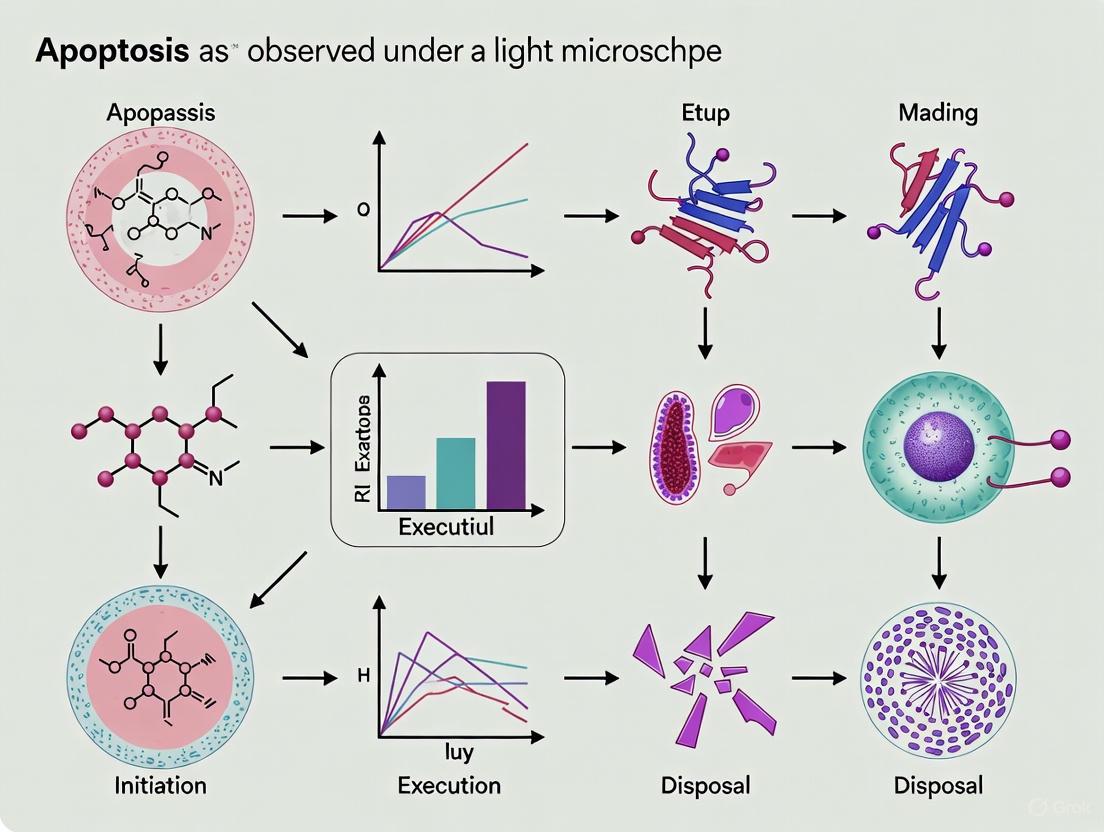
This article provides a comprehensive guide for researchers and drug development professionals on identifying the distinct phases of apoptosis using light microscopy.
A Practical Guide to Distinguishing Apoptosis Phases by Light Microscopy
Abstract
This article provides a comprehensive guide for researchers and drug development professionals on identifying the distinct phases of apoptosis using light microscopy. It covers the fundamental morphological and biochemical hallmarks of early and late apoptosis, details practical protocols for both label-free (DIC, PC) and fluorescence-based detection methods, and offers troubleshooting strategies for common pitfalls. By comparing light microscopy with other biochemical assays, the article validates its role as a powerful tool for real-time, non-invasive analysis of cell death in live cells, supporting applications in cancer research, neurobiology, and therapeutic efficacy evaluation.
Understanding Apoptosis: Core Pathways and Key Morphological Hallmarks
Apoptosis, a genetically regulated form of programmed cell death, is fundamental to both development and disease. It is characterized by a series of well-defined morphological and biochemical changes that enable the silent removal of cells without eliciting an inflammatory response, distinguishing it from necrotic cell death [1] [2]. This process is essential for normal development, tissue homeostasis, and the removal of damaged or infected cells. Disruptions to apoptotic pathways define a hallmark of cancer development, allowing malignant cells to overcome safeguards against uncontrolled proliferation [3]. Conversely, excessive apoptosis is implicated in neurodegenerative disorders and other pathological conditions. The accurate identification and quantification of apoptosis, particularly through non-invasive light microscopy techniques, is therefore crucial for both basic biological research and the development of novel therapeutic strategies.
Core Concepts and Hallmarks
Morphological and Biochemical Hallmarks
The execution of apoptosis is driven by the activation of a cascade of proteases, most notably the caspase family. Initiator caspases (e.g., caspase-8, -9) are activated in response to pro-apoptotic signals, which then activate effector caspases (e.g., caspase-3, -7) that cleave numerous cellular substrates, leading to the characteristic morphological changes [3] [1]. The key features that define apoptosis include:
- Cellular Shrinkage and Condensation: The cell and its nucleus undergo condensation, becoming more compact.
- Membrane Blebbing: The plasma membrane forms irregular bulges known as blebs.
- Chromatin Condensation and DNA Fragmentation: Nuclear chromatin condenses into compact masses, and the DNA is cleaved into oligonucleosomal fragments by endonucleases.
- Formation of Apoptotic Bodies: The cell fragments into small, membrane-bound vesicles called apoptotic bodies.
- Phosphatidylserine Externalization: The phospholipid phosphatidylserine (PS), normally confined to the inner leaflet of the plasma membrane, is translocated to the outer surface, serving as an "eat-me" signal for phagocytes.
- Maintenance of Plasma Membrane Integrity: Unlike necrosis, the plasma membrane remains intact during the initial stages, preventing the release of pro-inflammatory cellular contents.
In contrast, necrosis is an uncontrolled form of cell death caused by severe physicochemical injury. It is characterized by rapid cell and organelle swelling, loss of plasma membrane integrity, and leakage of intracellular contents, which triggers a significant inflammatory response [1] [2].
Key Biomarkers for Detection
A range of biomarkers has been exploited for detecting apoptosis in research and clinical settings. The table below summarizes the primary biomarkers and their targeting agents.
Table 1: Key Apoptosis Biomarkers and Targeting Agents
| Biomarker | Type of Cell Death | Targeting Group/Probe Examples | Primary Detection Modalities |
|---|---|---|---|
| Effector Caspases (e.g., Caspase-3) | Apoptosis | DEVD peptide sequence, Isatins | FLIM, Fluorescence, PET [3] [1] |
| Phosphatidylserine (PS) | Apoptosis (early) | Annexin V, Lactadherin, Zn-DPA | Fluorescence, Flow Cytometry, SPECT [4] [1] |
| DNA Fragmentation | Late Apoptosis | TUNEL assay, SYBR Green, dUTP incorporation | Fluorescence Microscopy, Flow Cytometry [5] [6] |
| Mitochondrial Membrane Potential | Apoptosis | Phosphonium cations, JC-1 | Fluorescence, PET [1] [5] |
| Cellular Morphology | Apoptosis | Label-free (direct observation) | Phase-Contrast Microscopy, FF-OCT [5] [2] |
Light Microscopy for Apoptosis Detection
Light microscopy serves as a powerful tool for detecting apoptosis, enabling researchers to observe both structural changes and biochemical events in living or fixed cells.
Label-Free Imaging Techniques
Label-free imaging allows for the observation of apoptotic morphology in living cells without the potential cytotoxic effects of stains or probes, making it ideal for long-term time-lapse studies.
- Phase-Contrast Microscopy: This technique is highly effective for visualizing the classic morphological changes associated with apoptosis, such as cell shrinkage, membrane blebbing, and the formation of apoptotic bodies [5] [7]. These changes alter the cell's refractive index and density, which are detected as variations in contrast in the phase-contrast image.
- Full-Field Optical Coherence Tomography (FF-OCT): An advanced label-free technique, FF-OCT provides high-resolution, three-dimensional visualization of cellular structures. It can clearly distinguish apoptotic features like echinoid spine formation, membrane blebbing, and filopodia reorganization from necrotic events characterized by rapid membrane rupture and intracellular content leakage [2]. Its key advantage is the ability to render detailed 3D topographies of single cells non-invasively.
- Quantitative Phase Microscopy (QPM): QPM maps phase shifts in transmitted light to visualize cell density and refractive index variations. It can quantitatively analyze subtle structural differences, such as cell shrinkage and condensation, during apoptosis [2].
Fluorescence Imaging Techniques
Fluorescence microscopy employs molecular probes to target specific biochemical hallmarks of apoptosis, providing high specificity and the ability to multiplex different markers.
- Caspase Activity Detection: Genetically encoded FRET (Fluorescence Resonance Energy Transfer) reporters are widely used. These reporters consist of donor and acceptor fluorescent proteins linked by a caspase cleavage site (e.g., DEVD). Upon caspase-3 activation, the linker is cleaved, separating the fluorophores and eliminating FRET, which can be detected as a change in the donor-to-acceptor fluorescence ratio or, more reliably, by a shortening of the donor's fluorescence lifetime (FLIM) [3]. Commercial fluorescently conjugated caspase inhibitors (e.g., FITC-VAD-FMK) also bind active caspases, providing a direct fluorescent readout of caspase activation [5].
- Phosphatidylserine Externalization: The binding of Annexin V conjugated to fluorophores like FITC to externalized PS is a gold standard for detecting early apoptosis. It is often used in conjunction with viability dyes like propidium iodide (PI) to distinguish early apoptotic (Annexin V+/PI-) from late apoptotic or necrotic (Annexin V+/PI+) cells [4] [8].
- DNA Fragmentation Detection: assays like the TUNEL (Terminal deoxynucleotidyl transferase dUTP Nick End Labeling) label the 3'-hydroxyl termini of DNA breaks with fluorescently tagged nucleotides, providing a specific marker for late-stage apoptosis [6] [9]. Dyes like SYBR Green can also be used to visualize condensed and fragmented chromatin [5].
Experimental Protocols and Workflows
Protocol: Caspase-3 Activation Imaging with FRET-FLIM
This protocol details the use of Fluorescence Lifetime Imaging Microscopy (FLIM) to quantify caspase-3 activity in live cells using a FRET-based reporter, a method that is particularly robust in 3D environments [3].
Cell Preparation and Transduction:
- Generate a stable cell line expressing a caspase-3 FRET reporter (e.g., LSS-mOrange-DEVD-mKate2) using lentiviral or PiggyBac transposon-based systems.
- Seed cells into an appropriate imaging dish (e.g., glass-bottom dish for high-resolution microscopy). For 3D studies, culture cells as spheroids or in Matrigel.
Treatment and Microscope Setup:
- Treat cells with the apoptotic inducer (e.g., chemotherapeutic drug, metabolic inhibitor) or vehicle control.
- Transfer the dish to a microscope equipped with a FLIM system, ideally using frequency-domain acquisition for rapid imaging. Maintain cells at 37°C and 5% CO₂ throughout the experiment.
Image Acquisition:
- Use two-photon or confocal microscopy to excite the donor fluorophore (e.g., LSS-mOrange).
- Acquire fluorescence lifetime images of the donor channel. FLIM measures the time a fluorophore remains in the excited state, which is shortened when FRET occurs (reporter intact) and lengthened upon caspase cleavage (FRET abolished).
Data Analysis with Phasor Plot:
- Process the FLIM data using phasor analysis, which transforms lifetime data into a graphical representation where each pixel is plotted based on its phase and modulation.
- In the phasor plot, pixels from cells with an intact reporter (high FRET, short lifetime) will cluster in one region, while pixels from apoptotic cells with a cleaved reporter (low FRET, long lifetime) will shift to a different region. This allows for real-time, pixel-wise quantification of caspase-3 activity.
Protocol: AI-Assisted Classification of Apoptosis via Phase-Contrast Imaging
This protocol leverages artificial intelligence to classify apoptotic cells based solely on label-free phase-contrast images, enabling high-throughput screening [5].
Sample Preparation and Imaging:
- Induce apoptosis in suspension cells (e.g., K562 human leukemic cells) using an agent like a gamma-secretase inhibitor (GSI-XXI).
- Simultaneously acquire phase-contrast images and fluorescence reference images of the same fields of view. For fluorescence, stain cells with a caspase activity probe (e.g., FITC-VAD-FMK) and a DNA dye (e.g., SYBR Green I).
Image Processing and Dataset Creation:
- Manually crop images to create a dataset of individual cell images.
- Classify each cell into categories based on the fluorescence reference images:
- Normal: Caspase-negative, no DNA fragmentation (CA-/Frag-)
- Early Apoptotic: Caspase-positive, no DNA fragmentation (CA+/Frag-)
- Late Apoptotic: Caspase-positive, DNA fragmentation-positive (CA+/Frag+)
AI Model Training:
- Import the labeled phase-contrast cell images into a machine learning platform (e.g., Lobe or a server-based ResNet50 model).
- Train the AI model to recognize the subtle morphological features in the phase-contrast images that correlate with the fluorescence-based apoptosis classification.
Validation and Application:
- Validate the model's accuracy using a separate test set of images, typically through methods like five-fold cross-validation, and evaluate using F-values.
- Once trained, the AI model can be used to automatically and rapidly classify apoptotic cells in new phase-contrast images, without the need for fluorescent staining.
Experimental Workflow Diagram
The following diagram illustrates the logical workflow for a combined microscopy approach to apoptosis analysis, integrating both label-free and fluorescence methods.
The Scientist's Toolkit: Essential Reagents and Materials
Table 2: Key Research Reagents for Apoptosis Detection via Light Microscopy
| Reagent/Material | Function | Example Application |
|---|---|---|
| Caspase FRET Reporter (e.g., LSS-mOrange-DEVD-mKate2) | Genetically encoded biosensor for caspase-3 activity; FRET efficiency decreases upon cleavage. | Live-cell imaging of caspase activation using FLIM or ratiometric imaging [3]. |
| Annexin V (FITC conjugate) | Binds to externalized phosphatidylserine (PS) on the outer leaflet of the plasma membrane. | Flow cytometry or fluorescence microscopy to detect early apoptotic cells [4] [8]. |
| Propidium Iodide (PI) / Ethidium Homodimer-1 (EthD-1) | Membrane-impermeant DNA dyes that stain nuclei of cells with compromised plasma membranes. | Distinguishing late apoptotic/necrotic cells (PI+) from early apoptotic cells (PI-) [8]. |
| Caspase Activity Probe (e.g., FITC-VAD-FMK) | Cell-permeable, fluorescently labeled inhibitor that covalently binds to active caspases. | Fluorescent detection of caspase activation in fixed or live cells [5]. |
| SYBR Green I | DNA-binding dye that stains nuclei; shows condensed/fragmented chromatin in apoptotic cells. | Fluorescent labeling of nuclear morphology in combination with caspase probes [5]. |
| Gamma-Secretase Inhibitor (GSI) | Chemical inducer of apoptosis; blocks Notch activation, leading to cell-cycle arrest and death. | Inducing apoptosis in leukemic cell lines (e.g., K562) for experimental studies [5]. |
| Custom-Built FF-OCT System | Label-free, high-resolution interferometric imaging system for 3D cellular tomography. | Visualizing and quantifying 3D morphological changes in apoptosis and necrosis [2]. |
Advanced Techniques and Future Directions
The field of apoptosis imaging is rapidly advancing with the integration of new technologies that provide deeper insights and higher throughput.
- Fluorescence Lifetime Imaging (FLIM): FLIM provides a robust, quantitative measure of FRET that is independent of fluorophore concentration and excitation light pathlength, making it superior to intensity-based ratiometric measurements, especially in thick samples like 3D spheroids and in vivo [3]. Phasor analysis of FLIM data simplifies the visualization and quantification of dynamic processes like caspase activation in real time.
- Artificial Intelligence (AI) and Machine Learning: AI models, such as convolutional neural networks (ResNet50), can be trained to identify apoptotic cells from phase-contrast images alone by learning the subtle morphological features associated with cell death [5]. This approach eliminates the need for staining, reduces observer bias and fatigue, and opens the door to fully automated, high-throughput screening of anticancer compounds.
- High-Resolution 3D Tomography: Techniques like Full-Field Optical Coherence Tomography (FF-OCT) are pushing the boundaries of label-free imaging by providing detailed, threeimensional topographic maps of single cells undergoing apoptosis. This allows for precise quantification of structural changes like membrane blebbing and filopodia reorganization with sub-micrometer resolution [2].
The precise definition and detection of apoptosis remain critical in biomedical research. Light microscopy, encompassing both classic and cutting-edge techniques, provides an indispensable suite of tools for this purpose. From the label-free identification of classical morphology using phase-contrast and FF-OCT to the specific biochemical profiling enabled by fluorescence reporters and stains, researchers can select and combine methodologies to suit their experimental needs. The ongoing integration of these imaging approaches with powerful quantitative analysis methods like FLIM and AI is transforming the field, enabling more dynamic, precise, and high-throughput analysis of programmed cell death in development and disease.
Apoptosis, or programmed cell death, is a fundamental process crucial for embryonic development, tissue homeostasis, and the elimination of damaged or infected cells [10] [11]. This genetically regulated process is characterized by distinct morphological changes: cell shrinkage, chromatin condensation, DNA fragmentation, membrane blebbing, and the formation of apoptotic bodies [10] [12] [11]. For researchers using light microscopy, recognizing these morphological hallmarks is the first step in identifying apoptotic cells [7] [13].
The molecular events driving these morphological changes are orchestrated primarily through two central signaling pathways: the intrinsic (mitochondrial) pathway and the extrinsic (death receptor) pathway [10] [14] [11]. Both pathways converge on the activation of caspases, a family of cysteine proteases that execute the dismantling of the cell [10] [11]. This whitepaper provides an in-depth technical comparison of these two pathways and details how light microscopy can be employed to distinguish the phases of apoptosis in a research setting.
Core Signaling Pathways: A Comparative Analysis
The Extrinsic (Death Receptor) Pathway
The extrinsic pathway is initiated outside the cell by the binding of specific death ligands to their corresponding death receptors on the cell surface [14] [11]. This pathway is typically activated in response to external signals, such as those from immune cells.
- Initiation: Death ligands (e.g., FasL, TNF-α) bind to their transmembrane death receptors (e.g., Fas, TNFR1) [14].
- Complex Formation: Receptor binding induces the formation of a multi-protein complex at the intracellular domain of the receptor, known as the Death-Inducing Signaling Complex (DISC) [10] [14].
- Caspase Activation: The DISC recruits and activates initiator caspase-8. In a cascade, caspase-8 then directly cleaves and activates the executioner caspases, caspase-3 and -7 [14] [11].
- Signal Amplification: In some cell types, activated caspase-8 cleaves the protein Bid, generating truncated Bid (tBid). tBid translocates to the mitochondria, thereby amplifying the death signal by engaging the intrinsic pathway [14] [11].
Diagram 1: The Extrinsic (Death Receptor) Pathway.
The Intrinsic (Mitochondrial) Pathway
The intrinsic pathway is initiated from within the cell in response to internal stressors, including DNA damage, oxidative stress, hypoxia, or growth factor withdrawal [10] [14]. The central regulator of this pathway is the mitochondrion.
- Initiation: Cellular stress signals activate sensor proteins, notably the tumor suppressor p53. p53 acts as a transcription factor to upregulate pro-apoptotic members of the Bcl-2 family, such as Bax, Bak, Noxa, and PUMA [10] [14].
- Mitochondrial Regulation: The Bcl-2 protein family, comprising both pro-apoptotic (e.g., Bax, Bak) and anti-apoptotic (e.g., Bcl-2, Bcl-xL) members, determines the cell's fate by controlling mitochondrial outer membrane permeabilization (MOMP) [10] [11].
- MOMP and Cytochrome c Release: Upon activation, Bax and Bak integrate into the mitochondrial outer membrane, forming pores that lead to MOMP. This results in the release of mitochondrial intermembrane space proteins, including cytochrome c, into the cytosol [10] [11].
- Apoptosome Formation and Caspase Activation: In the cytosol, cytochrome c binds to Apaf-1, forming a complex called the apoptosome. The apoptosome recruits and activates the initiator caspase-9 [14] [11].
- Execution: Activated caspase-9 then cleaves and activates the executioner caspases-3, -6, and -7, leading to the systematic cleavage of cellular components and the characteristic morphological changes of apoptosis [10] [11].
Diagram 2: The Intrinsic (Mitochondrial) Pathway.
Quantitative Comparison of Apoptotic Pathways
Table 1: Comparative Summary of Intrinsic and Extrinsic Apoptotic Pathways
| Feature | Intrinsic Pathway | Extrinsic Pathway |
|---|---|---|
| Also Known As | Mitochondrial Pathway [10] [14] | Death Receptor Pathway [10] [14] |
| Primary Initiator | Internal cellular stress (DNA damage, hypoxia, toxin exposure) [10] [14] | Extracellular death ligands (FasL, TNF-α) [14] [11] |
| Key Regulatory Complex | Bcl-2 Family Proteins [10] [11] | Death-Inducing Signaling Complex (DISC) [10] [14] |
| Key Initiator Caspase | Caspase-9 [10] [11] | Caspase-8 [10] [14] |
| Central Organelle | Mitochondrion [10] [14] | Plasma Membrane [14] |
| Key Biochemical Event | Mitochondrial Outer Membrane Permeabilization (MOMP) & Cytochrome c Release [10] [11] | Death Receptor Oligomerization & DISC Formation [10] [14] |
| Regulatory Proteins | p53, Bcl-2, Bax, Bak [10] [14] | FADD, TRADD, c-FLIP [14] |
| Cross-Talk Point | tBid (from caspase-8 cleavage) [14] [11] | tBid (amplifies signal via mitochondria) [14] [11] |
Distinguishing Apoptosis Phases by Light Microscopy
Light microscopy is a powerful, accessible tool for detecting and monitoring apoptosis in real-time without necessarily perturbing cells with stains [7] [13]. The following section details the morphological changes associated with different phases of apoptosis and how to identify them.
Morphological Hallmarks Across Apoptotic Stages
Table 2: Light Microscopy Features of Apoptosis Stages
| Stage | Key Morphological Features | Detectable by Transmitted Light | Corresponding Molecular Events |
|---|---|---|---|
| Early Phase | Cell shrinkage and rounding; loss of cell-cell contacts [7] [13]. | Yes (via DIC/Phase Contrast) [7] [13] | Caspase-8 or -9 activation; Phosphatidylserine externalization [11]. |
| Mid Phase | Chromatin condensation (pyknosis); pronounced membrane blebbing [7] [12]. | Yes (via DIC/Phase Contrast) [13] | Executioner caspase (caspase-3/7) activation; cleavage of structural proteins [11]. |
| Late Phase | Nuclear fragmentation (karyorrhexis); formation of apoptotic bodies [10] [12]. | Yes (via DIC/Phase Contrast) [13] | Widespread protein cleavage; DNA fragmentation; packaging into apoptotic bodies [10] [11]. |
Integrated Workflow for Apoptosis Detection
A robust experimental design combines label-free morphological observation with fluorescent probes to confirm the molecular mechanism and stage of apoptosis.
Diagram 3: Experimental Workflow for Apoptosis Detection.
Detailed Experimental Protocol: Inducing and Visualizing Apoptosis
Objective: To induce intrinsic apoptosis and monitor the progression of morphological changes using time-lapse light microscopy.
Materials:
- HeLa or PtK2 cell lines [15] [13].
- Complete cell culture medium (e.g., DMEM + 10% FBS) [13].
- Apoptosis inducer: Staurosporine (1-10 µM) [13].
- Imaging dishes (e.g., MatTek glass-bottom dishes) [13].
- Microscope equipped with DIC and fluorescence optics, environmental chamber (37°C, 5% CO₂), and time-lapse capability [13].
Method:
- Cell Preparation: Plate cells into glass-bottom dishes and allow them to adhere and grow to ~50-70% confluence [13].
- Induction of Apoptosis: Replace the medium with a fresh one containing staurosporine (a broad-spectrum kinase inhibitor that strongly induces the intrinsic pathway) at a final concentration of 10 µM. A control dish should receive the vehicle (e.g., DMSO) only [13].
- Time-Lapse Imaging: Place the dish on the microscope stage within the environmental chamber. Begin imaging immediately after treatment.
- Transmitted Light: Acquire DIC or phase-contrast images every 2-5 minutes for up to 4-6 hours to capture dynamic morphological changes [13].
- Fluorescence (Optional): If using a fluorescent probe for caspase activation (e.g., NucView 488 for caspase-3/7) or membrane integrity (e.g., propidium iodide), acquire fluorescence images at longer intervals (e.g., every 15-30 minutes) to minimize phototoxicity [13].
- Data Analysis: Analyze the acquired images for the sequential appearance of apoptotic features: cell rounding and shrinkage, membrane blebbing, and finally, the formation of apoptotic bodies.
The Scientist's Toolkit: Key Reagents for Apoptosis Research
Table 3: Essential Reagents for Apoptosis Detection Assays
| Reagent / Assay | Function / Target | Application and Notes |
|---|---|---|
| Staurosporine | Protein kinase inhibitor [13]. | Robust inducer of the intrinsic apoptotic pathway; used as a positive control [13]. |
| Annexin V (FITC conjugate) | Binds to phosphatidylserine (PS) [11]. | Marker for early apoptosis (PS externalization). Must be used with a viability dye (e.g., PI) to exclude necrotic/late apoptotic cells [16] [11]. |
| Propidium Iodide (PI) | DNA intercalating dye, membrane impermeant. | Labels nuclei of cells with compromised plasma membranes (necrosis, late apoptosis). Used to counter-stain Annexin V assays [11] [13]. |
| NucView 488 Caspase-3/7 Substrate | Cell-permeable, non-fluorescent substrate cleaved by caspase-3/7. | Fluorescently labels nuclei upon caspase-3/7 activation; marks mid-stage apoptosis [13]. |
| TMRE / JC-1 Dyes | Detect mitochondrial membrane potential (ΔΨm). | Loss of fluorescence indicates MOMP, an early event in intrinsic apoptosis. Can also occur in necrosis [11]. |
| TUNEL Assay | Labels 3'-OH ends of fragmented DNA. | Identifies late-stage apoptotic cells with DNA cleavage. Not entirely specific for apoptosis, as necrosis can also cause DNA damage [11] [17]. |
| z-VAD-fmk | Pan-caspase inhibitor. | Used to confirm the caspase-dependence of the cell death process [10]. |
The intrinsic and extrinsic apoptotic pathways, while initiated by distinct stimuli, execute a conserved cellular demolition program characterized by a predictable sequence of morphological events. Light microscopy, particularly when combining label-free transmitted light techniques with specific fluorescent probes, provides an invaluable tool for researchers to identify, validate, and stage apoptosis in real-time. A solid understanding of the underlying signaling pathways, as detailed in this whitepaper, empowers scientists to design more rigorous experiments, accurately interpret microscopic observations, and advance drug discovery efforts aimed at modulating cell death in diseases like cancer and neurodegeneration.
Apoptosis, or programmed cell death, is a fundamental biological process crucial for development, tissue homeostasis, and the elimination of damaged or potentially cancerous cells. At the heart of the apoptotic machinery lies a family of cysteine proteases known as caspases (cysteine-aspartic proteases), which serve as the principal executioners of cell death. These enzymes function as molecular guillotines, systematically dismantling cellular components through precise cleavage after aspartic acid residues in target proteins [18]. The caspase family consists of initiator caspases (including caspase-8, -9, and -10) that sense death signals and activate executioner caspases (caspase-3, -6, and -7), which in turn mediate the controlled demolition of the cell [19] [20]. Understanding caspase activation and function provides the foundational knowledge necessary for distinguishing apoptotic phases via light microscopy, enabling researchers to visualize and quantify this critical cellular process in real-time without significantly perturbing cellular physiology [13].
Caspase Classification and Activation Mechanisms
Traditional and Emerging Classification Systems
Caspases have traditionally been classified into three broad categories based on their primary functions in apoptotic pathways and inflammation, as detailed in Table 1.
Table 1: Traditional Classification of Caspase Family Proteases
| Category | Members | Primary Functions | Activation Mechanism |
|---|---|---|---|
| Initiator Caspases | Caspase-8, -9, -10 | Sense death signals; initiate apoptotic cascade | Activation platforms (DISC, apoptosome) |
| Executioner Caspases | Caspase-3, -6, -7 | Mediate proteolytic cleavage of cellular components | Cleaved and activated by initiator caspases |
| Inflammatory Caspases | Caspase-1, -4, -5, -11, -12 | Process inflammatory cytokines; pyroptosis | Inflammasome complexes |
Recent research has revealed that caspase functions extend beyond this traditional binary view of "death" versus "non-death" roles. A emerging "functional continuum" model proposes that caspases operate along an activity gradient where low-level activity facilitates homeostatic functions, moderate activation supports defensive responses, and high-level activity triggers cell death programs [19]. This model incorporates spatiotemporal localization as a critical determinant of functional output, explaining how the same caspase can mediate disparate functions in different cellular compartments [19].
Molecular Activation Mechanisms
Caspase activation occurs through well-defined molecular mechanisms that differ between initiator and executioner caspases:
- Initiator Caspase Activation: Initiator caspases are activated through dimerization induced by binding to specific activation platforms. Caspase-8 is recruited to the Death-Inducing Signaling Complex (DISC) following death receptor activation, while caspase-9 is activated through binding to the apoptosome, a multiprotein complex formed when cytochrome c is released from mitochondria [20].
- Executioner Caspase Activation: Executioner caspases exist as dimers in their inactive zymogen forms and require proteolytic cleavage by initiator caspases to become fully active. This creates a cascade of amplification where a small number of initiator caspase molecules can activate numerous executioner caspases [19].
- Engineering Novel Activation Systems: Recent innovations include engineered caspase proteins activatable by tobacco etch virus (TEV) protease, which replaces natural activation cleavage sites with TEV recognition sequences. This system enables high-throughput screening for caspase inhibitors with reduced background activity [21].
The following diagram illustrates the core caspase activation pathways and their functional relationships:
Experimental Detection of Caspase Activity in Apoptosis
Light Microscopy Approaches for Apoptosis Detection
Light microscopy provides powerful, non-destructive methods for detecting apoptosis through morphological changes and fluorescent reporters, enabling real-time observation of living cells [13]. The key advantage of light microscopy is its ability to monitor temporal dynamics without significant cellular perturbation, especially when using transmitted light modalities like phase contrast (PC) or differential interference contrast (DIC) [13].
Table 2: Light Microscopy Methods for Apoptosis Detection
| Method | Detection Principle | Key Features | Compatible Stains/Reporters |
|---|---|---|---|
| Transmitted Light (PC/DIC) | Morphological changes (cell shrinkage, membrane blebbing) | Non-invasive, real-time monitoring, no stains required | None required |
| Fluorescence Microscopy | Caspase activity or membrane changes | High specificity, multiplexing capability | Annexin V, Caspase-3/7 reporters, Hoechst, NucView 488 |
| Time-Lapse Imaging | Temporal progression of apoptosis | Kinetic data, single-cell resolution | Compatible with both transmitted light and fluorescence |
Phase-contrast microscopy can detect apoptosis through characteristic morphological changes including cytoplasmic blebbing, cell shrinkage, and nuclear fragmentation [13] [22]. These changes typically occur within 30 minutes to several hours after apoptotic induction and can be quantified through automated image analysis algorithms that achieve approximately 90% accuracy in detecting apoptotic events [22].
Fluorescent Reporters and Detection Assays
Fluorescent reporters enable specific detection of caspase activation and other apoptotic events:
- Caspase Activity Reporters: Fluorogenic substrates like NucView 488 provide a direct readout of caspase-3/7 activity. These substrates are non-fluorescent until cleaved by active caspases, after which they bind DNA and produce intense nuclear fluorescence [13].
- Membrane Asymmetry Probes: Annexin V conjugates bind to phosphatidylserine, which becomes exposed on the outer leaflet of the plasma membrane during early apoptosis [13].
- DNA Binding Dyes: Probes like Hoechst or DAPI allow visualization of nuclear fragmentation and chromatin condensation in late apoptosis [13].
The experimental workflow below outlines a typical protocol for time-lapse imaging of caspase activation:
Quantitative Profiling of Caspase Activity
Advanced proteomic approaches have revealed the complex substrate landscape of caspases during apoptosis. Quantitative N-terminomics technology has identified approximately 500 caspase cleavage products whose kinetics vary dramatically between cell types and cytotoxic drug treatments [18]. Selected reaction monitoring (SRM) mass spectrometry enables highly sensitive quantification of these caspase-derived peptides, revealing that caspase substrates are cleaved at rates varying more than 500-fold, suggesting a precise temporal order to the apoptotic dismantling process [18].
Research Reagent Solutions for Caspase Studies
Table 3: Essential Research Reagents for Caspase and Apoptosis Detection
| Reagent/Category | Specific Examples | Function/Application |
|---|---|---|
| Caspase-Specific Reporters | NucView 488, PhiPhiLux, FRET-based substrates | Direct detection of caspase-3/7 activity in live cells |
| Membrane Integrity Probes | Annexin V conjugates, Biotracker Apo-15 | Detection of phosphatidylserine externalization |
| DNA Staining Dyes | Hoechst 33342, DAPI, Propidium iodide | Nuclear morphology assessment and viability staining |
| Apoptosis Inducers | Staurosporine, Bortezomib, Doxorubicin | Experimental induction of intrinsic/extrinsic apoptosis |
| Caspase Inhibitors | Z-VAD-FMK (pan-caspase), specific caspase inhibitors | Mechanistic studies and control experiments |
| Engineered Caspase Systems | TEV-activatable caspase-10 | High-throughput screening for selective inhibitors |
Technical Protocols for Caspase Detection
Time-Lapse Imaging of Caspase Activation in Live Cells
This protocol enables real-time visualization of caspase activation and morphological changes in apoptotic cells using combined transmitted light and fluorescence microscopy [13].
Cell Preparation:
- Plate cells in MatTek glass-bottom 35 mm Petri dishes in phenol red-free medium 24 hours before experimentation.
- Use appropriate cell lines (e.g., PtK or HeLa cells) grown in EMEM or DMEM supplemented with 10% FBS, L-glutamine, and non-essential amino acids.
Apoptosis Induction and Staining:
- Treat cells with 10 μM Staurosporine (in 1% DMSO) 30 minutes prior to imaging.
- Add NucView 488 caspase-3/7 substrate (or similar) according to manufacturer's instructions.
Microscope Configuration:
- Use an inverted microscope (e.g., Nikon Eclipse Ti) equipped with DIC optics, fluorescence capabilities, and a perfect focus system.
- Maintain environmental control at 37°C with appropriate humidity and CO₂ levels.
- For DIC: Illuminate with shuttered, green (510-560 nm) heat-filtered light from 100 W tungsten bulbs.
- For fluorescence: Use a white light LED source (e.g., Lumencor Sola) with appropriate filter sets.
Image Acquisition:
- Acquire images in a single Z-plane at 2-4 frames/minute for 2-8 hours.
- Collect both DIC and fluorescence (e.g., FITC for NucView 488) channels at each time point.
- Control all microscope and camera functions with software such as Nikon Elements.
Data Analysis:
- Quantify the percentage of cells showing caspase activation (fluorescence) and morphological changes.
- Track individual cells over time to determine the sequence of apoptotic events.
High-Throughput Screening for Caspase Inhibitors
This protocol describes a screening approach for identifying selective caspase inhibitors using engineered caspase proteins, adapted from recent research [21]:
Protein Engineering:
- Generate TEV-activatable caspase constructs by replacing natural caspase cleavage sites (e.g., D415 in caspase-10) with TEV protease recognition sequences (ENLYFQG).
- Express and purify engineered caspase proteins, ensuring low background activity before TEV activation.
Screening Assay:
- Incubate engineered caspase-10 (333 nM) with test compounds in 384-well plates.
- Activate caspase by adding TEV protease (667 nM) and incubate for 30-60 minutes.
- Add fluorogenic substrate (Ac-VDVAD-AFC, 10 μM) and measure fluorescence continuously.
- Include controls: DMSO-only (negative), known caspase inhibitor (positive).
Hit Validation:
- Counter-screen against TEV protease to eliminate compounds targeting the activator protease.
- Determine IC₅₀ values for confirmed hits using dose-response curves.
- Test selectivity against other caspase family members.
Discussion: Implications for Research and Therapeutics
The precise understanding of caspase function in apoptosis execution has profound implications for both basic research and therapeutic development. In cancer research, apoptosis resistance is a hallmark of cancer, and understanding caspase regulation provides insights into overcoming drug resistance [20]. Many chemotherapeutic agents induce apoptosis through caspase-dependent mechanisms, and cancer cells frequently develop strategies to evade this process through impaired caspase activation or expression of caspase inhibitors [23] [20].
The growing North American apoptosis assay market, projected to reach USD 6.1 billion by 2034, reflects the increasing importance of caspase and apoptosis detection in drug discovery and development [24]. Technological advancements in flow cytometry, high-content imaging, and artificial intelligence-driven image analysis are enhancing the precision and efficiency of caspase activity measurement in both research and clinical applications [24].
Emerging research continues to reveal the complexity of caspase functions beyond apoptosis, including roles in cellular differentiation, immune modulation, and neural plasticity [19]. This expanding understanding is driving the development of more sophisticated tools for caspase detection and inhibition, with potential applications in cancer therapy, neurodegenerative diseases, and autoimmune disorders [19]. The integration of advanced microscopy techniques with specific caspase detection methods provides researchers with powerful approaches to visualize and quantify the central executioners of apoptosis, enabling deeper insights into both physiological and pathological cell death processes.
Apoptosis, a form of programmed cell death (PCD), is characterized by specific morphological changes including cell shrinkage, chromatin condensation, membrane blebbing, and nuclear fragmentation [11]. This process is critical for maintaining healthy tissue homeostasis by eliminating old or damaged cells and occurs during early embryonic development to remove unnecessary cells [11]. Disruptions in apoptotic pathways can lead to severe consequences: excessive apoptosis contributes to neurodegenerative diseases, while insufficient apoptosis may promote cancer progression and autoimmune disorders [11].
This technical guide focuses on the visual hallmarks of early apoptosis, specifically cell shrinkage and membrane blebbing, providing researchers with methodologies to distinguish apoptosis phases using light microscopy. Proper identification of these morphological changes enables scientists to detect apoptosis before biochemical markers become apparent, offering a crucial advantage in experimental timing and interpretation.
Morphological Transitions in Early Apoptosis
Core Visual Hallmarks
The early phase of apoptosis is marked by distinct morphological changes that can be visualized through light microscopy:
Cell Shrinkage: One of the earliest detectable events, where cells undergo significant reduction in volume due to cytoplasmic condensation and disruption of the cytoskeletal architecture [11] [25]. This contrasts with necrotic cells, which typically swell and rupture [13].
Membrane Blebbing: Characterized by the formation of dynamic bulges or blebs on the plasma membrane surface resulting from cytoskeletal breakdown and actomyosin-driven contractions [25]. These blebs eventually separate from the cell, forming apoptotic bodies containing cytoplasm and condensed organelles [25].
Chromatin Condensation: Genetic material becomes highly compacted within the nucleus, though this may be less visible in early stages without specific staining techniques [25].
These morphological changes occur due to the activation of caspases, particularly executioner caspases (caspase-3, -6, and -7), which cleave key cellular substrates including structural proteins such as gelsolin and ROCK1 [11] [25].
Comparative Morphology of Cell Death
Table 1: Distinguishing Early Apoptosis from Other Cell Death Forms
| Morphological Feature | Early Apoptosis | Necrosis | Late Apoptosis |
|---|---|---|---|
| Cell Size | Reduced (shrinkage) | Increased (swelling) | Reduced with apoptotic bodies |
| Plasma Membrane | Intact with blebbing | Ruptured | Disintegrated into fragments |
| Membrane Blebbing | Present | Absent | Present (extensive) |
| Cellular Contents | Retained | Released | Contained in apoptotic bodies |
| Inflammation | Minimal or none | Significant | Minimal or none |
| Phagocytic Signal | Phosphatidylserine exposure | Damage-associated patterns | Phosphatidylserine exposure |
Light Microscopy Detection Methods
Imaging Modalities for Apoptosis Detection
Light microscopy provides powerful, non-invasive approaches for detecting apoptosis through real-time observation of morphological changes [13]. Different modalities offer specific advantages:
Transmitted Light Microscopy (Phase Contrast and DIC): Enables visualization of morphological changes without staining or significant sample preparation [13]. This method allows researchers to differentiate between apoptosis and necrosis based on cytoplasmic characteristics - necrotic cells swell without blebbing compared to apoptotic cells [13].
Fluorescence Microscopy: Utilizes specific probes and reporters for different apoptosis phases, such as tagged caspase-3 for early detection or DNA-binding dyes like Hoechst and DAPI for nuclear changes [13].
The simplicity of transmitted light microscopy makes it particularly valuable for initial apoptosis detection, as cellular changes can be monitored by simply viewing cells without staining or extensive sample preparation [13].
Experimental Protocol: Time-Lapse Imaging of Early Apoptosis
Objective: To capture and quantify early apoptotic events (cell shrinkage and membrane blebbing) in live cells using time-lapse microscopy.
Materials:
- Cell culture (e.g., PtK or HeLa cells)
- Apoptosis inducer (e.g., 10 μM Staurosporine in 1% DMSO)
- MatTek glass-bottom 35 mm Petri dishes
- Culture media without phenol red indicator
- Inverted light microscope with DIC and fluorescence optics
- Perfect Focus system
- Environmental chamber maintaining 37°C and 5% CO₂
Procedure:
- Culture cells in MatTek dishes with phenol-red-free media for 24 hours before experimentation [13].
- Induce apoptosis by treating with 10 μM Staurosporine 30 minutes prior to imaging [13].
- Mount samples on microscope stage with environmental control.
- For DIC imaging: Illuminate with shuttered, green (510-560 nm) heat-filtered light from 100W tungsten bulbs [13].
- Configure time-lapse imaging in a single Z-plane with a framing rate of 2-4 frames/minute [13].
- Capture images over 2-6 hours to monitor early apoptotic events.
- For parallel caspase activation assessment: Include NucView 488 substrate (cleaved by caspase-3/7 to release DNA-binding dye) [13].
Data Analysis:
- Quantify cell size reduction using image analysis software to measure cross-sectional area over time.
- Count and measure membrane blebs, noting their frequency and duration.
- Correlate morphological changes with fluorescent caspase activation if using dual-mode imaging.
Research Reagent Solutions
Table 2: Essential Reagents for Apoptosis Detection via Light Microscopy
| Reagent/Kit | Function | Detection Method | Key Features |
|---|---|---|---|
| NucView 488 Caspase-3/7 Substrate | Detection of caspase activation | Fluorescence microscopy | Non-fluorescent until cleaved; penetrates plasma membrane |
| Annexin V Conjugates (FITC, Cy3, Cy5, PE) | Binds phosphatidylserine exposed on membrane surface | Flow cytometry or fluorescence microscopy | Early apoptosis marker; requires combination with viability dye |
| TUNEL Assay Kits | Labels fragmented DNA | Fluorescence microscopy, flow cytometry | Late apoptosis detection; high sensitivity risk of false positives |
| MitoTracker Red CMXRos | Assesses mitochondrial membrane potential | Fluorescence microscopy | Loss of signal indicates mitochondrial dysfunction |
| Propidium Iodide | Membrane integrity assessment | Fluorescence microscopy | Distinguishes late apoptotic/necrotic cells; impermeant to live cells |
| Staurosporine | Protein kinase inhibitor; apoptosis inducer | Experimental treatment | Induces intrinsic apoptosis through caspase-dependent and independent pathways |
Relationship to Apoptotic Signaling Pathways
The morphological changes of early apoptosis result from precise activation of molecular pathways. Two main mechanisms trigger apoptosis: the extrinsic (death receptor) pathway and the intrinsic (mitochondrial) pathway [11].
In the intrinsic pathway, cellular stress activates pro-apoptotic Bcl-2 family proteins (Bax, Bak) which induce mitochondrial outer membrane permeabilization (MOMP), leading to cytochrome c release and activation of caspase-9 [11]. The extrinsic pathway begins when extracellular death ligands bind to cell surface receptors, forming the death-inducing signaling complex (DISC) and activating caspase-8 [11].
Both pathways converge on the activation of executioner caspases (caspase-3, -6, -7) [11]. These proteases cleave key structural components including nuclear proteins (lamins), cytoskeletal proteins (gelsolin, ROCK1), and DNA repair enzymes (PARP), directly causing the morphological hallmarks of apoptosis: cell shrinkage, membrane blebbing, and nuclear fragmentation [11] [25].
Apoptotic Signaling Leading to Morphological Changes
Technical Considerations and Validation
Advantages and Limitations of Morphological Analysis
Advantages:
- Real-time monitoring of apoptosis progression in live cells [13]
- Non-invasive detection when using transmitted light modalities [13]
- Early detection capability before biochemical markers become pronounced
- Spatial context preservation within cell populations
Limitations:
- Subjectivity in identification without experienced interpretation
- Potential confusion with other cellular processes causing shape changes
- Limited specificity without complementary assays
- Resolution constraints for small or subtle changes
Multiparameter Validation Approaches
While light microscopy provides valuable morphological data, confirming apoptosis requires multiparameter validation due to overlapping features with other cell death forms [11] [25]. Recommended complementary approaches include:
Phosphatidylserine Exposure: Detect using Annexin V binding in combination with viability dyes like propidium iodide to distinguish early apoptosis (Annexin V+/PI-) from late apoptosis/necrosis (Annexin V+/PI+) [11] [25].
Caspase Activation: Assess using fluorogenic substrates (e.g., NucView 488) or antibodies specifically recognizing active caspases [13] [25].
Mitochondrial Changes: Monitor membrane potential decrease using Δψm-sensitive probes (e.g., TMRE) [11].
Nuclear Fragmentation: Detect via TUNEL assay or DNA laddering analysis, though these represent later apoptotic events [11] [25].
Table 3: Temporal Sequence of Apoptotic Markers
| Marker Category | Specific Markers | Detection Window | Primary Methodology |
|---|---|---|---|
| Early Morphological | Cell shrinkage, Membrane blebbing | 30 minutes - 2 hours | Phase contrast/DIC microscopy |
| Membrane Alterations | Phosphatidylserine exposure | 1 - 4 hours | Annexin V binding |
| Protease Activation | Caspase-3/7 cleavage | 1 - 3 hours | Fluorogenic substrates, Active caspase antibodies |
| Mitochondrial | Membrane potential loss, Cytochrome c release | 1 - 4 hours | TMRE staining, Western blot |
| Nuclear Changes | Chromatin condensation, DNA fragmentation | 2 - 6 hours | Hoechst/DAPI staining, TUNEL assay |
The visual identification of cell shrinkage and membrane blebbing through light microscopy provides researchers with a valuable tool for detecting early apoptosis in real-time without extensive sample processing. These morphological hallmarks represent the physical manifestation of complex molecular events including caspase activation and cleavage of structural proteins.
When integrated with complementary biochemical assays, light microscopy forms a powerful approach for distinguishing apoptosis phases and mechanisms. This multi-faceted methodology enables more accurate interpretation of experimental results across various research contexts, from basic biological investigations to drug discovery and development. As microscopy technologies continue advancing, the ability to detect and quantify these apoptotic hallmarks with greater precision will further enhance our understanding of programmed cell death and its implications in health and disease.
Late apoptosis is characterized by a sequence of definitive morphological events that signal the terminal phase of programmed cell death. This whitepaper provides an in-depth technical analysis of two primary hallmarks of this stage: nuclear fragmentation and apoptotic body formation. Within the context of light microscopy research, we delineate precise methodologies to identify and distinguish these features from earlier apoptotic events and other forms of cell death. We present quantitative data on nuclear morphological parameters, detail experimental protocols for inducing and visualizing these events, and introduce advanced computational tools for detection. This guide serves as an essential resource for researchers and drug development professionals aiming to accurately phase apoptosis in experimental and therapeutic contexts.
Apoptosis progresses through a series of well-orchestrated morphological changes, transitioning from early events like cell shrinkage and phosphatidylserine externalization to late-stage phenomena characterized by irreversible structural disintegration [26]. For researchers relying on light microscopy, accurate staging is paramount for interpreting experimental outcomes, especially in therapeutic contexts like cancer research where inducing apoptosis is a primary goal. The late stage, marked by nuclear fragmentation and apoptotic body formation, represents the point of cellular disassembly and is frequently the most visually distinctive phase under microscopic examination [27]. This document frames these late-stage hallmarks within a broader strategy for distinguishing apoptotic phases, providing the technical foundation for robust, microscopy-based assessment.
Visual Hallmarks of Late Apoptosis
The terminal phase of apoptosis is defined by the systematic dismantling of cellular components. The following hallmarks are readily identifiable via light microscopy when paired with appropriate staining techniques and analytical tools.
Nuclear Fragmentation (Pyknosis and Karyorrhexis)
The nucleus undergoes a characteristic and sequential transformation during late apoptosis, as detailed below.
- Chromatin Condensation (Pyknosis): The initial event involves the compaction of nuclear chromatin into dense, hyperchromatic masses. Under fluorescence microscopy with DNA-binding dyes like DAPI, this manifests as a marked increase in nuclear staining intensity and a transition from a diffuse to a coarse, granular pattern [27].
- Nuclear Fragmentation (Karyorrhexis): Following condensation, the nuclear envelope breaks down, and the condensed chromatin shatters into discrete, membrane-bound fragments [28]. This is not a random process but often results in multiple, spherical DNA-containing bodies within the cytoplasmic space.
Table 1: Quantitative Changes in Nuclear Morphology During Apoptosis
| Morphological Parameter | Normal Nuclei | Apoptotic Nuclei (Late Stage) | Measurement Technique |
|---|---|---|---|
| Nuclear Area | ~150-200 μm² [27] | Significantly reduced (~50% decrease) [27] | Fluorescence microscopy, DAPI staining |
| Nuclear Perimeter | Smooth, oval | Irregular, reduced | Image analysis software |
| Major & Minor Axis | Proportionally maintained | Disproportionally shortened | Image analysis software |
| Staining Intensity (DAPI) | Consistent, diffuse | Markedly increased, heterogeneous | Fluorescence intensity analysis |
Apoptotic Body Formation
Following nuclear fragmentation, the entire cell packages its contents into small, membrane-enclosed vesicles known as apoptotic bodies.
- Morphology and Content: Apoptotic bodies are typically spherical, range from 1-5 μm in diameter, and contain intact organelles and/or nuclear fragments [29]. Their formation is the cell's mechanism to safely package cellular material for efficient phagocytosis by neighboring cells, thereby preventing an inflammatory response [26].
- The "FOOTPRINT OF DEATH" (FOOD): A 2025 study identified a novel mechanism for generating large apoptotic extracellular vesicles (ApoEVs). In adherent cells, apoptotic retraction can leave behind an F-actin-rich "footprint" on the substrate, which subsequently vesicularizes into FOOD-derived ApoEVs (F-ApoEVs) approximately 2 μm in diameter [29]. This process is distinct from the formation of apoptotic bodies via membrane blebbing or apoptopodia.
Experimental Protocols for Induction and Visualization
Reproducible observation of late apoptotic hallmarks requires standardized protocols for induction and staining.
Induction of Apoptosis
A common method for inducing the intrinsic apoptotic pathway in vitro is through chemical intervention.
- Reagent: Staurosporine, a protein kinase inhibitor, is a potent inducer of intrinsic apoptosis. It acts by triggering mitochondrial outer membrane permeabilization (MOMP) and caspase activation [13] [30].
- Protocol: For mammalian cell lines (e.g., HeLa, PtK, SH-SY5Y), prepare a 10 μM working solution in culture medium containing 1% DMSO. Replace the normal culture medium with the staurosporine-containing medium and incubate for 2-6 hours at 37°C and 5% CO₂. The optimal duration is cell line-dependent and requires empirical determination [13].
Staining and Visualization Protocols
Specific staining protocols enable clear visualization of nuclear and cellular morphology.
Protocol for Nuclear Morphology Assay: This protocol allows for the quantification of apoptotic nuclear changes [27].
- Cell Seeding and Treatment: Seed cells (e.g., LNCaP, MDA-MB-231) onto glass-bottom dishes or multi-well plates. After apoptosis induction, wash cells twice with phosphate-buffered saline (PBS).
- Fixation and Permeabilization: Fix cells with 4% paraformaldehyde for 15 minutes. Permeabilize with 0.2% Triton X-100 for 10 minutes.
- DNA Staining: Incubate cells with a 1.0 μg/mL DAPI solution for 5-10 minutes, protected from light.
- Image Acquisition and Analysis: Acquire images using a fluorescence microscope with a DAPI filter set. Use image analysis software (e.g., BZ-II Analyzer, ImageJ) to quantify parameters such as nuclear area, perimeter, and fluorescence intensity for at least 100 nuclei per condition.
Real-Time Detection with Fluorescent Reporters:
- Caspase Activation: Use fluorescent probes like NucView 488, a cell-permeable, non-flugenic substrate that is cleaved by active caspase-3/7 to release a high-affinity DNA dye, resulting in nuclear fluorescence [13].
- Membrane Changes: Annexin V conjugates bind to phosphatidylserine (PtdSer) exposed on the outer leaflet of the plasma membrane, an early event that precedes nuclear fragmentation [29] [13]. Co-staining with a viability dye like propidium iodide can help distinguish early from late apoptosis.
Advanced Detection and Analysis Tools
Moving beyond manual observation, advanced tools now allow for high-throughput and precise analysis.
The Scientist's Toolkit: Essential Research Reagents
Table 2: Key Reagents for Apoptosis Detection via Light Microscopy
| Reagent / Tool | Function / Target | Application in Late Apoptosis |
|---|---|---|
| DAPI / Hoechst | DNA intercalating dyes | Highlights chromatin condensation and nuclear fragmentation [27]. |
| NucView 488 | Caspase-3/7 substrate | Fluorescently labels nuclei upon caspase activation, marking committed cells [13]. |
| Annexin V (e.g., A5) | Binds phosphatidylserine (PtdSer) | Detects PtdSer exposure on apoptotic bodies and F-ApoEVs [29]. |
| Staurosporine | Protein kinase inhibitor | Robust chemical inducer of the intrinsic apoptotic pathway [13]. |
| ADeS (AI Tool) | Deep learning-based detection | Automates detection and tracking of apoptotic morphology in live-cell imaging [28]. |
Computational Detection: The ADeS Platform
For complex datasets, especially from live-cell imaging, manual annotation becomes impractical. ADeS is a transformer-based deep learning system trained to detect apoptosis by recognizing morphological hallmarks. It can identify the location and duration of multiple apoptotic events in full microscopy time-lapses with over 98% accuracy, outperforming human annotation [28]. This tool is particularly valuable for high-content screening in drug development.
Distinguishing Late Apoptosis from Reversible Early Stages
A critical concept in apoptotic staging is the "point of no return." Research indicates that cells can recover from profound stress markers, including membrane blebbing, nuclear condensation, and mitochondrial fragmentation, if mitochondrial outer membrane permeabilization (MOMP) and cytochrome c release have not occurred [30]. Therefore, the visualization of released cytochrome c (e.g., via Cyto.c-GFP constructs) can serve as a key biochemical correlate to the morphological hallmarks of late apoptosis. The events of nuclear fragmentation and apoptotic body formation typically occur downstream of MOMP, marking an irreversible commitment to cell death.
The visual identification of nuclear fragmentation and apoptotic body formation remains a cornerstone of apoptosis validation in cellular research. By integrating traditional light microscopy with quantitative image analysis, specific fluorescent probes, and emerging computational tools like ADeS, researchers can achieve high confidence in distinguishing the irreversible late phase of apoptosis. This precise staging is critical for evaluating the efficacy of novel therapeutics, understanding disease mechanisms involving dysregulated cell death, and advancing our fundamental knowledge of cellular life cycles.
The precise differentiation between apoptosis and necrosis is a cornerstone of biomedical research, with significant implications for understanding disease mechanisms and developing therapeutic strategies. While both processes result in cell death, they are characterized by distinct morphological and biochemical hallmarks that have profound consequences for tissue homeostasis and inflammatory responses. This technical guide provides researchers with a comprehensive framework for distinguishing these cell death pathways, with particular emphasis on label-free detection methods, including light microscopy. We present detailed experimental protocols, quantitative morphological comparisons, and analytical techniques to facilitate accurate identification and interpretation of apoptotic and necrotic phenotypes in research and drug development contexts.
Cell death is a fundamental biological process with critical implications for development, tissue homeostasis, and disease pathology. The distinction between apoptosis and necrosis represents a cornerstone of cellular biology, as these processes differ dramatically in their mechanisms, morphological presentations, and physiological consequences [31]. Apoptosis, or programmed cell death, is an actively regulated, energy-dependent process that eliminates unwanted or damaged cells without triggering an inflammatory response [32]. First formally characterized by Kerr, Wyllie, and Currie in 1972, apoptosis plays crucial roles in embryonic development, immune system regulation, and maintenance of tissue homeostasis [31] [33]. In contrast, necrosis has traditionally been viewed as an accidental, unregulated form of cell death resulting from extreme physicochemical stress or injury, characterized by rapid plasma membrane rupture and release of intracellular contents that provoke inflammatory responses [32] [31].
Advancements in detection technologies have revealed that the distinction between these pathways is not always absolute, with some forms of necrosis exhibiting regulatory mechanisms and overlapping features. However, the classical morphological differences remain reliably distinct and form the basis for experimental differentiation. This whitepaper provides a comprehensive technical reference for distinguishing apoptosis from necrosis, with particular emphasis on methodologies relevant to light microscopy research and drug development applications.
Morphological Hallmarks: A Comparative Analysis
Characteristic Features of Apoptosis
Apoptotic cell death presents a stereotypic sequence of morphological changes that facilitate clear identification. The process initiates with cell shrinkage, where the cytoplasm condenses and the cell detaches from its extracellular matrix and neighboring cells [32] [33]. This is followed by chromatin condensation (pyknosis), where nuclear material aggregates into dense, marginalized masses, and nuclear fragmentation (karyorrhexis), where the nucleus breaks into discrete fragments [31]. The plasma membrane undergoes characteristic blebbing, forming protrusions that eventually separate from the cell as apoptotic bodies—small, membrane-bound vesicles containing intact organelles and nuclear fragments [2] [33]. These morphological events occur while membrane integrity remains preserved, preventing the release of inflammatory cellular contents [34]. The process concludes with rapid phagocytosis of apoptotic bodies by neighboring cells or macrophages, preventing secondary necrosis and inflammatory activation [31].
Characteristic Features of Necrosis
Necrosis presents a dramatically different morphological profile characterized primarily by loss of regulatory capacity. Initial stages feature cell swelling and organelle enlargement, particularly affecting mitochondria and the endoplasmic reticulum [34] [31]. This progresses to plasma membrane rupture and uncontrolled release of intracellular components into the extracellular space, triggering inflammatory responses [2]. Unlike apoptosis, necrosis involves random DNA degradation rather than organized fragmentation, and the nucleus may undergo pyknosis followed by complete dissolution (karyolysis) [31]. The process culminates in complete cellular disintegration without the formation of discrete, membrane-bound fragments [32]. These features collectively reflect a failure of homeostatic mechanisms rather than an actively executed program.
Table 1: Comparative Morphological Features of Apoptosis and Necrosis
| Morphological Parameter | Apoptosis | Necrosis |
|---|---|---|
| Cell Size | Shrinkage | Swelling |
| Plasma Membrane | Intact with blebbing | Rupture and disintegration |
| Membrane Integrity | Maintained until late stages | Rapidly lost |
| Nuclear Changes | Chromatin condensation and organized fragmentation | Random degradation and karyolysis |
| Cellular Contents | Packaged into apoptotic bodies | Released uncontrolled |
| Inflammatory Response | Minimal or absent | Significant |
| Phagocytosis | Rapid by neighboring cells | By immune cells, often incomplete |
| Energy Requirement | ATP-dependent | ATP-independent |
| Molecular Regulation | Caspase-dependent | Not caspase-dependent (classical) |
Quantitative Morphological Assessment
Advanced imaging modalities enable quantitative assessment of morphological parameters. Full-field optical coherence tomography (FF-OCT) studies reveal that apoptotic cells undergo approximately 30-50% reduction in cell volume, while necrotic cells may increase in volume by 50-100% before rupture [2]. Capacitance sensor measurements demonstrate monotonic decreases in capacitance during apoptosis, reflecting systematic membrane and size changes, while necrosis shows step-like decreases corresponding to membrane rupture events [34]. Near-infrared spectroscopy identifies distinct scattering profiles in the 1100-1700 nm wavelength range, with attenuation coefficients (δμ) providing quantitative discrimination between apoptosis, necrosis, and viable cells [35].
Table 2: Quantitative Parameters for Differentiating Cell Death Types
| Measurement Technique | Apoptosis Signature | Necrosis Signature | Experimental Context |
|---|---|---|---|
| FF-OCT Volume Tracking | Progressive decrease (30-50%) | Rapid increase (50-100%) followed by rupture | HeLa cells, single-cell level |
| Capacitance Sensing | Monotonic decrease | Step-like decreases with dips in dC/dt | TE2 cells, electrode gap measurement |
| NIR Spectroscopy | Characteristic δμ in 1100-1300 nm range | Distinct δμ in 1300-1700 nm range | Mouse dermal fibroblasts |
| Interference Reflection Microscopy | Progressive adhesion loss | Abrupt adhesion structure loss | HeLa cells on substrate |
Molecular Signaling Pathways
The morphological distinctions between apoptosis and necrosis originate from fundamentally different molecular mechanisms. Apoptosis executes through precisely regulated pathways mediated by caspase proteases, while necrosis involves catastrophic failure of ionic homeostasis and energy metabolism.
Apoptotic Signaling Cascades
Apoptosis proceeds through two principal signaling pathways that converge on caspase activation. The extrinsic pathway initiates when extracellular death ligands (e.g., FasL, TRAIL) bind to cell surface death receptors, recruiting adaptor proteins that activate initiator caspase-8 [32] [36]. The intrinsic pathway triggers in response to internal cellular stresses (DNA damage, oxidative stress), leading to mitochondrial outer membrane permeabilization (MOMP) and release of cytochrome c, which activates caspase-9 through the apoptosome complex [32] [31]. Both pathways converge on executioner caspases (caspase-3, -6, -7) that systematically dismantle cellular structures through cleavage of specific substrates, including nuclear lamins, cytoskeletal proteins, and DNA repair enzymes [36]. This proteolytic cascade produces the characteristic morphological features of apoptosis while maintaining membrane integrity.
Light Microscopy Detection Methodologies
Label-Free Detection Using Transmitted Light Microscopy
Light microscopy offers powerful, non-invasive approaches for identifying cell death modalities without fluorescent labeling. Phase contrast and differential interference contrast (DIC) microscopy enable real-time observation of characteristic morphological changes [13]. Apoptotic cells display cytoplasmic blebbing, nuclear fragmentation, and cell shrinkage, while necrotic cells exhibit cytoplasm swelling without blebbing and eventual membrane disintegration [13]. These transmitted light modalities provide the simplest and most direct approach for continuous monitoring of cell death progression in live samples, avoiding potential artifacts introduced by staining procedures.
Full-field optical coherence tomography (FF-OCT) represents an advanced label-free imaging platform that enables high-resolution 3D visualization of cellular structures. Using a custom-built time-domain FF-OCT system with broadband halogen illumination (650 nm center wavelength), researchers can achieve sub-micrometer resolution sufficient to identify subcellular features associated with apoptosis and necrosis [2]. The technique employs a Linnik-configured Michelson interferometer with identical 40× water-immersion objectives (NA: 0.8) in reference and sample arms, detecting interference patterns with a CCD camera (1024 × 1024 pixels) [2]. This approach enables reconstruction of 3D surface topography and identification of characteristic features such as echinoid spine formation in apoptosis or rapid membrane rupture in necrosis.
Fluorescence-Based Detection Assays
While label-free methods provide simplicity, fluorescence microscopy offers enhanced specificity through molecular targeting. Annexin V binding detects phosphatidylserine externalization, an early apoptotic event [13]. Caspase activity assays using fluorogenic substrates (e.g., NucView 488) specifically identify apoptotic activation [13]. Membrane integrity probes like propidium iodide selectively label necrotic cells with compromised membranes [35]. DNA binding dyes (Hoechst, DAPI) reveal nuclear morphology changes characteristic of each process [13]. Fluorescence approaches provide molecular specificity but require staining that may perturb native cellular processes.
Experimental Protocols for Induction and Detection
Establishing Model Systems for Cell Death Research
Proper experimental models are essential for rigorous cell death research. The following protocols describe standardized approaches for inducing and detecting apoptosis and necrosis in cell culture systems.
Cell Culture and Preparation
- Cell Lines: HeLa (human cervical carcinoma) and PtK (rat kangaroo kidney epithelium) cells are well-characterized models [2] [13].
- Culture Conditions: Maintain in Dulbecco's Modified Eagle Medium (DMEM) or Eagle's Minimum Essential Medium (EMEM) supplemented with 10% fetal bovine serum, 2 mM L-glutamine, and antibiotics at 37°C with 5% CO₂ [2] [13].
- Experimental Setup: Plate cells on MatTek glass-bottom 35 mm Petri dishes in phenol red-free medium 24 hours before experimentation to minimize background fluorescence and optimize optical clarity [13].
Apoptosis Induction Protocol
- Inducing Agent: Doxorubicin (5 μmol/L final concentration) or Staurosporine (10 μM in 1% DMSO) [2] [13].
- Mechanism: Doxorubicin intercalates into DNA and inhibits topoisomerase II, causing double-strand breaks and activating p53-mediated apoptosis [2]. Staurosporine inhibits protein kinases, inducing intrinsic apoptosis through parallel caspase-dependent and independent pathways [13].
- Timeline: Imaging initiated immediately after treatment and continued at 20-minute intervals for up to 180 minutes [2].
- Controls: Include vehicle-treated controls (e.g., 1% DMSO for staurosporine experiments) to distinguish treatment-specific effects from background cell death.
Necrosis Induction Protocol
- Inducing Agent: Ethanol (99% at high concentrations) [2].
- Mechanism: Ethanol disrupts membrane integrity through lipid bilayer dissolution and denatures cellular proteins, impairing ion homeostasis and leading to osmotic dysregulation, swelling, and rupture [2].
- Timeline: Rapid progression with observable morphological changes within 30-60 minutes [2].
- Considerations: Concentration-dependent effects; higher concentrations produce more rapid necrosis induction.
Real-Time Monitoring and Image Acquisition
- Microscope Configuration: Nikon Eclipse Ti inverted microscope equipped with DIC optics, fluorescence illumination (LED light source), and Perfect Focus system [13].
- Image Acquisition: Time-lapse imaging in single Z-plane at 2-4 frames/minute using Element Software [13].
- DIC Settings: Illumination with shuttered, green heat-filtered light (510-560 nm) from 100 W tungsten bulbs [13].
- Fluorescence Settings: Appropriate filter sets for fluorophores used (e.g., FITC for Annexin V, TRITC for propidium iodide).
- Environmental Control: Maintain 37°C and 5% CO₂ throughout imaging using stage-top incubators to ensure physiological relevance.
The Scientist's Toolkit: Essential Research Reagents
Table 3: Key Reagents for Apoptosis/Necrosis Research
| Reagent/Category | Specific Examples | Function/Application | Detection Method |
|---|---|---|---|
| Apoptosis Inducers | Doxorubicin, Staurosporine, TRAIL | Activate intrinsic or extrinsic apoptotic pathways | Response validation via morphology/caspase activation |
| Necrosis Inducers | High-concentration ethanol, Physical trauma models | Induce uncontrolled cell death via membrane damage | Membrane integrity assays |
| Fluorescent Probes | Annexin V, Propidium iodide, Hoechst, NucView 488 | Detect specific molecular/morphological events | Fluorescence microscopy, flow cytometry |
| Caspase Substrates | Fluorogenic caspase-3/7 substrates (e.g., NucView 488) | Detect and quantify caspase activation | Fluorescence microscopy, spectrophotometry |
| Inhibitors | zVAD-fmk (pan-caspase inhibitor), CY-09 (NLRP3 inhibitor) | Pathway modulation, mechanism studies | Rescue experiments, pathway validation |
| Antibodies | Anti-cleaved caspase-3, anti-phospho-H2AX, anti-RIPK1 | Detect specific protein modifications/activation states | Western blot, immunofluorescence |
| Label-Free Tools | Custom capacitance sensors, NIR spectroscopy setups | Non-invasive detection of dielectric/spectral changes | Electrical measurements, spectroscopy |
Advanced Detection Technologies
Capacitance Sensing for Cell Death Monitoring
Capacitance sensors provide a label-free electrical approach for distinguishing apoptosis and necrosis. Fabricated with gold electrodes (100 nm thickness) patterned on glass substrates with SiO₂ passivation layers (50 nm), these sensors feature precisely spaced electrodes (10-50 μm gaps) where cells are placed [34]. The system measures capacitance changes as cells undergo death processes, with apoptosis producing a monotonic decrease in capacitance and necrosis showing step-like decreases with characteristic dips in the dC/dt curves corresponding to membrane rupture events [34]. This approach enables parallel electrical and optical measurements from the same cell population, correlating electrical signatures with morphological changes.
Near-Infrared Spectroscopy for Non-Invasive Discrimination
Near-infrared (NIR) spectroscopy in the 1100-1700 nm range enables non-invasive discrimination of cell death types based on differential light scattering properties [35]. Experimental setups utilize NIR illumination with specialized detectors to measure attenuation coefficients (δμ) that reflect cellular structural changes. Apoptotic and necroptotic cells demonstrate distinct spectral signatures in this wavelength range, allowing differentiation without labels or stains [35]. Partial least squares (PLS) regression and linear discriminant analysis (LDA) provide computational frameworks for classifying cell states based on spectral data, achieving high discrimination accuracy between apoptosis, necrosis, and viable cells [35].
Data Interpretation and Analytical Considerations
Accurate interpretation of cell death data requires understanding potential pitfalls and contextual factors. Heterogeneous responses within cell populations may yield mixed morphological presentations, particularly at intermediate timepoints. Secondary necrosis can occur when apoptotic cells are not cleared by phagocytosis, complicating classification. Cell-type specific variations in death morphology necessitate validation in each experimental system. Concentration-dependent effects of inducing agents may produce different death modalities; high concentrations often favor necrosis even with apoptotic inducers. Temporal considerations are critical, as early stages may present ambiguous morphology that becomes characteristic later in the process.
Advanced imaging platforms like FF-OCT with interference reflection microscopy (IRM) capabilities can highlight changes in cell-substrate adhesion and boundary integrity that provide additional discriminatory power [2]. Three-dimensional surface topography mapping enables quantitative assessment of volume changes and membrane dynamics that may not be apparent in two-dimensional imaging [2]. Integration of multiple complementary detection methods provides the most reliable classification, particularly for ambiguous cases or heterogeneous populations.
The morphological distinction between apoptosis and necrosis remains a fundamental competency in cell biology research and drug development. While emerging technologies continue to enhance our detection capabilities, the classical morphological features described in this guide provide a reliable foundation for identification. Integration of label-free microscopy with molecular probes and advanced sensing technologies offers a multifaceted approach for unambiguous discrimination. As research continues to reveal complexities in cell death pathways, including overlapping features and hybrid forms, the core morphological principles outlined here maintain their diagnostic value. Researchers should select methodologies based on their specific experimental needs, considering the trade-offs between simplicity, specificity, and invasiveness when designing studies of cellular demise.
A Step-by-Step Guide to Light Microscopy Techniques for Apoptosis Detection
Label-free imaging techniques, such as Phase Contrast and Differential Interference Contrast (DIC) microscopy, provide powerful tools for visualizing cellular morphology without the need for fluorescent stains or labels that can alter cellular function. In apoptosis research, these methods enable researchers to observe the dynamic morphological changes characteristic of programmed cell death in living cells over time, preserving native cellular physiology. The non-invasive nature of these techniques makes them particularly valuable for long-term time-series studies of apoptosis progression, from early initial changes to late-stage cell disintegration [37].
The application of these imaging modalities has been further enhanced by integration with advanced computational approaches. Recent advancements, such as the deep-DPC platform which combines label-free time-series Digital Phase Contrast imaging with deep learning, demonstrate how cellular morphology can be dynamically monitored and analyzed to discriminate between different cell states [38]. This integration is revolutionizing apoptosis research by providing quantitative, high-content data from label-free images.
Core Principles of Phase Contrast and DIC Microscopy
Phase Contrast Microscopy
Phase contrast microscopy converts subtle variations in optical path length, caused by cellular structures, into visible contrast differences in the final image. This enables visualization of transparent specimens like living cells without staining. The technique employs a specialized condenser annulus and phase plate that separate direct and diffracted light waves, manipulating their phase relationship to create destructive and constructive interference that enhances image contrast. A modern innovation, external apodized phase-contrast (ExAPC) microscopy, has been developed to mitigate the characteristic halo artifacts associated with traditional phase contrast while maintaining high spatiotemporal resolution for observing intracellular structures [37].
Differential Interference Contrast (DIC) Microscopy
DIC microscopy, also known as Nomarski interference contrast, creates a pseudo-three-dimensional image with apparent shadow-cast effects that emphasize edges and boundaries. It works by splitting polarized light into two beams that pass through adjacent areas of the specimen and then recombining them. Differences in optical path length between the two beams create interference when recombined, generating contrast that reveals cellular details. DIC provides superior resolution along the direction of beam shear compared to phase contrast and eliminates halo artifacts, making it particularly valuable for observing fine structural details in apoptotic cells.
Morphological Hallmarks of Apoptosis Accessible via Light Microscopy
The progression of apoptosis involves distinct morphological changes that can be visualized and quantified using label-free imaging techniques. The following table summarizes key features observable through Phase Contrast and DIC microscopy:
Table 1: Morphological Features of Apoptosis Accessible via Label-Free Imaging
| Apoptosis Phase | Observable Morphological Changes | Detection Method |
|---|---|---|
| Early Apoptosis | Cell shrinkage, loss of cell-cell contacts, membrane blebbing, chromatin condensation | Phase Contrast, DIC |
| Intermediate Phase | Cytoplasmic condensation, nuclear fragmentation, pronounced membrane blebbing | DIC (superior for details) |
| Late Apoptosis | Formation of apoptotic bodies, phagocytosis by neighboring cells | Phase Contrast, DIC |
| Post-Apoptotic | Clearance of cellular debris | Phase Contrast |
These morphological changes represent critical biomarkers for distinguishing apoptosis from other forms of cell death such as necrosis. In necrosis, cells typically swell and lyse rather than shrink and form apoptotic bodies, making this distinction clearly visible through label-free imaging methods [38] [37].
Quantitative Analysis of Apoptotic Morphology
The integration of computational image analysis with label-free imaging has enabled robust quantification of apoptotic morphology. Advanced software platforms can calculate numerous quantitative features from cellular images, allowing objective assessment of apoptosis progression:
Table 2: Quantitative Morphological Parameters for Apoptosis Assessment
| Parameter Category | Specific Metrics | Application in Apoptosis Detection |
|---|---|---|
| Morphometric | Cell area, perimeter, aspect ratio, circularity | Quantifies cell shrinkage and shape changes |
| Textural | Granularity, intensity variance, contrast | Detects chromatin condensation and cytoplasmic density changes |
| Intensity-Based | Optical density, phase shift intensity | Measures biomolecular condensation |
| Spatial | Nuclear-cytoplasmic ratio, organelle distribution | Identifies nuclear fragmentation and organelle reorganization |
The deep-DPC platform exemplifies this approach, combining label-free time-series DPC imaging with cell morphology analysis and deep learning to dynamically monitor and control cell morphology. This method has demonstrated capability to discriminate between resting and activated cell states, a fundamental requirement for identifying apoptotic cells [38]. Such platforms can process over 100,000 images from thousands of compounds, enabling high-throughput drug discovery applications.
Experimental Protocols for Apoptosis Imaging
Time-Lapse Imaging of Apoptosis Using Phase Contrast Microscopy
Purpose: To monitor the temporal progression of apoptosis in living cells without labels. Materials:
- Phase contrast microscope with environmental chamber (temperature/CO₂ control)
- Appropriate cell culture vessels (e.g., glass-bottom dishes)
- Cell culture medium without phenol red
- Camera system for time-lapse acquisition
Procedure:
- Plate cells at appropriate density (typically 30-50% confluence) and allow to adhere overnight.
- Induce apoptosis using chosen stimulus (e.g., chemical inducer, radiation, or serum starvation).
- Place culture vessel on microscope stage with environmental control maintained at 37°C and 5% CO₂.
- Acquire images at multiple positions every 15-30 minutes for 24-72 hours using 10-40× phase contrast objectives.
- For high-resolution analysis of intracellular structures, employ ExAPC microscopy to mitigate halo artifacts [37].
Analysis:
- Quantify morphological parameters (Table 2) at each time point
- Track individual cells through the time series
- Classify apoptosis stages based on established morphological criteria (Table 1)
High-Content Analysis Using Digital Phase Contrast (DPC) Imaging
Purpose: To perform high-throughput, quantitative assessment of apoptotic morphology across multiple experimental conditions. Materials:
- High-content imaging system with DPC capability
- Multi-well plates (96-well or 384-well)
- Automated liquid handling system (for compound screening)
Procedure:
- Seed cells in multi-well plates at optimized density.
- Treat with experimental compounds or controls using automated systems.
- Acquire label-free time-series DPC images at 10× magnification or higher at regular intervals (e.g., every 30 minutes) [38].
- For systems with dual-channel output, capture both bright-field and DPC images simultaneously.
Analysis:
- Extract morphological features using integrated software (e.g., Harmony 4.9 or similar)
- Apply machine learning classifiers trained to identify apoptosis-specific morphology
- Generate dose-response curves and potency measurements based on morphological changes
Advanced Integration with Computational Methods
The true power of label-free imaging for apoptosis research emerges when combined with advanced computational approaches. Deep learning algorithms can be trained to recognize subtle morphological patterns indicative of apoptosis progression that may be imperceptible to the human eye. The deep-DPC strategy exemplifies this integration, utilizing neural networks to discriminate between cell states by "controlling" cell morphology, effectively identifying apoptotic cells based on their label-free imaging characteristics [38].
These computational methods typically follow a structured workflow:
Diagram Title: Computational Analysis Workflow for Apoptosis Imaging
This workflow enables researchers to process large-scale image datasets, such as the over 100,000 images generated from 1,400 compounds in the deep-DPC platform, identifying potential therapeutic compounds based on their ability to modulate apoptotic morphology [38].
Research Reagent Solutions for Apoptosis Imaging
Table 3: Essential Materials for Label-Free Apoptosis Imaging Studies
| Reagent/Material | Function/Application | Considerations |
|---|---|---|
| Glass-bottom Culture Dishes | Optimal optical clarity for high-resolution imaging | Ensure compatibility with microscope objectives |
| Phenol Red-free Medium | Eliminates autofluorescence during extended time-lapse | Maintains pH with alternative buffering systems |
| Apoptosis Inducers | Positive controls for assay validation (e.g., staurosporine, camptothecin) | Titrate for appropriate kinetics in specific cell models |
| Environmental Chamber | Maintains physiological conditions during live-cell imaging | Must provide stable temperature, humidity, and CO₂ control |
| Reference Compounds | Known modulators of apoptosis pathways for assay calibration | Include both inducers and inhibitors |
| Digital Phase Contrast Imaging System | High-content label-free imaging with quantitative outputs | Systems with automated stage and multi-well capability enable screening |
Applications in Drug Discovery and Development
Label-free imaging of apoptotic morphology plays a crucial role in pharmaceutical research, particularly in screening compounds for anti-cancer and cytotoxic properties. The deep-DPC platform demonstrated this application by screening 1,400 natural product-derived compounds and identifying Neo-Przewaquinone A as a potent anti-fibrotic agent that maintains cells in a resting state [38]. This discovery highlights how monitoring cell morphology through label-free methods can identify compounds that modulate cell fate decisions, including apoptosis.
In drug development, the ability to distinguish apoptosis phases by light microscopy provides valuable information about mechanism of action, potency, and kinetics of experimental therapeutics. The quantitative nature of modern label-free imaging approaches enables precise EC₅₀ determinations based on morphological changes and facilitates structure-activity relationship studies during lead optimization.
The field of label-free imaging continues to evolve with emerging technologies enhancing its application to apoptosis research. Imaging flow cytometry with a real-time throughput beyond 1,000,000 events per second represents a significant advancement, combining the imaging capabilities of microscopy with the high-throughput of flow cytometry [39]. This technology enables morphological analysis of apoptosis at unprecedented scale, potentially allowing detection of rare apoptotic events in heterogeneous populations.
Furthermore, innovations such as optical time-stretch (OTS) imaging with sub-micron spatial resolution are pushing the boundaries of speed and resolution in cell imaging [39]. When combined with the label-free approaches discussed here, these technologies will provide increasingly powerful tools for distinguishing apoptosis phases and understanding the subtle morphological changes that characterize programmed cell death.
In conclusion, Phase Contrast and DIC microscopy provide indispensable tools for visualizing apoptotic morphology without cellular perturbation. When integrated with computational analysis and high-content screening platforms, these label-free methods enable comprehensive, quantitative assessment of apoptosis progression that is transforming both basic research and drug discovery.
Apoptosis, or programmed cell death, is a fundamental biological process essential for maintaining cellular homeostasis, embryonic development, and eliminating damaged or infected cells. Its detection is paramount across biomedical research, particularly in cancer biology and drug discovery, where distinguishing the exact mode and stage of cell death directly influences therapeutic evaluation [40]. Early apoptosis is characterized by specific biochemical hallmarks, primarily phosphatidylserine (PS) externalization to the outer leaflet of the plasma membrane and the activation of caspases, a family of cysteine proteases that execute the cell death program [41] [42]. Accurate detection of these events allows researchers to not only confirm apoptosis but also to delineate its early stages from later phases and other forms of cell death, such as necrosis.
Light microscopy research offers a powerful platform for visualizing these events in situ, providing spatial and temporal information that bulk assays lack. This technical guide details the use of advanced fluorescent probes and methodologies for detecting caspase activation and PS externalization, framed within the broader objective of distinguishing specific apoptosis phases. We present a synthesized overview of probe characteristics, detailed experimental protocols, and data analysis workflows, equipping researchers with the tools to confidently apply these techniques in their investigative work.
Core Principles: Key Events and Detection Strategies in Early Apoptosis
Hallmark Events of Early Apoptosis
The initiation of apoptosis triggers a cascade of molecular events. Two of the most reliable markers for its early stage are:
- Phosphatidylserine (PS) Externalization: In viable cells, PS is restricted to the inner membrane leaflet. Early in apoptosis, it is rapidly translocated to the outer surface, where it serves as an "eat-me" signal for phagocytes [41].
- Caspase Activation: Initiator caspases (e.g., caspase-8, -9) are activated by apoptotic signals, which in turn activate effector caspases (e.g., caspase-3, -7). Caspase-3 is a key executioner, cleaving numerous cellular substrates and leading to the characteristic morphological changes of apoptosis [40] [42].
Fluorescent Probe Detection Mechanisms
Fluorescent probes transform these biochemical events into detectable optical signals. The general strategies include:
- PS Externalization: Typically detected using fluorescently labeled Annexin V, a calcium-dependent phospholipid-binding protein with high affinity for PS [41]. In early apoptotic cells with an intact membrane, Annexin V binds to the externalized PS, while membrane-impermeable DNA dyes like propidium iodide (PI) are excluded.
- Caspase Activation: Can be detected using several approaches:
- FRET-Based Probes: Genetically encoded probes consist of a donor fluorophore (e.g., ECFP) and an acceptor fluorophore (e.g., EYFP) linked by a caspase-specific cleavage sequence (e.g., DEVD). Upon caspase activation, the linker is cleaved, disrupting FRET and leading to a measurable change in the emission ratio [42].
- FLICA and Other Caspase-Substrate Probes: Fluorochrome-labeled inhibitors of caspases (FLICA) bind covalently to the active enzyme site.
- Antibodies against Active Caspase: Antibodies specific to the cleaved, active form of caspases (e.g., cleaved caspase-3) can be used for immunocytochemistry.
Fluorescent Probe Toolkit for Researchers
The following tables summarize key fluorescent probes and reagents for detecting early apoptotic events, integrating information on their mechanism and appropriate controls.
Table 1: Probes for Detecting Phosphatidylserine Externalization
| Probe Name | Target | Mechanism of Action | Key Feature | Common Control/Note |
|---|---|---|---|---|
| Annexin V (e.g., FITC, Alexa Fluor 647 conjugates) | Externalized PS | Binds PS in a Ca²⁺-dependent manner | Detects early apoptosis; requires calcium in buffer | Use in conjunction with a viability dye (e.g., PI) to exclude late apoptotic/necrotic cells. |
| Propidium Iodide (PI) | DNA | Membrane-impermeable intercalating dye | Nucleic acid stain; excludes live & early apoptotic cells | Co-stain with Annexin V to distinguish early (Annexin V+/PI-) from late (Annexin V+/PI+) apoptosis. |
Table 2: Probes for Detecting Caspase Activation
| Probe Name / Method | Target | Mechanism of Action | Key Feature | Key Consideration |
|---|---|---|---|---|
| FRET Probe (e.g., CFP-DEVD-YFP) | Active effector caspases | Caspase cleavage disrupts FRET; increased donor/acceptor emission ratio | Allows real-time, kinetic analysis in live cells | Requires generation of stably expressing cell line; quantitative. |
| FLICA Probes | Active caspase enzymes | Irreversible binding to active caspase enzyme site | Can be used for both microscopy and flow cytometry | Can be cytotoxic over long incubations. |
| Antibodies vs. Cleaved Caspase-3 | Activated caspase-3 fragment | Immunofluorescence staining | High specificity; can be combined with other markers | Requires cell fixation and permeabilization (end-point assay). |
| CPI-3 (Research Probe) | Mitochondria-to-Nucleolus Translocation | Membrane-permeable; stains mitochondria in live cells, moves to nucleolus upon MMP loss in early apoptosis [41] | Reports on early apoptotic drop in mitochondrial membrane potential (ΔΨm) | Distinguishes early from late apoptosis based on subcellular relocation [41]. |
Experimental Protocols for Light Microscopy
Protocol A: Co-staining for PS Externalization and Membrane Integrity
This protocol uses Annexin V and Propidium Iodide (PI) to distinguish early apoptotic cells in a population.
- 1. Sample Preparation: Harvest adherent cells using gentle, non-enzymatic dissociation methods (e.g., EDTA) to preserve membrane PS. Wash cells in cold PBS.
- 2. Staining Solution Preparation: Prepare 1X Annexin V Binding Buffer. Add fluorescently conjugated Annexin V (e.g., Annexin V-FITC) and PI to the buffer at pre-optimized concentrations.
- 3. Staining Incubation: Resuspend the cell pellet (~1x10⁶ cells) in 100 µL of the staining solution. Incubate for 15-20 minutes at room temperature in the dark.
- 4. Microscopy Preparation: After incubation, add a small volume of the cell suspension directly to a microscope slide or into an imaging chamber. Image immediately without washing to prevent dissociation of Annexin V.
- 5. Image Acquisition: Use a fluorescence microscope with appropriate filter sets for FITC (Annexin V) and TRITC/Cy3 (PI). Acquire images for both channels.
- Live Cells: Annexin V-negative, PI-negative.
- Early Apoptotic Cells: Annexin V-positive, PI-negative.
- Late Apoptotic/Necrotic Cells: Annexin V-positive, PI-positive.
Protocol B: Real-Time Detection of Caspase Activation using a FRET Probe
This protocol outlines the use of a stable cell line expressing a FRET-based caspase sensor for live-cell imaging.
- 1. Cell Line Generation: Stably transfect cells with a plasmid encoding a FRET-based caspase sensor (e.g., CFP-DEVD-YFP). Select single-cell clones and validate for homogeneous probe expression [42].
- 2. Live-Cell Imaging Setup: Plate the stable cells in a glass-bottom culture dish or imaging plate. Allow cells to adhere and reach 60-80% confluence.
- 3. Microscope Configuration: Configure an automated fluorescence microscope for live-cell imaging. Set up for time-lapse acquisition with an environmental chamber (37°C, 5% CO₂). Use a single excitation filter for CFP (e.g., 430/24 nm) and dual emission filters for CFP (e.g., 470/24 nm) and YFP (e.g., 535/30 nm).
- 4. Experimental Treatment and Acquisition: Add the apoptotic inducer (e.g., doxorubicin, 1 µM) directly to the medium. Begin time-lapse imaging, collecting both CFP and YFP channel images at regular intervals (e.g., every 30 minutes) for 6-24 hours.
- 5. Data Analysis: For each cell and time point, calculate the ratio of CFP emission intensity to YFP emission intensity. A progressive increase in this CFP/YFP ratio indicates caspase activation and cleavage of the FRET probe [42].
Protocol C: Distinguishing Apoptosis from Necrosis with a Dual-Probe System
This advanced protocol uses a cell line expressing both a soluble FRET probe and an organelle-targeted fluorescent protein to unambiguously differentiate death mechanisms [42].
- 1. Cell Line Generation: Create a stable cell line expressing two constructs: 1) the cytosolic FRET-based caspase sensor (CFP-DEVD-YFP), and 2) a fluorescent protein targeted to an organelle membrane, such as Mito-DsRed (DsRed targeted to mitochondria) [42].
- 2. Imaging and Treatment: Plate the dual-probe cells and treat with the agent of interest. Perform time-lapse imaging as in Protocol B, but include a third channel to capture the Mito-DsRed signal.
- 3. Phenotype Discrimination: Analyze the images to classify cell fate:
- Live Cell: Intact CFP-YFP FRET signal (low CFP/YFP ratio) and retained Mito-DsRed signal.
- Apoptotic Cell: Loss of FRET (high CFP/YFP ratio) with retained Mito-DsRed signal.
- Necrotic Cell: Loss of both CFP and YFP fluorescence (due to probe leakage through a permeabilized membrane), but with retained Mito-DsRed signal [42].
Data Analysis and Visualization Workflows
Apoptosis Detection Experimental Workflow
The following diagram illustrates the logical workflow for a typical experiment designed to detect and distinguish different stages of apoptosis and necrosis using fluorescent probes.
Mechanism of FRET-Based Caspase Sensor
This diagram details the molecular mechanism of the genetically encoded FRET probe for detecting caspase activity.
The Scientist's Toolkit: Essential Research Reagents
Table 3: Research Reagent Solutions for Apoptosis Detection
| Category | Reagent / Tool | Function / Application |
|---|---|---|
| Core Detection Kits | Annexin V Apoptosis Detection Kits (e.g., FITC, Alexa Fluor conjugates) | All-in-one solutions containing labeled Annexin V, binding buffer, and often a viability dye for detecting PS externalization. |
| Caspase-Glo Assays | Luminescent assays for measuring caspase activity in bulk cell populations (complementary to microscopy). | |
| Fluorescent Probes & Dyes | Propidium Iodide (PI) | Membrane-impermeable nucleic acid stain to identify late apoptotic/necrotic cells. |
| JC-1, TMRM | Mitochondrial membrane potential (ΔΨm) sensitive dyes; loss of potential is an early apoptotic event. | |
| CPI-2 / CPI-3 Probes | Research probes for distinguishing early (CPI-3) vs. late (CPI-2) apoptosis based on membrane permeability and subcellular localization [41]. | |
| Genetic Tools | FRET-Based Caspase Sensors (e.g., CFP-DEVD-YFP) | Plasmids for creating stable cell lines to monitor caspase activation kinetically in live cells [42]. |
| Mito-DsRed, Mito-GFP | Organelle-targeted fluorescent proteins for tracking mitochondrial integrity and as a marker for necrosis detection [42]. | |
| Instrumentation & Software | Imaging Flow Cytometers (e.g., ImageStream) | Combines high-throughput flow cytometry with single-cell image acquisition, ideal for complex morphological analysis [43]. |
| Digital Holographic Microscopy (DHM) | Label-free technique that quantifies phase shifts to assess cell topography; can be coupled with deep learning to classify cell death [44]. | |
| Analysis Software (e.g., FlowJo, Cytofast) | Platforms for high-dimensional data analysis, including clustering and dimensionality reduction (t-SNE, UMAP) to identify novel cell populations [45] [46]. |
Apoptosis, or programmed cell death, is a fundamental process critical for maintaining tissue homeostasis and embryonic development, and its dysregulation is a hallmark of numerous diseases, including cancer [47]. For researchers and drug development professionals, accurately distinguishing between the various phases of cell death is paramount for evaluating therapeutic efficacy and understanding fundamental cellular mechanisms. Apoptosis proceeds through a series of characteristic morphological stages, culminating in late apoptosis which is defined by nuclear fragmentation and the generation of DNA strand breaks [48] [49]. Light microscopy, particularly fluorescence microscopy, provides an accessible and powerful platform for identifying these late-stage events in situ. This guide focuses on two cornerstone techniques for visualizing late apoptosis: the TUNEL assay, which directly labels fragmented DNA, and Hoechst staining, which reveals the condensed and fragmented nuclear morphology associated with this cell death phase. The correct interpretation of these assays allows for a robust quantification of apoptotic cells within a population, a key metric in oncological and pharmacological research [27].
Within the broader context of distinguishing apoptosis phases by light microscopy, late-stage detection acts as a crucial confirmatory step. The Nomenclature Committee on Cell Death (NCCD) recommends that a cell be considered dead when it has lost the integrity of its plasma membrane, has undergone complete fragmentation, or its corpse has been engulfed [48] [49]. The methods described herein are essential for documenting the nuclear disintegration that satisfies a key part of this definition. While early apoptosis can be assessed via methods like Annexin V staining for phosphatidylserine externalization, the events of late apoptosis are more definitive and, thanks to advanced fluorescent probes, readily quantifiable through high-throughput and high-content imaging systems [42] [27].
Technical Principles of TUNEL and Hoechst Staining
The TUNEL Assay: Principle and Significance
The Terminal deoxynucleotidyl transferase (TdT)-mediated dUTP Nick-End Labeling (TUNEL) assay is the most widely used in situ test for the detection of apoptosis [50]. Its principle is based on the specific labeling of the 3'-hydroxyl (3'-OH) termini of DNA fragments, a biochemical hallmark of the ultimate stages of apoptotic cell death [50] [51]. The enzyme Terminal deoxynucleotidyl Transferase (TdT) catalyzes the template-independent addition of modified deoxynucleotides (dUTPs) to these 3'-OH ends. The dUTP modifications can be fluorophores (e.g., fluorescein) or haptens (e.g., biotin or an alkyne group), allowing for direct fluorescence detection or indirect detection via streptavidin or click chemistry, respectively [50] [51].
A significant advancement in this technology is the Click-iT TUNEL assay, which utilizes an alkyne-modified dUTP. The small size of the alkyne group enables more efficient incorporation by TdT compared to larger modifications like fluorescein. Detection is achieved through a copper(I)-catalyzed "click" reaction between the alkyne on the incorporated dUTP and an Alexa Fluor azide. This method offers superior sensitivity and requires milder fixation and permeabilization conditions because the small Alexa Fluor azide (MW ~1,000) penetrates samples more efficiently than a large antibody (MW ~150,000) [50]. It is crucial to interpret TUNEL results with caution, as the assay can sometimes yield false positives, for instance, in non-apoptotic necrotic cells or due to histological sectioning artifacts [48] [51]. Therefore, results should be corroborated with morphological analysis.
Hoechst Staining: Principle and Significance
Hoechst 33342 is a cell-permeable blue-fluorescent dye that binds preferentially to the minor groove of double-stranded DNA in a stoichiometric manner [50] [52]. In the context of apoptosis detection, its utility extends beyond simple nuclear counterstaining. As a cell undergoes apoptosis, profound morphological changes occur in the nucleus, including chromatin condensation (pyknosis) and nuclear fragmentation (karyorrhexis) [47] [27]. These changes are readily observable with Hoechst 33342 staining under a fluorescence microscope. The condensed chromatin in apoptotic cells exhibits a characteristically brighter and more focused fluorescence intensity compared to the diffuse and dimmer staining of viable cells [52] [27]. Furthermore, the formation of apoptotic bodies appears as small, bright, and fragmented nuclear particles.
The major advantage of Hoechst staining is its simplicity and cost-effectiveness, providing a rapid means to assess nuclear morphology. A comparative study on non-Hodgkin's lymphomas found that enumeration of apoptotic cells by Hoechst morphology was more reliable than flow cytometric sub-G1 peak analysis, as it allowed easier discrimination of apoptotic cells from debris and enabled the detection of both early and late apoptotic cells based on morphological criteria [52]. However, the accuracy of this method is dependent on the experience of the researcher, and it may be less suitable for high-throughput screening without automated image analysis systems.
Comparative Analysis of Detection Methods
The choice between TUNEL and Hoechst staining, or the decision to use them in tandem, depends on the specific experimental requirements. The table below summarizes a direct quantitative comparison of these methods in detecting apoptosis.
Table 1: Comparative Analysis of Apoptosis Detection by Hoechst Morphology and Other Methods
| Cell Type / Experimental Model | Treatment | Apoptosis Measurement by Hoechst Morphology | Apoptosis Measurement by Alternative Method (e.g., TUNEL, Flow Cytometry) | Key Finding | Reference |
|---|---|---|---|---|---|
| Non-Hodgkin's lymphomas (fine-needle samples) | In vitro irradiation (2 Gy) | 64% | 55% (Flow Cytometry, sub-G1 peak) | Hoechst morphology detected a higher percentage of apoptotic cells post-irradiation, suggesting flow cytometry may underestimate. | [52] |
| Non-Hodgkin's lymphomas (fine-needle samples) | In vitro irradiation (10 Gy) | 71% | 58% (Flow Cytometry, sub-G1 peak) | Similar to 2 Gy results, morphology showed higher detection rates. | [52] |
| Non-Hodgkin's lymphomas (fine-needle samples) | Non-irradiated controls (after 24h culture) | 40% | 41% (Flow Cytometry, sub-G1 peak) | Both methods showed strong agreement in controls. | [52] |
| LNCaP (Prostate Cancer) Cells | Cycloheximide (3.0 μM, 24h) | Significant reduction in nuclear area, perimeter, and axis; increased brightness. | 219% of control (TUNEL assay) | Software-based Hoechst nuclear morphology analysis confirmed apoptosis indicated by TUNEL. | [27] |
| MDA-MB-231 (Breast Cancer) Cells | Cycloheximide (3.0 μM, 24h) | Significant reduction in nuclear area, perimeter, and axis; increased brightness. | 153% of control (TUNEL assay) | Morphological changes in nuclei correlated with increased DNA fragmentation. | [27] |
Beyond this direct comparison, it is valuable to understand how newer TUNEL methodologies perform against traditional ones. The Click-iT TUNEL assay has demonstrated superior sensitivity in head-to-head comparisons.
Table 2: Performance Comparison of TUNEL Assay Methodologies
| Assay Type | Principle | Key Advantage | Experimental Evidence | Reference |
|---|---|---|---|---|
| Click-iT TUNEL | Incorporation of alkyne-dUTP by TdT, detected via click reaction with fluorescent azide. | Higher sensitivity; milder fixation/permeabilization; faster (under 2 hours). | Detected a higher percentage of apoptotic HeLa cells under identical conditions compared to fluorescein-dUTP assays. | [50] |
| Traditional TUNEL (e.g., Fluorescein-dUTP) | Direct incorporation of fluorescein-labeled dUTP by TdT. | Well-established protocol. | Used as a benchmark in comparative studies; effective but less sensitive than Click-iT. | [50] |
Experimental Protocols
Detailed Protocol: Click-iT TUNEL Assay for Cells on Coverslips
This protocol is adapted from the manufacturer's instructions and optimized for HeLa cells treated with 0.5 µM staurosporine for 4 hours to induce apoptosis [50].
Materials Required:
- Click-iT TUNEL Alexa Fluor Imaging Assay Kit (e.g., Thermo Fisher Scientific, Cat. No. C10245, C10246, or C10247).
- 1X Phosphate Buffered Saline (PBS).
- 4% Paraformaldehyde (PFA) in PBS.
- 0.25% Triton X-100 in PBS.
- 3% Bovine Serum Albumin (BSA) in PBS.
- Molecular biology grade water.
- Coverslips (22 x 22 mm or 18 x 18 mm).
Procedure:
- Cell Fixation and Permeabilization
- Culture cells on coverslips and apply the apoptotic stimulus.
- Remove media and gently wash coverslips once with PBS.
- Add a sufficient volume of 4% PFA to completely cover the cells and incubate for 15 minutes at room temperature.
- Remove the fixative and add the permeabilization reagent (0.25% Triton X-100 in PBS). Incubate for 20 minutes at room temperature.
- Wash the coverslips twice with deionized water.
Preparing a Positive Control (Optional, but Highly Recommended)
- The kit includes DNase I to generate DNA strand breaks, providing a positive control for the TUNEL reaction.
- Wash the control coverslips with deionized or molecular biology grade water.
- Prepare DNase I solution by diluting Component G (DNase I) in the provided 1X DNase I buffer (prepared from Component H). Do not vortex.
- Add 100 µL of the DNase I solution to each positive control coverslip and incubate for 30 minutes at room temperature.
- Wash the coverslips once with deionized water.
TdT Reaction (Labeling DNA Breaks)
- Prepare the TdT reaction buffer by combining the following components in a microcentrifuge tube for each sample:
- 100 µL of TdT reaction buffer (Component A)
- 2 µL of EdUTP nucleotide mixture (Component B)
- 6 µL of TdT enzyme (Component C)
- 92 µL of deionized water
- Add 200 µL of the TdT reaction buffer to each coverslip, ensuring the cells are completely covered.
- Incubate the samples for 60 minutes at 37°C in a humidified, dark environment.
- After incubation, wash the coverslips twice with deionized water.
- Prepare the TdT reaction buffer by combining the following components in a microcentrifuge tube for each sample:
Click Reaction (Fluorescent Detection)
- Prepare the Click-iT reaction mixture for each sample as follows:
- 8 µL of Click-iT reaction buffer additive (Component E)
- 430 µL of Click-iT reaction buffer (Component D, which contains the Alexa Fluor azide)
- Mix by vortexing until the additive is fully dissolved.
- Add 200 µL of the Click-iT reaction mixture to each coverslip.
- Incubate for 30 minutes at room temperature, protected from light.
- Wash the coverslips twice with deionized water.
- Prepare the Click-iT reaction mixture for each sample as follows:
Counterstaining and Mounting
- (Optional) To stain all nuclei, dilute Hoechst 33342 (Component F) 1:2000 in PBS and add to the coverslips. Incubate for 10-15 minutes at room temperature, protected from light.
- Wash the coverslips twice with deionized water.
- Mount the coverslips cell-side down on clean glass slides using a fluorescence-compatible mounting medium.
- The samples are now ready for visualization by fluorescence microscopy. The Alexa Fluor signal (green, red, or far-red) indicates TUNEL-positive apoptotic nuclei, while Hoechst stains all nuclei blue.
Detailed Protocol: Apoptosis Detection by Hoechst Nuclear Morphology
This protocol describes how to stain and analyze cells for apoptotic morphology using Hoechst 33342 [27].
Materials Required:
- Hoechst 33342 stock solution (e.g., 10 mg/mL in water).
- Phosphate Buffered Saline (PBS).
- 0.2% Triton X-100 in PBS.
- 4% Paraformaldehyde (PFA) in PBS.
- Fluorescence microscope with a DAPI filter set.
Procedure:
- Cell Culture and Treatment
- Seed cells (e.g., 30,000 LNCaP or 50,000 MDA-MB-231) into a multi-well plate or on coverslips and allow them to adhere.
- Treat cells with the apoptotic inducer (e.g., 3.0 µM cycloheximide) for the desired duration (e.g., 24 hours).
Cell Fixation and Permeabilization
- Remove the culture medium and wash the cells twice with PBS.
- Fix the cells with 4% PFA for 15 minutes at room temperature.
- Remove the fixative and wash the cells twice with PBS.
- Permeabilize the cells with 0.2% Triton X-100 for 10-15 minutes at room temperature.
Hoechst Staining
- Prepare a working solution of Hoechst 33342 at 1.0 µg/mL in PBS.
- Remove the permeabilization solution and add enough Hoechst working solution to cover the cells.
- Incubate for 10-15 minutes at room temperature, protected from light.
- Remove the staining solution and wash the cells twice with PBS.
Image Acquisition and Analysis
- For manual analysis, visualize the cells under a fluorescence microscope with a DAPI filter set. Apoptotic nuclei are identified by intensely bright, condensed, and often fragmented chromatin, in contrast to the dimmer, diffuse staining of viable nuclei.
- For quantitative, high-throughput analysis, acquire multiple images from different fields of view. Use image analysis software (e.g., Keyence BZ II Analyzer, ImageJ) to quantify morphometric parameters for each nucleus. Key parameters include:
- Area and Perimeter: Significantly reduced in apoptotic cells.
- Major and Minor Axis: Significantly reduced in apoptotic cells.
- Brightness/Intensity: Significantly increased in apoptotic cells due to chromatin condensation.
The Scientist's Toolkit: Essential Research Reagents
Table 3: Key Reagents for TUNEL and Hoechst-Based Apoptosis Detection
| Reagent | Function in Assay | Critical Notes | Reference |
|---|---|---|---|
| Terminal Deoxynucleotidyl Transferase (TdT) | Enzyme that catalyzes the addition of modified nucleotides (dUTP) to 3'-OH ends of fragmented DNA. | Recombinant enzyme is recommended for consistent activity. | [50] [51] |
| Modified Nucleotides (e.g., EdUTP, Fluorescein-dUTP) | The substrate incorporated into DNA breaks; the modification (alkyne, biotin, fluorophore) defines the detection method. | Alkyne-modified dUTP (for Click-iT) is incorporated more efficiently by TdT than larger fluorophores. | [50] |
| Click-iT Reaction Cocktail | Contains the Alexa Fluor azide and catalyst for the click chemistry reaction. | The small azide dye allows for better penetration and higher sensitivity. Incompatible with phalloidin. | [50] |
| Hoechst 33342 | Cell-permeable DNA dye that stains the minor groove, revealing nuclear morphology. | A known mutagen; use with appropriate laboratory precautions. | [50] [52] |
| DNase I | Enzyme used to intentionally create DNA strand breaks in positive control samples. | Do not vortex the DNase I solution, as vigorous mixing can denature the enzyme. | [50] |
| Paraformaldehyde | Cross-linking fixative that preserves cellular structure. | Standard concentration is 4% in PBS. | [50] [51] |
| Triton X-100 | Non-ionic detergent used to permeabilize the cell and nuclear membranes, allowing reagent access. | Concentration typically ranges from 0.1% to 0.25%. | [50] [51] |
Technical Considerations and Best Practices
Data Interpretation and Pitfalls
The interpretation of data from both TUNEL and Hoechst assays requires a cautious and informed approach. A primary concern with the TUNEL assay is its potential for false-positive results. For instance, non-apoptotic necrotic cells can also display DNA fragmentation that is detectable by TUNEL [51]. Furthermore, certain procedures like histologic sectioning can themselves produce TUNEL reactivity, leading to artifactual staining [48]. Therefore, a positive TUNEL signal should not be equated with apoptosis without corroborating evidence, typically from morphological assessment.
Hoechst staining provides this crucial morphological context. However, its utility depends on accurate identification of apoptotic nuclei. Early stages of condensation can be subtle, and operator experience is a factor in manual scoring. This subjectivity can be mitigated by using automated image analysis systems that quantify parameters like nuclear area and intensity, as demonstrated in [27]. The guidelines from the Nomenclature Committee on Cell Death (NCCD) emphasize the importance of performing multiple, methodologically unrelated assays to definitively quantify dying and dead cells, given the difficulty in pinpointing the exact "point-of-no-return" [48] [49]. Combining TUNEL with Hoechst staining on the same sample is an excellent strategy, as it allows for the simultaneous detection of DNA fragmentation (TUNEL) and apoptotic nuclear morphology (Hoechst) within the same cell.
Workflow Integration and Advanced Applications
For drug development professionals, integrating these assays into a streamlined workflow is key for efficient screening. Both TUNEL and Hoechst assays can be adapted for high-throughput formats in 96-well or 384-well plates, and analyzed using automated fluorescence imagers or high-content screening systems [50] [42] [27]. The quantitative nuclear morphology assay using Hoechst is particularly amenable to this kind of automation.
Advanced applications involve correlating these methods with other biomarkers. For example, the Click-iT TUNEL assay is compatible with multiplexing using antibodies against specific intracellular proteins, allowing researchers to probe cell death in specific cell types or in conjunction with other signaling events within a complex population [50]. Furthermore, for dynamic studies, researchers have developed sophisticated real-time approaches using genetically encoded biosensors to track caspase activation and mitochondrial integrity, providing a temporal resolution of the cell death process that endpoint assays like TUNEL cannot offer [42].
This whitepaper provides a detailed protocol for utilizing time-lapse light microscopy to visualize and quantify the dynamic process of staurosporine-induced apoptosis in live cells. The ability to distinguish specific phases of apoptosis is crucial for research in cell biology, toxicology, and drug development. This guide is structured to enable researchers to capture the spatiotemporal sequence of apoptotic events, from initial morphological changes to the final stages of cell death, thereby providing a powerful tool for mechanistic studies and compound screening.
Background
Apoptosis and Its Significance
Apoptosis, or programmed cell death, is a tightly regulated process critical for development, tissue homeostasis, and the removal of damaged or potentially cancerous cells [13]. Unlike necrosis, which results from external injury and causes inflammation, apoptosis is characterized by a series of controlled morphological and biochemical events, including cell shrinkage, membrane blebbing, and DNA fragmentation, culminating in phagocytosis by immune cells without an inflammatory response [13]. A hallmark of cancer is the resistance to apoptotic triggers, making the study of this process particularly relevant for oncology drug discovery [13].
Staurosporine as an Apoptotic Inducer
Staurosporine is a broad-spectrum protein kinase inhibitor frequently used to induce intrinsic apoptosis in experimental settings [13] [53]. It triggers cell death through both caspase-dependent and caspase-independent parallel pathways [13]. In practical terms, it is an efficient and reliable tool for inducing apoptosis across various cell lines, including HeLa and PtK cells, with effects observable within 1 to 6 hours of treatment, though some cell lines may require up to 12 hours [53] [13].
The Role of Time-Lapse Light Microscopy
Light microscopy is a powerful, non-invasive tool for detecting and measuring cellular and subcellular structural changes over time [13]. Time-lapse imaging provides unique insights into the real-time dynamics of apoptosis, allowing researchers to determine the precise order of molecular and morphological events, a capability not offered by endpoint assays like western blot or flow cytometry [13]. The key is to maintain cells in a near-homeostatic condition throughout the imaging process to ensure observed changes are due to the experimental treatment and not artifacts of suboptimal culture conditions [13].
Experimental Setup and Reagents
Research Reagent Solutions
The following table summarizes the essential materials required for this protocol.
Table 1: Key Research Reagents and Materials
| Item | Function/Description | Example/Source |
|---|---|---|
| Staurosporine | Protein kinase inhibitor used to induce intrinsic apoptosis. | Sigma-Aldrich, Cat# S6942 [53] |
| Cell Lines | Commonly used, well-characterized models for apoptosis studies. | HeLa (cervical carcinoma), PtK (kidney epithelial) [13] |
| Culture Medium | Phenol-red free medium for imaging. | EMEM or DMEM without phenol red [13] |
| Apoptosis Detection Probe | Fluorescent substrate for detecting caspase-3/7 activity. | NucView 488 kit (Biotium) [13] |
| Glass-Bottom Dish | Optimal for high-resolution microscopy. | MatTek glass bottom 35 mm Petri dishes [13] |
Signaling Pathway of Staurosporine-Induced Apoptosis
The following diagram illustrates the key mechanisms through which staurosporine triggers programmed cell death, informing the choice of detection methods.
(Staurosporine induces apoptosis via mitochondrial pathways)
Detailed Experimental Protocol
Pre-imaging Preparations
Cell Culture and Plating
- Cell Line Selection: Use appropriate cell lines such as HeLa or PtK cells [13].
- Culture Conditions: Maintain stock cultures in recommended media (e.g., EMEM or DMEM) supplemented with 10% FBS and other necessary additives at 37°C [13].
- Plating for Imaging: Seed cells into MatTek glass-bottom 35 mm dishes at a density that allows for clear single-cell observation (e.g., 5 x 10⁵ cells/ml) and culture for 24 hours in phenol-red free medium before use [13].
Staurosporine Treatment Preparation
- Prepare a working solution of staurosporine in DMSO.
- Treatment Concentration: Add staurosporine to the cell culture medium at a final concentration of 1 µM [53]. A range of 1-10 µM has been used effectively, with 10 µM applied 30 minutes prior to imaging in some protocols [13] [54].
- Time Course: Perform a time-course experiment. Apoptotic markers can be detected within 1-6 hours, though some cell lines may require up to 12 hours [53].
Microscope Configuration and Imaging
The experimental workflow for time-lapse imaging is outlined below.
(Workflow for time-lapse apoptosis imaging)
Microscope Setup
- Microscope: An inverted light microscope (e.g., Nikon Eclipse Ti) equipped with Differential Interference Contrast (DIC) and fluorescence optics is ideal [13].
- Environmental Control: Maintain uncompromised incubation conditions at 37°C throughout the imaging process. This is critical for preserving cell health and obtaining physiological results [55] [56].
- Autofocus: Utilize a reliable autofocus system (e.g., Perfect Focus System) to compensate for focus drift during long-term acquisition [55] [13].
Imaging Acquisition Parameters
- Modalities: Combine transmitted light (DIC or Phase Contrast) to visualize morphology and fluorescence to monitor molecular events like caspase activation [13].
- Temporal Resolution: Set the time-lapse interval to 2-4 frames per minute to capture dynamic processes without excessive phototoxicity [13].
- Spatial Resolution and Photo-toxicity: Balance spatial resolution with cell health. Higher resolution requires more intense illumination, which can cause photo-damage. Use the minimal laser power and exposure time necessary to achieve a sufficient signal-to-noise ratio [55].
Quantitative Phase Imaging (QPI) as a Complementary Label-Free Method
For a completely label-free assessment of cellular morphology and biophysical properties, Quantitative Phase Imaging (QPI) techniques like quantitative Differential Phase Contrast (qDPC) or Digital Holographic Microscopy (DHM) can be employed [57] [58].
- Principle: QPI measures the optical path-length shift induced by a specimen, providing quantitative data on cellular dry mass, volume, and morphology without dyes or stains [57] [58].
- Advantages: Non-invasive, high-contrast imaging of all cells in the field of view, allowing long-term time-lapse investigations without the risk of photobleaching or dye toxicity [58].
- Application: QPI can dynamically track detailed morphological changes such as cell shrinkage and membrane blebbing during apoptosis, providing quantitative metrics for analysis [57].
Data Analysis and Interpretation
Quantitative Data from Apoptosis Imaging
The following table summarizes key quantitative parameters that can be extracted from time-lapse image sequences to distinguish phases of apoptosis.
Table 2: Key Quantitative Parameters for Distinguishing Apoptosis Phases via Time-Lapse Microscopy
| Parameter | Detection Method | Quantitative Readout | Phase of Apoptosis |
|---|---|---|---|
| Cell Shrinkage | DIC/Phase Contrast [13] | Decrease in cell area & volume [58] | Early |
| Membrane Blebbing | DIC/Phase Contrast [13] | Increase in perimeter & irregularity index [58] | Middle |
| Caspase-3/7 Activation | Fluorescence (e.g., NucView 488) [13] | Time-point of fluorescent signal onset [13] | Early/Middle |
| Nuclear Fragmentation | Fluorescence (Hoechst/DAPI) [13] | Increase in discrete nuclear objects | Middle/Late |
| Dry Mass Change | Quantitative Phase Imaging [58] | Alteration in total cellular dry mass | Entire Process |
Distinguishing Apoptosis from Necrosis
It is crucial to differentiate apoptosis from necrosis. The table below contrasts their characteristics as observable via light microscopy.
Table 3: Differentiating Apoptosis from Necrosis via Light Microscopy
| Characteristic | Apoptosis | Necrosis |
|---|---|---|
| Cell Size | Cell shrinkage [13] | Cell swelling [13] |
| Plasma Membrane | Blebbing, integrity maintained until late stages [13] | Rupture [13] |
| Membrane Exposure of PS | Yes (detectable by Annexin V) [13] | Not typically assessed |
| Inflammation | Minimal or none [13] | Significant [13] |
| DIC Morphology | Condensed, bright, bubbly appearance | Swollen, dark, granular appearance |
Troubleshooting and Best Practices
- Maintaining Cell Health: To ensure cells are not stressed by the imaging process itself, compare the viability and behavior of imaged cells to controls that received no or minimal imaging [55]. Avoid over-illumination, which can cause photo-toxicity and induce aberrant cell death [13].
- Expression Level of Fluorescent Reporters: When using fluorescent fusion proteins (e.g., caspase tags), ensure they are expressed at levels comparable to the endogenous protein to avoid re-wiring the native regulatory network. Avoid strong constitutive promoters like CMV; consider using BAC-based constructs or endogenous promoters for more physiological expression [55].
- Multi-Marker Analysis: To capture the full spatiotemporal order of events, simultaneously image multiple markers (e.g., caspase activity plus membrane integrity). This provides a more comprehensive dataset from a single experiment [56].
Full-field optical coherence tomography (FF-OCT) represents a transformative advancement in optical imaging, enabling non-invasive, three-dimensional topography of scattering samples at subcellular resolution. This capability is particularly valuable for biomedical researchers studying dynamic cellular processes such as apoptosis, or programmed cell death. Unlike conventional histology that requires physical sectioning and complex preparation, FF-OCT generates biopsy-like images without perturbing the sample, making it ideal for real-time tracking of morphological changes throughout the entire apoptosis cascade [59]. For drug development professionals, this technology provides a powerful tool for visualizing therapeutic effects on cellular dynamics and quantifying morphological biomarkers of treatment efficacy.
The integration of FF-OCT into light microscopy research creates unprecedented opportunities for distinguishing apoptosis phases based on characteristic structural alterations. As cells undergo apoptosis, they progress through distinct phases marked by specific morphological hallmarks: initial cell shrinkage and dense cytoplasm (Phase I), chromatin condensation and margination (Phase IIa), and eventual fragmentation into apoptotic bodies (Phase IIb) [60]. FF-OCT's capacity to visualize these changes in real-time within a three-dimensional context offers significant advantages over endpoint assays and two-dimensional imaging techniques, enabling researchers to capture the complete temporal and spatial progression of apoptotic events without fluorescent labels or sample destruction.
Technical Foundation of Full-Field OCT
Fundamental Principles and System Architectures
FF-OCT operates on the principle of low-coherence interferometry to achieve optical sectioning of scattering samples. Unlike conventional OCT systems that employ point-scanning, FF-OCT utilizes a spatial incoherent broadband light source to evenly illuminate the entire field of view and employs a planar detector such as a CMOS or CCD camera to capture en face images at specific depth planes simultaneously [59]. This full-field illumination approach eliminates the need for transverse scanning, significantly enhancing imaging speed while maintaining high spatial resolution.
The interferometric nature of FF-OCT enables exceptional depth resolution determined by the coherence length of the light source, which can reach 1 μm or better with sufficiently broadband illumination [59]. The transverse resolution, determined by the numerical aperture (NA) of the microscope objectives, can also achieve subcellular level detail, typically reaching micrometer-scale resolution. This combination of high axial and lateral resolution allows FF-OCT to generate comprehensive three-dimensional reconstructions of cellular architecture comparable to histological sections, but without the need for physical sectioning or staining [59].
Key System Configurations
The most common interferometric configurations in FF-OCT systems include:
- Linnik Interferometer: Employs two identical high NA microscope objectives on both the sample and reference arms, providing flexible optical path adjustment and independent focus control [59]. This configuration offers the greatest flexibility for optimizing resolution and working distance.
- Michelson Interferometer: Utilizes a single objective shared between both arms, often resulting in a more compact system but with potential limitations for high-NA applications.
- Mirau Interferometer: Incorporates a miniature reference mirror within the objective assembly, ideal for miniaturized systems but with potential constraints on working distance [59].
Table 1: Comparison of FF-OCT Interferometer Configurations
| Interferometer Type | Best Application Context | Key Advantages | Inherent Limitations |
|---|---|---|---|
| Linnik | High-resolution biological imaging | Independent path length and focus adjustment; accommodates high NA objectives | Requires matched objectives; generally bulkier system |
| Michelson | Material science applications | Simpler alignment; more compact design | Potential limitations for high-NA implementations |
| Mirau | Miniaturized, portable systems | Compact design; integrated configuration | Limited working distance; potential NA constraints |
Recent innovations have further enhanced FF-OCT capabilities. The tunable-path-difference source (TPDS) approach eliminates mechanical scanning in the reference path, a major source of noise in traditional time-domain OCT systems [61]. This non-mechanical scanning method improves system stability while maintaining high signal-to-noise ratio (SNR), enabling more reliable long-term imaging for tracking dynamic processes like apoptosis progression.
FF-OCT Methodologies for Apoptosis Imaging
Core Imaging Protocol
Implementing FF-OCT for apoptosis research requires careful optimization of both sample preparation and imaging parameters to ensure high-quality data acquisition while maintaining cell viability:
Sample Preparation Guidelines:
- Culture cells on glass-bottom dishes or slides compatible with high-NA objectives
- Maintain cells in phenol red-free medium during imaging to reduce background autofluorescence
- For apoptosis induction, use established agents such as staurosporine (typically 10 μM for 30 minutes prior to imaging) [13]
- Include control groups with caspase inhibitors (e.g., Z-VAD-FMK) to confirm apoptosis-specific morphology
FF-OCT Imaging Parameters:
- Light source: Spatial incoherent broadband source (e.g., superluminescent diode)
- Camera exposure: Optimize for sufficient signal while minimizing photon dose to maintain viability
- Phase-shifting algorithm: Implement four-step phase-shifting algorithm (FPA) for optimal balance of acquisition speed and reconstruction quality [59]
- Axial scanning: Set step size according to desired z-resolution (typically 0.5-1 μm)
- Temporal resolution: Adjust frame rate based on apoptosis kinetics (typically 2-4 frames/minute for time-lapse) [13]
Image Reconstruction and Processing:
FF-OCT reconstructs tomographic images from interference patterns captured at different phases. The signal at each pixel can be expressed as:
I = Ī(x,y) + A(x,y)·cos[φ(x,y) + α]
where Ī(x,y) is the DC signal, A(x,y) contains the reflectivity information at the focal depth, φ(x,y) is the initial phase, and α is the single phase shift [59]. Reconstruction requires at least three interferograms with different phases to solve for the unknowns, with four-step phase-shifting providing an optimal balance between acquisition time and computational load.
Dynamic FF-OCT for Functional Imaging
Dynamic FF-OCT (D-FFOCT) extends conventional FF-OCT by capturing intracellular motility and tissue dynamic properties through signal fluctuations over time [59]. This functional imaging modality is particularly valuable for apoptosis research as it can detect early metabolic changes preceding morphological alterations. Different dynamic imaging algorithms can be applied to the same OCT data, each with distinct advantages for visualizing specific aspects of cellular dynamics during apoptosis.
The implementation of D-FFOCT requires:
- Higher temporal sampling rates to capture subcellular dynamics
- Computational analysis of signal variance or temporal correlations
- Specialized processing algorithms to extract dynamic contrast from static structural data
Distinguishing Apoptosis Phases with FF-OCT
Correlation of Morphological Features with Apoptosis Phases
FF-OCT enables precise identification of apoptosis phases based on characteristic morphological changes that are otherwise only observable with destructive techniques. The technology's ability to resolve subcellular structures in 3D allows researchers to track the progression from early to late apoptosis in real-time within the same cells:
Table 2: Apoptosis Phase Characterization by FF-OCT Morphology
| Apoptosis Phase | Key Morphological Hallmarks | FF-OCT Imaging Features | Complementary Validation Methods |
|---|---|---|---|
| Phase I (Early) | Cell shrinkage; decreased water content; increased eosinophilia; disappearance of microvilli | Increased signal intensity due to condensed cytoplasm; reduced cellular volume; maintained membrane integrity | Mitochondrial membrane potential dyes (e.g., JC-1); caspase activity probes |
| Phase IIa (Intermediate) | Chromatin condensation (pyknosis); chromatin margination along nuclear envelope | Nuclear fragmentation evident; hyperintense nuclear borders; irregular nuclear morphology | Hoechst 33342 or DAPI staining; TUNEL assay for DNA fragmentation |
| Phase IIb (Late) | Formation of membrane-coated apoptotic bodies; cytoskeleton degradation | Discrete, spherical apoptotic bodies with high signal intensity; cellular fragmentation | Annexin V staining for phosphatidylserine exposure; electron microscopy |
The transition between these phases occurs progressively, with FF-OCT providing continuous monitoring capability that reveals the kinetics of apoptotic progression. The non-invasive nature of the imaging allows for extended observation without perturbing the natural apoptotic process, addressing a significant limitation of endpoint assays that provide only snapshot views of this dynamic process [60].
Quantitative Analysis of Apoptotic Features
FF-OCT data enables quantification of key apoptotic parameters:
- Cell volume changes: Tracked through 3D segmentation of sequential images
- Nuclear fragmentation index: Calculated from nuclear morphology analysis
- Apoptotic body count and size distribution: Automated detection and classification
- Temporal kinetics: Measurement of phase transition timing and synchronization within cell populations
These quantitative metrics provide robust endpoints for drug screening applications and mechanistic studies of cell death pathways.
The Scientist's Toolkit: Essential Research Reagents and Materials
Successful implementation of FF-OCT for apoptosis research requires specific reagents and materials optimized for live-cell imaging and morphological analysis:
Table 3: Essential Research Reagents and Materials for FF-OCT Apoptosis Studies
| Reagent/Material | Function/Application | Example Specifications | Notes for Experimental Design |
|---|---|---|---|
| Staurosporine | Protein kinase inhibitor inducing intrinsic apoptosis through caspase-dependent and independent pathways [13] | 10 μM in DMSO, 30 min pretreatment [13] | Aliquot and store at -20°C; protect from light; include DMSO vehicle control |
| NucView 488 Caspase-3/7 Substrate | Fluorescent caspase activity reporter for validation [13] | 5 μM in live-cell imaging medium | Compatible with FF-OCT; add 30 min prior to imaging; initially non-fluorescent |
| Cell Culture Vessels | Specialized dishes for high-resolution imaging | Glass-bottom MatTek dishes (35 mm) [13] | Ensure glass thickness matches objective correction collar specification |
| Phenol Red-Free Medium | Maintenance medium during imaging | EMEM or DMEM without phenol red [13] | Reduces background autofluorescence; supplement with 10% FBS and L-glutamine |
| Annexin V Assay Kits | Validation of phosphatidylserine externalization | FITC- or Alexa Fluor-conjugated probes | Use post-imaging for endpoint validation; not compatible with live-cell FF-OCT |
| Hoechst 33342 | Nuclear counterstain for validation | 1-5 μg/mL in imaging medium [60] | Permeant DNA dye; validates nuclear morphology observed by FF-OCT |
Experimental Workflow and Signaling Pathways
The following diagrams illustrate the integrated experimental workflow for apoptosis detection using FF-OCT and the relationship between apoptosis signaling pathways and observable morphological features.
Experimental Workflow for Apoptosis Detection
Apoptosis Signaling to Morphological Changes
Comparative Analysis with Alternative Apoptosis Detection Methods
FF-OCT offers distinct advantages and complements existing techniques for apoptosis detection:
Table 4: Method Comparison for Apoptosis Detection
| Method | Key Readout | Temporal Resolution | Spatial Context | Sample Preparation | Primary Application Context |
|---|---|---|---|---|---|
| FF-OCT | 3D morphology and dynamics in real-time | High (seconds to minutes) | 3D spatial context preserved | Minimal (live cells) | Longitudinal studies of apoptosis kinetics; 3D structural analysis |
| Transmitted Light Microscopy (DIC/PC) | 2D morphology | High (seconds to minutes) | 2D spatial context | Minimal (live cells) | Quick assessment of apoptosis; basic morphological screening [13] |
| Fluorescence Microscopy | Molecular markers (caspases, phosphatidylserine) | Moderate (minutes) | 2D or limited 3D | Extensive (fixation or dyes) | Specific pathway activation; molecular characterization [13] |
| Flow Cytometry | Population-based molecular markers | Single time point | No spatial context | Cell suspension required | High-throughput population analysis; quantification of apoptosis incidence [60] |
| DNA Gel Electrophoresis | DNA fragmentation pattern | Single time point | No spatial context | Extensive (DNA extraction) | Confirmation of late-stage apoptosis; biochemical validation [60] |
| Electron Microscopy | Ultra-structural details | Single time point | 2D spatial context at high resolution | Extensive (fixation, sectioning) | Detailed structural analysis; gold standard for morphology [60] |
FF-OCT's unique strength lies in its ability to provide longitudinal, three-dimensional morphological data from unlabeled live cells, enabling researchers to track the entire apoptosis continuum within the same cell population while preserving spatial relationships within tissues or complex culture systems.
Future Perspectives and Advanced Applications
The continued evolution of FF-OCT technology promises even greater utility for apoptosis research and drug development. Emerging innovations include:
Deep Learning Enhanced FF-OCT: Computational approaches are being integrated to improve image quality, automate morphological analysis, and identify subtle patterns indicative of early apoptosis [59]. These algorithms can significantly enhance the quantitative capabilities of FF-OCT for high-content screening applications.
Multimodal Integration: Combining FF-OCT with fluorescence microscopy creates correlative imaging platforms that link detailed morphological information with specific molecular markers of apoptosis [59]. This approach leverages the strengths of both technologies for comprehensive mechanistic studies.
Dynamic FF-OCT (D-FFOCT): This extension of FF-OCT captures signal fluctuations from intracellular motility, providing functional insights into metabolic changes that precede morphological alterations in apoptosis [59]. Different dynamic imaging algorithms can be applied to the same dataset, each revealing distinct aspects of cellular dynamics.
Miniaturized Systems: Development of compact, handheld FF-OCT devices lays the foundation for more flexible imaging applications and potential clinical translation [59]. These systems maintain high resolution while offering greater accessibility for diverse laboratory settings.
For drug development professionals, these advancements will enable more sophisticated assessment of therapeutic efficacy and mechanism of action through detailed characterization of cell death pathways in response to treatment candidates. The technology's non-destructive nature also allows for continued observation of the same samples throughout extended experimental timelines, providing richer datasets while reducing experimental variability.
Apoptosis, or programmed cell death, is a fundamental biological process critical for maintaining tissue homeostasis, proper development, and eliminating damaged cells. Caspase-3, as a key executioner protease, serves as a definitive marker for the irreversible commitment to apoptotic cell death. Its activation signifies the point of no return in the apoptotic cascade, making it a prime target for distinguishing apoptosis phases in light microscopy research. The emergence of fluorescent reporter technology has revolutionized our ability to monitor caspase-3 activity in real-time within living systems, providing unprecedented spatial and temporal resolution of cell death dynamics.
This case study examines the application of fluorescent reporters for caspase-3 activity within the broader context of distinguishing apoptotic phases. We explore the molecular design principles, implementation methodologies, and quantitative applications of these biosensors across various experimental models, from two-dimensional cultures to physiologically relevant three-dimensional systems. For researchers and drug development professionals, mastering these tools enables precise assessment of therapeutic efficacy, mechanistic investigation of cell death pathways, and high-content screening of novel compounds in both basic research and translational applications.
Molecular Design of Caspase-3 Fluorescent Reporters
Fundamental Operating Principles
Fluorescent reporters for caspase-3 activity function as molecular switches that undergo conformational changes upon caspase-mediated cleavage, resulting in measurable alterations in fluorescent properties. These biosensors typically incorporate several essential components: a fluorescent protein scaffold (such as GFP, Venus, or mCherry), a caspase recognition sequence (most commonly DEVD, targeting caspase-3 and -7), and structural elements that link fluorescence emission to proteolytic cleavage. The fundamental operating principle centers on the strategic placement of the caspase cleavage site within the fluorescent protein structure to control fluorescence output.
Two primary design strategies dominate the field: fluorescence activation (switch-on) and fluorescence deactivation (switch-off) systems. In switch-on reporters, caspase cleavage removes inhibitory elements or facilitates fluorescent protein reconstitution, resulting in increased fluorescence intensity. For example, cyclized chimera indicators remain non-fluorescent until caspase-3 cleavage linearizes the structure and restores fluorescence [62]. Conversely, switch-off reporters like the ZipGFP-based system utilize a split-GFP architecture where caspase separation of β-strands prevents proper folding and chromophore maturation, leading to fluorescence loss upon activation [63]. The selection between these approaches depends on experimental requirements, with switch-on systems offering superior signal-to-noise ratio for detecting rare apoptotic events, while switch-off systems provide better temporal resolution of initial caspase activation kinetics.
Reporter System Variants and Their Characteristics
Table 1: Comparison of Caspase-3 Fluorescent Reporter Systems
| Reporter Name | Molecular Design | Fluorescence Change | Key Features | Optimal Use Cases |
|---|---|---|---|---|
| ZipGFP-based Reporter [63] | Split-GFP with DEVD linker, constitutive mCherry | GFP fluorescence increase upon cleavage | Minimal background, irreversible signal, internal mCherry normalization | Long-term tracking, 3D models, high-content screening |
| VC3AI [62] | Cyclized Venus with intein-assisted circularization | Switch-from dark to fluorescent | Ultra-low background, high sensitivity to caspase-7 | Detection in caspase-3 deficient cells (e.g., MCF-7) |
| FRET-based Reporter [64] | LSSmOrange-DEVD-mKate2 FRET pair | FRET efficiency decrease (lifetime shift) | Quantification by FLIM, concentration-independent | 3D environments, in vivo imaging, quantitative comparisons |
| KRIBB Reporter [65] | GFP with integrated DEVD motif | Fluorescence switch-off upon cleavage | Simplified design, compact structure | High-throughput drug screening, cytotoxicity assessment |
Experimental Implementation and Protocols
Generation of Stable Reporter Cell Lines
Establishing robust cellular models expressing caspase-3 reporters is foundational for reproducible apoptosis imaging. The process typically begins with molecular cloning of the reporter construct into appropriate expression vectors. For the ZipGFP-based system, researchers utilize lentiviral vectors containing the DEVD-based biosensor alongside a constitutive fluorescent marker (e.g., mCherry) for normalization [63]. The following protocol outlines key steps for generating stable reporter cell lines:
Day 1: Cell Seeding and Transfection
- Plate HEK-293T cells (or other suitable packaging cell line) in DMEM supplemented with 10% FBS and 1% penicillin/streptomycin/glutamine at a density of 5×10^6 cells per 10-cm dish [64].
- Incubate at 37°C with 5% CO₂ for 24 hours to reach 70-80% confluence.
Day 2: Viral Production
- Transfect cells with the reporter construct (e.g., LSS-mOrange-DEVD-mKate2 in a PiggyBac transposon vector) using FuGENE 6 Transfection Reagent or calcium phosphate precipitation [64].
- For lentiviral systems, include packaging plasmids (psPAX2) and envelope plasmid (pMD2.G) at appropriate ratios.
- Maintain cells for 48-72 hours to allow viral particle production.
Day 4-5: Target Cell Transduction
- Harvest viral supernatant, filter through 0.45μm membrane, and add to target cells (e.g., MDA-MB-231, HeLa, or other relevant lines) in the presence of 8μg/mL polybrene.
- Centrifuge at 800×g for 30-60 minutes (spinoculation) to enhance transduction efficiency.
- Replace medium after 24 hours with fresh complete medium.
Day 6-8: Selection and Expansion
- Begin antibiotic selection (e.g., blasticidin at 5-10μg/mL or puromycin at 1-2μg/mL) based on the resistance marker in your vector [64].
- Maintain selection pressure for 5-7 days, replacing antibiotic-containing medium every 2-3 days.
- For transposon systems, co-transfect with Super PiggyBac Transposase and apply puromycin selection 48 hours post-transfection.
- Expand surviving cells and validate reporter expression by fluorescence microscopy or flow cytometry.
Apoptosis Induction and Live-Cell Imaging
Once stable reporter lines are established, researchers can implement real-time apoptosis monitoring through time-lapse microscopy. The following protocol details the process for 2D cultures:
Sample Preparation:
- Seed reporter cells in glass-bottom dishes or multi-well plates at optimized densities (typically 5×10^4 to 1×10^5 cells/cm²) to prevent overcrowding during extended imaging.
- Allow cells to adhere and recover for 12-24 hours before treatment.
- Prepare working concentrations of apoptosis inducers: carfilzomib (1-10μM), oxaliplatin (50-200μM), or TNF-α (10-100ng/mL) depending on cell line sensitivity [63] [62].
- For inhibitor studies, pre-treat cells with zVAD-FMK (20-50μM) or z-DEVD-FMK (50-200μM) for 1-2 hours before apoptosis induction [62].
Microscope Setup and Image Acquisition:
- Utilize an inverted epifluorescence or confocal microscope with environmental chamber maintained at 37°C and 5% CO₂.
- Configure appropriate filter sets: GFP (excitation 470/40nm, emission 525/50nm) and mCherry/RFP (excitation 560/40nm, emission 630/60nm).
- Set acquisition parameters with 10-20× objectives, acquiring images at 15-60 minute intervals over 24-72 hours depending on experimental timeline.
- Maintain low laser intensities and exposure times to minimize phototoxicity while ensuring sufficient signal-to-noise ratio.
Data Analysis:
- Quantify fluorescence intensity changes using image analysis software (ImageJ, CellProfiler, or commercial platforms).
- Normalize GFP signals to mCherry fluorescence to account for potential variations in cell density or expression levels.
- Identify apoptotic cells based on threshold fluorescence increases and correlate with morphological changes (cell shrinkage, membrane blebbing).
Advanced Applications in Complex Model Systems
Three-Dimensional Culture and Organoid Models
The transition from traditional 2D cultures to three-dimensional model systems represents a significant advancement in apoptosis research, better recapitulating in vivo physiology. Implementation of caspase-3 reporters in 3D spheroids and organoids requires specific methodological adaptations. For spheroid formation, researchers can utilize the hanging drop method or low-adhesion U-bottom plates to promote self-assembly. Patient-derived organoids (PDOs) embedded in Cultrex or Matrigel provide particularly physiologically relevant models for studying apoptosis in response to chemotherapeutic agents [63].
Imaging parameters must be optimized for 3D structures, including light penetration and scattering considerations. Confocal microscopy with optical sectioning or light-sheet fluorescence microscopy enables visualization of caspase activation deep within spheroids. In MiaPaCa-2-derived spheroids, the ZipGFP reporter demonstrated time-dependent fluorescence increases following carfilzomib treatment, revealing heterogeneous patterns of apoptosis initiation [63]. Similar approaches in patient-derived pancreatic ductal adenocarcinoma (PDAC) organoids showed localized GFP fluorescence upon caspase activation, highlighting sub-regions with differential drug sensitivity [63]. These models enable researchers to monitor how spatial organization and microenvironmental factors influence apoptotic signaling, providing insights that are not accessible through 2D systems.
Fluorescence Lifetime Imaging (FLIM) for Quantitative Analysis
Fluorescence lifetime imaging microscopy (FLIM) provides a powerful alternative to intensity-based measurements, particularly valuable in complex 3D environments where light scattering and absorption complicate intensity quantification. FLIM measures the average time a fluorophore remains in its excited state before emitting a photon, a property independent of fluorophore concentration, excitation intensity, or photobleaching [64]. This approach is ideally suited for FRET-based caspase reporters where cleavage alters the donor fluorescence lifetime.
The implementation typically utilizes a FRET pair such as LSSmOrange-DEVD-mKate2, where intact reporter exhibits shortened donor lifetime due to energy transfer to the acceptor. Upon caspase-3 cleavage, the separation of donor and acceptor increases the donor fluorescence lifetime [64]. FLIM instrumentation requires time-correlated single photon counting (TCSPC) systems coupled with multiphoton or confocal microscopes. For data analysis, researchers fit fluorescence decay curves to exponential models, generating lifetime maps that spatially resolve caspase activity. This approach has been successfully applied to monitor chemotherapy-induced apoptosis in breast cancer spheroids and in vivo tumor xenografts, providing quantitative metrics of treatment efficacy at single-cell resolution within heterogeneous environments [64].
Research Reagent Solutions and Technical Tools
Table 2: Essential Research Reagents for Caspase-3 Reporter Studies
| Reagent Category | Specific Examples | Function & Application | Technical Notes |
|---|---|---|---|
| Reporter Vectors | ZipGFP-pLVX, VC3AI-piggyBac, LSSmOrange-DEVD-mKate2 | Genetically encoded caspase-3 biosensors | Select based on brightness, response kinetics, and compatibility with model system |
| Apoptosis Inducers | Carfilzomib (1-10μM), Oxaliplatin (50-200μM), TNF-α (10-100ng/mL) | Activate apoptotic pathways upstream of caspase-3 | Titrate concentration based on cell line sensitivity and treatment duration |
| Caspase Inhibitors | zVAD-FMK (pan-caspase, 20-50μM), z-DEVD-FMK (caspase-3/7 specific, 50-200μM) | Confirm caspase-dependent reporter activation | Pre-treat 1-2 hours before apoptosis induction for maximum efficacy |
| Cell Lines | MCF-7 (caspase-3 deficient), MDA-MB-231, HEK-293T, Patient-derived organoids | Provide cellular context for apoptosis studies | MCF-7 cells useful for assessing caspase-7-specific activation [62] |
| Selection Agents | Blasticidin (5-10μg/mL), Puromycin (1-2μg/mL) | Select for stably transduced reporter cells | Determine optimal concentration by kill curve analysis before use |
| Imaging Tools | Confocal microscopy, FLIM systems, Environmental chambers | Enable real-time visualization of caspase activation | FLIM provides quantitative data independent of probe concentration [64] |
Quantitative Data Analysis and Interpretation
Kinetic Parameters of Caspase Activation
Robust quantification of caspase-3 reporter signals enables researchers to extract meaningful kinetic parameters that distinguish apoptotic phases. The table below summarizes key quantitative metrics derived from fluorescence time-lapse data:
Table 3: Quantitative Parameters for Apoptosis Kinetics Analysis
| Parameter | Description | Biological Significance | Typical Values |
|---|---|---|---|
| Activation Lag Time | Duration from stimulus exposure to initial fluorescence change | Measures upstream signaling efficiency | 2-8 hours (varies by inducer) |
| Time to Half-Maximal Activation (t₁/₂) | Time required to reach 50% of maximum fluorescence intensity | Indicates rapidity of caspase activation execution | 4-12 hours post-stimulation |
| Maximum Activation Rate | Steepest slope of fluorescence increase curve | Reflects synchronization of population response | 0.5-2.0-fold change/hour |
| Signal Amplitude | Fold-increase in fluorescence from baseline to maximum | Correlates with caspase-3 activity level | 5-20-fold for switch-on reporters |
These parameters enable quantitative comparison between experimental conditions, cell types, and therapeutic interventions. For example, resistant cancer subpopulations may exhibit prolonged activation lag times or reduced activation rates compared to sensitive cells. Similarly, co-treatment with sensitizing agents can accelerate caspase activation kinetics, providing mechanistic insights into combination therapy strategies.
Distinguishing Apoptosis Phases by Reporter Dynamics
Caspase-3 reporter signals can be contextualized within the broader framework of apoptotic progression through multi-parameter imaging. The initial fluorescence change in switch-on reporters corresponds to the transition from the initiation phase to the execution phase of apoptosis, representing the commitment point to cell death. Subsequent morphological changes, including cell shrinkage, membrane blebbing, and eventual loss of membrane integrity, occur in defined temporal relationships to caspase-3 activation.
Integrating caspase-3 reporters with additional markers enables more comprehensive apoptosis staging. For example, Annexin V staining detects phosphatidylserine externalization, which typically precedes caspase-3 activation in some apoptotic pathways. Similarly, surface calreticulin exposure can be monitored as a marker of immunogenic cell death, which may occur concurrently with or following caspase activation [63]. Tracking proliferation dyes in neighboring cells can reveal apoptosis-induced proliferation (AIP), a compensatory mechanism where dying cells stimulate division of surviving neighbors, which represents a downstream consequence of apoptosis with significant implications for tumor repopulation after therapy [63].
Fluorescent reporters for caspase-3 activity represent powerful tools for distinguishing apoptotic phases in live cells, offering unprecedented temporal resolution and single-cell sensitivity. The continuing evolution of these biosensors addresses longstanding challenges in apoptosis research, including the need for minimal background, robust quantification, and compatibility with complex physiological models. As these technologies mature, several emerging applications promise to expand their utility in both basic research and drug development.
Future directions include the development of multi-color reporters capable of simultaneously monitoring multiple caspases to delineate hierarchical activation patterns, and the integration of caspase sensors with microenvironmental probes to investigate how factors like hypoxia or metabolic stress influence cell death decisions. For drug development professionals, these tools enable more predictive preclinical assessment of therapeutic efficacy, particularly in patient-derived organoids that recapitulate tumor heterogeneity. The implementation of standardized quantitative frameworks, as exemplified by the kinetic parameters outlined in this study, will facilitate cross-study comparisons and enhance reproducibility in apoptosis research. As light microscopy technologies continue to advance alongside molecular biosensors, our ability to resolve the spatiotemporal dynamics of apoptosis will undoubtedly yield new insights into fundamental biology and therapeutic opportunities.
Optimizing Your Assay: Overcoming Common Challenges and Pitfalls
Maintaining cell health during live-cell imaging is paramount for generating biologically relevant data, particularly for sensitive applications like distinguishing the sequential phases of apoptosis. Artifacts arising from poor cell viability can mimic or obscure critical morphological hallmarks, such as cell shrinkage and membrane blebbing, leading to erroneous interpretation. This guide details the strategies to preserve cell physiology on the microscope stage, ensuring accurate detection of apoptosis and other dynamic cellular processes.
The Foundation of a Healthy Imaging Experiment: Environmental Control
The most critical factor for successful live-cell imaging is tight regulation of the cellular environment. Divergence from physiological conditions can rapidly induce stress, alter cellular behavior, and trigger unintended apoptosis, compromising data integrity.
Table 1: Essential Environmental Parameters for Mammalian Live-Cell Imaging
| Variable | Optimum Range | Control Methods |
|---|---|---|
| Temperature | 28-37°C (cell line-dependent) | Specimen chamber heaters, inline perfusion heaters, objective lens heaters, environmental control boxes [66] |
| pH | 7.0 - 7.7 | Use of HEPES-buffered media (10-20 mM); for long-term imaging, maintain a 5-7% CO₂ atmosphere in a controlled chamber [66] |
| Humidity | 97-100% | Use of closed (sealed) chambers, humidified environmental chambers, or auto-fill systems for open chambers [66] |
| Osmolarity | 260-320 mosM | Avoid evaporation by using sealed chambers or humidity control; perfuse or change media regularly [66] |
| Culture Medium | Cell line-specific | Use phenol-red-free media to reduce background and prevent phototoxicity; regularly perfuse or change media to replenish nutrients [66] |
Minimizing Imaging-Induced Stress and Phototoxicity
The illuminating light itself is a significant source of cellular stress. To obtain accurate data on apoptosis, it is crucial to minimize photodamage that could prematurely induce cell death.
Optimizing Imaging Parameters
- Light Dose Management: Use the lowest illumination power and shortest exposure time possible to detect your signal [67]. This is the most effective strategy to reduce photobleaching (the destruction of fluorophores) and phototoxicity (the light-induced damage to cellular macromolecules) [67].
- Wavelength Selection: Whenever possible, use fluorophores excited by longer wavelengths (e.g., red vs. blue). Longer wavelengths carry less energy and are less likely to generate reactive oxygen species (ROS), the primary mediators of phototoxicity [67].
- Optical Hardware: Ensure your objectives are clean and free of damage. Use high-numerical aperture (NA) objectives for greater light collection efficiency and objectives with aberration corrections (e.g., Plan Apochromat) for optimal image quality [68].
Sample Preparation and Hardware Considerations
- Anti-fade Reagents: For fixed-cell imaging, use mounting media with anti-fade compounds. For live-cell imaging, consider using media supplements that scavenge ROS [67].
- Vibration Control: Place the microscope on an air table to isolate it from floor vibrations, which cause blurring and can disturb sensitive cells [67].
- Ambient Light: Turn off room lights to prevent background noise from degrading the signal-to-noise ratio [67].
Detecting Apoptosis by Light Microscopy
Light microscopy is a powerful tool for identifying apoptosis through characteristic morphological changes. These can be monitored using both label-free and fluorescence-based modalities.
Label-Free Detection with Quantitative Phase Imaging (QPI)
Quantitative phase microscopy (QPM) techniques are label-free and non-invasive, making them ideal for long-term apoptosis studies without phototoxic effects [7] [69]. QPM measures the optical path difference, which is directly proportional to the dry mass density of the cell [69]. This allows for precise monitoring of key apoptotic events:
- Cell Shrinkage: A quantifiable decrease in dry mass and cell volume [7] [70].
- Membrane Blebbing: The characteristic formation of dynamic blebs at the plasma membrane [7].
- Dynamic Phase Differences (DPD): An advanced QPI method that subtracts subsequent images in a time-lapse series, visualizing only the changes in mass distribution and revealing subtle dynamics that might otherwise escape attention [70].
Table 2: Selected Quantitative Phase Microscopy (QPM) Techniques for Live-Cell Imaging
| QPM Technique | Acronym | Key Characteristics for Live-Cell Imaging |
|---|---|---|
| Digital Holographic Microscopy | DHM | Inherently free from artifacts; suffers from coherent noise [69] |
| Cross-Grating Wavefront Microscopy | CGM/QLSI | Trade-off between precision and trueness; can be balanced experimentally [69] |
| Phase-Shifting Interferometry | PSI | Inherently free from artifacts; suffers from coherent noise [69] |
| Spatial Light Interference Microscopy | SLIM | Can suffer from inherent artifacts, especially with large cells like eukaryotes [69] |
Fluorescence-Based Detection
Fluorescence microscopy uses targeted probes to highlight specific biochemical events in apoptosis.
- Key Probes: Tagged caspase-3 reporters are used for different phases of apoptosis [7]. Other common probes include Annexin V for labeling phosphatidylserine externalization on the plasma membrane and fluorescent dyes for detecting mitochondrial membrane potential collapse.
- Minimizing Spectral Crosstalk: In multicolor experiments, use probes as far apart on the emission spectrum as possible and employ filter sets with narrow bandpass to minimize bleed-through (or spectral crosstalk), where signal from one fluorophore appears in the detector channel of another [67].
Experimental Workflow and The Scientist's Toolkit
The following diagram and table provide a practical overview of setting up an experiment for apoptosis detection while maintaining cell health.
Diagram 1: A streamlined workflow for a live-cell imaging experiment designed to maintain cell health.
Table 3: The Scientist's Toolkit: Essential Reagents and Materials
| Item | Function |
|---|---|
| HEPES-Buffered, Phenol-Red-Free Media | Maintains pH without a CO₂ incubator and reduces background fluorescence and phototoxicity [66]. |
| Environmental Chamber | Sealed chamber to maintain temperature, humidity, and gas composition (e.g., 5-7% CO₂) for the duration of the experiment [66]. |
| Long-Wavelength Fluorophores | Fluorescent probes (e.g., TagRFP, mCherry) excitable by longer, less energetic light to minimize phototoxicity [67]. |
| Caspase Activity Reporters | Fluorescent biosensors or activity probes to specifically detect and quantify caspase activation during apoptosis [7]. |
| High-NA Objective Lens | Microscope objective with high light-gathering power, allowing for lower illumination doses (e.g., Plan Apochromat 63x/1.4 NA Oil) [68]. |
A Pathway to Apoptosis: Key Morphological Transitions
Understanding the sequence of morphological changes is key to distinguishing apoptosis from other forms of cell death. The following pathway outlines the process as detectable by light microscopy.
Diagram 2: The progressive morphological stages of apoptosis observable via light microscopy.
In the study of apoptosis through light microscopy, the accuracy of your findings is directly dependent on the specificity of your fluorescence assays. False-positive signals can compromise data integrity, leading to incorrect conclusions about cell death mechanisms and phases. These spurious signals often originate from sample autofluorescence, non-specific probe binding, reagent interactions, or suboptimal image acquisition and analysis. This guide provides researchers and drug development professionals with a comprehensive framework of advanced strategies and practical protocols to enhance the specificity of fluorescence-based apoptosis detection, ensuring that observed signals truly represent the underlying biological processes.
Accurately distinguishing the phases of apoptosis requires an understanding of the common artifacts that can mimic or obscure true signal. In fluorescence microscopy, these false positives can arise from multiple sources within the sample, reagents, and instrumentation.
Sample Autofluorescence: Cellular components such as mitochondria and lysosomes naturally emit light, which can be mistaken for specific staining [71]. This is particularly problematic when using particulate biomaterials like bioactive glasses, which can exhibit strong autofluorescence and light scattering that inhibit fluorescence imaging [71]. Furthermore, fixed cells can show altered light scatter profiles, necessitating gate re-optimization to avoid misinterpretation [72].
Non-Specific Probe Binding: Fluorescent dyes can bind to cellular structures other than their intended targets, especially in cells with compromised membrane integrity, which is common in late-stage apoptosis and necrosis [73]. Dimerized or aggregated dyes can also exhibit altered fluorescence properties.
Reagent and Instrument Interactions: Spectral spillover, or "crosstalk," between fluorescence channels can cause a signal intended for one detector to appear in another, creating the illusion of co-localization [72]. Photon scattering in biological tissues, especially in deeper layers, can blur images and increase background noise, reducing the signal-to-background ratio (SBR) [74]. Instrumental factors like photomultromultiplier tube (PMT) voltage settings that are too high can also force dim signals into positive gates [72].
Optimized Experimental Protocols for Enhanced Specificity
Sample Preparation and Staining Protocol for Apoptosis Detection
Proper sample preparation is the first and most critical step in minimizing artifacts. The following protocol is designed to reduce autofluorescence and non-specific binding for adherent cell cultures (e.g., SAOS-2 osteoblast-like cells or HeLa cells).
Materials:
- Cell culture and appropriate growth medium
- Induction agent (e.g., Staurosporine, Doxorubicin, TRAIL)
- Fluorescence-activated probes (e.g., Annexin V-FITC, Propidium Iodide (PI), Hoechst stains, CellEvent Caspase-3/7 Green)
- Phosphate Buffered Saline (PBS), pH 7.4
- Binding Buffer (10 mM HEPES/NaOH, pH 7.4, 140 mM NaCl, 2.5 mM CaCl₂)
- Paraformaldehyde (4%, for fixation if required)
Procedure:
- Cell Seeding and Treatment: Seed cells onto glass-bottom dishes or chambered coverslips and allow them to adhere for 24 hours. Induce apoptosis using your chosen agent (e.g., 0.5 µM Staurosporine or 0.1 µM Doxorubicin for several hours) [73].
- Washing: Gently wash cells twice with pre-warmed PBS to remove residual media and dead cells that can contribute to background signal.
- Staining with Live-Cell Probes (for unfixed cells): a. For simultaneous detection of apoptosis and necrosis, prepare a staining solution in Binding Buffer containing Annexin V-FITC (e.g., 1:100 dilution) and PI (1 µg/mL). b. Incubate cells with the staining solution for 15-20 minutes at room temperature in the dark. c. Gently wash twice with Binding Buffer to remove unbound probe [75] [72]. d. Image immediately in Buffer. Note: The presence of Ca²⁺ in the buffer is essential for Annexin V binding [72].
- Staining for Fixed Cells (e.g., for TUNEL): a. Fix cells with 4% Paraformaldehyde for 15 minutes at room temperature. b. Permeabilize cells with 0.1% Triton X-100 in PBS for 5-10 minutes. c. For TUNEL assay, use a pressure cooker for antigen retrieval instead of proteinase K, as proteinase K drastically reduces protein antigenicity, hampering multiplexing and increasing background [76]. d. Proceed with TUNEL reaction mix and subsequent antibody staining as required.
Image Acquisition and Analysis Workflow
Optimal instrument settings are crucial for maximizing the signal-to-noise ratio.
- Control Acquisition: Always begin by acquiring images from an unstained but treated sample and a negative control (no primary antibody or no induction) to establish levels of autofluorescence and non-specific binding.
- Minimize Exposure: Use the lowest possible light intensity and shortest exposure time that yield a detectable specific signal. This reduces photobleaching and phototoxicity, which can induce artificial death [71].
- Sequential Imaging: When performing multiplexed imaging, acquire signals from different fluorophores sequentially rather than simultaneously to eliminate crosstalk.
- Computational Enhancement: For images with low contrast, employ computational techniques. Methods like MUSICAL can exploit fluctuations in image stacks to achieve enhanced contrast and suppress background from non-structural fluorescence debris [77].
- Segmentation and Gating: In image analysis, use a stringent segmentation protocol to exclude debris and dead cells. A robust method involves:
- Step 1: Display your fluorescence channels (e.g., Annexin V vs. PI) on the entire dataset and draw a region around the double-negative (viable cell) population [75].
- Step 2: Gate a scatter plot (e.g., cell area vs. granularity) on these double-negative events and draw a tight region to define "Debris" based on its small size and low complexity [75] [72].
- Step 3: Invert this debris gate to create a "Not-Debris" gate and apply it to the total population for downstream analysis. This prevents debris, which is often Annexin V and PI negative, from inflating the viable cell count [75].
Quantitative Comparison of Specificity-Enhancing Techniques
The table below summarizes key parameters and effectiveness of different strategies for minimizing false positives.
Table 1: Quantitative Comparison of Specificity-Enhancing Techniques
| Strategy | Key Parameter | Quantitative Impact / Benchmark | Primary Application |
|---|---|---|---|
| Flow Cytometry Gating [71] [75] | Correlation with Fluorescence Microscopy (FM) | Strong correlation (r = 0.94, R² = 0.8879, p < 0.0001) with FM; superior precision under high cytotoxicity [71] | Quantifying viability and apoptosis stages in cell populations |
| Pressure-Cooker TUNEL [76] | Antigen Preservation | Preserves protein antigenicity for multiplexing, unlike proteinase K which abrogates it [76] | Spatial contextualization of cell death in complex tissues |
| NIR-II Imaging (1880-2080 nm) [74] | Signal-to-Background Ratio (SBR) | Higher SBR and structural similarity in simulations vs. traditional NIR windows [74] | High-contrast in vivo deep-tissue imaging |
| MUSICAL Algorithm [77] | Contrast Enhancement | Results comparable to Structured Illumination Microscopy (SIM) in tested samples [77] | Enhancing contrast in in vitro fluorescence microscopy images |
| Surface-Enhanced Nanoprobes [78] | Fluorescence Intensity | Increased signal intensity by ~1.2-2x in qualitative region and ~1.6-1.7x in quantitative region [78] | High-contrast imaging of multiple target types in single living cells |
Visualizing Apoptosis Signaling and Detection Workflows
Diagram 1: Apoptosis Signaling and Detection
Diagram 2: Specificity-Focused Experimental Workflow
The Scientist's Toolkit: Essential Reagents and Materials
The following table details key reagents and their specific roles in ensuring assay specificity.
Table 2: Research Reagent Solutions for Specific Apoptosis Detection
| Reagent / Material | Function in Apoptosis Detection | Role in Minimizing False Positives |
|---|---|---|
| Annexin V (e.g., FITC conjugate) | Binds to phosphatidylserine (PS) exposed on the outer leaflet of the plasma membrane in early apoptosis. | Specific calcium-dependent phospholipid binding. Used with PI to differentiate early from late apoptosis/necrosis [75] [72]. |
| Propidium Iodide (PI) / 7-AAD | DNA intercalating dyes that are excluded from viable and early apoptotic cells. Mark late apoptotic/necrotic cells. | Serves as a viability dye to gate out dead cells and define late-stage death, preventing misclassification [71] [72]. |
| Caspase-Specific Probes (e.g., CellEvent Caspase-3/7, IC-RP) | Fluorescent reporters activated upon cleavage by initiator (Caspase-8) or effector (Caspase-3/7) caspases. | Provides direct, activity-based readout of caspase activation, more specific than membrane markers alone [79] [73]. |
| Fluorescence Minus One (FMO) Controls | Control samples containing all fluorophores except one. | Essential for setting accurate positive/negative boundaries in multicolor experiments, identifying spectral spillover [72]. |
| β-cyclodextrin (β-CD) | Used in surface-enhanced fluorescence-encoded nanoprobes (SFENPs) to encapsulate dyes. | Enhances fluorescence signal (~1.2-2x) and reduces dye leakage, improving contrast and specificity for intracellular targets [78]. |
| Pressure Cooker (for TUNEL) | Method for antigen retrieval in fixed samples. | Replaces proteinase K, which destroys protein antigenicity, enabling multiplexed imaging and preserving tissue context [76]. |
| z-VAD-FMK | Pan-caspase inhibitor. | Serves as a critical negative control to confirm caspase-dependent apoptosis mechanisms [73]. |
Advanced and Emerging Techniques
Pushing the boundaries of specificity often requires adopting cutting-edge methodologies.
Quantitative Phase Imaging (QPI): This label-free technique monitors subtle changes in cell mass distribution, density, and morphology, such as membrane blebbing and nuclear condensation. Parameters like Cell Dynamic Score (CDS) can classify cell death subroutines with ~75% accuracy without the need for fluorescent stains, thereby completely bypassing issues of dye specificity and phototoxicity [73].
Long-Wavelength and High-Absorption Imaging: Moving into the second near-infrared window (NIR-II, 900-1880 nm) and beyond reduces scattering and autofluorescence. Counter-intuitively, exploiting regions with high water absorption (e.g., 1880-2080 nm) can dramatically improve image contrast. The longer path of multiply scattered photons increases their absorption, preferentially depleting background signal and improving the signal-to-background ratio (SBR) [74].
Multiparametric Flow Cytometry with Advanced Gating: While basic flow cytometry is common, its power is maximized with multiparametric staining (e.g., Hoechst, DiIC1, Annexin V-FITC, PI) and rigorous gating protocols. This approach can classify cells into viable, early apoptotic, late apoptotic, and necrotic populations with superior precision, especially under high cytotoxic stress, outperforming fluorescence microscopy in quantitative accuracy [71].
The accurate detection of programmed cell death, or apoptosis, is a cornerstone of research in cancer biology, neurobiology, and therapeutic development. This process is characterized by a precise sequence of morphological and biochemical changes, including cell shrinkage, plasma membrane blebbing, phosphatidylserine (PS) externalization, caspase activation, mitochondrial membrane potential dissipation, and DNA fragmentation [80]. Fluorescence microscopy serves as a powerful tool for visualizing these events in real-time at single-cell resolution, enabling researchers to capture the inherent heterogeneity of apoptotic responses within cell populations [3] [80]. The efficacy of these imaging studies is critically dependent on the judicious selection of fluorescent probes, or fluorophores, matched precisely to the microscope's optical capabilities and the specific experimental aims. This guide provides a comprehensive framework for selecting optimal fluorophores to distinguish distinct phases of apoptosis, thereby enhancing the reliability and quantitative power of your research.
Fundamental Principles of Fluorophore Selection
Key Optical Properties
A fluorophore is a photoreactive chemical compound that absorbs light at a specific wavelength and re-emits it at a longer wavelength [81]. This process involves the excitation of electrons to a higher energy state and their subsequent return to the ground state, emitting a photon [82] [83]. Several key parameters dictate fluorophore performance and must be considered during selection:
- Excitation and Emission Wavelengths: The specific wavelengths for optimal excitation (λex) and emission (λem) are paramount. The difference between these wavelengths is known as the Stokes' shift [83] [81]. A larger Stokes' shift facilitates easier separation of the strong excitation light from the weaker emission signal, thereby improving image contrast [82] [83].
- Brightness: The practical brightness of a fluorophore is a function of its extinction coefficient (a measure of its ability to absorb light) and its quantum yield (the ratio of emitted to absorbed photons) [82]. Fluorophores with high extinction coefficients and quantum yields (e.g., rhodamines) emit the brightest signals [82].
- Photostability: Fluorophores undergo irreversible damage known as photobleaching when exposed to excitation light, particularly in the presence of molecular oxygen [82] [81]. This leads to fading of the fluorescence signal. The use of antifade reagents can mitigate this effect [81].
Microsystem Compatibility
The choice of fluorophore is inextricably linked to the microscope system's configuration and capabilities. Modern epi-fluorescence microscopes use filter cubes comprising an excitation filter, a dichromatic mirror (beamsplitter), and an emission (barrier) filter to isolate the fluorescence signal [83]. The fluorophore's excitation and emission spectra must align with the transmission bands of these filters. Furthermore, for experiments requiring deep tissue penetration or reduced background, near-infrared (NIR) and two-photon probes are advantageous, as they use longer wavelength light that scatters less and can penetrate more deeply [82] [84]. Two-photon probes also exhibit reduced photobleaching and can utilize fluorescence lifetime as a readout [84].
Table 1: Key Fluorophore Properties and Their Experimental Impact
| Property | Description | Experimental Consideration |
|---|---|---|
| Excitation/Emission Maxima | Wavelengths of peak light absorption and emission. | Must match available laser lines and microscope filter sets. |
| Stokes' Shift | The difference (in nm) between λex and λem. | A larger shift simplifies signal separation and improves contrast. |
| Extinction Coefficient (ε) | Measure of a fluorophore's ability to absorb light. | A higher value indicates a brighter potential signal. |
| Quantum Yield (QY) | Efficiency of photon emission relative to absorption. | A higher QY (closer to 1.0) results in a brighter signal. |
| Photostability | Resistance to irreversible light-induced degradation (photobleaching). | More stable probes allow for longer duration imaging. |
Matching Fluorophores to Apoptotic Phase Detection
Apoptosis unfolds in a multi-stage process, and each phase presents unique molecular targets for fluorescent probes. The following section details probe selection for key apoptotic events, with corresponding experimental workflows.
Early Apoptosis: PS Externalization and Caspase Activation
The earliest detectable apoptotic events include the loss of plasma membrane asymmetry, resulting in the externalization of phosphatidylserine (PS), and the proteolytic activation of caspase enzymes.
- PS Externalization: This event can be detected using Annexin V conjugates. Annexin V is a calcium-dependent phospholipid-binding protein with high affinity for PS [85] [80]. In a typical protocol, cells are stained with a fluorophore-conjugated Annexin V (e.g., Annexin V-FITC or -APC) along with a viability marker like propidium iodide (PI) to distinguish early apoptotic (Annexin V+/PI-) from late apoptotic/necrotic (Annexin V+/PI+) cells [85]. A critical limitation is its dependence on calcium, which can be suboptimal in hypocalcemic diseased tissues [86].
- Caspase Activation: The activation of executioner caspases (e.g., caspase-3) is a definitive biochemical marker of apoptosis.
- FLICA (Fluorochrome-Labeled Inhibitors of Caspases): These cell-permeable reagents form covalent bonds with active caspase enzymes, providing a fluorescent signal that can be detected by flow cytometry or microscopy. Cells are incubated with the FLICA reagent, followed by washing and often counterstaining with PI [85].
- FRET-Based Reporters: Genetically encoded reporters can be constructed where two fluorescent proteins (e.g., CFP and YFP) are linked by a caspase-cleavable peptide (DEVD). Before apoptosis, FRET occurs between the two proteins. Upon caspase activation, the linker is cleaved, eliminating FRET and changing the emission ratio [3] [87].
- ZipGFP Reporter: A redesigned, fluorogenic caspase reporter that increases fluorescence 10-fold after protease activation, enabling high-contrast imaging in live zebrafish embryos and other in vivo models [87].
Mid-Stage Apoptosis: Mitochondrial Membrane Permeabilization
A pivotal event in the intrinsic apoptotic pathway is mitochondrial membrane permeabilization, leading to a collapse of the mitochondrial transmembrane potential (Δψm).
- Δψm-Sensitive Probes: Cationic dyes such as tetramethylrhodamine methyl ester (TMRM) and JC-1 accumulate in the mitochondrial matrix in a potential-dependent manner [85] [84]. For TMRM, a loss of Δψm results in a decrease in fluorescence intensity [85]. JC-1 forms red fluorescent aggregates in healthy mitochondria, which revert to green fluorescent monomers upon Δψm loss, allowing a ratiometric measurement [84]. However, the relationship between the JC-1 ratio and Δψm is not necessarily linear, which can complicate quantification [84].
- Microenvironment-Sensing Probes: Changes in mitochondrial function are accompanied by alterations in the internal microenvironment, such as viscosity. Molecular rotors like the two-photon probe TPA-Mit exhibit fluorescence intensity and lifetime changes that are directly correlated with local viscosity [84]. Since a decrease in Δψm leads to increased mitochondrial matrix viscosity, TPA-Mit can serve as a sensitive, quantifiable indicator of early apoptosis via Fluorescence Lifetime Imaging Microscopy (FLIM) [84].
Late Apoptosis: DNA Fragmentation and Morphological Changes
In the late stages of apoptosis, endonucleases are activated, leading to internucleosomal DNA fragmentation, and the cell undergoes characteristic morphological changes, including nuclear condensation and fragmentation.
- DNA-Binding Dyes: Dyes such as DAPI and Hoechst can be used to visualize nuclear condensation and fragmentation under the microscope [82] [80]. Furthermore, the loss of DNA content due to fragmentation can be quantified by flow cytometry. After fixation and permeabilization, cells are stained with PI. Apoptotic cells, having lost DNA fragments, display a lower fluorescence intensity, appearing as a "sub-G1 peak" on a DNA content histogram [85] [80].
- Morphological Assessment: Simple phase-contrast microscopy can reveal key features like cell shrinkage, membrane blebbing, and the formation of apoptotic bodies [80]. These features can be confirmed with fluorescent organelle-specific stains to observe the disintegration of cellular structures.
Table 2: Apoptosis Phase-Specific Fluorophore Selection
| Apoptotic Phase | Molecular Target | Recommended Probe(s) | Detection Method | Key Considerations |
|---|---|---|---|---|
| Early | Phosphatidylserine (PS) | Annexin V-FITC/APC | Microscopy, Flow Cytometry | Requires Ca²⁺; combine with PI for viability. |
| Early | Active Caspases | FLICA, ZipGFP, FRET Reporters | Microscopy, Flow Cytometry | FLICA is cell-permeable; FRET allows ratiometric quantification. |
| Mid | Mitochondrial Potential (Δψm) | TMRM, JC-1 | Microscopy, Flow Cytometry | TMRM intensity decreases; JC-1 shows emission shift (red to green). |
| Mid | Mitochondrial Viscosity | TPA-Mit | FLIM | Provides quantitative, environment-independent data. |
| Late | DNA Fragmentation | DAPI, Hoechst, PI (Sub-G1) | Microscopy, Flow Cytometry | Requires cell fixation/permeabilization for DNA staining. |
Advanced Techniques and Quantitative Analysis
Fluorescence Lifetime Imaging Microscopy (FLIM)
FLIM measures the time a fluorophore remains in its excited state (fluorescence lifetime), a parameter that is independent of probe concentration, excitation light intensity, and moderate photobleaching [3] [84]. This makes it exceptionally powerful for quantitative biological imaging. For apoptosis research, FLIM can be used with:
- FRET Reporters: The fluorescence lifetime of the donor fluorophore shortens when FRET occurs. FLIM can precisely measure this change, providing a robust readout of caspase-3 activity without the confounding effects of light absorption in 3D environments [3].
- Environment-Sensing Probes: The lifetime of molecular rotors like TPA-Mit is highly sensitive to local viscosity. By using phasor-FLIM analysis, researchers can achieve precise quantification of mitochondrial viscosity changes during early apoptosis, even before overt morphological changes occur [84].
While more common in environmental science, EEM fluorescence spectroscopy is a powerful three-dimensional technique that characterizes all fluorophores in a sample by acquiring emission spectra across a range of excitation wavelengths [88]. This creates a unique "fingerprint" of complex samples. When combined with parallel factor analysis (PARAFAC), it can resolve the total fluorescence into individual components from different sources [88]. This approach holds potential for characterizing complex autofluorescence or multiple fluorescent labels in cell death studies.
The Scientist's Toolkit: Essential Reagents and Materials
Table 3: Research Reagent Solutions for Apoptosis Detection
| Reagent / Material | Function / Target | Example Application |
|---|---|---|
| Annexin V-FITC/APC | Binds externalized phosphatidylserine. | Flow cytometry and microscopy to identify early apoptotic cells. |
| FLICA Reagent (FAM-VAD-FMK) | Irreversibly binds to active caspases. | Pan-caspase activity detection in live cells by flow cytometry. |
| TMRM | Mitochondrial membrane potential (Δψm) sensor. | Staining of live cells to monitor mitochondrial health. |
| TPA-Mit | Mitochondrial viscosity sensor. | Two-photon FLIM for quantitative apoptosis measurement. |
| Propidium Iodide (PI) | DNA intercalator, membrane-impermeant. | Viability stain to discriminate late apoptotic/necrotic cells. |
| DAPI / Hoechst | DNA-binding nuclear counterstains. | Visualizing nuclear condensation and fragmentation. |
| p-Phenylenediamine / DABCO | Antifade reagents. | Slows photobleaching in fixed cell preparations for microscopy. |
| Paclitaxel (PTX) | Microtubule-stabilizing chemotherapeutic. | Induction of apoptosis in positive control experiments. |
The strategic selection of fluorophores, meticulously aligned with both the technical specifications of the microscope and the specific biochemical targets of successive apoptotic phases, is fundamental to successful light microscopy research in cell death. This guide outlines a pathway from fundamental fluorophore properties to advanced quantitative techniques like FLIM, providing a framework for designing robust and informative experiments. By leveraging the appropriate tools—from classic Annexin V stains to novel fluorogenic peptides and lifetime-sensitive probes—researchers can precisely dissect the mechanisms of apoptosis, thereby accelerating discovery in fundamental biology and therapeutic development.
Critical Control Experiments for Validating Apoptosis Induction and Detection
In light microscopy research, accurately distinguishing the distinct phases of apoptosis is paramount for generating reliable data in fields ranging from basic cell biology to anticancer drug development. Apoptosis is characterized by a tightly regulated sequence of morphological and biochemical events, including cell shrinkage, membrane blebbing, chromatin condensation, and eventual disintegration into apoptotic bodies [13] [80]. While light microscopy provides powerful tools for visualizing these dynamic processes in real-time, the interpretation of results is highly dependent on implementing appropriate control experiments. Without proper controls, researchers risk misinterpreting necrotic death or other cellular changes as apoptotic events, potentially compromising experimental conclusions. This technical guide outlines critical control experiments essential for validating both the induction and detection of apoptosis, with particular emphasis on methodologies compatible with light microscopy platforms. The protocols and considerations presented here are designed to ensure that researchers can confidently distinguish between apoptosis, necrosis, and other cellular states, thereby enhancing the rigor and reproducibility of their findings in the context of a broader thesis on apoptosis characterization.
Core Principles of Apoptosis and Experimental Planning
Key Morphological Hallmarks Distinguishing Apoptosis from Necrosis
The fundamental requirement for validating apoptosis detection is recognizing the characteristic morphological features that differentiate it from other forms of cell death. Apoptotic cells undergo a series of distinctive structural changes that can be visualized using various light microscopy modalities. In contrast to necrotic cells, which exhibit rapid plasma membrane rupture, organelle swelling, and release of inflammatory cellular contents, apoptotic cells display cell shrinkage, chromatin condensation, nuclear fragmentation, and formation of membrane-bound apoptotic bodies that maintain membrane integrity until cleared by phagocytes [80] [2]. During early apoptosis, the cell membrane remains intact but undergoes phospholipid redistribution, exposing phosphatidylserine (PS) on the outer leaflet [85]. The cytoplasm condenses, and the cell detaches from its substrate or neighboring cells. The nucleus shows progressive compaction of chromatin against the nuclear envelope, followed by fragmentation into discrete bodies [80]. These morphological landmarks occur in a generally sequential fashion, creating a recognizable continuum that can be tracked microscopically.
Strategic Experimental Design for Apoptosis Validation
Robust experimental design for apoptosis validation requires a multi-parameter approach that examines complementary aspects of the cell death process. Relying on a single detection method increases the risk of false positives or negatives, particularly when working with novel cell types or apoptosis-inducing agents. The most convincing apoptosis validation combines assessment of:
- Early membrane changes (PS externalization)
- Protease activation (caspase activation)
- Nuclear alterations (chromatin condensation and DNA fragmentation)
- Characteristic morphology (cell shrinkage, blebbing, apoptotic bodies)
This multi-parameter approach is especially important in light microscopy studies, where temporal resolution can reveal the sequence of events and confirm the appropriate progression through apoptotic stages [13]. Experimental timelines should account for the asynchronous nature of apoptosis in cell populations, with multiple time points recommended to capture both early and late events. Additionally, the potential for secondary necrosis should be considered in extended time-course experiments, where apoptotic cells eventually lose membrane integrity if not cleared by phagocytes [85].
Critical Control Experiments for Apoptosis Induction
Positive Control Strategies for Apoptosis Detection Systems
The use of robust positive controls is essential for verifying that apoptosis detection methods are functioning correctly in your experimental system. Well-established positive controls trigger apoptosis through defined molecular pathways, providing reference standards for comparing experimental treatments.
Table 1: Recommended Positive Control Agents for Apoptosis Induction
| Inducing Agent | Working Concentration | Mechanism of Action | Incubation Time | Applicable Cell Types |
|---|---|---|---|---|
| Staurosporine | 0.5-2 µM | Protein kinase inhibitor; induces intrinsic apoptosis | 2-6 hours | Mammalian cell lines [13] |
| Anti-Fas/CD95 Antibody | Varies by manufacturer | Activates extrinsic apoptosis pathway | 2-4 hours | Jurkat, other immune cells [89] |
| Doxorubicin | 1-10 µM | DNA intercalation; generates DNA damage | 8-24 hours | Cancer cell lines (e.g., HeLa) [2] |
| Camptothecin | 1-10 µM | Topoisomerase I inhibitor | 3-8 hours | Various cell lines [90] |
| UV Irradiation | 150 mJ/cm² | Direct DNA damage | 2-8 hours | Adherent and suspension cells [91] |
Implementation example: For staurosporine treatment, prepare a 1 mM stock solution in DMSO and dilute in culture medium to a final concentration of 1 µM. Treat cells for 4 hours at 37°C in a CO₂ incubator prior to microscopy analysis. Include a vehicle control (DMSO at the same dilution) to account for solvent effects [13]. For anti-Fas induced apoptosis in Jurkat cells, harvest exponentially growing cells (1×10⁵ cells/mL), resuspend in fresh medium to 5×10⁵ cells/mL, add anti-Fas antibody at the manufacturer's recommended concentration, and incubate for 2-4 hours at 37°C [89].
Negative and Specificity Controls for Induction Specificity
Appropriate negative controls are equally critical for establishing baseline apoptosis levels and verifying that observed effects are specific to the intended apoptotic stimulus.
- Vehicle Controls: Treat cells with the solvent used to dissolve inductive agents (e.g., DMSO, ethanol, water) at the same concentration as experimental conditions. This controls for potential solvent toxicity [89].
- Untreated Controls: Culture cells under identical conditions without any apoptosis-inducing agents to establish baseline apoptosis rates.
- Pathway Inhibition Controls: Utilize specific pharmacological inhibitors to block apoptotic pathways and confirm the specificity of induction:
Validation approach: When characterizing a novel apoptotic inducer, combine multiple negative controls to rule out non-specific effects. For example, pre-treat cells with Z-VAD-FMK for 1-2 hours before adding the apoptotic stimulus, then assess whether characteristic morphological changes are suppressed [80].
Control Experiments for Apoptosis Detection and Quantification
Controls for Microscopy-Based Detection Methods
Light microscopy approaches for apoptosis detection range from simple transmitted light observations to advanced fluorescence techniques, each requiring specific control strategies.
Transmitted Light Microscopy Controls
Phase contrast and differential interference contrast (DIC) microscopy can identify apoptotic cells based on morphological changes without requiring labels. Control experiments for these modalities must differentiate true apoptosis from similar-looking artifacts.
- Morphological confusion controls: Distinguish apoptotic membrane blebbing from other cellular protrusions (e.g., migration-associated blebs, filopodia) by demonstrating:
- Viability correlation controls: Combine transmitted light observations with viability stains (e.g., trypan blue exclusion) to confirm membrane integrity in early apoptotic cells versus loss of integrity in necrotic cells.
- Kinetic validation: Perform time-lapse imaging to verify the characteristic sequence of apoptotic events rather than isolated morphological changes.
Fluorescence Microscopy Controls
Fluorescence-based detection of apoptosis requires rigorous controls to ensure probe specificity and appropriate interpretation.
Table 2: Essential Controls for Common Apoptosis Detection Reagents
| Detection Method | Key Control Experiments | Interpretation Guidelines | Potential Pitfalls |
|---|---|---|---|
| Annexin V staining | Calcium omission control; Annexin V + EGTA (5 mM) | Loss of staining confirms specificity | False positives from damaged cells; requires calcium [85] |
| Caspase substrates (FLICA, NucView 488) | Pre-treatment with Z-VAD-FMK caspase inhibitor (50 µM) | Reduced signal confirms caspase dependence | Over-incubation can increase non-specific binding [13] [90] |
| DNA binding dyes (Hoechst, DAPI) | Compare staining patterns with membrane integrity markers | Condensed/fragmented nuclei in membrane-intact cells | Late apoptotic/necrotic cells also show nuclear changes [13] |
| Mitochondrial potential probes (TMRM, JC-1) | CCCP (50 µM) as depolarization control; verify with TMRE | Complete depolarization distinguishes from partial changes | Concentration-dependent artifacts; photobleaching [85] |
Implementation example for Annexin V controls: Split an apoptotic sample into two aliquots. Stain both with Annexin V-FITC according to manufacturer's protocol, but add 5 mM EGTA to the calcium-containing binding buffer for one aliquot. The loss of Annexin V staining in the EGTA-treated sample confirms the calcium dependence of phosphatidylserine binding [85]. Always include a viability marker (e.g., propidium iodide, TO-PRO-3) to distinguish early apoptotic (Annexin V+/PI-) from late apoptotic/necrotic (Annexin V+/PI+) cells [91] [92].
Instrument and Specificity Controls
Technical controls ensure that microscopy data accurately represents biological reality rather than instrument artifacts or methodological limitations.
- Autofluorescence controls: Include unstained samples with identical treatment history to establish background fluorescence levels for each channel.
- Compensation controls: For multicolor experiments, prepare single-stained samples for each fluorophore to calculate spectral bleed-through compensation.
- Photobleaching controls: Monitor fluorescence intensity over time in control samples to establish appropriate exposure times and illumination intensities that minimize phototoxicity while maintaining detectable signals.
- Focus drift controls: When performing long-term live-cell imaging, use instruments with perfect focus systems or include fiduciary markers to distinguish true morphological changes from focus artifacts [13].
Advanced Technical Considerations and Troubleshooting
Multiparameter Validation and Correlation Controls
For high-confidence apoptosis validation, implement correlation controls that simultaneously assess multiple apoptotic parameters in the same cells.
- Morphology-biochemistry correlation: Combine transmitted light microscopy (for morphology) with fluorescence detection (for biochemical events) to verify that characteristic structural changes coincide with caspase activation or phosphatidylserine exposure [13].
- Sequential event verification: Establish the expected temporal sequence of apoptotic events in your system (e.g., caspase activation precedes DNA fragmentation) and confirm this sequence is maintained with novel inducers.
- Flow cytometry correlation: For quantitative analyses, correlate microscopy findings with flow cytometry measurements using the same detection reagents to ensure population-level consistency with single-cell observations [92].
Diagram 1: Comprehensive apoptosis validation workflow integrating critical control experiments across multiple detection parameters.
The Scientist's Toolkit: Essential Reagents for Apoptosis Control Experiments
Table 3: Key Research Reagent Solutions for Apoptosis Control Experiments
| Reagent Category | Specific Examples | Primary Function | Considerations for Use |
|---|---|---|---|
| Apoptosis Inducers | Staurosporine, Anti-Fas Antibody, Doxorubicin | Positive control induction | Cell type-specific sensitivity; optimize concentration and time [13] [89] |
| Caspase Substrates | FLICA reagents, NucView 488 caspase-3/7 substrate | Detect caspase activation | Cell-permeable; confirm specificity with caspase inhibitors [13] [90] |
| Phosphatidylserine Detection | Annexin V-FITC, Annexin V-Cy5.5 | Detect PS externalization | Calcium-dependent; always combine with viability dye [93] [85] |
| Viability Indicators | Propidium iodide, TO-PRO-3, SYTOX Dead Cell Stains | Assess membrane integrity | Distinguish early vs. late apoptosis; TO-PRO-3 enters via PANX1 channels [91] [85] |
| Caspase Inhibitors | Z-VAD-FMK (pan-caspase), DEVD-FMK (caspase-3) | Specificity controls; pathway inhibition | Confirm inhibition of morphological changes [80] |
| Nuclear Stains | Hoechst 33342, DAPI, CellEvent Caspase-3/7 Green | Visualize nuclear morphology | Distinguish condensed chromatin; some stains are cell-permeable [13] [90] |
Troubleshooting Common Issues in Apoptosis Validation
Even with proper controls, apoptosis detection can present technical challenges that require specific troubleshooting approaches.
- Low apoptosis induction: Verify inducer potency with fresh stock solutions; confirm cell sensitivity using a known effective inducer; optimize treatment duration and concentration; check cell density (avoid over-confluence) [89].
- High background in control samples: Improve staining specificity through titration of detection reagents; include additional wash steps; verify serum quality in culture media; use proper filter sets to reduce autofluorescence.
- Inconsistent results between assays: Standardize sample processing to minimize mechanical damage; process controls and experimental samples in parallel; account for temporal progression of apoptosis by analyzing multiple time points.
- Discrepancies between morphology and biochemical markers: Consider cell type-specific variations in apoptotic progression; verify that biochemical assays are performed at appropriate time points relative to morphological changes.
- Poor viability in live-cell imaging: Optimize imaging conditions to minimize phototoxicity; use phenol-free media; control temperature and CO₂ during imaging; validate that imaging parameters themselves do not induce cell death [13].
Diagram 2: Troubleshooting guide for addressing common challenges in apoptosis detection experiments.
Implementation of comprehensive control experiments is not merely an optional refinement but an essential requirement for rigorous apoptosis research using light microscopy. The multifaceted approach outlined in this guide—incorporating positive controls with established inducers, negative controls for baseline establishment, specificity controls for detection methods, and technical controls for instrument validation—provides a framework for generating reliable, interpretable data. By adopting these practices, researchers can confidently distinguish true apoptotic events from artifactual observations, accurately stage apoptosis progression, and draw meaningful conclusions about cell death mechanisms in their experimental systems. As microscopy technologies continue to advance, enabling ever more detailed observation of cellular dynamics, the fundamental need for appropriate controls remains constant, ensuring that our visual insights into apoptosis reflect biological reality rather than methodological artifact.
Light microscopy is a powerful, non-invasive tool for detecting apoptosis in real-time, enabling researchers to observe key morphological changes in live cells without the need for extensive sample preparation. The core advantage of transmitted light techniques, such as phase contrast and differential interference contrast (DIC), is their ability to visualize cellular dynamics like membrane blebbing, cell shrinkage, and the formation of apoptotic bodies without perturbing the cells with fluorescent stains [13]. However, translating these morphological hallmarks into reliable, reproducible data for distinguishing apoptosis phases presents significant technical challenges. Issues such as poor signal-to-noise ratio, high background, and non-specific staining can obscure critical details and compromise data integrity. This guide provides a systematic troubleshooting framework to address these problems, ensuring accurate phase distinction within your light microscopy research.
Core Principles: Apoptotic Morphology and Phase Distinction
Apoptosis progresses through a series of phases, each characterized by distinct morphological and biochemical events. Accurately identifying these phases by light microscopy is foundational to troubleshooting detection issues.
The diagram below illustrates the primary signaling pathways of apoptosis and the key morphological changes associated with the process, which are observable via light microscopy.
Early Apoptosis: The initial phase is characterized by cell shrinkage, loss of cell-cell contact, and the onset of membrane blebbing (zeiosis). The most significant biochemical event is the externalization of phosphatidylserine (PS) from the inner to the outer leaflet of the plasma membrane [94]. While PS exposure itself requires a fluorescently-tagged annexin V for specific detection, the accompanying cytoskeletal changes and cell rounding are readily visible under phase-contrast or DIC microscopy [13].
Late Apoptosis: This execution phase is marked by intense and dynamic membrane blebbing, nuclear fragmentation (karyorrhexis), and condensation of chromatin (pyknosis). The cell dismantles into membrane-bound, vesicular apoptotic bodies [73] [95]. In label-free imaging, these appear as small, bright, refractive bodies surrounding the dying cell.
Distinction from Lytic Cell Death: A critical challenge is differentiating apoptosis from primary lytic cell death (e.g., necrosis, necroptosis). While apoptosis typically features cell shrinkage and organized fragmentation (often described as a "Dance of Death"), lytic death is characterized by cell swelling and rapid membrane rupture without the formation of discrete apoptotic bodies [73]. Quantitative Phase Imaging (QPI), a advanced label-free technique, can quantify parameters like cell density (pg/pixel) to help distinguish these death modalities objectively [73].
Troubleshooting Common Imaging Problems
Effective troubleshooting requires a structured approach to diagnosing and resolving the most common issues that hinder clear apoptosis detection.
Poor Signal-to-Noise Ratio and Weak Morphological Features
A weak signal can make it impossible to distinguish subtle apoptotic features like early membrane blebbing.
Table 1: Troubleshooting Poor Signal-to-Noise Ratio
| Cause | Solution | Technical Consideration |
|---|---|---|
| Insufficient illumination | Calibrate microscope lamp for Köhler illumination; ensure light path is clean and aligned. | Maximizes contrast and resolution without creating glare. |
| Incorrect optical settings | Use the highest NA objective available; optimize condenser settings for phase contrast. | Higher NA objectives collect more light and improve resolution. |
| Apoptotic features are inherently subtle | Employ Quantitative Phase Imaging (QPI) [96] or enhance contrast digitally. | QPI converts phase shifts from intensity gradients, making subtle density changes visible [96]. |
| Rapid progression of events | Increase frame rate for time-lapse imaging; consider lower resolution for speed. | Captures transient events like blebbing but requires careful balance to avoid phototoxicity. |
High Background and Low Contrast
High background "flattens" the image, obscuring critical details necessary for phase identification.
Table 2: Troubleshooting High Background and Low Contrast
| Cause | Solution | Technical Consideration |
|---|---|---|
| Contaminated optics | Clean objective front lens, condenser, and camera sensor according to manufacturer guidelines. | Dust and oil are common sources of flare and background speckling. |
| Sample too dense or thick | Plate cells at lower density to ensure individual cells are clearly separated and observable. | Over-confluence promotes cell overlap and increases scattered light. |
| Incorrect condenser setting | Re-align for Köhler illumination; ensure phase ring alignment is perfect for phase contrast. | Misalignment is a primary cause of poor contrast and uneven illumination. |
| Stray light | Eliminate ambient light in the room; ensure all microscope ports are properly covered. | Stray light contributes significantly to background noise. |
Non-Specific Staining in Fluorescent-Assisted Assays
Many researchers use fluorescent probes (e.g., Annexin V, caspase substrates) in conjunction with light microscopy to confirm apoptosis. Non-specific staining here can lead to false positives.
Table 3: Troubleshooting Non-Specific Staining in Fluorescent Assays
| Cause | Solution | Technical Consideration |
|---|---|---|
| Probe concentration too high | Perform a titration experiment to determine the optimal, minimal working concentration. | High concentrations cause probe aggregation and binding to non-target sites. |
| Insufficient washing | Increase number or volume of washes after incubation with the probe. | Removes unbound probe that contributes to background fluorescence. |
| Cell membrane integrity compromised | Use viability dyes (e.g., Propidium Iodide) to gate out necrotic or mechanically damaged cells. | Annexin V can bind to internal PS exposed in necrotic cells, causing false positives [97]. |
| Fluorescence bleed-through | Use narrow bandpass filters and sequential image acquisition for multi-color experiments. | Prevents signal from one channel from being detected in another. |
Advanced Methodologies for Enhanced Detection
When basic optimization is insufficient, advanced techniques can provide a clearer window into apoptotic processes.
Quantitative Phase Imaging (QPI)
QPI is a powerful label-free method that quantifies optical path length delays caused by the cell, translating them into a precise mass density map [96]. This is particularly useful for apoptosis detection because it can objectively measure key parameters:
- Cell Dry Mass: A steady decrease is indicative of apoptosis [96].
- Cell Density (pg/pixel): This parameter, along with Cell Dynamic Score (CDS), has been shown to classify caspase-dependent and -independent cell death with high accuracy [73].
- Morphological Dynamics: QPI can track subtle changes in mass distribution during membrane blebbing and apoptotic body formation with high contrast.
Practical Implementation: Transport of Intensity Equation (TIE) imaging is a widely accessible QPI method that can be implemented on a standard light microscope using two slightly defocused brightfield images and processed with a free Fiji plugin [96].
Leveraging Computational and Deep Learning Tools
Manual annotation of apoptotic cells in time-lapse data is time-consuming and subjective. Deep learning models now offer a robust solution.
- ADeS (Apoptosis Detection System): A transformer-based deep learning model trained on over 10,000 apoptotic instances. It detects the location and duration of apoptotic events in full microscopy timelapses with >98% accuracy, surpassing human performance. It is robust across imaging modalities and cell types [98].
- CNNs for Apoptotic Body Detection: Convolutional Neural Networks (CNNs) like ResNet50 can be trained to detect the formation of apoptotic bodies (ApoBDs) in label-free phase-contrast images with 92% accuracy, predicting apoptosis onset within a 5-minute frame window [95]. This method can detect events missed by Annexin V staining.
The workflow below outlines the key steps for implementing a label-free apoptosis detection assay, integrating both microscopy and computational analysis.
The Scientist's Toolkit: Essential Reagents and Materials
The following table lists key reagents and tools used in advanced apoptosis detection assays, as featured in the cited research.
Table 4: Research Reagent Solutions for Apoptosis Detection
| Item | Function in Apoptosis Detection | Example Assay/Protocol |
|---|---|---|
| Staurosporine | A potent protein kinase inhibitor used to reliably induce intrinsic apoptosis in model cell lines for experimental studies [73] [13]. | Induction of caspase-dependent and independent apoptosis in prostate cancer cell lines (DU145, LNCaP) [73]. |
| Annexin V (conjugated) | Binds to externalized phosphatidylserine (PS) on the outer membrane leaflet, a marker of early apoptosis. Detected by flow cytometry or fluorescence microscopy [97] [99]. | Annexin V/Propidium Iodide staining to distinguish live, early apoptotic, late apoptotic, and necrotic cell populations [97]. |
| Caspase-3/7 Substrate (e.g., DEVD-aminoluciferin) | A luminogenic peptide substrate cleaved by executioner caspases-3 and -7. The released aminoluciferin generates a luminescent signal proportional to caspase activity [99]. | Caspase-Glo 3/7 Assay; a homogeneous, lytic assay suitable for HTS in 96- to 1536-well plate formats [99]. |
| CellEvent Caspase-3/7 Green Detection Reagent | A fluorogenic substrate that is non-fluorescent until cleaved by activated caspases-3/7, resulting in bright nuclear fluorescence in apoptotic cells [73]. | Used for correlative time-lapse quantitative phase-fluorescence imaging to confirm caspase activation [73]. |
| Propidium Iodide (PI) | A membrane-impermeant DNA dye that enters cells upon loss of membrane integrity, marking late-stage apoptotic and necrotic cells [73] [97]. | Used in combination with Annexin V or in cell viability assays to gate out dead cells [73] [97]. |
| QPI Fiji Plugin | Open-source software for processing defocused brightfield images to solve the Transport of Intensity Equation (TIE) and generate quantitative phase images [96]. | Label-free determination of dry cell mass and density for apoptosis detection on standard light microscopes [96]. |
Accurately distinguishing apoptosis phases by light microscopy is a cornerstone of cell death research. Success hinges on a methodical approach that begins with mastering core morphological principles and systematically addressing fundamental imaging problems like poor signal, high background, and non-specific staining. Furthermore, the integration of advanced label-free methodologies like Quantitative Phase Imaging and powerful computational tools such as deep learning represents the future of this field. These technologies provide the objectivity, sensitivity, and throughput necessary to move beyond qualitative assessment to robust, quantitative analysis, ultimately strengthening the conclusions drawn from your research into programmed cell death.
Best Practices for Sample Preparation, Fixation, and Permeabilization
The accurate distinction of apoptosis phases by light microscopy is a cornerstone of cellular biology and drug discovery research. The reliability of this analysis is fundamentally dependent on the initial steps of sample preparation, particularly fixation and permeabilization, which preserve cellular morphology and enable the specific labeling of key intracellular biomarkers. This guide details the best practices for these critical steps, framed within the context of identifying distinct apoptotic phases—from early events like phosphatidylserine externalization and caspase activation to late-stage phenomena such as nuclear fragmentation. Proper technique ensures the preservation of characteristic morphological hallmarks, allowing researchers to generate quantitative, reproducible data on the dynamics of programmed cell death.
Fundamentals of Apoptosis and Key Detection Markers
Apoptosis progresses through a series of stages, each characterized by specific biochemical and morphological changes. Light microscopy detection relies on identifying these changes using various probes and assays.
Table 1: Key Apoptotic Markers and Their Detection by Light Microscopy
| Apoptosis Phase | Key Marker / Event | Common Detection Method(s) by Light Microscopy | Information Obtained |
|---|---|---|---|
| Early | Phosphatidylserine (PS) exposure | Annexin V conjugates (e.g., FITC, PE) combined with a viability dye (e.g., PI) [13] [25] | Loss of membrane asymmetry; distinguishes early apoptotic (Annexin V+/PI-) from late apoptotic/necrotic (Annexin V+/PI+) cells. |
| Early / Executioner | Caspase-3/7 activation | Fluorogenic caspase substrates (e.g., NucView 488, CellEvent) [13] [100] | Direct evidence of executioner caspase activity; cleaved substrates generate fluorescent signals. |
| Late | Nuclear & Chromatin Changes | DNA-binding dyes (e.g., Hoechst, DAPI) [25] [60] | Visualization of nuclear condensation, fragmentation, and apoptotic body formation. |
| Late | DNA Fragmentation | TUNEL Assay [13] [25] | Labeling of DNA strand breaks, a hallmark of late-stage apoptosis. |
| Late | Loss of Membrane Integrity | Viability dyes (e.g., Propidium Iodide, 7-AAD, Ethidium Homodimer III) [25] [100] | Indicator of late apoptosis and necrosis; stains cells with compromised plasma membranes. |
| N/A - Morphological | Cell Shrinkage & Membrane Blebbing | Transmitted light microscopy (Phase Contrast, DIC) [13] [73] | Label-free detection of classic apoptotic morphology, including cytoplasmic blebbing and cell shrinkage. |
The progression of these markers is not always sequential, and many events overlap [25]. Therefore, a multi-parametric approach is often necessary to confirm the apoptotic mechanism and stage confidently [40] [25]. The following diagram outlines a general workflow for integrating these markers in an experimental design to distinguish apoptosis phases.
Critical Step: Fixation
Fixation is the process of preserving cellular structure and halting biochemical activity at a specific time point. The choice of fixative profoundly impacts the preservation of morphology and the accessibility of epitopes for antibody binding.
Choosing the Right Fixative
Table 2: Comparison of Common Fixatives for Apoptosis Studies
| Fixative Type | Mechanism | Key Advantages | Key Disadvantages / Considerations | Ideal for Detecting |
|---|---|---|---|---|
| Aldehydes (e.g., 4% Formaldehyde) | Crosslinks proteins, stabilizes structure [101]. | Excellent preservation of overall cellular architecture and soluble proteins [101]. Good for phospho-epitopes. | Can mask some epitopes due to crosslinking; requires subsequent permeabilization [101]. | General morphology, caspase activation (if epitope is preserved), multiplexing. |
| Alcohols (e.g., Methanol) | Dehydrates and precipitates proteins [101]. | Can expose buried epitopes; simultaneously fixes and permeabilizes [101]. | Can disrupt lipid membranes and alter morphology; less suitable for soluble targets [101]. | Certain structural proteins (e.g., cytokeratins), some caspase substrates. |
The optimal fixative is antibody-dependent. For example, some antibodies against proteins like Keratin 8/18 perform best with methanol fixation, while others, such as those targeting AIF (Apoptosis-Inducing Factor), require formaldehyde [101]. When multiplexing with antibodies that have different optimal fixation conditions, a small-scale test is recommended to determine the best compromise [101].
Critical Step: Permeabilization
Permeabilization is essential after cross-linking fixation (like formaldehyde) to render the plasma membrane porous, allowing antibodies and other probes to access intracellular targets.
Selecting a Permeabilizing Agent
- Detergents (e.g., Triton X-100, Saponin): These are the most common agents. Triton X-100 creates pores in membranes, allowing access to most intracellular epitopes, including those in the nucleus, and is suitable for many apoptosis markers like activated caspases [101]. Saponin, which cholesterol complexes in membranes, is often used for labile structures or when detecting secreted molecules; its effects are more reversible.
- Alcohols (e.g., Methanol): As noted, methanol can be used for permeabilization after aldehyde fixation. This method can be particularly beneficial for staining certain organelle or cytoskeleton-associated targets [101].
The choice of permeabilization agent can significantly impact the signal. For instance, the staining pattern for antibodies against PDI and β-Actin is markedly improved with methanol permeabilization compared to Triton X-100 [101].
Integrated Experimental Protocols
This section provides detailed methodologies for key experiments that leverage best practices in fixation and permeabilization to distinguish apoptosis phases.
Protocol 1: Annexin V Staining for Flow Cytometry/Light Microscopy
This protocol detects the externalization of phosphatidylserine (PS), an early event in apoptosis [25] [102].
Detailed Methodology:
- Cell Harvesting: Gently harvest approximately (0.5-1 \times 10^6) cells. For adherent cells, use a gentle dissociation method and include both supernatant and attached cells [103].
- Washing: Wash cells once in 500 µL of cold 1X PBS, resuspending gently and pelleting by centrifugation [103].
- Staining Cocktail: Prepare a 100 µL incubation reagent per sample containing:
- 10 µL 10X Binding Buffer
- 1 µL Annexin V-FITC (or other conjugate)
- 10 µL Propidium Iodide (PI) Staining Solution (or 7-AAD)
- 79 µL dH₂O [103]
- Incubation: Gently resuspend the washed cell pellet in the 100 µL staining cocktail. Incubate in the dark for 15 minutes at room temperature [103] [102].
- Analysis: Add 400 µL of 1X Binding Buffer to the cells and analyze by flow cytometry or fluorescence microscopy within 1 hour. Do not wash after adding PI, as it must remain in the buffer during acquisition [103] [102].
Critical Notes:
- The assay is calcium-dependent; avoid buffers containing EDTA or other calcium chelators [102].
- Titration of the Annexin V conjugate may be necessary, as different cell types vary in their PS content and exposure [103].
- This protocol is not suitable for fixed cells, as fixation destroys membrane asymmetry [25].
Protocol 2: Multiparametric Apoptosis Staining for Live-Cell Imaging
This protocol uses a combination of stains to kinetically track viable, early apoptotic, late apoptotic, and necrotic cells over time in a live-cell imaging setup [100].
Detailed Methodology:
- Cell Plating: Plate cells (e.g., HeLa) in a glass-bottom microplate and incubate overnight under standard conditions (37°C, 5% CO₂).
- Initial Staining: Stain cells with a nuclear dye like Hoechst 33342 (3 µM) for 45 minutes. Remove the staining solution [100].
- Compound Addition & Apoptosis Staining: Add a solution containing:
- NucView 488 Caspase-3/7 substrate (5 µM final): A cell-permeant, non-fluorescent reagent that, upon cleavage by active caspases, releases a bright DNA-binding green fluorophore. This labels cells in early apoptosis [100].
- Ethidium Homodimer III (EthD-III, 1 µM final): A membrane-impermeant dye that labels nuclei of cells with compromised membranes (late apoptotic/necrotic) with red fluorescence [100].
- Experimental compounds (e.g., Staurosporine, Etoposide).
- Live-Cell Time-Lapse Imaging: Immediately place the microplate in a live-cell imaging system with environmental control (37°C, 5% CO₂, humidity). Acquire images in DAPI, FITC, and Texas Red channels every 2 hours for 14 hours or as required [100].
- Image Analysis: Use automated image analysis software to segment cells and classify them into four populations based on fluorescence:
- Viable: Hoechst positive only.
- Early Apoptotic: Hoechst and NucView 488 (Caspase 3/7) positive.
- Late Apoptotic: Hoechst, NucView 488, and EthD-III positive.
- Necrotic: Hoechst and EthD-III positive [100].
This multi-wavelength approach provides rich, kinetic data on the progression of cell death.
Protocol 3: Immunofluorescence for Cleaved Caspase-3
This protocol detects the activated (cleaved) form of caspase-3, a key executioner caspase, in fixed cells.
Detailed Methodology:
- Cell Culture and Induction: Culture and treat cells on glass coverslips or in a glass-bottom dish. Induce apoptosis as required.
- Fixation: Aspirate media and gently add freshly prepared 4% Formaldehyde in PBS. Incubate for 15 minutes at room temperature.
- Washing: Wash cells 2-3 times with 1X PBS for 5 minutes each.
- Permeabilization: Incubate cells with 0.1-0.5% Triton X-100 in PBS for 10-15 minutes at room temperature [101].
- Blocking: Incubate cells with a blocking buffer (e.g., 1-5% BSA or serum in PBS) for 30-60 minutes to reduce non-specific antibody binding.
- Primary Antibody Incubation: Apply an antibody specific for cleaved caspase-3 diluted in blocking buffer. Incubate in a humidified chamber for 1-2 hours at room temperature or overnight at 4°C.
- Washing: Wash 3-4 times with PBS for 5 minutes each.
- Secondary Antibody Incubation: Apply a fluorophore-conjugated secondary antibody (e.g., Alexa Fluor 488) diluted in blocking buffer. Incubate for 45-60 minutes at room temperature in the dark.
- Counterstaining and Mounting: Wash as before. Optionally, counterstain nuclei with Hoechst or DAPI. Mount coverslips with an anti-fade mounting medium.
- Imaging: Image using a fluorescence or confocal microscope.
The Scientist's Toolkit: Essential Reagents and Materials
Table 3: Key Research Reagent Solutions for Apoptosis Detection
| Item | Function / Utility | Example Products / Components |
|---|---|---|
| Fluorogenic Caspase 3/7 Substrate | Penetrates live cells and emits fluorescence upon cleavage by active caspases, marking early apoptotic cells. | NucView 488, CellEvent Caspase-3/7 Green [13] [100] |
| Annexin V Conjugates | Binds to phosphatidylserine (PS) exposed on the outer leaflet of the plasma membrane in early apoptosis. | Annexin V-FITC, Annexin V-PE, Annexin V-APC [103] [25] [102] |
| Viability Dyes | Distinguishes between intact and compromised membranes. Used with Annexin V to identify late-stage cells. | Propidium Iodide (PI), 7-AAD, Ethidium Homodimer III, Fixable Viability Dyes (FVD) [25] [100] [102] |
| Nuclear Stains | Visualizes nuclear morphology (condensation, fragmentation). Essential for cell segmentation in imaging. | Hoechst 33342, DAPI [13] [25] [100] |
| Apoptosis Inducers | Positive controls for inducing apoptosis in experimental systems. | Staurosporine, Doxorubicin, Etoposide [13] [100] [73] |
| Fixatives | Preserves cellular morphology and halts biological processes at a specific time point. | 4% Formaldehyde (crosslinking), Methanol (precipitating) [101] |
| Permeabilization Agents | Creates pores in membranes after crosslinking fixation to allow intracellular antibody access. | Triton X-100, Saponin, Methanol [101] |
Advanced and Label-Free Techniques
While fluorescence-based methods are highly sensitive, advanced label-free techniques are emerging. Quantitative Phase Imaging (QPI) utilizes the refractive index of cellular components to monitor subtle, time-dependent changes in cell mass distribution and morphology without any labels or fixation [73]. This allows for the observation of classic apoptotic features like cell shrinkage, membrane blebbing, and the formation of apoptotic bodies in a completely unperturbed system. Machine learning can then be applied to QPI data to classify cell death subroutines based on parameters like cell density and dynamic activity scores with high accuracy [73]. The following diagram conceptualizes this label-free imaging and analysis workflow.
Mastering sample preparation, fixation, and permeabilization is non-negotiable for generating reliable, high-quality data in apoptosis research using light microscopy. The choice of method must be guided by the specific apoptotic marker of interest, the required preservation of morphology, and the downstream application (e.g., endpoint vs. live-cell imaging). By adhering to these best practices and utilizing a multi-parametric approach—potentially even integrating label-free QPI with traditional fluorescence methods—researchers can achieve a robust and nuanced understanding of the complex and dynamic process of apoptotic cell death, which is vital for both basic research and drug development.
Beyond Microscopy: Validating Findings and Comparing Detection Platforms
In the study of apoptosis, or programmed cell death, light microscopy serves as a powerful tool for identifying the characteristic morphological changes cells undergo during this process. Researchers can observe key events such as cell shrinkage, membrane blebbing, chromatin condensation, and the formation of apoptotic bodies [47] [104]. However, while microscopy provides essential spatial and morphological information, these findings often require validation through complementary techniques to ensure accurate interpretation and quantification. This technical guide outlines a comprehensive correlative approach that integrates light microscopy with flow cytometry and western blotting, enabling researchers to distinguish between different phases of apoptosis with greater confidence and precision. By combining the strengths of these methodologies, scientists can obtain a multidimensional understanding of apoptotic processes, crucial for both basic research and drug development applications.
The Scientific Rationale for a Correlative Approach
Limitations of Single-Technique Apoptosis Analysis
Light microscopy, while invaluable for visualizing morphological changes in apoptosis, presents several limitations when used in isolation. Firstly, it primarily offers qualitative data, making accurate quantification of apoptotic rates challenging across large cell populations [40]. Secondly, microscopic analysis can be subjective, potentially leading to misinterpretation of cellular states, especially in early apoptosis where morphological changes are subtle [104]. Additionally, certain key biochemical events in apoptosis, such as caspase activation and specific protein cleavages, are not directly visible through standard light microscopy [47] [105].
These limitations necessitate a multimodal approach where microscopy findings are validated through complementary techniques. Flow cytometry provides robust quantitative data on population-level dynamics and can detect early apoptotic events through specific fluorescent markers [40] [94]. Meanwhile, western blotting delivers molecular-level confirmation through detection of specific protein biomarkers associated with apoptotic pathways [105]. Together, these techniques form a comprehensive validation framework that compensates for the weaknesses of any single method.
Apoptosis Phases and Detectable Markers
Apoptosis progresses through distinct phases, each characterized by specific cellular changes detectable through different techniques:
Table 1: Detectable Markers Across Apoptosis Phases
| Apoptosis Phase | Morphological Changes (Microscopy) | Biochemical Events (Western Blot) | Population Analysis (Flow Cytometry) |
|---|---|---|---|
| Early Phase | Cell shrinkage, membrane blebbing | Caspase activation, PARP cleavage | Phosphatidylserine exposure (Annexin V) |
| Middle Phase | Chromatin condensation, nuclear fragmentation | Increased Bax/Bak, cytochrome c release | Mitochondrial membrane potential loss |
| Late Phase | Apoptotic body formation | Extensive substrate cleavage | Membrane permeability changes (PI uptake) |
The extrinsic (death receptor) and intrinsic (mitochondrial) apoptotic pathways converge on caspase activation, making these proteases particularly valuable biomarkers for validation [47] [104]. As executioner caspases-3 and -7 become activated, they cleave specific cellular substrates including poly (ADP-ribose) polymerase (PARP), which serves as a definitive marker of committed apoptosis [105].
Experimental Design and Workflows
Correlative Experimental Strategy
Implementing a successful correlative analysis requires careful experimental planning to ensure sample compatibility across techniques. The fundamental principle involves analyzing equivalent samples subjected to the same experimental conditions using each of the three methods. For time-course studies aimed at distinguishing apoptosis phases, parallel samples should be harvested at consistent time points following apoptotic induction [40].
A recommended workflow begins with light microscopy analysis to identify morphological changes and establish a preliminary timeline of apoptotic progression. These findings then guide the selection of appropriate time points and markers for flow cytometry and western blot validation. Consistency in sample preparation is paramount; identical cell populations, treatment conditions, and harvesting methods must be maintained across all analytical platforms [40] [105].
Table 2: Key Research Reagents for Correlative Apoptosis Analysis
| Reagent Category | Specific Examples | Primary Function | Detection Method |
|---|---|---|---|
| Viability Indicators | Propidium Iodide (PI), 7-AAD | Distinguish viable vs. dead cells | Flow Cytometry |
| Early Apoptosis Markers | Annexin V conjugates | Detect phosphatidylserine externalization | Microscopy, Flow Cytometry |
| Caspase Substrates | FLICA probes, NucView 488 | Detect caspase activity | Microscopy, Flow Cytometry |
| Antibodies (Western Blot) | Anti-caspase-3, anti-PARP, anti-Bcl-2 | Detect protein expression/cleavage | Western Blot |
| Loading Controls | β-actin, GAPDH, tubulin | Normalize protein loading | Western Blot |
| Mitochondrial Probes | JC-1, TMRM | Assess mitochondrial membrane potential | Microscopy, Flow Cytometry |
Sample Preparation Protocol
Cell Culture and Apoptosis Induction:
- Culture cells appropriate for your research question (e.g., HeLa, Vero, or U2OS cells) under standard conditions [106] [107].
- Induce apoptosis using appropriate stimuli: staurosporine (0.5-2 μM), camptothecin (5-25 μg/ml), or other inducters relevant to your study [106] [107].
- Include untreated control cells in parallel for all analyses.
- For time-course studies, harvest samples at multiple time points (e.g., 0, 2, 4, 8, 12, 24 hours) post-induction.
Sample Division for Correlative Analysis:
- Split each sample into three aliquots after harvesting:
- Microscopy aliquot: Plate cells on glass coverslips or in chamber slides for morphological assessment and fluorescent staining.
- Flow cytometry aliquot: Prepare single-cell suspensions in appropriate buffer for immediate analysis or fixing.
- Western blot aliquot: Lyse cells in RIPA buffer supplemented with protease and phosphatase inhibitors for protein extraction.
Critical Considerations:
- Maintain identical cell densities and treatment conditions across all aliquots.
- Process all samples simultaneously to minimize technical variability.
- Include sufficient replicates for statistical analysis (recommended n≥3).
Light Microscopy Techniques for Apoptosis Morphology
Brightfield and Phase-Contrast Microscopy
Initial apoptosis assessment typically begins with brightfield or phase-contrast microscopy to identify characteristic morphological changes. Early apoptosis presents as cell shrinkage, cytoplasmic condensation, and loss of cell-cell contacts [104]. As apoptosis progresses, membrane blebbing becomes prominent, followed by nuclear condensation visible as increased nuclear density [47]. In late apoptosis, cells fragment into discrete apoptotic bodies [105]. These features represent the classical "gold standard" for apoptosis identification, though they may not be apparent in early stages or in all cell types [40].
For documentation, capture multiple images from different fields to account for population heterogeneity. Phase-contrast microscopy is particularly valuable for live-cell imaging of apoptosis progression, allowing temporal monitoring of morphological changes without fixation artifacts [104].
Fluorescence Microscopy with Specific Probes
Fluorescence microscopy enhances apoptosis detection through specific molecular probes that target key apoptotic events:
Nuclear Stains:
- DAPI or Hoechst 33342: These chromatin-binding dyes reveal nuclear morphology changes including chromatin condensation and nuclear fragmentation [94]. Apoptotic nuclei appear brighter and more condensed compared to normal nuclei.
- Propidium Iodide (PI): While typically excluded from viable cells, PI can identify late apoptotic and necrotic cells with compromised membrane integrity [40].
Phosphatidylserine Detection:
- Annexin V conjugates: In early apoptosis, phosphatidylserine translocates from the inner to outer leaflet of the plasma membrane. Fluorescently labeled Annexin V binds specifically to externalized phosphatidylserine, serving as a sensitive early marker [107] [94]. Since Annexin V requires calcium for binding, appropriate calcium-containing buffer must be used.
Caspase Activity Probes:
- FLICA (Fluorochrome-Labeled Inhibitors of Caspases): These cell-permeable reagents form covalent bonds with active caspase enzymes, providing direct evidence of caspase activation [94].
- FRET-based caspase substrates: Genetically encoded sensors that undergo fluorescence changes upon caspase-mediated cleavage enable real-time monitoring of caspase activation in live cells [108].
Mitochondrial Probes:
- JC-1 or TMRM: These potentiometric dyes detect loss of mitochondrial membrane potential (ΔΨm), an early event in intrinsic apoptosis [94]. JC-1 exhibits a fluorescence shift from red (aggregates) to green (monomers) as ΔΨm decreases.
Figure 1: Light Microscopy Workflow for Apoptosis Detection
Flow Cytometry Validation
Quantitative Analysis of Apoptotic Populations
Flow cytometry provides robust quantitative data that validates microscopic observations of apoptosis. The technique enables rapid multiparameter analysis of thousands of cells, offering statistical power that microscopy lacks [40]. Key applications include:
Annexin V/PI Dual Staining: This approach distinguishes between viable (Annexin V-/PI-), early apoptotic (Annexin V+/PI-), late apoptotic (Annexin V+/PI+), and necrotic (Annexin V-/PI+) cells [40] [94]. The method quantitatively confirms early apoptotic populations identified through membrane blebbing in microscopy.
Protocol:
- Harvest cells gently using non-enzymatic dissociation to preserve membrane integrity.
- Wash cells with cold PBS and resuspend in binding buffer containing calcium.
- Incubate with fluorescent Annexin V conjugate (e.g., FITC-Annexin V) for 15-20 minutes in the dark.
- Add PI immediately before analysis (PI concentration typically 1-5 μg/ml).
- Analyze using flow cytometry within 1 hour to maintain accuracy.
Caspase Activity Detection: Flow-compatible caspase substrates (e.g., FLICA, NucView 488) provide quantitative data on caspase activation [94]. These assays validate observations of caspase activation probes used in fluorescence microscopy.
Mitochondrial Membrane Potential: Dyes like JC-1, TMRM, or DiOC6(3) quantify loss of ΔΨm in apoptotic populations [94]. This measurement biochemically validates mitochondrial dysfunction observed in microscopy.
Multiparameter Analysis for Apoptosis Pathway Differentiation
Advanced flow cytometry enables simultaneous detection of multiple apoptotic parameters, helping distinguish between apoptosis pathways:
Surface Markers with Intracellular Staining: Combining Annexin V with antibodies against death receptors (e.g., Fas, TRAIL-R) can indicate extrinsic pathway activation [40].
Cell Cycle Analysis with Apoptosis Markers: DNA content staining (with PI or DAPI) combined with apoptotic markers reveals cell cycle-specific apoptosis susceptibility [40].
Multiplexed Caspase Detection: Using multiple caspase substrates (e.g., for caspase-8, -9, -3) can help identify which initiation and execution caspases are active, providing insight into the apoptotic pathway engaged [94].
Western Blot Validation
Detecting Key Apoptotic Proteins and Cleavage Events
Western blotting provides molecular validation of apoptosis by detecting specific protein expression changes and proteolytic cleavage events [105]. This technique confirms the biochemical events suggested by morphological changes observed in microscopy.
Essential Apoptosis Markers for Western Blot:
Caspases:
- Procaspase-3 (35 kDa) and Cleaved Caspase-3 (17/19 kDa): Executioner caspase activation is a definitive apoptosis marker [105].
- Procaspase-9 (47 kDa) and Cleaved Caspase-9 (37/35 kDa): Initiator caspase for intrinsic pathway.
- Procaspase-8 (55 kDa) and Cleaved Caspase-8 (43/41 kDa): Initiator caspase for extrinsic pathway.
PARP Cleavage:
- Full-length PARP (116 kDa) and Cleaved PARP (89 kDa): PARP cleavage by caspase-3 serves as a hallmark of apoptosis commitment [105].
Bcl-2 Family Proteins:
- Bcl-2 and Bcl-xL (anti-apoptotic): These typically decrease during apoptosis.
- Bax and Bak (pro-apoptotic): These often increase or undergo conformational changes.
Cytochrome c Release:
- Cytosolic fractions showing cytochrome c release confirm mitochondrial pathway engagement.
Western Blot Protocol for Apoptosis Detection
Sample Preparation:
- Lyse cells in RIPA buffer (50 mM Tris-HCl pH 7.4, 150 mM NaCl, 1% NP-40, 0.5% sodium deoxycholate, 0.1% SDS) supplemented with protease and phosphatase inhibitors.
- Determine protein concentration using BCA or Bradford assay.
- Prepare samples with Laemmli buffer, denature at 95°C for 5 minutes.
Electrophoresis and Transfer:
- Load 20-50 μg protein per lane on 10-15% SDS-PAGE gels.
- Transfer to PVDF or nitrocellulose membranes using wet or semi-dry transfer systems.
Antibody Incubation:
- Block membranes with 5% non-fat milk or BSA in TBST for 1 hour.
- Incubate with primary antibodies in blocking buffer overnight at 4°C.
- Recommended dilutions: caspases (1:1000), PARP (1:1000), Bcl-2 family (1:500-1:1000), β-actin (1:5000)
- Wash membranes 3× with TBST, 10 minutes each.
- Incubate with appropriate HRP-conjugated secondary antibodies (1:5000) for 1 hour at room temperature.
- Wash membranes 3× with TBST, 10 minutes each.
Detection and Analysis:
- Develop blots using enhanced chemiluminescence (ECL) substrate.
- Image with digital imaging system for quantification.
- Quantify band intensities using ImageJ or other densitometry software.
- Normalize target protein signals to loading controls (β-actin, GAPDH, tubulin).
Figure 2: Key Apoptosis Signaling Pathways and Detection
Data Integration and Interpretation
Correlating Results Across Techniques
Successful correlative analysis requires systematic comparison of data from all three techniques. Create a comprehensive table that aligns findings across methods:
Table 3: Correlation of Apoptosis Markers Across Detection Methods
| Apoptosis Phase | Microscopy Findings | Flow Cytometry Results | Western Blot Data | Interpretation |
|---|---|---|---|---|
| Early Apoptosis | Mild cell shrinkage, membrane blebbing | Annexin V+/PI- population (5-20%) | Procaspase-3 decrease, initial PARP cleavage | Commitment to apoptosis, membrane asymmetry loss |
| Mid Apoptosis | Significant shrinkage, chromatin condensation | Annexin V+/PI- increasing (20-50%), ΔΨm loss | Cleaved caspase-3 appearance, significant PARP cleavage | Full caspase activation, execution phase |
| Late Apoptosis | Apoptotic bodies, nuclear fragmentation | Annexin V+/PI+ population dominant (>50%) | Complete PARP cleavage, caspase substrate degradation | Irreversible apoptosis completion |
Troubleshooting Discrepancies
When data from different techniques appear inconsistent, consider these common issues:
Microscopy-Flow Cytometry Discrepancies:
- Annexin V false positives: Can occur in mechanically damaged cells during harvesting. Compare with caspase activation markers.
- Morphological vs. biochemical timing: Morphological changes may lag behind biochemical events. Analyze earlier time points.
Microscopy-Western Blot Discrepancies:
- Heterogeneous responses: Western blot reflects population average, while microscopy may focus on dramatic morphological changes. Use flow cytometry to assess population distribution.
- Sensitivity differences: Western blot may detect early biochemical changes before morphological alterations. Consider more sensitive microscopy techniques (e.g., FRET-based caspase sensors).
Flow Cytometry-Western Blot Discrepancies:
- Activation vs. expression: Flow cytometry detects active enzymes (e.g., caspase activity), while western blot detects protein presence/cleavage. Use complementary assays (e.g., FLICA for flow, cleavage-specific antibodies for western).
Advanced Applications and Techniques
Live-Cell Imaging and Real-Time Apoptosis Monitoring
Advanced microscopy techniques enable real-time monitoring of apoptosis progression in live cells. Multiparametric live-cell microscopy can track events like ROS production, caspase activation, and mitochondrial changes simultaneously [108]. Fluorescence lifetime imaging microscopy (FLIM) can monitor redox states via autofluorescence of NAD(P)H and FAD, providing additional metabolic context to apoptotic processes [108].
For correlative analysis with these advanced techniques:
- Use genetically encoded biosensors (e.g., FRET-based caspase sensors) for live-cell imaging [108].
- Correlate temporal data with endpoint flow cytometry and western blot analyses from parallel samples.
- Employ multiwell plate imaging systems for higher throughput live-cell analysis [106].
High-Content Analysis and Automated Imaging
Modern digital microscopy and automated imaging systems bridge the gap between traditional microscopy and flow cytometry [109]. High-content screening systems can:
- Quantify morphological features across thousands of cells
- Provide statistical power similar to flow cytometry while retaining spatial information
- Generate multiparametric data for sophisticated apoptosis stage classification
When validating high-content microscopy data:
- Use flow cytometry to confirm population distributions
- Employ western blotting to verify mechanistic hypotheses generated from phenotypic screening
The correlative approach integrating light microscopy with flow cytometry and western blotting provides a robust framework for distinguishing apoptosis phases with high confidence. Light microscopy identifies characteristic morphological changes, flow cytometry offers quantitative population analysis, and western blotting delivers molecular-level validation of key apoptotic events. This multimodal strategy compensates for the limitations of individual techniques, enabling researchers to generate comprehensive, validated data on apoptotic processes. For drug development professionals and researchers investigating cell death mechanisms, this correlative approach represents a best-practice methodology that enhances experimental rigor and mechanistic insight.
Apoptosis, or programmed cell death, is a fundamental biological process critical for maintaining tissue homeostasis, proper development, and eliminating damaged or potentially harmful cells [13]. The accurate detection and quantification of apoptosis are essential in diverse fields ranging from basic biological research to drug discovery and cancer biology. A wide array of methodologies has been developed to identify and measure apoptotic cells, each with distinct advantages, limitations, and applications [13] [110].
This technical guide provides a comprehensive comparative analysis of the most prominent apoptosis detection methods, with a particular focus on their cost, complexity, and real-time capabilities. The content is framed within the context of distinguishing apoptosis phases through light microscopy research, offering researchers and drug development professionals a practical framework for selecting appropriate methodologies for their specific experimental needs. As the apoptosis assay market continues to grow—projected to expand from USD 6.5 billion in 2024 to USD 14.6 billion by 2034—understanding these methodological distinctions becomes increasingly important for advancing both basic research and therapeutic development [110].
Apoptosis detection methodologies can be broadly categorized into techniques that assess morphological changes, biochemical alterations, and molecular markers associated with programmed cell death. These methods vary significantly in their underlying principles, with some capturing early apoptotic events while others detect late-stage apoptosis or secondary consequences [13].
Traditional methods like gel electrophoresis for DNA laddering and Western blotting for protein marker analysis provide population-level data but lack single-cell resolution and real-time monitoring capabilities [13]. Flow cytometry offers high-throughput multiparameter analysis at the single-cell level but typically requires cell suspension and provides only snapshot views of dynamic processes [111] [112]. Light microscopy, particularly when combining transmitted light and fluorescence modalities, enables real-time observation of apoptosis in both two-dimensional and three-dimensional culture systems, allowing researchers to track temporal dynamics and spatial heterogeneity [13] [63].
The selection of an appropriate detection method depends on multiple factors including the specific apoptotic pathway under investigation, required throughput, need for temporal resolution, available equipment, and budget constraints. Furthermore, the biological context—whether studying apoptosis in monolayer cultures, spheroids, organoids, or in vivo models—significantly influences methodological suitability [63].
Table 1: Core Characteristics of Major Apoptosis Detection Methods
| Method | What is being monitored | Time to complete | Complexity | Real-time monitoring |
|---|---|---|---|---|
| Gel Electrophoresis | DNA fragmentation | ++ (Moderate) | ++ (Moderate) | No |
| Western Blot/Immunoprecipitation | Mitochondrial damage; protein markers/cell signaling events | +++ (High) | +++ (High) | No |
| Flow Cytometry | DNA fragmentation; size/morphology; membrane permeability; mitochondrial damage; protein markers | ++ (Moderate) | +++ (High) | No |
| Colorimetry | Mitochondrial damage; cell membrane permeability | + (Low) | + (Low) | No |
| ELISA | Protein markers/cell signaling events | +++ (High) | ++ (Moderate) | No |
| PCR | Gene expression of protein markers, p52 mutations | +++ (High) | +++ (High) | No |
| Electron Microscopy | Size/morphology | +++ (High) | +++ (High) | No |
| Light Microscopy (Transmitted—DIC/PC) | Size/morphology | + (Low) | + (Low) | Yes |
| Light Microscopy (Fluorescence) | DNA fragmentation; size/morphology; membrane permeability; mitochondrial damage; protein markers | ++ (Moderate) | ++ (Moderate) | Yes |
Detailed Method Comparison
Light Microscopy Techniques
Light microscopy represents one of the most versatile approaches for apoptosis detection, offering capabilities ranging from simple morphological assessment to sophisticated functional analysis through fluorescent reporters [13]. Transmitted light modalities such as Differential Interference Contrast (DIC) and Phase Contrast (PC) enable visualization of characteristic apoptotic morphological changes—including cell shrinkage, membrane blebbing, and nuclear fragmentation—without the need for stains or probes that might perturb cellular function [13].
Fluorescence light microscopy significantly expands these capabilities by enabling specific detection of molecular events associated with apoptosis. Commonly used fluorescent probes include Annexin V for phosphatidylserine externalization (early apoptosis), caspase activity probes for executioner phase detection, and DNA-binding dyes like Hoechst or DAPI for nuclear morphology assessment [13] [63]. Advanced fluorescence techniques such as Fluorescence Lifetime Imaging Microscopy (FLIM) can detect metabolic changes in apoptotic cells by measuring the fluorescence lifetimes of endogenous metabolic cofactors like NADH and FAD, providing label-free apoptosis assessment [113].
The primary advantage of light microscopy for apoptosis research lies in its capacity for real-time, long-term imaging of living cells, enabling researchers to track the entire temporal progression of apoptosis at single-cell resolution [13]. This is particularly valuable for capturing heterogenous responses within cell populations and for studying rare events. Furthermore, the development of stable fluorescent reporter systems, such as the ZipGFP-based caspase-3/-7 biosensor, allows continuous monitoring of caspase activation dynamics in both 2D and 3D culture models without repeated sample manipulation [63].
Diagram 1: Light microscopy methods for apoptosis detection
Flow Cytometry and Mass Cytometry
Flow cytometry represents a powerful high-throughput alternative for apoptosis detection, capable of rapidly analyzing thousands of cells per second to provide quantitative data on multiple apoptotic parameters simultaneously [111] [112]. Modern flow cytometers can measure physical characteristics like cell size and granularity while simultaneously detecting multiple fluorescent probes targeting different aspects of apoptosis, such as Annexin V binding, caspase activation, mitochondrial membrane potential, and DNA fragmentation [111].
The technology has evolved significantly from basic 2-4 laser systems to sophisticated instruments capable of detecting dozens of parameters simultaneously. Mass cytometry (CyTOF) represents a further advancement, combining time-of-flight mass spectrometry with flow cytometry principles to enable high-dimensional single-cell analysis with minimal spectral overlap [112]. This technology uses metal-conjugated antibodies rather than fluorophores, dramatically increasing multiplexing capability to simultaneously monitor 40 or more cellular parameters [112].
While flow cytometry provides exceptional statistical power through high cell throughput, it typically requires single-cell suspensions, potentially disrupting tissue context and cellular interactions. Additionally, most flow cytometry applications provide snapshot views rather than continuous monitoring of apoptotic progression, although recent developments in live-cell flow cytometry are beginning to address this limitation [112].
Biochemical and Molecular Techniques
Biochemical and molecular methods form the foundation of apoptosis detection, offering specific and often quantitative information about specific apoptotic events. The DNA laddering assay detects the characteristic internucleosomal DNA cleavage pattern through gel electrophoresis, while the TUNEL (Terminal deoxynucleotidyl transferase dUTP nick end labeling) assay specifically labels DNA strand breaks with modified nucleotides for subsequent detection by microscopy or flow cytometry [13].
Western blotting remains widely used for detecting apoptosis-related protein cleavage events, such as caspase activation and PARP cleavage, providing information about specific apoptotic pathways activated in response to various stimuli [13]. Similarly, enzyme-linked immunosorbent assays (ELISAs) enable quantitative measurement of specific apoptotic markers in cell lysates or culture supernatants.
Molecular techniques like real-time PCR (polymerase chain reaction) allow monitoring of gene expression changes associated with apoptosis regulation. The real-time PCR market, valued at USD 6.35 billion in 2024 and projected to reach USD 10.38 billion by 2034, reflects the continued importance of molecular approaches in cell death research [114]. However, these endpoint biochemical and molecular methods typically lack single-cell resolution and cannot capture the dynamic progression of apoptosis in live cells.
Comparative Analysis: Cost, Complexity & Real-Time Capabilities
Economic Considerations
The economic aspects of apoptosis detection methodologies encompass not only initial instrument acquisition costs but also recurring expenses for reagents, consumables, maintenance, and specialized personnel. Transmitted light microscopy represents the most cost-effective approach for basic morphological assessment, with standard laboratory microscopes often already available in research institutions and minimal recurring costs [13].
Fluorescence microscopy requires additional investment in fluorescence filter sets, light sources, and cameras, with advanced techniques like FLIM and multiphoton microscopy involving substantially higher equipment costs [113]. However, a recent innovation reported in Biophotonics Discovery describes a novel microscopy technique using a standard fluorescence microscope with specialized imaging software to study metabolic changes in apoptotic cells, potentially reducing the cost barrier for advanced apoptosis analysis [115].
Flow cytometry systems represent a significant investment, with basic 2-4 laser systems ranging from $100,000 to $250,000, mid-range systems (4-6 lasers) costing $250,000 to $500,000, and high-end cell sorters or mass cytometers reaching $500,000 to $1.5 million [111]. Additionally, flow cytometry typically involves substantial recurring costs for fluorescent antibodies, calibration beads, and sheath fluid, along with annual service contracts costing 10-15% of the purchase price [111].
Table 2: Economic Comparison of Apoptosis Detection Methods
| Method | Equipment Cost | Recurring Cost | Assay Cost per Sample | Personnel Requirements |
|---|---|---|---|---|
| Transmitted Light Microscopy | Low (Often available) | Very Low | Very Low | Basic technical training |
| Fluorescence Microscopy | Moderate ($50k-$150k) | Low-Moderate | Low-Moderate | Technical training + imaging expertise |
| Advanced Microscopy (FLIM, etc.) | High ($200k-$500k+) | Moderate | Moderate | Specialized expertise required |
| Flow Cytometry | High ($100k-$500k+) | Moderate-High | Moderate | Specialized technical operation |
| Mass Cytometry (CyTOF) | Very High ($500k-$1.5M+) | High | High | Highly specialized operation |
| Western Blot | Low-Moderate | Low | Low | Basic technical training |
| PCR | Moderate ($50k-$100k) | Moderate | Moderate | Technical training + molecular biology expertise |
Technical Complexity and Accessibility
Technical complexity varies considerably across apoptosis detection methods, influencing their accessibility to different research environments. Transmitted light microscopy techniques (DIC and Phase Contrast) offer the lowest barrier to entry, requiring minimal sample preparation and basic technical expertise [13]. Similarly, basic colorimetric apoptosis assays provide relatively simple protocols accessible to most laboratory personnel.
Standard fluorescence microscopy increases complexity through requirements for fluorescent probe selection, optimization of staining protocols, and image analysis expertise. Advanced fluorescence techniques like FLIM introduce additional complexity in data acquisition, processing, and interpretation, often requiring specialized training [113]. As noted in recent research, new simplified approaches are being developed to make these advanced metabolic analyses more accessible, with one team reporting "a cost-effective approach to study cell metabolism at single-cell level with minimal expertise requirement" [115].
Flow cytometry operation requires significant technical expertise in instrument operation, experimental design, panel building, and data analysis, particularly for complex multicolor panels. Mass cytometry further increases complexity through sample preparation, data acquisition with rare earth metal-tagged antibodies, and high-dimensional data analysis [112].
Molecular techniques like real-time PCR and Western blotting present their own complexity challenges, requiring expertise in nucleic acid or protein handling, respectively, and careful optimization to ensure specificity and quantitative accuracy [114].
Real-Time and Dynamic Capabilities
The ability to monitor apoptosis dynamically in real time provides significant advantages for understanding temporal relationships, cellular heterogeneity, and kinetic parameters of cell death. Among all methods, light microscopy offers the most straightforward approach for real-time apoptosis monitoring, particularly when using transmitted light modalities or stable fluorescent reporter systems [13] [63].
Fluorescent reporter systems, such as the ZipGFP-based caspase-3/7 biosensor, enable continuous tracking of caspase activation dynamics at single-cell resolution over extended time periods [63]. This approach has been successfully implemented in both 2D and 3D culture models, including spheroids and patient-derived organoids, providing insights into apoptosis within physiologically relevant contexts [63].
Flow cytometry typically provides only snapshot views of apoptosis at fixed time points, although recent technological advances are enabling more dynamic analyses. The integration of live-cell imaging capabilities with flow cytometry and the development of microfluidic systems that support longer-term observation are beginning to bridge this temporal gap [112] [116].
Biochemical and molecular methods are generally limited to endpoint measurements, although multiple time points can be collected to approximate kinetics. The recent development of luminescent caspase substrates has enabled some kinetic measurements in plate-based formats, but without single-cell resolution [110].
Diagram 2: Apoptosis pathway phases and detection methods
Experimental Protocols for Key Methodologies
Real-Time Apoptosis Imaging with Fluorescent Reporters
The following protocol outlines the methodology for real-time apoptosis imaging using a stable fluorescent reporter system, based on the approach described by researchers using the ZipGFP-based caspase-3/7 biosensor [63]:
Cell Preparation and Culture:
- Generate stable reporter cell lines expressing caspase-3/7 biosensor (ZipGFP with DEVD cleavage motif) alongside a constitutive fluorescent marker (mCherry) using lentiviral transduction and antibiotic selection.
- Plate cells in MatTek glass-bottom 35 mm Petri dishes or appropriate imaging chambers at optimal density (typically 50-70% confluency) in phenol-red free medium 24 hours before imaging.
- For 3D cultures, embed cells in Cultrex or Matrigel matrix following standard spheroid or organoid protocols.
Apoptosis Induction and Imaging:
- Induce apoptosis using appropriate stimuli: Staurosporine (10 μM for 30 minutes), carfilzomib (proteasome inhibitor, concentration varies by cell type), or other inducters relevant to the research question.
- For inhibitor studies, include pan-caspase inhibitor zVAD-FMK (20-50 μM) as a control to confirm caspase-dependent reporter activation.
- Perform time-lapse imaging on a Nikon Eclipse Ti or similar inverted microscope equipped with environmental control (37°C, 5% CO₂), DIC, and fluorescence optics.
- Acquire images in single Z-plane or limited Z-stack every 2-15 minutes (depending on apoptosis kinetics) for 24-120 hours using a 20× or 40× objective.
- For GFP (caspase activation) use 488 nm excitation/500-550 nm emission; for mCherry (cell presence) use 587 nm excitation/610 nm emission.
Data Analysis:
- Quantify fluorescence intensity using ImageJ, Nikon Elements, or similar software.
- Normalize GFP signal to mCherry fluorescence to account for variations in cell number and expression level.
- Generate kinetic curves of caspase activation and determine timing of apoptosis initiation at single-cell level.
- Apply automated cell tracking and classification algorithms to distinguish apoptotic and non-apoptotic populations.
Integrated Flow Cytometry Apoptosis Assay
This protocol describes a multiparameter flow cytometry approach for simultaneous assessment of multiple apoptotic parameters:
Sample Preparation:
- Harvest cells by gentle trypsinization or collection of suspension cells.
- Wash twice with cold PBS and resuspend in 1× Annexin V binding buffer at 1×10⁶ cells/mL.
- Divide cell suspension into aliquots for different staining conditions including unstained control, single-color controls, and experimental samples.
Multiparameter Staining:
- Add Annexin V-FITC (5 μL/test) and Propidium Iodide (PI, 1 μg/mL) to detect phosphatidylserine exposure and membrane integrity.
- For caspase activity assessment, include cell-permeable fluorescent caspase inhibitors (e.g., FAM-DEVD-FMK for caspase-3/7) following manufacturer's protocol.
- Include additional markers as needed: MitoTracker Red for mitochondrial membrane potential, antibodies for surface protein expression.
- Incubate samples for 15-20 minutes at room temperature in the dark.
- Add 400 μL Annexin V binding buffer to each tube and analyze within 1 hour.
Flow Cytometry Acquisition and Analysis:
- Acquire data on flow cytometer (BD FACSCanto, Beckman Coulter CytoFLEX, or similar) with appropriate laser and filter configuration.
- Collect a minimum of 10,000 events per sample, using forward scatter (FSC) and side scatter (SSC) to gate on viable cell population.
- Use fluorescence minus one (FMO) controls to establish gating boundaries for each parameter.
- Analyze data using FlowJo or similar software to identify populations in different apoptotic stages:
- Viable cells: Annexin V⁻/PI⁻
- Early apoptotic: Annexin V⁺/PI⁻
- Late apoptotic/necrotic: Annexin V⁺/PI⁺
Research Reagent Solutions
Table 3: Essential Reagents for Apoptosis Detection Research
| Reagent/Category | Specific Examples | Function/Application | Detection Method |
|---|---|---|---|
| Caspase Activity Reporters | NucView 488 caspase-3/7 substrate; ZipGFP-based DEVD biosensor; FAM-DEVD-FMK | Detection of executioner caspase activation; real-time monitoring of apoptosis initiation | Fluorescence microscopy; Flow cytometry |
| Membrane Asymmetry Probes | Annexin V-FITC/Annexin V-PE conjugates; BioTracker Apo-15 | Detection of phosphatidylserine externalization on outer membrane leaflet (early apoptosis) | Flow cytometry; Fluorescence microscopy |
| DNA Binding Dyes | Hoechst 33342; DAPI; Propidium Iodide (PI); 7-AAD | Assessment of nuclear morphology; DNA fragmentation; membrane integrity discrimination | Fluorescence microscopy; Flow cytometry |
| Mitochondrial Probes | MitoTracker Red CMXRos; JC-1; TMRM | Measurement of mitochondrial membrane potential; mitochondrial mass and function | Fluorescence microscopy; Flow cytometry |
| Metabolic Probes | NADH/FAD autofluorescence; fluorescent glucose analogs | Detection of metabolic reprogramming during apoptosis; FLIM-compatible probes | FLIM; Fluorescence microscopy |
| Viability Indicators | Calcein AM; SYTOX Green/Blue; Trypan Blue | Discrimination of live vs. dead cells; membrane integrity assessment | Flow cytometry; Microscopy |
| Apoptosis Inducers/Inhibitors | Staurosporine; Carfilzomib; Oxaliplatin; zVAD-FMK (pan-caspase inhibitor) | Experimental induction of apoptosis; pathway inhibition controls | All methods |
| Secondary Detection | Fluorophore-conjugated secondary antibodies; HRP-conjugated antibodies | Immunofluorescence detection of apoptotic markers; Western blot detection | Microscopy; Western blot |
The comparative analysis presented in this technical guide reveals a clear trade-off between cost, complexity, and capability across different apoptosis detection methodologies. Transmitted light microscopy offers the most cost-effective and straightforward approach for detecting morphological changes associated with apoptosis, while fluorescence microscopy provides greater specificity and the ability to track dynamic processes in real time. Flow cytometry delivers high-throughput multiparameter data but typically at higher cost and with limited temporal resolution. Biochemical and molecular methods offer specific pathway information but generally lack single-cell resolution and real-time capability.
For researchers focusing on distinguishing apoptosis phases by light microscopy, the integration of transmitted light and fluorescence modalities provides a powerful approach to correlate morphological changes with specific molecular events. The development of stable fluorescent reporter systems represents a particularly significant advancement, enabling long-term tracking of caspase activation dynamics alongside morphological assessment in physiologically relevant model systems, including 3D cultures and patient-derived organoids.
As technological advancements continue to reduce costs and complexity while enhancing capabilities, the field is moving toward more accessible, multiplexed, and dynamic apoptosis assessment platforms. The integration of artificial intelligence and machine learning for automated image analysis and data interpretation promises to further enhance the precision and throughput of apoptosis detection, particularly in complex experimental systems and therapeutic screening applications.
The Role of Electron Microscopy for Ultra-Structural Validation
Light microscopy is an indispensable tool for the initial detection and real-time monitoring of apoptosis, allowing researchers to observe characteristic morphological changes such as cell shrinkage, membrane blebbing, and the presence of apoptotic bodies [13]. Fluorescence microscopy further enhances this capability by enabling the visualization of specific biochemical events, including phosphatidylserine externalization with annexin V binding, caspase activation, and DNA fragmentation [13] [117] [65]. However, the diffraction limit of light microscopy (~200 nm) fundamentally restricts its ability to reveal the definitive subcellular alterations that unequivocally distinguish apoptosis from other forms of cell death [118]. This resolution gap creates a critical need for ultrastructural validation through electron microscopy (EM), which provides nanometer-scale resolution to visualize the precise organellar and membrane changes that serve as the gold standard for identifying apoptotic progression [119] [47].
Electron microscopy fulfills this role by revealing the intricate structural details that underlie the gross morphological changes observed with light microscopy. While light microscopy may suggest apoptosis based on cellular shrinkage and blebbing, EM provides definitive evidence through the visualization of specific ultrastructural hallmarks, including nuclear chromatin condensation and margination, mitochondrial alterations without swelling, and plasma membrane blebbing with intact membrane integrity [119] [117] [47]. This validation is particularly crucial when distinguishing between apoptosis and necroptosis, as these death pathways share some biochemical features but present fundamentally different ultrastructural profiles with important implications for tissue inflammation and immune responses [47].
Ultrastructural Hallmarks of Apoptotic Phases
The progression of apoptosis through its sequential phases reveals distinctive ultrastructural features that serve as definitive markers for electron microscopic identification. These subcellular transformations provide the unequivocal evidence required to distinguish apoptosis from other cell death modalities.
Early Phase Ultrastructural Changes
During the initial phase of apoptosis, electron microscopy reveals characteristic alterations in nuclear architecture and cytoplasmic organization that precede irreversible membrane damage:
Nuclear Changes: Chromatin undergoes progressive condensation and compaction, forming dense, electron-dense masses that marginate against the nuclear envelope. This chromatin aggregation creates a characteristic "half-moon" or crescent-shaped appearance at the nuclear periphery, while the nucleolus typically disassembles [47].
Cytoplasmic Changes: Mitochondria may appear structurally normal or show slight condensation but notably lack the dramatic swelling characteristic of necrotic cells. The endoplasmic reticulum often dilates and forms vesicles, while the Golgi apparatus may become dispersed. Ribosomes detach from the rough ER, and overall cytoplasmic density increases due to cell shrinkage [119] [47].
Plasma Membrane: The membrane remains structurally intact while developing numerous surface blebs and projections. Critically, the membrane maintains its barrier function, preventing the release of intracellular contents that would trigger inflammation [117] [47].
Late Phase Ultrastructural Changes
As apoptosis advances to its execution phase, the cell undergoes systematic disassembly into discrete, membrane-bound fragments:
Nuclear Fragmentation: The nucleus breaks down into multiple discrete, membrane-bound fragments containing electron-dense chromatin masses. This nuclear disintegration follows the collapse of the nuclear envelope and represents the terminal stage of nuclear destruction [47].
Apoptotic Body Formation: The cell separates into multiple membrane-enclosed apoptotic bodies of varying sizes and compositions. These bodies contain intact organelles, cytoplasmic components, and nuclear fragments in different combinations, all enclosed within structurally intact plasma membranes [120] [47].
Cellular Fragmentation: The cell's structural integrity is systematically dismantled through coordinated processes of membrane blebbing and cytoplasmic constriction. Recent research has identified specialized structures such as the "Footprint Of Death" (FOOD), which are F-actin-rich, membrane-encased remnants that anchor to the substrate and vesicularize into large extracellular vesicles (~2 μm in diameter) [120].
Comparative Ultrastructural Pathology: Apoptosis vs. Necrosis
The definitive distinction between apoptosis and necrosis relies on specific ultrastructural criteria observable only through electron microscopy:
Table 1: Ultrastructural Differentiation Between Apoptosis and Necrosis
| Cellular Feature | Apoptosis | Necrosis |
|---|---|---|
| Nucleus | Chromatin condensation and margination; nuclear fragmentation into discrete membrane-bound bodies | Nuclear pyknosis (shrinkage), karyorrhexis (fragmentation), and karyolysis (dissolution); loss of nuclear membrane integrity |
| Plasma Membrane | Intact with blebbing; formation of apoptotic bodies with preserved membrane integrity | Early loss of membrane integrity; cellular swelling and rupture |
| Mitochondria | Generally intact; may show condensation without dramatic swelling; release of cytochrome c | Marked swelling; structural disruption; flocculent densities formation |
| Cytoplasmic Appearance | Condensed; tightly packed organelles; increased electron density | Severe edema; organelle disruption; decreased electron density |
| Inflammatory Response | No inflammation due to maintained membrane integrity | Significant inflammation triggered by intracellular content release |
| Cellular Breakdown Pattern | Organized fragmentation into membrane-bound apoptotic bodies | Disorganized cellular disintegration and spillage of contents |
The critical diagnostic feature remains the preservation of membrane integrity throughout apoptosis, contrasting sharply with the early membrane rupture characteristic of necrosis. This fundamental difference explains the divergent physiological consequences of these cell death pathways, with apoptosis maintaining a non-inflammatory environment while necrosis initiates potent inflammatory signaling [117] [47].
Advanced Electron Microscopy Techniques for Apoptosis Detection
Transmission Electron Microscopy (TEM) Protocols
Transmission Electron Microscopy represents the cornerstone technique for visualizing the intracellular ultrastructural changes that define apoptosis. The standard protocol involves:
Primary Fixation: Tissue samples (<1 mm³) or cell pellets are fixed in 2.5% glutaraldehyde in 0.1 M sodium cacodylate or phosphate buffer (pH 7.4) for a minimum of 2 hours at room temperature or preferably overnight at 4°C. This cross-linking fixative stabilizes protein structures and maintains cellular architecture [118] [121].
Secondary Fixation: Post-glutaraldehyde fixation, samples are treated with 1% osmium tetroxide in the same buffer for 1-2 hours at 4°C. Osmium tetroxide primarily stabilizes lipid membranes and provides electron density to cellular membranes, significantly enhancing image contrast [118].
Dehydration and Embedding: Samples undergo progressive dehydration through a graded ethanol series (50%, 70%, 90%, 100%) followed by transition solvent such as propylene oxide, and finally embedding in epoxy resin (Araldite or Epon) which is polymerized at 60°C for 24-48 hours [118] [121].
Sectioning and Staining: Ultrathin sections (60-90 nm) are cut using an ultramicrotome with a diamond knife, collected on copper grids, and post-stained with uranyl acetate (20-30 minutes) and lead citrate (5-10 minutes) to enhance contrast of cellular components [118].
This protocol optimization is crucial for preserving the delicate structural alterations characteristic of apoptosis, particularly membrane-bound apoptotic bodies and chromatin patterns, while avoiding fixation artifacts that could mimic or obscure genuine pathological changes.
Scanning Electron Microscopy (SEM) for Surface Topography
Scanning Electron Microscopy provides complementary three-dimensional information about surface changes during apoptosis:
Sample Preparation: Cells are typically grown on coverslips and fixed as described for TEM. Following fixation, samples undergo critical point drying to preserve delicate surface structures, then are sputter-coated with a thin layer (10-20 nm) of gold-palladium or platinum to render them conductive [120] [121].
Imaging Capabilities: SEM excels at visualizing the surface membrane blebbing, apoptopodia formation, and eventual separation of apoptotic bodies that occur during apoptosis. Recent advances include DMSO cryofracture methods that allow visualization of intracellular structures while maintaining surface topography [121].
Advanced Applications: Field-emission SEM operating at low accelerating voltages (1-2 kV) provides high-resolution imaging of uncoated or lightly coated samples, better preserving ultrastructural details. Recent studies have successfully employed SEM to identify novel apoptotic structures such as the "FOotprint Of Death" (FOOD), demonstrating its continuing value in apoptosis research [120].
Immunoelectron Microscopy (IEM) for Biomolecular Localization
Immunoelectron microscopy bridges the gap between ultrastructural analysis and specific protein localization:
Pre-embedding Labeling: Antibody incubation occurs before resin embedding, optimizing labeling efficiency for membrane-associated antigens but requiring permeabilization that can compromise ultrastructural preservation [118].
Post-embedding Labeling: Antibody application occurs on ultrathin sections after embedding, better preserving cellular morphology but potentially suffering from antigen masking due to resin embedding [118].
Nanogold Probes: Colloidal gold particles (5-30 nm) conjugated to secondary antibodies provide electron-dense markers for precise protein localization. Multiple sizes of gold particles allow simultaneous detection of different antigens [118].
Sensitivity Enhancement: Silver or gold intensification methods can amplify weak signals, while the Tokuyasu cryosectioning technique preserves both antigenicity and ultrastructure by avoiding resin embedding altogether [118].
The integration of IEM with traditional EM approaches enables researchers to correlate specific biochemical events, such as caspase activation or phosphatidylserine exposure, with the precise ultrastructural changes that define apoptotic progression.
Integrated Workflows: Correlating Light and Electron Microscopy
The most powerful experimental approaches for apoptosis research strategically integrate the complementary strengths of light and electron microscopy through correlated imaging workflows.
Diagram 1: Correlated Microscopy Workflow for Apoptosis Validation. This integrated approach combines dynamic live-cell imaging with definitive ultrastructural analysis.
Experimental Design for Sequential Imaging
The correlated microscopy workflow begins with live-cell imaging to identify apoptotic candidates based on characteristic morphological changes observable through phase contrast or differential interference contrast (DIC) microscopy [13]. This initial screening allows researchers to select specific cells at particular stages of apoptosis for subsequent ultrastructural analysis. Fluorescence microscopy using vital dyes or fluorescent protein reporters (e.g., annexin V conjugates, caspase substrates) provides additional biochemical confirmation before processing for EM [13] [65].
Critical to this approach is the implementation of targeted fixation strategies that preserve both the fluorescent signals and the ultrastructural integrity. This often involves using low concentrations of glutaraldehyde (0.1-0.25%) in combination with paraformaldehyde (2-4%) to maintain antigenicity for possible immunolabeling while adequately stabilizing cellular structures [118]. The sequential application of light and electron microscopy to the same cellular specimen provides unambiguous correlation between dynamic processes observed in live cells and the definitive ultrastructural features visible only at nanometer resolution.
Quantitative Ultrastructural Analysis
Advanced EM techniques enable not only qualitative assessment but also rigorous quantification of apoptotic features:
Table 2: Quantitative Parameters for Ultrastructural Analysis of Apoptosis
| Parameter Category | Specific Measurable Features | Analytical Method |
|---|---|---|
| Nuclear Morphometry | Degree of chromatin condensation; Nuclear fragmentation index; Number of nuclear fragments | Densitometric analysis; Particle counting in TEM sections |
| Mitochondrial Alterations | Cristae breakdown scoring; Matrix density changes; Mitochondrial volume fraction | Morphometric analysis; 3D reconstruction from serial sections |
| Plasma Membrane Changes | Bleb density and size distribution; Apoptotic body quantification; FOOD formation incidence | SEM surface analysis; Particle size distribution measurements |
| Cellular Integrity Metrics | Cytoplasmic condensation index; Organelle preservation scoring; Membrane integrity assessment | Binary scoring systems; Comparative morphometry |
The emergence of volume electron microscopy (vEM) techniques, including serial block-face SEM (SBF-SEM) and focused ion beam SEM (FIB-SEM), has enabled detailed three-dimensional reconstruction of apoptotic cells at nanometer resolution [121]. These approaches provide unprecedented insights into the spatial relationships between organelles during cell death and allow precise quantification of volumetric changes in cellular compartments.
Essential Research Reagent Solutions
The execution of high-quality electron microscopic analysis of apoptosis requires specific reagent systems optimized for preserving delicate ultrastructural features while maintaining antigenicity when required.
Table 3: Essential Research Reagents for Apoptosis Ultrastructure Analysis
| Reagent Category | Specific Products/Formulations | Primary Function in Apoptosis Research |
|---|---|---|
| Primary Fixatives | Glutaraldehyde (2.5-4%), Paraformaldehyde (2-4%), Glyoxal | Protein cross-linking and structural stabilization; preservation of membrane integrity critical for apoptotic body identification |
| Secondary Fixatives | Osmium tetroxide (0.5-1%), Tannic acid | Lipid membrane stabilization and contrast enhancement; visualization of membrane blebs and organelle alterations |
| Embedding Media | Epon 812, Araldite, LR White, Lowicryl K4M | Tissue support for ultrathin sectioning; LR White and Lowicryl preserve antigenicity for immunogold labeling |
| Contrast Enhancement | Uranyl acetate, Lead citrate, Phosphotungstic acid | Heavy metal staining for electron scattering; highlights chromatin condensation and organelle details |
| Immunolabeling Reagents | Protein A-gold, Secondary antibody-gold conjugates, Quantum dots | Specific protein localization; caspase cleavage site identification in relation to ultrastructural changes |
| Cryoprotectants | Sucrose (2.3 M), Glycerol (20-30%) | Ice crystal prevention during cryofixation; preservation of delicate apoptotic structures |
The selection of appropriate reagent combinations must be tailored to specific research questions. For conventional ultrastructural analysis, glutaraldehyde-osmium fixation with epoxy resin embedding provides optimal structural preservation. For immunoelectron microscopy studies targeting specific apoptosis-related proteins, lighter fixation with paraformaldehyde and cryosectioning or LR White/Lowicryl embedding better maintains antigenicity [118].
Despite remarkable advances in light microscopy, including super-resolution techniques that push toward nanometer-scale resolution, electron microscopy maintains its essential role as the definitive validating technology for apoptosis identification. The ultrastructural hallmarks of apoptosis—specifically the preserved membrane integrity of apoptotic bodies and the distinctive patterns of chromatin condensation—remain the unequivocal criteria for distinguishing apoptosis from other cell death modalities [119] [117] [47]. This distinction carries significant implications for understanding physiological and pathological processes, from embryonic development to cancer therapy response assessment.
The continuing evolution of electron microscopy techniques, particularly the integration of volume EM reconstruction with correlative light microscopy and immunolabeling approaches, provides increasingly sophisticated tools for analyzing the spatial and temporal progression of apoptosis within complex tissue environments. These advanced methodologies enable researchers not only to confirm apoptotic cell death but to reconstruct its complete sequence of ultrastructural events with unprecedented resolution and biomolecular specificity. As research increasingly reveals the complex interplay between different cell death pathways in disease pathogenesis and treatment response, the role of electron microscopy in providing definitive ultrastructural validation becomes ever more critical to advancing both basic biological understanding and therapeutic development.
Integrating Light Microscopy with Biochemical Assays (e.g., DNA Laddering, Caspase Activity)
Apoptosis, or programmed cell death, is a fundamental cellular process crucial for development, homeostasis, and disease pathogenesis. distinguishing its sequential phases reliably remains a central challenge in cell biology research. While light microscopy reveals characteristic morphological changes such as cell shrinkage, membrane blebbing, and nuclear condensation, these features alone often provide insufficient evidence for definitive apoptosis identification and phase discrimination. Biochemical assays, including DNA laddering and caspase activity measurements, deliver specific molecular evidence of apoptotic pathways but lack spatial context and single-cell resolution. This technical guide explores the strategic integration of light microscopy with key biochemical assays to create a comprehensive framework for distinguishing apoptotic phases, enabling researchers to correlate cellular morphology with molecular events in real-time. Such multidimensional analysis is particularly valuable in experimental contexts including drug discovery, toxicology assessments, and fundamental research into cell death mechanisms, where accurate phase determination directly impacts data interpretation and conclusions. The following sections provide detailed methodologies, experimental workflows, and analytical frameworks for implementing this integrated approach effectively.
Core Principles of Apoptosis and Key Detection Targets
Molecular Pathways and Morphological Transitions
Apoptosis proceeds through two primary pathways: the extrinsic (death receptor) pathway and the intrinsic (mitochondrial) pathway, both converging on caspase activation. The extrinsic pathway initiates through ligand binding to death receptors (e.g., Fas, TNF receptors), leading to caspase-8 activation. The intrinsic pathway involves mitochondrial outer membrane permeabilization and cytochrome c release, triggering caspase-9 activation via the apoptosome [122]. Both pathways converge on executioner caspases (caspase-3, -6, and -7), which mediate the proteolytic cleavage of hundreds of cellular substrates, resulting in characteristic morphological changes [122].
These morphological changes occur in a phased manner, initiating with early phase events such as cell shrinkage (pyknosis), loss of cell-adhesion, and chromatin condensation. Intermediate phases feature pronounced membrane blebbing and phosphatidylserine externalization, while late-phase apoptosis demonstrates nuclear fragmentation (karyorrhexis) and apoptotic body formation [60]. The sequential nature of these events creates opportunities for phase discrimination through multimodal detection strategies.
Biochemical Hallmarks for Phase Discrimination
Key biochemical markers serve as reliable indicators for specific apoptotic phases. Caspase activation, particularly of executioner caspases-3/7, represents a crucial "point of no return" and indicates intermediate apoptotic stages [99]. Phosphatidylserine externalization to the outer leaflet of the plasma membrane occurs during early phases, detectable through Annexin V binding [85]. DNA fragmentation into oligonucleosomal fragments (180-200 bp) represents a late-stage event, detectable through DNA laddering assays or TUNEL staining [60] [123]. Mitochondrial membrane potential dissipation (Δψm loss) serves as an early marker in the intrinsic pathway [85]. The temporal progression of these events creates a signature profile for distinguishing apoptotic phases when measured in conjunction with morphological assessment.
Light Microscopy Techniques for Morphological Assessment
Conventional Brightfield and Phase-Contrast Microscopy
Standard light microscopy techniques enable initial identification of apoptotic morphology without specialized staining. Brightfield microscopy reveals overall cell shrinkage, decreased cytoplasmic volume, and eventual apoptotic body formation. Phase-contrast microscopy enhances visualization of membrane blebbing, surface protrusions, and loss of normal cell architecture through improved contrast of cellular structures [60]. These techniques are ideal for continuous time-lapse monitoring of apoptotic progression in live cells, allowing researchers to track the dynamics of morphological changes while preserving cell viability for subsequent biochemical analysis.
For systematic assessment, researchers should document specific parameters including: (1) percentage of cells showing shrinkage versus normal morphology, (2) incidence of membrane blebbing, (3) presence of apoptotic bodies, and (4) timing of these events relative to experimental treatments. While these methods provide valuable initial data, they lack specificity for apoptosis and should be combined with biochemical confirmation.
Advanced Label-Free Imaging Technologies
Recent technological advances have introduced powerful label-free methods for apoptosis detection. Quantitative Phase Imaging (QPI) enables observation of subtle changes in cell mass distribution, density, and dry mass, providing quantitative parameters for distinguishing apoptosis from other cell death forms [73]. Studies demonstrate that cell density and "Cell Dynamic Score" can differentiate caspase-dependent and independent cell death with approximately 75% accuracy based on morphological dynamics alone [73].
Full-field optical coherence tomography (FF-OCT) represents another advanced interferometric technique providing high-resolution, label-free visualization of apoptotic morphological alterations. This method can identify characteristic features such as echinoid spine formation, cell contraction, membrane blebbing, and filopodia reorganization during apoptosis, while distinguishing these from necrotic morphology featuring rapid membrane rupture and content leakage [2]. These label-free approaches are particularly valuable for long-term kinetic studies where fluorescent dyes might affect cellular physiology or cause phototoxicity.
Fluorescence Microscopy with Vital Dyes
Fluorescence microscopy using vital dyes provides enhanced specificity for identifying apoptotic features. Nuclear stains including Hoechst 33342, DAPI, and acridine orange enable visualization of chromatin condensation and nuclear fragmentation through distinct fluorescence patterns [60]. Membrane-permeant dyes facilitate live-cell imaging, while membrane-impermeant dyes like propidium iodide selectively label cells with compromised membrane integrity, typically indicating late apoptosis or secondary necrosis.
Multiparametric fluorescence imaging combining multiple dyes with different spectral properties enables simultaneous assessment of multiple apoptotic features. For example, co-staining with Hoechst 33342 (nuclear morphology), Annexin V-FITC (phosphatidylserine exposure), and propidium iodide (membrane integrity) allows discrimination of early apoptotic (Annexin V-positive, PI-negative), late apoptotic (Annexin V-positive, PI-positive), and necrotic (Annexin V-negative, PI-positive) populations within the same sample [85]. This approach provides significantly more specific phase discrimination than morphological assessment alone.
Biochemical Assays: Principles and Protocols
Caspase Activity Assays
Caspase activation represents one of the most specific biochemical markers of apoptosis, with caspase-3/7 serving as key executioner caspases. These proteases recognize tetra-peptide sequences (typically DEVD for caspase-3/7) and cleave following aspartic acid residues. Modern detection methods utilize fluorogenic or luminogenic substrates that generate measurable signals upon cleavage [99].
Fluorogenic Caspase Assay Protocol:
- Prepare cell lysates from approximately 10^6 cells or treat intact cells with permeabilization agents.
- Incubate with DEVD-AMC (7-amino-4-methylcoumarin) or DEVD-AFC (7-amino-4-trifluoromethylcoumarin) substrate at 50-100 μM final concentration.
- Monitor fluorescence development over 30-120 minutes (AMC: excitation 340-380 nm, emission 440-460 nm; AFC: excitation 400 nm, emission 505 nm).
- Normalize activity to protein concentration or cell number.
Luminogenic Caspase Assay Protocol (Caspase-Glo 3/7):
- Equilibrate Caspase-Glo reagent to room temperature.
- Add equal volume of reagent to cells in culture (typically 100 μL each for 96-well format).
- Mix contents gently and incubate for 30-90 minutes at room temperature.
- Measure luminescence using a plate-reading luminometer [99].
The luminogenic approach offers superior sensitivity (20-50 fold greater than fluorogenic assays), compatibility with automation, and minimal interference from test compounds, making it ideal for high-throughput screening applications [99].
DNA Fragmentation Analysis
DNA fragmentation into oligonucleosomal units (180-200 bp and multiples) represents a late apoptotic hallmark resulting from endonuclease activation. The DNA laddering assay remains a classical method for demonstrating this phenomenon, though it requires relatively large cell numbers (≥10^6 cells) and is primarily qualitative [123].
DNA Laddering Protocol:
- Harvest cells by centrifugation and wash with PBS.
- Resuspend cell pellet (from ~2×10^6 cells) in lysis buffer (e.g., 0.5% Triton X-100, 10 mM EDTA, 10 mM Tris-HCl, pH 7.5) with proteinase K (100 μg/mL).
- Incubate at 50°C for 60 minutes, then add RNase A (50 μg/mL) and incubate at 37°C for 30 minutes.
- Precipitate DNA with isopropanol or ethanol after phenol-chloroform extraction.
- Resuspend DNA in TE buffer and separate on 1.5-2% agarose gel containing ethidium bromide.
- Visualize under UV light; apoptotic samples show characteristic "ladder" pattern versus smearing in necrosis [123].
TUNEL Assay Protocol: The TUNEL (Terminal deoxynucleotidyl transferase dUTP Nick End Labeling) assay provides a more sensitive method for detecting DNA fragmentation in situ, applicable to tissue sections, cell smears, and fixed cells:
- Fix cells with 4% paraformaldehyde for 30 minutes at room temperature.
- Permeabilize with 0.1% Triton X-100 in 0.1% sodium citrate for 2 minutes on ice.
- Incubate with TUNEL reaction mixture containing terminal deoxynucleotidyl transferase (TdT) and fluorescein-dUTP for 60 minutes at 37°C.
- Counterstain with DAPI or PI and analyze by fluorescence microscopy or flow cytometry [60].
While highly sensitive, the TUNEL assay can yield false-positive results in necrotic cells or during DNA repair processes, necessitating parallel morphological assessment for accurate interpretation [123].
Integrated Workflows: Correlating Morphology with Biochemistry
Sequential Analysis Workflow
A sequential integration approach begins with non-destructive microscopic analysis followed by biochemical assays on the same sample population. This strategy preserves temporal relationships between morphological and biochemical events while minimizing inter-sample variability.
Sequential Integration Protocol:
- Plate cells on imaging-compatible culture vessels (e.g., glass-bottom dishes or chambered coverslips).
- Acquire baseline morphological images using phase-contrast or label-free imaging methods.
- Apply experimental treatments and initiate time-lapse imaging at appropriate intervals (e.g., every 15-60 minutes).
- At predetermined timepoints or when specific morphological changes appear, harvest cells for biochemical analysis.
- Process samples for caspase activity, DNA fragmentation, or other apoptotic markers.
- Correlate timing and extent of biochemical changes with morphological progression.
This approach enables researchers to establish kinetic relationships, such as determining whether caspase activation precedes or follows specific morphological alterations in their experimental system. The major advantage lies in direct temporal correlation, while the limitation includes sacrificial sampling preventing longitudinal analysis of the same cells.
Simultaneous Multiparametric Assessment
Advanced integration strategies employ simultaneous detection of morphological and biochemical parameters within single cells, providing the most direct correlation between readouts. This typically combines fluorescence microscopy with vital fluorescent probes for biochemical events.
Simultaneous Assessment Protocol:
- Seed cells in imaging-compatible plates and apply experimental treatments.
- Load with fluorescent caspase substrates (e.g., CellEvent Caspase-3/7 Green reagent) according to manufacturer recommendations (typically 2-5 μM for 30 minutes).
- Add additional viability indicators such as propidium iodide (1 μg/mL) or membrane-permeant nuclear stains.
- Acquire simultaneous phase-contrast and fluorescence images at regular intervals using automated microscopy systems.
- Quantify the percentage of cells showing caspase activation alongside specific morphological features.
- Optionally, fix cells at endpoint for TUNEL staining to confirm DNA fragmentation in imaged cells.
This approach enables direct observation of caspase activation within morphologically altered cells, providing unequivocal evidence of apoptotic commitment. Modern image analysis algorithms can automatically classify cells into different apoptotic phases based on multiparametric data, significantly enhancing throughput and objectivity [124].
Technical Considerations and Optimization Strategies
Method Selection Guidelines
Choosing appropriate detection methods requires consideration of multiple experimental factors including sample type, throughput requirements, and equipment availability. The table below summarizes key characteristics of major apoptosis detection methods:
Table 1: Comparative Analysis of Apoptosis Detection Methods
| Method | Information Provided | Apoptotic Phase Detected | Throughput | Equipment Needs | Key Limitations |
|---|---|---|---|---|---|
| Phase-contrast microscopy | Morphological changes | Early to late | Medium | Standard microscope | Low specificity |
| Quantitative Phase Imaging | Cell density, mass distribution | All phases | Medium | Specialized system | Complex data analysis |
| Caspase activity assays | Executioner caspase activation | Intermediate | High | Plate reader | Population average only |
| DNA laddering | DNA fragmentation | Late | Low | Gel electrophoresis | Low sensitivity, qualitative |
| TUNEL assay | DNA strand breaks | Late | Medium | Microscope/flow cytometer | Potential false positives |
| Annexin V staining | PS externalization | Early | Medium | Flow cytometer/microscope | Requires live cells |
For comprehensive phase discrimination, researchers should select complementary methods targeting different apoptotic phases. A robust combination might include Annexin V staining (early), caspase activity (intermediate), and TUNEL assay (late), combined with continuous morphological monitoring.
Research Reagent Solutions
Table 2: Essential Reagents for Integrated Apoptosis Detection
| Reagent Category | Specific Examples | Primary Application | Key Considerations |
|---|---|---|---|
| Caspase substrates | DEVD-AMC, DEVD-AFC, Z-DEVD-R110, Caspase-Glo 3/7 | Caspase activity measurement | Luminogenic assays offer highest sensitivity for HTS |
| Vital fluorescent dyes | Hoechst 33342, DAPI, Acridine Orange, Propidium iodide | Nuclear morphology and viability | Concentration optimization critical for specificity |
| PS binding reagents | Annexin V-FITC, Annexin V-APC | Early apoptosis detection | Requires calcium-containing buffer |
| Mitochondrial probes | TMRM, JC-1, DiOC6(3) | Mitochondrial membrane potential | Careful concentration titration needed |
| DNA fragmentation kits | TUNEL assay kits, DNA laddering kits | Late apoptosis confirmation | Includes fixation/permeabilization reagents |
| Live-cell imaging reagents | CellEvent Caspase-3/7 Green, SYTO dyes | Simultaneous morphology and biochemistry | Optimize for minimal phototoxicity |
Troubleshooting Common Challenges
Several technical challenges commonly arise when integrating microscopy with biochemical assays. Nonspecific fluorescence or autofluorescence can interfere with both microscopic imaging and fluorometric assays. This can be addressed through appropriate filter selection, background subtraction, and inclusion of controls without fluorescent probes. For caspase assays, variable enzyme kinetics and substrate permeability may affect results; using cell-permeant substrates and establishing linear reaction ranges can mitigate these issues.
In DNA fragmentation analysis, the characteristic ladder pattern may be difficult to detect in cell types with low apoptotic rates or when sample collection occurs too early in the process. Increasing cell numbers, including positive controls (e.g., camptothecin-treated cells), and optimizing lysis conditions can enhance detection sensitivity. For all integrated approaches, establishing appropriate timing is crucial, as biochemical and morphological events may unfold at different rates depending on cell type and apoptotic stimulus.
Strategic integration of light microscopy with biochemical assays creates a powerful framework for distinguishing apoptotic phases with high confidence. This multimodal approach leverages the strengths of each method—morphological context from microscopy and molecular specificity from biochemical assays—while compensating for their individual limitations. The protocols and workflows presented here provide researchers with practical strategies for implementing this integrated approach across diverse experimental scenarios. As apoptosis research continues to evolve, emerging technologies including high-content automated imaging, machine learning-based morphological analysis, and novel fluorescent biosensors will further enhance our ability to resolve apoptotic progression with unprecedented spatial and temporal precision. By adopting these integrated approaches, researchers can generate more comprehensive datasets, avoid misinterpretation of cell death mechanisms, and ultimately advance both basic understanding of apoptotic regulation and therapeutic applications targeting cell death pathways.
The global high content screening (HCS) market is experiencing significant transformation, fueled by technological advancements and increasing demand in drug discovery. HCS, also known as high content analysis (HCA), is a powerful technique that combines high-throughput screening methods with automated microscopy, image analysis, and multiparametric data analysis [125]. This integrated approach enables researchers to analyze cellular events, phenotypic changes, and biomolecular interactions within live or fixed cells, providing quantitative data on cellular functions from multiplexed assays [125].
Market Size and Growth Projections
Recent market analyses reveal a consistent upward trajectory for HCS technologies, though estimates vary slightly between reporting firms.
Table 1: Global High Content Screening Market Size and Projections
| Market Research Firm | 2024 Value | 2025 Value | 2030/2034/2035 Projection | Projected CAGR |
|---|---|---|---|---|
| Future Market Insights [126] | USD 1.84 billion | USD 1.9 billion | USD 3.1 billion (by 2035) | 5.2% (2025-2035) |
| Towards Healthcare [125] | USD 1.52 billion | USD 1.63 billion | USD 3.12 billion (by 2034) | 7.54% (2025-2034) |
| Research and Markets [127] | USD 1.3 billion | - | USD 2.2 billion (by 2030) | 9.2% (2024-2030) |
This sustained growth is attributed to several key drivers, including the increased adoption of image-based drug discovery, phenotypic screening, and precision oncology platforms in early-stage translational research and preclinical trials [126]. The rising demand for personalized medicines and growing research and development activities, supported by government initiatives and funding, further contribute to market expansion [125].
Key Market Segments and Regional Trends
The HCS market's growth is not uniform across all segments and regions, with certain areas demonstrating accelerated adoption and technological leadership.
Table 2: High Content Screening Market Analysis by Segment and Region
| Category | Dominant Segment/Region | Key Statistics | Emerging/Fastest-Growing Segment/Region | Key Statistics |
|---|---|---|---|---|
| Product Type | Instruments [125] | ~34% market share (2024) | Software & AI/ML-based Tools [125] | Expected fastest CAGR |
| Application | Toxicity Studies [125] | ~28% revenue share (2024) | Phenotypic Screening [125] | Expected fastest growth |
| Technology | 2D Cell Culture [125] | ~42% revenue share (2024) | 3D Cell Culture [125] | Highest expected CAGR |
| End-User | Pharmaceutical & Biotechnology Companies [125] | ~46% market share (2024) | Contract Research Organizations (CROs) [125] | Rapid expansion expected |
| Region | North America [126] [125] | >40% market share | Asia-Pacific [125] | Fastest anticipated growth |
North America's leadership is supported by the presence of leading biopharmaceutical companies, NIH-funded research consortia, and the early deployment of AI-integrated screening technologies [126]. Europe follows, driven by strategic funding from the Horizon Europe framework and precision medicine mandates in Germany, France, and the United Kingdom [126].
The Integration of AI in High Content Screening
Artificial intelligence has progressed from an experimental curiosity to a clinical utility in drug discovery, with AI-designed therapeutics now in human trials across diverse therapeutic areas [128]. The integration of AI and machine learning (ML) into HCS workflows represents a paradigm shift, replacing labor-intensive, human-driven processes with AI-powered discovery engines capable of compressing timelines and expanding chemical and biological search spaces [128].
AI's Impact on HCS Workflows
AI plays a vital role in HCS by streamlining the analysis of complex datasets, enhancing both efficiency and accuracy [125]. Key applications include:
- Image Analysis and Segmentation: AI and ML algorithms facilitate rapid image segmentation and measurements, significantly reducing the time and cost associated with conventional methods [125]. A 2023 study published in Nature Methods revealed that AI-powered HCS systems can reduce screening time by up to 30% while improving image fidelity and consistency [126].
- Enhanced Image Quality: Deep learning models can enhance the resolution and quality of images obtained from lower-quality inputs, enabling researchers to extract more information from existing imaging systems [125].
- Phenotypic Classification: AI enables the automated classification of complex cellular phenotypes, identifying subtle patterns that may be difficult for human researchers to detect consistently [126]. This capability is particularly valuable in phenotypic screening applications, which are experiencing rapid growth in the HCS market [125].
- Data Integration and Prediction: AI systems can integrate HCS data with other omics datasets, enabling more comprehensive biological insights and better prediction of compound efficacy and toxicity [128].
Leading AI-driven drug discovery platforms, such as those developed by Exscientia, Insilico Medicine, and Recursion, have demonstrated the ability to accelerate early-stage research and development timelines dramatically [128]. For instance, Exscientia reports in silico design cycles approximately 70% faster and requiring 10x fewer synthesized compounds than industry norms [128].
Technological Advancements in Cell Culture Models
A significant trend in HCS is the shift from traditional 2D cell culture to more physiologically relevant 3D models [126]. While 2D cell culture-based HCS currently dominates the market with approximately 42% revenue share in 2024 [125], 3D cell culture-based HCS is expected to grow at the highest CAGR during the forecast period [125].
3D cell culture techniques, including organoids and spheroids, offer superior benefits over conventional 2D systems by mimicking tissue and organ structures outside the body, thereby representing in vivo conditions more accurately [125]. These advanced models help researchers study complex cell-cell and cell-environment interactions, particularly in applications like tumorigenesis research [125]. The availability of 3D cell culture models and multiplexed assays has further validated HCS as an essential tool in predictive toxicology and efficacy testing [126].
Distinguishing Apoptosis Phases by Light Microscopy
Within drug discovery and toxicity testing, accurately identifying and distinguishing between different cell death mechanisms, particularly apoptosis and necrosis, is crucial for assessing compound efficacy and safety [129]. Apoptosis, as a genetically regulated process, is characterized by specific morphological changes that can be detected and quantified using advanced light microscopy techniques [7] [129].
Classic vs. Innovative Detection Methods
Traditional methods for apoptosis detection have relied heavily on fluorescent dyes that bind to specific target molecules associated with apoptosis pathways [129]. However, these classic approaches have several limitations:
- Specificity Issues: Many classic dyes (e.g., PI, DAPI, annexin V) lack acceptable specificity or selectivity for different cell death pathways, making it difficult to accurately discriminate one cell death mechanism from another [129]. For instance, DAPI and PI cannot distinguish between early apoptotic and necrotic cells, potentially leading to false-positive results [129].
- Endpoint Measurements: Most classic methods use endpoint measurements rather than enabling real-time monitoring, making it challenging to study cell dynamics over time [129].
- Potential Artifacts: The use of fluorescent probes, particularly those requiring expensive recombinant proteins (e.g., annexin V), can affect cell activity or introduce artifacts [129].
Innovative imaging modalities are addressing these limitations. Full-field optical coherence tomography (FF-OCT), for example, is a high-resolution interferometric imaging technique that enables label-free visualization of cellular structural changes [2]. This approach allows researchers to monitor morphological alterations in cells undergoing apoptosis and necrosis at the single-cell level without the potential artifacts associated with staining procedures [2].
Morphological Features of Apoptosis Stages
Apoptosis progresses through distinct stages, each characterized by specific morphological features that can be identified using light microscopy techniques:
- Early Apoptosis: Characterized by loss of membrane asymmetry, cell shrinkage, and membrane blebbing [7] [129]. Phosphatidylserine (PS) externalization serves as a key biomarker detectable through various methods [129].
- Mid Apoptosis: Marked by DNA damage, with fragmentation into 180-200 bp fragments, changes in cell shape where cells become spherical and detach from neighbors, and formation of apoptotic bodies [129].
- Late Apoptosis: Involves phagocytosis, where apoptotic bodies are engulfed and degraded by other cells, and degradation of cellular components [129].
In contrast, necrosis typically presents with rapid membrane rupture, intracellular content leakage, and abrupt loss of adhesion structure [2]. These distinct morphological differences enable researchers to differentiate between the two cell death mechanisms using appropriate imaging techniques.
Experimental Protocol for Apoptosis Detection Using FF-OCT
The following methodology outlines a comprehensive approach for distinguishing apoptosis phases using advanced light microscopy:
Cell Preparation and Treatment:
- Utilize HeLa cells (or other relevant cell lines) cultured as a monolayer in appropriate culture dishes [2].
- For apoptosis induction, add doxorubicin to the culture medium at a final concentration of 5 μmol/L [2]. Doxorubicin induces apoptosis by intercalating into cellular DNA and inhibiting topoisomerase II, leading to double-strand breaks and activation of intracellular injury responses [2].
- For necrosis induction (as a comparative control), treat cells with 99% ethanol, which causes nonspecific and rapid cellular damage through membrane disruption and protein denaturation [2].
- Initiate imaging immediately after drug administration and perform continuous monitoring at 20-minute intervals for up to 180 minutes to capture dynamic changes [2].
FF-OCT System Configuration:
- Employ a custom-built time-domain FF-OCT system with a broadband halogen light source (center wavelength: 650 nm, spectral width: 200 nm) to achieve sub-micrometer axial resolution [2].
- Use a Linnik-configured Michelson interferometer with identical 40× water-immersion objectives (numerical aperture: 0.8) in both reference and sample arms for subcellular-resolution symmetrical imaging [2].
- Implement phase shifting by rapidly oscillating a piezoelectric actuator attached to the reference mirror along the z-axis to sequentially acquire interference images with successive phase shifts [2].
- Process temporal phase-shifted images arithmetically to remove the DC component, isolating sample reflection information and generating en face (x-y) cross-sectional images of the target area [2].
Image Analysis and 3D Reconstruction:
- Stack acquired tomographic images in a z-stack format using a precise motorized sample stage [2].
- Reconstruct and analyze the volume and surface morphology of cell structures in three dimensions [2].
- Identify the depth of maximum intensity (z-position with greatest reflected intensity in each A-scan) as the cell surface and map these positions across all pixels for comprehensive 3D visualization [2].
The Scientist's Toolkit: Essential Research Reagents and Materials
Successful implementation of HCS for apoptosis analysis requires specific reagents, instruments, and computational tools. The following table details key components of the experimental toolkit for researchers in this field.
Table 3: Essential Research Reagent Solutions for HCS Apoptosis Analysis
| Category | Item | Function/Application | Examples/Specifications |
|---|---|---|---|
| Cell Models | HeLa Cells [2] | Human cervical cancer cell line for apoptosis studies | Cultured in DMEM under 5% CO₂ at 37°C [2] |
| 3D Cell Cultures [126] [125] | More physiologically relevant models for drug screening | Organoids, spheroids for complex cell interactions [125] | |
| Induction Agents | Doxorubicin [2] | Apoptosis inducer through DNA intercalation | Final concentration of 5 μmol/L in culture medium [2] |
| Ethanol [2] | Necrosis inducer for comparative studies | 99% concentration for membrane disruption [2] | |
| Imaging Systems | FF-OCT System [2] | Label-free, high-resolution cellular imaging | Custom-built time-domain system with halogen light source [2] |
| Cell Imaging Systems [126] | Core HCS technology for multiplexed cellular imaging | 37.5% market share in HCS segment (2025) [126] | |
| Key Instruments | Automated Microscopy [125] | High-throughput image acquisition | Integrated with AI and regulatory-ready systems [126] |
| AI/ML-Based Analysis Tools [125] | Automated image analysis and phenotypic classification | Expected fastest growth in software segment [125] | |
| Detection Reagents | Fluorescent Dyes/Probes [129] | Classical apoptosis detection | Annexin V, PI, DAPI (with specificity limitations) [129] |
| Caspase Reporters [7] | Detection of caspase activation in apoptosis | Tagged caspase 3 for different apoptosis phases [7] |
The integration of automated high-content screening with AI-assisted analysis represents a fundamental shift in how researchers approach cell death analysis and drug discovery. The market trends clearly indicate sustained growth and technological advancement in this field, with particular emphasis on AI integration, 3D cell culture models, and more sophisticated imaging modalities [126] [125].
For apoptosis research specifically, the move toward label-free techniques like FF-OCT addresses critical limitations of traditional staining methods while providing richer, more dynamic information about cellular morphological changes [2]. The ability to distinguish accurately between apoptosis phases and other cell death mechanisms in a non-invasive manner has significant implications for drug development, particularly in toxicity assessment and anticancer therapy evaluation [129] [2].
As AI algorithms become more sophisticated and HCS platforms more automated, we can expect further acceleration in drug discovery timelines and improved predictive accuracy for compound efficacy and safety. The recent merger of Recursion and Exscientia to create an "AI drug discovery superpower" exemplifies the strategic direction of the industry toward integrated, AI-driven platforms [128]. For researchers focused on apoptosis mechanisms, these technological advancements provide increasingly powerful tools to unravel the complexities of cell death pathways and their implications for human health and disease treatment.
Apoptosis, or programmed cell death, is a fundamental biological process crucial for maintaining tissue homeostasis, proper development, and eliminating damaged cells. Within the context of light microscopy research, distinguishing the sequential phases of apoptosis—from initial membrane alterations to eventual cellular fragmentation—requires precise methodological selection. This technical guide provides a structured framework for researchers and drug development professionals to select optimal apoptosis assays based on specific research questions, model systems, and analytical requirements. The following sections establish a comprehensive decision matrix that integrates morphological, biochemical, and innovative computational approaches, all through the lens of light microscopy compatibility.
The accurate detection of apoptosis is paramount in both basic research and therapeutic development, particularly in oncology where aberrant apoptosis is a hallmark of cancer. As noted in a 2021 review, "apoptosis is closely associated with many diseases," and "selection of a suitable detection method for apoptosis will help clinical diagnosis and prevention of diseases" [60]. This guide synthesizes current methodologies to empower researchers in making informed decisions that align with their specific experimental contexts and phase-detection requirements.
Apoptotic Phases and Light Microscopy Detection
Morphological Transitions in Apoptosis
Apoptosis progresses through distinct morphological phases characterized by specific cellular alterations visible via light microscopy. According to contemporary classifications, these phases present identifiable features that form the basis for microscopic detection:
- Phase I: Cells undergo shrinkage with decreased water content, increased eosinophilia, and disappearance of microvilli. Apoptotic cells separate from neighboring normal cells [60].
- Phase IIa: Chromatin condensation occurs, manifesting as pyknosis (dense masses) or chromatin margination (assembled on the inner nuclear membrane), eventually leading to nuclear fragmentation [60].
- Phase IIb: The cytoskeleton degrades, causing membrane invaginations, sprouting, and displacement, resulting in membrane-bound vesicles known as apoptotic bodies [60].
Light microscopy can detect these morphological changes through various staining techniques. Hematoxylin and eosin (HE), Giemsa, or Wright's staining reveal cell shrinkage, nuclear rounding and shedding, and apoptotic body formation [60]. As highlighted in a 2025 review, "light microscopy is a powerful tool that can detect and measure cellular and subcellular structural changes over time," noting that "cells undergoing apoptosis often shrink in size and have characteristic blebs in the plasma membrane" [7].
Biochemical and Molecular Events Underlying Morphological Changes
The visible morphological transitions observed via light microscopy are driven by specific biochemical events that can serve as detection targets:
- Phosphatidylserine Externalization: During early apoptosis, phosphatidylserine translocates from the inner to outer leaflet of the plasma membrane [92].
- Caspase Activation: A cascade of cysteine-aspartic proteases (caspases) cleaves key cellular substrates, including the inhibitor of caspase-activated deoxyribonuclease [5].
- DNA Fragmentation: Activated endonucleases cleave DNA at internucleosomal regions, producing fragments of 180-200 base pairs and their multiples [60].
- Mitochondrial Membrane Potential Collapse: The mitochondrial membrane becomes depolarized during early apoptosis, particularly in the mitochondrial pathway [60].
Table 1: Correlation Between Apoptotic Phases and Detectable Features via Light Microscopy
| Apoptotic Phase | Key Morphological Features | Biochemical Events | Detection Window |
|---|---|---|---|
| Early Phase | Cell shrinkage, cytoplasmic condensation | Phosphatidylserine exposure, caspase activation, mitochondrial depolarization | Reversible phase |
| Intermediate Phase | Chromatin condensation, nuclear marginalization | DNA fragmentation begins, proteolytic cleavage | Commitment point |
| Late Phase | Membrane blebbing, apoptotic body formation | Extensive DNA cleavage, membrane integrity loss | Irreversible execution |
Apoptosis Detection Techniques Compatible with Light Microscopy
Morphological Detection Methods
Morphological assessment remains a cornerstone of apoptosis detection, with several light microscopy-based approaches available:
Brightfield Microscopy with Staining: Conventional stains like hematoxylin and eosin (HE), Giemsa, or Wright's enable identification of apoptotic cells through characteristic nuclear and cytoplasmic changes [60]. This approach is "simple, convenient, [offers] intuition in the observation, and the acquisition of storable specimens for further study" [60]. However, it's mainly suitable for observing Phase IIb apoptosis where morphological changes are most pronounced [60].
Phase-Contrast Microscopy: This label-free technique visualizes live cells without staining, allowing continuous monitoring of apoptotic progression. Research demonstrates that "cells undergoing apoptosis often shrink in size and have characteristic blebs in the plasma membrane" [7], both detectable via phase-contrast imaging. This approach is particularly valuable for time-lapse studies of unperturbed cells [7].
Fluorescence Microscopy: Using DNA-binding fluorophores like Hoechst 33342, acridine orange (AO), or 4',6-diamidino-2-phenylindole (DAPI), researchers can visualize nuclear condensation and fragmentation [60]. The "condensed chromatin of apoptotic cells" stains "more brightly than the chromatin of nonapoptotic cells" with Hoechst 33342 [130]. Fluorescence microscopy is mainly suitable for observing Phase IIb apoptosis [60].
Biochemical and Molecular Detection Methods
Biochemical assays provide specific detection of molecular events during apoptosis:
TUNEL Assay: The Terminal deoxynucleotidyl transferase dUTP Nick End Labeling technique detects DNA fragmentation by labeling 3'-OH ends with modified nucleotides. TUNEL "is quite robust" for apoptosis detection, though it "is costly, time consuming, and also detects necrotic cells" [131]. Commercial kits like Click-iT TUNEL assays incorporate fluorescent detection for microscopy applications [130].
Caspase Detection: Antibodies targeting activated caspases provide specific apoptosis identification. In Drosophila melanogaster, antibodies against cleaved Dcp-1 are used, while mammalian systems often employ antibodies against cleaved caspase-3 [131]. This approach is "more specific and convenient" than TUNEL with fewer protocol steps [131].
Annexin V Staining: The binding of annexin V to externalized phosphatidylserine identifies early apoptotic cells. When combined with propidium iodide (which stains late apoptotic/necrotic cells), this assay discriminates between apoptosis stages [92]. This forms the basis for "a robust method for quantitatively analyzing apoptosis induction" [92].
Table 2: Technical Comparison of Major Apoptosis Detection Methods for Light Microscopy
| Detection Method | Principle | Compatible Microscopy Modalities | Key Advantages | Main Limitations |
|---|---|---|---|---|
| Morphological Staining | Visualizes structural changes | Brightfield, Phase-contrast | Simple, inexpensive, intuitive | Lower specificity, subjective interpretation |
| TUNEL Assay | Labels DNA fragmentation ends | Fluorescence, Confocal | Specific for late-stage apoptosis, widely validated | Costly, time-consuming, detects necrosis |
| Caspase Detection | Targets activated caspases | Fluorescence, Confocal | High specificity, earlier detection than TUNEL | Dependent on antibody quality, species-specific |
| Annexin V/PI | Binds externalized PS & dead cells | Fluorescence, Confocal | Distinguishes early/late apoptosis, quantitative | Requires careful controls, compromised membrane needed for PI |
| Live-Cell Dyes | Membrane permeability changes | Fluorescence, Phase-contrast | Real-time kinetics, no fixation needed | Potential dye toxicity, concentration-dependent effects |
Decision Matrix for Apoptosis Assay Selection
Research Purpose and Experimental Considerations
Selecting the appropriate apoptosis assay requires careful consideration of multiple experimental factors:
Research Question Focus: Determine whether your study requires:
Model System Constraints:
- Cell Type: Adherent vs. suspension cells may affect certain assays like annexin V [130].
- Species Considerations: Antibody compatibility (e.g., cleaved caspase antibodies may be species-specific) [131].
- Tissue vs. Cell Culture: Tissue sections may require different processing and imaging approaches [131].
Technical Resources and Expertise:
Data Output Requirements:
- Quantitative Needs: Flow cytometry provides robust quantification, while microscopy offers spatial information [92] [132].
- Multiplexing Potential: Combining multiple apoptosis markers or with other cellular probes [130].
- Single-Cell vs. Population Analysis: Microscopy enables single-cell tracking, while biochemical methods often assess populations [5].
Decision Workflow for Assay Selection
The apoptosis assay selection process follows a logical progression from research objectives to appropriate methodologies:
- Define Primary Research Focus: Identify whether early detection, late-stage confirmation, kinetic analysis, or spatial context is paramount.
- Evaluate Model System Constraints: Consider cell type, species specificity, and tissue vs. culture requirements.
- Assess Technical Resources: Account for microscope capabilities, time constraints, and budget limitations.
- Determine Data Requirements: Decide between quantitative population data or single-cell spatial information.
- Select Complementary Assays: Often, combining multiple approaches provides the most comprehensive analysis.
Advanced and Emerging Technologies
Artificial Intelligence and Computational Approaches
Machine learning algorithms are revolutionizing apoptosis detection by enabling automated classification of cellular images:
AI-Based Phase-Contrast Image Analysis: Research demonstrates that artificial intelligence can effectively categorize apoptotic cells using phase-contrast images alone. A 2024 study showed that "both AI models demonstrated effectively categorized individual cells into three groups: caspase-negative/no DNA fragmentation, caspase-positive/no DNA fragmentation, and caspase-positive/DNA fragmentation" [5]. This approach leverages "subtle variations in phase-contrast images, potentially linked to changes in refractive indices during apoptosis progression" [5].
High-Throughput Screening Applications: AI-assisted classification enables "automating cell classification, especially in the context of apoptosis research and the discovery of anticancer substances" [5]. This addresses challenges of "manual labor and enhancing classification accuracy" for "high-throughput cell screening" [5].
Label-Free and Quantitative Technologies
Emerging technologies minimize cellular perturbation while providing quantitative apoptosis assessment:
Diffraction Imaging Flow Cytometry: This approach quantifies apoptosis through analysis of diffraction patterns. A 2014 study reported that "4 GLCM parameters of contrast (CON), cluster shade (CLS), correlation (COR) and dissimilarity (DIS) exhibit high sensitivities as the apoptotic rates" [132]. This method "has the capability for rapid and accurate extraction of morphological features to quantify cellular apoptosis without the need for cell staining" [132].
Phase-Field Modeling: Computational models simulate apoptotic processes, providing insights into underlying mechanisms. A 2025 model "for simulating cellular apoptosis induced by a cytotoxin" can "probe different morphological transitions, such as cell shrinkage, membrane blebbing, cavity formation and fragmentation" [12]. Such models serve "as a starting point for computational therapeutic testing" [12].
Experimental Protocols for Key Apoptosis Assays
Integrated TUNEL and Caspase Staining Protocol
This protocol enables simultaneous detection of DNA fragmentation and caspase activation in tissue samples:
Sample Preparation:
- Fix dissected tissues with 3.7% formaldehyde in 1X PBS for 20 minutes at room temperature.
- Wash three times for 10 minutes in PBST (1X PBS, 0.3% Triton X-100).
- Saturate samples for 1 hour in PBST-BSA (1X PBS, 0.3% Triton X-100, 2% BSA) [131].
Immunostaining:
- Incubate samples overnight with primary antibody (e.g., anti-cleaved Dcp-1 at 1:100 dilution) at 4°C.
- Wash three times in PBST.
- Incubate with secondary antibody (e.g., Alexa-Fluor-612-conjugated goat anti-rabbit at 1:400) for two hours.
- Wash three times in PBST [131].
TUNEL Staining:
- Perform TUNEL staining according to manufacturer's instructions.
- Mount samples and acquire images using appropriate fluorescence filter sets [131].
Image Analysis:
- Process images using Fiji/ImageJ software.
- Apply consistent thresholding and segmentation parameters.
- Quantify apoptotic cells based on count or area readouts [131].
Live-Cell Apoptosis Imaging with Phase-Contrast and AI Classification
This protocol enables label-free tracking of apoptosis progression with automated classification:
Cell Culture and Treatment:
- Culture cells (e.g., K562 chronic myeloid leukemia cells) in appropriate medium.
- Induce apoptosis with desired stimulus (e.g., 20 μM gamma-secretase inhibitor for 72 hours) [5].
Image Acquisition:
- Capture phase-contrast images using an inverted microscope.
- Acquire corresponding fluorescence images for caspase activity and DNA fragmentation if training AI.
- For time-lapse imaging, maintain cells at 37°C with 5% CO2 during acquisition [5].
AI Model Training:
- Manually crop individual cell images from field images.
- Label images based on fluorescence criteria (caspase-negative/no DNA fragmentation, caspase-positive/no DNA fragmentation, caspase-positive/DNA fragmentation).
- Train AI models (e.g., Lobe or ResNet50) using labeled image sets.
- Validate model performance through cross-validation [5].
Automated Classification:
- Apply trained model to new phase-contrast images.
- Classify cells into apoptotic stages based on morphological features alone [5].
The Scientist's Toolkit: Essential Research Reagents and Materials
Table 3: Key Research Reagent Solutions for Apoptosis Detection
| Reagent/Material | Function | Example Applications | Technical Notes |
|---|---|---|---|
| Annexin V-FITC | Binds externalized phosphatidylserine | Early apoptosis detection by flow cytometry or microscopy | Use with PI to distinguish early/late apoptosis [92] |
| Propidium Iodide (PI) | DNA intercalator, membrane impermeant | Viability staining, late apoptosis/necrosis detection | Combine with annexin V for stage discrimination [92] |
| Anti-Cleaved Caspase Antibodies | Detect activated caspases | Specific apoptosis confirmation by immunofluorescence | More specific than TUNEL, species-specific [131] |
| TUNEL Assay Kits | Label DNA fragmentation ends | Late apoptosis detection in tissues and cells | Can produce false positives, include controls [131] [130] |
| Hoechst 33342 | DNA stain, cell-permeant | Nuclear morphology assessment, chromatin condensation | Stains condensed chromatin more brightly [130] |
| YO-PRO-1 | DNA stain, apoptotic cell-permeant | Early apoptosis detection by flow cytometry | Selective passage through apoptotic membranes [130] |
| SYBR Green I | DNA stain, high sensitivity | DNA fragmentation detection, gel electrophoresis | Ultrasensitive detection of apoptotic DNA ladders [130] |
| Click-iT TUNEL Kits | Copper-catalyzed detection of DNA breaks | Highly specific apoptosis detection in cells | Faster and more specific than conventional TUNEL [130] |
The selection of appropriate apoptosis assays requires careful consideration of research objectives, model systems, and technical constraints. This decision matrix provides a structured framework for matching detection methodologies to specific experimental needs within light microscopy research. The optimal approach often combines multiple complementary techniques to capture different phases of apoptotic progression, leveraging both established morphological assessments and emerging technologies like AI-assisted classification. As research continues to advance, integration of label-free quantitative methods with computational approaches will further enhance our ability to precisely distinguish apoptotic phases and mechanisms in diverse biological contexts.
Conclusion
Light microscopy stands as an indispensable, versatile tool for distinguishing the dynamic phases of apoptosis, enabling real-time observation of morphological changes from initial membrane blebbing to final cell disintegration. Its unique combination of label-free and fluorescence modalities provides a comprehensive view of cell death that is both cost-effective and rich in information. The future of apoptosis imaging lies in the integration of these techniques with advanced technologies like AI-powered analysis, high-throughput screening, and novel fluorescent biosensors, which will further enhance sensitivity and quantification. For researchers in drug discovery and cancer therapy, mastering these microscopic techniques is crucial for accurately evaluating therapeutic efficacy, understanding mechanisms of drug resistance, and developing next-generation treatments that target cell death pathways.
References
- 1. Biomarkers and Molecular Probes for Cell Death Imaging and ... [https://pmc.ncbi.nlm.nih.gov/articles/PMC3477794/]
- 2. High-Resolution Imaging of Morphological Changes ... [https://www.mdpi.com/2079-6374/15/8/522]
- 3. Fluorescence Lifetime Imaging of Apoptosis - PMC [https://pmc.ncbi.nlm.nih.gov/articles/PMC4710058/]
- 4. Measurement of apoptosis in cytological specimens by flow ... [https://pubmed.ncbi.nlm.nih.gov/21054589/]
- 5. AI-based Apoptosis Cell Classification Using Phase ... [https://ar.iiarjournals.org/content/44/3/935]
- 6. detection of Flow : cytometric of the assays of... apoptosis comparison [https://www.semanticscholar.org/paper/Flow-cytometric-detection-of-apoptosis%3A-comparison-Hotz-Gong/149e5b7571ca26aed0a12472e5249803ff48d50c]
- 7. Light Microscopy as a Tool to Detect Apoptosis and Other ... [https://pubmed.ncbi.nlm.nih.gov/40329982/]
- 8. Drug toxicity assessment: cell proliferation versus cell death [https://www.nature.com/articles/s41420-022-01207-x]
- 9. Biomarkers of cell death applicable to early clinical trials [https://www.sciencedirect.com/science/article/abs/pii/S0014482712001474]
- 10. Apoptosis: A Comprehensive Overview of Signaling Pathways ... [https://pmc.ncbi.nlm.nih.gov/articles/PMC11592877/]
- 11. Mechanisms of Cell Death: Apoptosis - CST Blog [https://blog.cellsignal.com/mechanisms-of-cell-death-apoptosis]
- 12. A Phase-field Model for Apoptotic Cell Death [https://arxiv.org/html/2507.09038v1]
- 13. Light Microscopy as a Tool to Detect Apoptosis and Other ... [https://pmc.ncbi.nlm.nih.gov/articles/PMC12051451/]
- 14. Intrinsic and Extrinsic Pathways of Apoptosis [https://www.thermofisher.com/us/en/home/life-science/antibodies/antibodies-learning-center/antibodies-resource-library/cell-signaling-pathways/cellular-apoptosis-pathway.html]
- 15. High-Resolution Imaging of Morphological Changes ... [https://pmc.ncbi.nlm.nih.gov/articles/PMC12384366/]
- 16. Distinction between Apoptosis and Oncosis | PLOS One [https://journals.plos.org/plosone/article?id=10.1371/journal.pone.0121674]
- 17. Guidelines for Regulated Cell Death Assays: A Systematic ... [https://www.frontiersin.org/journals/cell-and-developmental-biology/articles/10.3389/fcell.2021.634690/full]
- 18. Quantitative profiling of caspase-cleaved substrates ... [https://pmc.ncbi.nlm.nih.gov/articles/PMC3412033/]
- 19. The multifunctionality of the caspase family of proteases [https://www.sciencedirect.com/science/article/abs/pii/S0098299725000755]
- 20. Overcoming cancer drug resistance: insights into Apoptotic ... [https://www.frontiersin.org/journals/oncology/articles/10.3389/fonc.2025.1677380/full]
- 21. An activation-based high throughput screen identifies caspase ... [https://pubs.rsc.org/en/content/articlehtml/2025/cb/d5cb00017c]
- 22. Apoptosis detection for adherent cell populations in time- ... [https://pubmed.ncbi.nlm.nih.gov/23285568/]
- 23. Modeling the heterogeneous apoptotic response of ... [https://www.sciencedirect.com/science/article/abs/pii/S0022519324001383]
- 24. North America Apoptosis Assay Market Trends 2025–2034 [https://www.gminsights.com/industry-analysis/north-america-apoptosis-assay-market]
- 25. is a form of Apoptosis death characterized by several features. cell [https://www.abcam.com/en-us/technical-resources/guides/cell-health-guide/apoptosis]
- 26. Programmed cell death detection methods: a systematic ... [https://link.springer.com/article/10.1007/s10495-022-01735-y]
- 27. Detection and Quantification of Nuclear Morphology ... [https://ar.iiarjournals.org/content/37/5/2239]
- 28. Transformer-based spatial-temporal detection of apoptotic ... [https://elifesciences.org/reviewed-preprints/90502v2/pdf]
- 29. The formation of the 'footprint of death' as a mechanism for ... [https://pmc.ncbi.nlm.nih.gov/articles/PMC12528690/]
- 30. Stressed neuronal cells can recover from profound ... [https://www.nature.com/articles/s41598-023-38210-w]
- 31. Diversity and complexity of cell death: a historical review [https://www.nature.com/articles/s12276-023-01078-x]
- 32. Apoptosis: A Comprehensive Overview of Signaling ... [https://www.mdpi.com/2073-4409/13/22/1838]
- 33. Apoptosis-Mechanisms, Regulation in Pathology, and ... [https://www.intechopen.com/chapters/1210078]
- 34. Distinguishing between apoptosis and necrosis using a ... [https://www.sciencedirect.com/science/article/abs/pii/S0956566309000360]
- 35. Non-invasive detection and differentiation of apoptotic and ... [https://www.sciencedirect.com/science/article/pii/S1011134423000842]
- 36. Caspases as master regulators of programmed cell death [https://pmc.ncbi.nlm.nih.gov/articles/PMC12229594/]
- 37. Label-free imaging of intracellular structures in living ... [https://pubmed.ncbi.nlm.nih.gov/41105913/]
- 38. Deep-DPC: Deep learning-assisted label-free temporal ... [https://www.sciencedirect.com/science/article/pii/S2090123225001262]
- 39. Imaging flow cytometry with a real-time throughput beyond ... [https://www.nature.com/articles/s41377-025-01754-9]
- 40. Apoptosis and Beyond: Cytometry in Studies of ... [https://pmc.ncbi.nlm.nih.gov/articles/PMC3263828/]
- 41. Construction of fluorescent probes to visualize early and ... [https://www.sciencedirect.com/science/article/abs/pii/S0925400523009152]
- 42. A quantitative real-time approach for discriminating ... [https://www.nature.com/articles/cddiscovery2016101]
- 43. Imaging flow cytometry: a primer - PMC - PubMed Central - NIH [https://pmc.ncbi.nlm.nih.gov/articles/PMC10468826/]
- 44. Deep learning with digital holographic microscopy ... [https://pmc.ncbi.nlm.nih.gov/articles/PMC8413278/]
- 45. Advanced flow cytometry data analysis ... [https://www.flowjo.com/advanced_analysis.html]
- 46. Cytofast: A workflow for visual and quantitative analysis of ... [https://www.sciencedirect.com/science/article/pii/S200103701830059X]
- 47. Programmed cell death detection methods - PubMed Central [https://pmc.ncbi.nlm.nih.gov/articles/PMC9308588/]
- 48. Guidelines for the use and interpretation of assays ... [https://www.nature.com/articles/cdd200944]
- 49. Guidelines for the use and interpretation of assays ... [https://pmc.ncbi.nlm.nih.gov/articles/PMC2757140/]
- 50. Click-iT TUNEL Alexa Fluor Imaging Assay Protocol [https://www.thermofisher.com/us/en/home/references/protocols/cell-and-tissue-analysis/apoptosis-protocol/tunel-protocols/click-it-tunel-alexa-fluor-imaging-assay-protocol.html]
- 51. TUNEL Assay - an overview | ScienceDirect Topics [https://www.sciencedirect.com/topics/neuroscience/tunel-assay]
- 52. Comparative analysis of apoptosis measured by Hoechst ... [https://pubmed.ncbi.nlm.nih.gov/9581623/]
- 53. Apoptosis By Treatment Staurosporine [https://www.bdbiosciences.com/en-us/resources/protocols/apoptosis-by-treatment-staurosporine]
- 54. Staurosporine-induced apoptosis of HPV positive and ... [https://www.nature.com/articles/4400796]
- 55. A Checklist for Successful Quantitative Live Cell Imaging in ... [https://pmc.ncbi.nlm.nih.gov/articles/PMC3972678/]
- 56. Following Multiple Events during Staurosporine Apoptosis [https://www.leica-microsystems.com/science-lab/life-science/following-multiple-events-during-staurosporine-apoptosis/]
- 57. Time-lapse imaging using dual-color coded quantitative ... [https://pmc.ncbi.nlm.nih.gov/articles/PMC9110021/]
- 58. Live-cell analysis framework for quantitative phase imaging ... [https://www.frontiersin.org/journals/photonics/articles/10.3389/fphot.2022.1083139/full]
- 59. Methods and applications of full-field optical coherence ... [https://pmc.ncbi.nlm.nih.gov/articles/PMC9122094/]
- 60. Apoptosis detection: a purpose-dependent approach ... [https://pmc.ncbi.nlm.nih.gov/articles/PMC8208110/]
- 61. Full-field optical coherence tomography using tunable-path ... [https://www.sciencedirect.com/science/article/pii/S0143816621001974]
- 62. Visualization of caspase-3-like activity in cells using a ... [https://www.nature.com/articles/ncomms3157]
- 63. Integrated real-time imaging of executioner caspase ... [https://www.nature.com/articles/s41420-025-02662-y]
- 64. Fluorescence Lifetime Imaging of a Caspase-3 Apoptosis ... [https://pmc.ncbi.nlm.nih.gov/articles/PMC5729923/]
- 65. "Reading cell death with light: Real-time visualization of ... [https://www.eurekalert.org/news-releases/1096590]
- 66. Maintaining Live Cells on the Microscope Stage [https://www.microscopyu.com/applications/live-cell-imaging/maintaining-live-cells-on-the-microscope-stage]
- 67. Learn To Minimize Artifacts In Fluorescence Microscopy [https://expertcytometry.com/artifacts-in-fluorescence-microscopy-and-how-to-minimize-them/]
- 68. A quick guide to light microscopy in cell biology - PMC [https://pmc.ncbi.nlm.nih.gov/articles/PMC4713126/]
- 69. Quantitative phase microscopies: accuracy comparison [https://www.nature.com/articles/s41377-024-01619-7]
- 70. Dynamic phase differences based on quantitative phase ... [https://pubmed.ncbi.nlm.nih.gov/26340954/]
- 71. Evaluating cell viability assessment techniques [https://pmc.ncbi.nlm.nih.gov/articles/PMC12492793/]
- 72. Comprehensive Guide to Gating Strategies in Flow Cytometry [https://www.bosterbio.com/blog/post/comprehensive-guide-to-gating-strategies-in-flow-cytometry?srsltid=AfmBOooOamt46ID7ETepxE9T86kUPouEFQih1nvc6B9_Y9ht0NbxGqPE]
- 73. The Quantitative-Phase Dynamics of Apoptosis and Lytic ... [https://www.nature.com/articles/s41598-020-58474-w]
- 74. High-contrast in vivo fluorescence imaging exploiting ... [https://www.nature.com/articles/s41467-025-59630-4]
- 75. My 3-step approach to gating Annexin V data appropriately [https://voices.uchicago.edu/ucflow/2012/07/08/my-3-step-approach-to-gating-annexin-v-data-appropriately/]
- 76. Harmonizing TUNEL with multiplexed iterative ... [https://www.sciencedirect.com/science/article/pii/S2667237525000839]
- 77. Deriving high contrast fluorescence microscopy images ... [https://pmc.ncbi.nlm.nih.gov/articles/PMC8515974/]
- 78. Surface-enhanced fluorescence-encoded nanoprobes for ... [https://www.sciencedirect.com/science/article/abs/pii/S1385894725053537]
- 79. Quantitative analysis of pathways controlling extrinsic ... [https://pmc.ncbi.nlm.nih.gov/articles/PMC2858979/]
- 80. Measuring apoptosis by microscopy and flow cytometry [https://www.sciencedirect.com/science/article/abs/pii/S1046202313000194]
- 81. Fluorescence Excitation and Emission Fundamentals [https://evidentscientific.com/en/microscope-resource/knowledge-hub/lightandcolor/fluoroexcitation]
- 82. How do you choose the right fluorophore? [https://www.enzo.com/note/how-do-you-choose-the-right-fluorophore/]
- 83. Introduction to Fluorescence Microscopy [https://www.microscopyu.com/techniques/fluorescence/introduction-to-fluorescence-microscopy]
- 84. Investigation of apoptosis based on fluorescence lifetime ... [https://pubs.rsc.org/en/content/articlehtml/2021/ra/d1ra06697h]
- 85. Flow cytometry-based apoptosis detection - PMC [https://pmc.ncbi.nlm.nih.gov/articles/PMC3863590/]
- 86. A fluorogenic cyclic peptide for imaging and quantification ... [https://www.nature.com/articles/s41467-020-17772-7]
- 87. Rational Design of a GFP-Based Fluorogenic Caspase ... [https://www.sciencedirect.com/science/article/pii/S2451945616302008]
- 88. Excitation-Emission Matrix Fluorescence Spectroscopy [https://www.sciencedirect.com/topics/chemistry/excitation-emission-matrix-fluorescence-spectroscopy]
- 89. Induction of apoptosis in cells [https://www.abcam.com/en-us/technical-resources/protocols/induce-apopotosis]
- 90. Measurement and Characterization of Apoptosis by Flow ... [https://www.thermofisher.com/us/en/home/references/newsletters-and-journals/bioprobes-journal-of-cell-biology-applications/bioprobes-75/bioprobes-75-journal-club-apoptosis-flow-cytometry.html]
- 91. Detection and Isolation of Apoptotic Bodies to High Purity [https://pmc.ncbi.nlm.nih.gov/articles/PMC6126795/]
- 92. Flow cytometry-based quantitative analysis of cellular ... [https://www.sciencedirect.com/science/article/pii/S2405844024096968]
- 93. Optical Imaging of Apoptosis as a Biomarker of Tumor ... [https://pmc.ncbi.nlm.nih.gov/articles/PMC1502408/]
- 94. Current trends in luminescence-based assessment of apoptosis [https://pubs.rsc.org/en/content/articlehtml/2023/ra/d3ra05809c]
- 95. Automated detection of apoptotic bodies and cells in label-free ... [https://pmc.ncbi.nlm.nih.gov/articles/PMC10563152/]
- 96. A guide to transport-of-intensity equation (TIE) imaging for ... [https://www.sciencedirect.com/science/article/pii/S0079610725000495]
- 97. Comprehensive analysis of cellular metrics [https://www.nature.com/articles/s41420-025-02391-2]
- 98. Transformer-based spatial–temporal detection of apoptotic ... [https://elifesciences.org/articles/90502]
- 99. Apoptosis Marker Assays for HTS - NCBI [https://www.ncbi.nlm.nih.gov/books/NBK572437/]
- 100. Monitor Stages of Apoptosis with Live Cell Kinetic Imaging [https://www.moleculardevices.com/en/assets/app-note/dd/img/monitor-multiple-stages-of-apoptosis-with-live-cell-kinetic-imaging]
- 101. Successful Immunofluorescence: Fixation & Permeabilization [https://blog.cellsignal.com/successful-immunofluorescence-fixation-and-permeabilization]
- 102. Annexin V Staining Protocol for Flow Cytometry [https://www.thermofisher.com/us/en/home/references/protocols/cell-and-tissue-analysis/protocols/annexin-v-staining-flow-cytometry.html]
- 103. Apoptosis Protocols [https://health.usf.edu/medicine/corefacilities/flowcytometry/methods-apoptosis]
- 104. Detection of apoptosis : A review of conventional and novel... [https://pubs.rsc.org/en/content/articlehtml/2010/ay/c0ay00247j]
- 105. Apoptosis western blot guide [https://www.abcam.com/en-us/knowledge-center/western-blot/western-blot-analysis-of-apoptosis]
- 106. Simplifying Complex Fluorescence Multiwell Plate... | Leica Microsystems [https://www.leica-microsystems.com/science-lab/life-science/simplifying-complex-fluorescence-multiwell-plate-assays/]
- 107. Visualization and detection of live and apoptotic cells with ... [https://pmc.ncbi.nlm.nih.gov/articles/PMC4654871/]
- 108. Insight into redox regulation of apoptosis in cancer cells with... [https://pubmed.ncbi.nlm.nih.gov/35296739/]
- 109. Validation of digital microscopy: Review ... [https://pmc.ncbi.nlm.nih.gov/articles/PMC8761960/]
- 110. Apoptosis Assay Market Size Report, 2025 – 2034 [https://www.gminsights.com/industry-analysis/apoptosis-assay-market]
- 111. How Much Does A Flow Cytometer Cost in 2024? [https://www.excedr.com/blog/how-much-does-a-flow-cytometer-cost]
- 112. Advancements in Mass Cytometry (CyTOF) to Accelerate ... [https://finance.yahoo.com/news/advancements-mass-cytometry-cytof-accelerate-073000029.html]
- 113. Application of fluorescence lifetime imaging-integrated ... [https://www.light-am.com/article/doi/10.37188/lam.2025.049]
- 114. Real-time PCR Market Size and Growth 2025 to 2034 [https://www.precedenceresearch.com/real-time-pcr-market]
- 115. New microscopy technique offers affordable way to study ... [https://www.news-medical.net/news/20250203/New-microscopy-technique-offers-affordable-way-to-study-cancer-cell-metabolism.aspx]
- 116. Flow Cytometry Market Size to Expand USD 9.80 Bn by 2035 [https://www.towardshealthcare.com/insights/flow-cytometry-market-sizing]
- 117. FLOW CYTOMETRIC SCORING OF APOPTOSIS ... [https://www.sciencedirect.com/science/article/pii/S1065699598902463]
- 118. Immunoelectron microscopy: a comprehensive guide from ... [https://pmc.ncbi.nlm.nih.gov/articles/PMC12420552/]
- 119. Electron Microscopic Evidence against Apoptosis as the ... [https://pmc.ncbi.nlm.nih.gov/articles/PMC6782610/]
- 120. The formation of the 'footprint of death' as a mechanism for ... [https://www.nature.com/articles/s41467-025-64206-3]
- 121. integrated analysis via scanning electron microscopy and 3D ... [https://cardiab.biomedcentral.com/articles/10.1186/s12933-025-02884-5]
- 122. A Comprehensive Exploration of Caspase Detection Methods [https://pmc.ncbi.nlm.nih.gov/articles/PMC11121653/]
- 123. DNA Laddering - an overview [https://www.sciencedirect.com/topics/biochemistry-genetics-and-molecular-biology/dna-laddering]
- 124. How to make sense of imaging flow cytometry data | PLOS One [https://journals.plos.org/plosone/article?id=10.1371/journal.pone.0197208]
- 125. High Content Screening Market Forecast 2025 to 2034 ... [https://www.towardshealthcare.com/insights/high-content-screening-market-sizing]
- 126. High Content Screening Market Size & Outlook 2025 to 2035 [https://www.futuremarketinsights.com/reports/high-content-screening-market]
- 127. High Content Screening (HCS) Business Analysis Report ... [https://www.globenewswire.com/news-release/2025/05/21/3085458/28124/en/High-Content-Screening-HCS-Business-Analysis-Report-2025-Global-Market-to-Reach-2-2-Billion-by-2030-Rising-Investments-in-Biotechnology-and-Life-Sciences-Expands-Scope.html]
- 128. Leading AI-Driven Drug Discovery Platforms [https://www.sciencedirect.com/science/article/abs/pii/S0031699725075118]
- 129. Current trends in luminescence-based assessment of ... [https://pmc.ncbi.nlm.nih.gov/articles/PMC10613953/]
- 130. Assays for Apoptosis and Autophagy—Section 15.5 [https://www.thermofisher.com/us/en/home/references/molecular-probes-the-handbook/assays-for-cell-viability-proliferation-and-function/assays-for-apoptosis.html]
- 131. Apoptosis Quantification in Tissue: Development of a Semi ... [https://pmc.ncbi.nlm.nih.gov/articles/PMC8533694/]
- 132. A quantitative method for measurement of HL-60 cell ... [https://opg.optica.org/boe/abstract.cfm?uri=boe-5-7-2172]