Activating Extrinsic Apoptosis via the Fas Receptor: A Comprehensive Protocol from Mechanism to Therapeutic Application
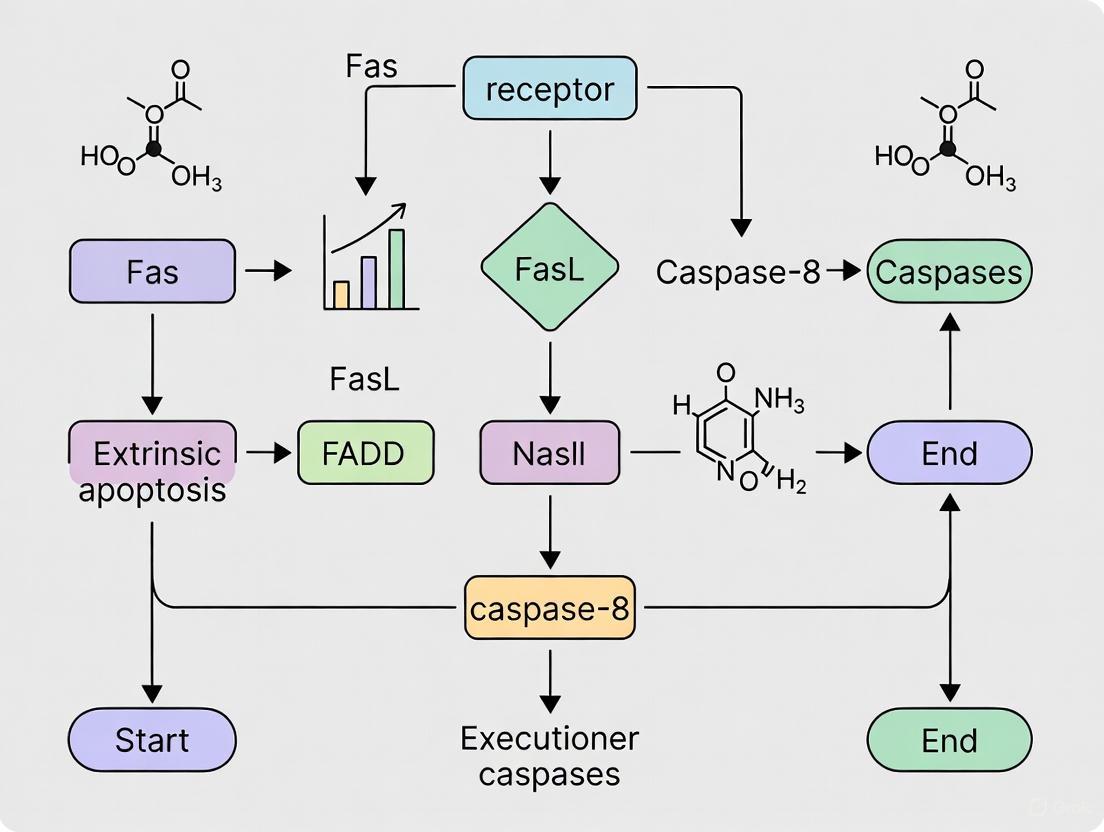
This article provides a comprehensive guide for researchers and drug development professionals on activating and analyzing the Fas-mediated extrinsic apoptosis pathway.
Activating Extrinsic Apoptosis via the Fas Receptor: A Comprehensive Protocol from Mechanism to Therapeutic Application
Abstract
This article provides a comprehensive guide for researchers and drug development professionals on activating and analyzing the Fas-mediated extrinsic apoptosis pathway. It covers the foundational biology of the Fas/FasL system, detailed protocols for receptor activation and apoptosis induction, common troubleshooting scenarios, and validation techniques for assessing pathway efficacy. The content integrates the latest research on both apoptotic and non-apoptotic signaling, regulatory mechanisms, and therapeutic targeting strategies, offering a complete framework for experimental design and implementation in both basic research and translational applications.
The Fas/FasL System: Molecular Architecture and Signaling Foundations
The Fas receptor (CD95/APO-1/TNFRSF6) serves as a prototypical death receptor within the tumor necrosis factor receptor (TNFR) superfamily, orchestrating the initiation of extrinsic apoptosis through precisely organized structural domains. Its function as a cellular switch for programmed cell death is governed by the intricate architecture of its extracellular, transmembrane, and intracellular regions. Understanding the relationship between Fas receptor structure and its signaling capability provides fundamental insights for developing therapeutic interventions targeting apoptotic pathways in cancer, autoimmune disorders, and infectious diseases.
The Fas receptor is a type I transmembrane protein with a molecular weight of approximately 48 kDa, organized into three primary domains: an extracellular region containing cysteine-rich domains (CRDs) responsible for ligand binding, a transmembrane (TM) domain that facilitates receptor oligomerization, and a cytoplasmic death domain (DD) that initiates intracellular signaling cascades [1] [2]. This structural arrangement allows the receptor to transmit extracellular death signals into intracellular apoptotic machinery, ultimately leading to controlled cell dismantling. The precise conformational changes within each domain following ligand binding represent critical regulatory checkpoints that determine cellular fate.
Structural Domains of the Fas Receptor
Extracellular Cysteine-Rich Domains (CRDs)
The extracellular portion of the Fas receptor comprises three cysteine-rich domains (CRDs) that form the binding interface for the Fas ligand (FasL). These domains are stabilized by disulfide bonds and create the distinctive architecture necessary for proper ligand-receptor interaction. Experimental evidence demonstrates that all three CRDs are essential for effective Fas ligand binding, with CRD1 playing a particularly crucial role [3]. This requirement was highlighted through chimeric receptor studies showing that TNFR I CRD1 could only partially substitute for Fas CRD1, indicating domain-specific functionality.
The clinical significance of these structural features is underscored by the identification of a Fas extracellular mutation (C66R) in a patient with Canale-Smith syndrome, an autoimmune condition characterized by lymphoproliferative disorder [3]. This mutation, which occurs in CRD1, results in complete loss of ligand binding capacity, emphasizing the critical nature of the conserved cysteine residues for maintaining structural integrity and function. The three CRDs collectively create a binding surface that specifically recognizes membrane-anchored FasL, with conformational changes upon ligand binding triggering the downstream signaling cascade.
Transmembrane Domain Organization
The Fas transmembrane domain plays an active role in receptor signaling beyond merely anchoring the protein within the lipid bilayer. Structural studies using nuclear magnetic resonance (NMR) spectroscopy in lipid bicelles have revealed that the Fas TM domain forms stable homotrimers through a unique mechanism distinct from classical trimeric coiled-coils [4]. This trimerization is mediated by proline-containing motifs that create optimal packing interactions between TM helices in the membrane environment.
Cancer-associated somatic mutations identified within the transmembrane segment (including C178R, L180F, and P183L) disrupt trimer formation and impair apoptosis induction, confirming the functional significance of this domain [4]. The NMR structures of both mouse and human Fas-TM domains demonstrate that these proline-containing sequences serve as common motifs for receptor TM trimerization across species, with precise packing orientation critically important for trimer stability. This intramembrane trimerization appears to represent the signaling-active conformation of Fas, which differs from the pre-ligand association state.
Table 1: Structural Domains of the Fas Receptor
| Domain | Residue Range | Key Structural Features | Functional Role |
|---|---|---|---|
| Extracellular CRDs | 1-157 | Three cysteine-rich domains with disulfide bonds | Fas ligand binding and receptor activation |
| Transmembrane Domain | 158-174 | Proline-mediated trimerization motifs | Membrane anchoring and oligomerization |
| Death Domain (DD) | 175-319 | Six-helix bundle with opening mechanism | FADD recruitment and DISC formation |
Cytoplasmic Death Domain
The cytoplasmic death domain of Fas represents the critical signaling module that initiates DISC assembly. This approximately 80-amino acid domain adopts a characteristic six-helix bundle fold that undergoes a dramatic conformational change upon receptor activation [5] [6]. The crystal structure of the Fas/FADD DD complex at 2.7 Å resolution reveals that Fas DD opening is the crucial molecular switch that enables FADD binding and subsequent apoptotic signaling [5].
In the unbound state, the Fas DD exists in a closed conformation, but upon receptor activation, helix 6 undergoes a significant shift and fuses with helix 5 to form an extended "stem helix" [6]. This opening movement simultaneously exposes hydrophobic residues that create the FADD binding interface and generates new Fas-Fas interaction surfaces that facilitate higher-order clustering. The resulting Fas/FADD complex forms a tetrameric arrangement consisting of four Fas DDs bound to four FADD DDs, with all contacts mediating the tetramer provided exclusively through Fas-Fas interactions [5].
Death-Inducing Signaling Complex (DISC) Assembly
Structural Basis of Fas/FADD Interaction
The Fas/FADD death domain complex represents the foundational unit of the DISC, serving as the platform for caspase activation. The interaction between these domains is characterized by a conditional, weak binding interface that functions as a regulatory switch to prevent accidental DISC assembly [5] [6]. Unlike constitutive death domain interactions observed in other apoptotic complexes, the Fas/FADD binding interface lacks defined hot spots and exhibits enhanced flexibility due to the opening of the Fas DD, resulting in a weak primary interaction that requires stabilization through clustering [6].
The tetrameric arrangement observed in the crystal structure demonstrates how receptor clustering stabilizes the open form of Fas, enabling processive DISC formation upon sufficient stimulus [5]. In this arrangement, the FADD DD binds primarily through helices 1 and 6, employing a hydrophobic patch surrounded by polar residues that complements the exposed surface on the open Fas DD [5]. This specific binding mode necessitates a conformational change in both partners, as the C-terminal helix of FADD must shift to avoid steric clash with the newly formed C-helix of Fas [5].
Diagram 1: Fas Receptor Activation and DISC Assembly Pathway
Higher-Order Clustering and Caspase Activation
The initial Fas/FADD complex serves as a nucleation point for extensive higher-order clustering that characterizes the mature DISC. The formation of microscopically visible Fas clusters ranging from sub-μm to μm dimensions demonstrates the robust oligomerization capacity of the activated receptor [4]. This clustering is essential for efficient caspase-8 activation, as it promotes caspase dimerization and autoproteolysis through proximity-induced mechanisms.
Within the DISC, FADD serves as an adaptor protein, connecting Fas to caspase-8 via homotypic death effector domain (DED) interactions [7] [1]. The DED/DED interactions facilitate recruitment of over-stoichiometric amounts of caspase-8, promoting caspase aggregation, dimerization, and auto-proteolysis [4]. The resulting active caspase-8 then initiates the apoptotic cascade through two distinct mechanisms: in Type I cells, it directly cleaves and activates executioner caspases (caspase-3, -7), while in Type II cells, it cleaves Bid to tBid, initiating the mitochondrial amplification loop [1] [2].
Experimental Protocols for Studying Fas Receptor Structure
Protocol 1: Analyzing Fas/FADD Death Domain Interactions
Objective: To isolate and characterize the structural interaction between Fas and FADD death domains.
Materials:
- Recombinant Fas DD (residues 190-335) and FADD DD (residues 93-191) expression constructs
- E. coli expression system (BL21 DE3 cells)
- Ni-NTA affinity chromatography resin
- Size exclusion chromatography column (Superdex 200)
- Crystallization screening kits
- Analytical ultracentrifugation equipment
Methodology:
- Complex Formation: Combine bacterial lysates containing separately expressed Fas DD and FADD DD prior to purification to maintain high protein concentrations that stabilize the weak interaction [5].
- Purification: Purify the complex using immobilized metal affinity chromatography followed by size exclusion chromatography. Maintain concentrations above 50 μM throughout purification to prevent complex dissociation [5].
- Biophysical Characterization:
- Crystallization: Screen crystallization conditions under acidic pH (4.0-4.5) to suppress excessive clustering and obtain diffracting crystals [5] [6].
- Structure Determination: Collect X-ray diffraction data and solve structure using molecular replacement with known death domain structures as search models.
Applications: This protocol enables detailed structural analysis of the conditional Fas/FADD interaction, revealing the opening mechanism of Fas DD and the tetrameric organization of the complex.
Protocol 2: Determining Transmembrane Domain Trimerization
Objective: To characterize the structure and oligomerization state of the Fas transmembrane domain in lipid bilayers.
Materials:
- Synthetic peptides corresponding to Fas TM domain (human: residues 158-184; mouse: residues 158-183)
- Lipid bicelles (DMPC/DHPC with q=0.5)
- NMR instrumentation with cryoprobe
- SDS-PAGE equipment for trimer stability assessment
- Site-directed mutagenesis kit for proline motif variants
Methodology:
- Sample Preparation:
- Express Fas-TM peptides as fusion proteins with trpLE sequence in E. coli [4].
- Cleave fusion partner using cyanogen bromide and purify peptides by reverse-phase HPLC.
- Reconstitute purified peptides into lipid bicelles that mimic native membrane environments.
- Trimer Confirmation:
- Analyze bicelle-reconstituted peptides by non-denaturing SDS-PAGE to demonstrate trimer stability [4].
- Confirm uniform 3-fold symmetry through observation of high chemical shift dispersion in TROSY-HSQC spectra.
- Structure Determination:
- Collect multidimensional NMR spectra on deuterated Fas-TM in bicelles.
- Calculate structures using distance and dihedral constraints from NMR data.
- Functional Validation:
- Introduce cancer-associated mutations (C178R, L180F, P183L) and assess trimer disruption [4].
- Measure apoptosis induction efficiency of TM mutants in cellular assays.
Applications: This protocol reveals the unique proline-mediated trimerization of Fas TM domains and establishes the functional significance of intramembrane interactions for apoptotic signaling.
Table 2: Key Research Reagents for Fas Structure Studies
| Reagent/Category | Specific Examples | Function/Application |
|---|---|---|
| Expression Systems | E. coli BL21(DE3), trpLE fusion construct | Recombinant production of death domains and TM peptides |
| Purification Media | Ni-NTA resin, Size exclusion matrices | Isolation of protein complexes based on size and affinity |
| Membrane Mimetics | DMPC/DHPC bicelles (q=0.5) | Creating native-like lipid environments for TM domains |
| Structural Biology | Crystallization screens, NMR with cryoprobe | Determining atomic-level structures of domains and complexes |
| Mutagenesis Tools | Site-directed mutants (I313D, C178R) | Probing structure-function relationships through targeted changes |
The Scientist's Toolkit: Essential Research Reagents
Advancing research on Fas receptor structure requires specialized reagents and methodologies designed to overcome the challenges associated with studying membrane proteins and weak, transient interactions. The conditional nature of the Fas/FADD interaction necessitates specific approaches to stabilize complexes for structural characterization, while the hydrophobic transmembrane domain demands appropriate membrane mimetics for faithful structural analysis.
Critical reagents include solubility-enhanced Fas/FADD constructs for crystallography studies, lipid bicelle systems for NMR analysis of transmembrane domains, and cancer-associated mutant forms for structure-function correlation studies [5] [4]. The Fas I313D mutant, which promotes Fas opening and creates a hyperactive phenotype, serves as a particularly valuable tool for validating the functional significance of the DD opening mechanism [5]. Similarly, proline motif mutants in the TM domain (P183L) demonstrate the critical importance of proper helix-helix packing for signal transduction [4].
For biochemical and cellular assays, specific monoclonal antibodies that mimic ligand-induced clustering without blocking natural binding interfaces are essential, though appropriate trimerization strategies must be employed to ensure physiological relevance [2]. Additionally, caspase activity assays and DISC immunoprecipitation protocols enable researchers to connect structural findings with functional outcomes in apoptotic signaling.
Structural Regulation of Fas Signaling
The structural organization of the Fas receptor embodies an elegant regulatory mechanism that prevents accidental cell death while allowing rapid apoptosis induction upon appropriate stimulation. The conditional nature of the Fas/FADD interaction, dependent on receptor clustering and domain opening, represents a fundamental safety mechanism [6]. In the absence of sufficient receptor activation, the Fas death domain remains predominantly closed, with only a small population spontaneously adopting the open conformation that exposes the FADD binding site.
This regulatory model explains how death receptors can transmit apoptotic signals solely through oligomerization and clustering events without enzymatic activity. The weak primary interactions between Fas and FADD death domains ensure that stable complex formation only occurs when a critical threshold of activated receptors is reached, thus functioning as a molecular switch for cell fate decisions [5] [6]. This mechanism provides stringency against accidental DISC assembly while permitting highly processive signaling amplification once initiated.
The structural insights into Fas receptor organization have significant implications for therapeutic development. Understanding the precise molecular requirements for Fas activation enables targeted interventions aiming to modulate apoptotic signaling in cancer, autoimmune disorders, and degenerative diseases. The identification of specific structural transitions, such as Fas DD opening and TM trimerization, provides new targets for small molecule therapeutics designed to either promote or inhibit Fas-mediated apoptosis in pathological conditions.
Fas Ligand (FasL), also known as CD95L or Apo-1L, is a type-II transmembrane protein belonging to the tumor necrosis factor (TNF) superfamily that plays critical roles in immune regulation, immune privilege, and apoptosis [8]. This biologically active molecule exists in two primary forms: membrane-bound FasL (mFasL) and soluble FasL (sFasL), which exhibit distinct functional properties and signaling consequences [9] [1]. The membrane-bound form is a homotrimeric protein complex embedded in the cell surface, while the soluble form results from proteolytic cleavage of the extracellular domain of mFasL by matrix metalloproteinases (MMPs), particularly MMP-7 [9] [8]. Understanding the differential functions and regulatory mechanisms of these isoforms is essential for researchers investigating apoptosis signaling pathways and developing therapeutic interventions targeting the Fas/FasL system.
The balance between mFasL and sFasL represents a crucial regulatory point in determining cellular outcomes following Fas receptor activation. While both forms can bind to the Fas receptor, they often initiate contrasting biological responses—mFasL typically induces strong apoptotic signaling, whereas sFasL exhibits significantly reduced apoptotic activity and may even function as an antagonist to mFasL under certain conditions [9] [1]. This application note provides detailed methodologies for studying these distinct isoforms and their functional consequences within the broader context of Fas receptor research and therapeutic development.
Structural and Biochemical Properties
Molecular Characteristics
FasL is a 281-amino acid protein organized into three identifiable structural domains: an intracellular N-terminal domain, a transmembrane domain, and an extracellular C-terminal domain responsible for receptor binding [8]. The biologically active membrane-bound form exists as three identical subunits that together form the functional unit for receptor activation and apoptotic signaling [8]. The FasL binding activity resides in its extracellular domain, which triggers Fas receptor engagement to initiate downstream signaling events [8].
The soluble form of FasL (sFasL) is generated through metalloproteinase-mediated proteolytic cleavage at a specific site in the extracellular region between the transmembrane and trimerization domains [9] [8]. This cleavage releases a 26kD soluble fragment containing the TNF-homologous portion of the membrane-bound FasL [8]. The structural differences between these isoforms fundamentally impact their receptor-binding characteristics and subsequent signaling capabilities, with mFasL demonstrating superior capacity for receptor clustering and activation compared to its soluble counterpart.
Quantitative Comparison of Fas Ligand Isoforms
Table 1: Comparative Properties of Membrane-Bound vs. Soluble Fas Ligand
| Property | Membrane-Bound FasL (mFasL) | Soluble FasL (sFasL) |
|---|---|---|
| Molecular Structure | Homotrimeric type-II transmembrane protein | Soluble trimeric protein (26kD subunits) |
| Apoptotic Efficacy | High apoptotic activity [9] | Greatly reduced apoptotic activity (≤1000-fold less) [9] |
| Generation Mechanism | Direct expression on cell surface | Proteolytic cleavage by MMPs (especially MMP-7) [9] [8] |
| Signaling Outcomes | Strong apoptosis induction; inflammation in specific contexts [9] | Variable effects: antagonist to mFasL; weak apoptosis; non-apoptotic signaling [9] [1] |
| Biological Roles | Cytotoxic effector functions; immune privilege maintenance [8] | Immunomodulation; potential decoy function; disease pathogenesis [9] [10] |
| Cellular Sources | Activated T cells; NK cells; immune privilege sites [1] [8] | Activated lymphocytes; tumor cells; proteolytically processed mFasL [10] [8] |
Signaling Pathways and Functional Consequences
Apoptotic Signaling Pathways
The Fas receptor activates two major apoptotic pathways depending on cellular context. In type I cells, engagement by membrane-bound FasL leads to efficient formation of the Death-Inducing Signaling Complex (DISC), resulting in direct activation of caspase-8 and subsequent effector caspases (caspase-3, -6, -7) without mitochondrial involvement [11]. In type II cells, DISC formation is less efficient, and the mitochondrial (intrinsic) pathway serves as an essential signal amplifier through caspase-8-mediated cleavage of Bid, leading to mitochondrial outer membrane permeabilization, cytochrome c release, and apoptosome formation [11] [1].
The differential signaling between mFasL and sFasL occurs primarily at the initial receptor activation stage. Membrane-bound FasL promotes robust receptor clustering and internalization, which enhances DISC formation and caspase-8 activation [11]. In contrast, sFasL fails to induce efficient receptor multimerization, resulting in attenuated DISC assembly and predominantly non-apoptotic signaling outcomes [9] [1]. This distinction explains the dramatically different biological activities of the two isoforms despite their shared receptor specificity.
Diagram 1: Differential signaling pathways activated by membrane-bound versus soluble FasL. mFasL induces robust DISC formation and apoptosis, while sFasL leads to weak DISC formation and predominantly non-apoptotic outcomes.
Non-Apoptotic Signaling Pathways
Beyond its well-characterized apoptotic functions, Fas activation can trigger several non-apoptotic signaling pathways, particularly in response to sFasL or under conditions where apoptotic execution is inhibited. These alternative pathways include NF-κB activation, MAPK pathway stimulation (p38, JNK, ERK), and PI3K/AKT signaling [11] [1]. The non-apoptotic signaling typically involves the formation of alternative signaling complexes such as the "FADDosome" or "Complex II," which contains FADD, RIPK1, and caspase-8 but differs in composition from the canonical DISC [1].
These non-apoptotic pathways regulate diverse cellular processes including proliferation, migration, inflammation, and differentiation [11] [1]. The functional outcome of Fas signaling is determined by the cellular context, the balance between apoptotic and non-apoptotic regulators, and the specific FasL isoform involved. For instance, in activated T cells, low-dose Fas stimulation can promote proliferation through ERK and NF-κB activation, while high-dose stimulation induces apoptosis [11]. Similarly, in certain tumor cells, Fas signaling enhances invasiveness and inflammatory responses rather than cell death [11] [1].
Experimental Protocols for Fas Ligand Research
Protocol 1: Detection and Quantification of Fas Ligand Isoforms
Objective: To detect and quantify membrane-bound and soluble FasL expression in cell cultures or biological samples.
Materials:
- Cell Lines: HuT 78 cells (positive control for FasL expression) [12]
- Antibodies: Anti-FasL antibodies for flow cytometry (MFL-3) and Western blot [9]
- ELISA Kits: Human FasL-specific ELISA (Oncogene Research Products QIA27) [13]
- Metalloproteinase Inhibitors: GM6001 or similar MMP inhibitors [9]
- Culture Media: Serum-free media for conditioned media collection [12]
Methodology:
- Cell Culture and Treatment:
- Culture HuT 78 cells or test samples in appropriate media.
- For sFasL detection, collect conditioned serum-free media after 24-48 hours.
- For mFasL detection, analyze cells directly by flow cytometry or Western blot.
- To inhibit FasL cleavage, treat cells with 10μM GM6001 for 24 hours before analysis.
Flow Cytometry for mFasL:
- Harvest cells and wash with PBS containing 1% BSA.
- Incubate with anti-FasL antibody (MFL-3) or isotype control for 1 hour at 4°C.
- Wash cells and incubate with fluorophore-conjugated secondary antibody if needed.
- Analyze by flow cytometry using appropriate gating strategies [9].
ELISA for sFasL:
- Concentrate conditioned media if necessary using centrifugal filter devices.
- Follow manufacturer instructions for FasL ELISA kit.
- Pipette standards and samples into antibody-coated wells.
- Incubate with detection antibody and streptavidin-HRP conjugate.
- Develop with TMB substrate and measure absorbance at 450nm [13].
Western Blot Analysis:
- Prepare cell lysates or concentrated conditioned media samples.
- Separate proteins by SDS-PAGE and transfer to PVDF membranes.
- Block with 5% non-fat milk in TBST for 1 hour.
- Incubate with anti-FasL primary antibody overnight at 4°C.
- Incubate with HRP-conjugated secondary antibody for 1 hour at room temperature.
- Detect using enhanced chemiluminescence substrate.
Troubleshooting Tips:
- sFasL levels may be low in some cell systems; concentration of conditioned media may be necessary.
- Include both positive and negative controls to ensure antibody specificity.
- Metalloproteinase inhibitors can help distinguish between mFasL and sFasL contributions.
Protocol 2: Functional Assessment of Fas Ligand Bioactivity
Objective: To evaluate the functional activity of membrane-bound and soluble FasL isoforms in apoptosis induction.
Materials:
- Target Cells: Fas-sensitive cells (e.g., Jurkat T cells, L929 fibroblasts) [12]
- Recombinant Proteins: Soluble FasL (commercial preparations)
- Antibodies: Agonistic anti-Fas antibody (positive control) [12]
- Apoptosis Detection Reagents: Annexin V-FITC/PI kit, caspase-3 activity assay [13]
Methodology:
- Preparation of FasL Sources:
- For mFasL activity: Use effector cells expressing membrane-bound FasL as co-culture.
- For sFasL activity: Use concentrated conditioned media or recombinant sFasL.
- For vesicle-associated FasL: Isolate extracellular vesicles by ultracentrifugation (100,000×g for 90 minutes) [12].
Apoptosis Induction Assay:
- Plate Fas-sensitive target cells in 96-well plates (5×10⁴ cells/well).
- Add either: effector cells (for mFasL), sFasL-containing media, or isolated vesicles.
- Include controls: untreated cells, anti-Fas antibody-treated cells (positive control).
- Incubate for 6-24 hours at 37°C, 5% CO₂.
Apoptosis Detection:
Annexin V/PI Staining:
- Harvest cells and wash with cold PBS.
- Resuspend in binding buffer containing Annexin V-FITC and PI.
- Incubate for 15 minutes in the dark.
- Analyze by flow cytometry within 1 hour [13].
Caspase-3 Activity Assay:
- Lyse cells in provided lysis buffer.
- Incubate lysate with DEVD-AFC substrate and DTT.
- Measure fluorescence (Ex: 370-425nm, Em: 490-525nm) [13].
Nuclear Morphology Assessment:
- Stain cells with Hoechst 33342 (1μg/mL) for 10 minutes.
- Visualize by fluorescence microscopy for condensed/fragmented nuclei.
Data Analysis:
- Calculate percentage of apoptotic cells (Annexin V-positive, PI-negative for early apoptosis; double-positive for late apoptosis).
- Compare caspase-3 activity relative to untreated controls.
- Determine EC₅₀ values for sFasL and mFasL preparations.
Protocol 3: Modifying FasL Cleavage Using Genetic Approaches
Objective: To investigate FasL function by manipulating its proteolytic cleavage using ΔCS-FasL mutant cells.
Materials:
- Cell Lines: Wild-type and ΔCS-FasL mutant cells (cleavage-resistant FasL) [9]
- Transfection Reagents: Lipofectamine or similar for introducing FasL constructs
- Selection Antibiotics: Appropriate antibiotics for stable cell line selection
Methodology:
- Generation of ΔCS-FasL Cells:
- Obtain or engineer FasL construct with deleted metalloproteinase cleavage site.
- Transfect target cells using appropriate transfection method.
- Select stable clones using antibiotics (e.g., puromycin, G418).
- Validate expression by flow cytometry and Western blot.
Characterization of FasL Expression and Cleavage:
- Compare mFasL and sFasL levels between wild-type and ΔCS cells.
- Stimulate cells with PMA/ionomycin (to enhance FasL expression and cleavage).
- Collect conditioned media and cell lysates at various time points.
- Analyze by Western blot to detect full-length and cleaved FasL.
Functional Comparison:
- Perform co-culture apoptosis assays as in Protocol 2.
- Compare apoptotic potency of wild-type vs. ΔCS effector cells.
- Assess non-apoptotic signaling outcomes (NF-κB activation, cytokine production).
Expected Results:
- ΔCS-FasL cells should exhibit increased mFasL and reduced sFasL.
- ΔCS-FasL cells may demonstrate enhanced apoptotic activity toward Fas-sensitive targets.
- In vivo, ΔCS-FasL expression may exacerbate inflammatory conditions [9].
The Scientist's Toolkit: Essential Research Reagents
Table 2: Key Research Reagents for Fas Ligand Studies
| Reagent Category | Specific Examples | Research Application | Key Considerations |
|---|---|---|---|
| Anti-FasL Antibodies | MFL-3 (flow cytometry) [9] | Detection of surface FasL expression | Validated for specific applications; check species reactivity |
| sFasL ELISA Kits | Oncogene QIA27 [13], RayBio Human Fas ELISA | Quantification of soluble FasL | Different kits may detect different isoforms; compare standards |
| MMP Inhibitors | GM6001, TAPI-1, TAPI-2 | Inhibition of FasL cleavage | Specificity varies; may affect other MMP substrates |
| FasL Expression Systems | ΔCS-FasL mutants [9], Recombinant FasL | Functional studies of specific isoforms | Commercial sFasL may have variable activity; consider source |
| Apoptosis Detection Kits | Annexin V-FITC/PI, caspase-3 assays [13] | Measurement of FasL bioactivity | Multiple methods recommended for confirmation |
| Control Cell Lines | HuT 78 (FasL+) [12], Jurkat (Fas+) | Positive controls for experiments | Verify receptor/ligand expression before use |
| Extracellular Vesicle Isolation Reagents | Ultracentrifugation equipment, filtration devices | Study of vesicle-associated FasL [12] | Multiple isolation methods available; characterize vesicles |
Data Analysis and Interpretation Guidelines
Quantitative Assessment of FasL Isoform Functions
When evaluating experimental results, researchers should consider several key aspects of FasL biology. First, the concentration and context of FasL presentation dramatically influence functional outcomes. Low doses of Fas agonists can promote proliferation in T cells, while high doses induce apoptosis [11]. Second, cellular classification as type I or type II for apoptosis signaling affects FasL responsiveness, with type I cells being more sensitive to Fas-mediated apoptosis [11]. Third, the local microenvironment, including the presence of metalloproteinases that generate sFasL, substantially modulates FasL activity.
For accurate interpretation, include appropriate controls in all experiments:
- Specificity controls: Use FasL-neutralizing antibodies to confirm Fas/FasL-dependent effects.
- Activity controls: Include known Fas agonists (e.g., anti-Fas antibodies) as positive controls for apoptosis assays.
- Cell type controls: Utilize both Fas-sensitive and Fas-resistant cells to verify specificity.
- Isoform-specific controls: When possible, compare results using membrane-bound versus soluble FasL preparations.
Statistical analysis should account for potential donor-to-donor or experiment-to-experiment variability, particularly when working with primary cells. Dose-response curves for both mFasL and sFasL activities are recommended to establish potency differences quantitatively.
Applications in Therapeutic Development
The differential functions of FasL isoforms have significant implications for therapeutic development. In cancer immunotherapy, strategies to enhance mFasL-mediated apoptosis of tumor cells while blocking immunosuppressive sFasL effects represent promising approaches [10]. Conversely, in autoimmune diseases, inhibiting FasL activity may reduce pathological tissue destruction [9]. The development of cleavage-resistant FasL variants (such as ΔCS-FasL) offers potential for enhancing apoptotic activity in targeted therapies [9].
Emerging research also suggests the importance of FasL forms in extracellular vesicles, which can transmit apoptotic signals between cells and may serve as biomarkers or therapeutic vehicles [12]. Understanding the balance between membrane-bound and soluble FasL activities provides a foundation for developing novel treatments for cancer, autoimmune disorders, and inflammatory conditions by selectively modulating specific aspects of Fas signaling.
The Fas receptor (also known as CD95 or APO-1) is a death domain-containing member of the tumor necrosis factor receptor (TNFR) superfamily that plays a central role in regulating programmed cell death [14] [15]. This pathway is crucial for maintaining cellular homeostasis, eliminating damaged or infected cells, and regulating immune system function [16]. The core apoptotic machinery involves the sequential formation of the Death-Inducing Signaling Complex (DISC), activation of caspase-8, and the subsequent execution phase mediated by downstream effector molecules [17] [14]. When the Fas ligand (FasL) binds to the Fas receptor, it induces receptor trimerization and clustering, initiating a precisely orchestrated signaling cascade that ultimately leads to apoptotic cell death [15] [2]. Understanding the molecular mechanisms governing DISC formation and caspase activation provides critical insights for developing targeted therapies for cancer, autoimmune diseases, and other pathological conditions characterized by dysregulated apoptosis [18] [16].
Molecular Architecture of the DISC
Stoichiometry and Assembly Mechanism
Recent structural insights from cryo-electron microscopy have revolutionized our understanding of DISC assembly and stoichiometry. The Fas-FADD death domain complex forms an asymmetric three-layered architecture with a 7:5 stoichiometry (seven Fas DDs and five FADD DDs) [17]. This complex exhibits dimensions of approximately 80 × 90 × 60 Å and is organized with two Fas DD protomers in the top layer, five in the middle layer, and five FADD DD molecules forming the bottom layer [17]. The assembly is stabilized by three characteristic interfaces common among death domain superfamily members: Type I interactions between H2 and H3 helices with H1 and H4 helices primarily through ionic bonds; Type II interactions involving H4 and the H4-H5 loop with H6 and the H5-H6 loop; and Type III interactions between H3 and the H1-H2 and H3-H4 loops, dominated by hydrophilic or charged residues [17].
Table 1: Structural Components of the Fas-FADD DD Complex
| Component | Location in Complex | Number of Protomers | Key Structural Features |
|---|---|---|---|
| Fas DD (Top layer) | Upper layer | 2 | Partially built due to poor density |
| Fas DD (Middle layer) | Middle layer | 5 | Clearly visible for model building |
| FADD DD | Bottom layer | 5 | Extensive interactions with middle layer Fas DDs |
| Type I Interface | Between protomers | - | H2-H3 with H1-H4 helices, ionic interactions |
| Type II Interface | Between protomers | - | H4, H4-H5 loop with H6, H5-H6 loop |
| Type III Interface | Between protomers | - | H3 with H1-H2 and H3-H4 loops |
This oligomeric structure closely resembles the PIDDosome complex (composed of seven RAIDD and five PIDD molecules), suggesting a conserved apoptotic signaling mechanism across different cell death pathways [17]. The open-ended architecture of the complex potentially allows additional Fas DDs to assemble, consistent with observations of higher-order Fas clustering during apoptosis [17].
FADD DED Filament Formation
Following the initial death domain interactions, FADD undergoes concentration-dependent oligomerization through its death effector domain (DED). Full-length FADD elutes in the void volume on gel filtration and forms large oligomers, with approximately 18% forming filaments at 2 mg/mL concentration, increasing to 30% at 4 mg/mL [17]. The FADD DED filament adopts a hollow helical structure with an outer diameter of 90 Å and a central cavity of 20 Å, exhibiting C3 symmetry with an axial rise of ~14 Å and a helical twist of 49° [17]. This filamentous structure closely resembles caspase-8 tandem DED (tDED) filaments and is stabilized by three distinct interaction interfaces: predominantly hydrophobic Type I interfaces, and charged/hydrophilic Type II and III interfaces [17]. The FADD DED filament serves as a nucleation scaffold for caspase-8 tDED polymerization, effectively recruiting and facilitating caspase-8 assembly [17].
Caspase-8 Activation Mechanisms
Hierarchical Activation Cascade
Within the DISC, procaspase-8 is recruited to FADD DED filaments via homotypic death effector domain interactions [17] [14]. The proximity-induced dimerization of caspase-8 molecules leads to their autocatalytic activation through proteolytic cleavage [17] [19]. Quantitative studies using FRET-based biosensors in living single cells have demonstrated that less than 1% of total cellular caspase-8 is sufficient to initiate the apoptotic program when properly activated [19]. The activated caspase-8 heterotetramer consists of p10 and p18 subunits, which then initiate the downstream apoptotic cascade [2].
Caspase-8 functions as a critical molecular switch that determines cellular fate between apoptosis, necroptosis, and pyroptosis [20]. Its activation leads to the cleavage of downstream effector caspases including caspase-3, -6, and -7 [14] [15]. The activation kinetics follow a precise hierarchical pattern, with caspase-8 activating caspase-3 through either direct cleavage or indirectly through the mitochondrial pathway via Bid cleavage [15] [19].
Table 2: Caspase-8 Activation Parameters and Downstream Targets
| Parameter | Value/Method | Experimental System | Reference |
|---|---|---|---|
| Minimal activation threshold | <1% of total cellular caspase-8 | HeLa cells with FRET biosensors | [19] |
| Downstream caspases activated | Caspase-3, -6, -7 | Multiple cell lines | [14] [15] |
| Bid cleavage site | Asp59 (produces tBid) | In vitro cleavage assays | [20] |
| Alternative functions | Cleaves GSDMC (induces pyroptosis) | Macrophages, cancer cells | [20] |
| Regulatory control | c-FLIP isoforms (pro/anti-apoptotic) | Lymphocytes, cancer cells | [14] |
Regulatory Mechanisms by c-FLIP
The cellular FLICE inhibitory protein (c-FLIP) exists in multiple isoforms that critically regulate caspase-8 activation at the DISC [14]. The long form (c-FLIPL) can either promote or inhibit apoptosis depending on cellular context and concentration, while the short form (c-FLIPS) forms dysfunctional heterodimers with procaspase-8 and completely inhibits DISC-mediated caspase-8 activation [14]. When c-FLIPL binds to procaspase-8, it induces conformational changes that trigger partial autocleavage and allosteric activation, potentially initiating apoptosis [14]. However, c-FLIPL may also block complete caspase-8 processing by retaining cleaved caspase-8 within the DISC, thereby terminating apoptotic signaling [14]. This delicate balance determines the cell's decision between survival and death in response to Fas stimulation.
Experimental Protocols for DISC Analysis
DISC Reconstitution and Stoichiometry Determination
Purpose: To reconstitute the human Fas-FADD death domain complex and determine its oligomeric state and stoichiometry under physiological conditions.
Materials:
- Bril-fused human Fas DD (enhances solubility) [17]
- Human FADD DD (untagged) [17]
- Cryo-EM grids (Quantifoil) [17]
- Gel filtration chromatography system
- Negative stain EM equipment
- Cryo-electron microscope
Procedure:
- Co-express Bril-fused Fas DD and FADD DD in Escherichia coli or express separately and purify for in vitro reconstitution [17].
- Mix purified Fas DD and FADD DD at equimolar ratios in physiological buffer (e.g., 20 mM HEPES pH 7.5, 150 mM NaCl).
- Incubate the mixture for 1 hour at 4°C to allow complex formation.
- Apply the complex to gel filtration chromatography to separate oligomeric species.
- Analyze elution fractions by SDS-PAGE and negative stain EM to confirm complex formation.
- Prepare cryo-EM grids by applying 3-4 μL of sample to Quantifoil grids, blotting, and plunge-freezing in liquid ethane.
- Collect cryo-EM data using single-particle analysis and process to obtain 3D reconstruction.
- Build atomic model into the density using iterative refinement protocols [17].
Expected Results: The complex should form a three-layered architecture with 7:5 stoichiometry. The Bril fusion may stabilize Fas DD and shift equilibrium toward the 7:5 stoichiometry observed in structural studies [17].
FADD DED Filament Assembly Analysis
Purpose: To investigate the concentration-dependent filament formation of FADD DED domains.
Materials:
- Full-length FADD protein or isolated FADD DED domain
- Gel filtration standards
- Cryo-EM equipment
- Image processing software (e.g., RELION, cryoSPARC)
Procedure:
- Express and purify full-length FADD or FADD DED domain in HEK293 cells or E. coli [17].
- Concentrate protein to 2 mg/mL and 4 mg/mL in physiological buffer.
- Analyze each concentration by gel filtration chromatography, monitoring elution volume.
- Calculate the percentage of filamentous FADD based on void volume peak area.
- Prepare cryo-EM grids from each concentration.
- Collect cryo-EM micrographs and process for helical reconstruction.
- Determine helical parameters (axial rise, twist) and measure filament dimensions.
- Build atomic model of FADD DED filament and identify stabilization interfaces [17].
Expected Results: At 2 mg/mL, approximately 18% of FADD DED forms filaments, increasing to 30% at 4 mg/mL. Filaments should display hollow helical structure with 90 Å outer diameter and 20 Å central cavity [17].
Downstream Execution Pathways
Extrinsic Execution Pathway
Upon activation at the DISC, caspase-8 directly cleaves and activates executioner caspases-3, -6, and -7 [15]. These effector caspases then proteolyze key cellular substrates including:
- PARP (Poly ADP-Ribose Polymerase): Disrupts DNA repair mechanisms [15] [16]
- Lamin A and B: Destabilizes nuclear envelope [15]
- α-Fodrin: Disassembles cytoskeletal components [15]
- ICAD: Releases CAD (Caspase-Activated DNAse) to cleave nuclear DNA [15]
- PAK (p21-Activated Kinase): Contributes to JNK activation and cell death [15]
This direct activation cascade characterizes Type I cells, where anti-apoptotic Bcl-2 family members cannot protect against Fas-mediated apoptosis [2].
Mitochondrial Amplification Pathway (Type II Cells)
In most cell types, caspase-8 catalyzes the cleavage of the BH3-only protein Bid to generate truncated tBid, which translocates to mitochondria [14] [2]. tBid activates pro-apoptotic Bax and Bak, leading to mitochondrial outer membrane permeabilization (MOMP) and release of cytochrome c and Smac/DIABLO [14] [16]. Cytochrome c forms the apoptosome with Apaf-1 and procaspase-9, activating the intrinsic apoptotic pathway [14] [16]. Smac/DIABLO counteracts inhibitor of apoptosis proteins (IAPs), ensuring efficient caspase activation [14]. This mitochondrial amplification pathway characterizes Type II cells, where the intrinsic pathway enhances the initial extrinsic signal.
Visualization of Signaling Pathways
Fas-Mediated Apoptotic Signaling Cascade
The Scientist's Toolkit: Essential Research Reagents
Table 3: Key Research Reagents for DISC and Caspase-8 Studies
| Reagent/Solution | Function/Application | Specifications/Alternatives |
|---|---|---|
| Bril-fused Fas DD | Enhances solubility for structural studies | N-terminal fusion tag for cryo-EM [17] |
| Recombinant FADD | DISC reconstitution assays | Full-length or death domain only [17] |
| Agonistic anti-Fas antibodies | Receptor activation without FasL | Clone CH11 (mouse); APO-1-3 (human) [2] |
| c-FLIP isoforms | Caspase-8 regulation studies | Long (c-FLIPL) and short (c-FLIPS) forms [14] |
| FRET-based caspase biosensors | Real-time activation kinetics in live cells | Single-cell monitoring (e.g., SCAT3, SCAT9) [19] |
| Caspase inhibitors | Pathway dissection and controls | z-IETD-fmk (caspase-8); z-VAD-fmk (pan-caspase) [19] |
| Gel filtration standards | Oligomeric state determination | HPLC/SEC-MALS compatible [17] |
| Cryo-EM grids | High-resolution structural analysis | Quantifoil grids (200-400 mesh) [17] |
Quantitative Analysis and Data Interpretation
The hierarchical transmission of apoptotic signals requires precise molar concentrations of key components. Quantitative studies in HeLa cells have determined the cellular concentrations of five caspases and Bid necessary for efficient signal transduction [19]. Mathematical modeling based on these data predicts the minimal concentration of caspase-8 required to initiate apoptosis (less than 1% of total cellular pool) and validates the presence of positive-feedback loops that amplify the initial death signal [19].
Unexpectedly, Fas signaling can also activate non-apoptotic pathways including NF-κB, MAPK, and PI3K/AKT through mechanisms involving Daxx, RIP, and FLIP, leading to cell proliferation, migration, and inflammatory responses rather than death [14] [15]. These alternative pathways are particularly relevant in cancer cells and under conditions of partial DISC assembly or sublethal caspase activation.
The experimental protocols outlined herein provide robust methodologies for investigating DISC formation, caspase-8 activation, and downstream execution events, enabling researchers to dissect the core apoptotic machinery with molecular precision. These approaches facilitate the development of targeted therapeutic strategies for diseases characterized by dysregulated apoptosis.
The Fas receptor (CD95) is a member of the tumor necrosis factor receptor superfamily (TNFRSF) and is ubiquitously expressed on most cells, particularly on immune cells such as activated macrophages and T cells [1]. While historically recognized for its pivotal role in triggering extrinsic apoptosis, Fas activation can also initiate diverse non-apoptotic signaling pathways, including NF-κB, MAPK, and PI3K/AKT [1] [21]. The induction of these alternative pathways is highly dependent on cellular context, including the receptor's stoichiometry and the form of its ligand [21]. Transmembrane FasL (mFasL) primarily induces apoptotic signaling, whereas metalloprotease-cleaved soluble FasL (sFasL) preferentially activates non-apoptotic signals, leading to inflammation, cell proliferation, migration, and invasion [1] [21]. This application note details standardized protocols for the specific activation and analysis of these non-apoptotic signaling pathways in the context of Fas receptor research, providing a critical framework for investigators studying immune regulation, cancer biology, and inflammatory diseases.
Fas-Mediated Non-Apoptotic Signaling Pathways
Upon activation by its ligand, Fas can initiate several key non-apoptotic signaling cascades. Table 1 summarizes the core components, upstream activators, and primary biological outcomes of these pathways.
Table 1: Key Non-Apoptotic Signaling Pathways Activated by Fas
| Pathway | Key Signaling Components | Upstream Fas-Mediated Activators | Primary Biological Outcomes |
|---|---|---|---|
| NF-κB | FADD, RIPK1, cIAP1/2, TAK1, IKK complex, NF-κB (p65/p50) [1] [22] | sFasL, possible mFasL under specific conditions [21] | Production of proinflammatory cytokines (IL-6, TNF-α), cell survival, promotion of inflammatory microenvironment [1] [22] |
| MAPK | p38 MAPK, JNK, ERK1/2 [1] [23] | sFasL, possible mFasL under specific conditions [21] | Cell migration, invasion, inflammation, differentiation [1] |
| PI3K/AKT | PI3K, Akt, PLCγ1 [1] [21] [24] | sFasL (via interaction with PLCγ1) [21] | Cell survival, metabolic regulation, migration, calcium signaling [1] [21] [25] |
Ligand Specificity and Stoichiometry
The outcome of Fas signaling is profoundly influenced by the nature of its ligand. The pre-ligand assembly domain (PLAD) is crucial for the ligand-independent pre-association of Fas receptors at the plasma membrane, which is mandatory for signaling [21]. While the homotrimeric form of FasL is ineffective at triggering apoptosis, the hexameric counterpart is highly effective [21]. Soluble FasL (sFasL), generated by metalloprotease-mediated cleavage of membrane-bound FasL, fails to trigger robust apoptosis but is potent at inducing non-apoptotic signals such as NF-κB and PI3K, leading to inflammatory responses and cell migration [21].
Experimental Protocols
Protocol 1: Activation of Non-Apoptotic Pathways with Soluble FasL
Objective: To specifically induce and analyze NF-κB, MAPK, and PI3K/AKT signaling via Fas using purified soluble FasL.
Materials:
- Recombinant human sFasL (e.g., from R&D Systems, Cat. No. 126-FL)
- Control Fc protein
- Cell culture medium (serum-free recommended for stimulation)
- Target cells (e.g., HeLa, HEK293, or primary cells with confirmed Fas expression)
- Lysis Buffer: RIPA buffer supplemented with protease and phosphatase inhibitors
- Specific inhibitors: BAY 11-7082 (NF-κB), SB203580 (p38 MAPK), LY294002 (PI3K)
Procedure:
- Cell Preparation: Seed cells in 6-well or 12-well plates and grow to 70-80% confluence.
- Starvation: Incubate cells in serum-free medium for 4-16 hours to reduce basal signaling activity.
- Stimulation:
- Prepare a working solution of sFasL (100-200 ng/mL) in serum-free medium. The optimal concentration should be determined empirically [21].
- Aspirate the starvation medium and add the sFasL solution.
- Incubate for 0, 5, 15, 30, and 60 minutes to establish a time course. For NF-κB, peak nuclear translocation often occurs around 30 minutes.
- Inhibition Studies (Optional): Pre-treat cells with pathway-specific inhibitors for 1 hour prior to sFasL stimulation to confirm the specificity of the response.
- Cell Lysis: At each time point, place the plates on ice, quickly aspirate the medium, and wash with cold PBS. Add ice-cold lysis buffer to the cells and scrape. Transfer the lysate to a microcentrifuge tube and centrifuge at 14,000 x g for 15 minutes at 4°C.
- Analysis: Determine protein concentration and analyze by western blotting.
Expected Results & Troubleshooting:
- Western Blot Targets:
- NF-κB Pathway: Phospho-IκBα (Ser32), total IκBα, Phospho-p65 (Ser536)
- MAPK Pathway: Phospho-p38 (Thr180/Tyr182), Phospho-JNK (Thr183/Tyr185), Phospho-ERK1/2 (Thr202/Tyr204)
- PI3K/AKT Pathway: Phospho-Akt (Ser473)
- Troubleshooting: Lack of phosphorylation may indicate inactive sFasL or low Fas receptor expression. Verify receptor expression by flow cytometry. High basal signaling can be mitigated by longer serum starvation.
Protocol 2: Differentiating Signaling Outcomes Using Membrane-Bound vs. Soluble FasL
Objective: To compare the activation of non-apoptotic pathways stimulated by membrane-presented FasL versus soluble FasL.
Materials:
- Effector cells expressing membrane-bound FasL (e.g., activated Jurkat T-cells or stably transfected CHO cells)
- Control effector cells (empty vector)
- Recombinant sFasL
- Target cells (as in Protocol 1)
- Flow cytometry antibodies for phospho-proteins
Procedure:
- Co-culture Setup:
- Seed target cells in wells.
- For membrane-FasL stimulation, add effector cells at a 2:1 or 3:1 (effector:target) ratio.
- For soluble-FasL stimulation, add recombinant sFasL at an equimolar concentration.
- Include controls of target cells alone and with control effector cells.
- Incubation: Co-culture for 30 minutes to 2 hours.
- Analysis by Flow Cytometry:
- Dissociate and fix cells immediately after co-culture using a commercial phospho-flow fixation buffer.
- Permeabilize the cells and stain with fluorescently conjugated antibodies against phospho-p65, phospho-p38, or phospho-Akt.
- Analyze using a flow cytometer. Gate on the target cell population based on size or a distinct fluorescent marker.
Expected Results: Target cells co-cultured with membrane-FasL effector cells should show minimal non-apoptotic signaling but higher levels of caspase activation. In contrast, stimulation with sFasL should result in robust phosphorylation of Akt, p38, and p65, with limited caspase-3 cleavage [21].
The Scientist's Toolkit: Essential Reagents
Table 2: Key Research Reagent Solutions for Studying Fas Non-Apoptotic Signaling
| Reagent / Tool | Function / Specificity | Example Application |
|---|---|---|
| Recombinant sFasL | Activates non-apoptotic signaling pathways (NF-κB, PI3K) [21] | Protocol 1: Stimulation of NF-κB/MAPK/PI3K in target cells |
| Agonistic Anti-Fas Antibody (e.g., CH11) | Mimics FasL binding; can induce apoptosis or non-apoptotic signals depending on cross-linking [1] | Alternative method for receptor activation; studying DISC formation |
| DB550 | Selective inhibitor of the CD95-PLCγ1 interaction [21] | Specifically blocks the CD95-mediated PI3K signal in vitro and in vivo |
| PLAD-Derived Peptide | Inhibits Fas pre-association by targeting the Pre-Ligand Assembly Domain [21] | Validating the role of receptor clustering in non-apoptotic signaling |
| Pathway Inhibitors (BAY 11-7082, LY294002, SB203580) | Pharmacological inhibitors of NF-κB, PI3K, and p38 MAPK, respectively [1] | Confirming the involvement of specific pathways in functional assays |
| Phospho-Specific Antibodies (p65, Akt, p38) | Detect activated/phosphorylated forms of signaling proteins [1] | Readout for pathway activation via western blot or flow cytometry |
Pathway Visualization and Experimental Workflow
Fas-Mediated Non-Apoptotic Signaling Cascade
Experimental Workflow for Pathway Analysis
The Fas receptor's ability to activate NF-κB, MAPK, and PI3K/AKT pathways represents a critical biological switch from cell death to pro-inflammatory and pro-survival outcomes. The protocols detailed herein provide a standardized approach for researchers to dissect these non-apoptotic signaling events. The careful application of specific ligand forms, alongside the use of targeted pharmacological inhibitors and genetic tools, is essential for accurate interpretation. Mastering these techniques will advance our understanding of Fas biology in health and disease and aid in developing therapeutic strategies that selectively modulate these pathways for cancer, autoimmune, and inflammatory disorders.
The FAS receptor (also known as CD95 or APO-1), a member of the tumor necrosis factor receptor family, initiates apoptotic signaling upon engagement with its ligand FASL [1]. This receptor is ubiquitously expressed on most cells and tissues, with particularly high expression on immune cells such as activated macrophages and T cells [1]. Despite a common initiating event—FAS-FASL binding—different cell types exhibit remarkable heterogeneity in their downstream signaling mechanisms, leading to the classification of Type I and Type II apoptotic pathways.
This classification fundamentally reflects the cellular context dependence of FAS-mediated apoptosis, where intrinsic cellular factors determine the route to cell death. The dichotomy between Type I and Type II cells is not merely academic; it has profound implications for drug development, particularly in oncology and autoimmune diseases, as therapeutic efficacy can vary dramatically between cell types based on their signaling classification [26]. Understanding these differences enables researchers to predict cellular responses to death receptor targeting agents and design more effective, context-specific therapeutic strategies.
Molecular Mechanisms: A Comparative Analysis
Core Signaling Pathways
The initial events following FAS activation are similar in both Type I and Type II cells. FAS binding by its homologous ligand FASL promotes receptor aggregation and conformational changes, leading to recruitment of the adaptor protein FADD (FAS-associated death domain) [1]. FADD then recruits procaspase-8 (and in some cases procaspase-10 and c-FLIP) through homotypic death effector domain interactions, forming the death-inducing signaling complex (DISC) [1]. Within the DISC, procaspase-8 undergoes autocatalytic activation, a critical juncture where Type I and Type II pathways diverge.
Type I cells exhibit robust DISC formation with efficient caspase-8 activation, generating sufficient amounts of active caspase-8 to directly cleave and activate downstream effector caspases (caspase-3, -6, and -7), leading to rapid apoptosis execution independent of mitochondrial amplification [1] [26]. In these cells, the apoptotic signal bypasses the need for mitochondrial involvement, making the process faster and more direct.
Type II cells form less efficient DISC complexes, resulting in limited caspase-8 activation [26]. The small amount of active caspase-8 is insufficient to directly activate effector caspases and must be amplified through mitochondrial involvement. In these cells, caspase-8 cleaves the BH3-interacting domain death agonist (BID), generating truncated BID (tBID) [1]. tBID then translocates to mitochondria where it interacts with pro-apoptotic proteins BAK or BAX, promoting their oligomerization and resulting in mitochondrial outer membrane permeabilization (MOMP) [1]. This leads to cytochrome c release, which binds to Apaf-1 forming the apoptosome, ultimately activating caspase-9 and subsequently the effector caspases [1].
Key Regulatory Nodes and Discriminating Factors
The differential behavior between Type I and Type II cells is governed by several key molecular determinants. Research has identified specific proteins and regulatory mechanisms that dictate which pathway predominates in a given cellular context.
XIAP (X-chromosome linked inhibitor of apoptosis protein) serves as a critical discriminator between Type I and Type II apoptosis signaling [26]. In Type II cells, XIAP potently inhibits the small amounts of active caspase-3 and caspase-7 generated by limited caspase-8 activation, necessitating mitochondrial amplification to overcome this inhibition. The mitochondrial pathway releases SMAC/DIABLO (second mitochondria-derived activator of caspases), which antagonizes XIAP, thereby relieving the inhibition of caspases and permitting apoptosis to proceed [1] [26]. In Type I cells, the large amount of active caspase-8 generates sufficient effector caspase activity to overwhelm XIAP inhibition, making the mitochondrial amplification loop unnecessary.
c-FLIP (cellular FLICE-inhibitory protein) regulates the FAS apoptotic pathway through interactions with procaspase-8 at the DISC level [1]. c-FLIP exists in two common isoforms: the long form (c-FLIPL) and short form (c-FLIPS), which differentially regulate FAS apoptotic signaling. c-FLIPL can either promote or inhibit apoptosis depending on cellular context and concentration, while c-FLIPS forms dysfunctional heterodimers with procaspase-8, inhibiting DISC-mediated caspase-8 activation and apoptosis initiation [1]. The relative expression levels of c-FLIP isoforms can therefore influence whether a cell behaves as Type I or Type II.
BID is essential for FAS-mediated apoptosis in Type II but not Type I cells [26]. Studies with BID-deficient mice have demonstrated resistance to FAS-induced hepatocellular apoptosis, confirming its critical role in Type II signaling [26]. The mitochondrial dependence in Type II cells makes them vulnerable to disruptions in the BID-mediated amplification step, whereas Type I cells bypass this requirement entirely.
Table 1: Key Molecular Discriminators Between Type I and Type II Cells
| Molecular Determinant | Type I Cells | Type II Cells | Functional Significance |
|---|---|---|---|
| DISC Formation Efficiency | High | Low | Determines initial caspase-8 activation level |
| XIAP Sensitivity | Low | High | Dictates need for mitochondrial amplification |
| BID Requirement | Non-essential | Essential | Determines mitochondrial dependence |
| c-FLIP Regulation | Modulates threshold | Critical gatekeeper | Influences initial signaling commitment |
| SMAC/DIABLO Role | Minor | Critical for XIAP neutralization | Enables effector caspase activity |
Experimental Discrimination and Assessment Methods
Pharmacological and Genetic Validation Approaches
Several experimental approaches have been developed to distinguish between Type I and Type II signaling pathways and validate their molecular differences.
Inhibition of Mitochondrial Function using compounds like cyclosporin A (CyA) and bongkrekic acid (BK) can prevent FAS-induced apoptosis in Type II cells but has minimal effect on Type I cells [27]. These inhibitors target the mitochondrial permeability transition pore and prevent cytochrome c release, thereby specifically blocking the mitochondrial amplification pathway essential for Type II but not Type I apoptosis.
Caspase-8 Inhibition with specific inhibitors such as Z-IETD-FMK can prevent apoptosis in both Type I and Type II cells, but with different mechanistic implications [27]. In Type I cells, caspase-8 inhibition completely blocks apoptosis by preventing direct activation of effector caspases. In Type II cells, caspase-8 inhibition prevents BID cleavage and subsequent mitochondrial events, but the protection may be less complete depending on the cellular context.
Genetic Manipulation of key pathway components provides definitive evidence for pathway classification. BID deficiency confers resistance to FAS-induced apoptosis in Type II cells (e.g., hepatocytes) but not in Type I cells (e.g., lymphocytes) [26]. Similarly, XIAP deficiency or SMAC mimetic treatment can convert Type II cells to a Type I-like phenotype by eliminating the need for mitochondrial amplification [26].
Flow Cytometry-Based Assessment Protocols
Flow cytometry provides a powerful platform for discriminating between Type I and Type II apoptosis through multiparameter analysis at single-cell resolution [28]. The following protocol outlines a standardized approach for pathway classification.
Protocol 1: Discriminating Type I and Type II FAS Signaling
Principle: Simultaneous assessment of caspase activation, mitochondrial membrane potential, and phosphatidylserine externalization allows discrimination of apoptotic pathways based on the temporal sequence of events and mitochondrial dependence.
Materials:
- Cell suspension (2.5×10⁵ – 2×10⁶ cells/mL)
- Anti-FAS antibody (e.g., CH-11) or recombinant FASL
- 1× PBS
- TMRM mitochondrial membrane potential dye (Invitrogen/Molecular Probes)
- FLICA caspase-8 assay reagent (Immunochemistry Technologies LLC)
- Annexin V-FITC or Annexin V-APC conjugate (Invitrogen/Molecular Probes)
- Propidium iodide (PI) stock solution (50 µg/mL in PBS)
- Annexin V Binding Buffer (AVBB): 10 mM HEPES/NaOH pH 7.4; 140 mM NaCl, 2.5 mM CaCl₂
- 12×75 mm Falcon FACS tubes (BD Biosciences)
- Flow cytometer with 488 nm and 633-640 nm excitation capabilities
Procedure:
- Cell Treatment: Divide cell suspension into three aliquots:
- Untreated control
- FAS stimulation alone
- FAS stimulation in presence of mitochondrial inhibitor (e.g., 1 µM cyclosporin A)
Staining Procedure: a. Induce apoptosis by adding anti-FAS antibody (e.g., 500 ng/mL) or recombinant FASL (100 ng/mL) for predetermined time points (typically 2-6 hours). b. Add 3 µL of FLICA working solution to each tube and incubate 60 minutes at 37°C, protected from light. c. Wash cells with 2 mL PBS and centrifuge at 1100 rpm for 5 minutes. d. Discard supernatant and add 100 µL of TMRM staining mix (15 µL of 1 µM TMRM + 85 µL PBS). e. Incubate 20 minutes at 37°C, protected from light. f. Add 500 µL PBS and keep samples on ice. g. Add 5 µL Annexin V-FITC and 5 µL PI staining mix, incubate 15 minutes at room temperature. h. Add 400 µL AVBB and analyze immediately by flow cytometry.
Flow Cytometry Analysis:
- Use 488 nm excitation for FLICA, TMRM, and PI
- Use 633-640 nm excitation for Annexin V-APC if used
- Collect emission signals:
- FLICA-FITC: 530/30 nm
- TMRM: 575/26 nm
- PI: 610/20 nm
- Annexin V-APC: 660/10 nm
Data Interpretation:
- Type I Pattern: Early, robust caspase-8 activation with minimal mitochondrial depolarization. Apoptosis proceeds despite mitochondrial inhibitors.
- Type II Pattern: Caspase-8 activation followed by significant mitochondrial depolarization. Apoptosis inhibited by mitochondrial inhibitors.
Quantitative Comparison of Cellular Responses
The functional differences between Type I and Type II cells can be quantified through various apoptotic parameters, providing objective criteria for classification. The following comparative data synthesizes findings from multiple experimental systems.
Table 2: Quantitative Differences in Apoptotic Parameters Between Type I and Type II Cells
| Parameter | Type I Cells | Type II Cells | Experimental Basis |
|---|---|---|---|
| Time to caspase-3 activation | 30-60 minutes | 90-180 minutes | Kinetic analysis of caspase cleavage [27] |
| Mitochondrial dependence | 0-20% inhibition | 70-90% inhibition | Apoptosis inhibition with mitochondrial blockers [27] |
| BID requirement | <2-fold change in EC₅₀ | >10-fold change in EC₅₀ | FAS sensitivity in BID-deficient cells [26] |
| DISC formation | High (≥60% receptor recruitment) | Low (≤20% receptor recruitment) | Immunoprecipitation studies [26] |
| XIAP sensitivity | IC₅₀ > 1 µM | IC₅₀ < 100 nM | SMAC mimetic sensitization studies [26] |
| c-FLIP protection | Moderate (EC₅₀ 10-50 ng/mL) | Potent (EC₅₀ 1-10 ng/mL) | c-FLIP transfection studies [1] [29] |
The Scientist's Toolkit: Essential Research Reagents
Table 3: Key Research Reagents for FAS Signaling Studies
| Reagent Category | Specific Examples | Research Application | Mechanistic Insight |
|---|---|---|---|
| FAS Agonists | Anti-FAS mAb (CH-11), Recombinant FASL | Pathway initiation | Death receptor activation specificity |
| Caspase Inhibitors | Z-IETD-FMK (caspase-8), Z-DEVD-FMK (caspase-3) | Pathway node dissection | Sequential caspase activation requirements |
| Mitochondrial Inhibitors | Cyclosporin A, Bongkrekic Acid | Mitochondrial dependence assessment | MOMP requirement determination |
| c-FLIP Modulators | c-FLIP expression vectors, c-FLIP siRNA | DISC regulation studies | Initial signal amplification control |
| IAP Antagonists | SMAC mimetics (e.g., Birinapant), XIAP siRNA | Apoptosis inhibition relief | Effector caspase blockade elimination |
| Detection Reagents | FLICA kits, Annexin V conjugates, TMRM | Apoptosis progression monitoring | Multiparameter kinetic analysis |
Implications for Therapeutic Development
The cellular context dependence of FAS signaling has profound implications for drug development, particularly in oncology, autoimmune diseases, and degenerative disorders.
Cancer Therapeutic Strategies must account for the FAS signaling classification of tumor cells. Hematological malignancies often exhibit Type I characteristics, making them potentially susceptible to direct death receptor agonists. Conversely, many solid tumors display Type II characteristics and may require combinatorial approaches that target both the death receptor and mitochondrial pathways [26]. SMAC mimetics show particular promise for converting Type II tumors to a more susceptible Type I-like phenotype by antagonizing XIAP [26].
Immunomodulatory Applications leverage the fact that lymphocytes primarily function as Type I cells. Dysregulated FAS signaling contributes to autoimmune lymphoproliferative syndromes (ALPS), where defective apoptosis leads to accumulation of self-reactive lymphocytes [30]. Understanding the precise molecular lesions in these conditions—whether in FAS itself, caspase-8, or downstream regulators—enables targeted therapeutic interventions.
Tissue-Specific Toxicities emerge as critical considerations in drug development. The finding that hepatocytes are prototypical Type II cells explains the liver toxicity observed with some death receptor-targeting therapies [26]. This tissue-specific signaling difference necessitates careful preclinical evaluation and potentially requires companion protective approaches when targeting death receptors in patients.
The continued elucidation of Type I and Type II FAS signaling pathways, coupled with advanced detection methodologies and targeted therapeutic agents, promises enhanced precision in manipulating cell death for therapeutic benefit across diverse disease contexts.
Experimental Activation: Protocols for Inducing and Measuring Fas-Mediated Apoptosis
The Fas receptor (also known as CD95 or APO-1), a member of the tumor necrosis factor (TNF) receptor superfamily, is a critical mediator of the extrinsic apoptosis pathway [2] [31]. Upon activation by its natural ligand, FasL, Fas transmits a potent death signal that eliminates target cells, playing an indispensable role in immune homeostasis, activation-induced cell death (AICD) of T lymphocytes, and cytotoxic T-cell-mediated killing [32] [1] [33]. The precise mechanisms of Fas activation are therefore a major focus in immunology and cancer research. This application note details established experimental methodologies for activating the Fas receptor using three primary ligand-based approaches: recombinant FasL proteins, agonistic antibodies, and membrane-bound stimulations. These protocols are designed for researchers investigating fundamental death receptor signaling and its applications in therapeutic development.
Experimental Approaches for Fas Activation
Table 1: Comparison of Fas Receptor Activation Methods
| Method | Key Features | Primary Applications | Critical Parameters |
|---|---|---|---|
| Recombinant Soluble FasL | - Bioactive soluble ligand- Often requires cross-linking for full efficacy- Mimics physiological activation | - Apoptosis assays in solution- Bulk cell culture treatment- Binding and inhibition studies | - Presence of cross-linker- Ligand concentration and purity- Cell type sensitivity (Type I/II) |
| Agonistic Antibodies | - High specificity and consistency- Available in clinical-grade formats- Can target specific regulatory epitopes (e.g., PPCR) | - Mechanistic studies of receptor clustering- Therapeutic antibody development- Immunoprecipitation of DISC | Antibody clone, valency (bivalent vs. multimeric), and binding epitope |
| Membrane-Bound Stimulation | - Most physiologically relevant presentation- Induces superior receptor clustering and signaling- Utilizes effector cells expressing membrane FasL | - Study of immune synapse and cytotoxic killing- Nanotube-mediated death signal exchange- Byster killing assays (e.g., CAR-T) | Effector-to-target cell ratio, cell-cell contact time, and activation state of effector cells |
Detailed Experimental Protocols
Activation Using Recombinant FasL Protein
Recombinant human FasL (sFasL) is typically produced as a soluble, purified protein, often fused to tags such as polyhistidine or Fc for detection and cross-linking. A critical consideration is that soluble FasL often requires oligomerization to efficiently trigger the receptor clustering necessary for robust apoptosis induction [31].
Protocol: Apoptosis Induction with Cross-Linked Recombinant FasL
- Reconstitution and Preparation: Obtain recombinant human FasL (e.g., ab157085). Reconstitute the lyophilized protein in sterile PBS to a stock concentration of 100 µg/mL. Prepare aliquots to avoid repeated freeze-thaw cycles and store at -20°C [34].
- Cross-Linker Enhancement: To significantly enhance the apoptotic activity of soluble FasL, use a cross-linking enhancer antibody. For an Fc-tagged FasL, add an anti-Fc antibody (e.g., at 1 µg/mL) to the cell culture medium simultaneously with FasL. For His-tagged FasL, an anti-polyhistidine antibody can be used similarly [34]. Note: Cross-linking can increase activity approximately 50-fold [34].
- Cell Treatment: Seed target cells (e.g., Jurkat T-cell line) in a 96-well plate at a density of 1-2 x 10^5 cells per well in complete medium. Treat cells with a titration of recombinant FasL (e.g., 1 ng/mL to 100 ng/mL) in the presence of the cross-linker. Include controls with cross-linker alone and medium only.
- Incubation and Analysis: Incubate cells for 4-24 hours at 37°C and 5% CO₂. Quantify apoptosis using flow cytometry with Annexin V/propidium iodide (PI) staining or by measuring caspase-8/-3 activity via fluorescent substrate cleavage. The typical ED₅₀ for a bioactive preparation on sensitive cells like Jurkat is approximately 50 ng/mL in the absence of a cross-linker [34].
Activation Using Agonistic Anti-Fas Antibodies
Agonistic antibodies are invaluable tools for specific and potent Fas activation. Their efficacy is highly dependent on their binding epitope on the Fas receptor and their ability to induce higher-order clustering.
Protocol: Agonistic Antibody-Mediated Apoptosis and DISC Analysis
- Antibody Selection and Trimerization: Select a clinical-grade or well-validated agonistic anti-Fas antibody (e.g., clone 7C11, APO-1). For many bivalent IgG antibodies, further oligomerization is required to mimic the activity of membrane-bound FasL. This can be achieved by adding a secondary anti-species antibody (e.g., F(ab')₂ fragment, at 5-10 µg/mL) to cross-link the primary antibody [32] [2].
- Cell Stimulation for Apoptosis Assay: Harvest and wash target cells. Resuspend cells in serum-free or low-serum medium. Pre-bind the primary agonistic antibody (e.g., at 0.1-1 µg/mL) to the cells on ice for 30 minutes. Wash away unbound antibody, then add the cross-linking secondary antibody and incubate at 37°C for the desired time (e.g., 2-16 hours). Analyze cell death as described in section 2.1.
- Death-Inducing Signaling Complex (DISC) Immunoprecipitation: Stimulate 10-20 x 10^6 cells with the cross-linked agonistic antibody for a shorter period (e.g., 5-30 minutes) to capture early signaling events. Lyse cells in a mild, non-ionic detergent buffer (e.g., 1% Triton X-100, 20 mM Tris-HCl pH 7.5, 150 mM NaCl, supplemented with protease inhibitors).
- Complex Isolation: Immunoprecipitate the Fas DISC by adding an antibody against Fas or the specific agonistic antibody to the lysate and incubating with protein A/G beads. Wash the beads extensively with lysis buffer.
- DISC Component Analysis: Elute the bound proteins and analyze by SDS-PAGE and immunoblotting. Probe for core DISC components: Fas receptor, FADD, procaspase-8, and its cleaved forms (p43/p41, p18) [32] [31].
Activation by Membrane-Bound FasL
The native, membrane-tethered form of FasL (mFasL) is the most potent inducer of Fas-mediated apoptosis, as its stable trimeric conformation on the cell surface enables optimal receptor clustering [31].
Protocol: Co-culture with FasL-Expressing Effector Cells
- Effector Cell Preparation: Use a cell line that naturally expresses mFasL (e.g., activated primary T cells or NK cells) or an engineered cell line stably transfected with full-length FasL.
- Target Cell Labeling: Label the target cells (e.g., a tumor cell line of interest) with a fluorescent dye such as CFSE (carboxyfluorescein succinimidyl ester) according to the manufacturer's protocol.
- Co-culture Setup: Mix the labeled target cells with the FasL-expressing effector cells at various effector-to-target (E:T) ratios (e.g., 1:1 to 10:1) in a 96-well plate. Centrifuge the plate briefly (e.g., 300 x g for 2 minutes) to initiate cell-cell contact.
- Incubation and Assessment: Incubate the co-culture for 2-8 hours at 37°C. To quantify specific apoptosis, harvest the cells and stain with PI. Analyze by flow cytometry, gating on the CFSE-positive target cell population and measuring the percentage of PI-positive (dead) cells. The use of a pan-caspase inhibitor like z-VAD-fmk (e.g., 20 µM) as a control can confirm the caspase-dependent nature of the death.
Fas Signaling Pathway and Experimental Workflow
The following diagram illustrates the core Fas-mediated apoptosis signaling pathway and integrates the activation methods described in the protocols.
The Scientist's Toolkit: Key Research Reagents
Table 2: Essential Reagents for Fas Activation Studies
| Reagent | Function/Description | Example & Notes |
|---|---|---|
| Recombinant Human FasL | Soluble ligand for receptor activation; often His- or Fc-tagged. | ab157085: Bioactive, >95% pure, ED₅₀ ~50 ng/mL on A20 cells. Requires cross-linking for full activity [34]. |
| Agonistic Anti-Fas Antibody | Monoclonal antibody that mimics FasL to cluster and activate Fas. | Clone APO-1 (IgG3): Requires secondary cross-linking. Critical epitopes exist in the PPCR region of Fas CRD2 [32] [2]. |
| Cross-Linking Enhancer | Secondary antibody used to oligomerize primary antibodies or Fc-tagged ligands. | Anti-Fc Antibody: Essential for achieving high apoptotic activity with soluble Fc-FasL or bivalent agonistic IgGs [34]. |
| Caspase Inhibitor | Peptide-based inhibitor to confirm caspase-dependent apoptosis. | z-VAD-fmk: A pan-caspase inhibitor used as a negative control (e.g., at 20 µM) [35]. |
| Fas-Fc Chimera | Soluble decoy receptor used as an inhibitory control to block FasL-Fas interaction. | Fas-Fc: Functions as a competitive antagonist (effective at 0.5-5 µg/mL) [34]. |
| Target Cell Lines | Fas-sensitive cell lines for apoptosis assays. | Jurkat T-cell line: A standard model for Type I cell death. SKW6.4: A common B-cell line for Fas studies [2]. |
Concluding Remarks
The methodologies outlined herein provide a robust framework for the experimental activation of the Fas receptor. The choice of activator—recombinant ligand, agonistic antibody, or membrane-bound stimulus—is determined by the specific research question, with each method offering distinct advantages. Recombinant FasL offers controlled stimulation, agonistic antibodies are ideal for mechanistic and epitope-mapping studies, and membrane-bound FasL provides the most physiologically relevant context. A thorough understanding of the Fas signaling pathway, including the critical role of receptor clustering and the differences between Type I and Type II apoptosis, is essential for the accurate design and interpretation of experiments aimed at modulating this pivotal cell death pathway.
The Fas receptor (Fas, CD95) and its ligand (FasL, CD95L) are critical components of the extrinsic apoptosis pathway, playing a fundamental role in immune regulation, tissue homeostasis, and cancer biology [14] [15]. Fas is a death domain-containing member of the tumor necrosis factor receptor (TNFR) superfamily that is ubiquitously expressed, while FasL is primarily expressed on activated immune cells, including T cells and natural killer (NK) cells [14]. Upon FasL-Fas binding, the receptor trimerizes and initiates the formation of a death-inducing signaling complex (DISC), triggering a caspase cascade that culminates in apoptotic cell death [15] [36]. Co-culture assays with FasL-expressing effector cells provide a physiologically relevant model system for investigating this crucial death receptor pathway, with applications in immuno-oncology, autoimmune disease research, and therapeutic development.
Recent research has illuminated the significance of this pathway in tumor immune evasion. Studies have demonstrated that senescent human fibroblasts exhibit increased FasL expression and can promote apoptosis of T and NK cells, thereby impairing antitumor immune responses [37]. Similarly, cholangiocarcinoma cells exploit this mechanism by expressing high levels of Fas and FasL, inducing apoptosis of co-cultured CD4+ and CD8+ T-cells and CD56+ NK cells while protecting themselves through upregulation of cellular FLICE-inhibitory protein (c-FLIP) [38]. These findings underscore the importance of robust co-culture assays for dissecting the complex interplay between FasL-expressing cells and their targets in physiological and pathological contexts.
Key Signaling Pathways
Fas-Mediated Apoptotic Signaling
The diagram below illustrates the core Fas-mediated apoptotic signaling pathway activated during co-culture with FasL-expressing effector cells.
Key Regulatory Nodes and Experimental Modulation
The Fas apoptotic pathway is regulated at multiple critical nodes that can be experimentally modulated in co-culture assays:
- FasL-Fas Binding: The initial ligand-receptor interaction can be blocked using Fas/Fc fusion proteins or neutralizing anti-FasL antibodies [39] [14].
- DISC Formation: The assembly of the death-inducing signaling complex can be inhibited by c-FLIP proteins, which compete with caspase-8 for binding to FADD [14] [38].
- Caspase Activation: Broad-spectrum caspase inhibitors (e.g., Z-VAD-FMK) or specific caspase-8 inhibitors can block apoptosis initiation [14].
- Mitochondrial Amplification: This step can be inhibited using Bcl-2 family protein inhibitors or by knocking down Bid expression [15].
Quantitative Data from Key Studies
The table below summarizes quantitative findings from relevant co-culture studies involving FasL-expressing cells.
Table 1: Quantitative Effects in FasL-Mediated Co-culture Assays
| Effector Cell Type | Target Cell Type | Experimental Readout | Key Quantitative Findings | Citation |
|---|---|---|---|---|
| Senescent human fibroblasts (HDF) | T cells and NK cells | Apoptosis induction | Significant increase in T and NK cell apoptosis; prevented by FasL deletion | [37] |
| HCV transgenic hepatocytes | Activated CD4+ T cells | Early apoptosis (Annexin V+/PI-) | Increased from 9.5% (control) to 14.6% after 4h co-culture | [40] |
| HCV transgenic hepatocytes | Activated CD8+ T cells | Early apoptosis (Annexin V+/PI-) | Increased from 6.8% (control) to 12.5% after 4h co-culture | [40] |
| Primary cholangiocarcinoma cells | PBMCs (CD4+, CD8+, NK) | Apoptosis induction | High levels of Fas/FasL-mediated apoptosis of immune cells; enhanced by c-FLIP upregulation in cancer cells | [38] |
| Bone marrow stromal cells (BMSCs) | Activated lymphocytes | Apoptosis after 72h co-culture | Strong cytotoxic effect; inhibited by Fas/Fc fusion protein | [39] |
Detailed Experimental Protocols
Co-culture Assay Workflow
The following diagram outlines the general workflow for conducting co-culture assays with FasL-expressing effector cells.
Protocol: Co-culture of FasL-Expressing Cells with Lymphocyte Targets
Principle: This protocol describes a method for evaluating FasL-mediated apoptosis using senescent fibroblasts as effector cells and primary lymphocytes as targets, based on established methodologies [37] [38].
Materials:
- FasL-expressing effector cells (e.g., senescent fibroblasts, activated T cells, or cancer cells)
- Target cells (e.g., peripheral blood mononuclear cells (PBMCs), T cells, or NK cells)
- Complete cell culture medium (RPMI-1640 or DMEM with 10% FBS)
- Fas/Fc fusion protein (100 µg/mL stock) or anti-FasL blocking antibody
- Annexin V binding buffer
- FITC-conjugated Annexin V and propidium iodide (PI)
- Flow cytometer with appropriate filters
Procedure:
- Effector Cell Preparation:
- Induce senescence in human dermal fibroblasts (HDF) using ionizing radiation (10-20 Gy) or RAS overexpression [37].
- Confirm senescence phenotype using β-galactosidase staining and SASP analysis.
- Verify FasL expression by Western blot (detecting both membrane-bound 37-40 kDa and soluble 26 kDa forms) [38] or flow cytometry.
Target Cell Preparation:
- Isolate PBMCs from healthy donor blood using Ficoll density gradient centrifugation.
- Activate T cells using anti-CD3/CD28 antibodies (1 µg/mL each) for 48-72 hours to enhance Fas expression [14].
- Alternatively, use purified CD4+, CD8+ T cell subsets, or NK cells.
Co-culture Establishment:
- Plate FasL-expressing effector cells in 24-well plates at 1-2 × 10^5 cells/well and allow to adhere overnight.
- Add target cells at effector:target ratios ranging from 1:1 to 1:10, depending on experimental requirements.
- Include control wells with target cells alone and effector cells alone.
- Use serum-containing culture medium and maintain at 37°C in 5% CO₂.
Inhibition Studies:
- For FasL blockade, add Fas/Fc fusion protein (10 µg/mL) or anti-FasL blocking antibody (5-10 µg/mL) at co-culture initiation [39].
- For caspase inhibition, add Z-VAD-FMK (20 µM) as a pan-caspase inhibitor control.
Incubation Time:
Apoptosis Assessment:
- Harvest cells using gentle pipetting or trypsinization for adherent cells.
- Wash twice with cold PBS and resuspend in Annexin V binding buffer.
- Stain with FITC-Annexin V (1:20 dilution) and PI (0.5-1 µg/mL) for 15 minutes at room temperature in the dark.
- Analyze by flow cytometry within 1 hour, collecting at least 10,000 events per sample.
- Identify apoptotic target cells using specific markers (e.g., CD3+ for T cells) and Annexin V/PI staining.
Data Analysis:
- Calculate percentage of specific apoptosis using the formula: % Specific Apoptosis = [(% Apoptosis in co-culture - % Spontaneous Apoptosis) / (100 - % Spontaneous Apoptosis)] × 100
- Compare experimental conditions to FasL-blockade controls to determine FasL-dependent apoptosis.
The Scientist's Toolkit: Essential Research Reagents
Table 2: Key Reagents for FasL Co-culture Assays
| Reagent/Category | Specific Examples | Function/Application | Experimental Notes |
|---|---|---|---|
| FasL Blockers | Fas/Fc fusion protein, Anti-FasL neutralizing antibodies | Inhibit FasL-Fas interaction; negative controls | Use at 5-20 µg/mL; validate blocking efficiency [39] |
| Apoptosis Detectors | FITC-Annexin V, Propidium Iodide (PI), Caspase-3/7 activity assays | Detect apoptotic cells by flow cytometry or microscopy | Distinguish early (Annexin V+/PI-) from late (Annexin V+/PI+) apoptosis [40] [41] |
| Fas Expression Inducers | Interferon-γ (IFN-γ), Anti-CD3/CD28 antibodies | Upregulate Fas on target cells to enhance sensitivity | Pre-treat target cells for 24-48h before co-culture [41] [38] |
| Caspase Inhibitors | Z-VAD-FMK (pan-caspase), Z-IETD-FMK (caspase-8 specific) | Confirm caspase-dependent apoptosis mechanisms | Use as controls to verify apoptosis pathway [14] [15] |
| Senescence Inducers | Ionizing radiation, RAS overexpression, Chemotherapeutic agents | Generate senescent effector cells with enhanced FasL expression | Validate senescence by β-galactosidase staining and SASP analysis [37] |
| Glycosylation Modulators | Swainsonine, Kifunensine | Regulate Fas N-glycosylation and function | Swainsonine inhibits α-mannosidase II, reduces apoptosis [41] |
Technical Considerations and Optimization
Critical Parameters for Assay Success
- Effector:Target Ratio Optimization: Conduct preliminary titration experiments across a range of ratios (1:1 to 1:10) to determine the optimal signal-to-noise ratio for specific cell types [37] [38].
- Temporal Dynamics: Fas-mediated apoptosis occurs rapidly, with significant effects observable within 4 hours of co-culture, though maximum apoptosis may require 24-72 hours depending on the system [40] [38].
- FasL Expression Validation: Confirm FasL expression on effector cells using multiple methods, including Western blot (detecting both membrane-bound and soluble forms), flow cytometry, or RNA-FISH [42] [38].
- Target Cell Activation Status: Resting lymphocytes are relatively resistant to Fas-mediated apoptosis compared to activated lymphocytes, which upregulate Fas expression and become more sensitive [14] [36].
Troubleshooting Common Issues
- High Background Apoptosis: Include appropriate controls (target cells alone) and optimize culture conditions to minimize spontaneous apoptosis.
- Weak Apoptotic Response: Pre-activate target T cells with anti-CD3/CD28 or treat with IFN-γ to enhance Fas expression [41] [38].
- Variable Results Between Replicates: Use consistent cell passage numbers, maintain standardized culture conditions, and implement appropriate assay controls.
- Effector Cell Detachment: For adherent effector cells, use gentle washing techniques and consider shorter co-culture durations for time course experiments.
This application note provides a framework for designing and executing robust co-culture assays with FasL-expressing effector cells, enabling researchers to investigate this critical death receptor pathway in physiological and pathological contexts.
The Death-Inducing Signaling Complex (DISC) is a pivotal platform in extrinsic apoptosis, formed upon the engagement of death receptors like Fas (CD95) with their cognate ligands [1] [43]. Its core components include the Fas receptor, the adaptor protein FADD, and initiator procaspase-8, alongside regulatory proteins like cFLIP [43]. Isolating and analyzing the DISC is therefore fundamental for research in programmed cell death, immune regulation, and cancer biology. This application note provides a detailed, actionable protocol for the efficient isolation of the native DISC and subsequent analysis of its key components, specifically focusing on FADD recruitment and caspase-8 activation.
Background and Signaling Pathway
The extrinsic apoptosis pathway is initiated when the Fas ligand binds to and trimerizes the Fas receptor [1]. This event triggers the recruitment of the cytosolic adaptor protein FADD via homotypic death domain (DD) interactions [43]. FADD then recruits procaspase-8 through homotypic death effector domain (DED) interactions, forming the core of the DISC [1] [43]. Within this complex, procaspase-8 undergoes proximity-induced dimerization, autoprocessing, and activation [44]. The regulatory protein cFLIP, which exists in long (cFLIP~L~) and short (cFLIP~S~) isoforms, is also recruited to the DISC and plays a critical role in determining cell fate by either promoting or inhibiting caspase-8 activation [1] [43]. Active caspase-8 then propagates the death signal by cleaving and activating downstream effector caspases (e.g., caspase-3 and -7) and the pro-apoptotic Bcl-2 protein Bid, thereby amplifying the death signal through the mitochondrial pathway [1] [45].
The following diagram illustrates the key molecular events in Fas-mediated DISC assembly and downstream signaling.
Materials and Reagents
Research Reagent Solutions
The following table lists essential reagents and their specific functions in DISC analysis and apoptosis detection.
| Reagent | Function/Application in Protocol | Key Details |
|---|---|---|
| Anti-Fas Agonist Antibody | Activates Fas receptor and initiates DISC assembly [46]. | Use clone CH11 for Jurkat cells; concentration range 100-500 ng/mL [46]. |
| Anti-FADD Antibody | Detects FADD recruitment to the DISC in Western blot (WB) [43]. | Critical for confirming successful immunoprecipitation. |
| Anti-Caspase-8 Antibody | Detects procaspase-8 recruitment and cleavage (p18/p10 subunits) in WB [43] [47]. | Confirms DISC formation and activation. |
| cFLIP Antibody | Detects recruitment of regulatory cFLIP isoforms to the DISC [43]. | Distinguish between cFLIP~L~ and cFLIP~S~ isoforms. |
| Caspase-3/7 Activity Assay | Measures downstream apoptotic activity; validates functional DISC output [48]. | CellEvent Caspase-3/7 Green is a no-wash, live-cell option [48]. |
| Caspase Inhibitor (Q-VD-OPh) | Pan-caspase inhibitor used as a negative control to block apoptosis [45] [47]. | Use at 20-50 µM to confirm caspase-dependent events. |
| Protein A/G Magnetic Beads | For immunoprecipitation of the native DISC complex [43]. | Preferred for gentle and efficient pulldown. |
| Fas Ligand (FASL) | Native activator of the Fas pathway; can be used as an alternative [32]. | Membrane-bound form is most effective [47]. |
Experimental Protocol
Stage 1: Induction of Apoptosis and DISC Formation
This stage outlines the procedure for activating the Fas receptor in cultured cells.
- Cell Culture: Maintain Jurkat T-cells (or other Fas-sensitive cells) in RPMI-1640 medium supplemented with 10% Fetal Bovine Serum (FBS) at 37°C in a 5% CO~2~ humidified incubator [46].
- Cell Preparation: Harvest exponentially growing cells by centrifugation at 300–350 × g for 5 minutes. Resuspend the cell pellet in fresh, pre-warmed medium to a final density of 5 × 10^5^ cells/mL [46].
- Apoptosis Induction: Add the anti-Fas agonist antibody (e.g., clone CH11) to the cell suspension at a final concentration of 500 ng/mL. Incubate the cells for the predetermined optimal time (e.g., 15-30 minutes for early DISC analysis) in the 37°C incubator [46].
- Controls: Include a negative control (untreated cells) and an inhibition control (cells pre-treated with 50 µM Q-VD-OPh for 1 hour prior to anti-Fas addition).
Stage 2: Cell Lysis and DISC Immunoprecipitation
This stage describes the isolation of the native DISC complex under mild detergent conditions.
- Cell Harvest and Washing: After induction, immediately transfer the cell suspension to a centrifuge tube placed on ice. Pellet cells at 500 × g for 5 minutes at 4°C. Carefully aspirate the medium and wash the cell pellet once with ice-cold Phosphate-Buffered Saline (PBS).
- Cell Lysis: Lyse the cell pellet with a sufficient volume of mild, non-denaturing lysis buffer (e.g., 1% CHAPS or Digitonin in PBS, supplemented with protease inhibitors and phosphatase inhibitors). Gently vortex and incubate on ice for 30 minutes with occasional mixing.
- Clarification: Centrifuge the lysate at 16,000 × g for 15 minutes at 4°C to remove insoluble debris and nuclei. Transfer the clear supernatant (whole cell lysate) to a new pre-chilled tube. Retain a small aliquot (~50 µL) of this lysate for later input control analysis.
- Immunoprecipitation: Incubate the remaining supernatant with protein A/G magnetic beads that have been pre-conjugated with an antibody against the Fas receptor (or FADD) for 3-4 hours at 4°C with constant rotation.
- Bead Washing: Place the tube on a magnetic stand to capture the beads. Carefully aspirate the supernatant (flow-through). Wash the bead complex 3-4 times with a large volume of ice-cold lysis buffer to remove non-specifically bound proteins.
- Elution: After the final wash, completely remove the wash buffer. Elute the bound proteins from the beads by adding 2X Laemmli SDS-PAGE sample buffer and heating at 95°C for 5-10 minutes.
Stage 3: Analyzing DISC Components
The immunoprecipitated proteins and input lysates are analyzed to confirm DISC composition and activation.
- Western Blotting:
- Resolve the eluted proteins and input controls by SDS-Polyacrylamide Gel Electrophoresis (SDS-PAGE).
- Transfer the separated proteins to a PVDF membrane.
- Probe the membrane with specific primary antibodies against key DISC components: FADD, Caspase-8, and cFLIP [43].
- After incubation with appropriate HRP-conjugated secondary antibodies, develop the blots using a chemiluminescent substrate.
- Caspase Activity Assay:
- In parallel, monitor the functional output of DISC activation using a caspase activity assay.
- Following apoptosis induction, harvest a separate aliquot of cells.
- According to the manufacturer's protocol, incubate the cells with a fluorogenic caspase-3/7 substrate, such as CellEvent Caspase-3/7 Green reagent [48].
- Quantify the fluorescent signal using a fluorescence microscope, flow cytometer, or microplate reader.
The overall workflow, from cell treatment to data analysis, is summarized in the following diagram.
Expected Results and Data Interpretation
Key Outcomes in Western Blot Analysis
Successful DISC isolation will be evident in the anti-Fas immunoprecipitate by the presence of FADD and the processing of procaspase-8.
| Target Protein | Expected Band Sizes in DISC IP | Interpretation |
|---|---|---|
| FADD | ~28 kDa | Confirms successful recruitment of the adaptor protein to the activated Fas receptor [43]. |
| Procaspase-8 | ~55/53 kDa (isoforms A/B) | Indicates recruitment of the inactive zymogen to the complex [44]. |
| Caspase-8 (cleaved) | p18/p10 subunits | The definitive signature of caspase-8 activation within the DISC [47]. |
| cFLIP | ~55 kDa (cFLIP~L~) / ~26 kDa (cFLIP~S~) | Indicates recruitment of key regulatory proteins that modulate caspase-8 activity [1] [43]. |
Representative Data
- Western Blot: A successful experiment will show a strong enrichment of FADD and procaspase-8 in the anti-Fas IP sample from treated cells compared to the untreated control. Cleavage of procaspase-8 into p18 and p10 fragments should be visible in the treated sample.
- Caspase-3/7 Activity: A time-dependent increase in fluorescence signal is expected in anti-Fas-treated cells, indicating the activation of downstream effector caspases. This increase should be abrogated in samples pre-treated with the caspase inhibitor Q-VD-OPh [47].
Troubleshooting Guide
Common challenges and proposed solutions are listed below.
| Problem | Potential Cause | Solution |
|---|---|---|
| Weak or no signal for DISC components in WB | Inefficient IP; low apoptosis induction; insufficient protein transfer. | Optimize antibody concentration for IP; verify Fas receptor expression; confirm cell death via viability staining. |
| High background in Western Blot | Non-specific antibody binding; insufficient washing of IP beads. | Increase number/stringency of washes; include isotype control for IP; titrate primary antibodies. |
| No Caspase-8 cleavage observed | Cells are resistant; stimulation time too short; dominant cFLIP~S~ expression. | Extend stimulation time; use a positive control (e.g., staurosporine); check cFLIP expression levels [1]. |
| Low cell viability after treatment | Over-induction of apoptosis; mechanical stress during handling. | Shorten stimulation time; use gentler pipetting and include a viability stain to quantify cell death. |
The FAS receptor (also known as CD95 or APO-1) is a cell surface death receptor belonging to the tumor necrosis factor receptor superfamily. Upon activation by its ligand (FASL), FAS initiates crucial signaling cascades that regulate programmed cell death, a process fundamental to immune system function, tissue homeostasis, and carcinogenesis [1]. The core biological function of the FAS/FASL interaction is to orchestrate and control immune responses, with mutations or deregulation in this pathway leading to autoimmunity and inflammation [21]. FAS activation triggers the assembly of the Death-Inducing Signaling Complex (DISC), which recruits FADD (FAS-associated death domain) and procaspase-8, leading to caspase-8 activation [1]. This initiates the extrinsic apoptotic pathway. Active caspase-8 then cleaves and activates effector caspases, including caspase-3 and -7, which execute the apoptotic program [1]. This application note details three key methodologies—Caspase-3/7 Activity, Annexin V/Propidium Iodide (PI) Staining, and DNA Fragmentation analysis—for detecting and quantifying apoptosis in the context of FAS receptor research.
FAS Signaling Pathway and Apoptosis Detection Methods
The diagram below illustrates the FAS-mediated extrinsic apoptosis pathway and identifies the stages where the three key readouts provide measurable outputs.
Comparative Analysis of Apoptosis Readouts
The following table summarizes the key characteristics, applications, and limitations of the three apoptosis detection methods, providing a guide for selecting the appropriate assay.
Table 1: Comparison of Key Apoptosis Readout Methods
| Parameter | Caspase-3/7 Activity | Annexin V/PI Staining | DNA Fragmentation |
|---|---|---|---|
| Detected Process | Effector caspase enzyme activity [49] [50] | Phosphatidylserine externalization & membrane integrity [51] [52] | Internucleosomal DNA cleavage [53] |
| Apoptosis Stage | Early-to-mid execution phase [1] | Early (Annexin V+/PI-) and late (Annexin V+/PI+) apoptosis [51] [52] | Late-stage/terminal event [53] |
| Primary Method | Luminescent plate reader [49] [50] | Flow cytometry [51] [52] | Agarose gel electrophoresis [53] [54] |
| Key Output | Luminescent signal (Relative Light Units) [50] | Population percentages: viable, early apoptotic, late apoptotic, necrotic [51] | Characteristic DNA "ladder" pattern [53] |
| Information Level | Quantitative, kinetic | Quantitative, population-based | Semi-quantitative, confirmatory [53] |
| Advantages | Homogeneous "add-mix-measure" format; high-throughput compatible [49] | Distinguishes stages of cell death; can be combined with protein expression analysis [51] | Direct visualization of hallmark apoptotic event; cost-effective [53] |
| Limitations | Does not distinguish between apoptotic and non-apoptotic caspase activity | Requires careful handling of live cells; may miss early caspase-only stages [52] | Less sensitive; not suitable for single-cell analysis; difficult to quantify [53] |
Detailed Experimental Protocols
Caspase-3/7 Activity Assay
This protocol uses a luminescent assay to measure the activity of effector caspases-3 and -7, which are key executioners of apoptosis cleaved upon FAS activation [1] [50].
Materials
- Caspase-Glo 3/7 Reagent (Promega, Cat.# G8091) [55]. The reagent contains a proluminescent caspase-3/7 substrate with the DEVD peptide sequence [49] [50].
- White-walled multiwell plate
- Plate-reading luminometer
- Multichannel pipette or automated pipetting station
- Plate shaker
Procedure
- Reagent Preparation: Equilibrate the Caspase-Glo 3/7 Buffer and lyophilized Substrate to room temperature. Transfer the buffer into the substrate bottle and mix by swirling until dissolved to form the Caspase-Glo 3/7 Reagent [50].
- Cell Preparation: Plate cells in a white-walled multiwell plate. Induce apoptosis via the FAS receptor using an appropriate agonist (e.g., recombinant FASL).
- Assay Execution: Remove culture media. Add a volume of Caspase-Glo 3/7 Reagent equal to the volume of medium remaining in the well (e.g., add 100 µL reagent to 100 µL medium) [50].
- Incubation: Mix contents gently using a plate shaker. Incubate the plate at 37°C for 1-3 hours to allow for signal development [50] [55].
- Measurement: Measure the luminescence of each sample in a plate-reading luminometer. The generated luminescent signal is proportional to caspase-3/7 activity [49] [50].
- Normalization: Normalize luminescence values to total protein concentration or cell number for accurate quantitative comparisons [50].
Annexin V/Propidium Iodide (PI) Staining
This flow cytometry-based protocol quantitatively distinguishes viable, early apoptotic, and late apoptotic/necrotic cells by detecting phosphatidylserine exposure and plasma membrane integrity [51] [52].
Materials
- Annexin V-FITC conjugate
- Propidium Iodide (PI) stock solution
- Binding Buffer (e.g., 10 mM HEPES, 140 mM NaCl, 2.5 mM CaCl₂, pH 7.4)
- Flow cytometer with filters for FITC and PI fluorescence
- Optional: APC-conjugated antibodies for simultaneous protein analysis [51]
Procedure
- Cell Harvesting: Harvest cells after FAS receptor stimulation. Include untreated and positive control samples.
- Washing: Pellet cells (300 x g for 5 min) and wash once with cold PBS.
- Staining: Resuspend the cell pellet (approximately 0.5 million cells) in 100-500 µL of Binding Buffer containing Annexin V-FITC and PI (e.g., 1 µg/mL final concentration for PI) [51] [52].
- Incubation: Incubate the cells in the dark for 15-20 minutes at room temperature.
- Analysis: Analyze the cells by flow cytometry within 1 hour. Use appropriate compensation controls, especially if combining with other fluorochromes [51].
- Gating Strategy:
- Viable cells: Annexin V-negative, PI-negative.
- Early apoptotic cells: Annexin V-positive, PI-negative. This indicates PS externalization with an intact membrane [51] [52].
- Late apoptotic cells: Annexin V-positive, PI-positive. This indicates PS externalization with a compromised membrane [51] [52].
- Necrotic cells: Annexin V-negative, PI-positive [52].
DNA Fragmentation Analysis
This protocol detects the characteristic internucleosomal DNA cleavage, a biochemical hallmark of late-stage apoptosis, by visualizing a DNA ladder pattern via agarose gel electrophoresis [53].
Materials
- Cell Lysis Buffer: 10 mM Tris (pH 7.4), 5 mM EDTA, 0.2% Triton X-100 [53] (or 1% NP-40 [54])
- DNase-free RNase A
- Proteinase K
- Phenol/Chloroform/Isoamyl Alcohol (25:24:1)
- Ethanol and 3 M Sodium Acetate (pH 5.2)
- Agarose and Ethidium Bromide (or safer alternative DNA stain)
- Gel Electrophoresis System
Procedure
- Cell Lysis: Pellet 2-5 million cells. Lyse the cell pellet in 0.5 mL of detergent-based lysis buffer. Vortex and incubate on ice for 30 minutes [53] [54].
- Separation: Centrifuge the lysate at high speed (e.g., 27,000 x g for 30 min) to separate fragmented DNA (in supernatant) from intact chromatin (in pellet) [53].
- DNA Precipitation: Transfer the supernatant to a new tube. Add 50 µL of 5 M NaCl and vortex. Precipitate the DNA with 600 µL ethanol and 150 µL 3 M sodium acetate (pH 5.2). Incubate at -80°C for 1 hour [53].
- Digestion: Centrifuge to pellet DNA. Dissolve the pellet and digest residual RNA by adding RNase A (e.g., 5 µg) and incubating at 56°C for 2 hours. Subsequently, digest proteins by adding Proteinase K (e.g., 2.5 µg/µL) and 1% SDS, and incubating at 37°C overnight or for several hours [53] [54].
- Purification: Extract DNA with phenol/chloroform/isoamyl alcohol and re-precipitate with ethanol [53].
- Visualization: Centrifuge, air-dry the pellet, and resuspend in buffer. Separate the DNA fragments electrophoretically on a 1-2% agarose gel containing ethidium bromide. Visualize the characteristic apoptotic DNA ladder under UV light [53] [54].
The Scientist's Toolkit: Essential Research Reagents
Table 2: Key Reagent Solutions for Apoptosis Detection
| Reagent | Function/Principle | Application Context |
|---|---|---|
| Caspase-Glo 3/7 Reagent [49] [55] | Homogeneous luminescent assay. Contains DEVD substrate cleaved by caspase-3/7 to generate light. | Quantifying effector caspase activity in high-throughput screens or kinetic studies. |
| Recombinant FAS Ligand (FASL) | The natural activator of the FAS receptor, initiating the extrinsic apoptosis pathway [1]. | Positive control for inducing FAS-mediated apoptosis in experimental setups. |
| Annexin V-FITC | Fluorescently labeled protein that binds to phosphatidylserine (PS) exposed on the outer leaflet of the plasma membrane in early apoptosis [51] [52]. | Flow cytometry-based detection of early apoptotic cells when combined with PI. |
| Propidium Iodide (PI) | A DNA intercalating dye that is impermeant to live and early apoptotic cells due to intact membranes [51] [52]. | Distinguishing late apoptotic/necrotic cells (PI+) from early apoptotic cells (PI-) in flow cytometry. |
| Cell Lysis Buffer (Tris/EDTA/Triton) | Mild detergent buffer that lyses the plasma membrane but leaves nuclei and intact chromatin intact [53]. | Selective extraction of low molecular weight, fragmented DNA from apoptotic cells for ladder detection. |
| DNase-free RNase A & Proteinase K | Enzymes that digest RNA and proteins, respectively, to purify DNA samples for electrophoresis [53] [54]. | Essential steps in DNA fragmentation protocol to prevent RNA smearing and ensure clear DNA ladder visualization. |
In the context of Fas receptor-mediated extrinsic apoptosis, mitochondrial amplification is a critical process in so-called Type II cells [56]. In these cells, the initial death signal from the cell surface is insufficient to fully execute apoptosis and requires amplification through the mitochondrial pathway [56] [57]. This application note provides detailed protocols for assessing key events in this mitochondrial amplification phase: the caspase-8-mediated cleavage of Bid, the subsequent mitochondrial outer membrane permeabilization (MOMP), and the release of cytochrome c [56] [57] [58]. The accurate evaluation of these events is essential for researchers investigating apoptotic mechanisms in cancer biology, drug development, and cellular stress response.
Background
The Fas Signaling Pathway and Mitochondrial Crosstalk
The Fas pathway initiates when the Fas ligand binds to the Fas receptor, leading to receptor clustering and the formation of the Death-Inducing Signaling Complex (DISC) [2]. The DISC recruits FADD (Fas-Associated protein with Death Domain) and procaspase-8, leading to caspase-8 activation [2] [59]. In Type I cells, activated caspase-8 directly cleaves and activates effector caspases (e.g., caspase-3 and -7) sufficient to induce apoptosis [56]. However, in Type II cells, this direct activation is inefficient due to high levels of inhibitors like XIAP, and the apoptotic signal requires mitochondrial amplification to proceed [56] [57].
Key Events in Mitochondrial Amplification
The critical link between the extrinsic death receptor signal and intrinsic mitochondrial pathway is the BH3-only protein Bid [56] [57]. Activated caspase-8 cleaves full-length Bid (22 kDa) at Asp60 to generate truncated Bid (tBid, 15 kDa) [57] [59]. tBid then translocates to the mitochondrial outer membrane (MOM), where it activates the pro-apoptotic effector proteins Bax and/or Bak [56] [58]. This activation leads to MOMP, a decisive step considered the "point of no return" in apoptosis [60]. MOMP allows for the release of mitochondrial intermembrane space proteins, including cytochrome c and SMAC/DIABLO [56] [58]. Cytochrome c, once in the cytosol, forms the apoptosome with Apaf-1 and procaspase-9, leading to the activation of caspase-9, which then activates the effector caspases [56] [58]. SMAC/DIABLO neutralizes XIAP, thereby relieving the inhibition on effector caspases [56].
Table 1: Key Proteins in Mitochondrial Amplification of Fas-Mediated Apoptosis
| Protein | Function | Role in Mitochondrial Amplification |
|---|---|---|
| Caspase-8 | Initiator caspase [2] | Cleaves full-length Bid to generate tBid [57] |
| Bid | BH3-only Bcl-2 family protein [56] | Serves as the critical molecular link between death receptor and mitochondrial pathway [57] |
| tBid | Truncated, activated form of Bid [57] | Activates Bax/Bak at the mitochondrial membrane; requires association with mitochondrial membrane via α6 and α7 helices for full activity [57] |
| Bax/Bak | Multi-domain pro-apoptotic effectors [58] | Upon activation by tBid, oligomerize to form pores in the MOM, leading to MOMP [56] [58] |
| Cytochrome c | Mitochondrial intermembrane space protein [56] | Released upon MOMP; forms apoptosome to activate caspase-9 [56] [58] |
| SMAC/DIABLO | Mitochondrial intermembrane space protein [56] | Released upon MOMP; inhibits XIAP, allowing effector caspase activity [56] |
| XIAP | X-linked Inhibitor of Apoptosis Protein [56] | Inhibits effector caspases; its neutralization by SMAC is crucial in Type II cells [56] |
Materials and Reagents
Research Reagent Solutions
Table 2: Essential Reagents for Mitochondrial Amplification Assays
| Reagent / Assay Kit | Specific Application | Function & Utility |
|---|---|---|
| Recombinant FasL / Anti-Fas Agonist Antibody | Fas receptor activation | Triggers the extrinsic apoptotic pathway upstream of mitochondrial amplification. An agonistic antibody is a common reliable tool [2]. |
| Caspase-8 Inhibitor (e.g., Z-IETD-FMK) | Control for caspase-8 specificity | Confirms that Bid cleavage is dependent on caspase-8 activity and not other proteases [57]. |
| Bid-deficient Cell Line | Control for Bid dependence | Validates the specific role of Bid in the signaling cascade (e.g., HCT116 Bid KO cells) [57]. |
| Anti-Bid Antibody | Immunoblotting | Detects full-length Bid (22 kDa) and its cleavage product tBid (15 kDa) [57]. |
| Anti-Cytochrome c Antibody | Immunoblotting / ICC | Detects cytochrome c release from mitochondria into the cytosol [58]. |
| Anti-COX IV Antibody | Subcellular fractionation control | Serves as a mitochondrial marker to assess the purity of cytosolic fractions and confirm MOMP. |
| Cell Fractionation Kit | Mitochondrial and cytosolic separation | Isolates cytosolic fractions free of mitochondria to accurately assess cytochrome c release. |
| Cytotoxicity Assay (e.g., LDH Release) | Viability and membrane integrity | Quantifies ultimate cell death, correlating with the success of mitochondrial amplification [57]. |
Methods
Protocol 1: Assessing Bid Cleavage via Immunoblotting
Principle: This protocol detects the caspase-8-mediated cleavage of endogenous full-length Bid to tBid by Western blot, providing direct evidence of the initiation of mitochondrial amplification [57].
Procedure:
- Cell Stimulation: Seed appropriate Type II cells (e.g., HCT116 colon carcinoma cells) and treat with an optimal concentration of recombinant Fas ligand (FasL) or an agonistic anti-Fas antibody (e.g., 100-500 ng/mL) for 2-6 hours. Include a negative control (vehicle-treated) and a specificity control (pre-treatment with 20-50 µM caspase-8 inhibitor Z-IETD-FMK for 1 hour before Fas activation).
- Cell Lysis: Harvest cells and lyse in a modified RIPA buffer (e.g., EBC buffer: 50 mM Tris, 120 mM NaCl, 1 mM EDTA, 0.5% NP-40, pH 7.5) supplemented with protease inhibitors (e.g., PMSF, pepstatin A, leupeptin) [57]. Rotate for 1-2 hours at 4°C.
- Protein Quantification and Electrophoresis: Clarify lysates by centrifugation at 22,000 × g for 10 minutes at 4°C. Determine protein concentration. Load 50-100 µg of total protein per lane and resolve by SDS-PAGE (12-15% gel is recommended for optimal separation of Bid and tBid) [57].
- Immunoblotting: Transfer proteins to a nitrocellulose membrane. Block the membrane with 5% non-fat milk in TBST for 1 hour.
- Antibody Incubation: Incubate with a primary anti-Bid antibody (typically overnight at 4°C), followed by an appropriate HRP-conjugated secondary antibody (1-2 hours at room temperature).
- Detection: Develop the blot using enhanced chemiluminescence (ECL) substrate. A successful Fas activation will show a decrease in the 22 kDa full-length Bid band and the appearance of a 15 kDa tBid band. This cleavage should be absent in the caspase-8 inhibitor-treated sample.
Protocol 2: Monitoring Cytochrome c Release by Subcellular Fractionation
Principle: This method biochemically assesses MOMP by measuring the translocation of cytochrome c from the mitochondrial intermembrane space to the cytosol [58].
Procedure:
- Cell Stimulation: Treat cells as described in Protocol 1.
- Harvesting and Permeabilization: Harvest cells by gentle scraping. Wash with ice-cold PBS. Resuspend the cell pellet in a digitonin-based permeabilization buffer (e.g., 100 µg/mL digitonin in a sucrose-based isotonic buffer) for 1-2 minutes on ice. Digitonin selectively permeabilizes the plasma membrane but not intracellular membranes.
- Cytosolic Fraction Isolation: Centrifuge the permeabilized cells at 12,000 × g for 10 minutes at 4°C. The resulting supernatant (S-12) represents the cytosolic fraction, now enriched with proteins released from the mitochondria, including cytochrome c.
- Mitochondrial Fraction Isolation: The pellet contains intact mitochondria and other organelles. It can be lysed in RIPA buffer to obtain the mitochondrial fraction.
- Immunoblot Analysis: Subject both cytosolic and mitochondrial fractions to SDS-PAGE and Western blotting.
- Probe the cytosolic fraction for cytochrome c. An increase in cytosolic cytochrome c indicates MOMP.
- Re-probe the same cytosolic blot for a mitochondrial marker (e.g., COX IV). The absence of this marker confirms the purity of the cytosolic fraction and validates the assay.
- The mitochondrial fraction can be probed for cytochrome c to show a corresponding decrease.
Protocol 3: Functional Assessment of MOMP via Microscopy
Principle: This protocol uses fluorescent dyes and microscopy to visualize the loss of mitochondrial membrane integrity and cytochrome c localization in intact cells.
Procedure:
- Cell Seeding and Staining: Seed cells on glass-bottom culture dishes. Prior to Fas stimulation, load cells with MitoTracker Red CMXRos (100-500 nM) for 15-30 minutes to label active mitochondria. Alternatively, use TMRE or JC-1 dyes to measure mitochondrial membrane potential (ΔΨm), which collapses after MOMP [61].
- Stimulation and Fixation: Treat cells with FasL for the desired time. Fix cells with 4% paraformaldehyde for 15 minutes. Do not use permeabilizing fixatives if subsequent immunostaining for cytochrome c is planned.
- Immunocytochemistry for Cytochrome c: If needed, permeabilize fixed cells with 0.1% Triton X-100 for 5 minutes. Block with 5% BSA, then incubate with an anti-cytochrome c primary antibody, followed by a fluorescently-labeled secondary antibody (e.g., Alexa Fluor 488).
- Image Acquisition and Analysis: Acquire images using a fluorescence or confocal microscope.
- In healthy cells, cytochrome c staining will show a punctate pattern that co-localizes with MitoTracker, indicating mitochondrial localization.
- Upon MOMP, cytochrome c is released and diffuses throughout the cytosol, resulting in a diffuse, non-punctate staining pattern that no longer co-localizes with the mitochondrial marker.
Anticipated Results and Data Interpretation
Upon successful activation of the Fas pathway in Type II cells, a characteristic sequence of molecular events should be observed. Immunoblot analysis for Bid will show a time-dependent decrease in the intensity of the full-length Bid band with a concurrent appearance and/or increase of the tBid fragment. The subcellular fractionation assay will reveal a significant increase in cytochrome c levels in the cytosolic fraction, while the mitochondrial fraction will show a corresponding decrease. The purity of the cytosolic fraction must be confirmed by the absence of a strong mitochondrial marker signal. Microscopy-based assays will visually confirm the transition of cytochrome c from a punctate mitochondrial pattern to a diffuse cytosolic pattern following Fas activation.
Table 3: Summary of Expected Experimental Outcomes
| Assay | Healthy Cells | Cells Undergoing Fas-Mediated Apoptosis (Type II) |
|---|---|---|
| Bid Immunoblot | Strong band at ~22 kDa (full-length Bid) | Decreased 22 kDa band; appearance of a ~15 kDa band (tBid) [57] |
| Cytochrome c Release (Biochemical) | Cytochrome c detected only in mitochondrial fraction | Cytochrome c strongly detected in cytosolic fraction [58] |
| Cytochrome c Localization (Microscopy) | Punctate, mitochondrial pattern | Diffuse, cytosolic pattern [58] |
| Mitochondrial Membrane Potential | High (bright TMRE/JC-1 J-aggregate signal) | Low (dim TMRE/JC-1 monomer signal) [61] |
Schematic Workflow and Pathway
The following diagram illustrates the integrated experimental workflow and the molecular pathway of mitochondrial amplification in Fas-mediated apoptosis.
Overcoming Experimental Challenges: Optimization and Critical Controls
The Fas receptor (CD95/APO-1), a member of the tumor necrosis factor receptor superfamily, orchestrates pleiotropic biological functions beyond its canonical role in extrinsic apoptosis [1] [21]. While Fas activation can trigger programmed cell death through the classic FADD-caspase-8 cascade, it also initiates non-apoptotic signaling pathways including NF-κB, MAPK, and PI3K/AKT, which regulate immune responses, cell migration, and invasion [1] [21]. The critical determinant of cellular fate—activation versus death—hinges upon qualitative and quantitative differences in Fas-mediated intracellular signaling, creating a landscape of variable sensitivity across cell types [62]. This application note provides detailed methodologies for dissecting and leveraging this variable sensitivity, with particular emphasis on optimizing Fas signaling in therapeutic contexts, including CAR-engineered lymphocytes and cancer models.
Quantitative Landscape of Fas Signaling Sensitivity
The cellular response to Fas stimulation is not binary but exists along a spectrum influenced by receptor expression, stoichiometry, and the intracellular signaling milieu. Understanding this variability is paramount for designing cell type-specific strategies.
Table 1: Key Factors Governing Cell Type-Specific Sensitivity to Fas Signaling
| Determinant Factor | Pro-Survival/Activation Outcome | Pro-Death Outcome | Relevant Cell Types |
|---|---|---|---|
| Receptor Stoichiometry | Pre-association via PLAD domain [21] | Ligand-induced hexameric clustering [21] | Ubiquitous |
| c-FLIP Isoform Expression | High c-FLIPL (incomplete caspase-8 processing) [1] | High c-FLIPS (dysfunctional heterodimers) [1] | T cells, CAR-T cells [1] |
| Signaling Intensity | Moderate Raf-1/ERK, p38, JNK; Atypical NF-κB [62] | Strong, sustained signaling; IL-2 & Nur77 expression [62] | T cell lines [62] |
| Ligand Form | Soluble FasL (sFASL) [1] [21] | Membrane-bound FasL (mFASL) [1] [21] | Activated T cells, NK cells [1] [42] |
| Cellular Context | CAR-T cells with ΔFAS dominant-negative receptor [42] | Hepatocytes, immature neuronal progenitors [63] | Immune cells, developing brain [42] [63] |
Single-cell transcriptomic analyses reveal that FASLG expression is highly restricted primarily to endogenous T cells, natural killer (NK) cells, and CAR-T cells, with minimal expression from tumor and stromal cells [42]. This creates an autoregulatory circuit where activated FASLG-expressing lymphocytes can engage FAS on neighboring lymphocytes to limit population expansion. Competitive fitness assays demonstrate that FAS-dominant negative receptor (ΔFAS)-expressing CAR-T cells become significantly enriched in vivo and after repetitive antigen stimulation, directly illustrating how manipulating Fas sensitivity can enhance lymphocyte persistence [42].
Experimental Protocols for Modulating Fas Sensitivity
Protocol: Disrupting the Fas Autoregulatory Circuit in CAR-Engineered Lymphocytes
This protocol details the generation of Fas-resistant CAR-T cells to enhance their persistence in adoptive cell therapy, based on findings that FAS-FASLG interactions limit lymphocyte longevity [42].
Key Research Reagent Solutions:
- CAR Construct: A second-generation CAR (e.g., 1928ζ) targeting a tumor antigen (e.g., CD19).
- FAS-Dominant Negative Receptor (ΔFAS): A truncated FAS receptor lacking the intracellular death domain to disrupt apoptotic signaling [42].
- Tracking Markers: Truncated EGFR (tEGFR) and truncated LNGFR (tLNGFR) for phenotypically discernable population tracking.
- CRISPR/Cas9 System: For FASLG gene knockout to validate the mechanism.
Procedure:
- Vector Construction: Clone a multi-cistronic vector encoding the CAR, ΔFAS, and a cell surface marker (e.g., tEGFR). A control vector should encode the CAR and a different marker (e.g., tLNGFR).
- Lentiviral Transduction: Isolate primary human T cells from leukapheresis product. Activate cells with anti-CD3/CD28 beads and transduce with lentivirus carrying the constructed vectors.
- Validation In Vitro:
- Confirm CAR and ΔFAS expression by flow cytometry.
- Validate ΔFAS function by challenging transduced T cells with recombinant FASLG and measuring apoptosis (e.g., by Annexin V staining) and caspase-3/7 activation. ΔFAS-expressing cells should show significant protection.
- Verify that ΔFAS does not impair antigen-dependent effector functions (cytokine production, cytotoxicity) in a co-culture assay with antigen-positive target cells.
- Competitive Fitness Assay:
- Mix ΔFAS/tEGFR+ and control/tLNGFR+ CAR-T cells in a 1:1 ratio.
- Option A (In Vivo): Transfer the mixed population into immunodeficient NSG mice bearing established tumors. After one month, analyze the tEGFR+/tLNGFR+ ratio in spleen, bone marrow, and blood to demonstrate enrichment of ΔFAS cells [42].
- Option B (In Vitro): Subject the mixed population to multiple rounds of stimulation with irradiated FASLG+ tumor cells. Monitor the population ratio after each stimulation to observe progressive enrichment of ΔFAS-expressing CAR-T cells.
Protocol: Specific Induction of Apoptosis via Fas in Murine Tumor Models
This protocol enables the controlled, specific induction of extrinsic apoptosis in established tumors to study the downstream consequences, such as immune activation and tumor regression [64] [65].
Key Research Reagent Solutions:
- Inducible Dimerizer System: A system based on a chemically induced dimerization (CID) domain fused to caspase-8 (for apoptosis).
- Lentiviral Vectors: For stable integration of the inducible constructs.
- Dimerizer Drug: A small, bioavailable molecule (e.g., AP20139) that cross-links the CID domains to activate caspase-8.
- Model Antigen-expressing Tumor Cell Line: (Optional) For tracking antigen-specific CD8+ T cell responses.
Procedure:
- Cell Line Engineering:
- Transduce a murine tumor cell line with lentivirus encoding the inducible, dimerizer-dependent caspase-8 construct.
- Select transduced cells using the appropriate antibiotic and perform single-cell cloning to generate a pure, responsive population.
- Validate the system in vitro by treating the cells with the dimerizer drug and confirming apoptosis via flow cytometry (e.g., Annexin V, cleaved caspase-3).
- Tumor Establishment and Death Induction:
- Inject engineered tumor cells subcutaneously into immunocompetent syngeneic mice.
- Allow tumors to establish to a predefined volume (e.g., 50-100 mm³).
- Initiate treatment with the dimerizer drug (via intraperitoneal injection or oral gavage) on a scheduled basis to induce apoptosis in the tumor.
- Downstream Analysis:
- Monitor tumor volume and survival.
- Harvest tumors for analysis of immune cell infiltration by flow cytometry (e.g., CD8+ T cells, dendritic cells) and cytokine profiling.
- For vaccination studies, inject the dimerizer drug-treated tumor cells intradermally into naive mice and later challenge with wild-type tumor cells to assess protective immunity [64].
Signaling Pathway Visualization
The following diagrams illustrate the core Fas signaling pathway and the key experimental workflow for modulating sensitivity in lymphocytes.
Diagram 1: The Fas Signaling Pathway Determines Cell Fate. Fas receptor activation can lead to either extrinsic apoptosis or non-apoptotic signaling. The cell's fate is determined by qualitative and quantitative differences in signal intensity, modulated by factors like c-FLIP isoforms and receptor pre-association [1] [21] [62].
Diagram 2: Workflow for Optimizing Lymphocyte Persistence via FAS Interference. The protocol involves engineering lymphocytes to disrupt FAS signaling, followed by comprehensive validation of function and competitive fitness in vitro and in vivo [42].
The Scientist's Toolkit: Essential Reagents
Table 2: Key Research Reagent Solutions for Fas Receptor Studies
| Reagent / Tool | Function / Application | Key Characteristics / Notes |
|---|---|---|
| FAS-Dominant Negative (ΔFAS) | Disrupts FAS-mediated apoptosis in lymphocytes. Enhances persistence [42]. | Lacks intracellular death domain; competes with endogenous FAS. |
| Inducible Caspase-8 System | Specific, controlled induction of extrinsic apoptosis in vitro and in vivo [64] [65]. | Chemically-induced dimerization (e.g., using AP20139). |
| c-FLIP Expression Constructs | Modulates the apoptotic threshold at the DISC. c-FLIPL and c-FLIPS have distinct effects [1]. | Bifunctional regulator; expression levels critically determine cell fate. |
| Recombinant Fas Ligand | Directly stimulate the Fas receptor. Membrane-bound vs. soluble forms have different activities [1] [21]. | Use cross-linked or multimeric forms for efficient apoptosis induction. |
| PLAD-Derived Peptides | Potential therapeutic to inhibit initial FAS self-association and downstream signaling [21]. | Targets the Pre-Ligand Assembly Domain (PLAD). |
| DB550 Compound | Selective inhibitor of the CD95-PLCγ1 interaction, blocking non-apoptotic PI3K signaling [21]. | Alleviates symptoms in lupus-prone mouse models. |
The Fas receptor (CD95/APO-1) is a quintessential death receptor that, upon activation by its ligand FasL, initiates the extrinsic apoptotic pathway. This process is critical for maintaining tissue homeostasis and eliminating damaged or malignant cells [1]. Activation leads to the formation of a multi-protein complex known as the Death-Inducing Signaling Complex (DISC), which serves as the central platform for initiating the caspase cascade [66] [67]. However, cancer cells frequently evade this programmed cell death through the overexpression of anti-apoptotic regulatory proteins, primarily cellular FLICE-inhibitory protein (c-FLIP), Inhibitor of Apoptosis Proteins (IAPs), and members of the Bcl-2 family [66] [68] [69]. This application note details protocols designed to investigate the functions of these critical regulators and to strategize their therapeutic targeting within the context of Fas receptor research. The overarching goal is to provide methodologies that can reactivate extrinsic apoptosis in resistant cancer cells, thereby providing a pathway for novel anti-cancer drug development.
Scientific Background and Molecular Mechanisms
The Core Apoptotic Machinery: From Fas Receptor to DISC Formation
The extrinsic apoptotic pathway commences with the trimerization of the Fas receptor upon binding its membrane-bound ligand (FasL). This event triggers the recruitment of the adaptor protein FADD (Fas-Associated protein with Death Domain), which in turn nucleates the assembly of the DISC by recruiting procaspase-8 and its regulator, c-FLIP, via homotypic death effector domain (DED) interactions [1] [67]. Within the DISC, procaspase-8 molecules undergo proximity-induced dimerization, autoproteolytic activation, and are released into the cytoplasm as active caspase-8. A critical regulatory checkpoint at this stage involves the c-FLIP/caspase-8 heterodimer, which can exhibit either pro- or anti-apoptotic function depending on the c-FLIP isoform and its concentration [67] [70].
Once activated, caspase-8 propagates the death signal by cleaving and activating effector caspases-3 and -7, leading to the systematic dismantling of the cell [1]. In some cellular contexts, known as Type II cells, the apoptotic signal requires amplification through the mitochondrial (intrinsic) pathway. This is achieved through caspase-8-mediated cleavage of the Bcl-2 family protein Bid into its active truncated form (tBid). tBid then translocates to the mitochondria, where it promotes Mitochondrial Outer Membrane Permeabilization (MOMP), culminating in cytochrome c release and apoptosome formation [68] [70].
Key Regulatory Nodes and Their Interference Mechanisms
Resistance to Fas-mediated apoptosis is a hallmark of many cancers, primarily orchestrated by three protein families:
c-FLIP Isoforms: c-FLIP is a master regulator of DISC activity. It exists in three primary isoforms (c-FLIPL, c-FLIPS, and c-FLIPR), all of which possess DEDs that allow them to be recruited to the DISC [66] [67]. The short isoforms (c-FLIPS/R) act as pure apoptosis inhibitors by incorporating into the DED filaments and preventing the complete activation of procaspase-8 [1] [67]. The long isoform, c-FLIPL, is a bifunctional regulator. At high concentrations, it inhibits apoptosis, but at intermediate levels, it forms a heterodimer with procaspase-8 that can paradoxically promote caspase-8 activation [67] [70]. The specific stoichiometry of c-FLIP to procaspase-8 at the DISC is a critical determinant of cellular life/death decisions [67].
Bcl-2 Family Proteins: The Bcl-2 family governs mitochondrial integrity and the intrinsic apoptotic pathway. Anti-apoptotic members like BCL2, BCL-XL, and MCL1 neutralize pro-apoptotic proteins such as BAX and BAK, thereby preventing MOMP and cytochrome c release [68]. In Type II cells, the overexpression of these anti-apoptotic proteins can block the amplification of the Fas-initiated death signal, even if DISC signaling occurs [70]. The development of BH3-mimetics (e.g., Venetoclax/ABT-199, Navitoclax/ABT-263, S63845) represents a major therapeutic advance to directly target and inhibit these pro-survival proteins [68] [70].
Inhibitor of Apoptosis Proteins (IAPs): IAPs, such as XIAP, function as a final barrier to apoptosis by directly binding to and inhibiting active caspases-3, -7, and -9 [69]. The mitochondrial protein SMAC/DIABLO is released during MOMP and counteracts XIAP, thus promoting apoptosis. The tumor suppressor ARTS further potentiates apoptosis by facilitating a novel mechanism where XIAP acts as an E3 ubiquitin ligase to target Bcl-2 for degradation, thereby linking IAP and Bcl-2 regulation [71].
The following diagram illustrates the Fas-mediated extrinsic apoptosis pathway and the primary interference points of these regulatory proteins.
Research Reagent Solutions
The following table compiles essential reagents for investigating regulatory protein interference in extrinsic apoptosis.
Table 1: Key Research Reagents for Targeting Apoptotic Regulators
| Reagent Category | Specific Examples | Key Molecular Targets | Primary Function in Research |
|---|---|---|---|
| c-FLIP Targeting | FLIPinB / FLIPinBγ [70] | Caspase-8/c-FLIPL heterodimer | Allosterically enhances pro-apoptotic activity of the c-FLIPL/caspase-8 heterodimer at the DISC. |
| BH3-Mimetics | ABT-199 (Venetoclax) [68] | BCL2 | Selective BCL2 inhibitor; used to overcome mitochondrial resistance in Type II cells. |
| ABT-263 (Navitoclax) [68] [70] | BCL2, BCL-XL, BCL-w | Pan-inhibitor of key anti-apoptotic Bcl-2 proteins. | |
| S63845 [70] | MCL1 | Selective MCL1 inhibitor, often used in combination with other BH3-mimetics. | |
| IAP Antagonists | SMAC mimetics [1] | XIAP, cIAP1/2 | Mimic endogenous SMAC/DIABLO to relieve caspase inhibition by IAPs. |
| Death Receptor Agonists | Recombinant LZ-CD95L [70] | Fas Receptor (CD95) | Recombinant, multimeric FasL used to robustly trigger the extrinsic pathway. |
| Caspase Activity Assays | Caspase-Glo 3/7 Assay [70] | Caspases-3 and -7 | Luminescent assay to quantify the activity of executioner caspases. |
Detailed Experimental Protocols
Protocol 1: Combinatorial Targeting of c-FLIP and Bcl-2 Family Proteins
This protocol is adapted from König et al. (2020) and is designed to overcome apoptosis resistance in HeLa-CD95 cells stably overexpressing c-FLIPL (HeLa-CD95-FL) by simultaneously targeting the extrinsic and intrinsic pathways [70].
Workflow Overview:
Materials:
- Cell Line: HeLa-CD95-FL cells (or other CD95L-resistant cancer cell line of interest) [70].
- Stimulants: Recombinant LZ-CD95L, FLIPinBγ, ABT-263 (Navitoclax), S63845.
- Assay Kits: Caspase-Glo 3/7 Assay, CellTiter-Glo Luminescent Cell Viability Assay.
- Apoptosis Staining: Annexin-V-FITC, Sytox Orange.
- Antibodies for Western Blot: Anti-PARP, anti-cleaved Caspase-3, anti-Bid, anti-actin.
Step-by-Step Procedure:
Cell Plating:
- Seed HeLa-CD95-FL cells at a density of ( 1.2 \times 10^4 ) cells per well in a 96-well plate. Use a final volume of 100 µL of complete growth medium per well.
- Allow cells to adhere and grow for 12-24 hours in a humidified incubator at 37°C and 5% CO₂.
Combinatorial Treatment:
- Prepare fresh treatment solutions in pre-warmed medium.
- Treat cells with the following combinations for the desired duration (e.g., 4-24 hours):
- Condition A: Medium only (Untreated Control)
- Condition B: CD95L (e.g., 1600 ng/mL) alone
- Condition C: CD95L + FLIPinBγ (e.g., 50 µM)
- Condition D: CD95L + ABT-263 (e.g., 10 µM) or CD95L + S63845 (e.g., 1 µM)
- Condition E: CD95L + FLIPinBγ + ABT-263/S63845
- Include controls for the individual small molecules alone to assess their baseline toxicity.
Apoptosis Analysis - Caspase-3/7 Activation:
- Following treatment, equilibrate the plate and Caspase-Glo 3/7 reagents to room temperature for approximately 30 minutes.
- Add 50 µL of Caspase-Glo 3/7 reagent directly to each 100 µL well containing cells and medium.
- Mix the contents gently on an orbital shaker for 30 seconds to ensure homogenous lysis.
- Incubate the plate at room temperature for 1 hour to allow the luminescent signal to develop.
- Measure the luminescence using a plate reader (e.g., Tecan Infinite M200pro). The signal is proportional to caspase-3/7 activity.
Apoptosis Analysis - Cell Viability:
- Using the same treatment plate layout (a separate plate is recommended for optimal results), perform the CellTiter-Glo assay according to the manufacturer's instructions.
- Add 50 µL of CellTiter-Glo reagent to each well and mix.
- Incubate for 10-15 minutes to stabilize the luminescent signal.
- Record luminescence, which is proportional to the ATP concentration and thus the number of viable cells.
Secondary Validation - Annexin V Staining and Western Blot:
- For flow cytometry, seed and treat cells in 6-well plates (( 7.5 \times 10^5 ) cells/well). After treatment, harvest cells and stain with Annexin-V-FITC and Sytox Orange to distinguish early apoptotic (Annexin V+/Sytox-) from late apoptotic/necrotic (Annexin V+/Sytox+) populations [70].
- For Western Blot analysis, prepare total cell lysates from treated cells. Resolve proteins by SDS-PAGE and immunoblot for key apoptotic markers such as cleaved PARP, cleaved Caspase-3, and truncated Bid (tBid) to confirm the activation of both extrinsic and intrinsic pathways [70].
Table 2: Example Treatment Conditions and Expected Outcomes in HeLa-CD95-FL Cells
| Treatment Condition | Expected Caspase-3/7 Activity | Expected Cell Viability | Molecular Evidence (Western Blot) |
|---|---|---|---|
| Untreated Control | Baseline (1x) | 100% | No cleavage of PARP or Caspase-3. |
| CD95L alone | Slight Increase | ~80-90% | Minimal PARP cleavage. |
| CD95L + FLIPinBγ | Moderate Increase | ~60-70% | Increased procaspase-8 processing; partial PARP cleavage. |
| CD95L + ABT-263 | Moderate Increase | ~50-65% | Appearance of tBid; partial PARP cleavage. |
| CD95L + FLIPinBγ + ABT-263 | Strong Synergistic Increase | ~20-40% | Robust cleavage of PARP, Caspase-3, and Bid. |
Protocol 2: Assessing IAP and Bcl-2 Protein Interactions
This protocol focuses on investigating the novel mechanism of Bcl-2 degradation mediated by the ARTS-XIAP complex, as described in Gottfried et al. (2017) [71].
Objective: To demonstrate the formation of a ternary complex between ARTS, XIAP, and Bcl-2 and to monitor the subsequent ubiquitination and degradation of Bcl-2.
Materials:
- Plasmids encoding ARTS, XIAP, and Bcl-2.
- Co-immunoprecipitation (Co-IP) kit (e.g., agarose-conjugated antibodies).
- Proteasome inhibitor (e.g., MG132).
- Antibodies: Anti-ARTS, Anti-XIAP, Anti-Bcl-2, Anti-Ubiquitin.
Step-by-Step Procedure:
Ternary Complex Co-Immunoprecipitation:
- Transfect HEK293T cells (or other suitable cell line) with expression vectors for ARTS, XIAP, and Bcl-2, individually and in combination. Include empty vector controls.
- 24-48 hours post-transfection, lyse cells in a mild, non-denaturing lysis buffer to preserve protein-protein interactions.
- Incubate the clarified lysates with an antibody against one of the proteins (e.g., anti-ARTS) conjugated to beads overnight at 4°C.
- The next day, wash the beads extensively to remove non-specifically bound proteins.
- Elute the bound proteins and analyze them by Western blotting. Probe the blot for all three proteins (ARTS, XIAP, Bcl-2) to confirm their co-precipitation in a ternary complex [71].
Bcl-2 Ubiquitination and Degradation Assay:
- To detect ubiquitination, treat transfected cells with a proteasome inhibitor like MG132 (e.g., 10 µM for 4-6 hours) prior to lysis to prevent the degradation of ubiquitinated proteins.
- Lyse cells in a denaturing buffer (e.g., RIPA buffer) to disrupt non-covalent interactions.
- Perform immunoprecipitation using an anti-Bcl-2 antibody.
- Analyze the immunoprecipitated samples by Western blot and probe with an anti-ubiquitin antibody. A ladder of higher molecular weight bands indicates poly-ubiquitinated Bcl-2 species.
- To monitor degradation, perform a cycloheximide chase experiment. Treat cells with cycloheximide to block new protein synthesis and collect lysates at various time points (0, 1, 2, 4 hours). Western blot analysis for Bcl-2 over time will show a faster degradation in the presence of ARTS and XIAP [71].
Data Analysis and Interpretation
When executing Protocol 1, successful combinatorial targeting is indicated by a synergistic reduction in cell viability and a synergistic increase in caspase-3/7 activity, far exceeding the effects of any single agent (as conceptualized in Table 2). This synergy confirms that resistance has been overcome by concurrently activating the initiator caspase at the DISC (via FLIPinBγ) and removing the mitochondrial block to apoptosis (via BH3-mimetics) [70]. Data should be normalized to untreated controls and presented as mean ± standard deviation from at least three independent experiments. Statistical significance between combination treatments and single-agent treatments should be assessed using a one-way ANOVA with a post-hoc test.
For Protocol 2, a successful outcome is the visual confirmation of a ubiquitin ladder on Bcl-2 in the immunoprecipitation assay and a corresponding decrease in Bcl-2 protein levels in the degradation assay. This provides direct molecular evidence for the proposed model where ARTS recruits XIAP to ubiquitinate Bcl-2, offering a distinct mechanism to lower the apoptotic threshold by reducing the cellular pool of this key anti-apoptotic protein [71].
The Fas receptor (Fas, CD95/APO-1) and its physiological ligand, FasL, constitute a critical death receptor/ligand pair belonging to the tumor necrosis factor (TNF) superfamily. This system plays a fundamental role in regulating immune homeostasis, eliminating activated immune cells, and mediating cytotoxic killing [1] [72]. FasL exists in two primary forms with distinct biological activities: a membrane-bound form (mFasL) and a soluble form (sFasL) generated through metalloprotease-mediated cleavage of the membrane-anchored protein [73] [74]. While mFasL is a potent inducer of apoptosis, sFasL demonstrates markedly reduced apoptotic capability and can even antagonize mFasL function, complicating its role in death receptor signaling [73] [74]. Within the context of Fas receptor research, understanding the limitations of sFasL—specifically its weak apoptotic induction and propensity to activate alternative non-apoptotic signaling pathways—is paramount for designing robust experimental protocols aimed at specifically activating extrinsic apoptosis. This Application Note details these limitations and provides methodologies to overcome them in a research setting.
Quantitative Comparison of FasL Isoforms
The functional divergence between mFasL and sFasL stems from their differential ability to cluster the Fas receptor. Effective apoptosis induction requires extensive oligomerization of Fas to form the Death-Inducing Signaling Complex (DISC), a feat achieved more efficiently by the membrane-anchored ligand [73] [74] [72].
Table 1: Functional Characteristics of Membrane-bound vs. Soluble FasL
| Feature | Membrane-bound FasL (mFasL) | Soluble FasL (sFasL) |
|---|---|---|
| Apoptotic Induction | Potent and consistent [73] | Weak and variable; can be anti-apoptotic [73] [74] |
| Fas Receptor Clustering | Promotes extensive oligomerization [74] | Limited oligomerization capacity [74] |
| Primary Signaling Outcome | Caspase-dependent apoptosis [1] [72] | Non-apoptotic pathways (e.g., NF-κB, MAPK, inflammation) [1] |
| Dependence on Cross-linking | Not required (inherently clustered on membrane) | Required for significant apoptotic activity [73] |
| Effect on Immune Homeostasis | Pro-apoptotic; maintains privilege [74] | Can promote inflammation and autoimmunity [1] |
| Experimental Use | Gold standard for physiological apoptosis induction | Requires careful interpretation and cross-linking for apoptosis studies |
Experimental Protocols for Apoptosis Induction via Fas
To reliably activate the extrinsic apoptotic pathway via the Fas receptor, researchers must employ strategies that ensure adequate receptor aggregation. The following protocols outline methods to achieve this using either physiological mFasL or engineered sFasL.
Protocol 1: Apoptosis Induction Using Membrane-Bound FasL
This protocol utilizes effector cells expressing membrane-anchored FasL to trigger apoptosis in target cells, most closely mimicking the physiological process [73].
Workflow Diagram: mFasL Apoptosis Assay
Materials & Reagents:
- Effector Cells: Neuro2A neuroblastoma cells stably transfected with murine FasL (Neuro2A-FasL). These cells lack the metalloprotease required for FasL cleavage, ensuring pure mFasL presentation [73].
- Target Cells: Fas-sensitive cell lines (e.g., primary lymphocytes, Jurkat T-cells) or primary cells of interest.
- Culture Medium: Appropriate complete medium (e.g., RPMI-1640 or DMEM with 10% FBS, penicillin/streptomycin).
- Apoptosis Detection Reagents: Annexin V-FITC and Propidium Iodide (PI) kit.
- Equipment: CO₂ incubator, flow cytometer, cell culture hood.
Step-by-Step Procedure:
- Seed Effector Cells: Plate Neuro2A-FasL cells in a 12-well plate and allow them to adhere overnight to reach ~80% confluency.
- Coculture with Target Cells: Gently seed 1-5 x 10⁵ target cells directly onto the adherent Neuro2A-FasL monolayer. Use Neuro2A mock-transfected cells as a negative control. Centrifuge the plate at 200 x g for 3 minutes to ensure cell-cell contact.
- Incubate: Incubate the coculture for 4 to 24 hours at 37°C in a 5% CO₂ incubator. The required time is cell type-dependent.
- Harvest Target Cells: Carefully pipette the culture medium to collect non-adherent target cells. For loosely adherent targets, use gentle accutase treatment (see Section 5.1 for critical notes on detachment methods) [75].
- Staining and Analysis: Wash cells with cold PBS and resuspend in Annexin V binding buffer. Add Annexin V-FITC and PI according to the manufacturer's instructions. Incubate for 15 minutes in the dark and analyze by flow cytometry within 1 hour.
Protocol 2: Apoptosis Induction Using Aggregated Soluble FasL
This protocol employs recombinant sFasL that is artificially cross-linked to mimic mFasL's clustering capability, thereby overcoming its inherent weak apoptotic activity [73].
Workflow Diagram: Cross-linked sFasL Apoptosis Assay
Materials & Reagents:
- Recombinant Soluble FasL: Human or murine FLAG-tagged sFasL.
- Cross-linking Antibody: Anti-FLAG M2 antibody.
- Control: Isotype control antibody.
- Target Cells: Fas-sensitive cell line.
- Culture Medium, Apoptosis Detection Reagents, Equipment: As in Protocol 1.
Step-by-Step Procedure:
- Prepare Aggregated sFasL Complex: Pre-mix recombinant FLAG-tagged sFasL (e.g., 0.5 µg/ml) with a cross-linking anti-FLAG M2 antibody (e.g., 1 µg/ml) in a sterile tube. Incubate at room temperature for 15-30 minutes to allow for complex formation [73].
- Treat Target Cells: Seed target cells in a 12-well plate. Add the pre-formed sFasL/anti-FLAG complexes directly to the cell culture medium. Include controls with sFasL alone, anti-FLAG antibody alone, and an isotype control.
- Incubate: Incubate the cells for 4 to 24 hours at 37°C in a 5% CO₂ incubator.
- Analyze Apoptosis: Harvest the cells (see note on detachment in Section 5.1) and analyze apoptosis using Annexin V/PI staining and flow cytometry as described in Protocol 1, Step 5. Alternatively, measure caspase-3/8 activation via Western blot or fluorescent activity assays.
Fas Signaling Pathways and sFasL Limitations
The divergent effects of mFasL and sFasL are a direct consequence of the distinct signaling pathways they activate. The diagram below illustrates these pathways and highlights the points where sFasL signaling diverges.
Signaling Pathway Diagram: Fas Receptor Activation Outcomes
Key Pathway Nodes and sFasL Limitations:
- DISC Formation: Effective formation of the Death-Inducing Signaling Complex (DISC)—comprising FADD, procaspase-8, and regulatory proteins like c-FLIP—is triggered by extensive Fas clustering, a hallmark of mFasL engagement [73] [1] [72]. The limited oligomerization capacity of sFasL results in inefficient DISC assembly and weak caspase-8 activation, underpinning its poor apoptotic induction [73] [74].
- Non-Apoptotic Signaling: When caspase-8 activation is insufficient, a secondary complex (Complex II or FADDosome) can form, containing FADD, RIPK1, and other factors. This complex activates pathways like NF-κB, MAPK, and PI3K/AKT, leading to gene expression, inflammation, and cell survival/proliferation [1]. sFasL is particularly prone to activating these non-apoptotic pathways.
- Pathological Consequences: The propensity of sFasL to drive non-apoptotic signaling is implicated in disease contexts. For example, in pancreatic neuroendocrine tumors (PNETs), an ACSS2/AATF-driven epigenetic mechanism upregulates sFasL secretion, which promotes tumor immune evasion by inducing apoptosis of infiltrating CD8⁺ T cells [76]. Conversely, in retinal detachment, exogenous sFasL can exert a neuroprotective effect against mFasL-mediated photoreceptor death [74].
The Scientist's Toolkit: Essential Research Reagent Solutions
Table 2: Key Reagents for Fas/FasL Apoptosis Research
| Reagent / Tool | Function & Utility | Example & Notes |
|---|---|---|
| mFasL-expressing Cells | Physiologically relevant apoptosis induction; positive control. | Neuro2A-FasL cells (metalloprotease-deficient) [73]. |
| Recombinant sFasL | Studying soluble ligand biology; requires cross-linking for apoptosis. | FLAG-tagged sFasL + anti-FLAG M2 for aggregation [73]. |
| Agonistic Anti-Fas Antibodies | Tool for receptor clustering; potential agonist/antagonist duality. | Anti-Fas mAb APO-1 or Jo2; must be cross-linked with Protein A [73]. |
| Caspase Inhibitors | Confirming caspase-dependent apoptosis mechanism. | pan-caspase inhibitor (e.g., Z-VAD-FMK) or caspase-8 specific inhibitor. |
| FADD-Dominant Negative | Inhibiting DISC formation; confirms FADD dependence. | Used to validate the canonical Fas pathway [73]. |
| Non-Enzymatic Detachment Buffer | Preserving surface Fas/FasL for flow cytometry. | EDTA-based buffers (e.g., Versene); accutase cleaves FasL [75]. |
| Annexin V / PI Kit | Standard for quantifying apoptosis vs. necrosis. | Available from multiple vendors. |
| Phospho-Specific Antibodies | Detecting non-apoptotic pathway activation. | Anti-phospho-NF-κB, -ERK, -p38 antibodies [1]. |
Critical Technical Note: Cell Detachment and FasL Integrity
The method used to detach adherent cells for analysis can profoundly impact the integrity of surface Fas/FasL. Accutase, a commonly used enzymatic detachment solution, cleaves the extracellular portion of FasL, significantly reducing its detection by flow cytometry and potentially compromising functional assays [75]. EDTA-based non-enzymatic buffers (e.g., Versene) or gentle scraping are recommended to preserve these surface proteins. If accutase must be used, allow cells to recover for ~20 hours in culture to enable surface protein re-expression before analysis [75].
The physiological form of FasL—membrane-bound, extensively aggregated—is the gold standard for robustly activating the extrinsic apoptotic pathway via the Fas receptor. Soluble FasL, in its native form, is a weak inducer of apoptosis and is prone to activating alternative, non-apoptotic signaling pathways like NF-κB and MAPK, which can confound experimental outcomes. The protocols and tools detailed herein provide a framework for researchers to overcome these limitations. By employing mFasL-expressing cells or properly cross-linked sFasL, and by adhering to critical technical practices such as appropriate cell detachment methods, scientists can ensure the specific and effective activation of Fas-mediated apoptosis, leading to more reliable and interpretable results in their research.
The Fas receptor (CD95/APO-1) is a crucial member of the tumor necrosis factor receptor superfamily that activates the extrinsic apoptosis pathway upon binding to its ligand, FasL [1] [21]. This signaling pathway plays a pivotal role in regulating immune responses, lymphoid homeostasis, and tumor surveillance [1] [77]. However, numerous pathogens have evolved sophisticated mechanisms to manipulate or evade this host defense system, primarily through the action of bacterial proteases and viral protease inhibitors that act as significant experimental confounders in apoptosis research.
Understanding these interference mechanisms is critical for researchers studying Fas-mediated apoptosis, as pathogen-derived factors can dramatically alter experimental outcomes and lead to misinterpretation of data. This protocol outlines standardized methodologies for identifying and controlling for these confounding variables in Fas receptor research, providing frameworks for detecting pathogen-induced perturbations in apoptotic signaling pathways.
Fas Signaling Pathway: Molecular Mechanisms and Key Components
Core Signaling Machinery
The Fas-mediated apoptotic pathway initiates when membrane-bound FasL engages and trimerizes Fas receptors at the plasma membrane [1] [21]. This ligand-receptor interaction triggers a conformational change that enables the intracellular death domain (DD) of Fas to recruit the adaptor protein FADD (Fas-associated death domain) [1] [18]. FADD then recruits procaspase-8 and procaspase-10 via death effector domain (DED) interactions, forming the death-inducing signaling complex (DISC) [1] [18].
Within the DISC, procaspase-8 undergoes autocatalytic activation through proximity-induced dimerization [18]. Active caspase-8 then cleaves and activates executioner caspases-3 and -7, initiating the proteolytic cascade that leads to apoptotic cell death [1] [18]. Additionally, in certain cell types, caspase-8 cleaves the BH3-only protein Bid to generate truncated Bid (tBid), which translocates to mitochondria and amplifies the apoptotic signal through the intrinsic pathway [1].
Table 1: Core Components of the Fas Signaling Pathway
| Component | Type | Function in Fas Signaling |
|---|---|---|
| Fas (CD95) | Death Receptor | Apoptosis initiation upon ligand binding |
| FasL (CD178) | TNF Family Ligand | Membrane-bound or soluble ligand that activates Fas |
| FADD | Adaptor Protein | Bridges Fas receptor and procaspase-8/10 at DISC |
| Procaspase-8 | Initiator Caspase | Autoadtivates at DISC, initiates caspase cascade |
| c-FLIP | Regulatory Protein | Modulates caspase-8 activation (pro/anti-apoptotic) |
| Caspase-3/7 | Executioner Caspase | Mediates proteolytic cleavage of cellular substrates |
| Bid | BH3-only Protein | Connects extrinsic and intrinsic apoptosis pathways |
Non-Apoptotic Signaling and Regulatory Mechanisms
Beyond its canonical apoptotic function, Fas receptor activation can also trigger non-apoptotic signaling pathways under specific conditions [1] [21]. These alternative pathways include:
- NF-κB activation through recruitment of RIPK1 and cIAP1/2, promoting inflammation and cell survival [1]
- MAPK/ERK pathway activation, enhancing cell proliferation and migration [1]
- PI3K/AKT signaling through interaction with phospholipase Cγ1 (PLCγ1), regulating calcium flux and cell motility [21]
The balance between apoptotic and non-apoptotic outcomes is influenced by multiple factors, including cellular context, ligand concentration and stoichiometry, and the subcellular localization of signaling complexes [21] [77]. Membrane-trafficking regulators such as ENTR1 control cell surface levels of Fas by directing receptor sorting from endosomes to lysosomes, thereby modulating signal termination [77].
Figure 1: Fas-Mediated Extrinsic Apoptosis Pathway. This diagram illustrates the core signaling cascade from FasL binding to apoptotic execution, including key regulatory points and mitochondrial amplification.
Pathogen Interference Mechanisms with Fas Signaling
Bacterial Protease-Mediated Disruption
Bacterial pathogens employ sophisticated protease-based strategies to subvert host Fas-mediated apoptosis, representing significant confounding factors in experimental systems [1] [78].
Yersinia pestis, the causative agent of plague, expresses a broad-spectrum protease called Pla that directly cleaves FasL from the surface of host immune cells [1]. This proteolytic shedding prevents FasL from engaging Fas receptors, thereby inhibiting apoptosis induction and allowing bacterial survival within the hostile host environment. The resulting impairment of immune cell clearance creates an immunosuppressive microenvironment conducive to bacterial replication and dissemination [1].
Other bacterial pathogens utilize alternative approaches to manipulate Fas signaling. ESBL-producing Escherichia coli strains demonstrate co-localization of virulence genes (fimH) and antibiotic resistance genes (blaCTX-M) on mobile genetic elements, creating pathogenic-resistant modules that can indirectly affect host cell survival pathways [78]. Additionally, Salmonella species can modulate their CRISPR-Cas systems under host immune pressure, leading to global transcriptional changes that alter expression of virulence factors and potentially influence host cell death pathways [78].
Table 2: Bacterial Protease Interference with Fas Signaling
| Bacterial Pathogen | Protease/Virulence Factor | Mechanism of Interference | Experimental Impact |
|---|---|---|---|
| Yersinia pestis | Pla protease | Cleaves membrane-bound FasL | Reduces apoptosis; creates immunosuppressive environment |
| ESBL E. coli | Co-localized virulence/resistance genes | Indirect modulation of host cell survival | Alters drug response; confounds treatment assays |
| Salmonella spp. | CRISPR-Cas regulated effectors | Global transcriptional modulation | Modifies host-pathogen interaction dynamics |
Viral Protease Inhibitor Interference
Viruses have evolved diverse strategies to co-opt host protease systems essential for their replication, while simultaneously developing mechanisms to evade host immune responses, including Fas-mediated apoptosis [79] [80].
Influenza A virus (H1N1) upregulates FasL expression in infected cells, thereby enhancing extrinsic apoptosis in neighboring immune cells [1]. This manipulation potentially maintains viral replicative niches by promoting release of viral particles during cell death or by exploiting the apoptotic environment to suppress immune clearance mechanisms [1].
SARS-CoV-2 and other coronaviruses depend on host proteases including TMPRSS2, furin, and cathepsins for spike protein priming and viral entry [79]. These same proteases play roles in regulating Fas signaling and apoptosis, creating potential cross-talk and interference in experimental systems. The extensive use of protease inhibitors targeting viral replication (e.g., HIV-1 protease inhibitors, SARS-CoV-2 Mpro inhibitors) can inadvertently affect host protease functions, including those involved in Fas-mediated apoptosis [79] [80].
Notably, drug resistance mutations in viral proteases (e.g., E166V mutation in SARS-CoV-2 Mpro) can reduce inhibitor efficacy by up to 100-fold, potentially requiring higher drug concentrations that increase the risk of off-target effects on host proteolytic systems [79].
Experimental Protocols for Assessing Pathogen Interference
Protocol 1: Detection of Bacterial Protease Activity in Fas Signaling Assays
Purpose: To identify and quantify bacterial protease-mediated interference in Fas-induced apoptosis experiments.
Materials:
- Bacterial culture supernatants or purified bacterial proteases
- Target cells expressing Fas receptor (e.g., Jurkat T-cells, HeLa cells)
- Recombinant FasL or anti-Fas agonistic antibody (e.g., CH11)
- Protease inhibitor cocktails (serine protease inhibitors for Pla-like activity)
- Flow cytometry apparatus with Annexin V/PI staining capability
- Western blot equipment for caspase cleavage analysis
Methodology:
- Sample Preparation:
- Culture bacterial pathogens of interest to mid-log phase
- Collect culture supernatants by centrifugation (10,000 × g, 10 min) and filter-sterilize (0.22 μm)
- Concentrate supernatants 10× using centrifugal filter units (10 kDa cutoff)
- Alternatively, purify specific bacterial proteases using affinity chromatography
Treatment Conditions:
- Seed target cells in 24-well plates (2 × 10^5 cells/well)
- Pre-treat cells with bacterial supernatants (10-100 μg/ml total protein) or purified proteases (1-10 nM) for 2-4 hours
- Include control wells with protease inhibitors (e.g., 1 mM PMSF for serine proteases)
- Induce apoptosis with recombinant FasL (10-100 ng/ml) or anti-Fas antibody (100-500 ng/ml) for 6-18 hours
Apoptosis Assessment:
- Harvest cells and stain with Annexin V-FITC and propidium iodide according to manufacturer's protocol
- Analyze by flow cytometry within 1 hour of staining
- Quantify apoptotic cells (Annexin V+/PI- early apoptotic; Annexin V+/PI+ late apoptotic)
- Parallel samples for Western blot analysis of caspase-8 and caspase-3 cleavage
Membrane FasL Detection:
- Analyze FasL surface expression on stimulated immune cells by flow cytometry after bacterial protease exposure
- Compare to untreated controls to quantify FasL shedding
Troubleshooting: High background apoptosis in control samples may indicate serum starvation effects; maintain cells in complete media until treatment. Bacterial supernatant cytotoxicity may require dose optimization.
Protocol 2: Evaluation of Viral Protease Inhibitor Effects on Fas Activation
Purpose: To assess off-target effects of viral protease inhibitors on Fas-mediated apoptosis signaling.
Materials:
- Viral protease inhibitors (e.g., nirmatrelvir, lopinavir, saquinavir)
- Cell lines with inducible Fas expression
- Caspase activity assays (fluorometric or colorimetric)
- DISC immunoprecipitation reagents
- qPCR equipment for gene expression analysis
Methodology:
- Inhibitor Titration:
- Prepare serial dilutions of viral protease inhibitors in DMSO (final concentration 0.1-100 μM)
- Treat cells for 24 hours prior to Fas activation
- Include vehicle controls (DMSO alone) and known caspase inhibitors as controls
DISC Analysis:
- Stimulate cells with FasL for specified durations (0-60 minutes)
- Lyse cells in mild detergent buffer (1% CHAPS, 20 mM HEPES, pH 7.4)
- Immunoprecipitate DISC components using anti-Fas or anti-FADD antibodies
- Analyze co-precipitated proteins (FADD, caspase-8, c-FLIP) by Western blot
Downstream Signaling Assessment:
- Measure caspase-8 and caspase-3/7 activities using fluorogenic substrates (IETD-AFC and DEVD-AFC)
- Analyze mitochondrial membrane potential using JC-1 dye by flow cytometry
- Quantify DNA fragmentation by TUNEL assay or sub-G1 peak analysis
Gene Expression Profiling:
- Extract RNA from treated cells and analyze expression of Fas pathway components
- Focus on genes encoding Fas, FasL, FADD, caspase-8, and c-FLIP
- Use RNA-seq for unbiased pathway analysis if unexpected effects are observed
Validation: Confirm specific vs. off-target effects using genetic approaches (siRNA knockdown of target proteases) where possible.
Protocol 3: Control Experiments for Pathogen-Free Fas Signaling
Purpose: To establish baseline Fas signaling parameters in the absence of pathogen interference.
Materials:
- Sterile cell culture facilities with mycoplasma testing capability
- Antibiotic/antimycotic supplements
- Endotoxin-free reagents
- Authentication services for cell lines
Methodology:
- System Validation:
- Regularly test cell lines for mycoplasma contamination
- Authenticate cell lines by STR profiling annually
- Use low-passage cells to minimize genetic drift
- Validate Fas expression by flow cytometry monthly
Standard Curve Establishment:
- Titrate FasL or anti-Fas antibody to determine EC50 for apoptosis induction
- Establish time course for caspase activation (0-24 hours)
- Determine dynamic range for apoptosis assays (Annexin V, caspase activity)
Reference Controls:
- Include known Fas-sensitive and Fas-resistant cell lines as controls
- Use caspase inhibitors (Z-VAD-FMK) to confirm caspase-dependent apoptosis
- Include DISC formation inhibitors as negative controls
Documentation: Maintain detailed records of reagent lots, cell passage numbers, and assay conditions to identify drift in system responsiveness.
The Scientist's Toolkit: Essential Research Reagents
Table 3: Key Research Reagents for Fas Signaling Studies
| Reagent Category | Specific Examples | Application Notes | Potential Confounders |
|---|---|---|---|
| Fas Activation | Recombinant FasL, Anti-Fas Ab (CH11) | Quality between lots; trimerization status critical | Soluble vs. membrane-bound forms have different activities |
| Apoptosis Detection | Annexin V/PI, Caspase substrates, TUNEL assay | Timing critical for accurate phase determination | Necrotic cells can give false positives |
| Pathogen Components | Bacterial supernatants, Viral protease inhibitors | Always titrate; include pathogen-free controls | Endotoxin contamination in bacterial preps |
| Protease Inhibitors | PMSF, E-64, Pepstatin A, EDTA | Specificity varies; off-target effects possible | Cellular toxicity at high concentrations |
| Signaling Analysis | DISC IP antibodies, Phospho-specific antibodies | Validation in specific cell types required | Cross-reactivity with unrelated proteins |
| Cell Line Models | Jurkat, HeLa, Primary T-cells | Variable Fas expression; primary cells have donor variation | Genetic drift in continuous cultures |
Visualization of Experimental Workflow
Figure 2: Experimental Workflow for Assessing Pathogen Interference. This diagram outlines the systematic approach for identifying and controlling pathogen-derived confounders in Fas signaling research.
Pathogen-derived proteases and viral protease inhibitors represent significant experimental confounders in Fas receptor research that must be systematically controlled for reliable data interpretation. Implementation of the protocols outlined herein will enable researchers to:
- Identify pathogen-mediated interference in Fas signaling assays
- Quantify the magnitude of confounding effects
- Implement appropriate controls to isolate specific Fas pathway mechanisms
- Generate reproducible data across experimental systems
Standardization of these approaches across laboratories will enhance the validity and translational potential of Fas signaling research, particularly in the context of infectious disease and cancer biology where pathogen-host interactions significantly influence disease outcomes. Future directions should include development of standardized reference materials for Fas pathway activation and expanded screening panels for common pathogen-derived confounders.
The Fas receptor (CD95), a member of the tumor necrosis factor (TNF) receptor superfamily, activates the extrinsic apoptosis pathway upon engagement with its cognate ligand (FasL) or agonist antibodies. This pathway initiates with receptor clustering, followed by the formation of the death-inducing signaling complex (DISC), which activates caspase-8 and subsequently executes caspases-3/7, leading to programmed cell death [32] [81]. Recent research has highlighted the critical role of Fas-mediated bystander killing in the efficacy of chimeric antigen receptor T-cell (CAR-T) therapies against solid tumors, renewing interest in targeting this pathway for cancer immunotherapy [32] [82]. Furthermore, dysregulated Fas signaling contributes to autoimmune pathologies and thyrocyte destruction in Hashimoto's thyroiditis [41] [81]. Establishing optimized, reproducible protocols for activating extrinsic apoptosis via the Fas receptor is therefore paramount for both basic research and therapeutic development. This application note provides detailed methodologies and optimized parameters for robust induction of Fas-mediated apoptosis in vitro.
Core Experimental Protocol for Fas-Mediated Apoptosis
This section outlines a standardized protocol for inducing Fas-mediated apoptosis in susceptible cell lines, incorporating critical optimization points.
Materials and Reagents
- Cells: Fas-positive cell line (e.g., Jurkat T-cells, Nthy-ori 3-1 thyrocytes).
- Induction Agent: Recombinant human FasL or anti-Fas agonist antibody (e.g., clone EOS9.1).
- Culture Media: Appropriate complete medium (e.g., RPMI-1640 for Jurkat cells).
- Pre-treatment Reagents (Optional): Interferon-gamma (IFNγ) for Fas upregulation, glycosylation inhibitors.
- Apoptosis Detection Reagents: Annexin V binding buffer, fluorochrome-conjugated Annexin V, propidium iodide (PI), caspase-3/7 activity assay reagents, TMRE for mitochondrial membrane potential.
Step-by-Step Procedure
Cell Preparation and Pre-treatment (If Applicable):
Apoptosis Induction:
- Harvest and seed cells at an optimal density.
- Apply Agonist: Add recombinant FasL or anti-Fas antibody at the predetermined optimal concentration.
- A typical starting concentration for anti-Fas antibody (EOS9.1) is 0.05–0.1 µg/mL [83].
- Incubate cells for the determined time course (e.g., 3–16 hours) in a 37°C, 5% CO₂ incubator [83].
Apoptosis Detection and Analysis:
- Harvest cells by gentle centrifugation.
- Wash cells with 1X PBS and resuspend in Annexin V binding buffer.
- Stain with Annexin V and PI according to manufacturer instructions.
- Analyze apoptosis by flow cytometry within 1 hour of staining.
- Complementary assays can include:
Optimization of Critical Parameters
Successful activation of Fas-mediated apoptosis depends on several interdependent variables. The table below summarizes optimized conditions derived from recent studies.
Table 1: Summary of Optimized Parameters for Fas-Mediated Apoptosis
| Parameter | Optimal Condition | Experimental Context | Key Findings |
|---|---|---|---|
| Agonist Dosage | 0.05 - 0.1 µg/mL (Anti-Fas Ab, EOS9.1) | Jurkat cells in RPMI-1640 + 10% FBS [83] | Effective for robust apoptosis induction in sensitive lines. |
| Incubation Time | 3 - 16 hours | Jurkat cells treated with anti-Fas Ab [83] | Time-course required; optimal window must be determined empirically. |
| Receptor Expression Priming | IFNγ (10-50 ng/mL for 24h) | Nthy-ori 3-1 thyrocytes [41] [81] | Pre-treatment significantly upregulates Fas surface expression, enhancing sensitivity to FasL. |
| Glycosylation Modulation | Swainsonine (α-mannosidase II inhibitor) | IFNγ-primed Nthy-ori 3-1 cells + FasL [41] [81] | Inhibition of complex-type N-glycan synthesis on Fas reduces apoptotic signaling, a key combinatorial factor. |
Key Optimization Strategies
Dosage and Timing Titration: The optimal concentration of Fas agonist and incubation time are cell line-specific and must be determined empirically. A time-course experiment (e.g., 3, 6, 12, 16, 24 hours) with a range of agonist concentrations is critical for identifying the window of maximal apoptosis with minimal secondary necrosis [83].
Combinatorial Pre-treatment for Sensitization: Many cancer cells resist Fas-mediated apoptosis. Pre-treatment with pro-inflammatory cytokines like IFNγ is a highly effective strategy to overcome this resistance by transcriptionally upregulating Fas receptor expression on the cell surface [41] [81].
Modulation of Post-Translational Regulation: Fas receptor N-glycosylation status directly impacts its function. Using inhibitors like swainsonine to prevent the formation of complex-type N-glycans on Fas can attenuate DISC formation and apoptosis, providing a tool to fine-tune signaling output [41] [81].
Fas Signaling Pathway and Experimental Workflow
The following diagram illustrates the core Fas signaling pathway and the key stages of the experimental protocol.
The Scientist's Toolkit: Essential Research Reagents
A curated list of critical reagents for investigating Fas-mediated apoptosis is provided below.
Table 2: Key Research Reagent Solutions for Fas Apoptosis Studies
| Reagent / Tool | Function / Application | Specific Example / Note |
|---|---|---|
| Anti-Fas Agonist Antibody | Induces receptor clustering and activates apoptotic signaling. | Clone EOS9.1; used at 0.05-0.1 µg/mL [83]. |
| Recombinant Fas Ligand (FasL) | Natural agonist for the Fas receptor. | N-terminal His-tagged and C-terminal Fc-tagged versions are functional [32]. |
| Interferon-gamma (IFNγ) | Cytokine pre-treatment to upregulate Fas receptor expression. | Used at 10-50 ng/mL for 24 hours prior to induction [41] [81]. |
| Glycosylation Inhibitors | To study the role of N-glycosylation in Fas receptor function. | Swainsonine (inhibits α-mannosidase II) reduces apoptosis [41] [81]. |
| Annexin V / Propidium Iodide (PI) | Flow cytometry-based detection of early (Annexin V+/PI-) and late (Annexin V+/PI+) apoptosis. | Standard kit for quantifying apoptotic cells [41] [81]. |
| Caspase-3/7 Activity Assay | Luminescent or fluorescent measurement of executioner caspase activity. | Direct functional readout of apoptosis progression [41] [81]. |
| Fas Mutagenesis Constructs | To study the role of specific epitopes (e.g., PPCR in CRD2) in signaling. | R87A mutation in Fas PPCR abrogates signaling [32]. |
This application note consolidates established and emerging methodologies for activating extrinsic apoptosis via the Fas receptor. The provided protocols, optimized parameters for dosage and timing, and combinatorial strategies such as receptor priming with IFNγ offer a robust framework for researchers. Furthermore, the highlighted role of regulatory mechanisms, including receptor glycosylation and the critical PPCR epitope, provides avenues for sophisticated experimental design. Adherence to these detailed protocols will enhance the reliability and reproducibility of findings in both basic research and pre-clinical drug development targeting the Fas pathway.
Validation Strategies and Comparative Pathway Analysis
The Fas receptor (also known as CD95 or APO-1) is a death receptor belonging to the tumor necrosis factor receptor superfamily that initiates the extrinsic apoptosis pathway upon binding to its cognate ligand, FasL [7] [2]. This pathway is crucial for eliminating infected, damaged, or transformed cells and maintaining immune homeostasis [7]. Activation of Fas leads to the formation of the Death-Inducing Signaling Complex (DISC), which recruits and activates initiator caspases, ultimately executing programmed cell death [2]. This application note details specific methodologies for verifying the functional role of the Fas pathway in apoptosis research, providing standardized protocols for genetic, molecular, and pharmacological interventions.
Research Reagent Solutions
The following table catalogues essential reagents for investigating Fas-mediated apoptosis:
Table 1: Key Research Reagents for Fas Apoptosis Studies
| Reagent | Type | Primary Function | Example Application |
|---|---|---|---|
| Agonistic Anti-Fas Antibody (Jo2) | Monoclonal Antibody | Cross-links and activates Fas receptor | Induce extrinsic apoptosis in murine models [84] |
| Dominant-Negative FADD (FADD-DN) | Genetic Construct | Blocks FADD recruitment to death receptor complex | Inhibit DISC formation and caspase-8 activation [85] |
| Caspase-3 Peptide Inhibitor (Ac-DEVD-CHO) | Peptide Inhibitor | Inhibits executioner caspase-3 activity | Block downstream apoptotic events [85] |
| Fas-Blocking Antibody | Neutralizing Antibody | Prevents FasL binding to Fas receptor | Inhibit initiation of Fas signaling [85] |
| Base Editor (ABE8e) with gRNAs | Gene Editing System | Installs dominant-negative point mutations in endogenous FAS | Create resistant T cells (e.g., FAS Y232C mutation) [86] |
Experimental data from key studies demonstrate the efficacy of various interventions in modulating Fas-mediated apoptosis:
Table 2: Quantitative Summary of Fas Pathway Intervention Outcomes
| Intervention Method | Experimental System | Key Metric | Result | Citation |
|---|---|---|---|---|
| FADD-DN Expression | Human Keratinocytes + SM | Caspase-3 Activity | Marked decrease | [85] |
| FAS-Blocking Antibody | Human Keratinocytes + SM | Caspase-3 Activity | Marked decrease | [85] |
| Base-Edited FAS (Y232C) | Primary Human T Cells + FASL | Cell Viability | ~80% reduction in death | [86] |
| Base-Edited FAS (Y232C) | Primary Human T Cells + FASL | Cleaved Caspase-3 | ~75% reduction | [86] |
| Hepatocyte-Specific Bid KO | Mouse Model + Jo2 Antibody | Survival Rate | Near-complete protection | [84] |
Experimental Protocols
Protocol: Inhibition of Fas Signaling Using Dominant-Negative FADD
Purpose: To block death receptor-mediated apoptosis by expressing a dominant-negative FADD construct that lacks the death effector domain required for caspase-8 recruitment [85].
Materials:
- Plasmid encoding FADD-DN
- Appropriate viral delivery system (e.g., lentivirus)
- Target cells (e.g., human keratinocytes)
- Sulfur Mustard (SM) or other apoptosis-inducing agent
- Caspase activity assays
Procedure:
- Transduction: Stably transduce target cells with FADD-DN expression construct using viral delivery.
- Selection: Apply appropriate antibiotics for selection of successfully transduced cells.
- Validation: Verify FADD-DN expression via immunoblotting.
- Treatment: Expose both FADD-DN and control cells to apoptosis inducer (e.g., 300 μM SM).
- Analysis: Assess apoptotic markers at various time points:
- Measure caspase-3, -7, and -8 activation by immunoblotting
- Quantify DNA fragmentation
- Evaluate lamin cleavage
- Functional Assessment: For in vivo validation, graft FADD-DN expressing human skin onto nude mice and assess vesication response to SM [85].
Protocol: Base Editing to Install Dominant-Negative FAS Mutations
Purpose: To generate FAS signaling-resistant T cells by introducing specific point mutations (Y232C) in the endogenous FAS gene using base editing technology [86].
Materials:
- Primary human T cells
- ABE8e adenine base editor mRNA
- gRNAs targeting FAS (e.g., for Y232C mutation)
- Electroporation system
- FASL for validation assays
- Flow cytometry equipment
Procedure:
- Design: Select gRNAs targeting specific A nucleotides in FAS gene for conversion to G.
- Electroporation: Co-deliver ABE8e mRNA and FAS-targeting gRNAs to primary T cells via electroporation.
- Culture: Maintain edited T cells for 7 days to allow protein turnover.
- Validation: Confirm editing efficiency by Sanger sequencing.
- Functional Assay:
- Expose edited and control T cells to trimerized FASL for 24 hours
- Measure cell viability using standardized assays
- Quantify cleaved caspase-3 by intracellular staining and flow cytometry
- CAR-T Application: Combine with CAR engineering for enhanced antitumor persistence [86].
Protocol: Validation of Pathway Specificity Using Inhibitory Antibodies
Purpose: To determine the specific contribution of Fas signaling to apoptosis using receptor-blocking antibodies [85].
Materials:
- Fas-neutralizing antibody
- Isotype control antibody
- Target cells
- Apoptosis inducer
- Caspase-3 activity assay kits
Procedure:
- Pretreatment: Incubate cells with Fas-neutralizing antibody or isotype control for 2 hours.
- Induction: Treat cells with apoptosis inducer (e.g., SM).
- Harvest: Collect cells at predetermined time points.
- Analysis:
- Measure caspase-3 activity using fluorogenic substrates
- Analyze processing of procaspases-3, -7, and -8 by immunoblotting
- Assess DNA fragmentation and nuclear morphology
- Interpretation: Compare apoptosis markers between antibody-treated and control conditions to determine Fas-specific contribution.
Signaling Pathway Diagrams
Diagram 1: Fas signaling pathway and inhibition points.
Diagram 2: Base editing workflow for FAS.
Extrinsic apoptosis, a form of programmed cell death, is critical for maintaining cellular homeostasis, eliminating damaged or infected cells, and shaping the immune response. This process is initiated by the binding of extracellular death ligands to their cognate death receptors (DRs) on the cell surface. Key members of the DR family include Fas (CD95/Apo-1), Tumor Necrosis Factor Receptor 1 (TNFR1), and the TNF-related apoptosis-inducing ligand (TRAIL) receptors DR4 (TRAIL-R1) and DR5 (TRAIL-R2). While all these receptors can trigger cell death, their signaling mechanisms, biological functions, and regulatory components exhibit significant differences. Framed within a broader thesis on the protocol for activating extrinsic apoptosis via the Fas receptor, this application note provides a detailed comparative analysis of these pathways. It includes structured data, experimental protocols, and visualization tools designed to assist researchers and drug development professionals in the selection and investigation of these critical cell death pathways.
Core Signaling Components
The following table summarizes the key ligands, primary adapter proteins, and initiator caspases involved in the canonical apoptotic signaling of each death receptor.
Table 1: Core Components of Major Death Receptor Pathways
| Death Receptor | Primary Ligand(s) | Key Adapter Protein(s) | Initiator Caspase(s) | Primary DISC Composition |
|---|---|---|---|---|
| Fas (CD95) | Fas Ligand (FasL) | FADD, Daxx [15] [87] | Caspase-8, Caspase-10 [15] | Fas, FADD, Procaspase-8/10, c-FLIP [17] |
| TNFR1 | TNF-α | TRADD, FADD, RIPK1 [88] | Caspase-8 [88] | Complex II (TRADD, FADD, RIPK1, Procaspase-8) [88] |
| DR4/DR5 | TRAIL | FADD, TRADD, RIP [89] | Caspase-8, Caspase-10 [89] | DR4/5, FADD, Procaspase-8/10 [89] |
Quantitative Receptor Expression and Functional Output
The physiological outcome of death receptor activation is influenced by receptor expression levels and the cellular context. The table below provides a comparative overview of these aspects.
Table 2: Receptor Expression Profiles and Apoptotic Signaling Strength
| Death Receptor | Expression in Healthy Tissues | Expression in Cancer Models | Presence of Decoy Receptors | Relative Apoptotic Potency |
|---|---|---|---|---|
| Fas | Widespread (Various cell types) [88] | Downregulated in some colon and lung carcinomas [88] | DcR3 (soluble, binds FasL) [88] | Strong (Type I cells); Moderate (Type II, requires mitochondrial amplification) [87] |
| TNFR1 | Ubiquitous (All cell types) [88] | Upregulated in some clear cell renal cell carcinoma [88] | Soluble TNF-R1 and TNF-R2 [88] | Weak (Apoptosis often masked by strong NF-κB survival signals) [88] |
| DR4/DR5 | Widespread (Various cell types) [88] | Upregulated in pancreatic, colorectal, and cervical cancers [88] | DcR1, DcR2 (membrane), OPG (soluble) [88] | Strong to Moderate (Highly variable and cancer cell-type dependent) [88] |
Key Experimental Protocols for Death Receptor Research
Protocol 1: Inducing and Quantifying Fas-Mediated Apoptosis
This protocol details the activation of the Fas receptor and measurement of downstream apoptotic events in adherent cell lines.
1. Materials and Reagents
- Recombinant human FasL (SuperFasLigand) or an agonistic anti-Fas antibody (e.g., CH11) [90]
- Target cells (e.g., A549 lung epithelial cells, Jurkat T-cells) [90]
- Complete cell culture medium
- Annexin V binding buffer
- Propidium Iodide (PI) or SYTOX Green stain
- Caspase-8 fluorogenic substrate (e.g., Z-IETD-AFC)
- Lysis buffer for Western blotting (RIPA buffer)
- Antibodies for Western blot: anti-caspase-8, anti-cleaved caspase-3, anti-FLIP, anti-Bid, anti-β-actin [90] [87] [91]
2. Methods A. Fas Receptor Activation - Seed cells in appropriate culture plates and allow to adhere overnight. - Replace medium with fresh medium containing recombinant FasL (e.g., 50-100 ng/mL) or anti-Fas antibody [90]. - Incubate for a time course (e.g., 0, 2, 4, 6, 8 hours) at 37°C and 5% CO₂.
B. Apoptosis Quantification via Flow Cytometry - Harvest cells (including floating cells) by gentle trypsinization or pipetting. - Wash cells twice with cold PBS. - Resuspend cell pellet (~1x10⁶ cells) in 100 µL of Annexin V binding buffer. - Add Annexin V-FITC and PI according to manufacturer's instructions. Incubate for 15 minutes in the dark. - Add 400 µL of binding buffer and analyze by flow cytometry within 1 hour. - Quantification: Annexin V+/PI- cells (early apoptotic); Annexin V+/PI+ cells (late apoptotic/necrotic) [91].
C. Caspase-8 Activity Assay - Lyse treated cells in a mild, non-denaturing lysis buffer. - Clarify the lysate by centrifugation. - Incubate equal amounts of protein with the caspase-8 substrate (Z-IETD-AFC) in assay buffer. - Measure the release of fluorescent AFC (λex = 400 nm, λem = 505 nm) over 1-2 hours using a fluorometer. - Express activity as fold-change over untreated control [91].
D. Western Blot Analysis of Key Apoptotic Markers - Lyse cells in RIPA buffer supplemented with protease and phosphatase inhibitors. - Resolve equal amounts of protein by SDS-PAGE and transfer to a PVDF membrane. - Block membrane and probe with primary antibodies against: - Procaspase-8/Cleaved caspase-8 - Cleaved caspase-3 - Full-length and cleaved Bid (tBid) - Cellular FLIP (c-FLIP) - Use β-actin as a loading control. - Detect bands using an appropriate chemiluminescence system [90] [87].
Protocol 2: Discriminating Between Type I and Type II Apoptotic Signaling
This protocol determines a cell's dependence on the mitochondrial amplification loop (Type II) for Fas-mediated apoptosis.
1. Materials and Reagents
- Pan-caspase inhibitor (e.g., Z-VAD-FMK)
- Caspase-8 specific inhibitor (e.g., Z-IETD-FMK) [90]
- Bid inhibitor or siRNA targeting Bid
- Mitochondrial membrane potential dye (e.g., TMRE or JC-1)
- Antibodies for detecting Cytochrome c release
2. Methods A. Inhibitor Studies - Pre-treat cells with Z-VAD-FMK (20 µM) or Z-IETD-FMK (20 µM) for 1 hour before adding FasL. - Measure apoptosis after 6-8 hours via Annexin V/PI staining. - Interpretation: Strong inhibition of apoptosis by Z-VAD-FMK but not Z-IETD-FMK suggests a Type II phenotype [87].
B. Analysis of Mitochondrial Involvement - Bid Cleavage: Analyze cell lysates by Western blot for the appearance of truncated Bid (tBid). - Cytochrome c Release: Fractionate cells into cytosol and mitochondrial fractions after FasL treatment. Detect Cytochrome c in the cytosolic fraction by Western blot. - Mitochondrial Membrane Potential (ΔΨm): Stain treated cells with TMRE and analyze by flow cytometry. A decrease in fluorescence indicates loss of ΔΨm, a hallmark of mitochondrial outer membrane permeabilization (MOMP) [87].
Visualization of Signaling Pathways and Workflows
The following diagrams, generated using Graphviz DOT language, illustrate the core signaling pathways and key experimental workflows.
Comparative Death Receptor Signaling Pathways
Figure 1: Comparative Death Receptor Signaling Pathways. The diagram highlights the direct DISC formation by Fas and DR4/5, contrasted with the delayed and more complex formation of the apoptotic complex (Complex II) by TNFR1. The role of mitochondrial amplification (via Bid) in Type II cells is specific to the Fas pathway.
Experimental Workflow for Fas Apoptosis Analysis
Figure 2: Experimental Workflow for Fas-Mediated Apoptosis. A streamlined protocol for inducing and analyzing Fas-mediated cell death, offering multiple readouts for quantification and mechanistic insight.
The Scientist's Toolkit: Key Research Reagents
The following table lists essential reagents for studying death receptor-mediated apoptosis, based on the protocols and literature cited.
Table 3: Essential Reagents for Death Receptor Research
| Reagent Category | Specific Example(s) | Key Function in Research | Application Notes |
|---|---|---|---|
| Recombinant Ligands | Recombinant FasL (SuperFasLigand), TRAIL, TNF-α [90] [88] | Activate specific death receptors to induce apoptosis. | Soluble FasL is less potent than membrane-bound; often requires cross-linking for full activity. TRAIL preferentially induces apoptosis in cancer cells [88]. |
| Agonistic Antibodies | Anti-Fas (Clone CH11), Agonistic anti-DR4/DR5 antibodies [88] | Cluster and activate target death receptors in lieu of native ligands. | Useful for specific receptor targeting without activating parallel pathways from shared ligands. |
| Pharmacological Inhibitors | Z-VAD-FMK (pan-caspase), Z-IETD-FMK (caspase-8), Necrostatin-1 (RIPK1) [90] [91] | Inhibit key enzymatic components to delineate apoptotic and necroptotic pathways. | Critical for determining mechanistic dependencies (e.g., Type I vs. Type II). Use appropriate controls for inhibitor specificity. |
| siRNA/shRNA | siRNA targeting FADD, Bid, c-FLIP, XIAP [90] [87] | Genetically knock down expression of specific signaling proteins. | Confirms the functional role of a protein. Validating knockdown efficiency via Western blot is essential. |
| Detection Antibodies | Anti-cleaved caspase-8, Anti-cleaved caspase-3, Anti-Bid/tBid, Anti-c-FLIP [90] [87] [91] | Detect protein expression, cleavage, and activation in Western blot, IF, or IHC. | Cleavage-specific antibodies are vital for confirming pathway activation. |
| Viability/Cell Death Assays | Annexin V/Propidium Iodide, SYTOX Green, Caspase-Glo Assays [92] [91] | Quantify apoptosis and cell death through flow cytometry, fluorescence, or luminescence. | Annexin V/PI is a standard for distinguishing early and late apoptosis. Caspase activity assays provide a functional readout. |
| Cell Lines | Jurkat T-cells (Fas-sensitive), A549 lung epithelial cells, L929 (for necroptosis studies) [90] | Model systems with well-characterized death receptor expression and signaling. | Choose cell lines based on their known classification as Type I or Type II for Fas signaling [87]. |
The Fas receptor (also known as CD95 or APO-1) represents a crucial member of the tumor necrosis factor receptor superfamily and serves as a primary initiator of the extrinsic apoptotic pathway [1] [93] [2]. Upon activation by its physiological ligand, FasL, Fas recruits the adaptor protein FADD (Fas-associated death domain) and procaspase-8 to form the death-inducing signaling complex (DISC), leading to caspase-8 activation [1] [93] [15]. This activation cascade directly stimulates effector caspases, including caspase-3 and -7, executing apoptotic cell death in so-called "Type I" cells [1] [87]. However, in "Type II" cells, the Fas-mediated apoptotic signal requires amplification through the intrinsic (mitochondrial) apoptotic pathway [87]. This necessary crosstalk between extrinsic and intrinsic pathways ensures efficient apoptosis execution in cell types where direct caspase activation proves insufficient.
The molecular integration point between these pathways centers on the proteolytic activation of the BH3-interacting domain death agonist (Bid) by caspase-8 [1] [87]. Once cleaved, truncated Bid (tBid) translocates to mitochondria, triggering mitochondrial outer membrane permeabilization (MOMP) and facilitating the release of pro-apoptotic proteins including cytochrome c and Smac/DIABLO [1] [87]. This mitochondrial amplification step represents a critical regulatory junction in apoptotic signaling, with significant implications for cellular fate decisions in response to death receptor activation.
Molecular Mechanisms of Pathway Integration
Bid: The Principal Molecular Bridge
The BH3-interacting domain death agonist (Bid) functions as the crucial molecular link connecting Fas receptor signaling to the intrinsic apoptotic pathway. In its inactive state, Bid resides in the cytosol as a precursor protein [87]. Upon Fas activation and subsequent caspase-8 activation at the DISC, caspase-8 proteolytically cleaves Bid to generate its active truncated form, tBid [1] [87]. This cleavage event represents the definitive biochemical step that couples the extrinsic pathway to mitochondrial amplification.
The newly formed tBid then translocates to the mitochondrial outer membrane, where it interacts with pro-apoptotic Bcl-2 family members Bak or Bax, facilitating their oligomerization [1]. This oligomerization directly induces mitochondrial outer membrane permeabilization (MOMP), a critical event that precipitates the release of mitochondrial intermembrane space proteins into the cytosol [1] [87]. The efficiency of Bid cleavage and subsequent tBid mitochondrial translocation varies significantly between cell types, accounting for the fundamental distinction between Type I and Type II cells in their dependence on mitochondrial amplification for Fas-mediated apoptosis.
Mitochondrial Events Following Pathway Integration
Following MOMP induced by tBid, mitochondria release several key pro-apoptotic factors that orchestrate the amplification of the death signal. Cytochrome c exits the mitochondrial intermembrane space and, once in the cytosol, binds to Apaf-1 (apoptotic protease activating factor 1) [1]. This binding event, in the presence of dATP/ATP, triggers the formation of a heptameric complex known as the apoptosome [1] [94]. The apoptosome then recruits and activates procaspase-9, which subsequently processes and activates the effector caspases-3 and -7, dramatically amplifying the initial caspase signal initiated at the DISC [1].
Concurrently, mitochondria release Smac/DIABLO (second mitochondria-derived activator of caspase/direct IAP-binding protein with low pI), which plays a crucial role in neutralizing the inhibitory effects of XIAP (X-linked inhibitor of apoptosis protein) [1] [87]. Under normal conditions, XIAP potently suppresses the activity of caspases-3, -7, and -9, thereby exerting a powerful brake on the apoptotic cascade. By counteracting XIAP, Smac/DIABLO ensures the efficient activation and function of these effector caspases, thereby facilitating the full execution of the cell death program [87]. This coordinated mitochondrial response establishes a robust feed-forward mechanism that guarantees irreversible commitment to apoptosis in Type II cells.
Table 1: Key Proteins in Fas-Mediated Apoptotic Cross-Talk
| Protein | Localization | Function in Cross-Talk | Regulators |
|---|---|---|---|
| Bid | Cytosol (inactive) | Caspase-8 substrate; bridges to mitochondrial pathway | Caspase-8 (cleavage) |
| tBid | Mitochondrial membrane | Activates Bax/Bak; induces MOMP | - |
| Bax/Bak | Mitochondrial membrane | Oligomerize to permeabilize mitochondrial membrane | Activated by tBid |
| Cytochrome c | Mitochondrial intermembrane space | Forms apoptosome with Apaf-1; activates caspase-9 | Released upon MOMP |
| Smac/DIABLO | Mitochondrial intermembrane space | Counteracts XIAP inhibition of caspases | Released upon MOMP |
| XIAP | Cytosol | Inhibits caspases-3, -7, and -9 | Neutralized by Smac/DIABLO |
Experimental Approaches for Detecting Cross-Talk
Biochemical Assessment of Bid Cleavage and Caspase Activation
To evaluate the cross-talk between Fas signaling and the intrinsic apoptotic pathway, researchers can employ immunoblotting techniques to detect Bid cleavage and subsequent caspase activation. Begin by treating cells (e.g., Jurkat T-cells or primary hepatocytes) with an apoptosis-inducing anti-Fas antibody (e.g., CH-11) at a concentration of 500 ng/mL for 0-6 hours [87]. Prepare cell lysates using RIPA buffer supplemented with protease inhibitors. Separate 30-50 μg of total protein by SDS-PAGE (12-15% gels) and transfer to PVDF membranes. Probe membranes with anti-Bid antibodies to detect both full-length (22 kDa) and truncated (15 kDa) Bid, anti-caspase-8 antibodies to detect cleavage fragments (43/41 kDa and 18 kDa), and anti-caspase-3 antibodies to detect cleavage fragments (17/19 kDa) [87]. Additionally, assess PARP cleavage (89 kDa fragment) as a marker of late apoptosis execution.
For mitochondrial events, fractionate cells to separate cytosolic and mitochondrial components. Confirm the purity of fractions using compartment-specific markers (e.g., cytochrome c oxidase for mitochondria). Probe cytosolic fractions for cytochrome c release using specific antibodies [87]. The temporal sequence of these events should demonstrate caspase-8 activation preceding Bid cleavage, followed by cytochrome c release, and finally caspase-3 activation. This biochemical timeline provides compelling evidence for functional cross-talk between the pathways.
Live-Cell Imaging for Real-Time Apoptosis Monitoring
Advanced live-cell imaging techniques enable real-time discrimination between apoptosis and necrosis, providing dynamic assessment of cross-talk events. Establish cell lines stably expressing FRET-based caspase sensors (e.g., ECFP-DEVD-EYFP) alongside mitochondrial-targeted fluorescent proteins (e.g., Mito-DsRed) [95]. Plate cells in glass-bottom dishes and treat with Fas agonists (e.g., 0.5 μM staurosporine or 0.1 μM doxorubicin) while maintaining physiological conditions (37°C, 5% CO₂) during imaging [96] [95]. Monitor cells using time-lapse fluorescence microscopy with appropriate filter sets for ECFP, EYFP, and DsRed.
Caspase activation manifests as a decrease in FRET efficiency, visualized by increasing ECFP/EYFP emission ratio, while maintained Mito-DsRed fluorescence indicates preserved mitochondrial integrity during early apoptosis [95]. Primary necrosis, in contrast, demonstrates simultaneous loss of both FRET probe fluorescence and mitochondrial staining due to rapid membrane permeability [95]. This methodology permits single-cell resolution analysis of the temporal relationship between caspase activation (initiated by Fas signaling) and mitochondrial events, providing direct visual evidence of cross-talk dynamics in living systems.
Table 2: Quantitative Parameters for Distinguishing Apoptosis Modalities
| Parameter | Apoptosis | Primary Necrosis | Measurement Technique |
|---|---|---|---|
| Cell Density | Increases then decreases | Rapid decrease | Quantitative Phase Imaging [96] |
| Caspase Activation | Present (FRET ratio change) | Absent | FRET-based caspase sensor [95] |
| Membrane Integrity | Maintained until late stages | Lost early | PI exclusion / FRET probe retention [95] |
| Mitochondrial Retention | Maintained during early phases | Lost | Mito-DsRed fluorescence [95] |
| Morphology | Membrane blebbing, shrinkage | Swelling, rupture | Phase contrast / QPI [96] |
| Cell Dynamic Score (CDS) | Characteristic oscillation | Monotonic decrease | Quantitative Phase Imaging [96] |
Visualization of Fas to Mitochondrial Signaling
Fas-Mediated Apoptosis Cross-Talk Signaling Pathway
This diagram illustrates the molecular events connecting Fas receptor activation to mitochondrial apoptosis amplification. The pathway initiates with FasL binding to Fas receptor, triggering DISC formation and caspase-8 activation [1] [93]. Caspase-8 then cleaves Bid to tBid, which represents the critical cross-talk point [87]. tBid activates Bax/Bak oligomerization, inducing MOMP and releasing cytochrome c and Smac/DIABLO [1] [87]. Cytochrome c facilitates apoptosome formation and caspase-9 activation, while Smac/DIABLO neutralizes XIAP inhibition, collectively amplifying the apoptotic signal [87].
The Scientist's Toolkit: Essential Research Reagents
Table 3: Key Research Reagent Solutions for Cross-Talk Evaluation
| Reagent Category | Specific Examples | Research Application | Experimental Function |
|---|---|---|---|
| Fas Activation | Agonistic anti-Fas antibody (CH-11) | Fas pathway stimulation | Triggers DISC formation and caspase-8 activation [87] |
| Caspase Detection | FRET probe (ECFP-DEVD-EYFP) | Live-cell caspase monitoring | Visualizes caspase-3/7 activation via FRET efficiency change [95] |
| Mitochondrial Labeling | Mito-DsRed, MitoTracker | Mitochondrial integrity assessment | Tracks mitochondrial morphology and retention during apoptosis [95] |
| Caspase Inhibitors | z-VAD-FMK (pan-caspase) | Pathway inhibition studies | Blocks caspase activity to distinguish apoptosis mechanisms [96] |
| Immunoblotting Antibodies | Anti-Bid, anti-cytochrome c, anti-caspase antibodies | Biochemical pathway analysis | Detects protein cleavage and subcellular localization [87] |
| Cell Death Inducers | Staurosporine, doxorubicin | Apoptosis induction controls | Provides comparative apoptosis mechanisms [96] [95] |
| Viability Indicators | Propidium iodide, Annexin V | Cell death quantification | Distinguishes apoptotic vs. necrotic populations [95] |
Advanced Methodologies for Cross-Talk Quantification
Quantitative Phase Imaging for Label-Free Cell Death Discrimination
Quantitative Phase Imaging (QPI) represents an advanced label-free methodology for distinguishing apoptosis subtypes based on morphological and dynamic parameters [96]. This technique employs time-lapse observation of subtle changes in cell mass distribution, requiring no fluorescent labeling or cell fixation. Culture cells in glass-bottom dishes and treat with Fas agonists while maintaining physiological conditions. Acquire time-lapse images using a quantitative phase microscope (e.g., Q-PHASE system) at regular intervals (e.g., every 15 minutes) for 24-48 hours [96].
Analyze the resulting micrographs for key parameters including cell density (pg/pixel) and Cell Dynamic Score (CDS), which quantifies average intensity changes of cell pixels over time [96]. Apoptotic cells typically demonstrate characteristic oscillations in these parameters followed by gradual decrease, while necrotic cells show monotonic decreases without dynamic oscillations [96]. Process images using segmentation algorithms to track individual cells throughout the death process. This methodology achieves approximately 76% accuracy in cell death detection and 75.4% prediction accuracy for distinguishing caspase-dependent and independent cell death subroutines based on QPI data alone [96].
Mathematical Modeling of Apoptosis Regulation
For quantitative analysis of cross-talk regulation, implement mathematical models that describe the dynamic interplay between Fas signaling and mitochondrial amplification. Develop ordinary differential equations that capture the essential biochemical reactions, including Bid cleavage kinetics, tBid mitochondrial translocation, and caspase activation thresholds [97]. A core model can describe the cell death rate (λ) as dependent on activated BAX concentration:
[ \lambda = \gamma \frac{[BAX^]^3}{K_{Bax}^3 + [BAX^]^3} ]
Extend this model to incorporate direct caspase regulation by survival factors:
[ \lambda = \left[\gamma\left(\frac{[BAX]^3}{K^3_{Bax} + [BAX]^3} + \frac{\kappa}{1 + \alpha f([APRIL])}\right)\left(\frac{1}{1 + \beta f([ST2])}\right)\right] ]
Where parameters α and β represent the inhibitory effects of APRIL and stromal cell contact (ST2), respectively, on caspase activation [97]. Fit these models to experimental data using least-squares optimization algorithms (e.g., Levenberg-Marquardt) implemented in scientific computing environments [97]. Such modeling approaches reveal that survival signals often exert differential rather than additive effects on distinct network components, providing insights into the control principles governing the cross-talk between apoptotic pathways.
Experimental Workflow for Cross-Talk Evaluation
This workflow outlines an integrated approach for evaluating cross-talk between Fas signaling and the intrinsic apoptotic pathway. The methodology combines live-cell imaging techniques (FRET-based caspase detection, mitochondrial tracking, and quantitative phase imaging) with biochemical analyses (cell fractionation and immunoblotting) to provide comprehensive assessment of pathway integration [96] [95] [87]. Data from these complementary approaches feed into mathematical modeling efforts that quantitatively describe the cross-talk mechanisms and enable prediction of cellular responses under various experimental conditions [97]. This multi-faceted strategy permits both qualitative and quantitative evaluation of the critical Bid-mediated junction between extrinsic and intrinsic apoptosis pathways.
The ability to accurately predict a tumor's response to chemotherapeutic agents remains a significant challenge in oncology. The evasion of programmed cell death, or apoptosis, is a recognized hallmark of cancer, and the molecular machinery that governs this process is a critical determinant of chemosensitivity [98]. Apoptosis can be initiated via two principal pathways: the extrinsic pathway, activated by cell surface death receptors like Fas (CD95), and the intrinsic pathway, regulated by the BCL-2 protein family at the mitochondrial level [99]. BH3 profiling is a functional assay that measures the readiness of a cell's mitochondrial pathway to undergo apoptosis, a state known as "priming" [100]. This application note details the integration of BH3 profiling with established protocols for activating the extrinsic apoptosis pathway via the Fas receptor. We provide a consolidated framework for researchers and drug development professionals to assess apoptotic signaling and its direct correlation with chemosensitivity, thereby facilitating more personalized and effective cancer treatment strategies.
Background and Principles
The Fas Receptor Extrinsic Apoptosis Pathway
The Fas pathway is a quintessential death receptor-mediated signaling cascade. Upon binding to its ligand (FasL), the Fas receptor trimerizes and recruits the adaptor protein FADD (Fas-Associated Death Domain) through homophilic death domain interactions [15]. FADD then recruits procaspase-8 via death effector domain interactions, forming the Death-Inducing Signaling Complex (DISC). Within the DISC, caspase-8 is activated through dimerization and self-cleavage [15] [101].
Active caspase-8 then propagates the death signal through two mechanisms, defining Type I and Type II cells. In Type I cells, caspase-8 directly activates downstream effector caspases (e.g., caspase-3, -7) in sufficient quantity to execute apoptosis. In Type II cells, the apoptotic signal requires amplification through the intrinsic mitochondrial pathway. This is achieved through caspase-8-mediated cleavage of the BH3-only protein BID into its active, truncated form, tBID [102] [15]. tBID then translocates to the mitochondria, where it potently activates the pro-apoptotic effector proteins BAX and BAK, leading to Mitochondrial Outer Membrane Permeabilization (MOMP), cytochrome c release, and the activation of the caspase-9/-3 cascade [102] [99]. The cleavage of BID thus serves as the critical molecular link connecting the extrinsic and intrinsic apoptosis pathways.
BH3 Profiling and Mitochondrial Priming
BH3 profiling is a technique that quantifies mitochondrial apoptotic priming by exposing mitochondria to synthetic peptides that mimic the BH3 domains of various pro-apoptotic BH3-only proteins [100]. The core principle is that cells with a high degree of priming are more dependent on anti-apoptotic BCL-2 family proteins (e.g., BCL-2, BCL-xL, MCL-1) for survival. When these pro-survival proteins are neutralized by BH3-only proteins, BAX and BAK are freed to initiate MOMP and apoptosis. Consequently, highly primed cells are more susceptible to apoptotic stimuli, including chemotherapy, whereas poorly primed cells are more resistant [100] [103]. The heterogeneous response of cancer cells to BH3-mimetic drugs, which target specific anti-apoptotic proteins, is a predictable result of the unique expression levels and interaction networks of BCL-2 family proteins within a tumor cell [100].
Materials and Reagents
Research Reagent Solutions
The following table catalogues the essential reagents required for conducting Fas-mediated apoptosis and BH3 profiling experiments.
Table 1: Key Research Reagents for Apoptosis Assessment
| Reagent / Tool | Function / Target | Application in Protocol |
|---|---|---|
| Anti-Fas (CD95) mAb | Agonist antibody that cross-links and activates the Fas receptor. | Induction of the extrinsic apoptosis pathway [46]. |
| Jurkat Cell Line | A human T-cell leukemia line that expresses Fas and is highly sensitive to Fas-mediated apoptosis. | A model cell system for optimizing and conducting apoptosis induction protocols [46]. |
| BH3 Mimetic Peptides | Synthetic peptides corresponding to the BH3 domains of proteins like BIM, BID, BAD, and NOXA. | Used in BH3 profiling to measure mitochondrial priming by targeting specific anti-apoptotic proteins [100] [98]. |
| Caspase Inhibitors (e.g., Z-VAD-FMK) | Broad-spectrum, cell-permeable irreversible caspase inhibitor. | Used as a negative control to confirm caspase-dependent apoptosis in experiments [46]. |
| BH3-Mimetic Small Molecules (e.g., ABT-737, Venetoclax) | Small molecule inhibitors that bind and neutralize specific anti-apoptotic BCL-2 family proteins. | Used to test chemosensitivity and to validate predictions made by BH3 profiling [100] [98]. |
| Annexin V / Propidium Iodide | Fluorescent probes that bind to phosphatidylserine externalization and DNA, respectively. | Standard flow cytometry method for detecting and quantifying early and late-stage apoptosis [46]. |
Experimental Protocols
Protocol 1: Induction of Extrinsic Apoptosis via Fas Receptor
This protocol is optimized for Jurkat cells but can be adapted for other Fas-sensitive cell lines [46].
Procedure:
- Cell Preparation: Grow Jurkat cells in RPMI-1640 medium supplemented with 10% FBS at 37°C in a humidified 5% CO2 incubator.
- Harvesting: Harvest exponentially growing cells at a concentration of 1 x 10^5 cells/mL by centrifugation at 300–350 x g for 5 minutes.
- Resuspension: Resuspend the cell pellet in fresh, pre-warmed medium to a final concentration of 5 x 10^5 cells/mL.
- Apoptosis Induction: Add an agonist anti-Fas monoclonal antibody to the cell suspension. The optimal concentration should be determined empirically (e.g., a range of 50-500 ng/mL is a common starting point).
- Incubation: Incubate the cells for 2–4 hours in the 37°C incubator.
- Controls:
- Negative Control: Incubate an aliquot of untreated cells (without anti-Fas antibody) under identical conditions.
- Inhibitor Control: Pre-treat a separate aliquot of cells with a pan-caspase inhibitor (e.g., 50 µM Z-VAD-FMK) for 1 hour prior to the addition of the anti-Fas antibody.
- Harvesting for Analysis: After incubation, harvest the cells by centrifugation. Remove all medium and wash the cell pellet once with PBS.
- Apoptosis Detection: Resuspend the cells in Annexin V binding buffer and proceed with apoptosis detection using your method of choice (e.g., flow cytometry with Annexin V/PI staining, western blot analysis for caspase cleavage).
Protocol 2: BH3 Profiling to Assess Mitochondrial Priming
This protocol outlines the core principles of the BH3 profiling technique, which can be performed using commercial kits or established in-house methodologies.
Procedure:
- Mitochondrial Isolation: Isolate intact mitochondria from the cell line or tissue of interest using differential centrifugation.
- Peptide Exposure: Incubate the isolated mitochondria with a panel of synthetic BH3 peptides (e.g., BIM, BID, BAD, NOXA, HRK). A negative control peptide (non-apoptotic) and a positive control (e.g., an uncoupler like FCCP) should be included.
- MOMP Measurement: Measure the loss of mitochondrial outer membrane potential (ΔΨm) over time, which is a surrogate for MOMP. This is typically done using a fluorescent dye like JC-1 or Tetramethylrhodamine (TMRM). The release of cytochrome c can also be quantified by ELISA or western blot.
- Data Analysis: The percentage of mitochondrial depolarization (or cytochrome c release) for each BH3 peptide is calculated. A high response to "activator" peptides like BIM or tBID indicates a high level of mitochondrial priming. A selective response profile (e.g., sensitivity to BAD but not NOXA) indicates dependence on specific anti-apoptotic proteins like BCL-2/BCL-xL but not MCL-1 [100] [99].
Data Integration and Correlation
Quantitative Correlation of Fas Sensitivity and BH3 Profiling
Integrating data from the Fas induction protocol and BH3 profiling allows for a robust assessment of a cell's apoptotic threshold. The following table summarizes key quantitative metrics that can be correlated to establish predictive models of chemosensitivity.
Table 2: Key Metrics for Correlating Fas Sensitivity and Mitochondrial Priming
| Experimental Readout | Measurement Technique | Correlation with Chemosensitivity |
|---|---|---|
| Fas-Induced Apoptosis (%) | Flow Cytometry (Annexin V/PI staining) after 4-6 hours of treatment. | Cells with high extrinsic pathway activity are often more sensitive to DNA-damaging agents and immunotherapy [104]. |
| Caspase-8 and Caspase-3 Activation | Western Blot for cleaved/active fragments. | Early and robust caspase activation indicates intact apoptotic signaling and predicts better response to therapy [15]. |
| tBID Generation | Western Blot to detect the cleaved fragment of BID. | Serves as a direct molecular link; strong tBID generation indicates efficient cross-talk between extrinsic and intrinsic pathways [102]. |
| BH3 Profile: Priming Level | Mitochondrial depolarization in response to BIM peptide. | High priming is a strong predictor of sensitivity to conventional chemotherapy and BH3-mimetics [100] [103]. |
| Anti-apoptotic Protein Dependence | Mitochondrial depolarization profile across BAD, NOXA, etc. | Predicts response to specific BH3-mimetic drugs (e.g., BAD response predicts venetoclax sensitivity) [100] [98]. |
Signaling Pathway and Workflow Visualizations
Integrated Fas and Mitochondrial Apoptosis Pathway
The following diagram illustrates the molecular signaling cascade from Fas receptor activation to mitochondrial apoptosis, highlighting the central role of BID and the points targeted by BH3 profiling.
Diagram 1: Integrated Fas and Mitochondrial Apoptosis Pathway. The extrinsic pathway (red) is initiated by FasL binding. Caspase-8 cleaves BID to tBID (green), linking to the intrinsic pathway (blue). BH3 profiling measures priming by using peptides to mimic endogenous BH3-only proteins, disrupting the balance between anti-apoptotic and pro-apoptotic factors at the mitochondria.
Experimental Workflow for Therapeutic Assessment
This workflow outlines the sequential steps for integrating Fas activation, BH3 profiling, and chemosensitivity testing in a single research pipeline.
Diagram 2: Experimental Workflow for Apoptotic Response Assessment. The process begins with sample preparation, followed by parallel analysis of Fas pathway activation and mitochondrial priming. Data from both arms are integrated to build a predictive model of therapeutic response.
Discussion and Application
The integrated protocol outlined here provides a multi-faceted view of a cell's apoptotic competency. The Fas activation assay directly tests the functionality of a key extrinsic pathway, while BH3 profiling provides a deep, functional readout of the intrinsic pathway's readiness to commit to cell death [100] [101]. The correlation between these datasets is powerful: for instance, cells that demonstrate robust tBID generation upon Fas activation and exhibit a highly primed mitochondrial state are likely to be exquisitely sensitive to a wide range of chemotherapeutics that ultimately work through the mitochondrial pathway. Conversely, resistance may be explained by defects in the Fas signaling cascade (e.g., low receptor expression, high FLIP levels) or a low primed state where the mitochondria are refractory to pro-apoptotic signals [104] [100].
This combined approach has direct translational applications. It can be used to:
- Stratify Patient-Derived Samples: Identify which patients' tumors have intact apoptotic pathways and are therefore more likely to respond to conventional chemotherapy.
- Guide BH3-Mimetic Therapy: The BH3 profile specifically identifies which anti-apoptotic protein (e.g., BCL-2, BCL-xL, MCL-1) a cancer cell is dependent on for survival, directly informing the choice of a targeted BH3-mimetic drug like venetoclax (BCL-2 inhibitor) [100] [98].
- Rational Drug Combination Design: The workflow can identify mechanisms of resistance. A cell with a functional Fas pathway but low priming might be sensitized to Fas-mediated death by combining a Fas agonist with a BH3-mimetic that increases mitochondrial priming. Computational models based on this data can successfully predict such synergistic combinations [100].
In conclusion, the correlative assessment of extrinsic pathway activation and intrinsic mitochondrial priming offers a robust, mechanistic framework for predicting therapeutic response, ultimately paving the way for more personalized and effective cancer treatments.
The Fas receptor (also known as CD95 or APO-1) is a death domain-containing member of the Tumor Necrosis Factor Receptor (TNFR) superfamily that plays a central role in regulating programmed cell death (apoptosis) [15]. This pathway is essential for many physiological processes, including the elimination of infected or transformed cells, proper immune system functioning, and maintaining cellular homeostasis [7]. The Fas-mediated extrinsic apoptosis pathway initiates when the Fas ligand (FasL), typically expressed on Natural Killer (NK) cells or Cytotoxic T Lymphocytes (CTLs), binds to and trimerizes the Fas receptor on target cells [7] [2]. This interaction triggers an intracellular signaling cascade that culminates in apoptotic cell death, characterized by DNA degradation, cytoskeletal disassembly, and cellular blebbing without inducing inflammatory responses [7].
The significance of the Fas pathway extends to numerous clinical contexts, particularly in immuno-oncology. Recent studies have revealed that Fas signaling governs the persistence of CAR-engineered lymphocytes through a FasL-FAS autoregulatory circuit [42]. This discovery has critical implications for optimizing cell-based cancer therapies, as disrupting Fas signaling can enhance the survival and antitumor efficacy of CAR-T and CAR-NK cells [42]. Functional validation of Fas-mediated cytotoxicity requires carefully correlated in vitro and in vivo approaches to ensure physiological relevance and translational potential.
Molecular Mechanisms of Fas-Mediated Apoptosis
Core Signaling Pathway
Upon FasL binding and receptor trimerization, Fas recruits intracellular adaptor proteins through homotypic death domain (DD) interactions to form the Death-Inducing Signaling Complex (DISC) [7] [93]. The core molecular events include:
DISC Formation: The Fas death domain serves as a docking site for the adaptor protein FADD (Fas-Associated Death Domain) [93] [2]. FADD then recruits procaspase-8 through death effector domain (DED) interactions, promoting caspase-8 dimerization and activation through autocatalytic processing [93] [15].
Caspase Activation: Active caspase-8 proteolytically activates downstream effector caspases (caspase-3, -6, and -7) which execute the apoptotic program by cleaving cellular substrates including structural proteins, DNA repair enzymes, and cell cycle regulators [15]. Caspase-8 also cleaves the BH3-only protein Bid to tBid, which translocates to mitochondria and amplifies the death signal through the intrinsic apoptotic pathway [2] [15].
Cellular Demolition: Effector caspases mediate the systematic dismantling of the cell through cleavage of key substrates such as PARP, nuclear lamins, and the DNA fragmentation factor inhibitor ICAD, which releases CAD endonuclease to fragment nuclear DNA [15].
Alternative Signaling Pathways
Beyond the canonical FADD/caspase-8 cascade, Fas can activate additional signaling pathways through other adaptor proteins:
Daxx-Mediated Pathway: The protein Daxx binds to the Fas death domain and activates the JNK kinase cascade via ASK1, contributing to a caspase-independent form of cell death [15].
RIP Kinase Pathways: Receptor-Interacting Proteins (RIP) can associate with the Fas death domain and activate NF-κB and ERK pathways, which may promote inflammatory responses or cell proliferation under specific conditions [15].
The following diagram illustrates the core Fas signaling pathway and its alternative branches:
Figure 1: Fas Signaling Pathway. The diagram illustrates the core apoptotic pathway (red) and alternative signaling branches (green, yellow) activated upon Fas receptor stimulation.
Regulatory Mechanisms
Fas-mediated apoptosis is tightly regulated at multiple levels:
c-FLIP Modulation: The cellular FLICE-inhibitory protein (c-FLIP) exists in multiple isoforms that can either inhibit or promote caspase-8 activation at the DISC, serving as a critical decision point for life/death signaling [93] [15].
IAP Proteins: Inhibitor of Apoptosis Proteins (IAPs) can suppress caspase activity, providing an additional regulatory checkpoint [15].
Membrane Compartmentalization: The Fas receptor complex is internalized via endosomal machinery following activation, which facilitates proper signal propagation [2].
In Vitro Cytotoxicity Assays
Quantitative Assessment of Apoptosis
Validated in vitro cytotoxicity assays provide essential quantitative data on Fas-mediated apoptosis. The following table summarizes key methodological approaches and their applications:
Table 1: In Vitro Cytotoxicity Assays for Fas Signaling Analysis
| Assay Type | Measured Parameters | Experimental Readout | Key Advantages | Reference Applications |
|---|---|---|---|---|
| Caspase Activity | Caspase-3/7 activation | Luminescence/Fluorescence | Early apoptosis marker; quantitative | Jurkat cells treated with agonistic anti-Fas antibodies showed EC~50~ of 0.9 nM for E09 antibody [105] |
| DNA Fragmentation | Late-stage apoptosis | DNA content analysis via flow cytometry | Distinguishes apoptotic vs. necrotic death | FasL induced DNA fragmentation with EC~50~ of 2.8 nM vs. 0.7 nM for E09 antibody [105] |
| Cell Viability | Metabolic activity/ membrane integrity | Colorimetric (MTT) or dye exclusion | High-throughput capability | E09 antibody showed 80% maximal killing efficiency in Jurkat cells [105] |
| Western Blot | Protein cleavage (PARP, caspases) | Immunodetection | Mechanism confirmation | Detection of FasL forms (~37 kD membrane, ~26 kD soluble) [42] |
| Co-culture Assays | Lymphocyte-mediated killing | Flow cytometry with cell tracking | Physiological cell-cell interactions | BMSCs killed 69.4% of activated lymphocytes via FasL [106] |
Detailed Protocol: Caspase-Glo 3/7 Assay
Purpose: To quantitatively measure caspase-3 and caspase-7 activation as early indicators of Fas-mediated apoptosis.
Materials:
- Caspase-Glo 3/7 reagent (commercial assay system)
- White-walled 96-well plates
- Luminescence plate reader
- Fas agonist: Recombinant FasL (100 ng/mL) or agonistic antibody (e.g., E09 antibody, 0.1-10 nM)
- Target cells (e.g., Jurkat T-cells, 5 × 10^4 cells/well)
- Cell culture medium appropriate for target cells
- Positive control: Staurosporine (1 μM)
Procedure:
- Cell Plating: Plate Jurkat cells at 5 × 10^4 cells per well in 100 μL complete medium. Include triplicate wells for each condition and controls.
- Treatment: Add Fas agonists in serial dilutions (recommended range: 0.1-10 nM for E09 antibody). Include untreated cells as negative control and staurosporine-treated cells as positive control.
- Incubation: Incubate plates at 37°C, 5% CO~2~ for 4-6 hours (optimal caspase-3/7 activation window for most cell lines).
- Assay Reagent Addition: Equilibrate plates and Caspase-Glo 3/7 reagent to room temperature. Add 100 μL reagent to each well.
- Signal Development: Mix contents gently using a plate shaker (300-500 rpm) for 30 seconds. Incubate at room temperature for 1 hour.
- Measurement: Record luminescence using a plate reader with integration time of 0.5-1 second per well.
- Data Analysis: Calculate relative luminescence units (RLU) normalized to untreated controls. Plot dose-response curves to determine EC~50~ values.
Technical Notes:
- Optimize cell density and treatment duration for specific cell types; primary lymphocytes typically require longer incubation (12-18 hours).
- Include caspase inhibitor (e.g., Z-VAD-FMK, 20 μM) as specificity control.
- For Type II cells (where mitochondrial amplification is required), extend treatment time to 16-24 hours.
Detailed Protocol: Competitive Fitness Co-culture Assay
Purpose: To evaluate the functional impact of Fas signaling disruption on lymphocyte survival under repeated stimulation.
Materials:
- Engineered lymphocytes: Control (tLNGFR+) and FAS-disrupted (ΔFAS/tEGFR+) CAR-T cells [42]
- Target cells: CD19+ K562 cells (for CAR-T cells) or antigen-presenting cells
- Flow cytometer with appropriate antibodies
- Cell culture medium (RPMI-1640 + 10% FBS)
- CellTracker dyes (CMFDA, CMTPX) for live cell tracking
Procedure:
- Cell Preparation: Mix FAS-disrupted and control lymphocytes at 1:1 ratio (5 × 10^4 cells each per well).
- Stimulation: Add irradiated or mitomycin-C-treated target cells at 1:1 effector:target ratio.
- Culture Maintenance: Incubate at 37°C, 5% CO~2~ for 72-96 hours. Restimulate every 7 days with fresh target cells.
- Monitoring: At each passage, count cells and analyze population ratios using flow cytometry gating on tEGFR+ vs. tLNGFR+ markers.
- Data Collection: Track population enrichment over 3-4 stimulation cycles.
- Validation: Confirm FAS disruption effect by parallel experiments with FASLG knockout target cells.
Technical Notes:
- Use phenotypically matched lymphocytes (e.g., comparable T~SCM~ and T~CM~ subsets) in initial mixture [42].
- Include unstimulated controls to assess baseline fitness differences.
- For allogeneic settings, use HLA-mismatched target cells to evaluate TCR-dependent elimination [42].
In Vivo Model Correlation
Murine Models for Fas Pathway Validation
Several well-established in vivo models enable correlation of in vitro findings with physiological outcomes:
Table 2: In Vivo Models for Fas Pathway Functional Validation
| Model Type | Key Features | Applications | Measured Endpoints | Considerations |
|---|---|---|---|---|
| NSG mouse + human tumor xenograft | Immunodeficient mice with human tumor cells and engineered lymphocytes | CAR-T/CAR-NK persistence studies [42] | Tumor volume, lymphocyte persistence (flow cytometry), survival | Human-specific Fas signaling; limited native immune context |
| Fas-mutant models (lpr/lpr mice) | Spontaneous Fas mutation causing lympho-proliferation [93] | Autoimmunity and lymphocyte homeostasis studies | Lymph node size, autoantibodies, T-cell populations | Intact developmental compensation mechanisms |
| Conditional Fas activation models | FK1012-dependent Fas dimerization in transgenic mice [107] | Controlled temporal activation of Fas signaling | Thymocyte depletion (CD4+ CD8+ populations) | Synthetic system; requires specialized transgenic mice |
| Humanized mouse models | NSG mice engrafted with human immune system | Human-specific immune responses in physiological context | Graft persistence, tumor killing, immune cell profiling | High cost; variable engraftment efficiency |
Detailed Protocol: CAR-Lymphocyte Persistence in NSG Mice
Purpose: To evaluate the impact of Fas signaling disruption on the persistence and antitumor efficacy of engineered lymphocytes in vivo.
Materials:
- NOD/SCID/γc−/− (NSG) mice, 6-8 weeks old
- Luciferase-expressing Nalm6 B-ALL cells (5 × 10^5 cells/mouse)
- Engineered human CAR-T cells: Control (tLNGFR+) and FAS-disrupted (ΔFAS/tEGFR+)
- IVIS imaging system for bioluminescence
- Flow cytometer with human CD3, CD45, tEGFR, tLNGFR antibodies
- Mouse blood collection supplies (heparinized capillaries)
Procedure:
- Tumor Engraftment: Inject 5 × 10^5 luciferase-expressing Nalm6 cells intravenously via tail vein on Day 0.
- Lymphocyte Transfer: On Day 7 (confirmed tumor engraftment), inject 1:1 mixture of control and FAS-disrupted CAR-T cells (total 5-10 × 10^6 cells/mouse) intravenously.
- Longitudinal Monitoring:
- Tumor burden: Measure weekly via bioluminescence imaging after D-luciferin injection (150 mg/kg IP).
- Lymphocyte persistence: Collect peripheral blood weekly (50-100 μL) for flow cytometry analysis of tEGFR+ vs. tLNGFR+ populations.
- Endpoint analysis: At Day 35-42, euthanize mice and analyze bone marrow, spleen, and tumor infiltration by flow cytometry.
- Data Analysis: Calculate enrichment ratio (tEGFR+/tLNGFR+) across tissues and timepoints. Correlate with tumor burden and survival.
Technical Notes:
- Use 8-10 mice per group for statistical power.
- Include FasL blockade control (FAS-Fc fusion protein, 100 μg/mouse, twice weekly) to confirm mechanism [106].
- Monitor for graft-versus-host disease (weight loss, posture changes) when using allogeneic systems.
The following diagram illustrates the workflow for in vivo validation of Fas-disrupted lymphocytes:
Figure 2: In Vivo Validation Workflow. The diagram outlines the key steps for assessing the persistence and efficacy of Fas-disrupted lymphocytes in murine tumor models.
The Scientist's Toolkit: Essential Research Reagents
Table 3: Key Reagents for Fas Signaling Research
| Reagent Category | Specific Examples | Function/Application | Key Characteristics |
|---|---|---|---|
| Fas Agonists | Recombinant FasL (soluble or membrane-bound) [93] | Physiological activation of Fas receptor | Trimeric structure; requires crosslinking for full activity |
| Agonistic antibodies (E09, DX2, SM1.1, CH11) [105] [106] | Experimental Fas activation; some show superior potency to FasL | E09 antibody has EC~50~ of 0.9 nM in Jurkat viability assays [105] | |
| Fas Antagonists | FAS-Fc fusion protein [106] | Blocks FasL-Fas interaction; inhibition control | Soluble decoy receptor; used at 1-10 μg/mL in vitro |
| Neutralizing anti-FasL antibodies | Prevents ligand-receptor binding | Validates FasL-dependent effects | |
| Genetic Tools | FAS-dominant negative receptor (ΔFAS) [42] | Disrupts endogenous Fas signaling | Co-expressed with CAR constructs; enhances persistence |
| FASLG knockout (CRISPR/Cas9) [42] | Eliminates Fas ligand expression | Confirms FasL-specific effects in cellular models | |
| Detection Reagents | Anti-cleaved caspase-3/8 antibodies | Apoptosis detection in Western blot/IHC | Specific for active caspase fragments |
| Annexin V / Propidium Iodide | Flow cytometry apoptosis assay | Distinguishes early vs. late apoptosis | |
| Cell Models | Jurkat T-cells (Type I cells) | Fas sensitivity studies | Direct caspase-8 activation sufficient for apoptosis |
| Hepatocytes (Type II cells) | Fas amplification studies | Require mitochondrial amplification for apoptosis | |
| Primary human T-cells | Physiological relevance | Variable Fas sensitivity based on activation state |
Data Interpretation and Correlation Strategies
Bridging In Vitro and In Vivo Findings
Successful functional validation requires careful correlation between experimental systems:
Mechanistic Confirmation: In vitro caspase activation and DNA fragmentation should correlate with in vivo tumor cell death and lymphocyte persistence patterns. For example, ΔFAS CAR-T cells showed 3-5 fold enrichment in murine tissues over 4 weeks [42].
Dose-Response Translation: Establish quantitative relationships between in vitro agonist potency (EC~50~) and effective in vivo concentrations. The E09 antibody with 0.9 nM EC~50~ in vitro [105] should inform dosing strategies for potential in vivo applications.
Temporal Dynamics: Apoptosis kinetics observed in vitro (caspase activation at 4-6 hours, DNA fragmentation at 12-24 hours) should align with in vivo response timelines.
Troubleshooting Common Discrepancies
Type I vs. Type II Cell Differences: Cells relying on mitochondrial amplification (Type II) may show different sensitivity patterns between in vitro and in vivo contexts due to microenvironmental factors.
Receptor Density Effects: Variable Fas expression across cell types (constitutive in lymphocytes, inducible in others) can dramatically impact apoptotic sensitivity.
Microenvironment Modulation: Soluble factors in tumor microenvironments (e.g., osteoprotegerin, decoy receptors) may alter Fas signaling in vivo but not in simplified in vitro systems.
Concluding Remarks
Robust functional validation of Fas-mediated cytotoxicity requires integrated in vitro and in vivo approaches that account for the pathway's complexity and contextual regulation. The protocols and reagents detailed herein provide a framework for generating reproducible, physiologically relevant data on Fas signaling. Particularly in the evolving field of cellular immunotherapy, understanding and manipulating the Fas pathway offers promising opportunities for enhancing therapeutic efficacy. The consistent observation that Fas disruption enhances CAR-lymphocyte persistence without compromising antitumor function [42] highlights the translational importance of these validation methodologies. As Fas-targeting approaches advance toward clinical application, these correlative validation strategies will remain essential for predicting therapeutic potential and optimizing treatment paradigms.
Conclusion
The Fas-mediated extrinsic apoptosis pathway represents a sophisticated cellular mechanism with profound implications for immune regulation, tissue homeostasis, and disease pathogenesis. Successful experimental activation requires careful consideration of molecular context, appropriate methodology selection, and robust validation. Future research directions should focus on leveraging this knowledge for therapeutic innovation, particularly in developing targeted cancer therapies that exploit Fas signaling, overcoming apoptosis resistance in autoimmune and inflammatory conditions, and engineering cellular therapies with enhanced Fas-mediated cytotoxicity. The continued elucidation of context-dependent signaling outcomes will further refine our ability to precisely manipulate this pathway for clinical benefit.
References
- 1. FAS mediates apoptosis, inflammation, and treatment of ... [https://pmc.ncbi.nlm.nih.gov/articles/PMC12052831/]
- 2. Fas receptor [https://en.wikipedia.org/wiki/Fas_receptor]
- 3. Requirement of Cysteine-rich Repeats of the Fas Receptor ... [https://www.sciencedirect.com/science/article/pii/S0021925818508334]
- 4. Structural Basis and Functional Role of Intramembrane ... [https://pmc.ncbi.nlm.nih.gov/articles/PMC4761300/]
- 5. The Fas/FADD death domain complex structure unravels ... [https://pmc.ncbi.nlm.nih.gov/articles/PMC2661029/]
- 6. Structure of the Fas/FADD complex: A conditional death ... [https://pmc.ncbi.nlm.nih.gov/articles/PMC2788920/]
- 7. Biochemistry, Extrinsic Pathway of Apoptosis - StatPearls - NCBI [https://www.ncbi.nlm.nih.gov/books/NBK560811/]
- 8. Fas ligand [https://en.wikipedia.org/wiki/Fas_ligand]
- 9. Overexpression of Membrane-bound Fas Ligand (CD95L) ... [https://pmc.ncbi.nlm.nih.gov/articles/PMC4219920/]
- 10. Soluble Fas and Fas-ligand in bladder cancer in vitro and ... [https://www.sciencedirect.com/science/article/abs/pii/S1078143900001307]
- 11. Life in the Fas lane: differential outcomes of Fas signaling - PMC [https://pmc.ncbi.nlm.nih.gov/articles/PMC11113183/]
- 12. Biologically Active Fas Antigen and Its Cognate Ligand Are ... [https://www.sciencedirect.com/science/article/pii/S0006497120547083]
- 13. The Role of Fas-FasL Signaling Pathway in Induction ... [https://pmc.ncbi.nlm.nih.gov/articles/PMC3026972/]
- 14. FAS mediates apoptosis, inflammation, and treatment of ... [https://www.frontiersin.org/journals/cellular-and-infection-microbiology/articles/10.3389/fcimb.2025.1561102/full]
- 15. Fas Pathway | Thermo Fisher Scientific - ES [https://www.thermofisher.com/us/en/home/life-science/antibodies/antibodies-learning-center/antibodies-resource-library/cell-signaling-pathways/fas-signaling-pathway.html]
- 16. Apoptosis: A Comprehensive Overview of Signaling ... [https://www.mdpi.com/2073-4409/13/22/1838]
- 17. Assembly and activation of the death-inducing signaling ... [https://pmc.ncbi.nlm.nih.gov/articles/PMC12168016/]
- 18. structural and molecular mechanisms and functions in cell ... [https://www.nature.com/articles/s41421-025-00791-3]
- 19. The molecular mechanism of apoptosis upon caspase-8 ... [https://www.sciencedirect.com/science/article/pii/S0167488912001991]
- 20. Caspases as master regulators of programmed cell death [https://pmc.ncbi.nlm.nih.gov/articles/PMC12229594/]
- 21. CD95/Fas stoichiometry in future precision medicine [https://www.nature.com/articles/s41418-025-01493-9]
- 22. NF-κB in inflammation and cancer [https://www.nature.com/articles/s41423-025-01310-w]
- 23. MAPK, PI3K/Akt Pathways, and GSK-3β Activity in Severe ... [https://pmc.ncbi.nlm.nih.gov/articles/PMC12295477/]
- 24. Role of the ALK gene and PI3K/Akt/NF-κB signaling ... [https://www.frontiersin.org/journals/oncology/articles/10.3389/fonc.2025.1619703/full]
- 25. PI3K/AKT signaling pathway: Molecular mechanisms and ... [https://www.sciencedirect.com/science/article/pii/S1043661824002457]
- 26. XIAP discriminates between type I and type II FAS-induced apoptosis | Nature [https://www.nature.com/articles/nature08229]
- 27. Re-evaluation of the distinction between type I and type II cells: the necessary role of the mitochondria in both the extrinsic and intrinsic signaling pathways upon Fas receptor activation - PubMed [https://pubmed.ncbi.nlm.nih.gov/16741989/]
- 28. Flow cytometry-based apoptosis detection - PMC [https://pmc.ncbi.nlm.nih.gov/articles/PMC3863590/]
- 29. Inhibition of Fas-mediated apoptosis by the B cell antigen ... [https://pubmed.ncbi.nlm.nih.gov/10602037/]
- 30. Inducible resistance to Fas-mediated apoptosis in B cells [https://www.nature.com/articles/7290053]
- 31. Apoptosis Initiation Through the Cell-Extrinsic Pathway [https://www.sciencedirect.com/science/article/abs/pii/B9780124171589000054]
- 32. Characterizing the regulatory Fas (CD95) epitope critical ... [https://www.nature.com/articles/s41418-023-01229-7]
- 33. Dual Role of Fas/FasL-Mediated Signal in Peripheral ... [https://www.frontiersin.org/journals/immunology/articles/10.3389/fimmu.2017.00403/full]
- 34. Recombinant human Fas Ligand protein (ab157085) [https://www.abcam.com/en-us/products/proteins-peptides/recombinant-human-fas-ligand-protein-ab157085]
- 35. Fas stimulation of T lymphocytes promotes rapid ... [https://www.nature.com/articles/cr2009112]
- 36. Fas Ligand ( FasL ) Biomarker Assay Testing, FasL Function and Effects [https://www.nebiolab.com/fas-ligand-antibody-fasl/]
- 37. Frontiers | Senescent human fibroblasts have increased FasL ... [https://www.frontiersin.org/journals/immunology/articles/10.3389/fimmu.2025.1685269/full]
- 38. Activation of Fas/FasL pathway and the role of c-FLIP in ... [https://www.nature.com/articles/s41598-017-14838-3]
- 39. Cytotoxicity Mediated by the Fas Ligand (FasL)-activated ... [https://www.sciencedirect.com/science/article/pii/S0021925818494082]
- 40. of activated CD4+ and CD8+ T Apoptosis is enhanced by... cells [https://pmc.ncbi.nlm.nih.gov/articles/PMC2865190/]
- 41. Swainsonine Protects Human Thyrocytes from Fas-Induced ... [https://pmc.ncbi.nlm.nih.gov/articles/PMC12445433/]
- 42. CAR-engineered lymphocyte persistence is governed by a ... [https://www.nature.com/articles/s43018-025-01009-x]
- 43. Deciphering DED assembly mechanisms in FADD ... [https://www.nature.com/articles/s41467-024-47990-2]
- 44. Caspase-8: Arbitrating Life and Death in the Innate Immune ... [https://pmc.ncbi.nlm.nih.gov/articles/PMC11853578/]
- 45. Fas-mediated neutrophil apoptosis is accelerated by Bid, ... [https://pmc.ncbi.nlm.nih.gov/articles/PMC3156212/]
- 46. Induction of apoptosis in cells [https://www.abcam.com/en-us/technical-resources/protocols/induce-apopotosis]
- 47. Loss of BID Delays FASL-Induced Cell Death of Mouse ... [https://www.mdpi.com/1422-0067/19/3/684]
- 48. Caspase Assays | Thermo Fisher Scientific - US [https://www.thermofisher.com/us/en/home/life-science/cell-analysis/cell-viability-and-regulation/apoptosis/caspase-assays.html]
- 49. Caspase-Glo® 3/7 Assay Protocol [https://www.promega.com/resources/protocols/technical-bulletins/101/caspase-glo-37-assay-protocol/]
- 50. Caspase 3/7 Activity [https://www.protocols.io/view/caspase-3-7-activity-d66n9hde.html]
- 51. Flow cytometry-based quantitative analysis of cellular ... [https://www.sciencedirect.com/science/article/pii/S2405844024096968]
- 52. From proliferation to mitochondrial membrane potential ... [https://www.nature.com/articles/s41420-025-02391-2]
- 53. Apoptosis DNA fragmentation analysis protocol [https://www.abcam.com/en-us/technical-resources/protocols/apoptosis-dna-fragmentation]
- 54. DNA Fragmentation Assay for Apoptosis [https://bio-protocol.org/exchange/minidetail?type=30&id=8916423]
- 55. Caspase 3/7 assay [https://bio-protocol.org/exchange/minidetail?id=2903323&type=30]
- 56. Multiple entanglements of different cell death pathways, in ... [https://pmc.ncbi.nlm.nih.gov/articles/PMC12644007/]
- 57. Cleavage by Caspase 8 and Mitochondrial Membrane ... [https://pmc.ncbi.nlm.nih.gov/articles/PMC4882451/]
- 58. Mitochondrial outer membrane permeabilization: a focus on ... [https://pmc.ncbi.nlm.nih.gov/articles/PMC5578938/]
- 59. Mitochondrial orchestration of PANoptosis: mechanisms, ... [https://www.nature.com/articles/s41420-025-02750-z]
- 60. Mitochondrial outer membrane permeabilization during ... [https://www.nature.com/articles/4401963]
- 61. Disruption of Mitochondrial Function during Apoptosis Is ... [https://www.sciencedirect.com/science/article/pii/S0092867404004969]
- 62. Qualitative and quantitative differences in the intensity of ... [https://yonsei.elsevierpure.com/en/publications/qualitative-and-quantitative-differences-in-the-intensity-of-fas-/]
- 63. Extrinsic apoptosis and necroptosis in telencephalic ... [https://www.nature.com/articles/s41418-025-01594-5]
- 64. Protocol for specific induction of apoptosis or necroptosis in ... [https://www.sciencedirect.com/science/article/pii/S266616672500591X]
- 65. Protocol for specific induction of apoptosis or necroptosis in ... [https://pubmed.ncbi.nlm.nih.gov/41205180/]
- 66. Regulation of extrinsic apoptotic signaling by c-FLIP [https://pubmed.ncbi.nlm.nih.gov/34973957/]
- 67. Review Regulation of extrinsic apoptotic signaling by c-FLIP [https://www.sciencedirect.com/science/article/abs/pii/S2405803321002508]
- 68. The BCL2 family: from apoptosis mechanisms to new ... [https://www.nature.com/articles/s41392-025-02176-0]
- 69. Human IAP-Like Protein Regulates Programmed Cell Death ... [https://pmc.ncbi.nlm.nih.gov/articles/PMC121528/]
- 70. Pharmacological targeting of c-FLIP L and Bcl-2 family ... [https://www.nature.com/articles/s41598-020-76079-1]
- 71. Degradation of Bcl-2 by XIAP and ARTS Promotes Apoptosis [https://www.sciencedirect.com/science/article/pii/S2211124717313426]
- 72. Research progress on morphology and mechanism of ... [https://www.nature.com/articles/s41419-024-06712-8]
- 73. Activation of Fas by FasL induces apoptosis by a ... [https://pmc.ncbi.nlm.nih.gov/articles/PMC24740/]
- 74. Membrane-bound and soluble Fas ligands have opposite ... [https://www.nature.com/articles/cddis2015334]
- 75. Different methods of detaching adherent cells and their ... [https://www.nature.com/articles/s41598-022-09605-y]
- 76. ACSS2/AATF Drives Soluble FasL‐Mediated CD8+ T Cell ... [https://pmc.ncbi.nlm.nih.gov/articles/PMC12561415/]
- 77. Apoptotic signalling targets the post-endocytic sorting ... [https://www.nature.com/articles/s41467-019-11025-y]
- 78. Pathogen virulence genes: Advances, challenges and future directions in infectious disease research (Review) - PMC [https://pmc.ncbi.nlm.nih.gov/articles/PMC12404894/]
- 79. Frontiers | Host proteases: key regulators in viral infection and therapeutic targeting [https://www.frontiersin.org/journals/immunology/articles/10.3389/fimmu.2025.1671173/full]
- 80. Recent Advances on Targeting Proteases for Antiviral ... [https://pmc.ncbi.nlm.nih.gov/articles/PMC10976044/]
- 81. Swainsonine protects human thyrocytes from Fas-induced ... [https://www.dovepress.com/swainsonine-protects-human-thyrocytes-from-fas-induced-apoptosis-in-vi-peer-reviewed-fulltext-article-JIR]
- 82. Evolutionary regulation of human Fas ligand (CD95L) by ... [https://www.nature.com/articles/s41467-025-60990-0]
- 83. Induction of Apoptosis (Death Receptor Protocol) [https://www.novusbio.com/support/apoptosis-induction-death-receptor-protocol?srsltid=AfmBOooLaqL98UvwHzZWTy3E95nG5QdM3hWWTEUE-KLlyL_z25SEDiTB]
- 84. Differential regulation of inflammation and apoptosis in Fas ... [https://pmc.ncbi.nlm.nih.gov/articles/PMC4712949/]
- 85. Expression of Dominant-negative Fas-associated Death ... [https://www.sciencedirect.com/science/article/pii/S0021925820864813]
- 86. Installation of dominant-negative mutations in FAS and ... [https://pmc.ncbi.nlm.nih.gov/articles/PMC12547302/]
- 87. Fas death receptor signalling: roles of Bid and XIAP [https://www.nature.com/articles/cdd2011121]
- 88. Apoptosis-Inducing TNF Superfamily Ligands for Cancer ... [https://pmc.ncbi.nlm.nih.gov/articles/PMC8036978/]
- 89. Death Receptor 5, a New Member of the TNFR Family, and ... [https://www.sciencedirect.com/science/article/pii/S1074761300804008]
- 90. The Fas Death Signaling Pathway Connecting Reactive ... [https://pmc.ncbi.nlm.nih.gov/articles/PMC3833600/]
- 91. Guidelines for Regulated Cell Death Assays - PubMed Central [https://pmc.ncbi.nlm.nih.gov/articles/PMC7970050/]
- 92. AI-based Apoptosis Cell Classification Using Phase ... [https://ar.iiarjournals.org/content/44/3/935]
- 93. The many roles of FAS receptor signaling in the immune system [https://pmc.ncbi.nlm.nih.gov/articles/PMC2956119/]
- 94. Insights on the crosstalk among different cell death ... [https://www.nature.com/articles/s41420-025-02328-9]
- 95. A quantitative real-time approach for discriminating ... [https://www.nature.com/articles/cddiscovery2016101]
- 96. The Quantitative-Phase Dynamics of Apoptosis and Lytic ... [https://pmc.ncbi.nlm.nih.gov/articles/PMC6994697/]
- 97. Data-Driven Mathematical Model of Apoptosis Regulation ... [https://pmc.ncbi.nlm.nih.gov/articles/PMC9102437/]
- 98. BH3 mimetics to improve cancer therapy; mechanisms and ... [https://www.sciencedirect.com/science/article/abs/pii/S1368764607000593]
- 99. BH3-only proteins in apoptosis at a glance - PMC [https://pmc.ncbi.nlm.nih.gov/articles/PMC3324577/]
- 100. Computational modeling of DLBCL predicts response to ... [https://www.nature.com/articles/s41540-023-00286-5]
- 101. Regulation of anoikis by extrinsic death receptor pathways [https://biosignaling.biomedcentral.com/articles/10.1186/s12964-023-01247-5]
- 102. Comprehensive analysis of the BID gene to uncover the role ... [https://pmc.ncbi.nlm.nih.gov/articles/PMC12628997/]
- 103. Developmental Regulation of Mitochondrial Apoptosis by c ... [https://www.sciencedirect.com/science/article/pii/S1535610816305542]
- 104. TRAIL Receptor Signaling Regulation of Chemosensitivity ... [https://pmc.ncbi.nlm.nih.gov/articles/PMC3021504/]
- 105. A series of Fas receptor agonist antibodies that ... [https://pmc.ncbi.nlm.nih.gov/articles/PMC3374083/]
- 106. Cytotoxicity Mediated by the Fas Ligand (FasL)-activated ... [https://pmc.ncbi.nlm.nih.gov/articles/PMC2755926/]
- 107. Functional analysis of Fas signaling in vivo using synthetic ... [https://www.sciencedirect.com/science/article/pii/S0960982202006073]