Advanced SDS-PAGE Strategies for Resolving PARP-1 Fragments and Post-Translational Modifications
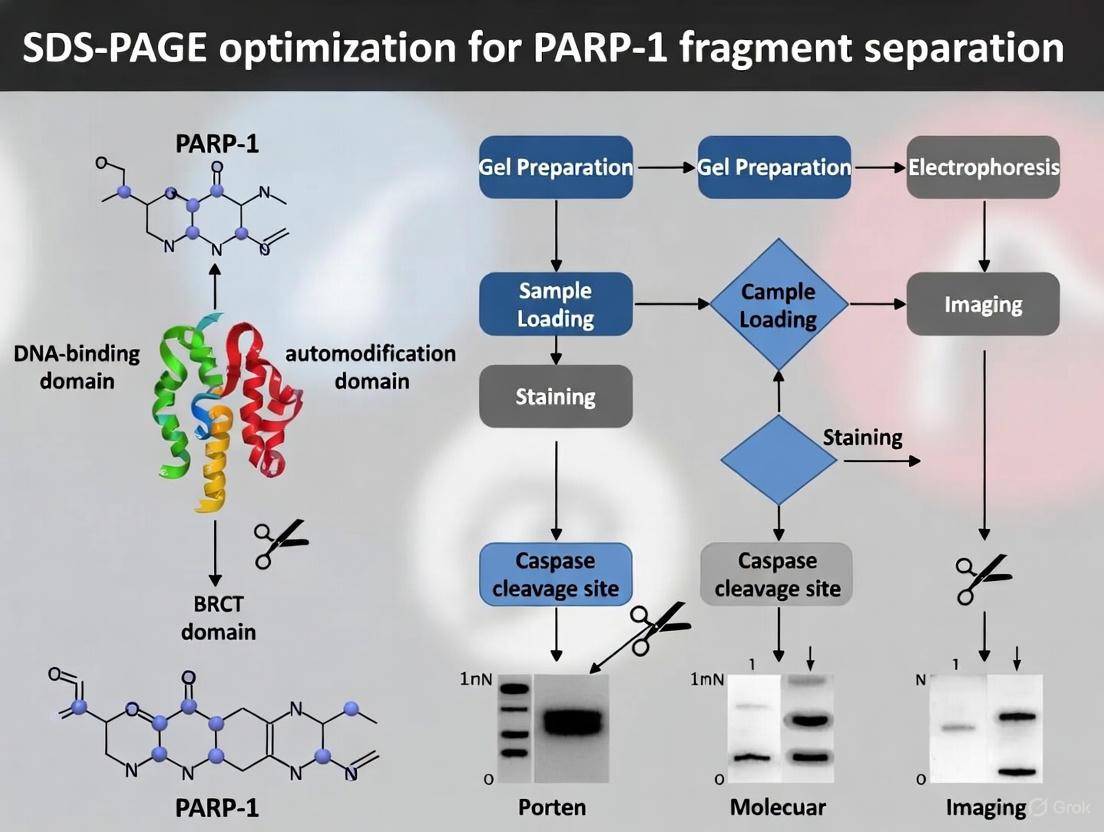
This methodological guide provides researchers and drug development professionals with optimized SDS-PAGE protocols for effective separation and analysis of PARP-1 fragments and their complex post-translational modifications.
Advanced SDS-PAGE Strategies for Resolving PARP-1 Fragments and Post-Translational Modifications
Abstract
This methodological guide provides researchers and drug development professionals with optimized SDS-PAGE protocols for effective separation and analysis of PARP-1 fragments and their complex post-translational modifications. Covering foundational principles of PARP-1 domain architecture and auto-modification, we detail specialized electrophoresis techniques for resolving serine ADP-ribosylation and other modifications. The article includes comprehensive troubleshooting for common artifacts, validation methods using mass spectrometry and Western blotting, and discusses implications for DNA repair research and PARP inhibitor development. These optimized protocols address the unique challenges posed by PARP-1's modification heterogeneity in studying DNA damage response mechanisms.
Understanding PARP-1 Domain Architecture and Modification Complexity
PARP-1 (Poly(ADP-ribose) polymerase-1) is a critical nuclear enzyme that functions as a primary sensor of DNA damage, facilitating the cellular response to genotoxic stress. This multi-domain protein detects DNA strand breaks and catalyzes the synthesis of poly(ADP-ribose) (PAR) chains onto target proteins, initiating DNA repair pathways and modulating chromatin structure. Understanding the structure-function relationships of PARP-1's domains is essential for research in DNA repair mechanisms and the development of targeted cancer therapies, particularly PARP inhibitors. The systematic analysis of these domains often relies on protein separation techniques, with SDS-PAGE serving as a fundamental method for resolving individual domains and proteolytic fragments to study their distinct functions and interactions.
Detailed Domain Structure and Function
PARP-1's functional versatility stems from its multi-domain architecture, where each domain contributes to DNA damage recognition, allosteric activation, and signal transduction. The table below summarizes the core structural and functional attributes of each domain.
Table 1: Core Domains of PARP-1 and Their Functions
| Domain | Location | Key Structural Features | Primary Functions |
|---|---|---|---|
| Zinc Fingers (F1 & F2) | N-terminus | Zn²⁺-coordinating motifs [1] | Primary DNA break sensors; initiate multi-domain assembly [2] [1] |
| Zinc Finger (F3) | N-terminus | Structurally distinct from F1/F2 [1] | Contributes to DNA binding and inter-domain contacts [1] |
| BRCT Domain | Central Region | Protein-protein interaction fold [3] | Serves as an auto-modification site; mediates recruitment of repair proteins like XRCC1 [3] |
| WGR Domain | Central Region | Named for conserved Trp-Gly-Arg motif [2] | Propagates allosteric signal; bridges DNA-binding and catalytic domains [2] |
| Catalytic Domain (CAT) | C-terminus | Comprises Helical Domain (HD) & ART subdomain [2] | Catalyzes ADP-ribose polymerization from NAD⁺ [2] |
The following diagram illustrates the domain organization and the sequential activation mechanism of PARP-1.
Key Experimental Data and Reagents
The study of PARP-1 domains utilizes a suite of specialized reagents and mutants to dissect their individual and collective functions. The quantitative analysis of DNA binding affinity for various PARP-1 constructs provides critical insights into the allosteric regulation of its activity.
Table 2: DNA Binding Affinity of PARP-1 Constructs and Mutants Data derived from fluorescence polarization (FP) DNA binding assays [2]
| PARP-1 Construct | Description | K_D (nM) for DSB | K_D (nM) with EB-47 (Type I PARPi) |
|---|---|---|---|
| WT (Full-length) | Wild-type PARP1 | 59.7 ± 9.2 | 8.4 ± 1.0 |
| ΔART | Catalytic ART subdomain deletion | 12.1 ± 4.6 | 15.4 ± 1.8 |
| L713F | Hyperactive mutant (Constitutive) | 21.3 ± 3.5 | 6.2 ± 3.1 |
| ΔV687-E688 | HD loop deletion mutant | 9.4 ± 1.3 | 8.0 ± 1.9 |
| WGR-CAT | WGR + Catalytic domains | >800 | 42.8 ± 5.7 |
| WGR-HD | WGR + Helical Domain | 7.0 ± 2.4 | Not Applicable |
Table 3: Essential Research Reagent Solutions for PARP-1 Domain Studies
| Reagent / Material | Function / Application | Key Details / Examples |
|---|---|---|
| Recombinant PARP1 Proteins | In vitro binding, activity, and structural assays | Human or murine PARP1, PARP2; full-length and domain fragments (e.g., Zn1-Zn3, WGR-CAT) [4] [2] |
| PARP Inhibitors (PARPi) | Probing allosteric mechanisms and catalytic function | EB-47 (Type I): Pro-retention, increases DNA affinity [2]. Niraparib: Shifts DNA to unkinked state [1] |
| DNA Substrates | Activating PARP-1 for functional studies | DSB, SSB, 1-nt gap, nucleosome core particle (NCP), cruciform, hairpin DNA [4] [5] [1] |
| HPF1 (Histone PARylation Factor) | Directs PARP1/PARP2 serine ADP-ribosylation | Essential for HPF1-dependent histone PARylation in DNA damage response [4] |
| Activity Assay Reagents | Measuring PARP-1 catalytic output | NAD⁺ (including ³²P-NAD⁺ for detection), PARG (hydrolyzes PAR chains) [4] |
Application Notes & Protocols
Protocol: Analyzing PARP-1 Domain Assembly on DNA Damage by smFRET
Application: This protocol uses single-molecule Förster Resonance Energy Transfer (smFRET) to probe the conformational changes in DNA and the induced fit multi-domain assembly of PARP-1 upon binding to a single-strand break (SSB) [1]. This is crucial for understanding the initial steps of DNA damage recognition.
Workflow Overview: The experimental pathway for investigating PARP-1 domain assembly via smFRET is methodically outlined below.
Detailed Methodology:
DNA Substrate Preparation:
- Design a dumbbell-shaped DNA hairpin substrate containing a single-strand break (nick) between two double-stranded stems.
- Site-specifically label the 3' stem with a donor fluorophore (ATTO 550) and the 5' stem with an acceptor fluorophore (Alexa 647), positioned 18 bases apart for optimal FRET sensitivity [1].
smFRET Data Acquisition:
- Immobilize the labeled DNA construct on a passivated microscope surface for single-molecule imaging.
- Image the molecules using total internal reflection fluorescence (TIRF) microscopy.
- First, record the FRET efficiency baseline for the DNA substrate alone in the absence of protein. This typically shows a low-FRET state, indicating minimal DNA kinking [1].
Protein Titration and Complex Formation:
- Introduce the PARP-1 zinc finger 2 (F2) domain at saturation concentrations. Observe the FRET population shift to an intermediate FRET state, indicating F2-induced DNA kinking [1].
- Subsequently, titrate with the F1F2 double zinc finger fragment. This will shift the population to a high-FRET state, signifying substantial DNA kinking and the formation of inter-domain contacts between F1 and F2 [1].
- Finally, repeat the experiment with full-length PARP-1 to observe the final, fully assembled complex.
Data Analysis and Interpretation:
- Plot the populations of molecules in low, medium, and high FRET states under each condition (DNA only, +F2, +F1F2).
- Use computational modeling and structural ensemble calculations to convert the observed FRET efficiencies into DNA kinking angles [1].
- The sequential, protein-induced progression of DNA through increasingly kinked states provides direct evidence for an induced fit mechanism rather than conformational selection [1].
Protocol: Mapping PARP-1 Allostery and Auto-inhibition Using Mutant Analysis
Application: This protocol employs a series of PARP-1 point mutants and deletions to dissect the allosteric communication between the DNA-binding domains and the auto-inhibitory Helical Domain (HD), and to study the resulting functional consequences in cells [6] [2].
Key Mutants and Their Utility:
- Constitutively Active Mutant (L713F): This mutation within the HD destabilizes auto-inhibition, leading to high catalytic activity even in the absence of DNA damage. Reconstituting PARP-1 KO cells with L713F triggers apoptosis, which can be rescued by PARP inhibitors, demonstrating the toxic potential of unregulated PAR synthesis [6].
- ART Subdomain Deletion (ΔART): Removing the ART subdomain "frees" the HD, allowing it to fully engage with the WGR domain. This mimics the effect of Type I PARP inhibitors like EB-47, resulting in a ~5-fold increase in DNA binding affinity (Table 2). This construct is vital for crystallography studies aimed at capturing the active state of PARP1 [2].
- Mono-ADP-ribosylating Mutant (E988K): This catalytic domain mutation abolishes PAR synthesis capacity, restricting the enzyme to mono-ADP-ribosylation. When expressed in PARP-1 KO cells, it causes a DNA-damage-induced G2 arrest, revealing distinct cellular outcomes for mono- versus poly-ADP-ribosylation [6].
Methodology:
- Protein Purification: Express and purify wild-type and mutant PARP1 proteins (e.g., L713F, E988K, ΔART) using recombinant baculovirus or bacterial systems [6] [2].
- DNA Binding Assays: Determine the DNA binding affinity (K_D) of each mutant for double-strand breaks (DSBs) using fluorescence polarization (FP). Compare the values to wild-type PARP1 (Table 2) to quantify allosteric effects [2].
- Cellular Reconstitution: Stably express these mutants in PARP1 knockout HeLa or DT40 cells [6] [3]. This provides a clean background to study mutant-specific phenotypes without interference from the endogenous protein.
- Phenotypic Analysis:
- Assess PARP1 recruitment kinetics to laser-induced DNA damage sites using live-cell imaging.
- Measure cell viability and cell cycle progression following genotoxic stress.
- Analyze markers of apoptosis and DNA repair.
- Test the rescuing effects of PARP inhibitors on observed phenotypes [6].
The sophisticated multi-domain architecture of PARP-1, comprising zinc fingers, BRCT, WGR, and catalytic domains, enables its precise function as a DNA break sensor and signal transducer. The experimental strategies and protocols detailed herein—ranging from smFRET analysis of domain assembly to the cellular phenotyping of allosteric mutants—provide a robust framework for deconstructing this complex protein. Mastery of these techniques, underpinned by optimized SDS-PAGE separation for analyzing domains and cleavage products, is fundamental for advancing research in DNA repair biochemistry and for developing the next generation of PARP-targeted therapeutics.
Auto-modification Mechanisms and Their Impact on Electrophoretic Mobility
Poly(ADP-ribose) polymerase 1 (PARP-1) is a nuclear enzyme that functions as a critical DNA damage sensor. Its primary catalytic function involves the transfer of ADP-ribose units from NAD+ onto acceptor proteins, including itself—a process known as auto-modification or autoPARylation. This post-translational modification results in the attachment of either linear or branched chains of ADP-ribose (poly(ADP-ribose) or PAR) to target proteins [7]. PARP-1's ability to function simultaneously as both a catalytic enzyme and an acceptor substrate has created challenges in interpreting experimental data, particularly regarding the stoichiometry of PARP-1 molecules involved in auto-modification reactions and the direction of PAR chain growth [7].
The electrophoretic mobility of PARP-1 undergoes significant shifts during auto-modification due to the substantial addition of negatively charged ADP-ribose polymers. These mobility changes provide researchers with a valuable tool for monitoring PARP-1 activation and enzymatic activity. Understanding these auto-modification mechanisms is especially relevant in pharmaceutical development, as PARP inhibitors have emerged as promising cancer therapeutics that exploit synthetic lethality in DNA repair-deficient tumors [7] [8].
Molecular Mechanisms of PARP-1 Auto-modification
Domain Architecture and Catalytic Activation
PARP-1 is a 116-kDa protein comprising three primary functional domains: an N-terminal DNA-binding domain containing zinc fingers, a central auto-modification domain, and a C-terminal catalytic domain [9]. The auto-modification domain contains multiple glutamate, aspartate, and lysine residues that serve as acceptors for ADP-ribose units [9]. Upon binding to DNA damage sites through its zinc finger domains, PARP-1 undergoes a conformational change that relieves the auto-inhibitory configuration of its catalytic domain, enabling NAD+ substrate access and catalytic activity [10].
PAR Chain Initiation and Elongation
The auto-modification reaction occurs through a two-step process:
- Initiation: Transfer of the first ADP-ribose unit to specific acceptor amino acids (primarily glutamate, aspartate, or lysine residues) within PARP-1's auto-modification domain
- Elongation: Subsequent addition of ADP-ribose units to the initial monomer, forming linear or branched polymers [7]
Recent research has revealed that the histone PARylation factor 1 (HPF1) plays a crucial role in modulating PARP-1 activity. HPF1 forms a joint active site with PARP-1, influencing both the specificity of amino acid targeting (switching preference to serine residues) and the length of PAR chains synthesized [10]. HPF1 presence typically results in shorter PAR chains, affecting the electrophoretic mobility patterns observed in SDS-PAGE analysis.
Table 1: Key Proteins Regulating PARP-1 Auto-modification
| Protein/Enzyme | Function in PARP-1 Auto-modification | Effect on PAR Chain |
|---|---|---|
| PARP-1 | Catalyzes addition of ADP-ribose units to itself and other proteins | Forms linear/branched polymers |
| HPF1 | Forms joint active site with PARP-1 | Shortens PAR chain length, switches amino acid specificity to serine |
| PARG | Hydrolyzes PAR chains | Removes PAR modifications, reverses mobility shifts |
| PARP-2 | Partially redundant function with PARP-1 | Synthesizes shorter PAR chains than PARP-1 |
Experimental Protocols for Analyzing PARP-1 Auto-modification
In Vitro PARP-1 Auto-modification Assay
Purpose: To monitor PARP-1 auto-modification and its impact on electrophoretic mobility through SDS-PAGE analysis.
Reagents and Equipment:
- Purified PARP-1 protein (commercial sources or purified from overexpression systems)
- NAD+ solution (prepared fresh in appropriate buffer)
- Activated DNA or nucleosome core particles (for PARP-1 activation)
- PARP assay buffer: 50 mM Tris-HCl (pH 8.0), 50 mM NaCl, 5 mM MgCl₂, 1 mM DTT
- HPF1 protein (optional, for modulation studies)
- PARP inhibitors (e.g., Olaparib, AG-14361, UPF 1069) for inhibition controls
- SDS-PAGE equipment and materials
- Western blot transfer system
- Anti-PAR antibody (e.g., Trevigen 4336-BPC-100) or anti-PARP-1 antibody (e.g., Cell Signaling 9532S)
Procedure:
- Reaction Setup:
- Prepare 20 μL reactions containing 1-2 μg PARP-1 in PARP assay buffer
- Add activating DNA (200-500 ng) or nucleosome core particles
- Include experimental conditions: ± HPF1 (60-1000 nM), ± PARP inhibitors
- Pre-incubate for 5 minutes at 25°C
PARylation Initiation:
- Start reactions by adding NAD+ to final concentration of 50-500 μM
- Incubate at 25°C for 5-30 minutes
- Terminate reactions by adding SDS-PAGE loading buffer and heating to 95°C for 5 minutes
Electrophoretic Analysis:
- Load samples on 6-10% SDS-PAGE gels (higher percentage for better resolution of modified PARP-1)
- Run electrophoresis at constant voltage until proper separation achieved
- Transfer proteins to PVDF membrane for Western blotting
- Probe with anti-PAR and anti-PARP-1 antibodies to visualize modified and total PARP-1
Troubleshooting Notes:
- High molecular weight smearing indicates extensive PARylation; optimize NAD+ concentration and reaction time
- Include PARG treatment controls to confirm PAR-specific modifications
- Use specialized buffers (e.g., Laemmli buffer without reducing agents) to preserve PAR chains
Figure 1: Experimental workflow for analyzing PARP-1 auto-modification and electrophoretic mobility shifts
Quantitative Assessment of Mobility Shifts
Data Analysis Method:
- Mobility Shift Quantification:
- Measure apparent molecular weights of PARP-1 bands
- Calculate shift magnitude relative to unmodified PARP-1
- Correlate shift extent with PAR chain length using molecular weight standards
- HPF1 Titration Experiments:
- Set up reactions with increasing HPF1 concentrations (0-2000 nM)
- Quantify PAR chain length using anti-PAR Western blotting
- Normalize data to PARP-1 total protein levels
Table 2: Effects of HPF1 on PARP-1 Auto-modification Parameters
| HPF1:PARP-1 Ratio | Auto-modification Level | PAR Chain Length | Electrophoretic Mobility |
|---|---|---|---|
| 0:1 | Baseline | Long polymers (≥20 units) | Pronounced smearing, high MW |
| 0.5:1 | Increased (2-3×) | Medium chains (10-15 units) | Defined bands with reduced smearing |
| 1:1 | Maximally stimulated (6× with NCP) | Short chains (5-10 units) | Tight band cluster, lower MW shift |
| 2:1 | Reduced from maximum | Very short chains (1-5 units) | Minimal shift,接近unmodified |
Impact of Auto-modification on Electrophoretic Mobility
Characteristic Mobility Patterns
Auto-modified PARP-1 exhibits distinctive electrophoretic mobility patterns that reflect the extent and nature of PAR modification:
Minimal Modification: Unmodified PARP-1 migrates as a ~116 kDa band with minimal smearing.
Moderate PARylation: Initial auto-modification produces a characteristic "ladder" or "smear" extending upward from the primary band, representing heterogeneous PAR chain lengths.
Extensive PARylation: Heavy modification results in pronounced high molecular weight smearing, often failing to enter standard SDS-PAGE separation gels due to enormous molecular weight increases and extreme negative charge.
HPF1-Modified Pattern: In the presence of HPF1, the heterogeneous smear is replaced by more defined bands with increased mobility, reflecting shorter PAR chains and more uniform modification [10].
Technical Considerations for SDS-PAGE Optimization
Gel System Optimization:
- Use low-percentage acrylamide gels (6-8%) for better resolution of high molecular weight PARylated species
- Implement gradient gels (4-20%) to capture broad molecular weight ranges
- Extend electrophoresis run times to improve separation of modified species
- Include high molecular weight markers (up to 500 kDa) for accurate size estimation
Sample Preparation Adjustments:
- Avoid excessive boiling which can degrade PAR chains
- Consider non-reducing conditions to preserve PAR structure
- Use specialized loading buffers without strong reducing agents
Research Reagent Solutions
Table 3: Essential Research Reagents for PARP-1 Auto-modification Studies
| Reagent | Function/Application | Example Products/Sources |
|---|---|---|
| PARP-1 Protein | Primary enzyme for in vitro assays | Recombinant human PARP-1 (commercial vendors) |
| Activated DNA | PARP-1 activator for in vitro assays | DNase I-treated calf thymus DNA |
| Nucleosome Core Particles | Physiological activator | Recombinant or native NCPs |
| NAD+ | PARylation substrate | Sigma-Aldrich N1511, prepare fresh |
| HPF1 Protein | PARP-1 activity modulator | Recombinant human HPF1 |
| PARP Inhibitors | Activity controls, mechanistic studies | Olaparib, AG-14361, UPF 1069 |
| PARG | PAR chain degradation control | Recombinant PARG enzyme |
| Anti-PAR Antibodies | Detection of PARylation | Trevigen 4336-BPC-100, Millipore MABE1016 |
| Anti-PARP-1 Antibodies | Loading controls, total PARP-1 | Cell Signaling 9532S |
| PARG Inhibitors | PAR preservation | PDD 00017273 (Tocris 5952) |
Applications in Drug Discovery and Development
The analysis of PARP-1 auto-modification and its electrophoretic mobility patterns has significant applications in pharmaceutical research:
PARP Inhibitor Screening: Mobility shift assays provide a rapid method for evaluating inhibitor efficacy and mechanism of action.
Mechanistic Studies: Electrophoretic patterns can distinguish between different inhibition mechanisms (competitive vs. allosteric).
Biomarker Development: PARP-1 modification status in clinical samples may serve as a pharmacodynamic biomarker for PARP inhibitor efficacy.
Combination Therapy Development: Understanding auto-modification mechanisms aids in designing rational combination therapies with PARP inhibitors.
Figure 2: PARP-1 auto-modification pathway and regulatory mechanisms impacting electrophoretic mobility
The analysis of PARP-1 auto-modification through electrophoretic mobility shifts provides critical insights into PARP-1 enzymatic activity and regulation. The characteristic mobility patterns observed in SDS-PAGE—from discrete banding to heterogeneous smearing—directly reflect the extent of PAR modification and can be systematically quantified. The discovery of regulatory proteins like HPF1 has further refined our understanding of PAR chain length control and its manifestation in electrophoretic profiles. These methodologies continue to support drug discovery efforts, particularly in the development and characterization of PARP inhibitors as cancer therapeutics. Optimized SDS-PAGE protocols for PARP-1 fragment separation remain essential tools for researchers investigating DNA damage response mechanisms and developing targeted cancer therapies.
HPF1-dependent serine ADP-ribosylation versus glutamate/aspartate modifications
ADP-ribosylation is a reversible post-translational modification that regulates vital cellular processes, including DNA damage response. A pivotal advancement in this field has been the discovery that the DNA damage-dependent serine ADP-ribosylation (Ser-ADPr) is strictly governed by a cofactor, Histone PARylation Factor 1 (HPF1). In complex with PARP1 or PARP2, HPF1 remodels the enzyme's active site, shifting amino acid specificity from acidic residues (aspartate and glutamate) to serine residues. This application note details the key differences between these modification pathways and provides optimized methodologies for their investigation, framed within the context of optimizing SDS-PAGE for PARP-1 fragment separation research.
Biochemical Mechanisms and Specificity
The HPF1/PARP1 Complex and Active Site Remodeling
The specificity shift from aspartate/glutamate to serine ADP-ribosylation is mediated by HPF1 through structural remodeling of PARP1's catalytic domain. In the absence of HPF1, PARP1 preferentially modifies acidic residues (Asp/Glu) and undergoes automodification. HPF1 binding to the activated catalytic domain of PARP1 (which requires local unfolding of the autoinhibitory helical domain) creates a composite active site that enables serine modification [11].
Key residues in HPF1, including Phe268, Phe280, Asp283, Cys285, and Lys307, form an extensive interface with PARP1 that envelopes the active site region. Mutagenesis of these residues significantly disrupts HPF1/PARP1 binding and restores PARP1 hyper-automodification [11]. Particularly critical is HPF1 Arg239, which positions Glu284 for catalysis of serine ADP-ribosylation and helps neutralize negative charge in the active site [11].
Specificity and Mutual Exclusivity with Other Modifications
HPF1-dependent serine ADP-ribosylation exhibits complex interplay with other post-translational modifications, particularly on histone tails. Research demonstrates that acetylation of H3K9 is mutually exclusive with ADP-ribosylation of the adjacent H3S10 residue both in vitro and in vivo [12]. This crosstalk represents a dynamic addition to the complex network of modifications that shape the histone code and influences DNA damage response signaling.
Table 1: Key Characteristics of HPF1-Dependent Serine vs. Aspartate/Glutamate ADP-ribosylation
| Characteristic | Serine ADP-ribosylation | Aspartate/Glutamate ADP-ribosylation |
|---|---|---|
| Dependency | Strictly HPF1-dependent [13] | HPF1-independent; PARP1 alone [14] |
| Chemical Bond | O-glycosidic linkage [14] | Ester linkage [14] |
| Chemical Stability | Highly stable; resistant to acidic conditions [14] | Labile; sensitive to heat, pH changes, and DNA shearing [14] |
| Temporal Dynamics in DNA Damage | Sustained signal; more enduring [14] | Initial wave; transient signal [14] |
| Primary Enzymes | PARP1/HPF1 and PARP2/HPF1 complexes [13] | PARP1 alone; other PARP family members [15] |
| Cellular Reversal | ARH3 hydrolase [14] | PARG hydrolase (new finding) [14] |
| Histone Modification Interplay | Mutually exclusive with proximal acetylation (e.g., H3K9ac vs. H3S10ADPr) [12] | Not well characterized |
Experimental Protocols and Methodological Considerations
Preservation of Labile Ester-Linked Modifications
Traditional sample preparation methods involving heat and extreme pH systematically undermine detection of aspartate/glutamate ADP-ribosylation due to the lability of ester bonds. The following optimized protocol enables reliable preservation and detection of these modifications:
Cell Lysis and Denaturation:
- Lyse cells directly with 4% SDS lysis buffer at room temperature (20-25°C)
- Avoid boiling samples as even brief heating rapidly hydrolyzes ester-linked ADPr
- Include PARP inhibitors in lysis buffer to prevent post-lysis ART activity
- Process samples immediately after lysis without freezing-thawing cycles
Electrophoresis and Immunoblotting:
- Maintain samples at room temperature throughout SDS-PAGE preparation
- Use pre-cast gels to minimize gel polymerization time
- Transfer proteins using standard western blot protocols
- Detect using broad-specificity mono-ADPr antibodies (e.g., AbD43647) [14]
Proteomic Sample Preparation:
- Perform protein digestion at 37°C for short durations (2-4 hours)
- Use acidic digestion conditions with Arg-C Ultra protease
- Avoid prolonged incubation and alkaline conditions
- Process samples immediately for LC-MS/MS analysis [14]
In Vitro Reconstitution of Serine ADP-ribosylation
To biochemically characterize HPF1-dependent serine modification, the following reconstitution system can be employed:
Reaction Components:
- Purified PARP1 (or PARP2) protein: 100-200 nM
- HPF1 protein: 200-400 nM (maintain 1:2-1:1 ratio with PARP1)
- Histone substrate (nucleosomes, core histones, or H3 peptides): 1-2 μg
- Activating DNA (ssDNA or gapped DNA): 100-200 ng
- NAD+ substrate: 10-100 μM (including 32P-NAD+ for radioactive detection)
- Reaction buffer: 50 mM Tris-HCl (pH 8.0), 50 mM NaCl, 10 mM MgCl₂
Reaction Conditions:
- Assemble reactions on ice without NAD+
- Initiate by adding NAD+ and incubate at 30°C for 10-30 minutes
- Terminate with SDS sample buffer (without boiling)
- Analyze by SDS-PAGE and autoradiography or immunoblotting [13]
Controls:
- Omit HPF1 to demonstrate dependency
- Include PARP inhibitor (olaparib, 1-10 μM) to confirm PARP specificity
- Use serine-to-alanine mutant substrates (e.g., H3S10A) to verify modification sites [13]
Signaling Pathways and Dynamics
The differential regulation and dynamics of serine versus aspartate/glutamate ADP-ribosylation create a sophisticated temporal signaling system in DNA damage response.
Diagram 1: Signaling pathways for HPF1-dependent serine and HPF1-independent aspartate/glutamate ADP-ribosylation in DNA damage response. The two pathways represent distinct temporal and regulatory mechanisms with different biological outcomes.
Research Reagent Solutions
Table 2: Essential Research Tools for Investigating ADP-ribosylation Pathways
| Reagent/Category | Specific Examples | Function/Application |
|---|---|---|
| PARP Inhibitors | Olaparib, Talazoparib, Rucaparib, Veliparib [16] | Inhibit PARP catalytic activity; research tools and clinical applications |
| HPF1 Mutants | HPF1 F268S, D283H, R239A [11] | Disrupt HPF1/PARP1 binding; study HPF1-dependent functions |
| Specific Antibodies | Site-specific Ser-ADPr antibodies; Broad mono-ADPr AbD43647 [14] [17] | Detect specific ADPr modifications; immunoblotting and immunofluorescence |
| Hydrolase Tools | Recombinant PARG, ARH3 [14] | Reverse specific ADPr types; study modification dynamics |
| Activity Assays | 32P-NAD+ incorporation, ETD mass spectrometry [13] | Detect and map ADP-ribosylation sites |
| Cell Models | HPF1 KO cells, PARP1 KO cells [13] [14] | Study pathway dependencies and biological functions |
Technical Considerations for SDS-PAGE Optimization
When optimizing SDS-PAGE for PARP-1 fragment separation in ADP-ribosylation studies, several critical factors must be considered:
Sample Preparation:
- For analyzing aspartate/glutamate modifications: avoid heat denaturation and maintain samples at 4°C to room temperature
- For serine modifications: standard boiling (95°C, 5 minutes) is acceptable due to thermal stability
- Include PARG and ARH3 inhibitors in lysis buffers to preserve modifications during processing
Gel System Selection:
- Use 4-12% or 4-20% gradient gels for optimal separation of PARP1 fragments (25-120 kDa range)
- Consider Tris-acetate gels for better separation of higher molecular weight PARP1 species
- Include molecular weight markers spanning 25-250 kDa for accurate size determination
Detection and Analysis:
- Implement simultaneous immunoblotting with modification-specific and total protein antibodies
- Use fluorescent secondary antibodies for quantitative comparison across samples
- Account for potential gel shifts due to ADP-ribosylation modifications
This methodological framework enables researchers to effectively distinguish between these biochemically distinct modification pathways and investigate their respective functions in DNA damage response and other cellular processes.
DNA Damage-Induced PARP-1 Structural Changes and Detection Challenges
Poly(ADP-ribose) polymerase-1 (PARP-1) serves as a primary sensor for DNA single-strand breaks (SSBs) in eukaryotic cells, initiating a critical signaling cascade for DNA damage repair. This nuclear enzyme detects DNA lesions and catalyzes the transfer of ADP-ribose units from nicotinamide adenine dinucleotide (NAD+) to target proteins, including itself—a process known as poly(ADP-ribosyl)ation (PARylation) [18] [19]. PARP-1 is exceptionally abundant, with approximately one molecule per 1,000 base pairs of DNA, and its enzymatic activity can increase up to 500-fold upon DNA damage recognition [19]. Understanding the structural transitions PARP-1 undergoes during damage detection and the subsequent technical challenges in analyzing these changes is fundamental to advancing research in DNA repair mechanisms and developing targeted cancer therapies, particularly PARP inhibitors.
Structural Domains and DNA Damage Sensing Mechanism
Domain Organization of PARP-1
PARP-1 possesses a modular architecture consisting of six structured domains that coordinate its damage sensing and signaling functions. The N-terminal region contains three zinc-binding domains: two zinc fingers (F1 and F2) that directly recognize DNA damage, followed by a third zinc finger (Zn3) or zinc ribbon domain that contributes to DNA-dependent activation [20] [21]. The central region includes a BRCT domain containing auto-modification sites and a WGR domain that participates in multi-domain assembly. The C-terminal region houses the catalytic domain, comprising a helical subdomain (HD) and the ADP-ribosyl transferase (ART) subdomain that executes PAR synthesis [20]. In the absence of DNA, these domains behave as largely independent units in an extended "beads-on-a-string" conformation [20] [21].
Table 1: PARP-1 Structural Domains and Their Functions
| Domain | Position | Primary Function | DNA Binding Role |
|---|---|---|---|
| Zinc Finger 1 (F1) | 1-209 | Primary DNA damage recognition | Binds 5' side of DNA breaks |
| Zinc Finger 2 (F2) | 1-209 | Primary DNA damage recognition | Binds 3' side of DNA breaks |
| Zinc Finger 3 (Zn3) | 233-273 | Allosteric regulation | Necessary for DNA-stimulated activation |
| BRCT | 384-486 | Auto-modification sites | Protein-protein interactions |
| WGR | 540-656 | Multi-domain assembly | Contributes to DNA-dependent activation |
| Catalytic (HD+ART) | 784-1014 | PAR synthesis | Allosterically inhibited until DNA binding |
DNA Damage Recognition and Structural Transition
PARP-1 employs an induced fit mechanism for DNA damage recognition rather than conformational selection [20]. Single-molecule FRET studies reveal that PARP-1 binding converts DNA containing single-strand breaks from a largely unperturbed conformation through an intermediate state to a highly kinked DNA conformation. The F2 domain initiates this process by binding the 3' side of the break and inducing initial DNA bending, followed by F1 binding to the 5' side, which further kinks the DNA approximately 90° [20]. This sequential binding triggers a comprehensive multi-domain assembly cascade where the zinc fingers, WGR domain, and catalytic domain coalesce into a compact, enzymatically active structure at the damage site [22] [20]. This allosteric transition releases auto-inhibition of the catalytic domain, activating PARP-1 for PAR synthesis.
Detection Challenges and Technical Considerations
Dynamic Structural Transitions
The highly dynamic nature of PARP-1 presents significant challenges for structural analysis. Solution studies using small-angle X-ray scattering (SAXS) demonstrate that the N-terminal DNA-binding region (residues 1-486) exists as an extended, flexible arrangement of domains in the absence of DNA, with a radius of gyration (Rg) of approximately 46-48Å and a maximum dimension (Dmax) of 150Å [21]. Upon DNA binding, PARP-1 undergoes substantial compaction, particularly in the zinc ribbon domain region. These rapid conformational changes, coupled with the transient nature of PARP-1-DNA interactions, complicate traditional structural biology approaches and require real-time monitoring techniques such as single-molecule FRET.
PARylation Heterogeneity and Turnover
The PARylation reaction itself introduces analytical complications due to its heterogeneity and rapid turnover. PAR chains can reach 200 units in length with both linear and branched structures [19]. This heterogeneity, combined with the low abundance of PARylated species and the labile nature of the modification, creates significant challenges for mass spectrometry-based analyses [19]. Furthermore, the half-life of PAR chains is exceptionally short (<1 minute) due to efficient degradation by poly(ADP-ribose) glycohydrolase (PARG) and other hydrolases [19]. This rapid turnover necessitates careful experimental timing and often requires PARG inhibition to capture PARylation events.
Complex Formation and Phase Separation
Recent research has revealed that PARP-1 undergoes liquid-liquid phase separation at DNA damage sites, forming co-condensates with damaged DNA through a process involving PARP1 dimerization and multimerization along DNA filaments [22]. These condensates exert mechanical forces that maintain synapsis of broken DNA ends and create enzymatically active compartments for PAR synthesis. The compositional complexity and dynamic nature of these structures present unique challenges for biochemical isolation and characterization, particularly in distinguishing between specific binding and phase partitioning.
Experimental Approaches and Methodologies
Structural Analysis Techniques
Small-Angle X-Ray Scattering (SAXS) SAXS provides low-resolution structural information for PARP-1 and its complexes in solution. The experimental workflow involves:
- Purifying recombinant PARP-1 fragments (e.g., hparp486, residues 1-486) to homogeneity
- Concentrating protein to 3-9 mg/ml in appropriate buffer (e.g., 20mM HEPES pH 7.5, 150mM NaCl)
- Collecting scattering data at multiple concentrations to assess concentration dependence
- Processing data using Guinier analysis to determine radius of gyration (Rg)
- Calculating distance distribution functions and ab initio shape reconstructions
- Fitting known domain structures into the overall envelope [21]
Single-Molecule FRET (smFRET) smFRET enables real-time observation of PARP-1-induced DNA bending and conformational changes:
- Designing DNA dumbbell substrates with a single-strand break between two hairpins
- Labeling with fluorophores (ATTO 550 on 3' stem, Alexa647 on 5' stem) positioned 18 bases apart
- Immobilizing DNA molecules on quartz slides via biotin-neutravidin linkage
- Acquiring time-resolved fluorescence data with total internal reflection microscopy
- Calculating FRET efficiency distributions for DNA alone and with PARP-1 domains
- Determining DNA kinking angles through computational modeling [20]
PARP-1 Activity and PARylation Assays
Automodification Assays
- Incubating purified PARP-1 with activated DNA (nick, gap, or blunt end) and NAD+ in reaction buffer
- Stopping reactions at timed intervals with PARP inhibitor or SDS sample buffer
- Separating PARylated species by SDS-PAGE with special considerations:
- Using low-acrylamide concentrations (6-8%) for better resolution of high molecular weight PARylated forms
- Including protein molecular weight markers exceeding 250 kDa
- Implementing modified electrophoresis conditions (extended run times, cooled apparatus)
- Detecting PAR modifications via immunoblotting with PAR-specific antibodies
- Quantifying automodification extent by comparing PARP-1 mobility shifts [18] [23]
PARP-1 DNA Binding Assays Electrophoretic Mobility Shift Assays (EMSAs):
- Preparing fluorescently labeled DNA substrates containing specific lesions (nicks, gaps, ends)
- Incubating DNA with purified PARP-1 domains or full-length protein
- Separating protein-DNA complexes from free DNA using non-denaturing polyacrylamide gels
- Visualizing complexes with fluorescence imaging or autoradiography
- Quantifying binding affinity through concentration-dependent experiments [21]
Research Reagent Solutions
Table 2: Essential Research Reagents for PARP-1 Studies
| Reagent Category | Specific Examples | Research Application | Technical Considerations |
|---|---|---|---|
| PARP Inhibitors | Olaparib, Niraparib, PJ34 | Mechanistic studies, therapeutic applications | Different classes affect DNA binding differently (pro-retention vs. pro-release) [20] |
| DNA Substrates | Nicked DNA, gapped DNA, blunt ends, 3'-overhangs | DNA binding and activation assays | Different structures activate PARP-1 to varying degrees [21] |
| PAR Detection Reagents | PAR-specific antibodies, PBZ domains | PARylation detection and quantification | Specificity varies for different PAR chain lengths and structures |
| Hydrolase Inhibitors | PARG inhibitors, ARH3 inhibitors | PAR stabilization for detection | Essential for capturing transient PARylation events [19] |
| Tagged PARP-1 Constructs | GFP-PARP1, FLAG-PARP1, truncated domains | Localization and interaction studies | Truncations help isolate specific functional domains [24] |
| Interaction Partners | XRCC1, HPF1, Histones | Pathway mapping and functional assays | HPF1 switches PARP-1 amino acid specificity to serine [25] |
Signaling Pathway and Experimental Workflow
PARP-1 Activation Pathway and Experimental Approaches
Advanced Methodological Considerations
Addressing PARP-1 Auto-modification
Recent studies utilizing separation-of-function PARP-1 mutants have revealed that auto-modification plays distinct roles in different cellular processes. An auto-modification-deficient PARP-1 mutant (serine to alanine substitution at four key sites) retains catalytic activity but demonstrates impaired release from DNA damage sites, leading to replication fork slowing and defects in Okazaki fragment processing [23]. This mutant provides a valuable tool for distinguishing between PARP-1's scaffolding and enzymatic functions. When studying PARP-1 auto-modification, researchers should consider:
- Utilizing auto-modification-deficient mutants as controls
- Monitoring replication fork dynamics in addition to repair recruitment
- Assessing Okazaki fragment maturation in auto-modification contexts
- Examining potential synthetic lethality with FEN1 inhibition [23]
Analyzing Composite Post-Translational Modifications
The discovery of serine ADP-ribosylation as a target for ester-linked ubiquitylation creates new analytical challenges and opportunities [25]. This composite modification requires specialized proteomic approaches:
- Implementing short, acidic ArgC digestion to preserve acid-labile linkages
- Developing enrichment strategies using specialized reader domains (e.g., ZUD domain of RNF114)
- Employing specific chemical elution (zinc chelation) to maintain modification integrity
- Creating modular detection reagents through protein ligation technologies (e.g., SpyTag) [25]
Phase Separation Studies
Investigating PARP-1-DNA co-condensates requires specialized methodologies:
- Bottom-up reconstitution of functional DNA repair sites using purified components
- Single-molecule imaging to monitor condensate dynamics
- Atomic force microscopy for structural characterization
- Assessing mechanical properties through biophysical approaches [22]
Concluding Remarks
The structural plasticity of PARP-1 during DNA damage recognition represents both a fascinating biological mechanism and a significant technical challenge. Successfully analyzing these dynamic transitions requires integrated methodological approaches that account for PARP-1's modular architecture, rapid conformational changes, and complex post-translational modifications. The continued development of separation techniques, including optimized SDS-PAGE protocols, coupled with advanced structural and single-molecule methods, will be essential for elucidating the full scope of PARP-1 functions in genome maintenance and for developing next-generation PARP-targeted therapies.
Recent Advances in PARP-1 Biology from 2024-2025 Research
Application Note 1: The Role of PARP1 Auto-modification in DNA Replication
Recent research has unveiled critical functions of PARP1 auto-modification (AM) beyond its well-established role in DNA repair. A 2025 study identified a specific separation-of-function PARP1 mutant, deficient in auto-modification but retaining catalytic activity, revealing its essential role in controlling replication fork speed and ensuring faithful Okazaki fragment maturation [23]. This discovery provides a new mechanistic understanding of replication stress and offers novel perspectives for therapeutic strategies.
Key Quantitative Findings
Table 1: Key Functional Parameters of Auto-modification-Deficient PARP1
| Parameter | Auto-modification Deficient PARP1 | Wild-type PARP1 |
|---|---|---|
| Catalytic Activity | Retained | Retained |
| Eviction from DNA Breaks | Impaired (timely release lost) | Normal |
| Replication Fork Speed | Increased | Normally controlled |
| Replication Stress | Increased formation | Prevented |
| Okazaki Fragment Processing | Impaired (synthetic lethality with FEN1 inhibition) | Normal [23] |
Biological Significance and Research Context
The auto-modification-deficient PARP1 mutant was generated by mutating four specific serine residues. Proteomic analyses using this mutant have mapped the extensive ADP-ribosylation network present at the replication fork [23]. The study demonstrates that auto-modification is dispensable for initial repair factor recruitment. Its primary function is to facilitate the timely release of PARP1 from DNA break sites. When this release is impaired, the trapped PARP1 obstructs the access of other essential replication and repair factors to the DNA, creating a blockage that leads to replication stress [23]. This is particularly critical during Okazaki fragment processing on the lagging strand. The finding of synthetic lethality between the loss of PARP1 auto-modification and inhibition of the flap endonuclease FEN1 directly implicates PARP1's auto-modification state in this fundamental process [23].
Implications for SDS-PAGE Optimization in PARP-1 Research
These findings highlight the necessity of optimizing SDS-PAGE protocols to separate and identify distinct PARP1 fragments and proteoforms. The auto-modified and unmodified states of PARP1, as well as caspase-cleaved fragments during apoptosis, exhibit different molecular weights and charges, influencing their migration. Precise separation is crucial for:
- Accurately determining the auto-modification status of PARP1 in cellular models.
- Evaluating the efficacy of PARP inhibitors that function by trapping PARP1 on DNA.
- Investigating the cleavage of PARP1 during different cell death pathways (e.g., apoptosis, parthanatos) in neurodegenerative disease models [26].
Diagram 1: PARP1 auto-modification controls DNA replication.
Application Note 2: PARP1 in Transcription-Replication Conflicts and Neurodegeneration
A landmark 2024 study revealed a novel mechanism for PARP inhibitor (PARPi) synthetic lethality, shifting the paradigm from the dominant "PARP trapping" model. The research established that PARP1, in conjunction with the TIMELESS-TIPIN complex, plays a crucial role in shielding DNA replication forks from transcription-replication conflicts (TRCs) during early S phase [27]. Furthermore, PARP1 overactivation is increasingly implicated in the pathogenesis of neurodegenerative diseases through mechanisms like parthanatos [26].
Key Insights and Data
Table 2: PARP1 in Cellular Stress and Disease Contexts
| Context | PARP1 Function / Effect | Key Experimental Findings |
|---|---|---|
| TRCs (Early S Phase) | Protects replisome from conflicts with transcription machinery. | PARPi induces γH2AX/53BP1/RAD51 foci; suppressed by transcription inhibitor DRB [27]. |
| Synthetic Lethality (HR Deficiency) | Prevents toxic DNA damage from TRCs. | siRNA PARP1 depletion is synthetic lethal with HR deficiency; damage from TRCs, not trapped PARPs, is key [27]. |
| Neurodegeneration | Overactivation depletes NAD+/ATP, triggering parthanatos. | PARP1 overactivation causes neuronal death via AIF translocation; inhibition is therapeutic [26]. |
| Okazaki Fragment Processing | Processes unligated Okazaki fragments during replication. | Unligated Okazaki fragments are a major source of S-phase PARP activity [28]. |
Research Implications
The discovery that PARP1 protects against TRCs suggests that the cytotoxic effect of PARP inhibitors in HR-deficient cells stems primarily from an accumulation of unresolved conflicts during early S phase, rather than solely from the physical blockage of replication forks by trapped PARP1 [27]. This refined understanding has significant implications for cancer therapy. In parallel, research into neurodegenerative diseases highlights the "dark side" of PARP1 activity. Severe DNA damage can lead to hyperactivation of PARP1, causing catastrophic depletion of cellular NAD+ and ATP pools, which ultimately triggers a novel form of programmed cell death known as parthanatos [26].
Protocol 1: Live-Cell Imaging for PARP1 Dynamics at DNA Damage Sites
This protocol, adapted from a 2025 methodology paper, details how to quantitatively measure PARP1 kinetics at micro-irradiation-induced DNA damage sites, a key assay for studying PARP trapping and inhibitor effects [29].
I. Generation of Stable Cell Lines (2-3 weeks)
- Objective: Create HeLa Kyoto (or other) cell lines expressing fluorescently tagged PARP1 at near-physiological levels using Bacterial Artificial Chromosome (BAC) transgenes.
- Procedure:
- BAC DNA Purification: Purify transfection-grade BAC DNA using a NucleoBond PC 100 Midi kit or equivalent. CRITICAL: Do not freeze BAC DNA; store at 4°C for ≤1 month. Avoid vortexing; gently mix by tapping tubes to prevent DNA fragmentation [29].
- Cell Transfection: Transfect cells using Effectene Transfection Reagent per manufacturer's instructions (e.g., 400 ng DNA per 35 mm glass-bottom dish) [29].
- Selection & Validation: Select positive clones with appropriate antibiotics for >1 week after control cell death. Validate by confirming recruitment of the fluorescent PARP1 to laser-induced DNA damage sites via microscopy [29].
II. Live-Cell Imaging and Micro-Irradiation
- Objective: Capture high-quality kinetics of PARP1-EGFP at DNA damage sites with high temporal resolution.
- Procedure:
- Culture Cells: Maintain stable cells in FluoroBrite DMEM supplemented with GlutaMAX and serum during imaging [29].
- Micro-Irradiation: Use a confocal microscope equipped with a precise UV laser system to induce DNA damage in a small, defined nuclear region. CRITICAL: Avoid pre-treatment with DNA damage-sensitizing agents to preserve native cellular responses [29].
- Image Acquisition: Acquire images at high speed (sub-second intervals) using spinning-disk confocal imaging to minimize photobleaching and phototoxicity [29].
III. Image Analysis and Kinetic Modeling
- Objective: Extract robust, quantitative parameters from imaging data.
- Procedure:
- Analysis: Use automated image analysis software (e.g., CellTool) to generate high-quality kinetic data of fluorescence intensity at damage sites over time [29].
- Modeling: Apply mathematical models to the fluorescence recovery curves to extract meaningful biochemical parameters, such as binding and release rates, rather than relying on qualitative assessment [29].
Diagram 2: Workflow for PARP1 dynamics analysis.
The Scientist's Toolkit: Key Research Reagents
Table 3: Essential Reagents for PARP1 Biology Research
| Reagent / Tool | Function in Research | Specific Application Example |
|---|---|---|
| Auto-modification Deficient PARP1 Mutant | Separates auto-modification function from DNA binding/catalysis. | Defining the specific role of auto-PARylation in replication fork speed and Okazaki fragment processing [23]. |
| BAC Transgenes for PARP1-EGFP | Enables expression of fluorescently tagged PARP1 at near-physiological levels. | High-quality live-cell imaging of PARP1 recruitment and dynamics without overexpression artifacts [29]. |
| Next-Gen PARP1-Selective Inhibitors | Inhibits PARP1 with reduced activity against PARP2. | Improving therapeutic safety profiles and probing distinct biological functions of PARP1 vs. PARP2 [28]. |
| HPF1 Protein | Forms joint active site with PARP1/2 for serine ADP-ribosylation. | In vitro studies of histone PARylation and chromatin remodeling in response to genotoxic stress [4]. |
| PARG and ARH3 Enzymes | Hydrolyzes PAR chains (dePARylation). | Studying the turnover of PAR modifications and its role in neurodegeneration and DNA repair [26]. |
Protocol 2: In Vitro Analysis of PARP1 Activity in a Nucleosome Context
This protocol is based on a 2025 study that detailed methods for analyzing PARP1 and PARP2 activities on nucleosome core particles (NCPs), which is crucial for understanding PARP function in a chromatin context [4].
I. Preparation of Nucleosome Core Particles (NCPs)
- Objective: Assemble defined NCPs containing site-specific DNA lesions.
- Procedure:
- Histone Preparation: Isolate core histones (H2A, H2B, H3, H4) from a suitable source, such as chicken erythrocytes, and purify via chromatography. Verify homogeneity by SDS-PAGE [4].
- DNA Template Synthesis: Generate DNA constructs containing the Widom 601 nucleosome positioning sequence via PCR from a plasmid template (e.g., pGEM-3z/603). Introduce a one-nucleotide gap (simulating a BER intermediate) at a specific superhelical location (SHL) [4].
- NCP Reconstitution: Mix purified histones and DNA template in high-salt buffer and dialyze into low-salt buffer to promote spontaneous NCP assembly [4].
II. PARP Activity Assay on NCPs
- Objective: Measure the efficiency and pattern of PARP auto-modification and histone heteromodification.
- Procedure:
- Reaction Setup: Incubate PARP1 (or PARP2) with assembled NCPs in reaction buffer. Include HPF1 to study serine-directed ADP-ribosylation. Supplement with NAD+,-
- Reaction Setup (continued): Supplement with NAD+, including [²²P]-NAD+ for detection [4].
- Reaction Termination: Stop the reaction at various time points by adding SDS-PAGE loading buffer.
- Analysis: Resolve proteins by SDS-PAGE. Visualize PARP1 automodification and histone PARylation using autoradiography (for [²²P]) or immunoblotting with PAR-specific antibodies. The shift in PARP1 mobility on the gel indicates the extent of auto-modification [4].
III. Data Interpretation
- The architecture of the NCP and the precise location of the DNA lesion significantly impact the efficiency and pattern of histone ADP-ribosylation, with PARP2 showing greater sensitivity to these structural features than PARP1 [4]. Optimized SDS-PAGE is critical here to resolve the heterogeneous, high-molecular-weight ADP-ribosylated species.
Optimized SDS-PAGE Protocols for PARP-1 Fragment Resolution
Sample Preparation Strategies for Preserving PARP-1 Modifications
PARP-1 is a crucial nuclear enzyme involved in DNA damage response, functioning as a primary sensor of DNA single-strand breaks [20]. Its activity leads to various post-translational modifications (PTMs), including auto-ADP-ribosylation, which regulates its function in DNA repair pathways [30] [23]. However, studying these modifications presents significant technical challenges due to the chemical lability of certain ADP-ribosylation linkages, particularly ester-linked aspartate/glutamate modifications that are highly susceptible to degradation under standard sample preparation conditions [14]. This application note details optimized protocols for preserving PARP-1 modifications during sample preparation, specifically tailored for SDS-PAGE-based separation in research contexts.
The Challenge of PARP-1 Modification Lability
PARP-1 catalyzes the transfer of ADP-ribose units from NAD+ to target proteins, forming different chemical linkages with varying stability [30]. The O-glycosidic serine ADP-ribosylation (Ser-ADPr) demonstrates relatively high chemical stability, remaining intact even under highly acidic conditions (44% formic acid at 37°C) [14]. In contrast, ester-linked aspartate/glutamate ADP-ribosylation (Asp/Glu-ADPr) is exceptionally labile, with significant losses occurring during standard sample preparation methods that involve heating or extreme pH conditions [14].
This lability has created systematic detection gaps in PARP-1 research, potentially leading to incomplete understanding of PARP-1 signaling dynamics. Recent investigations reveal that Asp/Glu-ADPr represents an initial wave of PARP-1 signaling, contrasting with the more enduring nature of serine mono-ADP-ribosylation [14]. Therefore, implementing preservation-focused methodologies is essential for comprehensive analysis of PARP-1 biology.
Optimized Sample Preparation Protocols
Protocol 1: Preservation of Ester-Linked ADP-Ribosylation for Immunoblotting
This protocol maximizes recovery of labile ester-linked PARP-1 modifications through temperature-controlled lysis and denaturation procedures [14].
Materials
- Lysis buffer: 4% SDS, 50 mM Tris-HCl (pH 7.5)
- Protease inhibitors
- PARP inhibitors (optional, for basal state analysis)
- Benzonase nuclease (optional, for reducing viscosity)
- Precast SDS-PAGE gels
- Transfer apparatus and membranes
- Anti-mono-ADPr antibodies (e.g., AbD43647)
Procedure
Cell Lysis:
- Aspirate culture medium and wash cells with ice-cold PBS.
- Add 4% SDS lysis buffer directly to cells (100-200 μL for a 6-well plate).
- Maintain samples at room temperature throughout lysis procedure.
- Scrape cells and transfer lysates to microcentrifuge tubes.
- Critical: Do not boil samples at any stage.
DNA Shearing:
- Pass lysates through a 25-gauge needle 10-15 times to reduce viscosity.
- Alternatively, add Benzonase nuclease (1000 U) and incubate at room temperature for 10 minutes.
Protein Quantification:
- Determine protein concentration using compatible assays (e.g., BCA assay).
- Adjust concentrations using lysis buffer.
SDS-PAGE Preparation:
- Mix normalized protein lysates with non-reducing sample buffer.
- Omit heating step or maintain at room temperature for ≤10 minutes if minimal heating is unavoidable.
- Load samples onto precast SDS-PAGE gels.
Electrophoresis and Transfer:
- Run gels at constant voltage (100-150V) using standard SDS-PAGE conditions.
- Transfer proteins to PVDF or nitrocellulose membranes.
- Proceed with standard immunoblotting protocols using anti-ADPr antibodies.
Protocol 2: Acidic Digestion for Mass Spectrometry Analysis
This protocol enables proteomic mapping of ester-linked ADP-ribosylation sites through optimized digestion conditions that minimize hydrolysis [14].
Materials
- Lysis buffer: 4% SDS, 50 mM Tris-HCl (pH 7.5)
- Arg-C Ultra protease or trypsin
- Digestion buffer: 50 mM ammonium bicarbonate (pH 6.0-6.5)
- C18 desalting columns
- HILIC enrichment materials
- Mass spectrometry-compatible solvents
Procedure
Protein Extraction and Denaturation:
- Lyse cells as described in Protocol 1 (room temperature procedure).
- Add 10 mM DTT and incubate at 37°C for 30 minutes.
- Add 20 mM iodoacetamide and incubate in dark at room temperature for 20 minutes.
Protein Digestion:
- Dilute SDS concentration to <0.5% using digestion buffer.
- Add Arg-C Ultra protease (1:50 enzyme-to-substrate ratio).
- Digest at 37°C for 4-6 hours (shorter duration than typical protocols).
- Maintain acidic pH conditions (pH 6.0-6.5) throughout digestion.
Peptide Cleanup:
- Acidify samples with trifluoroacetic acid (0.5% final concentration).
- Desalt using C18 columns according to manufacturer's instructions.
- Lyophilize and store at -80°C until analysis.
Enrichment of Modified Peptides:
- Resuspend peptides in HILIC loading buffer.
- Perform HILIC enrichment using standard protocols.
- Elute modified peptides for LC-MS/MS analysis.
Comparative Analysis of Methodologies
Table 1: Quantitative Comparison of Sample Preparation Methods for PARP-1 Modification Preservation
| Parameter | Standard Protocol | Optimized Preservation Protocol | Improvement Factor |
|---|---|---|---|
| Heating Step | 95°C for 5-10 minutes [31] [32] | Room temperature or ≤37°C | Eliminates heat-induced hydrolysis |
| Lysis Conditions | Boiling in 1× LDS buffer [31] | 4% SDS at room temperature [14] | Preserves ester linkages |
| Asp/Glu-ADPr Detection | Minimal to undetectable [14] | Strong signal enhancement [14] | >5-fold improvement |
| Digestion Time | 12-16 hours (overnight) | 4-6 hours [14] | Reduces exposure to hydrolysis |
| Optimal pH Range | pH 7.5-8.5 | pH 6.0-6.5 for digestion [14] | Minimizes base-catalyzed hydrolysis |
Table 2: Chemical Stability of PARP-1-Mediated ADP-Ribosylation Linkages
| Modification Type | Chemical Bond | Stability to Heat | Stability to Acid | Stability to Base | Recommended Preservation |
|---|---|---|---|---|---|
| Serine ADPr | O-glycosidic | High (stable at 95°C) [14] | High (stable in 44% formic acid) [14] | Moderate | Standard protocols sufficient |
| Glutamate ADPr | Ester linkage | Low (significant loss at 70°C+) [14] | Low | Very low | Room temperature lysis essential |
| Aspartate ADPr | Ester linkage | Low (significant loss at 70°C+) [14] | Low | Very low | Room temperature lysis essential |
| Lysine ADPr | N-glycosidic | Moderate | Moderate | Moderate | Mild conditions recommended |
Visualizing PARP-1 Modification Workflows
Sample Preparation Decision Pathway for PARP-1 Modification Analysis
PARP-1 Modification Stability Profiles and Preservation Strategies
The Scientist's Toolkit: Essential Research Reagents
Table 3: Key Research Reagents for PARP-1 Modification Studies
| Reagent | Function | Application Notes | References |
|---|---|---|---|
| Anti-mono-ADPr Antibodies (AbD43647) | Detection of various mono-ADPr types | Works for Ser, Asp, and Glu ADPr; requires preservation protocols for ester-linked forms | [14] |
| 5-Et-6-a-NAD+ | Orthogonal NAD+ analog for specific PARP targeting | Used with engineered KA-PARP variants; enables specific target identification | [33] |
| Arg-C Ultra Protease | Acid-stable protease for MS sample prep | Maintains activity at pH 6.0; enables shorter digestion times | [14] |
| HILIC Enrichment Materials | Enrichment of methylated/ADP-ribosylated peptides | Suitable for large-scale identification of modified peptides | [9] |
| PARP Inhibitors (Niraparib, EB47) | Modulating PARP-1 DNA binding | Different classes affect PARP-1 dynamics differently; useful for mechanistic studies | [20] |
| Benzonase Nuclease | Reduces sample viscosity | Degrades nucleic acids without affecting protein modifications | [14] |
Technical Considerations for SDS-PAGE Optimization
When implementing these preservation strategies within SDS-PAGE workflows, several technical adjustments are necessary:
Electrophoresis Conditions: Standard SDS-PAGE running conditions (50 mM MOPS, 50 mM Tris Base, 0.1% SDS, 1 mM EDTA, pH 7.7) remain appropriate after sample preparation using preservation protocols [34] [31].
Sample Buffer Modifications: Consider preparing samples with non-reducing buffer when analyzing intact PARP-1 complexes. If disulfide bond reduction is necessary, use lower temperatures (37°C instead of 95°C) and shorter incubation times.
Transfer Efficiency: Labile modifications may require optimized transfer conditions. Wet transfer systems at 4°C typically provide better recovery than semi-dry systems for ester-linked ADPr.
Validation Controls: Always include parallel samples processed using standard (heat-containing) protocols to confirm the enhancement of ester-linked modification detection.
The strategic implementation of modification-preserving sample preparation methods enables comprehensive analysis of PARP-1 biology that was previously inaccessible through standard protocols. By maintaining room temperature lysis, avoiding extreme pH conditions, and implementing shorter processing times, researchers can successfully stabilize labile ester-linked ADP-ribosylation modifications for downstream SDS-PAGE and mass spectrometry applications. These methodologies provide essential tools for advancing our understanding of PARP-1 signaling dynamics in DNA damage response and facilitating drug development efforts targeting PARP-1 activity.
Gel Percentage Optimization for Different PARP-1 Fragment Sizes
Poly(ADP-ribose) polymerase 1 (PARP1) is a critical nuclear enzyme involved in DNA damage repair and the maintenance of genomic integrity. Research into PARP1 function frequently requires the clear separation and identification of its full-length and proteolytic fragments using SDS-PAGE. The generation of PARP1 fragments occurs through two primary mechanisms: caspase-mediated cleavage during apoptosis and regulated proteolysis. During apoptosis, executioner caspases (caspase-3 and -7) cleave full-length PARP1 (113-116 kDa) into characteristic 24-kDa and 89-kDa fragments [35]. The 24-kDa fragment contains the DNA-binding domain and irreversibly binds to DNA breaks, while the 89-kDa fragment, which contains the catalytic domain, is translocated from the nucleus to the cytoplasm and directly induces caspase-mediated DNA fragmentation [35]. Additionally, research has identified other regulatory fragments and modifications, including auto-modification deficient mutants and various ADP-ribosylation states that can affect apparent molecular weight [23].
Optimizing SDS-PAGE conditions is therefore essential for accurately resolving these fragments, particularly when studying apoptotic progression, DNA damage response, or the efficacy of PARP inhibitors in cancer research and drug development.
SDS-PAGE Optimization Guidelines
Recommended Gel Percentages for PARP-1 Fragments
Based on the molecular weights of PARP1 and its primary fragments, the following gel percentages are recommended for optimal resolution:
Table 1: Optimal SDS-PAGE Conditions for PARP-1 Fragment Separation
| Target Protein/Fragment | Molecular Weight (kDa) | Recommended Gel Percentage | Key Resolvable Fragments |
|---|---|---|---|
| Full-length PARP1 | 113 - 116 | 7.5% | Resolves full-length from major degradation products |
| PARP1 Large Fragment | 89 | 10% | Separates 89-kDa from full-length (116-kDa) |
| PARP1 Small Fragment | 24 | 15% | Resolves 24-kDa fragment from other small proteins |
| Comprehensive Analysis | 24 - 116 | 4-20% Gradient | Resolves entire fragment range on a single gel |
Rationale for Gel Percentage Selection
The recommended gel percentages are calculated based on the optimal separation range of polyacrylamide gels. A 7.5% gel is ideal for resolving high molecular weight proteins around 100-150 kDa, making it suitable for analyzing full-length PARP1. A 10% gel provides superior resolution for proteins between 50-100 kDa, enabling clear distinction between the 89-kDa fragment and the full-length protein. For the small 24-kDa fragment, a 15% gel is necessary for adequate resolution in the lower molecular weight range. For experiments where all fragments must be visualized simultaneously, a 4-20% gradient gel provides the broadest linear separation range.
Detailed Experimental Protocols
Protocol 1: Detecting PARP1 Cleavage During Apoptosis
This protocol is adapted from methods used to study RSL3-induced ferroptosis-apoptosis crosstalk, where PARP1 cleavage serves as a key apoptotic marker [35].
Reagents and Solutions:
- Cell Lysis Buffer: RIPA buffer supplemented with 1x protease inhibitor cocktail and 1 mM PMSF.
- Running Buffer: 25 mM Tris, 192 mM glycine, 0.1% SDS, pH 8.3.
- Transfer Buffer: 25 mM Tris, 192 mM glycine, 20% methanol.
- Primary Antibodies: Anti-PARP1 antibody (specific for both full-length and cleaved fragments).
- Secondary Antibodies: HRP-conjugated anti-rabbit or anti-mouse IgG.
Procedure:
- Sample Preparation:
- Treat cells with apoptotic inducers (e.g., RSL3 for ferroptosis-apoptosis crosstalk) [35].
- Harvest cells and lyse in RIPA buffer on ice for 30 minutes.
- Centrifuge lysates at 14,000 × g for 15 minutes at 4°C.
- Collect supernatant and determine protein concentration using a BCA assay.
- Prepare samples with 2x Laemmli buffer, denature at 95°C for 5 minutes.
Gel Electrophoresis:
- Load 20-40 μg of total protein per well on a 4-20% gradient gel or the appropriate percentage gel from Table 1.
- Run gel at 100 V constant voltage until the dye front reaches the bottom (approximately 90 minutes).
Western Blotting:
- Transfer proteins to PVDF membrane at 100 V for 60 minutes in transfer buffer with ice pack.
- Block membrane with 5% non-fat milk in TBST for 1 hour.
- Incubate with primary antibody (diluted according to manufacturer's recommendation) overnight at 4°C.
- Wash membrane 3 times with TBST, 10 minutes each.
- Incubate with HRP-conjugated secondary antibody for 1 hour at room temperature.
- Develop with enhanced chemiluminescence (ECL) substrate and image.
Expected Results: Successful apoptosis induction will show both the full-length PARP1 (116 kDa) and the cleaved 89-kDa fragment. In late apoptosis, the 24-kDa fragment may also be detectable using a higher percentage gel.
Protocol 2: Monitoring PARP1 Auto-modification
This protocol is designed to detect PARP1 auto-modification, which can alter its electrophoretic mobility, as studied in auto-modification deficient PARP1 mutants [23].
Special Considerations:
- PARP1 auto-modification through ADP-ribosylation can cause a noticeable gel shift, appearing as a smear or higher molecular weight bands.
- To confirm the nature of the modification, include treatments with PARG (poly(ADP-ribose) glycohydrolase) to remove PAR chains [4].
Procedure:
- Induction of DNA Damage:
- Treat cells with DNA-damaging agents (e.g., H₂O₂ for oxidative stress) to activate PARP1.
- For inhibition studies, pre-treat with PARP inhibitors (e.g., Olaparib, Rucaparib) for 1-2 hours before damage induction.
Sample Preparation and Electrophoresis:
- Prepare lysates as described in Protocol 1.
- Use a 7.5% gel to better resolve the higher molecular weight modified species.
- Include controls: untreated, DNA-damaged, and DNA-damaged with PARP inhibitor.
Detection:
- Transfer and immunoblot as in Protocol 1.
- Use antibodies specific for PARP1 and/or poly(ADP-ribose) to confirm modification.
Expected Results: Auto-modified PARP1 will appear as a smear above the main 116-kDa band. This smear should be reduced or eliminated in samples treated with PARP inhibitors or PARG.
The Scientist's Toolkit: Key Research Reagents
Table 2: Essential Reagents for PARP-1 Fragment Research
| Reagent Category | Specific Examples | Research Application |
|---|---|---|
| PARP Inhibitors | Olaparib, Rucaparib, Niraparib, Talazoparib [36] | Inhibit PARP1 catalytic activity; study synthetic lethality in BRCA-deficient cells. |
| Apoptosis Inducers | RSL3 [35] | Induce caspase-dependent PARP1 cleavage during ferroptosis-apoptosis crosstalk. |
| DNA Damage Agents | H₂O₂ (oxidative stress) [25] | Activate PARP1 and induce auto-modification. |
| PROTAC Degraders | 180055 (Rucaparib-based) [36] | Specifically degrade PARP1 protein without DNA trapping effect. |
| PARP Activity Assays | BRET reporter assay [37] | Quantify PARP1 influence on DNA repair pathway choice (NHEJ, MMEJ, HR). |
| Hydrolases | PARG, ARH3 [25] | Remove poly(ADP-ribose) chains or serine ADP-ribosylation to confirm modification. |
PARP1 Signaling and Experimental Workflow
The following diagrams illustrate the key signaling pathways involving PARP1 cleavage and the experimental workflow for gel-based analysis.
PARP1 Cleavage in Apoptosis: This pathway shows how apoptotic stimuli trigger PARP1 cleavage into distinct fragments that promote cell death.
PARP1 Fragment Analysis Workflow: This chart outlines the key steps from cell treatment to fragment detection and analysis.
Technical Considerations and Troubleshooting
- Gel Choice Validation: Always include pre-stained molecular weight markers to verify separation efficiency. For critical applications, validate gel performance with control lysates containing known PARP1 fragments.
- Mobility Shift Interpretation: PARP1 auto-ADP-ribosylation can cause a characteristic smearing pattern above the main band [23]. This should not be confused with non-specific degradation, which typically appears as multiple discrete lower molecular weight bands.
- Antibody Selection: Ensure antibodies recognize both full-length and cleaved PARP1. Some antibodies are specific to the N-terminal (detecting full-length and 24-kDa fragment) or C-terminal (detecting full-length and 89-kDa fragment) regions.
- Advanced Applications: For studying PARP1 in DNA repair compartmentalization, consider that PARP1 forms co-condensates with DNA at damage sites [22], which may affect its extraction efficiency and apparent molecular weight.
Electrophoresis Conditions for Resolving Modification Heterogeneity
Poly(ADP-ribose) polymerase-1 (PARP-1) is a critical nuclear enzyme that functions as a primary sensor of DNA damage [20]. Upon detecting DNA strand breaks, PARP-1 becomes activated and catalyzes the transfer of ADP-ribose units from NAD+ to various acceptor proteins, including itself—a process known as auto-poly(ADP-ribosyl)ation [4] [21]. This post-translational modification generates a complex heterogeneity of protein-ADP-ribose conjugates that range from mono-ADP-ribosylation to extensive poly(ADP-ribose) chains of varying lengths [25]. Resolving this modification heterogeneity presents significant analytical challenges, as these modifications dramatically alter the molecular weight, charge, and conformation of PARP-1 and its fragments. SDS-PAGE electrophoresis remains the foundational method for separating and analyzing these complex modification patterns, providing critical insights into PARP-1 function in DNA repair, chromatin remodeling, and the mechanisms of PARP inhibitor therapies [38] [39].
Key PARP-1 Modifications and Their Impact on Electrophoretic Mobility
Types of PARP-1 Modifications
Table 1: PARP-1 Modifications and Their Electrophoretic Behavior
| Modification Type | Modified Residues | Key Enzymes/Cofactors | Impact on SDS-PAGE Mobility | Detection Methods |
|---|---|---|---|---|
| Serine mono-ADP-ribosylation | Serine residues | PARP1/HPF1 complex [25] | Discrete band shifts | Anti-ADPr-specific antibodies [25] |
| Poly(ADP-ribosyl)ation | Aspartate, Glutamate, Serine [25] | PARP1 catalytic domain | High molecular weight smears | Anti-PAR antibodies [38] |
| Ubiquitination | Lysine (K418 site) [38] | USP10 (deubiquitinase) | Discrete band shifts | Anti-ubiquitin antibodies [38] |
| Auto-modification | Multiple sites in BRCT domain [21] | PARP1 catalytic domain | Multiple discrete bands | Coomassie, silver stain |
Consequences of Modification Heterogeneity
The extensive modification of PARP-1 creates several analytical challenges for electrophoresis-based separation. Poly(ADP-ribosyl)ation generates highly negatively charged polymers that can result in characteristic smearing patterns on SDS-PAGE gels due to the heterogeneous chain lengths and branching patterns [21]. In contrast, mono-ADP-ribosylation and ubiquitylation typically produce more discrete band shifts, enabling clearer interpretation of specific modification states [38] [25]. The coexistence of multiple modification types on a single PARP-1 molecule further complicates the electrophoretic profile, requiring optimized separation conditions to resolve these complex patterns. Understanding these modification-specific electrophoretic behaviors is essential for accurate interpretation of PARP-1 function and activation status in response to DNA damage.
Experimental Protocols for PARP-1 Fragment Analysis
Protein Purification and Homogeneity Verification
Protocol: Recombinant PARP1 Purification and Quality Control
- Expression System: Recombinant human PARP1 is expressed in E. coli and purified using affinity chromatography followed by gel filtration [21].
- Homogeneity Verification: Verify protein homogeneity by SDS-PAGE electrophoresis followed by Coomassie Blue or silver staining. Purified PARP1 should show >95% purity as assessed by densitometric analysis of stained gels [21].
- Concentration Determination: Determine protein concentration using spectrophotometric methods (absorbance at 280 nm) with correction for turbidity if necessary.
- Aliquoting and Storage: Aliquot purified proteins to avoid repeated freeze-thaw cycles and store at -80°C in appropriate storage buffers containing glycerol and protease inhibitors.
Quality Control Note: The purity and integrity of the starting PARP1 material is critical for obtaining interpretable results in modification studies. Always include a reference sample of unmodified PARP1 on every gel for comparison with modified samples.
Electrophoresis Conditions for PARP-1 Modification Analysis
Protocol: SDS-PAGE Separation of PARP-1 and Its Fragments
- Gel System: Discontinuous SDS-PAGE system using Tris-glycine buffers
- Gel Composition:
- Resolving Gel: 8-12% acrylamide (depending on fragment size range)
- Stacking Gel: 4% acrylamide
- Sample Preparation:
- Dilute protein samples in 2× SDS-PAGE sample buffer (125 mM Tris-HCl, pH 6.8, 4% SDS, 20% glycerol, 0.02% bromophenol blue)
- Add β-mercaptoethanol (final concentration 5%) or DTT (final concentration 100 mM) as reducing agent
- Heat samples at 95°C for 5 minutes to denature proteins
- Electrophoresis Conditions:
- Running Buffer: 25 mM Tris, 192 mM glycine, 0.1% SDS, pH 8.3
- Run at constant voltage: 80 V through stacking gel, 120 V through resolving gel
- Continue electrophoresis until dye front reaches bottom of gel
- Molecular Weight Standards: Include prestained protein molecular weight markers covering relevant size range (approximately 20-130 kDa for PARP-1 fragments)
Critical Considerations: For optimal resolution of PARP-1 modification heterogeneity, use longer gel formats (10-15 cm resolving gel) and lower acrylamide concentrations (8%) for better separation of high molecular weight modified species. The high negative charge of poly(ADP-ribose) chains can affect SDS binding and migration behavior, which should be considered when interpreting results.
Detection of PARP-1 Modifications
Protocol: Western Blot Analysis of PARP-1 Modifications
- Protein Transfer:
- Transfer proteins from SDS-PAGE gel to PVDF or nitrocellulose membrane using wet or semi-dry transfer systems
- Conditions: 100 V for 60 minutes or 25 V overnight at 4°C in transfer buffer (25 mM Tris, 192 mM glycine, 20% methanol)
- Blocking:
- Block membrane with 5% non-fat dry milk in TBST (Tris-buffered saline with 0.1% Tween-20) for 1 hour at room temperature
- Antibody Incubation:
- Primary antibodies: Incubate with appropriate dilution of primary antibody in blocking buffer overnight at 4°C
- Washing: 3 × 10 minutes with TBST
- Secondary antibodies: Incubate with HRP-conjugated secondary antibodies for 1 hour at room temperature
- Washing: 3 × 10 minutes with TBST
- Detection:
- Use enhanced chemiluminescence (ECL) substrate for detection
- Expose to X-ray film or capture image using digital imaging system
Troubleshooting Note: For detection of serine ADP-ribosylation, specific enrichment strategies may be required before Western blot analysis, such as the use of the ZUD domain of RNF114 for pulldown assays [25].
PARP-1 Signaling Pathway and Experimental Workflow
Diagram 1: PARP-1 Activation Pathway & Analysis. This workflow illustrates the key steps in PARP-1 activation following DNA damage, highlighting critical points where electrophoresis-based analysis provides essential data on PARP-1 modification status.
The Scientist's Toolkit: Essential Research Reagents
Table 2: Key Research Reagents for PARP-1 Modification Studies
| Reagent/Category | Specific Examples | Function/Application | References |
|---|---|---|---|
| PARP-1 Antibodies | Anti-PARP1 (#9532, CST) | Detection of PARP-1 protein by Western blot | [38] |
| PAR Detection Reagents | Anti-PAR (#83732, CST) | Detection of poly(ADP-ribose) chains | [38] |
| Ubiquitination Detection | Anti-ubiquitin (#3933, CST) | Detection of ubiquitin conjugates | [38] |
| PARP Inhibitors | Olaparib (SC9118) | Inhibition of PARP catalytic activity | [38] |
| Deubiquitinase Inhibitors | Spautin-1 (SC5498) | Inhibition of deubiquitinating enzymes | [38] |
| DNA Damage Agents | H₂O₂, Hydroxyurea (HY-B0313) | Induction of DNA strand breaks and replication stress | [38] [25] |
| Protease Inhibitors | Protease inhibitor cocktails | Prevention of protein degradation during extraction | [38] |
| Phosphatase Inhibitors | Phosphorylation protease inhibitor | Preservation of phosphorylation status | [38] |
| PARP-1 Constructs | hparp486 (residues 1-486) | Defined domains for structural and functional studies | [21] |
Troubleshooting and Data Interpretation
Common Electrophoresis Challenges
When analyzing PARP-1 modification heterogeneity, several technical challenges may arise. Excessive smearing on Western blots may result from protein degradation during sample preparation—always include protease inhibitors and work quickly on ice. Poor transfer efficiency for high molecular weight PARylated species can be improved by including 0.1% SDS in the transfer buffer and extending transfer times. For distinguishing specific PARP-1 fragments, include appropriate controls such as catalytically inactive PARP-1 mutants and samples treated with PARG (poly(ADP-ribose) glycohydrolase) to remove PAR chains [21].
Quantitative Analysis of Modification Patterns
Densitometric analysis of SDS-PAGE gels and Western blots enables quantification of PARP-1 modification extent. Calculate the ratio of modified to unmodified PARP-1 to assess activation levels under different experimental conditions. For time-course experiments, track the temporal dynamics of PARP-1 auto-modification and subsequent recovery. When comparing multiple samples, normalize band intensities to loading controls and include internal standards on each gel to account for gel-to-gel variability. These quantitative approaches provide robust data for statistical analysis and comparison across experimental conditions.
Optimized SDS-PAGE electrophoresis conditions are essential for resolving the complex modification heterogeneity of PARP-1 in DNA damage response studies. The protocols detailed in this application note provide a foundation for reliable separation and analysis of PARP-1 and its modified forms, enabling researchers to investigate PARP-1 function in DNA repair pathways and the mechanisms of PARP-targeted therapies. Proper implementation of these electrophoretic methods, combined with the reagent toolkit and troubleshooting guidelines, will enhance the quality and reproducibility of research findings in this critical area of molecular biology and cancer therapeutics.
Special considerations for auto-modified versus catalytic mutants
In PARP-1 fragment separation research, distinguishing between auto-modified states and catalytic mutants is crucial for accurate interpretation of DNA damage response mechanisms and drug discovery. This technical guide outlines specialized electrophoretic methodologies optimized for resolving these distinct PARP-1 forms, which exhibit different migration patterns, molecular weights, and detection characteristics on SDS-PAGE. The protocols below enable researchers to precisely characterize PARP-1's functional states, which is fundamental for understanding its roles in DNA repair, replication stress, and cellular death pathways.
Quantitative Characterization of PARP-1 States
Table 1: Key Characteristics of Auto-modified vs. Catalytic Mutant PARP-1
| Parameter | Auto-modified PARP-1 | Catalytic Mutants | Detection Method |
|---|---|---|---|
| Molecular Weight Shift | Heterogeneous smearing/upward shift due to PAR polymer addition [11] | Discrete bands corresponding to specific mutations [23] | SDS-PAGE Western blot |
| Catalytic Activity | Activated state with poly(ADP-ribose) synthesis [40] | Variable activity (hypoactive to hyperactive) [40] | In vitro PARylation assay |
| DNA Binding | Reduced affinity after auto-modification [23] | Context-dependent (trapping vs. release) [23] | EMSA or pull-down |
| Branching Frequency | Standard branching pattern [40] | Altered (hypo- or hyper-branched) [40] | HPLC or specialized PAGE |
| HPF1 Dependence | Serine modification requires HPF1 [41] [11] | Variable response to HPF1 [41] | HPF1 co-incubation assays |
| Cellular Localization | DNA damage sites [23] | Altered retention at damage sites [23] | Immunofluorescence |
Table 2: Common PARP-1 Catalytic Mutants and Their Properties
| Mutant | Catalytic Defect | PAR Chain Phenotype | Key Functional Impact |
|---|---|---|---|
| PARP1\G972R | Hypobranched, short PAR chains [40] | Reduced branching frequency [40] | Compromised cell viability, increased genotoxic sensitivity [40] |
| PARP1\Y986S | Short, moderately hyperbranched PAR [40] | Increased branching, shorter length [40] | Mild cellular effects [40] |
| PARP1\Y986H | Strongly hyperbranched PAR [40] | Significant chain branching [40] | Moderate beneficial effects on cell physiology [40] |
| Auto-modification deficient | Specific loss of auto-ADP-ribosylation [23] | Retains trans-ADP-ribosylation capacity [23] | Increased replication fork speed, Okazaki fragment defects [23] |
Experimental Workflows for PARP-1 Analysis
Diagram 1: Experimental workflow for PARP-1 fragment analysis. This flowchart outlines the key steps from sample preparation through final analysis, highlighting critical decision points for differentiating auto-modified states and catalytic mutants.
Detailed Methodologies
Protocol 1: SDS-PAGE Optimization for PARP-1 Separation
Objective: Resolve auto-modified PARP-1 smearing patterns and mutant discrete bands Reagents:
- Tris-Glycine SDS Running Buffer (10X)
- Low-Acrylamide Gels (6-8% resolving, 4% stacking)
- Prestained Protein Ladder (high molecular weight)
- Sample Buffer (2X Laemmli, without boiling)
Procedure:
- Gel Preparation: Prepare discontinuous SDS-polyacrylamide gels with 6-8% acrylamide in resolving layer. Lower percentage gels better resolve high molecular weight PARP-1-PAR adducts.
- Sample Preparation: Mix cell lysates (20-40 μg protein) with 2X Laemmli buffer. Do not boil - heat at 37°C for 15 minutes to preserve PAR chains while denaturing proteins.
- Electrophoresis: Run gels at constant voltage (100V) through stacking gel, then reduce to 80V for resolving gel. Extended run time (approximately 3 hours) improves separation of high molecular weight species.
- Transfer: Use PVDF membranes for Western transfer due to superior retention of high molecular weight PARylated proteins.
Technical Notes: Auto-modified PARP-1 appears as a characteristic smearing pattern upward from the 116 kDa unmodified band [11]. Catalytic mutants typically show discrete bands at expected molecular weights with possible slight shifts due to point mutations.
Protocol 2: distinguishing auto-modification via hydroxylamine sensitivity
Objective: Confirm glutamate/aspartate vs serine ADP-ribosylation Principle: Ester-linked PAR (Glu/Asp) is hydroxylamine-sensitive while ether-linked PAR (Ser) is hydroxylamine-resistant [41]
Reagents:
- 1M Hydroxylamine (pH 7.0, fresh preparation)
- 1M Tris-HCl (pH 7.0, control treatment)
- PAR Monoclonal Antibody (10H)
- PARP-1 N-terminal Antibody
Procedure:
- Membrane Processing: Following transfer, cut PVDF membrane into duplicate strips.
- Treatment:
- Incubate one strip with 1M hydroxylamine (pH 7.0) for 2 hours at room temperature
- Incubate control strip with 1M Tris-HCl (pH 7.0) for 2 hours at room temperature
- Washing: Wash both strips 3×5 minutes with TBST
- Immunodetection: Proceed with standard Western blotting protocol using PAR-specific and PARP-1-specific antibodies
Interpretation: Hydroxylamine-sensitive PARylation indicates Glu/Asp modification (HPF1-independent), while resistant PARylation indicates Ser modification (HPF1-dependent) [41].
Protocol 3: in vitro PARylation assay for catalytic characterization
Objective: Assess catalytic activity of PARP-1 mutants Reagents:
- 9× PARP Reaction Buffer: 270 mM HEPES (pH 8.0), 45 mM MgCl₂, 45 mM CaCl₂, 0.09% NP-40, 9 mM DTT [42]
- Activated DNA (200 μg/mL sonicated salmon sperm DNA)
- NAD+ (working concentration 100-500 μM)
- Purified recombinant PARP-1 proteins
Procedure:
- Reaction Setup: Combine in thin-walled PCR tubes:
- 2 μL purified PARP-1 (0.5-1 μg)
- 2 μL activated DNA
- 2.2 μL 9× PARP Reaction Buffer
- 14.6 μL MilliQ H₂O
- 1 μL NAD+ (varying concentrations for kinetics)
- Incubation: Incubate at 25°C for desired time (typically 10-30 minutes)
- Termination: Add 4× Laemmli buffer and heat at 37°C for 15 minutes
- Analysis: Analyze by optimized SDS-PAGE as in Protocol 1
Applications: This assay directly assesses catalytic output of different PARP-1 mutants and their auto-modification capacity [40].
The Scientist's Toolkit
Table 3: Essential Research Reagents for PARP-1 Studies
| Reagent/Category | Specific Examples | Application & Function |
|---|---|---|
| PARP-1 Mutants | Auto-modification deficient (4Serine mutant) [23]; PARP1\G972R, \Y986S, \Y986H [40] | Separation-of-function studies; structure-function analysis |
| Activity Detection | 8-Bu(3-yne)T-NAD+ [42]; Anti-PAR antibody (10H); Click chemistry reagents | Analog-sensitive PARP profiling; PAR chain detection |
| Cofactors/Regulators | Recombinant HPF1 [41] [11]; NAD+ analogs [42] | Serine ADP-ribosylation studies; substrate specificity mapping |
| Specialized Buffers | 9× PARP Reaction Buffer [42]; Hydroxylamine treatment solution [41] | In vitro PARylation assays; ester linkage determination |
| Cell Systems | PARP1 KO HeLa cells [40]; DNA damage inducers | Cellular reconstitution studies; damage response analysis |
| Separation Matrices | Low-percentage acrylamide gels; PVDF membranes | High molecular weight PARP-1 complex resolution |
Molecular Relationships in PARP-1 Regulation
Diagram 2: Molecular and functional relationships between PARP-1 states. This schematic illustrates how auto-modified and catalytic mutant forms of PARP-1 diverge in their molecular properties and cellular consequences, highlighting key regulatory mechanisms and functional outcomes.
Troubleshooting and Quality Control
Common Artifacts and Solutions:
- Complete loss of high molecular weight signals: Avoid boiling samples; use 37°C denaturation only
- Inconsistent hydroxylamine sensitivity: Verify pH of hydroxylamine solution (must be pH 7.0)
- Poor separation of PARP-1 fragments: Optimize acrylamide percentage (6-8% works best) and extend run time
- High background in PAR detection: Include proper controls (no NAD+, catalytically dead PARP-1)
Validation Approaches:
- Confirm auto-modification deficiency through in vitro PARylation assays with wild-type comparator [23]
- Verify catalytic mutant functionality through complementation assays in PARP1 KO cells [40]
- Distinguish serine vs. glutamate/aspartate modification through HPF1 dependence and hydroxylamine sensitivity [41]
These optimized protocols enable precise discrimination between auto-modified and catalytic mutant PARP-1 forms, providing critical insights for DNA damage response research and therapeutic development targeting PARP-1 function in cancer and other diseases.
Molecular Weight Marker Selection for PARP-1 Analysis
PARP-1 (Poly(ADP-ribose) polymerase 1) is a crucial nuclear enzyme involved in DNA damage repair, chromatin remodeling, and transcriptional regulation [43] [44]. As a primary target for PARP inhibitor therapies in oncology, accurate analysis of PARP-1 protein expression and cleavage is essential for basic research and drug development [45] [46].
The molecular weight of human PARP-1 is well-established in scientific literature. Multiple independent studies confirm that PARP-1 migrates at approximately 113-116 kDa on SDS-PAGE gels [43] [44]. This consistency across reports makes molecular weight marker selection straightforward for most PARP-1 applications.
Table 1: Documented Molecular Weights of PARP-1
| Molecular Weight | Experimental Context | Citation Source |
|---|---|---|
| 113 kDa | Mammalian PARP-1 description | [43] |
| Approximately 116 kDa | Domain architecture analysis | [44] |
Optimal Molecular Weight Marker Selection
For PARP-1 analysis, molecular weight markers spanning the 50-250 kDa range are recommended to ensure accurate identification of both full-length protein and potential cleavage fragments. The marker should provide clear reference bands around the 100-120 kDa region for precise molecular weight determination.
Table 2: Molecular Weight Marker Selection Guidelines
| Application | Optimal Marker Range | Critical Reference Bands | Purpose |
|---|---|---|---|
| Full-length PARP-1 detection | 50-250 kDa | 100 kDa, 115 kDa, 130 kDa | Confirm intact PARP-1 at ~113-116 kDa |
| Cleavage fragment analysis | 25-150 kDa | 50 kDa, 75 kDa, 100 kDa | Identify apoptotic fragments (89 kDa, 24 kDa) |
| PARP-1 complex studies | 50-500 kDa | 100 kDa, 115 kDa, 250 kDa | Detect potential higher molecular weight complexes |
Experimental Protocol: PARP-1 Analysis via SDS-PAGE and Western Blotting
Cell Lysis and Protein Extraction
Materials Required:
- Whole Cell Lysis Buffer: 50 mM Tris-HCl pH 7.9, 500 mM NaCl, 1 mM CaCl₂, 0.2% Triton X-100
- Protease inhibitor cocktail
- PARP inhibitor (e.g., PJ34, 10 mM) for activity studies
- PARG inhibitor (ADP-HPD, 250 nM) to preserve PARylation [45]
Procedure:
- Wash cells with ice-cold PBS and resuspend in Whole Cell Lysis Buffer
- Incubate for 15 minutes at room temperature with gentle mixing
- Centrifuge at 12,000 × g for 10 minutes at 4°C
- Collect supernatant for protein quantification
- Adjust protein concentration to 1-2 μg/μL for SDS-PAGE
SDS-PAGE Electrophoresis
Gel Preparation:
- Use 8-10% acrylamide gels for optimal resolution of PARP-1
- Include appropriate molecular weight markers in first and/or middle lanes
- Recommended markers: Prestained Protein Ladder (10-250 kDa range)
Electrophoresis Conditions:
- Running buffer: 1X Tris-Glycine-SDS
- Initial voltage: 80V for 30 minutes until samples enter separating gel
- Main run: 120V for 60-90 minutes until dye front reaches bottom
- Ensure adequate cooling to prevent band smiling
Western Blot Transfer and Detection
Transfer Conditions:
- Transfer full-range proteins to PVDF membrane using wet or semi-dry transfer systems
- Conditions: 100V for 60 minutes at 4°C or 25V overnight
Antibody Detection:
- Primary antibody: Anti-PARP1 (Active Motif, 39559) at 1:3000 dilution [45]
- Secondary antibody: HRP-conjugated anti-rabbit at 1:6000 dilution
- Develop using ECL or similar chemiluminescent substrates
PARP-1 Signaling Pathway and Experimental Workflow
The following diagram illustrates the PARP-1 activation pathway and its role in DNA damage response, which is crucial for understanding the context of PARP-1 analysis:
Research Reagent Solutions for PARP-1 Studies
Table 3: Essential Research Reagents for PARP-1 Analysis
| Reagent | Supplier/Example | Function in PARP-1 Research |
|---|---|---|
| Anti-PARP1 antibody | Active Motif (39559) | Primary detection of PARP-1 in Western blotting [45] |
| PARP inhibitors | Olaparib, Talazoparib | Suppress PARP-1 catalytic activity; study inhibitor mechanisms [45] [29] |
| PAR detection reagent | Anti-PAR (EMD Millipore MABE1031) | Detect poly(ADP-ribose) chains synthesized by PARP-1 [45] |
| PARG inhibitor | ADP-HPD (250 nM) | Prevents PAR degradation; preserves PARylation signals [45] |
| Protease inhibitors | Complete cocktail (Roche) | Prevents PARP-1 degradation during protein extraction [45] |
| Biotin-NAD+ analogs | 8-Bu(3-yne)T-NAD+ | Chemical biology probes for PARP-1 activity profiling [45] |
| Micro-irradiation system | UV laser setup | Induce localized DNA damage for PARP-1 recruitment studies [29] |
Advanced Technical Considerations
PARP-1 Cleavage Fragment Analysis
During apoptosis, PARP-1 is cleaved by caspases into characteristic fragments of 89 kDa and 24 kDa. Detection of the 89 kDa fragment serves as a biochemical marker of apoptosis. For this application, molecular weight markers with enhanced resolution in the 75-100 kDa range are essential.
Post-Translational Modifications
PARP-1 undergoes extensive auto-PARylation, which can affect its apparent molecular weight on SDS-PAGE:
- PARylated PARP-1 may appear as higher molecular weight smears above 116 kDa
- Treatment with PARG (poly(ADP-ribose) glycohydrolase) can eliminate these smears
- Include PARG-treated controls when precise molecular weight determination is critical
Troubleshooting PARP-1 Western Blots
Common Issues and Solutions:
- Multiple bands near 116 kDa: May indicate PARP-1 isoforms or degradation; optimize protease inhibition
- Smearing above expected band: Likely due to PARylation; include PARG treatment or PARP inhibitor controls
- Weak or no signal: Confirm antibody specificity; try different anti-PARP1 clones
- Non-specific bands: Optimize antibody dilution and blocking conditions
Application in Drug Development Research
PARP-1 molecular weight analysis plays a crucial role in evaluating PARP inhibitor mechanisms:
- PARP trapping: Assess PARP-1 chromatin retention through fractionation studies
- Catalytic inhibition: Measure PARP-1 auto-PARylation reduction
- Cell death mechanisms: Distinguish parthanatos (PARP-1 dependent) from apoptosis [46]
The optimized SDS-PAGE protocols described herein enable researchers to accurately monitor PARP-1 integrity, modification status, and cleavage events across diverse experimental contexts, from basic DNA repair studies to preclinical drug development.
Solving Common PARP-1 SDS-PAGE Artifacts and Smearing Issues
Addressing Smearing from Heterogeneous ADP-ribosylation
ADP-ribosylation (ADPr) is a complex post-translational modification (PTM) catalyzed by enzymes like PARP1, playing a critical role in cellular processes, particularly the DNA damage response (DDR) [25] [22]. A significant technical challenge in studying PARP1 and its targets is the heterogeneous nature of ADP-ribosylation, which often manifests as smeared bands during SDS-PAGE analysis. This heterogeneity stems from several biochemical realities:
- Chemical Diversity: ADP-ribosylation can occur on different amino acids, including serine, glutamate, and aspartate, through distinct linkage chemistries [25] [47].
- Chain Length: The modification can manifest as a single ADP-ribose unit (mono-ADPr) or as long, branched polymers (poly-ADPr) [4] [17].
- Dynamic Turnover: The cellular levels of ADPr are rapidly modulated by hydrolases like PARG and ARH3, leading to a mixture of modified species at any given time [25] [17].
This diversity in modification states results in a population of protein molecules with varying molecular weights and charges, causing the characteristic smearing on western blots or stained gels that obscures clear interpretation. This application note details protocols to mitigate this issue, specifically within the context of PARP1 fragment separation research.
Biochemical Basis and Optimization Strategies
Understanding the source of heterogeneity is the first step in addressing it. Key factors influencing ADPr patterns on PARP1 and histones include the presence of the co-factor Histone PARylation Factor 1 (HPF1) and the nature of the DNA damage activator.
The Role of HPF1 in Defining ADPr Pathology
The formation of a joint active site between PARP1 and HPF1 profoundly shifts the target amino acid preference from acidic residues to serine residues [25] [4] [17]. Research shows that in the presence of HPF1, PARP1 predominantly synthesizes mono-ADP-ribosylation (Ser-ADPr) on histones and itself [17]. This shift towards a more uniform mono-ADPr profile can significantly reduce the heterogeneity compared to the complex poly-ADPr chains generated by PARP1 alone.
Table 1: Impact of HPF1 on PARP1-Mediated ADP-ribosylation Outcomes
| Factor | PARP1 Alone | PARP1-HPF1 Complex |
|---|---|---|
| Primary Target Residues | Glutamate (Glu), Aspartate (Asp) [47] | Serine (Ser) [25] [17] |
| Modification Type | Predominantly poly-ADPr [25] | Predominantly mono-ADPr [17] |
| Observed Banding on SDS-PAGE | Extensive smearing (high heterogeneity) | Sharper bands, reduced smearing (lower heterogeneity) |
Strategic Manipulation of Enzymatic Activities
A targeted biochemical approach can be employed to simplify the ADPr mixture before analysis.
Table 2: Enzymatic and Chemical Treatments to Reduce ADPr Heterogeneity
| Treatment | Target | Effect on ADPr | Outcome on SDS-PAGE |
|---|---|---|---|
| Poly(ADP-ribose) Glycohydrolase (PARG) | Poly-ADPr chains | Hydrolyzes poly-ADPr chains, leaving the initial mono-ADPr unit on proteins [25] [4]. | Reduces high-MW smearing, can enhance mono-ADPr signal. |
| ARH3 | Serine-linked ADPr | Cleaves Ser-ADPr, removing the mono-ADPr unit [25] [17]. | Useful as a negative control to confirm Ser-ADPr identity. |
| Hydrazine Hydrate | Glu/Asp-linked ADPr | Cleaves ester-linked ADPr on acidic residues [47]. | Useful as a negative control to confirm Glu/Asp-ADPr identity. |
Detailed Experimental Protocols
Protocol 1: Enrichment of Mono-ADP-ribosylated Proteins Using the ZUD Domain
This protocol leverages the specific binding of the RNF114-derived ZUD domain to mono-ADPr, enabling the enrichment of a less heterogeneous fraction of modified proteins for cleaner downstream analysis [25].
Workflow Diagram: ZUD-based Enrichment of Mono-ADPr
- Cell Lysis and Treatment: Prepare lysates from cells treated with a DNA-damaging agent (e.g., 1-2 mM H2O2 for 60 min) to induce PARP1-dependent serine mono-ADPr. Use a lysis buffer containing 50 mM Tris-HCl (pH 8.0), 150 mM NaCl, 1% NP-40, and supplemented with protease inhibitors and PARP inhibitors (to capture initial modification states).
- ZUD Enrichment: Incubate the clarified lysate with immobilized recombinant ZUD domain (zfDi19-UIM of RNF114) for 1-2 hours at 4°C [25].
- Washing: Pellet the beads and wash thoroughly with lysis buffer to remove non-specifically bound proteins.
- Specific Elution: Elute the bound mono-ADP-ribosylated proteins by incubating the beads with a buffer containing 20-50 mM EDTA. EDTA chelates zinc ions, disrupting the critical zinc-binding fold of the zfDi19 domain and providing a specific, mild elution [25].
- Analysis: The eluate can now be analyzed by SDS-PAGE and western blotting. The enrichment step typically results in a significant reduction of background and a clearer banding pattern.
Protocol 2: Simplified Digestion for MS-Compatible Sample Preparation
Traditional proteomic sample preparation can be inefficient for ADPr peptides. This short, acidic ArgC digestion method is tailored to the labile nature of this PTM [25].
- Protein Extraction and Denaturation: Denature your protein sample (e.g., PARP1 immunoprecipitate) in a buffer compatible with the digestion enzyme.
- Short Acidic ArgC Digestion: Digest the protein sample using ArgC protease under acidic conditions (pH ~6.5) for a shorter-than-usual incubation time (e.g., 2-4 hours). This minimizes hydrolysis of the acid-labile ADPr modification [25].
- Peptide Cleanup: Desalt the resulting peptides using C18 stage tips before LC-MS/MS analysis. This protocol improves the recovery of ADP-ribosylated peptides for mass spectrometry.
Protocol 3: In-gel Protein Detection and Troubleshooting
For direct SDS-PAGE analysis of ADP-ribosylated samples, follow these optimized steps to minimize smearing and artifacts.
- Sample Preparation:
- Add Reducing Agents: Ensure your SDS-PAGE loading buffer contains sufficient concentrations of DTT (e.g., 50-100 mM) or β-mercaptoethanol (BME) to break protein aggregates [48].
- Heat Denature: Heat samples at 95°C for 5-10 minutes to ensure complete denaturation and solubilization.
- Consider Urea: For hydrophobic or aggregation-prone proteins, adding 4-8 M urea to the lysis buffer can aid solubility [48].
- Gel Loading:
- Avoid Overloading: Do not load more than 10-20 µg of total protein per standard mini-gel well. Overloading is a primary cause of poor resolution and smearing [48].
- Pre-rinse Wells: Before loading, rinse the wells with running buffer to remove air bubbles that can cause uneven loading and sample leakage [48].
- Load Evenly: Load samples carefully, not exceeding 3/4 of the well's capacity [48].
- Electrophoresis: Run the gel at constant voltage, following standard protocols. If smearing persists, consider using low-protein-binding tubes during sample prep and ensuring fresh, properly filtered running buffer.
The Scientist's Toolkit: Key Research Reagents
Table 3: Essential Reagents for Studying ADP-ribosylation
| Reagent / Tool | Function / Specificity | Application in this Context |
|---|---|---|
| HPF1 Protein | Co-factor that forms a joint active site with PARP1/PARP2 [4] [17]. | Shifts PARP1 activity toward serine mono-ADPr, reducing heterogeneity for cleaner studies. |
| ZUD Domain (RNF114) | Protein domain that specifically binds mono-ADPr [25]. | Critical reagent for the specific enrichment protocol (Protocol 1). |
| PARG Enzyme | Hydrolyzes poly-ADPr chains into mono-ADPr [25] [4]. | Simplifies the ADPr mixture by converting poly-ADPr to mono-ADPr. |
| ARH3 Enzyme | Hydrolyzes Serine-linked ADPr (mono-ADPr) [25] [17]. | Serves as a specific negative control to confirm the identity of Ser-ADPr signals. |
| Ser-ADPr Specific Antibodies | Recombinant antibodies generated via chemoenzymatic strategies [17]. | Enable specific detection of serine mono-ADPr by western blot, avoiding cross-reactivity with other forms. |
Pathway Visualization: PARP1 Signaling and Experimental Strategy
The following diagram integrates the biochemical context of PARP1 signaling with the strategic points of intervention for the protocols described above.
Diagram Title: PARP1 Signaling and Heterogeneity Reduction Strategies
By implementing these tailored protocols—leveraging biochemical enrichment, enzymatic simplification, and optimized electrophoresis techniques—researchers can effectively address the challenge of heterogeneous ADP-ribosylation, leading to more interpretable and reliable data in PARP1 fragment separation and related research.
Optimizing Transfer Conditions for Western Blot Detection
Poly(ADP-ribose) polymerase-1 (PARP-1) is a 113 kDa nuclear enzyme that plays a critical role in cellular responses to stress, DNA repair, and the regulation of cell death pathways. This protein serves as a key molecular marker in research focusing on apoptosis and necrosis, with its cleavage fragments providing distinct signatures for different cell death modalities. During apoptosis, or programmed cell death, caspases-3 and -7 cleave PARP-1 at the DEVD214 site within its nuclear localization signal, generating characteristic fragments of 24 kDa and 89 kDa [49]. This cleavage event has become a well-established hallmark of apoptotic cell death and is frequently utilized as a biochemical marker in cell death studies.
In contrast, during necrosis, which represents a more uncontrolled form of cell death, PARP-1 undergoes a different proteolytic processing pattern, yielding a prominent 50 kDa fragment through a caspase-independent mechanism [50]. Research indicates that this necrotic cleavage is mediated by lysosomal proteases, particularly cathepsins B and G, which are released into the cytosol during necrotic cell death [50]. The distinct cleavage patterns observed in these different cell death pathways make PARP-1 an invaluable indicator for researchers investigating cell death mechanisms and developing therapeutic strategies.
The accurate detection and separation of these PARP-1 fragments via Western blotting presents significant technical challenges due to their substantial size differences and the need for clear resolution between fragments that may appear in close molecular weight ranges. This application note provides detailed methodologies for optimizing Western blot transfer conditions specifically for the effective detection of PARP-1 cleavage fragments, with particular emphasis on the context of PARP-1 fragment separation research.
Key PARP-1 Fragments and Their Biological Significance
Apoptosis-Specific Cleavage Fragments
The cleavage of PARP-1 during apoptosis represents a fundamental event in the execution phase of programmed cell death. The 89 kDa fragment retains the catalytic domain of the enzyme but loses its DNA-binding capability, effectively shutting down PARP-1's enzymatic activity and preventing wasteful depletion of cellular NAD+ and ATP pools during cell death [49]. Simultaneously, the 24 kDa fragment encompasses the DNA-binding domain containing the nuclear localization signal, which may have distinct biological functions in the apoptotic process [49]. Detection of these fragments provides researchers with a crucial tool for identifying apoptotic events in experimental systems, particularly in cancer research where therapeutic agents often induce apoptosis in malignant cells.
Necrosis-Specific Cleavage Fragment
The 50 kDa fragment generated during necrosis results from the activity of lysosomal proteases rather than caspases, reflecting the different biochemical environment of necrotic cell death [50]. This cleavage pattern is not inhibited by broad-spectrum caspase inhibitors such as zVAD-fmk, distinguishing it mechanistically from apoptotic cleavage. The presence of this fragment can indicate necrotic cell death, which has different implications for tissue pathology and inflammatory responses compared to apoptosis.
Table 1: PARP-1 Cleavage Fragments in Different Cell Death Pathways
| Cell Death Pathway | Cleavage Fragments | Molecular Weights | Proteases Involved | Biological Significance |
|---|---|---|---|---|
| Apoptosis | N-terminal fragment | 24 kDa | Caspases-3 and -7 | Contains DNA-binding domain; hallmark of apoptosis |
| C-terminal fragment | 89 kDa | Caspases-3 and -7 | Contains catalytic domain; loses DNA binding capability | |
| Necrosis | Major fragment | 50 kDa | Cathepsins B and G | Caspase-independent; indicates lysosomal protease involvement |
Optimal Western Blot Transfer Conditions for PARP-1 Fragments
Critical Parameters for Efficient Transfer
The efficient transfer of PARP-1 fragments from SDS-PAGE gels to membranes presents unique challenges due to the substantial size range of the fragments of interest (from 24 kDa to 113 kDa). Optimization of transfer conditions is essential for accurate detection and quantification. Based on empirical data and methodological principles, the following parameters require careful consideration:
Transfer Buffer Composition: Standard Towbin buffer (25 mM Tris, 192 mM glycine, 20% methanol) is typically effective for PARP-1 fragments. Methanol concentration can be adjusted between 10-20% based on protein size range - higher methanol concentrations improve retention of smaller proteins but may reduce transfer efficiency for larger proteins.
Transfer Duration and Voltage: For wet tank systems, transfers typically require 60-90 minutes at 100V constant voltage or overnight at 30V constant voltage. For semi-dry systems, transfer time should be optimized based on gel thickness and size range of proteins, typically 45-60 minutes at constant current (2.5 mA/cm² of gel) [51].
Membrane Selection: Nitrocellulose membranes with 0.2 μm pore size are generally recommended for optimal retention of PARP-1 fragments across the entire size range, providing excellent protein binding capacity and compatibility with detection methods.
Experimental Optimization Protocols
Protocol for Determining Optimal Transfer Time
Prepare multiple identical SDS-PAGE gels with PARP-1 samples and pre-stained molecular weight markers.
Transfer gels to membranes for different time intervals (e.g., 30, 60, 90, 120 minutes) while maintaining constant voltage (100V) and cooling (4°C).
After transfer, stain the membranes with Ponceau S to visualize total protein transfer.
Stain the residual gels with Coomassie blue to assess remaining proteins [51].
The optimal transfer time is determined when:
- High molecular weight bands (≥80 kDa) are visibly transferred to the membrane
- Low molecular weight bands (≤30 kDa) are present on the membrane but have not passed through
- Coomassie staining of the gel shows minimal residual protein
Protocol for Assessing Transfer Efficiency Using Dual Membranes
Prepare transfer stack with two nitrocellulose membranes placed sequentially behind the gel.
Perform transfer under standardized conditions.
Separate and process both membranes identically for Western blotting.
Analyze signal distribution:
- Optimal transfer: Strong signal on first membrane, minimal signal on second membrane
- Over-transfer: Significant signal on second membrane, particularly for lower molecular weight fragments [51]
Adjust transfer time accordingly to achieve optimal conditions.
Table 2: Optimized Transfer Conditions for PARP-1 Fragment Detection
| Parameter | Recommended Condition | Alternative Options | Application Note |
|---|---|---|---|
| Transfer System | Wet Tank | Semi-dry | Wet tank provides better heat dissipation for extended transfers |
| Membrane Type | Nitrocellulose, 0.2 μm | PVDF | Nitrocellulose offers superior binding for low abundance fragments |
| Transfer Buffer | Tris-Glycine with 20% methanol | Tris-Glycine with 10% methanol | Higher methanol improves smaller fragment retention |
| Transfer Time | 70-90 minutes (100V) | Overnight (30V) | Monitor with pre-stained ladder |
| Cooling | 4°C with stir bar | Ice pack in transfer tank | Essential to prevent heat-induced buffer evaporation |
PARP-1 Cleavage Detection Workflow and Signaling Pathways
Experimental Workflow for PARP-1 Cleavage Analysis
The following diagram illustrates the complete experimental workflow for analyzing PARP-1 cleavage, from sample preparation to data interpretation:
PARP-1 Cleavage in Cell Death Signaling Pathways
The cleavage of PARP-1 occurs in the context of specific cell death signaling pathways. The following diagram illustrates the key pathways involved in PARP-1 cleavage during apoptosis and necrosis:
The Scientist's Toolkit: Research Reagent Solutions
Successful detection of PARP-1 cleavage fragments requires specific research reagents optimized for this application. The following table details essential materials and their functions:
Table 3: Essential Research Reagents for PARP-1 Cleavage Detection
| Reagent Category | Specific Product/Type | Function in PARP-1 Research | Application Notes |
|---|---|---|---|
| Primary Antibodies | Anti-PARP-1 (cleavage specific) | Detects 89 kDa fragment (apoptosis) | Prefer antibodies recognizing C-terminal epitopes |
| Anti-PARP-1 (N-terminal) | Detects 24 kDa fragment | Confirms apoptotic cleavage | |
| Anti-PARP-1 (full length) | Detects 113 kDa intact protein | Control for loading and cleavage efficiency | |
| Secondary Antibodies | HRP-conjugated anti-rabbit/mouse | Signal generation for detection | Optimize dilution to minimize background |
| Detection Reagents | Enhanced chemiluminescence | Visualizes protein bands | Suitable for most applications |
| Fluorescent Western blot | Multiplexing capability | Allows simultaneous detection of multiple fragments | |
| Positive Controls | Apoptotic cell lysates | Validates assay performance | Staurosporine-treated Jurkat cells recommended |
| Necrotic cell lysates | Specificity for necrosis detection | H₂O₂-treated cells appropriate | |
| Reference Markers | Pre-stained protein ladder | Transfer monitoring and size determination | Essential for fragment identification |
Troubleshooting Common Challenges in PARP-1 Fragment Detection
Addressing Transfer-Related Issues
Incomplete Transfer of High Molecular Weight Fragments: If the 113 kDa full-length PARP-1 or 89 kDa fragment show weak or inconsistent signals, consider increasing transfer time (up to 120 minutes), adding SDS to the transfer buffer (0.01-0.1%), or using higher current settings. Ensure adequate cooling to prevent buffer evaporation during extended transfers.
Loss of Low Molecular Weight Fragments: The 24 kDa fragment may transfer too efficiently and pass through the membrane. To address this, reduce transfer time, increase methanol concentration to 20%, or use membranes with smaller pore size (0.1 μm) for improved retention of small proteins.
Uneven Transfer Patterns: Ensure proper assembly of the transfer stack with no air bubbles between gel and membrane. Use filter paper cut to exact gel dimensions and maintain consistent pressure during stack assembly. Rotating the orientation of the gel-membrane sandwich in subsequent experiments can help identify systematic transfer issues.
Validation of Results
To ensure accurate interpretation of PARP-1 cleavage data, include appropriate controls in every experiment:
- Induction controls: Cells treated with known apoptosis inducers (e.g., staurosporine) or necrosis inducers (e.g., H₂O₂)
- Inhibition controls: Caspase inhibitors (zVAD-fmk) for apoptosis studies
- Loading controls: Housekeeping proteins (GAPDH, β-actin, tubulin) to normalize protein levels
- Specificity controls: siRNA knockdown of PARP-1 to confirm antibody specificity
Quantification should include densitometric analysis of both full-length and cleaved fragments, with calculation of cleavage ratios (cleaved/full-length) to provide quantitative measures of cell death progression.
The optimization of Western blot transfer conditions for PARP-1 fragment detection represents a critical methodological consideration in cell death research. The distinct cleavage patterns of PARP-1 in apoptosis and necrosis provide valuable insights into cell death mechanisms, particularly in therapeutic contexts where understanding the mode of cell death is essential. By implementing the optimized protocols and troubleshooting strategies outlined in this application note, researchers can achieve reliable, reproducible detection of PARP-1 cleavage fragments, advancing our understanding of cellular responses to stress and injury in both physiological and pathological conditions.
Reducing Band Broadening in Catalytically Active Samples
The analysis of poly(ADP-ribose) polymerase 1 (PARP-1) and its proteolytic fragments is fundamental to research in DNA damage response, cell death pathways, and cancer drug development [52]. PARP-1 is an abundant nuclear enzyme with approximately 1-2 million copies per cell and plays a central role in detecting DNA damage and initiating repair processes [52]. During apoptosis and other forms of cell death, PARP-1 becomes a key substrate for various proteases, including caspases, calpains, and granzymes, generating specific signature fragments that serve as biomarkers for different cell death pathways [52].
A significant technical challenge in this field is the phenomenon of band broadening and artifact bands during SDS-PAGE separation of catalytically active samples like PARP-1. This broadening obscures the clear resolution of specific fragments, such as the characteristic 89-kD catalytic fragment and 24-kD DNA-binding domain fragment generated by caspase cleavage [52]. For researchers investigating PARP-1 biology or screening PARP inhibitors, this lack of resolution can compromise data interpretation and experimental outcomes.
Band broadening in PARP-1 samples primarily stems from two interrelated factors: the enzyme's catalytic activity and its extensive post-translational modifications. PARP-1 undergoes auto-ADP-ribosylation, attaching poly(ADP-ribose) chains of varying lengths to itself, which creates heterogeneous species with different molecular weights and migration patterns [52] [53]. Additionally, the recent discovery that PARP-1 auto-modification occurs predominantly on serine residues (Ser-499, Ser-507, and Ser-519) in complex with HPF1 adds another layer of complexity to sample preparation [54]. Understanding and addressing these sources of heterogeneity is essential for obtaining clean, interpretable western blot results.
Primary Cause: Incomplete Denaturation
Recent systematic investigations have revealed that incomplete denaturation constitutes the major cause of artifact bands and band broadening in non-reducing SDS-PAGE [55]. When monoclonal antibodies were studied as model proteins, artifact bands on non-gradient Tris-glycine gels were predominantly attributed to incomplete denaturation under typical gel conditions rather than disulfide bond scrambling [55].
For catalytically active samples like PARP-1, this challenge is exacerbated by several factors:
- Enzyme Stability: PARP-1 maintains structural stability that can resist complete denaturation.
- Complex Formation: PARP-1 interacts with various protein partners, including HPF1, which dramatically switches its activity from polymerase to hydrolase [53].
- Automodification: The extensive ADP-ribose polymer chains attached to PARP-1 create a heterogeneous population with varying charge-to-mass ratios.
While heating samples promotes denaturation, it can also generate extra bands if not properly controlled [55]. The presence of HPF1 further complicates this picture, as it redirects PARP1's target amino acid specificity from acidic residues to serine residues and significantly alters the reaction outcomes [53].
Additional Contributing Factors
Several other factors contribute to band broadening in PARP-1 research:
Post-translational Modifications: Beyond auto-ADP-ribosylation, PARP-1 can be modified through ester-linked ubiquitylation, where serine ADP-ribosylation serves as a cellular target for subsequent ubiquitylation events [25]. This creates complex composite post-translational modifications that affect electrophoretic mobility.
Proteolytic Processing: PARP-1 is cleaved by various cell-death proteases including caspases, calpains, cathepsins, granzymes, and matrix metalloproteinases, each generating distinctive signature fragments [52]. The simultaneous presence of multiple cleavage products creates a complex mixture that challenges resolution.
Chemical Lability of Modifications: Ester-linked ADP-ribosylation on aspartate and glutamate residues is chemically labile and can be lost during standard sample preparation, leading to heterogeneous samples [14]. Similarly, serine-linked ADP-ribosylation, while more stable, can still be affected by harsh processing conditions.
Table 1: Common PARP-1 Fragments and Their Origins
| Fragment Size | Protease Responsible | Cellular Process | Domains Contained |
|---|---|---|---|
| 89 kDa | Caspase-3, -7 | Apoptosis | Catalytic domain + Auto-modification domain |
| 24 kDa | Caspase-3, -7 | Apoptosis | DNA-binding domain (zinc fingers) |
| 55 kDa | Calpain | Necrosis, Excitotoxicity | Not specified |
| 40 kDa | Granzyme A | Immune-mediated cell death | Not specified |
Optimized Protocols for PARP-1 Sample Preparation
Denaturation Strategies for Artifact Minimization
Based on systematic investigations, the following denaturation methods effectively minimize band broadening:
Thermal Denaturation with IAM Treatment:
- Prepare sample buffer containing 2% SDS and 50 mM iodoacetamide (IAM)
- Heat samples at 70°C for 10-15 minutes (avoid higher temperatures to prevent additional artifact bands)
- IAM alkylates free sulfhydryl groups to prevent disulfide scrambling while heating promotes denaturation [55]
- This combination achieves slightly better results than heating alone
Alternative Urea-Based Denaturation:
- Treat samples with 8 M urea in SDS-containing buffer at room temperature for 30 minutes
- This approach promotes nearly complete denaturation without heat-induced artifacts
- Particularly effective for samples prone to aggregation or additional modification during heating
Critical Consideration for Ester-Linked Modifications:
- For studies focusing on aspartate/glutamate ADP-ribosylation, avoid heating samples above room temperature
- Perform cell lysis with 4% SDS at room temperature without boiling to preserve labile ester-linked modifications [14]
- This approach markedly boosts signal for chemically labile modifications while maintaining denaturation
Gel System Selection and Optimization
The choice of gel system significantly impacts band resolution:
Gel Concentration Guidelines: Table 2: Optimal Gel Concentrations for PARP-1 Fragment Separation
| Protein Size Range | Recommended Gel Concentration | Key PARP-1 Fragments |
|---|---|---|
| 50-500 kDa | 7% | Full-length PARP-1 (116 kDa) |
| 30-300 kDa | 10% | 89 kDa apoptotic fragment |
| 10-200 kDa | 12% | 55 kDa calpain fragment |
| 3-100 kDa | 15% | 24 kDa DNA-binding fragment |
Gel Chemistry Considerations:
- Non-gradient Tris-glycine gels provide the most straightforward assessment of denaturation efficiency [55]
- Gradient Bis-Tris gels may appear to have fewer artifacts due to insufficient resolution rather than true minimization [55]
- For precise fragment analysis, use non-gradient gels at appropriate concentrations rather than relying on gradient systems
The Scientist's Toolkit: Essential Research Reagents
Table 3: Key Research Reagents for PARP-1 Fragment Analysis
| Reagent | Function | Application Notes |
|---|---|---|
| Iodoacetamide (IAM) | Alkylating agent that blocks free sulfhydryl groups | Prevents disulfide bond scrambling; use at 50 mM in sample buffer |
| HPF1 | Histone PARylation Factor 1 | Regulates PARP1 serine modification; essential for studying DNA damage-induced PARylation [54] |
| Anti-ADPr Antibodies (Site-specific) | Detect specific ADP-ribosylation events | Critical for identifying automodified PARP1 species; recommend AbD43647 for sensitive detection [14] |
| Arg-C Ultra Protease | Digests proteins under acidic conditions | Preserves ester-linked modifications during sample processing for mass spectrometry [25] |
| PARG Inhibitors (PDD00017273) | Block poly(ADP-ribose) glycohydrolase activity | Stabilizes PAR modifications during analysis [54] |
| NAD+ | PARP1 co-substrate | Required for maintaining enzymatic activity in functional assays |
Experimental Workflow for PARP-1 Fragment Analysis
The following diagram illustrates the optimized workflow for preparing and analyzing PARP-1 samples to minimize band broadening:
Troubleshooting and Quality Assessment
Evaluating Artifact Reduction Success
To assess the effectiveness of band broadening minimization:
- Compare band patterns between reduced and non-reducing conditions
- Evaluate sharpness of known PARP-1 fragments (89 kDa and 24 kDa caspase fragments)
- Look for disappearance of smearing above and below primary bands
- Verify expected molecular weights match theoretical predictions
Common Artifacts and Solutions
Persistent High-Molecular-Weight Smearing:
- Indicates incomplete denaturation or persistent enzymatic activity
- Solution: Increase SDS concentration to 4%, extend denaturation time, or add urea
Extra Bands at Unexpected Positions:
- May result from heat-induced modifications or protease activity
- Solution: Switch to urea-based denaturation or include broader protease inhibitor cocktails
Loss of Labile Modifications:
- Ester-linked ADP-ribosylation is destroyed by standard heating
- Solution: Use cold denaturation protocol (room temperature lysis with 4% SDS) [14]
Effective reduction of band broadening in catalytically active PARP-1 samples requires a multifaceted approach addressing denaturation efficiency, modification preservation, and appropriate gel system selection. By implementing the optimized protocols outlined in this application note, researchers can achieve significantly improved resolution of PARP-1 fragments, enabling more accurate interpretation of DNA damage response pathways, cell death mechanisms, and PARP inhibitor effects. The specific recommendations for preserving labile ester-linked modifications while ensuring complete denaturation represent particularly valuable advancements for this challenging experimental system.
Troubleshooting Poor Resolution of Closely Sized Fragments
In PARP-1 research, achieving high-resolution separation of proteolytic fragments is essential for accurately studying apoptosis, DNA damage response, and the efficacy of PARP-targeted therapies. PARP-1 undergoes specific cleavage by various proteases including caspases, calpains, and granzymes, producing characteristic signature fragments that serve as biomarkers for different cell death pathways. The primary caspase-3 cleavage generates 89-kD and 24-kD fragments, while other proteases produce distinct fragments [52]. This application note provides optimized protocols and troubleshooting strategies to resolve these closely sized fragments, enabling more precise analysis in drug development research.
PARP-1 Fragment Characterization
Table 1: Characteristic PARP-1 Cleavage Fragments and Their Origins
| Protease | Fragment Sizes | Biological Significance | Research Context |
|---|---|---|---|
| Caspase-3/7 | 89-kD (catalytic + AMD), 24-kD (DBD) | Apoptosis hallmark; 24-kD fragment acts as trans-dominant inhibitor of DNA repair [52] | Biomarker for apoptotic response to PARP inhibitors |
| Calpain | 55-kD, 40-kD | Associated with excitotoxicity and calcium-mediated cell death [52] | Neurodegenerative disease research |
| Granzyme A | 50-kD (DBD + AMD) | Immune-mediated cell death [52] | Cancer immunotherapy studies |
| MMP | 55-kD, 40-kD | Alternative cell death pathways [52] | Inflammation and tissue remodeling research |
| Cathepsin | Variable fragments | Lysosome-mediated cell death [52] | Necroptosis and alternative cell death mechanisms |
AMD: Auto-modification domain; DBD: DNA-binding domain
Critical Factors Affecting PARP-1 Fragment Resolution
Gel Composition and Percentage Optimization
The molecular weight of PARP-1 fragments dictates the optimal acrylamide concentration for effective separation:
Table 2: Gel Percentage Recommendations Based on PARP-1 Fragment Size
| Fragment Size Range | Recommended Gel Percentage | Rationale | Expected Migration Characteristics |
|---|---|---|---|
| 80-100 kDa (89-kD fragment) | 8-10% | Balanced pore size for medium-high MW proteins [56] | Moderate migration with good separation |
| 20-30 kDa (24-kD fragment) | 12-15% | Tighter matrix restricts rapid migration [56] | Slower migration requiring longer run times |
| Mixed fragment analysis | 4-20% gradient | Accommodates complete PARP-1 fragment profile [57] | High resolution across all sizes |
For the 24-kD DNA-binding domain fragment, higher percentage gels (12-15%) provide superior resolution by creating a tighter matrix that prevents the rapid migration that causes poor separation [56]. When analyzing the complete PARP-1 cleavage profile, gradient gels (4-20%) offer the best compromise for resolving both large (89-kD) and small (24-kD) fragments simultaneously [57].
Electrophoresis Conditions Optimization
Voltage and temperature control significantly impact band sharpness:
- Voltage: Excessive voltage (≥150V for standard gels) causes smearing [58]. Optimal separation occurs at 10-15 volts/cm of gel length [58].
- Temperature management: Elevated gel temperature causes "smiling" bands and distorted migration [58]. Implement cooling through:
Sample Preparation Critical Steps
Proper sample preparation ensures accurate representation of PARP-1 fragments:
- Denaturation: Boil samples for 5 minutes at 98°C in denaturing loading buffer [56]
- Prevention of renaturation: Immediately place samples on ice after boiling to prevent gradual cooling and protein renaturation [56]
- Protein concentration optimization: Load 20-50 μg total protein per lane; excess protein causes aggregation and smearing [56]
- Fresh buffer preparation: Overused or improperly formulated running buffers hinder separation [56]
Detailed Experimental Protocol
Optimized SDS-PAGE Procedure for PARP-1 Fragments
Materials:
- Pre-cast gradient gels (4-20%) or freshly prepared gels
- Fresh electrophoresis buffer (25 mM Tris, 192 mM glycine, 0.1% SDS, pH 8.3)
- Protein sample buffer (62.5 mM Tris-HCl, pH 6.8, 2% SDS, 25% glycerol, 0.01% bromophenol blue)
- Reducing agent (fresh 100 mM DTT or 5% β-mercaptoethanol)
- Prestained protein molecular weight markers
Method:
- Sample Preparation
- Mix cell lysates (20-50 μg total protein) with 4X sample buffer
- Add fresh DTT to final concentration of 10 mM
- Denature at 98°C for 5 minutes
- Immediately place on ice until loading
Gel Setup
- Assemble electrophoresis apparatus with fresh running buffer
- Remove comb carefully and rinse wells with running buffer
- Load samples promptly to prevent diffusion from wells [58]
Electrophoresis Conditions
- Initial run: 80V constant voltage until dye front enters resolving gel
- Main separation: 120V constant voltage until dye front approaches bottom (≈1.5 hours for mini-gels)
- For maximum resolution of 24-kD fragment: extend run time until dye front is 0.5-1 cm from bottom
Post-Electrophoresis Processing
- Proceed to Western transfer or staining
- For Coomassie staining: fix gels in 40% methanol, 10% acetic acid for 30 minutes
Troubleshooting Guide
Table 3: Troubleshooting Poor PARP-1 Fragment Resolution
| Problem | Possible Cause | Solution |
|---|---|---|
| Smeared bands | Voltage too high | Reduce voltage by 25-50% [57] |
| Protein concentration too high | Reduce loading amount to 20-50 μg [56] | |
| Insufficient denaturation | Increase boiling time to 5 minutes, ensure immediate cooling [56] | |
| Poor separation between 24-kD and adjacent bands | Gel percentage too low | Increase to 12-15% acrylamide [56] |
| Run time too short | Extend electrophoresis until dye front nearly reaches bottom [58] | |
| Missing 24-kD fragment | Gel overrun | Stop electrophoresis before dye front exits gel [58] |
| Protease degradation | Add protease inhibitors during sample preparation | |
| Distorted bands in outer lanes | Edge effect | Load all wells, use protein ladder in empty lanes [58] |
| Vertical streaking | Sample precipitation | Centrifuge samples before loading (10,000 × g, 5 min) [57] |
| Unusual migration patterns | Improper buffer formulation | Prepare fresh running buffer with correct ion concentrations [58] |
Research Reagent Solutions
Table 4: Essential Reagents for PARP-1 Fragment Analysis
| Reagent | Function | Optimization Tips |
|---|---|---|
| Acrylamide bis-acrylamide (29:1) | Gel matrix formation | Use fresh solutions; degas before polymerization [57] |
| TEMED and ammonium persulfate | Gel polymerization catalysts | Prepare fresh ammonium persulfate solution weekly [57] |
| SDS (ultrapure) | Protein denaturation and charge uniformity | Ensure 2% final concentration in sample buffer [56] |
| DTT or β-mercaptoethanol | Reducing agent for disulfide bonds | Use fresh aliquots; avoid repeated freeze-thaw cycles [57] |
| Tris-glycine-SDS buffer | Electrophoresis running buffer | Prepare fresh before each run; do not reuse [56] |
| Prestained protein markers | Molecular weight reference | Include markers in both edge and interior lanes [58] |
| Protease inhibitor cocktails | Prevent PARP-1 degradation during preparation | Include caspase inhibitors if analyzing induced cleavage |
Experimental Workflow Visualization
Advanced Applications in PARP-1 Research
The optimized resolution of PARP-1 fragments enables critical applications in drug development:
- PARP inhibitor efficacy screening: Quantitative analysis of caspase-derived 89-kD fragment indicates apoptotic response to PARP inhibitors [52]
- Therapeutic mechanism studies: Distinct fragment patterns differentiate between caspase-mediated apoptosis (89-kD fragment) and alternative cell death pathways [52]
- Biomarker validation: Clean separation of 24-kD DBD fragment confirms its role as a trans-dominant inhibitor of DNA repair in treatment response [52]
- Combination therapy development: Fragment analysis reveals synergistic effects of PARP inhibitors with other chemotherapeutic agents
Optimized SDS-PAGE conditions are crucial for resolving closely sized PARP-1 fragments, particularly the diagnostically important 24-kD DNA-binding domain fragment. The implementation of appropriate gel percentages, controlled electrophoresis conditions, and meticulous sample preparation enables researchers to accurately monitor PARP-1 cleavage events that signify specific cell death pathways. These protocols provide the foundation for reliable assessment of PARP-1 status in basic research and preclinical drug development, facilitating the advancement of PARP-targeted therapeutic strategies.
Validating results against known PARP-1 mutants and controls
Within the framework of optimizing SDS-PAGE for PARP-1 fragment separation research, rigorous validation of experimental results is paramount. This application note provides detailed protocols and reference data for researchers to validate findings related to PARP-1 localization, function, and interaction partners using appropriate mutants and controls. The procedures outlined herein are essential for ensuring data reliability in studies investigating PARP-1's roles in DNA damage repair, mitochondrial function, and its targeting by therapeutic inhibitors.
Key validation targets and controls
The table below summarizes critical experimental targets and corresponding controls for validating PARP-1 experimental outcomes.
Table 1: Key PARP-1 validation targets and associated controls
| Validation Target | Purpose/Function | Recommended Controls/Mutants | Expected Outcomes |
|---|---|---|---|
| Mitochondrial Localization [59] | Confirm PARP-1 presence in mitochondria and dependence on Mitofilin | Mitofilin knockdown/overexpression; Nuclear fraction contamination markers | PARP-1 mitochondrial signal diminishes with Mitofilin knockdown; No contamination with nuclear markers (e.g., Sp1) |
| DNA Damage Binding [20] [60] | Verify PARP-1 recruitment to DNA lesions | DNA binding domain (DBD) fragments; Undamaged DNA controls | Truncated DBD (Zn1+Zn2) sufficient for recruitment; No binding to undamaged DNA |
| Catalytic Activation [61] | Assess PARP-1 enzyme activity upon DNA damage | Catalytic domain deletions; HD subdomain mutants | ΔHD mutants show constitutive activity; "Leucine switch" mutations increase basal activity |
| SUMOylation Status [62] | Monitor PARP-1 post-translational modification | Coilin knockdown; PIAS4 inhibition; SUMO-deficient mutants | Reduced SUMOylation with coilin suppression or PIAS4 inhibition |
| Inhibitor Trapping [36] | Evaluate PARP-1 DNA trapping by inhibitors | PROTAC degraders (e.g., 180055); Enzyme-dead PARP-1 | PROTACs cause degradation without trapping; Trapping absent with catalytic inhibitors |
Detailed experimental protocols
Protocol 1: Validating mitochondrial localization of PARP-1
Background: A subset of PARP-1 localizes to mitochondria through interaction with Mitofilin, playing a role in mitochondrial DNA integrity [59]. This protocol confirms this localization and distinguishes it from potential nuclear contamination.
Materials:
- Primary antibodies: PARP-1 (C2-10, Alexis Biochemicals), Mitofilin (Mitoscience/Affinity BioReagents), AIF (ProSci Inc.), mtHsp70 (Alexis Biochemicals)
- Secondary antibodies: Anti-mouse-Alexa Fluor 488, anti-rabbit-Texas Red 594
- Cell lines: Human diploid FB 1329 fibroblasts, HeLa cells
- Mitochondrial isolation kit
Procedure:
- Cell Culture and Treatment: Grow FB 1329 or HeLa cells in Dulbecco's modified Eagle's medium with 10% fetal bovine serum. For stress induction, treat with 400 μM H₂O₂ for 1 hour in serum-free medium.
- Mitochondrial Isolation: Use differential centrifugation to purify mitochondria following manufacturer's protocol. Validate purity by testing for absence of nuclear markers (Sp1) and presence of mitochondrial markers (AIF, mtHsp70).
- Western Blot Analysis:
- Lyse purified mitochondria in RIPA buffer with protease inhibitors
- Resolve 20-50 μg protein by SDS-PAGE (8-12% gradient recommended)
- Transfer to nitrocellulose membranes, block with 5% non-fat dry milk
- Incubate with primary antibodies overnight at 4°C
- Detect with HRP-conjugated secondary antibodies (1:10,000-1:20,000) and ECL
- Immunofluorescence and Confocal Microscopy:
- Fix cells in 30% methyl alcohol/70% acetone
- Co-stain with PARP-1 (F1-23) and Mitofilin or AIF antibodies
- Image using confocal microscope with ×40 oil immersion objective
- Scan fluorophores independently to prevent bleed-through
Validation Controls:
- Positive control: Overexpress Mitofilin to enhance PARP-1 mitochondrial localization
- Negative control: Knock down Mitofilin using siRNA to abrogate mitochondrial localization
- Specificity control: Test for nuclear contamination (Sp1) in mitochondrial fractions
Table 2: Antibody combinations for mitochondrial localization studies
| Target Combination | Primary Antibody Sources | Secondary Antibodies | Application |
|---|---|---|---|
| PARP-1 + Mitofilin | PARP-1 (F1-23, Alexis); Mitofilin (Affinity BioReagents) | Anti-mouse-Alexa 488; Anti-rabbit-Texas Red 594 | Confocal microscopy |
| PARP-1 + AIF | PARP-1 (C2-10, Alexis); AIF (ProSci Inc.) | Anti-mouse-Alexa 488; Anti-rabbit-Texas Red 594 | Mitochondrial fraction validation |
| PARP-1 + mtHsp70 | PARP-1 (H-250, Santa Cruz); mtHsp70 (JG1, Alexis) | HRP-conjugated secondaries | Western blot of fractions |
Protocol 2: DNA damage binding assessment using in situ fractionation
Background: This technique selectively removes unbound nuclear PARP-1 while retaining DNA-bound protein, enabling visualization of PARP-1 recruitment to specific DNA lesions including UV damage and strand breaks [60].
Materials:
- CSK buffer: 10 mM PIPES (pH 7.0), 100 mM NaCl, 300 mM sucrose, 3 mM MgCl₂
- Extraction buffers: CSK + 0.5% Triton X-100 (C+T); CSK + 0.5% Triton X-100 + 0.42 M NaCl (C+T+S)
- Primary antibodies: PARP-1 (multiple epitopes recommended), DDB2 (for UV damage)
- Local UV irradiation device (e.g., 5 μm filter)
Procedure:
- Cell Preparation and Damage Induction:
- Culture cells on coverslips until 70-80% confluent
- For local damage, use 5 μm filter for UVC irradiation (100 J/m²)
- For global damage, irradiate entire coverslip without filter
- In Situ Fractionation:
- Wash cells briefly with CSK buffer
- Extract with C+T buffer for 5 minutes at 4°C
- Extract with C+T+S buffer for 10 minutes at 4°C
- Fix with 3.7% formaldehyde for 15 minutes
- Immunofluorescence:
- Permeabilize with 0.5% Triton X-100 for 10 minutes
- Block with 5% BSA for 1 hour
- Incubate with primary antibodies overnight at 4°C
- Detect with appropriate fluorescent secondary antibodies
- Imaging and Analysis:
- Acquire images using confocal microscopy
- Quantify colocalization of PARP-1 with damage markers (e.g., DDB2 for UV damage)
- Calculate background-corrected signal intensity
Critical Controls:
- Transfect GFP-tagged PARP-1 DBD (zinc fingers 1+2) as positive control for recruitment
- Include undamaged cells to establish baseline binding
- Compare extraction efficiencies of different buffers (C, C+T, C+T+S)
Protocol 3: Assessing PARP-1 activation and autoinhibition
Background: PARP-1 catalytic activity is autoinhibited by its helical subdomain (HD), with DNA damage inducing conformational changes that relieve this inhibition [61]. This protocol monitors these structural dynamics.
Materials:
- PARP-1 constructs: Wild-type, ΔHD mutants, "leucine switch" mutants
- DNA substrates: Dumbbell DNA with single-nucleotide gap or nick
- NAD⁺ substrate for activity assays
- Hydrogen-deuterium exchange mass spectrometry (HXMS) equipment
Procedure:
- Protein Purification:
- Express and purify wild-type and mutant PARP-1 proteins
- Confirm purity and concentration by SDS-PAGE and spectrophotometry
- DNA Binding and Activity Assays:
- Incubate PARP-1 (100 nM) with DNA damage substrates (50 nM)
- Initiate reaction with NAD⁺ (100 μM) containing ³²P-NAD⁺ for detection
- Measure PAR formation at timepoints (0, 1, 5, 10, 30 min)
- Resolve products by SDS-PAGE and autoradiography
- Structural Dynamics Analysis:
- For HXMS: Incubate PARP-1 ± DNA in D₂O exchange buffer
- Quench reactions at timepoints (10¹-10⁵ seconds)
- Digest with pepsin, analyze by MS
- Map deuterium incorporation onto PARP-1 structure
Validation Mutants:
- ΔHD mutants: Show constitutive hyperactivity without DNA damage
- "Leucine switch" mutants: Mimic partial activation with increased basal activity
- DNA-binding domain mutants: Impaired activation response
PARP-1 validation workflow
The diagram below illustrates the decision pathway for selecting appropriate validation strategies based on research objectives.
PARP-1 Experimental Validation Workflow
The scientist's toolkit: Research reagent solutions
This table provides essential reagents and their applications for PARP-1 validation experiments.
Table 3: Key research reagents for PARP-1 validation studies
| Reagent/Resource | Specific Example/Catalog Number | Function/Application | Validation Context |
|---|---|---|---|
| PARP-1 Antibodies | H-250 (sc-7150, Santa Cruz); C2-10 (Alexis) | Western blot, IP; Confocal microscopy | General detection; multiple epitopes recommended |
| Mitochondrial Markers | Mitofilin (Mitoscience); AIF (ProSci Inc.) | Confirm mitochondrial localization | Mitofilin co-IP and knockdown essential |
| DNA Damage Substrates | Dumbbell DNA with single-nucleotide gap | PARP-1 activation assays | Standardized DNA damage stimulus |
| PARP-1 Mutants | ΔHD; DBD (Zn1+Zn2); "Leucine switch" | Control for specific functions | ΔHD: constitutive activity; DBD: minimal binding domain |
| SUMOylation Tools | His-SUMO1/2 plasmids; TAK-981 inhibitor | Assess PARP-1 SUMOylation | Coilin knockdown reduces PARP-1 SUMOylation |
| PROTAC Degraders | 180055 (Rucaparib-based) | Degrade PARP-1 without trapping | Avoid DNA trapping side effects |
| Inhibitor Classes | Niraparib (Class III); EB47 (Class I) | Study allosteric effects on DNA binding | Different mechanistic classes available |
Data interpretation guidelines
When validating PARP-1 experimental results:
- Mitochondrial localization: True positivity requires both presence in purified mitochondria and dependence on Mitofilin expression [59].
- DNA damage binding: Specific recruitment demonstrated by colocalization with damage markers after extraction procedures that remove unbound nuclear pool [60].
- Catalytic activation: DNA damage-induced activity should correlate with structural changes in the HD subdomain measured by HXMS [61].
- SUMOylation effects: Altered PARP-1 dynamics after coilin knockdown should be correlated with reduced SUMOylation levels [62].
- Inhibitor mechanisms: Distinguish between catalytic inhibition (all PARPi) and DNA trapping (varies by class) using appropriate cellular assays [20] [36].
These validation protocols provide a robust framework for ensuring the reliability of PARP-1 research findings, particularly in the context of SDS-PAGE fragment separation optimization and functional characterization.
Advanced Validation Techniques and Method Comparison
Mass Spectrometry Correlation for Modification Site Mapping
Poly(ADP-ribose) polymerase-1 (PARP-1) is a critical nuclear enzyme involved in DNA damage repair, chromatin remodeling, and cell death pathways. Research into its proteolytic fragments and diverse post-translational modifications (PTMs) provides essential insights into cellular stress responses. The separation and analysis of these fragments via optimized SDS-PAGE protocols serves as a foundational step for downstream mass spectrometry (MS) workflows, enabling precise mapping of modification sites that define PARP-1 function in health and disease. This protocol details an integrated approach for correlating SDS-PAGE-separated PARP-1 fragments with advanced MS techniques to map ADP-ribosylation sites, a modification central to PARP-1's role in DNA damage response [63] [19].
The analysis of PARP-1 is particularly challenging due to the enzyme's susceptibility to proteolytic cleavage by various cell-death proteases (caspases, calpains, cathepsins, granzymes, and MMPs), generating specific signature fragments. Furthermore, PARP-1 undergoes auto-ADP-ribosylation and modifies histones, creating a complex landscape of protein modifications that are low-abundance, labile, and heterogeneous [63] [52]. This document provides a standardized framework for researchers to navigate these complexities, from initial fragment separation to final site-specific mass spectrometric analysis.
Key PARP-1 Modifications and Fragments
Proteolytic Fragments as Protease Activity Biomarkers
PARP-1 is a substrate for multiple "suicidal" proteases, and its cleavage fragments serve as recognizable biomarkers for specific protease activity and cell death pathways. The table below summarizes the characterized PARP-1 fragments and their significance.
Table 1: Characterized PARP-1 Proteolytic Fragments and Their Significance
| Fragment Size | Generating Protease | Domains Contained | Functional Consequences |
|---|---|---|---|
| 89 kDa | Caspase-3, Caspase-7 | AMD + Catalytic Domain | Reduced DNA binding capacity; liberated from nucleus to cytosol [52] |
| 24 kDa | Caspase-3, Caspase-7 | DNA-Binding Domain (DBD) with 2 zinc fingers | Acts as trans-dominant inhibitor of PARP-1; binds irreversibly to nicked DNA, blocking repair [52] |
| 54 kDa | Multiple proteases | Catalytic Domain (CD) | Retains catalytic polymerization activity [52] |
| 46 kDa | Multiple proteases | DNA-Binding Domain (DBD) | Retains high-affinity DNA binding [52] |
ADP-Ribosylation Sites and Their Enzymatic Regulation
PARP-1 catalyzes the addition of ADP-ribose units to various amino acid residues on target proteins, including itself. The discovery of serine ADP-ribosylation (Ser-ADPr) has profoundly changed the understanding of PARP-1 signaling. The modification landscape is highly dynamic, regulated by writer and eraser enzymes.
Table 2: PARP-1 Catalyzed ADP-Ribosylation Types and Regulatory Enzymes
| Modification Type | Target Amino Acids | Key Enzymatic Complex | Eraser Enzymes | Functional Role |
|---|---|---|---|---|
| Serine Mono-ADP-ribosylation (Ser-ADPr) | Serine | PARP1/HPF1 complex [25] | ARH3 [63] [25] | Widespread DNA damage-induced modification; recruits RNF114 E3 ligase [25] |
| Aspartate/Glutamate ADP-ribosylation | Asp, Glu | PARP1 (alone) [25] | PARG, TARG1/C6orf130 [63] [19] | Traditional PARP1 activity; PARG degrades polymers but cannot remove terminal ADP-ribose on Asp/Glu [19] |
| Poly-ADP-ribosylation (PARylation) | Primarily Asp, Glu (extends Ser-ADPr) | PARP1 (alone, extends initial ADP-ribose) [25] | PARG [19] | Serves as a scaffold for DNA repair factors; leads to PARP1 automodification and dissociation from DNA [19] |
Experimental Workflow for PARP-1 Modification Site Mapping
The following section outlines a comprehensive protocol for separating PARP-1 fragments and mapping their modification sites. The core workflow is presented in the diagram below, which illustrates the integrated process from sample preparation through to data analysis.
Protocol: PARP-1 Fragment Separation via Optimized SDS-PAGE
3.1.1 Sample Preparation
- Cell Culture and Treatment: Use HeLa cells or mouse embryonic fibroblasts (PARP-1+/+). Induce DNA damage with 500 µM H₂O₂ for 60 minutes to maximize serine mono-ADP-ribosylation [25]. Include PARP-1 knockout cells (PARP-1-/-) as a control.
- Cell Lysis and Fractionation: Prepare nuclear extracts using a modified Dignam protocol. Maintain samples at 4°C with protease inhibitors (e.g., 1 mM PMSF) and PARP inhibitors (e.g., PJ34) where appropriate to preserve modification states [18].
- Protein Quantification: Determine protein concentration using the Bradford assay. Normalize samples to 2 µg/µL for consistent loading.
3.1.2 SDS-PAGE Optimization for PARP-1 Fragments
- Gel System: Use a discontinuous Tris-Glycine system with 4-20% gradient gels for optimal resolution of PARP-1 fragments (24-116 kDa).
- Sample Preparation: Dilute 50 µg of nuclear extract in 2X Laemmli buffer, heat at 95°C for 5 minutes. Avoid reducing agents like DTT if analyzing redox-sensitive modifications.
- Electrophoresis Conditions: Run at 80 V through stacking gel, 120 V through resolving gel until dye front reaches bottom (approximately 90 minutes).
- Visualization: Use Coomassie Brilliant Blue R-250 or SYPRO Ruby for in-gel digestion; transfer to PVDF for western blotting with PARP-1 antibodies (recommended: anti-PARP-1 DBD for fragment detection).
Critical Step: Include pre-stained protein markers spanning 20-150 kDa for accurate fragment size determination. For cleavage analysis, compare untreated and apoptotic-induced samples (e.g., 1 µM staurosporine for 4 hours) to visualize characteristic 89 kDa and 24 kDa fragments [52].
Protocol: Mass Spectrometry-Based Modification Site Mapping
3.2.1 In-Gel Digestion and Peptide Extraction
- Gel Excision: Excise protein bands of interest using a sterile scalpel. Dice into 1 mm³ pieces.
- Destaining: For Coomassie-stained gels, use 50 mM ammonium bicarbonate in 50% acetonitrile until clear.
- Reduction and Alkylation: Treat with 10 mM DTT (56°C, 30 minutes) followed by 55 mM iodoacetamide (room temperature, 20 minutes in dark).
- Proteolytic Digestion: Use trypsin (1:20 enzyme:substrate) or Short, Acidic ArgC method [25] in 50 mM ammonium bicarbonate (pH 8.0) at 37°C overnight.
- Peptide Extraction: Extract peptides with 50% acetonitrile/5% formic acid, then 100% acetonitrile. Combine extracts and dry in vacuum concentrator.
3.2.2 Enrichment of ADP-Ribosylated Peptides
- ZUD-Based Enrichment: Utilize the zfDi19-UIM domain (ZUD) of RNF114 to specifically enrich for mono-ADP-ribosylated peptides [25].
- Incubate digested peptides with ZUD-bound beads for 1 hour at 4°C.
- Wash with binding buffer (e.g., 20 mM HEPES, pH 7.5, 150 mM NaCl).
- Elute with 50 mM EDTA (chelates zinc ions, disrupting zfDi19-mono-ADPr interaction) [25].
- Alternative Enrichment Methods: Af1521 macrodomain, 10H antibodies, or boronate affinity chromatography can be used for broader ADP-ribosylation capture [63].
3.2.3 LC-MS/MS Analysis and Data Processing
- Liquid Chromatography: Use nanoflow LC system with C18 column (75 µm ID × 25 cm). Run 60-minute gradient from 2% to 35% acetonitrile in 0.1% formic acid.
- Mass Spectrometry: Operate instrument (e.g., Orbitrap Fusion Lumos) in data-dependent acquisition mode. Full MS scans at 120,000 resolution, MS/MS at 30,000 resolution.
- Data Analysis:
- Perform open search to determine delta mass clusters corresponding to potential ADP-ribosylation and ubiquitylation [25].
- Use software (e.g., MaxQuant, Spectronaut) with custom modifications for ADP-ribosylation (e.g., +541.0611 Da for ADP-ribose on Ser, Asp, Glu).
- Apply site localization algorithms (e.g., PTM-Score) to confidently assign modification sites.
The Scientist's Toolkit: Essential Research Reagents
Table 3: Key Research Reagents for PARP-1 Fragment and Modification Analysis
| Reagent/Catalog Number | Supplier Examples | Experimental Function |
|---|---|---|
| PARP-1 Antibodies (various clones) | Cell Signaling Technology, Santa Cruz Biotechnology | Detection of full-length PARP-1 (116 kDa) and specific fragments (e.g., 89 kDa, 24 kDa) via western blot |
| Recombinant Human PARP1 | BPS Bioscience, Trevigen | Positive control for enzymatic assays; substrate for in vitro modification studies |
| HPF1 (Histone PARylation Factor 1) | Recombinant expression [4] | Forms joint active site with PARP1/PARP2; essential for serine ADP-ribosylation [4] [25] |
| PARG Inhibitors (PDD00017273) | Tocris Bioscience, Sigma-Aldrich | Stabilizes poly(ADP-ribose) chains by inhibiting poly(ADP-ribose) glycohydrolase |
| PARP Inhibitors (Olaparib, PJ34) | Selleck Chemicals, Sigma-Aldrich | Tool compounds to inhibit PARP catalytic activity; PJ34 used to improve Sp1 DNA binding in studies [18] |
| ZUD (zfDi19-UIM Domain) | Recombinant expression [25] | Critical reagent for specific enrichment of mono-ADP-ribosylated peptides for MS analysis [25] |
| H₂O₂ | Sigma-Aldrich | Induces oxidative DNA damage, activating PARP1 and stimulating ADP-ribosylation signaling |
| Af1521 Macrodomain | Active Motif, Recombinant | Affinity reagent for enrichment of ADP-ribosylated peptides/proteins prior to MS analysis |
Data Interpretation and Technical Considerations
Expected Results and Analysis
Successful implementation of this protocol should yield:
- Clear separation of PARP-1 fragments by optimized SDS-PAGE, with characteristic 89 kDa and 24 kDa fragments in apoptotic samples.
- MS-identified modification sites including serine residues modified by PARP1/HPF1 complex and acidic residues (Asp/Glu) modified by PARP1 alone.
- Quantitative changes in modification abundance in response to DNA damage, which can be calculated using label-free or labeled proteomic approaches.
When analyzing data, researchers should note that PARP1 automodification can dramatically reduce its DNA binding capacity due to charge repulsion and steric hindrance, which represents a key functional consequence of extensive PARylation [19]. Furthermore, PARP1 interacts physically with transcription factor Sp1 and can poly(ADP-ribosyl)ate it, reducing Sp1's DNA binding capacity and thus providing a feedback mechanism for regulating PARP-1 promoter activity [18].
Troubleshooting Common Challenges
- Low Modification Coverage: Increase starting material (500-1000 µg protein) and optimize enrichment conditions. The ZUD-based method specifically improves serine mono-ADPr recovery [25].
- PAR Polymer Lability: Include PARG inhibitors during sample preparation to preserve poly-ADP-ribose chains. Keep samples acidic (pH <7) to minimize degradation.
- Fragment Identification Uncertainty: Use validated antibodies against specific PARP-1 domains (DBD, catalytic domain) for western confirmation of fragment identities.
- Complex Spectral Interpretation: Employ electron-transfer dissociation (ETD) or EThcD fragmentation methods which better preserve labile ADP-ribosylation modifications during MS/MS.
This integrated protocol for mass spectrometry correlation of modification sites on separated PARP-1 fragments provides a robust framework for investigating the complex post-translational regulation of this central DNA damage response protein, with particular relevance for cancer research and drug development.
Western Blot Validation with Modification-Specific Antibodies
Poly (ADP-ribose) polymerase 1 (PARP1) is a nuclear enzyme crucial for DNA damage repair and the maintenance of genomic integrity. A well-established biomarker of apoptosis is the caspase-mediated cleavage of PARP1, which generates an 89 kDa C-terminal fragment and a 24 kDa N-terminal fragment from the full-length 113-116 kDa protein [64]. This cleavage event inactivates PARP1's DNA repair function and is a definitive indicator of commitment to apoptotic cell death. Consequently, the specific and accurate detection of these fragments via Western blotting is paramount for research in cancer biology, neurodegeneration, and for assessing the efficacy of PARP-targeted therapies in drug development [65]. This application note details a validated protocol optimized for the separation and immunodetection of PARP1 and its characteristic cleavage fragment, providing a critical tool for researchers in these fields.
Current Publication Standards for Quantitative Western Blotting
Adherence to current journal guidelines is essential for publication. The field has shifted significantly toward quantitative rigor and data integrity.
Table 1: Key Publication Requirements for Western Blots in Major Journals
| Journal/Publisher | Image File Specifications | Blot-Specific Guidelines | Image Manipulation Policies |
|---|---|---|---|
| Nature | 300+ DPI RGB; In-text for submission [66] | Avoid high-contrast images; Loading controls must be on the same blot; Cropping must retain key bands [66] | Cloning/healing tools prohibited; Quantitative comparisons between different blots discouraged [66] |
| Cell Press | Separate 300 DPI TIFF/PDF files; RGB color [66] [67] | Splicing and overcropping must be explicitly indicated in figures/legends [66] | Minimal processing required; All adjustments must be disclosed in figure legends [66] |
| Journal of Biological Chemistry (JBC) | 300 DPI RGB; Verify quality post-submission [66] | Requires molecular weight markers; Detailed guidelines on splicing and overcrops [66] | Follows modified Journal of Cell Biology policy; Emphasizes transparency [66] |
| Elsevier | EPS, PDF, TIFF, or JPEG; 300-500 DPI [67] | No unified standard; check specific journal guidelines [67] | No specific feature enhancement allowed; Adjustments must not obscure original data [66] |
The Gold Standard: Total Protein Normalization
The normalization method for quantitative Western blotting has evolved. While housekeeping proteins (HKPs) like GAPDH and β-actin are still used, they are falling out of favor due to significant variability in expression across different cell types, tissues, and experimental conditions [66]. For robust quantification, Total Protein Normalization (TPN) is now considered the gold standard. TPN accounts for variability in protein concentration, sample loading, and transfer efficiency by normalizing the target protein signal to the total protein present in each lane, leading to greater accuracy and reproducibility [66] [68].
Validated Protocol for PARP-1 Fragment Separation and Detection
The following protocol is designed for the optimal separation of full-length PARP1 (113-116 kDa) from its cleaved 89 kDa fragment, a critical requirement for apoptosis detection.
Sample Preparation and Gel Electrophoresis
- Protein Extraction: Homogenize tissue or lyse cells in RIPA buffer (25 mM Tris-HCl pH 7.6, 150 mM NaCl, 1% NP-40, 1% sodium deoxycholate, 0.1% SDS) supplemented with a protease inhibitor cocktail. For PARP1, which is nuclear, RIPA buffer is effective. Centrifuge at 20,000 x g for 20 minutes at 4°C and collect the supernatant [68].
- Protein Quantification: Determine protein concentration using a BCA or Bradford assay. Ensure the standard curve has an R-squared value ≥ 0.99 for accuracy [68].
- Sample Preparation: Dilute protein lysates to the desired concentration. For PARP1 detection, a load of 15-25 µg of total protein is typically effective. Mix the protein sample with loading buffer to a final 1X concentration.
- Heat Denaturation: Heat samples at 98°C for 2 minutes to denature proteins. Avoid longer heating times, which can promote aggregation [68].
- Gel Selection and Electrophoresis:
- Use 4-12% Bis-Tris gradient gels for optimal separation across a broad molecular weight range, ensuring clear resolution between the 116 kDa and 89 kDa bands [68].
- Load pre-stained molecular weight markers and prepared samples.
- Run the gel using MES running buffer for optimal resolution of proteins between 3.5-160 kDa [68].
- Conduct electrophoresis at 80V for the first 4 minutes to allow uniform entry of proteins into the gel, then increase to 180V for approximately 50 minutes, or until the dye front reaches the bottom.
Protein Transfer and Immunodetection
- Membrane Transfer: Transfer proteins from the gel to a PVDF or nitrocellulose membrane using a standard wet or semi-dry transfer system.
- Blocking: Block the membrane with a protein-based blocking buffer (e.g., 5% non-fat milk or BSA in TBST) for 1 hour at room temperature to prevent non-specific antibody binding.
- Antibody Incubation:
- Primary Antibody: Incubate the membrane with a validated PARP1 primary antibody (e.g., Proteintech 13371-1-AP, rabbit polyclonal) [64]. A dilution of 1:500 to 1:2,500 in blocking buffer is recommended for this antibody, typically for 1 hour at room temperature or overnight at 4°C. This antibody is well-validated for detecting both full-length and the 89 kDa cleaved fragment of PARP1 [64].
- Washing: Wash the membrane 3 times for 5 minutes each with TBST.
- Secondary Antibody: Incubate with a fluorescently-labeled secondary antibody (e.g., IRDye 800CW Goat anti-Rabbit) at a dilution of 1:15,000 for 1 hour at room temperature, protected from light.
Visualization and Quantification
- Imaging: Image the blot using a fluorescence imaging system, such as a LI-COR Odyssey or Azure Sapphire imager. Fluorescent detection provides a wider linear dynamic range than chemiluminescence, enabling truly quantitative analysis [68].
- Normalization: For accurate quantification, implement Total Protein Normalization (TPN). Use a total protein stain (e.g., No-Stain Protein Labeling Reagent or Coomassie) on the membrane after transfer to visualize all proteins in each lane [66]. The signal from the total protein stain serves as the loading control.
- Analysis: Use imaging software to quantify the band intensities for full-length PARP1 and the 89 kDa fragment. Normalize these intensities to the total protein signal in the respective lane. The ratio of the cleaved fragment to the full-length protein can then be calculated to assess the level of apoptosis.
Research Reagent Solutions for PARP-1 Immunodetection
Table 2: Essential Reagents for PARP-1 Western Blotting
| Reagent/Kit | Function/Description | Example Product/Catalog |
|---|---|---|
| PARP1 Antibody | Primary antibody for detecting full-length (113 kDa) and cleaved (89 kDa) PARP1 [64] | Proteintech 13371-1-AP (Rabbit Polyclonal) [64] |
| Fluorescent Secondary Antibody | For quantitative detection with a wide linear range; conjugated to IRDye or similar fluorophores | IRDye 800CW Goat anti-Rabbit IgG |
| Total Protein Stain | For Total Protein Normalization (TPN); stains all proteins on the membrane for loading control | Invitrogen No-Stain Protein Labeling Reagent [66] |
| Gel Electrophoresis System | Pre-cast gradient gels and buffers for precise protein separation | 4-12% Bis-Tris Protein Gels, MES/SDS Running Buffer |
| Fluorescence Imager | Imaging system capable of detecting near-infrared or fluorescent signals for quantitation | LI-COR Odyssey Imager, Azure Sapphire Imager [67] [68] |
Experimental Workflow for PARP-1 Fragment Analysis
The diagram below illustrates the complete experimental workflow for validating PARP-1 cleavage, from sample preparation to data analysis.
Troubleshooting Common Issues in PARP-1 Immunoblotting
Table 3: Troubleshooting Guide for PARP-1 Western Blots
| Problem | Potential Cause | Solution |
|---|---|---|
| Poor resolution between 116 kDa and 89 kDa bands | Inappropriate gel percentage or electrophoresis conditions | Use a 4-12% Bis-Tris gradient gel with MES buffer; optimize run time/voltage [68]. |
| High background noise | Insufficient blocking or antibody concentration too high | Optimize blocking buffer (BSA vs. milk); titrate primary and secondary antibodies [68]. |
| Weak or no signal | Underloaded protein; inefficient transfer; inactive antibody | Confirm protein concentration (15-25 µg); check transfer efficiency with Ponceau S; validate antibody [64]. |
| Multiple non-specific bands | Antibody cross-reactivity or protein degradation | Include a positive control (e.g., apoptotic cell lysate); ensure fresh protease inhibitors are used [64] [68]. |
| Inconsistent quantification | Use of variable housekeeping proteins (HKPs) | Implement Total Protein Normalization (TPN) for more reliable and reproducible results [66]. |
Comparing SDS-PAGE results with size exclusion chromatography
In protein biochemistry research, particularly in studies focusing on complex proteins like PARP-1 and its fragments, selecting appropriate analytical methods is crucial for accurate characterization. SDS-PAGE (Sodium Dodecyl Sulfate-Polyacrylamide Gel Electrophoresis) and size exclusion chromatography (SEC) represent two fundamental but fundamentally different approaches for separating biomolecules based on size. While both techniques provide size-based separation, their underlying principles, experimental conditions, and the nature of the information they deliver differ significantly. Understanding these differences is especially important in PARP-1 research, where DNA binding properties, oligomeric states, and fragment analysis drive mechanistic insights into DNA damage response [21] [20].
This application note provides a detailed comparison between SDS-PAGE and SEC methodologies, with specific application to PARP-1 fragment separation research. We present standardized protocols, comparative data analysis, and practical guidance to help researchers select the optimal technique for their specific experimental questions in drug development and basic research.
Principle of Methods Comparison
Fundamental Separation Mechanisms
The core distinction between these techniques lies in their separation mechanisms and the physical states of the proteins during analysis.
SDS-PAGE is an electrophoretic technique that separates proteins based on their hydrodynamic size under denaturing conditions. The anionic detergent SDS binds to proteins, masking their intrinsic charge and imparting a uniform negative charge density. Consequently, separation occurs primarily by molecular weight as proteins migrate through a polyacrylamide gel matrix under an electric field [69]. The protocol involves sample denaturation by heating at 95°C in the presence of SDS and a reducing agent like β-mercaptoethanol, which disrupts secondary, tertiary, and quaternary structures, resulting in linearized polypeptide chains [69].
In contrast, SEC (also known as gel filtration chromatography) separates native proteins based on their hydrodynamic volume (Stokes radius) as they pass through a column packed with porous beads. Larger molecules that cannot enter the pores elute first, while smaller molecules that traverse the pore network elute later [70]. Crucially, SEC typically occurs under non-denaturing conditions, preserving native protein structure, interactions, and oligomeric states.
Comparative Analysis of Capabilities
Table 1: Direct comparison of SDS-PAGE and Size Exclusion Chromatography
| Parameter | SDS-PAGE | Size Exclusion Chromatography |
|---|---|---|
| Separation Principle | Molecular weight under denaturing conditions | Hydrodynamic volume under native conditions |
| Sample State | Denatured, reduced, and linearized | Native conformation maintained |
| Key Information | Apparent molecular weight, purity assessment | Native oligomeric state, protein size in solution |
| Typical Sample Volume | 5-35 µL [69] | 1-5% of total column volume [70] |
| Analysis Time | 45-90 minutes [69] | Variable, depending on column size and flow rate |
| Quantitation | Semi-quantitative (staining intensity) | Quantitative (UV absorbance) |
| Compatible Buffers | SDS-running buffer with defined pH | Broad pH range (3-11 for crosslinked beads), often with 0.15-0.2 M NaCl [70] |
| Key Limitations | May not reflect native size; poor separation of very large/small proteins | Limited peak capacity; requires narrow sample volume |
The complementary nature of these techniques was highlighted in a study analyzing conjugation products of horseradish peroxidase (HRP) with bovine serum albumin (BSA). The research demonstrated that basic conjugate units observed in denaturing SDS-PAGE tended to form dimeric or higher-order aggregates under SEC conditions, revealing aggregation behavior that would be missed by either method alone [71].
Experimental Protocols
Detailed SDS-PAGE Protocol for PARP-1 Fragment Analysis
Reagents Required:
- 4-20% Gradient Polyacrylamide Gel
- 10X SDS-PAGE Running Buffer
- 2X Laemmli Sample Buffer with 0.55M β-mercaptoethanol (BME)
- Protein Molecular Weight Standards
- diH₂O
Procedure:
- Gel Selection: Choose an appropriate gel percentage based on expected protein sizes. For PARP-1 fragments (full-length PARP-1 is ~116 kDa), a 4-20% gradient gel is recommended to resolve fragments from 10-200 kDa [69].
- Apparatus Assembly: Place gel in a clean plastic electrophoresis chamber with corresponding gel holder.
- Buffer Preparation: Dilute 50 mL of 10X SDS-PAGE Running Buffer with 450 mL diH₂O to prepare 500 mL of 1X running buffer.
- Chamber Filling: Fill the inner chamber between the gel(s) and gel holder with 1X Running Buffer. Pour remaining buffer into the outer chamber.
- Sample Preparation:
- For pre-prepared lysates: Transfer 25 µL lysate to a microcentrifuge tube. Add 1 µL stock BME per 25 µL lysate. Mix well by pipetting.
- For other protein samples: Mix with an equal volume of 2X Sample Buffer with 0.55M BME. Final protein concentrations should be sufficiently high (e.g., 1-500 µg depending on detection method).
- Prepare MW standards according to manufacturer instructions.
- Record lane assignments, sample descriptions, concentrations, loading volumes, and reducing agent addition.
- Denaturation: Heat samples at 95°C for 5 minutes in a heating block or water bath.
- Centrifugation: Centrifuge heated aliquots at maximum speed in a microcentrifuge for 3 minutes to pellet debris.
- Sample Loading: Load samples into gel lanes, starting with MW standards. Loading volumes typically range 5-35 µL per lane. For Coomassie staining, 1.0 µg is sufficient for purified proteins, while 10 µg is recommended for proteins in lysates [69].
- Electrophoresis: Connect electrodes and run at constant voltage of 150V for 45-90 minutes until dye front migrates out from the gel bottom.
- Post-Electrophoresis: Turn off power, disconnect electrodes, remove gel from holder and plates. Proceed with desired detection method (e.g., Coomassie staining, western blotting) [69].
Detailed Size Exclusion Chromatography Protocol
Reagents and Materials:
- Crosslinked agarose beads (e.g., 4-6% depending on protein size)
- SEC buffer (e.g., 20 mM Tris-HCl, pH 7.5, 150 mM NaCl)
- Protein sample (pre-cleared by centrifugation)
Procedure:
- Column Selection and Preparation: Pack crosslinked agarose beads into an appropriate column. For frequent use or higher pressure applications, crosslinked beads are essential as they withstand broader pH ranges (3-11), autoclaving, and pressure without damage [70].
- Column Equilibration: Equilibrate the column with at least 2-3 column volumes of SEC buffer. Ensure stable baseline on monitoring system (UV absorbance at 280 nm).
- Sample Preparation: Centrifuge protein sample at high speed (≥15,000 × g) for 10 minutes to remove aggregates or particulate matter. For PARP-1 studies, ensure DNA is absent unless DNA-protein complexes are being studied.
- Sample Loading:
- Limit load volume to 1-5% of total column volume to prevent peak overlapping and ensure optimal separation [70].
- For a 100 mL column volume, load no more than 5 mL of protein sample.
- Apply sample carefully to avoid disturbing the resin bed.
- Elution and Fraction Collection:
- Run isocratic elution with SEC buffer at recommended flow rate for the specific resin.
- Collect fractions throughout the elution process, with smaller fractions across peak regions for higher resolution.
- Analysis:
- Monitor elution profile by UV absorbance at 280 nm.
- Analyze fractions by SDS-PAGE to determine protein composition across peaks.
- For PARP-1 oligomerization studies, re-run peak fractions to assess equilibrium states [70].
- Column Regeneration and Storage:
- Clean column with 0.1-0.5 M NaOH for crosslinked beads to remove residual protein [70].
- Store in appropriate preservative (e.g., 20% ethanol) at recommended temperature.
Diagram 1: Decision workflow for selecting SDS-PAGE vs SEC in protein analysis
The Scientist's Toolkit: Research Reagent Solutions
Table 2: Essential research reagents for SDS-PAGE and SEC experiments
| Reagent/ Material | Function/Application | Key Considerations |
|---|---|---|
| Crosslinked Agarose Beads | SEC matrix for protein separation under native conditions | Withstand pH 3-11, autoclaving, and pressure; reusable after cleaning with NaOH [70] |
| β-mercaptoethanol (BME) | Reducing agent for SDS-PAGE | Disrupts disulfide bonds; use at 0.55M final concentration in sample buffer [69] |
| Pre-stained Protein Markers | Molecular weight standards for electrophoresis | Enable tracking during SDS-PAGE; essential for western blotting [69] |
| Widom 601/603 DNA Sequence | Nucleosome positioning sequence for PARP studies | Provides defined NCP architecture for PARP activation studies [4] |
| HPF1 (Histone PARylation Factor 1) | Forms joint active site with PARP1/PARP2 | Crucial for studying serine ADP-ribosylation in DNA damage response [25] [4] |
| Specialized SEC Buffers | Maintain native protein structure during separation | Typically contain 0.15-0.2 M NaCl to prevent non-specific binding to resin [70] |
Application to PARP-1 Fragment Separation Research
Technical Considerations for PARP-1 Studies
PARP-1 presents specific analytical challenges due to its multi-domain structure, DNA-binding capabilities, and involvement in higher-order complexes [21] [22]. Research indicates that PARP-1's N-terminal region (residues 1-486) behaves as an extended, flexible arrangement of individually folded domains in the absence of DNA, undergoing significant conformational changes upon DNA binding [21]. This structural plasticity necessitates careful application of complementary analytical techniques.
For PARP-1 fragment analysis, SDS-PAGE provides critical information about proteolytic processing and fragment purity under denaturing conditions. However, SEC becomes essential for studying PARP-1's oligomerization behavior, which recent research has shown mediates co-condensation with DNA to drive DNA repair site assembly [22]. SEC can separate different oligomeric states of PARP-1 fragments, enabling functional studies of these distinct populations.
Integrated Workflow for Comprehensive Analysis
Diagram 2: Integrated workflow for PARP-1 fragment analysis using SEC and SDS-PAGE
Case Study: Analyzing PARP-1 DNA Binding Domain Fragments
Research on human PARP-1's DNA binding region (residues 1-486) demonstrates the power of combining SEC and SDS-PAGE. SEC analysis revealed that this fragment exists as an elongated monomer in solution with a molar mass of ~57 kDa, consistent with a monomeric state [21]. When analyzed by SDS-PAGE, the same fragment migrated at its expected molecular weight, confirming its purity and absence of degradation.
More importantly, SEC coupled with small-angle X-ray scattering (SAXS) showed that PARP-1's N-terminal region undergoes a DNA-dependent conformational change, particularly in the zinc-ribbon domain area [21]. This conformational flexibility would be undetectable by SDS-PAGE alone but has profound implications for understanding PARP-1's activation mechanism in DNA damage response.
For PARP-1 researchers, this combined approach enables:
- Assessment of fragment integrity and purity by SDS-PAGE
- Determination of native oligomeric state by SEC
- Identification of DNA-induced conformational changes through SEC elution profile shifts
- Analysis of PARP-1 co-condensates that are crucial for DNA repair site assembly [22]
SDS-PAGE and size exclusion chromatography provide complementary information that, when used together, offer a comprehensive view of PARP-1 structure and function. SDS-PAGE excels in determining purity and apparent molecular weight under denaturing conditions, while SEC reveals native oligomeric states, conformational changes, and biomolecular interactions. For PARP-1 researchers, integrating both techniques is essential for understanding this dynamic protein's role in DNA damage sensing, repair complex assembly, and chromatin remodeling. The protocols and comparisons provided here serve as a foundation for optimizing experimental designs in PARP-1 fragment separation research and drug development applications.
Cross-laboratory protocol standardization approaches
In PARP-1 research, the reproducibility of experimental findings, particularly those related to its various proteoforms and fragments, is paramount. The efficacy of Poly (ADP-ribose) Polymerase 1 (PARP1) inhibitors in treating homologous recombination-deficient tumors has intensified the focus on understanding PARP1's complex biology, which extends beyond DNA repair to include roles in replication fork progression and Okazaki fragment maturation [23]. A critical technical challenge in this field is the separation and clear resolution of PARP1 fragments and its differentially modified forms (e.g., auto-modified, cleaved) using SDS-PAGE. Cross-laboratory standardization of this fundamental technique is essential to ensure that data from different sources are comparable and reliable, thereby accelerating therapeutic development. This Application Note details standardized protocols for SDS-PAGE, informed by recent findings on PARP1 function, to enhance reproducibility in PARP1 fragment analysis.
Key Experimental Contexts Requiring Standardized PARP1 Analysis
Recent studies have illuminated complex PARP1 behaviors that necessitate high-resolution protein separation. A separation-of-function PARP1 mutant, deficient in auto-modification (AM), has been critical in distinguishing its role in DNA repair factor recruitment from its function in replication fork speed control and Okazaki fragment processing [23]. Furthermore, the dynamic interplay of PARP1-mediated PARylation and its reversal by Poly (ADP-ribose) glycohydrolase (PARG) is crucial for DNA replication. PARG-mediated dePARylation of PCNA during S phase restores its interaction with FEN1, a key nuclease in Okazaki fragment maturation [72]. The analysis of such processes often involves monitoring changes in PARP1 itself, its interaction partners, and the resulting protein fragments, requiring robust and standardized electrophoretic methods.
Standardized SDS-PAGE Protocol for PARP1 Fragment Separation
Reagent Preparation
Cell Lysis Buffer (Whole Cell):
- 50 mM Tris-HCl (pH 7.9)
- 500 mM NaCl
- 1 mM CaCl₂
- 0.2% Triton X-100
- 1X complete protease inhibitor cocktail
- 250 nM ADP-HPD (PARG inhibitor)
- 10 mM PJ34 (PARP inhibitor) [45]
Critical Note: The inclusion of PARP and PARG inhibitors is non-negotiable for experiments aimed at capturing the native PARylation state of PARP1 and its fragments, as it prevents rapid turnover of the modification post-lysis.
4x Laemmli Sample Buffer:
- 250 mM Tris-HCl (pH 6.8)
- 8% (w/v) SDS
- 40% Glycerol
- 20% β-Mercaptoethanol
- 0.02% Bromophenol Blue
Resolving Gel (10 mL for 10% gel):
- 3.3 mL 30% Acrylamide/Bis solution (29:1)
- 2.5 mL 1.5 M Tris-HCl (pH 8.8)
- 4.0 mL Milli-Q Water
- 100 µL 10% SDS
- 100 µL 10% Ammonium Persulfate (APS)
- 10 µL Tetramethylethylenediamine (TEMED)
Stacking Gel (5 mL for 5% gel):
- 830 µL 30% Acrylamide/Bis solution (29:1)
- 1.25 mL 0.5 M Tris-HCl (pH 6.8)
- 2.87 mL Milli-Q Water
- 50 µL 10% SDS
- 50 µL 10% APS
- 5 µL TEMED
Running Buffer (10X):
- 250 mM Tris Base
- 1.92 M Glycine
- 1% (w/v) SDS
- Dilute to 1X with Milli-Q water before use.
Detailed Electrophoresis Procedure
Sample Preparation:
- Lyse adherent cells directly in the culture dish by adding an appropriate volume of pre-chilled Whole Cell Lysis Buffer. Incubate for 15 minutes at room temperature with gentle agitation [45].
- Scrape and transfer the lysate to a microcentrifuge tube. Clarify by centrifugation at 13,000 x g for 15 minutes at 4°C.
- Determine protein concentration using a compatible assay (e.g., BCA assay).
- Mix 20-50 µg of total protein with 4x Laemmli Sample Buffer to a final 1x concentration. Denature at 95°C for 5-10 minutes. Do not exceed this temperature or time to avoid excessive protein degradation and modification breakdown.
Gel Casting and Loading:
- Assemble glass plates according to manufacturer's instructions.
- Pour the resolving gel solution, leaving space for the stacking gel. Overlay with isopropanol or water to ensure a flat interface. Polymerize for 20-30 minutes.
- Pour off the overlay, rinse with water, and pour the stacking gel. Immediately insert a clean comb.
- Once polymerized, mount the gel in the electrophoresis chamber and fill with 1X Running Buffer. Carefully remove the comb.
- Load denatured samples and a pre-stained protein ladder into the wells.
Electrophoresis:
- Run the gel at a constant voltage of 80-100V through the stacking gel.
- Once the dye front enters the resolving gel, increase the voltage to 120-150V.
- Continue electrophoresis until the bromophenol blue dye front reaches the bottom of the gel.
Post-Electrophoresis Analysis
Follow standard western blotting procedures. For PARP1 and its fragments, use the following primary antibodies for detection:
- Anti-PARP1: (e.g., Active Motif #39559) to detect full-length (~116 kDa) and cleavage fragments (e.g., ~89 kDa and ~24 kDa) [45].
- Anti-PAR: (e.g., R&D Systems #4335-MC-100 or EMD Millipore MABE1031) to detect auto-modified and poly-ADP-ribosylated PARP1 species, which exhibit higher molecular weight smears or shifts [72] [45].
Workflow Visualization
The following diagram summarizes the key experimental workflow for analyzing PARP1 in DNA replication, highlighting the steps where standardized SDS-PAGE is critical.
Research Reagent Solutions
The table below lists essential reagents, their functions, and critical usage notes to ensure experimental consistency.
Table 1: Essential Research Reagents for PARP1 Studies
| Reagent / Kit | Function / Target | Key Application Notes |
|---|---|---|
| Anti-PARP1 Antibody [45] | Detection of full-length PARP1 and caspase-cleaved fragments. | Critical for identifying the characteristic ~89 kDa cleavage fragment during apoptosis. |
| Anti-PAR Antibody [72] [45] | Detection of poly(ADP-ribose) chains on PARP1 and other substrates. | Distinguishes hyperactivated (heavily PARylated) PARP1, which appears as a high molecular weight smear. |
| PARP Inhibitors (e.g., Olaparib, Talazoparib, PJ34) [23] [45] | Inhibition of PARP catalytic activity; used to trap PARP on DNA. | Concentration and treatment duration must be standardized. PJ34 is commonly used in lysis buffers. |
| PARG Inhibitor (e.g., PDD00017273, ADP-HPD) [72] [45] | Prevents degradation of PAR chains, preserving PARylation signals. | Essential in lysis buffers for proteomic and western blot analysis of PARylated proteins. |
| PARG siRNA/shRNA [72] | Genetic knockdown to study long-term effects of dePARylation loss. | Validated sequences (e.g., shPARG: GCAGTTTAGTAATGCTAACAT) are required for consistency. |
| Cell Synchronization Agents (e.g., Thymidine) [72] | Arrests cells at G1/S boundary to study S-phase specific PARP1 roles. | Double-thymidine block is a standard protocol for robust synchronization. |
Data Presentation Standards
To facilitate cross-laboratory comparisons, the presentation of quantitative data from SDS-PAGE and western blot analyses must be standardized. The following tables provide examples of how to summarize key experimental parameters and findings.
Table 2: Standardized Reporting of Electrophoresis Conditions
| Parameter | Standardized Condition | Notes |
|---|---|---|
| Gel Percentage | 8-12% | 10% is recommended for resolving full-length PARP1 and major fragments. |
| Sample Mass Loaded | 20-50 µg | Must be consistent across replicates and experiments. |
| Lysis Buffer Inhibitors | PARPi + PARGi | Specific inhibitors and concentrations (e.g., 10 mM PJ34, 250 nM ADP-HPD) must be reported. |
| Detection Method | Chemiluminescence | Ensure linear exposure range is documented and non-saturated images are used for quantification. |
| Normalization Control | β-tubulin / β-actin / GAPDH | Report the loading control antibody used (e.g., Abcam ab6046 for β-tubulin) [45]. |
Table 3: Quantification of PARP1 Fragment Dynamics Under Replication Stress
| Experimental Condition | Full-length PARP1 (Relative Abundance) | ~89 kDa Fragment (Relative Abundance) | PARylated PARP1 (Fold Change vs. Control) | Key Interpretation |
|---|---|---|---|---|
| Control (Untreated) | 1.0 ± 0.1 | 0.1 ± 0.05 | 1.0 ± 0.2 | Baseline state. |
| PARG Inhibition [72] | 0.9 ± 0.1 | 0.1 ± 0.05 | 3.5 ± 0.4 | PAR accumulation impairs replication. |
| PARP Inhibitor (Trapping) [23] | 0.6 ± 0.1 | 0.1 ± 0.05 | 0.3 ± 0.1 | PARP1 trapped on DNA, less free protein. |
| Induced Replication Stress | 0.7 ± 0.1 | 0.4 ± 0.1 | 2.8 ± 0.3 | Cleavage indicates potential apoptosis initiation. |
Quality Control Benchmarks for Reproducible PARP-1 Analysis
Poly(ADP-ribose) polymerase-1 (PARP-1) serves as a primary DNA damage sensor and signaling molecule in the cellular repair machinery, making it a crucial target for cancer therapeutics, particularly in tumors with deficient homologous recombination pathways. The development of PARP inhibitors (PARPi) has revolutionized treatment for breast, ovarian, prostate, and pancreatic cancers, yet reproducible analysis of PARP-1 function remains challenging due to the enzyme's complex activation mechanism and the lability of its catalytic products [16] [73]. Research has demonstrated that nuclear PARP-1 overexpression is associated with poor overall survival in early breast cancer, highlighting the clinical importance of accurate PARP-1 detection and quantification [73]. This application note establishes quality control benchmarks within the context of optimizing SDS-PAGE for PARP-1 fragment separation research, providing detailed protocols to address the technical challenges in PARP-1 analysis, with particular emphasis on preserving labile post-translational modifications and ensuring quantitative reproducibility.
PARP-1 Signaling Pathway and Analytical Challenges
DNA Damage-Induced PARP-1 Activation Mechanism
PARP-1 employs a multi-domain architecture to detect DNA lesions and initiate the repair cascade. As illustrated below, the process involves specific conformational changes, catalytic activation, and the formation of both stable and labile modifications that have historically challenged detection methodologies.
Diagram 1: PARP-1 activation and signaling pathway. Following DNA damage detection, PARP-1 undergoes conformational changes leading to either serine ADP-ribosylation (stable) through HPF1 complex formation or aspartate/glutamate ADP-ribosylation (labile). Auto-poly-ADP-ribosylation triggers PARP-1 release from DNA.
Key Analytical Challenges in PARP-1 Research
The analysis of PARP-1 presents several significant technical challenges that must be addressed to ensure experimental reproducibility:
Modification Lability: Ester-linked ADP-ribosylation on aspartate and glutamate residues is highly susceptible to hydrolysis under standard sample preparation conditions involving heat and extreme pH [14]. This lability has led to systematic underestimation of this important PARP-1 signaling modality.
Complex Retention Mechanisms: PARP inhibitors exhibit a two-step mechanism governing PARP-1 DNA retention, consisting of primary catalytic inhibition via NAD+ competition followed by allosteric modulation that either increases retention or facilitates release [16]. This complexity requires careful controls in inhibition studies.
DNA-Protein Crosslink Formation: PARP-1 can form covalent DNA-protein crosslinks (DPCs) at apurinic/apyrimidinic (AP) sites, creating challenging artifacts that require specific repair pathways for resolution [74]. These DPCs can interfere with standard electrophoretic analysis.
Domain-Specific Functions: PARP-1's multidomain architecture necessitates fragment separation approaches to study domain-specific functions and interactions, particularly when analyzing the interplay between the DNA-binding domains and the catalytic domain [16].
Quantitative PARP-1 Expression and Inhibition Profiling
PARP-1 Expression Correlations with Clinical Outcomes
Accurate quantification of PARP-1 expression is essential for both basic research and clinical applications. The table below summarizes key findings from studies investigating PARP-1 expression and its biological significance.
Table 1: PARP-1 Expression and Inhibition Profiling Data
| Analysis Type | Experimental System | Key Quantitative Findings | Clinical/Biological Correlation |
|---|---|---|---|
| PARP-1 Protein Expression | Operable breast cancer patients (N=330) [73] | PARP-1 overexpression in ~1/3 of ductal carcinoma in situ and infiltrating carcinomas | Hazard ratio for death: 7.24 (95% CI: 3.56-14.75); Independent prognostic factor in multivariate analysis |
| Radiotracer Binding | Multiple cell lines with [125I]KX1 [75] | Kd values in nanomolar range; Bmax varied by cell line | PARP-1 expression quantified by [125I]KX1 binding correlated with PARPi sensitivity |
| PARPi Competitive Inhibition | Cell-based assays [75] | Talazoparib and olaparib showed distinct Ki values | Inhibition constants predictive of cellular response to PARPi therapy |
| Single-Molecule Retention | Single-molecule colocalization [16] | ~71% of WT PARP-1 showed persistent DNA binding vs. reversed trend for R591A mutant | Retention efficiency directly quantifiable; R591C patient mutant shows reduced foci formation in cells |
PARP Inhibitor Classification by Retention Mechanism
The mechanistic understanding of how PARP inhibitors influence PARP-1 DNA retention has evolved significantly. Recent single-molecule studies reveal that clinically relevant PARP inhibitors exhibit distinct allosteric activities that can be categorized into specific types:
Table 2: PARP Inhibitor Classification by DNA Retention Mechanism
| PARP Inhibitor Type | Representative Compounds | Effect on PARP-1 DNA Retention | Proposed Mechanism |
|---|---|---|---|
| Type I (Proretention) | EB-47, BAD [16] | Increase retention (~15% or more) | Strong allosteric retention independent of catalytic inhibition |
| Type II (Modest/Neutral) | Talazoparib, Olaparib [16] | Modest increase in retention | Combination of catalytic inhibition with mild allosteric effects |
| Type III (Prorelease) | Veliparib, Rucaparib, Niraparib [16] | Decrease retention (up to ~25% for niraparib) | Allosteric modulation that facilitates PARP-1 release from DNA |
Experimental Protocols for Reproducible PARP-1 Analysis
Protocol 1: Preservation of Labile ADP-ribosylation Modifications for SDS-PAGE Analysis
Principle: Standard sample preparation methods involving heat and extreme pH cause nearly complete loss of ester-linked ADP-ribosylation on aspartate and glutamate residues, creating a significant detection gap. This protocol preserves these labile modifications while maintaining compatibility with downstream SDS-PAGE analysis [14].
Reagents Required:
- Lysis buffer: 4% SDS, 100 mM Tris (pH 6.8), 1x protease inhibitors, 1x PARP/PARG inhibitors
- Neutralization buffer: 1M Tris (pH 6.8)
- Acetone (pre-chilled to -20°C)
- Sample buffer (4X): 250 mM Tris-HCl (pH 6.8), 40% glycerol, 8% SDS, 0.02% bromophenol blue
Procedure:
- Cell Lysis: Aspirate culture media and immediately add pre-warmed (room temperature) lysis buffer directly to cells. Use 100-200 μL per 10⁶ cells. Do not boil samples at any stage.
- DNA Shearing: Pass lysate through a 27-gauge needle 10-15 times to shear genomic DNA and reduce viscosity.
- Protein Quantification: Perform bicinchoninic acid (BCA) assay using aliquots of lysate. Use bovine serum albumin (BSA) standards prepared in identical lysis buffer.
- Sample Preparation: For each sample, combine equal protein amounts with 4X sample buffer. Important: Do not add β-mercaptoethanol or dithiothreitol at this stage if analyzing non-reduced samples.
- SDS-PAGE: Load samples onto pre-cast 4-12% Bis-Tris gels. Run at constant voltage (120-150V) using MOPS or MES running buffer.
- Post-Electrophoresis Processing: Proceed to western transfer or staining while maintaining samples at 4°C whenever possible.
Quality Control Indicators:
- Successful preservation of aspartate/glutamate mono-ADP-ribosylation shows strong signal at ~116 kDa (PARP-1) in HPF1 KO cells when using anti-mono-ADP-ribose antibodies [14].
- Comparison with boiled samples (95°C, 5 minutes) should show significant signal reduction for aspartate/glutamate modifications while serine modifications remain stable.
Protocol 2: PARP-1 DNA Binding and Retention Assays
Principle: This protocol adapts single-molecule colocalization approaches to monitor PARP-1 binding and dissociation kinetics from DNA lesions, providing quantitative data on inhibitor-induced retention [16].
Reagents Required:
- DNA substrates: SSB-DNA (double-stranded with single-base gap), CTRL-DNA (continuous double-stranded)
- Fluorescently labeled PARP-1 (CF647-Halo-PARP1)
- Flow chambers with immobilized DNA substrates
- Imaging buffer: 50 mM Tris-HCl (pH 7.5), 50 mM NaCl, 1 mM DTT, 0.1 mg/mL BSA
- PARP inhibitors at appropriate concentrations
Procedure:
- DNA Substrate Immobilization: Tether end-biotinylated DNA substrates to streptavidin-coated flow chamber surfaces. Use both SSB-DNA (lesion) and CTRL-DNA (control) in parallel experiments.
- PARP-1 Incubation: Inject fluorescent PARP-1 molecules (1-10 nM) and incubate for 5 minutes to establish binding equilibrium.
- Image Acquisition: Use multicolor total internal reflection fluorescence (TIRF) microscopy to monitor PARP-1 association with surface-bound DNA.
- Kinetic Classification: Analyze individual PARP-1 trajectories and classify as:
- Persistent-binding: PARP-1 remains bound throughout trajectory
- Intermittent-binding: PARP-1 dissociates and rebinds during observation
- Inhibitor Studies: Repeat experiments in presence of PARP inhibitors (1-10 μM) to assess effects on retention efficiency.
Data Analysis:
- Calculate retention efficiency as percentage of trajectories showing persistent binding.
- Compare SSB-DNA versus CTRL-DNA to establish lesion-specific binding.
- Normalize inhibitor effects to vehicle control (DMSO) treated samples.
PARP-1 DNA Retention Mechanism Under Inhibitor Treatment
The two-step mechanism governing PARP-1 DNA retention in the presence of inhibitors involves both competitive binding and allosteric effects, as visualized below:
Diagram 2: Two-step mechanism of PARP inhibitor action on DNA retention. PARPi binding competes with NAD+ (primary step), followed by allosteric modulation (secondary step) that determines retention outcome, classifying inhibitors into three distinct types.
The Scientist's Toolkit: Essential Reagents and Materials
Table 3: Key Research Reagent Solutions for PARP-1 Analysis
| Reagent/Category | Specific Examples | Function/Application | Technical Notes |
|---|---|---|---|
| PARP Inhibitors | Talazoparib, Olaparib, Veliparib, Niraparib, Rucaparib [16] | Mechanistic studies of PARP-1 retention and catalytic inhibition | Distinct allosteric effects: talazoparib (type II), niraparib (type III) |
| Detection Antibodies | Anti-mono-ADPr (AbD43647) [14] | Detection of ADP-ribosylation modifications | Preserve ester-linked modifications by avoiding boiling during sample prep |
| DNA Substrates | SSB-DNA (single-base gap), CTRL-DNA (continuous) [16] | DNA binding and retention assays | Internally Cy3-labeled for single-molecule colocalization |
| PARP-1 Mutants | R591A (WGR domain), D766/770A (helical domain) [16] | Domain-function studies | R591A shows reduced DNA binding; D766/770A abolishes EB-47 proretention |
| Radiotracers | [125I]KX1 [75] | Quantitative PARP-1 expression measurement | Correlates with PARPi sensitivity; Kd in nanomolar range |
| HPF1 Interaction Assay | CFP-PARP2, YFP-HPF1 [76] | FRET-based screening for PARP-HPF1 interaction inhibitors | Buffer: 10 mM BTP, 0.01% Triton X-100, 0.5 mM TCEP, 3% PEG 20k, pH 7.0 |
Troubleshooting and Quality Control Recommendations
Common Technical Issues and Solutions
Loss of Aspartate/Glutamate ADP-ribosylation Signal: Caused by heating samples during preparation. Solution: Perform cell lysis with 4% SDS at room temperature and avoid boiling prior to SDS-PAGE [14].
Variable PARP-1 DNA Retention in Inhibitor Studies: Results from differential allosteric effects of PARPi. Solution: Include multiple PARPi with known mechanisms (Type I, II, III) as controls and quantify retention efficiency as percentage of persistent-binding molecules [16].
High Background in DNA Binding Assays: Caused by non-specific PARP-1 binding to undamaged DNA. Solution: Include CTRL-DNA substrates and subtract background binding in calculations [16].
Inconsistent PARP-1 Expression Measurements: Arises from different detection methodologies. Solution: Validate antibodies with PARP-1 knockout controls or use radiotracer approaches like [125I]KX1 for quantitative measurements [75].
Quality Control Benchmarks for Reproducible Analysis
Sample Preparation: >70% preservation of aspartate/glutamate ADP-ribosylation signal compared to unboiled controls in HPF1 KO cells [14].
DNA Binding Specificity: ≥5:1 ratio of PARP-1 binding to SSB-DNA versus CTRL-DNA in single-molecule assays [16].
Inhibitor Classification: Type I PARPi (EB-47) should show ≥15% increased retention; Type III PARPi (niraparib) should show ≥25% decreased retention compared to no-inhibitor controls [16].
Antibody Specificity: Anti-mono-ADPr antibodies should detect both serine and aspartate/glutamate modifications when proper preservation protocols are followed [14].
Implementation of these quality control benchmarks and standardized protocols enables reproducible PARP-1 analysis, particularly in the context of SDS-PAGE fragment separation research. The careful attention to modification lability, inhibitor mechanisms, and appropriate controls detailed in this application note addresses the key technical challenges that have historically complicated PARP-1 studies. As PARP-targeted therapies continue to expand in clinical oncology, these methodological standards provide essential frameworks for generating comparable, reliable data across research laboratories and drug development programs.
Conclusion
Optimized SDS-PAGE protocols for PARP-1 fragment separation are crucial for advancing DNA repair research and PARP inhibitor development. The integration of foundational knowledge about PARP-1's complex domain architecture and modification patterns with specialized electrophoretic techniques enables researchers to overcome long-standing analytical challenges. As recent studies reveal new dimensions of PARP-1 biology—from its role in replication fork dynamics to novel serine ADP-ribosylation pathways—refined separation methods become increasingly vital. These methodological advances will accelerate biomarker discovery, improve mechanistic understanding of PARP inhibitor function, and enhance quality control in pharmaceutical development targeting PARP-1 in cancer and neurodegenerative diseases.
References
- 1. dynamics of DNA strand break sensing by Structural - PARP at... 1 [https://www.nature.com/articles/s41467-022-34148-1?error=cookies_not_supported&code=5f6527b3-8965-4ff4-9887-bbbc3fa99da6]
- 2. Captured snapshots of PARP in the active state reveal the mechanics... 1 [https://pmc.ncbi.nlm.nih.gov/articles/PMC9391306/]
- 3. Structure/Function Analysis of PARP-1 in Oxidative and ... [https://journals.plos.org/plosone/article?id=10.1371/journal.pone.0006339]
- 4. Deciphering the dark side of histone ADP-ribosylation [https://pmc.ncbi.nlm.nih.gov/articles/PMC12412786/]
- 5. Regulation of Poly(ADP-ribose) Polymerase-1 by DNA ... [https://www.sciencedirect.com/science/article/pii/S0021925820658811]
- 6. Analyzing structure–function relationships of artificial and ... [https://pmc.ncbi.nlm.nih.gov/articles/PMC5137445/]
- 7. Poly(ADP-ribosyl) ation by PARP : reaction 1 and... mechanism [https://pubmed.ncbi.nlm.nih.gov/30799503/]
- 8. An Integrated Chemical Proteomics Approach for ... [https://www.nature.com/articles/s41598-019-43154-1]
- 9. Quantitative Analysis of the Protein Methylome Reveals ... [https://pmc.ncbi.nlm.nih.gov/articles/PMC9277342/]
- 10. Dual function of HPF1 in the modulation of PARP and PARP2 activities 1 [https://www.nature.com/articles/s42003-021-02780-0?error=cookies_not_supported]
- 11. HPF1 remodels the active site of PARP1 to enable ... [https://www.nature.com/articles/s41467-021-21302-4]
- 12. Interplay of Histone Marks with Serine ADP-Ribosylation [https://www.sciencedirect.com/science/article/pii/S2211124718314116]
- 13. Serine ADP-Ribosylation Depends on HPF1 - PMC [https://pmc.ncbi.nlm.nih.gov/articles/PMC5344681/]
- 14. Preserving ester-linked modifications reveals glutamate ... [https://www.nature.com/articles/s41467-024-48314-0]
- 15. ADP-Ribosylation as Post-Translational Modification of ... [https://www.mdpi.com/1422-0067/22/19/10829]
- 16. A two-step mechanism governing PARP1-DNA retention by ... [https://pmc.ncbi.nlm.nih.gov/articles/PMC9451145/]
- 17. An HPF1/PARP1-Based Chemical Biology Strategy for ... [https://www.sciencedirect.com/science/article/pii/S0092867420312526]
- 18. Regulation of poly(ADP-ribose) polymerase-1 (PARP-1) gene ... [https://pmc.ncbi.nlm.nih.gov/articles/PMC2175517/]
- 19. Proteomic analysis of the downstream signaling ... - PMC - NIH [https://pmc.ncbi.nlm.nih.gov/articles/PMC5790594/]
- 20. Structural dynamics of DNA strand break sensing by PARP ... [https://www.nature.com/articles/s41467-022-34148-1]
- 21. Structural and Biophysical Studies of Human PARP-1 in ... [https://pmc.ncbi.nlm.nih.gov/articles/PMC2864582/]
- 22. PARP1-DNA co-condensation drives DNA repair site ... [https://www.sciencedirect.com/science/article/pii/S0092867424000527]
- 23. PARP1 auto-modification promotes faithful Okazaki ... [https://www.sciencedirect.com/science/article/pii/S1097276525007476]
- 24. Investigation of PARP-1, PARP-2, and PARG interactomes by ... [https://proteomesci.biomedcentral.com/articles/10.1186/1477-5956-8-22]
- 25. Serine ADPr on histones and PARP1 is a cellular target of ... [https://www.nature.com/articles/s41589-025-01974-5]
- 26. Roles and therapeutic potential of PARP-1 in ... [https://www.sciencedirect.com/science/article/abs/pii/S0006295225006380]
- 27. Transcription–replication conflicts underlie sensitivity to ... [https://www.nature.com/articles/s41586-024-07217-2]
- 28. Targeting PARP1: A Promising Approach for Next- ... [https://pmc.ncbi.nlm.nih.gov/articles/PMC12162764/]
- 29. Protocol for quantifying PARP inhibitor-induced changes in ... [https://pmc.ncbi.nlm.nih.gov/articles/PMC12509909/]
- 30. Poly(ADP-ribosyl)ation by PARP1: reaction mechanism and ... [https://pmc.ncbi.nlm.nih.gov/articles/PMC6486540/]
- 31. SDS-PAGE [https://en.wikipedia.org/wiki/SDS-PAGE]
- 32. Protein Electrophoresis Using SDS-PAGE: A Detailed ... [https://www.goldbio.com/blogs/articles/protein-electrophoresis-sds-page-overview?srsltid=AfmBOopeFGItEMHjKc7mjQq2vUlR323qMzqQIWupJXU23_M-eWp-PLlS]
- 33. Identifying Direct Protein Targets of Poly-ADP-ribose ... [https://pmc.ncbi.nlm.nih.gov/articles/PMC4562056/]
- 34. Native SDS-PAGE: High Resolution Electrophoretic ... [https://pmc.ncbi.nlm.nih.gov/articles/PMC4517606/]
- 35. RSL3 promotes PARP1 apoptotic functions by distinct ... [https://cmbl.biomedcentral.com/articles/10.1186/s11658-025-00785-9]
- 36. Minimizing DNA trapping while maintaining activity ... [https://www.nature.com/articles/s41419-024-07277-2]
- 37. Influence of PARP1 on CRISPR/Cas9 induced double ... [https://pmc.ncbi.nlm.nih.gov/articles/PMC12538023/]
- 38. The deubiquitination-PARylation positive feedback loop of the ... [https://pmc.ncbi.nlm.nih.gov/articles/PMC12256264/]
- 39. PARP1-dependent DNA-protein crosslink repair [https://www.nature.com/articles/s41467-024-50912-x]
- 40. PARP1 catalytic variants reveal branching and chain length ... [https://pmc.ncbi.nlm.nih.gov/articles/PMC7544232/]
- 41. HPF1 dynamically controls the PARP1/2 balance between ... [https://pmc.ncbi.nlm.nih.gov/articles/PMC8602370/]
- 42. Identification of Protein Substrates of Specific PARP Enzymes Using Analog-Sensitive PARP Mutants and a ‘Clickable’ NAD+ Analog - PMC [https://www.ncbi.nlm.nih.gov/pmc/articles/PMC6465536/]
- 43. Requirements for PARP-1 covalent crosslinking to DNA ... [https://pmc.ncbi.nlm.nih.gov/articles/PMC7299745/]
- 44. PARP Power: A Structural Perspective on PARP1, PARP2 ... [https://pmc.ncbi.nlm.nih.gov/articles/PMC8150716/]
- 45. Mapping the Subtype-Specific PARP1 ADP-ribosylated ... - PMC [https://pmc.ncbi.nlm.nih.gov/articles/PMC12621782/]
- 46. Article PARP-1 improves leukemia outcomes by inducing ... [https://www.sciencedirect.com/science/article/pii/S2666379123003580]
- 47. Molecular mechanism of poly(ADP-ribosyl)ation by PARP1 ... [https://pmc.ncbi.nlm.nih.gov/articles/PMC2699514/]
- 48. Troubleshooting SDS-PAGE Sample Preparation Issues [https://www.goldbio.com/blogs/articles/troubleshooting-sds-page-sample-preparation-issues?srsltid=AfmBOopjzy4EF-hNse1A_Djj6nHRiO1p526ApdbygO_IyUB_rY9m7zEP]
- 49. Poly(ADP-ribose) polymerase-1 and its cleavage products ... [https://pmc.ncbi.nlm.nih.gov/articles/PMC4013233/]
- 50. Characterization of the necrotic cleavage of poly(ADP- ... [https://www.nature.com/articles/4400851]
- 51. How to Optimize Your Western Blot Transfers [https://bitesizebio.com/8276/how-to-optimize-your-western-blot-transfers/]
- 52. - PARP cleavage 1 : signatures of cell-death proteases in... fragments [https://biosignaling.biomedcentral.com/articles/10.1186/1478-811X-8-31]
- 53. HPF and nucleosomes mediate a dramatic switch in activity of... [https://elifesciences.org/articles/65773]
- 54. Serine-linked PARP1 auto-modification controls PARP ... [https://pmc.ncbi.nlm.nih.gov/articles/PMC8249464/]
- 55. Major cause of antibody artifact bands on non- reducing - SDS ... PAGE [https://pubmed.ncbi.nlm.nih.gov/31344475/]
- 56. 6 Best Tips for Troubleshooting Poor Band Separation on ... [https://azurebiosystems.com/blog/6-tips-for-troubleshooting-poor-band-separation-on-sds-page-gels/]
- 57. Troubleshooting Sodium Dodecyl Sulfate- Polyacrylamide ... [https://www.hycultbiotech.com/sds-page/troubleshooting/]
- 58. Troubleshooting SDS-PAGE Gel Running Issues [https://www.goldbio.com/blogs/articles/troubleshooting-sds-page-gel-running-issues?srsltid=AfmBOooaOealgJehrrIgoAgXo1c3jJ_ruNLPsAgWGMI7sVJUQNMwG9up]
- 59. Mitochondrial Localization of PARP-1 Requires Interaction ... [https://pmc.ncbi.nlm.nih.gov/articles/PMC2797232/]
- 60. Characterization of the interactions of PARP-1 with UV- ... [https://www.nature.com/articles/srep19020]
- 61. PARP-1 activation requires local unfolding of an ... [https://pmc.ncbi.nlm.nih.gov/articles/PMC4712911/]
- 62. Coilin and SUMOylation influence PARP1 dynamics and the ... [https://pmc.ncbi.nlm.nih.gov/articles/PMC12148040/]
- 63. Site-specific Analysis of the Asp- and Glu-ADP-Ribosylated ... [https://pmc.ncbi.nlm.nih.gov/articles/PMC7980777/]
- 64. PARP1 antibody (13371-1-AP) [https://www.ptglab.com/products/PARP1-Antibody-13371-1-AP.htm?srsltid=AfmBOoo8lMgiE3lLWgoepBag_4feAvPVvUH3Xv0R_y3SCrfN7WIWgZcb]
- 65. Analysis of the PARP1, ADP-Ribosylation, and TRIP12 ... [https://www.sciencedirect.com/science/article/pii/S0893395223000728]
- 66. 2024 Guide to Quantitative Western Blot Publication [https://www.thermofisher.com/blog/life-in-the-lab/2023-guide-to-quantitative-western-blot-publication/]
- 67. 2024 Scientific Publication Requirements for Western Blots ... [https://azurebiosystems.com/blog/publication-requirements-for-western-blots-and-gels/]
- 68. A Guide to Modern Quantitative Fluorescent Western ... [https://pmc.ncbi.nlm.nih.gov/articles/PMC4354265/]
- 69. SDS-PAGE Protocol [https://www.rockland.com/resources/sds-page-protocol/?srsltid=AfmBOooYrYP5LoVqAQW3mV0uX4lFvHuMV0ij2Di8sagdXiJK1j2dIh4a]
- 70. An Overview of Size Exclusion Chromatography for Protein ... [https://www.goldbio.com/blogs/articles/an-overview-of-size-exclusion-chromatography-for-protein-purification?srsltid=AfmBOopV-70YxgO-hGvyJMiHDJoSv5ViOkp1BTZPSNZT9n8S8oWLUBgN]
- 71. A comparison between SDS-PAGE and size exclusion ... [https://pubmed.ncbi.nlm.nih.gov/12376019/]
- 72. Poly (ADP‐Ribose) Glycohydrolase‐Dependent dePARylation ... [https://pmc.ncbi.nlm.nih.gov/articles/PMC12363383/]
- 73. Nuclear PARP-1 protein overexpression is associated with ... [https://www.sciencedirect.com/science/article/pii/S092375341934671X]
- 74. Repair pathway for PARP-1 DNA-protein crosslinks - PMC [https://pmc.ncbi.nlm.nih.gov/articles/PMC6312470/]
- 75. A Radiotracer Strategy to Quantify PARP-1 Expression In ... [https://pmc.ncbi.nlm.nih.gov/articles/PMC5549277/]
- 76. High-throughput screening assay for PARP-HPF1 ... [https://www.nature.com/articles/s41598-024-54123-8]