Apoptosis Detection Methods in 2025: A Sensitivity and Specificity Comparison Guide for Researchers
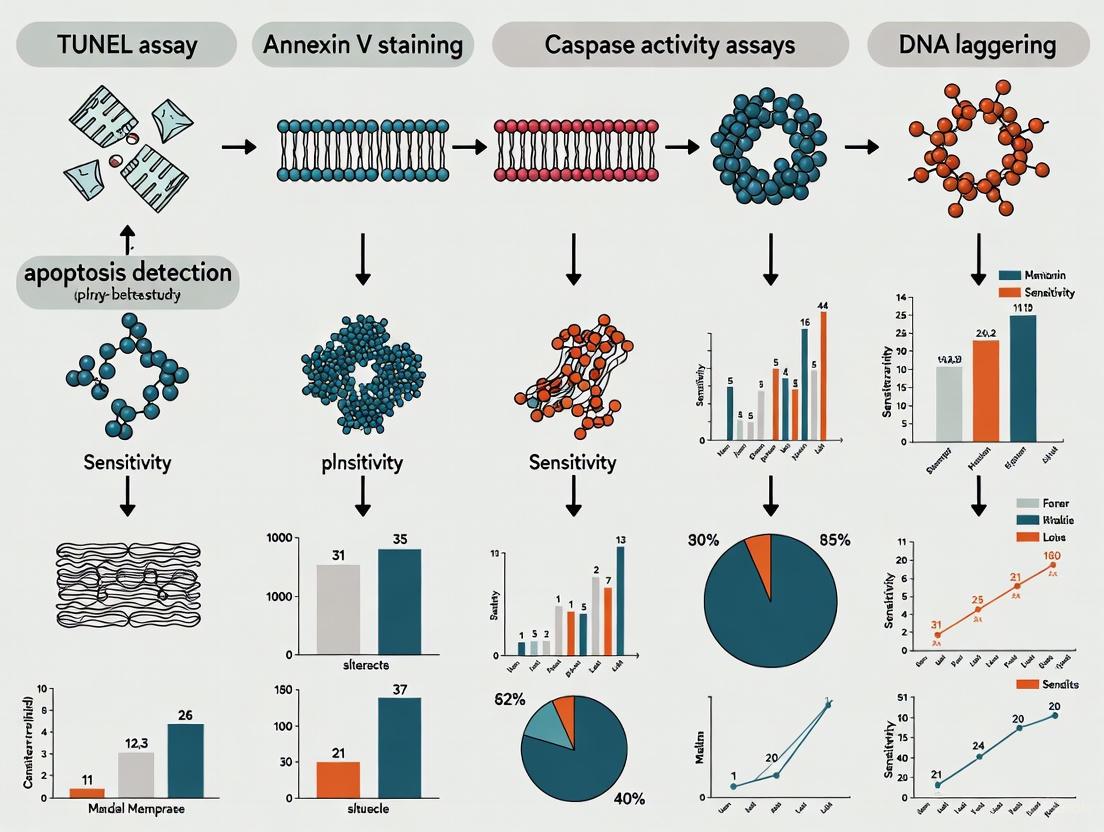
Accurately detecting apoptosis is fundamental to biomedical research, drug discovery, and toxicology.
Apoptosis Detection Methods in 2025: A Sensitivity and Specificity Comparison Guide for Researchers
Abstract
Accurately detecting apoptosis is fundamental to biomedical research, drug discovery, and toxicology. This article provides a comprehensive, comparative analysis of the sensitivity of different apoptosis detection methods, from traditional morphological and biochemical assays to advanced real-time fluorescent reporters and multiparametric flow cytometry. Tailored for researchers and drug development professionals, it offers foundational knowledge, practical methodological guidance, troubleshooting advice, and a direct comparison of techniques to empower the selection of the most sensitive and appropriate assay for specific research scenarios, ultimately enhancing experimental rigor and reproducibility.
Understanding Apoptosis: Key Biomarkers and Why Detection Sensitivity Matters
Defining the Morphological and Biochemical Hallmarks of Apoptosis
Apoptosis, often termed programmed cell death, is a highly regulated and vital process for maintaining cellular homeostasis in multicellular organisms [1]. First coined by John F.R. Kerr and colleagues in 1972, this evolutionarily conserved mechanism enables the selective elimination of aged, damaged, or dangerous cells without triggering an inflammatory response, thereby playing crucial roles in embryonic development, immune system regulation, and tissue homeostasis [1] [2]. Unlike accidental cell death (necrosis), apoptosis represents a controlled cellular suicide program characterized by distinctive morphological and biochemical hallmarks [1] [3]. The process is mediated by a family of cysteine-dependent aspartate-directed proteases known as caspases, which initiate and execute the death program through precise proteolytic cascades [3] [4].
The morphological transformations associated with apoptosis follow a recognizable sequence, beginning with cell shrinkage and chromatin condensation, followed by nuclear fragmentation, membrane blebbing, and ultimately formation of apoptotic bodies that are rapidly phagocytosed by neighboring cells [1] [2]. Biochemically, apoptosis features caspase activation, DNA fragmentation into oligonucleosomal fragments, protein cleavage (particularly cytoskeletal and nuclear proteins), and phosphatidylserine externalization to the outer leaflet of the plasma membrane [1] [3]. These hallmarks provide the foundation for the diverse detection methods researchers employ to identify and quantify apoptotic cells across experimental systems.
Morphological Hallmarks of Apoptosis
The morphological changes in apoptosis occur in a sequential and highly orchestrated manner, distinguishing it from other forms of cell death. These transformations can be observed through various microscopic techniques and represent the physical manifestation of the underlying biochemical processes.
Characteristic Morphological Changes
Cell Shrinkage and Condensation: One of the earliest observable features is a reduction in cell volume and increased cytoplasmic density. The cell undergoes a process known as pyknosis, where the nucleus shrinks and the chromatin condenses into compact masses against the nuclear envelope [1] [2]. This differs significantly from necrotic cells, which typically swell and burst [3].
Membrane Blebbing and Apoptotic Body Formation: As apoptosis progresses, the cell membrane undergoes dynamic protrusions described as "blebbing." This results from the cleavage of cytoskeletal proteins by activated caspases, particularly caspase-3 [1]. The cell eventually disassembles into small, membrane-bound fragments called apoptotic bodies, which contain intact organelles and nuclear fragments [1] [2].
Nuclear Fragmentation: The nucleus undergoes characteristic changes including karyorrhexis, where the nuclear envelope disassembles and the condensed chromatin fragments into discrete packets [1]. This nuclear disintegration precedes the packaging of nuclear material into apoptotic bodies.
Preservation of Organelle Structure and Membrane Integrity: Unlike necrosis where organelles swell and rupture, apoptotic cells generally maintain mitochondrial and other organelle integrity until late stages [5]. The plasma membrane remains selectively permeable, preventing the release of intracellular contents that could trigger inflammation [1].
Detection Methods Based on Morphology
Traditional morphological assessment relies on light or electron microscopy to identify these characteristic changes. Trypan blue exclusion distinguishes viable from non-viable cells based on membrane integrity, with apoptotic cells excluding the dye until late stages [5]. More advanced techniques include time-lapse microscopy and fluorescence imaging using DNA-binding dyes like DAPI or Hoechst stains to visualize chromatin condensation and nuclear fragmentation [6] [2].
The following diagram illustrates the progressive morphological changes during apoptosis:
Biochemical Hallmarks of Apoptosis
The morphological changes observed during apoptosis result from precise biochemical events orchestrated by specialized molecular machinery. These biochemical hallmarks provide specific molecular targets for detection and quantification methods.
Caspase Activation Cascade
Caspases (cysteine-aspartic proteases) represent the core effectors of apoptosis and are synthesized as inactive zymogens (procaspases) that require proteolytic activation [1] [3]. They are categorized based on their function in the apoptotic cascade:
- Initiator Caspases (caspase-2, -8, -9, -10): Activated in response to pro-apoptotic signals and initiate the caspase cascade by cleaving and activating executioner caspases [1] [3].
- Executioner Caspases (caspase-3, -6, -7): Responsible for the proteolytic cleavage of numerous cellular substrates, leading to the characteristic morphological changes [1] [3] [4].
Caspase-3 serves as the primary "executioner" protease and cleaves key cellular proteins including PARP (poly-ADP-ribose polymerase), nuclear lamins, and cytoskeletal proteins, systematically dismantling the cell while minimizing inflammatory responses [7] [3].
Mitochondrial Pathway Events
The intrinsic (mitochondrial) apoptotic pathway involves crucial biochemical events centered on mitochondrial function:
- Loss of Mitochondrial Membrane Potential: Early in apoptosis, the mitochondrial membrane permeability increases, leading to dissipation of the electrochemical gradient [6].
- Cytochrome c Release: The permeabilized mitochondrial membrane releases cytochrome c into the cytosol, where it binds to Apaf-1 and forms the apoptosome complex, activating caspase-9 [3] [4].
- Regulation by Bcl-2 Family Proteins: The Bcl-2 family of proteins tightly controls mitochondrial membrane permeability through a balance of pro-apoptotic (Bax, Bak, Bid) and anti-apoptotic (Bcl-2, Bcl-xL) members [8] [3]. Recent research has identified VDAC1 as a key mitochondrial protein that can interact with Bcl-xL under stress conditions, promoting apoptosis induction [8].
Membrane Phospholipid Redistribution
A classic biochemical hallmark of early apoptosis is the translocation of phosphatidylserine from the inner to the outer leaflet of the plasma membrane [5] [3]. This "eat-me" signal facilitates the recognition and phagocytosis of apoptotic cells by neighboring cells and professional phagocytes.
DNA Fragmentation
A late biochemical event in apoptosis involves the activation of Ca²⁺/Mg²⁺-dependent endonucleases that cleave nuclear DNA at internucleosomal regions, producing characteristic DNA fragments in multiples of 180-200 base pairs [1] [2]. This distinctive fragmentation pattern creates a "DNA ladder" when separated by gel electrophoresis.
The following diagram illustrates the key biochemical pathways in apoptosis:
Comparative Analysis of Apoptosis Detection Methods
Researchers have developed numerous techniques to detect apoptosis based on its morphological and biochemical hallmarks. These methods vary significantly in their sensitivity, specificity, applicability to different experimental systems, and ability to detect specific stages of apoptosis.
Methodology Comparison Based on Detection Principles
Table 1: Comparison of Major Apoptosis Detection Methods
| Detection Method | Principle/Basis | Stage Detected | Sensitivity & Specificity | Key Advantages | Major Limitations |
|---|---|---|---|---|---|
| Annexin V/Propidium Iodide (PI) [5] [3] | Binds to externalized phosphatidylserine (Annexin V) + membrane integrity (PI) | Early apoptosis (Annexin V+/PI-) to late apoptosis (Annexin V+/PI+) | Moderate sensitivity; distinguishes early vs late apoptosis | Can quantify apoptosis stages; works with flow cytometry | Cannot detect apoptosis in fixed tissues; may miss very early stages |
| YO-PRO-1/7-AAD [5] | Membrane permeability changes with YO-PRO-1 entry + DNA binding with 7-AAD | Early apoptosis (YO-PRO-1+/7-AAD-) | High sensitivity for early apoptosis; more sensitive than Annexin V/PI [5] | Identifies early apoptotic cells before membrane integrity loss | Requires flow cytometry; not for tissue sections |
| Caspase Activity Assays [7] [3] | Detection of activated caspases using fluorogenic substrates or antibodies | Mid-stage apoptosis during caspase activation | High specificity for apoptosis execution phase | Specific to apoptotic process; multiple detection formats | May miss early pre-caspase events or late post-caspase stages |
| DNA Fragmentation Analysis [1] [2] | Detection of internucleosomal DNA cleavage (TUNEL, gel electrophoresis) | Late apoptosis | High specificity but variable sensitivity | Confirms late-stage apoptosis; works with archived tissues | Only detects late stages; potential false positives with necrosis |
| Mitochondrial Membrane Potential Probes [6] | Detection of ΔΨm loss using JC-1, TMRM dyes | Early-mid apoptosis during mitochondrial events | Good sensitivity for intrinsic pathway | Detects early commitment to apoptosis; live cell imaging | Not specific to apoptosis; can be affected by other cellular stresses |
| FRET-Based Caspase Sensors [6] | Caspase cleavage of FRET probe causes loss of fluorescence resonance energy transfer | Mid-apoptosis during caspase activation | High sensitivity and specificity in live cells [6] | Real-time monitoring in live cells; single-cell resolution | Requires genetic engineering; specialized equipment needed |
Quantitative Sensitivity Comparison
Direct comparison of apoptosis detection methods reveals significant differences in their sensitivity to identify apoptotic cells. A systematic study comparing six different apoptosis detection methods in human peripheral blood mononuclear cells (PBMCs) found that the choice of detection method significantly impacted results, particularly following 3 days of stimulation (P = 2 × 10⁻⁶) [5].
Table 2: Relative Sensitivity Comparison of Apoptosis Detection Methods Based on Experimental Data [5]
| Detection Method | Relative Sensitivity | Optimal Detection Timeline | Notes on Experimental Performance |
|---|---|---|---|
| YO-PRO-1/7-AAD | Highest | Early stages (24-72 hours) | Most sensitive stain for apoptosis; accurate measure of apoptosis and mortality [5] |
| Annexin V/7-AAD | High | Early to mid stages (24-72 hours) | Reliable for distinguishing apoptosis stages; widely validated |
| Caspase-3 Activation | High | Mid stages (24-48 hours) | Specific to execution phase; may miss caspase-independent apoptosis |
| Annexin V/PI | Moderate | Early to late stages (24-72 hours) | Standard method but less sensitive than YO-PRO-1/7-AAD [5] |
| DNA Fragmentation (TUNEL) | Moderate to Low | Late stages (48-72+ hours) | Detects only late apoptotic stages; potential for false positives |
| Trypan Blue Exclusion | Lowest | Late stages only (48+ hours) | Distinguishes apoptotic cells by morphology but has poor sensitivity and objectivity [5] |
The superior sensitivity of YO-PRO-1/7-AAD combination stems from its ability to detect subtle changes in membrane permeability that occur earlier in apoptosis than phosphatidylserine externalization [5]. This method provides a low-cost alternative for sensitive detection of early apoptosis while simultaneously assessing cell mortality.
Experimental Protocols for Key Apoptosis Detection Methods
YO-PRO-1/7-AAD Staining Protocol for Flow Cytometry
This protocol, adapted from the comparative study that identified YO-PRO-1 as the most sensitive apoptosis stain, enables simultaneous detection of apoptosis and mortality [5].
Reagents and Materials:
- YO-PRO-1 iodide (1 mM solution in DMSO)
- 7-AAD (7-aminoactinomycin D, 200 μg/mL solution in DMSO)
- Binding buffer (10 mM HEPES/NaOH, pH 7.4, 140 mM NaCl, 2.5 mM CaCl₂)
- Flow cytometry tubes
- Flow cytometer with 488 nm excitation and appropriate filter sets
Procedure:
- Harvest approximately 3 × 10⁵ cells and wash with cold PBS.
- Resuspend cells in 100 μL of binding buffer.
- Add 1 μL of YO-PRO-1 solution (final concentration 100 nM) and 5 μL of 7-AAD solution (final concentration 1 μg/mL).
- Incubate for 20 minutes at room temperature in the dark.
- Add 400 μL of binding buffer and analyze by flow cytometry within 30 minutes.
- Use 488 nm excitation; collect YO-PRO-1 fluorescence at 530/30 nm (FITC channel) and 7-AAD fluorescence at 670 nm (PerCP-Cy5-5 channel).
Data Interpretation:
- Viable cells: YO-PRO-1⁻/7-AAD⁻
- Early apoptotic cells: YO-PRO-1⁺/7-AAD⁻
- Late apoptotic/dead cells: YO-PRO-1⁺/7-AAD⁺
- Necrotic cells: YO-PRO-1⁻/7-AAD⁺ (if present)
FRET-Based Caspase Sensor Imaging for Real-Time Apoptosis Detection
This advanced protocol utilizes genetically encoded FRET sensors to monitor caspase activation in real-time, enabling discrimination between apoptosis and necrosis at single-cell resolution [6].
Reagents and Materials:
- Cells stably expressing FRET-based caspase sensor (ECFP-DEVD-EYFP)
- Optional: Cells co-expressing mitochondrial-targeted DsRed (Mito-DsRed)
- Live-cell imaging medium
- Confocal or wide-field fluorescence microscope with environmental control
- Appropriate filter sets for FRET imaging (ECFP excitation/EYFP emission)
Procedure:
- Plate cells in glass-bottom dishes or imaging-optimized plates 24 hours before experiment.
- Replace medium with fresh pre-warmed imaging medium.
- Set up microscope with environmental chamber maintaining 37°C and 5% CO₂.
- For FRET imaging, excite ECFP at 433-453 nm and collect emissions at 470-500 nm (donor) and 520-550 nm (acceptor).
- Acquire baseline images for 1-2 hours before treatment.
- Add apoptosis-inducing compounds and continue time-lapse imaging.
- Acquire images every 15-30 minutes for 24-48 hours depending on experimental needs.
Data Analysis:
- Calculate FRET ratio (donor emission/acceptor emission) for each cell over time.
- Apoptotic cells: Show increased donor emission and decreased acceptor emission (increased FRET ratio) indicating caspase cleavage.
- Necrotic cells: Lose both ECFP and EYFP fluorescence simultaneously without FRET ratio change, while retaining Mito-DsRed fluorescence.
- Live cells: Maintain stable FRET ratio and fluorescence intensity.
The following workflow illustrates the experimental setup for real-time apoptosis detection using FRET-based sensors:
Research Reagent Solutions for Apoptosis Detection
Selecting appropriate reagents is crucial for accurate apoptosis detection. The following table summarizes key research tools and their applications based on the biochemical hallmarks of apoptosis.
Table 3: Essential Research Reagents for Apoptosis Detection
| Reagent Category | Specific Examples | Primary Application | Detection Method | Key Features & Considerations |
|---|---|---|---|---|
| Membrane Asymmetry Probes | Annexin V (FITC, PE, APC conjugates) | Early apoptosis detection | Flow cytometry, microscopy | Requires calcium-containing buffer; combine with viability dyes |
| Viability Stains | Propidium iodide, 7-AAD, DAPI | Membrane integrity assessment | Flow cytometry, microscopy | Distinguish early vs late apoptosis; 7-AAD preferred for multicolor flow |
| Caspase Substrates | Fluorogenic caspase substrates (DEVD-AMC, IETD-AFC) | Caspase activity measurement | Fluorometry, plate readers | Specific for different caspases; enables kinetic studies |
| Caspase Antibodies | Anti-cleaved caspase-3, anti-active caspase-8, anti-cleaved PARP | Immunodetection of caspase activation | Western blot, IHC, ICC | Confirms specific caspase activation; cleaved forms indicate activity |
| Mitochondrial Probes | JC-1, TMRM, MitoTracker Red | Mitochondrial membrane potential | Flow cytometry, fluorescence microscopy | JC-1 shows emission shift from red to green with ΔΨm loss |
| DNA Fragmentation Assays | TUNEL assay kits, DNA laddering kits | Late apoptosis detection | Microscopy, gel electrophoresis | TUNEL works on tissue sections; potential necrosis cross-reactivity |
| Genetically Encoded Sensors | FRET-based caspase sensors (ECFP-DEVD-EYFP) | Real-time apoptosis monitoring | Live-cell imaging | Enables kinetic single-cell analysis; requires genetic manipulation |
| IAP-Targeting Reagents | Survivin inhibitors (YM155), SMAC mimetics | Modulating apoptosis resistance | Functional assays | Research on apoptosis resistance mechanisms, particularly in cancer |
The accurate detection of apoptosis remains fundamental to biomedical research, particularly in cancer biology, neurobiology, and therapeutic development. Our comparative analysis demonstrates that method selection should be guided by multiple factors including sensitivity requirements, experimental timeline, equipment availability, and required throughput.
For early apoptosis detection, the YO-PRO-1/7-AAD combination offers superior sensitivity compared to traditional Annexin V/PI staining [5]. For kinetic studies and single-cell analysis, FRET-based caspase sensors provide unparalleled real-time monitoring capability, enabling discrimination between apoptosis and necrosis in live cells [6]. However, for high-throughput screening or clinical applications, flow cytometry-based methods using Annexin V or caspase antibodies remain more practical.
Emerging technologies continue to enhance our ability to detect and quantify apoptosis. Recent developments include novel fluorescent reporters that enable more sensitive and precise monitoring of apoptosis in human and animal cells [7]. These advances are particularly valuable for drug discovery, where accurate assessment of therapeutic-induced apoptosis is crucial for evaluating candidate compounds.
The growing understanding of apoptosis mechanisms has also revealed new molecular targets, such as the recently identified VDAC1-Bcl-xL interaction that serves as a molecular switch in programmed cell death [8]. Such discoveries not only expand our fundamental knowledge but also create opportunities for developing novel detection methods targeting these specific molecular events.
In conclusion, the optimal approach to apoptosis detection often involves employing multiple complementary methods that target different hallmarks of the process. This multi-parametric strategy provides the most comprehensive assessment of apoptosis, confirming results through different biochemical or morphological principles and minimizing potential artifacts associated with any single method. As research continues to unveil the complexity of cell death pathways, detection methods will undoubtedly evolve to provide greater sensitivity, specificity, and applicability to diverse experimental and clinical contexts.
This guide provides an objective comparison of two principal apoptosis detection methods: phosphatidylserine (PS) externalization and caspase activation. We analyze their sensitivity, specificity, and applicability to help researchers and drug development professionals select the optimal method for their experimental needs.
Apoptosis, or programmed cell death, is a fundamental process in development, tissue homeostasis, and disease pathogenesis. Its accurate detection is crucial for basic research and therapeutic development. Among the various apoptotic markers, phosphatidylserine (PS) externalization and caspase activation represent two of the most widely utilized biomarkers, each with distinct technical and biological considerations.
- Phosphatidylserine (PS) Externalization: In viable cells, PS is restricted to the inner leaflet of the plasma membrane. During apoptosis, PS is rapidly and irreversibly externalized to the outer leaflet, serving as a dominant "eat-me" signal for efferocytosis. This process is primarily mediated by caspase-activated scramblases like Xkr8 [9] [10].
- Caspase Activation: Caspases are a family of cysteine-aspartic proteases that act as central executioners of apoptosis. Initiator caspases (e.g., caspase-8) launch the cascade, while executioner caspases (e.g., caspase-3/7) dismantle the cell by cleaving hundreds of cellular substrates [11].
The following sections compare these biomarkers head-to-head, supported by experimental data and detailed protocols.
Comparative Biomarker Performance Analysis
The table below summarizes the key characteristics and performance metrics of PS externalization and caspase activation as apoptosis detection biomarkers.
Table 1: Comprehensive Comparison of Apoptosis Detection Biomarkers
| Feature | Phosphatidylserine (PS) Externalization | Caspase Activation (Executioner Caspase-3/7) |
|---|---|---|
| Primary Detection Method | Flow cytometry with Annexin V binding [12] | Fluorescent probes based on DEVD cleavage motif (e.g., ZipGFP reporter) [13] |
| Typical Assay Readout | Annexin V-positive cells by flow cytometry; can be combined with viability dyes (e.g., Propidium Iodide) | Fluorescence intensity from cleaved probe (e.g., GFP signal) [13] |
| Key Experimental Sensitivity | 74.7% sensitivity for early-stage cancers (PSEV-MultiCancer test) [14] | 3.3 to 3.7-fold signal increase over controls in cell-based BLI [15] |
| Key Experimental Specificity | 89.8% specificity for early-stage cancers (PSEV-MultiCancer test) [14] | Signal abrogation by pan-caspase inhibitor (zVAD-FMK) confirms specificity [13] |
| Clinical Utility | High; used in liquid biopsies for multi-cancer detection (PSEV-MultiCancer) [14] | Emerging; primarily for research and therapeutic monitoring (e.g., in vivo imaging) [15] |
| Technical Limitations | Can also occur in non-apoptotic processes (e.g., platelet activation) [10] | Does not detect caspase-independent apoptosis; background in caspase-3 deficient cells (e.g., MCF-7) requires caspase-7-specific probes [13] |
Detailed Experimental Protocols
Detecting Phosphatidylserine Externalization
The most common method for detecting PS externalization is Annexin V staining coupled with flow cytometry. Annexin V is a calcium-dependent protein with high affinity for externalized PS.
Table 2: Key Reagents for PS Externalization Detection via Flow Cytometry
| Reagent | Function | Example |
|---|---|---|
| APC-Annexin V | Fluorescently labels externalized phosphatidylserine on the cell surface. | Used in serum-induced apoptosis assays on Jurkat cells [12]. |
| Propidium Iodide (PI) | Membrane-impermeant dye that stains nucleic acids in late apoptotic/necrotic cells with compromised membranes. | Used to distinguish early apoptosis (Annexin V+/PI-) from late apoptosis/necrosis (Annexin V+/PI+) [13]. |
| Binding Buffer | Provides optimal calcium concentrations for Annexin V binding to PS. | Typically contains HEPES and NaCl. |
| Jurkat T-cells | A commonly used immortalized T-cell line highly sensitive to apoptosis induction, ideal for functional serum assays. | Incubated with patient serum to assess its pro-apoptotic activity [12]. |
Workflow Summary:
- Induction & Staining: Induce apoptosis in cells (e.g., with chemotherapeutics). Harvest cells and resuspend in binding buffer containing a fluorescent conjugate of Annexin V (e.g., APC-Annexin V) and Propidium Iodide (PI) [12].
- Incubation: Incubate cells in the dark for 10-15 minutes at room temperature.
- Analysis: Analyze cells immediately by flow cytometry. Viable cells are Annexin V-/PI-; early apoptotic cells are Annexin V+/PI-; and late apoptotic or necrotic cells are Annexin V+/PI+.
Detecting Caspase Activation
A highly sensitive method for detecting caspase activity is through genetically encoded biosensors that produce a fluorescent signal upon caspase-dependent cleavage.
Table 3: Key Reagents for Caspase Activation Detection via Live-Cell Imaging
| Reagent | Function | Example |
|---|---|---|
| Caspase-8 Probe (Ac-IETD-Amluc) | A bioluminescence probe containing the Caspase-8 cleavage sequence (IETD). Caspase-8 cleavage releases Aminoluciferin (Amluc), generating light in the presence of luciferase. | Used for in vivo imaging of apoptosis and pyroptosis; showed a linear relationship between bioluminescence and Caspase-8 concentration (LOD: 0.082 g/L) [15]. |
| Caspase-3/7 Reporter (ZipGFP) | A stable fluorescent reporter system. Caspase-3/7 cleavage of a DEVD motif causes GFP reconstitution and a fluorescent signal. | Enabled real-time tracking of apoptosis in 2D and 3D models; signal was abrogated by the caspase inhibitor zVAD-FMK [13]. |
| Pan-caspase Inhibitor (zVAD-FMK) | Cell-permeable broad-spectrum caspase inhibitor. Serves as a critical control to confirm the specificity of caspase-activated probes. | Completely abrogated GFP signal in carfilzomib-treated ZipGFP reporter cells [13]. |
| Firefly Luciferase (fLuc) | Enzyme that catalyzes the oxidation of D-luciferin (or Amluc) to produce light. Essential for bioluminescence-based probe systems. | Expressed in fLuc-4T1 cells for in vivo imaging with Ac-IETD-Amluc probe [15]. |
Workflow Summary for ZipGFP Reporter:
- Stable Cell Line Generation: Create a stable cell line expressing the ZipGFP-based caspase-3/7 reporter and a constitutive marker like mCherry [13].
- Treatment & Imaging: Treat cells with an apoptotic inducer (e.g., carfilzomib). Use live-cell imaging to monitor the increase in GFP fluorescence over time, which reflects caspase-3/7 activity.
- Validation & Analysis: Validate apoptosis with complementary methods like Western blot for cleaved PARP. Use mCherry fluorescence for cell presence normalization and quantitative analysis.
Visualization of Key Apoptotic Pathways
PS Externalization Pathway
Diagram Title: PS Externalization via Caspase-Dependent Pathway
This diagram illustrates the established mechanism of PS externalization during apoptosis. An apoptotic stimulus triggers the activation of executioner caspases-3/7, which simultaneously activate the scramblase Xkr8 and inactivate flippases. Xkr8 translocates PS from the inner to the outer leaflet, and the inactivated flippases prevent its return, resulting in stable PS exposure detectable by Annexin V binding [9] [10].
Caspase Activation Cascade
Diagram Title: Caspase Cascade in Apoptosis Signaling
This diagram shows the core caspase activation cascade. A death stimulus triggers the activation of initiator caspases like caspase-8, which then cleave and activate executioner caspases like caspase-3/7. The active executioner caspases cleave cellular substrates, leading to the apoptotic phenotype, and can be directly measured by cleaving synthetic probes containing the DEVD sequence, generating a fluorescent signal [11] [13].
The Scientist's Toolkit: Essential Research Reagents
Table 4: Essential Reagents for Apoptosis Detection Research
| Reagent/Category | Specific Examples | Primary Function in Apoptosis Detection |
|---|---|---|
| PS-Binding Probes | Annexin V (APC, FITC conjugates) | Binds to externalized PS for flow cytometry and imaging detection [12]. |
| Caspase Probes | Ac-IETD-Amluc (Caspase-8), DEVD-ZipGFP (Caspase-3/7) | Substrate for specific caspases; cleavage generates optical signal for quantification [15] [13]. |
| Caspase Inhibitors | zVAD-FMK (pan-caspase inhibitor) | Essential control to confirm caspase-specificity of probe activation [13]. |
| Cell Lines | Jurkat T-cells, fLuc-4T1, MCF-7 (caspase-3 null) | Model systems for inducing and validating apoptosis; MCF-7 is key for testing caspase-7 specific activity [12] [13]. |
| Viability Indicators | Propidium Iodide (PI) | Distinguishes membrane integrity, critical for interpreting Annexin V assays [13]. |
The choice between PS externalization and caspase activation as a detection biomarker depends heavily on the research context. PS externalization, particularly when detected via PS-positive extracellular vesicles (PSEVs), shows immense promise for clinical diagnostics and liquid biopsies, offering high sensitivity and specificity for early cancer detection [14]. In contrast, caspase activation assays, especially with advanced biosensors, provide unparalleled mechanistic insight and temporal resolution for basic research and drug discovery, allowing real-time tracking of cell death kinetics in complex models like 3D organoids [13]. For the most comprehensive analysis, a multi-parametric approach that integrates both biomarkers is often the most powerful strategy.
The Critical Link Between Sensitivity, Specificity, and Research Outcomes
In the field of cell death research, particularly in the critical areas of cancer biology and drug discovery, the accuracy of apoptosis detection methods is paramount. The sensitivity of a test—its ability to correctly identify true apoptotic events—and its specificity—its ability to correctly exclude non-apoptotic cell death—are not merely abstract statistical concepts. They are fundamental properties that directly determine the reliability, reproducibility, and translational potential of research outcomes. Variations in these parameters, as observed across different healthcare settings for diagnostic tests, underscore the importance of methodological rigor in basic research [16] [17]. This guide provides a objective comparison of contemporary apoptosis detection methods, equipping researchers with the data needed to select the optimal assay for their specific experimental context.
A Primer on Apoptosis Signaling Pathways
Apoptosis progresses primarily through two well-defined signaling cascades. Visualizing these pathways is essential for understanding the biomarkers targeted by the detection methods discussed later.
Diagram 1: Core apoptosis signaling pathways.
Comparative Analysis of Apoptosis Detection Methods
The following tables provide a detailed comparison of widely used apoptosis detection techniques, summarizing their operational basis, key biomarkers, and performance characteristics including relative sensitivity and specificity, as inferred from their ability to detect hallmark events and distinguish apoptosis from other death mechanisms.
Table 1: Classic Apoptosis Detection Methods
| Method | Target Biomarker/Event | Principle | Protocol Summary | Relative Sensitivity | Relative Specificity | Key Advantages | Key Limitations |
|---|---|---|---|---|---|---|---|
| Annexin V / PI Staining | Phosphatidylserine (PS) externalization & membrane integrity [18] | Annexin V binds PS; PI stains DNA in permeable cells | Cells stained with Annexin V-FITC & PI, analyzed by flow cytometry within 1 hour | High for early apoptosis [18] | Moderate (can stain late apoptotic/necrotic cells) [18] | Quantifies early vs. late apoptosis, technical ease | Cannot distinguish apoptosis from secondary necrosis; requires fresh cells [18] |
| TUNEL Assay | DNA fragmentation (3'-OH ends) [18] | Enzymatic labeling of DNA strand breaks | Fixed cells/permeabilized, incubated with TdT enzyme and labeled-dUTP, visualized via microscopy/flow cytometry | High [18] | Moderate (can stain necrotic cells) [18] | High sensitivity, works on tissue sections | Can label necrotic DNA damage; expensive [18] [1] |
| Caspase Activity Assays | Caspase-3/7, -8, or -9 activity [18] | Colorimetric/fluorometric detection of cleaved substrates | Cell lysates incubated with caspase-specific substrates (e.g., DEVD-pNA), measure absorbance/fluorescence | High for specific caspases | High for apoptosis vs. other RCD forms [18] | Mechanistic insight, pathway specificity | Measures activation, not necessarily cell death commitment |
| DNA Fragmentation Analysis (Gel Electrophoresis) | Internucleosomal DNA cleavage (180-200 bp ladder) [1] | DNA extraction, agarose gel electrophoresis | Cells lysed, DNA extracted and run on agarose gel, stained with ethidium bromide | Low to Moderate | High for apoptosis (classic ladder) | Low cost, specific "ladder" pattern | Low sensitivity, requires high cell number, qualitative |
| Mitochondrial Membrane Potential Assays (JC-1) | Mitochondrial membrane depolarization (ΔΨm) [18] | Dye shifts emission from red (high ΔΨm) to green (low ΔΨm) | Cells loaded with JC-1 dye, analyzed by flow cytometry or fluorescence microscopy | High for intrinsic pathway | Moderate (other stresses affect ΔΨm) | Functional assessment, intrinsic pathway specific | Not specific to apoptosis; artifacts possible |
Table 2: Advanced & Luminescence-Based Apoptosis Detection Methods
| Method | Target Biomarker/Event | Principle | Protocol Summary | Relative Sensitivity | Relative Specificity | Key Advantages | Key Limitations |
|---|---|---|---|---|---|---|---|
| Luminescent Caspase Assays | Caspase-3/7 activity [18] | Caspase cleavage releases luciferase substrate, generating light | Cells incubated with proluminescent substrate, luminescence measured after incubation | Very High [18] | High for apoptosis vs. other RCD forms [18] | High throughput, superior sensitivity, no wash steps | Measures activation, not cell death commitment |
| Split Luciferase Apoptosome Assay | Apoptosome formation [18] | Reconstitution of luciferase upon Apaf-1-caspase-9 interaction | Cells transfected with split-luciferase tagged Apaf-1 & caspase-9, luminescence measured post-induction | Very High for intrinsic pathway [18] | Very High for intrinsic apoptosis [18] | Real-time monitoring in live cells, pathway mechanistic insight | Technically challenging, requires transfection |
| Electrochemiluminescence ELISA | Cleaved caspase substrates (e.g., Lamin A) [18] | Antibody detection of cleaved neo-epitopes with electrochemiluminescent readout | Cell lysates added to antibody-coated plates, detected with ruthenium-labeled antibody, measured by ECL reader | Very High [18] | High (specific antibody-based detection) | Quantifies specific cleavage events, high multiplex potential | Requires specific antibodies, cell lysis |
| Flow Cytometry with Novel Probes (e.g., FLICA) | Active caspases in live cells [18] | Fluorescent inhibitors bind active caspase sites | Live cells incubated with FLICA probe, washed, analyzed by flow cytometry | High for active caspases | High for caspase-specific activity | Live-cell analysis, specific caspase activity | Probe can inhibit caspase activity, requires wash steps |
Experimental Workflow for Apoptosis Assay Selection
Choosing the right combination of assays is critical for confirming apoptosis and accurately interpreting experimental results. The following workflow diagram outlines a logical, multi-step approach for method selection and validation.
Diagram 2: Apoptosis assay selection workflow.
The Scientist's Toolkit: Essential Reagents for Apoptosis Detection
| Research Reagent / Kit | Primary Function | Key Features & Considerations |
|---|---|---|
| Annexin V-FITC / PI Apoptosis Kit | Detects PS externalization (early apoptosis) and loss of membrane integrity (late apoptosis/necrosis) [18] | Ready-to-use, compatible with standard flow cytometers and fluorescence microscopes. Requires calcium-containing buffer and fresh, unfixed cells. |
| Luminescent Caspase-Glo Assay | Measures caspase-3/7 activity via luminescent readout [18] | Homogeneous "add-mix-measure" format, high sensitivity, suitable for high-throughput screening. Provides indirect measurement of apoptosis. |
| TUNEL Assay Kit | Labels DNA strand breaks characteristic of mid-late apoptosis [18] [1] | Can be used for cells in culture, cytospins, and tissue sections (IHC). Can be adapted for flow cytometry or microscopy. May also label cells undergoing DNA repair or necrosis. |
| JC-1 Dye | Probes mitochondrial health by detecting depolarization of mitochondrial membrane potential (ΔΨm) [18] | Fluorescence shifts from red (J-aggregates) to green (monomers) upon depolarization. Sensitive to temperature and incubation time; intrinsic pathway indicator. |
| CellTiter-Glo Luminescent Viability Assay | Determines cell viability by quantifying ATP levels, inversely correlating with cell death [18] | Often used in parallel with apoptosis assays to correlate death induction with reduced metabolic activity. Homogeneous and high-throughput. |
| Recombinant Anti-Cytochrome c Antibody | Detects release of cytochrome c from mitochondria into cytosol via Western blot or immunofluorescence [18] | Confirms engagement of the intrinsic apoptotic pathway. Requires subcellular fractionation or careful imaging for accurate interpretation. |
| Z-VAD-FMK (Pan-Caspase Inhibitor) | Cell-permeable inhibitor that irreversibly binds to and inhibits active caspases [1] | Serves as a critical control to confirm caspase-dependent apoptosis. Used to validate that a phenotypic outcome is truly due to apoptotic induction. |
The selection of an apoptosis detection method is a critical decision that directly influences research outcomes. As demonstrated, methods vary significantly in their sensitivity, specificity, and applicability to different stages and pathways of cell death. While classic techniques like Annexin V/PI staining provide a solid foundation for initial screening, advanced luminescence-based assays offer superior sensitivity and are better suited for high-throughput applications and mechanistic studies. The fundamental link between analytical performance and research validity necessitates a strategic approach to assay selection, often involving orthogonal methods for confirmation. By aligning methodological strengths with experimental goals, researchers can ensure the accuracy, reliability, and translational relevance of their findings in the complex landscape of cell death research.
Cell death is a fundamental biological process with profound implications for health and disease. The precise detection and differentiation of various cell death mechanisms are not merely academic exercises; they are critical for understanding disease pathogenesis, developing novel therapeutics, and advancing personalized medicine. Among these mechanisms, apoptosis, or programmed cell death, stands as the most well-characterized pathway, playing essential roles in embryonic development, immune function, and tissue homeostasis. However, it exists within a complex landscape of alternative cell death pathways, including necrosis, necroptosis, and pyroptosis, each with distinct molecular mechanisms and physiological consequences [19] [20].
The global apoptosis assay market, valued at USD 2.7 billion in 2024 and projected to reach USD 6.1 billion by 2034, reflects the growing importance of these detection technologies in both research and clinical applications [21]. This growth is driven by the increasing prevalence of chronic diseases such as cancer, neurodegenerative disorders, and autoimmune conditions, where dysregulated cell death is a central feature. For researchers and drug development professionals, selecting the appropriate detection method is paramount, as the choice influences experimental outcomes, data interpretation, and ultimately, the progression of therapeutic candidates. This guide provides a comprehensive comparison of apoptosis detection methods against techniques for identifying other cell death mechanisms, offering structured data, experimental protocols, and analytical frameworks to inform method selection for specific research contexts.
Comparative Analysis of Cell Death Mechanisms
Understanding the fundamental differences between cell death mechanisms is prerequisite to selecting appropriate detection methodologies. The following table outlines the key characteristics of major cell death types, emphasizing their distinguishing features.
Table 1: Key Characteristics of Major Cell Death Mechanisms
| Feature | Apoptosis | Necrosis | Necroptosis |
|---|---|---|---|
| Regulation | Tightly programmed, regulated [20] | Accidental, unregulated [20] | Regulated [20] |
| Inducing Stimuli | Physiological signals, DNA damage, toxins [20] | Extreme physical/chemical injury [20] | Death receptors (e.g., TNFR1) when apoptosis is blocked [20] [22] |
| Key Molecular Players | Caspases, Bcl-2 family, Cytochrome c [19] [20] | N/A (unregulated) | RIP1, RIP3, MLKL [20] |
| Morphological Hallmarks | Cell shrinkage, chromatin condensation, membrane blebbing, apoptotic bodies [19] [20] | Cell swelling, loss of membrane integrity, organelle disruption [20] | Cell swelling & rupture (necrotic phenotype), but regulated [22] |
| Membrane Integrity | Maintained until late stages [20] | Lost early [20] | Lost [20] |
| Inflammatory Response | No (non-inflammatory) [20] | Yes (pro-inflammatory) [20] | Yes (highly immunogenic) [20] |
| Primary Detection Methods | Annexin V, caspase activation, TUNEL, DNA laddering [23] [19] | PI exclusion, LDH release [22] | Phospho-MLKL detection, viability dyes with caspase inhibition [22] |
Comparative Sensitivity of Apoptosis Detection Methods
No single detection method is optimal for all experimental scenarios. Sensitivity—the ability to accurately identify the earliest stages of cell death—varies significantly between techniques. A comparative study on human peripheral blood mononuclear cells (PBMCs) highlighted this variance, demonstrating that the choice of detection method is particularly critical when measuring apoptosis at early time points (e.g., 3 days post-stimulation) [5].
Table 2: Sensitivity Comparison of Key Apoptosis Detection Methods
| Detection Method | Principle | Stage Detected | Relative Sensitivity | Key Advantages | Key Limitations |
|---|---|---|---|---|---|
| YO-PRO-1/7-AAD | Uptake by permeable membrane & DNA binding [5] | Early Apoptosis [5] | Highest (in PBMC study) [5] | Highly sensitive for early apoptosis; cost-effective [5] | Requires flow cytometry; multiple steps [5] |
| Annexin V/PI | Binds phosphatidylserine exposure & membrane integrity [23] | Early & Late Apoptosis [23] | Moderate (Common standard) [5] | Differentiates apoptotic from necrotic cells [23] | Time-consuming; requires intact tissues to be dissociated [23] |
| Caspase Activity Assays | Detects activation of key apoptosis proteases [23] | Early Execution Phase [23] | High for execution phase [23] | Allows selection of specific caspases; rapid quantification [23] | May miss very early initiation signals [23] |
| TUNEL Assay | Labels DNA strand breaks [23] | Late Apoptosis [23] | High for DNA damage [23] | Applicable to early events; precise for DNA damage [23] | Qualitative; multi-step and time-consuming [23] |
| Electron Microscopy | Visualizes morphological changes [19] | Late Apoptosis [19] | Low for early stages [19] | Gold standard for morphology; plethora of information [23] [19] | End-point analysis; subjective quantification; laborious [23] |
| DNA Laddering | Detects internucleosomal DNA cleavage [23] | Late Apoptosis [23] | Moderate [23] | Relatively reliable and inexpensive [23] | Qualitative; difficult to quantify [23] |
The research indicates that YO-PRO-1/7-AAD combination staining emerged as the most sensitive method for detecting early apoptosis in PBMCs, providing a low-cost alternative to other flow cytometry-based techniques [5]. Furthermore, a novel fluorescent reporter for caspase-3 activation, which loses fluorescence upon apoptosis induction, has been developed for real-time, high-sensitivity monitoring in living cells, representing a significant advancement for dynamic studies [7].
Advanced & Emerging Detection Technologies
The field of cell death detection is rapidly evolving, with new technologies addressing the limitations of conventional methods.
- The CeDaD Assay: A novel flow cytometric assay that simultaneously quantifies cell division (via CFSE-based CellTrace dye dilution) and cell death (via calcium-independent Apotracker Green and PI staining) within a single-cell population. This allows for direct analysis of the interconnected dynamics between proliferation and death, which is crucial in cancer research and toxicology [24].
- Label-Free Deep Learning: An automated image analysis pipeline that directly detects apoptotic bodies (ApoBDs) in bright-field phase-contrast images using a trained ResNet50 network. This method achieved 92% accuracy in identifying apoptotic events and detected 70% more apoptosis than Annexin-V staining in a melanoma cell model, offering a non-invasive and highly sensitive alternative without biochemical perturbation [25].
- Near-Infrared (NIR) Spectroscopy: A non-invasive, label-free technique that distinguishes between apoptosis and necroptosis by measuring the attenuation coefficient of light in the 1100–1700 nm wavelength range. This method exploits differences in light scattering caused by morphological changes in dying cells and provides a rapid, non-destructive means for cell death differentiation [22].
Experimental Protocols for Key Assays
YO-PRO-1/7-AAD Staining for Flow Cytometry
This protocol is adapted from a sensitivity comparison study in human PBMCs [5].
- Cell Preparation: Isolate PBMCs using Ficoll-Hypaque density gradient centrifugation. Culture cells under desired experimental conditions.
- Staining: Harvest at least 3 × 10^5 cells. Resuspend cells in a suitable buffer.
- Incubation: Add YO-PRO-1 and 7-AAD dyes to the cell suspension according to manufacturers' recommended concentrations.
- Analysis: Incubate cells in the dark for a specified time (e.g., 20-30 minutes) at room temperature.
- Acquisition: Analyze cells immediately on a flow cytometer. Use a viable cell gate. YO-PRO-1 positive/7-AAD negative cells are considered early apoptotic.
Combined Cell Death and Division (CeDaD) Assay
This protocol outlines the steps for the novel CeDaD assay [24].
- Cell Labeling: Prior to experimentation, label cells with CFSE-based CellTrace Violet dye according to the manufacturer's protocol. This dye dilutes with each cell division.
- Treatment & Culture: Incubate the labeled cells under experimental conditions (e.g., with a drug candidate) for a defined period (e.g., 48 hours).
- Staining for Cell Death: Harvest cells and stain with Apotracker Green (an annexin V-derived fluorogenic peptide) and Propidium Iodide (PI).
- Flow Cytometric Analysis: Analyze cells on a flow cytometer equipped with appropriate lasers and filters.
- Cell Division: Track the dilution of CellTrace Violet fluorescence. Gate cells into populations that have undergone 0, 1, 2, 3, or more divisions.
- Cell Death: Identify Apotracker Green positive (apoptotic) and PI positive (dead) cells within each division gate.
Caspase-3 Fluorescent Reporter Assay
This protocol is based on the novel GFP-based biosensor for real-time apoptosis monitoring [7].
- Reporter Introduction: Transduce or transfert cells with the genetic construct encoding the GFP reporter, which has been engineered to contain a caspase-3 cleavage motif (DEVD).
- Real-Time Imaging: Plate the reporter cells in an appropriate imaging chamber. Establish baseline fluorescence.
- Treatment & Monitoring: Apply the apoptotic stimulus (e.g., toxic substance, anticancer drug). Monitor the cells in real-time using fluorescence microscopy.
- Data Analysis: The onset of apoptosis is indicated by a loss of GFP fluorescence, as caspase-3 activation cleaves and inactivates the fluorophore. Quantify the rate and extent of fluorescence loss.
Signaling Pathways and Experimental Workflows
Apoptosis and Necroptosis Signaling Pathways
The following diagram illustrates the key molecular pathways of intrinsic/extrinsic apoptosis and necroptosis, highlighting the critical decision points and execution mechanisms.
Diagram Title: Apoptosis and Necroptosis Signaling Pathways
CeDaD Assay Experimental Workflow
This diagram outlines the procedural workflow for the combined Cell Death and Division assay, demonstrating how data on both processes is generated from a single sample.
Diagram Title: CeDaD Assay Workflow
The Scientist's Toolkit: Key Research Reagent Solutions
Selecting the right reagents is fundamental to successful cell death research. The following table catalogs essential tools and their applications.
Table 3: Essential Reagents for Cell Death Research
| Reagent / Assay Kit | Primary Function | Application / Detects | Key Feature / Note |
|---|---|---|---|
| Annexin V-FITC/PI Kit [23] [26] | Flow Cytometry / Microscopy | Phosphatidylserine exposure (early apoptosis) & membrane integrity | Industry standard; requires calcium-containing buffer [23] |
| CellTrace Violet [24] | Flow Cytometry | Cell division tracking via dye dilution | Enables quantification of proliferation history |
| Apotracker Green [24] | Flow Cytometry / Microscopy | Apoptotic cells via fluorogenic peptide | Calcium-independent annexin V alternative [24] |
| YO-PRO-1 [5] | Flow Cytometry | Early apoptotic cells with permeable membranes | High sensitivity for early apoptosis [5] |
| Caspase-3 Antibody (Active) [26] | Western Blot, IHC, FC | Activated caspase-3 (execution phase) | Direct marker of apoptosis execution [26] |
| TUNEL Assay Kit [23] | Microscopy / Flow Cytometry | DNA fragmentation (late apoptosis) | High sensitivity for DNA strand breaks [23] |
| Anti-Bax / Anti-Bcl-2 [26] | Western Blot, IHC, FC | Pro- and anti-apoptotic protein levels | Assesses balance in mitochondrial pathway [26] |
| JC-1 Dye [26] | Flow Cytometry | Mitochondrial membrane potential (ΔΨm) | Indicator of intrinsic pathway activation [26] |
| Anti-phospho MLKL [20] | Western Blot, IP | Activated necroptosis executor | Specific marker for necroptosis [20] |
The landscape of cell death detection is characterized by a trade-off between sensitivity, specificity, practicality, and cost. While traditional methods like Annexin V/PI staining and caspase activity assays remain workhorses in laboratories, emerging technologies are pushing the boundaries of what is possible. The development of real-time fluorescent reporters [7], multiplexed assays like CeDaD [24], and label-free approaches leveraging deep learning [25] and NIR spectroscopy [22] points toward a future where dynamic, non-invasive, and highly informative profiling of cell death becomes routine.
For the researcher, the optimal path forward involves a strategic selection of methods based on the specific biological question. For high-sensitivity screening of early apoptosis in immune cells, YO-PRO-1/7-AAD presents a compelling option [5]. For understanding the interplay between proliferation and death in cancer models, the CeDaD assay is unparalleled [24]. Meanwhile, for long-term kinetic studies without biochemical perturbation, label-free imaging and novel fluorescent biosensors offer powerful alternatives. As the market continues to grow and technology advances, the integration of artificial intelligence and multi-omics data with cell death analysis will undoubtedly provide even deeper insights into this fundamental biological process, accelerating drug discovery and therapeutic development.
A Practical Guide to Apoptosis Assays: From Classic to Cutting-Edge Techniques
The detection of programmed cell death, or apoptosis, is a cornerstone of biomedical research, playing a pivotal role in understanding cancer biology, evaluating therapeutic efficacy, and advancing drug discovery [7] [27] [28]. Among the various detection strategies, morphological analysis through microscopy provides direct visual evidence of the characteristic structural changes that define apoptotic cells. These changes include cell shrinkage, chromatin condensation, nuclear fragmentation, and the formation of apoptotic bodies—features that are universally recognized as hallmarks of this programmed elimination process [28] [29].
Light microscopy (LM) and electron microscopy (EM) represent two fundamental approaches for visualizing these morphological alterations, yet they operate at vastly different scales of resolution and sensitivity. The inherent limitations of each method directly impact their capacity to detect the earliest indicators of apoptosis and resolve the intricate subcellular events that unfold during cell death. This guide provides a detailed, objective comparison of the sensitivity limitations inherent to light and electron microscopy within the context of apoptosis detection. By synthesizing current technical specifications, experimental data, and methodological protocols, we aim to equip researchers with the practical knowledge necessary to select and optimize morphological approaches for their specific applications in basic research and drug development.
Technical Principles and Resolution Limits
The fundamental difference between light and electron microscopy lies in their illuminating sources, which directly dictates their resolving power. Light microscopy uses photons of visible light (wavelength ~400-700 nm), while electron microscopy employs a beam of electrons with a much shorter equivalent wavelength (approximately 1 nm) [30]. This distinction in wavelength is the primary factor behind their dramatic difference in resolution.
According to Abbe's diffraction limit, the maximum resolution of a conventional light microscope is roughly half the wavelength of the illuminating light, setting a practical resolution boundary at about 200 nm laterally and 600-700 nm axially [31]. Consequently, structures smaller than this limit, such as many subcellular organelles and finer apoptotic details, appear blurred and cannot be resolved. In contrast, electron microscopes achieve a theoretical resolution of up to 0.001 µm (1 nm), which is about 250 times greater than that of a standard light microscope [30]. This sub-nanometer resolution allows EM to visualize ultrastructural details, including individual proteins, DNA strands, and the precise architecture of organelles during apoptosis [31].
Table 1: Fundamental Differences Between Light and Electron Microscopy
| Characteristic | Light Microscope (LM) | Electron Microscope (EM) |
|---|---|---|
| Illuminating Source | Visible light (~400-700 nm) | Beam of electrons (~1 nm equivalent wavelength) |
| Maximum Resolution | ~200 nm (laterally) [31] | ~0.001 µm (1 nm) [30] |
| Maximum Magnification | ~1,500x [30] | ~1,000,000x [30] |
| Nature of Image | Colored, 2D [30] | Grayscale; 2D (TEM) or 3D-like (SEM) [30] |
| Specimen Compatibility | Living or dead, fixed or unfixed [30] | Fixed, stained, non-living, and dehydrated [31] [30] |
| Specimen Thickness | 5 micrometers or thicker [30] | Ultra-thin (0.1 micrometers or below) [30] |
The following diagram illustrates the basic components and operational principles of the three main microscope types discussed, highlighting the key differences in their architecture and the nature of their illuminating sources.
Diagram 1: Comparative schematic of light and electron microscope components and workflows. EM requires electromagnetic lenses and operates in a vacuum, unlike LM.
Sensitivity Limitations in Apoptosis Detection
Limitations of Light Microscopy
The sensitivity of conventional light microscopy for detecting apoptosis is primarily constrained by its resolution limit. While later-stage apoptotic events like cell shrinkage and membrane blebbing can be visualized, early and definitive morphological hallmarks often fall below the diffraction barrier. Key early events in apoptosis, such as the cleavage of specific cytoskeletal proteins or the initial stages of chromatin condensation, produce structural changes at a scale finer than 200 nm, making them invisible to standard LM [31] [28]. Furthermore, without the use of specific fluorescent probes, LM lacks the molecular specificity to confirm that observed morphological changes are indeed due to apoptosis rather than other forms of cell death.
To overcome these limitations, researchers often couple LM with fluorescent reporters. A recent breakthrough is a novel fluorescent biosensor engineered by inserting a caspase-3 cleavage motif (DEVDG) into the structure of Green Fluorescent Protein (GFP). Upon caspase-3 activation, the reporter loses fluorescence, providing a highly sensitive and specific "fluorescence switch-off" mechanism for real-time apoptosis monitoring inside living cells [7]. This method offers greater sensitivity and accuracy than traditional approaches that rely on complex staining or sample preparation.
Limitations of Electron Microscopy
While Electron Microscopy provides the resolution needed to visualize ultrastructural details of late-stage apoptosis, such as condensed chromatin and fragmented nuclei, its significant limitations lie in functional analysis and practicality [31] [30]. The most critical sensitivity-related drawback is its inability to observe living processes. Since EM requires specimens to be placed in a vacuum and made ultra-thin (usually 0.1 µm or below), it is impossible to monitor the dynamic temporal sequence of apoptosis in real-time [31] [30]. This means EM can only provide static "snapshots" of the cell death process, making it insensitive to kinetic studies.
Furthermore, the elaborate and labor-intensive specimen preparation for EM—involving chemical fixation, dehydration, and coating with heavy metals—takes several days and requires advanced technical skill [30]. This lengthy process not only prevents the study of live cells but also introduces the potential for artifacts, which can be misinterpreted as genuine morphological features. Therefore, while EM is highly sensitive for resolving structure, it is inherently insensitive to the dynamic and functional aspects of apoptosis.
Table 2: Sensitivity and Practical Limitations in Apoptosis Detection
| Microscopy Method | Key Advantages for Apoptosis | Key Sensitivity & Practical Limitations |
|---|---|---|
| Conventional Light Microscopy | Can observe live cells [30] Simple, rapid preparation [30] Compatible with fluorescent probes [7] | Limited resolution (~200 nm) misses early subcellular events [31] Lacks molecular specificity without staining |
| Super-Resolution LM (e.g., MINFLUX) | Nanoscale resolution (1-3 nm) [31] Can image live cells and molecular dynamics [31] Circumvents Abbe's diffraction limit | Higher cost and operational complexity than conventional LM Still less resolution than EM for static ultrastructure |
| Electron Microscopy (TEM/SEM) | Unmatched resolution for ultrastructural details (e.g., organelle fragmentation) [31] [30] Provides definitive morphological evidence | Cannot observe live cells or dynamic processes [31] [30] Complex, lengthy preparation risks artifacts [30] Expensive and requires specialized facilities [30] |
Advanced and Complementary Methodologies
To address the limitations of standalone morphological methods, several advanced and integrated technologies have been developed. Imaging Flow Cytometry (IFC) merges the high-throughput, quantitative capabilities of flow cytometry with the visual confirmation of microscopy. This allows for the morphological analysis of thousands of individual cells in a population, significantly enhancing the statistical power and objectivity of apoptosis detection compared to manual microscopy [32]. IFC can capture high-resolution images of cells in flow, enabling the quantification of classic apoptotic features like phosphatidylserine externalization (using Annexin V) alongside morphological changes such as cell shrinkage and nuclear condensation [32] [33].
Another powerful approach is Mass Cytometry (MC or CyTOF), which uses metal-tagged antibodies and mass spectrometry for highly multiplexed single-cell analysis. A recent 2025 study detailed a 48-parameter panel to deeply phenotype cell cycle and cell death states, capturing both canonical and noncanonical apoptotic pathways [34]. This technology can be integrated with other MC panels to study the crosstalk between apoptosis, metabolism, and other cellular systems, providing a much more comprehensive view than morphology alone [34].
The following diagram outlines a consolidated experimental workflow that incorporates microscopy with other complementary assays for a robust analysis of cellular health and apoptosis.
Diagram 2: Consolidated workflow for multiparametric analysis of cell death and proliferation from a single sample, integrating morphological and functional assays.
Essential Research Reagent Solutions
The effectiveness of morphological apoptosis detection is greatly enhanced by specific research reagents. The table below details key reagents, their functions, and experimental considerations based on current research and market reports.
Table 3: Key Research Reagents for Apoptosis Detection
| Reagent / Assay | Primary Function & Mechanism | Application Notes & Limitations |
|---|---|---|
| Annexin V (e.g., FITC conjugate) | Binds phosphatidylserine (PS) on the outer leaflet of the apoptotic cell membrane [33]. Often used with PI to distinguish early apoptotic (Annexin V+/PI-) from late apoptotic/necrotic (Annexin V+/PI+) cells [27]. | A cornerstone assay; requires calcium-containing buffer. Cannot be used with EDTA-based cell dissociation [33]. |
| Caspase-3 Fluorescent Reporter | Engineered GFP containing a caspase-3 cleavage site (DEVDG). Fluorescence loss upon cleavage enables real-time, live-cell apoptosis monitoring [7]. | Highly specific for a key executioner caspase. Provides superior sensitivity and simplicity for kinetic studies in live cells [7]. |
| Propidium Iodide (PI) | A DNA intercalator that is impermeant to live and early apoptotic cells. Used as a viability dye to mark loss of membrane integrity [33]. | Distinguishes late-stage apoptotic and necrotic cells. Must be used in combination with other markers (e.g., Annexin V) for phase determination. |
| BrdU / EdU / IdU | Thymidine analogs incorporated into DNA during S-phase replication. Detection with antibodies (BrdU) or click chemistry (EdU) identifies proliferating cells [34] [33]. | Critical for contextualizing apoptosis within cell cycle dynamics. Requires DNA denaturation (BrdU) or a chemical reaction (EdU) for detection. |
| JC-1 Dye | A mitochondrial potential sensor. It forms red fluorescent J-aggregates in healthy mitochondria and remains green monomeric upon depolarization, a common early apoptotic event [33]. | The red/green fluorescence ratio is key. Requires careful control of staining conditions and analysis. |
| CellTrace Violet / CFSE | Fluorescent cell proliferation dyes that dilute evenly with each cell division, allowing tracking of proliferation history and rates [33]. | Helps correlate apoptosis with proliferation cessation. The dye can be cytotoxic at high concentrations. |
The selection between light and electron microscopy for apoptosis detection is not a matter of identifying a superior technique, but rather of aligning the technology with the specific research question. Conventional light microscopy, particularly when enhanced with fluorescent biosensors like the novel caspase-3 reporter, offers unparalleled utility for real-time, live-cell kinetic studies but is intrinsically limited by diffraction to visualizing later-stage morphological events [7] [31]. Super-resolution light microscopy bridges a critical gap, bringing nanoscale resolution to live samples, though it cannot match EM's ultimate resolving power [31]. Electron microscopy remains the gold standard for providing definitive, high-resolution ultrastructural evidence of apoptosis but sacrifices the ability to monitor dynamic processes and requires complex, static sample preparation [30].
For a comprehensive and sensitive analysis, the future lies in integrated workflows. No single morphological method can capture the full complexity of cell death. Combining the high-throughput, multiparametric power of Imaging Flow Cytometry or Mass Cytometry with the detailed structural context provided by LM and EM creates a synergistic platform [32] [34] [33]. This multifaceted approach, leveraging the strengths of each technology while mitigating their individual sensitivity limitations, provides the most robust and insightful framework for advancing apoptosis research in both basic science and drug development.
Gel Electrophoresis and TUNEL Specificity Analysis
Within the fields of cell biology, toxicology, and drug discovery, the accurate detection of programmed cell death, or apoptosis, is fundamental for understanding disease mechanisms and evaluating therapeutic efficacy [35]. Among the numerous methods available, gel electrophoresis (including the DNA laddering assay and the comet assay) and the TUNEL (Terminal deoxynucleotidyl transferase dUTP Nick End Labeling) assay are widely employed techniques for identifying the DNA fragmentation that characterizes apoptosis [36] [37]. While both are used to detect DNA strand breaks, their underlying principles, sensitivities, and specific applications differ significantly. This guide provides an objective, data-driven comparison of these two methodologies, focusing on their performance in detecting DNA fragmentation, to aid researchers in selecting the most appropriate tool for their specific experimental context within the broader scope of comparing the sensitivity of apoptosis detection methods.
Performance and Sensitivity Comparison
A direct comparison of key performance metrics reveals fundamental differences between these assays. The following table summarizes their core characteristics based on experimental data.
Table 1: Comparative Analysis of Gel Electrophoresis and TUNEL Assay for Apoptosis Detection
| Feature | Gel Electrophoresis (DNA Laddering) | Comet Assay (Single-Cell Gel Electrophoresis) | TUNEL Assay |
|---|---|---|---|
| Primary Detection Target | Internucleosomal DNA cleavage (180-200 bp fragments) [36] | Single and double-strand DNA breaks at the single-cell level [38] | 3'-OH ends of DNA strand breaks in situ [39] [37] |
| Sensitivity & Quantitative Nature | Less sensitive; semi-quantitative. Requires a high percentage (∼10-20%) of apoptotic cells [37] | Highly sensitive for double-stranded breaks; considered quantitative [38] [40] | Highly sensitive, accurate, and quantitative; can detect early-stage apoptosis [37] |
| Key Advantage | Simple, low-cost; demonstrates classic apoptotic DNA ladder [36] | Sensitive for double-strand breaks; can be performed with a small number of cells; correlates with sperm epigenetic health [38] | High sensitivity and specificity; applicable to tissue sections, cells in suspension, and cultured cells; allows for spatial context [41] [37] |
| Primary Limitation | Insensitive for early apoptosis; cannot analyze single cells [37] | Labor-intensive quantification; primarily limited to in vitro applications [37] | May not distinguish between apoptosis, necrosis, and other types of DNA fragmentation without careful morphological analysis [35] |
| Correlation with Epigenetic Disruption | Information not available in search results | In sperm, shows a significantly higher association (3,387 differentially methylated sites) with DNA methylation disruption [38] | In sperm, shows a much weaker association (23 differentially methylated sites) with DNA methylation disruption [38] |
Experimental Protocols for Key Applications
Comet Assay Protocol for Sperm DNA Damage Analysis
The following protocol is derived from a large-scale study comparing comet and TUNEL assays in human sperm [38].
- Cell Preparation: Use fresh sperm samples. Assess and exclude samples with somatic cell contamination by evaluating DNA methylation signatures, such as fraction methylation at the DLK1 locus, to prevent skewed results [38].
- Slide Preparation: Embed cells in a thin layer of low-melting-point agarose on a microscope slide. Lyse cells in a high-salt, detergent-based buffer (e.g., containing Triton X-100) to remove membranes and proteins, leaving the "nucleoid" (supercoiled DNA attached to a nuclear matrix) [38].
- Electrophoresis: Submerge slides in an alkaline electrophoresis buffer (pH >13) to unwind DNA and expose breaks. Apply an electric current, causing fragmented DNA to migrate from the nucleus toward the anode, forming a "comet tail," while intact DNA remains in the "head" [38].
- Staining and Analysis: Stain DNA with a fluorescent dye such as propidium iodide or DAPI. Analyze slides using fluorescence microscopy and specialized image analysis software. The percentage of DNA in the tail or the tail moment is quantified as a measure of DNA damage [38].
TUNEL Assay Protocol for Adherent Cells and Detached Structures
This protocol outlines a standard TUNEL procedure, including an alternative approach for analyzing detached cell populations, which can provide a more complete picture of genomic instability [37].
- Sample Preparation and Fixation: Culture cells on polylysine-coated glass slides or in flasks. For a comprehensive analysis, recover detached cellular structures from the culture medium via centrifugation. Fix cells and structures in 4% paraformaldehyde to preserve morphology [37].
- Permeabilization: Treat samples with a permeabilization buffer (e.g., 0.1% Triton X-100 in 0.1% sodium citrate) to allow reagents to enter the nucleus. Incubate on ice [37].
- TUNEL Reaction Mixture Incubation: Prepare the TUNEL reaction mix containing Terminal deoxynucleotidyl Transferase (TdT) enzyme and fluorescently labeled dUTP (e.g., BrdUTP or FITC-dUTP). Add the mix to the samples and incubate in a humidified chamber at 37°C. TdT enzymatically adds the labeled nucleotides to the 3'-OH ends of fragmented DNA [37].
- Detection and Analysis (For non-fluorescent detection): If using BrdUTP, add a fluorescently conjugated anti-BrdU antibody. Rinse slides and mount with an anti-fade mounting medium. Analyze by fluorescence microscopy. TUNEL-positive nuclei will exhibit fluorescent staining [37].
Biochemical Pathways and Workflows
The diagram below illustrates the core biochemical principle of the TUNEL assay, highlighting the enzymatic reaction that enables the specific detection of DNA breaks.
(caption: Core Principle of the TUNEL Assay)
The following workflow chart compares the key steps involved in performing the comet and TUNEL assays, showcasing their distinct procedural requirements.
(caption: Comparative Workflow of Comet and TUNEL Assays)
Research Reagent Solutions
Selecting appropriate reagents and kits is critical for the success of either assay. The table below lists key materials and their functions.
Table 2: Essential Reagents and Kits for DNA Damage Detection Assays
| Item | Function / Description | Example Providers / Kits |
|---|---|---|
| Terminal Deoxynucleotidyl Transferase (TdT) | The core enzyme in the TUNEL assay that catalyzes the addition of labeled nucleotides to DNA breaks. | Promega (G3250 kit) [37] |
| Fluorescently-Labeled dUTP | The modified nucleotide (e.g., FITC-dUTP, BrdUTP) incorporated into DNA breaks for detection. | Included in commercial TUNEL kits [37] |
| Comet Assay Kit | A complete set of reagents for single-cell gel electrophoresis, often including agarose, lysis buffer, and DNA stains. | Metasystems, Inc. (CometScan) [40] |
| Annexin V Assay Kit | Used in conjunction with other assays to detect phosphatidylserine externalization, an early marker of apoptosis. | Thermo Fisher Scientific (Annexin V-FITC Kit) [21] |
| Microscope & Image Analysis Software | Essential for visualizing and quantifying TUNEL staining and comet assay results. | Bio-Rad (Image Lab software with AI-assisted quantification) [21] |
Flow Cytometry Power: Multiparametric Analysis with Annexin V/PI and Beyond
The accurate detection of apoptosis, or programmed cell death, is a cornerstone of cellular research, particularly in cancer biology and therapeutic development. Among the various techniques available, flow cytometry-based methods offer a powerful blend of quantification, multiparametric capability, and high-throughput potential. This guide provides an objective comparison of apoptosis detection methods, with a focus on the widely used Annexin V/Propidium Iodide (PI) assay and its advanced applications against other emerging techniques, framing the discussion within the broader thesis of comparing the sensitivity of different detection methodologies.
The Gold Standard: Annexin V/Propidium Iodide (PI) Assay
The Annexin V/PI staining method is a robust, flow cytometry-based technique for the quantitative analysis of apoptosis induction. Its principle relies on key physiological changes in a dying cell: the translocation of phosphatidylserine (PS) from the inner to the outer leaflet of the plasma membrane during early apoptosis, and the subsequent loss of membrane integrity in late apoptosis and necrosis.
- Annexin V Binding: Annexin V is a calcium-binding protein with a high affinity for PS. When conjugated to a fluorochrome like FITC, it binds to PS on the cell surface, serving as a marker for early apoptosis [42] [35].
- Propidium Iodide (PI) Uptake: PI is a DNA-binding dye that is generally excluded from viable, intact cells. It only penetrates cells when the plasma membrane's integrity is compromised, marking late apoptotic or necrotic cells [33] [42].
Simultaneous staining allows for the differentiation of four distinct cell populations within a sample: viable (Annexin V-/PI-), early apoptotic (Annexin V+/PI-), late apoptotic (Annexin V+/PI+), and necrotic (Annexin V-/PI+) cells [33] [35]. This multiparametric resolution is a key advantage of the assay. The protocol is highly adaptable and can be enhanced by co-staining with fluorochrome-conjugated antibodies, enabling researchers to simultaneously track apoptosis induction and changes in specific protein expression, such as the downregulation of CD44 in doxorubicin-treated MDA-MB-231 breast cancer cells [42].
Sensitivity and Diagnostic Utility
The sensitivity of the Annexin V assay is well-demonstrated in clinical research. A recent 2025 study on ovarian serous tumors established that an Annexin V apoptotic index could effectively differentiate between benign and malignant states. When a cutoff value of 27.65% was selected, the assay demonstrated a sensitivity of 90.0% and a specificity of 93.3% for predicting serous ovarian carcinoma [43]. This highlights its potential as a cheap, fast, and effective diagnostic biomarker in certain contexts.
Beyond Annexin V/PI: A Comparison of Apoptosis Detection Methods
While Annexin V/PI is a foundational technique, a comprehensive understanding requires comparing it with other established and emerging methods. The table below summarizes key apoptosis detection assays based on their underlying principles, advantages, and limitations.
Table 1: Comparison of Key Apoptosis Detection Methods and Technologies
| Method/Assay | Detection Principle | Key Advantages | Key Limitations | Typical Sensitivity/Context |
|---|---|---|---|---|
| Annexin V/PI Staining | PS externalization & membrane integrity [42] [35]. | Distinguishes early/late apoptosis & necrosis; fast; adaptable to multiparametric panels [42]. | Cannot detect early caspase-dependent apoptosis before PS exposure [35]. | High clinical utility (e.g., 90% sensitivity in ovarian cancer diagnosis [43]). |
| Caspase Activity Assays | Detection of active caspase enzymes via fluorescent probes or antibodies [35] [44]. | Detects earlier apoptotic events than Annexin V; high specificity for apoptosis [35]. | Does not provide information on later stages of cell death. | High specificity for apoptosis initiation. |
| TUNEL Assay | Labels DNA fragmentation (a late apoptotic hallmark) [35] [44]. | Highly specific for late-stage apoptosis. | Does not distinguish between apoptotic and necrotic cell death in later phases [35]. | Specific for DNA strand breaks. |
| Multiparameter Flow Cytometry (MFC) for MRD | Immunophenotypic characterization of aberrant cell populations [45] [46]. | High-throughput; cost-effective; provides data on multiple cellular parameters simultaneously [46]. | Sensitivity limited to 10-4–10-5 with conventional methods; requires fresh samples [46]. | Conventional MFC: ~10-4–10-5 [46]. |
| Next-Generation Flow (NGF) | Standardized high-sensitivity MFC with optimized panels & protocols [46]. | Standardized; higher sensitivity (10-6); reduced inter-lab variability [46]. | Limited availability outside specialized centers [46]. | Up to 10-6 [46]. |
| Next-Generation Sequencing (NGS) for MRD | Detection of tumor-specific DNA sequences [46]. | Very high sensitivity (can exceed 10-6) [46]. | Requires a baseline sample; higher cost; less widely accessible [46]. | Can exceed 10-6 [46]. |
| CeDaD Assay | Combines CFSE/CellTrace (division) with Annexin V/PI (death) staining [44]. | Simultaneously quantifies cell division and death from a single sample. | Complex data analysis. | Provides correlated proliferation-death data. |
| JC-1 Staining | Measures mitochondrial membrane potential (MMP) shift [33]. | Detects an early event in the intrinsic apoptotic pathway. | Can be sensitive to cellular metabolic state unrelated to apoptosis. | Detects apoptosis upstream of caspase activation. |
Advanced Integrated and Multiparametric Protocols
To capture the interconnected nature of cell death, proliferation, and metabolism, researchers are developing sophisticated unified protocols. These workflows move beyond single-endpoint assays to provide a holistic view of cellular status.
One advanced protocol enables the comprehensive analysis of up to eight different parameters from a single sample. This approach integrates multiple stainings—Annexin V, PI, bromodeoxyuridine (BrdU), CellTrace Violet, and JC-1—to assess cell count, proliferation, cell cycle dynamics, apoptosis, membrane permeability, and mitochondrial membrane potential concurrently [33]. This is particularly valuable for deciphering whether a change in cell number is due to altered proliferation or increased cell death, and how mitochondrial health is linked to these outcomes.
Another innovative assay, the CeDaD (Cell Death and Division) assay, combines CFSE-based cell division tracking with Annexin V-based cell death detection in a single flow cytometric analysis. This method is especially useful for studying processes where cell cycle and apoptosis are intricately linked, such as in the response to p53-activating drugs or kinase inhibitors [44].
Experimental Protocol: Unified Workflow for Multiparametric Analysis
The following is a generalized step-by-step guide for a consolidated multiparametric flow cytometry protocol, synthesized from recent methodologies [33]:
- Cell Preparation and Treatment: Harvest approximately 0.5-1 million cells per experimental condition.
- Pulse with Metabolic Labels: Incubate cells with BrdU or EdU to label cells in S-phase, or with CellTrace Violet to monitor subsequent cell divisions.
- Staining for Mitochondrial Health: Load cells with JC-1 dye according to manufacturer's instructions. The shift from red (aggregates) to green (monomers) fluorescence indicates mitochondrial depolarization.
- Annexin V and PI Staining: Resuspend the cell pellet in a binding buffer containing Annexin V-FITC and PI. Incubate for 15-20 minutes in the dark at room temperature.
- Fixation and Permeabilization (if needed): For intracellular staining of incorporated BrdU, fix and permeabilize cells followed by incubation with a fluorescent anti-BrdU antibody.
- Flow Cytometric Acquisition: Analyze the cells on a flow cytometer equipped with appropriate lasers and filters. A minimum of 10,000 events per sample is recommended.
- Data Analysis: Use sequential gating to identify cell populations based on size/granularity (FSC/SSC), then analyze the various fluorescent parameters to distinguish viable, early apoptotic, late apoptotic, and necrotic cells, while also assessing proliferation and mitochondrial status.
Diagram: Integrated Analysis of Apoptosis and Cell Fate
The Research Toolkit: Essential Reagent Solutions
A range of reagents and tools is fundamental to executing these advanced apoptosis assays. The following table details key components and their functions in a typical workflow.
Table 2: Key Research Reagent Solutions for Apoptosis and Cell Analysis
| Reagent/Tool | Function/Principle | Application in Apoptosis Research |
|---|---|---|
| Annexin V (e.g., FITC conjugate) | Binds to externalized phosphatidylserine (PS) in the presence of Ca²⁺ [42]. | Marker for early apoptosis. |
| Propidium Iodide (PI) | DNA intercalating dye impermeant to live cells [33]. | Discards dead cells; identifies late apoptotic/necrotic populations. |
| Apotracker Green | Calcium-independent fluorogenic peptide that detects apoptotic cells [44]. | Alternative to Annexin V for early apoptosis detection. |
| CellTrace Violet / CFSE | Fluorescent cell membrane dyes diluted by half with each cell division [33] [44]. | Tracks cell proliferation history and number of divisions. |
| BrdU / EdU | Thymidine analogs incorporated into DNA during S-phase [33]. | Identifies proliferating cells and analyzes cell cycle dynamics. |
| JC-1 Dye | Fluorescent cationic dye that forms aggregates (red) in healthy mitochondria and monomers (green) upon depolarization [33]. | Probes the intrinsic apoptotic pathway via mitochondrial membrane potential. |
| Caspase-Specific Probes | Fluorescent inhibitors or substrates that bind active caspase enzymes [35]. | Detects initiation of apoptotic cascade, often with high sensitivity. |
| Anti-CD44 Antibody (APC) | Example of a fluorochrome-conjugated antibody against a surface protein [42]. | Tracks protein expression changes concurrently with apoptosis. |
Technological Frontiers: AI and Standardization in Data Analysis
A significant challenge in flow cytometry, especially in clinical applications like minimal residual disease (MRD) monitoring in hematologic malignancies, has been inter-laboratory variability and subjective gating. The field is now being transformed by computational approaches.
- Dimensionality Reduction Algorithms: Techniques like t-SNE and UMAP are being applied to flow cytometry data to automatically identify cell populations. In a 2025 study, this DR-based gating demonstrated over 95.0% agreement with manual gating and successfully identified MRD populations down to an extremely low level of 10-5.3, showcasing sensitivity comparable to or surpassing traditional analysis [45].
- Machine Learning (ML) Frameworks: ML models are enabling standardized analysis across different instruments and panel configurations. One framework for differentiating acute myeloid leukemia (AML) from non-neoplastic conditions achieved 93.88% accuracy and an AUC of 98.71% on an independent validation set, demonstrating robust cross-institute performance [47].
- AI-Powered Platforms: The market is seeing a rise in AI-driven platforms that offer automated gating, real-time image processing, and predictive analytics, significantly improving the accuracy and efficiency of apoptosis assays and other cell-based analyses [21].
Diagram: Apoptosis Signaling Pathways & Detection Points
The evolution of apoptosis detection has moved far beyond single-parameter assays. While the Annexin V/PI method remains a robust and highly valuable tool for its ability to distinguish stages of cell death, its true power is unlocked when integrated into multiparametric panels. The combination of advanced staining protocols for proliferation, mitochondria, and cell cycle, coupled with powerful new computational analysis tools like UMAP, t-SNE, and machine learning, provides researchers with an unprecedented ability to deconstruct the complex interplay between cell death, survival, and division. This holistic, data-driven approach is fundamental for advancing our understanding of disease mechanisms and accelerating the development of novel therapeutics.
Regulated cell death, or apoptosis, is a fundamental process critical for maintaining tissue homeostasis, proper development, and eliminating damaged cells. Dysregulation of apoptosis is implicated in numerous pathologies, including cancer, neurodegenerative diseases, and autoimmune disorders. Central to the apoptotic cascade are caspases, a family of cysteine-aspartic proteases that execute the cell death program. Caspase-3 and caspase-7 serve as key effector enzymes, recognized by their cleavage preference for the DEVD amino acid sequence. Traditional methods for detecting apoptosis, including Annexin V staining, TUNEL assays, and Western blotting for cleaved caspases, largely rely on endpoint analyses and provide limited insight into the dynamic, asynchronous nature of apoptotic events within heterogeneous cell populations [13] [48].
The development of genetically encoded fluorescent reporters has revolutionized apoptosis research by enabling real-time visualization of caspase activity in live cells with high spatiotemporal resolution. This guide provides a comprehensive comparison of contemporary fluorescent reporter technologies, detailing their operational mechanisms, performance characteristics, and experimental applications. By objectively evaluating the sensitivity and specificity of these systems across various biological contexts, this resource aims to equip researchers with the necessary information to select appropriate tools for investigating caspase dynamics in physiological and pathological conditions.
Comparative Analysis of Fluorescent Reporter Platforms
Advanced fluorescent reporters for caspase activity employ diverse molecular strategies to convert caspase cleavage events into detectable fluorescence signals. The quantitative performance characteristics of major reporter systems are summarized in the table below.
Table 1: Performance Comparison of Caspase Activity Reporters
| Reporter System | Detection Mechanism | Caspase Targets | Signal-to-Background Ratio | Temporal Resolution | Spatial Localization | Key Applications |
|---|---|---|---|---|---|---|
| ZipGFP [13] [48] | Split-GFP reassembly after DEVD cleavage | Caspase-3/7 | High (irreversible signal accumulation) | Excellent (real-time tracking over 80+ hours) | Whole-cell | Long-term imaging in 2D/3D models, high-content screening |
| Modified GFP [7] | Fluorescence loss after DEVD cleavage | Caspase-3 | Moderate | Good | Whole-cell | Drug toxicity screening, therapeutic evaluation |
| Apoliner [49] | Fluorophore separation and nuclear translocation | Effector caspases | High (subcellular redistribution) | Good | Membrane and nuclear compartments | Developmental apoptosis studies in model organisms |
| Rho-DEVD-AFC [50] | Fluorogenic substrate cleavage | Broad caspase spectrum | Moderate (reversible) | Limited (endpoint to short-term) | Cytosolic | In vitro enzymatic assays, inhibitor screening |
The ZipGFP Reporter System: Architecture and Validation
The ZipGFP platform represents a significant advancement in caspase reporter technology, utilizing a split-GFP architecture where the eleventh β-strand is connected to β-strands 1-10 via a flexible linker containing a caspase-3/7-specific DEVD cleavage motif. Under basal conditions, forced proximity of the GFP fragments prevents proper folding and chromophore formation, resulting in minimal background fluorescence. During apoptosis, caspase-mediated cleavage at the DEVD site liberates the β-strands, enabling spontaneous reassembly into the native GFP β-barrel structure with efficient chromophore formation and fluorescence recovery [13] [48].
Table 2: Experimental Validation Data for ZipGFP Reporter System
| Validation Method | Treatment Conditions | Key Findings | Quantitative Results |
|---|---|---|---|
| Live-cell imaging | Carfilzomib (proteasome inhibitor) | Time-dependent GFP fluorescence increase | Robust signal induction over 80 hours compared to DMSO controls |
| Pharmacologic inhibition | Carfilzomib + zVAD-FMK (pan-caspase inhibitor) | Abrogated GFP signal | Confirmed caspase-dependent reporter activation |
| Genetic validation | MCF-7 cells (caspase-3 deficient) | Significant GFP signal upon carfilzomib treatment | Demonstrated caspase-7-mediated DEVD cleavage sufficient for activation |
| Western blot | Carfilzomib treatment | Increased cleaved PARP and caspase-3 | Correlated fluorescence signal with biochemical apoptosis markers |
| Flow cytometry | Annexin V/PI staining | Confirmed apoptosis induction | Validated reporter specificity against established apoptosis assay |
This system incorporates a constitutively expressed mCherry fluorescent protein, which serves as a normalization control for cell presence and transduction efficiency, though its long half-life (24-30 hours) limits its utility for real-time viability assessment [13]. The ZipGFP platform has been successfully adapted for complex physiological models, including 3D spheroids and patient-derived organoids (PDOs), where it enables detection of localized apoptotic events within heterogeneous tissue structures [13] [48].
Figure 1: ZipGFP Caspase Reporter Mechanism. The diagram illustrates the molecular mechanism of ZipGFP activation upon caspase-3/7-mediated cleavage at the DEVD site, leading to fluorescent signal generation.
Alternative Reporter Strategies and Computational Approaches
Beyond the ZipGFP system, researchers have developed complementary technologies for caspase monitoring. A simplified GFP-based reporter engineered by the Korea Research Institute of Bioscience and Biotechnology (KRIBB) incorporates the caspase-3 cleavage motif (DEVDG) directly into the GFP structure, creating a "fluorescence switch-off" mechanism upon apoptosis induction [7]. This design offers enhanced simplicity and compactness compared to earlier iterations, with validated performance across various cancer cell lines and primary cells.
The Apoliner system represents a historically significant dual-fluorophore reporter that utilizes caspase-dependent subcellular redistribution. This construct comprises mRFP (monomeric red fluorescent protein) linked to eGFP (enhanced green fluorescent protein) via a caspase-sensitive domain derived from Drosophila DIAP1. Upon caspase activation, cleavage releases the NLS-eGFP moiety, allowing its translocation to the nucleus while mRFP remains membrane-associated, creating a quantifiable spatial separation of signals [49].
Recent advances extend beyond fluorescent proteins to computational detection methods. Deep learning-based platforms like ADeS (Apoptosis Detection System) utilize transformer architectures to identify apoptotic cells based on morphological features in label-free imaging, achieving classification accuracy exceeding 98% in both in vitro and in vivo models [51]. Similarly, CellApop employs knowledge-guided distillation for apoptotic cell segmentation in bright-field microscopy, achieving Dice scores of 0.843 for general cells and 0.754 for apoptotic cells while reducing labeling requirements by approximately 80% [52].
Experimental Protocols and Methodological Considerations
Protocol: Implementing the ZipGFP Reporter for Real-Time Apoptosis Monitoring
Cell Line Development and Culture:
- Generate stable reporter lines via lentiviral transduction with the ZipGFP construct under appropriate promoter control.
- Include a selection marker (e.g., puromycin) for stable cell population selection over 2-3 weeks.
- Maintain constitutive mCherry expression as a normalization control for cell presence and transduction efficiency.
- Culture cells in standard conditions appropriate for the specific cell type (e.g., DMEM with 10% FBS for mammalian cells at 37°C with 5% CO₂).
Treatment and Live-Cell Imaging:
- Plate cells in optical-grade multiwell plates (e.g., 96-well black-walled plates) at optimized density (typically 5,000-20,000 cells/well depending on cell size and growth rate).
- Allow cells to adhere for 12-24 hours before treatment.
- Apply apoptotic inducers (e.g., 10-100 nM carfilzomib, 50-200 μM oxaliplatin) or vehicle controls in fresh culture medium.
- For inhibition studies, pre-treat cells with 20-50 μM zVAD-FMK for 1-2 hours before apoptotic stimulus.
- Conduct live-cell imaging using automated microscopy systems (e.g., IncuCyte) with environmental control (37°C, 5% CO₂).
- Acquire GFP (excitation 488 nm/emission 510 nm) and mCherry (excitation 587 nm/emission 610 nm) images at regular intervals (30-60 minutes) over 48-120 hours.
Data Analysis and Quantification:
- Calculate fluorescence intensity ratios (GFP/mCherry) to normalize for cell number and viability.
- Apply background subtraction using untransduced control wells.
- Utilize automated segmentation algorithms (e.g., IncuCyte AI Cell Health Module) for single-cell tracking and apoptosis kinetics determination.
- Generate time-course curves and calculate area under curve (AUC) for quantitative comparisons between conditions.
- Confirm apoptosis endpoints via parallel samples analyzed by Annexin V/propidium iodide flow cytometry or Western blotting for cleaved PARP/caspase-3 [13] [48].
Protocol: Adaptation for 3D Culture Systems
Spheroid and Organoid Generation:
- For spheroid formation, plate reporter cells in low-adhesion U-bottom plates or embed in extracellular matrix substitutes (e.g., Cultrex, Matrigel).
- For patient-derived organoids (PDOs), transduce organoid cultures with lentiviral ZipGFP construct during routine passaging.
- Allow 3-7 days for structure formation with appropriate growth factors and culture conditions specific to the model system.
Imaging and Analysis in 3D Context:
- Use confocal or two-photon microscopy for optimal depth penetration in 3D structures.
- Acquire z-stacks (with appropriate step size, typically 5-10 μm) at each time point to capture three-dimensional apoptosis patterns.
- Apply computational deconvolution algorithms if necessary to improve signal clarity.
- Quantify apoptosis as normalized GFP intensity relative to mCherry signal across the entire structure or within specific regions of interest.
- Monitor apoptosis-induced proliferation (AIP) by incorporating proliferation dyes (e.g., CellTrace) to track neighboring cell division following apoptotic events [13].
Figure 2: Experimental Workflow for Real-Time Apoptosis Monitoring. The diagram outlines the key steps in implementing fluorescent reporter systems for caspase activity detection.
The Scientist's Toolkit: Essential Research Reagents
Successful implementation of caspase activity reporter systems requires specific reagents and tools. The following table catalogues essential materials and their applications in apoptosis detection studies.
Table 3: Essential Research Reagents for Caspase Reporter Studies
| Reagent/Category | Specific Examples | Function/Application | Considerations |
|---|---|---|---|
| Reporter Constructs | ZipGFP cassette, Modified GFP, Apoliner | Caspase activity visualization | Select based on caspase specificity, brightness, and compatibility with model system |
| Apoptosis Inducers | Carfilzomib, Oxaliplatin, Staurosporine | Experimental apoptosis triggering | Use at validated concentrations; establish dose-response relationships |
| Caspase Inhibitors | zVAD-FMK (pan-caspase), DEVD-FMK (caspase-3/7) | Specificity controls and pathway inhibition | Pre-treat 1-2 hours before apoptotic stimulus for optimal inhibition |
| Fluorescent Labels | CellTrace dyes, Annexin V conjugates, TMRE | Secondary validation and multiparameter analysis | Compatibility with reporter fluorescence spectra must be verified |
| Cell Culture Materials | Low-adhesion plates, Extracellular matrix (Cultrex) | 3D model establishment | Optimization required for different cell types and experimental goals |
| Detection Instruments | Confocal microscopes, Automated live-cell imagers | Signal acquisition and quantification | Environmental control essential for long-term live-cell imaging |
Advanced fluorescent reporters for real-time, caspase-specific monitoring represent powerful tools for investigating cell death mechanisms in physiological contexts. The ZipGFP system and related technologies offer significant advantages over traditional endpoint assays, enabling dynamic tracking of apoptotic events at single-cell resolution across extended timeframes. These platforms demonstrate particular utility in complex model systems, including 3D cultures and patient-derived organoids, which better recapitulate in vivo microenvironments.
When selecting reporter systems, researchers must consider multiple factors, including caspase specificity, signal-to-background ratio, temporal resolution, and compatibility with their biological models. The integration of fluorescent reporters with emerging computational approaches like ADeS and CellApop presents an exciting frontier for label-free apoptosis detection, potentially enabling longer-term studies without fluorophore-related phototoxicity.
As these technologies continue to evolve, we anticipate further refinements in caspase specificity, brightness, and multiplexing capabilities. The ongoing development of reporters for parallel detection of complementary cell death modalities (e.g., pyroptosis, necroptosis) will provide increasingly comprehensive tools for dissecting complex cell death networks in health and disease.
Apoptosis, or programmed cell death, is a fundamental biological process essential for maintaining tissue homeostasis, and its dysregulation is a hallmark of diseases such as cancer, neurodegenerative disorders, and cardiovascular conditions [7]. The accurate detection of apoptosis is therefore crucial for both basic biological research and the development of new therapeutic agents, particularly in anticancer drug development where treatment efficacy is often measured by the ability to induce cell death [7] [21]. Traditional methods for apoptosis detection, including microscopy observation, genetic analysis, and conventional fluorescent protein reporters, often involve complex sample preparation, additional staining steps, and issues with accuracy and temporal resolution [7]. These limitations have driven the development of advanced detection technologies that offer greater sensitivity, real-time monitoring capabilities, and minimal background interference.
Among the key targets for apoptosis detection is caspase-3, the "final executioner" enzyme in the apoptosis pathway that selectively cleaves the amino acid sequence DEVD [7] [53]. This review provides a comprehensive comparison of contemporary apoptosis detection methods, with a specific focus on the emerging superiority of luminescence-based techniques and novel nanoscale approaches over traditional fluorescence-based systems. We present structured experimental data and detailed methodologies to guide researchers and drug development professionals in selecting optimal detection strategies for their specific applications.
Comparative Performance Analysis of Apoptosis Detection Technologies
The evolution of apoptosis detection technologies has yielded diverse platforms with varying sensitivity profiles, operational requirements, and application suitability. The following comparison summarizes the key performance metrics of major detection modalities:
Table 1: Comparative Analysis of Apoptosis Detection Technologies
| Technology | Detection Mechanism | Limit of Detection | Signal-to-Noise Ratio | Real-time Capability | Key Advantages |
|---|---|---|---|---|---|
| Novel Chemiluminescent Probe (Ac-DEVD-CL) [53] | Caspase-3-mediated cleavage triggers chemiluminescent signal | 100-fold lower than fluorescent probes | 380-fold higher than fluorescent probes | Yes | Exceptional sensitivity, minimal background from autofluorescence |
| Fluorescent Reporter (KRIBB) [7] [54] | GFP mutant with DEVD insertion loses fluorescence upon caspase-3 activation | Not specified | Higher than dark-to-bright systems | Yes | Simplified design, applicable to various cell models |
| ZipGFP Reporter Platform [13] | Split-GFP reconstitution upon caspase-3/7 cleavage of DEVD motif | Not specified | Minimal background fluorescence | Yes | Suitable for 3D models and organoids, marks apoptotic events persistently |
| Traditional Fluorescent Probes [53] | Fluorescence emission upon caspase-3 cleavage | Reference value | Reference value | Limited | Established methodology, but suffers from autofluorescence |
| Deep Learning (ADeS) [55] | AI-based morphological analysis of apoptosis hallmarks | N/A | Above 98% classification accuracy | Yes | Probe-free, detects spatial-temporal patterns in live-cell imaging |
Table 2: Application-Based Technology Selection Guide
| Research Application | Recommended Technology | Rationale | Experimental Considerations |
|---|---|---|---|
| High-Throughput Drug Screening | Chemiluminescent Probes [53] | Superior sensitivity and signal-to-noise ratio enable earlier detection of treatment response | Compatible with standard plate readers; minimal washing steps required |
| 3D Culture & Organoid Models | ZipGFP Reporter Platform [13] | Maintains functionality in complex tissue architectures; enables single-cell resolution in heterogeneous environments | Lentiviral transduction for stable cell line generation; compatible with long-term time-lapse imaging |
| In Vivo & Intravital Imaging | ADeS Deep Learning System [55] | Probe-free detection based on morphological changes; eliminates potential chemical toxicity in living organisms | Requires extensive training datasets; effective across multiple cell types and imaging modalities |
| Multiplexed Cell Death Analysis | Flow Cytometry with Advanced Staining [56] | Simultaneously distinguishes viable, apoptotic, and necrotic populations; high-throughput single-cell analysis | Requires cell suspension; multiparametric staining (e.g., Hoechst, DiIC1, Annexin V-FITC, PI) |
Experimental Protocols for High-Sensitivity Apoptosis Detection
Protocol 1: Caspase-3 Detection Using Advanced Chemiluminescent Probes
The Ac-DEVD-CL chemiluminescent probe represents a significant advancement in caspase-3 activity detection with demonstrated 5000-fold signal increase upon activation and 100-fold lower detection limit compared to fluorescent alternatives [53].
Materials and Reagents:
- Ac-DEVD-CL chemiluminescent probe (synthesized as described in Tannous et al., 2025)
- Caspase-3 enzyme (recombinant, for validation)
- Appropriate cell culture medium (depending on cell line)
- Cisplatin or other apoptosis-inducing agents (e.g., staurosporine, carfilzomib)
- Caspase-3 inhibitor (e.g., zVAD-FMK) for validation controls
- Luminescence plate reader or imaging system
Procedure:
- Cell Preparation and Treatment: Seed appropriate cell lines (e.g., 4T1 breast cancer cells) in sterile multi-well plates at optimal density. Allow cells to adhere overnight under standard culture conditions.
- Apoptosis Induction: Treat cells with apoptosis-inducing agents (e.g., cisplatin at determined IC50 concentration). Include untreated controls and inhibitor-treated controls (pre-treated with caspase-3 inhibitor for 1 hour).
- Probe Application: Add Ac-DEVD-CL probe to culture medium at optimized concentration (typically 1-10 µM). Incubate according to established time courses (e.g., 0-24 hours post-induction).
- Signal Detection: Measure chemiluminescent signal using appropriate detection systems. For plate readers, take readings at multiple time points to establish kinetics. For imaging, use cooled CCD cameras with optimal exposure settings.
- Data Analysis: Quantify signal intensity relative to controls. Calculate fold-increase compared to baseline and inhibitor-treated conditions.
Validation: The specificity of signal generation should be confirmed through inhibition studies using caspase-3 inhibitors, which should abrogate signal development [53].
Protocol 2: Real-Time Apoptosis Monitoring with Fluorescent Reporters
The KRIBB fluorescent reporter system employs a novel GFP mutant with inserted DEVDG caspase-3 cleavage motif that loses fluorescence upon apoptosis activation [7] [54].
Materials and Reagents:
- KRIBB apoptosis reporter construct (DEVD-inserted EGFP mutant)
- Appropriate viral transduction system (lentiviral or retroviral)
- Target cell lines (cancer cell lines, primary cells, or animal models)
- Apoptosis-inducing agents (e.g., staurosporine, H2O2)
- Fluorescence microscopy or plate reading systems
- Pan-caspase inhibitor (zVAD-FMK) for control experiments
Procedure:
- Cell Line Generation: Transduce target cells with reporter construct using viral delivery systems. Select stable transformants using appropriate antibiotics.
- Validation Experiments: Treat reporter cells with apoptosis-inducing compounds at varying concentrations and time courses.
- Real-Time Imaging: Monitor fluorescence intensity using time-lapse microscopy or fluorescence plate readers. Capture images at regular intervals (e.g., every 30-60 minutes) over extended periods (24-80 hours).
- Signal Quantification: Measure fluorescence intensity decrease over time using image analysis software. Normalize signals to baseline values.
- Specificity Confirmation: Include control experiments with caspase inhibitors to confirm apoptosis-specific signal changes.
Applications: This system has been validated across multiple models, including various mammalian cell lines and other species, demonstrating its broad utility [54].
Signaling Pathways and Detection Mechanisms
The core molecular event targeted by advanced apoptosis detection methods is the caspase activation cascade, with particular focus on caspase-3 as the key executioner protease. The following diagram illustrates the fundamental signaling pathway and detection mechanisms:
The experimental workflow for implementing and validating these detection systems involves multiple critical steps, from reporter design to data analysis:
The Scientist's Toolkit: Essential Research Reagent Solutions
Successful implementation of advanced apoptosis detection methodologies requires specific reagent systems and tools. The following table details key solutions and their applications:
Table 3: Essential Research Reagents for Advanced Apoptosis Detection
| Reagent/Category | Specific Examples | Function & Mechanism | Application Notes |
|---|---|---|---|
| Caspase-Sensitive Reporters | DEVD-inserted GFP mutants [7] [54] | Fluorescence loss upon caspase-3 cleavage | Simplified design; broad species compatibility |
| ZipGFP caspase-3/7 reporter [13] | Split-GFP reconstitution after DEVD cleavage | Minimal background; ideal for 3D models and organoids | |
| Chemiluminescent Probes | Ac-DEVD-CL probe [53] | Caspase-3 cleavage triggers chemiluminescent signal | 5000-fold signal increase; superior for low-abundance detection |
| Cell Viability Stains | FDA/PI staining [56] | Distinguishes viable (FDA+) and dead (PI+) cells | Fluorescence microscopy applications |
| Annexin V-FITC/PI [56] | Detects phosphatidylserine exposure (early apoptosis) and membrane integrity | Flow cytometry applications; distinguishes apoptosis stages | |
| Inhibition Controls | zVAD-FMK [13] | Pan-caspase inhibitor | Essential for validating caspase-dependent signals |
| Apoptosis Inducers | Staurosporine, H2O2 [54] | Kinase inhibition; oxidative stress | Positive controls for assay validation |
| Carfilzomib, oxaliplatin [13] | Proteasome inhibition; DNA damage | Chemotherapy response models | |
| Detection Instruments | Flow cytometers [56] | Multiparametric single-cell analysis | Gold standard for quantification of apoptosis stages |
| Fluorescence microscopes [56] | Cellular localization and real-time imaging | Superior for spatial information and live tracking | |
| Luminescence plate readers [53] | High-sensitivity signal detection | Ideal for chemiluminescent probes and high-throughput screens |
The field of apoptosis detection is undergoing rapid transformation, driven by innovations in luminescence technology, nanomaterials, and computational approaches. The experimental data clearly demonstrates that chemiluminescent probes offer substantial advantages in sensitivity and signal-to-noise ratios compared to traditional fluorescence methods, making them particularly valuable for early apoptosis detection and therapeutic monitoring applications [53]. Simultaneously, engineered fluorescent reporter systems provide unprecedented capabilities for real-time tracking of cell death processes in physiologically relevant models, including 3D organoids and complex tissue architectures [13].
Emerging technologies, particularly deep learning-based approaches like ADeS, represent a paradigm shift by enabling probe-free detection of apoptosis through morphological analysis [55]. This addresses longstanding challenges associated with probe toxicity and perturbation of natural biological processes, while providing robust spatial-temporal resolution. As these technologies continue to converge and evolve, we anticipate the development of integrated platforms that combine the sensitivity of luminescence methods, the temporal resolution of fluorescent reporters, and the analytical power of artificial intelligence.
For researchers and drug development professionals, the selection of apoptosis detection methodology should be guided by specific application requirements: chemiluminescent systems for maximal sensitivity in screening applications, fluorescent reporters for dynamic processes in complex models, and AI-based approaches for in vivo studies where probe interference is a concern. As the North American apoptosis assay market continues to expand—projected to reach USD 6.1 billion by 2034—these technological advances will play an increasingly pivotal role in accelerating drug discovery, enhancing therapeutic monitoring, and deepening our understanding of fundamental cell death mechanisms [21].
Optimizing Your Apoptosis Assay: Overcoming Common Pitfalls for Maximum Sensitivity
Apoptosis, or programmed cell death, is a fundamental biological process crucial for maintaining cellular homeostasis, with dysregulation contributing to diseases like cancer and neurodegenerative disorders. Accurate detection of apoptosis is therefore vital in both basic research and drug development. However, with a multitude of detection methods available, each with distinct strengths and limitations, selecting the appropriate assay is a critical decision that directly impacts data quality and interpretation. This guide provides a systematic comparison of contemporary apoptosis detection methods, aligning them with specific research purposes and the distinct biochemical and morphological stages of apoptosis to empower researchers in making informed methodological choices.
The Apoptotic Cascade: Key Stages and Detection Targets
Apoptosis unfolds through a coordinated sequence of events, offering multiple detection targets. Understanding this cascade is the first step in selecting an appropriate assay. The process can be broadly segmented into early, mid, and late stages, each characterized by specific molecular and cellular changes.
Diagram: The Apoptotic Cascade and Key Detection Targets. Apoptosis progresses through distinct stages, each offering specific biomarkers for detection. Early events include loss of mitochondrial membrane potential and phosphatidylserine externalization. Mid-stage is characterized by caspase activation, while late-stage features chromatin condensation, DNA fragmentation, and apoptotic body formation [57] [58].
The initial phase involves intracellular changes such as the loss of mitochondrial membrane potential (ΔΨm) and the translocation of phosphatidylserine (PS) from the inner to the outer leaflet of the plasma membrane [58]. This is followed by the activation of a cascade of cysteine proteases, most notably caspase-3, which acts as a key "executioner" protease [7]. The final stages are characterized by chromatin condensation, internucleosomal DNA fragmentation, and the formation of apoptotic bodies [57]. This progression creates a toolkit of measurable parameters, from functional changes like caspase activity to structural end-points like DNA cleavage.
Comparative Analysis of Major Apoptosis Detection Methods
The following table summarizes the most common apoptosis detection methods, their underlying principles, the specific apoptotic stage they target, and their key performance characteristics, including sensitivity and limitations.
| Method | Detection Principle | Apoptosis Stage Detected | Sensitivity & Key Advantages | Major Limitations |
|---|---|---|---|---|
| Annexin V Staining [58] | Binds to externalized phosphatidylserine (PS). | Early | High sensitivity for early apoptosis; allows distinction between live, early apoptotic, and late apoptotic/necrotic cells when combined with a viability dye (e.g., PI). | Cannot be used on fixed cells; requires careful handling as PS exposure can occur in necrosis. |
| Caspase Activation (e.g., FLICA, IHC) [58] [59] [60] | Detects active caspases (e.g., caspase-3) using fluorochrome-labeled inhibitors (FLICA) or specific antibodies (IHC). | Mid | Highly specific and reliable; an "absolute marker" of apoptosis [58]; correlates well with apoptosis quantification; excellent for immunohistochemistry [59]. | FLICA requires live cells; detects enzyme activity which may be transient. |
| TUNEL Assay [57] [61] [60] | Labels 3'-OH ends of fragmented DNA with modified nucleotides using Terminal deoxynucleotidyl Transferase (TdT). | Late | Extremely sensitive compared to gel electrophoresis; can detect apoptosis in heterogeneous cell populations [61]. | Can yield false-positive results (e.g., in necrotic DNA damage); requires careful controls [57] [60]. |
| DNA Gel Electrophoresis [57] | Detects internucleosomal DNA cleavage (DNA laddering). | Late | Simple and qualitatively accurate. | Poor specificity and sensitivity; cannot localize apoptotic cells; only suitable for mid-late stage with large numbers of apoptotic cells. |
| Morphological Analysis (Microscopy) [57] | Visual identification of cell shrinkage, chromatin condensation, and apoptotic bodies. | Mid to Late | Simple, intuitive, and provides storable specimens; considered a gold standard when using electron microscopy. | Time-consuming, subjective, and may miss small areas of apoptosis; requires expertise. |
| Mitochondrial Potential Assay (e.g., TMRM) [58] | Uses fluorescent cationic dyes (e.g., TMRM) that accumulate in active mitochondria. Loss of fluorescence indicates ΔΨm dissipation. | Early | A sensitive marker of early apoptotic events, particularly via the mitochondrial pathway. | Change in pH can affect the dye; loss of ΔΨm is not exclusive to apoptosis. |
| ACINUS IHC [60] | Immunodetection of a cleaved nuclear protein (ACINUS) involved in chromatin condensation. | Mid to Late | Provides clear nuclear staining suitable for automated image analysis; good predictor of clinical aggressiveness in cancer studies. | Less established than caspase-3; requires validation. |
This comparative data reveals that method sensitivity is intrinsically linked to the apoptotic stage it targets. For instance, assays detecting early events (Annexin V, ΔΨm) are inherently more sensitive for quantifying initial cell death than methods relying on late-stage DNA fragmentation.
Supporting Experimental Data: Correlating Method Sensitivity
Independent research has quantitatively compared the performance of these methods. A study on prostate cancer xenografts found that immunohistochemistry for activated caspase-3 showed an excellent correlation (R = 0.89) with staining for cleaved cytokeratin 18 and a good correlation (R = 0.75) with the TUNEL assay, leading the authors to recommend caspase-3 IHC as a sensitive and reliable quantification method [59]. Further supporting this, a separate study on prostate cancer biopsies found that both ACINUS and caspase-3 were better predictors of clinical cancer aggressiveness than the TUNEL assay [60].
Detailed Experimental Protocols for Key Assays
To ensure experimental reproducibility, here are standardized protocols for three widely used, high-sensitivity techniques: Flow Cytometry-based Annexin V/PI, Caspase Activation (FLICA), and Mitochondrial Membrane Potential assessment.
Annexin V/Propidium Iodide (PI) Staining for Flow Cytometry
This protocol allows for the simultaneous discrimination of viable, early apoptotic, and late apoptotic/necrotic cell populations [58].
Key Reagent Solutions:
- Annexin V Binding Buffer (AVBB): 10 mM HEPES/NaOH (pH 7.4), 140 mM NaCl, 2.5 mM CaCl₂.
- Annexin V-FITC/APC conjugate.
- Propidium Iodide (PI) Stock Solution: 50 µg/mL in PBS.
Workflow:
- Harvest and wash ~2.5×10⁵ – 2×10⁶ cells in PBS.
- Centrifuge (5 min, ~300× g) and resuspend cell pellet in 100 µL of AVBB.
- Add the recommended volume of Annexin V-fluorochrome conjugate.
- Incubate for 15-20 minutes at room temperature, protected from light.
- Add 400 µL of AVBB containing a final concentration of 0.5-1 µg/mL PI.
- Analyze by flow cytometry within 1 hour.
Data Interpretation:
- Annexin V⁻/PI⁻: Viable cells.
- Annexin V⁺/PI⁻: Early apoptotic cells.
- Annexin V⁺/PI⁺: Late apoptotic or necrotic cells.
Caspase Activation Detection via FLICA Assay
The Fluorochrome-Labeled Inhibitors of Caspases (FLICA) assay measures the activity of executioner caspases in live cells [58].
Key Reagent Solutions:
- Poly-caspase FLICA reagent (e.g., FAM-VAD-FMK): Reconstitute in DMSO to make a stock solution.
- FLICA Working Solution: Prepare by a 5x dilution of the stock in PBS.
- Propidium Iodide (PI) Staining Mixture.
Workflow:
- Harvest and wash cells as in protocol 3.1.
- Resuspend cell pellet in 100 µL of PBS.
- Add 3 µL of FLICA working solution.
- Incubate for 60 minutes at 37°C, protected from light, agitating gently every 20 minutes.
- Wash twice with 2 mL of PBS to remove unbound FLICA reagent.
- Resuspend in 100 µL of PI staining mix, incubate for 3-5 minutes, and add 500 µL PBS.
- Analyze by flow cytometry.
Data Interpretation: FLICA-positive cells are undergoing apoptosis. PI is used to exclude dead cells with compromised membranes.
Mitochondrial Membrane Potential (ΔΨm) Assay using TMRM
Tetramethylrhodamine methyl ester (TMRM) is a cationic dye that accumulates in active mitochondria; its loss indicates ΔΨm dissipation, an early apoptotic event [58].
Diagram: Workflow for Mitochondrial Potential Assay. Cells are incubated with the TMRM dye, which accumulates in the mitochondria of healthy cells. A loss of fluorescence intensity, indicating a collapse of mitochondrial membrane potential, is a hallmark of early apoptosis [58].
Key Reagent Solutions:
- TMRM Stock Solution: 1 mM in DMSO. Store protected from light at -20°C.
- TMRM Working Solution: 1 µM in PBS (prepare fresh).
- TMRM Staining Mixture: Dilute working solution in PBS to the desired final concentration.
Workflow:
- Harvest and wash cells.
- Resuspend cell pellet in 100 µL of TMRM staining mix.
- Incubate for 20 minutes at 37°C, protected from direct light.
- Add 500 µL PBS and analyze immediately by flow cytometry.
- Use 488 nm excitation and collect emission at ~575 nm.
Data Interpretation: Viable cells display bright TMRM fluorescence (TMRM⁺), while early apoptotic and necrotic cells show low fluorescence (TMRM⁻).
The Scientist's Toolkit: Essential Research Reagent Solutions
Successful apoptosis detection relies on high-quality, specific reagents. The following table details key solutions and their critical functions in experimental workflows.
| Reagent / Assay Kit | Primary Function in Apoptosis Detection |
|---|---|
| Annexin V-FITC/APC Conjugates [58] | Binds to externalized phosphatidylserine for flow cytometric or microscopic detection of early apoptosis. |
| FLICA Kits (FAM-VAD-FMK) [58] | Cell-permeable, fluorescently-labeled caspase inhibitors that bind to active caspases, serving as a direct marker of mid-stage apoptosis. |
| TMRM & JC-1 Dyes [58] | Cationic dyes that accumulate in polarized mitochondria, with fluorescence loss indicating early mitochondrial membrane potential (ΔΨm) collapse. |
| TUNEL Assay Kits [57] [60] | Enzymatically labels the 3'-OH ends of fragmented DNA in late-stage apoptotic cells for in situ detection by microscopy or flow cytometry. |
| Antibodies to Activated Caspase-3 [59] | Enables specific immunohistochemical or immunocytochemical detection of the key executioner caspase, allowing spatial localization in tissue samples. |
| Antibodies to Cleaved ACINUS [60] | Detects a caspase-cleaved nuclear protein involved in chromatin condensation; useful for automated image analysis of tissue sections. |
| Propidium Iodide (PI) [58] | A membrane-impermeant DNA dye used to distinguish viable cells (PI⁻) from late apoptotic/necrotic cells (PI⁺) in combination assays like Annexin V. |
Strategic Method Selection: A Purpose-Driven Workflow
Choosing the optimal method requires aligning the assay with the research question, cell type, and required throughput. The following decision pathway provides a strategic framework for selection.
Diagram: A Purpose-Driven Workflow for Apoptosis Assay Selection. This decision tree guides researchers in selecting the most appropriate apoptosis detection method based on their specific experimental needs, such as throughput, sample type, and the biological question being asked [57] [58] [59].
For high-throughput drug screening, flow cytometry-based methods (Annexin V, FLICA) are ideal due to their speed and ability to process thousands of cells per second [58]. When working with tissue sections and requiring spatial information, immunohistochemistry for markers like activated caspase-3 or ACINUS is the method of choice, as it allows for precise localization of apoptotic cells within the tissue architecture [59] [60]. To capture the earliest phases of cell death, assays for mitochondrial membrane potential (ΔΨm) or Annexin V binding are most sensitive [58]. For an unambiguous confirmation of the apoptotic process, detecting the activation of executioner caspases via FLICA or IHC is considered highly specific [58] [59].
No single apoptosis detection method is universally superior. The optimal choice is a deliberate one, dictated by the specific research purpose, the apoptotic stage of interest, and the experimental model. Robust, sensitive detection is best achieved by employing a multiparameter approach that combines complementary techniques—such as Annexin V with caspase activation assays—to capture different facets of the apoptotic cascade. As the field advances with new technologies like AI-driven analysis and novel fluorescent reporters [7], the principles of aligning the assay with the biological question and stage-specific markers will remain the cornerstone of accurate and meaningful apoptosis research.
In the study of apoptosis, or programmed cell death, the reliability of experimental data is profoundly influenced by the pre-analytical phase. This phase encompasses all steps from sample collection to the moment of analysis. Inaccuracies introduced during this stage can compromise the detection of apoptotic cells, leading to flawed conclusions in critical research areas such as cancer biology and drug development. This guide objectively compares the sensitivity of different apoptosis detection methods, focusing on how pre-analytical variables impact their performance. We provide structured experimental data and protocols to guide researchers in selecting and optimizing these assays.
The Impact of Pre-Analytical Variables on Apoptosis Assays
The pre-analytical phase is a critical determinant of data integrity in laboratory testing. Studies indicate that pre-analytical errors account for a significant majority of laboratory errors, with estimates ranging from 60% to 75% [62] [63]. These errors can arise from inappropriate sample collection, handling, storage, and patient or cell preparation.
- Sample Quality: The quality of the biological sample is paramount. Hemolysis, lipemia, and icterus are major contributors to poor sample quality, with hemolyzed samples alone accounting for 40-70% of pre-analytical errors [63]. In apoptosis research, hemolysis can release intracellular proteases or caspases that interfere with assay components, leading to false positives or negatives.
- Sample Timing: The stability of analytes is time-dependent. Delays in processing can lead to spontaneous apoptosis in cell cultures or degradation of key biomarkers like activated caspases or externalized phosphatidylserine (PS). Comprehensive guidelines outline the stability of various analytes, which should be consulted for specific assays [62].
- Standardization and Controls: A lack of standardized protocols introduces variability. Mitigating these errors involves harmonization efforts, education, and the use of automated methods for sample quality assessment [63]. Establishing a pre-analytical quality manual that defines optimal sample volume, collection protocols, and stability criteria is essential for maintaining consistency [62].
Comparative Sensitivity of Apoptosis Detection Methods
The following table summarizes key apoptosis detection methods, their core principles, and their relative sensitivity, a crucial factor for detecting rare events or early apoptotic changes.
| Method | Core Principle | Key Performance Characteristics (Sensitivity) | Key Pre-Analytical Variables |
|---|---|---|---|
| Novel GFP-based Reporter [7] [54] | Caspase-3 cleavage causes fluorescence "switch-off" (bright-to-dark). | High sensitivity; enables real-time monitoring in living cells. | Cell line health, transfection efficiency, incubation time with inducer. |
| Live-Cell Imaging with Caspase Probe [64] | Live-cell imaging combining red target cell label & green caspase 3/7 probe. | Detects cytotoxicity from T cells with frequency as low as 0.1%. | Cell labeling efficiency, imaging conditions (CO₂, temperature), assay duration. |
| Multiparametric Flow Cytometry [33] | Simultaneous staining for Annexin V, PI, cell cycle, and mitochondrial potential (JC-1). | Multiparametric; provides a comprehensive view of cell death pathways. | Sample viability, antibody titration, fluorescence compensation, delay in analysis. |
| Annexin V/Propidium Iodide (PI) [33] [27] | Flow cytometry detection of externalized PS (Annexin V) and membrane integrity (PI). | Standard sensitivity; distinguishes live, early, and late apoptotic, and necrotic cells. | Calcium concentration (for Annexin V binding), avoidance of EDTA trypsin, rapid analysis post-staining. |
| Caspase Activity Assays | Detection of activated caspases using fluorescent substrates or antibodies. | High sensitivity for early apoptosis; adaptable to plate readers for throughput. | Cell lysis efficiency, reagent stability, reaction incubation time and temperature. |
Table 1: Comparison of common apoptosis detection methods and their relationship to pre-analytical variables.
Experimental Protocols for Key Apoptosis Assays
Protocol: High-Sensitivity Live-Cell Imaging Cytotoxicity Assay
This protocol is designed for the functional validation of rare epitope-specific cytotoxic T cells (CTLs) and is adapted from a study that detected killing mediated by as few as 0.1% CTLs [64].
Key Research Reagent Solutions:
- CellTracker Red Dye: For transient red labeling of target cells.
- Green Caspase 3/7 Probe: A fluorescent dye that becomes activated upon cleavage by caspases 3/7.
- T-cell Medium: A defined medium containing IL-2, IL-7, and IL-15 for maintaining CTLs.
Methodology:
- Target Cell Preparation: Harvest and wash target cells. Label the cells with a CellTracker Red dye (e.g., 1 µM for 20 minutes at 37°C). After labeling, wash the cells twice to remove excess dye.
- Effector Cell Preparation: Enrich or expand epitope-specific CD8+ T cells from PBMCs or other sources. Count and resuspend in T-cell medium.
- Caspase Probe Addition: Add the green caspase 3/7 probe directly to the culture medium at the manufacturer's recommended concentration.
- Coculture Setup: Seed the labeled target cells in a multi-well imaging plate. Add the effector T cells at the desired Effector-to-Target (E:T) ratios. Include control wells with target cells only (for spontaneous apoptosis) and a positive control (e.g., target cells with a known apoptosis inducer).
- Live-Cell Imaging: Place the plate in a live-cell imaging system. Maintain conditions at 37°C and 5% CO₂. Acquire images in both red (target cells) and green (apoptotic cells) channels at regular intervals (e.g., every 30-60 minutes) over 12-24 hours.
- Data Analysis: Quantify the fraction of apoptotic target cells by calculating the ratio of caspase-positive (green) cells to the total target cell population (red) at each time point.
Protocol: Multiparametric Flow Cytometry for Cell Death Analysis
This protocol allows for the comprehensive analysis of proliferation, cell cycle, apoptosis, and mitochondrial health from a single sample [33].
Key Research Reagent Solutions:
- BrdU (Bromodeoxyuridine): A thymidine analog incorporated during DNA synthesis to monitor proliferation.
- Annexin V (fluorochrome-conjugated): Binds to phosphatidylserine (PS) exposed on the outer leaflet of the cell membrane during early apoptosis.
- Propidium Iodide (PI): A DNA intercalating dye that stains cells with compromised membrane integrity (late apoptosis/necrosis).
- JC-1 Dye: A potentiometric dye used to measure mitochondrial membrane potential.
- CellTrace Violet: A fluorescent dye that dilutes with each cell division, tracking proliferation.
Methodology:
- Cell Staining and Treatment: For proliferation tracking, pre-stain cells with CellTrace Violet according to the manufacturer's protocol prior to treatment. Treat cells with the agent of interest.
- BrdU Pulse: Incubate cells with BrdU (e.g., 10 µM) for 30-60 minutes before harvesting.
- Harvesting and Washing: Harvest all cells (including any floating cells in the supernatant) and wash with PBS.
- Annexin V Staining: Resuspend the cell pellet in Annexin V binding buffer containing fluorochrome-conjugated Annexin V. Incubate for 15-20 minutes at room temperature in the dark.
- Fixation and Permeabilization: After Annexin V staining, fix cells with a mild fixative (e.g., 1-2% PFA) for 15 minutes. Then, permeabilize the cells using a suitable buffer (e.g., ice-cold 70% ethanol or a commercial permeabilization buffer).
- BrdU and PI Staining: For BrdU detection, treat fixed/permeabilized cells with DNase to expose the incorporated BrdU. Then, stain with a fluorescently-labeled anti-BrdU antibody. Finally, resuspend the cells in a solution containing PI to stain for DNA content.
- JC-1 Staining: For mitochondrial potential, stain a separate aliquot of live, unfixed cells with JC-1 dye according to the manufacturer's instructions and analyze immediately by flow cytometry.
- Flow Cytometric Analysis: Acquire data on a flow cytometer capable of detecting multiple fluorochromes. Use single-color controls for proper compensation. Analyze data to gate on populations that are Annexin V+/PI- (early apoptotic), Annexin V+/PI+ (late apoptotic), and to assess cell cycle distribution (G1, S, G2/M) based on BrdU and PI signals.
Workflow Visualization: Apoptosis Signaling and Detection
The following diagram illustrates the key pathways of apoptosis and the points where different detection methods act upon this biological process.
Diagram 1: Apoptosis pathways and method detection points. The colored rectangles represent key biological stages, and the blue ovals show where common detection methods interact with the process.
Essential Research Reagent Solutions
A successful apoptosis experiment relies on a toolkit of reliable reagents. The following table details key materials and their functions.
| Item | Function in Apoptosis Detection |
|---|---|
| Fluorescent Caspase 3/7 Probe [64] | Activated by cleavage, producing a fluorescent signal to identify cells in the execution phase of apoptosis in live-cell assays. |
| Annexin V (FITC conjugate) [33] [27] | Binds to externalized phosphatidylserine (PS), serving as a primary marker for detecting early apoptotic cells via flow cytometry. |
| Propidium Iodide (PI) [33] | A cell-impermeant DNA dye used to distinguish late apoptotic and necrotic cells (PI+) from early apoptotic cells (PI-). |
| JC-1 Dye [33] | A mitochondrial potential sensor that forms red aggregates in healthy mitochondria and green monomers upon depolarization. |
| CellTrace Violet [33] | A fluorescent cell dye that dilutes with each cell division, allowing concurrent measurement of proliferation and cell death. |
| BrdU (Bromodeoxyuridine) [33] | A thymidine analog incorporated during DNA synthesis; detected with specific antibodies to analyze cell cycle progression. |
| Novel GFP-based Reporter [7] [54] | A genetically encoded sensor where caspase-3 cleavage turns fluorescence "off," enabling real-time, high-sensitivity tracking in live cells. |
Table 2: Key reagents for apoptosis detection and their functional roles in experimental workflows.
The choice of an apoptosis detection method is a strategic decision that must align with the research question, considering the required sensitivity, multiplexing capability, and whether the assay needs to be performed in real-time on live cells. As demonstrated, methods like the novel GFP-based reporter and live-cell imaging assays offer superior sensitivity for tracking dynamic processes, while multiparametric flow cytometry provides a comprehensive snapshot of the cellular state. Ultimately, the rigorous control of pre-analytical variables—including sample preparation, timing, and the use of appropriate controls—is non-negotiable. It forms the foundation upon which reliable, reproducible, and meaningful apoptosis data is built, directly impacting the validity of findings in drug discovery and basic research.
Resolving False Positives/Negatives in Annexin V and TUNEL Assays
Accurate detection of programmed cell death is fundamental to cancer research, drug development, and understanding fundamental cellular mechanisms. Among the various modalities of cell death, apoptosis has been the most widely studied, characterized by specific morphological changes and biochemical events [1]. Two of the most established methods for detecting apoptosis are the Annexin V assay, which identifies the externalization of phosphatidylserine (PS) on the outer leaflet of the plasma membrane, and the TUNEL assay, which detects DNA fragmentation during late-stage apoptosis [1] [65] [66]. While both are cornerstone techniques in cell biology, they are prone to distinct artifacts that can compromise data interpretation, including false positive and false negative results that vary by cell type, treatment conditions, and experimental execution [67] [66].
This guide provides a systematic comparison of these two methodologies, focusing on resolving common pitfalls. We present structured experimental data, detailed protocols, and visual workflows to empower researchers in making informed decisions and optimizing their apoptosis detection assays.
Principles of Detection and Key Differences
Understanding the fundamental biological events detected by each assay is crucial for interpreting results and troubleshooting.
Annexin V Binding to Phosphatidylserine
In viable cells, phosphatidylserine (PS) is restricted to the inner leaflet of the plasma membrane. During early apoptosis, PS is translocated to the outer leaflet, where it becomes accessible for binding by Annexin V, a 35-36 kDa calcium-dependent phospholipid-binding protein [65]. The binding is detected using fluorescently conjugated Annexin V. Since the membrane remains intact in early apoptosis, impermeant DNA dyes like propidium iodide (PI) or 7-AAD are excluded. In late apoptosis, the membrane loses integrity, allowing these dyes to enter and stain nuclear DNA [67] [65]. A typical Annexin V assay thus discriminates between:
- Viable cells: Annexin V-negative, viability dye-negative.
- Early apoptotic cells: Annexin V-positive, viability dye-negative.
- Late apoptotic/necrotic cells: Annexin V-positive, viability dye-positive [65].
TUNEL Assay for DNA Fragmentation
The TUNEL (Terminal deoxynucleotidyl transferase dUTP Nick-End Labeling) assay identifies the DNA strand breaks that occur in the final stages of apoptosis. The enzyme Terminal Deoxynucleotidyl Transferase (TdT) catalyzes the addition of modified nucleotides (e.g., fluorescein-dUTP or EdUTP) to the 3'-OH ends of fragmented DNA [68] [66] [69]. Initially marketed as a specific assay for apoptosis, it is now understood that TUNEL detects any DNA fragmentation, making it a universal marker for irreversible cell death, including apoptosis, necrosis, pyroptosis, and ferroptosis [66]. Its signal is localized to the nucleus.
The following diagram illustrates the core detection principles and key differences of these two assays.
Performance Comparison and Troubleshooting Guide
A direct comparison of sensitivity and specificity reveals why each assay has distinct vulnerabilities. A comparative flow cytometry study found that both TUNEL and Annexin V methods are sensitive and specific, while other methods like lamin B immunodetection were less reliable [70].
Table 1: Comparative Analysis of Annexin V and TUNEL Assays
| Feature | Annexin V Assay | TUNEL Assay |
|---|---|---|
| Detection Target | Externalized Phosphatidylserine (PS) [65] | DNA fragmentation (3'-OH ends) [68] [66] |
| Primary Application | Early & Mid-stage Apoptosis [65] | Late-stage Apoptosis & other cell death types [66] |
| Key Advantage | Distinguishes early from late apoptosis/necrosis [67] | Universal marker for irreversible cell death; high sensitivity [66] |
| Common False Positives | Necrotic cells (membrane damage), EDTA in trypsin, platelet contamination [67] [71] | Non-apoptotic cell death (e.g., necrosis, ferroptosis) [66] |
| Common False Negatives | Insufficient drug treatment; missed apoptotic cells in supernatant [67] | Highly compact chromatin (e.g., sperm) without pre-treatment [68] |
| Optimal Controls | Unstained; single-stain (Annexin V, PI); camptothecin-treated positive control [67] [65] | DNase I-treated positive control; no-TdT enzyme negative control [69] |
Resolving Annexin V Assay Pitfalls
The Annexin V assay is highly reliable but requires careful optimization of cell handling and staining conditions.
Table 2: Troubleshooting Guide for Annexin V Assays
| Problem | Potential Cause | Solution |
|---|---|---|
| High Background in Control | Over-confluent/starved cells; mechanical damage from pipetting; over-trypsinization with EDTA [67]. | Use healthy, log-phase cells; gentle handling; use Accutase or EDTA-free trypsin [67]. |
| No Positive Signal in Treated Group | Insufficient drug concentration/duration; apoptotic cells lost in supernatant; kit degradation [67]. | Include supernatant during analysis; design dose/time gradients; use a positive control (e.g., camptothecin) [67]. |
| Only PI Positive (Annexin V Negative) | Cells are necrotic or late-stage apoptotic with fully compromised membranes [67] [65]. | Confirm health of starting cell population; reduce mechanical stress. |
| Poor Population Separation | Cellular autofluorescence; poor compensation [67]. | Choose a fluorophore without spectral overlap (e.g., APC for GFP-expressing cells); re-adjust compensation with single-stain controls [67]. |
Resolving TUNEL Assay Pitfalls
The TUNEL assay's major challenge is its initial mischaracterization as apoptosis-specific. Proper interpretation requires understanding its broader context.
- Specificity and Standardization Issues: The lack of a universally standardized protocol and useful threshold values has hampered its clinical reliability [68]. False positives can arise because TUNEL detects DNA breaks from various sources, including apoptosis, necrosis, and even DNA repair [66]. A robust experimental setup must include both positive (e.g., DNase I-treated) and negative (omitting TdT enzyme) controls to validate the signal [69].
- Sensitivity and Access Limitations: The highly compact nature of some chromatin, such as in spermatozoa, can prevent TdT from accessing DNA breaks, leading to false negatives. This can be mitigated by pre-treating samples with a disulphide-bridge-reducing agent like dithiothreitol (DTT) to relax the chromatin structure [68]. Furthermore, fluorescence-based TUNEL protocols require sophisticated and expensive instrumentation [68].
- Technological Advancements: Novel systems like the Click-iT Plus TUNEL Assay address several limitations. This technology uses EdUTP, which is incorporated more efficiently by TdT due to its small alkyne moiety. Detection is achieved via a copper-catalyzed "click" reaction with a bright, photostable Alexa Fluor picolyl azide dye, eliminating the need for harsh denaturation steps and improving sensitivity and multiplexing capability [69].
Experimental Protocols for Robust Detection
Annexin V Staining Protocol for Flow Cytometry
This protocol is optimized for suspension cells and uses Annexin V conjugated to Alexa Fluor 488 and Propidium Iodide (PI) [67] [65].
Cell Preparation and Staining:
- Harvest cells, including all supernatant to capture detached apoptotic cells [67].
- Wash cells gently with cold PBS. Critical: Use EDTA-free dissociation enzymes like Accutase to avoid chelating Ca²⁺, which is essential for Annexin V binding [67].
- Resuspend cell pellet (~1 x 10⁶ cells) in 100 µL of 1X Annexin Binding Buffer.
- Add Annexin V-FITC and PI (or 7-AAD) according to kit specifications.
- Incubate for 15 minutes at room temperature in the dark.
Data Acquisition and Analysis:
- After incubation, add 400 µL of 1X Annexin Binding Buffer and analyze by flow cytometry within 1 hour.
- Controls are essential: Include an unstained control, a single-stain control (Annexin V-only), and a single-stain control (PI-only) for accurate compensation [67].
- Analyze data on a dot plot: Annexin V-FITC vs. PI. Viable cells are double-negative; early apoptotic are Annexin V-positive/PI-negative; late apoptotic/necrotic are double-positive.
Click-iT Plus TUNEL Assay for Fixed Cells or Tissues
This modernized TUNEL protocol offers improved sensitivity and multiplexing capabilities [69].
Sample Preparation and Permeabilization:
- For adherent cells: Culture on coverslips, induce apoptosis, and fix with 4% formaldehyde for 15 minutes. Permeabilize with 0.25% Triton X-100 for 20 minutes.
- For formalin-fixed, paraffin-embedded (FFPE) tissue sections: Deparaffinize and rehydrate using standard histology protocols, followed by antigen retrieval if needed.
TUNEL Reaction:
- Prepare the TdT reaction mixture containing EdUTP according to the kit instructions.
- Apply the mixture to the fixed and permeabilized samples and incubate in a humidified chamber at 37°C for 60 minutes.
Click Reaction and Detection:
- Prepare the Click-iT Plus reaction cocktail containing the Alexa Fluor picolyl azide dye, CuSO₄, and a copper protectant.
- Apply the cocktail to the samples and incubate for 30 minutes at room temperature in the dark. The copper protectant is crucial for preserving the signal of fluorescent proteins if multiplexing [69].
- Wash thoroughly. Counterstain nuclei with Hoechst 33342 or DAPI.
- Mount and visualize by fluorescence microscopy. TUNEL-positive nuclei will fluoresce with the color of the chosen Alexa Fluor dye.
The workflow for this advanced TUNEL procedure is summarized below.
Research Reagent Solutions
Selecting the right reagents is critical for success. The following table lists essential materials and their functions.
Table 3: Essential Reagents for Apoptosis Detection
| Reagent / Kit | Function / Specificity | Key Consideration |
|---|---|---|
| Annexin V, Alexa Fluor 488 conjugate [65] | Fluorescently labels externalized PS for flow cytometry or imaging. | Bright signal; compatible with 488 nm laser. Avoid with GFP-expressing cells. |
| Propidium Iodide (PI) / 7-AAD [67] [65] | Cell-impermeant viability dyes to stain DNA in dead/late apoptotic cells. | Distinguishes early (dye-negative) from late (dye-positive) apoptosis. |
| Annexin Binding Buffer (5X) [65] | Provides calcium-rich environment essential for Annexin V-PS binding. | Must be Ca²⁺-containing and EDTA-free. |
| Click-iT Plus TUNEL Assay with Alexa Fluor dyes [69] | Detects DNA fragmentation via EdUTP incorporation and click chemistry. | High sensitivity, photostable, and multiplexable with fluorescent proteins. |
| DNase I [69] | Enzyme used to induce DNA strand breaks as a positive control for TUNEL. | Validates assay performance and protocol effectiveness. |
| Camptothecin [67] [65] | Topoisomerase inhibitor used as a positive control to induce apoptosis. | Validates the entire apoptosis detection workflow. |
Both Annexin V and TUNEL assays are powerful, yet each has a unique profile of strengths and vulnerabilities. The Annexin V assay is indispensable for identifying early apoptotic events based on plasma membrane changes but requires scrupulous attention to cell viability and handling to avoid artifacts. The TUNEL assay serves as a sensitive and universal marker for terminal cell death but must be interpreted with the understanding that it is not specific for apoptotic machinery alone.
The choice between them should be guided by the research question: use Annexin V for tracking the initiation and progression of apoptosis, and TUNEL for confirming irreversible DNA fragmentation, often in conjunction with other markers. By adhering to optimized protocols, implementing rigorous controls, and leveraging newer technologies like click chemistry-based TUNEL, researchers can confidently overcome the challenges of false results and generate robust, reproducible data in their apoptosis studies.
In the fields of drug discovery, toxicology, and fundamental biomedical research, accurately quantifying and characterizing cell death is paramount. Apoptosis, a highly regulated form of programmed cell death, and other cell death modalities exhibit complex, overlapping biochemical features. Traditional single-parameter assays often fail to capture this complexity, leading to an incomplete understanding of cellular responses. Multiparametric analysis addresses this limitation by simultaneously tracking multiple biochemical events within the same cell population, providing a more nuanced and comprehensive view of cell death dynamics. This approach is particularly valuable for distinguishing between different modes of cell death, identifying transitional cellular states, and understanding the temporal sequence of events during apoptotic progression. The integration of multiple assays into a unified workflow enables researchers to obtain richer datasets from limited samples, enhancing the reliability and depth of their conclusions in studies comparing the sensitivity of different apoptosis detection methods.
Comparative Analysis of Apoptosis Detection Platforms
Various technological platforms enable multiparametric analysis of cell death, each with distinct advantages, sensitivities, and operational considerations. The table below summarizes the key characteristics of major platforms used in contemporary research.
Table 1: Comparison of Platforms for Multiparametric Cell Death Analysis
| Technology Platform | Key Measurable Parameters | Sensitivity & Throughput | Key Advantages | Primary Limitations |
|---|---|---|---|---|
| Full Spectrum Flow Cytometry (FSFC) [72] | Up to 40+ parameters: surface markers (e.g., PS exposure), intracellular targets (e.g., caspases), cell cycle, mitochondrial membrane potential. | High throughput (10,000-15,000 cells/s); High sensitivity (<40 molecules) [72]. | Unprecedented parameter number in a single tube; Direct measurement of cell size/complexity; Capable of cell sorting [72]. | Requires single-label controls for spectral unmixing; Susceptible to cellular autofluorescence [72]. |
| Conventional Flow Cytometry [73] [33] | Multiple parallel parameters (e.g., Annexin V, PI, caspase substrates, viability dyes, proliferation dyes). | High throughput; Widely accessible; Suitable for 96/384-well formats. | Widely accessible instruments and established protocols; Can be performed on simpler cytometers [73]. | Limited by fluorescence spectral overlap (typically <10 colors); Resolution can be compromised with highly overlapping dyes. |
| Mass Cytometry (CyTOF) [72] | >40 parameters using metal-tagged antibodies; similar biological targets as FSFC. | Lower throughput (~500 cells/s); Lower sensitivity (300-400 molecules) [72]. | Minimal spectral overlap; No issues with cellular autofluorescence [72]. | No cell sorting capability; Lower cell transmission efficiency; Requires sample normalization post-acquisition [72]. |
| High-Throughput Screening (HTS) Plate Readers [74] | Caspase-3/7 activity (luminescent/fluorescent), PS exposure (luminescent annexin V). | Ultra-HTS compatible (1536-well format); Highly sensitive luminescent detection [74]. | Ideal for large compound library screening; Homogeneous, "no-wash" assay protocols available [74]. | Primarily limited to bulk population measurements, not single-cell analysis. |
| Live-Cell Microscopy [7] [75] | Real-time caspase activation (FRET reporters), PS exposure, mitochondrial membrane potential, morphology. | Low to medium throughput; Captures dynamic, single-cell temporal data [7] [75]. | Enables visualization of transient and sequential events in real-time [75]. | Imaging process itself can potentially affect cell viability; Complex data analysis. |
| Microfluidic Electronic Sensors [76] | PS exposure via electrochemical detection. | Rapid results; Portable and suitable for point-of-care use [76]. | Label-free, electronic detection; Minimal sample preparation; Portable [76]. | Emerging technology; Limited multiplexing capability compared to other platforms. |
Detailed Experimental Protocols for Key Methodologies
Integrated Flow Cytometry Workflow for Cell Death and Proliferation
A robust 5-hour flow cytometry protocol enables the comprehensive analysis of up to eight key cellular parameters from a single sample of approximately half a million cells. This integrated approach is designed to elucidate the biological reasons behind changes in cell numbers by simultaneously assessing cell death and proliferation pathways [33].
- Cell Staining and Processing: The workflow integrates multiple stainings. Cells are first labeled with CellTrace Violet to track proliferation and cell generations. During the final 30 minutes of culture, Bromodeoxyuridine (BrdU) is added to mark S-phase cells. Cells are then harvested and stained with JC-1 dye to measure mitochondrial membrane potential (MMP). Following MMP assessment, cells are stained with fluorescently conjugated Annexin V and propidium iodide (PI) to detect phosphatidylserine externalization and loss of membrane integrity [33].
- Intracellular Staining for Cell Cycle: After surface staining, cells are fixed, permeabilized, and subjected to DNA denaturation to allow anti-BrdU antibody binding. Finally, total DNA content is stained with PI, allowing for the combined analysis of BrdU incorporation and DNA content to delineate all phases of the cell cycle [33].
- Data Interpretation: This multiparametric staining allows for the distinction of:
- Cell Subpopulations: Healthy (Annexin V-/PI-), early apoptotic (Annexin V+/PI-), late apoptotic/dying (Annexin V+/PI+), and necrotic (Annexin V-/PI+) cells.
- Proliferation Status: Based on CellTrace Violet dilution and BrdU incorporation.
- Energetic Status: Based on JC-1 aggregate/monomer ratio indicating mitochondrial health.
- Cell Cycle Distribution: G1, S, and G2/M phases based on BrdU and total DNA content [33].
Luminescent Caspase-3/7 Activity Assay for HTS
The measurement of executioner caspase-3/7 activity is a cornerstone of apoptosis detection in high-throughput screening (HTS). A homogeneous, luminescent protocol is preferred for its sensitivity and miniaturization potential [74].
- Protocol Workflow:
- Cell Preparation: Plate cells in opaque-walled, white microplates (96-, 384-, or 1536-well format) and apply experimental treatments.
- Assay Execution: Equilibrate the Caspase-Glo 3/7 reagent to room temperature. Add an equal volume of reagent directly to each well containing cells in culture medium.
- Incubation and Measurement: Mix the contents gently on a plate shaker and incubate at room temperature for 30 minutes to 3 hours (duration requires empirical optimization). Measure the resulting luminescent signal using a standard plate-reading luminometer [74].
- Key Advantages and Considerations: This single-step, "add-mix-measure" protocol eliminates the need for washing and harvesting cells, making it ideal for automation. The luminescent signal is generated when caspase-3/7 cleaves the substrate to release aminoluciferin, which is subsequently converted to light by luciferase. This approach is about 20-50 fold more sensitive than fluorogenic versions and is minimally affected by DMSO concentrations typically used in compound libraries [74].
Real-Time Apoptosis Monitoring with Fluorescent Reporters
A novel fluorescent reporter technology enables highly sensitive and real-time visualization of apoptosis inside living cells, overcoming the limitations of endpoint assays.
- Reporter Design Principle: The biosensor is engineered by inserting the specific caspase-3 cleavage amino acid sequence (DEVDG) into the structure of the Green Fluorescent Protein (GFP). Upon caspase-3 activation during apoptosis, the cleavage of this sequence causes a loss of fluorescence ("fluorescence switch-off"), providing a direct and real-time readout of apoptotic activity [7].
- Application Protocol: Transfer cells expressing the reporter construct into an appropriate imaging chamber. Establish baseline fluorescence using a fluorescence microscope. Apply the experimental treatment (e.g., toxic substances, anticancer drugs) and continuously monitor fluorescence intensity over time. The kinetics of fluorescence loss in individual cells reports the timing and rate of caspase-3 activation, allowing for the tracking of apoptotic progression with high temporal resolution [7].
Signaling Pathways and Experimental Workflow Diagrams
The following diagrams visualize the core apoptosis signaling pathway and the integrated experimental workflow for its multiparametric analysis.
Core Apoptosis Signaling Pathway
Multiparametric Analysis Workflow
Research Reagent Solutions for Cell Death Analysis
Critical reagents form the foundation of any multiparametric apoptosis assay. The table below details key reagents, their targets, and their specific functions within a testing workflow.
Table 2: Essential Research Reagents for Cell Death Analysis
| Reagent / Assay | Target / Principle | Function in Apoptosis Detection | Detection Method |
|---|---|---|---|
| Annexin V (conjugated to fluorophores or luciferase subunits) [73] [74] [33] | Phosphatidylserine (PS) on the outer leaflet of the cell membrane. | Marks early-stage apoptotic cells; distinguishes from late apoptotic/necrotic cells when combined with a viability dye. | Flow Cytometry, Fluorescence Microscopy, Luminescent Plate Reading. |
| Caspase-3/7 Substrates (e.g., DEVD-aminoluciferin, DEVD-AMC) [74] | Activated executioner caspases-3 and -7. | Detects a key commitment step in the apoptotic cascade; highly specific for apoptosis. | Luminescent or Fluorescent Plate Reading, Flow Cytometry. |
| Propidium Iodide (PI) / 7-AAD [73] [33] | DNA in cells with compromised membrane integrity. | Viability probe; identifies late apoptotic and necrotic cells. Often used with Annexin V. | Flow Cytometry. |
| JC-1 Dye [33] | Mitochondrial membrane potential (ΔΨm). | Detects early mitochondrial depolarization, a event in the intrinsic apoptotic pathway. | Flow Cytometry, Fluorescence Microscopy (ratio metric). |
| CellTrace Violet / CFSE [33] | Cytoplasmic protein amines (covalent binding). | Tracks cell division and proliferation rates, providing context for changes in cell number. | Flow Cytometry. |
| Bromodeoxyuridine (BrdU) [33] | Newly synthesized DNA during S-phase. | Identifies proliferating cells and analyzes cell cycle distribution. | Flow Cytometry (requires antibody detection). |
| Covalent Viability Probes (e.g., Zombie dyes) [73] | Cell surface proteins in live cells. | Distinguishes live from dead cells based on membrane integrity; useful for immune cell staining. | Flow Cytometry. |
| Novel Fluorescent Reporter (Caspase-3 GFP sensor) [7] | Engineered GFP with caspase-3 cleavage site. | Enables real-time, live-cell imaging of caspase-3 activation without the need for additional staining. | Live-Cell Fluorescence Microscopy. |
The integration of multiple assays into a unified workflow is revolutionizing the field of cell death analysis. By moving beyond single-parameter endpoints, researchers can now deconstruct the complex and heterogeneous nature of apoptotic responses, leading to more accurate interpretations of how experimental treatments affect cellular fate. The choice of platform—whether high-parameter flow cytometry for deep immunophenotyping, HTS-compatible luminescent assays for drug screening, or real-time microscopy for kinetic studies—depends on the specific research question and available resources.
Looking forward, the field is poised for further transformation. Emerging technologies like electronic microchips promise to make robust apoptosis detection portable and accessible for point-of-care applications [76]. Furthermore, the integration of artificial intelligence for data analysis will be crucial for extracting meaningful patterns from the high-dimensionality datasets generated by these multiparametric workflows. As these tools continue to evolve and become more widely available, they will undoubtedly accelerate drug discovery, enhance toxicological assessments, and deepen our fundamental understanding of cell death in health and disease.
Best Practices for Data Interpretation and Quantification
Apoptosis, or programmed cell death, is a fundamental biological process crucial for maintaining cellular homeostasis, and its dysregulation is implicated in diseases ranging from cancer to neurodegenerative disorders. For researchers, scientists, and drug development professionals, selecting the appropriate detection method is paramount, as the choice directly impacts the sensitivity, accuracy, and biological relevance of the data obtained. This guide provides a comparative analysis of major apoptosis detection technologies, focusing on their sensitivity, and offers best practices for robust data interpretation and quantification. The consistent growth of the apoptosis assay market, projected to reach USD 14.6 billion by 2034, underscores the critical importance of these methodologies in modern biomedical research and therapeutic development [27].
Comparative Analysis of Key Apoptosis Detection Methods
The sensitivity of an apoptosis assay varies significantly depending on the biological marker detected and the technology platform used. The following table provides a structured comparison of the most common methods, highlighting their key differentiators.
Table 1: Sensitivity and Characteristics of Major Apoptosis Detection Methods
| Detection Method | Target / Principle | Detection Stage | Key Advantages | Key Limitations | Relative Sensitivity |
|---|---|---|---|---|---|
| Caspase-3/7 Activity (Luminescent) [74] | Cleavage of DEVD substrate releasing aminoluciferin | Early/Mid Execution Phase | Homogeneous "add-and-read" protocol; ~20-50x more sensitive than fluorescent versions; Ultra-HTS compatible [74]. | Potential interference from luciferase inhibitors; Lytic assay. | Very High |
| Annexin V Binding [77] | Phosphatidylserine (PS) exposure on outer membrane | Early Phase (before membrane integrity loss) | Detects early apoptosis; suitable for live cells. | Not suitable for fixed cells; requires flow cytometer or imager; multi-step washing in traditional formats [74] [77]. | High (with fluorescence detection) |
| TUNEL Assay [77] | DNA strand breaks (3'-OH ends) | Late Phase | High sensitivity; specific for DNA fragmentation. | Risk of false positives from non-apoptotic DNA damage; multi-step procedure not ideal for HTS [39] [74]. | High |
| AI-based Phase-Contrast Imaging [78] | Morphological changes (cell shrinkage, blebbing) | Mid/Late Phase | Label-free, non-destructive; allows long-term live-cell imaging. | Requires extensive training dataset; "black box" classification. | Moderate to High (context-dependent) |
| Sub-G1 Peak Analysis [77] | DNA content loss from fragmented DNA | Late Phase | Simple, low-cost if flow cytometer available. | Not specific for apoptosis; requires cell fixation [77]. | Moderate |
Experimental Protocols for Key Apoptosis Assays
To ensure reproducibility and reliable data quantification, adherence to standardized protocols is essential. Below are detailed methodologies for three cornerstone techniques.
Luminescent Caspase-3/7 Activity Assay
This protocol is optimized for a high-throughput screening (HTS) format using a plate-reading luminometer [74].
- Principle: Upon apoptosis induction, active caspase-3/7 cleaves a proluminescent substrate containing the DEVD sequence, releasing aminoluciferin. This substrate is consumed in a luciferase reaction, generating a luminescent signal proportional to caspase activity [74].
- Workflow:
- Cell Plating: Plate cells in opaque-walled, white microplates (e.g., 96, 384, or 1536-well format) suitable for luminescence detection.
- Treatment: Introduce the apoptotic inducer (e.g., cytotoxic compound) to the cells and incubate for the desired period.
- Assay Reagent Addition: Equilibrate the Caspase-Glo 3/7 reagent to room temperature. Add an equal volume of reagent to each well containing cells in culture medium.
- Incubation and Reading: Mix the contents gently on an orbital shaker and incubate at room temperature for 30-60 minutes. Measure the luminescence using a plate-reading luminometer [74].
Annexin V/Propidium Iodide (PI) Staining for Flow Cytometry
This protocol distinguishes between viable, early apoptotic, and late apoptotic/necrotic cells [77].
- Principle: Annexin V binds to phosphatidylserine (PS) exposed on the outer leaflet of the plasma membrane in early apoptosis. Propidium iodide (PI) is a membrane-impermeant dye that stains DNA only in cells with a compromised membrane (late apoptosis/necrosis) [77].
- Workflow:
- Cell Harvest and Wash: Harvest cells (adherent cells may require gentle trypsinization) and wash twice with cold phosphate-buffered saline (PBS).
- Staining: Resuspend the cell pellet (~1 x 10⁶ cells) in 100 µL of 1X Binding Buffer. Add Annexin V conjugate (e.g., FITC-labeled) and PI according to the manufacturer's instructions.
- Incubation: Incubate the mixture for 15 minutes at room temperature in the dark.
- Analysis: Within one hour, add additional binding buffer and analyze the cells by flow cytometry. Use FITC and PI channels to create a dot plot for population discrimination [77].
TUNEL Assay for Fluorescence Microscopy
This protocol detects DNA fragmentation in situ [77].
- Principle: The enzyme Terminal Deoxynucleotidyl Transferase (TdT) catalyzes the addition of fluorescently labeled dUTP to the 3'-hydroxyl termini of fragmented DNA, directly labeling apoptotic cells [77].
- Workflow:
- Sample Preparation and Fixation: Grow cells on glass coverslips. Induce apoptosis and fix cells with 4% paraformaldehyde for 15-30 minutes at room temperature.
- Permeabilization: Permeabilize cells by incubating with 0.1% Triton X-100 in PBS for 5-10 minutes on ice.
- TUNEL Reaction Mixture: Prepare the TUNEL reaction mixture per kit instructions (e.g., from Roche or Abcam). Apply the mixture to the fixed and permeabilized cells on the coverslip.
- Incubation and Counterstaining: Incubate the samples in a humidified chamber for 60 minutes at 37°C in the dark. Wash the samples and counterstain nuclei with DAPI or Hoechst stain.
- Mounting and Visualization: Mount the coverslips onto glass slides and visualize under a fluorescence microscope. Apoptotic nuclei with fragmented DNA will show positive TUNEL staining [77].
Signaling Pathways and Experimental Workflows
Visualizing the key apoptotic pathways and how detection assays interface with them is critical for accurate experimental design and data interpretation.
Diagram 1: Apoptosis Pathways & Assay Targets. This diagram illustrates the core extrinsic and intrinsic apoptosis pathways, culminating in the execution phase. The colored ovals show where key detection methods intercept specific biochemical events, providing a rationale for their different sensitivities and temporal application.
Diagram 2: Generic Experimental Workflow. This flowchart outlines the common steps in an apoptosis detection experiment, from initial setup to data analysis, highlighting the divergent, assay-specific processing steps required for different methodologies.
The Scientist's Toolkit: Key Reagent Solutions
Successful apoptosis detection relies on a suite of reliable reagents and tools. The consumables segment, valued at USD 3.6 billion in 2024, dominates the market due to the recurring need for these core components [27].
Table 2: Essential Reagents and Kits for Apoptosis Detection
| Reagent / Kit | Primary Function | Example Application |
|---|---|---|
| Caspase-Glo 3/7 Assay [74] | Luminescently measures activity of executioner caspases-3 and -7. | Homogeneous, high-throughput screening for early-to-mid apoptosis in live cells. |
| Annexin V-FITC Apoptosis Detection Kit [27] [77] | FITC-conjugated Annexin V binds exposed PS; often sold with PI. | Flow cytometry or fluorescence microscopy to distinguish early apoptotic (Annexin V+/PI-) from late apoptotic/necrotic (Annexin V+/PI+) cells. |
| TUNEL Assay Kit [77] | Labels DNA strand breaks with a fluorescent tag via TdT enzyme. | In situ detection of late-stage apoptotic cells in cultured cells or tissue sections. |
| Propidium Iodide (PI) [39] [77] | Membrane-impermeant DNA intercalating dye. | Used as a counterstain in Annexin V assays and for cell cycle/Sub-G1 analysis to identify dead cells or those with compromised membranes. |
| SYBR Green I / CaspACE (FITC-VAD-FMK) [78] | SYBR Green stains DNA; CaspACE is a FITC-conjugated caspase inhibitor that binds active caspases. | Multiplexed fluorescence detection of DNA fragmentation and caspase activity in the same sample. |
| Novel Fluorescent Reporters (e.g., GFP-DEVDG) [7] | Engineered biosensor where caspase-3 cleavage turns off fluorescence. | Real-time, live-cell imaging of apoptosis kinetics without the need for lysis or additional staining. |
Advanced and Emerging Technologies
The field of apoptosis detection is evolving, with new technologies offering novel ways to quantify cell death with greater efficiency and less invasiveness.
- AI-Driven Classification: A 2024 study demonstrated that artificial intelligence (AI) models, specifically ResNet50, can be trained to classify apoptotic cells using only label-free phase-contrast images. The AI learned to detect subtle morphological changes associated with caspase activation and DNA fragmentation, achieving high accuracy. This approach eliminates the need for fluorescent stains, reducing costs, cellular stress, and experimental complexity, thereby enabling long-term, non-destructive monitoring [78].
- Real-Time Fluorescent Reporters: A breakthrough in 2025 involved the development of a novel fluorescent reporter by inserting a caspase-3 cleavage motif (DEVDG) directly into the structure of green fluorescent protein (GFP). Upon caspase-3 activation during apoptosis, the reporter is cleaved and loses fluorescence. This "switch-off" mechanism provides a highly sensitive and specific tool for real-time visualization of apoptosis kinetics in living cells, surpassing the sensitivity of many traditional methods [7].
- Market Shift Towards Integration and AI: The apoptosis testing landscape is projected to shift significantly from 2025-2035. While the market from 2020-2024 was driven by basic fluorescence detection and standard markers, the future will see greater integration of real-time digital imaging, AI-based quantification, automated analysis, and the use of more physiologically relevant 3D cell culture models [79].
Best Practices for Data Quantification and Interpretation
To ensure reliable and meaningful results, adhere to the following best practices for data handling and analysis.
- Utilize Multiplexing Strategies: Relying on a single assay can lead to false positives or negatives. For example, the TUNEL assay, while sensitive, can sometimes label cells undergoing non-apoptotic DNA damage [39] [77]. Combining multiple assays that target different hallmarks of apoptosis (e.g., Annexin V for PS exposure and a caspase activity assay) provides a more robust and conclusive validation of the cell death mechanism [77].
- Implement Rigorous Controls: Every experiment must include appropriate controls for accurate gating in flow cytometry, background subtraction in luminescence assays, and normalization. These typically include:
- Untreated/Healthy Cell Control: Establishes the baseline for viability.
- Induced Apoptosis Positive Control: (e.g., cells treated with a known apoptosis inducer like staurosporine) confirms assay functionality.
- Technical Reagent Controls: (e.g., wells with reagent but no cells) measures background signal [74] [77].
- Account for Cell Type and Adherence: The optimal detection method can vary by cellular model. A 2008 study highlighted that for adherent cells like astrocytes, techniques like propidium iodide-based flow cytometry and TUNEL in immunofluorescence were more practical and better adapted than other methods, underscoring the need to validate protocols for specific cell types [39].
- Quantitate and Normalize Appropriately: Always report quantitative data (e.g., fold-change in luminescence, percentage of Annexin V-positive cells). Normalize signals to total protein content, cell number, or the untreated control to account for well-to-well variation in cell density and to enable cross-experiment comparisons [74].
Head-to-Head Comparison: Sensitivity and Applicability of Leading Apoptosis Detection Methods
Apoptosis, or programmed cell death, is a fundamental biological process critical for maintaining tissue homeostasis, proper development, and eliminating damaged or infected cells [57] [80]. The accurate detection of apoptosis is not merely an academic exercise but has profound implications for understanding disease mechanisms, particularly in cancer, neurodegenerative disorders, and viral infections, as well as for evaluating the efficacy of therapeutic interventions [81] [21]. The sensitivity of detection methods varies significantly depending on whether they target early or late-stage apoptotic events, making method selection crucial for research accuracy and experimental outcomes [57].
This guide provides a systematic comparison of apoptosis detection technologies, focusing specifically on their sensitivity for identifying early versus late-stage apoptotic events. We present summarized quantitative data, detailed experimental protocols, and analytical frameworks to help researchers select the most appropriate methods for their specific applications in basic research and drug development.
Apoptosis Signaling Pathways: Molecular Foundations for Detection
Understanding the temporal sequence of apoptotic events is essential for selecting appropriate detection methods. Apoptosis proceeds through two principal signaling pathways that converge on a common execution phase.
The extrinsic pathway is initiated by external death signals through cell surface receptors (e.g., Fas, TRAIL receptors), leading to caspase-8 activation [3]. The intrinsic pathway responds to internal cellular stress (e.g., DNA damage, oxidative stress) involving mitochondrial outer membrane permeabilization, cytochrome c release, and caspase-9 activation [80] [3]. Both pathways converge to activate executioner caspases-3 and -7, which orchestrate the systematic dismantling of cellular structures [13].
Early apoptotic events include phosphatidylserine (PS) externalization and mitochondrial membrane potential (ΔΨm) dissipation, while DNA fragmentation and morphological changes represent late-stage events [57] [82]. This temporal progression creates distinct molecular targets for detection methods with varying sensitivity profiles.
Comparative Sensitivity Analysis of Detection Methods
The sensitivity of an apoptosis detection method is intrinsically linked to its target molecule and the apoptotic stage at which that target becomes detectable. The following table provides a direct comparison of major detection methods based on their sensitivity for early versus late-stage apoptosis.
Table 1: Sensitivity Comparison of Apoptosis Detection Methods
| Detection Method | Target | Optimal Detection Stage | Sensitivity Limitations | Key Advantages |
|---|---|---|---|---|
| Annexin V/PI Staining [82] [83] | Phosphatidylserine externalization | Early apoptosis (Annexin V+/PI-) | Cannot distinguish apoptosis from other PS-exposing cell death (e.g., necroptosis); calcium-dependent [83] | Rapid, live-cell compatible, flow cytometry adaptable |
| Mitochondrial Potential Assays (JC-1) [57] [82] | Mitochondrial membrane potential (ΔΨm) | Early apoptosis (intrinsic pathway) | pH-sensitive; may miss extrinsic pathway apoptosis [57] | Early indicator, irreversible commitment step |
| Caspase Activation Assays [80] [13] | Caspase-3/7 activity | Mid-stage execution phase | May not detect caspase-independent apoptosis [80] | High specificity, pathway mechanism insight |
| DNA Fragmentation Assays [57] [82] | DNA cleavage (180-200 bp fragments) | Late apoptosis | Poor sensitivity for early apoptosis; false positives possible [57] | Classic apoptosis confirmation, specific endpoint |
| TUNEL Assay [57] [82] | 3'-OH DNA ends | Late apoptosis | Can yield false-positive results; requires careful controls [57] | Sensitive for late-stage, can localize apoptotic cells |
| Morphological Analysis [57] | Cellular and nuclear structure | Late apoptosis (Phase IIb) | Insensitive for early changes; small areas of apoptosis easily missed [57] | Visual confirmation, ultra-structural details (EM) |
Key Sensitivity Differentiators
The Annexin V/PI assay demonstrates high sensitivity for early apoptosis because phosphatidylserine externalization occurs before loss of membrane integrity [83]. However, its sensitivity is technique-dependent; flow cytometry approaches can detect apoptosis in rare cell populations, while microscopy methods may miss scattered apoptotic cells [57].
Caspase-based methods, particularly the novel fluorescent reporters, offer exceptional sensitivity for the execution phase with minimal background noise [7] [13]. The ZipGFP-based caspase-3/-7 reporter system demonstrates high signal-to-noise ratio through its split-GFP design that activates only upon DEVD cleavage [13].
Late-stage methods like DNA laddering suffer from significantly reduced sensitivity for early apoptosis detection, as DNA fragmentation occurs after caspase activation and PS externalization [57]. The TUNEL assay, while highly sensitive for late-stage apoptosis, requires rigorous controls to prevent false positives from necrotic DNA damage [57].
Experimental Protocols for Sensitivity Assessment
Standardized protocols are essential for meaningful sensitivity comparisons between methods. Below are detailed methodologies for key assays targeting different apoptotic stages.
This protocol provides high sensitivity for early apoptosis detection through flow cytometry.
- Cell Preparation: Harvest 1-5 × 10^5 cells by gentle centrifugation (300 × g for 5 minutes). For adherent cells, use gentle trypsinization and wash with serum-containing media to neutralize trypsin.
- Staining: Resuspend cell pellet in 500 µL of 1X Annexin V binding buffer. Add 5 µL of Annexin V-FITC and optional 5 µL of propidium iodide (PI) for viability assessment.
- Incubation: Incubate at room temperature for 5 minutes in the dark to prevent fluorochrome photobleaching.
- Analysis: Analyze immediately by flow cytometry (Ex = 488 nm, Em = 530 nm for FITC; Em > 570 nm for PI) or fluorescence microscopy. For fixed cells, incubate with Annexin V-FITC before fixation with 2% formaldehyde.
Critical Sensitivity Considerations:
- Analyze immediately after staining as Annexin V binding is reversible
- Maintain consistent calcium concentrations in binding buffer
- Include controls: unstained, Annexin V-only, and PI-only samples
- Avoid harsh trypsinization that can cause false-positive PI staining [83]
This novel approach provides superior temporal resolution and sensitivity for monitoring caspase activation dynamics.
- Reporter System: Utilize lentiviral-delivered caspase-3/7 reporter with ZipGFP technology and constitutive mCherry marker for normalization.
- Live-Cell Imaging: Plate reporter cells in appropriate culture vessels and treat with apoptosis inducers (e.g., carfilzomib, oxaliplatin).
- Time-Lapse Monitoring: Image continuously using fluorescence microscopy (GFP: Ex/Em 488/510 nm; mCherry: Ex/Em 587/610 nm) over 24-120 hours depending on experimental conditions.
- Validation: Confirm caspase-specificity through inhibition with pan-caspase inhibitor zVAD-FMK (20-50 µM).
- Quantification: Calculate GFP/mCherry fluorescence ratio to normalize for cell presence and viability.
Critical Sensitivity Considerations:
- The ZipGFP system provides low background and irreversible signal upon activation
- Suitable for both 2D monolayers and complex 3D culture models
- Enables single-cell resolution tracking of apoptotic kinetics
- Caspase-7 activation sufficient for signal generation in caspase-3-deficient cells [13]
This classical method detects late-stage apoptosis but has limited sensitivity for early detection.
- DNA Extraction: Harvest cells by centrifugation. Lyse cells in DNA extraction buffer (e.g., 10 mM Tris-HCl, 1 mM EDTA, 0.2% Triton X-100). Incubate on ice for 30 minutes.
- Separation: Centrifuge at 13,000 × g for 15 minutes to separate high molecular weight DNA from fragmented DNA.
- Precipitation: Transfer supernatant to fresh tube and precipitate DNA with isopropanol in the presence of 0.5 M NaCl overnight at -20°C.
- Electrophoresis: Resuspend DNA pellet in TE buffer with RNase A. Separate on 1.5-2% agarose gel containing ethidium bromide (0.5 µg/mL).
- Visualization: Image under UV light to detect characteristic 180-200 bp DNA ladder.
Critical Sensitivity Considerations:
- Requires substantial apoptosis (≥10% apoptotic cells) for clear ladder visualization
- Not suitable for detecting early apoptosis or single apoptotic cells
- Can be combined with Southern blotting for enhanced sensitivity
- Primarily applicable to cell cultures, not tissue sections [57]
Research Reagent Solutions for Apoptosis Detection
Selecting appropriate reagents is critical for achieving optimal sensitivity in apoptosis detection. The following table summarizes essential tools and their applications.
Table 2: Key Research Reagents for Apoptosis Detection
| Reagent Category | Specific Examples | Primary Application | Sensitivity Considerations |
|---|---|---|---|
| Fluorescent Reporters | ZipGFP caspase-3/7 reporter [13] | Real-time caspase activity monitoring | High sensitivity with low background; irreversible activation |
| Lipophilic Dyes | JC-1, MITO-ID Membrane Potential dye [82] [80] | Mitochondrial membrane potential assessment | JC-1 shows emission shift (green→red) with ΔΨm loss |
| Antibody-Based Tools | Annexin V conjugates, cleaved caspase-3 antibodies [83] [3] | Flow cytometry, immunohistochemistry | Cleaved caspase-3 antibodies specific for activated form |
| Cell Viability Indicators | Propidium iodide, 7-AAD [82] [83] | Membrane integrity assessment | Impermeant to live and early apoptotic cells |
| Commercial Kits | Annexin V-FITC Apoptosis Detection Kits [83], ApoSENSOR Cell Viability Assay [80] | Integrated apoptosis assessment | Optimized protocols enhance reproducibility |
Emerging Technologies and Future Directions
The field of apoptosis detection is evolving toward higher sensitivity and temporal resolution. Recent advances include novel fluorescent reporters that enable real-time visualization of caspase dynamics with minimal background noise [7] [13]. These systems permit long-term tracking of apoptotic events at single-cell resolution in both 2D and 3D culture models, providing unprecedented sensitivity for kinetic studies [13].
Integration of artificial intelligence with apoptosis detection platforms is enhancing sensitivity through automated image analysis and pattern recognition [21]. These systems improve accuracy in distinguishing early apoptotic cells from healthy populations, particularly in complex experimental models like patient-derived organoids [13].
The growing emphasis on detecting immunogenic cell death (ICD) has led to combined assays that simultaneously monitor caspase activation and surface calreticulin exposure, providing multifaceted sensitivity for both apoptotic progression and immunological consequences [13]. These integrated approaches represent the future of high-sensitivity apoptosis detection in therapeutic development.
Sensitivity in apoptosis detection is fundamentally dependent on the temporal alignment between the detection method's target and the apoptotic stage. Early-stage methods targeting PS externalization and mitochondrial membrane potential offer superior sensitivity for initial apoptotic events, while caspase activation assays provide high specificity for the execution phase. Late-stage methods, though less sensitive for early detection, provide confirmation through irreversible apoptotic endpoints.
Method selection should be guided by research objectives, experimental model, and required sensitivity level. For maximum sensitivity across multiple apoptotic stages, combined approaches such as Annexin V/PI with caspase activation assays are recommended. Emerging technologies, particularly real-time fluorescent reporters and AI-enhanced analysis, continue to push the boundaries of detection sensitivity, enabling more precise assessment of cell death in both basic research and drug discovery applications.
This guide provides an objective comparison of modern apoptosis detection methods, evaluating their performance based on throughput, cost, and operational complexity for researchers and drug development professionals.
Apoptosis, or programmed cell death, is a fundamental biological process crucial for maintaining tissue homeostasis and eliminating damaged cells. Accurate detection of apoptosis is vital in diverse fields, from basic cell biology research to the development of novel therapeutics, especially in oncology and neurodegenerative disease research [7] [21]. The sensitivity of an apoptosis detection method directly impacts the accuracy and reliability of experimental data, influencing downstream conclusions and research validity.
The apoptotic process occurs through two primary signaling pathways. The extrinsic pathway is initiated by external death ligands binding to cell surface receptors, leading to the activation of caspase-8. The intrinsic pathway, triggered by internal cellular stress, involves mitochondrial outer membrane permeabilization and caspase-9 activation. Both pathways converge on the activation of executioner caspases (e.g., caspase-3 and -7), which cleave cellular substrates, resulting in the characteristic morphological changes of apoptosis [84].
This analysis focuses on comparing the sensitivity, throughput, cost, and ease-of-use of established and emerging apoptosis detection methodologies to inform researchers' experimental design decisions.
Comparative Analysis of Key Methodologies
The table below summarizes the core performance characteristics of widely used apoptosis detection methods, providing a quick reference for researchers.
| Methodology | Key Measurable Parameters | Maximum Throughput | Relative Cost | Ease of Use | Key Strengths | Primary Limitations |
|---|---|---|---|---|---|---|
| Flow Cytometry [58] [85] | Phosphatidylserine exposure (Annexin V), mitochondrial membrane potential, caspase activation, DNA content | High (thousands of cells/sec) | High (instrument cost) | Moderate (requires cell suspension, sample handling) | Multiparametric analysis, high-speed quantification | Extensive sample handling can induce artifacts [86] |
| High-Content Live-Cell Imaging [86] | Real-time kinetics of PS exposure, membrane integrity, morphological changes | Medium-High (multi-well plates) | High (instrument cost) | Moderate | 10-fold more sensitive than flow cytometry [86], real-time kinetic data, non-toxic | Requires specialized imaging equipment |
| Western Blotting [84] | Caspase activation, PARP cleavage, Bcl-2 family protein expression | Low (manual processing) | Low-Moderate | Moderate (protocol complexity) | High specificity for protein markers, semi-quantitative | Low throughput, end-point analysis only |
| ELISA [87] | Specific apoptotic markers (proteins, peptides, hormones) | High (96/384-well plates) | Low (reduced reagent volumes) | High (standardized kits) | Cost-effective for large batches, simplified data analysis | Limited to specific, predefined targets |
| Novel Fluorescent Reporters [7] | Caspase-3 activation via fluorescence "switch-off" | Medium (compatible with standard plate readers) | Information Missing | High (simple operating principle) | High sensitivity & precision, real-time monitoring in live cells | Relatively new technology, limited adoption history |
| Deep Learning (ADeS) [51] | Morphological changes in live-cell imaging data | High (automated analysis of full time-lapses) | Information Missing | High (after model training) | >98% classification accuracy, label-free detection, surpasses human performance | Requires extensive training datasets and computational resources |
Detailed Methodologies and Protocols
Flow Cytometry-Based Annexin V/Propidium Iodide (PI) Assay
The Annexin V/PI assay is a gold standard for detecting early and late apoptotic stages by measuring phosphatidylserine (PS) externalization and plasma membrane integrity [58] [85].
Experimental Protocol [58]:
- Cell Preparation: Harvest and wash 2.5×10⁵ – 2×10⁶ cells in 1X PBS by centrifugation (5 min, 1100 rpm).
- Staining: Resuspend cell pellet in 100 µL of Annexin V Binding Buffer (AVBB: 10 mM HEPES/NaOH pH 7.4, 140 mM NaCl, 2.5 mM CaCl₂).
- Annexin V Incubation: Add fluorochrome-conjugated Annexin V (e.g., FITC or APC). Incubate for 15 minutes at room temperature, protected from light.
- PI Staining: Add 100 µL of PI staining mixture (diluted in AVBB) and incubate for 3-5 minutes on ice.
- Analysis: Add 500 µL of PBS and analyze immediately by flow cytometry using 488 nm excitation. Collect fluorescence emissions at ~530 nm for Annexin V-FITC and >617 nm for PI.
Data Interpretation:
- Viable Cells: Annexin V⁻/PI⁻
- Early Apoptotic Cells: Annexin V⁺/PI⁻
- Late Apoptotic/Necrotic Cells: Annexin V⁺/PI⁺
Real-Time Kinetic Analysis with High-Content Live-Cell Imaging
This method uses high-content imagers to provide sensitive, kinetic data on apoptosis in multi-well formats, eliminating extensive sample handling [86].
Experimental Protocol [86]:
- Cell Plating: Plate cells in a multi-well imaging-compatible microplate.
- Reagent Addition: Add recombinant Annexin V conjugated to a fluorophore (e.g., Annexin V-488 or Annexin V-594) at a concentration of ~0.25 µg/mL directly to the culture medium. For dual-reporter analysis, add a compatible viability dye like YOYO3.
- Image Acquisition: Place the plate in a high-content live-cell imager maintained at 37°C and 5% CO₂. Acquire images at regular intervals (e.g., every 2 hours) for the duration of the experiment (e.g., 24-48 hours).
- Analysis: Use the imager's software to quantify the fluorescence intensity of Annexin V and the viability dye over time, providing kinetic curves of apoptosis progression.
Key Advantage: This method is reported to be 10-fold more sensitive than traditional flow cytometry-based Annexin V detection and avoids the synergistic stress on cells caused by traditional Annexin Binding Buffers [86].
Western Blot Analysis for Apoptotic Markers
Western blotting detects key protein markers and their cleavage products, providing mechanistic insights into the apoptotic pathways activated [84].
Experimental Protocol [84]:
- Cell Lysis: Lyse cells using RIPA buffer supplemented with protease and phosphatase inhibitors.
- Protein Quantification: Determine protein concentration of lysates using a Bradford or BCA assay.
- Electrophoresis: Separate 20-40 µg of total protein by SDS-PAGE based on molecular weight.
- Membrane Transfer: Transfer proteins from the gel to a nitrocellulose or PVDF membrane.
- Blocking: Incubate the membrane in a blocking solution (e.g., 5% non-fat milk in TBST) for 1 hour.
- Antibody Probing: Incubate with primary antibodies against target proteins (e.g., pro/p17-caspase-3, cleaved PARP, Bcl-2) overnight at 4°C. Wash and incubate with an HRP-conjugated secondary antibody.
- Detection: Visualize bands using chemiluminescent substrates and image with a digital system.
Data Interpretation: Apoptosis is confirmed by the appearance of cleaved caspase-3 and cleaved PARP fragments, and/or changes in the expression levels of Bcl-2 family proteins. Signals must be normalized to a housekeeping protein like GAPDH or β-actin.
Visualizing Apoptosis Pathways and Detection Workflows
Apoptosis Signaling Pathways
Apoptosis Signaling Pathways Overview
High-Content Live-Cell Imaging Workflow
Live-Cell Imaging Workflow
The Scientist's Toolkit: Essential Reagents & Materials
This table details key reagents and materials essential for conducting the apoptosis detection experiments described above.
| Item Name | Function/Application | Key Characteristics |
|---|---|---|
| Annexin V-FITC/APC [58] [86] | Binds to phosphatidylserine (PS) on the outer leaflet of the plasma membrane in early apoptosis. | Fluorochrome-conjugated; requires calcium-containing buffer. |
| Propidium Iodide (PI) [58] | Cell-impermeable DNA dye staining late apoptotic/necrotic cells with compromised membranes. | Nucleic acid intercalator; potential carcinogen. |
| YOYO-3 / DRAQ7 [86] | Cell-impermeable viability dyes for late-stage apoptosis/necrosis in live-cell imaging. | Less toxic than PI for long-term incubation. |
| FLICA Reagents (FAM-VAD-FMK) [58] | Fluorochrome-labeled Inhibitor of Caspases binds active caspase enzymes in live cells. | Covalently binds; penetrates intact membranes. |
| TMRM / JC-1 Dyes [58] | Cationic dyes accumulating in active mitochondria; loss of fluorescence indicates loss of mitochondrial potential (ΔΨm). | Indicator of early intrinsic apoptosis. |
| Caspase & PARP Antibodies [84] | Detect full-length and cleaved forms of caspases and PARP in Western Blotting. | Specific for apoptosis protein markers and activation. |
| Apoptosis Antibody Cocktails [84] | Pre-mixed antibodies for multiple apoptosis markers (e.g., caspase-3, PARP, actin). | Streamlines Western Blotting, ensures consistency. |
| Annexin V Binding Buffer (AVBB) [58] | Provides optimal calcium concentration for Annexin V binding to PS during flow cytometry. | 10 mM HEPES, 140 mM NaCl, 2.5 mM CaCl₂, pH 7.4. |
| Recombinant Annexin V (unlabeled) [86] | Used in live-cell imaging assays; added directly to culture medium. | Non-toxic to cells over long durations. |
The landscape of apoptosis detection is evolving beyond simple endpoint measurements toward kinetic, high-information-content analyses. While flow cytometry remains a powerful tool for multiparameter single-cell analysis, high-content live-cell imaging offers superior sensitivity and real-time kinetic data without introducing sample-handling artifacts [86]. Meanwhile, deep learning systems like ADeS demonstrate the potential for label-free, high-accuracy detection based purely on morphology, which could revolutionize high-throughput screening [51].
Future trends point toward increased integration of AI-driven image analysis, multiplexed assay formats, and the application of these technologies in more physiologically relevant models like 3D cell cultures and organoids [21] [79]. For researchers, the choice of method must balance the need for sensitivity and kinetic data with practical constraints of throughput, cost, and technical expertise.
Apoptosis, or programmed cell death, is a fundamental biological process essential for maintaining cellular homeostasis. Its precise detection is critical in various research and clinical fields, including cancer biology, neurodegenerative disease studies, and drug safety assessment. The accurate measurement of apoptosis provides invaluable insights into disease mechanisms, treatment efficacy, and toxicological profiles of pharmaceutical compounds. In cancer research, apoptosis induction is a primary goal of many therapeutic regimens, and its quantification serves as a key indicator of treatment success. In neurodegeneration, aberrant apoptosis contributes to disease progression, making its detection vital for understanding pathophysiology. For drug toxicity screening, identifying apoptosis helps in early recognition of compound-induced cell death, guiding the selection of safer drug candidates.
The selection of an appropriate apoptosis detection method is highly application-dependent, with factors such as sensitivity, throughput, and quantitative capability playing pivotal roles in experimental design. This guide provides a comparative analysis of leading apoptosis detection technologies, supported by experimental data and detailed protocols, to assist researchers in making informed, application-specific choices.
Comparative Analysis of Apoptosis Detection Methods
Table 1: Comparison of Key Apoptosis Detection Methods
| Method | Mechanism of Detection | Sensitivity | Throughput | Key Applications | Quantitative Capability |
|---|---|---|---|---|---|
| Flow Cytometry (Annexin V/PI) | Detects phosphatidylserine externalization and membrane integrity | High (can detect early apoptosis) | Medium to High | Cancer research, drug screening [21] [27] | Excellent |
| Fluorescent Caspase Reporters | Monitors caspase-3/7 activity via cleavage-induced fluorescence change | Very High (real-time monitoring) | Medium | Kinetic studies, high-content screening [7] | Good |
| TUNEL Assay | Labels DNA fragmentation ends | High | Low to Medium | Neurodegeneration, tissue sections [19] | Moderate |
| Mitochondrial Membrane Potential Probes (JC-1) | Detects ΔΨm collapse in intrinsic pathway | Medium | Medium | Toxicology, intrinsic pathway studies [19] [88] | Good |
| Apoptotic Body Quantification | Isolates and counts apoptotic vesicles via centrifugation and flow cytometry | Medium (for circulating bodies) | Low to Medium | Clinical monitoring, cerebrovascular diseases [89] | Moderate |
Table 2: Application-Specific Method Recommendations
| Research Area | Recommended Methods | Rationale | Supporting Evidence |
|---|---|---|---|
| Cancer Research & Therapy Development | Flow cytometry (Annexin V/PI), Fluorescent caspase reporters | High sensitivity for treatment response; compatible with cell lines and primary cells | Widely used for evaluating anticancer agents [21] [7] |
| Neurodegenerative Disease Research | TUNEL assay, Apoptotic body quantification | Effective in fixed tissues; applicable to post-mortem analysis and biofluids | Detects apoptosis in Parkinson's disease, stroke models [89] |
| Drug Toxicity Screening | High-content screening with caspase assays, Mitochondrial potential probes | Early detection of drug-induced injury; mechanistic insights | Essential for preclinical safety assessment [90] [27] |
| Clinical Biomarker Development | Apoptotic body quantification from blood | Minimally invasive; potential for patient monitoring | Correlates with disease activity in stroke and neurodegeneration [89] |
Technical Protocols for Key Apoptosis Detection Methods
Annexin V/Propidium Iodide Flow Cytometry Protocol
Experimental Principle: This widely adopted method detects early and late apoptotic stages by leveraging two critical cellular changes: the translocation of phosphatidylserine (PS) from the inner to outer leaflet of the plasma membrane, and the loss of membrane integrity. Annexin V binds specifically to externally exposed PS, marking early apoptotic cells, while propidium iodide (PI) penetrates cells with compromised membranes, indicating late apoptosis or necrosis.
Detailed Workflow:
- Cell Preparation: Harvest approximately 1×10^6 cells per experimental condition and wash twice with cold phosphate-buffered saline (PBS).
- Staining: Resuspend cell pellet in 100 μL of binding buffer containing Annexin V-FITC (e.g., from Thermo Fisher Scientific or Merck's APOAF kit) and PI per manufacturer's instructions [27].
- Incubation: Incubate for 15 minutes at room temperature in darkness to prevent fluorophore degradation.
- Analysis: Add 400 μL of binding buffer and analyze immediately using flow cytometry with appropriate fluorescence channels (FITC detection at 530 nm, PI at >575 nm).
- Data Interpretation: Establish quadrants using appropriate controls: viable cells (Annexin V-/PI-), early apoptotic (Annexin V+/PI-), late apoptotic (Annexin V+/PI+), and necrotic cells (Annexin V-/PI+).
Key Considerations: This protocol requires fresh cells without fixatives, which would permeabilize membranes and cause artifactual staining. Timing is critical as secondary necrosis can occur if analysis is delayed beyond 1 hour.
Novel Fluorescent Caspase Reporter Protocol
Experimental Principle: This innovative approach enables real-time monitoring of apoptosis by engineering a green fluorescent protein (GFP) variant containing a caspase-3 cleavage motif (DEVD). During apoptosis, activated caspase-3 cleaves this motif, resulting in decreased fluorescence intensity, providing a direct readout of caspase activation [7].
Detailed Workflow:
- Cell Engineering: Transduce cells with the caspase-sensitive GFP reporter construct using appropriate viral vectors or stable transfection methods.
- Baseline Measurement: Establish baseline fluorescence using fluorescence microscopy or plate readers before applying apoptotic stimuli.
- Time-Course Monitoring: Continuously or intermittently monitor fluorescence intensity over the experimental timeframe (typically 2-48 hours).
- Data Normalization: Express results as normalized fluorescence intensity relative to baseline or control conditions.
Key Advantages: This method enables kinetic studies in living cells without requiring cell fixation or permeabilization, allowing longitudinal monitoring of the same cell population. The KRIBB-developed system demonstrates high sensitivity for tracking apoptosis induced by toxic substances and anticancer drugs [7].
Circulating Apoptotic Body Isolation and Quantification Protocol
Experimental Principle: This method isolates and quantifies apoptotic bodies from blood samples, serving as a non-invasive tool to monitor apoptosis in clinical settings. The protocol leverages differential centrifugation to separate apoptotic bodies based on size and density, followed by flow cytometric quantification using Annexin V and PI staining [89].
Detailed Workflow:
- Sample Collection: Collect blood in citrate or EDTA-containing tubes and process within 2 hours to maintain vesicle integrity.
- Plasma Preparation: Centrifuge at 1,500 × g for 15 minutes to obtain platelet-poor plasma.
- Apoptotic Body Isolation: Centrifuge plasma at 20,000 × g for 30 minutes to pellet apoptotic bodies.
- Washing and Staining: Resuspend pellet in binding buffer and stain with Annexin V-FITC and PI as described in section 3.1.
- Flow Cytometry Analysis: Use size-calibrated fluorescent beads to establish appropriate gating for apoptotic bodies (typically 800-1,300 nm) [89].
- Validation: Characterize isolated vesicles by electron microscopy to confirm morphological features of apoptotic bodies.
Clinical Applications: This protocol has been successfully applied to monitor disease activity in patients with ischemic stroke, multiple sclerosis, and Parkinson's disease, showing correlation with pathological apoptosis levels [89].
Visualization of Apoptosis Pathways and Detection Methods
Diagram 1: Apoptosis Signaling Pathways and Detection Methods. This diagram illustrates the major apoptotic pathways (extrinsic and intrinsic) and the points where different detection methods target specific apoptotic events. The extrinsic pathway initiates from death receptor activation, while the intrinsic pathway responds to cellular stress. Both converge on executioner caspase activation, leading to characteristic apoptotic events. Detection methods target specific stages: Annexin V assays detect phosphatidylserine (PS) exposure; caspase reporters monitor caspase-3 activity; TUNEL assays identify DNA fragmentation; and apoptotic body quantification measures vesicle formation [19] [88] [89].
The Scientist's Toolkit: Essential Reagents and Materials
Table 3: Key Research Reagent Solutions for Apoptosis Detection
| Reagent/Material | Function | Example Applications | Leading Providers |
|---|---|---|---|
| Annexin V-Based Kits | Detects phosphatidylserine exposure on cell surface | Early apoptosis detection in cancer cell lines | Thermo Fisher Scientific, Merck [21] [27] |
| Caspase-Sensitive Fluorescent Reporters | Real-time monitoring of caspase-3/7 activity | Kinetic studies of drug-induced apoptosis | KRIBB-developed system [7] |
| TUNEL Assay Kits | Labels DNA strand breaks in apoptotic cells | Apoptosis detection in tissue sections (neurodegeneration) | Multiple suppliers [19] |
| Mitochondrial Potential Probes (JC-1, TMRE) | Detects mitochondrial membrane depolarization | Assessment of intrinsic pathway activation | Various reagent companies [19] [88] |
| Apoptotic Body Isolation Kits | Enrichment of apoptotic vesicles from biofluids | Clinical monitoring of apoptosis | Protocol-specific reagents [89] |
| Flow Cytometry Instruments | Multi-parameter analysis of apoptotic markers | High-throughput screening in drug discovery | BD Biosciences, Beckman Coulter [21] [91] |
The optimal selection of apoptosis detection methods requires careful consideration of research context, sensitivity requirements, and practical constraints. Flow cytometry with Annexin V/PI remains the gold standard for many applications due to its robustness and ability to distinguish apoptosis stages. Novel approaches like fluorescent caspase reporters offer unprecedented real-time monitoring capabilities, while apoptotic body quantification provides a promising avenue for clinical applications.
Emerging technologies, particularly those leveraging artificial intelligence and improved fluorescent reporters, are poised to enhance the sensitivity and application range of apoptosis detection methods. The integration of these advanced detection platforms with automated analysis and multi-parameter assessment will continue to advance our understanding of programmed cell death across diverse research and clinical contexts.
Evaluating Commercial Kits and Platforms from Leading Vendors (Thermo Fisher, Bio-Rad, Merck)
Apoptosis, or programmed cell death, is a fundamental biological process crucial for maintaining cellular homeostasis. Its detection is vital for research in cancer biology, neurodegenerative diseases, and drug development. This guide provides an objective comparison of commercial apoptosis detection kits and platforms from three leading vendors—Thermo Fisher Scientific, Bio-Rad Laboratories, and Merck—focusing on their technological principles, performance characteristics, and optimal applications. The evaluation is framed within a broader thesis on comparing the sensitivity of different apoptosis detection methods, providing researchers and drug development professionals with data-driven insights for vendor selection.
The market for apoptosis assays is robust, with the global market valued at $6.5 billion in 2024 and projected to grow at a compound annual growth rate (CAGR) of 8.5% [27]. North America holds the largest market share (48.06% in 2024), driven by strong research infrastructure and funding [92]. Within this landscape, Thermo Fisher Scientific leads with a 26.5% market share in North America, followed by Danaher, Merck, Bio-Rad Laboratories, and Becton, Dickinson and Company, which collectively account for a significant portion of the market [21].
Vendor Landscape and Product Portfolios
The apoptosis assay market is characterized by the presence of established life science companies offering integrated portfolios of instruments, reagents, and consumables. These vendors compete on technological innovation, product reliability, and the ability to provide end-to-end workflows for diverse research applications.
- Thermo Fisher Scientific maintains its leadership position through a comprehensive and vertically integrated product portfolio. By offering end-to-end solutions including reagents, assay kits, flow cytometry systems, and cloud-based data analysis tools, it supports researchers across all stages of cell death studies. Its strong presence in pharmaceutical partnerships and global R&D programs enhances its influence in both academic and commercial sectors [21] [27].
- Merck KGaA stands out in the field with its expansive library of validated apoptosis reagents and assay kits, supported by the legacy of its Sigma-Aldrich acquisition. The company places a strong emphasis on assay reproducibility and scientific rigor, catering to both academic and commercial research environments. With a global distribution network and continued investment in life science R&D, Merck remains a trusted supplier for labs focused on cell death mechanisms, disease modeling, and targeted therapy development [21] [27].
- Bio-Rad Laboratories is a key player known for its innovative detection reagents and analytical instruments. The company has been active in launching new products, such as its eight StarBright Dye conjugates of annexin V for early-apoptosis detection by flow cytometry in August 2024 [92]. Its Image Lab software now includes AI-assisted quantification of apoptotic markers in Western blot analysis, enhancing data accuracy and reproducibility [21].
Table 1: Key Vendors and Their Market Positioning
| Vendor | Market Position | Core Strengths | Sample Product Technologies |
|---|---|---|---|
| Thermo Fisher Scientific | Market Leader (26.5% share in North America) [21] | End-to-end workflows, cloud-based analytics, strong pharma partnerships [21] [27] | Annexin V-FITC Apoptosis Detection Kit, flow cytometry systems [21] |
| Merck | Major Player with comprehensive portfolio [21] [27] | Validated reagents & kits, strong reproducibility, global supply chain [21] [27] | Annexin V-FITC Apoptosis Detection Kit (APOAF), extensive reagent library [27] |
| Bio-Rad Laboratories | Leading Player known for innovation [92] | High-quality detection reagents, AI-powered image analysis software [21] [92] | StarBright Dye conjugates, Image Lab software with AI [21] [92] |
Technology Comparison and Selection Guide
Apoptosis detection methods target different events in the apoptotic pathway, ranging from early externalization of phosphatidylserine to late-stage DNA fragmentation. The choice of technology depends on the research question, required sensitivity, and available instrumentation.
- Flow Cytometry is a dominant technology, valued for its ability to provide single-cell clarity and multi-parameter capability. It captured 39.67% of the apoptosis assay market share in 2024 [92]. It is particularly powerful for distinguishing between viable, early apoptotic, late apoptotic, and necrotic cell populations in a high-throughput manner using stains like Annexin V and propidium iodide (PI) [56].
- Fluorescence Microscopy allows direct imaging of cells and is a fundamental tool for assessing cell viability and morphology. However, it can be limited by a shallow depth of field, photobleaching, and difficulties in accurately distinguishing apoptosis from necrosis, especially in the presence of particulate biomaterials that can cause autofluorescence [56].
- Luminescence and Spectrophotometry based assays (e.g., caspase activity assays) are valued for their plate-level speed and are advancing at a significant CAGR [92]. They are well-suited for high-throughput screening applications in drug discovery.
- Novel Technologies are continuously emerging. For instance, a recent peer-reviewed study published in June 2025 detailed a novel fluorescent reporter that enables real-time visualization of apoptosis inside living cells by engineering a biosensor that loses fluorescence upon caspase-3 cleavage [7]. Furthermore, companies like Nanolive have launched label-free, automated platforms (e.g., LIVE Cell Death Assay) that use advanced machine learning to track cell health, apoptosis, and necrosis in real time [93].
Table 2: Comparison of Key Apoptosis Detection Technologies
| Detection Technology | Key Principle | Key Advantages | Common Assay Targets | Leading Vendor Offerings |
|---|---|---|---|---|
| Flow Cytometry | Multi-parameter analysis of single cells in suspension [56] | High-throughput, quantitative, distinguishes cell subpopulations [56] | Phosphatidylserine exposure (Annexin V), caspase activation, membrane integrity (PI) [56] | Thermo Fisher's flow cytometers; Bio-Rad's StarBright dyes; Merck's Annexin V kits [21] [92] |
| Fluorescence Microscopy | Visualization of fluorescent labels in cells [56] | Direct cell imaging, spatial context, multiplexing capability [56] | Membrane integrity (FDA/PI), caspase activity, mitochondrial potential [56] | Bio-Rad's Image Lab software; vendor-agnostic reagent kits from all three |
| Caspase Activity Assays (Luminescence/Spectro) | Measure protease activity of executioner caspases [93] | High-sensitivity, homogenous format, suitable for HTS [93] | Caspase-3/7 activity [93] | Merck's caspase assay kits; Thermo Fisher's assay kits |
| Novel Fluorescent Reporters | Genetically encoded sensors for real-time monitoring [7] | Real-time kinetics in live cells, no staining required [7] | Caspase-3 cleavage activity [7] | Primarily research use; commercial availability may follow |
Diagram 1: Apoptosis Signaling Pathway and Detection Methods. This diagram maps key biochemical events during apoptosis to the corresponding commercial detection methods. The flow from early to late-stage apoptosis shows the temporal windows targeted by different assay technologies.
Experimental Data and Performance Comparison
Comparative Sensitivity Analysis: Flow Cytometry vs. Fluorescence Microscopy
A recent peer-reviewed study provides direct experimental data comparing the performance of flow cytometry (FCM) and fluorescence microscopy (FM) for viability assessment in a cytotoxic context, which is highly relevant for apoptosis research [56]. The study exposed SAOS-2 osteoblast-like cells to Bioglass 45S5 particles of varying sizes and concentrations to induce a gradient of cell death.
Both techniques confirmed a clear trend: smaller particles and higher concentrations caused greater cytotoxicity [56]. However, flow cytometry demonstrated superior precision, particularly under high cytotoxic stress. For the most potent cytotoxic condition (< 38 µm particles at 100 mg/mL), fluorescence microscopy assessed viability at 9% at 3 hours and 10% at 72 hours. In stark contrast, flow cytometry measurements under the same conditions revealed viabilities of only 0.2% and 0.7%, respectively [56]. This suggests that flow cytometry is more sensitive in detecting and quantifying rare populations of dead or dying cells under severe stress.
Furthermore, while a strong correlation was observed between the overall data from both methods (r = 0.94, R² = 0.8879, p < 0.0001), flow cytometry provided an added critical advantage: it could distinguish early apoptotic (Annexin V-FITC positive, PI negative) from late apoptotic (Annexin V-FITC positive, PI positive) and necrotic populations (Annexin V-FITC negative, PI positive) through multiparametric staining [56]. Fluorescence microscopy, using FDA/PI staining, was largely limited to classifying cells as viable or nonviable.
Table 3: Experimental Comparison of Flow Cytometry and Fluorescence Microscopy for Viability Assessment [56]
| Parameter | Flow Cytometry (FCM) | Fluorescence Microscopy (FM) |
|---|---|---|
| Experimental Setup | Multiparametric staining (Hoechst, DiIC1, Annexin V-FITC, PI) on SAOS-2 cells treated with Bioglass 45S5 particles. | FDA/PI staining on SAOS-2 cells treated with Bioglass 45S5 particles. |
| Viability Result (Most cytotoxic condition: <38µm, 100 mg/mL, 3h) | 0.2% viability | 9% viability |
| Viability Result (Most cytotoxic condition: <38µm, 100 mg/mL, 72h) | 0.7% viability | 10% viability |
| Key Advantage | Superior precision under high cytotoxic stress; distinguishes early/late apoptosis and necrosis. | Direct imaging provides spatial context. |
| Key Disadvantage | Requires cells in suspension; access to specialized instrumentation. | Lower sensitivity; prone to sampling bias and background interference from particulates; difficult to distinguish apoptosis from necrosis. |
| Statistical Correlation | Strong correlation between FCM and FM data (r = 0.94, R² = 0.8879, p < 0.0001). | Strong correlation between FM and FCM data (r = 0.94, R² = 0.8879, p < 0.0001). |
Detailed Experimental Protocol: Flow Cytometry for Apoptosis/Necrosis Quantification
The following protocol is synthesized from the methodology described in the comparative study [56], representing a robust approach for quantifying apoptosis and necrosis using flow cytometry.
1. Cell Culture and Treatment:
- Culture adherent cells (e.g., SAOS-2 osteoblast-like cells) in appropriate medium and conditions.
- Upon reaching desired confluence, treat cells with the apoptotic inducer (e.g., Bioglass particles, chemical agent, therapeutic compound) across a range of concentrations and time points. Include an untreated control.
2. Cell Harvesting and Staining:
- Harvest cells gently using a non-enzymatic cell dissociation buffer to preserve cell surface markers.
- Wash cells with cold phosphate-buffered saline (PBS).
- Resuspend cell pellet in a binding buffer at a density of 1x10^6 cells/mL.
- Aliquot cell suspension into flow cytometry tubes.
- Add fluorescent-conjugated Annexin V (e.g., Annexin V-FITC from Thermo Fisher or Merck) and a viability dye like Propidium Iodide (PI) to the cell suspension.
- Incubate the tubes for 15-20 minutes at room temperature in the dark.
3. Data Acquisition and Analysis:
- Analyze the stained cells on a flow cytometer (e.g., instruments from Thermo Fisher or Bio-Rad) within 1 hour.
- Use forward scatter (FSC) and side scatter (SSC) to gate on the intact cell population.
- Measure fluorescence in the FITC channel (for Annexin V) and a red channel (e.g., PE or PerCP, for PI).
- Analyze the data to distinguish four populations:
- Viable cells: Annexin V-negative, PI-negative.
- Early apoptotic cells: Annexin V-positive, PI-negative.
- Late apoptotic cells: Annexin V-positive, PI-positive.
- Necrotic cells: Annexin V-negative, PI-positive.
Diagram 2: Flow Cytometry Workflow for Apoptosis/Necrosis Detection. This diagram outlines the key steps in a standard protocol for staining and analyzing cells for apoptosis and necrosis using flow cytometry, as derived from the cited experimental methodology.
The Scientist's Toolkit: Essential Reagent Solutions
Successful apoptosis detection relies on a suite of specific reagents and tools. The following table details key components used in the experiments cited and their critical functions, many of which are available from the vendors profiled.
Table 4: Key Research Reagent Solutions for Apoptosis Detection
| Reagent/Tool | Function in Apoptosis Detection | Example from Vendors |
|---|---|---|
| Annexin V (FITC conjugate) | Binds to phosphatidylserine (PS) exposed on the outer leaflet of the cell membrane during early apoptosis [56]. | Thermo Fisher's "Annexin V-FITC Apoptosis Detection Kit"; Merck's "Annexin V-FITC Apoptosis Detection Kit (APOAF)" [21] [27]. |
| Propidium Iodide (PI) | A membrane-impermeant DNA dye that stains nuclei of cells with compromised plasma membranes (late apoptotic and necrotic cells) [56]. | A standard component in most commercial apoptosis detection kits from all three vendors. |
| Caspase Activity Assay Kits | Measure the catalytic activity of executioner caspases (e.g., caspase-3/7) using luminescent or colorimetric substrates [93]. | Merck offers a range of caspase assay kits; Thermo Fisher also provides similar kits. |
| Flow Cytometer | Instrument for multi-parameter, single-cell analysis essential for distinguishing different stages of apoptosis based on fluorescent staining [56]. | Thermo Fisher Scientific offers a range of flow cytometers; Bio-Rad's instruments can be used with their StarBright dyes [21] [92]. |
| Cell Imaging and Analysis Software | Software for quantifying fluorescent signals from microscopy images, increasingly enhanced with AI for automated analysis [21]. | Bio-Rad's "Image Lab software" now includes AI-assisted quantification [21]. |
| StarBright Dyes | Novel dye conjugates for flow cytometry that offer bright and stable signals, improving detection sensitivity [92]. | Bio-Rad launched eight StarBright Dye conjugates of annexin V in 2024 [92]. |
The choice between apoptosis detection platforms from leading vendors like Thermo Fisher, Bio-Rad, and Merck is not a matter of one being universally superior, but rather depends on the specific research requirements.
For integrated, high-throughput workflows and drug discovery applications, Thermo Fisher's comprehensive portfolio, from reagents to cloud-based analytics, provides a seamless solution, underpinned by their market leadership and strong pharmaceutical partnerships [21] [27].
For research demanding high reproducibility and a vast selection of validated reagents, Merck's offering, backed by the Sigma-Aldrich legacy, is a dependable choice, ensuring rigor in both academic and commercial settings [21] [27].
For labs focusing on advanced imaging and cutting-edge detection reagents, Bio-Rad presents a strong option with its innovative dyes like StarBright and AI-enhanced software, which can improve the sensitivity and accuracy of quantification [21] [92].
From a methodological perspective, the experimental data clearly indicates that flow cytometry offers superior sensitivity and discriminatory power, especially under high-stress conditions, compared to fluorescence microscopy [56]. This makes kits and dyes optimized for flow cytometry particularly valuable for precise quantification of apoptosis. Researchers should align their vendor and technology selection with their primary need: high-content imaging, maximum sensitivity and population discrimination, or streamlined, end-to-end workflow support. The ongoing innovation in areas like AI-driven analysis, label-free testing, and novel fluorescent reporters will continue to enhance the sensitivity and capabilities of these commercial platforms [21] [7] [93].
The accurate assessment of drug-induced apoptosis is a cornerstone of modern drug development, particularly in oncology. However, the dynamic nature of programmed cell death presents significant methodological challenges. Apoptosis is not a single event but a process in which characteristic morphological and biochemical markers appear and disappear over time [94]. Consequently, the measured extent of apoptosis can vary dramatically depending on the detection method used and the timing of assessment [94] [95]. This case study examines the critical need for a tiered methodological approach to apoptosis detection, comparing the sensitivity, temporal resolution, and practical applications of various techniques through experimental data and technical protocols.
A comparative analysis of different methodological approaches revealed that in the same cell population treated with 10 μmol/L etoposide, maximum apoptotic responses varied from 22.5% to 72% depending on the assay used [94]. Similarly, with 5 μmol/L cisplatin, apoptosis values ranged from 30% to 57% [94] [95]. These discrepancies highlight the essential requirement for both maximum apoptotic response data and the precise timing at which it occurs when determining the apoptosis-inducing potency of therapeutic agents [95].
Comparative Analysis of Apoptosis Detection Methods
Methodological Categories and Principles
Apoptosis detection technologies fall into three primary categories: real-time kinetic assays, endpoint biochemical assays, and advanced imaging technologies. Each category offers distinct advantages and limitations for drug discovery applications.
Real-time kinetic assays, such as the microculture kinetic (MiCK) assay and time-lapse video microscopy (TLVM), enable continuous monitoring of apoptotic processes in undisturbed cell cultures [94]. The MiCK assay detects changes in optical density associated with membrane blebbing every 5 minutes, while TLVM provides direct visualization of morphological changes at 2.5-minute intervals [94]. These methods capture the dynamic progression of apoptosis without relying on single timepoint snapshots.
Endpoint biochemical assays measure specific molecular events in the apoptotic cascade. The most widely used include caspase-3/7 activity assays, annexin V binding for phosphatidylserine exposure, and DNA fragmentation tests [74]. These assays provide specific molecular information but represent the apoptotic state at a single timepoint, potentially missing the peak response in asynchronous cell populations [94].
Advanced imaging technologies represent the cutting edge of apoptosis detection. Genetically encoded fluorescent reporters, such as FRET-based caspase sensors, enable real-time visualization of apoptosis at single-cell resolution [6] [7]. Recent innovations include AI-powered brightfield microscopy systems that eliminate the need for fluorescent staining altogether [52].
Quantitative Comparison of Detection Sensitivity
Table 1: Comparison of Apoptosis Detection Methods in Drug-Treated HL-60 Cells
| Detection Method | Target Parameter | Maximum Apoptosis (%) Etoposide (10 μmol/L) | Maximum Apoptosis (%) Cisplatin (5 μmol/L) | Time of Peak Detection (Hours) |
|---|---|---|---|---|
| DNA Fragmentation | DNA cleavage | 72 | 57 | 16-20 |
| Giemsa Staining | Morphological changes | 45 | 48 | 12-16 |
| Annexin V Binding | Phosphatidylserine exposure | 22.5 | 30 | 8-10 |
| MiCK Assay | Optical density changes | 70 | 55 | 12-14 |
| TLVM | Membrane blebbing | 68 | 53 | 12-14 |
Table 2: Temporal Resolution and Technical Requirements of Apoptosis Assays
| Method | Temporal Resolution | Throughput | Special Equipment | Cell Disruption |
|---|---|---|---|---|
| MiCK Assay | 5-minute intervals | Medium | Spectrophotometer with incubation chamber | No |
| TLVM | 2.5-minute intervals | Low | Time-lapse microscopy system | No |
| Flow Cytometry | Single timepoint | High | Flow cytometer | Yes |
| Caspase-3/7 Luminescence | Single timepoint | High | Luminescence plate reader | Yes |
| Fluorescence Microscopy | Single timepoint (or time-lapse) | Medium | Fluorescence microscope | Optional |
| FRET-based Sensors | Minutes to hours | Medium | Fluorescence imager or flow cytometer | No |
Experimental data from HL-60 cells exposed to chemotherapeutic agents demonstrates substantial variation in detected apoptosis levels depending on the method used [94] [95]. The annexin V binding assay detected peak apoptosis 4-5 hours earlier than morphological assessment in Giemsa-stained preparations and 8 hours earlier than DNA fragmentation assays [94]. This temporal variation underscores the importance of method selection when comparing the potency of apoptosis-inducing agents.
Experimental Protocols for Key Apoptosis Detection Methods
Microculture Kinetic (MiCK) Assay Protocol
The MiCK assay provides a real-time kinetic approach to monitor apoptosis through changes in optical density associated with membrane blebbing [94].
Materials:
- HL-60 cells (or other cell line of interest)
- RPMI-1640 medium without phenol red
- 96-well microtiter plates
- Spectrophotometer with incubation chamber (e.g., SPECTRAmax 340)
- Mineral oil
- Test compounds (e.g., etoposide, cisplatin)
Procedure:
- Harvest exponentially growing cells and wash with prewarmed RPMI-1640 medium.
- Resuspend cells in complete medium at 2 × 10^5 cells/ml.
- Plate cells in 240-μl aliquots in 96-well microtiter plates.
- Incubate for 60 minutes in a fully humidified atmosphere of 5% CO₂ at 37°C.
- Add 10-μl aliquots of drug dilutions to achieve desired final concentrations.
- Incubate for 30 minutes at 37°C.
- Layer 50 μl of sterile mineral oil on top of each microculture to prevent evaporation.
- Place microtiter plate in spectrophotometer chamber maintained at 37°C.
- Measure optical density at 600 nm every 5 minutes for 24 hours.
- Analyze OD-versus-time curves to determine initiation time (Ti), development time (Td), and time to maximum response (Tm) [94].
Caspase-3/7 Activity Luminescence Assay Protocol
Caspase-3/7 activity measurement represents the current gold standard for endpoint apoptosis detection in high-throughput screening [74].
Materials:
- Caspase-Glo 3/7 Reagent (or equivalent)
- Opaque-walled white plates (96-, 384-, or 1536-well format)
- Luminescence plate reader
- Cell culture appropriate for experiment
Procedure:
- Plate cells in opaque-walled white plates at optimal density (determined empirically).
- Treat cells with test compounds for appropriate time periods.
- Equilibrate Caspase-Glo 3/7 Reagent and plate to room temperature.
- Add equal volume of Caspase-Glo 3/7 Reagent to each well.
- Mix contents gently using a plate shaker for 30 seconds.
- Incubate at room temperature for 1-3 hours (optimize for specific cell line).
- Measure luminescence using a plate-reading luminometer.
- Normalize data to untreated controls and report as fold-increase over baseline [74].
This luminescence-based approach demonstrates approximately 20-50-fold greater sensitivity than fluorogenic versions, enabling miniaturization to high-density plate formats [74]. The assay is compatible with monolayer, suspension, and 3D culture models, with detection sensitivity adequate for small numbers of cells in 1536-well formats [74].
FRET-Based Apoptosis/Necrosis Discrimination Protocol
Advanced FRET-based sensors enable real-time discrimination between apoptosis and necrosis at single-cell resolution [6].
Materials:
- Cells stably expressing FRET-based caspase sensor (ECFP-DEVD-EYFP)
- Cells co-expressing FRET sensor and Mito-DsRed
- Appropriate fluorescent microscope with time-lapse capability
- Drug treatments of interest
Procedure:
- Plate stable sensor cells in appropriate imaging chambers.
- Treat cells with apoptotic inducers (e.g., doxorubicin) or necrotic inducers (e.g., H₂O₂).
- Perform real-time imaging with sequential capture of ECFP, EYFP, and DsRed channels.
- Set imaging intervals at 15-30 minutes for optimal temporal resolution.
- Calculate FRET ratio (ECFP/EYFP) for each timepoint.
- Identify apoptotic cells by increased FRET ratio with retention of mitochondrial fluorescence.
- Identify necrotic cells by loss of FRET probe without ratio change, but with retention of mitochondrial fluorescence.
- Quantify the percentage of cells undergoing apoptosis versus necrosis over time [6].
This method enables discrimination of primary necrosis (no caspase activation) from secondary necrosis (occurring after caspase activation), with most cells transitioning from apoptotic to necrotic stage 45 minutes to 3 hours after caspase activation [6].
Technology Workflow and Comparison
Diagram 1: Tiered methodological approach for comprehensive apoptosis assessment. This workflow integrates high-throughput screening with advanced mechanistic confirmation.
Research Reagent Solutions for Apoptosis Detection
Table 3: Essential Research Reagents for Apoptosis Detection
| Reagent/Category | Function | Example Applications | Key Providers |
|---|---|---|---|
| Caspase-3/7 Luminescence Kits | Measures executioner caspase activity using luminogenic DEVD substrates | High-throughput screening of compound libraries; IC50 determination | Promega, Thermo Fisher Scientific |
| Annexin V Binding Kits | Detects phosphatidylserine exposure on outer membrane leaflet | Early apoptosis detection; flow cytometry applications | BD Biosciences, Thermo Fisher Scientific |
| FRET-Based Caspase Sensors | Genetically encoded caspase-3 cleavage reporters | Real-time apoptosis imaging; single-cell analysis | Evrogen, Addgene |
| Mitochondrial Stains (e.g., Mito-DsRed) | Labels mitochondrial structure for viability assessment | Necrosis discrimination; organellar morphology | Thermo Fisher Scientific, Bio-Rad |
| DNA Fragmentation Kits (TUNEL) | Labels DNA strand breaks in late apoptosis | Histological analysis; fixed tissue samples | Roche, Millipore Sigma |
| AI-Based Brightfield Analysis Software | Label-free apoptosis detection via morphological changes | Long-term kinetic studies; toxicology assessment | CellApop and other specialized platforms |
The research reagent landscape for apoptosis detection is dominated by established providers including Thermo Fisher Scientific (26.5% market share), Danaher, Merck, Bio-Rad Laboratories, and Becton, Dickinson and Company, which collectively hold 62% of the North American apoptosis assay market [21]. These companies offer integrated solutions combining reagents, instrumentation, and analytics to support comprehensive apoptosis assessment workflows.
Emerging Technologies and Future Directions
Novel Fluorescent Reporter Systems
Recent developments include a novel fluorescent reporter technology that enables real-time visualization of apoptosis inside living cells with simplified operating principles and compact design [7]. This system inserts the caspase-3 cleavage motif (DEVDG) directly into the structure of GFP, creating a fluorescence switch-off mechanism at the moment apoptosis occurs [7]. This approach provides greater sensitivity and simplicity than existing methods, accelerating evaluation of new drug candidates.
Artificial Intelligence and Label-Free Detection
AI-powered platforms are transforming apoptosis detection through automated gating, real-time image processing, and predictive analytics [21] [52]. The CellApop framework demonstrates how knowledge-guided decoupled distillation enables label-efficient apoptotic cell segmentation in brightfield microscopy, achieving Dice scores of 0.843 for general cells and 0.754 for apoptotic cells while reducing manual labeling requirements by approximately 80% [52]. These systems are increasingly linked to cloud-based data platforms, enabling remote collaboration and long-term data tracking.
Tiered Systems Pharmacology Approach
A systems pharmacology approach to detect adverse mitochondrial drug effects during preclinical development represents the future of apoptosis assessment in drug discovery [96]. This tiered approach integrates phenotypic characterization, profiling of key metabolic alterations, mechanistic studies, and functional in vitro and in vivo studies, combined with binding pocket similarity comparisons and metabolic network modeling [96]. Implementation of such comprehensive strategies could lead to more efficient drug development with lower attrition rates.
The assessment of drug-induced apoptosis requires a tiered methodological approach that accounts for the dynamic nature of programmed cell death. No single method provides a complete picture of apoptotic response, necessitating strategic integration of complementary technologies. High-throughput caspase activity assays offer practical screening solutions, while kinetic methods like the MiCK assay and advanced imaging technologies provide essential temporal resolution and mechanistic insight. Emerging technologies including novel fluorescent reporters, AI-powered analysis, and label-free detection systems promise to enhance sensitivity and efficiency in apoptosis assessment. By implementing a phased approach that progresses from high-throughput screening to advanced mechanistic studies, researchers can obtain comprehensive, reliable data on the apoptosis-inducing potential of therapeutic candidates, ultimately supporting more efficient and successful drug development.
Conclusion
Selecting the most sensitive apoptosis detection method is not a one-size-fits-all decision but a strategic choice dictated by the research question, the apoptotic stage of interest, and practical experimental constraints. This analysis underscores that while traditional methods like microscopy and DNA laddering provide foundational insights, their sensitivity for early apoptosis is limited. Advanced techniques, including multiparametric flow cytometry and novel real-time fluorescent reporters, offer superior sensitivity and temporal resolution for dynamic studies. The future of apoptosis detection lies in the integration of these methods into unified workflows, augmented by AI-driven analysis and 3D cell culture models, to provide a more holistic and precise understanding of cell death. This evolution will be crucial for accelerating drug discovery, improving toxicology assessments, and advancing personalized medicine initiatives.
References
- 1. Programmed cell death detection methods - PubMed Central [https://pmc.ncbi.nlm.nih.gov/articles/PMC9308588/]
- 2. Guidelines for Regulated Cell Death Assays: A Systematic ... [https://www.frontiersin.org/journals/cell-and-developmental-biology/articles/10.3389/fcell.2021.634690/full]
- 3. Apoptosis antibodies: Tools for cell death detection [https://www.abcam.com/en-us/knowledge-center/antibodies/apoptosis-antibodies]
- 4. Restoring apoptosis in breast cancer via peptide mediated ... [https://www.nature.com/articles/s41598-025-24772-4]
- 5. Comparison of apoptosis and mortality measurements in ... [https://pmc.ncbi.nlm.nih.gov/articles/PMC6496915/]
- 6. A quantitative real-time approach for discriminating ... [https://www.nature.com/articles/cddiscovery2016101]
- 7. "Reading cell death with light: Real-time visualization of ... [https://www.eurekalert.org/news-releases/1096590]
- 8. Researchers identify new molecular switch involved in ... [https://www.news-medical.net/news/20251103/Researchers-identify-new-molecular-switch-involved-in-programmed-cell-death.aspx]
- 9. Dys-regulated phosphatidylserine externalization as a cell ... [https://pmc.ncbi.nlm.nih.gov/articles/PMC11900106/]
- 10. Phosphatidylserine is a global immunosuppressive signal ... [https://www.nature.com/articles/cdd201611]
- 11. Caspases: structural and molecular mechanisms and ... [https://pmc.ncbi.nlm.nih.gov/articles/PMC12052993/]
- 12. Utility of a Multimodal Biomarker Panel and Serum ... [https://pmc.ncbi.nlm.nih.gov/articles/PMC12563309/]
- 13. Integrated real-time imaging of executioner caspase ... [https://www.nature.com/articles/s41420-025-02662-y]
- 14. Phosphatidylserine-positive extracellular vesicles for ... [https://www.sciencedirect.com/science/article/pii/S2211124725010307]
- 15. Caspase 8-activated bioluminescence probe for in vivo ... [https://www.sciencedirect.com/science/article/abs/pii/S0956566325008802]
- 16. Variation in sensitivity and specificity of diverse diagnostic ... [https://www.sciencedirect.com/science/article/pii/S0895435625001490]
- 17. A META-EPIDEMIOLOGICAL STUDY [https://pubmed.ncbi.nlm.nih.gov/40339825/]
- 18. Current trends in luminescence-based assessment of ... [https://pmc.ncbi.nlm.nih.gov/articles/PMC10613953/]
- 19. of Detection : A review of conventional and novel... apoptosis [https://pubs.rsc.org/en/content/articlehtml/2010/ay/c0ay00247j]
- 20. What is the difference between necrosis and apoptosis? [https://www.ptglab.com/news/blog/what-is-the-difference-between-necrosis-and-apoptosis/?srsltid=AfmBOopGDQ1zT4ZBLv6jJALhZRct6gNeNUSODlxM9v4XOhBWJVPXs3n1]
- 21. North America Apoptosis Assay Market Trends 2025–2034 [https://www.gminsights.com/industry-analysis/north-america-apoptosis-assay-market]
- 22. Non-invasive detection and differentiation of apoptotic and ... [https://www.sciencedirect.com/science/article/pii/S1011134423000842]
- 23. Comparision of apoptosis | PPTX detection methods [https://www.slideshare.net/slideshow/comparision-of-apoptosis-detection-methods/134834403]
- 24. CeDaD—a novel assay for simultaneous tracking of cell ... [https://www.nature.com/articles/s41420-025-02370-7]
- 25. Automated detection of apoptotic bodies and cells in label-free ... [https://pmc.ncbi.nlm.nih.gov/articles/PMC10563152/]
- 26. Investigating apoptosis in peripheral blood mononuclear cells ... [https://bmcimmunol.biomedcentral.com/articles/10.1186/s12865-025-00769-6]
- 27. Apoptosis Assay Market Size Report, 2025 – 2034 [https://www.gminsights.com/industry-analysis/apoptosis-assay-market]
- 28. A Comprehensive Exploration of Caspase Detection Methods [https://www.mdpi.com/1422-0067/25/10/5460]
- 29. A new way of measuring apoptosis by absolute quantitation of ... [https://pmc.ncbi.nlm.nih.gov/articles/PMC3424536/]
- 30. vs Light - 36 Major Differences Microscope Electron Microscope [https://microbenotes.com/differences-between-light-and-electron-microscope/]
- 31. Where the tiny becomes mighty: light vs electron microscopy [https://abberior.rocks/knowledge-base/where-the-tiny-becomes-mighty-light-vs-electron-microscopy/]
- 32. Imaging flow cytometry: from high - resolution morphological ... [https://pmc.ncbi.nlm.nih.gov/articles/PMC12098090/]
- 33. From proliferation to mitochondrial membrane potential ... [https://www.nature.com/articles/s41420-025-02391-2]
- 34. A deep single cell mass cytometry approach to capture ... [https://www.nature.com/articles/s41467-025-63883-4]
- 35. Programmed cell death detection methods: a systematic ... [https://link.springer.com/article/10.1007/s10495-022-01735-y]
- 36. Mini-Reviews Apoptosis detection: an overview [https://www.sciencedirect.com/science/article/abs/pii/S053155659800031X]
- 37. An alternative approach of TUNEL assay to specifically ... [https://link.springer.com/article/10.1007/s00418-024-02306-9]
- 38. The correlation between sperm DNA methylation and ... [https://www.frontiersin.org/journals/reproductive-health/articles/10.3389/frph.2025.1523386/full]
- 39. Comparison of several techniques for the detection ... [https://pmc.ncbi.nlm.nih.gov/articles/PMC6495494/]
- 40. Standards for Quantitative Measurement of DNA Damage ... [https://pmc.ncbi.nlm.nih.gov/articles/PMC10051712/]
- 41. Harmonizing TUNEL with multiplexed iterative ... [https://pmc.ncbi.nlm.nih.gov/articles/PMC12146639/]
- 42. Flow cytometry-based quantitative analysis of cellular ... [https://www.sciencedirect.com/science/article/pii/S2405844024096968]
- 43. A Comparison of the Flow Cytometric Analysis Results of ... [https://pmc.ncbi.nlm.nih.gov/articles/PMC12384939/]
- 44. CeDaD—a novel assay for simultaneous tracking of cell death ... [https://pmc.ncbi.nlm.nih.gov/articles/PMC11880512/]
- 45. Assessing the clinical applicability of dimensionality ... [https://pubmed.ncbi.nlm.nih.gov/40009469/]
- 46. Applications of Multiparameter Flow Cytometry in the ... [https://www.mdpi.com/2079-9721/13/10/320]
- 47. A machine learning framework for cross-institute ... [https://www.sciencedirect.com/science/article/pii/S0010482525007450]
- 48. Integrated real-time imaging of executioner caspase dynamics ... [https://pmc.ncbi.nlm.nih.gov/articles/PMC12328661/]
- 49. A fluorescent reporter of caspase activity for live imaging - PMC [https://pmc.ncbi.nlm.nih.gov/articles/PMC2544551/]
- 50. An activation-based high throughput screen identifies caspase ... [https://pubs.rsc.org/en/content/articlehtml/2025/cb/d5cb00017c]
- 51. Transformer-based spatial-temporal detection of apoptotic ... [https://elifesciences.org/reviewed-preprints/90502]
- 52. CellApop: A knowledge-guided decoupled distillation ... [https://pubmed.ncbi.nlm.nih.gov/41223808/]
- 53. Super-Sensitive Chemiluminescent Probe for the Detection ... [https://pubmed.ncbi.nlm.nih.gov/40340439/]
- 54. Designing an apoptosis reporter by mutagenesis-based ... [https://www.sciencedirect.com/science/article/pii/S2090123225004795]
- 55. Transformer-based spatial-temporal detection of apoptotic ... [https://elifesciences.org/reviewed-preprints/90502v2/pdf]
- 56. Evaluating cell viability assessment techniques: a comparative ... [https://biomedical-engineering-online.biomedcentral.com/articles/10.1186/s12938-025-01452-y]
- 57. Apoptosis detection: a purpose-dependent approach ... [https://pmc.ncbi.nlm.nih.gov/articles/PMC8208110/]
- 58. Flow cytometry-based apoptosis detection - PMC [https://pmc.ncbi.nlm.nih.gov/articles/PMC3863590/]
- 59. Comparison of immunohistochemistry for activated ... [https://pubmed.ncbi.nlm.nih.gov/12533835/]
- 60. Comparison of ACINUS, Caspase-3, and TUNEL as ... [https://pmc.ncbi.nlm.nih.gov/articles/PMC4348696/]
- 61. Flow cytometric determination of apoptosis in ... [https://www.sciencedirect.com/science/article/pii/002217599400309K]
- 62. Preanalytical Variables and Their Influence on the Quality ... [https://pmc.ncbi.nlm.nih.gov/articles/PMC6238383/]
- 63. Preanalytical Errors in Clinical Laboratory Testing at a ... [https://pmc.ncbi.nlm.nih.gov/articles/PMC10981510/]
- 64. Highly sensitive live-cell imaging-based cytotoxicity assay ... [https://www.frontiersin.org/journals/immunology/articles/10.3389/fimmu.2025.1558620/full]
- 65. Annexin V Staining | Thermo Fisher Scientific - US [https://www.thermofisher.com/us/en/home/life-science/cell-analysis/cell-viability-and-regulation/apoptosis/annexin-v-staining.html]
- 66. : A Powerful Tool for Kidney Injury Evaluation - PMC TUNEL Assay [https://pmc.ncbi.nlm.nih.gov/articles/PMC7795088/]
- 67. Common Problems and Solutions in Annexin V-Based Flow ... [https://www.yeasenbio.com/blogs/cell/common-problems-and-solutions-in-annexin-v-based-flow-cytometry-apoptosis-assays]
- 68. sciencedirect.com/topics/medicine-and-dentistry/ tunel - assay [https://www.sciencedirect.com/topics/medicine-and-dentistry/tunel-assay]
- 69. Multiplexable Click-iT Plus TUNEL for In Situ Apoptosis... Assays [https://www.thermofisher.com/ao/en/home/references/newsletters-and-journals/bioprobes-journal-of-cell-biology-applications/bioprobes-72/bioprobes-72-click-it-plus-tunel-assays.html]
- 70. Comparison of the TUNEL, lamin B and annexin V ... [https://pubmed.ncbi.nlm.nih.gov/12553704/]
- 71. Avoiding False Positive Antigen Detection by Flow ... [https://pmc.ncbi.nlm.nih.gov/articles/PMC4433223/]
- 72. Full spectrum flow cytometry and mass ... [https://pmc.ncbi.nlm.nih.gov/articles/PMC9790709/]
- 73. Multiparametric Analysis of Apoptosis by Flow Cytometry - PubMed [https://pubmed.ncbi.nlm.nih.gov/38526788/]
- 74. Apoptosis Marker Assays for HTS - NCBI [https://www.ncbi.nlm.nih.gov/books/NBK572437/]
- 75. Multi-parametric analysis of cell death pathways using live-cell microscopy - PubMed [https://pubmed.ncbi.nlm.nih.gov/24510543/]
- 76. Electronic detection of apoptotic cells on a microchip [https://www.sciencedirect.com/science/article/abs/pii/S0956566324007565]
- 77. Apoptosis [https://www.abcam.com/en-us/technical-resources/guides/cell-health-guide/apoptosis]
- 78. AI-based Apoptosis Cell Classification Using Phase ... [https://ar.iiarjournals.org/content/44/3/935]
- 79. Apoptosis Testing Market Size, Demand & Forecast 2025- ... [https://www.futuremarketinsights.com/reports/apoptosis-testing-market]
- 80. How to Detect Key Features of Apoptosis? [https://www.enzo.com/note/how-to-detect-key-features-of-apoptosis/]
- 81. Investigating apoptosis in peripheral blood mononuclear cells ... [https://pmc.ncbi.nlm.nih.gov/articles/PMC12577001/]
- 82. Cell Apoptosis/Methods for the detection of apoptosis [https://www.medchemexpress.com/literature/cell-apoptosis-methods-for-the-detection-of-apoptosis.html?srsltid=AfmBOooskGEe-DeeuvQvaXQZJpVgiKO6M0bemH1YWQkgNSUkwVG2ekth]
- 83. Annexin V staining assay protocol for apoptosis [https://www.abcam.com/en-us/technical-resources/protocols/annexin-v-for-apoptosis]
- 84. Apoptosis western blot guide [https://www.abcam.com/en-us/knowledge-center/western-blot/western-blot-analysis-of-apoptosis]
- 85. Analysis of Apoptotic Cells by Flow and Laser Scanning ... [https://www.sciencedirect.com/science/article/abs/pii/S0076687900220053]
- 86. Robust high-throughput kinetic analysis of apoptosis with ... [https://www.nature.com/articles/cddis2016332]
- 87. Why ELISAs Are Cost-Effective for Large-Scale Sample ... [https://www.arborassays.com/cost-effective-elisa-processing/?srsltid=AfmBOoqjg3dI-eW1vpZ_5uQAPq-FkiWb_V4MnCcqdGWxoAQdAfNHgj4d]
- 88. Targeting Cancer Cell Fate: Apoptosis, Autophagy, and Gold ... [https://pmc.ncbi.nlm.nih.gov/articles/PMC12191930/]
- 89. Isolation and Quantification of Blood Apoptotic Bodies, a Non-invasive... [https://biologicalproceduresonline.biomedcentral.com/articles/10.1186/s12575-020-00130-8]
- 90. Computational toxicology in drug discovery: applications of ... [https://pmc.ncbi.nlm.nih.gov/articles/PMC12499773/]
- 91. Top Apoptosis Detection Companies & How to Compare ... [https://www.linkedin.com/pulse/top-apoptosis-detection-companies-how-compare-them-2025-txqae/]
- 92. Apoptosis Assay Market Size, Growth Trends ... [https://www.mordorintelligence.com/industry-reports/apoptosis-assay-market]
- 93. Apoptosis Assay Kit Market Report 2025 [https://www.researchandmarkets.com/reports/5896075/apoptosis-assay-kit-market-report?srsltid=AfmBOopskKot_WNllB09-uNJS8j7DecWKiSMgtCTv8iNbYPTapUgSF7v]
- 94. Comparative Analysis of Different Methodological ... [https://pmc.ncbi.nlm.nih.gov/articles/PMC1867030/]
- 95. Comparative analysis of different methodological ... - PubMed [https://pubmed.ncbi.nlm.nih.gov/10514415/]
- 96. Time to Change: A Systems Pharmacology Approach ... [https://www.sciencedirect.com/science/article/pii/S0031699724007671]