Beyond Cell Death: The Emerging Role of Caspase-3 in Cancer Cell Motility and Metastasis
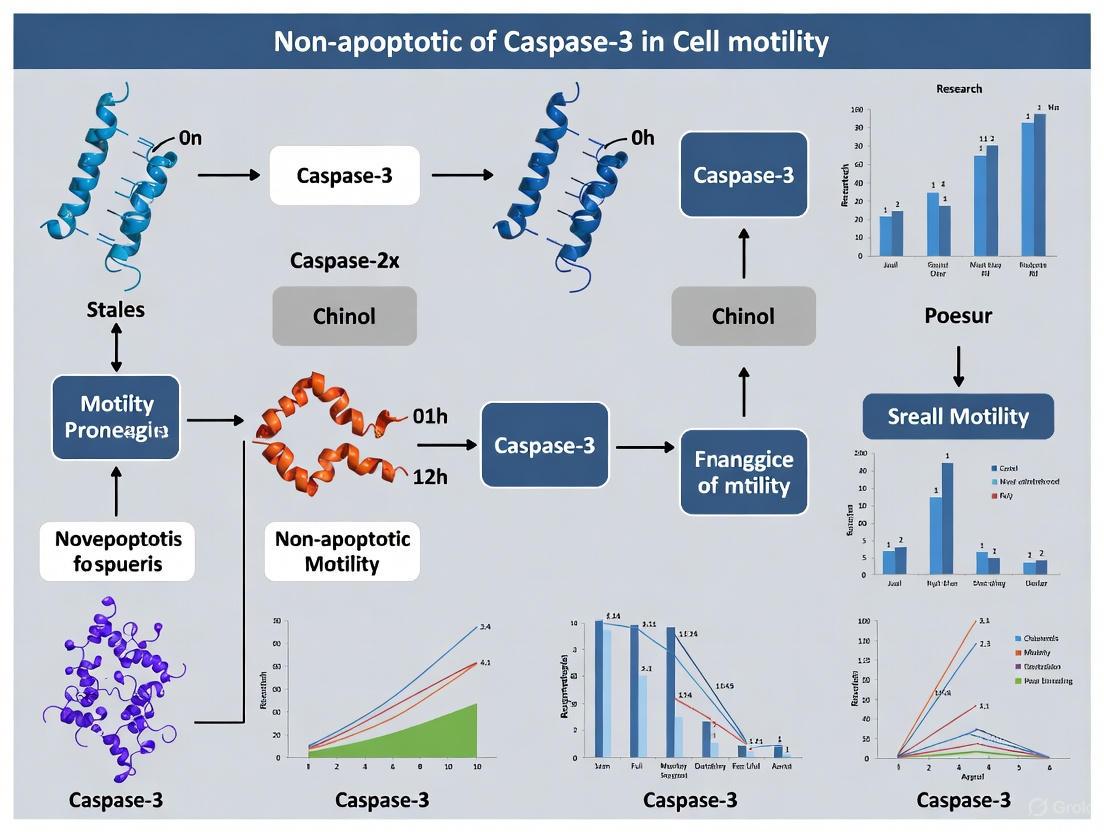
This article synthesizes current research revealing the non-apoptotic functions of caspase-3, specifically its critical role in regulating cell motility, migration, and invasion in cancer.
Beyond Cell Death: The Emerging Role of Caspase-3 in Cancer Cell Motility and Metastasis
Abstract
This article synthesizes current research revealing the non-apoptotic functions of caspase-3, specifically its critical role in regulating cell motility, migration, and invasion in cancer. Targeting researchers and drug development professionals, we explore the foundational mechanisms, including caspase-3's interaction with the cytoskeleton and proteins like coronin 1B, its protease-independent activation of pathways such as ERK, and its regulation by transcription factors like SP1. We further detail methodological approaches for studying these functions, analyze challenges in therapeutic targeting, including the failure of early caspase inhibitors in clinical trials, and present comparative evidence of its role across cancer types. The conclusion discusses the implications for developing novel anti-metastatic therapies that target caspase-3's non-apoptotic roles, highlighting future directions for biomedical research.
Unveiling the Paradox: Caspase-3's Non-Apoptotic Functions in Cell Motility
The Expanding Functional Landscape of Caspase-3
Caspase-3, a cysteine-aspartic protease, has been classically defined as a key executioner caspase in apoptosis, responsible for the systematic cleavage of cellular proteins leading to cell death [1]. However, accumulating evidence has fundamentally transformed this limited view, revealing that caspase-3 regulates critical non-apoptotic processes, particularly in cell motility and cytoskeletal remodeling [2] [1]. This paradigm shift recognizes that caspase-3 activation does not invariably lead to cell death; instead, its localized and sub-lethal activity can control specific cellular behaviors in viable cells.
The evolutionary history of caspase-like proteins in yeast suggests that caspase-3 may have acquired additional functions in multicellular organisms while retaining aspects of its ancestral roles [1]. This functional diversification is especially prominent in the nervous system, where caspase-3 regulates axonal growth, guidance, and regeneration [2]. Beyond neuronal development, caspase-3 influences motility processes in various cell types through precise cleavage of cytoskeletal regulators and adhesion molecules, establishing it as a versatile modulator of cell architecture and movement.
Molecular Mechanisms of Caspase-3 in Motility Regulation
Key Caspase-3 Substrates in Motility Pathways
Caspase-3 regulates cell motility through the proteolytic processing of specific structural and signaling proteins. The table below summarizes principal caspase-3 substrates implicated in motility regulation:
Table 1: Key Caspase-3 Substrates in Cell Motility Regulation
| Substrate | Functional Role | Cleavage Consequence | Biological Context |
|---|---|---|---|
| PTP-PEST | Cytosolic protein tyrosine phosphatase regulating actin cytoskeleton | Altered activity and scaffolding function; facilitates cellular detachment [3] | Apoptosis; cytoskeletal reorganization |
| Spectrin | Cortical cytoskeletal protein | Cytoskeletal remodeling enabling neurite outgrowth [2] | Axonal guidance and regeneration |
| Actin | Cytoskeletal filament protein | Generation of 15kDa fragment; cytoskeletal reorganization [2] | Neuronal development and pathology |
| Gap43 | Growth cone-associated protein | Growth cone regulation [2] | Axonal development |
| NCAM | Neural cell adhesion molecule | Altered cell-cell adhesion and neurite outgrowth [2] | NCAM-dependent neurite outgrowth |
| NgCAM | Neuron-glia cell adhesion molecule | Modified axonal fasciculation and growth [2] | Neurite extension |
| ROCK1 | Rho-associated protein kinase | Induces membrane blebbing and cell shrinkage [1] | Apoptotic morphological changes |
| CAD | Enzyme for de novo pyrimidine synthesis | Disruption of pyrimidine synthesis during apoptosis [4] | Cancer cell chemosensitivity |
Signaling Pathways in Caspase-3-Mediated Motility
Caspase-3 integrates into multiple signaling networks that regulate cell motility. The following diagram illustrates the principal pathways through which caspase-3 influences motile processes:
Caspase-3 Activation Pathways in Motility Regulation
The neural cell adhesion molecule (NCAM) activates caspase-8 through clustering-induced dimerization, which subsequently activates caspase-3 [2]. Additionally, the mitochondrial pathway activates caspase-9 through Apaf-1, leading to caspase-3 activation [2]. Once active, caspase-3 cleaves specific substrates including cytoskeletal proteins (spectrin, actin), adhesion molecules (NCAM, NgCAM), and regulatory phosphatases (PTP-PEST), ultimately coordinating motile processes such as axonal guidance, growth cone formation, and cytoskeletal remodeling.
Quantitative Analysis of Caspase-3 in Motility Contexts
Caspase-3 Activity Levels Across Cellular Processes
The diverse functions of caspase-3 are characterized by distinct activation levels and temporal dynamics. The following table compares quantitative aspects of caspase-3 activity across different biological contexts:
Table 2: Caspase-3 Activity Parameters in Different Biological Contexts
| Biological Context | Activation Level | Temporal Pattern | Key Regulators | Functional Outcome |
|---|---|---|---|---|
| Apoptosis | High, system-wide [5] | Rapid, irreversible activation [5] | Caspase-8, Caspase-9, Apaf-1 [1] | Cell death [1] |
| Axonal Guidance | Localized, sub-lethal [2] | Transient, localized | NCAM, caspase-8, calpain [2] | Growth cone turning [2] |
| Neurite Outgrowth | Moderate, restricted [2] | Sustained, compartmentalized | NCAM clustering, calpain [2] | Neurite extension [2] |
| Axonal Regeneration | Localized at injury site [2] | Acute, localized | Calcium flux, DLK-1, CED-4 [2] | Growth cone formation [2] |
| Tissue Homeostasis | Sporadic, low-level [1] | Pulsatile, controlled | Unknown survival signals [1] | Cell population regulation [1] |
Experimental Measurements of Caspase-3 Activity
Advanced biosensors have enabled precise quantification of caspase-3 dynamics. Research using DEVD-based fluorescent reporters reveals that caspase-3 activation begins approximately 10-16 hours post-apoptotic stimulus, with peak activity occurring around 24-30 hours [6]. In non-apoptotic contexts, caspase-3 activation is more transient, with studies showing that calpain inhibitors or siRNA against μ-calpain can block caspase-3 activation during axonal regeneration [2]. Single-cell analysis techniques have revealed significant heterogeneity in caspase-3 activation kinetics between individual cells, with cells destined to die showing markedly different caspase activity profiles several hours before death occurs [5].
Experimental Approaches for Studying Caspase-3 in Motility
Essential Research Reagents and Tools
Table 3: Essential Research Reagents for Studying Caspase-3 in Motility
| Reagent Category | Specific Examples | Application/Function | Experimental Context |
|---|---|---|---|
| Caspase Inhibitors | zVAD-FMK (pan-caspase) [6], DEVD-based inhibitors [2] | Inhibit caspase activity to assess functional requirement | Axonal guidance, neurite outgrowth, regeneration [2] |
| Fluorescent Biosensors | ZipGFP DEVD-based reporters [6], FRET-based sensors [7] | Real-time visualization of caspase-3/7 activity in living cells | Live-cell imaging in 2D and 3D cultures [6] |
| Activity Assays | Cleaved caspase-3 antibodies, PARP cleavage antibodies [6] | End-point detection of caspase activation | Immunoblotting, immunohistochemistry [6] |
| Genetic Tools | siRNA against μ-calpain [2], CRISPR/Cas9 knockout mutants [4] | Targeted disruption of caspase regulators or substrates | Mechanistic studies in various cell models [2] [4] |
| Cell Lines | MCF-7 (caspase-3 deficient) [6], Apaf-1 and caspase-9 null mice [2] | Models with compromised apoptotic machinery | Studying non-apoptotic functions [2] [6] |
Protocol: Real-Time Imaging of Caspase-3 Activity in Motility Studies
The following workflow diagram outlines a comprehensive approach for investigating caspase-3 activity in cell motility using advanced biosensor technology:
Experimental Workflow for Caspase-3 Motility Studies
Reporter Construction: Generate a lentiviral vector encoding a caspase-3/7 biosensor containing a DEVD cleavage motif embedded within a ZipGFP construct, along with a constitutive mCherry marker for cell presence normalization [6]. The DEVD sequence (Asp-Glu-Val-Asp) represents the canonical caspase-3/7 cleavage motif [1].
Stable Cell Line Generation: Transduce target cells (e.g., neuronal lines, cancer cells) using lentiviral delivery and select stable populations with appropriate antibiotics. Validation should include testing reporter responsiveness to known apoptotic inducers [6].
Model Establishment: Establish both 2D monolayers and 3D culture models (spheroids, organoids) to study caspase-3 in physiologically relevant contexts. 3D models particularly recapitulate tissue-like architecture for proper assessment of motility processes [6].
Experimental Treatment: Apply apoptotic inducers (e.g., carfilzomib, oxaliplatin) at concentrations determined by dose-response experiments. Include control groups with caspase inhibitors (zVAD-FMK, 20-50µM) to confirm caspase-dependent effects [6].
Live-Cell Imaging: Perform time-lapse microscopy over extended periods (up to 80+ hours) with appropriate environmental control. Monitor GFP fluorescence (caspase activation) and mCherry (cell presence) simultaneously, imaging at intervals of 30-60 minutes [6].
Multiparameter Analysis: Quantify caspase activation kinetics, correlate with motility parameters (directionality, speed, persistence), and perform endpoint validation through Western blotting for cleaved PARP and caspase-3, or flow cytometry for Annexin V/PI staining [6].
Protocol: Investigating Caspase-3 in Axonal Guidance and Regeneration
Cell Culture: Primary neuronal cultures (e.g., hippocampal, retinal ganglion cells) from embryonic rodents maintained in appropriate neurobasal media with growth factors [2].
Guidance Cue Exposure: Expose neurons to established chemotrophic guidance cues (e.g., netrin, lysophosphatidic acid) in compartmentalized chambers to create concentration gradients [2].
Caspase Inhibition: Treat with caspase-3-specific inhibitors (DEVD-fmk, 10-50µM) or caspase-8 inhibitors (IETD-fmk) to assess functional requirement. Include vehicle controls and calpain inhibitors where appropriate [2].
Axonal Behavior Analysis: Quantify growth cone turning, collapse events, and axonal branching patterns using time-lapse microscopy. Fixed endpoint analysis may include immunostaining for active caspase-3 and cytoskeletal markers [2].
Biochemical Analysis: Assess cleavage of specific caspase-3 substrates (spectrin, actin, Gap43) through Western blotting using cleavage-specific antibodies where available [2].
Research Implications and Therapeutic Perspectives
The recognition of caspase-3 as a regulator of cell motility opens significant therapeutic possibilities. In cancer research, understanding how caspase-3 influences metastatic behavior may inform novel treatment strategies that specifically target motility functions without triggering full apoptosis [1] [4]. In neurodegenerative diseases, the presence of active caspase-3 and its cleavage products (e.g., the 15kDa actin fragment) in patient neurons suggests potential involvement in pathological cytoskeletal changes [2]. For nerve regeneration, leveraging caspase-3's role in axonal growth cone formation may lead to innovative approaches for enhancing neural repair after injury [2].
The caspase-3 inhibitor market, projected to grow from USD 450 million in 2024 to USD 1.2 billion by 2033, reflects the therapeutic importance of targeting caspase-3 pathways [8]. Current applications focus primarily on inhibiting apoptotic cell death in conditions like neurodegenerative disorders; however, future therapeutics may aim to selectively modulate specific caspase-3 functions, including its motility-related activities, while sparing its other roles [8] [1].
Caspase-3, a canonical executioner protease in the apoptotic pathway, presents a compelling paradox in oncology. While its primary role in mediating programmed cell death would suggest tumor suppressor functions, compelling clinical and experimental evidence reveals elevated caspase-3 expression in some of the most aggressive and metastatic human cancers. This apparent contradiction represents a significant clinical conundrum with profound implications for cancer biology and therapeutic development. Emerging research has fundamentally shifted our understanding of caspase-3 from a straightforward executor of cell death to a multifaceted regulator of diverse cellular processes, particularly in the context of cancer cell motility, invasion, and metastasis. This whitepaper synthesizes current evidence regarding the non-apoptotic functions of caspase-3 in aggressive cancers, with specific emphasis on its mechanisms in promoting cell migration and invasion, and explores the therapeutic challenges and opportunities arising from this complex biology.
Clinical Evidence: Correlating Caspase-3 Expression with Aggressive Disease
Expression Patterns Across Cancer Types
Systematic analyses of caspase-3 expression across human malignancies reveal unexpected patterns that contradict traditional apoptotic paradigms. A comprehensive pan-cancer analysis utilizing The Cancer Genome Atlas and Genotype-Tissue Expression databases demonstrates that CASP3 expression is significantly associated with prognosis in most tumors, though the direction of this association varies by cancer type [9]. Notably, instead of being downregulated to avoid cell death, many aggressive cancers maintain or elevate caspase-3 expression.
Table 1: Caspase-3 Expression and Prognostic Significance in Human Cancers
| Cancer Type | CASP3 Expression (vs. Normal) | Correlation with Prognosis | Proposed Mechanism |
|---|---|---|---|
| Melanoma | Highly expressed in metastatic vs. primary tumors [10] | Poor prognosis [10] | Enhanced cell motility via cytoskeletal regulation |
| Breast Cancer | Overexpressed in tumor tissue [11] | Worse overall survival (HR=1.73) [11] | Association with PR and HER-2 subtypes |
| Colorectal Cancer | Variable | High stromal CC3 predicts good survival [12] | Immune surveillance; MHC-II expression |
| Gastric Cancer | Determines chemosensitivity [4] | Cleavage-resistant mutants confer chemoresistance [4] | Pyrimidine synthesis pathway regulation |
| Pancreatic Cancer | Targeted by oncogenic miRNAs [13] | Contributes to TRAIL resistance [13] | miRNA-mediated caspase suppression |
Paradoxical Prognostic Implications
The relationship between caspase-3 expression and clinical outcomes reveals additional complexity, with stark contrasts depending on tumor type and cellular context. In breast cancer, a meta-analysis of 21 studies encompassing 3,091 patients established that increased caspase-3 expression negatively influenced overall survival, with a hazard ratio of 1.73 [11]. This association was particularly pronounced in Asian populations and represented an independent risk factor in multivariate analyses. Conversely, in colorectal cancer, high levels of cleaved caspase-3 in tumor-associated stroma predict favorable survival, suggesting compartment-specific functions [12]. This tissue and subcellular localization dramatically influences the functional consequences of caspase-3 expression.
Molecular Mechanisms: Non-Apoptotic Roles in Cell Motility
Cytoskeletal Regulation and Interaction Networks
The non-apoptotic functions of caspase-3 in cancer cell motility are supported by comprehensive molecular interactome analyses. In metastatic melanoma cells, caspase-3 constitutively associates with the cytoskeleton and interacts with proteins involved in actin filament organization [10]. Gene ontology classification of caspase-3-interacting partners reveals significant enrichment for terms related to "actin filament organization," "regulation of actin-based processes," and "positive regulation of cytoskeleton organization" [10]. This physical association with cytoskeletal components provides a mechanistic basis for its role in cell motility independent of apoptotic functions.
Table 2: Key Caspase-3 Substrates in Non-Apoptotic Processes
| Substrate | Cleavage Site/ Domain | Functional Consequence | Biological Context |
|---|---|---|---|
| Coronin 1B | Not specified | Alters actin polymerization dynamics | Melanoma cell migration [10] |
| CAD Protein | Asp1371 [4] | Disrupts de novo pyrimidine synthesis | Chemosensitivity in gastric cancer [4] |
| Spectrin | Not specified | Cytoskeletal remodeling | Neurite outgrowth [2] |
| NCAM/NgCAM | Not specified | Alters cell adhesion properties | Axonal guidance [2] |
| Actin | Produces 15 kDa fragment | Cytoskeletal reorganization | Growth cone formation [2] |
Signaling Pathway in Melanoma Cell Motility
The mechanistic relationship between caspase-3 and cell motility has been particularly well-characterized in melanoma. The following diagram illustrates the signaling pathway through which caspase-3 regulates melanoma cell migration and invasion:
This pathway illustrates how transcription factor SP1 upregulates CASP3 expression in melanoma cells, leading to caspase-3 interaction with and regulation of coronin 1B, a key actin-binding protein. This regulation promotes actin polymerization, stabilizes focal adhesions, forms lamellipodia protrusions, and ultimately enhances cell motility, invasion, and metastatic potential—all through mechanisms independent of caspase-3's apoptotic function.
Experimental Approaches and Research Methodologies
Key Experimental Workflows
Research elucidating the non-apoptotic functions of caspase-3 employs sophisticated methodological approaches. The following diagram outlines a generalized experimental workflow for investigating caspase-3's role in cancer cell motility:
This workflow begins with comprehensive gene expression analyses comparing metastatic and non-metastatic tumors, followed by genetic manipulation of caspase-3 expression using RNA interference or CRISPR/Cas9 approaches. Subsequent interactome mapping through immunoprecipitation and mass spectrometry identifies direct binding partners, while functional assays quantitatively assess the phenotypic consequences. Finally, mechanistic validation and in vivo confirmation establish the physiological relevance.
The Scientist's Toolkit: Essential Research Reagents
Table 3: Key Research Reagents for Studying Caspase-3 in Cell Motility
| Reagent/Category | Specific Examples | Research Application | Functional Outcome Measured |
|---|---|---|---|
| Caspase Inhibitors | Z-VAD-FMK (pan-caspase), Z-DEVD-FMK (caspase-3 specific) [14] | Inhibit proteolytic activity | Migration and invasion impairment |
| Genetic Manipulation Tools | siRNA, shRNA, CRISPR/Cas9 for CASP3 knockout [10] | Reduce or eliminate caspase-3 expression | Altered cytoskeletal organization and adhesion |
| Activity Detection | Anti-cleaved caspase-3 antibodies [12] | Detect activated caspase-3 | Subcellular localization studies |
| Interactome Mapping | GFP-caspase-3 fusion proteins, anti-GFP nanobodies [10] | Identify binding partners | Cytoskeletal protein interactions |
| Live-Cell Imaging | IncuCyte migration/invasion assays [10] | Quantitative motility tracking | Migration rate and directionality |
| Cytoskeletal Markers | Phalloidin (F-actin), anti-paxillin [10] | Visualize structural changes | Focal adhesion dynamics |
Therapeutic Implications and Clinical Translation
Challenges in Caspase-Targeted Therapies
The development of caspase-targeted therapies faces substantial challenges due to the dual nature of caspase-3 in cancer biology. While caspase inhibitors showed promise in preclinical models for inflammatory and neurological conditions, their translation to oncology is complicated by the potential to simultaneously inhibit both apoptotic and non-apoptotic functions [14]. Peptidomimetic inhibitors like IDN-6556 (emricasan) and VX-740 (pralnacasan) advanced to clinical trials but faced termination due to inadequate efficacy or liver toxicity [14]. The context-dependent functions of caspase-3 necessitate highly specific inhibition strategies that can discriminate between pro-apoptotic and pro-motility activities.
Alternative Therapeutic Strategies
Given the challenges of direct caspase inhibition, alternative approaches targeting upstream regulators or downstream effectors offer promising alternatives. In melanoma, targeting transcription factor SP1 to reduce caspase-3 expression impairs cell migration [10]. In gastric and colorectal cancers, pharmacological targeting of cleavage-resistant CAD mutants with compounds like RMY-186 restores chemotherapy efficacy [4]. For pancreatic cancer, where miRNAs including miR-337-3p, miR-17-5p, and miRs-132-3p/-212-3p directly target caspase-3 and -7, therapeutic modulation of these miRNAs may overcome TRAIL resistance [13]. These indirect approaches may enable more selective disruption of the pro-tumorigenic functions of caspase-3 while preserving its apoptotic tumor suppressor activities.
The paradoxical role of caspase-3 in aggressive cancers represents a significant paradigm shift in cancer biology. Once viewed primarily as an executioner of cell death, caspase-3 now emerges as a multifunctional protease with context-dependent roles in cytoskeletal remodeling, cell motility, and metastasis. The clinical conundrum of its elevated expression in aggressive tumors reflects the complex interplay between its pro-apoptotic and pro-metastatic functions, influenced by cellular localization, genetic background, and tumor microenvironment. Future research must focus on elucidating the molecular switches that determine these divergent functions and developing therapeutic strategies capable of selectively inhibiting the pro-tumorigenic activities while preserving the tumor-suppressive apoptotic functions. The resolution of this clinical conundrum will require sophisticated tools capable of discriminating between these functionally distinct pools of caspase-3 and will likely yield novel targeted approaches for treating aggressive, metastatic cancers.
Caspase-3, traditionally recognized as a key executioner protease in apoptosis, has emerged as a critical regulator of cellular dynamics in vital processes, particularly in cell motility. This non-apoptotic function represents a paradigm shift in our understanding of caspase biology, revealing that the same enzyme that dismantles cells during programmed cell death also governs precise cytoskeletal rearrangements essential for cell migration. The molecular mechanisms underlying caspase-3's interaction with the cytoskeleton are now being elucidated in various physiological and pathological contexts, including neuronal development, cancer metastasis, and endothelial barrier function [2] [10] [15]. This technical guide synthesizes current research on caspase-3's non-apoptotic roles, with particular emphasis on its regulation of cytoskeletal dynamics in cell motility, providing methodologies and resources for continued investigation in this evolving field.
A key revelation in this field is that caspase-3 operates in non-apoptotic contexts through spatially restricted, temporally controlled, and substrate-specific activation mechanisms that avoid full apoptotic commitment. In melanoma and other aggressive cancers, caspase-3 is highly expressed without triggering cell death, instead promoting migratory and invasive behaviors [10]. Similarly, during neuronal development, caspase-3 activation is localized to growth cones and axonal branches where it regulates cytoskeletal remodeling without inducing apoptosis [2]. These findings collectively establish a new framework for understanding caspase-3 as a multifunctional protease whose cellular outcomes depend on subcellular localization, activation magnitude, and temporal dynamics.
Molecular Mechanisms of Caspase-3-Mediated Cytoskeletal Regulation
Direct Protein Interactions and Complex Formation
Caspase-3 interacts directly with core components of the cytoskeletal machinery, forming complexes that regulate actin dynamics and cell motility. Comprehensive interactome analyses in melanoma cells have revealed that caspase-3 constitutively associates with proteins involved in actin filament organization, with significant enrichment for actin-binding domains among its interaction partners [10]. Specifically, caspase-3 interacts with and modulates the activity of coronin 1B, a key regulator of actin polymerization that promotes ARP2/3-mediated actin branching at the leading edge of migrating cells [10]. This interaction promotes melanoma cell motility independently of caspase-3's proteolytic function, suggesting a scaffolding role in addition to its catalytic activities.
Table 1: Caspase-3 Cytoskeletal Protein Interactions and Functional Consequences
| Interacting Protein | Interaction Type | Functional Consequence | Biological Context |
|---|---|---|---|
| Coronin 1B | Direct binding | Enhanced actin polymerization | Melanoma cell motility |
| Spectrin | Proteolytic cleavage | Cytoskeletal reorganization | Neuronal axon guidance |
| Actin | Proteolytic cleavage | Generation of 15 kDa fragment | Growth cone remodeling |
| NCAM | Proteolytic cleavage | Modified cell adhesion | Neurite outgrowth |
| NgCAM | Proteolytic cleavage | Altered extracellular vesicle cargo | Auditory brainstem development |
Proteolytic Regulation of Cytoskeletal Components
Beyond scaffolding functions, caspase-3 directly cleaves multiple cytoskeletal proteins and adhesion molecules to facilitate cell motility. During neuronal development, caspase-3 cleaves cytoskeletal growth cone proteins and Gap43, which regulates growth cone dynamics [2]. The cleavage of spectrin by caspase-3 alters the cytoskeleton to permit neurite outgrowth [2]. Similarly, the neural cell adhesion molecule (NCAM) and neuron-glia cell adhesion molecule (NgCAM) are caspase-3 substrates, with cleavage potentially modifying cell adhesion properties during axonal guidance [2]. In apoptotic contexts, caspase-3 cleaves actin to produce a 15 kDa fragment that causes condensation and fragmentation of the actin network, though this cleavage has also been detected in non-apoptotic neurons from aged and Alzheimer's disease patients, where it co-localizes with active caspase-3 [2].
Subcellular Localization and Compartmentalization
The non-apoptotic functions of caspase-3 are tightly regulated by its subcellular localization. In endothelial cells, cytoplasmic sequestration of active caspase-3 preserves barrier function and prevents apoptosis, while nuclear translocation typically heralds cell death [15] [16]. Similarly, in melanoma cells, a fraction of caspase-3 localizes to the plasma membrane and F-actin, primarily at the cellular cortex, where it associates with the cytoskeletal fraction [10]. This subcellular compartmentalization ensures that caspase-3 interacts with specific subsets of substrates in different cellular locations, allowing precise regulation of cytoskeletal dynamics without triggering widespread apoptotic degradation.
Diagram 1: Subcellular localization determines caspase-3 functional outcomes. Non-apoptotic functions require restricted activation and cytoplasmic sequestration, while nuclear translocation typically leads to apoptosis.
Quantitative Analysis of Caspase-3 in Cytoskeletal Regulation
Experimental Measurement Techniques
Multiple sophisticated approaches have been developed to quantify caspase-3 activity and its relationship to cytoskeletal dynamics in living cells. Fluorescence Resonance Energy Transfer (FRET)-based reporters like SCAT3, which consists of ECFP and Venus fluorescent proteins linked by a caspase-3 cleavage sequence (DEVD), enable real-time monitoring of caspase-3 activation [17]. The FES (Fitting Emission Spectra) method quantitatively analyzes FRET efficiency by directly fitting emission spectra of donor-acceptor pairs, free from excitation and emission spectral crosstalk [17]. This approach has been validated against two-photon excitation fluorescence lifetime imaging microscopy (FLIM) and allows long-term dynamic detection of caspase-3 activity in living cells.
Complementary methods include subcellular fractionation with NP-40 detergent for clean separation of cytoplasmic and nuclear components, enabling compartment-specific analysis of caspase-3 localization and activity [16]. Magnetic twisting cytometry measures cell stiffness as an indicator of cytoskeletal integrity, while electric cell-substrate impedance sensing (ECIS) quantitatively assesses endothelial barrier function in response to caspase-3 modulation [15]. These techniques collectively provide multidimensional assessment of caspase-3's role in cytoskeletal regulation.
Table 2: Quantitative Findings on Caspase-3 Cytoskeletal Regulation Across Biological Contexts
| Experimental Context | Key Measurement | Quantitative Result | Functional Impact |
|---|---|---|---|
| Melanoma cell motility | F-actin anisotropy | ↓ 60-70% with caspase-3 knockdown | Severe disorganization of actin fibers |
| Melanoma cell adhesion | Adhesion to matrigel | ↓ 40-50% with caspase-3 inhibition | Impaired cell attachment and polarization |
| Melanoma migration | Migration rate (IncuCyte) | ↓ 55-65% with caspase-3 depletion | Reduced metastatic potential |
| Endothelial barrier | Transendothelial resistance | ↑ recovery with caspase-3 activation | Enhanced barrier integrity |
| Axonal regeneration | Regeneration success | ↓ 70-80% with caspase-3 inhibition | Blocked growth cone formation |
Methodological Considerations for Live-Cell Imaging
When implementing FRET-based caspase-3 sensors, several methodological considerations are crucial for accurate quantification. The FES method offers advantages over other FRET quantification approaches because it is free from both excitation and emission spectral crosstalks, can be used with current spectral systems or auto-microplate readers, and is suitable for long-term dynamic detection in living cells [17]. Control experiments should include validation with established caspase-3 inducers like staurosporine (STS) and comparison with complementary methods such as FLIM where possible. For cytoskeletal studies, parallel staining with phalloidin or immunolabeling of focal adhesion components like paxillin enables correlation of caspase-3 activation with specific cytoskeletal rearrangements [10] [15].
Experimental Models and Methodologies
Genetic and Pharmacological Perturbation Strategies
Elucidating caspase-3's cytoskeletal functions requires specific genetic and pharmacological perturbation approaches. RNA interference using siRNA targeting caspase-3 effectively reduces expression by 70-80% in melanoma cells, resulting in significant disorganization of F-actin fibers and reduced focal adhesions [10]. CRISPR/Cas9-mediated knockout provides complete genetic ablation for more severe phenotypic assessment. Pharmacological inhibition utilizes cell-permeable irreversible inhibitors such as z-DEVD-FMK (caspase-3-specific) or q-VD-OPH (pan-caspase inhibitor with preference for caspase-3) [15]. These inhibitors are typically applied at concentrations ranging from 10-50 μM, with pretreatment periods of 2 hours before experimental assessments.
For gain-of-function studies, stable expression of caspase-3-GFP fusion proteins enables investigation of caspase-3 localization and interactomes [10]. Immunoprecipitation using anti-GFP nanobodies coupled with mass spectrometry analysis has identified caspase-3 interaction networks with cytoskeletal proteins. Importantly, mutational analyses distinguishing proteolytically active versus scaffolding functions of caspase-3 require constructs with catalytic site mutations (e.g., C163A) that abolish protease activity while preserving protein interaction capabilities.
Functional Assays for Cytoskeletal Dynamics
Multiple specialized assays quantify the functional consequences of caspase-3 modulation on cytoskeletal properties and cell motility:
Migration and Invasion Assays: IncuCyte live-cell imaging systems enable quantitative assessment of cell migration and invasion in real-time. Caspase-3 knockdown typically reduces migration by 55-65% and invasion by 60-70% in melanoma models [10]. Chemotaxis assays using Boyden or Dunn chambers provide complementary data on directional migration.
Cytoskeletal Organization Analysis: Fluorescence microscopy of phalloidin-stained F-actin reveals that caspase-3 depletion reduces actin fiber anisotropy by 60-70%, comparable to effects of cytochalasin D treatment [10]. Quantitative analysis of paracellular gaps in endothelial monolayers demonstrates that caspase-3 inhibition increases gap formation by 2-3 fold during thrombin-induced barrier disruption [15].
Cell Adhesion and Mechanical Properties: Adhesion assays to matrigel-coated substrates show 40-50% reduction in caspase-3-deficient cells [10]. Magnetic twisting cytometry measures cell stiffness, with caspase-3 inhibition increasing endothelial cell stiffness by approximately 30% during thrombin stimulation [15].
Diagram 2: Comprehensive experimental workflow for analyzing caspase-3 cytoskeletal functions, integrating perturbation methods with assessment techniques.
Research Reagent Solutions
Table 3: Essential Research Reagents for Investigating Caspase-3 Cytoskeletal Interactions
| Reagent Category | Specific Examples | Application & Function | Experimental Context |
|---|---|---|---|
| Caspase-3 Inhibitors | z-DEVD-FMK (caspase-3 specific); q-VD-OPH (broad-spectrum) | Inhibit proteolytic activity; determine caspase-dependent effects | Melanoma motility; endothelial barrier function |
| FRET Reporters | SCAT3 (DEVD sequence linking ECFP-Venus) | Live-cell caspase-3 activity monitoring | Real-time activation kinetics; drug screening |
| Antibodies | Anti-active caspase-3 (CM1); anti-coronin 1B; anti-paxillin | Detection of localization and activation status | Immunofluorescence; Western blot; IP experiments |
| siRNA/Crispr Tools | siRNA targeting CASP3; CRISPR/Cas9 knockout constructs | Genetic perturbation of caspase-3 expression | Loss-of-function studies; mechanism dissection |
| Expression Constructs | Caspase-3-GFP fusion; catalytic mutants (C163A) | Localization studies; structure-function analysis | Interactome studies; separation of protease vs scaffolding functions |
| Cytoskeletal Probes | Phalloidin (F-actin); tubulin antibodies | Visualization of cytoskeletal architecture | Correlation with caspase-3 activation |
| Activity Assays | Caspase-Glo 3/7; fluorogenic substrates (DEVD-AFC) | Quantitative activity measurement | Biochemical characterization; inhibitor profiling |
Pathophysiological Contexts and Therapeutic Implications
Cancer Cell Motility and Metastasis
The role of caspase-3 in promoting cancer cell motility represents a paradigm shift in understanding cancer progression mechanisms. In melanoma, caspase-3 expression differentiates primary from metastatic tumors and is associated with poor prognosis [10]. Rather than attempting to eliminate these aggressive cancer cells through apoptotic induction, they paradoxically maintain high caspase-3 expression to enhance their migratory and invasive capabilities. Caspase-3 regulates lamellipodia formation, focal adhesion turnover, and actin polymerization through its interaction with coronin 1B, creating a molecular environment conducive to metastasis [10]. This understanding reveals the limitations of conventional pro-apoptotic cancer therapies and suggests that targeted inhibition of caspase-3's cytoskeletal functions, while sparing its apoptotic activities, may represent a novel anti-metastatic strategy.
Neuronal Development and Regeneration
During neuronal development, caspase-3 activation is precisely regulated in time and space to control axonal growth, guidance, and branching without triggering apoptosis [2]. Caspase-3 and caspase-9 activation occurs at axonal branch points of retinal ganglion cells, while caspase-8 activation via NCAM clustering triggers caspase-3-mediated spectrin cleavage and cytoskeletal remodeling necessary for neurite outgrowth [2]. In regeneration contexts, caspase-3 inhibitors block axon regeneration in dorsal root sensory neurons by preventing growth cone formation [2]. The conservation of these mechanisms extends to C. elegans, where CED-4 (Apaf-1 homolog) and CED-3 (caspase-3 homolog) regulate axonal regeneration after injury through calcium fluxes and DLK-1 kinase pathway activation [2]. These findings highlight the evolutionarily conserved role of caspase-3 in structural plasticity and suggest potential therapeutic applications for modulating caspase-3 in neurological disorders and nerve repair.
Vascular Barrier Function
In endothelial cells, non-apoptotic caspase-3 activation promotes barrier integrity through mechanisms involving cytoskeletal reorganization [15]. During thrombin-induced barrier disruption, cytoplasmic caspase-3 activation facilitates rapid recovery of transendothelial electrical resistance, while caspase-3 inhibition leads to increased cell stiffness, enhanced paracellular gap formation, and prolonged barrier dysfunction [15]. This barrier-protective function directly contrasts with the traditional view of caspase-3 as solely destructive and suggests contextual roles determined by activation magnitude, subcellular localization, and specific cellular environments. These findings have particular relevance for acute lung injury and sepsis, where endothelial barrier breakdown contributes to pathophysiology, and suggest that selective caspase-3 modulation rather than complete inhibition may represent optimal therapeutic approaches.
The investigation of caspase-3's interactions with the cytoskeleton has revealed a complex landscape of non-apoptotic functions that expand this protease's roles beyond cell death execution. Through direct protein interactions, proteolytic regulation of cytoskeletal components, and precise subcellular localization, caspase-3 emerges as a central regulator of cell motility, neuronal development, and vascular integrity. The experimental methodologies, reagents, and conceptual frameworks outlined in this technical guide provide researchers with comprehensive tools to further elucidate these mechanisms across physiological and pathological contexts. As our understanding of caspase-3's dual roles in life and death decisions deepens, targeted therapeutic strategies that selectively modulate its non-apoptotic functions offer promising avenues for treating cancer metastasis, neurological disorders, and vascular diseases.
Coronin 1B (Coro1B) represents a crucial node in the coordination of actin cytoskeleton dynamics, serving as a molecular scaffold that integrates signals from key regulatory partners including the Arp2/3 complex, cofilin, and cortactin. Recent evidence has unveiled a non-canonical role for caspase-3 in regulating Coro1B-mediated actin dynamics, revealing unexpected crosstalk between apoptotic machinery and cell motility pathways. This whitepaper provides an in-depth analysis of the molecular mechanisms governing Coro1B function, detailed experimental methodologies for investigating these relationships, and visual tools for understanding the complex regulatory networks involved. The emerging paradigm of caspase-3 in Coro1B regulation presents novel therapeutic opportunities for targeting metastatic disease, particularly in aggressive cancers such as melanoma where both proteins are highly expressed.
Coronin 1B is a highly conserved actin-binding protein belonging to the type I coronin family, characterized by a seven-bladed β-propeller domain, a unique variable region, and a coiled-coil domain that facilitates trimerization [18]. As a ubiquitous regulator of actin dynamics, Coro1B localizes to lamellipodia and cell-cell junctions where it governs fundamental cellular processes including migration, adhesion, and junctional remodeling [19] [20]. The protein functions as a molecular integrator that coordinates the antagonistic activities of actin assembly and disassembly machinery, particularly through its interactions with the Arp2/3 complex and cofilin pathway [19] [21].
The discovery of non-apoptotic caspase-3 functions in cell motility has unveiled a novel regulatory layer for Coro1B activity. In metastatic melanoma cells, caspase-3 interacts with Coro1B and modulates its function independently of caspase-3's apoptotic protease activity [10]. This finding positions Coro1B at the intersection of cytoskeletal dynamics and non-canonical caspase signaling, offering new perspectives on the molecular mechanisms driving cancer cell invasion and metastasis.
Molecular Mechanisms and Key Regulatory Partners
Coronin 1B and Arp2/3 Complex: Nucleation Regulation and Branch Disassembly
Coronin 1B directly interacts with the Arp2/3 complex through a mechanism requiring phosphorylation at Serine 2 [19] [22]. This interaction enables Coro1B to inhibit Arp2/3-dependent actin nucleation and promote debranching of existing actin networks [22]. The functional significance of this regulation is evident in cellular phenotypes—depletion of Coro1B leads to excessively dense branched actin networks at the cell periphery and reduced actin filament presence in lamellipodial regions [19].
Table 1: Quantitative Effects of Coronin 1B Depletion on Actin Dynamics
| Parameter | Control Cells | Coro1B-Depleted Cells | Change | Measurement Method |
|---|---|---|---|---|
| Cell migration speed | Baseline | ~33% decrease | -33% | Time-lapse microscopy [19] |
| Retrograde actin flow rate | Baseline | ~50% reduction | -50% | Kymography of GFP-actin [19] |
| Barbed end zone width | ~2μm | Narrowed significantly | - | Barbed end assay [19] |
| Protrusion persistence | Normal | Decreased | - | Kymography [19] |
| F-actin levels | Normal | Increased | + | Biochemical assays [18] |
The molecular basis for Coro1B's inhibition of Arp2/3 complex involves its competition with cortactin, a branch-stabilizing factor [22]. Coro1B and cortactin display distinct spatial distributions in lamellipodia, with cortactin localizing closer to the leading edge (~500 nm) and Coro1B peaking further back (~800 nm) [22]. This spatial separation suggests a temporal model of branch regulation where cortactin initially stabilizes new branches, followed by Coro1B-mediated disassembly as the network matures.
Coronin 1B and Cofilin: Coordinating Actin Turnover
Coronin 1B simultaneously interacts with Arp2/3 complex and Slingshot phosphatase (SSH1L), creating a physical bridge between actin assembly and disassembly machinery [19] [21]. SSH1L dephosphorylates and activates cofilin, a potent actin severing protein, while also dephosphorylating Coro1B at Ser2 to enhance its association with Arp2/3 complex [19]. This coordinated regulation ensures that actin filament nucleation and turnover are spatially and temporally coupled.
Genetic evidence supports this functional relationship—cells lacking Coro1B and the related Coro1C exhibit accumulated cofilin in lamellipodia but reduced cofilin activity, resulting in decreased actin turnover [18]. The conceptual model suggests that Coro1B promotes cofilin's access to actin filaments, possibly by inducing conformational changes that facilitate cofilin binding [18].
Caspase-3: A Novel Regulator of Coronin 1B in Cell Motility
Recent research has revealed an unexpected relationship between caspase-3 and Coro1B in melanoma cell motility [10]. Caspase-3 interacts with Coro1B and modulates its activity through a non-apoptotic mechanism, as caspase-3 inhibition or knockdown impairs melanoma cell migration and invasion without inducing cell death [10]. This regulation is particularly relevant in metastatic melanoma, where caspase-3 is highly expressed despite its pro-apoptotic function.
Table 2: Experimental Evidence for Caspase-3 Regulation of Coronin 1B-Mediated Motility
| Experimental Approach | Key Finding | Functional Outcome | Reference |
|---|---|---|---|
| Caspase-3 interactome analysis | Caspase-3 associates with cytoskeletal proteins including Coro1B | Identified physical interaction between caspase-3 and actin regulatory machinery | [10] |
| Caspase-3 knockdown | Disorganized F-actin fibers, reduced focal adhesions | Impaired cell adhesion and polarization | [10] |
| Caspase-3 inhibition | Reduced melanoma cell migration and invasion in vitro | Decreased haptotaxis and chemotaxis | [10] |
| Caspase-3 knockout (CRISPR/Cas9) | Impaired lamellipodia formation | Defective cytoskeletal organization | [10] |
| Subcellular fractionation | Caspase-3 associated with cytoskeletal fraction | Compartmentalized, non-apoptotic caspase-3 function | [10] |
The molecular mechanism underlying caspase-3 regulation of Coro1B activity remains under investigation, but evidence suggests it may involve direct binding and modulation rather than proteolytic cleavage [10]. This non-canonical role extends to endothelial cells, where cytoplasmic caspase-3 activation promotes barrier integrity rather than apoptosis [15].
Experimental Approaches and Methodologies
Analyzing Coronin 1B Function in Actin Dynamics
Retrograde Flow Measurement Using Kymography
- Plate Rat2 fibroblasts or other migratory cells on glass-bottom dishes
- Transfect with GFP-actin or stain with fluorescent phalloidin after fixation
- Acquire time-lapse images at 5-10 second intervals for 5-10 minutes using TIRF or confocal microscopy
- Draw lines perpendicular to the leading edge and generate kymographs using ImageJ or similar software
- Calculate flow rates by measuring the slope of diagonal lines in kymographs [19]
Barbed End Assay for Actin Assembly Sites
- Culture cells on coverslips until well-spread
- Permeabilize for 1 minute with permeability buffer (0.1% saponin, 30 mM HEPES, 138 mM KCl, 10 mM NaCl, 1 mM MgCl2, 2 mM EGTA, 0.2 mM ATP, 1% BSA)
- Incubate with actin monomer solution (0.2 μM rhodamine-labeled G-actin, 0.5 μM unlabeled G-actin in permeability buffer) for 1-5 minutes
- Fix with 4% PFA, stain with phalloidin to visualize total F-actin
- Image using super-resolution or confocal microscopy and quantify barbed end distribution [19]
Electron Microscopy of Actin Architecture
- Prepare platinum replica samples as described by Svitkina (2017)
- Extract cells with 1% Triton X-100 in cytoskeleton buffer for 3-5 minutes
- Fix with 2% glutaraldehyde, then with 1% osmium tetroxide
- Dehydrate through ethanol series, critical point dry, and coat with platinum and carbon
- Image using transmission electron microscopy to visualize actin branch density and organization [19]
Investigating Coronin 1B-Caspase-3 Interactions
Interactome Analysis by Immunoprecipitation and Mass Spectrometry
- Stably express caspase-3-GFP fusion protein in melanoma cells (WM793, WM852)
- Crosslink with DSP (dithiobis(succinimidyl propionate)) if needed for transient interactions
- Lyse cells in mild lysis buffer (1% NP-40, 150 mM NaCl, 50 mM Tris pH 8.0 with protease inhibitors)
- Immunoprecipitate using anti-GFP nanobodies coupled to magnetic agarose beads
- Wash stringently, elute with SDS sample buffer, and analyze by LC-MS/MS
- Validate interactions by co-immunoprecipitation and immunofluorescence [10]
Functional Migration and Invasion Assays
- For 2D migration: Seed cells in IncuCyte ImageLock plates, create wound, monitor closure with IncuCyte Live-Cell Imaging System
- For 3D invasion: Coat Transwell inserts with Matrigel (1 mg/mL), seed cells in serum-free medium, place in complete medium-containing well, fix and stain after 24-48 hours
- For haptotaxis: Use Boyden chambers with fibronectin or collagen-coated membranes
- Inhibit caspase-3 specifically with z-DEVD-FMK (10-20 μM) or through RNAi knockdown [10]
Visualization of Regulatory Networks
Coronin 1B Regulatory Network
Caspase-3 and Coronin 1B Experimental Workflow
The Scientist's Toolkit: Essential Research Reagents
Table 3: Key Research Reagents for Investigating Coronin 1B Function
| Reagent/Tool | Function/Application | Example Use | Key Findings Enabled |
|---|---|---|---|
| Coro1B shRNA | Gene knockdown | Deplete Coro1B in Rat2 fibroblasts | Reduced cell speed, altered lamellipodial dynamics [19] |
| Coro1B-GFP | Rescue experiments, localization | Express in Coro1B-depleted cells | Confirms specificity of RNAi phenotypes [19] |
| Coro1B S2D/S2A mutants | Phosphorylation site manipulation | Study PKC regulation of Coro1B-Arp2/3 interaction | Ser2 phosphorylation regulates Arp2/3 binding [19] [22] |
| Coro1B R30D mutant | F-actin binding disruption | Examine actin-binding requirements | F-actin binding essential for Arp2/3 inhibition [22] |
| z-DEVD-FMK | Caspase-3 specific inhibition | Block caspase-3 activity in migration assays | Identifies non-apoptotic role in motility [10] [15] |
| Caspase-3 siRNA | Gene knockdown | Reduce caspase-3 expression | Impaired melanoma cell migration, adhesion defects [10] |
| Caspase-3-GFP fusion | Interactome studies | Immunoprecipitation-mass spectrometry | Identified Coro1B as caspase-3 interaction partner [10] |
| Active Cofilin (S3A) | Cofilin pathway activation | Rescue experiments in Coro1B-deficient cells | Partial suppression of lamellipodial defects [19] |
The regulation of Coronin 1B represents a sophisticated mechanism for coordinating actin cytoskeleton dynamics through integration of multiple signaling inputs. The traditional view of Coro1B as primarily an Arp2/3 and cofilin coordinator has expanded to include novel regulatory partnerships, most notably with the non-apoptotic form of caspase-3. This expanded network positions Coro1B as a central processor of cytoskeletal organization that translates diverse cellular signals into coordinated actin dynamics.
The therapeutic implications of these relationships are substantial, particularly in metastatic cancers where both caspase-3 and Coro1B are highly expressed. Targeting the caspase-3-Coro1B interaction axis may offer new opportunities for inhibiting metastasis while avoiding broad cytotoxic effects. Future research should focus on elucidating the precise molecular mechanism of caspase-3 regulation of Coro1B, determining whether it involves direct proteolysis, allosteric regulation, or scaffold-mediated interactions. Additionally, exploring tissue-specific differences in these regulatory networks may reveal new context-dependent functions with important implications for targeted therapeutic development.
The Extracellular signal-Regulated Kinase (ERK) pathway represents one of the most conserved signaling cascades in eukaryotes, traditionally depicted as a linear pathway initiated by extracellular ligands activating receptor tyrosine kinases (RTKs), proceeding through the small GTPase RAS, and culminating in the sequential activation of RAF, MEK, and ERK. This canonical model positions proteolytic activity and extracellular stimuli as fundamental prerequisites for pathway initiation. However, emerging research has uncovered paradigm-shifting mechanisms of ERK activation that operate independently of both protease activity and upstream receptor engagement, revealing previously unappreciated complexities in this crucial signaling network.
This whitepaper examines the molecular machinery underlying protease-independent ERK activation, with particular emphasis on its intersection with non-apoptotic caspase-3 functions in cell motility. The established role of caspase-3 as an executioner protease in programmed cell death has been fundamentally challenged by recent findings demonstrating its involvement in cytoskeletal reorganization and migration pathways without proteolytic engagement. Understanding these alternative activation mechanisms has profound implications for drug development, particularly in cancer therapeutics where ERK signaling and caspase-3 play seemingly paradoxical roles in tumor progression and metastasis.
Core Mechanisms of Protease-Independent ERK Activation
KSR3: A RAS-Independent Allosteric Activator
Recent landmark research has identified Kinase Suppressor of Ras 3 (KSR3) as a potent activator of ERK signaling that operates completely independently of both RAS and extracellular cues. KSR3 belongs to a family of catalytically inactive allosteric activators of RAF, but possesses unique structural and functional characteristics that distinguish it from traditional KSR proteins [23].
Structural and Functional Characteristics of KSR3:
- KSR3 factors resemble several oncogenic human RAF mutants in their constitutive activity
- They activate ERK signaling independently of RAS when overexpressed in cultured cells
- KSR3-mediated activation occurs through RAF dimerization and allosteric transactivation
- This mechanism is cell-autonomous, requiring no extracellular signaling or proteolytic cleavage
The discovery of KSR3 emerged from studies of sea urchin embryogenesis, where ERK activation in mesodermal precursors was found to proceed normally despite dominant-negative RAS inhibition [23]. Subsequent transcriptome profiling identified KSR3 as the key mediator downstream of the transcription factor Pmar1, representing a previously unknown branch of the ERK signaling pathway with significant implications for both developmental biology and cancer research.
Non-Proteolytic Roles of Caspase-3 in Motility Regulation
Parallel investigations have revealed surprising non-apoptotic functions for caspase-3 in regulating cell motility through mechanisms that appear independent of its proteolytic activity. In aggressive cancers such as melanoma, caspase-3 is unexpectedly highly expressed and plays crucial roles in migration and invasion [24] [10].
Key Findings on Caspase-3 in Motility:
- Caspase-3 interacts with cytoskeletal proteins and regulates actin organization
- It localizes to the cellular cortex and F-actin structures, primarily at the plasma membrane
- Caspase-3 depletion disrupts F-actin fiber anisotropy and reduces focal adhesion number
- The interaction between caspase-3 and coronin 1B modulates actin polymerization without apparent proteolysis [10]
Table 1: Quantitative Effects of Caspase-3 Depletion on Melanoma Cell Behavior
| Parameter Measured | Effect of Caspase-3 Knockdown/KO | Experimental System |
|---|---|---|
| Cell Adhesion | Significantly impaired adhesion to matrigel-coated substrates | WM793 and WM852 melanoma cells [10] |
| Migration | Inhibited migration in live cell imaging assays | IncuCyte imaging of WM793 and WM852 [10] |
| Invasion | Reduced invasion through extracellular matrix | IncuCyte invasion assays [10] |
| Chemotaxis | Impaired directional migration toward chemoattractants | Transwell migration assays [10] |
| F-actin Organization | Dramatic decrease in F-actin fiber anisotropy | Fluorescence microscopy and quantification [10] |
| Focal Adhesions | Reduced number of paxillin-positive adhesion sites | Immunofluorescence staining [10] |
These findings fundamentally challenge the traditional paradigm of caspase-3 as solely an apoptotic protease and suggest alternative, non-proteolytic functions in cellular migration processes.
Experimental Approaches and Methodologies
Identifying Protease-Independent ERK Activators
The discovery of KSR3 exemplifies rigorous experimental approaches for identifying novel ERK pathway components. Key methodologies included:
Functional Genetic Screening:
- Gain-of-function experiments: Overexpression of Pmar1 in sea urchin embryos induced massive ERK activation throughout the embryo at early blastula stage [23]
- Loss-of-function approaches: Antisense morpholino oligonucleotides targeting ets1 or alx1 transcripts eliminated PMC formation but did not block ERK activation [23]
- Dominant-negative constructs: Injection of mRNA encoding dominant-negative RAS failed to block ERK activation, confirming RAS independence [23]
Transcriptome Profiling:
- Comparative RNA-seq analysis of embryos overexpressing pmar1 versus controls
- Identification of differentially expressed genes positioned downstream of Pmar1
- Validation of ksr3 as necessary and sufficient for cell-autonomous ERK activation [23]
Characterizing Non-Proteolytic Caspase-3 Functions
Research into caspase-3's role in migration employed comprehensive molecular and cellular analyses:
Interactome Mapping:
- Stable expression of caspase-3-GFP fusion proteins in melanoma cell lines
- Immunoprecipitation using anti-GFP nanobodies coupled to magnetic agarose beads
- Mass spectrometry analysis of caspase-3-interacting proteins [10]
- Gene ontology classification revealing enrichment in actin-binding domains [10]
Functional Migration and Invasion Assays:
- IncuCyte live cell imaging for quantitative migration and invasion measurements
- Transwell migration assays with FBS as chemoattractant
- Chemotaxis assays using specific chemoattractants
- Cellular tomography to visualize attachment and polarization dynamics [10]
Table 2: Key Reagent Solutions for Studying Protease-Independent ERK Signaling
| Research Reagent | Function/Application | Example Use Case |
|---|---|---|
| Dominant-negative RAS | Inhibits canonical RAS-dependent ERK signaling | Testing RAS-independence of ERK activation [23] |
| Caspase-3-GFP fusion constructs | Visualizing subcellular localization and interaction partners | Interactome mapping via immunoprecipitation and mass spectrometry [10] |
| Anti-GFP nanobodies with magnetic agarose beads | High-affinity immunoprecipitation of GFP-tagged proteins | Isolation of caspase-3 protein complexes for interactome analysis [10] |
| CRISPR/Cas9 knockout systems | Complete genetic ablation of target genes | Generation of caspase-3 KO cell lines to study migration defects [25] [10] |
| IncuCyte live-cell imaging systems | Quantitative measurement of cell migration and invasion over time | Documenting reduced migration in caspase-3 depleted melanoma cells [10] |
| Caspase-3 inhibitor Z-DEVD-FMK | Pharmacological inhibition of caspase-3 proteolytic activity | Testing proteolytic dependence of motility functions [25] |
Integrated Signaling Network Visualization
The emerging paradigm of protease-independent ERK activation reveals a complex network of interactions between traditional apoptotic components and motility signaling pathways. The following diagram integrates these relationships:
This integrated network reveals how protease-independent ERK activation through KSR3 intersects with non-proteolytic caspase-3 functions to regulate cell motility. The diagram highlights two parallel signaling streams that converge on cytoskeletal reorganization and migration processes, providing a conceptual framework for understanding their coordinated actions in both developmental and pathological contexts.
Research Applications and Drug Discovery Implications
The discovery of protease-independent ERK activation mechanisms opens new avenues for therapeutic intervention, particularly in cancer treatment where conventional approaches targeting proteolytic activities have shown limited efficacy.
Therapeutic Targeting Opportunities
Metastasis Intervention Strategies:
- Targeting the caspase-3/coronin 1B interaction may provide a novel approach to inhibit metastasis without inducing apoptosis resistance
- KSR3 inhibition could suppress RAS-independent ERK activation in tumors with wild-type RAS status
- SP1 inhibitors may reduce caspase-3 expression and impair migration in aggressive cancers [10]
Combination Therapy Approaches:
- Conventional chemotherapy coupled with migration pathway inhibitors to reduce metastatic potential
- Radiation therapy enhanced by caspase-3 modulation to overcome resistance mechanisms [25]
Experimental Design Considerations
Key Controls for Protease-Independent Signaling Studies:
- Include proteolytically dead caspase-3 mutants to distinguish proteolytic from non-proteolytic functions
- Utilize multiple ERK pathway inhibitors at different nodes (RAF, MEK, ERK) to confirm specificity
- Employ transcriptional profiling to identify downstream gene signatures specific to alternative activation mechanisms
Advanced Methodological Approaches:
- Optogenetics for precise spatiotemporal control of signaling activation [26]
- FRET-based biosensors to monitor ERK activity dynamics in live cells [26]
- Super-resolution microscopy to visualize caspase-3 localization at cytoskeletal structures [10]
The paradigm of protease-independent ERK pathway activation represents a fundamental shift in our understanding of this crucial signaling network. The identification of KSR3 as a RAS-independent activator and the recognition of non-proteolytic caspase-3 functions in cell motility collectively challenge traditional linear signaling models and reveal unprecedented complexity in the regulation of cellular behaviors. These findings not only advance our basic scientific knowledge but also open new therapeutic opportunities for targeting aggressive cancers, particularly those characterized by high metastatic potential and resistance to conventional apoptosis-inducing therapies. Future research focusing on the structural basis of KSR3 activation and the precise molecular mechanism of caspase-3's non-proteolytic functions will undoubtedly yield further insights with significant basic and translational implications.
The caspase-3 enzyme (CASP3), traditionally recognized as an executioner protease in apoptosis, demonstrates paradoxical high expression in aggressive cancers, notably melanoma, where it promotes cell motility and metastasis through non-apoptotic functions. This whitepaper delineates the precise transcriptional mechanism whereby Specificity Protein 1 (SP1) regulates CASP3 gene expression. We synthesize foundational and emerging evidence, highlighting that SP1 binding to specific promoter elements is critical for basal and induced CASP3 transcription. Furthermore, we frame these findings within the context of contemporary research establishing caspase-3's role in cytoskeletal organization and cell invasion. The characterization of the SP1-CASP3 axis provides a novel framework for understanding cancer progression and reveals potential therapeutic targets for anti-metastatic strategies.
Caspase-3 is a cysteine-aspartic protease universally known for its pivotal role in the execution phase of apoptosis. However, an evolving body of evidence compellingly demonstrates that caspase-3 possesses diverse non-apoptotic functions, including roles in cellular differentiation, proliferation, and motility [27]. Paradoxically, despite its pro-apoptotic function, caspase-3 is highly expressed in several aggressive cancers. In melanoma, for instance, CASP3 mutations are rare (approximately 2% of cases), yet its expression is significantly elevated, particularly in metastatic tumors compared to primary ones [24] [10]. This suggests a selective pressure for maintaining high caspase-3 levels in cancer cells, implicating it in processes that confer a survival or propagative advantage.
Recent groundbreaking research has identified a novel, non-apoptotic role for caspase-3 in regulating cancer cell motility. In melanoma cells, caspase-3 localizes to the cytoskeleton, interacts with actin-regulating proteins like coronin 1B, and is indispensable for efficient cell migration and invasion in vitro and in vivo [24] [10]. This motility function is independent of caspase-3's apoptotic protease activity, pointing toward a distinct mechanism of action. A critical question arising from these findings is how caspase-3 expression is sustained in these cancers. The transcription factor SP1 has emerged as a key transcriptional regulator providing the mechanistic link, controlling the expression of CASP3 and thereby modulating its non-apoptotic, pro-metastatic functions.
SP1-Mediated Transcriptional Regulation of theCASP3Gene
foundational Evidence of SP1/p73 Synergy in Promoter Activation
The initial characterization of the human CASP3 promoter provided the first direct evidence for SP1's role in its transcriptional regulation. A seminal study demonstrated that the minimal promoter region (120 base pairs) is sufficient for basal activity and is highly responsive to the pro-apoptotic agent cisplatin and the transcription factor p73 [28]. Computational and mutational analyses revealed that this minimal promoter contains several putative Sp1-like binding sites but lacks a canonical p53/p73 response element.
Table 1: Key Experimental Findings on SP1-Mediated CASP3 Promoter Activation
| Experiment | System | Key Finding | Citation |
|---|---|---|---|
| Promoter Deletion/Mutation | HeLa & K562 cells | Sp1-like sites in the 120 bp minimal promoter are essential for basal and p73-induced activity. | [28] |
| Heterologous System Validation | Sp1-deficient Drosophila SL-2 cells | SP1 and p73β co-expression synergistically activates the human CASP3 promoter. | [28] |
| Inhibition Studies | HeLa & K562 cells | Dominant-negative p73 (p73DD) inhibits basal and cisplatin-induced promoter activity. | [28] |
The dependency on Sp1-like sites was genetically validated in Sp1-deficient Drosophila SL-2 cells. In this system, the CASP3 promoter was activated by exogenous SP1 expression. Furthermore, SP1-induced activity was significantly enhanced by the co-expression of p73β, establishing that Sp1-like sequences are not only crucial for sustaining basal promoter activity but are also indispensable for mediating transactivation by p73 in response to stimuli like cisplatin [28]. This work positioned SP1 as a core component of the transcriptional complex governing CASP3 expression.
SP1 Drives CASP3 Expression in Non-Apoptotic Cell Motility
The foundational role of SP1 in regulating CASP3 transcription has been confirmed in the context of melanoma cell motility. A 2025 study established that SP1 is a transcriptional regulator of CASP3 expression in melanoma cells, and its inhibition reduces both caspase-3 protein levels and impairs cell migration [24] [10]. This finding directly connects the SP1-CASP3 transcriptional axis to a non-apoptotic, pro-metastatic phenotype. The molecular pathway from SP1-mediated transcription to increased cell motility is summarized in the following diagram.
Experimental Methodologies for Investigating SP1-CASP3 Regulation
The following section details key experimental protocols used to elucidate the relationship between SP1 and CASP3.
Promoter Analysis and Luciferase Reporter Assays
Objective: To identify and characterize SP1 binding sites within the CASP3 promoter.
- Promoter Truncation: Generate a series of 5' deletion constructs of the CASP3 promoter region cloned upstream of a firefly luciferase reporter gene [29].
- In Silico Analysis: Use software like ALGGEN-PROMO to predict transcription factor binding sites within the promoter sequence [29].
- Site-Directed Mutagenesis: Introduce specific nucleotide mutations into the predicted SP1 binding site(s) (e.g., at positions -36 to -28) in the promoter-reporter constructs [29].
- Cell Transfection and Assay: Co-transfect promoter-reporter constructs (wild-type and mutant) into relevant cell lines (e.g., HeLa, melanoma cells) with SP1 expression vectors or SP1-specific short hairpin RNA (shRNA). Measure luciferase activity after 24-48 hours to quantify promoter activity [28] [29].
Chromatin Immunoprecipitation (ChIP) and EMSA
Objective: To confirm the direct physical interaction between SP1 and the CASP3 promoter.
- Chromatin Immunoprecipitation (ChIP):
- Cross-link proteins to DNA in living cells using formaldehyde.
- Lyse cells and sonicate chromatin to shear DNA into fragments.
- Immunoprecipitate protein-DNA complexes using an anti-SP1 antibody.
- Reverse cross-links, purify DNA, and amplify the CASP3 promoter region containing the putative SP1 binding site via quantitative PCR [30].
- Electrophoretic Mobility Shift Assay (EMSA):
- Incubate a labeled double-stranded DNA oligonucleotide corresponding to the CASP3 promoter SP1 site with nuclear extracts from test cells.
- Resolve the protein-DNA complexes on a non-denaturing polyacrylamide gel.
- A "supershift" of the DNA probe occurs upon adding an anti-SP1 antibody, confirming SP1's presence in the complex [29].
Functional Validation in Cell Motility
Objective: To determine the functional consequence of SP1-driven CASP3 expression on melanoma cell behavior.
- Genetic Knockdown/Knockout:
- Use siRNA or CRISPR/Cas9 to deplete CASP3 or SP1 in melanoma cell lines (e.g., WM793, WM852) [10].
- Validate knockdown efficiency via western blot (Caspase-3, SP1) and qRT-PCR.
- Phenotypic Assays:
- Migration/Invasion: Use IncuCyte live-cell imaging or transwell assays to monitor 2D migration and Matrigel invasion in control versus knockdown cells [10].
- Adhesion: Seed cells on Matrigel-coated plates and quantify adherent cells after a set time [10].
- Cytoskeletal Analysis: Stain control and CASP3-depleted cells with phalloidin (for F-actin) and antibodies against proteins like paxillin (focal adhesions). Use confocal microscopy and image analysis software to quantify F-actin anisotropy and focal adhesion number [10].
The Scientist's Toolkit: Key Research Reagents
Table 2: Essential Reagents for Studying SP1 and CASP3 Biology
| Reagent / Tool | Function / Application | Example Use Case |
|---|---|---|
| SP1-specific shRNA/siRNA | Knocks down SP1 mRNA to probe its functional role. | Validating SP1's requirement for CASP3 expression and cell migration [29]. |
| SP1 Expression Plasmid | Overexpresses SP1 protein. | Testing sufficiency of SP1 to drive CASP3 promoter activity and transcription [28] [29]. |
| CASP3 Promoter-Luciferase Reporter | Reports on transcriptional activity of the CASP3 promoter. | Mapping functional SP1 binding sites via mutagenesis [28] [29]. |
| SP1 Inhibitors (e.g., Plicamycin) | Small-molecule inhibitors that block SP1 binding or induce its degradation. | Pharmacologically inhibiting SP1 to confirm its role in regulating CASP3 and pyroptosis [29]. |
| Anti-SP1 Antibody | Detects SP1 (western blot) or immunoprecipitates it (ChIP, EMSA). | Confirming direct binding of SP1 to the CASP3 promoter in vitro and in vivo [30] [29]. |
| Pan-Caspase Inhibitor (e.g., Z-VAD-FMK) | Irreversibly inhibits active sites of multiple caspases. | Distinguishing caspase-dependent vs. independent processes [14]. |
| Selective Caspase-3 Inhibitor (e.g., M826) | Reversibly and selectively inhibits caspase-3 activity. | Dissecting the specific contribution of caspase-3's enzymatic activity in complex processes [31]. |
The established regulatory circuit, wherein SP1 directly controls the transcription of the CASP3 gene, is a critical determinant of caspase-3 protein levels. In the context of melanoma and potentially other cancers, this axis is co-opted to fuel a non-apoptotic program that enhances cytoskeletal remodeling, cell migration, and invasion. This understanding reframes caspase-3 not merely as an executioner of death but as a versatile protein with context-dependent functions, the regulation of which is pivotal to cancer aggressiveness.
Targeting the SP1-CASP3 axis presents a compelling but challenging therapeutic strategy for anti-metastatic therapy. While direct caspase-3 inhibitors have been developed, their clinical application has been hampered by poor specificity, toxicity, and an incomplete understanding of caspase-3's diverse functions [14]. The discovery of its role in motility suggests that inhibiting caspase-3 in cancer could have the dual benefit of suppressing apoptosis resistance and metastasis. Alternatively, targeting the upstream regulator SP1 offers another avenue. However, given SP1's role in regulating numerous essential genes, achieving a therapeutic window would require highly specific approaches, such as disrupting the SP1-p73 interaction on the CASP3 promoter or utilizing novel formulations to deliver inhibitors specifically to tumor cells. As research continues to unravel the complexities of caspase-3's non-apoptotic roles, the SP1-CASP3 transcriptional pathway will undoubtedly remain a focal point for developing novel interventions against cancer metastasis.
Research Tools and Techniques for Studying Non-Apoptotic Caspase-3
The study of gene function, particularly in complex pathological processes like cancer, relies heavily on robust techniques for perturbing gene expression. Two foundational technologies for loss-of-function studies are CRISPR/Cas9-mediated gene knockout and RNA interference (RNAi)-mediated gene knockdown. While both aim to reduce gene expression, they operate through fundamentally distinct mechanisms—CRISPR/Cas9 permanently alters the DNA sequence, while RNAi operates at the post-transcriptional level to degrade or block translation of mRNA molecules [32]. In the context of cancer research, these tools have proven indispensable for dissecting signaling pathways, identifying therapeutic targets, and understanding mechanisms of drug resistance.
The selection between CRISPR knockout and RNAi knockdown depends on multiple experimental factors, including the desired duration of gene suppression, the specific biological question, and the need for complete versus partial loss of function. CRISPR/Cas9 generates permanent, heritable genetic changes through non-homologous end joining (NHEJ), an error-prone DNA repair pathway that often results in insertions or deletions (indels) disrupting the open reading frame of the target gene [33]. In contrast, RNAi utilizes the cell's endogenous RNA-induced silencing complex (RISC) to cleave or translationally repress target mRNAs through sequence-specific complementary base pairing, resulting in temporary reduction of gene expression [32] [34].
Within the specific research domain of non-apoptotic caspase-3 functions in cell motility, both technologies offer complementary approaches. RNAi enables transient suppression of caspase-3 to study immediate effects on cytoskeletal organization and migration, while CRISPR/Cas9 creates stable knockout cell lines for long-term investigation of metastatic mechanisms and in vivo modeling [10]. This technical guide provides a comprehensive comparison of these methodologies, detailed experimental protocols, and their specific application to caspase-3 motility research.
Technology Comparison: CRISPR/Cas9 vs. RNA Interference
Table 1: Comparative Analysis of CRISPR/Cas9 and RNA Interference Technologies
| Feature | CRISPR/Cas9 Knockout | RNA Interference (RNAi) |
|---|---|---|
| Molecular Target | DNA | mRNA |
| Mechanism of Action | Double-strand breaks followed by NHEJ repair causing frameshift mutations | RISC-mediated mRNA cleavage or translational repression |
| Genetic Alteration | Permanent, heritable changes | Transient, reversible suppression |
| Efficiency | High (often >80% INDEL rates with optimization) [35] | Variable (typically 70-90% mRNA reduction) |
| Duration of Effect | Stable, permanent | Transient (days to weeks) |
| Off-Target Effects | Lower with optimized sgRNA design [32] | Higher due to seed sequence-mediated off-targeting [34] |
| Key Components | Cas9 nuclease + sgRNA | siRNA, shRNA, or miRNA |
| Optimal Length | 20nt sgRNA guide sequence | 19-21nt siRNA with 2nt 3' overhang [34] |
| Applications | Complete gene knockout, functional domain deletion | Partial knockdown, essential gene study, therapeutic target validation |
| Typical Delivery | Plasmid, mRNA/protein RNP complexes | Synthetic siRNA, viral vectors for shRNA |
| Experimental Timeline | Longer (weeks to months for stable lines) | Shorter (days to weeks) |
CRISPR/Cas9 Knockout Methodology
Mechanism and Workflow
The CRISPR/Cas9 system functions as a programmable DNA endonuclease derived from bacterial adaptive immunity. The core system consists of two components: the Cas9 nuclease and a single-guide RNA (sgRNA) that directs Cas9 to specific genomic loci through complementary base pairing. Upon recognition of a target sequence adjacent to a protospacer adjacent motif (PAM—typically NGG for Streptococcus pyogenes Cas9), Cas9 induces a double-strand break (DSB) 3-4 base pairs upstream of the PAM site [36]. Cellular repair through the error-prone NHEJ pathway frequently results in small insertions or deletions (indels) that disrupt the coding sequence when occurring in exonic regions.
Detailed Experimental Protocol
sgRNA Design and Synthesis:
- Target Selection: Identify target sequences (19-20nt) within exon 3 of the caspase-3 gene (CASP3), which encodes the executioner domain critical for both apoptotic and non-apoptotic functions [10]. For complete knockout, target conserved exons shared across all isoforms.
- Computational Design: Utilize algorithms like Benchling or CCTop with the following parameters: high on-target score (>60), minimal off-target potential (≤3 mismatches in seed region), and target location within first half of coding sequence [35].
- Synthesis Options: Chemically synthesize modified sgRNAs with 2'-O-methyl-3'-phosphonoacetate modifications to enhance stability, or employ in vitro transcription for initial screening [35] [36].
Component Delivery and Transfection:
- Delivery Format: Utilize ribonucleoprotein (RNP) complexes for highest efficiency and reduced off-target effects. Complex 10μg of high-purity Cas9 protein with 100pmol sgRNA in Opti-MEM medium, incubate 10min at room temperature [36].
- Cell Transfection: For WM793 melanoma cells, use electroporation with program CA137 (Lonza Nucleofector) or lipid-based transfection with Lipofectamine 3000. For 6-well plates, seed 2×10^5 cells/well 24h prior to transfection [37].
- Inducible Systems: For essential genes like caspase-3, employ iCas9 systems with 4-hydroxytamoxifen (4HT) induction to control timing of knockout and avoid compensatory adaptations [37].
Validation and Screening:
- INDEL Efficiency: Assess 72-96h post-transfection using T7 endonuclease I assay or tracking of indels by decomposition (TIDE) analysis. Confirm with next-generation sequencing for clonal lines.
- Protein Validation: Verify caspase-3 knockout via Western blotting using anti-caspase-3 antibodies. For non-apoptotic motility studies, confirm retention of cell viability alongside cytoskeletal alterations [10].
- Functional Validation: Evaluate knockout efficacy through migration assays (IncuCyte live-cell imaging) and cytoskeletal organization (F-actin staining) compared to control cells [10].
Efficiency Optimization
Small Molecule Enhancement:
- Repsox: TGF-β signaling inhibitor increases NHEJ efficiency 3.16-fold in RNP delivery systems. Treat cells with 10μM Repsox for 48h post-transfection [36].
- Additional Enhancers: Zidovudine (1.17-fold), GSK-J4 (1.16-fold), and IOX1 (1.12-fold) also improve editing efficiency in porcine and human cell models [36].
Table 2: Small Molecule Enhancers of CRISPR/Cas9 Editing Efficiency
| Compound | Target Pathway | Efficiency Increase | Optimal Concentration | Application Note |
|---|---|---|---|---|
| Repsox | TGF-β inhibitor | 3.16-fold (RNP) | 10μM | Most effective in RNP systems |
| Zidovudine | Thymidine analog | 1.17-fold (RNP) | 100μM | Preferentially enhances NHEJ |
| GSK-J4 | H3K27 demethylase inhibitor | 1.16-fold (RNP) | 5μM | Cell type-dependent effects |
| IOX1 | HIF-1α inhibitor | 1.12-fold (RNP) | 25μM | Broad applicability |
RNA Interference Methodology
Mechanism and Workflow
RNA interference utilizes endogenous cellular machinery to mediate sequence-specific gene silencing at the post-transcriptional level. Experimentally introduced double-stranded RNA (dsRNA) is processed by the Dicer enzyme into 21-23 nucleotide small interfering RNAs (siRNAs). These siRNAs are loaded into the RNA-induced silencing complex (RISC), where the guide strand directs complementary binding to target mRNA molecules. The catalytic component Argonaute 2 (Ago2) then cleaves the target mRNA, preventing translation and leading to reduced protein expression [32] [34].
Detailed Experimental Protocol
siRNA Design and Optimization:
- Sequence Selection: Design 19bp siRNA duplexes with 2nt 3' overhangs (typically UU) targeting specific regions of caspase-3 mRNA. Avoid sequences with perfect complementarity beyond the target to minimize off-target effects [34].
- Structural Considerations: Select target sites with moderate GC content (30-50%) and ensure mRNA accessibility by avoiding highly structured regions. Utilize algorithms like siDirect for species-specific optimization [34].
- Chemical Modifications: Incorporate 2'-O-methyl modifications particularly in the seed region (positions 2-5 of guide strand) to reduce off-target effects while maintaining on-target activity [34].
Transfection and Delivery:
- Delivery Method: For WM793 melanoma cells, use lipid-based transfection reagents. Complex 50nM siRNA with 3μL Lipofectamine RNAiMAX in Opti-MEM medium, incubate 20min at room temperature, then add to cells at 30-50% confluency [10].
- Controls: Include negative control siRNAs with scrambled sequences and positive controls targeting essential genes like GAPDH or POLR2A to assess transfection efficiency.
- Time Course: Assess knockdown efficiency at 48-72h post-transfection for maximal effect, with functional assays typically performed within 96h.
Validation and Optimization:
- Knockdown Efficiency: Quantify mRNA reduction via RT-qPCR using exon-spanning primers for caspase-3. Confirm protein reduction by Western blotting with specific anti-caspase-3 antibodies [10].
- Functional Validation: In caspase-3 motility studies, validate knockdown efficacy through impaired cell migration in IncuCyte assays and disorganization of F-actin fibers compared to control cells [10].
- Dose Optimization: Perform dose-response curves (10-100nM) to identify minimal effective concentration, reducing potential off-target effects.
Efficiency Optimization
Structural Optimization:
- Length Optimization: 19nt siRNAs with 2nt 3' overhangs demonstrate significantly higher efficacy compared to shorter (17nt) or blunt-ended constructs [34].
- Seed Region Design: Ensure low thermodynamic stability in seed region (positions 2-8) with ≥4 A/U bases to facilitate RISC loading and target recognition [34].
Table 3: siRNA Design Parameters for Optimal Efficiency
| Parameter | Optimal Characteristic | Impact on Efficiency | Experimental Evidence |
|---|---|---|---|
| Length | 19bp with 2nt 3' overhang | Critical for Dicer processing and RISC loading | 17bp siRNAs showed no knockdown effect [34] |
| GC Content | 30-50% | Balanced stability and specificity | Outside this range reduces efficacy [34] |
| Seed Region | Low thermodynamic stability | Enhances RISC loading and target recognition | ≥4 A/U bases in positions 2-8 optimal [34] |
| Overhang | 2nt 3' overhang (UU) | Significantly enhances efficacy compared to blunt ends | 2nt overhangs improved efficiency by >40% [34] |
Application to Non-Apoptotic Caspase-3 Cell Motility Research
Caspase-3 in Melanoma Cell Motility
Recent research has revealed unexpected non-apoptotic functions of caspase-3 in regulating cancer cell motility, particularly in aggressive malignancies like melanoma. Contrary to traditional understanding, caspase-3 is highly expressed in metastatic melanoma tumors and cell lines, with minimal mutation rates (approximately 2% of cases), suggesting positive selection for its non-apoptotic functions [10]. Molecular analyses demonstrate that caspase-3 constitutively associates with the cytoskeleton and interacts with proteins involved in actin filament organization, including coronin 1B, a key regulator of actin polymerization [10].
The functional significance of caspase-3 in motility has been established through both RNAi and CRISPR/Cas9 approaches. Caspase-3 knockdown or knockout impairs melanoma cell migration and invasion in vitro and reduces metastatic potential in vivo. Mechanistically, caspase-3 regulates focal adhesion dynamics and lamellipodia formation independently of its apoptotic protease activity [10]. These findings highlight the critical importance of selecting appropriate genetic manipulation tools when studying non-apoptotic caspase-3 functions.
Experimental Strategies for Caspase-3 Motility Studies
CRISPR/Cas9 Knockout Approach:
- Target Selection: Design sgRNAs targeting exon 3 of CASP3, which encodes essential catalytic domains and is conserved across isoforms.
- Validation: Confirm complete knockout at protein level and assess functional consequences on cytoskeletal organization through F-actin staining and focal adhesion analysis (paxillin immunostaining) [10].
- Migration/Invasion Assays: Utilize IncuCyte live-cell imaging systems to quantify 2D migration and 3D matrigel invasion capabilities. Caspase-3 knockout typically reduces migration by 40-60% in WM793 and WM852 melanoma lines [10].
- Rescue Experiments: Express caspase-3 cleavage mutants (C163A) to confirm protease activity-independent functions in cell motility.
RNA Interference Approach:
- Target Selection: Design multiple siRNAs targeting different regions of caspase-3 mRNA to control for off-target effects.
- Time-Course Studies: Assess acute effects on cytoskeletal organization (24-48h post-transfection) and migration (48-72h) to establish temporal requirements for caspase-3 in motility regulation.
- Transcriptomic Analysis: Perform RNA sequencing following caspase-3 knockdown to identify differentially expressed genes in motility pathways (310 DEGs identified in WM793 cells) [10].
Table 4: Research Reagent Solutions for Caspase-3 Motility Studies
| Reagent | Function/Application | Example Product/Specification |
|---|---|---|
| Anti-caspase-3 antibody | Protein validation via Western blot | Cell Signaling Technology #9662 |
| Anti-coronin 1B antibody | Co-immunoprecipitation studies | Abcam ab121389 |
| Lipofectamine RNAiMAX | siRNA transfection reagent | Thermo Fisher Scientific 13778075 |
| Lipofectamine 3000 | Plasmid transfection reagent | Thermo Fisher Scientific L3000001 |
| Matrigel matrix | Invasion assay substrate | Corning 354234 |
| IncuCyte system | Live-cell migration analysis | Sartorius IncuCyte S3 |
| Phalloidin conjugates | F-actin staining | Thermo Fisher Scientific A12379 |
| Anti-paxillin antibody | Focal adhesion staining | Abcam ab32084 |
Technical Considerations for Caspase-3 Studies
Apoptosis-Independent Functions:
- Expression Systems: Utilize catalytically inactive caspase-3 mutants (C163A) in rescue experiments to distinguish between proteolytic-dependent and independent functions.
- Compensation Effects: Monitor potential compensation by other caspases (e.g., caspase-7) in knockout models through comprehensive Western blot analysis.
Alternative Splicing Considerations:
- Isoform-Specific Targeting: Design genetic tools targeting specific caspase-3 variants if studying isoform-specific functions, though current evidence suggests major isoforms share cytoskeletal regulatory functions.
CRISPR/Cas9 knockout and RNA interference represent complementary technologies for investigating gene function in cancer research, each with distinct advantages and limitations. In the context of non-apoptotic caspase-3 functions in melanoma cell motility, CRISPR/Cas9 provides a robust platform for generating stable knockout lines to study long-term metastatic potential and in vivo mechanisms, while RNAi offers flexibility for acute perturbation studies and rapid screening of multiple targets. The selection between these approaches should be guided by specific experimental requirements, time constraints, and desired level of gene suppression. As research continues to uncover non-apoptotic roles of traditional cell death regulators, precise genetic manipulation tools will remain essential for dissecting complex signaling networks and identifying novel therapeutic targets for aggressive malignancies like metastatic melanoma.
Functional assays for cell migration and invasion are cornerstone techniques in cancer research, providing critical insights into the metastatic potential of cells. These assays move beyond molecular marker identification to quantify the physical behaviors that underlie metastasis—the cause of nearly 90% of cancer-related deaths [38]. For researchers investigating non-apoptotic roles of proteins like caspase-3, these functional tools are indispensable. Recent studies have revealed that caspase-3, a key executioner protease in apoptosis, has a separate, non-canonical role in regulating cell motility by interacting with the cytoskeleton [10] [24]. This guide details the core principles, methodologies, and quantitative analysis of modern migration and invasion assays, providing a technical foundation for research into caspase-3 and other regulators of cell movement.
Core Concepts: Migration vs. Invasion
In experimental cell biology, "migration" and "invasion" describe distinct but related processes [39].
- Cell Migration is defined as the directed movement of cells on a two-dimensional (2D) substrate, such as a plastic plate or a basal membrane, without any obstructive fiber network.
- Cell Invasion is defined as cell movement through a three-dimensional (3D) matrix, which is accompanied by a restructuring of the 3D environment. Invasion requires adhesion, proteolysis of extracellular-matrix components, and migration [39].
A cell cannot invade without the ability to migrate, but it can migrate without invading. In pathology, invasion specifically describes the penetration of tissue barriers by malignant cells [39].
Established and Emerging Assay Methodologies
A variety of in vitro assays are available to quantify migration and invasion, each with unique advantages, limitations, and applications.
Two-Dimensional (2D) Migration Assays
A. Scratch/Wound Healing Assay
This is a simple, widely used assay to evaluate 2D cell migration [38] [40].
- Principle: A confluent monolayer of cells is intentionally scratched, creating a cell-free "wound." The migration of cells into the scratched area is monitored over time [38].
- Quantitative Readout: The primary metric is wound closure velocity, calculated from the rate at the which the cell-free area decreases over time [38].
- Protocol:
- Seed cells in a multi-well plate and culture until 100% confluent.
- Create a scratch using a sterile pipette tip or specialized scratcher.
- Wash away dislodged cells and add fresh medium.
- Acquire time-lapse images of the wound at regular intervals (e.g., every 2-4 hours) for 24-48 hours.
- Analyze images to quantify the remaining cell-free area over time.
- Advantages: Simple setup, inexpensive, and allows for kinetic analysis with time-lapse imaging [38] [39].
- Limitations: The initial scratch may damage cells, and the assay does not distinguish between migration and proliferation.
B. Impedance-Based Real-Time Migration Assays
Emerging bioelectronic systems offer a label-free, quantitative alternative to image-based scratch assays [40].
- Principle: Electrodes at the bottom of a culture well measure electrical impedance. As cells adhere, proliferate, and migrate onto the electrodes, they act as insulators, increasing the impedance. A "wound" is created electronically or physically, and the subsequent impedance change as cells migrate is monitored in real-time [40].
- Quantitative Readout: Impedance (Z) is measured in Ohms (Ω), providing continuous data on cell coverage, morphology, and barrier integrity (TEER) [40].
- Protocol:
- Seed cells onto a specialized plate with integrated electrodes.
- Allow cells to adhere and proliferate until a stable impedance reading is achieved.
- Create a wound (physically or via high-voltage pulse).
- Continuously monitor impedance using a system like the Maestro Z Live-cell Analysis System.
- Analyze the rate of impedance recovery, which correlates directly with migration velocity.
- Advantages: Label-free, non-destructive, provides real-time kinetic data without the need for intermittent imaging, and can simultaneously assess other cell characteristics like proliferation and barrier integrity [40].
Three-Dimensional (3D) Invasion Assays
A. Transwell Invasion Assay (Boyden Chamber Assay)
This is the gold-standard assay for evaluating cell invasion through an extracellular matrix (ECM) [41] [39] [42].
- Principle: A porous membrane (insert) is coated with a layer of ECM hydrogel (e.g., Matrigel or VitroGel). Cells are seeded in the top chamber. Invasive cells degrade and move through the ECM to reach the bottom chamber, which contains a chemoattractant (e.g., serum) [41] [42].
- Quantitative Readout: The number of cells that traverse the matrix and pores. This is typically an endpoint measurement, quantified by staining and counting cells on the bottom of the membrane or by using fluorescent/luminescent reporter cells [41].
- Protocol:
- Coat the Transwell membrane with a thin, uniform layer of ECM hydrogel and allow it to polymerize.
- Seed cells in serum-free medium into the top chamber.
- Place the insert into a well containing medium with serum or another chemoattractant.
- Incubate for 24-48 hours to allow for invasion.
- Remove non-invaded cells from the top of the membrane with a cotton swab.
- Fix, stain, and count the invaded cells on the bottom of the membrane. For reporter cells, measure fluorescence or luminescence.
- Advantages: Well-established, clearly distinguishes invasion from migration, and suitable for high-throughput screening [39].
B. Advanced 3D Spheroid Invasion Assays
These assays more closely mimic the in vivo tumor environment by using cell spheroids [42].
- Principle: A spheroid (a ball of cells) is embedded entirely within a 3D hydrogel or placed on top of a hydrogel layer. The invasion of cells from the spheroid into the surrounding matrix is monitored over time [42].
- Quantitative Readout: Invasion area or distance, quantified by microscopy.
- Protocol:
- Form uniform spheroids using ultra-low attachment U-bottom plates.
- Mix the spheroids with a hydrogel matrix (e.g., VitroGel) and pipette into a well plate to solidify, or carefully layer hydrogel on top of pre-formed spheroids.
- Add cell culture medium on top of the hydrogel.
- Acquire images over 1-7 days to monitor the radial invasion of cells from the spheroid body.
- Quantify the total area of invasion using image analysis software.
- Advantages: Preserves cell-cell interactions and tumor microstructure, providing a more physiologically relevant model of invasion [42].
Comparison of Key Assay Types
Table 1: Comparative Overview of Functional Migration and Invasion Assays
| Assay Type | Dimensionality | Primary Readout | Key Advantages | Key Limitations |
|---|---|---|---|---|
| Scatch/Wound Healing [38] | 2D | Wound Closure Velocity | Simple, inexpensive, kinetic data | Does not distinguish migration from proliferation; potential for cell damage |
| Impedance-Based [40] | 2D | Impedance (Ω) | Label-free, real-time, high-content data | Requires specialized equipment |
| Transwell Invasion [41] [42] | 3D | Cell Count / Luminescence | Distinguishes invasion from migration; high-throughput | Endpoint measurement; may not reflect in vivo complexity |
| 3D Spheroid Invasion [42] | 3D | Invasion Area / Distance | Physiologically relevant; preserves cell-cell contacts | Technically challenging; more complex image analysis |
Quantitative Data and Performance Metrics
Robust quantification is essential for interpreting migration and invasion assays. The table below summarizes key quantitative findings and performance metrics from recent studies.
Table 2: Quantitative Metrics and Performance in Functional Assays
| Cell Line / Context | Assay Type | Key Quantitative Findings | Reference |
|---|---|---|---|
| Breast Cancer Cell Pairs (e.g., MCF-7 vs. MDA-MB-231) | Scratch Assay & Adhesion Detachment | Low metastatic potential (MCF-7) was more aggressive in wound closure. High metastatic potential (MDA-MB-231) showed greater detachment. | [38] |
| Caspase-3 in Melanoma (WM793, WM852 cells) | IncuCyte Live-Cell Imaging & Adhesion | Caspase-3 knockdown impaired adhesion and reduced migration/invasion in real-time assays. | [10] |
| Luciferase/dTomato Reporter Assay (MDA-MB-231) | Modified Transwell Invasion | Luciferase activity correlated linearly with cell count (R² > 0.99), enabling highly sensitive, quantitative invasion measurement. | [41] |
| Impedance-Based Assay (MCF-7 vs. MDA-MB-231) | Bioelectronic Wound Healing | Aggressive triple-negative cells (MDA-MB-231) showed faster impedance recovery, indicating higher migration. | [40] |
The Scientist's Toolkit: Essential Research Reagents
Selecting the appropriate tools is critical for assay success. The following table details key reagents and their functions.
Table 3: Essential Research Reagents and Materials for Migration/Invasion Assays
| Item | Function / Application | Example Products / Notes |
|---|---|---|
| Hydrogel/ECM [42] | Mimics the in vivo extracellular matrix to create a 3D barrier for invasion assays. | Matrigel: Gold-standard, but biologically complex. VitroGel: Xeno-free, tunable stiffness and composition. |
| Cell Culture Inserts [41] [42] | Porous membranes that create two chambers for Transwell-based migration and invasion assays. | VitroPrime Inserts, Corning Transwell. Pore size (e.g., 8 μm) must be optimized for the cell type. |
| Live-Cell Imaging Systems [10] [40] | Enables real-time, kinetic data collection without manual intervention or cell disturbance. | IncuCyte, BioFlux, Maestro Z. Essential for continuous monitoring of scratch and 3D assays. |
| Reporter Cell Lines [41] | Allows for highly sensitive, non-endpoint quantification of invasion via fluorescence or luminescence. | Cells stably co-expressing luciferase (quantification) and dTomato (visualization). |
| Tunable Hydrogel System [42] | Allows researchers to study the effect of microenvironment (stiffness, ligands, degradability) on cell mobility. | VitroGel High-Concentration Kits. Enables detailed mechanistic studies. |
Integrating Caspase-3 Motility Research with Functional Assays
The non-apoptotic role of caspase-3 in cell motility is a paradigm-shifting concept in cancer biology. Functional assays are the primary tools for investigating this phenomenon. Research in melanoma models has shown that caspase-3 is highly expressed and constitutively associated with the cytoskeleton, where it regulates coronin 1B activity to promote actin polymerization and cell movement [10] [24].
Application of Assays in Caspase-3 Research:
- Scratch/IncuCyte Assays: Used to demonstrate that caspase-3 knockdown or knockout significantly impairs the migration and invasion of WM793 and WM852 melanoma cells without inducing apoptosis [10].
- Adhesion Assays: Revealed that caspase-3 depleted melanoma cells have fewer focal adhesions (paxillin-positive points) and impaired attachment to the substrate, providing a mechanistic link to the migration defect [10].
- Transwell Invasion Assays: Ideal for testing the effect of caspase-3 inhibition or genetic deletion on the ability of cells to degrade and move through an ECM, directly quantifying its role in invasion.
The following diagram illustrates the workflow for linking caspase-3 molecular manipulation to functional migratory and invasive outcomes using the assays described in this guide.
Functional assays for migration and invasion are powerful, phenotype-driven tools that are essential for modern cancer research, particularly in emerging fields like the non-apoptotic regulation of cell motility by caspase-3. The choice of assay—from simple 2D scratch tests to complex 3D spheroid models—depends on the specific research question and the balance between physiological relevance and throughput. The integration of real-time, label-free technologies like impedance sensing and sensitive reporter systems is pushing the field toward more quantitative and dynamic analyses. By applying these detailed methodologies, researchers can precisely dissect the molecular mechanisms driving metastasis and effectively evaluate potential anti-metastatic therapies.
Interactome analysis is critical for elucidating the complete network of protein-protein interactions within a cell, providing fundamental insights into biological processes and molecular mechanisms. The integration of co-immunoprecipitation (Co-IP) with shotgun mass spectrometry (MS) has emerged as a powerful proteomics-based approach for characterizing these interactions under physiological conditions [43]. This technical guide details the methodology for interactome analysis, framed within groundbreaking research on the non-apoptotic roles of caspase-3 in cell motility—a significant departure from its classical function as an apoptosis executioner [10]. For researchers in drug development, understanding these non-canonical pathways opens new therapeutic avenues for targeting metastatic cancers, such as melanoma, where caspase-3 expression is paradoxically high and associated with poor prognosis [10].
Core Methodology: Co-IP and Mass Spectrometry
Fundamental Principles
The core principle of this interactome analysis strategy involves using an antibody to isolate a protein of interest (the "bait") in its native state, along with its associated protein complexes, from cell or tissue lysates [43]. Subsequent identification of the co-precipitated "prey" proteins is performed via shotgun proteomics, specifically nano liquid chromatography tandem mass spectrometry (nLC-ESI-MS/MS) [43] [44]. A key advantage of this method over alternative technologies like yeast two-hybrid analysis is that it allows for the isolation of multi-component protein complexes in a single step from the protein's native environment, preserving post-translational modifications and physiological interactions [44].
Experimental Workflow
The following diagram illustrates the comprehensive end-to-end workflow for interactome analysis, from sample preparation to protein identification and data analysis.
Application in Caspase-3 Cell Motility Research
Caspase-3 Interactome Reveals Cytoskeletal Associations
Recent pioneering research has leveraged this Co-IP/MS methodology to uncover a novel, non-apoptotic role for caspase-3 in cancer cell motility. In metastatic melanoma, caspase-3 is highly expressed with few mutations, suggesting a survival advantage unrelated to cell death [10]. To investigate its non-canonical functions, researchers stably expressed caspase-3-GFP fusion proteins in melanoma cell lines (WM793 and WM852) and performed Co-IP using anti-GFP nanobodies coupled to magnetic agarose beads, followed by mass spectrometry analysis [10].
The resulting caspase-3 interactome was highly enriched for proteins involved in actin filament and cytoskeletal organization. Gene ontology (GO) analysis revealed significant clustering for terms such as "actin filament organization," "regulation of actin-based processes," and "positive regulation of cytoskeleton organization" [10]. Furthermore, an analysis of protein domains within the interacting partners showed a notable enrichment for actin-binding domains [10]. This interactome data provided the first crucial evidence linking caspase-3 directly to the cytoskeletal machinery that drives cell migration and invasion.
Functional Validation of Caspase-3 in Motility
The interactions identified via Co-IP/MS were functionally validated through a series of experiments confirming caspase-3's critical role in melanoma cell motility:
- Subcellular Localization: Immunostaining and cellular fractionation demonstrated that a fraction of caspase-3 localizes to the plasma membrane and F-actin at the cellular cortex, and associates with the cytoskeletal fraction—a localization not shared by the related executioner caspase-7 [10].
- Cytoskeletal Organization: Down-regulation of caspase-3 expression led to significant disorganization of F-actin fibers and a reduction in focal adhesion points, as visualized by paxillin staining [10].
- Migration and Invasion Assays: Caspase-3 knockdown impaired melanoma cell adhesion, migration, and invasion in vitro, and reduced chemotaxis. Cells were unable to efficiently attach, polarize, or expand lamellipodia [10].
- In Vivo Relevance: The clinical relevance of these findings is supported by data from the Cancer Genome Atlas Program (TCGA), where CASP3 expression significantly differentiated primary from metastatic melanoma tumors [10].
Molecular Mechanism
The study further elucidated the mechanism by which caspase-3 promotes motility. It interacts with and modulates the activity of coronin 1B, a key regulator of actin polymerization, thereby driving cell migration independently of caspase-3's apoptotic protease function [10]. Furthermore, the transcription factor SP1 was identified as a regulator of CASP3 expression, and its inhibition reduced both caspase-3 levels and melanoma cell migration [10].
Detailed Experimental Protocol
This section provides a detailed, step-by-step protocol for interactome analysis, optimized for the study of endogenous protein-protein interactions, as applied in the caspase-3 cell motility study [10] [45].
Co-Immunoprecipitation for Interactome Studies
Objective: To isolate the bait protein and its endogenous interacting partners from cell lysates under native conditions.
Materials & Reagents:
- Cells of Interest: e.g., WM793 and WM852 melanoma cell lines [10].
- Lysis Buffer: Ice-cold solubilization buffer compatible with native protein complexes, supplemented with a fresh protease inhibitor cocktail [44].
- Antibody-Bead Complex: For endogenous IP: Antibody against the bait protein (e.g., anti-caspase-3) bound to protein A/G plus agarose beads [43]. For tagged IP: Anti-tag antibodies (e.g., anti-GFP nanobodies) coupled to magnetic agarose beads [10].
- Wash Buffer: Appropriate physiological buffer (e.g., Tris-EDTA buffer, pH 7.4) to remove non-specifically bound proteins [44].
- Elution Buffer: Low-pH buffer or competitive elution agent to release the immunoprecipitated complex from the beads.
Procedure:
- Cell Lysis: Harvest and lyse cells in ice-cold lysis buffer. Maintain samples at 4°C throughout to preserve protein interactions and prevent degradation.
- Clarification: Centrifuge the lysate at high speed (e.g., 14,000 × g) to remove insoluble debris. Transfer the supernatant to a new tube.
- Pre-Clearance (Optional): Incubate the lysate with bare beads to reduce non-specific binding.
- Immunoprecipitation: Incubate the clarified lysate with the antibody-bead complex for several hours (or overnight) at 4°C with gentle agitation.
- Washing: Pellet the beads and wash multiple times (3-5 times) with wash buffer to eliminate non-specific interactors.
- Elution: Elute the bound protein complexes from the beads for downstream analysis.
Protein Separation and Mass Spectrometry
Objective: To identify the proteins within the isolated complex via liquid chromatography and tandem mass spectrometry.
Workflow:
- SDS-PAGE Fractionation: The eluted protein complexes may be separated by SDS-PAGE. The entire gel lane is often excised into multiple fractions to reduce sample complexity and increase proteome coverage [43].
- In-Gel Tryptic Digestion: Gel slices are destained, reduced, alkylated, and digested with trypsin to generate peptides [43].
- Peptide Extraction: Peptides are extracted from the gel matrix, dried, and reconstituted in a MS-compatible solvent.
- nLC-ESI-MS/MS Analysis:
- Chromatography: Peptides are separated by nano-scale liquid chromatography (nano-LC) based on hydrophobicity.
- Ionization: Eluting peptides are ionized via electrospray ionization (ESI).
- Mass Analysis: The mass spectrometer performs cyclic rounds of MS1 (measuring peptide mass) and MS2 (fragmenting selected peptides to obtain sequence information) [43].
Data Analysis and Bioinformatics
Objective: To convert raw spectral data into a list of high-confidence protein identifications and interactions.
Process:
- Database Search: Tandem mass spectra are searched against a protein sequence database using algorithms like Sequest, Mascot, or MaxQuant. Search parameters account for fixed and variable modifications (e.g., carbamidomethylation, oxidation).
- Protein Identification and Quantification: Proteins are identified based on peptide-spectrum matches (PSMs). Label-free or label-based quantification methods can be applied to distinguish specific interactors from background binders.
- Bioinformatic Analysis: The final list of interacting proteins is analyzed using computational tools and databases (e.g., Gene Ontology, STRING) to determine functional enrichment, pathway analysis, and network visualization [43].
Key Research Reagents and Materials
The following table catalogues essential reagents and their specific applications in Co-IP/MS workflows, derived from the cited protocols and studies.
| Research Reagent | Function & Application in Co-IP/MS |
|---|---|
| Protein A/G Agarose Beads | High-affinity binding to antibody Fc regions, forming an insoluble complex for immunoprecipitation [43]. |
| Anti-GFP Nanobodies | High-affinity binders for immunoprecipitating GFP-tagged bait proteins (e.g., caspase-3-GFP), minimizing steric hindrance [10]. |
| Dynabeads | Magnetic beads used for the enrichment of the target protein and its interactors; simplify washing and buffer exchange [45]. |
| Protease Inhibitor Cocktail | Added fresh to lysis and wash buffers to prevent proteolytic degradation of the protein complex during isolation [44]. |
| Trypsin (Proteomic Grade) | Protease used for in-gel digestion of proteins into peptides for mass spectrometric analysis [43]. |
| Specific Antibodies | Antibodies against the endogenous protein (e.g., anti-caspase-3) or an affinity tag (e.g., anti-FLAG) are critical for specific pulldown [10] [44]. |
Quantitative Data from Caspase-3 Interactome
The table below summarizes key quantitative findings from the caspase-3 interactome study in melanoma, illustrating the power of Co-IP/MS to generate biologically significant, quantifiable data.
| Experimental Readout | Control Cells | Caspase-3 Depleted/KO Cells | Significance & Context |
|---|---|---|---|
| CASP3 Mutation Rate | - | 2% (in melanoma tumors) | Compared to >50% for BRAF; suggests selective pressure to maintain wild-type function [10]. |
| F-Actin Anisotropy | Normal alignment | Dramatically decreased | Indicates severe disorganization of the actin cytoskeleton [10]. |
| Focal Adhesion Count | Normal number | Significantly lower (by paxillin staining) | Implies impaired cell-to-matrix adhesion [10]. |
| Cell Adhesion | 100% (fully attached) | Clearly impaired | Caspase-3 KO cells unable to efficiently attach and polarize [10]. |
| Migration/Invasion | Robust | Significantly inhibited | Measured via IncuCyte live-cell imaging and chemotaxis assays [10]. |
The integration of co-immunoprecipitation with mass spectrometry provides an unparalleled method for mapping protein interactomes under physiological conditions. Its application in research on the non-apoptotic functions of caspase-3 has fundamentally altered our understanding of this protein, revealing a critical role in regulating the cytoskeleton and driving melanoma cell motility and invasion. The detailed protocols, reagents, and data presentation frameworks outlined in this guide provide a robust foundation for researchers aiming to apply this powerful technology to other proteins of interest, ultimately accelerating discovery in basic science and drug development.
Caspase-3, traditionally recognized as an executioner protease in apoptosis, plays paradoxical roles in cancer progression. Accumulating evidence reveals that caspase-3 contributes to tumor cell motility, invasion, and metastatic dissemination through mechanisms independent of cell death [1]. This technical guide synthesizes current experimental evidence validating these non-apoptotic, pro-metastatic functions of caspase-3 across in vivo model systems, providing a framework for researchers investigating caspase-3 as a potential therapeutic target in metastatic disease.
Key In Vivo Findings: Metastasis Models in Caspase-3 Deficient Systems
The following table summarizes quantitative data from pivotal in vivo studies demonstrating the impact of caspase-3 deficiency on tumor progression and metastasis.
Table 1: Summary of In Vivo Findings on Caspase-3 Deficiency in Metastasis Models
| Cancer Type | Model System | Key Quantitative Findings | Proposed Mechanism | Citation |
|---|---|---|---|---|
| Melanoma | WM793 and WM852 cell xenografts | Caspase-3 knockdown inhibited melanoma cell migration and invasion in vivo. | Caspase-3 interacts with coronin 1B to regulate actin polymerization and cytoskeletal organization. [46] | |
| Breast Cancer | MMTV-PyMT; Casp3 KO transgenic mice | - Tumor Onset: Median age first tumor: 47.7 days (WT) vs. 100 days (KO).- Tumor Burden: Significantly reduced tumor numbers and weight in KO.- Lung Metastasis: Pronounced metastasis in WT vs. limited masses in KO. | Caspase-3 activation triggers EndoG translocation, activating Src-STAT3 phosphorylation to facilitate malignant transformation. [47] | |
| Breast Cancer | Xenograft of mPOR-transformed Casp3 KO fibroblasts | Caspase-3 knockout significantly delayed in vivo tumor formation from oncogene-transformed cells. | Caspase-3 is a critical facilitator of the oncogenic transformation process. [47] | |
| Melanoma | Tumor repopulation model post-therapy | Dying melanoma cells with active caspase-3 stimulated the growth of surviving tumor cells in vivo; effect attenuated with caspase-3 knockdown. | Caspase-3 mediates the release of paracrine signals like prostaglandin E2 (PGE2) from dying cells to stimulate repopulation. [48] |
Detailed Experimental Models and Methodologies
Genetically Engineered Mouse Model: MMTV-PyMT
The MMTV-PyMT model is a widely used spontaneous model for breast cancer that closely mimics human disease progression.
- Model Generation: Caspase-3 deficient (Casp3 KO) mice are crossed with MMTV-PyMT transgenic mice, which express the Polyoma Virus Middle T antigen under the mouse mammary tumor virus promoter. This drives oncogenic transformation specifically in the mammary epithelium. [47]
- Experimental Cohorts: Prospective studies typically use virgin female mice, comparing
Casp3WT;Pymt(control) withCasp3KO;Pymt(experimental) littermates. Sample sizes of 18-20 mice per group are common. [47] - Key Metrics and Endpoints:
- Tumor Onset: The age at which the first palpable mammary tumor is detected is recorded weekly.
- Tumor Burden: Mice are sacrificed when a tumor burden threshold is reached (e.g., a single tumor >1.5 cm in diameter). The total number of tumors per mouse and their combined weight are measured.
- Metastasis Analysis: Lungs are collected and examined for macroscopic metastatic nodules. Histological confirmation is performed via Hematoxylin and Eosin (H&E) staining of lung sections to quantify microscopic metastases. [47]
- Survival Analysis: The lifespan of tumor-burdened mice is tracked from birth or tumor onset to the predefined endpoint.
Subcutaneous and Orthotopic Xenograft Models
These models involve implanting caspase-3-deficient human cancer cells into immunocompromised mice to assess tumorigenic and metastatic potential.
- Cell Line Engineering: Caspase-3 expression is stably reduced in human melanoma (e.g., WM793, WM852) or other cancer cell lines using RNA interference (shRNA/siRNA) or CRISPR-Cas9 knockout. [46] [47]
- Validation: Successful knockdown/knockout is confirmed by western blotting and/or qPCR before in vivo implantation. [46]
- Tumor Implantation:
- For tumorigenesis studies, control and caspase-3-deficient cells are injected subcutaneously into the flanks of mice.
- For metastasis studies, cells may be injected intravenously (for experimental metastasis) or into the appropriate organ (e.g., mammary fat pad for breast cancer) to assess spontaneous metastasis.
- In Vivo Migration/Invasion Assays: Some studies use specialized in vivo assays to directly quantify cell migration and invasion potential. [46]
- Endpoint Analysis: Tumors are measured regularly to calculate volume, and at endpoint, they are excised and weighed. Metastatic organs are analyzed as described above.
Signaling Pathways in Caspase-3-Mediated Metastasis
The following diagram illustrates the key molecular pathways through which caspase-3 promotes metastasis, as identified in the cited research.
The Scientist's Toolkit: Essential Research Reagents
Table 2: Key Reagents for Studying Caspase-3 in Metastasis
| Reagent / Tool | Function / Application | Example Use in Context |
|---|---|---|
| Caspase-3 KO Mice | In vivo validation of caspase-3 function in genetically engineered mouse models (GEMMs). | Crossed with MMTV-PyMT mice to study spontaneous breast tumor progression and metastasis. [47] |
| Caspase-3 Luc-GFP Reporter | Non-invasive monitoring of caspase-3 activity in live cells and in vivo. | Identifying and sorting transformed cell subpopulations with varying caspase-3 activity levels. [47] |
| shRNA/siRNA vs. Caspase-3 | Transient or stable knockdown of caspase-3 gene expression. | Validating the role of caspase-3 in melanoma cell migration and invasion in vitro and in vivo. [46] [48] |
| CRISPR-Cas9 for Caspase-3 | Complete genetic knockout of caspase-3 in cell lines. | Generating caspase-3 null fibroblasts to study oncogene-induced transformation. [47] |
| Anti-Caspase-3 Antibodies | Detecting expression, cleavage, and localization (IHC, IF, WB). | Immunostaining to show caspase-3 co-localization with F-actin at the cell cortex. [46] |
| Specific Caspase-3 Inhibitors | Pharmacological inhibition of caspase-3 proteolytic activity. | Functional studies to dissect apoptotic vs. non-apoptotic roles (e.g., in neurite outgrowth). [2] |
| Anti-Coronin 1B Antibodies | Studying interaction with and modulation of the actin regulator coronin 1B. | Co-immunoprecipitation and imaging to define a novel mechanism for caspase-3 in cell motility. [46] |
| Anti-EndoG Antibodies | Tracking mitochondrial release and nuclear translocation of EndoG. | Mechanistic studies in breast cancer models linking caspase-3 to Src-STAT3 signaling. [47] |
The in vivo evidence from melanoma and breast cancer models consistently demonstrates that caspase-3 facilitates multiple stages of metastasis, including tumor cell migration, invasion, and repopulation after therapy. Future work should focus on elucidating the full spectrum of caspase-3 substrates in non-apoptotic contexts and developing targeted therapeutic strategies that selectively inhibit its pro-metastatic functions without compromising its essential role in controlled cell death.
Caspases (cysteine-dependent aspartate-specific proteases) are evolutionarily conserved enzymes traditionally recognized as the principal executioners of apoptotic cell death. However, a paradigm shift has occurred over the past decade, revealing that these enzymes play critical roles in a multitude of vital, non-apoptotic cellular processes, including cellular differentiation, proliferation, and motility [49]. Among these non-canonical functions, the role of caspase-3 in regulating cell motility has emerged as a particularly significant area of research, especially in the context of cancer metastasis [24] [10]. This whitepaper provides an in-depth technical guide to the pharmacological probes—inhibitors and activators—used to dissect these novel caspase functions. Framed within the context of non-apoptotic caspase-3 research, this document is designed to equip researchers and drug development professionals with the experimental and theoretical knowledge necessary to navigate this complex field, leveraging inhibitors and activators not merely as tools to block cell death, but as sophisticated probes to modulate subtle cellular behaviors like migration and invasion.
Recent studies have unveiled an unexpected, non-apoptotic role for caspase-3 in promoting cancer cell motility, offering a plausible explanation for why some highly aggressive cancers, such as melanoma, maintain high expression levels of this supposedly pro-apoptotic enzyme [24] [10]. Research by Berthenet et al. (2025) demonstrates that caspase-3 is constitutively associated with the cytoskeleton in melanoma cells and crucially regulates their migration and invasion in vitro and in vivo [24] [10].
The mechanistic model proposes that caspase-3 interacts with and modulates the activity of coronin 1B, a key regulator of actin polymerization [24]. This interaction promotes the dynamic remodeling of the actin cytoskeleton, which is essential for the formation of lamellipodia and filopodia—cellular protrusions that drive motility. Importantly, this function appears to be independent of caspase-3's classic apoptotic protease activity [10]. Furthermore, the transcription factor Specificity Protein 1 (SP1) has been identified as a positive transcriptional regulator of CASP3 gene expression, creating a signaling axis that promotes motility [10]. Inhibition of SP1 reduces caspase-3 expression and subsequently impairs melanoma cell migration [24]. This pathway represents a novel, actionable target for anti-metastatic therapies.
The following diagram illustrates the key signaling pathway through which caspase-3 influences cell motility in a non-apoptotic context.
A Guide to Caspase Pharmacological Probes
Pharmacological probes for caspases are broadly classified into inhibitors and activators. Their judicious application is key to elucidating the dual nature of caspases in death and life processes.
Caspase Inhibitors
Caspase inhibitors are indispensable tools for differentiating caspase-dependent processes from caspase-independent ones. They can be categorized based on their origin (natural vs. synthetic) and mechanism of action.
Natural Caspase Inhibitors
Natural inhibitors provide a blueprint for pharmacological design and are crucial for understanding physiological caspase regulation.
Table 1: Natural Caspase Inhibitors
| Inhibitor Name | Origin | Primary Target Caspases | Mechanism of Action | Key Applications/Notes |
|---|---|---|---|---|
| CrmA | Cowpox Virus | Caspase-1, -8, -10 | Serpin family; inhibits cytotoxic T cell serine protease and granzyme B [14]. | Used to study inflammatory caspases and death receptor-mediated apoptosis [14]. |
| p35 | Baculovirus | Multiple caspases (except caspase-9) | Substrate inhibitor; binds and inhibits caspases to prevent apoptosis in infected cells [14]. | Broad-spectrum anti-apoptotic protein in insect cells; inhibits CED-3 in C. elegans [14]. |
| XIAP | Mammalian Cells | Caspase-3, -7, -9 | IAP family; direct binding and inhibition via BIR domains; E3 ubiquitin ligase activity [14]. | One of the most potent endogenous caspase inhibitors; central to regulating apoptosis [14]. |
Synthetic Caspase Inhibitors
Synthetic inhibitors are the workhorses of experimental biology, designed for cell permeability, stability, and specificity.
Table 2: Synthetic Caspase Inhibitors
| Inhibitor Name | Type / Specificity | Mechanism of Action | Key Experimental Uses & Considerations |
|---|---|---|---|
| Z-VAD-FMK | Peptide-based (Pan-caspase) | Irreversible; fluoromethyl ketone (FMK) group binds catalytic cysteine [14]. | Broad-spectrum control for initial experiments; can have off-target effects and toxicity in vivo at high doses [14]. |
| Q-VD-OPh | Peptide-based (Pan-caspase) | Irreversible; quinoline-derived valyl-aspartyl scaffold [14]. | Superior cell permeability and reduced toxicity in vivo; preferred for long-term in vitro studies and animal models [14]. |
| Ac-DEVD-CHO | Peptide-based (Caspase-3/7) | Reversible; aldehyde group targets caspase-3's PARP cleavage site [14]. | Useful for in vitro enzymatic assays; poor membrane permeability limits cellular use [14]. |
| IDN-6556 (Emricasan) | Peptidomimetic (Pan-caspase) | Irreversible inhibitor [14]. | Advanced to clinical trials for liver diseases; development terminated due to side effects from extended treatment [14]. |
| VX-740 (Pralnacasan) | Peptidomimetic (Caspase-1) | Irreversible inhibitor [14]. | Developed for rheumatoid and osteoarthritis; clinical trials terminated due to liver toxicity in animal models [14]. |
| VX-765 (Belnacasan) | Peptidomimetic (Caspase-1) | Reversible inhibitor [14]. | More potent than VX-740; clinical trials for inflammatory diseases halted due to liver toxicity [14]. |
A critical consideration when using inhibitors is that achieving a functional blockade of a caspase-mediated process may require a very high degree of active site occupancy. A study using the active site probe [(125)I]M808 revealed that up to 40% of caspase active sites could be occupied without affecting DNA fragmentation, and inhibiting half of the DNA-cleaving activity required 65-75% occupancy [50]. This underscores the need for careful dose-response experiments and the use of multiple methods to confirm functional inhibition.
Caspase Activators
While less common as direct pharmacological tools, caspase activation can be achieved indirectly by targeting upstream regulators. In the context of non-apoptotic motility research, genetic manipulation often serves this purpose.
- IAP Antagonists: Compounds that mimic Smac/DIABLO can promote caspase activation by displacing IAPs like XIAP from caspases [14].
- Genetic Overexpression: Transfection of vectors expressing wild-type or constitutively active caspase-3 can be used to study its non-apoptotic functions [10].
- SP1 Agonists: In the specific context of the caspase-3 motility pathway, agents that increase the activity of the transcription factor SP1 can upregulate caspase-3 expression, thereby promoting migration [10]. Conversely, SP1 inhibitors can reduce caspase-3 expression and impair motility.
Experimental Protocols for Motility Research
This section outlines detailed methodologies for key experiments linking caspase activity to cell motility, based on the approaches used in recent literature [10].
Protocol 1: Establishing the Caspase-3 Interactome in Motile Cells
Objective: To identify proteins that physically interact with caspase-3, revealing its non-apoptotic partnership in cytoskeletal remodeling.
Workflow Summary: The multi-step process for mapping the caspase-3 interactome begins with generating stable cell lines expressing caspase-3-GFP, followed by affinity purification using anti-GFP nanobodies, and culminates in protein identification and bioinformatic analysis through mass spectrometry.
Key Materials & Reagents:
- Cell Lines: Metastatic melanoma cells (e.g., WM793, WM852) [10].
- Plasmids: Mammalian expression vectors for GFP and caspase-3-GFP fusion protein.
- Antibodies: Anti-GFP nanobodies coupled to magnetic agarose beads.
- Lysis Buffer: Non-denaturing lysis buffer (e.g., 1% NP-40 or Triton X-100 in a physiological salt buffer) supplemented with protease inhibitors (without caspase inhibitors).
- Mass Spectrometry System: High-resolution LC-MS/MS system.
Detailed Procedure:
- Stable Cell Line Generation: Transfect target melanoma cells with caspase-3-GFP or GFP control vectors using a standard method (e.g., lipofection). Select stable clones using an appropriate antibiotic (e.g., puromycin, G418) over 2-3 weeks.
- Cell Lysis: Culture cells to 70-80% confluence. Wash with ice-cold PBS and lyse in non-denaturing lysis buffer for 30 minutes on ice. Clarify the lysate by centrifugation at 16,000 × g for 15 minutes at 4°C.
- Immunoprecipitation: Incubate the clarified lysate with anti-GFP nanobody magnetic beads for 2-4 hours at 4°C with gentle rotation.
- Bead Washing: Pellet the beads and wash 3-5 times with ice-cold lysis buffer to remove non-specifically bound proteins.
- Elution and Digestion: Elute bound proteins using a low-pH glycine buffer or by directly denaturing the beads in SDS-PAGE loading buffer. Subject the eluate to tryptic digestion for LC-MS/MS analysis.
- Data Analysis: Process raw MS data using search engines (e.g., MaxQuant) against a human protein database. Perform Gene Ontology (GO) enrichment analysis on the list of significantly enriched proteins in the caspase-3-GFP sample compared to the GFP control.
Protocol 2: Functional Validation of Caspase-3 in 2D Cell Motility
Objective: To quantitatively assess the requirement of caspase-3 for melanoma cell migration and invasion using live-cell imaging.
Workflow Summary: The functional validation process involves genetically modulating caspase-3 levels, plating cells for motility assays, and performing continuous imaging and quantitative analysis of cell movement.
Key Materials & Reagents:
- Caspase-3 Modulators:
- siRNA: ON-TARGETplus Human CASP3 siRNA pool.
- CRISPR/Cas9: CASP3-targeting gRNA and Cas9 expression system.
- Pharmacological Inhibitor: Q-VD-OPh (10-20 µM).
- Motility Assay Plates: 96-well ImageLock plates for migration (wound healing) assays.
- Invasion Matrix: Reduced-growth-factor Matrigel for invasion assays.
- Live-Cell Imaging System: IncuCyte or similar system.
- Cell Stain: Nuclear stain (e.g., Hoechst 33342) or cytoplasmic dye (e.g., CellTracker) for segmentation.
Detailed Procedure (Wound Healing Assay):
- Gene Modulation: Transfect cells with CASP3-targeting siRNA or a non-targeting control 48-72 hours before the assay. For inhibitor studies, pre-treat cells with Q-VD-OPh or vehicle control for 2-4 hours.
- Create Wound: Seed cells in a 96-well ImageLock plate to form a 100% confluent monolayer. Create a uniform wound in each well using the WoundMaker tool.
- Live-Cell Imaging: Wash cells to remove debris and add fresh medium ± inhibitor. Place the plate in the IncuCyte and program it to capture images from each well at 3-hour intervals for 24-48 hours.
- Quantitative Analysis: Use integrated software (e.g., IncuCyte Scratch Wound Analysis module) to calculate metrics like Relative Wound Density and Wound Width over time.
Detailed Procedure (Cell Invasion Assay):
- Prepare Invasion Plate: Coat 96-well ImageLock plates with a thin, uniform layer of Matrigel (e.g., 50 µL per well at 1 mg/mL) and allow it to polymerize.
- Seed Cells: Seed serum-starved cells on top of the Matrigel layer. Add a chemoattractant (e.g., medium with 10% FBS) to the bottom of the well.
- Imaging and Analysis: Place the plate in the IncuCyte and image every 3 hours. Use the software to quantify the area of the invasion zone or the number of cells that have invaded through the Matrigel over time.
Table 3: Key Quantitative Metrics from Live-Cell Motility Assays
| Metric | Definition | Interpretation |
|---|---|---|
| Relative Wound Density | The density of cells in the wound area relative to the density of cells outside the wound. | Measures the rate of wound closure. A decrease upon caspase-3 inhibition indicates impaired migration. |
| Wound Width (µm) | The average width of the cell-free wound over time. | A slower decrease in wound width indicates slower migration. |
| Invasion Area (µm²) | The total area occupied by cells that have invaded into the Matrigel matrix. | A smaller area indicates impaired invasive capability. |
The Scientist's Toolkit: Essential Research Reagents
Table 4: Key Reagent Solutions for Caspase Motility Research
| Category | Item / Reagent | Function & Application | Example Source / Catalog |
|---|---|---|---|
| Pharmacological Probes | Q-VD-OPh | Broad-spectrum, cell-permeable caspase inhibitor; low toxicity for long-term motility studies [14]. | MedChemExpress, HY-12366 |
| Z-VAD-FMK | Pan-caspase inhibitor; useful for initial, short-term validation experiments. | Selleckchem, S7023 | |
| Caspase-3 Activator (SMAC Mimetic) | Promotes caspase activation by inhibiting IAPs; used to probe effects of increased caspase function. | Selleckchem, S7809 (Birinapant) | |
| Molecular Biology Tools | CASP3 siRNA | RNA interference for transient knockdown of caspase-3 expression. | Dharmacon, L-003800-00 |
| CASP3 CRISPR/Cas9 KO Kit | For generating stable caspase-3 knockout cell lines. | Santa Cruz Biotechnology, sc-416337 | |
| Caspase-3-GFP Plasmid | For overexpression and localization studies of caspase-3. | Addgene, #118144 (example) | |
| Anti-Coronin 1B Antibody | To detect and localize the key caspase-3 interaction partner in motility. | Cell Signaling, 92934 | |
| Assay Kits & Systems | IncuCyte Cell Migration Kit | Provides tools for standardized wound healing assays. | Sartorius, 4563 |
| IncuCyte Cell Invasion Kit | Provides Matrigel and protocols for standardized invasion assays. | Sartorius, 4515 | |
| Caspase-3 Activity Assay (Colorimetric) | Measures enzymatic activity of caspase-3 independently of its non-apoptotic roles. | Abcam, ab39401 |
The discovery of non-apoptotic roles for caspase-3, particularly in regulating cytoskeletal dynamics and cell motility, has fundamentally altered our understanding of this protein and opened new avenues for therapeutic intervention, especially in metastatic cancer. Pharmacological probes remain the essential scalpels for dissecting these complex functions. However, the historical failure of many caspase inhibitors in clinical trials, often due to inadequate efficacy or toxicity, highlights the profound complexity of targeting these multifunctional enzymes [14]. Future work must focus on developing more specific inhibitors that can discriminate between the apoptotic and motile functions of caspase-3, potentially by targeting its unique protein-protein interactions with partners like coronin 1B rather than the active site. The integration of sophisticated pharmacological tools with robust functional assays, as outlined in this guide, will be paramount in driving this exciting field forward and translating these fundamental discoveries into novel anti-metastatic strategies.
Traditionally recognized as a key executioner protease in apoptotic cell death, caspase-3 has emerged as a multifunctional enzyme with significant non-apoptotic roles, particularly in regulating cytoskeletal dynamics and cell motility. This paradigm shift reveals that caspase-3 activation does not invariably lead to cell death but can instead orchestrate sophisticated cellular remodeling processes [51]. In various cancer types, including melanoma and breast cancer, high caspase-3 expression correlates with enhanced migratory and invasive capabilities through mechanisms independent of its apoptotic function [10] [52]. This technical guide explores advanced imaging methodologies that enable researchers to visualize the spatiotemporal dynamics of caspase-3 activation and its interplay with cytoskeletal components, providing crucial insights for drug development targeting non-apoptotic caspase-3 functions in cancer progression.
Molecular Probes for Caspase-3 Detection
Fluorescent Substrate-Based Probes
CellEvent Caspase-3/7 Green Detection Reagent represents a widely adopted fluorogenic substrate for detecting activated caspases-3 and -7. This reagent consists of the DEVD peptide sequence conjugated to a nucleic acid-binding dye. The DEVD peptide sequence inhibits the dye's ability to bind DNA, rendering the substrate non-fluorescent. Upon cleavage by activated caspase-3/7, the dye is liberated and binds to DNA, producing a bright green fluorescent signal (emission maximum ~520 nm) localized to the nucleus [53]. This probe enables no-wash imaging, preserving fragile apoptotic cells typically lost during wash procedures, and is compatible with both live-cell and fixed-cell applications, allowing multiplexing with other fluorescent probes [53].
DEVD-Based FRET Biosensors utilize Fluorescence Resonance Energy Transfer (FRET) technology to monitor caspase-3 activity in real-time. The recently developed mSCAT3 probe features mECFP and mVenus fluorescent proteins linked by a DEVD sequence. In the uncleaved state, FRET occurs between mECFP and mVenus, resulting in a low mECFP/mVenus ratio. Caspase-3-mediated cleavage of the DEVD linker disrupts FRET, increasing the mECFP/mVenus ratio [54]. This probe can be targeted to specific subcellular compartments, such as presynapses, by fusion with proteins like synaptophysin (synaptophysin-mSCAT3), enabling precise localization of caspase-3 activation [54].
ZipGFP-Based Caspase-3/7 Reporter employs a split-GFP system where the GFP β-strands are separated by a linker containing the DEVD motif. Caspase cleavage allows GFP reassembly and fluorescence recovery, providing an irreversible, time-accumulating signal for caspase activation. This system is particularly valuable for long-term imaging studies in both 2D and 3D culture models, as it minimizes background noise and enables persistent marking of apoptotic events at single-cell resolution [6].
Activity-Based Probes and Radiotracers
Isatin Sulfonamide Probes constitute an important class of non-peptidic, activity-based probes that form reversible covalent bonds with the active site of caspase-3 and -7. These small molecules exhibit nanomolar affinity (IC~50~ values ranging from 0.5 to 80 nM for caspase-3) and can be radiolabeled with isotopes such as ^11^C, ^18^F, or ^123/125^I for nuclear imaging applications [55]. The isatin carbonyl group serves as the warhead that undergoes nucleophilic attack by the catalytic cysteine of caspase-3, while modifications at the isatin nitrogen (interacting with the S1 pocket) and pyrrolidine ring (interacting with the S2 and S3 pockets) modulate affinity and selectivity [55].
Table 1: Comparison of Caspase-3 Imaging Probes
| Probe Type | Mechanism of Action | Detection Method | Key Applications | Advantages | Limitations |
|---|---|---|---|---|---|
| CellEvent Caspase-3/7 Green | Fluorogenic DEVD substrate | Fluorescence microscopy (FITC filters) | Live/fixed cell imaging, high-content screening | No-wash protocol, preserves fragile cells | Nuclear localization limits cytosolic observation |
| FRET-based (mSCAT3) | DEVD cleavage disrupts FRET | Ratioetric fluorescence imaging | Real-time kinetics, subcellular localization | Quantitative, spatiotemporal resolution | Requires specialized equipment for ratio imaging |
| ZipGFP Reporter | Split-GFP reassembly after DEVD cleavage | Fluorescence recovery | Long-term tracking, 3D models | Irreversible marking, low background | Not suitable for reversible activation events |
| Isatin Sulfonamide | Reversible covalent binding | PET/SPECT imaging | In vivo apoptosis detection | High sensitivity and penetration depth | Challenges with selectivity and metabolic stability |
Imaging Caspase-3 in Cytoskeletal Remodeling
Caspase-3 and Actin Dynamics
Recent research has illuminated a constitutive association between caspase-3 and the cytoskeleton in aggressive cancers like melanoma. Immunostaining and subcellular fractionation experiments demonstrate that a significant fraction of caspase-3 localizes to the plasma membrane and F-actin, particularly at the cellular cortex, whereas caspase-7 shows no such association [10]. This specific localization enables caspase-3 to directly influence actin dynamics through interaction with coronin 1B, a key regulator of actin polymerization. The caspase-3-coronin 1B complex promotes melanoma cell migration and invasion independently of caspase-3's proteolytic activity, representing a non-apoptotic function with profound implications for metastasis [10].
Caspase-3 also participates in endothelial barrier regulation through cytoskeletal modulation. In human lung microvascular endothelial cells, thrombin-induced, non-apoptotic caspase-3 activation promotes barrier integrity. Inhibition of caspase-3, either pharmacologically or via RNA interference, results in increased cell stiffness, enhanced paracellular gap formation, and more pronounced barrier disruption following thrombin exposure [15]. This barrier-protective role demonstrates the functional diversity of non-apoptotic caspase-3 activation in different cellular contexts.
Experimental Approaches for Co-visualization
Multiplexed Live-Cell Imaging enables simultaneous monitoring of caspase-3 activation and cytoskeletal dynamics. A typical protocol involves:
- Transfecting cells with a caspase-3 reporter (e.g., ZipGFP-DEVD)
- Staining F-actin with fluorescent phalloidin (e.g., Texas Red-phalloidin at 1:200 dilution)
- Adding a viability marker (e.g., Hoechst 33342 for nuclear visualization)
- Performing time-lapse imaging using platforms like the IncuCyte or ImageXpress systems [6] [53]
This approach revealed that caspase-3 knockdown melanoma cells display disorganized F-actin fibers with dramatically reduced anisotropy, mimicking the effects of cytochalasin D treatment, though to a lesser extent [10].
Interactome Analysis through caspase-3-GFP fusion proteins immunoprecipitated with anti-GFP nanobodies coupled to magnetic agarose beads, followed by mass spectrometry, has identified numerous cytoskeleton-associated binding partners. Gene ontology classification reveals significant enrichment for terms like "actin filament organization," "regulation of actin-based processes," and "positive regulation of cytoskeleton organization" [10]. This methodology provides a comprehensive view of caspase-3's cytoskeletal interactions beyond its apoptotic substrates.
Table 2: Quantitative Effects of Caspase-3 Manipulation on Cytoskeletal Organization and Cell Motility
| Parameter | Experimental System | Caspase-3 Inhibition Effect | Measurement Method |
|---|---|---|---|
| F-actin anisotropy | WM793 melanoma cells | ~40% decrease compared to control | Fluorescence microscopy with cytochalasin D control |
| Focal adhesion number | WM793 melanoma cells | Significant reduction | Paxillin immunostaining |
| Cell adhesion | Melanoma cells on matrigel | Clear impairment | Adhesion assay |
| Cell migration | WM793 and WM852 cells | Significant inhibition | IncuCyte live-cell imaging |
| Cell invasion | WM793 and WM852 cells | Significant impairment | Matrigel invasion assay |
| Endothelial barrier function | HLMVECs with thrombin | More pronounced and rapid disruption | Transendothelial electrical resistance (ECIS) |
| Cell stiffness | HLMVECs with thrombin | Increased stiffness | Magnetic twisting cytometry |
Signaling Pathways and Experimental Workflows
Non-Apoptotic Caspase-3 Activation Pathways
The following diagram illustrates key signaling pathways through which caspase-3 influences cytoskeletal dynamics in non-apoptotic contexts:
Integrated Imaging Workflow
The following diagram outlines a comprehensive experimental workflow for investigating caspase-3 and cytoskeletal dynamics:
The Scientist's Toolkit: Essential Research Reagents
Table 3: Key Research Reagents for Caspase-3 and Cytoskeletal Dynamics Studies
| Reagent/Assay | Supplier Examples | Function/Application | Notable Features |
|---|---|---|---|
| CellEvent Caspase-3/7 Green | Thermo Fisher Scientific | Fluorogenic caspase-3/7 substrate for live/fixed cells | No-wash protocol, FITC filter compatibility, survives fixation |
| z-DEVD-FMK | Cayman Chemical, APExBIO | Cell-permeable, irreversible caspase-3 inhibitor | Specific caspase-3 inhibition (IC~50~ ~20 nM) |
| q-VD-OPH | APExBIO | Broad-spectrum caspase inhibitor with higher caspase-3 specificity | 17.2-fold higher specificity for caspase-3 vs caspase-9 |
| Texas Red-phalloidin | Multiple suppliers | F-actin staining for cytoskeletal visualization | High affinity, compatible with formaldehyde fixation |
| Caspase-3 siRNA | Dharmacon | Gene silencing for functional studies | Multiple duplex designs for optimal knockdown |
| Caspase-Glo 3/7 Assay | Promega | Luminescent caspase-3/7 activity measurement | Homogeneous, no-wash format for high-throughput screening |
| Electrical Cell-substrate Impedance Sensing (ECIS) | Applied Biophysics | Real-time endothelial barrier function assessment | Label-free, continuous monitoring of cell morphology |
| Magnetic Twisting Cytometry | Custom systems | Cell mechanical properties measurement | Quantifies cell stiffness changes in response to treatments |
Advanced Applications and Future Directions
3D and Complex Model Systems
The application of caspase-3 imaging in three-dimensional models represents a significant advancement for physiological relevance. Caspase-3/7 reporter systems have been successfully implemented in patient-derived organoids (PDOs) and spheroid cultures, enabling the study of apoptotic events within heterogeneous, architecturally complex tissues [6]. For instance, in pancreatic ductal adenocarcinoma (PDAC) organoids, localized GFP fluorescence following carfilzomib treatment revealed distinct patterns of caspase activation within the organoid structure, highlighting the spatial regulation of cell death responses in pathologically relevant models [6].
Emerging Non-Apoptotic Functions
Recent research has uncovered unexpected non-apoptotic roles for caspase-3 in synaptic phagocytosis within the nervous system. High-resolution live imaging demonstrates that neuronal activity triggers localized presynaptic caspase-3 activation, which facilitates complement C1q tagging and subsequent microglial phagocytosis of synapses [54]. This process contributes to circuit refinement without causing axonal degeneration, expanding the functional repertoire of caspase-3 beyond traditional cell death paradigms. The development of synaptically-targeted caspase-3 sensors (e.g., synaptophysin-mSCAT3) enables precise visualization of these spatially restricted activation events [54].
Therapeutic Implications
The non-apoptotic functions of caspase-3 in cell motility present both challenges and opportunities for cancer therapy. In melanoma, caspase-3 expression promotes migration and invasion through regulation of coronin 1B and actin dynamics [10]. Similarly, in breast cancer, cytoskeletal dynamics influenced by various signaling pathways contribute to metastasis and therapy resistance [52]. These findings suggest that targeted inhibition of specific caspase-3 functions, rather than global caspase inhibition, may represent a promising therapeutic strategy for advanced cancers. The imaging techniques detailed in this guide provide essential tools for evaluating such targeted approaches in relevant model systems.
Challenges and Considerations in Targeting Caspase-3 for Therapy
Caspase-3, a well-characterized executioner caspase, has long been recognized as a central mediator of apoptotic cell death, cleaving hundreds of cellular substrates to orchestrate cellular demolition. However, recent research has revealed a paradigm shift in our understanding of this protease—the same enzyme can execute vital cellular functions completely independent of cell death. This duality presents a significant specificity problem for researchers and drug development professionals: how to differentiate between apoptotic and non-apoptotic caspase-3 roles in experimental systems. The resolution of this problem is particularly crucial in cancer biology, where emerging evidence demonstrates that caspase-3 promotes metastasis through non-apoptotic regulation of cell motility in aggressive cancers like melanoma [10]. This technical guide provides a comprehensive framework for distinguishing these divergent functions, with special emphasis on caspase-3's role in cell motility—a key focus area for anti-metastatic therapy development.
Molecular and Cellular Hallmarks of Non-Apoptotic Caspase-3
Key Differentiating Characteristics
Non-apoptotic caspase-3 activation displays distinct spatiotemporal characteristics that differentiate it from classical apoptotic signaling. Rather than triggering global cellular destruction, non-apoptotic functions involve localized activation, sublethal thresholds, and specific substrate targeting that collectively avoid the point-of-no-return in cell death commitment [56] [57]. The table below summarizes the primary distinguishing features:
Table 1: Hallmarks of Apoptotic vs. Non-Apoptotic Caspase-3
| Characteristic | Apoptotic Caspase-3 | Non-Apoptotic Caspase-3 |
|---|---|---|
| Activation Level | Full, widespread activation | Partial, sublethal activation |
| Cellular Localization | Diffuse cytosolic distribution | Compartmentalized to specific structures (e.g., cytoskeleton) |
| Duration | Sustained until cell death | Transient, tightly controlled |
| Primary Function | Execute cell death | Cellular remodeling, differentiation, motility |
| Key Regulators | Apaf-1, cytochrome c, caspase-9 | IAPs, spatial inhibitors, phosphorylation states |
| Morphological Outcome | Membrane blebbing, chromatin condensation, cell fragmentation | Cytoskeletal reorganization, altered adhesion, enhanced migration |
In the context of cell motility, caspase-3 localizes to the cytoskeletal fraction and cell cortex, where it interacts with actin-regulating proteins without triggering apoptotic cascades [10]. This spatial restriction prevents the widespread substrate cleavage that would lead to cell death, while enabling precise modulation of migratory machinery.
Substrate Specificity and Cleavage Patterns
The functional outcomes of caspase-3 activation depend significantly on which substrates are cleaved and to what extent. While apoptotic activation involves cleavage of hundreds of proteins, non-apoptotic functions typically involve a limited substrate repertoire. In melanoma cell motility, caspase-3 specifically interacts with and modulates coronin 1B, a key regulator of actin polymerization, without proceeding to cleave classic apoptotic targets [10] [24]. This specificity appears to be regulated by:
- Subcellular compartmentalization of caspase-3
- Activation thresholds that determine substrate accessibility
- Protein complexes that guide caspase-3 to specific targets
Experimental Approaches for Differentiation
Methodological Framework
Differentiating apoptotic versus non-apoptotic caspase-3 roles requires a multifaceted experimental approach. The following methodologies provide complementary evidence for making this critical distinction:
Table 2: Key Experimental Methods for Differentiation
| Method Category | Specific Techniques | Apoptotic Readouts | Non-Apoptotic Readouts |
|---|---|---|---|
| Localization Studies | Subcellular fractionation, immunofluorescence, live-cell imaging | Diffuse cytosolic and nuclear localization | Association with cytoskeleton, membrane compartments, specific organelles |
| Functional Assays | Migration/invasion assays (IncuCyte), adhesion assays, chemotaxis assays | Reduced viability, detachment | Enhanced migration/invasion, directional persistence |
| Genetic Manipulation | CRISPR/Cas9 KO, RNA interference, dominant-negative constructs | Impaired cell death, survival advantage | Reduced migration, cytoskeletal disorganization |
| Proteomic Analysis | Caspase interactome, substrate cleavage profiling | Widespread substrate cleavage | Limited, specific substrate cleavage (e.g., coronin 1B) |
| Morphological Assessment | Time-lapse microscopy, actin cytoskeleton staining | Membrane blebbing, cell shrinkage | Aligned F-actin fibers, focal adhesion dynamics |
Detailed Experimental Protocols
Cytoskeletal Association Analysis
Objective: Determine caspase-3 association with cytoskeletal components in melanoma cells. Procedure:
- Culture WM793 or WM852 melanoma cells under standard conditions
- Perform subcellular fractionation to separate cytosolic, membrane, and cytoskeletal fractions
- Analyze fractions by Western blotting for caspase-3, caspase-7 (control), and cytoskeletal markers (e.g., actin)
- Confirm localization via immunofluorescence co-staining for caspase-3 and F-actin (phalloidin) Expected Results: Non-apoptotic caspase-3 shows significant cytoskeletal fraction association, while apoptotic triggers cause diffuse distribution [10].
Migration and Invasion Functional Assays
Objective: Quantify caspase-3-dependent cell motility independent of apoptosis. Procedure:
- Generate caspase-3 knockdown cells using siRNA or CRISPR/Cas9
- Seed cells in IncuCyte ImageLock plates for uniform distribution
- For migration: Create scratch wounds and monitor closure every 2 hours
- For invasion: Coat membranes with Matrigel (1 mg/mL) and quantify cell invasion toward chemoattractant (e.g., 10% FBS)
- Continuously monitor using IncuCyte live-cell imaging system
- Parallel analysis of apoptosis (annexin V staining) to confirm non-apoptotic conditions Expected Results: Caspase-3 depletion reduces migration/invasion without affecting viability [10].
Signaling Pathways and Molecular Mechanisms
The molecular circuitry governing caspase-3's dual roles involves precise regulation of its activation, localization, and substrate specificity. The following diagram illustrates the key pathways differentiating apoptotic versus motility-related caspase-3 functions:
Diagram 1: Apoptotic vs. Motility-Related Caspase-3 Pathways
Transcriptional Regulation
Non-apoptotic caspase-3 expression in melanoma is regulated by specificity protein 1 (SP1), which directly promotes CASP3 gene transcription [10] [24]. This transcriptional regulation establishes high caspase-3 levels that support motility functions without triggering apoptosis. SP1 inhibition reduces caspase-3 expression and impairs migration, providing a specific molecular target for disrupting non-apoptotic functions.
Molecular Interactions in Motility Regulation
The mechanism by which caspase-3 promotes melanoma cell motility involves:
- Direct interaction with coronin 1B at the actin polymerization machinery
- Modulation of actin dynamics through regulation of Arp2/3 complex activity
- Focal adhesion turnover through paxillin-containing complexes
- Lamellipodia formation at the leading edge of migrating cells
Notably, these functions occur without proteolytic cleavage of classical apoptotic substrates such as PARP, demonstrating the context-dependent specificity of caspase-3 activity [10].
Research Reagent Solutions Toolkit
Table 3: Essential Research Reagents for Differentiation Studies
| Reagent/Category | Specific Examples | Application/Function | Considerations |
|---|---|---|---|
| Caspase Inhibitors | Z-VAD-FMK (pan-caspase), DEVD-CHO (caspase-3 specific), Q-VD-OPh | Inhibit caspase activity to determine functional requirements | Distinguish concentration-dependent effects; sublethal doses may spare non-apoptotic functions |
| Activation Probes | CellEvent Caspase-3/7 Green reagent, NucView 488 caspase-3 substrate | Detect and quantify caspase-3 activation in live cells | Differentiate signal intensity and localization (diffuse vs. compartmentalized) |
| Genetic Tools | siRNA/shRNA against CASP3, CRISPR/Cas9 KO cells, Caspase-3-GFP fusion constructs | Modulate caspase-3 expression and visualize localization | Confirm specificity with multiple targeting approaches; rescue with wild-type and catalytic mutants |
| Motility Assays | IncuCyte Live-Cell Analysis, Transwell migration/invasion, wound healing | Quantify cell migration and invasion capabilities | Control for proliferation effects; monitor apoptosis in parallel |
| Cytoskeletal Markers | Phalloidin (F-actin), anti-paxillin, anti-coronin 1B | Visualize cytoskeletal organization and focal adhesions | Assess colocalization with caspase-3 via immunofluorescence |
| Apoptosis Detectors | Annexin V, propidium iodide, TUNEL assay, caspase substrates (PARP) | Confirm absence of apoptotic activation | Use multiple markers to definitively rule out apoptosis |
Implications for Drug Development
The differentiation between apoptotic and non-apoptotic caspase-3 functions has profound implications for therapeutic development, particularly in oncology. Traditional approaches aimed to activate caspase-3 to induce tumor cell apoptosis, but this strategy may inadvertently promote metastasis through non-apoptotic motility mechanisms in treatment-resistant cells [10] [58]. Alternative strategic approaches include:
- Context-Specific Inhibition: Target caspase-3 specifically in metastatic settings while preserving apoptotic functions in primary tumors
- Pathway-Specific Blockers: Develop compounds that disrupt caspase-3 interaction with motility-specific partners (e.g., coronin 1B) without affecting apoptotic activation
- Transcriptional Modulation: Target upstream regulators like SP1 to reduce caspase-3 expression specifically in motility contexts
- Localization Disruptors: Interfere with cytoskeletal association of caspase-3 to specifically impede migration functions
These approaches require sophisticated screening assays that specifically measure non-apoptotic functions, particularly in advanced disease models that recapitulate the metastatic microenvironment.
Resolving the specificity problem in caspase-3 biology requires integrated experimental approaches that simultaneously monitor apoptotic markers and motility functions. The key differentiators—subcellular localization, activation thresholds, substrate specificity, and functional outcomes—provide a framework for distinguishing these dual roles in both basic research and drug discovery. As evidence accumulates for the importance of non-apoptotic caspase-3 functions in cancer metastasis, neuronal development, and other physiological processes, the field must adopt more nuanced experimental paradigms that move beyond the binary view of caspases solely as cell death executioners. The methodologies and reagents outlined in this technical guide provide a foundation for this more sophisticated approach, enabling researchers to specifically target pathological non-apoptotic functions while preserving beneficial apoptotic activity.
The development of caspase inhibitors as therapeutic agents has been marked by significant clinical setbacks. Historically, these inhibitors were designed to modulate apoptosis in conditions like liver disease and inflammatory disorders. However, clinical trials have consistently faced challenges due to inadequate efficacy and safety concerns. Emerging research now reveals that caspases, particularly caspase-3, play critical non-apoptotic roles in cellular processes such as cell motility and invasion. This analysis posits that a fundamental underestimation of this caspase functional pleiotropy—specifically, the disruption of non-apoptotic pathways like caspase-3-mediated regulation of the cytoskeleton—is a primary contributor to the clinical failures of broad-spectrum caspase inhibitors.
Caspases are cysteine-dependent proteases traditionally recognized for their paramount role in apoptosis and inflammation. Their dysregulation is implicated in a wide range of diseases, making them attractive therapeutic targets for conditions including liver disease, rheumatoid arthritis, and neurodegenerative disorders [14]. Over recent decades, numerous caspase inhibitors have been designed and tested in clinical trials. Despite this considerable investment, the developmental landscape is littered with failures; only a limited number of synthetic caspase inhibitors have advanced into clinical trials, and none have achieved successful clinical use [14].
The consistent challenges faced—inadequate efficacy, poor target specificity, or adverse side effects—suggest a critical gap in our fundamental understanding of caspase biology [14]. A paradigm-shifting body of research now illuminates the multifaceted roles of caspases, extending far beyond cell death. Caspases are now known to be key regulators in processes such as cellular differentiation, proliferation, and, most notably for this discussion, cell motility [10] [51]. This analysis will explore the hypothesis that the failure of pan-caspase inhibitors in the clinic is intrinsically linked to their unintended disruption of these vital non-apoptotic functions, creating a disconnect between preclinical expectations and clinical outcomes.
Clinical Trial Failures of Major Caspase Inhibitors
The transition of caspase inhibitors from bench to bedside has been notably unsuccessful. The following table summarizes the key candidates, their intended applications, and the reasons for their clinical setbacks.
Table 1: Major Caspase Inhibitors and Their Clinical Setbacks
| Inhibitor Name | Target / Type | Primary Indication(s) | Stage of Failure | Documented Reasons for Failure |
|---|---|---|---|---|
| Emricasan (IDN-6556) | Irreversible pan-caspase inhibitor [14] | Liver diseases (e.g., NASH, fibrosis) [59] | Clinical development terminated [14] | Undisclosed reasons; side effects from extended treatment suspected [14]. Shown to inhibit caspase-7-mediated ECM accumulation, indicating broad off-target effects [59]. |
| VX-740 (Pralnacasan) | Peptidomimetic caspase-1 inhibitor [14] | Rheumatoid Arthritis, Osteoarthritis [14] | Clinical trials terminated [14] | Liver toxicity induced by high doses in animal models [14]. |
| VX-765 (Belnacasan) | Reversible caspase-1 inhibitor [14] [60] | Inflammatory diseases (e.g., epilepsy) [14] | Clinical trials terminated [14] | Liver toxicity concerns, despite greater potency than VX-740 [14]. |
A common theme among these failures is the issue of target specificity and selectivity. The structural similarity of caspase active sites makes designing a selective inhibitor for a single caspase extremely challenging [60]. Furthermore, the use of broad-spectrum, pan-caspase inhibitors like Emricasan inevitably disrupts the function of multiple caspases, leading to unpredictable biological consequences and toxicities.
The Non-Apoptotic Paradigm: Caspase-3 in Cell Motility
Recent groundbreaking research has uncovered a novel, non-apoptotic role for caspase-3 that is crucial for cancer progression, providing a plausible explanation for the therapeutic limitations of its inhibition.
Key Experimental Findings
A 2025 study demonstrated that in metastatic melanoma, caspase-3 is highly expressed and constitutively associated with the cellular cytoskeleton [10]. Through comprehensive molecular and cellular analyses, researchers established that caspase-3 crucially regulates melanoma cell migration and invasion both in vitro and in vivo [10]. The proposed mechanism involves a direct interaction between caspase-3 and coronin 1B, a key regulator of actin polymerization. This interaction promotes melanoma cell motility independently of caspase-3's classical apoptotic protease function [10] [24]. The study also identified specificity protein 1 (SP1) as a transcriptional regulator of CASP3 expression, and showed that SP1 inhibition reduces caspase-3 levels and impairs cell migration [10].
Detailed Experimental Workflow
The following diagram outlines the key experimental steps used to establish the non-apoptotic role of caspase-3 in cell motility:
Caspase-3 in Cell Motility Signaling Pathway
The diagram below illustrates the dual role of caspase-3 and how its inhibition disrupts non-apoptotic motility functions:
Re-evaluating Failures Through a New Lens
The discovery of caspase-3's role in cytoskeletal remodeling provides a mechanistic framework for re-analyzing clinical failures. The indiscriminate inhibition of caspases by drugs like Emricasan would not only block apoptosis but also disrupt the non-apoptotic, motility-related functions of caspase-3. In the context of chronic liver disease, for example, inhibiting caspase-3 could impair the normal migratory and repair functions of hepatic cells, potentially explaining the lack of efficacy and emergence of side effects that led to the termination of its clinical development [14] [59].
Furthermore, the failure of caspase-1 inhibitors like VX-765 and VX-740 due to liver toxicity [14] highlights the complex, interconnected nature of caspase pathways. Inhibiting one caspase can lead to unintended consequences on others, or disrupt the delicate balance between different forms of programmed cell death, such as apoptosis, pyroptosis, and necroptosis [61]. The non-apoptotic roles of caspases are not limited to motility; they also include functions in differentiation, synaptic plasticity, and immune response [51] [62], all of which could be adversely affected by broad-spectrum inhibitors.
The Scientist's Toolkit: Key Research Reagents
Research into the non-apoptotic roles of caspases relies on a specific set of chemical and biological tools. The table below details key reagents used in the featured melanoma motility study [10] and related caspase research.
Table 2: Essential Research Reagents for Caspase and Motility Studies
| Reagent / Tool | Function / Target | Key Application in Research |
|---|---|---|
| Q-VD-OPh | Irreversible, broad-spectrum caspase inhibitor [60] | Used as a control pan-caspase inhibitor; known for reduced cellular toxicity compared to older analogs like Z-VAD-FMK [14] [60]. |
| siRNA / shRNA | Gene silencing (e.g., for CASP3, SP1) [10] | Acute knockdown of specific genes to assess their function in cell migration, invasion, and cytoskeletal organization. |
| CRISPR/Cas9 | Gene knockout (e.g., generation of CASP3 KO cells) [10] | Creation of stable, genetically modified cell lines to validate findings from knockdown experiments. |
| Caspase-3-GFP Fusion | Protein interaction studies [10] | Expressed in cells for immunoprecipitation and mass spectrometry to map the caspase-3 interactome. |
| Ac-DEVD-CHO | Reversible, peptide-based caspase-3 inhibitor [60] | A classic substrate-competitive inhibitor used for in vitro enzymatic assays. |
| IncuCyte Live-Cell Imaging | Automated, real-time cell analysis [10] | Quantification of cell migration, invasion, and confluence over time in a controlled environment. |
| Cytochalasin D | Inhibitor of actin polymerization [10] | Used as a positive control for experiments investigating disruption of the actin cytoskeleton. |
The repeated clinical failures of caspase inhibitors underscore a critical lesson: targeting caspases requires a nuanced, sophisticated approach. The historical view of these enzymes purely as mediators of cell death is obsolete. The non-apoptotic functions of caspases, exemplified by caspase-3 in cytoskeletal regulation and cell motility, are likely fundamental to cellular homeostasis, and their disruption by broad-spectrum inhibitors can have profound negative consequences.
Future therapeutic strategies must move beyond pan-caspase inhibition. Promising avenues include:
- Developing highly selective inhibitors for individual caspases [60].
- Targeting upstream regulators, such as SP1 for caspase-3 expression, to achieve more nuanced modulation [10].
- Exploring context-dependent combination therapies that leverage the immunogenic potential of caspase inhibition, as seen in oncology models combining Caspase-9 blockade with Hsp90 inhibition and immunotherapy [63].
A comprehensive understanding of the full "caspasome"—the complex network of apoptotic and non-apoptotic caspase functions—is paramount. Future clinical success depends on this integrated knowledge, ensuring that new therapeutic agents are designed with a complete picture of the biological pathways they aim to modulate.
Caspase inhibitors emerged as a promising therapeutic class aimed at modulating programmed cell death in a range of diseases. Their development, however, has been marked by significant clinical challenges, primarily concerning safety and efficacy. The cases of VX-740 (pralnacasan) and Emricasan (IDN-6556) represent critical learning opportunities in the field. VX-740, a caspase-1 inhibitor investigated for rheumatoid and osteoarthritis, was terminated in Phase II/III trials due to drug-induced liver toxicity observed in animal models at high doses [14]. Similarly, Emricasan, an oral pan-caspase inhibitor evaluated for chronic liver diseases, faced clinical termination following extended treatment despite initial promising efficacy, with undisclosed side effects emerging [14] [64]. These setbacks underscore a fundamental complexity: caspases, including caspase-3, are not solely executioners of apoptosis but also regulate vital non-apoptotic cellular processes. Emerging research reveals that caspase-3, for instance, plays a key role in cytoskeletal organization and cell motility in aggressive cancers like melanoma [10]. Inhibiting such multifaceted enzymes therefore risks disrupting essential physiological functions, leading to unforeseen toxicities. This review analyzes the mechanistic basis for the toxicity profiles of these inhibitors and frames these findings within the growing understanding of caspases in non-apoptotic pathways.
Clinical Profiles and Toxicity Outcomes
The transition of VX-740 and Emricasan from preclinical promise to clinical termination highlights the challenges in therapeutic caspase inhibition. The table below summarizes their core clinical profiles and toxicity outcomes.
Table 1: Clinical and Toxicity Profiles of VX-740 and Emricasan
| Inhibitor | Target | Therapeutic Indication | Stage of Termination | Primary Toxicity/Side Effect |
|---|---|---|---|---|
| VX-740 (Pralnacasan) | Caspase-1 [14] | Rheumatoid Arthritis, Osteoarthritis [14] | Phase II/III [14] | Liver toxicity in animal models (high doses) [14] |
| Emricasan (IDN-6556) | Pan-caspase [14] [64] | Liver Diseases (e.g., FECD, NASH) [14] [64] | Phase II (for liver disease) [14] | Undisclosed side effects after extended treatment; liver toxicity for related inhibitor VX-765 (belnacasan) [14] |
The failure of these inhibitors illustrates a critical theme: inadequate efficacy and adverse safety profiles, often linked to poor target specificity or the disruption of vital non-apoptotic caspase functions [14]. The liver toxicity observed is particularly noteworthy, suggesting that caspase activity is crucial for hepatic homeostasis.
Molecular Mechanisms Underpinning Toxicity
The toxicity of caspase inhibitors stems from the disruption of finely balanced biological systems. Beyond their apoptotic roles, caspases are integral to a wide array of non-apoptotic processes.
Disruption of Non-Apoptotic Caspase Functions
The historic classification of caspases as solely apoptotic or inflammatory is insufficient. Caspases are now known to be critical regulators of cellular processes far beyond cell death, including:
- Cytoskeletal Remodeling and Cell Motility: Caspase-3 constitutively associates with the cytoskeleton in melanoma cells, regulating cell migration and invasion by interacting with and modulating the activity of coronin 1B, a key regulator of actin polymerization [10]. Inhibition of caspase-3 can thus impair these fundamental motility processes.
- Cellular Differentiation: Non-apoptotic caspase signaling is required for the proper differentiation of various cell types, including neural stem cells, cerebellar granule neurons, and Bergmann glia [65] [49] [56].
- Synaptic Plasticity: Caspase-3 and -9 activation is involved in long-term depression (LTD), a process of synaptic weakening, demonstrating a role in normal neuronal function [65].
The following diagram illustrates the dual roles of caspase-3 and the mechanisms through which their inhibition can lead to toxicity.
Activation of Alternative Cell Death Pathways
Compensatory mechanisms can be activated upon caspase inhibition. Cells may undergo other, often more inflammatory, forms of regulated cell death, such as necroptosis or pyroptosis [66]. This is a potential mechanism for the inflammatory flare-ups or toxicities observed when the apoptotic pathway is pharmacologically blocked.
The Specific Case of Caspase-3 in Cell Motility
The non-apoptotic function of caspase-3 in cell motility provides a specific framework for understanding potential off-target effects of broad-spectrum inhibitors like Emricasan. In metastatic melanoma, a cancer known for high caspase-3 expression, the protein interacts with the cytoskeleton and regulates focal adhesions. Knockdown of caspase-3 impairs cell adhesion, migration, and invasion [10]. A pan-caspase inhibitor used to treat a liver condition could, in theory, systemically interfere with similar motility processes in other tissues where caspase-3 has non-apoptotic duties, contributing to pathological side effects.
Table 2: Molecular Mechanisms of Toxicity from Caspase Inhibition
| Mechanism | Description | Potential Toxic Outcome |
|---|---|---|
| Disruption of Non-Apoptotic Roles | Inhibition of caspase functions in differentiation, cytoskeletal remodeling, and synaptic plasticity [10] [65] [56]. | Organ dysfunction, impaired wound healing, neurological side effects. |
| Alternative Pathway Activation | Induction of compensatory, lytic cell death pathways (e.g., necroptosis, pyroptosis) upon apoptotic blockade [66]. | Increased inflammation, tissue damage. |
| Lack of Selectivity | Poor specificity among caspase family members leads to simultaneous inhibition of multiple caspases with diverse functions. | Wide-ranging, unpredictable side effects due to multi-target disruption. |
The Scientist's Toolkit: Key Research Reagents and Models
Research into caspase inhibitor toxicity relies on a specific toolkit of reagents, model systems, and analytical methods.
Table 3: Essential Research Reagents and Models for Investigating Caspase Inhibitor Toxicity
| Category | Item | Specific Example | Function/Application |
|---|---|---|---|
| Caspase Inhibitors | Peptidomimetic Inhibitor | Emricasan (IDN-6556) [14] [64] | Irreversible pan-caspase inhibitor; used in vitro and in vivo to assess broad effects. |
| Peptide-based Inhibitor | Z-VAD-FMK [64] | Cell-permeable, irreversible broad-spectrum caspase inhibitor for in vitro studies. | |
| Selective Inhibitor | VX-740 (Pralnacasan) [14] | Caspase-1 selective inhibitor; used to dissect specific inflammatory caspase functions. | |
| Genetic Tools | siRNA/shRNA | CASP3-targeting siRNA [10] | To knock down specific caspase expression and study non-apoptotic functions (e.g., motility). |
| CRISPR-Cas9 | CASP3 KO cells [10] | To generate caspase-deficient cell lines for functional assays. | |
| Cell Lines & Models | Disease-Specific Cell Lines | Patient-derived FECD cells [64] | Primary or immortalized cells to study inhibitor efficacy and toxicity in a disease context. |
| Cancer Cell Lines | WM793, WM852 Melanoma cells [10] | Models to study non-apoptotic roles of caspases in motility and invasion. | |
| Animal Models | Col8a2Q455K/Q455K mice (FECD model) [64] | In vivo models for evaluating therapeutic efficacy and systemic toxicity of inhibitors. | |
| Assay Methods | Apoptosis Detection | Annexin V Staining [64] | To quantify apoptotic cells and verify inhibitor efficacy. |
| Migration/Invasion Assay | IncuCyte Live-Cell Imaging [10] | To measure changes in cell motility and invasion upon caspase inhibition. | |
| Protein Interaction Analysis | Co-immunoprecipitation & Mass Spectrometry [10] | To identify novel non-apoptotic interaction partners of caspases (e.g., cytoskeletal proteins). |
Detailed Experimental Protocol: Assessing Caspase-3's Role in Motility
The following workflow, derived from studies on melanoma, details key steps for investigating the non-apoptotic role of caspase-3 in cell motility and the effects of its inhibition [10].
Key Methodological Details:
- Caspase-3 Interactome Analysis: Stable expression of caspase-3-GFP fusion proteins is followed by immunoprecipitation using anti-GFP nanobodies coupled to magnetic beads. The immunoprecipitated protein complexes are then identified via mass spectrometry, revealing interaction partners involved in actin filament and cytoskeletal organization [10].
- Quantifying Cytoskeletal Disorganization: Following caspase-3 knockdown, F-actin fibers are stained with phalloidin and imaged using confocal microscopy. The anisotropy (parallel alignment) of the fibers is quantified, with a decrease indicating significant cytoskeletal disorganization [10].
- Functional Assays: IncuCyte live-cell imaging systems are used for real-time, label-free monitoring of 2D cell migration and 3D Matrigel invasion, allowing for kinetic analysis of motility defects upon caspase-3 inhibition [10].
The clinical failures of VX-740 and Emricasan provide a sobering but invaluable lesson: therapeutic caspase inhibition cannot be pursued with a narrow focus on their apoptotic roles. The growing body of evidence on the non-apoptotic functions of caspases, particularly caspase-3 in fundamental processes like cytoskeletal dynamics and cell motility, offers a crucial explanatory framework for the observed toxicities. Future drug development efforts must adopt more sophisticated strategies. These include designing highly specific inhibitors that target individual caspases or specific conformational states, developing targeted delivery systems to minimize systemic exposure and off-target effects, and employing comprehensive safety pharmacology that specifically assesses the impact on non-apoptotic pathways. The scientific toolkit and experimental frameworks outlined here provide a roadmap for this more nuanced and informed approach, which is essential for realizing the therapeutic potential of caspase modulation without incurring unacceptable side effects.
Caspase-3, traditionally recognized as a key executioner of apoptosis, plays a paradoxical role in cancer progression through non-apoptotic functions that enhance cellular motility and metastatic potential. This whitepaper synthesizes recent advances in understanding caspase-3's non-canonical regulation of cytoskeletal dynamics and cell migration, providing a technical framework for selectively targeting its pro-motility functions while preserving apoptotic capacity. We present mechanistic insights, validated experimental approaches, and therapeutic strategies aimed at disrupting caspase-3-mediated metastasis without compromising cell death pathways, offering novel avenues for anti-metastatic drug development.
Caspase-3 represents a compelling therapeutic paradox in oncology. While its proteolytic activity remains essential for apoptotic cell death execution, emerging research has elucidated unexpected non-apoptotic functions that directly contribute to cancer aggressiveness. In various aggressive cancers including melanoma and colon carcinoma, caspase-3 is highly expressed despite its lethal potential, suggesting cancer cells exploit its non-apoptotic functions for survival advantage [10]. This dichotomy is particularly evident in metastatic progression, where caspase-3 critically regulates cell migration, invasion, and cytoskeletal remodeling through mechanisms distinct from its apoptotic function [10] [25]. The strategic imperative has therefore shifted toward targeted disruption of caspase-3's motility-related functions while preserving its apoptotic capacity, presenting a novel therapeutic approach for metastatic disease management. This technical guide examines the molecular basis for this selectivity and provides methodologies for its experimental implementation in pre-clinical research.
Mechanistic Insights: How Caspase-3 Regulates Motility
Cytoskeletal Interactions and Coronin 1B Regulation
The non-apoptotic function of caspase-3 in cell motility is mediated through specific interactions with cytoskeletal components. Comprehensive interactome analyses using caspase-3-GFP immunoprecipitation and mass spectrometry have revealed that caspase-3 constitutively associates with proteins involved in actin filament organization and cytoskeletal regulation [10]. Gene ontology classification of caspase-3-interacting partners shows significant enrichment for "actin filament organization," "regulation of actin-based processes," and "positive regulation of cytoskeleton organization" [10].
The key mechanistic insight involves caspase-3's interaction with coronin 1B, a central regulator of actin polymerization. Caspase-3 binds to and modulates coronin 1B activity, thereby promoting actin cytoskeletal rearrangements necessary for cell migration [10]. This interaction occurs independently of caspase-3's apoptotic protease function, representing a structurally and functionally distinct pathway. Subcellular localization studies demonstrate that a fraction of caspase-3 is associated with the cytoskeletal fraction and plasma membrane, particularly at the cellular cortex in close proximity to F-actin [10]. This specific localization enables spatial regulation of cytoskeletal dynamics without triggering apoptosis.
Focal Adhesion and Lamellipodia Function
Beyond coronin 1B regulation, caspase-3 depletion significantly impairs focal adhesion formation, as evidenced by reduced paxillin staining and decreased adhesion points in melanoma cells [10]. This disruption of cell-to-matrix adhesion directly impacts migration capacity. Furthermore, caspase-3 regulates genes involved in lamellipodia function, specialized membrane protrusions essential for directional cell movement [10]. Cellular tomography reveals that caspase-3 knockdown prevents normal cell attachment, polarization, and lamellipodia expansion, providing structural explanation for its motility defects [10].
Table 1: Quantitative Effects of Caspase-3 Inhibition on Cancer Cell Motility
| Cell Line | Intervention | Migration Reduction | Invasion Reduction | Adhesion Impairment | Reference |
|---|---|---|---|---|---|
| WM793 (Melanoma) | CASP3 knockdown | ≈60% | ≈70% | Significant | [10] |
| WM852 (Melanoma) | CASP3 knockdown | ≈50% | ≈60% | Significant | [10] |
| HCT116 (Colon) | CASP3 knockout | ≈50% | ≈60% | Not reported | [25] |
| HT29 (Colon) | CASP3 knockdown | ≈40% | ≈50% | Not reported | [25] |
| UB cells | Caspase-3 inhibition | Not applicable | Not applicable | ≈50% cord formation reduction | [67] |
Transcriptional Regulation and EMT Modulation
Caspase-3 expression in melanoma is regulated by specificity protein 1 (SP1), and SP1 inhibition reduces caspase-3 levels and impairs cell migration [10]. Additionally, caspase-3 gene knockout in colon cancer cells reduces epithelial-to-mesenchymal transition (EMT) phenotypes, characterized by increased E-cadherin expression and decreased N-cadherin, Snail, Slug, and ZEB1 [25]. This regulation of EMT markers provides a molecular basis for caspase-3's role in metastatic progression.
Experimental Approaches: Methodologies for Dissecting Motility Functions
Genetic Manipulation Protocols
CRISPR/Cas9-Mediated Caspase-3 Knockout:
- Vector System: Utilize lentiCRISPR v2 vector (Addgene plasmid #52961) co-expressing Cas9 and sgRNA
- sgRNA Sequence: 5'-TAGTTAATAAAGGTATCCA-3' (prepended with G for efficient U6 transcription)
- Transduction: Infect target cells (e.g., HCT116, MDA-MB-231) with sgRNA-encoding lentivirus
- Selection: Culture in DMEM with 1μg/ml puromycin for 14 days
- Clonal Isolation: Plate surviving cells at 1 cell/well in 96-well plates and expand colonies
- Validation: Verify knockout via western blot and Sanger sequencing of PCR products amplified with primers 5'-GCAAAGAAATCATTATCCCCAG-3' (Forward) and 5'-TTTGCTTATTACACATCCCCAT-3' (Reverse) [25]
RNA Interference Protocol:
- siRNA/shRNA Design: Target CASP3-specific sequences (commercial sources: Open Biosystems/Thermo Fisher)
- Transfection/Transduction: Deliver siRNA or shRNA-encoding lentivirus to target cells
- Knockdown Validation: Assess CASP3 mRNA reduction via qRT-PCR and protein depletion via western blot (48-72 hours post-transfection) [10]
Functional Motility and Invasion Assays
IncuCyte Live-Cell Imaging Migration/Invasion Protocol:
- Cell Preparation: Seed 5,000-10,000 cells in 96-well ImageLock plates
- Wound Creation: Create uniform wounds using WoundMaker tool
- Imaging: Monitor migration every 3-6 hours for 24-48 hours using IncuCyte system
- Analysis: Quantify relative wound density using integrated software [10]
Transwell Migration/Invasion Assay:
- Migration Setup: Suspend 5×10⁴ cells in 200μl serum-free medium in upper chamber
- Invasion Setup: Use 1×10⁵ cells with Matrigel-coated inserts
- Chemoattractant: Add medium with 10% FBS to lower chamber
- Incubation: 24 hours (HCT116) or 40 hours (HT29) at 37°C, 5% CO₂
- Quantification: Fix cells with 4% paraformaldehyde, stain with 1% crystal violet, count migrated cells in five random fields [25]
Three-Dimensional Cord Formation Assay:
- Matrix Preparation: Seed ureteric bud cells in 3D collagen gels
- Stimulation: Treat with FGF2 (100 ng/mL)
- Culture Duration: 96 hours with medium refreshment at 48 hours
- Quantification: Count cords (stalk length to diameter ratio >2) as indicator of invasive morphology [67]
Molecular Interaction Mapping
Caspase-3 Interactome Analysis:
- Tagging: Stably express caspase-3-GFP fusion proteins in target cell lines
- Immunoprecipitation: Use anti-GFP nanobodies coupled to magnetic agarose beads
- Mass Spectrometry: Identify co-precipitating proteins via LC-MS/MS
- Bioinformatic Analysis: GO term enrichment analysis of interacting partners [10]
Subcellular Localization Studies:
- Fractionation: Separate cytosolic, membrane, and cytoskeletal fractions
- Immunofluorescence: Co-stain for caspase-3 and F-actin (phalloidin)
- Imaging: Confocal microscopy to assess spatial relationships [10]
Diagram 1: Caspase-3 Signaling Pathways in Motility vs. Apoptosis. Caspase-3 activation leads to divergent functional outcomes through distinct molecular interactions. The non-apoptotic motility pathway involves cytoskeletal association and coronin 1B regulation, while apoptotic function follows traditional substrate cleavage pathways.
The Scientist's Toolkit: Essential Research Reagents
Table 2: Key Research Reagents for Caspase-3 Motility Studies
| Reagent/Category | Specific Examples | Function/Application | Experimental Use |
|---|---|---|---|
| Caspase-3 Inhibitors | Ac-DNLD-CHO (specific), Ac-DEVD-CHO, Z-DEVD-FMK | Selective caspase-3 inhibition; distinguish from other caspases | Motility assays, mechanistic studies [67] [25] |
| Genetic Tools | lentiCRISPR v2, CASP3-specific sgRNA, shRNA vectors | Caspase-3 knockout/knockdown | Establish CASP3-deficient cells [10] [25] |
| Motility Assay Systems | IncuCyte Live-Cell Imaging, Transwell chambers, 3D collagen gels | Quantify migration, invasion, cord formation | Functional motility assessment [10] [67] |
| Molecular Tags | Caspase-3-GFP fusion constructs, anti-GFP nanobodies | Protein interaction studies, localization | Interactome analysis, subcellular localization [10] |
| Cytoskeletal Markers | Phalloidin (F-actin), anti-paxillin, anti-coronin 1B | Visualize cytoskeletal organization, focal adhesions | Immunofluorescence, localization studies [10] |
Therapeutic Targeting Strategies
SP1 Inhibition Approach
Targeting specificity protein 1 (SP1), identified as a transcriptional regulator of CASP3 expression, represents a promising indirect strategy. SP1 inhibition reduces caspase-3 expression and impairs melanoma cell migration without directly affecting apoptotic function [10]. This approach leverages transcriptional regulation to modulate caspase-3 levels, potentially maintaining basal expression sufficient for apoptosis while reducing pro-motility concentrations.
Coronin 1B Interaction Disruption
Developing therapeutic agents that specifically disrupt the caspase-3-coronin 1B interaction interface offers a precise mechanism for inhibiting motility functions. Small molecule inhibitors or peptide competitors targeting this protein-protein interaction could selectively block caspase-3's role in actin regulation while preserving apoptotic substrate cleavage [10].
Spatial Regulation Strategies
Exploiting the subcellular localization differences between apoptotic and non-apoptotic caspase-3 functions represents another strategic approach. Compounds that prevent caspase-3 association with cytoskeletal components or redirect it from the cell cortex could specifically inhibit motility functions while maintaining apoptotic competence [10].
Diagram 2: Strategic Approaches for Selective Caspase-3 Motility Inhibition. Three primary therapeutic strategies enable selective disruption of caspase-3's pro-motility functions while preserving apoptotic capacity, targeting different regulatory levels from transcription to protein interactions and subcellular localization.
The strategic targeting of caspase-3's non-apoptotic functions represents a paradigm shift in anti-metastatic therapy development. The mechanistic dissociation between its apoptotic and motility functions enables selective inhibition of pathways driving cancer dissemination without compromising cell death capacity. The experimental methodologies outlined provide robust frameworks for validating candidate therapeutic approaches, while the reagent toolkit facilitates standardized investigation across model systems. As research advances, targeting caspase-3-mediated motility offers promising avenues for metastasis suppression with potentially reduced resistance mechanisms compared to conventional apoptotic-targeting therapies. Future efforts should focus on optimizing the selectivity and pharmacological properties of compounds targeting the specific interaction interfaces identified in caspase-3's motility functions.
The traditional understanding of caspase-3 as merely an executioner protease in apoptosis has been fundamentally challenged by recent research revealing its critical functions in regulating cell motility, particularly in cancer metastasis [1]. This paradigm shift creates a compelling therapeutic rationale for targeting upstream regulators that control caspase-3 expression and activation in non-apoptotic contexts. In aggressive cancers such as melanoma, caspase-3 is unexpectedly highly expressed, where it promotes cell migration and invasion through mechanisms independent of its apoptotic function [10] [24]. This technical guide explores the strategic targeting of Specificity Protein 1 (SP1), a key transcriptional regulator of caspase-3, as an innovative approach to modulate caspase-3-mediated cell motility pathways in cancer.
The molecular basis for this approach lies in the constitutive association of caspase-3 with the cytoskeleton in motile cancer cells. Through comprehensive molecular and cellular analyses, research has demonstrated that caspase-3 interacts with and modulates the activity of coronin 1B, a key regulator of actin polymerization, thereby promoting cell motility through cytoskeletal reorganization [10]. This non-apoptotic function creates a novel vulnerability in metastatic cancers, where high caspase-3 expression, regulated by transcription factors like SP1, drives pathogenicity rather than suppressing it through cell death induction.
SP1-Caspase-3 Regulatory Axis: Molecular Mechanisms
SP1 as a Master Regulator of Caspase-3 Transcription
SP1 belongs to the 26-member Sp/KLF family of transcription factors and is ubiquitously expressed in mammalian cells [68]. While initially characterized as a regulator of housekeeping genes, SP1 is now recognized as a crucial modulator of tissue-specific, cell cycle, and signaling pathway response genes, including CASP3 [68]. The human caspase-3 gene promoter contains several Sp1-like sequences, and SP1 binding to these GC-rich regions directly activates caspase-3 transcription [1]. This regulatory relationship establishes SP1 as a pivotal upstream controller of caspase-3 expression levels in both normal and malignant contexts.
The molecular interaction between SP1 and the caspase-3 promoter has been demonstrated through reporter assay experiments, which confirmed that Sp1 or Sp1-like proteins are required for p73-induced activation of the caspase-3 promoter [1]. Additional transcription factors, including hypoxia-inducible factor 1α (HIF-1α), Stat3, FOXO1, and c-Jun:ATF2, have been shown to regulate murine caspase-3 expression, though direct evidence for their binding to the human caspase-3 promoter requires further validation [1]. The centrality of SP1 in this regulatory network makes it a prime therapeutic target for modulating caspase-3 expression in pathological conditions.
Table 1: Transcription Factors Regulating Caspase-3 Expression
| Transcription Factor | Binding Site Type | Evidence in Human Systems | Functional Outcome |
|---|---|---|---|
| SP1 | GC-rich sequences | Direct evidence from reporter assays | Activation of caspase-3 transcription |
| p73 | Sp1-like sequences | SP1-dependent activation shown | Cisplatin-induced upregulation |
| HIF-1α | Not specified | Limited direct evidence | Potential hypoxia-mediated regulation |
| Stat3 | Not specified | Limited direct evidence | Possible cytokine-responsive regulation |
| FOXO1 | Not specified | Limited direct evidence | Potential stress-induced regulation |
Structural Basis of SP1 Function
SP1 protein contains several functionally critical domains that enable its transcriptional regulatory activities. The C-terminus features three Cys2His2-type zinc finger structures that facilitate binding to GC-box DNA elements [69]. The N-terminal region contains two glutamine-rich transactivation domains (TADA and TADB) that interact with components of the basal transcription machinery [68]. Additionally, SP1 possesses a conserved Buttonhead (Btd) domain and SP box, which contribute to its transcriptional activity and protein stability [68].
The formation of SP1 tetramers through coordinated interactions between TADA, TADB, and the C-terminal D region causes bending of promoter DNA into a ring structure, enabling efficient recruitment of transcriptional co-activators [69]. SP1 can directly interact with histone acetyltransferases like p300, altering chromatin structure to a more relaxed state and increasing DNA accessibility [69]. These structural features enable SP1 to serve as a versatile transcriptional regulator capable of integrating multiple signaling inputs to control caspase-3 expression.
Diagram Title: SP1-Caspase-3 Cell Motility Signaling Pathway
Experimental Analysis of SP1-Caspase-3 Axis
Validating SP1-Mediated Caspase-3 Regulation
SP1 Knockdown and Caspase-3 Expression Analysis: To experimentally validate SP1 regulation of caspase-3 in cell motility contexts, researchers can employ RNA interference techniques. The following protocol has been successfully implemented in melanoma models [10]:
- Transfection: Introduce SP1-specific siRNAs or control non-targeting siRNAs into melanoma cell lines (e.g., WM793, WM852) using appropriate transfection reagents.
- Efficiency Validation: After 48-72 hours, harvest cells and validate SP1 knockdown efficiency via:
- Western Blotting: Analyze SP1 and caspase-3 protein levels using anti-SP1 and anti-caspase-3 antibodies.
- Quantitative PCR: Measure CASP3 mRNA expression to confirm transcriptional regulation.
- Functional Assays: Assess downstream functional consequences through:
- Migration/Invasion Assays: Utilize IncuCyte live-cell imaging systems or Transwell assays to quantify changes in cell motility.
- Cytoskeletal Organization: Perform immunofluorescence staining of F-actin (phalloidin) and caspase-3 to examine co-localization.
SP1 Inhibitor Treatment: Pharmacological inhibition provides complementary approach to genetic knockdown:
- Compound Selection: Utilize established SP1 inhibitors such as mithramycin A, tolfenamic acid, or betulinic acid [70].
- Dose Optimization: Perform dose-response experiments (typically 5-20 μM for small molecules) to identify concentrations that effectively reduce caspase-3 expression without excessive cytotoxicity.
- Time-Course Analysis: Assess caspase-3 expression at multiple timepoints (24-72 hours) to determine optimal treatment duration.
Table 2: Quantitative Effects of SP1 Manipulation on Caspase-3 and Motility
| Experimental Manipulation | Caspase-3 mRNA Change | Caspase-3 Protein Change | Migration Reduction | Invasion Reduction |
|---|---|---|---|---|
| SP1 siRNA (WM793 cells) | ~60% decrease | ~55% decrease | ~50% | ~65% |
| SP1 siRNA (WM852 cells) | ~65% decrease | ~60% decrease | ~45% | ~60% |
| Mithramycin A (10μM) | ~50% decrease | ~45% decrease | ~40% | ~55% |
| Caspase-3 siRNA | N/A | ~70% decrease | ~50% | ~70% |
Assessing Functional Consequences in Motility Assays
Migration and Invasion Protocols: Comprehensive assessment of motility changes following SP1 manipulation requires multiple complementary approaches [10]:
IncuCyte Live-Cell Imaging:
- Seed SP1-manipulated cells in specialized migration/invasion plates.
- Monitor cell movement every 2-4 hours for 24-72 hours using automated imaging systems.
- Analyze data using integrated software to calculate velocity, directionality, and total distance migrated.
Transwell Assay:
- For migration: Place cells in serum-free medium in upper chamber with chemoattractant in lower chamber.
- For invasion: Coat membranes with Matrigel matrix before adding cells.
- Incubate 16-24 hours, then fix, stain, and count migrated cells.
Cytoskeletal and Focal Adhesion Analysis:
- Perform immunofluorescence co-staining for F-actin (phalloidin) and focal adhesion markers (paxillin, vinculin).
- Use confocal microscopy to capture high-resolution images of cell periphery.
- Quantify focal adhesion number, size, and distribution using image analysis software.
Animal Metastasis Models: For in vivo validation of anti-motility effects:
- Utilize xenograft models with SP1-manipulated melanoma cells.
- Track metastatic spread using bioluminescent imaging if cells express luciferase.
- Analyze caspase-3 expression and cytoskeletal organization in harvested tumors.
Diagram Title: Experimental Workflow for SP1-Caspase-3 Motility Studies
The Scientist's Toolkit: Research Reagent Solutions
Table 3: Essential Reagents for Investigating SP1-Caspase-3 Motility Axis
| Reagent/Category | Specific Examples | Function/Application | Key Considerations |
|---|---|---|---|
| SP1 Inhibitors | Mithramycin A, Tolfenamic acid, Betulinic acid | Pharmacological SP1 inhibition; reduces DNA binding | Dose optimization critical due to potential cytotoxicity |
| Genetic Manipulation | SP1-specific siRNAs, shRNAs, CRISPR/Cas9 systems | Genetic knockdown/knockout of SP1 | Validate efficiency via Western blot and qPCR |
| Caspase-3 Detection | Anti-caspase-3 antibodies (pro and cleaved forms), Caspase-3 activity assays | Monitor caspase-3 expression and localization | Distinguish between full-length and activated forms |
| Motility Assays | IncuCyte Migration/Invasion kits, Transwell chambers, Matrigel | Quantify cell migration and invasion capabilities | Include appropriate ECM coatings for invasion assays |
| Cytoskeletal Markers | Phalloidin (F-actin), Anti-coronin 1B, Anti-paxillin | Visualize cytoskeletal organization and focal adhesions | Use high-resolution confocal microscopy for precise analysis |
| Transcriptional Analysis | SP1 ChIP kits, Luciferase reporter constructs with caspase-3 promoter | Direct assessment of SP1-caspase-3 promoter interaction | Include mutation controls for SP1 binding sites |
Therapeutic Implications and Future Directions
Targeting the SP1-caspase-3 axis represents a promising therapeutic strategy for inhibiting cancer metastasis by specifically addressing the non-apoptotic functions of caspase-3 in cell motility. The prognostic significance of SP1 in cancer development, coupled with its established role as a negative prognostic factor in multiple cancers, strengthens the rationale for this approach [70]. Compounds that downregulate SP1 transcription factors or interfere with their DNA binding activity offer potential for clinical translation as anti-metastatic agents.
Future research directions should focus on developing more specific SP1 inhibitors with reduced off-target effects, exploring combination therapies that simultaneously target both apoptotic and non-apoptotic caspase-3 functions, and investigating the potential of SP1-caspase-3 axis inhibition in immunotherapy contexts. Additionally, understanding the mechanistic basis of SP1-mediated caspase-3 transcription in different cancer types will enable more precise patient stratification for such targeted approaches. As research continues to elucidate the complex interplay between SP1, caspase-3, and cytoskeletal dynamics, new opportunities will emerge for innovative therapeutic interventions against metastatic disease.
Overcoming Compensatory Pathways and Activation of Alternative Cell Death
Executioner caspases, particularly caspase-3, have traditionally been viewed solely as mediators of apoptotic cell death, with cancer therapies designed to promote their activation. However, emerging research reveals a paradoxical reality: many aggressive cancers, including melanoma and colon cancer, exhibit unexpectedly high expression levels of caspase-3 that correlate with poor patient prognosis rather than effective tumor suppression [10]. This apparent contradiction stems from the activation of compensatory pathways that enable tumors to evade therapy and from the discovery of non-apoptotic caspase-3 functions that may actively promote metastasis. This whitepaper examines the molecular mechanisms underlying these compensatory pathways and details strategic approaches to overcome them by activating alternative cell death modalities, with particular emphasis on the implications for caspase-3 motility research in metastatic cancers.
The paradigm shift in understanding caspase-3 extends beyond its cell death functions. Recent studies have established that caspase-3 regulates cytoskeletal organization, focal adhesion dynamics, and cellular migration through direct interaction with actin-binding proteins [10] [51]. In melanoma models, caspase-3 localizes to the cell cortex and cytoskeleton, where it interacts with coronin 1B to promote actin polymerization and cell motility—functions entirely independent of its apoptotic role [10]. This dual nature of caspase-3 necessitates a fundamental re-evaluation of therapeutic strategies that target this protease, as conventional apoptotic induction may inadvertently activate pro-metastatic pathways in treatment-resistant cells.
Compensatory Pathway Mechanisms and Molecular Switches
Caspase-3 as a Molecular Switch Between Cell Death Modalities
The decision between apoptosis and pyroptosis represents a critical molecular switch in cancer cell fate, with caspase-3 activity serving as the central regulator. This switch is primarily governed by the expression levels of gasdermin E (GSDME), a caspase-3 substrate that determines the morphological and immunological consequences of cell death induction [71].
- Low GSDME Expression: In tumor cells with silenced or low GSDME expression, caspase-3 activation triggers classical apoptosis characterized by membrane blebbing, chromatin condensation, and relatively immunologically silent cell dismantling. This pathway predominates in many cancers and represents a key mechanism of therapy resistance [71].
- High GSDME Expression: When GSDME is highly expressed, caspase-3 cleaves this substrate to release its N-terminal domain, which oligomerizes and forms plasma membrane pores. This results in pyroptosis—a highly inflammatory form of cell death characterized by cellular swelling, membrane rupture, and release of pro-inflammatory cytokines that can stimulate anti-tumor immunity [71] [61].
The regulatory relationship between caspase-3 and GSDME is further complicated by evidence that GSDME can also function upstream of caspase-3, connecting extrinsic and intrinsic apoptotic pathways and promoting caspase-3 activation through a self-amplifying feed-forward loop [71].
Table 1: Caspase-3-Mediated Cell Death Modalities and Their Characteristics
| Feature | Apoptosis | Pyroptosis |
|---|---|---|
| Morphology | Cell shrinkage, membrane blebbing | Cell swelling, membrane rupture |
| Inflammation | Minimal | Highly inflammatory |
| Key Mediator | Caspase-3 | Caspase-3 cleaved GSDME |
| GSDME Role | Not required | Essential executor |
| Immunogenicity | Low | High |
| Therapeutic Implications | Conventional chemotherapy | Potential for immunotherapy synergy |
Non-Apoptotic Caspase-3 Signaling in Cancer Motility
Beyond its role in cell death decisions, caspase-3 participates in non-apoptotic signaling networks that promote cancer aggressiveness. In melanoma cells, caspase-3 directly interacts with the cytoskeletal regulatory machinery, binding proteins involved in actin filament organization and regulating focal adhesion dynamics through mechanisms involving coronin 1B [10]. This pathway represents a formidable compensatory mechanism whereby tumors not only resist caspase-3-mediated death but actually co-opt the protease for pro-metastatic functions.
The transcriptional regulation of caspase-3 expression further complicates this picture. Specificity protein 1 (SP1) has been identified as a transcriptional regulator of CASP3 expression in melanoma, and its inhibition reduces both caspase-3 levels and cell migration capacity [10]. This suggests that tumors actively maintain high caspase-3 expression to support motility pathways, creating a dependency that could be therapeutically exploited.
Experimental Approaches for Pathway Investigation
Methodologies for Studying Non-Apoptotic Caspase-3 Functions
Investigating the non-apoptotic roles of caspase-3 in cell motility requires specialized experimental approaches that differentiate these functions from apoptotic activity. The following methodologies represent key techniques for elucidating these pathways:
Interactome Analysis via Immunoprecipitation-Mass Spectrometry
- Experimental Workflow: Stable expression of caspase-3-GFP fusion proteins in target cells (e.g., WM793, WM852 melanoma lines) → Anti-GFP nanobody immunoprecipitation → Mass spectrometry analysis of interacting proteins → Gene ontology classification of caspase-3-binding partners [10].
- Key Findings: This approach revealed significant enrichment of caspase-3 interactions with proteins containing actin-binding domains and involvement in "actin filament organization" and "positive regulation of cytoskeleton organization" [10].
- Technical Considerations: Use of multiple cell lines controls for cell-type-specific interactions; reciprocal co-immunoprecipitation validates specific protein-protein interactions.
Live-Cell Migration and Invasion Assays
- Method Details: Real-time monitoring of cell movement using IncuCyte live-cell imaging systems → Migration assays in standard plates → Invasion assays through Matrigel-coated membranes → Quantitative analysis of cell trajectory, velocity, and distance traveled [10].
- Applications: Demonstrated that caspase-3 knockdown significantly impairs both migration and invasion capabilities of melanoma cells, providing functional validation of its role in motility [10].
- Complementary Approaches: Combination with caspase-3 pharmacological inhibitors (z-DEVD-FMK) and genetic approaches (siRNA, CRISPR/Cas9 KO) establishes specificity of observed effects.
Subcellular Localization Studies
- Techniques: Immunofluorescence staining of caspase-3 and cytoskeletal markers (phalloidin for F-actin, paxillin for focal adhesions) → Confocal microscopy → Subcellular fractionation followed by western blotting of cytoskeletal fractions [10].
- Critical Findings: Revealed caspase-3 localization at the cell cortex and plasma membrane, with a proportion constitutively associated with the cytoskeletal fraction—distinct from the diffuse cytoplasmic localization of other executioner caspases like caspase-7 [10].
Strategies for Activating Alternative Cell Death Pathways
Overcoming compensatory apoptosis resistance requires deliberate activation of alternative cell death modalities. The following experimental approaches demonstrate how to induce and quantify these alternative pathways:
Induction of GSDME-Mediated Pyroptosis
- Principle: Utilize DNA methyltransferase inhibitors (e.g., Decitabine) to reverse GSDME promoter hypermethylation, increasing GSDME expression and shifting caspase-3 activation from apoptosis to pyroptosis [71].
- Validation Methods: Monitor pyroptotic morphology (cell swelling, membrane rupture), measure lactate dehydrogenase (LDH) release as an indicator of plasma membrane permeability, and detect specific GSDME cleavage by western blotting [71].
- Combination Strategies: Sequential treatment with epigenetic modulators followed by conventional chemotherapeutic agents that activate caspase-3 maximizes pyroptotic cell death.
Nanomedicine Approaches for Coordinated Cell Death Induction
- Rationale: Engineered nanocarriers enable simultaneous delivery of multiple therapeutic agents, overcoming limitations of sequential drug administration and preventing compensatory pathway activation [72].
- Implementation: Design of nanoparticles containing both GSDME expression inducers (demethylating agents) and caspase-3 activators (chemotherapeutic drugs) → Surface functionalization for tumor-specific targeting → Controlled release kinetics to ensure proper timing of dual action [72].
- Advantages: Enhances therapeutic specificity, reduces systemic toxicity, and prevents rapid drug metabolism that often limits efficacy of conventional administration.
Table 2: Research Reagent Solutions for Caspase-3 and Cell Death Studies
| Reagent/Category | Specific Examples | Research Application | Key Considerations |
|---|---|---|---|
| Caspase-3 Inhibitors | z-DEVD-FMK, q-VD-OPH | Distinguishing apoptotic vs. non-apoptotic functions | Selectivity profiles vary; q-VD-OPH has broader caspase inhibition |
| Genetic Manipulation | siRNA, CRISPR/Cas9 KO | Definitive functional assessment | Confirm efficacy with multiple targets; watch for compensatory mechanisms |
| Activity Assays | Caspase-Glo 3/7, DEVD-ase assays | Quantifying caspase activation | Distinguish intracellular vs. extracellular activity [73] |
| Cell Death Detection | Annexin V/PI, LDH release, TUNEL | Differentiating apoptosis, pyroptosis, necrosis | Combine multiple assays for definitive classification |
| Motility Assays | IncuCyte, transwell, wound healing | Measuring migration/invasion | Real-time monitoring provides kinetic data superior to endpoint measures |
Therapeutic Targeting Strategies
Exploiting the Caspase-3/GSDME Switch
The molecular switch between apoptosis and pyroptosis represents a promising therapeutic target. Strategies to manipulate this switch include:
GSDME Reactivation Approaches
- DNA Methyltransferase Inhibition: Decitabine and related compounds reverse GSDME promoter hypermethylation, restoring expression in tumor cells and sensitizing them to pyroptosis upon caspase-3 activation [71].
- Histone Modification Modulators: HDAC inhibitors may further enhance GSDME expression by altering chromatin accessibility at the GSDME locus.
- Combination Therapy Rationale: Epigenetic priming followed by caspase-3-activating agents converts immunologically silent apoptosis into inflammatory pyroptosis, potentially stimulating anti-tumor immunity while directly killing cancer cells.
Caspase-3 Activation with Controlled Spatiotemporal Regulation
- Nanoparticle-Mediated Delivery: Precisely control the location and timing of caspase-3 activation to maximize tumor cell killing while minimizing pro-motility effects [72].
- Tumor Microenvironment Responsive Systems: Design drug delivery systems that release caspase-3 activators specifically in response to tumor-associated conditions (e.g., low pH, specific protease activity) [72].
Targeting Non-Apoptotic Caspase-3 in Metastasis
Specific inhibition of caspase-3's motile functions while preserving apoptotic capability represents an alternative strategic approach:
SP1 Inhibition Therapy
- Rationale: Since SP1 regulates CASP3 transcription in melanoma, its inhibition reduces caspase-3 expression and impairs migration without directly targeting the protease itself [10].
- Implementation: Small molecule SP1 inhibitors or RNA interference approaches to modulate caspase-3 expression specifically in metastatic settings.
Coronin 1B Interaction Disruption
- Mechanism: Development of therapeutic agents that specifically disrupt the caspase-3/coronin 1B interaction critical for actin polymerization and cell migration [10].
- Advantage: This approach would selectively target the non-apoptotic motility functions of caspase-3 while preserving its apoptotic capacity, potentially reducing metastatic spread without compromising cell death induction.
Signaling Pathway Integration and Experimental Workflows
The complex interplay between caspase-3's apoptotic and non-apoptotic functions, along with its role as a switch between cell death modalities, can be visualized through the following integrated signaling pathway:
The experimental workflow for investigating these integrated pathways and developing therapeutic interventions follows a systematic approach:
The multifaceted roles of caspase-3 in both cell death and cellular motility represent a significant challenge for cancer therapy development. The compensatory pathways that enable tumors to resist apoptosis while potentially co-opting caspase-3 for metastatic spread necessitate a paradigm shift in therapeutic targeting. Successful future strategies will likely involve precision modulation of caspase-3 functions—specifically inhibiting its motility-promoting activities while preserving or enhancing its cell death capabilities—and deliberate activation of alternative cell death modalities like pyroptosis that offer enhanced immunogenic potential.
The emerging understanding of caspase-3's non-apoptotic functions in cytoskeletal regulation and cell migration opens new avenues for metastasis-specific therapies that could be combined with traditional cell death-inducing approaches. Furthermore, the development of nanomedicine platforms that enable spatiotemporal control of caspase-3 activation and GSDME expression represents a promising direction for overcoming compensatory resistance mechanisms [72]. As research continues to unravel the complex regulatory networks governing caspase-3's dual roles, increasingly sophisticated therapeutic strategies will emerge to target this central protease in its multiple pathological contexts.
Evidence and Context: Caspase-3 in Cancer and Development
The traditional paradigm characterizing caspase-3 solely as an apoptotic executioner protease requires fundamental revision in light of compelling cross-cancer validation studies. Emerging evidence from both melanoma and colon carcinoma models reveals that caspase-3 performs critical non-apoptotic functions in regulating cellular motility, invasion, and metastatic progression. This whitepaper synthesizes findings from rigorous molecular and cellular analyses across these distinct malignancies, demonstrating consistent caspase-3-mediated regulation of actin cytoskeletal organization, focal adhesion dynamics, and migratory signaling pathways. The conserved mechanisms identified across cancer types underscore the fundamental biological significance of non-apoptotic caspase-3 functions and highlight its potential as a therapeutic target for limiting metastatic disease. Cross-cancer validation strengthens the conclusion that caspase-3 contributes pivotally to cancer aggressiveness through motility regulation independent of its cell death functions.
Caspase-3 represents a proteolytic enzyme traditionally recognized for its indispensable role in apoptosis execution, where it cleaves numerous cellular substrates to orchestrate programmed cell death. However, a paradigm-shifting body of evidence has emerged revealing that this "executioner" caspase paradoxically promotes tumor progression through non-apoptotic functions, particularly in regulating cellular motility and metastasis. This whitepaper synthesizes cross-cancer validation studies from melanoma and colon carcinoma models that definitively establish caspase-3 as a multifunctional regulator of cancer cell behavior.
The mechanistic basis for this paradox lies in the subcellular compartmentalization and regulated activity of caspase-3. While robust, systemic activation induces apoptotic death, precisely controlled, localized caspase-3 activity can cleave specific substrates to remodel cytoskeletal architecture and modulate signaling pathways governing motility [1]. This non-apoptotic role is evolutionarily conserved, with ancestral caspase-like genes in yeast performing functions unrelated to cell death [1]. In human cancers, including melanoma and colon carcinoma, caspase-3 is frequently highly expressed despite its lethal potential, suggesting strong selective pressure for its non-apoptotic functions in tumor progression [10] [25].
Cross-Cancer Evidence for Caspase-3 in Cell Motility and Metastasis
Functional Evidence from Melanoma Models
Comprehensive molecular and cellular analyses in melanoma have established that caspase-3 critically regulates cell migration and invasion through direct effects on cytoskeletal organization:
Cytoskeletal Association: Interactome analyses using caspase-3-GFP fusion proteins and mass spectrometry revealed that caspase-3 constitutively associates with proteins involved in actin filament and cytoskeletal organization in WM793 and WM852 melanoma cell lines [10]. Gene ontology classification identified significant enrichment for "actin filament organization," "regulation of actin-based processes," and "positive regulation of cytoskeleton organization" among caspase-3-interacting partners [10].
Migration and Invasion Defects: Functional studies using RNA interference and CRISPR/Cas9-mediated caspase-3 knockout demonstrated that caspase-3 depletion significantly impairs melanoma cell migration and invasion in vitro [10]. Live-cell imaging (IncuCyte) experiments showed substantial inhibition of both migration and invasion capacities in caspase-3-depleted WM793 and WM852 cells compared to controls [10].
Focal Adhesion Disruption: Caspase-3 knockdown melanoma cells exhibited dramatically fewer focal adhesion points, as evidenced by reduced paxillin staining, indicating impaired cell-to-matrix adhesion capacity [10]. Cellular tomography revealed that while control cells attached completely and expanded lamellipodia effectively, caspase-3 knockdown cells failed to efficiently attach and polarize [10].
Table 1: Experimental Evidence of Caspase-3 in Melanoma Motility
| Experimental Approach | Key Findings | Functional Outcome |
|---|---|---|
| Interactome Analysis (Mass Spectrometry) | Caspase-3 interacts with actin-binding proteins and cytoskeletal regulators | Identification of direct mechanistic links to cytoskeleton |
| RNA Interference & CRISPR/Cas9 | Caspase-3 depletion reduces cell adhesion, migration, and invasion | Impaired metastatic capabilities in vitro |
| Immunofluorescence & Cellular Tomography | Disorganized F-actin fibers and reduced focal adhesions | Disrupted cytoskeletal organization and cell polarization |
| Live-Cell Imaging (IncuCyte) | Significant inhibition of migration and invasion capacity | Direct evidence of motility impairment |
Functional Evidence from Colon Carcinoma Models
Parallel investigations in colon carcinoma models have provided complementary validation of caspase-3's role in promoting metastatic behavior:
Invasion and Metastasis Regulation: Caspase-3 knockout HCT116 colon cancer cells generated via CRISPR/Cas9 technology demonstrated significantly reduced invasiveness in Transwell assays and decreased pulmonary metastasis in both subcutaneous and intravenous inoculation models [25]. The metastatic potential was profoundly compromised despite similar primary tumor formation rates in caspase-3 knockout versus control cells [25].
Therapy Resistance Role: Caspase-3 knockout colon cancer cells exhibited increased sensitivity to radiotherapy and mitomycin C treatment, suggesting caspase-3 contributes to therapeutic resistance in addition to promoting metastatic behavior [25]. Clonogenic survival assays showed significantly reduced survival fractions in caspase-3 knockout cells following cytotoxic treatment [25].
EMT Pathway Modulation: At the mechanistic level, caspase-3 gene knockout caused reduced epithelial-mesenchymal transition (EMT) phenotypes, with significantly increased E-cadherin expression and reduced N-cadherin, Snail, Slug, and ZEB1 expression compared to control cells [25]. This evidence positions caspase-3 as a regulator of fundamental plasticity programs driving metastasis.
Table 2: Experimental Evidence of Caspase-3 in Colon Carcinoma Metastasis
| Experimental Approach | Key Findings | Functional Outcome |
|---|---|---|
| CRISPR/Cas9 Knockout | Reduced invasiveness in vitro and decreased pulmonary metastasis in vivo | Confirmed role in metastatic colonization |
| Clonogenic Survival Assays | Increased sensitivity to radiotherapy and mitomycin C | Role in therapeutic resistance mechanisms |
| Western Blot Analysis | Altered EMT marker expression (increased E-cadherin, decreased N-cadherin/Snail/Slug/ZEB1) | Regulation of epithelial-mesenchymal plasticity |
| Soft Agar Assay | Reduced colony formation in 3D culture | Impaired anchorage-independent growth |
Conserved Molecular Mechanisms
The cross-cancer validation is strengthened by identification of conserved molecular mechanisms through which caspase-3 regulates motility in both melanoma and colon carcinoma:
Cytoskeletal Regulation
In both cancer types, caspase-3 interacts directly with cytoskeletal components to facilitate motility. In melanoma, caspase-3 localizes to the cell cortex and F-actin structures, with subcellular fractionation confirming its association with the cytoskeletal compartment [10]. Caspase-3 depletion causes dramatic disorganization of F-actin fibers and reduced anisotropy (parallel alignment) similar to cytochalasin D treatment, an actin polymerization inhibitor [10]. The caspase-3 interactome identified coronin 1B, a key regulator of actin polymerization, as a direct interaction partner, providing a mechanistic link to actin dynamics [10].
Adhesion Complex Modulation
Caspase-3 regulates focal adhesion turnover in both melanoma and colon carcinoma models. In melanoma, caspase-3 knockdown reduces the number of focal adhesion points, impairing cell-matrix adhesion [10]. Similarly, in colon carcinoma, caspase-3 regulates EMT, a process intimately connected with adhesion molecule expression and cell-cell contact regulation [25]. The conserved impact on adhesion structures across cancer types underscores caspase-3's fundamental role in adhesion dynamics.
Transcriptional Control
Specificity protein 1 (SP1) emerges as a conserved transcriptional regulator of caspase-3 expression across cancer types. In melanoma, SP1 inhibition reduces caspase-3 expression and impairs cell migration [10]. The caspase-3 gene promoter contains several Sp1-like sequences through which SP1 and related transcription factors regulate expression [1]. This conserved transcriptional control mechanism ensures maintained caspase-3 expression in aggressive cancers.
Signaling Pathways and Molecular Interactors
Caspase-3 Motility Signaling Network
The diagram above illustrates the conserved signaling network through which caspase-3 regulates cell motility across melanoma and colon carcinoma models. The pathway identifies key molecular interactors and functional outcomes validated in both cancer types.
Experimental Protocols and Methodologies
Caspase-3 Genetic Manipulation
CRISPR/Cas9 Knockout Protocol (from colon carcinoma studies [25]):
- sgRNA Design: Identify target sequences using CRISPR design software (http://crispr.mit.edu). For caspase-3: 5'-TAGTTAATAAAGGTATCCA-3' (prepended with G for U6 transcription).
- Vector Construction: Clone annealed sgRNA oligos into lentiCRISPR v2 vector (Addgene #52961) at BsmBI site.
- Virus Production: Package lentiviral vectors using standard packaging protocols.
- Cell Infection: Infect target cells (HCT116, MDA-MB-231) with sgRNA-encoding lentivirus.
- Selection: Culture infected cells in DMEM with 1μg/ml puromycin for 14 days.
- Clonal Isolation: Plate surviving cells at 1 cell/well in 96-well plates, expand colonies, and validate knockout by Western blot.
RNA Interference Protocol (from melanoma studies [10]):
- siRNA Transfection: Transfect cells with caspase-3-specific or non-targeting control siRNA using appropriate transfection reagent.
- Validation: Confirm knockdown efficiency 48-72 hours post-transfection by Western blot analysis.
- Functional Assays: Perform motility and invasion assays within 96 hours of transfection.
Functional Motility and Invasion Assays
Transwell Migration/Invasion Assay (from colon carcinoma studies [25]):
- Cell Preparation: Suspend 5×10⁴ (migration) or 1×10⁵ (invasion) cells in 200μl serum-free medium for 30 minutes.
- Chamber Setup: Add cell suspension to upper chambers (Falcon Cell Culture Inserts). Add medium with 10% FBS to lower chambers.
- Incubation: Incubate 24 hours (HCT116) or 40 hours (HT29) at 37°C, 5% CO₂.
- Analysis: Fix cells with 4% paraformaldehyde, stain with 1% crystal violet, scrape upper filter surfaces with cotton swabs.
- Quantification: Count migrated cells in five random fields per filter under microscope.
IncuCyte Live-Cell Imaging (from melanoma studies [10]):
- Cell Seeding: Plate cells in appropriate density in ImageLock plates.
- Wound Making: Create uniform wounds using WoundMaker tool.
- Image Acquisition: Acquire images every 2 hours using IncuCyte system.
- Analysis: Quantify cell migration into wound area using integrated software.
The Scientist's Toolkit: Essential Research Reagents
Table 3: Key Research Reagents for Studying Non-Apoptotic Caspase-3 Functions
| Reagent/Category | Specific Examples | Application & Function |
|---|---|---|
| Genetic Manipulation | lentiCRISPR v2 vector, caspase-3 sgRNA (5'-TAGTTAATAAAGGTATCCA-3'), caspase-3 shRNA (V2LHS15044, V2LHS15045) | Stable caspase-3 knockout/knockdown in cancer cell lines |
| Pharmacological Inhibitors | z-DEVD-FMK (caspase-3 specific), q-VD-OPH (pan-caspase with caspase-3 preference) | Acute inhibition of caspase-3 proteolytic activity |
| Cell Lines | WM793, WM852 (melanoma); HCT116, HT29 (colon carcinoma); MCF7 (caspase-3 null control) | Model systems for studying non-apoptotic caspase-3 functions |
| Motility Assays | Transwell chambers, ImageLock plates, IncuCyte system | Quantitative measurement of migration and invasion capacity |
| Analytical Tools | Caspase-Glo 3/7 Assay, antibodies to total/cleaved caspase-3, phalloidin staining | Detection and quantification of caspase-3 expression and activity |
Discussion and Research Implications
The cross-cancer validation of caspase-3's non-apoptotic functions in melanoma and colon carcinoma represents a significant conceptual advancement in cancer biology. The consistent findings across these distinct malignancies strengthen the conclusion that caspase-3 possesses evolutionarily conserved roles in cellular motility that extend beyond its apoptotic functions. This paradigm shift has profound implications for both basic cancer research and therapeutic development.
From a therapeutic perspective, the non-apoptotic functions of caspase-3 present a complex challenge. While caspase-3 activation remains a desired outcome for many cytotoxic therapies, its inhibition may be beneficial for limiting metastatic progression [25]. The development of context-specific modulators that selectively target caspase-3's motile functions while preserving its apoptotic capacity represents a promising frontier. The identification of SP1 as a transcriptional regulator of caspase-3 expression suggests additional nodal points for therapeutic intervention [10].
Future research directions should focus on elucidating the precise mechanisms that determine whether caspase-3 activation leads to apoptosis versus motility promotion. The subcellular localization, activity thresholds, and specific substrate profiles in different contexts represent critical areas for investigation. Additionally, exploration of caspase-3's non-apoptotic functions across other cancer types will further validate its conserved role in malignancy.
Cross-cancer analyses of melanoma and colon carcinoma provide compelling validation for caspase-3's non-apoptotic functions in regulating cell motility and metastasis. Through conserved mechanisms involving cytoskeletal remodeling, adhesion regulation, and transcriptional control, caspase-3 emerges as a multifunctional protease that promotes malignant progression independent of its apoptotic role. These findings necessitate a fundamental revision of the traditional caspase-3 paradigm and highlight new therapeutic opportunities for targeting metastatic disease. The consistent results across distinct cancer models strengthen the biological significance of these non-apoptotic functions and provide a robust foundation for future research and therapeutic development.
Caspase-3, a cysteine-aspartic protease, has been classically defined as a key executioner of apoptosis, the programmed cell death essential for sculpting tissues and eliminating superfluous cells during development [1] [27]. However, a paradigm shift is underway, driven by accumulating evidence that caspase-3 also performs critical, non-apoptotic functions essential for normal development [1] [51] [27]. These roles are characterized by localized, transient, and limited caspase-3 activity that does not trigger cell death but instead regulates specific cellular processes, including cellular differentiation, axonal guidance, and cytoskeletal remodeling [74] [51]. This comparative analysis synthesizes current research to delineate the multifaceted roles of caspase-3 in normal development, with a particular emphasis on its emerging function in regulating cell motility—a process fundamental to morphogenesis. Understanding these non-apoptotic functions is crucial, as their dysregulation may underpin various diseases, including cancer metastasis [10] [27].
The non-apoptotic functions of caspase-3 are conserved across species and are integral to a diverse array of developmental events. The table below provides a comparative summary of these roles, highlighting the specific processes and molecular mechanisms involved.
Table 1: Non-Apoptotic Roles of Caspase-3 in Normal Development
| Developmental Context | Organism | Core Function | Key Molecular Targets/Mechanisms | Biological Outcome |
|---|---|---|---|---|
| Neuronal Development & Plasticity | Mammals | Axonal pruning, synaptic plasticity, dendrite remodeling [74] [75] | Caspase-6 activation; cleavage of cytoskeletal proteins [75] | Refinement of neuronal circuits [74] |
| Cell Differentiation | Mammals | Skeletal myoblast, erythrocyte, and osteoblast differentiation [27] | Cleavage of specific differentiation-associated substrates (not fully characterized) [27] | Promotion of cellular maturation [27] |
| Epithelial Tube Sizing | Drosophila (Fruit fly) | Regulation of tracheal tube elongation [76] | Regulation of endocytic trafficking of polarity proteins (e.g., Crumbs) [76] | Control of tubular organ size during morphogenesis [76] |
| Developmental Timing | C. elegans (Nematode) | Ensuring robust developmental gene expression dynamics [77] | Proteolytic inactivation of proteins LIN-14, LIN-28, and DISL-2 [77] | Regulation of heterochronic gene pathway and cell lineage timing [77] |
| Cell Motility | Mammals (Melanoma model) | Regulation of cell migration and invasion [10] [24] | Interaction with coronin 1B; regulation of actin polymerization [10] [24] | Promotion of cytoskeletal reorganization and focal adhesion dynamics [10] |
Experimental Focus: Caspase-3 in Cell Motility Regulation
Recent groundbreaking research has identified a novel, non-apoptotic role for caspase-3 in regulating cell motility, a process vital for development and pathologically activated in cancer metastasis [10] [24]. This function was elucidated through a series of sophisticated molecular and cellular experiments.
Experimental Protocols and Methodologies
The following experimental approaches were key to establishing caspase-3's role in motility:
Interactome Analysis via Immunoprecipitation-Mass Spectrometry (IP-MS):
- Objective: To identify proteins that physically interact with caspase-3 in melanoma cells.
- Protocol: Stable melanoma cell lines (WM793 and WM852) expressing caspase-3-GFP fusion proteins were generated. Caspase-3-GFP protein complexes were immunoprecipitated using anti-GFP nanobodies coupled to magnetic beads. The isolated protein complexes were then subjected to analysis by mass spectrometry to identify binding partners [10].
- Outcome: This analysis revealed a significant association between caspase-3 and proteins involved in actin filament and cytoskeletal organization, with an enrichment in actin-binding domains [10].
Subcellular Localization Studies:
- Objective: To determine the spatial distribution of caspase-3 within the cell.
- Protocol: Immunofluorescence staining was performed to visualize caspase-3 and F-actin (using phalloidin) in melanoma cells. Subcellular fractionation experiments were conducted to biochemically separate cytosolic and cytoskeleton-associated protein fractions, which were then probed for caspase-3 and caspase-7 via western blotting [10].
- Outcome: A fraction of caspase-3 was found localized at the plasma membrane and cell cortex, co-localizing with F-actin. Furthermore, caspase-3, but not caspase-7, was detected in the cytoskeletal fraction [10].
Functional Migration and Invasion Assays:
- Objective: To assess the functional requirement of caspase-3 for cell motility.
- Protocol:
- Genetic Knockdown/Knockout: Caspase-3 expression was reduced using RNA interference (siRNA) or completely ablated using CRISPR/Cas9 gene editing [10].
- IncuCyte Live-Cell Imaging: Control and caspase-3-depleted cells were seeded in specialized plates for migration (wound healing) or invasion (Matrigel-coated). Cell movement was monitored and quantified in real-time using the IncuCyte system [10].
- Chemotaxis Assays: The directional movement of cells toward a chemical attractant was measured after caspase-3 knockdown [10].
- Outcome: Depletion of caspase-3 significantly impaired melanoma cell adhesion, migration, invasion, and chemotaxis, confirming its crucial role in motility [10].
Mechanistic Target Identification:
- Objective: To identify the specific cytoskeletal regulator through which caspase-3 acts.
- Protocol: Based on the IP-MS data, the interaction between caspase-3 and coronin 1B was validated. Further experiments characterized how this interaction modulates coronin 1B's activity in regulating actin polymerization, independently of caspase-3's proteolytic function in apoptosis [10].
Signaling Pathway: Caspase-3 in Motility Regulation
The molecular pathway regulating cell motility, as identified in melanoma models, can be visualized as follows. This pathway highlights the non-apoptotic, cytoskeleton-focused mechanism.
The Scientist's Toolkit: Essential Research Reagents
To investigate the non-apoptotic roles of caspase-3, particularly in development and motility, researchers rely on a specific toolkit of reagents and model systems.
Table 2: Key Research Reagents and Models for Studying Non-Apoptotic Caspase-3
| Reagent / Model | Function in Research | Specific Application Example |
|---|---|---|
| CASP3-GFP Fusion Construct | Enables visualization and immunoprecipitation of caspase-3 and its interacting partners [10]. | Used to define the caspase-3 interactome in melanoma cells via IP-MS [10]. |
| siRNA / shRNA (CASP3) | Knocks down gene expression transiently (siRNA) or stably (shRNA) to assess loss-of-function phenotypes [10]. | Demonstrates that CASP3 depletion impairs melanoma cell migration and disrupts F-actin organization [10]. |
| CRISPR/Cas9 (CASP3 KO) | Creates permanent, null mutations in the CASP3 gene for definitive functional studies [10]. | Generation of caspase-3 knockout cell lines to confirm migration defects are due to complete absence of the protein [10]. |
| Caspase-3 Inhibitors (e.g., z-DEVD-fmk) | Pharmacologically inhibits caspase-3 proteolytic activity to dissect its role in specific processes [74]. | Used to show that caspase-3 inhibition alters neurite outgrowth and expression patterns in differentiating neurons [74]. |
| Anti-Caspase-3 Antibodies | Detects protein levels, cleavage status (pro vs. active), and subcellular localization (via immunofluorescence) [10] [75]. | Confirmed caspase-3's association with the cytoskeletal fraction and its proximity to F-actin at the cell cortex [10]. |
| IncuCyte Live-Cell Analysis | Provides real-time, quantitative imaging of cell behaviors like migration, invasion, and proliferation [10]. | Quantified the inhibitory effect of caspase-3 knockdown on melanoma cell migration and invasion over time [10]. |
| C. elegans ced-3 Mutants | Genetic model to study conserved, non-apoptotic roles of the caspase-3 homolog in a whole organism [77]. | Revealed synthetic developmental defects when combined with miRNA pathway mutants, uncovering a role in robust development [77]. |
The evidence is compelling that caspase-3 is a multifunctional protein whose physiological roles extend far beyond the execution of apoptosis. In normal development, it acts as a precise regulator of essential processes including neuronal wiring, cell fate determination, and—as recent research emphatically demonstrates—cell motility. The mechanistic insights from melanoma models, showing caspase-3's association with the cytoskeleton and its regulation of coronin 1B to control actin dynamics, provide a foundational framework for understanding its potential roles in developmental cell movements. This paradigm shift not only enriches our fundamental knowledge of developmental biology but also opens new avenues for therapeutic intervention. Targeting the specific mechanisms of non-apoptotic caspase-3 activity, while sparing its apoptotic function, could lead to novel strategies for treating diseases characterized by aberrant cell migration, such as metastatic cancer, without the systemic toxicity associated with broad-spectrum caspase inhibition.
Caspase-3, a cysteine-aspartic protease, has long been recognized as a central executioner of apoptotic cell death. However, emerging research has revealed that this enzyme also plays critical, non-apoptotic roles in cellular processes, including cell motility, proliferation, and differentiation. Within the context of a broader thesis on non-apoptotic roles of caspase-3 in cell motility research, this review examines the complex relationship between caspase-3 expression and clinical outcomes across various cancers and pathological conditions. The prognostic significance of caspase-3 is not uniform; it varies dramatically based on cellular context, subcellular localization, and the specific pathological environment. This technical guide synthesizes current evidence to provide researchers and drug development professionals with a comprehensive framework for evaluating caspase-3 as a prognostic biomarker and therapeutic target.
Caspase-3 as a Prognostic Indicator in Human Cancers
The prognostic value of caspase-3 expression varies significantly across cancer types and is influenced by multiple factors, including its subcellular localization and the cellular context. The table below summarizes key clinical findings regarding caspase-3 expression and patient outcomes.
Table 1: Prognostic Significance of Caspase-3 in Human Cancers
| Cancer Type | Expression Pattern | Correlation with Clinical Outcome | Significance | Reference |
|---|---|---|---|---|
| B-cell Diffuse Large-Cell Lymphoma (DLCL) | Diffuse cytosolic staining | Poor prognosis | P > 0.0004 | [78] |
| Punctate cytosolic staining | Complete response to treatment | P = 0.011 | [78] | |
| Non-Small Cell Lung Cancer (NSCLC) | Positive cytoplasmic expression | Good prognosis (multivariate analysis) | P = 0.03 | [79] |
| Melanoma | High expression in metastatic tumors | Poor prognosis, associated with increased motility | N/A | [10] |
The subcellular localization of caspase-3 provides critical prognostic information. In B-cell diffuse large-cell lymphoma, a diffuse cytosolic expression pattern is strongly correlated with poor patient survival, whereas a punctate cytosolic localization is associated with a complete response to treatment [78]. This suggests that the functional state and regulation of caspase-3, reflected in its staining pattern, may be more informative than its mere presence or absence.
Furthermore, the paradoxical association of high caspase-3 expression with poor prognosis in aggressive cancers like melanoma challenges the traditional view of this protein solely as a tumor suppressor [10]. In these contexts, its non-apoptotic, pro-motility functions likely dominate, contributing to disease progression rather than suppression.
Methodologies for Assessing Caspase-3 Activity and Localization
Immunohistochemical Analysis of Caspase-3
Protocol Overview: Immunohistochemistry (IHC) is a cornerstone technique for evaluating caspase-3 expression and localization in formalin-fixed, paraffin-embedded (FFPE) tissue sections, allowing for direct correlation with clinical outcomes.
- Sample Preparation: Tissue samples are fixed in 10% neutral buffered formalin and embedded in paraffin. Sections are cut at 3-5 µm thickness and mounted on charged slides.
- Antigen Retrieval: Deparaffinized and rehydrated sections undergo heat-induced epitope retrieval using a citrate-based (pH 6.0) or EDTA-based (pH 9.0) buffer.
- Blocking and Staining: Endogenous peroxidases are blocked with 3% H₂O₂. Non-specific binding is blocked with a serum-free protein block. Sections are incubated with a primary antibody against caspase-3 (e.g., cleaved caspase-3 antibody). Both polyclonal and monoclonal antibodies are commonly used, with specificity validated using positive and negative controls.
- Detection and Visualization: Detection is typically performed using a biotin-streptavidin-based detection system (e.g., ABC kit) and a chromogen such as 3,3'-Diaminobenzidine (DAB). Counterstaining with hematoxylin is performed to visualize nuclei.
- Interpretation and Scoring: Staining is evaluated for intensity (0-3) and the percentage of positive tumor cells. Critically, the subcellular localization pattern (diffuse vs. punctate cytosolic) must be noted, as this has prognostic significance [78]. A semi-quantitative H-score or similar method can be applied.
Functional Assays for Cell Migration and Invasion
Protocol Overview: To investigate the non-apoptotic roles of caspase-3 in cell motility, functional assays are essential. The following methodologies are commonly used.
- IncuCyte Live-Cell Imaging for Migration and Invasion:
- Cell Preparation: Melanoma or other cancer cells are transfected with CASP3-specific siRNA or non-targeting control siRNA using an appropriate transfection reagent [10].
- Migration Assay: 20,000 cells are plated in a 96-well ImageLock plate. A wound is created in the confluent monolayer using a WoundMaker tool. The plate is placed in an IncuCyte live-cell imaging system, and wound confluence is measured every 2 hours to quantify migration.
- Invasion Assay: For invasion, the same setup is used, but a thin layer of Matrigel (e.g., Corning Matrigel Matrix) is applied to the cell monolayer before wounding, creating a barrier for cells to invade through.
- Electric Cell-substrate Impedance Sensing (ECIS) for Endothelial Barrier Function:
- Cell Culture: Human lung microvascular endothelial cells (HLMVECs) are cultured on 0.1% gelatin-coated gold-plated electrodes [15].
- Measurement: Cells are exposed to a non-apoptotic stimulus like thrombin (1.25 U/ml). Electrical resistance across the monolayer is continuously measured as a marker of barrier integrity. A drop in resistance indicates increased permeability, while recovery indicates barrier restoration. Caspase-3 is inhibited pharmacologically (e.g., with z-DEVD-FMK) or via RNAi to assess its role [15].
- Caspase-3 Interaction and Cleavage Assays:
- Interactome Analysis: To identify novel binding partners, caspase-3-GFP fusion proteins are stably expressed in cells. Complexes are immunoprecipitated using anti-GFP nanobodies coupled to magnetic beads and analyzed by mass spectrometry [10].
- In Vitro Cleavage Assays: Recombinant caspase-3 is incubated with model protein substrates (e.g., αII-spectrin fragments or coronin 1B). Reactions are analyzed by gel electrophoresis, fluorescence, or mass spectrometry to identify cleavage sites and quantify kinetics [80] [10].
Molecular Mechanisms Underlying Non-Apoptotic Caspase-3 Signaling
The non-apoptotic functions of caspase-3, particularly in cell motility, are mediated through the cleavage of specific substrates that regulate cytoskeletal dynamics and signaling pathways. Key mechanisms include:
- Regulation of Actin Cytoskeleton and Focal Adhesions: In melanoma cells, caspase-3 constitutively interacts with proteins involved in actin filament organization. It directly binds and cleaves coronin 1B, a key regulator of actin polymerization, thereby promoting lamellipodia formation and cell migration [10]. Depletion of caspase-3 leads to disorganized F-actin fibers and reduced number of focal adhesions, impairing cell attachment and motility.
- Modulation of the YAP Signaling Pathway: A vital non-apoptotic role for caspase-3 was discovered in the regulation of cell proliferation and organ size. Caspase-3 cleaves α-Catenin, a component of adherens junctions that sequesters the transcriptional coactivator YAP in the cytoplasm. This cleavage liberates YAP, allowing its translocation to the nucleus where it drives the expression of pro-proliferative genes and inhibitors of apoptosis like XIAP [81].
- Cleavage of Spectrin in Neuronal and Non-Neuronal Cells: Caspase-3-mediated cleavage of αII-spectrin generates specific spectrin breakdown products (SBDPs: SBDP150 and SBDP120). This process is crucial for remodeling the cytoskeleton during axonal guidance, synaptic plasticity, and other non-apoptotic neuronal functions [80] [51]. The cleavage after residue D1185 is exceptionally efficient, highlighting the regulatory potential of this reaction [80].
- Endothelial Barrier Protection: In human lung microvascular endothelial cells, non-apoptotic activation of caspase-3 by thrombin promotes endothelial barrier integrity. Inhibition of caspase-3 leads to a more pronounced drop in electrical resistance, increased cell stiffness, and enhanced paracellular gap formation, indicating a barrier-disruptive phenotype [15].
The following diagram illustrates the key signaling pathways through which caspase-3 regulates cell motility and proliferation.
The Scientist's Toolkit: Essential Research Reagents
The following table details key reagents and tools essential for experimental investigation of caspase-3's non-apoptotic functions.
Table 2: Key Research Reagents for Studying Non-Apoptotic Caspase-3 Functions
| Reagent / Tool | Function / Application | Example Use Case |
|---|---|---|
| z-DEVD-FMK | Cell-permeable, irreversible caspase-3 specific inhibitor. | Inhibiting caspase-3 protease activity to assess its functional role in migration assays [15]. |
| Caspase-3 siRNA / shRNA | Molecular knockdown of CASP3 gene expression. | Validating the specific role of caspase-3 independent of pharmacological inhibitors [15] [10]. |
| Anti-Cleaved Caspase-3 Antibody | Immunodetection of activated caspase-3 via IHC, Western Blot. | Differentiating apoptotic from non-apoptotic caspase-3 activation in tissue samples [81] [82]. |
| Caspase-Glo 3/7 Assay | Luminescent measurement of caspase-3/7 activity in vitro. | Quantifying enzymatic activity in cell lysates under non-apoptotic conditions [15]. |
| Recombinant Caspase-3 | Active enzyme for in vitro cleavage assays. | Determining direct substrate cleavage and kinetics (e.g., spectrin, α-catenin) [80]. |
| Caspase-3-GFP Fusion Construct | Visualization of localization and interactome studies. | Identifying novel protein-protein interactions via immunoprecipitation-mass spectrometry [10]. |
| IncuCyte System | Live-cell imaging and analysis. | Automated, quantitative monitoring of cell migration, invasion, and confluence over time [10]. |
| Electric Cell-substrate Impedance Sensing (ECIS) | Real-time measurement of endothelial barrier function. | Assessing the role of caspase-3 in cellular barrier integrity and permeability [15]. |
The prognostic significance of caspase-3 is complex and context-dependent, extending far beyond its classical role in apoptosis. In various cancers, the expression level, activation status, and subcellular localization of caspase-3 provide critical information for predicting clinical outcomes and response to therapy. The emerging paradigm of non-apoptotic caspase-3 signaling, particularly in regulating cell motility, proliferation, and cytoskeletal dynamics, necessitates a refined approach to its study and therapeutic targeting. Future research must focus on elucidating the precise mechanisms that determine whether caspase-3 activation leads to cell death, promotes motility, or enhances proliferation. A deeper understanding of these pathways will be essential for developing novel strategies to manipulate caspase-3 for therapeutic benefit, particularly in combating cancer metastasis.
Caspase-3 has been extensively studied for its fundamental role as an executioner protease in apoptotic cell death. However, a growing body of evidence reveals that this enzyme possesses multifaceted non-apoptotic functions that extend far beyond its traditional cell elimination duties. Recent research has illuminated caspase-3's significance in regulating cellular motility, particularly in cancer contexts such as melanoma, where it unexpectedly promotes migration and invasion through novel molecular mechanisms [10]. This whitepaper expands upon this foundation to explore the even broader landscape of caspase-3 function in two critical cellular processes: differentiation and proliferation. For researchers and drug development professionals, understanding these non-canonical roles is paramount, as they reveal new therapeutic opportunities and challenges in cancer treatment, regenerative medicine, and beyond.
Caspase-3 in Cellular Differentiation
Stem Cell Regulation and Lineage Commitment
Caspase-3 plays a pivotal role in regulating stem cell properties, maintaining stem cell populations, and facilitating tissue regeneration [83]. In embryonic stem cells (ESCs), caspase-3 activity mediates differentiation processes rather than cell death. Research has demonstrated that caspase-3 is involved in the differentiation of ESCs, with its activation serving as a crucial mechanism that culls stalled embryonic stem cells to promote proper differentiation [83]. This selective function ensures the removal of suboptimal cells while allowing properly differentiating cells to continue development.
The molecular mechanisms through which caspase-3 influences stem cell behavior include:
- Cleavage of pluripotency factors: Caspase-3 targets and degrades key pluripotency factors like LIN-28 during non-apoptotic development, thereby facilitating the transition from pluripotency to differentiated states [83].
- Regulation of transcription networks: Through limited proteolysis of specific substrates, caspase-3 modulates transcriptional networks that govern stem cell identity and lineage commitment.
- Mitochondrial priming: In differentiating stem cells, caspase-3 activation through mitochondrial priming eliminates cells that fail to differentiate properly, thereby ensuring population fitness [83].
Hematopoietic System Differentiation
In the hematopoietic system, caspase-3 performs essential non-apoptotic functions in erythroid maturation. During red blood cell development, caspase-3 activation is required for nuclear condensation and enucleation—critical steps in erythrocyte formation [83]. This process involves caspase-3-mediated nuclear opening, which facilitates the dramatic structural changes necessary for functional red blood cell production without triggering cell death [83].
The table below summarizes key differentiation processes regulated by caspase-3:
Table 1: Caspase-3-Mediated Differentiation Processes
| Cell/Tissue Type | Differentiation Role | Molecular Mechanism | Biological Outcome |
|---|---|---|---|
| Embryonic Stem Cells | Differentiation mediation | Cleavage of pluripotency factors (e.g., LIN-28) | Transition from pluripotency to specialized lineages |
| Hematopoietic Stem Cells | Erythroid maturation | Nuclear condensation and enucleation | Functional erythrocyte production |
| Keratinocytes | Terminal differentiation | Notch1-caspase-3 regulatory mechanism | Skin barrier formation [83] |
| Neuronal Cells | Axonal guidance and growth | Cleavage of cytoskeletal proteins (e.g., spectrin) | Proper neural network development [51] |
Immune Cell Differentiation
Caspase-3 significantly influences immune cell development and function. In bone marrow-derived dendritic cells (BMDCs), caspase-3 is essential for proper development, maturation, and functional capacity [84]. Caspase-3 knockout BMDCs exhibit impaired maturation, characterized by diminished dendritic arborization and reduced expression of critical surface markers including CD80, CD86, CXCR4, MHCI, and MHCII [84]. This impaired development directly translates to compromised immune function, as these cells show reduced capabilities in phagocytosing tumor antigens and activating naïve T cells, ultimately undermining anti-tumor immune responses [84].
Caspase-3 in Cellular Proliferation
Compensatory Proliferation and Apoptosis-Induced Proliferation
One of the most intriguing non-apoptotic functions of caspase-3 is its role in stimulating cell division through compensatory proliferation mechanisms. This phenomenon, known as apoptosis-induced proliferation (AiP), involves caspase-3 activation in dying cells triggering the production of mitogenic signals that promote neighboring cell proliferation [83]. This process represents a sophisticated tissue homeostasis mechanism that maintains organ size and architecture despite significant cell loss.
The molecular pathways governing AiP include:
- Caspase-3-mediated production of prostaglandin E2 (PGE2): This lipid mediator acts as a potent mitogen for surrounding cells, stimulating their proliferation to compensate for cell loss [83].
- Secreted signaling factors: Activated caspase-3 in apoptotic cells promotes the release of growth-promoting factors that create a proliferative niche for stem and progenitor cells [83].
- JNK and Wnt signaling activation: Caspase-3 activity can initiate signaling cascades that ultimately drive compensatory cell division in developing tissues [83].
Organ Size Regulation and Tissue Homeostasis
Caspase-3 plays a surprising role in regulating organ size through its interaction with the Hippo signaling pathway. Research has demonstrated that caspase-3 directly cleaves and regulates the activity of YAP (Yes-associated protein), a key transcriptional co-activator that controls organ size and cell proliferation [83] [84]. This cleavage event modulates YAP-dependent gene expression programs, thereby influencing cell proliferation and overall organ dimensions without triggering apoptosis.
Cancer Cell Proliferation and Survival
In cancer contexts, particularly in breast cancer, caspase-3 promotes cytoprotective autophagy and DNA damage response during non-lethal stress conditions [85]. Caspase-3 and caspase-7 work cooperatively to enhance cancer cell survival under stress by promoting autophagy and facilitating DNA damage repair mechanisms. This adaptive function may explain the paradoxical observation that many aggressive cancers maintain high caspase-3 expression levels despite its pro-apoptotic function [85].
The table below quantifies caspase-3's proliferative effects across different experimental models:
Table 2: Quantitative Data on Caspase-3-Mediated Proliferation Effects
| Experimental System | Proliferative Effect | Key Metrics | Molecular Mediators |
|---|---|---|---|
| Drosophila imaginal discs | Compensatory proliferation | >2-fold increase in cell division [83] | Caspase-3-dependent mitogen secretion |
| YAP-dependent organ size regulation | Enhanced proliferation | Significant organ size alteration [84] | YAP cleavage and transcriptional activation |
| Breast cancer stress adaptation | Survival and proliferation | Enhanced stress resistance [85] | Cytoprotective autophagy induction |
| Melanoma progression | Increased metastatic potential | Correlation with poor prognosis [10] | Coronin 1B-mediated motility |
Experimental Approaches and Methodologies
Molecular Interaction Mapping
To investigate caspase-3's non-apoptotic roles, researchers have employed comprehensive interactome analyses using caspase-3-GFP fusion proteins immunoprecipitated with anti-GFP nanobodies coupled to magnetic agarose beads, followed by mass spectrometry [10]. This approach revealed caspase-3's unexpected association with cytoskeletal proteins and identified novel binding partners involved in differentiation and proliferation processes.
Genetic Manipulation Strategies
Key experimental approaches for studying non-apoptotic caspase-3 functions include:
- CRISPR/Cas9-mediated knockout: Generation of caspase-3 deficient cell lines to assess functional consequences in various processes [10] [84].
- RNA interference: Acute downregulation of caspase-3 expression to investigate immediate phenotypic effects [10].
- Transgenic expression of cleavage-resistant mutants: Identification of specific substrate cleavages responsible for observed phenotypes.
Functional Assays
Standardized assays for quantifying non-apoptotic caspase-3 activities include:
- Migration and invasion assays: IncuCyte live cell imaging-based systems to track cell movement capabilities [10].
- Differentiation assays: Morphological and marker-based assessment of lineage-specific differentiation.
- Proliferation tracking: Compensatory proliferation measurements following limited caspase-3 activation.
Signaling Pathways and Molecular Mechanisms
The diagram below illustrates the core signaling pathways through which caspase-3 regulates differentiation and proliferation processes:
Caspase-3 Regulation of Differentiation and Proliferation
The Scientist's Toolkit: Research Reagent Solutions
Table 3: Essential Research Reagents for Studying Non-Apoptotic Caspase-3 Functions
| Reagent/Cell Line | Specific Function | Research Application | Key Findings Enabled |
|---|---|---|---|
| Caspase-3 KO cells (CRISPR/Cas9) | Genetic ablation of caspase-3 | Functional studies of caspase-3 deficiency | Identification of motility, differentiation defects [10] |
| Caspase-3-GFP fusion proteins | Molecular interaction mapping | Immunoprecipitation and mass spectrometry | Identification of cytoskeletal partners [10] |
| DEVD-based fluorescent reporters | Apoptosis detection | Real-time monitoring of caspase-3 activation | Distinguishing apoptotic vs. non-apoptotic activation [86] |
| Ratiometric NIR-II FL probe (DCNP@IR-806) | In vivo caspase-3 tracking | Quantitative imaging of caspase-3 activity | Early assessment of therapy efficacy [87] |
| WM793/WM852 melanoma lines | Migration and invasion models | Study of caspase-3 in cancer motility | Coronin 1B-mediated migration mechanism [10] |
| Bone marrow-derived dendritic cells (Casp3-KO) | Immune function studies | Analysis of dendritic cell development | Role in DC maturation and T cell activation [84] |
Therapeutic Implications and Future Directions
The expanding understanding of caspase-3's non-apoptotic functions presents both challenges and opportunities for therapeutic development. In cancer treatment, the dual nature of caspase-3—as both a pro-apoptotic executioner and a promoter of metastasis, differentiation, and survival—demands more nuanced therapeutic approaches. Strategies that inhibit specific caspase-3 functions (e.g., motility promotion) while preserving its apoptotic capacity represent an emerging frontier in targeted cancer therapy [10].
Additionally, the role of caspase-3 in stem cell biology and tissue regeneration suggests potential applications in regenerative medicine, where fine-tuning caspase-3 activity could enhance tissue repair and regeneration outcomes. The discovery that caspase-3 regulates YAP-dependent organ size control further expands potential therapeutic applications in conditions characterized by aberrant tissue growth or regeneration [83] [84].
For drug development professionals, these findings highlight the importance of developing context-specific caspase modulators rather than broad inhibitors or activators. The future of caspase-targeted therapies lies in compounds that can selectively modulate specific non-apoptotic functions while leaving other roles intact, allowing for more precise therapeutic interventions with reduced off-target effects.
Caspase-3's functional repertoire extends far beyond its classical role in apoptosis to include critical functions in cellular differentiation and proliferation. Through limited, sublethal activation and specific substrate cleavage, caspase-3 influences stem cell fate decisions, immune cell development, tissue homeostasis, and compensatory proliferation mechanisms. These non-apoptotic functions reveal caspase-3 as a sophisticated regulatory node that integrates diverse cellular signals to coordinate complex biological outcomes. For researchers and therapeutic developers, appreciating the full spectrum of caspase-3 biology is essential for designing targeted interventions that can either harness or inhibit these functions for therapeutic benefit across a range of diseases, from cancer to degenerative disorders.
Caspase-3, traditionally recognized as a key executioner protease in apoptosis, has emerged as a critical regulator of diverse non-apoptotic cellular processes. This whitepaper synthesizes current research illuminating caspase-3's multifaceted functions within the broader non-apoptotic caspase network, with particular emphasis on its fundamental role in regulating cell motility. We examine the molecular mechanisms underpinning caspase-3's non-apoptotic activities, detail experimental approaches for their investigation, and discuss the implications for therapeutic development in cancer and other diseases. The emerging paradigm positions caspase-3 as a nexus protein capable of integrating signals across cellular compartments to coordinate complex behaviors including migration, invasion, cytoskeletal remodeling, and immune responses—all independent of its classical cell-killing function.
The caspase family of cysteine-aspartic proteases has been extensively characterized for its roles in apoptosis and inflammation. Caspase-3 specifically has been considered the primary "executioner" caspase, responsible for cleaving numerous cellular substrates to orchestrate apoptotic cell death [1]. However, accumulating evidence reveals that caspase-3 participates in a wide spectrum of vital cellular processes beyond cell death, including cellular differentiation, proliferation, and motility [1] [2].
This functional expansion is particularly relevant in cancer biology, where caspase-3 is highly expressed in certain aggressive cancers despite its pro-apoptotic reputation. In melanoma, for instance, caspase-3 expression differentiates primary from metastatic tumors and is associated with poor prognosis [10]. Similarly, caspase-3 maintains dendritic cell numbers, maturation, and anti-tumor functions [88]. These observations suggest that caspase-3 provides advantages to cancer cells unrelated to apoptosis, likely through regulation of motility and invasiveness.
This whitepaper examines caspase-3 within the interconnected network of non-apoptotic caspases, focusing on its mechanisms in cell motility and the experimental frameworks for studying these functions.
Molecular Mechanisms of Non-Apoptotic Caspase-3 Signaling
Caspase-3 in Cytoskeletal Organization and Focal Adhesion Dynamics
Caspase-3 directly interacts with and regulates components of the cytoskeletal machinery to influence cell motility. Comprehensive interactome analyses using immunoprecipitation and mass spectrometry reveal that caspase-3 associates with proteins involved in actin filament organization and cytoskeletal dynamics [10]. Key findings include:
- Cytoskeletal Association: A significant fraction of cellular caspase-3 constitutively associates with the cytoskeleton, localizing near the plasma membrane and F-actin at the cellular cortex [10]. This association is specific to caspase-3 and not observed with the executioner caspase-7 [10].
- F-Actin Regulation: Caspase-3 depletion causes dramatic disorganization of F-actin fibers and reduces anisotropy, indicating its essential role in maintaining cytoskeletal architecture [10].
- Focal Adhesion Control: Caspase-3 knockdown reduces focal adhesion number, as evidenced by diminished paxillin staining, suggesting impaired cell-to-matrix adhesion [10].
Table 1: Caspase-3 Interacting Partners in Cytoskeletal Organization
| Protein Category | Specific Components | Functional Consequences |
|---|---|---|
| Actin-binding proteins | Coronin 1B | Regulation of actin polymerization |
| Focal adhesion components | Paxillin | Focal adhesion formation and turnover |
| Cytoskeletal regulators | Proteins with actin-binding domains | Actin filament organization and dynamics |
Caspase-3 and Coronin 1B: A Key Motility Regulator
A critical mechanism through which caspase-3 influences motility involves its interaction with coronin 1B, a regulator of actin polymerization. Caspase-3 binds to and modulates coronin 1B activity, thereby promoting actin cytoskeletal changes necessary for cell migration and invasion [10]. This interaction occurs independently of caspase-3's apoptotic protease function, representing a dedicated non-apoptotic signaling pathway.
Transcriptional Regulation of Caspase-3 Expression
The caspase-3 gene (CASP3) contains several Sp1-like sequences in its promoter region, and specificity protein 1 (SP1) has been identified as a transcriptional regulator of CASP3 expression [10] [1]. Inhibition of SP1 reduces caspase-3 expression and impairs melanoma cell migration, establishing a transcriptional link between caspase-3 expression and motile behavior [10]. Additional transcription factors including HIF-1α, Stat3, FOXO1, and c-Jun:ATF2 may also regulate caspase-3 expression under specific conditions [1].
Caspase-3 as a Switch Between Cell Death Modalities
Beyond motility regulation, caspase-3 serves as a molecular switch between apoptosis and pyroptosis through its interaction with Gasdermin E (GSDME). When GSDME is highly expressed, activated caspase-3 cleaves it to release the N-terminal domain, which forms plasma membrane pores leading to pyroptotic cell death [71]. When GSDME expression is low, caspase-3 activation leads to classical apoptosis [71]. This dual functionality positions caspase-3 as a central decision-maker in cell fate determination.
Diagram 1: Caspase-3 signaling network. The diagram illustrates caspase-3's transcriptional regulation, its role in cell motility via coronin 1B, and its function as a switch between apoptosis and pyroptosis.
Caspase-3-Mediated Cell Motility: Experimental Evidence
In Vitro and In Vivo Migration and Invasion
Comprehensive studies using multiple melanoma cell lines demonstrate that caspase-3 is required for efficient cell migration and invasion:
- Migration Impairment: Caspase-3 knockdown or knockout significantly inhibits migration in IncuCyte live cell imaging assays [10].
- Invasion Defects: Caspase-3 depletion reduces invasion through matrigel in both 2D and 3D invasion assays [10].
- Chemotaxis Disruption: Caspase-3 deficient cells display impaired directional movement toward chemoattractants [10].
- In Vivo Validation: These in vitro findings are complemented by impaired metastatic potential in vivo, establishing the pathophysiological relevance [10].
Table 2: Quantitative Effects of Caspase-3 Inhibition on Cell Motility
| Experimental System | Parameter Measured | Effect of Caspase-3 Inhibition |
|---|---|---|
| WM793 melanoma cells | Migration (IncuCyte) | Significant inhibition |
| WM852 melanoma cells | Invasion (3D matrigel) | Significant reduction |
| Multiple melanoma lines | Chemotaxis | Impaired directional movement |
| Casp3-KO dendritic cells | Migration in vitro | Impaired motility |
| Casp3-KO dendritic cells | Migration in vivo | Reduced trafficking to tumor sites |
| BMDCs from Casp3-KO mice | T cell activation | Compromised capability |
Neuronal Development and Axonal Guidance
Beyond cancer cell motility, caspase-3 regulates neuronal development and axonal guidance, demonstrating the conservation of its non-apoptotic functions across cell types:
- Axonal Growth: Caspase-3 inhibition reduces neurite extension from neurosphere bodies and blocks NCAM-dependent neurite outgrowth [2] [51].
- Growth Cone Dynamics: Caspase-3 activation occurs at axonal branch points and growth cones, where it cleaves cytoskeletal proteins to facilitate remodeling [2].
- Axonal Regeneration: Caspase-3 inhibition blocks axon regeneration in dorsal root sensory neurons by preventing growth cone formation [2].
The mechanisms involve caspase-3-mediated cleavage of cytoskeletal proteins including spectrin, actin, and growth cone proteins, leading to structural rearrangements necessary for axonal extension and guidance [2].
Research Methodologies for Non-Apoptotic Caspase-3 Function
Experimental Workflow for Motility Studies
A standardized experimental approach for investigating non-apoptotic caspase-3 functions involves sequential molecular, cellular, and functional analyses:
Diagram 2: Experimental workflow for motility studies. The diagram outlines key methodological steps for investigating caspase-3's non-apoptotic roles in cell motility.
The Scientist's Toolkit: Essential Research Reagents
Table 3: Key Research Reagents for Studying Non-Apoptotic Caspase-3 Functions
| Reagent/Category | Specific Examples | Application and Function |
|---|---|---|
| Caspase-3 Inhibitors | z-DEVD-fmk (caspase-3 specific inhibitor) | Inhibits caspase-3 proteolytic activity to distinguish apoptotic vs. non-apoptotic functions |
| Q-VD-OPh (broad-spectrum caspase inhibitor) | Non-toxic pan-caspase inhibitor with enhanced cell permeability | |
| Genetic Manipulation Tools | siRNA/shRNA for CASP3 knockdown | Acute reduction of caspase-3 expression |
| CRISPR/Cas9 for CASP3 knockout | Complete genetic ablation of caspase-3 | |
| Caspase-3-GFP fusion constructs | Visualization and interactome studies | |
| Activity Detection Reagents | Anti-active caspase-3 antibodies | Detection of activated caspase-3 |
| Caspase-3/7 activity assays (flow cytometry) | Quantitative measurement of enzymatic activity | |
| FRET-based caspase-3 substrates | Real-time monitoring of caspase-3 activation | |
| Functional Assay Systems | IncuCyte live-cell imaging | Quantitative migration and invasion kinetics |
| Boyden chamber/transwell assays | Chemotaxis and invasion measurement | |
| Matrigel-coated adhesion assays | Cell-matrix attachment quantification |
Detailed Methodological Protocols
Caspase-3 Interactome Mapping
Workflow: Stable expression of caspase-3-GFP fusion proteins → Immunoprecipitation using anti-GFP nanobodies coupled to magnetic agarose beads → Mass spectrometry analysis → Gene ontology classification of interacting proteins [10].
Key Considerations: Use multiple cell lines to overcome limitations of a single model system; include GFP-only controls to identify non-specific interactions; combine results from different lines to identify high-confidence interacting partners.
Functional Motility Assays
IncuCyte Live-Cell Migration and Invasion:
- Seed cells in specialized migration or invasion plates
- Monitor cell movement every 2-4 hours using IncuCyte system
- Quantify confluence or track individual cells using integrated software
- Compare caspase-3 deficient cells with appropriate controls [10]
Cell Adhesion Assays:
- Coat plates with matrigel or other extracellular matrix components
- Seed caspase-3 knockdown and control cells
- Allow adhesion for specified time periods
- Remove non-adherent cells and quantify remaining cells [10]
Cellular Tomography:
- Analyze cell attachment and polarization states
- Assess lamellipodia formation in control vs. caspase-3 deficient cells
- Correlate morphological changes with functional motility defects [10]
Therapeutic Implications and Future Directions
Caspase-3 as a Therapeutic Target in Cancer
The non-apoptotic functions of caspase-3 present both challenges and opportunities for cancer therapy:
- Metastasis Inhibition: Targeting caspase-3's motility-related functions may provide a strategy to inhibit metastasis without inducing apoptosis resistance [10].
- Dendritic Cell Enhancement: Modulating caspase-3 activity in dendritic cells could improve anti-tumor immunity by enhancing their maturation, migration, and T cell activation capabilities [88].
- Context-Dependent Effects: Therapeutic inhibition of caspase-3 requires careful consideration of cellular context, as demonstrated by findings that caspase inhibition can enhance oxidative stress and tissue damage in some settings [89].
Challenges in Caspase-Targeted Therapeutics
Development of caspase-targeted therapies faces significant challenges:
- Specificity Issues: Many caspase inhibitors lack sufficient specificity, leading to off-target effects [14].
- Functional Dichotomy: The dual apoptotic and non-apoptotic roles of caspase-3 complicate therapeutic targeting, as inhibition may disrupt beneficial functions [1] [14].
- Clinical Trial Setbacks: Several caspase inhibitors (e.g., emricasan, pralnacasan, belnacasan) have advanced to clinical trials but were terminated due to inadequate efficacy or toxicity concerns [14].
Emerging Research Directions
Future research should prioritize:
- Substrate-Specific Modulation: Developing approaches to selectively target specific caspase-3 substrates or interactions rather than global inhibition.
- Context-Specific Functions: Better understanding how cellular context determines whether caspase-3 activation leads to apoptosis, pyroptosis, or non-apoptotic signaling.
- Single-Cell Analysis: Applying single-cell technologies to unravel caspase-3 heterogeneity within cell populations and its functional consequences.
- Temporal Regulation: Investigating how the duration and intensity of caspase-3 activation determine functional outcomes.
Caspase-3 occupies a central position within the non-apoptotic caspase network, coordinating diverse cellular processes ranging from cytoskeletal remodeling and cell motility to immune function and cell fate decisions. Its interactions with structural proteins like coronin 1B and its ability to switch between apoptotic and pyroptotic pathways highlight the functional complexity of this protease. The emerging paradigm positions caspase-3 not merely as an executioner of cell death, but as a sophisticated signaling node that integrates information to determine cellular behavior across physiological and pathological contexts. Future therapeutic strategies must account for this multifunctionality, potentially targeting specific interactions or activities rather than employing broad inhibition approaches. As research continues to unravel the complexities of the non-apoptotic caspase network, caspase-3 will undoubtedly remain a protein of central importance with significant implications for understanding disease mechanisms and developing targeted interventions.
Conclusion
The exploration of caspase-3's non-apoptotic functions, particularly in cell motility, fundamentally reshapes our understanding of this classic apoptotic effector. The synthesis of evidence confirms that caspase-3 is a critical driver of metastasis in aggressive cancers like melanoma and colon cancer through cytoskeletal regulation and protease-independent signaling. This duality presents both a challenge and an opportunity for therapeutic development. Future research must focus on designing highly specific inhibitors or modulators that can selectively target caspase-3's pro-migratory functions without compromising its essential apoptotic role or triggering adverse effects. Unraveling the context-dependent regulatory mechanisms and further elucidating its interaction partners will be paramount for translating these findings into successful anti-metastatic therapies, opening a new front in the battle against cancer progression.
References
- 1. Paradoxical roles of caspase-3 in regulating cell survival ... [https://pmc.ncbi.nlm.nih.gov/articles/PMC9106709/]
- 2. Non-Canonical Roles of Apoptotic Caspases in the Nervous ... [https://pmc.ncbi.nlm.nih.gov/articles/PMC8904960/]
- 3. Caspase-3 Regulates Catalytic Activity and Scaffolding ... [https://pmc.ncbi.nlm.nih.gov/articles/PMC1800677/]
- 4. Cleavage of CAD by caspase-3 determines the cancer cell ... [https://www.nature.com/articles/s41467-025-60144-2]
- 5. Measurement of caspase activity in individual cells reveals ... [https://www.nature.com/articles/4400800]
- 6. Integrated real-time imaging of executioner caspase ... [https://www.nature.com/articles/s41420-025-02662-y]
- 7. Visualization of caspase-3-like activity in cells using a ... [https://pubmed.ncbi.nlm.nih.gov/23857461/]
- 8. United States Caspase-3 Inhibitor Market Trends, Volumes, ... [https://www.linkedin.com/pulse/united-states-caspase-3-inhibitor-market-trends-lyqie/]
- 9. A Systematic Pan-Cancer Analysis of CASP3 as a Potential ... [https://www.frontiersin.org/journals/molecular-biosciences/articles/10.3389/fmolb.2022.776808/full]
- 10. Atypical contribution of caspase-3 to melanoma cancer cell ... [https://www.nature.com/articles/s41419-025-07952-y]
- 11. Caspase-3 over-expression is associated with poor overall ... [https://pmc.ncbi.nlm.nih.gov/articles/PMC5823563/]
- 12. High levels of cleaved caspase-3 in colorectal tumour ... [https://www.nature.com/articles/bjc2013166]
- 13. MicroRNAs Targeting Caspase-3 and -7 in PANC-1 Cells [https://www.mdpi.com/1422-0067/19/4/1206]
- 14. A long way to go: caspase inhibitors in clinical use [https://www.nature.com/articles/s41419-021-04240-3]
- 15. A nonapoptotic endothelial barrier-protective role for ... [https://pmc.ncbi.nlm.nih.gov/articles/PMC6620669/]
- 16. Apoptosis regulation by subcellular relocation of caspases [https://www.nature.com/articles/s41598-018-30652-x]
- 17. Quantitative analysis of caspase-3 activation by fitting ... [https://www.sciencedirect.com/science/article/abs/pii/S0968432809001103]
- 18. Coro1B and Coro1C regulate lamellipodia dynamics and ... [https://pmc.ncbi.nlm.nih.gov/articles/PMC9170525/]
- 19. Coronin 1B coordinates Arp2/3 complex and Cofilin ... [https://pmc.ncbi.nlm.nih.gov/articles/PMC2630706/]
- 20. Coronin 1B Controls Endothelial Actin Dynamics at Cell ... [https://www.frontiersin.org/journals/cell-and-developmental-biology/articles/10.3389/fcell.2020.00708/full]
- 21. Coronin 1B Coordinates Arp2/3 Complex and Cofilin ... [https://www.sciencedirect.com/science/article/pii/S0092867407001328]
- 22. Coronin 1B antagonizes Cortactin and remodels Arp2/3- ... [https://pmc.ncbi.nlm.nih.gov/articles/PMC2570342/]
- 23. RAS- independent by... | Nature Communications ERK activation [https://www.nature.com/articles/s41467-023-39606-y?error=cookies_not_supported&code=585cf128-a90a-4b04-bc61-82b57d8bb279]
- 24. Atypical contribution of caspase-3 to melanoma cancer cell ... [https://pubmed.ncbi.nlm.nih.gov/41053010/]
- 25. Caspase-3 regulates the migration, invasion, and ... [https://pmc.ncbi.nlm.nih.gov/articles/PMC6204286/]
- 26. ERK signaling for cell migration and invasion - PMC [https://pmc.ncbi.nlm.nih.gov/articles/PMC9573968/]
- 27. The concealed side of caspases: beyond a killer of cells [https://link.springer.com/article/10.1007/s00018-024-05495-7]
- 28. Sp1-like sequences mediate human caspase-3 promoter ... [https://pubmed.ncbi.nlm.nih.gov/18384375/]
- 29. Transcription factor Sp1 transcriptionally enhances ... [https://www.nature.com/articles/s41419-024-06455-6]
- 30. Sp1 Binding Is Critical for Promoter Assembly and ... [https://www.sciencedirect.com/science/article/pii/S0021925818310998]
- 31. Selective, Reversible Caspase-3 Inhibitor Is ... [https://www.sciencedirect.com/science/article/pii/S0021925818756822]
- 32. RNAi vs. CRISPR: Guide to Selecting the Best Gene ... [https://www.synthego.com/blog/rnai-vs-crispr-guide/]
- 33. CRISPR Knockouts vs. Knockins: Key Differences [https://www.zeclinics.com/blog/what-are-knockouts-and-knockins]
- 34. Assessment of RNA interference effectiveness mediated by ... [https://www.sciencedirect.com/science/article/abs/pii/S0965174825001626]
- 35. Optimization of gene knockout approaches and sgRNA ... [https://www.nature.com/articles/s41598-025-24184-4]
- 36. Improving the Efficiency of CRISPR/Cas9-Mediated Non ... [https://pmc.ncbi.nlm.nih.gov/articles/PMC12384319/]
- 37. CRISPR/Cas9-mediated deletion of MADD induces cell cycle ... [https://pmc.ncbi.nlm.nih.gov/articles/PMC12603207/]
- 38. Functional assessment of migration and adhesion to quantify ... [https://pubs.rsc.org/en/content/articlehtml/2025/sm/d4sm01351d]
- 39. In vitro cell migration and invasion assays [https://www.sciencedirect.com/science/article/abs/pii/S1383574212000464]
- 40. Quantitative impedance-based characterization of breast ... [https://pmc.ncbi.nlm.nih.gov/articles/PMC12512568/]
- 41. Highly sensitive luciferase-based assay with red ... [https://www.sciencedirect.com/science/article/abs/pii/S0003269725002258]
- 42. Consistent Cell Invasion and Migration with VitroGel® [https://www.thewellbio.com/applications/functional-assay/cell-invasion-assay/]
- 43. Characterization of a Protein Interactome by Co-Immunoprecipitation and Shotgun Mass Spectrometry - PubMed [https://pubmed.ncbi.nlm.nih.gov/27896772/]
- 44. Identifying Novel Protein-Protein Interactions Using Co-Immunoprecipitation and Mass Spectroscopy - PMC [https://pmc.ncbi.nlm.nih.gov/articles/PMC4752115/]
- 45. An optimized co-immunoprecipitation protocol for the analysis of endogenous protein-protein interactions in cell lines using mass spectrometry - PubMed [https://pubmed.ncbi.nlm.nih.gov/35300004/]
- 46. Atypical contribution of caspase-3 to melanoma cancer cell ... [https://pmc.ncbi.nlm.nih.gov/articles/PMC12500911/]
- 47. Caspase-3 promotes oncogene-induced malignant ... [https://www.nature.com/articles/s41419-024-06884-3]
- 48. Caspase 3 Promotes Surviving Melanoma Tumor Cell ... [https://www.sciencedirect.com/science/article/pii/S0022202X15368524]
- 49. The concealed side of caspases: beyond a killer of cells - PMC [https://pmc.ncbi.nlm.nih.gov/articles/PMC11615176/]
- 50. A caspase active site probe reveals high fractional ... [https://pubmed.ncbi.nlm.nih.gov/15067000/]
- 51. Non-Canonical Roles of Apoptotic Caspases in the ... [https://www.frontiersin.org/journals/cell-and-developmental-biology/articles/10.3389/fcell.2022.840023/full]
- 52. Cytoskeletal dynamics in breast cancer [https://www.sciencedirect.com/science/article/pii/S2667005425001188]
- 53. No-Wash Imaging of Apoptosis: CellEvent Caspase 3/7 ... [https://www.thermofisher.com/us/en/home/references/newsletters-and-journals/bioprobes-journal-of-cell-biology-applications/bioprobes-issues-2011/bioprobes-64-april-2011/cellevent-caspase-3-7-green-detection-reagent-april-2011.html]
- 54. Nonapoptotic caspase-3 guides C1q-dependent synaptic ... [https://www.nature.com/articles/s41467-025-56342-7]
- 55. Molecular Imaging of Apoptosis: The Case of Caspase-3 ... [https://pmc.ncbi.nlm.nih.gov/articles/PMC8069194/]
- 56. Caspase-dependent non-apoptotic processes in ... [https://www.nature.com/articles/cdd201736]
- 57. More alive than dead: non-apoptotic roles for caspases in ... [https://www.nature.com/articles/cdd201764]
- 58. Advances in non-apoptotic regulated cell death [https://www.frontiersin.org/journals/oncology/articles/10.3389/fonc.2025.1519119/full]
- 59. Therapeutic Potential of Emricasan, a Pan-Caspase ... [https://www.mdpi.com/2073-4409/14/7/498]
- 60. Genuine selective caspase-2 inhibition with new ... [https://www.nature.com/articles/s41419-022-05396-2]
- 61. Caspases as master regulators of programmed cell death [https://pmc.ncbi.nlm.nih.gov/articles/PMC12229594/]
- 62. Apoptotic and non-apoptotic roles of caspases in placenta ... [https://www.sciencedirect.com/science/article/pii/S0143400424000808]
- 63. Caspase-9 inhibition triggers Hsp90-based chemotherapy ... [https://pmc.ncbi.nlm.nih.gov/articles/PMC10711858/]
- 64. Therapeutic Potential of Emricasan, a Pan-Caspase ... [https://pmc.ncbi.nlm.nih.gov/articles/PMC11988121/]
- 65. Non-apoptotic caspases in neural development and in ... [https://pmc.ncbi.nlm.nih.gov/articles/PMC9117442/]
- 66. structural and molecular mechanisms and functions in cell ... [https://www.nature.com/articles/s41421-025-00791-3]
- 67. Caspase-3 regulates ureteric branching in mice via cell ... [https://www.sciencedirect.com/science/article/abs/pii/S0006291X21006975]
- 68. The Role of the Ubiquitously Expressed Transcription ... [https://pmc.ncbi.nlm.nih.gov/articles/PMC5168829/]
- 69. Function of SP1 in tumors and focused ... [https://www.spandidos-publications.com/10.3892/ol.2025.15230?text=fulltext]
- 70. Sp1 transcription factor: A long-standing target in cancer ... [https://www.sciencedirect.com/science/article/abs/pii/S0163725815000996]
- 71. The caspase-3/GSDME signal pathway as a switch ... [https://www.nature.com/articles/s41420-020-00349-0]
- 72. From mechanism to application: programmed cell death ... [https://www.sciencedirect.com/science/article/pii/S2452199X25002889]
- 73. Apoptotic Caspases-3 and -7 Cleave Extracellular ... [https://www.mdpi.com/1422-0067/26/8/3466]
- 74. Caspase-3 in the central nervous system: beyond apoptosis [https://www.sciencedirect.com/science/article/abs/pii/S0166223612001154]
- 75. A Caspase Cascade Regulating Developmental Axon ... [https://pmc.ncbi.nlm.nih.gov/articles/PMC3532512/]
- 76. The Caspase-3 homolog DrICE regulates endocytic ... [https://www.nature.com/articles/s41467-019-09009-z]
- 77. CED-3 caspase acts with miRNAs to regulate non- ... [https://elifesciences.org/articles/04265]
- 78. Immunohistochemical localization of caspase - 3 with... correlates [https://pubmed.ncbi.nlm.nih.gov/10537324/]
- 79. Expression of Caspase - 3 and c-myc in Non-Small Cell Lung Cancer [https://www.e-crt.org/journal/view.php?number=412]
- 80. Quantitative Studies of Caspase-3 Catalyzed αII-Spectrin ... [https://pmc.ncbi.nlm.nih.gov/articles/PMC3786445/]
- 81. Exiting the dark side: A vital role for Caspase-3 in Yap signaling [https://pmc.ncbi.nlm.nih.gov/articles/PMC6149913/]
- 82. Evaluation of Apoptotic Caspase-3 Immunopositivity in ... [https://www.mdpi.com/1422-0067/26/7/3317]
- 83. The secret stem cell life of caspase-3 [https://www.sciencedirect.com/science/article/abs/pii/S1084952125000278]
- 84. Caspase-3 deficiency inhibits the development and anti- ... [https://link.springer.com/article/10.1007/s12672-025-04118-2]
- 85. Caspase 3 and caspase 7 promote cytoprotective autophagy ... [https://journals.plos.org/plosbiology/article?id=10.1371/journal.pbio.3003034]
- 86. Designing an apoptosis reporter by mutagenesis-based ... [https://www.sciencedirect.com/science/article/pii/S2090123225004795]
- 87. Quantitative Tracking of Apoptotic Caspase‑3 In Vivo for ... [https://ui.adsabs.harvard.edu/abs/2025AngCh.137E2811W/abstract]
- 88. Caspase-3 deficiency inhibits the development and anti- ... [https://pubmed.ncbi.nlm.nih.gov/41299016/]
- 89. Caspase 3 Inhibitor - an overview [https://www.sciencedirect.com/topics/medicine-and-dentistry/caspase-3-inhibitor]