Cytoskeletal Disassembly in Apoptosis: Mechanisms, Regulation, and Therapeutic Targeting of Apoptotic Body Formation
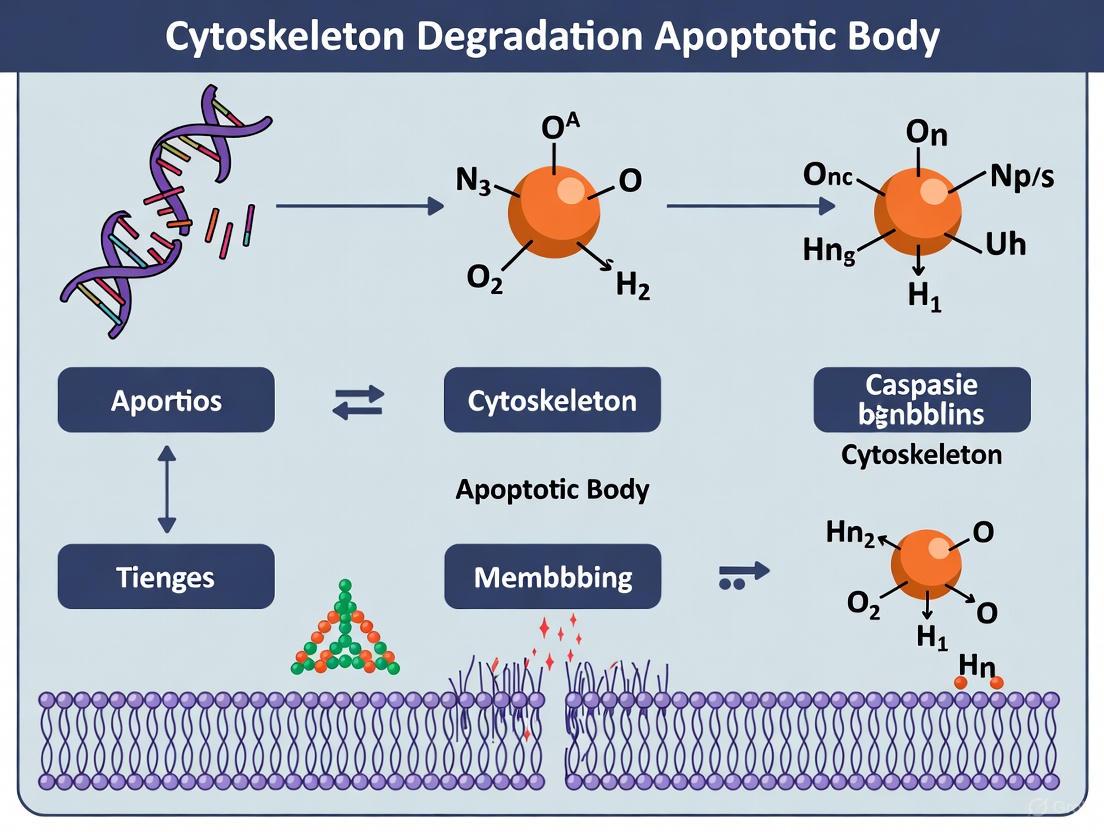
This article comprehensively examines the critical and regulated role of cytoskeletal degradation in the formation of apoptotic bodies (ApoBDs).
Cytoskeletal Disassembly in Apoptosis: Mechanisms, Regulation, and Therapeutic Targeting of Apoptotic Body Formation
Abstract
This article comprehensively examines the critical and regulated role of cytoskeletal degradation in the formation of apoptotic bodies (ApoBDs). Tailored for researchers and drug development professionals, it synthesizes foundational knowledge with recent breakthroughs, including the discovery of novel structures like the 'FOotprint Of Death' (FOOD). We explore the key molecular players, such as ROCK1, and their mechanistic roles in driving apoptotic cell disassembly. The content further delves into advanced methodological approaches for studying these processes, addresses common experimental challenges, and positions cytoskeletal-driven apoptosis within the broader landscape of cell death mechanisms. The review concludes by highlighting the translational potential of targeting these pathways in oncology and other therapeutic areas.
The Architects of Demise: Core Mechanisms of Cytoskeletal Reorganization in Apoptosis
Apoptotic cell disassembly is a fundamental biological process representing the terminal phase of programmed cell death. This highly orchestrated mechanism ensures the controlled fragmentation of a dying cell into membrane-bound vesicles, most notably apoptotic bodies (ApoBDs). Once considered mere cellular debris, ApoBDs are now recognized as key players in intercellular communication, influencing processes ranging from tissue homeostasis to disease progression [1]. Within the context of cytoskeleton degradation research, understanding ApoBD biogenesis provides critical insights into how structural cellular components are systematically dismantled to facilitate the formation of these important vesicles. The process is evolutionarily conserved and serves vital physiological functions, including the efficient clearance of cell corpses by phagocytes—a process known as efferocytosis—which prevents inflammatory responses and maintains tissue integrity [2].
Core Mechanisms: The Three Stages of ApoBD Biogenesis
The formation of ApoBDs occurs through three distinct, sequential morphological stages, each characterized by specific changes to the plasma membrane and underlying cytoskeleton.
Stage 1: Membrane Blebbing
The initial stage involves the formation of spherical membrane protrusions known as blebs. This process is directly regulated by the degradation and reorganization of the actin cytoskeleton. The key molecular mechanism involves caspase-mediated cleavage and activation of Rho-associated kinase 1 (ROCK1) [3] [1]. Activated ROCK1 phosphorylates the myosin light chain (MLC), driving actomyosin contraction that generates the force necessary for membrane blebbing. Simultaneously, phospholipase A2 (PLA2) activity modulates intracellular-extracellular hydrostatic pressure imbalances, while an early apoptotic volume decrease (AVD) contributes to cell shrinkage and facilitates bleb formation [1].
Stage 2: Formation of Apoptotic Membrane Protrusions
Following membrane blebbing, apoptotic cells develop more elaborate membrane protrusions. The specific morphology varies by cell type: while most cells exhibit classical membrane blebbing, neurons and certain epithelial cells form microtubule-driven spikes, and apoptotic immune cells like THP-1 cells and primary human neutrophils develop beaded membrane structures [1]. This stage represents a transitional phase where the cytoskeleton continues to undergo reorganization, paving the way for cell fragmentation.
Stage 3: Fragmentation and Vesicle Release
The final stage involves the constriction and scission of membrane protrusions to release ApoBDs. The Endosomal Sorting Complex Required for Transport (ESCRT-III), particularly the CHMP4B subunit, is recruited to the plasma membrane to mediate membrane scission and vesicle release [1]. Through continued contraction and fusion of these structures, vesicles of varying sizes (typically 1-5 μm in diameter) containing organellar fragments and nuclear debris mature into ApoBDs, which are subsequently released into the extracellular milieu.
Table 1: Key Molecular Regulators of Apoptotic Cell Disassembly
| Regulator | Stage Involved | Function | Activation Mechanism |
|---|---|---|---|
| ROCK1 | Stage 1: Membrane Blebbing | Phosphorylates MLC to drive actomyosin contraction | Caspase-mediated cleavage [3] [1] |
| PLA2 | Stage 1: Membrane Blebbing | Modulates hydrostatic pressure imbalance for blebbing | Not specified in search results |
| ESCRT-III (CHMP4B) | Stage 3: Vesicle Release | Mediates membrane scission and vesicle release | Recruited to plasma membrane [1] |
| NINJ1 | Post-disassembly: Membrane Rupture | Oligomerizes to form ring-like structures causing plasma membrane rupture | Higher-order oligomerization on ApoBDs [2] |
The Role of the Cytoskeleton: A Central Player
The actin cytoskeleton serves as both a sensor and mediator of apoptosis, undergoing dramatic reorganization throughout the disassembly process [4]. In healthy cells, the actin network provides structural integrity and regulates cell shape. During apoptosis, caspase-mediated cleavage of cytoskeletal proteins and their regulators (like ROCK1) initiates a cascade of events that lead to the dissolution of the existing actin architecture and the formation of a contractile actin-myosin cortex essential for membrane blebbing [4] [1].
Research has demonstrated that direct disruption of the actin cytoskeleton using agents like cytochalasin B can itself induce moderate apoptosis and enhance apoptosis triggered by other stimuli, underscoring the profound link between cytoskeletal integrity and cell survival [5]. The regulated degradation of the actin cytoskeleton is therefore not a passive consequence of cell death but an active, essential process that enables the morphological changes required for efficient ApoBD biogenesis and subsequent phagocytic clearance.
An Alternative Mechanism: The FOotprint Of Death (FOOD)
Recent research has revealed an alternative pathway for generating large apoptotic extracellular vesicles (ApoEVs) termed the "FOotprint Of Death" (FOOD) [3]. This mechanism occurs during apoptotic cell retraction, where retracting cells leave behind actin-rich, membranous "footprints" anchored to the substrate. These sheet-like structures subsequently vesicularize into large ApoEVs (~2 μm in diameter) known as FOOD-derived ApoEVs (F-ApoEVs) [3].
Table 2: Comparative Features of Apoptotic Vesicles
| Feature | Classical ApoBDs | F-ApoEVs (via FOOD) |
|---|---|---|
| Biogenesis Mechanism | Membrane blebbing & apoptopodia fragmentation [1] | Vesicularization of substrate-bound footprints [3] |
| Size Range | 1–5 μm [1] | ~2 μm (median diameter) [3] |
| Key Regulator | ROCK1, ESCRT-III [1] | ROCK1 [3] |
| Relationship to Cytoskeleton | Actomyosin-driven blebbing [1] | F-actin-rich footprints [3] |
| Distinguishing Feature | Actively radiate from cell [3] | Mark the site of cell death on substrate [3] |
FOOD formation is regulated by ROCK1 and has been observed across multiple cell types, apoptotic stimuli, and surface compositions, indicating it is a common phenomenon [3]. This pathway provides an alternative mechanism for marking the site of cell death and generating large ApoEVs, particularly in cell types like mouse embryonic fibroblasts that do not readily form ApoBDs through classical apoptopodia [3].
Regulatory Mechanisms and Vesicle Stability
The stability and fate of ApoBDs are critically regulated by proteins such as ninjurin-1 (NINJ1). NINJ1 oligomerizes on the surface of ApoBDs, forming ring-like structures that mediate plasma membrane rupture (PMR) during secondary necrosis [2]. This oligomerization occurs predominantly after the completion of apoptotic cell disassembly. NINJ1-mediated PMR leads to the release of inflammatory intracellular contents, including damage-associated molecular patterns (DAMPs) like HMGB1 and, in infection contexts, viral particles [2]. Studies in NINJ1-deficient cells show significantly reduced ApoBD lysis, highlighting its crucial role in regulating vesicle stability and content release [2].
Experimental Methods for Studying ApoBDs
Isolation and Quantification of ApoBDs
A reproducible method for isolating ApoBDs from biological samples like blood plasma involves differential centrifugation [6]. The protocol typically includes:
- Sample Collection: Blood samples collected in anticoagulant tubes.
- Plasma Separation: Centrifugation at 2,500 × g for 15 minutes to obtain platelet-poor plasma.
- ApoBD Enrichment: Centrifugation of plasma at 18,000 × g for 30 minutes to pellet ApoBDs.
- Washing and Resuspension: The pellet is washed in phosphate-buffered saline (PBS) and resuspended for analysis [6].
Isolated ApoBDs can be characterized using transmission electron microscopy for morphology, dynamic light scattering for size distribution (typically showing a main population ranging from ~680 to 1345 nm in diameter), and flow cytometry for quantification and purity assessment [6].
Metabolomic Analysis
Liquid chromatography-tandem mass spectrometry (LC-MS/MS) methods have been developed to quantify metabolites in ApoBDs. This targeted metabolomics approach can detect compounds such as pyridoxine, kynurenine, creatine, phenylacetylglycine, and various carnitines at concentrations as low as 0.02 ng mL⁻¹, providing insights into the metabolic cargo and biological functions of ApoBDs [7].
The Scientist's Toolkit: Key Research Reagents
Table 3: Essential Reagents and Tools for Apoptotic Disassembly Research
| Reagent/Tool | Function/Application | Example Use |
|---|---|---|
| BH3 Mimetics (ABT-737, S63845) | Induce intrinsic apoptosis pathway [3] [2] | Apoptosis induction for studying disassembly dynamics (e.g., 2 μM ABT-737 + 10 μM S63845) [3] |
| Annexin V (A5) | Detects phosphatidylserine (PtdSer) exposure, an early "eat-me" signal [3] | Flow cytometry or microscopy to identify apoptotic cells and ApoBDs [3] [6] |
| Caspase 3/7 Glo Assay | Quantifies executioner caspase activity [2] | Confirming apoptosis induction and monitoring kinetics [2] |
| Lactate Dehydrogenase (LDH) Release Assay | Measures plasma membrane rupture (PMR) [2] | Quantifying vesicle lysis and secondary necrosis [2] |
| FITC-Dextran Exclusion Assay | Visualizes PMR at single-vesicle level [2] | Assessing membrane integrity of individual ApoBDs [2] |
| JC-1 or TMRM Dye | Assesses mitochondrial membrane potential (ΔΨm) | Detecting early apoptosis via intrinsic pathway activation |
| Z-VAD-FMK | Pan-caspase inhibitor | Determining caspase-dependence of disassembly processes |
| Y-27632 | ROCK1 inhibitor | Investigating ROCK1-specific role in membrane blebbing [3] |
Visualizing the Process: Signaling Pathways and Workflows
Apoptotic Cell Disassembly Pathway
ApoBD Isolation and Analysis Workflow
The Rho-associated coiled-coil containing protein kinase 1 (ROCK1) serves as a critical signaling node that integrates apoptotic signals into specific morphological outcomes through its unique activation mechanism. During the execution phase of apoptosis, caspase-3 cleaves ROCK1 at a conserved DETD¹¹¹³/G sequence, resulting in the removal of its carboxyl-terminal inhibitory domain and subsequent constitutive kinase activation [8]. This caspase-mediated cleavage event transforms ROCK1 from a regulated signaling protein into a potent executor of cytoskeletal reorganization, ultimately driving the formation of apoptotic bodies for efficient cell disassembly [8] [9].
The significance of this pathway extends beyond conventional apoptosis, playing essential roles in diverse physiological processes including terminal erythroid maturation [9] and cellular stress responses [10]. This technical guide comprehensively examines the molecular mechanisms, experimental methodologies, and functional consequences of caspase-mediated ROCK1 activation, providing researchers with the foundational knowledge necessary to investigate this critical cell death pathway.
Molecular Mechanisms of ROCK1 Activation
Caspase Cleavage Site and Structural Consequences
ROCK1 undergoes precise proteolytic processing by caspase-3 at a specific recognition sequence located within its structural domains. The cleavage occurs at DETD¹¹¹³/G, a site situated in the carboxyl-terminal region of the protein [8]. This proteolytic event releases the auto-inhibitory PH domain that normally maintains ROCK1 in an inactive state through intramolecular interactions with the kinase domain [11].
Table 1: Structural Domains of ROCK1 and Cleavage Consequences
| Domain | Location | Function | Effect of Caspase Cleavage |
|---|---|---|---|
| Kinase Domain | N-terminus (aa 1-300) | Catalytic activity; serine/threonine phosphorylation | Released from auto-inhibition; constitutive activation |
| Coiled-coil Domain | Central region | Protein-protein interactions; contains Rho-binding domain | Retained in active fragment |
| Rho-binding Domain (RBD) | Within coiled-coil | Binds activated Rho GTPases | Cleavage renders kinase activity Rho-independent |
| Pleckstrin Homology (PH) Domain | C-terminus | Auto-inhibitory; membrane localization | Removed via caspase cleavage |
| Caspase Cleavage Site | DETD¹¹¹³/G | Recognition sequence for caspase-3 | Specific cleavage yielding ~130 kDa active fragment |
This structural rearrangement generates a constitutively active ~130 kDa kinase fragment that functions independently of its upstream regulator RhoA [8] [9]. The cleavage-induced activation represents a molecular switch that converts ROCK1 from a signal-responsive kinase to a dedicated executor of apoptotic morphology.
Alternative Activation Mechanisms
While caspase-mediated cleavage represents the predominant activation mechanism during apoptosis, alternative pathways can modulate ROCK1 activity under specific conditions:
- RhoA-dependent activation: In non-apoptotic cells, ROCK1 activation occurs through binding of GTP-bound RhoA to the RBD domain, relieving auto-inhibition [11].
- Lipid mediator binding: The PH domain can interact with arachidonic acid and sphingosylphosphorylcholine, potentially influencing localization and activity [11].
- Stress-induced activation: Under cellular stress conditions, ROCK1 can be recruited to stress granules, modulating its activity and function [10].
Downstream Signaling and Functional Consequences
Cytoskeletal Targets and Membrane Blebbing
Activated ROCK1 initiates a phosphorylation cascade that primarily targets regulators of actomyosin contractility. The most characterized substrate is myosin light chain (MLC), which ROCK1 phosphorylates through both direct mechanisms and indirect inhibition of myosin phosphatase [8] [9]. This increased MLC phosphorylation enhances actin-myosin II interaction and contractile force generation, driving the membrane blebbing characteristic of early apoptosis [8].
Table 2: Quantitative Measurements of ROCK1-Mediated Apoptotic Events
| Parameter | Experimental System | Measurement | Effect of ROCK Inhibition |
|---|---|---|---|
| MLC Phosphorylation | Apoptotic cells [8] | Gradual increase concomitant with ROCK1 cleavage | Abrogated by Y-27632 (ROCK inhibitor) |
| Membrane Blebbing | Various cell lines [8] | Dynamic blebbing at apoptosis onset | Eliminated by caspase or ROCK inhibition |
| Apoptotic Body Formation | Multiple systems [12] [13] | 10-20 ApoBDs per cell in beaded apoptosis | Prevented by cytoskeletal disruption |
| ROCK1 Cleavage | In vitro cleavage assays [8] | ~130 kDa active fragment generation | Blocked by caspase-3 inhibition |
| Cell Fate Decision | P19 stress model [10] | SG formation (survival) vs. apoptosis | Determined by ROCK1 localization |
ROCK1 also influences other cytoskeletal components during cell death processes. Recent research indicates that RhoA-ROCK1 signaling mediates disruption of F-actin, α-tubulin, β-tubulin, and filamin A/B in methuosis, a non-apoptotic cell death characterized by cytoplasmic vacuolization [14]. This demonstrates the broader relevance of ROCK1 in cytoskeletal remodeling beyond classical apoptosis.
Apoptotic Body Formation and Cell Disassembly
The terminal stage of apoptosis involves systematic cell disassembly into apoptotic bodies (ApoBDs) - membrane-bound vesicles containing nuclear fragments, organelles, and cytoplasmic content [12] [13]. ROCK1-mediated actomyosin contraction drives this process through several coordinated events:
- Cellular fragmentation: ROCK1-dependent contraction facilitates the separation of cellular contents into discrete packages through a process known as "beaded apoptosis," which represents the most efficient mechanism for ApoBD production, generating approximately 10-20 ApoBDs simultaneously [13].
- Membrane blebbing dynamics: The repeated process of membrane blebbing and contraction progressively remodels the apoptotic cell surface, facilitating the packaging of intracellular contents [13].
- Nuclear envelope disruption: While not directly phosphorylated by ROCK1, nuclear lamins are cleaved by executioner caspases, working in concert with ROCK1-mediated cytoplasmic changes to facilitate nuclear fragmentation [15] [16].
The packaging of cellular contents into ApoBDs serves critical physiological functions, including efficient phagocytic clearance and intercellular communication [12] [13]. Interestingly, defective ApoBD clearance or infection-modified ApoBDs may contribute to disease etiology, including autoimmune disorders like systemic lupus erythematosus [13].
Experimental Analysis and Methodologies
Detecting ROCK1 Activation and Cleavage
Several well-established experimental approaches enable researchers to monitor ROCK1 cleavage and activation during apoptosis:
Western Blot Analysis for ROCK1 Cleavage Procedure: Resolve cell lysates (20-30 μg protein) by SDS-PAGE (6-8% gel) and transfer to PVDF membrane. Probe with anti-ROCK1 antibodies targeting both N-terminal (detecting full-length and cleaved fragment) and C-terminal epitopes (detecting only full-length). The appearance of a ~130 kDa fragment with N-terminal antibodies concurrent with decreased full-length signal with C-terminal antibodies indicates caspase cleavage [8] [10].
ROCK1 Kinase Activity Assay Procedure: Immunoprecipitate ROCK1 from cell lysates (200-500 μg protein) using specific antibodies. Incubate immunocomplexes with recombinant MYPT1 (myosin phosphatase target subunit 1) and ATP in kinase buffer (25 mM Tris-HCl pH 7.5, 5 mM β-glycerophosphate, 2 mM DTT, 0.1 mM Na3VO4, 10 mM MgCl2) for 30 minutes at 30°C. Terminate reaction with SDS sample buffer and detect phosphorylated MYPT1 by Western blot using anti-phospho-MYPT1 (Thr696) antibodies [10].
Functional Assessment of Membrane Blebbing Procedure: Treat cells with apoptotic inducers (e.g., 0.5 mM sodium arsenite, staurosporine, or UV irradiation) in the presence or absence of ROCK inhibitors (Y-27632, 10-20 μM; fasudil, 10-50 μM) or caspase inhibitors (z-VAD-fmk, 20-50 μM). Quantify membrane blebbing by time-lapse microscopy or fix cells at various time points and count cells exhibiting characteristic membrane blebs [8].
Pathway Visualization and Logical Relationships
Caspase-ROCK1 Signaling in Apoptosis
Research Reagent Solutions
Table 3: Essential Research Reagents for Investigating ROCK1 in Apoptosis
| Reagent/Category | Specific Examples | Function/Application | Experimental Notes |
|---|---|---|---|
| ROCK Inhibitors | Y-27632, Fasudil (HA-1077) | Inhibit ROCK1/2 kinase activity; confirm ROCK1 involvement | Use at 10-20 μM (Y-27632) or 10-50 μM (fasudil); pre-treat 1-2h before apoptosis induction |
| Caspase Inhibitors | z-VAD-fmk (pan-caspase), z-DEVD-fmk (caspase-3) | Block ROCK1 cleavage and activation; establish caspase-dependence | Use at 20-50 μM; can be used to distinguish caspase-dependent vs independent processes |
| Activation Assay Kits | RhoA Activation Assay Kit, ROCK Activity Assay Kit | Measure upstream RhoA activation and downstream ROCK activity | Commercial kits available from Cell Biolabs and other vendors; use with positive/negative controls |
| Antibodies | Anti-ROCK1 (N-terminal), Anti-ROCK1 (C-terminal), Anti-phospho-MLC, Anti-cleaved caspase-3 | Detect cleavage, phosphorylation, and activation events | Use combination of N and C-terminal antibodies to distinguish full-length vs cleaved ROCK1 |
| Apoptosis Inducers | Staurosporine, Actinomycin D, Sodium Arsenite, TRAIL | Induce apoptosis and subsequent ROCK1 cleavage | Titrate for optimal time-course; cell-type specific responses expected |
| siRNA/shRNA | ROCK1-specific siRNA, ROCK2-specific siRNA | Isoform-specific knockdown; determine functional redundancy | Multiple siRNAs recommended; controls for off-target effects essential |
Experimental Workflow for Comprehensive Analysis
ROCK1 Activation Analysis Workflow
Physiological and Pathological Relevance
Non-Apoptotic Functions and Context-Dependent Outcomes
Beyond its established role in apoptosis, caspase-mediated ROCK1 activation contributes to specialized physiological processes:
- Erythroid maturation: During terminal erythroid differentiation, caspase-3 cleaves and activates ROCK1 independently of SCF signaling, facilitating enucleation and proper red blood cell formation [9].
- Cellular stress decisions: Under stress conditions, ROCK1 can be sequestered into stress granules, preventing its interaction with JIP-3 and subsequent JNK activation, thereby protecting cells from apoptosis [10].
- Tissue homeostasis: The proper clearance of apoptotic bodies generated through ROCK1-mediated processes prevents inflammation and maintains tissue function, with defects in this process contributing to autoimmune and inflammatory diseases [13] [16].
Therapeutic Implications and Research Directions
The caspase-ROCK1 pathway presents several potential therapeutic applications:
- Cancer therapy: Modulating ROCK1 activity may enhance apoptotic body formation and immune recognition of tumor cells [13].
- Inflammatory disease: Defective clearance of ROCK1-generated apoptotic bodies may contribute to autoimmune pathogenesis, suggesting potential intervention points [13] [16].
- Cardiovascular and neurological protection: ROCK inhibitors show promise in clinical development for various cardiovascular diseases and neurological disorders [11].
Future research directions should focus on isoform-specific functions of ROCK1 and ROCK2, context-dependent regulation, and therapeutic exploitation of this pathway in various disease states. The development of more specific pharmacological tools and genetically engineered model systems will continue to elucidate the multifaceted roles of caspase-mediated ROCK1 activation in health and disease.
The actin cortex is a thin, dynamic network of actin filaments, cross-linking proteins, and nonmuscle myosin II (MII) situated beneath the plasma membrane that enables cells to maintain and change shape in response to internal and external stimuli [17]. This contractile apparatus generates mechanical stress essential for diverse physiological processes, including cell migration, cell division, and tissue morphogenesis [18]. A specialized protrusion known as a membrane bleb forms when the actin cortex locally detaches from the plasma membrane, allowing cytosol to inflate the membrane and create a spherical bulge [17]. The life cycle of a membrane bleb comprises three distinct phases: bleb nucleation, bleb growth, and bleb retraction [17]. The final retraction phase is actively driven by the reassembly of the cortical actin network and the force-generating capacity of actomyosin contraction. Beyond its role in cellular motility and cytokinesis, actomyosin-mediated contraction is a fundamental executor of the cellular shape changes that characterize apoptosis, ultimately leading to the formation of apoptotic bodies [4] [19]. This review delineates the molecular mechanisms by which actomyosin contraction drives membrane blebbing and cell retraction, framing this process within the broader context of cytoskeletal degradation and apoptotic body formation.
Molecular Mechanisms of Actomyosin-Driven Blebbing
The Core Contractile Machinery
The generation of contractile force is governed by the interaction between filamentous actin (F-actin) and nonmuscle myosin II (MII). F-actin is a polarized polymer with fast-growing barbed ends and slow-growing pointed ends [18]. Myosin II functions as a bipolar mini-filament, comprising several dozen motor heads that translocate along actin filaments towards their barbed ends [18]. The minimal prerequisite for contraction is the coordinated activity of myosin II within the F-actin scaffold, which, when organized in an antiparallel fashion, results in the sliding of filaments and network contraction [18]. This process is regulated by a host of accessory proteins that modulate filament length, cross-linking, and membrane attachment.
The Blebbing Cycle
The formation and retraction of a membrane bleb is a coordinated, multi-stage process:
- Phase 1: Bleb Nucleation. A local failure of the actin-membrane linkage or a localized rupture in the cortical actin network causes the plasma membrane to detach from the cortex.
- Phase 2: Bleb Growth. The intracellular hydrostatic pressure drives the expansion of the membrane blister, forming a spherical protrusion devoid of the majority of cortical components. This growth phase occurs rapidly, within seconds.
- Phase 3: Bleb Retraction. A new cortical actin network is assembled on the bleb membrane. Ezrin recruitment is nearly instantaneous, followed by actin appearance ∼2 seconds after bleb formation, and nonmuscle myosin II follows ∼8 seconds later [17]. The activation of RhoA signaling, often facilitated by ezrin-recruited MYOGEF, leads to the recruitment and activation of MII, which drives the retraction of the bleb and its reintegration into the cellular cortex [17].
Table 1: Key Phases of Membrane Blebbing
| Phase | Key Events | Approximate Timing |
|---|---|---|
| Nucleation | Cortical actin detachment from the plasma membrane. | Instantaneous |
| Growth | Pressure-driven membrane expansion; absence of cortical actin. | A few seconds |
| Retraction | Ezrin, actin, and myosin II recruitment; actomyosin contraction. | Initiated ~10 seconds after formation |
The Central Role of Myosin II Paralogue Specificity
Mammalian cells express three MII paralogues (MIIA, MIIB, and MIIC) with distinct biophysical properties [17]. A critical finding is that MIIA is specifically required for driving bleb retraction [17]. Experimental evidence demonstrates that knockdown or knockout of MIIA, but not MIIB, results in a failure of bleb retraction during cytokinesis. While both MIIA and MIIB are recruited to newly formed blebs, only the expression of exogenous MIIA could rescue retraction in MIIA-deficient cells or in Cos7 cells (which natively express only MIIB and MIIC) [17].
The functional specificity of MIIA is attributed to its unique motor domain and C-terminal nonhelical tailpiece. Experiments with chimeric motors revealed that:
- The motor domain of MIIA is essential, as an N93K mutation that reduces ATPase activity significantly slows retraction [17].
- The motor domain of MIIA alone is not sufficient, as a chimera with the MIIA motor domain and the MIIB rod and tailpiece (MIIA/B) only partially rescues retraction [17].
- A construct containing the motor domain and nonhelical tailpiece of MIIA, with the rod domain of MIIB (MIIA/B/A), is sufficient to drive retraction as effectively as full-length MIIA [17].
A key biophysical property correlated with this functional competence is the turnover rate at the cortex. Fluorescence Recovery After Photobleaching (FRAP) experiments show that MIIA recovers twice as fast as MIIB, while MIIC turns over even more slowly [17]. This faster turnover is proposed to allow MIIA to effectively reorganize the actin network architecture during bleb retraction, even in the presence of passive cross-links.
The following diagram illustrates the key stages of the membrane blebbing cycle and the specific role of MIIA in retraction.
Actomyosin Contraction in Apoptosis and Apoptotic Body Formation
Apoptotic Signaling and Cytoskeletal Rearrangement
Apoptosis, or programmed cell death, is characterized by distinct morphological changes, including cell contraction, nuclear condensation, and widespread membrane blebbing leading to the formation of apoptotic bodies (ApoBDs) [4] [19]. The actin cytoskeleton is not merely a passive structural element during this process but acts as both a sensor and mediator of apoptosis [4]. The execution phase is coordinated by caspases, which cleave numerous cellular substrates. A pivotal event linking caspase activation to cytoskeletal collapse is the caspase-mediated cleavage and constitutive activation of ROCK1 (Rho-associated protein kinase 1) [19]. Activated ROCK1 phosphorylates and activates the myosin regulatory light chain, thereby stimulating actomyosin contractility [19].
From Apoptotic Blebbing to Apoptotic Body Formation
Actomyosin contraction is the primary driver of the apoptotic membrane blebbing that precedes ApoBD formation. The process involves:
- Actomyosin Contractility: ROCK1 and myosin ATPase activity generate sustained contractile forces, increasing intracellular hydrostatic pressure [19].
- Membrane Blebbing: This pressure causes the plasma membrane to detach and blister repeatedly [13].
- ApoBD Formation: The blebs constrict at their base and pinch off to form membrane-clad ApoBDs, which contain organelles, nuclear fragments, and other cellular contents [19] [13]. This process, where the cell dismantles into smaller packages, is considered a hallmark of apoptosis and represents a key step in the degradation and packaging of the cytoskeleton for clearance.
Inhibition of actomyosin contraction using the ROCK inhibitor Y27632 or the myosin ATPase inhibitor Blebbistatin significantly reduces membrane blebbing and apoptotic body formation without affecting caspase activation, underscoring the specific role of actomyosin in this morphological transformation [19].
Functional Consequences of Permeable Apoptotic Bodies
A paradigm-shifting discovery is that the membranes of ApoBDs are not impermeable barriers. Unlike the apoptotic cell body, which initially excludes dyes like propidium iodide (PI), a significant proportion of ApoBDs are permeable to macromolecules as large as 31 kDa (e.g., DNAse1) shortly after their formation [19]. This limited permeabilization allows for the acute and localized release of immunomodulatory proteins, such as nucleosomal histones (which are damage-associated molecular patterns or DAMPs), before the catastrophic loss of membrane integrity during secondary necrosis [19]. This indicates that the transition from apoptosis to secondary necrosis is graded, not a binary switch, with actomyosin-dependent ApoBDs playing an active role in communicating with the immune system.
Table 2: Key Experimental Findings on Apoptotic Body Permeability
| Experimental Finding | Significance | Citation |
|---|---|---|
| Apoptotic bodies permit entry of Propidium Iodide (668 Da) and proteins like RNAseA (13 kDa) and DNAse1 (31 kDa). | Demonstrates limited membrane permeabilization occurs early in apoptosis, before secondary necrosis. | [19] |
| Proteinase K (28 kDa) reduces GFP signal in ApoBDs from mGFP-expressing cells. | Confirms ApoBD membranes are permeable to macromolecules, allowing protein release/ingress. | [19] |
| Nucleosomal histones are highly enriched in proteins released from ApoBDs in an actomyosin-dependent manner. | Identifies a specific mechanism for DAMP release, which can initiate sterile inflammatory responses. | [19] |
| Inhibition of ROCK or myosin ATPase reduces ApoBD formation and protein release without blocking caspase activation. | Establishes actomyosin contraction as the direct driver of ApoBD formation and associated protein release. | [19] |
The following diagram integrates the signaling pathways that trigger apoptotic membrane blebbing and the subsequent formation of permeable apoptotic bodies.
Experimental Methodologies and Research Tools
Key Experimental Models and Protocols
The study of actomyosin contraction in blebbing relies on specialized techniques to induce and observe these dynamic processes in a controlled manner.
Laser Ablation for Controlled Bleb Induction: A common method involves using laser ablation to sever the actin cortex in a defined location. For example, ablating the polar cortex of a cell undergoing cytokinesis results in the formation of a single, large bleb that can be monitored throughout its growth and retraction phases [17]. This technique allows for precise spatiotemporal control and high-resolution imaging of the subsequent events.
Inhibition of Contractility: Specific pharmacological inhibitors are essential tools for establishing the role of actomyosin contraction.
- Y-27632: A potent and selective inhibitor of ROCK (ROCK1 and ROCK2), which acts upstream of myosin II activation [19].
- Blebbistatin: A selective inhibitor of myosin II ATPase activity that directly blocks the motor function of myosin II, thereby inhibiting contraction [19]. Treatment with these inhibitors (e.g., 10–50 µM for Blebbistatin) effectively abolishes membrane blebbing and apoptotic body formation in apoptotic cells.
Analysis of Protein Localization and Turnover:
- Fluorescence Recovery After Photobleaching (FRAP): This technique is used to measure the dynamics and turnover of proteins like MIIA and MIIB at the cell cortex. A specific region of the cortex (e.g., on a retracting bleb) is photobleached with a high-intensity laser, and the recovery of fluorescence into the bleached area is monitored over time. The half-time of recovery provides a quantitative measure of protein turnover, which has been shown to be critical for MIIA's function in bleb retraction [17].
The Scientist's Toolkit: Essential Research Reagents
Table 3: Key Reagents for Studying Actomyosin Contraction in Blebbing
| Reagent / Tool | Function / Target | Key Application in Research |
|---|---|---|
| Blebbistatin | Myosin II ATPase inhibitor | Inhibits myosin II motor activity; used to block bleb retraction and apoptotic body formation. [19] |
| Y-27632 | ROCK inhibitor (ROCK1/ROCK2) | Inhibits Rho-kinase signaling upstream of myosin II activation; prevents apoptotic membrane blebbing. [19] |
| siRNA / shRNA (MIIA, MIIB, ROCK1) | Gene knockdown | Used to deplete specific proteins (e.g., MIIA vs. MIIB) to determine functional roles in blebbing. [17] [19] |
| CRISPR/Cas9 (e.g., myh9 KO) | Gene knockout | Generates stable cell lines lacking specific myosin paralogues (e.g., HAP1 myh9 KO) for functional rescue experiments. [17] |
| FRAP (Fluorescence Recovery After Photobleaching) | Live-cell imaging of protein dynamics | Measures turnover rates of fluorescently tagged proteins (e.g., MIIA-mApple) at the cortex. [17] |
| Laser Ablation System | Precision cutting of cytoskeleton | Induces controlled, localized bleb formation for consistent and reproducible analysis. [17] |
Actomyosin contraction is the principal mechanical engine driving membrane bleb retraction and the extensive cellular reshaping that characterizes apoptosis. The specific requirement for the MIIA paralogue, with its unique motor properties and fast cortical turnover, highlights the sophisticated specialization within the cytoskeletal machinery. In the context of apoptosis, the caspase-ROCK-actomyosin axis is a critical link between the biochemical initiation of cell death and the physical dismantling of the cell into apoptotic bodies. The discovery that these bodies are not inert debris but are actively formed by actomyosin contraction and possess permeable membranes that release signaling molecules, redefines their role in physiology and immunology. Future research will likely focus on further elucidating the mechanochemical feedback loops that regulate contractility during blebbing, the precise cargo sorting into ApoBDs, and the therapeutic potential of modulating this pathway in diseases such as cancer and chronic inflammation, where apoptotic clearance is compromised. Understanding actomyosin contraction is therefore fundamental to grasping how life and death are shaped, quite literally, by mechanical forces.
The formation of apoptotic bodies (ApoBDs) is not a stochastic process of cellular fragmentation but a highly orchestrated disassembly program. This program extends beyond the initial phase of membrane blebbing to include the generation of intricate membrane protrusions, such as apoptopodia and beaded apoptopodia [20]. These structures are critical for determining the quantity, size, and cargo composition of the resulting ApoBDs, facilitating efficient cell clearance and mediating intercellular communication [20]. The entire process is underpinned by the controlled degradation and remodeling of the cytoskeleton, which directs the morphological transformations required for the final packaging of cellular contents [21]. This whitepaper details the mechanisms, regulation, and experimental investigation of these advanced stages of apoptotic cell disassembly, providing a technical guide for researchers in cell biology and drug development.
Core Concepts and Morphological Definitions
The disassembly of an apoptotic cell follows a coordinated sequence of morphological steps, each generating distinct structures.
- Step 1: Apoptotic Membrane Blebbing: This initial step involves the formation of large, circular bulges on the cell surface. It is driven by caspase-mediated activation of ROCK1, leading to actomyosin hyper-contraction, an increase in intracellular pressure, and detachment of the plasma membrane from the underlying cortex [3] [21] [22].
- Step 2: Formation of Apoptotic Membrane Protrusions: Following blebbing, some cell types form thin, extended membrane protrusions. These are not uniform and can be categorized into three main types [20]:
- Apoptopodia: Defined as string-like membrane protrusions that facilitate the separation of membrane blebs into ApoBDs [23] [20].
- Beaded Apoptopodia: A remarkable "beads-on-a-string" structure observed in monocytes, where multiple vesicle-like structures (the "beads") form along a thin membrane strand [23]. The fragmentation of this strand is a highly efficient mechanism for producing numerous ApoBDs simultaneously [23] [13].
- Microtubule Spikes: Thin, spike-like protrusions whose formation is dependent on microtubules [20].
- Step 3: Fragmentation: The final step is the resolution of membrane protrusions into discrete, membrane-bound ApoBDs. This can involve the breaking apart of apoptopodia or beaded apoptopodia, releasing individual vesicles [23] [22].
The following diagram illustrates the logical relationships and key morphological steps in the apoptotic disassembly pathway:
Diagram: Morphological Steps in Apoptotic Disassembly.
Quantitative Morphological Analysis
The morphological features of apoptotic protrusions vary significantly between cell types and structures. The table below summarizes key quantitative data for easy comparison.
Table 1: Quantitative Characteristics of Apoptotic Protrusions and Bodies
| Morphological Structure | Typical Size / Diameter | Key Quantifiable Metrics | Primary Cell Type Observed |
|---|---|---|---|
| Membrane Blebs | Varies, increases over time [21] | Number of blebs formed per unit time decreases from early to late apoptosis [21] | Universal in apoptotic cells [20] |
| Apoptopodia | Thin, string-like [23] | Not specified in results | T lymphocytes [23] [20] |
| Beaded Apoptopodia | "Beads" ~1-4 μm [23] | Length can reach 8x the diameter of the apoptotic cell [23]; ~45% of blebbing THP-1 cells form them [23] | Monocytes (e.g., THP-1 cells), primary human CD14+ monocytes [23] |
| Apoptotic Bodies (ApoBDs) | 1–5 μm (can be larger) [3] [24] [25] | MEFs generate a median of ~40 F-ApoEVs (a type of ApoBD) per cell [3] | Many cell types, notably monocytes and lymphocytes [23] [20] |
| FOOD-derived ApoEVs | ~2 μm [3] | Median branch thickness ~1.5 μm, occupying area of ~193.7 μm² (in MEFs) [3] | Adherent cells (e.g., A431, HUVECs, MEFs, HeLa) [3] |
Molecular Mechanisms and Signaling Pathways
The formation of apoptopodia and beaded apoptopodia is regulated by a precise molecular circuitry that interfaces with the core apoptotic machinery and the cytoskeleton.
4.1 Key Regulatory Molecules
- ROCK1 (Rho-associated protein kinase 1): Activated via cleavage by caspase-3, ROCK1 is a master regulator of the early stages of disassembly. It phosphorylates the myosin light chain, enhancing actomyosin contractility necessary for initial membrane blebbing [3] [21]. This activity is a prerequisite for the subsequent formation of membrane protrusions in many cell types.
- PANX1 (Pannexin 1): This caspase-activated membrane channel acts as a key negative regulator of apoptopodia formation [23] [20]. Inhibition of PANX1, either genetically or pharmacologically with drugs like trovafloxacin or probenecid, promotes the formation of apoptopodia and increases the yield of ApoBDs [23] [25].
- Plexin B2 (PLXB2): In contrast to PANX1, the caspase-cleaved membrane receptor Plexin B2 acts as a positive regulator for the formation of beaded apoptopodia in certain cell types like monocytes [25].
- Actomyosin Contraction: The force generated by actin-myosin interaction is the fundamental engine driving membrane blebbing. Its regulation by ROCK1 and other kinases dictates the dynamics and size of blebs and protrusions [21] [22].
4.2 The Cytoskeleton in Disassembly
The degradation and remodeling of the cytoskeleton are central to apoptotic disassembly. ROCK1-driven actomyosin contraction does more than just cause blebbing; it generates physical forces that contribute to the disruption of the nuclear envelope, facilitating the degradation of nuclear proteins like Lamin A and allowing the mixing of nuclear and cytoplasmic contents [21]. This physical breakdown is a critical step in packaging diverse cellular materials into ApoBDs. The subsequent formation of apoptopodia involves a dramatic reorganization of the cortical actin cytoskeleton to form thin, stable protrusions.
The following pathway diagram integrates these molecular regulators with the cytoskeletal dynamics that control the formation of apoptopodia and beaded apoptopodia:
Diagram: Molecular Regulation of Apoptopodia Formation.
Experimental Methods and Protocols
Studying apoptopodia requires a combination of live-cell imaging, pharmacological perturbation, and specific biochemical assays. Below is a detailed protocol for inducing and quantifying beaded apoptopodia formation in monocytic cells, based on established methodologies [23].
5.1 Protocol: Induction and Quantification of Beaded Apoptopodia in THP-1 Monocytic Cells
Objective: To induce apoptosis in THP-1 cells, trigger the formation of beaded apoptopodia, and quantitatively analyze the resulting structures.
Materials:
- THP-1 human monocytic cell line.
- Apoptosis inducer: Ultraviolet (UV) irradiation system or serum-free medium for spontaneous apoptosis.
- Time-lapse microscopy system (DIC or phase-contrast).
- Inhibition reagents: PANX1 inhibitor (e.g., 40 μM Trovafloxacin), ROCK1 inhibitor (e.g., 10 μM Y-27632).
- Annexin V binding buffer and fluorescent Annexin V (e.g., Annexin A5) for phosphatidylserine detection.
- Flow cytometer.
Method Steps:
Cell Preparation and Apoptosis Induction:
- Culture THP-1 cells in standard growth medium.
- Induce apoptosis using one of two methods:
- UV Irradiation: Expose cells to UV-C light (e.g., 254 nm, 100-200 J/m²) and then incubate in fresh medium for 2-4 hours.
- Serum Starvation: Wash cells and resuspend in serum-free medium for 12-24 hours to induce spontaneous apoptosis.
Pharmacological Inhibition (Optional):
- To enhance apoptopodia formation, pre-treat cells with a PANX1 inhibitor (e.g., Trovafloxacin) for 1 hour prior to and during apoptosis induction.
- To inhibit the initial blebbing step, pre-treat cells with a ROCK1 inhibitor (Y-27632).
Time-Lapse Microscopy and Morphological Analysis:
- Plate cells on a glass-bottom dish suitable for microscopy.
- Capture time-lapse images every 30-60 seconds for 2-4 hours post-induction using DIC or phase-contrast optics.
- Quantification: Analyze the recorded videos to determine:
- The percentage of blebbing cells that form beaded apoptopodia.
- The length of the beaded apoptopodia (relative to cell diameter).
- The number and diameter of "beads" per protrusion.
- The timing from apoptosis induction to the emergence of protrusions.
Validation of Apoptosis and ApoBD Formation:
- Harvest cells and culture supernatant at a late time point (e.g., 4-6 hours).
- Stain cells with Annexin V to detect phosphatidylserine exposure, a hallmark of apoptosis and ApoBDs.
- Use flow cytometry to distinguish intact apoptotic cells (high Annexin V signal) from smaller ApoBDs (intermediate Annexin V signal) [23].
- Compare ApoBD counts in control versus PANX1-inhibited samples to confirm enhanced disassembly.
5.2 The Scientist's Toolkit: Essential Research Reagents
Table 2: Key Reagents for Investigating Apoptotic Protrusions
| Reagent / Tool | Function / Target | Application in Research |
|---|---|---|
| Trovafloxacin | PANX1 Channel Inhibitor | Blocks PANX1 activity, thereby enhancing the formation of apoptopodia and ApoBDs [23] [25]. |
| Y-27632 | ROCK1 Inhibitor | Inhibits ROCK1 kinase activity; suppresses initial membrane blebbing and subsequent protrusion formation [21]. |
| Sertraline | Antidepressant; ApoBD Blocker | Inhibits the formation of beaded apoptopodia and ApoBDs in monocytes; potential antiviral therapeutic [23] [25]. |
| Annexin V (A5) | Binds Phosphatidylserine (PS) | Detects PS exposure on the surface of apoptotic cells and ApoBDs; used for flow cytometry and microscopy validation [3] [23]. |
| FlipGFP Caspase-3 Reporter | Fluorogenic Caspase-3 Sensor | Allows real-time visualization of caspase-3 activation in live cells, correlating enzyme activity with morphological changes [21]. |
Functional Consequences and Research Implications
The non-random formation of apoptopodia has significant functional outcomes, impacting both physiology and pathology.
- Efficient Cell Clearance (Efferocytosis): Disassembly into smaller ApoBDs is proposed to facilitate the rapid and efficient clearance of apoptotic debris by professional and non-professional phagocytes. Defects in this process can lead to secondary necrosis, inflammation, and autoimmune disease [25] [20].
- Regulated Cargo Sorting: The mechanism of disassembly directly influences the contents of ApoBDs. For instance, beaded apoptopodia in monocytes actively exclude nuclear material (e.g., DNA), while cytoplasmic components can be packaged into the "beads" [23]. This sorting mechanism can determine the immunogenic potential of the ApoBDs.
- Pathogen Propagation: In infectious diseases, apoptopodia and ApoBDs can be hijacked by pathogens. Influenza A virus (IAV)-infected monocytes release ApoBDs containing viral proteins and virions, which can propagate infection to healthy cells [3] [25]. Pharmacological inhibition of disassembly (e.g., with Haloperidol or Sertraline) can reduce viral spread [25].
- Therapeutic Target: The molecular regulators of apoptopodia formation are druggable targets. PANX1 inhibitors like probenecid (FDA-approved) could be repurposed to enhance clearance in autoimmune and inflammatory diseases. Conversely, inhibitors of disassembly (e.g., Sertraline) may be useful in blocking the cell-to-cell spread of viruses or the transfer of oncogenes via tumor-derived ApoBDs [23] [25].
The journey of an apoptotic cell from membrane blebbing to the formation of complex structures like apoptopodia and beaded apoptopodia represents a sophisticated biological program. This process, tightly regulated by molecules such as ROCK1, PANX1, and Plexin B2, and powered by cytoskeletal remodeling, is fundamental to the packaging and dispatch of cellular contents. A deep understanding of these mechanisms provides not only insight into a critical aspect of cell death but also a foundation for novel therapeutic strategies aimed at modulating this process in cancer, infection, and autoimmune disorders.
The 'FOotprint Of Death' (FOOD) represents a newly identified mechanism for generating large apoptotic extracellular vesicles (ApoEVs). This substrate-bound, membrane-encased structure forms during apoptotic cell retraction and subsequently vesicularizes into FOOD-derived ApoEVs (F-ApoEVs). Regulated by ROCK1 kinase activity, this process provides an alternative pathway to classical apoptotic body formation, intimately linked to cytoskeleton remodeling. F-ApoEVs expose phosphatidylserine to facilitate efferocytosis and can propagate viral infections, revealing dual roles in homeostasis and disease. This whitepaper details the mechanism, quantitative characterization, and experimental methodologies for investigating this novel cell death pathway.
Apoptosis, a fundamental programmed cell death process, involves controlled cellular disassembly and the generation of extracellular vesicles (ApoEVs) [26]. These vesicles encompass a heterogeneous population varying in size, biogenesis, and cargo, including apoptotic bodies (ApoBDs, 1-5 μm), apoptotic microvesicles (ApoMVs, 100-1000 nm), and apoptotic exosomes (ApoExos, <150 nm) [27]. Traditional understanding attributes ApoBD formation to dynamic membrane processes like blebbing and apoptopodia [3].
Recent research has revealed an additional mechanism: the generation of substrate-bound large ApoEVs via the 'FOotprint Of Death' (FOOD) [3]. This pathway occurs during apoptotic retraction of adherent cells, leaving behind actin-rich membranous remnants that mark the site of cell death. These structures subsequently round into F-ApoEVs, which function in phagocyte recruitment and viral propagation [3]. The FOOD pathway is distinct from other EV biogenesis mechanisms as it arises specifically from cell-substrate detachment during apoptosis rather than active membrane protrusion.
The following diagram illustrates the position of the FOOD pathway within the broader context of apoptotic cell disassembly and ApoEV formation:
FOOD and F-ApoEVs: Core Mechanisms and Quantitative Characterization
Biogenesis and Structural Transformation
The FOOD formation initiates during early apoptosis through caspase-mediated activation of ROCK1, which drives actomyosin contraction and cell detachment from the substratum [3]. This retraction leaves behind flat, sheet-like membranous structures rich in F-actin, tightly anchored to the substrate at the site of cell death. These structures subsequently undergo a vesicularization process, rounding into discrete F-ApoEVs approximately 2 μm in diameter [3].
Table 1: Quantitative Characterization of FOOD and F-ApoEV Formation Across Cell Types
| Parameter | A431 Cells | MEFs | HUVECs | HeLa Cells |
|---|---|---|---|---|
| FOOD Formation Incidence | ~80-99% | ~80-99% | ~80-99% | ~80-99% |
| Median FOOD Branches (MEFs) | - | ~145 | - | - |
| Median Branch Thickness (MEFs) | - | ~1.5 μm | - | - |
| FOOD Area (MEFs) | - | ~193.7 μm² | - | - |
| F-ApoEV Diameter | ~2 μm | ~2 μm | ~2 μm | ~2 μm |
| Median F-ApoEVs/Cell | ~40 | ~40 | ~40 | ~40 |
Molecular Regulators and Distinctive Features
FOOD formation is specifically regulated by ROCK1 kinase, which becomes constitutively activated following caspase-mediated cleavage [3] [26]. This mechanism aligns with established apoptotic processes where ROCK1 controls actomyosin contractility necessary for membrane blebbing and cell detachment [26]. FOOD structures are characterized by their enrichment in F-actin and adhesion proteins, maintaining membrane integrity throughout the vesicularization process [3].
Table 2: Key Differentiators Between F-ApoEVs and Other Large EV Subtypes
| Characteristic | F-ApoEVs | Classical ApoBDs | Migrasomes |
|---|---|---|---|
| Biogenesis Trigger | Apoptotic cell retraction | Apoptotic blebbing/apoptopodia | Cell migration |
| Spatial Organization | Substrate-bound at death site | Released from cell surface | Trailing edge of migrating cells |
| Formation Mechanism | Vesicularization of retraction remnants | Pinching-off of membrane protrusions | Tethers on retraction fibers |
| ROCK1 Dependence | Yes | Yes | Not established |
| Inhibitor Sensitivity | Resistant to migrasome inhibitors | Not applicable | Inhibited by SMS2-IN-1, ISA-2011B |
Experimental Analysis of FOOD and F-ApoEVs
Core Methodologies and Workflows
Research into FOOD and F-ApoEVs employs advanced microscopy and biochemical techniques to capture their dynamic formation and characterize their composition.
3.1.1 Lattice Light Sheet Microscopy (LLSM) for Dynamic Visualization LLSM provides high-resolution temporal imaging of FOOD formation and vesicularization:
- Cell Preparation: Plate cells expressing fluorescent markers (e.g., membrane tags, F-actin biosensors) on imaging-optimized coverslips
- Apoptosis Induction: Treat with BH3-mimetic cocktail (ABT-737 + S63845) or other apoptotic stimuli
- Image Acquisition: Capture 3D time-lapse sequences every 2-5 minutes for 4-8 hours post-induction
- Analysis: Track FOOD formation, PtdSer exposure (via annexin A5 staining), and F-ApoEV budding
3.1.2 FOOD Proteomic Analysis Proteomic characterization reveals FOOD composition:
- FOOD Isolation: Induce apoptosis in adherent cells, gently remove apoptotic cell bodies, collect substrate-bound MATERIAL with non-enzymatic cell dissociation buffers
- Sample Preparation: Solubilize proteins, digest with trypsin, label with TMT reagents
- LC-MS/MS Analysis: Separate peptides by liquid chromatography, analyze by tandem mass spectrometry
- Data Processing: Identify proteins using database searching, perform label-free quantification
The experimental workflow for studying FOOD formation and characterization integrates these methodologies as follows:
Research Reagent Solutions
Table 3: Essential Reagents and Tools for FOOD/F-ApoEV Research
| Reagent/Category | Specific Examples | Research Application | Key Function |
|---|---|---|---|
| Apoptosis Inducers | BH3-mimetic cocktail (ABT-737 + S63845), UV irradiation, Etoposide, IAV infection | Induce controlled apoptosis | Activate intrinsic apoptotic pathway |
| Molecular Inhibitors | ROCK1 inhibitors, Jasplakinolide, SMS2-IN-1, ISA-2011B | Mechanism dissection | Test specificity vs. migrasomes/ApoBDs |
| Detection Reagents | Annexin A5 conjugates, Caspase-3/9 activity assays, Anti-PANX1 antibodies | Apoptosis validation & tracking | Detect PtdSer exposure, caspase activation |
| Microscopy Tools | Cell membrane dyes (e.g., CellMask), F-actin probes (e.g., Phalloidin), LLSM/CLSM systems | Dynamic visualization | Track membrane and cytoskeleton remodeling |
| Cell Culture Substrates | Collagen I, Fibronectin, ECM-coated surfaces | Physiological relevance testing | Model in vivo attachment environments |
| ApoEV Isolation Kits | Differential centrifugation kits, Density gradient media | F-ApoEV purification | Separate vesicles by size/density |
Functional Significance and Research Applications
Physiological and Pathological Roles
F-ApoEVs serve critical biological functions through their surface composition and cargo delivery. They consistently expose phosphatidylserine (PtdSer) on their outer membrane, functioning as "eat-me" signals that facilitate efferocytosis—the clearance of apoptotic material by phagocytes [3]. This promotes anti-inflammatory responses and maintains tissue homeostasis [27].
In pathological contexts, particularly viral infection, F-ApoEVs can harbor viral proteins and virions, propagating infection to neighboring healthy cells [3]. This represents a mechanism for pathogen dissemination that exploits apoptotic communication pathways.
Research and Therapeutic Implications
The FOOD pathway offers new perspectives for drug development targeting apoptotic signaling. Specific modulation of F-ApoEV formation could potentially influence inflammatory responses, tissue regeneration, and viral spread. The ROCK1-regulated mechanism presents a promising target for therapeutic intervention in conditions where apoptotic signaling is dysregulated.
The FOOD pathway represents a significant advancement in understanding apoptotic cell disassembly and ApoEV formation. As a substrate-bound mechanism generating large ApoEVs through cytoskeleton-dependent processes, it complements existing models of apoptotic body biogenesis. Its roles in efferocytosis and viral propagation highlight both homeostatic and pathological significance. Further research into FOOD and F-ApoEVs will continue to elucidate their contributions to tissue homeostasis, disease mechanisms, and potential therapeutic applications.
From Observation to Intervention: Techniques and Therapeutic Applications
The study of cytoskeleton degradation during apoptotic body formation represents a critical frontier in cell biology and therapeutic development. As programmed cell death unfolds, systematic disassembly of the actin cortex, microtubule networks, and intermediate filaments drives the controlled fragmentation of cellular contents into membrane-bound apoptotic bodies. Understanding these dynamic processes requires imaging technologies capable of capturing rapid, three-dimensional structural changes within living cells without inducing phototoxicity that could artificially trigger or alter the very death processes under investigation.
Lattice Light-Sheet Microscopy (LLSM) and 4D Confocal Imaging have emerged as complementary technologies that enable researchers to overcome traditional limitations in live-cell imaging. LLSM provides unprecedented speed and minimal photodamage by illuminating only the focal plane being imaged, while modern confocal systems offer enhanced temporal resolution for capturing the fourth dimension (time) in three-dimensional biological contexts. This technical guide explores how these advanced imaging modalities are revolutionizing our understanding of the spatiotemporal coordination of cytoskeletal remodeling during apoptosis, with particular emphasis on quantitative approaches relevant to drug discovery and development.
Technology Fundamentals: LLSM and 4D Confocal Imaging
Lattice Light-Sheet Microscopy Principles
LLSM represents a significant evolution beyond conventional light-sheet microscopy, addressing key limitations through structured illumination patterns. The fundamental architecture involves decoupling illumination and detection pathways, placing them at perpendicular axes. This configuration ensures that only the focal plane being imaged is exposed to light, dramatically reducing out-of-focus excitation and associated phototoxicity.
The technology employs a lattice pattern of Bessel beams rather than conventional Gaussian beams. These specialized beam profiles are non-diffracting, maintaining their focused profile over longer distances than traditional light beams. When combined with two-dimensional optical lattices that create confined excitation patterns, this approach achieves:
- Optical sectioning at subcellular resolution (approximately 300 nm laterally and 500 nm axially)
- Imaging speeds up to 1000 volumes per second
- Phototoxicity reduction of 10-100x compared to confocal microscopy
- Extended temporal windows for observing delicate cellular processes over hours
The minimal photodamage makes LLSM particularly suited for monitoring sensitive processes like apoptosis, where maintaining cellular viability during extended observation is paramount to capturing the complete sequence of morphological changes.
4D Confocal Imaging Advancements
Modern 4D confocal microscopy (3D space + time) has evolved significantly from earlier point-scanning implementations. Contemporary systems incorporate resonant scanners, acousto-optical devices, and spinning disk technologies to achieve the temporal resolution necessary for capturing cytoskeletal dynamics. Key technological improvements include:
- Resonant scanning at 8-12 kHz for frame rates exceeding 30 fps at 512×512 resolution
- GaAsP detectors with 45-50% quantum efficiency for improved signal detection
- Adaptive focus control for maintaining precise z-position during time-lapse acquisition
- Environmental chambers that maintain physiological conditions throughout extended experiments
While confocal microscopy inherently exposes more of the sample to light than LLSM, modern implementations have significantly mitigated phototoxicity through optimized detection pathways, higher sensitivity detectors, and intelligent acquisition software that minimizes exposure duration.
Table 1: Technical Comparison of Imaging Modalities for Apoptosis Research
| Parameter | LLSM | 4D Confocal | Conventional Widefield |
|---|---|---|---|
| Lateral Resolution | 300-400 nm | 200-250 nm | 400-500 nm |
| Axial Resolution | 500-600 nm | 600-800 nm | 1.5-2 μm |
| Typical Acquisition Speed (volumes/sec) | 10-100 | 1-5 | 0.1-0.5 |
| Phototoxicity Impact | Minimal | Moderate | High for extended imaging |
| Sample Compatibility | Requires specialized mounting | Standard culture vessels | Standard culture vessels |
| Live-cell Imaging Duration | Hours to days | Minutes to hours | Limited by phototoxicity |
Imaging Cytoskeletal Dynamics During Apoptosis
Actin Cortex Remodeling
The actin cytoskeleton undergoes precisely orchestrated disassembly during apoptosis, transitioning from a structured cortical network to fragmented aggregates. Using LLSM with live-cell actin markers (such as SiR-actin or LifeAct-GFP), researchers have identified distinct phases of actin remodeling:
- Initial cortical weakening (0-30 minutes post-apoptotic induction): Localized decreases in actin density at specific membrane regions
- Membrane blebbing phase (30-90 minutes): Rapid formation and retraction of membrane protrusions correlated with actomyosin contractility
- Fragmentation phase (90-180 minutes): Systematic cleavage of actin networks into discrete packages within emerging apoptotic bodies
These processes occur at temporal scales requiring the rapid volumetric acquisition that LLSM provides. The mechanical forces driving bleb formation and expansion can be quantified through traction force microscopy approaches coupled with LLSM imaging.
Microtubule Disassembly
Microtubule depolymerization represents another hallmark of apoptotic progression, with dismantling of the interphase network preceding nuclear fragmentation. Using 4D confocal imaging with end-binding protein fusions (EB3-GFP) or tubulin fluorophores, the spatial and temporal progression of microtubule breakdown can be tracked. Key observations include:
- Loss of microtubule organizing center (MTOC) integrity within 60 minutes of apoptotic induction
- Progressive shortening of microtubule polymers from distal ends toward centrosomes
- Catastrophe frequency increases 3-5x over baseline levels
- Spatial coordination between microtubule breakdown and actin remodeling
The coupling between microtubule and actin networks can be visualized through dual-channel acquisitions, revealing how destabilization of one cytoskeletal system influences the other.
Figure 1: Cytoskeletal Degradation Pathway in Apoptosis - This diagram illustrates the key events in cytoskeleton remodeling during apoptotic body formation, highlighting the parallel processes in actin and microtubule networks.
Intermediate Filament Reorganization
Intermediate filaments including vimentin (in mesenchymal cells) and nuclear lamins undergo caspase-mediated cleavage during apoptosis. Using 3D structured illumination microscopy (3D-SIM) in conjunction with LLSM, the collapse of vimentin networks and nuclear envelope breakdown can be visualized at super-resolution levels. These structural changes create mechanical vulnerabilities that facilitate cellular fragmentation.
Experimental Protocols for Cytoskeletal Imaging
LLSM Sample Preparation and Imaging
Protocol: Visualizing Actin Dynamics During Apoptosis with LLSM
Materials:
- Cells stably expressing LifeAct-GFP or stained with SiR-actin (Cytoskeleton, Inc.)
- Apoptosis inducer (e.g., staurosporine, 1μM)
- LLSM-compatible sample chamber
- Phenol-free imaging medium with HEPES buffer
- Mounting medium for temperature stabilization
Method:
- Sample Preparation:
- Seed cells in LLSM-compatible chambers 24-48 hours before imaging
- Transfer to phenol-free medium supplemented with 10% FBS 2 hours before imaging
- For SiR-actin staining: incubate with 100nM SiR-actin for 1 hour prior to imaging
Apoptosis Induction:
- Acquire 3-5 baseline volumes before inducer addition
- Add apoptosis inducer directly to chamber without moving sample
- Maintain temperature at 37°C throughout experiment
LLSM Acquisition Parameters:
- Excitation laser: 488nm for GFP, 640nm for SiR-actin
- Detection objective: 40×/1.1 NA water immersion
- z-stack range: 20-30μm with 0.5μm steps
- Temporal resolution: 30-60 seconds between volumes
- Total duration: 3-6 hours post-induction
Data Processing:
- Deskew raw data using computational transformation
- Apply deconvolution algorithms if necessary
- Generate maximum intensity projections and 3D reconstructions
4D Confocal Imaging of Microtubule Dynamics
Protocol: Tracking Microtubule Disassembly with 4D Confocal
Materials:
- Cells expressing EB3-GFP or stained with Tubulin-Tracker
- Spinning disk confocal system with environmental chamber
- Apoptosis inducer
- 35mm glass-bottom dishes
Method:
- Sample Preparation:
- Plate cells at 60-70% confluence in glass-bottom dishes
- For EB3-GFP: use stable expression or transient transfection 24h prior
- For Tubulin-Tracker: incubate with dye according to manufacturer protocol
System Configuration:
- Set environmental chamber to 37°C with 5% CO₂
- Configure z-stack to encompass entire cell volume
- Set temporal resolution to 30-second intervals
- Use 488nm excitation with appropriate emission filters
Time-lapse Acquisition:
- Establish baseline microtubule dynamics (10-15 timepoints)
- Add apoptosis inducer without moving sample
- Continue acquisition for 2-4 hours
- Monitor for phototoxicity and adjust laser power if necessary
Quantitative Analysis:
- Track EB3-GFP comets to quantify polymerization rates
- Measure microtubule density over time using fluorescence thresholding
- Correlate microtubule breakdown with cellular morphological changes
Table 2: Quantitative Metrics for Cytoskeletal Degradation Analysis
| Parameter | Measurement Method | Pre-apoptosis Values | Mid-apoptosis Values | Analytical Tools |
|---|---|---|---|---|
| Actin Cortex Thickness | Fluorescence intensity profile | 0.5-0.8 μm | 0.2-0.4 μm | Line scan analysis |
| Microtubule Polymerization Rate | EB3-GFP comet tracking | 8-12 μm/min | 2-4 μm/min | Kymograph analysis |
| Cortical Tension | Membrane fluctuation analysis | 100-200 pN/μm | 50-100 pN/μm | Fourier transform of membrane contours |
| Apoptotic Body Size Distribution | 3D segmentation | N/A | 1-5 μm diameter | Object classification algorithms |
| Caspase Activation Timing | FRET biosensors | N/A | 60-120 minutes post-induction | Ratio imaging |
The Scientist's Toolkit: Research Reagent Solutions
Table 3: Essential Reagents for Cytoskeletal Imaging in Apoptosis Research
| Reagent | Function | Example Application | Considerations |
|---|---|---|---|
| SiR-actin | Far-red fluorescent actin label | Long-term actin dynamics in LLSM | Minimal cytotoxicity, compatible with live cells |
| LifeAct-GFP | GFP-tagged actin binding peptide | High-resolution actin visualization | May affect actin dynamics at high expression |
| EB3-GFP | Microtubule plus-end binding protein | Microtubule polymerization tracking | Reveals dynamics rather than structure |
| Tubulin-Tracker Green | Live-cell microtubule stain | Microtubule network architecture | Fixed-cell compatible, photostable |
| Caspase-3 FRET reporter | Apoptosis progression sensor | Correlating caspase activation with structural changes | Requires ratio imaging capabilities |
| MitoTracker Deep Red | Mitochondrial membrane potential dye | Early apoptosis detection | Loss of signal indicates depolarization |
| CellMask Plasma Membrane Stain | Membrane contour labeling | Defining cellular boundaries during blebbing | Compatible with multicolor imaging |
| NucBlue Live | Hoechst-based nuclear stain | Nuclear morphology changes | Can be DNA-damaging at high concentrations |
Data Analysis and Computational Approaches
Image Processing Workflows
The rich datasets generated by LLSM and 4D confocal imaging require specialized computational approaches for extracting quantitative information. A typical processing workflow includes:
Preprocessing:
- Deskewing (LLSM-specific) to correct for oblique light-sheet orientation
- Deconvolution using measured point spread functions
- Drift correction using cross-correlation algorithms
- Background subtraction using rolling-ball or top-hat filters
Segmentation:
- Machine learning approaches (U-Net, Cellpose) for cellular segmentation
- Threshold-based methods for subcellular structures
- 3D surface rendering for volumetric analysis
Tracking:
- Particle tracking for vesicular structures and cytoskeletal elements
Tracking Algorithm Strength Limitation TrackMate (FIJI) User-friendly interface Limited for high-density objects U-Track Handles merging/splitting events Complex parameter optimization Bayesian tracking Robust to noise Computationally intensive
- Particle tracking for vesicular structures and cytoskeletal elements
Figure 2: Image Analysis Workflow - This diagram outlines the computational pipeline for extracting quantitative information from LLSM and 4D confocal datasets of apoptotic cells.
Cytoskeletal Network Analysis
Advanced analytical approaches enable quantification of cytoskeletal architecture during degradation:
Network Persistence Analysis:
- Skeletonization algorithms convert fluorescent images to mathematical graphs
- Branch point density quantifies network complexity over time
- Directionality analysis using Fourier transform methods reveals structural anisotropy
Fluctuation Analysis:
- Membrane undulation tracking provides insights into cortical tension changes
- Particle image velocimetry (PIV) maps intracellular flows during apoptosis
- Mean square displacement (MSD) analysis quantifies cytoskeletal element mobility
Applications in Drug Discovery and Development
The integration of advanced imaging technologies with apoptosis research has significant implications for pharmaceutical development, particularly in:
Chemotherapeutic Efficacy Assessment
Microtubule-targeting agents (e.g., paclitaxel, vinca alkaloids) induce apoptosis through distinct mechanisms that can be visualized and quantified using the approaches described. LLSM enables researchers to:
- Distinguish between stabilizing and destabilizing agents based on microtubule dynamics
- Measure temporal delays between drug exposure and apoptotic initiation
- Identify heterogeneous responses within cell populations
Neurodegenerative Disease Modeling
In conditions like Alzheimer's and Parkinson's diseases, pathological protein aggregates can trigger apoptotic pathways in neuronal cells. The minimal phototoxicity of LLSM allows extended observation of:
- Cytoskeletal breakdown in differentiated neurites
- Mitochondrial trafficking defects preceding apoptosis
- Axonal fragmentation patterns
These insights provide potential readouts for neuroprotective compound screening.
Cardioprotective Compound Screening
In cardiovascular contexts, ischemia-reperfusion injury induces apoptosis in cardiomyocytes. The rapid volumetric imaging capabilities of LLSM enable researchers to:
- Screen compounds for their ability to delay cytoskeletal collapse
- Quantify sarcomeric disassembly kinetics
- Correlate contractile apparatus integrity with cell survival
Future Perspectives and Technological Convergence
The ongoing development of advanced imaging technologies promises even greater insights into cytoskeletal dynamics during apoptosis. Emerging directions include:
Multi-modal Imaging Platforms:
- Integration of LLSM with expansion microscopy for molecular resolution
- Combination with raman microscopy for label-free biochemical characterization
- Correlation with electron microscopy through targeted fixation approaches
Computational Innovations:
- Deep learning approaches for predicting apoptotic progression from early structural changes
- Digital twin models that simulate cytoskeletal dynamics based on partial observations
- Automated phenotype classification for high-content screening applications
These technological advances, coupled with the experimental protocols outlined in this guide, will continue to illuminate the intricate process of cytoskeletal degradation during apoptotic body formation, with broad implications for basic research and therapeutic development.
Pharmacological and Genetic Tools for Dissecting Cytoskeletal Roles
The cytoskeleton, a dynamic network of protein filaments, is classically recognized for maintaining cellular architecture, enabling motility, and facilitating division. However, its role as a central executioner in the final stages of a cell's life—particularly in the formation of apoptotic bodies (ApoBDs)—has only recently come into sharp focus. During the orchestrated process of apoptotic cell disassembly, the cytoskeleton undergoes dramatic, caspase-mediated reorganization, which is not a passive collapse but an active mechanism for generating membrane-bound extracellular vesicles [3] [28]. These ApoBDs are crucial for intercellular communication, immunomodulation, and the clean clearance of dying cells, a process known as efferocytosis [28]. Disruption of this process is implicated in pathologies ranging from autoimmune diseases to cancer metastasis [29] [30]. Therefore, dissecting the precise roles of microtubules, actin filaments, and their associated regulators using sophisticated pharmacological and genetic tools is fundamental to advancing our understanding of this critical biological process and its therapeutic applications.
The Cytoskeletal Machinery of Apoptotic Body Formation
Key Cytoskeletal Components and Regulators
The process of apoptotic body formation is driven by the coordinated breakdown and remodeling of the cytoskeleton. The table below summarizes the core components and their specific roles.
Table 1: Core Cytoskeletal Components in Apoptotic Body Formation
| Cytoskeletal Element | Key Regulators | Role in Apoptotic Body Formation |
|---|---|---|
| Actin Filaments | ROCK1, PAKs, FAK, ARF signaling | Generates contractile forces for membrane blebbing and cell retraction; forms the core of newly discovered structures like the 'FOotprint Of Death' (FOOD) [29] [3]. |
| Microtubules | Microtubule-associated proteins (MAPs) such as ATIP3, MASTL, Tau | Maintains structural integrity during apoptosis; its disassembly contributes to cellular fragmentation [29]. |
| Intermediate Filaments | (Specific regulators less defined in this context) | Provides structural support; their cleavage facilitates the overall dismantling of the cellular architecture [29]. |
Emerging Mechanisms: The 'Footprint of Death' (FOOD)
Recent research has elucidated a novel mechanism for generating large ApoBDs, termed the 'FOotprint Of Death' (FOOD) [3]. Upon induction of apoptosis, adherent cells retract and leave behind an F-actin-rich membranous "footprint" anchored to the substrate. This structure subsequently vesicularizes into large ApoBDs (~2 µm in diameter), termed FOOD-derived ApoEVs (F-ApoEVs). Mechanistically, this process is regulated by the protein kinase ROCK1, which is activated by caspase-mediated cleavage, leading to actomyosin hyper-contraction [3]. This discovery highlights the actin cytoskeleton's role not only in blebbing but also in generating substrate-bound signals that mark the site of cell death for phagocytes.
The following diagram illustrates the signaling pathways involved in cytoskeletal remodeling during apoptosis, leading to the formation of ApoBDs through both classical blebbing and the novel FOOD pathway.
The Researcher's Toolkit: Pharmacological and Genetic Agents
To dissect the complex roles of the cytoskeleton in ApoBD formation, researchers employ a suite of targeted pharmacological inhibitors and genetic tools. These agents allow for the precise functional interrogation of specific cytoskeletal elements and their regulators.
Table 2: Pharmacological Inhibitors for Dissecting Cytoskeletal Roles
| Target/Pathway | Tool Compound | Mechanism of Action | Key Experimental Use in Apoptosis Research |
|---|---|---|---|
| ROCK1/ROCK2 | Y-27632, Fasudil | Inhibits ROCK kinase activity, reducing myosin light chain phosphorylation and actomyosin contraction. | Validates the role of ROCK1 in apoptotic membrane blebbing and FOOD formation; reduces ApoBD generation [3]. |
| Actin Polymerization | Jasplakinolide, Cytochalasin D | Jasplakinolide stabilizes actin filaments; Cytochalasin D caps filament ends, preventing polymerization. | Probes the necessity of dynamic actin turnover for apoptopodia formation and cell fragmentation [3]. |
| Microtubule Dynamics | Nocodazole, Paclitaxel (Taxol) | Nocodazole depolymerizes microtubules; Paclitaxel stabilizes them, suppressing dynamic instability. | Investigates the contribution of microtubule integrity to the maintenance of apoptotic cell morphology and fragmentation efficiency [29]. |
| PAK Signaling | IPA-3, FRAX486 | Allosteric inhibitors that prevent PAK activation. | Used to delineate the role of PAK-driven actin dynamics in metastatic potential and therapy resistance of cancer cells [29]. |
| FAK Signaling | Defactinib, PF-562271 | ATP-competitive inhibitors of FAK kinase activity. | Explores the connection between focal adhesion turnover, cytoskeletal organization, and survival signaling during cell death [29]. |
| Pan-Caspase Inhibitor | Q-VD-OPh | Broad-spectrum, potent caspase inhibitor that blocks apoptosis execution. | Essential control to confirm that observed cytoskeletal phenomena (e.g., FOOD formation) are apoptosis-dependent [28]. |
Table 3: Genetic Tools for Targeting Cytoskeletal Components
| Tool Type | Target Gene | Experimental Application | Functional Outcome |
|---|---|---|---|
| CRISPR-Cas9 Knockout | ROCK1, PAKs, FAK | Generation of stable knockout cell lines to study loss-of-function phenotypes in ApoBD formation. | ROCK1 KO abolishes FOOD formation; PAK/FAK KO alters actin dynamics and metastatic potential [29] [3]. |
| siRNA/shRNA Knockdown | MAPs (e.g., Tau, MASTL), ARF | Acute or sustained downregulation to assess the role of specific regulators in cytoskeletal stability during apoptosis. | MASTL knockdown sensitizes cells to microtubule-targeting agents; ARF6 knockdown can sensitize TNBC cells to EGFR inhibitors [29]. |
| Dominant-Negative Mutants | CDC42, RAC | Expression of mutants (e.g., CDC42 T17N) to disrupt specific signaling nodes upstream of actin remodeling. | Useful for dissecting the contribution of small GTPases to apoptotic membrane protrusions without complete gene ablation. |
| Constitutively Active Mutants | ROCK1, RAC | Expression of activated forms (e.g., truncated ROCK1) to induce cytoskeletal changes and probe sufficiency. | Mimics caspase-cleaved ROCK1, leading to hyper-condensation and blebbing even in the absence of full apoptosis [3]. |
Detailed Experimental Workflows
This section provides a detailed methodology for key experiments designed to probe the relationship between cytoskeletal dynamics and ApoBD formation.
Workflow 1: Analyzing FOOD Formation and F-ApoEV Release
Objective: To visualize and quantify the formation of the 'Footprint of Death' (FOOD) and the subsequent generation of F-ApoEVs in adherent cells.
Materials:
- Adherent cells (e.g., A431, MEFs, HUVECs)
- Apoptosis inducer: BH3-mimetic cocktail (e.g., 2 µM ABT-737 + 500 nM S63845) [3] [28]
- Pharmacological inhibitors: Y-27632 (ROCK inhibitor), Jasplakinolide
- Fluorescent dyes: Phalloidin (for F-actin), Annexin A5 (for phosphatidylserine exposure), Cell-permeable fluorescent protein (e.g., GFP)
- Imaging setup: Confocal or Lattice Light Sheet Microscope (LLSM) for high-resolution 3D time-lapse imaging
Procedure:
- Cell Preparation: Seed cells on glass-bottom dishes or ECM-coated surfaces. For fluorescence imaging, transfert cells with a cell-permeable fluorescent protein (e.g., GFP) to label the entire cytoplasm and membrane.
- Inhibition (Optional): Pre-treat cells with a ROCK inhibitor (Y-27632, 10-20 µM) or vehicle control for 1-2 hours.
- Induction of Apoptosis: Induce apoptosis by adding the BH3-mimetic cocktail to the culture medium.
- Staining: At appropriate time points, stain live cells with Annexin A5 conjugated to a far-red fluorophore (e.g., Cy5) and a nuclear dye like Hoechst to identify apoptotic cells.
- Time-Lapse Imaging: Immediately place the dish on a pre-warmed microscope stage. Acquire 3D z-stacks every 5-10 minutes for 4-6 hours using a 60x or 100x oil objective. Capture both GFP (cell body/FOOD) and Cy5 (Annexin A5, PtdSer exposure) channels.
- Image Analysis:
- FOOD Area/Branches: Use ImageJ/Fiji to threshold and analyze the F-actin (phalloidin) or GFP signal in the focal plane attached to the substrate. Quantify the total area and number of branches of the FOOD structure.
- F-ApoEV Counting: Track the rounding and release of individual F-ApoEVs from the FOOD over time. Manually or automatically count the number of F-ApoEVs generated per cell.
The experimental workflow for visualizing and quantifying FOOD formation is outlined below.
Workflow 2: Functional Genomic Screen for Cytoskeletal Regulators of CDC
Objective: To identify novel cytoskeletal genes that confer resistance to Complement-Dependent Cytotoxicity (CDC), a model of antibody-induced cell death involving cytoskeletal rearrangements [31].
Materials:
- CDC-sensitive cell line (e.g., RI-1 DLBCL line) [31]
- Lentiviral CRISPR-Cas9 TKOv3 library (e.g., with sgRNAs targeting 18,000+ genes) [31]
- CDC-inducing agent: Therapeutic antibody with complement (e.g., DuoHexaBody-CD37 + Normal Human Serum) [31]
- Flow cytometer with cell sorter (FACS)
- Next-generation sequencing (NGS) platform
Procedure:
- Generate Cas9-Expressing Cells: Stably transduce the RI-1 cell line with a lentivirus expressing Cas9 and select with blasticidin.
- Genomic Library Transduction: Transduce the Cas9-expressing cells with the TKOv3 sgRNA library at a low MOI (e.g., ~0.3) to ensure single integrations. Select transduced cells with puromycin.
- Positive Selection with CDC: Treat the sgRNA-expressing cell pool with the CDC-inducing agent (e.g., DuoHexaBody-CD37 at IC90 + 20% NHS). Culture the surviving cells until they recover and re-express the target antigen (CD37).
- FACS Sorting: Isolate the viable, CD37-positive population using FACS. This population is enriched for cells with sgRNAs targeting genes that confer CDC resistance.
- Genomic DNA Extraction & NGS: Extract genomic DNA from the pre-selection library and the post-selection CDC-resistant population. Amplify the integrated sgRNA sequences by PCR and subject them to NGS.
- Bioinformatic Analysis: Map the NGS reads to the sgRNA library reference. Use analysis tools like DrugZ to compare sgRNA abundance pre- and post-selection. Genes with significantly enriched sgRNAs are putative cytoskeletal regulators of CDC resistance [31].
Data Analysis and Interpretation
Rigorous quantification is essential for validating the role of cytoskeletal components in ApoBD biology. The following table presents key quantitative findings from recent studies.
Table 4: Quantitative Data on Cytoskeleton-Dependent ApoBD Formation
| Parameter | Experimental System | Measurement | Implication |
|---|---|---|---|
| FOOD Formation Frequency | MEFs treated with BH3-mimetic [3] | ~80-99% of apoptotic cells formed FOOD. | FOOD is a common, not aberrant, phenomenon during apoptosis of adherent cells. |
| F-ApoEV Yield | MEFs analyzed by LLSM over 4h [3] | Median of ~40 F-ApoEVs generated per cell. | FOOD is a highly productive mechanism for generating large ApoEVs. |
| FOOD Architecture | MEF-derived FOOD [3] | Median of ~145 branches, thickness ~1.5 µm, area ~193.7 µm². | FOOD consists of a complex, web-like structure of fine membrane strands. |
| CDC Resistance Link | DLBCL patient samples & cell lines [31] | Resistance linked to decreased actin polymerization and elongated mitochondria. | Connects cytoskeletal dynamics and organellar rearrangements to evasion of immune-mediated cell death. |
The strategic application of pharmacological and genetic tools has been instrumental in elevating our understanding of the cytoskeleton from a static scaffold to a master regulator of apoptotic cell disassembly. The discovery of the FOOD pathway, mediated by ROCK1-driven actin dynamics, exemplifies how these toolkits can uncover entirely new biological mechanisms [3]. Future research will likely focus on exploiting these findings for therapeutic gain. For instance, targeting cytoskeletal regulators like PAKs, FAK, or MASTL could mitigate metastasis and overcome therapy resistance in aggressive cancers by sensitizing cells to death-inducing signals and reducing the formation of pro-metastatic ApoBDs [29]. Furthermore, the development of more specific inhibitors, the establishment of cytoskeletal-based biomarkers (e.g., ATIP3, Tau), and the rational design of combination therapies represent promising frontiers [29] [32]. As our toolkit expands, so will our ability to precisely manipulate the life-and-death decisions of cells, opening new avenues for treating a wide range of diseases.
Apoptotic bodies (ApoBDs) represent a distinct class of extracellular vesicles generated during the terminal phase of apoptosis, serving as crucial vehicles for intercellular communication through their diverse molecular cargo. This technical review provides a comprehensive analysis of ApoBD biogenesis pathways and their direct influence on the loading of DNA, RNA, and protein content. Within the broader context of cytoskeleton degradation in apoptotic body formation, we examine how specific disintegration of actin, microtubules, and associated proteins directly facilitates cargo sorting into ApoBDs. The review systematically categorizes quantitative cargo profiles across different biogenesis mechanisms, presents detailed experimental protocols for cargo isolation and characterization, and visualizes key molecular pathways linking cytoskeletal remodeling to ApoBD formation. This synthesis of current research provides methodological frameworks for researchers investigating ApoBD cargo sorting mechanisms and their applications in disease diagnostics and therapeutic development.
Apoptotic bodies (ApoBDs) are membrane-bound extracellular vesicles typically ranging from 50 nm to 5 μm in diameter that are released during the final stage of apoptosis [33] [13]. Unlike other extracellular vesicles such as exosomes and microvesicles, ApoBDs are characterized by their formation through apoptotic cell disassembly and frequently contain nuclear fragments, organelles, and cytoplasmic components [33]. Recent advancements have shifted the perception of ApoBDs from mere cellular debris to bioactive entities with significant roles in intercellular communication, immune regulation, and disease pathogenesis [13].
The formation of ApoBDs is intrinsically linked to the systematic degradation of the cytoskeleton, which serves as both a structural scaffold and a regulatory framework for cargo sorting during apoptotic cell disassembly. The cytoskeleton undergoes precisely coordinated remodeling through caspase-mediated proteolysis, which directly influences the molecular composition of resulting ApoBDs [4] [34]. This review examines how different biogenesis pathways—including apoptotic membrane blebbing, apoptopodia formation, and the recently described "FOotprint Of Death" (FOOD) mechanism—impact the DNA, RNA, and protein profiles of ApoBDs [35] [13].
Understanding the relationship between cytoskeletal degradation and ApoBD cargo composition has profound implications for both basic research and clinical applications. Defects in ApoBD formation and clearance have been associated with autoimmune disorders, cancer progression, and inflammatory conditions [13]. Moreover, ApoBDs show promising potential as diagnostic biomarkers and therapeutic carriers, necessitating a thorough comprehension of their biogenesis and cargo loading mechanisms [13].
Cytoskeleton Degradation: The Foundation of ApoBD Biogenesis
Caspase-Mediated Cytoskeletal Proteolysis
The controlled dismantling of the cytoskeleton during apoptosis is primarily executed by caspase proteases, which selectively cleave structural components to facilitate cell fragmentation. Caspase-2 has been identified as a key regulator of cytoskeleton protein degradation during apoptosis, promoting the proteasomal degradation of tropomyosin, profilin, stathmin-1, and myotrophin [34]. This degradation process is not random but follows a precise sequence that enables the systematic disassembly of the cellular architecture.
The actin cytoskeleton undergoes significant reorganization early in apoptosis, mediated by caspase-3 cleavage of specific actin-regulatory proteins. This cleavage activates ROCK1 (Rho-associated coiled-coil containing protein kinase 1), leading to actomyosin-mediated contraction that drives membrane blebbing and cell rounding [4] [15]. Simultaneously, microtubule networks are dismantled through caspase-mediated cleavage of tubulin and microtubule-associated proteins, while intermediate filaments are disassembled through caspase cleavage of structural components like lamins [4].
Table 1: Key Cytoskeletal Proteins Degraded During ApoBD Formation
| Cytoskeletal Component | Specific Proteins Targeted | Cleaving Caspases | Functional Consequences |
|---|---|---|---|
| Actin cytoskeleton | Tropomyosin, Profilin | Caspase-2 [34] | Loss of microfilament stability |
| ROCK1 | Caspase-3 [4] | Actomyosin contraction, membrane blebbing | |
| Microtubule network | Stathmin-1 | Caspase-2 [34] | Microtubule destabilization |
| Tubulin | Caspase-3 [4] | Loss of structural integrity | |
| Intermediate filaments | Lamin A/C | Caspase-6 [4] | Nuclear envelope breakdown |
| Contractile apparatus | Myotrophin | Caspase-2 [34] | Impaired muscle cell contraction |
| Myosin light chain | Multiple caspases [4] | Altered contractility |
Morphological Transitions in Apoptotic Cell Disassembly
The degradation of cytoskeletal components facilitates specific morphological changes that enable ApoBD formation. Three primary mechanisms have been characterized:
Apoptotic Membrane Blebbing: Controlled by ROCK1-mediated actomyosin contraction, resulting in the formation of surface protrusions that pinch off to form ApoBDs [4] [15].
Apoptopodia Formation: Thin membrane protrusions that actively extend from apoptotic cells and fragment into ApoBDs, facilitated by microtubule reorganization [35].
FOotprint Of Death (FOOD) Mechanism: A recently identified process where retracting apoptotic cells leave behind actin-rich membrane footprints that vesicularize into large ApoBDs (~2 μm in diameter) [35]. This mechanism is distinct from apoptopodia and occurs specifically during cell retraction from substrates.
The FOOD mechanism is particularly noteworthy as it generates ApoBDs enriched in actin and adhesion proteins, reflecting their origin from cytoskeleton-anchored structures [35]. These distinct biogenesis pathways directly influence the cargo composition of resulting ApoBDs, as different cellular components are sorted into specific vesicle types during the disassembly process.
Figure 1: Caspase Activation Pathways Leading to Cytoskeleton Degradation and ApoBD Formation. The intrinsic and extrinsic apoptotic pathways converge on executioner caspases, which activate caspase-2 to mediate proteasomal degradation of cytoskeleton proteins, enabling ApoBD formation.
ApoBD Biogenesis Pathways and Cargo Sorting Mechanisms
Molecular Regulation of ApoBD Formation
The formation of ApoBDs is not a passive process but rather an actively regulated series of events controlled by specific molecular machinery. The caspase-mediated cytoskeletal degradation described in Section 2 creates the necessary conditions for cellular fragmentation, but additional specialized mechanisms direct the packaging of cellular contents into ApoBDs.
The FOOD mechanism is regulated by ROCK1, which controls the formation of actin-rich membrane footprints that subsequently vesicularize into F-ApoEVs (FOOD-derived ApoEVs) [35]. These structures are characterized by their enrichment in actin and adhesion proteins, with a median branch thickness of approximately 1.5 μm occupying an area of about 193.7 μm² in mouse embryonic fibroblasts [35]. The FOOD mechanism demonstrates how cytoskeletal components are not merely degraded but actively repurposed to form ApoBDs with distinct protein profiles.
In contrast, the apoptopodia pathway relies on the formation of dynamic membrane protrusions facilitated by microtubule reorganization and actin polymerization [13]. This pathway typically generates smaller ApoBDs (approximately 1-5 μm in diameter) that often contain mitochondrial components and nuclear fragments [33]. The molecular regulation of these distinct biogenesis pathways directly influences the sorting of specific cargo into different ApoBD populations.
Cargo Sorting Mechanisms
The sorting of cellular components into ApoBDs follows specific patterns influenced by the biogenesis pathway and the degradation status of cytoskeletal elements:
Nuclear Cargo Sorting: During apoptosis, caspase-mediated cleavage of nuclear lamins (particularly lamin A/C and B1) weakens the nuclear envelope, facilitating nuclear fragmentation [4]. The resulting micronuclei and chromatin fragments are selectively packaged into ApoBDs through the action of the apoptotic microtubule network, which provides structural support for nuclear fragment dispersion [4] [13].
Mitochondrial Sorting: The cytoskeleton plays a crucial role in mitochondrial positioning and dynamics throughout apoptosis. As microtubules are dismantled, mitochondria are released and subsequently incorporated into ApoBDs based on their membrane potential and size [13]. ApoBDs generated via the apoptopodia pathway show particular enrichment for mitochondrial components.
Cytoplasmic Cargo Selection: Caspase-2-mediated degradation of cytoskeletal proteins like tropomyosin, profilin, and stathmin creates pools of cytoplasmic components that are selectively packaged into ApoBDs [34]. The FOOD mechanism specifically enriches for actin and adhesion proteins in the resulting ApoBDs [35].
Table 2: ApoBD Cargo Profiles Across Different Biogenesis Pathways
| Biogenesis Pathway | Size Range | DNA Content | RNA Profiles | Protein Markers | Distinctive Cargo |
|---|---|---|---|---|---|
| Apoptotic Membrane Blebbing | 1-5 μm [33] | Chromatin fragments, micronuclei [13] | mRNA, miRNA subsets [13] | Phosphatidylserine exposure [13] | Organelles, nuclear fragments |
| Apoptopodia | 1-5 μm [33] | DNA fragments, nucleosomal DNA [13] | Selective miRNA loading [36] | Actin, tubulin [13] | Mitochondrial components |
| FOOD Mechanism | ~2 μm [35] | Limited DNA content [35] | Not characterized | Actin, adhesion proteins [35] | Viral proteins (in infection) [35] |
| Beaded Apoptopodia | 0.5-3 μm [13] | Chromatin fragments | mRNA, non-coding RNAs [13] | Phosphatidylserine [13] | Multiple small vesicles |
The differential cargo loading across these biogenesis pathways demonstrates how the molecular mechanisms of ApoBD formation directly influence their functional properties and potential roles in intercellular communication.
Comprehensive ApoBD Cargo Analysis
Nucleic Acid Content
ApoBDs contain diverse nucleic acid cargo that reflects their cellular origin and the specific conditions of their formation. The DNA content primarily consists of fragmented genomic DNA, with chromatin organization playing a crucial role in determining which DNA sequences are packaged into ApoBDs.
DNA Content: ApoBDs typically contain fragmented nuclear DNA ranging from 50-250 kbp, reflecting the activation of specific endonucleases during apoptosis [13]. The DNA is often organized as nucleosomal fragments due to caspase-activated DNase (CAD) activity. Recent studies have shown that certain genomic regions may be preferentially packaged into ApoBDs, potentially influencing intercellular communication and disease propagation [13].
RNA Profiles: ApoBDs contain various RNA species, including messenger RNA (mRNA), microRNA (miRNA), and other non-coding RNAs. The RNA profile differs significantly from that of parent cells, indicating selective loading mechanisms [13]. Specific miRNA signatures have been identified in ApoBDs from different cell types, with potential implications for their function as biomarkers. For instance, ApoBDs from tumor cells may contain oncogenic miRNAs that can influence recipient cells [36] [13].
Table 3: Nucleic Acid Content of ApoBDs
| Nucleic Acid Type | Characteristics | Loading Mechanism | Functional Significance |
|---|---|---|---|
| Genomic DNA | 50-250 kbp fragments, nucleosomal organization | Passive incorporation during nuclear fragmentation | Source of autoantigens in autoimmune disease |
| Mitochondrial DNA | Circular, ~16.6 kb | Incorporated with mitochondrial organelles | Potential inflammatory stimulus |
| mRNA | Subset of cellular transcriptome | Selective packaging | Potential genetic information transfer |
| miRNA | Cell-type specific signatures | Active sorting mechanisms | Regulatory function in recipient cells |
| Other non-coding RNAs | IncRNAs, snRNAs | Not well characterized | Unknown functional significance |
Protein Composition
The protein cargo of ApoBDs reflects their biogenesis pathway and the degradation status of cytoskeletal elements during their formation. Comprehensive proteomic analyses have revealed consistent protein categories across ApoBDs from different cellular origins.
Cytoskeletal Proteins: As expected given their formation mechanisms, ApoBDs are enriched in various cytoskeletal components, including actin, tubulin, and associated regulatory proteins [35] [13]. The specific profile depends on the biogenesis pathway, with FOOD-derived ApoBDs showing particular enrichment for actin and adhesion proteins [35].
Nuclear Proteins: ApoBDs containing nuclear fragments are enriched for histones, lamins, and other nuclear matrix proteins [13]. The presence of specific nuclear antigens in ApoBDs has implications for autoimmune disease development, as improper clearance can lead to exposure of self-antigens to the immune system [13].
Mitochondrial Proteins: ApoBDs generated via apoptopodia often contain mitochondrial proteins, reflecting the selective packaging of organelles during this biogenesis pathway [13]. These include proteins involved in oxidative phosphorylation and apoptosis regulation.
Surface Markers: A key characteristic of ApoBDs is the externalization of phosphatidylserine (PS) on their surface, which serves as an "eat-me" signal for phagocytic cells [13]. Additional surface proteins include integrins, tetraspanins, and other membrane proteins that influence their cellular uptake and biological functions.
The protein composition of ApoBDs is directly influenced by caspase activity during apoptosis, with specific cleavage patterns affecting which proteins are incorporated into the resulting vesicles. This relationship between caspase-mediated degradation and ApoBD protein content provides important insights for understanding their biological functions.
Experimental Methodologies for ApoBD Cargo Analysis
Isolation and Purification Protocols
The accurate analysis of ApoBD cargo requires rigorous isolation and purification methods to minimize contamination with other extracellular vesicle types and apoptotic cell debris. The following protocols have been optimized for ApoBD research:
Differential Centrifugation Protocol:
- Collect cell culture supernatant or biological fluid and centrifuge at 300 × g for 10 minutes to remove intact cells.
- Transfer supernatant to new tubes and centrifuge at 2,000 × g for 20 minutes to pellet ApoBDs.
- Wash pellet with phosphate-buffered saline (PBS) and repeat 2,000 × g centrifugation.
- Resuspend ApoBD pellet in appropriate buffer for downstream applications [13].
Density Gradient Ultracentrifugation:
- Prepare discontinuous iodixanol gradient (e.g., 5%, 10%, 20%, 40%) in ultracentrifugation tubes.
- Layer pre-cleared sample on top of gradient and centrifuge at 100,000 × g for 2 hours.
- Collect ApoBD-containing fractions (typically at 1.08-1.12 g/mL density) for further analysis [13].
Size Exclusion Chromatography:
- Pack Sepharose CL-2B or similar matrix in chromatography column.
- Equilibrate with PBS or appropriate buffer.
- Apply pre-cleared sample and collect ApoBD-containing fractions based on calibrated elution volumes [37].
Flow Cytometry Analysis:
- Label ApoBDs with Annexin A5 to detect surface phosphatidylserine.
- Counterstain with cell-type-specific antibodies to confirm cellular origin.
- Use calibrated size beads for size estimation during analysis [13].
Cargo Characterization Techniques
Comprehensive analysis of ApoBD cargo requires multiple complementary techniques to characterize nucleic acid, protein, and lipid components:
Nucleic Acid Analysis:
- DNA Content: Extract DNA using phenol-chloroform protocol with carrier RNA to improve yield. Analyze fragment size using agarose gel electrophoresis and specific sequences using quantitative PCR [13].
- RNA Profiling: Isplicate RNA using commercial kits with modifications for small RNA recovery. Analyze miRNA profiles using next-generation sequencing or targeted RT-qPCR arrays [36] [13].
Proteomic Analysis:
- Protein Extraction: Lyse ApoBDs in RIPA buffer with protease inhibitors. Precipitate proteins using acetone or TCA for subsequent analysis.
- Western Blotting: Use specific antibodies to detect cytoskeletal proteins (actin, tubulin), nuclear proteins (histones, lamins), and surface markers (phosphatidylserine, tetraspanins) [35] [13].
- Mass Spectrometry: Digest proteins with trypsin and analyze using LC-MS/MS. Compare spectral counts to determine relative protein abundance across ApoBD populations [34].
Advanced Imaging Techniques:
- Lattice Light Sheet Microscopy (LLSM): Use for high-resolution temporal imaging of ApoBD formation dynamics, particularly useful for visualizing FOOD mechanism [35].
- Transmission Electron Microscopy: Employ conventional negative staining or cryo-EM for ultrastructural analysis of ApoBD morphology and contents.
- Immunogold Labeling: Combine TEM with antibody staining for specific protein localization within ApoBDs.
Figure 2: Experimental Workflow for ApoBD Isolation and Cargo Analysis. The comprehensive approach combines multiple isolation methods with complementary analytical techniques to characterize ApoBD nucleic acid, protein, and morphological characteristics.
Research Reagent Solutions
Table 4: Essential Reagents for ApoBD Research
| Reagent Category | Specific Products | Application | Technical Notes |
|---|---|---|---|
| Apoptosis Inducers | BH3-mimetic cocktail (ABT-737 + S63845) [35] | Induction of intrinsic apoptosis pathway | Optimize concentration for cell type |
| Etoposide, UV irradiation [35] | DNA damage-induced apoptosis | Titrate for optimal ApoBD yield | |
| Caspase Inhibitors | z-VDVAD-fmk (caspase-2 inhibitor) [34] | Study caspase-2 specific functions | Use alongside broad-spectrum inhibitors for specificity |
| Ankyrin (DARPin AR_F8) [34] | Specific caspase-2 inhibition | Recombinant protein with high specificity | |
| Cytoskeleton Drugs | Jasplakinolide [35] | Actin stabilization, migration inhibition | Validate effectiveness in specific cell types |
| SMS2-IN-1, ISA-2011B [35] | Migrasome formation inhibition | Use to distinguish ApoBDs from migrasomes | |
| Detection Reagents | Annexin A5 conjugates [13] | Phosphatidylserine detection | Essential for ApoBD identification |
| CellTracker dyes, GFP transfection [35] | Cell lineage tracking | Confirm membrane integrity in ApoBDs | |
| Isolation Materials | Sepharose CL-2B [37] | Size exclusion chromatography | Calibrate for ApoBD size range |
| Iodixanol density gradients [13] | Density-based separation | Optimize gradient concentrations |
The comprehensive analysis of ApoBD cargo reveals a complex relationship between cytoskeleton degradation during apoptosis and the molecular composition of the resulting extracellular vesicles. The specific biogenesis pathway—whether through apoptotic membrane blebbing, apoptopodia formation, or the FOOD mechanism—directly influences the DNA, RNA, and protein content of ApoBDs. The caspase-mediated degradation of cytoskeletal elements, particularly through caspase-2 activation, serves as a critical regulatory point that determines both the morphological process of ApoBD formation and the selective packaging of cellular components.
The methodological approaches outlined in this review provide researchers with robust tools for investigating ApoBD cargo sorting mechanisms and their functional implications. As research in this field advances, understanding how different biogenesis pathways influence ApoBD cargo will be essential for harnessing their potential as diagnostic biomarkers and therapeutic vehicles. The intersection of cytoskeleton dynamics and ApoBD formation represents a promising area for future research, with particular relevance for understanding disease mechanisms and developing novel therapeutic strategies.
Engineering Apoptotic Extracellular Vesicles (ApoEVs) for Drug Delivery
Apoptotic extracellular vesicles (ApoEVs) represent a distinct subclass of extracellular vesicles generated during the terminal phases of apoptosis, characterized by their membrane-bound structure and diverse molecular cargo [38]. Unlike exosomes and microvesicles from viable cells, ApoEVs encapsulate unique cellular components—including nuclear fragments, organelles, and apoptotic regulators—that reflect the physiological state of their parent cells at the moment of death [38]. This composition, coupled with their inherent biological stability and biocompatibility, positions ApoEVs as promising natural delivery vehicles for therapeutic applications [39]. The formation of ApoEVs is intrinsically linked to the systematic degradation and reorganization of the cellular cytoskeleton, a process regulated by specific molecular pathways that transform dying cells into sophisticated communication entities [40]. This technical guide explores the fundamental mechanisms underlying ApoEV biogenesis, with particular emphasis on cytoskeletal remodeling, and provides a comprehensive framework for engineering these vesicles as targeted drug delivery systems for researchers and drug development professionals.
Biogenesis and Cytoskeletal Remodeling in ApoEV Formation
Molecular Mechanisms of ApoEV Biogenesis
The formation of ApoEVs is not a passive disintegration but an actively regulated process involving coordinated cytoskeletal reorganization. During apoptosis, a cascade of molecular events leads to the characteristic morphological changes that facilitate vesicle generation. Central to this process is the activation of caspases, particularly caspase-3, which cleaves key structural and regulatory proteins to initiate membrane blebbing and vesicle formation [39]. These morphological transformations result in the production of membrane-bound vesicles containing various cellular components, with their specific composition and size dependent on the biogenetic pathway employed [38].
Table 1: Key Molecular Regulators of ApoEV Biogenesis
| Regulator | Activation Mechanism | Primary Function in ApoEV Formation |
|---|---|---|
| ROCK1 | Cleaved and activated by caspase-3 | Phosphorylates myosin light chain, enabling actomyosin contraction and membrane blebbing |
| LIMK1 | Activated by caspases | Phosphorylates and inactivates cofilin, facilitating actin reorganization |
| PAK2 | Cleaved and activated by caspase-3 | Regulates cytoskeletal dynamics and JNK signaling pathway |
| MLCK | Not fully elucidated (caspase-independent) | Phosphorylates myosin light chain, promoting contractility |
| Pannexin 1 (PANX1) | Cleaved by caspases | Forms membrane channels regulating nuclear content incorporation |
Three primary biogenetic pathways for ApoEV formation have been characterized, each with distinct morphological features and regulatory mechanisms. The Classical Membrane Blebbing Pathway involves large-scale membrane protrusions driven by ROCK1-mediated actomyosin contraction, resulting in ApoEVs ranging from 1-5 μm in diameter [38]. The Apoptopodia-Mediated Pathway features beaded membrane protrusions that generate smaller, more homogeneous ApoEV populations (approximately 10-20 vesicles per strand) through an efficient mechanism that can operate independently of membrane blebbing [39]. Finally, the PANX1-Regulated Pathway involves channel-mediated incorporation of nuclear content into ApoEVs, influenced by pannexin channel activity [38]. These coordinated pathways ensure the systematic packaging of cellular components into vesicles capable of mediating intercellular communication.
The "Two Coffins" Hypothesis and Cytoskeletal Dynamics
The "Two Coffins" hypothesis provides a conceptual framework for understanding how cytoskeletal reorganization dictates apoptotic cell morphology and subsequent ApoEV properties. This hypothesis proposes that genotoxic stress can induce two distinct morphological patterns of apoptosis—round or irregular—resulting from different kinetic reorganizations of the cytoskeleton during the execution phase [40]. In round apoptosis, cells maintain an organized apoptotic microtubule network (AMN) that supports plasma membrane integrity and produces more uniform ApoEVs, representing a physiological and controlled form of cell death. By contrast, irregular apoptosis features disrupted cytoskeletal dynamics with compromised AMN, leading to heterogeneous ApoEV populations and loss of membrane integrity more quickly, representing a pathological form closer to necrosis [40].
The dynamic reorganization of all three cytoskeletal components—actin filaments, microtubules, and intermediate filaments—orchestrates these morphological outcomes. Actin remodeling, driven by ROCK1 and MLCK activation, enables membrane blebbing through actomyosin contraction [39]. Microtubules undergo initial depolymerization followed by reorganization into the AMN, which helps maintain structural integrity during apoptosis [40]. Intermediate filaments are systematically disassembled through caspase-mediated cleavage, facilitating cellular fragmentation [41]. DNA damage response pathways further influence these processes through activation of RhoA GEFs like Net1, which translocates from the nucleus to cytosol following genotoxic stress and activates RhoA/ROCK signaling to modulate cytoskeletal reorganization and cell survival decisions [40].
Diagram 1: Signaling pathways coordinating cytoskeletal degradation during ApoEV formation. Caspase-3 activation triggers multiple kinase pathways that converge on cytoskeletal remodeling, enabling membrane blebbing and ApoEV generation.
ApoEV Isolation and Characterization Techniques
Standardized Isolation Methodology
The isolation of high-purity ApoEVs requires optimized protocols that account for their heterogeneous size distribution and physical properties. Differential ultracentrifugation remains the most widely employed technique, though modifications are necessary to address the unique challenges of ApoEV isolation compared to other extracellular vesicles. The following protocol has been validated for mesenchymal stromal cell-derived ApoEVs and can be adapted for other cell types with appropriate optimization [42].
Step-by-Step Isolation Protocol:
Apoptosis Induction: Culture mesenchymal stromal cells to 70-80% confluence. Induce apoptosis using 1μM staurosporine (STS) for 16 hours. Validate apoptosis induction through TUNEL assay and flow cytometry with annexin V/7AAD staining [42].
Initial Clarification Centrifugation: Collect cell culture supernatant and perform low-speed centrifugation at 300 × g for 10 minutes at 4°C to remove intact cells and large debris.
Apoptotic Body Enrichment: Transfer supernatant to fresh tubes and centrifuge at 2,000 × g for 20 minutes at 4°C to pellet larger ApoEVs (apoptotic bodies). Resuspend in sterile PBS for downstream applications [42].
Small ApoEV Isolation: Transfer the post-2,000 × g supernatant to ultracentrifugation tubes. Centrifuge at 12,000 × g for 45 minutes at 4°C to collect smaller ApoEV populations. Resuspend in appropriate buffer for storage or immediate use [42].
Optional Density Gradient Purification: For higher purity requirements, layer the resuspended ApoEV pellet onto a discontinuous iodixanol density gradient (ranging from 5% to 30%) and centrifuge at 120,000 × g for 2 hours. ApoEVs typically band at densities of 1.06-1.21 g/ml [43].
Table 2: ApoEV Isolation Techniques and Performance Characteristics
| Method | Principle | ApoEV Size Range | Purity | Throughput | Key Limitations |
|---|---|---|---|---|---|
| Differential Ultracentrifugation | Sequential centrifugation at increasing speeds | 50 nm - 5 μm | Moderate | Medium | Potential vesicle damage, co-pelleting of contaminants |
| Density Gradient Centrifugation | Separation based on buoyant density | 50 nm - 5 μm | High | Low | Time-consuming, lower yield |
| Size-Exclusion Chromatography | Separation by hydrodynamic size | 30 nm - 1 μm | High | Medium | Sample dilution, limited resolution for larger ApoEVs |
| Immunoaffinity Capture | Antibody-based surface marker selection | Subset-dependent | Very High | Low | Targets specific subpopulations only |
| Microfluidic Techniques | Size-based sorting in microchannels | 100 nm - 1 μm | Moderate | High | Requires specialized equipment |
Comprehensive Characterization Approaches
Rigorous characterization of isolated ApoEVs is essential for quality control and experimental reproducibility. Multiple complementary techniques should be employed to validate ApoEV identity, quantity, and purity.
Nanoparticle Tracking Analysis (NTA): Dilute ApoEV samples in filtered PBS to achieve approximately 20-100 particles per frame. Inject into NTA system with appropriate camera settings to determine size distribution and concentration. ApoEVs typically show a heterogeneous size profile ranging from 50 nm to several micrometers [42].
Transmission Electron Microscopy (TEM): Fix ApoEVs in 2% paraformaldehyde, deposit on Formvar-carbon coated grids, and negative stain with 1% uranyl acetate. Image at 80-100 kV to visualize membrane morphology and internal structure. ApoEVs appear as membrane-bound vesicles with electron-dense cores reflecting their cargo content [42].
Western Blot Analysis: Confirm the presence of ApoEV markers including CD9, TSG101, phosphatidylserine (detected by annexin V binding), calreticulin, and cleaved caspase-3. Assess purity by confirming absence of syntenin-1 (exosome-specific marker) and cellular organelle markers such as cytochrome c (mitochondria) or Lamin B1 (nucleus) [42].
Nanoflow Cytometry: Utilize high-sensitivity flow cytometry capable of detecting sub-micron particles to characterize surface markers on individual ApoEVs. Typical ApoEV preparations show high phosphatidylserine exposure (approximately 80%), with variable expression of calreticulin (41%) and lamin B1 (28%) depending on cellular origin [42].
Engineering Strategies for ApoEV-Based Drug Delivery
ApoEV Cargo Loading Techniques
Engineering ApoEVs for therapeutic delivery requires efficient cargo loading strategies that can be broadly categorized into pre-isolation and post-isolation approaches. Each method offers distinct advantages and limitations that must be considered based on the therapeutic application.
Pre-isolation (Endogenous) Loading: This approach involves modifying parent cells before apoptosis induction to incorporate therapeutic cargo into subsequently formed ApoEVs. Genetic engineering of parent cells to overexpress target proteins or RNAs ensures efficient packaging into ApoEVs during their biogenesis [44]. For small molecule drugs, incubation with parent cells prior to apoptosis induction allows passive diffusion and accumulation, though loading efficiency is highly variable and depends on drug physicochemical properties [43].
Post-isolation (Exogenous) Loading: Isolated ApoEVs can be directly loaded with therapeutic cargo using various physical and chemical methods. Electroporation has been successfully employed for nucleic acid loading, though optimization is required to prevent ApoEV aggregation [43]. Sonication applies gentle ultrasound to transiently disrupt ApoEV membranes, facilitating small molecule entry, while extrusion through porous membranes mechanically creates openings for drug diffusion while maintaining ApoEV integrity [44]. Incubation at controlled temperatures with specific therapeutic compounds can enable passive loading, particularly for hydrophobic molecules that partition into the lipid bilayer [43].
Surface Modification for Targeted Delivery
Enhancing ApoEV targeting specificity is crucial for therapeutic applications. Surface engineering approaches can be categorized into genetic manipulation of parent cells and direct modification of isolated ApoEVs.
Genetic Engineering of Parent Cells: Transfection of parent cells with plasmids encoding targeting ligands (e.g., RGD peptides for integrin recognition, transferrin for cancer targeting) fused to transmembrane domains ensures display on the surface of subsequently generated ApoEVs [44]. Lentiviral transduction offers higher efficiency for difficult-to-transfect cell types and enables stable expression of targeting moieties [43].
Chemical Conjugation: Isolated ApoEVs can be directly modified through covalent chemistry. Click chemistry reactions (e.g., copper-free strain-promoted azide-alkyne cycloaddition) enable specific coupling of targeting ligands to engineered surface proteins with minimal ApoEV damage [43]. NHS ester chemistry reacts with primary amines on surface proteins, while biotin-streptavidin bridging utilizes strong non-covalent interactions for ligand attachment [44].
Membrane Fusion Techniques: Integration of targeting functionality can be achieved through membrane fusion between ApoEVs and functionalized liposomes, either through freeze-thaw cycles or detergent-mediated membrane fusion approaches [44].
Diagram 2: ApoEV engineering strategies overview. Engineering approaches are categorized into pre-isolation methods involving parent cell modification and post-isolation methods involving direct vesicle modification, each with distinct applications.
Experimental Models and Functional Assessment
In Vitro and In Vivo Evaluation Models
Comprehensive assessment of engineered ApoEV functionality requires validated experimental models that recapitulate key aspects of human physiology and disease. Selection of appropriate models depends on the intended therapeutic application, with each system offering unique advantages.
In Vitro Models:
- Macrophage Uptake Assays: Differentiate THP-1 cells or primary monocytes into macrophages using PMA, then incubate with fluorescently labeled ApoEVs to assess phagocytosis and internalization kinetics through flow cytometry and confocal microscopy [42].
- Endothelial Barrier Models: Culture human umbilical vein endothelial cells (HUVECs) on transwell inserts to form confluent monolayers, then apply engineered ApoEVs to assess transmigration capability and barrier penetration efficiency [45].
- 3D Tumor Spheroids: Generate multicellular tumor spheroids from cancer cell lines (e.g., MCF-7, U87-MG) using hanging drop or ultra-low attachment plates, then treat with therapeutic-loaded ApoEVs to evaluate penetration depth and efficacy in tissue-like structures [39].
In Vivo Models:
- Cutaneous Wound Healing: Utilize full-thickness excisional wounds in C57BL/6 mice with MRSA infection to evaluate ApoEV-based formulations for promoting healing. Apply ApoEV-loaded hydrogels and monitor wound closure, bacterial load, and immune cell infiltration over 14 days [45].
- Tumor Xenograft Models: Establish subcutaneous or orthotopic tumors in immunocompromised mice (e.g., BALB/c-nu/nu) using human cancer cell lines, then administer fluorescently labeled or therapeutic-loaded ApoEVs via systemic injection to assess biodistribution and antitumor efficacy [42].
- Systemic Distribution Studies: Intravenously inject DIR-labeled ApoEVs into mouse models and track whole-body distribution over time (1, 3, 7 days) using intravital imaging, with subsequent organ collection for ex vivo fluorescence quantification [42].
The Scientist's Toolkit: Essential Research Reagents
Table 3: Key Reagents for ApoEV Research and Their Applications
| Reagent/Category | Specific Examples | Research Application | Technical Notes |
|---|---|---|---|
| Apoptosis Inducers | Staurosporine (1μM), Etoposide (25-100μM), UV irradiation | Trigger controlled apoptosis for ApoEV production | Concentration and duration must be optimized for each cell type |
| Isolation Reagents | OptiPrep density gradient medium, Proteinase K, RNase A | ApoEV purification and contamination removal | Include nuclease treatment steps to remove external nucleic acids |
| Characterization Antibodies | Anti-CD9, Anti-TSG101, Anti-calreticulin, Annexin V, Anti-Lamin B1 | ApoEV identification and purity assessment | Combine multiple markers to distinguish ApoEVs from other EVs |
| Labeling Dyes | PKH26/PKH67, DIR, CFSE, DCPy (AIEgen) | ApoEV tracking in vitro and in vivo | DCPy enables simultaneous induction and labeling of apoptosis |
| Engineering Tools | Click-chemistry kits (DBCO-NHS, TCO-Tz), Lipofectamine, Lentiviral vectors | ApoEV surface modification and cargo loading | Consider impact of modification on ApoEV stability and function |
| Hydrogel Systems | Chitosan-based hydrogels, PLGA microspheres, Polydopamine coatings | ApoEV delivery platform for localized therapy | Enables sustained release and improves retention at target site |
Therapeutic Applications and Case Studies
Preclinical Success Stories
Engineered ApoEVs have demonstrated significant potential across diverse therapeutic areas, with several compelling case studies highlighting their translational value. In infected wound healing, ApoEVs derived from mesenchymal stromal cells encapsulated in chitosan-modified hydrogels demonstrated remarkable healing capacity for MRSA-infected wounds in mice. The engineered hydrogel (NP@QC@PP-Mg2+-ApoEVs) provided sequential release of CCL5 (macrophage recruitment), Mg2+ (immunomodulation), and ApoEVs (pro-angiogenic factors) that collectively promoted macrophage polarization toward M2 phenotype, enhanced angiogenesis through vWF and CD31 activation, and accelerated tissue regeneration through MAPK/ERK signaling pathway activation [45].
In intervertebral disc repair, USP5-rich ApoEVs derived from etoposide-induced apoptotic nucleus pulposus cells exhibited cytoprotective functions by stabilizing the transcription factor E2F1, thereby suppressing apoptosis and enhancing DNA repair mechanisms in recipient cells. This novel pathway challenges the conventional view of apoptosis as purely detrimental and demonstrates the potential of ApoEVs to mediate endogenous repair mechanisms within degenerative tissue microenvironments [46].
For cancer therapy, engineered ApoEVs have been utilized both as direct therapeutic agents and targeted delivery vehicles. Tumor cell-derived ApoEVs loaded with chemotherapeutic agents demonstrated enhanced tumor accumulation and cytotoxicity compared to free drug administration, while MSC-derived ApoEVs engineered with tumor-targeting ligands showed improved specificity and reduced off-target effects in glioma models [39].
Technical Challenges and Translational Considerations
Despite their considerable promise, several technical hurdles must be addressed before clinical translation of engineered ApoEVs becomes feasible. The heterogeneous nature of ApoEV populations presents standardization challenges, with variations in size, composition, and function depending on the apoptotic stimulus, cell type, and isolation methodology [46]. The contextual duality of certain molecular pathways, such as E2F1 which can promote both cell survival and senescence, necessitates precise control mechanisms to ensure predictable therapeutic outcomes [46]. Manufacturing scalability remains a significant obstacle, with current isolation techniques unable to produce clinical-grade ApoEV quantities cost-effectively [44]. Finally, regulatory frameworks for ApoEV-based therapeutics are currently undefined, with no specific technical guidelines issued by major drug regulatory authorities worldwide [44].
The engineering of apoptotic extracellular vesicles represents a promising frontier in drug delivery that harnesses naturally evolved biological processes for therapeutic applications. The deliberate reorganization of the cytoskeleton during apoptosis, once viewed merely as cellular disintegration, is now recognized as a sophisticated mechanism for generating complex communication vehicles. By understanding and exploiting the molecular mechanisms underlying ApoEV biogenesis—particularly the caspase-mediated cleavage of cytoskeletal regulators and the subsequent membrane remodeling events—researchers can design increasingly sophisticated delivery systems with enhanced targeting capabilities and therapeutic efficacy.
Future progress in this field will likely focus on several key areas: the development of more precise engineering techniques to control ApoEV composition and function; the establishment of standardized protocols for ApoEV isolation and characterization; the implementation of scalable manufacturing processes suitable for clinical translation; and the thorough investigation of long-term safety profiles in relevant disease models. As these challenges are systematically addressed, engineered ApoEVs hold exceptional promise for revolutionizing targeted drug delivery across a spectrum of clinical applications, from oncology and regenerative medicine to the treatment of inflammatory and infectious diseases.
Targeting Cytoskeletal Apoptotic Machinery to Overcome Chemoresistance
The cytoskeleton, far from being a static cellular scaffold, is a dynamic and active participant in the precise execution of apoptosis. Its regulated degradation is not a passive consequence of cell death but a necessary mechanistic step for the efficient dismantling of cellular structures and the formation of apoptotic bodies (ApoBDs) [47] [13]. In the context of cancer, chemoresistant tumors frequently exploit cytoskeletal dynamics to evade this final dismantling process. Defects in the intrinsic and extrinsic apoptotic pathways are well-established hallmarks of cancer; however, emerging research indicates that aberrant regulation of the cytoskeletal apoptotic machinery constitutes a complementary and potent mechanism of therapy resistance [47] [48] [29]. This whitepaper delineates the role of the cytoskeleton in apoptosis, its dysregulation in chemoresistant cancers, and the consequent therapeutic strategies to target these mechanisms, thereby framing this discussion within the broader thesis that cytoskeletal degradation is a critical, active component of apoptotic body formation and a viable target for overcoming treatment resistance.
Core Apoptotic Pathways and Their Crosstalk with the Cytoskeleton
A foundational understanding of the canonical apoptotic pathways is essential to appreciate their interplay with the cytoskeleton.
Intrinsic and Extrinsic Apoptotic Pathways
- Intrinsic Pathway: Initiated by intracellular stressors such as DNA damage, it is regulated by the BCL-2 protein family. The balance between pro-apoptotic (e.g., BAX, BAK) and anti-apoptotic (e.g., BCL-2, BCL-xL) members determines mitochondrial outer membrane permeabilization (MOMP), leading to cytochrome c release, apoptosome formation, and caspase-9 activation [49] [50] [51].
- Extrinsic Pathway: Triggered by the binding of extracellular death ligands (e.g., TRAIL, FasL) to cell surface receptors, resulting in the formation of the Death-Inducing Signaling Complex (DISC) and activation of caspase-8 [49] [50] [51].
Both pathways converge on the activation of executioner caspases-3, -6, and -7, which orchestrate the systematic cleavage of hundreds of cellular substrates, including key cytoskeletal components [47] [50].
Pathway Integration and Caspase Activation
The intrinsic and extrinsic pathways are interconnected. For instance, caspase-8 can cleave the pro-apoptotic protein BID, linking the extrinsic pathway to mitochondrial membrane permeabilization and amplification of the apoptotic signal [49] [51]. The entire process is tightly regulated by inhibitor of apoptosis proteins (IAPs), which are neutralized by SMAC/Direct IAP Binding Protein (DIABLO) released from mitochondria [50] [52]. The following diagram illustrates the core components and crosstalk of these pathways.
Cytoskeletal Reorganization During Apoptosis
The execution phase of apoptosis is characterized by profound and coordinated cytoskeletal rearrangements, which are critical for the cell's morphological changes and eventual fragmentation into ApoBDs.
The "Two Coffins" Hypothesis and Cytoskeletal Dynamics
Recent research proposes a "two coffins" hypothesis, suggesting that apoptotic cells can adopt two distinct morphological patterns based on cytoskeletal reorganization kinetics [47]:
- Round Apoptosis: A more controlled, physiological form of cell death characterized by smooth cell contraction.
- Irregular-Shaped Apoptosis: A more pathological form closer to necrosis, involving extensive membrane blebbing and protrusion formation.
The type of cytoskeletal reorganization has biological consequences, affecting the rate of secondary necrosis and subsequent immune responses [47].
Specific Cytoskeletal Changes
The three major cytoskeletal components undergo caspase-mediated restructuring:
- Actin Filaments: Caspase-3 activation leads to the cleavage of key actin-regulating proteins like ROCK I, gelsolin, and p21-activated kinase 2 (PAK2). This results in the uncontrolled activation of the RhoA/ROCK axis, driving actomyosin contractility and plasma membrane blebbing, a hallmark of apoptosis [47] [48]. The actinomyosin ring contraction generates the force for cell shrinkage and membrane blebbing [47].
- Microtubules: Contrary to the long-held belief that microtubules simply depolymerize early in apoptosis, evidence now shows they reorganize into a distinct apoptotic microtubule network (AMN) during the execution phase. The AMN helps maintain plasma membrane integrity and cell morphology during apoptosis, preventing premature lysis [47].
- Intermediate Filaments: Proteins such as lamins are cleaved by caspases, leading to nuclear collapse and chromatin condensation [47].
Table 1: Key Cytoskeletal Targets in Apoptotic Execution
| Cytoskeletal Element | Caspase-Mediated Cleavage Targets | Functional Consequence in Apoptosis |
|---|---|---|
| Actin Filaments | ROCK I, Gelsolin, PAK2, p21-Arc | Membrane blebbing, cell contraction, apoptotic body formation [47] [48] [13] |
| Microtubules | Not directly cleaved; dynamics altered | Formation of Apoptotic Microtubule Network (AMN); maintenance of membrane integrity [47] |
| Intermediate Filaments | Lamins, Keratins | Nuclear envelope breakdown; chromatin condensation [47] |
The dynamic interplay of these events is summarized in the following diagram of the cytoskeletal degradation cascade.
Mechanisms of Cytoskeleton-Mediated Chemoresistance
Cancer cells develop resistance to chemotherapy by subverting the normal apoptotic cytoskeletal degradation process through several key mechanisms.
Dysregulation of Cytoskeletal Remodeling and Survival Signaling
Resistant cells often exhibit overexpression of anti-apoptotic BCL-2 family proteins (e.g., BCL-2, BCL-xL), which prevents MOMP and the subsequent caspase cascade required to initiate cytoskeletal dismantling [50] [51]. Furthermore, hyperactivation of survival signaling pathways like RhoA/ROCK and p38 MAPK can promote aberrant actin remodeling that counteracts apoptotic contraction. For instance, the RhoA-specific GEF Net1 is activated following DNA damage and promotes cell survival; its knockdown enhances cell death [47]. This suggests that cytoskeleton-based survival pathways are a direct resistance mechanism.
Defective Apoptotic Body Formation and Clearance
The efficient formation and immunologically silent clearance of ApoBDs are crucial for resolving apoptosis. Defects in this process can lead to secondary necrosis and inflammation, potentially promoting tumorigenesis [47] [13]. Cancer cells may resist therapy by disrupting the final stages of apoptosis, preventing their own clean removal and potentially releasing inflammatory signals.
Cytoskeletal Support of DNA Damage Repair
The cytoskeleton plays a surprising but critical role in the DNA Damage Response (DDR). Microtubules, actin filaments, and their associated proteins are implicated in the recruitment of DDR molecules to damage sites and the movement of damaged DNA within the nucleus to repair factories [48]. By efficiently supporting DDR, the cytoskeleton helps cancer cells survive the DNA damage induced by many chemotherapeutic agents, thereby fostering resistance [48] [29].
Table 2: Mechanisms of Cytoskeleton-Mediated Chemoresistance
| Resistance Mechanism | Molecular Players | Impact on Therapy |
|---|---|---|
| Inhibition of Apoptotic Initiation | Overexpression of BCL-2, BCL-xL; IAPs (XIAP) | Prevents caspase activation, halting the entire apoptotic cascade, including cytoskeletal dismantling [50] [51] [52] |
| Pro-Survival Cytoskeletal Signaling | Net1, RhoA/ROCK, p38 MAPK | Promotes actin remodeling that favors survival over apoptotic contraction [47] |
| Enhanced DNA Damage Repair (DDR) | Actin, Tubulin, and associated proteins | Facilitates efficient repair of chemotherapy-induced DNA lesions, promoting cell survival [48] |
| Defective Apoptotic Body Formation | Dysregulated actomyosin contractility | Impairs the final stages of cell death, potentially leading to inflammatory secondary necrosis [47] [13] |
Experimental Approaches for Investigating Cytoskeletal Apoptosis
To study these complex processes, researchers employ a suite of advanced techniques that allow for the label-free, real-time analysis of cell death and cytoskeletal dynamics.
Label-Free Imaging and Biomechanical Analysis
- Quantitative Phase Imaging (QPI): This technique enables time-lapse observation of subtle changes in cell mass distribution, morphology, and density without requiring labels. Key parameters like cell density (pg/pixel) and Cell Dynamic Score (CDS) can distinguish between caspase-dependent and -independent cell death subroutines with high accuracy [53].
- Atomic Force Microscopy (AFM): AFM provides nanoscale topographical and mechanical data. It can detect early changes in cell elasticity (Young's modulus) and distinguish between different regulated cell death (RCD) modalities, such as apoptosis, necroptosis, and ferroptosis, based on distinct surface morphology and mechanical properties [54].
Correlative Fluorescence and Holographic Imaging
Combining QPI with fluorescent probes for caspase-3/7 activity (e.g., CellEvent Caspase-3/7 Green), plasma membrane integrity (e.g., Propidium Iodide), and nuclear morphology (e.g., Hoechst 33342) allows for the direct correlation of morphological changes with specific biochemical apoptotic events [53]. This multimodal approach is crucial for validating label-free findings.
The following workflow outlines a standard protocol for such an investigation.
The Scientist's Toolkit: Key Reagents and Materials
Table 3: Essential Research Reagents for Cytoskeletal Apoptosis Studies
| Reagent / Material | Function / Application | Specific Examples |
|---|---|---|
| Chemotherapeutic Inducers | Induce apoptosis via DNA damage or kinase inhibition | Doxorubicin (Topoisomerase II inhibitor) [53]; Staurosporine (Broad-spectrum kinase inhibitor) [53] |
| Caspase Inhibitor | Negative control to confirm caspase-dependent processes | z-VAD-FMK (pan-caspase inhibitor) [53] |
| Fluorescent Probes | Label-specific biochemical and morphological events | CellEvent Caspase-3/7 Green (caspase activity) [53]; Propidium Iodide (membrane integrity) [53]; Hoechst 33342 (nuclear condensation) [53] |
| Cell Lines | Model systems with varying genetic backgrounds | DU145 (prostate cancer, p53 mutant) [53]; LNCaP (prostate cancer, AR+) [53]; PNT1A (immortalized 'normal' prostate) [53] |
| Imaging Systems | Perform label-free and fluorescence imaging | Q-PHASE or similar QPI microscope [53]; Atomic Force Microscope (AFM) [54] |
Therapeutic Strategies to Target Cytoskeletal Apoptosis
The mechanistic understanding of cytoskeletal apoptosis has revealed several promising therapeutic avenues to overcome chemoresistance.
Direct Pharmacological Targeting of Apoptotic Pathways
- BH3 Mimetics: Drugs like venetoclax (a BCL-2 inhibitor) directly target the intrinsic pathway, promoting MOMP and initiating the caspase cascade, thereby overcoming resistance conferred by anti-apoptotic protein overexpression [50] [51]. It is FDA-approved for certain leukemias.
- IAP Antagonists: Compounds such as xevinapant and birinapant inhibit cIAP1/2 and XIAP, thereby relieving the inhibition on caspases and sensitizing cancer cells to chemotherapy-induced apoptosis. Xevinapant has shown promise in phase II clinical trials for head and neck cancer [52].
- DR5 Agonists: Second-generation TRAIL receptor agonists (e.g., TLY012, a PEGylated recombinant human TRAIL) with improved half-lives are being developed to effectively activate the extrinsic pathway [50].
Exploiting Cytoskeletal Vulnerabilities
A novel strategy involves the co-targeting of the cytoskeleton and DDR. Since the cytoskeleton supports efficient DNA repair, its disruption could augment the cytotoxicity of DNA-damaging chemotherapeutics [48] [29]. For example, combining cytoskeleton-targeting agents (e.g., taxanes, which are already standard of care) with DDR inhibitors (e.g., PARP inhibitors) may yield synergistic effects in resistant tumors.
Emerging Directions: Apoptotic Bodies as Therapeutic Vectors
ApoBDs, once considered mere debris, are now recognized as intercellular communication vehicles. There is growing interest in engineering ApoBDs from therapeutic cells (e.g., mesenchymal stem cells) to deliver anti-tumor cargo or to be used as personalized anti-tumor vaccines containing tumor antigens, thereby stimulating an immune response against the cancer [13].
The cytoskeleton is an active executor of the apoptotic program, and its targeted degradation is a prerequisite for efficient cell death and clearance. Chemoresistance often arises from the cancer cell's ability to sabotage this cytoskeletal machinery. The strategies outlined herein—from direct apoptotic sensitizers like BH3 mimetics and IAP antagonists to the innovative co-targeting of cytoskeletal survival signals and the therapeutic harnessing of ApoBDs—offer a robust roadmap for restoring apoptosis in treatment-resistant cancers. Future research deepening our understanding of the "cytoskeletal degradome" will undoubtedly unveil new vulnerabilities and advance the development of more effective, targeted cancer therapies.
Navigating Experimental Complexities in Apoptotic Body Research
Distinguishing ApoBDs from Migrasomes and Other Extracellular Vesicles
Extracellular vesicles (EVs) represent a heterogeneous population of membrane-bound structures secreted by nearly all cell types, playing crucial roles in intercellular communication by transporting diverse cargo such as proteins, lipids, and nucleic acids [55]. Among these EVs, apoptotic bodies (ApoBDs) and migrasomes represent distinct classes with unique biogenesis pathways, structural characteristics, and biological functions. While both are considered large EVs, their formation mechanisms are fundamentally different: ApoBDs arise during programmed cell death, whereas migrasomes are generated as a consequence of cell migration [56] [57]. Understanding the distinctions between these vesicle types is particularly crucial in the context of cytoskeleton dynamics, as both their formation pathways involve extensive cytoskeletal remodeling. This technical guide provides a comprehensive comparison of ApoBDs and migrasomes, with special emphasis on the role of cytoskeleton degradation in ApoBD biogenesis, offering researchers in the field detailed methodologies for their study and differentiation.
Classification and Key Characteristics
Defining Features of Major Extracellular Vesicles
EVs are broadly classified based on their biogenesis pathways, size ranges, and molecular markers. The following table summarizes the key distinguishing characteristics of ApoBDs and migrasomes alongside other major EV types for contextual comparison:
Table 1: Comparative Analysis of Extracellular Vesicle Types
| Feature | Apoptotic Bodies (ApoBDs) | Migrasomes | Exosomes | Microvesicles |
|---|---|---|---|---|
| Biogenesis | Apoptotic cell disassembly | Cell migration on substrate | Endosomal pathway (MVB fusion) | Plasma membrane budding |
| Size Range | 1-5 μm (up to 10 μm reported) [1] [27] | 0.5-3 μm [56] [57] | 30-150 nm [55] | 100 nm-2 μm [55] |
| Key Morphological Features | Contain nuclear fragments, organelles [33] | Pomegranate-like structure with internal vesicles [56] | Cup-shaped in TEM, homogeneous | Heterogeneous, irregular |
| Formation Trigger | Apoptotic stimuli (intrinsic/extrinsic pathways) | Cell migration | Constitutive or induced | Cellular activation, stress |
| Key Molecular Regulators | ROCK1, caspase-3, actomyosin contraction [1] [3] | Tetraspanins (TSPAN4), Rab35, PIP5K1A, SMS2 [56] [57] | ESCRT complexes, tetraspanins (CD63, CD9) [55] | Calcium influx, scramblases |
| Characteristic Markers | Phosphatidylserine exposure, histones (in some) [13] [27] | NDST1, PIGK, CPQ, EOGT [57] | CD63, CD81, TSG101, Alix [55] | Integrins, selectins, ARF6 |
| Primary Functions | Efficient cellular disposal, immunomodulation, signaling [13] [27] | Chemokine signaling, mitochondrial quality control, organ morphogenesis [56] [57] | Intercellular communication, waste disposal | Cellular signaling, coagulation |
Specialized Subtypes and Related Structures
Recent research has revealed further specialization within these categories. ApoBDs are now recognized to include subtypes such as apoptotic microvesicles (ApoMVs) and apoptotic exosomes (ApoExos) with distinct size profiles and cargo compositions [27] [58]. A newly described structure called the "FOotprint Of Death" (FOOD) represents a mechanism for generating large substrate-bound ApoEVs during apoptotic cell retraction, which subsequently vesicularize into FOOD-derived ApoEVs (F-ApoEVs) of approximately 2μm in diameter [3]. Similarly, retractosomes (50-250nm) have been identified as a migrasome subtype that forms as "beads-on-a-string" along retraction fibers [57].
Molecular Mechanisms and Biogenesis Pathways
ApoBD Biogenesis: A Caspase-Dependent Process Driven by Cytoskeletal Degradation
The formation of ApoBDs is a tightly regulated, multi-stage process that occurs during the execution phase of apoptosis and is intimately linked to cytoskeletal degradation:
Initiation Phase: Apoptotic signaling through either the intrinsic (mitochondrial) or extrinsic (death receptor) pathways converges on the activation of executioner caspases, primarily caspase-3 [1] [13]. Activated caspase-3 cleaves various cellular substrates, including the nuclear lamina (leading to nuclear fragmentation) and cytoskeletal components [33].
Membrane Blebbing Phase: Caspase-3-mediated cleavage of ROCK1 generates a constitutively active form that phosphorylates the myosin light chain (MLC), driving actomyosin contraction [1] [3]. Simultaneously, caspase-mediated degradation of cytoskeletal proteins like focal adhesion kinases facilitates cell detachment from the substratum [33]. This actomyosin contraction creates intracellular pressure that forces the plasma membrane to bleb, forming apoptotic membrane blebs [1].
Protrusion and Fragmentation Phase: Different cell types employ distinct mechanisms for ApoBD formation. Some develop dynamic membrane protrusions called apoptopodia or beaded apoptopodia, while others form microtubule spikes [1]. The ESCRT-III complex (particularly CHMP4B) is recruited to facilitate membrane scission and final vesicle release [1]. The resulting ApoBDs contain various cellular components, including nuclear fragments, organelles, and cytoplasmic material [33].
Diagram: Apoptotic Body Biogenesis Signaling Pathway
Migrasome Biogenesis: A Migration-Dependent Process
In contrast to ApoBDs, migrasome formation is intrinsically linked to cell migration and occurs through a distinct biophysical process:
Nucleation Phase: As cells migrate, long retraction fibers (RFs) remain attached to the substrate at the trailing edge. Migrasome formation initiates at the ends or branching points of these RFs [56]. Sphingomyelin synthase 2 (SMS2) is recruited to these sites and catalyzes the conversion of ceramide to sphingomyelin, forming stationary foci [57]. Simultaneously, phosphatidylinositol 4-phosphate 5-kinase (PIP5K1A) generates PI(4,5)P2, which recruits Rab35 and integrins to these sites [56].
Maturation Phase: Tetraspanin-enriched microdomains (particularly TSPAN4) assemble at migrasome formation sites, organizing into larger macrodomains that stabilize the structure [56]. Cholesterol is critical for maintaining these tetraspanin-enriched domains and migrasome integrity [57].
Expansion and Release Phase: Mechanical forces, including membrane tension from cell migration, drive tube pearling instability in retraction fibers, leading to the formation of swollen bulges that develop into mature migrasomes [56]. Calcium signaling through synaptotagmin-1 (Syt1) stabilizes these transient bulges [56]. Mature migrasomes are eventually released through rupture of the retraction fibers as cells continue migrating [56].
Diagram: Migrasome Biogenesis Pathway
Experimental Approaches for Differentiation and Study
Isolation and Purification Techniques
Differentiating between ApoBDs and migrasomes requires specific isolation strategies that exploit their distinct physical properties and formation conditions:
Table 2: Experimental Differentiation of ApoBDs and Migrasomes
| Methodology | ApoBD Applications | Migrasome Applications | Key Differentiating Factors |
|---|---|---|---|
| Induction Conditions | Apoptotic stimuli (e.g., UV irradiation, BH3 mimetics, etoposide) [3] | Cell migration on ECM-coated surfaces [56] | ApoBDs require apoptosis induction; migrasomes require active migration |
| Separation Techniques | Differential centrifugation: 1,000-20,000 × g [33] | Low-speed centrifugation (2,000-3,000 × g) to collect migrasomes with cells [57] | Migrasomes remain attached to substrate; ApoBDs are released into supernatant |
| Inhibition Approaches | ROCK1 inhibitors (Y-27632), caspase inhibitors (Z-VAD-FMK) [1] | SMS2 inhibitors (SMS2-IN-1), PIP5K1A inhibitors (ISA-2011B) [3] | Distinct pharmacological profiles confirm biogenesis mechanisms |
| Microscopy Identification | Annexin A5 staining for PS exposure, nuclear stains for DNA content [33] | TSPAN4-GFP labeling, wheat germ agglutinin staining [56] | PS exposure specific to ApoBDs; TSPAN4 enrichment in migrasomes |
The Researcher's Toolkit: Essential Reagents and Methodologies
Table 3: Research Reagent Solutions for ApoBD and Migrasome Studies
| Reagent/Method | Specific Application | Experimental Function | Example References |
|---|---|---|---|
| BH3-mimetic Cocktail (ABT-737 + S63845) | ApoBD induction | Induces intrinsic apoptosis pathway; reliable ApoBD generation [3] | [3] |
| ROCK1 Inhibitor (Y-27632) | ApoBD inhibition | Blocks actomyosin contraction; suppresses membrane blebbing [1] | [1] |
| TSPAN4 Antibodies/Reporters | Migrasome identification | Specific marker for migrasome visualization and isolation [56] | [56] |
| SMS2 Inhibitors (SMS2-IN-1) | Migrasome inhibition | Blocks sphingomyelin synthesis; prevents migrasome nucleation [3] | [3] |
| Annexin A5 Staining | ApoBD detection | Labels phosphatidylserine exposure on ApoBD surface [3] | [3] |
| Lattice Light Sheet Microscopy (LLSM) | High-resolution 3D imaging | Visualizes dynamic formation of FOOD/F-ApoEVs and migrasomes [3] | [3] |
| ECM-coated Surfaces | Migrasome studies | Provides substrate for migrasome formation during migration [56] | [56] |
Detailed Experimental Protocol: ApoBD Isolation and Characterization
For researchers specifically studying ApoBD formation in the context of cytoskeletal degradation, the following protocol provides comprehensive methodology:
Step 1: Induction of Apoptosis
- Culture adherent cells (A431, HeLa, or MEFs) to 70-80% confluence in complete medium
- Induce apoptosis using BH3-mimetic cocktail (1μM ABT-737 + 1μM S63845) or alternative apoptotic stimuli (UV irradiation: 50-100 mJ/cm²; etoposide: 20-50μM) [3]
- Incubate for 4-16 hours (time-dependent on cell type and stimulus)
- Include control groups with ROCK1 inhibitor (Y-27632, 10μM) or pan-caspase inhibitor (Z-VAD-FMK, 20μM) to confirm specific apoptosis-dependent formation [1]
Step 2: Collection and Isolation
- Collect culture supernatant containing released ApoBDs
- Perform sequential centrifugation: 300 × g for 10 min (remove intact cells), 2,000 × g for 20 min (pellet ApoBDs) [33]
- For FOOD/F-ApoEV isolation, gently wash substrate with PBS to collect substrate-bound vesicles [3]
- Resuspend pellets in appropriate buffer for downstream applications
Step 3: Characterization and Validation
- Flow cytometry: Stain with Annexin A5-FITC for phosphatidylserine exposure and propidium iodide for membrane integrity [33]
- Immunofluorescence microscopy: Fix samples and stain for cytoskeletal components (F-actin with phalloidin, microtubules with anti-tubulin) and nuclear material (DAPI) [33]
- Western blotting: Analyze for caspase activation (cleaved caspase-3), ROCK1 cleavage, and cytoskeletal degradation products [1] [3]
- Functional assays: Perform phagocytosis assays with macrophages to confirm efferocytosis capability [1]
Functional Roles and Pathophysiological Significance
Biological Functions in Physiological and Pathological Contexts
The distinct biogenesis pathways of ApoBDs and migrasomes underpin their specialized biological functions:
ApoBD Functions:
- Efficient cellular disposal: Facilitate breakdown and clearance of dying cells through phagocytosis [1]
- Immunomodulation: Carry "find-me" and "eat-me" signals (phosphatidylserine, calreticulin) for regulated efferocytosis [1] [13]
- Intercellular communication: Transfer bioactive molecules (proteins, nucleic acids) to recipient cells, influencing processes such as tumor repopulation after therapy [1] [13]
- Disease propagation: In pathological contexts, can harbor and transmit viral components or autoantigens [3] [58]
Migrasome Functions:
- Chemical signaling: Establish chemokine gradients during development (e.g., zebrafish gastrulation) [57]
- Mitochondrial quality control: Mediate disposal of damaged mitochondria during neutrophil migration [57]
- Organ morphogenesis: Facilitate tissue patterning through localized release of growth factors [56]
- Viral dissemination: In infection contexts, can package and transmit virions [57]
Diagnostic and Therapeutic Applications
Understanding the distinctions between these EV classes has significant translational implications:
- ApoBDs as diagnostic biomarkers: Circulating ApoBD levels and cargo can indicate pathological cell death in conditions such as cancer, atherosclerosis, and autoimmune diseases [13] [26]
- Migrasomes in disease monitoring: Urinary migrasome miRNA content shows promise as early biomarker for podocyte injury [57]
- Therapeutic applications: ApoBDs from mesenchymal stem cells demonstrate regenerative potential in myocardial infarction models, while engineered ApoBDs show promise as drug delivery vehicles [13] [27]
Distinguishing between ApoBDs and migrasomes is essential for accurate interpretation of EV-related phenomena in both basic research and clinical applications. While both represent large EVs, their fundamentally different biogenesis mechanisms - caspase-dependent cytoskeletal degradation for ApoBDs versus migration-dependent membrane dynamics for migrasomes - result in distinct structural and functional properties. The experimental methodologies outlined in this guide provide researchers with robust tools for their discrimination and study. As the field advances, recognizing these distinctions will be crucial for understanding their specialized roles in physiological processes and disease pathogenesis, particularly in contexts where both apoptosis and cell migration occur simultaneously, such as in development, tissue repair, and cancer metastasis.
Challenges in Isolating and Purifying Heterogeneous ApoBD Populations
Apoptotic bodies (ApoBDs) are the largest type of extracellular vesicles (typically 1–5 μm in diameter) generated during the terminal phase of apoptotic cell disassembly [59]. Once regarded merely as cellular debris, ApoBDs are now recognized as bioactive entities capable of mediating intercellular communication through the transfer of proteins, nucleic acids, and other biomolecules [13]. Their formation is not a stochastic process but rather a highly regulated sequence of morphological steps known as apoptotic cell disassembly, which is critically dependent on cytoskeletal remodeling [60] [61].
The heterogeneity of ApoBD populations presents a fundamental challenge for their isolation and purification. This heterogeneity manifests in several dimensions: size variation (from 50 nm to 5 μm), diverse intracellular contents (nuclear, mitochondrial, or cytoplasmic), and cell type-specific surface markers [39] [13]. Furthermore, the mechanism of ApoBD formation—whether through membrane blebbing, apoptopodia, or beaded apoptopodia—significantly influences their physical characteristics and molecular composition [60] [61] [62]. This technical guide examines these challenges within the broader context of cytoskeletal degradation research and provides detailed methodologies for overcoming them.
The Role of Cytoskeletal Degradation in ApoBD Formation and Heterogeneity
Molecular Mechanisms of Cytoskeletal Remodeling During Apoptosis
The disassembly of apoptotic cells into ApoBDs occurs through three sequential, morphologically distinct stages, each governed by specific cytoskeletal components and regulatory proteins [62]:
Stage 1: Plasma Membrane Blebbing – Executioner caspases (primarily caspase-3/7) cleave and activate Rho-associated kinase 1 (ROCK1), which phosphorylates myosin light chain to drive actomyosin contraction [62]. Simultaneously, phospholipase A2 (PLA2) modulates hydrostatic pressure imbalances, promoting cell shrinkage and membrane blebbing [62].
Stage 2: Apoptotic Membrane Protrusion Formation – Different cell types exhibit distinct membrane deformation patterns. While most cells undergo classical membrane blebbing, neurons and epithelial cells form microtubule spikes, and monocytes and neutrophils develop beaded apoptopodia structures [60] [61] [62].
Stage 3: Fragmentation and ApoBD Release – The ESCRT-III complex (including CHMP4B) mediates membrane scission and vesicle release through neck constriction of membrane protrusions [62].
A critical finding in recent research is that apoptopodia formation occurs independently of actin polymerization and microtubule assembly, representing a novel type of membrane protrusion [60] [61]. This discovery has profound implications for understanding ApoBD heterogeneity, as different cytoskeletal mechanisms yield ApoBDs with varying physical and biochemical properties.
Diagram Title: Cytoskeletal Signaling in ApoBD Formation
Implications of Cytoskeletal Mechanisms for ApoBD Heterogeneity
The specific cytoskeletal mechanisms employed during apoptotic disassembly directly contribute to ApoBD heterogeneity in several crucial ways:
Size Diversity: Beaded apoptopodia represent the most efficient ApoBD formation mechanism, generating approximately 10–20 ApoBDs simultaneously from a single protrusion, while membrane blebbing typically produces fewer, larger vesicles [39] [62].
Content Distribution: The mechanism of ApoBD formation affects the distribution of intracellular contents. Nuclear materials, mitochondria, and other organelles are selectively partitioned into different ApoBDs based on the cytoskeletal structures facilitating their formation [63].
Membrane Composition: Variations in cytoskeletal dynamics during blebbing versus protrusion formation result in differences in phosphatidylserine exposure and surface marker presentation, which subsequently impact phagocytic clearance and intercellular communication [59] [13].
Technical Challenges in Isolating Heterogeneous ApoBD Populations
The intrinsic diversity of ApoBD populations creates multiple challenges for isolation and purification techniques, which must accommodate wide variations in physical and biochemical properties while maintaining vesicle integrity.
Table 1: Sources of ApoBD Heterogeneity and Technical Implications
| Source of Heterogeneity | Manifestation | Technical Challenge |
|---|---|---|
| Size Variation [39] [13] | 50 nm - 5 μm diameter | No single isolation technique efficiently captures entire size spectrum |
| Density Differences [59] [64] | Variable buoyant densities due to diverse cargo | Differential centrifugation loses specific subpopulations |
| Surface Marker Expression [59] [63] | Cell type-specific surface antigens (CD4, CD8, CD14, etc.) | Antibody-based approaches require prior knowledge of parental cells |
| Intracellular Contents [63] [39] | Nuclear, mitochondrial, or cytoplasmic enrichment | Content-based separation disrupts vesicle integrity |
| Membrane Properties [59] [13] | Variable phosphatidylserine exposure | Annexin V-based methods miss subpopulations with low PS |
Limitations of Conventional Isolation Methods
Traditional approaches for ApoBD isolation, primarily differential centrifugation, face significant limitations when addressing population heterogeneity:
Differential Centrifugation: Conventional protocols involving sequential centrifugation at 300–500g (to pellet cells) followed by 1,000–4,000g (to pellet ApoBDs) typically achieve only ~84% purity and systematically exclude larger ApoBDs pelleted during the initial low-speed step [59]. Furthermore, these methods isolate ApoBDs based solely on density rather than biological characteristics, making it impossible to separate subpopulations derived from different cell types or containing specific cargo [59] [64].
Ultracentrifugation: While standard for exosome isolation, ultracentrifugation at >100,000g is unsuitable for most ApoBDs as it pellets smaller extracellular vesicles but misses the larger ApoBDs that sediment at lower g-forces [59] [39].
Advanced Methodologies for Isolation and Purification
Fluorescence-Activated Cell Sorting (FACS) for High-Purity ApoBD Isolation
FACS has emerged as a powerful solution for isolating ApoBDs to high purity while preserving the ability to distinguish heterogeneous subpopulations. The key advantage of this approach is the ability to sort ApoBDs based on multiple parameters simultaneously, including size, granularity, phosphatidylserine exposure, and cell type-specific surface markers [59] [64].
Detailed Experimental Protocol [59] [65] [64]:
Induction of Apoptosis:
- Culture THP-1 monocytes to concentration of 1×10⁶ cells/mL in complete RPMI media.
- Induce apoptosis by UV irradiation at 150 mJ/cm² using a UV Stratalinker.
- Incubate at 37°C, 5% CO₂ for 2–6 hours.
- Confirm apoptosis morphologically by light microscopy (40X) observing membrane blebbing and ApoBD formation.
Sample Preparation for FACS:
- Centrifuge apoptotic sample at 3,000×g for 6 minutes.
- Resuspend pellet in staining solution containing:
- 1× Annexin V (A5) binding buffer
- 7.5% (v/v) A5-FITC
- 0.2% (v/v) TO-PRO-3
- Incubate in dark at room temperature for 10 minutes.
- Add 1–2 mL 1× A5 binding buffer and centrifuge at 3,000×g for 6 minutes to remove excess stain.
- For complex samples (tissue, blood), add antibody staining for cell type-specific markers (CD4, CD8, CD14, CD11b, etc.) in 1× A5 binding buffer and incubate on ice for 20 minutes before centrifugation.
FACS Analysis and Sorting:
- Resuspend sample in FACS buffer (PBS, A5 binding buffer, 10% FCS, 2 mM EDTA).
- Filter through 70μm cell strainer.
- Use FACS machine with 100μm nozzle, set acquisition speed to ~1000 events/second.
- Adjust FSC, SSC, APC (TO-PRO-3), and FITC (A5) voltages to optimize population separation.
- Employ gating strategy to identify ApoBDs as FSC^low^/SSC^low^, A5^intermediate^, TO-PRO-3^low/intermediate^ events.
- Sort ApoBD population collecting into FACS buffer.
Purity Validation:
- Reanalyze sorted sample by flow cytometry to confirm ApoBD purity.
- Validate by differential interference contrast (DIC) microscopy to confirm subcellular fragment morphology within expected size range (1–5μm for monocytes).
This FACS-based approach enables isolation of ApoBDs to 99% purity directly from whole apoptotic samples without prior enrichment [59]. Furthermore, it allows for isolation of cell type-specific ApoBDs from complex samples—for example, thymocyte-derived ApoBDs (CD4/CD8^intermediate^) from thymus tissue to ~93% purity, or monocyte-derived ApoBDs (CD14^intermediate^/CD11b^intermediate^) from human PBMCs [59].
Diagram Title: FACS Workflow for ApoBD Isolation
Enhanced Differential Centrifugation Approaches
For researchers without access to FACS capability, modified differential centrifugation protocols can achieve >90% purity while better preserving heterogeneous subpopulations compared to traditional approaches [59] [64].
Detailed Experimental Protocol [59] [64]:
Sample Preparation:
- Induce apoptosis as described in Section 4.1.
- Collect apoptotic cells and gently pipette to dislodge ApoBDs.
- Perform initial centrifugation at 300×g for 5 minutes to pellet intact cells (save supernatant).
ApoBD Enrichment:
- Transfer supernatant to new tube.
- Centrifuge at 1,000×g for 10 minutes to pellet larger ApoBDs.
- Save supernatant for subsequent steps if smaller ApoBDs are desired.
- Wash pellet by resuspending in PBS and repeating 1,000×g centrifugation.
- To exclude smaller extracellular vesicles (microvesicles and exosomes), perform two additional centrifugation steps at 1,000×g for 10 minutes.
Purity Assessment:
- Resuspend final pellet in PBS.
- Assess purity using flow cytometry with A5 and TO-PRO-3 staining as described in Section 4.1.
- Confirm by microscopy that preparation contains subcellular fragments within expected size range.
This modified centrifugation approach specifically addresses the limitation of traditional methods that lose larger ApoBDs during the initial low-speed spin by using gentler initial centrifugation and multiple washes at consistent g-forces [59] [64].
Integrated Approaches for Cell Type-Specific ApoBD Isolation
For complex samples containing ApoBDs from multiple cellular origins, integrated approaches combining physical separation with immunological techniques are required:
Protocol for Cell Type-Specific ApoBD Isolation from Mixed Populations [59] [63]:
Prepare Mixed Apoptotic Sample:
- Induce apoptosis in mixed cell population (e.g., PBMCs containing T cells and monocytes).
- Confirm apoptosis induction and ApoBD formation by microscopy.
Immunological Labeling:
- Stain with cell type-specific antibodies (e.g., CD3-APC for T cells, CD14-FITC for monocytes) in 1× A5 binding buffer on ice for 20 minutes.
- Add A5-PE and TO-PRO-3 as previously described.
FACS Sorting of Subpopulations:
- Identify total ApoBD population as FSC^low^/SSC^low^, A5^intermediate^ events.
- Within ApoBD gate, sort subpopulations based on cell type-specific marker expression (e.g., CD3^intermediate^ for T cell-derived ApoBDs, CD14^intermediate^ for monocyte-derived ApoBDs).
- Sort into collection tubes containing FACS buffer.
This approach has been successfully used to isolate T cell-derived ApoBDs (CD3^intermediate^) to ~80% purity and monocyte-derived ApoBDs (CD14^intermediate^/CD11b^intermediate^) to ~61% purity from human PBMCs, with 93-94% of sorted ApoBDs confirming expected cell type origin [59].
The Scientist's Toolkit: Essential Reagents and Materials
Table 2: Key Research Reagent Solutions for ApoBD Isolation and Characterization
| Reagent/Material | Specific Example | Function/Application | Technical Notes |
|---|---|---|---|
| Annexin V (A5) Conjugates [59] [65] | A5-FITC, A5-PE, A5-APC, A5-V450 | Detection of phosphatidylserine exposure on ApoBD membranes | Use in 1× binding buffer containing Ca²⁺; critical for distinguishing ApoBDs from debris |
| Nucleic Acid Stains [59] [65] | TO-PRO-3, Propidium Iodide (PI) | Membrane permeability assessment; distinguishes apoptotic vs. necrotic particles | TO-PRO-3 preferred over PI as it is taken up by caspase-activated PANX1 channels |
| Cell Type-Specific Antibodies [59] [63] | CD3, CD4, CD8, CD14, CD11b, CD45 | Identification of ApoBD cellular origin in mixed samples | Use intermediate staining intensity to distinguish ApoBDs from intact cells |
| Caspase Inhibitors [39] [62] | Z-VAD-FMK (pan-caspase inhibitor) | Control experiments to confirm apoptosis-specific processes | Validate ApoBD formation is caspase-dependent |
| Cytoskeletal Inhibitors [60] [61] | Cytochalasin D (actin), Nocodazole (microtubules) | Investigating cytoskeletal mechanisms in ApoBD formation | Apoptopodia form independently of actin polymerization and microtubule assembly |
| ROCK Inhibitors [39] [62] | Y-27632, GSK 269962 | Specifically inhibit membrane blebbing during apoptosis | Confirm ROCK1 role in Stage 1 of apoptotic disassembly |
| Flow Cytometry Buffers [59] [64] | FACS buffer (PBS, A5 binding buffer, FCS, EDTA) | Maintain ApoBD integrity during sorting | EDTA prevents aggregation; FCS preserves membrane integrity |
The isolation and purification of heterogeneous ApoBD populations remains technically challenging but methodologically essential for advancing our understanding of their biological functions. The interplay between cytoskeletal degradation mechanisms and ApoBD heterogeneity necessitates approaches that can address diversity in size, content, and cellular origin.
Future methodological developments should focus on several key areas:
- Standardized Classification Systems: Establishing consensus criteria for categorizing ApoBD subpopulations based on size, content, and surface markers would facilitate cross-study comparisons and methodology optimization [39] [13].
- Integrated Isolation Platforms: Combining sequential physical separation (size-exclusion chromatography, gradient centrifugation) with immunological techniques may enable more comprehensive recovery of heterogeneous populations [39].
- Single-ApoBD Analysis Techniques: Advancing technologies for proteomic, genomic, and functional analysis at the single-vesicle level will be crucial for understanding the functional implications of ApoBD heterogeneity [63] [13].
As research increasingly reveals the important roles of ApoBDs in disease pathogenesis, immune regulation, and potential therapeutic applications [39] [13] [62], overcoming these technical challenges in isolating and studying heterogeneous populations will be essential for both basic research and translational applications.
Addressing Cell-Type-Specific Variability in Apoptotic Morphologies
Apoptosis, a fundamental process of programmed cell death, is characterized by a sequence of highly coordinated morphological changes. While the core biochemical pathways of apoptosis are conserved, the execution of these pathways demonstrates remarkable cell-type-specific variability. This diversity in morphological presentation, dictated by the unique cytoskeletal architecture and expression profiles of different cells, is not merely incidental. It plays a critical functional role in determining the mechanism of apoptotic body formation and subsequent clearance, with profound implications for tissue homeostasis and disease pathogenesis. Understanding this variability is therefore paramount for research and drug development, particularly in the context of the cytoskeleton's role as both a sensor and mediator of cell death. This guide provides a technical framework for identifying, quantifying, and interpreting these cell-type-specific apoptotic morphologies, with a focus on the disintegration of the cytoskeleton.
Core Apoptotic Pathways and Universal Morphological Hallmarks
The process of apoptosis is orchestrated by a family of cysteine proteases known as caspases, which are synthesized as inactive zymogens and activated through proteolytic cleavage [66] [4]. The execution of apoptosis proceeds through two principal signaling pathways, both culminating in the activation of effector caspases.
The Extrinsic Pathway is initiated by the binding of extracellular death ligands (e.g., FasL, TNF-α) to their cognate cell-surface death receptors. This binding triggers the assembly of the death-inducing signaling complex (DISC), leading to the activation of initiator caspase-8 [66] [4].
The Intrinsic Pathway is activated in response to internal cellular stressors, such as DNA damage or growth factor withdrawal. This pathway is regulated by the Bcl-2 family of proteins, which govern mitochondrial outer membrane permeabilization (MOMP). MOMP leads to the release of apoptogenic factors like cytochrome c, which facilitates the formation of the apoptosome and the activation of initiator caspase-9 [66] [47].
Despite their distinct origins, both pathways converge on the activation of executioner caspases-3, -6, and -7. These enzymes coordinate the systematic dismantling of the cell by cleaving over a thousand cellular substrates, with proteins of the cytoskeleton being key targets [66] [67] [4].
The following diagram illustrates the core sequence of these pathways and their convergence:
The Central Role of the Cytoskeleton in Apoptotic Body Formation
The cytoskeleton is not a passive victim of apoptosis but an active participant whose reorganization is essential for the characteristic morphological changes. The dismantling of the cytoskeletal network is a direct consequence of caspase-mediated cleavage of key structural and regulatory proteins [67] [4].
Table 1: Caspase-Mediated Cleavage of Cytoskeletal Components
| Cytoskeletal Element | Key Caspase Targets | Functional Consequence of Cleavage |
|---|---|---|
| Actin & Associated Proteins | ROCK I: Cleaved by caspase-3, leading to constitutive kinase activity [67]. | Membrane Blebbing: Increased phosphorylation of Myosin Light Chain (MLC), driving actomyosin contraction and plasma membrane blebbing [67] [4]. |
| Fodrin (Spectrin): Cleaved early in apoptosis [67]. | Loss of membrane integrity and cortical cytoskeleton structure. | |
| Intermediate Filaments | Keratin 18: Cleaved by caspases [67]. | Network Collapse: Disassembly of the cytokeratin network in epithelial cells. |
| Lamin A/C & B: Cleaved by caspases [67]. | Nuclear Fragmentation: Breakdown of the nuclear lamina, facilitating chromatin condensation and nuclear disintegration. | |
| Microtubules | Motor Proteins (e.g., Dynein): Cleaved by caspases [67]. | Microtubule Depolymerization: Disruption of centrosomal components and organelle trafficking; in some cells, reorganization into an Apoptotic Microtubule Network (AMN) [47]. |
The degradation of these components facilitates critical steps in apoptotic body formation. First, the breakdown of focal adhesions and cortical actin reorganization leads to cell rounding and detachment [4]. Subsequently, actomyosin-driven contraction and membrane blebbing occur, a process critically dependent on ROCK I activation [67]. Finally, the cleavage of nuclear lamins and other structural proteins enables nuclear condensation and fragmentation, allowing for the packaging of cellular contents into apoptotic bodies [67].
Cell-Type-Specific Morphological Patterns in Apoptosis
The universal apoptotic machinery manifests in distinct morphological patterns across different cell types. This variability primarily arises from differences in the cytoskeletal architecture, the mechanism of apoptotic cell disassembly, and the specific profile of caspase substrates [47] [63].
Table 2: Cell-Type-Specific Apoptotic Morphologies and Mechanisms
| Cell Type / Line | Predominant Morphology | Key Morphological Features | Underlying Mechanisms & Cytoskeletal Basis |
|---|---|---|---|
| Immune Cells (e.g., Jurkat T cells, THP-1 monocytes) | Beaded Apoptopodia | Formation of long, dynamic membrane protrusions that fragment into multiple, uniformly sized ApoBDs simultaneously (producing 10-20 ApoBDs) [68] [63]. | Highly dynamic actin cytoskeleton; efficient disassembly process regulated by ROCK1 and PANX1 [63]. |
| Epithelial & Endothelial Cells (e.g., HUVEC, HK-2) | Plasma Membrane Blebbing | Classical zeiosis: formation of numerous spherical membrane blebs that separate from the cell body [68] [63]. | Strong cortical actin cytoskeleton and cell-cell adhesions; contraction driven by ROCK1/MLC phosphorylation [67]. |
| Neurons | Microtubule Spikes | Formation of thin, spike-like protrusions that are dependent on microtubules rather than actin [68]. | Extensive microtubule network; unique cytoskeletal composition with minimal actin-based blebbing. |
| Adherent Cells (General) | "Two Coffins" Hypothesis | Cells can adopt either round or irregular shapes during apoptosis [47]. | Round: Preserved Apoptotic Microtubule Network (AMN), maintained membrane integrity. Irregular: Loss of AMN, closer to necrosis. Kinetics of cytoskeleton degradation is key [47]. |
The following diagram synthesizes how the core apoptotic pathway interacts with cell-type-specific factors to produce distinct morphological outcomes:
Quantitative Analysis of Apoptotic Body Contents
The heterogeneity of apoptotic morphologies extends to the contents of the resulting apoptotic bodies. The distribution of intracellular components is not random but is influenced by the cell type and the mechanism of disassembly [63].
Table 3: Distribution of Intracellular Contents in Apoptotic Bodies
| Intracellular Content | Distribution in ApoBDs | Quantitative/Sizing Data | Cell Type / Experimental Context |
|---|---|---|---|
| Nuclear DNA | Distributed to a subset of ApoBDs; packaged as nucleosome-sized fragments [6] [63]. | DNA fragments show a sharp, dominant peak at 150-200 bp [6]. | Human plasma ApoBDs (Ischemic Stroke, MS, PD patients) [6]; THP-1, Jurkat cells [63]. |
| Mitochondria | Distributed to a subset of ApoBDs; not all ApoBDs contain mitochondria [63]. | Determined by flow cytometry using MitoTracker Green staining [63]. | THP-1, Jurkat cells [63]. |
| Cellular Metabolites | Metabolite composition differs between ApoBD generations and inducing stimuli [7]. | Concentrations of pyridoxine, kynurenine, creatine, acetylcarnitine, etc., were quantified via LC-MS/MS [7]. | HK-2 cells induced with Cisplatin vs. UV light [7]. |
| General Size Range | ApoBDs are a heterogeneous population of subcellular vesicles. | Diameter ranges from ~0.5 μm to 5 μm, with a main population often between ~0.8-1.3 μm [6] [63]. | Various primary cells and cell lines [6] [63]. |
Experimental Protocols for Morphological Analysis
Accurate assessment of cell-type-specific apoptosis requires robust, quantitative methodologies. The following protocols are essential for characterizing apoptotic morphologies.
Flow Cytometry-Based Identification and Subtyping of Apoptotic Bodies
This protocol allows for the quantitative analysis of ApoBDs and their contents in a high-throughput manner [6] [63].
- Induction of Apoptosis: Treat cells with a relevant apoptotic stimulus (e.g., UV irradiation at 150 mJ/cm², anti-Fas antibody (62.5 ng/mL), or chemotherapeutic agents like cisplatin). Incubate for 2-6 hours in serum-reduced medium (e.g., 1% BSA/RPMI) [63].
- Staining for Flow Cytometry:
- ApoBD Identification: Stain cells with Annexin A5 (A5)-conjugated fluorophores to detect phosphatidylserine exposure and TO-PRO-3 to assess membrane permeability. A5+/TO-PRO-3- particles are indicative of ApoBDs [63].
- Content Analysis: Prior to apoptosis induction, load cells with vital dyes:
- DNA: Hoechst 33342 (5 μg/mL)
- RNA: SYTO RNASelect green (500 nM)
- Mitochondria: MitoTracker Green (100 nM)
- Cell of Origin Identification: Stain with cell type-specific surface antibodies (e.g., CD3 for T cells, CD14 for monocytes) after apoptosis induction [63].
- Data Acquisition and Analysis: Analyze samples on a flow cytometer. Use forward and side scatter to gate on ApoBD-sized particles (typically 1-5 μm). Subsequent gating on A5 and intracellular dyes allows for the quantification of ApoBD subpopulations based on their contents and cellular origin [63].
Confocal Microscopy for Morphological Assessment
This technique provides visual confirmation and high-resolution detail of the disassembly process [63].
- Cell Preparation and Staining: Seed cells into chambered slides. Pre-stain with Hoechst 33342 (for DNA) and MitoTracker Green (for mitochondria) or other organelle-specific dyes.
- Induction and Live-Cell Imaging: Induce apoptosis and immediately place the chamber on a confocal microscope equipped with an environmental chamber (37°C, 5% CO₂). Time-lapse imaging over 4-6 hours captures the dynamic processes of membrane blebbing, protrusion formation, and ApoBD separation [63].
- Immunofluorescence (Optional): For fixed samples, after apoptosis induction, stain with A5 and/or specific antibodies to cytoskeletal components (e.g., phalloidin for F-actin, anti-tubulin for microtubules) to correlate morphology with cytoskeletal rearrangements [67].
Isolation of Apoptotic Bodies for Downstream Analysis
Isolation of ApoBDs enables proteomic, metabolomic, and functional studies [6] [7].
- Sample Collection: Collect cell culture supernatant or blood plasma from subjects.
- Differential Centrifugation:
- Centrifuge at 2,000 × g for 10 minutes to remove intact cells and large debris.
- Transfer supernatant to a new tube and centrifuge at 12,000 × g for 30 minutes to pellet ApoBDs [6].
- Washing and Resuspension: Carefully resuspend the pellet in phosphate-buffered saline (PBS). The pellet contains highly purified, intact ApoBDs, as verified by electron microscopy and dynamic light scattering [6].
The Scientist's Toolkit: Key Research Reagents
Table 4: Essential Reagents for Studying Apoptotic Morphology
| Reagent Category | Specific Examples | Function and Application |
|---|---|---|
| Apoptosis Inducers | Anti-Fas/Apo-1 Antibody (62.5 ng/mL) [63]; UV-C Radiation (150 mJ/cm²) [63]; Cisplatin [7] | Activate the extrinsic (Fas) or intrinsic (UV, chemo) apoptotic pathways to initiate the cell death process. |
| Viability & "Eat-Me" Signal Probes | Annexin A5 (A5)-conjugated Fluorophores (e.g., A5-FITC, A5-APC) [6] [63]; TO-PRO-3 [63] | A5 binds to phosphatidylserine (PS) exposed on the outer leaflet. TO-PRO-3 stains nucleic acids in cells with permeabilized membranes, distinguishing late apoptosis/necrosis. |
| Intracellular Content Dyes | Hoechst 33342 (DNA) [63]; SYTO RNASelect (RNA) [63]; MitoTracker Green (Mitochondria) [63] | Pre-loading allows tracking of organelle and macromolecular distribution into ApoBDs via flow cytometry or microscopy. |
| Cytoskeletal Probes & Inhibitors | Phalloidin (F-actin stain); ROCK Inhibitor (e.g., GSK 269962) [63]; Pannexin 1 (PANX1) Inhibitors [63] | Visualize actin cytoskeleton dynamics (phalloidin). Inhibit key regulators of membrane blebbing (ROCK1) and apoptotic cell disassembly (PANX1) to study their functional roles. |
| Cell Surface Markers | CD3-APC (T-cells); CD14-FITC (Monocytes); CD31-VioBlue (Endothelial cells) [63] | Antibodies against cell-type-specific surface proteins to trace the origin of ApoBDs in heterogeneous cultures or samples. |
The variability in apoptotic morphologies is a direct reflection of the complex interplay between a conserved core death machinery and cell-type-specific execution mechanisms, with the cytoskeleton serving as the central stage for this process. The degradation of actin, intermediate filaments, and microtubules, mediated by executioner caspases, is the fundamental driver that translates biochemical signals into the physical dismantling of the cell. Recognizing that a neuron undergoing apoptosis via microtubule spikes is molecularly and functionally distinct from a monocyte forming beaded apoptopodia is critical. For researchers and drug development professionals, appreciating this diversity is not an academic exercise. It is essential for accurately interpreting experimental data, developing more relevant disease models, and designing targeted therapies that can modulate specific cell death pathways in specific tissues, such as promoting the clearance of apoptotic cells in autoimmune diseases or sensitizing resistant cancer cells to death signals. Future research will continue to unravel how the cytoskeletal degradome dictates these final morphological signatures, offering new avenues for therapeutic intervention.
Optimizing Conditions for Studying Apoptosis in 3D and Physiologically-Relevant Models
The failure rates of new therapies during translation from preclinical research to clinical trials remain a significant issue in cancer research, largely due to limitations of conventional two-dimensional (2D) cell cultures [69]. Unlike 2D monolayers, three-dimensional (3D) culture methods—particularly multicellular tumor spheroids (MCTS)—more closely mimic the in vivo tumour microenvironment due to cell secretion of its own extracellular matrix (ECM) and the formation of cell-cell interactions [69]. These models better represent in vivo drug resistance as they form a more dense barrier for drugs to penetrate, with the core of the structure being most protected against therapeutic agents [69]. The compactness and stiffness of spheroids resemble the in vivo hypoxic tumour microenvironment, which can cause drug resistance through cell cycle arrest and downregulation of pro-cell death proteins [69]. Within this context, understanding apoptotic processes, particularly the role of cytoskeleton degradation in apoptotic body formation, becomes paramount for advancing therapeutic discovery in physiologically relevant models.
Quantitative Comparison of Apoptosis Detection Methods for 3D Models
Selecting an appropriate apoptosis detection method for 3D models requires careful consideration of technical parameters and compatibility with spheroid architectures. The table below summarizes key methodologies validated for 3D apoptosis analysis.
Table 1: Comparison of Apoptosis Detection Methods for 3D Models
| Method | Detection Principle | Throughput | Key Advantages | Key Limitations | Compatibility with Cytoskeleton Studies |
|---|---|---|---|---|---|
| 3DELTA Assay [69] | Sytox dyes intercalate with DNA after membrane permeabilization | High | Cost-effective; does not require spheroid disaggregation; quantitative | Endpoint analysis only; does not distinguish apoptosis from other death types | Limited direct assessment, but can be combined with cytoskeletal staining |
| Real-time Kinetic Caspase 3/7 + PI [70] [71] | Activated caspase-3/7 cleavage of DEVD peptide and PI DNA intercalation | High | Real-time kinetic monitoring; distinguishes apoptosis from necrosis | Potential drug autofluorescence interference | Excellent for correlating caspase activation with structural disintegration |
| Micropillar/Microwell Chip Apoptosis Assay [72] | Caspase-3/7 detection with CellEvent reagent | Ultra-high (532 tests/chip) | Extreme miniaturization (1µL volume); reduced reagent costs | Requires specialized equipment and chips | Compatible with subsequent cytoskeletal immunofluorescence |
| Footprint of Death (FOOD) Analysis [35] | Microscopic visualization of actin-rich membrane remnants | Low | Direct observation of cytoskeletal remnants during apoptosis | Low throughput; specialized imaging required | Excellent direct assessment of cytoskeletal reorganization |
Advanced Experimental Protocols for 3D Apoptosis Analysis
3DELTA Cell Death Assay Protocol
The 3D Cell Death Assay (3DELTA) provides a quantitative approach to measure cell death in spheroids without requiring disaggregation [69].
Materials and Reagents:
- Sytox Green or Sytox Blue dyes (Life Technologies)
- Triton X-100 for 100% cell death control
- Nonadherent agarose microwell chips (e.g., 2865 pores with 200µm diameter)
- L929 or SK-OV-3 cell lines
- Fluorescence microplate reader
Procedure:
- Spheroid Formation: Seed 1×10^6 cells onto agarose microwells, resulting in approximately 349 cells per pore [69]. Culture spheroids at 37°C in a humidified 5% CO2 incubator with medium refreshment after 24 hours and every two days thereafter [69].
- Assay Optimization: Optimize Sytox concentration and Triton X-100 concentration through preliminary titration experiments [69].
- Treatment Application: Apply apoptotic inducers and inhibitors (e.g., zVAD-fmk for apoptosis, Nec-1 for necroptosis, Fer-1, DFO, and α-Toc for ferroptosis) to validate death mechanisms [69].
- Fluorescence Measurement: Monitor Sytox fluorescence intensity using a fluorescence microplate reader. Correlate increased fluorescence with cell death percentage using Triton X-100-treated spheroids as 100% death control [69].
- Data Analysis: Calculate percentage cell death by normalizing treatment group fluorescence to Triton X-100 controls after subtracting background fluorescence from untreated spheroids [69].
Real-time Kinetic Viability and Apoptosis Monitoring
This protocol enables simultaneous tracking of viability and apoptosis kinetics in the same spheroid population over extended durations [70] [71].
Materials and Reagents:
- CellEvent Caspase-3/7 Green Detection Reagent (Thermo Fisher Scientific)
- Propidium Iodide (PI) stock solution
- Celigo Image Cytometer or compatible imaging system
- U87MG or other relevant cell lines
- 384-well ultra-low attachment plates
Procedure:
- Spheroid Formation and Staining: Generate spheroids in 384-well plates and stain with both CellEvent Caspase-3/7 Green reagent and PI according to manufacturer recommendations [70].
- Baseline Imaging: Acquire baseline images of all spheroids using brightfield and appropriate fluorescence channels before treatment application [71].
- Compound Treatment: Apply drug compounds to spheroids, ensuring appropriate controls are included (untreated, vehicle, and positive apoptosis induction controls) [71].
- Kinetic Monitoring: Image spheroids at regular intervals (e.g., every 24 hours) for extended durations (up to 9-21 days) to capture both early and late apoptotic responses [70] [71].
- Multiparameter Analysis: Quantify caspase 3/7 fluorescence (apoptosis) and PI fluorescence (necrosis/viability) while simultaneously monitoring spheroid size and morphology changes [70].
- Categorization: Classify compound effects based on kinetic profiles as early cytotoxic, late cytotoxic, apoptotic, cytostatic, or no effect [71].
FOOTprint Of Death (FOOD) Protocol for Cytoskeletal Remnant Analysis
This specialized protocol enables investigation of cytoskeleton degradation and apoptotic body formation through the FOOD mechanism [35].
Materials and Reagents:
- A431, HUVEC, MEF, or HeLa cell lines
- BH3-mimetic cocktail (ABT-737 and S63845) or other apoptotic inducers
- Lattice Light Sheet Microscope (LLSM) or confocal microscope
- Fluorescent actin markers (Phalloidin conjugates)
- Annexin A5 for phosphatidylserine detection
- ECM protein coatings (collagen I, fibronectin)
Procedure:
- Surface Preparation: Coat glass-bottom dishes with ECM proteins (collagen I, fibronectin, or combinations) to mimic physiological adhesion conditions [35].
- Cell Seeding and Apoptosis Induction: Seed cells and induce apoptosis using BH3-mimetics, UV irradiation, etoposide, or other validated inducers [35].
- Time-Lapse Imaging: Perform 3D time-lapse microscopy using LLSM or confocal systems to capture FOOD formation and vesicularization into F-ApoEVs [35].
- Immunofluorescence Staining: Fix samples at various timepoints and stain for F-actin, phosphatidylserine (Annexin A5), and adhesion proteins to characterize cytoskeletal elements [35].
- Inhibition Studies: Validate ROCK1 dependence using pharmacological ROCK inhibitors to confirm mechanism [35].
- Image Analysis: Quantify FOOD characteristics including branch number, thickness, surface area coverage, and F-ApoEV generation rate [35].
Research Reagent Solutions for 3D Apoptosis Studies
Selecting appropriate reagents is crucial for successful apoptosis monitoring in 3D models. The following table details essential solutions and their applications.
Table 2: Essential Research Reagents for 3D Apoptosis Studies
| Reagent/Category | Specific Examples | Function/Application | Technical Considerations |
|---|---|---|---|
| Viability/Cytotoxicity Markers | Sytox Green, Sytox Blue, Propidium Iodide (PI) | Membrane integrity assessment; distinguish live/dead cells | Sytox optimal for 3DELTA; PI for kinetic viability [69] [70] |
| Apoptosis-Specific Detection | CellEvent Caspase-3/7 Green, Annexin V conjugates | Detect caspase activation and phosphatidylserine exposure | Critical for MOA determination; check drug autofluorescence [71] [72] |
| Inhibitors for Death Pathway Elucidation | zVAD-fmk (apoptosis), Nec-1s (necroptosis), Ferrostatin-1 (ferroptosis) | Determine specific death pathways engaged | Use cocktail approach to confirm death mechanism [69] |
| 3D Culture Systems | Agarose microwell chips, Ultra-low attachment plates, Micropillar/microwell chips | Spheroid formation and maintenance | Agarose enables self-assembly; micropillars enable miniaturization [69] [72] |
| Cytoskeleton Detection | Phalloidin conjugates (F-actin), anti-tubulin antibodies | Visualize cytoskeletal reorganization during apoptosis | Essential for FOOD and apoptotic body formation studies [35] |
Molecular Mechanisms: Connecting Caspase Activation to Cytoskeletal Degradation
The molecular events linking caspase activation to cytoskeletal reorganization and apoptotic body formation represent a critical axis in apoptosis research. Caspases, as crucial regulators of programmed cell death, mediate the controlled dismantling of intracellular components [15]. Executioner caspases (caspase-3, -6, and -7) cleave key structural proteins including nuclear envelope components (lamins) and cytoskeletal elements, facilitating the formation of apoptotic bodies [15]. During apoptosis initiation, caspase-8 activation in the FADDosome complex serves as a molecular switch between different cell death pathways [15].
The recently discovered "FOOTprint Of Death" (FOOD) mechanism provides novel insights into cytoskeletal dynamics during apoptosis [35]. Upon apoptotic induction, adherent cells retract and leave behind actin-rich membrane tracks resembling a cellular 'footprint' that subsequently round into large apoptotic extracellular vesicles (F-ApoEVs) [35]. This process is regulated by the protein kinase ROCK1, which phosphorylates myosin light chain to drive actomyosin contraction necessary for apoptotic membrane blebbing and cell detachment [35]. FOOD formation demonstrates high frequency (approximately 80-99% of apoptotic cells) across diverse cell types including HUVECs, MEFs, and HeLa cells, indicating a conserved mechanism [35].
Diagram Title: Apoptotic Signaling to Cytoskeleton Remodeling
Integrated Workflow for Comprehensive 3D Apoptosis Analysis
Implementing a robust workflow that integrates multiple detection methods provides the most comprehensive analysis of apoptotic processes in 3D models. The following workflow diagram illustrates how these methodologies can be combined to connect caspase activation with cytoskeletal degradation and apoptotic body formation.
Diagram Title: Integrated 3D Apoptosis Analysis Workflow
Optimizing conditions for studying apoptosis in 3D models requires careful integration of appropriate detection methodologies, understanding of molecular mechanisms connecting caspase activation to cytoskeletal reorganization, and implementation of robust experimental protocols. The advancement from 2D to 3D culture systems represents a critical evolution in apoptosis research, enabling more physiologically relevant investigation of cell death processes. By employing the methods and reagents detailed in this technical guide, researchers can more effectively investigate the intricate relationship between cytoskeleton degradation and apoptotic body formation, ultimately enhancing the predictive validity of therapeutic screening and accelerating the development of novel treatment strategies.
Validating Functional Outcomes of ApoBD Uptake by Recipient Cells
Apoptotic bodies (ApoBDs) are large (1-5 μm), membrane-bound extracellular vesicles generated during the final stage of apoptotic cell disassembly [73] [62] [74]. Once considered mere cellular debris, ApoBDs are now recognized as key mediators of intercellular communication, capable of transferring bioactive molecules—including proteins, nucleic acids, and even pathogens—to recipient cells, thereby influencing both physiological and pathological processes [73] [75] [62]. The formation of ApoBDs is intrinsically linked to the degradation and reorganization of the cytoskeleton, a process regulated by specific molecular pathways. Validating the functional outcomes of ApoBD uptake is therefore crucial for understanding their role in health and disease, and for harnessing their potential in therapeutic applications.
Cytoskeleton Degradation in ApoBD Biogenesis
The formation of ApoBDs is a highly regulated, multi-stage process driven by the systematic degradation of cytoskeletal components. This process, known as apoptotic cell disassembly, ensures the controlled packaging of cellular contents into communicative vesicles.
Molecular Regulators of Cytoskeletal Remodeling
The key molecular pathway connecting caspase activation to cytoskeletal reorganization involves the Rho-associated kinase 1 (ROCK1). Executioner caspases, primarily caspase-3, cleave and activate ROCK1 [62]. Activated ROCK1 then phosphorylates the myosin light chain (MLC), leading to actomyosin contraction [62]. This contraction generates the force necessary for plasma membrane blebbing, the initial step in ApoBD formation. The diagram below illustrates this core pathway.
Stages of Apoptotic Cell Disassembly
The process of ApoBD formation occurs through three distinct, sequential stages [62]:
- Membrane Blebbing: Driven by ROCK1-mediated actomyosin contraction, the cell membrane forms spherical blebs. An early apoptotic volume decrease (AVD) and phospholipase A2 (PLA2) activity contribute to cell shrinkage and bleb formation.
- Formation of Apoptotic Membrane Protrusions: Different cell types form distinct protrusions, such as apoptopodia, beaded apoptopodia, or microtubule spikes. Notably, research indicates that apoptopodia can form in the absence of actin polymerization or microtubule assembly in some immune cells, suggesting the existence of alternative mechanisms [60] [61].
- Fragmentation and Release: The final scission of membrane protrusions is mediated by the ESCRT-III complex (e.g., CHMP4B), which pinches off the vesicles to release ApoBDs containing organelles, nuclear fragments, and other cytoplasmic contents [62].
A recently identified mechanism, the "FOotprint Of Death" (FOOD), demonstrates an alternative pathway for large ApoEV generation. During apoptotic retraction, adherent cells leave behind actin-rich membrane tracks (FOOD) on the substrate, which subsequently vesicularize into FOOD-derived ApoEVs (F-ApoEVs) that mark the site of cell death [3].
Functional Outcomes of ApoBD Uptake
The transfer of ApoBD cargo to recipient cells can induce a wide range of functional outcomes, summarized in the table below.
Table 1: Documented Functional Outcomes of ApoBD Uptake by Recipient Cells
| Functional Outcome | ApoBD Source | Recipient Cell | Key Mediators / Cargo | Experimental Evidence |
|---|---|---|---|---|
| Immune Activation & Antigen Presentation [73] | Inflamed Endothelial Cells (HUVECs) | CD8+ T cells | Antigen Presentation Machinery | Increased IFN-γ expression by T cells in vitro |
| Monocyte Chemotaxis [73] | Inflamed Endothelial Cells (HUVECs) | Monocytes | MCP-1 (Enriched in iApoBDs) | Promoted monocyte migration in vitro |
| Enhanced Efferocytosis [73] | Inflamed Endothelial Cells (HUVECs) | Macrophages | Altered ICAM-1 expression | Increased uptake of ApoBDs in vitro and in vivo |
| Viral Propagation [75] | Influenza A Virus (IAV)-infected Monocytes | Healthy cells | IAV mRNA, protein, virions | Viral plaque formation in MDCK cells; infection propagation in vivo |
| Tissue Regeneration [74] | Mesenchymal Stem Cells (MSCs) | Endothelial Cells | Pro-angiogenic factors | Enhanced angiogenesis, improved myocardial infarction in models |
| Sterile Inflammation [74] | Endothelial Cells | Endothelial Cells | Interleukin (IL)-1α | Induction of sterile inflammatory response |
Key Experimental Workflows for Validation
Validating these outcomes requires robust and specific experimental protocols. Below are detailed methodologies for key functional assays.
Validating Immunomodulatory Outcomes: Antigen Presentation to T-cells
This protocol assesses the ability of ApoBDs derived from antigen-pulsed cells to activate antigen-specific T-cells [73].
Step 1: Generation of Antigen-Loaded ApoBDs
- Cell Model: Use Human Umbilical Vein Endothelial Cells (HUVECs) from a single donor.
- Antigen Pulsing: Pulse HUVECs with the peptide antigen of interest.
- Induction of Inflammatory Apoptosis: Pre-treat cells with recombinant TNF-α (50 ng/mL) for 24 hours to simulate an inflammatory environment, then induce apoptosis using a BH3-mimetic cocktail (e.g., ABT-737 2 µM / S63845 500 nM) for 2 hours.
- ApoBD Isolation: Collect supernatant and isolate ApoBDs via differential centrifugation. An initial low-speed spin (e.g., 1,000-2,000 × g) removes cells and debris, followed by a higher-speed spin (e.g., 14,000 × g for 30 minutes) to pellet ApoBDs [73] [76].
Step 2: Co-culture and T-cell Activation Readout
- Co-culture: Co-culture isolated ApoBDs with peptide-specific CD8+ T-cells.
- Control Groups: Include negative controls such as ApoBDs from non-pulsed HUVECs and T-cells alone.
- Functional Validation: After an appropriate incubation period (e.g., 24-72 hours), measure T-cell activation by flow cytometry detection of intracellular IFN-γ. An increase in IFN-γ+ CD8+ T-cells in the test group indicates successful antigen cross-presentation via ApoBDs [73].
The workflow for this experiment is outlined below.
Validating Infectious Outcomes: Viral Propagation
This protocol tests the hypothesis that ApoBDs from virus-infected cells can propagate infection to naive cells [75].
Step 1: Generation and Isolation of Virally-Loaded ApoBDs
- Infection Model: Infect human monocytic THP-1 cells or primary human CD14+ monocytes with Influenza A Virus (IAV strain PR8). Use a multiplicitiy of infection (MOI) and duration (e.g., 24 hours) optimized for the cell type to establish a productive infection.
- ApoBD Isolation: Collect the supernatant from infected cultures. Isolate ApoBDs using a Fluorescence-Activated Cell Sorting (FACS)-based protocol to ensure purity [75]. ApoBDs can be identified and sorted based on size (FSC/SSC parameters) and positive staining for phosphatidylserine (PS) using Annexin A5.
Step 2: Functional Viral Propagation Assay
- Recipient Cells: Use Madin-Darby Canine Kidney (MDCK) cells, a standard model for IAV propagation.
- Inoculation: Incubate FACS-isolated ApoBDs with naive MDCK cells.
- Plaque Assay: After incubation, quantify infectious viral particles using a standard plaque assay. The formation of plaques in the MDCK monolayer indicates that the ApoBDs contained functional virions or viral components capable of initiating a new infection cycle [75].
- Critical Controls: Include ApoBDs from uninfected or UV-irradiated cells to rule out non-specific effects.
The Scientist's Toolkit: Essential Research Reagents
Successful validation of ApoBD function relies on a suite of specific reagents and tools. The following table catalogs key solutions used in the cited research.
Table 2: Key Research Reagent Solutions for ApoBD Studies
| Reagent / Tool | Function / Application | Example Usage in Context |
|---|---|---|
| BH3-mimetics (ABT-737/S63845) [73] | Induces intrinsic apoptosis pathway; enables synchronized ApoBD generation. | Used at 2 µM / 500 nM to induce apoptosis in endothelial cells and monocytes. |
| Q-VD-OPh (pan-caspase inhibitor) [73] [75] | Inhibits caspase activity; acts as a negative control to confirm apoptosis-dependent processes. | Pre-incubated at 50 µM to prevent apoptosis and subsequent ApoBD formation. |
| Recombinant TNF-α [73] | Primes cells in an inflammatory state; generates "inflammatory ApoBDs" (iApoBDs) with altered cargo. | Used at 50 ng/mL for 24h pre-treatment to model inflammatory apoptosis. |
| Annexin A5 (A5) [3] [75] | Binds externalized Phosphatidylserine (PS); used to label and identify ApoBDs via flow cytometry or microscopy. | Standard marker for detecting ApoBDs and early apoptotic cells. |
| Haloperidol [75] | Identified inhibitor of apoptotic monocyte disassembly; tool for probing functional significance of ApoBD formation. | Used to block beaded apoptopodia formation and ApoBD production in monocytes. |
| Flow Cytometry with Cell-Specific Antibodies [73] [76] | Identifies and quantifies ApoBDs of specific cellular origin from complex mixtures (e.g., blood). | Panels with CD45, CD11b, CD41, CD146, CD31 used to identify endothelial-derived ApoBDs in mouse blood. |
| FACS-based ApoBD Isolation [75] | High-purity isolation of ApoBDs based on size and PS exposure for downstream functional or cargo analysis. | Critical for isolating pure ApoBD populations for viral propagation assays. |
The functional validation of ApoBD uptake reveals these vesicles as significant mediators of intercellular communication with far-reaching implications for immune regulation, disease progression, and tissue homeostasis. The tightly coupled relationship between cytoskeletal degradation and ApoBD biogenesis ensures that the formation of these vesicles is a controlled process, directly influencing their subsequent bioactivity. The experimental frameworks and tools detailed in this guide provide a roadmap for researchers to rigorously dissect the functional outcomes of ApoBD uptake. As the field progresses, understanding how specific cytoskeletal disruption pathways dictate the packaging of cargo and the resulting functional effects in recipient cells will be paramount for developing ApoBD-based diagnostic and therapeutic strategies.
Context and Specificity: Placing Apoptosis Among Cell Death Mechanisms
Comparative Analysis of Cytoskeletal Remodeling in Apoptosis vs. Methuosis
This technical guide provides a comparative analysis of the cytoskeletal dynamics in two distinct cell death processes: apoptosis, a well-characterized form of programmed cell death, and methuosis, a more recently identified mechanism involving massive vacuolization. While apoptotic cytoskeletal remodeling is extensively documented and involves caspase-mediated degradation, actomyosin-driven contraction, and apoptotic microtubule network formation, the cytoskeletal mechanisms underlying methuosis remain largely unexplored. This review synthesizes current knowledge on how microfilaments, microtubules, and intermediate filaments reorganize during apoptosis, highlighting the critical role of cytoskeletal degradation in apoptotic body formation. By contrasting these established pathways with the limited available data on methuosis, we identify key knowledge gaps and propose experimental frameworks to elucidate cytoskeletal contributions to methuotic cell death. The insights gathered herein aim to inform future research directions and therapeutic strategies targeting cytoskeletal remodeling in cell death pathways.
Cell death processes are fundamentally linked to cytoskeletal transformations that facilitate the morphological changes characteristic of each pathway. Apoptosis, the most thoroughly studied programmed cell death mechanism, features stereotypical cytoskeletal rearrangements including actinomyosin ring contraction, caspase-mediated degradation of cytoskeletal components, and reorganization of microtubules into an apoptotic microtubule network (AMN) [47] [77]. These processes enable cell shrinkage, membrane blebbing, and eventual fragmentation into apoptotic bodies while maintaining plasma membrane integrity. In contrast, methuosis is characterized by extensive cytoplasmic vacuolization derived from macropinosomes, ultimately leading to loss of membrane integrity without typical apoptotic features [47]. Despite its identification over a decade ago, the cytoskeletal dynamics driving methuosis remain poorly characterized, creating a significant knowledge gap in comparative cell death biology. This review systematically analyzes the role of cytoskeletal elements in both processes, with particular emphasis on how cytoskeletal degradation facilitates apoptotic body formation—a critical aspect for tissue homeostasis and therapeutic manipulation.
Cytoskeletal Components and Their Basic Functions
The eukaryotic cytoskeleton comprises three primary filament systems with distinct structural and functional properties that collectively maintain cellular architecture and enable dynamic remodeling during cell death processes.
Microfilaments (Actin Filaments)
Structure and Dynamics: Microfilaments are 7nm diameter filaments formed by polymerization of actin monomers (G-actin) into filaments (F-actin) with characteristic barbed (+) and pointed (-) ends [48]. Their dynamics are regulated by numerous actin-binding proteins (ABPs) including profilin, coffilin, gelsolin, and the Arp2/3 complex, which control nucleation, polymerization, depolymerization, and organization into higher-order structures [48].
Cellular Functions: Actin networks provide mechanical support, enable cell motility through lamellipodia and filopodia formation, facilitate cytokinesis through contractile ring assembly, and mediate intracellular transport via myosin motor proteins [48] [78]. During apoptosis, actin reorganization drives membrane blebbing and apoptotic body formation [79].
Microtubules
Structure and Dynamics: Microtubules are hollow cylindrical structures approximately 25nm in diameter, composed of α/β-tubulin heterodimers arranged in protofilaments with inherent polarity (plus and minus ends) [48]. Their dynamic instability is regulated by microtubule-associated proteins (MAPs), including stabilizers (e.g., tau, MAP1-4) and destabilizers (e.g., katanin, stathmin) [48] [47].
Cellular Functions: Microtubules establish cell polarity, facilitate intracellular transport via motor proteins (dynein and kinesin), form the mitotic spindle during cell division, and provide structural support [48]. During apoptosis, they undergo reorganization into the apoptotic microtubule network (AMN) that helps maintain membrane integrity [47] [77].
Intermediate Filaments
Structure and Dynamics: Intermediate filaments are 10nm diameter fibrous proteins categorized into six types based on sequence homology and assembly properties, including keratins (epithelial cells), vimentin (mesenchymal cells), neurofilaments (neurons), and nuclear lamins [77]. They form stable, non-polar structures that provide mechanical resilience.
Cellular Functions: Intermediate filaments primarily provide tensile strength, maintain cell shape, organize cytoplasmic organelles, and stabilize nuclear structure [77]. During apoptosis, they are proteolytically cleaved by caspases, contributing to cellular dismantling [77].
Table 1: Major Cytoskeletal Components and Their Regulators
| Component | Diameter | Constituent Proteins | Regulatory Proteins | Primary Functions |
|---|---|---|---|---|
| Microfilaments | 7nm | G-actin, F-actin | Profilin, Cofilin, Gelsolin, Arp2/3 | Cell shape, motility, cytokinesis, intracellular transport |
| Microtubules | 25nm | α/β-tubulin heterodimers | MAPs, Tau, Stathmin, Katanin | Intracellular transport, mitosis, structural support |
| Intermediate Filaments | 10nm | Keratins, Vimentin, Lamins | Plectin, Desmoplakin | Mechanical strength, organelle positioning, nuclear stability |
Cytoskeletal Remodeling in Apoptosis
Apoptotic cytoskeletal remodeling is a highly coordinated process involving sequential changes to all three filament systems, ultimately facilitating the controlled dismantling of cellular structures and formation of apoptotic bodies.
Execution Phase and Cytoskeletal Rearrangements
The execution phase of apoptosis encompasses approximately one hour and features characteristic morphological changes including cell shrinkage, membrane blebbing, chromatin condensation, and DNA fragmentation [47] [77]. These transformations are driven by caspase-mediated proteolysis and profound cytoskeletal reorganizations that actively contribute to the apoptotic phenotype rather than merely resulting from it.
Actin Dynamics and Membrane Blebbing
Actinomyosin Contraction: Apoptotic membrane blebbing results from actomyosin-driven contractions regulated by Rho-associated protein kinase (ROCK) activation and myosin light chain (MLC) phosphorylation [47]. ROCK activation leads to actinomyosin contractility, generating intracellular pressure that causes plasma membrane blebbing at weak points in the cortical actin network.
Regulatory Pathways: DNA damage activates the RhoA-specific GEF Net1, which translocates from the nucleus to the cytoplasm where it activates RhoA GTPase [47]. RhoA then signals through ROCK to promote actinomyosin contractility and stress fiber formation. Knockdown of Net1 prevents RhoA activation, inhibits stress fiber formation, and enhances cell death, indicating this cytoskeletal reorganization pathway plays a protective role in cellular stress response [47].
Caspase-Mediated Actin Remodeling: Executioner caspases directly cleave actin and actin-regulatory proteins, including gelsoiln and ROCK-II, to facilitate cytoskeletal dismantling [34]. Caspase-2 promotes degradation of cytoskeletal proteins including tropomyosin, profilin, and stathmin, although it does not directly cleave them but rather targets them for proteasomal degradation [34].
Microtubule Reorganization
Early Depolymerization: Microtubules undergo depolymerization during early apoptosis through mechanisms involving Cdk1 activation, which phosphorylates β-tubulin and MAP4, reducing microtubule stability [77]. Additionally, PP2A-like phosphatase activation leads to τ dephosphorylation and microtubule destabilization.
Apoptotic Microtubule Network (AMN) Formation: Contrary to earlier models suggesting complete microtubule disintegration, recent evidence demonstrates microtubule reorganization during later execution phases into a distinctive AMN [47] [77]. The AMN forms a cortical structure beneath the plasma membrane that maintains cellular integrity during apoptosis, preventing premature lysis and secondary necrosis.
Functional Significance: AMN disruption accelerates apoptotic cell collapse and secondary necrosis, suggesting this network preserves membrane integrity during the execution phase, potentially facilitating recognition and clearance by phagocytes [77]. The "two coffins" hypothesis proposes that AMN and apoptotic cells can adopt round or irregular morphological patterns based on cytoskeletal kinetic reorganization during genotoxic stress-induced apoptosis [47].
Intermediate Filament Proteolysis
Caspase-Mediated Cleavage: Intermediate filaments are targeted by multiple caspases during apoptosis. Type I keratins are cleaved by caspases-3, -6, and -7 at their linker domains, while type III intermediate filaments (vimentin, desmin) are similarly proteolyzed [77]. Cleaved intermediate filament subunits accumulate in cytoplasmic aggregates, contributing to cytoskeletal collapse.
Nuclear Lamina Disassembly: Nuclear lamins A and B are cleaved by caspases-3 and -6, leading to nuclear envelope disintegration and facilitating chromatin condensation and fragmentation [77]. This proteolysis is essential for complete nuclear breakdown during apoptosis.
Regulatory Functions: Certain intermediate filaments regulate apoptosis induction beyond their structural roles. Keratin 18 sequesters TRADD, preventing its interaction with TNF receptor and negatively regulating apoptosis [77]. Additionally, caspase cleavage of K18 is essential for maintaining membrane integrity during apoptosis, with interference in this process shifting cells toward necrotic death [77].
Apoptotic Body Formation
Morphological Stages: Apoptotic body formation occurs through three distinct stages: (1) apoptotic membrane blebbing with crescent-shaped spaces around the nucleus; (2) actomyosin-mediated contraction generating intracellular pressure; and (3) separation of membrane-bound vesicles containing cellular components [13].
Cytoskeletal Role: Actin-myosin interactions play the predominant role in apoptotic body formation through membrane blebbing [13]. The apoptotic volume decrease (AVD) accompanies membrane blebbing, with inhibition of cytoskeletal destruction preventing apoptotic body formation [13]. Different cell types exhibit varying membrane deformation patterns during this process, with "bead cell apoptosis" representing the most efficient mechanism for producing numerous apoptotic bodies simultaneously [13].
Functional Consequences: Apoptotic bodies serve as intercellular communication vehicles, containing bioactive molecules that influence surrounding cells [13]. Their formation enables efficient phagocytic clearance while preventing inflammatory responses associated with secondary necrosis.
Table 2: Quantitative Parameters of Cytoskeletal Remodeling in Apoptosis
| Parameter | Measurement Method | Values/Timeframe | Biological Significance |
|---|---|---|---|
| Execution phase duration | Time-lapse imaging | Approximately 1 hour [77] | Defines window for cytoskeletal reorganizations |
| Caspase activation | Fluorometric assays (Ac-VDVAD-AMC, Ac-DEVD-AMC) | Minutes to hours post-stimulus [34] | Initiates cytoskeletal protein degradation |
| Actin-mediated blebbing | Quantitative Phase Imaging (QPI) | Cell Dynamic Score (CDS) changes [53] | Indicates actomyosin contractility activity |
| Apoptotic body size | Electron microscopy | 50-5000 nm diameter [13] | Determines phagocytosis efficiency |
| Cytoskeletal protein degradation | 2D-DIGE, Western blot | Tropomyosin, profilin, stathmin reduction [34] | Facilitates cellular dismantling |
Experimental Models for Studying Apoptotic Cytoskeletal Remodeling
Cell Culture Models and Apoptosis Induction
Common Cell Lines:
- HCT116 human colon cancer cells: Used for caspase-2 substrate identification via 2D-DIGE proteomics [34]
- HL-60 and K-562 leukemia cells: Employed for cytostatic drug-induced cytoskeletal reorganization studies [79]
- DU145, LNCaP prostate cancer cells, PNT1A benign prostatic cells: Utilized for quantitative phase imaging of cell death dynamics [53]
- Mouse embryonic fibroblasts (MEFs): Used for actin dynamics studies via dispersion-relation fluorescence spectroscopy [78]
Apoptosis Induction Methods:
- Genotoxic agents: Etoposide (20-200μM), doxorubicin (0.1-10μM) - cause DNA damage [79]
- Protein kinase inhibitors: Staurosporine (0.5μM) - broad-spectrum kinase inhibition [53]
- Microtubule-targeting agents: Taxol (2-10μM) - stabilizes microtubules [79]
- Receptor-mediated apoptosis: TNF-α, Fas ligand - activate extrinsic pathway [77]
Imaging and Analytical Techniques
Quantitative Phase Imaging (QPI): Enables label-free monitoring of subtle changes in cell mass distribution, morphology, and density during apoptosis [53]. Parameters like Cell Dynamic Score (CDS) and cell density (pg/pixel) distinguish caspase-dependent and independent death subroutines with 75.4% prediction accuracy [53].
Dispersion-Relation Fluorescence Spectroscopy (DFS): Analyzes spatiotemporal fluctuations of GFP-tagged cytoskeletal proteins, distinguishing deterministic transport (Γ∞q) along filaments from diffusive transport (Γ∞q²) across them [78].
Correlative Time-Lapse Quantitative Phase-Fluorescence Imaging: Combines QPI with fluorescent markers for caspase activation (CellEvent Caspase-3/7), membrane integrity (propidium iodide), and nuclear morphology (Hoechst 33342) [53].
Immunofluorescence Microscopy: Visualizes cytoskeletal protein distribution (F-actin, vimentin, tubulin) during apoptosis using specific antibodies and phalloidin staining [79].
Electron Microscopy with Immunogold Labeling: Localizes cytoskeletal proteins at ultrastructural resolution, demonstrating actin association with chromatin condensation and margination [79].
Diagram 1: Experimental Workflow for Apoptotic Cytoskeletal Analysis
Biochemical and Proteomic Approaches
Two-Dimensional Differential Gel Electrophoresis (2D-DIGE): Identifies cytoskeletal protein degradation patterns during apoptosis, revealing caspase-2-mediated degradation of tropomyosin, profilin, stathmin, and myotrophin [34].
Fluorometric Caspase Activity Assays: Quantify caspase activation using fluorogenic substrates (Ac-VDVAD-AMC for caspase-2, Ac-DEVD-AMC for caspases-3/7) [34].
Subcellular Fractionation: Isolates cytosolic, membrane, and nuclear compartments for compartment-specific analysis of cytoskeletal rearrangements [34].
Gene Silencing and Pharmacological Inhibition: Caspase-2 siRNA and specific inhibitors (z-VDVAD-fmk, ankyrin) validate protein involvement in cytoskeletal degradation [34].
The Scientist's Toolkit: Research Reagent Solutions
Table 3: Essential Reagents for Cytoskeletal Remodeling Research
| Reagent Category | Specific Examples | Function/Application | Experimental Context |
|---|---|---|---|
| Apoptosis Inducers | Etoposide (20-200μM), Doxorubicin (0.1-10μM), Staurosporine (0.5μM) | Induce DNA damage and initiate apoptotic signaling | Cytoskeletal reorganization studies [79] |
| Cytoskeleton Inhibitors | Cytochalasin D (1μM), Nocodazole (1μM) | Disrupt actin polymerization and microtubule formation | Cytoskeletal dynamics perturbation [78] |
| Caspase Inhibitors | z-VAD-FMK (pan-caspase, 10μM), z-VDVAD-fmk (caspase-2 specific) | Inhibit caspase activity to probe specific functions | Caspase-dependent cytoskeletal degradation [53] [34] |
| Fluorescent Probes | CellEvent Caspase-3/7 Green, Phalloidin (F-actin), Hoechst 33342 (DNA) | Visualize caspase activation, cytoskeletal organization, nuclear morphology | Live-cell imaging and fixed cell analysis [53] |
| Live-Cell Imaging Tools | GFP-actin, GFP-tubulin constructs, Cell Mask membrane stains | Track cytoskeletal dynamics in real-time | Time-lapse microscopy [78] |
| Proteomic Analysis Kits | Qproteome Cell Compartment Kit, 2D-DIGE reagents | Subcellular fractionation and differential protein analysis | Identification of cytoskeletal substrates [34] |
Cytoskeletal Remodeling in Methuosis
Methuosis Characteristics and Distinguishing Features
Methuosis is a non-apoptotic cell death pathway characterized by accumulation of cytoplasmic vacuoles derived from macropinosomes, ultimately leading to metabolic disruption and loss of membrane integrity. Unlike apoptosis, methuosis occurs independently of caspase activation and lacks characteristic apoptotic features such as chromatin condensation, DNA laddering, and apoptotic body formation. The process begins with excessive fluid-phase uptake through macropinocytosis, resulting in vacuole accumulation that displaces organelles and disrupts normal cellular functions.
Current Knowledge of Cytoskeletal Involvement
While comprehensive studies of cytoskeletal dynamics in methuosis are limited, initial evidence suggests both similarities and distinctions from apoptotic remodeling:
Actin Cytoskeleton: Macropinosome formation requires actin polymerization-driven membrane ruffling, suggesting significant actin reorganization during early methuosis stages. Unlike apoptosis, where actin mediates contraction and blebbing, in methuosis it likely facilitates excessive vacuole formation through sustained macropinocytic activity.
Microtubules: Preliminary evidence indicates microtubule involvement in vacuole trafficking and distribution, though whether they undergo reorganization similar to AMN formation in apoptosis remains uninvestigated.
Intermediate Filaments: Their status during methuosis is completely unknown, representing a significant knowledge gap.
Comparative Experimental Approaches for Methuosis
Research on methuosis cytoskeletal dynamics would benefit from adapting methodologies established for apoptosis research:
Imaging Techniques: QPI could distinguish methuosis from apoptosis based on distinct morphological parameters without labels. Live-cell imaging of GFP-tagged cytoskeletal components would reveal real-time dynamics during vacuole formation.
Pharmacological Perturbation: Cytoskeletal-disrupting agents (cytochalasin D, nocodazole) could probe functional requirements for different cytoskeletal elements in methuosis induction and progression.
Biochemical Analysis: Proteomic approaches similar to 2D-DIGE could identify cytoskeletal protein modifications specific to methuosis.
Diagram 2: Comparative Signaling Pathways in Apoptosis vs. Methuosis
Comparative Analysis and Knowledge Gaps
Systematic Comparison of Cytoskeletal Remodeling
Direct comparison of cytoskeletal dynamics between apoptosis and methuosis reveals fundamental differences in physiological context, morphological outcomes, and molecular mechanisms:
Physiological Context: Apoptosis is a physiological process for eliminating unwanted cells during development and tissue homeostasis, while methuosis appears predominantly as a pathological response to specific stimuli or oncogenic activation.
Morphological Outcomes: Apoptosis produces membrane-bound apoptotic bodies containing cellular components, while methuosis generates fluid-filled vacuoles that displace cytoplasm and organelles.
Molecular Mechanisms: Apoptosis involves caspase activation and deliberate cytoskeletal proteolysis, while methuosis occurs independently of classic apoptosis machinery.
Table 4: Comparative Analysis of Cytoskeletal Remodeling Features
| Feature | Apoptosis | Methuosis | Research Implications |
|---|---|---|---|
| Actin Reorganization | Actomyosin contraction, membrane blebbing | Membrane ruffling, macropinosome formation | Different actin-binding proteins likely involved |
| Microtubule Dynamics | Early depolymerization, AMN formation | Potential role in vacuole trafficking | Microtubule function in vacuole transport unconfirmed |
| Intermediate Filaments | Caspase-mediated proteolysis | Unknown status | Critical knowledge gap requiring investigation |
| Caspase Involvement | Central executioners | Not required | Different regulatory mechanisms |
| Membrane Integrity | Maintained until late stages | Progressively compromised | Different cytoskeletal support mechanisms |
| Final Morphological Outcome | Apoptotic bodies (50-5000nm) | Large cytoplasmic vacuoles | Distinct structural requirements |
Critical Knowledge Gaps and Research Directions
Despite comprehensive understanding of apoptotic cytoskeletal remodeling, significant gaps exist regarding methuosis:
Molecular Regulators: Identification of specific cytoskeletal regulators controlling macropinosome formation, vacuole maturation, and their potential therapeutic targeting.
Temporal Dynamics: Comprehensive analysis of cytoskeletal reorganization kinetics throughout methuosis progression using live-cell imaging.
Interorganellar Interactions: Investigation of how cytoskeletal rearrangements coordinate with mitochondrial, endoplasmic reticulum, and lysosomal alterations during methuosis.
Therapeutic Applications: Exploration of whether cytoskeletal targeting could enhance methuosis induction in cancer cells resistant to apoptotic stimuli.
This comparative analysis elucidates the sophisticated cytoskeletal remodeling mechanisms in apoptosis while highlighting the substantial knowledge gaps regarding methuosis. Apoptosis employs coordinated cytoskeletal transformations—actomyosin-driven contraction, caspase-mediated degradation, and apoptotic microtubule network formation—to execute controlled cellular dismantling and apoptotic body formation. In contrast, methuosis involves distinct cytoskeletal rearrangements that support excessive macropinocytosis and vacuolization, though their specific nature remains poorly characterized. The established methodologies for studying apoptotic cytoskeletal dynamics—including quantitative live-cell imaging, proteomic analysis, and specific pharmacological perturbation—provide robust experimental frameworks for investigating methuosis. Future research should prioritize elucidating the cytoskeletal mechanisms underlying methuosis, particularly given its potential as an alternative cell death pathway for eliminating apoptosis-resistant cancer cells. Such comparative understanding of cytoskeletal remodeling across different cell death modalities will advance fundamental cell biology knowledge and inform novel therapeutic strategies for cancer and other diseases characterized by dysregulated cell survival.
While the role of cytoskeleton degradation in apoptotic body formation is well-established, its function in other regulated cell death pathways remains less characterized. This technical review examines emerging evidence of cytoskeletal involvement in the execution and regulation of necroptosis and pyroptosis—two inflammatory cell death modalities with distinct molecular triggers but convergent lytic outcomes. We analyze how membrane disruption in these pathways potentially intersects with cytoskeletal dynamics, survey current methodological approaches for investigation, and discuss implications for therapeutic targeting in pathological conditions characterized by excessive inflammatory cell death.
The systematic dismantling of cellular structures during programmed cell death represents a fundamental biological process with profound implications for development, homeostasis, and disease. In apoptosis, caspase-mediated cleavage of cytoskeletal components including actin, intermediate filaments, and microtubules facilitates the formation of apoptotic bodies, enabling immunologically silent cell removal [80] [81]. However, the role of the cytoskeleton in non-apoptotic regulated cell death pathways—particularly necroptosis and pyroptosis—remains less comprehensively characterized despite their significant contributions to inflammatory pathologies.
Necroptosis and pyroptosis represent lytic forms of programmed cell death characterized by plasma membrane rupture and release of damage-associated molecular patterns (DAMPs) that promote inflammatory responses [82] [83]. While these pathways initiate through distinct molecular mechanisms, they converge on terminal effector phases involving membrane disruption. Emerging evidence suggests the cytoskeleton may participate in both the execution and regulation of these processes, potentially through mechanisms distinct from its role in apoptotic body formation [84] [81]. This review synthesizes current understanding of cytoskeletal dynamics during necroptosis and pyroptosis, providing technical guidance for researchers investigating these pathways within the broader context of cell death mechanisms.
Molecular Mechanisms of Necroptosis and Pyroptosis
Core Signaling Pathways
Table 1: Key molecular mediators in necroptosis and pyroptosis
| Component | Necroptosis | Pyroptosis |
|---|---|---|
| Initiators | TNF-α, TLR ligands, IFNs [84] [85] | Microbial PAMPs, DAMPs, cytosolic DNA [82] [81] |
| Sensor Complex | RIPK1-RIPK3 necrosome [84] | NLRP3, AIM2, NLRC4 inflammasomes [82] |
| Key Adaptors | TRADD, FADD (when caspase-8 inhibited) [84] | ASC, caspase-1 [82] [81] |
| Effector Protein | MLKL [84] [85] | Gasdermin D (GSDMD) [82] [81] |
| Execution Mechanism | MLKL oligomerization & membrane disruption [84] [83] | GSDMD pore formation [82] [81] |
| Inflammatory Output | DAMP release (HMGB1, ATP) [82] [83] | IL-1β, IL-18 maturation & release [82] [81] |
Necroptosis represents a regulated form of necrosis typically activated when apoptotic signaling is compromised, particularly under conditions of caspase-8 inhibition [84] [83]. The pathway initiates through death receptor activation (e.g., TNFR1) or pattern recognition receptors (e.g., TLR3/4), leading to formation of a RIPK1-RIPK3 complex termed the necrosome [84]. This complex phosphorylates the terminal effector MLKL, inducing its oligomerization and translocation to the plasma membrane where it mediates membrane disruption through putative pore formation or channel activation [84] [85].
Pyroptosis functions as an antimicrobial defense mechanism triggered by pathogen detection or cellular damage [82] [81]. Canonical pyroptosis activates inflammasome complexes (e.g., NLRP3, AIM2) that recruit and activate caspase-1, which cleaves pro-IL-1β and pro-IL-18 into mature cytokines and processes gasdermin D (GSDMD) to release its N-terminal pore-forming domain [82]. Non-canonical pyroptosis directly engages caspase-4/5/11 in response to intracellular LPS, which also cleaves GSDMD [82] [81]. Gasdermin pores facilitate cytokine release and initiate osmotic lysis while activating additional inflammatory signaling through potassium efflux [82].
Pathway Visualization
Cytoskeletal Dynamics in Membrane Disruption Phases
Plasma Membrane Remodeling and Cytoskeletal Rearrangements
The execution phases of both necroptosis and pyroptosis involve profound plasma membrane alterations that potentially interface with cytoskeletal components. During necroptosis, phosphorylated MLKL oligomerizes and translocates to phosphatidylinositol phosphate-rich membrane domains [84]. While MLKL directly interacts with membrane lipids, recent evidence suggests this process may involve cortical actin rearrangements that facilitate MLKL aggregation at specific membrane microdomains [84]. Similarly, gasdermin pore formation during pyroptosis generates large (10-15 nm) non-selective channels that compromise membrane integrity [82] [81]. The insertion of these stable protein pores creates membrane curvature stress that potentially activates cytoskeletal remodeling mechanisms, though the precise biophysical interactions remain incompletely characterized.
Table 2: Documented cytoskeletal interactions in necroptosis and pyroptosis
| Cytoskeletal Element | Necroptosis Association | Pyroptosis Association |
|---|---|---|
| Actin | MLKL oligomers associate with actin [84] | Gasdermin pores cause membrane blebbing [81] |
| Microtubules | Indirect regulation through trafficking [84] | Inflammasome transport to perinuclear space [82] |
| Intermediate Filaments | Not characterized | Keratin cleavage by inflammatory caspases [81] |
| Membrane-Cortex Attachment | Potential MLKL-cortex interaction [84] | Osmotic lysis through cortex disruption [81] |
Comparative Mechanisms of Membrane Disruption
The distinct mechanisms of membrane disruption in necroptosis versus pyroptosis suggest different dependencies on cytoskeletal components. MLKL-mediated membrane damage in necroptosis may require cortical actin coordination for full manifestation of lytic effects [84]. Experimental evidence indicates that MLKL oligomers initially form discrete foci at the plasma membrane that subsequently coalesce into larger membrane-disrupting assemblies, a process potentially facilitated by actin dynamics [84]. In contrast, gasdermin pores in pyroptosis directly compromise membrane integrity, with cell lysis ultimately resulting from osmotic imbalance [82] [81]. The swelling and bursting of pyroptotic cells suggests potential involvement of membrane-cytoskeleton adhesion complexes in regulating the timing and progression of lytic events.
Methodological Approaches for Cytoskeletal Investigation
Experimental Models and Manipulations
Table 3: Research models for investigating cytoskeleton in cell death
| Model System | Applications | Key Readouts |
|---|---|---|
| iBMDM cells | Studying necroptosis execution [84] | pMLKL localization, actin co-localization |
| THP-1 macrophages | Pyroptosis induction & imaging [82] | GSDMD trafficking, membrane integrity |
| Primary murine BMDMs | Physiological relevance assessment [84] | Cytokine release, DAMP measurement |
| HT-29 cells | Caspase-8 inhibition studies [83] | RIPK1/RIPK3/MLKL activation |
| Genetic knockouts | Pathway component requirement [84] | Cell death rescue, cytoskeletal changes |
Technical Protocols for Cytoskeletal Analysis
Co-localization Imaging of MLKL and Actin Cytoskeleton
This protocol assesses the spatial relationship between necroptotic effectors and cytoskeletal elements in immortalized Bone Marrow-Derived Macrophages (iBMDMs):
- Cell Preparation: Plate iBMDMs on glass coverslips and treat with TNF-α (20 ng/mL) + SM-164 (100 nM) + Z-VAD (20 μM) to induce necroptosis [84] [83].
- Fixation and Permeabilization: At appropriate timepoints (typically 4-6 hours post-induction), fix cells with 4% paraformaldehyde for 15 minutes followed by permeabilization with 0.1% Triton X-100 for 10 minutes.
- Immunostaining: Incubate with primary antibodies against phospho-MLKL (Ser358) and phospho-RIPK3 (Ser227) for 1 hour, followed by appropriate fluorescent secondary antibodies [83].
- Cytoskeletal Labeling: Incubate with phalloidin conjugates (e.g., Alexa Fluor 488-phalloidin) to visualize F-actin and DAPI for nuclear staining.
- Image Acquisition: Capture high-resolution confocal images using a 63x oil immersion objective, ensuring appropriate channel separation and z-stack collection.
- Quantitative Analysis: Process images using co-localization algorithms (e.g., Pearson's correlation coefficient, Manders' overlap coefficient) to quantify MLKL-actin spatial relationships.
Cytoskeletal Fractionation During Pyroptosis Progression
This biochemical approach isolates cytoskeleton-associated components during pyroptosis execution in primed macrophages:
- Cell Lysis and Fractionation: Induce pyroptosis in LPS-primed (100 ng/mL, 4 hours) THP-1 macrophages using nigericin (10 μM) [82]. At designated intervals, lyse cells using cytoskeleton-stabilizing buffer (10 mM PIPES pH 6.8, 100 mM NaCl, 300 mM sucrose, 3 mM MgCl₂, 1 mM EGTA, 0.1% Triton X-100) supplemented with protease and phosphatase inhibitors.
- Differential Centrifugation: Subject lysates to sequential centrifugation: 500 × g for 5 minutes (nuclear fraction), 10,000 × g for 10 minutes (heavy membrane/cytoskeletal fraction), and 100,000 × g for 60 minutes (soluble fraction).
- Immunoblot Analysis: Resuspend pellets in SDS-sample buffer and analyze by Western blotting for GSDMD, GSDMD-N, caspase-1, IL-1β, and cytoskeletal markers (β-actin, tubulin).
- Membrane Association Assessment: Compare the distribution of pyroptotic effectors between soluble and cytoskeletal fractions to determine association dynamics.
The Scientist's Toolkit: Essential Research Reagents
Table 4: Key reagents for investigating cytoskeleton in cell death pathways
| Reagent/Category | Specific Examples | Research Application |
|---|---|---|
| Necroptosis Inducers | TNF-α + Z-VAD + SM-164 [83] | Induce canonical necroptosis pathway |
| Pyroptosis Inducers | LPS + ATP, Nigericin [82] | Activate NLRP3 inflammasome |
| Pathway Inhibitors | Necrostatin-1 (RIPK1) [84], Disulfiram (GSDMD) [82] | Mechanism validation studies |
| Cytoskeletal Modulators | Cytochalasin D (actin), Nocodazole (microtubules) | Functional cytoskeleton requirement tests |
| Detection Antibodies | Anti-phospho-MLKL (Ser358) [83], Anti-GSDMD (full length & cleaved) [81] | Pathway activation assessment |
| Live-Cell Imaging Reagents | Cell membrane dyes (FM 1-43FX), viability probes (PI) | Real-time death progression monitoring |
Research Implications and Therapeutic Perspectives
The potential intersection between cytoskeletal dynamics and inflammatory cell death execution presents several compelling research directions and therapeutic opportunities. From a fundamental perspective, understanding how conserved cytoskeletal remodeling mechanisms are co-opted across different cell death modalities could reveal unifying principles of cellular dismantling. The contrasting roles of cytoskeletal degradation in apoptosis (facilitating tidy packaging) versus its potential role in facilitating membrane disruption in necroptosis/pyroptosis highlight the functional plasticity of these structural networks in cell fate decisions.
From a translational standpoint, targeting cytoskeletal regulators of inflammatory cell death may offer therapeutic advantages in pathological conditions characterized by excessive lytic cell death, including neurodegenerative diseases, inflammatory disorders, and ischemia-reperfusion injury [84] [85] [86]. Small molecules that modulate specific cytoskeletal interactions with MLKL or gasdermin pores could potentially attenuate lytic outcomes while preserving other aspects of pathway signaling, offering a more nuanced intervention approach than complete pathway inhibition. Additionally, the cytoskeleton's role in regulating the timing of membrane rupture may represent a therapeutic target for modulating the inflammatory consequences of these cell death pathways without completely abrogating their protective functions against pathogens or damage.
Concluding Remarks
This review has synthesized current understanding and methodological approaches for investigating cytoskeletal involvement in necroptosis and pyroptosis. While significant progress has been made in characterizing the core signaling pathways of these inflammatory cell death modalities, the role of the cytoskeleton in their execution phases remains an emerging frontier. Technical advances in live-cell imaging, biochemical fractionation, and biophysical analysis will be essential for elucidating the precise mechanisms through which structural cellular networks participate in and regulate these lytic processes. Integrating these insights with the well-established role of cytoskeletal degradation in apoptotic body formation will provide a more comprehensive understanding of how cells differentially implement structural dismantling programs to achieve distinct physiological outcomes.
Rho-associated protein kinase 1 (ROCK1) represents a critical regulatory node connecting cytoskeletal dynamics to apoptotic execution. As a serine/threonine kinase, ROCK1 mediates actomyosin contractility through phosphorylation of key substrates such as MYPT1 and LIMK, directly influencing cellular morphology and mechanical properties. Within apoptosis research, ROCK1 activation has been implicated in the formation of apoptotic bodies through its role in membrane blebbing and cellular contraction. The development of Bax/Bak knockout models has provided indispensable tools for dissecting the precise contribution of ROCK1-dependent cytoskeletal remodeling to apoptotic progression, particularly in distinguishing between mitochondrial permeabilization and subsequent execution-phase events. This technical guide examines experimental approaches for validating ROCK1 pathway activity within the context of cytoskeleton degradation during apoptotic body formation, with specific consideration for applications in drug discovery and therapeutic development.
ROCK1 in Apoptotic Signaling and Cytoskeletal Reorganization
Molecular Regulation of ROCK1 Activity
ROCK1 operates as a central mediator of Rho GTPase signaling, translating extracellular cues into cytoskeletal rearrangements through phosphorylation of downstream effectors. The kinase domain structure follows conserved protein kinase architecture, featuring an N-terminal lobe comprising β-sheets and the α-C helix, and a larger C-terminal lobe containing the activation loop with DFG motif [87]. Type I inhibitors target the ATP-binding site in the active kinase conformation, interacting with hinge region residues Tyr155 and Met156 in ROCK1, while the compound's aromatic core is stabilized between Val90 and Leu205 [87]. ROCK1 activation triggers phosphorylation of myosin light chain (MLC) both directly and indirectly through inhibition of myosin phosphatase, enhancing actomyosin contractility essential for membrane blebbing during apoptosis.
ROCK1-Dependent Execution Phase Events
Activation of ROCK1 during apoptosis contributes significantly to the morphological changes characteristic of programmed cell death, particularly in the execution phase. ROCK1-mediated phosphorylation events promote actin-myosin contractility, generating the intracellular pressure necessary for plasma membrane blebbing and apoptotic body formation. This process facilitates the packaging of cellular contents into discrete, phagocytosable vesicles, preventing inflammatory responses and ensuring clean cellular removal. The dependency of these morphological events on ROCK1 signaling has been established through pharmacological inhibition studies and genetic approaches, positioning ROCK1 as a key regulator of the final stages of apoptotic disintegration [88].
Experimental Validation Using Bax/Bak Knockout Models
Genetic Tool Development
The generation of multi-gene knockout models has been instrumental in dissecting the functional relationships between ROCK1 signaling and core apoptotic machinery. Quintuple knockout mice lacking Bax, Bak, Bok, caspase-8, and MLKL enable researchers to investigate ROCK1-mediated cytoskeletal changes in systems devoid of multiple programmed cell death pathways [89]. These sophisticated models reveal that despite the absence of core apoptotic effectors, certain developmental processes proceed, suggesting compensatory mechanisms or alternative death pathways. The survival of a small percentage of these multi-knockout animals to adulthood (2 out of 147 in one study) indicates that development can occur even without these critical regulatory systems, though with dramatically reduced efficiency [89].
Table 1: Survival Rates in Multi-Knockout Mouse Models
| Genotype | Expected at Weaning | Observed at Weaning | Reached Adulthood | Key Phenotypic Abnormalities |
|---|---|---|---|---|
| Bax−/−;Bak−/−;Bok−/−;Casp8−/−;Mlkl−/− | 38 | 3 | 2 | Cleft palate/face, aortic arch defects, omphalocele, curled digits |
| Bax−/−;Bak−/−;Bok−/−;Casp8+/−;Mlkl−/− | 53 | 7 | 4 | Similar spectrum as quintuple KOs but with reduced severity |
Phenotypic Characterization in Knockout Systems
Bax/Bak/Bok triple knockout embryos exhibit consistent developmental abnormalities including cleft palate, aortic arch defects, omphalocele, and curled fingers, toes, and tail [89]. These manifestations highlight the essential role of intrinsic apoptosis in normal morphogenesis. When combined with deficiencies in death receptor signaling (caspase-8 knockout) and necroptosis (MLKL knockout), the phenotypic spectrum remains similar, suggesting overlapping functions or limited compensatory capacity between these pathways during development [89]. The rarity of surviving quintuple knockout animals (approximately 1.4% at weaning) underscores the collective importance of these cell death pathways in development.
Quantitative Assessment of ROCK1 Dependency
Methodological Framework for Pathway Validation
Validating ROCK1 dependency in apoptotic body formation requires integrated experimental approaches spanning molecular, cellular, and functional assessments. The following methodology outlines key procedures for establishing the functional relationship between ROCK1 activation and cytoskeletal degradation during apoptosis:
Cell Culture and Genetic Manipulation:
- Utilize Bax/Bak double knockout (DKO) cell lines (e.g., murine embryonic fibroblasts) alongside wild-type controls
- Implement ROCK1 knockdown/knockout using CRISPR/Cas9 or RNA interference
- Employ ROCK1 overexpression constructs to test pathway sufficiency
- Apply pharmacological inhibitors including Y-27632 (IC50 = 0.046 μM) and fasudil (IC50 = 0.18 μM) at specified concentrations [87]
Apoptosis Induction and Monitoring:
- Activate intrinsic apoptosis using 5 μmol/L doxorubicin [90] or other DNA-damaging agents
- Induce extrinsic apoptosis via death receptor ligands (e.g., FasL, TNF-α)
- Monitor apoptosis progression through time-lapse imaging and biochemical markers
- Employ full-field optical coherence tomography (FF-OCT) for label-free visualization of morphological changes [90]
Molecular Readouts and Cytoskeletal Assessment:
- Analyze ROCK1 activation through phosphorylation status (MYPT1, MLC)
- Assess cytoskeletal integrity via immunofluorescence staining of F-actin and microtubules
- Quantify apoptotic body formation using high-resolution imaging and flow cytometry
- Evaluate caspase activation and mitochondrial membrane potential as apoptosis markers
Experimental Workflow for ROCK1 Validation
The following DOT script defines a comprehensive experimental workflow for validating ROCK1 function in apoptotic body formation:
Diagram 1: Experimental workflow for ROCK1 pathway validation
Key Research Reagents and Technical Solutions
Table 2: Essential Research Reagents for ROCK1 Pathway Analysis
| Reagent/Category | Specific Examples | Function/Application | Technical Notes |
|---|---|---|---|
| Chemical Inhibitors | Y-27632 (IC50 = 0.046 μM), Fasudil (IC50 = 0.18 μM), H-1152P (IC50 = 0.005 μM) | Selective ROCK1 inhibition; mechanistic studies | Dose-response essential; monitor off-target effects |
| Genetic Tools | Bax/Bak DKO cells, CRISPR/Cas9 ROCK1 KO, shRNA knockdown, Dominant-negative ROCK1 | Establish genetic dependency; pathway dissection | Validate efficiency via Western blot and functional assays |
| Apoptosis Inducers | Doxorubicin (5 μmol/L), Etoposide, Staurosporine, Death receptor agonists | Activate intrinsic/extrinsic apoptosis pathways | Titrate concentration to achieve submaximal response |
| Detection Reagents | Phospho-specific ROCK1 substrates (p-MYPT1, p-MLC), Cleaved caspase antibodies, F-actin probes (Phalloidin) | Monitor pathway activation and morphological changes | Multiplex staining for correlation analysis |
| Imaging Platforms | Full-field OCT [90], Quantitative phase microscopy, Confocal live-cell imaging | Label-free morphological analysis; high-resolution tomography | FF-OCT provides subcellular 3D imaging without fixation |
Interpretation and Analytical Framework
Data Integration and Pathway Validation Criteria
Establishing ROCK1 dependency in apoptotic body formation requires satisfaction of multiple experimental criteria. First, ROCK1 inhibition (genetic or pharmacological) should significantly impair membrane blebbing and apoptotic body formation without necessarily blocking earlier apoptotic events such as caspase activation or DNA fragmentation. Second, ROCK1 activation should temporally correlate with execution-phase events, typically occurring after mitochondrial outer membrane permeabilization (MOMP) and caspase activation. Third, reconstitution of ROCK1 activity in knockout systems should rescue the cytoskeletal manifestations of apoptosis. The differential phenotypes observed in Bax/Bak knockout systems—where early apoptotic signaling is blocked but ROCK1-mediated events can still be experimentally induced—provide critical insights into the hierarchical organization of apoptotic machinery.
ROCK1 Signaling Pathway in Apoptosis
The following DOT script illustrates the core signaling relationships between ROCK1, cytoskeletal elements, and apoptotic execution:
Diagram 2: ROCK1 signaling in apoptotic execution
Research Applications and Therapeutic Implications
The validation of ROCK1 dependency in apoptotic body formation extends beyond basic mechanistic understanding to practical applications in drug development and disease modeling. In oncology, ROCK1 inhibition represents a potential strategy for modulating chemotherapy responses, particularly in tumors with dysregulated cytoskeletal dynamics. For non-alcoholic steatohepatitis (NASH), dual ROCK1/ASK1 inhibitors have shown promise in preclinical models by concurrently addressing apoptotic regulation and metabolic stress [87]. The experimental frameworks outlined herein provide standardized approaches for evaluating ROCK1-targeted therapeutics across disease contexts. Furthermore, the integration of Bax/Bak knockout models with advanced imaging techniques such as FF-OCT enables more precise dissection of ROCK1's contribution to apoptotic morphology, potentially revealing novel regulatory nodes for therapeutic intervention. As drug discovery efforts increasingly focus on cytoskeletal targets in apoptosis, these validation methodologies will be essential for establishing mechanism-based therapeutic strategies.
Apoptosis, or programmed cell death, is a highly regulated process crucial for development and maintaining cellular homeostasis. It occurs through two primary pathways: the extrinsic (death receptor) pathway and the intrinsic (mitochondrial) pathway [91] [92]. The execution of these pathways involves a cascade of proteolytic enzymes called caspases. The extrinsic pathway initiates when extracellular death ligands (e.g., FasL, TNF-α) bind to cell surface death receptors, leading to the formation of the Death-Inducing Signaling Complex (DISC) and activation of initiator caspase-8 [91] [93]. The intrinsic pathway triggers in response to internal cellular stress (e.g., DNA damage, oxidative stress), causing mitochondrial outer membrane permeabilization (MOMP) and release of cytochrome c into the cytosol. Cytochrome c then binds to APAF-1, forming the "apoptosome" and activating initiator caspase-9 [91] [92]. Both pathways converge on the activation of executioner caspases-3, -6, and -7, which cleave cellular substrates, leading to characteristic apoptotic morphology [92].
Molecular Mechanisms of Crosstalk
Key Molecular Bridges Between Death Pathways
The molecular machinery of apoptosis does not operate in isolation. Key proteins serve as critical bridges, facilitating crosstalk between apoptosis and other cell death modalities.
- Bid: The Bidirectional Integrator: The Bcl-2 family protein Bid is a pivotal molecular switch. Upon activation by death receptors, caspase-8 cleaves full-length Bid into its truncated, active form (tBid). tBid then translocates to mitochondria, where it promotes MOMP and cytochrome c release, thereby engaging the intrinsic apoptotic pathway [93]. This mechanism is particularly critical in "Type II" cells, where efficient apoptosis requires mitochondrial amplification of the death signal [93].
- Caspase-8: The Gatekeeper: Caspase-8 activation at the DISC is a decisive event that can initiate apoptosis directly or suppress other death pathways. By cleaving and inactivating key proteins like RIPK1 and CYLD, caspase-8 can inhibit necroptosis, a form of inflammatory programmed necrosis. When caspase-8 activity is pharmacologically or genetically inhibited, cells may default to necroptosis [93].
- p53 and ROS: Stress Integrators: The tumor suppressor p53, a master regulator of the intrinsic apoptotic pathway, can also influence other death mechanisms. p53 activation can transcriptionally upregulate pro-apoptotic proteins like PUMA and Bax, and also contribute to ferroptosis by regulating genes involved in reactive oxygen species (ROS) metabolism. Similarly, ROS generated during apoptotic stress can directly promote ferroptosis by amplifying lipid peroxidation [91].
Contextual Modulation of Crosstalk
The decision of a cell to undergo pure apoptosis or a hybrid death is not fixed but is dynamically regulated by cellular context [93].
- Cellular Tone of the Intrinsic Pathway: The susceptibility to crosstalk is heavily influenced by the "tone" of the intrinsic apoptotic pathway, which is set by the balance of pro- and anti-apoptotic Bcl-2 family proteins. Growth factors and cytokines can shift this balance towards survival, making cells more dependent on mitochondrial amplification and thus more susceptible to crosstalk modulation [93].
- Stimulus Strength and Nature: The strength and nature of the death stimulus determine the pathway engaged. Strong death receptor signaling may directly activate sufficient caspase-8 to induce apoptosis independently of mitochondria ("Type I" cells). In contrast, weaker stimuli or specific cell types ("Type II" cells) require the Bid-mediated mitochondrial amplification loop [93].
The Central Role of Cytoskeleton Degradation
The systematic disassembly of the cytoskeleton is a hallmark of apoptosis and is directly responsible for the formation of apoptotic bodies. This process is not a passive collapse but an active, caspase-mediated dismantling.
- Executioner Caspases as Principal Effectors: Activated executioner caspases-3 and -7 directly cleave key cytoskeletal components. Their targets include proteins involved in maintaining cell shape, adhesion, and structural integrity.
- Specific Substrate Cleavage:
- Actin and Regulators: Caspases cleave proteins like gelsoiln, which then severs actin filaments, and ROCK I, leading to actomyosin contraction and membrane blebbing [92].
- Intermediate Filaments: Lamins, the structural components of the nuclear lamina, are cleaved by caspases, resulting in nuclear fragmentation [92].
- Formation of Apoptotic Bodies: The coordinated cleavage of cytoskeletal and nuclear substrates causes the cell to shrink, lose adhesion, and condense its chromatin. The cell then buds off into small, membrane-bound vesicles called apoptotic bodies. These bodies contain fragmented organelles and nuclear material, which are efficiently phagocytosed by neighboring cells, preventing an inflammatory response [92].
Table 1: Key Caspase Subunits in Cytoskeletal Degradation and Apoptotic Body Formation
| Caspase | Role/Type | Key Cytoskeletal/Nuclear Substrates | Functional Outcome of Cleavage |
|---|---|---|---|
| Caspase-3 | Executioner | Lamin A, ROCK I, Gelsoiln, PAK2 | Nuclear fragmentation, membrane blebbing, actin filament disassembly |
| Caspase-6 | Executioner | Lamin A/C | Nuclear membrane breakdown |
| Caspase-7 | Executioner | PARP, Actin (indirectly via other caspases) | DNA repair shutdown, amplification of cytoskeletal breakdown |
Quantitative Analysis of Cell Death Dynamics
Understanding the dynamics and quantification of cell death is essential for dissecting crosstalk mechanisms. Advanced real-time imaging approaches now allow for precise discrimination between apoptosis and necrosis at the single-cell level.
- FRET-Based Live-Cell Imaging: A powerful method involves using cells stably expressing a FRET-based caspase sensor (e.g., CFP-DEVD-YFP) and a stable fluorescent marker targeted to an organelle like mitochondria (e.g., Mito-DsRed) [94].
- Quantitative Discrimination: This setup allows for the real-time quantification of three distinct cell populations based on fluorescence patterns [94]:
- Live Cells: Retain intact FRET probe (CFP/YFP emission) and mitochondrial fluorescence.
- Apoptotic Cells: Show loss of FRET (increased CFP/YFP ratio) due to caspase cleavage, while retaining mitochondrial fluorescence.
- Necrotic Cells: Lose the soluble FRET probe due to membrane rupture without prior FRET loss, but retain the organelle-targeted fluorescence.
Table 2: Quantitative Profiles of Cell Death Modalities from Real-Time Imaging
| Cell Status | FRET Probe (CFP/YFP) | Mito-DsRed Fluorescence | Morphological Hallmarks | Approximate Timing from Insult |
|---|---|---|---|---|
| Viable Cell | Intact (Low CFP/YFP ratio) | Retained | Normal, adherent | N/A |
| Early Apoptosis | Cleaved (High CFP/YFP ratio) | Retained | Cell shrinkage, membrane blebbing | 2-8 hours |
| Late Apoptosis / Secondary Necrosis | Lost (after cleavage) | Weakened/Diffuse | Permeabilized membrane, organelle disintegration | 8-24 hours |
| Primary Necrosis | Lost (no cleavage) | Retained initially | Swelling, vacuolization, rapid membrane rupture | 1-4 hours |
Experimental Protocols for Assessing Death Pathway Crosstalk
Real-Time Apoptosis/Necrosis Discrimination Assay
This protocol enables simultaneous, quantitative tracking of apoptosis and necrosis in live cells [94].
Cell Line Engineering:
- Stable Transfection: Generate a cell line (e.g., U251 neuroblastoma) stably co-expressing two constructs:
- A FRET-based caspase-3/7 sensor (e.g., pSCAT3 encoding CFP-DEVD-YFP).
- A fluorescent protein targeted to mitochondria (e.g., pMito-DsRed).
- Clone Selection: Isolate single-cell clones and expand those showing homogenous, high expression of both probes.
- Stable Transfection: Generate a cell line (e.g., U251 neuroblastoma) stably co-expressing two constructs:
Live-Cell Imaging and Treatment:
- Plating: Seed engineered cells into multi-well imaging plates.
- Treatment: Add the compound of interest (e.g., 1µM doxorubicin to induce apoptosis; 1mM H₂O₂ to induce necrosis).
- Image Acquisition: Perform time-lapse imaging over 24-48 hours using a high-throughput microscope or confocal system with environmental control (37°C, 5% CO₂). Acquire images for CFP, YFP, and DsRed channels every 30-60 minutes.
Quantitative Image Analysis:
- Segmentation: Identify individual cells in each time-lapse frame.
- Ratio Calculation: For each cell, calculate the CFP/YFP emission ratio.
- Classification: Classify cell fate based on the following criteria [94]:
- Apoptosis: A sustained increase in the CFP/YFP ratio while Mito-DsRed signal is retained.
- Primary Necrosis: Sudden loss of CFP and YFP fluorescence without a prior ratio change, with Mito-DsRed retained.
- Secondary Necrosis: Loss of CFP/YFP fluorescence after a detectable period of high FRET ratio.
Biochemical Assessment of Caspase Activation
This is a standard lytic assay for high-throughput screening of caspase-3/7 activity [95].
- Protocol:
- Cell Treatment and Lysis: Treat cells in an opaque-walled white plate. At the desired time point, add an equal volume of Caspase-Glo 3/7 reagent to each well. Mix gently and incubate at room temperature for 30-120 minutes.
- Luminescence Measurement: Measure the resulting luminescent signal (Relative Luminescence Units, RLU) using a plate-reading luminometer. The signal is proportional to caspase-3/7 activity.
- Key Considerations:
The Scientist's Toolkit: Key Research Reagents
Table 3: Essential Reagents for Studying Apoptotic Crosstalk
| Reagent / Assay | Specific Example | Primary Function in Research |
|---|---|---|
| Caspase-3/7 Luminescent Assay | Caspase-Glo 3/7 | Quantitative, high-throughput measurement of executioner caspase activity in cell lysates [95]. |
| FRET-Based Caspase Sensor | SCAT3, CFP-DEVD-YFP | Real-time, single-cell visualization and quantification of caspase activation in live cells [94]. |
| Mitochondrial Marker | Mito-DsRed, MitoTracker | Visualizing mitochondrial integrity and location; used to distinguish apoptotic from necrotic cells [94]. |
| Death Receptor Agonists | Anti-Fas Antibody, Recombinant TRAIL/TNF-α | Specific activation of the extrinsic apoptotic pathway to study its initiation and crosstalk [93]. |
| Caspase Inhibitors | Z-VAD-FMK (pan-caspase) | To inhibit caspase activity and probe for a switch to alternative death pathways like necroptosis [93]. |
| Bcl-2 Family Modulators | ABT-263 (Navitoclax), BIM SAHB | To perturb the intrinsic apoptotic pathway and investigate its role in crosstalk signaling [91]. |
Signaling Pathway and Experimental Workflow Diagrams
Diagram 1: Apoptotic signaling and crosstalk mechanisms.
Diagram 2: Workflow for real-time apoptosis/necrosis discrimination.
Apoptotic bodies (ApoBDs), the largest class of extracellular vesicles (EVs) generated during programmed cell death, were historically considered mere cellular debris. However, contemporary research has unveiled their critical roles as bioactive treasures in intercellular communication, influencing processes ranging from immune homeostasis to tissue regeneration and disease progression [74]. The functional specificity of these vesicles is intrinsically linked to their biogenesis mechanism, which determines their size, cargo composition, and subsequent biological effects [96]. Within the broader context of cytoskeleton degradation in apoptotic body formation research, this technical guide examines how distinct biogenetic pathways produce ApoBDs with specialized communicative functions, providing researchers and drug development professionals with a mechanistic framework for exploiting these vesicles in therapeutic applications.
The formation of ApoBDs is not a random disintegration but a carefully orchestrated process regulated by the apoptotic cascade and substantial cytoskeletal reorganization [74] [77]. During the execution phase of apoptosis, cells undergo profound morphological changes, including cell shrinkage, membrane blebbing, and eventual fragmentation into vesicles, all of which require precise spatiotemporal coordination of actin, microtubules, and intermediate filaments [47] [77]. Caspase-mediated degradation of cytoskeletal proteins facilitates the proper dismantlement of the dying cell, while the reformation of specific structures, such as the apoptotic microtubule network (AMN), helps maintain plasma membrane integrity until phagocytic clearance occurs [77]. Understanding these fundamental processes is essential for appreciating how different biogenesis mechanisms yield functionally distinct ApoBD populations.
Apoptotic Body Biogenesis: Three Distinct Mechanisms
Recent advances in cell death research have revealed that ApoBD formation occurs through multiple specialized mechanisms, each producing vesicles with unique structural and compositional properties. The three primary biogenesis pathways—apoptotic membrane blebbing, apoptopodia formation, and the newly discovered "FOotprint Of Death" (FOOD) mechanism—demonstrate how cytoskeletal dynamics and subcellular localization dictate the fate and function of the resulting vesicles.
Apoptotic Membrane Blebbing
Apoptotic membrane blebbing represents the classical and most extensively studied mechanism of ApoBD formation. This process initiates with the disruption of phospholipid asymmetry in the plasma membrane and is mechanically driven by actomyosin contraction [74]. Caspase-mediated activation of Rho-associated kinase 1 (ROCK1) leads to phosphorylation of the myosin light chain, generating contractile forces that produce membrane blebs [3] [97]. These blebs eventually separate from the dying cell, forming ApoBDs typically ranging from 1-5 μm in diameter [3]. The repeated process of blebbing and contraction packages cellular contents into ApoBDs, which contain various organelles and cytoplasmic materials [74]. This mechanism is ubiquitous across cell types and occurs within 30-90 minutes of apoptosis induction [96].
Beaded Apoptopodia
Beaded apoptopodia represent a more specialized mechanism for ApoBD generation, characterized by the formation of thin, dynamic membrane protrusions that radiate from apoptotic cells. These structures exhibit a distinctive "beads-on-a-string" morphology and facilitate the simultaneous production of numerous ApoBDs [74]. Research indicates that beaded apoptopodia represent one of the most efficient mechanisms for ApoBD formation, capable of generating approximately 10-20 vesicles simultaneously [74]. This mechanism depends on precise regulation of the actin machinery and apoptotic volume decrease (AVD), which provides the necessary membrane surface area for ApoBD biogenesis [96]. The efficiency of this pathway suggests its potential importance in scenarios requiring rapid clearance of apoptotic cells.
FOOD (FOotprint Of Death) Mechanism
A groundbreaking study published in Nature Communications in 2025 identified a novel mechanism termed the "FOotprint Of Death" (FOOD) [3]. During apoptotic retraction, adherent cells leave behind membrane-encased, F-actin-rich footprints tightly anchored to the substrate. These FOOD structures subsequently vesicularize into large ApoBDs approximately 2 μm in diameter, referred to as FOOD-derived ApoEVs (F-ApoEVs) [3]. Unlike other mechanisms, FOOD formation is substrate-bound and marks the precise site of cell death, potentially serving as a "flag" for phagocytic cells [3]. Mechanistically, this process is regulated by the protein kinase ROCK1 but occurs independently of cell migration or apoptopodia formation [3]. This pathway has been observed across multiple cell types, apoptotic stimuli, and surface compositions, including physiological extracellular matrix proteins and 3D environments [3].
Table 1: Key Characteristics of ApoBD Biogenesis Mechanisms
| Biogenesis Mechanism | Primary Structural Features | Size Range | Key Regulators | Distinguishing Features |
|---|---|---|---|---|
| Apoptotic Membrane Blebbing | Membrane protrusions from contractile forces | 1-5 μm [3] | ROCK1, actomyosin contraction [3] [97] | Classical mechanism; ubiquitous across cell types |
| Beaded Apoptopodia | Thin membrane protrusions with "beads-on-a-string" morphology | 50-5000 nm [74] | Actin dynamics, AVD [96] | Highly efficient; produces 10-20 ApoBDs simultaneously [74] |
| FOOD Mechanism | Substrate-bound membranous footprints | ~2 μm [3] | ROCK1, substrate adhesion [3] | Marks site of cell death; substrate-anchored; forms ~40 F-ApoEVs/cell [3] |
Molecular Regulators and Cytoskeletal Dynamics
The execution phase of apoptosis involves dramatic cytoskeletal rearrangements that enable cell fragmentation into ApoBDs. These reorganizations affect all three major cytoskeletal components—actin filaments, microtubules, and intermediate filaments—each contributing uniquely to the biogenesis process.
Actin Machinery in Apoptotic Remodeling
The actin cytoskeleton plays a paramount role in apoptotic cell remodeling, providing the mechanical forces necessary for membrane blebbing and protrusion formation. During apoptosis induction, the integrity of the actin cytoskeleton is essential for death receptor-mediated signaling, with proteins like Ezrin interfacing between CD95/Fas receptors and F-actin to facilitate apoptosis activation [97]. Similarly, translocation of TNF receptor-1 to the plasma membrane requires myosin II motor activity [97]. The critical regulation occurs through the ROCK1 pathway, wherein caspase-mediated activation leads to phosphorylation of the myosin light chain, driving actomyosin contraction necessary for membrane blebbing [3] [97]. This contractile force generates the intracellular pressure required for membrane protrusion and eventual vesicle separation. Additionally, actin-binding proteins such as Gelsolin, Cofilin, and Coronin-1 are caspase substrates whose cleavage facilitates cytoskeletal reorganization [97]. The pro-apoptotic factor Bcl-2 family protein Bmf translocates from F-actin networks to mitochondria upon cytoskeletal disruption, further linking actin dynamics to apoptosis progression [97].
Microtubule Reorganization: The AMN
Contrary to traditional understanding that microtubules depolymerize early in apoptosis, recent evidence reveals their reorganization into a distinctive apoptotic microtubule network (AMN) during the execution phase [47] [77]. This network is hypothesized to maintain plasma membrane integrity and cell morphology during apoptosis, preventing premature lysis and secondary necrosis [77]. Disruption of AMN formation leads to apoptotic cell collapse and the release of pro-inflammatory damage-associated molecular patterns (DAMPs), which can damage surrounding tissues and promote inflammation [77]. The "two coffins" hypothesis proposes that both AMN and apoptotic cells can adopt two morphological patterns—round or irregular—resulting from different cytoskeleton kinetic reorganization during apoptosis induced by genotoxic agents [47]. These morphological patterns exhibit distinct biological properties regarding AMN maintenance, plasma membrane integrity, and phagocyte responses, suggesting that identifying the type of apoptosis may predict how rapidly cells undergo secondary necrosis and subsequent immune activation [47].
Intermediate Filament Degradation
Intermediate filaments undergo caspase-mediated degradation early in the execution phase of apoptosis, contributing to the loss of cellular structural integrity necessary for fragmentation [77]. Type I keratins are targeted by caspases-3, -7, and -6 at their linker domains, while type III intermediate filaments like desmin and vimentin are similarly cleaved [77]. The resulting subunits accumulate in the cytoplasm as large aggregates. Notably, caspase digestion of K18 (type I) is indispensable for maintaining membrane integrity during apoptosis, with interference in keratin cleavage shifting hepatocytes toward necrosis [77]. Beyond their role as structural elements, keratins regulate apoptosis induction, with deficiencies in keratins 8 and 18 favoring TNF/cycloheximide-induced cell death [77]. Nuclear lamins, which support the nuclear envelope, are specifically targeted by caspases-3 and -6, leading to lamina cleavage and contributing to nuclear collapse [77].
Table 2: Cytoskeletal Components and Their Roles in ApoBD Biogenesis
| Cytoskeletal Component | Role in ApoBD Biogenesis | Key Regulators/Effectors | Functional Consequences |
|---|---|---|---|
| Actin Filaments | Generates contractile forces for membrane blebbing and protrusion formation | ROCK1, caspase-2, Cofilin, Gelsolin, Bmf [3] [34] [97] | Membrane blebbing, FOOD formation, apoptopodia |
| Microtubules | Forms AMN to maintain membrane integrity | Cdk1/cyclin B, MAP4, τ protein [77] | Prevents secondary necrosis; maintains cell morphology during apoptosis |
| Intermediate Filaments | Provides structural stability; cleavage facilitates cellular dismantlement | Caspases-3, -6, -7 [77] | Regulates apoptosis induction; maintains membrane integrity when cleaved |
Functional Implications for Intercellular Communication
The mechanism of biogenesis directly influences ApoBD composition and consequently their function in intercellular communication. These functional differences have significant implications for both physiological processes and pathological conditions.
Immunomodulatory Properties
ApoBDs exhibit size-dependent immunomodulatory capabilities, with larger ApoBDs (∼700 nm) demonstrating superior efficacy in inhibiting T-cell proliferation and promoting M2 macrophage polarization compared to their smaller counterparts (∼500 nm) [98]. This size-function relationship is particularly evident in mesenchymal stromal cell (MSC)-derived ApoBDs, where large ApoBDs more effectively upregulated CD163 expression in macrophages and showed enhanced uptake by phagocytic cells [98]. These findings suggest that biogenesis mechanisms producing larger vesicles, such as apoptotic membrane blebbing and the FOOD mechanism, may generate ApoBDs with enhanced immunomodulatory potential. The externalized phosphatidylserine (PS) on ApoBD surfaces serves as a critical "eat-me" signal that triggers endocytosis by macrophages, facilitating immune tolerance and resolution of inflammation [74]. This process is essential for maintaining tissue homeostasis and preventing inappropriate immune activation against self-antigens.
Pathogen Transmission
The FOOD mechanism has been implicated in pathogen propagation during viral infections. F-ApoEVs generated from influenza A virus (IAV)-infected apoptotic cells can harbor viral proteins and virions, propagating infection to healthy cells [3]. Similarly, ApoBDs from influenza A virus-infected monocytes can transmit infection through viruses within ApoBDs [74]. This phenomenon suggests that substrate-bound ApoBD biogenesis may represent an immune evasion strategy for certain pathogens, enabling viral dissemination while bypassing immune surveillance. The packaging of viral components within ApoBDs may also modulate the immune response to infection, potentially explaining variations in pathogenicity and host response across different viral strains.
Tissue Regeneration and Disease Modulation
ApoBDs contribute significantly to tissue repair and regeneration processes. MSC-derived ApoBDs enhance angiogenesis and improve myocardial infarction outcomes by regulating autophagy in endothelial cells [74]. In bone homeostasis, ApoBDs transfer factors such as ubiquitin ligase RNF146 and miR-328-3p to mesenchymal stem cells, activating pathways that enhance bone regeneration and ameliorate osteopenia [96]. Conversely, in pathological settings, ApoBDs from endothelial cells carrying interleukin (IL)-α can induce sterile inflammation [74], while those from M1 macrophages promote inflammation by stimulating basal nitric oxide (NO) production [74]. In systemic lupus erythematosus (SLE), ApoBDs uptake by dendritic cells induces maturation, potentially driving autoimmunity [74]. These divergent functions highlight how biogenesis mechanism and cell of origin collectively determine ApoBD impact on surrounding tissues.
Experimental Approaches and Methodologies
Research Reagent Solutions
Table 3: Essential Research Reagents for Studying ApoBD Biogenesis
| Reagent/Category | Specific Examples | Function/Application | Experimental Notes |
|---|---|---|---|
| Apoptosis Inducers | BH3-mimetic cocktail (ABT-737 + S63845) [3], UV irradiation [3], Etoposide [3], Staurosporine [98] | Activate intrinsic or extrinsic apoptotic pathways | Different inducers may favor specific biogenesis mechanisms; BH3-mimetics specifically target intrinsic pathway [3] |
| Cytoskeletal Inhibitors | Jasplakinolide [3], SMS2-IN-1 [3], ISA-2011B [3], Cytochalasin D, Latrunculin A [97] | Disrupt specific cytoskeletal elements or related signaling | Jasplakinolide inhibits cell migration; SMS2-IN-1 and ISA-2011B inhibit migrasome formation [3] |
| Molecular Biology Tools | siRNAs targeting caspase-2 [34], Bax⁻/⁻Bak⁻/⁻ MEFs [3], Annexin A5 [3] | Genetic manipulation and detection of apoptotic markers | Bax/Bak deficient cells do not generate FOOD [3]; Annexin A5 detects surface PS exposure [3] |
| Imaging Reagents | Live-cell compatible dyes (MitoTracker, LysoTracker), Membrane dyes (PKH67, DiI), Transfection reagents for fluorescent protein expression (e.g., GFP) [3] | Visualization of ApoBD formation and cargo | FOOD/F-ApoEVs from free-GFP expressing cells harbor GFP, indicating membrane integrity [3] |
Key Methodologies for ApoBD Research
Advanced imaging techniques have been instrumental in elucidating ApoBD biogenesis mechanisms. Lattice light sheet microscopy (LLSM) has provided high-resolution temporal insights into FOOD formation, revealing that FOOD begins as flat, sheet-like membrane structures that gradually round up into discrete vesicle-like structures following phosphatidylserine exposure [3]. Similarly, 3D time-lapse confocal microscopy has enabled researchers to capture the dynamic morphological changes during apoptotic cell disassembly [3]. For ultrastructural analysis, scanning electron microscopy (SEM) visualizes the fine architecture of FOOD and other ApoBDs [3]. Proteomic analyses using two-dimensional gel electrophoresis (2D-DIGE) and mass spectrometry have identified cytoskeleton proteins degraded during apoptosis and revealed FOOD/F-ApoEVs enrichment in actin and adhesion proteins [3] [34]. Functional assays including macrophage phagocytosis assays, T-cell proliferation suppression assays, and macrophage polarization studies help determine the immunomodulatory capacity of ApoBDs [98]. These methodologies collectively provide comprehensive insights into the formation, composition, and function of ApoBDs generated through different mechanisms.
Visualizing ApoBD Biogenesis Pathways and Cytoskeletal Regulation
Diagram 1: ApoBD Biogenesis Pathways and Functional Outcomes. This diagram illustrates how apoptosis initiation leads to caspase-mediated cytoskeletal reorganization, which directs the formation of ApoBDs through distinct biogenesis mechanisms, each associated with specific functional outcomes in intercellular communication.
Diagram 2: Molecular Regulation of ApoBD Biogenesis. This diagram details the molecular pathways regulating ApoBD formation, highlighting ROCK1-mediated actomyosin contraction and caspase-2-mediated cytoskeletal protein degradation as key regulatory mechanisms.
The functional specificity of ApoBDs is inextricably linked to their biogenesis mechanisms, which determine their physical properties, molecular cargo, and ultimately their biological functions. The three primary pathways—apoptotic membrane blebbing, beaded apoptopodia, and the FOOD mechanism—each produce vesicles with distinct communicative capacities through specialized cytoskeletal rearrangements. Understanding these mechanisms provides critical insights for harnessing ApoBDs in therapeutic contexts, from immunomodulation and tissue regeneration to targeted drug delivery. Future research focusing on the molecular signatures associated with each biogenesis pathway will enable more precise engineering of ApoBD-based therapeutics and diagnostics, potentially revolutionizing approaches to diseases ranging from cancer to autoimmune disorders and degenerative conditions.
Conclusion
The process of cytoskeletal degradation is not a passive collapse but an actively orchestrated program essential for the formation of apoptotic bodies and other apoptotic extracellular vesicles (ApoEVs). The discovery of novel structures like the FOOD, regulated by the ROCK1 pathway, underscores the complexity and specificity of this disassembly process. Understanding these mechanisms provides more than fundamental knowledge; it opens tangible therapeutic avenues. Harnessing the specific signaling, such as ROCK1 activation, offers potential to modulate cell death in cancers resistant to traditional apoptosis inducers. Furthermore, the inherent ability of ApoBDs and F-ApoEVs to carry bioactive cargo positions them as promising natural platforms for targeted drug delivery. Future research must focus on standardizing isolation protocols, fully elucidating the cargo and functional roles of ApoEV subsets, and translating these insights into clinical strategies that exploit cytoskeletal disassembly for therapeutic benefit in oncology, regenerative medicine, and beyond.
References
- 1. ApoBDs: a paradigm shift from cellular debris to therapeutic ... [https://pmc.ncbi.nlm.nih.gov/articles/PMC12310468/]
- 2. NINJ1 oligomerises on large apoptotic cell-derived ... [https://www.frontiersin.org/journals/immunology/articles/10.3389/fimmu.2025.1599809/full]
- 3. The formation of the 'footprint of death' as a mechanism for ... [https://www.nature.com/articles/s41467-025-64206-3]
- 4. The actin cytoskeleton as a sensor and mediator of apoptosis [https://pmc.ncbi.nlm.nih.gov/articles/PMC3414384/]
- 5. Apoptosis induced by disruption of the actin cytoskeleton is ... [https://www.nature.com/articles/4401002]
- 6. Isolation and Quantification of Blood Apoptotic Bodies, a Non ... [https://pmc.ncbi.nlm.nih.gov/articles/PMC7395395/]
- 7. Quantification of relevant metabolites in apoptotic bodies ... [https://www.sciencedirect.com/science/article/pii/S0003267024009917]
- 8. Caspase-3-mediated cleavage of ROCK I induces MLC ... [https://pubmed.ncbi.nlm.nih.gov/11283607/]
- 9. Caspase-activated ROCK-1 allows erythroblast terminal ... [https://www.nature.com/articles/cdd2010140]
- 10. RhoA/ROCK1 signaling regulates stress granules ... [https://pmc.ncbi.nlm.nih.gov/articles/PMC2815184/]
- 11. Rho kinase in the regulation of cell death and survival - PMC [https://pmc.ncbi.nlm.nih.gov/articles/PMC2612781/]
- 12. Apoptotic Bodies: Mechanism of Formation, Isolation and ... [https://pubmed.ncbi.nlm.nih.gov/33779914/]
- 13. Apoptotic bodies: bioactive treasure left behind by the dying ... [https://jnanobiotechnology.biomedcentral.com/articles/10.1186/s12951-023-01969-1]
- 14. Cytoskeleton disruption and plasma membrane damage ... [https://cellandbioscience.biomedcentral.com/articles/10.1186/s13578-025-01441-7]
- 15. Caspases as master regulators of programmed cell death [https://www.nature.com/articles/s12276-025-01470-9]
- 16. 50 years on and still very much alive: 'Apoptosis [https://www.nature.com/articles/s41416-022-02020-0]
- 17. Myosin IIA drives membrane bleb retraction - PMC [https://pmc.ncbi.nlm.nih.gov/articles/PMC6724514/]
- 18. Forcing cells into shape: the mechanics of actomyosin ... [https://pmc.ncbi.nlm.nih.gov/articles/PMC7443980/]
- 19. Blebs produced by actin–myosin contraction during ... [https://www.nature.com/articles/cdd201369]
- 20. Disassembly of the Dying: Mechanisms and Functions [https://www.sciencedirect.com/science/article/abs/pii/S0962892416301295]
- 21. Coordinated changes in cell membrane and cytoplasm during ... [https://pmc.ncbi.nlm.nih.gov/articles/PMC7185959/]
- 22. Introduction to Drug Delivery System Based on Apoptotic Body [https://www.cd-bioparticles.net/blog/introduction-to-drug-delivery-system-based-on-apoptotic-body/?srsltid=AfmBOordE0HiTQvIk6ioRiKeS8n5oEKNnddmPoAxQY9wTn4MkDt6CKgc]
- 23. A novel mechanism of generating extracellular vesicles ... [https://www.nature.com/articles/ncomms8439]
- 24. Advances in biological functions and applications ... [https://pmc.ncbi.nlm.nih.gov/articles/PMC10519056/]
- 25. Unleashing the therapeutic potential of apoptotic bodies [https://pmc.ncbi.nlm.nih.gov/articles/PMC7609033/]
- 26. Extracellular vesicles arising from apoptosis: forms, functions ... [https://pmc.ncbi.nlm.nih.gov/articles/PMC10952477/]
- 27. Advances in biological functions and applications of apoptotic ... [https://biosignaling.biomedcentral.com/articles/10.1186/s12964-023-01251-9]
- 28. Endothelial cell-derived apoptotic bodies modulate innate and ... [https://biosignaling.biomedcentral.com/articles/10.1186/s12964-025-02382-x]
- 29. Cytoskeletal dynamics in breast cancer [https://www.sciencedirect.com/science/article/pii/S2667005425001188]
- 30. Cytoskeletal disruption-induced calcium dysregulation drives ... [https://pmc.ncbi.nlm.nih.gov/articles/PMC12454665/]
- 31. Cytoskeletal dynamics and mitochondrial rearrangements ... [https://www.nature.com/articles/s41408-025-01358-x]
- 32. A computational framework for identifying cytoskeletal ... [https://www.nature.com/articles/s41598-025-97363-y]
- 33. Apoptotic Bodies: Particular Extracellular Vesicles Involved ... [https://pmc.ncbi.nlm.nih.gov/articles/PMC7168913/]
- 34. Caspase-2 promotes cytoskeleton protein degradation ... [https://www.nature.com/articles/cddis2013463]
- 35. The formation of the 'footprint of death' as a mechanism for ... [https://pmc.ncbi.nlm.nih.gov/articles/PMC12528690/]
- 36. Advances in the role of extracellular vesicles in circulating ... [https://pmc.ncbi.nlm.nih.gov/articles/PMC12647087/]
- 37. Extracellular vesicles: cargo loading, degradation and ... [https://www.oaepublish.com/articles/evcna.2025.21]
- 38. Apoptotic extracellular vesicles: emerging biomarkers for ... [https://www.frontiersin.org/journals/immunology/articles/10.3389/fimmu.2025.1619456/full]
- 39. Apoptotic extracellular vesicles: mechanisms, applications ... [https://link.springer.com/article/10.1007/s44258-024-00039-x]
- 40. Dynamic Reorganization of the Cytoskeleton during ... [https://www.mdpi.com/1422-0067/18/11/2393]
- 41. Molecular mechanisms of cell death: recommendations ... [https://www.nature.com/articles/s41418-017-0012-4]
- 42. Apoptotic extracellular vesicles are metabolized regulators ... [https://pmc.ncbi.nlm.nih.gov/articles/PMC9109130/]
- 43. Extracellular vesicles for targeted drug delivery [https://pmc.ncbi.nlm.nih.gov/articles/PMC12486671/]
- 44. Extracellular vesicle-based drug overview [https://www.nature.com/articles/s41392-025-02312-w]
- 45. Apoptotic extracellular vesicles derived from mesenchymal ... [https://www.sciencedirect.com/science/article/abs/pii/S1385894725120780]
- 46. USP5‐Laden ApoEVs and E2F1 Stabilization in Disc Repair [https://pmc.ncbi.nlm.nih.gov/articles/PMC12626163/]
- 47. Dynamic Reorganization of the Cytoskeleton during Apoptosis [https://pmc.ncbi.nlm.nih.gov/articles/PMC5713361/]
- 48. Interplay Between the Cytoskeleton and DNA Damage ... [https://pmc.ncbi.nlm.nih.gov/articles/PMC12025774/]
- 49. Overcoming cancer drug resistance: insights into Apoptotic ... [https://www.frontiersin.org/journals/oncology/articles/10.3389/fonc.2025.1677380/full]
- 50. Targeting apoptotic pathways for cancer therapy - PMC [https://pmc.ncbi.nlm.nih.gov/articles/PMC11245162/]
- 51. Targeting Apoptosis to Overcome Chemotherapy Resistance [https://www.ncbi.nlm.nih.gov/books/NBK580869/]
- 52. Targeting Inhibitor of Apoptosis Proteins to Overcome ... [https://www.mdpi.com/1422-0067/24/17/13385]
- 53. The Quantitative-Phase Dynamics of Apoptosis and Lytic ... [https://pmc.ncbi.nlm.nih.gov/articles/PMC6994697/]
- 54. AFM Analysis Enables Differentiation between Apoptosis ... [https://www.sciencedirect.com/science/article/pii/S2589004220310130]
- 55. Extracellular vesicles: cargo loading, degradation and ... [https://pmc.ncbi.nlm.nih.gov/articles/PMC12540057/]
- 56. The biogenesis and biological roles of migrasomes in ... [https://www.nature.com/articles/s41420-025-02569-8]
- 57. Biogenesis, physiological roles, and therapeutic potentials [https://pmc.ncbi.nlm.nih.gov/articles/PMC11473597/]
- 58. Apoptotic cell-derived exosomes: messages from dying cells [https://www.nature.com/articles/s12276-019-0362-8]
- 59. Isolation of cell type-specific apoptotic bodies by fluorescence-activated cell sorting - PMC [https://www.ncbi.nlm.nih.gov/pmc/articles/PMC5216387/]
- 60. Defining the role of cytoskeletal components in the formation of... [https://pubmed.ncbi.nlm.nih.gov/31489517/]
- 61. Defining the role of cytoskeletal components in the formation of... [https://link.springer.com/article/10.1007/s10495-019-01565-5]
- 62. ApoBDs: a paradigm shift from cellular debris to ... [https://www.frontiersin.org/journals/endocrinology/articles/10.3389/fendo.2025.1626796/full]
- 63. Determining the contents and cell origins of apoptotic ... [https://www.nature.com/articles/s41598-017-14305-z]
- 64. Detection and Isolation of Apoptotic Bodies to High Purity - PMC [https://pmc.ncbi.nlm.nih.gov/articles/PMC6126795/]
- 65. Detection and Isolation of Apoptotic Bodies to High Purity [https://www.jove.com/t/58317/detection-and-isolation-of-apoptotic-bodies-to-high-purity]
- 66. Apoptosis: A Comprehensive Overview of Signaling Pathways ... [https://pmc.ncbi.nlm.nih.gov/articles/PMC11592877/]
- 67. Cytoskeleton and apoptosis [https://www.sciencedirect.com/science/article/abs/pii/S0006295208001962]
- 68. Advances in the Therapeutic Effects of Apoptotic Bodies on Systemic Diseases [https://www.mdpi.com/1422-0067/23/15/8202]
- 69. A 3D Cell Death Assay to Quantitatively Determine Ferroptosis in Spheroids - PMC [https://pmc.ncbi.nlm.nih.gov/articles/PMC7140689/]
- 70. Real-time viability and apoptosis kinetic detection method of 3D multicellular tumor spheroids using the Celigo Image Cytometer - PubMed [https://pubmed.ncbi.nlm.nih.gov/28618188/]
- 71. Real-Time Apoptosis and Viability High-Throughput ... [https://www.sciencedirect.com/science/article/pii/S247255522206837X]
- 72. A High Throughput Apoptosis Assay using 3D Cultured Cells - PMC [https://pmc.ncbi.nlm.nih.gov/articles/PMC6767243/]
- 73. Endothelial cell-derived apoptotic bodies modulate innate and ... [https://pmc.ncbi.nlm.nih.gov/articles/PMC12502297/]
- 74. Apoptotic bodies: bioactive treasure left behind by the ... [https://pmc.ncbi.nlm.nih.gov/articles/PMC10337089/]
- 75. Monocyte apoptotic bodies are vehicles for influenza A ... [https://pmc.ncbi.nlm.nih.gov/articles/PMC7210108/]
- 76. Plasma Levels of Neuron/Glia-Derived Apoptotic Bodies ... [https://link.springer.com/article/10.1007/s12975-024-01283-4]
- 77. Cytoskeleton Rearrangements during the Execution Phase ... [https://www.intechopen.com/chapters/53382]
- 78. Dispersion relations of cytoskeleton dynamics | CHC [https://www.dovepress.com/dispersion-relations-of-cytoskeleton-dynamics-peer-reviewed-fulltext-article-CHC]
- 79. Cytoskeletal reorganization during process of apoptosis ... [https://www.sciencedirect.com/science/article/abs/pii/S000629520300532X]
- 80. Apoptosis, Pyroptosis, and Necrosis: Mechanistic Description ... [https://pmc.ncbi.nlm.nih.gov/articles/PMC1087413/]
- 81. What is the difference between pyroptosis and apoptosis? [https://www.ptglab.com/news/blog/what-is-the-difference-between-pyroptosis-and-apoptosis/?srsltid=AfmBOopvx8Yj4dSrjqmdJQT10zj4ytFOb7MW_2OfmZCkHcMVjsH5GGaC]
- 82. Pyroptosis versus necroptosis: similarities, differences, and ... [https://pmc.ncbi.nlm.nih.gov/articles/PMC6294779/]
- 83. Necroptosis & Pyroptosis: Understanding Apoptotic Cell ... [https://blog.cellsignal.com/necroptosis-and-pyroptosis-add-to-our-understanding-of-apoptotic-cell-death]
- 84. Necroptosis, pyroptosis and apoptosis: an intricate game ... [https://www.nature.com/articles/s41423-020-00630-3]
- 85. Induction Mechanism of Ferroptosis, Necroptosis, and ... [https://www.mdpi.com/1422-0067/24/12/10127]
- 86. The Emerging Roles of Pyroptosis, Necroptosis, and ... [https://pmc.ncbi.nlm.nih.gov/articles/PMC10171792/]
- 87. Discovery of dual rho-associated protein kinase 1 (ROCK1 ... [https://bmcchem.biomedcentral.com/articles/10.1186/s13065-023-01081-3]
- 88. RETRACTED ARTICLE: ROCK1 mechano-signaling ... [https://www.nature.com/articles/s41467-022-28319-3]
- 89. Some mice lacking intrinsic, as well as death receptor ... [https://pmc.ncbi.nlm.nih.gov/articles/PMC8991225/]
- 90. High-Resolution Imaging of Morphological Changes ... [https://www.mdpi.com/2079-6374/15/8/522]
- 91. Insights on the crosstalk among different cell death ... [https://www.nature.com/articles/s41420-025-02328-9]
- 92. Research progress on morphology and mechanism of ... [https://www.nature.com/articles/s41419-024-06712-8]
- 93. Cross-Talk in Cell Death Signaling - PMC [https://pmc.ncbi.nlm.nih.gov/articles/PMC2195865/]
- 94. A quantitative real-time approach for discriminating ... [https://www.nature.com/articles/cddiscovery2016101]
- 95. Apoptosis Marker Assays for HTS - NCBI [https://www.ncbi.nlm.nih.gov/books/NBK572437/]
- 96. Molecular Mechanisms of Extracellular Vesicle Biogenesis ... [https://pmc.ncbi.nlm.nih.gov/articles/PMC12417789/]
- 97. Involvement of the Actin Machinery in Programmed Cell ... [https://www.frontiersin.org/journals/cell-and-developmental-biology/articles/10.3389/fcell.2020.634849/full]
- 98. Comparison of in-vitro immunomodulatory capacity ... [https://www.sciencedirect.com/science/article/pii/S1567576925004709]