DNA Laddering vs. TUNEL Assay: A Definitive Guide to Specificity in Apoptosis Detection
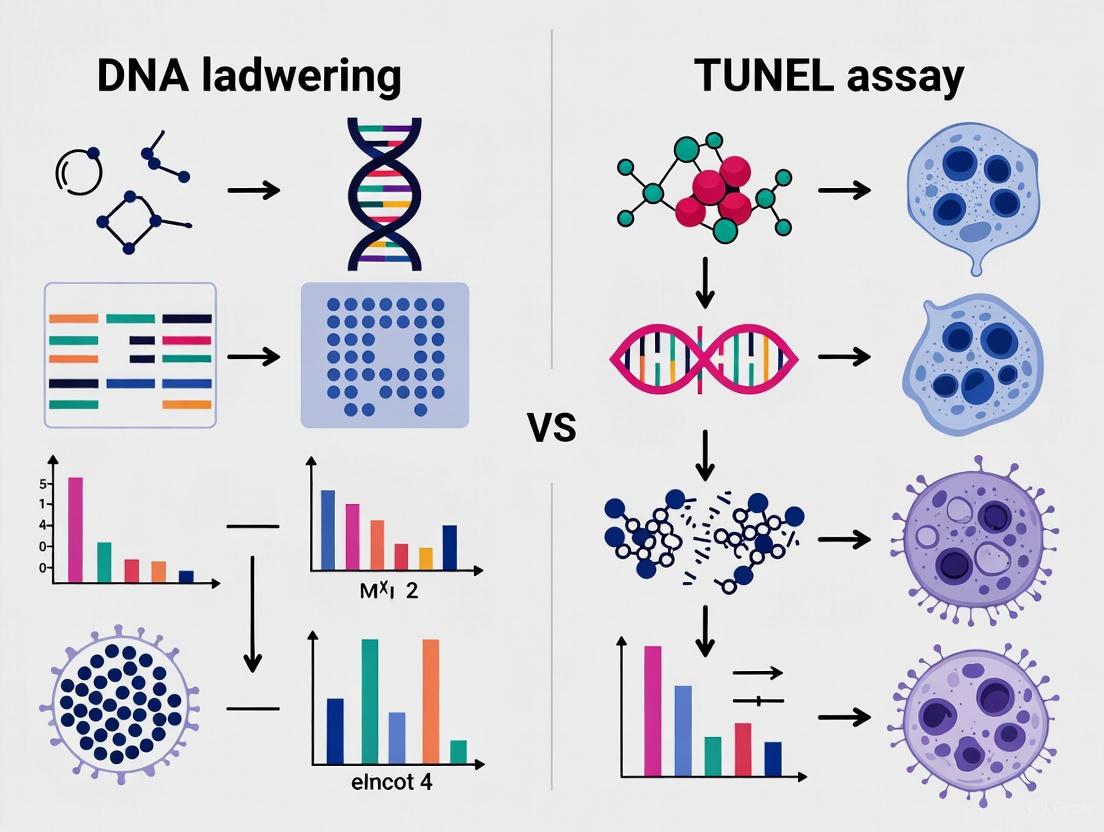
This article provides a comprehensive comparison of two fundamental techniques for detecting DNA fragmentation: the DNA laddering assay and the TUNEL assay.
DNA Laddering vs. TUNEL Assay: A Definitive Guide to Specificity in Apoptosis Detection
Abstract
This article provides a comprehensive comparison of two fundamental techniques for detecting DNA fragmentation: the DNA laddering assay and the TUNEL assay. Tailored for researchers, scientists, and drug development professionals, we explore the foundational principles, specific methodologies, and optimal applications of each technique. The scope extends from core biochemical concepts to advanced troubleshooting and validation strategies, addressing common pitfalls like the non-specificity of TUNEL and the sensitivity limitations of DNA laddering. By synthesizing current research and practical insights, this guide empowers scientists to select and optimize the most appropriate method for their specific research context, from basic life sciences to preclinical drug development.
The Biochemistry of Cell Death: Understanding DNA Fragmentation
Internucleosomal DNA cleavage is a definitive biochemical hallmark of apoptotic cell death, setting it apart from other forms of cellular demise. This process is orchestrated by caspase-activated DNase (CAD), which systematically cleaves chromosomal DNA into 180-200 base pair fragments corresponding to the length of DNA wrapped around nucleosomes [1]. These fragments, when separated by agarose gel electrophoresis, generate the characteristic "DNA ladder" that has become a visual signature of apoptosis [2] [3]. The detection of this specific fragmentation pattern serves as a critical endpoint in cellular life-and-death decisions, with profound implications for understanding development, tissue homeostasis, and diseases such as cancer [4] [3].
The molecular machinery governing this process involves a carefully coordinated cascade. In healthy cells, CAD remains inactive through binding to its inhibitor (ICAD). Upon initiation of apoptosis, executioner caspases (particularly caspase-3) cleave ICAD, liberating CAD to enter the nucleus and execute DNA cleavage at internucleosomal regions [1]. This systematic fragmentation represents one of the final commitments to cellular suicide, preventing the propagation of genetically compromised cells.
This guide provides a comprehensive comparative analysis of the two principal methodologies used to detect this apoptotic hallmark: the classical DNA ladder assay and the TUNEL (Terminal deoxynucleotidyl transferase dUTP Nick End Labeling) technique. We evaluate their technical principles, experimental protocols, performance characteristics, and applications to empower researchers in selecting the optimal approach for their specific experimental context.
Methodological Principles and Comparative Analysis
DNA Ladder Assay: A Classical Approach
The DNA ladder assay represents the historical gold standard for apoptosis detection, relying on the separation of extracted DNA fragments using standard agarose gel electrophoresis. This method directly visualizes the characteristic nucleosomal fragmentation pattern through conventional DNA staining techniques [2] [3].
Table 1: DNA Ladder Assay Technical Profile
| Parameter | Specification |
|---|---|
| Detection Principle | Agarose gel separation of extracted DNA fragments |
| Target | Internucleosomal DNA fragments (180-200 bp multiples) |
| Readout | Visual ladder pattern on gel |
| Sensitivity | Requires ~10⁶ apoptotic cells [3] |
| Temporal Resolution | Late apoptosis detection |
| Key Advantage | Direct visualization of apoptotic hallmark; cost-effective |
| Primary Limitation | Lower sensitivity; cannot analyze single cells |
TUNEL Assay: A Modern Molecular Technique
The TUNEL assay operates on a fundamentally different principle, enzymatically detecting the 3'-OH termini of DNA breaks generated during apoptosis. The technique utilizes terminal deoxynucleotidyl transferase (TdT) to incorporate labeled nucleotides (e.g., fluorescein-dUTP) at DNA break sites, allowing visualization through fluorescence microscopy or flow cytometry [1] [5].
Table 2: TUNEL Assay Technical Profile
| Parameter | Specification |
|---|---|
| Detection Principle | Enzymatic labeling of DNA strand breaks |
| Target | 3'-OH ends in single- and double-stranded DNA breaks |
| Readout | Fluorescence microscopy, flow cytometry, or chromogenic detection |
| Sensitivity | Can detect individual apoptotic cells [1] |
| Temporal Resolution | Can detect earlier stages than DNA laddering |
| Key Advantage | Single-cell resolution; high sensitivity; tissue localization |
| Primary Limitation | Less specific for apoptosis (labels any DNA breaks) |
Experimental Protocols and Technical Considerations
DNA Ladder Assay: Updated Protocol
Recent methodological refinements have improved the reliability and efficiency of the DNA ladder assay. The following protocol, adapted from Saadat et al. (2015), provides a robust framework for apoptosis detection in mammalian cells [2] [3]:
Cell Culture and Apoptosis Induction:
- Culture NIH-3T3 cells (or relevant cell line) in appropriate medium (e.g., RPMI1640 with 10% FBS).
- Induce apoptosis using 500 μM H₂O₂ for 48 hours [3].
- Critical Note: Collect both adherent and floating cells, as apoptotic cells detach and would be lost if only adherent cells are harvested [3].
DNA Extraction Protocol:
- Centrifuge culture media (containing detached apoptotic cells) at 5,000 rpm for 5 minutes. Discard supernatant.
- Add 500 μL lysis buffer (100 mM Tris-HCl, 20 mM EDTA, 1.4M NaCl, 2% CTAB) to cell pellet.
- Add 500 μL additional lysis buffer to culture vessel, incubate 10 minutes at room temperature, and combine with cell pellet.
- Incubate lysate at 65°C for 5 minutes, then cool to room temperature.
- Add 700 μL chloroform-isoamyl alcohol, mix gently, and centrifuge at 12,000 rpm for 5 minutes.
- Transfer aqueous phase to new tube, add equal volume cold isopropanol, and mix by inversion.
- Centrifuge at 12,000 rpm for 5 minutes, discard supernatant, and air-dry pellet for 30 minutes.
- Resuspend DNA in 50 μL distilled water and quantify using spectrophotometry [3].
Gel Electrophoresis and Visualization:
- Load 1-2 μg DNA per lane on 1.5% agarose gel containing SYBR-Safe DNA gel stain (1 μL/100 mL gel).
- Conduct electrophoresis at constant voltage (5-6 V/cm gel length) until adequate separation achieved.
- Visualize using UV transillumination system; apoptotic samples display characteristic 180-200 bp ladder pattern [3].
TUNEL Assay: Standardized Protocol
The TUNEL protocol has evolved with variations in detection methodology. The following represents a consensus approach optimized for sensitivity and specificity:
Sample Preparation:
- For cells: Fix with 4% paraformaldehyde for 15-20 minutes at room temperature.
- For tissue sections: Deparaffinize and rehydrate FFPE sections using standard protocols.
- Critical Consideration: Antigen retrieval method significantly impacts protein antigenicity for multiplexing. Proteinase K digestion diminishes protein antigenicity, while pressure cooker treatment preserves it without compromising TUNEL sensitivity [5].
DNA Break Labeling:
- Permeabilize cells with 0.1% Triton X-100 in PBS for 5-10 minutes on ice.
- Prepare TUNEL reaction mixture according to manufacturer's instructions, containing:
- Terminal deoxynucleotidyl transferase (TdT) enzyme
- Fluorescein-labeled dUTP (or alternative modified nucleotide)
- Reaction buffer with cobalt cofactor
- Incubate samples with TUNEL reaction mixture for 60 minutes at 37°C in a humidified chamber.
- Wash with PBS to terminate reaction.
Detection and Analysis:
- For fluorescence detection: Analyze directly by fluorescence microscopy or flow cytometry.
- For brightfield applications: incubate with anti-fluorescein antibody conjugated to horseradish peroxidase, followed by DAB chromogenic development [1].
- Counterstain with DAPI (for fluorescence) or methyl green/methyl blue (for chromogenic detection) to visualize total cells.
Specificity Controls:
- Include DNase-treated positive control samples.
- Include negative controls omitting TdT enzyme.
- Enhanced Specificity: For improved apoptosis specificity, combine TUNEL with caspase-3 immunostaining to confirm activation of apoptotic pathways [1].
Comparative Performance and Applications
Sensitivity and Specificity Analysis
The fundamental distinction between these techniques lies in their detection thresholds and specificity profiles. The DNA ladder assay requires approximately 10⁶ apoptotic cells for clear visualization, making it unsuitable for analyzing small cell populations or rare events [3]. In contrast, TUNEL can detect DNA fragmentation in individual cells, providing significantly higher sensitivity for heterogeneous populations or limited sample material [1].
Regarding specificity, while both techniques detect apoptotic DNA fragmentation, TUNEL exhibits broader reactivity to various DNA breaks. As noted in recent studies, "TUNEL staining is not always a specific indicator of apoptosis because cells actively repairing DNA damage or undergoing necrosis can also incorporate labeled nucleotides" [1]. This limitation can be mitigated through dual-labeling approaches combining TUNEL with caspase-3 detection [1] or careful morphological analysis.
Technical Comparison and Selection Guidelines
Table 3: Method Selection Guide for Apoptosis Detection
| Experimental Requirement | Recommended Method | Rationale |
|---|---|---|
| Initial apoptosis screening | DNA ladder assay | Cost-effective; simple interpretation; establishes apoptotic hallmark |
| Single-cell analysis | TUNEL assay | Single-cell resolution; compatible with flow cytometry |
| Tissue localization studies | TUNEL assay | Preserves spatial context; in situ application |
| Multiplexed protein detection | TUNEL with pressure cooker retrieval | Preserves protein antigenicity for spatial proteomics [5] |
| Early apoptosis detection | TUNEL assay | Detects DNA breaks before complete nucleosomal fragmentation |
| Resource-limited settings | DNA ladder assay | Minimal equipment requirements; lower cost |
| High-throughput screening | TUNEL with flow cytometry | Automated quantification; rapid analysis |
Advanced Applications and Integration
Multiplexed Approaches and Spatial Context
Recent methodological advances have enhanced TUNEL compatibility with cutting-edge techniques. Sherman et al. (2025) demonstrated that replacing proteinase K with pressure cooker antigen retrieval enables seamless TUNEL integration with multiple iterative labeling by antibody neodeposition (MILAN) and cyclic immunofluorescence (CycIF) [5]. This harmonization permits rich spatial contextualization of cell death within complex tissues while simultaneously mapping dozens of protein targets, opening new frontiers in microenvironmental analysis of apoptosis.
Apoptosis Detection in Specific Research Contexts
The choice between detection methods varies significantly across research applications:
Cancer Research: The DNA ladder assay provides compelling visual evidence of drug-induced apoptosis in therapeutic development [3]. Modified protocols have optimized DNA extraction to minimize sample loss, enhancing detection reliability [2]. For screening compound libraries, TUNEL with flow cytometry enables high-throughput quantification of apoptotic responses.
Male Infertility Studies: Sperm DNA fragmentation represents a specialized application where TUNEL has demonstrated particular utility. Comparative studies indicate TUNEL detects higher amounts of DNA fragmentation during cryopreservation compared to SCSA, SCD, and COMET assays [6] [7]. Standardized TUNEL protocols have established clinical cut-off values (9.17%) for distinguishing fertile and infertile samples [8].
Developmental Biology: The spatial resolution of TUNEL makes it indispensable for mapping programmed cell death during embryogenesis and tissue remodeling. Recent protocol innovations maintain tissue architecture while enabling multiplexed protein detection alongside DNA fragmentation analysis [5].
The Scientist's Toolkit: Essential Research Reagents
Table 4: Essential Reagents for Apoptosis Detection
| Reagent/Catalog Item | Function | Application Notes |
|---|---|---|
| Terminal deoxynucleotidyl transferase (TdT) | Catalyzes addition of labeled nucleotides to 3'-OH ends of DNA breaks | Critical for TUNEL assay; requires cobalt cofactor [1] |
| Biotin- or fluorescein-dUTP | Modified nucleotides for incorporation at DNA break sites | Fluorescein-dUTP enables direct fluorescence detection; biotin-dUTP requires secondary detection [1] |
| Caspase-activated DNase (CAD) | Endonuclease executing internucleosomal cleavage | Molecular mediator of DNA laddering; useful as apoptosis marker [1] |
| Anti-caspase-3 antibodies | Detection of activated executioner caspase | Confirm apoptotic pathway activation; enhances TUNEL specificity [1] |
| SYBR-Safe DNA gel stain | Fluorescent DNA intercalating dye | Safer alternative to ethidium bromide for DNA ladder visualization [3] |
| Proteinase K | Proteolytic enzyme for antigen retrieval | Traditional TUNEL protocol component; degrades protein epitopes [5] |
| Pressure cooker system | Heat-mediated antigen retrieval | Alternative to Proteinase K; preserves protein antigenicity for multiplexing [5] |
Molecular Pathway of Apoptotic DNA Fragmentation
The following diagram illustrates the molecular events leading to internucleosomal DNA cleavage and the detection points for each method:
Diagram 1: Molecular Pathway of Apoptotic DNA Fragmentation and Detection
Experimental Workflow Comparison
The following diagram compares the procedural workflows for both detection methods:
Diagram 2: Comparative Workflows for DNA Ladder and TUNEL Assays
The detection of internucleosomal DNA cleavage remains a cornerstone of apoptosis research, with both DNA laddering and TUNEL offering complementary approaches for different experimental contexts. The DNA ladder assay provides an economical, straightforward method for establishing the apoptotic hallmark, particularly suitable for initial screening and resource-limited settings. In contrast, TUNEL offers superior sensitivity, single-cell resolution, and spatial context preservation, making it indispensable for advanced applications requiring quantification, localization, or multiplexing.
Recent methodological refinements in both techniques – from optimized DNA extraction protocols for ladder assays to pressure cooker-based antigen retrieval for TUNEL – have enhanced their reliability and expanded their applications. The choice between methods should be guided by specific experimental requirements including sample type, required sensitivity, equipment availability, and need for multiplexing capabilities. As apoptosis research continues to evolve, both techniques will maintain their relevance as fundamental tools for defining this critical molecular hallmark of programmed cell death.
Apoptosis, or programmed cell death, is a fundamental biological process crucial for development, tissue homeostasis, and defense against disease. Its dysregulation is implicated in various pathologies, including cancer and neurodegenerative disorders [9]. Among the most recognizable biochemical hallmarks of apoptosis is DNA laddering—the internucleosomal cleavage of nuclear DNA into fragments of roughly 180 base pairs and multiples thereof [10] [11]. This distinctive ladder pattern, visualized via agarose gel electrophoresis, has served as a classic signature of apoptotic cell death for decades. This guide provides a comprehensive comparison between the DNA laddering assay and the TUNEL (Terminal deoxynucleotidyl transferase dUTP Nick End Labeling) method, framing them within ongoing research on fragmentation detection.
The Biochemical Mechanism of DNA Laddering
The formation of the DNA ladder is a caspase-dependent process executed by specific enzymatic machinery.
The CAD/ICAD Enzyme System
The primary enzyme responsible for apoptotic DNA fragmentation is Caspase-Activated DNase (CAD), also known as DFF40 (DNA Fragmentation Factor 40) [10]. In healthy, non-apoptotic cells, CAD remains complexed with its inhibitor, ICAD (Inhibitor of CAD). ICAD acts as a specific chaperone for CAD and keeps it in an inactive state [10].
During apoptosis, the apoptotic effector caspase, caspase-3, is activated and cleaves ICAD. This cleavage dissociates the CAD-ICAD complex, liberating and activating CAD [10]. The activated CAD enzyme then cleaves chromosomal DNA at the internucleosomal linker regions between nucleosomes. These are the protein-containing structures that occur in chromatin at approximately 180-base-pair intervals [10]. Because the DNA is tightly wrapped around the nucleosomes' core histones, the linker sites are the most exposed and accessible regions for CAD to attack. This systematic cleavage results in the characteristic DNA fragments that form the "ladder" on an agarose gel [10].
Diagram 1: The CAD/ICAD Apoptotic DNA Fragmentation Pathway
DNA Laddering vs. TUNEL Assay: A Head-to-Head Comparison
The following table provides a detailed, objective comparison of the DNA laddering assay and the TUNEL assay, two principal methods for detecting apoptotic DNA fragmentation.
| Feature | DNA Laddering Assay | TUNEL Assay |
|---|---|---|
| Detection Principle | Agarose gel electrophoresis of internucleosomal DNA fragments [10] [11] | Enzymatic labeling of 3'-OH ends of DNA breaks with modified dUTP [11] |
| Specificity for Apoptosis | High for late apoptosis (characteristic ladder pattern) [12] | Can label any DNA break, including necrosis; requires careful interpretation [12] |
| Sensitivity | Low to moderate; requires ~5-10% apoptotic cells [12] | High; can detect single apoptotic cells [11] |
| Stage of Apoptosis Detected | Late stage (after caspase activation) [12] | Mid to late stage [12] |
| Throughput & Scalability | Low; suitable for bulk cell population analysis [12] | High; adaptable to flow cytometry for rapid, single-cell analysis [11] |
| Quantification Capability | Semi-quantitative [12] | Quantitative (especially via flow cytometry) [11] |
| Key Advantage | Provides iconic, visual hallmark of apoptosis; cost-effective [3] [12] | High sensitivity and versatility for in-situ detection and quantification [11] |
| Key Limitation | Less sensitive; not suitable for single-cell analysis or tissue sections [12] | Potential for false positives from necrotic DNA fragmentation [12] |
| Typical Cost | Low (standard lab reagents) [3] | High (commercial kits often required) [13] |
Experimental Protocols for Apoptosis Detection
Detailed Protocol: DNA Laddering Assay
This is an improved protocol for detecting apoptosis via DNA laddering in mammalian cells, adapted from research that optimized the method for ease and reliability [3].
Cell Lysis and DNA Extraction
- Harvest Cells: Collect both adherent and floating cells by centrifugation. Critical Hint: Apoptotic cells detach, so collecting the culture medium is crucial to avoid losing the majority of apoptotic cells [3].
- Lyse Cells: Resuspend the cell pellet in 500 μL of lysis buffer (e.g., 2% buffer containing 100 mM Tris-HCl, 5 mM EDTA, 0.2% Triton X-100) [3] [12]. Incubate at room temperature for 10 minutes [3].
- Separate Fragmented DNA: Centrifuge the lysate at 12,000-27,000 x g for 5-30 minutes. The fragmented DNA will be in the supernatant, while intact chromatin and cell debris are in the pellet [3] [12].
- Precipitate DNA: Transfer the supernatant to a new tube. Add an equal volume of cold isopropanol and 0.1-0.15 volumes of sodium acetate (pH 5.2) to precipitate the DNA. Incubate at -80°C for 1 hour [3] [12].
- Pellet DNA: Centrifuge at 12,000-20,000 x g for 5-20 minutes. Discard the supernatant and air-dry the pellet [3] [12].
- Purify DNA (Optional but Recommended): Resuspend the DNA pellet and treat with DNase-free RNase (e.g., 2 μL of 10 mg/mL) for 5 hours at 37°C to remove RNA. This is followed by proteinase K treatment (e.g., 25 μL of 20 mg/mL) and incubation overnight at 65°C to digest proteins. Extract with phenol/chloroform/isoamyl alcohol and precipitate with ethanol again for a cleaner result [3] [12].
Gel Electrophoresis and Visualization
- Resuspend DNA: Dissolve the final DNA pellet in 20-50 μL of Tris-acetate-EDTA (TAE) or Tris-borate-EDTA (TBE) buffer [3] [12].
- Prepare Gel: Cast a 1.5% to 2% agarose gel in an appropriate buffer. Incorporate a DNA stain, such as 1 μg/mL ethidium bromide or a safer alternative like SYBR-Safe [3] [12].
- Load and Run: Mix the DNA sample with a loading dye (e.g., containing bromophenol blue and glycerol) and load it into the gel wells. Include a DNA molecular weight marker. Run the electrophoresis at 5-10 V/cm [3].
- Visualize: Examine and photograph the gel under an ultraviolet transillumination system. A positive apoptotic result shows a ladder of bands at ~180 bp intervals [3] [12].
Diagram 2: DNA Ladder Assay Experimental Workflow
The TUNEL assay is a widely used method for detecting DNA fragmentation in situ. The following is a generalized protocol based on flow cytometric analysis [11].
- Sample Preparation: Induce apoptosis in cells and prepare a single-cell suspension (0.5-2 x 10^5 cells).
- Fixation: Fix cells in 2% (w/v) paraformaldehyde for 15 minutes at room temperature. Fixed cells can be stored at 4°C for several days.
- Permeabilization: Permeabilize the fixed cells to allow enzyme access. Use PBS containing a detergent such as 0.1% (v/v) Triton X-100 or 0.1% (v/v) saponin.
- Labeling Reaction (TUNEL Mix): Incubate the cells in the TUNEL reaction mixture. A typical mix includes:
- Terminal deoxynucleotidyl transferase (TdT) enzyme.
- TdT reaction buffer (e.g., 200 mM potassium cacodylate, 25 mM Tris-HCl, pH 6.6, BSA, 1.5 mM CoCl₂).
- Fluorescently labeled dUTP (e.g., FITC-dUTP).
- dATP. Incubate for 1 hour at 37°C in the dark.
- Analysis by Flow Cytometry: Wash the cells and resuspend in PBS. Analyze by flow cytometry, exciting with a 488 nm laser and detecting the fluorescence signal (e.g., FITC emission at 520 nm through the FL1 channel) [11]. Analyze 10,000 events or more, gating on single cells.
The Scientist's Toolkit: Essential Reagents and Materials
The following table details key reagents and equipment essential for conducting DNA fragmentation detection experiments.
| Item Category | Specific Examples | Function in Apoptosis Detection |
|---|---|---|
| Cell Lysis Buffers | Triton X-100, NP-40, CTAB-based buffers [3] [12] | Disrupts cell and nuclear membranes to release DNA content. |
| DNA Precipitation Agents | Cold Ethanol, Isopropanol, Sodium Acetate [3] [12] | Concentrates and purifies fragmented DNA from the lysate. |
| Nucleases | DNase-free RNase A, Proteinase K [12] | Removes RNA and digests proteins for cleaner DNA visualization. |
| Electrophoresis Consumables | Agarose, DNA Stains (SYBR-Safe, Ethidium Bromide), DNA Ladders [3] [12] | Matrix for separating DNA fragments by size and visualizing the ladder pattern. |
| TUNEL Assay Kits | Annexin V-FITC Apoptosis Detection Kits, Commercial TUNEL Kits [13] [11] | Provide optimized reagents for labeling and detecting DNA strand breaks in cells/tissues. |
| Key Instruments | Flow Cytometer, Fluorescence Microscope, Gel Doc System [3] [11] | Enables quantification (flow cytometry), in-situ visualization (microscopy), and documentation of results (gel imaging). |
Market Context and Research Applications
The apoptosis assays market, valued at USD 6.5 billion in 2024 and projected to reach USD 14.6 billion by 2034, reflects the critical importance of these techniques in life sciences [13]. This growth is fueled by the rising incidence of chronic diseases like cancer and the increasing demand for personalized medicine, which requires precise cellular response analysis [13] [9].
While the DNA laddering assay remains a foundational, cost-effective tool for confirming apoptosis, the market is evolving towards high-throughput, quantitative technologies. Flow cytometry, a multi-billion dollar segment itself, is frequently used for TUNEL assays and other multiplexed apoptosis analyses [13]. Leading industry players such as Thermo Fisher Scientific, Danaher, and Merck offer comprehensive portfolios, including reagents, assay kits, and advanced instrumentation, supporting researchers from basic science to drug discovery [13] [14].
The detection of DNA fragmentation is a cornerstone of cell death research, particularly in the study of apoptosis. For decades, scientists have relied on two primary techniques to visualize this key apoptotic hallmark: the DNA laddering assay and the Terminal deoxynucleotidyl transferase dUTP nick end labeling (TUNEL) assay. While DNA laddering detects the internucleosomal cleavage pattern characteristic of apoptosis through gel electrophoresis, the TUNEL assay provides distinct advantages for in situ visualization and quantification of DNA breaks within individual cells or tissue sections [15]. The TUNEL method, first developed in the early 1990s, has evolved into one of the most widely used techniques for identifying apoptotic programmed cell death in diverse research areas, from neuroscience to cancer biology [16] [17]. This guide examines the fundamental principles of the TUNEL assay, compares its performance with alternative methods, and provides detailed experimental protocols to help researchers implement this technique effectively within the broader context of DNA fragmentation detection research.
Fundamental Principles of the TUNEL Assay
Core Mechanistic Principle
The TUNEL assay operates on a straightforward yet powerful biochemical principle: it enzymatically labels the 3'-hydroxyl termini of DNA strand breaks that are generated during the final stages of apoptosis [16]. The assay utilizes terminal deoxynucleotidyl transferase (TdT), a template-independent DNA polymerase that catalyzes the addition of deoxynucleotides to the 3'-OH ends of DNA fragments without needing a template strand [18]. This key differentiator from other DNA labeling methods allows TUNEL to detect all types of DNA breaks—including single-strand breaks, double-strand breaks, and those with blunt, overhanging, or recessed ends [17] [19].
In a typical TUNEL reaction, TdT incorporates modified nucleotides (dUTP) that are tagged with either a fluorochrome or hapten label. These labeled nucleotides are added to the 3'-OH ends of fragmented DNA, creating a readily detectable signal at the sites of DNA damage [16]. The direct incorporation method using fluorescently-tagged dUTP (e.g., fluorescein-dUTP) is the most rapid approach, requiring fewer staining steps. However, methods incorporating biotin- or bromine-modified dUTP followed by detection with streptavidin-conjugates or antibodies respectively can provide signal amplification, potentially enhancing sensitivity for samples with minimal DNA fragmentation [16] [18].
Visualizing the TUNEL Workflow
The following diagram illustrates the fundamental workflow and key detection methods for the TUNEL assay:
Comparative Analysis of TUNEL Detection Methodologies
Technical Comparison of Major TUNEL Approaches
The TUNEL assay has evolved into several distinct methodological variations, each with unique advantages and limitations. The choice between direct fluorescent labeling, biotin-streptavidin systems, or BrdU-based detection significantly impacts experimental outcomes, sensitivity, and compatibility with other techniques.
Table 1: Comparison of Major TUNEL Detection Methodologies
| Method | Principle | Sensitivity | Steps | Compatibility | Common Applications |
|---|---|---|---|---|---|
| Direct Fluorescent (e.g., FITC-dUTP) [18] | TdT directly incorporates fluorescence-tagged nucleotides | Moderate | Minimal (fastest) | Multiplexing with some fluorescent dyes | Flow cytometry, rapid screening |
| Biotin-Streptavidin [20] [18] | Biotin-dUTP + streptavidin-HRP + chromogenic substrate | High | Multiple (requires amplification) | Brightfield microscopy, permanent slides | Histopathology, tissue sections |
| BrdU-Antibody [16] [18] | BrdU incorporation + fluorescent anti-BrdU antibody | Highest (improved incorporation) | Multiple | Fluorescence imaging | Low-level apoptosis detection |
| Click Chemistry (e.g., EdUTP) [5] [20] | EdUTP + azide dye via copper-catalyzed cycloaddition | High | Moderate | Multiplexing with fluorescent proteins | Advanced multiplex imaging, spatial proteomics |
Popularity and Usage Patterns in Current Research
A survey of recent scientific publications reveals clear preferences in TUNEL methodology adoption among researchers. An analysis of 50 research papers published in 2017 containing the term "TUNEL Assay" or "TUNEL Staining" demonstrated that direct fluorescent methods (primarily using FITC-dUTP) account for approximately 50% of all published TUNEL applications [18]. Biotin-streptavidin based detection and FITC-dUTP with anti-FITC antibody amplification each represented about 15% of usage, while digoxygenin-based methods accounted for 12% [18]. BrdU-based protocols, despite their enhanced sensitivity, were used in only 8% of the surveyed studies, likely due to their more complex multi-step workflow [16] [18].
Notably, more than 90% of the surveyed research papers utilized commercial kits rather than laboratory-developed protocols, reflecting the importance of standardization and reproducibility in TUNEL experimentation [18]. This distribution highlights the research community's prioritization of technical simplicity and rapid workflow, even when more sensitive alternatives are available.
TUNEL vs. Alternative DNA Fragmentation Detection Methods
Performance Comparison with Key Alternative Techniques
When selecting a DNA fragmentation detection method, researchers must consider multiple performance parameters including sensitivity, specificity, throughput capability, and technical requirements. The following comparative analysis examines TUNEL against other commonly used approaches in apoptosis research.
Table 2: TUNEL Assay vs. Alternative DNA Fragmentation Detection Methods
| Method | Detects | Sensitivity | Throughput | Specificity for Apoptosis | Technical Complexity |
|---|---|---|---|---|---|
| TUNEL [16] [19] | DNA strand breaks (SSB & DSB) | High (especially BrdU method) | High (flow cytometry) to Moderate (microscopy) | Moderate (also detects necrosis, DNA repair) [17] [15] | Moderate |
| DNA Laddering [15] | Internucleosomal fragmentation | Low (requires ~10⁶ cells) | Low | High for late apoptosis | Low |
| Comet Assay [21] [19] | DNA strand breaks (SSB & DSB) | Very High (single-cell) | Low | Low (detects all DNA damage) | High |
| Annexin V Staining [22] | Phosphatidylserine externalization | High | High | High for early apoptosis | Low |
| SCSA [19] | DNA denaturability | High | High | Moderate | High (specialized equipment) |
Key Differentiators and Method Selection Criteria
The comparative data reveals that TUNEL occupies a unique position in the methodological landscape, particularly valuable when in situ visualization of DNA fragmentation is required. While the Comet assay demonstrates superior sensitivity for detecting low levels of DNA damage, especially double-strand breaks [21], it lacks the spatial context preservation that makes TUNEL indispensable for tissue-based research. Recent comparative research has revealed that despite both being used to assess DNA integrity, Comet and TUNEL assays identify meaningfully different aspects of DNA damage, with Comet showing significantly higher association with DNA methylation disruption in spermatozoa (3,387 differentially methylated regions vs. 23 for TUNEL) [21].
A critical limitation of TUNEL is its moderate specificity for apoptosis. As noted in multiple technical guides, TUNEL can label cells with DNA damage from various causes, including necrosis, DNA repair processes, and even transcriptional activity [17] [15]. This necessitates careful experimental design with appropriate controls and often requires combination with other apoptotic markers (e.g., activated caspase-3) for definitive apoptosis identification [17]. The original TUNEL protocols were particularly prone to false positives from necrotic cells, though methodological improvements have dramatically enhanced specificity for apoptotic cells in later stages of cell death [16] [19].
For method selection, DNA laddering remains valuable when a classic biochemical hallmark of apoptosis is sufficient and cell numbers are adequate, while TUNEL is preferable for spatial localization, higher sensitivity, and analysis of heterogeneous cell populations. Annexin V staining provides complementary information about early apoptotic events before DNA fragmentation occurs, with research showing phosphatidylserine externalization and DNA fragmentation can be concomitant events in some cell systems [22].
Advanced TUNEL Protocol with Spatial Proteomics Compatibility
Modernized Workflow for Multiplexed Imaging
Recent methodological advances have addressed key limitations in traditional TUNEL protocols, particularly regarding compatibility with multiplexed protein detection. The standard proteinase K antigen retrieval method, used in most commercial TUNEL kits, dramatically reduces protein antigenicity, preventing effective combination with spatial proteomic methods like Multiple Iterative Labeling by Antibody Neodeposition (MILAN) or Cyclic Immunofluorescence (CycIF) [5]. A harmonized protocol developed in 2025 demonstrates that replacing proteinase K with pressure cooker-based antigen retrieval preserves TUNEL sensitivity while maintaining full protein antigenicity for iterative immunofluorescence [5].
Table 3: Research Reagent Solutions for Advanced TUNEL Applications
| Reagent/Category | Specific Examples | Function in TUNEL Assay |
|---|---|---|
| TdT Enzyme | Recombinant Terminal Deoxynucleotidyl Transferase | Catalyzes addition of modified nucleotides to 3'-OH DNA ends |
| Modified Nucleotides | EdUTP, BrdUTP, Biotin-dUTP, FITC-dUTP [20] [18] | Provides detection moiety for incorporated nucleotides |
| Detection Systems | Click-iT Chemistry, Streptavidin-HRP, Anti-BrdU Antibodies [20] [18] | Visualizes incorporated nucleotides (fluorescence or colorimetric) |
| Antigen Retrieval | Proteinase K, Pressure Cooker (citrate buffer) [5] | Exposes DNA breaks for TdT accessibility |
| Signal Amplification | Tyramide Signal Amplification (TSA), Streptavidin-Biotin Complex | Enhances sensitivity for low-abundance targets |
| Mounting Media | Antifade media with DAPI [23] | Preserves fluorescence, provides nuclear counterstain |
Step-by-Step Protocol for MILAN-Compatible TUNEL Assay
Sample Preparation:
- Start with formalin-fixed paraffin-embedded (FFPE) tissue sections (4-5μm) mounted on charged slides.
- Deparaffinize and rehydrate through xylene and graded ethanol series (100%, 95%, 70%).
- Perform antigen retrieval using pressure cooker (20 min at 95°C in citrate buffer, pH 6.0) instead of proteinase K treatment [5].
- Permeabilize with 0.1% Triton X-100 in PBS for 15 minutes at room temperature.
TUNEL Reaction:
- Prepare TUNEL reaction mixture containing TdT enzyme and EdUTP (or BrdUTP) in TdT reaction buffer.
- Apply reaction mixture to tissue sections and incubate in a humidified chamber at 37°C for 60-90 minutes.
- Terminate reaction by washing with PBS containing 0.1% Tween-20.
Click Chemistry Detection:
- For EdUTP-based detection: Prepare Click-iT reaction cocktail containing fluorescent azide (e.g., Alexa Fluor 488 azide), CuSO₄, and reaction buffer.
- Apply Click-iT reaction mixture and incubate for 30 minutes at room temperature, protected from light.
- Wash thoroughly with PBS to remove unreacted components.
Iterative Immunofluorescence (MILAN):
- Block sections with 5% normal serum from species matching secondary antibodies.
- Apply primary antibodies for protein targets of interest, incubate overnight at 4°C.
- Detect with fluorophore-conjugated secondary antibodies (1-2 hours at room temperature).
- Image sections using appropriate fluorescence microscopy.
- For iterative rounds: Erase antibodies by incubating in 2-mercaptoethanol/SDS buffer at 66°C for 1 hour [5].
- Confirm erasure by imaging, then proceed with next round of antibody staining.
This protocol enables comprehensive spatial contextualization of cell death within complex tissue microenvironments, allowing correlation of TUNEL signals with 20+ protein markers in the same tissue section [5].
Troubleshooting and Technical Considerations
Addressing Common TUNEL Pitfalls
Successful TUNEL implementation requires careful attention to potential technical challenges. A frequent issue is over-fixation of tissues, which can reduce TdT enzyme accessibility to DNA breaks. Limiting formalin fixation to 24-48 hours and avoiding acid decalcification solutions can significantly improve signal intensity [19]. For highly compact chromatin structures like spermatozoa, additional chromatin decondensation steps using dithiothreitol (DTT) may be necessary to allow TdT access to DNA breaks [19].
Appropriate controls are essential for valid TUNEL interpretation. Each experiment should include:
- Positive control: DNase I-treated sections to induce DNA breaks
- Negative control: Omission of TdT enzyme from reaction mixture
- Specificity control: TUNEL combined with caspase-3 immunohistochemistry to confirm apoptotic nature of DNA fragmentation [17]
Quantitative Considerations and Standardization
While TUNEL is excellent for qualitative apoptosis assessment, quantitative applications require careful standardization. For flow cytometric analysis, consistent gating strategies based on positive and negative controls are essential for reproducible results [19]. In microscopy-based quantification, systematic random sampling and blinded counting procedures help minimize bias in determining the percentage of TUNEL-positive cells [22].
The lack of universally established threshold values for TUNEL positivity remains a challenge for clinical translation and inter-laboratory comparisons [19]. Establishing internal laboratory standards using consistently processed control samples helps maintain assay consistency over time. When comparing across experimental groups, processing all samples simultaneously using identical reagent batches minimizes technical variability.
The TUNEL assay remains an indispensable tool in the cell death researcher's toolkit, offering unique capabilities for in situ detection of DNA fragmentation. While methodological considerations regarding specificity and standardization persist, ongoing technical innovations continue to enhance its utility and compatibility with modern multiplexed imaging platforms. Within the broader context of DNA fragmentation detection research, TUNEL provides complementary information to DNA laddering and other apoptotic markers, enabling comprehensive characterization of cell death processes in development, homeostasis, and disease pathogenesis.
For decades, the Terminal deoxynucleotidyl transferase dUTP nick end labeling (TUNEL) assay has been a cornerstone method for detecting apoptotic cell death by identifying DNA fragmentation. However, emerging research reveals this classic assay's utility extends far beyond apoptosis, detecting DNA breakage in necrotic cell death and other contexts of genomic instability. This comparison guide examines the expanding role of TUNEL against alternative DNA fragmentation detection methods, highlighting its evolving applications and limitations through recent experimental findings. We synthesize data on TUNEL's performance across biological contexts, provide detailed methodologies for modern implementations, and contextualize its use within the broader landscape of DNA damage detection technologies.
The TUNEL assay has traditionally served as a gold standard for apoptosis detection, capitalizing on the characteristic DNA fragmentation that occurs during programmed cell death [24]. The assay detects DNA strand breaks by utilizing terminal deoxynucleotidyl transferase (TdT) to incorporate labeled nucleotides at free 3'-hydroxyl termini, providing a direct means to visualize cells undergoing DNA degradation [18].
Recent investigations have significantly expanded our understanding of TUNEL's detection capabilities. Evidence now indicates that TUNEL positivity can manifest in various contexts beyond classical apoptosis, including necrosis, reversible apoptosis (anastasis), and other cellular states featuring DNA breakage [5] [25]. This expanded recognition necessitates a reevaluation of TUNEL's specificity and prompts comparison with alternative methods for detecting DNA fragmentation across diverse cell death modalities.
Comparative Performance of DNA Fragmentation Detection Assays
Technical Principles and Detection Capabilities
Table 1: Comparison of Major DNA Fragmentation Detection Assays
| Assay | Detection Principle | Types of DNA Damage Detected | Compatibility with Other Analyses | Key Limitations |
|---|---|---|---|---|
| TUNEL | TdT-mediated addition of labeled nucleotides to 3'-OH ends of DNA breaks | Both single- and double-strand breaks [26] | Compatible with multiplexed spatial proteomics when using optimized protocols [5] | Not specific to apoptosis; detects any DNA breakage [25] |
| Comet Assay | Electrophoretic migration of DNA fragments under alkaline (primarily single-strand) or neutral (double-strand) conditions | Single- and double-strand breaks under respective conditions [6] | Limited compatibility with simultaneous protein staining | Requires single-cell suspensions; less suitable for tissue architecture |
| SCD Test (Sperm Chromatin Dispersion) | Differential halo pattern formation after DNA denaturation and protein removal | Nuclear DNA fragmentation and chromatin integrity [6] | Primarily optimized for sperm analysis | Limited to specific cell types; semi-quantitative |
| SCSA (Sperm Chromatin Structure Assay) | Flow cytometric measurement of DNA susceptibility to acid denaturation | Chromatin abnormalities and DNA fragmentation [6] | High-throughput cell analysis | Specialized equipment required; primarily for sperm |
Quantitative Performance Across Biological Contexts
Table 2: Quantitative Performance of TUNEL Versus Comet Assay in Sperm DNA Fragmentation Studies
| Study Context | TUNEL Performance | Comet Assay Performance | Correlation Between Assays | Notable Differences |
|---|---|---|---|---|
| Clinical Infertility (Egyptian population) | Cut-off value of 20.3% for discriminating fertile/infertile men (96.6% sensitivity, 87.5% specificity) [26] | Not assessed in this study | Not assessed | Established population-specific threshold |
| DNA Methylation Correlation (FAZST Trial) | Limited association with DNA methylation patterns (23 differentially methylated regions) [21] | Strong association with DNA methylation patterns (3,387 differentially methylated regions) [21] | Moderate overall correlation (R² = 0.34, p < 0.001) [21] | Comet showed stronger epigenetic associations |
| Cryopreservation-Induced Damage | Detected highest amounts of sDF during cryopreservation [6] | Detected significant but lower levels of damage compared to TUNEL [6] | Poor concordance (Lin's CCC values below 0.5) [6] | Different sensitivity to freeze-thaw induced breaks |
Experimental Protocols and Methodological Advances
Standard TUNEL Protocol for Flow Cytometry
The following protocol adapts the highly sensitive Br-dUTP labeling method for flow cytometric analysis [24]:
Cell Preparation and Fixation
- Suspend 1-2 × 10⁶ cells in 0.5 ml PBS
- Transfer to 4.5 ml ice-cold 1% formaldehyde (methanol-free) in PBS
- Incubate for 15 minutes on ice
- Centrifuge at 300g for 5 minutes and resuspend in PBS
Permeabilization
- Resuspend cell pellet in 0.5 ml PBS
- Transfer to 4.5 ml ice-cold 70% ethanol
- Cells can be stored in ethanol for several weeks at -20°C
DNA Strand Break Labeling
- Centrifuge at 200g for 3 minutes and remove ethanol
- Resuspend cells in 50 μl of reaction solution containing:
- 10 μl TdT 5X reaction buffer
- 2.0 μl Br-dUTP stock solution (2 mM)
- 0.5 μl (12.5 units) TdT enzyme
- 5 μl CoCl₂ solution (10 mM)
- 33.5 μl distilled H₂O
- Incubate for 40 minutes at 37°C
Immunocytochemical Detection
- Add 1 ml of rinsing buffer (0.1% Triton X-100, 5 mg/ml BSA in PBS)
- Centrifuge and resuspend in 100 μl FITC-conjugated anti-BrdU antibody solution
- Incubate for 1 hour at room temperature
- Add 1 ml PI staining solution (5 μg/ml PI, 100 μg/ml RNase A in PBS)
- Analyze by flow cytometry
Harmonized TUNEL with Spatial Proteomics
Recent advances enable TUNEL integration with multiplexed spatial proteomics, overcoming previous limitations [5] [27]:
Antigen Retrieval Optimization
- Replace proteinase K treatment with pressure cooker-based retrieval
- Proteinase K consistently reduces or abrogates protein antigenicity
- Pressure cooker treatment enhances protein antigenicity for targets tested
Iterative Staining Compatibility
- Antibody-based TUNEL with pressure cooker retrieval integrates into MILAN (multiple iterative labeling by antibody neodeposition) staining series
- TUNEL signal is erasable using 2-ME/SDS treatment at 66°C
- Enables multiple cycles of staining and erasure on the same specimen
Validation in Diverse Cell Death Models
- Protocol validated in acetaminophen-induced hepatocyte necrosis
- Confirmed in dexamethasone-induced adrenocortical apoptosis
- Maintains tissue architecture while enabling multiplexed protein detection
Figure 1: Experimental workflow for harmonizing TUNEL with multiplexed spatial proteomics, highlighting the critical decision point between proteinase K and pressure cooker antigen retrieval methods that determines downstream compatibility with iterative staining [5] [27].
Key Research Reagents and Experimental Solutions
Table 3: Essential Research Reagents for Advanced TUNEL Applications
| Reagent/Category | Specific Examples | Function and Application Notes |
|---|---|---|
| TdT Enzyme Sources | Boehringer Mannheim, Commercial kits (APO-BRDU, APO-DIRECT, ApopTag) [24] | Catalyzes nucleotide addition to 3'-OH ends; different sources offer varying batch consistency |
| Labeled Nucleotides | Br-dUTP, FITC-dUTP, Biotin-dUTP, Digoxigenin-dUTP [24] [18] | Detection moieties with different signal amplification requirements and background considerations |
| Detection Systems | FITC-conjugated anti-BrdU antibody, Streptavidin-HRP, Anti-digoxigenin-HRP [24] [18] | Fluorochrome or enzyme-based detection with varying sensitivity and compatibility with multiplexing |
| Antigen Retrieval Methods | Proteinase K, Pressure cooking, Trypsin [5] [28] | Critical for epitope exposure; choice dramatically affects downstream protein antigenicity |
| Erasure Solutions | 2-Mercaptoethanol/SDS (2-ME/SDS) [5] | Enables iterative staining cycles by removing antibodies while preserving tissue integrity |
Critical Interpretation and Limitations
Specificity Challenges in Cell Death Detection
While TUNEL detects DNA fragmentation, multiple caveats necessitate careful interpretation:
Reversible Apoptosis (Anastasis): Cells exhibiting TUNEL positivity can potentially recover through anastasis, challenging the assumption that TUNEL-positive cells are irreversibly committed to death [25]. This recovery has been documented in various cancer cell lines regardless of p53 status.
Non-Apoptotic DNA Breakage: TUNEL detects DNA breaks from various sources including necrotic cell death, chromothripsis, and other genomic instability events unrelated to apoptosis [25].
Context-Dependent Specificity: In sperm DNA fragmentation studies, TUNEL shows different detection patterns compared to SCSA and Comet assays, suggesting method-specific bias in detecting particular types of DNA damage [6].
Technical Considerations for Accurate Interpretation
Figure 2: Interpretation flowchart for TUNEL staining results, highlighting the multiple cellular contexts that can generate positive signals and the necessity for cautious interpretation corroborated with additional markers [5] [25].
The application landscape of TUNEL has expanded significantly beyond its traditional role in apoptosis detection. Modern implementations leveraging improved antigen retrieval methods and integration with spatial proteomics enable rich contextualization of cell death within complex tissue environments [5]. Nevertheless, researchers must maintain critical awareness of TUNEL's limitations, particularly regarding specificity and interpretation.
Future developments will likely focus on enhancing quantification standards, establishing context-specific cut-off values [26], and further improving compatibility with multi-omic approaches. The continued validation of TUNEL against emerging cell death paradigms will ensure its enduring utility as a fundamental tool in cell death research and diagnostic applications.
Deoxyribonucleases (DNases) are hydrolytic enzymes that catalyze the cleavage of phosphodiester bonds in the DNA backbone, playing indispensable roles in a vast array of biological processes from DNA replication and repair to programmed cell death and immune defense [29] [30]. These enzymes are broadly classified into two major families based on their biochemical properties, catalytic mechanisms, and biological functions: the DNase I family and the DNase II family [29] [30].
The precise activity of these enzymes is critical for cellular homeostasis, and their dysfunction is linked to various diseases. This review focuses on the central role of DNases, particularly in the kidney, a organ highly vulnerable to DNA damage due to its unique enzymatic landscape. We will objectively compare the primary laboratory methods used to detect the DNA fragmentation resulting from DNase activity, providing a structured guide for researchers in drug development and biomedical science.
DNase Families: Mechanisms and Tissue-Specific Roles
Biochemical Classification and Characteristics
The two main DNase families operate via distinct hydrolytic mechanisms, producing different end products as shown in Table 1.
Table 1: Comparative Biochemical Properties of DNase Families
| Feature | DNase I Family | DNase II Family |
|---|---|---|
| Catalytic Mechanism | Single-strand endonucleolytic cleavage [29] | Single-strand endonucleolytic cleavage [29] |
| End Products | 5'-Phosphate (5'-P) and 3'-Hydroxyl (3'-OH) ends [29] | 5'-Hydroxyl (5'-OH) and 3'-Phosphate (3'-P) ends [29] |
| pH Optimum | Neutral [29] | Acidic [29] |
| Cation Requirement | Requires Ca²⁺ and Mg²⁺ [29] | Not required; inhibited by Zn²⁺, Cu²⁺, and high Na⁺ [29] |
| Primary Subcellular Localization | Secreted, cytoplasm, nucleus [29] [30] | Lysosomes [29] |
Key DNases and Their Biological Functions
Each DNase family comprises several enzymes with specialized functions and tissue distributions:
- DNase I: A secretory enzyme highly active in the kidney, pancreas, and salivary glands. In the kidney, it is secreted by tubular epithelial cells, presumably to degrade viral and bacterial DNA in urine, functioning alongside proteinases like meprin [31]. Its high activity also makes kidney DNA particularly susceptible to damage from toxic or hypoxic injury [31].
- DNase1L3 (DNase γ): Highly active in the kidney and involved in cleaving chromatin during apoptosis [31] [30].
- DNase II: A lysosomal enzyme present in almost all tissues, responsible for degrading DNA from phagocytosed cells or apoptotic bodies [29] [30].
- Endonuclease G (EndoG): Another significant endonuclease active in the kidney, implicated in DNA fragmentation during cell death [31].
The diagram below illustrates how these different DNases contribute to DNA fragmentation patterns detectable by various laboratory assays.
The Kidney: A Focal Point for DNase Activity and DNA Fragmentation
The kidney presents a unique case where high intrinsic DNase activity creates both protective and vulnerability. As a filtering organ, the kidney is constantly exposed to toxic compounds and their metabolites. The presence of highly active DNases, particularly DNase I and Endonuclease G, makes kidney cell DNA very sensitive to damage from these insults [31]. This high DNase activity, while protective against microbial infection, becomes cytotoxic to host cells under conditions of toxic or hypoxic stress, actively promoting cell death [31]. Consequently, detecting and quantifying DNA fragmentation is a cornerstone of kidney injury evaluation in both basic research and clinical studies.
Detection Methods: A Comparative Guide for Researchers
The two most common methods for detecting DNase-mediated DNA fragmentation are the TUNEL assay and DNA laddering. A objective comparison of their performance is critical for selecting the appropriate experimental tool.
The TUNEL Assay: Principles and Protocols
The TUNEL (Terminal deoxynucleotidyl transferase dUTP Nick-End Labeling) assay, developed in 1992, is a mainstay technique for detecting DNA strand breaks [31]. Its principle relies on the enzyme Terminal deoxynucleotidyl transferase (TdT), which catalyzes the addition of labeled dUTP (e.g., biotinylated, fluorochrome-conjugated) to the 3'-Hydroxyl (3'-OH) termini of DNA fragments, which are primary products of DNase I family activity [31] [32].
Detailed Protocol for TUNEL Staining (Cell Smears/Sections) [22] [33]:
- Sample Fixation: Fix cells or tissue sections in 3.7% paraformaldehyde for 60 minutes at room temperature.
- Permeabilization: Permeabilize the fixed samples with a solution containing 0.1% Triton X-100 and 0.1% sodium citrate in PBS for several minutes on ice. This step allows reagents to enter the nucleus.
- Labeling Reaction: Incubate samples with the TUNEL reaction mixture, which contains TdT enzyme and labeled dUTP, in a humidified chamber for 60 minutes at 37°C.
- Detection: For chromogenic detection (e.g., using biotin-dUTP), incubate with a streptavidin-horseradish peroxidase (HRP) conjugate, followed by a substrate like DAB that produces a brown precipitate. For fluorescence detection, incubate with a fluorophore-conjugated streptavidin or directly use fluorochrome-labeled dUTP.
- Counterstaining and Mounting: Counterstain nuclei with hematoxylin (for colorimetric) or a nuclear stain like DAPI (for fluorescence). Mount slides and analyze under a microscope. TUNEL-positive nuclei will show brown staining (DAB) or specific fluorescence.
DNA Laddering Assay: Principles and Protocols
DNA laddering is a classical technique that identifies the internucleosomal cleavage characteristic of apoptotic cell death. Activated endonucleases, particularly CAD, cleave DNA between nucleosomes, generating fragments that are multiples of ~180-200 base pairs [32].
Detailed Protocol for DNA Laddering [22]:
- DNA Extraction: Lyse cells and extract total genomic DNA using a standard phenol-chloroform protocol or a commercial kit.
- Concentration Measurement: Quantify the DNA concentration spectrophotometrically.
- Gel Electrophoresis: Load 1-2 µg of DNA per well onto a standard 1.5-2% agarose gel containing a DNA-intercalating dye like ethidium bromide.
- Electrophoresis and Visualization: Run the gel at a constant voltage (e.g., 5 V/cm) until fragments are adequately separated. Visualize the DNA under UV light. A positive apoptotic result is indicated by a distinctive "ladder" pattern of discrete bands, as opposed to a single high-molecular-weight band (viable cells) or a "smear" (necrosis).
Objective Performance Comparison
The following table provides a direct, data-driven comparison of these two key methodologies to guide researcher selection.
Table 2: Performance Comparison of DNA Fragmentation Detection Methods
| Performance Criterion | TUNEL Assay | DNA Laddering Assay |
|---|---|---|
| Sensitivity | High sensitivity; can detect early, low-level DNA fragmentation [31] [33] | Lower sensitivity; requires a sufficient number of apoptotic cells [31] |
| Quantification | Quantitative or semi-quantitative (based on positive cell count or fluorescence intensity) [31] [33] | Not quantitative [31] [33] |
| Spatial Context | Preserves tissue architecture and cell morphology; allows linkage to specific cells/compartments [31] | No spatial information; requires tissue homogenization [31] |
| Specificity for Apoptosis | Low specificity; labels DNA breaks from any cause (apoptosis, necrosis, repair, oxidative stress) [31] [32] | Historically considered specific for apoptosis, but smear patterns can indicate necrosis [31] |
| Multiplexing Potential | High; can be combined with immunohistochemistry for cell typing or mechanism investigation [31] | Low |
| Throughput & Workflow | Relatively fast; amenable to medium-throughput screening of multiple samples [31] | Labor-intensive DNA extraction and quantification [33] |
| Sample Compatibility | Universal: cultured cells (adherent/suspension), tissues, spheroids, ex vivo slices [31] | Limited to samples from which high-quality DNA can be extracted (e.g., fresh tissue, many cells) [31] |
The Scientist's Toolkit: Essential Reagents for DNA Fragmentation Analysis
Table 3: Key Research Reagent Solutions for DNA Fragmentation Studies
| Reagent / Solution | Critical Function in Experimental Workflow |
|---|---|
| Terminal Deoxynucleotidyl Transferase (TdT) | The core enzyme in TUNEL assay; catalyzes the addition of labeled nucleotides to 3'-OH DNA ends [32]. |
| Labeled dUTP (Biotin-, Flu-, DIG-) | The substrate incorporated by TdT; the label enables subsequent detection via fluorescence or chromogenic reaction [32]. |
| Proteinase K | Used in DNA extraction for laddering; digests proteins and nucleases to purify intact genomic DNA. |
| Agarose | Matrix for gel electrophoresis; separates DNA fragments by size to visualize the apoptotic ladder. |
| Propidium Iodide / DAPI | DNA-binding fluorescent dyes used for counterstaining in TUNEL or for cell cycle/viability analysis by flow cytometry [22]. |
| Anti-Caspase-3 Antibody | Enables multiplexing with TUNEL; confirms apoptosis-specific signaling to improve mechanistic interpretation [32]. |
DNases are fundamental regulators of genomic integrity and cell fate across diverse tissues, with the kidney standing out due to its high susceptibility to DNase-mediated injury. The choice between DNA fragmentation detection methods is not a matter of which is universally superior, but which is most appropriate for the specific research question. The TUNEL assay offers superior sensitivity, spatial resolution, and flexibility for in-situ analysis in complex tissues like the kidney. In contrast, DNA laddering provides a classic, though less sensitive, hallmark of apoptotic internucleosomal cleavage. A comprehensive research strategy, particularly in drug development, often benefits from employing these techniques in concert, using the strengths of one to validate and contextualize the findings of the other.
Protocols in Practice: From Gel Electrophoresis to In Situ Labeling
DNA laddering is a hallmark characteristic of cells undergoing late-stage apoptosis, or programmed cell death. This process is mediated by the activation of specific endonucleases, primarily Caspase-Activated DNase (CAD), which cleaves chromosomal DNA at internucleosomal regions [34]. The result is the production of DNA fragments in multiples of approximately 180-200 base pairs [34]. When these fragments are separated by agarose gel electrophoresis, they form a distinctive "ladder" pattern, unlike the smeared pattern typically seen in necrotic cell death. The phenol-chloroform DNA laddering protocol described herein provides a traditional method for extracting and visualizing this apoptotic DNA fragmentation, allowing researchers to confirm programmed cell death in experimental systems. This technique remains valuable for its cost-effectiveness and reliability, particularly in contexts where more expensive commercial kits are unavailable or when processing large sample volumes.
Principle of the Phenol-Chloroform DNA Laddering Method
The traditional phenol-chloroform DNA laddering method leverages differential solubility of cellular components in organic and aqueous solvents to purify fragmented DNA from apoptotic cells. The core principle involves separating DNA from proteins, lipids, and other cellular contaminants through a series of liquid-phase extractions. Phenol effectively denatures and extracts proteins, while chloroform removes lipid components and facilitates phase separation [35]. The addition of isoamyl alcohol (typically in a 25:24:1 phenol:chloroform:isoamyl alcohol ratio) reduces foaming and helps maintain the integrity of the aqueous phase containing the DNA [35] [36].
In apoptosis, the activated endonucleases generate DNA fragments with a characteristic size distribution. The phenol-chloroform extraction isolates these fragments, which are then precipitated using absolute ethanol or isopropanol in the presence of salts like ammonium acetate [35] [36]. The precipitated DNA, when separated by agarose gel electrophoresis, reveals the distinctive ladder pattern that confirms apoptotic activity, with each "rung" corresponding to oligonucleosomal fragments of increasing molecular weight.
Materials and Reagents
Research Reagent Solutions
The following table details the essential materials and reagents required for successful execution of the phenol-chloroform DNA laddering protocol:
| Reagent/Material | Function/Description | Application Notes |
|---|---|---|
| Lysis Buffer (TE buffer with SDS & Proteinase K) [35] | Disrupts cell membranes, inactivates nucleases, digests proteins. | Pre-warm to 55°C; Proteinase K concentration typically 20 mg/mL [36]. |
| Phenol:Chloroform:Isoamyl Alcohol (25:24:1) [35] [36] | Organic phase for protein/lipid removal; phenol denatures proteins, chloroform extracts lipids. | Handle in a fume hood; discard waste appropriately [36]. |
| Chloroform:Isoamyl Alcohol (24:1) [36] | Further purifies DNA by removing residual phenol and contaminants. | Improves DNA purity for downstream applications [36]. |
| 7.5 M Ammonium Acetate (NH₄OAc) or 10 M Ammonium Acetate [35] [36] | Salt solution facilitating DNA precipitation by neutralizing phosphate charge repulsion. | Final concentration typically 2-2.5 M [36]. |
| Absolute (100%) Ethanol (ice-cold) [35] | Precipitates DNA from the aqueous solution. | Use at 2.5x volume of sample + salt; ice-cold improves yield [35]. |
| 70% Ethanol [35] | Washes DNA pellet to remove residual salts without dissolving DNA. | Critical for removing co-precipitated salts [35]. |
| TE Buffer or Nuclease-free Water [35] | Resuspends the purified DNA pellet post-precipitation. | Pre-heating to 55°C can aid in dissolving the pellet [36]. |
| RNase A [36] | Degrades RNA that may co-purify with DNA, preventing interference. | Add after cell lysis; typical concentration 10 mg/mL [36]. |
| Agarose Powder & TAE/TBE Buffer [37] [38] | Matrix for gel electrophoresis to separate DNA fragments by size. | Gel concentration (e.g., 1-2%) depends on expected fragment size [38]. |
| DNA Ladder/Loading Dye [37] | Molecular weight standard for sizing DNA fragments in gel. | Essential for identifying the ~180-bp apoptotic ladder pattern [37]. |
Step-by-Step Protocol
Sample Preparation and Cell Lysis
- Sample Collection: Transfer a small piece of tissue (e.g., 5-25 mg of liver or muscle) or cell pellet into a 1.5 mL microcentrifuge tube [36]. For adherent cells, scrape or trypsinize and collect by centrifugation.
- Washing (Optional): For certain samples like mammalian blood, add 1 mL of a pre-warmed saline solution (0.85% NaCl) or PBS. Vortex briefly and centrifuge at 7,000 rpm for 5 minutes. Discard the supernatant and retain the pellet. This step can be repeated to remove contaminants [36].
- Lysis: Add 400 μL of Lysis Solution (e.g., 100 mM Tris-HCl, 10 mM EDTA, 100 mM NaCl, 1% SDS) pre-warmed to 55°C [36].
- Proteinase K Digestion: Add 5-15 μL of Proteinase K (20 mg/mL) to the sample [36]. Vortex the mixture thoroughly for 20-30 seconds to ensure complete mixing [35].
- Incubation: Incubate the sample in a water bath or thermomixer at 55°C for 2-12 hours (or until complete digestion is achieved) with moderate rotation (~550 rpm) [36]. For tough tissues, digestion time may be extended up to 24 hours.
Phenol-Chloroform Extraction and DNA Precipitation
- RNase Treatment: Briefly vortex the lysed sample. Add 10 μL of RNase A (10 mg/mL), incubate at room temperature for 3 minutes to degrade RNA [36].
- Dilution: Add 120-300 μL of Milli-Q water to the lysate [36].
- First Organic Extraction (in a fume hood): Add 1 volume of Phenol:Chloroform:Isoamyl Alcohol (25:24:1). Mix vigorously for 30 seconds. Centrifuge at 14,000 rpm for 3 minutes at room temperature to achieve phase separation [36].
- Aqueous Phase Transfer: Carefully transfer the upper aqueous phase (which contains the DNA) to a new tube. Avoid transferring any material from the interphase or organic layer [35] [36].
- Second Organic Extraction (in a fume hood): Add 1 volume of Chloroform:Isoamyl Alcohol (24:1) to the collected aqueous phase. Mix vigorously for 30 seconds. Centrifuge at 14,000 rpm for 3 minutes [36].
- Final Aqueous Transfer: Transfer the upper aqueous phase to a new tube. If the phase appears turbid or yellowish, repeat steps 5 and 6 [36].
- DNA Precipitation: Outside the fume hood, add Ammonium Acetate (10 M) to a final concentration of 2 M (e.g., add 100 μL to 400 μL of supernatant) [36]. Add 1 mL of ice-cold Absolute Ethanol (or 0.7-1 volume of isopropanol). Mix well by inversion 20 times [35] [36].
- Incubation for Precipitation: Store the sample at -80°C for at least 1 hour or overnight at -20°C to precipitate the DNA [35] [36].
- Pellet Formation: Centrifuge at 14,000 rpm for 20-30 minutes at 0-4°C to pellet the DNA. Carefully discard the supernatant without disturbing the pellet [35] [36].
- Wash: Add 1 mL of 70% Ethanol. Invert the tube gently 3 times. Centrifuge at 14,000 rpm for 5-10 minutes at 4°C. Carefully discard the supernatant [35] [36]. This wash step can be repeated once for optimal salt removal.
- Drying: Air-dry the pellet for 5-10 minutes at room temperature or use a SpeedVac concentrator for 2 minutes. Do not let the pellet dry completely, as this will make it difficult to resuspend [35] [36].
- Resuspension: Dissolve the DNA pellet in an appropriate volume (20-100 μL) of Low TE buffer or nuclease-free water. Preheating the elution buffer to 55°C can aid resuspension. Pipette up and down 30-40 times and incubate at 55°C for 1-2 hours to ensure complete dissolution [35] [36].
Agarose Gel Electrophoresis for DNA Ladder Visualization
- Prepare Agarose Gel: Combine 1x TAE buffer and agarose powder to create a gel with a concentration appropriate for resolving small DNA fragments (typically 1.5-2%). Microwave until clear and free of translucent particles. Allow to cool below 60°C, then add DNA stain such as SYBR Safe (e.g., 6 μL for a 60 mL gel) [37].
- Cast the Gel: Pour the molten agarose into a casting tray with a comb inserted. Allow it to solidify for 15-20 minutes. Remove the comb and place the gel in the electrophoresis chamber filled with 1x TAE buffer [37].
- Prepare and Load Samples: Mix the resuspended DNA samples with a 6X DNA loading dye to a final concentration of 1X. Load 3 μL of a suitable DNA ladder (e.g., 100 bp ladder) and the prepared DNA samples into the wells. Ensure you load at least 10 ng of DNA for clear visualization [37].
- Run Electrophoresis: Run the gel at 100-150V until the dye front has migrated an adequate distance through the gel (generally 30-45 minutes) [37].
- Visualize: Image the gel using a UV gel imager. The characteristic apoptotic DNA ladder will appear as a series of discrete bands at approximately 180 bp, 360 bp, 540 bp, etc [34].
Comparison with TUNEL Assay for Fragmentation Detection
While the phenol-chloroform DNA laddering protocol detects the physical pattern of oligonucleosomal fragments, the TUNEL (Terminal deoxynucleotidyl transferase dUTP Nick End Labeling) assay is another common method for detecting DNA fragmentation. The table below provides a direct comparison of these two techniques:
| Parameter | Phenol-Chloroform DNA Laddering | TUNEL Assay |
|---|---|---|
| Detection Principle | Physical separation of DNA fragments by size via electrophoresis [34]. | Enzymatic labeling of 3'-OH ends of DNA breaks with fluorescent or colorimetric tags [21] [34]. |
| Specificity for Apoptosis | High for late-stage apoptosis due to characteristic nucleosomal ladder pattern [34]. | Moderate; can label DNA breaks from apoptosis, necrosis, and DNA repair [34]. |
| Sensitivity | Lower; requires a substantial number of cells undergoing apoptosis to visualize the ladder. | High; can detect fragmentation in individual cells [21] [34]. |
| Throughput & Speed | Lower throughput; requires DNA extraction and gel electrophoresis (several hours). | Higher throughput; amenable to plate readers and flow cytometry; faster for single-cell analysis. |
| Spatial Context | No; analysis is performed on a homogenized sample. | Yes; can be performed on tissue sections (in situ) to locate apoptotic cells [34]. |
| Key Advantage | Provides direct visual confirmation of the apoptotic-specific ladder pattern; cost-effective. | High sensitivity and ability to analyze individual cells or specific locations in tissue. |
| Main Limitation | Insensitive for detecting early apoptosis or low levels of fragmentation; labor-intensive. | Less specific; requires careful controls to distinguish apoptosis from other DNA damage [34]. |
Experimental Evidence: Correlation with Epigenetic Dysregulation
Recent research has provided quantitative data comparing different DNA damage assays in their ability to correlate with sperm epigenetic abnormalities. A 2025 retrospective study of 1,470 samples compared the Comet assay (a type of electrophoresis-based assay) and the TUNEL assay against DNA methylation patterns [21] [39]. The findings are summarized below:
| Assay Type | Number of Significantly Differentially Methylated Sites Identified | Correlation with Biological Pathways (GO Term Analysis) |
|---|---|---|
| Comet Assay (Electrophoresis-based) | 3,387 [21] [39] | Yes; sites associated with biological pathways related to DNA methylation involved in germline development [21] [39]. |
| TUNEL Assay | 23 [21] [39] | No; produced no relevant biological pathways [21] [39]. |
This data demonstrates that the electrophoresis-based Comet assay showed a significantly higher association (3,387 vs. 23 differentially methylated sites) with DNA methylation disruption compared to the TUNEL assay [21] [39]. The authors concluded that the Comet assay is a better indicator of sperm epigenetic health, suggesting that electrophoresis-based methods for detecting DNA fragmentation may provide more biologically relevant information in certain research contexts, particularly those investigating the link between DNA integrity and epigenetics [21] [39].
Troubleshooting and Technical Considerations
- No DNA Pellet or Low Yield: Ensure adequate starting material. Verify precipitation incubation times and temperatures (-80°C for ≥1 hour or -20°C overnight). Check that the pH of the phenol is appropriate for DNA extraction (acidic pH can cause phenol to partition into the aqueous phase, degrading DNA).
- Smearing on Gel (No Ladder): This indicates random DNA degradation, often from nuclease activity or sample necrosis. Use fresh RNase (which should be DNase-free) and ensure all solutions are sterile. Avoid excessive vortexing after cell lysis, which can shear DNA. Confirm that the apoptosis induction was successful.
- Protein Contamination (Gel Wells Shine): Repeat the phenol-chloroform extraction steps, ensuring careful aspiration of the aqueous phase without disturbing the interphase. Increase the Proteinase K digestion time or concentration for tough tissues.
- Salt Contamination in DNA Pellet: Ensure the 70% ethanol wash is performed correctly and repeated if necessary. Allow the pellet to air-dry sufficiently after the final wash to evaporate residual ethanol, but do not over-dry.
The accurate detection of DNA fragmentation, a critical biomarker in apoptosis research and drug development, is highly dependent on the quality and sensitivity of the isolated DNA. This guide compares an improved DMSO-SDS-TE DNA isolation method against conventional and commercial techniques, evaluating their performance within the context of DNA laddering and TUNEL assay specificity. Quantitative data demonstrate that the inclusion of dimethyl sulfoxide (DMSO) enhances DNA yield and integrity, providing researchers with a robust protocol for sensitive downstream fragmentation analysis.
DNA fragmentation is a hallmark of programmed cell death (apoptosis), characterized by internucleosomal cleavage that produces a characteristic ladder pattern when visualized by gel electrophoresis [12]. The detection of this phenomenon is crucial in cancer research, toxicology, and developmental biology for evaluating cellular responses to treatment and stress [12]. While the TUNEL (Terminal deoxynucleotidyl transferase dUTP Nick End Labeling) assay offers high sensitivity for detecting DNA breaks, it is not entirely specific to apoptosis, as DNA damage from other sources can also yield positive results [40]. This limitation underscores the need for high-quality DNA isolation methods that preserve the integrity of the apoptotic fragmentation pattern.
Traditional DNA purification methods, including column-based silica kits and organic extraction, can be time-consuming, costly, and may not fully optimize the recovery of fragmented DNA [41] [42] [43]. The improved DMSO-SDS-TE method addresses these challenges by incorporating DMSO, a versatile solvent known for its cell membrane-penetrating and radical-scavenging properties [44] [45] [46]. Even at low concentrations, DMSO influences cellular macromolecules, potentially stabilizing nucleic acids during the isolation process [44]. This guide provides a direct, data-driven comparison of this enhanced method against common alternatives, offering researchers a validated approach to improve the sensitivity and reliability of DNA fragmentation detection.
Comparative Performance of DNA Isolation Methods
We conducted a back-to-back comparison of five DNA isolation methods, evaluating their performance on cultured cell pellets based on yield, purity, processing time, and cost. The results, summarized in the table below, highlight the distinct advantages of the improved DMSO-SDS-TE protocol.
Table 1: Performance Comparison of DNA Isolation Methods for Apoptosis Detection
| Method | DNA Yield (µg/10⁶ cells) | Purity (A260/A280) | Processing Time | Relative Cost per Sample | Suitability for DNA Laddering |
|---|---|---|---|---|---|
| Improved DMSO-SDS-TE | 4.5 - 5.5 | 1.80 - 1.85 | ~3 hours | $ | Excellent (Clear ladder pattern) |
| Silica Column (QIAamp) | 3.0 - 4.0 | 1.75 - 1.80 | ~1 hour | $$$$ | Good |
| Phenol-Chloroform (PKPC) | 4.0 - 5.0 | 1.70 - 1.75 | ~4 hours (incl. overnight) | $$ | Good (Potential smear if incomplete purification) |
| Chelex Boiling | 1.5 - 2.5 | 1.50 - 1.60 | ~1.5 hours | $ | Poor (High RNA contamination, smearing) |
| HLGT Boiling | 2.0 - 3.0 | 1.60 - 1.70 | ~2 hours | $$ | Fair |
The data reveal that the DMSO-SDS-TE method provides a superior balance of high DNA yield and excellent purity, which is critical for sensitive downstream applications like DNA laddering. While silica columns are faster, their higher cost and lower yield can be limiting for high-throughput studies. The Chelex method, while fast and inexpensive, results in DNA of low purity, often leading to smearing during electrophoresis that can obscure the apoptotic ladder [41]. The DMSO-SDS-TE protocol is particularly effective at isolating intact low-molecular-weight DNA fragments, making the characteristic 180-200 base pair ladder clearly visible.
Table 2: Downstream Application Performance
| Method | DNA Ladder Clarity | Compatibility with TUNEL Assay | Inhibition in PCR |
|---|---|---|---|
| Improved DMSO-SDS-TE | Clear, distinct bands | Excellent | None detected |
| Silica Column (QIAamp) | Good bands | Excellent | None detected |
| Phenol-Chloroform (PKPC) | Bands visible, potential smear | Good | None detected |
| Chelex Boiling | Significant smearing | Poor (high impurity) | Frequent |
| HLGT Boiling | Faint bands, some smearing | Fair | Occasional |
The Scientist's Toolkit: Key Research Reagents
The following table details essential reagents used in the featured DMSO-SDS-TE DNA isolation protocol and their critical functions in the extraction process.
Table 3: Essential Reagents for DMSO-SDS-TE DNA Isolation
| Reagent | Function in the Protocol | Key Property |
|---|---|---|
| Dimethyl Sulfoxide (DMSO) | Cell membrane permeabilization; stabilization of DNA structure [44] | Polar, aprotic solvent; penetrates biological membranes [44] |
| Sodium Dodecyl Sulfate (SDS) | Ionic detergent for cell lysis and protein denaturation | Disrupts lipid bilayers and unfolds proteins by breaking hydrophobic interactions |
| Tris-EDTA (TE) Buffer | DNA resuspension and storage; EDTA chelates Mg²⁺ to inhibit DNases [12] | Maintains stable pH; protects DNA from degradation |
| Proteinase K | Broad-spectrum serine protease for digesting nucleases and cellular proteins [42] | Active in the presence of SDS and EDTA, ensuring efficient digestion of contaminants |
| RNase A | Digests RNA to prevent contamination in the final DNA sample [42] | Ribonuclease that specifically degrades RNA into oligonucleotides |
| Ethanol | Precipitation of nucleic acids from aqueous solution [42] | Reduces dielectric constant of solution, forcing DNA out of suspension |
| Sodium Acetate | Provides counterions for neutralization of DNA backbone, facilitating precipitation | High concentration of Na⁺ ions neutralizes PO₃⁻ charges on DNA |
Detailed Experimental Protocols
Improved DMSO-SDS-TE DNA Isolation Protocol
This protocol is optimized for the detection of DNA fragmentation in adherent or suspension cells (e.g., HeLa, MCF-7, primary lymphocytes).
Stage 1: Harvest and Lysis of Cells
- Pellet approximately 1-5 × 10⁶ cells by centrifugation at 500 × g for 5 minutes.
- Resuspend cells in 500 µL of DMSO-SDS-TE Lysis Buffer (10 mM Tris-HCl pH 7.4, 5 mM EDTA, 0.2% Triton X-100, 1% SDS, 5% DMSO).
- Vortex the mixture thoroughly and incubate on ice for 30 minutes to ensure complete lysis.
- Centrifuge at 27,000 × g for 30 minutes at 4°C to separate soluble DNA from cell debris and precipitated proteins.
Stage 2: DNA Precipitation and Purification
- Transfer the supernatant to a fresh microcentrifuge tube, dividing into two 250 µL aliquots.
- Add 50 µL of ice-cold 5 M NaCl to each aliquot and vortex briefly.
- Add 600 µL of absolute ethanol and 150 µL of 3 M sodium acetate (pH 5.2). Mix by gentle pipetting.
- Incubate at -80°C for 1 hour or at -20°C overnight to precipitate DNA.
- Centrifuge at 20,000 × g for 20 minutes to pellet DNA. Carefully discard supernatant.
- Wash the pellet with 500 µL of 70% ethanol and centrifuge again for 10 minutes.
- Air-dry the pellet and resuspend in a total of 400 µL of TE buffer (10 mM Tris, 5 mM EDTA, pH 8.0).
Stage 3: DNase-free RNase and Proteinase K Treatment
- Add 2 µL of DNase-free RNase (10 mg/mL) and incubate for 5 hours at 37°C to remove RNA contamination.
- Add 25 µL of proteinase K (20 mg/mL) and 40 µL of digestion buffer (100 mM Tris pH 8.0, 100 mM EDTA, 250 mM NaCl).
- Incubate overnight at 65°C to ensure complete protein digestion.
- Extract DNA with phenol/chloroform/isoamyl alcohol (25:24:1) and precipitate with ethanol as in Stage 2.
Stage 4: DNA Analysis by Agarose Gel Electrophoresis
- Resuspend the final DNA pellet in 20 µL TE buffer with 2 µL loading buffer (0.25% bromophenol blue, 30% glycerol).
- Separate DNA on a 2% agarose gel containing 1 µg/mL ethidium bromide.
- Run electrophoresis at 4 V/cm for 120 minutes in TAE buffer.
- Visualize DNA fragments by ultraviolet transillumination. Apoptotic cells display a characteristic ladder pattern with fragments at ~180-200 bp intervals.
TUNEL Assay Protocol for Comparison
For researchers comparing DNA laddering to TUNEL specificity, the following abbreviated TUNEL protocol is provided [33] [40]:
- Fix cells in 3.7% paraformaldehyde for 60 minutes.
- Permeabilize with 0.1% Triton X-100 in 0.1% sodium citrate for 2 minutes on ice.
- Incubate with TUNEL reaction mixture containing terminal deoxynucleotidyl transferase (TdT) and labeled-dUTP (e.g., fluorescein-12-dUTP) for 60 minutes at 37°C.
- Analyze by fluorescence microscopy or flow cytometry. Incorporate anti-BrdU antibodies if using BrdU-labeled nucleotides for enhanced sensitivity [40].
Technical Diagrams and Workflows
Apoptotic DNA Fragmentation Signaling Pathway
Diagram 1: Apoptotic DNA Fragmentation Pathway. This diagram illustrates the key signaling events leading to DNA fragmentation, from initial apoptosis triggers through caspase activation to the cleavage of DNA by Caspase-Activated DNase (CAD), producing the characteristic ladder pattern [12] [40].
DMSO-SDS-TE DNA Isolation Workflow
Diagram 2: DMSO-SDS-TE DNA Isolation Workflow. This flowchart outlines the major steps in the improved DNA isolation protocol, highlighting key stages where DMSO enhances membrane permeabilization and DNA stabilization [44] [12].
The comparative data presented in this guide demonstrate that the improved DMSO-SDS-TE DNA isolation method offers significant advantages for apoptosis research, particularly when detecting DNA fragmentation via laddering assays. The incorporation of DMSO at 5% concentration enhances the protocol's efficiency by improving cell membrane permeability and potentially stabilizing DNA through its effects on macromolecular structures [44]. This results in higher yields of high-purity DNA with clear apoptotic ladder patterns compared to traditional methods.
The methodological comparison between DNA laddering and TUNEL assays reveals a critical trade-off between specificity and sensitivity. While TUNEL is highly sensitive and can detect early apoptosis, it lacks absolute specificity, as DNA damage from non-apoptotic processes can also produce positive signals [33] [40]. The DNA laddering approach, when performed with high-quality DNA isolated using the DMSO-SDS-TE method, provides a highly specific confirmation of apoptosis but may be less sensitive to very early stages of cell death. For comprehensive analysis, researchers should consider using both methods complementarily: TUNEL for early detection and high-throughput screening, followed by DNA laddering with the DMSO-SDS-TE protocol for specific confirmation of apoptotic DNA fragmentation.
In conclusion, the improved DMSO-SDS-TE DNA isolation method represents an optimized approach for researchers requiring high-quality DNA for sensitive apoptosis detection. Its superior yield, clarity of apoptotic ladders, and cost-effectiveness make it particularly valuable for drug development studies where accurate assessment of cell death mechanisms is crucial for evaluating therapeutic efficacy and safety profiles.
Within the broader investigation comparing DNA laddering to TUNEL assays for specificity in detecting DNA fragmentation, the choice of detection method is a critical experimental determinant. The TUNEL (Terminal deoxynucleotidyl transferase dUTP Nick End Labeling) assay identifies apoptotic cells by labeling the 3'-hydroxyl termini of fragmented DNA. The execution of this assay, however, primarily diverges into two pathways: fluorescence and chromogenic detection. This guide objectively compares the performance, applications, and methodological considerations of these two central detection methodologies to inform researchers and drug development professionals in selecting the optimal approach for their specific experimental and analytical contexts.
Principles of the TUNEL Assay
The fundamental principle of the TUNEL assay is consistent across detection methods. It utilizes the enzyme Terminal Deoxynucleotidyl Transferase (TdT), which catalyzes the addition of deoxynucleotides to the 3'-hydroxyl ends of DNA fragments—a hallmark of the late stages of apoptosis [47] [18]. The key differentiation lies in the type of nucleotide used and the subsequent detection strategy.
The logical flow of the TUNEL assay, from sample preparation to final detection, is outlined below.
Performance Comparison: Fluorescence vs. Chromogenic
The choice between fluorescence and chromogenic detection significantly impacts the sensitivity, required equipment, and practical application of the TUNEL assay. The table below summarizes the core characteristics of each method based on current research and commercial kits.
Table 1: Direct Comparison of Fluorescence and Chromogenic TUNEL Detection Methods
| Feature | Fluorescence Detection | Chromogenic Detection |
|---|---|---|
| Common Labels | Fluorescein-dUTP (FITC), Tunnelyte Red [18] [48] | Biotin-dUTP, Digoxigenin-dUTP [47] [18] |
| Detection Equipment | Fluorescence microscope, Confocal microscope, Flow cytometer [47] [49] | Standard light microscope [47] |
| Signal Stability | Signal may fade over days/weeks; light-sensitive [47] | Stable, long-term preservation (months to years) [47] |
| Sensitivity | High sensitivity; capable of quantitative analysis via flow cytometry [49] [48] | High sensitivity with signal amplification via enzyme-substrate reaction [18] |
| Multiplexing Potential | Excellent; easily combined with other fluorescent labels (e.g., DAPI for nuclei) and immunofluorescence [47] [5] | Limited by color spectrum for brightfield microscopy |
| Key Advantages | Suitable for quantitative analysis and high-throughput applications (e.g., flow cytometry) [49]. Enables precise spatial localization in tissue via confocal microscopy. | Permanent slides, familiar protocol for histopathology, no specialized microscope needed [47] [18]. |
| Key Limitations & Background | Can be compromised by tissue autofluorescence (e.g., from red blood cells) or mycoplasma contamination in cell cultures [47]. | Requires blocking of endogenous peroxidase activity (e.g., with H₂O₂) and potentially endogenous biotin [47] [18]. |
Supporting Experimental Data
- Sperm DNA Fragmentation Analysis: A 2023 study directly comparing TUNEL via fluorescence microscopy and flow cytometry for sperm DNA fragmentation found no significant differences in the DNA Fragmentation Index (DFI) values obtained from the two fluorescence-based analysis methods (p=0.543). Both methods showed a significant negative correlation between sperm motility and DNA fragmentation, validating their high sensitivity and accuracy for assessing male fertility [49].
- Popularity in Research: A survey of 50 research papers from 2017 revealed that fluorescence-based methods are predominant, with 50% of studies using dUTP directly conjugated to FITC. Chromogenic methods, using biotin-dUTP/streptavidin-HRP or similar, accounted for the remainder [18].
- Compatibility with Multiplexed Spatial Proteomics: A 2025 study demonstrated that fluorescence TUNEL is compatible with advanced spatial proteomic methods like Multiple Iterative Labeling by Antibody Neodeposition (MILAN) and Cyclic Immunofluorescence (CycIF), but only when proteinase K is replaced with heat-induced antigen retrieval (e.g., pressure cooking) to preserve protein antigenicity. This harmonization allows for the rich spatial contextualization of cell death alongside dozens of protein targets [5].
Detailed Experimental Protocols
Protocol for Fluorescence TUNEL Assay (Microscopy)
This protocol is adapted for in situ detection on fixed cells or tissue sections [47] [50].
- Fixation and Permeabilization: Fix cells or tissue sections with 4% paraformaldehyde for 30 minutes. Permeabilize the cells using a detergent such as 0.1% Triton X-100 in PBS for 5-15 minutes on ice. Optimization Note: The concentration of Proteinase K (typically 10–20 µg/mL) can be used as an alternative, but over-digestion can damage cell structures [47].
- TUNEL Reaction Mixture: Prepare the reaction mixture as per kit instructions. It typically contains TdT enzyme, reaction buffer, and fluorescein-labeled dUTP (e.g., FITC-12-dUTP).
- Incubation: Apply the TUNEL reaction mixture to the samples and incubate in a humidified chamber for 60 minutes at 37°C in the dark.
- Washing and Counterstaining: Rinse the samples several times with PBS to stop the reaction. Counterstain nuclei with a non-specific DNA dye like DAPI (1 µg/mL) for 10 minutes.
- Mounting and Visualization: Mount the samples with an anti-fade mounting medium. Analyze using a fluorescence microscope with appropriate filter sets (e.g., FITC: Ex/Em ~490/520 nm). For quantitative results, analysis by flow cytometry is also highly effective [49].
Protocol for Chromogenic TUNEL Assay (DAB)
This protocol outlines the key steps for a chromogenic (DAB) detection [47] [51].
- Fixation, Permeabilization, and TUNEL Reaction: The initial steps are similar to the fluorescence protocol. The key difference is the use of a hapten-labeled dUTP (e.g., Biotin-dUTP or Digoxigenin-dUTP) in the TUNEL reaction mixture.
- Blocking: After the TUNEL reaction and washing, block endogenous peroxidase activity by incubating the samples with 3% H₂O₂ in methanol for 10-15 minutes. If using biotin-dUTP, also block endogenous biotin.
- Conjugate Incubation: Incubate the samples with a reporter molecule conjugate, such as Streptavidin conjugated to Horseradish Peroxidase (HRP) for biotin-labeled samples, or an anti-digoxigenin antibody conjugated to HRP.
- Chromogenic Development: Develop the signal by applying the chromogenic substrate, 3,3'-Diaminobenzidine (DAB), which produces a brown precipitate at the site of DNA fragmentation. Monitor the reaction under a microscope to avoid over-development.
- Counterstaining and Mounting: Counterstain with a histological stain like Methyl Green or Hematoxylin to provide morphological context. Dehydrate the samples, clear in xylene, and mount with a permanent mounting medium for long-term storage and observation under a light microscope [47] [18].
The Scientist's Toolkit: Essential Reagents and Materials
Successful execution of the TUNEL assay requires a set of core reagents. The following table details these essential components and their functions.
Table 2: Key Research Reagent Solutions for TUNEL Assays
| Reagent/Material | Function in the Assay | Examples & Notes |
|---|---|---|
| Terminal Deoxynucleotidyl Transferase (TdT) | Core enzyme that catalyzes the addition of labeled nucleotides to 3'-OH DNA ends. | Critical for assay function; must be kept active and not expired [47]. |
| Labeled dUTP | The detectable marker incorporated into fragmented DNA. | Fluorescein-dUTP (direct fluorescence), Biotin-dUTP or Digoxigenin-dUTP (indirect, chromogenic/fluorescence) [18]. |
| Proteinase K or Detergent | Permeabilizes the cell and nuclear membranes to allow reagent access to DNA. | Triton X-100 is common. Proteinase K concentration (10-20 µg/mL) must be optimized to avoid tissue damage [47] [5]. |
| Antigen Retrieval Solution | For FFPE tissues, exposes hidden DNA breaks by reversing formaldehyde cross-links. | Proteinase K or heat-induced epitope retrieval (HIER) using a pressure cooker or citrate buffer [5] [51]. |
| HRP-Conjugated Reporter | For chromogenic detection, binds to the hapten label and catalyzes the color reaction. | Streptavidin-HRP (for Biotin-dUTP) or anti-Digoxigenin-HRP [18]. |
| Chromogenic Substrate | Produces an insoluble colored precipitate upon reaction with HRP. | DAB (3,3'-Diaminobenzidine) yields a stable brown precipitate [18] [51]. |
| Fluorescence Mounting Medium | Preserves fluorescent signal and reduces photobleaching for microscopy. | Should contain anti-fade agents. |
| Nuclear Counterstain | Provides contrast and allows visualization of all cell nuclei. | DAPI (for fluorescence), Methyl Green or Hematoxylin (for chromogenic) [18]. |
Both fluorescence and chromogenic TUNEL detection methods offer robust and sensitive means to identify apoptotic cells based on DNA fragmentation. The decision between them is not a matter of superior performance in absolute terms, but rather the alignment of method strengths with experimental goals. Fluorescence detection is the method of choice for quantitative analysis, multiplexing with other protein markers, and any application requiring high-resolution imaging, such as confocal microscopy. In contrast, chromogenic detection is ideal for histopathological evaluation, situations requiring permanent archival of samples, and laboratories equipped with standard light microscopy. As research moves towards increasingly complex, multiplexed spatial analyses, the compatibility of fluorescence TUNEL with cutting-edge proteomic platforms solidifies its role as an indispensable tool in the modern cell death researcher's arsenal.
The integrity of genomic DNA is a paramount concern in toxicology and drug development, as DNA damage serves as a critical indicator of chemical toxicity and potential carcinogenicity. Among the various methods available for detecting DNA fragmentation, DNA laddering and Terminal deoxynucleotidyl transferase dUTP nick end labeling (TUNEL) have emerged as fundamental techniques. Initially developed to identify apoptotic cells, these assays now play expanded roles in genotoxicity testing and safety assessment of pharmaceutical compounds. While both techniques detect DNA strand breaks, they differ significantly in their principles, applications, and limitations. This guide provides a comprehensive comparison of DNA laddering and TUNEL assays, focusing on their specific applications in toxicological research and drug screening environments. Understanding their distinct capabilities enables researchers to select the most appropriate method for accurately assessing DNA damage across various experimental contexts, from traditional in vitro systems to modern high-throughput screening approaches.
Fundamental Principles and Technical Specifications
DNA Laddering Assay
The DNA laddering assay is a classical molecular biology technique that identifies the internucleosomal cleavage of DNA, a hallmark of apoptosis. This method relies on the separation of DNA fragments via agarose gel electrophoresis to reveal a characteristic ladder pattern consisting of fragments in multiples of approximately 180-185 base pairs. This specific fragmentation results from the activation of endogenous endonucleases that cleave DNA at linker regions between nucleosomes [52] [15].
The conventional protocol involves several sequential steps: cell lysis using SDS- or Triton X-100-based buffers, DNA purification through phenol-chloroform extraction, enzymatic treatment with RNase and proteinase K to remove contaminants, ethanol precipitation to concentrate nucleic acids, and finally separation by agarose gel electrophoresis with visualization using DNA intercalating dyes such as ethidium bromide [53] [15]. This multi-step process, while established, presents limitations including potential loss of low molecular weight DNA fragments during precipitation phases and requirement for substantial starting material (typically 1-5 million cells).
Recent methodological improvements have addressed some limitations. Suman et al. developed a streamlined protocol utilizing DMSO-based lysis followed by a single centrifugation step, significantly reducing processing time while improving sensitivity for detecting smaller fragments. This modification minimizes DNA loss and simplifies the procedure for handling multiple samples simultaneously [53] [15].
TUNEL Assay
The TUNEL assay operates on a fundamentally different principle, enzymatically labeling 3'-hydroxyl (3'-OH) termini of DNA breaks using terminal deoxynucleotidyl transferase (TdT). This enzyme catalyzes the addition of modified nucleotides (typically BrdUTP or EdUTP) to the 3'-OH ends of fragmented DNA, which are subsequently detected using fluorophore- or enzyme-conjugated reporter systems [31] [54] [33].
The standard TUNEL protocol involves: fixation of cells or tissue sections with crosslinking agents like paraformaldehyde, permeabilization with detergents (Triton X-100) to allow reagent penetration, incubation with TdT enzyme and labeled nucleotide mixture, and detection of incorporated labels via fluorescence microscopy, flow cytometry, or colorimetric methods [54] [33]. A critical step involves appropriate optimization of fixation and permeabilization conditions to maintain cellular morphology while allowing sufficient enzyme access to nuclear DNA.
Unlike DNA laddering, TUNEL detects multiple forms of DNA fragmentation beyond apoptotic cleavage, including single-strand breaks, double-strand breaks, and DNA damage generated during various cell death pathways. This broader detection capability makes it particularly valuable in toxicological assessments where multiple mechanisms of DNA damage may be operative simultaneously [31] [33].
Table 1: Fundamental Characteristics of DNA Laddering and TUNEL Assays
| Parameter | DNA Laddering | TUNEL Assay |
|---|---|---|
| Detection Principle | Agarose gel separation of internucleosomal DNA fragments | Enzymatic labeling of 3'-OH DNA ends |
| Primary Application | Apoptosis confirmation | Detection of multiple DNA fragmentation types |
| Sensitivity | Lower (requires ~1-5×10⁶ cells) | Higher (can detect single cells) |
| Specificity for Apoptosis | High (shows characteristic ladder) | Lower (labels various break types) |
| Throughput Capacity | Low to moderate | High (adaptable to multi-well formats) |
| Quantification Capability | Semi-quantitative (densitometry) | Highly quantitative (flow cytometry, image analysis) |
| Time Requirement | 6-24 hours (overnight for conventional protocol) | 4-8 hours (including staining procedures) |
| Key Equipment | Agarose gel electrophoresis system, UV transilluminator | Fluorescence microscope, flow cytometer, or microplate reader |
Comparative Performance Analysis
Sensitivity and Specificity
TUNEL assay demonstrates superior sensitivity compared to DNA laddering, capable of detecting DNA damage at the single-cell level. This heightened sensitivity allows researchers to identify rare events within heterogeneous cell populations and perform precise spatial localization of DNA damage within tissue sections [31] [33]. However, this increased sensitivity comes with reduced specificity for apoptosis, as TUNEL labels DNA breaks regardless of their origin, including necrosis, autophagy, and even DNA repair intermediates [31]. This limitation necessitates careful experimental design and interpretation, often requiring correlation with complementary morphological assessments.
DNA laddering provides higher specificity for apoptotic cell death due to its dependence on the characteristic internucleosomal cleavage pattern, which is less frequently observed in other forms of cell death [53] [15]. However, its sensitivity is substantially lower, typically requiring a minimum of 5-15% apoptotic cells in a population to generate a detectable ladder pattern. This limitation makes it unsuitable for detecting early or low-level apoptosis and challenging for analyzing limited cell samples [15].
Applications in Toxicology and Drug Screening
In toxicological assessment, TUNEL has become the preferred method for evaluating DNA damage induced by chemical agents, environmental toxins, and pharmaceutical compounds. Its adaptability to high-throughput screening formats using multi-well plates and automated imaging systems makes it particularly valuable for drug discovery pipelines [55] [31]. The ability to combine TUNEL with cell type-specific markers through immunofluorescence co-staining enables researchers to identify which cellular populations are most vulnerable to genotoxic insults within complex tissues [31].
DNA laddering maintains utility in mechanistic studies where confirmation of apoptotic engagement is required, particularly during lead optimization stages where understanding cell death mechanisms informs structure-activity relationships [53] [15]. Its lower equipment requirements and operational costs make it accessible for initial screening in resource-limited settings.
Table 2: Application Scope in Toxicology and Drug Development Contexts
| Application Context | DNA Laddering | TUNEL Assay |
|---|---|---|
| High-Throughput Compound Screening | Limited applicability | Excellent (adaptable to 96/384-well formats) |
| Mechanistic Toxicology Studies | Strong for apoptosis confirmation | Moderate (requires complementary assays) |
| Regulatory Safety Assessment | Supplementary method | Primary method for histopathological evaluation |
| Kinetic Studies of DNA Damage | Poor (single time point) | Excellent (time-course tracking possible) |
| Spatial Localization in Tissues | Not applicable | Excellent (tissue section analysis) |
| Sample-Limited Scenarios | Poor (requires large cell numbers) | Good (works with limited material) |
| Multiplexing with Other Parameters | Limited | Excellent (combined with phenotype markers) |
Quantitative Experimental Comparisons
Direct comparative studies reveal significant performance differences between these methodologies. In sperm DNA fragmentation studies, TUNEL detected approximately 2-3-fold higher damage levels compared to other methods following cryopreservation stress, highlighting its enhanced detection capability [56]. The same study demonstrated that TUNEL's superior performance was particularly evident in detecting damage in viable cell populations using LiveTUNEL protocols, providing insights into sublethal genotoxic effects [56].
In drug sensitivity testing, the AO/EB staining method (which shares similar applications with TUNEL) showed no statistically significant difference from flow cytometric analysis in quantifying apoptotic cells across multiple drug concentrations (p>0.05), validating the reliability of microscopy-based DNA damage assessment [57]. This concordance supports the use of these methods in preclinical drug evaluation.
Experimental Protocols
DNA Laddering Protocol (Improved DMSO-SDS Method)
The enhanced protocol for DNA laddering addresses several limitations of conventional approaches, particularly regarding sensitivity and processing time [53]:
Reagents Required:
- Cell pellet (1.8-2.0 × 10⁶ cells)
- Dimethyl sulfoxide (DMSO)
- TE buffer (10 mM Tris-HCl, 1 mM EDTA, pH 7.4)
- SDS-TE buffer (2% sodium dodecyl sulfate in TE buffer)
- Agarose gel electrophoresis system
- DNA molecular weight markers
Procedure:
- Cell Collection: Harvest cells and wash with phosphate-buffered saline (PBS). Centrifuge at 5,000×g to obtain a cell pellet.
- DMSO Lysis: Add 100 μL DMSO directly to the cell pellet and mix thoroughly by vortexing. DMSO acts as a polar-aprotic solvent that denatures proteins, precipitates lipids, and inhibits nuclease activity, thereby preserving DNA integrity.
- SDS Treatment: Add 100 μL of 2% SDS-TE buffer to the DMSO-lysed sample. Mix by gentle inversion and vortex briefly. SDS further disrupts cellular structures and solubilizes membrane components.
- Centrifugation: Centrifuge the lysate at 12,000×g for 10 minutes at 4°C to pellet cellular debris and proteins.
- Supernatant Collection: Transfer 40 μL of supernatant directly to agarose gel wells for electrophoresis.
- Electrophoresis: Separate DNA fragments using 1.5-2.0% agarose gel at 5-8 V/cm in TAE or TBE buffer.
- Visualization: Stain gel with ethidium bromide or SYBR Safe and image under UV transillumination.
This streamlined protocol reduces processing time from overnight to approximately 30 minutes of active work while improving detection sensitivity by minimizing DNA loss [53].
TUNEL Assay Protocol (Fluorescence Detection)
The standard TUNEL protocol for cultured cells or tissue sections enables specific detection of DNA fragmentation with single-cell resolution [54] [33]:
Reagents Required:
- Terminal deoxynucleotidyl transferase (TdT) recombinant enzyme
- TdT reaction buffer
- EdUTP or BrdUTP nucleotide mixture
- Fluor picolyl azide dye (for click chemistry detection)
- Paraformaldehyde (4% in PBS)
- Permeabilization solution (0.25% Triton X-100 in PBS)
- Blocking solution (3% BSA in PBS)
- Hoechst 33342 nuclear counterstain
Procedure:
- Sample Preparation: Culture cells on coverslips or in chamber slides. Treat with test compounds according to experimental design.
- Fixation: Remove culture medium and wash once with PBS. Fix cells with 4% paraformaldehyde for 15 minutes at room temperature.
- Permeabilization: Add sufficient permeabilization solution (0.25% Triton X-100 in PBS) to cover samples. Incubate for 20 minutes at room temperature.
- Washing: Wash twice with deionized water to remove residual detergents.
- Positive Control Preparation (optional): Treat control samples with DNase I (1 μL in 100 μL reaction volume) for 30 minutes to induce artificial DNA breaks.
- TUNEL Reaction Mixture: Prepare cocktail containing TdT reaction buffer (94 μL), TdT recombinant enzyme (4 μL), and EdUTP (2 μL) per 100 μL reaction.
- Enzymatic Labeling: Add TUNEL reaction mixture to samples and incubate for 60 minutes at 37°C in a humidified chamber.
- Click Reaction: Prepare fluorescent staining solution containing staining buffer (97.5 μL) and fluor picolyl azide dye (2.5 μL) per 100 μL. Add to samples and incubate for 30 minutes at room temperature, protected from light.
- Nuclear Counterstaining: Dilute Hoechst 33342 in PBS to working concentration. Add to samples and incubate for 15 minutes at room temperature.
- Imaging and Analysis: Wash samples twice with PBS and image using fluorescence microscopy with appropriate filter sets (excitation/emission ~495/519 nm for Fluor 488, ~350/460 nm for Hoechst 33342) [54].
This protocol typically requires 4-6 hours of active processing time and can be adapted for flow cytometry by analyzing cells in suspension after the TUNEL reaction step [54].
Workflow Visualization
Diagram 1: Comparative Workflows for TUNEL and DNA Laddering Assays. The TUNEL pathway (green) emphasizes histological compatibility and single-cell resolution, while the DNA laddering pathway highlights direct visualization of apoptotic fragmentation patterns.
Research Reagent Solutions
Table 3: Essential Research Reagents for DNA Fragmentation Analysis
| Reagent/Category | Specific Examples | Function in Assay | Application Notes |
|---|---|---|---|
| Nucleotide Analogs | EdUTP, BrdUTP | Substrate for TdT enzyme incorporation at DNA break sites | EdUTP enables click chemistry detection with reduced background [54] |
| Detection Enzymes | Terminal deoxynucleotidyl transferase (TdT) | Catalyzes template-independent addition of nucleotides to 3'-OH ends | Recombinant TdT offers higher specificity and batch consistency [54] [33] |
| Cell Permeabilizers | Triton X-100, Digitonin | Enables reagent access to nuclear DNA | Concentration optimization critical for morphology preservation [54] [33] |
| Fixation Agents | Paraformaldehyde, Methanol | Preserves cellular architecture and DNA fragments | Cross-linking fixatives better retain low molecular weight DNA [33] |
| DNA Separation Matrix | Agarose, Polyacrylamide | Size-based separation of DNA fragments | High-resolution agarose (2-3%) improves ladder visualization [53] [15] |
| Fluorescent Reporters | Fluorophore-azide conjugates, Streptavidin-enzyme | Visualizes incorporated nucleotides | Fluor 488, 594, and 647 enable multiplexing [54] |
| Nuclear Stains | Hoechst 33342, DAPI | Nuclear counterstaining for normalization | Distinguishes apoptotic nuclei morphology [54] [57] |
| Positive Controls | DNase I, Apoptosis inducers | Validates assay performance | DNase I creates uniform DNA breaks for standardization [54] |
Integration in Modern Toxicology Frameworks
The field of genetic toxicology has undergone significant transformation with the integration of high-throughput screening (HTS) approaches and computational toxicology methods [55]. Within this evolving landscape, TUNEL assay has maintained relevance through adaptations to automated screening platforms, while DNA laddering serves as a lower-throughput confirmatory method.
Regulatory agencies including the FDA and EPA increasingly leverage advanced methodologies including AI-driven analysis of toxicological data, with well-validated endpoints like DNA fragmentation playing crucial roles in safety assessments [55]. The establishment of standardized endpoints across testing approaches enhances comparability and fosters consensus in toxicological evaluations, with DNA damage detection remaining a cornerstone in these initiatives [55].
Modern approaches increasingly combine multiple assessment methods to overcome limitations of individual techniques. For instance, researchers may employ high-content screening with TUNEL assay alongside caspase activity measurements and mitochondrial membrane potential assessments to provide comprehensive mechanistic insights into toxicological pathways [58]. This integrated approach enables more accurate prediction of human carcinogenicity and enhanced safety profiling of drug candidates and environmental chemicals.
The continuing evolution of DNA damage detection methodologies reflects the growing emphasis on predictive toxicology that reduces reliance on traditional animal testing while improving human relevance. As the field advances, both DNA laddering and TUNEL assays will maintain important roles within comprehensive testing strategies that incorporate computational models, high-throughput in vitro systems, and mechanistic toxicology approaches to better protect human health and the environment.
The detection of DNA fragmentation remains a cornerstone in the study of programmed cell death, serving as a critical biomarker for apoptosis across diverse biological systems. For researchers, scientists, and drug development professionals, selecting the appropriate methodological approach requires careful consideration of technical capabilities, model system constraints, and research objectives. Two principal techniques have dominated this landscape: the DNA laddering assay, which visualizes the characteristic internucleosomal cleavage pattern through gel electrophoresis, and the Terminal deoxynucleotidyl transferase dUTP nick end labeling (TUNEL) assay, which enables in situ detection of DNA strand breaks [15] [33]. The fundamental distinction between these methods lies not only in their technical execution but also in the biological information they yield—DNA laddering confirms the apoptotic process through its distinctive fragmentation pattern, while TUNEL identifies individual cells undergoing DNA degradation, providing spatial context within tissues [15] [33].
The applicability and performance of these techniques vary significantly across different model systems, including two-dimensional (2D) cell cultures, three-dimensional (3D) organoids, animal tissues, and human clinical samples. Each system presents unique challenges and opportunities for detection sensitivity, specificity, and experimental throughput. This comparison guide objectively evaluates the TUNEL assay and DNA laddering techniques across these model systems, providing structured experimental data and protocols to inform methodological selection in apoptosis research. By framing this comparison within the broader context of DNA fragmentation detection research, we aim to equip researchers with the necessary information to align their technical approach with specific experimental requirements and system constraints.
Technical Foundations and Comparative Performance Metrics
Principles of DNA Laddering Assay
The DNA laddering technique leverages agarose gel electrophoresis to separate DNA fragments based on size, specifically visualizing the internucleosomal cleavage products characteristic of apoptosis [15]. During apoptotic execution, caspase-activated DNase (CAD) cleaves chromosomal DNA at internucleosomal linker regions, generating fragments that are multiples of approximately 180-200 base pairs [15]. This produces a distinctive "ladder" pattern when separated electrophoretically, in contrast to the smeared pattern observed in necrotic cell death where random DNA degradation occurs [15]. The methodology requires relatively large amounts of starting material (typically ≥1×10⁶ cells) and involves DNA extraction, precipitation, and electrophoresis steps, with processing times ranging from 6-24 hours depending on protocol variations [15]. A significant limitation of conventional protocols is the potential loss of smaller DNA fragments during processing, though this can be mitigated by including dimethyl sulfoxide (DMSO) in the lysis buffer to prevent folded DNA structures and reduce false fragmentation readings [15].
Principles of TUNEL Assay
The TUNEL assay operates on the principle of enzymatically labeling the 3'-hydroxyl termini of DNA strand breaks using terminal deoxynucleotidyl transferase (TdT) [25] [24]. This enzyme incorporates modified nucleotides (e.g., Br-dUTP, fluorescein-dUTP) at the free 3'-OH ends of fragmented DNA, which are then detected immunocytochemically or directly via fluorescence [24]. The assay's key advantage is its capability for in situ detection, preserving spatial and morphological context at the single-cell level [24] [33]. The standard protocol involves cell fixation with crosslinking agents like formaldehyde to prevent extraction of fragmented DNA, permeabilization with ethanol or detergents, enzymatic labeling, and detection [24]. The Br-dUTP-based TUNEL variant offers superior sensitivity in detecting DNA strand breaks compared to other labeling approaches [24]. Recent adaptations have enhanced its compatibility with modern spatial proteomic methods by replacing proteinase K antigen retrieval with pressure cooker treatment, preserving protein antigenicity for multiplexed analysis [5].
Direct Technique Comparison
Table 1: Performance Comparison of DNA Laddering and TUNEL Assays
| Parameter | DNA Laddering | TUNEL Assay |
|---|---|---|
| Detection Principle | Agarose gel electrophoresis of extracted DNA | Enzymatic labeling of DNA breaks in situ |
| Sensitivity | Lower (requires ~1×10⁶ cells) [15] | Higher (single-cell detection) [33] |
| Specificity for Apoptosis | High (detects specific fragmentation pattern) [15] | Moderate (detects any DNA strand breaks) [25] [15] |
| Spatial Information | No (population average) | Yes (cellular and tissue context) [5] [33] |
| Throughput | Medium | High (especially with flow cytometry) [24] |
| Processing Time | 6-24 hours | 4-8 hours [24] |
| Compatibility with Model Systems | Limited to cell cultures and homogenized tissues | Broad (cells, tissues, clinical samples) [5] [33] |
| Multiplexing Potential | Low | High (with immunofluorescence, spatial proteomics) [5] |
| Quantification Capability | Semi-quantitative | Quantitative [24] [33] |
| Key Limitations | Insensitive for low apoptosis levels; cannot discriminate early stages [15] | Can label non-apoptotic DNA breaks; requires careful controls [25] [15] |
Experimental Protocols for DNA Fragmentation Detection
Detailed TUNEL Assay Protocol for Flow Cytometry
The following protocol outlines the Br-dUTP-based TUNEL assay for apoptosis detection by flow cytometry, adapted from established methodologies [24]:
- Cell Fixation: Suspend 1-2×10⁶ cells in 0.5 ml PBS and transfer into 4.5 ml of ice-cold 1% formaldehyde (methanol-free). Incubate for 15 minutes on ice [24].
- Permeabilization: Centrifuge at 300g for 5 minutes, resuspend pellet in 5 ml PBS, centrifuge again, and resuspend in 0.5 ml PBS. Transfer to 4.5 ml ice-cold 70% ethanol. Cells can be stored in ethanol for several weeks at -20°C [24].
- Enzymatic Labeling: Prepare a 50 μl reaction solution containing:
- 10 μl TdT 5X reaction buffer (1M potassium cacodylate, 125 mM HCl, pH 6.6, 1.25 mg/ml BSA)
- 2.0 μl Br-dUTP stock solution (2 mM in 50 mM Tris-HCl, pH 7.5)
- 0.5 μl (12.5 units) Terminal deoxynucleotidyl transferase (TdT)
- 5 μl CoCl₂ solution (10 mM)
- 33.5 μl distilled H₂O Incubate cells in this solution for 40 minutes at 37°C [24].
- Immunodetection: Centrifuge cells, resuspend in 100 μl FITC-conjugated anti-BrdU antibody solution (0.3 μg antibody in PBS with 0.3% Triton X-100 and 1% BSA). Incubate for 1 hour at room temperature protected from light [24].
- DNA Counterstaining and Analysis: Resuspend cells in propidium iodide (PI) staining solution (5 μg/ml PI, 100 μg/ml RNase A in PBS). Analyze by flow cytometry using standard FITC and PI detection settings [24].
DNA Laddering Assay Protocol
The standard DNA laddering protocol involves the following key steps [15]:
- Cell Harvesting and Lysis: Collect approximately 1×10⁶ cells by centrifugation. Resuspend pellet in cell lysis buffer (typically containing Tris-HCl, EDTA, and SDS) with 0.1-0.5% DMSO to prevent formation of folded DNA structures and reduce false fragmentation [15].
- DNA Extraction: Incubate with RNase A (20-30 minutes at 37°C) followed by proteinase K (1-2 hours at 50-56°C) to remove RNA and proteins, respectively [15].
- DNA Precipitation: Add equal volume of precipitation solution (e.g., isopropanol or ethanol with ammonium acetate) and incubate at -20°C overnight. Centrifuge at high speed (≥12,000g) to pellet DNA [15].
- Electrophoresis: Resuspend DNA in TE buffer or nuclease-free water. Load 0.5-2 μg DNA per well on 1.5-2% agarose gel containing ethidium bromide or SYBR Safe. Run at 5-8 V/cm for 1-2 hours alongside appropriate DNA molecular weight markers [15].
- Visualization: Image gel under UV transillumination. Apoptotic samples display characteristic DNA ladder with fragments at ~180-200 bp and multiples thereof, while viable cells show high molecular weight band and necrotic cells show smeared pattern [15].
Figure 1: TUNEL Assay Experimental Workflow. This diagram outlines the key procedural steps for performing TUNEL assay, from sample preparation to final analysis.
Model System Applicability and Experimental Considerations
Performance Across Different Biological Systems
Table 2: Technique Applicability Across Model Systems
| Model System | DNA Laddering Suitability | TUNEL Assay Suitability | Key Technical Considerations |
|---|---|---|---|
| 2D Cell Cultures | Moderate [59] | High [24] [59] | Laddering requires sufficient cell numbers; TUNEL works with sparse cultures |
| 3D Cultures/Organoids | Low | High [5] | Laddering hampered by structural complexity; TUNEL preserves spatial information |
| Animal Tissues | Low (requires homogenization) | High [5] | TUNEL enables spatial mapping of apoptosis within tissue architecture |
| Human Clinical Samples | Low | High [5] [33] | TUNEL compatible with FFPE sections; laddering limited by sample availability |
| Heterogeneous Cell Populations | Low | High [33] | Laddering provides population average; TUNEL resolves cell-to-cell variation |
Emerging Techniques and Validation Approaches
Beyond the conventional DNA laddering and TUNEL assays, several complementary approaches have emerged for detecting nuclear changes associated with apoptosis. A quantitative spectrofluorometric assay using Hoechst 33258 dye has been developed to detect nuclear condensation and fragmentation in intact cells [59]. This method offers comparable sensitivity to TUNEL with advantages in speed, cost-effectiveness, and compatibility with high-throughput screening [59]. The protocol involves treating cells cultured in 96-well plates with apoptotic inducers, followed by incubation with Hoechst 33258 (2 μg/mL) and fluorescence measurement at EX/EM = 352/461 nm [59]. This approach detected nuclear changes in HepG2 and HK-2 cells treated with cisplatin, staurosporine, and camptothecin with sensitivity matching TUNEL assay [59].
Recent advancements have also focused on enhancing TUNEL compatibility with multiplexed spatial biology techniques. Harmonizing TUNEL with Multiple Iterative Labeling by Antibody Neodeposition (MILAN) enables rich spatial contextualization of cell death within complex tissues [5]. This integration requires replacing proteinase K digestion with pressure cooker antigen retrieval, as proteinase K treatment consistently reduces or abrogates protein antigenicity, while pressure cooking enhances it for most targets [5]. This adaptation permits concurrent analysis of DNA fragmentation and dozens of protein markers in the same tissue section, dramatically expanding the analytical potential for apoptosis research in pathologically complex samples [5].
Figure 2: Apoptosis Detection Pathway and Method Relationships. This diagram illustrates the relationship between key apoptotic events and corresponding detection methodologies.
Research Reagent Solutions and Technical Specifications
Essential Materials for DNA Fragmentation Analysis
Table 3: Key Research Reagents for DNA Fragmentation Detection
| Reagent/Category | Specific Examples | Function and Application Notes |
|---|---|---|
| Commercial Kits | APO-BRDU Kit (Phoenix Flow Systems) [24] | BrdUTP-based TUNEL offering high sensitivity |
| APO-DIRECT Kit (Phoenix) [24] | Single-step fluorochrome labeling; simpler but less sensitive | |
| ApopTag (Roche) [24] | Digoxygenin-dUTP based two-step TUNEL assay | |
| Click-iT Plus TUNEL Assay (Invitrogen) [5] | Click chemistry-based detection with EdU labeling | |
| Critical Enzymes | Terminal deoxynucleotidyl transferase (TdT) [24] | Core enzyme for TUNEL; catalyzes nucleotide addition to DNA ends |
| Proteinase K [5] | Traditional antigen retrieval for TUNEL; may degrade antigens | |
| RNase A [24] | Removes RNA to prevent interference in DNA analysis | |
| Nucleotide Analogs | Br-dUTP [24] | Highest sensitivity for TUNEL; requires immunodetection |
| Fluorescein-dUTP [24] | Directly labeled; simpler detection workflow | |
| Digoxigenin-dUTP [24] | Alternative indirect labeling approach | |
| Detection Reagents | FITC-anti-BrdU antibody [24] | Immunodetection for BrdUTP-based TUNEL |
| Propidium iodide [24] | DNA counterstain for cell cycle analysis | |
| Hoechst 33258 [59] | DNA binding dye for spectrofluorometric apoptosis detection | |
| Instrumentation | Flow cytometers (BD, Beckman Coulter) [24] | Quantitative analysis of TUNEL-labeled cells |
| Laser scanning cytometer (CompuCyte) [24] | Combined flow and image cytometry capabilities | |
| Fluorescence plate readers [59] | High-throughput spectrofluorometric apoptosis screening |
Critical Interpretation and Methodological Limitations
A crucial consideration in DNA fragmentation detection is the nuanced interpretation of results, particularly for the TUNEL assay. While traditionally considered specific for apoptosis, TUNEL staining is not exclusively associated with apoptotic cell death [25]. Cells can recover from early and even late stages of apoptosis through a process called anastasis, despite exhibiting DNA fragmentation, caspase activation, and other classical apoptotic markers [25]. This cellular recovery phenomenon has been demonstrated across various cancer cell lines expressing wild-type p53, mutant p53, or no p53, indicating it is not p53-dependent [25]. Consequently, TUNEL positivity should not be automatically equated with irreversible cell demise, particularly in preclinical studies performed under conditions that permit cellular recovery [25].
Similarly, DNA laddering has significant limitations in detecting the end stages of apoptosis and may lack sensitivity for clinical applications where sample availability is limited [15]. Even when TUNEL detects increased apoptosis in fresh marrow aspirates, corresponding DNA laddering is often absent [15]. These methodological constraints highlight the importance of employing complementary approaches and interpreting results within appropriate biological contexts. The Nomenclature Committee on Cell Death has recommended abandoning terms like "percentage apoptosis" in favor of more specific descriptors such as "percent TUNEL positive" or "percent cleaved caspase-3 positive" to more accurately represent the actual parameters being measured [25].
For optimal experimental design, researchers should consider implementing orthogonal validation methods when studying DNA fragmentation. These may include parallel assessment of caspase activation, morphological analysis by microscopy, mitochondrial membrane potential assessment, and measurement of additional cell death parameters. Such comprehensive approaches provide more reliable interpretation of apoptotic processes across different model systems and experimental conditions, ultimately strengthening research conclusions in basic science and drug development applications.
Solving Experimental Challenges: Pitfalls and Best Practices
In the study of programmed cell death, the detection of DNA fragmentation serves as a critical biochemical hallmark. For decades, the DNA laddering assay has been a fundamental technique for visualizing the internucleosomal DNA cleavage characteristic of apoptosis. This method relies on the separation of DNA fragments via gel electrophoresis to produce a distinctive ladder pattern, contrasting with the smear observed in necrotic cell death. However, researchers frequently encounter significant limitations with this technique, including low sensitivity and proneness to sample loss during processing, which can compromise experimental outcomes and lead to false negatives.
These technical challenges have prompted the scientific community to explore alternative methodologies, most notably the TUNEL (Terminal deoxynucleotidyl transferase dUTP Nick End Labeling) assay. This guide provides a comprehensive comparison between these two fundamental techniques, framing the discussion within broader research on DNA fragmentation detection and offering practical solutions for overcoming the inherent limitations of traditional DNA laddering.
Technical Comparison: DNA Laddering Versus TUNEL Assay
Fundamental Principles and Mechanisms
The DNA laddering and TUNEL assays operate on distinct principles for detecting DNA fragmentation:
DNA Laddering separates fragmented DNA using gel electrophoresis, typically agarose, to visualize the characteristic ~180-200 base pair fragments resulting from internucleosomal cleavage during apoptosis. This method depends on the extraction of intact DNA from samples, followed by separation based on fragment size, and visualization with DNA-binding dyes such as ethidium bromide.
TUNEL Assay employs the enzyme terminal deoxynucleotidyl transferase (TdT) to catalytically add labeled dUTP nucleotides to the 3'-hydroxyl termini of fragmented DNA. These labeled nucleotides are then detected through various methods including fluorescence, colorimetric, or chemiluminescent systems, allowing for in situ visualization and quantification of DNA damage without requiring DNA extraction [31] [20].
Table 1: Core Methodological Differences Between DNA Laddering and TUNEL Assay
| Parameter | DNA Laddering | TUNEL Assay |
|---|---|---|
| Detection Principle | Gel electrophoresis separation by size | Enzymatic labeling of DNA strand breaks |
| Visual Output | Ladder pattern on gel | Fluorescent or colorimetric signal in situ |
| Sample Requirement | Bulk DNA extraction | Fixed cells or tissue sections |
| Key Reagents | Agarose, DNA-binding dyes, extraction buffers | TdT enzyme, labeled dUTP, detection reagents |
| Spatial Context | Lost during DNA extraction | Preserved in tissue architecture |
Quantitative Performance Comparison
Recent studies have directly compared the performance characteristics of these two methods, revealing significant differences in sensitivity and application:
Table 2: Performance Comparison of DNA Fragmentation Detection Methods
| Performance Metric | DNA Laddering | TUNEL Assay |
|---|---|---|
| Sensitivity | Low; requires ~1-5 μg DNA with significant fragmentation [31] | High; can detect single-cell apoptosis [31] [20] |
| Quantification Capability | Semi-quantitative (band intensity) | Highly quantitative (flow cytometry, image analysis) |
| Detection Timeframe | Late apoptosis only | Late apoptosis and some necrotic processes [31] |
| Compatibility with Multiplexing | Limited | Excellent; compatible with immunofluorescence and protein staining [5] [20] |
| Mechanistic Specificity | Originally considered specific for apoptosis, but proved unreliable [31] | Universal for irreversible cell death; detects all mechanisms of DNA fragmentation [31] |
A comprehensive 2025 study comparing DNA damage assays in sperm cells found that while comet and TUNEL values showed some correlation (R² = 0.34), they identified key differences that may be biologically meaningful [21]. This highlights that these assays are not always interchangeable and may capture distinct aspects of DNA fragmentation.
Experimental Protocols and Methodological Optimization
Standard DNA Laddering Protocol with Troubleshooting
Protocol:
- Cell Harvesting: Collect 1-5 × 10⁶ cells by centrifugation at 500 × g for 5 minutes.
- DNA Extraction: Use commercial DNA extraction kits or traditional phenol-chloroform method.
- Quantification: Measure DNA concentration using spectrophotometry or fluorometry.
- Gel Electrophoresis: Load 1-2 μg DNA per lane on 1.5-2% agarose gel containing ethidium bromide (0.5 μg/mL).
- Electrophoresis: Run at 5-6 V/cm for 2-3 hours in TAE or TBE buffer.
- Visualization: Image under UV transillumination.
Troubleshooting Common Issues:
- Low Sensitivity/Faint Ladder: Increase cell input (up to 10⁷ cells); use specialized apoptotic DNA extraction kits; try silver staining for enhanced sensitivity.
- Sample Loss During Extraction: Implement carrier RNA during precipitation; extend precipitation time to overnight at -20°C; use glycogen as co-precipitant.
- Smear Instead of Ladder: Optimize incubation time with apoptotic inducers; minimize mechanical shearing by using wide-bore tips; ensure fresh preparation of all reagents.
- No Bands Visible: Include positive control (DNase I-treated cells); verify apoptosis induction method; test DNA integrity by running genomic DNA control.
Optimized TUNEL Assay Protocol
Click-iT Plus TUNEL Assay Workflow [20]:
- Sample Preparation: Fix cells or tissue sections with 4% formaldehyde for 15 minutes at room temperature.
- Permeabilization: Treat with 0.25% Triton X-100 in PBS for 20 minutes on ice.
- TUNEL Reaction: Prepare reaction mix containing TdT enzyme and EdUTP. Apply to samples and incubate for 60 minutes at 37°C.
- Click Chemistry Detection: Add detection cocktail containing Alexa Fluor azide and incubate for 30 minutes at room temperature, protected from light.
- Counterstaining and Mounting: Apply nuclear counterstain (e.g., Hoechst 33342) and anti-fade mounting medium.
- Visualization and Analysis: Image using fluorescence microscopy or analyze by flow cytometry.
Critical Optimization Steps [5] [47]:
- Antigen Retrieval: Replace proteinase K with pressure cooker-based retrieval for better preservation of protein antigenicity when combining with immunofluorescence.
- Permeabilization Optimization: Titrate proteinase K concentration (typically 10-20 μg/mL) and incubation time (15-30 minutes) for different tissue types.
- Signal-to-Noise Improvement: Include adequate controls (DNase-treated positive, omission of TdT negative); use PBS with 0.05% Tween 20 for washing; optimize TdT and labeled dUTP concentrations to reduce non-specific staining.
Integrated Workflow Diagram
Advanced Applications and Compatibility with Modern Techniques
Integration with Spatial Proteomics
Recent methodological advances have demonstrated successful harmonization of TUNEL with cutting-edge spatial proteomic techniques. A 2025 study established that TUNEL can be effectively integrated with Multiple Iterative Labeling by Antibody Neodeposition (MILAN) and Cyclic Immunofluorescence (CycIF) through replacement of proteinase K with pressure cooker-based antigen retrieval [5]. This innovation resolves the key incompatibility between traditional TUNEL protocols and multiplexed protein detection, enabling rich spatial contextualization of cell death within complex tissues while simultaneously profiling 20-80 protein targets.
Universal Cell Death Detection
While initially marketed as an apoptosis-specific assay, TUNEL is now recognized as a universal detector for irreversible cell death across multiple mechanisms. Research demonstrates TUNEL positivity in various programmed cell death pathways including ferroptosis in renal ischemia-reperfusion models, pyroptosis, necroptosis, and other forms of non-apoptotic cell death [31]. This broad detection capability must be considered when interpreting results, as TUNEL positivity alone cannot distinguish between different cell death mechanisms without additional morphological or biochemical validation.
Research Reagent Solutions
Table 3: Essential Reagents for DNA Fragmentation Detection assays
| Reagent/Category | Function/Purpose | Examples/Specific Notes |
|---|---|---|
| DNA Laddering | ||
| Apoptotic DNA Extraction Kits | Specialized isolation of low MW DNA fragments | Minimizes sample loss; improves sensitivity |
| High-Sensitivity DNA Stains | Gel visualization | SYBR Gold, Silver staining; more sensitive than ethidium bromide |
| DNA Molecular Weight Markers | Fragment size determination | 100 bp ladder essential for pattern verification |
| TUNEL Assay | ||
| Terminal Deoxynucleotidyl Transferase (TdT) | Catalyzes dUTP addition to 3'-OH ends | Core enzyme for TUNEL reaction [31] |
| Modified dUTP Substrates | Label incorporation for detection | EdUTP, BrdUTP, Fluorescein-dUTP [20] |
| Detection Systems | Signal amplification/visualization | Click chemistry, HRP-streptavidin, fluorescent azides |
| General Reagents | ||
| Permeabilization Agents | Cell membrane permeabilization | Proteinase K, Triton X-100; concentration requires optimization [47] |
| Antigen Retrieval Reagents | Epitope unmasking in FFPE tissues | Pressure cooker method preferred over proteinase K for multiplexing [5] |
| Blocking Agents | Reduction of non-specific binding | BSA, normal serum, proprietary blocking solutions |
The choice between DNA laddering and TUNEL assays ultimately depends on specific experimental requirements and considerations:
DNA Laddering remains valuable for initial apoptosis screening when equipment is limited and high sensitivity is not critical. Its straightforward methodology and lower cost make it accessible for basic confirmation of apoptotic DNA fragmentation, particularly in cell culture models where sample quantity is not limiting.
TUNEL Assay represents the superior choice for most contemporary applications requiring high sensitivity, precise quantification, or spatial information. Its compatibility with modern multiplexing approaches and ability to work with limited clinical samples make it particularly valuable for preclinical drug development and translational research.
For researchers committed to improving DNA laddering reliability, implementing specialized apoptotic DNA extraction protocols, increasing cell input, and employing high-sensitivity detection methods can partially mitigate its limitations. However, for most applications requiring robust, sensitive, and quantifiable detection of DNA fragmentation, TUNEL assay represents the more reliable and informative approach, particularly when integrated with complementary techniques for mechanistic validation.
The accurate detection of programmed cell death is fundamental to research in cancer biology, toxicology, and drug development. Within this landscape, the terminal deoxynucleotidyl transferase dUTP nick end labeling (TUNEL) assay has become a cornerstone method for identifying DNA fragmentation, a key biochemical hallmark of apoptosis [60] [61]. However, its widespread application is tempered by a significant challenge: a well-documented propensity for false positives, stemming from an inability to inherently distinguish between the distinct DNA fragmentation patterns of apoptosis, necrosis, and active DNA repair processes [62]. This limitation is critically important for researchers and drug development professionals who require precise cell death quantification for evaluating therapeutic efficacy and toxicity. The DNA laddering assay, which detects the characteristic internucleosomal cleavage pattern of apoptosis, offers a complementary specificity but with its own limitations in sensitivity and applicability [63] [15]. This guide objectively compares the performance of the TUNEL and DNA laddering techniques within the broader thesis of DNA fragmentation detection research. It synthesizes current experimental data and protocols, providing a structured framework for researchers to navigate the complexities of apoptotic cell death detection, mitigate false positives, and select the most appropriate methodology for their specific experimental context.
Fundamental Principles: DNA Fragmentation as a Hallmark of Cell Death
Biochemical Basis of DNA Fragmentation
The detection of DNA fragmentation rests upon fundamental biochemical differences in how DNA is degraded during various cellular events. During the execution phase of apoptosis, caspase-activated DNase (CAD) is activated, which cleaves DNA at internucleosomal linker regions [63]. This enzymatic process generates double-stranded DNA fragments that are multiples of 180–185 base pairs in length [63] [15]. When separated by agarose gel electrophoresis, these fragments produce a distinctive "ladder" pattern, which is considered a biochemical hallmark of apoptosis [63] [12]. In contrast, necrosis involves unregulated, random digestion of DNA by enzymes released from lysosomes, resulting in a nonspecific smear on an agarose gel [63] [15]. Furthermore, single-strand and double-strand DNA breaks are natural intermediates in DNA repair pathways; these breaks are also labeled by the TUNEL assay, contributing to potential false-positive signals [62] [15].
The TUNEL Assay Mechanism
The TUNEL assay is designed to detect DNA strand breaks in situ by leveraging the enzyme terminal deoxynucleotidyl transferase (TdT) [62] [61]. Unlike DNA polymerases, TdT catalyzes the template-independent addition of deoxynucleotide triphosphates (dNTPs) to the 3'-hydroxyl termini of DNA fragments [61]. In a standard TUNEL protocol, these dNTPs are labeled with fluorochromes (e.g., fluorescein-dUTP) or haptens like biotin or BrdU, allowing for subsequent detection via fluorescence microscopy, flow cytometry, or enzymatic reactions [62]. The critical vulnerability of this mechanism is that TdT does not discriminate between the 3'-OH ends generated by apoptotic CAD, necrotic degradation, or DNA repair machinery [62]. Consequently, while highly sensitive, the assay's specificity for apoptosis is not inherent and must be secured through careful optimization and validation with morphological and other biochemical markers [62].
Table 1: Core Principles of DNA Fragmentation Detection Methods
| Feature | DNA Laddering Assay | TUNEL Assay |
|---|---|---|
| Core Principle | Electrophoretic separation of extracted DNA fragments [63] | Enzymatic labeling of DNA strand breaks in situ [62] |
| Primary Detection Target | Internucleosomal DNA cleavage [12] | 3'-hydroxyl termini of DNA strand breaks [61] |
| Characteristic Output for Apoptosis | "Ladder" pattern of ~180 bp fragments on a gel [63] | Fluorescent or colorimetric nuclear staining [62] |
| Key Enzyme | (None, relies on endogenous nucleases) | Terminal Deoxynucleotidyl Transferase (TdT) [61] |
Diagram 1: Origins of TUNEL False Positives. This pathway illustrates how different cellular processes (apoptosis, necrosis, DNA repair) all generate 3'-OH DNA ends, which are the detection target of the TUNEL assay, leading to potential false-positive identification of apoptosis.
Comparative Analysis: TUNEL vs. DNA Laddering
Specificity and Sensitivity Profiles
The core distinction between these two methods lies in their diagnostic specificity and sensitivity. The DNA laddering assay provides high specificity for apoptosis because the ladder pattern is a direct result of regulated internucleosomal cleavage, a process not typically seen in necrosis or DNA repair [63] [15]. However, this method lacks sensitivity, requiring a large number of apoptotic cells (often >1 x 10^6) and is only capable of detecting the later stages of apoptosis when DNA fragmentation is extensive [15]. It is also a bulk population assay, losing all spatial information and the ability to quantify apoptosis in heterogeneous tissue samples [12].
Conversely, the TUNEL assay is exquisitely sensitive, capable of detecting DNA strand breaks in individual cells, making it suitable for analyzing small populations and providing spatial context in tissue sections [62] [61]. This high sensitivity is a double-edged sword, as it is the root of the false-positive problem. The assay labels DNA breaks from any source, including necrosis, autolytic cell death, and even DNA breaks occurring during gene transcription or repair [62] [15]. Studies have noted that standardization is critical, as false-positive signals are apparent even with different commercial TUNEL kits [15].
Technical and Practical Considerations
From a practical standpoint, the two methods diverge significantly in their workflow and output. The DNA laddering assay is a semi-quantitative, gel-based biochemical technique that is relatively straightforward and cost-effective but time-consuming and prone to DNA loss during extraction [12]. It destroys the sample, precluding any further analysis on the same material.
The TUNEL assay is a more complex histochemical or cytometric technique that can be quantified via flow cytometry or by counting labeled cells in microscopy images [61]. It preserves tissue and cellular architecture, allowing for co-staining with other markers (e.g., antibodies for specific proteins) to provide crucial contextual information for validating the nature of cell death [5]. Recent advancements have focused on improving TUNEL's compatibility with modern multiplexed spatial proteomic methods by identifying and replacing problematic steps in the protocol, such as substituting proteinase K with heat-induced antigen retrieval to preserve protein antigenicity for subsequent immunofluorescence [5].
Table 2: Performance Comparison of DNA Laddering and TUNEL Assays
| Performance Parameter | DNA Laddering Assay | TUNEL Assay |
|---|---|---|
| Specificity for Apoptosis | High (based on pattern) [63] | Low to Moderate (requires confirmation) [62] |
| Sensitivity | Low (requires ~1x10^6 cells) [15] | High (works on single cells) [61] |
| Spatial Context | No | Yes (in situ detection) [5] |
| Quantitative Capability | Semi-quantitative | Quantitative (with flow cytometry/image analysis) |
| Stage of Detection | Late-stage apoptosis | Mid to late-stage apoptosis [12] |
| Throughput | Low | Medium to High (depending on platform) |
| Key Advantage | Definitive apoptotic pattern | High sensitivity and spatial resolution |
| Key Limitation | Insensitive, no spatial data | False positives from necrosis/repair [62] |
Experimental Protocols for Mitigating False Positives
Optimized TUNEL Protocol with Specificity Controls
To address the specificity issues of the TUNEL assay, researchers must incorporate rigorous controls and protocol optimizations. The following detailed methodology is synthesized from recent studies and established best practices.
Materials:
- Terminal Deoxynucleotidyl Transferase (TdT): The core enzyme that catalyzes nucleotide addition [61].
- Labeled dUTP: e.g., Fluorescein-dUTP or Biotin-dUTP for detection [62].
- TdT Reaction Buffer: Typically containing cacodylate; note that some commercial kits (e.g., AAT Bioquest's Cell Meter) now eliminate this toxic component [61].
- Antigen Retrieval Reagents: Proteinase K or alternatives like citrate buffer for heat-induced epitope retrieval [5].
Methodology:
- Sample Preparation and Fixation: Fix cells or tissue sections with paraformaldehyde to preserve structure. Follow with permeabilization using Triton X-100 to allow reagent access to the nucleus [62].
- Critical Step - Antigen Retrieval: Recent 2025 research demonstrates that the standard proteinase K (ProK) treatment significantly reduces protein antigenicity, hampering subsequent multiplexed protein detection. A validated alternative is heat-mediated antigen retrieval using a pressure cooker (PC), which preserves TUNEL signal while enhancing protein antigenicity for co-staining [5].
- TUNEL Reaction: Incubate samples with TdT enzyme and labeled dUTP in an appropriate reaction buffer. Cobalt ion is often required as a cofactor [61].
- Detection: Visualize incorporated label via fluorescence microscopy or flow cytometry. Use a counterstain like DAPI to identify all nuclei [62].
Essential Controls for Specificity:
- Positive Control: Treat a sample with DNase I to introduce deliberate DNA strand breaks in all cells. This should result in ~100% TUNEL-positive nuclei, verifying the assay is working [5].
- Negative Control 1 (Label Omission): Omit the TdT enzyme from the reaction mixture. This should result in no signal, confirming that the staining is enzyme-dependent [5].
- Negative Control 2 (No Primary Cleavage): Use a sample known to be healthy or from an untreated control group to establish baseline signal [5].
- Morphological Correlation: The most critical step for mitigating false positives is to correlate TUNEL staining with morphological hallmarks of apoptosis (e.g., chromatin condensation, nuclear fragmentation, and cell shrinkage) using high-resolution microscopy [60]. TUNEL-positive cells that lack these features should be treated with skepticism.
- Multiplexed Co-staining: Harmonize the TUNEL protocol with iterative immunofluorescence (e.g., MILAN - Multiple Iterative Labeling by Antibody Neodeposition) to co-detect protein biomarkers. For instance, co-staining for cleaved caspase-3 (an early apoptotic marker) can provide independent confirmation that TUNEL-positive cells are undergoing apoptosis [5].
Diagram 2: Optimized TUNEL Workflow for Enhanced Specificity. This flowchart contrasts the traditional TUNEL protocol with an optimized version that replaces proteinase K with pressure cooker antigen retrieval, enabling multiplexed protein co-staining to confirm apoptosis and reduce false positives.
DNA Laddering Assay Protocol
For a direct comparison, the standard DNA laddering protocol is outlined below, highlighting its utility as a specific, though less sensitive, confirmatory test.
Materials:
- Cell Lysis Buffer: Typically containing Tris, EDTA, and a detergent like Triton X-100 [12].
- DNase-free RNase: To remove RNA that could obscure the DNA fragments on the gel.
- Proteinase K: To digest proteins and purify DNA.
- Phenol/Chloroform/Isoamyl Alcohol: For DNA extraction and purification.
- Agarose Gel Electrophoresis Equipment.
Methodology [12]:
- Harvest and Lyse Cells: Pellet approximately 1-5 x 10^6 cells. Lyse in detergent buffer (e.g., 10 mM Tris pH 7.4, 5 mM EDTA, 0.2% Triton X-100) on ice for 30 minutes.
- Separate Fragmented DNA: Centrifuge the lysate at high speed (e.g., 27,000 x g for 30 min). The fragmented (apoptotic) DNA will be in the supernatant, while intact genomic DNA will be in the pellet.
- Precipitate DNA: Precipitate the DNA from the supernatant using ethanol and salt. Treat the DNA extract with DNase-free RNase (e.g., 2 µL of 10 mg/mL for 5h at 37°C) to remove RNA.
- Digest Proteins and Purify: Add Proteinase K (e.g., 25 µL at 20 mg/mL) and incubate to digest proteins. Extract DNA with phenol/chloroform and precipitate again with ethanol.
- Electrophoresis and Visualization: Resuspend the air-dried DNA pellet and separate it on a 2% agarose gel containing ethidium bromide. Visualize the DNA under UV light. A positive apoptotic result shows a ladder of bands at ~180-200 bp intervals.
Research Reagent Solutions
The following table details key reagents essential for conducting and optimizing the experiments discussed in this guide.
Table 3: Essential Research Reagents for DNA Fragmentation Detection
| Reagent / Tool | Function / Application | Key Considerations |
|---|---|---|
| Terminal Deoxynucleotidyl Transferase (TdT) | Core enzyme for TUNEL assay; adds labeled nucleotides to 3'-OH DNA ends [61]. | Critical for assay sensitivity. |
| Fluorochrome-labeled dUTP (e.g., Fluorescein-dUTP) | Directly detectable nucleotide for TUNEL; allows visualization via microscopy/flow cytometry [62]. | Enables direct detection without secondary antibodies. |
| BrdUTP | Hapten-labeled nucleotide for TUNEL; requires detection with an anti-BrdU antibody [62]. | Allows for indirect, amplified signal detection. |
| Proteinase K | Protease used for antigen retrieval in traditional TUNEL and for protein digestion in DNA laddering [5] [12]. | Can degrade protein antigens; heat retrieval is now preferred for multiplexed TUNEL [5]. |
| Anti-Cleaved Caspase-3 Antibody | Validatory biomarker for apoptosis; used in co-staining to confirm TUNEL results [5]. | Provides independent confirmation of apoptotic pathway activation. |
| DNase I | Enzyme used to intentionally fragment DNA for a positive control in TUNEL assays [5]. | Essential control for validating TUNEL reagent functionality. |
| ApopTag Plus Peroxidase Kit | Example of a commercial TUNEL kit using peroxidase-based detection [64]. | Common in histopathology applications. |
| Cell Meter TUNEL Assay Kits | Example of commercial fluorometric TUNEL kits noted for omitting toxic cacodylate buffer [61]. | Improves safety and can reduce background signal. |
The pursuit of precise apoptosis detection necessitates a clear understanding of the inherent limitations of both DNA laddering and the TUNEL assay. DNA laddering offers pattern-based specificity but is hampered by low sensitivity and a lack of spatial context. The TUNEL assay, while highly sensitive and versatile, requires meticulous optimization and rigorous validation to overcome its vulnerability to false positives from necrosis and DNA repair. The experimental data and protocols summarized in this guide underscore that the most reliable approach involves a combinatorial strategy. This includes using morphological correlation, co-detection of early apoptotic markers like cleaved caspase-3, and adopting optimized protocols such as pressure-cooker-based antigen retrieval to harmonize TUNEL with multiplexed spatial proteomics [5]. Emerging trends, including the development of more specific biochemical assays and the integration of artificial intelligence for automated morphological analysis [65] [64], promise to further refine our ability to distinguish between cell death pathways. For researchers in drug development, embracing these validated, multi-parametric approaches is paramount for generating accurate, reproducible data on compound efficacy and toxicity, ultimately ensuring a rigorous foundation for scientific discovery and therapeutic innovation.
In the study of programmed cell death, the detection of DNA fragmentation serves as a cornerstone for identifying apoptotic cells. Two principal methodologies dominate this field: the traditional DNA laddering technique and the more contemporary TUNEL (TdT-mediated dUTP Nick End Labeling) assay. While DNA laddering through agarose gel electrophoresis provides a classic biochemical signature of apoptosis—the characteristic oligonucleosomal DNA ladder—it lacks spatial context and suffers from limited sensitivity for detecting early or sporadic apoptosis [12]. The TUNEL assay, developed to overcome these limitations, enables in situ detection of DNA breaks at the cellular level, making it indispensable for quantifying apoptosis within heterogeneous tissue samples and cultured cells [22] [18].
However, the transition from DNA laddering to TUNEL introduces new technical challenges. The specificity of TUNEL has been questioned, as DNA fragmentation can occur in non-apoptotic contexts such as necrosis, DNA repair, and cellular autolysis [66] [67]. Furthermore, technical artifacts including absent signals, elevated background, and non-specific staining frequently compromise data interpretation. This guide systematically addresses these optimization challenges, providing researchers with evidence-based solutions to enhance the reliability and reproducibility of TUNEL staining within the broader context of DNA fragmentation detection research.
TUNEL Assay Principles and Methodological Variations
Fundamental Principles of TUNEL Staining
The TUNEL assay operates on the principle of enzymatically labeling DNA strand breaks, which are hallmark biochemical events during the late stages of apoptosis. The key enzyme, terminal deoxynucleotidyl transferase (TdT), catalyzes the addition of modified deoxyuridine triphosphate (dUTP) nucleotides to the 3'-hydroxyl termini of fragmented DNA [47] [18]. This enzymatic reaction distinguishes TUNEL from DNA laddering, which relies on physical separation of DNA fragments based on size. The labeling enables precise spatial localization of apoptotic cells within tissue architecture, providing a significant advantage over the bulk analysis characteristic of DNA laddering techniques.
During apoptosis, caspase-activated DNase (CAD) cleaves chromosomal DNA at internucleosomal regions, generating fragments of approximately 180-200 base pairs [66] [12]. While both TUNEL and DNA laddering detect this fragmentation event, their methodological approaches differ substantially. DNA laddering provides a population-level snapshot through gel electrophoresis, whereas TUNEL offers single-cell resolution within morphological context, making it particularly valuable for pathological assessment and quantitative analysis in heterogeneous cell populations.
Common TUNEL Detection Methods
Table 1: Comparison of TUNEL Detection Methodologies
| Detection Method | Label System | Readout | Sample Compatibility | Key Characteristics |
|---|---|---|---|---|
| Direct Fluorescence | Fluorescein-dUTP | Fluorescence microscopy | Tissue sections, cell samples | High sensitivity; light-sensitive; faster protocol [47] [18] |
| Biotin-Streptavidin | Biotin-dUTP + Streptavidin-HRP + DAB | Light microscopy | Tissue sections | Signal amplification; requires endogenous peroxidase blocking [47] [18] |
| Antibody-Mediated | BrdU-dUTP + Anti-BrdU-Fluorophore | Fluorescence microscopy | Tissue sections, cell samples | Enhanced brightness; easier incorporation by TdT [66] [18] |
| Digoxigenin-Based | Digoxigenin-dUTP + Anti-Digoxigenin-HRP | Light microscopy | Tissue sections | Avoids endogenous biotin interference [18] |
The selection of detection methodology significantly impacts experimental outcomes. Direct fluorescence methods, utilized in approximately 50% of published studies, offer simplified workflows with fewer steps but may lack signal amplification [18]. In contrast, indirect methods employing biotin-streptavidin or antibody-based detection provide enhanced sensitivity through signal amplification, crucial for detecting early apoptosis with limited DNA fragmentation. Bromodeoxyuridine (BrdU) incorporation methods demonstrate superior incorporation efficiency compared to biotinylated equivalents, offering heightened sensitivity particularly valuable in challenging sample types [66].
Systematic Troubleshooting of Common TUNEL Problems
Addressing Absent or Weak Signal
Table 2: Troubleshooting No Signal or Weak Signal in TUNEL Assays
| Problem Cause | Detection Method Affected | Solution | Experimental Evidence |
|---|---|---|---|
| Inadequate permeabilization | All methods, particularly fluorescence | Optimize Proteinase K concentration (10-20 μg/mL) and incubation time (15-30 min); test alternative permeabilization agents [47] [67] | Proteinase K overdigestion damages cell structures, while under-digestion prevents reagent access [47] |
| Enzyme inactivation | All methods | Verify TdT enzyme activity with positive control; ensure proper storage conditions; avoid repeated freeze-thaw cycles [47] | DNase I-treated positive control validates system functionality; without TdT, no signal generation occurs [47] [68] |
| Substrate degradation | Fluorescence methods | Use fresh fluorescent-dUTP aliquots; protect from light during storage and procedures [67] | Fluorescence severely quenches after 10 minutes of light exposure [67] |
| Improper fixation | All methods, particularly chromatin-based detection | Use 4% paraformaldehyde (pH 7.4); avoid alcoholic fixatives; optimize fixation time (typically 24 hours maximum) [67] | Ethanol/methanol fixation causes chromatin loss during processing; over-fixation causes excessive cross-linking [67] |
| Insufficient DNA fragmentation | All methods | Include positive control (DNase I treatment); verify apoptosis induction method; extend apoptosis induction time [47] | UV or infrared-induced apoptosis causes continuous DNA cleavage, potentially missing late apoptosis signals [67] |
The complete absence of TUNEL signal typically stems from failures in the core enzymatic reaction or physical barriers preventing reagent access. The most prevalent issue involves inadequate permeabilization, where nuclear chromatin remains inaccessible to the TdT enzyme and labeled nucleotides. Optimization of Proteinase K concentration and incubation time represents the primary intervention, requiring empirical determination for each cell or tissue type [47]. Including a DNase I-treated positive control is essential for distinguishing between technical failure and biological absence of apoptosis, as this treatment artificially creates DNA breaks independently of the apoptotic pathway [47] [68].
Recent methodological advances demonstrate that pressure cooker-induced antigen retrieval can effectively replace Proteinase K treatment, simultaneously enabling DNA access while preserving protein antigenicity for concurrent immunofluorescence [5] [68]. This approach resolves the fundamental compromise between sufficient permeabilization for TUNEL signal and maintained protein integrity for co-detection, representing a significant improvement for multiplexed experiments.
Resolving High Background Fluorescence
Figure 1: Troubleshooting Guide for High Background Fluorescence in TUNEL Assays
Elevated background fluorescence compromises signal-to-noise ratio and represents a frequent challenge in TUNEL optimization. As illustrated in Figure 1, background issues originate from both sample-intrinsic properties and technical artifacts. Sample autofluorescence, particularly from hemoglobin in red blood cells or resulting from mycoplasma contamination in cell cultures, generates non-specific signals indistinguishable from true TUNEL staining [47]. Technical factors including insufficient washing, excessive enzyme or substrate concentrations, and prolonged reaction times contribute to nonspecific deposition of labeled nucleotides.
Effective background reduction employs both preventive and corrective strategies. Incorporating thorough washing with PBS containing 0.05% Tween-20 significantly reduces residual reagent deposition without compromising specific signal [47]. For autofluorescence issues, spectral shifting to fluorophores outside the autofluorescence spectrum or chemical quenching methods prove effective. Critical optimization of TdT enzyme and dUTP concentrations establishes the optimal balance between specific signal intensity and nonspecific background, typically requiring titration experiments for each new experimental system.
Minimizing Non-Specific Staining
Table 3: Addressing Non-Specific Staining in TUNEL Assays
| Cause of Non-Specificity | Distinguishing Features | Preventive Strategies | Validation Methods |
|---|---|---|---|
| Necrotic cell death | Diffuse nuclear staining; loss of membrane integrity | Combine with viability markers; minimize processing delays; fix tissues promptly [47] [66] | Combine with morphological assessment (H&E) for nuclear condensation and apoptotic bodies [47] |
| Tissue autolysis | Widespread staining in tissue centers | Fix tissues immediately after collection; avoid prolonged ischemia [67] | Compare fresh versus delayed fixation controls |
| Excessive enzyme activity | Staining in negative controls | Optimize TdT concentration; reduce reaction time (typically 60 min at 37°C) [47] | Include negative controls without TdT enzyme [18] |
| DNA repair activities | Focal nuclear staining in proliferating cells | Interpret cautiously in highly metabolic tissues; combine with proliferation markers [66] | Dual labeling with caspase-3 activation confirms apoptotic pathway [66] |
| Over-fixation | Abnormal staining patterns throughout sample | Limit fixation to 24 hours maximum; avoid acidic fixatives [47] [67] | Compare different fixation durations |
Non-specific staining presents perhaps the most challenging interpretation issue in TUNEL assays, as DNA fragmentation occurs in multiple biological contexts beyond apoptosis. Necrotic cell death generates random DNA fragmentation detectable by TUNEL, while active DNA repair processes in highly proliferative tissues incorporate labeled nucleotides independent of apoptotic signaling [66]. These fundamental limitations underscore why TUNEL should not be considered a standalone apoptosis confirmation method, but rather interpreted within a multimodal analytical framework.
Specificity validation requires integrating multiple complementary approaches. Morphological assessment via hematoxylin and eosin (H&E) staining identifies classic apoptotic features—nuclear condensation, chromatin margination, and apoptotic body formation—that distinguish apoptosis from necrosis [47]. Concurrent immunohistochemical detection of caspase-3 activation provides biochemical confirmation of apoptotic pathway engagement, resolving ambiguity in TUNEL-positive cells [66]. Experimental controls must include both TdT-negative (enzyme omitted) and biological negative (non-apoptotic) samples to establish staining specificity thresholds.
Advanced TUNEL Applications and Integration with Spatial Proteomics
TUNEL and Immunofluorescence Combinations
The integration of TUNEL staining with immunofluorescence (IF) enables sophisticated multiparameter analysis of cell death within specific phenotypic contexts. Traditional protocols performing TUNEL after immunofluorescence frequently compromise protein antigenicity due to Proteinase K treatment and additional fixation steps [5]. Modern approaches reverse this sequence, performing TUNEL first followed by IF detection, preserving both DNA break labeling and protein epitope recognition.
Protocol harmonization requires substituting Proteinase K with heat-induced antigen retrieval methods. As demonstrated in recent spatial proteomics studies, pressure cooker treatment in TE buffer (pH 9) for 20 minutes effectively exposes DNA breaks while simultaneously enhancing protein antigenicity [5] [68]. This critical modification enables seamless TUNEL integration with multiplexed iterative staining techniques, including multiple iterative labeling by antibody neodeposition (MILAN) and cyclic immunofluorescence (CycIF), facilitating comprehensive spatial contextualization of cell death within complex tissues [5].
Quantitative Analysis and Interpretation
Standardized quantification approaches ensure reproducible TUNEL analysis across experiments. Apoptotic indices typically calculate the percentage of TUNEL-positive cells relative to total nuclei, the latter determined by DAPI or propidium iodide counterstaining [47]. This normalized approach controls for cell density variations between samples. For fluorescence-based detection, consistent imaging parameters (exposure time, gain, and intensity thresholds) must be maintained throughout an experiment to enable valid comparisons.
Critical interpretation of TUNEL results requires recognizing the assay's position within the apoptotic timeline. DNA fragmentation represents a relatively late apoptotic event, subsequent to caspase activation, phosphatidylserine externalization, and loss of mitochondrial membrane potential [12]. Consequently, TUNEL detects a more advanced apoptotic population compared to Annexin V staining or caspase activity assays. This temporal progression should inform experimental design, particularly for time-course studies of apoptosis induction.
Figure 2: Optimized TUNEL Workflow Comparing Traditional vs. Modern Methodologies
Essential Reagents and Research Solutions
Table 4: Key Research Reagents for TUNEL Assays
| Reagent Category | Specific Examples | Function | Technical Considerations |
|---|---|---|---|
| Core Enzymes | Terminal deoxynucleotidyl transferase (TdT) | Catalyzes dUTP addition to 3'-OH DNA ends | Sensitivity to freeze-thaw cycles; requires proper storage buffer [68] |
| Labeled Nucleotides | Fluorescein-dUTP, Biotin-dUTP, BrdU-dUTP | Provides detection moiety for visualization | BrdU-dUTP offers enhanced incorporation efficiency [66] |
| Detection Reagents | Anti-BrdU antibodies, Streptavidin-HRP, Anti-fluorescein antibodies | Enables signal generation | Species-matched secondary antibodies critical for indirect methods [68] |
| Permeabilization Agents | Proteinase K, Triton X-100, Tween-20 | Enables nuclear access for reagents | Concentration and time optimization required for each sample type [47] [12] |
| Mounting Media | DAPI-containing aqueous mounts, Permanent mounting media | Preserves fluorescence and counterstains nuclei | Photobleaching protection essential for fluorescent signals [67] |
| Control Reagents | DNase I, Apoptosis inducers, Caspase inhibitors | Validates assay performance | DNase I creates positive control; caspase inhibitors confirm apoptosis specificity [47] [66] |
The selection of core reagents fundamentally influences TUNEL assay performance. Terminal deoxynucleotidyl transferase quality and activity represent the foundational element, with commercial preparations from suppliers like New England Biolabs providing standardized enzyme units for reproducible labeling [68]. Nucleotide selection balances incorporation efficiency against detection sensitivity—BrdU-dUTP demonstrates superior incorporation kinetics compared to biotinylated equivalents, while directly conjugated fluorophores streamline workflows at potential cost to signal amplification [66] [18].
Control reagents establish assay validity and specificity. DNase I treatment generates ubiquitous DNA fragmentation, serving as a robust positive control for technical performance [47] [18]. Pharmacological apoptosis inducers (e.g., staurosporine, camptothecin) provide biological positive controls, while caspase inhibitors help distinguish apoptosis-specific DNA fragmentation from nonspecific degradation. These controls collectively enable rigorous validation of both experimental results and technical performance.
The strategic optimization of TUNEL staining resolves the principal limitations of traditional DNA laddering approaches while addressing the technical challenges that have historically compromised TUNEL specificity and reliability. Through systematic troubleshooting of signal generation, background reduction, and specificity validation, researchers can harness the single-cell resolution and spatial context preservation that make TUNEL invaluable for apoptosis research.
The ongoing methodological evolution, particularly the harmonization of TUNEL with multiplexed spatial proteomics through proteinase-free antigen retrieval, represents a significant advancement in cell death analysis [5] [68]. These innovations enable unprecedented contextualization of apoptosis within complex tissue microenvironments, advancing our understanding of programmed cell death in development, homeostasis, and disease pathogenesis.
Within the broader thesis of DNA fragmentation detection, TUNEL occupies a distinct niche complementary to—rather than replacement for—DNA laddering and other apoptosis assays. The optimized methodologies presented herein empower researchers to implement TUNEL with enhanced confidence and interpretive rigor, driving more sophisticated analysis of apoptotic processes across diverse biological and pharmacological contexts.
In the rigorous field of cell death research, particularly when investigating DNA laddering versus TUNEL specificity, the validity of experimental data is paramount. The TUNEL (Terminal deoxynucleotidyl transferase dUTP nick end labeling) assay is a cornerstone technique for detecting apoptotic cells by labeling DNA strand breaks. However, its sensitivity also makes it vulnerable to false-positive results, which can stem from non-apoptotic DNA fragmentation, sample preparation artifacts, and non-specific antibody binding. This guide objectively compares the role of DNase I treatment and comprehensive sample quality controls as critical validation steps, providing a framework for researchers and drug development professionals to ensure data accuracy and reproducibility.
The Necessity of Controls in DNA Fragmentation Detection
A foundational principle in flow cytometry and apoptosis detection is that without proper controls, data interpretation is compromised [69]. The comparison between DNA laddering, a classic biochemical hallmark of apoptosis, and the TUNEL assay often centers on specificity. While DNA laddering demonstrates the internucleosomal DNA cleavage pattern, the TUNEL assay provides in situ detection within individual cells [24] [70]. A significant challenge for the TUNEL assay is its potential to label DNA breaks from non-apoptotic events, such as necrosis, autolysis, or even mechanical shearing during sample processing [71]. Furthermore, in flow cytometry, dead cells and cellular clumps can bind reagents non-specifically, leading to inaccurate readings [72] [73]. Therefore, implementing a tiered control strategy is not optional but essential for distinguishing true apoptotic signals from background noise.
DNase I Treatment as a Positive Experimental Control
Core Function and Methodology
DNase I treatment serves as a critical positive control for TUNEL assays. Its purpose is to validate the entire experimental workflow by artificially creating DNA strand breaks in every cell nucleus, confirming that the TdT enzyme and detection systems are functioning correctly [20]. A successful DNase I treatment should result in strong, universal TUNEL labeling, providing a benchmark for maximum assay sensitivity and verifying that negative results are genuine and not due to reagent failure.
The following diagram illustrates the experimental workflow for implementing DNase I as a positive control.
Experimental Protocol for DNase I Treatment
The protocol below is adapted from established methods for using DNase I to generate a positive control [20] [70].
- Sample Preparation: Begin with fixed and permeabilized cells or tissue sections mounted on slides. For cells, a mild fixation with 1-4% formaldehyde (methanol-free) for 15 minutes is recommended, followed by permeabilization with 0.1% Triton X-100 for 2-10 minutes on ice [24] [71].
- DNase I Solution: Prepare a working solution of DNase I (e.g., 1-10 U/mL in PBS or a recommended reaction buffer) [20].
- Treatment: Apply the DNase I solution to the sample, ensuring complete coverage. Incubate for 30-60 minutes at room temperature or 37°C in a humidified chamber.
- Termination and Rinsing: Remove the DNase I solution and rinse the sample thoroughly with PBS to stop the reaction.
- TUNEL Assay: Proceed immediately with the standard TUNEL labeling protocol, using the same steps as for the experimental samples [20].
Quantitative Performance Data
The table below summarizes the expected outcomes from a properly executed DNase I control compared to other sample conditions, illustrating its role in assay validation.
Table 1: Expected TUNEL Assay Outcomes Under Different Sample Conditions
| Sample Condition | DNA Integrity | Expected TUNEL Signal | Interpretation |
|---|---|---|---|
| DNase I Treated | Artificially fragmented in all nuclei | Strong, universal positive (≈100%) [20] | Validates assay sensitivity and reagent functionality. |
| Healthy / Untreated Cells | Intact | Negative or low background | Baseline for negative population. |
| Apoptotic-Induced Cells | Internucleosomal fragmentation | Strong, specific positive (population dependent) | True positive experimental result. |
| Necrotic Cells | Random, non-specific fragmentation | Variable (can be positive) [71] | Highlights risk of false positives; requires viability gating. |
Comprehensive Sample Quality Checks for Data Fidelity
While DNase I controls the assay's biochemical efficacy, sample quality checks are necessary to control for biological and technical variability. These checks are vital for accurate data interpretation in both flow cytometry and microscopy.
Cell Viability Staining
Dead cells exhibit non-specific binding and increased autofluorescence, which can lead to false-positive TUNEL signals [72] [73]. Incorporating a viability dye is therefore critical.
- Principle: Cell-impermeant DNA dyes like Propidium Iodide (PI), 7-AAD, or DRAQ7 are excluded from live cells but penetrate membrane-compromised dead cells [72] [73].
- Protocol: Add the viability dye to the cell suspension prior to fixation or during the final staining step. For analysis, a viability gate is set to exclude dead cells, ensuring the TUNEL signal is analyzed only in the live cell population [69].
- Data Impact: Relying solely on physical parameters (FSC/SSC) to identify dead cells is insufficient, as it can lead to misidentification and the loss of over 30% of a population of interest [69].
Assessing and Managing Autofluorescence
Autofluorescence from naturally occurring cellular components (e.g., NADPH, flavins) can mask antigen-specific signals, reducing the signal-to-noise ratio [72].
- Control: Analyze an aliquot of unstained cells under the same instrument settings as the experimental sample.
- Solution: If autofluorescence is significant, switching to a fluorophore excited by a longer-wavelength laser (e.g., moving from FITC to a red fluorescent dye) can resolve the issue [72].
Ensuring a Single-Cell Suspension
Cellular clumps and doublets can cause inaccurate gating and data interpretation, particularly in flow cytometry.
- Causes: Clumping often results from released DNA from dying cells or incomplete tissue dissociation [73].
- Solutions:
- DNAse I Co-treatment: Adding small amounts of DNase I (e.g., 10 U/mL) during or after tissue dissociation chelates Mg²⁺ and digests extracellular DNA, effectively reducing clumping [73] [69].
- EDTA: Adding EDTA (e.g., 1-5 mM) to the cell suspension buffer can minimize cell adhesion [73].
- Filtration: Always pass the final cell suspension through a cell strainer before analysis to remove any remaining clumps [73].
Integrated Workflow and Reagent Toolkit
Combining these controls into a single, logical workflow provides the most robust framework for validating TUNEL assay results. The following diagram outlines this integrated strategy.
Research Reagent Solutions
The table below details key reagents essential for implementing these critical controls.
Table 2: Essential Reagents for TUNEL Assay Validation Controls
| Reagent / Solution | Core Function | Specific Example |
|---|---|---|
| DNase I Enzyme | Positive control; induces DNA breaks to validate TUNEL reagent activity and reduce cell clumping [73] [20]. | Recombinant DNase I, 1-10 U/mL in buffer. |
| Cell Impermeant Viability Dyes | Distinguishes live from dead cells for accurate gating and reduction of false positives [72] [73]. | Propidium Iodide (PI), 7-AAD, DRAQ7. |
| Fixatives | Preserves cellular morphology and cross-links fragmented DNA to prevent loss during washing [24] [70]. | 1-4% Formaldehyde (methanol-free), 4% Paraformaldehyde (PFA). |
| Permeabilization Agents | Creates pores in the cell membrane to allow TdT enzyme and labeled nucleotides to enter [24] [71]. | Triton X-100, Tween-20, Ethanol. |
| TdT Enzyme & Labeled dUTP | Core TUNEL assay components; enzyme catalyzes addition of labeled nucleotides to 3'-OH ends of DNA breaks [24] [20]. | Terminal Deoxynucleotidyl Transferase (TdT) with Br-dUTP, Fluorescein-dUTP, or EdUTP. |
Within the broader thesis of DNA fragmentation detection, the specificity of the TUNEL assay is not inherent but must be actively validated through rigorous experimental design. DNase I treatment stands as a non-negotiable positive control, confirming the technical success of the assay. This must be coupled with robust sample quality checks—including viability staining, autofluorescence assessment, and clump minimization—to control for biological and preparation artifacts. For researchers and drug developers, adopting this comprehensive validation strategy is critical for generating reliable, publication-quality data that accurately distinguishes apoptosis from other causes of DNA fragmentation, thereby strengthening conclusions in basic research and preclinical drug safety studies.
Within the broader research on DNA laddering versus TUNEL specificity for fragmentation detection, integrating complementary techniques addresses a critical methodological challenge: false-positive signals. The terminal deoxynucleotidyl transferase dUTP nick end labeling (TUNEL) assay, while highly sensitive for detecting DNA fragmentation, is not exclusively specific for apoptosis. It can also label DNA breaks resulting from necrosis, autolysis, or even active DNA repair [74]. This limitation becomes particularly significant in complex experimental systems, such as tumor microenvironments or stressed tissues, where multiple cell death pathways may be activated simultaneously.
To overcome this challenge, researchers have developed integrated approaches that combine TUNEL with immunohistochemistry (IHC) and detailed morphological assessment. This multi-parametric strategy allows for the simultaneous detection of DNA strand breaks alongside cell-specific markers or pathway activation signatures, providing a more comprehensive understanding of cell death context and mechanism [75]. This guide systematically compares the performance of these integrated methodologies against standalone techniques, providing experimental data and protocols to inform researcher selection for specific applications in basic research and drug development.
Technical Principles and Workflows
Fundamental Mechanisms of DNA Fragmentation Detection
The TUNEL assay operates on the principle of enzymatically labeling the 3'-hydroxyl termini of DNA fragments. Terminal deoxynucleotidyl transferase (TdT) catalyzes the addition of modified nucleotides (e.g., biotin-dUTP, fluorescein-dUTP) to these broken DNA ends, which are subsequently visualized using chromogenic or fluorescent detection systems [74]. In apoptosis, this labeling corresponds to the characteristic internucleosomal DNA cleavage generating fragments of 180-200 base pairs.
In contrast, DNA laddering detects these same fragments through agarose gel electrophoresis, revealing a distinctive "ladder" pattern. However, this technique lacks spatial context and is less sensitive than TUNEL, particularly when analyzing small numbers of cells or heterogeneous tissues [33].
The integration with IHC relies on the sequential or simultaneous application of antibodies targeting specific protein epitopes, such as activated caspases, cell-type-specific markers, or post-translationally modified proteins indicative of cellular stress. This combination allows researchers to correlate the presence of DNA damage with specific biochemical events within the same cell [75].
Optimized Integrated Protocol
A proven protocol for combining TUNEL with IHC involves these critical steps [75]:
Sample Preparation: Use formalin-fixed, paraffin-embedded (FFPE) tissue sections or cultured cells fixed in 4% paraformaldehyde. For cytological preparations, cytospin centrifugation onto polylysine-coated slides ensures optimal cell adhesion.
Antigen Retrieval: This is a crucial step for unmasking epitopes for antibody binding. While proteinase K digestion has been traditionally used for TUNEL, it often diminishes protein antigenicity, compromising subsequent IHC. A superior alternative is heat-induced epitope retrieval (HIER) using a pressure cooker or microwave in citrate buffer (pH 6.0) [27]. This method preserves both TUNEL sensitivity and protein antigen integrity.
Permeabilization: Treat slides with 0.1% Triton X-100 in PBS for 5–10 minutes at 4°C to allow reagent penetration.
TUNEL Reaction: Apply the TUNEL reaction mixture (containing TdT enzyme and labeled nucleotide) and incubate in a humidified chamber for 60 minutes at 37°C.
Immunohistochemistry: After the TUNEL reaction, block sections with appropriate serum, then incubate with primary antibodies (e.g., anti-activated caspase-3 for apoptosis confirmation, or anti-8-OHdG for oxidative damage) overnight at 4°C. Detect with a compatible secondary antibody system, ensuring the chromogen (e.g., DAB for brown precipitate) is spectrally distinct from the TUNEL signal.
Counterstaining and Mounting: Use a mild counterstain (e.g., hematoxylin) and aqueous mounting medium for analysis.
For a visual summary of this integrated workflow and the molecular pathways it detects, see the diagram below.
Integrated TUNEL-IHC Experimental Workflow
Comparative Performance Data
Quantitative Comparison of Integrated vs. Standalone Methods
The performance advantages of integrated TUNEL-IHC over standalone DNA fragmentation assays are demonstrated by direct comparisons in recent literature. The following table synthesizes key quantitative findings from comparative studies.
Table 1: Performance Comparison of DNA Fragmentation Detection Methods
| Method | Detection Target | Spatial Context | Specificity for Apoptosis | Key Limitations | Recommended Applications |
|---|---|---|---|---|---|
| DNA Laddering | Internucleosomal DNA fragments (180-200 bp) | No | Moderate | Low sensitivity; requires many cells; no tissue localization [33] | Confirming apoptosis in homogeneous cell populations |
| Standalone TUNEL | DNA strand breaks (3'-OH ends) | Yes | Low to Moderate | Labels necrosis, DNA repair; false positives common [74] [33] | Initial screening for DNA damage when specific cell death pathway is not the primary question |
| COMET Assay | Single/Double-strand DNA breaks | No (single-cell but no tissue architecture) | Low | Limited to in vitro cells; labor-intensive quantification [21] [33] | Quantifying genotoxic stress and DNA repair efficiency in cultured cells |
| TUNEL-IHC Integrated | DNA breaks + protein markers / cell identity | Yes | High | Technically demanding; requires optimization of antigen retrieval [75] [27] | Definitive apoptosis confirmation, characterizing cell-type-specific death, complex tissues |
Beyond the general performance characteristics in Table 1, specific experimental data highlights the critical importance of antigen retrieval method choice. A 2024 study demonstrated that replacing proteinase K with pressure cooker retrieval not only preserved but enhanced protein antigenicity for IHC, with a quantified reduction or complete abrogation of antigenicity observed after proteinase K treatment. This modification was fully compatible with spatial proteomic methods like MILAN and CycIF, enabling rich contextualization of cell death [27].
Furthermore, an alternative TUNEL approach applied to metaphase chromosomes and detached cell populations enabled a grading of genomic instability across different cell lines (astrocytes, Caco-2, MDA-MB-231), proving particularly useful for specifically characterizing DNA fragmentation beyond just adherent cells [33].
Correlation with Other DNA Damage Assays
Understanding how TUNEL correlates with other DNA damage assessments is crucial for method selection. A 2025 large-scale retrospective study (n=1,470) compared the TUNEL assay with the Comet assay [21]. While a significant overall correlation was found (R² = 0.34, P < 0.001), there was little overlap between patients with the highest and lowest scores from each assay. This suggests these tests detect meaningfully different types of damage. Notably, the Comet assay identified 3,387 differentially methylated regions associated with DNA damage, compared to only 23 for TUNEL, indicating Comet may be more sensitive to certain types of epigenetic disruptions linked to DNA damage [21].
Technical Optimization and Troubleshooting
Key Reagent Solutions for Successful Integration
The successful implementation of integrated TUNEL-IHC relies on a set of core reagents, each fulfilling a specific function. The following table details these essential materials.
Table 2: Essential Research Reagents for Integrated TUNEL-IHC
| Reagent / Material | Function in the Protocol | Specific Examples & Notes |
|---|---|---|
| Terminal Deoxynucleotidyl Transferase (TdT) | Core enzyme that catalyzes the addition of labeled nucleotides to 3'-OH DNA ends. | Highly purified enzyme; requires co-factors like cobalt cation for activity [74]. |
| Labeled Nucleotides (dUTP) | Provides the detectable tag incorporated at DNA break sites. | Biotin-dUTP, Fluorescein-dUTP, or BrdU. BrdU incorporation can offer greater sensitivity [74]. |
| Primary Antibodies for IHC | Provides specificity for target proteins to confirm death pathway or cell identity. | Anti-activated Caspase-3 (apoptosis), anti-8-OHdG (oxidative damage), cell-specific markers (neuronal, epithelial) [75]. |
| Detection Systems | Visualizes the TUNEL and IHC signals. | HRP- or AP-conjugated secondary antibodies with chromogens (DAB, Vector Red). Must use spectrally distinct colors for multiplexing. |
| Antigen Retrieval Buffer | Unmasks hidden epitopes after formalin fixation. | Citrate buffer (pH 6.0) or EDTA/TRIS (pH 9.0) used with heat induction is superior to proteinase K for combined assays [27]. |
Addressing Common Integration Challenges
A primary challenge in combining TUNEL with IHC is the loss of protein antigenicity when using proteinase K, a step common in traditional TUNEL protocols. As confirmed by recent spatial proteomics research, the solution is to replace proteinase K digestion with heat-induced epitope retrieval (HIER) using a pressure cooker or microwave in appropriate buffer [27]. This adjustment preserves the TUNEL signal while dramatically improving IHC outcomes.
For controlling specificity, always include both positive and negative controls. Treat sections with DNase I to create universal DNA breaks as a positive TUNEL control. Use sections incubated without the TdT enzyme as a negative control. For IHC, include tissues known to express and not express the target antigen.
Signal quantification in multiplexed assays can be challenging. For accurate analysis, use sequential imaging with different filter sets for each chromogen/fluorophore to avoid bleed-through effects. Automated image analysis systems can then quantify the co-localization of TUNEL and IHC signals reliably.
Research Applications and Contextualization
Application in Specific Research Models
The TUNEL-IHC combination has been successfully applied across diverse research models:
- Cancer Research: In human oral squamous cell carcinoma xenografts, the combination was used to detect DNA fragmentation alongside specific tumor markers, helping evaluate the efficacy of anticancer agents [75].
- Neurobiology: Studies on Parkinson's disease models have used this approach to correlate DNA damage in dopaminergic neurons with specific pathological markers, clarifying mechanisms of neuronal loss [75].
- Toxicology: The protocol is valuable for high-throughput drug screening, enabling simultaneous assessment of compound-induced oxidative damage (via 8-OHdG detection) and the resultant apoptotic response in target tissues [75].
Pathway Contextualization
Integrating TUNEL with IHC allows researchers to place DNA fragmentation within the context of specific cell death pathways. The diagram below illustrates key pathways where this integrated approach provides critical mechanistic insights.
Cell Death Pathways & TUNEL-IHC Detection Strategy
The integration of TUNEL with immunohistochemistry and morphological analysis represents a significant advancement over standalone DNA fragmentation detection methods. By combining the spatial detection of DNA breaks with specific protein biomarkers, this approach dramatically improves the specificity of apoptosis detection and enables the precise characterization of cell death pathways in complex tissues.
Future developments in this field are likely to focus on further multiplexing capabilities. The recent harmonization of a pressure-cooker-based TUNEL protocol with advanced spatial proteomic methods like multiple iterative labeling by antibody neodeposition (MILAN) and cyclic immunofluorescence (CycIF) exemplifies this trend [27]. This opens the possibility of contextualizing cell death within incredibly detailed maps of cellular phenotypes and signaling activities in situ, providing unprecedented insights for drug development and disease mechanism research.
Strategic Method Selection: A Head-to-Head Comparison for Specific Research Goals
The accurate detection of programmed cell death represents a cornerstone of biomedical research, with profound implications for understanding disease mechanisms and developing therapeutic interventions. Among the various methods available, the DNA laddering assay and TUNEL (Terminal deoxynucleotidyl transferase dUTP nick-end labeling) technique have emerged as two fundamental approaches for identifying apoptotic cells based on DNA fragmentation [76]. While both methods detect DNA breakdown, they differ dramatically in their biological specificity and application contexts. The DNA laddering assay reveals the classic hallmark of apoptosis—internucleosomal DNA cleavage—producing a distinctive ladder pattern on agarose gels that is highly specific for programmed cell death [12]. In contrast, TUNEL functions as a universal death detector by identifying 3'-OH DNA termini generated by various endonucleases, making it sensitive but less specific for apoptosis alone [31]. This comprehensive analysis examines the technical foundations, experimental parameters, and appropriate applications of these two fundamental techniques, providing researchers with a scientific framework for selecting the optimal detection method based on their specific experimental requirements.
Fundamental Principles and Mechanisms
DNA Laddering: The Apoptosis-Specific Signature
The DNA laddering technique operates on a well-established biochemical principle specific to apoptotic cell death. During apoptosis, activation of caspase-activated DNase (CAD) and other endonucleases cleaves genomic DNA at internucleosomal linker regions, generating DNA fragments in multiples of approximately 180-200 base pairs [12]. This specific cleavage pattern produces the characteristic "DNA ladder" when separated by agarose gel electrophoresis, representing a definitive biochemical signature of apoptosis [3]. The method detects a late-stage apoptotic event where systematic DNA fragmentation occurs before the cell dismantles into apoptotic bodies. The visualization of this ladder pattern provides compelling evidence for programmed cell death execution, as random DNA degradation occurring in necrosis produces a smear-like pattern without discrete banding [77]. This fundamental difference in fragmentation patterns establishes DNA laddering as a specific rather than sensitive detection method, making it particularly valuable for confirming apoptotic mechanisms in cell populations.
TUNEL: The Universal Death Detector
The TUNEL assay functions on an entirely different principle that confers its universal detection capabilities. This technique utilizes the enzyme terminal deoxynucleotidyl transferase (TdT) to catalyze the addition of labeled deoxynucleotides to the 3'-hydroxyl termini of DNA fragments [78]. Unlike DNA laddering, which detects a specific fragmentation pattern, TUNEL identifies DNA strand breaks regardless of their origin, making it applicable to multiple cell death pathways [31]. The assay's foundation rests on detecting the abundant 3'-OH ends generated during DNA degradation, which serve as a common denominator across various DNA-destroying enzymes including endonucleases, exonucleases, and DNA repair enzymes [31]. This fundamental mechanism explains why TUNEL positivity has been documented not only in apoptosis but also in necrosis, ferroptosis, pyroptosis, necroptosis, and other forms of cell death [31]. The technique's versatility is further enhanced through multiple detection modalities, including fluorescence, colorimetric, and chemiluminescent readouts, allowing adaptation to various experimental platforms from microscopy to flow cytometry.
Table 1: Fundamental Principles of DNA Laddering and TUNEL Assays
| Parameter | DNA Laddering Assay | TUNEL Assay |
|---|---|---|
| Detection Target | Internucleosomal DNA fragments (~180-200 bp multiples) | 3'-OH DNA termini |
| Enzyme Required | None (detects existing fragmentation pattern) | Terminal deoxynucleotidyl transferase (TdT) |
| Principle | DNA fragmentation pattern specificity | DNA end-labeling sensitivity |
| Primary Application | Confirmation of apoptosis | Detection of overall cell death |
| Specificity Basis | Biochemical signature of apoptotic nucleases | Universal marker of DNA strand breaks |
Visual Representation of Detection Principles
The following diagram illustrates the fundamental differences in what each assay detects at the DNA level:
Specificity Comparison: Experimental Evidence and Limitations
DNA Laddering: High Specificity with Technical Considerations
The specificity of DNA laddering for apoptosis detection is well-established in scientific literature, with its unique banding pattern serving as a distinguishing feature from necrotic DNA degradation. This method provides a semi-quantitative assessment of apoptosis in cell populations, with sensitivity limitations that require approximately 5-10% of cells to be undergoing apoptosis for clear visualization [12]. The technique's reliability stems from the specific activation of endonucleases during programmed cell death, particularly DNase I and endonuclease G, which systematically cleave DNA at internucleosomal regions [31]. However, researchers must consider that some forms of apoptosis may not produce the characteristic ladder pattern if DNA cleavage generates large fragments (approximately 50 kb) instead of oligonucleosomal fragments [77]. Additionally, improper DNA extraction techniques can produce artifactual laddering, emphasizing the need for careful protocol optimization and appropriate controls [77]. Despite these limitations, the presence of a clear DNA ladder remains one of the most trusted confirmatory tests for apoptosis in experimental systems.
TUNEL: Universal Detection with Specificity Challenges
TUNEL's fundamental strength as a universal death detector simultaneously represents its primary specificity limitation. Extensive research has demonstrated that TUNEL positivity occurs across virtually all forms of cell death, creating significant potential for misinterpretation if used as a standalone apoptosis assessment [31]. The assay detects DNA fragmentation resulting from apoptotic endonucleases, but also identifies breaks generated during necrosis, autophagy, and other degenerative processes [78] [31]. This lack of specificity for apoptosis has led to numerous documented cases of false-positive identification in scientific literature, particularly when optimal controls and validation methods are not implemented [79]. Additional technical factors further complicate TUNEL interpretation, including the potential for false-positive signals from DNA repair processes, proliferating cells with active DNA replication, and autolysis in tissue samples [78]. The assay's sensitivity to fixation methods, protease treatments, and other pre-analytical variables necessitates careful optimization and parallel confirmation using complementary techniques for accurate apoptosis-specific interpretation [79].
Specificity Comparison Data
Table 2: Specificity Profiles of DNA Laddering and TUNEL Assays
| Cell Death Type | DNA Laddering Detection | TUNEL Detection | Evidence Source |
|---|---|---|---|
| Apoptosis | Positive (characteristic ladder) | Positive | [12] [31] |
| Necrosis | Negative (smear pattern) | Positive | [78] [31] |
| Ferroptosis | Not documented | Positive | [31] |
| Pyroptosis | Not documented | Positive | [31] |
| Necroptosis | Not documented | Positive | [31] |
| Autophagy | Not documented | Positive (dysregulated) | [31] |
| DNA Repair | Negative | Positive (false positive) | [78] |
Experimental Protocols and Methodological Considerations
DNA Laddering Protocol: Traditional and Updated Approaches
The classical DNA laddering protocol involves harvesting cells, lysing with detergent-based buffers, and extracting DNA through multiple precipitation and purification steps. A representative protocol includes:
Cell Harvesting and Lysis: Pellet approximately 1-5 × 10⁶ cells and lyse in detergent buffer (10 mM Tris pH 7.4, 5 mM EDTA, 0.2% Triton X-100) followed by 30-minute incubation on ice [12]. Centrifuge at 27,000 × g for 30 minutes to separate fragmented DNA (supernatant) from intact chromatin (pellet).
DNA Precipitation and Purification: Transfer supernatant and precipitate DNA by adding 0.5 volumes of 5 M NaCl and 2 volumes of ethanol, incubating at -80°C for 1 hour [12]. After centrifugation, treat DNA extract with DNase-free RNase (2 µL of 10 mg/mL) for 5 hours at 37°C to remove RNA contamination.
Protein Digestion and Final Purification: Add proteinase K (25 µL at 20 mg/mL) with appropriate buffer and incubate overnight at 65°C [12]. Perform phenol/chloroform/isoamyl alcohol extraction (25:24:1 ratio) followed by ethanol precipitation.
Electrophoresis and Visualization: Resuspend DNA pellet in Tris-acetate EDTA buffer, separate on 2% agarose gel containing ethidium bromide (1 µg/mL), and visualize by ultraviolet transillumination [12].
An updated DNA extraction protocol has been developed to reduce processing time and improve reliability [3]. This modified approach utilizes a simplified lysis buffer (Tris-HCl 100 mM, EDTA 20 mM, NaCl 1.4M, C-TAB) with 5-minute incubation at 65°C, followed by chloroform-isoamyl alcohol extraction and isopropanol precipitation [3]. This streamlined method reduces the multiple incubation, elution, and drying steps that can compromise DNA yield and quality, making the assay more practical for routine apoptosis screening.
TUNEL Assay Protocol: Optimization Critical for Specificity
The TUNEL protocol requires careful optimization to balance sensitivity with specificity, particularly through proteinase K treatment and TdT enzyme concentration adjustments:
Sample Preparation and Fixation: Use formalin-fixed, paraffin-embedded tissue sections (4µm) or cell preparations. Adherent cells may require special handling to preserve morphology during apoptosis induction and fixation [22].
Permeabilization and Protein Digestion: Treat sections with proteinase K (optimized concentration 25 µg/mL for 20 minutes at 37°C) to expose DNA breaks while minimizing artifactual DNA damage [79]. This step is crucial for assay sensitivity and requires titration for different tissue types.
TdT-Mediated Labeling: Incubate samples with TdT enzyme (diluted 1:3.9 in reaction buffer) and labeled nucleotides (typically fluorescein-dUTP or bromolated dUTP) for 1 hour at 37°C [79]. TdT concentration optimization helps reduce background staining.
Detection and Visualization: For colorimetric detection, apply anti-fluorescein or anti-digoxigenin peroxidase conjugate followed by DAB or AEC chromogen development [51] [79]. Counterstain with methyl green or diluted hematoxylin to provide morphological context.
Specificity Controls: Include positive controls (DNase-treated sections) and negative controls (omitting TdT enzyme) with each experiment [79]. Correlation with morphological features of apoptosis (chromatin condensation, cell shrinkage) is essential for accurate interpretation.
Research Reagent Solutions
Table 3: Essential Reagents for DNA Fragmentation Assays
| Reagent/Category | Specific Examples | Function in Assay | Considerations |
|---|---|---|---|
| Nucleases | DNase I, Endonuclease G | Positive controls; endogenous apoptotic effectors | Kidney, salivary glands, pancreas have high DNase I activity [31] |
| Detection Enzymes | Terminal deoxynucleotidyl transferase (TdT) | Catalyzes nucleotide addition to 3'-OH ends in TUNEL | Concentration optimization critical for specificity [79] |
| Labeling Molecules | Fluorescein-dUTP, Biotin-dUTP, Bromolated dUTP | Visualizing DNA breaks in TUNEL | Fluorochrome conjugates offer multiplexing capabilities [78] |
| Permeabilization Agents | Proteinase K, Triton X-100 | Enables reagent access to nuclear DNA | Concentration and time optimization essential [79] |
| Detection Systems | Anti-fluorescein peroxidase, Streptavidin-HRP | Signal amplification and detection | Different systems offer varying sensitivity [79] |
Technical Comparison and Application Guidelines
Comprehensive Methodology Comparison
The following diagram illustrates the key decision points researchers should consider when selecting between these apoptosis detection methods:
Performance Metrics and Practical Considerations
Table 4: Comprehensive Technical Comparison of DNA Laddering and TUNEL
| Parameter | DNA Laddering Assay | TUNEL Assay |
|---|---|---|
| Specificity for Apoptosis | High (based on pattern) | Low to moderate (requires confirmation) |
| Sensitivity | Low (requires 5-10% apoptotic cells) | High (detects single cells) |
| Quantification Capability | Semi-quantitative (population level) | Quantitative (single-cell level) |
| Sample Compatibility | Cell culture, fresh tissues | Cell culture, fixed tissues, tissue arrays |
| Throughput Capacity | Low to moderate | Moderate to high (with automation) |
| Technical Difficulty | Moderate (DNA quality critical) | Moderate to high (optimization required) |
| Time Requirement | 24-48 hours (including DNA extraction) | 6-8 hours (optimized protocols) |
| Cost Considerations | Lower (standard lab reagents) | Higher (commercial kits, specialized reagents) |
| Multiplexing Potential | Low | High (with fluorescence detection) |
| Key Advantage | Apoptosis confirmation | Spatial information in tissues |
Research Applications and Integration Strategies
Context-Specific Method Selection
The appropriate application of DNA laddering versus TUNEL depends significantly on the research context and specific experimental questions. For drug screening and therapeutic development, where confirming apoptotic mechanisms is paramount, DNA laddering provides definitive evidence of programmed cell death execution [12]. This is particularly valuable when evaluating chemotherapeutic agents or targeted therapies designed to activate apoptotic pathways in cancer cells [3]. In toxicology and environmental studies, TUNEL offers advantages for detecting overall cellular injury across multiple cell death pathways, providing a comprehensive assessment of tissue damage [31]. For developmental biology and tissue homeostasis research, where both physiological apoptosis and other cell death mechanisms may coexist, a combined approach using both techniques yields the most comprehensive understanding [51].
In kidney injury studies, where high DNase I activity makes renal cells particularly vulnerable to DNA fragmentation, TUNEL has proven exceptionally valuable for quantifying injury across diverse models from zebrafish to humans [31]. The technique's adaptability to various species and experimental systems underscores its utility in comparative pathology and translational research. For neuroscience applications, where cell numbers may be limited and tissue architecture critical, TUNEL's single-cell resolution in tissue sections provides significant advantages over population-based DNA laddering [22].
Integrated Experimental Approaches
Sophisticated research designs often incorporate both techniques in complementary roles:
Initial Screening and Mechanism Confirmation: Use TUNEL for initial injury assessment followed by DNA laddering to confirm apoptotic involvement [31] [51].
Spatial and Biochemical Correlation: Combine TUNEL's cellular localization with DNA laddering's biochemical specificity to correlate morphological changes with molecular mechanisms [51].
Time-Course Studies: Employ TUNEL for early detection of DNA damage and DNA laddering for confirmation of committed apoptosis at later time points [22].
Multi-Platform Validation: Supplement both techniques with additional apoptosis markers such as caspase activation assays, Annexin V staining, and morphological assessment to create a comprehensive cell death profile [80] [51].
This integrated methodology approach strengthens experimental conclusions by compensating for the limitations of individual techniques while leveraging their respective strengths. The combination provides both spatial information about which cells are dying and biochemical confirmation of how they are dying, offering a more complete understanding of cell death dynamics in complex biological systems.
The specificity showdown between DNA laddering and TUNEL reveals a fundamental dichotomy in cell death detection strategies. DNA laddering remains the gold standard for apoptosis confirmation through its identification of a biochemical signature specific to programmed cell death. Its pattern-based detection approach provides high specificity despite moderate sensitivity requirements. Conversely, TUNEL operates as a universal death detector with exceptional sensitivity across multiple cell death pathways, necessitating careful interpretation and complementary confirmation for apoptosis-specific conclusions. The strategic researcher recognizes that these techniques address different experimental questions rather than representing direct alternatives. DNA laddering answers "Is apoptosis occurring?" while TUNEL addresses "Where is cell death happening?" This distinction fundamentally guides appropriate technical selection based on specific research objectives. As cell death research continues evolving beyond traditional apoptosis paradigms, recognizing both the capabilities and limitations of these established techniques ensures their continued productive application in advancing biomedical knowledge and therapeutic development.
In molecular biology and clinical diagnostics, the accurate detection of DNA fragmentation is paramount across diverse fields, from cancer research to male infertility assessment. Two principal methodologies dominate this landscape: the traditional DNA laddering assay and the Terminal deoxynucleotidyl transferase dUTP Nick-End Labeling (TUNEL) assay. While both techniques identify DNA fragmentation, their underlying mechanisms, sensitivity profiles, and applications differ significantly. The DNA laddering technique, relying on gel electrophoresis to visualize internucleosomal DNA cleavage patterns, has long served as a fundamental method for detecting apoptotic cells. In contrast, the TUNEL assay employs enzymatic labeling of DNA strand breaks with modified nucleotides, offering potentially superior sensitivity and quantification capabilities.
This guide provides an objective comparison of these methodologies, drawing upon recent experimental data to elucidate their performance characteristics. Understanding when the ultrasensitive TUNEL assay offers distinct advantages over traditional laddering enables researchers to select the optimal approach for their specific experimental context, particularly in scenarios requiring precise quantification or detection of low-level fragmentation.
Fundamental Mechanisms and Technical Principles
Traditional DNA Laddering Assay
The DNA laddering technique operates on the principle of internucleosomal DNA cleavage, a hallmark of apoptosis. During programmed cell death, endonucleases cleave DNA at linker regions between nucleosomes, generating DNA fragments in multiples of approximately 180-200 base pairs. When separated by agarose gel electrophoresis, these fragments produce a characteristic "ladder" pattern, distinguishing apoptotic cells from healthy cells (which show intact high-molecular-weight DNA) or necrotic cells (which show a diffuse smear).
Key Procedural Steps:
- DNA Extraction: Isolate genomic DNA from cells or tissues using phenol-chloroform extraction or commercial kits.
- Electrophoresis: Load equal amounts of DNA onto an agarose gel (typically 1.5-2%) containing a DNA-intercalating dye (e.g., ethidium bromide).
- Visualization: Analyze under UV light to detect the ladder pattern indicative of apoptosis.
The method is relatively simple and inexpensive but requires a substantial number of apoptotic cells (typically >10-15% of the total population) for clear visualization, limiting its sensitivity.
TUNEL Assay
The TUNEL assay identifies DNA fragmentation by enzymatically labeling the 3'-hydroxyl termini of DNA breaks. The core mechanism involves the enzyme terminal deoxynucleotidyl transferase (TdT), which catalyzes the addition of labeled dUTP (e.g., fluorochrome-, biotin-, or digoxigenin-labeled) to the 3'-OH ends of single- and double-stranded DNA breaks. This allows for direct visualization and quantification of apoptotic cells at the single-cell level.
Key Procedural Steps:
- Sample Preparation: Cells or tissue sections are fixed and permeabilized to allow reagent access to nuclear DNA.
- Labeling Reaction: Incubate samples with TdT and labeled dUTP in an appropriate reaction buffer.
- Detection: Detect the incorporated label via fluorescence microscopy, flow cytometry, or colorimetry.
- Quantification: For flow cytometry, the percentage of TUNEL-positive cells is calculated relative to appropriate controls.
Table 1: Core Mechanism Comparison
| Feature | DNA Laddering | TUNEL Assay |
|---|---|---|
| Detection Principle | Physical separation of DNA fragments by size | Enzymatic labeling of DNA strand breaks |
| Target Structure | Internucleosomal cleavage pattern | 3'-OH ends of single/double-strand breaks |
| Readout | Banding pattern on gel | Fluorescence, colorimetric, or chemiluminescent signal |
| Key Reagent | Agarose gel, DNA-binding dye | Terminal deoxynucleotidyl transferase (TdT), Labeled dUTP |
Diagram 1: Conceptual comparison of the TUNEL assay and traditional DNA laddering detection pathways. The TUNEL pathway directly labels early DNA breaks for sensitive detection, while laddering relies on the physical separation of later-stage cleavage fragments.
Performance Comparison and Experimental Data
Recent comparative studies provide quantitative insights into the performance characteristics of these assays, particularly in complex biological contexts.
Sensitivity and Dynamic Range
A 2025 study directly compared four sperm DNA fragmentation (sDF) detection tests, including TUNEL, found that while all tests detected increases in sDF after cryopreservation and in vitro incubation, TUNEL revealed the highest amounts of sDF during cryopreservation challenges [7]. The fold increase in DNA damage detected by TUNEL was substantially greater than that detected by other methods like the Sperm Chromatin Structure Assay (SCSA) and Sperm Chromatin Dispersion (SCD) test in these experimental conditions, highlighting its superior responsiveness to induced damage [7].
Correlation with Biological Endpoints
The relationship between different DNA fragmentation assays and biologically significant endpoints varies considerably. A comprehensive 2025 study comparing TUNEL and Comet assays found that while results from both were correlated (R² = 0.34, P < 0.001), they identified key differences in patient samples [21]. Crucially, the Comet assay showed a significantly higher association with DNA methylation disruption (3,387 differentially methylated sites) compared to TUNEL (only 23 sites), suggesting it may be a better indicator of sperm epigenetic health [21]. This indicates that while TUNEL excels at quantifying fragmentation, other assays might provide complementary information about associated epigenetic abnormalities.
Table 2: Quantitative Performance Comparison Based on Experimental Data
| Performance Metric | TUNEL Assay | Traditional Laddering | Experimental Context |
|---|---|---|---|
| Detection Sensitivity | High (single-cell level) | Moderate (>10-15% apoptotic cells required) | Sperm DNA fragmentation analysis [7] |
| Quantification Capability | Excellent (flow cytometry) | Poor (semi-quantitative via band intensity) | Male infertility assessment [81] |
| Correlation with Biological Metrics | Fair to Good (r = -0.64 with sperm motility) [81] | Limited data | Diagnostic performance in ART [81] |
| Association with Epigenetic Changes | Weak (23 DMRs) [21] | Not typically assessed | Sperm DNA methylation [21] |
| Dynamic Range | Broad (fold increases clearly detectable) [7] | Narrow (visual detection limit) | Cryopreservation-induced damage [7] |
Detailed Experimental Protocols
TUNEL Assay Protocol for Flow Cytometry
This protocol is adapted from methodologies used in recent male infertility studies [81] and optimized for quantitative assessment.
Reagents and Materials:
- Terminal deoxynucleotidyl transferase (TdT), recombinant
- Fluorochrome-labeled dUTP (e.g., FITC-dUTP)
- TdT reaction buffer
- Phosphate-buffered saline (PBS), nuclease-free
- Permeabilization solution (0.1% Triton X-100 in 0.1% sodium citrate)
- DNase I (for positive control)
- Flow cytometer with appropriate excitation/emission filters
Procedure:
- Cell Preparation and Fixation: Wash approximately 1-2 × 10⁶ cells with PBS. Centrifuge at 500 × g for 5 minutes and resuspend in 4% paraformaldehyde in PBS. Fix for 30 minutes at room temperature.
- Permeabilization: Pellet cells and permeabilize with ice-cold permeabilization solution for 2 minutes on ice.
- Labeling Reaction: Prepare TUNEL reaction mixture per manufacturer's instructions. Typically:
- TdT Reaction Buffer: 1X final concentration
- Fluorochrome-dUTP (e.g., FITC-dUTP): 10-20 µM final concentration
- TdT Enzyme: 0.3-0.5 U/µL final concentration
- Positive Control: Treat a sample with DNase I (1-3 µg/mL for 10 minutes) prior to labeling to induce DNA breaks.
- Negative Control: Omit TdT enzyme from the reaction mixture.
- Incubation: Incubate cells in 50 µL of TUNEL reaction mixture for 60 minutes at 37°C in the dark.
- Analysis: Wash cells twice with PBS and analyze immediately by flow cytometry (e.g., FITC channel: excitation 488 nm, emission 515-535 nm). Acquire at least 10,000 events per sample.
- Data Interpretation: The percentage of TUNEL-positive cells is determined by gating compared to the negative control. In sperm DNA fragmentation studies, a cut-off of 26% SDF has been used to classify high fragmentation associated with infertility [81].
DNA Laddering Protocol
This standard protocol is included for comparative methodology.
Reagents and Materials:
- Lysis buffer (e.g., 10 mM Tris-HCl, 1 mM EDTA, 0.2% Triton X-100)
- RNase A (100 µg/mL)
- Proteinase K (200 µg/mL)
- Phenol:Chloroform:Isoamyl Alcohol (25:24:1)
- 100% Ethanol and 70% Ethanol
- DNA loading dye
- Agarose
- DNA molecular weight marker
Procedure:
- DNA Extraction: Lysate 5-10 × 10⁶ cells in 500 µL lysis buffer for 30 minutes on ice. Centrifuge at 16,000 × g for 15 minutes at 4°C to separate fragmented DNA (supernatant) from intact chromatin (pellet).
- Digestion and Purification: Incubate supernatant with RNase A (final concentration 20 µg/mL) for 1 hour at 37°C, followed by Proteinase K (final concentration 100 µg/mL) for 2 hours at 50°C. Extract DNA with phenol:chloroform:isoamyl alcohol and precipitate with 2 volumes of 100% ethanol.
- Electrophoresis: Resuspend dried DNA pellet in TE buffer. Load 10-15 µL (mixed with loading dye) onto a 1.5-2% agarose gel containing a nucleic acid stain. Run at 5 V/cm until adequate separation is achieved.
- Visualization: Image the gel under UV light. A positive apoptotic result shows a characteristic ladder with bands at ~180 bp and multiples thereof. A negative result shows only high molecular weight DNA, while necrosis shows a diffuse smear.
The Scientist's Toolkit: Essential Research Reagents
Table 3: Key Reagent Solutions for DNA Fragmentation Analysis
| Reagent / Kit | Function / Principle | Application Context |
|---|---|---|
| Terminal Deoxynucleotidyl Transferase (TdT) | Core enzyme that catalyzes template-independent addition of labeled nucleotides to 3'-OH DNA ends. | Essential for TUNEL assay; critical for reaction efficiency and specificity. |
| Fluorochrome-dUTP (e.g., FITC-dUTP) | Directly labeled nucleotide substrate incorporated at DNA break sites; enables detection. | Fluorescence-based TUNEL for flow cytometry or microscopy. |
| Biotin-dUTP / Digoxigenin-dUTP | Hapten-labeled nucleotide substrate; requires secondary detection (enzyme-conjugated streptavidin or antibody). | Colorimetric or chemiluminescent TUNEL detection, often used in histology. |
| Permeabilization Buffer (Triton X-100/Citrate) | Creates pores in cell membrane to allow TdT enzyme and nucleotides to access nuclear DNA. | Critical step for successful labeling in intact cells or tissue sections. |
| DNase I (Deoxyribonuclease I) | Enzyme that induces double-stranded DNA breaks; used for positive control. | Validates TUNEL assay performance and helps set positivity gates/thresholds. |
| Proteinase K | Broad-spectrum serine protease that digests nucleases and other proteins. | DNA extraction for laddering assay; prevents DNA degradation during isolation. |
| RNase A | Ribonuclease that degrades RNA contaminants. | DNA purification for laddering; ensures clean DNA sample free of RNA interference. |
The choice between ultrasensitive TUNEL and traditional laddering assays should be guided by specific research requirements, sample type, and desired outcomes.
When to Choose Ultrasensitive TUNEL
- Requiring High Sensitivity and Quantification: TUNEL is unequivocally superior when detecting low levels of DNA fragmentation or when precise quantification is necessary, such as in diagnostic applications [81] or monitoring subtle treatment effects.
- Working with Limited or Heterogeneous Samples: TUNEL's ability to analyze individual cells makes it ideal for small samples, mixed cell populations, or tissue sections where spatial information is valuable.
- Seeking Correlation with Functional Metrics: In clinical contexts like male infertility, TUNEL's correlation with sperm motility (r = -0.64) and embryo quality in ART supports its predictive utility [81].
- Needing High-Throughput Capability: When combined with flow cytometry, TUNEL facilitates the rapid analysis of thousands of cells, making it suitable for screening applications or kinetic studies of apoptosis induction.
When Traditional Laddering Remains Relevant
- Initial Apoptosis Screening with Abundant Material: For basic confirmation of apoptosis in cell culture models with ample homogeneous starting material, laddering provides a simple, cost-effective solution.
- Budget-Constrained Environments: The reagent costs for DNA laddering are significantly lower than for a standard TUNEL assay, making it accessible for labs with limited funding.
- Distinguishing Apoptosis from Necrosis: The characteristic ladder pattern remains a specific hallmark of apoptosis, distinguishing it from the random DNA degradation of necrosis.
Diagram 2: A practical decision framework to guide researchers in selecting the most appropriate DNA fragmentation detection method based on their specific experimental needs and constraints.
In conclusion, the "one-size-fits-all" approach does not apply to DNA fragmentation detection. The ultrasensitive TUNEL assay offers distinct advantages in sensitivity, quantification, and application to complex samples, making it the preferred choice for advanced research and clinical diagnostics. Traditional DNA laddering retains its utility for straightforward apoptosis confirmation under appropriate conditions. Researchers should weigh factors such as required sensitivity, sample type, analytical throughput, and budget against the technical capabilities of each method to make an informed selection that optimally aligns with their experimental objectives.
The integrity of genetic material is a cornerstone of biological research and clinical diagnostics, directly influencing fields from male fertility to cancer therapy. Accurate assessment of DNA fragmentation is critical, yet no single detection method has emerged as a universal gold standard. This guide provides a systematic comparison of the primary techniques for evaluating DNA fragmentation, focusing on their operational principles, technical capabilities, and suitability for different research and clinical applications. Understanding the distinct advantages and limitations of DNA laddering, TUNEL, SCSA, SCD, and COMET assays enables researchers to select the most appropriate methodology based on their specific experimental needs, sample type, and required throughput.
Comparative Analysis of DNA Fragmentation Detection Methods
The following table synthesizes key technical parameters for the predominant DNA fragmentation detection methods, providing a direct comparison of their capabilities and limitations.
| Technical Parameter | DNA Laddering | TUNEL Assay | SCSA | SCD Test | COMET Assay |
|---|---|---|---|---|---|
| Detection Principle | Agarose gel electrophoresis separation by size [82] | Enzymatic labeling of 3'-OH DNA breaks [56] [7] | Flow cytometry analysis of acid-induced chromatin denaturation [56] [7] | Microscopic assessment of halo formation around nuclear core [56] [7] | Electrophoretic migration of DNA fragments from a nucleus [56] [7] |
| Type of Damage Detected | Internucleosomal cleavage (Apoptosis) | Single- & double-stranded DNA breaks [56] [7] | Chromatin susceptibility / abnormalities [56] [7] | Chromatin dispersion / abnormalities [56] [7] | Single- & double-stranded DNA breaks (Alkaline version) [56] [7] |
| Quantification Capability | Semi-quantitative (Non-quantitative) [33] | Quantitative [33] | Quantitative | Quantitative | Quantitative |
| Throughput | Low | Medium [83] | High (Flow Cytometry) | Medium (Microscopy) | Low |
| Key Advantages | - Simple protocol- Low cost | - High sensitivity & accuracy [33]- Applicable to various samples [33]- Can be combined with cytogenetic techniques [33] | - High cell count- Objective analysis | - No need for complex instrumentation- Can distinguish viable sperm | - High sensitivity for single-strand breaks- Requires few cells |
| Key Limitations | - Not quantitative [33]- Low sensitivity- Requires high DNA mass | - Complex, time-consuming protocol [83]- Susceptible to dye interference [83] [84]- Potential unbound dye artifacts [83] | - Requires flow cytometer- Does not detect direct breaks [56] | - Subjective analysis- Does not detect direct breaks [56] | - Labor-intensive analysis [83]- Subject to subjective bias [83] |
| Typical Sample Types | Cultured cells [33] | Cells in suspension, tissues, metaphase chromosomes [33] | Sperm cells [6] [56] [7] | Sperm cells [6] [56] [7] | Cultured cells, sperm [6] [83] [56] |
Detailed Experimental Protocols
Agarose Gel Electrophoresis for DNA Laddering
Principle: This classic method separates DNA fragments based on size using an electric field applied through an agarose matrix. The phosphate backbone of DNA is negatively charged, causing fragments to migrate towards the anode, with smaller fragments moving faster than larger ones [82].
Protocol Steps [82]:
- Gel Preparation: Weigh appropriate agarose (0.8%-2.0%) and add to running buffer (TAE or TBE) in an Erlenmeyer flask. The percentage used depends on the expected size of DNA fragments.
- Melting & Additives: Heat the mixture to dissolve the agarose completely. Allow to cool, then add a fluorescent nucleic acid stain such as ethidium bromide to a final concentration of 0.5 µg/ml. Note: EtBr is a suspected carcinogen and requires careful handling and disposal. Alternative stains like SYBR Gold or Crystal Violet can be used.
- Casting: Pour the molten agarose into a casting tray with a well comb and allow it to solidify at room temperature.
- Sample Loading: Mix DNA samples with a 6X loading dye (containing bromophenol blue and glycerol) and load into the pre-cast wells. Include an appropriate DNA size marker (ladder).
- Electrophoresis: Submerge the gel in running buffer in an electrophoresis box. Apply a constant voltage (1-5 V/cm between electrodes) until the dye front has migrated sufficiently.
- Visualization: Place the gel under ultraviolet light to visualize the separated DNA bands. A distinct ladder pattern of fragments differing by ~180-200 base pairs indicates internucleosomal cleavage characteristic of apoptosis.
TUNEL Assay Protocol for DNA Break Detection
Principle: The Terminal deoxynucleotidyl transferase dUTP Nick-End Labeling (TUNEL) assay uses the enzyme Terminal deoxynucleotidyl transferase (TdT) to catalyze the addition of fluorescently labeled dUTP nucleotides to the 3'-hydroxyl termini of DNA single- and double-strand breaks. This allows for direct visualization and quantification of DNA fragmentation [56] [33] [7].
Protocol for Cells and Metaphase Chromosomes [33]:
- Sample Preparation: Culture and treat cells as required. For adherent cells, grow on glass slides or trypsinize and prepare cytospin slides. For metaphase chromosomes, treat cells with colcemid, followed by hypotonic solution and fixation using an air-drying protocol.
- Fixation and Permeabilization: Fix cells in 3.7% paraformaldehyde. Permeabilize the cells on slides using a solution of 0.1% Triton X-100 and 0.1% sodium citrate in PBS to allow enzyme access to the nucleus.
- Labeling Reaction: Apply the TUNEL reaction mixture (containing TdT enzyme and fluorescent-dUTP) to the slide areas containing the sample. Incubate in a humidified chamber at 37°C for 60 minutes.
- Washing and Counterstaining: Rinse slides thoroughly to remove unincorporated nucleotides. A counterstain, such as DAPI, can be applied to identify all cell nuclei.
- Analysis: Analyze slides under a fluorescence microscope. TUNEL-positive nuclei with DNA breaks will exhibit fluorescent staining. The percentage of TUNEL-positive cells can be determined manually or via image analysis software. Flow cytometry can also be used for quantitative analysis of cell suspensions.
Workflow and Signaling Pathways
The following diagram illustrates the core procedural workflow for the two foundational techniques compared in this guide: the DNA laddering assay and the TUNEL assay.
DNA Fragmentation Detection Workflows
Research Reagent Solutions
The table below lists essential reagents and materials required for performing DNA fragmentation assays, along with their specific functions in the experimental protocols.
| Reagent/Material | Function/Application |
|---|---|
| Agarose | Gel matrix for electrophoretic separation of DNA fragments by size [82]. |
| TAE or TBE Buffer | Running buffer for agarose gel electrophoresis; maintains stable pH and ionic strength [82]. |
| DNA Ladder (Molecular Weight Marker) | Size standard for estimating the length of unknown DNA fragments during electrophoresis [82] [85]. |
| Ethidium Bromide (or SYBR Safe/Gold) | Fluorescent dye that intercalates with DNA for visualization under UV light [82]. |
| Terminal Deoxynucleotidyl Transferase (TdT) | Core enzyme in TUNEL assay; adds labeled nucleotides to 3'-OH ends of DNA breaks [83] [33]. |
| Fluorochrome-labeled dUTP (e.g., Fluorescein-dUTP) | Labeled substrate incorporated by TdT enzyme to tag DNA break sites for detection [33]. |
| Paraformaldehyde | Fixative agent used to preserve cell morphology for the TUNEL assay [33]. |
| Triton X-100 | Detergent used for cell permeabilization, allowing reagent access to nuclear DNA [33]. |
A critical challenge in genomic studies, drug development, and clinical diagnostics is the accurate detection of DNA fragmentation, a hallmark of programmed cell death or apoptosis. Among the various techniques available, the DNA laddering assay and the TUNEL (Terminal deoxynucleotidyl transferase dUTP Nick End Labeling) assay are widely employed, yet they differ significantly in their principles, applications, and specificity. This guide provides an objective comparison of these two key methods, supported by experimental data and detailed protocols, to aid researchers in selecting the most appropriate assay for their specific context.
Principles and Mechanisms: A Technical Comparison
Understanding the fundamental working principles of each assay is the first step in selecting the right tool.
DNA Laddering Assay: This classic biochemical method detects the characteristic pattern of inter-nucleosomal DNA cleavage that occurs during the late stages of apoptosis. Activated endonucleases cleave chromosomal DNA into fragments that are multiples of 180-200 base pairs. When extracted DNA is run on an agarose gel, this results in a distinctive "ladder" pattern, unlike the smeared pattern seen in necrosis [86] [3].
TUNEL Assay: This method is a histochemical technique that identifies DNA strand breaks in situ by labeling the free 3'-hydroxyl termini. The enzyme Terminal Deoxynucleotidyl Transferase (TdT) catalyzes the incorporation of labeled nucleotides (e.g., fluorescein-dUTP or biotin-dUTP) into the sites of DNA breaks. These labeled sites are then visualized using fluorescence microscopy or a chromogenic reaction [86] [33] [47]. A key advantage is its ability to detect fragmentation in individual cells within a tissue section or culture, allowing for spatial analysis.
Table 1: Core Principle Comparison of DNA Laddering and TUNEL Assay
| Feature | DNA Laddering Assay | TUNEL Assay |
|---|---|---|
| Detection Principle | Gel electrophoresis of fragmented DNA | Enzymatic labeling of DNA breakpoints in situ |
| What It Detects | Inter-nucleosomal cleavage pattern (180-200 bp fragments) | Free 3'-OH ends in DNA single/double-strand breaks |
| Visual Output | DNA band "ladder" on agarose gel | Fluorescent or chromogenic signal in cell nuclei |
| Key Reagent | DNA extraction reagents, agarose gel | Terminal deoxynucleotidyl transferase (TdT), labeled dUTP |
| Cellular Context | No (requires DNA extraction from a cell population) | Yes (preserves tissue/cellular architecture) |
Application Across Fields: Genomic Studies, Drug Development, and Clinical Diagnostics
The suitability of DNA laddering and TUNEL assays varies significantly depending on the research or diagnostic context.
In Genomic Studies and Basic Research
In fundamental research, the choice often hinges on the need for quantification versus spatial localization.
- DNA Laddering is valued as a confirmatory, low-cost tool for initial apoptosis screening, especially in cell culture models. Its strength lies in demonstrating the classic biochemical hallmark of apoptosis. However, its major limitation is that it is not quantitative and requires a relatively large number of apoptotic cells to produce a visible ladder [3] [22].
- TUNEL Assay is considered more sensitive, accurate, and quantitative than DNA laddering [33]. Its primary strength in basic research is its flexibility and cellular resolution. For instance, an advanced TUNEL approach can be applied to metaphase chromosomes and to detached cell populations recovered from culture media, providing a more comprehensive profile of genomic instability and DNA damage across different cellular compartments [33].
In Drug Development
The drug development pipeline, from discovery to post-market surveillance, relies heavily on robust biomarkers for evaluating drug efficacy and toxicity [87].
- TUNEL Assay is extensively used in preclinical research to assess whether experimental therapeutic agents, such as chemotherapeutics, induce apoptosis in target cells. For example, studies have treated various cell lines with compounds like doxorubicin and resveratrol and used TUNEL to quantify and characterize the resulting DNA fragmentation, providing critical data for lead compound optimization [33].
- DNA Laddering, with its simplicity, can be used for initial, high-throughput screening of compound libraries for pro-apoptotic activity. The "fit-for-purpose" modeling approach in modern drug development [87] would favor TUNEL when precise, quantitative data on apoptosis induction is required for decision-making.
In Clinical Diagnostics
The trend in clinical diagnostics is moving towards more integrated, high-throughput genomic analyses [88]. While direct use of these assays in routine patient diagnosis is less common, they play a role in specialized contexts.
- TUNEL Assay has applications in cancer research and pathology to assess apoptosis levels in tumor tissue biopsies, which can be a prognostic marker or an indicator of treatment response. It is crucial to note that TUNEL staining is not exclusively specific for apoptosis. DNA damage from necrosis, tissue autolysis, or active DNA repair can also yield positive signals, potentially leading to false positives [86] [47]. This limitation can be mitigated by using dual labeling, such as combining TUNEL with an antibody against activated caspase-3, a more specific marker of apoptosis [86].
- DNA Laddering is rarely used in modern clinical diagnostics due to its low throughput and requirement for fresh tissue, making it less practical compared to automated genomic platforms [88].
Table 2: Contextual Application and Performance Comparison
| Context | DNA Laddering Assay | TUNEL Assay |
|---|---|---|
| Genomic Studies | Confirmatory tool for apoptosis; not quantitative [22]. | Sensitive, quantitative; applicable to chromosomes & detached structures [33]. |
| Drug Development | Initial screening of compound efficacy. | Standard for quantifying apoptosis in preclinical models (e.g., with doxorubicin) [33]. |
| Clinical Diagnostics | Limited use, low throughput. | Used in pathology; requires confirmation (e.g., with caspase-3) due to specificity issues [86]. |
| Key Advantage | Simple, cost-effective, shows biochemical hallmark. | Sensitive, quantitative, provides spatial context. |
| Key Limitation | Not quantitative; requires many apoptotic cells. | Can label non-apoptotic DNA damage (necrosis, repair) [86] [47]. |
Experimental Protocols and Data
To ensure reproducibility, below are detailed methodologies for key experiments cited in this guide.
Updated DNA Laddering Assay Protocol
This protocol, adapted from a 2015 study, improves upon traditional methods by being rapid and cost-effective while avoiding commercial kits [3].
- Cell Culture and Apoptosis Induction: NIH-3T3 cells are cultured and treated with an apoptotic agent (e.g., 500 μM H22O22 for 48 hours).
- DNA Extraction:
- Collect culture media containing floating cells and centrifuge. Harvest adherent cells using lysis buffer.
- Pool cell pellets and lysates. Incubate at 65°C for 5 minutes.
- Cool, add chloroform-isoamyl alcohol, and centrifuge.
- Transfer the aqueous upper phase to a new tube. Add cold isopropanol to precipitate DNA.
- Centrifuge, discard supernatant, air-dry the pellet, and resuspend DNA in water.
- Detection: Quantify DNA and electrophorese on a 1.5% agarose gel. A positive apoptotic result is indicated by a ladder of bands at 180-200 bp intervals [3].
TUNEL Assay Protocol for Cell Lines
This protocol, based on a 2024 study, includes an alternative approach for analyzing metaphase chromosomes and detached cells [33].
- Cell Preparation and Treatment: Treat cells (e.g., Caco-2, MDA-MB-231) with the agent of interest (e.g., 50 μM Resveratrol or 1 μM Doxorubicin for 48 hours).
- Sample Preparation:
- For metaphase chromosomes: Treat cells with colcemid, followed by hypotonic solution and fixation.
- For detached cell population: Recover conditioned medium, centrifuge, and fix the pellet in paraformaldehyde. Transfer cells to slides using cytospin centrifugation.
- TUNEL Staining:
- Permeabilize cells with a solution containing 0.1% Triton X-100.
- Incubate slides with the TUNEL reaction mixture (containing TdT and labeled dUTP).
- For fluorescence detection, use an antifade mountant with DAPI for counterstaining.
- Analysis: Visualize under a fluorescence or confocal microscope. TUNEL-positive nuclei will display green fluorescence (FITC) against the blue DAPI stain. The apoptotic rate is calculated as (TUNEL-positive cells / total DAPI-stained cells) × 100% [33] [47].
Visualizing the Workflow and Decision Pathway
The following diagrams illustrate the experimental workflow and the logical process for selecting the appropriate assay.
Assay Selection Workflow
Assay Selection Guide
The Scientist's Toolkit: Essential Research Reagents
A successful experiment relies on high-quality, specific reagents. The following table details key materials used in these assays.
Table 3: Essential Reagents for DNA Fragmentation Assays
| Reagent / Kit | Function in Assay | Example Catalog Number |
|---|---|---|
| Terminal Deoxynucleotidyl Transferase (TdT) | Core enzyme that catalyzes the addition of labeled nucleotides to 3'-OH DNA ends. | Promega #M1871 [89] |
| Fluorescein-12-dUTP | Fluorescently-labeled nucleotide incorporated into DNA breaks for direct fluorescence detection. | Thermo Scientific #R0101 [89] |
| Biotin- or Digoxigenin-dUTP | Hapten-labeled nucleotides for indirect detection via enzyme-conjugated streptavidin or antibodies. | N/A [86] [47] |
| DeadEnd Fluorometric TUNEL System | Commercial kit providing optimized reagents for TUNEL assay, including TdT and buffer. | Promega #G3250 [33] [89] |
| Proteinase K | Enzyme used to permeabilize samples (especially tissues) for reagent access; concentration must be optimized. | Invitrogen #AM2544 [89] |
| ProLong Gold Antifade Mountant with DAPI | Mounting medium that preserves fluorescence and provides nuclear counterstain for microscopy. | Thermo Fisher #P36931 [89] |
| DNase I (Recombinant) | Used to create positive control samples by inducing DNA strand breaks. | N/A [47] |
| C-TAB (N-Cetyl-N,N,N-trimethylammonium bromide) | Component of lysis buffer in modified DNA extraction protocols for laddering assays. | N/A [3] |
The choice between DNA laddering and TUNEL assays is not a matter of one being superior to the other, but rather of selecting the right tool for the specific research question and experimental context.
- The DNA laddering assay remains a valuable, straightforward, and cost-effective method for initial confirmation of apoptosis in cell populations, particularly in resource-limited settings or during high-throughput compound screening.
- The TUNEL assay offers superior sensitivity, quantification, and spatial resolution, making it the preferred method for detailed mechanistic studies, preclinical drug evaluation, and pathological examination. However, researchers must be vigilant about its potential lack of absolute specificity and employ confirmatory strategies like caspase-3 co-staining.
As genomic technologies and drug development pipelines become more sophisticated and integrated with AI and machine learning [88] [87], the demand for robust, quantitative, and specific cellular biomarkers like DNA fragmentation will only grow. A nuanced understanding of these two fundamental assays ensures that researchers can effectively apply them to advance scientific discovery and clinical diagnostics.
In cell death research, relying on a single biomarker for validation is a common pitfall that can compromise data integrity and lead to misinterpretation of biological outcomes. Cell death involves overlapping biological mechanisms that have various impacts on different biomarkers [90]. Consequently, an assay that quantifies cell death by measuring changes to a single, specific biomarker provides an incomplete assessment of cell viability [90]. The limitations of single-assay approaches are particularly acute in the context of DNA fragmentation detection, where techniques like DNA laddering and TUNEL, while foundational, possess distinct and often complementary strengths and weaknesses. This guide objectively compares these key methodologies and integrates them into a modern, multi-assay framework, providing researchers with the evidence and protocols needed for robust experimental design.
DNA Fragmentation Assays: A Comparative Analysis
DNA fragmentation is a hallmark of apoptotic cell death, characterized by the cleavage of chromosomal DNA into specific fragments. The two most classical techniques for detecting this phenomenon are DNA laddering and the TUNEL assay. The table below provides a systematic comparison of these techniques.
Table 1: Comparison of DNA Laddering and TUNEL Assays for DNA Fragmentation Detection
| Feature | DNA Laddering | TUNEL Assay |
|---|---|---|
| Detection Principle | Agarose gel electrophoresis of internucleosomal DNA fragments (multiples of 180-200 bp) [91] [15] | Enzymatic labeling of 3'-OH ends of DNA strand breaks with modified nucleotides (e.g., fluorescein-dUTP) [92] [66] |
| Specificity for Apoptosis | Considered a biochemical hallmark of apoptosis when a clear "ladder" is present; smeared pattern indicates necrosis [15] | Not specific; labels DNA breaks from apoptosis, necrosis, and DNA repair [15] [66] |
| Sensitivity | Low; requires a large number of apoptotic cells (≥1x10⁶) and detects later stages [15] | High; can detect single DNA strand breaks and earlier stages of apoptosis [92] |
| Key Advantage | Ability to visually discriminate between apoptotic and necrotic modes of cell death based on banding pattern [15] | High sensitivity and applicability to various sample types (cells, tissues, chromosomes) and high-throughput platforms [92] [64] |
| Primary Limitation | Low sensitivity, labor-intensive, and cannot provide spatial information within a tissue [91] [15] | Lack of specificity for apoptosis alone; requires corroborative evidence with other markers (e.g., caspase activation) [15] [66] |
| Sample Throughput | Low | Medium to High (especially with fluorescence microscopy or flow cytometry) |
| Typical Data Output | Qualitative or semi-quantitative ladder pattern on a gel [91] | Quantitative (percentage of TUNEL-positive cells) via fluorescence or colorimetric readout [92] [64] |
Experimental Protocols for Core DNA Fragmentation Assays
Protocol 1: DNA Laddering Assay
This protocol outlines the steps to detect the characteristic internucleosomal DNA cleavage pattern of apoptosis.
- Cell Lysis: Pellet approximately 1-5 x 10⁶ cells. Lyse the cell pellet using a lysis buffer containing Tris-Cl, EDTA, and SDS. Some modified protocols include dimethyl sulphoxide (DMSO) in the lysis buffer to prevent the formation of folded DNA structures and reduce false DNA fragmentation [15].
- DNA Extraction: Incubate the lysate with RNase A to digest RNA, followed by proteinase K to digest proteins. Precipitate the purified DNA using ice-cold absolute ethanol or isopropanol.
- Gel Electrophoresis: Re-dissolve the DNA pellet and load equal amounts (typically 0.5-1 µg) onto a 1.5-2% agarose gel containing a DNA-intercalating dye (e.g., ethidium bromide). Run the gel at a constant voltage alongside a DNA molecular weight marker.
- Visualization and Analysis: Visualize the DNA under UV light. A positive apoptotic result is indicated by a ladder of DNA fragments in increments of 180-200 base pairs. A smeared pattern suggests necrotic cell death [15].
Table 2: Grading DNA Laddering Results
| Grade | Description | Band Location on Gel |
|---|---|---|
| Mild (+) | Bands are faint and closer to the well | Upper third of the gel [91] |
| Moderate (++) | Clear, distinct bands | Middle third of the gel [91] |
| Severe (+++) | Very intense, distinct bands | Lower third of the gel, nearer to the end [91] |
Protocol 2: TUNEL Assay
This protocol is for detecting DNA strand breaks in situ, typically in cell cultures or on microscope slides.
- Sample Preparation and Fixation: Adherent cells or cytospin pellets are fixed with 4% paraformaldehyde. Permeabilization is performed using a buffer containing 0.1% Triton X-100 and 0.1% sodium citrate to allow enzyme access to the nucleus [92].
- Enzymatic Labeling: Incubate samples with the TUNEL reaction mixture. A standard mixture contains:
- Terminal Deoxynucleotidyl Transferase (TdT) Enzyme: Catalyzes the addition of nucleotides to the 3'-OH ends of DNA breaks [92] [66].
- Labeled Nucleotide (dUTP): Typically tagged with fluorescein (FITC) or biotin [66].
- Reaction Buffer: Provides optimal conditions (e.g., potassium cacodylate, Tris-HCl, cobalt chloride) for TdT activity.
- Detection and Visualization:
- For direct detection: If fluorescein-dUTP is used, visualize labeled nuclei directly via fluorescence microscopy.
- For indirect detection: If biotin-dUTP is used, follow with a streptavidin-horseradish peroxidase (HRP) conjugate and a chromogenic substrate (e.g., DAB) to generate a colored precipitate [66].
- Counterstaining and Analysis: Counterstain with DAPI (for fluorescence) or a nuclear stain like hematoxylin (for colorimetry) to identify all nuclei. The percentage of TUNEL-positive cells is quantified relative to the total cell count.
DNA Fragmentation Detection Pathways
Advancing Beyond Single-Assay Approaches: Integrated Workflows
Contemporary research underscores the necessity of multimodal assessment to capture the complexity of cell death. A 2025 study introduced a multi-assay cytotoxicity assessment combining data from four distinct assays (ATP content, Live/Dead, Caspase-3/7 activity, and proliferation) using linear mixed-effects regression and principal component analysis (PCA) [90]. This approach revealed multifaceted cellular injuries that single biomarkers could not capture and introduced a new Multi-Assay Lethal Concentration (MMLC50) threshold for a more comprehensive viability evaluation [90].
Furthermore, machine learning is being leveraged to improve the objectivity and power of traditional assays. A novel artificial intelligence (AI) tool was developed to predict sperm DNA fragmentation detected by TUNEL using phase-contrast microscopy images alone, achieving 60% sensitivity and 75% specificity [64]. This digitizes a destructive assay into a non-destructive, potentially more reproducible, analysis method.
For dynamic, real-time analysis, stable fluorescent reporter systems are now available. These tools enable real-time visualization of executioner caspase-3/7 activity in 2D and 3D cultures, allowing researchers to track apoptotic kinetics and correlate them with other endpoints like immunogenic cell death markers [93].
Multi-Assay Viability Assessment Workflow
Essential Research Reagent Solutions
The following table details key reagents and their functions for executing the DNA fragmentation and multi-assay protocols discussed.
Table 3: Key Research Reagents for Cell Death Assays
| Reagent / Kit | Primary Function | Application Context |
|---|---|---|
| Terminal Deoxynucleotidyl Transferase (TdT) | Core enzyme that catalyzes the addition of labeled nucleotides to 3'-OH DNA ends [92] [66] | TUNEL Assay |
| Labeled dUTP (e.g., Fluorescein-12-dUTP, Biotin-dUTP) | Reporter molecule incorporated into DNA breaks for detection [66] | TUNEL Assay |
| Caspase-Glo 3/7 Assay | Luminescent assay to measure activation of executioner caspases-3 and -7 [90] | Apoptosis Validation (Corroborative with TUNEL) |
| CellTiter-Glo 3D Assay | Luminescent assay to quantify ATP levels as a marker of metabolically active cells [90] | Metabolic Viability Assessment |
| Live/Dead Viability/Cytotoxicity Kit | Dual-fluorescence staining to simultaneously label live (calcein-AM, green) and dead (ethidium homodimer-1, red) cells [90] | Membrane Integrity Assessment |
| Click-iT EdU Cell Proliferation Assay | Labels newly synthesized DNA with a modified thymidine analog (EdU) to assess cell proliferation [90] | Proliferation Measurement |
| ZipGFP-based Caspase-3/7 Reporter | Genetically encoded biosensor for real-time, live-cell imaging of caspase-3/7 activity [93] | Dynamic Apoptosis Tracking |
In the pursuit of robust and reproducible cell death validation, a multi-assay strategy is no longer optional but essential. While classical DNA fragmentation assays like DNA laddering and TUNEL provide critical snapshots of late apoptosis, they are most powerful when used as complementary tools within a broader panel. The integration of metabolic assays, caspase activity probes, membrane integrity markers, and real-time fluorescent reporters provides a multidimensional view of cellular health and death mechanisms. By adopting these corroborative experimental frameworks, researchers in drug development and basic science can significantly improve the predictive power of their cytotoxicity studies, reduce attrition rates in drug discovery, and generate data of the highest reliability.
Conclusion
The choice between DNA laddering and the TUNEL assay is not a matter of superiority but of strategic application. DNA laddering remains a specific, though less sensitive, gold standard for confirming apoptotic internucleosomal cleavage, ideal for bulk sample analysis. In contrast, the TUNEL assay offers superior sensitivity and spatial resolution for detecting diverse cell death mechanisms in situ but requires careful optimization and morphological correlation to avoid misinterpretation. The future of cell death detection lies in leveraging the complementary strengths of these techniques, integrating them with other molecular markers, and adopting improved protocols for greater sensitivity and accuracy. For biomedical research, this nuanced understanding is crucial for advancing drug discovery, toxicological assessments, and our fundamental knowledge of disease mechanisms, from cancer to neurodegenerative disorders.
References
- 1. DNA Fragmentation in Apoptosis [https://www.novusbio.com/research-topics/apoptosis/dna-fragmentation?srsltid=AfmBOoo8yUZOh9H7fhZR9m25bK8LcTDvFH6nvxuF2uTz2zqGdeU5rTVf]
- 2. An update to DNA ladder assay for apoptosis detection [https://scholars.nova.edu/en/publications/an-update-to-dna-ladder-assay-for-apoptosis-detection]
- 3. An update to DNA ladder assay for apoptosis detection [https://pmc.ncbi.nlm.nih.gov/articles/PMC4401164/]
- 4. Programmed cell death detection methods: a systematic ... [https://link.springer.com/article/10.1007/s10495-022-01735-y]
- 5. Harmonizing TUNEL with multiplexed iterative ... [https://pmc.ncbi.nlm.nih.gov/articles/PMC12146639/]
- 6. Comparison of TUNEL, SCSA, SCD Test and COMET Assay [https://pubmed.ncbi.nlm.nih.gov/41009547/]
- 7. Comparison of TUNEL, SCSA, SCD Test and COMET Assay [https://pmc.ncbi.nlm.nih.gov/articles/PMC12469900/]
- 8. A 2-step remote TUNEL approach for sperm DNA ... [https://www.sciencedirect.com/science/article/abs/pii/S0301211524003063]
- 9. How will Apoptosis Assays Market Growth Accelerate ... [https://www.linkedin.com/pulse/how-apoptosis-assays-market-growth-accelerate-between-dpztf/]
- 10. Apoptotic DNA fragmentation [https://en.wikipedia.org/wiki/Apoptotic_DNA_fragmentation]
- 11. DNA Laddering - an overview [https://www.sciencedirect.com/topics/neuroscience/dna-laddering]
- 12. Apoptosis DNA fragmentation analysis protocol [https://www.abcam.com/en-us/technical-resources/protocols/apoptosis-dna-fragmentation]
- 13. Apoptosis Assay Market Size Report, 2025 – 2034 [https://www.gminsights.com/industry-analysis/apoptosis-assay-market]
- 14. Apoptosis Reagents and Kits 2025-2033 Overview [https://www.archivemarketresearch.com/reports/apoptosis-reagents-and-kits-303066]
- 15. DNA Laddering - an overview [https://www.sciencedirect.com/topics/biochemistry-genetics-and-molecular-biology/dna-laddering]
- 16. TUNEL assay [https://en.wikipedia.org/wiki/TUNEL_assay]
- 17. DNA Fragmentation in Apoptosis [https://www.novusbio.com/research-topics/apoptosis/dna-fragmentation?srsltid=AfmBOootHyc0Sibv0OPoKY60SRGXX0h3RZtJaIIjqT0EbkJ46-qJ0psq]
- 18. TUNEL staining [https://www.abcam.com/en-us/technical-resources/guides/cell-health-guide/tunel-staining-or-tunel-assay]
- 19. TUNEL Assay - an overview [https://www.sciencedirect.com/topics/medicine-and-dentistry/tunel-assay]
- 20. TUNEL Assays | Thermo Fisher Scientific - US [https://www.thermofisher.com/us/en/home/life-science/cell-analysis/cell-viability-and-regulation/apoptosis/tunel-assays.html]
- 21. The correlation between sperm DNA methylation and ... [https://www.frontiersin.org/journals/reproductive-health/articles/10.3389/frph.2025.1523386/full]
- 22. Comparison of several techniques for the detection ... [https://pmc.ncbi.nlm.nih.gov/articles/PMC6495494/]
- 23. Zipper-interacting protein kinase mediates neuronal cell ... [https://www.nature.com/articles/s41419-025-07474-7]
- 24. Analysis of apoptosis by cytometry using TUNEL assay [https://pmc.ncbi.nlm.nih.gov/articles/PMC2295206/]
- 25. Do TUNEL and Other Apoptosis Assays Detect Cell Death ... [https://pmc.ncbi.nlm.nih.gov/articles/PMC7730366/]
- 26. TUNEL assay: Establishing a sperm DNA fragmentation cut ... [https://pubmed.ncbi.nlm.nih.gov/31347719/]
- 27. Harmonizing TUNEL with multiplexed iterative ... [https://www.sciencedirect.com/science/article/pii/S2667237525000839]
- 28. Click-iT EdU and Click-iT TUNEL Colorimetric Assays for ... [https://www.thermofisher.com/us/en/home/references/newsletters-and-journals/bioprobes-journal-of-cell-biology-applications/bioprobes-73/bioprobes-73-click-it-edu-click-it-tunel-colorimetric-assays.html]
- 29. Role of DNase Activity in Human Sperm DNA Fragmentation [https://pmc.ncbi.nlm.nih.gov/articles/PMC10968501/]
- 30. Necessity for further exploration of both endogenous and ... [https://www.sciencedirect.com/science/article/abs/pii/S1344622325000872]
- 31. TUNEL Assay: A Powerful Tool for Kidney Injury Evaluation - PMC [https://pmc.ncbi.nlm.nih.gov/articles/PMC7795088/]
- 32. DNA Fragmentation in Apoptosis [https://www.novusbio.com/research-topics/apoptosis/dna-fragmentation?srsltid=AfmBOoopr1_lHdNLV-E5iYyvs8X320f1e-mXCPF29r2O4YZRcOoZ7hXo]
- 33. An alternative approach of TUNEL assay to specifically ... [https://link.springer.com/article/10.1007/s00418-024-02306-9]
- 34. DNA Fragmentation in Apoptosis [https://www.novusbio.com/research-topics/apoptosis/dna-fragmentation?srsltid=AfmBOopxRvicHHNkJW1SpQe7xg5op6bu5OwvNOqADhbnVG5-XfpRYw1V]
- 35. How to Use Phenol-Chloroform for DNA Purification [https://www.thermofisher.com/us/en/home/references/protocols/nucleic-acid-purification-and-analysis/dna-extraction-protocols/phenol-chloroform-extraction.html]
- 36. Phenol-chloroform DNA extraction protocol for biodiversity [https://www.protocols.io/view/phenol-chloroform-dna-extraction-protocol-for-biod-haqqb2dvx.html]
- 37. Agarose Gel Electrophoresis - 2025 UBC iGEM Wiki [https://2025.igem.wiki/ubc-vancouver/protocols/agarose-gel-electrophoresis]
- 38. Agarose gel electrophoresis of DNA: Principles, protocols, ... [https://deepscienceresearch.com/dsr/catalog/book/107/chapter/405]
- 39. The correlation between sperm DNA methylation and ... [https://pmc.ncbi.nlm.nih.gov/articles/PMC11882583/]
- 40. DNA Fragmentation in Apoptosis [https://www.novusbio.com/research-topics/apoptosis/dna-fragmentation?srsltid=AfmBOoq-g5Kh7vi7AiYI0UubMwLysM6RYkLhEcmWKaGcgBYLDvaMlFFM]
- 41. Comparison and Optimization of DNA Extraction Methods ... [https://pmc.ncbi.nlm.nih.gov/articles/PMC11932244/]
- 42. DNA Purification | DNA Extraction Methods [https://www.promega.com/resources/guides/nucleic-acid-analysis/dna-purification/]
- 43. Comparison of Different Methods of Isolation of DNA of ... [https://pmc.ncbi.nlm.nih.gov/articles/PMC446303/]
- 44. Low dose dimethyl sulfoxide driven gross molecular ... [https://pmc.ncbi.nlm.nih.gov/articles/PMC6172209/]
- 45. The Effects of Dimethylsulfoxide and Oxygen on DNA ... [https://www.mdpi.com/2075-4426/11/4/286]
- 46. The effect of dimethyl sulfoxide on the induction of DNA strand ... [https://ejnmmires.springeropen.com/articles/10.1186/s13550-016-0203-x]
- 47. How Much Do You Know About TUNEL Staining? A ... - Yeasen [https://www.yeasenbio.com/blogs/cell/how-much-do-you-know-about-tunel-staining-a-troubleshooting-guide-for-abnormal-staining-results]
- 48. A Superior Direct Method for the Quantitative Analysis ... [https://www.aatbio.com/resources/assaywise/2018-7-1/a-superior-direct-method-for-the-quantitative-analysis-of-dna-fragments-in-late-stage-apoptosis]
- 49. Evaluation of Sperm DNA Fragmentation Using Two ... [https://pmc.ncbi.nlm.nih.gov/articles/PMC10384605/]
- 50. TUNEL staining : The method of choice for measuring cell ... [https://www.assaygenie.com/blog/tunel-staining?srsltid=AfmBOoob5OdRKZRbVPFdS5RZgUndbN_U3yWEtAFKTVO6hXDe_r-SxvtO]
- 51. Comparison of Apoptosis Detection Markers Combined ... [https://pmc.ncbi.nlm.nih.gov/articles/PMC2716774/]
- 52. DNA Laddering - an overview [https://www.sciencedirect.com/topics/pharmacology-toxicology-and-pharmaceutical-science/dna-laddering]
- 53. An improved non-enzymatic “DNA ladder assay” for more ... [https://pmc.ncbi.nlm.nih.gov/articles/PMC3261451/]
- 54. TUNEL Apoptosis Assay (Fluorescent) [https://www.creative-bioarray.com/support/tunel-apoptosis-assay-fluorescent.htm]
- 55. Revisiting the approaches to DNA damage detection in ... [https://pmc.ncbi.nlm.nih.gov/articles/PMC12054138/]
- 56. Comparison of TUNEL, SCSA, SCD Test and COMET Assay [https://www.mdpi.com/1422-0067/26/18/8978]
- 57. Dual AO/EB Staining to Detect Apoptosis in Osteosarcoma ... [https://pmc.ncbi.nlm.nih.gov/articles/PMC4332266/]
- 58. Comparative Analysis of Cytotoxicity Assays, from ... [https://www.intechopen.com/chapters/1202699]
- 59. Quantitative spectrofluorometric assay detecting nuclear ... [https://www.nature.com/articles/s41598-021-91380-3]
- 60. Programmed cell death detection methods - PubMed Central [https://pmc.ncbi.nlm.nih.gov/articles/PMC9308588/]
- 61. Visualizing Apoptosis with AAT Bioquest's TUNEL Assays [https://resources.biomol.com/biomol-blog/cellular-self-destruction-visualizing-apoptosis-with-aat-bioquests-tunel-assays]
- 62. TUNEL assay [https://grokipedia.com/page/TUNEL_assay]
- 63. DNA laddering [https://en.wikipedia.org/wiki/DNA_laddering]
- 64. Validation of an Artificial Intelligence Tool for the Detection ... [https://arxiv.org/html/2510.11142v1]
- 65. Validation of an Artificial Intelligence Tool for the Detection ... [https://arxiv.org/abs/2510.11142]
- 66. DNA Fragmentation in Apoptosis | Detection and TUNEL ... [https://www.bio-techne.com/research-areas/apoptosis/dna-fragmentation]
- 67. TUNEL FAQ and Solutions [https://www.linkedin.com/pulse/tunel-faq-solutions-elabscience]
- 68. TUNEL protocol that preserves protein antigenicity for co [https://www.protocols.io/view/tunel-protocol-that-preserves-protein-antigenicity-ddus26we.html]
- 69. Planning For Surface Staining Of Cells In Flow Cytometry [https://expertcytometry.com/planning-for-surface-staining-of-cells-in-flow-cytometry/]
- 70. TUNEL Assays [https://www.aatbio.com/catalog/tunel-assays]
- 71. TUNEL Assay - an overview | ScienceDirect Topics [https://www.sciencedirect.com/topics/neuroscience/tunel-assay]
- 72. Recommended controls for flow cytometry [https://www.abcam.com/en-us/technical-resources/guides/flow-cytometry-guide/recommended-controls-for-flow-cytometry]
- 73. Flow Cytometry Sample Preparation: Best Practices [https://kcasbio.com/blogs/sample-preparation-for-flow-cytometry-best-practices/]
- 74. DNA Fragmentation in Apoptosis [https://www.novusbio.com/research-topics/apoptosis/dna-fragmentation?srsltid=AfmBOordubPvUqFA7OMVWlEyOd8E9LAw42q1jhShz-H_CHRD8bVCP0Rp]
- 75. Combination of TUNEL Assay with Immunohistochemistry for... [https://link.springer.com/protocol/10.1007/978-1-60327-409-8_2]
- 76. An overview of apoptosis assays detecting DNA ... [https://pubmed.ncbi.nlm.nih.gov/30022463/]
- 77. DNA Laddering - an overview [https://www.sciencedirect.com/topics/agricultural-and-biological-sciences/dna-laddering]
- 78. TUNEL Assay - an overview [https://www.sciencedirect.com/topics/biochemistry-genetics-and-molecular-biology/tunel-assay]
- 79. Identifying and Quantifying Apoptosis: Navigating ... [https://www.nature.com/articles/3880776]
- 80. Flow cytometry-based apoptosis detection - PMC [https://pmc.ncbi.nlm.nih.gov/articles/PMC3863590/]
- 81. The Utility of Sperm DNA Fragmentation as a Diagnostic ... [https://www.mdpi.com/1422-0067/26/13/6314]
- 82. Agarose Gel Electrophoresis for the Separation of DNA ... [https://pmc.ncbi.nlm.nih.gov/articles/PMC4846332/]
- 83. Non-invasive assessment of stem cell DNA integrity in ... [https://www.nature.com/articles/s41598-025-00701-3]
- 84. Interference and Artifacts in High-content Screening - NCBI - NIH [https://www.ncbi.nlm.nih.gov/books/NBK615088/]
- 85. Straightforward Procedure for Laboratory Production of ... [https://pmc.ncbi.nlm.nih.gov/articles/PMC3306978/]
- 86. DNA Fragmentation in Apoptosis [https://www.novusbio.com/research-topics/apoptosis/dna-fragmentation?srsltid=AfmBOoqXU0A6rQP0qMvSc_502iB5TvQx0vWKVJiaRpepQCu01Y6QolZM]
- 87. Advancing drug development with “Fit-for-Purpose” modeling ... [https://pmc.ncbi.nlm.nih.gov/articles/PMC12436579/]
- 88. Clinical Genomics Market Surges in 2025 with NABL ... [https://www.biospace.com/press-releases/clinical-genomics-market-surges-in-2025-with-nabl-accredited-molecular-labs-and-ai-integrated-platforms]
- 89. TUNEL Assay to Assess Extent of DNA Fragmentation and ... [https://pmc.ncbi.nlm.nih.gov/articles/PMC8413497/]
- 90. Multi-assay assessment of cytotoxicity reveals multiple ... [https://pmc.ncbi.nlm.nih.gov/articles/PMC11759695/]
- 91. DNA Laddering to Evaluate Cytogenetic Damage in Patients ... [https://pmc.ncbi.nlm.nih.gov/articles/PMC6792315/]
- 92. An alternative approach of TUNEL assay to specifically ... [https://pmc.ncbi.nlm.nih.gov/articles/PMC11393043/]
- 93. Integrated real-time imaging of executioner caspase ... [https://www.nature.com/articles/s41420-025-02662-y]