Flow Cytometry vs. Microscopy for Apoptosis Quantification: A Guide to Accuracy, Applications, and Best Practices
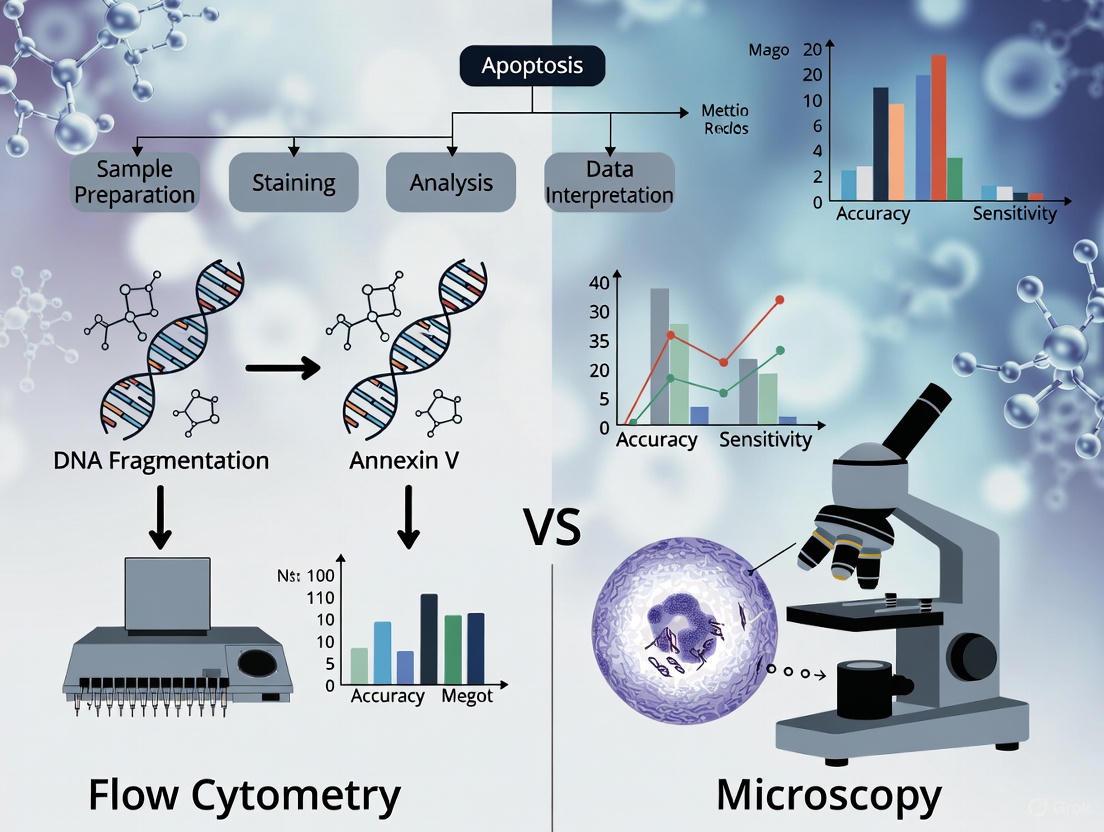
This article provides a comprehensive comparison of flow cytometry and microscopy for quantifying apoptosis, tailored for researchers, scientists, and drug development professionals.
Flow Cytometry vs. Microscopy for Apoptosis Quantification: A Guide to Accuracy, Applications, and Best Practices
Abstract
This article provides a comprehensive comparison of flow cytometry and microscopy for quantifying apoptosis, tailored for researchers, scientists, and drug development professionals. It explores the foundational principles of apoptotic hallmarks, details methodological protocols and applications for each technique, offers troubleshooting and optimization strategies, and presents validation data from comparative studies. The goal is to equip readers with the knowledge to select the most accurate and efficient method for their specific research context, from basic science to preclinical drug evaluation.
Understanding Apoptosis: Hallmarks and Detection Principles
Apoptosis, or programmed cell death, is a genetically regulated process essential for embryonic development, tissue homeostasis, and immune function. It is characterized by a series of distinct morphological and biochemical changes that distinguish it from other forms of cell death, such as necrosis. Accurate detection and quantification of apoptosis are critical in biomedical research, particularly in drug development and toxicology studies. This guide compares the performance of two primary technologies used for apoptosis quantification—flow cytometry and fluorescence microscopy—within the broader context of methodological research, providing experimental data and protocols to inform analytical decisions.
Hallmarks of Apoptosis
The accurate identification of apoptosis relies on recognizing its unique cellular events.
Morphological Hallmarks
Apoptotic cells undergo characteristic structural changes [1]. The cell shrinks and condenses, with the chromatin condensing and marginating against the nuclear envelope. The cell membrane forms bulges known as blebs, and the cell fragments into membrane-bound apoptotic bodies, which are rapidly phagocytosed by neighboring cells without triggering inflammation [1] [2].
Biochemical Hallmarks
Several key biochemical events occur during apoptosis. Phosphatidylserine (PS), a phospholipid normally located on the inner leaflet of the plasma membrane, is translocated to the outer leaflet, serving as an "eat-me" signal for phagocytes [3]. Caspase Activation is a cornerstone; a cascade of cysteine proteases is activated, leading to the selective cleavage of vital cellular substrates [1]. This includes the activation of DNases, which cause internucleosomal DNA fragmentation, resulting in a characteristic "ladder" pattern during gel electrophoresis [1]. Mitochondrial Outer Membrane Permeabilization (MOMP) is regulated by the Bcl-2 family of proteins. MOMP leads to the release of pro-apoptotic factors like cytochrome c from the mitochondrial intermembrane space into the cytosol, which triggers caspase activation and commits the cell to die [4] [2].
Diagram of the key morphological and biochemical hallmarks of apoptosis, illustrating the pathways from initial stimulus to phagocytosis.
Technology Comparison: Flow Cytometry vs. Fluorescence Microscopy
The choice between flow cytometry (FCM) and fluorescence microscopy (FM) significantly impacts the sensitivity, depth, and throughput of apoptosis analysis.
Performance Comparison in Cytotoxicity Assessment
A 2025 comparative study on bioactive glass cytotoxicity provides robust experimental data, directly comparing FCM and FM under identical conditions using SAOS-2 osteoblast-like cells [5] [6].
Table 1: Cell Viability Assessment by Flow Cytometry vs. Fluorescence Microscopy
| Experimental Condition | Time Point | Viability by Fluorescence Microscopy (FDA/PI) | Viability by Flow Cytometry (Multiparametric) |
|---|---|---|---|
| Control Cells | 3 h & 72 h | > 97% | > 97% |
| < 38 µm BG, 100 mg/mL | 3 h | 9% | 0.2% |
| < 38 µm BG, 100 mg/mL | 72 h | 10% | 0.7% |
BG = Bioglass 45S5 [5] [7] [6].
The data shows a strong correlation between the two techniques (r = 0.94), but FCM consistently reported lower viability under high cytotoxic stress, indicating superior sensitivity in detecting dead and dying cells [5] [6].
Capability and Throughput Analysis
Beyond simple viability, the technologies differ in their analytical capabilities.
Table 2: Capability Comparison of Flow Cytometry and Fluorescence Microscopy
| Feature | Flow Cytometry | Fluorescence Microscopy |
|---|---|---|
| Analysis Type | Quantitative, single-cell statistics | Semi-quantitative, morphological imaging |
| Cell Throughput | High (thousands of cells/second) | Low (limited fields of view) |
| Viability Staining | Multiparametric (e.g., Hoechst, DiIC1, Annexin V, PI) [5] | Typically binary (e.g., FDA/PI) [5] |
| Apoptosis Resolution | Distinguishes viable, early/late apoptotic, and necrotic cells [5] [8] | Primarily distinguishes viable vs. non-viable; limited apoptosis/necrosis differentiation [5] |
| Key Advantage | High-resolution, multi-parameter data on cell subpopulations | Direct visualization of cell morphology and spatial context |
| Key Limitation | Requires single-cell suspension; no morphological context | Susceptible to sampling bias, autofluorescence, and lower precision [5] |
Flow cytometry's multiparametric nature allows for a more nuanced dissection of cell death. By using Annexin V (which binds to externalized phosphatidylserine) in combination with a viability dye like propidium iodide (PI), FCM can distinguish healthy cells (Annexin V-/PI-), early apoptotic cells (Annexin V+/PI-), late apoptotic cells (Annexin V+/PI+), and necrotic cells (Annexin V-/PI+) [8]. FM with simple live/dead stains lacks this resolution [5].
Experimental Protocols for Apoptosis Detection
Standardized protocols are essential for generating reliable and comparable data.
Flow Cytometry Protocol for Apoptosis and Viability
This protocol outlines a method for simultaneously assessing apoptosis and membrane integrity [8].
- Cell Preparation and Staining: Harvest and wash cells. Resuspend approximately 1x10^6 cells in a binding buffer. Add fluorescently labeled Annexin V (e.g., Annexin V-FITC) and a viability dye such as Propidium Iodide (PI) or 7-AAD [8].
- Incubation: Vortex the cells gently and incubate for 15 minutes at room temperature (20-25°C) in the dark [8].
- Analysis: Within 1 hour, analyze the samples using a flow cytometer. Configure the instrument to detect the specific fluorescence of Annexin V and PI. Use unstained and single-stained controls to set up compensation and define the quadrants for data analysis [8].
- Data Interpretation:
- Viable Cells: Annexin V-negative, PI-negative.
- Early Apoptotic Cells: Annexin V-positive, PI-negative (intact membrane).
- Late Apoptotic/Necrotic Cells: Annexin V-positive, PI-positive (compromised membrane).
Fluorescence Microscopy Protocol with ApoNecV Macro
This protocol uses the APOAC detection kit and automated image analysis for quantifying cell death types [3].
- Cell Culture and Staining: Seed cells (e.g., HeLa) on a cover glass-bottom plate. After treatment, incubate cells with both Annexin-Cy3.18 (AnnCy3) and 6-Carboxyfluorescein diacetate (6-CFDA) probes for 15 minutes at room temperature, protected from light [3].
- Image Acquisition: Image cells immediately in PBS using a fluorescent microscope with appropriate filters: 488 nm laser for 6-CF (green, emission ~520 nm) and 561 nm laser for AnnCy3 (red, emission ~570 nm). A 10x objective is recommended for use with the ApoNecV macro. Acquire multiple images per sample for statistical robustness [3].
- Automated Image Analysis:
- Open the image stack (green, red, and transmitted light channels) in the Fiji platform.
- Run the ApoNecV macro, which automates background subtraction and deconvolution.
- The macro classifies cells based on fluorescence [3]:
- Viable Cells: Green fluorescence only (6-CF).
- Apoptotic Cells: Both red (AnnCy3) and green (6-CF) fluorescence.
- Necrotic Cells: Red fluorescence only (AnnCy3).
Diagram of the flow cytometry experimental workflow for apoptosis detection, from cell staining to data analysis.
Research Reagent Solutions
The selection of reagents is fundamental to the success of any apoptosis assay.
Table 3: Key Reagents for Apoptosis Detection
| Reagent | Function/Application | Detection Method |
|---|---|---|
| Annexin V (e.g., FITC conjugate) | Binds to phosphatidylserine (PS) exposed on the outer leaflet of the cell membrane, a marker for early apoptosis [3]. | Flow Cytometry, Fluorescence Microscopy |
| Propidium Iodide (PI) | A membrane-impermeant DNA dye that stains nuclei in cells with compromised plasma membranes (late apoptotic/necrotic cells) [8]. | Flow Cytometry |
| 6-CFDA | A cell-permeant esterase substrate. Converted to green-fluorescent 6-CF in viable cells, indicating intracellular esterase activity and membrane integrity [3]. | Fluorescence Microscopy |
| Hoechst Stains | Cell-permeant DNA dyes that stain all nuclei, useful for identifying and counting cells [5]. | Flow Cytometry, Fluorescence Microscopy |
| Annexin V-Cy3.18 (AnnCy3) | A variant of Annexin V with a Cy3 label, used to detect PS exposure [3]. | Fluorescence Microscopy (APOAC Kit) |
| Caspase Inhibitors/Assays | Used to investigate caspase involvement (e.g., zVAD-fmk) or to measure caspase activity directly [2]. | Various |
The experimental data and comparative analysis lead to clear conclusions for researchers.
Flow cytometry demonstrates superior performance for quantitative, high-throughput apoptosis analysis. Its higher sensitivity, as shown by the significantly lower viability readings under cytotoxic conditions, and its ability to provide multiparametric data on large cell populations make it the more robust tool for generating statistical data on cell death subpopulations [5] [6] [8]. This is invaluable in contexts like drug screening and biomarker analysis in clinical trials [9].
Fluorescence microscopy remains a powerful tool for morphological confirmation and spatial analysis. It allows researchers to visually confirm hallmark features like membrane blebbing and cell shrinkage, providing context that flow cytometry cannot [10]. The development of automated analysis tools like the ApoNecV macro enhances its quantitative potential, making it a good option for labs without access to flow cytometers or for experiments where visual validation is paramount [3].
In conclusion, the choice between flow cytometry and fluorescence microscopy is not a matter of which is universally better, but which is more appropriate for the specific research question. For detailed, quantitative dissection of apoptotic pathways and high-throughput screening, flow cytometry is the definitive choice. For morphological validation and spatial context, fluorescence microscopy is indispensable. A combined approach, using microscopy for initial observation and flow cytometry for deep quantitative analysis, often provides the most comprehensive understanding of cellular responses in apoptosis research.
The term apoptosis, coined by Kerr, Wyllie, and Currie in 1972, was established based solely on distinct morphological characteristics observed under the electron microscope [11] [12]. Unlike other forms of cell death, apoptosis is a finely orchestrated process involving specific structural changes. While modern biochemistry and flow cytometry offer high-throughput quantification, the unique ultrastructural insight provided by electron microscopy (EM) maintains its status as the incontrovertible "gold standard" for confirming apoptotic cell death, especially in complex or novel research scenarios [11] [12]. This guide objectively compares the capabilities of electron microscopy against other prevalent techniques within the context of apoptosis research.
The Ultramorphological Hallmarks of Apoptosis
Electron microscopy excels by revealing key subcellular events that are otherwise inaccessible. Transmission Electron Microscopy (TEM) provides high-resolution images of a cell's interior, while Scanning Electron Microscopy (SEM) offers detailed three-dimensional topographical analysis of the cell surface [11] [12].
The definitive ultrastructural markers of apoptosis identifiable via EM are summarized in the table below.
Table 1: Key Morphological Markers of Apoptosis Identifiable by Electron Microscopy
| Morphological Feature | Description | Significance |
|---|---|---|
| Cell Shrinkage & Rounding | Reduction in cell volume and detachment from neighboring cells or extracellular matrix [12]. | One of the most ubiquitous early characteristics of apoptosis [12]. |
| Chromatin Condensation | Aggregation of nuclear chromatin into dense, compact masses, often against the nuclear membrane in a crescent shape [11] [12]. | A hallmark nuclear event; distinguishes apoptosis from necrosis [11]. |
| Nuclear Fragmentation (Karyorrhexis) | The shrunken nucleus breaks into several discrete, membrane-bound fragments [11] [12]. | Represents an advanced stage of nuclear disintegration. |
| Formation of Apoptotic Bodies | The cell disassembles into sealed, membrane-enclosed vesicles containing cytoplasm, compacted organelles, and nuclear fragments [13] [12]. | The most definitive hallmark of apoptosis, crucial for clean cell disposal [13]. |
| Plasma Membrane Blebbing | Formation of dynamic, surface protrusions resulting from actomyosin-driven contraction and cytoskeletal reorganization [14] [12]. | An early and dynamic process that precedes the pinching-off of apoptotic bodies. |
| Intact Organelles | Cytoplasmic organelles, including mitochondria, generally maintain their structural integrity until late in the process [11]. | Distinguishes apoptosis from necrosis, where organelle swelling is prevalent. |
Comparative Analysis of Apoptosis Identification Techniques
No single technique provides a complete picture. The choice of method depends on the research question, whether it is the unequivocal morphological confirmation of death type, high-throughput quantification, or the assessment of biochemical activity. The following table offers a direct comparison of the primary techniques used in apoptosis identification.
Table 2: Comparison of Techniques for Apoptosis Identification
| Technique | Key Principle | Key Advantages | Key Limitations | Best Suited For |
|---|---|---|---|---|
| Electron Microscopy | High-resolution imaging of ultrastructural morphology [11] [12]. | Unmatched resolution; "gold standard" for definitive classification; reveals entire apoptotic morphology [11] [12]. | Low-throughput, expensive, requires specialized expertise; cannot analyze large cell numbers [11]. | Definitive confirmation of apoptosis; novel cell death studies; resolving ambiguous cases. |
| Flow Cytometry | Multiparametric fluorescence analysis of single cells in suspension [15] [16]. | High-throughput, quantitative, multi-parameter analysis (e.g., viability, apoptosis, cell cycle) [6] [16]. | Lacks visual confirmation of morphology; requires single-cell suspensions [6]. | Rapid quantification of apoptotic populations and simultaneous analysis of other cellular parameters. |
| Fluorescence Microscopy | Visualization of fluorescent probes in cells/tissues [6] [12]. | Visual confirmation of localization; accessible; can be used on adherent cells [6]. | Lower resolution; semi-quantitative; prone to observer bias; limited field of view [6] [17]. | Initial screening and spatial context of cell death in cultured cells or tissues. |
Recent research underscores the value of a multi-technique approach. A 2025 study comparing flow cytometry (FCM) and fluorescence microscopy (FM) for assessing biomaterial cytotoxicity found a strong correlation between the two methods (r=0.94) but highlighted FCM's superior precision and ability to distinguish early and late apoptosis from necrosis, particularly under high cytotoxic stress [6] [17]. However, neither FCM nor FM can visualize the critical morphological features, such as the precise state of chromatin condensation or organelle integrity, that EM provides [11]. EM remains the reference for validating observations made by these other methods.
Detailed Experimental Protocols
Protocol 1: Transmission Electron Microscopy (TEM) for Apoptosis Assessment
This protocol outlines the standard process for preparing and observing apoptotic cells via TEM, essential for revealing intracellular ultrastructure [11] [12] [18].
- Fixation: Primary fixation is performed using 2.5% glutaraldehyde and 2% paraformaldehyde in a 0.1 M sodium cacodylate buffer (pH 7.4) for several hours at 4°C. This crosslinks and preserves cellular structures.
- Post-fixation: Samples are treated with 1% osmium tetroxide for 1 hour, which stabilizes lipids and provides electron density.
- Dehydration: Water is removed through a graded series of ethanol washes (e.g., 30%, 50%, 70%, 90%, 100%).
- Embedding: Infiltrate and embed the sample in a resin, such as Spurr's or Epon, and polymerize at 60-70°C overnight [18].
- Sectioning: An ultramicrotome with a diamond knife is used to cut ultra-thin sections (typically 60-90 nm thick).
- Staining: Sections are stained with heavy metals like uranyl acetate and lead citrate to enhance contrast.
- Imaging: Observe sections under a transmission electron microscope operating at 80-120 kV, focusing on identifying the morphological hallmarks listed in Table 1.
Protocol 2: Multiparametric Flow Cytometry for Apoptosis Quantification
This protocol, representative of modern high-throughput approaches, allows for the simultaneous assessment of viability, apoptosis, and mitochondrial health in a single sample [15] [16].
- Cell Staining:
- Annexin V / Propidium Iodide (PI): Resuspend ~0.5 million cells in a binding buffer containing fluorescently conjugated Annexin V (e.g., FITC) and PI. Annexin V binds to phosphatidylserine exposed on the outer leaflet of the plasma membrane in apoptotic cells, while PI enters only upon loss of membrane integrity, marking late-stage apoptotic or necrotic cells [16].
- JC-1 for Mitochondrial Potential: Use the JC-1 dye to assess mitochondrial membrane potential. In healthy mitochondria, JC-1 forms red fluorescent aggregates; in depolarized mitochondria, it remains in a green fluorescent monomeric form. A shift from red to green indicates mitochondrial depolarization, an early event in intrinsic apoptosis [16].
- BrdU / PI for Cell Cycle: To link apoptosis with proliferation, cells can be pulsed with BrdU, which is incorporated during DNA synthesis (S-phase). Cells are then fixed, permeabilized, and stained with an anti-BrdU antibody and PI. PI intensity indicates DNA content, allowing for cell cycle staging [16].
- Data Acquisition: Analyze the stained cell suspension on a flow cytometer, collecting data from at least 10,000 events per sample.
- Data Analysis: Use software to gate on the cell population of interest and create 2D dot plots (e.g., Annexin V vs. PI) to distinguish viable (Annexin V-/PI-), early apoptotic (Annexin V+/PI-), late apoptotic (Annexin V+/PI+), and necrotic (Annexin V-/PI+) populations [16].
Visualizing Apoptosis: Pathways and Workflows
Diagram 1: Key Apoptosis Pathways & Detection Methods. This diagram illustrates the major signaling pathways in apoptosis and highlights the stages where flow cytometry (blue) and electron microscopy (green) provide key detection capabilities.
Diagram 2: Standard Workflow for TEM Sample Processing. The workflow for preparing biological samples for TEM analysis is a multi-step process that preserves ultrastructural morphology for definitive identification of apoptotic features.
Research Reagent Solutions for Apoptosis Studies
A successful apoptosis assay relies on specific reagents tailored to the chosen technique.
Table 3: Essential Research Reagents for Apoptosis Detection
| Reagent / Assay | Function / Target | Primary Application |
|---|---|---|
| Glutaraldehyde / Formaldehyde | Cross-linking fixative that preserves ultrastructural morphology for EM [12] [18]. | Electron Microscopy |
| Osmium Tetroxide | Post-fixative that stabilizes lipids and provides electron scattering for EM contrast [18]. | Electron Microscopy |
| Uranyl Acetate / Lead Citrate | Heavy metal stains that bind to cellular components (e.g., nucleic acids, membranes) to enhance contrast in EM [18]. | Electron Microscopy |
| Annexin V (e.g., FITC conjugate) | Binds to externalized phosphatidylserine (PS) on the outer membrane of apoptotic cells [15] [16]. | Flow Cytometry, Fluorescence Microscopy |
| Propidium Iodide (PI) | DNA intercalating dye that is impermeant to live cells; marks cells with compromised membranes (late apoptosis/necrosis) [15] [16]. | Flow Cytometry, Fluorescence Microscopy |
| JC-1 Dye | Fluorescent potentiometric dye used to measure mitochondrial membrane depolarization, an early apoptotic event [16]. | Flow Cytometry |
| Hoechst 33342 / DAPI | Cell-permeable DNA dyes used to visualize nuclear morphology, including condensation and fragmentation [12]. | Fluorescence Microscopy |
| BrdU (Bromodeoxyuridine) | Thymidine analog incorporated during DNA synthesis; used with an antibody to identify proliferating cells (S-phase) [16]. | Flow Cytometry |
Electron microscopy remains the definitive tool for the identification of apoptosis, providing the irreplaceable ultrastructural context upon which the phenomenon was originally defined. Its role is not obsolete but rather specialized, serving as the final arbiter in characterizing novel cell death modalities or validating observations from other methods. Flow cytometry offers unparalleled power for rapid, quantitative, and multiparametric analysis of cell populations, while fluorescence microscopy provides valuable spatial and localization data. The most robust experimental designs in modern cell death research strategically integrate these techniques, leveraging the high-throughput quantification of flow cytometry and the unequivocal morphological confirmation of electron microscopy to build a comprehensive and irrefutable body of evidence.
Core Principles of Flow Cytometry for Multiparametric Single-Cell Analysis
Flow cytometry has emerged as a cornerstone technology in biomedical research and drug development by enabling high-throughput, multiparameter analysis of individual cells within heterogeneous populations. Unlike bulk measurement techniques that provide population averages, flow cytometry offers single-cell resolution, allowing researchers to identify rare cell subpopulations and analyze complex cellular processes such as apoptosis with exceptional precision. This capability has proven particularly valuable in contexts where cellular heterogeneity significantly influences biological outcomes, such as in cancer research and immunology [19].
The fundamental principle of flow cytometry involves the hydrodynamic focusing of cells into a single-file stream, which then passes through precisely aligned laser beams. As each cell intersects the laser light, it scatters light and may emit fluorescence from specific probes or antibodies. These signals are captured by specialized detectors: forward scatter (FSC) correlates with cell size, side scatter (SSC) indicates cellular granularity and internal complexity, and multiple fluorescence detectors capture emitted light from various fluorophores [5] [20]. This process enables the simultaneous measurement of multiple parameters for each individual cell at astonishing speeds of up to 70,000 events per second [16].
When compared to fluorescence microscopy, another established method for cellular analysis, flow cytometry demonstrates distinct advantages and limitations. While microscopy provides spatial context and enables subcellular localization studies through imaging, flow cytometry offers superior statistical power through the rapid analysis of thousands to millions of cells, thereby reducing sampling bias [5] [16]. This comparative performance is especially evident in apoptosis detection, where flow cytometry's capacity for multiparametric analysis enables precise discrimination between viable, apoptotic, and necrotic cell populations within complex samples [5] [16].
Core Technical Principles of Multiparametric Flow Cytometry
Instrumentation and Light Detection
The modern flow cytometer integrates several sophisticated subsystems to achieve multiparametric single-cell analysis. The core components include:
Fluidics System: Utilizes hydrodynamic focusing to create a narrow, coaxial stream that guides cells single-file through the interrogation point. The sample stream is surrounded by a faster-moving sheath fluid, which constrains the cells to the center of the flow stream and ensures consistent illumination [19].
Optics and Lasers: Multiple lasers emitting at different wavelengths (e.g., 405nm violet, 488nm blue, 633nm red) provide the excitation sources for various fluorophores. The trend toward polychromatic flow cytometry (simultaneous detection of ≥5 colors) has been enabled by instruments equipped with an increasing number of lasers and detectors [19].
Detection System: Photomultiplier tubes (PMTs) and photodiodes capture light signals from each cell. Forward-scattered light is detected by a photodiode in the forward direction, while side-scattered light and fluorescence emissions are collected by PMTs positioned orthogonally to the laser path. Advanced optical filters, including dichroic mirrors and bandpass filters, direct specific wavelength ranges to designated detectors [20] [19].
The development of new fluorochromes, particularly Brilliant Violet dyes and quantum dots, has significantly expanded the multiparameter capabilities of flow cytometry by increasing the number of spectrally distinct probes that can be simultaneously detected [19].
Signal Processing and Data Acquisition
As cells pass through the laser intercept, the resulting light signals are converted into electronic pulses. The pulse height, width, and area for each parameter are digitized and stored for subsequent analysis. This digital data acquisition enables sophisticated gating strategies and population analysis based on multiple parameters simultaneously [19].
Modern flow cytometers can measure up to 20-30 parameters per cell, including 2 light scatter parameters and multiple fluorescence emissions. The data is typically displayed in one-dimensional histograms, two-dimensional dot plots, or more complex multidimensional representations that require advanced computational tools for comprehensive analysis [19].
Flow Cytometry Versus Fluorescence Microscopy: A Direct Comparison in Apoptosis Detection
Methodological Approaches and Technical Capabilities
The comparative performance of flow cytometry and fluorescence microscopy for apoptosis quantification was directly evaluated in a study investigating the cytotoxicity of Bioglass 45S5 on SAOS-2 osteoblast-like cells. Both techniques were applied under identical experimental conditions to assess cell viability across different particle sizes and concentrations [5].
Table 1: Comparison of Flow Cytometry and Fluorescence Microscopy for Apoptosis Assessment
| Parameter | Flow Cytometry | Fluorescence Microscopy |
|---|---|---|
| Viability Stains | Multiparametric staining (Hoechst, DiIC1, Annexin V-FITC, PI) | FDA/PI staining |
| Cell Population Classification | Viable, apoptotic, necrotic | Viable, nonviable |
| Throughput | High (thousands to millions of cells) | Low (limited fields of view) |
| Temporal Resolution | Moderate [21] | High for live-cell imaging [22] |
| Sampling Bias | Low (analyzes entire population) | Potential (manual field selection) |
| Spatial Information | No | Yes (subcellular localization) |
| Data Output | Quantitative percentages | Semi-quantitative with imaging |
| Handling of Particulate Systems | Minimal interference [5] | Autofluorescence interference [5] |
The experimental protocols for apoptosis detection in the comparative study included:
Flow Cytometry Protocol:
- Cells were treated with Bioglass particles of varying sizes (<38 µm, 63-125 µm, 315-500 µm) at concentrations of 25, 50, and 100 mg/mL for 3 and 72 hours
- Cells were stained with a multiparametric panel including Hoechst (DNA content), DiIC1 (mitochondrial membrane potential), Annexin V-FITC (phosphatidylserine exposure), and PI (membrane integrity)
- Samples were analyzed using a flow cytometer with appropriate laser configurations and filter sets
- Data from thousands of cells per condition were collected and analyzed using population gating strategies [5]
Fluorescence Microscopy Protocol:
- Parallel cell treatments under identical conditions to flow cytometry samples
- Cells were stained with FDA (fluorescein diacetate, for viable cells) and PI (propidium iodide, for dead cells)
- Multiple random fields were imaged using fluorescence microscopy
- Cells were manually or semi-automatically counted based on fluorescence signals [5]
Quantitative Performance Comparison
The direct comparison revealed significant differences in the sensitivity and detection capabilities of the two techniques. For the most cytotoxic condition (<38 µm particles at 100 mg/mL), flow cytometry measured viability at 0.2% at 3 hours and 0.7% at 72 hours, while fluorescence microscopy reported 9% and 10% viability at the same timepoints, respectively [5]. Controls maintained >97% viability by both methods, confirming the size-dependent cytotoxicity pattern [5].
Table 2: Quantitative Viability Assessment Comparison Between Flow Cytometry and Fluorescence Microscopy [5]
| Particle Size | Concentration (mg/mL) | Time Point | Viability by Flow Cytometry (%) | Viability by Fluorescence Microscopy (%) |
|---|---|---|---|---|
| <38 µm | 100 | 3 h | 0.2 | 9 |
| <38 µm | 100 | 72 h | 0.7 | 10 |
| 63-125 µm | 100 | 3 h | 58.1 | 63 |
| 315-500 µm | 100 | 3 h | 84.9 | 83 |
| Control | N/A | 3 h | >97 | >97 |
Despite the absolute differences in viability measurements, the study found a strong correlation between the datasets generated by both techniques (r = 0.94, R² = 0.8879, p < 0.0001) [5]. This correlation suggests that while the absolute values may differ, both methods consistently capture the same biological trends and relative differences between experimental conditions.
A key advantage demonstrated by flow cytometry was its ability to discriminate between early and late apoptotic stages through multiparametric staining, providing more detailed mechanistic insights into the cell death process compared to the simple live/dead classification offered by basic fluorescence microscopy approaches [5].
Essential Workflow and Best Practices for Multiparametric Flow Cytometry
Experimental Design and Panel Configuration
Successful multiparametric flow cytometry requires meticulous experimental design and panel configuration. The following workflow outlines the critical steps:
Panel Design Principles:
- Fluorophore Selection: Pair bright fluorophores (e.g., PE, APC) with low-abundance antigens, and dimmer fluorophores (e.g., FITC) with highly expressed targets to optimize signal detection [20]
- Spectral Overlap Minimization: Choose fluorophores with minimal spectral overlap to reduce spillover and compensation complexity [20]
- Antibody Titration: Perform serial dilutions of antibodies to determine the separating concentration that provides optimal signal-to-noise ratio while conserving reagents [20]
- Voltage Optimization: Conduct voltage walks using dimly fluorescent beads to establish the minimum voltage requirement (MVR) for each detector, ensuring optimal resolution without signal saturation [20]
Critical Experimental Controls
Appropriate controls are essential for generating reliable, interpretable flow cytometry data:
- Viability Staining: Incorporation of viability dyes (e.g., propidium iodide, LIVE/DEAD Fixable stains) enables exclusion of dead cells that nonspecifically bind antibodies [20] [16]
- Fluorescence Minus One (FMO) Controls: Samples containing all fluorophores except one help establish gating boundaries for multicolor panels, particularly for dim populations or continuously expressed markers [20]
- Compensation Controls: Single-stained samples are essential for calculating spectral spillover between channels and ensuring accurate fluorescence quantification [20]
- Unstained Controls: Cells without any fluorescent staining establish baseline autofluorescence levels [20]
The Scientist's Toolkit: Essential Reagents and Materials
Table 3: Key Research Reagent Solutions for Multiparametric Apoptosis Analysis
| Reagent Category | Specific Examples | Function and Application |
|---|---|---|
| Viability Probes | Propidium Iodide (PI), LIVE/DEAD Fixable Stains | Distinguish live/dead cells based on membrane integrity; exclude dead cells from analysis [5] [16] |
| Apoptosis Markers | Annexin V-FITC, Hoechst 33342, Caspase substrates | Detect phosphatidylserine exposure, DNA fragmentation, and caspase activation [5] [22] |
| Mitochondrial Probes | DiIC1, JC-1, MitoTracker Deep Red | Assess mitochondrial membrane potential and mass; early apoptosis indicator [5] [16] |
| Proliferation Trackers | CellTrace Violet, BrdU | Monitor cell division and proliferation capacity [16] |
| Cell Cycle Stains | Propidium Iodide, DAPI | Quantify DNA content and identify cell cycle phases [16] [19] |
| Antibody Conjugates | Fluorophore-labeled specific antibodies (CD markers, intracellular targets) | Identify cell phenotypes and functional states through surface and intracellular staining [19] |
Advanced Applications in Apoptosis Research
Comprehensive Multiparametric Assessment of Cell Death
Advanced flow cytometry panels enable simultaneous assessment of multiple cell death parameters within single samples. A recently developed protocol integrates BrdU/PI staining for cell cycle analysis, JC-1 for mitochondrial membrane potential, and Annexin V/PI for apoptosis detection, allowing researchers to obtain up to eight different parameters from one sample [16].
This comprehensive approach reveals interconnections between different cellular processes. For example, mitochondrial depolarization often precedes phosphatidylserine externalization in apoptosis, while cell cycle arrest in specific phases may increase susceptibility to death stimuli [16]. The ability to measure these parameters simultaneously provides a systems-level understanding of cellular responses to experimental treatments.
Comparison with Emerging Technologies
While flow cytometry remains the gold standard for high-throughput single-cell analysis, emerging technologies offer complementary capabilities:
Digital Holographic Microscopy (DHM): A label-free technique that quantifies phase shifts in transmitted light to visualize transparent cells and generate topographic information. When combined with deep learning algorithms, DHM can discriminate between apoptosis, necroptosis, and viable cells with >85% precision [23]
Ultrasensitive Confocal Fluorescence Microscopy (UCFM): Provides high temporal resolution and the ability to perform repetitive single-cell analysis, making it suitable for tracking rapid subcellular events such as mitochondrial membrane potential changes in early apoptosis [21]
Integrated Approaches: Future directions point toward combining multiple technologies, such as using flow cytometry for high-throughput screening followed by microscopy for detailed spatial analysis of interesting subpopulations [5] [23]
Flow cytometry establishes its position as an indispensable tool for multiparametric single-cell analysis, particularly in apoptosis research where its high-throughput capabilities, statistical power, and multiparametric discrimination provide significant advantages over fluorescence microscopy. The direct comparative studies demonstrate flow cytometry's superior sensitivity in detecting subtle population changes and its ability to differentiate between apoptosis stages through advanced staining panels.
Future developments in flow cytometry continue to expand its applications in cell death research. Emerging trends include:
- Increased parameter capacity with new fluorophore technologies
- Enhanced integration with molecular biology techniques like single-cell RNA sequencing
- Development of automated analysis pipelines using machine learning algorithms
- Standardized panels and protocols for multisite studies [19]
These advancements will further solidify flow cytometry's role as a cornerstone technology in fundamental biological research and drug development, providing unprecedented insights into cellular heterogeneity and death mechanisms at single-cell resolution.
Core Principles of Fluorescence Microscopy for Morphological Assessment
Fluorescence microscopy (FM) stands as a cornerstone technique in biological research, enabling the visualization of specific structures and processes within cells and tissues with high contrast and molecular specificity. This guide details the core principles of fluorescence microscopy, with a specific focus on its application in morphological assessment. We objectively compare its performance and capabilities for cell viability and apoptosis quantification against flow cytometry (FCM), presenting supporting experimental data to highlight the respective strengths and limitations of each method within the context of preclinical biomaterial research.
Fundamental Principles of Fluorescence and Microscope Operation
The functionality of fluorescence microscopy is rooted in the physical phenomenon of fluorescence. This process begins when a fluorescent molecule, or fluorophore, absorbs high-energy light at a specific wavelength (excitation). This energy promotion causes the fluorophore to enter an excited state. As it returns to its ground state, the fluorophore emits lower-energy light at a longer wavelength (emission) [24] [25] [26]. The difference between the peak excitation and emission wavelengths is known as the Stokes shift, a critical property that allows the emitted signal to be distinguished from the excitation light [24].
In a standard epifluorescence microscope, the pathway of light is managed by several key components housed within a filter cube. The process is as follows [24]:
- Excitation Filter: Light from a powerful source (e.g., LED, laser) passes through an excitation filter, which permits only the specific wavelengths needed to excite the fluorophore.
- Dichroic Mirror: This precise mirror, positioned at a 45-degree angle, reflects the shortened-wavelength excitation light down through the objective lens and onto the specimen.
- Emission Filter: The longer-wavelength emitted light from the fluorophore is collected by the objective lens. It passes through the dichroic mirror and an emission filter (or barrier filter), which blocks any stray excitation light, ensuring only the fluorescence signal reaches the detector [24] [26].
This orchestrated separation of light allows for the high-contrast imaging of labeled structures within a specimen. The following diagram illustrates this core imaging pathway.
Fluorescence Microscopy vs. Flow Cytometry: A Technical Comparison for Cell Analysis
While both fluorescence microscopy (FM) and flow cytometry (FCM) leverage fluorescence for cell analysis, their methodologies and primary outputs differ significantly. FM provides spatial context and morphological information through imaging, whereas FCM offers high-throughput, quantitative multiparametric data on individual cells in suspension [5] [16].
A recent 2025 comparative study evaluated these techniques for assessing the cytotoxicity of particulate Bioglass 45S5 (BG) on SAOS-2 osteoblast-like cells. This study highlights the practical consequences of their technical differences [5] [7] [6].
Experimental Design and Protocols
The study exposed cells to BG particles of different sizes (< 38 µm, 63-125 µm, and 315-500 µm) at concentrations of 25, 50, and 100 mg/mL for 3 and 72 hours [5].
- Fluorescence Microscopy Protocol: Cells were stained with fluorescein diacetate (FDA) and propidium iodide (PI). Viable cells metabolize FDA to a green-fluorescent product, while PI only enters dead cells with compromised membranes, binding to DNA and emitting red fluorescence. Viability was determined by counting cells in multiple imaging fields [5] [7].
- Flow Cytometry Protocol: Used a multiparametric staining panel including Hoechst (nuclei), DiIC1 (membrane potential), Annexin V-FITC (apoptosis marker), and PI (cell death marker). This allowed FCM to classify cells into viable, early apoptotic, late apoptotic, and necrotic populations based on simultaneous measurement of multiple parameters [5] [16].
The workflow below summarizes the parallel experimental processes for the two techniques.
Key Findings and Quantitative Data Comparison
Both techniques confirmed that smaller particles and higher concentrations of BG caused greater cytotoxicity. However, the quantitative results and depth of information differed markedly [5] [7].
Table 1: Comparative Viability Assessment of SAOS-2 Cells Treated with < 38 µm Bioglass 45S5 Particles
| Technique | Concentration | Viability at 3 h | Viability at 72 h | Key Observations |
|---|---|---|---|---|
| Fluorescence Microscopy (FM) | 100 mg/mL | 9% | 10% | Identifies general live/dead status; susceptible to sampling bias from limited fields of view. |
| Flow Cytometry (FCM) | 100 mg/mL | 0.2% | 0.7% | Higher sensitivity; analyzes >10,000 cells/sample, providing superior statistical precision. |
Table 2: Performance Characteristics for Cell Death Analysis
| Feature | Fluorescence Microscopy (FM) | Flow Cytometry (FCM) |
|---|---|---|
| Primary Output | High-contrast images, morphological context [5] | Quantitative, multiparametric data on single cells [5] [16] |
| Throughput | Low (100s-1000s of cells from selected fields) [5] | High (10,000+ cells per sample automatically) [16] |
| Viability Discrimination | Dichotomous (Live/Dead) via FDA/PI [5] | Multiplexed (Viable, Early/Late Apoptotic, Necrotic) [5] [16] |
| Statistical Precision | Lower, prone to sampling bias [5] | Superior, high-resolution quantification [5] [7] |
| Spatial Information | Yes, enables subcellular localization [26] | No, cells are in suspension |
| Data Correlation | Strong correlation with FCM (r = 0.94) [5] | Strong correlation with FM (r = 0.94) [5] |
The study reported a strong overall correlation between the viability data obtained by both techniques (r = 0.94, R² = 0.8879, p < 0.0001), validating FM as a reliable screening tool. However, FCM demonstrated superior precision, particularly under high cytotoxic stress, and its ability to distinguish early apoptosis from necrosis provides a more nuanced understanding of cell death mechanisms [5] [7].
Essential Reagents and Research Solutions
The following table details key reagents used in the featured experiments and their functions in fluorescence-based cell assessment.
Table 3: Research Reagent Solutions for Fluorescence-Based Cell Viability and Apoptosis Assays
| Reagent / Dye | Function and Application | Experimental Context |
|---|---|---|
| Fluorescein Diacetate (FDA) | Viability stain; metabolized by live cells to green fluorescent product [5] | FM live/dead staining [5] |
| Propidium Iodide (PI) | Cell death stain; enters dead cells, binds nucleic acids, red fluorescence [5] [16] | FM & FCM; indicates loss of membrane integrity [5] |
| Annexin V-FITC | Binds phosphatidylserine (PS); marks early-stage apoptosis [5] [16] | FCM multiparametric panel [5] |
| Hoechst Stains | Cell-permeant DNA binding dye; labels all nuclei [5] | FCM for cell identification and counting [5] |
| DiIC1 | Lipophilic cationic dye; assesses mitochondrial membrane potential [5] | FCM multiparametric panel [5] |
| JC-1 | Mitochondrial dye; potential-dependent emission shift (red/green) [16] | FCM measurement of mitochondrial depolarization [16] |
| CellTrace Violet (CFSE) | Cell proliferation dye; diluted with each cell division [16] | FCM to track proliferation and generations [16] |
| Bromodeoxyuridine (BrdU) | Thymidine analog; incorporated into DNA during S-phase [16] | FCM cell cycle analysis (with PI) [16] |
Advanced Fluorescence Microscopy Techniques
To overcome the limitations of conventional widefield fluorescence microscopy—such as poor axial resolution and out-of-focus light—several advanced techniques have been developed [27].
- Confocal Laser Scanning Microscopy (CLSM): Uses a pinhole to physically block out-of-focus light, enabling optical sectioning and the reconstruction of high-resolution 3D images. This is ideal for visualizing the internal structures of thicker specimens [27] [26].
- Two-Photon Microscopy: Excites fluorophores using long-wavelength, near-infrared light, which penetrates deeper into tissues with less scattering and reduced phototoxicity. This makes it superior for live-cell and deep-tissue imaging [24] [27].
- Total Internal Reflection Fluorescence (TIRF) Microscopy: Creates an "evanescent field" that excites fluorophores only in a very thin layer (∼100-200 nm) adjacent to the coverslip. It provides exceptional signal-to-noise ratio for imaging processes at the cell membrane [27] [26].
- Super-Resolution Microscopy: Techniques like STED (Stimulated Emission Depletion), PALM, and STORM break the diffraction limit of light, achieving spatial resolutions down to tens of nanometers. This allows for the visualization of fine subcellular structures that are indistinguishable with conventional FM [24] [27] [26].
Fluorescence microscopy remains an indispensable tool for morphological assessment, providing unparalleled spatial context and visual validation of cellular structures. Its core principles of fluorescence excitation and emission underpin a versatile family of imaging modalities. For quantitative apoptosis and cell death analysis, the choice between FM and FCM hinges on the experimental priorities: FM is optimal for morphological insight and spatial localization, while FCM is superior for high-throughput, multiparametric quantification of cell populations. The integration of both techniques, as demonstrated in contemporary research, provides a comprehensive approach, combining visual confirmation with robust statistical data to advance our understanding of cellular responses in biomaterial science and drug development.
Apoptosis, or programmed cell death, is a fundamental process essential for maintaining cellular homeostasis, development, and eliminating damaged cells. Disruptions in apoptotic pathways contribute to numerous diseases, including cancer, neurodegenerative disorders, and autoimmune conditions. For researchers and drug development professionals, accurately quantifying apoptosis is crucial for understanding disease mechanisms and evaluating therapeutic efficacy. Two principal pathways—the intrinsic and extrinsic pathways—orchestrate apoptosis through distinct initiators and biomarkers, culminating in a common execution phase. This guide provides a detailed comparison of these pathways, their key biomarkers, and evaluates the accuracy of flow cytometry versus microscopy for apoptosis quantification in research settings.
The Intrinsic Apoptotic Pathway
The intrinsic pathway, also known as the mitochondrial pathway, is primarily activated by internal cellular stressors, including DNA damage, oxidative stress, and cytokine deprivation.
Key Biomarkers and Mechanism
- Mitochondrial Membrane Potential (MMP): A loss of MMP (ΔΨm) is an early indicator of intrinsic apoptosis activation, signifying mitochondrial permeability. This can be quantified using fluorescent dyes like JC-1 in flow cytometry [16].
- Bcl-2 Family Proteins: The balance between pro-apoptotic (e.g., Bax) and anti-apoptotic (e.g., Bcl-2) proteins regulates mitochondrial outer membrane permeabilization (MOMP). An increased Bax/Bcl-2 ratio promotes apoptosis [28] [29].
- Cytochrome c: Upon MOMP, cytochrome c is released from the mitochondrial intermembrane space into the cytoplasm [29].
- Caspase-9: Released cytochrome c binds to Apaf-1, forming the "apoptosome" complex, which activates the initiator caspase-9 [29].
- Reactive Oxygen Species (ROS): Increased intracellular ROS generation is a common stress signal that can trigger the intrinsic pathway [29].
The following diagram illustrates the sequence of the intrinsic apoptotic pathway:
The Extrinsic Apoptotic Pathway
The extrinsic pathway, or death receptor pathway, is initiated by extracellular signals binding to specific death receptors on the cell surface.
Key Biomarkers and Mechanism
- Death Receptors: Receptors such as Fas (CD95) and others belonging to the Tumor Necrosis Factor (TNF) receptor superfamily initiate signaling upon ligand binding (e.g., FasL) [29].
- Caspase-8: Ligand-bound death receptors form the Death-Inducing Signaling Complex (DISC), leading to the activation of the initiator caspase-8 [29].
- Caspase-3/7: Both intrinsic and extrinsic pathways converge on the activation of these effector caspases, which cleave cellular substrates, leading to apoptotic cell death [29].
The following diagram illustrates the sequence of the extrinsic apoptotic pathway:
Comparative Analysis of Detection Methodologies
Accurate apoptosis quantification relies on detecting the pathway-specific biomarkers. Flow cytometry and fluorescence microscopy are widely used, but offer different capabilities.
Table 1: Key Characteristics of Flow Cytometry and Fluorescence Microscopy in Apoptosis Detection
| Feature | Flow Cytometry | Fluorescence Microscopy |
|---|---|---|
| Primary Principle | Cells in suspension analyzed by laser scattering and fluorescence [5] | Visualization of fluorescently-labeled cells on a slide [5] |
| Throughput | High-throughput; can analyze >10,000 cells per second [16] | Low-throughput; limited to sampled fields of view [5] |
| Key Apoptosis Assays | Annexin V/PI, caspase activation, JC-1 (MMP), BrdU/PI (cell cycle) [16] | FDA/PI live/dead staining, DAPI/Hoechst nuclear morphology [5] [29] |
| Multiparametric Capability | Excellent; can simultaneously analyze 8+ parameters on single cells [16] | Limited by channel overlap and fluorophore compatibility [5] |
| Data Output | Quantitative, statistical population data [5] [16] | Qualitative and semi-quantitative, provides spatial context [5] |
| Key Advantage | Objective, high-resolution quantification of apoptotic stages [5] [7] | Direct imaging and morphological confirmation [5] |
| Main Limitation | Requires single-cell suspension; no spatial information [5] | Susceptible to observer bias; lower cell count analyzed [5] |
Experimental Data Comparing Accuracy and Precision
A 2025 comparative study on bioactive glass cytotoxicity provides direct experimental evidence for the performance differences between these techniques [5] [7] [6].
- Strong Correlation with Precision Differences: The study found a strong correlation between FM and FCM data (r = 0.94, R² = 0.8879, p < 0.0001), validating both for trend analysis. However, FCM demonstrated superior precision, especially under high cytotoxic stress [5] [7].
- Superior Sensitivity of Flow Cytometry: When assessing cell viability after exposure to the smallest bioactive glass particles (<38 µm) at the highest concentration (100 mg/mL), FCM detected significantly lower viability than FM. FM reported viabilities of 9% (3h) and 10% (72h), whereas FCM detected 0.2% and 0.7% viability under the same conditions, highlighting its higher sensitivity [5] [7].
- Distinction of Apoptotic Stages: A key FCM advantage is differentiating apoptotic stages. Using multiparametric staining (e.g., Hoechst, DiIC1, Annexin V-FITC, PI), FCM can classify cells as viable, early apoptotic, late apoptotic, or necrotic. FM with simple FDA/PI staining typically only distinguishes viable from non-viable cells [5] [7].
Table 2: Experimental Viability Data from Bioactive Glass Study (FM vs. FCM)
| Experimental Condition | Time | Fluorescence Microscopy (FM) Viability | Flow Cytometry (FCM) Viability |
|---|---|---|---|
| Control | 3h & 72h | >97% [5] [7] | >97% [5] [7] |
| <38 µm particles at 100 mg/mL | 3h | 9% [5] [7] | 0.2% [5] [7] |
| <38 µm particles at 100 mg/mL | 72h | 10% [5] [7] | 0.7% [5] [7] |
Detailed Experimental Protocols for Apoptosis Detection
Below are generalized protocols for detecting apoptosis via flow cytometry and fluorescence microscopy, synthesizing methods from the cited research.
Multiparametric Apoptosis Analysis by Flow Cytometry
This protocol allows for the comprehensive assessment of apoptosis, cell cycle, and mitochondrial health from a single sample [16].
Cell Preparation and Staining:
- Harvest and wash cells. For suspension cells, proceed directly. For adherent cells, use gentle enzymatic (e.g., trypsin) or non-enzymatic dissociation to create a single-cell suspension [16].
- Resuspend ~0.5 million cells in culture medium.
- Proliferation Staining: Incubate cells with CellTrace Violet dye following manufacturer's instructions to track cell division [16].
- BrdU Incorporation: Incubate cells with BrdU to label cells in S-phase of the cell cycle [16].
- Induction and Harvest: Treat cells with the apoptotic inducer for the desired time. Harvest cells and wash with PBS.
- Mitochondrial Staining: Stain cells with JC-1 dye to measure mitochondrial membrane potential (MMP). Cells with depolarized mitochondria (low MMP) will show a shift from red (J-aggregates) to green (J-monomers) fluorescence [16].
- Annexin V/Propidium Iodide (PI) Staining: Resuspend cells in Annexin V binding buffer. Add Annexin V-FITC and PI, incubate in the dark, and analyze by flow cytometry within 1 hour [16] [29].
- Fixation and Permeabilization (for BrdU): Fix and permeabilize cells using ethanol or a commercial kit. Denature DNA to expose incorporated BrdU, then stain with an anti-BrdU antibody and PI to analyze cell cycle phases (G1, S, G2) [16].
Flow Cytometry Data Acquisition and Analysis:
- Acquire data on a flow cytometer capable of detecting all fluorophores used (e.g., FITC, PE, PerCP, Pacific Blue).
- Use unstained and single-stained controls to set up compensation and gating thresholds.
- Analyze data to identify subpopulations:
Fluorescence Microscopy for Apoptosis Assessment
This protocol uses simple live/dead and nuclear stains for a morphological assessment of apoptosis [5] [29].
Cell Seeding and Treatment:
- Seed adherent cells (e.g., SAOS-2 osteosarcoma cells [29]) onto glass-bottom culture dishes or chamber slides. Allow cells to adhere.
- Treat cells with the apoptotic inducer.
Staining and Visualization:
- Live/Dead Staining: Prepare a working solution of Fluorescein Diacetate (FDA) and Propidium Iodide (PI) in culture medium. FDA is metabolized to green-fluorescent fluorescein in live cells, while PI enters dead cells with compromised membranes, staining nuclei red [5] [7].
- Incubate cells with the FDA/PI solution for a short period (e.g., 5-15 minutes) at 37°C.
- Nuclear Staining (Optional): For fixed cells, stain with DAPI or Hoechst 33342 to visualize nuclear condensation and fragmentation, hallmarks of apoptosis [29].
- Gently wash cells with PBS to remove excess dye.
Image Acquisition and Analysis:
- Immediately visualize cells using a fluorescence microscope with appropriate filter sets for FITC (FDA), TRITC/Rhodamine (PI), and DAPI.
- Capture multiple random fields of view for statistical robustness.
- Count viable (green cytoplasm) and non-viable (red nuclei) cells manually or using image analysis software. Calculate the percentage viability.
The Scientist's Toolkit: Key Research Reagent Solutions
Selecting appropriate reagents is critical for robust apoptosis detection. The following table details essential tools and their functions.
Table 3: Essential Reagents for Apoptosis Detection Assays
| Reagent / Assay Kit | Primary Function | Key Biomarker / Pathway Detected |
|---|---|---|
| Annexin V-FITC/PI Kit [16] [30] | Distinguishes viable, early apoptotic, and late apoptotic/necrotic cells by PS exposure and membrane integrity. | Extrinsic & Intrinsic (Execution Phase) |
| JC-1 Dye [16] | Measures mitochondrial membrane potential (MMP) depolarization. | Intrinsic Pathway |
| CellTrace Violet [16] | Tracks cell proliferation and division history. | Cell Health / Proliferation |
| BrdU/PI Staining [16] | Identifies cell cycle phases (G1, S, G2) and proliferation status. | Cell Cycle Analysis |
| Anti-Bax / Anti-Bcl-2 Antibodies [28] [29] | Detects expression levels of pro- and anti-apoptotic Bcl-2 family proteins via Western blot or flow cytometry. | Intrinsic Pathway Regulation |
| Anti-Caspase-3 Antibody [29] | Detects cleavage and activation of the key executioner caspase. | Extrinsic & Intrinsic (Execution Phase) |
| DAPI / Hoechst 33342 [29] | DNA-binding dyes for visualizing nuclear morphology (condensation, fragmentation). | Apoptotic Morphology |
| FDA/PI Staining [5] [7] | Basic live/dead discrimination for fluorescence microscopy. | Cell Viability / Membrane Integrity |
Methodologies in Practice: Protocols and Applications for Apoptosis Detection
The accurate quantification of apoptotic cell death is a cornerstone of biomedical research, playing a critical role in understanding fundamental biological processes and evaluating the efficacy of potential therapeutic agents. Among the various technologies available, flow cytometry has emerged as a preferred platform for rapid, multiparameter assessment of cellular demise at the single-cell level [31]. This guide provides a detailed comparative analysis of three foundational flow cytometry protocols—Annexin V/PI staining, fluorochrome-labeled inhibitors of caspases (FLICA) assays, and DNA fragmentation analysis—against alternative microscopic and emerging techniques. The central thesis underpinning this comparison is that while flow cytometry offers superior throughput and quantification for many applications, advanced microscopy techniques provide unparalleled spatial-temporal resolution and morphological context, with the choice of optimal method being highly dependent on specific research questions and experimental constraints.
The biological process of apoptosis is characterized by a cascade of well-defined morphological and biochemical events, including phosphatidylserine externalization, caspase activation, and internucleosomal DNA cleavage [31]. The protocols discussed herein target these specific hallmarks, allowing researchers to detect and quantify apoptosis at various stages of the process. Understanding the strengths and limitations of each method is essential for generating reliable, reproducible data in diverse experimental contexts, from basic research to drug discovery pipelines.
Comparative Performance Analysis of Apoptosis Detection Methods
The following table summarizes the key characteristics, including performance metrics, of the primary apoptosis detection methods discussed in this guide.
| Method | Target/Principle | Key Advantages | Key Limitations | Reported Performance |
|---|---|---|---|---|
| Annexin V/PI Flow Cytometry | PS externalization & membrane integrity [31]. | Distinguishes live, early apoptotic, late apoptotic, and necrotic cells; fast and quantitative [16]. | Cannot detect early caspase activation; requires careful handling to avoid shear stress artifacts [32] [31]. | 90% sensitivity, 93.3% specificity for serous ovarian carcinoma at 27.65% cutoff [33]. |
| FLICA Flow Cytometry | Active caspase enzymes [31]. | Detects early apoptosis; specific for caspase activity; suitable for multiparameter panels [31]. | FLICA reagent can be cytotoxic; may not detect late-stage apoptotic/caspase-independent death [31]. | Enables distinction of consecutive apoptotic stages when combined with PI [31]. |
| DNA Fragmentation Flow Cytometry | DNA strand breaks (Sub-G1, TUNEL) [31]. | Robust marker for late apoptosis; TUNEL is highly specific for DNA breaks [31] [34]. | Late-stage detection only; Sub-G1 can miss early apoptosis; TUNEL is complex and time-consuming [31] [34]. | SCSA DFI correlates with male infertility; negative correlation with sperm motility/morphology [35] [34]. |
| Imaging Flow Cytometry | Combines flow cytometry with microscopy [36]. | High-throughput single-cell images; can apply machine learning for analysis [36]. | High cost of instrumentation; complex data analysis requiring specialized computational approaches [36]. | Machine learning enables label-free apoptosis detection from morphological features [36]. |
| Deep Learning on Live-Cell Imaging | Morphological hallmarks (e.g., membrane blebbing, nuclear shrinkage) [37]. | Label-free; provides spatial-temporal dynamics in physiological contexts (in vivo) [37]. | Limited throughput; requires extensive annotated datasets for training models [37]. | ADeS model achieves >98% classification accuracy in detecting apoptotic events [37]. |
| Dielectrophoresis (DEP) | Changes in cellular electrophysiology [32]. | Label-free; can detect apoptosis earlier than Annexin V; rapid and low-cost [32]. | Inability to track cells that disintegrate into apoptotic bodies; not yet a standardized method [32]. | Can detect apoptosis within 30 minutes of drug incubation; IC50 measurements comparable to MTT assay [32]. |
Detailed Experimental Protocols
Annexin V/Propidium Iodide (PI) Staining Protocol
The Annexin V/PI assay is a widely adopted method for distinguishing between viable, early apoptotic, and late apoptotic or necrotic cells based on the loss of plasma membrane asymmetry and integrity [16] [31].
Materials:
- Cell suspension (2.5×10⁵ – 2×10⁶ cells/mL)
- Annexin V Binding Buffer (AVBB): 10 mM HEPES/NaOH pH 7.4, 140 mM NaCl, 2.5 mM CaCl₂
- Fluorescently conjugated Annexin V (e.g., FITC or APC)
- Propidium Iodide (PI) stock solution (50 µg/mL in PBS)
- Flow cytometry tubes
Method:
- Cell Preparation: Collect cells by gentle centrifugation (5 min, 300× g). Wash once with cold PBS and resuspend the cell pellet in 100 µL of AVBB.
- Staining: Add a recommended volume of fluorescent Annexin V conjugate to the cell suspension. Incubate for 15-20 minutes at room temperature, protected from light.
- Propidium Iodide Addition: Just before analysis, add 5-10 µL of PI staining mixture (prepared by diluting PI stock in AVBB) to the cells.
- Flow Cytometry Analysis: Analyze the cells on a flow cytometer within 1 hour. Use 488 nm excitation and measure Annexin V fluorescence at ~530 nm (e.g., FITC) and PI fluorescence at >570 nm.
- Data Interpretation:
FLICA (Fluorochrome-Labeled Inhibitors of Caspases) Assay Protocol
The FLICA assay directly measures the activation of executioner caspases, a hallmark of early apoptosis, by using fluorescently labeled, cell-permeable inhibitors that covalently bind to active caspase enzymes [31].
Materials:
- Cell suspension (2.5×10⁵ – 2×10⁶ cells/mL)
- Poly-caspase FLICA reagent (e.g., FAM-VAD-FMK)
- Dimethyl sulfoxide (DMSO)
- Propidium Iodide (PI) staining mixture
- PBS
- Flow cytometry tubes
Method:
- Reconstitution: Reconstitute the FLICA reagent powder in 50 µL of DMSO to create a stock solution. Prepare a working solution by diluting the stock 1:5 in PBS.
- Staining: After washing cells with PBS, resuspend the cell pellet in 100 µL of PBS. Add 3 µL of the FLICA working solution.
- Incubation: Incubate the cells for 60 minutes at 37°C, protected from light. Gently agitate the cells every 20 minutes to ensure homogeneous loading.
- Washing: Wash the cells twice with 2 mL of PBS or the wash buffer provided in the kit to remove unbound FLICA reagent. This step is critical to reduce background signal.
- Viability Staining: Resuspend the final pellet in 100 µL of PI staining mixture. Incubate for 3-5 minutes before analysis.
- Flow Cytometry Analysis: Analyze cells immediately. FLICA fluorescence (FAM) is detected at ~530 nm, and PI at >570 nm.
- Data Interpretation:
- FLICA⁺/PI⁻: Cells in early apoptosis with active caspases and an intact membrane.
- FLICA⁺/PI⁺: Cells in late-stage apoptosis with active caspases and a compromised membrane.
- FLICA⁻/PI⁻: Viable, healthy cells.
- FLICA⁻/PI⁺: Necrotic cells [31].
DNA Fragmentation Analysis via Sub-G1 Assay
This protocol measures the loss of DNA content in apoptotic cells due to internucleosomal cleavage and subsequent leakage of DNA fragments, resulting in a population of cells with a "sub-G1" DNA content when stained with a DNA-binding dye like PI [31].
Materials:
- Cell suspension (5×10⁵ – 1×10⁶ cells)
- Cold 70% Ethanol
- PBS
- Propidium Iodide (PI) stock solution (1 mg/mL)
- RNase A solution (1 mg/mL)
- Flow cytometry tubes
Method:
- Fixation: Gently pipette the cell suspension into a cold tube containing 70% ethanol to fix the cells. Fix for at least 2 hours or overnight at -20°C.
- Preparation for Staining: Pellet the fixed cells by centrifugation and carefully remove the ethanol. Wash the cell pellet once with PBS to remove residual ethanol.
- Staining: Resuspend the cell pellet in 1 mL of staining mixture, prepared by adding 30 µL of RNase A and 16 µL of PI stock solution to 954 µL of PBS.
- Incubation: Incubate the cells for 30-45 minutes at room temperature, protected from light.
- Flow Cytometry Analysis: Analyze the cells on a flow cytometer. Use 488 nm excitation and collect PI fluorescence at >570 nm. The DNA content is displayed as a histogram.
- Data Interpretation: The cell cycle distribution is analyzed by gating:
- Sub-G1 Peak: A distinct peak to the left of the G1 peak represents apoptotic cells with reduced DNA content.
- G1 Peak: Cells with 2N DNA content.
- S Phase: Cells with DNA content between 2N and 4N.
- G2/M Peak: Cells with 4N DNA content [31].
Diagram 1: A decision workflow for selecting an apoptosis detection method, highlighting the bifurcation between high-throughput flow cytometry and high-content microscopy approaches.
The Scientist's Toolkit: Essential Research Reagents
The following table catalogs the key reagents and their functions essential for executing the apoptosis detection protocols described in this guide.
| Reagent / Solution | Primary Function | Key Considerations |
|---|---|---|
| Annexin V (conjugated) | Binds to phosphatidylserine (PS) on the outer leaflet of the plasma membrane, indicating loss of membrane asymmetry [31]. | Calcium-dependent binding; requires Annexin V Binding Buffer for optimal activity. |
| Propidium Iodide (PI) | DNA intercalating dye that stains nuclei in cells with compromised plasma membranes [16] [31]. | Distinguishes late apoptotic/necrotic cells; cannot cross intact membranes. |
| FLICA Reagent | Cell-permeable, fluorescent-labeled inhibitor that covalently binds to active caspase enzymes [31]. | Requires a wash step to remove unbound reagent; can be combined with PI for viability staining. |
| Annexin V Binding Buffer | Provides the optimal calcium-containing ionic environment for Annexin V to bind to PS [31]. | Critical for assay performance; PBS cannot be substituted for the staining step. |
| RNase A | Degrades RNA in fixed cells to prevent false-positive PI staining from double-stranded RNA [31]. | Essential for clean DNA content analysis in cell cycle and Sub-G1 assays. |
| JC-1 Dye | Mitochondrial potential sensor that forms red fluorescent aggregates in healthy mitochondria and green monomers upon depolarization [16]. | Used in multiparametric protocols to assess early apoptotic events linked to mitochondrial health. |
The choice between flow cytometry and microscopy for apoptosis quantification is not a matter of identifying a universally superior technology, but rather of selecting the most appropriate tool for the specific research context. Flow cytometry, with its panel of Annexin V, FLICA, and DNA fragmentation assays, remains the gold standard for high-throughput, quantitative analysis of cell death in large populations. Its strengths lie in its ability to provide statistically robust data and to dissect different stages of apoptosis in a single sample through multiparametric staining [16] [31].
Conversely, advanced microscopy techniques, particularly when augmented by deep learning algorithms like ADeS, offer unparalleled insights into the spatial-temporal dynamics of apoptosis within complex physiological environments, such as living tissues observed via intravital microscopy [38] [37]. These methods excel in providing rich morphological data and are capable of label-free detection, avoiding potential artifacts introduced by fluorescent probes.
Future directions in the field point toward integration rather than replacement. Imaging flow cytometry represents a powerful hybrid, combining the statistical power of flow cytometry with the visual information of microscopy [36]. Furthermore, the application of machine learning to datasets from both technologies is poised to enhance the accuracy, objectivity, and depth of apoptotic cell death quantification, ultimately refining our understanding of this fundamental biological process in health and disease.
Fluorescence microscopy is a fundamental tool in biological research, enabling the visualization of specific molecules or structures in cells and tissues by exciting fluorescent dyes with light and detecting the emitted light at longer wavelengths [5]. In the context of apoptosis detection and cell viability assessment, fluorescence microscopy protocols using dyes such as Ethidium Bromide/Acridine Orange (EB/AO), Hoechst, and DAPI provide critical insights into cellular health and death mechanisms. These methods allow researchers to distinguish between viable, apoptotic, and necrotic cells based on morphological changes and staining patterns observable through the microscope.
The accuracy of fluorescence microscopy in apoptosis quantification is frequently compared with flow cytometry in methodological studies. While conventional widefield fluorescence microscopy illuminates the entire sample and captures emitted light through an objective lens, it faces limitations including a shallow depth of field, risks of photobleaching and phototoxicity, interference from autofluorescence, and difficulties in accurately distinguishing between live and dead cells [5]. These factors contribute to the complexity of apoptosis quantification using microscopic techniques and highlight the importance of optimized staining protocols and imaging conditions.
Comparative Performance: Fluorescence Microscopy vs. Flow Cytometry
A 2025 comparative study examining the cytotoxicity of Bioglass 45S5 on SAOS-2 osteoblast-like cells provides quantitative data on the performance differences between fluorescence microscopy and flow cytometry for viability assessment [5] [7] [6]. The study revealed a strong correlation between FM and FCM data (r = 0.94, R² = 0.8879, p < 0.0001), validating both techniques for cytotoxicity assessment [5] [6].
Table 1: Comparative Cell Viability Assessment by Fluorescence Microscopy and Flow Cytometry
| Particle Size & Concentration | Time Point | Viability by FM (FDA/PI) | Viability by FCM (Multiparametric) |
|---|---|---|---|
| < 38 µm at 100 mg/mL | 3 hours | 9% | 0.2% |
| < 38 µm at 100 mg/mL | 72 hours | 10% | 0.7% |
| Control (untreated) | 3/72 hours | >97% | >97% |
Despite strong correlation, flow cytometry demonstrated superior precision, particularly under high cytotoxic stress conditions where it detected significantly lower viability percentages compared to fluorescence microscopy [5] [7]. This discrepancy highlights flow cytometry's enhanced sensitivity in detecting subtle cellular changes. Additionally, flow cytometry's multiparametric staining capabilities enabled distinction between early apoptosis, late apoptosis, and necrosis, providing a more comprehensive view of cell death mechanisms than the basic live/dead discrimination offered by conventional fluorescence microscopy with FDA/PI staining [5].
Fluorescence Microscopy Staining Protocols
EB/AO (Ethidium Bromide/Acridine Orange) Staining
The EB/AO staining method utilizes the differential uptake and fluorescence of two DNA-binding dyes to distinguish viable, apoptotic, and necrotic cells. Acridine Orange penetrates all cells and emits green fluorescence when bound to DNA, while Ethidium Bromide only enters cells with compromised membranes and emits red fluorescence upon DNA binding, overpowering the green fluorescence.
Standard Protocol:
- Prepare working solution by mixing Acridine Orange and Ethidium Bromide in PBS or culture medium (typically 1:1 ratio at 100 μg/mL each).
- Add dye solution directly to cells at 1:10 dilution or replace culture medium with dye-containing medium.
- Incubate for 5-15 minutes at room temperature or 37°C.
- Observe immediately under fluorescence microscope with appropriate filters.
- Interpretation: Viable cells show green nuclei with organized structure; early apoptotic cells exhibit condensed or fragmented bright green nuclei; late apoptotic cells display condensed or fragmented orange nuclei; necrotic cells show orange nuclei with organized structure.
Hoechst Staining
Hoechst dyes (33258 and 33342) are blue fluorescent nuclear stains that bind preferentially to A/T-rich regions in DNA minor grooves [39]. They exhibit minimal fluorescence in solution but become brightly fluorescent upon DNA binding.
Live Cell Staining Protocol:
- Prepare intermediate dilution of Hoechst dye in complete culture medium at 10 times the final concentration (10 μg/mL).
- Without removing medium, add 1/10 volume of 10X dye directly to well.
- Mix thoroughly by gentle pipetting or swirling.
- Incubate at room temperature or 37°C for 5-15 minutes.
- Image without washing, though nuclear staining remains stable after washing.
- Recommended concentration: 1 μg/mL for both Hoechst 33258 and 33342 [39].
Fixed Cell Staining Protocol:
- Add Hoechst dye to PBS at 1 μg/mL final concentration.
- Apply to fixed cells or tissue sections.
- Incubate at room temperature for at least 5 minutes.
- Image with optional washing.
DAPI Staining
DAPI is a blue fluorescent nuclear stain with similar DNA-binding properties to Hoechst dyes but with reduced cell membrane permeability, making it particularly suitable for fixed cells [39].
Live Cell Staining Protocol:
- Prepare DAPI at 10 μg/mL in complete culture medium.
- Replace culture medium with dye-containing medium or add directly as 10X solution.
- Incubate for 5-15 minutes at room temperature or 37°C.
- Image immediately.
Fixed Cell Staining Protocol:
- Dilute DAPI to 1 μg/mL in PBS [39].
- Apply to fixed cells or tissue sections for at least 5 minutes at room temperature.
- Image with or without washing.
- Alternative approach: DAPI can be included directly in antifade mounting medium for one-step mounting and staining.
Technical Considerations and Limitations
Photoconversion Artifacts
A significant technical challenge with Hoechst and DAPI stains is their tendency toward photoconversion when exposed to UV light [40] [39]. This phenomenon can cause these dyes to fluoresce in unexpected channels, potentially compromising experimental interpretation.
Photoconversion can produce both green-excited red emission and blue-excited green emission forms, with the red form often more intense than the green form [40]. This conversion can occur rapidly, with observations noting significant photoconversion after less than 10 seconds of UV exposure [40].
Mitigation Strategies:
- Image green fluorescence before switching to DAPI channel
- Move to unexposed field of view before imaging green channel after UV exposure
- Use hardset mounting media instead of glycerol-based wet-set media
- Consider alternative nuclear stains specifically designed to avoid photoconversion issues
Background Fluorescence Reduction
Background fluorescence can significantly impact signal-to-noise ratio in fluorescence microscopy. Major sources include unbound dye, nonspecific staining, sample autofluorescence, fluorescent drugs or inducing agents, culture vessels, and imaging media [41].
Optimization Approaches:
- Perform 2-3 washes with buffered saline solution after labeling to remove unbound fluorophores
- Titrate fluorescent dye concentrations to determine optimal levels that maximize signal while minimizing background
- Consider dye excitation/emission properties that avoid sample autofluorescence
- Use optically clear buffered saline solutions or specialized media like FluoroBrite DMEM during imaging
- Select appropriate imaging vessels, as plastic-bottom dishes can produce significant background fluorescence
Apoptosis Signaling Pathways and Detection Mechanisms
Understanding the molecular mechanisms of apoptosis provides context for interpreting staining patterns observed with fluorescence microscopy. Programmed cell death occurs through two main pathways: extrinsic and intrinsic, both culminating in activation of executioner caspases [42].
The diagram above illustrates the key apoptotic pathways and their connection to detectable morphological changes. The intrinsic pathway triggers mitochondrial outer membrane permeabilization regulated by Bcl-2 family proteins, leading to cytochrome c release and apoptosome formation [42]. The extrinsic pathway initiates with death receptor activation, forming the death-inducing signaling complex (DISC). Both pathways converge on executioner caspase activation, producing hallmark morphological changes including phosphatidylserine (PS) externalization, chromatin condensation, DNA fragmentation, and membrane blebbing [42].
Research Reagent Solutions
Table 2: Essential Reagents for Fluorescence Microscopy Apoptosis Detection
| Reagent | Function | Application Notes |
|---|---|---|
| Hoechst 33342 | Nuclear counterstain for live/fixed cells | Preferred for live cells due to better membrane permeability; use at 1 μg/mL [39] |
| Hoechst 33258 | Nuclear counterstain for live/fixed cells | More water soluble but less cell permeant than Hoechst 33342; use at 1 μg/mL [39] |
| DAPI | Nuclear counterstain primarily for fixed cells | Less membrane permeant than Hoechst; use at 1 μg/mL for fixed cells, 10 μg/mL for live cells [39] |
| Acridine Orange | Viable cell staining, DNA intercalation | Penetrates all cells, emits green when bound to DNA; typically used at 100 μg/mL in EB/AO assay |
| Ethidium Bromide | Non-viable cell staining, DNA intercalation | Only enters cells with compromised membranes, emits red; used at 100 μg/mL in EB/AO assay |
| Propidium Iodide | Membrane integrity assessment | Standard dead cell indicator; excluded from viable cells with intact membranes |
| Annexin V-FITC | Phosphatidylserine detection | Binds to externalized PS on apoptotic cells; requires calcium-containing buffer |
| Safranin-Fast Green | Plant cell wall differentiation | Permanent staining for lignified and cellulosic cell walls in plant tissues [43] |
Methodological Workflow for Apoptosis Assessment
The following diagram illustrates a comprehensive workflow for assessing apoptosis using fluorescence microscopy, integrating multiple staining approaches to maximize detection accuracy and information yield:
This workflow emphasizes the importance of selecting appropriate staining methods based on specific experimental requirements. For rapid viability assessment, EB/AO provides straightforward discrimination, while Hoechst staining offers detailed nuclear morphology information crucial for identifying apoptotic characteristics like chromatin condensation and nuclear fragmentation. For fixed cells, DAPI serves as an excellent nuclear counterstain, and Annexin V-based methods enable specific detection of phosphatidylserine externalization, an early apoptosis marker.
Fluorescence microscopy protocols using EB/AO, Hoechst, and DAPI staining provide accessible, informative methods for apoptosis detection and cell viability assessment. While these techniques offer valuable morphological context and are widely available in research settings, they demonstrate limitations in precision and apoptotic stage discrimination compared to flow cytometric approaches, particularly under high cytotoxic stress conditions [5] [7].
The optimal choice between fluorescence microscopy and flow cytometry depends on specific research requirements, with microscopy providing superior morphological context and flow cytometry offering higher throughput, multiparametric analysis, and enhanced quantification capabilities. For comprehensive apoptosis assessment, researchers may consider combining these complementary techniques to leverage their respective strengths while mitigating their limitations.
The escalating demand for large-scale biological analysis has positioned high-throughput technologies as indispensable tools in biomedical research and drug discovery. Flow cytometry has evolved from a basic cell counting technique to a sophisticated high-content platform capable of multiparametric single-cell analysis at unprecedented scales. When compared to traditional microscopy-based methods, modern flow cytometry offers distinct advantages in speed, quantification, and multiplexing capability, particularly for applications requiring analysis of thousands of samples. This guide objectively compares the performance characteristics of flow cytometry versus fluorescence microscopy for high-throughput applications, with special emphasis on drug screening and immunophenotyping, drawing on experimental data to illuminate their respective strengths and limitations in apoptosis quantification and beyond.
Technical Comparison: Flow Cytometry vs. Fluorescence Microscopy
Fundamental Principles and Throughput Characteristics
Fluorescence Microscopy (FM) enables visualization of specific molecules or structures in cells and tissues by exciting fluorescent dyes with light and detecting the emitted longer-wavelength light. Conventional widefield fluorescence microscopy illuminates the entire sample, capturing emitted light through an objective lens. While valuable for spatial context, FM is inherently limited by its shallow depth of field, photobleaching risks, and manual counting requirements that undermine precision and throughput [5].
Flow Cytometry (FCM) analyzes cells or particles suspended in fluid as they pass individually through a laser beam. The system detects scattered light (indicating cell size and granularity) and emitted fluorescence from labeled cellular components. This approach enables rapid, quantitative multiparametric analysis of thousands of cells per second without the spatial constraints of microscopy [5].
Direct Comparative Performance Data
A 2025 comparative study directly evaluated FM and FCM for cytotoxicity assessment of Bioglass 45S5 on SAOS-2 osteoblast-like cells. The study employed three particle size ranges (<38 µm, 63-125 µm, and 315-500 µm) at concentrations of 25, 50, and 100 mg/mL over 3 and 72-hour exposures [5] [7].
Table 1: Viability Assessment Comparison Between FM and FCM
| Condition | Time Point | FM Viability (%) | FCM Viability (%) | Additional FCM Resolution |
|---|---|---|---|---|
| <38 µm particles at 100 mg/mL | 3 hours | 9% | 0.2% | Distinguished early/late apoptosis and necrosis |
| <38 µm particles at 100 mg/mL | 72 hours | 10% | 0.7% | Distinguished early/late apoptosis and necrosis |
| Control cells | Both timepoints | >97% | >97% | Maintained high viability across techniques |
Both techniques confirmed the same trend: smaller particles and higher concentrations caused greater cytotoxicity [5] [7]. Statistical analysis revealed a strong correlation between FM and FCM data (r = 0.94, R² = 0.8879, p < 0.0001), validating FM as a screening tool while highlighting FCM's superior precision, particularly under high cytotoxic stress [7].
High-Throughput Flow Cytometry Applications
Advanced Screening Platforms
Modern automated flow cytometry platforms have achieved remarkable throughput capabilities. One fully automated system dedicated to processing complex phenotypic assays can achieve a throughput of 50,000 wells per day, enabling robust phenotypic drug discovery across multiple disease areas [44]. This system has supported various drug discovery programs over five years, with many molecules advancing quickly into preclinical development and clinical trials [44].
The integration of advanced automation addresses previous limitations in flow cytometry throughput. As researchers have established more complex cellular models that better recapitulate disease settings—including primary cells, patient-derived material, and co-culture systems—the demand for sophisticated analysis tools has grown accordingly [44].
Technological Innovations in Throughput
Recent breakthroughs in imaging flow cytometry have dramatically improved throughput capabilities. Traditional IFC systems using CCD or CMOS sensors were limited to approximately 1,000 events per second (eps) due to exposure and readout time constraints [45]. The innovative optofluidic time-stretch (OTS) IFC technology has increased this throughput to over 1,000,000 events per second with sub-micron spatial resolution [45].
This revolutionary system integrates optical time-stretch imaging, microfluidic-based cell manipulation, and online image processing to capture, store, and analyze images of individual cells flowing at speeds up to 15 m/s [45]. Such advancements address the critical challenge of data processing that previously constrained high-throughput systems, enabling highly efficient, accurate, and intelligent cell measurement for applications ranging from basic research to clinical diagnostics.
Experimental Design and Protocols
Methodologies for Comparative Viability Assessment
The direct comparison between flow cytometry and fluorescence microscopy followed standardized protocols to ensure valid comparisons [5] [7]:
Fluorescence Microscopy Protocol:
- Staining Method: FDA/PI (fluorescein diacetate/propidium iodide) staining
- Viability Discrimination: Viable cells (FDA-positive, green fluorescence) vs. nonviable cells (PI-positive, red fluorescence)
- Analysis Method: Manual counting or image analysis of multiple fields of view
Flow Cytometry Protocol:
- Staining Method: Multiparametric staining (Hoechst, DiIC1, Annexin V-FITC, and PI)
- Population Classification: Viable, early apoptotic, late apoptotic, and necrotic populations
- Analysis Method: Automated high-throughput analysis of thousands of cells
High-Content Immunophenotyping Pipeline
Large-scale immunophenotyping requires meticulous standardization to minimize non-biological variation. A robust pipeline for high-content, high-throughput immunophenotyping incorporates [46]:
- Stringent instrument standardization
- Standardized staining protocols
- Comprehensive quality controls
- Automated unsupervised data analysis
- Batch effect mitigation strategies
This approach enabled the analysis of 3,357 samples across 19 experiments with minimal non-biological variation, demonstrating its utility for large immunophenotyping studies [46].
Diagram 1: High-Throughput Flow Cytometry Workflow for Immunophenotyping
Instrumentation and Reagent Solutions
Research Reagent Solutions
Table 2: Essential Reagents for High-Throughput Flow Cytometry
| Reagent Category | Specific Examples | Function | Application Notes |
|---|---|---|---|
| Viability Dyes | Propidium iodide (PI) | Distinguishes nonviable cells (membrane-compromised) | Standard for viability assessment; must be titrated [44] |
| Apoptosis Markers | Annexin V-FITC | Detects early apoptotic cells (phosphatidylserine exposure) | Requires calcium-containing buffer [5] [7] |
| DNA Binding Dyes | Hoechst stains | Cell cycle analysis, DNA content assessment | Can be used for cell cycle analysis [5] |
| Metabolic Dyes | DiIC1 | Mitochondrial membrane potential assessment | Indicator of mitochondrial health [7] |
| Cell Surface Antibodies | CD4, CD25, CD41, CD42 | Specific marker detection for immunophenotyping | Require careful titration and Fc receptor blockade [44] [47] |
| Intracellular Stains | Foxp3 | Transcription factor detection | Requires cell fixation/permeabilization [44] |
Advanced Flow Cytometry Platforms
Modern flow cytometers are classified into two main categories based on their detection principles:
Conventional Flow Cytometers detect photons of different wavelengths with individual photodetectors associated with specific optical filters. High-dimensional analyzers from manufacturers like BD Biosciences, Beckman Coulter, and Bio-Rad can distinguish 40-50 colors using 5-7 spatially separated lasers [47].
Spectral Flow Cytometers collect photons across the entire spectrum for each fluorochrome, using linear arrays of 10-32 detectors per laser. Instruments from Sony Biotechnology, Cytek Biosciences, and Thermo Fisher can perform spectral analysis and sorting on more than 20-color panels, with potential for 40-50 color discrimination [47].
Applications in Drug Discovery and Immunophenotyping
Phenotypic Screening Applications
Automated high-throughput flow cytometry has enabled diverse phenotypic screening campaigns:
T-regulatory Cell Screening: Primary human CD4+ T cells were purified, stimulated with anti-CD3/anti-CD28 beads in the presence of TGF-β, and compounds were screened for their ability to modulate Treg differentiation using surface staining for CD4/CD25 and intracellular Foxp3 staining [44].
Platelet Production Screening: CD34+ stem cells were differentiated to megakaryocytes in serum-free medium with cytokine cocktails, then screened with various factors to assess their impact on platelet production using CD41-PE and CD42-APC staining [44].
Natural Killer Cell Screening: NK cells purified from human blood were dispensed into 1536-well plates pre-spotted with compounds and controls, incubated overnight, and assessed for activation markers [44].
Large-Scale Immunophenotyping Studies
The high-density murine immunophenotyping platform (3i) compatible with high-throughput genetic screening has profoundly expanded our understanding of immune variation. This platform featured [48]:
- High-content flow cytometry of lymphoid and myeloid cells in spleen, lymph nodes, bone marrow, and blood
- Quantitative imaging of intraepidermal immune cells
- Anti-nuclear antibody quantification
- CD8+ T cell cytolysis assays
- Challenge responses to pathogens (Trichuris muris, influenza, Salmonella) and chemicals (DSS)
This comprehensive approach generated over 1 million datapoints from 7 steady-state assay systems applied to 2,100-10,000 mice, identifying 140 monogenic "hits" from 530 gene knockouts screened, with most hits having no previous immunological association [48].
Diagram 2: Flow Cytometry in Phenotypic Drug Screening Workflow
Comparative Advantages and Limitations
Performance Metrics in Apoptosis Quantification
The 2025 comparative study revealed significant methodological differences in apoptosis quantification capability [5] [7]:
Fluorescence Microscopy Limitations:
- Dichotomizes cells into live/dead categories only
- Cannot distinguish early apoptotic stages
- Manual counting introduces operator bias
- Lower statistical power due to smaller cell counts
- Subject to interference from particulate biomaterials
Flow Cytometry Advantages:
- Distinguishes viable, early apoptotic, late apoptotic, and necrotic populations
- Detects apoptotic changes prior to membrane breakdown
- Provides objective, automated quantification
- Analyzes thousands of cells per sample
- Superior precision under high cytotoxic stress
Throughput and Multiplexing Considerations
Throughput Capabilities:
- Traditional Flow Cytometry: ~10,000-100,000 events per second
- Advanced OTS Imaging Flow Cytometry: >1,000,000 events per second [45]
- Automated Screening Systems: 50,000 wells per day [44]
- Fluorescence Microscopy: Limited to cells in field of view, typically hundreds to thousands of cells
Multiplexing Capacity:
- Conventional Flow Cytometers: 40-50 parameters with 5-7 lasers [47]
- Spectral Flow Cytometers: 40-50 parameters with advanced unmixing algorithms [47]
- Fluorescence Microscopy: Typically limited to 4-8 colors due to spectral overlap
Flow cytometry establishes clear advantages over fluorescence microscopy for high-throughput applications requiring quantitative, multiparametric single-cell analysis. While both techniques showed strong correlation in viability assessment (r = 0.94), flow cytometry demonstrated superior precision, sensitivity, and ability to distinguish apoptotic subpopulations, particularly under conditions of high cytotoxic stress [5] [7]. The scalability of flow cytometry—with automated platforms processing 50,000 wells daily and advanced imaging systems exceeding 1,000,000 events per second—positions it as an indispensable technology for modern drug discovery and large-scale immunophenotyping efforts [44] [45]. As biomedical research continues to embrace complex phenotypic screening models, flow cytometry's capacity for high-content, high-throughput analysis will remain instrumental in advancing our understanding of biological systems and accelerating therapeutic development.
The quantitative analysis of cellular processes, particularly apoptosis and protein localization, relies heavily on two principal technologies: fluorescence microscopy and flow cytometry. Each technique offers distinct advantages and limitations rooted in their fundamental operational principles. Fluorescence microscopy preserves essential spatial context within adherent cells and enables detailed subcellular localization, but traditionally sacrifices throughput and statistical power. Flow cytometry provides exceptional single-cell quantification across vast populations but eliminates native cellular architecture and spatial relationships through cell suspension. This guide objectively compares these technologies using recent experimental data, highlighting how methodological advancements are bridging this historical divide, particularly for researchers requiring both spatial information and quantitative accuracy in adherent cell systems.
Technical Comparison: Microscopy vs. Flow Cytometry for Apoptosis and Localization
Quantitative Performance Metrics
Recent direct comparisons provide empirical data on the performance of microscopy and flow cytometry under controlled conditions.
Table 1: Direct Method Comparison in Viability and Apoptosis Assessment
| Parameter | Fluorescence Microscopy (FM) | Flow Cytometry (FCM) | Experimental Context |
|---|---|---|---|
| Viability Correlation | Strong correlation with FCM (r=0.94) [5] | Reference method [5] | SAOS-2 cells with Bioglass 45S5 particles [5] |
| Detection Precision | Viability: 9-10% (under high stress) [5] | Viability: 0.2-0.7% (under high stress) [5] | High cytotoxic stress (<38µm particles at 100 mg/mL) [5] |
| Spatial Context | Preserved (subcellular resolution) [49] [50] | Lost (whole-cell average) [51] [52] | Native adherent state vs. single-cell suspension [51] [52] |
| Multiplexing Capacity | Limited by color channels & bleed-through [5] | High (10+ parameters simultaneously) [16] | Integrated analysis of death, proliferation, cell cycle, MMP [16] |
| Throughput | Lower (field of view limitation) [5] | Very High (10,000-70,000 cells/sec) [45] [16] | Standard analysis vs. ultra-high-throughput IFC (1M+ events/sec) [45] |
| Sample Perturbation | Minimal for adherent cells [52] | Requires trypsinization & suspension [51] [52] | Introduction of enzymatic/mechanical stress [51] |
Table 2: Application-Specific Method Capabilities
| Analysis Goal | Recommended Method | Key Advantages | Supporting Evidence |
|---|---|---|---|
| High-Throughput Screening | Flow Cytometry [16] | Quantifies 8+ parameters from ~500,000 cells in 5 hours [16] | Integrated BrdU/PI, Annexin V/PI, JC-1, CellTrace Violet protocol [16] |
| Subcellular Protein Localization | Fluorescence Microscopy [49] [50] | Direct visualization of protein distribution within cellular compartments [50] | Organelle immunocapture validation; spatial networks [50] |
| Rare Event Detection | Imaging Flow Cytometry (IFC) [45] | >1,000,000 events/second with 780 nm resolution [45] | Optical time-stretch (OTS) IFC with real-time processing [45] |
| Adherent Cell Analysis | Microscopy-Based Cytometry [52] | Avoids trypsinization artifacts; uses accessible hardware [52] | Python/Cellpose analysis on trypsin-treated adherent cells [52] |
| Computational Prediction | Bioinformatic Tools [53] [54] | Predicts localization from sequence (Amphiphilic PseAAC) [53] | SVM-based predictor with 90.5% jackknife test accuracy [53] |
Key Technological Advancements
Recent innovations are reshaping the traditional capabilities of both techniques:
- Ultra-High-Throughput Imaging Flow Cytometry: New systems integrating optical time-stretch (OTS) imaging, microfluidic cell manipulation, and online image processing achieve real-time throughput exceeding 1,000,000 events per second with sub-micron spatial resolution, bridging the gap between microscopy and conventional flow cytometry [45].
- Advanced Computational Segmentation: Tools like Cellpose enable accurate segmentation of adherent cells from brightfield images, especially after mild trypsin treatment that reduces cell overlap without full detachment. This facilitates microscopy-based cytometry that matches flow cytometry's single-cell resolution while maintaining spatial information [51] [52].
- Global Organelle Profiling: Advanced proteomic strategies combining immunoprecipitation with mass spectrometry can map over 7,600 proteins across 19 subcellular structures, providing systematic validation for microscopy-based localization studies and revealing spatial remodeling during cellular perturbations like viral infection [50].
Experimental Protocols for Direct Comparison
Protocol 1: Comparative Viability Assessment for Particulate Biomaterials
This integrated protocol enables direct comparison between microscopy and flow cytometry under identical treatment conditions [5].
Sample Preparation:
- Culture SAOS-2 osteoblast-like cells in standard conditions.
- Apply Bioglass 45S5 particles of varying sizes (<38 µm, 63-125 µm, 315-500 µm) at concentrations of 25, 50, and 100 mg/mL for 3 and 72 hours.
- Include untreated controls for baseline measurements.
Parallel Staining and Analysis:
- For Fluorescence Microscopy: Stain cells with FDA/PI (fluorescein diacetate/propidium iodide). Capture multiple random fields using a standardized microscope. Calculate viability as (live cells/total cells) × 100 [5].
- For Flow Cytometry: Detach cells using trypsin, then stain with a multiparametric panel (Hoechst, DiIC1, Annexin V-FITC, PI). Analyze using a flow cytometer with optimized PMT voltage settings. Gate populations to distinguish viable, apoptotic, and necrotic cells [5].
Key Considerations: Flow cytometry demonstrated superior precision under high cytotoxic stress, detecting near-complete cell death (0.2-0.7% viability) where microscopy showed higher apparent viability (9-10%), likely due to material interference and sampling bias [5].
Protocol 2: Microscopy-Based Cytometry for Adherent Cells
This protocol enables flow-cytometry-like quantification from adherent cells using accessible microscopes [52].
Sample Preparation and Imaging:
- Culture adherent cells (HEK293T or HeLa) in coverglass-bottom 96-well plates.
- Apply brief trypsin treatment (2-5 minutes) without full detachment to improve cell separation.
- For complete detachment comparison: trypsinize fully, resuspend, then centrifuge cells back onto the surface.
- Acquire brightfield and fluorescence images using available microscopy systems (e.g., Nikon Ti-E or EVOS).
Image Analysis with Cellpose:
- Use Python-based analysis tools with Cellpose segmentation.
- Optimize parameters: cell diameter ~145 pixels, flow threshold 0.95-2.05 for trypsinized cells.
- Segment brightfield images to identify single cells, then quantify fluorescence intensity per cell.
- Validate against nuclear counts; optimal segmentation should achieve near 1:1 segment-to-nuclei ratio [52].
Performance Validation: This approach shows significantly improved signal-to-noise ratio compared to optimized flow cytometry, with minimal doublet rates (0.90% in 50:50 cell mixtures) and accurate segmentation for cell densities up to 62,500 cells per well in a 96-well plate [52].
Visualizing Workflows and Relationships
Technology Selection Pathway
Integrated Apoptosis/Proliferation Assessment
Essential Research Reagent Solutions
Table 3: Key Reagents for Apoptosis and Localization Studies
| Reagent/Category | Primary Function | Application Context | Notable Examples |
|---|---|---|---|
| Viability Stains | Distinguish live/dead cells | Basic viability in both FM & FCM [5] | FDA/PI (microscopy); Hoechst/DiIC1/Annexin V/PI (FCM) [5] |
| Apoptosis Detectors | Identify programmed cell death | Specific detection of apoptotic pathways [16] | Annexin V (binds externalized PS); Caspase-specific probes [16] |
| Cell Cycle Probes | Monitor proliferation status | DNA synthesis & cell cycle phase analysis [16] | BrdU (S-phase); Propidium Iodide (DNA content) [16] |
| Mitochondrial Dyes | Assess organelle function | Mitochondrial membrane potential & health [16] | JC-1 (MMP depolarization); DHR/DCFDA (ROS) [16] |
| Cell Tracking Dyes | Trace cell divisions | Proliferation history & generation counting [16] | CellTrace Violet (CFSE-like); Generational analysis [16] |
| Computational Tools | Image segmentation & analysis | Microscopy-based cytometry [52] | Cellpose (generalist algorithm); Python analysis scripts [52] |
| Subcellular Markers | Organelle identification | Protein localization validation [50] | Immunocapture antibodies; Organelle-specific stains [50] |
The choice between microscopy and flow cytometry for apoptosis quantification and subcellular analysis no longer represents a binary trade-off between spatial context and statistical power. Technological advancements in imaging flow cytometry, computational segmentation, and multiplexed staining protocols are creating a hybrid landscape where researchers can select positioned solutions along a spatial-resolution-to-throughput continuum. For adherent cell systems requiring minimal perturbation and detailed subcellular localization, modern microscopy-based approaches offer compelling advantages. For high-throughput screening and deep multiparametric phenotyping, flow cytometry remains unparalleled. The most impactful research strategies will likely continue to leverage both technologies in complementary workflows, validated by emerging computational prediction tools and systematic organelle profiling methods that provide unprecedented resolution of cellular spatial organization.
The accurate quantification of programmed cell death is a cornerstone of biomedical research, with profound implications for understanding cancer biology, developmental disorders, and therapeutic efficacy. Within this landscape, two technological approaches have emerged as fundamental tools: microscopy-based assays in multi-well plates and flow cytometry-based analysis and sorting. This guide objectively compares the performance, applications, and limitations of these platforms, framed within a broader research thesis investigating their relative accuracy in apoptosis quantification. Researchers and drug development professionals must navigate the choice between these methodologies, balancing throughput, informational content, and technical requirements. Advanced techniques now enable sophisticated apoptosis tracking within the convenient 96-well format, while modern cell sorters can physically separate cell populations based on complex phenotypic signatures of early and late apoptosis for downstream genomic or functional analysis.
Technical Comparison of Apoptosis Assay Platforms
The choice between microscopy and flow cytometry involves trade-offs between throughput, contextual information, and analytical depth. The table below summarizes the core characteristics of these platforms.
Table 1: Platform Comparison for Apoptosis Analysis
| Feature | 96-Well Plate Microscopy/Imaging | Flow Cytometry | Fluorescence-Activated Cell Sorting (FACS) |
|---|---|---|---|
| Primary Output | Morphological assessment & spatial context [55] [56] | Quantitative, multi-parametric data from thousands of cells [57] | Physical separation of defined cell populations [58] |
| Throughput | High (parallel processing of entire plates) [59] | High (thousands of cells/second) [60] | Lower (dependent on population rarity and sort purity) [58] |
| Multiplexing Capability | Good (multiplexed imaging of multiple markers) [59] | Excellent (10+ parameters simultaneously) [58] [57] | Excellent (sorting based on multiple parameters) [58] |
| Key Advantage | Preserves cellular morphology and enables visual validation [55] [56] | Robust statistical power and single-cell resolution [57] [60] | Enables downstream -omic and functional analyses [58] |
| Limitation | Lower statistical count per well compared to flow cytometry | Lacks visual confirmation of morphological hallmarks [55] | Higher instrument cost and complexity; potential for cell stress [58] |
Image-based cytometry bridges the gap between these technologies, allowing for simultaneous quantitative analysis and visualization of thousands of cells [55]. A study directly comparing image cytometry (NucleoCounter NC-3000) and flow cytometry (BD LSRII) for quantifying phosphatidylserine externalization, mitochondrial membrane depolarization, and Caspase 3/7 activation found a high degree of concordance between the systems, demonstrating that image cytometry provides accurate quantification while retaining the benefit of visual inspection [55].
Advanced 96-Well Plate Apoptosis Assays
Optimized Protocols for High-Throughput Screening
The 96-well plate format is ideal for high-throughput drug screening, and protocol refinements have focused on minimizing artifacts and enabling multiplexed readouts.
- Modified EB/AO Assay in 96-Well Plates: This improved Ethidium Bromide (EB) and Acridine Orange (AO) staining method eliminates cell detachment and washing steps for adherent cells. Cells are centrifuged directly in the plate to sediment all cells, including floaters, before imaging. This one-step method drastically reduces assay time, minimizes cell damage, and allows simultaneous quantification of live, apoptotic, and necrotic cells with high specificity [56].
- Multiplexed High-Content Imaging Assay: A modernized, multiplexed 384-well assay simultaneously assesses proliferation, apoptosis, and cell viability in human neural progenitor cells (hNPCs). This assay uses BrdU incorporation to mark proliferating cells and the CellEvent Caspase-3/7 Green Detection Reagent to identify apoptotic cells, all combined with automated liquid handling and high-content imaging. This approach significantly increases throughput and decreases time, labor, and material costs compared to traditional separate assays run in 96-well plates [59].
Key Reagent Solutions for 96-Well Apoptosis Assays
Table 2: Essential Reagents for Apoptosis Detection in 96-Well Formats
| Reagent/Solution | Function & Mechanism | Assay Application |
|---|---|---|
| CellEvent Caspase-3/7 Green | Fluorogenic substrate activated by cleavage by caspase-3/7; added directly to culture medium. [59] [60] | Multiplexed HCS Apoptosis Assay [59]; Flow Cytometry Dose-Response [60] |
| BrdU (5-Bromo-2'-deoxyuridine) | Synthetic thymidine analog incorporated into DNA during S-phase; detected with immunocytochemistry. [59] | Multiplexed HCS Proliferation Assay [59] |
| Ethidium Bromide (EB) & Acridine Orange (AO) | DNA-binding dyes; AO enters all cells (green), EB enters only dead cells (orange/red). [56] | Modified EB/AO Viability/Apoptosis Assay [56] |
| Apotracker Green | Calcium-independent, fluorogenic peptide alternative to annexin V for detecting apoptotic cells. [61] | CeDaD Assay (combined with cell division tracking) [61] |
| Annexin V (FITC conjugate) | Binds to phosphatidylserine (PS) exposed on the outer leaflet of the apoptotic cell membrane. [55] | Image vs. Flow Cytometry Comparison [55] |
Flow Cytometry and Cell Sorting for Apoptosis
Apoptosis Analysis by Flow Cytometry
Flow cytometry excels in multiparameter analysis of apoptosis, allowing researchers to probe multiple events in the death cascade simultaneously on a single-cell level [57]. A common application is generating dose-response curves for drug efficacy. For example, Jurkat cells treated with a range of cancer drug concentrations can be stained with CellEvent Caspase-3/7 Green reagent and analyzed on a flow cytometer with an autosampler. This setup quickly provides quantitative, single-cell data on a statistically relevant number of cells across many samples, enabling precise EC50 calculations [60]. This method's robustness stems from its ability to correlate caspase activation with other parameters, such as cell surface markers or mitochondrial potential, providing a deeper mechanistic understanding [57].
Fluorescence-Activated Cell Sorting (FACS) of Apoptotic Populations
Cell sorting extends the analytical power of flow cytometry by enabling the physical isolation of cell populations based on apoptotic markers.
- Electrostatic Cell Sorters: The most common sorting technology uses a piezo-driven oscillator to break a stream of analyzed cells into droplets. Based on the measured phenotype, droplets containing target cells are electrically charged and deflected into collection tubes by electrostatic plates. This technology allows for high-speed sorting (up to ~30,000 events/second) with high purity (>95%), enabling the collection of cells in various stages of apoptosis for downstream transcriptomic or functional studies [58].
- Microfluidic-Based Cell Sorters: These systems use chips with microfluidic channels and mechanical gates or air pressure to divert cells after analysis. They operate at lower pressures, making them gentler on fragile cells, and allow for more precise single-cell deposition. While currently slower and with fewer laser/detector options than traditional sorters, their use of disposable cartridges makes them attractive for clinical applications where sterility is paramount [58].
Integrated and Novel Assay Approaches
Innovative assays are being developed to simultaneously track interconnected physiological processes like cell death and division, which are often regulated by shared pathways (e.g., p53) [61].
The CeDaD (Cell Death and Division) assay is a novel flow cytometric method that combines CFSE-based CellTrace Violet staining to monitor cell division via dye dilution with Apotracker Green and PI staining to monitor cell death. This integrated approach allows for the quantitative dissection of how experimental treatments impact both proliferation and death within a single population, providing a more comprehensive view of population dynamics than either metric alone [61].
Another advanced application is high-content imaging in 384-well formats, which represents a significant evolution from older 96-well assays. This multiplexed platform combines BrdU immunocytochemistry for proliferation with caspase-3/7 activation detection for apoptosis, all automated with liquid handling systems. This design has been successfully used to screen hundreds of chemicals for developmental neurotoxicity, demonstrating high concordance with previous 96-well data while drastically improving efficiency [59].
Integrated Workflow for Combined Cell Death and Division Analysis
Experimental Data and Performance Comparison
Quantitative Data from Comparative Studies
Direct comparisons between platforms and assays provide valuable performance data for researchers.
Table 3: Comparative Performance of Apoptosis Detection Methods
| Assay Method | Key Measurable Output | Reported Performance/Outcome | Reference |
|---|---|---|---|
| Image Cytometry (NC-3000) vs. Flow Cytometry (BD LSRII) | Phosphatidylserine translocation, Caspase 3/7 activation, Mitochondrial depolarization | High concordance quantified for all three apoptotic markers between the two systems. [55] | [55] |
| 96-Well EB/AO Assay vs. Conventional EB/AO | Percentage of live, apoptotic, and necrotic Jurkat and A375 cells | Quantification results were statistically comparable (p > 0.8) for both suspension and adherent cells. [56] | [56] |
| WST Metabolic Assay vs. Direct Cell Counting | HCT116 cell population growth after inhibitor treatment | Showed significant discrepancies in effect sizes for AMG 232 and volasertib, highlighting potential artifacts of metabolic assays. [61] | [61] |
| 384-Well HCS Apoptosis Assay | Z'-factor (quality control metric for HTS) | Achieved a Z'-factor of 0.61, indicating a robust and reproducible assay for chemical screening. [59] | [59] |
Signaling Pathways in Apoptosis and Drug Mechanisms
Understanding the molecular pathways of apoptosis is essential for interpreting assay results. Chemotherapeutic drugs like cisplatin induce DNA damage, which activates the tumor suppressor p53. p53 then transcriptionally upregulates pro-apoptotic proteins, leading to Mitochondrial Outer Membrane Permeabilization (MOMP) and the release of cytochrome c. This triggers the assembly of the apoptosome and activation of executioner caspases (e.g., caspase-3/7), which cleave cellular substrates, resulting in the characteristic morphological changes of apoptosis [62] [57]. Research using selective inhibitors (e.g., Q-VD-Oph for caspases) helps delineate these pathways, as shown in studies where Q-VD-Oph partially rescued cell death, confirming a significant apoptotic component in drug toxicity [62].
Apoptosis Signaling Pathway and Detection Methods
The choice between advanced 96-well plate assays and flow cytometry for apoptosis analysis is not a matter of superior versus inferior, but rather context-dependent suitability. 96-well plate methods, especially with modern high-content imaging, offer unparalleled throughput and morphological context, making them ideal for high-throughput screening and adherent cell studies. Flow cytometry provides unmatched multiparametric quantification and the ability to correlate apoptosis with a vast array of other cellular parameters. Furthermore, fluorescence-activated cell sorting unlocks the powerful capability to isolate phenotypically defined populations for in-depth downstream analysis. The most robust research strategies often employ these techniques in a complementary fashion, using integrated workflows to dissect the complex interplay between cell death, division, and function. As the field advances, the convergence of these platforms—such as in image cytometry and microfluidic sorting—promises even more powerful tools for researchers and drug developers.
Optimizing Accuracy: Troubleshooting Common Pitfalls and Artifacts
The accurate detection of programmed cell death (apoptosis) is fundamental to biomedical research, drug discovery, and therapeutic development. Among the various techniques available, the Terminal deoxynucleotidyl transferase dUTP nick end labeling (TUNEL) assay has emerged as one of the most widely used methods for identifying apoptotic cells in situ. However, despite its sensitivity and convenience, the TUNEL assay faces significant specificity challenges that can compromise experimental outcomes. False positive results remain a persistent concern, potentially leading to erroneous data interpretation and conclusions.
This comparative guide examines the specificity limitations of apoptosis detection assays, with particular focus on the TUNEL method, and provides a detailed analysis of how flow cytometry and fluorescence microscopy approaches differ in their capacity to mitigate these challenges. Within the broader context of apoptosis quantification accuracy research, understanding these methodological distinctions is crucial for researchers, scientists, and drug development professionals seeking to implement the most appropriate and reliable detection strategies for their specific applications.
Understanding TUNEL Assay Principles and Limitations
Technical Basis of the TUNEL Assay
The TUNEL assay operates on the principle of detecting DNA fragmentation, a hallmark biochemical event in the late stages of apoptosis. The technique utilizes the enzyme terminal deoxynucleotidyl transferase (TdT) to catalyze the addition of labeled deoxyuridine triphosphate (dUTP) nucleotides to the 3'-hydroxyl termini of DNA strand breaks. These labeled nucleotides are subsequently detected using various visualization methods, depending on the platform employed [63].
The assay's capability to simultaneously detect both single-strand and double-strand DNA breaks constitutes one of its significant advantages over other methodologies [64]. This comprehensive detection capacity makes it particularly valuable for identifying cells in advanced stages of apoptosis, where DNA cleavage becomes extensive. However, this same characteristic also contributes to its vulnerability to false positives, as discussed in subsequent sections.
Specificity Challenges and False Positive Mechanisms
The TUNEL assay exhibits several well-documented limitations that can generate false positive results:
- Necrotic Cell Staining: Cell necrosis and autolysis generate sufficient single-stranded DNA to produce false-positive labeling, making it difficult to distinguish between apoptotic and necrotic cell death [63].
- DNA Repair Interference: Proliferating cells with increased rates of DNA repair may exhibit false TUNEL positivity due to the presence of transient DNA strand breaks during repair processes [63].
- Technical Artifacts: The sensitivity of TUNEL detection is partially dependent on the accessibility of TdT to DNA breaks, which can be affected by nuclear protein environment, extent of cell fixation, and chemical pretreatments [63].
- Endogenous Nuclease Activity: In liver tissue studies, false positive staining has been directly linked to the release of endogenous endonucleases as a result of proteinase K treatment during sample preparation [65].
Table 1: Sources of False Positive Results in TUNEL Assays
| False Positive Source | Underlying Mechanism | Affected Cell/Tissue Types |
|---|---|---|
| Necrosis | Random DNA degradation generates 3'-OH ends accessible to TdT | All cell types, particularly under toxic conditions |
| Active DNA Repair | Transient DNA strand breaks during repair processes | Rapidly proliferating cells |
| Over-fixation | Formalin-induced cross-linking requires aggressive retrieval, exposing non-apoptonic DNA breaks | Fixed paraffin-embedded tissues |
| Endogenous Nucleases | Enzyme release during tissue processing | Liver tissue, certain epithelial cells |
| Autolysis | Post-mortem DNA degradation | Poorly preserved clinical samples |
Comparative Analysis of Apoptosis Detection Platforms
Flow Cytometry vs. Fluorescence Microscopy: Technical Considerations
The ongoing debate between flow cytometry and fluorescence microscopy for apoptosis detection centers on their respective capabilities to provide accurate, quantitative data while minimizing false positive interpretations. Both platforms can implement TUNEL assays, but they differ substantially in their operational principles, data acquisition, and analytical approaches.
Flow cytometry offers a high-throughput, multiparametric approach for single-cell analysis, capable of rapidly processing thousands of cells per second and collecting data on multiple fluorescence parameters simultaneously [16]. This automated analysis eliminates observer bias and provides superior statistical power through the examination of large cell populations. Modern flow cytometers can integrate TUNEL staining with other viability and apoptosis markers, creating a more comprehensive assessment of cell death mechanisms [66].
Fluorescence microscopy enables direct visualization of apoptotic cells within their morphological context, allowing researchers to correlate TUNEL staining with classical apoptotic morphology such as cell shrinkage, membrane blebbing, and chromatin condensation [17]. However, this method typically analyzes fewer cells (often only a few hundred per sample) and is more susceptible to subjective interpretation and sampling bias [17].
Quantitative Performance Comparison
Recent comparative studies have directly assessed the performance of flow cytometry and fluorescence microscopy for cell death assessment. A 2025 investigation evaluating cytotoxicity of bioactive glass particles on osteoblast-like cells demonstrated a strong correlation (r = 0.94, R² = 0.8879, p < 0.0001) between viability measurements obtained by both methods [17]. However, flow cytometry demonstrated superior precision under conditions of high cytotoxic stress, with more consistent results at extreme viability values.
Table 2: Methodological Comparison of Flow Cytometry vs. Fluorescence Microscopy for Apoptosis Detection
| Parameter | Flow Cytometry | Fluorescence Microscopy |
|---|---|---|
| Throughput | High (up to 70,000 cells/second) [16] | Low (typically hundreds of cells) [17] |
| Objectivity | Automated analysis minimizes bias | Subjective interpretation possible |
| Multiparametric Capacity | High (multiple simultaneous detectors) [16] | Limited (channel crosstalk issues) |
| Morphological Context | None (cells in suspension) | Preserved (cells in situ) |
| Sensitivity to False Positives | Lower (gating excludes debris) | Higher (material interference) [17] |
| Statistical Power | High (large cell numbers) | Limited (small sample sizes) |
| Equipment Cost | High | Moderate |
Platform Strengths and Limitations for Apoptosis Detection
Experimental Approaches to Enhance Specificity
Methodological Optimization for TUNEL Assays
Several technical modifications can significantly improve TUNEL assay specificity by reducing false positive results:
- Controlled Proteolytic Digestion: The number of TUNEL-positive cells in liver tissue has been shown to be highly dependent on proteinase K incubation time. Optimizing this parameter for specific tissue types is crucial [65].
- Endogenous Nuclease Inhibition: Pretreatment of tissue slides with diethyl pyrocarbonate (DEPC) can abolish false positive staining in CCl4-induced hepatocyte necrosis by inhibiting putative endogenous endonucleases [65].
- Appropriate Fixation Protocols: Prolonged fixation can lead to irreversible cross-linking between DNA strands and between DNA and proteins, making DNA ends inaccessible to TdT. Standardized fixation times improve consistency [63].
- Multiparametric Confirmation: Combining TUNEL with other apoptosis markers such as caspase activation or Annexin V binding provides orthogonal verification of apoptotic events [67].
Integrated Workflows for Enhanced Accuracy
Advanced flow cytometry protocols now enable comprehensive analysis of multiple cellular parameters from a single sample, providing internal controls for apoptosis verification. One recently published methodology integrates BrdU/PI staining for cell cycle analysis, Annexin V/PI for apoptosis detection, and JC-1 staining for mitochondrial membrane potential assessment in a unified workflow [16]. This multiparametric approach allows researchers to distinguish true apoptosis from other forms of cell death with greater confidence.
For fluorescence microscopy applications, combining TUNEL with morphological assessment using high-resolution imaging helps validate positive results. The current consensus recommends that "TUNEL labeling should be accepted as specific for apoptosis only if it is strong compared to the general background labeling and located in cells lacking mitotic or necrotic features" [63].
Table 3: Strategies to Minimize False Positives in TUNEL Assays
| Strategy | Implementation | Mechanism of Action |
|---|---|---|
| Morphological Correlation | Combine with hematoxylin/eosin staining | Verifies apoptotic nuclear morphology |
| Multiparametric Detection | Annexin V, caspase activation markers | Confirms early apoptotic events |
| Controlled Proteolysis | Titrate proteinase K concentration | Limits non-specific DNA exposure |
| DEPC Pretreatment | Incubate slides with diethyl pyrocarbonate | Inhibits endogenous nuclease activity |
| Appropriate Controls | Include negative (no TdT) and positive controls | Validates assay performance |
Research Reagent Solutions for Apoptosis Detection
Selecting appropriate reagents and implementing standardized protocols is essential for obtaining reliable apoptosis data. The following table outlines key solutions used in advanced apoptosis detection workflows:
Table 4: Essential Research Reagents for Apoptosis Detection Assays
| Reagent | Application | Function & Mechanism |
|---|---|---|
| Terminal Deoxynucleotidyl Transferase (TdT) | TUNEL Assay | Enzymatically adds labeled dUTP to 3'-OH DNA ends |
| Biotin- or Fluorescein-dUTP | TUNEL Assay | Labeled nucleotide for detection of DNA breaks |
| Annexin V-FITC/APC | Flow Cytometry/Microscopy | Binds phosphatidylserine exposed on apoptotic cells |
| Propidium Iodide (PI) | Viability Staining | DNA intercalator that excludes from viable cells |
| JC-1 Dye | Mitochondrial Assessment | Potential-dependent accumulation in mitochondria |
| CellTrace Violet | Proliferation Tracking | Fluorescent cell division tracker |
| BrdU Antibodies | Cell Cycle Analysis | Detects S-phase cells via incorporated thymidine analog |
| Proteinase K | Tissue Pretreatment | Digests proteins to enhance DNA accessibility |
Apoptosis Signaling Pathways and Detection Windows
Understanding the temporal sequence of apoptotic events is crucial for appropriate assay selection and interpretation. The following diagram illustrates key apoptotic pathways and corresponding detection methods:
Apoptosis Pathways and Corresponding Detection Methods
The accurate detection of apoptosis remains challenging due to the inherent limitations of individual detection methods, particularly the TUNEL assay's susceptibility to false positive results from various biological and technical sources. Based on current evidence and methodological comparisons:
- Flow cytometry offers superior quantitative accuracy, statistical power, and reduced false positive rates through multiparametric analysis and automated gating strategies.
- Fluorescence microscopy provides valuable morphological context but requires careful interpretation and complementary staining to verify apoptotic events.
- TUNEL assay specificity can be significantly enhanced through methodological optimizations, including controlled proteolysis, endogenous nuclease inhibition, and multiparametric verification.
For researchers prioritizing quantitative accuracy and reproducibility in apoptosis quantification, flow cytometry-based approaches currently provide the most robust platform, particularly when integrated with orthogonal detection methods to confirm apoptotic events. Future advancements in both technologies will likely focus on further improving specificity while maintaining detection sensitivity across diverse experimental and clinical applications.
The accurate quantification of apoptosis is a cornerstone of biomedical research, particularly in drug development and toxicology studies. The debate between using flow cytometry (FCM) and fluorescence microscopy (FM) for these measurements often centers on the analytical capabilities of the instruments themselves. However, a critical, frequently overlooked factor that profoundly influences data quality and reliability is the initial sample preparation of adherent cell cultures. The process of detaching, harvesting, and preparing adherent cells for analysis introduces significant artifacts that can compromise the integrity of the results, regardless of the downstream detection platform. This guide provides a objective comparison of these preparation methods, supported by experimental data, to help researchers minimize cellular loss and damage, thereby enhancing the accuracy of apoptosis quantification.
Critical Sample Preparation Artifacts in Adherent Cell Cultures
Working with adherent cells necessitates their detachment from the culture surface before analysis, a process that inherently risks introducing artifacts. The choice of detachment method can significantly alter cell surface markers, viability, and the very apoptotic signals researchers seek to measure.
Cell Detachment-Induced Surface Protein Alteration: A 2022 study directly compared the effects of different detachment methods on the surface expression of Fas receptor and Fas ligand, proteins critically involved in apoptosis signaling. The research found that accutase, often considered a mild enzymatic detachment solution, significantly decreased the mean fluorescence intensity (MFI) of surface FasL and Fas receptor compared to EDTA-based non-enzymatic solutions or mechanical scraping. Immunoblotting revealed that accutase cleaved the extracellular portion of FasL into fragments, potentially leading to underestimation of its surface expression [68].
Recovery Time Post-Detachment: The effects of enzymatic detachment on surface proteins are reversible but require a significant recovery period. For cells treated with accutase, the surface levels of FasL and Fas receptor required up to 20 hours of incubation in complete medium to return to levels comparable to those observed in cells detached with non-enzymatic methods. This finding has major implications for experimental timelines and design [68].
Viability vs. Surface Marker Integrity: The same study demonstrated a trade-off between cell viability and surface marker preservation. While accutase treatment for 60-90 minutes resulted in significantly higher cell viability compared to EDTA or PBS buffer, it concurrently compromised specific surface markers. In contrast, mechanical scraping preserved the highest levels of surface FasL but posed a higher risk of cellular damage through tearing. EDTA-based solutions offered a middle ground, preserving surface proteins better than accutase but potentially being insufficient for strongly adherent cell lines without mechanical assistance [68].
Table 1: Impact of Cell Detachment Method on Surface Markers and Viability
| Detachment Method | Effect on FasL/Fas Surface Levels | Cell Viability | Key Considerations |
|---|---|---|---|
| Scraping | Preserves highest levels | Lower risk; potential for physical damage | Ideal for surface marker studies, but risky for delicate cells [68] |
| EDTA-based Solutions | Moderate preservation; better than accutase | Viable; may require scraping aid | Good balance for many applications; check adherence [68] |
| Accutase | Significantly decreases levels | Highest post-detachment viability | Excellent for viability; poor for specific surface protein studies [68] |
| Trypsin | Degrades most surface proteins | Variable; risk of over-digestion | Broadly damages surface markers; use with caution [68] |
Flow Cytometry vs. Fluorescence Microscopy: A Methodological Comparison
The core hypothesis in many comparative studies is that flow cytometry outperforms fluorescence microscopy in sensitivity, statistical resolution, and ability to distinguish cell death subpopulations. A 2025 study investigating the cytotoxicity of Bioglass 45S5 on SAOS-2 osteoblast-like cells provided quantitative data to test this hypothesis under identical experimental conditions [5] [7].
Experimental Protocol for Cytotoxicity Comparison
Cell Culture and Treatment:
- Cell Line: Human osteosarcoma SAOS-2 cells (osteoblast-like phenotype) were used [5].
- Test Material: Bioglass 45S5 (BG) particles of three size ranges: <38 µm, 63–125 µm, and 315–500 µm [5].
- Treatment: Cells were exposed to BG particles at concentrations of 25, 50, and 100 mg/mL for 3 and 72 hours [5] [7].
Staining and Analysis:
- Fluorescence Microscopy (FM): Cells were stained with FDA (fluorescein diacetate) and PI (propidium iodide) to distinguish viable (FDA+) and non-viable (PI+) cells. Manual or automated image analysis was then performed [5] [7].
- Flow Cytometry (FCM): Cells were stained with a multiparametric panel including Hoechst (nuclei), DiIC1 (mitochondrial membrane potential), Annexin V-FITC (apoptosis), and PI (necrosis). This allowed classification into viable, early apoptotic, late apoptotic, and necrotic populations [5] [7].
Diagram 1: Experimental workflow for comparing FM and FCM in adherent cell cytotoxicity assessment.
Quantitative Comparison of Results
The 2025 study yielded direct, quantitative comparisons between FM and FCM, summarized in the table below [5] [7].
Table 2: Quantitative Viability Results from a Comparative Study of FM and FCM
| Experimental Condition | Time Point | Viability by FM (%) | Viability by FCM (%) | Key Observations |
|---|---|---|---|---|
| Control (Untreated) | 3 h & 72 h | > 97% | > 97% | Both methods confirmed high baseline viability [7]. |
| <38 µm BG, 100 mg/mL | 3 h | 9% | 0.2% | FCM detected near-total cell death under high stress [5] [7]. |
| <38 µm BG, 100 mg/mL | 72 h | 10% | 0.7% | FCM showed a marginal increase, while FM was stable [5] [7]. |
| Overall Correlation | N/A | r = 0.94, R² = 0.8879, p < 0.0001 | Strong correlation, but FCM provided greater dynamic range and sensitivity [5] [7]. |
The data demonstrates that while both techniques are strongly correlated and identify the same trends of size- and dose-dependent cytotoxicity, FCM consistently reports lower viability percentages under high-stress conditions. This is attributed to FCM's superior ability to detect early apoptotic events and its higher sensitivity in quantifying rare populations [5] [7].
Advantages and Limitations in Practice
Beyond raw quantification, the two techniques offer different practical advantages and suffer from distinct limitations, particularly in the context of analyzing cells from adherent cultures.
Throughput and Objectivity: Flow cytometry automates the analysis of tens of thousands of cells, minimizing sampling bias and eliminating the need for manual counting or complex image analysis software. In contrast, fluorescence microscopy typically analyzes only a few fields of view, which can introduce sampling bias and is more labor-intensive [5] [16].
Multiparametric Capability: FCM excels at multiparametric analysis. The use of Annexin V/PI, for example, allows for the distinction between healthy (Annexin V-/PI-), early apoptotic (Annexin V+/PI-), late apoptotic (Annexin V+/PI+), and necrotic (Annexin V-/PI+) cells within a single sample. FM struggles to provide this level of subpopulation discrimination reliably [5] [16] [69].
Handling Particulate Materials: A significant, often underappreciated limitation of FM is its susceptibility to interference from particulate biomaterials. These particles can exhibit strong autofluorescence and light scattering, which "inhibit fluorescence imaging" and complicate the analysis of attached cells. FCM is generally better equipped to overcome these issues through gating strategies [5].
Sensitivity to Preparation Artifacts: As a single-cell suspension technique, FCM's data quality is heavily dependent on the detachment and sample preparation process. Artifacts introduced at this stage, such as clumping or selective loss of a specific cell population, will directly affect the results. FM can sometimes visualize these artifacts directly (e.g., seeing cell clumps on the plate) but may still be affected by selective detachment [5] [68].
Table 3: Comparative Analysis of Fluorescence Microscopy and Flow Cytometry
| Feature | Fluorescence Microscopy (FM) | Flow Cytometry (FCM) |
|---|---|---|
| Throughput | Lower (a few fields of view) [5] | High (10,000+ cells/sample) [5] [16] |
| Sampling Bias | Possible (selection of fields) [5] | Minimal (large, random sample) [5] |
| Multiparametric Analysis | Limited (typically 2-3 colors) [5] | Excellent (4+ parameters easily) [5] [15] |
| Data Output | Images; semi-quantitative counts [5] | Quantitative percentages and intensities [16] |
| Apoptosis Staging | Poor at distinguishing stages [5] | Excellent (e.g., via Annexin V/PI) [5] [16] |
| Sensitivity | Lower (e.g., 9% viability detected) [5] [7] | Higher (e.g., 0.2% viability detected) [5] [7] |
| Particulate Interference | High (autofluorescence, scattering) [5] | Lower (can be gated out) [5] |
| Preparation Sensitivity | Visual inspection possible | Highly sensitive to detachment quality [68] |
The Scientist's Toolkit: Key Reagents for Apoptosis Analysis
The faithful execution of these assays relies on a set of core reagents, each with a specific function in marking cellular states.
Diagram 2: Logical relationship between key reagents and apoptotic cell states.
Table 4: Essential Reagents for Cell Viability and Apoptosis Analysis
| Reagent | Primary Function | Application and Notes |
|---|---|---|
| Propidium Iodide (PI) | DNA intercalator; membrane integrity probe [70] [16] | Distinguishes dead/necrotic cells (PI+) from live cells (PI-). Used in both FM and FCM. Cannot cross intact membranes [69]. |
| Annexin V | Binds to phosphatidylserine (PS) [16] [69] | Marks early apoptosis when PS is externalized. Used in combination with PI to stage cell death [16] [15]. |
| Fluorogenic Caspase Substrates (e.g., FLICA) | Detects activated caspases [15] | Identifies cells in early phases of apoptosis commitment. Can be combined with Annexin V and PI [15]. |
| Hoechst Stains | Cell-permeant DNA stain [5] | Labels all nuclei, useful for total cell counting and for excluding debris in FCM. |
| Cell Detachment Reagents | Releases adherent cells for analysis | Accutase: High viability, but cleaves some proteins (e.g., FasL) [68].EDTA: Mild, non-enzymatic; better for surface markers [68].Trypsin: Effective but can degrade many surface proteins [68]. |
| Viability Dyes (e.g., FDA/Calcein-AM) | Metabolic activity / esterase activity [5] | Live-cell stains. FDA is cleaved to fluorescent fluorescein in viable cells [5]. |
Best Practices for Minimizing Artifacts
To ensure the most accurate and reliable data from your apoptosis assays, adhere to the following guidelines, which synthesize the evidence from the cited studies.
Validate Your Detachment Method: Do not assume that a "gentle" enzyme like accutase is safe for all your targets. Pilot experiments comparing EDTA, accutase, and scraping should be conducted, using an unaffected surface marker as a control (e.g., F4/80 in macrophages). Choose the method that best preserves your antigen of interest [68].
Incorporate a Recovery Period: If enzymatic detachment is necessary, plan your experiment to include a recovery phase. Allowing cells to recover in complete medium for up to 20 hours after detachment can enable the re-expression of cleaved surface proteins, providing a more accurate snapshot of their physiological state [68].
Leverage Multiparametric Panels for Specificity: Relying on a single parameter (like PI exclusion) is insufficient for accurate apoptosis quantification. Utilize multiparametric flow cytometry panels (e.g., Annexin V/PI with a caspase substrate) to distinguish between different stages of cell death and improve the specificity of your measurements [16] [15].
Account for Particulate Interference in Imaging: When working with particulate materials (e.g., biomaterials, drug carriers), be aware that autofluorescence can severely compromise fluorescence microscopy data. In such cases, flow cytometry, with its ability to gate out particulate debris based on light-scattering properties, is often the more robust choice [5].
Use Appropriate Controls and Gating Strategies: Always include unstained and single-stained controls for flow cytometry to set compensation and gating accurately. For microscopy, include stain controls to account for background autofluorescence. This is critical for distinguishing true positive signals from preparation-induced artifacts [70] [15].
In the ongoing comparison of flow cytometry and microscopy for apoptosis quantification, the accuracy of the final data is profoundly influenced by the foundational steps of assay optimization. The choice of fluorophore, the precision of its concentration, and the timing of its incubation are not mere technical details; they are critical determinants that can either unveil clear biological truths or obscure them with experimental artifacts. This guide provides a detailed, data-driven comparison of staining strategies, presenting optimized protocols and quantitative data to empower researchers in making informed decisions for their apoptosis detection workflows.
Flow Cytometry vs. Microscopy: Core Technical Considerations
The fundamental differences between flow cytometry and microscopy dictate distinct optimization strategies for staining. The table below summarizes the key operational characteristics that influence experimental design.
Table 1: Core Technical Differences Influencing Staining Optimization
| Feature | Flow Cytometry | Imaging Cytometry/Microscopy |
|---|---|---|
| Throughput | High (10,000+ events/second) [71] | Low to Medium (1-100 events/second) [71] |
| Primary Data | Quantitative fluorescence intensity [72] [71] | Quantitative fluorescence intensity & high-resolution morphology [71] |
| Spatial Context | Lost [71] | Preserved (allows subcellular localization) [71] |
| Best For | High-throughput screening, bulk phenotyping, rare population analysis in large samples [72] [71] | Analysis of subcellular events, morphological changes, and cell-cell interactions [71] |
Quantitative Comparison of Apoptosis Detection Methods
Selecting the appropriate detection method and dye is crucial for accurate apoptosis assessment. The following table compares the performance of various dyes and techniques based on experimental data.
Table 2: Performance Comparison of Apoptosis Detection Dyes and Techniques
| Method / Dye | Target/Principle | Key Performance Data | Best Suited Technique |
|---|---|---|---|
| TPA-Mit (Fluorescence Lifetime) | Mitochondrial microviscosity [73] | Lifetime increase from 550 ps to 800 ps after 24h PTX-induced apoptosis [73] | Phasor-FLIM Microscopy [73] |
| Annexin V / PI | PS externalization / membrane integrity [74] | Qualitative to semi-quantitative; cannot distinguish early from late apoptosis/necrosis reliably [75] | Flow Cytometry, Microscopy [74] |
| FRET-based Caspase Sensor | Caspase activation (cleavage of DEVD sequence) [75] | Enables real-time, single-cell discrimination of apoptosis (FRET loss) vs. necrosis (probe loss) [75] | Live-Cell Imaging, Confocal Microscopy [75] |
| Fixable Viability Dyes (FVD) | Covalent binding to amines in dead cells [76] | Compatible with fixation/permeabilization; superior for intracellular staining vs. PI/7-AAD [76] | Flow Cytometry [76] |
| Propidium Iodide (PI) | DNA intercalation in dead cells [76] [74] | Membrane impermeant; must be present in buffer during acquisition; not fixable [76] | Flow Cytometry (surface staining only) [76] |
| JC-1 | Mitochondrial membrane potential (ΔΨm) [73] | Qualitative (shift greenred); ratio not necessarily linear with ΔΨm [73] | Flow Cytometry, Microscopy [73] |
Detailed Experimental Protocols
Protocol: Mitochondrial Microviscosity Measurement with TPA-Mit
This protocol uses a two-photon viscosity probe for precise, quantitative apoptosis detection via Fluorescence Lifetime Imaging Microscopy (FLIM) [73].
- Cell Line: SKOV-3 human ovarian cancer cells.
- Probe Staining:
- Apoptosis Induction: Treat cells with paclitaxel (PTX) for 24 hours [73].
- Image Acquisition:
- Technique: Phasor-FLIM (Phasor Fluorescence Lifetime Imaging Microscopy).
- Excitation: Two-photon in the near-infrared range [73].
- Data Analysis: Quantify the degree of apoptosis by analyzing the shift in fluorescence lifetime, which increases from ~550 ps (viable) to ~800 ps (apoptotic) [73].
Protocol: Real-Time Discrimination of Apoptosis and Necrosis
This live-cell imaging protocol uses a FRET-based caspase sensor and a mitochondrial marker to dynamically distinguish between apoptosis and necrosis [75].
- Cell Preparation: Stable cell line (e.g., U251) expressing two constructs:
- A FRET-based caspase sensor (e.g., ECFP-DEVD-EYFP).
- A mitochondrial-targeted fluorescent protein (e.g., Mito-DsRed) [75].
- Image Acquisition:
- Technique: Time-lapse fluorescence microscopy (wide-field or confocal).
- Interval: 30-45 minutes for several hours [75].
- Data Interpretation:
- Viable Cell: Intact FRET signal (e.g., high EYFP) and retained Mito-DsRed.
- Apoptotic Cell: Loss of FRET (increased ECFP/EYFP ratio) with retained Mito-DsRed.
- Necrotic Cell: Loss of soluble FRET probe fluorescence with retained Mito-DsRed [75].
Protocol: Cell Viability Staining for Flow Cytometry
A standard protocol for discriminating live and dead cells prior to surface or intracellular staining [76] [77].
- Sample Preparation: Harvest and wash cells in ice-cold PBS supplemented with 5-10% fetal calf serum (FCS) [77].
- Viability Staining (Choose One):
- Fixable Viability Dyes (FVD):
- Propidium Iodide (PI):
- Analysis: Analyze samples by flow cytometry, ideally within 4 hours [76].
Visualizing Apoptosis Signaling and Detection Pathways
The following diagrams illustrate the key apoptosis signaling pathways and the principles behind the FRET-based detection method.
The Scientist's Toolkit: Essential Research Reagents
Successful apoptosis detection relies on a suite of well-characterized reagents. The following table details key solutions and their functions.
Table 3: Essential Research Reagent Solutions for Apoptosis Detection
| Reagent / Kit | Function / Application | Key Considerations |
|---|---|---|
| TPA-Mit Probe | Mitochondria-targeted two-photon probe for detecting microviscosity changes via FLIM [73]. | Enables precise quantification of early apoptosis; superior to membrane potential probes like JC-1 [73]. |
| Fixable Viability Dyes (FVD) | Amine-reactive dyes that covalently label dead cells; compatible with fixation/permeabilization [76]. | Essential for intracellular staining protocols. Avoid freeze-thaw cycles and use in azide/protein-free PBS for brightest staining [76]. |
| Annexin V Conjugates | Binds to externalized phosphatidylserine (PS) for detection of early apoptosis [74] [78]. | Often used with a viability dye (e.g., PI) to exclude late apoptotic/necrotic cells. Can be expensive and may introduce artifacts [74]. |
| FRET-based Caspase Sensor | Genetically encoded probe (e.g., ECFP-DEVD-EYFP) for real-time caspase activity imaging [75]. | Allows dynamic, single-cell analysis and discrimination from necrosis. Requires generation of stable cell lines [75]. |
| Flow Cytometry Staining Buffer | PBS-based buffer often supplemented with protein (e.g., FCS) to reduce background [77]. | Critical for maintaining cell integrity and minimizing non-specific antibody binding. |
| FcR Blocking Reagent | Blocks Fc receptors on immune cells to prevent non-specific antibody binding [77]. | Crucial for high signal-to-noise ratios in immunostaining; use species-specific blockers (e.g., mouse anti-CD16/CD32). |
| Permeabilization Solutions | Detergents (e.g., Saponin, Triton X-100) that allow antibody access to intracellular targets [77]. | Choice of detergent (harsh vs. mild) depends on target antigen localization (nuclear vs. cytoplasmic) [77]. |
The optimization of fluorophore selection, concentration, and incubation times is a critical pillar supporting the validity of apoptosis research. As the data demonstrates, the choice between flow cytometry and microscopy is not about superiority, but about aligning the technique with the biological question. Flow cytometry offers unparalleled statistical power for high-throughput analysis of large cell populations, while microscopy provides unique insights into temporal dynamics and spatial relationships at the single-cell level. By applying the optimized protocols and quantitative comparisons outlined in this guide, researchers can significantly enhance the accuracy and reproducibility of their apoptosis quantification, thereby strengthening the conclusions drawn in both basic research and drug development contexts.
Instrument Calibration and Controls for Reproducible Results
Accurately quantifying apoptosis is fundamental to biomedical research and drug development. The choice of instrumentation—flow cytometry or microscopy—directly impacts the precision, sensitivity, and reproducibility of the results. This guide provides an objective comparison of these two dominant technologies, underpinned by recent experimental data and detailed protocols, to inform robust experimental design.
Technology Face-Off: Flow Cytometry vs. Microscopy
The performance of flow cytometry and fluorescence microscopy differs significantly in key areas relevant to quantitative apoptosis analysis. The table below summarizes their comparative strengths and limitations.
Table 1: Technical Comparison of Flow Cytometry and Fluorescence Microscopy for Apoptosis Detection
| Feature | Flow Cytometry | Fluorescence Microscopy |
|---|---|---|
| Throughput & Sampling | High; analyzes >10,000 cells per sample, minimizing sampling bias [16] | Low; typically analyzes a few fields of view, risking sampling bias [5] |
| Quantitative Precision | High; provides objective, numerical data on fluorescence intensity [5] [16] | Moderate to Low; can be influenced by subjective manual counting or image analysis [5] |
| Multiparametric Capability | High; can simultaneously analyze viability, apoptosis, cell cycle, and more from one sample [16] [60] | Moderate; limited by the number of non-overlapping fluorophores [5] |
| Spatial Context | No; cells are in suspension, so tissue or cellular architecture is lost. | Yes; allows visualization of cellular and subcellular morphology within its environment [10] [22] |
| Handling Complex Samples | Challenging with particulate biomaterials; particles can cause clogging or background signals [5] [60] | Challenging; particulate biomaterials can cause autofluorescence and light scattering that inhibit imaging [5] |
| Key Advantage | Superior for high-throughput, statistical analysis of cell populations. | Ideal for real-time monitoring of morphological changes and providing spatial information [22] [79] |
Experimental Protocols for Apoptosis Quantification
To ensure reproducible results, consistent experimental design and calibration are critical. Below are detailed protocols for a comparative apoptosis assay as applied in recent studies.
Flow Cytometry Multiparametric Apoptosis Assay
This protocol, adapted from a 2025 Nature journal article, allows for the comprehensive analysis of key cellular parameters from a single sample [16].
- Cell Preparation & Treatment: Plate cells and apply the experimental treatment (e.g., a drug candidate) in a 96-well format suitable for flow cytometry.
- Staining: Harvest cells and resuspend in a staining solution containing:
- Annexin V-FITC (or a comparable conjugate): To detect phosphatidylserine externalization on the outer membrane leaflet, a marker of early apoptosis [80] [16].
- Propidium Iodide (PI): A DNA dye that only enters cells with compromised membranes, distinguishing late apoptotic/necrotic cells [16].
- JC-1 Dye: To measure mitochondrial membrane potential (ΔΨm). In healthy cells, JC-1 forms aggregates that fluoresce red; in apoptotic cells with depolarized mitochondria, it remains in a green fluorescent monomeric form [80] [16].
- BrdU & CellTrace Violet: For integrated analysis of cell cycle and proliferation rates [16].
- Instrument Calibration & Data Acquisition:
- Controls: Before running experimental samples, use unstained cells, single-color stained controls (for each fluorophore), and cells with known apoptosis status (e.g., induced with Staurosporine) to calibrate the instrument and set compensation [60].
- Acquisition: Acquire a minimum of 10,000 events per sample on a flow cytometer. Use a forward scatter (FSC) threshold to eliminate debris [60].
- Data Analysis: Analyze data using flow cytometry software. Create two-dimensional dot plots (e.g., Annexin V vs. PI) to gate and quantify populations of viable (Annexin V-/PI-), early apoptotic (Annexin V+/PI-), late apoptotic (Annexin V+/PI+), and necrotic (Annexin V-/PI+) cells [16].
Fluorescence Microscopy Apoptosis Detection
This protocol outlines both a standard endpoint assay and real-time imaging for apoptosis detection [22].
- Cell Preparation & Staining:
- Live-Cell Staining: For real-time imaging, culture cells in glass-bottom dishes. Add a fluorogenic caspase-3/7 substrate (e.g., NucView 488 or CellEvent Caspase-3/7) directly to the culture medium. This substrate is non-fluorescent until cleaved by active caspases, upon which it stains the nucleus green [22] [60].
- Endpoint Staining: At the end of the treatment, stain cells with a combination of Annexin V (e.g., conjugated to a red or far-red fluorophore) and PI to differentiate between apoptotic and necrotic cells [5] [80].
- Image Acquisition:
- Calibration: Image control samples to set exposure times and avoid signal saturation.
- Acquisition: For endpoint assays, acquire multiple, random fields of view for statistical robustness. For real-time imaging, use time-lapse microscopy to capture images at regular intervals (e.g., every 5-20 minutes) over several hours [22].
- Image Analysis: Use image analysis software to count the total number of cells (e.g., via a nuclear stain like Hoechst) and the number of caspase-3/7 positive or Annexin V-positive cells. Viability and apoptosis are expressed as a percentage of the total cell count [5].
Apoptotic Signaling Pathways and Detection Workflow
The intrinsic apoptosis pathway is a primary target for detection assays. The following diagram illustrates the key cellular events and how they are probed by different reagents in a flow cytometry workflow.
Detection of Key Apoptotic Events
The integrated workflow for a multiparametric flow cytometry assay, combining the probes mentioned above, is outlined below.
Multiparametric Apoptosis Assay Workflow
The Scientist's Toolkit: Key Reagents for Apoptosis Detection
The following table lists essential reagents used in the protocols above, along with their specific functions in detecting apoptotic events.
Table 2: Essential Reagents for Flow Cytometry-Based Apoptosis Detection
| Reagent | Function & Target | Detection Method |
|---|---|---|
| Annexin V Conjugate | Binds to phosphatidylserine (PS) exposed on the outer leaflet of the cell membrane during early apoptosis [80] [16] | Flow Cytometry, Fluorescence Microscopy |
| Propidium Iodide (PI) | Nucleic acid stain that enters cells only when plasma membrane integrity is lost, marking late apoptotic and necrotic cells [5] [16] | Flow Cytometry, Fluorescence Microscopy |
| Caspase-3/7 Substrate | Cell-permeable, non-fluorescent substrate that is cleaved by active caspase-3/7, releasing a green fluorescent DNA dye [22] [60] | Flow Cytometry, Fluorescence Microscopy |
| JC-1 Dye | Lipophilic cationic dye that changes fluorescence from red (J-aggregates in healthy mitochondria) to green (monomers in depolarized mitochondria) [80] [16] | Flow Cytometry |
| CellTrace Violet | Fluorescent cell staining dye that dilutes with each cell division, allowing measurement of proliferation rates [16] | Flow Cytometry |
The choice between flow cytometry and microscopy is not a matter of one being universally superior, but rather which is optimal for the specific research question. Flow cytometry is the unequivocal choice for high-throughput, quantitative screening that demands statistical power and multiparametric depth at the population level. Its precision is particularly valuable in dose-response studies and when deconvoluting complex cell death mechanisms [5] [60]. Fluorescence microscopy is indispensable when the goal is to capture the spatial context of apoptosis, observe real-time morphological dynamics in live cells, or when working with adherent systems where spatial relationships are key [10] [22]. Ultimately, rigorous instrument calibration, the use of appropriate biological controls, and a clear understanding of the strengths of each technology are the foundational elements for achieving reproducible and biologically relevant results in apoptosis quantification.
Head-to-Head Comparison: Validating Sensitivity, Specificity, and Throughput
The accurate assessment of cell viability and cytotoxicity is a cornerstone of biomaterial research, forming a critical bridge between in vitro development and clinical application. For bioactive glasses (BGs)—a class of materials renowned for their ability to bond with living bone—this evaluation is particularly complex. The dissolution of BG releases ions that can increase local pH and induce cytotoxic effects, creating a challenging environment for reliable cell viability measurement [17]. Within this context, a methodological debate centers on the choice of analytical technique: flow cytometry (FCM) versus fluorescence microscopy (FM). This guide provides an objective, data-driven comparison of these two prevalent methods, framing the analysis within a broader thesis on apoptosis quantification accuracy. We synthesize findings from recent, controlled studies to delineate the performance characteristics, limitations, and appropriate applications of FCM and FM in particulate biomaterial research, using bioactive glass as a representative case study.
Comparative Performance in Bioactive Glass Research
A direct comparative study investigating the cytotoxicity of Bioglass 45S5 (BG) on SAOS-2 osteoblast-like cells provides a robust dataset for comparing FCM and FM under identical experimental conditions [17]. The study exposed cells to BG particles of varying sizes and concentrations, creating a gradient of cytotoxic stress.
Quantitative Data Comparison
The table below summarizes key viability findings from this comparative study, highlighting the discrepancies between the two methods under high cytotoxic stress induced by small (<38 µm) BG particles [17].
Table 1: Comparative Cell Viability Measurements: Flow Cytometry vs. Fluorescence Microscopy
| BG Particle Size | Concentration (mg/mL) | Incubation Time | Viability by FM (FDA/PI) | Viability by FCM (Multiparametric) |
|---|---|---|---|---|
| < 38 µm | 100 | 3 hours | 9% | 0.2% |
| < 38 µm | 100 | 72 hours | 10% | 0.7% |
| Control (Untreated) | 0 | 3 & 72 hours | > 97% | > 97% |
Despite the significant absolute difference in values under high-stress conditions, statistical analysis revealed a strong correlation between the datasets from both methods (r = 0.94, R² = 0.8879, p < 0.0001) [17]. This correlation confirms that both techniques consistently capture the same underlying trends of size- and dose-dependent cytotoxicity.
Methodological Advantages and Limitations
The observed discrepancies are attributable to the fundamental strengths and weaknesses of each technique.
- Flow Cytometry Advantages: FCM demonstrated superior precision, particularly under high cytotoxic stress, by analyzing tens of thousands of individual cells in suspension, thereby eliminating sampling bias [17]. Crucially, its multiparametric staining panels (e.g., Hoechst, DiIC1, Annexin V-FITC, PI) enabled the distinction of cell death pathways, classifying populations as viable, early apoptotic, late apoptotic, or necrotic [17] [16]. This provides a more nuanced understanding of the biomaterial's biological impact.
- Fluorescence Microscopy Limitations: FM viability assessment can be inhibited by BG particles themselves, which cause autofluorescence and light scattering, potentially interfering with accurate fluorescence imaging [17]. Furthermore, FM typically analyzes only a few fields of view, making it susceptible to sampling error and resulting in lower throughput [17]. It also struggles to consistently differentiate apoptosis from necrosis based on standard live/dead stains [17].
Detailed Experimental Protocols
To ensure reproducibility and provide a clear framework for understanding the compared data, the core methodologies are outlined below.
Sample Preparation and Cytotoxicity Induction
The following protocol is adapted from the comparative study on Bioglass 45S5 [17]:
- Cell Culture: Use human osteosarcoma cell line SAOS-2, maintained in standard culture conditions (e.g., McCoy's 5A medium with 10% FBS, 37°C, 5% CO₂).
- Biomaterial Preparation: Sterilize BG particles (e.g., size fractions: <38 µm, 63-125 µm, 315-500 µm) and prepare suspensions at various concentrations (e.g., 25, 50, 100 mg/mL) in culture medium.
- Treatment: Seed cells at a standard density (e.g., 2×10⁴ cells/well in a 96-well plate for FM; in flasks for FCM). After cell attachment, expose them to the BG suspensions for defined periods (e.g., 3 and 72 hours). Include untreated cells as a negative control.
- pH Monitoring: Measure the pH of the culture medium at the end of the treatment periods, as ion release from BG elevates pH, contributing to cytotoxicity.
Viability Staining and Analysis Workflows
The two techniques diverge significantly in their staining and analysis procedures. The diagram below illustrates the parallel workflows for Flow Cytometry and Fluorescence Microscopy in cell viability assessment.
Flow Cytometry Protocol
This protocol is optimized for multiparametric analysis [17] [16].
- Cell Harvesting: After treatment, harvest cells using a gentle method like trypsinization, and prepare a single-cell suspension in a suitable buffer like PBS.
- Staining:
- For Viability/Apoptosis: Use a combination of stains. A typical panel includes Annexin V-FITC to detect phosphatidylserine exposure (early apoptosis) and Propidium Iodide (PI) to detect loss of membrane integrity (late apoptosis/necrosis) [31] [16]. Incubate according to manufacturer specifications.
- For Mitochondrial Membrane Potential (ΔΨm): Use a lipophilic cationic dye like TMRM or JC-1. Cells with high ΔΨm accumulate the dye, showing bright fluorescence; depolarized mitochondria (a feature of apoptosis) show diminished fluorescence [31].
- Analysis: Analyze the stained suspension on a flow cytometer. Collect data from a minimum of 10,000 events per sample. Use forward and side scatter to gate on single cells and fluorescent channels to distinguish viable (Annexin V-/PI-), early apoptotic (Annexin V+/PI-), late apoptotic (Annexin V+/PI+), and necrotic (Annexin V-/PI+) populations [16].
Fluorescence Microscopy Protocol
This protocol uses standard live/dead staining [17].
- Staining: After treatment, directly add fluorescent stains to the culture medium. A common combination is Fluorescein Diacetate (FDA), which is metabolized to green-fluorescent fluorescein in live cells, and Propidium Iodide (PI), which enters dead cells with compromised membranes and binds to DNA, producing red fluorescence.
- Incubation: Incubate the cells with the stains for a short period (e.g., 10-20 minutes) at 37°C, protected from light.
- Imaging and Analysis: Acquire fluorescent images using a microscope with appropriate filter sets. Capture multiple, random fields of view to mitigate sampling bias. Manually or using automated software, count the number of green (live) and red (dead) cells to calculate the percentage viability.
The Scientist's Toolkit: Essential Research Reagents
Successful execution of these viability assays relies on a set of key reagents, each with a specific function in probing cellular status.
Table 2: Key Reagent Solutions for Cell Viability and Death Analysis
| Reagent | Primary Function | Application in Bioactive Glass Studies |
|---|---|---|
| Propidium Iodide (PI) | DNA intercalating dye; labels nuclei of cells with compromised plasma membranes (necrotic/late apoptotic) [31] [22]. | Core stain in both FM and FCM for identifying dead cell population. Cytotoxicity is often reported as % PI-positive cells [17]. |
| Annexin V (FITC/APC) | Binds to phosphatidylserine (PS) exposed on the outer leaflet of the plasma membrane during early apoptosis [31] [16]. | Used in FCM panels with PI to differentiate early apoptosis from late apoptosis/necrosis, providing mechanism insight beyond simple viability [17]. |
| TMRM / JC-1 | Potentiometric dyes that accumulate in active mitochondria; loss of fluorescence indicates mitochondrial membrane potential (ΔΨm) dissipation, an early apoptotic event [31] [16]. | FCM-based probe for detecting early-stage apoptotic induction in cells stressed by BG dissolution products [31]. |
| Caspase 3/7 Substrates (e.g., FLICA, NucView 488) | Fluorescently labeled inhibitors or substrates activated by executioner caspases, key enzymes in apoptotic pathway [31] [22]. | Used in both FM and FCM to confirm activation of the classical apoptotic cascade in response to BG exposure. |
| CellTrace Violet / CFSE | Fluorescent cell membrane dyes diluted with each cell division, tracking proliferation rates and generations [16]. | FCM-based tool to assess if BG exposure impacts cell proliferation dynamics, complementing viability data. |
| Calcein-AM / FDA | Non-fluorescent esters converted by intracellular esterases into fluorescent products in live cells [81]. | Used primarily in FM, and sometimes FCM, as a positive marker for viable, metabolically active cells. |
Advanced Techniques and Emerging Methods
While FCM and FM are workhorses, advanced and label-free techniques are emerging, offering deeper insights.
Quantitative Phase Imaging (QPI)
QPI is a label-free technique that measures changes in cell mass distribution and morphology in real-time [82]. It can distinguish between apoptosis (characterized by cell shrinkage, membrane blebbing, and formation of apoptotic bodies) and lytic cell death (involving cell swelling and membrane rupture) based on parameters like cell density and a "Cell Dynamic Score" [82]. This method avoids potential artifacts from fluorescent stains and is ideal for kinetic studies of cell death.
Integrated Multiparametric Flow Cytometry
Advanced FCM workflows now allow for the simultaneous assessment of up to eight parameters from a single sample. This includes combined staining for proliferation (e.g., BrdU or CellTrace Violet), cell cycle (PI), apoptosis (Annexin V), and mitochondrial health (JC-1) [16]. This comprehensive approach provides a systems-level view of cellular status, crucial for deciphering the complex mechanisms behind BG-induced changes in cell numbers. The following diagram illustrates the key signaling pathways and cellular features detected by these multiparametric assays.
The choice between flow cytometry and fluorescence microscopy for quantifying viability discrepancies in bioactive glass research is not trivial and significantly impacts data interpretation. Based on the comparative evidence:
- Flow Cytometry is the more powerful tool for definitive, high-precision quantification and mechanistic studies. Its ability to perform multiparametric analysis at the single-cell level, distinguish death modalities, and avoid sampling bias makes it superior for generating robust, publication-quality data, particularly under moderate to high cytotoxic stress.
- Fluorescence Microscopy provides a accessible and direct visualization of cell cultures and is highly valuable for initial screening and when material interference is low. However, its limitations in throughput, objectivity, and subpopulation discrimination necessitate cautious interpretation of quantitative results.
For researchers aiming to substantiate a thesis on quantification accuracy, the evidence strongly supports the adoption of flow cytometry as the gold standard for endpoint analysis. For a comprehensive understanding, combining FCM with emerging label-free techniques like QPI for kinetic monitoring represents the most rigorous approach for future investigations into biomaterial-cell interactions.
In the field of biomaterial research and drug development, accurately quantifying cell death is paramount for assessing cytotoxic responses. Apoptosis assays are essential tools in this process, with flow cytometry (FCM) and fluorescence microscopy (FM) representing two widely employed technologies [83]. While both methods are routinely used for cell viability and death assessment, their comparative performance, particularly in complex experimental setups involving particulate systems, has not been thoroughly characterized. This creates a significant methodological gap, as the choice of technique can influence data interpretation and subsequent conclusions regarding material biocompatibility or drug efficacy [5].
This guide provides an objective, data-driven comparison of flow cytometry and fluorescence microscopy for apoptosis quantification. We focus on evaluating the statistical agreement between these techniques, detailing experimental protocols, and presenting quantitative results to help researchers select the most appropriate method for their specific applications. The context is a growing apoptosis assay market, valued at USD 6.5 billion in 2024, which underscores the critical importance of reliable and precise detection methods in life sciences and medicine [83].
Experimental Protocols for Direct Comparison
To ensure a fair and meaningful comparison between flow cytometry and fluorescence microscopy, standardized experimental protocols are crucial. The following methodologies are adapted from a controlled study that investigated the cytotoxicity of bioactive glass particles on human SAOS-2 osteoblast-like cells [5] [7] [6].
Cell Culture and Treatment
- Cell Line: SAOS-2 osteoblast-like cells, known for their robust osteogenic phenotype, are used.
- Test Material: Bioglass 45S5 (BG) particles are employed as a model particulate to induce a gradient of cytotoxic stress.
- Experimental Variables: Cells are treated with BG particles of three size ranges (< 38 µm, 63–125 µm, and 315–500 µm) at concentrations of 25, 50, and 100 mg/mL for two exposure periods: 3 hours and 72 hours [5].
Staining Protocols for Apoptosis and Viability
The fundamental difference between the two techniques lies in their staining approaches, which directly impacts the richness of the data acquired.
Fluorescence Microscopy (FM) Protocol: This method uses a binary live/dead stain.
- Stains: Fluorescein diacetate (FDA) and Propidium Iodide (PI).
- Principle: Viable cells esterify FDA to green-fluorescent fluorescein, while PI only enters cells with compromised membranes, producing red fluorescence in dead cells.
- Imaging & Analysis: Multiple fields of view are captured. Viable (green) and non-viable (red) cells are counted manually or using image analysis software to calculate viability percentages [5] [7].
Flow Cytometry (FCM) Protocol: This method uses a multiparametric stain for deeper cell state classification.
- Stains: Hoechst (nuclei), DiIC1 (mitochondrial membrane potential), Annexin V-FITC (phosphatidylserine exposure), and PI (membrane integrity).
- Principle: This combination allows for the distinction between viable (Annexin V-/PI-), early apoptotic (Annexin V+/PI-), late apoptotic (Annexin V+/PI+), and necrotic (Annexin V-/PI+) cell populations [5] [7] [8].
- Analysis: Thousands of cells are analyzed individually as they pass through a laser. Fluorescence intensities are quantified to assign each cell to a specific category [5].
The workflow below illustrates the parallel processes for preparing and analyzing samples using these two techniques.
Key Findings and Statistical Correlation
The direct comparison under identical experimental conditions reveals both correlations and critical differences between FM and FCM.
Quantitative Viability Data
The table below summarizes the cell viability data obtained from both techniques across different particle sizes and concentrations after a 3-hour exposure [5] [7].
| Particle Size | Concentration (mg/mL) | FM Viability (%) | FCM Viability (%) |
|---|---|---|---|
| < 38 µm | 25 | 65% | 52% |
| 50 | 25% | 15% | |
| 100 | 9% | 0.2% | |
| 63-125 µm | 25 | 92% | 89% |
| 50 | 85% | 80% | |
| 100 | 70% | 58% | |
| 315-500 µm | 25 | 98% | 97% |
| 50 | 96% | 95% | |
| 100 | 90% | 88% | |
| Control | - | >97% | >97% |
Both techniques consistently identified the same trend: smaller particles and higher concentrations caused greater cytotoxicity [5] [7]. However, flow cytometry consistently reported lower viability percentages, especially under high cytotoxic stress. The most striking discrepancy was observed with the smallest particles (< 38 µm) at the highest concentration (100 mg/mL), where FM reported 9% viability while FCM detected near-total cell death (0.2%) [5].
Statistical Agreement and Distinguishing Capabilities
Despite the absolute differences in viability percentages, the overall dataset from both methods showed a strong positive correlation [5] [7] [6].
- Correlation coefficient (r): 0.94
- Coefficient of determination (R²): 0.8879
- p-value: < 0.0001
This strong correlation validates FM as a reliable screening tool for identifying general trends in cytotoxicity. The key advantage of FCM, however, lies in its superior resolution and multiparametric capability. While FM provides a simple viable/non-viable count, FCM can differentiate between early apoptotic, late apoptotic, and necrotic cell populations [5] [7]. This offers researchers a more nuanced understanding of the cell death mechanism, which is often critical for evaluating drug mechanisms or material biocompatibility.
The Scientist's Toolkit: Essential Research Reagents
The execution of these protocols relies on a set of specific reagents and tools. The following table details key solutions used in the featured experiments.
| Research Reagent | Function / Application |
|---|---|
| Bioglass 45S5 (BG) Particles | Model particulate biomaterial used to induce a controlled, size-dependent cytotoxic response in osteoblast-like cells [5] [7]. |
| FDA/PI Staining Kit | Standard two-color fluorescence stain for microscopy; distinguishes live (FDA+, green) from dead (PI+, red) cells based on membrane integrity [5] [6]. |
| Annexin V-FITC / PI Apoptosis Kit | Essential for flow cytometry-based apoptosis detection. Annexin V binds to phosphatidylserine exposed on the surface of apoptotic cells, while PI indicates loss of membrane integrity [7] [83] [8]. |
| Multiparametric Stain (Hoechst, DiIC1) | Used in advanced FCM panels. Hoechst stains DNA for cell cycle analysis, and DiIC1 assesses mitochondrial membrane potential, an early marker of apoptosis [5] [7]. |
| CellApop / Cellpose Software | Deep learning-based tools for label-free (bright-field) segmentation and analysis of adherent cells, enabling apoptosis quantification without fluorescent stains [52] [84]. |
Emerging Technologies and Future Directions
The field of cell death analysis is rapidly evolving, with new technologies emerging to overcome the limitations of traditional methods.
Imaging Flow Cytometry (IFC): This hybrid technology merges the high-throughput, quantitative capabilities of flow cytometry with the visual information content of microscopy [85]. IFC can acquire multichannel fluorescence images of thousands of individual cells in a short time, allowing for discrimination of cell states based on protein localization and morphological features that are indistinguishable using conventional FCM [85].
Novel Fluorescent Reporters: New reporter systems are being developed for more sensitive and real-time apoptosis monitoring. One example is a caspase-3-sensitive GFP reporter that loses fluorescence upon cleavage by the apoptotic enzyme caspase-3, providing a direct, real-time readout of apoptosis initiation in living cells without the need for staining [86].
Label-Free Analysis with AI: Deep learning frameworks, such as CellApop, are now enabling accurate segmentation and identification of apoptotic cells directly from bright-field microscopy images [84]. This approach eliminates the need for fluorescent staining, which can be cytotoxic and labor-intensive, and allows for long-term, dynamic monitoring of cell death in the same culture.
The following diagram illustrates the central mechanism of apoptosis that many advanced tools, like the novel fluorescent reporter, are designed to detect.
Both flow cytometry and fluorescence microscopy are valuable for apoptosis quantification, demonstrating a strong statistical correlation in identifying cytotoxicity trends. The choice between them should be guided by the specific research requirements.
- Fluorescence Microscopy serves as an excellent tool for initial screening and spatial context. It is accessible and provides intuitive visual data, making it suitable for studies where understanding the distribution of cell death within a culture is important.
- Flow Cytometry excels in precision, sensitivity, and detailed phenotyping. Its ability to perform multiparametric analysis and distinguish between stages of cell death makes it the superior choice for in-depth mechanistic studies, high-throughput drug screening, and scenarios requiring the highest quantitative accuracy, especially under significant cytotoxic stress.
For future work, technologies like imaging flow cytometry and AI-powered label-free analysis are poised to offer more integrated and comprehensive solutions, combining the strengths of both traditional methods to provide a deeper, more dynamic understanding of cell death.
In biomedical research and drug development, accurately quantifying cell death and identifying rare cellular events are fundamental for understanding disease mechanisms and treatment efficacy. The choice of analytical technique directly impacts the sensitivity, resolution, and reliability of the data obtained. This guide objectively compares two cornerstone technologies—flow cytometry and fluorescence microscopy—for apoptosis quantification, focusing on their performance in detecting subtle biological differences and rare cell populations. As research moves toward increasingly complex cellular models and requires higher statistical confidence, understanding the capabilities and limitations of each method becomes crucial for experimental design and data interpretation in contexts ranging from basic research to preclinical trials.
Performance Comparison: Flow Cytometry vs. Fluorescence Microscopy
Direct comparative studies reveal significant differences in how flow cytometry and fluorescence microscopy perform in viability and apoptosis assessment, particularly under challenging conditions such as particulate biomaterial exposure.
Table 1: Quantitative Comparison of Cell Viability Assessment Using FM vs. FCM
| Parameter | Fluorescence Microscopy (FM) | Flow Cytometry (FCM) |
|---|---|---|
| Viability (Control) | >97% [5] [7] | >97% [5] [7] |
| Viability (<38 µm BG, 100 mg/mL, 3h) | 9% [5] [7] | 0.2% [5] [7] |
| Viability (<38 µm BG, 100 mg/mL, 72h) | 10% [5] [7] | 0.7% [5] [7] |
| Statistical Correlation | r = 0.94 (vs. FCM) [5] [7] | r = 0.94 (vs. FM) [5] [7] |
| Key Advantage | Direct cell visualization [5] | Multiparametric subpopulation distinction [5] [7] |
| Throughput | Limited fields of view, lower cell count [5] | High-throughput, thousands of cells/second [87] [16] |
| Rare Event Detection | Challenging due to limited cell count [5] [88] | Capable of detecting frequencies as low as 0.0001% [87] |
| Data Output | Qualitative images with quantitative potential [5] | Quantitative, numerical data for multiple parameters [5] [16] |
A seminal 2025 comparative study highlights these performance differences explicitly. When assessing the cytotoxicity of Bioglass 45S5 on SAOS-2 osteoblast-like cells, both techniques confirmed that smaller particles and higher concentrations caused greater cytotoxicity. However, flow cytometry consistently detected lower viability percentages under high-stress conditions, revealing its superior sensitivity in detecting non-viable cells [5] [7]. The strong statistical correlation (r = 0.94) between the methods validates fluorescence microscopy as a useful screening tool, but flow cytometry provided greater precision, especially under high cytotoxic stress [5] [7].
Distinguishing Apoptotic Stages
A critical advantage of flow cytometry is its ability to differentiate stages of cell death. While fluorescence microscopy typically dichotomizes cells into live or dead, multiparametric flow cytometry staining can distinguish between viable, early apoptotic, late apoptotic, and necrotic populations [5] [7] [16]. This nuanced understanding of the apoptotic trajectory is invaluable for mechanistic studies in drug development.
Methodologies for Apoptosis and Viability Assessment
Fluorescence Microscopy Protocol for Live/Dead Staining
The following protocol is adapted from studies comparing viability assessment techniques for particulate biomaterials [5] [7].
Sample Preparation:
- Cell Culture: Plate SAOS-2 osteoblast-like cells or other relevant cell lines in appropriate culture vessels and allow them to adhere.
- Treatment: Expose cells to experimental conditions (e.g., particulate biomaterials, drug candidates). Include untreated controls for baseline viability.
- Staining: Incubate cells with a working solution containing Fluorescein Diacetate (FDA) and Propidium Iodide (PI). FDA is cleaved by esterases in live cells to produce green fluorescence, while PI is a red fluorescent dye that enters only dead cells with compromised membranes.
- Incubation: Stain for approximately 10-20 minutes at 37°C, protected from light.
- Imaging: Replace staining solution with fresh buffer or medium. Image immediately using a fluorescence microscope with appropriate filter sets for FITC (FDA) and TRITC/Texas Red (PI).
Data Acquisition and Analysis:
- Capture multiple, random fields of view to mitigate sampling bias.
- Use image analysis software to count green (viable) and red (non-viable) cells based on fluorescence.
- Calculate viability percentage:
(Number of FDA-positive cells / Total number of cells) × 100[5] [7].
Multiparametric Flow Cytometry Protocol for Apoptosis
This integrated protocol allows for the assessment of viability, apoptosis, and other key cellular parameters from a single sample [16].
Sample Preparation and Staining:
- Cell Harvest: Gently detach adherent cells using a non-enzymatic dissociation buffer to preserve cell surface markers. Collect cells in suspension.
- Cell Counting: Determine cell concentration and ensure a sufficient number of cells are available for analysis (typically 0.5 - 1 × 10^6 cells per tube).
- Staining for Apoptosis and Viability:
- Resuspend cell pellet in a binding buffer containing Annexin V-FITC.
- Add Propidium Iodide (PI) solution.
- Incubate for 15-20 minutes at room temperature, protected from light.
- Add more binding buffer and analyze by flow cytometry within 1 hour.
- (Optional) Multiplexing with Other Stains: The protocol can be expanded with other dyes to gain deeper insights:
- Mitochondrial Membrane Potential: Use JC-1 dye, which forms red fluorescent aggregates in healthy mitochondria and shifts to green monomers upon depolarization [16].
- Proliferation: Incorporate CellTrace Violet or similar dyes to track cell divisions [16].
- Cell Cycle: Perform BrdU/PI staining to analyze cell cycle progression and DNA synthesis [16].
Data Acquisition and Analysis:
- Acquire a minimum of 10,000 events per sample to ensure statistical relevance. For rare events, millions of events may be needed [87] [16].
- Use forward scatter (FSC) vs. side scatter (SSC) plotting to gate on intact cells and exclude debris.
- Create a biparametric dot plot of Annexin V-FITC vs. PI.
- Identify cell populations:
- Viable cells: Annexin V-negative, PI-negative.
- Early apoptotic cells: Annexin V-positive, PI-negative.
- Late apoptotic/necrotic cells: Annexin V-positive, PI-positive [16].
The Scientist's Toolkit: Essential Reagents for Cell Death Analysis
Table 2: Key Research Reagent Solutions for Apoptosis and Viability Assays
| Reagent / Dye | Primary Function | Mechanism of Action | Common Applications |
|---|---|---|---|
| Propidium Iodide (PI) | Viability / Cell Death Marker [16] | Binds to DNA in cells with compromised membranes; impermeant to live cells. | Distinguishing dead cells in Annexin V/PI assays; cell cycle analysis with DNA content [5] [16]. |
| Annexin V (FITC conjugate) | Early Apoptosis Detection [16] | Binds phosphatidylserine (PS) exposed on the outer leaflet of the plasma membrane in apoptotic cells. | Quantifying early and late apoptotic populations when combined with a viability dye like PI [7] [16]. |
| Fluorescein Diacetate (FDA) | Viability Marker [7] | Cell-permeant esterase substrate converted to fluorescent fluorescein in live cells. | Live/dead staining for fluorescence microscopy, often paired with PI [7]. |
| JC-1 | Mitochondrial Health Probe [16] | Forms red fluorescent aggregates in polarized mitochondria; shifts to green monomers upon depolarization. | Detecting early apoptosis via loss of mitochondrial membrane potential (∆Ψm) [16]. |
| CellTrace Violet | Proliferation Tracer [16] | Cell-permeant dye that dilutes equally between daughter cells with each division. | Monitoring cell proliferation rates and tracking generations in multi-parameter assays [16]. |
| BrdU (Bromodeoxyuridine) | DNA Synthesis Marker [16] | Thymidine analog incorporated into DNA during S-phase of the cell cycle. | Assessing cell proliferation and cell cycle dynamics, often detected with specific antibodies [16]. |
| Caspase-Specific Probes | Early Apoptosis Detection | Fluorescently-labeled inhibitors or substrates that bind active caspase enzymes. | Highly sensitive detection of early apoptosis initiation, can be more sensitive than Annexin V [16]. |
Advanced Applications: Navigating the Challenges of Rare Event Detection
Detecting rare cell populations, such as circulating tumor cells or residual disease cells, presents unique challenges where the choice of technology is critical.
The Statistical Imperative of High-Throughput Analysis
Accurate rare-event detection requires analyzing a vast number of cells to achieve statistical significance. The required number of events to acquire depends on the frequency of the rare population and the desired precision, governed by Poisson statistics [87]. For example, to detect a cell population with a frequency of 0.01% with a coefficient of variation (CV) of 10%, one must acquire 1,000,000 total events [87]. Flow cytometry's ability to rapidly analyze tens of thousands of cells per second makes it the method of choice for this application, whereas microscopy's lower throughput is a major limitation [5] [87].
Optimizing Specificity with Multiparameter Gating
To maximize specificity in rare-event detection, flow cytometry employs sophisticated gating strategies. This involves using multiple markers to positively identify the cell of interest (compound gating) and at least one "dump channel" to exclude unwanted cells (e.g., dead cells, cell aggregates, or cells expressing irrelevant markers) [87]. This multiparameter approach, facilitated by modern cytometers with multiple lasers and detection channels, is essential for minimizing false positives and accurately identifying the true rare population [87] [89].
The comparative analysis demonstrates that both fluorescence microscopy and flow cytometry are valuable for apoptosis quantification, yet they serve distinct purposes. Fluorescence microscopy provides intuitive visualization and is effective for initial screening and morphological assessment. However, flow cytometry offers superior quantitative precision, sensitivity in detecting subtle viability changes, and the unique ability to dissect complex apoptotic pathways through multiparametric analysis. Its high throughput and robust statistical power make it an indispensable tool for detecting rare cell populations and for applications requiring the highest level of accuracy, such as drug discovery and preclinical safety assessment. As the field advances, the integration of flow cytometry with AI-powered analytics and more complex cellular models will further solidify its role as a cornerstone technology for precise cell death analysis.
The accurate quantification of apoptosis is fundamental to advancing our understanding of cellular biology, disease mechanisms, and the efficacy of novel therapeutics. Within this sphere, a central thesis investigates the comparative accuracy of two dominant technologies: flow cytometry and microscopy. This guide provides an objective comparison of these platforms, focusing on two critical performance metrics—analysis speed (throughput) and susceptibility to operator bias (objectivity). We summarize experimental data and detail methodologies to equip researchers and drug development professionals with the information necessary to select the optimal technology for their specific applications.
Technology Comparison at a Glance
The table below summarizes the key characteristics of flow cytometry, traditional microscopy, and emerging technologies based on current research.
| Technology | Key Principle | Maximum Throughput (Cells/Second) | Objectivity & Key Biases | Best Applications |
|---|---|---|---|---|
| Flow Cytometry [31] [90] | Laser-based scattering and fluorescence detection of cells in a fluid stream. | >10,000 (High-throughput) | Moderate; relies on user-defined gating strategies, which can introduce subjective bias. [36] | High-speed population analysis, multiparametric phenotyping. |
| Traditional Microscopy [22] [90] | Visualizes morphological changes via transmitted or fluorescent light. | Low (Manual counting) | Low; highly dependent on user interpretation of cell morphology. [36] | Detailed morphological assessment, time-lapse studies of single cells. |
| Imaging Flow Cytometry [36] [91] | Combines high-speed flow cytometry with high-content cellular imaging. | ~1,000 (High-throughput) | High; combines statistical power of flow cytometry with image-based verification, amenable to automated ML analysis. [36] [91] | Identifying rare cell events, analyzing complex morphologies, and machine learning applications. |
| High-Content Live-Cell Imaging [92] | Automated, kinetic imaging of cells in multi-well plates. | Variable (Kinetic data from entire wells) | High; enables real-time, label-free kinetic analysis with minimal sample handling, reducing handling-induced artifacts. [92] | Kinetic studies of apoptosis, high-throughput drug screens requiring temporal data. |
| Label-Free Raman Microscopy [93] | Detects biochemical "molecular fingerprints" via inelastic light scattering. | Low (Complex data acquisition) | High; entirely label-free and uses machine learning for classification, removing staining and interpretation bias. [93] | Distinguishing between different modes of regulated cell death without labels. |
Experimental Protocols and Data
Flow Cytometry: Annexin V/Propidium Iodide Assay
The Annexin V assay is a gold standard for detecting early apoptosis by measuring the externalization of phosphatidylserine (PS). [31] [90] [92]
Detailed Protocol [31]:
- Cell Preparation: Harvest and wash 2.5×10⁵ – 2×10⁶ cells in 1X PBS.
- Staining: Resuspend cell pellet in 100 µL of Annexin V Binding Buffer (AVBB) containing a fluorescent conjugate (e.g., Annexin V-FITC) and Propidium Iodide (PI).
- Incubation: Incubate for 15-20 minutes at room temperature, protected from light.
- Analysis: Add 400 µL of AVBB and analyze immediately on a flow cytometer. Viable cells are Annexin V⁻/PI⁻; early apoptotic cells are Annexin V⁺/PI⁻; late apoptotic/necrotic cells are Annexin V⁺/PI⁺.
Supporting Data & Bias Considerations: While robust, this method requires extensive sample handling (centrifugation, resuspension), which can mechanically stress cells and cause false-positive staining. [92] Furthermore, data interpretation involves subjective gating strategies to distinguish cell populations, a significant source of operator bias. [36]
High-Content Live-Cell Imaging: Kinetic Annexin V Assay
This methodology improves upon traditional flow cytometry by enabling real-time kinetic analysis in a high-throughput format.
Detailed Protocol [92]:
- Cell Plating: Plate cells in a multi-well plate suitable for live-cell imaging.
- Labeling: Add a non-toxic concentration of recombinant Annexin V conjugated to a fluorophore (e.g., Annexin V-488) directly to the culture medium. A viability dye like YOYO3 can be added for multiplexing.
- Image Acquisition: Place the plate in a high-content live-cell imager. Acquire images automatically at regular intervals (e.g., every 2 hours) for up to 24-48 hours.
- Analysis: Use integrated software to quantify the percentage of Annexin V-positive cells over time, normalized to total cell count.
Supporting Data: A landmark study demonstrated that this method is 10-fold more sensitive than flow cytometry-based Annexin V detection. [92] It eliminates the sample processing required for flow cytometry, thereby avoiding handling-induced artifacts. The study also found that traditional Annexin V binding buffers (ABB) can synergize with pro-apoptotic agents, exaggerating death signals, whereas using standard cell culture media (e.g., DMEM) provides more accurate results. [92]
Machine Learning for Objective Classification
Both imaging flow cytometry and label-free microscopy leverage machine learning (ML) to overcome operator bias.
- Imaging Flow Cytometry [36]: ML algorithms like Support Vector Machines (SVM) can be trained on high-dimensional feature data (morphological, spectral) extracted from cell images. Filter techniques, such as Mutual Information Maximization (MIM), rank features by their discriminative power, allowing the model to automatically classify cell states based on the most relevant information, not subjective user selection.
- Label-Free Raman Microscopy [93]: This method uses Raman spectra as a biochemical "fingerprint" of the cell. An SVM model can be trained directly on these spectra to distinguish between different types of regulated cell death (e.g., apoptosis vs. ferroptosis) with high accuracy, completely removing the need for fluorescent labels and subjective interpretation.
Research Reagent Solutions
The table below details key reagents and their functions in apoptosis detection assays.
| Reagent / Assay | Function / Target | Key Characteristics |
|---|---|---|
| Annexin V Conjugates [31] [92] | Binds to phosphatidylserine (PS) exposed on the outer leaflet of the plasma membrane in early apoptosis. | Early apoptotic marker; requires calcium; often used with a viability dye. |
| FLICA (Fluorochrome-Labeled Inhibitors of Caspases) [31] | Irreversibly binds to active caspases, serving as a direct marker of caspase-dependent apoptosis. | Penetrates live cells; signal indicates caspase activation. |
| TMRM [31] | A cationic dye that accumulates in active mitochondria; loss of fluorescence indicates loss of mitochondrial membrane potential (ΔΨm). | Marker of early apoptotic events; used for multiparameter assays. |
| Propidium Iodide (PI) [31] | A DNA intercalating dye that is excluded by intact plasma membranes. Labels cells with compromised membrane integrity (late apoptosis/necrosis). | Impermeant to live and early apoptotic cells; used to distinguish late-stage death. |
| NucView 488 [22] | A cell-permeant, non-fluorescent substrate that is cleaved by active caspase-3/7, releasing a DNA-binding green fluorophore. | Directly measures executioner caspase activity in live cells. |
| DRAQ7 & YOYO3 [92] | Cell-impermeant DNA dyes used as viability markers in long-duration live-cell imaging experiments. | Less toxic than PI for prolonged incubation; YOYO3 labels cells faster than DRAQ7. [92] |
Visualizing Experimental Workflows and Technology Relationships
Apoptosis Signaling and Detection Pathway
Technology Comparison: Throughput vs. Objectivity
The choice between flow cytometry and microscopy for apoptosis quantification is fundamentally a trade-off between throughput and objectivity, a central thesis in methodological accuracy research. Traditional flow cytometry offers the highest raw speed but is susceptible to bias from manual gating and sample handling artifacts. Traditional microscopy provides unparalleled morphological detail but is low-throughput and highly subjective.
For researchers prioritizing both statistical power and analytical objectivity, advanced platforms are increasingly the optimal choice. Imaging flow cytometry and high-content live-cell imaging bridge the gap, offering high-throughput data collection complemented by image-based verification and automated analysis. Emerging label-free techniques like Raman microscopy coupled with machine learning represent the future of objective, bias-free cell death classification, though they currently face throughput limitations. The evolution of these technologies continues to enhance our ability to quantify apoptosis with both speed and precision, directly accelerating drug discovery and basic biological research.
Selecting the appropriate method for apoptosis detection is crucial for accurate and reliable research outcomes. This guide provides an objective, data-driven comparison of flow cytometry and microscopy, two central techniques for quantifying programmed cell death.
Quantitative Performance and Data Accuracy
Direct comparative studies reveal significant differences in the performance of flow cytometry and fluorescence microscopy for apoptosis quantification.
Table 1: Comparative Viability and Apoptosis Detection by Flow Cytometry and Fluorescence Microscopy [5] [7]
| Parameter | Flow Cytometry (FCM) | Fluorescence Microscopy (FM) |
|---|---|---|
| General Correlation | Strong correlation with FM (r=0.94, R²=0.8879, p<0.0001) [5] | Strong correlation with FCM [5] |
| Reported Viability | Particles <38µm at 100 mg/mL: 0.2% at 3h; 0.7% at 72h [5] [7] | Particles <38µm at 100 mg/mL: 9% at 3h; 10% at 72h [5] [7] |
| Control Viability | >97% [5] | >97% [5] |
| Key Advantage | Superior precision under high cytotoxic stress; detects subtle viability changes [5] [7] | Direct visual confirmation and imaging of cellular events [5] |
| Primary Limitation | Requires cell suspension; loses spatial context [5] | Susceptible to sampling bias and material autofluorescence; lower throughput [5] |
Flow cytometry demonstrates higher sensitivity, reporting drastically lower viability rates under high-stress conditions compared to microscopy. This superior precision is particularly valuable for detecting subtle cytotoxic effects in dose-response studies [5] [7].
Methodologies and Experimental Protocols
Standardized protocols are essential for reproducible apoptosis detection. Below are detailed methodologies for the most common applications of both techniques.
Flow Cytometry Protocols
Flow cytometry excels in multiparametric analysis, allowing researchers to dissect various stages of apoptosis and correlate them with other cellular parameters.
Annexin V/Propidium Iodide (PI) Staining for Apoptosis
This protocol quantitatively distinguishes viable, early apoptotic, and late apoptotic/necrotic cells [66] [33].
Key Reagents:
- Annexin V-FITC: Binds to phosphatidylserine (PS) exposed on the outer membrane leaflet during early apoptosis [66] [33].
- Propidium Iodide (PI): A DNA dye that only enters cells with compromised membranes, indicating late-stage apoptosis or necrosis [66].
This method can be combined with antibody staining (e.g., APC-conjugated antibodies) to track protein expression changes simultaneously in defined cell subpopulations [66].
Comprehensive Multiparametric Panel
This advanced protocol enables a holistic view of cellular status from a single sample, assessing apoptosis alongside proliferation, cell cycle, and mitochondrial health [16].
Integrated Staining Panel: [16]
- BrdU/PI Staining: Assesses cell cycle progression and DNA synthesis intensity.
- Annexin V/PI Staining: Differentiates apoptotic stages as described above.
- JC-1 Staining: Measures mitochondrial membrane potential (ΔΨm); depolarization is an early event in intrinsic apoptosis.
- CellTrace Violet: Tracks cell proliferation rates and generations.
This 5-hour protocol allows for the rapid acquisition of up to eight different parameters from approximately half a million cells, providing interconnected data on cell death, proliferation, and metabolic status [16].
Fluorescence Microscopy Protocols
Fluorescence microscopy provides spatial context and visual validation of apoptosis, albeit with lower throughput.
FDA/PI Staining for Cell Viability
A common dual-staining method for a straightforward viability assessment [5] [7].
- Cell Seeding and Treatment: Culture and treat cells adherently on suitable imaging dishes.
- Staining: Incubate cells with Fluorescein Diacetate (FDA) and Propidium Iodide (PI).
- Image Acquisition: Capture multiple, random fields of view using a fluorescence microscope with appropriate filter sets.
- Manual/Automated Counting: Quantify viable (FDA-positive/green) and non-viable (PI-positive/red) cells.
Key Reagents:
- Fluorescein Diacetate (FDA): A non-fluorescent compound that crosses the membrane of live cells, where esterases cleave it to produce green fluorescent fluorescein.
- Propidium Iodide (PI): As in flow cytometry, stains the DNA of dead cells with compromised membranes.
While simple, this method is labor-intensive for counting and has limited ability to distinguish early apoptotic stages [5].
Label-Free Imaging with Full-Field OCT
Emerging label-free techniques like Full-Field Optical Coherence Tomography (FF-OCT) visualize apoptosis-induced morphological changes without dyes.
Protocol Summary: [10]
- Cell Preparation: Culture cells in standard conditions.
- Treatment and Imaging: Induce apoptosis (e.g., with 5 μmol/L doxorubicin) and immediately begin continuous, time-lapsed FF-OCT imaging.
- 3D Reconstruction: Use interferometric signals to generate high-resolution tomographic images and 3D surface topography maps.
FF-OCT can identify characteristic apoptotic features, including cell shrinkage, membrane blebbing, and echinoid spine formation, entirely without labels, avoiding potential staining artifacts [10].
Research Reagent Solutions
Table 2: Essential Reagents for Apoptosis Detection Assays
| Reagent / Assay Kit | Primary Function | Application & Key Feature |
|---|---|---|
| Annexin V-FITC Kit [83] [66] | Detects phosphatidylserine externalization | Gold standard for flow cytometry-based early apoptosis detection. |
| Propidium Iodide (PI) [5] [16] | DNA intercalation in permeable cells | Distinguishes late apoptotic/necrotic cells; used in both FCM and FM. |
| FDA/PI Staining [5] [7] | Live/Dead viability assay | Simple, cost-effective viability assessment for fluorescence microscopy. |
| JC-1 Dye [16] | Mitochondrial membrane potential sensor | Flow cytometry-based detection of early intrinsic apoptosis via ΔΨm loss. |
| BrdU/PI Staining [16] | Cell cycle analysis | Multiparametric FCM to link apoptosis with cell cycle progression. |
| Multiparametric FCM Panel [16] | Holistic cellular status | Integrated FCM protocol analyzing death, proliferation, and cycle from one sample. |
Apoptotic Signaling Pathways and Detection Windows
Understanding the biological timeline of apoptosis is key to selecting the right detection method. The following diagram maps the primary apoptotic pathways and indicates the stages where different techniques are most effective.
Strategic Selection Guidelines
The choice between flow cytometry and microscopy should be driven by your specific research question, throughput needs, and required level of cellular detail.
Choose Flow Cytometry when: Your goal is high-throughput, quantitative analysis of apoptosis rates across large cell populations. It is ideal for generating statistically robust dose-response curves, conducting multiparametric studies to explore correlations between apoptosis and other cellular parameters (e.g., cell cycle, mitochondrial health, specific protein markers), and for detecting subtle shifts in viability or early apoptotic stages with high precision [5] [16].
Choose Fluorescence Microscopy when: Your research requires spatial context and morphological validation. It is the preferred tool for confirming the localization of apoptotic cells within a tissue structure or culture, for visualizing characteristic morphological hallmarks like membrane blebbing, and when using samples that are difficult to dissociate into single-cell suspensions. Label-free techniques like FF-OCT are superior for long-term, live-cell imaging without the risk of dye-related toxicity or artifacts [5] [10].
For the most comprehensive analysis, many studies benefit from an integrated approach, using microscopy for qualitative spatial validation and flow cytometry for quantitative population-wide statistics [5].
Conclusion
Flow cytometry and fluorescence microscopy are not mutually exclusive but complementary technologies for apoptosis quantification. Flow cytometry offers superior quantitative accuracy, high-throughput capacity, and multiparametric capabilities for detecting subtle cellular changes, making it ideal for drug screening and detailed mechanistic studies. Microscopy provides invaluable spatial context and morphological confirmation, serving as an excellent tool for initial screening and investigating cell-to-cell interactions. The choice between them should be guided by the research question's specific needs regarding throughput, resolution, and quantitative rigor. Future directions will likely involve the integrated use of both techniques, along with advancements in automated imaging and data analysis, to further refine our understanding of cell death in biomedical research and therapeutic development.
References
- 1. Morphologic and biochemical hallmarks of apoptosis [https://pubmed.ncbi.nlm.nih.gov/10728374/]
- 2. Apoptosis: A Comprehensive Overview of Signaling ... [https://www.mdpi.com/2073-4409/13/22/1838]
- 3. ApoNecV: A macro for cell death type differentiation - PMC [https://pmc.ncbi.nlm.nih.gov/articles/PMC11891952/]
- 4. Imaging of morphological and biochemical hallmarks ... [https://www.sciencedirect.com/science/article/pii/S0021925820305330]
- 5. Evaluating cell viability assessment techniques [https://pmc.ncbi.nlm.nih.gov/articles/PMC12492793/]
- 6. Evaluating cell viability assessment techniques [https://pubmed.ncbi.nlm.nih.gov/41044769/]
- 7. Comparing Cell Viability: Flow Cytometry vs. Microscopy [https://bioengineer.org/comparing-cell-viability-flow-cytometry-vs-microscopy/]
- 8. Flow Cytometry Protocols for Assessing Membrane ... [https://link.springer.com/protocol/10.1007/978-1-0716-4518-5_32]
- 9. Flow Cytometry Analysis & Testing Services [https://www.precisionformedicine.com/specialty-lab-services/flow-cytometry/]
- 10. High-Resolution Imaging of Morphological Changes ... [https://www.mdpi.com/2079-6374/15/8/522]
- 11. Morphological and cytochemical determination of cell ... [https://pmc.ncbi.nlm.nih.gov/articles/PMC2137940/]
- 12. Morphological assessment of apoptosis [https://www.sciencedirect.com/science/article/abs/pii/S1046202307002150]
- 13. Apoptotic bodies in phytoplankton suggest evolutionary ... [https://www.nature.com/articles/s41467-025-63956-4]
- 14. The formation of the 'footprint of death' as a mechanism for ... [https://www.nature.com/articles/s41467-025-64206-3]
- 15. Multiparametric Analysis of Apoptosis by Flow Cytometry [https://pmc.ncbi.nlm.nih.gov/articles/PMC8063493/]
- 16. From proliferation to mitochondrial membrane potential ... [https://www.nature.com/articles/s41420-025-02391-2]
- 17. Evaluating cell viability assessment techniques: a comparative ... [https://biomedical-engineering-online.biomedcentral.com/articles/10.1186/s12938-025-01452-y]
- 18. Quantitative 3D electron microscopy characterization of ... [https://pmc.ncbi.nlm.nih.gov/articles/PMC11381154/]
- 19. Multiparameter Flow Cytometry: Advances in High ... [https://pmc.ncbi.nlm.nih.gov/articles/PMC3659255/]
- 20. Best Practices for Multiparametric Flow Cytometry [https://www.thermofisher.com/us/en/home/references/newsletters-and-journals/bioprobes-journal-of-cell-biology-applications/bioprobes-79/best-practices-multiparametric-flow-cytometry.html]
- 21. High temporal resolution fluorescence measurements of a ... [https://pmc.ncbi.nlm.nih.gov/articles/PMC3754438/]
- 22. Light Microscopy as a Tool to Detect Apoptosis and Other ... [https://pmc.ncbi.nlm.nih.gov/articles/PMC12051451/]
- 23. Deep learning with digital holographic microscopy ... [https://www.nature.com/articles/s41420-021-00616-8]
- 24. Fluorescence Microscopy - PMC [https://pmc.ncbi.nlm.nih.gov/articles/PMC4711767/]
- 25. Advanced Fluorescence Microscopy Techniques—FRAP, FLIP, FLAP, FRET and FLIM - PMC [https://pmc.ncbi.nlm.nih.gov/articles/PMC6268795/]
- 26. Fluorescence Microscopy: Principles, Types and Techniques | Danaher Life Sciences [https://lifesciences.danaher.com/us/en/library/fluorescence-microscopy.html]
- 27. Fluorescence Microscopy: A Concise Guide to Current Imaging Methods - PMC [https://pmc.ncbi.nlm.nih.gov/articles/PMC3805368/]
- 28. Investigating apoptosis in peripheral blood mononuclear cells ... [https://pmc.ncbi.nlm.nih.gov/articles/PMC12577001/]
- 29. Regulation of Intrinsic and Extrinsic Apoptotic Pathways in ... [https://pmc.ncbi.nlm.nih.gov/articles/PMC5133944/]
- 30. North America Apoptosis Assay Market Trends 2025–2034 [https://www.gminsights.com/industry-analysis/north-america-apoptosis-assay-market]
- 31. Flow cytometry-based apoptosis detection - PMC [https://pmc.ncbi.nlm.nih.gov/articles/PMC3863590/]
- 32. Accurate quantification of apoptosis progression and toxicity ... [https://pubs.rsc.org/en/content/articlehtml/2016/an/c6an01596d]
- 33. A Comparison of the Flow Cytometric Analysis Results of ... [https://pmc.ncbi.nlm.nih.gov/articles/PMC12384939/]
- 34. DNA breakpoints and free DNA fragments as potential ... [https://www.nature.com/articles/s41598-024-81252-x]
- 35. Assessment of the sperm DNA Fragmentation using SCSA ... [https://www.jomh.org/articles/10.22514/jomh.2024.167]
- 36. How to make sense of imaging flow cytometry data [https://pmc.ncbi.nlm.nih.gov/articles/PMC5955558/]
- 37. Transformer-based spatial-temporal detection of apoptotic ... [https://elifesciences.org/reviewed-preprints/90502v2/pdf]
- 38. An in vivo microscopy dataset for the characterization ... [https://pmc.ncbi.nlm.nih.gov/articles/PMC11982338/]
- 39. Cell Staining with Hoechst or DAPI Nuclear Stains [https://biotium.com/tech-tips-protocols/protocol-staining-cells-with-hoechst-or-dapi-nuclear-stains/]
- 40. Photoconversion of DAPI and Hoechst dyes to green ... [https://pmc.ncbi.nlm.nih.gov/articles/PMC5945337/]
- 41. Background in Fluorescence Imaging [https://www.thermofisher.com/us/en/home/life-science/cell-analysis/cell-analysis-learning-center/molecular-probes-school-of-fluorescence/imaging-basics/protocols-troubleshooting/troubleshooting/background-fluorescence.html]
- 42. Programmed cell death detection methods: a systematic ... [https://link.springer.com/article/10.1007/s10495-022-01735-y]
- 43. Protocol to analyse the structural composition by ... [https://pmc.ncbi.nlm.nih.gov/articles/PMC11525127/]
- 44. A Fully Automated High-Throughput Flow Cytometry ... [https://pmc.ncbi.nlm.nih.gov/articles/PMC6055113/]
- 45. Imaging flow cytometry with a real-time throughput beyond ... [https://www.nature.com/articles/s41377-025-01754-9]
- 46. A robust pipeline for high-content, high-throughput ... [https://www.sciencedirect.com/science/article/pii/S2667237523002837]
- 47. Principles of Advanced Flow Cytometry: A Practical Guide [https://pmc.ncbi.nlm.nih.gov/articles/PMC10802916/]
- 48. High-throughput phenotyping reveals expansive genetic and ... [https://pmc.ncbi.nlm.nih.gov/articles/PMC7338221/]
- 49. New Approaches to Old Techniques in Cell Handling ... [https://pmc.ncbi.nlm.nih.gov/articles/PMC12385152/]
- 50. Global organelle profiling reveals subcellular localization ... [https://www.sciencedirect.com/science/article/pii/S0092867424013448]
- 51. Accessible and accurate cytometry analysis using ... [https://pmc.ncbi.nlm.nih.gov/articles/PMC11785219/]
- 52. Accessible and accurate cytometry analysis of adherent ... [https://www.nature.com/articles/s41598-025-01957-5]
- 53. Prediction of apoptosis protein subcellular location based on ... [https://pmc.ncbi.nlm.nih.gov/articles/PMC10011625/]
- 54. Protein subcellular localization prediction tools [https://www.sciencedirect.com/science/article/pii/S2001037024001156]
- 55. Image vs. Flow cytometry – A comparison of apoptotic events [https://chemometec.com/case-studies/university-of-copenhagen-image-vs-flow-cytometry/]
- 56. A simple technique for quantifying apoptosis in 96-well plates [https://pmc.ncbi.nlm.nih.gov/articles/PMC1142306/]
- 57. Apoptosis and Beyond: Cytometry in Studies of ... [https://pmc.ncbi.nlm.nih.gov/articles/PMC3263828/]
- 58. Flow cytometry and cell sorting - PMC - PubMed Central - NIH [https://pmc.ncbi.nlm.nih.gov/articles/PMC10703423/]
- 59. Development of a Multiplexed, High Content Imaging ... [https://www.sciencedirect.com/science/article/abs/pii/S0300483X25002252]
- 60. Flow Cytometry Analysis of Dose Response for Apoptosis ... [https://www.thermofisher.com/us/en/home/life-science/cell-analysis/flow-cytometry/flow-cytometry-learning-center/flow-cytometry-resource-library/flow-cytometry-application-notes/flow-cytometry-analysis-dose-response-apoptosis-induction.html]
- 61. CeDaD—a novel assay for simultaneous tracking of cell death ... [https://pmc.ncbi.nlm.nih.gov/articles/PMC11880512/]
- 62. Drug toxicity assessment: cell proliferation versus cell death [https://www.nature.com/articles/s41420-022-01207-x]
- 63. TUNEL Assay - an overview [https://www.sciencedirect.com/topics/biochemistry-genetics-and-molecular-biology/tunel-assay]
- 64. Evaluation of Sperm DNA Fragmentation Using Two ... [https://pmc.ncbi.nlm.nih.gov/articles/PMC10384605/]
- 65. False positive staining in the TUNEL assay to detect ... [https://pmc.ncbi.nlm.nih.gov/articles/PMC395637/]
- 66. Flow cytometry-based quantitative analysis of cellular ... [https://www.sciencedirect.com/science/article/pii/S2405844024096968]
- 67. Current trends in luminescence-based assessment of apoptosis [https://pubs.rsc.org/en/content/articlehtml/2023/ra/d3ra05809c]
- 68. Different methods of detaching adherent cells and their ... [https://www.nature.com/articles/s41598-022-09605-y]
- 69. Measuring apoptosis by microscopy and flow cytometry [https://www.sciencedirect.com/science/article/abs/pii/S1046202313000194]
- 70. Comparison of several techniques for the detection ... [https://pmc.ncbi.nlm.nih.gov/articles/PMC6495494/]
- 71. Comparing Flow Cytometry with Imaging Cytometry [https://www.labx.com/resources/comparing-flow-cytometry-with-imaging-cytometry/5523]
- 72. Flow Cytometry: An Overview - PMC [https://pmc.ncbi.nlm.nih.gov/articles/PMC5939936/]
- 73. Investigation of apoptosis based on fluorescence lifetime ... [https://pmc.ncbi.nlm.nih.gov/articles/PMC9044426/]
- 74. Current trends in luminescence-based assessment of ... [https://pmc.ncbi.nlm.nih.gov/articles/PMC10613953/]
- 75. A quantitative real-time approach for discriminating ... [https://www.nature.com/articles/cddiscovery2016101]
- 76. BestProtocols: Viability Staining Protocol for Flow Cytometry [https://www.thermofisher.com/us/en/home/references/protocols/cell-and-tissue-analysis/protocols/viability-staining-flow-cytometry.html]
- 77. Flow Cytometry Protocol | Abcam [https://www.abcam.com/en-us/technical-resources/protocols/flow-cytometry-for-intracellular-and-extracellular-targets]
- 78. Lighting up the changes of plasma membranes during ... [https://www.sciencedirect.com/science/article/abs/pii/S0010854522005215]
- 79. An in vivo microscopy dataset for the characterization of ... [https://www.nature.com/articles/s41597-025-04632-6]
- 80. Molecular Imaging of Apoptosis: From Micro to Macro - PMC [https://pmc.ncbi.nlm.nih.gov/articles/PMC4377726/]
- 81. Quantitative assessment of cell viability based on flow ... [https://pubmed.ncbi.nlm.nih.gov/23081720/]
- 82. The Quantitative-Phase Dynamics of Apoptosis and Lytic ... [https://www.nature.com/articles/s41598-020-58474-w]
- 83. Apoptosis Assay Market Size Report, 2025 – 2034 [https://www.gminsights.com/industry-analysis/apoptosis-assay-market]
- 84. CellApop: A knowledge-guided decoupled distillation ... [https://pubmed.ncbi.nlm.nih.gov/41223808/]
- 85. Imaging Flow Cytometry as a Molecular Biology Tool [https://pmc.ncbi.nlm.nih.gov/articles/PMC12524540/]
- 86. "Reading cell death with light: Real-time visualization of ... [https://www.eurekalert.org/news-releases/1096590]
- 87. Rare-Event Detection Using Flow Cytometry [https://www.thermofisher.com/us/en/home/references/newsletters-and-journals/bioprobes-journal-of-cell-biology-applications/bioprobes-71/bioprobes-71-flow-cytometry-rare-event-detection.html]
- 88. Rarity: discovering rare cell populations from single- ... [https://pmc.ncbi.nlm.nih.gov/articles/PMC10751233/]
- 89. Balancing Sensitivity and Specificity in Flow Cytometry [https://www.flowview.eu/blog/flow-cytometry-sensitivity-specificity/]
- 90. Measuring apoptosis by microscopy and flow cytometry [https://pubmed.ncbi.nlm.nih.gov/23403105/]
- 91. Imaging Flow Cytometry: Coping with Heterogeneity in ... [https://pmc.ncbi.nlm.nih.gov/articles/PMC3524563/]
- 92. Robust high-throughput kinetic analysis of apoptosis with ... [https://www.nature.com/articles/cddis2016332]
- 93. Machine learning with label-free Raman microscopy to ... [https://www.nature.com/articles/s42003-025-07624-9]