Mitigating FCCP Toxicity: A Strategic Guide for Controlling Mitochondrial Depolarization in Research
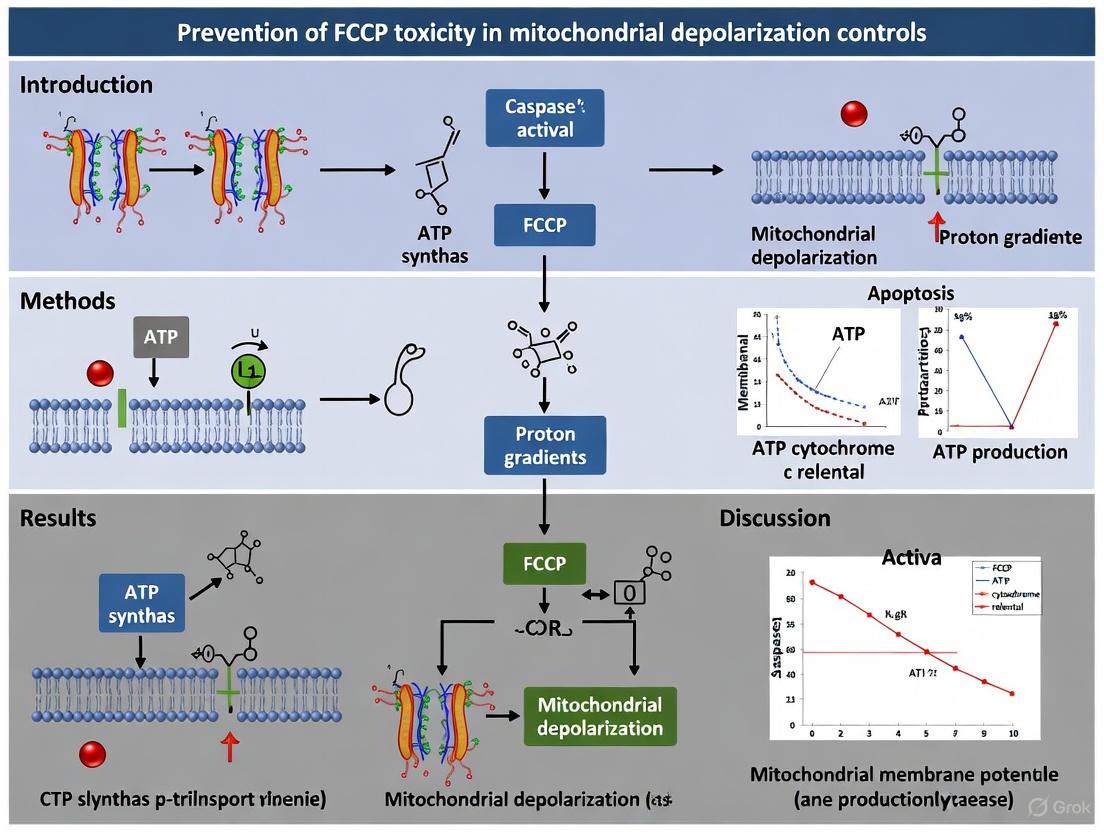
FCCP is a potent mitochondrial uncoupler widely used to study depolarization, cellular stress responses, and mitophagy.
Mitigating FCCP Toxicity: A Strategic Guide for Controlling Mitochondrial Depolarization in Research
Abstract
FCCP is a potent mitochondrial uncoupler widely used to study depolarization, cellular stress responses, and mitophagy. However, its application is complicated by significant off-target effects and toxicity, which can compromise experimental integrity. This article provides a comprehensive framework for researchers and drug development professionals to understand FCCP's mechanisms of toxicity, implement best practices for its controlled application in cell culture and animal models, troubleshoot common experimental issues, and validate findings using alternative uncouplers and assays. By outlining strategies to prevent FCCP-induced toxicity, this guide aims to enhance the reliability and interpretation of mitochondrial function studies.
Understanding FCCP: Mechanisms of Uncoupling and Sources of Toxicity
How does FCCP work as a protonophore to dissipate the mitochondrial membrane potential?
FCCP (Carbonyl cyanide-4-(trifluoromethoxy)phenylhydrazone) is a potent protonophore, a type of ionophore that specifically transports protons (H+) across biological membranes [1] [2]. Its mechanism of action disrupts the essential proton gradient that mitochondria use to synthesize ATP.
The step-by-step facilitated transport of protons by FCCP is as follows [3] [2]:
- The anionic form of FCCP (FCCP⁻) adsorbs onto the positive outer surface of the mitochondrial inner membrane.
- A proton (H⁺) from the intermembrane space binds to the anionic FCCP⁻, forming a neutral FCCP-H complex.
- This neutral complex diffuses freely across the lipid bilayer to the matrix side of the membrane.
- On the matrix side, FCCP-H dissociates, releasing the proton (H⁺) into the matrix.
- The resulting FCCP⁻ anion then moves back to the positive outer surface, driven by the electrical potential, to repeat the cycle.
This short-circuiting of the proton gradient uncouples the mitochondrial electron transport chain from ATP synthesis. The energy that would normally be captured as ATP is instead released as heat, and oxygen consumption increases as the cell attempts to restore the gradient [4] [1].
Diagram: The Protonophoric Mechanism of FCCP. FCCP shuttles protons across the inner mitochondrial membrane, dissipating the electrochemical gradient.
What is the experimental evidence for FCCP's mechanism of action?
The molecular mechanism of FCCP was rigorously characterized in a seminal 1983 study using planar bilayer membranes and biophysical techniques [3]. The research proposed and validated a quantitative model requiring four key parameters, which were determined independently:
| Parameter | Symbol | Value Determined (1983 Study) | Description |
|---|---|---|---|
| Movement rate of neutral FCCP | kHA | 104 s-1 | Rate constant for neutral FCCP-H diffusion across membrane [3] |
| Movement rate of anionic FCCP | kA | ~700 s-1 (at V≈0) | Voltage-dependent rate constant for FCCP⁻ movement [3] |
| Adsorption coefficient | βA | 3 x 10⁻³ cm | Measures FCCP⁻ adsorption to membrane-solution interface [3] |
| Surface pK | pK | 6.0 - 6.4 | pK at the membrane interface, critical for protonation/deprotonation [3] |
The adequacy of this model was confirmed using multiple techniques: charge-pulse, voltage-clamp, equilibrium dialysis, zeta potential, and conductance measurements [3]. The model successfully predicts that FCCP should exert maximal uncoupling activity at a pH congruent to its pK, a prediction that aligns with experimental results in mitochondria [3].
Modern studies continue to validate this mechanism. For example, a 2014 study used simultaneous optical mapping of membrane potential (Vm) and mitochondrial membrane potential (ΔΨm) in intact hearts. Administration of 2.5 μM FCCP to the perfusate caused a rapid and targeted collapse of ΔΨm, confirming its potent depolarizing action in a complex physiological system [5].
What are the key in vivo toxicities of FCCP that researchers should be aware of?
Repeated oral dose studies in male rats have revealed a profile of significant toxicity, which is critical for researchers to understand when designing in vivo experiments [4].
| Organ/Tissue | Observed Pathological Changes (Rat Studies) |
|---|---|
| Liver | Increased liver weight; hydropic degeneration and centrilobular necrosis of hepatocytes; mitochondrial pleomorphism [4]. |
| Pancreas | Swelling of mitochondria in alpha and beta cells; dilatation of rough endoplasmic reticulum and Golgi bodies; loss of secretory granules in beta cells [4]. |
| General/Systemic | Salivation, increased body temperature, mortality/moribundity, and effects on testis, epididymal duct, stomach, and parotid gland [4]. |
The severity of toxicity is dose-dependent. In a 2-week rat study, doses of 20 mg/kg and 30 mg/kg led to fatalities, forcing early termination. A 4-week study established lower doses of 2.5, 5, and 10 mg/kg for repeated administration [4]. It is crucial to note that in vitro uncoupling potency does not directly predict in vivo toxicity. When compared to other uncouplers (DNP, OPC-163493, tolcapone), FCCP produced the strongest peak uncoupling effect at the lowest concentration (0.4 μM) in HepG2 cells. However, this high potency did not run parallel to its in vivo toxicological profile, indicating that factors beyond protonophoric activity, such as pharmacokinetics and tissue distribution, play a major role in determining toxicity [4].
What are the recommended protocols for using FCCP in experimental models?
Protocol 1: Confirming FCCP Activity in Isolated Heart Preparations
This protocol is used to validate FCCP's function as a depolarizing agent in intact tissue [5].
- Objective: Targeted depolarization of ΔΨm.
- Tissue: Isolated rabbit or mouse hearts, or human left ventricular wedge preparations.
- Dye System: Simultaneous optical mapping using TMRM (150 nmol/L) for ΔΨm and RH-237 (500 nmol/L) for sarcolemmal transmembrane potential (Vm).
- Perfusion: Constant pressure (70-90 mmHg) with oxygenated Tyrode's solution at 37°C.
- FCCP Application: Add 2.5 μmol/L FCCP to the perfusate.
- Outcome Measure: Rapid and significant decrease in TMRM fluorescence (FΔΨm), indicating collapse of ΔΨm.
Protocol 2: Inducing Maximal Mitochondrial Uncoupling in Cell-Based Assays
This protocol is common in assays like the Seahorse XF Analyzer to measure maximal respiratory capacity [4] [6].
- Cell Line: HepG2 cells or other relevant cell types.
- Assay Platform: Extracellular flux analyzer (e.g., Seahorse XF24).
- FCCP Preparation: Prepare a stock solution in DMSO (e.g., 100 mM). Dilute in assay medium to the final working concentration.
- FCCP Titration: A range of concentrations should be tested. 0.4 - 10 μM FCCP is a typical range, with lower concentrations (e.g., 1 μM) sufficient for depolarization and higher concentrations (e.g., 10 μM) potentially inducing mitophagy and acidification.
- Outcome Measure: Sharp increase in Oxygen Consumption Rate (OCR) following injection, indicating uncoupled respiration.
How can I troubleshoot common issues when working with FCCP?
Problem: Inconsistent or weak uncoupling response.
- Cause: Degraded or precipitated FCCP. FCCP solutions are sensitive to storage and can form precipitates.
- Solution: Prepare a fresh stock solution in DMSO. If stored solutions are required, freeze aliquots at -20°C for no more than one month. Before use, warm the solution to room temperature and vortex thoroughly to ensure no precipitate remains [1].
- Cause: Incorrect pH of the experimental medium. FCCP's protonophoric activity is maximal near its pK (~6.0-6.4) [3].
- Solution: Verify and adjust the pH of your buffer system. Activity may be reduced at highly acidic or basic pH.
Problem: Unexpected cellular toxicity or death in my experiment.
- Cause: Concentration of FCCP is too high.
- Solution: Titrate the FCCP concentration carefully. Use the lowest effective dose. For depolarization without immediate severe toxicity, start with 1 μM and adjust based on validation assays [6]. Refer to in vivo toxicity data (e.g., rat studies) to understand potential organ-specific risks [4].
- Cause: Extended exposure time.
- Solution: Limit the duration of FCCP exposure. Consider pulsed rather than continuous application depending on your experimental goals.
Problem: Poor solubility of FCCP in aqueous buffer.
- Cause: FCCP has very low water solubility and must be dissolved in an organic solvent first [6].
- Solution: Always first prepare a concentrated stock solution in DMSO (e.g., 100 mM). Subsequent dilutions into your aqueous assay buffer should be made from this stock. The final DMSO concentration should be kept low (typically <0.1%) to avoid solvent toxicity.
The Scientist's Toolkit: Key Research Reagent Solutions
| Item | Function/Description | Example in FCCP Research |
|---|---|---|
| FCCP | Potent protonophore uncoupler; dissolves in DMSO [1] [6]. | Core investigative agent; used at 0.4-10 μM in cells, 2.5 μM in perfused hearts [4] [5]. |
| TMRM | Cell-permeant, cationic fluorescent dye that accumulates in active mitochondria based on ΔΨm [5]. | Used at 150 nM to monitor ΔΨm depolarization by FCCP in intact hearts [5]. |
| Seahorse XF Analyzer | Instrument platform for real-time measurement of OCR and ECAR in live cells. | To demonstrate FCCP-induced increase in OCR, confirming uncoupling activity [4]. |
| Oligomycin | ATP synthase inhibitor. | Used in Seahorse assays to establish baseline proton leak before FCCP injection [4]. |
| Rotenone & Antimycin A | Complex I and III inhibitors, halting mitochondrial electron transport. | Used after FCCP in Seahorse assays to shut down respiration and calculate non-mitochondrial oxygen consumption [4]. |
| Blebbistatin | Myosin II inhibitor used for excitation-contraction uncoupling. | Essential in heart optical mapping to eliminate motion artifacts [5]. |
FCCP (Carbonyl cyanide-4-(trifluoromethoxy)phenylhydrazone) is a potent protonophore that functions as a mitochondrial uncoupler. Its primary and intended mechanism of action is to dissipate the proton gradient across the inner mitochondrial membrane, thereby inhibiting oxidative phosphorylation. By shuttling protons into the mitochondrial matrix independently of ATP synthase, FCCP uncouples electron transport from ATP production, leading to increased oxygen consumption and a decrease in ATP generation [7] [4]. Researchers frequently utilize FCCP in experimental settings to study mitochondrial function, to induce mitophagy, and to depolarize mitochondria as a control condition [4] [8].
Key Off-Target Effects and Cellular Damage
Despite its utility as a chemical tool, FCCP possesses several significant off-target effects that can compromise experimental outcomes and lead to misinterpretation of data.
Cytotoxicity and Organ Damage
- In Vivo Toxicity: Repeated oral administration of FCCP in male rats resulted in significant toxicity, including salivation, increased body temperature, and mortality. Pathological examination revealed increased liver weight, hydropic degeneration, and centrilobular necrosis of hepatocytes. Adverse effects were also observed in the pancreas, testis, epididymal duct, stomach, and parotid gland [4].
- Cellular Growth Inhibition and Apoptosis: In human pulmonary adenocarcinoma Calu-6 cells, FCCP inhibited growth with an IC₅₀ of approximately 6.64 ± 1.84 μM at 72 hours. Treatment induced cell cycle arrest at the G1 phase and promoted apoptosis, as evidenced by mitochondrial membrane potential loss, annexin V staining, and cleavage of PARP protein. This apoptotic cell death was caspase-dependent [9].
Disruption of Intracellular Calcium Handling
- Promotion of Calcium Alternans: Computational modeling and experimental studies indicate that mitochondrial depolarization, such as that induced by FCCP, can promote arrhythmogenic calcium (Ca²⁺) alternans in cardiac myocytes. This effect is driven primarily by the elevation of reactive oxygen species (ROS) in response to depolarization, which affects ryanodine receptors and sarco/endoplasmic reticulum Ca²⁺-ATPase function [10].
Impairment of Mitochondrial Quality Control
- Disruption of Mitophagy: While low concentrations of FCCP can induce mitophagy, this process can become impaired under certain conditions. In models of heart failure, FCCP treatment led to the accumulation of "giant Parkin-rich regions" with completely depolarized mitochondria, suggesting a breakdown in the mitophagic signaling cascade and an inability to clear damaged mitochondria effectively [8].
Non-Mitochondrial Targets
- Plasma Membrane Depolarization: FCCP has been reported to depolarize the plasma membrane potential, an effect distinct from its primary action on the inner mitochondrial membrane. This can have widespread consequences on various cellular processes that depend on plasma membrane potential [4].
Table 1: Summary of FCCP's Off-Target Effects and Observed Damage
| Effect Category | Specific Effect | Observed Outcome / Model System | Reference |
|---|---|---|---|
| Cytotoxicity | In vivo organ toxicity | Hepatotoxicity, pancreatic toxicity, lethality in rats | [4] |
| Cell growth inhibition & apoptosis | G1 phase arrest & caspase-dependent apoptosis in Calu-6 cells | [9] | |
| Signaling Disruption | Calcium handling disruption | Promotion of Ca²⁺ alternans in cardiac myocytes | [10] |
| Impaired mitochondrial quality control | Accumulation of giant Parkin-rich areas in HF myocytes | [8] | |
| Non-Selective Actions | Plasma membrane depolarization | Depolarization of plasma membrane potential | [4] |
FCCP Toxicity Troubleshooting Guide
Frequently Asked Questions (FAQs)
Q1: My experiments require mitochondrial depolarization, but my cells are dying at commonly used FCCP concentrations. What can I do?
A1: Cell death is a direct consequence of FCCP's narrow therapeutic window.
- Reduce Concentration: Explore the effects of vastly lower FCCP concentrations. For instance, in myocardial cells, a concentration as low as 5 nM was shown to provide protective effects against hypoxia/reoxygenation injury by inducing mild uncoupling, rather than the severe depolarization that leads to death [11].
- Shorten Exposure Time: Limit the duration of FCCP exposure to the minimum required for your readout. Continuous, long-term exposure is far more likely to induce cytotoxic effects.
- Consider Safer Alternatives: Evaluate newer-generation uncouplers like BAM15, which has been shown in comparative studies to have a superior in vitro activity profile and a wider safety margin in animal models [12].
Q2: I am studying mitophagy, but my results with FCCP are inconsistent or show giant clusters of Parkin. What might be happening?
A2: This is a known phenomenon, particularly in stressed or diseased cell models.
- Underlying Mechanism: In contexts like heart failure, the fusion-fission machinery (involving proteins like MFN2 and DRP1) is often impaired. FCCP can still recruit Parkin to mitochondria, but the subsequent steps of mitophagy are blocked, leading to the accumulation of these "giant Parkin-rich regions" [8].
- Troubleshooting Steps:
- Validate Your Model: Confirm that your cellular model has intact mitochondrial dynamics.
- Use Complementary Assays: Do not rely solely on Parkin translocation. Measure downstream steps like LC3-II conversion or lysosomal colocalization.
- Modulate the Pathway: Research indicates that cell-permeable peptides that stabilize MFN2 can prevent the formation of these giant clusters and restore mitophagic flux [8].
Q3: Are the toxic effects of FCCP due to its on-target uncoupling activity or specific off-target actions?
A3: The toxicity likely arises from a combination of both.
- On-Target Toxicity: The extreme depolarization of the mitochondrial membrane potential can directly lead to a catastrophic loss of ATP, disruption of calcium buffering, and increased ROS, triggering cell death pathways.
- Off-Target Toxicity: Studies show that FCCP's toxicity profile does not perfectly parallel its uncoupling potency when compared to other uncouplers, suggesting compound-specific effects are at play [4]. Effects like plasma membrane depolarization are clear off-target actions [4].
Experimental Protocol: Establishing a Safe and Effective FCCP Dose
To prevent FCCP toxicity in mitochondrial depolarization controls, follow this detailed protocol for dose-validation.
Objective: To determine the minimal FCCP concentration required to induce target mitochondrial depolarization without causing significant cytotoxicity in your specific cell model.
Materials:
- Cell culture system of choice
- FCCP stock solution (e.g., 10 mM in DMSO or Ethanol)
- Mitochondrial membrane potential-sensitive fluorescent dye (e.g., TMRM, JC-1)
- Cell viability assay kit (e.g., MTT, Calcein-AM, or Propidium Iodide)
- Oxygen consumption rate (OCR) assay system (e.g., Seahorse XF Analyzer)
Methodology:
- Preparation: Prepare a serial dilution of FCCP in your cell culture medium. A suggested starting range is 1 nM to 100 μM, prepared from a fresh stock solution.
- Depolarization Assay:
- Seed cells in a multi-well plate suitable for fluorescence reading.
- Load cells with the membrane potential-sensitive dye according to the manufacturer's instructions.
- Treat cells with the FCCP dilution series for a defined period (e.g., 10-30 minutes).
- Measure fluorescence. A decrease in signal indicates mitochondrial depolarization. Plot the fluorescence intensity versus FCCP concentration to establish a dose-response curve. The goal is to identify a concentration that induces a sub-maximal (e.g., ~80%) depolarization.
- Viability Assay:
- In parallel, seed cells in a separate multi-well plate.
- Treat with the same FCCP dilution series for the duration relevant to your main experiments (e.g., 1, 6, or 24 hours).
- Perform a cell viability assay (e.g., MTT) according to the kit protocol.
- Plot cell viability (%) versus FCCP concentration.
- Functional Confirmation (Optional but Recommended):
- Using a Seahorse XF Analyzer or similar system, measure the Oxygen Consumption Rate (OCR) of cells treated with your selected FCCP dose. Confirm that it causes the expected increase in basal OCR and decrease in ATP-linked respiration [13].
- Data Integration: Overlay the dose-response curves from steps 2 and 3. The optimal FCCP concentration is the highest dose that achieves the desired depolarization while maintaining >90% cell viability.
Table 2: Research Reagent Solutions for Mitochondrial Depolarization Studies
| Reagent / Tool | Function / Application | Key Considerations |
|---|---|---|
| FCCP | Potent protonophore for maximum mitochondrial depolarization. | Narrow therapeutic window; significant off-target effects; use low, titrated doses. |
| BAM15 | Mitochondrial uncoupler used as a safer alternative chemical probe. | Superior, stable uncoupling with fewer off-target effects; does not inhibit maximal mitochondrial capacity [12]. |
| TMRM / JC-1 | Fluorescent dyes for quantifying mitochondrial membrane potential (ΔΨm). | Use to empirically verify depolarization in your specific model system. |
| Seahorse XF Analyzer | Instrument for measuring Oxygen Consumption Rate (OCR). | Gold-standard for confirming functional uncoupling (increased basal OCR). |
| Carbonyl cyanide-3-chlorophenylhydrazone (CCCP) | Protonophore uncoupler similar to FCCP. | Shares similar toxicity and off-target profiles with FCCP [7]. |
Safer Alternatives and Concluding Recommendations
Given the documented off-target effects and toxicity of FCCP, exploring safer alternatives is a critical step in refining experimental models.
- BAM15: This modern mitochondrial uncoupler has been shown in head-to-head comparisons to be a superior chemical probe. It drives stable mitochondrial respiration without the unwanted mitochondrial inhibition or off-target effects associated with FCCP. In vivo, BAM15 has demonstrated efficacy in improving metabolic phenotypes with a favorable safety profile [12].
- Mild Uncoupling Strategies: For some research questions, the goal is not maximal depolarization but a mild modulation of coupling efficiency. Using very low doses of uncouplers (e.g., 5 nM FCCP) or alternative molecules can achieve this, potentially providing protective effects, such as reducing ROS during ischemia/reperfusion injury, without triggering cell death [11].
In conclusion, while FCCP remains a valuable tool for inducing mitochondrial depolarization, researchers must be acutely aware of its significant limitations. A rigorous, empirically determined dosing strategy is non-negotiable. Whenever possible, the scientific community should strongly consider transitioning to next-generation uncouplers like BAM15, which offer a more specific and safer profile for studying mitochondrial function.
Visual Guide: FCCP Mechanisms and Toxicity Troubleshooting
Oxidative phosphorylation (OXPHOS) is the primary process through which cells generate adenosine triphosphate (ATP), their main energy currency [14]. This essential metabolic pathway relies on an electrochemical proton gradient across the mitochondrial inner membrane, known as the proton-motive force (PMF), to drive ATP synthesis [14]. In research and drug development, chemicals that disrupt this process are invaluable tools. Among these, carbonyl cyanide-p-trifluoromethoxyphenylhydrazone (FCCP) is a powerful protonophore uncoupler that dissipates the proton gradient, collapsing the mitochondrial membrane potential (ΔΨm) and halting ATP synthesis [15] [7]. However, the application of FCCP is characterized by a profoundly narrow concentration-dependent therapeutic window. While low concentrations can effectively uncouple mitochondria for experimental controls, slightly higher concentrations quickly transition to severe toxicity, causing cell cycle arrest, apoptosis, and metabolic catastrophe [15] [16]. This technical support guide addresses the specific challenges researchers face when using FCCP and other OXPHOS inhibitors, providing troubleshooting and best practices to prevent toxicity in mitochondrial depolarization controls.
Troubleshooting Guides
FCCP-Induced Toxicity in Experimental Controls
Problem: Unexpected cell death or metabolic shut-down following the use of FCCP as a mitochondrial depolarization control.
| Signs of Trouble | Potential Causes | Recommended Solutions |
|---|---|---|
| Rapid drop in cell viability | Concentration too high; >20 µM can cause acute necrosis [15]. | Titrate the dose. Start with low concentrations (0.1-1 µM) and increase incrementally [16]. |
| Reduced ATP levels persisting after FCCP washout | Severe or prolonged depolarization triggering irreversible damage [15]. | Shorten exposure time. Use pulsed, rather than continuous, exposure and ensure proper washout protocols. |
| Inhibition of cell migration/micromotion | Subtle toxicity at low doses (as low as 0.1 µM) affecting energy-dependent motility [16]. | Validate with a viability assay. Use a real-time method like ECIS to monitor subtle effects on cell behavior [16]. |
| Inconsistent depolarization readings | Solvent (e.g., DMSO) toxicity or improper stock solution storage leading to degraded FCCP. | Use fresh stocks. Prepare stock solutions in high-quality DMSO and avoid repeated freeze-thaw cycles. |
Differentiating Uncoupling from OXPHOS Inhibition
Problem: Difficulty in interpreting experimental results due to confusion between mitochondrial uncoupling and direct OXPHOS inhibition.
| Phenomenon | Mitochondrial Uncouplers (e.g., FCCP, DNP) | OXPHOS Inhibitors (e.g., IACS-010759, Rotenone) |
|---|---|---|
| Primary Mechanism | Discharges the proton gradient across the inner mitochondrial membrane by shuttling protons [7]. | Directly blocks electron transport chain (ETC) complexes, halting electron flow [17] [18]. |
| Oxygen Consumption | Stimulates oxygen consumption as the ETC works maximally to restore the gradient [7]. | Inhibits oxygen consumption due to a blockage in the ETC [17]. |
| ATP Synthesis | Halts ATP synthesis because the proton gradient is dissipated [15]. | Halts ATP synthesis because the proton gradient cannot be generated. |
| Mitochondrial ΔΨm | Collapses the membrane potential [15] [19]. | May hyperpolarize or collapse the membrane potential, depending on the site of inhibition. |
| Metabolic Byproduct | Can lead to increased lactate production if glycolysis compensates [18]. | Can lead to increased lactate production due to forced glycolytic metabolism [18]. |
The following diagram illustrates the fundamental mechanistic differences between uncouplers and inhibitors in the context of the electron transport chain.
Addressing the Narrow Therapeutic Window of OXPHOS Inhibitors
Problem: Clinical failure of potent OXPHOS inhibitors like IACS-010759 due to systemic toxicity, including lactic acidosis and peripheral neuropathy [18].
| Challenge | Underlying Issue | Mitigation Strategy |
|---|---|---|
| Dose-Limiting Toxicities (e.g., lactic acidosis) | Excessive, non-selective inhibition of mitochondrial respiration in healthy tissues forces a glycolytic shift and lactate production [18]. | Use moderate inhibitors. Drugs like atovaquone (Complex III) have safer profiles and show efficacy at clinically achievable doses [18]. |
| Lack of Tumor Selectivity | The drug target (e.g., Complex I) is equally essential in healthy and cancerous cells [17] [18]. | Employ targeting technologies. Conjugate inhibitors to mitochondria-targeting moieties (e.g., TPP+) or use antibody-drug conjugates (ADCs) for selective delivery [17] [18]. |
| Metabolic Plasticity of Cancer | Tumors may develop resistance by switching metabolic pathways, rendering monotherapy ineffective [18]. | Develop rational combinations. Use OXPHOS inhibitors to sensitize tumors to radiotherapy, chemotherapy, or immunotherapy [18] [20]. |
Frequently Asked Questions (FAQs)
Q1: What is a safe starting concentration for FCCP in my cell culture experiments? A safe starting point is highly cell-type dependent. For human mesenchymal stem cells (hMSCs), effects on micromotion have been detected at concentrations as low as 0.1 µM [16]. In a rhabdomyosarcoma cell line, 20 µM FCCP was used to achieve 75% uncoupling, which induced clear gene expression changes and cell cycle arrest [15]. The best practice is to conduct a dose-response curve, starting from 0.1 µM and not exceeding 20-30 µM, while closely monitoring established toxicity markers.
Q2: Why did IACS-010759 fail in clinical trials, and what lessons can be learned? IACS-010759, a potent complex I inhibitor, failed in phase I trials due to an extremely narrow therapeutic window, leading to dose-limiting toxicities like lactic acidosis and peripheral neuropathy [18]. The key lesson is that extreme potency may not be clinically desirable for OXPHOS inhibitors. The field is now shifting towards moderate inhibitors (e.g., atovaquone, metformin) and targeted delivery strategies (e.g., TPP+ conjugation) to improve the drug's safety profile and tumor selectivity [18].
Q3: My data shows FCCP increased oxygen consumption but killed my cells. What went wrong? This is a classic sign of over-uncoupling. While FCCP does stimulate oxygen consumption by forcing the ETC to operate at maximum capacity, this state is energetically unsustainable. The cell cannot regenerate the proton gradient needed to make ATP, leading to a catastrophic drop in energy levels. The rapid consumption of oxygen and nutrients can also generate excessive reactive oxygen species (ROS), triggering apoptosis. You should lower the FCCP concentration and/or shorten the exposure time [15] [7].
Q4: Are there alternatives to FCCP for uncoupling mitochondria in experimental models? Yes, several alternatives exist, each with its own profile. DNP (2,4-Dinitrophenol) is another protonophore uncoupler with a history of use, though it also has a narrow therapeutic window. BAM15 is a more recent mitochondrial-specific protonophore that has been shown to cause less off-target stimulation of thermogenesis, potentially offering a better profile for some studies [7]. Furthermore, endogenous systems involving uncoupling proteins (UCP-1) can be studied as physiological models of uncoupling [7].
Q5: How can I experimentally confirm that my compound is an uncoupler and not an OXPHOS inhibitor? The definitive test is to measure the effect on oxygen consumption. A true uncoupler will stimulate oxygen consumption in the presence of substrates and ADP, as it unleashes the ETC from the constraint of the proton gradient. In contrast, an OXPHOS inhibitor will decrease oxygen consumption by blocking electron flow. This can be assessed using high-resolution respirometry. Additionally, directly measuring the mitochondrial membrane potential (e.g., with JC-1 or TMRM dyes) will show a collapse in both cases, so the oxygen consumption profile is the key differentiator [7].
Research Reagent Solutions
The following table details key reagents used in studying mitochondrial uncoupling and OXPHOS inhibition.
| Reagent Name | Primary Function | Key Considerations & Toxicity |
|---|---|---|
| FCCP | Protonophore uncoupler; dissipates H+ gradient, collapses ΔΨm [15] [7]. | Potent toxicity at >20 µM; causes cell cycle arrest and apoptosis; use fresh DMSO stocks [15] [16]. |
| CCCP | Protonophore uncoupler; similar mechanism to FCCP [7]. | Similar toxicity profile to FCCP; concentration-dependent effects require careful titration. |
| IACS-010759 | Potent, selective inhibitor of mitochondrial Complex I [18]. | Nanomolar potency; clinical failure due to lactic acidosis and neuropathy; very narrow therapeutic window [18]. |
| Atovaquone | Moderate inhibitor of mitochondrial Complex III [18]. | Approved anti-malarial; better safety profile; shown to reduce tumor hypoxia in patients [18]. |
| BAM15 | Mitochondria-specific protonophore uncoupler [7]. | Newer compound; reported to have less off-target thermogenic effects compared to DNP [7]. |
| Rotenone | Natural product and potent inhibitor of mitochondrial Complex I [18]. | Often used in research; high toxicity risk similar to IACS-010759; not suitable for clinical development. |
| JC-1 Dye | Cationic fluorescent dye for measuring mitochondrial membrane potential (ΔΨm) [19] [16]. | Emits different fluorescence (green/red) based on ΔΨm; confirms depolarization after uncoupler application. |
| Electric Cell-Substrate Impedance Sensing (ECIS) | Label-free method to monitor cell viability, micromotion, and migration in real-time [16]. | Highly sensitive; can detect metabolic disruption from FCCP at concentrations as low as 0.1 µM [16]. |
Experimental Protocols & Workflows
Protocol: Assessing FCCP Toxicity and Mitochondrial Function in Cultured Cells
This protocol outlines a comprehensive approach to evaluate the effects of FCCP on cells, from initial viability checks to mechanistic insights.
1. Reagent Preparation:
- Prepare a 10 mM stock solution of FCCP in high-purity DMSO. Aliquot and store at -20°C protected from light. Avoid repeated freeze-thaw cycles.
- Prepare assay buffers and culture media appropriate for your cell line.
2. Dose-Response Viability Assay (MTT/XTT):
- Plate cells in a 96-well plate and allow them to adhere overnight.
- Treat cells with a range of FCCP concentrations (e.g., 0.1, 1, 5, 10, 20, 30 µM) for a defined period (e.g., 2-24 hours). Include a DMSO vehicle control.
- Following incubation, add MTT reagent and incubate further to allow formazan crystal formation by metabolically active cells.
- Solubilize the crystals and measure the absorbance at 570 nm. Normalize values to the vehicle control to determine the percentage of viable cells.
3. Real-Time Monitoring of Cell Behavior (ECIS):
- Plate cells directly onto ECIS electrode arrays and grow to confluence.
- Treat with sub-lethal doses of FCCP (e.g., 0.1 - 1 µM) while continuously monitoring impedance and capacitance.
- Analyze the time-series data for fluctuations (micromotion) and overall resistance/capacitance, which reflect changes in cell health, morphology, and attachment [16].
4. Confirmation of Mitochondrial Depolarization (JC-1 Assay):
- Plate and treat cells as in step 2.
- Load cells with JC-1 dye (1-5 µg/mL) for 20-30 minutes at 37°C.
- Wash and analyze using a fluorescence microplate reader or microscope. A decrease in the red/green fluorescence intensity ratio indicates a collapse of ΔΨm, confirming FCCP activity [19] [16].
5. ATP Level Quantification:
- Using a luminescent ATP detection kit, lyse cells after FCCP treatment.
- Measure the luminescence, which is proportional to the ATP concentration.
- Normalize the values to total protein content. Expect a significant, concentration-dependent drop in ATP levels with effective uncoupling [15] [19].
The workflow for this multi-faceted protocol is summarized in the following diagram.
Key Experimental Considerations
- Cell Type Variability: Different cell lines have varying metabolic dependencies and sensitivities to OXPHOS disruption. For instance, cancer stem cells and therapy-resistant cancers often show heightened OXPHOS dependence, making them more vulnerable to these agents [18].
- Time is Critical: The duration of uncoupler exposure is as important as the concentration. Short, pulsed exposures may achieve depolarization without triggering irreversible death pathways.
- Measure Multiple Endpoints: Relying on a single assay (e.g., only MTT) can be misleading. Combining viability assays with direct measures of membrane potential (JC-1) and metabolic function (ATP, oxygen consumption) provides a more robust picture of FCCP's effects and toxicity [15] [16].
What is the primary mechanism of FCCP toxicity in vivo?
FCCP (Carbonyl cyanide-4-(trifluoromethoxy)phenylhydrazone) functions as a mitochondrial uncoupler, dissipating the proton gradient across the inner mitochondrial membrane. This disruption inhibits oxidative phosphorylation, leading to impaired ATP production and increased energy consumption. In rodent studies, this fundamental mechanism manifests as systemic toxicity affecting multiple organs, with the liver and pancreas being particularly vulnerable [4].
What are the most critical in vivo toxicity findings from rodent studies?
Repeated oral dose studies in male Sprague-Dawley rats reveal distinct toxicity patterns across different exposure periods. The table below summarizes the key findings from these studies:
Table: FCCP Toxicity Profile in Male Sprague-Dawley Rats
| Study Duration | Dose Levels | Major Observations | Affected Organs/Tissues |
|---|---|---|---|
| 3-day study | 30, 60, 100 mg/kg | Salivation, increased body temperature, mortality/moribundity [4] | Liver, systemic |
| 2-week study | 20, 30, 40 mg/kg | Discontinued due to high mortality; 4/6 animals died in 30 mg/kg group by day 7 [4] | Liver, pancreas, testis, epididymal duct, stomach, parotid gland [4] |
| 4-week study | 2.5, 5, 10 mg/kg | Increased liver weight, hepatocyte hydropic degeneration and centrilobular necrosis [4] | Liver, pancreas [4] |
The liver and pancreas consistently emerge as primary targets of FCCP toxicity. Electron microscopic examinations confirmed mitochondrial pleomorphism in hepatocytes and swelling of mitochondria in both alpha and beta cells of the pancreas [4].
Troubleshooting Experimental Challenges
How can I establish appropriate dosing protocols for FCCP studies?
Establishing correct dosing is critical. The 2-week study demonstrated that 20 mg/kg was excessively toxic, requiring early termination. For longer-term studies (up to 4 weeks), doses of 2.5-10 mg/kg were utilized, with significant toxicological findings still observed. Always include a carefully selected vehicle control group; a 5% gum arabic solution is an appropriate suspension vehicle for oral FCCP administration in rodents [4].
What are the earliest indicators of FCCP toxicity in rodent models?
Monitor for these clinical signs that often precede severe toxicity:
- Salivation: Observed shortly after dosing [4]
- Increased body temperature: A direct consequence of mitochondrial uncoupling and elevated energy expenditure [4]
- Reduced body weight gain: May indicate systemic metabolic disruption [4]
Experimental Protocols & Methodologies
Protocol: Repeated Dose Oral Toxicity Study in Rats
Objective: To evaluate the toxicological profile of FCCP following repeated oral administration.
Materials:
- Test Article: FCCP (store at room temperature, protected from light) [4]
- Animals: Sprague-Dawley male rats (6-7 weeks old at initiation) [4]
- Vehicle: 5% gum arabic solution in water for injection [4]
- Dosing volume: 5 mL/kg, adjusted to most recent body weight [4]
Methodology:
- Prepare fresh dosing suspensions in vehicle at least weekly; store cooled and protected from light [4]
- Administer via gavage once daily at consistent time
- Conduct general condition assessments 3 times daily (pre-dose, ~1 and 4 hours post-dose) [4]
- Measure body weight at minimum weekly; more frequent weighing recommended for higher doses
- Terminate study per predefined humane endpoints (e.g., >20% body weight loss, moribund state)
Histopathological Examination:
- Collect and preserve liver and pancreas tissues for both light and electron microscopy
- For liver: specifically examine centrilobular regions for hydropic degeneration and necrosis [4]
- For pancreas: examine both alpha and beta cells for mitochondrial swelling and secretory granule loss [4]
Mechanisms of FCCP Toxicity Across Biological Levels
Essential Research Reagent Solutions
Table: Key Research Reagents for FCCP Toxicity Studies
| Reagent/Assay | Primary Function | Application in FCCP Research |
|---|---|---|
| FCCP | Mitochondrial uncoupler [4] [9] [21] | Primary test article for inducing mitochondrial depolarization |
| 5% Gum Arabic | Vehicle suspension [4] | Ensures proper dosing formulation for oral administration studies |
| Oligomycin | ATP synthase inhibitor [22] | Used in mitochondrial toxicity assays to distinguish inhibition from uncoupling |
| Rotenone/Antimycin A | Electron transport chain inhibitors [22] | Validates mitochondrial function assays and confirms FCCP mechanism |
| Seahorse XF Analyzer | Measures oxygen consumption rate (OCR) [22] | Quantifies mitochondrial uncoupling activity in vitro |
| Histopathology Reagents | Tissue preservation and staining | Identifies hepatocellular degeneration and pancreatic damage |
Mitochondrial Toxicity Assessment
How do I quantitatively assess mitochondrial toxicity?
The Mito Tox Index (MTI) provides a standardized approach to quantify mitochondrial toxicity. This method distinguishes between mitochondrial inhibition and uncoupling:
- MTI for uncouplers: Compares proton leak-induced OCR after oligomycin injection in test versus control groups, scaled 0-1 [22]
- MTI for inhibitors: Compares maximal FCCP-induced OCR in test versus control groups, scaled 0 to -1 [22]
FCCP serves as a validated uncoupler control in these assays at concentrations of 0.4-2μM for in vitro systems [22].
Mitochondrial Toxicity Assessment Workflow
Frequently Asked Questions (FAQs)
How does FCCP toxicity compare to other mitochondrial uncouplers?
When compared with DNP, OPC-163493, and tolcapone, FCCP produced the strongest uncoupling effect in vitro, inducing peak changes in oxygen consumption rate (ΔOCR) at the lowest concentration (0.4 μM). However, there is no direct parallel relationship between in vitro mitochondrial uncoupling potency and the degree of in vivo toxicity, highlighting the importance of animal studies for safety assessment [4].
What are the critical pathophysiological mechanisms beyond uncoupling?
Transcriptional analyses reveal that FCCP exposure significantly alters gene expression associated with:
- Protein synthesis and cell cycle regulation [15]
- Cytoskeletal integrity and energy metabolism [15]
- Apoptosis and inflammatory pathways [15]
These changes correlate with cell cycle arrest in G1 and S phases and decreased intracellular ATP concentrations, providing mechanisms for the observed tissue damage [15] [9].
Are there specific biomarkers for monitoring FCCP toxicity?
Seven genes have been identified as potential molecular markers for chemical uncouplers: seryl-tRNA synthetase, glutamine-hydrolyzing asparagine synthetase, mitochondrial bifunctional methylenetetrahydrofolate dehydrogenase, mitochondrial heat shock 10-kDa protein, proliferating cell nuclear antigen, cytoplasmic beta-actin, and growth arrest and DNA damage-inducible protein 153 (GADD153) [15].
FCCP (Carbonyl cyanide p-(trifluoromethoxy)phenylhydrazone) is a potent mitochondrial uncoupler widely used in research to study cellular metabolism, oxidative stress, and programmed cell death. As a protonophore, it dissipates the proton gradient across the inner mitochondrial membrane, inhibiting ATP synthesis via oxidative phosphorylation. This primary action triggers a complex cascade of molecular events, culminating in oxidative stress and the activation of apoptotic pathways. Its utility in probing mitochondrial function is significant, yet its inherent toxicity presents challenges for experimental controls, necessitating a deep understanding of its mechanisms for accurate data interpretation [21] [4] [23].
Key Characteristics of FCCP
- Mechanism: Acts as a proton ionophore, equalizing the proton concentration across the mitochondrial inner membrane [4] [23].
- Primary Effect: Uncouples mitochondrial electron transport from ATP production, leading to a rapid depletion of cellular energy stores [21] [9].
- Key Consequences: Leads to a loss of mitochondrial membrane potential (ΔΨm), increased oxygen consumption, and elevated production of reactive oxygen species (ROS) [21].
Frequently Asked Questions (FAQs)
Q1: What is the primary mechanism by which FCCP induces oxidative stress? FCCP induces oxidative stress primarily by disrupting the mitochondrial electron transport chain. By collapsing the proton gradient, it forces the electron transport chain to operate at a maximum rate, which enhances the leakage of electrons and significantly increases the generation of superoxide anion (O₂•⁻) and other reactive oxygen species (ROS). This surge in ROS overwhelms the cell's antioxidant defenses, leading to oxidative damage of lipids, proteins, and DNA [21] [9].
Q2: How does FCCP-triggered apoptosis differ from classical apoptosis pathways? A hallmark of FCCP-induced apoptosis is its frequent independence from canonical caspase activation. While FCCP treatment can lead to caspase-3 activation and PARP cleavage, studies in As4.1 juxtaglomerular cells show that broad-spectrum or specific caspase inhibitors (e.g., Z-VAD-FMK, Z-DEVD-FMK) often fail to prevent cell death. This indicates the activation of robust, caspase-independent apoptotic pathways that can execute cell death even when key caspase-mediated pathways are blocked [21].
Q3: Why does FCCP cause glutathione (GSH) depletion, and how can this be prevented? FCCP does not simply promote the oxidation of glutathione; it directly forms covalent adducts with the thiol group of GSH, thereby depleting its bioavailable pool. This FCCP-GSH adduct formation is a primary mechanism of GSH loss. The protective effect of N-acetylcysteine (NAC) is not solely due to its role as a GSH precursor. Instead, NAC rapidly reacts with FCCP to form an FCCP-NAC adduct, effectively clearing the active FCCP compound from the culture medium and preventing its toxic effects [23].
Q4: What are the critical in vivo toxicity concerns when working with FCCP? Repeated dose studies in male rats reveal that FCCP has a narrow therapeutic window. Key toxicological findings include:
- Acute Effects: Salivation, increased body temperature, and mortality at higher doses (e.g., 20-40 mg/kg over 2 weeks).
- Organ Toxicity: Increased liver weight accompanied by hydropic degeneration and centrilobular necrosis of hepatocytes. Pathological changes are also observed in the pancreas, testis, and stomach.
- Cellular Changes: Electron microscopy reveals mitochondrial swelling and pleomorphism in hepatocytes and pancreatic cells, alongside dilatation of the endoplasmic reticulum [4].
Troubleshooting Guide: Mitigating FCCP Toxicity in Experimental Controls
Problem: Variable or Inconsistent Apoptotic Response
- Potential Cause: Cell-type specific differences in apoptotic pathway engagement. Some cells may rely more heavily on caspase-dependent pathways, while others undergo caspase-independent death [21] [9].
- Solution: Conduct preliminary time- and dose-response experiments to establish the appropriate IC50 for your specific cell line. Do not assume caspase inhibitors will universally block death; instead, confirm the mode of death using multiple assays (e.g., Annexin V/PI, MMP loss, and PARP cleavage).
Problem: Unexpected Cell Death in Control Experiments
- Potential Cause: Residual FCCP contamination in laboratory equipment or incomplete wash-out from pre-treatment protocols.
- Solution: Implement stringent cleaning protocols for shared equipment. When using FCCP pre-treatment to study mitophagy or other processes, ensure adequate washing steps are followed and include a vehicle control (e.g., ethanol or DMSO) to rule out solvent toxicity.
Problem: In Vivo Toxicity Obscuring Experimental Results
- Potential Cause: The narrow margin between the effective uncoupling dose and the toxic dose in animal models [4].
- Solution: Perform careful dose-ranging studies. For longer-term experiments, consider doses at or below 10 mg/kg in rodent models and closely monitor animal vitals (e.g., body temperature, overall condition). The 4-week rat study established 10 mg/kg as the high dose for that duration, with lower doses (2.5, 5 mg/kg) showing better tolerability [4].
Table 1: In Vitro Cytotoxicity and Apoptotic Markers of FCCP
| Cell Line | IC50 (48-72 h) | Key Apoptotic Markers | Caspase Dependence | Primary Reference |
|---|---|---|---|---|
| As4.1 (Juxtaglomerular) | ~10 μM | ↓ MMP, Sub-G1 population, Annexin V+ | Independent [21] | [21] |
| Calu-6 (Lung Adenocarcinoma) | ~6.6 μM | ↓ MMP, G1 arrest, PARP cleavage, GSH depletion | Dependent [9] | [9] |
| K562 (Leukemia) | Not specified | ↓ MMP, GSH depletion, G1/S arrest | Weakly induces apoptosis [23] | [23] |
Table 2: In Vivo Toxicity Profile of FCCP in Male Rats
| Study Duration | Dose Groups | Major Findings | Reference |
|---|---|---|---|
| 3-day | 30, 60, 100 mg/kg | Salivation, increased body temperature, mortality at highest doses. | [4] |
| 2-week | 20, 30, 40 mg/kg | High mortality; discontinued. Liver weight increase, hepatocyte necrosis, pancreatic toxicity. | [4] |
| 4-week | 2.5, 5, 10 mg/kg | 10 mg/kg identified as the maximum tolerated dose for this duration. | [4] |
Detailed Experimental Protocols
Protocol 1: Assessing Apoptosis and Caspase Dependence
This protocol is adapted from methods used to characterize FCCP-induced cell death in As4.1 cells [21].
Materials:
- FCCP (e.g., Sigma-Aldrich, Cat. No. C2920)
- Pan-caspase inhibitor (Z-VAD-FMK) and specific caspase inhibitors (Z-DEVD-FMK for caspase-3)
- Annexin V-FITC/PI Apoptosis Detection Kit
- Propidium Iodide (PI) solution
- Rhodamine 123 or JC-1 dye for MMP assessment
- Flow cytometer
Method:
- Cell Treatment: Seed cells in 6-well plates. The next day, pre-treat with 20-50 μM Z-VAD-FMK for 1 hour.
- FCCP Exposure: Add FCCP (e.g., 20 μM) to the media and incubate for 24-48 hours.
- Annexin V/PI Staining:
- Harvest cells (including floating cells), wash with cold PBS.
- Resuspend 1x10⁵ cells in 100 μL of 1X Binding Buffer.
- Add 5 μL of Annexin V-FITC and 5 μL of PI solution.
- Incubate for 15 minutes at room temperature in the dark.
- Add 400 μL of 1X Binding Buffer and analyze by flow cytometry within 1 hour.
- Mitochondrial Membrane Potential (MMP) Measurement:
- Harvest treated cells and incubate with 0.1 μg/mL Rhodamine 123 (or 2 μM JC-1) at 37°C for 30 minutes.
- Wash cells twice with PBS and analyze fluorescence intensity by flow cytometry (Rhodamine 123: Ex/Em=485/535 nm). A decrease in fluorescence indicates MMP loss.
Protocol 2: Measuring Glutathione (GSH) Depletion and Adduct Formation
This protocol is based on investigations into the mechanism of GSH depletion by FCCP in K562 cells [23].
Materials:
- FCCP
- N-acetylcysteine (NAC)
- Glutathione Assay Kit (e.g., colorimetric or fluorometric)
- LC/MS/MS system for adduct confirmation
Method:
- Cell Treatment: Treat cells with FCCP (e.g., 10-50 μM) in the presence or absence of a protective agent like NAC (1-2 mM) for 3-24 hours.
- GSH Quantification:
- Lyse the harvested cells and deproteinize the lysates as per the assay kit instructions.
- Use the supernatant to measure total GSH levels colorimetrically or fluorometrically. FCCP treatment typically causes a rapid and significant drop in GSH.
- Mechanism Investigation (Adduct Formation):
- To confirm FCCP-GSH adduct formation, incubate FCCP directly with GSH or NAC in a cell-free system.
- Analyze the mixture using LC/MS/MS to identify the characteristic mass shifts corresponding to the FCCP-GSH or FCCP-NAC adducts.
Signaling Pathway Diagrams
FCCP-Induced Apoptosis Signaling
Experimental Workflow for FCCP Toxicity Analysis
The Scientist's Toolkit: Essential Research Reagents
Table 3: Key Reagents for Investigating FCCP-Mediated Effects
| Reagent / Material | Function / Application | Example Use Case |
|---|---|---|
| FCCP | Protonophore; induces mitochondrial uncoupling. | Positive control for mitochondrial depolarization; inducer of oxidative stress and apoptosis [21] [4]. |
| Rhodamine 123 / JC-1 | Fluorescent dyes for measuring mitochondrial membrane potential (ΔΨm). | Quantifying the degree of FCCP-induced mitochondrial depolarization via flow cytometry or fluorescence microscopy [21]. |
| Annexin V-FITC / Propidium Iodide (PI) | Fluorescent conjugates for detecting apoptosis vs. necrosis. | Distinguishing early apoptotic (Annexin V+/PI-) from late apoptotic/necrotic (Annexin V+/PI+) cells after FCCP treatment [21] [9]. |
| Caspase Inhibitors (e.g., Z-VAD-FMK) | Pan-caspase or specific caspase inhibitors. | Determining the caspase-dependence of FCCP-induced cell death in a specific cell model [21] [9]. |
| N-Acetylcysteine (NAC) | Antioxidant and thiol-containing compound. | Investigating the role of GSH depletion and ROS; acts as a protective control by forming adducts with FCCP [23]. |
| Antibodies: PARP, Cleaved Caspase-3 | Western blot analysis of apoptotic markers. | Confirming the execution of apoptosis through detection of characteristic protein cleavage events [21] [9]. |
| Glutathione Assay Kit | Colorimetric/Fluorometric quantification of GSH. | Measuring the extent of FCCP-induced glutathione depletion in cells [23] [9]. |
Best Practices for Controlled FCCP Application in Experimental Models
Carbonyl cyanide-4-(trifluoromethoxy)phenylhydrazone (FCCP) is a potent protonophoric mitochondrial uncoupler that dissipates the proton gradient across the inner mitochondrial membrane, thereby inhibiting oxidative phosphorylation. This action depolarizes mitochondria, increases oxygen consumption, and decreases mitochondrial reactive oxygen species (mROS) production. FCCP serves as a critical tool for studying mitochondrial function, inducing controlled mitochondrial depolarization, and assessing cellular bioenergetics. However, its toxicity profile and optimal application parameters must be carefully considered for experimental design.
Table 1: Optimal FCCP Concentrations Across Different Experimental Models
| Experimental System | Cell Type/Organism | Optimal Concentration Range | Exposure Time | Key Findings | Source |
|---|---|---|---|---|---|
| In vitro cytotoxicity | Human HepG2 cells | IC50: 44 nM (1h), 116 nM (5h) | 1-5 hours | Concentration- and time-dependent MMP decrease | [24] |
| In vitro growth inhibition | Human Calu-6 lung cancer cells | IC50: ~6.64 ± 1.84 μM | 72 hours | Induced G1 phase arrest and apoptosis | [9] |
| In vivo toxicity (3-day) | Male SD rats | 30, 60, 100 mg/kg (oral gavage) | 3 days | Salivation, increased body temperature, mortality at higher doses | [4] |
| In vivo toxicity (2-week) | Male SD rats | 20, 30, 40 mg/kg (oral gavage) | 7-10 days | High mortality (4/6 at 30 mg/kg; 2/6 at 20 mg/kg) | [4] |
| In vivo toxicity (4-week) | Male SD rats | 2.5, 5, 10 mg/kg (oral gavage) | 4 weeks | 10 mg/kg caused liver weight increase and pathological changes | [4] |
| Mitochondrial morphology | Primary mouse hepatocytes | 5 μM | 30 minutes | Induced mitochondrial depolarization | [25] |
| mUncoupling activity | HepG2 cells | Peak ΔOCR at 0.4 μM | Not specified | Most potent uncoupler among compounds tested | [4] |
Table 2: FCCP Toxicity Profile in Rat Studies
| Toxicity Parameter | 3-Day Study Findings | 2-Week Study Findings | 4-Week Study Findings |
|---|---|---|---|
| Mortality | Occurred at 60-100 mg/kg | 67% at 30 mg/kg; 33% at 20 mg/kg | No mortality observed |
| Clinical Signs | Salivation, increased body temperature | Similar signs, moribund condition | No remarkable signs |
| Liver Effects | Increased weight, hydropic degeneration, centrilobular necrosis | Similar but more pronounced changes | Increased weight at 10 mg/kg, hepatocellular necrosis |
| Other Organs | Effects on pancreas, testis, stomach, parotid gland | Consistent multi-organ effects | Pancreatic changes at 5-10 mg/kg |
| Mitochondrial Changes | Pleomorphism in hepatocytes | Not assessed | Not assessed |
Experimental Protocols
Cell-Based Mitochondrial Membrane Potential Assay
Principle: This protocol measures changes in mitochondrial membrane potential (MMP) using a fluorescent MMP indicator in a high-throughput format [24].
Materials:
- Human HepG2 cells (or other relevant cell line)
- Culture medium: Eagle's Minimum Essential Medium with 10% FBS and 1% penicillin-streptomycin
- Mitochondrial Membrane Potential Indicator (m-MPI)
- FCCP (positive control)
- 1536-well black wall/clear bottom plates
- Multidrop Combi Reagent Dispenser
- Fluorescence plate reader
Procedure:
- Cell Culture: Maintain HepG2 cells in T-225 flasks at 37°C, 5% CO2, and 95% humidity.
- Cell Harvesting: Detach cells from 80-90% confluent flasks using Trypsin-EDTA.
- Cell Plating: Plate cells at 2000 cells/well in 5 μL culture medium into 1536-well plates.
- Incubation: Incubate plates overnight at 37°C for cell adhesion.
- Compound Treatment: Transfer 23 nL of test compounds and FCCP controls using a Pintool workstation.
- Incubation: Incubate treated plates at 37°C for 1 h or 5 h.
- Dye Loading: Add 5 μL of 2× m-MPI dye-loading solution to each well.
- Incubation: Incubate plates at 37°C for 30 minutes.
- Fluorescence Measurement: Read fluorescence intensity at 485/535 nm (green monomers) and 540/590 nm (red aggregates).
- Data Analysis: Calculate MMP as the ratio of 590 nm/540 nm emissions.
Technical Notes:
- FCCP should concentration-dependently decrease MMP with IC50 values of 44 nM and 116 nM for 1 h and 5 h treatments, respectively [24].
- Include a cell viability assay (e.g., CellTiter-Glo) to control for cytotoxicity.
In Vivo Repeated Dose Toxicity Study
Principle: This protocol evaluates FCCP toxicity in male Sprague-Dawley rats through repeated oral administration [4].
Materials:
- FCCP (protected from light)
- 5% gum arabic solution (vehicle)
- Male Sprague-Dawley rats (6-7 weeks old, 214-287 g)
- Disposable syringes and gastric tubes
Procedure:
- Test Article Preparation: Prepare FCCP suspensions in 5% gum arabic solution. Store in cool place (1-10°C) protected from light.
- Animal Allocation: Assign rats to control and treatment groups using stratified random grouping based on body weight.
- Dosing: Administer FCCP once daily via gavage at dose volume of 5 mL/kg based on most recent body weight.
- Dose Levels:
- 3-day study: 30, 60, 100 mg/kg
- 2-week study: 20, 30, 40 mg/kg
- 4-week study: 2.5, 5, 10 mg/kg
- Observations:
- Assess general condition 3 times daily
- Measure body weight periodically
- Monitor food consumption
- Conduct hematology and blood chemistry
- Perform gross and histopathological examinations
Technical Notes:
- For 2-week studies, doses of 20 mg/kg and above caused significant mortality, suggesting lower doses for longer-term studies [4].
- 10 mg/kg for 4 weeks caused significant liver and pancreatic toxicity, suggesting 2.5-5 mg/kg as maximum tolerated dose for chronic studies.
Figure 1: FCCP Mechanism of Action and Toxicity Pathway
Troubleshooting Guide & FAQs
Frequently Asked Questions
Q1: What is the optimal FCCP concentration for inducing mitochondrial depolarization without causing excessive cytotoxicity?
A: The optimal FCCP concentration varies by experimental system:
- For HepG2 cells in MMP assays: 44-116 nM for 1-5 hour treatments [24]
- For primary mouse hepatocytes in morphology studies: 5 μM for 30 minutes [25]
- For Calu-6 cells in cytotoxicity studies: IC50 of ~6.64 μM at 72 hours [9]
Always perform dose-response curves in your specific experimental system and include viability assays.
Q2: What are appropriate solvent controls for FCCP studies?
A: FCCP is typically dissolved in DMSO for in vitro studies. For in vivo studies, 5% gum arabic solution has been successfully used [4]. Key considerations:
- Keep DMSO concentrations consistent across all treatment groups (typically ≤0.1%)
- For in vivo studies, prepare fresh dosing suspensions and protect from light
- Include vehicle-only controls in all experiments
Q3: How does exposure time affect FCCP toxicity?
A: FCCP toxicity is highly time-dependent:
- Short exposures (1-5 hours) at low concentrations (nM range) are suitable for functional assays [24]
- Longer exposures (24-72 hours) at low μM concentrations cause significant apoptosis and cell cycle arrest [9]
- In vivo, repeated dosing at ≥20 mg/kg for 7-10 days causes significant mortality [4]
Q4: What are the key indicators of FCCP toxicity in experimental systems?
A:
- In vitro: MMP loss, reduced ATP production, ROS generation, G1 cell cycle arrest, caspase activation, Annexin V staining [24] [9]
- In vivo: Salivation, increased body temperature, liver weight increase, hepatocellular necrosis, pancreatic damage, hematological changes [4]
Q5: Are there safer alternatives to FCCP for mitochondrial uncoupling?
A: Yes, novel uncouplers like BAM15 show similar potency without plasma membrane depolarization effects [26]. BAM15 stimulates higher maximum mitochondrial respiration and is less cytotoxic than FCCP.
Troubleshooting Common Experimental Issues
Problem: High background toxicity in controls
- Cause: Solvent toxicity or contaminated FCCP stock
- Solution: Use fresh DMSO aliquots, verify FCCP stock concentration, include vehicle controls, test lower concentration ranges
Problem: Inconsistent mitochondrial depolarization
- Cause: Improper FCCP storage or preparation
- Solution: Protect FCCP from light, prepare fresh solutions, use appropriate solvents, verify pH
Problem: Poor correlation between depolarization and functional endpoints
- Cause: Off-target effects or incorrect timing
- Solution: Use shorter exposure times, include complementary assays, try alternative uncouplers like BAM15 [26]
Problem: Excessive cell death in functional assays
- Cause: Concentration too high or exposure too long
- Solution: Perform time- and dose-response curves, reduce exposure time, use lower concentrations
Figure 2: FCCP Experimental Design Workflow
The Scientist's Toolkit: Research Reagent Solutions
Table 3: Essential Reagents for FCCP Experiments
| Reagent | Function/Purpose | Application Notes | Source |
|---|---|---|---|
| FCCP | Protonophoric mitochondrial uncoupler | Light-sensitive; prepare fresh solutions; store protected from light | [24] [4] |
| m-MPI | Mitochondrial membrane potential indicator | Fluorescent dye that changes from aggregates (red) to monomers (green) with depolarization | [24] |
| DMSO | Solvent for in vitro studies | Keep concentration consistent and ≤0.1% across treatments | [24] [9] |
| 5% gum arabic | Vehicle for in vivo studies | Suitable for oral gavage administration in rodent studies | [4] |
| Oligomycin | ATP synthase inhibitor | Used in mitochondrial stress tests to assess ATP-linked respiration | [24] [25] |
| Rotenone & Antimycin A | Electron transport chain inhibitors | Used to measure non-mitochondrial respiration in stress tests | [25] |
| CellTiter-Glo | Cell viability assay | Measures ATP content as viability indicator | [24] |
| BAM15 | Alternative mitochondrial uncoupler | Does not depolarize plasma membrane; reduced cytotoxicity | [26] |
Mitochondrial toxicity is a significant concern in drug development, as impairment of mitochondrial function can lead to severe adverse effects. This technical support guide focuses on the use of galactose media in cell culture, a key strategy for unmasking drug-induced mitochondrial toxicity that may be missed in conventional assays using glucose media. The content is framed within the broader context of preventing FCCP toxicity in mitochondrial depolarization controls research, providing researchers with essential troubleshooting and methodological support.
Frequently Asked Questions (FAQs)
1. What is the fundamental principle behind replacing glucose with galactose media for mitochondrial toxicity assessment?
- Many conventional cell lines are metabolically adapted to high glucose conditions, deriving most energy from glycolysis rather than mitochondrial oxidative phosphorylation (a phenomenon known as the Crabtree effect). This reduces their susceptibility to mitochondrial toxicants. Replacing glucose with galactose in cell culture media forces cells to rely more heavily on mitochondrial oxidative phosphorylation to generate ATP. By comparing compound toxicity in glucose versus galactose media, researchers can specifically detect mitochondrial impairment and determine whether observed cytotoxicity is primarily due to mitochondrial dysfunction or other mechanisms [27].
2. How do I interpret results from the Glu/Gal assay to confirm mitochondrial toxicity?
- A compound is considered a mitochondrial toxicant if it demonstrates a greater than three-fold change in IC₅₀ value observed in galactose media compared to glucose media. For example, the mitochondrial toxicant papaverine showed a 7.91-fold increase in IC₅₀ in galactose media versus glucose media, while the non-mitochondrial toxicant tamoxifen showed no significant fold-change [27].
3. What cell lines are appropriate for mitochondrial toxicity assessment using this method?
- HepG2 cells and U-87 MG cells are commonly used and validated for Glu/Gal assays. Other cell lines can be utilized upon request, depending on the specific research requirements [27].
4. Why is FCCP used in mitochondrial research and what are the key safety considerations?
- FCCP (Carbonyl cyanide p-trifluoromethoxy phenylhydrazone) is a mitochondrial uncoupler that dissipates the proton gradient across the inner mitochondrial membrane, inhibiting ATP synthesis via oxidative phosphorylation [9]. In vitro studies show FCCP inhibits cell growth with an IC₅₀ of approximately 6.64 ± 1.84 μM at 72h in Calu-6 cells [9]. In vivo rat studies reveal FCCP induces toxicities including increased liver weight, hydropic degeneration, centrilobular necrosis of hepatocytes, and mitochondrial pleomorphism [28]. Researchers should use appropriate personal protective equipment and implement proper safety protocols for handling FCCP, as it demonstrates higher in vitro mitochondrial uncoupling activity (peak ΔOCR at 0.4 μM) compared to other uncouplers like DNP, OPC-163493, and tolcapone [28].
5. What are common experimental issues when using galactose media and how can I troubleshoot them?
- Poor cell growth in galactose media: This is expected as cells transition to oxidative phosphorylation. Ensure proper culture conditions and allow adequate adaptation time.
- Inconsistent results between replicates: Confirm consistent media preparation and avoid cross-contamination with glucose-containing media.
- Weak toxicity signal: Verify that your positive controls (e.g., FCCP) show the expected differential toxicity between glucose and galactose conditions.
Experimental Protocols
Glu/Gal Assay for Mitochondrial Toxicity Assessment
Materials and Reagents
- Appropriate cell line (e.g., HepG2, U-87 MG)
- Glucose-containing media (standard growth media)
- Galactose-containing media (prepared by replacing glucose with equimolar galactose)
- Test compounds and controls (e.g., FCCP as a positive control for uncoupling)
- Cell culture plates and standard tissue culture supplies
- MTT reagent or other cell viability assay components
Procedure
- Culture cells in standard glucose-containing media until 70-80% confluent.
- Harvest cells and seed at appropriate density into multiple culture plates.
- Once cells adhere, replace media with either glucose-containing media (control) or galactose-containing media (test) for experimental groups.
- After 24 hours, treat cells with test compounds at various concentrations in both media types.
- Include appropriate controls: vehicle control, positive control for mitochondrial toxicity (e.g., FCCP), and negative control without cells.
- Incubate for predetermined time points (typically 24-72 hours).
- Assess cell viability using MTT assay or other validated method.
- Calculate IC₅₀ values for each compound in both glucose and galactose media.
- Determine fold-change in IC₅₀ (galactose IC₅₀ ÷ glucose IC₅₀).
- Interpret results: >3-fold change indicates mitochondrial toxicity.
Mitochondrial Depolarization Control Using FCCP
Materials and Reagents
- FCCP stock solution (prepare fresh in DMSO or ethanol)
- Cells cultured in appropriate media
- Mitochondrial membrane potential detection kit (e.g., JC-1, TMRM)
- Fluorescence plate reader or flow cytometer
Procedure
- Culture cells in either glucose or galactose media as required by experimental design.
- Prepare FCCP working concentrations based on published effective concentrations (typically 1-10 μM).
- Treat cells with FCCP for predetermined time points.
- Assess mitochondrial membrane potential using fluorescent dyes according to manufacturer protocols.
- Include untreated controls and CCCP (another uncoupler) as additional control if available.
- Measure fluorescence changes indicating mitochondrial depolarization.
- Use this established depolarization control to validate your experimental system before testing unknown compounds.
Data Presentation
Quantitative Comparison of Mitochondrial Toxicants
Table 1: IC₅₀ Fold-Change Values for Known Compounds in Glu/Gal Assay
| Compound | IC₅₀ in Glucose Media | IC₅₀ in Galactose Media | Fold Change | Classification |
|---|---|---|---|---|
| Papaverine | Data not provided | Data not provided | 7.91 | Mitochondrial Toxicant |
| Tamoxifen | Data not provided | Data not provided | No significant change | Non-Mitochondrial Toxicant |
| FCCP | Varies by cell line | Varies by cell line | >3 | Mitochondrial Toxicant |
Table 2: In Vitro Mitochondrial Uncoupling Activity Comparison
| Uncoupler | Concentration for Peak ΔOCR | Relative Potency |
|---|---|---|
| FCCP | 0.4 μM | Highest |
| OPC-163493 | 2.5 μM | High |
| Tolcapone | 10 μM | Moderate |
| DNP | 50 μM | Lower |
Table 3: FCCP-Induced Toxicity Findings in Rat Studies
| Tissue Affected | Observed Pathological Changes |
|---|---|
| Liver | Increased liver weight, hydropic degeneration, centrilobular necrosis |
| Pancreas | Swelling of mitochondria in alpha and beta cells, loss of secretory granules |
| Testis/Epididymal Duct | Pathological changes observed |
| Stomach/Parotid Gland | Pathological changes observed |
Visualization of Concepts and Workflows
Mitochondrial Function and Uncoupling Mechanism
Title: FCCP Mitochondrial Uncoupling Mechanism
Glu/Gal Assay Experimental Workflow
Title: Glu/Gal Assay Experimental Workflow
FCCP-Induced Cellular Effects Pathway
Title: FCCP-Induced Cellular Toxicity Pathways
The Scientist's Toolkit: Research Reagent Solutions
Table 4: Essential Reagents for Mitochondrial Toxicity Assessment
| Reagent/Material | Function/Purpose | Key Considerations |
|---|---|---|
| Galactose Media | Forces cells to rely on oxidative phosphorylation, unmasking mitochondrial toxicity | Prepare by replacing glucose with equimolar galactose in standard media formulation |
| FCCP (Carbonyl cyanide p-trifluoromethoxy phenylhydrazone) | Positive control for mitochondrial uncoupling; establishes depolarization controls | Use fresh stock solutions; effective at low concentrations (0.4 μM for peak ΔOCR) [28] |
| HepG2 Cells | Validated cell line for Glu/Gal assays | Human hepatoma cell line; relevant for drug toxicity screening |
| U-87 MG Cells | Alternative cell line for neuronal-focused toxicity studies | Human glioblastoma cell line; useful for CNS compound assessment |
| MTT Assay Kit | Measures cell viability based on metabolic activity | Correlates with mitochondrial function; use in both glucose and galactose conditions |
| JC-1 or TMRM Dyes | Fluorescent indicators of mitochondrial membrane potential | Direct measurement of mitochondrial health; validates FCCP effects |
| Papaverine | Positive control for mitochondrial toxicant | Shows characteristic >3-fold IC₅₀ shift in Glu/Gal assay [27] |
| Tamoxifen | Negative control for non-mitochondrial toxicant | Shows minimal IC₅₀ difference between glucose and galactose media [27] |
This guide provides detailed protocols and troubleshooting advice for researchers assessing Mitochondrial Membrane Potential (MMP) using JC-10 or TMRM dyes. Proper measurement of MMP is crucial for evaluating mitochondrial health, a key parameter in studies of cellular metabolism, apoptosis, and drug toxicity. Particular emphasis is placed on the safe and effective use of the protonophore FCCP (Carbonyl cyanide-p-trifluoromethoxyphenylhydrazone), a potent mitochondrial uncoupler often used as a depolarization control, but one that carries significant toxicity risks if misused [4].
Research Reagent Solutions
The following table outlines key reagents used in MMP assays and their specific functions within the experimental workflow.
| Reagent Name | Function / Description | Key Characteristics |
|---|---|---|
| JC-10 [29] [30] | Ratiometric fluorescent dye for MMP. | - Ex/Em: 508/524 nm (monomer); 570/595 nm (J-aggregate)- Accumulates in mitochondria in a potential-dependent manner.- Emission shift from green (monomer) to red (J-aggregate) with higher MMP. |
| TMRM (Tetramethylrhodamine methyl ester) [30] | Fluorescent dye for MMP. | - Ex/Em: 540/580 nm.- Positively charged, accumulates in energized mitochondria.- Can be used in quantitative or quenching modes. |
| FCCP [31] [4] [9] | Protonophore; positive control for full mitochondrial depolarization. | - Potent mitochondrial uncoupler dissipates the proton gradient.- Known to cause cellular toxicity at high concentrations or prolonged exposure [4]. |
| Carbonyl cyanide m-chlorophenyl hydrazone (CCCP) [7] | Protonophore; alternative uncoupler for depolarization controls. | - Similar mechanism to FCCP [7]. |
| Ruthenium Red (RuRed) [32] | Inhibitor of the Mitochondrial Calcium Uniporter (MCU). | - Used in mechanistic studies of metal toxicity and mitochondrial function [32]. |
Experimental Protocols
Protocol 1: MMP Measurement in Cell Suspensions using JC-10
This protocol is adapted from fluorometric methods used to study mitochondrial function in cell death [30].
Key Materials:
- JC-10 dye (1 mM stock in DMSO) [30].
- Appropriate cell culture reagents [30].
- Assay Buffer: e.g., Intracellular Medium (ICM) or Ca2+-free extracellular buffer [30].
- Fluorometer with temperature control.
Procedure:
- Cell Preparation: Harvest and wash cells. For studies on intracellular signaling, cells may be permeabilized with low concentrations of digitonin to allow control over the experimental medium [30].
- Dye Loading: Resuspend cell suspension in assay buffer. Load cells with 0.5-2 µM JC-1 from the 1 mM DMSO stock. Incubate for 15-30 minutes at 37°C protected from light.
- Washing: Gently wash cells twice with assay buffer to remove excess dye.
- Fluorescence Measurement: Transfer the cell suspension to a fluorometer cuvette. Monitor fluorescence simultaneously at two emission wavelengths:
- J-aggregates (high MMP): Ex 570 nm / Em 595 nm.
- Monomers (low MMP): Ex 490 nm / Em 535 nm [30].
- Establishing Baseline and Adding Controls:
- Record a stable baseline for both channels.
- Add the experimental compounds.
- At the end of the experiment, add 1-10 µM FCCP to fully depolarize mitochondria and record the signal for minimum MMP (monomer signal).
- Data Analysis: Calculate the ratio of fluorescence at 595 nm (red, J-aggregates) to 535 nm (green, monomers). A decreasing ratio indicates a loss of MMP.
Protocol 2: Using FCCP Safely and Effectively as a Depolarization Control
FCCP is a critical tool but must be used with caution due to its cytotoxicity, which extends beyond mere uncoupling [4] [9].
Toxicity Profile of FCCP (Based on In Vivo Studies): The table below summarizes key toxicological findings from repeated oral dose studies in male rats [4].
| Parameter | Findings in Male Rats |
|---|---|
| General Symptoms | Salivation, increased body temperature, moribund state, and death at higher doses (e.g., 20-40 mg/kg in a 2-week study). |
| Affected Organs | Liver, pancreas, testis, epididymal duct, stomach, and parotid gland. |
| Liver Pathology | Increased liver weight, hydropic degeneration, and centrilobular necrosis of hepatocytes. |
| Pancreatic Pathology | Swelling of mitochondria in alpha and beta cells; dilatation of rough endoplasmic reticulum and loss of secretory granules in beta cells. |
| "Minimally Toxic" In Vitro Concentration | ~20 µM (resulted in 75% membrane depolarization in a human cell line without severe immediate toxicity) [15]. |
Safe-Use Guidelines:
- Concentration is Critical:
- Start Low: For in vitro experiments, begin with low concentrations of FCCP (0.4-10 µM) to achieve the desired depolarization while minimizing off-target effects [15] [4] [9].
- Pilot Dose-Response: Always perform a dose-response curve for your specific cell type. The IC50 for FCCP in Calu-6 cells, for instance, was found to be approximately 6.6 µM at 72 hours [9].
- Limit Exposure Time: Add FCCP to your experiments as late as feasible. prolonged exposure significantly increases the risk of activating apoptotic pathways and causing irreversible damage [4] [9].
- Confirm Specificity: Be aware that FCCP can have effects beyond uncoupling, including plasma membrane depolarization [4]. Use other complementary assays to confirm mitochondrial-specific effects.
- Consider Alternatives: For some experimental questions, less toxic uncouplers or alternative methods for depolarization (e.g., inhibitor combinations) may be worth exploring.
Diagram 1: Recommended experimental workflow for using FCCP as a late-stage control to minimize toxicity.
Frequently Asked Questions (FAQs)
Q1: Why is my JC-10 signal weak or absent?
- Cause 1: The dye concentration may be too low, or the loading time insufficient.
- Solution: Perform a dye titration (e.g., 0.5, 1, 2 µM) and time-course experiment to optimize for your cell type.
- Cause 2: The mitochondria may be overly depolarized at baseline due to poor cell health or contamination in buffers.
- Solution: Ensure cells are healthy and passage appropriately. Use fresh, pre-warmed assay buffers. Include a positive control with FCCP to validate the assay.
Q2: Why does my positive control with FCCP not show full depolarization?
- Cause 1: The FCCP stock may be degraded. FCCP is light-sensitive and can degrade in solution over time.
- Solution: Prepare fresh FCCP stock in DMSO, aliquot it, store it at -20°C protected from light, and avoid freeze-thaw cycles.
- Cause 2: The concentration may be insufficient for your specific cell model.
- Solution: Titrate FCCP (e.g., from 1 µM to 10 µM) to find the minimum concentration that gives a maximal depolarization signal.
Q3: We are observing high cell death in our experiments after using FCCP. How can we prevent this?
- Cause: FCCP is cytotoxic, especially at high concentrations and with long exposure times [4] [9].
- Solution:
- Reduce Concentration: Titrate to find the lowest effective concentration for complete depolarization.
- Shorten Exposure: Add FCCP at the very end of the experiment, just long enough to take the measurement (see Diagram 1).
- Validate Cell Health: Use a cell viability assay in parallel to confirm that your FCCP protocol is not inducing significant death during the assay window.
Q4: What are the key mechanisms behind FCCP-induced toxicity we should be aware of? FCCP toxicity is not only due to energy disruption. Mechanisms include:
- Bioenergetic Collapse: Dissipation of the proton motive force, leading to a rapid drop in ATP production [7] [9].
- Oxidative Stress: Increased generation of reactive oxygen species (ROS), such as superoxide anion [9].
- Cell Cycle Arrest: Induction of G1 phase arrest via modulation of cyclins and CDKs [9].
- Apoptosis Activation: Loss of MMP, cytochrome c release, and caspase activation [9] [30].
- Cellular Damage: In vivo, it can cause mitochondrial swelling and damage in organs like the liver and pancreas [4].
Troubleshooting Guide
| Problem | Potential Causes | Recommended Solutions |
|---|---|---|
| High Background Signal | Incomplete dye washing; dye precipitation. | Increase number of washes after loading; filter dye stock solution; confirm dye is not precipitating in buffer. |
| High Variation Between Replicates | Inconsistent cell numbers; uneven dye loading; plate edge effects. | Normalize cell count per well; ensure uniform dye mixing during loading; use interior wells of plate. |
| FCCP Kills Cells Too Rapidly | Concentration too high; exposure too long. | Titrate FCCP to find minimum effective dose; add FCCP at the end of the protocol and read plate immediately. |
| No Response to Experimental Drug | Drug is not effective; MMP not the primary target; assay not optimized. | Include a robust FCCP positive control to verify assay functionality; check drug solubility and stability. |
Diagram 2: Key mechanistic pathways linking FCCP exposure to cellular toxicity, integrating energy disruption, oxidative stress, and direct cell damage.
This technical support guide provides troubleshooting and methodological support for researchers using FCCP (Carbonyl cyanide p-trifluoromethoxy phenylhydrazone) in mitochondrial studies. FCCP is a potent mitochondrial uncoupler that dissipates the proton gradient across the inner mitochondrial membrane, leading to mitochondrial depolarization. While invaluable for studying mitochondrial function, FCCP can induce significant cytotoxicity through multiple pathways, complicating its use as an experimental control. This resource addresses common challenges and solutions for mitigating FCCP-induced toxicity while maintaining experimental validity.
FCCP Toxicity Mechanisms: A Troubleshooting Guide
FAQ: What are the primary mechanisms through which FCCP causes cytotoxicity in my experiments?
FCCP induces cytotoxicity through several interconnected pathways that vary by cell type and experimental conditions:
Bioenergetic Collapse: As a protonophore, FCCP uncouples oxidative phosphorylation, leading to rapid depletion of cellular ATP levels. This energy deficiency impairs essential cellular processes and can trigger cell death [15] [9].
Oxidative Stress: FCCP increases mitochondrial production of reactive oxygen species (ROS), particularly superoxide anion (O₂•⁻), leading to oxidative damage of cellular components including lipids, proteins, and DNA [9] [21].
Cell Cycle Disruption: FCCP can induce G1 phase arrest in some cell lines (e.g., Calu-6 pulmonary adenocarcinoma cells) by decreasing cyclin-dependent kinases (CDKs) and cyclins while increasing p27 levels, which binds to and inhibits CDK4 [9].
Apoptosis Activation: FCCP triggers both caspase-dependent and independent apoptotic pathways, characterized by mitochondrial membrane potential (ΔΨm) collapse, cytochrome c release, and caspase activation in many cell types [9] [21].
Table 1: Documented FCCP Toxicity Profiles Across Different Cell Models
| Cell Type | FCCP Concentration | Primary Toxicity Manifestations | Key Molecular Markers |
|---|---|---|---|
| Human Rhabdomyosarcoma (RD) | 20 μM | Mitochondrial depolarization, cell cycle arrest, ATP depletion | GADD153, PCNA, ATP reduction [15] |
| Calu-6 Lung Cancer | 6.64 μM (IC₅₀) | G1 phase arrest, apoptosis, ROS generation, GSH depletion | p27, CDKs, cleaved PARP, caspase activation [9] |
| As4.1 Juxtaglomerular | 10 μM (IC₅₀) | ΔΨm loss, apoptosis, caspase-3 activation | Rhodamine 123 fluorescence reduction, PARP cleavage [21] |
| Rat Hippocampal Neurons | 0.1 μM | Mitochondrial depolarization (in controls) | TMRE fluorescence changes [33] |
Intervention Strategies: Caspase Inhibitors and Antioxidants
FAQ: How effective are caspase inhibitors and antioxidants at preventing FCCP-induced cytotoxicity?
The efficacy of these interventions depends significantly on the specific cell type and death pathways activated:
Caspase Inhibitors
- In Calu-6 lung cancer cells, caspase inhibitors (Z-VAD-fmk pan-caspase inhibitor, Z-DEVD-fmk caspase-3 inhibitor, Z-IETD-fmk caspase-8 inhibitor, and Z-LEHD-fmk caspase-9 inhibitor) markedly rescued cells from FCCP-induced death [9].
- Conversely, in As4.1 juxtaglomerular cells, the same caspase inhibitors failed to prevent cell death despite effectively reducing caspase-3 activity, indicating cell-type specific caspase-independent death pathways [21].
Antioxidant Approaches
- The flavonoid myricetin demonstrates protective effects against mitochondrial toxicity through multiple mechanisms: scavenging free radicals, enhancing activities of antioxidant enzymes (SOD, CAT, GSH-Px), preventing GSH depletion, and inhibiting mitochondrial permeability transition (MPT) pore opening [34].
- Other antioxidants including N-acetyl-cysteine (NAC) and N'N'-dimethylthiourea (DMTU) have shown efficacy in preventing MPT and subsequent apoptosis in other models of mitochondrial dysfunction [35].
Table 2: Efficacy of Protective Agents Against Mitochondrial Toxicity
| Protective Agent | Mechanism of Action | Experimental Context | Efficacy Outcome |
|---|---|---|---|
| Caspase Inhibitors (Z-VAD-fmk, Z-DEVD-fmk, etc.) | Inhibition of caspase-mediated apoptotic signaling | FCCP-induced apoptosis in Calu-6 cells | Significant protection against cell death [9] |
| Caspase Inhibitors (same compounds) | Inhibition of caspase activity | FCCP-induced apoptosis in As4.1 cells | No protection despite caspase-3 reduction [21] |
| Myricetin | Free radical scavenging, MPT pore inhibition, antioxidant enzyme enhancement | Aluminum phosphide-induced mitochondrial toxicity | Ameliorated cytotoxicity, reduced ROS, prevented ΔΨm collapse [34] |
| N-acetyl-cysteine (NAC) | Antioxidant, glutathione precursor | Ethanol-induced MPT and apoptosis | Prevented MPT, cytochrome c release, and caspase activation [35] |
Experimental Protocols
Principle: JC-1 dye exhibits potential-dependent accumulation in mitochondria, indicated by fluorescence emission shift from green (~529 nm) to red (~590 nm). The red/green fluorescence intensity ratio correlates with ΔΨm.
Procedure:
- Prepare fresh 200 μM JC-1 stock solution in DMSO.
- Harvest cells and resuspend in warm culture medium or PBS at ~1×10⁶ cells/mL.
- Add JC-1 to final concentration of 2 μM and incubate at 37°C, 5% CO₂ for 15-30 minutes.
- For positive control, treat separate sample with 50 μM CCCP (a known uncoupler) for 5 minutes at 37°C.
- Wash cells with warm PBS and analyze by flow cytometry, fluorescence microscopy, or plate reader.
- Calculate red/green fluorescence ratio: * decreased ratio indicates mitochondrial depolarization*.
Troubleshooting Tips:
- Include CCCP-treated controls in every experiment to validate assay performance.
- Ensure dye concentration and incubation time are optimized for your specific cell type.
- Use appropriate filter sets: 510/527 nm for green monomers and 585/590 nm for red J-aggregates.
Procedure:
- Reconstitute caspase inhibitors in DMSO according to manufacturer instructions:
- Pan-caspase inhibitor: Z-VAD-fmk (10 mM stock)
- Caspase-3 inhibitor: Z-DEVD-fmk (10 mM stock)
- Caspase-8 inhibitor: Z-IETD-fmk (10 mM stock)
- Caspase-9 inhibitor: Z-LEHD-fmk (10 mM stock)
- Pre-treat cells with caspase inhibitors (typical concentration range: 20-50 μM) for 1-2 hours before FCCP exposure.
- Add FCCP at predetermined concentrations (varies by cell type).
- Assess protection using:
- Cell viability assays (MTT, Trypan Blue exclusion)
- Annexin V/PI staining for apoptosis
- Caspase-3 activity assays
- Western blotting for PARP cleavage
Troubleshooting Tips:
- Include DMSO vehicle controls to account for solvent effects.
- Test multiple inhibitor concentrations to establish dose-response.
- Verify inhibitor efficacy by measuring caspase activity in parallel samples.
The Scientist's Toolkit: Essential Research Reagents
Table 3: Key Reagents for Mitigating FCCP Toxicity
| Reagent/Category | Specific Examples | Function/Application | Considerations |
|---|---|---|---|
| Caspase Inhibitors | Z-VAD-fmk (pan-caspase), Z-DEVD-fmk (caspase-3), Z-IETD-fmk (caspase-8), Z-LEHD-fmk (caspase-9) | Blocks caspase-dependent apoptosis | Efficacy varies by cell type; pre-treatment required [9] [21] |
| Antioxidants | Myricetin, N-acetyl-cysteine (NAC), N'N'-dimethylthiourea (DMTU) | Scavenges ROS, enhances cellular antioxidant defenses | Multiple mechanisms; may require optimization of concentration and timing [35] [34] |
| MPT Inhibitors | Cyclosporin A, N-MeVal-4-cyclosporin | Inhibits mitochondrial permeability transition pore opening | Protective in calcium overload models; specific to MPT-mediated toxicity [36] |
| ΔΨm Detection Dyes | JC-1, Rhodamine 123, Tetramethylrhodamine ethyl ester (TMRE) | Monitors mitochondrial membrane potential changes | JC-1 provides ratio-metric measurement; choice depends on detection method [33] [37] |
| Cell Viability Assays | MTT, Annexin V/PI staining, Trypan Blue exclusion | Quantifies cell death and viability | Use multiple complementary assays for comprehensive assessment [9] [21] |
Advanced Troubleshooting Guide
FAQ: My caspase inhibitors aren't providing protection against FCCP toxicity. What could be wrong?
Cell-type Specific Effects: As demonstrated in research, FCCP can activate caspase-independent death pathways in some cell types (e.g., As4.1 cells). In these cases, caspase inhibitors will not provide protection despite effectively inhibiting caspase activity [21]. Consider alternative death mechanisms such as necrosis, autophagy, or parthanatos.
Timing of Administration: Caspase inhibitors typically require pre-treatment (1-2 hours before FCCP exposure) to allow cellular uptake and target engagement before death initiation.
Concentration Optimization: Titrate inhibitor concentrations (typically 10-100 μM) as efficacy varies across cell systems. Verify target engagement using caspase activity assays.
Alternative Pathways: When caspase inhibition fails, focus on antioxidant approaches or MPT inhibition. Myricetin has demonstrated protection through both antioxidant activity and MPT pore inhibition [34].
FAQ: How can I confirm FCCP is working without causing irreversible toxicity?
Dose-Response Validation: Establish a concentration curve for FCCP in your specific cell model. Use the lowest effective concentration that achieves the desired mitochondrial depolarization without triggering irreversible toxicity [15].
Temporal Controls: FCCP effects may be reversible at early time points. Consider pulsed exposures rather than continuous treatment.
Functional Assessment: Combine ΔΨm measurements with cellular ATP levels and viability assays to distinguish functional uncoupling from toxic effects.
Successful use of FCCP in mitochondrial research requires careful balancing between achieving experimental objectives and mitigating unwanted cytotoxicity. Key considerations include:
- Cell-type specific validation of both FCCP toxicity mechanisms and protective strategies
- Empirical determination of optimal FCCP concentrations that uncouple mitochondria without triggering irreversible cell death
- Combination approaches using both caspase inhibitors and antioxidants when the primary death pathway is uncertain
- Thorough validation of protective interventions using multiple complementary assays
By implementing these troubleshooting guidelines and methodological recommendations, researchers can more effectively utilize FCCP as a tool for studying mitochondrial function while maintaining cellular viability and experimental integrity.
This technical support resource is designed for researchers using Fluoromethoxy Carbonyl Cyanide Phenylhydrazone (FCCP) in mitochondrial depolarization studies. FCCP is a potent protonophore that uncouples oxidative phosphorylation by dissipating the proton gradient across the inner mitochondrial membrane [4]. While invaluable for in vitro research, its translation to in vivo models requires careful consideration of dose, exposure duration, and toxicity profiles. This guide synthesizes evidence from recent toxicity studies to help you design safer and more effective experiments, preventing FCCP-related toxicities in your research.
FCCP Toxicity Profiles: Key Findings from Animal Studies
Understanding the toxicological profile of FCCP is fundamental to designing safe in vivo experiments. The following table summarizes critical findings from repeated-dose oral toxicity studies in male Sprague-Dawley rats.
Table 1: Summary of FCCP Toxicities from Repeated-Dose Oral Studies in Rats [4] [28]
| Study Duration | Dose Levels | Major Clinical Observations | Key Pathological Findings |
|---|---|---|---|
| 3-day study | 30, 60, 100 mg/kg | Salivation, increased body temperature, dead and moribund animals [4]. | Not specified in provided excerpt. |
| 2-week study | 20, 30, 40 mg/kg | High mortality; administration discontinued for 20 and 30 mg/kg groups due to severe toxicity [4]. | Increased liver weight, hydropic degeneration, and centrilobular necrosis of hepatocytes [4]. |
| 4-week study | 2.5, 5, 10 mg/kg | Conducted without discontinuation, indicating a more tolerable dose range [4]. | Pathological changes in the liver, pancreas, testis, epididymal duct, stomach, and parotid gland. Mitochondrial swelling in pancreatic alpha and beta cells [4] [28]. |
Mechanisms of Toxicity and Comparative Uncoupler Activity
FCCP-induced toxicity is primarily driven by its profound impact on cellular energy metabolism. In rodent studies, toxicity was observed in organs with high energy demands [4]. Electron microscopy confirmed mitochondrial pleomorphism in hepatocytes and swelling in pancreatic cells, providing direct morphological evidence of its target organ toxicity [4] [28].
When compared to other mitochondrial uncouplers, FCCP is the most potent in vitro. It produced the peak change in Oxygen Consumption Rate (ΔOCR) in HepG2 cells at the lowest concentration (0.4 μM), followed by OPC-163493 (2.5 μM), tolcapone (10 μM), and 2,4-Dinitrophenol (DNP; 50 μM) [4]. However, this high in vitro potency does not directly correlate with the degree of in vivo toxicity, highlighting the critical role of other factors like pharmacokinetics and tissue distribution [4].
Researcher's FAQ: Navigating FCCP In Vivo Experiments
Q1: What is a maximum tolerated dose (MTD) and how is it determined for a substance like FCCP?
The Maximum Tolerated Dose (MTD) is conventionally defined as the highest dose that produces toxic effects without causing death and decreases body weight gain by no more than 10% relative to controls [38]. It is determined based on findings from subchronic or range-finding studies. For FCCP, the 2-week study in rats demonstrated that doses at or above 20 mg/kg were intolerable, leading to mortality, while the 4-week study established a more tolerable range of 2.5 to 10 mg/kg [4].
Q2: What are the primary target organs for FCCP toxicity in repeated-dose studies?
Based on rodent studies, the primary target organs for FCCP toxicity are the liver and pancreas [4] [28].
- Liver: Findings include increased liver weight, hydropic degeneration, and centrilobular necrosis of hepatocytes.
- Pancreas: Effects include mitochondrial swelling in both alpha and beta cells, dilatation of rough endoplasmic reticulum, and loss of secretory granules. Additional pathological changes have also been noted in the testis, epididymal duct, stomach, and parotid gland [4] [28].
Q3: How does the potency and toxicity of FCCP compare to other known mitochondrial uncouplers?
FCCP is the most potent uncoupler in vitro, but its in vivo toxicity profile is not necessarily the most severe. In a comparative assay, FCCP achieved peak mitochondrial uncoupling (ΔOCR) at 0.4 μM, making it more potent than DNP, which required 50 μM to achieve its peak effect [4]. However, the relationship between in vitro uncoupling activity and the degree of in vivo toxicity is not parallel, indicating that factors beyond pure potency govern toxicological outcomes [4].
Q4: What are the key principles for selecting appropriate dose levels for a repeated-dose study?
Effective dose level selection is crucial for a successful study [38]. Key principles include:
- "Bottom-Up" Approach: Using knowledge or prediction of human (or target) exposure to inform dose ranges, rather than starting with excessively high doses [38].
- Use of Existing Data: Dose levels should be based on results from acute or repeated dose range-finding studies and take into account any existing toxicological and toxicokinetic data [39].
- Relevance and Pragmatism: The highest dose should be limited to a level that causes minimal but evident toxicity without significantly compromising animal well-being, moving away from the default use of the MTD for all study types [38].
Troubleshooting Guide: Mitigating FCCP Toxicity
Problem: Unexpected Mortality in a Sub-Acute Dosing Study
- Potential Cause: The selected dose level was too high. The 2-week rat study showed that doses of 20 mg/kg and above led to significant mortality [4].
- Solution: Conduct a thorough range-finding study. If proceeding without one, start with doses in the 2.5-10 mg/kg/day range for a 4-week study in rats, as this range was tolerated in a repeated-dose experiment [4]. Closely monitor clinical signs like body temperature and salivation, which are early indicators of toxicity [4].
Problem: Observing Hepatotoxicity in Study Animals
- Potential Cause: FCCP-induced liver toxicity is a known, on-target effect due to its action in a highly metabolic organ [4].
- Solution: Incorporate more frequent monitoring of clinical biochemistry parameters related to liver function. Consider lowering the dose or dosing frequency to allow for recovery. Histopathological examination of the liver at the end of the study is essential for definitive assessment [4].
Problem: Need for a Potent Uncoupler In Vivo but Concerned about FCCP's Toxicity Profile
- Potential Cause: FCCP's high potency, while useful in vitro, can lead to a narrow therapeutic window in vivo.
- Solution: Explore other mitochondrial uncouplers with potentially better safety profiles. For instance, OPC-163493 was developed as a more liver-localized uncoupler, which may offer a different toxicity profile [4]. The choice of uncoupler should be guided by the specific research question and the relative importance of potency versus tolerability.
The Scientist's Toolkit: Essential Reagents and Materials
Table 2: Key Research Reagent Solutions for FCCP-based Mitochondrial Studies
| Item | Function/Description | Example Application |
|---|---|---|
| FCCP | A potent protonophore that uncouples mitochondrial oxidative phosphorylation, dissipating the proton gradient and reducing mitochondrial membrane potential [4] [9]. | Used as a positive control for mitochondrial depolarization in both in vitro and in vivo models [40]. |
| Gum Arabic | A vehicle used to prepare stable suspensions of FCCP for oral gavage administration in animal studies [4]. | Ensures consistent and accurate dosing of FCCP in rodent toxicity studies [4]. |
| Rhodamine 123 / DiOC6(3) | Fluorescent dyes used to measure mitochondrial membrane potential (ΔΨm). Depolarization leads to a loss of dye and decreased fluorescence [21]. | Quantifying FCCP-induced loss of mitochondrial membrane potential in cells via flow cytometry [21]. |
| Seahorse XF Analyzer | An extracellular flux analyzer that measures the Oxygen Consumption Rate (OCR) of cells in real-time [4]. | Profiling the mitochondrial uncoupling activity of FCCP and comparing its potency to other uncouplers [4]. |
Experimental Workflow and Signaling Pathways
FCCP-Induced Mitochondrial Depolarization and DNA Damage Pathway
The following diagram illustrates a novel mechanism by which FCCP and silica particles can rapidly induce DNA damage in cells, independent of reactive oxygen species (ROS), as identified in airway epithelial studies [40].
Protocol: Assessing In Vivo Toxicity of FCCP (4-Week Rat Study)
This methodology is adapted from a published study on FCCP toxicities [4].
Test Article Preparation:
- Vehicle: Prepare a suspension of FCCP in 5% gum arabic solution.
- Storage: Store dosing solutions in a cool place (1–10 °C) and protect from light. Prepare fresh at least once weekly.
Animal Model and Housing:
- Use Crl:CD(SD) male rats (e.g., 6-7 weeks old at start).
- House individually under controlled conditions (12-h light-dark cycle, 21–25 °C).
Dosing Regimen:
- Route: Administer once daily via oral gavage.
- Dose Levels: Based on tolerability, consider dose levels such as vehicle control, 2.5, 5, and 10 mg/kg/day.
- Volume: A standard dose volume is 5 mL/kg, calculated based on the most recent body weight.
In-Life Observations and Measurements:
- Clinical Signs: Assess at least once before dosing and approximately 1 and 4 hours after dosing for signs like salivation or lethargy.
- Body Weight: Record weights at minimum on days 1 (pre-dose), 8, 15, 22, and 29.
- Food Consumption: Measure regularly to calculate daily or weekly consumption.
Terminal Procedures:
- Necropsy: Conduct a full gross necropsy on all animals at the end of the study.
- Organ Weights: Weigh key organs, especially the liver and pancreas.
- Histopathology: Preserve tissues in formalin for microscopic examination. Key organs include liver, pancreas, testis, epididymal duct, stomach, and parotid gland. Electron microscopy can be used to examine ultrastructural changes in mitochondria [4].
Troubleshooting Experimental Pitfalls and Optimizing FCCP Protocols
Core Scientific Principles
What is the Crabtree Effect and Why Does It Matter for My Assays?
The Crabtree effect describes the phenomenon where cells, even in the presence of oxygen, preferentially use glycolysis over mitochondrial oxidative phosphorylation to produce energy when glucose concentrations are high [41]. This metabolic shift presents a significant challenge for research, as it can mask mitochondrial dysfunction. In a high-glucose environment, a cell may maintain its energy levels and viability through fermentation, making it appear that its mitochondria are healthy, even when they are not [41]. Consequently, assays measuring cell health or survival in high-glucose conditions may not accurately reflect the functional status of the mitochondria, potentially leading to false negative results in toxicity studies.
How Does FCCP Fit Into Mitochondrial Research?
FCCP (Carbonyl cyanide-4-(trifluoromethoxy)phenylhydrazone) is a potent mitochondrial uncoupler [4]. It works by dissipating the proton gradient across the inner mitochondrial membrane, which is essential for ATP production. This forces the mitochondria to consume oxygen at their maximum rate in an attempt to restore the gradient, a state measured as the uncoupled respiratory rate. In experimental models, FCCP is crucial for assessing mitochondrial function and dependency. A cell reliant on oxidative phosphorylation will experience a severe bioenergetic crisis upon FCCP exposure, often leading to cell death. In contrast, a cell exhibiting a strong Crabtree effect may be less affected due to its glycolytic ATP production. Therefore, FCCP is a key tool for probing the metabolic state of cells and ensuring that observed toxicities are linked to mitochondrial dysfunction.
FCCP Toxicity and Safety Profiling
Understanding the in vivo toxicity profile of FCCP is critical for framing its responsible use in research and for interpreting its effects in cellular models.
Table: Summary of FCCP Toxicity Findings from In Vivo Rat Studies [4]
| Study Duration | Dose Levels | Key Clinical Observations | Major Pathological Findings |
|---|---|---|---|
| 3-day study | 30, 60, 100 mg/kg | Salivation, increased body temperature, moribund state | Increased liver weight, hepatocyte hydropic degeneration and necrosis |
| 2-week study | 20, 30, 40 mg/kg | High mortality; study discontinued early | Pathological changes in liver, pancreas, testis, stomach, and parotid gland |
| 4-week study | 2.5, 5, 10 mg/kg | --- | --- |
The toxicity is linked to its mechanism; as a protonophore, FCCP causes a collapse of the mitochondrial membrane potential, not only inhibiting ATP synthesis but also triggering secondary pathological events [4]. Electron microscopy revealed mitochondrial swelling in pancreatic cells and pleomorphism in hepatocytes [4]. It is important to note that the in vitro uncoupling potency of FCCP does not directly parallel its in vivo toxicity, highlighting the complexity of translating cellular findings to whole-organism effects [4].
Optimized Experimental Protocols
Protocol 1: Validating Mitochondrial Dependency with an FCCP Dose-Response
This protocol is designed to determine the optimal FCCP concentration to fully assess mitochondrial dependency while monitoring for acute toxicity.
Detailed Methodology:
- Cell Preparation: Plate cells in standard high-glucose culture media and allow them to adhere.
- Baseline Measurement: Using a Seahorse XF Analyzer or similar system, measure the baseline Oxygen Consumption Rate (OCR).
- FCCP Challenge: Inject a range of FCCP concentrations. Based on the literature, a suggested starting range is 0.4 to 2.5 µM [4] [42]. Include a vehicle control.
- Data Collection: Monitor the OCR spike post-FCCP injection (uncoupled respiration). Subsequently, monitor cell viability in real-time for 2-4 hours using a compatible viability dye.
- Optimal Concentration Selection: The ideal FCCP concentration is the lowest one that produces the maximum possible OCR without causing a rapid, precipitous drop in viability indicative of acute lethal toxicity.
Table: Key Research Reagent Solutions for Mitochondrial Function Assays
| Reagent / Assay | Primary Function | Key Considerations |
|---|---|---|
| FCCP | Potent mitochondrial uncoupler; induces maximum OCR | Highly toxic; requires careful dose optimization and handling [4]. |
| Seahorse XF Analyzer | Platform for real-time measurement of OCR and ECAR | Gold standard for live-cell metabolic phenotyping [42]. |
| TMRM / TMRE | Fluorescent dyes for measuring mitochondrial membrane potential (ΔΨm) | Signal decreases upon depolarization; reversible staining [5] [43]. |
| JC-1 Dye | Ratiometric fluorescent dye for ΔΨm | Shifts emission from green (monomer) to red (J-aggregate) with higher ΔΨm; sensitive but more complex analysis [44] [43]. |
| Oligomycin | ATP synthase inhibitor | Used to measure ATP-linked respiration and proton leak. |
| Rotenone & Antimycin A | Inhibitors of Complex I and III, respectively | Used to shut down mitochondrial respiration and measure non-mitochondrial oxygen consumption. |
Protocol 2: Confirming Mitochondrial Depolarization with TMRM Staining
This protocol provides a visual confirmation of FCCP's effect on the mitochondrial membrane potential.
Detailed Methodology [5] [43]:
- Cell Staining: Load cells with 150 nM TMRM in standard culture medium for 20-30 minutes at 37°C.
- Baseline Imaging: Acquire baseline fluorescence images using a TRITC filter set.
- FCCP Application: Treat cells with your optimized FCCP concentration.
- Post-Treatment Imaging: Acquire images at regular intervals (e.g., every 5 minutes) for 30-60 minutes.
- Analysis: A successful depolarization is indicated by a clear and significant decrease in TMRM fluorescence intensity over time. The collapse should be rapid and widespread.
Experimental Logic: FCCP Challenge
Troubleshooting FAQs
Q: My cells show a strong Crabtree effect. What are my options for assessing mitochondrial toxicity? A: You have several strategic options:
- Media Modification: Culture cells in galactose or low-glucose media for 24-48 hours prior to the assay. This forces the cells to rely on mitochondrial OXPHOS for energy, making the assay more sensitive to mitochondrial toxicants [42].
- Use Alternative Uncouplers: Consider testing other uncouplers like DNP or tolcapone, which have different in vitro and in vivo toxicity profiles [4].
- Multi-Parametric Assessment: Go beyond viability. Combine FCCP challenge with direct measurements of mitochondrial membrane potential (e.g., TMRM) and cellular ATP levels to get a comprehensive picture of the metabolic insult.
Q: I observed unexpected cell death in my control group after FCCP administration. What went wrong? A: Sudden death in controls typically points to an FCCP concentration that is too high. Re-run a dose-response curve as detailed in Protocol 1, focusing on a lower concentration range (e.g., 0.1 - 1.0 µM). Ensure your FCCP stock solution is fresh and properly diluted, as it can degrade over time. Consider your cell type; some primary cells are exquisitely sensitive to uncouplers compared to immortalized cell lines.
Q: My TMRM staining shows only a partial drop in fluorescence after FCCP. Is my batch of FCCP bad? A: Not necessarily. A partial drop could indicate:
- Sub-optimal FCCP concentration: The dose may be insufficient to fully collapse the membrane potential in your specific cell model. Titrate the concentration upwards.
- Incomplete staining or dye leakage: Ensure you are using a sufficient concentration of TMRM and that imaging is performed quickly after washing.
- Presence of drug-resistant subpopulations: This is a biologically interesting result that may warrant further investigation.
Table: Key Assays for Evaluating Mitochondrial Function and Health
| Parameter | Detection Method | Application in This Context |
|---|---|---|
| Oxygen Consumption Rate (OCR) | Seahorse XF Analyzer, fluorescent oxygen probes | Directly measures mitochondrial respiration; used to establish baseline function and response to FCCP [42] [44]. |
| Mitochondrial Membrane Potential (ΔΨm) | TMRM, TMRE, JC-1 dyes | Confirms the mechanistic action of FCCP and visualizes the loss of mitochondrial integrity [5] [43]. |
| Cellular ATP Production | Luciferase-based bioluminescence assays | Quantifies the bioenergetic impact of FCCP-induced uncoupling; a direct readout of energy crisis [44]. |
| Mitochondrial Superoxide Production | MitoSOX Red dye | Assesses reactive oxygen species (ROS) generation, a key secondary effect of mitochondrial stress and depolarization [43]. |
| Cell Viability Real-time assays (e.g., Annexin V, propidium iodide) | Distinguishes between metabolic stress and actual cell death, crucial for determining FCCP toxicity thresholds [43]. |
Metabolic Pathways: Crabtree vs OXPHOS
Interpreting Lost Cytosolic Calcium Responses in Diseased Cell Models
Troubleshooting Guide: Lost Cytosolic Calcium Signals
FAQ 1: Why is my cytosolic calcium signal decreasing instead of increasing in my neurodegenerative disease model?
Answer: A decrease in cytosolic calcium can be an early, decisive cellular response to protein aggregation stress, preceding the well-known phase of calcium overload and cell death. This phenomenon is particularly relevant in models of synucleinopathies like Parkinson's disease.
Mechanism: Soluble α-synuclein aggregates can bind to and activate the Sarco/Endoplasmic Reticulum Ca²⁺ ATPase (SERCA), increasing calcium pumping from the cytosol into the endoplasmic reticulum (ER). This creates a pathological reduction in resting cytosolic calcium levels [45].
Troubleshooting Steps:
- Confirm the Model: Verify the build-up of soluble protein aggregates (e.g., α-synuclein oligomers) in your cellular model.
- Measure SERCA Activity: Use an in vitro assay with sarcoplasmic microsomes to measure ATP hydrolysis and Ca²⁺ transport rates. Increased activity suggests SERCA activation by aggregates [45].
- Pharmacological Inhibition: Apply a specific SERCA inhibitor like cyclopiazonic acid (CPA). If the reduced cytosolic calcium is due to this mechanism, CPA should counteract the decrease and improve subsequent cell viability [45].
- Proximity Ligation Assay: Use a proximity ligation assay in your cells or human brain tissue to confirm the abnormal complexes between α-synuclein aggregates and SERCA [45].
FAQ 2: Could my mitochondrial control agent, FCCP, be interfering with my calcium measurements?
Answer: Yes, absolutely. FCCP is a potent mitochondrial uncoupler that dissipates the proton gradient across the inner mitochondrial membrane, leading to mitochondrial depolarization [46] [4]. This can have several downstream effects that disrupt calcium homeostasis.
Mechanism: FCCP-induced mitochondrial depolarization impairs mitochondrial calcium uptake capacity. Furthermore, the loss of ATP production due to uncoupled oxidative phosphorylation can affect the activity of ATP-dependent calcium pumps like SERCA and PMCA, leading to secondary, complex dysregulation of cytosolic calcium [4] [47].
Troubleshooting Steps:
- Titrate FCCP Concentration: Use the lowest effective concentration for mitochondrial depolarization. The table below summarizes in vivo toxicity data for FCCP in rats, which can inform concentration choices in vitro [4].
- Monitor Cytosolic Calcium in Real-Time: Use ratiometric calcium sensors (e.g., Fura-2) during FCCP application to observe its direct impact on your calcium readout [45] [48].
- Assess ATP Levels: Measure cellular ATP levels concurrently to determine if calcium dysregulation is secondary to energy depletion.
- Consider Alternative Uncouplers: For long-term experiments, other uncouplers with different toxicity profiles, such as OPC-163493, may be considered, though all require careful validation [4].
FAQ 3: How do I distinguish between primary calcium handling defects and those secondary to mitochondrial dysfunction?
Answer: This requires a systematic approach to dissect the sequence of pathological events. Mitochondrial dysfunction can both cause and be caused by calcium dysregulation [47].
Troubleshooting Steps:
- Temporal Analysis: Perform live, simultaneous imaging of cytosolic calcium and mitochondrial membrane potential (using dyes like TMRM). Determine which parameter changes first [47].
- Metabolic Substrate Manipulation: Culture cells in galactose medium instead of glucose. This forces cells to rely on mitochondrial OxPhos for ATP production, making them more sensitive to mitochondrial perturbations. A pronounced effect in galactose suggests a primary mitochondrial defect is driving the calcium phenotype [49].
- Measure ER Calcium: Directly measure ER calcium load using a targeted sensor (e.g., ER-aequorin). Impaired ER refill points toward a primary defect in calcium storage organelles [50].
- Check for Cytoskeletal Links: In some disease models, like anti-IgLON5 disease, cytoskeletal disruption is the primary event, leading to impaired ER calcium refill and subsequent mitochondrial dysfunction. Investigate cytoskeletal integrity if other pathways are inconclusive [50].
The following tables consolidate key quantitative information from research findings to aid in experimental interpretation and design.
Table 1: In Vivo Toxicity Profile of FCCP in Male Rats [4]
| Study Duration | Dose (mg/kg) | Key Observations |
|---|---|---|
| 3-day study | 30, 60, 100 | Salivation, increased body temperature, mortality; increased liver weight, hydropic degeneration and necrosis. |
| 2-week study | 20, 30, 40 | High mortality; administration discontinued in 20 & 30 mg/kg groups due to moribund state. |
| 4-week study | 2.5, 5, 10 | Pathological changes in liver, pancreas, testis, and other organs at 10 mg/kg. |
Table 2: Key Characteristics of Calcium Response Phases in Protein Aggregation Models [45]
| Phase | Cytosolic [Ca²⁺] | Key Mechanism | Cell Viability | Pharmacological Rescue |
|---|---|---|---|---|
| Early / Initial | Reduced | α-synuclein aggregates bind to and activate SERCA pump. | Unaffected | Yes, with SERCA inhibitor (e.g., CPA). |
| Late / Degenerative | Increased | Overload; likely due to subsequent mitochondrial dysfunction and loss of homeostasis. | Decreased; cell death |
Detailed Experimental Protocols
Protocol 1: Assessing SERCA-Driven Cytosolic Calcium Loss
Objective: To confirm that a reduction in cytosolic calcium is caused by SERCA activation due to protein aggregates.
Materials:
- Cell model expressing protein of interest (e.g., α-synuclein).
- Ratiometric Ca²⁺ indicator dye (Fura-2 AM) [45] [48].
- SERCA inhibitor (e.g., Cyclopiazonic Acid/CPA).
- Calcium imaging setup with appropriate excitation/emission filters.
Method:
- Cell Loading: Load cells with 2-5 μM Fura-2 AM in standard extracellular buffer for 30-60 minutes at room temperature. Protect from light [45] [48].
- Baseline Recording: Acquire ratiometric (340nm/380nm) images for at least 5 minutes to establish a stable baseline cytosolic calcium level.
- Pharmacological Intervention: Apply a specific, non-toxic dose of CPA (e.g., 10-30 μM) to the bathing solution while continuing image acquisition.
- Data Analysis: Calculate the ratio of fluorescence (F340/F380). An increase in the ratio upon CPA application indicates that SERCA activity was pathologically suppressing cytosolic calcium levels.
Protocol 2: Evaluating Mitochondrial Contribution with FCCP Titration
Objective: To establish a dose of FCCP that effectively uncouples mitochondria without causing acute, severe calcium dysregulation.
Materials:
- Cells cultured in relevant medium (glucose or galactose).
- Fluorescent dyes: TMRM (for ΔΨm) and a Ca²⁺ indicator (e.g., Fluo-4).
- FCCP stock solution (in DMSO or Ethanol).
- Extracellular flux analyzer (Seahorse) or live-cell imaging system.
Method:
- Dye Loading: Co-load cells with TMRM (e.g., 20 nM) and Fluo-4 AM (e.g., 2-5 μM) according to manufacturer protocols [49] [47].
- Baseline Recording: Record baseline fluorescence for both TMRM (indicates ΔΨm) and Fluo-4 (indicates cytosolic Ca²⁺).
- FCCP Titration: Apply FCCP in incremental doses (e.g., 0.1, 0.2, 0.5, 1.0 μM). For reference, FCCP produced peak uncoupling activity at 0.4 μM in HepG2 cells [4].
- Simultaneous Monitoring: Observe the real-time changes in both mitochondrial membrane potential and cytosolic calcium.
- Determine Optimal Dose: Identify the lowest FCCP dose that causes maximal mitochondrial depolarization (TMRM signal decrease) with minimal immediate, disruptive spike in cytosolic calcium.
Signaling Pathway Diagrams
Diagram 1: Calcium Dysregulation Pathway in Synucleinopathy Models
Title: Two-phase calcium dysregulation mechanism driven by protein aggregates.
Diagram 2: Experimental Workflow for Calcium Response Analysis
Title: Systematic troubleshooting workflow for interpreting lost calcium signals.
The Scientist's Toolkit: Research Reagent Solutions
Table 3: Essential Reagents for Investigating Cytosolic Calcium Responses
| Reagent / Tool | Function / Application | Key Considerations |
|---|---|---|
| Fura-2 AM | Ratiometric fluorescent Ca²⁺ indicator for quantifying cytosolic free calcium concentrations [45] [48]. | Ratiometric measurement corrects for artifacts like dye loading or cell thickness. |
| TMRM / TMRE | Cell-permeant fluorescent dyes that accumulate in active mitochondria based on membrane potential (ΔΨm) [49] [47]. | Use at low, non-quenching concentrations to reliably report ΔΨm. |
| Cyclopiazonic Acid (CPA) | Specific and reversible inhibitor of the SERCA pump [45]. | Useful for testing the involvement of SERCA in pathological calcium decreases. |
| FCCP | Potent mitochondrial uncoupler; dissipates ΔΨm to induce mitochondrial depolarization [46] [4]. | Highly toxic; requires careful dose optimization to avoid severe secondary effects like ATP depletion. |
| CGP-37157 | Inhibitor of the mitochondrial Na⁺/Ca²⁺ exchanger (mNCX). | Useful to probe mitochondrial calcium efflux contributions to cytosolic calcium. |
| CaImAn / Mesmerize | Open-source software packages for automated analysis of calcium imaging data, including motion correction and signal extraction [51] [52]. | Ensures reproducible, high-throughput analysis of large imaging datasets, reducing manual annotation bias. |
Rescuing FCCP-Induced G1 Cell Cycle Arrest and Its Impact on Proliferation Assays
FCCP-Induced G1 Arrest: Core Mechanism & Key Targets
What is the primary molecular mechanism behind FCCP-induced G1 cell cycle arrest?
FCCP (Carbonyl cyanide p-trifluoromethoxy phenylhydrazone) is a potent mitochondrial uncoupler that dissipates the proton gradient across the inner mitochondrial membrane, disrupting oxidative phosphorylation and reducing ATP production [9] [4]. In human pulmonary adenocarcinoma Calu-6 cells, this metabolic stress induces a robust G1 phase cell cycle arrest. The arrest is mediated through the upregulation of the cyclin-dependent kinase inhibitor p27 (CDKN1B), which enhances its binding to CDK4 [9] [53]. This leads to decreased activity of cyclin-CDK complexes, resulting in the hypophosphorylation of the retinoblastoma (Rb) protein. Hypophosphorylated Rb remains bound to and inhibits E2F transcription factors, preventing the expression of genes required for S-phase entry and causing cells to arrest in the G1 phase [9].
Table 1: Key Proteins Involved in FCCP-Induced G1 Arrest
| Protein | Role in Cell Cycle | Effect of FCCP |
|---|---|---|
| p27 (CDKN1B) | Cyclin-dependent kinase inhibitor (CKI) | Increased protein level and enhanced binding to CDK4 [9] |
| CDK4/6 | G1-phase cyclin-dependent kinases | Decreased level and activity [9] |
| Cyclins (D/E) | Activators of CDKs | Decreased level [9] |
| Rb Protein | Master regulator of G1/S transition | Becomes hypophosphorylated, inhibiting E2F [9] |
| E2F | Transcription factor for S-phase genes | Sequestered and inactivated by hypophosphorylated Rb [9] |
Rescuing G1 Arrest: Experimental Strategies & Reagents
What experimental strategies can be used to rescue or prevent FCCP-induced G1 arrest?
Rescuing the arrest involves targeting the key molecular events in the pathway. The most direct evidence comes from p27 small interfering RNA (p27 siRNA). Transfecting Calu-6 cells with p27 siRNA successfully inhibited the FCCP-induced G1 phase arrest, demonstrating that p27 upregulation is a critical mediator of this effect [9]. Note that while siRNA transfection prevented the arrest, it did not restore Rb phosphorylation and, importantly, intensified FCCP-induced cell death [9]. This indicates that the arrest may serve a protective function, and its rescue can shift cellular fate towards apoptosis.
Can caspase inhibitors rescue FCCP-induced cell death? Yes, but they do not directly rescue the G1 arrest. Treatment with broad-spectrum (pan-) caspase inhibitors or specific inhibitors for caspase-3, -8, and -9 markedly rescued Calu-6 cells from FCCP-induced apoptosis [9]. This suggests that the cell death triggered by FCCP operates through a caspase-dependent pathway. Furthermore, these inhibitors also prevented the FCCP-induced depletion of glutathione (GSH), linking caspase activity to oxidative stress management [9].
Table 2: Research Reagent Solutions for Mitigating FCCP Effects
| Reagent / Tool | Function / Mechanism | Experimental Outcome |
|---|---|---|
| p27 siRNA | Knocks down the key CDK inhibitor p27 | Inhibits FCCP-induced G1 arrest but intensifies cell death [9] |
| Pan-Caspase Inhibitor (e.g., Z-VAD-FMK) | Broadly inhibits caspase protease activity | Rescues cells from FCCP-induced apoptosis [9] |
| Caspase-3, -8, -9 Inhibitors | Inhibits specific initiator/executioner caspases | Rescues cells from FCCP-induced apoptosis [9] |
| Antioxidants (Theoretical) | Replenishes cellular antioxidants (e.g., GSH) | Prevents FCCP-induced GSH depletion when applied via caspase inhibition [9] |
Impact on Proliferation & Viability Assays
How does rescuing G1 arrest impact the interpretation of proliferation and viability assays?
Rescuing the cell cycle arrest fundamentally changes the biological outcome and can dramatically alter the results of common assays.
MTT Assay: This assay measures metabolic activity, which is often used as a proxy for cell viability and proliferation. FCCP treatment inhibits the growth of Calu-6 cells with an IC50 of ~6.64 µM at 72 hours in an MTT assay [9]. If you rescue the G1 arrest with p27 siRNA without addressing the apoptotic pathway, the MTT signal will likely remain low or drop further because cells bypass the protective arrest and undergo apoptosis. A rescue would only be successful (i.e., show increased MTT signal) if both the arrest and the cell death pathways are inhibited concurrently.
Flow Cytometry (Cell Cycle Analysis): This is the primary method for quantifying G1 arrest. DNA content analysis via flow cytometry confirmed that FCCP induces G1 arrest at concentrations below 20 µM [9]. A successful rescue using p27 siRNA would be directly observable as a reduction in the G1 population and a corresponding increase in the S and G2/M populations on a DNA histogram.
Annexin V/PI Staining & Sub-G1 Analysis: These assays measure apoptosis. Rescuing the G1 arrest via p27 knockdown intensified FCCP-induced cell death, which would be reflected as an increase in Annexin V-positive and sub-G1 cells [9]. Therefore, any experiment rescuing arrest must include these apoptosis assays to get a complete picture of cellular fate.
Detailed Experimental Protocol: siRNA Transfection
What is a detailed protocol for using p27 siRNA to rescue FCCP-induced G1 arrest in Calu-6 cells?
This protocol is adapted from the study on Calu-6 cells [9].
Materials:
- Calu-6 cells (or other relevant cell line)
- p27-specific siRNA and non-targeting control siRNA
- Transfection reagent (e.g., Lipofectamine)
- Opti-MEM or similar serum-free medium
- Complete cell culture medium (RPMI-1640 + 10% FBS)
- FCCP stock solution (in DMSO)
- Lysis buffer for protein or RNA extraction
Procedure:
- Seed Cells: Plate Calu-6 cells in appropriate culture vessels at a density that will reach 30-50% confluency at the time of transfection (e.g., 24-48 hours later).
- Transfect siRNA:
- Prepare two siRNA mixtures in Opti-MEM: one with p27 siRNA and another with a non-targeting control siRNA.
- Complex the siRNAs with the transfection reagent according to the manufacturer's instructions.
- Replace the cell culture medium with the siRNA complexes.
- Incubate cells for 6-24 hours, then replace with complete medium.
- FCCP Treatment: 24-48 hours post-transfection, treat the cells with the predetermined IC50 concentration of FCCP (~6-7 µM for Calu-6) or a vehicle control (DMSO).
- Incubate & Harvest: Incubate the cells for the desired period (e.g., 72 hours) and then harvest them for analysis.
- Validation & Analysis:
- Knockdown Efficiency: Confirm p27 knockdown by western blotting 48-72 hours post-transfection.
- Cell Cycle Analysis: Fix and stain harvested cells with a DNA dye (e.g., Propidium Iodide) and analyze DNA content by flow cytometry.
- Apoptosis Assay: In parallel, stain cells with Annexin V and PI to quantify cell death.
- Viability Assay: Perform an MTT assay on a separate plate treated under identical conditions.
Signaling Pathway Diagram
The following diagram illustrates the signaling pathway of FCCP-induced G1 arrest and the points of experimental rescue.
Frequently Asked Questions (FAQs)
Q1: What is a safe, non-lethal concentration of FCCP to induce G1 arrest without triggering widespread apoptosis? For Calu-6 lung cancer cells, concentrations below 20 µM were shown to induce G1 arrest, while apoptosis was also efficiently induced, indicating the window may be narrow [9]. The IC50 for growth inhibition was ~6.64 µM at 72 hours. The exact "safe" concentration is cell-type dependent and must be determined empirically by performing a dose-response curve and analyzing cell cycle (flow cytometry) and apoptosis (Annexin V) in parallel.
Q2: Why did rescuing the G1 arrest with p27 siRNA lead to more cell death? The FCCP-induced G1 arrest is likely a protective cellular response to metabolic stress. By halting the cell cycle, the cell may attempt to conserve energy and repair damage. Forcing the cell to bypass this protective checkpoint by knocking down p27 pushes the stressed cell into the apoptotic pathway [9]. This underscores that cell cycle arrest and cell death are interconnected fate decisions.
Q3: Can I use FCCP as a control for mitochondrial depolarization in long-term experiments? Caution is advised. While FCCP is an excellent acute uncoupler, its effects are pleiotropic. A 2023 study in rats showed that repeated oral dosing of FCCP caused significant toxicity, including liver damage and pancreatic effects [4]. For long-term or chronic depolarization models, alternative strategies or careful consideration of FCCP's stability and secondary effects are necessary.
Q4: Are the effects of FCCP on the cell cycle reversible? Evidence suggests that the recovery can be slow and depends on the cellular structure affected. One study on BHK21 cells showed that FCCP-induced disruption of microtubules took 30 minutes to begin recovering after FCCP removal, which was markedly slower than recovery from a specific microtubule poison like nocodazole [54]. This slow recovery was linked to the time required for mitochondrial function to normalize.
In mitochondrial research, FCCP (Carbonyl cyanide-4-(trifluoromethoxy)phenylhydrazone) is widely utilized as a potent protonophore that depolarizes mitochondria by dissipating the proton gradient across the inner mitochondrial membrane [4]. This depolarization is crucial for assessing mitochondrial function through parameters like maximal respiratory capacity. However, a significant technical challenge emerges when FCCP induces excessive mitochondrial fragmentation, leading to artifactual results and compromised data interpretation. This technical guide addresses the mechanisms underlying FCCP-induced fragmentation and provides evidence-based strategies to prevent this phenomenon while maintaining experimental validity.
Understanding FCCP-Induced Mitochondrial Fragmentation
Mechanisms of FCCP Toxicity and Fragmentation
FCCP functions as a mitochondrial uncoupler by short-circuiting the proton gradient, effectively collapsing the mitochondrial membrane potential (ΔΨm) [4] [21]. While this property makes it valuable for assessing maximal respiratory capacity, the resulting bioenergetic crisis triggers downstream consequences:
- Energy Compromise: The collapse of ΔΨm eliminates the proton motive force essential for ATP synthesis, creating a cellular energy deficit [21] [9]
- Calcium Dysregulation: Mitochondrial depolarization alters calcium buffering capacity, potentially activating calcium-dependent proteases and phosphatases [55]
- Reactive Oxygen Species (ROS) Generation: Impaired electron flow through the respiratory chain increases electron leak, elevating superoxide production [21] [9]
- Activation of Quality Control Pathways: Severe or prolonged depolarization marks mitochondria for elimination via mitophagy [56]
Experimental Evidence of FCCP Toxicity
Multiple studies demonstrate the dose-dependent toxicity of FCCP across various cell models:
Table 1: FCCP Toxicity Profiles Across Experimental Models
| Cell Type | FCCP Concentration | Exposure Time | Observed Effects | Citation |
|---|---|---|---|---|
| Rat hepatocytes (in vivo) | 20-40 mg/kg | 2 weeks (daily) | Centrilobular necrosis, mitochondrial pleomorphism | [4] |
| As4.1 juxtaglomerular cells | 10 μM (IC₅₀) | 48 hours | Caspase-independent apoptosis, MMP loss | [21] |
| Calu-6 lung cancer cells | 6.64 μM (IC₅₀) | 72 hours | G1 phase arrest, apoptosis, glutathione depletion | [9] |
| Cortical neurons | 10 μM | 1 hour | Mitochondrial depolarization, activated mitophagy | [56] |
Frequently Asked Questions (FAQs)
Q1: Why does FCCP cause mitochondrial fragmentation in my experiments when it's supposed to merely depolarize them?
FCCP-induced fragmentation results from the activation of mitochondrial quality control mechanisms. When depolarization becomes excessive or prolonged, it triggers mitochondrial fission as part of the cellular defense mechanism to isolate damaged portions for removal [56]. This process involves recruitment of E3-ligases like Siah2 to depolarized mitochondria, initiating ubiquitination of mitochondrial proteins and facilitating mitochondrial fragmentation and subsequent mitophagy.
Q2: What are the optimal FCCP concentrations that avoid fragmentation while achieving sufficient depolarization?
Table 2: Recommended FCCP Concentrations by Cell Type
| Cell Type | Recommended FCCP Concentration | Critical Threshold | Key Considerations |
|---|---|---|---|
| Cortical neurons | 1-5 μM | 10 μM | Higher concentrations induce Siah2-mediated mitophagy [56] |
| HepG2 cells | 0.4 μM for peak ΔOCR | >1 μM | Concentration for peak uncoupling effect [4] |
| As4.1 cells | <10 μM | 10 μM (IC₅₀) | Caspase-independent apoptosis occurs at ≥10 μM [21] |
| Primary cell lines | 0.5-2 μM | Varies | Test 2-fold dilutions to establish optimal range |
Q3: How does exposure duration influence mitochondrial fragmentation with FCCP?
Brief exposures (5-30 minutes) typically induce reversible depolarization with minimal fragmentation, while prolonged exposures (>1 hour) significantly increase fragmentation risk [56]. The 2025 study by Chen et al. demonstrated that even 1-hour exposure to 10 μM FCCP in cortical neurons was sufficient to induce significant mitochondrial depolarization and Siah2 activation, initiating quality control processes that lead to fragmentation.
Q4: What experimental readouts help distinguish normal depolarization from pathological fragmentation?
- Normal Depolarization: Increased oxygen consumption rate (OCR), maintained mitochondrial network structure, reversible effects
- Pathological Fragmentation: Decreased basal OCR, reduced form factor and aspect ratio in morphological analyses, increased LC3-II colocalization with mitochondrial markers, cytochrome c release [56]
Troubleshooting Guide: Addressing FCCP-Induced Fragmentation
Problem: Excessive Fragmentation at Standard FCCP Concentrations
Potential Causes and Solutions:
Cause: Concentration too high for specific cell type
- Solution: Perform dose-response titration (0.1-10 μM) with real-time OCR monitoring to identify minimum effective concentration [4]
Cause: Prolonged exposure time
- Solution: Reduce exposure to ≤30 minutes and implement washout protocol after OCR measurements [56]
Cause: Inadequate cellular energy reserves
- Solution: Pre-condition cells with mitochondrial substrates (pyruvate, glutamine) 2-4 hours pre-treatment
Problem: Inconsistent Depolarization With Minimal Fragmentation
Potential Causes and Solutions:
Cause: FCCP solvent concentration affecting cell health
- Solution: Ensure final ethanol or DMSO concentration ≤0.1% and include vehicle controls [21]
Cause: Cell-type specific sensitivity
- Solution: Validate depolarization with TMRE or JC-1 staining while monitoring morphology [56]
Cause: Batch-to-batch FCCP variability
- Solution: Prepare fresh stock solutions in anhydrous DMSO, aliquot, and store at -20°C protected from light [4]
Advanced Mitigation Strategies
Combination Approach: Co-treatment with 50 nM Bafilomycin A1 during FCCP exposure to inhibit lysosomal degradation while permitting depolarization assessment [56]
Genetic Validation: Knockdown of Siah2 expression to confirm role in FCCP-induced fragmentation [56]
Alternative Uncouplers: Consider BAM15 or DNP for potentially milder fragmentation profiles in sensitive cell types
Table 3: Research Reagent Solutions for Mitochondrial Depolarization Studies
| Reagent/Method | Function/Application | Key Considerations |
|---|---|---|
| FCCP | Protonophore uncoupler for maximal respiration assessment | Titrate carefully (0.1-10 μM); prepare fresh stocks in DMSO [4] |
| BMS-191095 | mitoKATP channel activator; alternative depolarization method | 50 μM in neurons; induces milder depolarization [55] |
| Diazoxide | mitoKATP channel activator; neuroprotective depolarization | 100-500 μM; activates nNOS protective signaling [55] |
| Rhodamine 123 | Mitochondrial membrane potential dye | Use at 0.1 μg/ml; decreased fluorescence indicates depolarization [21] |
| Seahorse XF Analyzer | Real-time metabolic profiling | Enables rapid FCCP washout after OCR measurement [4] |
| TMRE/JC-1 dyes | Membrane potential-sensitive dyes | Confirm depolarization while visualizing morphology [56] |
| LC3-II antibodies | Mitophagy marker | Increased mitochondrial colocalization indicates pathological activation [56] |
| Siah2 siRNA | Genetic validation of fragmentation pathway | Confirm mechanism of FCCP-induced fragmentation [56] |
Experimental Protocols
Optimized FCCP Titration Protocol for Depolarization Without Fragmentation
Day 1: Cell Preparation
- Seed cells at appropriate density (e.g., 20,000 HepG2 cells/well for Seahorse assay)
- Culture for 24 hours in complete medium [22]
Day 2: FCCP Treatment and Assessment
- Prepare FCCP working solutions (0.1, 0.5, 1, 2, 5, 10 μM) in assay medium
- Replace culture medium with FCCP-containing medium
- Incubate for 20 minutes at 37°C without CO₂
- Measure OCR using Seahorse XF Analyzer [4]
- Immediately post-reading, replace with fresh medium without FCCP
- Fix cells for mitochondrial morphology assessment (4% PFA, 15 minutes)
- Perform immunostaining with Tom20 antibody and calculate form factor
Mitochondrial Morphology Quantification Protocol
- Cell Culture and Treatment: Plate cells on poly-D-lysine coated coverslips
- Transfection: Transfect with mito-RFP or mito-GFP (0.5 μg/cm²) 24 hours pre-treatment [56]
- FCCP Exposure: Treat with optimized FCCP concentration (typically 1-5 μM) for ≤30 minutes
- Fixation: Fix with 4% paraformaldehyde for 15 minutes at room temperature
- Image Acquisition: Capture ≥20 images per condition using 63-100x oil immersion objective
- Morphometric Analysis: Use ImageJ with MiNA plugin to calculate:
- Form Factor (4π×Area/Perimeter²): Indicates complexity
- Aspect Ratio (Major Axis/Minor Axis): Indicates elongation
- Statistical Analysis: Compare treated vs. control using one-way ANOVA with post-hoc testing
Visualizing Mitochondrial Stress Response Pathways
Optimizing Acute vs. Chronic Depolarization Regimens for Specific Research Questions
Frequently Asked Questions: FCCP Toxicity and Depolarization
Q1: What is the primary mechanism of FCCP toxicity in experimental models? A1: FCCP is a protonophore that disrupt the mitochondrial proton gradient across the inner membrane. It effectively "shorts" the mitochondria, preventing ATP synthesis and causing the cell to deplete its energy reserves. This rapid uncoupling of oxidative phosphorylation leads to a metabolic crisis and can induce apoptosis or necrosis [57] [58].
Q2: We observe high cell death in our chronic depolarization experiments. How can we mitigate this? A2: High cell death in chronic regimens is a common manifestation of FCCP toxicity. Mitigation strategies include:
- Reducing Concentration and Duration: The core of the toxicity is the severe energy depletion. Consider if a lower concentration of FCCP or a shorter exposure time can achieve a sufficient level of depolarization for your research question without triggering cell death.
- Utilizing Alternative Uncouplers: Other compounds like CCCP can be tested, as they may have slightly different kinetic profiles or potencies, potentially offering a wider therapeutic window for chronic use [57].
- Optimizing Cell Media: Ensure the culture media contains ample metabolic substrates (e.g., glucose, pyruvate) to support glycolytic ATP production, which can help cells temporarily cope with mitochondrial dysfunction.
Q3: Are there cellular compensatory mechanisms we should monitor during chronic depolarization? A3: Yes, cells can activate several adaptive pathways that may confound experimental interpretations. Key mechanisms to monitor include:
- Transcriptional Upregulation of ETC Components: Cells may attempt to increase the production of electron transport chain proteins to counteract inefficiency.
- Activation of Mitophagy: The selective removal of damaged mitochondria via mitophagy can be triggered, changing the overall mitochondrial population in the cell over time [59].
- Shift to Glycolytic Metabolism: A well-known adaptation is the increased reliance on glycolysis for energy production. Measuring extracellular acidification rate (ECAR) alongside oxygen consumption rate (OCR) can track this shift.
Q4: What are the key differences in experimental design between acute and chronic FCCP treatment? A4: The regimen should be tailored to the specific biological question.
- Acute Treatment (Seconds to Minutes): Ideal for assessing maximum mitochondrial capacity and function. It is used in protocols like the Seahorse XF Cell Mito Stress Test to directly measure the maximal respiratory capacity of the cells. It answers "what is the functional reserve of the mitochondria right now?" [58].
- Chronic Treatment (Hours to Days): Used to model mitochondrial dysfunction and stress seen in chronic diseases, aging, or toxin exposure. This approach studies long-term cellular adaptations, survival pathways, and the gradual loss of function. It answers "how do cells adapt to and survive under persistent mitochondrial stress?".
Q5: How can we accurately confirm the degree of mitochondrial depolarization achieved with our FCCP regimen? A5: The most common and direct method is using fluorescent cationic dyes like TMRE (Tetramethylrhodamine, ethyl ester) or JC-1. These dyes accumulate in the mitochondrial matrix in a membrane potential-dependent manner. A successful depolarization with FCCP will result in a measurable decrease in fluorescence intensity. Flow cytometry or fluorescence microscopy can be used for quantification.
Troubleshooting Common Experimental Issues
Problem: Inconsistent depolarization readings across cell lines. Solution: The optimal concentration of FCCP is highly cell-type dependent due to variations in mitochondrial density, metabolic state, and efflux pump activity. A dose-response curve is essential. Titrate FCCP (e.g., from 0.1 to 2 µM) while measuring oxygen consumption rate (OCR) or TMRE fluorescence. The correct concentration for acute uncoupling is the lowest one that elicits maximum OCR (for assays of function) or minimum fluorescence (for confirmation of depolarization).
Problem: FCCP treatment leads to rapid and complete cell death, leaving no viable cells for chronic adaptation studies. Solution: This indicates the chosen dose is too high for the planned duration.
- Re-titrate for Survival: Systemically lower the FCCP concentration to find a sub-lethal threshold that induces depolarization without immediate cytotoxicity. Monitor cell viability with assays like Annexin V/PI staining over 24-48 hours.
- Check Energetic Substrates: Confirm your media is not nutrient-depleted. Using high-glucose media (e.g., 25 mM) can support survival through glycolysis during the initial phase of mitochondrial insult.
- Consider Pulsed Dosing: Instead of continuous exposure, a "pulse-chase" regimen (short periods of FCCP exposure followed by recovery in fresh media) might be used to model intermittent stress.
Problem: Experimental results are confounded by off-target effects of FCCP. Solution: While FCCP is a classic uncoupler, it can have secondary effects. To strengthen your conclusions:
- Use a Second, Structurally Distinct Uncoupler: Validate key findings with another protonophore like CCCP [57]. If both compounds produce the same phenotype, it strengthens the evidence that the effect is due to uncoupling and not a molecule-specific off-target effect.
- Employ Genetic Controls: Where possible, use models with altered expression of mitochondrial proteins (e.g., ANT) [57] to see if they modify the FCCP-induced phenotype.
Quantitative Data and Experimental Protocols
Table 1: Exemplary FCCP Dosing and Outcomes in Model Systems
| Model System | Acute Regimen (Function Test) | Chronic Regimen (Stress Model) | Key Measured Outcomes |
|---|---|---|---|
| Cultured Mammalian Cells (e.g., PC12) | 1–2 µM, single bolus injection [58] | 0.1–0.5 µM, 6–24 hours [58] | Acute: Maximal OCR increased. Chronic: Protein synthesis inhibited by ~68%; activation of stress pathways [58]. |
| Isolated Mitochondria | 10–100 nM, single addition | N/A (typically acute) | Rapid dissipation of membrane potential (ΔΨm); increased State 2 respiration. |
| In Vivo (Mouse, i.p.) | 1 mg/kg, single injection [58] | Not commonly used due to toxicity | Acute: Increased infarct volume after stroke; worsened neuroscore [58]. |
Table 2: Key Research Reagent Solutions
| Reagent / Material | Function in Experiment | Key Considerations |
|---|---|---|
| FCCP (Carbonyl cyanide-p-trifluoromethoxyphenylhydrazone) | Protonophore uncoupler; induces mitochondrial depolarization [58]. | Highly labile. Prepare fresh stock solutions in DMSO or ethanol and protect from light. Avoid repeated freeze-thaw cycles. |
| TMRE / JC-1 Dyes | Fluorescent indicators of mitochondrial membrane potential (ΔΨm). | Validate depolarization by showing fluorescence loss after FCCP addition. Optimize loading concentration and time for each cell type. |
| Seahorse XF Analyzer | Platform for real-time measurement of OCR and ECAR in live cells. | The standard tool for functionally defining acute FCCP response and calculating metabolic parameters. |
| Oligomycin | ATP synthase inhibitor. | Used in concert with FCCP in mitochondrial stress tests to isolate ATP-linked respiration. |
Detailed Protocol: Acute Mitochondrial Function Assessment using FCCP
This protocol is adapted for a Seahorse XF Analyzer to measure oxygen consumption rate (OCR) in adherent cells.
- Cell Seeding: Seed cells in a Seahorse XF cell culture microplate at an optimized density (e.g., 20,000-50,000 cells per well) in growth medium. Incubate for 18-24 hours to allow for adherence and stabilization.
- Assay Media Preparation: On the day of the assay, replace the growth medium with Seahorse XF Base Medium supplemented with 1-10 mM glucose, 1 mM pyruvate, and 2 mM glutamine (pH adjusted to 7.4). Incubate the cell plate in a CO₂-free incubator for 45-60 minutes to allow for temperature and pH equilibration.
- Drug Loading into Cartridge:
- Port A: Load with Oligomycin (1.5 µM final concentration) to inhibit ATP synthase and measure ATP-linked respiration.
- Port B: Load with FCCP (1.0-2.0 µM final concentration, pre-optimized via titration) to uncouple mitochondria and measure maximal respiratory capacity.
- Port C: Load with Rotenone/Antimycin A (0.5 µM final concentration each) to inhibit Complex I and III, revealing non-mitochondrial respiration.
- Assay Execution: Run the standard Mito Stress Test program on the Seahorse Analyzer (typically 3-5 measurements of OCR after the injection of each compound).
- Data Analysis: Calculate key parameters from the OCR profile:
- Basal Respiration: (Last measurement before Oligomycin) - (Non-mitochondrial respiration).
- Maximal Respiration: (Maximum measurement after FCCP) - (Non-mitochondrial respiration).
- Proton Leak: (Minimum measurement after Oligomycin) - (Non-mitochondrial respiration).
Signaling Pathways and Experimental Workflows
FCCP Experimental Regimen Decision Workflow
Pathways of FCCP-Induced Toxicity
Validating Findings and Comparing FCCP with Next-Generation Uncouplers
Frequently Asked Questions (FAQs)
1. Why is it essential to integrate cell viability assays with Seahorse XF assays when studying mitochondrial toxicants? Many drug candidates can induce cytotoxicity, which can confound the interpretation of mitochondrial function. Measuring cell viability in parallel ensures that a reduction in oxygen consumption rate (OCR) is due to genuine mitochondrial dysfunction and not simply a reduction in the number of viable cells. For instance, drugs like chlorpromazine and valproic acid have been identified as cytotoxic in HepG2 cells, and their impact on mitochondrial parameters must be assessed in the context of their overall effect on cell health [60].
2. What are the specific risks associated with using FCCP in my depolarization controls, and how can I prevent toxicity? FCCP is a potent uncoupler used to measure maximum respiratory capacity. However, at high concentrations or with prolonged exposure, it can be toxic to cells, leading to loss of plasma membrane integrity and cell death. This toxicity can be prevented by:
- Concentration Optimization: Performing a dose-response curve (typically 0.5-2 µM) to find the minimum concentration that achieves maximal uncoupling without inducing toxicity.
- Timely Analysis: Conducting the Seahorse XF assay immediately after the FCCP injection step, as the uncoupled state can rapidly lead to metabolic collapse and secondary toxic effects like oxidative stress [61].
3. My Seahorse assay shows low OCR values. Is this a sign of mitochondrial inhibition or poor cell health? Low OCR can indicate either. To troubleshoot, you must integrate data from complementary assays:
- Check Cell Viability: Use a viability assay (e.g., LDH release or propidium iodide) on the same cell population. High cell death explains low OCR.
- Probe Mitochondrial Membrane Potential (MMP): Use a fluorescent dye like TMRE or JC-1. A dissipated MMP (loss of ΔΨm) confirms direct mitochondrial impairment, as seen with compounds like olanzapine [60].
- Review Assay Conditions: Ensure cells are not over-confluent and that the assay medium is at the correct pH and temperature.
4. When validating a drug's mitochondrial liability, which model system should I use—intact cells, permeabilized cells, or isolated mitochondria? Each system has strengths for answering different questions, and a combination is often best for validation [60]:
- Intact Cells (e.g., HepG2): Best for initial screening and assessing physiological relevance, as they contain a full cellular context.
- Permeabilized Cells: Useful for pinpointing the specific site of action within the electron transport chain (e.g., Complex I vs. Complex II inhibition) because they allow controlled substrate delivery.
- Isolated Mitochondria (e.g., from rat liver): Ideal for mechanistic studies without the confounding factors of cellular metabolism, such as confirming a drug is a direct uncoupler or ETC inhibitor.
Troubleshooting Guide
| Problem | Potential Cause | Solution |
|---|---|---|
| High LDH Release after FCCP | FCCP concentration is too high, causing cytotoxic membrane depolarization. | Titrate FCCP to find the optimal, non-toxic concentration for your cell type. Validate with a cell viability assay [61]. |
| No Response to FCCP Injection | Cells are not metabolically active; FCCP is degraded; or the electron transport chain is inhibited. | Verify cell health and plating density. Check FCCP stock solution preparation and date. Use rotenone/antimycin A to confirm ETC function [60]. |
| Poor Reproducibility Between Assays | Inconsistent cell seeding, passage number, or assay conditions. | Standardize cell culture and seeding protocols. Use internal controls in every assay plate. Ensure consistent media and supplement batches. |
| Inconsistent MMP & OCR Data | MMP dyes are used at incorrect concentrations or with incompatible buffers. | Calibrate dye loading concentration and incubation time. Ensure assay buffers do not quench fluorescence. Correlate with a functional readout like OCR [61]. |
Integrated Experimental Protocols
Protocol 1: Integrated Seahorse XF96 Flux Analysis and Cell Viability (LDH Assay)
This protocol allows for the concurrent assessment of mitochondrial function and compound toxicity in the same experiment.
Key Materials & Reagents [60] [61]:
- Cell Line: HepG2 cells or H9c2 cardiomyoblasts.
- Instrument: Seahorse XFe96 Analyzer and XF96 Cell Culture Microplates.
- Drugs: Compounds for testing (e.g., Aripiprazole, Fluoxetine), FCCP, Oligomycin, Rotenone, Antimycin A.
- Viability Assay: Lactate Dehydrogenase (LDH) Cytotoxicity Detection Kit.
Methodology:
- Cell Seeding: Seed cells in the XF96 microplate and a parallel 96-well plate for the LDH assay. Use the same seeding density and conditions.
- Drug Treatment: Treat cells with the investigational psychotropic drugs or vehicle control for a defined period.
- Seahorse Assay:
- Hydrate the sensor cartridge in a non-CO2 incubator overnight.
- On the day of the assay, replace medium with Seahorse XF Base Medium supplemented with 1mM Pyruvate, 2mM Glutamine, and 10mM Glucose. Incubate for 1 hour in a non-CO2 incubator.
- Load port injectors with mitochondrial modulators: Port A: Oligomycin (1.5 µM), Port B: FCCP (1.0 µM), Port C: Rotenone/Antimycin A (0.5 µM each).
- Run the standard Mito Stress Test program.
- LDH Assay:
- Following the Seahorse assay, collect supernatant from both the XF96 plate and the parallel plate.
- Perform the LDH activity measurement per the kit's instructions, using tetrazolium salts to measure the conversion of NAD+ to NADH [61].
- Data Integration: Normalize the OCR data from the Seahorse assay to the percentage of viable cells (100% - % Cytotoxicity from LDH assay) to distinguish mitochondrial-specific effects from general cytotoxicity.
Protocol 2: Simultaneous Measurement of Mitochondrial Membrane Potential (MMP) and Cell Death
This protocol uses fluorescent probes to assess two key parameters of mitochondrial health.
Key Materials & Reagents [61]:
- Cell Line: Neonatal rat ventricular cardiomyocytes (RNVCs) or H9c2 cells.
- MMP Dye: MitoTracker Red CMXRos or Tetramethylrhodamine Ethyl Ester (TMRE).
- Cell Death Dye: Propidium Iodide (PI).
- Instrument: Fluorescence plate reader or confocal microscope.
Methodology:
- Cell Seeding and Treatment: Seed cells in a laminin-coated, glass-bottom culture dish or a 96-well plate. Treat with drugs (e.g., 1 µM Digitoxigenin) or controls.
- Staining:
- Load cells with the MMP-sensitive dye (e.g., 50-100 nM MitoTracker Red) for 30 minutes at 37°C.
- Add propidium iodide (1-5 µg/mL) for the final 10 minutes of incubation to label dead cells.
- Analysis:
- Fluorescence Spectrofluorimetry: Measure fluorescence intensities (Ex/Em ~540/580 nm for MitoTracker Red; ~535/617 nm for PI). A decrease in MMP dye signal indicates depolarization. An increase in PI signal indicates plasma membrane permeabilization and cell death.
- Confocal Microscopy: Image live cells. Healthy cells show bright mitochondrial filamentous staining (MMP dye) and no PI nuclear staining. Cells undergoing cell death will show diminished MMP staining and bright PI-positive nuclei [61].
The Scientist's Toolkit: Research Reagent Solutions
| Item | Function / Explanation |
|---|---|
| Seahorse XF Glycolytic Rate Assay | Measures the extracellular acidification rate (ECAR) to quantify glycolysis and glycolytic capacity, providing a full picture of cellular energetics alongside mitochondrial respiration [60]. |
| MitoTracker Probes (e.g., Red CMXRos) | Cell-permeant dyes that accumulate in active mitochondria based on membrane potential. Used to visualize the mitochondrial network and measure MMP in live cells [61]. |
| Propidium Iodide (PI) | A cell-impermeant fluorescent dye that binds to DNA. It is used to label the nuclei of cells that have lost plasma membrane integrity, a key indicator of late-stage apoptosis or necrosis [61]. |
| Lactate Dehydrogenase (LDH) Assay | A colorimetric assay that measures the activity of LDH enzyme released from damaged cells into the culture medium. It is a standard and quantitative method for assessing cytotoxicity [61]. |
| Rotenone & Antimycin A | Inhibitors of mitochondrial Complex I and Complex III, respectively. Used in the Seahorse Mito Stress Test to shut down mitochondrial respiration, allowing calculation of non-mitochondrial oxygen consumption [60]. |
| Carbonyl cyanide 4-(trifluoromethoxy)phenylhydrazone (FCCP) | A proton ionophore that uncouples mitochondrial oxygen consumption from ATP production. Used to collapse the mitochondrial membrane potential and measure the maximum respiratory capacity of cells [61]. |
| Oligomycin | An ATP synthase (Complex V) inhibitor. Used in the Seahorse assay to reveal the portion of basal respiration used to drive ATP production [60]. |
Experimental Workflow and Signaling Pathways
Integrated Mitochondrial Toxicity Assessment Workflow
The following diagram outlines the key steps for a comprehensive assessment of a compound's effects on mitochondrial function, integrating Seahorse analysis, MMP, and viability assays.
Mitochondrial Signaling Pathways in Toxicity
This diagram illustrates the key cellular signaling pathways involved in mitochondrial toxicity, linking damage to downstream effects like autophagy and cell death.
Mitochondrial uncouplers are chemical agents that dissipate the proton gradient across the inner mitochondrial membrane, uncoupling nutrient oxidation from adenosine triphosphate (ATP) synthesis. This process increases energy expenditure and reduces reactive oxygen species (ROS) production by accelerating electron transport chain activity. While research interest in these compounds has revived due to their potential therapeutic applications for obesity, metabolic diseases, and cancer, their toxicity profiles remain a significant concern. This technical support document provides a comparative analysis of three commonly referenced uncouplers—2,4-dinitrophenol (DNP), carbonyl cyanide m-chlorophenylhydrazone (CCCP), and niclosamide—to help researchers select appropriate compounds and troubleshoot experimental challenges, particularly in the context of preventing FCCP toxicity in mitochondrial research.
Comparative Properties of Mitochondrial Uncouplers
Chemical and Mechanistic Profiles
DNP (2,4-Dinitrophenol): DNP is a classic protonophore that functions as a mitochondrial uncoupler by shuttling protons across the inner mitochondrial membrane. It exists in both protonated and deprotonated forms at physiological pH, enabling it to transport protons without requiring membrane transporters. DNP is known for its high toxicity in humans, with symptoms including fever, elevated heart rate, and potential organ damage occurring at doses of 3-5 mg/kg [62].
CCCP (Carbonyl Cyanide m-Chlorophenylhydrazone): CCCP is a potent protonophore uncoupler structurally related to FCCP. Both CCCP and FCCP belong to the carbonyl cyanide phenylhydrazone class of chemical uncouplers and share similar mechanisms of action, though they differ in their specific chemical substituents [7]. These compounds rapidly dissipate the proton gradient, leading to increased oxygen consumption and loss of mitochondrial membrane potential.
Niclosamide: Originally developed as an anthelmintic, niclosamide has been rediscovered for its anticancer and metabolic activities. It functions as a protonophore uncoupler but also exhibits multiple additional mechanisms, including STAT3 pathway inhibition, Wnt/β-catenin suppression, and mTOR disruption [63]. Unlike DNP and CCCP, niclosamide's clinical application has been limited by poor bioavailability resulting from low water solubility and extensive first-pass metabolism [63].
Quantitative Comparison of Uncoupler Properties
Table 1: Comparative Properties of Mitochondrial Uncouplers
| Uncoupler | Mechanism | Mitochondrial Specificity | Peak ΔOCR Concentration | Key Toxicity Concerns | Bioavailability Issues |
|---|---|---|---|---|---|
| FCCP | Protonophore | No [7] | 0.4 μM [28] | Hepatotoxicity, pancreatic toxicity, hyperthermia [28] | Non-specific cellular effects |
| DNP | Protonophore | No [7] | 50 μM [28] | Hyperthermia, cataracts, multiple organ damage [62] | High systemic toxicity |
| CCCP | Protonophore | No [7] | Similar to FCCP (qualitative) | Similar to FCCP (qualitative) | Non-specific cellular effects |
| Niclosamide | Protonophore | No [63] | Not quantitatively determined | DNA damage (genotoxicity) [64] | Poor solubility, extensive first-pass metabolism [63] |
| OPC-163493 | Protonophore | Not specified | 2.5 μM [28] | Liver toxicity (similar to DNP but with differences) [4] | Designed for liver localization |
Table 2: In Vitro Bioactivity Profiles of Uncouplers
| Uncoupler | IC50 in Cancer Cells | Effect on Mitochondrial Membrane Potential | ROS Generation | Apoptosis Induction |
|---|---|---|---|---|
| FCCP | 10 μM (As4.1 cells) [21] | Rapid dissipation [21] | Increases superoxide anion [9] | Caspase-independent in As4.1 cells [21] |
| DNP | Not specified | Dissipation | Increases | Variable by cell type |
| CCCP | Not specified | Rapid dissipation | Increases | Variable by cell type |
| Niclosamide | Variable by cell line | Dissipation with matrix condensation [63] | Increases due to ETC stimulation [63] | Via cytochrome c release [63] |
Troubleshooting Guides and FAQs
Frequently Asked Questions
Q: What are the primary considerations when selecting an uncoupler for mitochondrial function assays? A: Key factors include potency, specificity, toxicity profile, and experimental context. FCCP and CCCP offer high potency but lack mitochondrial specificity and exhibit notable toxicity. DNP has historical data but significant safety concerns. Niclosamide provides multiple mechanisms but has bioavailability challenges. Consider the research goals—highly potent protonophores for maximal uncoupling versus milder uncouplers for therapeutic exploration [28] [7] [63].
Q: How can I mitigate FCCP toxicity in experimental models? A: Several strategies can reduce FCCP toxicity: (1) Use the lowest effective concentration (typically 0.4-10 μM depending on cell type); (2) Limit exposure duration through pulsed treatments; (3) Consider structural analogs with reduced non-specific effects; (4) Explore tissue-targeted delivery approaches; (5) Implement rigorous temperature control to prevent hyperthermia [28] [64] [65].
Q: Why does niclosamide show promising in vitro activity but limited in vivo efficacy? A: Niclosamide suffers from poor aqueous solubility due to its hydrophobic aromatic structure and undergoes extensive first-pass metabolism via cytochrome P450-mediated hydroxylation and UDP-glucuronosyltransferase-mediated glucuronidation. These factors severely limit its systemic bioavailability, though research continues on analogs and novel delivery systems to overcome these challenges [63].
Q: Are there uncouplers with better safety profiles than DNP and FCCP? A: Yes, several next-generation uncouplers show improved safety profiles. OPC-163493 was designed for liver localization with a wider therapeutic window. BAM15 is a mitochondrial-specific protonophore that doesn't depolarize plasma membrane potential. Novel niclosamide analogs with modified functional groups show reduced genotoxicity while maintaining uncoupling activity [28] [64] [7].
Troubleshooting Common Experimental Issues
Problem: Excessive Cell Death with FCCP Treatment
- Potential Cause: Concentration too high or exposure too prolonged.
- Solution: Titrate concentration starting from 0.1 μM and use time-course experiments to determine minimal effective exposure. For in vivo studies, consider starting at 2.5 mg/kg and monitor body temperature closely [28] [66].
- Prevention: Implement careful dose-response studies and consider alternative uncouplers with wider therapeutic windows for long-term experiments.
Problem: Inconsistent Uncoupling Effects Across Cell Types
- Potential Cause: Variable uptake, metabolism, or intrinsic mitochondrial differences.
- Solution: Validate efficacy in each cell type by directly measuring oxygen consumption rate (OCR) and mitochondrial membrane potential. Ensure consistent treatment conditions including pH, serum concentration, and cell density.
- Alternative Approach: Use multiple uncouplers with different chemical properties to confirm mitochondrial effects are consistent across mechanisms.
Problem: Non-Specific Effects in FCCP-Treated Cells
- Potential Cause: FCCP inhibits mitochondrial oxygen consumption at higher concentrations (≥1 μM) and affects various cellular pathways beyond uncoupling [64].
- Solution: Use lowest effective concentration, include appropriate controls, and validate key findings with structurally distinct uncouplers.
- Advanced Solution: Consider FCCP analogs identified through structure-activity relationship studies that maintain uncoupling but reduce non-specific inhibition [64].
Problem: Poor Aqueous Solubility of Niclosamide
- Potential Cause: Highly hydrophobic structure with aromatic rings and balanced polar groups.
- Solution: Use solubilizing agents such as DMSO, but maintain final DMSO concentrations below 0.1%. Consider niclosamide ethanolamine salt (NES) which has improved solubility. Novel delivery systems including nanoparticles and liposomes are under investigation to enhance delivery [63].
Experimental Protocols for Uncoupler Evaluation
Protocol: Mitochondrial Uncoupling Assessment Using Seahorse XF Analyzer
Purpose: To quantitatively evaluate uncoupling activity of test compounds by measuring oxygen consumption rate (OCR) in cells.
Materials:
- Seahorse XF24 or XF96 Analyzer
- HepG2 cells or other appropriate cell line
- XF Base Medium
- Oligomycin (ATP synthase inhibitor)
- Test uncouplers (DNP, FCCP/CCCP, niclosamide)
- Substrate mix (glucose, pyruvate, glutamine)
Procedure:
- Seed cells in Seahorse microplates at optimal density (typically 20,000-40,000 cells/well for HepG2) and culture for 24 hours.
- Replace medium with XF Base Medium containing substrates and incubate for 1 hour at 37°C without CO2.
- Load test compounds into injection ports: Port A - oligomycin (1-3 μM), Port B - serial concentrations of test uncouplers.
- Run Seahorse Mito Stress Test program with mixing and measurement cycles.
- Calculate ΔOCR as the difference between basal and uncoupler-stimulated OCR.
- Generate dose-response curves to determine EC50 values for uncoupling activity.
Expected Results: FCCP typically produces peak ΔOCR at the lowest concentration (0.4 μM), followed by OPC-163493 (2.5 μM), tolcapone (10 μM), and DNP (50 μM) [28]. Niclosamide shows concentration-dependent uncoupling with variable potency across cell types.
Protocol: Assessment of Mitochondrial Membrane Potential
Purpose: To evaluate the effect of uncouplers on mitochondrial membrane potential (ΔΨm).
Materials:
- Rhodamine 123 or TMRE fluorescent dyes
- Flow cytometer or fluorescence plate reader
- Test uncouplers
- Culture medium without phenol red
Procedure:
- Culture cells in appropriate medium and treat with test uncouplers for desired duration.
- Load cells with Rhodamine 123 (0.1 μg/mL) or TMRE (50-100 nM) for 30 minutes at 37°C.
- Wash cells twice with PBS and analyze fluorescence intensity by flow cytometry (Ex/Em=485 nm/535 nm for Rhodamine 123).
- Calculate percentage loss of mitochondrial membrane potential compared to untreated controls.
Expected Results: FCCP (10-20 μM) efficiently reduces mitochondrial membrane potential within 1 hour in As4.1 cells [21]. Niclosamide induces mitochondrial depolarization accompanied by matrix condensation and cytochrome c release [63].
Protocol: In Vitro Toxicity Screening for Uncouplers
Purpose: To evaluate cytotoxic effects of uncouplers and establish therapeutic windows.
Materials:
- Cell lines of interest (primary hepatocytes recommended for liver toxicity assessment)
- MTT or PrestoBlue cell viability reagents
- LDH release assay kit for necrosis assessment
- Caspase activity assays for apoptosis evaluation
Procedure:
- Seed cells in 96-well plates and allow to adhere overnight.
- Treat with serial dilutions of test uncouplers for 24-72 hours.
- Assess cell viability using MTT assay according to manufacturer's protocol.
- Parallelly, collect supernatant for LDH measurement and cell lysates for caspase activity.
- Calculate IC50 values for viability and compare to uncoupling EC50 to establish therapeutic index.
Expected Results: FCCP shows IC50 of approximately 10 μM in As4.1 cells at 48 hours [21] and 6.64 μM in Calu-6 cells at 72 hours [9]. Toxicity typically correlates with mitochondrial membrane potential loss.
Signaling Pathways and Mechanisms
Protonophoric Action of Mitochondrial Uncouplers
Figure 1: Protonophoric Mechanism of Mitochondrial Uncouplers. Uncouplers such as DNP, CCCP, and niclosamide function as protonophores that shuttle protons across the inner mitochondrial membrane, dissipating the proton gradient and uncoupling electron transport from ATP synthesis [7] [63].
Multiple Mechanisms of Niclosamide Action
Figure 2: Multiple Mechanisms of Niclosamide Action. Unlike classic protonophores, niclosamide exhibits pleiotropic effects including mitochondrial uncoupling, STAT3 pathway inhibition, Wnt/β-catenin suppression, and mTORC1 disruption, contributing to its anticancer properties [63].
The Scientist's Toolkit: Research Reagent Solutions
Table 3: Essential Research Reagents for Uncoupler Studies
| Reagent/Category | Specific Examples | Function/Application | Key Considerations |
|---|---|---|---|
| Mitochondrial Uncouplers | FCCP/CCCP, DNP, Niclosamide, BAM15 | Induce mitochondrial uncoupling; positive controls for mitochondrial function assays | Varying potency and specificity; toxicity concerns with classic uncouplers [28] [7] |
| Viability Assays | MTT, PrestoBlue, Calcein-AM/EthD-1 | Assess cell health and cytotoxicity | Use multiple assays to distinguish apoptosis from necrosis [66] [21] |
| Mitochondrial Dyes | Rhodamine 123, TMRE, JC-1, MitoTracker | Measure mitochondrial membrane potential and mass | Use appropriate controls for dye loading and specificity [66] [21] |
| Oxygen Consumption Assays | Seahorse XF Analyzer, Oroboros O2k | Direct measurement of mitochondrial respiration | Gold standard for uncoupling assessment; requires specialized equipment [28] |
| Apoptosis Detection | Annexin V, Caspase assays, TUNEL | Distinguish modes of cell death | FCCP induces caspase-independent apoptosis in some cells [21] |
| Structural Analogs | FCCP analogs, Niclosamide derivatives | Investigate structure-activity relationships | Some analogs reduce non-specific effects while maintaining uncoupling [64] |
The comparative analysis of DNP, CCCP, and niclosamide reveals distinct profiles that inform their research applications. DNP serves as a historical benchmark with well-characterized toxicity. CCCP (structurally related to FCCP) offers high potency but significant toxicity concerns. Niclosamide presents a multi-target profile with complex mechanisms beyond uncoupling but faces bioavailability challenges.
For researchers focusing on preventing FCCP toxicity, several strategic approaches emerge:
- Concentration Optimization: Employ the lowest effective concentrations based on quantitative OCR assessments.
- Exposure Control: Implement pulsed rather than continuous treatments to reduce cumulative toxicity.
- Structural Alternatives: Explore FCCP analogs with reduced non-specific effects or next-generation uncouplers like BAM15 with improved specificity.
- Therapeutic Targeting: Develop tissue-specific delivery systems to limit off-target effects.
- Mechanistic Validation: Use multiple uncouplers with different structures to confirm on-target versus compound-specific effects.
These strategies will advance mitochondrial research while mitigating the toxicity concerns associated with classic protonophoric uncouplers.
Mitochondrial uncouplers are small molecules that dissipate the proton gradient across the inner mitochondrial membrane, disconnecting nutrient oxidation from adenosine triphosphate (ATP) synthesis. This process stimulates cellular energy expenditure and has demonstrated therapeutic potential for numerous conditions, including obesity, diabetes, and neurodegenerative diseases [67] [7]. For decades, researchers have used compounds like carbonyl cyanide-p-trifluoromethoxyphenylhydrazone (FCCP) as standard laboratory uncouplers. However, FCCP presents significant toxicity concerns, including a narrow therapeutic window, plasma membrane depolarization, and respiratory inhibition at high concentrations [7] [68]. These limitations have driven the search for safer, more specific alternatives for research and therapeutic development.
BAM15 ((2-fluorophenyl){6-(2-fluorophenyl)amino} amine) has emerged as a promising next-generation mitochondrial uncoupler with a superior safety profile. Unlike FCCP, BAM15 demonstrates high mitochondrial specificity, sustained efficacy across a broad dosing range, and minimal off-target effects [69] [70]. This technical resource provides comprehensive guidance for researchers implementing BAM15 in their experimental systems, offering detailed protocols, troubleshooting assistance, and reagent information to facilitate the transition to this safer uncoupling agent.
Mechanism of Action: How BAM15 Functions as a Safer Uncoupler
Molecular Mechanism of Protonophoric Activity
BAM15 operates as a protonophore, shuttling protons across the inner mitochondrial membrane independently of ATP synthase. Its chemical properties as a lipophilic weak acid enable it to become protonated in the intermembrane space (pH ~6.8), diffuse across the lipid bilayer, and release protons into the mitochondrial matrix (pH ~8.0) [68]. This continuous cycle dissipates the proton motive force essential for ATP production, instead releasing energy as heat and increasing oxygen consumption. Structural studies have confirmed that the furazan, pyrazine, and aniline rings in BAM15 are all essential for its protonophoric activity, with optimal function achieved at a pKa of approximately 7.56 [71] [72] [68].
Key Signaling Pathways and Cellular Effects
The diagram below illustrates the core mechanism of BAM15 and its subsequent effects on key cellular signaling pathways.
BAM15-induced uncoupling triggers several critical adaptive cellular responses:
AMPK Activation: The decreased ATP:AMP ratio resulting from uncoupling activates AMP-activated protein kinase (AMPK), a central regulator of energy homeostasis [69] [73]. AMPK activation promotes glucose uptake and fatty acid oxidation to restore cellular energy stores.
PGC-1α Activation: BAM15 stimulates peroxisome proliferator-activated receptor gamma coactivator 1-alpha (PGC-1α), enhancing mitochondrial biogenesis and antioxidant defenses [69] [73].
Anti-inflammatory Effects: By reducing mitochondrial reactive oxygen species (mtROS) and mitochondrial DNA (mtDNA) release, and by shifting macrophage polarization from pro-inflammatory M1 to anti-inflammatory M2 phenotypes, BAM15 mitigates tissue damage and inflammation [69] [74].
Quantitative Comparison: BAM15 vs. Traditional Uncouplers
Efficacy and Safety Profiles
Table 1: Direct comparison of BAM15 with traditional mitochondrial uncouplers
| Parameter | BAM15 | FCCP | DNP (2,4-Dinitrophenol) |
|---|---|---|---|
| Mechanism | Protonophore [68] | Protonophore [7] | Protonophore [67] |
| Mitochondrial Specificity | High [69] [70] | Low (depolarizes plasma membrane) [68] | Moderate [70] |
| Therapeutic Window | Wide (effective from 3-100 μM without respiratory collapse) [70] | Narrow (respiratory inhibition above 30 μM) [70] | Very narrow [70] [68] |
| EC₅₀ for OCR Stimulation | ~1.4 μM (in NMuLi cells) [70] | ~10.1 μM (in NMuLi cells) [70] | Not specified in results |
| Oral Bioavailability | 67% (in mice) [70] | Not applicable (research use only) | High (historically used in humans) [70] |
| Effect on Body Temperature | No change at doses up to 200 mg/kg (mice) [70] | Not specified in results | Hyperthermia at high doses [70] |
| Key Advantage | Sustained maximal respiration across broad dosing range [70] | Potent uncoupler [68] | Proof-of-concept for human weight loss [70] |
Experimental Dosing and Pharmacokinetics
Table 2: Experimentally-tested dosing regimens and pharmacokinetic parameters for BAM15 in preclinical models
| Model System | Route of Administration | Dose | Key Pharmacokinetic & Pharmacodynamic Findings |
|---|---|---|---|
| C57BL/6J Mice (Acute) | Oral gavage | 10, 50, 100 mg/kg [70] | • 50 & 100 mg/kg increased OCR by 30% and 50%, respectively [70]• Plasma Cmax: 8.2 μM; t½: 1.7 hours [70] |
| C57BL/6J Mice (Long-term) | Admixed in Western Diet (45% fat) | 0.1% w/w [70] | • Plasma concentrations sustained at 5-10 μM during feeding period [70]• Increased dark cycle oxygen consumption by 15% [70] |
| CLP Sepsis Model (Therapeutic) | Intraperitoneal injection | 5 mg/kg [74] | • Increased survival from 25% (vehicle) to 75% (BAM15) [74]• Reduced plasma creatinine and BUN [74] |
| L6 Myoblasts (In Vitro) | Cell culture media | EC₅₀: 270 nM [68] | • Increased maximal respiration to 215% above baseline [68] |
The Scientist's Toolkit: Essential Research Reagents
Table 3: Key reagents and resources for BAM15 experimentation
| Reagent / Resource | Function / Application | Experimental Notes |
|---|---|---|
| BAM15 Compound | Primary mitochondrial uncoupler | • High lipophilicity (cLogP = 6.52) [68]• Requires DMSO for stock solutions [70] |
| Seahorse XF Analyzer | Measure oxygen consumption rate (OCR) and extracellular acidification rate (ECAR) in live cells | • Standard platform for validating uncoupler activity [70] [68]• BAM15 EC₅₀ typically 0.27-1.4 μM depending on cell type [70] [68] |
| Oxymax CLAMS System | Comprehensive lab animal monitoring system for in vivo energy expenditure | • Used to demonstrate 15% increase in dark cycle oxygen consumption in mice [70] |
| Antibodies for: AMPK, PGC-1α, LC3II, Cytochrome C | Western blot analysis of BAM15-activated signaling pathways | • Confirmation of AMPK/PGC-1α activation and mitochondrial quality control [69] [73] |
| Methylcellulose Vehicle | For oral gavage delivery in rodents | • BAM15 solubility limited to ~100 mg/kg in methylcellulose [70] |
Detailed Experimental Protocols
Protocol 1: Validating Uncoupler Activity in Cultured Cells Using Seahorse XF Technology
Objective: To assess the efficacy and optimal concentration of BAM15 for uncoupling mitochondria in your specific cell model.
Materials:
- Seahorse XF Analyzer (e.g., XF24, XF96)
- Seahorse XF Base Medium (Agilent, 103335-100)
- BAM15 (prepared as 10 mM stock in DMSO)
- Cell culture plates appropriate for Seahorse Analyzer
- L6 myoblasts or other relevant cell line (e.g., NMuLi, primary hepatocytes)
Procedure:
- Cell Seeding: Seed cells at an appropriate density (e.g., 20,000-40,000 cells/well for a 96-well plate) in complete growth medium and culture for 24 hours.
- Assay Medium Preparation: On the day of the assay, replace growth medium with Seahorse XF Base Medium supplemented with 10 mM glucose, 1 mM pyruvate, and 2 mM glutamine (pH 7.4). Incubate cells for 1 hour in a non-CO₂ incubator at 37°C.
- Compound Loading: Load BAM15 into injection ports to achieve final concentrations across a broad range (e.g., 0.01, 0.1, 1, 3, 10, 30, and 100 μM). Include DMSO-only vehicle controls.
- OCR Measurement: Run the Seahorse Mito Stress Test protocol according to manufacturer instructions. Measure basal respiration, then inject BAM15 and measure uncoupled respiration.
- Data Analysis: Normalize OCR values to protein content or cell number. Generate dose-response curves to determine EC₅₀ values for your cell system. Compare the maximal uncoupled respiration and the dosing window where maximal respiration is sustained [70] [68].
Protocol 2: Assessing In Vivo Efficacy in Diet-Induced Obese Mice
Objective: To evaluate the anti-obesity and metabolic effects of BAM15 in a rodent model.
Materials:
- C57BL/6J mice (or similar strain) with diet-induced obesity (e.g., fed 45% high-fat diet for 12-16 weeks)
- BAM15
- Control and high-fat diets
- Methylcellulose (0.5-1.0% in water)
- Oxymax CLAMS system or similar indirect calorimetry system
- Equipment for oral gavage
Procedure:
- Diet Formulation: Admix BAM15 into high-fat diet at 0.1% w/w concentration for long-term studies. For acute studies, prepare BAM15 suspension in 0.5% methylcellulose for oral gavage (50-100 mg/kg) [70].
- Study Design: Randomize obese mice into vehicle control and BAM15 treatment groups (n=8-12/group). For long-term studies, provide ad libitum access to BAM15-formulated diet or control diet for 4-8 weeks.
- Metabolic Phenotyping: Place mice in indirect calorimetry system for 24-48 hours to measure oxygen consumption (VO₂), carbon dioxide production (VCO₂), respiratory exchange ratio (RER), and locomotor activity.
- Tissue Collection: At study endpoint, collect plasma, liver, skeletal muscle, and adipose tissues for downstream analysis.
- Endpoint Analyses:
- Body Composition: Compare fat mass and lean mass between groups using NMR or DEXA.
- Plasma Biomarkers: Assess insulin, glucose, adipokines, and liver enzymes.
- Tissue Analysis: Evaluate lipid content (e.g., Oil Red O staining), gene expression (e.g., PGC-1α targets), and protein signaling (e.g., AMPK phosphorylation) [73] [70].
Troubleshooting Guide: Frequently Asked Questions
Q1: My BAM15 stock solution appears cloudy or precipitates in aqueous cell culture media. How can I improve solubility? A: BAM15 is highly lipophilic (cLogP = 6.52), which can challenge delivery in aqueous systems [68]. Ensure your stock solution is in 100% DMSO at a concentration of 10-50 mM. When adding to cell media, vortex vigorously during dilution and consider using media pre-warmed to 37°C. The final DMSO concentration should not exceed 0.1-0.5% to maintain cell viability. For in vivo studies where higher concentrations are needed, use suspensions in 0.5-1.0% methylcellulose with brief sonication [70].
Q2: BAM15 does not stimulate oxygen consumption in my cell model. What could be wrong? A: Consider these potential issues and solutions:
- Cell Type Variability: Different cell lines have varying mitochondrial content and metabolic profiles. Validate with a positive control like FCCP first. Cancer cell lines may already have high basal proton leak [67].
- Compound Activity: Verify your BAM15 is from a reputable source and stored properly at -20°C. Test its activity in a standard cell line like L6 myoblasts to confirm potency (expected EC₅₀ ~270 nM) [68].
- Assay Conditions: Ensure cells are at appropriate confluence (70-90%) and in optimal health. Include mitochondrial inhibitors (oligomycin, rotenone/antimycin A) in your Seahorse assay to confirm mitochondrial specificity of the respiratory response.
Q3: What are the appropriate controls when using BAM15 in my experiments? A: A comprehensive control strategy should include:
- Vehicle Control: DMSO at the same concentration used for BAM15 delivery.
- Positive Uncoupling Control: FCCP (0.5-2 μM) to confirm maximal respiratory capacity.
- Specificity Controls: Consider compounds that target specific pathways affected by BAM15, such as AMPK inhibitors (e.g., Compound C) or PGC-1α inhibitors, to establish mechanism.
- Cell Viability Assessment: Include assays (e.g., MTT, Calcein AM) to distinguish uncoupling effects from cytotoxicity, particularly at higher concentrations.
Q4: I'm observing variable results with BAM15 in animal studies. How can I improve consistency? A: Several factors can influence in vivo consistency:
- Fasting State: Administer BAM15 at consistent times relative to animal feeding cycles, as nutritional status affects mitochondrial function.
- Diet Composition: The fat content of the diet can influence BAM15 absorption and distribution due to its lipophilicity.
- Dosing Formulation: Ensure consistent particle size in suspensions by using standardized preparation methods (vortexing, sonication).
- Genetic Background: Use genetically consistent animal models, as mitochondrial function can vary between strains.
BAM15 represents a significant advancement in mitochondrial uncoupler technology, offering researchers a potent tool with a markedly improved safety profile compared to traditional agents like FCCP. Its mitochondrial specificity, wide therapeutic window, and demonstrated efficacy across multiple disease models make it an invaluable reagent for both basic research and therapeutic development [69] [70]. The experimental frameworks and troubleshooting guidance provided herein will assist researchers in successfully implementing BAM15 in their investigations, potentially accelerating the development of mitochondrial uncoupling strategies for metabolic diseases, neurodegenerative disorders, and inflammatory conditions.
Future research directions should focus on optimizing delivery methods to address BAM15's high lipophilicity, exploring combination therapies that leverage its unique mechanism of action, and further elucidating its long-term safety profile across different physiological contexts. As our understanding of mitochondrial biology expands, targeted uncouplers like BAM15 will continue to provide crucial insights into metabolic regulation and therapeutic intervention strategies.
Core Concepts: FCCP in Mitochondrial Research
What is the primary mechanism of action of FCCP, and why is it used in mitochondrial depolarization studies?
FCCP (Carbonyl cyanide-p-trifluoromethoxyphenylhydrazone) is a proton ionophore that uncouples mitochondrial oxidative phosphorylation. It dissipates the proton gradient across the inner mitochondrial membrane, effectively collapsing the mitochondrial membrane potential (ΔΨm). This disruption halts ATP synthesis while accelerating oxygen consumption and electron flow through the electron transport chain. In research contexts, FCCP is employed as a positive control to induce mitochondrial depolarization, allowing scientists to study cellular responses to mitochondrial stress, probe metabolic flexibility, and investigate downstream signaling pathways.
Within the context of preventing FCCP toxicity, what constitutes "mild uncoupling" and what are its protective benefits?
Recent studies demonstrate that carefully calibrated, low-dose FCCP treatment can achieve "mild uncoupling" that paradoxically protects against more severe injury. One investigation found that 5 nM FCCP slightly depolarized mitochondria, reducing ATP production and reactive oxygen species (ROS) generation. This mild uncoupling was shown to upregulate uncoupling protein 1 (UCP1) expression and ultimately diminish cellular injury during hypoxia/reoxygenation experiments, a model of ischemia/reperfusion injury. In vivo validation further confirmed that 1 mg/kg body weight FCCP provided protection against myocardial ischemia/reperfusion injury [11].
Table 1: FCCP Concentration-Dependent Effects in Experimental Models
| FCCP Concentration | Experimental Model | Primary Effect | Functional Outcome |
|---|---|---|---|
| 5 nM | Myocardial cells (in vitro) | Mild mitochondrial depolarization | Reduced H/R injury, induced UCP1 [11] |
| 1 mg/kg (body weight) | Animal model (in vivo) | Mild mitochondrial uncoupling | Attenuated myocardial I/R injury [11] |
| 2.5 μmol/L | Rabbit heart (optical mapping) | Targeted ΔΨm depolarization | Validation of depolarization protocol [5] |
| 100 μmol/L | Rabbit heart (post-ischemia) | Complete ΔΨm collapse | Confirm minimal residual potential [5] |
Experimental Protocols & Workflows
ASSURED-Optimized CRISPR Protocol for Genetic Validation
Validating FCCP-specific phenotypes requires robust genetic models. The following workflow, adapted from the ASSURED (Affordable, Successful, Specific, User-friendly, Rapid, Efficient, and Deliverable) CRISPR-Cas9 pipeline, details knockout (KO) and knockin (KI) generation in human induced pluripotent stem cells (hiPSCs) [75].
Workflow Overview:
- Guide RNA (gRNA) and Donor Template Design: Use resources like Benchling or NCBI to obtain the target gene sequence (e.g., ENSEMBL ID). For KO, design gRNAs targeting early exons common to all isoforms. For precise KI (e.g., introducing a single nucleotide polymorphism), design a single-stranded oligodeoxynucleotide (ssODN) donor template with homologous arms.
- Cell Culture Preparation: Maintain hiPSCs in a high-quality, pluripotent state using recommended media (e.g., StemFlex or StemMACS). Culture under hypoxic conditions (5% O₂) can enhance cell viability and reduce genomic instabilities post-editing. Use cells at low passages (2-3 passages after thawing) for editing.
- CRISPR-Cas9 Delivery: Co-deliver the Cas9-gRNA ribonucleoprotein (RNP) complex and the HDR donor template (for KI) via nucleofection.
- HDR Enhancement: Include the HDR Enhancer V2 in the nucleofection mix to improve KI efficiency.
- Single-Cell Cloning: 48-72 hours post-nucleofection, use automated cell sorting to deposit single cells into 96-well plates containing conditioned media supplemented with CloneR2 to enhance survival.
- Clone Expansion and Screening: Expand clonal lines and screen using a combination of methods:
- Genomic DNA PCR: Amplify the targeted region.
- Sanger Sequencing: Confirm the presence of the intended mutation.
- Restriction Fragment Length Polymorphism (RFLP): If the edit introduces or disrupts a restriction site, use it for rapid screening.
Protocol for Confirming FCCP-Specific Phenotypes with Genetic Models
Once your knockout or knockin model is established, follow this core protocol to confirm the FCCP-specific phenotype is dependent on your target gene.
Objective: To determine if the cellular response to FCCP is altered in your genetic model compared to wild-type (WT) controls, thereby validating a genetic link.
Materials:
- Wild-type and genetically modified cell lines (e.g., hiPSC-derived cardiomyocytes or hepatocytes).
- FCCP stock solution (e.g., 10 mM in DMSO).
- Cell culture medium without serum.
- Potentiometric fluorescent dyes (e.g., TMRM, TMRE for ΔΨm; available from Life Technologies).
- Fluorescence plate reader or live-cell imaging system.
- Equipment for measuring ATP levels (e.g., luciferase-based assay).
- ROS detection probes (e.g., MitoSOX Red).
Method:
- Cell Seeding: Seed WT and gene-edited cells in an appropriate multi-well plate at a consistent density and allow them to adhere for 24-48 hours.
- Dye Loading: Load cells with a ΔΨm-sensitive dye (e.g., 150 nM TMRM) in serum-free medium for 30-60 minutes at 37°C [5].
- Baseline Measurement: Record baseline fluorescence (e.g., Ex/Em ~548/573 nm for TMRM) and baseline ATP levels.
- FCCP Challenge: Treat cells with a range of FCCP concentrations (e.g., from 1 nM to 1 µM, prepared in serum-free medium from a DMSO stock). Include a vehicle control (DMSO only).
- Post-Treatment Measurement: Monitor ΔΨm fluorescence continuously or at a defined endpoint (e.g., 15-30 minutes post-treatment). Correlate with measurements of ATP levels and/or mitochondrial ROS production.
- Control: At the end of the experiment, apply a high dose of FCCP (e.g., 10 µM) to fully depolarize mitochondria and define the minimum fluorescence value.
Key Analysis: The critical comparison is the dose-response relationship. Generate curves for ΔΨm depolarization and ATP depletion in response to FCCP in both WT and edited cells. A rightward or leftward shift in the curve for the edited cells indicates that the targeted gene modifies cellular sensitivity to FCCP.
Troubleshooting Common Experimental Challenges
FAQ: In our genetic models, we observe high background cell death upon FCCP treatment, confounding results. How can we mitigate this?
High cytotoxicity is frequently a sign of FCCP concentration exceeding the therapeutic window of "mild uncoupling." The central tenet of preventing FCCP toxicity is dose optimization.
- Action: Perform a comprehensive FCCP dose-response curve. Start with low nanomolar concentrations (1-10 nM) and titrate upwards. Utilize cell viability assays (e.g., MTT, Calcein-AM) in tandem with mitochondrial functional readouts (ΔΨm, ATP) to identify a concentration that robustly induces depolarization without causing significant death [11].
- Genetic Correlation: If toxicity persists at appropriate doses in your specific model, it may validate your hypothesis that the knocked-out gene is essential for managing metabolic stress. In this case, confirm the phenotype using complementary methods, such as an independent siRNA knockdown.
FAQ: Our CRISPR-edited clones show inconsistent mitochondrial phenotypes, even with validated genotypes. What could be the cause?
Phenotypic variability in clonal lines is a common challenge, often stemming from clonal heterogeneity or compensatory adaptations.
- Action: Always analyze multiple independent clones (at least 3) for each genetic modification. Ensure that the parental cell line is isogenic to the edited clones. Furthermore, confirm that the observed phenotype is consistent across different differentiation batches of hiPSC-derived cells.
- Advanced Consideration: Conduct rescue experiments by re-introducing the wild-type gene into the knockout model. Reversion of the phenotype back to wild-type characteristics provides the strongest confirmation of specificity [49].
FAQ: We are unable to detect a clear difference in FCCP-induced depolarization between WT and our knockin model. What are potential explanations?
A null result can stem from several factors:
- Insufficient Challenge: The FCCP dose may be too high, causing maximal depolarization in all groups and masking subtle genetic differences. Re-test using lower, sub-maximal doses.
- Redundant Pathways: The protein you are studying might have functional redundancy. Investigate related family members or parallel pathways.
- Alternative Phenotype Readouts: The primary phenotype may not be the degree of depolarization, but the functional consequence of depolarization. Assess parameters like calcium handling (e.g., Ca²⁺ alternans [10]), transcriptional changes [49], or phosphoproteomic signatures post-FCCP challenge.
Table 2: Troubleshooting Guide for FCCP Genetic Validation Experiments
| Problem | Potential Cause | Solution |
|---|---|---|
| High cell death post-FCCP | Concentration too high; off-target effects | Titrate FCCP dose (start at 1-10 nM); use a fresh stock solution; include viability stains. |
| Inconsistent phenotypes between clones | Clonal variation; genetic compensation | Analyze multiple independent clones; perform rescue experiments. |
| No phenotype in knockin model | Insufficient FCCP challenge; redundant pathways | Use sub-maximal FCCP doses; investigate related genes; measure alternative endpoints (e.g., Ca²⁺ signaling). |
| High variability in ΔΨm measurements | Dye loading inconsistency; photobleaching | Standardize dye loading time and temperature; include internal controls on each plate; minimize light exposure. |
The Scientist's Toolkit: Key Reagent Solutions
Table 3: Essential Research Reagents for FCCP Genetic Validation Studies
| Reagent / Tool | Function / Application | Example Source / Citation |
|---|---|---|
| ALT-R S.p. HiFi Cas9 | High-fidelity Cas9 nuclease for precise genome editing with reduced off-target effects. | Integrated DNA Technologies [75] |
| TMRM / TMRE | Potentiometric fluorescent dyes for quantifying mitochondrial membrane potential (ΔΨm) via live-cell imaging or flow cytometry. | Life Technologies [5] [49] |
| FCCP (Carbonyl cyanide-p-trifluoromethoxyphenylhydrazone) | Proton ionophore used to uncouple oxidative phosphorylation and induce mitochondrial depolarization as a positive control. | Sigma-Aldrich [5] [11] |
| StemFlex / StemMACS Media | Specialized cell culture media formulations that support hiPSC health and improve recovery post-nucleofection. | Life Technologies / Miltenyi Biotech [75] |
| MitoSOX Red | Fluorogenic probe for the highly selective detection of mitochondrial superoxide. | Life Technologies |
| HDR Enhancer V2 | Small molecule additive that improves the efficiency of homology-directed repair (HDR) for knockin experiments. | Integrated DNA Technologies [75] |
Signaling Pathways & Mechanistic Insights
Understanding the downstream consequences of FCCP-induced depolarization is critical for interpreting phenotypes in genetic models. The diagram below integrates key pathways and potential points of investigation for your target gene.
Key Mechanisms to Probe:
- Calcium Dysregulation: Mitochondrial depolarization disrupts Ca²⁺ buffering, promoting arrhythmogenic cytosolic Ca²⁺ alternans. This is acutely driven by ROS effects on ryanodine receptors (RyR) and the SERCA pump [10].
- Transcriptional & Epigenetic Rewiring: Chronic mitochondrial hyperpolarization (the opposite state to depolarization) has been shown to alter nuclear DNA methylation and gene expression through phospholipid remodeling [49]. It is plausible that significant depolarization also triggers distinct transcriptional programs.
- Metabolic Shifts: The primary effect of FCCP is a switch from ATP production to thermogenesis. Monitor how this shift impacts cellular ATP levels, glycolytic flux, and overall metabolic health in your models.
Correlating In Vitro Uncoupling Potency with In Vivo Toxicity Profiles Across Compounds
Mitochondrial uncouplers are critical tools in toxicology and bioenergetics research. They dissipate the proton gradient across the inner mitochondrial membrane, uncoupling electron transport from ATP synthesis. Carbonyl cyanide p-(trifluoromethoxy) phenylhydrazone (FCCP) is a classical proton ionophore used extensively as a reference uncoupler in mechanistic studies. Research indicates that FCCP inhibits cell growth with an IC50 of approximately 6.64 ± 1.84 μM at 72 hours in human pulmonary adenocarcinoma Calu-6 cells, demonstrating its potent bioactivity [9].
Understanding the relationship between in vitro uncoupling potency and in vivo toxicity presents significant challenges. The mechanism by which in vitro assay results translate to whole-organism effects involves complex toxicokinetic and toxicodynamic processes. This technical support center provides troubleshooting guides and FAQs to help researchers design experiments that better predict in vivo toxicity outcomes from in vitro uncoupling potency measurements [76] [77].
Key Experimental Concepts and Definitions
Q: What is the fundamental mechanism of FCCP toxicity? A: FCCP acts as a protonophore, transporting protons across the inner mitochondrial membrane and dissipating the proton motive force essential for ATP synthesis. This collapse of the mitochondrial membrane potential (ΔΨm) leads to a rapid depletion of cellular ATP stores and subsequent activation of cell death pathways. In Calu-6 cells, FCCP treatment resulted in mitochondrial membrane potential loss and cleavage of PARP protein, indicating apoptosis induction [9].
Q: Why is correlating in vitro potency with in vivo toxicity particularly challenging for uncouplers? A: Several factors complicate this correlation: (1) Species differences in mitochondrial physiology and metabolic rates; (2) Tissue-specific distribution and accumulation of compounds; (3) Compensatory physiological mechanisms in whole organisms that don't exist in cell cultures; (4) Differences in exposure duration and concentration gradients across tissues. Studies show that transcriptional responses to FCCP involve multiple pathways including protein synthesis, cell cycle regulation, cytoskeletal proteins, energy metabolism, apoptosis, and inflammatory mediators, further complicating extrapolations [15] [76].
Q: What are the key parameters to measure when assessing uncoupling potency? A: Essential measurements include: (1) Mitochondrial membrane potential (ΔΨm) using fluorescent dyes like TMRM or JC-1; (2) Oxygen consumption rates in intact cells or isolated mitochondria; (3) Extracellular acidification rates (glycolytic flux); (4) ATP production levels; (5) Gene expression changes in metabolic pathways. Research demonstrates that changes in mitochondrial membrane potential can serve as a biological dosimeter, with increasing FCCP concentrations producing corresponding increases in membrane depolarization [15] [5].
Technical Troubleshooting Guide
Experimental Design Issues
Q: My in vitro assays show strong uncoupling activity, but I detect minimal toxicity in animal studies. What could explain this discrepancy? A: This common issue may stem from several factors:
Rapid Metabolism: The compound may be rapidly metabolized and cleared in vivo, preventing accumulation to active concentrations. Consider conducting metabolite identification studies and testing major metabolites for uncoupling activity.
Tissue Distribution Limitations: The compound might not reach mitochondrial targets in relevant tissues at sufficient concentrations. Tissue distribution studies can help identify potential accumulation sites.
Compensatory Mechanisms: In vivo systems activate compensatory pathways (e.g., increased glycolysis, activation of AMPK) that maintain cellular energy status. Monitor these pathways in your animal models.
Protein Binding: High plasma protein binding can reduce freely available compound. Measure free versus total compound concentrations.
Recent advances in in vitro to in vivo extrapolation (IVIVE) using physiologically-based toxicokinetic (PBTK) models can help address these discrepancies by predicting tissue concentrations from in vitro data [77].
Q: I'm observing inconsistent results in mitochondrial membrane potential measurements between different techniques. Which method is most reliable? A: Discrepancies in ΔΨm measurements often arise from technical differences:
Wide-field optical mapping studies have characterized ΔΨm depolarization as a promptly spreading wave in some models [5].
Microscopy techniques (two-photon, confocal) typically show delayed, sporadic depolarization within cell clusters [5].
For intact tissue measurements, simultaneous monitoring of ΔΨm and transmembrane potential (Vm) using dual-camera imaging systems with appropriate potentiometric dyes (e.g., TMRM for ΔΨm, RH-237 for Vm) provides the most comprehensive assessment. Always include a positive control like FCCP (2.5-100 μM) to validate your measurement system [5].
Protocol Optimization
Q: What is the appropriate FCCP concentration range for in vitro studies? A: The optimal FCCP concentration depends on your experimental system:
Table: FCCP Concentration Guidelines for Different Experimental Systems
| Experimental System | Recommended Concentration | Key Endpoints | Reference |
|---|---|---|---|
| RD human rhabdomyosarcoma cells | 20 μM (75% uncoupling) | Gene expression changes, cell cycle arrest | [15] |
| Calu-6 human pulmonary adenocarcinoma | 6.64 μM IC50 (72h) | Growth inhibition, G1 phase arrest, apoptosis | [9] |
| Rabbit heart preparations | 2.5-100 μM | ΔΨm collapse, electrophysiological changes | [5] |
| Primary hepatocytes | 1-10 μM | Oxygen consumption, glycolytic flux | Multiple studies |
Always perform concentration-response curves specific to your model system, and verify uncoupling by measuring both oxygen consumption and glycolytic rates where possible [15] [5] [9].
Q: How long should FCCP exposure be to model chronic toxicity? A: Exposure duration depends on your research question:
Acute effects (minutes to hours): Measure immediate changes in membrane potential, oxygen consumption, and calcium flux.
Early adaptive responses (4-24 hours): Assess transcriptional changes, autophagy induction, and metabolic remodeling.
Chronic toxicity (24-72 hours): Evaluate cell cycle arrest, apoptosis, and comprehensive gene expression profiling.
Studies show FCCP induces statistically significant transcriptional changes in protein synthesis, cell cycle regulation, and apoptosis pathways within 1-10 hours of exposure [15].
Essential Methodologies
Gene Expression Analysis for Uncoupler Mechanism Identification
Protocol: Identification of Molecular Markers for Chemical Uncouplers
Exposure Conditions: Treat human rhabdomyosarcoma (RD) cells with 20 μM FCCP (concentration producing 75% uncoupling) for 1, 2, and 10 hours [15].
RNA Extraction: Isolate total RNA using standard TRIzol or column-based methods.
Platform Selection: Utilize cDNA-based large-scale differential gene expression (LSDGE) platforms for comprehensive profiling.
Data Analysis: Identify statistically significant changes in pathways including protein synthesis, cell cycle regulation, cytoskeletal proteins, energy metabolism, apoptosis, and inflammatory mediators.
Validation: Confirm transcriptional changes of key genes using reverse transcription-polymerase chain reaction (RT-PCR).
Key molecular markers for chemical uncouplers include: seryl-tRNA synthetase (Ser-tRS), glutamine-hydrolyzing asparagine synthetase (Glut-HAS), mitochondrial bifunctional methylenetetrahydrofolate dehydrogenase (Mit BMD), mitochondrial heat shock 10-kDa protein (Mit HSP 10), proliferating cyclic nuclear antigen (PCNA), cytoplasmic beta-actin (Act B), and growth arrest and DNA damage-inducible protein 153 (GADD153) [15].
Simultaneous ΔΨm and Vm Mapping in Intact Tissue
Protocol: Dual Camera Optical Mapping of Mitochondrial and Sarcolemmal Potentials
Tissue Preparation: Use mouse, rabbit, or human left ventricular wedge preparations perfused via coronary arteries with oxygenated Tyrode solution [5].
Dye Loading: Load tissue with TMRM (150 nmol/L) for ΔΨm measurements and RH-237 (500 nmol/L) for transmembrane potential (Vm).
Optical Setup: Implement a dual-camera imaging system with a dichroic mirror (635-nm cutoff) to separate fluorescence signals.
Excitation: Use a single LED (520 ± 5 nm) with precise temporal triggering.
Motion Suppression: Include blebbistatin (5-10 μmol/L) in perfusate to minimize motion artifacts.
Data Analysis: Spatially bin signals (3 × 3 pixels), normalize, and calculate action potential duration at 70% repolarization (APD70).
This methodology reveals that during ischemia, ΔΨm depolarization is sporadic and changes asynchronously with electrophysiological changes, providing critical insights into mitochondrial-electrical relationships [5].
Signaling Pathways and Experimental Workflows
Diagram: FCCP Toxicity Signaling Pathway
Research Reagent Solutions
Table: Essential Research Reagents for Uncoupling Studies
| Reagent/Category | Specific Examples | Research Application | Technical Notes |
|---|---|---|---|
| Reference Uncouplers | FCCP, CCCP, 2,4-DNP | Positive controls for uncoupling | FCCP working concentration typically 1-20 μM; prepare fresh in DMSO |
| Mitochondrial Membrane Potential Dyes | TMRM, JC-1, Rhodamine 123 | ΔΨm quantification | TMRM concentration 150 nM for intact tissue; use equilibrium loading |
| Viability/Cytotoxicity Assays | MTT, Annexin V/PI, LDH release | Cell death quantification | MTT assays show FCCP IC50 ~6.6 μM in Calu-6 cells [9] |
| Gene Expression Analysis | qPCR reagents, RNAseq kits | Mechanistic pathway analysis | Key targets: Ser-tRS, GADD153, PCNA, Mit HSP 10 [15] |
| Simultaneous Mapping Dyes | RH-237 (Vm) + TMRM (ΔΨm) | Dual-parameter electrophysiology | Requires dual-camera system with dichroic separator [5] |
| Cell Cycle Analysis | Propidium iodide, BrdU | Cell cycle progression | FCCP induces G1 phase arrest below 20 μM [15] [9] |
Advanced Correlation Strategies
Q: How can I improve prediction of in vivo toxicity from my in vitro uncoupling data? A: Implement these advanced strategies:
Utilize Tox21/ToxCast Data: Screen compounds in the Tox21 10K compound library against nuclear receptor and stress response pathway assays. This generates activity profiles that serve as signatures for mechanism of toxicity [78].
Apply Machine Learning Approaches: Use artificial intelligence models trained on ToxCast data to predict in vivo toxicity endpoints. These models can identify structure-activity relationships that inform mechanism hypotheses [79].
Implement IVIVE with PBTK Modeling: Apply quantitative in vitro to in vivo extrapolation (QIVIVE) using physiologically-based toxicokinetic models to convert in vitro AC50 values to predicted in vivo exposure levels [77].
Pathway-Based Analysis: Cluster compounds by activity profile similarity rather than individual assay results. Compounds with similar activity profiles tend to share annotated modes of action, improving toxicity prediction [78].
Studies demonstrate that models combining structural information and Tox21 assay activity data perform better in predicting human toxicity endpoints than using structure or activity data alone [78].
FAQ: Addressing Common Technical Challenges
Q: My FCCP stock solution seems to lose potency over time. What is the best storage practice? A: FCCP is light-sensitive and can degrade in solution. Prepare fresh stock solutions in DMSO weekly, aliquot into single-use portions, and store protected from light at -20°C. Avoid repeated freeze-thaw cycles. Confirm potency regularly with a mitochondrial respiration assay.
Q: What are appropriate negative and positive controls for FCCP experiments? A: Essential controls include:
- Vehicle control: DMSO at the same concentration used for FCCP dissolution
- Negative control: Untreated cells/tissue
- Positive control for uncoupling: Fresh FCCP or other validated uncouplers
- Viability control: A compound with known cytotoxic effects in your system
Q: How does FCCP toxicity differ between cell types? A: FCCP sensitivity varies significantly by cell type:
- Cancer cells: Often more sensitive due to higher metabolic rates; Calu-6 cells show IC50 of ~6.6 μM [9]
- Primary cells: May have different threshold responses
- Neuronal cells: Particularly sensitive due to high energy demands Always establish concentration-response relationships for your specific model system.
Q: Can I use FCCP as a positive control for apoptosis induction? A: Yes, but with important considerations. FCCP induces apoptosis through the mitochondrial pathway, characterized by caspase activation, PARP cleavage, and annexin V staining. However, the timing and concentration are critical - lower concentrations may cause cell cycle arrest without apoptosis, while higher concentrations may cause rapid necrosis. Always confirm apoptosis with multiple markers [9].
Conclusion
FCCP remains an indispensable but double-edged tool in mitochondrial research. Its potent uncoupling activity is invaluable for studying depolarization, but its significant off-target toxicities necessitate rigorous experimental controls and careful interpretation. A strategic approach that combines a deep understanding of its mechanisms, adherence to best-practice methodologies, proactive troubleshooting, and thorough validation is paramount. Future directions should focus on the adoption of novel, less toxic uncouplers and the development of targeted delivery systems to harness the therapeutic potential of mitochondrial uncoupling while minimizing adverse effects, ultimately advancing drug discovery and our understanding of cellular bioenergetics.
References
- 1. FCCP | Uncoupler of mitochondrial oxidative phosphorylation [https://hellobio.com/fccp.html]
- 2. Protonophore [https://en.wikipedia.org/wiki/Protonophore]
- 3. The molecular mechanism of action of the proton ... [https://pubmed.ncbi.nlm.nih.gov/6838976/]
- 4. Carbonyl cyanide-4-(trifluoromethoxy)phenylhydrazone ... [https://pmc.ncbi.nlm.nih.gov/articles/PMC10541353/]
- 5. Mitochondrial depolarization and electrophysiological ... - PMC [https://pmc.ncbi.nlm.nih.gov/articles/PMC4200335/]
- 6. FCCP, ATPase inhibitor | CAS#:370-86-5 [https://www.lumiprobe.com/p/fccp-trifluoromethoxy-carbonylcyanide-phenylhydrazone]
- 7. Mitochondrial Uncoupling: A Key Controller of Biological ... [https://pmc.ncbi.nlm.nih.gov/articles/PMC6721602/]
- 8. Mitochondrial Quality Control in Aging and Heart Failure [https://www.frontiersin.org/journals/physiology/articles/10.3389/fphys.2019.00382/full]
- 9. Effects of carbonyl cyanide p-(trifluoromethoxy) ... [https://www.sciencedirect.com/science/article/abs/pii/S0300483X09004946]
- 10. Mitochondrial depolarization promotes calcium alternans [https://journals.plos.org/ploscompbiol/article?id=10.1371/journal.pcbi.1008624]
- 11. Mildly uncoupling mitochondria reduces myocardial cell ... [https://www.sciencedirect.com/science/article/pii/S0753332225005049]
- 12. Diverse actions of 15 structurally unrelated mitochondrial ... [https://pmc.ncbi.nlm.nih.gov/articles/PMC12303080/]
- 13. Guidelines on experimental methods to assess mitochondrial ... [https://pmc.ncbi.nlm.nih.gov/articles/PMC5864235/]
- 14. Overview of oxidative phosphorylation [https://www.abcam.com/en-us/knowledge-center/cell-biology/overview-of-oxidative-phosphorylation]
- 15. Effects of minimally toxic levels of carbonyl cyanide P ... [https://pubmed.ncbi.nlm.nih.gov/12700400/]
- 16. Detecting Effects of Low Levels of FCCP on Stem Cell ... [https://www.mdpi.com/1424-8220/21/9/3017]
- 17. Mitochondria Targeting of Oxidative Phosphorylation ... [https://pubmed.ncbi.nlm.nih.gov/39898881/]
- 18. Targeting mitochondrial oxidative phosphorylation: lessons ... [https://www.nature.com/articles/s41416-023-02394-9]
- 19. Ciclopirox protects mitochondria from hydrogen peroxide ... [https://pmc.ncbi.nlm.nih.gov/articles/PMC1576158/]
- 20. Therapeutic Strategies for Regulating Mitochondrial ... [https://pmc.ncbi.nlm.nih.gov/articles/PMC7023101/]
- 21. Carbonyl Cyanide P-(Trifluoromethoxy) Phenylhydroazone ... [https://ar.iiarjournals.org/content/30/7/2863]
- 22. Chain length-dependent mitochondrial toxicity of ... [https://pmc.ncbi.nlm.nih.gov/articles/PMC12303941/]
- 23. Loss of mitochondrial transmembrane potential and ... [https://www.sciencedirect.com/science/article/abs/pii/S0009279715300077]
- 24. Mitochondrial Membrane Potential Assay - PMC [https://pmc.ncbi.nlm.nih.gov/articles/PMC5375165/]
- 25. Mitochondrial Membrane Potential Drives Early Change in ... [https://pmc.ncbi.nlm.nih.gov/articles/PMC7916734/]
- 26. Identification of a novel mitochondrial uncoupler that does ... [https://www.sciencedirect.com/science/article/pii/S2212877813001233]
- 27. Mitochondrial Toxicity (Glu/Gal Assay) | Cyprotex ADME- ... [https://www.evotec.com/solutions/drug-discovery-preclinical-development/cyprotex-adme-tox-solutions/toxicology/mitochondrial-toxicity/mitochondrial-toxicity-glu-gal-assay]
- 28. comparative study with other mitochondrial uncouplers (2,4 ... [https://pubmed.ncbi.nlm.nih.gov/37779591/]
- 29. Spectrum [JC-10] [https://www.aatbio.com/fluorescence-excitation-emission-spectrum-graph-viewer/jc_10]
- 30. Fluorometric Methods for Detection of Mitochondrial ... [https://pmc.ncbi.nlm.nih.gov/articles/PMC3799828/]
- 31. Aberrant mitochondrial morphology and function associated ... [https://pmc.ncbi.nlm.nih.gov/articles/PMC8526027/]
- 32. Increased cytotoxicity of Pb2+ with co-exposures to a ... [https://pubs.rsc.org/en/content/articlelanding/2023/em/d3em00188a]
- 33. Mitochondrial Depolarization Is Not Required for Neuronal ... [https://pmc.ncbi.nlm.nih.gov/articles/PMC6782497/]
- 34. Antioxidant Potential and Inhibition of Mitochondrial ... [https://www.frontiersin.org/journals/pharmacology/articles/10.3389/fphar.2021.719081/full]
- 35. The mitochondrial permeability transition contributes to ... [https://pubmed.ncbi.nlm.nih.gov/11481617/]
- 36. Oxidative stress, mitochondrial permeability transition and ... [https://www.sciencedirect.com/science/article/pii/S0006899399023203]
- 37. Analysis of the Mitochondrial Membrane Potential Using ... [https://pmc.ncbi.nlm.nih.gov/articles/PMC6343665/]
- 38. Recommendations on dose level selection for repeat ... [https://pmc.ncbi.nlm.nih.gov/articles/PMC9151511/]
- 39. Test No. 408: Repeated Dose 90-Day Oral Toxicity Study in ... [https://www.oecd.org/en/publications/2018/06/test-no-408-repeated-dose-90-day-oral-toxicity-study-in-rodents_g1gh2931.html]
- 40. Crystalline silica particles cause rapid NLRP3-dependent... [https://particleandfibretoxicology.biomedcentral.com/articles/10.1186/s12989-020-00370-2]
- 41. An evolutionary perspective on the Crabtree effect - PMC [https://pmc.ncbi.nlm.nih.gov/articles/PMC4429655/]
- 42. High glucose induces mitochondrial dysfunction ... [https://pmc.ncbi.nlm.nih.gov/articles/PMC4408906/]
- 43. Assays for Mitochondria Function [https://www.thermofisher.com/us/en/home/life-science/cell-analysis/cell-viability-and-regulation/apoptosis/mitochondria-function.html]
- 44. Comprehensive Guide to Mitochondrial Function Assays [https://www.elabscience.com/resources/cell-metabolism-technical-topics/1954?srsltid=AfmBOooQa7nYKQ03Q-Gt_H0a0WaySefF-2T7Vdml1q-yzp-jXeSBZGqg]
- 45. Reduced Cytosolic Calcium as an Early Decisive Cellular ... [https://pmc.ncbi.nlm.nih.gov/articles/PMC6232531/]
- 46. Exposure to Mixtures of Contaminants May Increase the ... [https://tools.niehs.nih.gov/srp/News/view.cfm?newsitem_ID=3957]
- 47. Guidelines on experimental methods to assess ... [https://www.nature.com/articles/s41418-017-0020-4]
- 48. Imaging calcium signals in vivo: a powerful tool in physiology ... [https://pmc.ncbi.nlm.nih.gov/articles/PMC3166690/]
- 49. Mitochondrial membrane hyperpolarization modulates ... [https://www.nature.com/articles/s41467-025-59427-5]
- 50. Cytoskeletal disruption-induced calcium dysregulation ... [https://www.sciencedirect.com/science/article/pii/S2213231725003672]
- 51. CaImAn an open source tool for scalable calcium imaging ... [https://elifesciences.org/articles/38173]
- 52. Mesmerize is a dynamically adaptable user-friendly ... [https://www.nature.com/articles/s41467-021-26550-y]
- 53. Effects of carbonyl cyanide p-(trifluoromethoxy ... [https://pubmed.ncbi.nlm.nih.gov/19819288/]
- 54. In vivo and in vitro effects of the mitochondrial uncoupler ... [https://pmc.ncbi.nlm.nih.gov/articles/PMC553215/]
- 55. Depolarization of mitochondria in neurons promotes activation ... [https://pmc.ncbi.nlm.nih.gov/articles/PMC4867394/]
- 56. The E3-ligase Siah2 activates mitochondrial quality control ... [https://www.nature.com/articles/s41419-025-07339-z]
- 57. 氧化磷酸化解偶联剂中毒临床诊治进展 [http://www.cem.org.cn/rhtml/20230334/index.htm]
- 58. FCCP | 氧化磷酸化抑制剂 [https://www.targetmol.cn/compound/fccp]
- 59. CN105142632B - 通过投予尿石素或其前体增强自噬或增加 ... [https://patents.google.com/patent/CN105142632B/zh]
- 60. Risk Assessment of Psychotropic Drugs on Mitochondrial ... [https://pmc.ncbi.nlm.nih.gov/articles/PMC10741027/]
- 61. Multiple analysis of mitochondrial metabolism, autophagy ... [https://www.sciencedirect.com/science/article/abs/pii/S0091679X21000145]
- 62. Dinitrophenol - an overview | ScienceDirect Topics [https://www.sciencedirect.com/topics/chemistry/dinitrophenol]
- 63. Optimizing Niclosamide for Cancer Therapy: Improving ... [https://www.mdpi.com/2072-6694/16/20/3548]
- 64. Structural investigations on the mitochondrial uncouplers ... [https://pmc.ncbi.nlm.nih.gov/articles/PMC11216929/]
- 65. Therapeutic potential of mitochondrial uncouplers for the ... [https://www.sciencedirect.com/science/article/pii/S2212877821000181]
- 66. Carbonyl cyanide 4-(trifluoromethoxy)phenylhydrazone ... [https://pmc.ncbi.nlm.nih.gov/articles/PMC5171893/]
- 67. Exploring the therapeutic potential of mitochondrial in... uncouplers [https://pmc.ncbi.nlm.nih.gov/articles/PMC8129951/]
- 68. Structure–activity relationships of furazano[3,4-b]pyrazines ... [https://pmc.ncbi.nlm.nih.gov/articles/PMC6734931/]
- 69. BAM15 as a mitochondrial uncoupler - Frontiers [https://www.frontiersin.org/journals/endocrinology/articles/10.3389/fendo.2023.1252141/full]
- 70. Mitochondrial uncoupler BAM15 reverses diet-induced ... [https://www.nature.com/articles/s41467-020-16298-2]
- 71. Structure-activity relationships of furazano[3,4-b]pyrazines as ... [https://pubmed.ncbi.nlm.nih.gov/26119501/]
- 72. Structure–activity relationships of furazano[3,4-b]pyrazines ... [https://www.sciencedirect.com/science/article/abs/pii/S0960894X15006332]
- 73. BAM15 as a mitochondrial uncoupler: a promising therapeutic ... [https://pmc.ncbi.nlm.nih.gov/articles/PMC10600450/]
- 74. BAM15 treats mouse sepsis and kidney injury, linking ... [https://www.jci.org/articles/view/152401]
- 75. ASSURED-optimized CRISPR protocol for knockout/SNP ... [https://pmc.ncbi.nlm.nih.gov/articles/PMC10382939/]
- 76. Mechanism of action, potency and efficacy - PubMed Central [https://pmc.ncbi.nlm.nih.gov/articles/PMC11067168/]
- 77. Advancing Toxicity Predictions: A Review on in Vitro to in ... [https://pmc.ncbi.nlm.nih.gov/articles/PMC11504544/]
- 78. Modelling the Tox21 10 K chemical profiles for in vivo ... [https://www.nature.com/articles/ncomms10425]
- 79. AI-based toxicity prediction models using ToxCast data [https://www.sciencedirect.com/science/article/pii/S0300483X25001891]