Mitochondrial Membrane Potential and pH Control: From Molecular Mechanisms to Disease Implications and Advanced Measurement Techniques
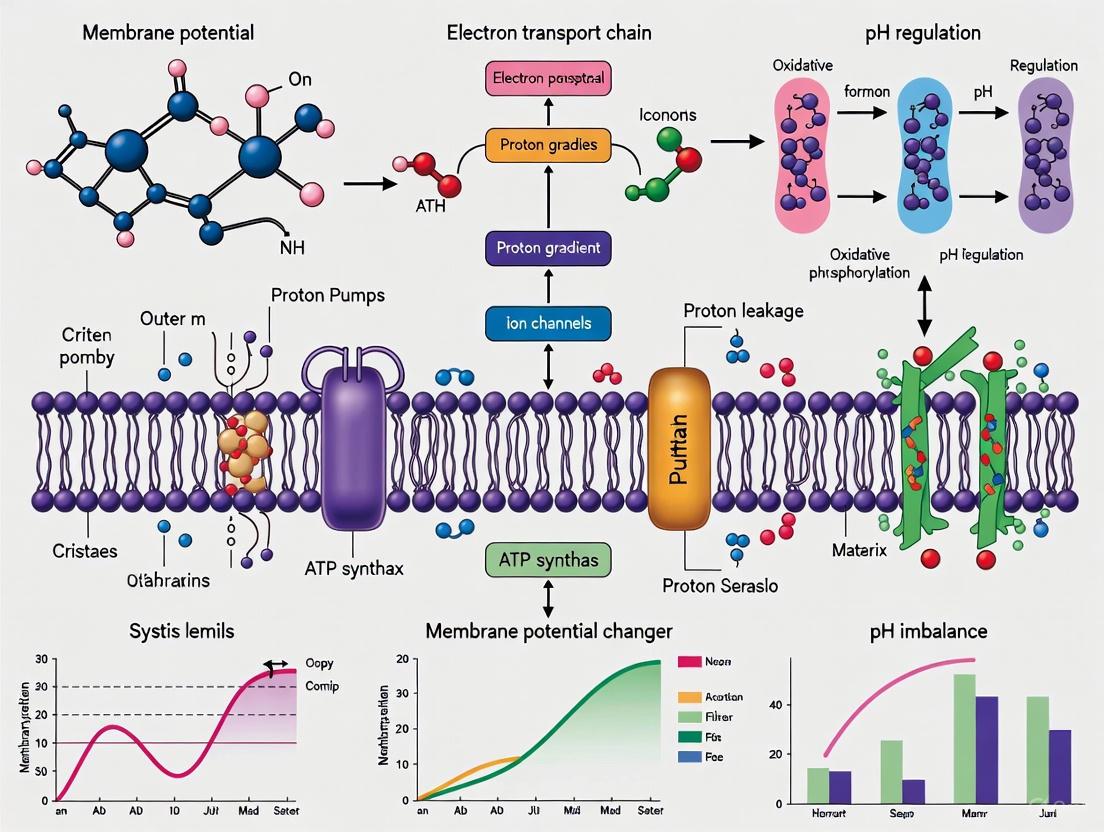
This article provides a comprehensive analysis of the intricate relationship between mitochondrial membrane potential (ΔΨm) and pH gradient (ΔpH), the two components of the proton motive force essential for ATP...
Mitochondrial Membrane Potential and pH Control: From Molecular Mechanisms to Disease Implications and Advanced Measurement Techniques
Abstract
This article provides a comprehensive analysis of the intricate relationship between mitochondrial membrane potential (ΔΨm) and pH gradient (ΔpH), the two components of the proton motive force essential for ATP production and cellular survival. Tailored for researchers, scientists, and drug development professionals, it explores the foundational biophysics of the electrochemical gradient, details cutting-edge and traditional methodologies for measuring these parameters, addresses common experimental challenges and artifacts, and discusses the critical role of ΔΨm/ΔpH dysregulation in diseases such as ischemia-reperfusion injury, cancer, and neurodegenerative disorders. The content synthesizes validation strategies for different techniques and highlights emerging therapeutic opportunities targeting mitochondrial bioenergetics.
The Proton Motive Force: Deconstructing the Energetic Core of the Mitochondrion
Troubleshooting Guides
Issue 1: Consistently Low or Unmeasurable ΔΨm
Problem: Fluorescent dye assays (e.g., JC-1, TMRM) indicate a lower-than-expected mitochondrial membrane potential, suggesting poor energetic state or uncoupling.
| Possible Cause | Diagnostic Experiments | Proposed Solution |
|---|---|---|
| Uncoupling [1] [2] | Add an uncoupler like FCCP. If ΔΨm collapses further, the issue is elsewhere. If ΔΨm is already minimal, the mitochondria may be already uncoupled. | Check for contamination with uncoupling agents (e.g., ionophores). Use inhibitors like oligomycin to block ATP synthase hydrolysis. |
| Respiratory Chain Inhibition [1] [3] | Measure oxygen consumption rate (OCR). Low basal OCR suggests impaired electron transport chain (ETC) function. | Use substrates for specific ETC complexes to isolate the blocked segment. Ensure adequate metabolite supply (e.g., pyruvate, succinate). |
| ATP Synthase Reversal [1] [4] | Inhibit ATP synthase with oligomycin. If ΔΨm increases, it indicates the synthase was hydrolyzing ATP to pump protons. | Utilize the ATPase inhibitory factor 1 (IF1) or ensure adequate ATP levels to prevent reverse activity. |
| Proton Leak [4] [2] | Calculate the proton leak fraction from OCR measurements. High leak under oligomycin indicates intrinsic or protein-mediated leak. | Investigate expression levels of uncoupling proteins (UCPs). Use UCP inhibitors if appropriate. |
Issue 2: Excessive ΔΨm (Hyperpolarization) and Associated Toxicity
Problem: Mitochondria exhibit sustained, abnormally high membrane potential, which can increase reactive oxygen species (ROS) production.
| Possible Cause | Diagnostic Experiments | Proposed Solution |
|---|---|---|
| Inhibition of ATP Synthesis [1] | Measure cellular ATP/ADP ratio. A low ratio with high ΔΨm suggests a blockage in ATP synthesis or export. | Check for inhibition of ATP synthase (e.g., oligomycin) or the adenine nucleotide translocator (ANT). |
| Reduced Metabolic Demand | N/A | Correlate with overall cellular activity. Hyperpolarization may be transient and physiological. |
| Compromised Uncoupling Mechanisms [2] | Assess expression and function of UCPs. | Investigate regulatory pathways for UCPs. Induce mild uncoupling to safely dissipate excess potential. |
Issue 3: Inconsistent or Heterogeneous ΔΨm Readings Across a Cell Population
Problem: High variability in ΔΨm measurements between cells or between mitochondria within a single cell.
| Possible Cause | Diagnostic Experiments | Proposed Solution |
|---|---|---|
| Normal Physiological Heterogeneity [1] [2] | Use high-resolution live-cell imaging. Heterogeneity may correlate with cell cycle stage, metabolic activity, or mitochondrial subpopulations. | Establish a baseline for "normal" heterogeneity in your model system. Analyze subcellular mitochondrial populations separately. |
| Onset of Mitophagy [2] | Co-stain with mitophagy markers (e.g., PINK1, Parkin). Mitochondria with low ΔΨm may be targeted for degradation. | This is often a healthy quality control process. If excessive, investigate causes of widespread damage. |
| Artifacts from Dye Loading/Measurement [1] | Validate dye concentrations, loading times, and proper use of quench/dequench protocols. Compare multiple dyes (e.g., JC-1 vs. TMRM). | Follow established protocols rigorously. Include appropriate controls (e.g., FCCP for collapse, inhibitors for specific conditions). |
Frequently Asked Questions (FAQs)
Q1: What is the fundamental relationship between ΔΨm and ΔpH? They are the two components of the proton-motive force (PMF). The PMF is the total energy stored in the electrochemical proton gradient across the inner mitochondrial membrane and is calculated as PMF = ΔΨ - (2.3RT/F)ΔpH [3] [4]. In mitochondria, the electrical potential (ΔΨm) is the dominant component, typically around -170 to -180 mV, while the chemical gradient (ΔpH) is smaller, contributing about a quarter of the total PMF [2].
Q2: Why is my ΔΨm reading unstable after adding a drug intended to modulate metabolism? Many drugs, especially those in development, have off-target effects on mitochondrial function. The compound may be acting as an uncoupler, an ETC inhibitor, or an ionophore that disturbs the membrane integrity. It is recommended to perform a Seahorse XF Analyzer assay or similar to profile the bioenergetic function and pinpoint the specific complex or process affected [1] [2].
Q3: Can ΔΨm be too high? Why is that a problem? Yes. While a strong ΔΨm is necessary for ATP production, sustained hyperpolarization can be pathological. An excessively high ΔΨm increases the reduction of oxygen at the ETC, leading to a significant leak of electrons and a surge in superoxide and other ROS production. This oxidative stress can damage cellular components and trigger cell death pathways [1] [2].
Q4: How does ΔΨm directly control mitochondrial quality control (mitophagy)? A sustained loss of ΔΨm in a damaged mitochondrion is a primary signal for its elimination. Reduced ΔΨm stabilizes the PINK1 kinase on the outer membrane, which then recruits the E3 ubiquitin ligase Parkin. Parkin ubiquitinates outer membrane proteins, marking the entire organelle for degradation via autophagy in a process called mitophagy [2].
Table 1: Components of the Proton-Motive Force (PMF)
| Parameter | Typical Value in Mitochondria | Contribution to Total PMF | Notes |
|---|---|---|---|
| ΔΨm (Electrical Gradient) | ~ -170 to -180 mV [3] [2] | Major contributor (~75%) [2] | Negative inside the matrix. Measured with potentiometric dyes. |
| ΔpH (Chemical Gradient) | ~ 0.4 pH units [2] | Minor contributor (~25%) [2] | Matrix is more alkaline (pH ~7.8) than the intermembrane space (pH ~7.4). |
| Total PMF | ~ 180-200 mV [4] | 100% | Minimum ~170 mV (or ~50 kJ/mol) is required for ATP synthesis [3] [5]. |
Table 2: Key Experimental Inhibitors and Uncouplers
| Reagent | Target/Function | Effect on ΔΨm | Primary Use in Experimentation |
|---|---|---|---|
| Oligomycin | ATP Synthase (F0 subunit) [4] | Increases (by blocking consumption) | To assess proton leak or measure ATP-linked respiration. |
| FCCP | Uncoupler (H+ ionophore) [2] | Collapses (dissipates the gradient) | To measure maximum respiratory capacity; used as a control to collapse ΔΨm in dye assays. |
| Rotenone | Complex I [3] | Decreases (halts proton pumping) | To inhibit NADH-linked respiration. |
| Antimycin A | Complex III [3] | Decreases (halts proton pumping) | To inhibit ETC function completely. |
Experimental Protocols
Protocol 1: Measuring ΔΨm using JC-1 with Fluorescence Microscopy
Principle: JC-1 is a cationic dye that accumulates in mitochondria in a potential-dependent manner. At high ΔΨm, it forms aggregates that emit red light (~590 nm). At low ΔΨm, it remains in a monomeric state that emits green light (~529 nm). The red/green ratio is a quantitative measure of ΔΨm [1].
Procedure:
- Cell Preparation: Plate cells on glass-bottom culture dishes and grow to 50-70% confluency.
- Dye Loading: Incubate cells with 2-5 µM JC-1 in culture media for 15-30 minutes at 37°C in the dark.
- Washing: Gently rinse cells with pre-warmed PBS or dye-free media to remove excess extracellular dye.
- Imaging: Acquire images using a fluorescence microscope with appropriate filter sets for FITC (green monomers) and TRITC (red J-aggregates).
- Analysis: Calculate the ratio of red fluorescence intensity to green fluorescence intensity for individual mitochondria or whole cells. Include controls:
- High ΔΨm Control: Cells treated with a complex I or II substrate.
- Low ΔΨm Control: Cells treated with 1-10 µM FCCP to fully collapse the gradient.
Protocol 2: Calibrating ΔΨm using a K+ Gradient with Valinomycin
Principle: The ionophore valinomycin makes the membrane permeable to K+. By controlling the K+ concentration inside and outside of the mitochondria ([K+]~in~ and [K+]~out~), the membrane potential can be set to a known value using the Nernst equation: ΔΨm = -61.5 log([K+]~in~ / [K+]~out~) at 37°C [1].
Procedure:
- Suspend Mitochondria: Isolate mitochondria in a K+-free sucrose-based buffer.
- Create K+ Gradient: Add aliquots of mitochondria to a series of tubes containing buffers with known, varying concentrations of KCl (e.g., 0.1, 1, 10 mM).
- Apply Valinomycin: Add a low concentration of valinomycin (e.g., 100 nM) to each tube to allow K+ equilibration.
- Add Dye and Measure: Introduce a potentiometric dye like TMRM and record the fluorescence.
- Generate Standard Curve: Plot the fluorescence signal (or its log) against the calculated Nernst potential for each K+ concentration. This curve can be used to convert fluorescence readings from experimental samples into millivolt (mV) estimates of ΔΨm.
The Scientist's Toolkit: Research Reagent Solutions
| Reagent | Function & Application |
|---|---|
| JC-1 (5,5',6,6'-tetrachloro-1,1',3,3'-tetraethylbenzimidazolylcarbocyanine iodide) | Ratiometric fluorescent dye for monitoring ΔΨm; green monomer at low potential, red J-aggregate at high potential [1]. |
| TMRM (Tetramethylrhodamine, methyl ester) / TMRE | Cationic, fluorescent dye that accumulates in mitochondria in a ΔΨm-dependent manner; used for quantitative potential measurement. |
| FCCP (Carbonyl cyanide-p-trifluoromethoxyphenylhydrazone) | Proton ionophore and potent uncoupler; collapses the proton gradient and ΔΨm, used as a critical control [2]. |
| Oligomycin | ATP synthase inhibitor; used to prevent reverse activity (ATP hydrolysis) and to probe the proton leak component of respiration [4]. |
| Valinomycin | K+ ionophore; used to calibrate ΔΨm measurements by clamping the potential to known values via the K+ diffusion potential [1]. |
| Antimycin A | Inhibitor of Complex III; used to shut down the electron transport chain for controlled studies of ΔΨm decay [3]. |
Signaling Pathways and Experimental Workflows
Chemiosmotic Theory Framework
Mitochondrial Quality Control via ΔΨm
Experimental Workflow for ΔΨm Investigation
The mitochondrial membrane potential (ΔΨm) is a critical component of cellular bioenergetics, representing the electrical component of the proton motive force that drives adenosine triphosphate (ATP) synthesis. This potential is generated primarily through the coordinated activity of specific complexes within the mitochondrial electron transport chain (ETC). Complexes I, III, and IV function as proton pumps, translocating protons from the mitochondrial matrix to the intermembrane space and creating an electrochemical gradient [6] [1] [7]. The energy stored in this gradient is then harnessed by ATP synthase (Complex V) to phosphorylate adenosine diphosphate (ADP), producing ATP [6] [7]. This article provides a technical guide for researchers investigating ΔΨm, with a specific focus on troubleshooting common experimental challenges related to its generation by Complexes I, III, and IV.
FAQ: Core Concepts of ΔΨm Generation
Q1: Which ETC complexes are directly responsible for generating ΔΨm, and what are their specific contributions? Complexes I, III, and IV are the primary proton-pumping complexes responsible for building ΔΨm. Their specific roles are summarized in the table below.
Table 1: Proton-Pumping Complexes of the Electron Transport Chain
| Complex | Common Name | Electron Transfer | Proton Translocation (H+/2e-) | Key Inhibitors |
|---|---|---|---|---|
| Complex I | NADH:ubiquinone oxidoreductase | NADH → Coenzyme Q | 4 H+ from matrix to IMS [6] | Rotenone [8] |
| Complex III | Cytochrome bc₁ complex | Coenzyme Q → Cytochrome c | 4 H+ (via the Q-cycle) [6] | Antimycin A [7] |
| Complex IV | Cytochrome c oxidase | Cytochrome c → O₂ | 2 H+ from matrix to IMS [6] | Cyanide, Azide [7] |
Q2: Why is Complex II not a contributor to ΔΨm? Complex II (succinate dehydrogenase) participates in the ETC by oxidizing succinate to fumarate and reducing ubiquinone to ubiquinol. However, its function is not coupled to proton translocation across the inner mitochondrial membrane [6] [7]. It serves as an auxiliary entry point for electrons from FADH2 into the ETC but does not directly contribute to the proton gradient.
Q3: How does a compromised proton gradient affect mitochondrial function beyond ATP production? ΔΨm is not only essential for ATP synthesis but also serves as a key indicator of mitochondrial health and a driver of critical cellular processes. A sustained drop in ΔΨm can induce a loss of cell viability and is implicated in various pathologies [1]. Furthermore, ΔΨm provides the electrophoretic force for importing proteins into the mitochondria and transporting ions, such as calcium and iron, which are necessary for healthy mitochondrial function and biogenesis of Fe-S clusters [1].
Troubleshooting Guide: Resolving Common Experimental Issues
Problem 1: Inconsistent or Lower-Than-Expected ΔΨm Readings Unexpectedly low ΔΨm measurements can stem from issues with the ETC complexes or experimental conditions.
- Potential Cause: Inhibition of Proton-Pumping Complexes. Contamination from environmental toxins or residual cleaning agents can inhibit ETC complexes. For instance, cyanide and azide inhibit Complex IV, while rotenone inhibits Complex I [7] [8].
- Solution:
- Validate Reagent Purity: Ensure all buffers and media are prepared with high-grade water and reagents. Test for the presence of inhibitors.
- Confirm Substrate Integrity: Use fresh, properly aliquoted substrates for respiration (e.g., succinate, glutamate/malate). Degraded substrates will limit electron flow.
- Employ an Inhibitor Cocktail: Systematically use specific inhibitors to isolate the faulty complex.
- Add rotenone (Complex I inhibitor); a failure to recover ΔΨm with subsequent succinate (Complex II substrate) addition suggests broader membrane damage.
- If ΔΨm is established with succinate but collapses upon adding antimycin A (Complex III inhibitor), it confirms proton pumping by Complex III is functional.
Problem 2: High Background ROS Interfering with ΔΨm Assays Excessive reactive oxygen species (ROS) production is both a consequence and a cause of a compromised ΔΨm.
- Potential Cause: Pathological Electron Leakage. When electron flow through the ETC is impaired (e.g., by inhibition, hypoxia, or mutations in ETC subunits), electrons can leak prematurely and react with oxygen, generating superoxide (O₂•–) [8]. Complexes I and III are major sites of ROS production [8]. This is particularly relevant in cancer research, where oncogenic pathways can hijack the ETC to increase its ROS-producing capacity [8].
- Solution:
- Optimize Assay Conditions: Reduce ambient light exposure for fluorescent dyes and minimize sample preparation time.
- Use Antioxidants Judiciously: Include low concentrations of membrane-permeable antioxidants like MitoTEMPO (a mitochondria-targeted superoxide scavenger) in your assays to mitigate ROS interference [8]. Note: High concentrations may artificially suppress physiological ROS signaling.
- Investigate ETC Supercomplex Assembly: Defects in the assembly of ETC supercomplexes can increase electron leakage and ROS. Assess the integrity of supercomplexes via blue native PAGE [8] [9].
Problem 3: Failure to Link ΔΨm to Functional ATP Output A high ΔΨm does not always correlate with high ATP production, indicating a possible uncoupling or dysfunction in ATP synthase.
- Potential Cause: Reverse Operation of ATP Synthase. Under conditions where the proton gradient is dissipated (e.g., after ETC inhibition), the ATP synthase (Complex V) can run in reverse, hydrolyzing ATP to pump protons and maintain ΔΨm, thereby consuming cellular ATP [1].
- Solution:
- Inhibit ATP Synthase: Use oligomycin to block the F0 subunit of ATP synthase. This will prevent reverse activity and allow for a pure measurement of the ETC-generated ΔΨm [9].
- Measure Concurrently: Use real-time assays that simultaneously monitor ΔΨm (e.g., with TMRM) and ATP levels (e.g., with a FRET-based ATP sensor) to directly observe the coupling efficiency [10].
Essential Experimental Protocols
Protocol: Measuring ΔΨm with TMRM/JC-1 via Fluorescence Microscopy
This protocol outlines the steps for assessing ΔΨm in live cells using potentiometric dyes.
- Principle: Cationic dyes like Tetramethylrhodamine Methyl Ester (TMRM) and JC-1 accumulate in the mitochondrial matrix in a ΔΨm-dependent manner. TMRM fluorescence intensity is quantitative, while JC-1 exhibits a shift from green (monomer, low ΔΨm) to red (J-aggregates, high ΔΨm) [11].
- Procedure:
- Cell Loading: Incubate cells with 20-200 nM TMRM or 2-5 µM JC-1 in culture medium for 20-40 minutes at 37°C [11]. The optimal concentration must be determined empirically, as low concentrations (e.g., 1.35-2.7 nM TMRM) are required to visualize spatial gradients between the cristae and inner boundary membranes [10].
- Washing & Equilibration: Replace the dye-containing medium with a clear, pre-warmed buffer. Allow the dye to equilibrate for 10-15 minutes.
- Image Acquisition: Capture images using a fluorescence microscope with appropriate filter sets.
- For TMRM, use excitation/emission ~548/573 nm. The intensity correlates with ΔΨm.
- For JC-1, acquire both green (ex/em ~514/529 nm) and red (ex/em ~585/590 nm) channels. Calculate the red/green fluorescence intensity ratio.
- Validation (Critical Control): At the end of the experiment, add an uncoupler like FCCP (1-10 µM) to fully dissipate ΔΨm. The subsequent loss of TMRM intensity or JC-1 red/green ratio confirms the signal is ΔΨm-dependent.
Protocol: Isolating Proton Pump Defects with Seahorse XF Analyzer
This protocol uses metabolic inhibitors to pinpoint which proton pump is dysfunctional.
- Principle: The Seahorse XF Analyzer measures the Oxygen Consumption Rate (OCR), which is directly linked to proton pumping. Sequential injection of specific inhibitors allows for the dissection of ETC function [9].
- Workflow:
- Basal OCR: Measure the baseline OCR.
- ATP Synthase Inhibition: Inject oligomycin (1-2 µM). This inhibits ATP synthase, causing a drop in OCR. The remaining OCR is associated with proton leak.
- Uncoupling: Inject FCCP (0.5-2 µM). This uncouples electron transport from ATP synthesis, allowing maximum electron flux and OCR. A low response to FCCP suggests a defect in the proton-pumping complexes (I, III, IV) themselves.
- ETC Shutdown: Inject a cocktail of rotenone (Complex I inhibitor, 0.5-1 µM) and antimycin A (Complex III inhibitor, 1-2 µM). This shuts down all mitochondrial respiration, revealing the non-mitochondrial OCR.
Diagram: Experimental Workflow for ETC Functional Analysis
The Scientist's Toolkit: Key Research Reagents
Table 2: Essential Reagents for Investigating ΔΨm and ETC Function
| Reagent / Tool | Primary Function / Target | Key Application in Research |
|---|---|---|
| Rotenone | Inhibits Complex I (IQ site) [8] | Used to isolate electron flow through Complex II; can increase ROS production at Complex I [8]. |
| Antimycin A | Inhibits Complex III (QI site) [7] | Blocks the Q-cycle, inducing significant ROS production at Complex III [7] [8]. |
| Cyanide (NaCN) | Inhibits Complex IV (cytochrome c oxidase) [7] | Used to fully inhibit mitochondrial respiration and confirm the specificity of ΔΨm signals. |
| Oligomycin | Inhibits ATP synthase (Complex V) [9] | Used to distinguish between ATP-linked respiration and proton leak; prevents reverse activity of ATP synthase [1]. |
| FCCP | Chemical uncoupler [9] | Dissipates the proton gradient, uncoupling electron transport from ATP synthesis to measure maximum respiratory capacity. |
| TMRM / TMRE | ΔΨm-sensitive fluorescent dyes [11] [10] [9] | Quantitative measurement of ΔΨm in live cells via fluorescence microscopy or flow cytometry. |
| JC-1 | Ratiometric ΔΨm-sensitive dye [11] | Provides a qualitative and semi-quantitative measure of ΔΨm via a shift in fluorescence emission (green/red ratio). |
| MitoTEMPO | Mitochondria-targeted superoxide scavenger [8] | Used to investigate the role of mitochondrial ROS in signaling and pathology. |
Advanced Technical Notes: Spatial Gradients and Cancer Research Implications
Recent research using super-resolution microscopy (e.g., STED, SIM) has revealed that the ΔΨm is not uniform across the inner mitochondrial membrane. The membrane potential of the cristae (ΔΨC), where the proton pumps are located, is higher (more negative) than that of the inner boundary membrane (ΔΨIBM) [10]. The cristae junction acts as a barrier that maintains this gradient. Methods have been developed to analyze this spatial membrane potential gradient (SMPG) by examining the distribution of TMRM fluorescence intensity relative to a reference stain like MitoTracker Green [10]. This is crucial for understanding how local ΔΨm changes, for instance, in response to calcium signals that hyperpolarize the cristae to boost ATP production [10].
Furthermore, the ETC and ΔΨm are emerging as important targets in disease research, particularly in cancer. Mutations in genes like DNMT3A can lead to DNA hypomethylation and increased expression of ETC components and supercomplex machinery (e.g., Cox7a2l) [9]. This results in elevated ΔΨm and mitochondrial respiration, which can confer a selective growth advantage to certain cells, such as in clonal hematopoiesis [9]. This elevated ΔΨm can also be a therapeutic vulnerability, as cells become more dependent on oxidative phosphorylation and more sensitive to targeted agents like MitoQ [9].
Contributions of ΔΨm and ΔpH to the Total Proton Motive Force (Δp)
Frequently Asked Questions (FAQs)
FAQ 1: What is the protonmotive force (Δp) and what are its components? The protonmotive force (Δp or pmF) is an electrochemical potential gradient across the mitochondrial inner membrane that serves as the central intermediate coupling electron transport to ATP synthesis. It is composed of two distinct components: the electrical potential gradient (ΔΨm) resulting from charge separation, and the chemical potential gradient (ΔpH) resulting from a difference in proton concentration across the membrane [12] [2].
FAQ 2: What are the typical relative contributions of ΔΨm and ΔpH to the total Δp under physiological conditions? Under most physiological conditions, the membrane potential (ΔΨm) is the dominant component, contributing approximately 75-85% of the total protonmotive force. The pH gradient (ΔpH) typically contributes the remaining 15-25% [2] [13]. For a typical total Δp of 200 mV, ΔΨm accounts for about 160-170 mV, while ΔpH contributes ~30-40 mV.
FAQ 3: Why might I measure a low ΔpH contribution in my experiments? A very low measured ΔpH (< 3 mV) can result from specific experimental conditions, including the use of certain phosphate concentrations or particular cell types [13]. Methodological factors are also critical: the use of high concentrations of potentiometric dyes like TMRM can saturate the cristae membranes and obscure the true ΔpH contribution. Using lower dye concentrations (e.g., 1.35-5.4 nM) is essential for accurate resolution of the ΔpH component [10].
FAQ 4: How does mitochondrial membrane architecture influence ΔΨm and ΔpH measurements? The inner mitochondrial membrane is not uniform. The cristae membranes (CM), which house the proton pumps, can maintain a different membrane potential (ΔΨC) compared to the inner boundary membranes (IBM, ΔΨIBM). The narrow cristae junctions act as barriers that can separate these potentials. This compartmentalization means that the ΔΨm you measure is often an average value, and local gradients can significantly impact bioenergetics and signaling [10].
FAQ 5: My data shows a change in ΔΨm. Can I directly conclude that the total protonmotive force has changed in the same way? Not always. While ΔΨm is the major component and often mirrors changes in the total Δp, the ΔpH component can change independently. For example, activation of ion exchangers or changes in matrix buffering capacity can cause a shift in the balance between ΔΨm and ΔpH without an immediate change in the total Δp. Therefore, for a complete picture, it is preferable to assess both components [12] [13].
Table 1: Typical Values and Contributions of ΔΨm and ΔpH to the Total Protonmotive Force
| Parameter | Typical Value | Contribution to Total Δp | Experimental Notes |
|---|---|---|---|
| Total Δp | 170 - 200 mV | 100% | Value can change with energy demand and substrate availability [2] [13]. |
| ΔΨm (Electrical) | ~160 to -180 mV | ~80% (75-85%) | Dominant component; easily measured with potentiometric dyes [2] [14]. |
| ΔpH (Chemical) | ~0.4 pH units (~30 mV) | ~20% (15-25%) | Corresponds to a 2.5-fold difference in [H+]; often underestimated [2]. |
Table 2: Impact of Experimental Conditions on ΔΨm/ΔpH Balance
| Condition / Intervention | Effect on ΔΨm | Effect on ΔpH | Net Effect on Δp | Primary Mechanism |
|---|---|---|---|---|
| High ATP Demand (State 3) | Decrease | Decrease | Decrease | Increased H+ influx via ATP synthase consumes Δp [14]. |
| Oligomycin (ATP Synthase Inhibitor) | Increase | Variable | Increase (initially) | Block of main H+ consumption pathway; Δp builds up [14]. |
| Potassium Ionophores (e.g., VCP) | Decrease | Increase | Variable | K+/H+ exchange dissipates ΔΨm but can enhance ΔpH [13]. |
| Calcium Influx into Matrix | Increase (in Cristae) | Variable | Increase | Boosts TCA cycle & ETC activity, increasing H+ pumping [10]. |
| Mild Uncoupling (FCCP, low dose) | Decrease | Decrease | Decrease | Induces H+ leak, dissipating both components [15]. |
Experimental Protocols & Troubleshooting
Protocol: Measuring Spatial Membrane Potential Gradients with TMRM/MTG
Objective: To resolve distinct membrane potentials between the cristae membranes (CM) and inner boundary membranes (IBM) in living cells.
Principle: This method uses SIM super-resolution microscopy and the differential, concentration-dependent accumulation of two dyes: potential-sensitive TMRM and potential-insensitive MitoTracker Green (MTG), which serves as a morphological reference [10].
Workflow:
- Cell Staining: Incubate cells with 500 nM MitoTracker Green (MTG) and a low concentration of TMRM (1.35 - 5.4 nM) for 30 minutes. Using low TMRM is critical to avoid saturation and reveal the true gradient.
- Image Acquisition: Perform simultaneous dual-channel imaging using Structured Illumination Microscopy (SIM).
- Data Analysis (IBM Association Index):
- Use the MTG channel to define the mitochondrial boundaries automatically (e.g., using Otsu's thresholding).
- Generate two regions of interest (ROIs): a shrunken region for the Cristae (CM) and a widened region for the Inner Boundary Membrane (IBM).
- Calculate the IBM Association Index = (Mean TMRM intensity in IBM ROI) / (Mean TMRM intensity in CM ROI). A lower index indicates a higher relative potential in the cristae [10].
Troubleshooting Guide:
- Problem: No gradient detected, uniform TMRM signal. Solution: Confirm the use of low TMRM concentrations (1.35-5.4 nM). High dye concentrations saturate the cristae and mask the gradient. Verify SIM resolution and calibration [10].
- Problem: Poor signal-to-noise ratio in TMRM channel. Solution: Optimize dye loading time and temperature. Ensure minimal photobleaching by using low illumination intensities.
- Problem: Histamine stimulation does not induce the expected hyperpolarization in cristae. Solution: Validate ER calcium stores and mitochondrial calcium uptake pathways. Confirm activity of complexes I and III, as this response depends on proton pump activity [10].
Protocol: Computational Modeling of ΔΨm/ΔpH Contribution
Objective: To simulate how ion transport mechanisms control the balance between ΔΨm and ΔpH.
Principle: Computer models of oxidative phosphorylation can be extended to include key ion transport processes—K+ uniport, K+/H+ exchange, and membrane capacitance—to predict how the ΔΨm/ΔpH ratio changes under various conditions [13].
Workflow:
- Model Framework: Utilize an established model of oxidative phosphorylation (e.g., Korzeniewski model).
- Define Key Equations:
- K+ Uniport (vKuni): Dependent on the membrane potential (ΔΨm) and intra-/extramitochondrial K+ concentration.
- K+/H+ Exchange (vKHex): Dependent on the K+ and H+ gradients across the membrane.
- Membrane Capacitance: Describes how charge separation builds ΔΨm.
- Parameterization: Set initial rate constants (e.g., kKuni, kKHex), ion concentrations, and buffering capacities based on experimental data.
- Simulation & Validation: Run simulations under different conditions (e.g., varying ATP demand, inhibitor presence) and validate the output against empirical measurements of ΔΨm and ΔpH [13].
Troubleshooting Guide:
- Problem: Model predicts an unphysiologically low ΔpH (e.g., < 3 mV). Solution: Re-evaluate the ratio of the rate constants for K+ uniport and K+/H+ exchange. The contribution of ΔΨ and ΔpH is determined by the ratio of these constants, not their absolute values [13].
- Problem: Model is unstable or fails to converge. Solution: Check the initial conditions and ensure the differential equations for H+ and K+ transport are correctly implemented, including the buffering coefficients for the matrix and cytosol.
The Scientist's Toolkit
Table 3: Key Research Reagents for Investigating Δp Components
| Reagent / Tool | Primary Function | Considerations for ΔΨm/ΔpH Studies |
|---|---|---|
| TMRM / TMRE | Potentiometric dye for measuring ΔΨm. | Critical: Use low concentrations (1.35-5.4 nM) to resolve spatial gradients between CM and IBM. High concentrations saturate the signal [10]. |
| MitoTracker Green (MTG) | Mitochondrial morphology dye; stains IMM independent of potential. | Used as a spatial reference marker in super-resolution studies to normalize TMRM distribution [10]. |
| Oligomycin | Inhibitor of ATP synthase (Complex V). | Used to block the primary consumer of Δp. Causes a buildup of Δp, useful for assessing ETC pumping capacity [14]. |
| FCCP / CCP | Chemical uncoupler; carries protons across IMM. | Dissipates both ΔΨm and ΔpH. Low doses can induce "mild uncoupling" to test ROS sensitivity [15]. |
| Rotenone & Antimycin A | Inhibitors of ETC Complex I and III. | Reduce Δp generation. Useful to confirm that Δp changes are linked to proton pump activity [10]. |
| K+/H+ Exchanger Ionophores (e.g., nigericin) | Collapses ΔpH by exchanging K+ for H+. | Used to dissect the individual contributions of ΔΨm and ΔpH to the total Δp or to a specific process. |
| MitoSNARE-ATeam / mt-MaLion | Genetically encoded sensors for matrix ATP:ADP ratio or pH. | Provide an indirect readout of Δp activity and allow compartment-specific measurement of the ΔpH component. |
ΔΨm as a Key Indicator of Mitochondrial Health and Cellular Viability
Frequently Asked Questions (FAQs)
Q1: What is ΔΨm and why is it a key indicator of mitochondrial health?
The mitochondrial membrane potential (ΔΨm) is the electrical potential difference across the inner mitochondrial membrane, generated by the proton pumps of the electron transport chain (Complexes I, III, and IV). It is an essential component in the process of energy storage during oxidative phosphorylation. Together with the proton gradient (ΔpH), ΔΨm forms the transmembrane potential of hydrogen ions which is harnessed by ATP synthase to produce ATP [1].
ΔΨm serves not only for ATP synthesis but is also a critical factor in determining mitochondrial viability by participating in the elimination of dysfunctional mitochondria (mitophagy). Furthermore, it acts as a driving force for the transport of charged ions (such as Ca2+ and Fe2+) and proteins that are necessary for healthy mitochondrial function. Sustained changes in ΔΨm can be deleterious, with prolonged drops or rises from normal levels potentially inducing loss of cell viability and contributing to various pathologies [1].
Q2: What are the typical physiological values of ΔΨm in healthy cells?
In healthy, active mitochondria, the membrane potential typically ranges from -150 mV to -180 mV [16]. Quantitative measurements in specific cell types, such as cultured rat cortical neurons, have shown a resting ΔΨm of approximately -139 mV, which can be regulated between -108 mV and -158 mV in response to changes in energy demand and metabolic activation [17]. It is noteworthy that ΔΨm in intact cells is generally smaller (e.g., -120 mV to -160 mV) compared to that observed in isolated mitochondria suspended in artificial media (-180 mV to -190 mV) [17].
Q3: My ΔΨm measurements are inconsistent. What could be causing this?
Inconsistencies in ΔΨm measurements can arise from numerous sources. The table below summarizes common artifacts and their solutions.
Table: Troubleshooting Common ΔΨm Measurement Artifacts
| Problem | Potential Causes | Recommended Solutions |
|---|---|---|
| High background fluorescence/noise | Non-specific probe binding; dye aggregation; cellular autofluorescence [17]. | Titrate dye concentration; include proper wash steps; use probes with low background (e.g., LDS 698) [16]. |
| False depolarization readings | Probe overloading leading to quenching artifacts; inappropriate use of non-Nernstian dyes (e.g., JC-1 aggregates) [17]. | Use low, non-quenching dye concentrations; validate with a Nernstian dye like TMRM in non-quench mode [17]. |
| Variable results between cell types | Differences in plasma membrane potential (ΔΨP), mitochondrial density, cell size, and volume ratios [17]. | Use a calibration paradigm that accounts for ΔΨP, volume ratios, and binding properties [17]. |
| Dye leakage or sequestration | Probe instability; metabolism of the dye; active export from cells [18]. | Use esterase-resistant probes where possible; perform time-course experiments to monitor signal stability. |
| Unresponsive ΔΨm signal | Use of covalent trappers (e.g., MitoTracker Red FM) that do not reflect dynamic changes [16]. | Switch to reversible, equilibrium-distribution probes like TMRM or LDS 698 for real-time tracking [16]. |
Q4: How do I choose the right fluorescent probe for my ΔΨm experiment?
The choice of probe depends on your experimental goals, required sensitivity, and the equipment available. Key considerations include the need for quantitative vs. qualitative data, the expected magnitude of ΔΨm changes, and the potential for artifacts.
Table: Comparison of Common Fluorescent Probes for ΔΨm Measurement
| Probe Name | Measurement Mode | Key Advantages | Key Limitations | Best For |
|---|---|---|---|---|
| TMRM / TMRE | Reversible, Nernstian distribution [17]. | Suitable for quantitative, absolute measurements; can be used in quench or non-quench mode [17]. | Signal depends on ΔΨP, volume ratios, and binding; requires careful calibration [17]. | Quantitative tracking of kinetics and absolute values of ΔΨm [17]. |
| JC-1 | Ratiometric (shift from green monomer to red J-aggregates) [16]. | Visual and ratiometric output; easy to interpret polarization. | Prone to non-specific staining; aggregation influenced by factors other than ΔΨm; non-equilibrium distribution [16]. | Qualitative assessment of large shifts in polarization. |
| MitoTracker Red FM | Covalent binding (irreversible) [16]. | Good for fixed cells and tracking mitochondrial morphology. | Does not respond to subsequent changes in ΔΨm after loading [16]. | End-point experiments requiring fixation. |
| LDS 698 | Reversible, Nernstian distribution [16]. | High sensitivity to subtle changes; low background fluorescence; tracks kinetics effectively [16]. | Less commonly used; validation history is shorter than TMRM. | Detecting fine, transient changes in ΔΨm in live cells [16]. |
The Scientist's Toolkit: Key Research Reagent Solutions
Table: Essential Reagents and Tools for ΔΨm Research
| Reagent/Tool | Function/Principle | Example Use in Experimentation |
|---|---|---|
| Tetramethylrhodamine Methyl Ester (TMRM) | Cationic, lipophilic dye that distributes across membranes according to the Nernst equation [17]. | Quantitative imaging of ΔΨm dynamics in live cells under different metabolic conditions. |
| LDS 698 | Hemicyanine dye with low background, high sensitivity for detecting subtle ΔΨm changes [16]. | Tracking kinetics of slight depolarizations or hyperpolarizations that may be missed by other dyes. |
| Carbonyl cyanide-p-trifluoromethoxyphenylhydrazone (FCCP) | Protonophore uncoupler that dissipates the proton motive force, collapsing ΔΨm [17]. | Used as a control to induce maximal depolarization and validate probe response. |
| Oligomycin | ATP synthase inhibitor [1]. | Used to block ATP synthesis, allowing assessment of ΔΨm dependent on proton leak and respiratory chain activity. |
| Nigericin | K+/H+ exchanger ionophore [19]. | Used to dissect the components of the proton motive force by collapsing ΔpH, leading to a compensatory hyperpolarization of ΔΨm. |
| Valinomycin | K+ ionophore [19]. | Used to dissect the proton motive force by hyperpolarizing the plasma membrane or, under specific conditions in isolated mitochondria, to manipulate ΔΨm and ΔpH independently. |
| ATPase Inhibitory Factor 1 (IF1) | Endogenous protein that inhibits the reverse activity of ATP synthase (ATP hydrolysis) [1]. | Studied to understand how cells prevent wasteful ATP hydrolysis to maintain ΔΨm during stress. |
Experimental Protocols for Quantitative ΔΨm Assessment
Protocol 1: Absolute Quantification of ΔΨm in Adherent Cells using TMRM
This protocol, adapted from [17], allows for the measurement of absolute ΔΨm values in millivolts.
Workflow Overview:
Detailed Methodology:
Cell Preparation and Dye Loading:
- Culture adherent cells (e.g., primary neurons) on poly-ornithine-coated coverglasses or chambered coverglasses.
- Load cells with a low concentration (e.g., 10-50 nM) of TMRM in non-quench mode to avoid artifacts from dye aggregation and quenching. Simultaneously, load cells with a bis-oxonol-type plasma membrane potential (ΔΨP) indicator (PMPI) to monitor and account for changes in plasma membrane potential.
Fluorescence Imaging:
- Perform time-lapse fluorescence imaging using an appropriate microscope setup. Acquire images for TMRM and PMPI fluorescence.
- At the end of the experiment, apply a calibration paradigm. This typically involves sequential additions of:
- Oligomycin (1 µg/mL): To inhibit ATP synthase and observe ΔΨm under non-phosphorylating conditions.
- FCCP (1-2 µM): To completely collapse ΔΨm and obtain a minimum fluorescence value.
Data Analysis and Deconvolution:
- Use a biophysical model that accounts for the Nernstian distribution of TMRM, ΔΨP-dependent probe dynamics, mitochondrial and cellular volume ratios, and high- and low-affinity dye binding [17].
- Input the fluorescence time courses, calibration parameters, and volume data into a mathematical algorithm (e.g., compatible with spreadsheet calculations or custom software) to deconvolute the absolute values of ΔΨP and ΔΨM in millivolts over time.
Protocol 2: Assessing Subtle ΔΨm Changes with LDS 698
This protocol leverages the high sensitivity of LDS 698 to detect fine variations in membrane potential [16].
Workflow Overview:
Detailed Methodology:
Dye Loading:
- Incubate live cells with LDS 698 at a concentration of approximately 1 µM in the culture medium for 15-30 minutes at 37°C.
- Replace the dye-containing medium with a fresh, pre-warmed buffer to remove excess, unincorporated dye.
Fluorescence Measurement:
- Acquire fluorescence using excitation at ~460 nm and collect emission in the 580-700 nm range. LDS 698 exhibits weak fluorescence in its free state, leading to low background, and its fluorescence increases upon accumulation in mitochondria [16].
- Fluorescence can be monitored via fluorescence microscopy, flow cytometry, or a plate reader.
Experimental Treatment and Validation:
- Expose the cells to the experimental condition of interest (e.g., a drug, metabolic stressor).
- Track the fluorescence kinetics over time. The high sensitivity of LDS 698 allows for the detection of even faint changes in ΔΨm.
- Confirm that the fluorescence changes are ΔΨm-dependent by adding an uncoupler like FCCP at the end of the experiment to collapse the potential.
Advanced Topic: The Interplay between ΔΨm, ΔpH, and Reactive Oxygen Species (ROS) Production
The proton motive force (pmf) driving ATP synthesis comprises both ΔΨm and the pH gradient (ΔpH). Understanding their relationship is crucial, especially in pathological contexts like ischemia-reperfusion injury, where reverse electron transport (RET) at Complex I is a major source of damaging ROS [19].
Key Findings:
- ΔΨm is Dominant: Research indicates that succinate-driven RET-evoked ROS production is more dependent on ΔΨm than on ΔpH. A minor decrease in ΔΨm can lead to a significant suppression of ROS generation [19].
- Absolute pH Matters: The absolute intramitochondrial pH (pHin), rather than the ΔpH value itself, also modulates the rate of ROS formation during RET [19].
- Experimental Dissection: The ionophores nigericin (a K+/H+ exchanger, which decreases ΔpH and hyperpolarizes ΔΨm) and valinomycin (a K+ ionophore, which can depolarize ΔΨm and increase pHin) are critical tools for dissecting the individual contributions of ΔΨm and ΔpH to ROS production [19].
Pathway and Experimental Logic:
Troubleshooting Common ΔΨm Measurement Issues
Q: My readings for mitochondrial membrane potential (ΔΨm) are inconsistent and vary between technical replicates. What could be causing this?
Inconsistent ΔΨm readings often stem from improper dye handling or concentration issues. The cationic fluorescent dyes used to measure ΔΨm (such as TMRE and JC-1) are sensitive to experimental conditions. Ensure you are using the optimal dye concentration for your specific cell type, as excessive dye can lead to self-quenching, while insufficient dye yields weak signals. Always prepare fresh dye working solutions and avoid repeated freeze-thaw cycles of stock solutions. Furthermore, maintain consistent loading times and temperatures across all replicates, as these factors significantly impact dye uptake and distribution [20].
Q: I observe high background fluorescence in my ΔΨm assays. How can I reduce this?
High background fluorescence typically results from incomplete removal of unincorporated dye or non-specific binding. After the dye loading incubation, perform multiple careful washes with a dye-free buffer. Including a small amount of bovine serum albumin (BSA, 0.1-0.5%) in the wash buffer can help scavenge residual dye. For adherent cells, consider gentle agitation during washing. Additionally, verify that your instrument's optical settings (exposure time, gain) are calibrated using an unstained control, and subtract this background from your experimental readings [20].
Q: My pharmacological controls for uncouplers (like FCCP) are not giving the expected depolarization. What might be wrong?
If the expected depolarization with uncouplers is not observed, first verify the preparation and storage of your uncoupler stock solution. FCCP, for instance, should be dissolved in high-quality DMSO or ethanol and stored at -20°C, protected from light and moisture. Check the final working concentration, as too little may be insufficient, while too much can be toxic. A final concentration of 2-5 µM FCCP is commonly used. Also, ensure adequate incubation time (typically 5-15 minutes) for the uncoupler to take full effect before reading. Pre-warm the uncoupler solution to the assay temperature to facilitate rapid action [20] [9].
Optimizing Experimental Conditions for ΔΨm Research
Q: How does the cellular growth medium affect my ΔΨm measurements?
The composition of your growth medium can significantly influence mitochondrial physiology. High concentrations of glucose (e.g., in DMEM) can promote glycolysis, potentially masking mitochondrial phenotypes. Media containing pyruvate can help maintain mitochondrial function. For consistent results, use a well-buffered, nutrient-replete medium, and ensure the pH is stable (typically 7.4) throughout the experiment, as intracellular and mitochondrial pH are tightly linked to membrane potential. It is good practice to measure ΔΨm in a controlled, physiological buffer (e.g., Krebs-Ringer buffer) after replacing the growth medium to minimize confounding factors [21] [22].
Q: My cell line has a very high glycolytic rate. How can I ensure I'm measuring a true ΔΨm signal?
In highly glycolytic cells, mitochondria may be less active, and ΔΨm can be lower. To confirm that your signal is specific to the mitochondrial potential, include a positive control using a mitochondrial substrate like succinate (for complex II) or pyruvate/malate (for complex I) to energize the mitochondria and observe a hyperpolarization. Conversely, the uncoupler control (e.g., FCCP) should collapse the potential. Comparing the signal with and without these modulators confirms that the fluorescence shift is due to changes in ΔΨm and not other non-specific factors [20] [23].
Q: What is the best way to isolate primary cells for ΔΨm studies without damaging their native state?
The isolation procedure for primary cells is critical. Use gentle, optimized dissociation protocols to minimize physical and metabolic stress. Keep samples on ice or at 4°C during processing when possible, and use isolation buffers that are calcium-free and contain chelators (like EDTA/EGTA) to prevent premature activation. Crucially, allow a sufficient "recovery" period (at least 1-2 hours) in complete, nutrient-rich media at 37°C after isolation and before staining for ΔΨm. This allows the cells to restore ion gradients and recover from the isolation stress, providing a more accurate reflection of their in vivo state [9].
Data Interpretation and Contextualization
Q: I've found that my experimental treatment increases ΔΨm. Is this beneficial or detrimental to the cell?
An elevated ΔΨm can be a double-edged sword, and context is key. A moderately high ΔΨm can indicate a metabolically active, efficient oxidative phosphorylation system, supporting higher ATP production. However, an excessively high ΔΨm is a known risk factor for increased reactive oxygen species (ROS) production because it can increase electron leak from the electron transport chain (ETC). You must correlate your finding with other measurements. Assess mitochondrial ROS production, cellular health (e.g., viability assays), and functional output (e.g., ATP levels). A concurrent rise in ROS and signs of stress suggest the hyperpolarization is pathological [9] [23].
Q: How do I distinguish between a primary defect in ΔΨm and a secondary effect from another cellular process?
Mitochondrial membrane potential is a integrative parameter influenced by many processes. To pinpoint a primary defect, a multi-faceted approach is necessary. Probe the ETC directly by measuring oxygen consumption rates (OCR) in the presence of specific inhibitors (using a Seahorse Analyzer or similar platform). Assess the proton gradient's other component, ΔpH, if possible. Also, check for upstream issues such as changes in substrate availability, TCA cycle function, or adenine nucleotide translocase (ANT) activity. A primary defect in ΔΨm maintenance will typically show direct abnormalities in ETC function or coupling, while secondary effects may present with normal ETC function but altered substrate flux or ATP demand [22] [23].
Q: In my disease model, ΔΨm is low. Does this automatically mean ATP depletion and cell death?
Not necessarily. A reduced ΔΨm indicates lower proton motive force, which can diminish the rate of ATP synthesis. However, cells can adapt. They may upregulate glycolysis to compensate for reduced mitochondrial ATP production. Measure the actual ATP/ADP ratio and lactate production to understand the metabolic shift. Furthermore, a mild, chronic reduction in ΔΨm can be an adaptive mechanism to lower ROS production and minimize oxidative damage, as seen in some models of metabolic stress. Correlate the low ΔΨm with long-term cell survival and overall function to determine its pathological significance [24] [23].
Quantitative Data Reference Tables
Table 1: Physiological and Pathological Ranges of Key Mitochondrial Parameters
| Parameter | Physiological Range | Pathological Indication | Measurement Technique |
|---|---|---|---|
| Cytosolic H₂O₂ [24] | ~80 nM | >100 nM (Distress) | Genetically encoded sensors (e.g., roGFP) |
| Mitochondrial Matrix H₂O₂ [24] | 5-20 nM | Sustained elevation | Genetically encoded sensors |
| ER Lumen H₂O₂ [24] | ~700 nM | Disruption to prot. folding | Genetically encoded sensors |
| GSH/GSSG Ratio (Cytosol) [24] | High (e.g., 100:1) | Low (e.g., <10:1) | Enzymatic recycling assay / fluorescent probes |
| ΔΨm (High vs Low) [9] | Context-dependent | Excessively high ΔΨm linked to increased ROS & pathology | TMRE, JC-1, TMRM staining |
Table 2: Common Pharmacological Agents for Modulating and Studying ΔΨm
| Agent | Primary Target | Effect on ΔΨm | Typical Working Concentration | Key Consideration |
|---|---|---|---|---|
| FCCP [20] | Protonophore (uncoupler) | ↓ Depolarization | 1-5 µM | Complete depolarization control; requires solvent control (DMSO). |
| Oligomycin [9] | ATP synthase (Complex V) | ↑ Hyperpolarization | 1-10 µM | Inhibits ATP synthesis, reduces proton consumption, increases ΔΨm. |
| MitoQ [9] | Mitochondrial ROS | Context-dependent | 100-500 nM | A mitochondrial-targeted antioxidant; its TPP+ cation accumulation depends on ΔΨm. |
| Antimycin A | Complex III | ↓ Depolarization | 1-10 µM | Inhibits ETC, increases superoxide production. |
| Rotenone | Complex I | ↓ Depolarization | 100-500 nM | Inhibits ETC; can induce complex I-dependent ROS. |
Core Experimental Protocols
Protocol 1: Precise Measurement of ΔΨm using TMRE Staining and Flow Cytometry
This protocol is adapted from methodologies used to identify HSPCs with elevated ΔΨm [9].
- Cell Preparation: Harvest and wash cells in a suitable buffer (e.g., PBS or a physiological salt solution). For adherent cells, use a gentle, non-enzymatic dissociation method if possible to preserve surface receptors and mitochondrial integrity.
- Dye Loading: Resuspend cells at a density of 1-2 x 10^6 cells/mL in pre-warmed culture medium or assay buffer containing 20-100 nM TMRE. The optimal concentration should be determined empirically for each cell type.
- Incubation: Incubate the cells for 15-30 minutes at 37°C in the dark to allow for dye uptake and distribution.
- Washing: Pellet the cells and wash twice with a large volume (e.g., 5x the staining volume) of TMRE-free, pre-warmed buffer to remove extracellular dye.
- Control Preparation:
- Unstained Control: A sample of cells not exposed to TMRE.
- FCCP Control: A sample stained with TMRE in the presence of 2-5 µM FCCP during the incubation and washing steps. This sample defines the background/depolarized fluorescence.
- Flow Cytometry: Resuspend the cells in a small volume of fresh buffer and analyze immediately on a flow cytometer. Use the FL2 (PE) channel or its equivalent. Acquire at least 10,000 events per sample. The median fluorescence intensity (MFI) of the TMRE-stained sample (minus the FCCP control MFI) is proportional to the ΔΨm.
Protocol 2: Assessing Coupling Efficiency and ROS Relationship using SCENITH
This method, based on the SCENITH assay, allows for the determination of metabolic dependencies [9].
- Plate Cells: Seed cells in a 96-well plate at a uniform density.
- Metabolic Inhibition: Treat cells with different metabolic inhibitors for a defined period (e.g., 1-2 hours). Key treatments include:
- DMSO: Vehicle control.
- Oligomycin (1-10 µM): To inhibit mitochondrial ATP synthase (OXPHOS inhibition).
- 2-DG (50mM) + Oligomycin: To inhibit both glycolysis and OXPHOS (global energy inhibition).
- FCCP (2-5 µM): To uncouple mitochondria and induce maximum respiration.
- Puromycin Incorporation: Add puromycin (1-10 µM) to the culture medium for the final 10-30 minutes of the inhibition period. Puromycin incorporates into newly synthesized polypeptides, and its level serves as a proxy for global protein translation, which is a major energy-consuming process.
- Fixation and Staining: Fix the cells, permeabilize, and stain intracellularly with an anti-puromycin antibody.
- Flow Cytometry and Analysis: Analyze puromycin incorporation by flow cytometry. The decrease in protein translation upon oligomycin treatment, relative to the DMSO control, indicates the cell's dependence on mitochondrial OXPHOS for energy. A greater inhibition in your experimental group suggests a higher reliance on mitochondrial respiration, which is often linked to a high ΔΨm [9].
Signaling Pathway and Experimental Workflow Visualizations
Diagram 1: The ΔΨm Balancing Act
Diagram 2: Hyperpolarization Investigation
The Scientist's Toolkit: Key Research Reagents
Table 3: Essential Reagents for ΔΨm and Redox Research
| Reagent / Tool | Primary Function | Key Application in ΔΨm Research |
|---|---|---|
| TMRE / TMRM [20] [9] | Cationic, fluorescent ΔΨm probe. | Quantitative measurement of ΔΨm via fluorescence microscopy or flow cytometry. Accumulates in the mitochondrial matrix in a potential-dependent manner. |
| JC-1 [20] | Ratiometric ΔΨm probe. | Distinguishes healthy (red J-aggregates) from depolarized (green monomers) mitochondria, providing an internal ratio. |
| FCCP [20] | Protonophore uncoupler. | Positive control for complete mitochondrial depolarization; validates that a fluorescent signal is ΔΨm-dependent. |
| MitoSOX Red | Mitochondrial superoxide indicator. | Directly measures the primary ROS (superoxide) produced in the mitochondria, often a consequence of high ΔΨm. |
| MitoQ [9] | Mitochondria-targeted antioxidant. | A tool to dissect the role of mitochondrial ROS in a phenotype. Its TPP+ moiety drives accumulation based on ΔΨm. |
| Oligomycin [9] | ATP synthase inhibitor. | Used to probe coupling efficiency. Induces a hyperpolarization by preventing proton re-entry via ATP synthase. |
| Genetic ΔΨm Biosensors (e.g., mt-cpYFP) [25] | Report on mitochondrial pH and electrical pulses. | Used to detect subtle, transient changes in mitochondrial energetics ("mitoflashes") linked to matrix pH and ΔΨm. |
| GSH/GSSG-Glo Assay | Measures glutathione redox potential. | Quantifies the major cellular antioxidant buffer, providing context for the level of oxidative distress caused by high-ΔΨm-driven ROS [24]. |
FAQ: Fundamental Concepts and Disease Links
F1: What are ΔΨm and ΔpH, and why are they critical for mitochondrial function? The mitochondrial membrane potential (ΔΨm) and the proton gradient (ΔpH) are the two components that make up the proton electrochemical gradient, or proton motive force, across the inner mitochondrial membrane. This gradient is generated by the respiratory chain and accounts for over 90% of the energy available for respiration, driving the production of ATP. ΔΨm, the electric potential component, is particularly reflective of the functional metabolic status of mitochondria [26].
F2: How does the dysregulation of ΔΨm/ΔpH contribute to neurodegenerative diseases? Mitochondrial dysfunction, including the collapse of ΔΨm, is a central mechanism in chronic neurodegenerative diseases. It directly leads to insufficient energy (ATP) for neurons, impairing neurotransmitter synthesis and release. This dysfunction also triggers increased reactive oxygen species (ROS) production and disrupts calcium homeostasis, creating a vicious cycle that promotes neuroinflammation and neuronal cell death, which are hallmarks of diseases like Alzheimer's (AD) and Parkinson's (PD) [27] [28].
F3: What is the connection between ΔΨm/ΔpH impairment and metabolic diseases like Type 2 Diabetes? Recent research has uncovered a specific mechanism in obesity where defective coenzyme Q metabolism in the liver drives a process called reverse electron transport (RET) at mitochondrial complex I. This leads to excessive, site-specific production of mitochondrial ROS (mROS), which disrupts metabolic homeostasis and is a key factor in driving insulin resistance and the development of Type 2 Diabetes [29].
F4: What are the primary experimental methods for assessing ΔΨm in live cells and isolated mitochondria? The two primary methodological approaches are:
- Electrochemical Probes: Using a tetraphenylphosphonium (TPP+)-selective electrode to measure the accumulation of this cationic probe in isolated mitochondria [26].
- Fluorometric Evaluations: Using fluorescent, cationic dyes like tetramethylrhodamine methyl ester (TMRM) in conjunction with instruments such as microplate readers or flow cytometers to assess ΔΨm in both isolated mitochondria and live cells [26].
F5: Beyond an energy deficit, what other pathological pathways are activated by a loss of ΔΨm? The collapse of ΔΨm is now understood to trigger broader mitochondrial stress responses. This includes the activation of the mitochondrial integrated stress response (mt-ISR) at the molecular level and alterations in mitochondrial dynamics (fusion/fission) at the organelle level. Ultimately, severe or sustained dysfunction can initiate programmed cell death pathways (apoptosis) [28].
Troubleshooting Guide: Common Experimental Challenges
T1: Problem: High background noise and inconsistent results when measuring ΔΨm with potentiometric dyes (e.g., TMRM).
| Possible Cause | Diagnostic Steps | Solution |
|---|---|---|
| Incorrect dye loading or concentration. | Titrate dye concentration; verify loading temperature and time. | Optimize dye loading protocol for your specific cell type; use the minimum dye concentration required for a clear signal. |
| Dye sequestration or compartmentalization. | Check for punctate staining patterns unrelated to mitochondria. | Use a lower dye concentration and shorter incubation time; consider using alternative dyes less prone to sequestration. |
| Uncompensated plasma membrane potential (ΔΨp). | Use a pharmacological agent to depolarize the plasma membrane and assess its contribution. | Include an agent like gramicidin to clamp the plasma membrane potential and ensure the signal is specific to ΔΨm. |
| Cell death or poor health. | Assess cell viability with a marker like propidium iodide alongside the potentiometric dye. | Ensure cultures are healthy and sub-confluent; avoid prolonged experimental timelines that induce stress. |
T2: Problem: Discrepancy between ΔΨm measurements and other markers of mitochondrial function (e.g., ATP levels).
| Possible Cause | Diagnostic Steps | Solution |
|---|---|---|
| Compensatory glycolysis maintaining ATP. | Measure extracellular acidification rate (ECAR) as a proxy for glycolysis. | Interpret ΔΨm data in the context of overall cellular metabolism, as cells may compensate for OXPHOS defects by enhancing glycolysis [28]. |
| Uncoupling. The proton gradient is dissipated without ATP synthesis. | Measure oxygen consumption rate (OCR); uncouplers will increase OCR. | Treat with an uncoupler like FCCP as a control. A maintained ΔΨm in the face of low ATP suggests other pathologies. |
| Incomplete coupling or electron transport chain (ETC) inhibition. | Use specific ETC inhibitors (rotenone, antimycin A) to probe different sites. | Perform a mitochondrial stress test to dissect the specific site of dysfunction within the ETC. |
Research Reagent Solutions
Table: Key Reagents for Investigating ΔΨm/ΔpH and Mitochondrial Dysfunction
| Reagent / Material | Primary Function / Application | Example Use in Protocol |
|---|---|---|
| Tetramethylrhodamine, Methyl Ester (TMRM) | Cationic, fluorescent dye used to measure ΔΨm in live cells via fluorometry or flow cytometry. Its accumulation in the mitochondrial matrix is proportional to ΔΨm [26]. | Load cells with 20-100 nM TMRM for 30 min at 37°C. Analyze via flow cytometry or fluorescence microscopy. A decrease in fluorescence intensity indicates depolarization. |
| Tetraphenylphosphonium (TPP+) Electrode | Electrochemical probe for direct, quantitative measurement of ΔΨm in isolated mitochondrial preparations [26]. | Isolate mitochondria via differential centrifugation. Add TPP+ to the preparation and measure its accumulation using a TPP+-selective electrode. Calibrate with a known K+ gradient. |
| Carbonyl cyanide-p-trifluoromethoxyphenylhydrazone (FCCP) | Proton ionophore that uncouples mitochondrial respiration by dissipating the proton gradient (ΔΨm and ΔpH). Serves as a critical control for depolarization. | In a TMRM assay, add 1-5 µM FCCP at the endpoint. A rapid loss of fluorescence confirms the signal was ΔΨm-dependent. |
| Rotenone | Specific inhibitor of mitochondrial Complex I (NADH:ubiquinone oxidoreductase). Used to induce ETC dysfunction and study subsequent ΔΨm collapse. | Pre-treat cells (e.g., 1 µM for 1-4 hours) to inhibit Complex I and model defects seen in Parkinson's disease and other disorders. |
| Idebenone | Synthetic analog of coenzyme Q10 that can shuttle electrons in the ETC. Used therapeutically and experimentally to bypass ETC blocks. | Apply to cell models of CoQ deficiency or RET-driven ROS production (e.g., 1-10 µM) to assess rescue of ΔΨm and reduction of oxidative stress [29] [28]. |
Experimental Protocols
P1: Protocol for Evaluating ΔΨm in Live Cells Using TMRM and Flow Cytometry
This protocol details a semi-quantitative method for assessing relative changes in ΔΨm across cell populations, ideal for screening treatments or modeling disease states.
Principle: The lipophilic, cationic dye TMRM accumulates in the mitochondrial matrix in a manner dependent on the highly negative ΔΨm. A depolarization (loss of ΔΨm) results in a loss of TMRM fluorescence.
Materials:
- Cell culture of interest
- TMRM stock solution (e.g., 1 mM in DMSO)
- Flow cytometry buffer (e.g., PBS with glucose)
- Control compounds: FCCP (50 µM stock in DMSO) or CCCP (for full depolarization)
- Flow cytometer with appropriate laser and filter (e.g., 488 nm excitation, 574 nm emission)
Procedure:
- Cell Preparation: Harvest and wash cells. Adjust cell concentration to 1-2 x 10^6 cells/mL in flow cytometry buffer.
- Dye Loading: Incubate cells with a pre-optimized concentration of TMRM (typically 20-100 nM) for 30 minutes at 37°C in the dark.
- Experimental Controls:
- Unstained Control: Cells without TMRM.
- Fully Depolarized Control: Cells stained with TMRM and treated with 10-20 µM FCCP/CCCP for the final 5-10 minutes of incubation.
- Data Acquisition: Analyze the cells immediately on the flow cytometer. Collect a minimum of 10,000 events per sample.
- Data Analysis: Gate on viable cells based on forward and side scatter. Plot the fluorescence intensity of the TMRM channel (e.g., PE-Texas Red). The geometric mean fluorescence intensity (GeoMFI) is used for comparison. A decrease in GeoMFI relative to the untreated, stained control indicates a loss of ΔΨm.
P2: Protocol for Isolating Mitochondria and Assessing ΔΨm via TPP+-Selective Electrode
This method provides a direct, quantitative measurement of ΔΨm in a controlled, isolated system, free from cytosolic influences.
Principle: The TPP+ cation distributes across the inner mitochondrial membrane in response to ΔΨm. A TPP+-selective electrode detects the concentration of TPP+ in the extramitochondrial medium, which decreases as the probe is driven into the matrix by the negative potential.
Materials:
- Tissue or pelleted cells
- Mitochondrial isolation buffer (e.g., containing mannitol, sucrose, HEPES, EDTA)
- Respiration buffer (e.g., containing KCl, sucrose, HEPES, KH2PO4)
- TPP+ chloride stock solution
- Substrates: Succinate (for Complex II-driven respiration), Glutamate/Malate (for Complex I)
- Inhibitors/Uncouplers: Rotenone, FCCP
- TPP+-selective electrode and a voltmeter/data acquisition system
Procedure:
- Mitochondrial Isolation: Homogenize tissue or cells in ice-cold isolation buffer. Isolate mitochondria using standard differential centrifugation techniques.
- Electrode Calibration: Calibrate the TPP+-selective electrode by adding known amounts of TPP+ to the respiration buffer and recording the voltage response.
- Assay Setup: Add mitochondria (e.g., 0.5-1 mg protein) to respiration buffer in a stirred, temperature-controlled chamber (e.g., 37°C). Add a known quantity of TPP+.
- Measurement:
- Initiate respiration by adding a substrate (e.g., succinate).
- Record the voltage change as TPP+ is taken up by the mitochondria, causing a decrease in external [TPP+].
- The magnitude of the voltage change is proportional to the accumulated TPP+, which is related to ΔΨm.
- Add FCCP at the end to dissipate ΔΨm and release TPP+, confirming the signal specificity.
- Calculation: ΔΨm (in millivolts) can be calculated using the Nernst equation based on the measured internal and external TPP+ concentrations.
Signaling Pathways and Disease Mechanisms Visualization
Mechanisms Linking ΔΨm/ΔpH Impairment to Disease
Workflow for Live-Cell ΔΨm Assay
Advanced Tools and Techniques for Quantifying Membrane Potential and pH Dynamics
Mitochondrial membrane potential (ΔΨm) is a key indicator of cellular health, serving as a critical parameter in the study of various diseases, including neurodegenerative disorders, cancer, and metabolic syndromes. The electrochemical proton gradient across the inner mitochondrial membrane, comprising both ΔΨm and the mitochondrial pH gradient (ΔpHm), provides the driving force for ATP synthesis [30]. Cationic fluorescent dyes have become indispensable tools for monitoring ΔΨm in living cells, enabling researchers to assess mitochondrial function in real-time. These lipophilic cations accumulate in the mitochondrial matrix in a Nernstian fashion, inversely proportional to ΔΨm [30]. A more negative (polarized) ΔΨm accumulates more dye, while depolarization results in dye release. Understanding the principles, applications, and limitations of these probes is essential for proper experimental design and data interpretation in mitochondrial research, particularly when investigating complex bioenergetic phenomena where ΔΨm may not always correlate directly with proton gradient changes [30].
Dye Selection Guide: Comparative Profiles
Spectral Properties and Functional Characteristics
Table 1: Comparative characteristics of TMRM, Rhodamine 123, and JC-1
| Characteristic | TMRM | Rhodamine 123 | JC-1 |
|---|---|---|---|
| Excitation/Emission (nm) | 550/576 [31] | 507/529 [30] | 514/529 (monomer), 585/590 (aggregate) [32] |
| Detection Mode | Non-quenching or quenching modes [30] | Primarily quenching mode [30] | Ratiometric (monomer/aggregate) [32] |
| Mitochondrial Binding | Low [33] | Moderate [33] | High (J-aggregates) [32] |
| Toxicity/Inhibition | Lowest toxicity and electron transport chain inhibition [33] [30] | Moderate suppression of mitochondrial respiration [33] | Concentration-dependent aggregation sensitivity [30] |
| Optimal Applications | Quantitative analysis of pre-existing ΔΨm; slow-resolving acute studies [30] | Fast-resolving acute studies in quenching mode [30] | "Yes/No" discrimination of polarization state (e.g., apoptosis studies) [30] |
| Typical Working Concentration | 1-30 nM (non-quenching); >50-100 nM (quenching) [30] | ~1-10 μM (quenching mode) [30] | Manufacturer-dependent (follow specific kit protocols) [32] |
Quantitative Binding and Inhibition Data
Table 2: Experimentally determined binding and inhibitory properties
| Parameter | TMRM | Rhodamine 123 | JC-1 |
|---|---|---|---|
| Binding Affinity | Lowest binding of rhodamine dyes [33] | Intermediate binding [33] | Not quantitatively assessed in available literature |
| Respiratory Control Suppression | Minimal at low concentrations [33] | Moderate suppression [33] | Not quantitatively assessed in available literature |
| Temperature-Dependent Binding | Yes, but to a lesser extent than TMRE or Rhodamine 123 [33] | Significant temperature dependence [33] | Information not available in search results |
Experimental Protocols: Standardized Methodologies
TMRM Staining Protocol for Adherent Cells
The following protocol has been standardized across multiple laboratories in the CeBioND consortium for assessing mitochondrial function in cellular models of neurodegenerative diseases [34]:
Preparation of TMRM working solution:
- Dissolve 1 mg TMRM in 525 μL DMSO to obtain 5 mM stock solution [31].
- Dilute the stock solution in serum-free cell culture medium or PBS to obtain 1-20 μM working solution [31].
- Note: Use the lowest possible concentration that provides sufficient signal-to-noise ratio (typically 1-30 nM for non-quenching mode) [30].
Cell staining procedure:
- Culture adherent cells on sterile coverslips.
- Remove the coverslip from the medium and aspirate excess medium.
- Add 100 μL of working solution, gently shaking to completely cover the cells.
- Incubate at room temperature for 30-60 minutes protected from light [31].
- Wash twice with culture medium, 5 minutes each time [31].
- For non-quenching mode measurements, maintain TMRM in the bath during imaging if test treatment precedes dye loading [30].
Imaging and analysis:
JC-1 Staining Protocol for Apoptosis Detection
Preparation of JC-1 working solution:
Cell staining procedure:
- For adherent cells: Detach cells (collecting cells that detach due to apoptosis from the culture supernatant) and follow protocol for suspended cells if using flow cytometry [32].
- Incubate cells with JC-1 working solution according to manufacturer-recommended concentration and duration.
- Note: JC-1 requires longer load times than commonly reported to ensure proper formation of J-aggregates [30].
Detection and analysis:
- Analyze by flow cytometry or fluorescence microscopy.
- In normal cells with high ΔΨm, JC-1 forms aggregates emitting red fluorescence (590 nm).
- In apoptotic cells with low ΔΨm, JC-1 remains in monomeric form emitting green fluorescence (529 nm) [32].
- Calculate the red/green fluorescence ratio to determine ΔΨm changes.
Diagram 1: JC-1 experimental workflow and interpretation guide
Troubleshooting FAQs: Addressing Common Experimental Challenges
General Technical Issues with Mitochondrial Dyes
Q: My fluorescent signal is weak, even with healthy cells. What could be the cause?
A: Weak signal can result from several factors:
- Insufficient dye concentration: Optimize dye concentration for your specific cell type and equipment. For TMRM, try increasing within the 1-30 nM range (non-quenching) or 50-100 nM (quenching) [30].
- Inadequate loading time: Ensure proper dye equilibration; for TMRM, typical loading is 30-60 minutes [31].
- Dye precipitation: Filter dye solutions or sonicate if particulates are visible, especially critical for JC-1 [32].
- Photobleaching: Reduce exposure time or use lower light intensity during imaging.
- Loss of mitochondrial potential: Validate with positive controls (e.g., FCCP) [34].
Q: I observe uneven staining patterns in my cell population. Is this normal?
A: Heterogeneous staining can reflect biological reality or technical issues:
- Biological variation: Mitochondrial membrane potential naturally varies among cells based on metabolic state, cell cycle stage, and health status.
- Technical artifacts: Ensure uniform dye distribution during incubation by gentle shaking.
- Cell density effects: Avoid over-confluent cultures which can create microenvironments with varying nutrient/oxygen availability [32].
- Validation: Compare with additional mitochondrial markers (e.g., Mitotracker Green FM for mass) to distinguish potential-dependent from -independent effects [35].
Dye-Specific Technical Challenges
Q: My JC-1 shows red particulate crystals in the working solution. How can I resolve this?
A: This common issue with JC-1 arises from improper preparation or solubility limitations:
- Correct preparation order: Prepare JC-1 working solution strictly following manufacturer's instructions, typically diluting JC-1 (500×) with distilled water first, then adding JC-1 Assay Buffer [32].
- Enhanced dissolution: Promote dissolution by placing in a 37°C water bath or using brief sonication [32].
- Filtration: Filter the working solution through a 0.2 μm filter if precipitates persist.
- Fresh preparation: Always prepare JC-1 working solution fresh just before use.
Q: Can I use TMRM or JC-1 in tissue samples?
A: Tissue applications require specific adaptations:
- Single-cell suspensions: For flow cytometry, prepare tissues into single-cell suspensions first, then follow protocols for suspended cells. Optimize the dissociation process to minimize artificial depolarization [32].
- Mitochondrial isolation: Alternatively, extract mitochondria using commercial mitochondrial extraction kits, then incubate with JC-1, detecting results with a fluorescence plate reader [32].
- Limitations for intact tissues: Ratio fluorescence approaches using the mitochondrial matrix-induced wavelength shift may not work effectively in intact tissues like the perfused heart, as the spectral shift also occurs in the cytosol [33].
Q: Can I fix cells after staining with these dyes for later analysis?
A: Fixation compatibility varies by dye:
- TMRM and Rhodamine 123: Not recommended, as these dyes are readily washed out once mitochondrial membrane potential is lost following fixation [35].
- JC-1: Not compatible with fixation, as JC-1 requires live cells. Fixation causes cell death and fluorescence quenching [32].
- Alternative solutions: For fixed cell applications, consider MitoTracker probes (e.g., MitoTracker Red CMXRos, MitoTracker Deep Red FM) which are fixable due to their thiol-reactive chloromethyl moieties that covalently bind to mitochondrial proteins [35].
The Scientist's Toolkit: Essential Research Reagents
Table 3: Key reagents for mitochondrial membrane potential assays
| Reagent/Category | Specific Examples | Function/Application |
|---|---|---|
| ΔΨm Dyes | TMRM, TMRE, Rhodamine 123, JC-1, DASPEI [30] [36] | Direct monitoring of mitochondrial membrane potential |
| Validation Compounds | FCCP, CCCP, DNP (uncouplers) [30] [36]; Oligomycin (ATP synthase inhibitor) [30] | Instrument validation and control experiments |
| Mitochondrial Mass Markers | MitoTracker Green FM [35], CellLight Mitochondria-GFP/RFP [35] | Discrimination of potential-dependent vs. potential-independent effects |
| Viability Indicators | Propidium iodide, Annexin V, Caspase assays [35] | Correlation of ΔΨm with cell death pathways |
| Sample Preparation | Mitochondria Extraction Kits [32], Density gradient media (sucrose, Percoll, Nycodenz, Optiprep) [37] | Isolation of mitochondria from cells and tissues |
Advanced Considerations: Integrating ΔΨm Measurements with Other Parameters
Diagram 2: Relationship between mitochondrial membrane potential and bioenergetic parameters
Understanding the relationship between ΔΨm and other mitochondrial parameters is essential for accurate data interpretation. The proton motive force (Δp) comprises both ΔΨm (electrical gradient) and ΔpHm (chemical gradient) according to the equation: Δp (mV) = ΔΨm - 60ΔpHm at 37°C [30]. Under typical physiological conditions (ΔΨm = 150 mV, ΔpHm = -0.5 units), ΔΨm accounts for approximately 150 mV of the total 180 mV Δp [30]. However, research has demonstrated that ΔΨm does not always correlate directly with ΔpHm. In cortical neurons treated with HIV Tat protein, researchers observed increased ΔΨm alongside decreased mitochondrial pH (increased [H+]mito), indicating that non-protonic charges (specifically Ca²⁺) can influence ΔΨm measurements independently of the proton gradient [30]. This highlights the importance of complementary assays when investigating mitochondrial bioenergetics, particularly in disease models where ionic dysregulation may occur.
For comprehensive assessment of mitochondrial function, consider integrating ΔΨm measurements with:
- Mitochondrial pH monitoring using pH-sensitive dyes (e.g., SNARF-1) [30]
- Calcium imaging with targeted indicators (e.g., YC3.1mito) [30]
- Oxygen consumption rate measurements using Seahorse analyzers or oxygen electrode polarography [37] [34]
- ROS production with specific indicators (e.g., MitoSOX Red for mitochondrial superoxide) [35]
- ATP levels via luciferase-based assays, HPLC, or enzymatic methods [37]
This multi-parameter approach provides a more complete picture of mitochondrial status and helps prevent misinterpretation of dye behavior that might otherwise lead to incorrect conclusions about cellular bioenergetics.
Technical Support Center
Troubleshooting Guides
Guide 1: Addressing Inaccurate pH Measurements in Mitochondrial Matrix
Problem: Measured mitochondrial pH values are inconsistent with theoretical expectations or show poor reproducibility, potentially leading to incorrect conclusions about mitochondrial membrane potential and H+ ion gradients [38].
Symptoms:
- pH values in the mitochondrial matrix appear systematically higher or lower than expected.
- High variability in pH readings between experimental replicates.
- Calibration curves are poorly fitted by standard sigmoidal or Henderson-Hasselbalch equations.
Solutions:
- Implement an Improved Calibration Algorithm: Standard calibration methods may inadequately describe probe behavior. Use a fitting algorithm that accounts for potential anticooperative binding of H+ ions to the probe (Hill coefficient n ≈ 0.5), which can reveal a mitochondrial pH approximately 0.5 units lower than previously assumed [38].
- Validate Probe Localization and Retention: When using the acetoxymethyl ester (AM) form, ensure complete hydrolysis to the cell-impermeant acid form and verify the probe does not leak from mitochondria during experiments via kinetic diffusion assays [38].
- Use a Proton Ionophore Control: Apply CCCP (carbonyl cyanide m-chlorophenyl hydrazone) to equalize pH between the buffer and mitochondrial matrix, ensuring a robust in-situ calibration [38].
Guide 2: Managing Probe-Environment Interactions that Distort Fluorescence
Problem: The fluorescence behavior of carboxy-SNARF-1 in biological systems (liposomes, cells) differs from its behavior in pure buffer solutions, leading to inaccurate calibration curves [39].
Symptoms:
- Fluorescence emission spectra and isosbestic points are shifted in biological suspensions compared to buffer.
- Unexpectedly high fluorescence intensity in lipid-rich environments.
- Difficulty obtaining a stable calibration in intact cells or organelles.
Solutions:
- Account for Lipid Binding: Carboxy-SNARF-1 binds predominantly to the outer surface of lipid bilayers. If measuring internal pH of liposomes or membrane-bound organelles, remove dye from the bulk solution by gel filtration to quantify the signal from the bound fraction accurately [39].
- Perform System-Specific Calibration: Always perform a full calibration (in-situ) within the same biological system (e.g., mitochondria, liposomes) under identical experimental conditions. Do not rely solely on calibration curves generated in pure buffer [38] [39].
- Exploit the Generalized Ratiometric Method: If your microscope lacks standard laser lines (e.g., 440 nm for BCECF), systematically test all available excitation wavelengths and calculate all ratio combinations to identify the optimal configuration for your setup, which can also extend the accurate pH measurement range [40].
Frequently Asked Questions (FAQs)
Q1: What are the key advantages of using 5(6)-carboxy-SNARF-1 over other pH probes for mitochondrial studies?
A1: Carboxy-SNARF-1 is a ratiometric probe, meaning pH is determined from the ratio of fluorescence intensities at two wavelengths, making the measurement independent of probe concentration, optical path length, and photobleaching [40]. Its emission shift from ~580 nm (acidic) to ~640 nm (basic) provides a large, easily measurable signal. It is also chemically stable, resistant to photobleaching, and its emission spectrum has minimal interference from biological autofluorescence [38].
Q2: My confocal microscope does not have the recommended 440 nm laser for exciting BCECF. Can I still perform accurate ratiometric pH measurements?
A2: Yes. A generalized ratiometric method has been developed that systematically evaluates all available laser lines to find the optimal excitation wavelength combination for your specific setup. This approach can not only overcome hardware limitations but can also significantly extend the valid pH measurement range from pH 4 to 8.4 with increased accuracy [40].
Q3: Why is my in-situ calibration of carboxy-SNARF-1 in mitochondria not fitting the standard model, and what should I do?
A3: The probe may be interacting with the mitochondrial environment (e.g., phosphates, nucleotides, membranes) in an anticooperative manner, deviating from standard binding kinetics. You should employ an improved calibration algorithm that does not assume a fixed Hill coefficient of 1.0. Allowing the Hill coefficient to be a free parameter during curve fitting can resolve these discrepancies and provide a more accurate pH measurement [38].
Q4: How does the choice of biological medium affect the spectral properties of SNARF probes?
A4: The nature of the medium can influence the specific emission wavelengths. For example, the fluorescence emission maxima for SNARF-4F (a related probe) were observed at 599 nm and 668 nm in cell culture medium, differing from the 580 nm and 640 nm typically reported in aqueous buffers [40]. This underscores the critical need for system-specific calibration.
Experimental Protocols & Data Presentation
Table 1: Key Spectral Properties and Calibration Data for Carboxy-SNARF-1
| Parameter | Value / Description | Experimental Conditions & Notes |
|---|---|---|
| pKa Value | ~7.5 [41] | Useful for pH measurements between 7 and 8 [41]. |
| Excitation (Ex) λ | 488 nm, 514 nm [40] [38] | Can be excited by standard Argon-ion laser lines. |
| Emission (Em) λ | Protonated (HA): ~580 nm [38], Deprotonated (A⁻): ~640 nm [38] | Emission peaks are medium-dependent; e.g., shifted to 599/668 nm in culture medium [40]. |
| Measurement Mode | Ratiometric (Dual-Emission) | Ratio (F640/F580 or medium-adjusted equivalents) is related to pH [40]. |
| Hill Coefficient (n) | Can be ~0.5 (Anticooperative) in mitochondria [38] | Do not assume n=1; determine it during in-situ calibration. |
| Accuracy Consideration | Mitochondrial pH may be ~0.5 units lower than classic calibrations suggest [38] | Highlights importance of improved calibration algorithms. |
Protocol 1: Simplified Calibration of Carboxy-SNARF-1 with Post-Processing
This protocol simplifies the calibration procedure, making it less dependent on perfectly controlled equipment and sample conditions [42].
- Preparation of Calibration Solutions: Prepare a series of buffers covering the desired pH range (e.g., from 6.0 to 8.5). Use a pH meter to confirm the exact pH of each solution.
- Sample Preparation: Add a fixed volume of carboxy-SNARF-1 stock solution to each calibration buffer. The exact concentration need not be perfectly uniform across samples for this method.
- Spectral Acquisition: Acquire fluorescence emission spectra for each calibration sample at multiple excitation wavelengths (e.g., 488, 514, 540 nm). Excitation energy and collection efficiency can vary.
- Post-Processing Analysis:
- The emitted fluorescence energy evolves linearly with pH at a given excitation wavelength.
- Model this linear evolution (
Emission Energy = slope * pH + intercept) for each excitation wavelength. - The isosbestic point (where emission is pH-independent) will shift with excitation wavelength. Knowing these dependencies allows for correction of variations in concentration, path length, and instrument settings during data analysis [42].
Protocol 2: In-Situ Calibration in Mitochondria for Mitochondrial Membrane Potential Studies
This protocol is critical for research investigating the relationship between mitochondrial pH and membrane potential [38] [43].
- Isolation and Staining:
- Isolate intact mitochondria from your model organism (e.g., yeast, mammalian cells).
- Incubate with 20 μM carboxy-SNARF-1 AM (the cell-permeant ester form) for 30 minutes at 30°C. Intramitochondrial esterases hydrolyze AM to the cell-impermeant acid form, trapping the probe in the matrix.
- Wash mitochondria twice to remove external probe.
- Control for Leakage:
- Perform a kinetic diffusion experiment by measuring fluorescence in the supernatant over time (e.g., after 10, 20, 30 minutes) to ensure probe retention.
- In-Situ Calibration with CCCP:
- Resuspend stained mitochondria in a 'respiration buffer' at a series of different pH values.
- Add 4 μM CCCP (a proton ionophore) to each sample to equalize the pH between the external buffer and the mitochondrial matrix.
- Record full fluorescence emission spectra (e.g., 520–720 nm) following excitation at 488 nm for each pH value.
- Data Fitting:
- Calculate the ratio R = F640 / F580 for each spectrum.
- Fit the R vs. pH data to a sigmoidal curve or a modified Hill equation, allowing the Hill coefficient (n) to be a free parameter to account for potential anticooperative behavior [38].
The Scientist's Toolkit
Table 2: Essential Research Reagents and Materials
| Item | Function/Description | Application in pH/MMP Research |
|---|---|---|
| Carboxy-SNARF-1 (AM & Acid forms) | Ratiometric pH fluorescent probe; AM form is cell-permeant for loading, acid form is cell-impermeant [38]. | Measuring intracellular and intra-organellar pH, particularly in mitochondrial matrix studies [38]. |
| CCCP (Carbonyl cyanide m-chlorophenyl hydrazone) | Proton ionophore (H+ uncoupler); collapses H+ gradients across membranes [38]. | Essential for in-situ calibration in mitochondria to equilibrate internal and external pH [38]. |
| BCECF | Ratiometric pH probe (dual-excitation, single-emission) [40]. | Common alternative for cytosolic pH measurements; generalized method extends its usable range [40]. |
| TMRE (Tetramethylrhodamine ethyl ester) | Cell-permeant, cationic fluorescent dye that accumulates in active mitochondria based on membrane potential (Δψm) [9]. | Used concurrently with pH probes to correlate matrix pH with mitochondrial membrane potential [9]. |
| Respiration Buffer | Typically contains mannitol, EGTA, Tris-phosphate, Tris-maleate; supports mitochondrial function [38]. | Maintaining mitochondrial viability and function during pH measurement experiments [38]. |
| Oligomycin | ATP synthase inhibitor [9]. | Used in SCENITH assays to test dependency of cells on oxidative phosphorylation, often linked to pH regulation [9]. |
Signaling Pathways and Experimental Workflows
Diagram 1: Carboxy-SNARF-1 Ratiometric pH Sensing Workflow
Workflow for using carboxy-SNARF-1 in ratiometric pH sensing, highlighting critical steps for accurate biological measurement.
Diagram 2: Mitochondrial pH & Membrane Potential Functional Interaction
Functional interaction between genetic mutation, metabolic changes, and pH dynamics, revealing a targetable therapeutic vulnerability.
Technical Support Center
Troubleshooting Guide: Common Experimental Issues
Symptom: Inconsistent or Drifting Impedance Readings
- Potential Cause 1: Electrode Polarization or Fouling
- Explanation: At low frequencies, the formation of an electrical double layer at the electrode-solution interface can mask the actual sample impedance. Biofouling from proteins or cellular debris can exacerbate this [44] [45].
- Solution: Use a four-electrode configuration where the outer pair drives the current and the inner pair measures the voltage. This minimizes current flow through the sensing electrodes, drastically reducing polarization effects. Implementing unique meshed pickup electrodes has been shown to reduce impedance artifacts by over 83% at 200 Hz [44] [45].
- Potential Cause 2: Imperfect Electrical Model Fitting
- Explanation: The impedance spectra of biological samples are complex and can be described by more than one equivalent circuit. An incorrect model choice leads to misinterpretation of the physical properties of the sample [46].
- Solution: Start with established, simple equivalent circuit models (e.g., a lumped parameter model with cell membrane capacitance and cytoplasm resistance) before progressing to more complex ones. Use fitting software that provides goodness-of-fit parameters and always correlate impedance data with complementary measurements, such as pH or optical monitoring [46] [44].
Symptom: Erratic or Noisy pH Sensor Measurements
- Potential Cause 1: High Reference Electrode Impedance
- Explanation: The reference electrode is susceptible to blockage from precipitates (e.g., silver chloride or proteins), leading to high electrical junction resistance and non-reproducible diffusion potentials. This causes slow, constant upward drift or noisy readings [47].
- Solution: For integrated sensors, ensure the reference junction is properly designed for the sample matrix. In systems with solution ground capability, install a grounding electrode of suitable metal to dissipate stray voltages. A diagnostic check showing reference impedance (RZ) approaching 30–35 kΩ indicates a need for cleaning or sensor replacement [47].
- Potential Cause 2: Sensor Drying or Damage
- Explanation: The gel layer in pH electrodes can degrade if dried out, leading to slow response, erratic readings, and a shifted calibration span. Minute, invisible cracks in the glass membrane also cause major measurement errors [47].
- Solution: Store sensors in a recommended storage solution. For dried-out electrodes, rejuvenate by soaking in a pH 4.0 or 7.0 buffer solution for 30 minutes to 24 hours, depending on the severity. Systems with online impedance diagnostics can automatically detect and alarm for cracked membranes [47].
Symptom: Low Sensitivity or Sluggish Response in Multi-Parameter Measurements
- Potential Cause: Cross-Talk Between Sensing Modalities
- Explanation: In a miniaturized BioMEMS device, the close proximity of impedance electrodes and ion-sensitive field-effect transistors (ISFETs) can lead to electrical or chemical interference [44] [45].
- Solution: Incorporate proper shielding and grounding in the device design and data acquisition system. Use sequential, rather than simultaneous, reading of different sensors if cross-talk is severe. Ensure microfluidic design provides adequate sample exchange to prevent localized pH or ion concentration gradients from affecting impedance measurements [44] [48].
Frequently Asked Questions (FAQs)
Q1: Why is parallel monitoring of impedance and pH particularly valuable in mitochondrial research? Mitochondrial function is directly governed by the proton motive force, which consists of both the electrical potential (ΔΨm) across the inner mitochondrial membrane and the pH gradient (ΔpH) [44]. Impedance spectroscopy serves as a non-invasive, label-free tool to monitor changes in membrane potential [44] [10], while parallel pH sensing tracks proton flux. This combined approach provides a more complete picture of bioenergetics, crucial for studying dysfunction linked to diseases like diabetes, obesity, and heart failure [44] [45].
Q2: What is a key consideration when applying electrical fields for impedance measurement on living cells? The measurement procedure must not significantly affect cell viability. The transmembrane potential should remain well below the threshold for electroporation (250–350 mV). It is important to note that relatively weak fields can affect the cytoskeleton, cell shape, and the activity of some membrane channels. Fields as small as 60 V/cm can damage sensitive muscle and nerve cells [46].
Q3: Our lab is new to BioMEMS. What is one key advantage over traditional culture methods for dynamic stimulation? BioMEMS integrated with microfluidics provides unparalleled spatial and temporal control over the cellular microenvironment [48]. Unlike traditional static cultures or simple pipetting, microfluidics allows for perfusing cells with well-defined, time-varying stimulus patterns (e.g., simulating nutrient or drug concentration changes) and establishing stable chemical gradients to study cell migration, which is impossible with conventional methods [48].
Q4: We observe an increase in impedance upon adding an uncoupler like FCCP. Is this expected? Yes, this is a validated response. Uncouplers depolarize the mitochondrial membrane by disrupting the proton gradient. Dielectric spectroscopy detects this change in membrane state, manifesting as a corresponding increase in impedance values at specific frequencies [44]. This confirms the technique's sensitivity to membrane potential.
Quantitative Data for Experimental Design
Table 1: Characteristic Performance of Electroplated Iridium Oxide (IrOx) pH Sensors [49]
| Parameter | Typical Value | Conditions / Notes |
|---|---|---|
| Sensitivity | 69.9 ± 2.2 mV/pH | Super-Nernstian response; highly linear (R² = 0.997) |
| Temperature Dependence | -1.6 mV/°C | Linear response in accordance with Nernst equation |
| Influence of [K+] | < 3.5 mV | Tested at physiologically high concentrations (16 mM) |
| Influence of [Mg2+] | < 3.5 mV | Tested at physiologically high concentrations (5 mM) |
| Response Time | ~0.5 seconds | Minimum time for reproducible open circuit potential |
Table 2: Key Parameters for Impedance Spectroscopy of Mitochondria [46] [44]
| Parameter | Typical Value / Specification | Application / Significance |
|---|---|---|
| Membrane Capacitance | ~1 μF/cm² | Specific capacitance of the cellular membrane [46]. |
| Cytoplasm Conductivity | ~0.005 S/cm | Determines impedance at very high frequencies [46]. |
| Optimal Electrode Configuration | Four-probe with meshed pickup electrodes | Reduces polarization effects at low frequencies [44] [45]. |
| Critical TMRM Concentration | < 5.4 nM | For super-resolution mapping of mitochondrial membrane potential gradients; higher concentrations saturate cristae [10]. |
Detailed Experimental Protocols
Protocol 1: BioMEMS-based Impedance Spectroscopy for Monitoring Mitochondrial Membrane Potential
- Device Preparation: Use a BioMEMS chip fabricated with gold electrodes (e.g., 50 µm wide, 100 µm spacing) in a two- or four-probe configuration. For low-frequency accuracy, a four-probe array with meshed inner electrodes is preferred [44].
- Mitochondrial Isolation: Isolate functional mitochondria from tissue (e.g., mouse heart) using a differential centrifugation protocol in an isotonic buffer (e.g., 220 mM mannitol, 70 mM sucrose, 5 mM MOPS) to preserve membrane integrity [44].
- Sample Loading and Activation: Pellet the mitochondria and resuspend in measurement buffer. Add substrates like glutamate and malate to activate respiration and build up the proton gradient across the inner mitochondrial membrane [44].
- Impedance Measurement: Apply a small alternating voltage signal (typically 10-50 mV) across a frequency range (e.g., 100 Hz to 10 MHz). Monitor the real and imaginary parts of the impedance in real-time [46] [44].
- Intervention and Data Analysis: Add an uncoupler (e.g., FCCP) to depolarize the membrane. The resulting increase in impedance, particularly in the low-to-mid frequency range, correlates with the loss of membrane potential. Fit the impedance spectra to an appropriate equivalent circuit model to extract parameters like membrane resistance and capacitance [44].
Protocol 2: Correlative Measurement of Membrane Potential Gradients and ATP Production
- Cell Staining: Culture cells (e.g., HeLa or EA.hy926) on a glass-bottom dish. Co-stain with 500 nM MitoTracker Green FM (MTG, an IMM reference marker) and a low concentration (e.g., 13.5 nM) of TMRM, a membrane-potential-sensitive dye [10].
- Super-Resolution Imaging: Use structured illumination microscopy (SIM) for simultaneous dual-channel imaging of both dyes. MTG defines the mitochondrial morphology, while TMRM distribution indicates local membrane potential [10].
- Stimulation and Image Analysis: Stimulate cells with an IP3-generating agonist (e.g., histamine) to induce mitochondrial Ca2+ uptake. Capture time-lapse images.
- Quantify Membrane Potential Gradients:
- IBM Association Index: Use automated software to define inner boundary membrane (IBM) and cristae membrane (CM) regions based on the MTG signal. Calculate the ratio of TMRM fluorescence in the IBM vs. CM. A decrease in this index after stimulation indicates cristae hyperpolarization [10].
- ΔFWHM Method: Analyze the full width at half maximum (FWHM) of cross-section intensity profiles for both dyes. A larger difference (ΔFWHM) between MTG and TMRM profiles indicates TMRM accumulation in the cristae [10].
- Correlate with ATP Production: In parallel experiments, use a FRET-based ATP sensor to measure mitochondrial ATP levels. Correlate the kinetics of ATP production with the observed changes in membrane potential gradients following histamine stimulation [10].
The Scientist's Toolkit: Research Reagent Solutions
Table 3: Essential Materials for Mitochondrial BioMEMS Experiments
| Item | Function / Application | Example / Specification |
|---|---|---|
| BioMEMS Chip with Electrodes & ISFETs | Core platform for dielectric spectroscopy and parallel ion activity monitoring. | SU-8 microfluidic system; gold electrodes; Ion-Sensitive Field Effect Transistors (ISFETs) with ~55 mV/pH sensitivity [44] [45]. |
| Iridium Oxide (IrOx) | Sensitive material for pH sensing electrodes in the BioMEMS device. | Electrochemically deposited on gold electrodes; provides super-Nernstian response and high stability [49]. |
| Tetramethylrhodamine Methyl Ester (TMRM) | Cell-permeant, potentiometric fluorescent dye for assessing mitochondrial membrane potential. | Used at low concentrations (1.35-5.4 nM) for super-resolution mapping of membrane potential gradients [10]. |
| MitoTracker Green FM (MTG) | Green-fluorescent dye that labels mitochondria, largely independent of membrane potential. | Serves as a spatial reference for mitochondrial morphology in correlative microscopy with TMRM [10]. |
| Carbonyl cyanide 4-(trifluoromethoxy)phenylhydrazone (FCCP) | Protonophore uncoupler. | Used as an experimental control to depolarize mitochondrial membranes and validate impedance and fluorescence measurements [44]. |
| Isolation Buffers | To maintain mitochondrial integrity and function during extraction. | Typically contain mannitol, sucrose, MOPS, and EGTA to provide osmotic support and pH stability [44]. |
Experimental Workflow and Signaling Pathway Visualization
Diagram 1: Experimental Workflow for Mitochondrial BioMEMS Analysis
Diagram 2: Signaling Pathway from Agonist Stimulation to Cristae Hyperpolarization
Novel MMP-Independent Probes for Viscosity-Exclusive Imaging
Technical Troubleshooting Guide
Q1: My viscosity probe is leaking out of mitochondria during experiments, especially when membrane potential drops. What is the cause and how can I fix it?
A: This is a classic limitation of traditional mitochondrial probes that rely on electrostatic attraction for localization.
- Root Cause: Most conventional probes use a cationic group (like quinolinium or pyridinium) to target the negatively charged mitochondrial matrix. During experiments that induce mitophagy or cellular stress, the mitochondrial membrane potential (MMP) collapses. This dissipates the electrostatic driving force, causing probes to diffuse away and leading to unreliable data [50] [51].
- Solution: Switch to a next-generation, MMP-independent probe. These are engineered with a long alkyl chain (e.g., C12, C8) that embeds into the mitochondrial lipid bilayer, acting as a permanent anchor. This physical immobilization ensures the probe stays in place regardless of changes in MMP, guaranteeing accurate spatial and temporal data [51] [52]. Probes like M-KZ-C8 and the DHX-V-C12 series were designed specifically to overcome this problem.
Q2: The fluorescence signal from my probe is weak or unstable during long-term imaging of mitophagy. How can I improve signal fidelity?
A: Signal instability often stems from probe leakage or sensitivity to factors other than viscosity.
- Root Cause: The issue could be a combination of probe diffusion (as in Q1) and interference from the local microenvironment, such as changes in pH or polarity.
- Solution:
- Verify Probe Specificity: Ensure your probe is highly sensitive to viscosity but shows minimal response to pH fluctuations, polarity, and other biologically relevant reactive species. The probe DHX-V-C12, for instance, was validated to have minimum interference from these factors [52].
- Confirm Immobilization: Use a probe confirmed to be mitochondria-immobilized. The alkyl chain anchoring strategy not only prevents leakage but also allows for prolonged, stable imaging, which is crucial for tracking dynamic processes like mitophagy [51].
- Use Positive Controls: Validate your experimental setup by using known inducters of mitochondrial viscosity changes, such as nystatin or monensin (ionophores), or starvation conditions to induce mitophagy [50] [52].
Q3: I need to image viscosity in clinical tissue samples (e.g., from cancer patients), but my current probes are not reliable. Are there probes validated for this application?
A: Yes, recent advancements have led to probes specifically designed for clinical applicability.
- Challenge: Traditional probes have struggled with the complex physiology and pathology of clinical specimens, where MMP is often variable.
- Solution: The probe M-KZ-C8 has been successfully applied to visualize elevated mitochondrial viscosity not just in cell and animal models (e.g., fatty liver disease), but also, for the first time, in surgical specimens from clinical cancer patients [51]. Its MMP-independent nature and robust immobilization are key to this translational success, making it a potent diagnostic tool.
Frequently Asked Questions (FAQs)
Q1: Why is it so important to have a probe that is independent of Mitochondrial Membrane Potential (MMP)?
A: MMP is a highly dynamic parameter that fluctuates with cellular energy demand, stress, and disease states [2] [14] [53]. A probe that relies on MMP for its mitochondrial localization will produce artifacts when the MMP changes. An MMP-independent probe, through its stable anchoring, reports exclusively on changes in viscosity, decoupling this parameter from the complex bioenergetic status of the organelle. This provides more accurate and interpretable data [51] [52].
Q2: What are the key design features of an effective MMP-independent viscosity probe?
A: These probes typically incorporate two critical structural elements:
- A Viscosity-Sensitive Fluorophore: Often designed with a "Twisted Intramolecular Charge Transfer" (TICT) character. In low-viscosity environments, the molecule twists and relaxes non-radiatively (low fluorescence). In high viscosity, this rotation is restricted, leading to a strong "off-on" fluorescence response [51].
- A Mitochondrial-Anchoring Group: Instead of relying solely on a cationic charge, these probes feature a long hydrophobic alkyl chain (e.g., C8, C12). This chain integrates into the mitochondrial membrane, immobilizing the probe and making its retention independent of the electrical gradient [51] [52].
Q3: Beyond basic research, what are the practical applications of these novel probes?
A: The ability to reliably measure mitochondrial viscosity has significant implications:
- Drug Discovery: Screening for compounds that modulate mitochondrial function in diseases like cancer, where metabolism is altered.
- Toxicology: Assessing drug-induced mitochondrial toxicity, a common cause of drug attrition.
- Clinical Diagnostics: As demonstrated with M-KZ-C8, these probes can potentially be used for the early detection and diagnosis of human cancers and other diseases by analyzing tissue viscosity signatures [51].
Experimental Protocols for Key Applications
Protocol 1: Monitoring Mitophagy-Induced Viscosity Changes
This protocol uses the probe Mito-3 [50] or DHX-V-C12 [52] to track viscosity during starvation-induced mitophagy.
- Key Reagents: Mito-3 or DHX-V-C12 probe, appropriate cell culture media and reagents, Earle's Balanced Salt Solution (EBSS) for starvation.
- Procedure:
- Cell Preparation: Seed cells (e.g., HeLa cells) in a confocal dish and culture until ~70% confluent.
- Starvation Induction: Replace the standard growth medium with EBSS to induce mitophagy via nutrient deprivation.
- Staining: After a predetermined starvation period (e.g., 2-4 hours), incubate cells with the probe (e.g., 1 µM Mito-3 or DHX-V-C12) in culture medium for 20-30 minutes at 37°C.
- Washing & Imaging: Gently wash cells with warm PBS to remove excess dye. Add fresh pre-warmed PBS or imaging medium.
- Image Acquisition: Perform live-cell imaging using a confocal microscope with a near-infrared (for Mito-3) or appropriate laser line. Monitor the fluorescence intensity increase, which correlates directly with rising mitochondrial viscosity.
- Expected Outcome: A time-dependent increase in fluorescence signal within mitochondria, indicating the progression of mitophagy and associated viscosity changes.
Protocol 2: Visualizing Viscosity in Clinical Tissue Specimens
This protocol, based on the use of M-KZ-C8 [51], outlines the process for imaging viscosity in fresh tissue samples.
- Key Reagents: M-KZ-C8 probe, fresh tissue samples (e.g., from surgery or biopsy), optimal cutting temperature (OCT) compound, cryostat.
- Procedure:
- Tissue Preparation: Immediately after resection, snap-freeze the tissue specimen in OCT compound using liquid nitrogen or a dry-ice/isopentane bath.
- Sectioning: Cut thin sections (e.g., 10-20 µm) of the frozen tissue using a cryostat and mount them on glass slides.
- Staining: Apply the M-KZ-C8 probe solution directly onto the tissue section and incubate in a humidified chamber for 30-60 minutes at room temperature, protected from light.
- Washing: Carefully rinse the slide with buffer to remove unbound probe.
- Mounting and Imaging: Apply a coverslip with an antifading mounting medium. Image the sections using a fluorescence microscope equipped with the appropriate filter set.
- Expected Outcome: Cancerous or diseased tissue regions will show significantly higher fluorescence intensity compared to adjacent normal tissue, revealing regions of abnormal mitochondrial viscosity.
Research Reagent Solutions
The table below summarizes key MMP-independent viscosity probes and their properties as described in the literature.
Table 1: Characteristics of Featured MMP-Independent Mitochondrial Viscosity Probes
| Probe Name | Core Design & Targeting Mechanism | Key Feature | Primary Application | Citation Basis |
|---|---|---|---|---|
| Mito-3 | Cationic quinolinium unit + C12 alkyl chain | Near-infrared (NIR) emission; "off-on" response to viscosity. | Real-time tracking of mitophagy in live cells. | [50] |
| M-KZ-C8 | Carbazole-indole D-π-A system + C8 alkyl chain | Mitochondria-immobilized; MMP-independent; high fidelity. | Visualization of viscosity in clinical cancer and fatty liver tissues. | [51] |
| DHX-V-C12 | Dihydroxanthene (DHX) fluorophore + C12 chain | NIR emission; high sensitivity and selectivity to viscosity. | Accurate monitoring of mitochondrial viscosity changes in living cells. | [52] |
| MMN | D-π-A system with pyridine salts | Sequential targeting of cell membrane, mitochondria, and nuclei. | Multi-organelle imaging and assessment of mitochondrial integrity. | [54] |
Visualization of Probe Mechanisms and Workflows
The following diagrams illustrate the core concepts and experimental workflows using MMP-independent probes.
Diagram 1: Mechanism of MMP-Independent Viscosity Sensing
Diagram 2: Experimental Workflow for Viscosity Imaging
Frequently Asked Questions (FAQs)
FAQ 1: What are the primary super-resolution techniques for studying mitochondrial membrane potential (MMP) gradients, and how do I choose?
The choice of technique depends on your specific research question, balancing resolution, live-cell capability, and multiplexing needs. The primary techniques are:
- STED (Stimulated Emission Depletion) Microscopy: Uses a confocal scanning laser combined with a second "depletion" beam to shrink the effective fluorescence volume, achieving ~50 nm resolution. It is suitable for live-cell imaging but can have higher phototoxicity [55] [56].
- SMLM (Single-Molecule Localization Microscopy): Includes techniques like PALM and STORM. These methods rely on the stochastic blinking of fluorophores to localize individual molecules with high precision (~10-20 nm). They are excellent for fixed samples but typically have low temporal resolution [55] [57].
- MINFLUX: A recently advanced SMLM technique that uses a minimal photon flux for localization, achieving single-digit nanometer precision. It is the most photon-efficient super-resolution method but requires long acquisition times and is best for fixed samples [58] [55].
- SIM (Structured Illumination Microscopy): Uses patterned illumination to achieve a resolution of about 100 nm. It is faster and gentler on cells, making it well-suited for live-cell imaging, though it offers lower resolution than STED or SMLM [57] [56].
FAQ 2: My fluorescent probe relocates or loses signal during mitochondrial depolarization events. How can I ensure accurate localization?
This is a common issue with membrane-potential-dependent dyes like TMRE or TMRM. The solution is to use a membrane-potential-independent fluorescent probe [59].
- Explanation: Conventional probes accumulate in mitochondria based on the highly negative MMP. During depolarization (a collapse of the MMP), these probes diffuse out of the mitochondria, leading to a loss of signal and false-negative results.
- Solution: Newer probes, such as Mito-Py, are engineered for membrane-potential-independent targeting. They often use electrostatic interactions with the mitochondrial membrane or other targeting moieties (e.g., pyridine salt cations) to ensure stable localization even during depolarization, providing a reliable signal for visualizing mitochondrial remodeling under stress [59].
FAQ 3: I am observing excessive photobleaching and phototoxicity during live-cell STED imaging of mitochondria. What can I do to mitigate this?
Photobleaching and phototoxicity are significant challenges in STED microscopy due to the high-intensity depletion laser [55] [60].
- Optimize Dye and Buffer: Use fluorophores known for high photostability and ensure your imaging buffer is optimized to reduce photobleaching (e.g., using oxygen-scavenging systems for fixed samples) [55].
- Adjust STED Parameters: Lower the STED laser power to the minimum required to achieve your desired resolution. There is always a trade-off between resolution and photodamage; sometimes, a slight reduction in resolution can vastly improve cell viability [55].
- Use Gated STED (gSTED): If your system is equipped, gated STED can improve the signal-to-noise ratio, allowing you to use lower laser intensities [55].
- Consider Alternative Techniques: For dynamic live-cell imaging, if STED proves too damaging, consider using SIM, which is generally less phototoxic and offers faster acquisition, though at a lower resolution [57].
FAQ 4: How can I visualize individual mitochondrial cristae and their association with membrane potential?
Visualizing cristae requires high resolution, typically below 100 nm.
- Technique Choice: STED microscopy has been used to visualize cristae structure in minute detail and monitor cristae dynamics during fission and fusion events [57]. For the highest resolution on fixed samples, MINFLUX nanoscopy can achieve single-digit nanometer precision, revealing the fine structure of sub-mitochondrial components [58].
- Probe Selection: Use a bright, photostable dye that localizes to the inner mitochondrial membrane or matrix. Combining a membrane-potential-sensitive dye with a potential-independent marker (like TOM20) can help correlate cristae structure with MMP gradients.
Troubleshooting Guides
Table 1: Troubleshooting Common Problems in Super-Resolution MMP Imaging
| Problem | Possible Cause | Solution |
|---|---|---|
| Poor Signal-to-Noise Ratio | Photobleaching; low dye concentration or labeling efficiency; low detector sensitivity. | Optimize dye concentration and staining protocol; use antifade mounting media (fixed); increase detector gain or laser power (within phototoxicity limits). |
| Unspecific or Mistargeted Probe Localization | Probe concentration too high; loss of MMP not controlled for; inappropriate probe for the target. | Titrate probe concentration; use a membrane-potential-independent probe [59]; validate with controls (e.g., Rho0 cells without mtDNA) [58]. |
| Artifacts in Reconstructed Image (SMLM/SIM) | Drift during acquisition; incomplete blinking or over-counting; reconstruction errors. | Use drift correction; optimize blinking buffer (SMLM); ensure high signal-to-noise ratio in raw images (SIM); use validated reconstruction algorithms. |
| Low Resolution in Live-Cell STED | Excessive scan speed; low STED laser power; photobleaching. | Slow down scan speed; increase STED laser power (balance with phototoxicity); use more photostable dyes. |
| Mismatch Between MMP and Structure | Use of membrane-potential-dependent probes alone. | Combine a potential-sensitive probe (for function) with a potential-independent probe or immunostaining for a structural protein (e.g., TOM20, COXIV) for correlation [59] [61]. |
Table 2: Quantitative Comparison of Super-Resolution Techniques for Mitochondrial Imaging
| Technique | Spatial Resolution (Lateral) | Temporal Resolution | Live-Cell Suitability | Key Advantages for Mitochondrial Research |
|---|---|---|---|---|
| STED | ~50 nm (tuneable with laser power) [55] | ~1 second [57] | Good, but phototoxicity can be a limitation [55] | High resolution; can be combined with smFISH for mRNA localization [58]. |
| SMLM (PALM/STORM) | 10-20 nm [55] | Very low (minutes-hours) [55] [56] | Poor (fixed samples) [55] | Highest resolution; can reveal protein distribution and cristae structure [57]. |
| MINFLUX | 1-5 nm [58] [55] | Very low [58] | Poor (fixed samples) [58] | Single-digit nanometer precision; can reveal mRNA folding and proximity to ribosomes [58]. |
| SIM | 90-130 nm [55] [57] | High (milliseconds-seconds) [57] | Excellent (least phototoxic) [57] | Fast, gentle; good for cristae dynamics and live-cell imaging [57]. |
Experimental Protocols
Protocol 1: STED Microscopy of Mitochondrial mRNAs and Proteins
This protocol, adapted from a 2025 Nature Communications study, details how to visualize individual mitochondrial mRNA molecules and their spatial relationship with proteins using STED microscopy [58].
1. Cell Culture and Preparation:
- Culture cells (e.g., U-2 OS, HEK-293, HeLa, or primary fibroblasts) on high-quality glass-bottom dishes under standard conditions.
- For challenged cells, treat with appropriate stressors (e.g., apoptosis inducers, complex inhibitors) as required by the experimental design.
2. Single-Molecule FISH (smFISH) Labeling:
- Probe Design: Design primary probe pairs (20-30 nucleotides each) that hybridize to adjacent regions of the target mitochondrial mRNA (e.g., MT-ND1, MT-CYB).
- Hybridization: Fix cells and perform branched DNA (bDNA) smFISH according to established protocols [58]. The workflow is:
- Hybridize primary probe pairs to the target mRNA.
- Hybridize a preamplifier to the bound probe pairs.
- Hybridize multiple amplifiers to the preamplifier.
- Finally, hybridize label probes coupled to STED-compatible fluorophores (e.g., Abberior STAR ORANGE) to the amplifiers, creating a signal amplification "tree."
3. Immunostaining:
- After smFISH, permeabilize cells and incubate with primary antibodies against mitochondrial proteins of interest (e.g., GRSF1, TOM20) or dsDNA for nucleoid staining.
- Incubate with secondary antibodies conjugated to a different STED-compatible fluorophore.
4. STED Imaging:
- Mount samples in an antifade mounting medium.
- Use a commercial STED microscope (e.g., Leica STELLARIS TauSTED or Abberior MATRIX STED).
- Acquire images using the appropriate excitation and STED depletion lasers for the chosen fluorophores. Typical resolutions of ~85 nm for mRNA spots can be achieved [58].
- For 3D imaging, use a 3D STED depletion pattern.
5. Image Analysis:
- Analyze the spatial distribution and minimum distances between different mRNA species and proteins.
- The average diameter of mRNA spots can be measured to infer mRNA compaction.
Experimental Workflow for STED-smFISH
Protocol 2: Super-Resolution Imaging of Mitochondrial Cristae with a Membrane-Potential-Independent Probe
This protocol outlines the use of the Mito-Py probe for visualizing mitochondrial remodeling under oxidative stress, compatible with SIM [59].
1. Probe Preparation:
- Dissolve the Mito-Py probe in DMSO to create a stock solution. Prepare working concentrations in a serum-free or low-serum culture medium.
2. Cell Staining:
- Culture cells (e.g., skin cells for UV-induced damage models) on glass-bottom dishes.
- Induce oxidative stress (e.g., with UV irradiation at 302 nm for 5 min, or treatment with 10 µM CCCP for 30 minutes as a positive control for depolarization).
- Replace the medium with the probe-working solution (e.g., 1 µM Mito-Py).
- Incubate for 20-30 minutes at 37°C in the dark.
- Replace with a fresh, probe-free culture medium for imaging.
3. Super-Resolution Imaging (SIM):
- Image live or fixed cells on a commercial SIM microscope (e.g., Zeiss Elyra 7, CSR Biotech MI-SIM, or HIS-SIM).
- Use an excitation laser at 559 nm and collect emission at ~689 nm (Stokes shift ~130 nm).
- Acquire the necessary raw images (e.g., 15 phases/rotations for 3D-SIM) for reconstruction.
4. Data Analysis:
- Reconstruct super-resolution images using the manufacturer's software.
- The probe's viscosity-sensitive, turn-on behavior will report on the mitochondrial microenvironment, while its stable localization allows for clear visualization of cristae fragmentation and swelling at sub-100 nm resolution [59].
The Scientist's Toolkit
Table 3: Research Reagent Solutions for Sub-Mitochondrial MMP Imaging
| Reagent / Material | Function / Application | Key Characteristics |
|---|---|---|
| Mito-Py Probe [59] | Membrane-potential-independent imaging of mitochondrial structure and viscosity. | Large Stokes shift (~130 nm); TICT-based viscosity sensitivity; compatible with SIM. |
| Branched DNA (bDNA) smFISH Probes [58] | Labeling specific mitochondrial mRNAs for super-resolution localization. | High specificity; amplification "tree" creates a strong signal for STED and MINFLUX. |
| MINFLUX-smFISH Probes [58] | Ultra-high-resolution imaging of mRNA folding and distribution. | Preamplifier fused to a DNA-PAINT docking strand; enables single-digit nanometer precision. |
| Anti-TOM20 Antibody [61] [57] | Immunostaining of the outer mitochondrial membrane as a structural marker. | Common structural marker; used to correlate MMP with mitochondrial architecture. |
| STED-Compatible Fluorophores (e.g., Abberior STAR dyes) [55] | Fluorescent labels for STED microscopy. | High photostability to withstand the intense STED depletion laser. |
| Photoswitchable Fluorophores (e.g., for dSTORM) [55] [56] | Fluorescent labels for SMLM techniques (PALM/STORM). | Capable of stochastic "blinking" for single-molecule localization. |
Logical Approach to Resolving MMP Imaging Challenges
Technical Support Center: Troubleshooting Guides and FAQs
This section addresses specific, frequently encountered issues during experiments involving the ⁴[¹⁸F]fluorobenzyl triphenylphosphonium (¹⁸FBnTP) radiotracer, providing targeted solutions for researchers.
Frequently Asked Questions (FAQs)
Q1: Our radiochemical yield (RCY) for [¹⁸F]FBnTP is consistently low. What are the most common causes and how can we improve it?
- A: Low RCY is a common challenge. The traditional multi-step synthesis is a primary factor [62]. To address this:
- Adopt a Modern Synthesis Method: Transition from the older four-step method [62] to a simplified, one-step, one-pot automated process that uses a boronic ester precursor and copper-mediated ¹⁸F-fluorination. This approach has been shown to achieve reliable non-decay-corrected RCYs of approximately 28% [63].
- Optimize Precursor and Catalyst: Ensure you are using the trifluoromethanesulfonate (triflate) salt of the precursor instead of the bromide salt, as the former significantly improves yield. Also, verify the concentration and activity of the copper catalyst (e.g., Cu(OTf)₂) [64] [63].
- A: Low RCY is a common challenge. The traditional multi-step synthesis is a primary factor [62]. To address this:
Q2: We observe high bone uptake in our rodent biodistribution studies, which interferes with image interpretation. What does this indicate?
- A: Elevated bone uptake is a strong indicator of in vivo defluorination, where the ¹⁸F label detaches from the tracer and accumulates in bone tissue as [¹⁸F]fluoride [62]. To confirm and mitigate this:
- Confirm with Biodistribution: Conduct ex vivo biodistribution studies. Accumulation in the femur significantly higher than background suggests defluorination [62].
- Verify Radiochemical Purity: Ensure your final product has a high radiochemical purity (>99%). The use of a robust purification method (e.g., HPLC on a C18 column) in an automated synthesizer is critical to remove any free [¹⁸F]fluoride before injection [63].
- A: Elevated bone uptake is a strong indicator of in vivo defluorination, where the ¹⁸F label detaches from the tracer and accumulates in bone tissue as [¹⁸F]fluoride [62]. To confirm and mitigate this:
Q3: The cellular uptake of [¹⁸F]FBnTP in our in vitro models is lower than expected. How can we validate if the tracer is functioning correctly?
- A: Low cellular uptake can be related to the experimental conditions rather than the tracer itself. Perform the following validation experiments:
- Induce Membrane Depolarization: Treat cells with a mitochondrial uncoupler like carbonyl cyanide m-chlorophenylhydrazone (CCCP). A marked decrease (e.g., 69-85%) in cellular uptake of [¹⁸F]FBnTP upon uncoupler treatment confirms that its accumulation is dependent on the mitochondrial membrane potential (ΔΨm) [62].
- Compare with a Reference Tracer: Validate your results against a well-characterized reference compound, such as ³H-labeled tetraphenylphosphonium ([³H]TPP). The uptake kinetics of [¹⁸F]FBnTP and its response to depolarizing agents should be similar [62].
- A: Low cellular uptake can be related to the experimental conditions rather than the tracer itself. Perform the following validation experiments:
Q4: How stable is the final formulated [¹⁸F]FBnTP solution, and what are the optimal storage conditions?
- A: Stability is critical for imaging and multi-patient doses. Recent cGMP-compliant production data indicates that [¹⁸F]FBnTP is stable for at least 8 hours post-formulation when stored at room temperature, with no observable radiolysis at activity levels up to 7.88 GBq [63]. While specific extreme condition data for [¹⁸F]FBnTP is not available, studies on other ¹⁸F-labeled tracers (e.g., [¹⁸F]FET) show that radiochemical purity remains above 95% across a wide temperature range (-20°C to 50°C), with slight reductions at basic pH [65] [66]. It is recommended to store the formulation at a slightly acidic pH (e.g., 4.0-6.0) [63].
Experimental Protocols & Workflows
Detailed Methodology: One-Step, One-Pot Automated Synthesis of [¹⁸F]FBnTP
This protocol is adapted from a recent cGMP-compliant method, designed for implementation on a standard GE TRACERlab FXFN synthesizer [63].
- Objective: To reliably produce [¹⁸F]FBnTP with high radiochemical purity and yield for clinical or preclinical imaging.
- Principle: The synthesis utilizes a copper-mediated ¹⁸F-fluorination reaction of a boronic ester pinacol precursor, significantly simplifying the previously reported multi-step process [64] [63].
- Precursor: Triphenyl(4‐(4,4,5,5‐tetramethyl‐1,3,2‐dioxaborolan‐2‐yl)benzyl)phosphonium trifluoromethanesulfonate [63].
- Reagents: ¹⁸O-enriched water, [¹⁸F]Fluoride, K₂CO₃, Kryptofix 2.2.2, Cu(OTf)₂(py)₄ or Cu(OTf)₂, Pyridine, Anhydrous N,N-Dimethylformamide (DMF), Sterile Water for Injection (SWI), Ethanol, Normal Saline [64] [63].
- Equipment: PET cyclotron, Automated synthesis module (e.g., GE TRACERlab FXFN), Hot cell, HPLC system equipped with a radioactivity detector and a C18 column [63].
Procedure:
- ¹⁸F-Fluoride Production: Produce [¹⁸F]fluoride by irradiating 2.5 mL of [¹⁸O]H₂O with a proton beam.
- Trapping and Drying: Transfer the [¹⁸F]fluoride solution to a preconditioned QMA (Quaternary Methyl Ammonium) light cartridge to trap the fluoride. Elute it into the reaction vessel using a solution of potassium triflate and potassium carbonate in water/acetonitrile. Dry the mixture azeotropically with anhydrous acetonitrile under a stream of nitrogen or argon at 110°C.
- Radiofluorination: To the dried [¹⁸F]fluoride, add a solution of the triflate precursor (4 μmol) and Cu(OTf)₂ (20 μmol) in DMF/pyridine. Heat the mixture at 110°C for 20 minutes with stirring [64].
- Purification: After cooling, dilute the reaction mixture with water and transfer it to an HPLC injection loop. Purify using a semi-preparative C18 column with a suitable mobile phase (e.g., acetonitrile/water mixture).
- Formulation: Collect the HPLC fraction containing the desired [¹⁸F]FBnTP product. Pass it through a solid-phase extraction (SPE) cartridge (e.g., tC18 Plus), wash with water, and elute the product with ethanol. Finally, mix with normal saline and sterile filter (0.22 μm) into a sterile, pyrogen-free vial.
Quality Control:
- Radiochemical Purity (RCP): Analyze by analytical HPLC or TLC. Must be >95% (typically >99%) [63].
- Molar Activity: Determine via HPLC, typically achieving >69 GBq/μmol [63].
- pH: Should be between 4.0-6.0 [63].
- Sterility and Endotoxin Testing: Perform according to pharmacopoeial standards.
Experimental Workflow Diagram
The following diagram illustrates the streamlined synthesis and quality control process for [¹⁸F]FBnTP.
Diagram 1: Automated Synthesis and QC Workflow for [¹⁸F]FBnTP.
Table 1: Synthesis and Quality Control Data for [¹⁸F]FBnTP
This table consolidates key quantitative data from recent production and earlier studies to provide a benchmark for researchers [62] [63].
| Parameter | Reported Value (cGMP one-step method [63]) | Reported Value (Historical four-step method [62]) | Analytical Method |
|---|---|---|---|
| Total Synthesis Time | < 55 minutes | ~82 minutes | - |
| Radiochemical Yield (non-decay corrected) | 28.33% ± 13.92% | ~6% (n=20) | - |
| Radiochemical Purity | 99.79% ± 0.41% | >99% | HPLC / TLC |
| Molar Activity | 69.23 ± 45.62 GBq/µmol | 16.7 GBq/µmol (451 mCi/µmol) | HPLC |
| pH of Final Formulation | 4.0 - 6.0 | Not specified | pH strip / meter |
| Stability | >8 hours (no radiolysis) | Not specified | HPLC / TLC |
Table 2: Key In Vitro and Preclinical Biodistribution Findings
This table summarizes critical biological validation data for [¹⁸F]FBnTP, essential for experimental design and data interpretation [62].
| Study Model | Key Finding | Quantitative Result | Implication |
|---|---|---|---|
| Isolated Canine Myocytes (in vitro) | Rapid, sustained uptake | ~30% at 5 min; plateau ~45% at 30-120 min; >85% retention after washout | Confirms high affinity for mitochondria and slow washout. |
| H345 Human Lung Carcinoma Cells (in vitro) | Uptake dependent on ΔΨm | 69-85% decrease in uptake with mitochondrial uncoupler (CCCP) | Validates specificity to mitochondrial membrane potential. |
| CD1 Mice (biodistribution, 60 min p.i.) | Organ uptake profile | Kidney (24.7% ID/g), Heart (12.2% ID/g), Liver (8.1% ID/g), Low Blood (0.05% ID/g) | Shows primary clearance routes and target organ uptake. |
| Mongrel Dogs (PET imaging) | Heart imaging quality | LV wall/Blood ratio: 16.6 at 60 min; Uniform myocardial distribution | Supports use for high-contrast myocardial perfusion imaging. |
| CD1 Mice (Defluorination assessment) | Bone uptake | [¹⁸F]FBnTP: 1.38% ID in femur; Free [¹⁸F]Fluoride: 15.3% ID | Indicates relatively low in vivo defluorination. |
Tracer Mechanism and Research Tools
Mechanism of [¹⁸F]FBnTP Uptake
The cellular uptake and retention of [¹⁸F]FBnTP are driven by physicochemical properties that make it an excellent sensor for the mitochondrial membrane potential. The following diagram illustrates this mechanism.
Diagram 2: Mechanism of [¹⁸F]FBnTP Mitochondrial Accumulation.
The Scientist's Toolkit: Essential Research Reagents & Materials
This table lists key reagents, precursors, and materials required for the synthesis and application of [¹⁸F]FBnTP in research, as derived from the protocols [64] [63].
| Item Name | Function / Explanation | Key Note / Specific Example |
|---|---|---|
| Boronic Ester Precursor | Essential for simplified radiosynthesis; acts as the substrate for copper-mediated ¹⁸F-fluorination. | Triphenyl(4‐(4,4,5,5‐tetramethyl‐1,3,2‐dioxaborolan‐2‐yl)benzyl)phosphonium triflate [64] [63]. |
| Copper Catalyst | Crucial for catalyzing the 18F-fluorination reaction of the boronic ester precursor. | Cu(OTf)₂(py)₄ or Cu(OTf)₂ [64]. |
| Mitochondrial Uncoupler (e.g., CCCP) | Used for in vitro validation experiments to collapse ΔΨm and demonstrate tracer specificity. | A positive control to confirm voltage-dependent uptake; expect >69% reduction in cell uptake [62]. |
| Automated Synthesis Module | Enables reproducible, cGMP-compliant, one-pot production of the tracer. | GE TRACERlab FXFN [63]. |
| Semi-Preparative HPLC System | For purification of the crude reaction mixture to isolate [¹⁸F]FBnTP with high purity. | Equipped with a C18 column and a radioactivity detector [63]. |
| Anhydrous Solvents | Critical for efficient radiofluorination reactions, as water quenches the reactive [¹⁸F]fluoride intermediate. | Anhydrous DMF, Acetonitrile [63]. |
Resolving Experimental Pitfalls and Pathological Disruption in Mitochondrial Bioenergetics
Frequently Asked Questions (FAQs)
Q1: What are the most common artifacts when measuring mitochondrial membrane potential (ΔΨm) with fluorescent dyes? The three most common artifacts are dye leakage, concentration-dependent quenching, and uncoupling effects caused by the dyes themselves. These can lead to misinterpretation of data, such as falsely indicating mitochondrial depolarization or hyperpolarization [30].
Q2: How can I minimize dye-induced uncoupling during my experiment? To minimize dye-induced uncoupling, use the lowest possible dye concentration that still provides a detectable signal. Tetramethylrhodamine esters (TMRM, TMRE) are generally preferred over other dyes for their lower binding to mitochondria and reduced inhibition of the electron transport chain (ETC). Always include proper controls, such as using uncouplers (e.g., FCCP) to validate dye response [30].
Q3: Why does my fluorescence signal fade quickly, and how can I prevent it? Rapid signal loss is often due to dye leakage from the mitochondria or the cell. This can be addressed by using a non-quenching mode with low dye concentrations (e.g., 1-30 nM for TMRM) and, in some cases, including a small amount of dye in the bath solution during imaging to maintain equilibrium [30].
Q4: My flow cytometry data shows a spread in ΔΨm values; is this an artifact? It could be. For flow cytometry using dyes like DiOC6(3), it is critical to use very low concentrations (<1 nM). Higher concentrations can cause the dye to report on the plasma membrane potential (ΔΨp) instead of, or in addition to, the mitochondrial membrane potential, leading to inaccurate data [67].
Q5: What is the difference between mitochondrial membrane potential (ΔΨm) and the proton gradient (ΔpHm)? The mitochondrial membrane potential (ΔΨm) is the electrical gradient component, while ΔpHm is the chemical gradient of protons across the inner mitochondrial membrane. Together, they form the protonmotive force (Δp) that drives ATP synthesis. Cationic ΔΨm dyes only measure the electrical gradient (ΔΨm) and cannot be used to directly infer changes in ΔpHm, as these two components can change independently under certain stress conditions [30].
Troubleshooting Guides
Problem 1: Dye Leakage and Relocalization
- Symptoms: Rapid decrease in fluorescence signal over time; diffuse, non-mitochondrial staining pattern.
- Causes and Solutions:
- Cause: Dye equilibrium is disturbed after washing, or the dye is not sufficiently retained within mitochondria.
- Solution: For slow-equilibrating dyes like Rhod123, use a quenching mode with dye loading and subsequent washout before imaging. For fast-equilibrating dyes like TMRM, use a non-quenching mode and consider imaging with a low concentration of dye maintained in the bath solution to prevent efflux [30].
- Solution: Validate that the signal is mitochondrial by using a mitochondrial-specific marker (e.g., Mitotracker) for co-localization.
Problem 2: Concentration-Dependent Quenching Artifacts
- Symptoms: Unexpected fluorescence intensity changes that do not correlate with ΔΨm; signal saturation.
- Causes and Solutions:
- Cause: Using a dye concentration that is too high, leading to aggregation and fluorescence quenching within the mitochondria. Depolarization causes dye release and de-quenching, which can be mistaken for increased polarization.
- Solution: Titrate the dye concentration to find the optimal range for your system. The table below summarizes usage considerations for common dyes [30].
Table 1: Common ΔΨm Probes and Their Usage Considerations
| Probe | Spectra | Key Usage Considerations and Recommended Concentrations |
|---|---|---|
| TMRM, TMRE |  |
Best for acute studies or measuring pre-existing ΔΨm. Use in non-quenching mode at very low concentrations (~1-30 nM). Has low mitochondrial binding and minimal ETC inhibition [30]. |
| Rhod123 |  |
Best for fast-resolving acute studies in quenching mode. Use at ~1-10 μM, load dye then wash out before imaging. Depolarization causes fluorescence unquenching [30]. |
| JC-1 |  |
Best for yes/no discrimination of polarization state (e.g., apoptosis). Forms J-aggregates (red) at high ΔΨm and monomers (green) at low ΔΨm. Very sensitive to concentration and loading time [30]. |
| DiOC6(3) | |
Often used in flow cytometry. Must be used at very low concentrations (<1 nM) to accurately monitor ΔΨm and avoid ΔΨp measurement and respiration toxicity [30] [67]. |
Problem 3: Dye-Induced Uncoupling and Toxicity
- Symptoms: Gradual, unexplained mitochondrial depolarization; reduced cell viability; inhibition of cellular respiration.
- Causes and Solutions:
- Cause: The dye itself or its metabolites can act as protonophores or inhibit the electron transport chain, artificially dissipating the protonmotive force.
- Solution: Use dyes with the lowest known toxicity, such as TMRM, at the minimum effective concentration [30].
- Solution: Include essential controls to confirm that the dye is reporting accurately and not causing damage. The table below outlines key controls and their purposes.
Table 2: Essential Controls for Validating ΔΨm Dye Measurements
| Control Experiment | Protocol | Expected Outcome & Purpose |
|---|---|---|
| Full Depolarization | Apply a known uncoupler (e.g., FCCP, CCCP at 1-10 μM) at the end of the experiment. | A rapid and strong decrease in fluorescence confirms the dye is responding to ΔΨm and establishes the baseline for a depolarized state [30] [68]. |
| ATP Synthase Inhibition | Apply oligomycin (1-10 μM), an ATP synthase inhibitor, to hyperpolarize the mitochondria. | A increase in fluorescence validates that the dye can detect hyperpolarization, confirming proper Nernstian behavior [30]. |
| Viability & Specificity | Use a mitochondrial toxin (e.g., antimycin A, rotenone) to inhibit the ETC. | A gradual depolarization is expected. This control tests the system's response to pathological depolarization and helps assess dye toxicity over time [30]. |
The Scientist's Toolkit: Key Research Reagent Solutions
Table 3: Essential Reagents for Mitochondrial Membrane Potential Research
| Reagent | Function | Example in Use |
|---|---|---|
| TMRM / TMRE | Cationic, fluorescent dye for measuring ΔΨm in non-quenching or quenching modes. | Used at low concentrations (~1-30 nM) for live-cell imaging of acute ΔΨm changes with minimal artifact [30]. |
| JC-1 | Ratiometric, J-aggregate-forming dye for assessing polarization states. | Useful in flow cytometry or microscopy to distinguish highly polarized (red J-aggregates) from depolarized (green monomers) mitochondria, commonly used in apoptosis studies [30]. |
| FCCP / CCCP | Protonophore uncouplers that dissipate ΔΨm and ΔpHm. | Used as a control at the end of an experiment (at 1-10 μM) to fully depolarize mitochondria and validate dye response [30] [68]. |
| Oligomycin | Inhibitor of F0/F1 ATP synthase (Complex V). | Used as a control (at 1-10 μM) to induce a maximal ΔΨm by preventing proton re-entry through ATP synthase, thereby testing hyperpolarization detection [30]. |
| BAM15 | A mitochondrial-specific protonophore uncoupler. | A research tool for experimental uncoupling with potentially fewer off-target effects compared to FCCP/CCCP [68]. |
Experimental Pathways and Workflows
The following diagram illustrates the core concepts of protonmotive force generation, its coupling to ATP production, and how uncouplers and dyes interact with this system.
The diagram below outlines a recommended experimental workflow for setting up and validating a ΔΨm experiment to avoid common pitfalls.
The Critical Challenge of MMP-Dependent Probe Leakage During Dysfunction
Technical Support Center
Troubleshooting Guides
Troubleshooting Common MMP Probe Leakage Issues
Problem 1: Inconsistent or Erratic Fluorescence Signals
- Potential Cause: Incomplete immersion of the probe in the test solution, leading to poor electrical connectivity and false leakage readings [69] [70].
- Solution: Ensure the probe's shaft is fully immersed in the conductive test solution (e.g., saline or enzymatic cleaner) as per manufacturer guidelines. The control housing (handle), cable, and connector must remain dry [70].
- Prevention: Standardize the immersion depth in your lab's SOPs and use a marked container to ensure consistent fluid levels.
Problem 2: False Positive Leakage Test Failures
- Potential Cause 1: The test solution has insufficient conductivity [69] [70].
- Solution: Perform a conductivity test first. If it fails, ensure the electrodes are immersed at least one inch and that the solution is appropriate (e.g., saline solution). Do not proceed with the leakage test if the conductivity test fails [70].
- Potential Cause 2: Using outdated leakage current thresholds. Some modern probes, like certain GE models, have allowable leakage currents up to 350 µA. Using a meter set to an older threshold (e.g., 185 µA) will cause a false failure [69].
- Solution: Verify the manufacturer's current specifications for your specific probe model and calibrate your leakage tester accordingly [69].
Problem 3: Failure to Detect a Genuine Copy Number Variation (CNV) in MLPA
- Potential Cause: A sequence variation (e.g., single nucleotide polymorphism) adjacent to the probe ligation site can prevent the two half-probes from ligating, resulting in a weak signal that mimics a deletion [71] [72].
- Solution: Any copy number change detected by a single MLPA probe requires confirmation by an alternative method, such as DNA sequencing or quantitative PCR (qPCR) [72].
Mitochondrial Dysfunction: Probe Performance and Interpretation
Challenge: Distinguishing Between True MMP Loss and Probe Artifact A critical challenge in live-cell imaging is confirming that a observed loss of fluorescent signal from an MMP-sensitive probe (like TMRE or TMRM) is due to genuine mitochondrial depolarization and not an experimental artifact.
Recommended Validation Workflow:
- Control Experiments: Always include a control with a known uncoupler (e.g., FCCP) to collapse the MMP and confirm the probe's response.
- Dual-Staining: Use a mitochondrial mass marker independent of MMP, such as MitoTracker Green (MTG), to normalize your potentiometric dye signal. This corrects for changes in mitochondrial mass or morphology [53].
- Correlative Analysis: Correlate MMP measurements with a functional assay, such as mitochondrial calcium uptake, which is also driven by MMP. Faster cytosolic Ca²⁺ clearance, as measured with indicators like FuraFF, can validate the presence of a high MMP [53].
Frequently Asked Questions (FAQs)
Q1: What is the fundamental difference between mitochondrial membrane potential (MMP) and protonmotive force (PMF)? The PMF is the total electrochemical potential gradient across the inner mitochondrial membrane used to power ATP synthesis. It consists of two components: the electrical gradient (MMP, ΔΨm) and the chemical proton gradient (ΔpH). Under most physiological conditions, the MMP (typically around -180 mV) is the dominant contributor, representing the majority of the driving force for ATP production [2].
Q2: Our lab uses MLPA to detect gene copy number variations. Why might we get a signal indicating an exon deletion when sequencing shows no mutation? This is a known specificity of the MLPA technique. The ligation of the two probe oligonucleotides is highly specific and requires a perfect match at the target site [71]. If there is a single-nucleotide variant (SNV) at or near the probe hybridization site, it can prevent ligation. Since only ligated probes are amplified, this results in a reduced signal that is interpreted as a deletion [72]. Always confirm single-probe findings with sequencing.
Q3: Can different mitochondria within the same cell have different membrane potentials? Yes. Mitochondria form a dynamic network, and MMP is not uniform. Regions of the network or individual mitochondria can have different potentials. For instance, during quality control, a fragment with low MMP is likely to be targeted for mitophagy, while a fragment with high MMP will re-join the network [2]. Furthermore, distinct mitochondrial subpopulations, such as those engaged in oxidative ATP production versus reductive biosynthesis, can exhibit different MMP levels [2].
Q4: What are the functional consequences of chronic mitochondrial hyperpolarization? Recent research shows that chronically elevated MMP (hyperpolarization), as studied in IF1-knockout cell models, triggers widespread cellular adaptations. These include significant remodeling of the cell's transcriptome and alterations in nuclear DNA methylation patterns. These epigenetic changes can regulate the expression of genes involved in mitochondrial function, carbohydrate metabolism, and lipid metabolism, demonstrating that MMP acts as a key signaling hub that influences nuclear gene expression [53].
Experimental Protocols & Data
Detailed MLPA Methodology
Multiplex Ligation-dependent Probe Amplification (MLPA) is a PCR-based technique for detecting copy number variations (CNVs) in up to 50 different genomic sequences simultaneously [71] [72].
Protocol Steps:
- DNA Denaturation: The sample DNA is heated to 98°C to separate the double strands [72].
- Hybridization: MLPA probes are added. Each probe consists of two half-probes that hybridize to immediately adjacent target sequences on the DNA. Each half-probe contains a target-specific sequence and a universal primer binding site [71] [72].
- Ligation: The enzyme ligase joins the two hybridized half-probes. This step is highly specific; a single base pair mismatch at the ligation site will prevent joining [71] [72].
- Amplification: PCR is performed using a single fluorescently-labeled primer pair that binds the universal sequences on all ligated probes. Only successfully ligated probes are amplified exponentially [72].
- Fragment Separation: The PCR products are separated by capillary electrophoresis, generating an electropherogram with peaks for each target [72].
- Data Analysis: Peak patterns and heights from the sample are compared to a reference control. A probe ratio of ~1 indicates a normal copy number (two copies). A ratio below 1 suggests a deletion, while a ratio above 1 indicates a duplication [72].
Quantitative Data on Membrane Potential Components
Table 1: Components of the Protonmotive Force (PMF) Under Physiological Conditions
| Parameter | Typical Value | Contribution to PMF | Functional Significance |
|---|---|---|---|
| Mitochondrial Membrane Potential (ΔΨm) | ~ -180 mV [2] | Major contributor (~75%) [2] | Primary driving force for ATP synthesis; regulates protein import and ion homeostasis [2] [53]. |
| Chemical Proton Gradient (ΔpH) | ~ 0.4 pH units [2] | Minor contributor (~25%) [2] | Represents the difference in proton concentration between the intermembrane space and the matrix. |
Research Reagent Solutions
Table 2: Essential Reagents for Mitochondrial Membrane Potential Research
| Reagent / Assay | Function / Application | Key Considerations |
|---|---|---|
| TMRE / TMRM | Cell-permeant, cationic fluorescent dyes that accumulate in the mitochondrial matrix in an MMP-dependent manner. Used for live-cell imaging and flow cytometry. | Use in quenching vs. non-quenching modes; potential toxicity with prolonged exposure. Normalize signal to a mass marker like MitoTracker Green [53]. |
| MitoTracker Green (MTG) | Cell-permeant fluorescent dye that covalently binds to mitochondrial proteins, labeling mass independently of MMP. | Ideal for normalizing potentiometric dye signals and for assessing mitochondrial morphology and network integrity [53]. |
| FCCP | Proton ionophore that uncouples mitochondrial respiration from ATP synthesis, collapsing the MMP. Used as a control for maximal depolarization. | A critical control to validate that a fluorescent signal is MMP-dependent. |
| MLPA Kits (e.g., MRC-Holland) | Pre-designed probe mixes for detecting CNVs and methylation status in specific gene sets (e.g., for Lynch syndrome, muscular dystrophies). | Allows for multiplexed analysis. Requires confirmation of single-probe hits with an orthogonal method like sequencing [71] [72]. |
| OLIGOMYCIN | ATP synthase inhibitor. In cells with functional ETC, treatment leads to MMP hyperpolarization as proton flow through ATP synthase is blocked. | Useful for studying the effects of acute MMP elevation and for investigating the role of ATP hydrolysis in maintaining MMP [53]. |
Signaling Pathways and Workflows
Mitochondrial Membrane Potential Signaling and Outcomes
Diagram 1: MMP as a Signaling Hub. This diagram illustrates how changes in mitochondrial membrane potential (MMP) directly influence key cellular processes, including metabolic specialization, calcium signaling, and quality control via mitophagy [2].
MLPA Experimental Workflow
Diagram 2: MLPA Workflow and Pitfalls. This diagram outlines the key steps of the MLPA protocol and highlights how a single nucleotide variant (SNV) at the probe binding site can prevent ligation and lead to a false signal of a gene deletion [71] [72].
Strategies for Probe Immobilization and Accurate Calibration in Biological Compartments
Frequently Asked Questions
Q1: What are the primary causes of high background noise in my mitochondrial membrane potential (Δψm) measurements, and how can I reduce it? High background is frequently caused by non-specific probe binding or incomplete washing. Key strategies include optimizing tissue permeabilization using a precise protease digestion step maintained exactly at 40°C [73] and ensuring all washing buffers are fresh and used according to standardized protocols [73]. For fluorescent probes, comprehensive validation of fluorescence compensation is critical when working with multi-color panels to avoid false-positive signals from spectral overlap [74].
Q2: My calibration signals are inconsistent across experiments. How can I improve reproducibility? Inconsistency often stems from variable sample preparation or instrument settings. To address this:
- Standardize Sample Preparation: Follow a strict sample fixation protocol using fresh 10% Neutral Buffered Formalin (NBF) for 16-32 hours [73].
- Implement Instrument Calibration: Use standardized operating procedures (SOPs) for daily instrument setup. The EuroFlow consortium, for example, demonstrates that using SOPs for flow cytometer settings and compensation leads to highly reproducible data across different laboratories [74].
- Include Internal Controls: Always run positive and negative control probes (e.g., PPIB and dapB for RNA) with your experimental samples to qualify the assay performance in every run [73].
Q3: How can I confirm that my probe is accurately targeting the mitochondrial compartment? Correlate your findings with complementary techniques. For instance, a study on Dnmt3a-mutant cells used the fluorescent probe Tetramethylrhodamine Ethyl Ester (TMRE) to measure Δψm and validated the results by electron microscopy to assess mitochondrial morphology, confirming that the functional changes were not due to morphological artifacts [9].
Q4: Why is my probe signal weak or absent, even when I know the target is present? This can occur due to insufficient permeabilization or probe degradation.
- Check Permeabilization: Optimize the antigen retrieval and protease treatment conditions for your specific tissue type. The required conditions may need to be intensified for over-fixed tissues [73].
- Verify Probe Integrity: Ensure probes and critical reagents have been stored correctly. Some reagents, like certain RNAscope probes, need to be warmed to 40°C before use to dissolve precipitates that form during storage [73].
Troubleshooting Guide
The following table outlines common problems, their potential causes, and recommended solutions.
| Problem | Possible Cause | Recommended Solution |
|---|---|---|
| High Background Noise | Non-specific binding; insufficient washing | Optimize protease concentration and incubation time [73]; use fresh wash buffers [73]; validate compensation matrices on your flow cytometer [74]. |
| Weak or Absent Signal | Inadequate permeabilization; degraded probe | Increase protease treatment time incrementally (e.g., in 10-minute steps) [73]; warm probes as per manual to re-dissolve precipitates [73]. |
| Inconsistent Signal Between Runs | Variable sample fixation; inconsistent instrument calibration | Fix tissues for a standardized duration (16-32 hours in 10% NBF) [73]; implement daily instrument SOPs and quality control checks [74]. |
| Failure of Calibration | Drift in instrument settings; outdated reagents | Perform regular instrument decontamination and maintenance [73]; use fresh, aliquoted stock solutions for calibration curves. |
Experimental Protocols
Protocol 1: Standardized Workflow for Sample Qualification and Probe Validation This workflow, adapted from best practices in RNAscope, is essential for ensuring your samples and probes are performing correctly before beginning target experiments [73].
Detailed Steps:
- Prepare Samples: Use your samples alongside control cell pellets (e.g., Hela or 3T3 cells) fixed in fresh 10% NBF for 16-32 hours [73].
- Run Control Probes: Process samples with a positive control probe (e.g., for a housekeeping gene like PPIB or UBC) and a negative control probe (e.g., the bacterial gene dapB) [73].
- Evaluate Staining:
- Successful assay: Positive control should show a specific, granular signal with a score of ≥2 for PPIB; negative control should show no staining (score <1) [73].
- If signals are incorrect: You must optimize pretreatment conditions (e.g., adjust boiling epitope retrieval or protease digestion times) before running your valuable target probes [73].
Protocol 2: Measuring Mitochondrial Membrane Potential (Δψm) and Linking to pH This protocol is based on methodologies used in recent research investigating metabolic regulation of lymphocyte fate and clonal hematopoiesis [21] [9].
Detailed Steps:
- Cell Isolation and Treatment: Isolate primary cells (e.g., lymphocytes [21] or Hematopoietic Stem and Progenitor Cells (HSPCs) [9]). To manipulate metabolism and pH, treat cells with metabolic regulators such as:
- Probe Loading: Load cells with the potentiometric dye TMRE to measure Δψm [9]. Co-load with a radiometric intracellular pH (pHi) indicator dye (e.g., SNARF or BCECF).
- Flow Cytometric Analysis: Acquire data on a flow cytometer calibrated with standardized settings [74]. Use unstained and single-stained controls for proper compensation.
- Functional Validation: Correlate the probe data with functional metabolic assays.
- Seahorse Extracellular Flux Analyzer: Measure mitochondrial respiration (oxygen consumption rate, OCR) and glycolytic rate (extracellular acidification rate, ECAR) [9].
- SCENITH Assay: A flow cytometry-based method that quantifies metabolic dependencies by measuring protein translation inhibition in response to drugs like oligomycin (inhibits ATP synthase) [9].
- Data Interpretation: Analyze the relationship between Δψm, pHi, and metabolic phenotype. Research shows that low pHi can induce apoptosis in proliferating lymphocytes, while a high pHi environment is more conducive to survival, linking these physical parameters directly to cell fate [21].
The Scientist's Toolkit: Research Reagent Solutions
| Item | Function / Application |
|---|---|
| TMRE | A cell-permeant, fluorescent dye that accumulates in active mitochondria in a manner dependent on Δψm; used for quantifying mitochondrial function [9]. |
| Metabolic Modulators (DCA, C75, CB-839) | Small molecule inhibitors used to perturb specific metabolic pathways (e.g., pyruvate dehydrogenase, fatty acid synthesis, glutaminolysis) to study the resulting effects on pHi and Δψm [21]. |
| Positive Control Probes (PPIB, POLR2A, UBC) | RNA probes for constitutively expressed housekeeping genes with varying copy numbers. They are essential for verifying sample RNA integrity and successful assay performance [73]. |
| Protease | An enzyme used for tissue permeabilization in hybridization assays. Precise time and temperature control (40°C) are critical for allowing probe access without destroying the target RNA [73]. |
| Standardized Fluorochrome-Conjugated Antibodies | Antibodies from optimized 8-color panels (e.g., EuroFlow) ensure maximal reproducibility and minimal spectral overlap in multicolor flow cytometry experiments, which is crucial for complex cell phenotyping [74]. |
Quantitative Data Scoring and Interpretation
Table: Semi-Quantitative Scoring Guidelines for Single-Molecule RNA FISH Assays This scoring system, used in RNAscope, can be adapted for quantitative analysis of granular probe signals, such as those from immobilized mitochondrial probes [73].
| Score | Criteria (Dots per Cell) | Interpretation |
|---|---|---|
| 0 | No staining or <1 dot/ 10 cells | Negative / No detectable expression |
| 1 | 1-3 dots/cell | Low expression level |
| 2 | 4-9 dots/cell; very few clusters | Moderate expression level |
| 3 | 10-15 dots/cell; <10% in clusters | High expression level |
| 4 | >15 dots/cell; >10% in clusters | Very high expression level |
Mitochondria are central hubs for cellular energy production, signaling, and homeostasis. Research into mitochondrial membrane potential (ΔΨm) and pH control is often complicated by the organelle's complex internal microenvironment, where reactive oxygen species (ROS), reactive sulfur species (RSS), and electrical polarity are intrinsically linked and constantly interacting. This technical support document addresses the most frequent experimental challenges encountered in this field, providing targeted troubleshooting advice and detailed protocols to enhance the reliability and reproducibility of your findings. The guidance herein is framed within the context of advanced research on mitochondrial bioenergetics and its implications for health and disease, aiming to support scientists in deciphering the nuanced signals from this dynamic organelle.
Troubleshooting Guides & FAQs
Frequently Asked Questions
Q1: My measurements of mitochondrial membrane potential (ΔΨm) are inconsistent across experiments. What could be causing this variability? A: Inconsistent ΔΨm readings, often measured with potentiometric dyes like TMRM, can stem from several sources [75] [1]:
- Cell Confluence and Status: The metabolic state of cells can dramatically influence ΔΨm. Ensure cells are harvested at the same confluence and that the passage number is consistent, as senescence can alter mitochondrial function.
- Dye Loading and Concentration: Optimize dye loading conditions (time, temperature, concentration) for your specific cell type. Excess dye can lead to aggregation and artifactual quenching, while insufficient dye will give a weak signal.
- Instrument Calibration and Settings: Ensure consistent instrument settings (e.g., laser power, gain, detection filters) across experiments. Small changes can significantly affect the signal intensity of ratiometric dyes.
- Pharmacological Controls: Always include controls with uncouplers (e.g., FCCP, BAM15) to dissipate ΔΨm and confirm the specificity of your signal [76].
Q2: How can I specifically dissect the contribution of Complex I vs. Complex III to total mitochondrial ROS production? A: The use of selective inhibitors is key to isolating the ROS production from specific complexes [77] [78].
- For Complex I-derived ROS: Utilize S1QELs (Suppressors of site IQ Electron Leak). These compounds selectively suppress ROS production from the IQ site of Complex I without affecting mitochondrial respiration [77] [78].
- For Complex III-derived ROS: Utilize S3QELs (Suppressors of site IIIQo Electron Leak). These compounds selectively inhibit ROS production from the Qo site of Complex III without altering normal electron flow or ATP production [77].
- Experimental Workflow: Treat cells with either S1QEL or S3QEL prior to stimulation. The reduction in detected ROS (e.g., via H2O2-sensitive probes like mtHyPer7) following stimulation indicates the contribution of the targeted complex. Co-treatment with both can block the majority of detectable mtROS [77].
Q3: I am observing high background ROS signals in my control cells. How can I reduce this? A: A high basal ROS signal can mask stimulus-induced changes.
- Confirm Serum Conditions: Serum can contain growth factors and cytokines that mildly stimulate cells. Consider performing assays in serum-free or low-serum media for a defined period before measurement.
- Check for Mycoplasma Contamination: Mycoplasma infections can chronically stress cells and elevate basal ROS; routinely test your cultures.
- Validate Probe Specificity: Ensure that the ROS signal is mitochondrial in origin. Use mitochondrial-targeted probes (e.g., MitoSOX Red for superoxide, mtHyPer7 for H2O2) and confirm localization. The antioxidant N-acetyl cysteine (NAC) can be used as a control to confirm the signal is ROS-related [79].
Q4: How does a change in mitochondrial membrane potential directly influence other aspects of the microenvironment, like ROS and RSS? A: ΔΨm is a key regulator of the mitochondrial microenvironment [2] [1]:
- ROS Production: A hyperpolarized ΔΨm (very negative inside) can slow electron transport through the respiratory chain, increasing the likelihood of electron leak to oxygen and thus superoxide formation [2] [79]. Conversely, a collapsed ΔΨm can also induce ROS production through different mechanisms, depending on the stimulus.
- Calcium Handling: ΔΨm drives calcium uptake into the matrix via the mitochondrial calcium uniporter (MCU). Altered ΔΨm disrupts calcium homeostasis, which in turn can regulate calcium-sensitive dehydrogenases and ROS-producing enzymes [1].
- RSS and Redox State: The glutathione and thioredoxin systems, crucial for RSS generation and redox balance, are dependent on NADPH. The production of NADPH is linked to metabolic pathways that are influenced by ΔΨm and TCA cycle activity. A loss of ΔΨm can disrupt this balance, affecting the entire redox landscape.
Troubleshooting Common Experimental Problems
| Problem | Potential Cause | Recommended Solution |
|---|---|---|
| Low Signal-to-Noise in ΔΨm Imaging | Non-specific dye binding; incorrect dye concentration; incomplete dye loading. | Titrate dye concentration; include quenching controls with uncouplers (e.g., FCCP); use ratiometric dyes like JC-1 for more robust quantification [75]. |
| No Change in ROS upon Stimulus | Inefficient stimulation; probe is not sensitive or specific enough; antioxidant systems are buffering the signal. | Validate your stimulus (e.g., confirm IL-1α activity); use a positive control (e.g., Antimycin A for CIII ROS); try a more sensitive genetically encoded sensor like mtHyPer7 [77]. |
| Cell Death During/After Assay | Toxicity from ROS probes or inhibitors; over-stimulation; excessive light exposure during live imaging. | Reduce probe concentration and incubation time; titrate stimulus to a sub-lethal dose; minimize phototoxicity by using lower light intensity and shorter exposure times [75]. |
| Inconsistent OCR/ECAR Readings (Seahorse) | Inconsistent cell seeding; variations in medium pH or temperature; improper port loading. | Use precise cell counting methods; pre-warm all reagents; calibrate the instrument on the day of the experiment; verify port loading with a dye [75]. |
Key Experimental Protocols & Workflows
Protocol: Live-Cell Imaging of Mitochondrial H2O2 with mtHyPer7
This protocol details the measurement of stimulus-induced mitochondrial H2O2 dynamics in primary astrocytes, as utilized in recent studies [77].
1. Principle: The mtHyPer7 sensor is a genetically encoded, ratiometric probe targeted to the mitochondrial matrix. Its fluorescence excitation ratio (500 nm/420 nm) increases upon specific reaction with H2O2, allowing for sensitive and spatially resolved quantification of mitochondrial H2O2 dynamics.
2. Reagents & Materials:
- Primary astrocytes cultured on glass-bottom dishes.
- mtHyPer7 plasmid DNA or recombinant adenovirus.
- Transfection reagent (e.g., Lipofectamine) or materials for viral transduction.
- Live-cell imaging buffer (e.g., Hanks' Balanced Salt Solution, HBSS).
- Stimuli: IL-1α (e.g., 10-50 ng/mL), oligomeric Aβ (oAβ, e.g., 500 nM).
- Pharmacological tools: S3QEL1.2 (5-10 µM), S1QEL2.2 (5-10 µM), Antimycin A (positive control, 2-5 µM).
- Confocal or epifluorescence microscope with environmental control (37°C, 5% CO2) and capability for ratiometric imaging.
3. Step-by-Step Procedure:
- Transduction/Transfection: Introduce the mtHyPer7 construct into astrocytes following standard protocols. Allow 24-48 hours for expression.
- Preparation: On the day of imaging, replace culture medium with pre-warmed imaging buffer.
- Baseline Acquisition: Mount the dish on the microscope. Select fields of healthy, expressing cells. Acquire baseline ratiometric images (excite at 420 nm and 500 nm, collect emission at ~516 nm) every 30-60 seconds for 5-10 minutes.
- Stimulation and Inhibition:
- For testing the role of CIII ROS, pre-treat cells with S3QEL1.2 or vehicle control for 30-60 minutes prior to imaging.
- Add your stimulus (e.g., IL-1α) directly to the dish without moving it. Continue time-lapse imaging.
- The typical response to IL-1α is a gradual increase in ratio, peaking around 6 hours post-stimulation [77].
- Data Analysis: Calculate the 500/420 nm excitation ratio for mitochondria in each cell over time. Normalize the ratios to the baseline average (F/F0). Plot the normalized ratio versus time to visualize H2O2 flux.
This protocol uses selective pharmacological tools to attribute observed ROS production to specific mitochondrial sites [77] [78].
1. Workflow Logic:
2. Key Steps:
- Plate cells in equal densities for all experimental conditions.
- Pre-incubate cells for 30-60 minutes with:
- S1QEL2.2 (to suppress Complex I ROS)
- S3QEL1.2 (to suppress Complex III ROS)
- APX-115 (to suppress NADPH oxidase (NOX)-derived ROS)
- Vehicle (e.g., DMSO) as a control.
- Apply the disease-relevant stimulus (e.g., IL-1α for astrocytes).
- Measure the resulting ROS production using a plate-reader based H2O2 assay (e.g., Amplex Red) or live-cell imaging at the appropriate time point (e.g., 6h for IL-1α).
- Interpretation: A significant reduction in ROS in the S3QEL-treated group compared to the vehicle control indicates a major contribution from Complex III. The lack of effect from APX-115, as shown in recent research, helps rule out a contribution from NOX enzymes at that specific time point [77].
Signaling Pathways & Mechanisms
The mitochondrial microenvironment is a network of interdependent signals. The following diagram integrates the core concepts of how membrane potential, ROS production, and cellular signaling interact, particularly in the context of neurodegenerative pathology.
Pathway Description: This pathway illustrates a key mechanism in astrocytes, as identified in recent research [77]. A pathogenic stimulus (like IL-1α or amyloid-beta) triggers NF-κB signaling and activates the mitochondrial sodium-calcium exchanger (NCLX). This, in turn, promotes a burst of ROS production specifically from mitochondrial Complex III (CIII). This CIII-derived ROS acts as a signaling molecule, causing the oxidation of specific cysteine residues on immunometabolic proteins. This oxidative signal amplifies a broader immunometabolic shift in the cell, with STAT3 identified as a major downstream mediator. This cascade ultimately promotes transcriptional changes that drive neuronal toxicity and dementia-related pathology, such as tauopathy. Therapeutic suppression of CIII ROS in mice has been shown to decrease these neuroimmune cascades and extend lifespan, highlighting its importance [77].
The Scientist's Toolkit: Research Reagent Solutions
| Reagent / Tool | Primary Function / Target | Example Application in Research | Key Considerations |
|---|---|---|---|
| S3QELs [77] [78] | Selective suppressor of ROS production from the Qo site of Complex III (CIII). | Dissecting the contribution of CIII to total cellular ROS in response to IL-1α or Aβ. Validate with respirometry to confirm no impact on basal oxygen consumption. | |
| S1QELs [77] [78] | Selective suppressor of ROS production from the IQ site of Complex I (CI). | Isolating CI-derived ROS, which may play a greater role in setting basal redox tone. | |
| TMRM / TMRE [75] [76] | Potentiometric fluorescent dyes that accumulate in polarized mitochondria. | Quantifying ΔΨm in live cells via fluorescence microscopy or flow cytometry. Use in quench mode for most accurate readings; concentration is critical. | |
| mtHyPer7 [77] | Ratiometric, genetically encoded sensor for mitochondrial matrix H2O2. | High-sensitivity, spatially resolved detection of dynamic H2O2 changes in live cells. Requires transfection/transduction; ratiometric measurement minimizes artifacts. | |
| BAM15 / CCCP [76] | Mitochondrial uncouplers that dissipate ΔΨm by shuttling protons across the inner membrane. | Experimental reduction of ΔΨm to study its role as a retrograde signal (e.g., on cell cycle). Titrate carefully as high concentrations can be toxic. | |
| Oligomycin [76] | ATP synthase (Complex V) inhibitor. | Used to assess the dependence of a process on ATP synthesis vs. ΔΨm itself. | ρ0 cells (lacking mtDNA) are resistant, providing a good control [76]. |
| MitoTEMPO / MitoQ [80] | Mitochondria-targeted antioxidants. | Scavenging mitochondrial ROS to test its functional role in a signaling pathway. May blunt both physiological signaling and pathological damage. |
Frequently Asked Questions (FAQs)
FAQ 1: What is the primary cause of reactive oxygen species (ROS) overproduction in post-ischemic mitochondria? The overproduction of ROS, particularly superoxide (•O2−) and hydrogen peroxide (H₂O₂), in post-ischemic mitochondria is primarily driven by the impairment of the proton motive force (Δp), which consists of the mitochondrial membrane potential (ΔΨm) and the pH gradient (ΔpH). During ischemia, the electron transport chain becomes highly reduced. Upon reperfusion, the sudden availability of oxygen leads to a burst of reverse electron transport (RET) at Complex I, a process critically dependent on a high ΔΨm. In the post-ischemic heart, although overall mitochondrial function is compromised, the components of the proton motive force are impaired unevenly. This disruption of the delicate balance between ΔΨm and ΔpH removes the physiological "proton backpressure" that normally restricts electron flow, resulting in excessive electron leakage and ROS generation [81] [82].
FAQ 2: How do ΔΨm and ΔpH differentially regulate ROS production? Research indicates that ΔΨm and ΔpH have distinct roles in regulating ROS production, with ΔΨm appearing to be the dominant factor. Studies on heart and brain mitochondria show that even a minor decrease in ΔΨm (e.g., 10%) can lead to a dramatic reduction (e.g., up to 90%) in succinate-driven RET-associated ROS production. In contrast, manipulations that primarily dissipate ΔpH (e.g., using nigericin) can lead to a compensatory increase in ΔΨm and a subsequent augmentation of H₂O₂ generation. Therefore, ΔΨm is a more critical target for therapeutic interventions aimed at reducing RET-driven ROS load in ischemia-reperfusion injury [82].
FAQ 3: What experimental approaches can directly assess ΔpH and ΔΨm impairment? A combination of techniques is required to dissect the contributions of ΔΨm and ΔpH.
- ΔΨm Measurement: ΔΨm can be quantified using potentiometric fluorescent dyes like Tetramethylrhodamine Methyl Ester (TMRM) or Safranin, or with a TPP⁺ electrode [75] [82].
- ΔpH Measurement: Direct measurement of the intramitochondrial pH (pHᵢₙ) to calculate ΔpH is more complex. It can be assessed using fluorescent probes like BCECF [82].
- Ionophore Use: A key experimental strategy involves using specific ionophores to dissect the two components. Nigericin (a K⁺/H⁺ exchanger) dissipates ΔpH, while valinomycin (a K⁺ ionophore) dissipates ΔΨm. Observing the effects of these compounds on ROS production allows researchers to determine their individual contributions [81] [82].
FAQ 4: Why is the mitochondrial benzodiazepine receptor (mBzR) a potential therapeutic target? The mitochondrial benzodiazepine receptor (mBzR) modulates the mitochondrial inner membrane anion channel (IMAC), which is involved in the collapse of ΔΨm. Studies show that the mBzR antagonist 4′-chlorodiazepam (4′-Cl-DZP) can stabilize ΔΨm, blunt action potential shortening during ischemia, and prevent reperfusion arrhythmias in guinea pig hearts. Conversely, mBzR agonists exacerbate electrophysiological dysfunction. This highlights the mBzR-IMAC axis as a crucial pathway linking ΔΨm instability to electrical dysfunction in the post-ischemic heart, making it a promising target for anti-arrhythmic therapies [83].
Troubleshooting Guide
Problem 1: Inconsistent Measurement of Mitochondrial Membrane Potential (ΔΨm)
- Potential Cause: Dye overloading or inaccurate calibration.
- Solution: Ensure the use of appropriate dye concentrations (e.g., TMRM typically 50-200 nM) and establish a validation protocol. The signal should be calibrated using the protonophore FCCP (carbonyl cyanide-p-trifluoromethoxyphenylhydrazone) to achieve complete depolarization, setting the minimum fluorescence value [75] [1].
Problem 2: High Background ROS Signals Obscuring Data
- Potential Cause: Non-mitochondrial sources of ROS or suboptimal probe concentration.
- Solution:
- Confirm the mitochondrial origin of the signal by adding mitochondrial inhibitors.
- Use specific probes like Amplex UltraRed for H₂O₂ and ensure the assay is performed in the presence of horseradish peroxidase.
- For •O2− detection, Electron Paramagnetic Resonance (EPR) with spin traps like DMPO can provide more specific quantification [81] [82].
Problem 3: Failure to Replicate Protective Effects of Pharmacological Agents
- Potential Cause: Incorrect timing of administration or concentration.
- Solution: Adhere to optimized protocols from literature. For instance, the mBzR antagonist 4′-Cl-DZP was effective when administered both throughout the ischemia-reperfusion protocol and as a bolus just before reperfusion, with an optimal concentration of 64 μM [83]. Similarly, the efficacy of ionophores like nigericin and valinomycin is highly dependent on their concentration and the experimental buffer composition [82].
Detailed Experimental Protocols
Protocol 1: Isolating Mitochondria from the Post-Ischemic Myocardial Risk Region
This protocol is adapted from the in vivo rat model of myocardial ischemia-reperfusion [81].
- Surgical Procedure: Subject male Sprague-Dawley rats (~300-350 g) to 30 minutes of left anterior descending (LAD) coronary artery occlusion under anesthesia.
- Reperfusion: Release the ligature to allow reperfusion for 24 hours.
- Heart Excision and Tissue Separation: Excise the heart and identify the risk region (area-at-risk, IR) and the non-ischemic region (NR) using 2,3,5-triphenyltetrazolium chloride (TTC) staining. The non-stained risk region tissue is used for mitochondrial isolation.
- Mitochondrial Isolation: Homogenize the myocardial tissue in isolation buffer (e.g., containing 200 mM mannitol, 50 mM sucrose, 5 mM MOPS, 1 mM EGTA, 0.1% BSA, pH 7.15) and isolate mitochondria using standard differential centrifugation techniques [81] [82].
Protocol 2: Simultaneous Measurement of H₂O₂ Production and Membrane Potential
This protocol allows for the correlation of ROS production with the energetic state of the mitochondria [82].
- Setup: Use a fluorometer with temperature control and dual-wavelength capability.
- Fluorescent Probes:
- H₂O₂: Use Amplex UltraRed (1-10 μM) with horseradish peroxidase (0.1 U/mL). Excitation/Emission: 571/585 nm.
- ΔΨm: Use Safranin O (2-5 μM). Excitation/Emission: 495/586 nm.
- Assay Buffer: Utilize a respiration buffer such as 125 mM KCl, 20 mM HEPES, 2 mM MgCl₂, 2 mM KH₂PO₄, pH 7.2.
- Experimental Run:
- Load isolated mitochondria (0.1-0.5 mg protein/mL) into the buffer containing the probes.
- Initiate respiration by adding 5 mM succinate.
- Record baseline fluorescence for both probes.
- Add pharmacological agents sequentially (e.g., 1 μg/mL oligomycin to induce state 4 and maximize ΔΨm, followed by 1 μM nigericin or 1 μM valinomycin to dissect ΔpH and ΔΨm contributions).
- Data Analysis: Quantify H₂O₂ production from the slope of the Amplex UltraRed signal and correlate it with the changes in Safranin fluorescence (inverse indicator of ΔΨm).
Research Reagent Solutions
Table 1: Key Pharmacological Tools for Investigating ΔpH and ΔΨm
| Reagent Name | Primary Function | Key Experimental Use |
|---|---|---|
| Nigericin | K⁺/H⁺ ionophore | Dissipates ΔpH without collapsing ΔΨm; can be used to study the specific role of the pH gradient in ROS production [81] [82]. |
| Valinomycin | K⁺ ionophore | Dissipates ΔΨm by facilitating K⁺ influx; used to study the specific role of membrane potential in driving RET and ROS generation [81] [82]. |
| Oligomycin | ATP synthase inhibitor | Inhibits proton flow through ATP synthase, maximizing ΔΨm and ΔpH, thereby inducing a state of high RET-driven ROS production [81]. |
| 4′-Chlorodiazepam (4′-Cl-DZP) | mBzR antagonist | Stabilizes ΔΨm by blocking the mitochondrial inner membrane anion channel (IMAC); used to demonstrate the link between ΔΨm stability and post-ischemic arrhythmias [83]. |
| FCCP | Protonophore | Completely uncouples mitochondria by dissipating both ΔΨm and ΔpH; used as a control to collapse the proton motive force and confirm the dependence of a process on it [75] [82]. |
Table 2: Quantitative Effects of Ionophores on Mitochondrial Parameters in Post-Ischemic Hearts
| Parameter Measured | Treatment | Effect in Normal Mitochondria (NR) | Effect in Post-Ischemic Mitochondria (IR) | Interpretation |
|---|---|---|---|---|
| •O2−/H₂O₂ Production | Nigericin (dissipates ΔpH) | Dramatically reduced production [81] | Quenching effect less pronounced [81] | Post-ischemic mitochondria have pre-existing ΔpH impairment. |
| •O2−/H₂O₂ Production | Valinomycin (dissipates ΔΨm) | Drastically diminished production [81] | Diminishing effect less pronounced [81] | Post-ischemic mitochondria have pre-existing ΔΨm impairment. |
| Oxygen Consumption Rate (OCR) | Nigericin | Increased OCR [81] | Not significantly responsive [81] | Loss of ΔpH-mediated control over electron flow after IR. |
| Redox Status (CM-H oxidation) | Nigericin | Induced oxidation [81] | No responsive oxidation [81] | IR tissue is already oxidized due to impaired Δp. |
| H₂O₂ Production (Succinate) | 10% decrease in ΔΨm (via uncoupler) | ~90% decrease in ROS production [82] | Data not explicitly given, but effect is attenuated [81] [82] | Highlights extreme sensitivity of RET to ΔΨm. |
Signaling Pathway and Experimental Workflow Visualizations
Diagram 1: Mechanism of Post-Ischemic Mitochondrial Dysfunction
Diagram 2: Experimental Workflow for Ionophore Analysis
What are ΔΨm and ΔpH, and why is it important to dissect their individual contributions?
The proton motive force (pmf) that drives ATP synthesis in mitochondria is composed of two components: the mitochondrial membrane potential (ΔΨm) and the transmembrane pH gradient (ΔpH) [19]. These two components can differentially regulate critical mitochondrial processes, with studies showing that ΔΨm has dominant control over reverse electron transport (RET)-induced reactive oxygen species (ROS) production, while absolute pH values can significantly influence mitochondrial function independently of the pH gradient [19]. Dissecting their individual contributions is essential for understanding pathological conditions like ischemia-reperfusion injury where RET-driven ROS generation plays a key role [19].
How do pharmacological uncouplers help distinguish between ΔΨm and ΔpH effects?
Pharmacological uncouplers allow researchers to experimentally manipulate ΔΨm and ΔpH independently [19]. By using specific ionophores with different mechanisms, you can create dissociation between these two pmf components that normally change in the same direction. FCCP acts as a protonophore that dissipates both components of the proton motive force, while nigericin specifically acts as a K+/H+ exchanger that dissipates ΔpH while causing a compensatory increase in ΔΨm [19]. This selective manipulation enables precise dissection of their individual contributions to mitochondrial bioenergetics and related signaling pathways.
Reagent Reference Guide
Table 1: Key Reagents for Dissecting ΔΨm and ΔpH Contributions
| Reagent Name | Primary Mechanism | Effect on ΔΨm | Effect on ΔpH | Key Applications |
|---|---|---|---|---|
| Nigericin | K+/H+ exchanger | Increases (compensatory) | Decreases | Isolating ΔΨm effects; studying pH-dependent processes [19] |
| FCCP | Protonophore | Decreases | Decreases | Complete uncoupling; collapsing proton motive force [19] |
| Valinomycin | K+ ionophore | Decreases | Increases | Isolating ΔpH effects; studying membrane potential-dependent processes [19] |
| BAM15 | Protonophore | Decreases | Decreases | Modern uncoupler with improved toxicity profile [84] |
| Safranin | Fluorescent dye | Measurement | N/A | Indirect detection of ΔΨm in isolated mitochondria [19] |
| BCECF | Fluorescent dye | N/A | Measurement | Assessment of intramitochondrial pH (pHin) [19] |
| TPP+ electrode | Electrochemical sensor | Direct measurement | N/A | Quantitative detection of ΔΨm [19] |
| Amplex UltraRed | Fluorescent probe | N/A | N/A | Measurement of H2O2 production [19] |
Experimental Protocols
Core Protocol: Dissecting pmf Components in Isolated Mitochondria
How do I set up a basic experiment to dissect ΔΨm and ΔpH contributions to RET-driven ROS production?
This protocol is adapted from studies using guinea pig brain and heart mitochondria to investigate reverse electron transport [19].
Isolation of Mitochondria:
- Brain Mitochondria: Homogenize brain cortex in Buffer A (225 mM mannitol, 75 mM sucrose, 5 mM HEPES, 1 mM EGTA, pH 7.4). Centrifuge at 1,300 g for 3 min, then centrifuge supernatant at 20,000 g for 10 min. Resuspend pellet in 15% Percoll and layer on discontinuous gradient (40%/23% Percoll). Centrifuge at 30,700 g for 8 min (no brake). Resuspend lower fraction in Buffer A, centrifuge at 16,600 g for 10 min. Finally, resuspend pellet in Buffer B (225 mM mannitol, 75 mM sucrose, 5 mM HEPES, pH 7.4) [19].
- Heart Mitochondria: Homogenize heart tissue in homogenisation buffer (200 mM mannitol, 50 mM sucrose, 5 mM NaCl, 5 mM MOPS, 1 mM EGTA, 0.1% BSA, pH 7.15) with protease. Centrifuge at 10,500 g for 10 min, discard supernatant, and resuspend pellet in homogenisation buffer [19].
Experimental Setup:
- Prepare mitochondrial suspensions (0.5-1 mg protein/mL) in appropriate respiration buffer.
- Add substrates: 5 mM succinate or α-glycerophosphate to support reverse electron transport.
- Pre-incubate with selected uncouplers: nigericin (1-5 µM) to dissipate ΔpH, or FCCP (0.1-1 µM) to dissipate both ΔΨm and ΔpH.
- Include control groups with vehicle only.
Parallel Measurements:
- ΔΨm: Monitor using safranin O fluorescence (495-586 nm excitation-emission) or with a TPP+ electrode.
- Intramitochondrial pH (pHin): Assess using BCECF fluorescence.
- ROS Production: Measure H₂O₂ generation using Amplex UltraRed fluorescence.
- Calculations: Calculate ΔpH from the difference between measured pHin and extramitochondrial pH.
Experimental Workflow for Dissecting pmf Components
Macrophage Application Protocol
How can I apply these principles in immune cell models studying inflammasome activation?
A recent study in bone-marrow-derived macrophages (BMDMs) demonstrates how to investigate ΔΨm and RET in immune cells [85].
Cell Culture and Stimulation:
- Culture BMDMs according to standard protocols.
- Stimulate with LPS (100 ng/mL) for 24 hours to induce pro-inflammatory metabolic reprogramming.
Metabolic Measurements:
- ΔΨm Assessment: Use TMRM probe in non-quenching mode with live-cell confocal microscopy. Establish dynamic range with oligomycin (maximal ΔΨm) and FCCP or BAM15 (minimal ΔΨm).
- Mitochondrial Superoxide Detection: Employ MitoNeoD, which is preferentially converted to fluorescent MitoNeoOH by superoxide.
- RET Inhibition: Use complex I inhibitors like rotenone (100 nM) to confirm RET involvement.
Key Readouts:
- Correlate ΔΨm increases with mitochondrial superoxide production.
- Assess IL-1β release as a functional readout of NLRP3 inflammasome activation.
Troubleshooting Guide
Data Interpretation Challenges
I'm observing unexpected ROS patterns when using nigericin – what might be happening?
Problem: Unexpected increase in ROS production with nigericin treatment.
Explanation: This is actually an expected finding that validates the protocol. Studies show that nigericin lowers pHin and ΔpH, followed by a compensatory increase in ΔΨm that leads to augmented H₂O₂ production [19]. This pattern confirms the dominant role of ΔΨm (rather than ΔpH) in controlling RET-driven ROS generation.
Solution:
- Verify your observation matches the expected pattern: increased ΔΨm (safranin signal) with decreased ΔpH (BCECF signal).
- Confirm with valinomycin, which should show the opposite pattern: decreased ΔΨm with increased pHin, resulting in declined H₂O₂ formation [19].
- Ensure nigericin concentration is appropriate (1-5 µM typically); excessive concentrations may cause non-specific effects.
My uncouplers are showing toxic effects in cellular models – what alternatives exist?
Problem: FCCP and other classical uncouplers show toxicity or off-target effects in your cellular system.
Solution:
- Consider newer-generation uncouplers with improved safety profiles. BAM15 has demonstrated superior specificity for mitochondrial uncoupling with reduced off-target effects [84].
- Optimize concentration ranges. Many modern uncouplers like BAM15 and ES9 have better therapeutic windows [84].
- Validate findings with multiple uncouplers from different structural classes to confirm on-target effects [84].
Table 2: Troubleshooting Common Experimental Issues
| Problem | Potential Causes | Solutions |
|---|---|---|
| No response to uncouplers | Incorrect concentration; Non-functional mitochondria; Improper buffer conditions | Titrate uncoupler concentrations; Validate mitochondrial function with ADP; Check buffer osmolarity and ion composition |
| Excessive ROS in controls | Mitochondrial damage during isolation; Too high substrate concentration | Optimize isolation protocol; Use fresh mitochondria; Titrate succinate concentration (typically 5 mM) |
| Inconsistent ΔΨm measurements | Dye quenching; Instrument calibration issues; Protein interference | Use non-quenching mode for TMRM; Calibrate with FCCP/oligomycin; Include protein controls |
| Poor correlation between ΔΨm and ROS | Non-RET ROS sources; Complex II inhibition; Inadequate experimental conditions | Include rotenone controls; Validate substrate specificity; Ensure non-phosphorylating conditions |
Technical Optimization
How do I validate that my uncouplers are working correctly in the system?
Verification Protocol:
- Baseline Measurement: Record baseline ΔΨm and ROS production with succinate alone.
- Nigericin Response: Add nigericin (1-5 µM) - you should observe decreased ΔpH (increased matrix pH) followed by compensatory ΔΨm increase.
- FCCP Response: Add FCCP (0.1-1 µM) - you should observe collapse of both ΔΨm and ΔpH.
- Validation Pattern: Successful uncoupler action is confirmed by the characteristic directional changes: nigericin (ΔΨm↑, ΔpH↓), FCCP (ΔΨm↓, ΔpH↓) [19].
What are the critical controls for these experiments?
Essential Control Conditions:
- Vehicle Control: DMSO or ethanol used as uncoupler solvent.
- RET Inhibition: Rotenone (100 nM) to confirm complex I-derived ROS.
- Full Uncoupling: FCCP or BAM15 at maximal concentrations to establish minimum ΔΨm/ROS.
- ATP Synthase Inhibition: Oligomycin (1-2 µg/mL) to enhance ΔΨm under non-phosphorylating conditions.
- Substrate Controls: Assess basal rates without succinate/α-glycerophosphate.
Advanced Applications & Emerging Research
How can I apply these techniques to study pathological models?
Recent research demonstrates the application of these principles in disease models:
- Cancer Therapeutics: Nigericin induces apoptosis in acute myeloid leukemia (AML) via mitochondrial dysfunction and oxidative stress, showing potent cytotoxicity with IC50 values in the nanomolar range [86].
- Metabolic Disease: Next-generation uncouplers like BAM15 show promise for treating obesity and diabetes by improving body weight, glucose tolerance, and liver steatosis in db/db mice [84].
- Inflammatory Disorders: In LPS-activated macrophages, metabolic reprogramming increases ΔΨm that drives superoxide production via RET, regulating IL-1β release during NLRP3 inflammasome activation [85].
What emerging technologies are enhancing pmf research?
- RNA-based Proton Sinks: Emerging research suggests RNA within the mitochondrial intermembrane space may function as a proton sink, aligning proton release with ADP and Pi availability to maximize oxidative phosphorylation efficiency [87].
- Improved Chemical Tools: Development of UCP1-inspired mitochondrial uncouplers with better tissue specificity and safety profiles, such as tryptophan derivatives identified through molecular docking studies [88].
- Advanced Measurement Techniques: Combination of multiple fluorescent probes with genetic approaches to simultaneously monitor ΔΨm, pH, and ROS in live cells.
Cross-Validation of Techniques and Comparative Analysis in Disease Models
Core Concepts and Frequently Asked Questions
Fundamental Principles
What is the relationship between ΔΨm and overall mitochondrial function? The mitochondrial membrane potential (ΔΨm) is the electrical component of the protonmotive force (PMF), an electrochemical gradient across the inner mitochondrial membrane essential for ATP production [2]. Under physiological conditions, ΔΨm is approximately -180 mV and serves as the primary driver of the PMF, making it a central regulator of mitochondrial bioenergetics and a key parameter to measure in functional assessments [2].
Why is it important to measure ΔΨm, ATP, and morphological data simultaneously? Simultaneous measurement provides an integrated view of mitochondrial health and function that single-parameter measurements cannot capture. These parameters are functionally interconnected: ΔΨm drives ATP synthesis through oxidative phosphorylation, while mitochondrial morphology (such as fusion/fission balance and cristae density) directly impacts bioenergetic capacity [2] [75] [89]. Correlative analysis reveals how these elements cooperate in cellular processes, from synaptic plasticity in neurons to pathological states in neurodegenerative diseases [2].
Technical Implementation
What are the primary challenges in maintaining ΔΨm during live-cell imaging? Maintaining physiological ΔΨm during imaging requires careful control of multiple factors. These include minimizing phototoxicity through optimized illumination, using appropriate media to maintain nutrient and oxygen supply, and controlling temperature and CO₂ levels. Furthermore, the dynamic nature of ΔΨm means experimental conditions must support normal mitochondrial respiration without inducing stress responses that artificially alter membrane potential [75].
How can I validate that my ΔΨm measurements reflect true physiological conditions? Validation should include multiple approaches: using complementary potentiometric dyes with different chemical properties (e.g., TMRM, TMRE), correlating with oxygen consumption rate (OCR) measurements, and implementing calibration protocols with established uncouplers (FCCP) and inhibitors (oligomycin). Consistent results across these methods increase confidence that measurements reflect true physiological states rather than artifacts [75].
Troubleshooting Common Experimental Issues
ΔΨm Measurement Artifacts
Table 1: Troubleshooting ΔΨm Measurement Issues
| Problem | Potential Causes | Solutions | Validation Approach |
|---|---|---|---|
| Low signal-to-noise ratio | dye concentration too low, excessive photobleaching, inappropriate filter sets | titrate dye concentration (typically 20-100 nM), reduce illumination intensity, use appropriate bandpass filters | signal should be abolished with FCCP uncoupler [75] |
| Inconsistent readings between replicates | variable dye loading, temperature fluctuations, cell confluency differences | standardize dye loading protocol, use pre-warmed media, plate cells at consistent density | measure control cells with known ΔΨm properties [75] |
| Unexpected ΔΨm hyperpolarization | inhibition of ATP synthase, compensatory response to stress | verify with oligomycin control, assess cell health, measure ROS production | correlate with ATP levels and mitochondrial morphology [9] |
| Rapid signal dissipation | excessive uncoupling, dye toxicity, impaired ETC function | optimize dye incubation time, verify inhibitor concentrations, assess cell viability | measure OCR simultaneously if possible [75] |
Data Integration Challenges
Table 2: Troubleshooting Multi-Parameter Integration Issues
| Integration Challenge | Root Cause | Resolution Strategy | Quality Control Metric |
|---|---|---|---|
| Temporal misalignment | different acquisition rates for various parameters | establish a master timing protocol, use synchronized triggering | perfect overlap of FCCP response curves across parameters |
| Spatial resolution mismatch | different resolution requirements for functional vs. structural imaging | establish resolution hierarchy, use correlative markers | clear visualization of mitochondrial structures in both datasets |
| Conflicting parameter interpretations | complex mitochondrial subpopulations | implement single-cell analysis, avoid population averaging | identification of distinct functional subpopulations [2] |
| Morphometric correlations unclear | cristae structure not resolved with standard microscopy | employ EM validation, use super-resolution techniques | correlation between cristae density and ΔΨm/ATP output [89] |
Experimental Protocols and Workflows
Standardized Protocol for Simultaneous ΔΨm and Morphometric Analysis
Principle This protocol enables correlative assessment of mitochondrial membrane potential and morphology in live cells using tetramethylrhodamine (TMRM) dye, following standardized guidelines established by the CeBioND consortium for neurodegenerative disease research [75].
Reagents and Equipment
- Tetramethylrhodamine methyl ester (TMRM), 20 nM working concentration
- Live-cell imaging medium (pre-warmed to 37°C)
- Confocal microscope with temperature (37°C) and CO₂ (5%) control
- 60x or higher magnification oil-immersion objective
- Appropriate filter sets for TMRM (excitation/emission ~548/573 nm)
Procedure
- Cell Preparation: Plate cells at appropriate density (30-50% confluency) 24-48 hours before imaging.
- Dye Loading: Incubate cells with 20 nM TMRM in pre-warmed imaging medium for 30 minutes at 37°C, 5% CO₂.
- Wash and Equilibration: Replace with fresh dye-free medium and equilibrate for 10 minutes.
- Image Acquisition: Acquire time-lapse images with minimal laser power to prevent phototoxicity.
- Validation: Apply 5 μM FCCP at the end of the experiment to collapse ΔΨm and confirm specificity.
- Morphometric Analysis: Use thresholding and segmentation algorithms to quantify mitochondrial network properties.
Technical Notes
- For quantitative ΔΨm measurements, use TMRM in non-quenching mode with careful attention to dye concentration [75].
- Avoid phenol red in imaging media as it can interfere with fluorescence signals.
- Include control experiments with inhibitors (oligomycin, FCCP) to validate response profiles.
Workflow Visualization
Figure 1: Experimental workflow for correlative multi-parameter microscopy of mitochondrial function and structure.
The Scientist's Toolkit: Research Reagent Solutions
Table 3: Essential Reagents for Mitochondrial Multi-Parameter Microscopy
| Reagent/Category | Specific Examples | Concentration Range | Primary Function | Key Considerations |
|---|---|---|---|---|
| Potentiometric Dyes | TMRM, TMRE, JC-1 | 20-100 nM | ΔΨm measurement | Concentration-dependent quenching; use non-quenching mode for quantification [75] |
| ATP Indicators | FRET-based ATP biosensors (ATeam) | Varies by construct | ATP dynamics monitoring | Requires genetic manipulation; calibrate with glycolytic inhibition [75] |
| Morphology Probes | Mitotracker Green, GFP-tagged markers | 50-200 nM | Structural visualization | Mitotracker Green is MMP-independent; ideal for morphology [90] |
| Pharmacological Modulators | FCCP (uncoupler), Oligomycin (ATP synthase inhibitor) | 1-5 μM (FCCP), 1-10 μM (Oligomycin) | Experimental validation | Titrate for each cell type; FCCP collapses ΔΨm [75] |
| OXPHOS Modulators | Rotenone (Complex I inhibitor), Antimycin A (Complex III inhibitor) | 100 nM-1 μM | ETC perturbation | Use to probe specific respiratory chain defects [75] |
Advanced Technical Considerations
Addressing Mitochondrial Heterogeneity
Mitochondria exist as functionally distinct subpopulations within single cells, exhibiting variations in ΔΨm, metabolic specialization, and morphology [2]. This heterogeneity presents both challenges and opportunities for correlative microscopy:
Spatial Compartmentalization
- Subsarcolemmal versus interfibrillar mitochondria in muscle cells show different respiratory capacities and ΔΨm profiles [2]
- In neurons, mitochondrial populations differ between soma, dendrites, and synaptic terminals, with localized ΔΨm regulating synaptic plasticity [2]
Functional Specialization
- Mitochondria can segregate into ATP-producing and biosynthetic precursor-producing populations [2]
- Elevated ΔΨm promotes filamentation of P5CS enzyme, shifting mitochondria toward reductive biosynthesis [2]
Experimental Implications Single-cell and single-organelle analysis is essential, as population averaging can mask biologically significant subpopulations. Advanced segmentation and tracking algorithms are required to follow individual mitochondria over time and assess functional heterogeneity.
Mitochondrial Structure-Function Relationships Visualization
Figure 2: Interdependence of mitochondrial structure, membrane potential, and functional output. The MICOS complex maintains cristae architecture, which supports ΔΨm generation and ATP production. Reduced ΔΨm triggers quality control mechanisms including mitophagy [2] [89].
Quality Control and Data Validation Framework
Cross-Platform Validation Correlative microscopy findings should be validated using complementary techniques:
- Seahorse extracellular flux analysis for oxygen consumption rate (OCR) correlating with ΔΨm measurements [75] [9]
- Electron microscopy for ultrastructural validation of morphometric data [89]
- Calcium imaging to assess interdependence with ΔΨm [9]
Reference Standards Establish internal controls for each experiment:
- Cells with genetically encoded reporters for key mitochondrial parameters
- Pharmacological calibration curves using FCCP and oligomycin
- Interlaboratory standardization following CeBioND consortium guidelines [75]
Implementing these rigorous validation protocols ensures that correlative microscopy data accurately reflects biological reality rather than technical artifacts, enabling reliable conclusions about mitochondrial function in health and disease.
Comparative Analysis of Fluorescence Intensity, Lifetime (FLIM), and Ratiometric Measurements
Fluorescence-based assays are fundamental tools for investigating mitochondrial health and function. Within the context of mitochondrial membrane potential (MMP) and pH control research, selecting the appropriate measurement technique is critical for obtaining accurate and biologically relevant data. This technical support center guide provides a comparative analysis of three core methodologies—fluorescence intensity, fluorescence lifetime imaging microscopy (FLIM), and ratiometric measurements—to help you troubleshoot specific experimental issues. MMP, a key driver of cellular energy transduction, is typically around -180 mV and serves as the primary component of the protonmotive force (PMF), which also includes a chemical gradient (ΔpH) of approximately 0.4 pH units [2]. Understanding the strengths and limitations of how to measure these parameters is the first step in designing robust experiments.
The table below summarizes the core principles, key parameters, and primary applications of each technique to help you select the right method for your research question.
| Technique | Core Principle | Key Measured Parameter(s) | Primary Applications in Mitochondrial Research |
|---|---|---|---|
| Fluorescence Intensity | Measures the brightness of fluorescence emission at a given wavelength [91]. | Signal intensity (in arbitrary units or photon count) [91]. | Quantifying dye accumulation (e.g., TMRE for MMP), measuring protein expression levels via GFP, assessing changes in fluorophore concentration [2] [92]. |
| FLIM | Measures the average time a fluorophore remains in its excited state before emitting a photon, which is independent of concentration and probe intensity [92]. | Fluorescence lifetime (τ), typically in nanoseconds (ns) [92]. | Probing the molecular microenvironment (e.g., pH, ion concentration), detecting protein-protein interactions via FRET, monitoring metabolic states using autofluorescence of NAD(P)H and FAD [92]. |
| Ratiometric Measurement | Calculates the ratio of fluorescence intensities at two different wavelengths or under two different conditions for a single probe [93] [94]. | Intensity ratio (dimensionless) [93]. | Measuring extracellular pH with dyes like carboxy-SNARF-1, quantifying ion concentrations (e.g., Ca²⁺), and performing FRET experiments to monitor biomolecule conformation [93] [94]. |
Troubleshooting Guides & FAQs
Fluorescence Intensity Issues
Q: My fluorescence intensity signal is weaker than expected. What could be the cause?
Fluorescence intensity is highly sensitive to the instrument setup and sample environment. To troubleshoot a weak signal, check the following:
- Microscope Objectives: Use objectives with the highest possible numerical aperture (NA). The intensity varies as the fourth power of the NA, so a high-NA objective can significantly enhance signal [95].
- Photobleaching: Prolonged exposure to excitation light causes irreversible fading of the fluorophore. Minimize exposure time and illumination power, and use anti-fade reagents if available [95].
- Sample Preparation: Ensure fluorophore concentration is within the linear range. Contamination or improper handling can also quench the signal [96].
- Environmental Control: Temperature changes and ambient light interference can introduce noise and reduce reliability. Use temperature-controlled stages and shield samples from ambient light [96].
Q: How can I prove that an unexpected change in intensity is due to my sample and not a microscope fault?
This is a common challenge in core facilities. The most reliable method is to use a standardized fluorescent reference slide, such as an Argolight slide, which contains a pattern with known fluorescence intensity levels [91].
- Establish a Baseline: Acquire an image of the reference slide using your standard acquisition settings after a microscope maintenance session. Save this as a reference intensity response [91].
- Routine Monitoring: When a doubt arises, image the same reference slide using the exact same settings.
- Compare Results: Use analysis software (e.g., Daybook Analysis) to compare the current intensity response to your saved reference. If the responses match, the issue lies with the sample. If they differ, there has been a fluctuation in the microscope's performance [91].
FLIM (Fluorescence Lifetime) Issues
Q: What is the primary advantage of FLIM over intensity-based measurements?
The primary advantage is that fluorescence lifetime is independent of fluorophore concentration, excitation light intensity, and photon path length [92]. While intensity can be influenced by factors like sample thickness, dye concentration, and instrument settings, the lifetime provides a robust readout of the fluorophore's molecular environment, making it superior for detecting subtle changes in pH, ion binding, or molecular interactions via FRET [92].
Q: My FLIM data shows high photon noise. How can I improve the signal-to-noise ratio?
Photon noise is a common challenge in FLIM due to the low photon counts often encountered.
- Increase Signal Collection: Use objectives with high transmission values for the wavelengths of interest. Extend image acquisition times or increase the number of image averages to collect more photons [93] [92].
- Optimize Dye and Sample: Use bright, photostable fluorophores. For live samples, ensure viability and health to maintain signal strength [92].
- Instrument Calibration: Regularly calibrate your FLIM system to ensure the timing electronics and detectors are functioning optimally [92].
Ratiometric Measurement Issues
Q: My ratiometric pH measurements are consistently biased (e.g., lower than expected). What are potential error sources?
As noted in studies measuring extracellular pH in tumors, a consistent bias can arise from several factors [93]:
- Calibration Errors: The relationship between the ratio and pH must be calibrated under conditions that match the experimental environment (e.g., temperature, buffer composition). Any drift in this calibration will cause a bias [93].
- Background Fluorescence: Improper subtraction of background autofluorescence from tissue or media can skew the ratio calculation. Always acquire and subtract background images from both emission channels [93].
- Temperature Fluctuations: The pKa of many fluorescent probes is temperature-sensitive. Maintain a stable temperature during both calibration and imaging [93].
- Photobleaching: If the two emission channels bleach at different rates, the calculated ratio will drift over time. Use low illumination power and verify that the ratio is stable over the acquisition period [95] [93].
Q: How does the ratiometric approach suppress intensity fluctuations in single-molecule experiments?
In single-molecule diffusion experiments, the observed photon bursts from a molecule traversing the laser spot can vary in total intensity due to the molecule's path and orientation. The ratiometric method calculates an observable (like FRET efficiency or polarization) as a ratio of two simultaneous measurements (e.g., donor and acceptor emission) [94]. This calculation cancels out the common-mode noise related to the burst size and molecular trajectory, allowing for clear identification of sub-populations based on their conformational states [94].
Experimental Protocols
Detailed Protocol: Verifying Microscope Intensity Response
This protocol is essential for validating your microscope's performance before critical experiments on mitochondrial samples [91].
Materials:
- Argolight slide with intensity gradation pattern (or other standardized fluorescent reference slide).
- Power meter (e.g., Argo-POWERHM), recommended for advanced diagnostics.
Method:
- Acquisition of Reference Image:
- Place the Argolight slide on the microscope. Use a low magnification objective (e.g., 10x or 20x) to start.
- Switch to the desired objective and channel (e.g., DAPI or GFP). Move to the 4x4 intensity gradation pattern.
- Center the pattern and adjust the focus. Using your acquisition software (e.g., Zen Blue for Zeiss), set an exposure time that avoids pixel saturation (use the range indicator).
- Acquire a Z-stack multi-channel image and save it in a raw, non-compressed format. This is your reference image.
Define Reference Intensity Response:
- Launch analysis software like Daybook Analysis.
- Select "Intensity response" analysis and upload your reference image.
- After the analysis is complete, save the result as your "reference response."
Routine Verification and Troubleshooting:
- When a problem is suspected, image the same pattern with the exact same acquisition settings.
- Analyze the new image and use the "Compare response" function against your saved reference.
- If the responses match: The microscope is functioning correctly; investigate the sample.
- If the responses differ: There is a system fluctuation. Use a power meter at the sample plane to check illumination power. If the power is unchanged, the issue is likely in the detection path (e.g., detector sensitivity). If the power has changed, the issue is in the illumination path (e.g., light source, filters) [91].
Generalized Workflow for Fluorescence Assay Setup and Troubleshooting
The following diagram outlines a logical workflow for planning and validating a fluorescence-based experiment, incorporating key troubleshooting steps.
Diagram 1: Experimental Workflow and Troubleshooting Paths
The Scientist's Toolkit: Research Reagent Solutions
This table lists essential materials and tools used in fluorescence-based mitochondrial research.
| Item | Function/Description | Example Use Cases |
|---|---|---|
| Argolight Slide | A slide with patterned fluorescent features for quantitative performance verification of microscopes (intensity response, illumination homogeneity) [91]. | System qualification, routine performance monitoring, troubleshooting user complaints. |
| Power Meter | Measures optical power (in µW) at the sample plane [91]. | Quantifying and stabilizing illumination power, diagnosing illumination path failures. |
| Carboxy SNARF-1 | A ratiometric, pH-sensitive fluorescent dye with dual emission peaks (580 nm and 640 nm) that shift with pH changes [93]. | Measuring extracellular pH in tissues and tumors (e.g., in window chamber models). |
| TMRE / TMRM | Potentiometric dyes that accumulate in mitochondria in a membrane potential-dependent manner. Used for intensity-based MMP measurements [92]. | Assessing mitochondrial health and energetic status. |
| NAD(P)H & FAD | Endogenous metabolic coenzymes that are autofluorescent. Their fluorescence lifetime and intensity report on cellular metabolic state [92]. | Label-free metabolic imaging using FLIM or intensity; monitoring the optical redox ratio. |
| Hydrophobic Microplates | Black or white microplates with a hydrophobic surface to reduce meniscus formation, which can distort absorbance and fluorescence readings [97]. | Improving data quality in microplate reader-based assays. |
Benchmarking Dielectric Spectroscopy against Traditional Fluorescent Probing
Technical Support & Troubleshooting Hub
Frequently Asked Questions (FAQs)
Q1: What are the primary advantages of using Dielectric Spectroscopy over fluorescent probes for monitoring mitochondrial membrane potential?
A1: Dielectric spectroscopy offers several key advantages:
- Label-Free Measurement: It is a non-invasive technique that does not require fluorescent dyes, thereby avoiding potential toxicity, photobleaching, and the alteration of membrane potential by the dye itself [98].
- Continuous Monitoring: It allows for real-time, continuous monitoring of mitochondrial membrane potential and ionic activity, providing dynamic data on changes in the system [98] [45].
- Multi-Parametric Output: The technique can simultaneously provide information on membrane potential, ion concentrations (via integrated ISFETs), and other dielectric properties, offering a more comprehensive view of mitochondrial function [98] [45].
Q2: My fluorescent probe data shows inconsistent results when assessing membrane potential. What could be the cause?
A2: Inconsistencies with fluorescent probes can arise from several factors:
- Dye-Loading Variability: Inhomogeneous loading of the dye into mitochondria can lead to uneven fluorescence and inaccurate readings.
- Photobleaching: The fluorescent signal can decay over time due to light-induced damage, compromising quantitative measurement accuracy [98].
- Cellular Autofluorescence: Background fluorescence from other cellular components can interfere with the signal, creating noise and reducing the signal-to-noise ratio [99].
- Dye-Induced Toxicity: Some probes can be toxic to cells or mitochondria over extended periods, affecting their normal function and the validity of the experiment.
Q3: Why is the pKa value of a fluorescent probe critical for mitochondrial pH studies, and what is the ideal range?
A3: The pKa determines the pH range over which a probe exhibits a significant change in fluorescence. Mitochondria maintain a slightly alkaline matrix pH of approximately 8.0 under physiological conditions [99]. Therefore, a probe with a pKa close to this value (e.g., around 7.27, as reported for the Rh-NorCy probe) is essential to accurately monitor subtle pH variations within the physiologically relevant range. Probes with pKa values in the acidic range are unsuitable for detecting changes in the mitochondrial matrix [99].
Q4: When setting up a dielectric spectroscopy experiment, when should I choose a through-field versus a fringing-field electrode configuration?
A4: The choice depends on physical access to your sample and its geometry [100]:
- Through-Field Configuration: Use this when you have two-sided access to the sample and the sample thickness does not vary significantly. It typically provides a stronger signal.
- Fringing-Field Configuration: Opt for this when you have only one-sided access to the sample, or if the sample thickness varies considerably. Fringing-field sensors can also be designed to have a defined penetration depth, which is useful for analyzing specific layers of a material [100].
Troubleshooting Guide
Issue 1: Low Signal-to-Noise Ratio in Dielectric Spectroscopy at Low Frequencies
- Problem: Impedance measurements at low frequencies are masked by large polarization effects at the electrode-electrolyte interface.
- Solution:
- Use a four-electrode configuration instead of a two-electrode setup. In a four-electrode array, the outer electrodes supply current, while the inner electrodes act as voltage pick-up probes with negligible current flow, drastically reducing polarization effects [98] [45].
- Implement specialized mesh pickup electrodes. One study demonstrated an 83.28% reduction in measured impedance at 200 Hz using mesh electrodes (with 7.5x7.5 μm² loops), which helps mitigate the masking effect of polarization in conductive solutions [45].
Issue 2: Fluorescent Probe Photobleaching During Long-Term Imaging
- Problem: The fluorescent signal diminishes rapidly during time-lapse imaging, preventing long-term monitoring.
- Solution:
- Select probes known for high photostability. Newer near-infrared (NIR) probes, such as those based on a rhodamine-hemicyanine hybrid structure, are being developed to address severe photobleaching issues [99].
- Optimize imaging parameters: reduce laser power, use a lower sampling frequency, and increase the camera binning to minimize light exposure.
- Use a mounting medium that contains anti-fade reagents.
Issue 3: Inaccurate Monitoring of Mitochondrial pH with Fluorescent Probes
- Problem: The probe does not display a significant fluorescence change in response to expected pH variations.
- Solution:
- Verify the pKa of the probe. Ensure it is appropriate for the mitochondrial pH range (~7.5-8.5). For example, a probe with a pKa of 7.27 is suitable, whereas one with a pKa of 5.5 is not [99].
- Confirm proper mitochondrial targeting. Use probes functionalized with mitochondria-targeting groups, such as triphenylphosphonium (TPP), to ensure the probe is localized to the mitochondrial matrix and not the cytosol or other organelles [99].
Experimental Protocols & Data Presentation
Detailed Protocol: Assessing Membrane Depolarization with Dielectric Spectroscopy
This protocol outlines the use of a BioMEMS device for monitoring mitochondrial membrane potential.
1. Materials and Reagents
- Isolation Buffers:
- Buffer A: 220 mM mannitol, 70 mM sucrose, 5 mM Mops.
- Buffer B: Buffer A + 2 mM EGTA, 0.2% FAF BSA.
- Buffer C: Buffer A + 0.5 mM EGTA [98].
- Substrates: Glutamate and malate to activate Complex I of the electron transport chain.
- Uncoupler: FCCP (carbonyl cyanide 4-(trifluoromethoxy) phenylhydrazone), a protonophore used to depolarize the membrane [98].
- BioMEMS Chip: Fabricated with gold electrodes (two- and four-probe structures) and optionally, Ion-Sensitive Field-Effect Transistors (ISFETs) for pH measurement [98].
2. Mitochondria Isolation
- Extract tissue (e.g., mouse heart) and place it in an ice-cold isolation buffer.
- Mince the tissue and subject it to gentle polytron homogenization in Buffer B.
- Perform differential centrifugation: centrifuge at 600 g for 10 minutes to remove cell debris. Centrifuge the resulting supernatant at 3000 g for 15 minutes to pellet the mitochondria.
- Resuspend the final mitochondrial pellet in Buffer C. Determine protein concentration using an assay like the Biuret method [98].
3. Experimental Setup and Measurement
- Load the mitochondrial suspension (e.g., 4 mg/ml) onto the BioMEMS chip.
- Add substrates (glutamate/malate) to initiate respiration and build up the proton gradient.
- Connect the chip to an impedance analyzer or potentiostat.
- Perform impedance spectroscopy over a wide frequency range (e.g., 100 Hz to 1 MHz).
- Acquire a baseline measurement of the impedance.
- Introduce the uncoupler FCCP to the system. FCCP allows protons to leak back across the inner mitochondrial membrane, collapsing the membrane potential.
- Continuously monitor the impedance in real-time after FCCP addition [98].
4. Data Analysis
- Fit the complex impedance data to an equivalent electrical circuit model (e.g., a combination of resistors and capacitors representing the solution, membranes, and interfaces).
- Monitor the low-frequency impedance response. A drop in membrane potential (depolarization) is expected to cause a corresponding increase in impedance at low frequencies [98].
- The extracted parameters (e.g., resistance associated with the membrane) can be used to quantify changes in membrane potential.
Table 1: Key Dielectric Properties of Common Liquids for Experimental Preparation
| Liquid | Static Dielectric Permittivity (ε₀) | Molecular Weight (g/mol) | Dipole Moment (Debye) |
|---|---|---|---|
| Water | 78.80 | 18.01 | 1.85 |
| Propylene Glycol (PG) | 30.20 | 76.10 | 3.32 |
| Polypropylene Glycol (PPG) | 5.59 | 2000 | 2.25 |
| Ethyl Alcohol | 24.40 | 46.06 | 1.69 |
| Glycerol | 42.50 | 92.09 | 2.56 |
Data sourced from dielectric relaxation studies [101].
Table 2: Benchmarking Dielectric Spectroscopy vs. Fluorescent Probing
| Feature | Dielectric Spectroscopy | Traditional Fluorescent Probing |
|---|---|---|
| Measurement Type | Label-free, non-invasive | Requires labeling, can be invasive |
| Primary Output | Impedance & Permittivity (Electrical properties) | Fluorescence Intensity (Optical property) |
| Temporal Resolution | Real-time, continuous monitoring | Real-time, but susceptible to photobleaching |
| Key Artifacts/Issues | Electrode polarization at low frequencies | Photobleaching, dye toxicity, cellular autofluorescence |
| Membrane Potential Tracking | Yes, via low-frequency impedance changes [98] | Yes, via intensity shifts of potential-sensitive dyes |
| pH Monitoring Capability | Yes, via integrated ISFETs (sensitivity ~55 mV/pH) [45] | Yes, via pH-sensitive fluorescent probes [99] |
| pKa Requirement | Not applicable | Critical; must match physiological pH (e.g., ~7.27) [99] |
| Suitable for Long-Term Studies | Excellent | Limited by dye stability and toxicity |
Mandatory Visualizations
Research Reagent Solutions
Table 3: Essential Reagents for Mitochondrial Membrane and pH Studies
| Reagent | Function / Role | Key Consideration / Example |
|---|---|---|
| FCCP | Protonophore uncoupler that collapses the mitochondrial membrane potential by facilitating proton leak. Used to validate dielectric response. | Serves as a positive control for depolarization studies [98]. |
| Glutamate/Malate | Substrates for Complex I of the electron transport chain. Used to activate respiration and build the proton gradient. | Essential for energizing mitochondria and establishing a measurable membrane potential [98]. |
| Rh-NorCy Probe | A near-infrared (NIR) fluorescent probe for mitochondrial pH. | Contains a triphenylphosphonium group for mitochondrial targeting and has a pKa of ~7.27, ideal for physiological pH monitoring [99]. |
| ISFET (Ion-Sensitive Field-Effect Transistor) | Semiconductor sensor integrated into BioMEMS for measuring ion activities (e.g., H⁺ for pH). | Provides a sensitivity of approximately 55 mV per pH unit, allowing for complementary pH measurement alongside impedance [45]. |
Experimental Workflow and Pathway Diagrams
Diagram 1: Dielectric Spectroscopy Experimental Workflow
Diagram 2: Membrane Potential & FCCP Uncoupling Pathway
Frequently Asked Questions (FAQs)
FAQ 1: How does mitochondrial membrane potential (ΔΨm) fundamentally differ between cancer and neurodegenerative disease contexts? In cancer, mitochondria often exhibit a hyperpolarized membrane potential (more negative than -140 mV, up to -220 mV) compared to normal cells. This hyperpolarization supports increased biosynthesis, creates a selective advantage for accumulation of lipophilic cations, and can inhibit apoptosis, thereby promoting tumor survival and growth [102]. In contrast, in neurodegenerative diseases, a sustained depolarization (less negative ΔΨm) is a hallmark of dysfunction. This depolarization impairs ATP production, disrupts calcium buffering, and can initiate mitophagy, ultimately leading to synaptic dysfunction and neuronal loss [2] [103] [104].
FAQ 2: What are the primary quality control mechanisms triggered by a loss of ΔΨm, and how are they implicated in neurodegeneration? A sustained loss of ΔΨm is a key signal for activating multiple mitochondrial quality control (MQC) mechanisms [2] [104]:
- Mitophagy: Reduced ΔΨm leads to the stabilization and accumulation of PINK1 on the mitochondrial outer membrane, which recruits Parkin. This ubiquitinates outer membrane proteins, targeting the mitochondrion for autophagic degradation via LC3 [2] [104].
- Mitochondrial Dynamics: Depolarized mitochondria are more likely to undergo fission. Mitochondrial fragments with low ΔΨm are prevented from re-fusing with the network and are instead targeted for mitophagy, while those with higher ΔΨm are retained [2].
- Mitochondrial Unfolded Protein Response (UPRmt): Proteostatic stress within mitochondria, which can be associated with ΔΨm loss, triggers retrograde signaling to the nucleus to upregulate mitochondrial chaperones and proteases, restoring protein homeostasis [104]. In neurodegenerative diseases, the failure of these MQC pathways to clear damaged mitochondria allows for the accumulation of dysfunctional organelles, contributing to oxidative stress and neuronal death [103] [104].
FAQ 3: Why is the hyperpolarized ΔΨm of cancer cells a valuable therapeutic target? The hyperpolarized ΔΨm (negative inside) of cancer cells acts as an "electrophoretic trap" for delocalized lipophilic cations (DLCs). This physical property allows for selective drug targeting [102]:
- Enhanced Accumulation: The plasma and mitochondrial membrane potentials combine to drive a 100- to 1000-fold uptake of DLCs into the mitochondrial matrix of cancer cells compared to normal cells [102].
- Targeted Drug Delivery: Conjugating therapeutics to mitochondria-targeting moieties like triphenylphosphonium (TPP+) facilitates their selective delivery to cancer mitochondria, enhancing efficacy while potentially minimizing off-target toxicity [102].
- Exploiting Metabolic Vulnerability: This strategy can directly disrupt mitochondrial function in cancer cells, inducing bioenergetic crisis or cell death [102] [105].
FAQ 4: What are common pitfalls when measuring ΔΨm in disease models, and how can they be avoided? Common pitfalls and their solutions are summarized in the table below.
Table 1: Troubleshooting ΔΨm Measurements
| Pitfall | Consequence | Solution |
|---|---|---|
| Interpreting fluorescence intensity as a direct readout of OXPHOS activity | Misleading conclusions about mitochondrial respiration. A hyperpolarized state can indicate either high ETC activity or inhibition of ATP synthase [14]. | Correlate ΔΨm measurements with oxygen consumption rate (OCR) and extracellular acidification rate (ECAR) for a complete bioenergetic profile [14]. |
| Assuming dyes are solely specific for ΔΨm | Fluorescence can be influenced by changes in plasma membrane potential, dye loading, and mitochondrial mass [14]. | Use a ratio-metric dye like JC-1 and confirm findings with a non-potentiometric mitochondrial mass stain (e.g., MTG) [14]. |
| Using inappropriate controls | Inability to confirm that fluorescence changes are due to ΔΨm. | Include a positive control for depolarization (e.g., FCCP) and hyperpolarization (e.g., oligomycin) in every experiment [14]. |
Troubleshooting Guides
Guide 1: Investigating Drug-Induced Mitochondrial Toxicity
Objective: To determine if a drug of interest induces hepatotoxicity via mitochondrial dysfunction, using acetaminophen (APAP) as a prototype [106].
Background: Drugs like APAP can cause liver injury through the formation of reactive metabolites that form protein adducts on mitochondrial proteins, leading to oxidative stress and the collapse of ΔΨm [106].
Protocol:
- Model System: Use primary mouse or human hepatocytes.
- Treatment:
- Treat cells with the drug at clinically relevant and overdose concentrations.
- Include a positive control (e.g., 10-20 mM APAP) and a negative control (vehicle).
- Pre-treat with the antidote N-acetylcysteine (NAC) where applicable to confirm on-target effects.
- Key Assays:
- Viability: Measure cell death via LDH release or propidium iodide staining.
- ΔΨm Measurement: Use JC-1 dye. A decrease in the red/green fluorescence ratio indicates depolarization.
- Oxidative Stress: Use MitoSOX Red to detect mitochondrial superoxide.
- Biomarkers: Analyze culture media for released biomarkers of mitochondrial damage, such as mitochondrial DNA or proteins [106].
Interpretation and Next Steps:
- If ΔΨm loss and ROS increase are observed, it suggests direct mitochondrial impairment. Proceed to investigate the upstream mechanism, such as the formation of mitochondrial protein adducts via proteomics [106].
- If no ΔΨm loss is observed, but toxicity is present, investigate other mechanisms like direct inhibition of the electron transport chain complexes or activation of non-mitochondrial death pathways.
Guide 2: Validating Mitochondrial Dysfunction in a Neurodegenerative Disease Model
Objective: To assess the role of ΔΨm and associated quality control pathways in a neuronal model of proteinopathy (e.g., Aβ or α-synuclein exposure) [103] [104].
Background: Pathogenic proteins in AD and PD can localize to mitochondria, impair ETC function, and induce ΔΨm depolarization, triggering aberrant MQC and synaptic failure [103] [104].
Protocol:
- Model System: Use differentiated neuronal cell lines (e.g., SH-SY5Y) or primary neurons.
- Induction: Treat neurons with oligomeric Aβ (for AD models) or overexpress mutant α-synuclein (for PD models).
- Functional and MQC Assessment:
- ΔΨm and Morphology: Co-stain with TMRM (for ΔΨm) and Mitotracker Green (for mass). Use high-content imaging to analyze ΔΨm and mitochondrial morphology (network branching, length) simultaneously.
- Mitophagy Assay: Use a fluorescent reporter like mt-Keima. Keima fluorescence is pH-dependent; its emission shift in acidic environments allows quantification of mitochondria within lysosomes [104].
- ATP/ADP Ratio: Measure using a bioluminescent assay to confirm bioenergetic deficit.
- Rescue Experiment: Apply a mitochondrial protective agent (e.g., MitoQ, a TPP+-conjugated antioxidant) or a fission inhibitor (e.g., Mdivi-1) to determine if normalizing ΔΨm or dynamics rescues neuronal viability [104].
Interpretation and Next Steps:
- If ΔΨm depolarization and increased mitophagy are found, it confirms MQC activation. Investigate whether this is an adaptive or maladaptive response by inhibiting PINK1/Parkin and assessing neuronal survival.
- If ΔΨm is depolarized but mitophagy is impaired, this indicates a failure in MQC, which would lead to the accumulation of damaged mitochondria. Investigate the expression levels of PINK1, Parkin, and other mitophagy receptors.
Guide 3: Exploiting ΔΨm for Cancer Therapeutic Development
Objective: To design and test a mitochondrial-targeted chemotherapeutic agent using a TPP+ conjugate [102].
Background: The hyperpolarized ΔΨm of cancer cells drives the accumulation of TPP+-conjugated compounds, enabling selective targeting and disruption of mitochondrial function [102].
Protocol:
- Compound Design: Conjugate a known cytotoxic agent (e.g., metformin, a polyphenol, or an HSP90 antagonist) to TPP+ via a linker [102].
- In Vitro Testing:
- Selectivity: Treat panels of cancer and non-transformed cell lines. The TPP+ conjugate should show greater potency in cancer cells. Use a non-conjugated parent drug as a control.
- Accumulation: Confirm enhanced mitochondrial accumulation of the conjugate using a fluorescent TPP+ derivative or via LC-MS.
- Mechanism: Assess ΔΨm (using JC-1 or TMRM), OCR, and ROS production. Effective compounds often induce rapid ΔΨm collapse and oxidative stress.
- In Vivo Validation:
- Use patient-derived xenograft (PDX) or transgenic mouse models.
- Formulate the TPP+ conjugate in nanoparticles or liposomes to improve pharmacokinetics and tumor accumulation [102].
- Monitor tumor growth and survival as primary endpoints.
Interpretation and Next Steps:
- If the TPP+ conjugate shows selective toxicity and ΔΨm collapse in cancer cells, it validates the targeting strategy. Proceed to investigate the precise molecular mechanism on the mitochondrion (e.g., ETC inhibition, mPTP opening).
- If selectivity is low, optimize the lipophilicity and charge of the conjugate to improve its differential uptake.
Research Reagent Solutions
Table 2: Essential Reagents for Mitochondrial Research in Disease Contexts
| Reagent | Function | Example Use Cases |
|---|---|---|
| JC-1 | Ratiometric ΔΨm-sensitive dye. Emits green fluorescence (monomer) at low ΔΨm and red (J-aggregates) at high ΔΨm. | Ideal for quantifying ΔΨm changes in all disease models; the ratio is less sensitive to artifacts than single-wavelength dyes [14]. |
| TMRM / TMRE | Cationic, potentiometric dyes that accumulate in mitochondria in a ΔΨm-dependent manner. | Useful for live-cell imaging and flow cytometry to monitor ΔΨm dynamics in real-time [14]. |
| MitoSOX Red | Fluorogenic dye selectively targeted to mitochondria that detects superoxide. | Measuring mitochondrial oxidative stress in drug toxicity and neurodegenerative models [106]. |
| Triphenylphosphonium (TPP+) | Delocalized lipophilic cation used to conjugate and target compounds to mitochondria. | Developing selective cancer chemotherapeutics or delivering antioxidants (e.g., MitoQ) to mitochondria [102]. |
| Oligomycin | ATP synthase inhibitor. | Used as a control to hyperpolarize ΔΨm by blocking its consumption by ATP synthase [14]. |
| FCCP | Protonophore that uncouples mitochondria, dissipating ΔΨm. | Used as a positive control for complete ΔΨm depolarization and to assess maximal respiratory capacity [14]. |
| Mito-Tempo | Mitochondria-targeted SOD mimetic and antioxidant. | Rescuing mitochondrial oxidative stress in models of APAP toxicity or neurodegeneration [106]. |
Signaling Pathways and Experimental Workflows
Diagram 1: ΔΨm in Cellular Signaling and Quality Control
This diagram illustrates the central role of ΔΨm in integrating cellular signals and controlling mitochondrial fate across different disease contexts.
Diagram 2: Experimental Workflow for ΔΨm Validation
This workflow outlines a systematic approach for validating the role of ΔΨm in a specific disease context, integrating the key assays and considerations discussed in the FAQs and guides.
Two-Probe vs. Four-Probe Electrode Configurations in Impedance Spectroscopy
This technical support center resource is designed for researchers investigating mitochondrial membrane potential (ΔΨm) and its critical relationship with pH control. The choice of electrode configuration—two-probe versus four-probe—is a fundamental technical decision that directly impacts the accuracy and reliability of impedance spectroscopy measurements in complex biological systems. This guide provides clear protocols, troubleshooting advice, and comparative data to help you select the optimal method and execute it successfully for your research.
FAQs & Troubleshooting Guides
What is the core difference between two-probe and four-probe measurements?
- Two-Probe Method: The same pair of electrodes is used to both inject the current and measure the resulting voltage. Consequently, the measured impedance includes the resistance of the sample plus the contact resistance at the interface between each electrode and the sample. [107] [108]
- Four-Probe Method: This method uses two separate pairs of electrodes. The outer pair injects the current, while the inner pair measures the voltage. Because the voltage sensing electrodes carry negligible current, the measured impedance effectively excludes the contact and lead resistances, providing a more accurate measurement of the sample's intrinsic properties. [107] [108]
When should I use the four-probe configuration for mitochondrial research?
You should prioritize the four-probe method in the following scenarios:
- When measuring samples with inherently low impedance, where even small contact resistances could cause significant errors. [108]
- When the electrode-tissue interface is unstable or difficult to control, which is common in biological preparations. [109] [108]
- When your goal is to determine the absolute resistivity of a material or biological sample without the confounding variable of contact resistance. [107]
I am getting inconsistent impedance readings. Could my electrode configuration be the cause?
Yes, inconsistent readings are a classic symptom of configuration-related issues. The table below summarizes common problems and their solutions.
| Problem Description | Possible Cause | Recommended Solution |
|---|---|---|
| High and variable resistivity values | Two-probe method where contact resistance is dominating the measurement. [107] | Switch to a four-probe method to eliminate contact resistance from the measurement. [107] [108] |
| Drifting readings over time | Unstable electrode-sample interface; system not at steady state. [110] [109] | Ensure system stability (e.g., constant temperature); allow more time for equilibration; use a four-probe method to minimize interface effects. [110] |
| Inability to distinguish specific from non-specific binding | Non-specific impedance changes in biosensing applications. [109] | Perform parallel control experiments; ensure thorough electrode cleaning; avoid additional CV or DPV measurements between EIS scans. [109] |
| Low sensitivity in low-frequency bioimpedance | Use of a two-electrode configuration at very low frequencies. [108] | Switch to a four-electrode configuration, which allows for better classification of cell types at low frequencies. [108] |
Why might I still choose a two-probe method for electrode testing?
The two-probe method remains valuable for specific applications. It is ideal for evaluating through-thickness electrode resistance in battery research, as the electron conduction path during testing mirrors the path in an actual battery. This provides a comprehensive test value that includes the contributions of the current collector, the coating, and their interface, making it efficient for studying how formulations affect overall electrode sheet resistance. [107]
Experimental Protocols
Protocol 1: Basic Four-Probe Impedance Measurement for Material Characterization
This protocol is adapted for measuring the resistivity of materials like electrode coatings. [107]
Principle: A known constant current is applied through the outer two probes, and the voltage drop is measured across the inner two probes. The resistivity is calculated using Ohm's Law and the sample's geometric dimensions. [107]
Procedure:
- Sample Preparation: For accurate results, coat the material as a slurry onto an insulating substrate to prevent current shunting through a conductive base. [107]
- Probe Arrangement: Place the four probes in a linear configuration on the sample surface, ensuring equal spacing between them.
- Equipment Setup:
- Connect the outer two probes to a constant current source.
- Connect the inner two probes to a high-impedance voltmeter.
- Measurement:
- Apply a known, stable current (
I) through the outer probes. - Measure the resulting voltage (
V) across the inner probes.
- Apply a known, stable current (
- Calculation:
- Calculate the resistance
R = V / I. - Calculate the resistivity
ρusing the formula:ρ = R * (A / L), whereAis the cross-sectional area andLis the distance between the voltage probes.
- Calculate the resistance
Protocol 2: Configuring a Four-Electrode Cell for Bioimpedance Measurements
This protocol outlines the setup for measuring the impedance of biological samples, such as cell suspensions. [108]
Principle: The four-electrode system minimizes the effect of electrode polarization impedance at the current-injecting electrodes, providing a more accurate reading of the biological tissue's impedance. [108]
Procedure:
- Electrode Fabrication: Create a four-electrode setup by fixing four conductive rods (e.g., stainless steel) in an insulating holder with equal spacing. [111]
- Sample Immersion: Immerse the electrodes in the cell suspension or biological medium of interest.
- Circuit Connection:
- Connect the function generator (current source) through a series resistor to the two outer electrodes.
- Connect one oscilloscope channel across this series resistor to measure the current.
- Connect a second oscilloscope channel to the two inner electrodes to measure the voltage drop in the sample. [111]
- Data Collection: Use a network analyzer or frequency response analyzer to sweep through a range of frequencies (e.g., from 1 Hz to 1 MHz) and record the impedance and phase angle at each frequency. [110] [111]
Data Presentation: Comparative Analysis
The table below summarizes quantitative data comparing the performance of different probe methods.
Table 1: Comparative Resistivity Measurements of Electrode Materials [107]
| Test Sample | Single-Probe Resistivity | Two-Probe Resistivity | Four-Probe Resistivity | Notes |
|---|---|---|---|---|
| Aluminum Foil | Highest value | Intermediate value | Lowest value | Trend is consistent across foil and coated electrode samples. |
| Copper Foil | Highest value | Intermediate value | Lowest value | |
| Anode Electrode | Highest value | Intermediate value | Lowest value | Four-probe gives the absolute resistivity. |
| Cathode Electrode | Highest value | Intermediate value | Lowest value |
Signaling Pathways & Workflows
Measurement Configuration Workflow
The following diagram illustrates the logical decision process for selecting and implementing the correct probe configuration.
Four-Probe Measurement Setup
This diagram provides a schematic of the four-probe electrode setup, showing the separation of current and voltage paths.
The Scientist's Toolkit: Research Reagent Solutions
Table 2: Essential Materials for Impedance Spectroscopy in Mitochondrial Research
| Item | Function/Application | Example in Context |
|---|---|---|
| Potentiostat / Frequency Response Analyzer | The core instrument that applies the AC potential/current and measures the resulting current/potential across a range of frequencies. [110] [112] | Essential for performing all EIS measurements, whether studying battery electrodes or biological cells. |
| Ionophores (e.g., Nigericin, Valinomycin) | Used to experimentally dissect the components of the proton motive force (pmf). Nigericin exchanges K+ for H+, collapsing ΔpH, while valinomycin is a K+ ionophore that can depolarize ΔΨm. [19] | Critical for research into whether mitochondrial membrane potential (ΔΨm) or ΔpH has a dominant effect on processes like reverse electron transport (RET) and ROS production. [19] |
| Safranin / TPP+ Electrode | Fluorescent dye and ion-selective electrode used to detect and quantify mitochondrial membrane potential (ΔΨm). [19] | Used to monitor changes in ΔΨm in real-time during impedance experiments or other manipulations. |
| Amplex UltraRed | A fluorogenic substrate used to measure the rate of hydrogen peroxide (H₂O₂) formation. [19] | Allows correlating changes in impedance or membrane potential with mitochondrial reactive oxygen species (mtROS) production. |
| High-Quality Reference Electrode | Provides a stable and known reference potential for the electrochemical cell, crucial for accurate three-electrode measurements. [112] | Ensures that potential changes are measured correctly at the working electrode, separating them from changes at the counter electrode. [108] |
Assessing the Impact of ΔΨm Collapse on Apoptosis and Cytochrome c Release
Frequently Asked Questions (FAQs)
Q1: What is the fundamental relationship between ΔΨm collapse and the initiation of apoptosis? A1: The mitochondrial membrane potential (ΔΨm) is essential for energy production and cellular health. Its collapse is a pivotal early event in apoptosis, often preceding other biochemical changes [113]. This depolarization triggers mitochondrial outer membrane permeabilization (MOMP), leading to the release of pro-apoptotic proteins like cytochrome c from the mitochondrial intermembrane space into the cytosol [114] [115]. Once in the cytosol, cytochrome c binds to Apaf-1, forming the apoptosome complex, which activates caspase-9 and the downstream caspase cascade, executing cell death [114].
Q2: Can cells recover after cytochrome c release, or is this the point-of-no-return? A2: The point-of-no-return in apoptosis is a complex issue. Research on apoptosome-deficient cells (e.g., lacking Apaf1) shows that cytochrome c release does not immediately lead to cell death [114]. These cells can survive for extended periods by sustaining ATP production through glycolysis and activating autophagy. However, the released cytochrome c in the cytosol is often degraded by the proteasome, and the mitochondria remain in a depolarized state, indicating severe metabolic compromise. While not instantly fatal, cytochrome c release represents a significant commitment toward cell death [114].
Q3: What are the primary direct causes of ΔΨm collapse in experimental and pathological contexts? A3: Several stressors can directly induce the loss of ΔΨm. Key factors include:
- Excitotoxicity: As seen in traumatic brain injury (TBI) and subarachnoid hemorrhage (SAH), excessive glutamate receptor activation causes massive calcium (Ca²⁺) influx into the cell. Mitochondria overloaded with Ca²⁺ lose their membrane potential [116] [117].
- Oxidative Stress: Hemoglobin degradation products after SAH or treatment with oxidants can generate abundant reactive oxygen species (ROS), damaging mitochondrial components and inducing depolarization [117].
- Chemical Uncouplers: Experimental compounds like CCCP (carbonyl cyanide m-chlorophenyl hydrazine) rapidly dissipate the proton gradient across the inner mitochondrial membrane, leading to an immediate and dramatic collapse of ΔΨm [118].
Q4: What technical artifacts should I consider when measuring ΔΨm with fluorescent dyes? A4: Accurate measurement is crucial for valid interpretation. Common pitfalls include:
- Dye Concentration: Using excessively high concentrations of cationic dyes like TMRM or JC-1 can cause artifactual mitochondrial uncoupling, itself inducing depolarization [119].
- Dye Redistribution: Upon depolarization, some dyes (e.g., TMRM) diffuse out of the cell entirely, while others (e.g., Syto dyes) relocate to the nucleus. This affects fluorescence readings and requires careful interpretation [119].
- Quenching Effects: Dyes like JC-1 form aggregates in energized mitochondria, shifting fluorescence from green to red. The loss of ΔΨm is measured by a decrease in the red/green fluorescence ratio, but dye aggregation can lead to quenching and misinterpretation if not properly controlled [119] [113].
Troubleshooting Experimental Challenges
Challenge 1: Inconsistent ΔΨm Readouts Using Fluorescent Probes
| Symptom | Potential Cause | Solution |
|---|---|---|
| High background fluorescence; low signal-to-noise ratio. | Non-specific dye binding or accumulation in other organelles. | Optimize dye loading concentration and incubation time. Include a wash step to remove unbound dye. Confirm mitochondrial localization with a mitochondrial marker. |
| Rapid signal decay during live-cell imaging. | Phototoxicity or dye bleaching. | Reduce light exposure/intensity, use a more sensitive camera, or include an oxygen scavenging system to minimize photobleaching. |
| No change in fluorescence after applying a depolarizing agent (e.g., CCCP). | Inefficient dye loading or probe malfunction. | Include a positive control with a validated uncoupler (e.g., CCCP) to confirm the dye is responding to ΔΨm changes. Prepare fresh dye stocks. |
| JC-1 shows red fluorescence even in uncoupled cells. | Incomplete depolarization or improper dye equilibrium. | Titrate the concentration and incubation time of the uncoupler. Ensure the dye is not forming precipitates. |
Challenge 2: Failure to Detect Cytochrome c Release in My Model System
| Symptom | Potential Cause | Solution |
|---|---|---|
| Cytochrome c is not detected in cytosolic fractions via western blot. | The release is transient, or the apoptotic stimulus is sub-optimal. | Perform a detailed time-course experiment. Use a positive control (e.g., staurosporine-treated cells) to validate your fractionation and detection protocol. |
| High background in immunofluorescence; difficult to distinguish cytosolic from mitochondrial cytochrome c. | Antibody cross-reactivity or incomplete cell permeabilization. | Optimize permeabilization conditions (use digitonin for cytosolic protein extraction). Include a no-primary-antibody control and validate antibody specificity using siRNA knockdown. |
| Cell death occurs without observable cytochrome c release. | Activation of a caspase-independent or intrinsic pathway that bypasses cytochrome c release. | Investigate alternative cell death pathways (e.g., AIF-mediated). Use pan-caspase inhibitors (e.g., Z-VAD-FMK) to confirm the dependency of cell death on caspase activation [114]. |
Table 1: Temporal Profile of Mitochondrial Markers After Severe Traumatic Brain Injury (pTBI) [116]
This table summarizes key quantitative changes in mitochondrial components post-injury, illustrating the timeline of dysfunction.
| Time Point Post-Injury | Mitochondrial Ca²⁺ Homeostasis | Cytochrome c (Cyt C) & VDAC Levels | Apoptosis Markers (GAPDH, Bcl-2) |
|---|---|---|---|
| 30 minutes | Significantly compromised | Initial reduction | Initial elevation |
| 3 - 6 hours | Compromised | Significant reduction | Elevated |
| 24 hours | Compromised | Significant reduction | Elevated |
| 3 - 14 days | Compromised | Significant reduction | Elevated |
Table 2: Common Reagents for Inducing and Measuring ΔΨm Collapse [116] [1] [118]
| Reagent | Function & Mechanism | Key Considerations |
|---|---|---|
| CCCP | Protonophore uncoupler; dissipates proton gradient, collapsing ΔΨm. | Induces rapid, widespread mitochondrial fragmentation and spheroid formation [118]. |
| Valinomycin | K⁺ ionophore; disrupts K⁺ gradient, leading to ΔΨm loss. | Useful for inducing controlled, K⁺-dependent depolarization in apoptosis studies [113]. |
| TMRE / TMRM | Cationic, lipophilic dyes; accumulate in mitochondria in a ΔΨm-dependent manner. | Fluorescence intensity correlates with ΔΨm. Can be used for both fluorescence intensity and FLIM (Fluorescence Lifetime Imaging) measurements [119]. |
| JC-1 | Cationic dye that exhibits potential-dependent accumulation; forms aggregates (red) at high ΔΨm and monomers (green) at low ΔΨm. | The red/green fluorescence ratio is a quantitative measure of ΔΨm. Sensitive to artifacts from dye aggregation and quenching [119] [113]. |
| Tetramethyl rhodamine ethyl ester (TMRE) | Used to monitor ΔΨm based on mitochondrial accumulation, as measured by epifluorescence microscopy [116]. | Ensure working concentration is optimized to avoid uncoupling effects [119]. |
Experimental Protocols
Protocol 1: Isolating Mitochondria from Rat Brain Tissue Post-Injury [116]
This protocol is critical for assessing mitochondrial-specific changes, such as cytochrome c retention and membrane integrity.
- Euthanize and Dissect: Euthanize the animal at the desired post-injury time point. Quickly remove the brain and dissect the ipsilateral frontal cortex and striatum (injury core) on ice.
- Homogenize: Pool the brain regions and homogenize in 2 mL of cold Mitochondrial Isolation Buffer (MIB: 215 mM mannitol, 75 mM sucrose, 0.1% BSA, 20 mM HEPES, 1 mM EGTA, pH 7.2).
- Low-Speed Spin: Centrifuge the homogenate at 1,300 × g for 3 minutes at 4°C. Discard the pellet (cell debris and nuclei).
- High-Speed Spin: Transfer the supernatant to a new tube and centrifuge at 13,000 × g for 10 minutes at 4°C to obtain a crude mitochondrial pellet (differential mitochondria, DM).
- Purify (Optional): For higher purity, resuspend the DM fraction and disrupt it in a nitrogen cell disruption chamber at 1200 psi for 10 minutes. Layer this onto a discontinuous Ficoll gradient for further separation via centrifugation.
Protocol 2: Measuring Cytochrome c Release via Subcellular Fractionation and Western Blot
- Treat and Harvest: Apply the apoptotic stimulus to cells. At designated time points, harvest cells by trypsinization and centrifugation.
- Permeabilize Plasma Membrane: Resuspend the cell pellet in a digitonin-containing cytosolic extraction buffer (e.g., 75 mM NaCl, 1 mM NaH₂PO₄, 8 mM Na₂HPO₄, 250 mM sucrose, 190 μg/mL digitonin). Incubate on ice for 5-10 minutes. Digitonin selectively permeabilizes the cholesterol-rich plasma membrane but not mitochondrial membranes.
- Separate Fractions: Centrifuge the sample at 12,000 × g for 5 minutes at 4°C. The resulting supernatant (S) is the cytosolic fraction containing released cytochrome c. The pellet (P) is the heavy membrane fraction containing mitochondria.
- Analyze by Western Blot: Load equal protein amounts from both cytosolic (S) and mitochondrial (P) fractions on an SDS-PAGE gel. Probe for cytochrome c. A strong signal in the cytosolic fraction indicates release. Re-probe the blot with compartment-specific markers (e.g., COX IV for mitochondria, α-tubulin for cytosol) to confirm fractionation purity.
Signaling Pathways & Workflow Visualization
Diagram 1: Apoptosis Pathway Post ΔΨm Collapse
Diagram 2: Experimental Workflow for ΔΨm & Cytochrome c Analysis
Conclusion
The precise regulation of mitochondrial membrane potential and pH is fundamental to cellular health, and their dysfunction is a convergent pathological mechanism in numerous diseases. Advanced methodologies, particularly those enabling multi-parameter correlation and super-resolution analysis of sub-mitochondrial compartments, are revolutionizing our understanding of these bioenergetic parameters. Future directions must focus on developing next-generation, MMP-independent molecular probes and non-invasive in vivo imaging techniques to accurately track mitochondrial function in real-time. For biomedical and clinical research, this knowledge opens promising avenues for diagnosing mitochondrial dysfunction at earlier stages and developing novel therapeutics that specifically target the restoration of the mitochondrial proton motive force in conditions ranging from cardiovascular diseases to cancer and aging-related disorders.
References
- 1. Mitochondrial membrane potential - PMC [https://pmc.ncbi.nlm.nih.gov/articles/PMC5792320/]
- 2. Mitochondrial membrane potential and compartmentalized ... [https://pmc.ncbi.nlm.nih.gov/articles/PMC12454667/]
- 3. Chemiosmosis [https://en.wikipedia.org/wiki/Chemiosmosis]
- 4. 14.2 Chemiosmotic Theory and ATP Synthesis [https://fiveable.me/biochemistry/unit-14/chemiosmotic-theory-atp-synthesis/study-guide/D3702TdoSPEHIJhT]
- 5. Chemiosmosis [https://www.wikidoc.org/index.php/Chemiosmosis]
- 6. Biochemistry, Electron Transport Chain - StatPearls - NCBI - NIH [https://www.ncbi.nlm.nih.gov/books/NBK526105/]
- 7. Electron transport chain [https://en.wikipedia.org/wiki/Electron_transport_chain]
- 8. Oncogenic pathways and the electron transport chain [https://www.nature.com/articles/s41416-019-0651-y]
- 9. Elevated mitochondrial membrane potential is a ... [https://www.nature.com/articles/s41467-025-57238-2]
- 10. Implications of mitochondrial membrane potential gradients ... [https://www.nature.com/articles/s41598-024-65595-z]
- 11. Mitochondrial Membrane Potential - an overview [https://www.sciencedirect.com/topics/medicine-and-dentistry/mitochondrial-membrane-potential]
- 12. Protonmotive force - from motive protons to membrane ... [https://www.bioenergetics-communications.org/index.php/bec/article/view/gnaiger_2025_pmf]
- 13. Control Over the Contribution of the Mitochondrial ... [https://pmc.ncbi.nlm.nih.gov/articles/PMC2662253/]
- 14. Measuring mitochondrial membrane potential | The EMBO ... [https://link.springer.com/article/10.1038/s44318-025-00632-9]
- 15. Use the protonmotive force: mitochondrial uncoupling and ... [https://pmc.ncbi.nlm.nih.gov/articles/PMC6170739/]
- 16. LDS 698: A highly sensitive probe for tracking ... [https://www.sciencedirect.com/science/article/abs/pii/S0006291X25011568]
- 17. Quantitative measurement of mitochondrial membrane ... [https://pmc.ncbi.nlm.nih.gov/articles/PMC3448152/]
- 18. An Overview of the Current State of Cell Viability ... [https://pmc.ncbi.nlm.nih.gov/articles/PMC11719996/]
- 19. Membrane potential and delta pH dependency of reverse ... [https://pmc.ncbi.nlm.nih.gov/articles/PMC6209044/]
- 20. membrane potential probes and the Mitochondrial ... proton gradient [https://pubmed.ncbi.nlm.nih.gov/21486251/]
- 21. Intracellular pH links energy metabolism to lymphocyte ... [https://pubmed.ncbi.nlm.nih.gov/40998896/]
- 22. Regulation of the mitochondrial by cytosolic Ca2+... proton gradient [https://link.springer.com/article/10.1007/s00424-012-1106-y]
- 23. Mitochondria in oxidative stress, inflammation and aging [https://www.nature.com/articles/s41392-025-02253-4]
- 24. The role of redox signaling in mitochondria and endoplasmic ... [https://pmc.ncbi.nlm.nih.gov/articles/PMC12085381/]
- 25. science.gov/topicpages/m/ mitochondrial .html proton gradient [https://www.science.gov/topicpages/m/mitochondrial+proton+gradient.html]
- 26. Mitochondrial Membrane Potential (ΔΨ) Fluctuations ... [https://pubmed.ncbi.nlm.nih.gov/39546260/]
- 27. Inherent potential of mitochondria-targeted interventions for ... [https://pmc.ncbi.nlm.nih.gov/articles/PMC12407529/]
- 28. Mitochondrial diseases: from molecular mechanisms to ... [https://www.nature.com/articles/s41392-024-02044-3]
- 29. Newly discovered mechanism of mitochondrial dysfunction ... [https://hsph.harvard.edu/news/newly-discovered-mechanism-of-mitochondrial-dysfunction-in-obesity-may-drive-insulin-resistance-and-type-2-diabetes/]
- 30. Mitochondrial membrane potential probes and the proton ... [https://pmc.ncbi.nlm.nih.gov/articles/PMC3115691/]
- 31. TMRM | Mitochondrial Membrane Potential Fluorescent Dye [https://www.medchemexpress.com/TMRM.html?srsltid=AfmBOorePA2BCn5O9mAG3hcrg5Q5qB4zlUlQyUHOEhSHY6ZJ9JOlNaUK]
- 32. JC-1 Experiment Common Questions and Solutions [https://www.elabscience.com/resources/cell-function-technical-topics/1845?srsltid=AfmBOopAcZZsgDrdJNVmGC1mYso19ffPA1S5b2jZ3Q2rtFAesKF_t5i-]
- 33. Measurement of mitochondrial membrane potential using ... [https://pmc.ncbi.nlm.nih.gov/articles/PMC1302536/]
- 34. Guidelines on experimental methods to assess ... [https://www.nature.com/articles/s41418-017-0020-4]
- 35. Probes for Mitochondria—Section 12.2 [https://www.thermofisher.com/us/en/home/references/molecular-probes-the-handbook/probes-for-organelles/probes-for-mitochondria.html]
- 36. Development of a No-Wash Assay for Mitochondrial ... [https://www.sciencedirect.com/science/article/pii/S2472555222079837]
- 37. Common methods in mitochondrial research (Review) - PMC [https://pmc.ncbi.nlm.nih.gov/articles/PMC9448300/]
- 38. carboxy-SNARF-1 Probe Reveals Anticooperative Reaction ... [https://journals.plos.org/plosone/article?id=10.1371/journal.pone.0161353]
- 39. Fluorescence behavior of the pH-sensitive probe carboxy ... [https://pubmed.ncbi.nlm.nih.gov/11460541/]
- 40. Generalization of the Ratiometric Method to Extend pH ... [https://pmc.ncbi.nlm.nih.gov/articles/PMC10046582/]
- 41. 5-(and-6)-Carboxy SNARF™-1 1 mg | Buy Online | Invitrogen [https://www.thermofisher.com/order/catalog/product/C1270]
- 42. Simplifying Ratiometric C-SNARF-1 pH Calibration ... [https://www.sciencepublishinggroup.com/article/10.11648/j.ijpp.20170102.11]
- 43. Imaging of mitochondrial matrix pH dynamics reveals a ... [https://www.sciencedirect.com/science/article/pii/S1043661825003986]
- 44. Mitochondrial Membrane Studies Using Impedance ... [https://journals.plos.org/plosone/article?id=10.1371/journal.pone.0101793]
- 45. Biosensor for Dielectric Spectroscopy of Mitochondria and ... [https://link.springer.com/article/10.1557/PROC-1236-SS01-10]
- 46. Impedance Spectroscopy as a Tool for Monitoring ... [https://pmc.ncbi.nlm.nih.gov/articles/PMC6992543/]
- 47. Successful pH Troubleshooting [https://www.yokogawa.com/us/library/resources/media-publications/succeed-at-ph-troubleshooting/]
- 48. Solving Medical Problems with BioMEMS - PMC [https://pmc.ncbi.nlm.nih.gov/articles/PMC4490689/]
- 49. Ultrathin, Stretchable, Multiplexing pH Sensor Arrays on ... [https://pmc.ncbi.nlm.nih.gov/articles/PMC3969880/]
- 50. Mitochondrial Membrane Potential Independent Near ... [https://pubmed.ncbi.nlm.nih.gov/36940187/]
- 51. Rational design of MMP-independent fluorescent probe for ... [https://www.sciencedirect.com/science/article/pii/S1872204025001392]
- 52. Rational Design of MMP-Independent Near-Infrared ... [https://pubmed.ncbi.nlm.nih.gov/37134014/]
- 53. Mitochondrial membrane hyperpolarization modulates ... [https://www.nature.com/articles/s41467-025-59427-5]
- 54. A triple-targeting and viscosity-sensitive fluorescence ... [https://www.sciencedirect.com/science/article/abs/pii/S0925400525003892]
- 55. Resolution in super-resolution microscopy – facts, artifacts ... [https://pmc.ncbi.nlm.nih.gov/articles/PMC12148039/]
- 56. A Guide To Super Resolution Microscopy Part 1 [https://bitesizebio.com/13436/overcoming-the-limits-of-light-a-guide-to-super-resolution-microscopy-part-1/]
- 57. The Matrix of Mitochondrial Imaging: Exploring Spatial ... [https://pmc.ncbi.nlm.nih.gov/articles/PMC11853629/]
- 58. Super-resolution microscopy of mitochondrial mRNAs [https://www.nature.com/articles/s41467-025-61577-5]
- 59. A Membrane-Potential-Independent Fluorescent Probe ... [https://www.sciencedirect.com/science/article/abs/pii/S0925400525014698]
- 60. Investing in Super-Resolution Microscopy [https://www.excedr.com/blog/investing-in-super-resolution-microscopy]
- 61. Best Image Award 2025 Winners Announced [https://wms-site.com/alert-on-mitochondria/1352-best-image-award-2025-winners-announced]
- 62. 4-[18F]Fluorobenzyl-triphenylphosphonium - NCBI - NIH [https://www.ncbi.nlm.nih.gov/books/NBK23362/]
- 63. cGMP compliant one-step, one-pot automated [18F]FBnTP ... [https://ejnmmipharmchem.springeropen.com/articles/10.1186/s41181-024-00274-y]
- 64. One-step synthesis of 18F-fluorobenzyl triphenylphosphonium ... [https://jnm.snmjournals.org/content/57/supplement_2/1128]
- 65. Stability assessment of PET radiopharmaceuticals under ... [https://pubmed.ncbi.nlm.nih.gov/41222606/]
- 66. Stability assessment of PET radiopharmaceuticals under ... [https://ejnmmipharmchem.springeropen.com/articles/10.1186/s41181-025-00399-8]
- 67. Quantitative assay by flow cytometry of the mitochondrial ... [https://www.sciencedirect.com/science/article/pii/S0167488998000883]
- 68. Mitochondrial Uncoupling: A Key Controller of Biological ... [https://pmc.ncbi.nlm.nih.gov/articles/PMC6721602/]
- 69. Troubleshooting TEE Probe Leakage Failures - TechNation [https://1technation.com/20-20-imaging-insights-troubleshooting-tee-probe-leakage-failures/]
- 70. TEE Probe Leak Test [https://www.cardioserv.net/tee-probe-leak-test/]
- 71. sciencedirect.com/topics/medicine-and-dentistry/multiplex-ligation... [https://www.sciencedirect.com/topics/medicine-and-dentistry/multiplex-ligation-dependent-probe-amplification]
- 72. Multiplex Ligation- Dependent Amplification (MLPA) Probe [https://www.news-medical.net/life-sciences/Multiplex-Ligation-Dependent-Probe-Amplification-(MLPA).aspx]
- 73. RNAscope Troubleshooting Guide and FAQ [https://acdbio.com/technical-support/solutions]
- 74. EuroFlow standardization of flow cytometer instrument ... [https://www.nature.com/articles/leu2012122]
- 75. Guidelines on experimental methods to assess mitochondrial ... [https://pmc.ncbi.nlm.nih.gov/articles/PMC5864235/]
- 76. Mitochondrial membrane potential acts as a retrograde ... [https://www.life-science-alliance.org/content/6/12/e202302091]
- 77. Mitochondrial complex III-derived ROS amplify ... [https://www.nature.com/articles/s42255-025-01390-y]
- 78. An Update on Mitochondrial Reactive Oxygen Species ... [https://pmc.ncbi.nlm.nih.gov/articles/PMC7346187/]
- 79. Mitochondrial Management of Reactive Oxygen Species - PMC [https://pmc.ncbi.nlm.nih.gov/articles/PMC8614740/]
- 80. Mitochondrial dysfunction: mechanisms and advances in ... [https://www.nature.com/articles/s41392-024-01839-8]
- 81. Impairment of pH Gradient and Membrane Potential Mediates ... [https://pmc.ncbi.nlm.nih.gov/articles/PMC5495109/]
- 82. Membrane potential and delta pH dependency of reverse ... [https://link.springer.com/article/10.1007/s10863-018-9766-8]
- 83. The mitochondrial origin of postischemic arrhythmias - PMC [https://pmc.ncbi.nlm.nih.gov/articles/PMC1280968/]
- 84. Diverse actions of 15 structurally unrelated mitochondrial ... [https://pmc.ncbi.nlm.nih.gov/articles/PMC12303080/]
- 85. Pro-inflammatory macrophages produce mitochondria ... [https://www.nature.com/articles/s42255-025-01224-x]
- 86. Nigericin-induced apoptosis in acute myeloid leukemia via ... [https://pubmed.ncbi.nlm.nih.gov/40746891/]
- 87. The Role of RNA as a Proton Sink [https://www.mdpi.com/2218-273X/15/1/87]
- 88. Design, synthesis and thermogenic activity studies [https://www.sciencedirect.com/science/article/abs/pii/S0045206825003463]
- 89. Mitofilin and CHCHD6 physically interact with Sam50 to ... [https://www.nature.com/articles/srep16064]
- 90. Targeting enhanced mitochondrial respiration chain activity ... [https://www.sciencedirect.com/science/article/pii/S0925443925002339]
- 91. [HOW TO] How to troubleshoot an intensity response issue ... [https://argolight.com/tuto-intensity-response/]
- 92. Fluorescence lifetime imaging microscopy: fundamentals ... [https://pmc.ncbi.nlm.nih.gov/articles/PMC7219965/]
- 93. Error analysis of ratiometric imaging of extracellular pH in a ... [https://pmc.ncbi.nlm.nih.gov/articles/PMC4572359/]
- 94. Ratiometric measurement and identification of single ... [https://www.sciencedirect.com/science/article/abs/pii/S0301010499001329]
- 95. Fluorescence Microscopy Errors [https://evidentscientific.com/en/microscope-resource/knowledge-hub/photomicrography/fluorescenceerrors]
- 96. How to Reduce Fluorescence Measurement Errors [https://aelabgroup.com/how-to-reduce-fluorescence-measurement-errors/]
- 97. The Ultimate Guide to Troubleshooting Microplate Assays [https://bitesizebio.com/81249/troubleshooting-microplate-assays/]
- 98. Mitochondrial Membrane Studies Using Impedance ... [https://pmc.ncbi.nlm.nih.gov/articles/PMC4091947/]
- 99. A mitochondria-targeted near-infrared fluorescent probe for ... [https://www.sciencedirect.com/science/article/pii/S014372082400531X]
- 100. Dielectric Spectroscopy: Choosing the Right Approach [https://www.pharmtech.com/view/dielectric-spectroscopy-choosing-right-approach]
- 101. Dielectric Relaxation Time - an overview [https://www.sciencedirect.com/topics/chemistry/dielectric-relaxation-time]
- 102. Mitochondria as a Novel Target for Cancer Chemoprevention [https://pmc.ncbi.nlm.nih.gov/articles/PMC8137522/]
- 103. Mitochondrial quality control in neurodegenerative diseases [https://pmc.ncbi.nlm.nih.gov/articles/PMC12571580/]
- 104. Mitochondrial Quality Control Strategies: Potential ... [https://www.frontiersin.org/journals/neuroscience/articles/10.3389/fnins.2021.746873/full]
- 105. Targeting mitochondrial ion channels for cancer therapy [https://www.sciencedirect.com/science/article/pii/S221323172031051X]
- 106. Mitochondrial dysfunction as a mechanism of drug-induced ... [https://pmc.ncbi.nlm.nih.gov/articles/PMC6261533/]
- 107. Two Probe Method Vs Four Probe: Electrode Resistance ... [https://iestbattery.com/case/four-probe-method-vs-two-probe-method/]
- 108. Evaluation of Cancer Cell Lines by Four-Point Probe Technique, by Impedance Measurements in Various Frequencies - PMC [https://pmc.ncbi.nlm.nih.gov/articles/PMC8466278/]
- 109. Challenges of electrochemical impedance spectroscopy in ... [https://pubmed.ncbi.nlm.nih.gov/19364089/]
- 110. Basics of Electrochemical Impedance Spectroscopy [https://www.gamry.com/application-notes/EIS/basics-of-electrochemical-impedance-spectroscopy/]
- 111. Two-electrode vs. four-electrode impedance spectroscopy | Gas station without pumps [https://gasstationwithoutpumps.wordpress.com/2016/12/16/two-electrode-vs-four-electrode-impedance-spectroscopy/]
- 112. Electrochemical Impedance Spectroscopy (EIS) Basics [https://pineresearch.com/support-article/eis-basics/]
- 113. Phenotypic Changes in Mitochondrial Membrane Potential ... [https://pmc.ncbi.nlm.nih.gov/articles/PMC4615948/]
- 114. Apoptosome-deficient Cells Lose Cytochrome c through ... [https://pmc.ncbi.nlm.nih.gov/articles/PMC2488277/]
- 115. The role of mitochondrial factors in apoptosis: a Russian ... [https://www.nature.com/articles/4401088]
- 116. Temporal Changes in Mitochondria-Centric Excitotoxic ... [https://pmc.ncbi.nlm.nih.gov/articles/PMC12293088/]
- 117. Mitochondrial dysfunction and quality control lie at the heart of ... [https://pmc.ncbi.nlm.nih.gov/articles/PMC10664111/]
- 118. Uncoupled mitochondria quickly shorten along their long ... [https://www.nature.com/articles/s41598-017-18582-6]
- 119. Mitochondrial Membrane Potential - an overview [https://www.sciencedirect.com/topics/biochemistry-genetics-and-molecular-biology/mitochondrial-membrane-potential]