Nernstian Distribution of Cationic Potentiometric Dyes: Principles, Applications, and Best Practices for Cellular Membrane Potential Measurement
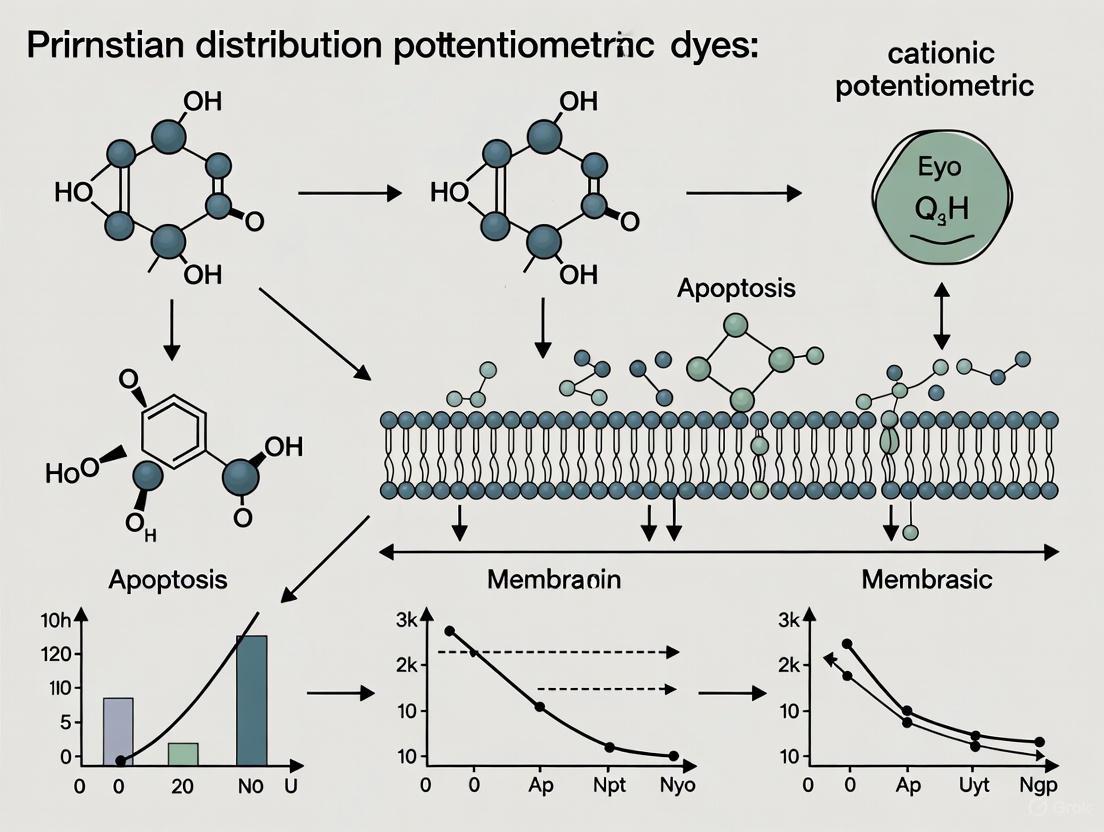
This article provides a comprehensive resource for researchers and drug development professionals on the application of cationic potentiometric dyes for measuring cellular membrane potential (Vm).
Nernstian Distribution of Cationic Potentiometric Dyes: Principles, Applications, and Best Practices for Cellular Membrane Potential Measurement
Abstract
This article provides a comprehensive resource for researchers and drug development professionals on the application of cationic potentiometric dyes for measuring cellular membrane potential (Vm). It covers the foundational principles of the Nernstian distribution law that govern dye accumulation, explores methodological workflows for accurate measurement in individual cells, and addresses common troubleshooting and optimization challenges. Furthermore, it details validation strategies and compares different dye classes, synthesizing established knowledge with recent advancements to guide robust experimental design, enhance data reliability in biomedical research, and support applications in drug discovery and physiological monitoring.
The Nernst Equation and Core Principles of Cationic Dye Distribution
Theoretical Foundations of Membrane Potential
Membrane potential is a fundamental biophysical property defined as the electrical potential difference across a cell's lipid bilayer. This voltage gradient, typically ranging from -20 mV to -200 mV (inside negative relative to the outside), is established by the asymmetric distribution of intracellular and extracellular ions maintained by active and passive transport mechanisms [1]. In excitable cells like neurons and muscle cells, rapid changes in this potential generate action potentials that enable cellular communication and physiological function [2].
The resting membrane potential is primarily determined by the equilibrium potentials of permeant ions and the relative permeability of the membrane to these ions. The Nernst equation describes the equilibrium potential for a single ion species:
E_ion = (RT/zF) * ln([ion]_out/[ion]_in)
where Eion is the equilibrium potential, R is the gas constant, T is temperature, z is the ion's valence, F is Faraday's constant, and [ion]out and [ion]_in are the extracellular and intracellular concentrations, respectively [3]. For multiple permeant ion species, the Goldman-Hodgkin-Katz equation provides a more comprehensive description of the membrane potential.
Measurement Methodologies: From Electrodes to Optical Probes
Electrophysiological Techniques
Traditional methods for measuring membrane potential include intracellular microelectrodes and patch-clamp electrophysiology. These approaches provide direct, high-fidelity measurements of electrical activity with millisecond temporal resolution, making them ideal for recording action potentials in excitable cells [2]. However, these techniques are invasive, technically demanding, and difficult to implement for intracellular organelles or in complex multicellular preparations [4].
Nernstian Potentiometric Dyes
Potentiometric dyes (voltage-sensitive dyes) offer a powerful optical alternative for monitoring membrane potential, particularly in systems where electrode-based approaches are impractical [5]. These dyes can be broadly classified into two categories based on their response mechanisms:
Table 1: Classification of Voltage-Sensitive Dyes
| Dye Type | Response Mechanism | Response Time | Examples | Primary Applications |
|---|---|---|---|---|
| Fast-Response Probes | Electrochromic (Stark effect); molecular structure changes directly with electric field | Microseconds to milliseconds | di-4-ANEPPS, di-8-ANEPPS, ANNINE-6plus, ElectroFluor dyes [5] [6] | Action potential propagation, neuronal spiking, cardiac electrophysiology |
| Slow-Response (Nernstian) Probes | Potential-dependent redistribution across membrane; follows Nernst equation | Seconds to minutes | Rhodamine esters, carbocyanines, triphenylphosphonium derivatives, Thioflavin T [4] [3] | Mitochondrial membrane potential, bacterial membrane potential, organelle membrane potential |
The theoretical foundation for Nernstian dyes rests on the principle that for a permeant cationic dye that is not actively transported, the equilibrium distribution between intracellular and extracellular compartments is governed by the Nernst equation [7]:
Δψ = (RT/zF) * ln([Dye]_out/[Dye]_in)
where Δψ represents the membrane potential, and [Dye]out and [Dye]in represent the extracellular and intracellular dye activities, respectively. Driving the membrane potential negative increases the cell-associated dye by increasing the activity ratio and consequently the amount of dye bound to cell contents [7].
Experimental Protocols for Membrane Potential Measurement
Generalized Workflow for Nernstian Dye Characterization
Recent research has established a systematic workflow for characterizing Nernstian dyes and accounting for their potential effects on cellular physiology [3]:
- Dye Selection: Choose dyes based on membrane permeability, low membrane binding, appropriate spectral properties, and strong fluorescence signal [8].
- Calibration Conditions: Establish proper ionic conditions for calibration, typically using high-K+ solutions to depolarize membranes or specific ionophores like valinomycin to clamp membrane potential at known values [7].
- Signal Validation: Confirm that dye accumulation follows Nernstian behavior and does not exhibit non-specific binding or toxic effects on cells.
- Physiological Impact Assessment: Determine the concentration range where the dye functions as a sensor rather than a physiological actuator [3].
- Quantitative Analysis: Correct measured fluorescence intensities for extracellular background fluorescence and non-potentiometric binding [8].
Specific Protocol for Mammalian Cells Using Cationic Dyes
Experimental Steps:
Cell Preparation: Culture adherent cells on glass-bottom dishes or suspension cells in appropriate medium. Ensure cells are healthy and at optimal density (typically 70-90% confluency for adherent cells) [8].
Dye Loading: Incubate cells with 100-500 nM dye in standard extracellular solution for 15-30 minutes at 37°C. The exact concentration and incubation time should be optimized for specific cell types and dyes [8].
Washing: Remove extracellular dye by washing 2-3 times with fresh buffer solution to minimize background fluorescence [8].
Equilibration: Allow 5-10 minutes for dye distribution to stabilize before measurements. For trapped dyes like SPIRIT RhoVR, this step includes enzymatic conversion to impermeant forms [4].
Fluorescence Measurement: Acquire fluorescence signals using appropriate excitation/emission wavelengths. For rationetric measurements, use multiple wavelength pairs to normalize for dye concentration effects [4] [6].
Signal Calibration: Apply high-K+ solutions (e.g., 145 mM K+) or ionophores like valinomycin in the presence of known K+ gradients to establish calibration curves between fluorescence intensity and membrane potential [7].
Data Analysis: Calculate membrane potential using the Nernst equation after determining intra- and extracellular dye activities from fluorescence measurements [7] [3].
Validation and Controls
Essential controls and validation measures include:
- Ionophore Application: Use valinomycin (K+ ionophore) to test K+ diffusion potentials and confirm dye responsiveness [7].
- pH Monitoring: Monitor intracellular pH changes, as dye binding to intracellular components like hemoglobin can be pH-sensitive [7].
- Viability Assessment: Confirm that dye concentrations used do not adversely affect cell physiology or proliferation [3] [1].
Biological Significance and Research Applications
Membrane Potential in Cellular Physiology
Membrane potential plays crucial roles beyond electrical excitability in neurons and muscle cells:
Cell Proliferation: Membrane depolarization promotes mitosis through voltage-dependent activation of extracellular signal-regulated kinase (ERK), independent of growth factor stimulation [1]. Even small shifts in resting potential near physiological ranges can influence proliferative activity.
Organelle Function: Intracellular organelles maintain membrane potentials that regulate their physiology:
- Mitochondria: Maintain a negative potential across the inner membrane (-200 to -100 mV) that drives ATP synthesis through oxidative phosphorylation [4].
- Lysosomes: Exhibit positive luminal potentials (+30 to +120 mV) that contribute to their acidic environment and catabolic functions [4].
- Endoplasmic Reticulum: Maintains a slightly negative luminal potential that may influence calcium sequestration and protein translation [4].
Bacterial Physiology: Membrane potential constitutes a key component of the proton motive force that powers vital cellular processes in bacteria [3].
Advanced Research Applications
Table 2: Organelle-Specific Membrane Potential Probes and Applications
| Organelle | Representative Dyes | Typical Potential Range | Key Biological Functions Regulated |
|---|---|---|---|
| Mitochondria | Rhodamine 123, TMRM, TMRE, SPIRIT RhoVR, RVolt [4] | -200 mV to -100 mV (matrix negative) | ATP production, metabolic regulation, apoptosis |
| Lysosomes | FRET-based probes, DNA-scaffolded Voltair, Acridine Orange [4] | +30 mV to +120 mV (lumen positive) | Protein degradation, nutrient sensing, membrane trafficking |
| Endoplasmic Reticulum | Mutant ArcLight (Aahn), Ceramide-conjugated RhoVR [4] | Neutral to slightly negative | Calcium storage, protein synthesis, lipid metabolism |
The Scientist's Toolkit: Essential Research Reagents
Table 3: Key Research Reagents for Membrane Potential Studies
| Reagent Category | Specific Examples | Function and Application |
|---|---|---|
| Nernstian Dyes | Tetramethyl rhodamine esters, DiS-C3-(5), DiOC6(3), Thioflavin T [8] [3] | Potential-dependent accumulation following Nernst equation; ideal for organelle and bacterial membrane potential measurements |
| Fast Voltage-Sensitive Dyes | di-4-ANEPPS, di-8-ANEPPS, ANNINE-6plus, ElectroFluor530 [5] [6] | Electrochromic dyes with microsecond response times; suitable for action potential recording in excitable cells |
| Ionophores | Valinomycin (K+), Gramicidin (cations), Nigericin (K+/H+ exchange) [7] | Clamp membrane potential at known values for calibration; selectively increase membrane permeability to specific ions |
| Ion Channel Modulators | Tetrodotoxin (Na+ channel blocker), Tetraethylammonium (K+ channel blocker) | Selectively inhibit specific ion channels to study their contribution to membrane potential |
| Targeted Dye Systems | SPIRIT RhoVR (mitochondria), DNA-scaffolded Voltair (lysosomes), Cer-TCO (ER) [4] | Chemically targeted dyes for specific organelle membrane potential measurements |
| Signal Transduction Inhibitors | U0126 (MEK inhibitor) [1] | Probe molecular mechanisms linking membrane potential to downstream signaling pathways |
Technical Considerations and Limitations
While Nernstian dyes provide powerful tools for membrane potential measurement, several important limitations must be considered:
- Phototoxicity: Extended illumination can damage cells and alter membrane properties. Fluorinated dyes like ElectroFluor variants offer improved photostability [5] [6].
- Dye Buffering: High dye concentrations may themselves affect membrane potential, essentially turning dyes from sensors into actuators of physiology [3].
- Environmental Sensitivity: Dye fluorescence and binding can be influenced by factors beyond membrane potential, including pH, viscosity, and binding to intracellular components [7].
- Quantification Challenges: Accurate absolute potential measurements require careful calibration, while relative changes are more readily quantified [8].
- Organelle-Specific Limitations: Dye targeting specificity, internal compartmental pH variations, and unknown internal binding partners can complicate interpretation of organellar measurements [4].
The continued development of improved potentiometric dyes, including fluorinated variants with enhanced photostability [6], genetically encoded voltage indicators [4], and targeted delivery systems [4] [5], promises to overcome many current limitations and expand our understanding of the multifaceted roles of membrane potential in cellular physiology.
The Nernst Distribution Law provides a fundamental thermodynamic principle governing the partitioning of charged molecules between two phases. This whitepaper explores its critical application in directing the accumulation of cationic potentiometric dyes across biological membranes and in separation systems. For researchers in drug development and biological sciences, understanding this principle is paramount for accurately measuring membrane potentials, developing extraction protocols, and interpreting dye-based assays. We detail the theoretical framework, present quantitative data on common dyes, and provide standardized methodologies for applying these principles in experimental settings, with a specific focus on addressing common pitfalls such as dye-induced physiological artifacts.
The Nernst Distribution Law, in its generalized form, describes how a solute will distribute itself between two immiscible phases at equilibrium. When applied to charged species like cationic potentiometric dyes, this principle is expressed by the Nernst equation, which relates the electrochemical potential across a membrane to the concentration ratio of the permeant ion [9].
For a cationic dye, the equation is: Vm = (RT/zF) * ln(Cout/Cin) [9] where:
- Vm is the transmembrane electrical potential (in volts)
- R is the universal gas constant
- T is the absolute temperature (Kelvin)
- z is the valence of the charged molecule
- F is the Faraday constant
- Cout and Cin are the external and internal concentrations of the dye, respectively
This relationship means that for a typical resting membrane potential of -60 mV, a monovalent cation (z=+1) will achieve a 10-fold higher concentration inside the cell or organelle compared to the external solution [10]. In mitochondria, where potentials can reach -180 mV, this accumulation can be exponentially greater, making these dyes exceptionally useful for monitoring the health and function of these critical organelles [11] [10].
Theoretical Foundations and Quantitative Models
Core Thermodynamic Relationships
The Nernst equation is derived from the broader context of chemical thermodynamics and the Gibbs free energy. Under non-standard conditions, the relationship between cell potential and reaction quotient Q is given by the Nernst Equation [12]:
E = E° - (RT/nF) * ln(Q) [12]
At standard temperature (298 K), this simplifies to: E = E° - (0.0592 V/n) * log10(Q) [12]
Where E° is the standard cell potential, n is the number of electrons transferred, and Q is the reaction quotient. This fundamental relationship explains why dyes continue to accumulate until the electrical gradient exactly balances the concentration gradient, reaching a Nernstian equilibrium.
Phase Distribution and Separation Systems
Beyond cellular membranes, the Nernst Distribution Law finds application in engineered separation systems like Aqueous Two-Phase Systems (ATPS). In ATPS, the distribution of molecules between two aqueous phases follows a similar partitioning principle, characterized by a distribution coefficient, K [13]:
K = Ct / Cb
Here, Ct and Cb represent the equilibrium concentrations of a target molecule in the top and bottom phases, respectively [13]. The construction of phase diagrams with binodal curves and tie lines provides a critical framework for predicting and optimizing the separation of biomolecules, including dyes [13].
Application to Cationic Potentiometric Dyes
Mechanism of Accumulation
Cationic potentiometric dyes are lipophilic cations that passively diffuse across lipid bilayers and accumulate within compartments that maintain a negative internal potential, such as the mitochondrial matrix or cytoplasm of polarized cells [11] [14]. This accumulation occurs because the negatively charged interior attracts the positively charged dye molecules. The driving force is the electrochemical gradient, and the final distribution is a direct reflection of the voltage difference across the membrane [10].
Table 1: Common Cationic Potentiometric Dyes and Their Properties
| Dye Name | Primary Application | Key Characteristics | Excitation/Emission | Working Mode |
|---|---|---|---|---|
| TMRM / TMRE | Mitochondrial & plasma membrane potential [11] [10] | Low mitochondrial binding & minimal ETC inhibition; suitable for quantitative absolute potential measurements [11] | ~549/573 nm [11] | Non-quenching (low conc.) or Quenching (high conc.) |
| Rhodamine 123 | Mitochondrial membrane potential (acute changes) [11] | Slowly permeant; often used in quenching mode for acute changes [11] | ~507/529 nm [11] | Primarily Quenching |
| JC-1 | Mitochondrial membrane potential (apoptosis studies) [11] [14] | Forms J-aggregates (red) at high potentials; monomer (green) at low potentials; ratiometric [11] | Mono: 514/529 nm Agg: 585/590 nm [11] | Ratiometric |
| DiOC6(3) | Plasma membrane potential (flow cytometry) [11] | Requires very low concentrations (<1 nM) to avoid toxicity and ensure specificity for ΔΨm [11] | ~484/501 nm [11] | Non-quenching |
| Thioflavin T (ThT) | Membrane potential in bacteria [9] | Reported as a Nernstian probe in B. subtilis; requires careful calibration in other systems [9] | ~385/445 nm (approx.) | Non-quenching |
Critical Considerations for Accurate Interpretation
The ideal Nernstian dye must meet several criteria: it should provide sufficient signal without affecting the cell's Vm, diffuse rapidly enough to reach equilibrium, remain inert without interacting with cellular components, and exhibit a constant signal per molecule [9]. Key practical considerations include:
- Dye Concentration: The chosen dye concentration must balance between achieving a sufficient signal-to-noise ratio and minimizing physiological impacts. Excessive concentrations of cationic dyes can directly lower Vm, effectively turning the sensor into an actuator that perturbs the system it is meant to measure [9].
- Equilibration Time: Dyes require a finite time (τeq) to distribute across the membrane according to the Nernst equation. Measurements taken before equilibration do not faithfully report Vm, and phenomena occurring faster than τeq are beyond the dye's temporal resolution [9].
- Binding and Compartmentalization: Dyes can bind to membranes or other cellular structures, which may alter their fluorescent properties. Corrections must be applied to distinguish the signal from free versus bound dye for quantitative measurements [9].
- Non-Protonic Charges: Cationic dyes report on the total electrical potential (ΔΨm), not the proton gradient (ΔpHm) component of the proton motive force. Changes in ΔΨm do not always mirror changes in mitochondrial pH, particularly during cellular stress involving fluxes of other ions like Ca²⁺ [11].
Experimental Protocols and Methodologies
Workflow for Characterizing a Nernstian Dye
Adhering to a systematic workflow is essential for validating dye performance and obtaining reliable data [9]. The following diagram outlines the key steps for characterizing a Nernstian dye candidate, such as Thioflavin T, in a new experimental system:
Protocol: Measuring Mitochondrial Membrane Potential with TMRM in Permeabilized Cells
This protocol, adapted for flow cytometry, allows for the quantification of ΔΨ in millivolts by eliminating the confounding influence of the plasma membrane potential [14].
Materials:
- TMRM (Tetramethylrhodamine Methyl Ester): The potentiometric dye [14] [10].
- Digitonin: A detergent used to selectively permeabilize the plasma membrane [14].
- MitoTracker Green (MTG): A mitochondrial mass/volume marker whose accumulation is (reportedly) potential-independent [14].
- KCl-based Medium (80 mM KCl, 10 mM HEPES, 1 mM EGTA, 5 mM succinate, pH 7.4): Provides ionic conditions suitable for maintaining mitochondrial function [14].
- FCCP (Carbonyl cyanide-p-trifluoromethoxyphenylhydrazone): A protonophore uncoupler used to fully depolarize mitochondria as a negative control [14].
Procedure:
- Cell Preparation: Harvest and wash cells (e.g., human skin fibroblasts) in ice-cold phosphate-buffered saline (PBS).
- Plasma Membrane Permeabilization: Resuspend the cell pellet in KCl-based medium containing a titrated concentration of digitonin (e.g., 0.01-0.05%) to permeabilize the plasma membrane without damaging mitochondria. Incubate for a few minutes on ice.
- Dye Loading: Add TMRM (e.g., 100-500 nM) and MTG (e.g., 100 nM) to the cell suspension. Incubate for 15-30 minutes at room temperature or 37°C to allow for dye equilibration.
- Flow Cytometry: Analyze the cells using a flow cytometer. Measure the fluorescence intensities of TMRM (e.g., FL2 channel for ~550/575 nm) and MTG (e.g., FL1 channel for ~490/516 nm).
- Data Analysis:
- The mitochondrial membrane potential (ΔΨ) is proportional to the log of the TMRM fluorescence intensity, normalized to the mitochondrial volume using the MTG signal.
- The absolute ΔΨ can be calculated using the formula: ΔΨ = (RT/F) * ln(ITMRM / ITMRM,0) (after appropriate calibration and correction for non-Nernstian binding), where ITMRM,0 is the fluorescence intensity of TMRM in fully depolarized mitochondria (e.g., after FCCP treatment) [14].
The Scientist's Toolkit: Essential Reagent Solutions
Table 2: Key Research Reagents for Nernstian Dye Experiments
| Reagent / Material | Function / Role | Example Usage & Considerations |
|---|---|---|
| Cationic Dyes (TMRM, TMRE) | Nernstian redistribution probes for membrane potential [10]. | Use in non-quenching mode (~1-30 nM) for quantitative imaging of absolute potential; low binding minimizes toxicity [11]. |
| MitoTracker Green (MTG) | Mitochondrial mass/volume counterstain [14]. | Used to normalize potentiometric dye signal to mitochondrial content; verify potential-independence for your cell type [14]. |
| Digitonin | Selective plasma membrane permeabilization agent [14]. | Allows direct access to mitochondria without cytosolic dye interference; concentration must be carefully optimized for each cell type [14]. |
| Protonophores (FCCP/CCCP) | Positive controls for complete mitochondrial depolarization [11] [15]. | Collapses the proton motive force, validating the potential-dependent nature of dye accumulation; typical use 1-10 µM [11]. |
| Supported Liquid Membrane (SLM) | Artificial membrane in electromembrane extraction [16]. | Used with organic solvent (e.g., 1-octanol) immobilized in a porous hollow fiber for electro-driven extraction of ions/drugs [16]. |
Advanced Concepts and Emerging Applications
Electromembrane Extraction (EME)
The Nernst-Planck equation, which incorporates the Nernstian flux, forms the basis for modeling Electromembrane Extraction (EME). In EME, an electric field drives the migration of ionizable analytes (e.g., basic drugs) from a donor solution, across a Supported Liquid Membrane (SLM), and into an acceptor solution [16]. Numerical solutions to the Poisson-Nernst-Planck equations reveal that the extraction flux and recovery are strongly dependent on the potential difference across the SLM, enabling recoveries in the range of 89-99% for various pharmaceuticals [16].
Breakdown of Classical Relations under Confinement
Recent research has revealed that the classic Nernst-Einstein relation, which connects diffusion and electrophoretic mobility, can break down under extreme confinement. In sub-nanometer carbon nanotubes (diameter ~8 Å), the Nernst-Einstein ratio was found to be >1000 instead of 1, indicating a decoupling of ion transport mechanisms [17]. This occurs because diffusion is severely hindered, while electric fields can disrupt the single-file water chain, creating distinct ion-water clusters that translocate rapidly [17].
The Nernst Distribution Law provides an indispensable theoretical foundation for predicting and quantifying the accumulation of cationic dyes in biological and chemical systems. Its correct application enables the precise measurement of mitochondrial membrane potential, the development of efficient extraction techniques like EME, and the rational design of dye-based assays. However, rigorous calibration and a thorough understanding of its limitations—including the potential for dyes to perturb physiology, the influence of non-protonic charges, and the surprising breakdown of classical relationships under nanoconfinement—are critical for generating accurate, interpretable data. For drug development professionals and researchers, mastering these principles is key to leveraging the full power of Nernstian distribution in scientific innovation.
Cationic potentiometric dyes are indispensable tools in modern cell physiology, enabling researchers to optically monitor changes in membrane potential—a fundamental property of biological cells that drives processes from nerve-impulse propagation to cell signaling and apoptosis [18] [19]. These dyes operate primarily on the principle of Nernstian distribution, whereby permeable cationic dyes distribute across biological membranes according to the transmembrane electrical potential [20]. A typical resting plasma membrane potential of approximately –70 mV (negative inside) results in a tenfold higher concentration of dye inside the cell compared to the outside [18] [20]. In mitochondria, which exhibit transmembrane potentials of approximately –150 mV to –180 mV, this accumulation is even more pronounced [18] [20]. The resulting fluorescence intensity, therefore, serves as a quantitative indicator of membrane potential, allowing researchers to investigate physiological processes without the invasive nature of microelectrodes [18] [8].
The ideal properties for these dyes—membrane permeability, low non-potentiometric binding, and high fluorescence—are crucial for accurate measurement. Membrane permeability allows the dye to freely traverse the lipid bilayer to achieve a Nernstian equilibrium. Low binding to cellular components such as proteins and DNA ensures that the fluorescence signal primarily reflects the dye's distribution across the membrane rather than nonspecific adhesion [8]. Finally, high fluorescence is essential for achieving a strong signal-to-noise ratio, particularly when measuring subtle potential changes in small organelles or single cells [8]. The absence of any of these properties can lead to significant artifacts, compromising the validity of experimental data.
Fundamental Properties and Their Theoretical Basis
The Nernstian Distribution Framework
The theoretical foundation for using cationic dyes is the Nernst equation, which quantitatively describes the relationship between the transmembrane potential (ΔΨ) and the concentration ratio of the permeant cation across the membrane. For a cationic dye, the equation is expressed as:
ΔΨ = − (RT / zF) ln ( [Dye]in / [Dye]out )
Where:
- ΔΨ is the transmembrane potential (in volts)
- R is the universal gas constant
- T is the absolute temperature (in Kelvin)
- z is the valence of the dye (typically +1 for these probes)
- F is the Faraday constant
- [Dye]in and [Dye]out are the intracellular and extracellular dye concentrations, respectively [20]
Since fluorescence intensity (F) is proportional to dye concentration, this equation can be adapted to show that the measured fluorescence is directly related to the absolute membrane potential. Accurately measuring the fluorescence intensity inside the cell using a confocal microscope and comparing it to the fluorescence outside the cell thus offers the ability to determine absolute membrane potential [20]. This relationship is the cornerstone of quantitative measurements using slow-response, Nernstian dyes like TMRE, TMRM, and the carbocyanines [21] [20].
Core Ideal Properties and Their Impact on Measurement Fidelity
The validity of the Nernstian model depends entirely on the physicochemical properties of the dye. The following properties are considered ideal for accurate potential measurement:
- Membrane Permeability: The dye must be sufficiently lipophilic to passively diffuse through the lipid bilayer, yet retain its cationic charge to be sensitive to the electric field.
- Low Non-Potentiometric Binding: The dye should not bind to proteins, DNA, or other intracellular structures. Such binding creates a reservoir of dye whose fluorescence is independent of membrane potential, leading to a distorted and inaccurate signal [8]. Rhodamine esters, for example, are noted for being highly fluorescent dyes which do not form aggregates or display binding-dependent changes in fluorescence efficiency, making their accumulation quantitatively related to membrane potential [8].
- High Fluorescence Quantum Yield: A high quantum yield provides a strong signal, which is essential for detecting small potential changes and for applications in low-light imaging or in small subcellular compartments like mitochondria.
- Environmental Insensitivity: The spectral properties of the dye should be largely insensitive to the local environment (e.g., pH, viscosity). A dye whose fluorescence is quenched upon binding to DNA or whose excitation spectrum shifts in different environments introduces voltage-independent variables that are difficult to correct for [8] [22].
- Low Toxicity (Minimal Perturbation of Cell Function): The dye should not interfere with normal cellular processes. Some carbocyanine dyes, for instance, can inhibit respiration and may therefore be relatively cytotoxic, which inevitably alters the physiological state being measured [21].
Classification of Dyes by Response Mechanism
Cationic potentiometric dyes are broadly classified into two categories based on their response kinetics and mechanism: slow-response and fast-response probes. The following diagram illustrates the fundamental operating principles of these two classes.
Slow-Response Probes (Nernstian Dyes)
Slow-response probes, which include cationic carbocyanines and rhodamines, exhibit potential-dependent changes in their transmembrane distribution [18]. Their operation is illustrated in the left panel of the diagram above. The magnitude of their optical response is large—typically a 1% fluorescence change per mV [18]. This high sensitivity makes them suitable for detecting changes in average membrane potentials of nonexcitable cells caused by respiratory activity, drug binding, and ion-channel permeability [18]. Their redistribution across the membrane is a relatively slow process, making them unsuitable for tracking millisecond-scale action potentials in neurons or cardiomyocytes [20].
- Carbocyanines (e.g., DiOC₆(3), JC-1, DiIC₁(5)): These cationic dyes accumulate on hyperpolarized membranes and translocate into the lipid bilayer [21]. A key consideration is concentration-dependent aggregation, which can result in fluorescence quenching or spectral shifts. JC-1 is a particularly notable dye as it exhibits a potential-dependent emission shift, forming red-fluorescent "J-aggregates" in energized mitochondria while remaining a green-fluorescent monomer at lower potentials or concentrations, enabling powerful ratiometric measurements [21].
- Rhodamines (e.g., TMRE, TMRM): These dyes were specifically designed to measure absolute membrane potential via a Nernstian redistribution mechanism [20]. They are characterized by their high fluorescence, low binding, and minimal toxicity, making them excellent for quantitative confocal microscopy and flow cytometry. They are "reversible," meaning their distribution continuously reflects the instantaneous membrane potential [8].
Fast-Response Probes (Electrochromic Dyes)
Fast-response probes, usually styrylpyridinium dyes, operate by an entirely different mechanism, as shown in the right panel of the diagram. They undergo an ultrafast change in their electronic structure (electrochromism or Stark effect) in response to the surrounding electric field, which alters their fluorescence properties [18] [19]. Their optical response is sufficiently fast to detect transient (millisecond) potential changes in excitable cells [18]. However, the magnitude of their response is much smaller than that of slow-response probes, typically showing only a 2–10% fluorescence change per 100 mV [18]. This small signal requires sophisticated detection systems and signal averaging.
Table 1: Comparison of Slow-Response and Fast-Response Potentiometric Dyes
| Feature | Slow-Response Probes (Nernstian) | Fast-Response Probes (Electrochromic) |
|---|---|---|
| Response Mechanism | Redistribution of dye across membrane | Electrochromism; change in dye electronic structure |
| Response Time | Slow (seconds to minutes) | Very Fast (sub-millisecond) |
| Sensitivity | High (~1% fluorescence change per mV) | Low (~2-10% change per 100 mV) |
| Primary Applications | Mitochondrial potential, apoptosis, cell viability | Neuronal activity, cardiac action potentials |
| Example Dyes | TMRE, TMRM, JC-1, DiOC₆(3) | ANNINE dyes, RH dyes (styryl dyes) |
Quantitative Comparison of Key Cationic Dyes
Selecting the appropriate dye requires a careful balance of its properties against the experimental needs. The following table summarizes the key characteristics of several commercially important cationic potentiometric dyes.
Table 2: Characteristics of Common Cationic Potentiometric Dyes
| Dye Name | Charge | Key Spectral Properties | Primary Application & Notes | Ideal Property Manifestation |
|---|---|---|---|---|
| TMRE / TMRM [20] | +1 | Ex/Em ~549/575 nm (red) | Quantitative mitochondrial and plasma membrane potential. Reversible, low toxicity. | High Fluorescence, Low Binding: Nontoxic, highly fluorescent, minimal aggregation. [8] [20] |
| JC-1 [21] | +1 | Monomer: ~514/529 nm (green)J-aggregate: ~585/590 nm (red) | Mitochondrial depolarization in apoptosis. Ratiometric (red/green). | High Fluorescence: Strong signal in both channels. Binding Risk: J-aggregate formation is concentration-dependent. [21] |
| DiOC₆(3) [21] | +1 | Concentration-dependent shift (green to red) | Membrane potential in flow cytometry. Can stain ER at high concentrations. | Permeability: Easily enters cells. Binding Risk: Aggregation can cause quenching; cytotoxic at high conc. [21] |
| Rhodamine 123 [8] | +1 | Ex/Em ~507/529 nm (green) | Early mitochondrial dye. Less consistent response to depolarization. | Permeability: Cell-permeant. Binding/Retention: Can be retained in mitochondria despite depolarization. [21] |
| DiOC₂(3) [21] | +1 | Concentration-dependent shift (green to red) | Bacterial membrane potential (BacLight Kit). Ratiometric flow cytometry. | Permeability: Effective in bacteria. Utility: Red/green ratio corrects for cell size. [21] |
Essential Research Reagents and Experimental Kits
The translation of theoretical principles into robust laboratory practice is facilitated by commercially available assay kits. These kits provide standardized protocols and optimized dye formulations, ensuring reproducibility and ease of use. The following table details key reagent solutions used in this field.
Table 3: Key Research Reagent Solutions for Potentiometric Imaging
| Reagent / Kit Name | Core Component(s) | Function and Application |
|---|---|---|
| MitoProbe JC-1 Assay Kit [21] | JC-1 dye, CCCP (uncoupler) | For flow cytometric analysis of mitochondrial membrane potential, particularly in apoptosis studies. Enables ratiometric analysis. |
| MitoProbe DiIC₁(5) Assay Kit [21] | DiIC₁(5) dye (far-red), CCCP | Designed for flow cytometry. Far-red fluorescence allows multiplexing with green and red fluorescent probes. |
| BacLight Bacterial Membrane Potential Kit [21] | DiOC₂(3) dye, CCCP, buffer | Specifically optimized for ratiometric flow cytometric measurement of membrane potential in bacterial cells. |
| Carbonyl Cyanide m-Chlorophenylhydrazone (CCCP) [21] | Proton ionophore (uncoupler) | Used as a control to dissipate the proton gradient and collapse mitochondrial or bacterial membrane potential. |
| Valinomycin / Gramicidin [18] | K⁺ ionophore / channel former | Used for calibration by imposing a defined transmembrane potential in conjunction with externally applied K⁺ solutions. |
Detailed Experimental Protocol for Quantitative Measurement
This section provides a generalized workflow for measuring mitochondrial membrane potential in live cells using a Nernstian dye like TMRE, based on established protocols [21] [20].
The entire experimental procedure, from cell preparation to data analysis, can be summarized in the following workflow diagram.
Step-by-Step Methodology
Cell Preparation and Dye Loading
- Plate cells onto an appropriate imaging dish (e.g., glass-bottom dish for high-resolution microscopy) and allow them to adhere under standard culture conditions.
- Prepare a working solution of the cationic dye (e.g., 20-100 nM for TMRE or TMRM) in pre-warmed culture medium or physiological buffer. Critical: The concentration must be optimized to be low enough to avoid artifacts (e.g., aggregation, toxicity) but high enough for a good signal. For JC-1, a concentration of 2-5 µM is typical [21].
- Replace the cell culture medium with the dye-containing solution and incubate for 15-30 minutes at 37°C in the dark to allow for Nernstian equilibrium.
Image Acquisition and Calibration
- For quantitative measurements of absolute potential, a confocal microscope is recommended to precisely define the intracellular and extracellular volumes [20].
- Acquire images using appropriate excitation/emission settings (e.g., ~549/575 nm for TMRE). Ensure the detector gain is set to avoid signal saturation.
- Include Essential Controls:
- Uncoupler Control: Treat a separate sample with an uncoupler like CCCP (e.g., 10-50 µM) for 10-15 minutes prior to imaging. This dissipates the membrane potential, providing a baseline for depolarized cells [21].
- Valinomycin Calibration (Optional): For absolute calibration, equilibrate cells in a high-K⁺ buffer and use the K⁺ ionophore valinomycin to clamp the membrane potential to a known value. This allows for the construction of a standard curve relating fluorescence intensity to membrane potential [18].
Data Analysis and Interpretation
- Using image analysis software, measure the mean fluorescence intensity (Fin) inside the cell (or mitochondria) and the intensity in an extracellular region (Fout).
- For qualitative or semi-quantitative assessments, the Fin/Fout ratio can be reported directly. A decrease in this ratio indicates membrane depolarization.
- For Absolute Potential Calculation: Apply the Nernst equation. Assuming the intracellular and extracellular volumes are accurately measured and that the dye is free in solution (not bound), the absolute membrane potential can be calculated as: ΔΨ (in mV) = − (RT / F) * ln ( Fin / Fout ) at 37°C, this simplifies to approximately −62 * ln ( Fin / Fout ) [20].
- For ratiometric dyes like JC-1, calculate the ratio of the fluorescence in the J-aggregate channel (red) to the monomer channel (green). A decrease in this ratio indicates mitochondrial depolarization [21].
Cationic potentiometric dyes that embody the ideal properties of membrane permeability, low nonspecific binding, and high fluorescence are powerful tools for quantifying membrane potential in living systems. Their function is rooted in the robust thermodynamic principle of Nernstian distribution, which allows for both qualitative assessment of dynamic changes and, with careful calibration, absolute measurement of transmembrane potential. The choice between slow-response Nernstian dyes and fast-response electrochromic dyes is dictated by the biological question, with the former being ideal for high-sensitivity measurements in non-excitable cells and organelles, and the latter being essential for tracking rapid electrical signals in neurons and cardiomyocytes. By understanding their distinct mechanisms, carefully selecting dyes based on quantitative properties, and adhering to rigorous experimental protocols, researchers can reliably employ these optical tools to advance our understanding of cellular physiology and pathology.
Cationic potentiometric dyes are indispensable tools in modern biological research for measuring transmembrane potential, a fundamental parameter in cellular physiology. These dyes, which include rhodamine esters and carbocyanines, operate on the principle of Nernstian distribution, accumulating within compartments in response to electrical gradients across membranes [23]. The plasma membrane of a typical cell at rest maintains a transmembrane potential of approximately -70 mV (negative inside), while mitochondria exhibit an even larger potential of approximately -150 mV (negative inside the matrix) [24]. These potentials arise from active transport processes that maintain concentration gradients of ions such as K⁺, Na⁺, and Cl⁻ [24].
The Nernst equation predicts the equilibrium distribution of a permeant ion across a membrane. For cationic dyes, this results in their accumulation in compartments with negative internal potentials (such as the mitochondrial matrix or the cytoplasm relative to the extracellular space) in proportion to the potential difference [25] [26]. This accumulation is often accompanied by fluorescence changes—either a shift in spectral properties or quenching—that can be quantified to provide a measure of the membrane potential [25] [26] [23]. This whitepaper provides an in-depth technical guide to two major classes of these dyes—rhodamine esters and carbocyanines—framed within the context of their Nernstian behavior and their critical applications in biomedical research and drug development.
Fundamental Principles of Nernstian Dye Distribution
The Nernst Equation and Dye Accumulation
The theoretical foundation for the use of cationic dyes as potentiometric probes rests on the Nernst equation. For a permeant cation, the equation describes the relationship between the transmembrane potential (ΔΨ) and the concentration ratio of the dye across the membrane:
ΔΨ = -59 log([Dye]~in~/[Dye]~out~) at 37°C
Where:
- ΔΨ is the transmembrane potential (in mV)
- [Dye]~in~ is the intracellular (or intra-organellar) dye concentration
- [Dye]~out~ is the extracellular dye concentration
This relationship indicates that for every 59 mV of negative internal potential, cationic dyes will achieve a 10-fold accumulation inside the membrane-bound compartment [23]. In practice, dyes often accumulate to a greater extent than predicted by the Nernst equation alone due to binding to internal membrane sites and macromolecules, a factor that must be experimentally determined and corrected for in quantitative measurements [25] [26].
Response Mechanisms of Potentiometric Dyes
Potentiometric dyes are broadly categorized into two classes based on their response mechanisms, each with distinct advantages and applications:
Slow-Response (Nernstian) Probes: This category includes cationic carbocyanines and rhodamines. They exhibit potential-dependent changes in their transmembrane distribution, which are accompanied by fluorescence changes due to aggregation, binding to intracellular sites, or environmental factors [24] [23]. These probes typically show a large optical response (approximately 1% fluorescence change per mV), making them suitable for measuring steady-state potentials and relatively slow changes in non-excitable cells [24]. They are ideal for monitoring potentials in mitochondria, and for assessing changes caused by respiratory activity, ion-channel permeability, and drug binding [24].
Fast-Response Probes: Typically styryl dyes, these probes operate through an electrochromic mechanism where the electric field directly affects the electronic structure of the dye, altering its fluorescence properties [24] [5]. Their response is extremely rapid (on the order of milliseconds) but the magnitude of fluorescence change is smaller (2-10% per 100 mV) compared to Nernstian dyes [24]. They are essential for detecting transient potential changes in excitable cells such as neurons and cardiac cells [24] [5].
Table 1: Comparison of Potentiometric Dye Response Mechanisms
| Feature | Slow-Response (Nernstian) Probes | Fast-Response Probes |
|---|---|---|
| Representative Dyes | Rhodamine 123, TMRM, TMRE, carbocyanines | ANEP dyes, styryl dyes |
| Response Mechanism | Redistribution across membrane | Electrochromic shift |
| Response Time | Seconds to minutes | Milliseconds |
| Signal Magnitude | Large (~1%/mV) | Small (2-10%/100 mV) |
| Primary Applications | Mitochondrial potential, cell viability, metabolic studies | Neuronal activity, cardiac electrophysiology |
Rhodamine Esters: Properties and Applications
Structural Characteristics and Variants
Rhodamine dyes are characterized by a planar, multi-ring xanthene core structure, with nitrogen atoms replacing the oxygens on the outer rings [27]. Their fluorescent properties stem from this extended π-conjugated system, which can be modified through substitutions to alter spectral properties and chemical functionality [27]. The core rhodamine structure exists in a dynamic equilibrium between a fluorescent zwitterionic form and a non-fluorescent spirolactone form; this equilibrium is sensitive to the local environment and is key to the dye's performance in biological applications [28].
Common rhodamine esters used as potentiometric probes include:
- Rhodamine 123 (R123): A basic rhodamine derivative that readily accumulates in active mitochondria.
- Tetramethylrhodamine Methyl Ester (TMRM): A cell-permeant dye that is less toxic to mitochondria compared to other rhodamine esters.
- Tetramethylrhodamine Ethyl Ester (TMRE): Similar to TMRM but with slightly different binding affinities and potential toxicity.
These dyes are lipophilic cations that can passively distribute across membranes according to the transmembrane potential [25] [26]. Upon accumulation in negatively-charged compartments, they typically exhibit a red shift in both absorption and emission spectra, and their fluorescence intensity is often quenched [25] [26].
Table 2: Properties of Common Rhodamine Ester Potentiometric Probes
| Dye | Excitation Maximum (nm) | Emission Maximum (nm) | Binding Affinity | Mitochondrial Toxicity |
|---|---|---|---|---|
| Rhodamine 123 | 507 [25] | 529 [25] | Moderate [26] | Moderate [26] |
| TMRM | 548 [25] | 574 [25] | Low [26] | Low (at proper concentrations) [26] |
| TMRE | 549 [25] | 574 [25] | High [26] | High [26] |
Experimental Protocol for Mitochondrial Membrane Potential Measurement
The following protocol details the measurement of mitochondrial membrane potential in isolated mitochondria using ratio fluorescence techniques with rhodamine esters [25] [26].
Materials and Reagents
- Isolation buffer (e.g., 250 mM sucrose, 10 mM HEPES, 0.5 mM EGTA, pH 7.4)
- Respiration buffer (e.g., 125 mM KCl, 20 mM HEPES, 2 mM MgCl₂, 2.5 mM KH₂PO₄, 0.1 mM EGTA, pH 7.2)
- Substrates (e.g., glutamate/malate or succinate)
- Rhodamine ester stock solution (e.g., 1 mM in DMSO)
- Fluorometer with ratio capabilities or fluorescence microscope
Procedure
Isolate Mitochondria: Prepare mitochondria from rat heart or liver using differential centrifugation in ice-cold isolation buffer. Maintain protein concentration at 10-20 mg/mL.
Prepare Dye Working Solution: Dilute the rhodamine ester stock in respiration buffer to achieve a final concentration in the cuvette of 100-500 nM. Protect from light.
Set Up Fluorescence Measurement: In a stirred cuvette at 30°C, add 2 mL of respiration buffer containing the dye. Record baseline fluorescence with excitation at the wavelength appropriate for the specific dye (e.g., 490 nm for R123) and emission at 535 nm.
Add Mitochondria: Add mitochondrial suspension (0.1-0.5 mg protein) to the cuvette. Observe the rapid decrease in fluorescence as the dye accumulates into mitochondria and is quenched.
Calibrate Signal:
- After steady state is reached, add 1-2 μM protonophore (e.g., FCCP) to fully depolarize mitochondria.
- Record the maximum fluorescence signal upon depolarization.
- Add 1-2 μM valinomycin (K⁺ ionophore) in the presence of high external K⁺ to clamp the membrane potential at known values for calibration.
Calculate Membrane Potential: The membrane potential can be calculated from the fluorescence data using the Nernst equation, corrected for dye binding using predetermined partition coefficients [25] [26].
Critical Considerations
- Dye Concentration: Use the lowest possible dye concentration that provides an adequate signal-to-noise ratio to minimize artifacts and toxicity.
- Binding Corrections: Determine internal and external partition coefficients for binding to correct the calculated potential, as binding causes dyes to accumulate beyond Nernstian prediction [25] [26].
- Temperature Dependence: Note that dye binding is temperature-dependent, with greater binding occurring at lower temperatures [26].
- Toxicity Assessment: Evaluate respiratory control ratios in the presence and absence of dyes to assess potential toxicity to mitochondrial function.
Applications in Live-Cell Imaging and Super-Resolution Microscopy
Recent advances in rhodamine chemistry have expanded their applications in live-cell imaging. The development of 4-carboxyrhodamines through improved synthetic routes has produced dyes with enhanced cell permeability and reduced susceptibility to efflux pumps [28]. This is attributed to the "neighboring group effect," where the proximity of the carboxyl group to the amide group in isomer-4 probes influences the spirolactone equilibrium, favoring the cell-permeant form [28].
These next-generation rhodamines can be targeted to specific intracellular structures—including microtubules, actin, mitochondria, and lysosomes—and operate at submicromolar concentrations, enabling high-contrast STED and confocal microscopy of living cells and tissues [28]. Their structural diversity allows emission tuning across the visible spectrum, facilitating multicolor imaging applications [28].
Carbocyanine Dyes: Properties and Applications
Structural Characteristics and Key Members
Carbocyanine dyes are another important class of cationic potentiometric probes characterized by two nitrogen-containing heterocyclic rings connected by a conjugated methine bridge. The length of this bridge and the substituents on the heterocyclic rings determine their spectral properties. A prominent member of this class is DiOC₆(3) (3,3'-dihexyloxacarbocyanine iodide), which is widely used for monitoring membrane potential in various biological systems.
While the search results do not provide extensive specific data on DiOC₆(3), carbocyanines in general share several properties with rhodamine esters as Nernstian dyes. They are lipophilic cations that distribute across membranes according to the transmembrane potential and exhibit potential-dependent fluorescence changes [24] [23]. Their accumulation in energized compartments can lead to fluorescence quenching or spectral shifts that can be quantified.
Experimental Protocol for Plasma Membrane Potential Measurement
Carbocyanine dyes can be used to monitor plasma membrane potential in whole cells using the following generalized protocol:
Materials and Reagents
- Cell suspension or culture
- Physiological buffer (e.g., HEPES-buffered saline)
- Carbocyanine dye stock solution (e.g., 1 mM in DMSO)
- Valinomycin (K⁺ ionophore)
- High K⁺ calibration buffers
Procedure
Prepare Cell Suspension: Wash and resuspend cells in appropriate physiological buffer at a density of 10⁶-10⁷ cells/mL.
Load Dye: Add carbocyanine dye to a final concentration of 10-500 nM and incubate for 10-30 minutes at room temperature or 37°C.
Measure Fluorescence: Monitor fluorescence with appropriate excitation/emission wavelengths (e.g., 484/501 nm for DiOC₆(3)) in a fluorometer or flow cytometer.
Calibrate with K⁺ Gradients:
- Use valinomycin (1-5 μM) in the presence of buffers with varying K⁺ concentrations to clamp the membrane potential to known values.
- Construct a calibration curve relating fluorescence signal to membrane potential.
Experimental Measurements: After calibration, add pharmacological agents or test compounds and monitor changes in fluorescence reflecting alterations in membrane potential.
Critical Considerations
- Dye Toxicity: Some carbocyanine dyes can inhibit mitochondrial function at high concentrations; perform dose-response curves to determine optimal concentrations.
- Signal Interpretation: Fluorescence changes may reflect dye redistribution between compartments rather than just plasma membrane potential changes.
- Multi-Dye Approaches: Combining cationic dyes with anionic membrane-permeant redistributing dyes can increase the dynamic range and sensitivity of transmembrane potential measurements [23].
Advanced Applications and Research Tools
The Scientist's Toolkit: Essential Research Reagents
Table 3: Essential Reagents for Potentiometric Dye Research
| Reagent | Function | Example Applications |
|---|---|---|
| Rhodamine 123 | Cationic potentiometric dye for mitochondria | Monitoring mitochondrial membrane potential, cell viability assays [25] [29] |
| TMRM/TMRE | Lower-toxicity cationic potentiometric dyes | Long-term mitochondrial potential monitoring, live-cell imaging [25] [26] |
| Valinomycin | K⁺ ionophore | Clamping membrane potential at known values for calibration [24] |
| FCCP/CCCP | Protonophores | Mitochondrial depolarization controls [25] [26] |
| ANEP Dyes | Fast-response potentiometric dyes | Neuronal activity mapping, cardiac electrophysiology [5] |
| HaloTag/SNAP-tag Systems | Self-labeling protein tags | Targeted localization of synthetic dyes to specific proteins [28] |
Visualizing Experimental Workflows and Signaling Pathways
The following diagrams illustrate key experimental workflows and relationships in potentiometric dye applications.
Nernstian Dye Experimental Workflow and Applications
Nernstian Distribution Principle
Rhodamine esters and carbocyanine dyes represent powerful tools for investigating membrane potential in biological systems through their Nernstian distribution behavior. Their application spans from basic mitochondrial function assessment to sophisticated drug screening approaches in pharmaceutical development. Recent advances in dye chemistry, particularly the development of 4-carboxyrhodamines with enhanced cell permeability and reduced efflux susceptibility, continue to expand the capabilities of these probes for advanced imaging applications including live-cell super-resolution microscopy [28]. When properly applied with appropriate controls and calibration methods, these dyes provide invaluable insights into cellular physiology and the mechanisms of drug action, making them essential components of the modern biologist's toolkit.
This technical guide examines the critical factors governing dye behavior in experimental research, with a specific focus on the principles of Nernstian distribution for cationic potentiometric dyes. The interaction between temperature, solute concentration, and molecular form creates a complex framework that significantly influences dye performance in biological and chemical systems. Through systematic analysis of experimental data and methodologies, this whitepaper provides researchers with a comprehensive understanding of how these variables affect dye-membrane interactions, aggregation states, and measurement accuracy. The findings presented herein offer essential guidance for optimizing experimental design in drug development and basic research applications involving potentiometric dye technologies.
The application of cationic potentiometric dyes in biological research represents a cornerstone technique for monitoring membrane potential dynamics in living cells. These methodologies rely fundamentally on the Nernstian distribution principle, which describes the equilibrium partitioning of permeant ions across biological membranes in response to electrical potentials. According to this principle, cationic dyes accumulate intracellularly in response to negative membrane potentials, with the distribution ratio providing a quantitative measure of the potential difference. Understanding the factors that influence this distribution is paramount for accurate experimental interpretation.
While the theoretical foundation of the Nernst equation provides the basic relationship between ion distribution and membrane potential, practical application reveals significant complexities. The behavior of potentiometric dyes in experimental systems deviates from ideal Nernstian predictions due to interplay of multiple variables. Among these, temperature fluctuations, solute concentration effects, and molecular form transitions constitute the most significant determinants of experimental outcomes. This whitepaper examines these critical factors through systematic analysis of current research, providing a technical framework for researchers engaged in drug development and mechanistic studies of cellular function.
Temperature Effects on Dye Behavior
Temperature represents a fundamental physical parameter with profound effects on dye behavior through multiple mechanisms. The thermodynamic driving forces governing Nernstian distribution exhibit direct temperature dependence, as reflected in the pre-exponential factor of the Nernst equation. Research demonstrates that temperature variations significantly impact membrane fluidity, dye diffusion coefficients, and the equilibrium constants governing dye partitioning between aqueous and membrane phases.
Temperature Dependence in Adsorption Processes
Experimental studies with sludge-activated carbon systems have revealed pronounced temperature dependencies in dye adsorption behaviors. As detailed in Table 1, the adsorption of various dyes exhibits either endothermic or exothermic characteristics, with significant implications for Nernstian distribution experiments.
Table 1: Temperature Dependence of Dye Adsorption Processes
| Dye Name | Adsorption Type | Optimal Temperature | Molecular Volume Implication |
|---|---|---|---|
| Methylene Blue (MB) | Endothermic | 55°C | Large molecular volume |
| Crystal Violet (CV) | Endothermic | 55°C | Large molecular volume |
| Fuchsine (F) | Endothermic | 55°C | Moderate molecular volume |
| Direct Blue 86 (DB-86) | Endothermic | 55°C | Moderate molecular volume |
| Alizarin Green (AG) | Endothermic | 55°C | Moderate molecular volume |
| Reactive Black 5 (RB-5) | Endothermic | 55°C | Small molecular volume |
| Methanil Yellow (MY) | Exothermic | 25°C | Small molecular volume |
| Amaranth Red (AR) | Endothermic | 55°C | Small molecular volume |
Data derived from adsorption studies using porous sludge-activated carbon [30].
The predominantly endothermic nature of dye adsorption processes indicates that elevated temperatures generally enhance dye uptake in these systems. This thermal sensitivity parallels the temperature dependence observed in Nernstian distribution experiments, where both the thermodynamic driving forces and kinetic parameters exhibit significant temperature correlations. Researchers must carefully control temperature conditions to ensure reproducible measurements in potentiometric dye experiments.
Thermal Stability of Potentiometric Sensors
Investigations into malachite green dye sensors have demonstrated maintained thermal stability up to 55°C, with optimal Nernstian response within this temperature range [31]. This thermal profile aligns with biological experimentation requirements and informs appropriate temperature parameters for dye-based measurements. The consistency of dye performance across this temperature spectrum ensures reliable application in varied experimental conditions encountered in drug development research.
Figure 1: Temperature Impact on Dye Partitioning. Temperature influences dye behavior through multiple parallel pathways affecting final measurement accuracy.
Solute Concentration Effects
Solute concentration profoundly influences dye behavior through molecular aggregation phenomena that directly impact spectral properties and membrane partitioning. The aggregation equilibrium between monomeric and multimeric dye forms exhibits strong concentration dependence, with significant implications for spectroscopic measurements and potentiometric responses.
Concentration-Dependent Aggregation in Reactive Dyes
Systematic investigation of reactive dyes in concentrated solutions has revealed distinct aggregation patterns correlated with concentration gradients. As detailed in Table 2, the distribution of molecular aggregates shifts dramatically across concentration ranges, directly affecting dye behavior in experimental systems.
Table 2: Concentration-Dependent Aggregation of Reactive Dyes
| Dye | Concentration Range | Monomer Percentage | Dimer Percentage | Multimer Percentage | Key Structural Factors |
|---|---|---|---|---|---|
| O-13 | 1 mM | 33.2% | 31.8% | 35.0% | β-linked position, small non-conjugate chain |
| O-13 | 100 mM | 30.6% | 28.8% | 40.6% | β-linked position, small non-conjugate chain |
| R-24:1 | 1 mM | 40.5% | 34.2% | 25.3% | α-linked position, good solubility |
| R-24:1 | 100 mM | 36.8% | 36.0% | 27.2% | α-linked position, good solubility |
| R-218 | 1 mM | 45.3% | 32.1% | 22.6% | α-linked position, poor solubility |
| R-218 | 100 mM | 38.9% | 35.8% | 25.3% | α-linked position, poor solubility |
Data obtained through UV-Vis spectral analysis with Gaussian curve fitting [32].
The data demonstrates that increasing concentration promotes multimer formation across all dye types, though the magnitude of this effect is modulated by specific molecular structural features. Dye O-13, characterized by a β-linked position and small non-conjugate side chain, exhibits the strongest aggregation tendency, with multimers increasing from 35.0% to 40.6% over the concentration range tested. This aggregation behavior has direct implications for the application of potentiometric dyes in high-concentration environments.
Impact of Inorganic Salts on Dye Separation
Molecular dynamics simulations of dye wastewater separation through TpPa-1 membranes have revealed that inorganic salts significantly enhance dye rejection rates [33]. The presence of ions including K⁺, Na⁺, and Mg²⁺ alters dye molecule orientation during membrane transit, promoting π-π interactions between dye molecules and the membrane surface. This ion-mediated effect reduces permeation rates by 15-30% across different dye systems, demonstrating how solute environment directly modulates dye-membrane interactions fundamental to Nernstian distribution principles.
The mechanistic basis for this effect involves ion adsorption and electrostatic interactions that reorient dye molecules during membrane transit. These findings have direct relevance to potentiometric dye applications in biological systems, where intracellular and extracellular ionic compositions similarly influence dye behavior and membrane partitioning.
Molecular Form and Tautomeric Equilibria
Molecular structure and isomeric forms constitute critical determinants of dye behavior, particularly through tautomeric equilibria that govern electronic properties, hydrophobicity, and membrane interactions. The dynamic balance between azo and hydrazone tautomers represents a particularly significant structural polymorphism with profound effects on dye properties.
Azo-Hydrazone Tautomerism in Food Dyes
Comprehensive investigation of aromatic azo food dyes has demonstrated that solvent polarity directly influences the tautomeric equilibrium between azo and hydrazone forms [34]. This balance significantly affects spectroscopic properties and biological interactions, with particular relevance to dye applications in biological systems.
Table 3: Tautomeric Properties and Toxicity of Aromatic Azo Dyes
| Dye | Predominant Form | Toxicity Profile | Key Environmental Factors | Molecular Implications |
|---|---|---|---|---|
| Ponceau 4R | Hydrazone | Notable toxicity (kidney cells) | High polarity environments | Incomplete azo-hydrazone pathway |
| Sunset Yellow | Azo-Hydrazone mixture | Minimal toxicity | Compatible with polar solvents | Complete transition pathway |
| Tartrazine | Azo-Hydrazone mixture | Moderate toxicity | Variable polarity | Incomplete transition pathway |
Toxicity assessed via MTT assay in kidney cells; tautomeric balance evaluated through Kamlet-Abboud-Taft polarity scale [34].
The research demonstrates that Ponceau 4R predominantly exists in the hydrazone form in condensed phases, influencing its thermodynamic stability and spectroscopic properties [34]. This tautomeric preference correlates with observed toxicity in renal cellular systems, suggesting that incomplete azo-hydrazone transition pathways may promote bioaccumulation and adverse effects. The Kamlet-Abboud-Taft polarity scale provides effective quantification of these solvent effects on tautomeric equilibria, offering researchers a predictive tool for dye behavior in complex biological environments.
Structural Determinants of Aggregation Behavior
The aggregation propensity of dye molecules is strongly influenced by structural features including conjugate plane geometry, substituent position, and hydrophilic group arrangement. Studies comparing reactive dyes O-13, R-24:1, and R-218 have demonstrated that non-conjugate side chains and their linkage position (α or β) on naphthalene rings significantly impact molecular stacking and aggregation behavior [32].
Dye O-13, with its β-linked position and small non-conjugate side chain, exhibits stronger aggregation than R-24:1 and R-218, attributed to reduced steric hindrance for molecular stacking. This structural influence directly affects solution properties including surface tension and viscosity, with implications for dye performance in potentiometric applications where aggregation state influences membrane permeability and distribution kinetics.
Experimental Protocols and Methodologies
Microfluorometric Membrane Potential Measurement
The determination of membrane potential using cationic fluorescent dyes requires specific methodological considerations to ensure accurate and reproducible results [8].
Protocol: Membrane Potential Measurement in Individual Cells
Dye Selection and Preparation: Select cationic fluorescent dyes based on membrane permeability, low membrane binding, and environment-insensitive spectral properties. Rhodamine esters are particularly suitable due to their high fluorescence, minimal aggregation, and reversible accumulation properties.
Cell Staining: Incubate cells with dye solution at appropriate concentration (typically 1-10 μM) in physiological buffer for sufficient time to reach distribution equilibrium (typically 15-30 minutes).
Microfluorometric Measurement:
- Utilize appropriate excitation/emission wavelengths specific to selected dye
- Maintain constant temperature throughout measurement
- Implement correction for extracellular fluorescence
- Account for non-potentiometric dye binding
Data Analysis:
- Calculate fluorescence intensity ratios between intracellular and extracellular compartments
- Apply correction factors for background fluorescence
- Relate distribution ratio to membrane potential using Nernst equation principles
- Validate measurements against established literature values for specific cell types
This methodology has been successfully applied to HeLa cells, neutrophils, and macrophages, yielding membrane potential values consistent with literature reports [8].
UV-Vis Spectroscopic Analysis of Dye Aggregation
The characterization of dye aggregation states in concentrated solutions requires specialized spectroscopic approaches [32].
Protocol: Aggregation Assessment in High Concentration Dye Solutions
Sample Preparation: Prepare dye solutions across concentration range from 0.01 mM to 100 mM in appropriate solvents. For high concentrations (>1 mM), utilize short pathlength cuvettes (0.01 mm) to maintain absorbance within instrumental detection limits.
Spectral Acquisition:
- Record UV-Vis absorption spectra from 300-800 nm
- Maintain constant temperature during measurements
- Utilize matched cuvettes with appropriate pathlengths for each concentration range
Spectral Deconvolution:
- Apply Gaussian curve fitting to absorption spectra
- Identify spectral components corresponding to monomers, dimers, and higher aggregates
- Calculate relative distribution of aggregation states from component areas
Data Interpretation:
- Correlate spectral changes with molecular structure features
- Relate aggregation state to functional properties (viscosity, surface tension)
- Evaluate impact of structural modifications on aggregation behavior
This protocol has been successfully applied to characterize aggregation in reactive dyes O-13, R-24:1, and R-218, revealing structure-dependent aggregation patterns [32].
Potentiometric Sensor Fabrication for Dye Detection
The development of selective electrodes for dye quantification provides complementary methodology for monitoring dye distribution [31].
Protocol: Fabrication of Malachite Green-Selective Electrodes
Ion-Exchanger Preparation: Form malachite green-phosphomolybdate (MG-PM) ion pair complex through precipitation reaction.
Membrane Formulation:
- For PVC membrane electrode (S1): Incorporate MG-PM ion exchanger in PVC matrix with dibutyl phthalate (DBP) plasticizer
- For coated wire electrode (S2): Utilize dioctyl adipate (DOA) as plasticizer in coating formulation
Electrode Assembly:
- Cast membrane solutions onto appropriate supports
- Condition electrodes in malachite green solutions prior to use
Performance Validation:
- Verify Nernstian response across concentration range (2.00 × 10⁻⁷ – 1.00 × 10⁻² M)
- Confirm detection limit (approximately 2.00 × 10⁻⁷ M)
- Assess response time (<5 seconds) and thermal stability (up to 55°C)
- Evaluate selectivity in complex matrices (wastewater, aquaculture samples)
This approach enables sensitive, selective determination of dye concentrations in real-world samples with minimal pretreatment [31].
Figure 2: Membrane Potential Measurement Workflow. Experimental protocol for determining membrane potential using cationic fluorescent dyes based on Nernstian distribution principles.
The Scientist's Toolkit: Essential Research Reagents and Materials
The experimental investigation of dye behavior requires specific reagents and materials optimized for particular applications. Table 4 summarizes essential components for research in this domain.
Table 4: Essential Research Reagents and Materials for Dye Behavior Studies
| Reagent/Material | Specification | Research Application | Functional Significance |
|---|---|---|---|
| Cationic Fluorescent Dyes | Rhodamine esters, membrane permeable | Microfluorometric membrane potential measurement | Nernstian distribution-based potential determination |
| Short Pathlength Cuvettes | 0.01 mm optical path | UV-Vis spectroscopy of concentrated solutions | Prevents signal saturation at high dye concentrations |
| Polyvinyl Chloride (PVC) Matrix | High purity with plasticizer (DBP/DOA) | Potentiometric sensor fabrication | Forms selective membrane for dye quantification |
| Liquid Crystals | Variable dielectric constants | Anisotropic environment simulation | Mimics cellular membrane orientation properties |
| Kamlet-Abboud-Taft Solvents | Defined polarity parameters | Tautomeric equilibrium studies | Quantifies solvent effects on molecular structure |
| Sludge-Activated Carbon | High surface area (∼983 m²/g) | Adsorption mechanism studies | Models interfacial dye behavior |
This collection of specialized reagents enables comprehensive investigation of dye behavior across multiple experimental contexts, from molecular-level tautomeric studies to cellular membrane potential measurements [8] [34] [30].
The behavior of potentiometric dyes in experimental systems is governed by a complex interplay of temperature, concentration, and molecular form factors that modulate Nernstian distribution principles. Temperature affects both thermodynamic driving forces and kinetic parameters of dye partitioning. Solute concentration directly influences aggregation states that alter spectral properties and membrane interactions. Molecular form, particularly tautomeric equilibria, governs electronic characteristics and biological activity.
Researchers applying potentiometric dye methodologies must carefully control these variables to ensure experimental reproducibility and biological relevance. The protocols and analytical approaches described in this technical guide provide a framework for systematic investigation of these critical factors. Particularly in drug development contexts, where precise measurement of membrane potential is essential for understanding compound effects, acknowledgment of these influencing variables prevents experimental artifact and enhances data reliability.
Future directions in this field will likely include development of dye molecules with reduced aggregation propensity and temperature sensitivity, along with advanced computational models that more accurately predict dye behavior in complex biological environments. Such advances will further enhance the utility of potentiometric dyes as tools for investigating biological membrane function and drug mechanisms of action.
A Practical Workflow for Measuring Membrane Potential in Individual Cells
The accurate measurement of membrane potential, a fundamental parameter in cell physiology and pharmacology, relies heavily on the application of cationic potentiometric dyes. These dyes operate on the principle of Nernstian distribution, a thermodynamic relationship dictating how lipophilic cations partition across energized membranes in response to voltage gradients. For a cell or organelle with a membrane potential (ΔΨ), the Nernst equation describes the equilibrium distribution of a permeable cation between the external medium and the interior compartment. The equation is expressed as: ΔΨ = − (RT / zF) ln (Cin / Cout) where R is the gas constant, T is the absolute temperature, z is the charge of the ion, F is the Faraday constant, and Cin and Cout are the internal and external dye concentrations, respectively [14]. Cationic fluorescent dyes such as rhodamine and cyanine derivatives accumulate within negatively charged compartments (cytosol or mitochondrial matrix) in a manner quantitatively related to the potential difference [8]. The resulting contrast in fluorescence intensity between the intracellular and extracellular environments allows membrane potentials in individual cells to be continuously monitored, forming the basis for a wide range of assays in drug discovery and basic research [8] [14].
Core Spectral and Physicochemical Properties of Potentiometric Dyes
Selecting an appropriate potentiometric dye requires a careful balance of multiple physicochemical properties to ensure accurate, reliable, and physiologically relevant measurements.
Essential Dye Attributes
The ideal cationic potentiometric dye should possess the following core attributes [8]:
- Membrane Permeability: The dye must readily cross lipid bilayers to reach its site of accumulation.
- Low Non-Potentiometric Binding: Minimal binding to cellular components (e.g., proteins, membranes) is critical, as such binding obfuscates the potential-dependent signal and requires mathematical correction for accurate quantification [8] [14].
- Environmentally Insensitive Spectral Properties: The fluorescence excitation and emission spectra, as well as the quantum yield, should be largely unaffected by the local molecular environment to ensure that fluorescence intensity is a true reflection of dye concentration.
- High Fluorescence Yield: Strong fluorescence is necessary for achieving a high signal-to-noise ratio, especially in low-light applications like live-cell time-lapse imaging.
- Low Phototoxicity: For long-term imaging, the dye should minimize the generation of reactive oxygen species (ROS) to avoid compromising cellular physiology [35].
Spectral Characteristics and Environmental Sensitivity
The optical properties of a dye must match the experimental setup and the target cell type. Key spectral characteristics include excitation and emission maxima, Stokes shift, and photostability. Rhodamine-based dyes, for instance, typically exhibit excitation/emission maxima in the green-orange range (e.g., ~570/590 nm for Rhodamine B), which is ideal for minimizing interference from cellular autofluorescence [36]. However, these spectral properties can be influenced by environmental factors such as solvent polarity, pH, and viscosity [37] [36]. Furthermore, some rhodamines can exist in a pH-dependent equilibrium between a fluorescent zwitterionic form and a non-fluorescent spirolactam, which can quench fluorescence under alkaline conditions or in non-polar environments [38] [36].
Table 1: Key Spectral and Physicochemical Properties of Common Cationic Potentiometric Dyes
| Dye Name | Ex/Emm Maxima (approx.) | Key Advantages | Key Limitations | Primary Application Context |
|---|---|---|---|---|
| Tetramethylrhodamine Methyl Ester (TMRM) | ~550/575 nm | Low non-Nernstian binding; suitable for quantitative work [14]. | Can be toxic to mitochondria at high concentrations [14]. | Flow cytometry, quantitative microfluorometry of mitochondrial potential. |
| Rhodamine B | ~570/590 nm [36] | High quantum yield and photostability; ideal for red-shifted applications [36]. | Can form non-fluorescent spirolactam; fluorescence is sensitive to pH and viscosity [38] [36]. | Cell trafficking, FRET assays, biosensing. |
| Rhodamine 6G (R6G) | ~568/579 nm (varies by solvent) [37] | High fluorescence intensity in alcohols like methanol [37]. | Tendency to form non-fluorescent aggregates at high concentrations [37]. | Laser applications, flow visualization. |
| Gentle Rhodamine GR555-mito | Similar to TMR | Significantly reduced phototoxicity; allows prolonged time-lapse imaging [35]. | Photobleaching kinetics not necessarily improved [35]. | Long-term, high-resolution live-cell imaging of mitochondria. |
| JC-1 | J-aggregates: ~590/~570 nm (monomer) | Ratiometric measurement; emits at different wavelengths depending on potential [14]. | Cannot be treated with simple Nernstian frameworks; more complex analysis [14]. | Qualitative and semi-quantitative assessment of mitochondrial polarization. |
Matching Dye Properties to Cell Type and Experimental System
The biological model system imposes specific constraints on dye selection. Key considerations include the presence of efflux pumps, the organelle of interest, and the planned duration of the experiment.
Cell Type-Specific Considerations
In HeLa cells, a standard model cell line, dyes like tetramethyl rhodamine esters have been successfully used to determine membrane potentials that align with established literature values [8]. However, primary cells or those with active multidrug resistance pumps may rapidly export certain dyes, leading to weak signals. In such cases, using dyes in conjunction with pump inhibitors or selecting dyes that are poor substrates for these transporters may be necessary. The health of the cell culture is also paramount, as stressed or confluent cells can exhibit altered membrane potentials and dye-loading characteristics.
Subcellular Targeting: Plasma Membrane vs. Mitochondria
The final subcellular destination of a dye is governed by its chemical composition. While many cationic dyes naturally accumulate in mitochondria due to the high negative potential (ΔΨm ≈ -150 to -180 mV) across the inner membrane, specific targeting of the plasma membrane potential (ΔΨp ≈ -30 to -90 mV) requires different strategies.
- Mitochondrial Potential Probes: Dyes like TMRM, TMRE, and Rhodamine 123 are lipophilic cations that freely cross both the plasma and mitochondrial membranes. Their accumulation within the mitochondrial matrix is a function of both ΔΨp and ΔΨm. To isolate ΔΨm, the plasma membrane potential is often collapsed using permeabilizing agents like digitonin, leaving the dye distribution solely responsive to the mitochondrial potential [14].
- Plasma Membrane Potential Probes: To specifically report on ΔΨp, dyes can be conjugated to large, membrane-impermeant molecules like wheat germ agglutinin (WGA), which anchors them to the outer surface of the plasma membrane. For example, GR555-PM is a Gentle Rhodamine conjugated to WGA, creating a bright and photostable marker for the plasma membrane with reduced phototoxicity [35].
- Organelle-Specific Design: Recent advances include the rational design of Rhodamine Voltage Reporters (RhoVRs) with specific subcellular localizations. Molecular simulations show that the positioning of polarized functional groups and the overall chemical structure dictate the dye's orientation and permeation barriers across different membranes, allowing for targeted design of probes for the inner mitochondrial membrane or the plasma membrane [39].
Experimental Protocols for Quantitative Measurement
To ensure reliable and quantitative data, standardized protocols must be followed. Below are detailed methodologies for two key applications.
Protocol 1: Flow-Cytometric Quantification of Mitochondrial Membrane Potential in Millivolts
This protocol, adapted from the work described in [14], allows for the conversion of fluorescence intensity into absolute mitochondrial membrane potential values in millivolts in permeabilized cells. Principle: The logarithmic transformation of the Nernst equation allows fluorescence intensity from a potentiometric dye (e.g., TMRM) to be linearly related to the membrane potential, after correction for mitochondrial volume and non-Nernstian dye binding. Reagents:
- KCl-based experimental medium (e.g., 80 mM KCl, 10 mM HEPES, 1 mM MgCl₂, 1 mg/mL BSA, pH 7.4).
- Tetramethylrhodamine Methyl Ester (TMRM).
- MitoTracker Green (MTG) for mitochondrial mass/volume normalization.
- Digitonin for plasma membrane permeabilization.
- Carbonyl cyanide m-chlorophenyl hydrazone (CCCP) as an uncoupler for depolarization control. Procedure:
- Cell Preparation: Harvest and wash cells (e.g., human skin fibroblasts) in ice-cold PBS. Resuspend the cell pellet in the KCl-based experimental medium.
- Dye Loading: Incubate cells with a low, non-quenching concentration of TMRM (e.g., 50 nM) for a predetermined time to reach distribution equilibrium.
- Plasma Membrane Permeabilization: Treat cells with a titrated concentration of digitonin to selectively permeabilize the plasma membrane without disrupting mitochondrial membranes.
- Flow Cytometry Measurement: Acquire fluorescence signals from TMRM (potentiometric signal) and MTG (mitochondrial volume signal) using appropriate laser and filter sets.
- Data Analysis: a. Calculate the normalized TMRM fluorescence: F_norm = F_TMRM / F_MTG. b. The membrane potential (ΔΨ, in mV) at 37°C can be calculated using the formula derived from the Nernst equation: ΔΨ = 61.5 * log(Fnorm) + ΔΨb where ΔΨ_b is a constant correcting for non-Nernstian dye binding, determined empirically by measuring residual fluorescence after complete depolarization with CCCP.
Protocol 2: Live-Cell Imaging with Reduced Phototoxicity Using Gentle Rhodamines
This protocol leverages next-generation dyes for long-term time-lapse imaging of membrane potential in live cells [35]. Principle: Gentle Rhodamines (GR) are conjugated with triplet-state quenchers like cyclooctatetraene (COT), which reduces the generation of singlet oxygen and subsequent photodamage, without necessarily enhancing photostability. Reagents:
- Appropriate cell culture medium.
- Gentle Rhodamine probe (e.g., GR555-mito for mitochondria or GR555-PM for plasma membrane).
- Propidium iodide or Calcein AM for cell viability assessment. Procedure:
- Cell Seeding: Seed cells (e.g., HeLa cells) into imaging-optimized plates and culture until the desired confluence is reached.
- Dye Staining: Incubate cells with the chosen Gentle Rhodamine probe at the manufacturer's recommended concentration.
- Image Acquisition: Perform time-lapse imaging on a confocal or wide-field microscope. Use significantly lower excitation light intensities than with conventional dyes to achieve the same signal-to-noise ratio, or image for extended durations.
- Viability Monitoring: Co-stain with a viability marker like propidium iodide to quantitatively assess photo-induced apoptosis. Compare the half-lethal light dose (the illumination time required to kill 50% of cells) between Gentle Rhodamines and their conventional counterparts.
The Scientist's Toolkit: Essential Reagents and Materials
Table 2: Key Research Reagent Solutions for Potentiometric Dye Studies
| Reagent / Material | Function | Example Usage |
|---|---|---|
| Tetramethylrhodamine Methyl Ester (TMRM) | Cationic, redistribution dye for monitoring mitochondrial membrane potential. | Quantitative flow-cytometric assays in digitonin-permeabilized cells [14]. |
| Gentle Rhodamine (GR555-mito) | COT-conjugated TMR derivative with markedly reduced phototoxicity. | Long-term, high-resolution time-lapse imaging of mitochondrial membrane potential in live cells [35]. |
| MitoTracker Green (MTG) | Mitochondria-selective probe that stains independently of membrane potential. | Normalization of potentiometric dye fluorescence to mitochondrial mass/volume in flow cytometry [14]. |
| Digitonin | Steroidal glycoside that selectively permeabilizes the plasma membrane. | Isolating the mitochondrial membrane potential signal from the plasma membrane potential in whole cells [14]. |
| Wheat Germ Aggglutinin (WGA) | Lectin that binds to glycoproteins and glycolipids on the plasma membrane. | Conjugated to dyes like GR555-PM to create a plasma membrane-specific marker [35]. |
| Cyclooctatetraene (COT) | Triplet-state quencher (TSQ). | Chemically conjugated to rhodamine scaffolds to create Gentle Rhodamines that reduce singlet oxygen formation [35]. |
Data Analysis and Visualization
The final step in a potentiometric dye experiment is the correct interpretation of the fluorescence data. The following diagram illustrates the core logical workflow for converting raw fluorescence into a quantitative membrane potential measurement, based on the Nernstian principle.
The accurate measurement of membrane potential (Vm) using cationic potentiometric dyes is a cornerstone of cellular biophysics, providing critical insights into cellular energy status, signal transduction, and ion channel function [9]. These measurements rely on the principle of Nernstian distribution, where charged dyes accumulate across biological membranes according to the Nernst equation [9]. However, the fidelity of these measurements is profoundly influenced by the cell culture model system employed. The fundamental dichotomy between adherent and suspension cells necessitates distinctly different sample preparation and staining protocols to ensure accurate Vm quantification. This technical guide provides an in-depth examination of these critical methodological considerations, offering researchers a structured framework for optimizing potentiometric dye experiments within the context of their specific cellular models.
Fundamental Differences Between Adherent and Suspension Cells
The selection of an appropriate cell culture system represents the first critical decision in experimental design. Adherent cells require attachment to a solid substrate for survival and proliferation, a characteristic termed anchorage dependence [40] [41]. These cells, which include many primary cells and lines like Vero, HEK293, and mesenchymal stem cells, typically exhibit flattened, elongated (fibroblastic) or polygonal (epithelial-like) morphologies [40]. In contrast, suspension cells grow freely floating in the culture medium and are often derived from hematopoietic origins, such as lymphocytes (e.g., Jurkat cells) or some adapted lines like CHO cells for bioproduction [42] [41]. Their native state is spherical, and they proliferate without surface attachment [40].
Table 1: Core Characteristics of Adherent vs. Suspension Cell Cultures
| Parameter | Adherent Cells | Suspension Cells |
|---|---|---|
| Growth Requirement | Requires attachment to a solid substrate (anchorage-dependent) [40] [41] | Grows freely floating in the culture medium (anchorage-independent) [40] [41] |
| Cell Morphology | Fibroblastic (elongated) or epithelial-like (polygonal) [40] | Spherical, lymphoblast-like [40] |
| Subculturing/Passaging | Requires enzymatic (e.g., trypsin) or mechanical dissociation [40] [41] | Simple dilution with fresh medium; no detachment needed [40] [41] |
| Culture Vessels | Tissue-culture treated surfaces for attachment [40] | Non-treated vessels; requires agitation for gas exchange [40] |
| Scalability | Limited by available surface area [41] | Limited by cell concentration in medium; highly scalable in bioreactors [41] |
| Primary Applications | Cytology, drug screening, tissue engineering, disease modeling [42] [41] | Large-scale biopharmaceutical production, immunology studies [42] [41] |
Core Principles of Nernstian Dyes in Membrane Potential Measurement
Cationic potentiometric dyes, such as tetramethyl rhodamine esters and others, function as Nernstian probes by distributing across the plasma membrane in response to the electrical potential difference [8]. The fundamental relationship is governed by the Nernst equation:
Vm = (RT/zF) ln(cout/cin) [9]
Where Vm is the membrane potential, R is the gas constant, T is temperature, z is the valence of the charged molecule, F is Faraday's constant, and cout and cin are the external and internal concentrations of the dye, respectively.
For a dye to serve as an ideal sensor, it must meet several critical criteria [9]:
- Provide sufficient signal intensity without perturbing the native Vm.
- Diffuse through the membrane with an equilibration time (τeq) on the order of minutes.
- Remain inert and not interact with cellular components.
- Exhibit a constant signal per molecule, without self-quenching or environment-dependent signal enhancements.
Failure to adequately calibrate these dyes and account for their interactions with cellular physiology can transform them from passive sensors into active actuators that alter the very physiological parameter they are intended to measure [9].
Sample Preparation and Handling Protocols
Handling and Subculturing of Adherent Cells
The maintenance of adherent cells requires specific protocols to preserve membrane integrity and viability, both critical for reliable potentiometric measurements.
Protocol: Passaging Adherent Cells
- Aspiration: Remove and discard the spent culture medium [43].
- Washing: Gently wash the cell monolayer twice with phosphate-buffered saline (PBS) to remove residual serum and calcium, which can inhibit trypsin [43].
- Detachment: Add a sufficient volume of a dissociation reagent (e.g., 0.25% Trypsin/EDTA) to cover the monolayer. Incubate at the recommended temperature (typically 37°C) for 2-10 minutes, monitoring periodically until cells begin to round up and detach [43].
- Neutralization: Add a volume of pre-warmed complete medium (containing serum) that is at least equal to the volume of trypsin used. Pipette gently to resuspend the cells and inactivate the trypsin [43].
- Counting: Perform a viable cell count using a method such as trypan blue exclusion with a hemocytometer or automated cell counter [43].
- Seeding: Centrifuge the cell suspension (if necessary to remove trypsin) and resuspend in fresh medium. Seed the desired number of cells into new culture vessels [43].
Key Consideration for Staining: Over-confluent cultures or cells damaged by over-trypsinization can exhibit altered membrane potentials. Cells should be harvested during their logarithmic growth phase, ideally before they reach 80-85% confluency [43] [44].
Handling and Subculturing of Suspension Cells
Suspension cells generally require less manipulation for passaging but need careful monitoring of cell density.
Protocol: Maintaining Suspension Cells
- Assessment: Determine the cell density and viability via cell counting [43].
- Dilution: Subculture by diluting the existing culture with fresh, pre-warmed medium to achieve the recommended seeding density (e.g., 5-7 x 10^5 cells/mL for many lines) [43]. Simply dilute the cell suspension; no enzymatic detachment is required [40].
- Agitation: Maintain cultures in flasks on an orbital shaker or in spinner flasks to keep cells in suspension and ensure adequate gas exchange [40] [41].
Key Consideration for Staining: Suspension cells are prone to settling and clumping. Ensure cultures are well-agitated and homogeneous before sampling. For staining, a pre-centrifugation step is often recommended to remove old medium and resuspend cells in a fresh, defined buffer [43].
Surface Coating for Suspension Cell Imaging
A significant challenge with suspension cells is their poor attachment to surfaces, leading to cell loss during the multiple washing steps of immunofluorescence or staining protocols [45]. To overcome this, surfaces must be coated to enhance attachment prior to fixation and staining.
Protocol: Coating Surfaces for Suspension Cells
- Coating Selection: Choose an appropriate coating material. Common options include:
- Application: Dilute the coating to the working concentration (e.g., 12.5-100 μg/mL for PLO/PLL) in PBS or water. Add a sufficient volume to cover the surface of the culture vessel (e.g., a 96-well glass-bottom plate) [45].
- Incubation: Incubate at room temperature (for FN or LN, incubate for 1 hour; for PLO/PLL, 5 minutes is often sufficient) [45].
- Washing: For PLO/PLL, aspirate the solution and wash the plate once with PBS. For FN and LN, simply remove the coating solution [45].
- Seeding: Seed the suspension cells directly onto the coated plates and incubate for a defined period (e.g., 24 hours) to allow for attachment before proceeding with staining [45].
Staining Protocols for Potentiometric Dyes
General Staining Workflow for Adherent Cells
Protocol: Staining of Adherent Cells
- Preparation: Culture cells on an appropriate, optically clear substrate (e.g., glass-bottom dishes or multi-well plates) until they reach the desired confluency (typically 60-80%).
- Washing: Gently wash the cells twice with a pre-warmed, dye-compatible buffer (e.g., HEPES-buffered saline or PBS) to remove residual serum and media components that might interfere with dye loading or function.
- Dye Loading: Incubate cells with the potentiometric dye (e.g., Thioflavin T, tetramethyl rhodamine esters) diluted in the appropriate buffer at the experimentally determined optimal concentration [9]. The incubation should be performed at the required temperature (e.g., 37°C or room temperature) for the duration needed to reach equilibrium (τeq) [9].
- Removal of Excess Dye: Carefully wash the cells 2-3 times with fresh buffer to remove any non-specific, extracellular dye. It is critical that the buffer is maintained at a physiological temperature and pH throughout this process.
- Image Acquisition: Immediately acquire images or fluorescence data using a confocal microscope or other suitable imaging system. For time-lapse experiments, maintain the cells at a constant temperature and CO2 level if possible.
General Staining Workflow for Suspension Cells
Protocol: Staining of Suspension Cells
- Harvesting: Gently centrifuge the suspension culture (e.g., 100-150 x g for 5 minutes) to pellet the cells. Aspirate the supernatant [43].
- Optional Attachment for Imaging: For microscopic imaging that requires stationary cells, resuspend the pellet and seed the cells onto a pre-coated surface (as described in Section 4.3) and allow them to attach for the predetermined time [45]. Alternatively, proceed with staining in suspension for analysis by flow cytometry.
- Dye Loading: Resuspend the cell pellet in the potentiometric dye solution, prepared at the optimal concentration in an appropriate buffer.
- Incubation: Incubate the cell-dye suspension at the required temperature for the equilibration time (τeq), with gentle agitation if needed to prevent settling [9].
- Removal of Excess Dye: Centrifuge the cell suspension again to pellet the cells. Carefully aspirate the supernatant containing the excess dye and resuspend the pellet in fresh, pre-warmed buffer. Repeat this wash step if necessary.
- Analysis: Immediately analyze the stained cells via flow cytometry or, if attached to a coated surface, via microscopy.
Table 2: Key Reagent Solutions for Nernstian Dye Experiments
| Reagent/Category | Specific Examples | Function & Importance |
|---|---|---|
| Nernstian Dyes | Tetramethyl rhodamine esters, Thioflavin T (ThT), Carbocyanine dyes (e.g., DiOC6(3)) [9] [8] | Cationic, membrane-permeant probes that distribute across the membrane according to the Nernst equation, allowing quantification of Vm [9] [8]. |
| Cell Dissociation Reagents | Trypsin/EDTA, TrypLE Express, Accutase [46] [40] | Enzymatically cleaves cell-surface and cell-matrix proteins to detach adherent cells for passaging or preparation for staining. Critical for maintaining cell health. |
| Surface Coatings | Poly-L-Lysine (PLL), Poly-L-Ornithine (PLO), Fibronectin, Laminin, Collagen [45] | Promotes the attachment of suspension or sensitive adherent cells to imaging surfaces, preventing cell loss during staining and washing steps [45]. |
| Buffers for Staining | Phosphate-Buffered Saline (PBS), HEPES-buffered saline | Provides a physiologically compatible ionic environment for dye loading and washing, maintaining cell viability and dye function. |
| Viability Stains | Trypan Blue [43] | Used to exclude non-viable cells during counting and to assess overall culture health prior to staining, as dead cells can nonspecifically bind dye and confound results [43]. |
Critical Considerations for Nernstian Dye Experiments
Dye Calibration and Validation
A systematic workflow for characterizing Nernstian dyes is essential to avoid misinterpretation of data [9]. Key steps include:
- Concentration Optimization: Titrate the dye concentration to find a range that provides a sufficient signal-to-noise ratio without acting as a Vm actuator. High concentrations of cationic dyes can themselves depolarize the membrane [9].
- Determining Equilibration Time (τeq): Establish the time required for the dye to reach a stable distribution. Measurements taken before τeq do not faithfully report Vm, and phenomena occurring faster than τeq are beyond the dye's temporal resolution [9].
- Assessing Dye-Cell Interactions: Evaluate potential binding to membranes or intracellular components, formation of aggregates, or sequestration into organelles, all of which can alter the fluorescent signal independent of Vm [9] [47].
Fluorescence Measurement and Quantification
For quantitative Vm measurements, the relationship between fluorescence intensity and dye concentration must be well-defined. Confocal microscopy can be leveraged to measure absolute and relative concentrations of fluorescent molecules inside cells [47]. For compartments larger than the microscope's point spread function, the fluorescence intensity is proportional to the fluorophore concentration. For smaller compartments, corrections must be applied to account for signal dilution from out-of-focus regions [47].
The rigorous preparation of cell samples is a prerequisite for obtaining reliable data with potentiometric dyes. The distinction between adherent and suspension cell systems demands tailored approaches to handling, subculturing, and staining. By integrating the fundamental principles of Nernstian distribution with the specific, practical protocols outlined in this guide—from the passaging of cells to the critical step of surface coating for suspension imaging—researchers can significantly enhance the accuracy and interpretability of their membrane potential measurements. A disciplined focus on dye calibration, validation, and appropriate quantification techniques will ensure that these powerful molecular tools function as true sensors of physiological function rather than unintended actuators of cellular change.
The study of cellular potentials using cationic potentiometric dyes is fundamentally grounded in the Nernst equation. These dyes distribute across membranes according to the plasma or mitochondrial membrane potential (ΔΨ), and their fluorescence intensity or shift allows for quantitative assessment of cellular physiology. Accurate measurement requires a microfluorometer configured for the sensitivity and temporal resolution necessary for live-cell imaging. This guide details the instrumental setup, calibration, and experimental protocols for such investigations.
Core Microfluorometer Configuration
A microfluorometer for live-cell imaging integrates an inverted epifluorescence microscope with a high-sensitivity detection system. The key components and their configuration parameters are summarized below.
Table 1: Core Microfluorometer Components and Specifications
| Component | Key Specification | Recommended Parameter for Cationic Dyes (e.g., TMRM, JC-1) | Rationale |
|---|---|---|---|
| Light Source | Stability, Intensity | LED Light Source (e.g., 530-560 nm) | High stability, long lifetime, precise TTL control for time-lapse. Avoids dye bleaching. |
| Excitation Filter | Bandwidth (CWL/BW) | 545/25 nm | Matches absorption peak of common dyes (e.g., TMRM). |
| Dichroic Mirror | Cut-on Wavelength | 562 nm | Efficiently reflects excitation light and transmits emission. |
| Emission Filter | Bandwidth (CWL/BW) | 590/35 nm (for TMRM monomer) | Isolates dye-specific emission, blocks scattered light. |
| Objective Lens | Magnification/NA | 40x or 60x, NA ≥1.3 | High numerical aperture (NA) maximizes light collection and resolution. |
| Camera | Type & Cooling | sCMOS, cooled to -10°C to -20°C | High quantum yield, low read noise, essential for dim signals and fast kinetics. |
| Environmental Control | Stability | 37°C, 5% CO₂, humidity | Maintains cell viability over extended imaging periods. |
Calibration and Quantitative Analysis
To translate fluorescence intensity into millivolts (mV), a calibration protocol using ionophores is essential. The Nernst equation, ΔΨ = -61.5 log([Dye]in/[Dye]out), forms the theoretical basis.
Experimental Protocol: In-Situ Calibration of ΔΨ
- Objective: To construct a standard curve relating fluorescence to membrane potential.
- Reagents: Imaging Buffer, Cationic Dye (e.g., 20 nM TMRM), Valinomycin (K⁺ ionophore), High-K⁺ Buffer (e.g., 130 mM KCl).
- Procedure:
- Incubate cells with the potentiometric dye in standard imaging buffer for 30 minutes.
- Acquire a baseline fluorescence image (F).
- Perfuse cells with High-K⁺ Buffer containing Valinomycin (1-5 µM). This clamps the plasma membrane potential (ΔΨp) to known values by changing the extracellular K⁺ concentration ([K⁺]out). The ΔΨp is calculated as
-61.5 log([K⁺]in/[K⁺]out), assuming [K⁺]in ≈ 140 mM. - Acquire fluorescence images at each [K⁺]out (e.g., 1, 5, 10, 20, 130 mM).
- Plot the measured fluorescence intensity (F) against the calculated ΔΨp. Fit the data to a logarithmic or exponential function to create the standard curve.
Table 2: Example Calibration Data for Plasma Membrane Potential (ΔΨp) using TMRM
| [K⁺]out (mM) | Calculated ΔΨp (mV) | Mean Fluorescence Intensity (F) | Normalized F/F₀ |
|---|---|---|---|
| 5 | -84 mV | 1250 ± 150 | 1.00 |
| 10 | -66 mV | 950 ± 120 | 0.76 |
| 20 | -48 mV | 650 ± 80 | 0.52 |
| 130 | 0 mV | 250 ± 50 | 0.20 |
Experimental Workflow for Mitochondrial Membrane Potential (ΔΨm) Assay
The following diagram outlines a standard workflow for assessing drug-induced changes in ΔΨm using a cationic dye like TMRM.
Diagram Title: ΔΨm Live-Cell Assay Workflow
Key Signaling Pathways Modulating Membrane Potential
Changes in ΔΨm are a key indicator of mitochondrial health and are integrally linked to apoptosis. The intrinsic apoptosis pathway, a common target in drug development, directly impacts ΔΨm, as shown below.
Diagram Title: Apoptosis Pathway Leading to ΔΨm Loss
The Scientist's Toolkit
Table 3: Essential Research Reagents for Potentiometric Dye Imaging
| Reagent | Function & Rationale | Example |
|---|---|---|
| Cationic Potentiometric Dyes | Accumulate in electronegative compartments (mitochondria, cytosol) proportional to ΔΨ. The basis for the fluorescence signal. | Tetramethylrhodamine, Methyl Ester (TMRM) |
| Ionophores | Used for calibration. Valinomycin specifically clamps K⁺ diffusion potential, allowing precise setting of ΔΨ. | Valinomycin |
| Metabolic Inhibitors | Positive controls for ΔΨm dissipation. Rotenone inhibits Complex I, collapsing the proton gradient. | Rotenone / FCCP |
| Ionic Buffers | Used in calibration protocols to set specific extracellular ion concentrations for calculating ΔΨ. | High-K⁺ Buffers |
| Live-Cell Imaging Media | Maintains pH and osmolarity without background fluorescence or autofluorescence. | HEPES-buffered, Phenol Red-free media |
In the study of cellular electrophysiology, particularly in research centered on the Nernstian distribution of cationic potentiometric dyes, the ability to acquire accurate, real-time fluorescence intensity data is paramount. These dyes, which accumulate within the cytoplasm in a membrane potential ((Vm))-dependent manner, serve as a critical optical readout for a cell's energetic state and signal transduction activity [9]. However, their application extends beyond simple staining; the very act of measurement can influence the physiological system being observed. A dye must provide a sufficient signal without excessively perturbing the (Vm) it is intended to measure [9]. This technical guide outlines the core principles, methodologies, and analytical frameworks for implementing robust real-time fluorescence monitoring systems. The protocols detailed herein are designed to enable researchers to capture dynamic biological processes while critically assessing and minimizing the artifacts inherent to using Nernstian probes.
Core Principles of Nernstian Dyes and Real-Time Monitoring
Nernstian potentiometric dyes are charged molecules that passively distribute across biological membranes according to the Nernst equation [9]: $$Vm = \frac{RT}{zF} \ln\left(\frac{c{out}}{c{in}}\right)$$ where (R) is the gas constant, (T) is temperature, (z) is the valence of the charged molecule, (F) is Faraday’s constant, and (c{out}) and (c_{in}) are the external and internal concentrations of the dye, respectively [9].
The fundamental principle for real-time monitoring is that the measured fluorescence intensity is a proxy for the intracellular dye concentration ((c{in})), which is directly linked to (Vm). Therefore, tracking intensity changes over time allows for the tracking of changes in membrane potential. The ideal Nernstian dye for real-time sensing must fulfill several criteria [9]:
- Sufficient Signal-to-Noise Ratio: It must provide a fluorescence intensity significantly above the background detection level.
- Minimal Physiological Perturbation: Its working concentration should not act as an actuator by significantly altering the cell's native (V_m), a common caveat of cationic dyes [9].
- Appropriate Equilibration Dynamics: The dye's diffusion constant dictates its equilibration time across the membrane ((τ{eq})). Measurements taken before (τ{eq}) do not faithfully report (Vm), and phenomena occurring faster than (τ{eq}) are beyond the dye's temporal resolution [9].
- Stable and Quantifiable Signal: The fluorescence signal per molecule should be constant, or there should be a well-defined way to correlate the signal to the concentration of free dye, even in the presence of binding or aggregation [9].
System Configuration and Data Acquisition Methodologies
Core Components of a Fluorescence Detection System
A system for continuous real-time fluorescence monitoring typically consists of several key components, which can be configured for either microscopy or plate reader formats.
Table 1: Key Components of a Real-Time Fluorescence Detection System
| System Component | Function and Key Considerations | Exemplary Technologies |
|---|---|---|
| Excitation Light Source | Provides light at the excitation wavelength of the dye. Stability and monochromaticity are critical. | Light-Emitting Diodes (LEDs), Lasers [48] |
| Optical Filters | Isolate specific excitation and emission wavelengths; minimize background and crosstalk. | Excitation Filter, Emission Filter, Dichroic Mirror [48] |
| Sample Chamber | Maintains cells under physiological conditions (temperature, CO₂) during measurement. | Temperature-controlled stage, perfusion systems |
| Fluorescence Detector | Converts photon flux into an electrical signal. Sensitivity and speed are crucial. | Photomultiplier Tube (PMT), CMOS/CCD sensors [49] |
| Data Acquisition Hardware | Digitizes the analog signal from the detector and records it with a precise time stamp. | Analog-to-digital converters (ADCs), Time-correlated single-photon counting (TCSPC) modules [50] |
Advanced detection modalities like Fluorescence Lifetime Imaging Microscopy (FLIM) offer an alternative to intensity-based measurements by quantifying the average time a fluorophore spends in the excited state. FLIM is particularly valuable as it is less susceptible to intensity-based artifacts, such as variations in probe concentration or excitation light intensity [51].
Critical Data Acquisition Modes
The choice of data acquisition mode depends on the required temporal resolution and the complexity of the analysis.
- Synchronous (Bin-and-Correlate) Mode: The total measurement time is divided into consecutive, macroscopic time bins of equal width (e.g., 100 ns to 1 ms). A fluorescence intensity value (often 0 or 1 for single photons) is recorded for each bin. This mode can be prohibitively memory-intensive for high-time-resolution, low-light experiments, as most bins will contain zero values [50].
- Asynchronous (Time-Tagged Time-Resolved - TTTR) Mode: This mode records data only upon a photon detection event, generating a list containing the macroscopic arrival time (time-tag) and the time relative to the last laser pulse (TCSPC time) for each photon. TTTR mode is highly efficient for low-light applications and retains the full photon data for subsequent complex analysis, such as fluorescence correlation spectroscopy (FCS) or FLIM [50].
Experimental Protocols for Real-Time Monitoring with Nernstian Dyes
Workflow for Characterizing a Nernstian Dye
Before employing a new Nernstian dye for real-time experiments, a systematic characterization is essential to define its operational parameters and limitations within the specific biological model.
Protocol Steps:
Determine the Working Concentration:
- Objective: To identify a dye concentration that provides a sufficient fluorescence signal ((\Delta I) in Fig. 1) without causing significant physiological perturbation [9].
- Method: Perform a dose-response curve. Incubate cells (e.g., E. coli) with a range of dye concentrations. Measure the resulting fluorescence intensity and a key physiological output. For example, in bacteria, the speed of the bacterial flagellar motor (BFM) can be a sensitive indicator of (V_m) perturbation [9].
- Analysis: Select the highest concentration that does not significantly alter the physiological output compared to untreated controls.
Establish the Equilibration Time ((τ_{eq})):
- Objective: To determine the time required for the dye to reach equilibrium distribution across the membrane, defining the temporal resolution of the assay [9].
- Method: Rapidly add the dye to the cell suspension while continuously monitoring fluorescence intensity. The signal will increase until it plateaus at equilibrium.
- Analysis: Fit the fluorescence time-trajectory to determine (τ{eq}). All real-time measurements for (Vm) quantification must be performed after this time point.
Verify Nernstian Behavior and Assess Physiological Impact:
- Objective: To confirm that the dye distribution follows the Nernst equation and that its presence does not unduly stress the cells.
- Method: Apply known perturbations to (V_m) (e.g., using ionophores or changing extracellular ion concentrations) and verify that the fluorescence response is consistent with the Nernst equation [9]. In parallel, conduct growth curve analyses in the presence and absence of the dye to assess long-term effects on viability [9].
Protocol for Real-Time Intensity Measurement and Calibration
This protocol uses Thioflavin T (ThT) in E. coli as an example, based on the workflow established in [9].
Table 2: Key Reagent Solutions for Real-Time Monitoring with Nernstian Dyes
| Reagent/Material | Function/Role in the Experiment |
|---|---|
| Cationic Potentiometric Dye (e.g., Thioflavin T) | The Nernstian probe whose intracellular accumulation reports on membrane potential ((V_m)). |
| Appropriate Growth Medium (e.g., LB, M9) | Maintains cells in a healthy, physiological state during fluorescence measurement. |
| Ionophores (e.g., Valinomycin) | Used to calibrate the fluorescence signal by clamping (V_m) to known values. |
| Strains: Wild-type and (\Delta tolC) mutant | The (\Delta tolC) mutant, which lacks a key efflux pump, can be used to test for active export of the dye, a violation of Nernstian behavior [9]. |
| Fluorescence Microplate Reader or Microscope | Instrumentation for performing continuous, time-based fluorescence measurements. |
Procedure:
Cell Preparation and Loading:
- Grow cells to mid-log phase (OD₆₀₀ ≈ 0.3–0.5).
- Harvest cells by gentle centrifugation and wash them in a non-fluorescent, appropriate experimental buffer (e.g., fresh growth medium).
- Resuspend the cells in buffer and add the pre-determined optimal concentration of ThT dye.
Data Acquisition:
- Transfer the cell-dye suspension to a suitable measurement chamber (e.g., a well in a 96-well plate for a plate reader or a coverslip for a microscope).
- Begin continuous fluorescence intensity acquisition. For a plate reader, this may involve kinetic cycles with excitation and emission at the appropriate wavelengths (e.g., ex: 440 nm, em: 490 nm for ThT). For microscopy, acquire images at a fixed time-lapse interval.
- Allow the signal to stabilize beyond the established (τ_{eq}).
Signal Calibration (Optional but Recommended):
- At the end of the experiment, apply a saturating concentration of a ionophore like valinomycin in the presence of a high K⁺ concentration. This clamps (V_m) to ~0 mV, allowing for the estimation of the maximum fluorescence signal change.
- The recorded fluorescence intensity can be correlated to (V_m) using the Nernst equation, with the initial and ionophore-treated signals as reference points.
Data Processing and Analysis
The raw fluorescence intensity data ((F(t))) requires processing to yield meaningful biological information.
- Background Subtraction: Subtract the fluorescence intensity of a control sample (buffer with dye but no cells) from the experimental traces.
- Normalization: To account for variations in cell density or dye loading, fluorescence can be normalized, for example, as (\Delta F/F0), where (F0) is the baseline fluorescence at the start of the experiment.
- Noise Reduction: Fluorescence data, especially at low light levels, is susceptible to Poisson-distributed shot noise. Denoising algorithms, such as Noise-Corrected Principal Component Analysis (NC-PCA), can significantly improve the signal-to-noise ratio (SNR) without introducing significant errors, thereby enhancing the detection of subtle biological changes [52].
- Correlation with (Vm): The final processed fluorescence intensity can be converted into an estimate of (Vm) using a calibration curve or the Nernst equation directly, assuming the external dye concentration and the dye's binding properties are known and accounted for [9] [47].
Advanced Applications and Future Perspectives
The principles of real-time fluorescence monitoring extend beyond basic (V_m) measurement. Combining intensity analysis with techniques like Fluorescence Correlation Spectroscopy (FCS) enables the study of molecular dynamics and interactions at faster timescales [50] [53]. Furthermore, the development of portable, high-sensitivity detection systems [49] opens the door to field-deployable biological sensors. The integration of machine learning for automated data analysis, as seen in advanced FLIM analysis [51] [52], promises to further enhance the throughput and objectivity of real-time fluorescence data interpretation, solidifying its role as a cornerstone technique in life science research and drug development.
Monitoring Vm in HeLa Cells, Neutrophils, and Macrophages
The membrane potential (Vm), the voltage difference across a cell's plasma membrane, is a fundamental biophysical property crucial for a wide range of cellular processes, from electrical excitability in neurons to the regulation of cell proliferation and immune function [1]. The Nernst potential defines the equilibrium potential for a specific ion across a membrane, and the Goldman-Hodgkin-Katz equation extends this principle to account for multiple ions, providing the theoretical foundation for the resting membrane potential. According to these principles, cationic potentiometric dyes distribute themselves between the extracellular and intracellular compartments in a manner dictated by the membrane potential; a more negative interior (can you say "a more negative interior"?) attracts positively charged dyes, leading to their accumulation inside the cell. This Nernstian distribution forms the basis for using these dyes to quantitatively measure Vm [8]. This technical guide details the application of these principles for monitoring Vm in three critical cell models: HeLa cells, neutrophils, and macrophages.
Table 1: Key Methodologies for Monitoring Vm in Different Cell Types.
| Cell Type | Primary Method | Key Dyes / Probes | Measured Vm Range/Response | Key Applications |
|---|---|---|---|---|
| HeLa Cells | Cationic dye distribution & microfluorometry [8] | Tetramethyl rhodamine esters, other cationic dyes | Within range of literature values; depolarization promotes mitosis [1] [8] | Linking Vm to cell proliferation and ERK signaling [1] |
| Neutrophils | Optical Metabolic Imaging (OMI) of intrinsic coenzymes [54] | NAD(P)H, FAD (label-free) | Rapid shift to a reduced redox state upon activation [54] | Studying metabolic shifts during oxidative burst and NETosis [54] |
| Macrophages | In vitro trained immunity protocol [55] | Cytokine production (IL-6, TNF) as a functional proxy | Functional staging of macrophage training [55] | Investigating innate immune memory and inflammatory responses [55] |
| General | Coarse-grained Poisson-Nernst-Planck (PNP) modeling [56] | Computational simulation of ion transport | Predicts ion enrichment/depletion in nanopores [56] | Theoretical framework for ion and charge transport in confined spaces [56] |
Experimental Protocols for Vm and Related Monitoring
Protocol 1: Measuring Vm in HeLa Cells Using Cationic Dyes
This protocol is adapted from established methods for determining membrane potential in individual HeLa cells using cationic fluorescent dyes [8].
Key Research Reagent Solutions:
- Cationic Fluorescent Dyes: Tetramethyl rhodamine esters (e.g., DiOC₆(3)). Function: Permeant dyes that distribute across the membrane according to the Vm [8].
- HeLa Cell Culture Medium: Dulbecco's Modified Eagle Medium (DMEM) with 4.5 g/L glucose, supplemented with 10% FBS. Function: Supports cell growth and maintenance [57].
- Extracellular Buffers: Physiologic salt solutions (e.g., Hanks' Balanced Salt Solution) with varying K+ concentrations to manipulate Vm. Function: Alters the K+ diffusion potential to depolarize cells [1] [8].
Methodology:
- Cell Culture: Maintain HeLa cells in standard culture conditions (37°C, 5% CO₂) in DMEM supplemented with 10% FBS [57].
- Dye Loading: Incubate cells with a selected cationic dye (e.g., a tetramethyl rhodamine ester) in an appropriate buffer. Dye concentration and incubation time must be optimized for minimal binding and toxicity [8].
- Image Acquisition: Transfer dye-loaded cells to a microfluorometer or fluorescence microscope. Acquire fluorescence images with appropriate excitation/emission filters.
- Vm Manipulation (Optional): To establish a calibration curve, perfuse cells with buffers containing high K+ concentrations (e.g., 145 mM) to depolarize the membrane, effectively clamping Vm close to 0 mV [1] [8].
- Data Analysis: Quantify fluorescent intensities from individual cells. Correct for extracellular background fluorescence and non-potentiometric dye binding. The corrected fluorescence intensity is quantitatively related to the Vm via the Nernst equation for a permeant cation [8].
Protocol 2: Monitoring Metabolic Shifts in Neutrophils via Optical Metabolic Imaging
This protocol uses label-free imaging of intrinsic metabolic coenzymes to infer rapid metabolic changes linked to membrane-associated processes in neutrophils [54].
Key Research Reagent Solutions:
- Activation Agents: Phorbol Myristate Acetate (PMA), Lipopolysaccharide (LPS), TNF-α. Function: Pharmacological and physiological stimuli to activate neutrophils and induce effector functions [54].
- Live Pathogens: Pseudomonas aeruginosa, Toxoplasma gondii. Function: Biologically relevant stimuli to study heterogeneous neutrophil responses [54].
Methodology:
- Neutrophil Isolation: Isolate primary human neutrophils from peripheral blood using standard density gradient centrifugation.
- Stimulation: Treat neutrophils with chosen stimuli (e.g., 100 nM PMA) for a defined period (e.g., 15 minutes) [54].
- Multiphoton Microscopy: Perform optical metabolic imaging using a multiphoton microscope. Image the intrinsic fluorophores NAD(P)H and FAD without any labels.
- Data Acquisition:
- Optical Redox Ratio: Calculate the intensity ratio NAD(P)H/(NAD(P)H + FAD) on a per-cell basis. A higher ratio indicates a more reduced metabolic state [54].
- Fluorescence Lifetime Imaging (FLIM): Measure the fluorescence lifetime of NAD(P)H and FAD. Changes in lifetime reflect alterations in the enzyme-binding status of these coenzymes [54].
- Validation: Correlate OMI findings with functional assays like oxidative burst (using Dihydrorhodamine 123) and NETosis assays to confirm neutrophil activation [54].
Protocol 3: Functional Staging of Macrophage Training as an Immune Proxy
This protocol assesses the functional state of macrophages, a key innate immune cell, through a defined series of stimulations, reflecting deep cellular reprogramming [55].
Key Research Reagent Solutions:
- Differentiation Factor: Macrophage Colony-Stimulating Factor (M-CSF). Function: Drives the differentiation of bone marrow precursors into macrophages.
- Training/Stimulation Agents: β-glucan, Lipopolysaccharide (LPS). Function: β-glucan is used for the primary training stimulus; LPS is used for the secondary challenge to reveal the trained phenotype [55].
- ELISA Kits: For cytokines IL-6 and TNF. Function: Quantify cytokine production as a measure of macrophage functional response [55].
Methodology:
- Macrophage Differentiation: Generate bone-marrow-derived macrophages (BMDMs) from murine bone marrow by culturing with M-CSF for several days.
- Primary Stimulation (Step 1): Stimulate BMDMs with β-glucan (e.g., 10 µg/mL) for 24 hours. This induces the first stage of trained immunity.
- Resting Phase (Step 2): Replace the medium and culture the cells in fresh medium for several days (e.g., 5 days). Cytokine production returns to basal levels.
- Secondary Challenge (Steps 3 & 4): Re-stimulate the macrophages with a low dose of LPS (e.g., 10 ng/mL). Trained macrophages will secrete significantly higher levels of IL-6 and TNF compared to control cells or cells stimulated with either β-glucan or LPS alone.
- Data Analysis: Compare the cytokine production profiles across the different stimulation groups to confirm the distinctive functional stages of trained immunity [55].
Signaling Pathways and Theoretical Frameworks
Vm and ERK Signaling in Cell Proliferation
The diagram below illustrates the pathway linking membrane potential to cell proliferation in human cells, as identified in HeLa and U2OS models [1].
Nernstian Distribution of Cationic Dyes
This diagram visualizes the core principle of using cationic dyes to measure membrane potential, based on the Nernstian distribution framework [8].
The Scientist's Toolkit: Essential Research Reagents
Table 2: Key Reagents for Vm and Functional Cell Monitoring.
| Reagent Category | Specific Examples | Function in Research |
|---|---|---|
| Cationic Potentiometric Dyes | Tetramethyl rhodamine esters, DiOC₆(3) [8] | Accumulate inside cells in a Vm-dependent manner for quantitative measurement. |
| Vm Manipulation Buffers | High K⁺ solutions (e.g., 15-145 mM KCl) [1] [8] | Experimentally depolarize the membrane potential to study its effects. |
| Label-Free Metabolic Probes | Intrinsic NAD(P)H and FAD [54] | Serve as intrinsic fluorophores for optical metabolic imaging (OMI) to infer metabolic state. |
| Cell Signaling Inhibitors | MEK inhibitor U0126 [1] | Chemically inhibit specific signaling pathways to establish causal relationships (e.g., in ERK activation). |
| Immune Cell Activators | PMA, LPS, TNF-α, β-glucan [55] [54] | Stimulate immune cells (neutrophils, macrophages) to study activation-related changes in function and metabolism. |
| Xeno-Free Cell Culture Media | Oredsson Universal Replacement (OUR) medium [57] | Provide a chemically-defined, animal product-free environment for cell culture, enhancing reproducibility. |
Overcoming Common Challenges: From Artifact Identification to Assay Optimization
Identifying and Correcting Non-Potentiometric Dye Binding
Cationic potentiometric dyes are indispensable tools in cellular electrophysiology, enabling researchers to monitor membrane potential (Vm) through the principle of Nernstian distribution. These lipophilic cations passively distribute across the plasma membrane in accordance with the Nernst equation, accumulating in the compartment where they experience a more negative electrical potential. The resulting fluorescence intensity or spectral changes provide an optical readout of Vm, allowing non-invasive monitoring of electrochemical gradients in living cells [8] [58]. This methodology has proven invaluable for investigating fundamental biological processes ranging from neuronal activity and cardiac electrophysiology to tumorogenesis and cell-cycle progression [59].
However, a significant complication arises from non-potentiometric binding—the interaction of these dyes with cellular components through mechanisms independent of membrane potential. This binding creates a fluorescent signal background that does not correlate with Vm, potentially leading to inaccurate measurements and erroneous biological interpretations [8]. As these dyes increasingly find applications in drug discovery and safety pharmacology, where precise membrane potential quantification is crucial, addressing non-potentiometric binding becomes essential for generating reliable, reproducible data. This technical guide examines the principles underlying this phenomenon and provides detailed methodologies for its identification and correction within the broader context of Nernstian dye research.
Theoretical Foundation of Nernstian Dye Behavior
The distribution of cationic dyes across biological membranes is governed by the Nernst equation, which relates the transmembrane electrical potential to the concentration gradient of a permeant ion. For a monovalent cation, the equation is expressed as:
Vm = (RT/F) ln([Dye]in/[Dye]out)
Where Vm is the membrane potential, R is the gas constant, T is the absolute temperature, F is Faraday's constant, and [Dye]in and [Dye]out are the intracellular and extracellular dye concentrations, respectively [58]. Ideally, the fluorescence signal from these dyes directly reflects this thermodynamic distribution, providing a quantitative measure of Vm. The essential attributes of ideal Nernstian dyes include membrane permeability, low membrane binding, environment-insensitive spectral properties, and strong fluorescence [8].
Mechanisms of Non-Potentiometric Binding
Non-potentiometric binding occurs through several physicochemical mechanisms that compromise this ideal relationship:
- Hydrophobic Interactions: Dye molecules may partition into lipid bilayers or bind to hydrophobic protein domains through van der Waals forces, creating fluorescence signals unrelated to Vm [8].
- Electrostatic Binding: Despite their net positive charge, cationic dyes can bind to negatively charged phospholipid head groups or anionic sites on membrane proteins through complementary charge interactions [8].
- Specific Molecular Interactions: Some dyes form aggregates or display binding-dependent changes in fluorescence efficiency, while others may intercalate into DNA or bind to cytoskeletal components [8].
- Compartmentalization: Dye molecules may accumulate in organelles such as mitochondria or lysosomes, creating signals that do not reflect plasma membrane potential [59].
Table 1: Common Sources of Non-Potentiometric Binding Artifacts
| Binding Type | Cellular Target | Effect on Signal |
|---|---|---|
| Lipid Bilayer Incorporation | Plasma membrane hydrophobic core | Increased background fluorescence, reduced voltage sensitivity |
| Electrostatic Binding | Anionic phospholipids (e.g., phosphatidylserine) | Signal saturation at low dye concentrations |
| Protein Binding | Membrane and cytosolic proteins | Altered fluorescence spectra and quantum yield |
| Mitochondrial Sequestration | Mitochondrial membrane | Contribution from organelle potential rather than plasma membrane |
| Nucleic Acid Intercalation | Nuclear DNA/RNA | Signal from non-relevant compartments |
Detection and Quantification of Non-Potentiometric Binding
Experimental Approaches for Detection
Identifying non-potentiometric binding requires systematic approaches that differentiate between potential-dependent and potential-independent dye interactions:
- Fluorescence Intensity Analysis: Compare fluorescence signals under conditions of known, clamped membrane potentials. A significant signal persisting at zero membrane potential indicates substantial non-potentiometric binding [8] [58].
- Binding Isotherm Characterization: Measure dye accumulation across a range of concentrations while maintaining constant membrane potential. Deviation from linearity suggests saturation of binding sites [8].
- Washout Kinetics: Monitor fluorescence decrease during dye washout phases. Rapid initial decrease followed by a persistent signal suggests both freely diffusible and bound dye populations [8].
- Lifetime Imaging: Fluorescence lifetime imaging microscopy (FLIM) can distinguish bound and free dye molecules based on their different excited state decay characteristics, providing a parameter (τexc) that is largely independent of dye concentration [59].
Quantitative Assessment Methods
Several quantitative methods enable researchers to parameterize the extent of non-potentiometric binding:
- Background Fluorescence Correction: The measured fluorescent intensities require correction for fluorescence collected from outside the plane of focus of the cell and for nonpotentiometric binding of the dye [8].
- Bound/Free Ratio Determination: Using calibration protocols with ionophores at known membrane potentials, determine the fraction of signal arising from bound versus freely distributed dye.
- Binding Affinity Constants: For dyes with specific molecular interactions, determine dissociation constants (Kd) through saturation binding experiments.
Table 2: Key Parameters for Quantifying Non-Potentiometric Binding
| Parameter | Description | Measurement Approach |
|---|---|---|
| Non-Potentiometric Fraction (Fnp) | Percentage of total signal insensitive to Vm changes | Signal remaining at zero Vm (K+ clamp) |
| Binding Capacity (Bmax) | Maximum number of dye binding sites per cell | Saturation binding isotherm |
| Association Rate (kon) | Rate constant for dye binding to cellular components | Kinetic analysis of fluorescence increase |
| Dissociation Rate (koff) | Rate constant for dye release from binding sites | Washout kinetics after dye removal |
| Binding Correction Factor (Cb) | Multiplicative factor for signal correction | Derived from paired potentiometric and binding measurements |
Correction Methodologies and Experimental Protocols
Mathematical Correction Approaches
Once quantified, non-potentiometric binding can be corrected through several mathematical approaches:
- Linear Subtraction: The simplest approach subtracts a constant background value determined from measurements at zero membrane potential.
- Ratioetric Methods: Using dual-wavelength measurements or ratioing with a reference dye can correct for binding-dependent signal variations [59].
- Computational Modeling: Implement mathematical models that account for both Nernstian distribution and binding equilibria to derive corrected Vm values.
Experimental Design for Minimizing Binding Artifacts
Proper experimental design can significantly reduce the impact of non-potentiometric binding:
- Dye Selection Criteria: Prioritize dyes with demonstrated low membrane binding, such as rhodamine esters, which are nontoxic, highly fluorescent dyes that do not form aggregates or display binding-dependent changes in fluorescence efficiency [8] [58].
- Optimal Dye Concentration: Determine the minimum dye concentration that provides adequate signal-to-noise ratio while minimizing saturation of binding sites.
- Incubation Conditions: Standardize incubation time, temperature, and loading protocol to ensure consistent binding characteristics across experiments.
- Control Measurements: Include appropriate controls with ionophores (e.g., valinomycin) at known membrane potentials to assess binding contributions.
Diagram 1: Workflow for characterizing Nernstian dyes and their effects on cellular physiology, highlighting steps where non-potentiometric binding must be assessed [3].
Practical Protocols for Identification and Correction
Protocol 1: Quantitative Assessment of Non-Potentiometric Binding
This protocol enables systematic quantification of non-potentiometric binding for any cationic potentiometric dye:
- Cell Preparation: Plate cells on appropriate imaging substrates and culture until desired confluence is reached.
- Membrane Potential Clamping: Incubate cells in high-K+ solution (e.g., 140 mM K+) with valinomycin (1-5 µM) to clamp membrane potential near 0 mV.
- Dye Loading: Incubate with the potentiometric dye across a range of concentrations (typically 0.1-10 µM) for the predetermined optimal loading time.
- Fluorescence Measurement: Acquire fluorescence images or readings using appropriate excitation/emission parameters.
- Signal Correction: Subtract background autofluorescence from unlabeled cells.
- Data Analysis: Plot fluorescence intensity versus dye concentration. The y-intercept represents non-potentiometric binding, while the slope reflects potential-dependent accumulation.
Protocol 2: Correction Method Using Reference Measurements
This protocol utilizes reference measurements to correct for non-potentiometric binding in experimental data:
- Experimental Measurements: Perform membrane potential imaging experiments according to standard protocols.
- Reference Measurements: At the conclusion of experiments, clamp membrane potential to a known value using high-K+ solution and ionophores.
- Binding Determination: Measure the residual fluorescence signal under clamped conditions.
- Correction Calculation: Apply the formula: Fcorrected = (Fexperimental - Fnon-potentiometric) / Fnon-potentiometric
- Calibration: Convert corrected fluorescence values to membrane potential using established calibration curves.
Diagram 2: Logical workflow for correcting non-potentiometric binding artifacts in experimental data using reference measurements.
The Scientist's Toolkit: Essential Reagents and Materials
Table 3: Research Reagent Solutions for Non-Potentiometric Binding Studies
| Reagent/Material | Function | Example Applications |
|---|---|---|
| Rhodamine Esters | Cationic potentiometric dyes with low membrane binding | Primary sensors for membrane potential measurements [8] |
| Valinomycin | K+ ionophore for membrane potential clamping | Establishing 0 mV reference for binding quantification |
| High-K+ Solutions | Extracellular solutions for depolarizing cells | Membrane potential clamping controls |
| Ion Substitution Media | Modified physiological salts for controlling ionic gradients | Manipulating membrane potential through ion concentration changes |
| Fluorescence Microscopy Setup | Imaging system with appropriate filter sets | Quantitative fluorescence measurement from individual cells [8] |
| Microfluorometer | Instrument for precise fluorescence quantification | High-sensitivity measurements from small cell populations [8] |
Advanced Techniques and Future Directions
Emerging Methodologies for Binding Correction
Recent technological advances provide new approaches for addressing non-potentiometric binding:
- Fluorescence Lifetime Imaging (FLIM): This technique measures the excited state lifetime of fluorophores (τexc), which is largely independent of dye concentration but may be affected by local environment and binding status. For several sensors, linear voltage-dependence of τexc was demonstrated, providing an alternative parameter for Vm measurements that may be less susceptible to binding artifacts [59].
- Genetically Encoded Voltage Indicators (GEVIs): These protein-based sensors target specific membrane compartments, potentially reducing non-specific binding to intracellular components [59].
- Multi-Wavelength Detection: Advanced optical systems capable of simultaneous multi-wavelength detection enable more sophisticated rationetric approaches that can account for binding-related spectral shifts.
- Nanoparticle-Based Sensors: Emerging nanomaterial-based platforms offer alternative sensing mechanisms with potentially reduced non-specific interactions.
Implementation in Drug Development Workflows
For researchers in pharmaceutical development, integrating binding correction protocols into standard workflows is essential for generating reliable data:
- High-Throughput Adaptation: Develop miniaturized, automated versions of binding assessment protocols compatible with screening platforms.
- Standardized Validation: Establish internal standards for dye performance validation across experiments and laboratories.
- Quality Control Metrics: Implement acceptance criteria for non-potentiometric binding levels in different assay formats.
- Data Reporting Standards: Include binding correction methodology in experimental documentation to enhance reproducibility and data interpretation.
Non-potentiometric binding represents a significant source of potential error in membrane potential measurements using cationic Nernstian dyes. Through systematic characterization and appropriate correction methodologies, researchers can significantly improve the accuracy and reliability of their electrophysiological measurements. The protocols and principles outlined in this technical guide provide a framework for identifying, quantifying, and correcting these binding artifacts across various experimental contexts. As optical electrophysiology continues to evolve, with expanding applications in basic research and drug development, rigorous attention to these methodological details will remain essential for generating biologically meaningful data. By adopting these practices, researchers can more confidently utilize Nernstian dyes to investigate membrane potential dynamics in health and disease.
In research utilizing cationic potentiometric dyes based on the principles of Nernstian distribution, two significant sources of artifact frequently compromise data integrity: out-of-focus fluorescence and dye aggregation. The Nernstian distribution mechanism, where lipophilic cationic dyes accumulate in compartments with negative internal potentials according to the Nernst equation, is fundamental for measuring membrane potential in organelles like mitochondria and bacteria [60] [11] [61]. However, the accuracy of these measurements is highly susceptible to technical artifacts. Out-of-focus fluorescence can obscure signal origin and reduce resolution, while dye aggregation can lead to non-linear fluorescence responses and quenching, severely distorting the relationship between measured fluorescence and the underlying membrane potential [11] [61]. This guide details advanced microscopic techniques and methodological controls to minimize these artifacts, ensuring more reliable and quantitative measurements.
Core Optical Techniques to Minimize Out-of-Focus Fluorescence
A primary challenge in fluorescence microscopy is restricting signal detection to the focal plane, thereby eliminating background noise that degrades image quality and quantitative accuracy. The table below compares three advanced microscopy techniques designed for this purpose.
Table 1: Comparison of Optical Sectioning Techniques for Minimizing Out-of-Focus Fluorescence
| Technique | Fundamental Principle | Key Mechanism for Optical Sectioning | Advantages for Potentiometric Dye Research | Primary Limitations |
|---|---|---|---|---|
| Confocal Microscopy [62] | Single high-energy photon excitation | Physical pinhole in the detection pathway blocks emitted light from outside the focal plane. | Improved resolution over widefield microscopy; readily available. | Excitation and photobleaching occur throughout the illumination cone, above and below the focal plane [62]. |
| Multiphoton Microscopy [62] [63] | Simultaneous absorption of two (or more) long-wavelength, low-energy photons. | Excitation is intrinsically confined to the focal point due to the non-linear dependence on high photon density [63]. | High-cost, complex pulsed laser systems required; resolution can be slightly lower than confocal. | |
| Total Internal Reflection Fluorescence (TIRF) Microscopy [64] | An evanescent wave generated at the interface of two media with different refractive indices (e.g., coverslip and sample). | The evanescent field intensity decays exponentially, exciting fluorophores only within a ~100 nm layer adjacent to the coverslip [64]. | Exceptional signal-to-noise ratio for imaging processes at the plasma membrane or coverslip-adherent structures. | Limited to imaging surfaces and interfaces; not suitable for imaging deep within cells. |
The following diagram illustrates the fundamental operational principles of these three techniques, highlighting how each achieves optical sectioning.
Addressing Dye Aggregation and Concentration Artifacts
Dye aggregation presents a major challenge, particularly for Nernstian dyes like TMRM, Rhodamine 123, and JC-1, which are used at high concentrations for potentiometric measurements. Aggregation can cause fluorescence quenching, spectral shifts, and non-Nernstian behavior [11] [61]. The table below outlines common aggregation artifacts and strategies to mitigate them.
Table 2: Common Dye Aggregation Artifacts and Mitigation Strategies
| Artifact / Challenge | Underlying Cause | Impact on Measurement | Recommended Mitigation Strategies |
|---|---|---|---|
| Concentration-dependent Quenching [11] [61] | High local dye concentration leads to formation of non-fluorescent aggregates (e.g., with JC-1, TMRM). | Fluorescence intensity plateaus or decreases with further dye accumulation, breaking the linear relationship with concentration and potential [61]. |
|
| Perturbation of Biological System [60] | High concentrations of cationic dyes can alter the membrane potential they are meant to measure or exhibit toxicity. | Slowed cellular growth, altered metabolism, and distorted absolute potential readings [60]. |
|
| Spectral Shifts from Aggregation [11] | Dyes like JC-1 form J-aggregates with distinct fluorescence spectra (red shift) compared to monomers (green). | Enables rationetric measurement, but aggregate formation is sensitive to factors beyond potential (e.g., surface-to-volume ratios, oxidative stress) [11]. |
|
Advanced Quantitative Approaches to Overcome Artifacts
To move beyond qualitative measurements, fluorescence lifetime imaging (FLIM) and absolute quantitative calibration provide powerful solutions.
Fluorescence Lifetime Imaging (FLIM): This technique measures the average time a fluorophore remains in its excited state before emitting a photon. The lifetime (τ) is an intrinsic property of the fluorophore that is largely independent of probe concentration, excitation light intensity, and, critically, dye aggregation or quenching effects [60]. This makes it ideal for overcoming artifacts related to variable dye loading and local environment. For instance, the VoltageFluor (VF) dye VF2.1.Cl exhibits a membrane potential-dependent fluorescence lifetime, allowing for absolute quantification of potential without the confounding effects of concentration changes [60].
Absolute Quantitative Calibration of Membrane Potential: A biophysical model-based approach can deconvolute absolute mitochondrial membrane potential (ΔΨM) in millivolts from fluorescence intensity data. This method accounts for multiple variables, including plasma membrane potential (ΔΨP), matrix-to-cell volume ratio, and crucially, high- and low-affinity binding of dyes that can lead to aggregation [61]. The protocol involves using a calibration paradigm with a potentiometric dye (e.g., TMRM) and a separate plasma membrane potential indicator, followed by computational analysis to back-calculate absolute potentials, effectively correcting for many non-ideal dye behaviors [61].
Integrated Experimental Protocols
This protocol uses TMRM and a bis-oxonol-based plasma membrane potential indicator (PMPI) to calculate absolute mitochondrial membrane potential in millivolts.
- Cell Culture and Dye Loading: Plate cells on glass-bottom dishes. On the day of imaging, load cells with a low (non-quenching) concentration of TMRM (e.g., 20-30 nM) and the PMPI dye as per manufacturer's instructions in the imaging buffer.
- Calibration Image Acquisition: Acquire time-lapse fluorescence images of both TMRM and PMPI channels.
- During acquisition, sequentially perfuse the following calibration solutions:
- I. Baseline: Standard imaging buffer.
- II. High-K+ Depolarization: Buffer with elevated KCl (e.g., 120 mM) to depolarize the plasma membrane (ΔΨP ~ 0 mV). Add oligomycin (1-2 µg/mL) to prevent ATP synthase reversal.
- III. Mitochondrial Depolarization: Add a protonophore (e.g., FCCP; 1-2 µM) to fully depolarize mitochondria (ΔΨM ~ 0 mV).
- During acquisition, sequentially perfuse the following calibration solutions:
- Parameter Determination:
- Determine the cell's mitochondrial volume fraction using confocal microscopy and 3D reconstruction or use a standard value for the cell type.
- Determine the binding and activity coefficients for TMRM in the cytosol and mitochondrial matrix, which can be estimated from the fluorescence intensities in calibration steps II and III.
- Computational Deconvolution:
- Input the time-course fluorescence data for TMRM and PMPI, along with the calibrated parameters, into a biophysical model based on Nernstian equilibrium and Eyring rate theory.
- Use the model to deconvolute the absolute values of ΔΨP and ΔΨM over time. This process corrects for the interdependence of the two potentials and the effects of dye binding.
The workflow for this quantitative assay is summarized below:
This protocol is applicable to dyes like VoltageFluor (VF) whose fluorescence lifetime is sensitive to membrane potential.
- Sensor Expression/Loading: For genetically encoded sensors, transfert cells with the construct (e.g., NERNST for NADP(H) [65]). For synthetic dyes like VF2.1.Cl, incubate cells with the dye according to optimized loading protocols.
- FLIM System Setup: Configure a multiphoton or confocal microscope equipped with time-correlated single photon counting (TCSPC) capabilities. Set the excitation wavelength appropriate for the dye (e.g., ~900 nm multiphoton for VF dyes).
- Lifetime Image Acquisition: Acquire fluorescence lifetime images of the cells under resting conditions. The fluorescence decay curve is measured for each pixel.
- Lifetime Analysis and Calibration:
- Fit the decay curves to a multi-exponential model to calculate the average fluorescence lifetime (τ) for each pixel or cellular region.
- For absolute quantification, perform a calibration by clamping the membrane potential to known values. For bacterial cells, this can be achieved by chemically modulating the potassium gradient across the membrane with an ionophore (e.g., valinomycin) in media of defined [K+] [60].
- Generate a calibration curve relating the measured fluorescence lifetime (τ) to the calculated absolute membrane potential (mV).
- Application: Apply the calibration curve to the lifetime data from experimentally perturbed cells to estimate the absolute membrane potential under those conditions.
The Scientist's Toolkit: Essential Research Reagents and Materials
Table 3: Key Reagent Solutions for Minimizing Potentiometric Dye Artifacts
| Category / Item | Specific Examples | Function & Rationale | Key Considerations |
|---|---|---|---|
| Cationic Potentiometric Dyes | TMRM, TMRE, Rhodamine 123 [11] [61] | Nernstian distribution into mitochondria and bacteria for membrane potential measurement. | TMRM/TMRE have lower mitochondrial binding and are preferred for quantitative non-quenching mode assays [11]. |
| FLIM-Compatible Dyes | VoltageFluor (VF) dyes (e.g., VF2.1.Cl) [60] | Fluorescence lifetime is dependent on membrane potential, not concentration, minimizing aggregation and quenching artifacts. | Requires a FLIM-capable microscope system for data acquisition. |
| Genetically Encoded Sensors | NERNST [65], PROPS [60] | Enable cell/tissue-specific expression and compartment-specific targeting (e.g., mitochondria, chloroplasts). Avoids dye loading variability and permeability issues. | Requires genetic manipulation of the system under study. |
| Calibration Reagents | High-K+ Buffer, Ionophores (Valinomycin), Uncouplers (FCCP, CCCP), ATP Synthase Inhibitor (Oligomycin) [60] [61] | Used to clamp membrane potential to known values for absolute calibration of dye signal (intensity or lifetime). | Essential for translating relative fluorescence changes into quantitative millivolt values. |
| Advanced Microscopy Systems | Multiphoton Microscope [62] [63], TIRF Microscope [64], Confocal Microscope with FLIM attachment [60] | Provide the optical sectioning and detection capabilities necessary to physically exclude out-of-focus light or to read out lifetime-based signals. | Choice of system depends on the sample depth, required resolution, and the need for quantification vs. surface imaging. |
Membrane potential is a fundamental biophysical property governing vital cellular processes from neuronal signaling to cell cycle progression [59]. To measure this potential, researchers increasingly rely on Nernstian potentiometric dyes—cationic fluorescent molecules whose distribution across biological membranes follows the Nernst equation, thereby providing an optical readout of membrane voltage [3] [66]. These "redistribution dyes" offer significant advantages for studying small cells like bacteria or subcellular compartments like mitochondria, where direct electrophysiological methods are challenging to implement [3] [67].
However, a critical and often overlooked phenomenon occurs when these molecular sensors cease to be passive observers and begin to directly influence cellular physiology—transforming from probes into actuators. This transition represents a significant confounding factor in membrane potential research, potentially compromising experimental validity and biological interpretation. A growing body of evidence suggests that careful calibration and characterization of these dyes is essential, as their intrusion into cellular systems can alter the very processes they are designed to measure [3] [68].
This technical guide examines the principles underlying Nernstian dye function, identifies conditions under which probe-actuator transition occurs, and provides a systematic workflow for characterizing dye effects on cellular physiology within the broader context of cationic potentiometric dye research. The content is specifically tailored to researchers, scientists, and drug development professionals who require rigorous assessment of membrane potential probes in their experimental systems.
Theoretical Foundations of Nernstian Dyes
The Nernst Equation and Dye Distribution
Nernstian dyes, also referred to as redistribution dyes, operate on a fundamental electrochemical principle: their passive distribution across biological membranes depends on the transmembrane electrical potential. These lipophilic cations accumulate in compartments with more negative internal potentials according to the Nernst equation:
EMF = − (RT/zF) ln(Cin/Cout)
Where EMF is the membrane potential, R is the universal gas constant, T is absolute temperature, z is the dye's charge, F is Faraday's constant, and Cin and Cout are the intra- and extracellular dye concentrations, respectively [3] [66]. At equilibrium, the fluorescence intensity ratio between compartments reflects the membrane potential, enabling quantitative measurements.
The foundational work establishing this principle was published in Biophysical Journal (1988), demonstrating that the distribution of cationic fluorescent dyes can measure membrane potential in individual cells [66] [69]. The study screened various dyes for membrane permeability, low membrane binding, environment-insensitive spectral properties, and strong fluorescence—attributes that remain essential for contemporary Nernstian probes [66].
From Bacterial Membranes to Mitochondria
The application of Nernstian dyes spans biological systems from bacterial cells to eukaryotic organelles. In bacteria, these dyes serve as the favorite strategy for measuring the electrical component (Vm) of the proton motive force due to the small cell size that precludes many electrophysiological approaches [3]. Similarly, in mitochondrial research, cationic dyes like Rhodamine 123 and TMRM (tetramethylrhodamine methyl ester) accumulate in the mitochondrial matrix driven by the negative internal potential of approximately -180 mV, which represents the primary component of the proton motive force in this organelle [70] [67].
Table 1: Common Nernstian Dyes and Their Key Characteristics
| Dye Name | Primary Application | Excitation/Emission | Key Characteristics | Potential Artifacts |
|---|---|---|---|---|
| Thioflavin T | Bacterial membrane potential [3] | ~385/445 nm [3] | Nernstian accumulation; identified transition to actuator | Can disrupt bacterial physiology at higher concentrations [3] |
| diS-C3(3) | Diffusion membrane potential assessment [68] | Not specified in sources | Redistribution dye; Nernstian behavior questioned | Mechanism of fluorescence response not fully characterized [68] |
| Rhodamine 123 | Mitochondrial membrane potential [67] | ~507/529 nm | Cationic, lipophilic properties | Can affect mitochondrial function at high concentrations |
| TMRM | Mitochondrial membrane potential [67] | ~548/573 nm | Cell-permeant cation; quantitative potential measurements | Potential toxicity with prolonged exposure |
The Probe-Actuator Transition: Mechanisms and Consequences
Fundamental Mechanisms of Interference
Nernstian dyes can transition from passive reporters to active interferers through several biochemical and biophysical mechanisms:
Membrane Disruption: Cationic dyes can incorporate into lipid bilayers, potentially disrupting membrane integrity and altering native function. Their hydrophobic structures may interfere with membrane protein function or create non-specific ion channels [3] [68].
Oxidative Stress: Fluorescent dyes under illumination can generate reactive oxygen species (ROS), leading to oxidative damage of cellular components and signaling pathways [70] [67]. This is particularly problematic in mitochondrial studies where ROS play important signaling roles.
Respiration Inhibition: In bacteria and mitochondria, certain dyes can directly inhibit electron transport chain components, thereby collapsing the very potential they intend to measure [3]. For example, Thioflavin T was found to alter bacterial physiology under specific conditions, transitioning from a Vm probe to an actuator [3].
Protein Interaction: Dyes may bind to cellular proteins, potentially inhibiting their function or creating aberrant interactions. The propensity of these dyes to form aggregates or display binding-dependent changes in fluorescence efficiency further complicates their use [66].
Impact on Cellular Processes
The actuator effect of Nernstian dyes manifests in various critical cellular processes:
Metabolic Specialization: Mitochondria exist in functionally distinct subpopulations dedicated to specific metabolic roles. Dye-induced alterations in mitochondrial membrane potential (MMP) can disrupt the dynamic partitioning of metabolic enzymes, potentially shifting the balance between oxidative and reductive metabolism [70].
Neuronal Plasticity: In neurons, changes in MMP coordinate synaptic plasticity by linking metabolic state to structural changes at synapses. Artifactual dye effects could potentially misinterpret this relationship [70].
Quality Control Mechanisms: MMP serves as a key signal in mitochondrial quality control, where reduced potential triggers mitophagy to remove damaged organelles. Dye-induced depolarization could falsely signal dysfunction, leading to inappropriate organelle clearance [70].
Bacterial Physiology: Studies on Escherichia coli with Thioflavin T have demonstrated that beyond certain concentration thresholds, the dye begins to significantly alter bacterial physiology, thereby compromising its utility as a reliable sensor [3] [71].
Diagram 1: The transition of Nernstian dyes from probes to actuators. At low concentrations, dyes follow the Nernst equation and accurately report membrane potential. Beyond critical thresholds, they disrupt cellular function through multiple mechanisms.
Comprehensive Workflow for Dye Characterization
A systematic approach to characterizing Nernstian dyes is essential for distinguishing their probe versus actuator functions. The following workflow, adapted from studies on bacterial systems but applicable across biological models, provides a robust framework for dye validation [3] [71].
Establishing Baseline Dye Behavior
Step 1: In Vitro Characterization
- Determine spectral properties (excitation/emission maxima) in relevant buffers
- Assess dye stability under experimental illumination conditions
- Evaluate concentration-dependent aggregation tendencies
Step 2: Concentration Optimization
- Perform dose-response curves to identify the minimum detectable concentration
- Verify Nernstian behavior by testing response to known perturbants (e.g., KCl depolarization, valinomycin hyperpolarization)
- Establish linear range of fluorescence response to membrane potential changes
Step 3: Binding Affinity Assessment
- Quantify nonspecific binding to membrane components
- Determine partition coefficients between aqueous and lipid phases
- Evaluate potential for protein interaction using relevant model systems
Physiological Impact Assessment
Step 4: Viability and Function Assays
- Measure cell growth/division rates in the presence of dye
- Assess metabolic activity markers (e.g., ATP levels, respiration rates)
- Evaluate membrane integrity using exclusion dyes
Step 5: System-Specific Functional Tests
- For bacteria: Assess proton motive force-dependent transport and motility
- For mitochondria: Measure ATP synthesis, calcium buffering, and ROS production
- For neurons: Monitor action potential frequency and synaptic function
Step 6: Comparative Validation
- Correlate dye measurements with alternative methods (electrophysiology, radiotracer fluxes)
- Use genetic approaches to manipulate membrane potential and confirm dye response
- Employ multiple dyes with different chemical structures to verify results
Table 2: Key Experiments for Assessing Dye Artifacts
| Experiment Type | Methodology | Key Parameters Measured | Interpretation Guidelines |
|---|---|---|---|
| Dose-Response Analysis | Incubate cells with dye concentrations spanning 3 orders of magnitude; measure fluorescence and viability | Signal-to-noise ratio, IC50 for toxicity, minimum effective concentration | Optimal range: concentrations well below toxicity threshold with sufficient signal |
| Temporal Stability Assessment | Continuous monitoring of dye-loaded cells over typical experimental duration | Fluorescence bleaching rates, signal stability, dye leakage | Significant signal decay (>20%) during experiment suggests dye instability |
| Metabolic Impact Profiling | Compare metabolic parameters in dyed vs. dye-free cells under identical conditions | Oxygen consumption, ATP production, nutrient uptake | Statistical difference indicates dye interference with metabolism |
| Functional Validation | Measure known physiological responses to standardized stimuli with and without dye | Bacterial motility, mitochondrial polarization, neuronal firing | Attenuated responses suggest dye-induced physiological impairment |
The Scientist's Toolkit: Essential Reagents and Methodologies
Research Reagent Solutions
Table 3: Essential Reagents for Nernstian Dye Characterization
| Reagent/Method | Function | Application Notes |
|---|---|---|
| Valinomycin | K+ ionophore used to clamp membrane potential at known values | Critical for establishing Nernstian response; use with varying K+ concentrations |
| CCCP/FCCP | Protonophores that collapse proton motive force | Positive control for depolarization; may have off-target effects |
| Rhodamine 123 | Cationic mitochondrial membrane potential indicator | Benchmark for new dye characterization; well-established artifacts |
| Tetramethyl Rhodamine Esters | Synthetic cationic dyes with minimal binding-dependent fluorescence changes | Preferred for quantitative measurements due to reduced aggregation [66] |
| DiS-C3(3) | Redistribution dye for diffusion membrane potential | Questionable Nernstian behavior requires validation [68] |
| Two-Photon Microscopy | Advanced imaging for deep tissue with reduced photodamage | Minimizes dye phototoxicity during prolonged experiments [67] |
| Time-Resolved Fluorescence | Fluorescence lifetime measurements independent of dye concentration | Alternative approach to intensity-based measurements [59] |
Experimental Protocol: Validating Dye Performance in Bacterial Systems
Objective: To determine whether a candidate Nernstian dye functions as a faithful probe or acts as an actuator in Escherichia coli.
Materials:
- Bacterial strain (e.g., E. coli MG1655)
- Candidate Nernstian dye (e.g., Thioflavin T)
- Ionophores (valinomycin, nigericin)
- Fluorescence-compatible growth medium
- Microplate reader or fluorescence microscope
- Viability assay reagents (e.g., propidium iodide, colony formation)
Method:
- Culture Preparation: Grow bacteria to mid-log phase in appropriate medium.
- Dye Loading: Incubate aliquots with dye concentrations ranging from 0.1-100 μM for 30 minutes.
- Baseline Fluorescence: Measure fluorescence intensity (appropriate λex/λem).
- Potential Perturbation:
- Add valinomycin (1 μM) with varying K+ concentrations (1-100 mM)
- Monitor fluorescence response over time
- Calculate potential using Nernst equation
- Physiological Assessment:
- Measure growth curves in dye-containing vs. dye-free media
- Assess membrane integrity with viability stains
- Quantify respiration rates using oxygen electrodes
- Data Analysis:
- Plot measured potential vs. theoretical potential for Nernstian validation
- Compare physiological parameters across dye concentrations
- Identify concentration where physiological impact exceeds 10% threshold
Interpretation: A faithful probe will show linear correlation between measured and theoretical potentials with minimal physiological impact. An actuator will demonstrate significant physiological alterations at concentrations required for adequate signal detection.
Diagram 2: Comprehensive workflow for characterizing Nernstian dyes. This systematic approach validates dye performance while identifying potential actuator effects before experimental implementation.
Advanced Technical Considerations
Beyond Intensity: Fluorescence Lifetime Imaging
For quantitative membrane potential measurements, fluorescence intensity-based approaches face limitations due to dye concentration variations, photobleaching, and focus changes. Fluorescence lifetime imaging microscopy (FLIM) provides an alternative approach based on the average time a fluorophore remains in its excited state before emitting a photon. The excited state lifetime (τexc) is calculated as:
τexc = 1 / (kfl + knr)
Where kfl is the rate constant for fluorescence and knr is the rate constant for non-radiative decay [59]. For certain potentiometric sensors, lifetime demonstrates linear voltage dependence while being largely independent of dye concentration, potentially offering more reliable measurements in complex biological systems [59].
Chemical Optimization Strategies
Recent advances in dye development have focused on molecular engineering to minimize physiological impacts:
- Reduced Binding Affinity: Modifying dye structures to decrease non-specific binding to membranes and proteins [66]
- Enhanced Brightness: Developing dyes with higher quantum yields to enable lower working concentrations [67]
- Targeted Localization: Engineering dyes with specific subcellular targeting to reduce cytoplasmic interactions [67]
- Improved Reversibility: Ensuring rapid equilibrium following potential changes to minimize buffer-like effects [66]
The transition of Nernstian dyes from probes to actuators represents a significant challenge in membrane potential research, particularly as studies extend to more complex physiological questions and long-term experimental paradigms. The workflow and methodologies presented here provide a systematic approach for distinguishing between these two states, enabling researchers to make informed decisions about dye selection and application.
Future directions in this field will likely include the development of standardized validation protocols for different biological systems, increased utilization of fluorescence lifetime-based approaches for quantitative measurements, and continued chemical optimization of dye structures to minimize physiological interference. By rigorously characterizing these molecular tools before employment, researchers can ensure that their measurements reflect biological reality rather than experimental artifact, advancing our understanding of the critical role membrane potential plays in cellular function and dysfunction.
The performance of cationic potentiometric dyes is fundamentally governed by their behavior in solution, specifically the equilibria of dye association and dissociation and the nature of solute-solvent interactions. These molecular-level phenomena directly impact critical analytical parameters, including sensitivity, selectivity, and response time, by influencing the dye's stability, brightness, and interaction with target ions. Within the framework of the Nernstian distribution principle, which describes the equilibrium partitioning of a solute between two immiscible phases, these interactions determine the efficiency with which a dye can report on analyte activity. This guide examines the core limitations arising from these fundamental processes and details advanced experimental strategies to characterize and overcome them, thereby enabling the rational design of more effective potentiometric and optical chemical sensors.
Theoretical Framework: Nernstian Distribution and Dye Behavior
The Nernst distribution law establishes that a solute will distribute itself between two immiscible solvents at a constant temperature with a fixed concentration ratio, the partition coefficient (KD). For a cationic dye (D+) partitioning between an aqueous phase and an organic membrane phase (as in a polymer-based sensor), this is expressed as:
K_D = [D^+]_org / [D^+]_aq
The effective application of this principle in potentiometric dye research is often complicated by several factors:
- Ion-Pair Formation: The dye cation (D+) may associate with a counterion (A-) in the organic phase, shifting the apparent partition equilibrium. The stability of this ion-pair, driven by electrostatic, hydrophobic, and specific intermolecular forces, is crucial for preventing dye leaching and ensuring a stable sensor baseline [72] [73].
- Dye Dissociation and Aggregation: Within the organic phase, the functional form of the dye is not guaranteed. Dyes can dissociate into inactive ions or associate into non-responsive aggregates, effectively reducing the concentration of the active, monomeric dye species available for sensing.
- Solvent-Solute Interactions: The nature of the organic plasticizer (e.g., o-NPOE, DOP) profoundly influences KD and dye speciation through solvophobic effects, hydrogen bonding, and dipole-dipole interactions. A poorly chosen solvent environment can promote dye aggregation or instability [72].
These phenomena collectively determine the "free" dye concentration available for the potentiometric response, underscoring the necessity for meticulous characterization of these equilibria.
Quantitative Analysis of Modern Dye Systems
Advances in dye chemistry are consistently aimed at improving key performance metrics. The following table summarizes the properties of several recently developed dyes, highlighting the trade-offs and achievements in addressing classical limitations.
Table 1: Performance Characteristics of Recently Developed Fluorescent Dyes and Sensors
| Dye / Sensor System | Key Analytical Property | Value / Performance | Significance in Addressing Limitations |
|---|---|---|---|
| Borenium-based Dyes (MIT) [74] | Emission Range | Red to Near-IR | Reduces tissue scattering/autofluorescence, enables deeper imaging. |
| Quantum Yield | ~30% | High for the red/NIR region, indicates reduced non-radiative decay. | |
| Environmental Stability | Air- and photostable | CDC ligands suppress reactivity, addressing traditional instability. | |
| Perylene-based Dye (6) [75] | Brightness (ε × Φ) | 2.2 × 10⁴ M⁻¹cm⁻¹ × 97% = 21,340 | High brightness minimizes interference, allows lower dye concentrations. |
| Chloride Response (KSV NaCl) | 160 M⁻¹ | Strong, specific analyte response versus non-responsive analogs. | |
| Acridinium-Quinolinium Dye (5) [75] | Fluorescence Lifetime | 24.5 ns | Enables lifetime-based sensing (FLIM), circumventing intensity-based artifacts. |
| Anion Crosstalk | KSV NaNO₃ ≈ 0, KSV Na₂SO₄ ≈ 0 | Superior selectivity eliminates false positives from common anions. | |
| DODTA-TPB Sensor [72] | Detection Limit (SDS) | 3.1 × 10⁻⁷ M | High sensitivity from optimized ion-pair lipophilicity and stability. |
| Slope | -59.2 mV / decade | Near-Nernstian behavior indicates efficient thermodynamic exchange. |
Table 2: Essential Research Reagents for Potentiometric Dye Studies
| Reagent / Material | Function in Research | Specific Example & Rationale |
|---|---|---|
| Polymer Matrix | Provides a solid support for the ion-selective membrane. | Polyvinyl Chloride (PVC): A common, inert matrix that allows for diffusion of ions and incorporation of plasticizers [72] [73]. |
| Plasticizer | Imparts mobility to ionophores/ion-exchangers within the PVC matrix; influences dielectric constant and KD. | o-Nitrophenyl Octyl Ether (o-NPOE): A polar plasticizer that enhances the partitioning of hydrophilic ions into the membrane phase [72]. |
| Lipophilic Salt / Ion-Pair | Serves as the transducing element in surfactant sensors; its stability is paramount. | DODTA-TPB: The ion-pair of 1,3-dioctadecyl-1H-triazol-3-ium and tetraphenylborate provides high lipophilicity and stability, reducing leaching [72]. |
| Stabilizing Ligand | Chemically stabilizes reactive dye cores for practical application. | Carbodicarbenes (CDCs): Used to stabilize reactive borenium cations, enabling handling in air and resistance to photodegradation [74]. |
| Reference Electrode | Provides a stable, known potential against which the indicator electrode is measured. | Double-junction Ag/AgCl: Standard electrode used to complete the potentiometric cell and ensure accurate potential readings [73]. |
Experimental Protocols for Characterizing Dye Behavior
Protocol: Determination of Binding Constants and Stern-Volmer Analysis
This methodology is critical for quantifying the interaction between a fluorescent dye and its target analyte, such as chloride ions [75].
- Solution Preparation: Prepare a stock solution of the cationic dye (e.g., Perylene analog 6 or Acridinium-Quinolinium hybrid 5) in a suitable solvent (e.g., deionized water or buffer). Prepare a concentrated stock solution of the analyte (e.g., NaCl).
- Titration Procedure: Into a series of cuvettes, pipette a fixed volume of the dye stock solution. Add progressively increasing volumes of the analyte stock solution to each cuvette, maintaining a constant total volume by adding the pure solvent. The analyte concentration should span a range from zero to beyond the expected binding saturation.
- Spectrofluorometric Measurement: Measure the fluorescence emission intensity (or lifetime) of each solution in the series. For intensity-based measurements, excite at the dye's absorption maximum and record the emission at its peak wavelength. For lifetime measurements, use a time-resolved fluorometer.
- Data Analysis: Plot the relative fluorescence intensity (I₀/I) or lifetime (τ₀/τ) against the analyte concentration [Q]. Fit the data to the Stern-Volmer equation:
I₀/I = 1 + K_SV[Q], where KSV is the Stern-Volmer constant, a quantitative measure of the quenching efficiency. A linear plot indicates dynamic collisional quenching.
Protocol: Fabrication and Characterization of a Potentiometric Sensor
This protocol outlines the creation of a polymer membrane-based sensor for surfactants, as described for the DODTA-TPB system [72].
- Membrane Fabrication:
- Weigh out the following components into a glass vial: 1.0 wt% ion-pair (DODTA-TPB), 33.0 wt% polymer matrix (PVC), and 66.0 wt% plasticizer (o-NPOE).
- Dissolve the mixture in a volatile organic solvent (e.g., 3 mL Tetrahydrofuran, THF) and stir until a homogeneous solution is formed.
- Pour the solution into a flat-bottomed petri dish and allow the THF to evaporate slowly over 24-48 hours, resulting in a flexible, transparent polymer membrane.
- Electrode Assembly & Conditioning:
- Punch a disk from the cast membrane and mount it on a PVC tube or electrode body.
- Fill the electrode body with an internal filling solution (e.g., 10⁻³ M KCl and 10⁻³ M NaCl).
- Condition the assembled electrode by soaking in a solution containing the target surfactant (e.g., 10⁻³ M SDS) for at least 24 hours before use to hydrate the membrane and establish a stable potential.
- Potentiometric Measurement:
- Calibrate the electrode by measuring its potential in a series of standard solutions of the anionic surfactant (e.g., SDS or DBS) across a concentration range (e.g., 10⁻⁷ to 10⁻² M).
- Plot the measured potential (mV) against the logarithm of the surfactant concentration. The slope of the linear region should be close to the theoretical Nernstian value (-59.2 mV/decade at 25°C for a monovalent ion).
- The limit of detection (LOD) is determined from the calibration curve as the concentration at the intersection of the two extrapolated linear segments.
Protocol: Computational Analysis of Ion-Pair Stability
Molecular modeling provides atomic-level insight into the forces governing dye association, complementing experimental data [72].
- System Preparation:
- Build the molecular structures of the dye cation (e.g., DODTA+) and its counterion (e.g., TPB-) using a molecular builder.
- Perform initial geometry optimization of the individual ions using Density Functional Theory (DFT) with a functional like B3LYP and a basis set like 6-31G*.
- Molecular Dynamics (MD) Simulation:
- Place the optimized ion-pair in a simulation box with an explicit solvent (e.g., THF) or a continuum solvent model.
- Run an MD simulation (e.g., 100 ns) under constant temperature and pressure (NPT ensemble) to sample the conformational space of the ion-pair.
- Energetic and Structural Analysis:
- Use the Molecular Mechanics Poisson-Boltzmann Surface Area (MM-PBSA) method on snapshots from the MD trajectory to calculate the binding free energy (ΔGbind) of the ion-pair.
- Calculate the Radial Distribution Function (RDF) between atoms of the cation and anion to identify key intermolecular contacts (e.g., C–H∙∙∙π interactions).
- Analyze the trajectory to visualize the conformational flexibility of alkyl chains and their role in stabilizing the adduct through hydrophobic interactions.
Visualization of Signaling Pathways and Workflows
The following diagrams illustrate the core concepts and experimental workflows discussed in this guide.
Diagram 1: Dye Behavior Challenges and Mitigation Strategies
Diagram 2: Sensor Development and Validation Workflow
Optimizing Signal-to-Noise Ratio and Ensuring Dye Reversibility and Non-Toxicity
Cationic potentiometric dyes that distribute across biological membranes according to the Nernst equation are indispensable tools for measuring membrane potential (Vm) in cellular systems, from bacteria to mammalian cells [3] [9]. These lipophilic cations accumulate within cytoplasmic or mitochondrial compartments in proportion to the electrical potential difference, with their distribution following the relationship: Vm = (RT/zF)ln(cout/cin), where R is the gas constant, T is temperature, z is valence, F is Faraday's constant, and cout and cin represent external and internal dye concentrations, respectively [9]. This fundamental principle enables researchers to monitor vital physiological processes including energy production, signal transduction, and ionic homeostasis in real-time [9] [11].
However, the effective application of these dyes presents significant technical challenges centered on three critical parameters: achieving an optimal signal-to-noise ratio (SNR), ensuring complete reversibility of dye response, and confirming non-toxicity to cellular systems. Imperfections in these parameters can transform dyes from passive reporters into active modulators of cellular physiology, fundamentally compromising experimental validity [3] [11]. This technical guide establishes a comprehensive framework for optimizing these essential parameters within the context of Nernstian distribution principles, providing researchers with validated methodologies to ensure reliable membrane potential measurements in both bacterial and eukaryotic systems.
Theoretical Foundation: The Nernst Equation and Its Practical Limitations
The theoretical distribution of Nernstian dyes follows predictable thermodynamics, but practical application reveals complex interactions with biological systems that must be characterized for accurate interpretation. The ideal Nernstian dye exhibits four key characteristics: (1) sufficient signal intensity without affecting cellular Vm, (2) appropriate diffusion kinetics with equilibration time (τeq) on the order of minutes, (3) minimal interaction with cellular components, and (4) consistent signal per molecule [9]. In practice, these conditions are rarely fully met, requiring systematic characterization of dye behavior in specific experimental systems.
A primary limitation arises from the inherent tradeoff between signal intensity and physiological perturbation. As dye concentration increases, the signal-to-noise ratio improves, but cationic dyes directly diminish membrane potential through their charge accumulation, potentially acting as actuators rather than passive sensors [3] [9]. This effect is particularly pronounced in bacteria with their small size and stiff cell walls, where alternative measurement techniques like microelectrodes are impractical [9]. Furthermore, cellular processes such as active transport mechanisms or sequestration into organelles can disrupt purely Nernstian behavior, as can dye aggregation, membrane binding, or environment-dependent fluorescence changes [9] [8]. These factors collectively necessitate empirical determination of operational parameters rather than reliance on theoretical distribution alone.
Table 1: Key Challenges in Nernstian Dye Applications
| Challenge | Underlying Principle | Experimental Consequence |
|---|---|---|
| Signal-to-Noise Optimization | Sufficient dye must be present for detection, but high concentrations alter Vm | Dye transitions from sensor to actuator of cellular physiology [3] |
| Dye Reversibility | Equilibration depends on diffusion constant and membrane permeability | Measurements taken before τeq do not faithfully report Vm [9] |
| Cellular Toxicity | Cationic dyes can inhibit electron transport chain complexes | Altered metabolism and viability confound results [11] |
| Non-Nernstian Behavior | Active transport, membrane binding, or aggregation | Deviation from predicted distribution and fluorescence relationship [9] [8] |
Optimizing Signal-to-Noise Ratio
Fundamental Principles and Concentration Optimization
The signal-to-noise ratio (SNR) for Nernstian dyes represents the balance between measurable signal intensity above background and the minimal perturbation of the biological system. Achieving an optimal SNR begins with empirical determination of the dye concentration window that provides sufficient fluorescence intensity while maintaining physiological relevance. Research indicates that for dyes like TMRM, concentrations in the range of 1-30 nM are typically appropriate for non-quenching modes, while higher concentrations (>50-100 nM) may be used in quenching modes but require careful validation [11]. This determination must be system-specific, as optimal concentrations vary with cell type, dye properties, and detection methodology.
The relationship between dye concentration and membrane potential follows a direct physical principle: each cationic dye molecule that accumulates within the cell effectively neutralizes a portion of the membrane potential. Consequently, higher dye loads progressively diminish the parameter being measured [9]. This phenomenon is particularly critical in systems with limited capacitance, such as bacterial cells [3]. A mathematical model describing these tradeoffs can guide researchers in identifying appropriate concentration ranges, with experimental validation essential for confirming that observed fluorescence changes genuinely reflect membrane potential alterations rather than dye-induced artifacts [3].
Technical Considerations for SNR Enhancement
Beyond concentration optimization, several technical approaches can enhance SNR without increasing dye loading. Ratiometric imaging techniques, whether using dual-emission dyes or combining potentiometric dyes with reference fluorophores, can correct for variations in dye loading, cell thickness, and illumination intensity [8] [76]. For instance, the JC-1 dye exhibits potential-dependent emission shift from green to red, providing an internal ratio that is largely independent of dye concentration [11]. Additionally, fluorescence lifetime imaging (FLIM) approaches can circumvent intensity-based artifacts entirely, as lifetime measurements are independent of dye concentration, photobleaching, or excitation light path fluctuations [76].
Microscopy and detection parameters also significantly impact SNR. Confocal microscopy reduces background signal from out-of-focus planes, particularly beneficial for thick samples or small structures like mitochondria [11]. Appropriate selection of optical filters matched to dye spectra minimizes bleed-through and background noise. For flow cytometry applications, dyes like DiOC₆(3) require very low concentrations (<1 nM) to accurately report plasma membrane potential rather than mitochondrial potential, and voltage titration is essential to establish specificity [11]. Finally, temporal resolution must be considered, as averaging frames or extending integration times can improve SNR at the cost of capturing dynamic processes.
Table 2: Signal-to-Noise Optimization Strategies for Common Nernstian Dyes
| Dye | Typical Working Concentration | Detection Method | SNR Optimization Strategy |
|---|---|---|---|
| TMRM/TMRE | 1-30 nM (non-quenching); >50-100 nM (quenching) [11] | Fluorescence microscopy, Plate readers | Use lowest possible concentration; validate with ionophores [11] |
| Rhodamine 123 | ~1-10 μM (quenching mode) [11] | Fluorescence microscopy, Flow cytometry | Leverage slow permeation for acute measurements; utilize quenching/unquenching [11] |
| JC-1 | Concentration-critical (varies by system) [11] | Ratiometric microscopy, Flow cytometry | Monitor J-aggregate (red) to monomer (green) ratio; avoid overloading [11] |
| DiOC₆(3) | <1 nM (for plasma membrane) [11] | Flow cytometry | Extreme dilution required to ensure plasma membrane specificity [11] |
| Thioflavin T | System-specific calibration required [3] | Fluorescence microscopy | Characterize operational range for each cell type and condition [3] |
Ensuring Dye Reversibility and Valid Equilibration
Establishing Equilibration Kinetics and Reversibility
Dye reversibility refers to the ability of a Nernstian probe to rapidly redistribute in response to changes in membrane potential, a critical requirement for monitoring dynamic physiological processes. The equilibration time constant (τeq) determines the temporal resolution of measurements and must be empirically determined for each dye-cell system [9]. Measurements taken before complete equilibration do not accurately report membrane potential, potentially leading to erroneous conclusions about cellular physiology [9]. Furthermore, irreversible binding or sequestration of dyes compromises their ability to track potential changes, effectively rendering them useless for monitoring dynamics.
To validate proper equilibration and reversibility, researchers should implement a pharmacological validation protocol using established ionophores and metabolic inhibitors. For mitochondrial membrane potential measurements, carbonyl cyanide-p-trifluoromethoxyphenylhydrazone (FCCP) rapidly depolarizes membranes and should cause immediate dye release, while oligomycin hyperpolarizes by inhibiting ATP synthase [11]. In bacterial systems, combination treatments that manipulate proton motive force components can similarly validate dye response [3]. The kinetics of these responses reveal the operational timescale for reliable measurements with specific dye-cell combinations, with incomplete responses indicating problematic dye retention or non-Nernstian behavior.
Quantitative Assessment of Reversibility
The diagram below illustrates the experimental workflow for characterizing dye equilibration and reversibility, incorporating both kinetic and pharmacological validation approaches.
Quantitative assessment of dye reversibility requires establishing specific performance metrics. Following the workflow above, researchers should calculate the percentage of dye release upon depolarization, with values exceeding 80% typically indicating acceptable reversibility. Similarly, the recovery kinetics following repolarization should mirror initial accumulation rates. Significant deviations suggest dye sequestration, metabolism, or toxic effects that compromise measurement validity. These parameters are particularly crucial when studying chronic treatments or extended time courses, where dye retention and stability become increasing concerns [11].
For bacterial systems, characterization of Thioflavin T (ThT) provides an instructive example of systematic reversibility assessment. Researchers should determine the dynamic range over which ThT responds linearly to membrane potential changes while maintaining reversible distribution [3]. This involves measuring fluorescence response to carefully controlled perturbations of membrane potential while monitoring for hysteresis or baseline drift upon recovery. Such comprehensive characterization establishes the boundary conditions for valid ThT application as a Nernstian probe in specific bacterial strains and growth conditions [3].
Demonstrating Non-Toxicity and Minimal Physiological Impact
Comprehensive Toxicity Assessment Protocols
Demonstrating dye non-toxicity is paramount for ensuring that measured physiological parameters reflect normal cellular function rather than dye-induced artifacts. A multifaceted approach to toxicity assessment should include functional assays that monitor cellular processes known to be sensitive to membrane potential perturbations. For example, in bacteria, flagellar motor speed represents a quantifiable readout of proton motive force, with dye-induced slowing indicating physiological disruption [3] [9]. Similarly, measurement of growth kinetics through optical density monitoring in the presence versus absence of dye reveals subtle metabolic impacts that might not be apparent in short-term imaging experiments [9].
Additional toxicity endpoints should include cell viability assays using dye exclusion methods (e.g., propidium iodide) or colony-forming unit counts, which detect overt membrane damage or reproductive failure [3]. For mitochondrial dyes, assessment of oxygen consumption rates provides a sensitive indicator of respiratory function compromise, as certain cationic dyes can inhibit electron transport chain complexes [11]. These functional assays should be complemented with morphological examinations, as changes in cellular or organellar structure often precede outright toxicity. Throughout these assessments, parallel validation with established ionophores provides essential context for interpreting minor perturbations relative to known physiological manipulations.
Mitigation Strategies for Dye-Induced Toxicity
When dye-induced toxicity is detected, several mitigation strategies can preserve experimental validity. Reducing dye concentration represents the most straightforward approach, though this may compromise SNR below usable levels [9]. Alternative dye selection may overcome specific toxicity mechanisms, as different dyes exhibit varying propensities to inhibit respiratory complexes or disrupt membrane integrity [11]. For instance, TMRM demonstrates lower mitochondrial binding and electron transport chain inhibition compared to some rhodamine derivatives [11].
Modified loading protocols can also minimize toxicity. Reducing incubation temperature or time during dye loading decreases cellular stress while still achieving sufficient accumulation. For some applications, continuous perfusion of low dye concentrations during imaging maintains signal while preventing massive initial accumulation [11]. In bacterial systems, specific genetic backgrounds (e.g., ΔtolC mutants) can help identify dye efflux through multidrug resistance transporters, guiding protocol adjustments to compensate for active dye export mechanisms [9]. Ultimately, confirmation that key physiological functions remain unchanged in the presence of dye provides the definitive evidence required for valid experimental interpretation.
Table 3: Toxicity Assessment Methods for Nernstian Dye Applications
| Toxicity Dimension | Assessment Method | Acceptance Criterion |
|---|---|---|
| Membrane Integrity | Propidium iodide exclusion, LDH release | >95% viability compared to untreated controls [3] |
| Metabolic Function | Growth curves, ATP assays, resazurin reduction | No significant difference in growth rate or metabolism [9] |
| Specific Organelle Function | Bacterial flagellar motor speed, mitochondrial respiration | <10% change from baseline function [3] [11] |
| Morphological Integrity | Microscopic examination of cell structure | Normal morphology without swelling or shrinkage |
| Long-term Viability | Colony forming units, clonogenic assays | No reduction in reproductive capacity [3] |
Integrated Workflow for Dye Characterization and Validation
Implementing a systematic characterization workflow ensures that Nernstian dyes function as reliable sensors rather than physiological actuators. The comprehensive diagram below outlines an integrated validation approach that addresses SNR optimization, reversibility, and non-toxicity in a coordinated framework.
This integrated approach emphasizes the iterative nature of dye characterization, where findings at one stage may necessitate refinement of previous parameters. The workflow begins with broad concentration screening to identify potential working ranges, followed by simultaneous assessment of SNR and functional toxicity to narrow options [3] [9]. Successful candidates then undergo rigorous kinetic characterization to establish equilibration time constants and validate reversibility through pharmacological challenges [11]. Finally, system-specific calibration under actual experimental conditions confirms appropriate performance before committing valuable samples to full investigation.
Documentation throughout this characterization process creates a validation dossier for each dye-cell system, including concentration-response relationships, kinetic parameters, toxicity endpoints, and appropriate controls. This documentation not only ensures experimental rigor but also facilitates method transfer between laboratories and supports publication transparency. Furthermore, this systematic approach highlights situations where Nernstian dyes may be inadequate, guiding researchers toward alternative techniques such as fluorescence lifetime-based measurements [76] or genetically encoded voltage indicators when synthetic dyes cannot meet validation criteria.
Essential Research Reagents and Methodologies
The successful implementation of Nernstian dye experiments requires specific research tools and methodologies tailored to address the unique challenges of membrane potential measurement. The following table summarizes key reagents and their applications in dye characterization and validation.
Table 4: Essential Research Reagent Solutions for Dye Characterization
| Reagent Category | Specific Examples | Primary Function | Validation Role |
|---|---|---|---|
| Ionophores & Inhibitors | FCCP, CCCP, Valinomycin, Oligomycin [11] | Manipulate membrane potential through defined mechanisms | Establish dye response to known perturbations; validate reversibility [11] |
| Viability Indicators | Propidium iodide, SYTOX Green, Resazurin [3] | Assess membrane integrity and metabolic function | Control for dye-induced toxicity; confirm physiological relevance [3] |
| Reference Fluorophores | mKate2, GFP variants [9] | Provide signal normalization independent of potential | Correct for loading differences, cell size, and positioning [9] |
| Ionic Manipulators | High-K+ buffers, Nigericin, Bafilomycin A1 [11] | Alter specific components of electrochemical gradients | Deconvolute ΔΨ from ΔpH effects; test specificity [11] |
| Metabolic Substrates/Inhibitors | Glucose, 2-deoxyglucose, Rotenone, Antimycin A [77] | Modulate cellular energy metabolism | Confirm physiological response; validate bioenergetic measurements [77] |
These reagents enable the systematic characterization of dye properties outlined in previous sections. Ionophores and metabolic inhibitors, when used at established concentrations, provide critical positive controls for dye response to known perturbations [11]. Reference fluorophores expressed in the compartment of interest (e.g., cytoplasmic mKate2) facilitate ratiometric measurements that control for technical variability [9]. Ionic manipulators help distinguish responses to electrical potential versus pH gradients, particularly important when interpreting results from cationic dyes that respond to both components of the proton motive force [11].
Complementing these reagents, specific methodological approaches enhance characterization efficiency. Flow cytometry enables rapid screening of dye accumulation and toxicity across population distributions [11]. Microplate readers facilitate high-throughput assessment of concentration effects on growth and metabolism [9]. Automated microscopy platforms combine single-cell resolution with statistical power for kinetic characterization. Finally, advanced techniques like fluorescence lifetime imaging (FLIM) provide alternative validation approaches that are independent of intensity-based artifacts, particularly valuable for absolute membrane potential quantification [76].
The rigorous optimization of signal-to-noise ratio, reversibility, and non-toxicity represents a fundamental prerequisite for valid membrane potential measurements using Nernstian dyes. This comprehensive technical guide outlines a systematic framework for dye characterization that acknowledges the complex interplay between these parameters and their dependence on specific experimental systems. By implementing the validated protocols and quality control measures described herein, researchers can confidently employ cationic potentiometric dyes as reliable sensors rather than unrecognized actuators of cellular physiology. Such methodological rigor ensures that resulting data accurately reflect biological phenomena rather than measurement artifacts, advancing the integrity of electrophysiological research across microbial and eukaryotic systems.
Ensuring Accuracy: Validation Strategies and Comparative Analysis of Nernstian Dyes
Benchmarking Against Literature Values for Different Cell Types
The measurement of cellular membrane potential (Vm) is a cornerstone of cellular physiology, critical for understanding processes ranging from neuronal firing and cardiac contraction to cell cycle progression and cancer pathogenesis [59]. Among the various techniques available, the use of Nernstian potentiometric dyes represents a favored strategy, particularly in bacteria and small cells, due to their non-invasive nature and compatibility with optical imaging [3]. The core principle governing their function is the Nernst equation, which relates the dye's cytoplasmic accumulation to the transmembrane potential. The reliability of any experimental study utilizing these dyes, however, is contingent upon a critical practice: benchmarking observed membrane potential values against established literature values for the specific cell types under investigation. This guide provides a detailed technical framework for performing this essential benchmarking, ensuring data accuracy and physiological relevance within the context of Nernstian distribution research.
Core Principles of Nernstian Dyes and the Imperative for Benchmarking
Nernstian dyes, typically lipophilic cations, permeate the cell membrane and distribute themselves between the cytoplasm and the extracellular medium in accordance with the transmembrane potential [3]. A higher intracellular concentration of a cationic dye indicates a more negative (hyperpolarized) interior of the cell. The quantitative relationship is described by the Nernst equation. The fluorescence intensity of these dyes is directly proportional to their concentration within the cell, thereby providing an optical readout of the Vm [8].
Benchmarking against literature values is not merely a procedural formality but a fundamental step for several reasons:
- Validation of Experimental Setup: It confirms that the dye loading, imaging parameters, and calibration procedures are functioning correctly within your laboratory environment.
- Assessment of Dye Perturbations: Dyes are not passive reporters; they can interact with cellular physiology, potentially acting as "actuators" that alter the very potential they are meant to measure [3]. Benchmarking helps identify such discrepancies.
- Contextualization of Findings: It allows researchers to determine if the measured membrane potentials in their experimental conditions (e.g., drug treatment, genetic modification) fall within or outside the expected physiological range for that cell type.
- Troubleshooting: Significant deviations from established literature values can indicate issues with cell health, dye toxicity, or improper experimental protocol.
Table 1: Key Characteristics of Major Classes of Potentiometric Dyes
| Dye Class | Mechanism of Action | Temporal Resolution | Typical ΔF/F per 100 mV | Primary Applications |
|---|---|---|---|---|
| Electrochromic Dyes [59] [67] | Direct interaction of the chromophore with the electric field (Stark effect) causes a spectral shift. | Sub-millisecond (Excellent) | ~10-20% (Low) | Recording fast action potentials in neurons and cardiomyocytes. |
| FRET-based Dyes [59] [67] | Voltage-dependent movement of an acceptor molecule alters FRET efficiency from a donor. | Sub-millisecond to millisecond | Dozens to hundreds of % (High) | High-sensitivity population imaging and detection of subthreshold potentials. |
| Photoinduced Electron Transfer (PeT) Dyes [67] | Membrane potential modulates the rate of electron transfer, quenching fluorescence. | Varies with design | High signal-to-noise ratios | Cellular imaging with low background fluorescence. |
| Cationic Nernstian Dyes (e.g., Rhodamine esters, TMRM) [8] [67] | Redistribution across the membrane according to the Nernst equation. | Seconds to minutes (Slow) | Varies | Measuring resting membrane potential and mitochondrial potential (Δψm). |
Establishing a Benchmarking Workflow
A robust benchmarking workflow involves careful selection of reference data, precise experimental execution, and a thorough comparison against established norms.
Sourcing and Curating Literature Values
The first step is to compile a reliable set of reference membrane potential values for your cell model. This requires a critical review of the scientific literature.
- Identify Key Studies: Prioritize studies that utilize direct electrophysiological techniques (patch-clamp) as the gold standard, as well as those that employ well-characterized dye-based methods. The study by Misra et al. exemplifies the use of a K+ ion-sensitive dye for validation in a specific system [17].
- Note Methodological Details: Record the specific dye used (e.g., FLIPR Membrane Potential dye [78], DiOC6(3) [8], TMRM [67]), the calibration method, and the exact experimental conditions (temperature, buffer composition). The study on electroporation highlights that Vm changes can be temperature and cell-type dependent [78].
- Acknowledge Natural Variability: Resting membrane potential is not a single value but a range, influenced by cell confluency, passage number, and metabolic state. Literature values should be treated as a distribution.
Table 2: Exemplary Literature Membrane Potential Values for Selected Cell Types
| Cell Type | Reported Vm (mV) | Measurement Technique | Key Contextual Notes | Citations |
|---|---|---|---|---|
| HeLa | ~ -30 to -50 mV | Cationic fluorescent dyes (Tetramethyl rhodamine esters) | Potentials were continuously monitored and fell within the range of literature values. | [8] |
| U-87 MG (Glioblastoma) | Depolarization followed by hyperpolarization | FLIPR Membrane Potential Dye | Post-electroporation, hyperpolarization at 33°C attributed to K+ channel activation. | [78] |
| CHO-K1 | Sustained depolarization | FLIPR Membrane Potential Dye | Post-electroporation response; low endogenous ion channel expression. | [78] |
| J774.2 Mouse Macrophage | ~ -40 mV (ion distribution) | Microelectrode & ion distribution | Highlights variability between measurement techniques. | [8] |
| Human Neutrophils | ~ -80 mV (resting) | Cyanide dyes (DiOC6(3)) | Membrane potential oscillations detected during chemotactic factor interaction. | [8] |
Experimental Protocol for Dye-Based Measurement
The following protocol, synthesized from the search results, outlines a general method for measuring membrane potential using Nernstian dyes, which can be adapted for benchmarking purposes.
Workflow for Dye-Based Vm Measurement
- Cell Preparation: Culture the cells of interest under standard conditions. Plate them on appropriate imaging dishes at a confluence that allows for single-cell analysis (~50-70% confluence).
- Dye Loading: Incubate cells with the selected potentiometric dye (e.g., 10-500 nM, depending on the dye and cell type) in a physiological buffer for the recommended duration (typically 15-60 minutes) at the desired temperature (e.g., 33°C or 37°C) [8] [78].
- Wash and Equilibration: Replace the dye-containing solution with a fresh buffer to remove extracellular dye. Allow a short equilibration period (~10-20 minutes) for the dye to stabilize within the cells.
- Image Acquisition: Acquire fluorescence images using a fluorescence microscope, confocal microscope, or a plate reader. Use minimal excitation light intensity to avoid photobleaching and phototoxicity. It is critical to maintain consistent settings (exposure time, gain, laser power) across all experiments intended for comparison.
- Calibration (for Absolute Values): To convert relative fluorescence units into absolute membrane potential values (in mV), a calibration step is required. A common method involves using a high-K+ solution to depolarize the cell membrane to a known potential, which can be calculated using the Nernst equation [59].
- Data Analysis: Quantify the fluorescence intensity from regions of interest corresponding to individual cells or the cell population. Correct for background fluorescence. The resulting fluorescence values (either raw or calibrated) form the basis for comparison with literature.
The Scientist's Toolkit: Essential Reagents and Materials
Table 3: Key Research Reagent Solutions for Dye-Based Membrane Potential Assays
| Reagent / Material | Function / Description | Example Products / Notes |
|---|---|---|
| Cationic Potentiometric Dyes | Nernstian dyes that accumulate in the cytoplasm or mitochondria in a voltage-dependent manner. | Tetramethylrhodamine esters [8], Rhodamine 123 [67], FLIPR Membrane Potential Dye [78], DiOC6(3) [8]. |
| Ion Channel Modulators | Pharmacological tools to manipulate membrane potential for calibration or functional tests. | Ouabain (Na+/K+ ATPase inhibitor) [8], specific calcium-activated potassium channel inhibitors (for U-87 MG cells) [78]. |
| Physiological Buffers | Maintain cell viability and ionic balance during experiments. | HEPES-buffered saline, Ringer's solution. Composition (K+, Ca2+) is critical. |
| Calibration Solutions | High-K+ solutions to clamp membrane potential to a known value for calibration. | Allows conversion of fluorescence intensity to absolute Vm values [59]. |
| Cell Culture Reagents | For maintaining and propagating the cell lines under study. | Standard media, sera, and passaging reagents specific to the cell type (e.g., CHO-K1, U-87 MG, HeLa). |
Troubleshooting Discrepancies and Advanced Considerations
When experimental results deviate significantly from literature benchmarks, a systematic investigation is required. The following diagram outlines a logical troubleshooting path.
Troubleshooting Discrepancies from Benchmarks
- Dye-Induced Perturbations: As identified by Terradot et al., dyes can transition from probes to actuators, disrupting membrane integrity or metabolic processes [3]. If a dye is suspected, test alternative dyes from different classes (e.g., electrochromic vs. FRET-based).
- Ion Channel Expression: Different cell passages or culture conditions can alter ion channel expression profiles, dramatically affecting Vm. The contrasting post-electroporation responses of CHO-K1 (low ion channels) and U-87 MG (abundant channels) cells is a prime example [78]. Transcriptomic analysis or using specific ion channel inhibitors can help identify the responsible channels.
- Environmental Factors: Temperature is a critical variable, as demonstrated by the temperature-dependent hyperpolarization in U-87 MG cells [78]. Ensure that your experimental temperature (e.g., 25°C vs. 33°C vs. 37°C) matches that of the benchmark study.
- Calibration Errors: Inaccurate calibration using high-K+ solutions is a common source of error. Verify the calculations for the expected depolarized potential and ensure the solution completely and rapidly perfuses the cells.
Rigorous benchmarking of membrane potential measurements against established literature values is an indispensable practice in research utilizing Nernstian dyes. By adhering to the workflow and guidelines presented in this technical guide—meticulously sourcing reference data, executing controlled experiments with appropriate controls and calibration, and systematically troubleshooting discrepancies—researchers can ensure the validity and physiological relevance of their findings. This disciplined approach not only fortifies the integrity of individual studies but also advances the entire field by building a more reliable and reproducible foundation of knowledge on cellular electrophysiology.
This whitepaper provides a comparative analysis of rhodamine esters against other commercial cationic dyes, framed within the critical context of Nernstian distribution principles for measuring cellular membrane potential. Membrane potential (Vm) is a fundamental component of the proton motive force that powers vital cellular processes and signal transduction. In biological research, particularly in small bacterial cells, Nernstian membrane voltage probes are a favored strategy for measuring this potential. The accumulation of these cationic dyes within the cytoplasm is governed by the Nernst equation, directly relating the distribution ratio to the membrane potential [3]. We evaluate the performance of rhodamine esters against traditional alternatives like tetramethylrhodamine and Thioflavin T, focusing on critical parameters such as membrane permeability, fluorescence properties, binding dependencies, and minimal cellular disruption. A thorough workflow for characterizing these potentiometric dyes, emphasizing the calibration required to balance signal detection with physiological impact, is presented to guide researchers and drug development professionals in selecting optimal probes for their specific applications.
The accurate measurement of membrane potential (Vm) is paramount for understanding cellular energetics, signal transduction, and ion channel function. The Nernst equation provides the fundamental thermodynamic relationship governing the distribution of permeable ions across a biological membrane, forming the basis for using cationic dyes as potentiometric probes [12]. For a cationic dye, the equation establishes a logarithmic relationship between the membrane potential and the concentration ratio of the dye between the cytoplasm and the external medium. A key challenge in this field is that many Nernstian probes exist on a spectrum between being passive reporters and active actuators of cellular physiology, necessitating careful characterization before reliable application [3].
Cationic fluorescent dyes, including rhodamine esters, are particularly well-suited for this role due to their membrane permeability and strong fluorescence. Their essential working principle involves passive distribution across the lipid bilayer according to the prevailing membrane potential; a more negative internal potential leads to a greater accumulation of the positively charged dye inside the cell. This accumulation can be quantitatively measured via fluorescence intensity, allowing for the determination of Vm in individual cells [66]. The ideal Nernstian dye exhibits high membrane permeability, minimal non-potentiometric binding, environment-insensitive spectral properties, strong fluorescence, and low toxicity to avoid altering the very system it is designed to measure [66].
Principles of Nernstian Distribution for Cationic Dyes
The theoretical foundation of this analysis rests on the Nernst equation, which connects the electrochemical gradient to the equilibrium distribution of an ion. For cationic dyes used in membrane potential sensing, the equation is expressed as:
[E = E^o - \frac{RT}{nF} \ln Q]
Where E is the measured cell potential, Eo is the standard cell potential, R is the gas constant, T is the temperature, n is the number of electrons transferred, F is the Faraday constant, and Q is the reaction quotient [12]. Under biological conditions, this translates to the relationship between the membrane potential (ΔΨ) and the intracellular-to-extracellular concentration ratio of the permeant cation (the dye).
The practical application of this principle requires dyes that behave as ideal Nernstian distributors. A mathematical model for understanding the tradeoffs between the ease of signal observation and the dyes' interactions with cellular physiology has been developed, highlighting that without careful calibration, a dye can transition from a Vm probe to an actuator of cellular function [3]. The distribution of a selection of cationic fluorescent dyes can be used to measure the membrane potential of individual cells with a microfluorometer, provided their accumulation is reversible and quantitatively related to the fluorescence contrast between the intracellular and extracellular compartments [66].
Comparative Analysis of Rhodamine Esters and Commercial Dyes
Performance Metrics and Quantitative Data
The following tables summarize key performance characteristics of rhodamine esters and other commercial cationic dyes, based on experimental data from the literature.
Table 1: Optical and Physicochemical Properties of Rhodamine Dyes and Commercial Alternatives
| Dye Name | Class | Excitation Max (nm) | Emission Max (nm) | Molar Extinction Coefficient (M⁻¹cm⁻¹) | Quantum Yield | Lipophilicity |
|---|---|---|---|---|---|---|
| Rhodamine B Butyl Ester [79] | Rhodamine Ester | ~552 | ~558 | N/A | High (in cells) | Very High |
| Tetramethylrhodamine [27] | Rhodamine | ~544 | ~576 | ~63,000 (in methanol) | ~25% | Moderate |
| Texas Red [27] | Sulforhodamine | ~589 | ~608 | N/A | ~25% | High (Hydrophobic) |
| Thioflavin T [3] | Nernstian Probe | ~450 | ~482 | N/A | N/A | Low/Moderate |
Table 2: Functional Performance in Biological Systems
| Dye Name | Nernstian Behavior | Cellular Penetrance | Mitochondrial Accumulation | Toxicity / Physiological Impact | Key Advantages |
|---|---|---|---|---|---|
| Rhodamine Esters [66] [79] | Excellent (Reversible) | Excellent, rapid | Very High | Low toxicity, minimal binding | High retention, ideal for long-term tracking |
| Tetramethylrhodamine [27] | Good | Good | Moderate | Low, but quenching at high F/P ratios | Photostable, pH insensitive |
| Texas Red [27] | Moderate | Moderate (Hydrophobic) | Low | Can cause denaturation/precipitation | Red-shifted spectrum, good for multiplexing |
| Thioflavin T [3] | Conditional | Good | N/A | Can become an actuator of physiology | Model for characterizing workflow |
Critical Discussion of Comparative Performance
Membrane Permeability and Accumulation: Rhodamine esters, particularly those with longer alkyl chains (e.g., butyl ester), demonstrate superior cellular penetrance and enhanced accumulation in mitochondria compared to their non-esterified counterparts and other commercial dyes [79]. This is directly attributable to their increased lipophilicity, which facilitates passive diffusion across lipid bilayers. Their accumulation is confined to mitochondria, as confirmed by colocalization studies with Mito-GFP, making them exceptionally suitable for studying mitochondrial membrane potential [79].
Fluorescence and Spectral Properties: While rhodamine dyes generally have lower quantum yields (~25%) compared to fluorescein, they offer greater photostability and are relatively pH-insensitive above pH 7, which is a significant advantage in biological assays [27]. However, a critical consideration for all rhodamine conjugates, especially Texas Red and tetramethylrhodamine, is fluorescent quenching at high fluorophore-to-protein ratios, which can compromise signal intensity [27].
Toxicity and Physiological Impact: A paramount finding from recent research is that rhodamine esters are non-toxic and do not form aggregates or display binding-dependent changes in fluorescence efficiency [66]. This contrasts sharply with dyes like Thioflavin T, which, under certain conditions, can turn from a probe into an actuator of bacterial physiology, thereby confounding experimental results [3]. Furthermore, the hydrophobic nature of dyes like Texas Red can lead to antibody denaturation and precipitation if labeling is not carefully controlled [27].
Utility in Specific Assays: The development of fluorogenic rhodamine B derivatives that become brightly fluorescent at neutral pH opens new avenues for activity-based sensing [80]. These "turn-on" probes are highly valuable for detecting specific enzymatic activities or ions in live cells without the background fluorescence associated with traditional always-on probes.
Experimental Protocols for Dye Characterization and Application
General Workflow for Characterizing Nernstian Dyes
A proposed general workflow for characterizing Nernstian dye candidates involves several critical steps to ensure their utility and minimize experimental artifacts [3]:
- Dye Selection & Model Definition: Choose dye candidates based on their chemical properties and define a mathematical model to understand the expected accumulation and potential trade-offs.
- Calibration under Controlled Conditions: Measure the dye's fluorescence response and accumulation in model systems (e.g., vesicles, bacteria) under varying, known membrane potentials to establish a calibration curve.
- Assessment of Physiological Impact: Critically evaluate if the dye itself alters cellular growth, membrane integrity, or other physiological functions. This step identifies if the dye is a probe or an actuator.
- Application and Validation: Apply the calibrated dye in the biological system of interest and validate the measured membrane potentials against known literature values or using complementary methods.
Diagram 1: Dye characterization workflow.
Protocol: Labeling IgG with NHS-Rhodamine
This protocol details the conjugation of rhodamine to antibodies, creating reagents for immunofluorescence and other imaging applications [27].
- Principle: NHS-rhodamine is an amine-reactive fluorescent probe that forms stable amide bonds with primary amine groups (e.g., lysine residues) on proteins.
- Materials:
- Immunoglobulin G (IgG) to be labeled.
- NHS-Rhodamine (mixed or purified 5- or 6-isomers).
- Anhydrous Dimethyl Sulfoxide (DMSO) or Dimethylformamide (DMF).
- Ice-cold 50-mM sodium bicarbonate buffer, pH 8.5.
- Gel filtration column or dialysis equipment.
- Aluminum foil.
- Procedure:
- Dissolve the IgG in ice-cold, 50-mM sodium bicarbonate, pH 8.5, at a concentration of 10 mg/ml.
- Dissolve NHS-rhodamine in DMSO at a concentration of 1 mg/ml. Protect this solution from light.
- In a darkened lab, slowly add 50-100 µl of the NHS-rhodamine solution to each milliliter of the antibody solution with gentle mixing.
- Wrap the reaction vessel in aluminum foil and place it on ice. Allow the reaction to proceed for 2 hours.
- Purify the conjugated antibody to remove unreacted dye and reaction byproducts using a gel filtration column or dialysis against a suitable buffer.
- Notes: The number of dye molecules conjugated per antibody (F/P ratio) should be optimized to avoid quenching and loss of antibody activity. Higher F/P ratios often lead to increased quenching and non-specific background staining.
Protocol: Measuring Membrane Potential in Individual Cells
This protocol outlines the use of cationic dyes like rhodamine esters to determine membrane potential in individual cells using a microfluorometer [66].
- Principle: Cationic dyes distribute between the extracellular and intracellular compartments according to the Nernst equation. The resulting fluorescence intensity contrast is quantitatively related to the membrane potential.
- Materials:
- Cells of interest (e.g., HeLa cells, bacterial cells).
- Suitable cationic dye (e.g., tetramethyl rhodamine ester).
- Microfluorometer or fluorescence microscope with photometry capabilities.
- Appropriate physiological buffers.
- Procedure:
- Suspend cells in a physiological buffer.
- Add the cationic dye to the cell suspension and incubate to allow for equilibration.
- Measure the fluorescent intensities from individual cells and the background.
- Analyze the measured fluorescent intensities, correcting for fluorescence collected from outside the plane of focus and for non-potentiometric binding of the dye.
- Calculate the membrane potential based on the Nernstian distribution of the dye, using the established calibration and correction factors.
- Notes: The rhodamine esters are particularly suitable for this application due to their reversible accumulation, lack of toxicity, and absence of aggregation or binding-dependent fluorescence changes.
The Scientist's Toolkit: Essential Research Reagents
Table 3: Key Reagents for Nernstian Dye Research
| Reagent / Material | Function / Application | Key Considerations |
|---|---|---|
| NHS-Rhodamine [27] | Amine-reactive probe for labeling proteins, antibodies, and other macromolecules. | Insoluble in water; must be dissolved in DMSO/DMF first. Reacts efficiently at pH 7-9. |
| Tetramethyl Rhodamine Esters [66] | Cationic, permeable dyes for direct measurement of membrane potential in live cells. | Highly fluorescent, non-toxic, and show minimal non-potentiometric binding. |
| Girard's Reagent T [81] | Cationizing agent used to modify surfaces (e.g., cellulose) for dye adsorption studies. | Introduces quaternary ammonium groups; used in preparing cationic adsorbents. |
| Sodium Periodate [81] | Oxidizing agent used to create aldehyde groups on carbohydrate-based materials (e.g., cellulose). | Enables subsequent functionalization with amines (e.g., from Girard's T). |
| Dimethyl Sulfoxide (DMSO) [27] | Anhydrous solvent for preparing stock solutions of water-insoluble dyes like NHS-esters. | Ensure high purity and anhydrous conditions to prevent hydrolysis of the active ester. |
This analysis demonstrates that rhodamine esters hold a distinct position among commercial cationic dyes for applications requiring Nernstian distribution-based membrane potential sensing. Their exceptional cellular penetration, high mitochondrial accumulation, and low toxicity profile make them superior to alternatives like tetramethylrhodamine and Texas Red for live-cell imaging and potentiometric measurements [66] [79]. However, the choice of dye is not absolute and must be guided by the specific experimental context. The critical finding from recent literature is that all Nernstian probes require rigorous characterization within their intended biological system. A dye's performance is contextual, and a workflow that assesses not only its optical properties but also its impact on cellular physiology is essential for generating reliable and interpretable data [3]. By adhering to such a workflow and understanding the comparative strengths outlined in this whitepaper, researchers can effectively leverage rhodamine esters and their commercial alternatives to advance our understanding of cellular bioenergetics and signaling.
Mathematical Modeling for Dye Characterization and Response Calibration
The quantification of cellular physiological parameters, such as membrane potential, is fundamental to biomedical research and drug development. Within this realm, cationic potentiometric dyes serve as critical tools for observing these invisible electrical phenomena. The application of these dyes is governed by a core biophysical principle: the Nernstian distribution. This principle posits that lipophilic, cationic dyes will distribute themselves across biological membranes in a manner that is exponentially dependent on the transmembrane electrical potential. The foundation of this method was established by work demonstrating that the distribution of selected cationic fluorescent dyes can be used to measure the membrane potential of individual cells [8]. This technical guide provides an in-depth framework for the mathematical characterization of these dyes and the calibration of their response, enabling researchers to transform raw fluorescent signals into accurate, quantitative measurements of membrane potential.
Theoretical Foundations: The Nernstian Principle
The operation of cationic potentiometric dyes is predicated on their behavior as Nernstian indicators. These dyes are typically lipophilic and carry a delocalized positive charge, allowing them to freely permeate lipid bilayers and equilibrate between the extracellular and intracellular compartments.
The Nernst Equation and Dye Distribution
At equilibrium, the relationship between the membrane potential (ΔΨ) and the concentration of dye across the membrane is described by the Nernst equation:
ΔΨ = (RT / zF) * ln([Dye]~out~ / [Dye]~in~)
Where:
- ΔΨ is the membrane potential (in volts).
- R is the universal gas constant.
- T is the absolute temperature (in Kelvin).
- z is the valence of the dye ion (typically +1 for these probes).
- F is the Faraday constant.
- [Dye]~out~ and [Dye]~in~ are the extracellular and intracellular dye concentrations, respectively.
For a dye that follows this ideal behavior, the intracellular accumulation increases exponentially as the interior of the cell becomes more negative. Since the fluorescent intensity (I) measured in a cell-based assay is proportional to the intracellular dye concentration, the Nernst equation can be reframed in terms of fluorescence, providing a direct link between the measured signal and the underlying membrane potential. A critical insight from recent research is that while optical measurements based on Nernstian indicators have been successfully used, they often do not provide absolute or precise quantification of membrane potential without proper calibration [76]. This underscores the necessity of the modeling and calibration procedures detailed in this guide.
Signaling Pathways and Dye Response
Membrane potential is a key integrator of cellular function, particularly in organelles like mitochondria. Changes in membrane potential influence a variety of downstream signaling events, and dyes allow for the observation of these dynamics. The following diagram illustrates the core signaling pathways that regulate mitochondrial membrane potential (ΔΨ~m~) and how potentiometric dyes report on these changes.
Diagram 1: Signaling pathways regulating mitochondrial membrane potential and dye response. The net ΔΨm results from the balance between its generation and dissipation. This potential directly governs the accumulation of cationic dyes, which is read out as a fluorescent signal. ΔΨm also critically influences key downstream processes such as calcium handling, reactive oxygen species (ROS) production, and the removal of damaged mitochondria via mitophagy [70] [77].
Dye Characterization and Key Parameters
A systematic approach to dye characterization is essential for robust experimental design. The following table summarizes the critical parameters that must be quantified for any cationic potentiometric dye.
Table 1: Key Characterization Parameters for Cationic Potentiometric Dyes
| Parameter | Description | Experimental Method | Significance for Modeling |
|---|---|---|---|
| Partition Coefficient (Log P) | Measure of dye lipophilicity; ratio of dye concentration in octanol vs. water. | Shake-flask method followed by HPLC/UV-Vis quantification. | Determines membrane permeability and uptake kinetics. High log P is essential. |
| Nernstian Compliance (z) | Effective valence, reporting how closely the dye follows the Nernst equation. | Calibration using ionophores (e.g., valinomycin) in buffers with varying [K⁺] to clamp membrane potential [76]. | The core parameter linking fluorescence ratio to membrane potential (mV). |
| Binding Constant (K~d~) | Reflects non-specific binding to cellular components like proteins or membranes. | Fluorescence titration with isolated cellular membranes or BSA; comparison of fluorescence in cells vs. buffer. | Non-potentiometric binding causes a background signal that must be corrected for accurate measurements [8]. |
| Quantum Yield (Φ) | Efficiency of photon emission per photon absorbed. | Measurement with a calibrated integrating sphere; comparison with a standard dye of known Φ. | Impacts signal-to-noise ratio and detection sensitivity. |
| Environmental Sensitivity | Change in fluorescence intensity or lifetime due to factors other than potential (e.g., viscosity, pH). | Measuring fluorescence in buffers mimicking intracellular environments (varying pH, viscosity). | A major source of error; dyes with low environmental sensitivity are preferred [8]. |
The Scientist's Toolkit: Essential Research Reagents
The following reagents are indispensable for the characterization and application of potentiometric dyes.
Table 2: Research Reagent Solutions for Dye Characterization
| Reagent / Material | Function / Purpose | Key Considerations |
|---|---|---|
| Cationic Potentiometric Dyes (e.g., TMRM, TMRE, DiSC₃(5), Rhodamine esters) | Primary optical reporters of membrane potential. | Select based on compartment (plasma membrane vs. mitochondria), compliance with the Nernst equation, and minimal environmental sensitivity [8] [82] [83]. |
| Ionophores (e.g., Valinomycin, Gramicidin) | Used to clamp membrane potential at known values for calibration by selectively facilitating ion transport across the membrane [76] [83]. | Valinomycin is a K⁺-specific ionophore. Gramicidin forms non-selective cation channels. |
| Uncouplers / Depolarizing Agents (e.g., FCCP, DNP) | Positive controls that fully dissipate the proton motive force, collapsing membrane potential. | Used to validate dye response and determine the minimum fluorescence signal [77] [82]. |
| P-glycoprotein (P-gp) Inhibitors (e.g., PSC833) | Critical for studies in cell types expressing efflux pumps like T cells. Inhibits dye extrusion, preventing artificially low signals [84]. | Necessary for accurate measurement in immune cells and other P-gp expressing populations. |
| Extracellular Ionic Media (e.g., High K⁺ buffers) | Used in conjunction with ionophores to set a defined membrane potential for calibration curves. | Buffer composition (e.g., M9 vs. MSgg) can significantly impact the absolute measured potential [76]. |
Experimental Protocols for Calibration
This section provides detailed methodologies for calibrating the dye response to convert fluorescence into absolute membrane potential values.
Workflow for Absolute Calibration Using Ionophores
The most robust method for calibrating dye response involves the use of potassium ionophores in combination with defined extracellular potassium concentrations to clamp the membrane potential to a known value.
Diagram 2: Workflow for absolute calibration of dye response using potassium clamping. This process involves setting the membrane potential to known values using a potassium ionophore and buffers of varying potassium concentrations, then measuring the corresponding dye signal to construct a calibration curve [76] [83].
Step-by-Step Protocol:
- Cell Preparation: Harvest and wash cells in a suitable, dye-free buffer. Assess cell viability, as dead cells with compromised membranes will not maintain a potential.
- K⁺ Clamping: Prepare a series of calibration buffers with varying concentrations of KCl (e.g., 1, 5, 10, 20, 50 mM). Maintain a constant ionic strength by compensating with NaCl. Add a K⁺-specific ionophore like valinomycin (e.g., 1-5 µM) to each buffer to make the membrane perfectly permeable to K⁺. This clamps the membrane potential (ΔΨ) close to the K⁺ equilibrium potential (E~K~), calculated as ΔΨ ≈ E~K~ = (RT/F) * ln([K⁺]~out~ / [K⁺]~in~). The intracellular potassium concentration ([K⁺]~in~) must be estimated or measured independently.
- Dye Loading and Incubation: Add the potentiometric dye to each cell suspension in the calibration buffers. For a dye like TMRM, a concentration of 50 nM is often used [82]. Incubate at the experimental temperature (e.g., 37°C) for a sufficient time to reach equilibrium (typically 15-30 minutes).
- Signal Acquisition: Measure the fluorescence signal for each condition using a plate reader, flow cytometer, or microscope. For enhanced accuracy, consider using fluorescence lifetime imaging (FLIM). A unique VoltageFluor (VF) optical transducer, whose fluorescence lifetime varies as a function of membrane potential via photoinduced electron transfer, can be used for this purpose, as it is more robust against intensity-based artifacts [76].
- Data Fitting and Curve Generation: For each calibration buffer, plot the natural logarithm of the measured fluorescence (or the fluorescence ratio if using a radiometric dye) against the calculated theoretical membrane potential. The data should fit a straight line. The slope of this line is (zF/RT), from which the effective Nernstian compliance (z) can be validated or determined.
High-Throughput Screening Assay
For screening applications, a validated assay can be adapted to a plate-reader format.
- Protocol: Seed cells into a multi-well plate (e.g., 48-well). Load cells with dye (e.g., 50 nM TMRM) directly in the well. Establish a baseline fluorescence reading. Subsequently, add depolarizing agents like FCCP (10 µM) or DNP in a concentration-dependent manner and monitor the time-dependent decrease in fluorescence [82].
- Validation: The assay is considered validated if the fluorescence decrease is saturable and specific, as confirmed by the lack of response from drugs affecting non-mitochondrial properties. A cell line deficient in mitochondrial DNA (ρ⁰ cells) should show a significantly decreased signal, confirming the mitochondrial origin of the signal [82].
Data Analysis and Model Validation
Correcting for Non-Ideal Dye Behavior
Raw fluorescence data must be corrected for artifacts to yield accurate potential values. Two major corrections are required:
- Correction for Non-Potentiometric Binding: A significant portion of the dye signal may stem from binding to cellular components, not from the potential-driven accumulation. This is quantified by measuring the residual fluorescence after the complete dissipation of membrane potential with a saturating concentration of FCCP. The corrected fluorescence (F~corr~) is F~measured~ - F~FCCP~.
- Background and Out-of-Focus Fluorescence: In microscopy, a correction for fluorescence collected from outside the plane of focus of the cell is necessary for accurate quantification in individual cells [8].
Quantitative Data from Calibration Studies
The following table synthesizes quantitative data from calibration studies, providing reference points for researchers.
Table 3: Quantitative Data from Dye Calibration and Application Studies
| Measurement Context | Key Quantitative Finding | Experimental System | Implication for Modeling |
|---|---|---|---|
| Absolute MP in Bacteria | MP of unperturbed B. subtilis was estimated at -127 mV (in M9) and -65 mV (in MSgg), dropping to -14 mV upon depolarization [76]. | Fluorescence lifetime imaging (FLIM) with a VoltageFluor probe. | Highlights the dependency of absolute MP on extracellular environment and the power of lifetime-based calibration. |
| P-gp Mediated Dye Efflux | P-gp inhibition (with PSC833) dramatically increased MitoTracker Green FM (MTG) and TMRE signals in iNKT cells, reversing an apparent 3-fold lower signal to reveal higher mitochondrial content/activity [84]. | Flow cytometry on mouse T cell subsets. | A critical confounding variable; calibration must account for cell-type specific efflux activity. |
| Dynamic Range of ΔΨ~m~ | The normal mitochondrial response of the ETC to a decrease in proton motive force (Δp) is to elevate electron transport, preserving the Δp. This results in a finite ΔΨ~m~ range in coupled mitochondria [77]. | Theoretical and experimental analysis of OXPHOS. | Explains why ΔΨ~m~ has low sensitivity and specificity for reporting changes in OXPHOS activity alone. |
| High-Throughput Assay Validation | Addition of 10 µM FCCP or DNP resulted in a time- and concentration-dependent decrease in TMRM fluorescence that was saturable, confirming assay specificity for MMP [82]. | Plate-reader assay on NT2 neural cells. | Validates the use of depolarizing agents as positive controls in screening protocols. |
The path from a fluorescent image to a quantitative, absolute value of membrane potential is intricate, requiring rigorous application of biophysical principles and careful experimental control. This guide has outlined the essential components of this process: a deep understanding of the Nernstian distribution, comprehensive characterization of dye properties, execution of meticulous calibration protocols using ionophores, and finally, robust data analysis and validation. Adherence to this framework, while accounting for biological confounders such as efflux pump activity, will empower researchers to leverage cationic potentiometric dyes not merely as qualitative indicators, but as precise tools for quantifying cellular bioenergetics in health, disease, and in response to therapeutic intervention.
Accurately measuring cellular membrane potential (Vm) is fundamental to understanding electrochemical signaling, from neuronal action potentials to metabolic processes. Within the context of researching cationic potentiometric dyes and their Nernstian distribution, cross-validating results with other techniques is not merely a supplementary step but a critical practice for confirming data fidelity. The Nernst equation dictates the logarithmic relationship between the transmembrane potential and the distribution ratio of permeant cationic dyes across the membrane. While these dyes provide a powerful, often high-throughput, optical readout of Vm, their accuracy can be influenced by factors such as dye toxicity, non-potentiometric binding, and interactions with cellular physiology that can transform the dye from a passive probe into an active actuator [8] [3]. This technical guide details how to cross-validate findings from Nernstian dye-based measurements with two established techniques: self-referencing ion-selective microelectrodes, which measure extracellular ion fluxes, and patch-clamp-derived intracellular recordings. By integrating these methodologies, researchers can build a more robust and reliable framework for characterizing electrochemical profiles, which is essential for applications in drug discovery and basic biomedical research.
Core Principles and the Need for Cross-Validation
The Nernstian Distribution of Cationic Dyes
Cationic potentiometric dyes, such as tetramethyl rhodamine esters and other lipophilic cations, permeate cellular membranes in a voltage-dependent manner. Their distribution between the extracellular and intracellular compartments follows the Nernst equation:
[ \Delta \psi = \frac{RT}{zF} \ln \left( \frac{[C]{out}}{[C]{in}} \right) ]
Where (\Delta \psi) is the membrane potential, (R) is the gas constant, (T) is temperature, (z) is the charge of the ion, (F) is Faraday's constant, and ([C]{out}/[C]{in}) is the dye concentration ratio across the membrane. The intracellular accumulation of these dyes, quantified via fluorescence intensity, is thus directly related to Vm [8] [3]. The ideal Nernstian dye exhibits membrane permeability, low membrane binding, minimal toxicity, and spectral properties insensitive to the cellular environment [8].
Limitations and the Imperative for Technical Corroboration
Despite their utility, Nernstian dyes present significant challenges that necessitate validation:
- Physiological Impact: Dyes can interfere with cellular physiology. For instance, Thioflavin T can transition from a Vm probe to an actuator under certain conditions, actively altering the system it is meant to measure [3].
- Non-Potentiometric Binding: Dyes may bind to cellular components independent of membrane potential, leading to fluorescent signals that do not accurately reflect Vm [8].
- Sensitivity to Microenvironments: Factors such as pH, mitochondrial binding, and aggregate formation can affect fluorescence efficiency, complicating interpretation [8].
Cross-validation with direct electrophysiological techniques mitigates these concerns, ensuring that observed fluorescence changes genuinely reflect alterations in membrane potential rather than experimental artifacts.
Cross-Validation Techniques: Methodologies and Protocols
Ion-Selective Self-Referencing Microelectrodes
This technique measures specific extracellular ion fluxes, which are the primary carriers of current that establish and modulate the membrane potential. It is particularly valuable for non-invasively assessing ion transport activity near cells or tissues.
Detailed Experimental Protocol [85]:
Microelectrode Preparation:
- Pulling: Heat-pull thin-walled borosilicate glass capillaries using a microelectrode puller to produce tips 3-4 µm in diameter.
- Silanization: To render the glass hydrophobic and retain the lipophilic ionophore, heat the microelectrodes in an oven (>100°C) overnight. Place a drop of silanization solution at the base of each electrode while they are hot within a fume hood, allowing the vapor to coat the interior. Cool and store in a desiccator.
- Back-Filling: Using a fine filament pipette, back-fill the microelectrode shaft with ~100 µl of a solution containing 100 mM of the ion to be measured (e.g., KCl for K⁺). Ensure no air bubbles are present.
- Tip-Filling: Under a dissecting microscope, briefly touch the microelectrode tip to a droplet of the appropriate ionophore cocktail (e.g., Cocktail A for K⁺) to draw in a 30-50 µm column by capillary action.
Electrode Mounting and Stabilization:
- Mount the microelectrode in a holder with an Ag/AgCl wire.
- Attach the holder to a 3D micropositioner system.
- Immerse the tip in the experimental bathing solution and allow the potential to stabilize for 1-2 hours.
Measurement and Data Collection:
- Position the microelectrode 1-5 µm from the cell surface.
- Set the micropositioner to oscillate the electrode at a low frequency (0.3-0.5 Hz) over a defined distance (5-20 µm).
- The amplifier records the voltage difference ((\Delta V)) between the two oscillation points. This differential signal is proportional to the local ion concentration gradient.
Ion Flux Calculation:
- The specific ion flux ((J)) is calculated using Fick's first law of diffusion: [ J = -D \cdot \frac{\Delta C}{\Delta r} ]
- Where (D) is the ion's diffusion coefficient, and (\Delta C) is the concentration difference over the oscillation distance (\Delta r). (\Delta C) is derived from the measured (\Delta V) using the Nernst equation (( \Delta V = (RT/zF) \cdot \ln(C1/C2) )).
Table 1: Key Reagents for Ion-Selective Microelectrode Measurements [85]
| Research Reagent | Function / Description |
|---|---|
| Borosilicate Glass Capillaries | Forms the body of the microelectrode with defined tip diameter. |
| Silanization Solution | Renders the microelectrode interior hydrophobic to hold ionophore. |
| Ionophore Cocktail | Lipophilic ion-exchange liquid that selectively complexes the target ion (e.g., K⁺, Ca²⁺, Na⁺, H⁺). |
| Back-filling Solution | Aqueous solution (e.g., 100 mM KCl) providing a stable internal reference potential. |
| Ag/AgCl Wire | Serves as the stable half-cell to complete the electrical circuit. |
Fluorescent Dye-Based Membrane Potential Measurement
Detailed Experimental Protocol [8]:
Dye Selection and Loading:
- Select a cationic, permeant dye with suitable spectral properties (e.g., tetramethyl rhodamine ester). Screen dyes for low binding and minimal toxicity.
- Incubate cells with the dye (typical concentration 0.1-1 µM) in a physiological buffer for the duration required to reach equilibrium distribution (typically 15-60 minutes).
Data Acquisition via Microfluorometry:
- Use a microfluorometer to measure fluorescence intensity from individual cells or populations.
- Correct the raw fluorescence data for background signals and non-potentiometric binding. This often involves measuring fluorescence from regions outside the cell plane of focus.
Calibration and Analysis:
- Relate the corrected fluorescence intensity ratio (inside/outside) to the membrane potential using the Nernst equation.
- Validate measurements against known literature values for the cell type under investigation (e.g., HeLa cells, macrophages) to ensure accuracy.
Workflow for Cross-Validation
The following diagram illustrates the integrated workflow for cross-validating Nernstian dye measurements with microelectrode techniques.
Diagram 1: Cross-validation workflow between Nernstian dye and microelectrode methods.
Quantitative Data Comparison and Integration
Successful cross-validation relies on the quantitative agreement between the membrane potentials or ion dynamics derived from each technique. The table below summarizes key performance characteristics and comparative data.
Table 2: Cross-Validation of Membrane Potential Measurement Techniques
| Parameter | Nernstian Cationic Dyes | Ion-Selective Microelectrodes | Direct Microelectrode Impalement |
|---|---|---|---|
| Measured Quantity | Fluorescence intensity ratio (reporting [C]in/[C]out) | Extracellular ion concentration gradient (flux, J) | Intracellular electrical potential (mV) |
| Theoretical Basis | Nernst equation (Ion distribution) | Nernst equation & Fick's Law (Ion flux) | Ohm's Law & Kirchhoff's rules (Current flow) |
| Typical Temporal Resolution | Milliseconds to seconds | Seconds | Microseconds to milliseconds |
| Spatial Resolution | Single cell to subcellular | ~1-5 µm from cell surface | Intracellular |
| Primary Advantage | High-throughput; scalable for screening; optical sectioning. | Non-invasive; provides ion identity. | Direct, gold-standard measurement. |
| Key Limitation | Potential dye toxicity & non-potentiometric binding [8] [3]. | Measures indirect correlate of Vm (ion flux). | Invasive; requires high skill; difficult in small cells. |
| Reported Vm in HeLa cells | -15 mV to -30 mV [8] | N/A (Measures K⁺ flux, not direct Vm) | -10 mV to -25 mV [8] |
| Key Cross-Validation Check | Dye-derived Vm matches direct microelectrode values within the expected physiological range for the cell type. | Calculated electrochemical driving force from ion fluxes should be consistent with directly measured Vm. | Serves as the reference for validating other methods. |
Advanced Applications and Future Directions
The convergence of these techniques is being amplified by technological advancements. High-density microelectrode arrays (HD-MEAs), for instance, now allow for large-scale, parallel electrophysiological recordings from electrogenic cells with sub-cellular resolution [86]. This provides a powerful platform for directly validating optical signals from Nernstian dyes across a population of neurons or cardiomyocytes simultaneously. Furthermore, in phenotypic drug screening for chronic pain, machine learning classifiers are being applied to extracellular recordings from neuronal co-cultures to identify responsive nociceptor subtypes [87]. Cross-validating the firing rate changes used in these classifiers with Vm dynamics measured via Nernstian dyes could strengthen the identification of novel, non-addictive analgesic compounds.
Future developments will likely focus on tighter integration of these modalities. Combining Nernstian dyes with self-referencing microelectrodes in a single experimental setup allows for real-time, simultaneous acquisition of optical and electrical data from the same cell, providing an unambiguous correlation between signal and potential. As the field moves toward more complex in vitro models, such as 3D organoids, the principles of cross-validation remain essential. Microelectrodes can characterize network-level field potentials, while Nernstian dyes can report the Vm of individual cells within the network, together offering a multi-scale view of electrochemical activity for basic research and therapeutic development.
This technical guide provides a comprehensive evaluation of Thioflavin T (ThT) as a Nernstian dye for measuring plasma membrane potential (Vm) in bacterial systems. ThT operates via the Nernstian distribution principle, where its intracellular accumulation is governed by the electrical potential across the membrane [9]. While this cationic dye enables non-invasive Vm monitoring through fluorescence changes, recent research reveals significant caveats, including concentration-dependent effects on bacterial growth and potential experimental artifacts [88] [9]. This case study synthesizes validation methodologies, experimental protocols, and key considerations for researchers employing ThT in bacterial electrophysiology, drug discovery, and bioelectricity studies.
The plasma membrane potential (Vm) is a fundamental property of all living cells, functioning as a critical component of the proton motive force that powers essential cellular processes including ATP production, nutrient import, and bacterial flagellar motor rotation [9]. In bacterial systems, where small cell size and rigid cell walls complicate direct electrode-based measurements, fluorescent Nernstian dyes have become the preferred methodology for Vm quantification [9].
Theoretical Foundation: Nernstian dyes are charged molecules that diffuse across biological membranes and distribute according to the Nernst equation [9]:
Where R is the gas constant, T is temperature, z is the valence of the charged molecule, F is the Faraday constant, and cout and cin represent external and internal concentrations of the dye, respectively [9]. For a dye to function as an ideal Nernstian sensor, it must: (1) provide sufficient signal intensity without affecting the cell's native Vm; (2) diffuse rapidly across the membrane with practical equilibration time (τeq); (3) remain inert without significant cellular interactions; and (4) maintain a constant signal per molecule [9].
Diagram 1: Nernstian distribution principle of Thioflavin T (ThT+) across the bacterial plasma membrane. The intracellular accumulation of the cationic dye is determined by the membrane potential (Vm) according to the Nernst equation.
Thioflavin T as a Nernstian Dye: Properties and Mechanisms
Thioflavin T (ThT) is a cationic benzothiazole dye that has been repurposed from its traditional use in amyloid fibril detection [89] to a potentiometric probe for estimating plasma membrane potential in microorganisms [90]. Its molecular structure consists of a dimethylated benzothiazole ring coupled to a dimethylamino benzyl ring, which functions as a molecular rotor in solution [90]. In aqueous environments, free ThT exhibits low fluorescence due to rotational freedom around its bonds, but this fluorescence increases significantly when the dye's mobility is restricted—either by binding to cellular components or in response to the restrictive environment encountered upon membrane potential-driven accumulation [90].
Accumulation Mechanism: In bacterial systems, ThT enters cells via passive diffusion across the plasma membrane and distributes between the extracellular and intracellular compartments according to the existing Vm [9]. Hyperpolarization (increased negative charge inside the cell) drives increased intracellular accumulation of the cationic ThT molecules, leading to enhanced fluorescence signal [88]. This fluorescence intensity serves as a quantitative proxy for Vm when properly calibrated [90].
Validation Workflow for ThT as a Bacterial Vm Sensor
A systematic workflow is essential to characterize ThT as a Vm sensor and identify the parameter range where it functions as a measurement tool rather than a cellular perturbant [9]. The following diagram illustrates this comprehensive validation approach:
Diagram 2: Systematic workflow for validating ThT as a bacterial Vm sensor, emphasizing iterative optimization at each stage.
Critical Validation Parameters
Table 1: Key parameters for validating ThT as a Vm sensor in bacterial systems
| Parameter | Experimental Assessment | Acceptance Criteria | Technical Considerations |
|---|---|---|---|
| Working Concentration | Growth curves; Fluorescence intensity vs. concentration | Signal-to-noise ratio > 3:1; <20% growth inhibition | Varies by bacterial species; Typically 1-10 μM for E. coli [9] |
| Equilibration Time (τeq) | Fluorescence kinetics after dye addition | Stable fluorescence reading within experimental timeframe | Affected by temperature, membrane composition, and dye permeability |
| Membrane Perturbation | Single-cell elongation rates; Propidium iodide exclusion | <25% reduction in elongation rate; >90% membrane integrity | Bulk growth measurements may mask subtle effects [88] |
| Nernstian Response | Fluorescence changes to known perturbants (K+, CCCP) | Appropriate hyperpolarization/depolarization responses | Requires validation with multiple Vm modulators |
| Binding Corrections | Comparison of fluorescence vs. direct accumulation measurements | Linear correlation between signal and concentration | Non-specific binding affects quantification accuracy [90] |
Experimental Protocols for ThT-Based Vm Measurements
Bacterial Culture and Sample Preparation
Strains and Growth Conditions:
- E. coli strains: MG1655 (wild-type) and derived mutants (e.g., ΔtolC) are commonly used [9]
- B. subtilis strains: ATCC-6051 cultivated in LB or MSgg media at 30°C [88]
- Growth protocol: Inoculate from overnight culture at 1:80 dilution in appropriate medium (LB, TB, or MSgg); harvest at OD600 = 0.3-0.8 [88] [9]
Cell Preparation for Imaging:
- Grow cells to mid-log phase (OD600 ≈ 0.3-0.5)
- Wash cells via centrifugation (2,000-5,000 × g for 5 minutes) in fresh experimental medium
- For agarose pad immobilization: Suspend cells in 2 μL at OD600 ≈ 0.24 and apply to 1.5% MSgg-agarose pads [88]
- Incubate pads with cells for 10-60 minutes at room temperature before imaging
ThT Staining and Fluorescence Measurement
Dye Preparation and Application:
- Prepare ThT stock solution (typically 1-10 mM in water or DMSO)
- Add ThT to experimental medium at working concentrations (1-50 μM, optimized for specific application)
- For time-course experiments, add ThT directly to cell suspension and monitor immediately
Experimental Conditions for PMP Estimation (based on yeast protocol adaptations [90]):
- Basic medium: 10 mM MES-TEA buffer, pH 6.0
- Additives: 10 μM BaCl₂ and 20 mM glucose to energize cells
- Cell density: 50 mg wet weight cells per 2 mL final volume
- ThT concentration: 15 μM (optimize for bacterial species)
- Sequential additions: Monitor baseline, then add 3% H₂O₂ (5 μL) after anaerobiosis, followed by 10 μM CCCP (depolarizing control), and finally 10 mM KCl (to observe PMP changes)
Instrumentation and Data Acquisition
Fluorescence Measurement Settings:
- Excitation/Emission: 470-485 nm/505-520 nm [88] [90]
- Microscopy: 40× objective, oil immersion, FITC filter set
- Exposure times: 100 ms for B. subtilis, 60 ms for E. coli [88]
- Controls: Always include unstained cells and CCCP-depolarized controls
Multi-well Plate Reader Method:
- Use black-walled, clear-bottom 96-well plates
- Total volume: 200 μL per well
- Settings: Excitation 485 nm, emission 520 nm, constant agitation, 30°C [90]
- Monitor fluorescence every 1-5 minutes for kinetic studies
Quantitative Assessment of ThT as a Vm Probe
Performance Across Bacterial Species
Table 2: ThT performance characteristics across different bacterial species
| Bacterial Species | Optimal ThT Concentration | Key Findings | Validation Methods |
|---|---|---|---|
| Escherichia coli | 2-10 μM | Concentration-dependent growth effects; Accurate Vm reporting at low μM range [9] | Growth curves; BFM speed assays; Single-cell imaging |
| Bacillus subtilis | 5-10 μM | Decreased elongation rates at single-cell level; Bulk growth unaffected at <10 μM [88] | Agarose pad microscopy; Growth curves in liquid culture |
| Saccharomyces cerevisiae | 15-20 μM | Validated across multiple strains; Requires binding corrections for quantification [90] | Fluorometry; Flow cytometry; Multi-well plate reader |
Artifacts and Limitations
Concentration-Dependent Effects:
- At concentrations >10 μM, ThT consistently decreases elongation rates in both B. subtilis and E. coli at the single-cell level, even when bulk growth curves appear normal [88]
- Hyperpolarized cells accumulate more ThT, potentially amplifying growth inhibition effects and creating experimental artifacts where decreased growth is misinterpreted as a direct cellular response rather than a dye effect [88]
Correcting for Non-Nernstian Behavior:
- Binding corrections: A significant fraction of intracellular ThT binds to cellular components rather than reporting Vm [90]
- Quantification method: Actual Vm values require measuring dye accumulation with correction for binding to internal components:
The Scientist's Toolkit: Essential Reagents and Materials
Table 3: Key research reagents and solutions for ThT-based Vm measurements
| Reagent/Solution | Composition/Purpose | Application Notes |
|---|---|---|
| Thioflavin T Stock | 1-10 mM in water or DMSO; Light-sensitive | Aliquot and store at -20°C; Avoid freeze-thaw cycles |
| Experimental Media | MES-TEA buffer (10 mM, pH 6.0) with glucose (20 mM) | Maintain consistent ionic composition for comparability |
| Depolarization Control | CCCP (carbonyl cyanide m-chlorophenylhydrazone); 10-100 μM in ethanol | Protonophore that collapses PMF; Validates ThT response |
| Hyperpolarization Control | KCl (10-100 mM); Varies by organism | Alters K+ gradient to modulate Vm; Concentration-dependent |
| Viability Stain | Propidium iodide (0.5-1 μM); Membrane integrity assessment | Co-staining with ThT requires spectral separation |
| Immobilization Matrix | 1.5% agarose in experimental medium | For single-cell microscopy; Maintains cell viability during imaging |
Best Practices and Technical Recommendations
Concentration Optimization: Always perform initial titration experiments for each new bacterial strain or growth condition. Begin with 1-2 μM ThT and increase until adequate signal-to-noise is achieved without growth inhibition [88] [9].
Single-Cell Validation: Supplement bulk population measurements with single-cell analysis, as population-level assays may mask subtle physiological effects of ThT on cellular elongation and division [88].
Binding Corrections: For quantitative Vm determinations, always account for non-specific ThT binding to intracellular components through appropriate calibration methods [90].
Experimental Controls: Include the following essential controls in every experiment:
- Unstained cells for autofluorescence background
- CCCP-depolarized cells (10 μM, 5-10 minutes pre-incubation)
- Ion-modifying treatments (e.g., KCl addition) to validate Nernstian response
Temporal Considerations: Allow sufficient time for ThT equilibration across membranes (typically 5-30 minutes depending on species and conditions) before initiating experimental measurements [9].
Thioflavin T represents a valuable tool for monitoring membrane potential in bacterial systems when properly validated and applied within its operational limitations. Its Nernstian distribution mechanism provides a direct relationship between fluorescence accumulation and Vm, enabling non-invasive monitoring of bioelectrical phenomena in live cells. However, researchers must remain cognizant of its concentration-dependent effects on bacterial physiology, particularly at the single-cell level where subtle growth rate alterations may not be apparent in bulk assays. The validation workflow and experimental protocols outlined in this case study provide a framework for the rigorous characterization of ThT and other Nernstian dyes, emphasizing the importance of defining operational parameters where these probes function as sensors rather than actuators of cellular physiology. As bacterial electrophysiology continues to emerge as a critical field connecting membrane biophysics to cellular behavior, appropriate implementation of Vm sensing methodologies will be essential for generating reliable, interpretable data in both basic research and drug development applications.
Conclusion
The Nernstian distribution of cationic dyes provides a powerful, accessible method for monitoring membrane potential in individual cells, enabling continuous, real-time observation of physiological and pharmacological responses. Mastering this technique requires a solid grasp of the underlying principles, a careful methodological approach that includes rigorous dye characterization, and proactive troubleshooting to avoid common pitfalls. The future of this field lies in the development of next-generation dyes with improved specificity and reduced physiological impact, the integration of these probes with high-throughput screening platforms for drug discovery, and their expanded use in complex disease models to decipher the role of Vm in signaling and pathogenesis. By adhering to the validated workflows and comparative frameworks outlined herein, researchers can generate highly reliable data to drive innovations in biomedical and clinical research.
References
- 1. Membrane potential modulates ERK activity and cell ... [https://elifesciences.org/articles/101613]
- 2. What is Action Potential, Membrane ... [https://www.moleculardevices.com/applications/patch-clamp-electrophysiology/what-action-potential]
- 3. A General Workflow for Characterization of Nernstian Dyes ... [https://www.sciencedirect.com/science/article/pii/S0006349519308793]
- 4. Fluorescent indicators for imaging membrane potential of ... [https://pmc.ncbi.nlm.nih.gov/articles/PMC10259174/]
- 5. Voltage-sensitive dye [https://en.wikipedia.org/wiki/Voltage-sensitive_dye]
- 6. How VSDs Work | Explore Voltage-Sensitive Dyes [https://www.potentiometricprobes.com/how-vsds-work?srsltid=AfmBOor9wpjabwAaJKiS7yL_XgRhsFGDQ6F7QJyWHODTyc45OuWZBryp]
- 7. Potential difference and the distribution of ions ... [https://pmc.ncbi.nlm.nih.gov/articles/PMC1307701/]
- 8. Membrane potential can be determined in individual cells ... [https://pmc.ncbi.nlm.nih.gov/articles/PMC1330255/]
- 9. A General Workflow for Characterization of Nernstian Dyes ... [https://pmc.ncbi.nlm.nih.gov/articles/PMC6950638/]
- 10. TMRE & TMRM | Explore Membrane Potentials [https://www.potentiometricprobes.com/tmre-tmrm?srsltid=AfmBOoqrLWzx411lCCRg3EyBycKIZ61zCX5GB09JcWw5lr_GG1SlRmzd]
- 11. Mitochondrial membrane potential probes and the proton ... [https://pmc.ncbi.nlm.nih.gov/articles/PMC3115691/]
- 12. Nernst Equation - Chemistry LibreTexts [https://chem.libretexts.org/Bookshelves/Analytical_Chemistry/Supplemental_Modules_(Analytical_Chemistry)/Electrochemistry/Nernst_Equation]
- 13. Aqueous two-phase system (ATPS): from basic science to ... [https://pubs.rsc.org/en/content/articlehtml/2025/ra/d4ra08232j]
- 14. Flow-cytometric monitoring of mitochondrial depolarisation [https://www.sciencedirect.com/science/article/abs/pii/S1011134404001526]
- 15. Dye-based mito-thermometry and its application in ... [https://pmc.ncbi.nlm.nih.gov/articles/PMC5719795/]
- 16. A simulation study of an applied approach to enhance drug ... [https://www.sciencedirect.com/science/article/abs/pii/S0167732222007486]
- 17. Breakdown of the Nernst-Einstein Relation for Confined ... [https://cheme.mit.edu/molecular-models-revealing/]
- 18. Introduction to Potentiometric Probes—Section 22.1 [https://www.thermofisher.com/us/en/home/references/molecular-probes-the-handbook/probes-for-membrane-potential/introduction-to-potentiometric-probes.html]
- 19. Fluorescence Imaging of Cell Membrane Potential [https://pmc.ncbi.nlm.nih.gov/articles/PMC9916766/]
- 20. TMRE & TMRM | Explore Membrane Potentials [https://www.potentiometricprobes.com/tmre-tmrm?srsltid=AfmBOorY916JxTJPyJ5RraYme8V8r2dtmBoQtFYJ3RmcWNJ7IIHKpeJZ]
- 21. Slow-Response Probes—Section 22.3 [https://www.thermofisher.com/us/en/home/references/molecular-probes-the-handbook/probes-for-membrane-potential/slow-response-probes.html]
- 22. Binding of cationic dyes to DNA [https://pubmed.ncbi.nlm.nih.gov/20560871/]
- 23. US6759191B2 - Use of nernstein voltage sensitive dyes in measuring... [https://patents.google.com/patent/US6759191B2/en]
- 24. Introduction to Potentiometric ... | Thermo Fisher Scientific - KR [https://www.thermofisher.com/kr/ko/home/references/molecular-probes-the-handbook/probes-for-membrane-potential/introduction-to-potentiometric-probes.html]
- 25. Measurement of mitochondrial membrane potential using ... [https://pmc.ncbi.nlm.nih.gov/articles/PMC1302536/]
- 26. Measurement of Mitochondrial Membrane Potential Using ... [https://www.sciencedirect.com/science/article/pii/S0006349599772140]
- 27. Rhodamine - an overview [https://www.sciencedirect.com/topics/medicine-and-dentistry/rhodamine]
- 28. A general highly efficient synthesis of biocompatible ... [https://pmc.ncbi.nlm.nih.gov/articles/PMC9998615/]
- 29. Rhodamine Dyes: Definition, Structure and Uses [https://probes.bocsci.com/resources/rhodamine-dyes-definition-structure-uses-excitation-and-emission.html]
- 30. New study of the adsorption mechanism of different dye ... [https://www.sciencedirect.com/science/article/abs/pii/S221334372401875X]
- 31. Applications of potentiometric sensors for the determination ... [https://www.sciencedirect.com/science/article/pii/S2666351122000316]
- 32. Systematically Exploring Molecular Aggregation and Its ... [https://www.mdpi.com/1420-3049/25/7/1588]
- 33. Investigation of the effect of salts on dye wastewater ... [https://www.sciencedirect.com/science/article/abs/pii/S0167732224021536]
- 34. Solvent polarity effect on photophysical properties of some ... [https://www.nature.com/articles/s41598-025-00001-w]
- 35. Gentle Rhodamines for Live-Cell Fluorescence Microscopy [https://pmc.ncbi.nlm.nih.gov/articles/PMC11503488/]
- 36. Rhodamine B Fluorescent Labeling | LifeTein Peptide Blog [https://lifetein.com/blog/rhodamine-b-fluorescent-labeling/?srsltid=AfmBOooXP4_DjPFf-_NffOT1CuXTqJRa3yH0tlWr3P5nlzLUHBnkK2P4]
- 37. Fluorescence spectroscopy of Rhodamine 6G [https://ui.adsabs.harvard.edu/abs/2014AcSpA.121..147Z]
- 38. Investigating rhodamine B-labeled peptoids [https://pubmed.ncbi.nlm.nih.gov/22180914/]
- 39. Probing the orientation and membrane permeation of ... [https://pubmed.ncbi.nlm.nih.gov/39791319/]
- 40. Cell Lines, Culture Types, & Cell Morphology [https://www.thermofisher.com/us/en/home/references/gibco-cell-culture-basics/cell-morphology.html]
- 41. The Pros and Cons of Adherent Versus Suspension Cell ... [https://www.biopharminternational.com/view/the-pros-and-cons-of-adherent-versus-suspension-cell-culture]
- 42. Types of Cell Culture: Adherent vs. Suspension ... [https://bostonmedsupply.com/types-of-cell-culture-adherent-vs-suspension-cells-and-their-applications/]
- 43. Cell culture protocols [https://www.culturecollections.org.uk/training-and-support/technical-support/cell-culture-protocols/]
- 44. Adherent & Suspension Cell Culture in Bioprocessing [https://escovaccixcell.com/news/adherent-suspension-cell-culture-in-bioprocessing]
- 45. A Sample Preparation Protocol for High Throughput ... [https://pmc.ncbi.nlm.nih.gov/articles/PMC7350080/]
- 46. Cell Culture Protocols | Thermo Fisher Scientific - US [https://www.thermofisher.com/us/en/home/references/gibco-cell-culture-basics/cell-culture-protocols.html]
- 47. Intracellular Fluorescent Probe Concentrations by Confocal ... [https://www.sciencedirect.com/science/article/pii/S0006349598776076]
- 48. design and implementation of a real-time optical detection ... [https://pmc.ncbi.nlm.nih.gov/articles/PMC10312126/]
- 49. A portable and high-sensitivity optical sensing system for ... [https://journals.plos.org/plosone/article?id=10.1371/journal.pone.0236043]
- 50. Fast calculation of fluorescence correlation data with ... [https://opg.optica.org/oe/abstract.cfm?uri=oe-11-26-3583]
- 51. Review of Fluorescence Lifetime Imaging Microscopy ... [https://www.mdpi.com/2813-4648/1/1/4]
- 52. Denoising of fluorescence lifetime imaging data via ... [https://www.nature.com/articles/s41598-025-24022-7]
- 53. FRET-FCS: Advancing comprehensive insights into ... [https://www.sciencedirect.com/science/article/pii/S0006349525002425]
- 54. Single cell autofluorescence imaging reveals immediate ... [https://www.frontiersin.org/journals/immunology/articles/10.3389/fimmu.2025.1617993/full]
- 55. In vitro protocol demonstrating five functional steps of ... [https://www.sciencedirect.com/science/article/pii/S2211124725009738]
- 56. A coarse-grained Poisson–Nernst–Planck model for ... [https://www.degruyterbrill.com/document/doi/10.1515/ntrev-2024-0029/html?lang=en&srsltid=AfmBOor1O0068wfEYeRWI-bi5pZEWjVe2bd5ToVj2Ft-o2opphxGIBm7]
- 57. Advancing humanized 3D tumor modeling using an open ... [https://www.frontiersin.org/journals/toxicology/articles/10.3389/ftox.2025.1529360/full]
- 58. Membrane potential can be determined in individual cells ... [https://www.sciencedirect.com/science/article/pii/S0006349588831588]
- 59. Fluorescence Imaging of Cell Membrane Potential [https://www.mdpi.com/1422-0067/24/3/2435]
- 60. Toward measurements of absolute membrane potential in ... [https://pmc.ncbi.nlm.nih.gov/articles/PMC11835658/]
- 61. Quantitative measurement of mitochondrial membrane ... [https://pmc.ncbi.nlm.nih.gov/articles/PMC3448152/]
- 62. neuroscience - Voltage sensitive dyes technique: 2-photons... [https://psychology.stackexchange.com/questions/13829/voltage-sensitive-dyes-technique-2-photons-microscopy-vs-confocal-microscopy]
- 63. Molecular Expressions Microscopy Primer: Specialized Microscopy... [https://micro.magnet.fsu.edu/primer/techniques/fluorescence/multiphoton/multiphotonintro.html]
- 64. Total Internal Reflection Fluorescence ... | Nikon’s MicroscopyU [https://www.microscopyu.com/techniques/fluorescence/total-internal-reflection-fluorescence-tirf-microscopy]
- 65. NERNST: a genetically-encoded ratiometric non- ... [https://www.nature.com/articles/s41467-023-38739-4]
- 66. Membrane potential can be determined in individual cells from the... [https://pubmed.ncbi.nlm.nih.gov/3390520/]
- 67. Advancements in Cellular Imaging: Expanding Horizons ... [https://www.mdpi.com/2079-6447/3/4/25]
- 68. Is a Potential-Sensitive Probe diS-C3(3) a Nernstian ?... Dye [https://link.springer.com/chapter/10.1007/978-1-4899-1866-6_19]
- 69. Membrane potential can be determined in individual cells from the... [https://ui.adsabs.harvard.edu/abs/1988BpJ....53..785E/abstract]
- 70. Mitochondrial membrane potential and compartmentalized ... [https://pmc.ncbi.nlm.nih.gov/articles/PMC12454667/]
- 71. A General Workflow for Characterization of Nernstian and Their... Dyes [https://datashare.ed.ac.uk/handle/10283/3635?show=full]
- 72. A DODTA–TPB-Based Potentiometric Sensor for Anionic ... [https://www.mdpi.com/2227-9040/13/9/321]
- 73. Review of potentiometric determination of cationic surfactants [https://www.degruyterbrill.com/document/doi/10.1515/revac-2023-0078/html?lang=en&srsltid=AfmBOopW_YTqRPi2zmJ-aL23hueBO56rChSD-KOu2n0UWYaC06i1_zT9]
- 74. Chemists create red fluorescent dyes that may enable ... [https://news.mit.edu/2025/chemists-create-red-fluorescent-dyes-may-enable-clearer-biomedical-imaging-1006]
- 75. New cationic fluorescent dyes for optical sensing of chloride [https://pubs.rsc.org/en/content/articlelanding/2025/tc/d5tc02192h]
- 76. Toward measurements of absolute membrane potential in ... [https://www.sciencedirect.com/science/article/pii/S2667074725000011]
- 77. Measuring mitochondrial membrane potential | The EMBO ... [https://link.springer.com/article/10.1038/s44318-025-00632-9]
- 78. Long-term changes in transmembrane voltage after ... [https://www.sciencedirect.com/science/article/pii/S1567539424001646]
- 79. Investigating the Effect of Esterification on Retinal Pigment ... [https://pmc.ncbi.nlm.nih.gov/articles/PMC7409196/]
- 80. Fluorogenic rhodamine B derivatives that become brighter ... [https://www.sciencedirect.com/science/article/abs/pii/S0960894X25003312]
- 81. Performance evaluation of cationic cellulose for anionic ... [https://link.springer.com/article/10.1007/s44371-025-00123-0]
- 82. High-throughput measurement of mitochondrial membrane ... [https://www.sciencedirect.com/science/article/abs/pii/S0006291X02025469]
- 83. Analysis of Antimicrobial-Triggered Membrane ... [https://www.frontiersin.org/journals/cell-and-developmental-biology/articles/10.3389/fcell.2016.00029/full]
- 84. P-glycoprotein expression skews mitochondrial dye ... [https://www.frontiersin.org/journals/immunology/articles/10.3389/fimmu.2025.1560104/full]
- 85. Measurement of Extracellular Ion Fluxes Using the ... [https://pmc.ncbi.nlm.nih.gov/articles/PMC4541607/]
- 86. Advances in large-scale electrophysiology with high-density ... [https://pubs.rsc.org/en/content/articlehtml/2025/lc/d5lc00058k]
- 87. Co-cultured sensory neuron classification using extracellular ... [https://pmc.ncbi.nlm.nih.gov/articles/PMC12547651/]
- 88. Effect of Thioflavin T on the Elongation Rate of Bacteria [https://pmc.ncbi.nlm.nih.gov/articles/PMC11441367/]
- 89. Direct Observation of Amyloid Fibril Growth Monitored by ... [https://www.sciencedirect.com/science/article/pii/S002192581958351X]
- 90. The Use of Thioflavin T for the Estimation and ... [https://www.mdpi.com/2309-608X/9/9/948]