Proton Motive Force and ATP Synthesis: Molecular Mechanisms, Research Methodologies, and Therapeutic Applications
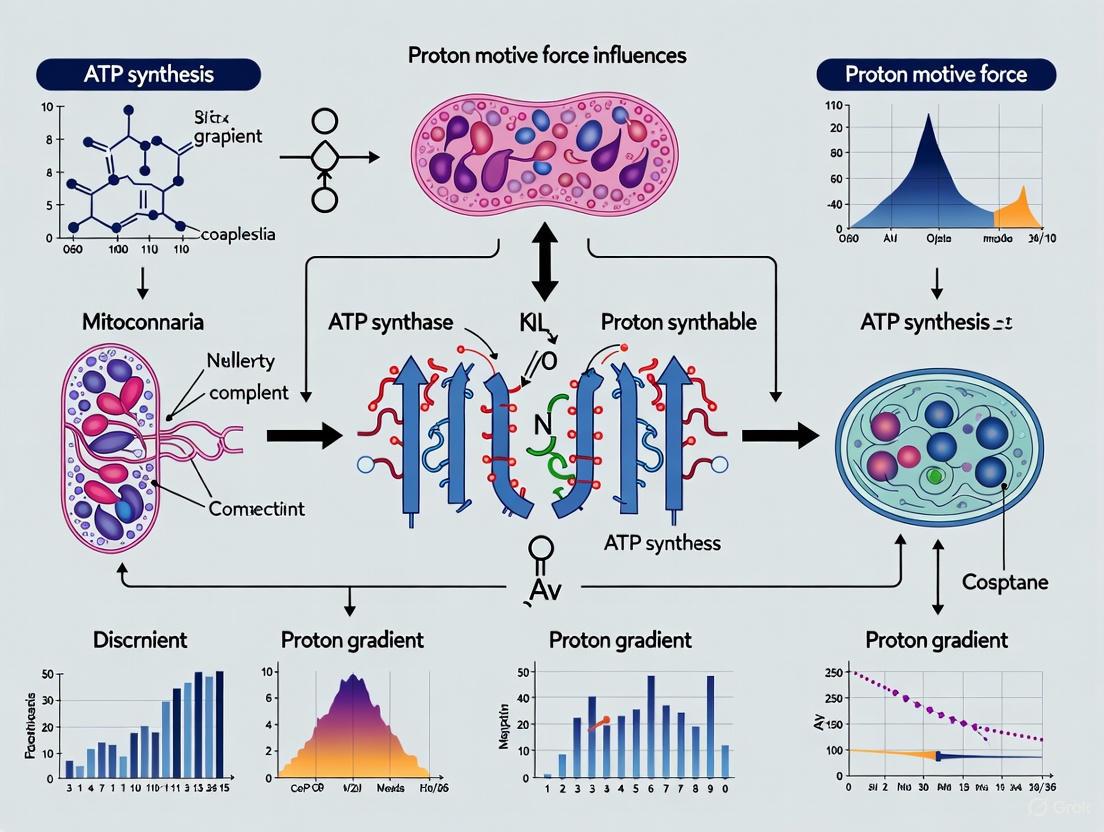
This article provides a comprehensive analysis of the proton motive force (PMF) as the central energy currency driving ATP synthesis.
Proton Motive Force and ATP Synthesis: Molecular Mechanisms, Research Methodologies, and Therapeutic Applications
Abstract
This article provides a comprehensive analysis of the proton motive force (PMF) as the central energy currency driving ATP synthesis. It explores foundational principles, including the chemiosmotic theory and the rotary catalytic mechanism of ATP synthase, supported by recent high-resolution structural studies. Methodological sections detail advanced techniques for measuring PMF and its components in situ. The content addresses key challenges in the field, such as PMF heterogeneity and stoichiometry debates, and examines emerging therapeutic strategies that target PMF dynamics for conditions like Parkinson's disease. Designed for researchers, scientists, and drug development professionals, this review synthesizes current evidence and identifies future research directions with significant implications for biomedicine.
The Chemiosmotic Principle: Understanding the Energetic Driver of Cellular Life
The proton motive force (pmf) is the cornerstone of energy transduction in biological systems, serving as the primary link between substrate oxidation and adenosine triphosphate (ATP) synthesis. This electrochemical gradient across the inner mitochondrial membrane, composed of a electrical potential (ΔΨm) and a chemical proton concentration gradient (ΔpH), represents a universal energy currency in cells. This technical guide delineates the precise composition of the pmf, its generation by the electron transport system, and its utilization by ATP synthase, framing this discussion within contemporary research on mitochondrial bioenergetics. Detailed methodologies for experimental assessment and key reagent solutions are provided to support ongoing drug discovery and bioenergetic research aimed at modulating mitochondrial function in neurodegenerative diseases, metabolic disorders, and cancer.
The proton motive force (pmf), also termed Δp, is the electrochemical potential difference of protons across the inner mitochondrial membrane that drives ATP synthesis according to Peter Mitchell's chemiosmotic theory [1]. This theory posits that energy released from electron transfer through the respiratory chain is conserved through the directional translocation of protons, creating both a pH gradient and an electrical potential that collectively energize phosphorylation [2]. The proton circuit integrates redox reactions, proton translocation, and ATP synthesis into a unified energy-transducing system essential across diverse life forms, from bacteria to humans [1]. In mitochondria, the pmf is generated by proton-pumping complexes (I, III, and IV) during substrate oxidation and is utilized by the F1Fo ATP synthase (Complex V) to phosphorylate ADP [3] [4]. The precise balance between its two components—ΔΨm and ΔpH—is critical for efficient energy conversion, ion transport, metabolic regulation, and mitochondrial homeostasis, making it a focal point in bioenergetics research and therapeutic development [5] [3].
Composition of the Proton Motive Force
Fundamental Equation and Components
The proton motive force (Δp) is mathematically defined by the following equation, which incorporates both its electrical and chemical components:
Δp = ΔΨm - ZΔpH [4]
Where:
- Δp represents the total protonmotive force, expressed in millivolts (mV)
- ΔΨm is the electrical potential difference across the inner mitochondrial membrane (in mV), with the matrix side negatively charged relative to the intermembrane space
- ΔpH is the chemical gradient of protons across the membrane, representing the difference in proton concentration (expressed in pH units)
- Z is a constant that converts the pH difference to millivolts, calculated as Z ≈ 59 mV per pH unit at 25°C [4]
This formulation highlights that the total pmf represents the sum of an electrical driving force (ΔΨm) and a chemical diffusion force (ZΔpH) acting on protons [2].
Relative Contributions of ΔΨm and ΔpH
Under physiological conditions in animal mitochondria, the total pmf typically ranges between 170-200 mV [5] [4]. The relative contributions of the two components are not fixed but dynamically regulated, though in most tissues ΔΨm constitutes the dominant fraction:
Table 1: Typical Values and Relative Contributions of pmf Components in Animal Mitochondria
| Parameter | Typical Value | Contribution to Total pmf | Physiological Significance |
|---|---|---|---|
| Total Δp | 170-200 mV | 100% | Total available energy for ATP synthesis and transport |
| ΔΨm | ~140-170 mV | ~80-85% | Primary driver for ATP synthase rotation and cation transport |
| ΔpH | ~0.5 pH units (~30 mV) | ~15-20% | Significant thermodynamic push; influences phosphate carrier and ROS production |
This distribution is physiologically significant because ΔΨm and ΔpH exert distinct influences on mitochondrial components and processes [5]. For instance, the ATP/ADP carrier is primarily driven by ΔΨm, whereas the phosphate carrier is driven by ΔpH [5]. Similarly, reactive oxygen species (ROS) production appears more sensitive to ΔpH, while proton leak is more responsive to ΔΨm [5].
Dynamic Interconversion and Regulation
The balance between ΔΨm and ΔpH is dynamically regulated by ion transport systems, particularly potassium cycling. The K+ uniport allows potassium influx driven by ΔΨm, while K+/H+ exchange exports potassium in exchange for protons, effectively converting ΔΨm into ΔpH [5]. This ion circulation modulates the ΔΨm/ΔpH ratio without necessarily changing the total Δp. Research indicates that this ratio is determined by the relative activities of these transport systems rather than their absolute rates [5]. Secondary active transport processes, including electrophoretic and electroneutral exchangers, continuously fine-tune this balance to meet cellular energy demands and maintain mitochondrial homeostasis under varying physiological conditions [2].
Quantitative Data on pmf Components
Table 2: Experimentally Measured Values of pmf Components Across Biological Systems
| System / Condition | Total Δp (mV) | ΔΨm (mV) | ΔpH (mV) | ΔpH (pH units) | Notes | Reference |
|---|---|---|---|---|---|---|
| Isolated Mitochondria (general) | 170-200 | ~140-170 | ~30 | ~0.5 | Typical reference values; state-dependent | [5] [4] |
| E. coli cells (pH 7.5) | ~150-200 | ~150-200 | <20 | <0.3 | ΔpH near zero at this external pH | [4] |
| E. coli cells (pH 6.0-6.5) | ~200 | Decreases | Increases | >0.5 | Δp changes slightly with pH | [4] |
| Cardiac Myocytes (resting) | ≥ -140 | -100 | ~ -53 | 0.9 | Measured with TMRM & SNARF-1 | [6] |
| Computer Model (Beard) | - | - | <3 | <0.05 | Contrasts with most experimental data | [5] |
The values in Table 2 demonstrate that while the total pmf remains relatively stable across different systems and conditions, the partitioning between ΔΨm and ΔpH can vary significantly. In bacteria such as E. coli, the relative contribution of ΔpH increases substantially as the external environment becomes more acidic [4]. In mammalian cardiac cells, direct measurements using fluorescent probes reveal a substantial ΔpH contribution of approximately 0.9 pH units, equivalent to about 53 mV [6]. Discrepancies between experimental measurements and computational models, such as the very low ΔpH predicted by Beard's model, highlight ongoing research challenges in precisely quantifying these parameters [5].
Generation and Utilization of the Proton Motive Force
Generation by the Electron Transport System
The electron transport system (ETS), located in the inner mitochondrial membrane, functions as the primary generator of the pmf. Complexes I, III, and IV act as proton pumps that couple electron transfer to vectorial proton translocation from the matrix to the intermembrane space [4] [1]. Complex I (NADH:ubiquinone oxidoreductase) pumps 4 H+ per 2 electrons, Complex III (cytochrome bc1 complex) pumps 4 H+, and Complex IV (cytochrome c oxidase) pumps 2 H+ per 2 electrons transferred [5]. This asymmetric proton distribution creates both the electrical (ΔΨm, negative inside) and chemical (ΔpH, alkaline inside) components of the pmf. The ETS operates in series with respect to electron flow but in parallel with respect to the proton circuit, collectively generating a maximal Δp of approximately 200 mV [4]. This process effectively converts redox energy into an electrochemical potential that represents a versatile, intermediate form of energy storage [3].
Utilization by ATP Synthase and Other Processes
The F1Fo ATP synthase (Complex V) represents the primary consumer of the pmf, harnessing the energy of proton flow back into the matrix to drive ATP synthesis from ADP and inorganic phosphate [1]. This molecular machine consists of two structurally and functionally distinct domains: the membrane-embedded F0 subunit that forms a proton channel, and the catalytic F1 subunit that synthesizes ATP [1]. According to the rotational catalysis mechanism, the downhill flow of protons through F0 drives rotation of a subunit oligomer, which induces conformational changes in the F1 catalytic sites that facilitate ATP formation [1]. The stoichiometry of approximately 2.5 protons translocated per ATP synthesized reflects the energy requirements of this process [5]. Beyond ATP synthesis, the pmf drives multiple essential cellular functions, including: active transport of metabolites and ions via secondary transporters; protein import and assembly; NADPH maintenance via energy-linked transhydrogenase; and in bacteria, flagellar rotation and nutrient uptake [4] [1].
Diagram Title: Proton Circuit in Oxidative Phosphorylation
Experimental Assessment of Proton Motive Force
Measurement Methodologies
Accurate assessment of the pmf requires independent measurement of both ΔΨm and ΔpH using specialized techniques and instrumentation. Standardized protocols across laboratories enable meaningful comparison of results, particularly in disease models where mitochondrial dysfunction is implicated [7].
Measuring Mitochondrial Membrane Potential (ΔΨm)
Fluorescent potentiometric probes provide the most common approach for ΔΨm assessment in intact cells and isolated mitochondria. Tetramethylrhodamine methyl ester (TMRM) and similar cationic dyes accumulate in the mitochondrial matrix in a ΔΨm-dependent manner, with increased fluorescence intensity or quenching indicating higher membrane potential [7] [6]. For precise quantification, confocal microscopy is employed to monitor fluorescence intensity changes in individual mitochondria, often coupled with calibration using protonophores and ionophores to establish absolute values [6]. This technique revealed a ΔΨm of approximately -100 mV in resting adult rabbit cardiac myocytes [6]. Critical controls include verifying that dye concentrations remain in the non-quenching range and accounting for potential plasma membrane potential contributions to the measurements [7].
Measuring Mitochondrial pH Gradient (ΔpH)
Ratiometric fluorescent pH indicators such as SNARF-1 enable quantitative assessment of ΔpH. Cells are loaded with the acetoxymethyl ester derivative (SNARF-1-AM), which is hydrolyzed intracellularly to release the pH-sensitive dye [6]. The ratio of fluorescence emissions at two wavelengths (e.g., 584 nm and >620 nm with 568 nm excitation) provides a pH measurement independent of dye concentration and mitochondrial density [6]. An in situ calibration curve is generated using solutions of known pH with ionophores to equilibrate intra- and extramitochondrial pH, allowing conversion of fluorescence ratios to absolute pH values [6]. This approach measured a ΔpH of 0.9 units (approximately 53 mV) across the mitochondrial membrane in cardiac myocytes [6].
Integrated Protonmotive Force Determination
To determine the total pmf (Δp) within intact cells, simultaneous measurements of ΔΨm and ΔpH across the same mitochondrial population are required. Using co-loaded TMRM and SNARF-1 in confocal microscopy experiments, researchers calculated a mitochondrial Δp of at least -140 mV in resting adult rabbit cardiac myocytes (ΔΨm = -100 mV; ΔpH = 0.9 units ≈ -53 mV) [6]. This integrated approach provides the most physiologically relevant assessment of the full energy gradient available for ATP synthesis and other energy-requiring processes.
Experimental Modulation of pmf
Research into pmf dynamics requires tools to selectively dissipate or modulate its components. The table below details key pharmacological agents used in experimental settings:
Table 3: Research Reagent Solutions for pmf Manipulation
| Reagent / Intervention | Primary Target/Mechanism | Effect on pmf Components | Research Application |
|---|---|---|---|
| Oligomycin | F1Fo-ATP synthase inhibitor | Blocks proton flow through ATP synthase, increases Δp | Distinguishes ATP-linked respiration; hyperpolarizes membrane [8] |
| CCCP/FCCP | Protonophore (H+ ionophore) | Collapses both ΔΨm and ΔpH (uncoupler) | Determines maximum respiratory capacity; dissipates pmf [8] |
| Valinomycin | K+ ionophore | Collapses ΔΨm specifically (electrogenic K+ transport) | Selective dissipation of electrical component [5] [6] |
| Nigericin | K+/H+ exchanger | Collapses ΔpH specifically (electroneutral exchange) | Selective dissipation of pH gradient [5] [6] |
| Rotenone, Antimycin A | ETS Complex I & III inhibitors | Prevents pmf generation by blocking proton pumping | Identifies electron transport chain contributions [7] |
These reagents enable researchers to dissect the contributions of individual pmf components to various cellular processes. For example, combining valinomycin and nigericin completely collapses both components of the pmf, while using them separately allows investigation of processes specifically dependent on ΔΨm or ΔpH [5] [6].
Diagram Title: Workflow for Comprehensive pmf Assessment
Research Context: pmf in ATP Synthesis Studies
Current Research Directions
Contemporary research on proton motive force increasingly focuses on its dynamic regulation and role in pathological conditions. Artificial mitochondria represent a cutting-edge approach where glucose oxidase and catalase are co-encapsulated in silica nanocapsules, then coated with ATPase-integrated liposomes to create biomimetic systems that establish sustained proton gradients for ATP production [9]. These constructs achieve a remarkable ΔpH of approximately 1.4 units, significantly higher than previous artificial systems, enabling high-yield ATP synthesis when integrated into artificial cells [9]. In neurodegenerative disease research, standardized assessment of pmf components in cellular models of Alzheimer's, Parkinson's, and Huntington's diseases facilitates cross-disease analysis of mitochondrial bioenergetic dysfunction [7]. In cancer biology, the unusual sensitivity of certain tumor cell lines to F1F0-ATPase inhibitors like oligomycin highlights the potential for targeting pmf-dependent processes in therapeutic development [8]. Additionally, discoveries of extra-mitochondrial OXPHOS in mitochondria-derived vesicles challenge traditional paradigms of cellular energy metabolism and suggest more complex spatial organization of bioenergetic processes than previously recognized [10].
Methodological Considerations and Pitfalls
Accurate interpretation of pmf-related data requires careful consideration of methodological limitations. The standard assay using oligomycin to inhibit ATP synthase and estimate proton leak-linked respiration slightly overestimates endogenous leak rates because oligomycin causes mild hyperpolarization of the mitochondrial membrane; however, this error is typically less than 10% [8]. Changes in proton leak-linked respiration must be interpreted cautiously, as they may reflect alterations in membrane potential rather than changes in the intrinsic proton conductance of the inner membrane [8]. For genetic studies, many proteins implicated in neurodegenerative diseases regulate mitochondrial homeostasis and function to varying degrees, potentially confounding the interpretation of pmf measurements in disease models [7]. Furthermore, when studying bacterial systems, researchers must account for the fact that the relative contributions of ΔΨm and ΔpH to the total pmf change with external pH, with ΔpH becoming increasingly significant in acidic environments [4] [6].
The proton motive force, comprising ΔΨm and ΔpH, represents a fundamental biological energy currency that couples respiratory activity to ATP synthesis and numerous other energy-requiring processes. Understanding its precise composition, regulation, and measurement is essential for advancing bioenergetics research and developing therapeutic interventions for mitochondrial-related pathologies. The continued refinement of artificial mitochondrial systems, standardized assessment protocols, and targeted pharmacological tools will enable deeper investigation into pmf dynamics across physiological and disease contexts. As research reveals increasingly complex aspects of proton dynamics—from extra-mitochondrial oxidative phosphorylation to tissue-specific variations in ΔΨm/ΔpH partitioning—the fundamental principles outlined in this guide provide a foundation for interpreting new discoveries in this rapidly evolving field.
The chemiosmotic theory, first proposed by Peter Mitchell in 1961, provides the fundamental framework for understanding how cells convert energy across biological membranes [11]. This paradigm establishes that energy conservation occurs through the generation of an electrochemical gradient of protons across a membrane, the proton motive force (pmF), which links redox reactions to phosphorylation. The pmF consists of two components: an electrical potential (ΔΨ) and a chemical pH gradient (ΔpH) [12]. The interplay between these components creates the thermodynamic driving force that powers ATP synthesis via the ubiquitous enzyme F(0)F(1)-ATP synthase [11] [13]. This whitepaper examines the core principles of the chemiosmotic theory, explores contemporary research developments, and details how manipulation of proton dynamics informs modern therapeutic strategies, particularly in combating antibiotic resistance.
Core Principles and Quantitative Foundations
Mitchell's theory rests on several key postulates integrated across four functional modules [12]:
- An electron transfer system (Module 2) generates the pmF through redox-driven proton pumping.
- The ATP synthase (Module 1) utilizes the pmF to synthesize ATP.
- Ion exchange systems (Module 3) modulate the balance between ΔΨ and ΔpH.
- A coupling membrane (Module 3) integrates these structural and functional modules, maintaining the proton gradient.
The overall reaction coupling proton translocation to ATP synthesis is expressed as: [ \text{ADP} + \text{P}i + n\text{H}^+{\text{in}} \rightleftharpoons \text{ATP} + \text{H}2\text{O} + n\text{H}^+{\text{out}} ] The corresponding Gibbs free energy equation is: [ \Delta G' = \Delta G'{\text{ATP}} - nF \cdot \text{pmF} ] where (n) is the H+/ATP ratio, (F) is Faraday's constant, and (\Delta G'{\text{ATP}}) is the Gibbs free energy of ATP synthesis [13]. ATP synthesis proceeds when (\Delta G'_{\text{ATP}} < nF \cdot \text{pmF}).
Table 1: Key Quantitative Parameters in Chemiosmotic Bioenergetics
| Parameter | Symbol | Typical Range/Value | Functional Significance |
|---|---|---|---|
| Total Proton Motive Force | pmF | ~200 mV (mitochondria) | Thermodynamic driving force for ATP synthesis [14] |
| Membrane Potential | ΔΨ | Dominant component in animal mitochondria | Electric component of pmF [12] |
| pH Gradient | ΔpH | ~0.5 units (contributes 15-20% to pmF) | Chemical component of pmF; more significant in chloroplasts/bacteria [12] |
| Threshold pmF for ATP synthesis | ~210 mV | Minimum pmF required to activate ATP synthase [14] | |
| H+/ATP Ratio | (n) | 2.7 - 5.0 (natural); up to 5.8 (engineered) | Coupling stoichiometry; defines energy cost of ATP synthesis [13] |
| c-subunit Stoichiometry | 8 - 15 subunits per c-ring | Primary natural determinant of H+/ATP ratio [13] |
Contemporary Theoretical Refinements
The Localized Coupling Model and the Role of Membrane Dynamics
The original "delocalized coupling" model proposed a bulk-phase proton gradient. However, significant evidence now supports a "localized coupling" model, where proton transfer occurs along the membrane surface rather than through the aqueous bulk phase [11]. This model posits that protons remain closely associated with the lipid bilayer prior to interaction with ATP synthase, minimizing energy dissipation [14]. This is facilitated by protonic currents that travel via a Grotthuss-type mechanism, where protons hop along hydrogen-bonded water molecules or protein side chains, avoiding a slow bulk-phase diffusion [11].
RNA as a Regulated Proton Sink
A groundbreaking addendum to the theory proposes that RNA within the mitochondrial intermembrane space (IMS) acts as a dynamic proton sink [14]. The enzyme polynucleotide phosphorylase (PNPase) plays a key regulatory role, synthesizing poly(A) RNA under low phosphate (Pi) and high ADP conditions, which traps protons and expands the proton sink. When Pi becomes abundant, PNPase switches to phosphorolytic mode, degrading the RNA and simultaneously releasing the sequestered protons and ADP. This mechanism synchronizes the availability of protons (the driving force) with ADP and Pi (the substrates) for ATP synthase, thereby maximizing the efficiency of oxidative phosphorylation [14]. This RNA-based sink mitigates futile proton cycling and protects membrane integrity.
Advanced Experimental Methodologies and Model Systems
Investigating Proton Dynamics: Key Experimental Protocols
Several advanced methodologies are employed to probe the mechanisms of chemiosmosis.
Table 2: Research Reagent Solutions for Chemiosmotic Studies
| Reagent / Material | Function in Experimentation | Key Findings Enabled |
|---|---|---|
| Fluorescent pH Indicators (e.g., GFP variants) | Measure localized pH changes in subcellular compartments or near membrane surfaces [11]. | Validated localized proton coupling by revealing pH microdomains near Complex III and ATP synthase [11]. |
| Reconstituted Proteoliposomes | Artificial vesicles containing purified respiratory complexes and/or ATP synthase for studying function in isolation [9] [11]. | Demonstrated that a proton gradient across a pure phospholipid bilayer is sufficient to drive ATP synthesis by isolated ATP synthase [11]. |
| RNase A | Enzyme used to degrade RNA within the mitochondrial intermembrane space (IMS) [14]. | Revealed the role of RNA as a proton sink; its degradation causes a pH drop and ATP synthesis spike, even with a stalled ETC [14]. |
| Valinomycin (K+ ionophore) | Induces a transient membrane potential (ΔΨ) by facilitating K+ diffusion across membranes [11]. | Historically used to demonstrate that an artificial ΔΨ alone can drive ATP synthesis in ATP synthase-incorporated liposomes [11]. |
| Fatty Acid Vesicles (Protocells) | Model for primitive, pre-biotic membranes to study the minimal requirements for chemiosmosis [15]. | Showed that simple fatty acid membranes can maintain proton gradients strong enough for ATP synthesis under simulated hydrothermal vent conditions [15]. |
Protocol 1: Measuring H+/ATP Ratio via Thermodynamic Equilibrium. This method determines the stoichiometry ((n)) by finding the point where the pmF and the Gibbs free energy of ATP hydrolysis are balanced [13]. Purified F(0)F(1)-ATP synthase is reconstituted into liposomes. A precise pmF is applied, and the reaction is allowed to reach equilibrium. The concentrations of ATP, ADP, and Pi at equilibrium are measured, and (n) is calculated using the equation (\Delta G'{\text{ATP}} = nF \cdot \text{pmF}). This protocol has confirmed H+/ATP ratios of ~3.3 for *Bacillus* PS3 F(0)F(_1) and revealed variations in other species [13].
Protocol 2: Demonstrating RNA as a Proton Sink. Mitochondria are isolated and treated with RNase A to degrade IMS RNA [14]. The extracellular acidification rate (ECAR) and oxygen consumption rate (OCR) are simultaneously measured using a Seahorse Analyzer or similar instrument. A sharp increase in ECAR (indicating proton release) and a transient spike in ATP levels following RNase treatment, even in the presence of electron transport chain inhibitors, provide evidence for the proton-sink function of RNA [14].
Engineering and Synthetic Biology Approaches
Engineering Artificial Mitochondria: A state-of-the-art approach co-compartmentalizes glucose oxidase (GOx) and catalase (CAT) within silica nanocapsules, which are then coated with an ATP synthase-integrated liposome [9]. GOx consumes glucose to produce gluconic acid (protons), while CAT decomposes the byproduct H(2)O(2) into O(_2), which fuels the GOx reaction. This self-reinforcing cascade creates a strong proton gradient (ΔpH ≈ 1.4), efficiently driving ATP synthesis and powering processes like NADH biosynthesis in artificial cells [9].
Engineering ATP Synthase: To enhance bioenergetic efficiency, researchers have engineered F(0)F(1)-ATP synthase to have multiple a-subunits and peripheral stalks. By truncating the N-terminal domain of the δ subunit and creating a δΔN-α fusion construct, an enzyme with up to three peripheral stalks was generated [13]. This engineered synthase exhibited an H+/ATP ratio of 5.8, surpassing naturally occurring enzymes and enabling ATP synthesis under lower pmF conditions [13].
Applications in Drug Development and Antibiotic Resistance
The proton motive force is a critical target for combating antibiotic resistance. The metabolic state-driven approach exploits the link between bacterial metabolism, pmF, and antibiotic uptake [16].
Mechanism: Antibiotic uptake for many drug classes (e.g., aminoglycosides, fluoroquinolones) is dependent on the pmF [17] [16]. Resistant bacterial populations often exhibit a metabolically downregulated state with a reduced pmF, thereby limiting drug import [16]. This approach uses specific nutrient metabolites to reprogram bacterial metabolism, increasing pmF and resensitizing bacteria to antibiotics.
Experimental Evidence:
- Proline as an Evolution-Mitigating Agent: In E. coli, exposure to ciprofloxacin drives resistance evolution. However, supplementation with the amino acid proline reduces resistance development by >50% [17]. Transcriptomic and metabolic flux analyses showed that proline downregulates the TCA cycle, reducing NADH production, pmF, and consequently, the uptake of ciprofloxacin [17].
- Nutrient-Induced Resensitization: Exogenous metabolites like glucose, alanine, and fructose can restore susceptibility in multidrug-resistant pathogens. For example, in kanamycin-resistant Edwardsiella tarda, these nutrients activate the pyruvate cycle, increasing NADH/NAD+ ratio, pmF, and drug uptake [16].
These strategies represent a promising paradigm for developing anti-resistance adjuvants that work by modulating the fundamental bioenergetic force described by the chemiosmotic theory.
Visualizing Core Concepts and Pathways
The Chemiosmotic Theory and ATP Synthase Mechanism
The RNA Proton Sink Model
The synthesis of adenosine triphosphate (ATP) is a fundamental process for cellular energy conservation. According to the chemiosmotic theory proposed by Peter Mitchell, the proton motive force (PMF) is the universal intermediate form of energy that drives ATP synthesis [18] [19]. The PMF is an electrochemical gradient of protons across energy-transducing membranes, generated by proton-pumping respiratory complexes or photosynthetic light reactions. This force consists of two components: a transmembrane electrical potential (ΔΨ) and a transmembrane chemical proton gradient (ΔpH) [20] [19]. The complete PMF is described by the equation Δp = ΔΨ - 2.3(RT/F)ΔpH, where Δp represents the total proton motive force [20]. ATP synthase, also known as F-type ATPase or Complex V, is the sophisticated molecular machine that harnesses the energy stored in the PMF to phosphorylate ADP, producing ATP [21] [22]. This enzyme is highly conserved across biological kingdoms and is found in bacterial cytoplasmic membranes, thylakoid membranes of chloroplasts, and inner mitochondrial membranes of eukaryotes [21] [22] [23].
Recent research has revealed that the PMF is not a static, homogeneous parameter but exhibits complex spatiotemporal dynamics that significantly impact cellular bioenergetics [18] [20]. In bacteria, the PMF drives essential processes including ATP production, motility, cell division, antibiotic resistance, and biofilm formation [18]. The classical view of a spatially and temporally stable PMF has been challenged by evidence of rapid dynamics and potential heterogeneity, although recent single-cell studies suggest that spatial PMF heterogeneity may be short-lived due to rapid electrotonic spread along the membrane [18]. In mitochondria, the complex architecture of the inner membrane creates microdomains with variations in PMF that influence ATP synthase activity and overall energy conversion efficiency [20]. Understanding how ATP synthase couples PMF to ATP production is therefore essential for comprehending cellular bioenergetics and developing therapeutic interventions for related disorders.
Structural Organization of ATP Synthase
ATP synthase is a complex molecular motor composed of two main functional domains: the membrane-embedded FO component and the peripheral F1 component [21] [22] [23]. These two components are connected by central and peripheral stalks, creating a rotary motor mechanism that couples proton translocation to ATP synthesis [22]. The overall reaction catalyzed by ATP synthase is: ADP + Pi + 2H+out ⇌ ATP + H2O + 2H+_in [21].
The enzyme's structure is highly conserved across bacteria, chloroplasts, and mitochondria, though subunit composition and oligomeric state show significant variation [22]. Bacterial and chloroplast ATP synthases typically function as monomers, while mitochondrial ATP synthases form dimers, tetramers, and higher-order oligomers that determine the topology of mitochondrial cristae [22]. This structural arrangement is functionally significant, as the dimerization of mitochondrial ATP synthases induces membrane curvature essential for proper cristae formation and compartmentalization of bioenergetic processes [22].
The F_1 Catalytic Domain
The F1 portion is a water-soluble complex that protrudes into the mitochondrial matrix (or bacterial cytoplasm) and contains the catalytic sites for ATP synthesis [21] [23]. It is composed of five different subunits with a stoichiometry of α3β3γδε [21] [23]. The three α and three β subunits form a hexameric ring that houses three catalytic sites primarily located on the β subunits [23]. The γ subunit forms the central stalk that extends from the F1 down to the FO region and rotates within the α3β3 hexamer during ATP synthesis [21]. The δ and ε subunits are involved in regulating activity and connecting to the FO region [21].
The crystal structure of the F_1 component revealed an asymmetrical arrangement with alternating α and β subunits surrounding the central γ subunit [21]. This asymmetry is crucial for the binding change mechanism of ATP synthesis, where each catalytic site cycles through three different conformational states with differing nucleotide affinities [21].
The F_O Proton Channel Domain
The FO component is embedded in the membrane and functions as a proton channel [21] [23]. Its composition varies among species but generally includes subunits a, b, and multiple copies of subunit c that form a rotating ring structure [21] [23]. In bacteria, the FO typically consists of 9-12 c-subunits arranged in a circular ring [23]. The a-subunit provides the interface for proton transfer between the c-ring and the membrane environment, containing two half-channels that allow protons to access and exit the c-ring [23] [24].
Recent structural studies of human ATP synthase have identified water molecules in the inlet and outlet proton half-channels, suggesting that proton transfer follows a Grotthus mechanism involving proton hopping through hydrogen-bonded water networks [24]. The c-ring rotates within the membrane as protons bind to and dissociate from specific amino acid residues on the c-subunits, typically a conserved acidic residue (asp or glu) [23].
Table 1: Core Subunits of ATP Synthase Across Biological Kingdoms
| Subunit | Location | Function | Bacterial | Mitochondrial | Chloroplast |
|---|---|---|---|---|---|
| α | F_1 | Structural framework, non-catalytic nucleotide binding | Present | Present | Present |
| β | F_1 | Catalytic nucleotide binding, ATP synthesis | Present | Present | Present |
| γ | Central stalk | Rotation during catalysis, conformational changes | Present | Present | Present |
| δ | Peripheral stalk | Connection between F1 and FO, stability | Present (bacterial ε) | Present | Present |
| ε | Central stalk | Regulation of activity | Present | Present (bacterial δ) | Present |
| a | F_O | Proton translocation pathway, half-channels | Present | Present (MT-ATP6) | Present |
| b | Peripheral stalk | Stator connection, prevents F_1 rotation | Present | Present (ATP5PB) | Present |
| c | F_O | Rotary c-ring, proton binding and transport | Present | Present (ATP5MC1/2/3) | Present |
Stator Connections and Oligomeric States
The peripheral stalk serves as a stator that prevents the α3β3 hexamer from rotating in sympathy with the central stalk rotor [21]. This connection allows the enzyme to harness the energy of proton flow through FO to drive conformational changes in F1 [21]. In mitochondria, the peripheral stalk contains additional subunits that are not present in bacterial systems, reflecting the increased complexity of eukaryotic ATP synthases [22].
The oligomeric state of ATP synthase varies significantly across species and has functional implications. Bacterial ATP synthases are generally monomeric [22] [20], while mitochondrial ATP synthases form dimers and higher-order oligomers that arrange into rows along the cristae ridges [22]. These oligomeric structures determine mitochondrial ultrastructure, with different dimer types generating varying degrees of membrane curvature—approximately 86° in Opisthokonta (including mammals) and 55-56° in Viridiplantae [22]. This structural organization creates functional microdomains that influence PMF distribution and ATP synthesis efficiency [20].
Molecular Mechanism of ATP Synthesis
The Binding Change Mechanism and Rotary Catalysis
ATP synthesis follows the binding change mechanism, first proposed by Paul Boyer, which postulates that ATP forms easily at catalytic sites but requires energy to be released [21] [23]. This mechanism involves coordinated conformational changes in the three catalytic β subunits driven by rotation of the γ subunit [21]. Each β subunit cycles through three distinct conformational states:
- Open (O) state: Low affinity for substrates and products, allowing ATP release and ADP/Pi binding [23].
- Loose (L) state: Moderately tight binding of ADP and Pi, but no catalysis [23].
- Tight (T) state: Tight binding that promotes formation of ATP from ADP and Pi [23].
The rotation of the asymmetrical γ subunit within the α3β3 hexamer causes each β subunit to sequentially transition through these three states with each 120° rotation [23]. Since the three catalytic sites are at different stages of the cycle at any given time, the enzyme simultaneously binds substrates, catalyzes ATP formation, and releases products in a coordinated manner [21].
Proton Translocation and Torque Generation
The energy coupling between proton flow and ATP synthesis occurs through a rotary mechanism where proton translocation through F_O drives rotation of the c-ring and attached γ subunit [23]. Protons from the intermembrane space (or periplasmic space in bacteria) enter through the half-channel in the a-subunit and bind to a conserved carboxyl group on a c-subunit [23]. The c-ring rotation brings the protonated c-subunit through the membrane, and when it reaches the exit half-channel, the proton is released to the matrix (or cytoplasm) [23].
This proton translocation generates torque that drives rotation of the c-ring relative to the a-subunit [23]. The number of c-subunits in the ring varies among species, typically ranging from 8 to 15, which determines the stoichiometry of protons transported per rotation [23] [25]. Since three ATP molecules are synthesized per complete rotation of the γ subunit, the number of c-subunits determines the proton-to-ATP ratio, which typically ranges from 2.7 to 5.0 in naturally occurring ATP synthases [25].
Coupling Efficiency and H+/ATP Ratio
The H+/ATP ratio is a crucial bioenergetic parameter that defines the thermodynamic efficiency of ATP synthesis [25]. Recent engineering studies have successfully modified ATP synthase to achieve an H+/ATP ratio of 5.8, surpassing the highest ratios found in nature [25]. This was accomplished by engineering FoF1 to form multiple peripheral stalks, each bound to a proton-conducting a-subunit [25]. Such engineered enzymes can synthesize ATP under low PMF conditions where wild-type enzymes cannot function, demonstrating the plasticity of this molecular machine and offering potential applications in bioenergy [25].
Table 2: Proton-to-ATP Ratios and Structural Features in Different Organisms
| Organism/Source | Number of c-subunits | H+/ATP Ratio | Special Features | Reference |
|---|---|---|---|---|
| Engineered ATP synthase | Modified | 5.8 | Multiple peripheral stalks & a-subunits | [25] |
| Mycobacteria | 9 | 3.0 | Target of anti-TB drug bedaquiline | [22] |
| Yeast mitochondria | 10 | 3.3 | V-shape dimers, 86° membrane curvature | [22] |
| Mammalian mitochondria | 8 | 2.7 | V-shape dimers (type I) | [22] |
| Spinach chloroplasts | 14 | 4.7 | Mostly monomeric, can form oligomers | [22] |
| E. coli | 10 | 3.3 | Monomeric structure | [23] |
Experimental Methods for Studying ATP Synthase and PMF Coupling
Single-Molecule Studies of PMF Dynamics
Recent advances have enabled direct investigation of PMF dynamics and ATP synthase function at the single-cell level. In a groundbreaking approach, researchers used light-activated proton pumps (proteorhodopsin, PR) combined with monitoring of the bacterial flagellar motor (BFM) to probe PMF dynamics in single E. coli cells with millisecond resolution [18]. The experimental protocol involves:
- Strain Engineering: E. coli cells expressing proteorhodopsin (PR) in the inner membrane [18].
- Cell Immobilization: Individual cells are immobilized on microscope slides [18].
- Bead Attachment: 600-nm diameter beads are attached to flagellar stubs, serving as markers for BFM rotation [18].
- Speed Measurement: BFM angular speed is tracked via bright-field microscopy with up to 20-kHz sampling rate by recording holograms of off-axis bead rotation [18].
- PMF Manipulation: Spatiotemporally controlled laser excitation activates PR to generate localized PMF perturbations [18].
- Data Analysis: Motor acceleration transitions are synchronized with laser pulses and averaged to obtain high signal-to-noise response profiles [18].
This method revealed that spatially localized PMF perturbations are homogenized over the entire cell faster than proton diffusion can account for, suggesting an electrotonic spread similar to that observed in passive neurons [18]. The temporal dynamics of PMF changes followed capacitor-like charging and discharging with distinct time constants for charging (τ↑) and discharging (τ↓), where τ↓ > τ↑ due to the additional resistance pathway during charging [18].
Local pH Measurement Techniques
To understand how ATP synthase activity influences and is influenced by local PMF conditions, researchers have developed targeted pH sensors positioned at specific mitochondrial sub-compartments [20]. The methodology includes:
- Sensor Engineering: pH-sensitive GFP (super-ecliptic pHluorin, sEcGFP) is genetically fused to specific ATP synthase subunits - both F1 and FO components [20].
- Cell Line Generation: Creation of IF1-knockout (IF1-KO), IF1-overexpressing (IF1-OE), and constitutively active IF1-H49K mutant cell lines [20].
- Metabolic Manipulation: Cells are cultured in high-glucose (glycolytic) or galactose (respiratory) conditions to manipulate metabolic states [20].
- Ratiometric Imaging: pH values are determined through ratiometric imaging of the pH-sensitive GFP [20].
- Multi-localization: Simultaneous measurement of pH at different mitochondrial locations (F1, FO, complex IV, matrix) provides high spatial resolution of pH gradients [20].
These studies revealed that ATP synthase activity substantially controls the PMF and that the inhibitory factor IF1 is essential under oxidative phosphorylation conditions to prevent reverse ATP synthase activity [20]. The local Δp at sites of active ATP synthase was found to be surprisingly low under steady-state OXPHOS conditions [20].
Diagram: Methodologies for Investigating ATP Synthase Function and PMF Coupling - This diagram illustrates the key experimental approaches, their methodologies, and major findings in contemporary ATP synthase research.
Structural Biology Techniques
High-resolution structural studies have been instrumental in understanding the molecular mechanism of ATP synthase. Key approaches include:
- Cryo-Electron Microscopy (cryo-EM): Enables structure determination of complete ATP synthase complexes in multiple rotational states [22] [24]. Recent cryo-EM structures of human ATP synthase have reached near-atomic resolution, revealing details of proton half-channels and subunit interactions [24].
- X-ray Crystallography: Provided the first atomic structures of the F_1 catalytic domain, revealing the asymmetrical arrangement of subunits and supporting the binding change mechanism [21].
- Nuclear Magnetic Resonance (NMR): Used to study dynamics of small subunits and their interactions with inhibitors [22].
- Chemical Cross-linking and Mass Spectrometry: Helps map subunit interactions and conformational changes during the catalytic cycle [22].
These structural approaches have identified clinically relevant mutations at subunit-subunit interfaces that cause instability of the complex [24], and have revealed how isoprenoid quinones within the c-ring pore might stabilize the structure and prevent ion leakage [22].
The Scientist's Toolkit: Research Reagent Solutions
Table 3: Essential Reagents and Materials for ATP Synthase and PMF Research
| Reagent/Material | Function/Application | Key Features | Example Use Cases |
|---|---|---|---|
| Proteorhodopsin (PR) | Light-activated proton pump for controlled PMF manipulation | Spatiotemporal control via laser excitation; compatible with various bacterial systems | Single-cell PMF dynamics studies [18] |
| pH-Sensitive GFPs (pHluorins) | Ratiometric pH sensors for subcellular compartment measurements | Genetically encodable; can be fused to specific protein targets | Local pH measurement at ATP synthase [20] |
| Oligomycin | Specific ATP synthase inhibitor (binds F_O subunit) | Potent inhibitor of proton channel; useful for dissecting ETC contributions | Studying reverse-mode ATP synthase activity [21] [20] |
| Carbonyl cyanide m-chlorophenyl hydrazone (CCCP) | Proton ionophore that dissipates PMF | Uncouples respiration from ATP synthesis; collapses both ΔΨ and ΔpH | Testing PMF-dependent phenomena [26] |
| Bedaquiline (BDQ) | Specific anti-tuberculosis drug targeting mycobacterial F_O | Binds c-subunit ring; inhibits proton translocation | Antimicrobial development [22] |
| Inhibitory Factor 1 (IF1) | Endogenous ATP hydrolysis inhibitor | Regulatory protein controlled by pH and phosphorylation | Studying ATP synthase directionality [20] |
| Tetramethylrhodamine ethyl ester (TMRE) | ΔΨm-sensitive fluorescent dye | Accumulates in mitochondria based on membrane potential | Monitoring PMF components [20] |
| SYTOX Green | Membrane-impermeant nucleic acid stain | Assesses membrane integrity and permeability | Testing membrane integrity in PMF studies [26] |
Regulatory Mechanisms and Physiological Significance
Regulation of ATP Synthase Activity
ATP synthase is subject to multiple regulatory mechanisms that coordinate its activity with cellular energy demands:
Inhibitory Factor 1 (IF1): This endogenous protein inhibits the ATP hydrolysis activity of ATP synthase, preventing futile ATP consumption when PMF drops [20]. IF1 activity is regulated by pH, with stronger inhibition under acidic conditions that occur during impaired respiration [20]. Recent studies using IF1-knockout cells demonstrated that IF1 is essential under oxidative phosphorylation conditions to prevent reverse ATP synthase activity [20].
Subunit Composition and Expression: The expression of ATP synthase subunits varies across tissues and metabolic conditions, providing tissue-specific optimization of energy conversion [22]. In some specialized tissues, alternative subunits create isoforms with different kinetic properties and regulatory features [22].
Reversible Phosphorylation: Several subunits of ATP synthase can be phosphorylated, potentially modulating enzyme activity in response to cellular signaling pathways [20].
Metabolic Substrate Availability: The abundance of ADP and Pi relative to ATP directly affects the thermodynamics of the synthesis reaction, providing substrate-level regulation [20] [19].
PMF Heterogeneity and Microcompartmentation
Recent research has challenged the classical view of a uniform PMF throughout the mitochondrial inner membrane, revealing instead a spatially heterogeneous PMF with functional implications [20]. Key findings include:
- Cristae as Functional Microdomains: Individual cristae can maintain disparate ΔΨm values, and depolarization events may affect some cristae but not others [20].
- Lateral pH Gradients: A lateral pH gradient exists between primary proton pumps and ATP synthase, creating intracristal Δp heterogeneity [20].
- ATP Synthase Dimers as Cristae Organizers: Rows of ATP synthase dimers along cristae rims determine cristae morphology and create subcellular compartments with distinct bioenergetic properties [22] [20].
- Metabolic State Dependence: PMF heterogeneity is influenced by metabolic conditions, with different patterns observed in glycolytic versus respiratory cells [20].
Pathophysiological Implications and Therapeutic Targeting
Dysfunctions of ATP synthase are linked to numerous severe disorders, making it an important therapeutic target:
Mitochondrial Diseases: Mutations in ATP synthase subunits, particularly those encoded by mitochondrial DNA (e.g., MT-ATP6), cause severe neurological disorders such as Leigh syndrome and neurogenic muscle weakness [22] [24].
Antibiotic Tolerance: Active maintenance of PMF is essential for starvation-induced bacterial antibiotic tolerance [26]. Disruption of PMF using ionophores or through suppression of PMF maintenance mechanisms can eradicate tolerant sub-populations, suggesting a feasible strategy for treating chronic and recurrent bacterial infections [26].
Cancer Metabolism: Some cancer cells exhibit altered expression of ATP synthase subunits, potentially reflecting adaptations to their metabolic environment [22] [20].
Ischemia-Reperfusion Injury: The reverse operation of ATP synthase under conditions of low PMF may contribute to cellular damage during reperfusion following ischemic events [20] [19].
Antimicrobial Development: The bacterial ATP synthase is a validated target for antimicrobial drugs, as demonstrated by the anti-tuberculosis drug bedaquiline which specifically inhibits the mycobacterial c-ring [22]. Structural studies of bacterial ATP synthases are facilitating the development of new antimicrobials with improved specificity and reduced side effects [22].
Diagram: ATP Synthase in Cellular Energy Conversion and Disease - This diagram illustrates how ATP synthase couples PMF to ATP production, its regulatory mechanisms, and connections to human disease and therapeutic development.
ATP synthase represents one of nature's most remarkable molecular machines, efficiently converting the energy of the proton motive force into the chemical energy of ATP. Recent research has transformed our understanding of this enzyme from a static complex to a dynamic, regulated system that responds to and influences its local bioenergetic environment. The emerging picture reveals spatiotemporal complexity in PMF distribution and ATP synthase function that challenges the classical chemiosmotic theory while simultaneously enriching it.
Future research directions will likely focus on several key areas: First, understanding how nanoscale organization of ATP synthase oligomers influences mitochondrial architecture and function. Second, elucidating the precise proton translocation mechanism through the F_O channel, including the role of water molecules and protein dynamics. Third, developing targeted therapeutic strategies that modulate ATP synthase activity for treating metabolic diseases, infections, and cancer. Finally, bioengineering approaches may create modified ATP synthases with enhanced efficiency for biotechnological applications, as demonstrated by the recent success in engineering enzymes with improved proton-to-ATP ratios [25].
As research techniques continue to advance, particularly in single-molecule analysis, structural biology, and genetic engineering, our understanding of this fundamental energy-converting machine will continue to deepen, potentially revealing new principles of biological energy conversion and novel approaches to manipulating cellular bioenergetics for therapeutic benefit.
The chemiosmotic theory, pioneered by Peter Mitchell, established that a proton motive force (PMF) across biological membranes serves as the fundamental energy currency for cells [1]. This force, an electrochemical gradient comprising a proton concentration difference (ΔpH) and an electric potential (ΔΨ), is harnessed by a family of nanomachines known as rotary ATPases to drive the synthesis of adenosine triphosphate (ATP) from adenosine diphosphate (ADP) and inorganic phosphate (Pi) [1] [27]. Rotary ATPases are reversible molecular motors that interconvert chemical energy from ATP hydrolysis and the mechanical energy of proton translocation through a rotational catalytic mechanism [28] [29]. Recent breakthroughs in cryogenic electron microscopy (cryo-EM) have provided unprecedented high-resolution structural snapshots of these complexes, revealing the intricate molecular details of how the PMF is transduced into rotation and ultimately into chemical bond energy [28] [30] [31]. This whitepaper synthesizes these structural insights, framing them within the ongoing research on the PMF's influence on ATP synthesis, and provides a technical guide for researchers and drug development professionals navigating this rapidly advancing field.
Rotary ATPases share a conserved core architecture, comprising two primary motor apparatuses connected by a central rotor shaft.
Conserved Domains and Subunit Composition
- F₁/V₁ Domain (Soluble Catalytic Head): This hydrophilic domain protrudes into the mitochondrial matrix, bacterial cytoplasm, or organellar lumen and contains three catalytic sites for ATP hydrolysis or synthesis. In F-type ATP synthases, it is composed of an α₃β₃ hexamer, while in V/A-type ATPases, it is an A₃B₃ hexamer. The conformational changes in these subunits drive and are driven by the rotation of the central shaft [28] [31].
- Fₒ/Vₒ Domain (Membrane-Embedded Proton Channel): This hydrophobic domain is responsible for proton translocation across the membrane. It typically features a ring of c-subunits (e.g., a c₁₂ ring in Thermus thermophilus V/A-ATPase) that rotates relative to a stationary a-subunit which contains the proton entry and exit channels [28] [29].
- Central Rotor Stalk: The DF shaft in V/A-type or the γε shaft in F-type ATPases forms the central rotor. It physically couples the Fₒ/Vₒ and F₁/V₁ domains, transmitting mechanical energy between them [28] [30].
- Peripheral Stalk (Stator): This structure, composed of subunits such as E₂G₂ in V/A-type or b₂δ in F-type, acts as a static scaffold. It prevents the futile rotation of the A₃B₃/α₃β₃ catalytic head against the membrane, thereby ensuring that the energy from proton translocation is efficiently converted into torque on the central rotor [28] [31].
Table 1: Core Subunit Composition and Function in Rotary ATPases
| Domain | Subunit (F-type) | Subunit (V/A-type) | Stoichiometry | Primary Function |
|---|---|---|---|---|
| Catalytic Head | α, β | A, B | α₃β₃ / A₃B₃ | ATP binding, hydrolysis, and synthesis |
| Central Rotor | γ, ε | D, F | γ₁ε₁ / D₁F₁ | Transmits rotation between Fₒ and F₁ |
| Membrane Rotor | c | c | c₁₀ (E. coli) / c₁₂ (Tth) | Forms rotating ring for proton translocation |
| Membrane Stator | a | a | a₁ | Contains proton half-channels |
| Peripheral Stalk | b, δ | E, G | b₂δ₁ / E₂G₂ | Static scaffold; prevents futile rotation of catalytic head |
High-Resolution Cryo-EM Snapshots of the Rotary Mechanism
Single-particle cryo-EM has enabled the determination of multiple rotational states of rotary ATPases, moving beyond static snapshots to a dynamic portrayal of the catalytic cycle.
Visualizing Three Rotational States
A landmark study on the V/A-ATPase from Thermus thermophilus obtained cryo-EM maps for three distinct rotational states (State 1, 2, and 3) based on the orientation of the central DF rotor [28]. The populations of these states were unequal (57.9%, 15.2%, and 6.3%, respectively), suggesting differing thermodynamic stability, with State 3 being the least stable [28]. The position of the rotor in these states corresponded to the expected 120° steps of the catalytic cycle, with each step accompanied by a concerted rearrangement of the three AB dimers in the A₃B₃ hexamer [28] [30].
Atomic Models of Catalytic Intermediates
Further structural work on the V₁ domain of V/A-ATPase under different nucleotide conditions resolved 18 catalytic intermediates [30]. This detailed analysis revealed that the three catalytic AB dimers adopt distinct conformations—open (ABopen), semi-closed (ABsemi), and closed (ABclosed)—at any point in the cycle [30]. The rotation is not triggered solely by ATP binding but is coupled with simultaneous events: ATP hydrolysis in the ABsemi dimer, a "zipper" movement in ABopen upon ATP binding, and an "unzipper" movement in ABclosed facilitating the release of both ADP and Pi [30]. This supports a ratchet-like mechanism for unidirectional rotation, rather than a simple power stroke.
Diagram 1: Rotary catalysis and conformational states.
Detailed Experimental Protocols in Cryo-EM for Rotary ATPases
Achieving high-resolution structures of dynamic complexes like rotary ATPases requires meticulous optimization at every stage, from sample preparation to image processing.
Sample Preparation and Grid Optimization
The intrinsic flexibility and membrane-bound nature of rotary ATPases present significant challenges. Key methodological advances include:
- Detergent Optimization: The use of lauryl maltose-neopentyl glycol (LMNG), a detergent with an extremely low critical micelle concentration (CMC) and slow off-rate, was critical. Purifying the protein in LMNG at a concentration below its CMC (e.g., 0.003%) dramatically reduces the background detergent layer in vitreous ice, enhancing image contrast [29].
- Cryo-Grid Support Films: Detergent-solubilized membrane proteins tend to adsorb poorly to unsupported ice holes. Using a continuous carbon support film concentrates particles and provides extra physical stability, reducing beam-induced motion. This allows for data collection at lower protein concentrations, preventing aggregation [29].
Single-Particle Analysis and 3D Classification
The conformational heterogeneity of rotary ATPases is both a challenge and the key to understanding their mechanism. The standard workflow involves:
- Data Acquisition: Images are collected using a cryo-EM microscope (e.g., FEI Titan Krios) equipped with a direct electron detector (e.g., Falcon II). For the T. thermophilus V/A-ATPase study, 483,129 particles were initially picked from 4,674 micrographs [28].
- 2D and 3D Classification: After 2D class averaging to remove poorly defined particles, the remaining dataset (e.g., 223,982 particles) is subjected to 3D classification [28]. This step is crucial for separating particles based on their conformational state, such as the orientation of the central rotor.
- Focused Refinement and Signal Subtraction: To overcome resolution limitations caused by localized flexibility, masked refinement is employed. A soft mask is created around a more rigid region of the complex, such as the V₁ domain. This allows for high-resolution refinement of this specific region by computationally subtracting the signal from the more flexible parts (e.g., the Vₒ domain) [28] [30]. This technique enabled the T. thermophilus V₁ domain to be resolved to 3.0-4.1 Å resolution [30].
Diagram 2: Cryo-EM workflow for rotary ATPases.
Quantitative Data and Functional Correlates
High-resolution structures allow for the quantitative analysis of structural features and their correlation with biochemical and biophysical data.
Table 2: Cryo-EM Resolution and Functional Data for Selected Rotary ATPase Structures
| Source Organism | Complex Type | Best Resolution (Domain) | Key Functional Finding | Proton:ATP Ratio (H⁺/ATP) | Citation |
|---|---|---|---|---|---|
| Thermus thermophilus | V/A-ATPase (intact) | 5.0 Å (Overall) | Three rotational states identified; 30° substeps in Vₒ | Implied: ~4 (from c₁₂ ring) | [28] |
| Thermus thermophilus | V/A-ATPase (V₁ domain) | 3.0 Å (V₁) | 18 catalytic intermediates; ratchet mechanism | N/A | [30] |
| E. coli | F-ATP synthase (autoinhibited) | 6.9 Å (Overall) | ε-subunit in autoinhibitory conformation; decameric c-ring | ~3.3 (from c₁₀ ring) | [31] |
| Engineered ATP Synthase | F-ATP synthase (modified) | N/A | Three proton pathways; functional ATP synthesis at low PMF | 5.8 (measured) | [32] |
The Scientist's Toolkit: Essential Reagents and Materials
Table 3: Key Research Reagent Solutions for Cryo-EM Studies of Rotary ATPases
| Reagent / Material | Function / Application | Specific Example / Note |
|---|---|---|
| Lauryl Maltose-Neopentyl Glycol (LMNG) | Detergent for membrane protein solubilization and stability. | Used below CMC for improved cryo-EM contrast [29]. |
| Continuous Carbon Grids | Cryo-EM support film for membrane proteins. | Increases particle density and stability [29]. |
| Nanodiscs (MSP1E3D1, DMPC) | Membrane mimetic system for native-like environment. | Used for structural studies of nucleotide-free V/A-ATPase [30]. |
| ATP, ADP, AMP-PNP | Substrates, products, and non-hydrolyzable analogs for trapping states. | Used to populate specific catalytic intermediates [30]. |
| EDTA Phosphate Buffer | Chelating agent for nucleotide removal from high-affinity sites. | Activates ATPase for homogeneous sample preparation [30]. |
The high-resolution structural insights afforded by cryo-EM have fundamentally advanced our understanding of how the proton motive force is converted into the chemical energy of ATP. The visualization of multiple rotational and catalytic intermediates has moved the field from a cartoon understanding to a mechanistic, atomic-level model of rotary catalysis. These findings are not only of fundamental biological importance but also open new avenues for applied research. The recent successful engineering of an ATP synthase with a higher proton-to-ATP ratio than any natural enzyme demonstrates the potential for rational design of bioenergetic systems [32]. Such engineered enzymes could revolutionize synthetic biology and bio-manufacturing by enabling efficient ATP production in energy-poor environments. Furthermore, the detailed structural knowledge of bacterial and eukaryotic rotary ATPases provides a foundation for structure-based drug discovery, particularly for developing new antimicrobial agents and therapies targeting cellular energy metabolism. As cryo-EM methodologies continue to evolve, allowing for the trapping of even more transient states and the application of time-resolved techniques, our picture of this magnificent molecular machine will become ever more complete and dynamic.
The proton motive force (PMF), an electrochemical gradient across the inner mitochondrial membrane, serves as the fundamental energy currency driving ATP synthesis in aerobic organisms. This in-depth technical guide examines the precise mechanisms by which the electron transport chain (ETC) generates and maintains the PMF, with specific focus on recent advances in understanding its dynamic regulation and coupling efficiency. Framed within the context of how PMF influences ATP synthesis research, this review synthesizes current experimental data and emerging engineering strategies aimed at modulating bioenergetic efficiency for therapeutic and biotechnological applications, providing researchers and drug development professionals with a detailed framework of core principles, methodologies, and future directions in mitochondrial bioenergetics.
The proton motive force (PMF) is the cornerstone of chemiosmotic theory as proposed by Peter Mitchell, representing the electrochemical potential difference of protons across energy-transducing membranes [20] [33]. In mitochondria, the PMF is generated primarily through the coordinated activity of the electron transport chain (ETC) complexes and is utilized by ATP synthase (Complex V) to drive phosphorylation of ADP to ATP. The PMF consists of two components: a chemical gradient (ΔpH) due to differential proton concentration, and an electrical gradient (ΔΨm) due to charge separation, collectively forming the proton electrochemical potential (ΔμH+). This energy intermediate serves as the crucial link between oxidative processes of the ETC and phosphorylation reactions for ATP production, a process known as oxidative phosphorylation (OXPHOS) [20] [34].
The general equation defining the PMF is: Δp = ΔΨm - 2.3RT/F ΔpH (in millivolts), where ΔΨm is the membrane potential, R is the gas constant, T is temperature, and F is Faraday's constant [20]. Under physiological conditions, the total PMF in mitochondria is approximately 180-200 mV, with the electrical component (ΔΨm) constituting the dominant portion (approximately 150-160 mV) and the chemical component (ΔpH) contributing the remainder [34]. Recent research has revealed that the PMF is not a uniform field but exhibits significant heterogeneity within mitochondrial sub-compartments, with distinct microdomains exhibiting varying ΔpH and ΔΨm values that influence ATP synthase activity and efficiency [20].
Biochemical Mechanisms of PMF Generation by the Electron Transport Chain
Structural Organization of Electron Transport Chain Complexes
The electron transport chain consists of four multi-subunit protein complexes embedded in the inner mitochondrial membrane, along with two mobile electron carriers. The canonical organization includes:
- Complex I (NADH:ubiquinone oxidoreductase): Accepts electrons from NADH, transfers them to ubiquinone (coenzyme Q), and pumps 4 protons from the matrix to the intermembrane space [33] [34].
- Complex II (Succinate dehydrogenase): Transfers electrons from succinate to ubiquinone without proton pumping, serving as an auxiliary entry point to the ETC [20].
- Complex III (Cytochrome c reductase): Transfers electrons from ubiquinol to cytochrome c while pumping 4 protons via the Q-cycle mechanism [33] [34].
- Complex IV (Cytochrome c oxidase): Transfers electrons from cytochrome c to molecular oxygen (forming water) and pumps 2 protons across the membrane [20] [33].
The specific proton-pumping stoichiometries per electron pair are summarized in Table 1.
Table 1: Proton Pumping Stoichiometries of ETC Complexes
| ETC Complex | Electron Source | Electron Acceptor | Protons Pumped per 2e- | Additional Contributions |
|---|---|---|---|---|
| Complex I | NADH | Ubiquinone | 4 H+ | Major contributor to ΔΨm establishment |
| Complex II | Succinate | Ubiquinone | 0 H+ | FADH2 entry without proton pumping |
| Complex III | Ubiquinol | Cytochrome c | 4 H+ | Q-cycle doubles proton efficiency |
| Complex IV | Cytochrome c | Molecular Oxygen | 2 H+ | Consumes matrix protons for water formation |
Electron Transfer Mechanisms and Proton Pumping
Electron flow through the ETC occurs via a series of redox reactions where electrons move spontaneously from carriers with lower electron affinity (more negative redox potential) to those with higher electron affinity (more positive redox potential) [33]. The significant energy released during electron transfer from NADH to oxygen (ΔG° = -52.4 kcal/mole for two electrons) is harvested in gradual steps rather than a single reaction, enabling efficient energy capture instead of heat dissipation [33].
The ETC employs several types of electron carriers with distinct properties:
- Cytochromes: Hemeproteins where the iron atom alternates between Fe³⁺ (ferric) and Fe²⁺ (ferrous) states during electron transfer [33].
- Iron-sulfur proteins: Feature iron atoms bound to sulfur and cysteine residues, carrying one electron at a time [33].
- Ubiquinone (Coenzyme Q): A lipid-soluble quinone that diffuses within the membrane bilayer, capable of accepting either one or two electrons along with protons from the aqueous environment [33].
- Flavoproteins: Contain flavin mononucleotide (FMN) or flavin adenine dinucleotide (FAD) as prosthetic groups that undergo reversible reduction [34].
Proton pumping is achieved through precise vectorial organization of these carriers within the membrane-bound complexes. As noted in molecular studies, "The electron carrier merely needs to be arranged in the membrane in a way that causes it to pick up a proton from one side of the membrane when it accepts an electron, and to release the proton on the other side of the membrane as the electron is passed to the next carrier molecule in the chain" [33]. This mechanism couples exergonic electron transfer to endergonic proton translocation against the electrochemical gradient.
Diagram Title: Electron Transport Chain Proton Pumping Mechanism
Establishment of the Proton Gradient
The collective action of Complexes I, III, and IV results in the translocation of approximately 10 protons from the matrix to the intermembrane space for every pair of electrons transferred from NADH to oxygen [33] [34]. This creates both a chemical gradient (higher [H⁺] in the intermembrane space, lower pH) and an electrical gradient (positive charge outside, negative inside), collectively forming the PMF [34]. The established PMF represents a stored energy intermediate that can be utilized for various cellular functions, primarily ATP synthesis through ATP synthase (Complex V).
Recent high-resolution imaging studies using pH sensors positioned at specific mitochondrial sub-compartments have revealed that "a lateral pH exists between primary proton pumps and ATP synthase that downscales Δp to an intracristal Δp heterogeneity" [20]. This indicates that the PMF is not uniform throughout the mitochondrion but exhibits microdomain variations that potentially optimize ATP synthase efficiency under different metabolic conditions.
Quantitative Analysis of PMF Parameters
Energy Conversion Efficiencies and Stoichiometries
The thermodynamic relationship governing ATP synthesis is defined by the equation: ΔG' = ΔG'ATP - nF·pmf, where ΔG'ATP is the Gibbs free energy of ATP synthesis, F is Faraday's constant, and n is the H⁺/ATP ratio (the number of protons required to synthesize one ATP molecule) [13]. For ATP synthesis to proceed, the condition ΔG'ATP < nF·pmf must be satisfied, establishing a direct relationship between PMF magnitude and ATP synthesis capability [13].
Table 2: Experimentally Determined H+/ATP Ratios Across Species
| Organism/Source | c-subunit Stoichiometry | Theoretical H+/ATP | Experimental H+/ATP | Experimental Method |
|---|---|---|---|---|
| Bacillus PS3 FoF1 | c10-ring | 3.3 | 3.3 | Thermodynamic equilibrium |
| E. coli FoF1 | c10-ring | 3.3 | 4.0 ± 0.3 | Thermodynamic equilibrium |
| Yeast Mitochondria | c10-ring | 3.3 | 2.9 ± 0.2 | Thermodynamic equilibrium |
| Spinach Chloroplast | c14-ring | 4.7 | 4.0 ± 0.2 | Thermodynamic equilibrium |
| Engineered FoF1 | c10-ring + multiple a-subunits | N/A | 5.8 | Thermodynamic equilibrium |
The H⁺/ATP ratio varies among species due to structural differences in ATP synthase, particularly the number of c-subunits in the rotor ring, with naturally occurring values ranging from 2.7 to 5.0 [13]. Recent protein engineering approaches have successfully created ATP synthase variants with H⁺/ATP ratios of 5.8, exceeding naturally occurring maxima and enabling ATP synthesis under lower PMF conditions [13].
Metabolic Regulation of PMF Generation
The magnitude and composition of the PMF are dynamically regulated according to cellular metabolic status. Research comparing cells grown under high glucose (glycolytic) versus galactose (respiratory) conditions demonstrates that "supplying cells with galactose resulted in increased respiration and less glycolysis," accompanied by significantly increased basal respiration, ATP synthase-linked respiration, and maximal respiratory capacity [20].
Glycolytic cells exhibit a low OCR/ECAR (Oxygen Consumption Rate/Extracellular Acidification Rate) ratio, while respiratory cells show a high OCR/ECAR ratio, indicating differential engagement of mitochondrial OXPHOS versus glycolytic ATP production [20]. These metabolic adaptations directly influence PMF generation and utilization, with respiratory cells demonstrating generally increased ΔΨm and altered dependence on ATP synthase activity for PMF maintenance [20].
Experimental Methodologies for PMF Research
PMF Measurement Techniques
Advanced methodologies have been developed to quantitatively assess PMF parameters in live cells and isolated mitochondria:
Localized pH Measurement Using Targeted Sensors
- Protocol: Genetically encoded pH-sensitive GFP derivatives (e.g., sEcGFP/pHluorin) are fused to specific subunits of ATP synthase (F₁ and Fₒ subcomplexes) and other ETC components [20].
- Methodology: Ratiometric pH determination allows calculation of pH values in mitochondrial sub-compartments with high spatial resolution [20].
- Application: Enables determination of "lateral pH gradients between primary proton pumps and ATP synthase" and assessment of ATP synthase forward and reverse activity in situ [20].
Membrane Potential (ΔΨm) Assessment
- Protocol: Staining with potential-sensitive dyes such as TMRE (tetramethylrhodamine ethyl ester) followed by fluorescence measurement [20].
- Methodology: Fluorescence intensity correlates with ΔΨm magnitude; can be combined with pharmacological inhibitors for functional assays.
- Application: Used to demonstrate that "ΔΨm is generally increased in respiratory cells and influenced by ATP synthase/IF1" [20].
Metabolic Flux Analysis
- Protocol: Simultaneous measurement of Oxygen Consumption Rate (OCR) and Extracellular Acidification Rate (ECAR) using specialized extracellular flux analyzers [20].
- Methodology: Sequential injection of modulators (oligomycin, FCCP, rotenone/antimycin A) reveals specific bioenergetic parameters.
- Application: Quantifies "basal respiration, respiration after inhibiting ATP synthase with oligomycin, and maximal respiration after uncoupling with FCCP" [20].
Genetic and Pharmacological Manipulation Strategies
IF1 Modulation Studies
- Approach: Generation of IF1-knockout (IF1-KO), IF1-overexpressing (IF1-OE), and constitutively active IF1-H49K mutant cell lines [20].
- Methodology: Comparative analysis of local pH gradients and ATP synthase/ase activity under different metabolic conditions.
- Findings: "IF1 is essential under OXPHOS conditions to prevent reverse ATP synthase activity due to an almost negligible ΔpH" [20].
ATP Synthase Engineering
- Approach: Structural modification of FoF1-ATP synthase to accommodate multiple a-subunits and peripheral stalks [13].
- Methodology: Design of δΔN-α fusion constructs with truncated δ subunit genetically fused to α subunit, combined with removal of inhibitory C-terminal domain of ε subunit [13].
- Findings: Engineered FoF1 "exhibits an H+/ATP ratio of 5.8, surpassing the highest ratios found in naturally occurring FoF1s" [13].
The Scientist's Toolkit: Essential Research Reagents
Table 3: Key Reagents for PMF and ATP Synthesis Research
| Reagent/Category | Specific Examples | Function/Application | Experimental Context |
|---|---|---|---|
| Fluorescent Dyes & Sensors | TMRE, pHluorin (sEcGFP), 9-aminoacridine | ΔΨm measurement, localized pH determination, ΔpH assessment | Live-cell imaging, sub-mitochondrial compartment pH mapping [20] [35] |
| Pharmacological Inhibitors/Modulators | Oligomycin, FCCP, Rotenone, Antimycin A | ATP synthase inhibition, mitochondrial uncoupling, ETC complex inhibition | Metabolic flux analysis, PMF dissipation studies [20] |
| Genetic Engineering Tools | CRISPR/Cas9, siRNA, Plasmid vectors for protein expression | Gene knockout (IF1-KO), protein overexpression (IF1-OE), site-directed mutagenesis | Isogenic cell line generation, structure-function studies [20] [13] |
| Protein Purification Systems | Affinity tags (His-tag, Strep-tag), Detergent systems | Isolation of functional protein complexes (ETC complexes, ATP synthase) | Biochemical characterization, in vitro reconstitution assays [13] |
| Structural Biology Reagents | Cryo-EM grids, Crystallization screens, Crosslinkers | High-resolution structure determination of membrane protein complexes | Molecular mechanism elucidation, engineering design [13] |
Research Applications and Therapeutic Implications
PMF Dysregulation in Disease States
Dysregulation of PMF generation and utilization represents a fundamental mechanism underlying various pathological conditions:
- Neurodegenerative Disorders: Impaired ETC function and reduced PMF generation are implicated in Parkinson's and Alzheimer's diseases, leading to inadequate ATP supply and neuronal vulnerability [34].
- Metabolic Diseases: Type 2 diabetes and metabolic syndrome are associated with mitochondrial dysfunction characterized by reduced PMF and inefficient coupling of oxidation to phosphorylation [20] [34].
- Cancer: Many cancer cells exhibit altered bioenergetics with PMF heterogeneity contributing to metabolic flexibility and treatment resistance [20].
- Aging: Progressive decline in mitochondrial function includes reduced PMF generation capacity and increased proton leak, contributing to age-related energy deficiency [34].
Therapeutic Targeting Strategies
Current research focuses on several approaches to modulate PMF for therapeutic benefit:
- ATP Synthase Modulation: The inhibitory factor 1 (IF1) emerges as a key regulatory protein that "is essential under OXPHOS conditions to prevent reverse ATP synthase activity" [20]. Pharmacological targeting of IF1-ATP synthase interaction may allow modulation of ATP synthase directionality under pathological conditions.
- ETC Complex Stabilization: Small molecules that enhance complex assembly or stability may improve PMF generation efficiency in deficiency states.
- Uncoupling Protein Regulation: Controlled, mild uncoupling may reduce oxidative stress while maintaining adequate ATP synthesis, potentially benefiting conditions associated with excessive ROS production.
- Engineered ATP Synthase Applications: Synthetic biology approaches creating ATP synthase variants with enhanced H⁺/ATP ratios "open up possibilities for engineering the foundation of cellular bioenergetics" [13], with potential applications in gene therapy for mitochondrial disorders.
The electron transport chain's contribution to PMF generation represents a sophisticated biological energy conversion system with profound implications for cellular bioenergetics and human health. Recent advances in high-resolution imaging, genetic engineering, and structural biology have revealed unprecedented details about the spatial organization and dynamic regulation of PMF within mitochondrial sub-compartments. The emerging understanding of PMF heterogeneity and the development of engineered ATP synthase variants with enhanced proton-to-ATP ratios provide promising avenues for therapeutic intervention in mitochondrial disorders and energy-related pathologies. Future research directions will likely focus on developing precise spatiotemporal control of PMF parameters, creating novel molecular tools for monitoring and manipulating regional PMF microdomains, and translating fundamental discoveries into targeted therapies for the growing spectrum of diseases characterized by bioenergetic deficiency.
Advanced Techniques for Probing PMF Dynamics and ATP Synthase Function
High-Resolution Local pH and ΔΨm Measurement Strategies
The proton motive force (PMF) is a fundamental concept in bioenergetics, acting as the primary energy currency that drives adenosine triphosphate (ATP) synthesis across life's domains. This electrochemical gradient, comprising a proton concentration difference (ΔpH) and an electrical potential gradient (ΔΨm), is harnessed by the ATP synthase enzyme to phosphorylate ADP [36] [37]. Understanding the precise regulation of ATP synthesis necessitates the direct, high-resolution measurement of both PMF components. This technical guide details advanced strategies for quantifying local pH and mitochondrial membrane potential (ΔΨm), providing researchers with the methodologies to probe the bioenergetic state of cells with unprecedented clarity. These techniques are indispensable for elucidating how perturbations in the PMF—whether from genetic mutations, chemical exposures, or disease states—impact cellular energy production and overall health [38] [25].
The Proton Motive Force and ATP Synthesis
The chemiosmotic theory, pioneered by Peter Mitchell, posits that ATP synthesis is coupled to the flow of protons down their electrochemical gradient through the ATP synthase complex [36] [37]. The proton-motive force (Δp) is quantitatively described by the equation:
Δp = -Δψ + (59.1 mV) ΔpH [36]
This equation highlights that the total PMF has two components: the electrical potential (ΔΨm, negative inside) and the chemical pH gradient (ΔpH, alkaline inside). The H+/ATP ratio, a key bioenergetic parameter, defines the number of protons required to synthesize one ATP molecule. This ratio varies among species and is a critical focus of contemporary research, with recent engineering efforts successfully creating ATP synthase variants with enhanced H+/ATP ratios of up to 5.8, enabling ATP synthesis under lower PMF conditions [25].
Table 1: Key Components of the Proton Motive Force and Their Roles in ATP Synthesis
| Component | Description | Contribution to PMF | Role in ATP Synthesis |
|---|---|---|---|
| Electrical Gradient (ΔΨm) | Voltage difference across the membrane (typically -170 mV in mitochondria, negative inside) [36] | Primary component in mitochondria [36] | Drives the mechanical rotation of the ATP synthase rotor (c-ring) [25] |
| Chemical Gradient (ΔpH) | Difference in proton concentration (pH) across the membrane [36] | Primary component in chloroplasts; minor in mitochondria [36] | Contributes to the total proton-motive force driving ATP synthase |
| Proton-Motive Force (Δp) | Combined electrochemical potential of ΔΨm and ΔpH [36] | Typically needs to be >460 mV for ATP synthesis [36] | Provides the total free energy required for the phosphorylation of ADP to ATP |
High-Resolution Measurement of ΔΨm
The mitochondrial membrane potential (ΔΨm) is most commonly measured using potential-sensitive fluorescent dyes. The following protocol, adapted from single-cell high-content assays, provides a robust methodology for quantifying ΔΨm in living cells.
Experimental Protocol: TMRM-Based ΔΨm Assay in iPSC-Derived Neurons
This protocol is designed for a high-content screening platform using tetramethylrhodamine methyl ester (TMRM) in non-quench mode, where a decrease in fluorescence intensity indicates mitochondrial depolarization [39].
Key Resources:
- Cell Model: iPSC-derived dopaminergic neurons or other relevant cell types.
- Dyes:
- TMRM: A cell-permeant, cationic dye that accumulates in active mitochondria based on ΔΨm. Used in non-quench mode (low nanomolar range) [39].
- Hoechst 33342: A cell-permeant nuclear stain.
- Calcein-AM: A cell-permeant dye that becomes fluorescent and retained upon cleavage by intracellular esterases, identifying viable cell soma.
- Equipment: Confocal or high-content screening microscope (e.g., Opera Phenix Plus), 384-well microplates, automated image analysis software (e.g., Harmony) [40] [39].
Step-by-Step Method Details:
- Cell Seeding and Staining: Seed cells into 384-well plates. On the day of the assay, incubate cells with a staining solution containing TMRM (e.g., 20 nM), Hoechst 33342, and Calcein-AM in pre-warmed culture medium for 30-60 minutes at 37°C [39].
- Image Acquisition: Acquire images using an automated confocal microscope. For TMRM, use appropriate excitation/emission filters (e.g., ~548/573 nm). Acquire corresponding images for Hoechst (nuclei) and Calcein (viable cytoplasm) [39].
- Image and Data Analysis:
- Cell Identification: Use the Hoechst channel to identify all nuclei. Use the Calcein channel to identify the cytoplasm of viable cells; exclude nuclei not associated with Calcein staining (non-viable or non-neuronal cells) [39].
- Mitochondrial Object Identification: Apply a white top-hat filter to the raw TMRM image to enhance bright mitochondrial objects against a dimmer background. Use intensity and size thresholds to identify individual mitochondrial objects [39].
- Data Extraction: Associate mitochondrial objects with their parent cell. For each cell, measure the following from the original TMRM image (not the filtered one):
- Mean TMRM Intensity per Cell: The average intensity of all pixels within the cell's boundary. This provides a population-level measure of ΔΨm [39].
- Mean TMRM Intensity per Mitochondrial Pixel: The average intensity only of pixels identified as mitochondria. This can be a more specific measure of the organelle's energetic state [39].
- Morphological Parameters: The identified mitochondrial objects can also be analyzed for area, form factor, and other morphological descriptors to correlate function with structure [39].
Validation and Controls:
- Include a positive control for depolarization, such as cells treated with FCCP (a protonophore that uncouples oxidative phosphorylation and collapses ΔΨm), to confirm that a decrease in TMRM signal is detected [40] [39].
- Normalize data to control conditions within each experiment to account for inter-experimental variability.
Diagram 1: TMRM-based ΔΨm measurement workflow.
High-Resolution Measurement of Local pH
While the provided search results focus extensively on ΔΨm measurement, quantifying the local pH (ΔpH) component of the PMF is equally critical. The following section synthesizes general principles for intracellular pH measurement.
Genetically Encoded pH Indicators
Genetically encoded fluorescent proteins whose excitation or emission spectra are sensitive to ambient pH (pHluorins, mtAlpHi) represent the gold standard for high-resolution local pH measurement. They can be targeted to specific subcellular compartments (e.g., mitochondrial matrix, intermembrane space).
Experimental Workflow:
- Genetic Construct Design: Select a pH-sensitive fluorescent protein (e.g., pHluorin, SypHer) and fuse it with a targeting sequence for the organelle of interest (e.g., mitochondrial targeting sequence for matrix pH).
- Cell Transduction: Stably or transiently express the construct in your cell model using viral transduction or transfection.
- Ratiometric Imaging: Perform live-cell imaging using two excitation or emission wavelengths. The ratio of the fluorescence signals at these wavelengths is directly related to pH and is independent of probe concentration, photobleaching, and cell thickness.
- In-situ Calibration: At the end of the experiment, calibrate the fluorescence ratio to absolute pH values by perfusing cells with solutions of known pH containing ionophores (e.g., nigericin/K⁺ for cytosolic pH).
Table 2: Comparison of Key Probes for PMF Component Measurement
| Probe Name | Target | Measurement Mode | Key Features & Advantages | Primary Applications |
|---|---|---|---|---|
| TMRM | ΔΨm | Fluorescence intensity (Non-quench mode) [39] | Minimal toxicity, reversible binding, suitable for live-cell imaging [39] | High-content screening of mitochondrial function [39] |
| TMRE | ΔΨm | Fluorescence intensity | Similar to TMRM | Quantifying resting ΔΨm in intact cells [38] |
| MitoTracker Green | Mitochondrial Mass | Fluorescence intensity | ΔΨm-independent accumulation [38] | Normalizing ΔΨm dyes for mitochondrial content [38] |
| Genetically Encoded pH Indicators (e.g., pHluorin) | Local pH (e.g., mitochondrial matrix) | Ratiometric fluorescence | Targetable to specific compartments, quantitative pH readout | High-resolution mapping of ΔpH component of PMF |
| SNARF-based dyes | Cytosolic pH | Ratiometric fluorescence | Well-established for bulk cytosolic pH measurements | General intracellular pH assessment |
The Scientist's Toolkit: Research Reagent Solutions
Table 3: Essential Reagents for Mitochondrial Function and PMF Studies
| Reagent / Material | Function / Application | Example |
|---|---|---|
| Cationic Fluorescent Dyes | Accumulate in mitochondria in a ΔΨm-dependent manner for potentiometric measurements [38] [39] | TMRM, TMRE [38] [39] |
| ΔΨm-Independent Mitochondrial Dyes | Label mitochondrial mass for normalization of potentiometric dyes [38] | MitoTracker Green [38] |
| Uncouplers | Positive control for ΔΨm dissipation; collapse the proton gradient by making the membrane permeable to H⁺ [40] | FCCP [40] |
| ATP Synthase Inhibitors | Inhibit the proton flow through ATP synthase, affecting PMF and ATP production [38] | Oligomycin |
| Cell Viability & Segmentation Dyes | Distinguish viable cells and define cellular boundaries for single-cell analysis [40] [39] | Hoechst 33342 (Nuclei), Calcein-AM (Cytoplasm) [40] [39] |
| Specialized Cell Culture Media | Force cells to rely on oxidative phosphorylation, making them more sensitive to mitochondrial perturbations [38] | Galactose-containing medium [38] |
Applications in Research and Drug Development
Quantifying ΔΨm and pH has profound implications for understanding cellular energy metabolism in health and disease.
- Disease Modeling: High-content TMRM assays in iPSC-derived dopaminergic neurons from Parkinson's disease patients with SNCA mutations revealed a significantly reduced mitochondrial membrane potential compared to control neurons, providing a quantifiable cellular phenotype for drug screening [39].
- Toxicology and Chemical Exposure: Research shows that chronic mitochondrial hyperpolarization, which can be induced by environmental chemicals, triggers widespread cellular changes, including altered nuclear DNA methylation and gene expression. Measuring ΔΨm is thus crucial for assessing the metabolic impact of toxicants [38].
- Cancer Metabolism: Certain cancer cells, such as some ovarian cancers and glioblastomas, exhibit a characteristically high resting ΔΨm. Understanding this bioenergetic profile can reveal metabolic vulnerabilities that can be therapeutically exploited [38].
- Bioengineering: Measuring PMF is essential for validating engineered systems, such as microbes expressing microbial rhodopsins to generate additional PMF for enhanced ATP synthesis and extracellular electron transfer [41].
Diagram 2: PMF measurement in research context.
Cryo-Electron Microscopy for Elucidating ATP Synthase Rotary Mechanisms
Adenosine triphosphate (ATP) synthase is a universal molecular machine responsible for generating the majority of cellular ATP, the primary energy currency of life. This remarkable enzyme operates as a rotary nano-motor, interconverting the energy stored in transmembrane proton gradients into the chemical energy of ATP [13] [37]. The core function of ATP synthase is governed by the chemiosmotic principle, pioneered by Peter Mitchell, which states that a proton motive force (pmf) generated by the electron transport chain drives ATP synthesis [37]. The pmf comprises an electric potential (Δψ) and a chemical proton gradient (ΔpH), together creating an electrochemical potential energy difference across the membrane.
ATP synthase is structurally and functionally divided into two coupled motors: the membrane-embedded Fo complex, which harnesses the pmf to drive rotation, and the soluble F1 complex, where mechanical rotation is converted into ATP synthesis [13] [42]. The enzyme's operation is one of the most efficient and elegant processes in bioenergetics, with its detailed mechanistic understanding owing much to revolutionary advances in cryogenic electron microscopy (cryo-EM). This technical guide explores how cryo-EM has been instrumental in elucidating the rotary mechanisms of ATP synthase, framed within the broader context of proton motive force research.
ATP Synthase Architecture and the Rotary Catalytic Mechanism
F-type ATP synthases are multi-subunit complexes with a conserved core architecture across species, though subunit complexity varies between bacteria, chloroplasts, and mitochondria [42] [43]. The enzyme consists of two main domains:
- F1 Domain: The soluble catalytic core composed of an α₃β₃ hexamer forming three catalytic sites, with a central stalk consisting of subunits γ, δ, and ε (in eukaryotes) or γ and ε (in prokaryotes). This domain protrudes into the mitochondrial matrix or bacterial cytoplasm [42] [43].
- Fo Domain: The membrane-embedded proton-translocating sector, containing a ring of c-subunits (c-ring), subunit a, which forms the proton channel, and additional subunits that vary by species. In mitochondria, Fo includes subunits a, e, f, g, i/j, k, 8, and the transmembrane portion of subunit b [42] [43].
These two domains are connected by central and peripheral stalks. The central stalk (γ, δ, ε) transmits mechanical rotation from Fo to F1. The peripheral stalk, composed of different subunits depending on the species (e.g., b, d, F6, and OSCP in mitochondria), acts as a stator to prevent futile rotation of the α₃β₃ head relative to the membrane [42] [43].
The Rotary Catalytic Cycle Coupled to Proton Flux
The binding change mechanism of ATP synthase involves a sequential, rotary catalytic process where three active sites cycle through distinct conformational states (Open, Loose, and Tight) with each 120° rotation of the γ-subunit [42]. This rotation is powered by proton translocation through Fo following a fundamental energy relationship:
ΔG' = ΔG'ATP - nF · pmf
Where ΔG'ATP is the Gibbs free energy of ATP synthesis, F is Faraday's constant, and n is the H⁺/ATP ratio—the number of protons translocated per ATP synthesized [13]. ATP synthesis proceeds when ΔG'ATP < nF · pmf, making the H⁺/ATP ratio a critical parameter determining the pmf threshold required for ATP synthesis [13].
According to the half-channel model, the proton pathway in Fo is formed by the c-ring and a-subunit, which has two aqueous half-channels exposed to opposite sides of the membrane [13]. During ATP synthesis, protons from the positive side (P-side) enter the periplasmic half-channel, protonate a c-subunit carboxylate, and are carried around by c-ring rotation before being released through the cytoplasmic half-channel to the negative side (N-side) after a ~180° swing [13]. The number of protons translocated per c-ring revolution equals the number of c-subunits in the ring, while F1 catalyzes three ATP molecules per revolution, theoretically giving an H⁺/ATP ratio of c-ring stoichiometry/3 [13].
Table 1: Structural and Stoichiometric Diversity of ATP Synthases
| Species/Type | c-ring Stoichiometry | Theoretical H⁺/ATP Ratio | Experimentally Determined H⁺/ATP Ratio | Key Structural Features |
|---|---|---|---|---|
| Bacillus PS3 | c₁₀ | 3.3 | ~3.3 [13] | Bacterial, simplest subunit composition |
| E. coli | c₁₀ | 3.3 | 4.0 ± 0.3 [13] | Bacterial model organism |
| Yeast Mitochondria | c₁₀ | 3.3 | 2.9 ± 0.2 [13] | Eukaryotic model, monomeric and dimeric forms |
| Spinach Chloroplast | c₁₄ | 4.7 | 4.0 ± 0.2 [13] | Photosynthetic organisms |
| Thermus thermophilus V/A-ATPase | c₁₂ | 4.0 | Not specified | Functions as ATP synthase in vivo [29] |
| Engineered Bacillus PS3 (2025) | c₁₀ with multiple a-subunits | 5.8 (measured) | 5.8 [13] | Three peripheral stalks and a-subunits |
Cryo-EM Methodologies for ATP Synthase Structural Analysis
Specimen Preparation for Membrane Proteins
Cryo-EM analysis of ATP synthase presents significant challenges due to the complex membrane-embedded nature of Fo and the conformational heterogeneity inherent to its rotary mechanism. Key methodological advances have been crucial for success:
- Detergent Optimization: Early EM studies used negative staining but suffered from limited resolution. For cryo-EM, lauryl maltose-neopentyl glycol (LMNG) and related maltose-neopentyl glycol class amphipols have proven effective due to their extremely low critical micelle concentration and slow off-rates, forming stable protein-detergent complexes that improve image contrast by reducing background detergent [29].
- Lipid Bilayer Reconstitution: To study ATP synthase under near-native conditions, the enzyme can be reconstituted into lipid nanodiscs. This approach preserves membrane protein integrity and provides a lipid environment that maintains functional relevance, as demonstrated in high-resolution studies of yeast ATP synthase [44].
- Cryo-Grid Support Films: Detergent-solubilized membrane proteins tend to adsorb to air-water interfaces, making particle distribution problematic. Using continuous carbon or graphene oxide support films concentrates particles and reduces charge-induced motion, though it increases background noise [29]. Graphene and its derivatives are particularly promising due to their minimal thickness and high conductivity [29].
Single-Particle Analysis and Handling Conformational Heterogeneity
The rotational catalysis of ATP synthase means that purified samples contain multiple rotational states simultaneously, presenting a major challenge for high-resolution structure determination. Several strategies have been developed to address this:
- Conformational Sorting through 3D Classification: Advanced classification algorithms in single-particle analysis can separate different rotational states present in the same sample. For the Thermus thermophilus V/A-ATPase, this approach revealed three distinct rotational states corresponding to different steps in the catalytic cycle [29].
- Engineering to Restrict Flexibility: To reduce conformational heterogeneity, researchers have engineered fusion proteins that lock the rotor in specific positions. In one innovative approach, the F6 subunit of the stator was genetically fused to the δ-subunit of the rotor via T4 lysozyme, significantly restricting rotational freedom and simplifying structural analysis [44].
- Focused Refinement: Due to flexibility between F1 and Fo domains, focused 3D classification and refinement on specific regions (e.g., Fo alone) has enabled higher resolution for membrane-embedded subunits that would otherwise be poorly resolved [44].
Diagram Title: Cryo-EM Workflow for ATP Synthase Structural Analysis
Technical Advances in Cryo-EM Instrumentation
The resolution revolution in cryo-EM has been driven by several key technological developments:
- Direct Detector Devices (DDDs): The replacement of photographic film with DDD cameras dramatically improved detective quantum efficiency, enabling resolution improvements from 10-20 Å to 6-8 Å, sufficient to visualize tilted α-helices in the a-subunit and its interface with the c-ring [42] [43].
- Field Emission Electron Sources: Highly coherent electron sources provided necessary contrast in defocused images of protein complexes, essential for initial cryo-EM studies of ATP synthase [42].
- Improved Cryo-Specimen Holders: Stable holders with reduced drift and better temperature control enabled longer exposure times and collection of higher quality movie frames [42].
Key Structural Insights from Cryo-EM Studies
Architecture of the Complete Enzyme Complex
Cryo-EM structures have provided the first complete views of intact ATP synthase, revealing how F1 and Fo are coupled and how the peripheral stalk assembles. Key findings include:
- The yeast mitochondrial ATP synthase structure at 3.6-3.8 Å resolution revealed 27 polypeptide chains, showing how the stator bridges Fo with F1 along the non-catalytic site formed by the αTP and βDP subunits [44].
- The peripheral stalk in mitochondrial enzymes is more complex than in bacteria, involving subunits b, d, F6, h, and OSCP, forming an extensive structure that prevents rotation of the catalytic head [42] [43].
- The interface between the central rotor subunits shows specific interactions critical for torque transmission, particularly between the D-subunit helix and the d-subunit cavity in V/A-ATPases [29].
The Proton Translocation Pathway and Coupling Mechanism
Cryo-EM has illuminated the long-mysterious proton translocation pathway through the Fo region:
- The a-subunit contains two aqueous half-channels separated by ~18 Å, connecting the c-ring to opposite sides of the membrane [13] [44].
- Highly tilted α-helices in the a-subunit contact the c-ring, creating a tight interface where protonation and deprotonation of conserved carboxyl groups on c-subunits drives rotation [42] [43].
- In the Thermus thermophilus V/A-ATPase, the a-subunit's hydrophilic domain provides entry and exit pathways for protons contacting the c₁₂ ring [29].
Structural Basis for H⁺/ATP Ratio Variation and Engineering
The H⁺/ATP ratio varies naturally between species due to differences in c-ring stoichiometry, with c-rings containing 8-15 subunits, theoretically giving H⁺/ATP ratios of 2.7-5.0 [13]. Organisms facing low pmf conditions, such as alkaliphilic bacteria or photosynthetic organisms under light limitation, often have larger c-rings with higher H⁺/ATP ratios, representing an evolutionary adaptation for efficient ATP synthesis under energy-limited conditions [13].
A groundbreaking 2025 study engineered an ATP synthase with an unprecedented H⁺/ATP ratio of 5.8 by creating multiple peripheral stalks, each bound to a proton-conducting a-subunit [13]. This was achieved by:
- Removing the N-terminal domain of the δ subunit that normally disrupts pseudo-threefold symmetry
- Designing a δΔN-α fusion construct where the C-terminus of the truncated δ subunit was genetically fused to the N-terminus of the α subunit
- Removing the inhibitory C-terminal domain of the ε subunit to enhance enzymatic activity
Structural analysis confirmed the engineered FoF1 formed up to three peripheral stalks and a-subunits, surpassing the highest ratios found in nature and enabling ATP synthesis under low pmf conditions where wild-type enzymes cannot function [13].
Table 2: Essential Research Reagents for ATP Synthase Cryo-EM Studies
| Reagent/Material | Function/Application | Specific Examples | Key Considerations |
|---|---|---|---|
| Detergents | Solubilize and stabilize membrane protein complexes | LMNG, DDM, GDN | Low CMC detergents (e.g., LMNG) reduce background noise in cryo-EM |
| Lipids for Reconstitution | Create native-like membrane environment | Soybean polar extract, E. coli polar extract, synthetic lipids | Nanodiscs provide stability while maintaining functional relevance [44] |
| Support Films | Improve particle distribution and stability | Continuous carbon, graphene oxide, holy carbon grids | Graphene offers minimal background but challenging to handle |
| Inhibitors | Trap specific conformational states | Oligomycin, DCCD, Autovertin | Oligomycin binds Fo and inhibits proton translocation [44] |
| Engineering Tags | Facilitate purification and structural studies | His-tags, FLAG-tags, GFP fusions | His-tags enable IMAC purification with minimal disruption |
| Fusion Constructs | Restrict conformational heterogeneity | F6-δ fusion with T4 lysozyme linker | Reduces rotational states for simplified analysis [44] |
Diversity and Specialization Across Species
Cryo-EM continues to reveal remarkable structural diversity in ATP synthases across the tree of life:
- The brine shrimp (Artemia franciscana) mitochondrial ATP synthase shows distinct structural features, including a stronger density for the e-subunit C-terminal region with enhanced interaction with the c-ring, potentially related to its resistance to calcium-induced permeability transition [45].
- Bacterial ATP synthases show simpler subunit composition while maintaining the core rotary mechanism, with c-ring stoichiometries varying from 9 to 15 subunits [42] [43].
- V/A-type ATPases from Thermus thermophilus, while evolutionarily related to V-ATPases, function as ATP synthases in vivo and show rotational states with 30° steps corresponding to their c₁₂ ring symmetry [29].
Implications for Bioenergetics and Human Health
Mitochondrial Permeability Transition and Disease
Structural insights from cryo-EM have shed light on the role of ATP synthase in mitochondrial permeability transition pore (mPTP) formation, a process implicated in cell death in conditions like ischemia/reperfusion injury and neurodegenerative diseases [45]. Comparative studies between mammalian and brine shrimp ATP synthases suggest the c-ring may form the core of the permeability transition pore, with regulatory mechanisms involving subunit interactions that prevent inappropriate pore opening [45].
Engineering Opportunities for Bioenergy Applications
The demonstration that ATP synthase can be engineered to enhance its H⁺/ATP ratio opens possibilities for synthetic biology and bioenergy applications [13]. Modified ATP synthases with higher proton efficiency could potentially enhance energy production in artificial systems or engineered organisms, particularly under low pmf conditions.
Diagram Title: Proton Motive Force Coupling to ATP Synthesis
Cryo-electron microscopy has transformed our understanding of ATP synthase rotary mechanisms, progressing from low-resolution envelope models to atomic-level insights that reveal the molecular details of proton-driven rotation and torque transmission. These structural advances have profound implications for understanding cellular bioenergetics, the evolution of chemiosmotic systems, and developing therapeutic interventions for mitochondrial diseases.
Future directions in the field will likely focus on:
- Capturing additional intermediate states of the rotary cycle to create molecular movies of ATP synthesis
- Investigating the structural basis of dimerization and supercomplex formation in mitochondrial ATP synthases
- Developing targeted therapies that modulate ATP synthase function in disease contexts
- Engineering synthetic bioenergetic systems inspired by the efficient rotary mechanism of natural ATP synthases
The continued integration of cryo-EM with biochemical, biophysical, and computational approaches will undoubtedly yield further breakthroughs in understanding this remarkable molecular machine and its central role in cellular energy transduction.
Molecular Dynamics Simulations of Proton-Driven c-ring Rotation
This technical guide examines the crucial role of molecular dynamics (MD) simulations in elucidating the mechanism of proton-powered c-ring rotation in ATP synthase. As the central energy currency of life, adenosine triphosphate (ATP) is predominantly synthesized by this remarkable molecular machine, which harnesses the proton motive force (pmf) across biological membranes. We provide an in-depth analysis of computational methodologies, key findings, and structural insights gained from MD simulations that have illuminated the precise mechanism by which proton transport drives rotational motion in the membrane-embedded c-ring. By integrating data from recent cryo-EM structures and advanced sampling techniques, this review serves as both a technical reference and conceptual framework for researchers investigating bioenergetic systems and rotary molecular motors.
ATP synthase represents one of nature's most exquisite molecular machines, catalyzing the synthesis of adenosine triphosphate (ATP) through a remarkable rotary mechanism [46] [47]. This enzyme complex operates through the coupling of two rotary motors: the membrane-embedded Fₒ sector, which converts proton flow into mechanical rotation, and the F₁ sector, which utilizes this rotation to drive ATP synthesis from ADP and inorganic phosphate [48] [49]. The central mystery of this system – how the transmembrane proton motive force is transduced into directional rotation – has been progressively unraveled through advances in structural biology and computational approaches.
Molecular dynamics simulations have emerged as an indispensable tool for investigating the c-ring rotation mechanism at atomic resolution, complementing experimental structural data from cryo-electron microscopy (cryo-EM) [46] [50]. Recent high-resolution structures of mitochondrial and bacterial ATP synthase complexes have enabled researchers to build accurate simulation systems that capture the proton-transfer coupled dynamics essential for rotation [47] [50]. These simulations have revealed how the c-ring, a circular assembly of 8-15 identical c-subunits depending on the species, functions as a molecular turbine that rotates in response to protonation and deprotonation of conserved acidic residues [48] [49].
The proton motive force, comprising both pH gradient (ΔpH) and electrical potential (ΔΨ) components, drives protons from the intermembrane space through the Fₒ sector to the mitochondrial matrix (or from outside to inside in bacteria) [47] [10]. This proton flow is channeled through the a-subunit, which contains two aqueous half-channels that allow proton access to the c-ring but prevent direct short-circuiting across the membrane [48] [49]. The key mechanistic question addressed by MD simulations is how protonation changes trigger unidirectional rotation while preventing energy-dissipating slippage.
Structural Framework for Simulation
Core Components of the Rotary Motor
The Fₒ motor consists of two principal components: the c-ring rotor and the a-subunit stator. High-resolution cryo-EM structures have revealed critical details about their organization and interactions:
The c-ring is a symmetrical assembly of c-subunits, each containing two transmembrane helices with a conserved proton-carrying residue (glutamate in mitochondria and bacteria, aspartate in some species) positioned midway through the membrane [48] [50]. The number of c-subunits varies between organisms, determining the H+/ATP ratio and thus the thermodynamic efficiency of ATP synthesis [25].
The a-subunit contains two aqueous half-channels formed by tilted transmembrane helices, connecting the c-ring to the intermembrane space (access channel) and matrix (exit channel) respectively [47] [49]. A critically conserved arginine residue (aR239 in Polytomella sp., aR176 in yeast) projects from the a-subunit toward the c-ring, forming electrostatic interactions that guide rotation [46] [48].
Recent cryo-EM structures of the Vo domain from Thermus thermophilus at 2.8 Å resolution have revealed precise orientations of glutamate residues in the c₁₂-ring and identified aligned water molecules within the half-channels that facilitate proton transfer [50]. These structural advances have provided atomic-resolution starting points for molecular dynamics simulations.
Proton Transport Pathway
The fundamental mechanism involves protonation and deprotonation of the conserved glutamate residues (cE111 in Polytomella sp., cE59 in yeast) as they sequentially align with the two half-channels during rotation [46] [47]. In the accepted model:
- Protons enter from the intermembrane space via the access channel, binding to deprotonated glutamate residues on the c-ring
- Protonation neutralizes the negative charge, allowing the residue to move through the hydrophobic membrane core
- At the matrix side, protons are released through the exit channel when the protonated glutamate realigns with this pathway
- The essential arginine residue in the a-subunit forms salt bridges with deprotonated glutamates, creating an electrostatic barrier that prevents backward rotation [46] [48]
Table 1: Key Residues in Proton-Driven c-ring Rotation
| Component | Residue | Organism | Functional Role |
|---|---|---|---|
| c-subunit | cE111 | Polytomella sp. | Proton carrier; alternates between protonated and deprotonated states |
| c-subunit | cE59 | Yeast | Proton carrier; mutation abolishes ATP synthesis |
| a-subunit | aR239 | Polytomella sp. | Essential arginine; forms salt bridges with deprotonated cE111 |
| a-subunit | aR176 | Yeast | Conserved arginine; mutation causes proton leakage |
| a-subunit | aE223/aE162 | Yeast | Proton relaying sites in half-channels |
Computational Methodologies
All-Atom Molecular Dynamics Simulations
All-atom MD simulations provide the highest resolution approach for studying c-ring rotation, explicitly representing all atoms in the protein, membrane, and solvent environment. Recent technical advances have enabled multi-microsecond simulations that capture key aspects of the rotation mechanism:
System Preparation: Simulations typically incorporate the c-ring and a-subunit embedded in a realistic lipid bilayer (often mimicking the mitochondrial inner membrane), solvated with explicit water molecules and ions to physiological concentration [46] [47]. Starting structures are derived from cryo-EM models (e.g., PDB IDs: 6F36 for mitochondrial Fₒ).
Enhanced Sampling Methods: Due to the slow timescales of rotation (milliseconds in vivo), specialized techniques are required to observe meaningful transitions. The extended Adaptive Biasing Force (eABF) method has been successfully applied to calculate potentials of mean force (PMFs) along the rotation coordinate [46] [47]. In one study, nearly 70 microseconds of aggregate simulation time was used to determine free energy profiles for different protonation states [47].
Free Energy Calculations: By computing PMFs as a function of the c-ring rotation angle (θ), researchers have identified metastable rotational intermediates and the energy barriers between them [46] [47]. These calculations revealed that rotation proceeds through a "dynamic sliding" mechanism where interactions with conserved polar residues stabilize distinct intermediates along the rotation pathway [46].
Hybrid Monte Carlo/Molecular Dynamics Approaches
To address the challenge of simulating proton transfer events coupled to conformational changes, researchers have developed hybrid MC/MD methods that alternate between molecular dynamics for protein motions and Monte Carlo sampling for protonation state changes [48] [49]. This approach:
- Allows proton hopping between residues to be simulated on feasible timescales
- Models changes in charge distribution during proton transfer events
- Captures the coupling between protonation state changes and rotational dynamics
In practice, MD stages simulate the rotational dynamics under fixed protonation states, while MC stages stochastically evaluate possible proton transfers based on energy calculations and environmental factors like local pH [48]. This method has successfully reproduced the 36° stepwise rotations of the c-ring coupled to proton transfer in both ATP synthesis and hydrolysis modes [48].
Coarse-Grained Simulations
Coarse-grained (CG) models, where multiple atoms are represented by single beads, enable longer timescale simulations of c-ring rotation [48] [51]. The MARTINI force field is commonly employed, with parameterization specifically for membrane proteins. While sacrificing atomic detail, CG simulations:
- Access microsecond to millisecond timescales
- Capture large-scale conformational changes
- Identify free energy surfaces as functions of rotation angle and protonation state
- Can be combined with Monte Carlo methods for proton transfer [48] [51]
Table 2: Comparison of MD Simulation Approaches for c-ring Rotation
| Method | Resolution | Timescale | Key Applications | Limitations |
|---|---|---|---|---|
| All-Atom MD | Atomic | Nanoseconds to microseconds | Free energy calculations; water wire formation; side-chain dynamics | Limited by computational cost; cannot simulate full rotation cycles |
| Enhanced Sampling MD | Atomic | Effectively extends to millisecond events | PMF along rotation coordinate; identification of metastable states | Requires careful choice of reaction coordinates; potential oversimplification |
| Hybrid MC/MD | Coarse-grained protonation | Microseconds with proton transfer | Coupled proton-transfer and rotation; stoichiometry analysis | Simplified treatment of proton transfer physics |
| Coarse-Grained MD | Bead-based | Microseconds to milliseconds | Large-scale dynamics; free energy landscapes; mutant studies | Loss of atomic detail; limited chemical specificity |
Key Mechanistic Insights from Simulations
Free Energy Landscape of Rotation
MD simulations have revealed that c-ring rotation occurs on a complex free energy landscape with multiple metastable states separated by significant barriers [46] [47]. Calculations of potentials of mean force along the rotation coordinate have shown:
- The energy landscape is strongly dependent on the protonation state of c-ring glutamates [46] [47]
- Distinct local minima correspond to rotational intermediates stabilized by specific interactions with polar residues in the a-subunit [46]
- After proton transfer, a high energy barrier prevents backward rotation while an overall drop in free energy favors forward rotation [46]
- The landscape ensures directional rotation essential for efficient ATP synthesis [46]
Notably, simulations of the Polytomella sp. mitochondrial c-ring identified a ground state at θ = 5° in the pre-protonation (OOH) state, with the reference cryo-EM structure (θ ≈ 0°) corresponding to a metastable state within the same basin [47]. The calculations also captured an alternate ring position (P2 state at θ ≈ 12°) observed in cryo-EM studies, validating the simulation approach [47].
Proton Transfer Mechanism
Simulations have provided atomic-level insights into how protons are transferred between the a-subunit and c-ring:
Ordered water chains align to enable Grotthuss-type proton hopping in specific rotational intermediates [46] [47]. These transient water wires facilitate long-range proton transfer without significant movement of water molecules themselves.
The essential arginine residue in the a-subunit (aR239) stabilizes rotated configurations through salt bridge formation with deprotonated c-ring glutamates [46] [47]. This interaction is crucial for preventing backward rotation after protonation.
Proton transfer is favored at specific rotational angles where the hydration environment and electrostatic interactions create favorable conditions for proton release or uptake [46] [48].
The hybrid MC/MD simulations of yeast mitochondrial Fₒ demonstrated that rotation proceeds through a prominent pathway where states with two and three deprotonated glutamates alternate, driving 36° stepwise rotations per proton transfer event [48].
Directionality Mechanisms
A central question in Fₒ motor function is how directional rotation is achieved from seemingly symmetric protonation events. MD simulations have revealed several key mechanisms that enforce unidirectional rotation:
- Electrostatic guidance from the essential arginine creates an asymmetric energy landscape that favors forward rotation [46] [48]
- The asymmetric geometry of the a-subunit interface with the c-ring creates different environmental contexts for proton access and release sites [51]
- Side-chain flexibility of the proton-carrying glutamate residues contributes to rotational efficiency, with conformational changes coupled to protonation state [51]
- Simulations of mutant systems where the essential arginine was replaced showed increased proton leakage and decreased coupling efficiency, confirming its critical role in directionality [48]
Figure 1: Proton-Coupled Rotation Mechanism of the c-ring. The diagram illustrates the cyclic process of proton binding, rotation, and proton release that drives directional c-ring rotation in ATP synthase.
Quantitative Data from Simulation Studies
MD simulations have generated substantial quantitative data on the energetics and dynamics of c-ring rotation. The following table summarizes key numerical findings from recent studies:
Table 3: Quantitative Parameters of c-ring Rotation from MD Simulations
| Parameter | Value | System | Method | Reference |
|---|---|---|---|---|
| Rotation step size | 36° | Yeast mitochondrial Fₒ (c₁₀-ring) | Hybrid MC/MD | [48] |
| Free energy barrier | ~8-12 kBT | Polytomella sp. Fₒ | All-atom eABF | [47] |
| Metastable states per revolution | 10 | Polytomella sp. Fₒ (c₁₀-ring) | All-atom eABF | [46] [47] |
| Simulation duration | ~70 μs aggregate | Polytomella sp. Fₒ | All-atom eABF | [47] |
| H⁺/revolution ratio | ~10 | Yeast mitochondrial Fₒ (c₁₀-ring) | Hybrid MC/MD | [48] |
| Coupling efficiency | ~90% | Yeast mitochondrial Fₒ under optimal conditions | Hybrid MC/MD | [48] |
| Proton transfer rate | Varies with ΔpH and ΔΨ | Yeast mitochondrial Fₒ | Hybrid MC/MD | [48] |
The high coupling efficiency of approximately 90% under optimal conditions indicates the remarkable effectiveness of the Fₒ motor in converting proton motive force into mechanical rotation [48]. Mutations in key residues, particularly the conserved glutamate and arginine, significantly reduce this efficiency by allowing proton leakage [48].
Experimental Protocols
All-Atom MD with Enhanced Sampling
Protocol for Free Energy Calculations of c-ring Rotation
This protocol outlines the methodology used in recent studies to determine free energy profiles along the c-ring rotation coordinate [46] [47]:
System Preparation
- Obtain starting coordinates from cryo-EM structure (e.g., PDB ID 6F36 for Polytomella sp. mitochondrial Fₒ)
- Embed the c-ring and a-subunit in a lipid bilayer mimicking the native membrane composition
- Solvate the system with explicit water molecules (TIP3P or similar water model)
- Add ions to physiological concentration (150 mM KCl or NaCl)
- Ensure proper protonation states of key residues based on simulation objectives
Equilibration
- Perform energy minimization using steepest descent algorithm
- Conduct gradual heating from 0K to 310K over 100ps with positional restraints on protein heavy atoms
- Run 50-100ns unrestrained equilibration until system properties (density, potential energy) stabilize
Enhanced Sampling Production Run
- Apply the extended Adaptive Biasing Force (eABF) method with collective variables:
- Primary variable: c-ring rotation angle (θ)
- Secondary variable: distance between cE111 CD and aR239 CZ atoms (d₁)
- Use stratification strategy to improve convergence
- Run multiple replicas (typically 3-5) for statistical reliability
- Aggregate simulation time: 50-70μs total
- Apply the extended Adaptive Biasing Force (eABF) method with collective variables:
Analysis
- Calculate potential of mean force (PMF) along rotation coordinate
- Identify metastable states and transition barriers
- Analyze contact probabilities between key residues
- Visualize water networks and hydrogen bonding patterns
Figure 2: Workflow for Enhanced Sampling MD Simulations. The diagram outlines the key steps in performing free energy calculations for c-ring rotation using advanced sampling techniques.
Hybrid MC/MD Simulation Protocol
Protocol for Proton-Transfer Coupled Rotation Simulations
This protocol describes the hybrid Monte Carlo/Molecular Dynamics approach used to simulate coupled proton transfer and rotation [48] [49]:
Coarse-Grained Model Setup
- Represent each amino acid with a single bead (MARTINI or similar CG force field)
- Implement implicit membrane potential to penalize deprotonated glutamates facing lipids
- Parameterize protonation states as discrete charge states on glutamate residues
Hybrid Simulation Cycle
- MD Phase: Run 10-50ns CG-MD simulation with fixed protonation states
- MC Phase: Attempt protonation state changes using Metropolis criterion:
- Calculate energy change for proposed proton hop
- Accept or reject based on Boltzmann probability
- Consider local environment (aqueous channel vs. hydrophobic membrane)
- Iterate MD and MC phases throughout simulation trajectory
Simulation Conditions
- Apply pH difference (typically ΔpH = 1-2 units) and membrane potential (ΔΨ = 150mV)
- Run multiple independent trajectories (10-20) with different random seeds
- For ATP hydrolysis mode, apply external torque to c-ring
Analysis
- Track rotation angle versus number of protons translocated
- Identify predominant protonation states during rotation
- Calculate coupling efficiency (protons per revolution)
- Analyze mutation effects by modifying relevant residue parameters
Research Reagent Solutions
Table 4: Essential Research Reagents and Computational Tools
| Resource | Type | Specifications | Application | Reference |
|---|---|---|---|---|
| Polytomella sp. Fₒ Structure | Structural Data | Cryo-EM at 3-4Å resolution (PDB: 6F36) | All-atom MD system setup | [47] |
| Yeast Mitochondrial Fₒ | Structural Data | Cryo-EM structure with c₁₀-ring | Hybrid MC/MD simulations | [48] |
| Thermus thermophilus Vo | Structural Data | 2.8Å cryo-EM structure of c₁₂-ring | High-resolution water structure analysis | [50] |
| CHARMM36 | Force Field | All-atom protein/lipid parameters | All-atom MD simulations | [46] [47] |
| MARTINI 2.2 | Coarse-Grained Force Field | Bead-based representation with polarizable water | Long timescale rotation simulations | [48] |
| NAMD | MD Software | Scalable parallel MD engine | Enhanced sampling simulations | [46] [47] |
| PLUMED | Enhanced Sampling Plugin | Collective variable-based sampling | Free energy calculations | [46] [47] |
| Hybrid MC/MD Code | Custom Software | Proton transfer with coarse-grained MD | Coupled protonation-rotation dynamics | [48] |
Molecular dynamics simulations have transformed our understanding of proton-driven c-ring rotation in ATP synthase, progressing from theoretical models to atomic-resolution mechanistic descriptions. The integration of computational approaches with high-resolution structural data has revealed how directional rotation emerges from the coordinated effects of electrostatic interactions, proton transfer kinetics, and conformational changes. Key insights include the identification of the free energy landscape governing rotation, the role of conserved polar residues in stabilizing rotational intermediates, and the mechanisms that ensure high coupling efficiency between proton transport and mechanical rotation.
As simulation methodologies continue to advance, particularly through more accurate treatment of proton transfer and longer timescales, we can anticipate increasingly predictive models of ATP synthase function. These developments will not only enhance our understanding of this fundamental biological process but also inform therapeutic strategies targeting mitochondrial dysfunction and engineering approaches for designing bio-inspired energy conversion systems.
Genetic and Pharmacological Manipulation of PMF Components
The proton motive force (PMF), an electrochemical gradient across energy-transducing membranes, is a fundamental energy currency in cells. This whitepaper provides an in-depth technical examination of methodologies for manipulating the two components of the PMF—the electrical potential (Δψ) and the chemical pH gradient (ΔpH). Within the broader context of ATP synthesis research, we detail how genetic engineering of key molecular machines, particularly the FoF1-ATP synthase, and pharmacological intervention with specific ionophores enable precise dissection of PMF contributions to bioenergetics. The protocols and reagents described herein empower researchers to investigate PMF's role in cellular physiology, with significant implications for therapeutic development in metabolic diseases, neurodegeneration, and infectious diseases.
The proton motive force (PMF) is the electrochemical potential gradient of protons (H+) across a membrane. It is the central energy intermediate in Peter Mitchell's chemiosmotic theory, universally conserved across bacteria, mitochondria, and chloroplasts [1] [36]. The PMF is quantitatively defined by the equation: Δp = Δψ – ZΔpH where Δp is the total protonmotive force (in millivolts, mV), Δψ is the membrane potential (electrical component), and ΔpH is the proton concentration gradient (chemical component). The constant Z is approximately 59 mV/pH unit at 25°C [4] [36]. This equation highlights that the PMF consists of two, often interchangeable, components: an electrical potential (Δψ, negative inside) and a chemical gradient (ΔpH, alkaline inside) [19] [6].
In a physiological context, the PMF is generated by proton-pumping complexes of the electron transport chain (ETC)—Complexes I, III, and IV in mitochondria—which use energy from substrate oxidation to move protons outward across the membrane [19] [36]. The primary consumer of the PMF is the FoF1-ATP synthase (ATP synthase), a molecular machine that converts the energy of proton flux back into chemical energy as ATP [13] [1]. The relationship between the PMF and ATP synthesis is governed by the equation: ΔG' = ΔG'ATP - nF · pmf, where n is the H+/ATP ratio, a critical bioenergetic parameter [13]. For ATP synthesis to occur, the condition ΔG'ATP < nF · pmf must be met [13]. The relative contributions of Δψ and ΔpH to the total PMF vary by system; in mitochondria, Δψ is the dominant component (approximately -170 mV), whereas in chloroplasts, ΔpH can constitute a larger fraction [19] [36].
Genetic Manipulation of PMF Components
Genetic manipulation allows for the precise alteration of proteins involved in generating and utilizing the PMF, offering insights into their function and enabling the engineering of bioenergetic systems.
Engineering ATP Synthase for Enhanced Proton-to-ATP Stoichiometry
A groundbreaking approach to manipulating the bioenergetic cost of ATP synthesis involves genetically engineering the FoF1-ATP synthase to alter its H+/ATP ratio. Naturally, this ratio varies from 2.7 to 5.0 among species, dictated by the number of H+-binding c-subunits in the rotor ring (c-ring) [25] [13]. A higher H+/ATP ratio allows an organism to synthesize ATP under lower PMF conditions [13].
- Experimental Objective: To engineer a bacterial FoF1-ATP synthase with an H+/ATP ratio that surpasses naturally occurring values.
- Engineering Strategy: Instead of modifying the number of c-subunits, an alternative approach was employed to multiply the number of proton-conducting a-subunits and peripheral stalks. The hypothesis was that the N-terminal domain of the δ subunit limits the complex to a single peripheral stalk. By removing this domain (creating δΔN) and genetically fusing the truncated δ subunit to the N-terminus of the α subunit (δΔN-α fusion), the structural constraint was bypassed. This design aimed to accommodate multiple a-subunits, each bound to its own peripheral stalk [13].
- Key Genetic Construct:
Bacillus PS3 FoF1-εΔC-δΔN-α(a mutant with the inhibitory C-terminal domain of the ε subunit deleted and the δΔN-α fusion) [13]. - Methodology:
- Gene Cloning and Fusion: The gene for the α subunit was modified to include the sequence for the truncated δ subunit (δΔN) at its N-terminus via a flexible linker. The gene for the ε subunit was truncated to remove its C-terminal domain (εΔC).
- Protein Expression and Purification: The engineered FoF1 complex was expressed in E. coli and purified using affinity chromatography followed by size-exclusion chromatography. Subunit stoichiometry was verified by SDS-PAGE [13].
- Structural Analysis: Single-particle cryo-electron microscopy (cryo-EM) was used to confirm the formation of complexes with up to three peripheral stalks and a-subunits [13].
- Functional Assay - H+/ATP Ratio Determination: The H+/ATP ratio was determined from the thermodynamic equilibrium point. The reconstituted enzyme was inserted into liposomes, generating a known pmf (using an acid-base transition or K+/valinomycin diffusion potential). The steady-state ATP hydrolysis activity was measured spectrophotometrically (e.g., via an NADH-coupled assay) under conditions where the reaction was reversed to synthesize ATP. The H+/ATP ratio was calculated from the relationship between the applied pmf and the known ΔG'ATP at equilibrium [13].
- Outcome: The engineered FoF1 exhibited an H+/ATP ratio of 5.8, significantly higher than the wild-type ratio of ~3.3 and all known natural variants. This enabled ATP synthesis under low pmf conditions where the wild-type enzyme was ineffective [13].
Targeting Proton-Pumping Complexes and Regulatory Proteins
Beyond ATP synthase, other genetic targets allow for modulation of PMF generation and regulation.
- Knockout of PGR5 in Plants: The PROTON GRADIENT REGULATION 5 (PGR5) protein is critical for photoprotection in plants, proposed to regulate cyclic electron flow (CEF) around Photosystem I, which contributes to pmf generation [52].
- Protocol (Setaria viridis C4 model):
- Mutant Generation: Generate null
pgr5alleles using CRISPR-Cas9-mediated gene editing. - Phenotypic Analysis:
- Pmf Estimation: Measure the electrochromic shift (ECS) at 515 nm using a spectrophotometer to assess the light-induced pmf in vivo.
- Photosynthetic Parameters: Use a pulse-amplitude modulation (PAM) fluorometer to quantify non-photochemical quenching (NPQ), specifically the energy-dependent qE component. Analyze photosynthetic control at the cytochrome b6f complex by monitoring PSI activity via absorbance changes in P700 [52].
- Mutant Generation: Generate null
- Findings: The pgr5 mutants showed severely impaired pmf establishment, loss of photosynthetic control, and defective qE, leading to Photosystem I photodamage under fluctuating light, thus confirming PGR5's vital role in regulating thylakoid pmf [52].
- Protocol (Setaria viridis C4 model):
Pharmacological Manipulation of PMF Components
Pharmacological agents provide a reversible and rapid means to dissect the contributions of Δψ and ΔpH. These tools are indispensable for probing PMF function in real-time.
Table 1: Pharmacological Agents for Selective PMF Component Manipulation
| Reagent | Primary Target | Mechanism of Action | Effect on PMF | Key Applications |
|---|---|---|---|---|
| CCCP/FCCP | Lipid Bilayer | Protonophore; facilitates H+ diffusion across membrane. | Collapses both Δψ and ΔpH. | General uncoupling; induces maximal respiration [19] [6]. |
| Valinomycin | Lipid Bilayer | K+ ionophore; carries K+ down its gradient. | Dissipates Δψ (electrogenic K+ efflux). | Isolate Δψ component; study ΔpH contribution [6]. |
| Nigericin | Lipid Bilayer | K+/H+ antiporter (electroneutral exchange). | Dissipates ΔpH while preserving Δψ. | Isolate ΔpH component; study Δψ contribution [6]. |
| Rotenone | Complex I (ETC) | Inhibits electron transfer from Complex I to ubiquinone. | Prevents PMF generation by blocking proton pumping. | Study ETC contribution to PMF; induce ROS production [19] [6]. |
| Oligomycin | ATP Synthase (Fo) | Binds the c-ring, blocking H+ translocation. | Inhibits ATP synthesis, leading to high PMF. | Study reverse-mode operation; assess coupling efficiency [1]. |
Experimental Protocol: Dissecting PMF Components in Isolated Mitochondria
This protocol utilizes specific ionophores to isolate and measure the individual contributions of Δψ and ΔpH to the total PMF driving ATP synthesis.
- Mitochondrial Isolation: Isolate intact mitochondria from rat liver or cultured cells via differential centrifugation in an isotonic sucrose-based buffer (e.g., 250 mM sucrose, 10 mM HEPES, 1 mM EGTA, pH 7.4) at 4°C.
- Respiration Buffer: Place mitochondria in a sealed, stirred chamber with a Clark-type oxygen electrode, thermostatted at 37°C. Use a buffer containing 125 mM KCl, 10 mM HEPES, 5 mM KH2PO4, 2 mM MgCl2, and 0.1 mM EGTA, pH 7.2.
- Baseline Respiration: Initiate state 2 respiration by adding a complex I-linked substrate (e.g., 5 mM glutamate + 5 mM malate).
- ATP Synthesis Assay (Control): Add a small aliquot of ADP (e.g., 200 µM). Monitor oxygen consumption and simultaneously measure ATP synthesis using a luciferin-luciferase bioluminescence assay. This establishes the coupling efficiency under normal conditions.
- Pharmacological Dissection:
- Condition A (Collapse Δψ): Add 2 µM valinomycin. This induces electrogenic K+ influx, collapsing Δψ. ATP synthesis now depends solely on the remaining ΔpH. Measure the resultant rate of ATP synthesis.
- Condition B (Collapse ΔpH): Add 2 µM nigericin. This catalyzes electroneutral H+/K+ exchange, collapsing ΔpH while preserving Δψ. Measure the ATP synthesis rate dependent solely on Δψ.
- Condition C (Total Uncoupling): Add 2 µM CCCP to fully dissipate the entire PMF. This serves as a negative control for ATP synthesis.
- Data Analysis: Compare the rates of ATP synthesis from steps 4 and 5. The relative contributions of Δψ and ΔpH can be quantified by the percentage of ATP synthesis activity retained in Conditions A and B, respectively [6].
Visualization of PMF Dynamics and Manipulation
The following diagrams illustrate the core concepts of PMF generation, its utilization by ATP synthase, and the specific sites of action for genetic and pharmacological manipulations.
Diagram 1: The chemiosmotic coupling of electron transport to ATP synthesis. The Electron Transport Chain (ETC) complexes (CI, CIII, CIV) pump protons (H+) from the N-side (matrix) to the P-side (intermembrane space), generating the PMF. This force, composed of Δψ and ΔpH, drives protons back through the ATP synthase, powering ATP production from ADP and Pi.
Diagram 2: Strategic sites for manipulating the PMF. Genetic approaches (yellow/green) target the structure and function of PMF-generating (ETC) and consuming (ATP synthase) complexes. Pharmacological approaches (red) use specific chemicals to inhibit, uncouple, or selectively dissipate components of the PMF.
The Scientist's Toolkit: Essential Research Reagents
Table 2: Key Reagent Solutions for PMF and ATP Synthesis Research
| Reagent / Material | Function / Application | Specific Example / Note |
|---|---|---|
| Ionophores | Selective dissipation of Δψ or ΔpH to determine their individual contributions to the total PMF and ATP synthesis. | Valinomycin (K+ ionophore, targets Δψ); Nigericin (K+/H+ antiporter, targets ΔpH) [6]. |
| Chemical Uncouplers | Collapse the entire PMF, maximally stimulating respiration and uncoupling it from ATP synthesis. Used to measure maximal ETC capacity. | CCCP (Carbonyl cyanide m-chlorophenyl hydrazine) or FCCP [19] [6]. |
| ETC Inhibitors | Block specific sites in the ETC to inhibit proton pumping and PMF generation. Useful for studying individual complex function and inducing electron leak/ROS. | Rotenone (Complex I inhibitor); Antimycin A (Complex III inhibitor) [19] [6]. |
| ATP Synthase Inhibitor | Directly inhibits the H+ channel of ATP synthase (Fo domain). Used to study coupled respiration and measure the built-up PMF when ATP synthesis is blocked. | Oligomycin [1]. |
| Fluorescent Dyes | Quantitative, real-time measurement of PMF components in vivo or in isolated organelles. | TMRM (Tetramethylrhodamine methyl ester; for Δψ); SNARF-1 (for ΔpH) [6]. |
| Reconstitution System | For studying purified protein complexes like engineered ATP synthase in a controlled membrane environment. | Proteoliposomes (synthetic liposomes with incorporated protein) [13]. |
| Cryo-EM | High-resolution structural analysis of engineered or native protein complexes to validate genetic manipulations. | Used to confirm the structure of engineered ATP synthase with multiple stalks [13]. |
Genetic and pharmacological manipulation of PMF components provides a powerful, complementary toolkit for deconstructing the fundamental process of energy conversion in cells. The ability to precisely engineer molecular machines like the ATP synthase to operate with novel bioenergetic parameters, as demonstrated by the achievement of an H+/ATP ratio of 5.8, opens new frontiers in synthetic bioenergetics. Concurrently, the targeted application of ionophores and inhibitors remains a cornerstone for experimentally defining the roles of Δψ and ΔpH in diverse physiological and pathological contexts. As research progresses, these manipulation strategies will continue to be crucial for elucidating the intricate role of the PMF in health, disease, and the development of novel therapeutic agents targeting cellular energy metabolism.
The proton motive force (PMF), an electrochemical gradient across the inner mitochondrial membrane, is the fundamental driver of adenosine triphosphate (ATP) synthesis in eukaryotic cells. This gradient, composed of both electrical (ΔΨ) and chemical (pH) components, is harnessed by the ATP synthase complex (FoF1-ATP synthase) to phosphorylate ADP, effectively converting electrochemical energy into chemical energy [50]. The efficiency of this process is governed by the H+/ATP ratio, a crucial bioenergetic parameter indicating the number of protons required to synthesize one ATP molecule [25]. Recent research has not only clarified the molecular mechanisms of PMF generation and consumption but has also explored its manipulation for therapeutic purposes. Disruptions in mitochondrial energy supply are implicated in various diseases, particularly those affecting the heart and central nervous system [53]. This whitepaper examines a novel therapeutic strategy: using light-driven proton pumps to artificially restore and enhance the PMF, thereby improving mitochondrial function and ATP production in pathological contexts. This approach represents a paradigm shift in targeting mitochondrial dysfunction, moving from pharmacological intervention to direct physical manipulation of core bioenergetic parameters.
Technical Background: Principles of Proton Motive Force and ATP Synthesis
The Mechanism of ATP Synthase and the H+/ATP Ratio
The FoF1-ATP synthase is a molecular machine that interconverts the energy of the PMF and ATP. Its membrane-embedded Fo domain contains a rotating c-ring, and the number of c-subunits in this ring determines the H+/ATP ratio, which varies from 2.7 to 5.0 across different species [25]. A recent breakthrough in bioengineering successfully created an FoF1 variant with multiple peripheral stalks, yielding an H+/ATP ratio of 5.8. This enhanced ratio allows the enzyme to synthesize ATP under low PMF conditions where wild-type enzymes are non-functional [25]. The rotary mechanism of the Fo motor is driven by proton flow; molecular dynamics simulations show that asymmetry in the protonation of glutamate residues in the c-ring biases its Brownian motion, facilitating unidirectional rotation and consequent ATP synthesis [50]. This detailed understanding of the mechano-chemical coupling within ATP synthase provides a foundation for therapeutic strategies aimed at optimizing its efficiency.
Established Methods for Generating Proton Motive Force
Traditionally, the PMF is generated through two primary biological processes:
- Oxidative Phosphorylation (OXPHOS): Electron transfer through the mitochondrial respiratory chain drives proton pumping across the inner membrane.
- Photophosphorylation: In chloroplasts, light energy is used to create a proton gradient.
In synthetic biology, the most established method for generating a light-driven PMF involves coupling bacteriorhodopsin (bR), a light-activated proton pump from archaea, with ATP synthase in liposomal membranes [54]. This biomimetic system has been extensively used to power various cellular activities, from cytoskeletal assembly to cell-free protein synthesis, within synthetic cells [54].
Quantitative Data on Light-Driven Proton Pump Applications
The following tables summarize key performance data and experimental parameters from recent studies utilizing light-driven proton pumps and related technologies for mitochondrial and bioenergetic applications.
Table 1: Performance Metrics of Light-Driven Proton Pumps and Related Technologies
| Technology / Intervention | Key Performance Metric | Reported Outcome | Source Model/System |
|---|---|---|---|
| Mito-dR (Delta-rhodopsin) | ATP production in dopaminergic neurons | Reversed age-dependent ATP reduction in whole brain; stimulated ATP production in axonal terminals | Drosophila PD Model [55] |
| Mitochondrial Membrane Potential (ΔΨm) | Recovered loss of ΔΨm in abdominal motor neuron terminals | Drosophila PD Model [55] | |
| Reactive Oxygen Species (ROS) | Suppressed accumulation of lipid peroxidation (4-HNE) and mitochondrial ROS to normal levels | Drosophila PD Model [55] | |
| Mid-Infrared (MIR) Photons | ATP Synthesis Rate | Unique, significant enhancement of ATP synthesis in a short period | In vitro mitochondrial study [53] |
| Cytochrome c Oxidase Activity | Increased enzyme activity with prolonged exposure | In vitro mitochondrial study [53] | |
| Engineered FoF1-ATP Synthase | H+/ATP Ratio | Achieved a ratio of 5.8, enabling ATP synthesis under low pmf | In vitro engineering study [25] |
| Janus Metal-Organic Layers (Janus-MOLs) | ATP Production | Generated a pH gradient driving CFoF1-ATP synthase activity | Liposome-based artificial system [56] |
Table 2: Key Experimental Parameters for Featured Light-Driven Proton Pump Studies
| Experimental Parameter | Mito-dR in Parkinson's Model [55] | Mid-Infrared Photon Therapy [53] |
|---|---|---|
| Light Source / Wavelength | 550 nm light at 2 Hz | 8.3 µm (Mid-infrared) |
| Dosing / Illumination Regimen | 12 hours per day | Varied; short-term vs. prolonged exposure |
| Key Cofactor / Chromophore | All-trans-retinal (100 µM in food) | Not Applicable (direct photon absorption) |
| Target Molecule/Complex | Mitochondrial proton-motive force (Δp) | Cytochrome c Oxidase (CcO), specifically H61/H378 linked to heme a |
| Primary Molecular Effect | Light-driven proton transport into mitochondria | Resonance with amino acids, increasing water molecules in CcO's H+ channel |
| Validated Disease Model | Drosophila CHCHD2 knockout (PD-like phenotypes) | Not specified in abstract |
Experimental Protocols for Key Methodologies
Protocol: Implementing Mito-dR in a Drosophila Parkinson's Model
This protocol details the methodology for using a light-driven proton pump to ameliorate mitochondrial dysfunction in an established model of Parkinson's disease.
1. Genetic Engineering and Fly Construction:
- Construct Design: Engineer transgenes encoding a mitochondrion-targeted Delta-rhodopsin (mito-dR). Include a mitochondrial targeting signal (e.g., from cytochrome c oxidase subunit VIII) fused to the N-terminus of the wild-type (WT) dR sequence. As a critical control, generate a non-functional mutant (e.g., D104N/K225A, termed NA mutant) that lacks retinal-binding activity [55].
- Fly Generation: Use the Drosophila GAL4-UAS system to drive tissue-specific expression. Cross UAS-mito-dR (WT and NA) flies with appropriate GAL4 driver lines (e.g., Ddc-GAL4 for dopaminergic neurons, repo-GAL4 for glial cells) in a dCHCHD2 knockout background, which serves as the PD model.
2. Rearing and Illumination:
- Dietary Cofactor: Maintain all experimental flies on food supplemented with 100 µM all-trans-retinal to ensure maximum dR activity [55].
- Light Stimulation: Irradiate adult flies with 550 nm light (the absorption maximum for dR) pulsed at 2 Hz for 12 hours per day. Use light-emitting diode (LED) arrays for consistent and uniform illumination. Include control groups kept in dark conditions.
3. Functional and Phenotypic Validation:
- ATP Measurement: In DA neurons, use the FRET-based ATP biosensor ATeam expressed via Ddc-GAL4. Measure ATP levels via fluorescence microscopy in both cell bodies and axonal terminals projecting to the mushroom body [55].
- Mitochondrial Membrane Potential (ΔΨm): Use potentiometric dyes (e.g., Tetramethylrhodamine, Ethyl Ester) to assess ΔΨm in abdominal motor neuron terminals.
- Oxidative Stress Markers: Quantify lipid peroxidation by immunostaining for 4-Hydroxynonenal (4-HNE). Measure mitochondrial ROS production using a genetically encoded sensor like mito-roGFP2-Orp1 [55].
- Behavioral Assessment: Monitor improvement in PD-like symptoms using standard locomotor assays, such as climbing ability, over time.
Protocol: Applying Mid-Infrared Photons to Modulate ATP Synthesis
This protocol describes a method for using specific mid-infrared wavelengths to directly enhance the function of cytochrome c oxidase and boost ATP production.
1. Experimental Setup:
- Source Configuration: Utilize a monochromatic mid-infrared light source tuned to a wavelength of 8.3 µm [53].
- Sample Preparation: Isolate intact mitochondria or use cultured cells. Maintain samples in an appropriate physiological buffer during irradiation.
- Real-Time ATP Monitoring: Employ a luciferase-based assay system (e.g., Luciferin/Luciferase) to monitor ATP synthesis kinetics in real time.
2. Irradiation and Analysis:
- Dosage and Timing: Apply MIR photons for short periods (seconds to minutes) to observe the enhancement of ATP synthesis. Independently, apply prolonged exposure (hours) to study its effects on mitochondrial biogenesis and CcO enzyme activity, noting that effects may differ with duration [53].
- Molecular Dynamics (MD) Simulation: To investigate the mechanism, perform all-atom MD simulations of cytochrome c oxidase. Analyze the impact of 8.3 µm photon resonance on the dynamics of key amino acids (H61 and H378) and the hydration of the H+ proton-conducting channel [53].
- Enzyme Activity Assay: Measure cytochrome c oxidase activity spectrophotometrically by following the oxidation of ferrocytochrome c at 550 nm.
The Scientist's Toolkit: Research Reagent Solutions
Table 3: Essential Reagents and Tools for Light-Driven Proton Pump Research
| Reagent / Tool | Function/Description | Example Application |
|---|---|---|
| Delta-Rhodopsin (dR) | A light-driven proton transporter from halophilic bacteria; maximum activity at ~550 nm. | Engineered as mito-dR to repolarize mitochondria and boost ATP in neuronal terminals [55]. |
| All-trans-Retinal | The essential chromophore cofactor for microbial rhodopsins like dR. | Added to fly food (100 µM) to reconstitute active mito-dR in Drosophila models [55]. |
| ATeam Biosensor | A genetically encoded FRET-based sensor for quantifying ATP levels in specific cellular compartments. | Visualizing ATP changes in the mitochondria of dopaminergic neuron cell bodies and axonal terminals [55]. |
| Mito-roGFP2-Orp1 | A genetically encoded, mitochondrially-targeted sensor for hydrogen peroxide. | Measuring light-induced changes in mitochondrial reactive oxygen species (ROS) in vivo [55]. |
| Janus Metal-Organic Layers (Janus-MOLs) | Synthetic 2D materials functionalized asymmetrically to act as a directional light-driven proton pump. | Generating a proton gradient across liposomal membranes to drive purified ATP synthase [56]. |
| Bacteriorhodopsin (bR) | The archetypal light-driven proton pump from archaea. | Reconstituted with ATP synthase in vesicles for foundational studies in synthetic bioenergetics [54]. |
| Engineered FoF1-ATP Synthase | A modified ATP synthase with an enhanced H+/ATP ratio, allowing operation under low pmf. | Synthesizing ATP under conditions that are prohibitive for the wild-type enzyme [25]. |
Signaling Pathways and Workflow Visualizations
The following diagrams, generated using Graphviz DOT language, illustrate the core conceptual and experimental workflows described in this whitepaper.
Diagram: Mito-dR Therapeutic Pathway in a Parkinson's Model
Diagram: Experimental Workflow for Mito-dR Study
The direct manipulation of the proton motive force using light-driven proton pumps represents a frontier in mitochondrial therapy. Techniques such as Mito-dR and MIR photon application move beyond conventional biochemistry, offering spatiotemporal precision to control fundamental bioenergetic parameters. The evidence from model organisms is promising, demonstrating rescue of ATP levels, suppression of oxidative stress, and amelioration of neurodegenerative phenotypes.
Future research must focus on optimizing the key parameters of these interventions—wavelength, timing, and dosage—as these factors critically determine the balance between beneficial and potential adverse effects [53]. Furthermore, translating these technologies into mammalian systems requires solving significant challenges, including safe and efficient delivery of microbial opsins and the development of non-invasive, tissue-penetrating light sources. The convergence of optogenetics, structural biology, and synthetic chemistry is paving the way for a new class of therapies that directly target the energetic core of the cell, offering hope for diseases rooted in mitochondrial dysfunction.
Resolving Key Controversies and Technical Challenges in PMF Research
The classical view of oxidative phosphorylation posits a uniform proton motive force (PMF) across the mitochondrial inner membrane driving ATP synthesis. Recent advances in high-resolution imaging and bioenergetic assessment have fundamentally challenged this model, revealing that the PMF is not uniformly distributed. Instead, pronounced electro-chemical gradients exist at the sub-organellar level, with individual cristae forming insulated microdomains that operate with functional autonomy. This whitepaper examines the mechanisms underlying PMF heterogeneity, its regulation by ATP synthase and cristae morphology, and the experimental approaches enabling its investigation. Understanding cristae-specific microdomains provides crucial insights into cellular energy regulation and presents novel therapeutic targets for diseases linked to metabolic dysfunction.
The proton motive force (PMF), comprising electrical (Δψ) and chemical (ΔpH) gradients, serves as the fundamental energy currency coupling respiratory electron transfer to ATP synthesis in mitochondria. Traditional bioenergetic models treated the mitochondrial inner membrane as a uniform capacitor, maintaining a delocalized PMF dissipated by ATP synthase during phosphorylation. Contemporary research now establishes that this classical view requires significant revision. The inner mitochondrial membrane is structurally and functionally heterogeneous, consisting of two distinct domains: the inner boundary membrane and the cristae membranes, which differ in protein composition and bioenergetic capacity.
Emerging evidence demonstrates that the PMF is not uniform but exhibits significant spatial variation, with the highest magnitude consistently observed within cristae microdomains. This heterogeneity arises from the architectural organization of the electron transport chain and ATP synthase, combined with restricted proton diffusion between compartments. The insulation of individual cristae enables them to function as autonomous bioenergetic units, transforming our understanding of how mitochondria regulate energy conversion and respond to metabolic demands. This whitepaper examines the mechanistic basis, functional consequences, and investigative methodologies for understanding PMF heterogeneity within cristae-specific microdomains and its critical implications for ATP synthesis research.
Quantitative Evidence for PMF Heterogeneity
Experimental data from multiple research groups consistently demonstrate significant differences in PMF components between mitochondrial compartments. The following table summarizes key quantitative findings regarding PMF distribution:
Table 1: Experimental Measurements of PMF Heterogeneity
| Parameter Measured | Cristae Membranes | Inner Boundary Membrane | Experimental System | Citation |
|---|---|---|---|---|
| Membrane Potential (Δψ) | Higher potential | Lower potential | Live mammalian cells (super-resolution microscopy) | [57] |
| Local pH at F1F0 ATP synthase | Substantial ΔpH control | N/A | pH sensors at F1 and FO subunits | [58] |
| Lateral pH Gradient | Exists between complex IV and ATP synthase | N/A | Folded mitochondrial membranes | [57] |
| Functional Independence | Individual cristae display different potentials | Dependent on cristae | Membrane potential imaging | [57] |
| PMF Insulation | Electro-chemically discontinuous | Connected to cristae via junctions | MICOS complex mutants | [57] |
Key observations from these studies include:
- Membrane Potential Gradients: Super-resolution microscopy reveals that cristae membranes maintain a consistently higher membrane potential compared to the inner boundary membrane, with hyperpolarization enhanced when ATP synthase activity is blocked [57].
- ATP Synthase as PMF Governor: Positioning pH sensors directly at F1 and FO subunits demonstrates that ATP synthase activity substantially controls the local PMF, with the inhibitory factor IF1 essential under oxidative phosphorylation conditions to prevent reverse ATP synthase activity when ΔpH becomes negligible [58].
- Cristae Autonomy: Individual cristae within the same mitochondrion can maintain different membrane potentials and undergo local depolarization events that require time to spread throughout the organelle, indicating functional independence [57].
Structural and Molecular Determinants of Cristae Microdomains
Cristae Junctions as Diffusion Barriers
The architectural basis for PMF heterogeneity lies in the physical structure of cristae junctions, which form narrow tubular connections between cristae and the inner boundary membrane. These junctions are stabilized by the MICOS complex (mitochondrial contact site and cristae organizing system), a large protein assembly that determines cristae morphology:
- MICOS Disruption: Genetic deletion of MICOS components causes cristae to become detached and swollen, yet these detached cristae retain a membrane potential, demonstrating their bioenergetic autonomy despite physical separation [57].
- Restricted Diffusion: The MICOS complex at cristae junctions may create a physical barrier that restricts proton movement, though the precise mechanism by which a protein complex limits proton diffusion remains unclear [57].
ATP Synthase Dimerization and Vectorial Proton Flow
The F1F0 ATP synthase plays a dual role in both consuming the PMF for ATP production and actively shaping its distribution:
- Dimer Ribbons: ATP synthase complexes form dimeric arrays along cristae rims, creating a physical curvature that defines cristae architecture [57].
- Vectorial Proton Movement: The strategic localization of ATP synthase along cristae rims may direct proton diffusion toward cristae centers through vectorial movement along the membrane surface, rather than allowing uniform dissipation [57].
- Proton Channeling: This organization creates spatially confined proton loops running both across and along cristae membranes, establishing microdomains with distinct PMF characteristics [57].
Table 2: Molecular Determinants of PMF Microdomains
| Molecular Component | Role in PMF Heterogeneity | Experimental Evidence | Functional Consequence |
|---|---|---|---|
| MICOS Complex | Forms cristae junctions; potential diffusion barrier | Cristae detach but maintain potential in mutants | Creates physical separation between compartments |
| ATP Synthase Dimers | Organizes cristae rims; directs proton flow | Dimers create membrane curvature; local pH gradients | Generates lateral PMF gradients along cristae |
| OPA1 Protein | Regulates cristae fusion and morphology | Alters potential difference between compartments | Affects inter-cristae communication |
| Inhibitory Factor 1 (IF1) | Prevents reverse ATP synthase activity | Essential when ΔpH is negligible in OXPHOS | Maintains PMF under glycolytic conditions |
Methodologies for Investigating Cristae-Specific PMF
High-Resolution pH and Membrane Potential Mapping
Advanced imaging technologies have been instrumental in characterizing PMF heterogeneity:
- Targeted pH Sensors: Genetically encoded or chemically targeted pH indicators can be positioned at specific mitochondrial sub-compartments, including directly at ATP synthase subunits (F1 and FO), complex IV, and within the matrix [58]. This enables high spatial resolution mapping of proton gradients in live cells under different metabolic conditions.
- Super-Resolution Microscopy: Techniques such as stimulated emission depletion (STED) microscopy break the diffraction limit of conventional light microscopy, allowing visualization of membrane potential differences between cristae and inner boundary membranes [57]. These approaches employ potential-sensitive dyes with precise localization.
- Electrochromic Shift (ECS) Measurements: The ECS signal, which reports changes in the thylakoid electric field in chloroplasts, has analogous applications in mitochondria for monitoring dynamic changes in membrane potential components in response to metabolic perturbations [59].
Genetic and Pharmacological Perturbations
Experimental manipulation of key components tests their necessity in maintaining PMF microdomains:
- MICOS Complex Disruption: Genetic deletion of MICOS subunits (e.g., Mic10, Mic60) disorganizes cristae junctions, allowing assessment of how structural integrity affects PMF distribution [57].
- ATP Synstrate Modulation: Pharmacological inhibition of ATP synthase (e.g., oligomycin) or genetic manipulation of its subunits alters proton consumption, demonstrating how activity affects local PMF magnitude and distribution [58] [57].
- IF1 Manipulation: Genetic modulation of the ATP synthase inhibitory factor IF1 reveals its critical role in preventing reverse ATP synthase operation under conditions where ΔpH becomes minimal [58].
Computational Modeling of Proton Diffusion
Theoretical approaches complement experimental investigations:
- Reaction-Diffusion Models: These simulations incorporate measured parameters for proton diffusion coefficients, membrane conductance, and source/sink distributions to predict PMF patterning.
- Finite Element Analysis: Spatial models of cristae structures can simulate how physical barriers and enzyme localization create heterogeneous PMF distributions.
The Scientist's Toolkit: Essential Research Reagents
Table 3: Key Research Reagents for Investigating PMF Microdomains
| Reagent/Category | Specific Examples | Function/Application | Technical Notes |
|---|---|---|---|
| Genetically Encoded pH Sensors | mtAlpHi, SypHer | Targeted to specific compartments (matrix, IMS, enzyme surfaces) | Enable rationetric measurements; target to F1/FO subunits for local pH [58] |
| Membrane Potential Dyes | TMRM, TMRE, JC-1 | Monitor Δψ component of PMF | Calibrate for quantitative assessments; use with super-resolution microscopy [57] |
| ATP Synthase Inhibitors | Oligomycin, IF1 expression vectors | Block proton flow through FO domain; test reverse activity | Oligomycin inhibits forward activity; IF1 prevents reverse operation [58] |
| Cristae Morphology Mutants | MICOS KO (Mic60, Mic10), OPA1 mutants | Disrupt cristae junctions to test insulation hypothesis | Detached cristae maintain potential, demonstrating autonomy [57] |
| Metabolic Modulators | Substrate combinations (glycolytic/OXPHOS) | Alter metabolic conditions to test PMF stability | IF1 essential under OXPHOS with minimal ΔpH [58] |
| Super-Resolution Microscopy Platforms | STED, STORM, PALM | Break diffraction limit for cristae-level resolution | Dyes must bind appropriately to cristae vs. IBM [57] |
Implications for Cellular Bioenergetics and Therapeutic Development
The recognition of PMF heterogeneity fundamentally alters our understanding of mitochondrial function with far-reaching implications:
- Bioenergetic Efficiency: Cristae microdomains represent optimized bioenergetic units where proton diffusion paths between source (respiratory complexes) and sink (ATP synthase) are minimized, enhancing phosphorylation efficiency.
- Metabolic Regulation: The insulated nature of individual cristae enables mitochondria to maintain functional compartments under stress conditions, potentially allowing localized energy production while other compartments undergo remodeling.
- Quality Control and Signaling: Localized depolarization events within specific cristae may serve as signaling mechanisms for selective mitophagy or initiate apoptosis without complete organellar failure.
- Drug Development: The distinct electro-chemical properties of cristae microdomains present novel targeting opportunities for metabolic diseases, neurodegenerative disorders, and cancer, where mitochondrial dysfunction plays a central role.
Future Directions and Research Opportunities
Several promising research avenues emerge from our current understanding of PMF microdomains:
- Dynamic PMF Mapping: Develop next-generation sensors capable of real-time, high-resolution tracking of both Δψ and ΔpH components simultaneously within individual cristae under changing metabolic conditions.
- Structural-Bioenergetic Integration: Combine cryo-electron tomography with functional measurements to correlate precise supramolecular organization with local PMF characteristics.
- Engineering Applications: Inspired by nature's optimization, engineer ATP synthases with modified H+/ATP ratios (e.g., through multiple peripheral stalks) to enhance energy conversion efficiency under low PMF conditions [13].
- Therapeutic Translation: Explore how cristae-specific PMF disruption contributes to disease pathogenesis and develop targeted interventions that modulate PMF distribution rather than global mitochondrial function.
The paradigm of cristae-specific PMF microdomains represents a fundamental advancement in bioenergetics, transforming our understanding of how mitochondria transduce energy and opening new frontiers for research and therapeutic innovation.
The proton motive force (PMF), an electrochemical gradient across the inner mitochondrial membrane, is the central energy currency that drives adenosine triphosphate (ATP) synthesis in oxidative phosphorylation. The chemiosmotic theory, pioneered by Peter Mitchell, posits that the PMF, composed of a membrane potential (ΔΨ) and a pH gradient (ΔpH), is harnessed by the F₁F₀ ATP synthase to phosphorylate ADP [60] [4]. A fundamental parameter in this bioenergetic process is the H⁺/ATP ratio, defined as the number of protons translocated through the F₀ sector of ATP synthase for every molecule of ATP synthesized by the F₁ sector. This ratio is a critical determinant of the thermodynamic efficiency of cellular energy conversion, setting the lower limit of PMF required for ATP synthesis and influencing the overall energy balance of the cell [61] [13].
The scientific community is engaged in a persistent debate regarding the precise nature of this ratio. One camp advocates for a constant H⁺/ATP ratio, determined primarily by the fixed structural stoichiometry of the ATP synthase complex, specifically the number of c-subunits in the F₀ rotor ring. The opposing view proposes a PMF-dependent slip, where the coupling between proton translocation and ATP synthesis is not perfectly tight, leading to a variable H⁺/ATP ratio that changes with the magnitude of the PMF [20] [61]. This review delves into the core of this debate, examining the evidence for both models and framing the discussion within the broader context of how the proton motive force continues to shape fundamental and applied research in bioenergetics.
The Theoretical and Structural Basis of the H⁺/ATP Ratio
The Chemiosmotic Framework and the Proton Circuit
According to the chemiosmotic theory, the electron transport chain functions as a proton pump, moving hydrogen ions from the mitochondrial matrix to the intermembrane space. This action generates the PMF, expressed by the equation: Δp = ΔΨ - 2.3(RT/F)ΔpH [4]. In this context, ΔΨ represents the electrical gradient (typically 150-200 mV, matrix negative), while the ΔpH represents the chemical gradient (approximately 0.5-1 pH unit, matrix alkaline). The total PMF in a metabolically active cell is typically around 200 mV [62] [60] [4]. This PMF represents a store of potential energy that can be utilized to perform work, most notably through the ATP synthase enzyme [63].
The system can be conceptualized as a proton circuit, analogous to an electrical circuit. The respiratory complexes (primarily I, III, and IV) act as proton pumps ("batteries") that generate the PMF ("voltage"). The flow of protons ("current") back into the matrix occurs through two main pathways: the ATP synthase, which couples proton flow to ATP synthesis, and the proton leak, which dissipates energy as heat [62]. The kinetic responses of the substrate oxidation module (electron transport chain), the ATP turnover module (ATP synthesis and consumption), and the proton leak module to the PMF determine the overall flux and efficiency of the system [62].
Molecular Structure of ATP Synthase and the Determinants of Stoichiometry
The F₁F₀ ATP synthase is a sophisticated rotary molecular motor. The water-soluble F₁ portion (α₃β₃γδε) contains three catalytic sites for ATP synthesis or hydrolysis. The membrane-embedded F₀ portion (ab₂cₓ) forms a proton channel, where the number of c-subunits (x) varies between species, ranging from 8 to 15 [61] [13].
The prevailing "binding change mechanism" and "rotational catalysis" model suggests that the flow of protons through F₀ drives the rotation of the c-ring. This rotation, in turn, drives the rotation of the central γ-subunit within the α₃β₃ hexamer of F₁, inducing conformational changes in the three catalytic β-subunits (Loose, Tight, and Open states) that force ATP synthesis [60] [64]. A straightforward structural prediction posits that the H⁺/ATP ratio should be equal to the number of c-subunits divided by the number of β-subunits (which is universally three). This would result in species-dependent ratios, for example, 3.3 for a c₁₀-ring or 4.7 for a c₁₄-ring [61].
Table 1: Structurally Predicted H⁺/ATP Ratios Based on c-Subunit Stoichiometry
| Source of ATP Synthase | Number of c-Subunits (x) | Predicted H⁺/ATP Ratio (x/3) |
|---|---|---|
| E. coli / Yeast Mitochondria | 10 | 3.3 |
| Bacillus PS3 | 10 | 3.3 |
| Spinach Chloroplasts | 14 | 4.7 |
| Ilyobacter tartaricus (Na⁺) | 11 | 3.7 |
This structural model forms the cornerstone of the constant H⁺/ATP ratio argument, suggesting a fixed, species-specific stoichiometry dictated by the molecular architecture of the enzyme.
The Evidence for a Constant H⁺/ATP Ratio
Support for a fixed stoichiometry comes from rigorous thermodynamic experiments conducted in minimal, reconstituted systems designed to eliminate confounding cellular factors. A seminal approach involves reconstituting purified ATP synthase into liposomes and subjecting them to an acid-base transition to create a controlled ΔpH at zero membrane potential (ΔΨ = 0, achieved with potassium and valinomycin) [61].
In such experiments, the equilibrium point of the coupled reaction is determined. At equilibrium, the Gibbs free energy change (ΔG') is zero, leading to the equation: ΔGₚ°' = -nF(ΔpH(eq)) + 2.3RT log(Q) [61] where Q = [ATP]/([ADP][Pi]). By measuring the equilibrium ΔpH at different Q values, both the standard free energy of ATP phosphorylation (ΔGₚ°') and the H⁺/ATP ratio (n) can be derived.
Using this method, studies on the chloroplast (CF₀F₁) and E. coli (EF₀F₁) ATP synthases, which have different c-ring stoichiometries (c₁₄ vs. c₁₀), yielded a surprising result: an H⁺/ATP ratio of approximately 4.0 for both enzymes [61]. This finding was pivotal as it demonstrated a constant thermodynamic stoichiometry under these experimental conditions, albeit one that differed from the simple structural prediction for the chloroplast enzyme. This discrepancy suggests that while the ratio may be constant under set conditions, it may not always be a simple function of the c-subunit count, pointing to more complex coupling mechanisms.
Further reinforcing the concept of a constant ratio, a 2025 protein engineering study successfully modified the Bacillus PS3 ATP synthase to incorporate multiple a-subunits and peripheral stalks. The engineered enzyme exhibited an H⁺/ATP ratio of 5.8, a value that surpasses the highest ratios found in nature. This breakthrough not only demonstrates that the ratio can be altered by design but also that it can stabilize at a new, higher constant value, underscoring the role of structural determinants in setting a fixed coupling stoichiometry [13].
The Evidence for PMF-Dependent Slip
The concept of a rigid, fixed H⁺/ATP ratio has been challenged by observations both in isolated systems and, more compellingly, in live cells. The PMF-dependent slip model proposes that the coupling between proton translocation and ATP synthesis is not perfectly tight, leading to a variable effective H⁺/ATP ratio, particularly under different metabolic conditions.
Advanced research utilizing high-resolution pH sensors targeted to specific mitochondrial sub-compartments in live mammalian cells has revealed a complex picture. These studies show that the local PMF at the site of ATP synthase activity is surprisingly low under steady-state oxidative phosphorylation (OXPHOS) conditions [20]. The ΔpH component, in particular, was found to be almost negligible. In this context, the ATPase inhibitory factor 1 (IF1) becomes essential to prevent the enzyme from running in reverse and hydrolyzing ATP. This suggests that the thermodynamic balance is fine enough that strict regulation is required to maintain forward operation, a scenario consistent with the possibility of slip under different PMF conditions [20].
The slip can be understood through the "modular analysis" of the proton circuit. The kinetics of the ATP synthase module (proton flow through F₀ coupled to ATP synthesis) may not be perfectly rigid. As the PMF changes, the relationship between proton flux and the rate of ATP synthesis may not be linear, implying a change in the effective H⁺/ATP ratio. This could be a physiological regulatory mechanism to prevent the depletion of ATP when the PMF is low, or to fine-tune the output of ATP to cellular demands [62]. Evidence from studies on bacteria and mitochondria in various metabolic states indicates that the efficiency of coupling, and thus the effective H⁺/ATP ratio, can vary, supporting the notion of a dynamic rather than a fixed relationship [20] [4].
Critical Analysis of Methodologies and Discrepancies
The debate between a constant and a variable H⁺/ATP ratio is fueled in part by the methodological differences employed in its investigation.
Table 2: Key Experimental Approaches for Determining the H⁺/ATP Ratio
| Methodology | Description | Key Findings & Evidence Generated | Considerations and Limitations |
|---|---|---|---|
| Thermodynamic Equilibrium in Proteoliposomes [61] | Purified ATP synthase is reconstituted into liposomes. The ΔpH at which ATP synthesis and hydrolysis rates are equal (equilibrium) is measured at known [ATP]/[ADP][Pi] ratios. | Suggests a constant ratio (e.g., n≈4 for both E. coli and chloroplast enzyme). | High mechanistic control but lacks the full cellular context (e.g., protein regulators, macromolecular organization). |
| Live-Cell pH Landscape Analysis [20] | Genetically encoded pH sensors are targeted to specific mitochondrial microdomains (e.g., at F₁ or F₀ subunits) to measure local ΔpH in real-time. | Reveals low local ΔpH at ATP synthase under OXPHOS; highlights critical role of IF1. Suggests conditions prone to slip. | Provides unparalleled physiological relevance but infers ratio indirectly from component dynamics and inhibitor effects. |
| Enzyme Engineering & Structural Analysis [13] | The ATP synthase complex is genetically engineered to alter subunit stoichiometry (e.g., adding a-subunits), and the new H⁺/ATP ratio is measured. | Created a stable enzyme with a novel, high ratio (n=5.8), proving stoichiometry can be changed and stabilized. | Directly proves structural determination of the ratio but does not directly test its variability with PMF in vivo. |
Discrepancies in reported H⁺/ATP ratios can often be traced to these methodological roots. Thermodynamic measurements in simplified systems favor the constant ratio model, as they capture the enzyme's behavior at equilibrium in a controlled environment. In contrast, observations in intact cells or under non-equilibrium conditions are more likely to capture the dynamic, slip-like behavior influenced by cellular regulators like IF1, the precise local PMF, and the metabolic state of the cell [20] [62] [61]. The presence of other energy-consuming processes, such as metabolite transport driven by the PMF, can also effectively raise the cellular H⁺/ATP ratio, as more protons are consumed per net ATP synthesized [65].
Research Protocols and Tools
Detailed Experimental Protocol: Thermodynamic H⁺/ATP Ratio Determination
This protocol is adapted from studies that determined the H⁺/ATP ratio for the chloroplast and E. coli enzymes [61].
- Reconstitution: Purify F₀F₁ ATP synthase and reconstitute it into liposomes composed of phosphatidylcholine/phosphatidic acid. The internal phase of the liposomes is equilibrated with an acidic buffer (e.g., pH 6.0) during this process.
- Establish Reaction Conditions: Inject the proteoliposomes into a basic medium (e.g., pH 8.5) containing ADP, Pi, luciferin, and luciferase. The mixing creates a known ΔpH (e.g., 2.5 units). The external K⁺ concentration is set to 50 mM with 10 μM valinomycin to short-circuit the diffusion potential (ΔΨ ≈ 0).
- Measure Initial Rates: Use the luciferin/luciferase assay to monitor ATP concentration in real-time. The initial slope of the luminescence signal after mixing provides the initial rate of ATP synthesis.
- Repeat for Different Q Values: Perform the experiment at various predefined Q values (Q = [ATP]/([ADP][Pi])) by adjusting the initial concentrations of ATP, ADP, and Pi in the basic medium.
- Interpolate Equilibrium ΔpH: For each Q value, measure initial rates of ATP synthesis and hydrolysis at different ΔpH levels. The ΔpH(eq) is the specific ΔpH at which the net initial rate is zero.
- Data Analysis: Plot 2.3RT log(Q) against FΔpH(eq) for the different data points. The slope of the resulting linear fit gives the H⁺/ATP ratio (n), and the intercept provides the standard Gibbs free energy for phosphorylation, ΔGₚ°' [61].
The Scientist's Toolkit: Essential Research Reagents
Table 3: Key Reagents for Investigating ATP Synthase Stoichiometry and Function
| Research Reagent | Function and Application |
|---|---|
| Oligomycin A | A classic inhibitor that binds between the a and c subunits of F₀, specifically blocking proton transport. Used to isolate ATP synthase-dependent respiration [64]. |
| Dicyclohexylcarbodiimide (DCCD) | A covalent inhibitor that reacts with a specific aspartate (Asp-61 in E. coli) in the c-subunit, blocking proton transport through F₀. Used to confirm the essential role of the c-ring [64]. |
| Inhibitory Factor 1 (IF1) | An endogenous regulatory protein that inhibits the ATP hydrolysis activity of ATP synthase to prevent futile ATP consumption when the PMF drops. Crucial for studying regulation and slip in cellular contexts [20]. |
| Valinomycin | A K⁺ ionophore used to clamp the membrane potential (ΔΨ) to zero in experiments designed to measure the contribution of the ΔpH component of the PMF [61]. |
| Nigericin | A K⁺/H⁺ exchanger that dissipates the ΔpH component of the PMF, used to isolate the contribution of the ΔΨ [20]. |
| FCCP (Carbonyl cyanide-p-trifluoromethoxyphenylhydrazone) | A protonophore that uncouples electron transport from ATP synthesis by dissipating the entire PMF. Used to measure maximal respiratory capacity and to study uncoupled conditions [20] [62]. |
The debate on the H⁺/ATP ratio is a testament to the dynamic nature of scientific inquiry. The weight of evidence suggests that these two models are not necessarily mutually exclusive. The ATP synthase possesses a fixed structural stoichiometry that sets a theoretical maximum for its coupling efficiency, as demonstrated by thermodynamic and engineering studies. However, within the complex and dynamic environment of the cell, regulatory mechanisms like IF1 and potential PMF-dependent slip can modulate the effective coupling ratio, providing a layer of bioenergetic flexibility [20] [61] [13].
This fundamental debate directly influences ongoing research in drug development and disease. For instance, the altered metabolic profile of cancer cells (the Warburg effect) and mitochondrial dysfunction in neurodegenerative diseases like Parkinson's and Alzheimer's are areas of intense focus. A deeper understanding of how H⁺/ATP stoichiometry is regulated could reveal new therapeutic targets. Drugs that subtly induce slip in cancer cell mitochondria could disrupt their energy production without being overtly toxic. Furthermore, research into extra-mitochondrial OXPHOS and the role of mitochondria-derived vesicles (MDVs) that may contain functional ATP synthase adds another layer of complexity, suggesting that local PMF and ATP synthesis might occur in novel cellular compartments beyond the classical cristae [10].
Future research directions will include:
- Applying single-molecule techniques to observe the rotation of ATP synthase in real-time within live cells under varying PMF conditions.
- Developing more sophisticated molecular dynamics models to simulate proton transport and torque generation within F₀.
- Exploring the role of the lipid membrane composition in influencing the efficiency of coupling.
- Systematically investigating the H⁺/ATP ratio in the context of specific mitochondrial diseases to identify new bioenergetic biomarkers.
Resolving the subtleties of the H⁺/ATP stoichiometry is more than an academic exercise; it is pivotal for building a predictive, quantitative model of cellular energy metabolism that can be leveraged for therapeutic intervention.
Diagrams and Visualizations
Chemiosmotic Coupling and the Proton Circuit
Constant Ratio vs. PMF-Dependent Slip Models
The proton motive force (PMF), an electrochemical gradient across the mitochondrial inner membrane, is the fundamental energy source driving adenosine triphosphate (ATP) synthesis. This gradient, composed of both electrical (Δψ) and chemical (ΔpH) components, is harnessed by the ATP synthase enzyme (Complex V) to phosphorylate ADP, coupling cellular respiration to energy production [36] [66]. The precise regulation of this system is critical to prevent wasteful energy dissipation. A key regulatory mechanism involves controlling futile cycles—energy-wasting processes where ATP is hydrolyzed rather than synthesized. This whitepaper examines the central role of ATPase Inhibitory Factor 1 (IF1),
IF1: Structure, Mechanism, and Central Role in Bioenergetics
Molecular Identity and Regulation of IF1
ATPase Inhibitory Factor 1 (IF1) is a nuclear-encoded, mitochondrial protein that serves as the primary endogenous inhibitor of the mitochondrial ATP synthase in mammals [67]. The human ATPIF1 gene produces several splice variants, with isoform 1 (a mature 81-amino acid protein) being the major and most well-characterized form [67]. Its structure is critical to its function: the C-terminal half forms a stable α-helix, while the N-terminal region is intrinsically disordered, allowing it to become structured upon binding to its target [68]. IF1 functions as an antiparallel coiled-coil dimer, a configuration essential for its inhibitory activity [68] [67]. The expression of IF1 is highly variable across differentiated tissues and is known to be overexpressed in various carcinomas, suggesting a role in metabolic reprogramming [69] [67].
Mechanism of ATP Synthase Inhibition
IF1 acts as a critical brake on ATP synthase activity. Under physiological, phosphorylating conditions, a fraction of cellular ATP synthase is bound to and inhibited by IF1, creating a reserve of "sluggish" enzymes [70]. The primary mechanism involves IF1 binding to the catalytic F1 domain of the ATP synthase, specifically at the interface between the α and β subunits, thereby preventing the conformational changes necessary for ATP synthesis or hydrolysis [67] [70].
Crucially, IF1's inhibitory action is context-dependent and highly regulated:
- pH Dependence: IF1's binding is strengthened at lower pH values, a condition that occurs during ischemia or hypoxia when the PMF collapses. This makes IF1 a more potent inhibitor precisely when the risk of ATP hydrolysis is highest [67] [70].
- Post-Translational Modification: Phosphorylation of IF1 at serine 39 by Protein Kinase A (PKA) prevents its binding to ATP synthase. This provides a rapid mechanism to activate the enzyme pool in response to increased energy demand, such as in the heart [70].
Table 1: Key Characteristics of Human IF1 Isoforms
| Isoform | NCBI Reference Sequence | Length (Mature Protein) | Molecular Weight | Known Function |
|---|---|---|---|---|
| Isoform 1 | NP_057395.1 | 81 amino acids | ~9.5 kDa | Major isoform; full ATP synthase inhibitory activity |
| Isoform 2 | NP_835497.1 | 46 amino acids | ~5.2 kDa | Unknown; lacks complete inhibitory sequence |
| Isoform 3 | NP_835498.1 | 35 amino acids | ~3.9 kDa | Unknown; lacks complete inhibitory sequence |
The following diagram illustrates the core mechanism of how IF1 regulates ATP synthase in response to the cellular energy state, particularly the PMF.
Quantitative Analysis of IF1's Impact on Mitochondrial Function
Recent in vivo studies using conditional knockout (KO) mouse models and CRISPR-Cas9-generated KO cell lines have provided robust quantitative data on the physiological consequences of IF1 ablation.
Biochemical and Metabolic Consequences of IF1 Ablation
Genetic deletion of IF1 consistently results in a significant increase in both the synthetic and hydrolytic activities of the ATP synthase, confirming its role as a physiological brake on the enzyme [69] [70]. This removal of inhibition triggers a cascade of mitochondrial and metabolic dysfunctions.
Table 2: Quantitative Changes in Mitochondrial Parameters upon IF1 Ablation
| Parameter | Observation in IF1-KO vs. Control | Experimental Model | Citation |
|---|---|---|---|
| ATP Synthase Activity | ↑ ~2-3 fold (synthesis & hydrolysis) | Isolated colon mitochondria; HCT116 cells | [69] [70] |
| Oligomeric ATP Synthase | ↓ Dimers and higher-order assemblies | BN-PAGE of colon/hepatocyte mitochondria | [69] [70] |
| Mitochondrial Respiration | ↑ Basal and oligomycin-sensitive rates | Permeabilized HCT116/Jurkat cells | [70] |
| Mitochondrial Membrane Potential (ΔΨm) | ↓ Reduction in ΔΨm | TMRM staining in HCT116 cells | [70] |
| Cristae Morphology | Shorter, disordered cristae | Electron microscopy (colon/neurons) | [69] [71] |
| Supercomplex Assembly | ↑ Increased CI/CIII/CIV assemblies | BN-PAGE of HCT116 mitochondria | [70] |
| Adenosine Accumulation | ↑ Significant increase in serum/tissue | Metabolomics of mouse serum/colon | [69] |
IF1 in Cristae Morphogenesis and Permeability Transition
Beyond its regulatory function, IF1 has a critical structural role. It is essential for the formation of dimeric and oligomeric assemblies of ATP synthase [69] [70]. Cryo-EM studies reveal that IF1 dimers act as "staples," linking adjacent ATP synthase dimers to form inactive tetramers [69]. This oligomerization is a key determinant of cristae structure, as the oligomers localize to the rims of cristae and promote their sharp curvature. Ablation of IF1 prevents oligomerization, resulting in mitochondria with more circular shapes and shorter, poorly defined cristae, which compromises the efficiency of the electron transport chain [69].
Furthermore, IF1 is implicated in regulating the mitochondrial permeability transition pore (mPTP), a nonspecific channel whose opening leads to cell death. Lack of IF1 promotes intramitochondrial Ca2+ overload and lowers the threshold for Ca2+-induced mPT, suggesting IF1 plays a protective role against cell death [69] [71].
Experimental Protocols for Investigating IF1 Function
To study the multifaceted roles of IF1, researchers employ a suite of biochemical, cellular, and in vivo techniques. Below are detailed methodologies for key experiments cited in this field.
Protocol 1: Assessing ATP Synthase Activity and Oligomerization State
Objective: To determine the functional activity and oligomeric state of ATP synthase in control versus IF1-ablated models [69] [70].
Materials:
- Isolated mitochondria from target tissue (e.g., colon, liver) or cultured cells.
- ATP-regenerating system (for hydrolase activity) or ATP-synthesis reagents (luciferase-based assay).
- Clear Native (CN) and Blue Native (BN) PAGE gel systems.
- Antibodies against ATP synthase subunits (e.g., β-F1-ATPase) and IF1.
Method Details:
- Mitochondrial Isolation: Homogenize tissue or harvest cells and isolate mitochondria using differential centrifugation.
- ATP Hydrolytic Activity:
- Incubate mitochondria in a medium containing ATP, Mg2+, and an ATP-regenerating system (phosphoenolpyruvate and pyruvate kinase).
- Monitor NADH oxidation spectrophotometrically at 340nm, which is coupled to ATP consumption.
- Include oligomycin to confirm ATP synthase-specific activity.
- ATP Synthetic Activity:
- Use permeabilized cells or isolated mitochondria.
- Initiate synthesis by adding ADP to mitochondria respiring on succinate.
- Quantify ATP production using a luciferin/luciferase-based luminescence assay.
- Native Gel Electrophoresis:
- Solubilize mitochondrial membranes with a mild non-ionic detergent (e.g., digitonin).
- Resolve protein complexes using CN-PAGE or BN-PAGE.
- For CN-PAGE, an in-gel ATPase activity stain can be applied to visualize functional complexes.
- Follow with western blotting using anti-β-F1-ATPase to identify oligomeric (dimeric/tetrameric) versus monomeric states.
Protocol 2: Evaluating Mitochondrial Morphology and IF1 Localization
Objective: To analyze the ultrastructural impact of IF1 on mitochondria and determine the sub-mitochondrial localization of IF1 [70].
Materials:
- Cultured cells or tissue sections.
- Glutaraldehyde, osmium tetroxide, and resin for EM embedding.
- Antibodies for IF1 and β-F1-ATPase for immuno-EM and Proximity Ligation Assay (PLA).
- PLA kit (e.g., Duolink).
Method Details:
- Transmission Electron Microscopy (TEM):
- Fix cells/tissue in 2.5% glutaraldehyde, post-fix in 1% osmium tetroxide, and dehydrate in an ethanol series.
- Embed in epoxy resin, section (60-90 nm), and stain with uranyl acetate and lead citrate.
- Image using a TEM. Quantify cristae length, matrix density, and mitochondrial circularity using image analysis software (e.g., ImageJ).
- Immunoelectron Microscopy:
- Embed samples in LR White resin at low temperature.
- Incubate ultra-thin sections with primary antibodies against IF1, followed by colloidal gold-conjugated secondary antibodies.
- Analyze the distribution of gold particles relative to cristae membranes and tips.
- Proximity Ligation Assay (PLA):
- Culture cells on glass coverslips, fix, and permeabilize.
- Incubate with primary antibodies from different hosts (e.g., mouse anti-β-F1-ATPase, rabbit anti-IF1).
- Apply species-specific PLA probes, which generate a fluorescent signal only if the two targets are within ~40 nm.
- Image with fluorescence microscopy and quantify PLA signals per cell or mitochondrial area to assess IF1-ATP synthase interaction.
The following workflow summarizes the multi-faceted experimental approach required to dissect IF1's functions.
The Scientist's Toolkit: Key Research Reagents
This table details essential materials and reagents used in contemporary IF1 research, as derived from the cited experimental protocols.
Table 3: Essential Research Reagents for IF1 and ATP Synthase Studies
| Reagent / Tool | Function / Application | Example Use in Context |
|---|---|---|
| IF1-Knockout Models | To study the physiological consequences of IF1 loss. | Conditional KO mice (intestinal epithelium, neurons); CRISPR-Cas9 KO cell lines (HCT116, Jurkat) [69] [70]. |
| Anti-IF1 Antibody | Detection, quantification, and localization of IF1. | Western blotting, immunofluorescence, immuno-EM, immunoprecipitation [69] [70]. |
| Anti-β-F1-ATPase Antibody | Marker for ATP synthase; used in co-localization and interaction studies. | Proximity Ligation Assay (PLA) with anti-IF1 to visualize IF1-ATP synthase complexes [70]. |
| Oligomycin | Specific pharmacological inhibitor of ATP synthase. | Used to confirm that measured ATPase activity is specific to ATP synthase [70]. |
| Proximity Ligation Assay (PLA) Kit | To visualize and quantify protein-protein interactions in situ. | Detects close proximity (<40 nm) between IF1 and β-F1-ATPase in fixed cells [70]. |
| TMRM / JC-1 Dyes | Fluorescent indicators of mitochondrial membrane potential (ΔΨm). | Flow cytometry or fluorescence microscopy to assess ΔΨm in live cells [70]. |
| Blue Native (BN) PAGE System | To separate and analyze native protein complexes and supercomplexes. | Resolving oligomeric states of ATP synthase (monomers, dimers, tetramers) [69] [70]. |
IF1 emerges as a central regulator of mitochondrial energy homeostasis, far exceeding its initial characterization as a simple ATPase inhibitor. Its dual role—functionally inhibiting ATP hydrolysis to prevent futile energy dissipation during metabolic stress and structurally promoting ATP synthase oligomerization to maintain cristae architecture—places it at the heart of cellular bioenergetics. The influence of the proton motive force on IF1's activity, particularly through matrix pH changes, creates a sensitive feedback loop that optimally matches ATP synthase function to the cell's energetic status.
Future research will need to further elucidate the signaling pathways that fine-tune IF1's activity, such as its phosphorylation by PKA, and explore its roles in mitochondrial communication with other organelles [71]. The documented overexpression of IF1 in diverse cancers and its role in metabolic reprogramming highlight its potential as a therapeutic target. Developing small molecules that can modulate the IF1-ATP synthase interaction offers a promising, albeit challenging, avenue for novel drug development in oncology, cardiology, and neurodegenerative diseases.
Challenges in Measuring True Mechanistic P/O Ratios
The proton motive force (PMF) is the fundamental energy currency that drives adenosine triphosphate (ATP) synthesis across biological membranes. This electrochemical gradient, generated by the electron transport chain (ETC), consists of both an electrical potential (ΔΨ) and a chemical pH gradient (ΔpH) [72] [12]. The accurate determination of the P/O ratio—the number of inorganic phosphate molecules incorporated into ATP per atom of oxygen reduced by the ETC—or its mechanistic counterpart, the H+/ATP ratio, represents a cornerstone of bioenergetic research. These stoichiometries define the thermodynamic efficiency of oxidative phosphorylation and have profound implications for understanding cellular energy transduction, metabolic diseases, and developing therapeutic interventions [73] [13].
Despite its conceptual simplicity, the experimental quantification of true mechanistic H+/ATP ratios remains fraught with technical challenges. The P/O ratio is intrinsically linked to the PMF, as the energy required for ATP synthesis is derived from proton flux back into the mitochondrial matrix through the F₀F₁-ATP synthase [50]. Recent structural studies of ATP synthase have revealed that the H+/ATP ratio is principally determined by the stoichiometry of its rotary c-ring, with the number of c-subunits varying between 8 and 15 across species, theoretically yielding H+/ATP ratios ranging from 2.7 to 5.0 [13]. However, direct experimental measurements often diverge from these structurally predicted values, highlighting the complex interplay between PMF generation, utilization, and cellular regulatory mechanisms that this review will explore in depth.
Fundamental Concepts: Proton Motive Force and Coupling Mechanisms
Composition and Generation of the Proton Motive Force
The proton motive force (PMF) is an electrochemical potential gradient across the inner mitochondrial membrane, described by the equation: Δp = ΔΨ - 60ΔpH (in mV at 37°C), where ΔΨ represents the electrical membrane potential and ΔpH represents the chemical proton gradient [72]. Under physiological conditions in animal mitochondria, the ΔΨ typically accounts for approximately 75-80% of the total PMF, with a value around -180 mV, equivalent to a 1000-fold difference in proton concentration across the membrane. The ΔpH contributes the remaining 20-25%, with a value of approximately 0.4 pH units [72]. This charge separation creates a potential energy source that ATP synthase harnesses to phosphorylate ADP, coupling substrate oxidation to ATP production through the process of chemiosmosis [12].
The electron transport chain complexes I, III, and IV function as redox-driven proton pumps, actively translocating protons from the mitochondrial matrix to the intermembrane space to establish the PMF [72]. Complex I (NADH:ubiquinone oxidoreductase) transports four protons per pair of electrons, Complex III (ubiquinol:cytochrome c reductase) transports four protons, and Complex IV (cytochrome c oxidase) transports two protons, resulting in the translocation of up to ten protons for every electron pair transferred from NADH to oxygen [73]. This proton circuit creates both a voltage gradient (negative inside) and a concentration gradient (acidic outside) that together form the PMF, typically reaching a total value of approximately 200-220 mV under physiological conditions—sufficient to drive ATP synthesis when the threshold of approximately 210 mV is achieved [14].
The Rotary Catalytic Mechanism of ATP Synthase
ATP synthase (F₀F₁ complex) represents one of nature's most remarkable molecular machines, functioning as a reversible rotary motor that interconverts the energy of the PMF and ATP hydrolysis. The enzyme comprises two structurally and functionally distinct domains: the membrane-embedded F₀ sector, which conducts protons down their electrochemical gradient, and the soluble F₁ sector, which catalyzes ATP synthesis/hydrolysis [50] [13]. According to the binding change mechanism, the rotation of the c-ring within F₀, driven by proton translocation, induces conformational changes in the catalytic β-subunits of F₁ that drive ATP synthesis.
The precise mechanism of proton-driven rotation has been elucidated through recent high-resolution structural studies. Cryo-EM analysis of the V/A-ATPase from Thermus thermophilus at 2.8 Å resolution reveals that protonation of specific glutamate residues (c/E63) in the c₁₂-ring triggers unidirectional Brownian motion [50]. The a-subunit contains two half-channels that allow proton access from opposite sides of the membrane. A critical arginine residue (a/R563) in the a-subunit forms a salt bridge with unprotonated c-glutamate residues, blocking rotation until protonation from the periplasmic side disrupts this interaction. Subsequent deprotonation toward the cytoplasmic side completes the proton transfer process [50]. This molecular mechanism efficiently converts the energy of proton translocation into mechanical rotation, which in turn drives the synthesis of ATP from ADP and inorganic phosphate in the F₁ catalytic domain.
Table 1: Components of the Proton Motive Force in Mammalian Mitochondria
| Component | Symbol | Typical Value | Contribution to PMF | Primary Measurement Methods |
|---|---|---|---|---|
| Membrane Potential | ΔΨ | -180 mV | ~75-80% | Potentiometric dyes (TMRM, JC-1), patch clamp |
| pH Gradient | ΔpH | 0.4 units | ~20-25% | pH-sensitive fluorescent probes (BCECF, SNARF) |
| Total Proton Motive Force | Δp | ~210-220 mV | 100% | Calculated from ΔΨ and ΔpH measurements |
Diagram 1: PMF Generation and ATP Synthesis Coupling. The electron transport chain complexes pump protons to create the PMF, which drives ATP synthase rotation.
Key Challenges in Measuring Accurate H+/ATP Ratios
Stoichiometric Variability in ATP Synthase Structure
The fundamental challenge in determining fixed H+/ATP ratios stems from the natural structural variation in ATP synthase complexes across species and tissues. The c-ring stoichiometry—the number of c-subunits forming the rotary motor of F₀—varies significantly between organisms, with documented structures containing between 8 and 15 c-subunits [13]. This variation directly impacts the H+/ATP ratio, as each c-subunit theoretically transports one proton per complete rotation of the c-ring, while each rotation drives the synthesis of three ATP molecules by the α₃β₃ catalytic head of F₁. This relationship establishes the theoretical H+/ATP ratio as c/3, yielding values ranging from 2.7 (for c₈-rings) to 5.0 (for c₁₅-rings) across different species [13].
Recent protein engineering approaches have further demonstrated the plasticity of this stoichiometry. An engineered Bacillus PS3 FoF1 with multiple peripheral stalks and a-subunits exhibited an H+/ATP ratio of 5.8, surpassing the highest ratios found in naturally occurring FoF1 complexes [13]. This breakthrough indicates that natural ATP synthases may not operate at maximal theoretical efficiency and highlights how structural assumptions based on one species may not apply universally. These findings complicate the establishment of a universal H+/ATP ratio and question the validity of extrapolating measurements between different biological systems.
Table 2: Experimentally Determined H+/ATP Ratios Across Species
| Source | c-ring Stoichiometry | Theoretical H+/ATP | Experimentally Measured H+/ATP | Measurement Method |
|---|---|---|---|---|
| Bacillus PS3 | c₁₀ | 3.3 | 3.3 | Thermodynamic equilibrium [13] |
| E. coli | c₁₀ | 3.3 | 4.0 ± 0.3 | Thermodynamic equilibrium [13] |
| Yeast Mitochondria | c₁₀ | 3.3 | 2.9 ± 0.2 | Thermodynamic equilibrium [13] |
| Spinach Chloroplast | c₁₄ | 4.7 | 4.0 ± 0.2 / 3.9 ± 0.3 | Thermodynamic equilibrium [13] |
| Engineered Bacillus PS3 | Modified structure | N/A | 5.8 | Thermodynamic equilibrium [13] |
Proton Leak and Non-ATP Related Proton Consumption
A significant complication in PMF measurement arises from proton leakage across the inner mitochondrial membrane, which dissipates the gradient without contributing to ATP synthesis. This phenomenon occurs through both basal leak pathways and protein-mediated inducible leak, notably through uncoupling proteins (UCPs) [73]. In skeletal muscle, basal proton leak may account for up to 50% of mitochondrial respiration, while in INS-1E insulinoma cells, an astonishing 70% of oxygen consumption may be uncoupled from ATP synthesis [73]. This leakage creates a substantial discrepancy between the theoretical maximum efficiency based on proton pumping stoichiometries and actual ATP yield.
Beyond simple leakage, protons are consumed in various cellular processes unrelated to ATP synthesis, further complicating accurate P/O ratio determinations. Recent research has identified RNA within the intermembrane space functioning as a proton sink, temporarily sequestering protons and releasing them in coordination with ADP and Pi availability [14]. Additionally, mitochondrial calcium handling involves TMBIM5, which functions as a Ca²⁺/H⁺ exchanger in the inner membrane, coupling proton flux to calcium homeostasis and thereby diverting protons from ATP synthesis [74]. These processes illustrate that the PMF serves multiple cellular functions beyond ATP production, making simple stoichiometric relationships difficult to establish experimentally.
Compartmentalization and Localized Coupling of Protons
The traditional chemiosmotic theory posits a bulk-phase delocalized coupling model, where protons freely diffuse in the intermembrane space before being utilized by ATP synthase. However, emerging evidence supports a localized coupling model wherein proton transfer to ATP synthase occurs primarily through the lipid bilayer itself rather than through the bulk aqueous phase [14]. Rigorous measurements indicate that proton diffusion through the membrane occurs at a rate an order of magnitude higher than through the water phase, challenging the assumption of homogeneous proton distribution in P/O ratio calculations [14].
This compartmentalization extends to metabolic specialization within mitochondrial populations and even within individual mitochondria. Subpopulations such as subsarcolemmal and interfibrillar mitochondria in cardiac muscle demonstrate different respiratory capacities and protein compositions [72]. Furthermore, recent work suggests that metabolic enzymes partition into distinct mitochondrial subpopulations dedicated to either oxidative ATP production or reductive biosynthesis, with the mitochondrial membrane potential (ΔΨ) influencing this partitioning [72]. For instance, pyrroline-5-carboxylate synthase (P5CS) forms filamentous assemblies that drive proline biosynthesis under elevated ΔΨ conditions, while reduced ΔΨ inhibits this filamentation and shifts metabolism toward ATP production [72]. Such metabolic compartmentalization means that P/O ratios may vary not only between tissues but even within individual cells, depending on metabolic demands and mitochondrial subpopulations.
Dynamic Regulation of Proton Gradient Utilization
The PMF is not a static energy reservoir but rather a dynamically regulated signaling hub that integrates cellular energy status with various physiological processes. Mitochondrial membrane potential (ΔΨ), which constitutes the major component of the PMF, undergoes rapid adjustments in response to acute changes in cellular energy demand and participates in sustained modifications during developmental processes [72]. These dynamic fluctuations create a moving target for P/O ratio measurements, as the efficiency of ATP synthesis may vary with the magnitude and composition of the PMF.
The PMF directly regulates mitochondrial proteostasis through its influence on the m-AAA protease AFG3L2, which is inhibited by TMBIM5 under normal conditions. Persistent hyperpolarization triggers degradation of TMBIM5, unleashing m-AAA protease activity that remodels the mitochondrial proteome, including degradation of complex I subunits to limit reactive oxygen species (ROS) production [74]. This feedback loop directly links PMF magnitude to protein turnover, creating a dynamic system where the components responsible for PMF generation are themselves regulated by the PMF. Such intricate regulatory mechanisms make it challenging to establish fixed stoichiometric relationships between oxygen consumption, proton translocation, and ATP synthesis.
Advanced Experimental Approaches and Methodologies
Structural Biology Techniques for Stoichiometry Determination
High-resolution structural techniques have revolutionized our understanding of ATP synthase stoichiometry by enabling direct visualization of subunit composition. Cryo-electron microscopy (cryo-EM) has emerged as a particularly powerful tool, with recent studies achieving resolutions of 2.8 Å for the Vo domain of V/A-ATPase from Thermus thermophilus, allowing precise determination of c-ring stoichiometry and glutamate residue orientations [50]. This approach provides direct structural evidence for the number of proton-binding sites, forming the basis for theoretical H+/ATP ratio calculations.
The experimental protocol involves incorporating purified ATP synthase complexes into nanodiscs to maintain a native lipid environment, followed by vitrification and single-particle analysis using direct electron detectors [50]. Advanced computational methods, including focused refinement on specific domains, enable resolution of structural details critical for stoichiometric determinations, such as the precise number of c-subunits and their association with the a-subunit. Molecular dynamics simulations based on these high-resolution structures further elucidate the proton transport mechanism, revealing how asymmetric protonation of glutamate residues biases c-ring movement to facilitate unidirectional rotation [50]. These structural insights provide a foundation for interpreting functional measurements of H+/ATP ratios.
Thermodynamic Equilibrium Methods
Thermodynamic equilibrium approaches determine H+/ATP ratios by measuring the point at which the PMF and the phosphorylation potential (ΔG'ₐₜₚ) are balanced, establishing the conditions where ATP synthesis and hydrolysis occur at equal rates. The fundamental relationship is described by the equation: ΔG'ₐₜₚ = nF·pmf, where n represents the H+/ATP ratio and F is Faraday's constant [13]. Experimental determination involves manipulating the PMF while simultaneously measuring ATP synthesis rates and the phosphorylation potential.
A detailed protocol involves preparing tightly coupled mitochondrial suspensions or proteoliposomes containing reconstituted ATP synthase. The system is allowed to reach equilibrium in the presence of substrate, ADP, and inorganic phosphate. The PMF is then systematically manipulated using ionophores, inhibitors, or titration with respiratory substrates while monitoring ΔΨ with potentiometric dyes (e.g., TMRM, safranin O), ΔpH with pH-sensitive fluorescent probes (e.g., BCECF, SNARF), and ATP/ADP ratios using luciferase-based assays or HPLC. The H+/ATP ratio is calculated from the slope of the relationship between ΔG'ₐₜₚ and pmf at equilibrium [13]. This method provides a thermodynamic rather than kinetic measurement, potentially yielding more accurate stoichiometries under near-physiological conditions.
Diagram 2: Experimental Workflow for Thermodynamic H+/ATP Ratio Determination. The approach involves parallel measurement of PMF components and ATP phosphorylation potential.
Single-Vesicle Analysis for Proton Flux Quantification
Recent technological advances enable the quantification of proton flux across individual lipid vesicles, providing unprecedented resolution for studying proton permeability and its impact on P/O ratio measurements. This approach utilizes giant unilamellar vesicles (GUVs) trapped in microfluidic devices, allowing direct visualization of proton permeation events at the single-vesicle level [75]. The method differentiates between protons translocating as free ions (H⁺) and those crossing in the form of neutral acids (HA), which is crucial for accurate assessment of PMF generation efficiency.
The experimental protocol involves preparing GUVs using the octanol-assisted liposome assembly (OLA) method in a microfluidic device, incorporating pH-sensitive fluorescent probes (e.g., HPTS) into the vesicle lumen [75]. A proton gradient is established across the vesicle membrane, and proton flux is monitored by fluorescence microscopy, tracking both the internal pH change and the development of transmembrane potential using voltage-sensitive dyes. This approach revealed that for strong acids like HCl, proton permeation is dominated by H⁺ translocation, generating substantial PMF (approximately 14.2 mV), while for weak acids like formic acid, most protons (≈80%) cross as neutral HA, generating minimal PMF (approximately 1.3 mV) [75]. These findings highlight how the chemical nature of proton carriers significantly impacts the magnitude of usable PMF, with important implications for interpreting cellular P/O ratios.
The Scientist's Toolkit: Essential Research Reagents and Methodologies
Table 3: Key Research Reagents and Methods for PMF and H+/ATP Ratio Studies
| Reagent/Method | Specific Examples | Function/Application | Technical Considerations |
|---|---|---|---|
| Potentiometric Dyes | TMRM, JC-1, safranin O | Measure mitochondrial membrane potential (ΔΨ) | Concentration-dependent response; potential toxicity with prolonged use |
| pH-Sensitive Probes | BCECF, SNARF, HPTS | Monitor pH gradients (ΔpH) across membranes | Require calibration; may perturb local pH |
| ATP/ADP Detection | Luciferase-based assays, HPLC | Quantify ATP synthesis rates and phosphorylation potential | Luciferase requires careful kinetic measurements; HPLC offers direct quantification |
| Protonophores | CCCP, FCCP | Dissipate PMF to establish baseline measurements | Non-specific effects on membrane integrity at high concentrations |
| ATP Synthase Inhibitors | Oligomycin, DCCD | Block proton flux through F₀ to assess proton leak | Oligomycin specifically targets F₀; essential for quantifying uncoupled respiration |
| Structural Biology Tools | Cryo-EM, molecular dynamics simulations | Determine c-ring stoichiometry and proton transport mechanisms | Require highly purified protein complexes; technical expertise intensive |
| Single-Vesicle Systems | GUVs in microfluidic devices | Quantify proton permeability and PMF generation | Model membrane system; may not fully replicate biological membrane properties |
| Genetic Engineering | CRISPR/Cas9, recombinant expression | Modify ATP synthase subunits to test stoichiometric relationships | Enables direct testing of structure-function relationships |
The determination of true mechanistic P/O ratios remains a fundamental challenge in bioenergetics, with discrepancies between theoretical predictions and experimental measurements highlighting the complexity of mitochondrial energy transduction. The proton motive force serves not only as a simple energy reservoir for ATP synthesis but as a dynamic, multifunctional cellular parameter integrated with calcium signaling, protein quality control, metabolic specialization, and redox balance [72] [74]. This integrative function means that simplistic stoichiometric measurements inevitably fail to capture the full complexity of cellular energy transformation.
Future research directions will likely focus on developing techniques that can simultaneously monitor PMF components, ATP synthesis fluxes, and collateral proton-consuming processes in intact cellular systems under physiological conditions. The integration of structural biology, single-organelle analysis, and genetic engineering approaches holds particular promise for resolving longstanding controversies in bioenergetic stoichiometries [50] [13]. Furthermore, recognizing the context-dependent nature of P/O ratios—varying by cell type, metabolic state, and subcellular localization—will lead to more nuanced models of cellular energy transformation that better reflect the intricate biological reality of energy conservation in living systems.
Cellular bioenergetics is fundamentally governed by the interplay between glycolysis in the cytosol and oxidative phosphorylation (OXPHOS) in the mitochondria. A critical concept unifying these processes is the proton motive force (PMF), an electrochemical gradient across the inner mitochondrial membrane that drives ATP synthesis. The PMF, as defined by Peter Mitchell's chemiosmotic theory, consists of an electrical potential (ΔΨm) and a chemical proton gradient (ΔpH), expressed as Δp = ΔΨm - 2.3RT/F ΔpH [20]. This force is harnessed by the F₁F₀ ATP synthase (Complex V), which couples proton translocation down its electrochemical gradient to the phosphorylation of ADP to ATP [76] [77]. The efficiency of this coupling—quantified by the H⁺/ATP ratio (the number of protons required to synthesize one ATP molecule)—is a crucial bioenergetic parameter that varies among species and cell types, typically ranging from 2.7 to 5.0 based on the structural composition of the ATP synthase c-ring [13].
Different cell types and metabolic states exhibit preferential utilization of glycolytic versus OXPHOS pathways. While normal cells primarily rely on mitochondrial OXPHOS for efficient ATP production, many cancer cells enhance glycolysis even under aerobic conditions—a phenomenon known as the Warburg effect [78]. However, this view has been challenged by recent findings demonstrating that mitochondrial OXPHOS function remains intact in most cancers, with metabolic phenotypes exhibiting significant plasticity based on oncogenic signaling, microenvironmental factors, and cellular heterogeneity [78] [79]. Understanding how to experimentally model these distinct metabolic states is essential for research in cancer biology, immunology, and drug development. This guide provides detailed methodologies for establishing and validating glycolytic versus OXPHOS cell models, with particular emphasis on how these models inform our understanding of PMF regulation and its critical influence on ATP synthesis research.
Metabolic Pathway Fundamentals and Technical Diagrams
Core Bioenergetic Pathways
Glycolysis: An anaerobic cytoplasmic pathway that converts glucose to pyruvate, yielding a net gain of 2 ATP molecules per glucose molecule independently of oxygen [80]. Under aerobic conditions, pyruvate enters mitochondria for OXPHOS; under anaerobic conditions, it is reduced to lactate.
Oxidative Phosphorylation: An oxygen-dependent process in mitochondria where electrons from NADH and FADH₂ are transferred through the electron transport chain (ETC), pumping protons into the intermembrane space to create the PMF that drives ATP synthesis by ATP synthase [76].
The relationship between these pathways is both competitive and cooperative, with cells dynamically adjusting their contribution to total ATP production based on energy demand, oxygen availability, and substrate supply [78].
Signaling and Metabolic Interrelationships
The following diagram illustrates the key regulatory relationships and experimental interventions for manipulating cellular metabolic phenotypes:
Diagram Title: Metabolic Pathway Regulation and Experimental Modulation
Establishing Glycolytic and OXPHOS Cell Models
Cell Culture Media Formulations for Metabolic Phenotyping
The foundation of metabolic phenotyping lies in manipulating culture conditions to force cells to preferentially utilize specific energy pathways.
Table 1: Culture Media Formulations for Metabolic Modeling
| Component | Glycolytic Model (High Glucose) | OXPHOS Model (Galactose) | Function in Metabolic Phenotyping |
|---|---|---|---|
| Carbon Source | 25 mM Glucose [20] | 10 mM Galactose [20] | Glucose readily enters glycolysis; galactose requires oxidative metabolism via low-rate PPP and TCA cycle, forcing OXPHOS dependence. |
| Serum | 10% FBS [81] | 10% FBS [20] | Provides growth factors and micronutrients. Serum concentration can be optimized or reduced to minimize external metabolic influence. |
| Base Medium | DMEM or RPMI-1640 [81] | Glucose-free DMEM or RPMI [81] | Must be selected to be compatible with the chosen carbon source. Glucose-free base is essential for galactose medium. |
| Supplements | Glutamine, Pyruvate [79] | Glutamine, Pyruvate [79] | Glutamine can serve as an anaplerotic substrate for the TCA cycle, influencing metabolic flexibility. |
Protocol for Metabolic Phenotype Switching
- Cell Seeding: Plate cells at an appropriate density (e.g., 2-5 × 10⁴ cells/cm²) in standard high-glucose medium and allow to adhere for 24 hours [20].
- Media Exchange: Replace the medium with the respective test media (High Glucose or Galactose media from Table 1).
- Adaptation Period: Maintain cells in the experimental media for a minimum of 3-7 days, with regular passaging to ensure full metabolic adaptation [20]. The metabolic shift induced by galactose takes time, as cells must downregulate glycolytic enzymes and enhance mitochondrial biogenesis.
- Validation: Confirm the successful establishment of the metabolic phenotype using the functional assays described in Section 4.
Validating Metabolic Phenotypes: Key Assays and Reagents
Extracellular Flux Analysis for Real-Time Metabolic Profiling
The Seahorse XF Analyzer provides real-time, live-cell measurement of two key rates: the Oxygen Consumption Rate (OCR, a marker of OXPHOS) and the Extracellular Acidification Rate (ECAR, a marker of glycolysis) [81].
Workflow for Mitochondrial Stress Test (OCR Measurement) [81]:
- Cell Preparation: Seed adapted cells in a Seahorse XF microplate and culture until a confluent monolayer is formed.
- Assay Medium: Replace growth medium with XF assay medium (bicarbonate-free, pH 7.4) supplemented with the carbon source matching the phenotype (10 mM glucose for glycolytic, 10 mM galactose for OXPHOS). Incubate for 1 hour in a non-CO₂ incubator.
- Sequential Inhibitor Injections:
- Basal Respiration: Measure baseline OCR.
- Oligomycin (1.0 µM): Inhibits ATP synthase. The resulting drop in OCR represents ATP-linked respiration.
- FCCP (1.0 µM): Uncouples mitochondria, collapsing the PMF and forcing maximal electron flow. The increase in OCR indicates maximal respiratory capacity.
- Rotenone & Antimycin A (0.5 µM each): Inhibit Complex I and III, shutting down mitochondrial respiration. The remaining OCR is non-mitochondrial.
Workflow for Glycolytic Stress Test (ECAR Measurement) [81]:
- Cell Preparation: As for the Mitochondrial Stress Test.
- Assay Medium: Use XF assay medium without glucose.
- Sequential Injections:
- Basal ECAR: Measure acidification from non-glycolytic sources.
- Glucose (10 mM): Induces glycolysis. The increase in ECAR represents glycolytic capacity.
- Oligomycin (1.0 µM): Inhibits OXPHOS, forcing maximum glycolytic output.
- 2-Deoxy-D-Glucose (100 mM): A non-metabolizable glucose analog that inhibits glycolysis. The subsequent drop confirms that ECAR was glycolytically derived.
Key Research Reagents for Metabolic Studies
Table 2: Essential Reagents for Metabolic Pathway Investigation
| Reagent / Kit | Primary Function | Application in PMF/ATP Synthesis Research |
|---|---|---|
| Oligomycin | ATP synthase inhibitor (Complex V) [78] [81] | Blocks proton flow through F₀ subunit, preventing ATP synthesis and causing a sharp increase in PMF. Used to measure ATP-linked respiration. |
| FCCP | Mitochondrial uncoupler [20] [81] | Collapses the PMF by shuttling protons across the membrane, uncoupling electron transport from ATP synthesis. Used to measure maximal respiratory capacity. |
| 2-Deoxy-D-Glucose (2-DG) | Competitive glycolysis inhibitor [78] [81] | Blocks hexokinase and glycolysis, used to assess dependency on glycolytic ATP production. |
| Rotenone & Antimycin A | Inhibitors of ETC Complex I and III [81] | Shut down mitochondrial electron transport, eliminating the source of the PMF. Used to confirm mitochondrial respiration. |
| TMRE / TMRM | Fluorescent dyes for ΔΨm measurement [20] | Positively charged dyes accumulate in the mitochondrial matrix in a ΔΨm-dependent manner. A key component for assessing the electrical aspect of the PMF. |
| Seahorse XF Analyzer Kits | Integrated kits for OCR/ECAR analysis [81] | Provide standardized, optimized protocols for performing mitochondrial and glycolytic stress tests in a live-cell, real-time format. |
| Geneticin (G418) | Selection antibiotic | For maintaining stable cell lines with modified mitochondrial function (e.g., ρ⁰ cells lacking mtDNA). |
Quantitative Metabolic Parameters from Functional Assays
The following parameters, derived from extracellular flux analysis and other endpoint assays, provide a quantitative profile of the cellular metabolic state.
Table 3: Key Quantitative Parameters for Metabolic Phenotype Validation
| Parameter | Glycolytic Phenotype Profile | OXPHOS Phenotype Profile | Technical Measurement |
|---|---|---|---|
| Basal OCR | Low [20] [78] | High [20] [78] | Oxygen Consumption Rate (pmol/min) in baseline media [81]. |
| Basal ECAR | High [20] [78] | Low [20] [78] | Extracellular Acidification Rate (mpH/min) in baseline media [81]. |
| ATP Production (from OCR) | Low | High | Calculated from the OCR drop after oligomycin injection (ATP-linked respiration) [81]. |
| Glycolytic Capacity | High | Low | Calculated from the ECAR increase after oligomycin injection [81]. |
| Maximal Respiration | Low | High | OCR after FCCP injection, indicating spare respiratory capacity [81]. |
| OCR/ECAR Ratio | Low [20] | High [20] | Integrative metric of the balance between oxidative metabolism and glycolysis. |
Investigating Proton Motive Force in ATP Synthesis
Direct Assessment of PMF Components
The PMF is not a static, homogeneous pool but exhibits dynamic heterogeneity within mitochondrial sub-compartments [20]. Advanced techniques are required to dissect its local properties.
- Measuring ΔΨm (Electrical Component): Use potentiometric fluorescent dyes like TMRE (tetramethylrhodamine ethyl ester). The accumulation of these cationic dyes in the mitochondrial matrix is proportional to ΔΨm [20]. Quenching or de-quenching protocols with specific inhibitors can quantify specific contributions.
- Measuring ΔpH (Chemical Component): Employ targeted pH-sensitive fluorescent proteins (e.g., sEcGFP/pHluorin) genetically fused to specific mitochondrial subunits. For instance, positioning the sensor at the F₁ and Fₒ subunits of ATP synthase allows for high-resolution mapping of pH gradients across the membrane and reveals local ΔpH values at the site of ATP synthesis [20].
- Inhibitor Studies with IF1: The mitochondrial protein IF1 (Inhibitory Factor 1) regulates ATP synthase by preventing reverse activity (ATP hydrolysis) when the PMF is low [20]. Using IF1-knockout (IF1-KO) or IF1-overexpressing (IF1-OE) cell lines, particularly the constitutively active IF1-H49K variant, is a powerful genetic tool to probe the relationship between PMF stability and ATP synthase directionality [20].
Advanced Research: Engineering ATP Synthase H+/ATP Ratio
The H⁺/ATP ratio is a fundamental bioenergetic parameter defining the energy cost of ATP synthesis. Recent groundbreaking work has moved beyond natural variation in the c-subunit ring to actively engineer ATP synthase with modified stoichiometry. By designing a chimeric δΔN-α fusion construct and removing the inhibitory C-terminal domain of the ε subunit (εΔC), researchers created a variant with multiple peripheral stalks and a-subunits [13]. This engineered enzyme exhibited an H⁺/ATP ratio of 5.8, surpassing the highest natural ratios and enabling ATP synthesis under lower PMF conditions than the wild-type enzyme can tolerate [13]. This approach provides both a powerful research tool and validates the mechanistic coupling between proton flux and ATP synthesis.
The strategic optimization of glycolytic and OXPHOS cell models, validated by the robust methodological framework outlined herein, provides a powerful experimental platform for probing cellular bioenergetics. The ability to control and interrogate the metabolic phenotype of cells is indispensable for research ranging from cancer therapy and immunometabolism to toxicology and neurodegenerative diseases. Central to this understanding is the PMF, which serves as the critical energetic link between substrate oxidation and ATP synthesis. As research advances, particularly with the advent of engineered enzymes like the high H⁺/ATP ratio ATP synthase, the dynamic and localized nature of the PMF will continue to be a focal point for understanding and therapeutically targeting cellular energy metabolism.
Comparative Analysis and Therapeutic Validation of PMF-Targeting Strategies
ATP synthases and pumps are fundamental nanomachines that interconvert chemical and translational energy via the proton motive force (pmf). This whitepaper provides a detailed technical comparison between F-type and V-type ATPases, focusing on their distinct structural architectures, functional mechanisms, and roles in cellular bioenergetics. While both enzyme families operate as rotary motors with evolutionary kinship, they diverge significantly in subunit composition, stoichiometry, and primary biological roles. F-ATP synthases primarily catalyze ATP synthesis using pmf generated from respiration or photosynthesis, whereas V-ATPases predominantly function as ATP-dependent proton pumps that acidify intracellular compartments. Recent cryo-EM structural insights have revolutionized our understanding of their operational mechanisms, revealing novel aspects of proton translocation, rotational coupling, and regulatory control. This analysis frames these molecular machines within the context of pmf-driven ATP synthesis research, highlighting emerging therapeutic opportunities that target these complexes in human diseases including cancer, microbial infections, and neurodegenerative disorders.
The proton motive force (pmf), a cornerstone of bioenergetics first formulated in Peter Mitchell's chemiosmotic theory, represents the electrochemical potential of protons across a membrane [20]. This potential, comprising both a transmembrane electrical gradient (ΔΨ) and a chemical pH gradient (ΔpH), provides the primary energy currency that drives ATP synthesis in microorganisms, mitochondria, and chloroplasts [20]. The interconversion between pmf and chemical energy in adenosine triphosphate (ATP) is catalyzed by a family of enzymatic nanomachines known as rotary ATPases, which include F-type ATP synthases (F-ATPases) and V-type ATPases (V-ATPases).
These molecular machines share a common rotary mechanism and evolutionary origin but have diverged to fulfill specialized physiological roles [82] [83]. F-ATPases primarily function as ATP synthases, harnessing the pmf generated through respiratory or photosynthetic electron transport to phosphorylate ADP [84]. In contrast, V-ATPases typically operate in reverse, consuming ATP to pump protons across membranes and generate pmf for acidification of intracellular compartments and energization of plasma membranes [85]. The fundamental reaction catalyzed by these enzymes can be summarized as: ATP + H₂O + nH⁺in ⇌ ADP + Pi + nH⁺out, where the direction is determined by cellular conditions and enzyme specialization [21].
Recent structural biology breakthroughs, particularly cryo-electron microscopy (cryo-EM) at near-atomic resolution, have illuminated the intricate architectural features and operational principles of both F- and V-ATPases [22] [86] [50]. These advances have revealed how pmf is converted into mechanical rotation and subsequently into chemical bond energy, providing unprecedented insights into one of life's most essential enzymatic processes. This whitepaper examines the structural and functional relationships between F- and V-ATPases, with particular emphasis on their roles in pmf-driven ATP synthesis research and the emerging therapeutic implications of these essential molecular machines.
Structural Organization and Domain Architecture
Both F- and V-ATPases share a conserved modular architecture consisting of membrane-embedded and cytosolic domains, but exhibit significant differences in subunit composition and structural organization:
F-ATPase Structure:
- F₁ catalytic domain: A water-soluble complex protruding into the mitochondrial matrix or bacterial cytoplasm containing the catalytic sites for ATP synthesis/hydrolysis [83] [21]. The core F₁ structure comprises an α₃β₃ hexamer arranged like orange segments around an asymmetric central stalk [21].
- Fₒ membrane domain: A transmembrane proton channel that harnesses pmf to drive mechanical rotation [83]. The minimal Fₒ complex includes subunits a, b, and a c-ring whose composition varies between species [22].
- Stator systems: A single peripheral stalk that prevents futile rotation of the α₃β₃ hexamer during catalysis [82] [83]. The stator connects the non-catalytic subunits of F₁ (OSCP, δ) with the membrane-embedded subunit a via subunits b and d [83].
V-ATPase Structure:
- V₁ catalytic domain: The ATP-hydrolytic sector located in the cytoplasm, containing three copies each of subunits A and B that form a heterohexameric catalytic ring [86]. Unlike F-ATPases, the V₁ A₃B₃ hexamer contains three catalytic sites with structurally distinct AB dimers [50].
- Vₒ membrane domain: The proton-translocating sector embedded in intracellular membranes or plasma membranes [86]. The eukaryotic Vₒ complex contains subunits a, d, e, f, RNAseK, c, c", and ATP6AP1 [86].
- Stator systems: Three peripheral stalks (E-G heterodimers) that provide structural stability and prevent counter-rotation of the catalytic V₁ sector [82]. These stalks exhibit intrinsic structural plasticity to accommodate tilting and twisting during ATP binding and hydrolysis [86].
Table 1: Comparative Structural Features of F-type and V-type ATPases
| Structural Feature | F-ATPase | V-ATPase |
|---|---|---|
| Catalytic Domain | F₁ (α₃β₃γδε) | V₁ (A₃B₃) |
| Membrane Domain | Fₒ (ab₂c₈‑₁₅) | Vₒ (ac₈c'₁c"₁) |
| Peripheral Stalks | 1 | 3 |
| Central Stalk | γ, δ, ε | D, F |
| Regulatory Subunits | IF1, Factor B | Subunit C, H |
| c-ring Composition | Homomeric (8-15 subunits) | Heteromeric (c₈c'₁c"₁ in yeast) |
| Overall Mass | ~530 kDa (mammalian) | ~800 kDa (mammalian) |
Membrane-Embedded Rotors and Proton Translocation
The membrane-embedded c-rings represent the rotary engines of both ATPases, where pmf is transduced into mechanical rotation:
F-ATPase c-ring: Typically homomeric with 8-15 identical c-subunits depending on species, each containing two transmembrane helices with a essential carboxylate residue (glutamate or aspartate) for proton binding [22] [83]. The number of c-subunits determines the H⁺/ATP ratio, with mammalian mitochondria typically containing 8 c-subunits [83].
V-ATPase c-ring: Heteromeric composition with proteolipid subunits of different types (c, c', and c") creating asymmetry in the ring [50]. Yeast V-ATPase contains a decameric ring (c₈c'₁c"₁) with varying transmembrane helices per subunit (4-5 TMs) [50]. Recent structural studies of prokaryotic V-ATPase reveal a homomeric c₁₂-ring with each subunit containing two transmembrane helices [50].
The proton translocation pathway in both enzymes involves essential arginine residues in subunit a that interact with carboxylates on the c-ring. In F-ATPase, protonation and deprotonation of c-subunit carboxylates drives rotation relative to subunit a [83]. Similarly, in V-ATPase, protonation of glutamate residues in the c-ring triggers unidirectional Brownian motion toward ATP synthesis in synthetic-direction enzymes [50]. Molecular dynamics simulations based on high-resolution cryo-EM structures suggest that asymmetry in protonation states of c-subunit glutamate residues biases c-ring movement, facilitating rotation [50].
Diagram 1: Comparative structural organization of F-type and V-type ATPases showing domain architecture and subunit composition.
Functional Mechanisms and Rotary Catalysis
ATP Synthesis Versus Hydrolysis
The primary functional distinction between F- and V-ATPases lies in their physiological directionality:
F-ATPases primarily function as ATP synthases under normal physiological conditions, utilizing the pmf generated through oxidative phosphorylation or photophosphorylation to drive ATP synthesis [20] [84]. The enzyme can reverse direction under specific conditions, hydrolyzing ATP to generate pmf when the membrane potential drops below a critical threshold [20] [83].
V-ATPases predominantly operate as proton pumps that consume ATP to acidify intracellular compartments (lysosomes, endosomes) or extracellular spaces in specialized tissues [85] [86]. Some prokaryotic V-ATPases function as ATP synthases, similar to F-ATPases, using pmf to drive ATP synthesis [50].
This functional specialization is reflected in their regulatory mechanisms. F-ATPase activity is controlled by the endogenous inhibitor protein IF1, which binds to the F₁ sector under conditions of low pH and low pmf to prevent wasteful ATP hydrolysis [20] [83]. V-ATPase activity is regulated by reversible dissociation of V₁ and Vₒ domains in response to nutrient cues and by targeting to different cellular membranes controlled by isoforms of subunit a [82].
Rotary Catalysis Mechanism
Both enzymes operate through a binding-change mechanism with rotary catalysis at its core:
The Catalytic Cycle:
- Proton translocation through the membrane domain (Fₒ/Vₒ) drives rotation of the c-ring relative to subunit a
- Torque transmission via the central stalk (γδɛ in F-ATPase; DF in V-ATPase) to the catalytic hexamer
- Conformational changes in the catalytic subunits (β in F-ATPase; B in V-ATPase) drive ATP synthesis or hydrolysis
- Stator function prevents unproductive rotation of the catalytic hexamer
The rotational mechanism involves precise 120° steps per ATP synthesized/hydrolyzed, with each step corresponding to the translocation of a specific number of protons (determined by c-ring stoichiometry) [83] [50]. Single-molecule studies and molecular dynamics simulations have revealed that the central shaft undergoes deformations and can store elastic energy, contributing to the efficiency of energy conversion [82].
Table 2: Functional Comparison of F-type and V-type ATPases
| Functional Aspect | F-ATPase | V-ATPase |
|---|---|---|
| Primary Function | ATP synthesis | Proton pumping |
| Secondary Function | Proton pumping | ATP synthesis (some prokaryotes) |
| Energy Coupling | pmf → ATP | ATP → pmf |
| H⁺/ATP Ratio | 3-4 (varies with c-ring size) | 2-3 (varies with organism) |
| Rotation Steps | 120° per ATP with substeps | 120° without substeps |
| Regulatory Mechanism | IF1 (pH-dependent) | Reversible dissociation (nutrient-dependent) |
| Directional Control | pmf magnitude | Cellular localization & assembly |
Proton Translocation and Coupling Efficiency
The efficiency of energy conversion differs between F- and V-ATPases due to structural variations in their membrane domains:
F-ATPase coupling: The number of c-subunits in the rotary ring determines the H⁺/ATP ratio, which varies across species to optimize bioenergetic efficiency under different environmental conditions [22]. Mammalian mitochondrial F-ATPase with 8 c-subunits has a theoretical H⁺/ATP ratio of 8/3 = 2.67, while bacterial enzymes with 10-15 c-subunits have higher ratios [83].
V-ATPase coupling: The heteromeric nature of the V-ATPase c-ring creates inherent asymmetry that may influence proton binding affinity and coupling efficiency [50]. Recent structural studies of prokaryotic V-ATPase reveal a homomeric c₁₂-ring with specific glutamate residues facing a water channel, with one forming a salt bridge with arginine in the stator [50].
The pmf requirements also differ between the enzymes. F-ATPases require sufficient Δp (∼180 mV in mitochondria) to drive ATP synthesis effectively, while V-ATPases can generate steeper pH gradients (as low as pH 1 in lemon fruit vacuoles) through ATP hydrolysis [85] [21].
Experimental Approaches and Methodologies
Structural Biology Techniques
Recent advances in cryo-electron microscopy have revolutionized the structural analysis of both F- and V-ATPases:
Sample Preparation:
- Membrane protein purification: Use of mild detergents (e.g., glyco-diosgenin GDN, lauryl maltose-neopentyl glycol LMNG) to maintain complex integrity [22] [87]
- Membrane mimetics: Incorporation into nanodiscs or liposomes to preserve native lipid environment and functionality [22] [50]
- Stabilization strategies: Ligand binding (e.g., SidK for V-ATPase, inhibitors for F-ATPase) to trap specific rotational states [86]
Cryo-EM Workflow:
- Grid preparation: Ultra-rapid vitrification using carbon-coated grids to concentrate limited samples [86]
- Data collection: High-resolution imaging using Titan Krios microscopes equipped with K3 direct electron detectors in counting mode [86] [50]
- Image processing: Single-particle analysis with classification to resolve multiple rotational states [86]
- Focused refinement: Local refinement on specific domains (V₁, Vₒ, F₁, Fₒ) to achieve higher resolution [86] [50]
- Atomic model building: De novo tracing assisted by mass spectrometry identification of subunits and post-translational modifications [86]
Complementary Approaches:
- X-ray crystallography: Provided initial high-resolution structures of F₁-ATPase and subcomplexes [21]
- Nuclear Magnetic Resonance (NMR): Studying small subunits and inhibitor binding (e.g., Bz-423 binding to OSCP) [82]
- Molecular Dynamics (MD) simulations: Investigating protonation-triggered rotation and energy transduction mechanisms [50]
Diagram 2: Cryo-EM workflow for determining high-resolution structures of F-type and V-type ATPases.
Functional Assays and Biophysical Approaches
Proton Motive Force Measurements:
- Local pH sensors: Genetically encoded pH-sensitive GFPs (e.g., pHluorin) targeted to specific mitochondrial sub-compartments [20]
- Membrane potential probes: TMRE and other potentiometric dyes calibrated for quantitative ΔΨ measurements [20]
- Spatially resolved pH profiling: Determination of lateral, transmembrane, and radial pH gradients in mitochondrial cristae [20]
ATP Synthesis/Hydrolysis Assays:
- Polarographic methods: Oxygen consumption rates (OCR) as a proxy for OXPHOS activity [20]
- Extracellular acidification: ECAR measurements to monitor glycolytic flux [20]
- Luminometric assays: Real-time ATP production using luciferase-based detection systems [87]
Single-Molecule Techniques:
- Fluorescence microscopy: Observation of subunit rotation using fluorophore-labeled enzymes [82]
- Single-molecule FRET: Monitoring conformational changes in real time with nanometer resolution [82]
- Optical/magnetic tweezers: Direct measurement of torque generation and mechanochemical coupling [84]
Genetic and Cellular Approaches:
- Knockout/knockdown models: Generation of IF1-knockout and IF1-overexpressing cell lines to study regulatory mechanisms [20]
- Metabolic profiling: Switching carbon sources (glucose to galactose) to induce respiratory phenotypes [20]
- Disease modeling: Study of pathogenic mutations in mitochondrial DNA-encoded subunits (a, A6L) [82] [83]
Research Reagents and Experimental Tools
Table 3: Essential Research Reagents for ATPase Studies
| Reagent/Tool | Function/Application | Example Use |
|---|---|---|
| Oligomycin | Fₒ domain inhibitor, binds subunits a and c | Blocking proton translocation in F-ATPase [83] [21] |
| Bedaquiline (BDQ) | Mycobacterial F-ATPase inhibitor, binds c-ring | Anti-tuberculosis drug; structural studies [22] [87] |
| Bz-423 | F-ATPase inhibitor, binds OSCP subunit | Immunomodulatory drug; apoptosis induction [82] |
| SidK | V-ATPase binding protein from Legionella | Affinity purification of human V-ATPase [86] |
| IF1 (Inhibitory Factor 1) | Endogenous F-ATPase regulator | Studying ATP hydrolysis prevention at low pmf [20] [83] |
| Concanamycin | V-ATPase-specific inhibitor | Blocking organelle acidification and proton pumping [85] |
| pHluorin/sEcGFP | Ratiometric pH sensor | Local pH measurements at ATP synthase subcomplexes [20] |
| TMRE | Membrane potential-sensitive dye | ΔΨm measurements in living cells [20] |
| Nanodiscs | Membrane mimetic system | Structural studies in near-native lipid environment [22] [50] |
| Glyco-diosgenin (GDN) | Mild detergent | Protein purification maintaining complex integrity [87] |
Physiological Roles and Pathological Implications
Cellular Functions and Metabolic Integration
F-ATPase Physiological Roles:
- Oxidative phosphorylation: Primary ATP producer in mitochondrial cristae membranes [20] [83]
- Cristae formation: Dimerization and oligomerization determine mitochondrial inner membrane topology [22] [83]
- Metabolic regulation: IF1-mediated inhibition under hypoxia reprograms energy metabolism toward glycolysis [82] [20]
- Cell death modulation: Potential involvement in mitochondrial permeability transition pore (mPTP) formation [22] [87]
V-ATPase Physiological Roles:
- Organelle acidification: pH homeostasis in endosomes, lysosomes, Golgi apparatus [85] [86]
- Membrane trafficking: Supporting intracellular membrane trafficking and protein degradation [86]
- Signaling regulation: Direct association with Notch, Wnt, and mTOR signaling pathways [86]
- Specialized secretion: Acid excretion in kidney, bone resorption by osteoclasts, sperm maturation [86]
Disease Associations and Therapeutic Targeting
F-ATPase in Human Disease:
- Mitochondrial disorders: Mutations in mtDNA-encoded subunits (a, A6L) causing NARP, Leigh syndrome [82] [83]
- Metabolic diseases: Dysfunction linked to diabetes, neurodegeneration, and aging [22] [83]
- Cancer potential: Altered expression affecting cellular bioenergetics and apoptosis susceptibility [87]
V-ATPase in Human Disease:
- Cancer progression: Overexpression in breast tumor cells with plasma membrane relocation enhancing invasiveness [82]
- Renal tubular acidosis: Mutations affecting kidney proton secretion [86]
- Osteoporosis: Impaired bone resorption due to defective osteoclast acidification [86]
- Neurodegeneration: Lysosomal dysfunction in Alzheimer's and Parkinson's diseases [86]
Therapeutic Development:
- F-ATPase-targeted drugs: Bedaquiline for tuberculosis, Bz-423 for autoimmune disorders [82] [22]
- V-ATPase inhibitors: Potential anticancer agents blocking acidification-dependent invasion [82] [86]
- Structure-based design: Utilizing cryo-EM structures for targeted inhibitor development [22] [87]
The structural and functional comparison of F-type and V-type ATPases reveals both remarkable conservation of core mechanistic principles and significant divergence in biological implementation. While both enzyme families operate as rotary nanomachines that interconvert chemical and translational energy via the proton motive force, they have evolved distinct structural features optimized for their primary physiological roles: ATP synthesis for F-type and proton pumping for V-type ATPases.
Recent cryo-EM advances have provided unprecedented structural insights into both complexes, revealing novel aspects of their assembly, regulation, and operational mechanisms. These structural studies have highlighted the importance of lipid interactions, glycans, and accessory subunits in the biogenesis and function of both enzymes. The emerging understanding of how pmf is converted into mechanical rotation and subsequently into chemical bond energy continues to inspire new research directions and therapeutic opportunities.
Future research will likely focus on several key areas: (1) understanding the dynamic assembly and regulation of these complexes in cellular contexts; (2) elucidating the structural basis of disease-causing mutations; (3) developing isoform-specific inhibitors for therapeutic applications; and (4) harnessing engineering principles from these biological nanomotors for synthetic biology applications. As structural biology techniques continue to advance, particularly in situ cryo-ET and time-resolved methods, our understanding of these fundamental energy-converting machines will continue to deepen, opening new avenues for manipulating cellular bioenergetics in human health and disease.
Validating PMF Enhancement as a Therapeutic Mechanism in Parkinson's Models
The proton motive force (PMF) is the fundamental electrochemical gradient driving adenosine triphosphate (ATP) synthesis via mitochondrial ATP synthase (FoF1). In Parkinson's disease (PD), mitochondrial dysfunction and impaired ATP production are central to the selective degeneration of dopaminergic neurons in the substantia nigra. This whitepaper explores the therapeutic potential of enhancing PMF to improve cellular bioenergetics in PD. We detail the molecular basis of PMF, its disruption in PD models, and present a comprehensive technical guide for experimentally validating PMF enhancement as a neuroprotective strategy. The document provides methodologies for quantifying PMF and ATP synthesis, summarizes key quantitative findings, outlines essential research reagents, and illustrates critical signaling pathways and experimental workflows for researchers and drug development professionals.
The Bioenergetic Crisis in Parkinson's Disease Parkinson's disease is characterized by the progressive loss of dopaminergic neurons in the substantia nigra pars compacta and a subsequent reduction in striatal dopamine levels [88]. A key pathological mechanism underlying this neuronal loss is mitochondrial dysfunction, leading to impaired energy production and increased oxidative stress [89] [88]. The proton motive force (PMF), which consists of an electrical potential (Δψ) and a chemical proton gradient (ΔpH) across the inner mitochondrial membrane, is the essential driving force for ATP synthesis. The enzyme responsible for this conversion is FoF1-ATP synthase, which interconverts the energy of the PMF and ATP through mechanical rotation [13]. In PD, several factors, including environmental toxins and mutations in genes such as PRKN and PINK1, disrupt mitochondrial function, potentially compromising the PMF and thereby contributing to the bioenergetic failure that predisposes neurons to degeneration [88] [90].
The Crucial H+/ATP Ratio A critical parameter in this bioenergetic equation is the H+/ATP ratio, defined as the number of protons translocated through FoF1 coupled with a single turnover of ATP synthesis. This ratio fundamentally determines the energy cost of ATP synthesis and the minimum PMF required for the reaction to proceed [13]. The H+/ATP ratio varies among species, primarily dictated by the number of c-subunits in the rotor ring (c-ring) of FoF1-ATP synthase, with naturally occurring ratios ranging from 2.7 to 5.0 [13]. A higher H+/ATP ratio allows an organism to synthesize ATP under lower PMF conditions, a strategic evolutionary adaptation seen in alkaliphilic bacteria and photosynthetic organisms living in energy-poor environments [13]. Consequently, therapeutic strategies aimed at enhancing the PMF or, alternatively, engineering a more efficient FoF1-ATP synthase with a higher H+/ATP ratio, represent a novel and promising avenue for restoring cellular bioenergetics in PD.
Molecular Mechanisms: PMF and Mitochondrial Dysfunction in PD
The integrity of the PMF and the efficiency of ATP synthesis are compromised in PD through several interconnected pathways. Understanding these mechanisms is essential for designing targeted interventions.
Core Pathology and PMF Disruption
The cardinal pathological features of PD include the loss of dopaminergic neurons and the presence of Lewy bodies, which are intracellular inclusions rich in misfolded alpha-synuclein (α-syn) [88] [90]. These elements are directly implicated in mitochondrial dysfunction:
- Protein Misfolding and Aggregation: The accumulation of misfolded α-syn in Lewy bodies is a leading hypothesis in PD pathogenesis [89] [88]. These aggregates can directly impair mitochondrial function, potentially by associating with mitochondrial membranes and disrupting the electron transport chain (ETC). A compromised ETC reduces proton pumping, thereby diminishing the PMF and the cell's capacity for ATP synthesis [88].
- Mitochondrial Complex I Deficiency: Multiple lines of evidence point to defective mitochondrial Complex I activity in PD. Neurotoxins like MPTP and rotenone, used to model PD, are potent inhibitors of Complex I [90]. By blocking electron transfer, they collapse the PMF, leading to catastrophic ATP depletion and increased generation of reactive oxygen species (ROS), which further damage mitochondrial components [89] [90].
- Genetic Factors: Mutations in genes such as PINK1 and PRKN disrupt the critical pathway for mitophagy, the selective autophagy of damaged mitochondria. This results in the accumulation of dysfunctional mitochondria that are inefficient in generating PMF, perpetuating a cycle of energy failure and oxidative stress [90].
Therapeutic Targeting of PMF
The molecular understanding of PMF disruption informs several potential therapeutic strategies, one of which involves directly targeting the bioenergetic machinery itself.
- Engineering ATP Synthase for Enhanced Efficiency: Recent groundbreaking research has demonstrated the feasibility of engineering FoF1-ATP synthase to operate with a higher H+/ATP ratio than found in nature. Scientists achieved this by designing an enzyme with multiple peripheral stalks, each bound to a proton-conducting a-subunit. This engineered FoF1 exhibited an H+/ATP ratio of 5.8, enabling it to synthesize ATP under low PMF conditions where the wild-type enzyme could not [13]. This proof-of-concept opens the door for novel gene therapy approaches aimed at boosting the energy efficiency of vulnerable neurons in PD.
- Emerging Concepts in Cellular Bioenergetics: The discovery of extra-mitochondrial OXPHOS and mitochondria-derived vesicles (MDVs) capable of ATP synthesis suggests a more complex picture of cellular energy dynamics than previously appreciated [10]. The role of interfacial and intramembrane proton channels in ATP synthesis is an important area of future research that could reveal new targets for modulating the PMF and cellular energy supply in pathological conditions [10].
The following diagram illustrates the core molecular mechanisms of PMF disruption in PD and the potential therapeutic strategy of PMF enhancement.
Diagram 1: Molecular Mechanisms of PMF Disruption in PD and Therapeutic Strategy. The diagram outlines how various PD factors lead to mitochondrial dysfunction and PMF disruption, culminating in neuronal death. It also illustrates the potential therapeutic pathway of enhancing PMF, including through engineered ATP synthase, to provide neuroprotection.
Experimental Models for Validating PMF-Targeted Therapies
Selecting an appropriate pre-clinical model is paramount for validating the therapeutic potential of PMF enhancement. Each model system offers distinct advantages and limitations for studying bioenergetic aspects of PD [91] [90] [92].
Neurotoxin Models
- MPTP: This toxin induces rapid and severe nigrostriatal dopaminergic degeneration by inhibiting mitochondrial Complex I, leading to PMF collapse and ATP depletion. It is excellent for modeling acute motor deficits and oxidative stress but generally lacks prominent α-syn pathology (except in chronic regimens) [89] [90].
- 6-Hydroxydopamine (6-OHDA): Typically administered unilaterally into the medial forebrain bundle or striatum of rodents, this model produces a robust, stable dopaminergic lesion. It is ideal for studying motor asymmetry and screening symptomatic treatments but does not replicate the progressive pathology or Lewy body formation of human PD [90].
- Rotenone and Paraquat: These agrochemicals are Complex I inhibitors associated with an increased risk of PD in agricultural workers. Chronic, low-dose administration can produce progressive nigrostriatal degeneration and, in some cases, α-syn-positive inclusions, making them relevant for studying gene-environment interactions in PMF disruption [88] [90].
Genetic Models
- Transgenic Mice (SNCA, LRRK2): Models overexpressing wild-type or mutant (e.g., A53T) α-synuclein or carrying mutations in LRRK2 can exhibit protein aggregation, variable nigral neurodegeneration, and non-motor symptoms. A key limitation is that motor deficits and significant cell loss often only appear at advanced ages, and developmental compensation can complicate interpretation [91] [90].
- Viral Vector-Mediated Models: Using adeno-associated viral (AAV) vectors to overexpress α-syn or knockdown PD-related genes (e.g., PRKN) in the nigrostriatal pathway allows for spatiotemporal control of a progressive lesion with rapid-onset motor deficits. However, it often employs supraphysiological expression levels, and pathology is typically limited to the injection site [91].
Alpha-Synuclein Pre-Formed Fibril (PFF) Models The introduction of synthetically generated α-syn PFFs into the brain of wild-type or PD-related transgenic mice induces a cascade of endogenous α-syn pathology that spreads through connected brain regions. This model recapitulates key features of PD, including Lewy body-like inclusions and progressive neurodegeneration, with a more protracted time course (often 6+ months) [91] [92]. It is particularly suited for studying mechanisms of protein spread and for testing therapies targeting extracellular α-syn or its seeding capacity [91].
Model Selection for PMF Studies
For research focused specifically on PMF and bioenergetics, the following considerations are critical:
- Acute PMF Disruption: Neurotoxin models like MPTP and rotenone are the gold standard for directly and rapidly inducing the type of mitochondrial failure and PMF collapse relevant to PD.
- Chronic Bioenergetic Stress: The α-syn PFF model or chronic, low-dose rotenone administration may better model the slow, progressive bioenergetic decline seen in human PD, allowing researchers to test whether PMF-enhancing therapies can halt or slow progression.
- Genetic Validation: Genetic models involving PINK1 or PRKN are indispensable for validating therapies that aim to rescue the specific mitochondrial quality control defects that contribute to PMF instability.
Methodologies for Quantifying PMF and ATP Synthesis
Robust experimental protocols are required to directly measure PMF and its functional output, ATP synthesis, in pre-clinical PD models. The following workflows provide a framework for validation.
Experimental Workflow for Isolated Mitochondria
This protocol assesses the direct impact of a therapeutic candidate on mitochondrial function ex vivo.
Diagram 2: Workflow for Measuring PMF and ATP Synthesis in Isolated Mitochondria. This protocol details the steps for ex vivo assessment of mitochondrial bioenergetics following treatment with a therapeutic candidate.
Detailed Protocol:
- Mitochondrial Isolation: Fresh brain tissue (e.g., striatum or whole brain) from a PD model animal (e.g., MPTP-treated or α-syn PFF-injected) is homogenized in ice-cold isolation buffer. Mitochondria are purified using differential centrifugation [90].
- Incubation and Treatment: Isolated mitochondria are suspended in a respiration buffer. Key substrates (e.g., glutamate/malate for Complex I or succinate for Complex II) are added to fuel the ETC. The therapeutic candidate (e.g., a small molecule purported to stabilize the c-ring or enhance ETC efficiency) is applied to the experimental group.
- PMF Quantification:
- Δψ (Electrical Gradient): Use the potentiometric dye Tetramethylrhodamine Methyl Ester (TMRM). As Δψ increases, the dye accumulates in the mitochondrial matrix, leading to increased fluorescence quenching. A collapse of Δψ (e.g., by adding the uncoupler FCCP) results in dequenching and a large fluorescence increase. Fluorescence is measured using a fluorometer or plate reader.
- ΔpH (Chemical Gradient): Use a pH-sensitive fluorescent dye like BCECF-AM. The difference between internal and external pH can be calibrated to calculate ΔpH.
- Total PMF: The total PMF is calculated as PMF = Δψ - 2.3(RT/F)ΔpH, where R is the gas constant, T is temperature, and F is Faraday's constant [13] [10].
- ATP Synthesis Assay: Following PMF measurement, a defined amount of ADP is added to the mitochondrial suspension to initiate ATP synthesis. Aliquots are taken at timed intervals and quenched. ATP production is quantified using a bioluminescent assay based on luciferase, where light output is proportional to ATP concentration.
In Vivo Validation Workflow
This protocol assesses the functional consequences of PMF enhancement in a living animal model of PD.
Diagram 3: In Vivo Workflow for Validating PMF-Targeted Therapies. This protocol outlines the steps for assessing the functional and neuroprotective effects of a PMF-enhancing therapy in a live animal model of Parkinson's disease.
Detailed Protocol:
- Model Establishment and Treatment: A PD model is established (e.g., MPTP injection, striatal α-syn PFF injection). The therapeutic intervention (e.g., AAV vector delivering an engineered ATP synthase subunit, or a small-molecule ETC stabilizer) is administered.
- Longitudinal Behavioral Analysis: Motor function is assessed over time using standardized tests:
- Rotarod: Measures balance, coordination, and motor learning.
- Pole Test: Assesses bradykinesia.
- Open Field Test: Evaluates general locomotor activity and anxiety.
- Amphetamine/Apomorphine-Induced Rotation: For unilateral models, this quantifies the extent of the nigrostriatal lesion [90].
- In Vivo Neuroimaging: Non-invasive techniques like positron emission tomography (PET) with specific tracers (e.g., FDG for glucose metabolism) can provide indirect evidence of changes in brain energy metabolism.
- Post-Mortem Tissue Analysis:
- Immunohistochemistry: Brain sections are stained for tyrosine hydroxylase (TH) to quantify the survival of dopaminergic neurons in the substantia nigra and their terminals in the striatum. Staining for α-syn and markers of oxidative stress (e.g., 4-HNE) is also performed.
- Biochemical Assays: Fresh-frozen brain tissue is used to measure ATP levels and, if possible, to perform ex vivo PMF measurements on isolated synaptosomes or mitochondria, directly linking the therapy to improved bioenergetic parameters.
Quantitative Data and Research Toolkit
Table 1: Experimentally Determined H+/ATP Ratios and Bioenergetic Parameters
| Source / System | c-ring Stoichiometry | Theoretically Expected H+/ATP Ratio | Experimentally Determined H+/ATP Ratio | Key Finding/Context |
|---|---|---|---|---|
| Bacillus PS3 FoF1 [13] | c~10~ | 3.3 | ~3.3 | Good agreement with structural expectation. |
| E. coli FoF1 [13] | c~10~ | 3.3 | 4.0 ± 0.3 | Slightly higher than theoretically expected value. |
| Spinach Chloroplast FoF1 [13] | c~14~ | 4.7 | 4.0 ± 0.2 / 3.9 ± 0.3 | Lower than the structurally expected value. |
| Engineered FoF1 (Multiple a-subunits) [13] | Not specified | N/A | 5.8 | Surpasses highest natural ratios; enables ATP synthesis under low PMF. |
Table 2: Core Outcome Measures for PMF Validation in Pre-Clinical PD Models
| Measurement Category | Specific Assay/Metric | Technological Platform | Expected Outcome with Successful PMF Enhancement |
|---|---|---|---|
| Cellular Bioenergetics | ATP synthesis rate | Luciferase-based bioluminescence assay | ↑ Rate of ATP production |
| Mitochondrial membrane potential (Δψ) | Fluorometry (TMRM, JC-1 dyes) | ↑ Stabilized Δψ | |
| Oxygen consumption rate (OCR) | Seahorse XF Analyzer | ↑ Basal and ATP-linked OCR | |
| In Vivo Functional Readouts | Motor coordination & endurance | Rotarod test | ↑ Latency to fall |
| Bradykinesia | Pole test | ↓ Time to descend | |
| Dopaminergic neuron survival | IHC for Tyrosine Hydroxylase (TH) | ↑ TH+ neurons in SNpc | |
| Striatal dopamine levels | HPLC | ↑ Dopamine and metabolites | |
| Pathological Hallmarks | α-syn pathology | IHC for pS129 α-syn | ↓ Phosphorylated α-syn aggregates |
| Neuroinflammation | IHC for IBA1 (microglia) & GFAP (astrocytes) | ↓ Activated microglia/astrocytes |
The Scientist's Toolkit: Essential Research Reagents
Table 3: Key Research Reagent Solutions for PMF and ATP Synthesis Studies
| Reagent / Material | Function & Application | Example & Notes |
|---|---|---|
| Neurotoxins | Induction of acute mitochondrial dysfunction and PMF collapse for mechanistic studies. | MPTP, 6-OHDA, Rotenone. Requires careful handling and validation of lesion [90]. |
| Alpha-Synuclein PFFs | Induction of progressive, spreading α-syn pathology and associated bioenergetic stress. | Recombinant mouse/human α-syn PFFs. MJFF provides best practices for generation and use [91]. |
| Viral Vectors (AAV/Lentivirus) | For targeted gene delivery (e.g., of engineered ATP synthase subunits, PD-related genes) in vivo. | AAV2/5, AAV2/9 for neuronal tropism. Used for overexpression or knockdown studies [91] [88]. |
| Fluorescent Probes | Quantification of mitochondrial parameters (Δψ, ΔpH, ROS) in cells or isolated organelles. | TMRM (Δψ), BCECF-AM (ΔpH), MitoSOX (mtROS). Critical for live-cell imaging and fluorometry [13] [10]. |
| ATP Detection Kits | Sensitive and quantitative measurement of ATP concentration from cell/tissue lysates. | Luciferase-based kits (e.g., Promega CellTiter-Glo). Gold standard for ATP quantification. |
| Antibodies for IHC/WB | Validation of pathology, neuronal survival, and expression of therapeutic constructs. | Anti-TH (neuronal survival), anti-pS129 α-syn (pathology), anti-ATP synthase subunits. |
| Genetically Engineered Mouse Models | Studying PD in the context of specific human mutations or for testing genetic therapies. | SNCA (A53T, A30P) transgenic, LRRK2 (G2019S) knock-in, PRKN/PINK1 KO. MJFF provides phenotyping data for many models [91] [90]. |
The strategic enhancement of the proton motive force represents a promising and mechanistically grounded approach to addressing the bioenergetic deficit at the core of Parkinson's disease pathology. As outlined in this whitepaper, the validation of this therapeutic mechanism relies on a multifaceted experimental strategy: selecting physiologically relevant pre-clinical models, applying rigorous methodologies to quantify PMF and ATP synthesis, and comprehensively linking bioenergetic improvements to functional and neuroprotective outcomes.
The recent pioneering work in engineering FoF1-ATP synthase to achieve a supra-natural H+/ATP ratio of 5.8 provides a compelling proof-of-concept that the cell's energy machinery can be optimized to operate under pathological, low-PMF conditions [13]. Future research should focus on translating this breakthrough into safe and effective gene therapies deliverable to the vulnerable nigrostriatal circuit. Furthermore, the emerging roles of extra-mitochondrial OXPHOS and mitochondria-derived vesicles suggest that our understanding of cellular energy landscapes is still evolving, potentially opening entirely new avenues for therapeutic intervention [10]. The continued refinement of animal models, particularly those that recapitulate the progressive spread of α-syn pathology, combined with advanced in vivo imaging techniques, will be crucial for bridging the gap between basic bioenergetic research and clinical application for Parkinson's disease patients.
Adenosine triphosphate (ATP) synthase, the universal enzyme responsible for ATP production, utilizes the proton motive force (pmf) generated across biological membranes to power cellular metabolism. The pmf, an electrochemical gradient of protons, serves as the central energy currency that drives the rotational catalysis of ATP synthase, a mechanism conserved from bacteria to humans [50] [37]. While the core engine of ATP synthase—the F(1)F(O) motor—is remarkably conserved across the prokaryotic-eukaryotic divide, significant structural and regulatory divergences have evolved. These differences reflect adaptations to distinct bioenergetic membranes, physiological constraints, and regulatory needs. This whitepaper provides a technical comparison of ATP synthase mechanisms, emphasizing how the pmf influences its operation and how this relationship shapes research into this fundamental enzyme. Understanding these nuances is critical for exploiting ATP synthase as a drug target in infectious diseases, cancer, and metabolic disorders.
Structural Composition: A Conserved Core with Peripheral Divergence
The fundamental architecture of ATP synthase is conserved: a membrane-embedded F(O) rotor that harnesses the pmf and a soluble F(1) catalytic head that synthesizes ATP. However, the subunit composition of the peripheral stalk and dimerization modules differs substantially.
Table 1: Core and Ancillary Subunits of ATP Synthase Across Domains of Life
| Subcomplex | Core Subunits (Common to most Prokaryotes & Eukaryotes) | Ancillary Subunits (Often Eukaryote-Specific or Divergent) | Key Functions |
|---|---|---|---|
| F(_1) Sector (Soluble) | α, β, γ, δ, ε | None (Highly conserved) | Catalytic ATP synthesis/hydrolysis; central rotor/stator |
| F(_O) Sector (Membrane) | a, c-ring | - | Proton translocation; c-ring rotation |
| Peripheral Stalk | b (in prokaryotes) | d, e, f, g, h, i/j, k, 8, OSCP (in eukaryotes) | Stator function; links F(O) and F(1); regulation |
| Dimer-Specific | - | e, g, k (in animals/fungi) | Induces membrane curvature; cristae formation |
Bioinformatic analyses confirm that the Last Eukaryotic Common Ancestor (LECA) possessed an ATP synthase with all 17 subunits found in modern animals and fungi [93]. Prokaryotic complexes, such as the V/A-ATPase from Thermus thermophilus, feature a homomeric c({12})-ring and a simpler stator, while eukaryotic complexes often incorporate supernumerary subunits that facilitate dimerization and cristae formation, critical for mitochondrial ultrastructure [50] [93]. Notably, the c-ring stoichiometry can vary (e.g., c(8) in mammals, c({10}) in yeast, c({12}) in some prokaryotes), directly influencing the number of protons required per ATP molecule synthesized and thus the bioenergetic efficiency of the complex [93].
The Proton Motive Force: The Driving Force for Rotation
The pmf, as defined by Peter Mitchell's chemiosmotic theory, is the electrochemical potential of protons across a membrane [37]. It consists of two components:
- ΔΨ (membrane potential): The electrical gradient.
- ΔpH (pH gradient): The chemical gradient.
The total pmf is expressed as Δp = ΔΨ - 2.3(RT/F)ΔpH, where ΔΨ is the dominant component, often contributing ~150-180 mV of the total ~200 mV pmf in respiring mitochondria [19] [20]. The F(_O) motor converts the energy of protons moving down this gradient into mechanical rotation.
The Rotary Mechanism and the Role of the c-ring
High-resolution structural studies, particularly cryo-EM of the prokaryotic V(_O) motor, have elucidated the mechanism of pmf-driven rotation. The process involves several key steps, illustrated in the diagram below.
Diagram 1: PMF-driven rotary mechanism of ATP synthase. The proton flow, governed by the protonation states of c-subunit glutamate/aspartate residues, drives the unidirectional rotation of the c-ring and the attached γ-subunit, leading to ATP synthesis in the F(_1) head.
The a-subunit of the F(_O) complex contains two hydrophilic half-channels that provide access for protons from opposite sides of the membrane. A critical arginine residue (a/R563 in T. thermophilus) in the a-subunit forms a salt bridge with a glutamate residue on a c-subunit (c/E63) [50]. Protonation of this glutamate from the periplasmic (or intermembrane space) side disrupts the salt bridge, allowing the c-ring to rotate by Brownian motion. This rotation brings the protonated c-subunit past the arginine barrier. Subsequent deprotonation of the glutamate into the cytoplasmic (or matrix) half-channel releases the proton, completing the cycle [50]. The asymmetry in protonation states across the c-ring, enforced by the pmf, biases this Brownian motion to drive unidirectional rotation.
Functional and Regulatory Divergence
While the core catalytic mechanism is conserved, profound functional and regulatory differences have emerged between prokaryotic and eukaryotic ATP synthases.
Regulation by the Inhibitory Factor 1 (IF1)
A key regulatory divergence is the presence of IF1 in mitochondria. ATP synthase is reversible; a sufficiently low pmf can cause it to hydrolyze ATP to pump protons, which is energetically wasteful. IF1 acts as a master regulator to prevent this.
Table 2: Key Functional and Regulatory Parameters
| Parameter | Prokaryotic ATP Synthase | Eukaryotic Mitochondrial ATP Synthase |
|---|---|---|
| Primary Function | ATP synthesis (F-type); ATP synthesis/proton pumping (V-type) | ATP Synthesis |
| Reverse Activity (ATP Hydrolysis) | Not regulated by IF1 | Potent inhibition by IF1 |
| Impact of IF1 Knockout | Not applicable | ↓ PMF, ↑ ATP hydrolysis, impaired fitness under OXPHOS [20] |
| Local ΔpH at F(_O) | Not fully characterized | Can be surprisingly low under steady-state OXPHOS, necessitating IF1 function [20] |
| H+/ATP Ratio | Depends on c-ring stoichiometry (e.g., ~4 for c(_{12})) | Depends on c-ring stoichiometry (e.g., ~2.7 for c(_8)) [93] |
Recent research using localized pH sensors has revealed that the local pmf at the ATP synthase in respiring mammalian cells is lower than previously assumed. This finding underscores the critical role of IF1 in preventing ATP hydrolysis under normal oxidative phosphorylation (OXPHOS) conditions. Cells lacking IF1 show reduced pmf and compromised fitness, while cells expressing a constitutively active IF1 variant (IF1-H49K) maintain a higher maximal pmf [20].
Bioenergetic Capacity and Membrane Scaling
A long-standing hypothesis posits that the internalization of bioenergetic membranes within mitochondria provided a massive energetic boost that enabled eukaryotic complexity. However, quantitative scaling analyses challenge this view. Data indicate that the total surface area of mitochondrial inner membranes in a eukaryotic cell is generally on the same order of magnitude as the plasma membrane area of a prokaryotic cell of similar volume, with ratios rarely exceeding 5:1 [94]. Furthermore, the ATP synthase complexes are confined to the narrow edges of cristae, meaning the effective surface area dedicated to ATP synthesis is a small fraction of the total inner membrane area. These observations suggest that membrane surface area is not the primary factor limiting ATP synthesis and that the origin of mitochondria did not precipitate a simple bioenergetics revolution [94].
Advanced Research Methodologies and Reagents
Research into ATP synthase mechanisms relies on a sophisticated toolkit of structural biology, biophysics, and molecular genetics.
Key Experimental Workflow
A comprehensive approach to studying ATP synthase involves integrating structural data with functional assays, as demonstrated in recent cryo-EM studies.
Diagram 2: Integrated workflow for mechanistic studies. Combining high-resolution cryo-EM with molecular dynamics simulations allows researchers to move from structure to dynamic mechanism.
The Scientist's Toolkit: Essential Research Reagents
Table 3: Key Reagents for ATP Synthase Research
| Reagent / Method | Function in Research | Example Use Case |
|---|---|---|
| Nanodiscs | Membrane mimetic system for stabilizing purified complexes in a native-like lipid environment for structural studies. | Cryo-EM analysis of the T. thermophilus V(_O) domain [50]. |
| Cryo-Electron Microscopy (Cryo-EM) | High-resolution structure determination of large complexes in near-native states. | Determining the 2.8 Å structure of the isolated V(_O) domain, revealing water molecules in proton channels [50]. |
| Molecular Dynamics (MD) Simulations | Computational modeling of atomistic dynamics, including proton transfer and water wire formation. | Simulating the effect of glutamate protonation on c-ring rotation [50]. |
| Oligomycin | Pore-blocking antibiotic that inhibits proton flow through the F(_O) channel. | Validating the essential role of ATP synthase activity in maintaining pmf and synaptic plasticity [95]. |
| Inhibitory Factor 1 (IF1) & Mutants | Tool to probe the reverse activity (ATP hydrolysis) of the enzyme and its physiological impact. | Demonstrating that IF1-KO cells have a lower pmf under OXPHOS conditions [20]. |
| Metabolic Phenotyping (Seahorse Analyzer) | Simultaneous measurement of Oxygen Consumption Rate (OCR) and Extracellular Acidification Rate (ECAR). | Confirming a metabolic shift to OXPHOS in cells cultured with galactose [20]. |
| MINFLUX Nanoscopy | Super-resolution microscopy for nanometer-scale protein localization in fixed tissues. | Revealing the polarized redistribution of ATP5a in dendritic spines of memory engram cells [95]. |
The mechanistic conservation of the ATP synthase rotary engine across all domains of life underscores its fundamental perfection. The primary divergence lies not in the core mechanism of pmf conversion, but in the ancillary structures and regulatory systems that have evolved around this core. Eukaryotes have incorporated subunits that facilitate dimerization and cristae formation and have developed sophisticated regulators like IF1 to control the enzyme's directionality in the context of a complex cellular environment.
Future research, powered by the methodologies detailed above, will continue to clarify how local pmf heterogeneity influences ATP synthase activity and how its dysfunction contributes to disease. The enzyme remains a prime drug target, and understanding the subtle differences between prokaryotic and human ATP synthase, particularly in the regulation of its reverse activity, could open new avenues for therapeutic intervention in cancer, infectious diseases, and neurodegeneration.
Comparative Efficacy of Metabolic Interventions on PMF Stability
The proton motive force (PMF), an electrochemical gradient across biological membranes, serves as the fundamental energy currency for adenosine triphosphate (ATP) synthesis across diverse biological systems. Maintaining PMF stability is crucial for cellular bioenergetics, and its disruption is implicated in numerous metabolic disorders and antibiotic resistance mechanisms. This whitepaper provides a comparative analysis of contemporary metabolic interventions targeting PMF stability, evaluating their efficacy through the lens of ATP synthesis research. We summarize quantitative data across experimental models, detail critical methodological protocols, and visualize core signaling pathways. Furthermore, we present a curated toolkit of research reagents to facilitate the development of novel therapeutic strategies aimed at modulating PMF for metabolic health and combating multidrug-resistant pathogens.
The proton motive force (PMF), generated by the electron transport chain, is a vital electrochemical potential energy source across membranes in mitochondria, chloroplasts, and bacteria. It comprises a proton gradient (ΔpH) and an electrical potential (ΔΨ). This force is primarily utilized by F-type (FoF1) and V-type ATP synthases, rotary molecular machines that catalyze ATP synthesis from ADP and inorganic phosphate during cellular respiration and photosynthesis [25] [50]. The H+/ATP ratio, a key bioenergetic parameter, defines the number of protons required to synthesize one ATP molecule and varies among species, typically ranging from 2.7 to 5 [25]. Recent bioengineering breakthroughs have successfully engineered an FoF1-ATP synthase with an H+/ATP ratio of 5.8, enhancing ATP synthesis efficiency under low PMF conditions [25]. Understanding the mechanisms governing PMF generation and consumption is paramount, as PMF stability influences everything from cellular metabolic health to bacterial susceptibility to antibiotics.
Core Concepts: The PMF-ATP Synthesis Axis
The Rotary Mechanism of ATP Synthesis
ATP synthases interconvert the energy of the PMF and ATP through mechanical rotation. The membrane-embedded Fo or Vo motor complex contains a rotor c-ring that rotates as protons flow down their electrochemical gradient through the subunit. This rotation drives conformational changes in the soluble F1 or V1 catalytic domain, facilitating ATP synthesis [25] [50]. High-resolution cryo-EM structures (e.g., at 2.8 Å) of the Vo domain from Thermus thermophilus have elucidated the precise orientation of glutamate residues in the c-ring, revealing that asymmetry in protonation of these residues is critical for introducing a unidirectional bias to the ring's Brownian motion, thereby facilitating rotation and ATP synthesis [50].
Reductive Stress: A Disruptor of PMF and Metabolic Homeostasis
Reductive stress represents a critical disruption of cellular redox balance, defined by a shift toward an excessively reduced state with an abundance of reductants like NADH, NADPH, and GSH over their oxidized counterparts (NAD+, NADP+, GSSG) [96]. This state directly impairs PMF stability and metabolic health by:
- Disrupting Mitochondrial Function: Excessive NADH accumulation can overload the electron transport chain, impairing ATP production and paradoxically increasing reactive oxygen species (ROS) generation [96].
- Inducing Endoplasmic Reticulum (ER) Stress: The oxidized environment of the ER is essential for proper protein disulfide bond formation. Reductive stress disrupts this, triggering the unfolded protein response (UPR), which can lead to insulin resistance and compromised cellular homeostasis [96].
- Exacerbated by Antioxidants: Counterintuitively, excessive antioxidant supplementation (e.g., vitamins C and E, N-acetylcysteine) can exacerbate reductive stress, undermining metabolic benefits and impairing cardiovascular health [96].
Comparative Analysis of Metabolic Interventions
The efficacy of various interventions on PMF stability and its functional outcomes can be assessed across different experimental models. The table below synthesizes quantitative data and key findings from recent research.
Table 1: Comparative Efficacy of Metabolic Interventions on PMF and Related Outcomes
| Intervention Category | Specific Intervention | Experimental Model | Key Efficacy Findings on PMF & Metabolism | Primary Outcome |
|---|---|---|---|---|
| ATP Synthase Engineering | Engineered FoF1 with multiple peripheral stalks | In vitro enzyme assay | H+/ATP ratio of 5.8; enabled ATP synthesis under low PMF [25] | Enhanced bioenergetic efficiency |
| Nutrient Metabolite Supplementation | Alanine, Glucose, Fructose | Edwardsiella tarda (kanamycin-resistant) | Activated pyruvate cycle; ↑NADH, ↑PMF, ↑drug uptake [16] | Reversion of antibiotic resistance |
| Nutrient Metabolite Supplementation | Glucose | Vibrio alginolyticus (gentamicin-resistant) | Reprogrammed P-cycle; ↑NADH, ↑PMF, ↑ROS, ↑drug uptake [16] | Reversion of antibiotic resistance |
| Nutrient Metabolite Supplementation | Fumarate, NADH, Nitrate | Pseudomonas aeruginosa (cefoperazone-resistant) | Restored nitric oxide biosynthesis; ↑NADH [16] | Reversion of antibiotic resistance |
| Pharmacologic Inhibition | Proton Pump Inhibitors (PPIs) | Human Cohorts (Celiac Disease, Obesity) | Associated with dysbiosis, "leaky gut," systemic inflammation; OR for Metabolic Syndrome: 22.9 [97] [98] [99] | Induction of metabolically unhealthy state |
| Reductive Stress Mitigation | LbNOX (NADH oxidase) expression | Transgenic Mouse Hepatocytes | ↓ cytoplasmic NADH/NAD+ ratio; alleviated abnormal triglyceride/glucose tolerance [96] | Improved metabolic parameters |
Detailed Experimental Protocols
To ensure reproducibility and facilitate further research, this section outlines detailed methodologies for key experiments cited in this review.
Protocol for Metabolic Reprogramming to Revert Antibiotic Resistance
This protocol is adapted from studies demonstrating the reversal of antibiotic resistance in gram-negative bacteria by nutrient supplementation [16].
Objective: To restore antibiotic susceptibility in resistant pathogens by modulating bacterial metabolism to enhance PMF and drug uptake.
Materials:
- Bacterial Strains: Antibiotic-resistant strain (e.g., Edwardsiella tarda, Vibrio alginolyticus).
- Culture Media: Standard broth (e.g., LB). Minimal medium may be used to control nutrient availability.
- Metabolic Reprogramming Agents: 100 mM stock solutions of target nutrients (e.g., D-glucose, L-alanine, sodium fumarate) in sterile water or buffer. Filter sterilize.
- Antibiotics: Stock solution of the target antibiotic (e.g., kanamycin, gentamicin).
- Equipment: Spectrophotometer, shaking incubator, microcentrifuge tubes, multi-well plates for high-throughput assays.
Methodology:
- Culture Preparation: Grow the antibiotic-resistant strain overnight in standard broth. The following day, subculture into fresh medium and grow to mid-log phase (OD600 ~0.5).
- Experimental Groups: Aliquot the bacterial culture into separate tubes or wells. Establish the following conditions:
- Control: Bacteria + antibiotic.
- Experimental: Bacteria + antibiotic + metabolic reprogramming agent (e.g., 10-20 mM glucose/alanine).
- Viability Control: Bacteria only.
- Agent Control: Bacteria + metabolic reprogramming agent only.
- Incubation and Assessment: Incubate the cultures under optimal growth conditions for 4-6 hours.
- Viability Assay: Measure OD600 at regular intervals or use colony-forming unit (CFU) counts by serial dilution and plating at time zero and endpoint.
- PMF Measurement: Use a fluorescent potential-sensitive dye, such as 3,3'-Diethyloxacarbocyanine iodide [DiOC2(3)], according to manufacturer protocols. Analyze via flow cytometry or fluorescence spectrometry.
- Drug Uptake Assay: Use a fluorescently tagged antibiotic (if available) or measure intracellular antibiotic concentrations via mass spectrometry.
- Data Analysis: Calculate the log-reduction in CFU/mL for the experimental group compared to the antibiotic-only control. Correlate killing efficacy with measured increases in PMF and drug uptake.
Protocol for Structural Analysis of Vo Motor Complex
This protocol describes the process for determining high-resolution structures of the Vo domain to elucidate PMF-driven rotation mechanisms [50].
Objective: To resolve the high-resolution structure of the Vo domain of V/A-ATPase in multiple rotational states to understand proton transport and torque generation.
Materials:
- Protein Sample: Purified V/A-ATPase holo-complex or isolated Vo domain, stabilized in nanodiscs or detergent.
- Grids: UltrAuFoil or Quantifoil cryo-EM grids.
- Vitrification System: Vitrobot or similar plunge freezer.
- Equipment: High-end cryo-electron microscope (e.g., Titan Krios) equipped with a direct electron detector (e.g., K3). High-performance computing cluster for image processing.
Methodology:
- Sample Preparation and Vitrification: Apply 3-4 µL of purified protein sample to a pre-treated cryo-EM grid. Blot away excess liquid and plunge-freeze the grid in liquid ethane cooled by liquid nitrogen to embed the sample in amorphous ice.
- Data Collection: Automatically acquire thousands of micrograph movies at a defocus range of -1.0 to -2.5 µm under low-dose conditions (e.g., ~50 e-/Å2).
- Image Processing:
- Pre-processing: Perform beam-induced motion correction and contrast transfer function (CTF) estimation for all micrographs.
- Particle Picking: Autopick protein particles from the micrographs.
- 2D and 3D Classification: Iteratively classify particles to remove junk aggregates and separate distinct conformational states (e.g., State 1, 2, 3 based on d-subunit position).
- Focused Refinement: Apply a mask around the Vo domain specifically to improve its local resolution during 3D refinement.
- Model Building and Validation: Build an atomic model into the refined cryo-EM density map using software like Coot. Refine the model and validate it against the map.
- Molecular Dynamics (MD) Simulations: Use the high-resolution structure to run MD simulations in a solvated lipid bilayer. Probe the protonation states of key glutamate residues in the c-ring and their interaction with the stator arginine to model the rotation mechanism.
Pathway and Workflow Visualizations
PMF-Driven ATP Synthesis and Metabolic Intervention Pathways
The following diagram illustrates the core mechanism of ATP synthesis driven by proton motive force and highlights key points of intervention, including nutrient-mediated PMF enhancement and the detrimental impact of reductive stress.
Diagram 1: PMF-Driven ATP Synthesis and Intervention Pathways. The core rotary mechanism can be positively modulated by nutrient metabolites that enhance PMF, or negatively impacted by reductive stress and dysbiosis.
Experimental Workflow for Metabolic State-Driven Research
This workflow outlines the sequential steps for conducting research into metabolic state-driven interventions, from initial profiling to mechanistic validation.
Diagram 2: Workflow for Metabolic State-Driven Intervention Research. The process involves systematic profiling, identification of key metabolites, testing of interventions, and comprehensive validation of mechanisms and outcomes.
The Scientist's Toolkit: Essential Research Reagents
The following table catalogues critical reagents and their applications for researching PMF stability and related metabolic interventions.
Table 2: Key Research Reagent Solutions for PMF and Metabolic Studies
| Research Reagent / Material | Function / Application | Experimental Context |
|---|---|---|
| DiOC2(3) Fluorescent Dye | A lipophilic cationic dye used to measure membrane potential (ΔΨ), a key component of PMF, via flow cytometry or fluorometry. | Quantifying PMF changes in bacterial or mitochondrial membranes in response to interventions [16]. |
| Nanodiscs (e.g., MSP, Saposin) | Membrane scaffold proteins used to solubilize and stabilize membrane protein complexes (e.g., Vo, Fo) in a native-like lipid environment for structural studies. | Cryo-EM sample preparation for high-resolution structure determination of ATP synthase complexes [50]. |
| LbNOX Transgene | A genetically encoded enzyme from Lactobacillus brevis that oxidizes cytoplasmic NADH to NAD+, directly modulating the cellular redox state. | Investigating causal roles of reductive stress in metabolic disorders using transgenic mouse models [96]. |
| Metabolic Reprogramming Agents (e.g., D-Glucose, L-Alanine) | Specific nutrient metabolites used to reprogram bacterial metabolism, stimulate the pyruvate cycle, increase NADH/PMF, and potentiate antibiotic efficacy. | Reversion of antibiotic resistance in multidrug-resistant pathogens (Metabolic State-Driven Approach) [16]. |
| Simulated Gastric & Intestinal Juices | In vitro digestion models to study the biotransformation and absorption of oral compounds, including drugs and natural products. | Investigating the stability and metabolic fate of bioactive compounds during digestion [100]. |
| UPLC-Q Exactive Orbitrap HRMS | High-resolution mass spectrometry system for precise identification and quantification of metabolites, drugs, and natural products in complex biological samples. | Metabolomic profiling, metabolite identification, and pharmacokinetic studies of PMF-related interventions [100]. |
The comparative analysis presented in this whitepaper underscores that PMF stability is a critical regulatory node in cellular bioenergetics, amenable to intervention through diverse strategies. Engineering ATP synthase itself represents a frontier in enhancing bioenergetic efficiency. Conversely, nutrient-based metabolic reprogramming offers a powerful, clinically relevant approach to combat antibiotic resistance by directly bolstering PMF to drive drug uptake. Finally, the emerging understanding of reductive stress and the negative impacts of certain pharmacologic agents like PPIs highlights the delicate balance of cellular redox state and gut microbiome health in maintaining PMF and metabolic homeostasis. Future research should focus on translating nutrient-mediated sensitization into clinical therapies for resistant infections, developing pharmacological agents that safely mitigate reductive stress in metabolic diseases, and further elucidating the high-resolution dynamics of ATP synthase rotation under different PMF conditions. The tools and protocols outlined herein provide a foundation for these advanced investigations.
The canonical view of oxidative phosphorylation (OXPHOS) confines ATP synthesis to the mitochondrial inner membrane, driven by a proton motive force (PMF) generated by the electron transport chain. However, emerging research challenges this paradigm, revealing that the core principles of chemiosmotic coupling can extend beyond their traditional cellular localization. This whitepaper synthesizes recent evidence validating non-canonical OXPHOS pathways, focusing on the mechanisms of PMF-dependent ATP synthesis in extra-mitochondrial contexts. We examine the roles of ATP synthase localization, PMF generation on non-mitochondrial membranes, and the import machinery enabling these processes. By integrating quantitative data, experimental protocols, and structural visualizations, this review provides researchers with a framework for investigating and validating these unconventional energy production pathways, with significant implications for understanding cellular bioenergetics and developing novel therapeutic strategies.
The chemiosmotic theory, pioneered by Peter Mitchell, established that ATP synthesis is coupled to proton translocation across energy-transducing membranes [37]. This paradigm has traditionally been confined to mitochondrial inner membranes in eukaryotes and plasma membranes in prokaryotes. However, recent discoveries have identified PMF-driven ATP synthesis in unexpected cellular locations, suggesting a more versatile biological implementation of chemiosmotic principles than previously recognized.
Non-canonical OXPHOS pathways challenge fundamental assumptions about cellular compartmentalization of energy production. These pathways may involve:
- Atypical localization of ATP synthase complexes on non-mitochondrial membranes
- Novel mechanisms for generating and maintaining proton gradients outside traditional contexts
- Specialized import machinery that enables biogenesis of energy transduction systems in extra-mitochondrial locations
Understanding these pathways requires reexamining the core components of the PMF-ATP synthesis coupling mechanism and their potential deployment in diverse cellular environments. This review synthesizes current evidence, methodological approaches, and conceptual frameworks for investigating extra-mitochondrial ATP synthesis within the broader context of how PMF influences ATP synthesis research.
Theoretical Foundation: Proton Motive Force and ATP Synthesis
Fundamental Principles of Chemiosmotic Coupling
The proton motive force (PMF) is an electrochemical potential gradient of protons that serves as the universal energy currency driving ATP synthesis across all domains of life. According to Mitchell's chemiosmotic theory, the PMF consists of two components: a chemical potential (ΔpH, pH gradient) and an electrical potential (ΔΨ, membrane potential) [37] [101]. These components are formally related by the equation:
Δp = ΔΨ - 2.3(RT/F)ΔpH
Where Δp represents the total proton motive force in millivolts, R is the gas constant, T is absolute temperature, and F is the Faraday constant. In typical mitochondria, the total PMF averages approximately 200 mV, with the electrical component (ΔΨ) contributing roughly 160 mV and the chemical component (ΔpH) contributing about 40 mV [101].
The F₁Fₒ ATP synthase complex harnesses this energy through a remarkable molecular mechanism. As protons flow through the membrane-embedded Fₒ domain, they drive rotation of an oligomeric c-ring rotor assembly. This mechanical energy is transmitted via a central stalk to the catalytic F₁ domain, where it drives conformational changes that facilitate ATP synthesis from ADP and inorganic phosphate [20] [50]. The number of c-subunits in the rotor ring varies between species and determines the number of protons required to synthesize one ATP molecule, with estimates ranging from 3.3 to 5 protons per ATP depending on the organism [102].
Structural Basis of Proton-Coupled Rotation
Recent high-resolution structural studies have illuminated the precise molecular mechanisms underlying PMF-driven rotation in ATP synthase. Cryo-EM analysis of the Vₒ domain from Thermus thermophilus at 2.8 Å resolution reveals how protonation states of key residues create directional bias in rotor movement [50]. The c₁₂-ring structure shows glutamate (Glu) residues in various orientations, with some facing water channels and others forming salt bridges with arginine residues in the stator subunit.
Table 1: Key Structural Features of ATP Synthase Rotary Mechanism
| Structural Element | Composition | Functional Role | Experimental Evidence |
|---|---|---|---|
| c-ring rotor | 8-15 c-subunits (species-dependent) | Proton transport across membrane | Cryo-EM shows asymmetric protonation [50] |
| a-subunit | Transmembrane helix bundle | Contains half-channels for proton entry/exit | MD simulations reveal water-filled pathways [50] |
| Glu/Asp residues | Conserved carboxyl groups in c-subunits | Protonation/deprotonation drives rotation | Structural analysis shows conformational changes [50] |
| Stator arginine | Positively charged residue in a-subunit | Forms salt bridge with c-subunit Glu | Distance measurements in cryo-EM structures [50] |
Molecular dynamics simulations based on these structures demonstrate that asymmetric protonation of glutamate residues in the c-ring creates unidirectional Brownian motion toward ATP synthesis [50]. When key glutamate residues remain unprotonated, persistent salt bridges with stator arginine residues create rotational barriers, while protonation disrupts these interactions, allowing rotation to proceed.
Non-Canonical OXPHOS Pathways: Evidence and Mechanisms
Non-Canonical Roles of Mitochondrial Dynamics Proteins
Traditional understanding of mitochondrial dynamics proteins emphasizes their roles in organelle morphology. However, recent research has revealed direct involvement in bioenergetics regulation independent of their canonical functions. As summarized in [103], mitochondrial fission and fusion proteins exhibit "non-canonical" roles that directly impact ATP synthesis efficiency and cellular energy management.
Table 2: Non-Canonical Roles of Mitochondrial Dynamics Proteins in Bioenergetics
| Protein | Canonical Role | Non-Canonical Role | Impact on Bioenergetics |
|---|---|---|---|
| Drp1 | Mitochondrial fission | Regulates mPTP opening, respiration, apoptosis | Decreases respiration and ATP levels when inhibited [103] |
| Mfn1/2 | Outer membrane fusion | Tethers mitochondria to ER/SR, regulates mitophagy | Knockout decreases respiration and mitochondrial Ca²⁺ uptake [103] |
| Opa1 | Inner membrane fusion | Maintains cristae structure, ETC supercomplex formation | Deletion disrupts cristae, decreases mtDNA and respiration [103] |
These non-canonical functions extend the potential localization and regulation of OXPHOS components beyond traditional boundaries. For instance, Mfn2-mediated tethering of mitochondria to the endoplasmic reticulum creates specialized microdomains for efficient calcium signaling and metabolic coupling [103], potentially enabling novel mechanisms of ATP synthase regulation outside standard mitochondrial contexts.
Non-Canonical Substrate Transport Pathways
The mitochondrial carrier family (MCF/SLC25) traditionally transports metabolites with specific structural features, typically containing even numbers of transmembrane segments with both termini in the intermembrane space. However, recent work has identified exceptions to these "rules" that expand possible locations for OXPHOS components. The mitochondrial pyruvate carrier (MPC) complex, comprising Mpc1-Mpc2 or Mpc1-Mpc3 heterodimers, represents a non-canonical transporter with an odd number of transmembrane segments and N-terminal facing the matrix [104].
Surprisingly, despite their atypical topology, MPC subunits utilize the canonical TIM22 import pathway rather than the expected TIM23 presequence pathway [104]. This finding demonstrates unexpected versatility in mitochondrial import machinery and suggests potential for other non-canonical energy transduction components to be properly targeted to or beyond mitochondrial membranes. The import pathway employs:
- Receptor Tom70 for initial recognition
- Small TIM chaperones for intermembrane space transport
- TIM22 complex for membrane insertion
This expanded substrate specificity for mitochondrial import machinery potentially enables novel localization of OXPHOS components in extra-mitochondrial membranes, provided appropriate targeting signals and assembly mechanisms exist.
Methodological Approaches: Experimental Validation
Quantitative Analysis of ATP Synthase Coupling Efficiency
Rigorous evaluation of ATP synthase activity in non-canonical contexts requires precise measurement of coupling efficiency—the number of protons translocated per ATP synthesized or hydrolyzed. The reconstituted ATP synthase from E. coli provides an exemplary model system for such investigations [105]. In this approach, ATP synthase is isolated and incorporated into liposomes, creating a defined system for measuring proton pumping coupled to ATP hydrolysis.
Experimental Protocol: Coupling Efficiency Measurement
- Enzyme Reconstitution: Purify ATP synthase and incorporate into liposomes using detergent dilution or dialysis methods
- Proton Gradient Detection: Employ the fluorescent probe ACMA (9-amino-6-chloro-2-methoxyacridine) to monitor internal acidification
- Parallel Activity Assays: Simultaneously measure ATP hydrolysis rates spectrophotometrically
- Signal Calibration: Perform acid-base transitions to convert fluorescence changes to absolute pH values
- Ligand Modulation: Test effects of ADP and Pi concentration variations on coupling ratios
This methodology revealed that E. coli ATP synthase operates at different coupling efficiencies under physiological conditions, with the relative number of translocated protons per hydrolyzed ATP depending on concentrations of Pi and ADP with apparent Kd values of 220 μM and 27 nM, respectively [105]. Under low ADP conditions without Pi, the coupling ratio dropped to just 15% of the maximum observed value, demonstrating significant intrinsic uncoupling modulated by physiological ligands.
Table 3: Quantitative Parameters of ATP Synthase Coupling Efficiency
| Parameter | Value | Experimental Condition | Significance |
|---|---|---|---|
| Pi Kd | 220 μM | Half-maximal effect on coupling ratio | Physiological Pi modulates efficiency [105] |
| ADP Kd | 27 nM | Half-maximal effect on coupling ratio | Extremely high affinity for ADP regulation [105] |
| Minimum Coupling | 15% of maximum | Low ADP, no Pi | Significant intrinsic uncoupling possible [105] |
| Hydrolysis Inhibition | 510 μM | Half-maximal Pi inhibition | Distinct from coupling effect [105] |
Structural Approaches to Mechanism Elucidation
High-resolution structural analysis provides critical insights into non-canonical ATP synthase mechanisms. Cryo-EM studies of Thermus thermophilus V/A-ATPase have revealed unprecedented details of proton-driven rotation at 2.8 Å resolution [50]. These structural insights form the basis for understanding how PMF might drive ATP synthesis in non-canonical contexts.
Experimental Protocol: Cryo-EM Analysis of Rotary ATPases
- Sample Preparation: Incorporate target complexes into nanodiscs to preserve native membrane environment
- Data Collection: Acquire micrographs using direct electron detectors in counting mode
- Image Processing: Perform focused classification and refinement on rotary states
- Water Molecule Identification: Resolve ordered water molecules within proton transport pathways
- Molecular Dynamics Simulations: Complement structural data with computational analysis of protonation states
This approach identified three distinct rotational states of the Vₒ domain and revealed precisely oriented glutamate residues within the c₁₂-ring that undergo protonation-dependent conformational changes [50]. Such detailed structural information enables hypothesis generation about how similar mechanisms might operate in non-canonical cellular locations.
Research Tools and Reagents
Table 4: Essential Research Reagents for Investigating Non-Canonical OXPHOS
| Reagent/Category | Specific Examples | Function/Application | Key References |
|---|---|---|---|
| Inhibitors/Uncouplers | Mdivi-1 (Drp1 inhibitor), P110 (Mfn inhibitor), Cyanide (CIV inhibitor), DNP (uncoupler) | Probe specific ETC components and coupling efficiency | [103] [106] |
| Fluorescent Probes | ACMA, TMRE, pHluorin | Measure ΔpH, ΔΨ, and local pH gradients | [20] [105] |
| Genetic Models | Tissue-specific KO mice (Mfn2, Drp1), Yeast import mutants (tom70Δ, tim17) | Determine physiological relevance in cellular context | [103] [104] |
| Structural Tools | Nanodiscs, Cryo-EM, Crosslinkers | Stabilize membrane complexes for high-resolution analysis | [50] |
| Activity Assays | ATP hydrolysis luminescence, OCR/ECAR measurements | Quantify energy transduction parameters | [20] [105] |
Visualization of Key Mechanisms
Proton Translocation and Rotary Mechanism
Experimental Workflow for Coupling Efficiency
Mitochondrial Carrier Import Pathway
The validation of extra-mitochondrial ATP synthesis pathways represents a paradigm shift in cellular bioenergetics. The evidence summarized herein demonstrates that the core principles of PMF-driven ATP synthesis can operate beyond traditional mitochondrial boundaries through multiple mechanisms: non-canonical functions of dynamics proteins, expanded substrate specificity of import machinery, and context-dependent regulation of coupling efficiency. These findings necessitate reevaluation of cellular energy distribution networks and compartmentalization of metabolic processes.
Future research directions should prioritize:
- Comprehensive localization studies to identify extra-mitochondrial ATP synthase complexes
- Elucidation of novel PMF generators on non-mitochondrial membranes
- Investigation of pathophysiological relevance in metabolic diseases and cancer
- Development of targeted interventions that specifically modulate non-canonical OXPHOS pathways
The methodological framework presented here provides researchers with validated approaches to investigate these unconventional energy production mechanisms. As our understanding of non-canonical OXPHOS pathways expands, so too will opportunities for therapeutic intervention in diseases characterized by metabolic dysregulation.
Conclusion
The proton motive force remains a cornerstone of bioenergetics, with recent research revealing unprecedented complexity in its spatial organization and regulation. High-resolution structural studies have illuminated the precise molecular mechanics of ATP synthase, while advanced methodologies have uncovered significant PMF heterogeneity within mitochondrial sub-compartments. The critical regulatory role of proteins like IF1 in preventing futile ATP hydrolysis underscores the sophisticated control mechanisms governing this system. Emerging therapeutic applications, particularly the use of light-driven proton pumps to restore PMF in neurodegenerative disease models, validate PMF as a promising target for clinical intervention. Future research should focus on developing technologies to dynamically manipulate PMF in specific cellular locales, further elucidate the role of mitochondria-derived vesicles in extra-mitochondrial ATP synthesis, and translate these foundational insights into novel treatments for cancer, metabolic disorders, and neurodegenerative diseases.
References
- 1. 8.4 Chemiosmotic theory and proton-motive force [https://fiveable.me/biophysics/unit-8/chemiosmotic-theory-proton-motive-force/study-guide/xutpC6f2J1TVI93D]
- 2. Protonmotive force - from motive protons to membrane ... [https://www.bioenergetics-communications.org/index.php/bec/article/view/gnaiger_2025_pmf]
- 3. Mitochondrial membrane potential - PMC [https://pmc.ncbi.nlm.nih.gov/articles/PMC5792320/]
- 4. Proton Motive Force - an overview [https://www.sciencedirect.com/topics/biochemistry-genetics-and-molecular-biology/proton-motive-force]
- 5. Control Over the Contribution of the Mitochondrial ... [https://pmc.ncbi.nlm.nih.gov/articles/PMC2662253/]
- 6. Proton Motive Force - an overview [https://www.sciencedirect.com/topics/medicine-and-dentistry/proton-motive-force]
- 7. Guidelines on experimental methods to assess mitochondrial ... [https://pmc.ncbi.nlm.nih.gov/articles/PMC5864235/]
- 8. Protonmotive Force - an overview [https://www.sciencedirect.com/topics/chemistry/protonmotive-force]
- 9. Engineering Artificial Mitochondria with Self‐Amplifying Proton ... [https://pmc.ncbi.nlm.nih.gov/articles/PMC12643332/]
- 10. Extra-mitochondrial ATP synthesis, proton dynamics at the ... [https://www.sciencedirect.com/science/article/pii/S2590279225000070]
- 11. An update of the chemiosmotic theory as ... - PubMed Central [https://pmc.ncbi.nlm.nih.gov/articles/PMC6501646/]
- 12. Protonmotive force - from motive protons to membrane ... [https://www.bioenergetics-communications.org/index.php/BECpreprints/article/view/gnaiger_2025_pmf]
- 13. Engineering of ATP synthase for enhancement of proton-to ... [https://www.nature.com/articles/s41467-025-61227-w]
- 14. The Role of RNA as a Proton Sink [https://www.mdpi.com/2218-273X/15/1/87]
- 15. Report Chemiosmotic ATP synthesis by minimal protocells [https://www.sciencedirect.com/science/article/pii/S2666386425000608]
- 16. Metabolic state-driven nutrient-based approach to combat ... [https://www.nature.com/articles/s44259-025-00092-5]
- 17. Proline mitigates antibiotic resistance evolution induced by ... [https://www.sciencedirect.com/science/article/abs/pii/S0304389425004753]
- 18. Spatiotemporal dynamics of the proton motive force on single ... [https://pmc.ncbi.nlm.nih.gov/articles/PMC11114223/]
- 19. Use the protonmotive force: mitochondrial uncoupling and ... [https://pmc.ncbi.nlm.nih.gov/articles/PMC6170739/]
- 20. Mitochondrial F1FO ATP synthase determines the local ... [https://pmc.ncbi.nlm.nih.gov/articles/PMC8647149/]
- 21. ATP synthase [https://en.wikipedia.org/wiki/ATP_synthase]
- 22. ATP synthase FOF1 structure, function, and structure-based ... [https://pmc.ncbi.nlm.nih.gov/articles/PMC11072866/]
- 23. ATP Synthase: Structure, Mechanism, Significances [https://microbenotes.com/atp-synthase/]
- 24. Structure of the human ATP synthase [https://www.sciencedirect.com/science/article/pii/S1097276523003246]
- 25. Engineering of ATP synthase for enhancement of proton-to ... [https://pubmed.ncbi.nlm.nih.gov/40610443/]
- 26. Active maintenance of proton motive force mediates ... [https://www.nature.com/articles/s42003-021-02612-1]
- 27. The Proton | dummies Motive Force [https://www.dummies.com/article/academics-the-arts/science/biology/the-proton-motive-force-146534/]
- 28. Cryo EM structure of intact rotary H+-ATPase/synthase from ... [https://www.nature.com/articles/s41467-017-02553-6]
- 29. Cryo-EM studies of the rotary H+-ATPase/synthase from ... [https://pmc.ncbi.nlm.nih.gov/articles/PMC6812961/]
- 30. Structural snapshots of V/A-ATPase reveal the rotary catalytic ... [https://pmc.ncbi.nlm.nih.gov/articles/PMC8904598/]
- 31. Cryo-EM structures of the autoinhibited E. coli ATP synthase in ... [https://pmc.ncbi.nlm.nih.gov/articles/PMC5214741/]
- 32. Successful development of ATP synthase allows for energy conversion... [https://sj.jst.go.jp/news/202508/n0818-02k.html]
- 33. Electron-Transport Chains and Their Proton Pumps - NCBI - NIH [https://www.ncbi.nlm.nih.gov/books/NBK26904/]
- 34. 13: Electron Transport Chain [https://bio.libretexts.org/Courses/Irvine_Valley_College/Lecture%3A_Protein_amino_acids_enzymes_and_kinetics_(Biot274_@_IVC)/13%3A_Electron_Transport_Chain]
- 35. Proton Gradient - an overview [https://www.sciencedirect.com/topics/engineering/proton-gradient]
- 36. Chemiosmosis - Wikipedia [https://en.wikipedia.org/wiki/Chemiosmosis]
- 37. Proton Gradient, Cell Origin, ATP Synthase | Learn Science at Scitable [https://www.nature.com/scitable/topicpage/why-are-cells-powered-by-proton-gradients-14373960/]
- 38. Mitochondrial membrane hyperpolarization modulates ... [https://www.nature.com/articles/s41467-025-59427-5]
- 39. A single cell high content assay detects mitochondrial ... [https://www.nature.com/articles/s41598-018-27058-0]
- 40. High-content assay to measure mitochondrial function and ... [https://pmc.ncbi.nlm.nih.gov/articles/PMC10031535/]
- 41. Proton motive force generated by microbial rhodopsin promotes extracellular electron transfer - PMC [https://pmc.ncbi.nlm.nih.gov/articles/PMC11786069/]
- 42. CryoEM Reveals the Complexity and Diversity of ATP Synthases [https://pmc.ncbi.nlm.nih.gov/articles/PMC9244403/]
- 43. CryoEM Reveals the Complexity and Diversity of ATP ... [https://www.frontiersin.org/journals/microbiology/articles/10.3389/fmicb.2022.864006/full]
- 44. High-resolution cryo-EM analysis of the yeast ATP synthase in ... [https://pmc.ncbi.nlm.nih.gov/articles/PMC5948177/]
- 45. Cryo-EM structure of the brine shrimp mitochondrial ATP ... [https://www.nature.com/articles/s41418-025-01476-w]
- 46. Mechanism of proton-powered c-ring rotation in a ... [https://pubmed.ncbi.nlm.nih.gov/38451940/]
- 47. Mechanism of proton-powered c-ring rotation in a ... [https://pmc.ncbi.nlm.nih.gov/articles/PMC10945847/]
- 48. Molecular dynamics simulation of proton-transfer coupled ... [https://www.nature.com/articles/s41598-020-65004-1]
- 49. Rotational Mechanism of FO Motor in the F-Type ATP ... [https://www.frontiersin.org/journals/microbiology/articles/10.3389/fmicb.2022.872565/full]
- 50. Rotary mechanism of the prokaryotic V o motor driven by ... [https://www.nature.com/articles/s41467-024-53504-x]
- 51. Structural Basis for Efficient Fo Motor Rotation Revealed by ... [https://www.sciencedirect.com/science/article/pii/S0006349525006575]
- 52. PROTON GRADIENT REGULATION 5 enables efficient C4 ... [https://pmc.ncbi.nlm.nih.gov/articles/PMC12541380/]
- 53. Mid-infrared photons enhance mitochondrial ATP synthesis [https://www.sciencedirect.com/science/article/pii/S2667325825003231]
- 54. Towards Synthetic Cells with Self-Producing Energy - PMC [https://pmc.ncbi.nlm.nih.gov/articles/PMC11726215/]
- 55. Light-driven activation of mitochondrial proton-motive force ... [https://www.nature.com/articles/s42003-019-0674-1]
- 56. Light-driven proton transport across liposomal membranes ... [https://www.sciencedirect.com/science/article/pii/S245192942100526X]
- 57. Mitochondrial cristae as insulated transformers of metabolic energy... [https://pmc.ncbi.nlm.nih.gov/articles/PMC6856608/]
- 58. Mitochondrial F1 FO ATP synthase determines the local ... [https://pubmed.ncbi.nlm.nih.gov/34595823/]
- 59. Limitations to photosynthesis by proton motive force ... [https://elifesciences.org/articles/16921]
- 60. The Mechanism of Oxidative Phosphorylation - The Cell - NCBI [https://www.ncbi.nlm.nih.gov/books/NBK9885/]
- 61. The thermodynamic H+/ATP ratios of the H+-ATPsynthases ... [https://pmc.ncbi.nlm.nih.gov/articles/PMC2268821/]
- 62. Assessing mitochondrial dysfunction in cells - PMC [https://pmc.ncbi.nlm.nih.gov/articles/PMC3076726/]
- 63. Atp Synthase Chemiosmotic Coupling [https://jackwestin.com/resources/mcat-content/oxidative-phosphorylation/atp-synthase-chemiosmotic-coupling]
- 64. C10. Proton Gradient Collapse and ATP synthesis - Structure [https://chem.libretexts.org/Courses/CSU_Chico/CSU_Chico%3A_CHEM_451_-_Biochemistry_I/CHEM_451_Test/10%3A_Oxidation/10.3%3A_ATP_and_Oxidative_Phosphorylation/C10.__Proton_Gradient_Collapse_and_ATP_synthesis_-_Structure]
- 65. Lectures Overview Mitochondria [https://web.pdx.edu/~kstedman/Cell%20Biology/PaucekLECTURES.html]
- 66. Proton Motive Force - an overview [https://www.sciencedirect.com/topics/immunology-and-microbiology/proton-motive-force]
- 67. The Multifaceted ATPase Inhibitory Factor 1 (IF1) in Energy ... [https://pmc.ncbi.nlm.nih.gov/articles/PMC9398489/]
- 68. NMR assignments of the human homodimeric ... [https://pmc.ncbi.nlm.nih.gov/articles/PMC12637840/]
- 69. IF1 ablation prevents ATP synthase oligomerization ... [https://pmc.ncbi.nlm.nih.gov/articles/PMC10336053/]
- 70. IF1 promotes oligomeric assemblies of sluggish ATP ... [https://www.nature.com/articles/s42003-023-05214-1]
- 71. F-ATP synthase inhibitory factor 1 and mitochondria ... [https://www.sciencedirect.com/science/article/pii/S1043661824003384]
- 72. Mitochondrial membrane potential and compartmentalized ... [https://pmc.ncbi.nlm.nih.gov/articles/PMC12454667/]
- 73. Mitochondrial uncoupling, energy substrate utilization, and ... [https://www.nature.com/articles/s44324-025-00080-3]
- 74. Regulation of mitochondrial proteostasis by the proton ... [https://link.springer.com/article/10.15252/embj.2021110476]
- 75. Quantifying proton-induced membrane polarization in ... [https://pmc.ncbi.nlm.nih.gov/articles/PMC9279353/]
- 76. Biochemistry, Oxidative Phosphorylation - StatPearls - NCBI [https://www.ncbi.nlm.nih.gov/books/NBK553192/]
- 77. ATP synthesis driven by proton transport in F1F0- ... [https://www.sciencedirect.com/science/article/pii/S0014579303003946]
- 78. Energy metabolism of cancer: Glycolysis versus oxidative ... [https://pmc.ncbi.nlm.nih.gov/articles/PMC3506713/]
- 79. Choosing between glycolysis and oxidative phosphorylation [https://www.sciencedirect.com/science/article/pii/S0005272810007206]
- 80. Biochemistry, Glycolysis - StatPearls - NCBI Bookshelf - NIH [https://www.ncbi.nlm.nih.gov/books/NBK482303/]
- 81. Glycolysis and Oxidative Phosphorylation Play Critical ... [https://www.frontiersin.org/journals/immunology/articles/10.3389/fimmu.2020.00202/full]
- 82. Editorial: Structure and Function of F- and V-ATPases - PMC [https://pmc.ncbi.nlm.nih.gov/articles/PMC6456705/]
- 83. Mitochondrial ATP synthase: architecture, function and ... [https://pmc.ncbi.nlm.nih.gov/articles/PMC3278611/]
- 84. F-ATPases - How They Work [https://proteinswebteam.github.io/interpro-blog/potm/2005_12/Page3.htm]
- 85. The cellular biology of proton-motive force generation by V- ... [https://pubmed.ncbi.nlm.nih.gov/10600677/]
- 86. of a complete human Structures - V reveal mechanisms of its... ATPase [https://pmc.ncbi.nlm.nih.gov/articles/PMC7655608/]
- 87. Human F-ATP synthase as a drug target [https://www.sciencedirect.com/science/article/pii/S1043661824003682]
- 88. Current understanding of the molecular mechanisms in... [https://translationalneurodegeneration.biomedcentral.com/articles/10.1186/s40035-017-0099-z]
- 89. ' Parkinson disease: s and mechanisms models [https://pubmed.ncbi.nlm.nih.gov/12971891/]
- 90. Animal Models of Parkinson's Disease - NCBI - NIH [https://www.ncbi.nlm.nih.gov/books/NBK536725/]
- 91. Pre-Clinical Models of Parkinson's Disease [https://www.michaeljfox.org/pre-clinical-models-parkinsons-disease]
- 92. Review Advances in animal models of Parkinson's disease [https://www.sciencedirect.com/science/article/pii/S0361923024001576]
- 93. The persistent homology of mitochondrial ATP synthases [https://pmc.ncbi.nlm.nih.gov/articles/PMC10214729/]
- 94. Membranes, energetics, and evolution across the ... [https://elifesciences.org/articles/20437]
- 95. Polarized ATP synthase in synaptic mitochondria induced ... [https://www.nature.com/articles/s42003-025-08963-3]
- 96. Reductive stress: The key pathway in metabolic disorders ... [https://pmc.ncbi.nlm.nih.gov/articles/PMC12627390/]
- 97. Frontiers | Evidence for proton - pump inhibitor (PPI)-associated... [https://www.frontiersin.org/journals/endocrinology/articles/10.3389/fendo.2023.1205490/full]
- 98. inhibitors as risk factor for Proton syndrome and... pump metabolic [https://pubmed.ncbi.nlm.nih.gov/28823009/]
- 99. inhibitors as risk factor for Proton syndrome and... pump metabolic [https://link.springer.com/article/10.1007/s00535-017-1381-7]
- 100. Targeting Neuroinflammation - PMC [https://pmc.ncbi.nlm.nih.gov/articles/PMC11857992/]
- 101. The Mitochondrion - Molecular Biology of the Cell - NCBI - NIH [https://www.ncbi.nlm.nih.gov/books/NBK26894/]
- 102. - Wikipedia Electron transport chain [https://en.wikipedia.org/wiki/Electron_transport_chain]
- 103. Regulation of mitochondrial bioenergetics by the non ... [https://pmc.ncbi.nlm.nih.gov/articles/PMC5851799/]
- 104. The mitochondrial carrier pathway transports non-canonical ... [https://bmcbiol.biomedcentral.com/articles/10.1186/s12915-019-0733-6]
- 105. Quantitative evaluation of the intrinsic uncoupling ... [https://www.sciencedirect.com/science/article/pii/S0005272810006870]
- 106. | Biology for Majors I Electron Transport Chain [https://courses.lumenlearning.com/wm-biology1/chapter/reading-electron-transport-chain/]