Sucrose vs. Nycodenz Density Gradients: A Comprehensive Guide for Optimizing Mitochondrial Purity and Function
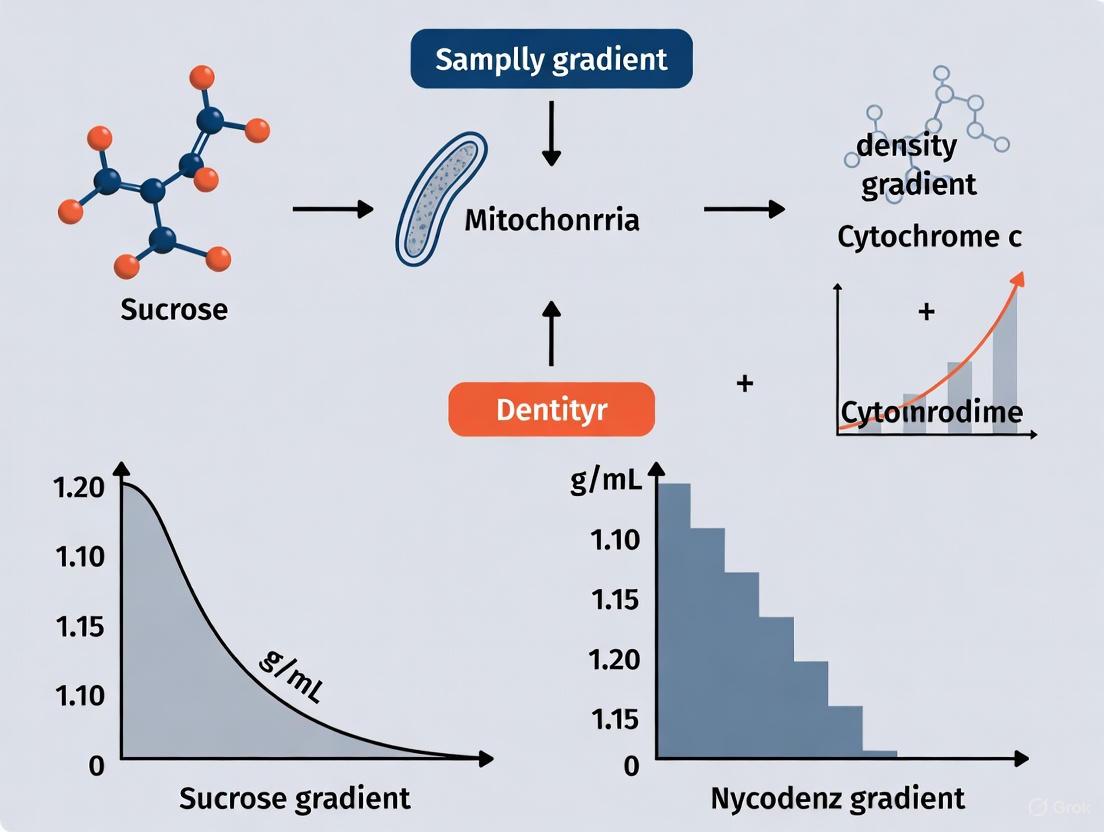
The isolation of high-purity, functionally intact mitochondria is a critical step for advancing research in metabolism, neurodegenerative diseases, and drug development.
Sucrose vs. Nycodenz Density Gradients: A Comprehensive Guide for Optimizing Mitochondrial Purity and Function
Abstract
The isolation of high-purity, functionally intact mitochondria is a critical step for advancing research in metabolism, neurodegenerative diseases, and drug development. This article provides a systematic comparison of two foundational density gradient media—sucrose and Nycodenz—for mitochondrial purification. We explore the fundamental principles of density gradient centrifugation and deliver a detailed methodological guide for applying these techniques across various tissue types, including skeletal muscle and liver. The content further addresses common troubleshooting scenarios and presents rigorous validation data comparing the purity, integrity, and bioenergetic function of the resulting mitochondrial preparations. Designed for researchers and laboratory professionals, this resource offers evidence-based recommendations to refine isolation protocols, enhance experimental reproducibility, and support high-quality mitochondrial research.
Understanding Density Gradient Centrifugation: Principles of Sucrose and Nycodenz Media
Core Principles of Buoyant Density and Organelle Separation
Density gradient centrifugation is a foundational technique in subcellular biology for the separation of organelles, macromolecules, and microbial cells based on their buoyant densities. This method enables researchers to isolate specific cellular components from complex mixtures for downstream analysis, a critical step in fields ranging from mitochondrial research to drug discovery. The core principle relies on creating a vertical column of liquid with increasing density, typically using inert gradient-forming media. When a sample mixture is centrifuged through this gradient, particles migrate to positions where their buoyant density matches that of the surrounding medium, resulting in high-purity separation. Two primary media have emerged as standards for these separations: sucrose, a classical carbohydrate-based medium, and Nycodenz, a non-ionic, triiodinated derivative of benzoic acid. This guide provides an objective, data-driven comparison of these two media, focusing on their application in mitochondrial purification and related organelle separation workflows, to inform researchers selecting the optimal medium for their specific experimental needs.
Fundamental Properties and Separation Mechanisms
The effectiveness of a density gradient medium is determined by its physicochemical properties and how they interact with biological samples during centrifugation. Rate-zonal separation resolves particles based on size and mass as they migrate through the gradient, while isopycnic separation occurs when particles reach their equilibrium buoyant density. Sucrose gradients are predominantly used for rate-zonal separation, as the density of biological particles typically exceeds that of the sucrose solution, preventing true isopycnic banding. In contrast, Nycodenz can form solutions with densities high enough for isopycnic separation of most organelles.
Table 1: Fundamental Properties of Sucrose and Nycodenz
| Property | Sucrose | Nycodenz |
|---|---|---|
| Chemical Structure | Disaccharide (glucose + fructose) | Non-ionic triiodinated benzoic acid derivative |
| Solution Type | Rate-zonal (typically) | Isopycnic |
| Max Working Density | ~1.32 g/mL (60% w/v) | ~1.27 g/mL (50% w/v) |
| Osmolality | High (increasing with concentration) | Low and osmotically inert |
| Viscosity | High (increasing with concentration) | Low to moderate |
| Biological Inertia | Can be osmotically stressful | Generally inert, preserving viability |
The osmotic pressure and viscosity of sucrose solutions increase dramatically with concentration, which can potentially damage sensitive organelles like mitochondria through osmotic stress and require longer centrifugation times. Nycodenz solutions, being non-ionic and osmotically inert, exert minimal osmotic stress, making them particularly suitable for preserving the structural and functional integrity of labile organelles and maintaining microbial cell viability during extraction procedures [1].
Comparative Experimental Data and Performance Metrics
Mitochondrial and Organelle Separation
Multiple studies have directly or indirectly compared the performance of sucrose and Nycodenz for organelle isolation. The choice of medium significantly impacts the yield, purity, and functional integrity of the isolated components.
Table 2: Performance Comparison in Organelle Separation
| Application/Parameter | Sucrose Gradient Performance | Nycodenz Gradient Performance |
|---|---|---|
| Mitochondrial Purity | Effective, but potential for cytosolic contamination [2] | Highly effective for mitochondrial outer membrane proteomics [3] |
| Mitochondrial Integrity | Requires careful buffer optimization (e.g., Mg²⁺, HEPES) [4] [2] | Maintains functional integrity; suitable for downstream assays [3] |
| Post-Isolation Activity | Preserves electron transport chain (ETC) complex activity when optimized [5] | Maintains protein import function and membrane integrity [3] |
| Typical Centrifugation | Ultracentrifugation (e.g., 100,000 × g for 3-16 hours) [4] [6] | Lower g-force possible (e.g., 70,000 × g for 30 min) [3] |
| Cell Viability/Extraction | Not typically used for viable cell extraction | High viability and yield for soil microbial cells [1] |
For specialized applications, such as the isolation of the mitochondrial outer membrane (MOM), a combined sucrose-Nycodenz approach has proven highly effective. A protocol for Trypanosoma brucei MOM purification used a sequential strategy: mitochondrial vesicles were first isolated using a Nycodenz step gradient, followed by MOM purification using a discontinuous sucrose step gradient (0/15/32/60% w/v). This hybrid method successfully identified 82 MOM proteins, two-thirds of which were novel mitochondrial associations [3].
Microbial Cell Extraction from Soil
Beyond organelle separation, density gradient media are crucial for extracting microbial cells from environmental samples like soil for metagenomic studies. Here, the choice of medium directly impacts cell yield and viability. A comprehensive study found that a protocol using 80% Nycodenz yielded the highest cell viability and extraction efficiency from diverse soil types. The optimized method involved physical blending, treatment with the detergent Tween 20, and centrifugation with 80% Nycodenz. This approach was superior to other methods for obtaining viable cells that accurately represent the original microbial community. Furthermore, for sample storage prior to cell extraction, short-term storage at 4°C was identified as optimal for preserving viable cell yield when using this Nycodenz-based method [1]. This application highlights a key advantage of Nycodenz—its minimal impact on microbial viability, which is critical for single-cell technologies and culturing efforts.
Detailed Experimental Protocols
Mitochondrial Purification Using a Sucrose Gradient
This protocol is adapted from methods used for the isolation of intact mitochondria from mammalian cell lines [4] [2].
- Step 1: Cell Lysis and Homogenization. Harvest approximately 7 × 10⁷ cells by centrifugation at 370 × g for 10 minutes. Wash the cell pellet with an NKM buffer (10 mM Tris-HCl pH 7.4, 0.13 M NaCl, 5 mM KCl, 7.5 mM MgCl₂). Resuspend the pellet in 6 volumes of ice-cold homogenization buffer (10 mM Tris-HCl pH 6.7, 10 mM KCl, 0.15 mM MgCl₂, 1 mM PMSF, 1 mM DTT). Use a Dounce homogenizer with 30 strokes of a tight-fitting pestle. Monitor cell breakage under a microscope; optimal lysis is around 60% [2].
- Step 2: Crude Mitochondrial Pellet. Mix the homogenate with 1 volume of 2 M sucrose solution. Pellet nuclei and unbroken cells with two sequential low-speed spins at 1,200 × g for 5 minutes, transferring the supernatant to a new tube each time. Pellet the crude mitochondria from the combined supernatant by centrifuging at 7,000 × g for 10 minutes [2].
- Step 3: Sucrose Gradient Centrifugation. Prepare a discontinuous sucrose gradient. For an SW41 tube (13.2 mL), carefully layer solutions of decreasing density: 2 mL of 60% sucrose, 3 mL of 32% sucrose, 3 mL of 15% sucrose, and top with the crude mitochondrial pellet resuspended in a minimal volume. Alternatively, use a continuous 10-30% or 7-50% linear sucrose gradient prepared with a gradient maker [4] [6]. Centrifuge at 100,000 × g for 1 hour at 4°C using a swing-bucket rotor.
- Step 4: Fraction Collection and Analysis. Mitochondria typically band at the interface between the 32% and 60% sucrose layers. Carefully collect this band by aspiration or by fractionating the entire gradient. Dilute the mitochondrial fraction with mitochondrial suspension buffer (10 mM Tris HCl pH 6.7, 0.15 mM MgCl₂, 0.25 M sucrose, 1 mM PMSF, 1 mM DTT) and pellet at 9,500 × g for 5 minutes [2]. Assess purity by Western blot using markers like AOX (mitochondria), RbcL (chloroplasts in plants), and β-actin (cytosol) [5].
Viable Microbial Cell Extraction Using Nycodenz
This protocol is optimized for extracting viable microbial cells from soil for single-cell analysis or metagenomics [1] [7].
- Step 1: Separate Bacteria from Soil Matrix. First, liberate microbes from soil particles. Suspend 5-10 g of fresh soil (or soil stored short-term at 4°C) in a suitable buffer (e.g., phosphate-buffered saline) and subject it to physical dispersion, such as blending or mild sonication. The addition of a chemical dispersant like Tween 20 enhances cell detachment.
- Step 2: Nycodenz Density Gradient Centrifugation. Prepare an 80% Nycodenz solution in an appropriate buffer. In a centrifuge tube, layer the soil homogenate onto an equal volume of the 80% Nycodenz solution. Alternatively, create a step gradient with different Nycodenz concentrations. Centrifuge at 10,000 × g for 30 minutes at 4°C.
- Step 3: Collect the Microbial Cell Band. After centrifugation, viable microbial cells will form a distinct band at the buffer-Nycodenz interface. Debris and soil particles will pellet at the bottom of the tube. Carefully aspirate the microbial cell band from the interface using a pipette.
- Step 4: Wash and Analyze. To remove residual Nycodenz, dilute the harvested cell fraction with buffer and pellet the cells by centrifugation. Repeat this wash step. The resulting cell suspension can be used for downstream applications like fluorescence-activated cell sorting (FACS), viability staining, or DNA extraction for metagenomic sequencing [1] [7]. For high-molecular-weight DNA, a standard hot CTAB extraction or a commercial HMW DNA extraction kit can be used on the cell suspension [7].
The Scientist's Toolkit: Essential Research Reagents
Table 3: Key Reagents for Density Gradient Centrifugation
| Reagent/Buffer | Function/Purpose | Example Composition |
|---|---|---|
| Sucrose Solutions | Forms density gradient for rate-zonal separation. | 10-30% or 7-50% (w/v) sucrose in buffer (e.g., 20 mM HEPES, 10 mM MgCl₂/EDTA, 100 mM KCl) [4] [6]. |
| Nycodenz Solutions | Forms low-viscosity, osmotically inert gradient for isopycnic separation. | 80% (w/v) stock solution, often diluted to 40-60% working concentrations in buffer [1] [3]. |
| Homogenization Buffer | Lyses cells while preserving organelle integrity. | 10 mM Tris-HCl (pH 6.7), 10 mM KCl, 0.15 mM MgCl₂, 1 mM PMSF, 1 mM DTT [2]. |
| Protease Inhibitors (PMSF) | Prevents proteolytic degradation of proteins during isolation. | Added fresh to buffers (e.g., 1 mM PMSF) [3] [2]. |
| Detergents (Tween 20) | Aids in dispersing samples and detaching cells from particles. | Added to extraction buffers (e.g., 0.1%) [1]. |
| Antioxidants (DTT) | Maintains reducing environment, preserves protein function. | Added fresh to buffers (e.g., 1 mM DTT) [2]. |
Application Scenarios and Selection Guidelines
The choice between sucrose and Nycodenz is dictated by the specific experimental goals, the biological material, and the requirements for downstream applications.
- Choose Sucrose Gradients When: Your primary goal is rate-zonal separation based on size and mass (e.g., separating polysomes, ribosomal subunits, or protein complexes) [4] [6]. The experiment involves well-established protocols where osmotic effects are mitigated, or when cost is a significant factor. You are working with standard sample types like mammalian cell cultures where classical sucrose-based mitochondrial isolation protocols are well-defined [2].
- Choose Nycodenz Gradients When: The viability of extracted cells is paramount, such as in single-cell microbiology or high-throughput culturing [1]. You require high-purity organelle separation for sensitive downstream proteomic analyses, as its low viscosity and osmotically inert properties better preserve structural integrity [3]. The target organelle or cell is sensitive to high osmotic pressure. You are working with complex, tough-to-disrupt samples like soil, where separating intact microbial cells from the matrix is the initial goal [7].
For the highest resolution spatial proteomics, advanced methods like LOPIT (Localisation of Organelle Proteins by Isotope Tagging) can utilize both media. While LOPIT traditionally uses density gradient ultracentrifugation with media like Nycodenz or sucrose [8], simplified and effective alternatives like LOPIT-DC (Differential ultraCentrifugation) have been developed that reduce processing time and resource requirements while maintaining high resolution [8].
Density gradient centrifugation is a foundational technique in molecular biology and biochemistry, enabling the separation of cellular components based on their buoyant density. For decades, sucrose has been the historical medium of choice for isolating organelles, particularly mitochondria. Its widespread adoption in mid-20th century laboratories was driven by its accessibility, cost-effectiveness, and well-understood chemical properties. Sucrose solutions create a gradient whose density increases from top to bottom, allowing particles to migrate during centrifugation until they reach a point of density equilibrium. While this method has been instrumental in advancing our understanding of mitochondrial biology, its inherent limitations regarding osmotic stress and purity have spurred the development of advanced alternatives like Nycodenz. This guide objectively compares the performance of sucrose and Nycodenz density gradients in mitochondrial research, providing researchers and drug development professionals with experimental data to inform their methodological choices.
The Legacy of Sucrose in Mitochondrial Research
Sucrose density gradient centrifugation emerged in the 1950s as a cornerstone method for subcellular fractionation and quickly became the standard for mitochondrial isolation [9] [4]. The classic protocol involves creating a homogenate from tissues or cells in an isotonic sucrose solution, typically at 0.25 M, followed by differential centrifugation to separate cellular components based on size and density [9]. The mitochondrial fraction is then further purified using a sucrose density gradient, where particles are separated based on their sedimentation rate under centrifugal force [4].
The historical preference for sucrose is rooted in its practical advantages. Buffered sucrose solution is relatively close to the dispersion phase of the cytoplasm, which helps maintain the structural integrity of organelles and the activity of enzymes to a certain extent [9]. From a practical standpoint, sucrose is inexpensive, widely available, and its properties are well-characterized, making it accessible to laboratories with varying levels of funding and technical expertise. The methodology is also robust and reproducible, contributing to its enduring presence in protocols for mitochondrial proteomics and functional studies [10] [9].
The table below summarizes the core properties and historical applications of sucrose gradients:
Table 1: Characteristics and Historical Use of Sucrose Density Gradients
| Aspect | Description |
|---|---|
| Era of Prominence | Since the 1950s [9] |
| Primary Mechanism | Rate-zonal separation based on size and mass [4] |
| Typical Concentration Range | Varies; common gradients, e.g., 10-30% or 32-60% interfaces [11] [10] |
| Key Advantage | Low cost, wide application, and well-understood protocols [9] |
| Common Application | Classic method for extracting and purifying mitochondria from tissues and cells [9] |
Inherent Limitations of Sucrose Gradients
Despite its historical role, the use of sucrose presents significant technical limitations that can compromise experimental outcomes. The most critical drawback is its high osmolality, which creates a hypertonic environment that can cause osmotic shock, leading to mitochondrial swelling, membrane damage, and loss of function [12] [13]. This is particularly detrimental for experiments assessing metabolic function, membrane potential, and enzymatic activities.
Furthermore, sucrose solutions have high viscosity, which reduces the resolution of separation by slowing the migration of particles through the gradient. This can result in broader bands and incomplete separation of mitochondria from other organelles of similar density, such as peroxisomes and lysosomes, ultimately yielding a preparation of lower purity [9] [12]. While the purity of crudely extracted mitochondria may suffice for some applications, such as analyzing the activity of known mitochondrial proteins, it is often insufficient for advanced proteomic studies or localization of a novel protein, where contamination from other cellular compartments must be minimized [9].
The following workflow diagram illustrates the traditional sucrose protocol and its associated challenges:
Nycodenz as an Advanced Alternative
Nycodenz, a non-ionic, tri-iodinated density gradient medium, was developed to overcome the inherent limitations of sucrose. Its chemical structure is engineered to provide a high-density solution while maintaining low osmolality and low viscosity [12]. These properties make it exceptionally gentle on biological samples, preserving the integrity and functionality of isolated organelles.
The key advantage of Nycodenz is its low osmolality, which minimizes the risk of osmotic shock, thereby maintaining mitochondrial structure and function more effectively than sucrose [12]. Its non-ionic nature prevents unwanted interactions with biological membranes, and its high solubility in water and compatibility with various buffers facilitate the preparation of gradients tailored for specific applications [12]. Nycodenz is suitable for both rate-zonal and isopycnic separation methods, the latter allowing particles to migrate until their buoyant density equals that of the surrounding medium, providing a high-resolution separation [4] [12]. This medium has proven instrumental in isolating mitochondria, peroxisomes, and other organelles, enabling in-depth studies of cellular structures and functions with higher purity and yield [10] [12].
Table 2: Characteristics and Advantages of Nycodenz Density Gradients
| Aspect | Description |
|---|---|
| Chemical Nature | Non-ionic, triiodinated benzoic acid derivative [12] |
| Primary Mechanism | Isopycnic or rate-zonal separation based on buoyant density [4] [12] |
| Key Properties | Low osmolality, low viscosity, high solubility, non-toxic [12] |
| Major Advantage | High-resolution separation with minimal impact on sample integrity and viability [12] |
| Common Application | High-purity isolation of organelles (mitochondria, peroxisomes) and viruses [10] [12] |
Direct Comparison: Sucrose vs. Nycodenz
When directly compared, the performance differences between sucrose and Nycodenz become clear, particularly regarding mitochondrial integrity and purity. A critical study evaluating organelle proteomics highlighted that the reliability of the data is intrinsically dependent on the purity of the organelle preparations, which can be compromised by contaminants from different locations when using traditional methods like sucrose gradients [10] [14]. Quantitative proteomics methods are often required to distinguish true organellar constituents from contaminants in such preparations.
The following table provides a structured, point-by-point comparison of the two media based on experimental parameters:
Table 3: Experimental Performance Comparison: Sucrose vs. Nycodenz
| Parameter | Sucrose | Nycodenz |
|---|---|---|
| Osmolality | High, posing risk of osmotic shock [12] [13] | Low, minimizing osmotic stress [12] |
| Viscosity | High, slowing particle migration [12] | Low, enabling faster and sharper separation [12] |
| Impact on Integrity | Can compromise morphological integrity and function [9] | Preserves organelle structure and biological activity [12] |
| Separation Purity | Moderate; risk of co-isolating contaminants [9] | High; superior for resolving organelles of similar density [10] [12] |
| Cost & Accessibility | Low cost and widely available [9] | Higher cost, but standard for high-fidelity work [9] |
The decision-making process for selecting an appropriate gradient medium can be visualized as follows:
Detailed Experimental Protocols
Sucrose Density Gradient Centrifugation for Mitochondria
This protocol is adapted from methods used for mitochondrial ribosome profiling and general mitochondrial purification [9] [4].
- Solutions Required:
- Homogenization Buffer: 0.25 M sucrose, 10 mM Tris-HCl (pH 7.4), 1 mM EDTA or 0.5 mM MgCl₂. Keep ice-cold.
- Sucrose Gradient Solutions: Prepare solutions of 1.0 M, 1.5 M, and 2.0 M sucrose in 10 mM Tris-HCl (pH 7.4). For a continuous gradient, use a gradient maker to create a linear gradient from, for example, 10% to 60% (w/v) sucrose [10] [4].
- Procedure:
- Homogenization: Homogenize the tissue or cell pellet in a pre-cooled homogenizer with ice-cold Homogenization Buffer. Maintain low temperature throughout to prevent protein denaturation.
- Differential Centrifugation: Centrifuge the homogenate at 600 × g for 10 minutes at 4°C to pellet unlysed cells, nuclei, and debris. Transfer the supernatant to a new tube and repeat this low-speed spin. Recover the supernatant and centrifuge at 10,000 × g for 15 minutes to pellet the crude mitochondrial fraction [9].
- Gradient Purification: Resuspend the crude mitochondrial pellet in a small volume of 0.25 M sucrose. Carefully layer it on top of the pre-formed sucrose density gradient. Centrifuge in an ultracentrifuge at 100,000 × g for 60-90 minutes at 4°C.
- Collection: After centrifugation, mitochondria will typically band at the density corresponding to approximately 1.18 g/cm³. Carefully collect the mitochondrial band using a pipette or fraction collector. Dilute the fraction with homogenization buffer and pellet the mitochondria by centrifuging at 10,000 × g for 15 minutes to remove the sucrose [9] [4].
Nycodenz Density Gradient Centrifugation for Mitochondria
This protocol leverages the properties of Nycodenz for high-purity mitochondrial isolation, based on methodologies described for organelle proteomics [10] [12].
- Solutions Required:
- Homogenization Buffer: 0.25 M sucrose, 10 mM HEPES (pH 7.4), 1 mM EDTA.
- Nycodenz Stock Solution: 50% (w/v) Nycodenz in 5 mM HEPES (pH 7.4) and 1 mM EDTA. Sterilize by filtration.
- Working Nycodenz Gradient: Create a discontinuous step gradient. For example, in an ultracentrifuge tube, layer from bottom to top: 3 mL of 34% Nycodenz, 3 mL of 26% Nycodenz, 3 mL of 20% Nycodenz (all prepared by diluting the stock with Homogenization Buffer) [10].
- Procedure:
- Homogenization and Differential Centrifugation: Perform steps 1 and 2 as described in the sucrose protocol to obtain a crude mitochondrial pellet.
- Gradient Purification: Gently resuspend the crude mitochondrial pellet in a small volume of 10% Nycodenz. Carefully layer this suspension on top of the pre-formed discontinuous Nycodenz gradient. Centrifuge in an ultracentrifuge at 70,000 × g for 30-60 minutes at 4°C. The lower viscosity allows for shorter run times.
- Collection: Mitochondria will typically collect at the interface between the 26% and 34% Nycodenz layers. Harvest the mitochondrial band, dilute it with at least 3 volumes of Homogenization Buffer, and pellet the purified mitochondria by centrifugation at 10,000 × g for 15 minutes [10] [15].
Essential Research Reagent Solutions
The table below lists key reagents and materials essential for performing density gradient centrifugation for mitochondrial isolation, based on the cited protocols.
Table 4: Essential Reagents for Density Gradient Centrifugation
| Reagent/Material | Function/Application | Example from Protocols |
|---|---|---|
| Sucrose | Classical density gradient medium for rate-zonal separation of organelles. | Preparing homogenization buffers and continuous gradients (e.g., 10-30% or 32-60%) [9] [4]. |
| Nycodenz | Non-ionic, low-osmolality medium for high-resolution isopycnic separation. | Forming discontinuous step gradients (e.g., 20%/26%/34%) for high-purity organelle isolation [10] [12]. |
| HEPES or Tris-HCl Buffer | Maintains physiological pH during isolation, critical for preserving protein function. | Component of homogenization and gradient solutions, typically at pH 7.4 [4]. |
| EDTA or MgCl₂ | Chelating agent (EDTA) or cofactor (Mg²⁺); affects membrane integrity and enzyme activity. | Included in buffers to prevent clumping (EDTA) or to preserve complex integrity (MgCl₂) [4]. |
| Protease Inhibitor Cocktails | Prevents proteolytic degradation of mitochondrial proteins during extraction. | Added to homogenization and gradient solutions to maintain protein integrity for proteomic studies [10]. |
| Digitonin | Mild detergent used to selectively permeabilize the mitochondrial outer membrane. | Used at low concentrations (e.g., 0.1%) in gradient solutions for specific applications like mitoribosome analysis [4]. |
The historical use of sucrose in density gradient centrifugation has been instrumental in laying the groundwork for mitochondrial research. Its advantages of low cost and operational familiarity are undeniable. However, the inherent limitations of sucrose—namely its high osmolality and viscosity—can compromise the structural and functional integrity of isolated mitochondria, limiting its applicability in high-precision research. Nycodenz, with its low osmolality, low viscosity, and non-ionic properties, provides a superior alternative for experiments demanding high mitochondrial purity and preserved biological function. The choice between these media should be guided by the specific experimental goals: sucrose remains a viable option for basic isolation where cost is a primary concern, while Nycodenz is the reagent of choice for advanced proteomic, functional, and biomedical studies where the quality of the mitochondrial preparation is paramount.
Density gradient centrifugation is a fundamental technique in biological research for the separation and purification of cellular components. The choice of gradient medium is critical, balancing factors such as osmotic pressure, viscosity, and biocompatibility. This guide provides a comparative analysis of Nycodenz, a modern non-ionic, low-osmotic medium, against classical alternatives like sucrose, with a specific focus on applications in mitochondrial research. We objectively evaluate their performance based on experimental data concerning mitochondrial purity, integrity, and functional viability, providing researchers with the evidence necessary to select the optimal medium for their experimental goals.
Chemical and Physical Properties of Nycodenz
Nycodenz is the trademark name for iohexol, a non-ionic, tri-iodinated compound with a molecular weight of 821 g/mol [16] [12]. Its high density (up to 1.426 g/ml for an 80% w/v solution) stems from the presence of a triiodobenzene ring, which is linked to several hydrophilic hydroxyl groups that confer high water solubility and low toxicity [16] [12]. As a density gradient medium, its core value lies in its unique combination of properties that make it exceptionally suitable for separating delicate biological particles.
The following table summarizes the key properties of Nycodenz and provides a direct comparison with sucrose:
Table 1: Fundamental Properties of Nycodenz and Sucrose
| Property | Nycodenz | Sucrose (for comparison) |
|---|---|---|
| Chemical Nature | Non-ionic, iodinated benzoic acid derivative [12] | Ionic, disaccharide |
| Molecular Weight | 821 g/mol [16] | 342 g/mol |
| Max Solution Density | ~1.426 g/ml (80% w/v) [16] | ~1.32 g/ml (80% w/v) [9] |
| Osmolality | Low osmolality, reducing osmotic shock [12] | High osmolality at high concentrations |
| Toxicity | Non-toxic and metabolically inert [16] [12] | Can be toxic to organelles at high concentrations |
| Viscosity | Lower viscosity at comparable densities [9] | High viscosity, which can slow centrifugation |
| UV Interference | Absorbs at 244 nm [16] | Generally low interference |
The non-ionic nature and low osmolality of Nycodenz are its most significant advantages for organelle isolation [12]. Unlike ionic media or high-osmolality sucrose solutions, Nycodenz creates an environment that minimizes osmotic shock, thereby helping to preserve the structural integrity and biological function of isolated organelles like mitochondria [12]. Furthermore, Nycodenz is inert and does not interfere with many downstream biochemical assays, including protein and nucleic acid quantification, or enzyme activity tests [16].
Performance Comparison: Nycodenz vs. Sucrose for Mitochondrial Purity
The primary goal of mitochondrial isolation is to obtain a fraction that is both pure and functionally intact. Classical differential centrifugation provides a crude mitochondrial pellet but is often contaminated with other organelles of similar size, such as lysosomes and peroxisomes [17]. Density gradient centrifugation is employed to overcome this limitation, and the choice of medium directly impacts the outcome.
Experimental data and methodological reviews highlight a clear performance difference between sucrose and Nycodenz.
Table 2: Experimental Comparison for Mitochondrial Isolation
| Criterion | Sucrose Density Gradient | Nycodenz Density Gradient |
|---|---|---|
| Mitochondrial Purity | Moderate; significant contamination from other organelles [17] | High; effective separation from lysosomes and peroxisomes [9] [17] |
| Mitochondrial Integrity | Can result in swelling and membrane damage due to high osmotic pressure [9] | Superior structural preservation due to iso-osmotic and non-ionic conditions [9] [12] |
| Functional Viability | May impair function; not ideal for downstream functional assays [9] | Better preservation of function; more suitable for respiratory studies [9] |
| Protocol Speed & Convenience | Standard method, but high viscosity can lengthen centrifugation time. | Faster gradient formation (e.g., self-forming gradients) and lower viscosity [9] [16]. |
| Cost | Low cost and widely available [9] [17] | Higher cost compared to sucrose [9] |
A key advantage of Nycodenz is its effectiveness in separating mitochondria from lysosomes and peroxisomes, which have very similar densities in sucrose gradients [17]. The physical properties of Nycodenz gradients expand the separation window, leading to a purer mitochondrial fraction. This high purity is crucial for techniques like proteomics, where contamination can severely confound results [17] [11]. While sucrose gradients are sufficient for basic metabolic studies, Nycodenz is the preferred medium for applications requiring high structural and functional fidelity.
Detailed Experimental Protocols
Mitochondrial Isolation Using a Nycodenz Gradient
The following protocol is adapted from established methods for subcellular fractionation and mitochondrial purification [9] [17] [18].
Research Reagent Solutions:
- Homogenization Buffer: 250 mM sucrose, 10 mM Tris-HCl (pH 7.4), 1 mM EDTA, 0.2% (w/v) fatty acid-free BSA. (Function: Provides an isotonic environment to protect organelles during cell disruption.)
- Nycodenz Stock Solution: 50% (w/v) Nycodenz in homogenization buffer (without BSA). (Function: The primary gradient medium for separation.)
- Discontinuous Gradient Solutions: Prepare working solutions from the stock, typically at 15%, 23%, 32%, and 35% (w/v) in a suitable buffer like 10 mM MOPS/1 mM EDTA [18]. (Function: Form the density layers for precise organelle separation.)
Methodology:
- Homogenization: Incubate tissue or cell pellet on ice. Homogenize gently in a pre-chilled glass homogenizer with homogenization buffer. The buffer must contain protease inhibitors.
- Differential Centrifugation:
- Centrifuge the homogenate at 1,000 × g for 10 minutes at 4°C to pellet nuclei and unbroken cells.
- Transfer the supernatant to a new tube and centrifuge at 10,000 × g for 10-20 minutes at 4°C. The resulting pellet contains the crude mitochondrial fraction.
- Gradient Preparation: Resuspend the crude mitochondrial pellet gently in a small volume of homogenization buffer. In an ultracentrifuge tube, carefully layer a discontinuous Nycodenz gradient (e.g., from bottom to top: 35%, 23%, 15%) [17]. Gently layer the mitochondrial suspension on top of the gradient.
- Density Gradient Centrifugation: Centrifuge the gradient at 116,000 × g for 2 hours at 4°C in an ultracentrifuge with a swinging bucket rotor [17].
- Fraction Collection: After centrifugation, mitochondria will typically band at the interface between the 23% and 35% layers [17]. Carefully collect this band using a pipette.
- Washing: Dilute the collected fraction with at least 3 volumes of isolation buffer and centrifuge at 10,000 × g for 10-15 minutes to pellet the purified mitochondria. Resuspend the final pellet in an appropriate buffer for downstream analysis.
Diagram 1: Nycodenz Mitochondrial Isolation Workflow.
Assessing Mitochondrial Purity and Function
After isolation, the quality of the mitochondrial preparation must be validated.
- Purity Assessment: This is typically done by measuring the activity of marker enzymes in the mitochondrial fraction and comparing it to the activity of markers for contaminating organelles.
- Mitochondrial Marker: Cytochrome c oxidase (Complex IV).
- Lysosomal Marker: Acid phosphatase or β-galactosidase.
- Peroxisomal Marker: Catalase. A high-purity preparation will show high activity for the mitochondrial marker and minimal activity for contaminant markers.
- Integrity and Function Assessment:
The Scientist's Toolkit: Essential Research Reagents
The following table details key reagents and their functions in a typical mitochondrial isolation protocol using density gradients.
Table 3: Essential Reagents for Mitochondrial Isolation
| Research Reagent | Function & Rationale |
|---|---|
| Nycodenz | Non-ionic, low-osmotic density gradient medium. Minimizes organelle damage during purification [16] [12]. |
| Sucrose | Classical, low-cost homogenization buffer and gradient medium. Can be hyperosmotic, potentially affecting integrity [9] [17]. |
| Protease Inhibitor Cocktail | Added to all buffers to prevent proteolytic degradation of mitochondrial proteins during isolation. |
| EDTA/EGTA | Chelating agents that bind calcium and other divalent cations, inhibiting calcium-dependent proteases and phospholipases. |
| Fatty Acid-Free BSA | Added to homogenization buffers to absorb free fatty acids and detergents that can destabilize mitochondrial membranes. |
| JC-1 / TMRM Dye | Fluorescent dyes used to quantify mitochondrial membrane potential, a critical indicator of functional health [9]. |
| Anti-TOMM20 Antibody | Used for advanced immuno-purification techniques to isolate ultra-pure mitochondria via magnetic beads [11]. |
Context Within Mitochondrial Research and Signaling
Understanding mitochondrial function is not limited to isolation; it extends to studying its role in cellular signaling. Mitochondria are signaling hubs that communicate with the nucleus via retrograde signaling [9]. When mitochondria become dysfunctional—due to damage, membrane potential loss, or permeability—they release signals such as mtDNA and Reactive Oxygen Species (ROS) [9]. These signals are detected by the nucleus, which can then activate pathways to manage the stress. For instance, released mtDNA can activate the TLR9 pathway, triggering an inflammatory response, while excessive ROS can cause DNA damage [9]. Therefore, obtaining high-quality, functional mitochondria through gentle methods like Nycodenz gradient centrifugation is fundamental for accurate in vitro study of these critical signaling pathways.
Diagram 2: Mitochondrial-Nuclear Retrograde Signaling.
The selection of a density gradient medium is a critical determinant in the success of mitochondrial isolation. Sucrose remains a viable, cost-effective option for initial crude separations where ultimate purity and function are not paramount. However, for research demanding high mitochondrial purity, structural integrity, and preserved biological function—such as proteomics, metabolomics, and respiratory studies—Nycodenz offers a demonstrably superior performance. Its non-ionic, low-osmotic properties minimize artifactual damage, providing researchers with a more truthful representation of mitochondrial biology in vitro. The choice ultimately aligns with the research objective: sucrose for basic fractionation and Nycodenz for high-fidelity mitochondrial characterization.
In mitochondrial research, the purity and functional integrity of isolated organelles are paramount for downstream analyses. The choice of density gradient medium is a critical factor in this process, directly influencing the success of the isolation through its physicochemical properties. Sucrose, a traditional and widely used medium, is often compared with modern alternatives like Nycodenz and iodixanol (OptiPrep). This guide provides a objective, data-driven comparison of these media, focusing on their osmolality, viscosity, and subsequent impact on mitochondrial purity and function. The objective is to equip researchers with the necessary information to select the most appropriate medium for their specific experimental needs in mitochondrial isolation.
Comparative Properties of Density Gradient Media
The performance of a density gradient medium is largely determined by its osmolality and viscosity. These properties can affect organelle integrity, the resolution of separation, and the functionality of the isolated mitochondria.
The following table summarizes the key properties of sucrose, Nycodenz, and iodixanol.
Table 1: Comparative Properties of Density Gradient Media
| Property | Sucrose | Nycodenz | Iodixanol (OptiPrep) |
|---|---|---|---|
| Chemical Type | Disaccharide sugar | Non-ionic, tri-iodinated benzoic acid derivative | Non-ionic, dimeric derivative of Nycodenz |
| Typical Working Density | Up to 1.35 g/mL [19] | Up to 1.2 g/mL (isoosmotic) [20] | Up to 1.32 g/mL (isoosmotic) [20] |
| Osmolality Profile | High and increases with density; can cause organelle shrinkage [20] [19] | Low osmolality at densities < ~1.2 g/mL; significant osmotic pressure at higher densities [20] | Isoosmotic (260 mOsm) over the full range of organelle densities (up to 1.32 g/mL) [20] |
| Viscosity Profile | High viscosity [20] [19] | Lower viscosity than sucrose [20] [19] | Lower viscosity than Nycodenz; enables formation of isoosmotic gradients [20] [19] |
| Impact on Organelles | Can cause reversible or irreversible shrinkage, compromising structure and resolution [20] | Improved structure preservation over sucrose, but still compromised at higher densities due to osmolality [20] | Superior preservation of organelle structure and function due to isoosmotic conditions [20] |
| Primary Research Applications | General organelle separation; historical characterization of organelles [20] [21] | Subcellular fractionation of granules and mitochondria; improved resolution over sucrose [20] [21] [15] | Isolation of functional, membrane-bound organelles (e.g., granules, mitochondria) for functional studies [20] [22] |
Detailed Experimental Protocols for Mitochondrial Isolation
The following sections detail specific protocols for isolating mitochondria using different methods and media, highlighting the practical application of the gradient materials.
Mitochondrial Isolation from Rat Brain Using a Sucrose and Ficoll Gradient
This protocol is a classic method for separating distinct populations of brain mitochondria [21].
- Rationale: To isolate non-synaptic ("free") mitochondria and synaptosomal mitochondria from rat brain tissue using discontinuous gradients prepared with sucrose and Ficoll [21].
- Materials & Reagents:
- Solution A: 0.32 M Sucrose, 1.0 mM EDTA-K+, 10 mM Tris-HCl, pH 7.4.
- Solution B: 0.32 M Sucrose, 50 µM EDTA-K+, 10 mM Tris-HCl, pH 7.4.
- Gradient I: Discontinuous gradient with 7.5% and 12% (w/w) Ficoll in Solution B.
- Gradient II: Discontinuous gradient with 4.5% and 6% (w/w) Ficoll in Solution D (0.24 M Mannitol, 60 mM Sucrose, 50 µM EDTA-K+, 10 mM Tris-HCl, pH 7.4).
- Protocol:
- Homogenization: Homogenize rat hemicortexes in Solution A using a Teflon-glass homogenizer [21].
- Crude Mitochondria Preparation:
- Centrifuge homogenate at 1,000 × g to pellet nuclei and debris.
- Centrifuge the resulting supernatant at 15,000 × g for 20 min to pellet the crude mitochondria [21].
- Separation on Gradient I:
- Resuspend the crude mitochondrial pellet in Solution A and layer onto Gradient I.
- Centrifuge at 73,000 × g for 24 min.
- After centrifugation, free mitochondria (FM) are found in the pellet, while the synaptosomal band is collected from the interface of the 7.5%/12% gradients [21].
- Separation of Synaptosomal Mitochondria on Gradient II:
- The synaptosomal fraction is lysed in a low-osmotic buffer (6 mM Tris-HCl, pH 8.1) and centrifuged.
- The pellet is resuspended and layered onto Gradient II.
- Centrifuge at 10,000 × g for 30 min. The heavy mitochondrial (HM) fraction is in the pellet, and the light mitochondrial (LM) fraction is at the 4.5%/6% interface [21].
Mitochondrial Isolation from Skeletal Muscle Using a Percoll Gradient
Percoll density gradient centrifugation is recognized for yielding highly purified mitochondrial preparations from skeletal muscle, a tissue known for being particularly challenging to work with [23].
- Rationale: To obtain minimally contaminated, functional mitochondria from mouse skeletal muscle for high-resolution downstream analyses like proteomics and bioenergetics [23].
- Materials & Reagents:
- IM Buffer: Typically contains mannitol, sucrose, and other components for isotonicity.
- Percoll Solutions: Discontinuous gradient prepared with layers of 15%, 24%, and 40% Percoll in IM buffer.
- Protocol:
- Tissue Preparation: Mince quadriceps femoris muscle and digest with Nagarse [23].
- Homogenization and Differential Centrifugation:
- Homogenize the digested tissue.
- Centrifuge at 1,000 × g to remove debris and nuclei.
- Centrifuge the resulting supernatant at 21,000 × g to pellet the crude mitochondria [23].
- Percoll Gradient Purification:
- Resuspend the crude mitochondrial pellet in 15% Percoll and layer it on top of a pre-formed discontinuous gradient of 24% and 40% Percoll.
- Centrifuge at 30,750 × g for 10 min (with slow acceleration and no brake).
- The enriched mitochondrial fraction is collected from the interface between the 24% and 40% Percoll layers [23].
- Washing: The mitochondrial fraction is washed in IM buffer to remove the Percoll, resulting in a pure and functional preparation [23].
Subcellular Fractionation of Eosinophils Using an Iodixanol (OptiPrep) Gradient
This protocol exemplifies the use of an isoosmotic medium for the isolation of delicate organelles, ensuring their structural and functional preservation [20].
- Rationale: To isolate well-preserved and functional membrane-bound specific granules from human eosinophils using an isoosmotic iodixanol gradient [20].
- Materials & Reagents:
- Disruption Buffer: 0.25 M sucrose, 1 mM EGTA, 10 mM Hepes – pH 7.4, supplemented with protease inhibitors.
- Iodixanol Solution (45% w/v): Prepared from commercial OptiPrep (60% w/v) by dilution with a buffer containing 0.25 M sucrose, 1 mM EGTA, and 10 mM Hepes, pH 7.4 [20].
- Protocol:
- Cell Disruption: Suspend purified eosinophils in disruption buffer and disrupt using nitrogen cavitation at 600 psi for 10 min [20].
- Post-Nuclear Supernatant Collection: Pellet nuclei and intact cells at 200g. The resulting postnuclear supernatant (Sup1) contains the organelles [20].
- Density Gradient Centrifugation:
- Layer the postnuclear supernatant onto a continuous iodixanol gradient.
- Centrifuge to achieve separation. The specific granules band at their characteristic buoyant density in the gradient [20].
Workflow and Pathway Diagrams
The following diagram illustrates the key decision-making pathway and corresponding experimental workflows for selecting and applying a density gradient medium for mitochondrial isolation.
The Scientist's Toolkit: Essential Research Reagents
Successful mitochondrial isolation relies on a suite of specialized reagents and equipment. The table below lists key materials, their functions, and relevant examples from the protocols.
Table 2: Essential Reagents and Equipment for Mitochondrial Isolation
| Item | Function / Purpose | Specific Examples / Notes |
|---|---|---|
| Density Gradient Media | Forms the density barrier for separating organelles based on buoyant density. | Sucrose: Traditional, high osmolality [20] [19]. Nycodenz: Reduced osmolality and viscosity vs. sucrose [20] [15]. Iodixanol (OptiPrep): State-of-the-art, isoosmotic medium [20]. Percoll: For high-purity preparations from tissues like skeletal muscle [23]. |
| Homogenization Buffers | Provides an isotonic environment to maintain organelle integrity during cell disruption. | Typically contain sucrose or mannitol for osmotic balance, EDTA as a chelating agent, and HEPES or Tris for pH stability [20] [21]. |
| Protease Inhibitors | Prevents proteolytic degradation of mitochondrial proteins during isolation. | PMSF, leupeptin, aprotinin are commonly added to buffers just before use [20]. |
| Centrifuges & Rotors | Essential equipment for differential and density gradient centrifugation. | Low-speed centrifuges for initial steps [2]. High-speed and ultracentrifuges for pelleting and gradient separation [21]. Swinging bucket rotors are typically used for density gradients [21]. |
| Homogenizers | Mechanically disrupts tissues or cells to release organelles. | Dounce homogenizer (glass-Teflon or glass-glass) is standard for many tissues and cultured cells [21] [2]. Nitrogen cavitation bomb is used for more uniform disruption of certain cell types [20]. |
| Assessment Tools | For evaluating the success of the isolation. | Western Blot: To check for organelle-specific markers and contamination [22] [2]. Seahorse XF Analyzer: To measure mitochondrial respiration and function (e.g., RCR) [23]. Proteomics/Lipidomics: For comprehensive analysis of purity and composition [22]. |
The Critical Role of Osmotic Stress on Mitochondrial Membrane Integrity
The integrity of the mitochondrial membrane is a cornerstone for accurate assessment of mitochondrial function, including respiration, membrane potential, and enzymatic activities. During isolation procedures, mitochondria are exceptionally vulnerable to osmotic stress—a physical force that can compromise membrane integrity, leading to swelling, rupture, and functional decline. Density gradient centrifugation, a fundamental technique for purifying mitochondria from crude homogenates, relies on creating a density medium to separate organelles. The choice of medium—specifically between the traditional sucrose and the inert Nycodenz—is critical in determining the osmotic environment and, consequently, the structural and functional preservation of the isolated mitochondria.
This guide provides an objective comparison of sucrose and Nycodenz density gradients, framing the analysis within the broader thesis that minimizing osmotic stress is paramount for obtaining high-purity, functional mitochondria. The data and protocols presented are designed to inform the selection of the appropriate gradient medium for specific research applications in biomedical science and drug development.
Fundamental Properties: Sucrose vs. Nycodenz
The core difference between these two media lies in their biochemical nature and interaction with biological membranes. Sucrose is a disaccharide that forms a penetrating gradient. Because sucrose can permeate the outer mitochondrial membrane, it creates an osmotic imbalance across the inner membrane, which must be counteracted by adding osmotic balancers like mannitol or sucrose itself to the isolation buffer [9]. In contrast, Nycodenz is a tri-iodinated benzoic acid derivative that forms non-penetrating gradients. Its large, inert molecules cannot cross biological membranes, thereby generating significantly less osmotic stress [15] [17].
Table 1: Fundamental Properties of Sucrose and Nycodenz Gradients
| Property | Sucrose | Nycodenz |
|---|---|---|
| Chemical Nature | Disaccharide | Tri-iodinated benzoic acid derivative |
| Gradient Type | Penetrating | Non-penetrating |
| Osmotic Stress | High (requires careful osmolarity control) | Low (inherently low osmotic pressure) |
| Viscosity | High | Lower than sucrose at similar densities |
| Impact on Membrane Integrity | Can cause swelling and damage if not optimized | Better preserves membrane structure |
| Primary Consideration | Cost-effective; widely used and characterized | Superior for preserving function and integrity |
Comparative Experimental Data and Outcomes
The theoretical advantages of Nycodenz translate into measurable experimental outcomes. A comparative review of mitochondrial research methods indicates that while sucrose is low-cost and widely applied, it can result in poor mitochondrial morphological integrity [9]. The same review highlights that the magnetic bead method, which often employs specific buffers, offers mitochondrial purity and integrity superior to other methods, underscoring the importance of moving beyond traditional sucrose gradients for high-quality preparations [9].
Furthermore, a protocol for the isolation of autophagic fractions from mouse liver successfully utilizes a Nycodenz density gradient for the high-yield isolation of intact autolysosomes and lysosomes [24]. This demonstrates the reagent's general applicability for isolating delicate membranous organelles with preserved integrity, a principle that extends directly to mitochondria.
Table 2: Experimental Outcomes from Studies Using Different Media
| Experimental Metric | Sucrose-Based Gradients | Nycodenz-Based Gradients |
|---|---|---|
| Mitochondrial Morphology | Potential for poor integrity and swelling [9] | Better preservation of native structure [9] [24] |
| Organelle Purity | Good, but can be contaminated with similar-density organelles | High, effective for separating delicate organelles [24] |
| Functional Preservation | Requires precise buffer optimization to maintain function | Inherently supports functional integrity due to low osmotic stress |
| Best Application | Initial, cost-sensitive purifications where ultimate purity/function is less critical | High-stakes applications requiring maximal structural and functional integrity |
Detailed Experimental Protocols
The following protocols detail the specific steps for purifying mitochondria using sucrose and Nycodenz density gradients, highlighting the critical steps designed to manage osmotic stress.
Sucrose Density Gradient Protocol
This protocol is adapted from classic mitochondrial isolation methods and is suitable for tissues like liver and skeletal muscle [9] [17].
- Homogenization: Mince 100-200 mg of fresh tissue on ice. Homogenize in a pre-chilled Dounce homogenizer with 2 mL of Isolation Buffer A (250 mM sucrose, 10 mM HEPES-KOH pH 7.4, 1 mM EGTA, 0.5% fatty acid-free BSA). The high sucrose concentration here is crucial to prevent osmotic swelling during disruption.
- Differential Centrifugation: Centrifuge the homogenate at 1,000 × g for 10 minutes at 4°C to pellet nuclei and unbroken cells. Transfer the supernatant to a new tube and centrifuge at 10,000 × g for 15 minutes at 4°C. The resulting pellet contains the crude mitochondrial fraction.
- Gradient Preparation and Purification: Resuspend the crude mitochondrial pellet in 1 mL of 15% sucrose in IM buffer. Prepare a discontinuous gradient by carefully layering 3.7 mL of 24% sucrose (in IM buffer) over 1.5 mL of 40% sucrose (in IM buffer) in a 10 mL ultracentrifuge tube. Gently layer the resuspended mitochondria on top of the gradient. Centrifuge at 30,750 × g for 10 minutes at 4°C with slow acceleration and no brake.
- Fraction Collection and Washing: The purified mitochondria will collect at the interface between the 24% and 40% sucrose layers. Carefully collect this fraction using a Pasteur pipette. Dilute it with at least 5 volumes of BSA-free isolation buffer and pellet the mitochondria by centrifuging at 16,750 × g for 10 minutes. Resuspend the final pellet in a suitable respiration buffer (e.g., MAS buffer) for functional assays [25].
Nycodenz Density Gradient Protocol
This protocol, informed by methods used for organelle isolation, optimizes for membrane integrity [15] [24].
- Homogenization and Differential Centrifugation: Begin with steps 1 and 2 of the sucrose protocol, using the same Isolation Buffer A.
- Gradient Preparation: Prepare a working solution of Nycodenz (e.g., 40% w/v) in a buffer such as 1 mM EDTA, 10 mM Tris-HCl, pH 7.4. Create a discontinuous or continuous gradient. For a discontinuous gradient, layer solutions of decreasing density (e.g., 30%, 25%, 20%, 15%) in an ultracentrifuge tube. A continuous 15-50% (w/w) gradient can also be formed using a Gradient Master [26].
- Sample Loading and Centrifugation: Resuspend the crude mitochondrial pellet in a low-concentration Nycodenz solution (e.g., 15%). Carefully layer this suspension on top of the pre-formed gradient. Centrifuge at 100,000 × g for 2 hours at 4°C.
- Fraction Collection and Washing: After centrifugation, mitochondria will band at their characteristic buoyant density. Collect the band, dilute it with a large volume of isotonic buffer (e.g., PBS or TN buffer) to reduce the Nycodenz concentration, and recover the mitochondria by centrifugation at 70,000 × g for 45 minutes. The final pellet contains highly purified and intact mitochondria [26] [15].
Diagram 1: Comparative Workflow for Mitochondrial Purification. This diagram outlines the parallel paths for purifying mitochondria using sucrose (red) and Nycodenz (green) density gradients, highlighting the shared initial and final steps.
The Scientist's Toolkit: Essential Research Reagents
Successful mitochondrial isolation hinges on the correct combination of reagents and equipment. The following table details key solutions and their critical functions in preserving mitochondrial integrity during isolation.
Table 3: Essential Reagents for Mitochondrial Isolation via Density Gradients
| Reagent / Equipment | Function & Rationale | Considerations for Osmotic Stress |
|---|---|---|
| Sucrose | Forms a penetrating density gradient; cost-effective. | High osmotic potential requires precise molarity in homogenization buffer (e.g., 250 mM) to prevent swelling. |
| Nycodenz | Forms a non-penetrating, inert density gradient. | Low osmolarity and viscosity minimize osmotic stress, better preserving membrane integrity. |
| Fatty Acid-Free BSA | Scavenges free fatty acids released during tissue disruption. | Prevents uncoupling of oxidative phosphorylation and membrane damage, indirectly supporting functional integrity. |
| EGTA / EDTA (Chelators) | Binds calcium and other divalent cations. | Prevents induction of the mitochondrial permeability transition pore (mPTP), a key event in swelling-induced rupture. |
| HEPES-KOH Buffer | Maintains a stable physiological pH (7.4) throughout the procedure. | pH fluctuations can destabilize membranes and trigger apoptotic pathways. |
| Dounce Homogenizer | Provides controlled, mechanical cell disruption. | Ensures efficient cell lysis while minimizing excessive shear forces that can damage organelles. |
| Ultracentrifuge | Generates the high g-forces required for density gradient separation. | Essential for achieving high-purity organelle fractions in a reasonable time frame. |
The choice between sucrose and Nycodenz density gradients is not merely a technical preference but a strategic decision that directly impacts the quality and reliability of mitochondrial research. Sucrose, despite its cost advantage and historical prevalence, introduces a significant variable of osmotic stress that can compromise the very membrane integrity researchers seek to study. Nycodenz, as an inert, non-penetrating medium, provides a gentler environment that superiorly preserves mitochondrial morphology and function.
For research applications where the highest degree of structural and functional integrity is non-negotiable—such as in studies of membrane potential, respiration kinetics, or proteomics—the evidence strongly supports the adoption of Nycodenz gradients. While the protocols for both media require skill and attention to detail, the use of Nycodenz offers a more robust buffer against osmotic artifactual findings, thereby providing drug development professionals and researchers with more physiologically relevant and reproducible results.
Diagram 2: Osmotic Stress Impact on Research Data. This diagram illustrates the causal pathway from osmotic stress during isolation to the generation of erroneous experimental data, underscoring the critical importance of membrane integrity.
Practical Protocols: Implementing Sucrose and Nycodenz Gradients for Mitochondrial Isolation
Standardized Protocol for Discontinuous Sucrose Gradient Centrifugation
Density gradient centrifugation is a cornerstone technique in biochemistry and cell biology for the purification and analysis of subcellular organelles, viruses, and macromolecular complexes. This guide objectively compares the performance of discontinuous sucrose gradients with alternative density media, such as Percoll and Nycodenz, focusing on applications in mitochondrial research and beyond. The fundamental principle of the technique relies on separating particles based on their buoyant density by centrifuging them through a pre-formed gradient. Under centrifugal force, particles migrate until they reach a layer with a density equivalent to their own, forming distinct bands that can be collected separately.
Discontinuous (or step) gradients, characterized by distinct layers of different densities, are often favored for their ease of preparation and effectiveness in separating complex mixtures into enriched fractions. The choice of gradient medium is critical, as it influences resolution, yield, and the structural and functional integrity of the purified samples. Sucrose, a traditional and widely used medium, is often compared to modern alternatives like iodixanol (e.g., Nycodenz) and silica gel (e.g., Percoll) for specific applications. This guide provides a detailed, standardized protocol for discontinuous sucrose gradient centrifugation and presents experimental data comparing its performance to other methods.
Performance Comparison: Sucrose vs. Alternative Density Gradients
Extensive research has compared the efficacy of different gradient materials for isolating specific biological samples. The tables below summarize key experimental findings, highlighting how the optimal choice of medium depends on the target material and the desired outcome, whether it is purity, yield, or functional preservation.
Table 1: Comparative Analysis of Sucrose and Percoll Gradients for Isolating Specific Complexes
| Biological Sample | Gradient Medium | Key Performance Findings | Source |
|---|---|---|---|
| Synaptosomes (Rat Cortex/Hippocampus) | Sucrose | Higher enrichment of pre- and post-synaptic markers; higher yield of intact, functional synaptosomes. | [27] |
| Synaptosomes (Rat Cortex/Hippocampus) | Percoll | Lower enrichment of synaptic markers and lower overall yield compared to sucrose. | [27] |
| Mycobacterial Subpopulations | Percoll | Enabled 90-98% enrichment of short-sized and normal-sized cells from M. smegmatis; a continuous sucrose gradient failed. | [28] |
| K. pneumoniae by Capsule Amount | Percoll | Successfully separated bacterial populations based on capsule production, isolating hyper-capsulated, capsulated, and non-capsulated variants. | [29] |
Table 2: Comparative Analysis of Sucrose Gradient Methods for Virus and VLP Purification
| Biological Sample | Gradient Method | Key Performance Findings | Source |
|---|---|---|---|
| Norovirus GII-4 VLPs | Sucrose Gradient + Ultrafiltration | Best quality: Resulted in intact VLPs (38 nm) with excellent binding to HBGA receptors; high yield (2-3 mg/200ml). | [30] |
| Norovirus GII-4 VLPs | Cesium Chloride (CsCl) | Poor quality: Resulted in VLPs of heterogeneous size that appeared broken and aggregated. | [30] |
| AcMNPV Budded Virions (BVs) | Optimized Continuous Sucrose Gradient | 81% of BVs had intact envelopes; preserved prefusion conformation of envelope protein GP64. | [31] |
| AcMNPV Budded Virions (BVs) | Discontinuous Sucrose Gradient | Only 36% of BVs had intact envelopes. | [31] |
Standardized Experimental Protocol for Discontinuous Sucrose Gradients
The following section provides a detailed, step-by-step protocol for setting up and running a discontinuous sucrose density gradient, adaptable for various biological samples.
Reagent and Solution Preparation
- Homogenization Buffer: This is typically an isotonic, buffered solution (e.g., 0.25 M sucrose, 10 mM HEPES, 1 mM EDTA, pH 7.4) used to maintain organelle integrity during tissue disruption.
- Sucrose Stock Solutions: Prepare ultra-pure sucrose solutions in appropriate buffer (e.g., PBS or Tris-HCl). Common concentrations for discontinuous gradients range from 10% to 60% (w/v or w/w). Ensure solutions are filtered (0.22 µm) and chilled to 4°C.
- Diluent Buffer: A suitable buffer like Phosphate-Buffered Saline (PBS) or Tris-EDTA (TE) for diluting samples and adjusting gradient fractions post-centrifugation.
Sample Preparation and Clarification
- Homogenization: Gently homogenize the starting material (e.g., tissue or cell pellet) in cold homogenization buffer using a Dounce homogenizer or similar device. The goal is to break the plasma membrane without damaging internal organelles [27].
- Clarification: Centrifuge the homogenate at low speed (e.g., 1,000 × g for 10 min at 4°C) to remove intact cells, nuclei, and large debris. The resulting supernatant (S1) contains the organelles of interest [27].
Gradient Formation and Ultracentrifugation
- Gradient Assembly: In an ultracentrifuge tube (e.g., Beckman Ultraclear), carefully layer the sucrose solutions from highest to lowest density (e.g., 60%, 50%, 40%, 30%, 10%) using a pipette. Place the tip against the tube wall just above the existing meniscus and slowly dispense the solution to minimize mixing between layers [30] [29].
- Sample Loading: Gently layer the clarified sample (or a pre-concentrated pellet resuspended in buffer) on top of the prepared gradient.
- Ultracentrifugation: Centrifuge the loaded gradient using a swinging-bucket rotor (e.g., SW41 Ti or SW32 Ti). Conditions must be optimized for the target particle. For virus-like particles (VLPs), a protocol of 100,000 × g for 2 hours at 4°C has been used successfully [30]. For other samples like mitochondria, centrifugation at 100,000 × g for 4 hours may be required [32].
Fraction Collection and Analysis
- Fractionation: After centrifugation, carefully collect the distinct bands from the top of the gradient using a pipette or by puncturing the tube bottom. The band of interest is typically visible [30] [32].
- Desalting/Concentration: Remove sucrose by overnight dialysis against a suitable buffer or by dilution followed by ultracentrifugation [30].
- Analysis: Validate the purity and integrity of collected fractions using techniques like:
Workflow Visualization
The following diagram illustrates the key stages of the protocol from sample preparation to analysis.
The Scientist's Toolkit: Essential Research Reagent Solutions
Successful density gradient centrifugation relies on specific reagents and equipment. The following table details key solutions and their functions in the protocol.
Table 3: Essential Reagents and Equipment for Discontinuous Sucrose Gradient Centrifugation
| Item | Function/Application | Key Considerations | |
|---|---|---|---|
| Ultra-Pure Sucrose | Forms the density gradient for particle separation. | Cost-effective and widely available. High osmolarity can affect some organelles. Must be prepared in appropriate buffer. | [33] [32] |
| Percoll | Silica-based density medium. | Low viscosity and osmolarity. Often requires addition of salts (e.g., 1.5 M NaCl) to make it isotonic. Effective for separating bacteria and some organelles. | [28] [29] |
| Ultracentrifuge | Provides high centrifugal force required for separation. | Requires a swinging-bucket rotor (e.g., SW41 Ti, SW32 Ti). Temperature control (4°C) is critical. | [30] [28] |
| Ultraclear Centrifuge Tubes | Tubes designed for high g-forces. | Polyallomer material allows for easy sample visualization and recovery. | [30] [28] |
| Fraction Recovery System | For collecting gradient fractions post-centrifugation. | Can be a pipette, a tube piercer, or an automated fraction collector. | [30] [32] |
Discontinuous sucrose gradient centrifugation remains a powerful, reliable, and cost-effective method for purifying a wide array of biological particles. The experimental data shows that it can outperform other media, such as Percoll, for specific applications like synaptosome isolation, and can yield high-quality, functional preparations like VLPs. However, the choice of density medium is highly application-dependent, as demonstrated by the superior performance of Percoll in separating bacterial subpopulations.
While this guide has focused on the comparison with Percoll, the broader thesis context includes Nycodenz. A critical insight for researchers is that no single gradient medium is universally superior. The decision must be based on the buoyant density and sensitivity of the target particle, the required level of purity and yield, and the need for functional preservation. Sucrose gradients are a fundamental tool, but alternative media like Nycodenz—known for its low osmolarity and minimal impact on organelle function—may be preferable for isolating labile structures like mitochondria. Researchers are encouraged to run pilot comparisons to identify the optimal protocol for their specific system.
Optimized Workflow for Nycodenz Density Gradient Ultracentrifugation
The isolation of pure, functional organelles is a cornerstone of molecular and cellular biology research. Density gradient ultracentrifugation serves as a pivotal technique for achieving high-purity separations of cellular components based on their buoyant densities. Within this domain, the choice of gradient medium profoundly influences the yield, integrity, and biological activity of the isolated specimens. This guide provides a objective comparison between two prevalent media—sucrose, a classical sugar-based medium, and Nycodenz, a modern non-ionic iodinated compound—focusing on their application in mitochondrial research. The evaluation is grounded in experimental data concerning their physico-chemical properties and their performance in practical laboratory scenarios, providing researchers with the evidence necessary to select the optimal medium for their specific applications.
Fundamental Properties: Sucrose vs. Nycodenz
The intrinsic properties of a density gradient medium directly dictate its performance and suitability for isolating sensitive biological structures. The table below summarizes the core characteristics of sucrose and Nycodenz.
Table 1: Fundamental Properties of Sucrose and Nycodenz
| Property | Sucrose | Nycodenz |
|---|---|---|
| Chemical Nature | Disaccharide sugar | Non-ionic, tri-iodinated benzoic acid derivative [12] |
| Osmolality | High (increasing with concentration) [34] | Low, iso-osmotic across a wide density range [12] |
| Viscosity | High [34] | Low [12] |
| Membrane Permeability | Penetrates cells and organelles [34] | Does not penetrate biological membranes [34] |
| Impact on Samples | Can cause osmotic stress and shrinkage/swelling [35] | Biocompatible; preserves integrity and viability [12] |
Implications for Organelle Isolation
The high osmolality and viscosity of sucrose solutions can adversely affect mitochondrial integrity. The hyperosmotic environment can draw water out of organelles, leading to shrinkage and potential dysfunction [34]. Furthermore, its low molecular weight allows sucrose to permeate organelles over time, altering their apparent buoyant density. In contrast, Nycodenz's low osmolality and non-penetrating nature create a gentler environment. Its solutions are iso-osmotic, meaning they minimize osmotic shock, thereby better preserving the native structure and function of isolated mitochondria [35]. The low viscosity of Nycodenz also facilitates easier handling and faster centrifugation runs.
Performance Comparison in Mitochondrial Research
The theoretical advantages of Nycodenz translate into tangible benefits in the laboratory. The following table compares the key performance metrics of the two media for mitochondrial purification.
Table 2: Performance Comparison for Mitochondrial Isolation
| Performance Metric | Sucrose Gradients | Nycodenz Gradients |
|---|---|---|
| Mitochondrial Integrity | Moderate; susceptible to osmotic damage [35] | High; morphology is largely complete and intact [35] |
| Mitochondrial Purity | Good, but may contain more microsomal contamination [35] | Excellent; effectively separates from peroxisomes and microsomes [35] |
| Functional Preservation | May impair function due to stress [34] | Superior; maintains enzyme activity and membrane potential [12] |
| Ease of Use | High viscosity makes preparation and fractionation slower [34] | Low viscosity simplifies gradient preparation and sample recovery [12] |
| Typical Yield | Good | Significantly higher yield of intact mitochondria [35] |
Supporting Experimental Evidence
A review of common mitochondrial research methods indicates that the yield of intact mitochondria is significantly higher in Nycodenz gradients when sorbitol is used as an osmotic stabilizer instead of sucrose [35]. This finding underscores the critical impact of the medium on the final experimental outcome. Furthermore, the biocompatibility of Nycodenz reduces the risk of artifactual findings stemming from organelle stress or damage, which is a crucial consideration for downstream functional assays such as respiratory studies or assessments of membrane potential [12].
Optimized Experimental Protocol for Nycodenz Gradient Centrifugation
This section provides a detailed methodology for the purification of mitochondria from rat liver using a Nycodenz density gradient, based on established protocols [21] [35].
Reagent Preparation
- Homogenization Buffer: 0.32 M Sucrose, 1 mM EDTA-K⁺, 10 mM Tris-HCl, pH 7.4.
- Nycodenz Stock Solution: 50% (w/v) Nycodenz in 5 mM Tris-HCl (pH 7.4).
- Working Nycodenz Solutions: Prepare discontinuous gradient layers by diluting the stock solution with homogenization buffer to create 20%, 30%, and 40% (w/v) solutions. Keep all solutions at 0–4°C.
Step-by-Step Workflow
- Tissue Homogenization: Excise the liver and place it in ice-cold homogenization buffer. Mince the tissue finely with scissors and homogenize using a pre-chilled Teflon-glass Potter-Elvehjem homogenizer with 5-7 up-and-down passes at 800 rpm.
- Differential Centrifugation:
- Centrifuge the homogenate at 1,000 × g for 10 minutes at 4°C.
- Carefully collect the supernatant and centrifuge it again at 1,000 × g for 10 minutes to remove any remaining nuclei and cell debris.
- Transfer the resulting supernatant to a new tube and centrifuge at 10,000 × g for 20 minutes to pellet the crude mitochondrial fraction.
- Gradient Formation and Loading:
- Resuspend the crude mitochondrial pellet gently in a small volume of homogenization buffer.
- In a thin-wall ultracentrifuge tube, carefully layer a discontinuous density gradient. Gently pipette the solutions in the following order from bottom to top: 3 mL of 40% Nycodenz, 3 mL of 30% Nycodenz, and 3 mL of 20% Nycodenz.
- Gently layer the resuspended mitochondrial sample on top of the gradient.
- Ultracentrifugation: Load the tubes into a swinging bucket rotor (e.g., SW 50.1) and centrifuge at 70,000 × g for 2 hours at 4°C in an ultracentrifuge.
- Fraction Collection: After centrifugation, carefully collect the purified mitochondria, which typically form a tight band at the interface between the 30% and 40% Nycodenz layers. Use a Pasteur pipette to aspirate the band. Dilute the collected fraction with at least 3 volumes of homogenization buffer and pellet the mitochondria by centrifugation at 10,000 × g for 15 minutes.
Figure 1: Workflow for Mitochondrial Purification using Nycodenz Density Gradient Centrifugation.
Alternative Applications and Research Reagent Solutions
The utility of Nycodenz extends far beyond mitochondrial isolation. Its gentle properties make it ideal for a wide array of sensitive biological separations.
Key Research Reagent Solutions
Table 3: Essential Reagents for Nycodenz-Based Purifications
| Reagent / Material | Function / Application |
|---|---|
| Nycodenz Powder/Stock | Non-ionic density gradient medium for isolating cells, organelles, and viruses [12]. |
| Protease Inhibitor Cocktails | Added to buffers to prevent proteolytic degradation of samples during isolation. |
| Tris-HCl Buffer | Provides a stable physiological pH environment for homogenization and gradient solutions. |
| EDTA (Chelating Agent) | Binds metal ions to inhibit metalloproteases and protect sample integrity. |
| Sorbitol or Mannitol | Osmotic stabilizers used in homogenization buffers to maintain organelle structure [35]. |
| Ultracentrifuge & Rotor | Essential equipment for achieving the high g-forces required for density gradient separations. |
Diverse Research Applications
- Virus and Virus-Like Particle (VLP) Purification: Nycodenz is exceptionally suited for purifying labile structures like VLPs and viruses. Its low osmolality and non-ionic nature help maintain the structural integrity and antigenic properties of these particles, which is critical for vaccine development and virology research [36] [12].
- Bacterial Cell Isolation: Nycodenz gradients can efficiently extract bacteria from complex matrices like soil. The resulting bacterial suspensions are representative of the original community and maintain cell integrity and physiology, which is vital for microbiological studies [37].
- Analysis of mRNA Translation (Polysome Profiling): In contrast to sucrose gradients which separate by size, Nycodenz gradients separate cellular components by density. This allows for clear separation of translationally active polysomes from inactive free-mRNP complexes, providing insights into gene regulation [38].
- General Cell and Organelle Separation: The medium is widely used for isolating various cell types (e.g., blood cells, hepatocytes) and other organelles, including peroxisomes and endoplasmic reticulum, owing to its high resolution and biocompatibility [12].
The comparative data presented in this guide unequivocally demonstrates that Nycodenz density gradient centrifugation offers a superior and optimized workflow for the purification of mitochondria and other sensitive biological particles when compared to traditional sucrose gradients. The primary advantages of Nycodenz—its low osmolality, low viscosity, and non-penetrating nature—directly translate into higher yields of intact, functional organelles with excellent purity.
While sucrose remains a cost-effective and adequate medium for some rudimentary separations, the rigorous demands of modern research, particularly in proteomics, functional genomics, and therapeutic development, necessitate the use of gentler and more reliable methods. The Nycodenz protocol detailed herein provides researchers with a robust framework for obtaining high-quality mitochondrial preparations, thereby ensuring that downstream analytical results are a true reflection of biological reality rather than an artifact of the isolation process. As the field continues to advance towards more precise and sensitive analyses, the adoption of optimized tools like Nycodenz will be instrumental in driving discoveries in mitochondrial biology and beyond.
The study of mitochondria is fundamental to understanding cellular metabolism, energy production, and the pathophysiology of numerous diseases. Isolating high-purity mitochondria from specific tissues is a critical prerequisite for accurate functional analyses, including respirometry, proteomics, and biochemical assays [9]. The choice of purification methodology significantly impacts the outcome of these studies, as the presence of contaminating organelles can compromise data interpretation. Among the various techniques available, density gradient centrifugation has emerged as a cornerstone method for refining crude mitochondrial preparations obtained through differential centrifugation [9] [25].
This guide provides an objective comparison of two prevalent density gradient media—sucrose and Nycodenz—within the context of mitochondrial isolation from skeletal muscle, liver, and cell cultures. Each tissue presents unique challenges; skeletal muscle is highly fibrous, liver is soft but rich in peroxisomes, and cell cultures offer a homogeneous starting material [39] [9] [2]. The performance of sucrose and Nycodenz in overcoming these challenges to yield mitochondria of high purity and functional integrity will be examined through experimental data and detailed protocols, providing researchers with the evidence needed to select the optimal medium for their specific applications.
Fundamental Principles of Density Gradient Centrifugation
Density gradient centrifugation separates cellular organelles based on their intrinsic buoyant densities rather than their size alone [40]. During ultracentrifugation, organelles migrate through a pre-formed density gradient until they reach a position where their own density matches that of the surrounding medium [9] [41]. This process effectively resolves mitochondria from common contaminants such as lysosomes, peroxisomes, and fragments of the endoplasmic reticulum and plasma membrane, which possess different buoyant densities [9] [25].
The core advantage of this method over simple differential centrifugation is its superior resolution. Differential centrifugation, which pellets particles based on size and mass through a series of increasing g-forces, typically yields a crude mitochondrial fraction with significant contamination from other organelles [25] [2]. Density gradient centrifugation serves as a subsequent purification step that exploits subtle differences in density to generate a highly enriched mitochondrial preparation [9]. The choice of gradient medium is crucial, as its physicochemical properties—including osmotic activity, viscosity, and ionic composition—can profoundly influence the yield, structural integrity, and biochemical functionality of the isolated organelles [9].
In-Depth Profile of Sucrose and Nycodenz
Sucrose: The Classical Medium
Sucrose, a disaccharide, is one of the most traditional and widely used media for density gradient centrifugation. Its solutions are aqueous, inexpensive, and have a long history of use in subcellular fractionation [33] [9]. The buffered sucrose solution is relatively close to the dispersion phase of the cytoplasm, which helps maintain the structure of various organelles and the activity of enzymes to a certain extent [9]. However, at the high concentrations required to form gradients suitable for mitochondrial purification (often exceeding 1.0 M), sucrose solutions become highly viscous and generate significant osmotic stress. This osmotic pressure can potentially cause shrinkage or damage to sensitive organelles like mitochondria, affecting both their structural integrity and subsequent functional analyses [9].
Nycodenz: The Advanced Alternative
Nycodenz is a non-ionic, tri-iodinated benzoic acid derivative characterized by its low viscosity and low osmolarity across a wide range of densities [39] [42]. These properties make it particularly gentle on biological membranes. Its low osmotic activity minimizes the risk of organelle shrinkage or swelling, thereby better preserving native structure and function [9]. Furthermore, its low viscosity allows for faster particle migration during centrifugation, reducing the total run time required for effective separation and facilitating easier handling and fraction collection post-centrifugation [9]. Nycodenz is considered a versatile and effective medium for purifying functional mitochondria, especially from challenging tissues like skeletal muscle [39].
Table 1: Fundamental Properties of Sucrose and Nycodenz
| Property | Sucrose | Nycodenz |
|---|---|---|
| Chemical Nature | Disaccharide | Tri-iodinated benzoic acid derivative |
| Osmolarity | High | Low |
| Viscosity | High | Low |
| Cost | Low / Inexpensive [33] [9] | Higher [9] |
| Typical Working Density | ~1.0 - 1.2 g/mL [33] | ~1.06 - 1.18 g/mL [42] |
Objective Performance Comparison: Purity, Function, and Yield
Mitochondrial Purity
Purity is a paramount consideration for downstream applications like proteomics or enzymatic assays, where contamination can lead to erroneous results.
- Sucrose: Effectively separates mitochondria from nuclei and large debris but may co-isolate organelles of similar density, such as peroxisomes and lysosomes, particularly in tissues like liver where these are abundant [9].
- Nycodenz: Consistently demonstrates superior purification efficacy. Proteomic analyses of mitochondria isolated from skeletal muscle using Nycodenz gradients show significant enrichment of mitochondrial proteins with minimal co-purification of other organellar markers, indicating high sample purity [39]. Its low osmolarity helps maintain the integrity of lysosomes, preventing the release of hydrolytic enzymes that could degrade mitochondria, thereby indirectly enhancing perceived purity [9].
Structural and Functional Integrity
The ultimate goal of isolation is to obtain functional, intact mitochondria.
- Sucrose: The high osmolarity of sucrose gradients can compromise mitochondrial integrity, leading to swelling or rupture of the outer membrane in some preparations. This can result in the loss of intermembrane space components and impair function [9].
- Nycodenz: The low viscosity and osmolarity of Nycodenz are less disruptive to mitochondrial membranes. Mitochondria isolated with Nycodenz consistently show excellent respiratory function. For instance, studies on skeletal muscle mitochondria purified via Nycodenz gradients show high respiratory control ratios (RCR), a key indicator of coupled respiration and functional integrity [39]. The low viscosity also facilitates better oxygen diffusion during respirometry measurements, leading to more accurate assessments of function [9].
Tissue-Specific Performance and Yield
- Skeletal Muscle: This highly fibrous tissue is a challenging source. The Nycodenz density gradient ultracentrifugation method is specifically cited as an efficient protocol for isolating high-quality and purity mitochondria from murine skeletal muscle [39]. While sucrose gradients can be used, the superior ability of Nycodenz to handle the dense tissue homogenate and preserve function makes it the preferred choice.
- Liver and Cell Cultures: For standard tissues and cells, sucrose gradients remain a viable and cost-effective option, especially for applications where ultra-high purity is not critical [33] [2]. However, for the most demanding applications requiring the highest functional integrity from liver mitochondria, Nycodenz may still be advantageous.
Table 2: Experimental Performance Comparison Across Tissues
| Performance Metric | Sucrose | Nycodenz |
|---|---|---|
| Overall Purity | Moderate; susceptible to peroxisomal contamination [9]. | High; effective separation from lysosomes and peroxisomes [39] [9]. |
| Structural Integrity | Can be compromised due to osmotic stress [9]. | Excellent; well-preserved structure due to low osmolarity [39] [9]. |
| Functional Quality (RCR) | Variable, can be lower due to osmotic damage. | High; RCR values demonstrated from 3.9 to over 7 in skeletal muscle [39] [25]. |
| Yield from Muscle | Moderate | High [39] |
| Recommended for Proteomics | Less suitable due to potential contamination. | Highly suitable; proven for SWATH-MS proteomics [39]. |
Detailed Experimental Protocols
Mitochondrial Isolation using a Sucrose Step Gradient
This protocol, adapted from Clayton and Shadel, is designed for the purification of mitochondria from tissues or cells after an initial differential centrifugation step [33].
Workflow Overview:
Key Materials and Reagents:
- Homogenization Buffer: Typically containing sucrose (e.g., 250 mM), a buffer (e.g., HEPES or Tris), and EDTA/EGTA to chelate calcium [2].
- Sucrose Solutions: Prepare stock solutions of sucrose (e.g., 1.0 M, 1.5 M, and 2.0 M) in an appropriate buffer, pH-adjusted to 7.4. All solutions must be ice-cold [33] [9].
- Ultracentrifuge with a swinging-bucket rotor.
Step-by-Step Methodology:
- Prepare Gradient: In an ultracentrifuge tube, carefully layer sucrose solutions from highest to lowest density (e.g., bottom: 2.0 M, middle: 1.5 M, top: 1.0 M) to create a discontinuous step gradient. Allow to settle on ice.
- Load Sample: Resuspend the crude mitochondrial pellet (obtained from differential centrifugation) in a small volume of homogenization buffer. Gently layer this suspension on top of the prepared sucrose gradient.
- Centrifuge: Balance the tubes and centrifuge at high speed (e.g., 40,000-70,000 x g) for 30-60 minutes at 4°C, using slow acceleration and no brake during deceleration to prevent gradient disruption.
- Collect Mitochondria: After centrifugation, mitochondria will typically form a discrete band at the interface between the 1.5 M and 1.0 M sucrose layers. Carefully aspirate and collect this band using a Pasteur pipette.
- Wash and Dilute: Transfer the collected mitochondria to a fresh tube. Dilute with at least 3-4 volumes of isolation buffer (without sucrose) to reduce the sucrose concentration. Pellet the mitochondria by centrifugation at ~10,000 x g for 10-15 minutes.
- Resuspend: Gently resuspend the final, purified mitochondrial pellet in a suitable buffer (e.g., MAS buffer) for immediate functional analysis or in lysis buffer for protein extraction [33] [9] [2].
Mitochondrial Isolation using a Nycodenz Gradient
This protocol is particularly effective for challenging tissues like skeletal muscle, as described by Dong et al. [39].
Workflow Overview:
Key Materials and Reagents:
- Nycodenz Stock Solution: Commercially available or prepared at a high density (e.g., 50% w/v).
- IM Buffer: Isolation buffer, typically containing sucrose, HEPES, and EDTA/EGTA.
- Digestion Solution: IM buffer supplemented with a protease such as Nagarse (for tough tissues).
- BSA (Fatty Acid-Free): Added to washes to adsorb free fatty acids.
Step-by-Step Methodology:
- Tissue Preparation: Mince skeletal muscle finely and incubate briefly with Nagarse (e.g., 0.6 mg/ml) for enzymatic digestion to soften connective tissue [39] [25].
- Homogenization and Crude Isolation: Homogenize the digested tissue using a Dounce homogenizer. Subject the homogenate to differential centrifugation: low-speed spins (e.g., 1,000 x g) to remove debris and nuclei, followed by a high-speed spin (e.g., 21,000 x g) to pellet the crude mitochondria [39].
- Prepare Nycodenz Gradient: Create a discontinuous gradient. For example, layer 3.7 ml of 24% Nycodenz (in IM buffer) over 1.5 ml of 40% Nycodenz in a centrifuge tube, ensuring a sharp interface [39] [25].
- Load Sample and Centrifuge: Resuspend the crude mitochondrial pellet in 2 ml of 15% Nycodenz. Filter through a 70 μm nylon filter to remove clumps. Carefully layer this suspension on top of the discontinuous gradient. Centrifuge at ~31,000 x g for 10 minutes with slow acceleration and no brake.
- Collect and Wash: The purified mitochondria will collect as a tight band at the interface between the 24% and 40% Nycodenz layers. Collect this band, dilute with BSA-supplemented isolation buffer, and pellet the mitochondria by centrifugation at ~16,000 x g. Perform a final wash in BSA-free buffer if needed for downstream assays [39].
- Resuspend and Quantify: Resuspend the final pellet in an appropriate respiration buffer (e.g., MAS with BSA) for functional studies or in a lysis buffer for other analyses. Quantify protein concentration using an assay like the Qubit Protein Assay [39] [25].
The Scientist's Toolkit: Essential Reagent Solutions
Table 3: Key Reagents for Mitochondrial Isolation and Their Functions
| Reagent / Solution | Primary Function | Key Considerations |
|---|---|---|
| Density Gradient Media | ||
| Sucrose [33] [9] | Forms density barrier for separation based on buoyant density. | Low cost, high osmolarity can be damaging. |
| Nycodenz [39] [9] | Forms low-osmolarity, low-viscosity density barrier. | Higher cost, superior for preserving function. |
| Percoll [25] | Silica-based medium for high-purity isolations. | Requires careful washing; may adsorb to membranes. |
| Isolation Buffers | ||
| Homogenization Buffer [2] | Medium for tissue/cell disruption. | Contains osmotic stabilizer (sucrose) and protease inhibitors (PMSF). |
| MAS Buffer [39] [25] | Respiration medium for functional assays. | Contains substrates (e.g., pyruvate, malate) and salts to mimic cytosol. |
| Enzymes & Additives | ||
| Nagarse / Protease [39] [25] | Digests connective tissue in skeletal muscle. | Digestion time must be optimized to avoid mitochondrial damage. |
| Fatty Acid-Free BSA [39] [25] | Adsorbs free fatty acids and detergents. | Prevents uncoupling of oxidative phosphorylation. |
| Protease Inhibitors (PMSF, DTT) [2] | Protects mitochondrial proteins from degradation. | Must be added fresh immediately before use. |
The objective comparison of sucrose and Nycodenz density gradients reveals a clear trade-off between cost and performance. Sucrose remains a viable, economical choice for routine isolations from standard tissues where ultra-high purity is not the foremost concern. However, for demanding applications—particularly those involving challenging tissues like skeletal muscle, or requiring pristine organelles for functional respirometry or sensitive proteomics—Nycodenz is demonstrably superior. Its low osmolarity and viscosity directly translate to higher yields of intact, well-coupled mitochondria with minimal contamination.
The future of mitochondrial research, especially with a growing focus on tissue-specific adaptations in disease, will increasingly rely on methods that preserve native organellar function. While density gradients are established tools, emerging technologies like immunoisolation with anti-TOMM20 magnetic beads offer a pathway to even higher specificity by targeting mitochondrial surface proteins directly [11]. Selecting the appropriate purification strategy, whether classical or modern, is and will remain a critical first step in ensuring the validity and impact of mitochondrial research.
Composition of Essential Buffers and Additives for Functional Preservation
The integrity of subcellular components during isolation is paramount for accurate functional and proteomic analysis in biological research. The choice of density gradient medium is a critical factor that directly influences the yield, purity, and functional preservation of isolated organelles. This guide provides a comparative analysis of two prevalent density gradient media—sucrose and Nycodenz—focusing on their application in mitochondrial research. The composition of the surrounding buffers and additives is equally vital for maintaining organelle function and structural integrity throughout the isolation process. By objectively comparing the performance of these media alongside their essential buffer systems, this article aims to equip researchers with the data necessary to select the optimal protocol for their specific experimental requirements in drug development and basic research.
Fundamental Properties of Sucrose and Nycodenz
Sucrose, a disaccharide, and Nycodenz, a non-ionic, tri-iodinated compound, serve as the core media for density gradient centrifugation. Their distinct chemical properties directly impact the osmotic environment and the overall success of the isolation procedure.
- Sucrose: As an ionic medium, sucrose solutions can exert significant osmotic stress on biological samples. This high osmolality can lead to the shrinkage or even damage of delicate organelles like mitochondria, potentially compromising their function in downstream assays [12].
- Nycodenz: This medium is characterized by its low osmolality and non-ionic nature. Its solutions are typically iso-osmotic, which minimizes osmotic shock and better preserves the structure and function of isolated organelles [12]. Furthermore, its non-ionic character reduces unwanted interactions with biological molecules, making it particularly suitable for applications where maintaining viability is crucial [12].
Table 1: Fundamental Characteristics of Density Gradient Media
| Feature | Sucrose | Nycodenz |
|---|---|---|
| Chemical Nature | Disaccharide (ionic) | Non-ionic, tri-iodinated benzoic acid derivative |
| Osmolality | High | Low (iso-osmotic) |
| Impact on Samples | Potential for osmotic damage | Gentle; minimal osmotic stress |
| Biocompatibility | Standard | High; low cytotoxicity |
Comparative Experimental Data and Performance
When sucrose and Nycodenz gradients are compared directly in mitochondrial isolation protocols, key differences in performance emerge, particularly regarding purity and the preservation of mitochondrial components.
Mitochondrial Purity and Integrity
The effectiveness of a density gradient medium is ultimately judged by the quality of the isolated mitochondria.
- Nycodenz Gradients: Isolation of mitochondria from murine skeletal muscle using a discontinuous Nycodenz gradient (23%, 25%, 30%) results in a light brown mitochondrial band at the interface between the 25% and 30% Nycodenz layers [43]. The use of Nycodenz is recommended specifically for obtaining mitochondria with high quality and purity, as evidenced by immunoblotting assessments that show minimal contamination from other cellular components [43].
- Sucrose Gradients: Protocols for purifying yeast mitochondria often employ a multi-step sucrose gradient (e.g., 15%, 23%, 32%, 60%). High-purity mitochondria are typically recovered from the interface between the 32% and 23% sucrose layers after high-speed centrifugation [18]. While effective for separation, the high osmotic pressure of sucrose can be a concern for functional studies.
Table 2: Experimental Comparison of Mitochondrial Isolation Outcomes
| Parameter | Sucrose Gradient | Nycodenz Gradient |
|---|---|---|
| Typical Gradient Structure | Discontinuous (e.g., 15%, 23%, 32%, 60%) [18] | Discontinuous (e.g., 23%, 25%, 30%) [43] |
| Mitochondrial Band Location | Interface of 32%/23% sucrose [18] | Interface of 30%/25% Nycodenz [43] |
| Purity Assessment | High purity confirmed via proteomics [18] | High purity and quality via immunoblotting [43] |
| Functional Impact | Potential for osmotic stress due to high osmolality | Gentle isolation; maintains functional integrity |
Separation Efficiency in Other Applications
The utility of these media extends beyond mitochondria, and their performance can vary.
- Virus and VLP Purification: Nycodenz is noted for its gentleness on viruses, allowing for effective purification without compromising their infective properties [12]. Its low osmolality and non-ionic nature provide an ideal environment for delicate particles such as Virus-Like Particles (VLPs). Sucrose gradients, including double-sucrose cushion methods, are also widely used for concentrating and partially purifying VLPs, though the potential for higher impurity carry-over exists, as observed in some protocols [12].
- mRNA Translation Studies: In the analysis of polysomal mRNA, Nycodenz gradients are reported to separate polysomes and free-mRNPs into two discrete fractions with minimal effects from mRNA size. In some cases, they may provide more accurate estimates of polysomal mRNA levels in cell populations where translation is strongly repressed, compared to sucrose gradients [44].
Essential Buffer Composition and Additives for Functional Preservation
The buffer system in which the density gradient medium is dissolved is not merely a solvent; it is a critical cocktail of components designed to maintain a stable biochemical environment and prevent degradation. The primary goals are pH maintenance, ionic balance, and inhibition of destructive enzymes [45].
Core Buffer Components
A standard homogenization buffer for mitochondrial isolation typically includes the reagents outlined in the table below.
Table 3: Key Components of a Mitochondrial Homogenization Buffer
| Buffer Component | Example Concentration | Primary Function |
|---|---|---|
| Tris-HCl | 100 mM, pH 7.4 [43] | pH maintenance; ensures protein and organelle stability [45] |
| Sucrose | 100 mM [43] | Osmolyte; provides osmotic support to prevent organelle rupture |
| EDTA | 10 mM [43] | Chelating agent; binds metal ions to inhibit metalloproteases [45] |
| KCl | 46 mM [43] | Salt; provides ionic strength and mimics intracellular environment [45] |
| BSA | 5 mg/mL [43] | Stabilizer; binds fatty acids and detergents, protecting mitochondria |
Critical Additives
To further safeguard the target proteins and organelles, specific additives are indispensable.
- Protease Inhibitors: These are a universal requirement in purification buffers. During cell lysis, proteases are released and can rapidly degrade the target protein or damage organellar structures. Adding inhibitors like PMSF (Phenylmethylsulfonyl fluoride) or commercial protease inhibitor cocktails is essential to prevent this unwanted degradation and maximize yield [45] [18].
- Phosphatase Inhibitors: When studying post-translational modifications such as phosphorylation, phosphatase inhibitors are added to the buffer to preserve the native phosphorylation state of proteins [45].
- Reducing Agents: For proteins or complexes that rely on cysteine residues, reducing agents like DTT (Dithiothreitol) or BME (β-mercaptoethanol) are included. These agents prevent the formation of incorrect disulfide bonds and protect against oxidative damage during the purification process [45].
The Scientist's Toolkit: Essential Research Reagent Solutions
Successful organelle isolation relies on a suite of carefully selected reagents. The following table details the essential materials and their functions for experiments utilizing density gradient centrifugation.
Table 4: Essential Research Reagent Solutions for Density Gradient Centrifugation
| Reagent Solution | Function in the Experiment |
|---|---|
| Nycodenz | Non-ionic, iso-osmotic density gradient medium for high-resolution, gentle separation of organelles [12]. |
| Sucrose | Ionic density gradient medium; a classic and widely used agent for separating particles based on buoyant density [18]. |
| Protease Inhibitor Cocktail | Prevents protein degradation by inactivating a broad spectrum of proteases released during cell homogenization [45] [43]. |
| Tris-HCl Buffer | A standard biological buffer used to maintain a stable pH (typically around 7.4) throughout the isolation procedure [45] [43]. |
| EDTA Solution | A chelating agent that binds magnesium and calcium ions, inhibiting the activity of metal-dependent nucleases and proteases [45] [43]. |
| BSA (Bovine Serum Albumin) | Acts as a chemical stabilizer in homogenization buffers; binds and neutralizes trace contaminants like fatty acids and detergents that could harm organelles [43]. |
| HEPES Buffer | An alternative pH buffer with good stability across physiological temperatures, often used in dissection and washing solutions [43]. |
Detailed Experimental Protocol for Mitochondrial Isolation
This section provides a step-by-step methodology for the isolation of mitochondria from mammalian tissue, incorporating a Nycodenz density gradient for purification. The protocol is adapted from published methods for skeletal muscle and liver tissue [43] [18].
The following diagram illustrates the complete experimental workflow, from tissue dissection to the final collection of purified mitochondria.
Step-by-Step Procedure
Tissue Preparation and Homogenization:
- Euthanize the mouse and rapidly dissect the target tissue (e.g., skeletal muscle, liver).
- Rinse the tissue in ice-cold Homogenization Buffer (e.g., 100 mM Tris-HCl pH 7.4, 100 mM sucrose, 10 mM EDTA, 46 mM KCl) supplemented with 5 mg/mL BSA and 1X protease/phosphatase inhibitors [43].
- Mince the tissue into fine pieces and transfer to a glass homogenizer.
- Add a volume of Homogenization Buffer equivalent to 9-10 times the tissue weight and homogenize with a motor-driven Teflon pestle (e.g., 10 strokes). Keep the tube on ice throughout the process [43].
Differential Centrifugation:
- Transfer the homogenate to a centrifuge tube and spin at 800g for 10 minutes at 4°C to pellet cell nuclei, unbroken cells, and large debris [43].
- Carefully transfer the supernatant (S1) to a new tube.
- Centrifuge the S1 supernatant at 10,000g for 10 minutes at 4°C to pellet the crude mitochondrial fraction [43].
- Discard the resulting supernatant (S2), which contains cytosolic components.
Density Gradient Purification:
- Gently resuspend the crude mitochondrial pellet in a small volume (e.g., 1.5 mL) of 25% Nycodenz solution [43].
- In an ultracentrifuge tube, carefully layer the Nycodenz solutions to form a discontinuous gradient. From the bottom up: 1.25 mL of 30% Nycodenz, the 1.5 mL sample resuspended in 25% Nycodenz, and finally 1.25 mL of 23% Nycodenz. Take care not to mix the layers [43].
- Load the tubes into a swing-out rotor (e.g., Beckman SW60 Ti) and centrifuge at high speed (e.g., 19,800 rpm for 90 minutes at 4°C) [43].
Collection of Purified Mitochondria:
- After centrifugation, mitochondria will appear as a light brown band at the interface between the 25% and 30% Nycodenz layers [43].
- Using a Pasteur pipette, carefully aspirate the mitochondrial band.
- Dilute the collected fraction with 2-3 volumes of Dilution Buffer or Homogenization Buffer (without BSA) to reduce the Nycodenz concentration.
- Pellet the purified mitochondria by centrifuging at 10,000g for 10 minutes at 4°C. The resulting pellet contains high-purity mitochondria ready for downstream applications [43].
The selection between sucrose and Nycodenz density gradients is a fundamental decision that shapes the outcome of mitochondrial isolation. Sucrose, a time-tested medium, is effective for achieving high-purity separation as confirmed by proteomic analysis. However, Nycodenz offers a significant advantage for functional studies due to its low osmolality and non-ionic nature, which minimize osmotic stress and better preserve mitochondrial integrity. The supporting buffer system, fortified with protease inhibitors, chelating agents, and chemical stabilizers like BSA, is not supplementary but essential for functional preservation. The choice of protocol should be guided by the primary objective of the research: sucrose gradients may suffice for pure analytic proteomics, while Nycodenz gradients are strongly recommended for studies where the functional viability of the mitochondria is paramount.
Density gradient centrifugation is a foundational technique for isolating high-purity mitochondria, essential for downstream applications in proteomics, bioenergetics, and metabolic research. This method separates cellular components based on their buoyant density by centrifuging samples through a medium that increases in density from top to bottom [46]. Among the various media available, sucrose and Nycodenz are widely used, each offering distinct advantages and limitations. Sucrose, a traditional and cost-effective medium, can exert high osmotic pressure, potentially compromising mitochondrial integrity [35]. In contrast, Nycodenz is a non-ionic, low-viscosity medium originally developed as an X-ray contrast agent. It is metabolically inert and non-toxic to cells, often yielding a higher proportion of intact organelles due to its minimal osmotic stress [16] [35]. This guide provides a detailed, step-by-step protocol for mitochondrial isolation using both media, enabling researchers to make an informed choice based on their experimental requirements for purity and function.
Detailed Step-by-Step Experimental Protocol
Tissue Homogenization
The initial step is the careful homogenization of the starting tissue to release intracellular contents while preserving mitochondrial integrity.
- Preparation: All buffers and equipment must be pre-chilled. Work must be performed at 0-4°C to minimize proteolytic degradation and preserve organelle function [35].
- Sample Preparation: Excise approximately 100-200 mg of fresh skeletal muscle (e.g., quadriceps femoris) and immediately place it in ice-cold phosphate-buffered saline (PBS). Remove any connective tissue and adipose tissue meticulously [25].
- Mincing and Protease Digestion: Mince the tissue finely with scissors in a small volume of Isolation Medium (IM) buffer containing the protease Nagarse (0.6 mg/ml). Incubate the minced tissue with Nagarse for 5 minutes at room temperature to soften the tissue [25].
- Homogenization: Transfer the digested tissue to a Dounce tissue grinder. Add cold IM buffer and homogenize using a loose-fitting pestle for approximately 10 strokes. Avoid excessive homogenization, which can damage organelles [25]. The homogenization buffer should be supplemented with protective agents like phenylmethylsulfonyl fluoride (PMSF) as a protease inhibitor, polyvinylpyrrolidone (PVP) to adsorb phenolic compounds, and an antioxidant such as sodium ascorbate [5].
Differential Centrifugation
This step separates the mitochondrial fraction from other cellular components based on sedimentation velocity.
- Remove Debris: Centrifuge the homogenate at 1,000 × g for 5 minutes at 4°C. This pellets unlysed cells, nuclei, and heavy debris [25] [35].
- Collect Crude Mitochondrial Fraction: Carefully decant the supernatant and centrifuge it at a higher force—10,000 × g for 10 minutes—to pellet the crude mitochondrial fraction [35]. The resulting pellet will contain mitochondria but also be contaminated with other organelles like peroxisomes and lysosomes [25].
Density Gradient Centrifugation
The crude mitochondrial pellet is further purified based on buoyant density.
- Gradient Preparation:
- Sucrose Gradient: Prepare a discontinuous gradient by carefully layering solutions of decreasing sucrose density (e.g., 50%, 40%, 30%, 20%, 10%) in an ultracentrifuge tube [26]. Alternatively, use a Gradient Master to create a continuous gradient (e.g., 15-50% w/w sucrose) [26].
- Nycodenz Gradient: Prepare a discontinuous gradient. Pipette 3.7 ml of 24% Nycodenz in IM buffer into a tube, then carefully underlay it with 1.5 ml of 40% Nycodenz, maintaining a sharp interface [25]. Nycodenz gradients can also be self-forming or created by diffusion [16].
- Sample Loading and Centrifugation: Gently resuspend the crude mitochondrial pellet in 2 ml of 15% Nycodenz (or a suitable sucrose solution) and filter it through a pre-wetted 70 μm nylon filter. Carefully layer this suspension on top of the prepared density gradient [25]. Centrifuge the loaded gradient at 30,750 × g for 10 minutes at 4°C using a slow acceleration and with the brake off to prevent gradient disruption [25] [46].
Mitochondrial Band Collection
After centrifugation, distinct bands will be visible within the gradient tube, corresponding to cellular components of different densities.
- Band Identification: The purified mitochondria typically form a band at the interface between the 24% and 40% Nycodenz layers [25]. In sucrose gradients, the mitochondrial band is located at a density of approximately 1.077 g/mL [46].
- Collection: Using a Pasteur pipette, carefully aspirate the upper layers and discard them. Position a standard 200 μL micropipette (with its tip cut to widen the mouth to ~0.3-0.4 cm) just above the mitochondrial band and collect the fraction [26].
- Washing: Transfer the collected mitochondrial fraction to a new centrifuge tube and add at least 3-5 volumes of cold IM or suspension buffer. Centrifuge at 16,750 × g for 10 minutes to pellet the purified mitochondria [25]. This critical wash step removes the density gradient medium.
- Final Resuspension: Discard the supernatant and gently resuspend the clean mitochondrial pellet in an appropriate buffer (e.g., MAS buffer) for immediate functional assays or storage [25].
The following diagram illustrates the complete workflow:
Diagram Title: Mitochondrial Isolation Workflow
Comparative Performance Data: Sucrose vs. Nycodenz
Quantitative Comparison of Gradient Media
The choice of density medium significantly impacts the yield, purity, and functional integrity of the isolated mitochondria. The table below summarizes a direct comparison based on published data.
Table 1: Direct Comparison of Sucrose and Nycodenz for Mitochondrial Isolation
| Property | Sucrose | Nycodenz | Experimental Implication |
|---|---|---|---|
| Chemical Nature | Disaccharide, ionic | Non-ionic tri-iodinated derivative of benzoic acid [16] | Nycodenz is inert and does not interact with biomolecules [16]. |
| Osmotic Pressure | High [35] | Low [35] | Nycodenz causes less osmotic stress, better preserving mitochondrial structure [35]. |
| Viscosity | High [35] | Low [35] | Mitochondials migrate more easily through Nycodenz, reducing centrifugation time. |
| Mitochondrial Integrity | Lower yield of intact organelles; can cause shrinkage/swelling [35] | Significantly higher yield of intact organelles [35] | Nycodenz is superior for applications requiring functional, intact mitochondria. |
| Post-Isolation Removal | Requires careful dialysis or washing | Easy removal by dilution & centrifugation [16] | Nycodenz is less likely to interfere with downstream assays. |
| Cost | Low | Higher | Sucrose remains a cost-effective option for large-scale or low-budget studies. |
Impact on Mitochondrial Purity and Function
The differences in physical properties between sucrose and Nycodenz translate directly to measurable outcomes in mitochondrial research.
Table 2: Impact on Mitochondrial Purity and Functional Assays
| Application | Performance with Sucrose | Performance with Nycodenz | Supporting Evidence |
|---|---|---|---|
| Organelle Purity | Moderate; contaminated with peroxisomes, microsomes [35] | High; effective removal of contaminants [35] | Proteomic analysis shows significant enrichment of mitochondrial proteins with Nycodenz [25]. |
| Membrane Potential (ΔΨm) | May be compromised due to osmotic stress | Better preserved, as indicated by strong JC-1 red fluorescence [5] | Essential for accurate assessment of mitochondrial health and function. |
| Enzyme Activity (e.g., COX) | Activity may be lower | High functional activity retained [5] | Critical for respirometry studies and metabolic profiling. |
| Downstream Proteomics | Sucrose can interfere with some assays [35] | No interference with most assays; easy to remove [16] | Nycodenz is compatible with fluorimetric assays and commercial scintillants [16]. |
The Scientist's Toolkit: Essential Reagents and Materials
A successful mitochondrial isolation protocol relies on a set of key reagents, each serving a specific protective or separation function.
Table 3: Essential Reagents for Mitochondrial Isolation
| Reagent / Material | Function / Purpose | Example / Specification |
|---|---|---|
| Density Gradient Medium | Separates organelles based on buoyant density. | Sucrose, Nycodenz, or Percoll [35]. |
| Protease Inhibitor (PMSF) | Inhibits proteases released during homogenization, protecting mitochondrial proteins. | Phenylmethylsulfonyl fluoride [5]. |
| Osmotic Stabilizer | Maintains osmotic balance to prevent organelle rupture. | Sorbitol or sucrose in extraction buffers [5]. |
| Antioxidant | Protects mitochondrial membranes from oxidative damage during isolation. | Sodium ascorbate or DTT [5]. |
| Polyvinylpyrrolidone (PVP) | Binds phenolic compounds released from plant tissues, preventing their interference. | Essential for plant and moss mitochondrial isolation [5]. |
| Buffering Agent (HEPES) | Maintains stable pH throughout the isolation process. | 4-(2-hydroxyethyl)-1-piperazineethanesulfonic acid; does not chelate Mg²⁺/Ca²⁺ [5]. |
| Protease (Nagarse) | Digests connective tissue in muscle samples, facilitating homogenization. | Bacterial protease from Bacillus subtilis [25]. |
The selection between sucrose and Nycodenz for mitochondrial isolation is a critical decision that directly influences experimental outcomes. Sucrose gradients offer a traditional, low-cost method suitable for initial separations where ultimate purity and membrane integrity are not the primary concerns. However, for advanced applications such as structural studies, precise bioenergetic profiling, and proteomic analyses, Nycodenz gradients are unequivocally superior. The low viscosity and osmotic inertia of Nycodenz consistently yield mitochondria with higher structural integrity and functional activity, providing a more reliable platform for investigating mitochondrial biology in health and disease [35]. Researchers should adopt Nycodenz-based protocols when studying delicate regulatory mechanisms or when the highest level of organelle purity is required.
Solving Common Challenges: Strategies to Enhance Yield, Purity, and Activity
The isolation of high-purity subcellular components represents a foundational step in biomedical research, driving discoveries in metabolism, gene therapy, and neurological disease. Among the various isolation techniques, density gradient centrifugation stands as a critical methodology for separating organelles based on their buoyant densities. Within this technical landscape, sucrose and Nycodenz have emerged as two prevalent media, each with distinct biochemical and physical properties that significantly impact the yield, purity, and functional integrity of isolated organelles. Researchers and drug development professionals face continual challenges in optimizing homogenization and centrifugation forces to maximize recovery while minimizing artifacts. Low yield, often resulting from suboptimal centrifugal force, inappropriate media viscosity, or disruptive homogenization, can compromise downstream omics analyses and functional assays. This guide provides an objective, data-driven comparison of sucrose and Nycodenz gradients, drawing on current experimental data to delineate their performance in mitochondrial and cellular purification. By synthesizing optimized protocols and quantitative outcomes, we aim to equip scientists with the evidence necessary to select and refine isolation strategies for specific research applications.
Theoretical Foundations: Sucrose vs. Nycodenz
Key Characteristics of Gradient Media
Density gradient centrifugation separates cellular components based on their sedimentation rate (rate-zonal) or buoyant density (isopycnic). The choice of medium directly influences the efficiency of this separation.
Sucrose, a disaccharide, is a traditional and widely used medium for rate-zonal separations. Its solutions are characterized by high viscosity and osmolarity, which can increase sedimentation times and potentially exert osmotic stress on organelles, leading to functional impairment [44].
Nycodenz, a non-ionic, iodinated compound, is a low-viscosity, iso-osmotic medium. It is particularly suited for isopycnic separations. Its low viscosity reduces the time required for particles to reach their equilibrium density, while its iso-osmotic nature helps preserve the structural and functional integrity of sensitive biological structures like mitochondria and peroxisomes [44] [47].
Comparative Properties Table
The table below summarizes the fundamental properties of these two media.
Table 1: Fundamental Properties of Sucrose and Nycodenz
| Property | Sucrose | Nycodenz |
|---|---|---|
| Chemical Nature | Disaccharide | Non-ionic, tri-iodinated benzoic acid derivative |
| Viscosity | High | Low |
| Osmolarity | Hyperosmotic | Can be rendered iso-osmotic |
| Primary Separation Mechanism | Rate-zonal (size/mass) | Isopycnic (buoyant density) |
| Impact on Organelles | Potential osmotic stress; may shrink organelles | Preserves native structure and function |
| Ease of Removal | Requires dialysis or dilution | Easy dialysis due to low molecular weight |
Comparative Experimental Data: Purity, Yield, and Functional Integrity
Quantitative Performance in Mitochondrial Isolation
Direct comparisons and dedicated protocols highlight the performance differences between the two media. A proteomic study on rat liver mitochondria directly compared traditional centrifugation (CM) with further purification on a Nycodenz gradient (PM). The ICAT (Isotope-Coded Affinity Tag) ratio of PM:CM was used to identify true mitochondrial proteins. Nearly all known mitochondrial proteins had a PM:CM ratio >1.0, confirming that Nycodenz gradient purification effectively enriches mitochondrial proteins while depleting contaminants from other compartments like the cytoplasm and endoplasmic reticulum [47].
Furthermore, a protocol optimized for isolating mitochondria from murine skeletal muscle uses a discontinuous Nycodenz gradient (23%, 25%, 30%) and centrifugation at 19,800 rpm for 90 minutes. This method successfully yields a light brown mitochondrial band at the interface between the 25% and 30% Nycodenz layers, demonstrating high purity as validated by immunoblotting for the mitochondrial marker TOM20 and the absence of cytosolic tubulin [43].
Table 2: Experimental Outcomes from Isolation Protocols
| Isolation Target / Study | Gradient Medium | Reported Outcome | Validation Method |
|---|---|---|---|
| Rat Liver Mitochondria [47] | Nycodenz | Effective enrichment of mitochondrial proteins (PM:CM ICAT ratio >1.0); identification of multilocation proteins like catalase in mitochondria. | ICAT proteomics, bioinformatics |
| Murine Skeletal Muscle Mitochondria [43] | Nycodenz (discontinuous) | Successful isolation of a pure mitochondrial band; high integrity and purity. | Immunoblotting (TOM20, tubulin) |
| Spermatogenic Cell mRNA [44] | Sucrose & Nycodenz | Sucrose: Superior for resolving polysome size. Nycodenz: More accurate for quantifying repressed mRNA, easier preparation. | Northern blot, phosphorimage analysis |
| Soil Microbial Cells [1] | Nycodenz (80%) | Highest cell viability and extraction yield when combined with blending and Tween 20. | Fluorescence staining, flow cytometry |
Functional Assessment of Isolated Organelles
Beyond purity, the functional integrity of isolated organelles is paramount. The choice of gradient medium directly impacts this. For instance, in the isolation of mitochondria from the desiccation-tolerant moss Syntrichia caninervis, an optimized protocol using a discontinuous Percoll gradient demonstrated high mitochondrial integrity and function. This was confirmed through cytochrome c oxidase (COX) activity assays and membrane potential measurements using the JC-1 fluorescent probe, which showed a high red/green fluorescence ratio indicating a healthy membrane potential [5]. While this study used Percoll, it underscores the importance of using isolation media and methods that preserve biological function, a key advantage cited for Nycodenz.
Optimized Experimental Protocols
Protocol for Mitochondrial Isolation Using Nycodenz Density Gradient
The following protocol, adapted from the isolation of murine skeletal muscle mitochondria, has been demonstrated to yield high-purity, functional organelles [43].
- Homogenization: Mince ~0.5g of skeletal muscle in ice-cold Homogenization Buffer (100 mM Tris-HCl pH 7.4, 100 mM sucrose, 10 mM EDTA, 46 mM KCl) supplemented with 5 mM BSA and protease/phosphatase inhibitors. Transfer the tissue to a glass homogenizer with a total volume of homogenization buffer equal to 9-10 times the tissue weight. Homogenize with a PTFE pestle with 10 up-and-down strokes, keeping the tube on ice.
- Differential Centrifugation:
- Centrifuge the homogenate at 800g, 4°C for 10 minutes.
- Carefully collect the supernatant (S1) and centrifuge it at 10,000g, 4°C for 10 minutes.
- Discard the resulting supernatant (S2); the pellet contains the crude mitochondrial fraction.
- Density Gradient Purification:
- Gently resuspend the crude mitochondrial pellet in 1.5 mL of 25% Nycodenz solution.
- In an ultracentrifuge tube (e.g., Beckman 11 x 60 mm), prepare a discontinuous gradient by carefully layering the following solutions:
- Bottom: 1.25 mL of 30% Nycodenz.
- Middle: The 1.5 mL resuspended sample in 25% Nycodenz.
- Top: 1.25 mL of 23% Nycodenz.
- Centrifuge the gradient using a swinging-bucket rotor (e.g., Beckman SW60 Ti) at 19,800 rpm (approx. 52,000g), 4°C for 90 minutes.
- Collection: After centrifugation, a light brown mitochondrial band will be visible at the interface between the 25% and 30% Nycodenz layers. Carefully collect this band using a pipette.
- Washing (Optional): For further purification, dilute the collected mitochondria in a suitable buffer (e.g., Dilution Buffer: 128 mM NaCl, 5 mM Tris pH 7.4, 3 mM KCl, 0.3 mM EDTA) and pellet by centrifuging at 10,000g, 4°C for 10 minutes.
Protocol for Polysome Profiling Using Sucrose and Nycodenz Gradients
This protocol, based on the quantitative analysis of mRNA translation in mammalian cells, outlines the use of both media for separating translationally active (polysomal) and inactive (free-mRNP) mRNAs [44].
A. Sucrose Density Gradient (Rate-zonal Separation):
- Gradient Preparation: Prepare a linear 10-50% sucrose gradient in a buffer containing 10 mM MgCl₂ (or 5 mM EDTA for control dissociation), 20 mM HEPES pH 7.4, and 100 mM KCl. Use a gradient maker for continuous gradient formation.
- Sample Layering: Layer a cytoplasmic extract (prepared in a similar buffer) carefully on top of the pre-formed gradient.
- Centrifugation: Centrifuge in an ultracentrifuge with a swinging-bucket rotor at ~200,000g for 2-3 hours at 4°C. The long duration is required for polysomes to sediment through the viscous sucrose medium according to their size.
- Fractionation: Fractionate the gradient from the top while monitoring absorbance at 254 nm to identify the free-mRNP (lighter) and polysomal (heavier) peaks.
B. Nycodenz Density Gradient (Isopycnic Separation):
- Gradient Preparation: Prepare a pre-formed Nycodenz gradient (e.g., 20-50%) in a suitable buffer.
- Sample Layering: Layer the cytoplasmic extract on top.
- Centrifugation: Centrifuge at ~100,000g for 16-18 hours (overnight) at 4°C. This extended time allows mRNA complexes to migrate to their equilibrium buoyant density.
- Fractionation: Collect fractions manually from the bottom. Free-mRNPs equilibrate in the middle of the gradient, while polysomes and ribosomes equilibrate at the higher density near the bottom.
The Scientist's Toolkit: Essential Research Reagents
Successful isolation depends on a suite of specialized reagents beyond the primary gradient medium.
Table 3: Essential Reagents for Density Gradient Centrifugation
| Reagent / Solution | Function / Purpose | Example Composition |
|---|---|---|
| Protease/Phosphatase Inhibitors | Prevents proteolytic degradation and preserves phosphorylation states of proteins during isolation. | Commercial cocktails (e.g., 100X solution) added to buffers [43]. |
| Phenylmethylsulfonyl Fluoride (PMSF) | Serine protease inhibitor; a common, cost-effective addition to inhibit a broad range of proteases. | Added to homogenization buffer from a stock solution in ethanol or isopropanol [5]. |
| Polyvinylpyrrolidone (PVP) | Binds phenolic compounds released from plant tissues, preventing their oxidation and interference with organelle integrity. | Added to the extraction buffer for plant and moss mitochondrial isolation [5]. |
| HEPES Buffer | A zwitterionic buffering agent that maintains stable pH without chelating Mg²⁺/Ca²⁺ ions, thus preserving respiratory chain enzyme activity. | 20 mM HEPES, pH 7.4 [4] [5]. |
| Digitonin | A mild detergent used at low concentrations (e.g., 0.1%) to permeabilize membranes without complete dissolution, aiding in the release of organelles. | Added to sucrose solutions for mitoribosome analysis [4]. |
The choice between sucrose and Nycodenz is not a matter of superiority but of strategic application, dictated by the specific research goals and the biological material in question.
- Choose Sucrose Gradients when the experimental objective requires resolution based on size and mass, such as analyzing polysome profiles to determine the number of ribosomes bound to an mRNA [44]. Its high viscosity, while increasing centrifugation time, is fundamental to this rate-zonal separation principle.
- Choose Nycodenz Gradients when the priority is high purity and functional integrity of organelles like mitochondria, or when separating components based on their intrinsic buoyant density [43] [47]. Its low viscosity and iso-osmotic properties minimize preparation time and osmotic stress, leading to higher viability and more reliable functional assays [1] [44].
Optimization of homogenization (e.g., using blending with Tween 20 for soil microbes) and centrifugation forces (adhering to calculated RCF rather than arbitrary RPM) is critical for both media to address the pervasive challenge of low yield [1] [48]. By aligning the properties of the density gradient medium with the biological question, researchers can significantly enhance the quality and reproducibility of their subcellular proteomics and functional analyses.
The isolation of pure mitochondria is a critical prerequisite for obtaining reliable data in proteomic, functional, and biochemical studies. Among the various purification strategies, density gradient centrifugation stands out as a powerful technique for separating organelles based on their buoyant densities. This guide provides a objective comparison between two common gradient media—sucrose and Nycodenz—focusing on their performance in isolating mitochondria while removing contaminating organelles and cellular debris. The choice of medium significantly impacts mitochondrial yield, structural integrity, functional activity, and overall purity, thereby influencing downstream analytical outcomes. By presenting experimental data and detailed methodologies, this guide equips researchers with the information necessary to select the most appropriate purification strategy for their specific research context, particularly in drug development and basic mitochondrial research.
Key Reagents for Mitochondrial Purification
Table 1: Essential Research Reagent Solutions for Density Gradient Centrifugation
| Reagent/Gradient Medium | Function in Mitochondrial Isolation | Key Characteristics |
|---|---|---|
| Nycodenz | Density gradient medium for purification [1] [49] | Non-ionic, inert triiodinated compound; forms iso-osmotic solutions [49] [50]. |
| Sucrose | Traditional density gradient medium [49] | Non-ionic sugar; creates hyperosmotic solutions at high concentrations [49]. |
| Iodixanol (OptiPrep) | Advanced density gradient medium [50] | Similar to Nycodenz; used for virus and organelle isolation under iso-osmotic conditions [50]. |
| Percoll | Density gradient medium for cell and organelle separation [49] | Silica particles coated with PVP; low viscosity and osmolality [49]. |
| Protease Inhibitor Cocktail | Protects mitochondrial proteins from degradation [5] [51] | Added to all isolation and suspension buffers to preserve protein integrity. |
| Phenylmethylsulfonyl fluoride (PMSF) | Serine protease inhibitor [5] | Protects mitochondrial proteins during the isolation process [5]. |
| Polyvinylpyrrolidone (PVP) | Binds phenolic compounds [5] | Prevents interference from phenolics released from plant tissues [5]. |
| Ethylene Glycol-bis(β-aminoethyl ether) (EGTA) | Calcium chelator [52] [51] | Weaken cell-to-cell connections and helps in cell release; stabilizes mitochondria by chelating Ca²⁺ [52]. |
| HEPES Buffer | pH stabilization [5] | Zwitterionic buffer that stabilizes suspension pH without chelating Mg²⁺/Ca²⁺ ions [5]. |
| Fatty Acid-Free BSA | Component of isolation buffers [51] | Absorbs free fatty acids and contaminants, helping to preserve mitochondrial function. |
Performance Comparison: Sucrose vs. Nycodenz
Table 2: Quantitative and Qualitative Comparison of Sucrose and Nycodenz Gradients
| Performance Metric | Sucrose Gradients | Nycodenz Gradients | Experimental Context & Implications |
|---|---|---|---|
| Maximum Density (g/cm³) | 1.32 [49] | 1.42 [49] | Higher maximum density of Nycodenz allows for a broader separation range of particles. |
| Osmolality | Hyperosmotic at high concentrations [49] [50] | Iso-osmotic at working concentrations [49] [50] | Iso-osmotic nature of Nycodenz is less stressful to organelles, better preserving viability and integrity. |
| Impact on Viability/Integrity | Can cause organelle shrinkage and damage due to hyperosmotic stress [50]. | Superior for maintaining viability and structural integrity [1] [49]. | Critical for functional assays (e.g., respiration, membrane potential) requiring intact, active mitochondria. |
| Purity & Separation Efficiency | Standard purity; effective for many applications [49]. | High purity; effective removal of contaminants like chloroplasts and debris [1] [5]. | "Blending + Tween 20 + 80% Nycodenz" protocol demonstrated high purity for soil microbes [1]. |
| Typical Centrifugation Force/Time | Ultracentrifugation at ~100,000 - 160,000 × g for several hours [49]. | Often lower speeds and shorter times possible (e.g., 10,300 × g for 10 min in differential steps) [51]. | Nycodenz can reduce equipment wear and experimental time, increasing throughput. |
| UV Absorbance | Low [49] | High [49] | High UV absorbance of Nycodenz can interfere with downstream spectrophotometric analyses. |
| Cost & Handling | Low cost, readily available. | Higher cost, requires protection from light to prevent iodine release [50]. | Sucrose is economical for large-scale or low-budget studies, whereas Nycodenz is a premium reagent. |
Experimental Protocols for Direct Comparison
To objectively compare the performance of sucrose and Nycodenz, researchers can implement the following parallel protocols. These are optimized based on methodologies from recent studies.
Protocol A: Mitochondrial Purification via Sucrose Density Gradient
This protocol is adapted from classic and contemporary approaches for isolating mitochondria from plant and mammalian tissues [5] [49] [51].
- Homogenization: Homogenize 50 g of fresh tissue (e.g., Syntrichia caninervis moss, mouse liver, or Arabidopsis leaves) in a pre-chilled isolation buffer (e.g., 0.25 M sucrose, 1 mM EDTA, 10 mM Tris-HCl, pH 7.4, 0.1% BSA, protease inhibitors) using a Dounce homogenizer or blender [5] [52].
- Differential Centrifugation:
- Centrifuge the homogenate at 600 × g for 10 minutes at 4°C to remove nuclei and unbroken cells.
- Transfer the supernatant to a new tube and centrifuge at 10,000 × g for 20 minutes at 4°C to pellet a crude mitochondrial fraction.
- Sucrose Gradient Preparation: Prepare a discontinuous gradient in an ultracentrifuge tube. Gently layer the following sucrose solutions from bottom to top: 2.0 M (1.5 mL), 1.6 M (2 mL), 1.18 M (2 mL), and 0.8 M (1.5 mL) [49]. Alternatively, a continuous gradient can be generated using a gradient maker or by diffusion [50].
- Gradient Loading and Centrifugation: Carefully layer the resuspended crude mitochondrial pellet on top of the pre-formed gradient. Centrifuge at 160,000 × g for 3 hours at 4°C in an ultracentrifuge [49].
- Fraction Collection: After centrifugation, collect the mitochondrial fraction, typically found at the interface between the 1.18 M and 1.6 M sucrose layers. Dilute the fraction with isolation buffer and pellet the purified mitochondria by centrifuging at 10,000 × g for 20 minutes.
Protocol B: Mitochondrial Purification via Nycodenz Density Gradient
This protocol leverages the iso-osmotic properties of Nycodenz for high-purity isolation, as validated in studies on soil microbes and mammalian cells [1] [49].
- Homogenization and Differential Centrifugation: Perform steps 1 and 2 as described in Protocol A.
- Nycodenz Gradient Preparation: Prepare a working solution (e.g., 50% w/v iodixanol) by diluting OptiPrep stock with a buffer containing 6x the desired final concentration of salts and buffers (e.g., 60 mM Tris-HCl, pH 7.4) to maintain iso-osmolality [50]. Create a discontinuous gradient by underlayering or overlayering solutions of decreasing density (e.g., 40%, 30%, 20% iodixanol working solution) [50]. For a direct performance test, an 80% Nycodenz solution can be used as the bottom layer in a step gradient [1].
- Gradient Loading and Centrifugation: Layer the crude mitochondrial pellet, resuspended in a low-density buffer, on top of the gradient. Centrifuge at a lower force compared to sucrose, such as 10,300 × g for 20-30 minutes at 4°C [51].
- Fraction Collection: Pure mitochondria will typically migrate to a region corresponding to a density of approximately 1.13-1.19 g/mL [49]. Collect this band, dilute with at least 3 volumes of isolation buffer, and pellet the mitochondria by centrifuging at 10,000 × g for 20 minutes.
Figure 1: Comparative Workflow for Mitochondrial Purification. This diagram outlines the parallel experimental paths for isolating mitochondria using sucrose (red) and Nycodenz (green) density gradients, from sample preparation to final assessment.
Analysis and Validation of Purity
After purification, it is essential to validate the success of the isolation using a combination of techniques.
- Western Blot Analysis: The most common method for assessing purity. Probe samples with antibodies against markers for mitochondria (e.g., AOX, TOMM20), chloroplasts (RbcL), cytoplasm (β-actin), and nuclei. A high-purity mitochondrial preparation will show strong signals for mitochondrial markers and negligible signals for contaminants [5] [11] [51].
- Functional Assays:
- Membrane Potential (ΔΨm): Use fluorescent probes like JC-1 to confirm the integrity and activity of the inner mitochondrial membrane. Functional mitochondria with high membrane potential show red fluorescent aggregates [5].
- Enzyme Activity: Measure the activity of electron transport chain (ETC) complexes, such as Cytochrome c Oxidase (COX), to confirm functional integrity [5].
- Proteomic Analysis: Mass spectrometry-based proteomics can provide the most comprehensive assessment of purity by identifying all proteins in the sample. Contamination levels are indicated by the presence and abundance of non-mitochondrial proteins [53] [8] [51].
Figure 2: Multi-Method Validation of Mitochondrial Purity. A combination of biochemical, functional, and omics techniques is required to confirm mitochondrial purity, integrity, and activity after isolation.
The choice between sucrose and Nycodenz density gradient centrifugation involves a clear trade-off. Sucrose gradients offer a cost-effective and widely established method suitable for many standard applications. However, for research requiring mitochondria of the highest structural and functional integrity—such as studies of respiratory function, membrane dynamics, or high-fidelity proteomics—Nycodenz provides a superior solution. Its key advantage lies in its ability to form iso-osmotic gradients, which significantly reduces osmotic stress and better preserves organelle viability. The experimental data and protocols presented herein provide a framework for researchers to make an evidence-based decision, optimizing the balance between purity, viability, and practical constraints in their mitochondrial isolation workflows.
The integrity of mitochondrial function is a cornerstone of cellular research, with profound implications for understanding metabolism, apoptosis, and disease mechanisms. The isolation process itself presents a significant challenge, as mechanical and osmotic stresses encountered during purification can profoundly compromise mitochondrial structure and function, leading to artifactual results in downstream applications. Among the various techniques available, density gradient centrifugation stands as a fundamental method for purifying functional mitochondria. This guide provides an objective comparison between two prevalent gradient media—sucrose and Nycodenz—focusing on their capacity to preserve mitochondrial function by minimizing osmotic and mechanical stress during isolation procedures. The choice between these media is not merely technical but fundamentally influences the biochemical fidelity of the isolated organelles, making a comparative understanding essential for research reliability and reproducibility in mitochondrial studies.
Sucrose vs. Nycodenz: A Fundamental Comparison
Sucrose gradients separate cellular components primarily by sedimentation velocity, where particles migrate based on their size and mass. In contrast, Nycodenz gradients operate primarily through equilibrium density, where particles band at their isopycnic point based on intrinsic buoyant density [38]. This fundamental distinction in separation mechanism has direct implications for the stress imposed upon sensitive organelles like mitochondria.
The biochemical properties of the gradient media themselves are a primary source of differential stress. Sucrose, a disaccharide with a molecular weight of 342 g/mol, creates solutions with high osmolality and high viscosity at the concentrations required for mitochondrial isolation [34]. This hyperosmotic environment can lead to mitochondrial dehydration, shrinkage, and potential damage to the delicate inner membrane. Nycodenz, a non-ionic, tri-iodinated benzoic acid derivative with a much higher molecular weight of 821 g/mol, can be used to prepare iso-osmotic solutions across a wide density range [34] [54]. Its low osmolality and viscosity closely mimic physiological conditions, thereby providing a gentler environment that preserves mitochondrial integrity.
Table 1: Core Physicochemical Properties of Sucrose and Nycodenz
| Property | Sucrose | Nycodenz |
|---|---|---|
| Chemical Nature | Disaccharide | Tri-iodinated benzoic acid derivative |
| Molecular Weight | 342 g/mol [34] | 821 g/mol [54] |
| Primary Separation Mechanism | Sedimentation Velocity [38] | Equilibrium Density [38] |
| Osmolality of Working Solutions | High [34] | Low to Iso-osmotic [34] [54] |
| Viscosity of Working Solutions | High [34] | Low [34] |
| Membrane Permeability | Can penetrate cellular compartments [34] | Non-penetrating [34] |
Quantitative Comparison of Mitochondrial Purity and Function
Empirical data from various isolation protocols reveals how the differing properties of sucrose and Nycodenz translate into practical outcomes for mitochondrial research. A key advantage of Nycodenz is its ability to separate polysomes and free-mRNPs into discrete fractions with minimal effects from mRNA size, which is indicative of a gentler separation process that can be analogized to organelle isolation [38]. Furthermore, Nycodenz does not interfere with a wide range of downstream analytical assays, including dye-binding assays for protein and DNA, nucleic acid estimation, and most marker enzyme assays, enhancing its utility for functional mitochondrial studies [54].
While direct side-by-side comparisons of sucrose and Nycodenz for mitochondrial isolation are limited in the provided search results, studies utilizing other iodinated media like OptiPrep (iodixanol) support the principle that low-osmolality media are superior for preserving function. For instance, one study noted that in iodixanol gradients, macromolecules may have lower densities than in traditional media, a factor that must be accounted for during method development [55]. Furthermore, Percoll, another low-osmolality medium based on colloidal silica coated with PVP, has been shown to yield mitochondria with high respiratory control ratios (RCR), a key indicator of functional integrity, with values ranging from 3.9 to 7.1 in skeletal muscle mitochondria [25]. This high degree of functionality is comparable to what is achievable with Nycodenz and supports the general principle that low-osmolality, non-penetrating media are less stressful to organelles.
Table 2: Comparative Functional Outcomes in Density Gradient Separations
| Performance Metric | Sucrose Gradients | Nycodenz Gradients |
|---|---|---|
| Impact on Organelle Density | Can alter due to penetration and high osmolarity [34] | Reflects more physiological buoyant density [55] |
| Handling and Practicality | Requires specialized equipment (gradient former, UV analyzer) [38] | Easier to prepare, requires less specialized equipment [38] |
| Compatibility with Assays | Can interfere with some assays (e.g., orcinol reaction) [54] | High compatibility; does not interfere with most dye-binding, nucleic acid, or enzyme assays [54] |
| Post-Isolation Removal | Requires dialysis or dilution | Readily removed by dialysis, gel filtration, or centrifugation [54] |
Detailed Experimental Protocols for Mitochondrial Isolation
Sucrose Density Gradient Protocol for Mitochondrial Isolation
The following protocol is adapted from standard methods for subcellular fractionation, utilizing differential and density gradient centrifugation.
- Step 1: Homogenization. Mince 1-2 grams of fresh tissue (e.g., liver or skeletal muscle) in ice-cold homogenization buffer (e.g., 0.25 M sucrose, 1 mM EDTA, 10 mM Tris-HCl, pH 7.4). Transfer the tissue to a Dounce homogenizer and apply 10-15 strokes with a tight-fitting pestle. Maintain the sample at 4°C throughout the process.
- Step 2: Differential Centrifugation. Centrifuge the homogenate at 1,000 × g for 10 minutes at 4°C to pellet nuclei and unbroken cells. Carefully decant the supernatant (post-nuclear supernatant) and centrifuge it at 12,000 × g for 15 minutes at 4°C to pellet a crude mitochondrial fraction.
- Step 3: Gradient Preparation and Layering. Prepare a discontinuous sucrose gradient in an ultracentrifuge tube. A typical gradient may consist of layers of 2.0 M, 1.5 M, 1.0 M, and 0.5 M sucrose in a suitable buffer. Gently resuspend the crude mitochondrial pellet in a small volume of 0.25 M sucrose buffer and carefully layer it on top of the pre-formed gradient.
- Step 4: Isopycnic Centrifugation. Centrifuge the gradient at a high force (e.g., 100,000 × g) for 60-90 minutes at 4°C. Use slow acceleration and no brake during deceleration to prevent gradient disruption.
- Step 5: Fraction Collection and Washing. After centrifugation, mitochondria will typically band at the interface between 1.0 M and 1.5 M sucrose. Collect the mitochondrial band by careful aspiration or tube puncture. Dilute the collected fraction with at least 3 volumes of ice-cold buffer to reduce sucrose concentration, and pellet the purified mitochondria by centrifuging at 12,000 × g for 15 minutes. Resuspend the final pellet in an appropriate respiration or storage buffer.
Nycodenz Density Gradient Protocol for Mitochondrial Isolation
This protocol leverages the iso-osmotic properties of Nycodenz for a gentler isolation process [54].
- Step 1: Homogenization and Differential Centrifugation. Begin with Steps 1 and 2 of the sucrose protocol to obtain a crude mitochondrial pellet.
- Step 2: Preparation of Nycodenz Working Solution. Prepare an iso-osmotic working solution of Nycodenz (e.g., 27.6% w/v, density ~1.15 g/ml) in a buffered medium. This can be diluted to desired concentrations using an appropriate osmotic balancer like NaCl or sucrose [54].
- Step 3: Gradient Formation. Create a discontinuous gradient. For example, layer 3 mL of 20% Nycodenz underneath 3 mL of 14% Nycodenz in an ultracentrifuge tube. Alternatively, self-forming gradients can be generated by centrifuging a uniform Nycodenz solution.
- Step 4: Sample Loading and Centrifugation. Resuspend the crude mitochondrial pellet in a dilute Nycodenz solution (e.g., 10%). Carefully layer this suspension on top of the pre-formed gradient. Centrifuge at 40,000 × g for 30-45 minutes at 4°C, with slow acceleration and no brake.
- Step 5: Fraction Collection and Washing. Mitochondria will band at their isopycnic point, typically in the lower half of the gradient. Collect the band and wash the mitochondria by diluting with buffer (e.g., 2-3 volumes) and centrifuging at 12,000 × g for 15 minutes to remove the Nycodenz, which does not contaminate pellets upon centrifugation [54].
Isolation Workflow Comparison: This diagram illustrates the parallel steps in mitochondrial isolation using sucrose (red-highlighted high-stress step) versus Nycodenz (green-highlighted low-stress step) gradients, highlighting the key divergence in osmotic stress during band collection.
The Scientist's Toolkit: Essential Research Reagent Solutions
Successful mitochondrial isolation and analysis depend on a suite of specialized reagents. The following table details key solutions and their functions in the context of preserving mitochondrial function.
Table 3: Essential Reagents for Mitochondrial Isolation and Function Assessment
| Reagent / Solution | Function / Purpose |
|---|---|
| Nycodenz | Non-ionic, iso-osmotic density gradient medium; minimizes osmotic stress and preserves mitochondrial function during isolation [54]. |
| Sucrose | Traditional density gradient medium; effective for separation but imposes high osmotic stress, potentially compromising function [34]. |
| HEPES Buffer | A zwitterionic buffering agent that stabilizes pH without chelating Mg²⁺/Ca²⁺ ions, thereby preserving the activity of mitochondrial respiratory chain enzymes [5]. |
| Polyvinylpyrrolidone (PVP) | Adsorbs phenolic compounds released from plant tissues during homogenization, preventing their interference with mitochondrial integrity [5]. |
| Fatty Acid-Free BSA | Added to isolation buffers to absorb free fatty acids and detergents that can uncouple oxidative phosphorylation, thus helping to maintain mitochondrial coupling and respiratory control [25]. |
| JC-1 (Fluorescent Dye) | A cationic carbocyanine dye used to monitor mitochondrial membrane potential (ΔΨm); it forms red fluorescent aggregates in healthy, high-potential mitochondria and green monomers in depolarized mitochondria [5]. |
| PMSF (Phenylmethylsulfonyl fluoride) | A serine protease inhibitor added to isolation buffers to prevent proteolytic degradation of mitochondrial proteins during the isolation procedure [5]. |
The choice between sucrose and Nycodenz density gradients is a critical determinant in the success of mitochondrial isolation protocols aimed at preserving physiological function. Sucrose, while historically prevalent and effective for many separations, introduces significant osmotic stress that can artifactually alter mitochondrial biology. Nycodenz, with its iso-osmotic properties and non-penetrating nature, provides a gentler alternative that more reliably yields functional, intact mitochondria. The optimal choice hinges on the specific research question: sucrose may suffice for applications where maximal purity is paramount and minor functional deficits are acceptable, whereas Nycodenz is strongly preferred for studies of intrinsic mitochondrial physiology, bioenergetics, and in any context where preserving in vivo function is the ultimate goal. As mitochondrial research continues to advance toward more dynamic and functional analyses, the adoption of low-stress purification media like Nycodenz will be instrumental in generating biologically relevant and reproducible data.
The isolation of highly purified mitochondria is a foundational prerequisite for advancing biomedical research, including omics studies and functional analyses at the single-organelle level. Within this context, the selection of an appropriate density gradient medium becomes paramount, directly influencing the yield, purity, and structural integrity of the isolated organelles. Sucrose, a classical and inexpensive medium, has been widely used for decades for the purification of mitochondria from tissue culture cells or tissues such as liver via density gradient centrifugation [33]. In comparison, Nycodenz (also known as iohexol), a non-ionic, low-osmolar, iodinated gradient medium, has emerged as a versatile alternative with distinct physicochemical properties [56] [16]. This guide provides an objective, data-driven comparison of these two media, focusing on their performance in mitochondrial isolation and providing a structured framework for troubleshooting common artifacts encountered during the process. The ability to correctly interpret banding patterns is not merely a technical exercise but a critical diagnostic skill that can determine the success of downstream applications, from respirometry to proteomic profiling.
Fundamental Principles of Density Gradient Centrifugation
Density gradient centrifugation separates cellular components based on their buoyant density by employing a medium that forms a density gradient under centrifugal force. Particles within the sample migrate through this gradient until they reach a position where their density is equal to that of the surrounding medium, resulting in the formation of distinct bands [57]. The core principle hinges on exploiting the inherent density differences between the target organelle, in this case mitochondria, and other cellular contaminants such as lysosomes, peroxisomes, endoplasmic reticulum fragments, and damaged organelles.
- Sucrose Gradients are typically created by layering solutions of varying sucrose concentrations, which form a continuous gradient from low to high concentration either before or during centrifugation [57]. The separation occurs as particles move through the gradient during centrifugation, settling at their isopycnic point.
- Nycodenz Gradients leverage a non-ionic, iodinated compound that is inert and non-toxic to cells and organelles [16]. Its high density derives from a substituted triiodobenzene ring linked to hydrophilic groups, allowing for the preparation of solutions with densities ranging from approximately 1.32 to 1.41 g/ml [56]. Gradients can be formed by centrifugation in situ, diffusion, or using specialized equipment like the Gradient Master [16].
The following diagram illustrates the generalized workflow for mitochondrial purification using density gradient centrifugation, highlighting key decision points that influence the final outcome.
Diagram 1: Generalized Workflow for Mitochondrial Purification via Density Gradient Centrifugation.
Comparative Analysis: Sucrose vs. Nycodenz
Chemical and Physical Properties
The fundamental differences in the chemical nature of sucrose and Nycodenz dictate their performance and application in mitochondrial isolation.
Table 1: Fundamental Properties of Sucrose and Nycodenz
| Property | Sucrose | Nycodenz |
|---|---|---|
| Chemical Type | Disaccharide sugar [57] | Non-ionic, tri-iodinated derivative of benzoic acid [16] |
| Molecular Weight | 342.3 g/mol | 821 g/mol [16] |
| Osmolarity | High (can be hypertonic) | Low-osmolar [56] |
| Viscosity | High (concentration-dependent) | Lower than sucrose at equivalent densities |
| UV Absorbance | Low | Strong absorption at 244 nm [16] |
| Metabolic Inertness | Metabolized by some cells | Metabolically inert [16] |
| Toxicity | Non-toxic | Non-toxic to cells and organelles [56] [16] |
| Removal from Sample | Dialysis required | Easy removal by dialysis, ultrafiltration, or gel filtration [16] |
Performance Metrics in Mitochondrial Isolation
When applied to mitochondrial purification, the two media yield different outcomes in terms of purity, integrity, and functional recovery.
Table 2: Performance Comparison for Mitochondrial Isolation
| Performance Metric | Sucrose Gradients | Nycodenz Gradients |
|---|---|---|
| Typical Purity (vs. crude) | Good (enrichment over differential centrifugation alone) [33] | High (effective separation from lysosomes, peroxisomes, and microsomes) [56] |
| Mitochondrial Integrity | Good, but potential for osmotic damage and swelling | Superior; low osmolarity helps maintain structural and functional integrity [56] |
| Organelle Functionality | Suitable for many standard assays (e.g., respiration) | Excellent for functional assays requiring high membrane integrity |
| Typical Yield | Moderate to good | Good to high (reduced loss due to aggregation) |
| Interference with Downstream Assays | Low, but sucrose can interfere with some enzymatic assays | Low; does not interfere with most nucleic acid or protein assays, including UV spectroscopy and fluorimetric assays [16] |
| Ease of Use & Protocol | Well-established, standard protocols [33] | Requires gradient preparation but is straightforward |
| Cost | Very inexpensive [33] | More expensive than sucrose |
Troubleshooting Banding Patterns and Artifacts
Correct interpretation of the banding pattern after centrifugation is crucial for assessing the success of the isolation and identifying potential issues. The following flowchart provides a diagnostic path for common problems.
Diagram 2: Troubleshooting Guide for Common Gradient Banding Artifacts.
Artifact Analysis and Resolution
Broad or Diffuse Mitochondrial Band: This artifact indicates a population of mitochondria with a wide density distribution. This can be a genuine reflection of mitochondrial heterogeneity—where organelles from different cell types or subcellular locales have varying compositions [11]. Alternatively, it can be caused by an unstable gradient that has not properly formed or has been disturbed. Solution: For research aiming to study specific subpopulations, consider advanced techniques like immunoisolation with anti-TOMM20 magnetic beads or flow cytometry for single mitochondrion sorting [11]. To improve the gradient, use a steeper pre-formed gradient or allow a self-forming Nycodenz gradient to stabilize for a longer period [16].
Multiple Bands in the Mitochondrial Density Region: The appearance of several distinct bands near the expected density of mitochondria (around 1.10 g/mL for sucrose, ~1.15-1.19 g/mL for Nycodenz) strongly suggests co-isolation of contaminants. Common culprits are lysosomes, peroxisomes, and fragments of the endoplasmic reticulum, which have overlapping densities. Solution: The superior resolving power of Nycodenz often provides better separation in these cases due to its non-ionic nature, which reduces organelle aggregation [56] [16]. Ensure the initial differential centrifugation step was performed correctly to remove heavier and lighter debris before loading onto the gradient.
No Discernible Mitochondrial Band: The absence of a band is a critical failure. The most likely cause is an incorrect density range of the gradient, where the mitochondrial density falls outside the prepared gradient. Alternatively, the mitochondria may have been damaged during homogenization (e.g., by excessive force or inappropriate buffer), causing them to disintegrate or release their contents. Solution: Carefully recalibrate the gradient density range based on established protocols for your specific tissue or cell type [33]. Re-optimize the homogenization protocol to be more gentle, ensuring the use of an isotonic, pH-buffered medium containing protective agents like EDTA or EGTA.
Heavy Pellet with Minimal Banding: This indicates that a significant portion of the mitochondria never entered the gradient and sedimented to the bottom. This is typically caused by excessive aggregation of organelles, often due to the release of cationic proteins or DNA from damaged nuclei, which can cause mitochondria to clump together. Sample overloading is another common cause. Solution: Reduce the amount of sample loaded onto the gradient. Include a chelating agent (e.g., EDTA) in the homogenization and gradient buffers to neutralize divalent cations that promote aggregation. Filter the sample through a fine mesh or nylon net before loading to break up large clumps.
Detailed Experimental Protocols
Sucrose Step Gradient for Mitochondrial Purification
This protocol, adapted from Cold Spring Harbor Protocols, is a standard method for purifying mitochondria from tissue or cultured cells after an initial differential centrifugation [33].
Reagents and Solutions:
- Homogenization Buffer: 0.25 M sucrose, 10 mM HEPES-KOH (pH 7.4), 1 mM EDTA or EGTA. Sucrose provides osmotic support, while EDTA chelates calcium and inhibits nucleases.
- Sucrose Solutions: Prepare stock solutions of 1.0 M, 1.5 M, and 2.0 M sucrose in 10 mM HEPES-KOH (pH 7.4), 1 mM EDTA. Filter sterilize (0.22 µm) and store at 4°C.
Procedure:
- Prepare the Gradient: In a sterile ultracentrifuge tube, carefully layer the sucrose solutions to form a discontinuous (step) gradient. Typically, add 3 mL of 2.0 M sucrose to the bottom, then gently layer 3 mL of 1.5 M sucrose, and finally 3 mL of 1.0 M sucrose on top. Avoid mixing the layers.
- Load the Sample: Gently layer the crude mitochondrial pellet (resuspended in a small volume, e.g., 0.5-1 mL, of homogenization buffer) on top of the gradient.
- Centrifuge: Use a swinging-bucket rotor. Centrifuge at high speed (e.g., 100,000 ×g) for 60 minutes at 4°C.
- Harvest Mitochondria: After centrifugation, mitochondria will typically form a tight band at the interface between the 1.5 M and 2.0 M sucrose layers. Carefully aspirate the material above the band and then collect the mitochondrial band using a Pasteur pipette or a fraction collector.
- Wash and Resuspend: Dilute the harvested mitochondria with at least 3 volumes of a suitable isotonic buffer (e.g., Mannitol-Sucrose buffer) to reduce the sucrose concentration. Pellet the mitochondria by centrifugation at 10,000 ×g for 10 minutes. Discard the supernatant and gently resuspend the purified mitochondrial pellet in an appropriate assay buffer.
Nycodenz Continuous Gradient for Mitochondrial Purification
This protocol leverages the low osmolarity and high solubility of Nycodenz for high-resolution mitochondrial isolation [56] [16].
Reagents and Solutions:
- Homogenization Buffer: 0.25 M sucrose, 10 mM HEPES-KOH (pH 7.4), 1 mM EDTA. Keep on ice.
- Nycodenz Stock Solution: Prepare a 50% (w/v) stock solution of Nycodenz in 5 mM HEPES-KOH (pH 7.4), 1 mM EDTA. The density of this solution is approximately 1.27 g/mL. Filter sterilize and store protected from light at 4°C.
- Working Nycodenz Solutions: Dilute the stock solution with homogenization buffer to create solutions of varying densities (e.g., 20%, 25%, 30% Nycodenz). The exact densities required should be determined empirically for the specific biological material.
Procedure:
- Prepare the Gradient: A continuous gradient can be prepared using a gradient maker or by freezing and thawing the Nycodenz solution. For a simpler approach, a discontinuous step gradient can be created and allowed to diffuse into a near-linear gradient. Layer, for example, 3 mL each of 30%, 25%, and 20% Nycodenz in a centrifuge tube and let it stand at 4°C for several hours before use.
- Load the Sample: Gently layer the crude mitochondrial fraction on top of the prepared gradient.
- Centrifuge: Use a swinging-bucket rotor. Centrifuge at a high speed (e.g., 70,000 ×g) for 90 minutes at 4°C.
- Harvest Mitochondria: Mitochondria will band at a density of approximately 1.15-1.19 g/mL. The exact position can be determined by measuring the refractive index of the gradient fractions [16].
- Wash and Resuspend: Collect the mitochondrial band and dilute with at least 3 volumes of homogenization buffer or assay buffer. Pellet the mitochondria by centrifugation at 10,000 ×g for 15 minutes. Resuspend the final pellet in the desired buffer for immediate use or storage.
The Scientist's Toolkit: Essential Research Reagent Solutions
Table 3: Key Reagents for Density Gradient Mitochondrial Isolation
| Reagent / Material | Function / Purpose | Key Considerations |
|---|---|---|
| Sucrose (Ultra-pure) | Forms the density gradient; provides osmotic support [33] [57]. | Inexpensive and widely available. High osmolarity can be detrimental to some organelles. |
| Nycodenz (Iohexol) | Non-ionic, low-osmolarity density gradient medium [56] [16]. | Superior for preserving organelle function; easy to remove from samples; more expensive. |
| HEPES Buffer | Maintains a stable physiological pH (e.g., 7.4) during isolation. | Prevents acidification that can activate destructive lysosomal enzymes. |
| EDTA / EGTA | Chelating agents that bind divalent cations (Ca²⁺, Mg²⁺). | Inhibits nuclease activity and reduces mitochondrial aggregation. |
| Protease Inhibitor Cocktails | Broad-spectrum inhibitors of proteolytic enzymes. | Crucial for preserving the mitochondrial proteome during isolation. |
| BSA (Fatty-Acid Free) | Added to homogenization buffers to absorb free fatty acids and contaminants. | Prevents membrane damage and stabilizes mitochondria. Must be omitted from final wash steps for functional assays. |
| Anti-TOMM20 Antibody | Target for immunoisolation of highly purified mitochondria [11]. | Provides exceptional purity, ideal for omics studies, but lower yield and higher cost. |
| Density Marker Beads | Colored beads of known density for calibrating gradients. | Essential for accurately determining the density profile of a gradient. |
The isolation of pure and functional mitochondria is a cornerstone of biochemical research, with direct implications for understanding cellular metabolism, disease mechanisms, and drug development. The pursuit of high-quality mitochondrial preparations has led to the refinement of centrifugation techniques that separate organelles based on their physical properties. Among these techniques, differential centrifugation provides initial separation based on particle size and sedimentation velocity, while density gradient centrifugation further resolves particles based on their buoyant densities. The choice of gradient medium, particularly between sucrose and Nycodenz, significantly impacts the yield, purity, and functional integrity of isolated mitochondria. This guide objectively compares these critical methodologies by synthesizing experimental data from recent studies, providing researchers with evidence-based protocols for optimizing mitochondrial isolation for specific applications ranging from proteomics to functional bioenergetic assays.
Fundamental Principles of Centrifugation Techniques
Differential Centrifugation
Differential centrifugation operates on the principle of sequential separation at increasing centrifugal forces. Initial low-speed steps remove intact cells, nuclei, and cellular debris, while subsequent higher-speed steps pellet larger organelles and finally mitochondria. This technique provides a crude mitochondrial fraction but typically results in significant cross-contamination with other organelles of similar size, including lysosomes, peroxisomes, and fragments of other membranes. The method's advantage lies in its speed, simplicity, and ability to process larger sample volumes, making it suitable for initial enrichment steps before further purification.
Density Gradient Centrifugation
Density gradient centrifugation separates particles based on their buoyant density rather than size alone. As the sample is centrifuged through a density medium, cellular components migrate until they reach a position where their density matches that of the surrounding medium. This technique achieves significantly higher resolution than differential centrifugation alone. The choice of gradient material profoundly affects outcomes, as osmotic properties, viscosity, and chemical compatibility vary between media. Sucrose, a disaccharide, creates hyperosmotic conditions that can potentially affect organelle integrity, while Nycodenz, a non-ionic triiodinated derivative of benzoic acid, produces solutions with low osmolarity and viscosity, offering gentler separation conditions for sensitive organelles like mitochondria.
Table 1: Key Properties of Density Gradient Media
| Property | Sucrose | Nycodenz |
|---|---|---|
| Chemical Nature | Disaccharide | Non-ionic triiodinated derivative of benzoic acid |
| Osmolarity | High (hyperosmotic) | Low (iso-osmotic achievable) |
| Viscosity | High | Low to moderate |
| Typical Working Concentration | 20-60% (w/v) | 30-50% (w/v) |
| Impact on Mitochondrial Integrity | Potential for osmotic damage | Better preservation of membrane integrity |
Comparative Analysis: Sucrose vs. Nycodenz Gradients
Mitochondrial Purity and Yield
Recent studies provide quantitative data on the performance of sucrose and Nycodenz gradients in mitochondrial isolation. Research on skeletal muscle mitochondria from mice demonstrated that Percoll purification (a silica-based gradient medium) yielded 200-400 μg mitochondrial protein from 100-200 mg fresh tissue, with high respiratory function. While this study utilized Percoll, it noted that density media like Nycodenz prolong preparation time but improve purity compared to differential centrifugation alone [25]. In a direct comparison of purification methods, another study found that a protocol featuring blending + Tween 20 + 80% Nycodenz achieved the highest cell viability and yield when extracting microbial cells from soil samples, highlighting the efficiency of Nycodenz in maintaining biological integrity during separation [1].
For sucrose gradients, research on the desiccation-tolerant moss Syntrichia caninervis established that a low-temperature immersion method combined with discontinuous sucrose density gradient centrifugation successfully isolated mitochondria with high purity, effectively removing chloroplast and cytoplasmic contaminants. The mitochondrial yield was approximately 56.7 mg from 50 g of plant tissue, with confirmed structural integrity and functional activity [5]. This demonstrates sucrose's effectiveness for challenging plant tissues where secondary metabolites and robust cell walls complicate isolation.
Functional Integrity and Applications
The functional integrity of isolated mitochondria is paramount for downstream applications, particularly in metabolic studies. Mitochondria isolated using Nycodenz density gradient ultracentrifugation from murine skeletal muscle exhibited excellent respiratory function, with respiratory control ratios (RCR) ranging from 3.9 to 7.1 using various substrates, indicating well-coupled oxidative phosphorylation [43]. This high degree of functionality makes Nycodenz-purified mitochondria suitable for sensitive bioenergetic assays.
Similarly, sucrose-gradient purified mitochondria from moss tissue maintained robust membrane potential and electron transport chain complex activity, demonstrating that both media can preserve mitochondrial function when optimized properly [5]. However, the hyperosmotic nature of sucrose gradients may compromise function for more sensitive tissues or specific experimental needs.
Table 2: Experimental Outcomes by Gradient Medium
| Parameter | Sucrose Gradient | Nycodenz Gradient |
|---|---|---|
| Reported Mitochondrial Yield | ~56.7 mg from 50 g moss tissue [5] | ~200-400 μg protein from 100-200 mg muscle tissue [25] |
| Purity Assessment | Effective removal of chloroplasts/cytoplasmic contaminants [5] | Minimal organellar contamination; suitable for proteomics [25] |
| Functional Integrity | Maintained membrane potential and ETC activity [5] | RCR of 3.9-7.1 indicating coupled respiration [43] |
| Recommended Applications | Plant mitochondria; structural studies | Functional bioenergetics; proteomic analyses |
Integrated Experimental Protocols
Combined Differential and Nycodenz Density Gradient Centrifugation for Skeletal Muscle Mitochondria
This protocol, adapted from current methodologies, isolates high-purity, functional mitochondria from mouse skeletal muscle [43] [25]:
Reagents Required:
- Homogenization Buffer: 100 mM Tris-HCl (pH 7.4), 100 mM sucrose, 10 mM EDTA, 46 mM KCl
- 50% (w/v) Nycodenz stock: 5 mM Tris (pH 7.4), 3 mM KCl, 0.3 mM EDTA, 50% Nycodenz
- Protease/phosphatase inhibitors
- BSA (fatty acid-free)
Procedure:
- Tissue Preparation: Euthanize mouse by cervical dislocation without anesthesia to preserve mitochondrial function. Excise quadriceps femoris muscle and place in ice-cold Muscle Dissection Solution (145 mM NaCl, 5 mM KCl, 2 mM MgCl2, 10 mM HEPES, pH 7.2).
- Homogenization: Mince tissue finely with scissors in Homogenization Buffer containing Nagarse (0.6 mg/mL). Incubate for 5 minutes at room temperature. Dounce homogenize with loose pestle (10 strokes). Add BSA to 0.5% final concentration.
- Differential Centrifugation:
- Centrifuge homogenate at 1,000 × g for 5 minutes at 4°C.
- Collect supernatant and centrifuge at 21,000 × g for 10 minutes at 4°C.
- Discard supernatant and resuspend pellet in 25% Nycodenz.
- Density Gradient Centrifugation:
- Prepare discontinuous gradient: carefully layer 1.25 mL 30% Nycodenz, then 1.5 mL 25% Nycodenz with sample, then 1.25 mL 23% Nycodenz in ultracentrifuge tube.
- Centrifuge at 19,800 rpm (SW60 Ti rotor) for 90 minutes at 4°C.
- Mitochondrial Collection: Collect light brown mitochondrial band at 25%/30% Nycodenz interface. Dilute with IM buffer and centrifuge at 16,750 × g for 10 minutes. Wash pellet once in BSA-containing buffer and final pellet in appropriate respiration buffer.
Combined Differential and Sucrose Density Gradient Centrifugation for Plant Mitochondria
This protocol, optimized for desiccation-tolerant moss, can be adapted for various plant tissues [5]:
Reagents Required:
- Extraction Buffer: 0.3 M sorbitol, 50 mM HEPES (pH 7.5), 1 mM EDTA, 0.1% BSA, 0.05% cysteine, 1% PVP-40
- Suspension Buffer: 0.3 M sorbitol, 20 mM HEPES (pH 7.2), 0.1% BSA
- Sucrose solutions: 20%, 40%, and 80% (w/v) in suspension buffer
Procedure:
- Tissue Preparation: Harvest 50 g plant tissue. Implement low-temperature immersion pretreatment at 4°C for 8-12 hours in Extraction Buffer to facilitate mitochondrial release while minimizing damage.
- Homogenization: Homogenize with Polytron homogenizer at medium speed for 2-3 bursts of 5 seconds each. Filter homogenate through multiple layers of cheesecloth.
- Differential Centrifugation:
- Centrifuge filtrate at 2,000 × g for 10 minutes at 4°C to remove debris.
- Collect supernatant and centrifuge at 15,000 × g for 15 minutes at 4°C.
- Sucrose Density Gradient Centrifugation:
- Prepare discontinuous gradient: layer 4 mL 20% sucrose, 4 mL 40% sucrose, and 4 mL 80% sucrose in ultracentrifuge tube.
- Resuspend crude mitochondrial pellet in small volume of suspension buffer and layer on top of gradient.
- Centrifuge at 60,000 × g for 45 minutes at 4°C.
- Mitochondrial Collection: Collect purified mitochondria from the 40%/80% sucrose interface. Dilute with suspension buffer and centrifuge at 15,000 × g for 15 minutes. Resuspend final pellet in appropriate buffer for downstream applications.
Technical Visualization of Workflows
Workflow for Combined Centrifugation Techniques. This diagram illustrates the sequential integration of differential and density gradient centrifugation for high-purity mitochondrial isolation.
Research Reagent Solutions
Table 3: Essential Reagents for Mitochondrial Isolation Protocols
| Reagent | Function/Purpose | Example Formulation |
|---|---|---|
| Nycodenz | Density gradient medium; creates iso-osmotic solutions for organelle separation | 50% stock solution: 5 mM Tris pH 7.4, 3 mM KCl, 0.3 mM EDTA [43] |
| Sucrose | Density gradient medium; traditional choice for density-based separations | Discontinuous gradients: 20%, 40%, 80% (w/v) in suspension buffer [5] |
| Protease Inhibitors | Prevent mitochondrial protein degradation during isolation | 1X concentration in homogenization buffer [43] [58] |
| BSA (Fatty Acid-Free) | Binds free fatty acids that can uncouple oxidative phosphorylation | 0.1-0.5% in isolation buffers [43] [25] |
| HEPES Buffer | Maintains physiological pH during isolation; doesn't chelate Mg²⁺/Ca²⁺ ions | 20-50 mM in extraction/suspension buffers [5] |
| Sorbitol/Mannitol | Osmotic support; maintains mitochondrial integrity without excessive osmolarity | 0.3 M in plant mitochondrial isolation buffers [5] |
The integration of differential and density gradient centrifugation remains the gold standard for obtaining high-purity mitochondria for research applications. The choice between sucrose and Nycodenz gradients depends on specific research requirements:
Select Nycodenz gradients when prioritizing mitochondrial function for bioenergetic studies, particularly with sensitive tissues like skeletal muscle. The low osmolarity and viscosity of Nycodenz better preserve respiratory function, as evidenced by higher RCR values [43] [25].
Choose sucrose gradients for applications requiring high yield and purity from challenging samples like plant tissues, or when cost is a primary consideration. Sucrose gradients effectively separate mitochondria from chloroplasts and other plant-specific contaminants [5].
Implement combined protocols that utilize differential centrifugation for initial enrichment followed by density gradient purification for highest purity. This approach maximizes both yield and quality while removing contaminating organelles [43] [25].
For future methodological development, researchers should consider emerging gradient media like Iodixanol and optimized Percoll formulations that offer alternative osmotic properties. Additionally, the integration of proteomic validation of mitochondrial purity, as demonstrated in recent studies [25], provides an essential quality control measure for ensuring that isolated mitochondria are suitable for their intended downstream applications.
Benchmarking Performance: Direct Comparison of Purity, Integrity, and Function
The isolation of pure mitochondria is a fundamental prerequisite for reliable research in cellular energetics, metabolism, signaling, and quality control [53]. Density gradient centrifugation represents the gold-standard technique for purifying mitochondria from crude homogenates, with sucrose and Nycodenz emerging as the most commonly used media [9]. Each medium offers distinct advantages and limitations that significantly impact the outcome of downstream applications, particularly Western blot analysis with organelle-specific markers. The critical importance of this purification step cannot be overstated—mitochondrial preparations of insufficient purity contain contaminating proteins from other organelles that can severely compromise proteomic studies, functional assays, and biochemical characterization [10] [59]. This guide provides a systematic comparison of sucrose and Nycodenz density gradients for mitochondrial purification, focusing specifically on validation through Western blot analysis with organelle-specific markers. We present experimental data and methodologies to enable researchers to make informed decisions based on their specific research requirements, whether prioritizing ultrapure mitochondria for proteomic studies or highly active organelles for functional assays.
Comparative Analysis of Density Gradient Media
The choice of density gradient medium significantly impacts mitochondrial yield, purity, structural integrity, and functional preservation. Based on extensive methodological comparisons, sucrose and Nycodenz present distinct physicochemical properties that translate into practical differences in mitochondrial isolation outcomes [9].
Table 1: Properties and Performance Comparison of Sucrose and Nycodenz Gradients
| Characteristic | Sucrose | Nycodenz |
|---|---|---|
| Chemical Nature | Disaccharide sugar | Non-ionic, tri-iodinated benzoic acid derivative |
| Osmolality | High (can cause organelle shrinkage) | Low, iso-osmotic |
| Viscosity | High | Lower |
| Density Range | Up to 1.33 g/cm³ | Up to 1.32 g/cm³ |
| Impact on Organelle Integrity | Can affect morphological integrity due to high osmotic pressure | Better preservation of integrity |
| Typical Centrifugation Conditions | 52,000-100,000 × g for 90 min [60] | 52,000 × g for 90 min [60] |
| Cost Considerations | Low cost, widely available | Higher cost |
| Purity Assessment | WB, EM, functional assays | WB, TEM, functional assays [59] |
The high osmolarity of sucrose solutions can potentially cause organelle shrinkage and affect morphological integrity, whereas Nycodenz provides low osmolarity and is iso-osmotic, offering better preservation of organelle structure [9]. Additionally, the lower viscosity of Nycodenz compared to sucrose allows for shorter centrifugation times and potentially better resolution [9]. These fundamental differences directly influence the quality of mitochondrial preparations and must be considered when selecting the appropriate medium for specific research applications.
Table 2: Experimental Outcomes in Mitochondrial Isolation
| Experimental Parameter | Sucrose Gradients | Nycodenz Gradients |
|---|---|---|
| Protein Yield | Variable, often lower | Consistent, high yields reported |
| Purity Performance | Moderate, some contaminations reported | High purity demonstrated across species [59] |
| Functional Activity | Well-preserved respiratory function | Excellent membrane integrity and activity preservation [59] |
| Downstream Applications | Suitable for standard WB, proteomics | Recommended for high-resolution techniques (e.g., complexome profiling) [53] |
| Documented Contaminants | Peroxisomes, endoplasmic reticulum [9] | Minimal contaminants when optimized |
Experimental Protocols for Mitochondrial Isolation and Purity Assessment
Mitochondrial Isolation Using Sucrose Density Gradients
The sucrose density gradient centrifugation method represents a classical approach for mitochondrial purification. The following protocol has been optimized for liver tissue but can be adapted for other sources with appropriate modifications:
Homogenization: Minced liver tissue is homogenized in ice-cold homogenization buffer (0.25 M sucrose, 10 mM HEPES pH 7.5, 1 mM EDTA, 0.5 mM EGTA, 1 mM PMSF) using a Potter-Elvehjem homogenizer with a motor-driven Teflon pestle (approximately 5-7 strokes at 500 rpm) [60].
Differential Centrifugation: The homogenate is centrifuged at 600 × g for 10 minutes at 4°C to remove nuclei and unbroken cells. The supernatant is carefully decanted and centrifuged at 10,000 × g for 15 minutes to obtain a crude mitochondrial pellet [9].
Gradient Preparation and Centrifugation: Prepare discontinuous sucrose gradients in ultracentrifuge tubes consisting of layers ranging from 20% to 60% sucrose (w/v) in appropriate buffer. Carefully layer the crude mitochondrial suspension on top of the gradient and centrifuge at 52,000 × g for 90 minutes at 4°C [60].
Mitochondrial Collection: Pure mitochondria collect at the interface between specific sucrose densities (typically between 1.18 and 1.21 g/cm³). Carefully collect this band using a Pasteur pipette, dilute with at least 3 volumes of mitochondrial resuspension buffer (200 mM mannitol, 50 mM sucrose, 10 mM Tris-HCl, pH 7.4), and recover by centrifugation at 20,000 × g for 30 minutes [60].
Mitochondrial Isolation Using Nycodenz Density Gradients
The Nycodenz density gradient method offers advantages in preserving mitochondrial function and structural integrity:
Homogenization and Differential Centrifugation: Follow identical initial steps as the sucrose protocol through obtaining the crude mitochondrial pellet.
Gradient Preparation: Prepare discontinuous Nycodenz gradients with concentrations ranging from 20% to 34% in homogenization buffer. The non-ionic nature of Nycodenz allows for preparation of iso-osmotic solutions throughout the gradient [59] [60].
Centrifugation and Collection: Layer the crude mitochondrial fraction on the pre-formed gradient and centrifuge at 52,000 × g for 90 minutes at 4°C. Pure mitochondria collect at the interface of 25/30% Nycodenz [60]. Collect this band and wash by dilution and centrifugation as described for the sucrose protocol.
Purity Assessment by Western Blot Analysis
Western blot analysis with organelle-specific markers provides a sensitive method for assessing mitochondrial purity. The following protocol details the critical steps for accurate contamination assessment:
Protein Extraction and Quantification: Solubilize purified mitochondrial pellets in lysis buffer (7 M urea, 2 M thiourea, 4% CHAPS, 1 mM PMSF, 2 mM EDTA, and 40 mM Tris-HCl) [60]. Determine protein concentration using a compatible assay (e.g., Bradford), ensuring serial dilutions fall within the linear range of the standard curve.
Gel Electrophoresis: Separate proteins (typically 20-30 μg per lane) by SDS-PAGE using appropriate gel percentages (e.g., 10-12% acrylamide) [61] [62]. Include pre-stained molecular weight markers and controls for subcellular fractions.
Electrophoretic Transfer: Transfer proteins to PVDF or nitrocellulose membranes using wet or semi-dry transfer systems. For comprehensive assessment of transfer efficiency, use reversible protein stains that do not interfere with subsequent immunodetection [62].
Blocking and Antibody Incubation: Block membranes with 5% non-fat milk or specialized blocking buffers to prevent nonspecific binding [62]. Incubate with primary antibodies against markers for different subcellular compartments:
Table 3: Essential Organelle-Specific Markers for Purity Assessment
| Organelle | Marker Protein | Localization | Function |
|---|---|---|---|
| Mitochondria | ATP synthase subunit beta (ATPB) [60] | Inner membrane | ATP production |
| Mitochondria | Porin (VDAC1) [10] | Outer membrane | Metabolite transport |
| Cytosol | Aldolase (ALD) [60] | Cytosol | Glycolysis |
| Endoplasmic Reticulum | Dolichol-phosphate mannose synthase (DPM1) [10] | ER membrane | Glycosylation |
| Peroxisomes | Catalase [10] | Matrix | Redox metabolism |
| Plasma Membrane | Vanadate-sensitive ATPase (PMA1) [10] | Plasma membrane | Ion transport |
| Nucleus | RNA polymerase [10] | Nucleus | Transcription |
- Detection and Analysis: Incubate with appropriate HRP-conjugated secondary antibodies and detect using enhanced chemiluminescence substrates [62]. Ensure signal acquisition falls within the linear detection range for semi-quantitative comparisons.
Research Reagent Solutions for Mitochondrial Purity Assessment
Successful mitochondrial isolation and purity assessment requires specific research reagents optimized for each step of the process. The following table details essential solutions and their functions:
Table 4: Essential Research Reagents for Mitochondrial Isolation and Purity Assessment
| Reagent/Category | Specific Examples | Function/Application |
|---|---|---|
| Density Gradient Media | Sucrose, Nycodenz, Optiprep, Iodixanol | Separation of organelles based on buoyant density |
| Homogenization Buffers | HEPES-buffered sucrose (0.25 M) with EDTA/EGTA | Maintain pH and ionic stability during tissue disruption |
| Protease/Phosphatase Inhibitors | PMSF, NaF, Na₃VO₄ | Prevent protein degradation and maintain phosphorylation states |
| Detergents | Digitonin (mild, for complexome), CHAPS (for extraction) | Membrane solubilization while preserving protein complexes |
| Western Blot Membranes | Nitrocellulose, PVDF (0.45 μm pore size) | Protein immobilization after transfer |
| Blocking Agents | Non-fat dry milk, BSA, specialized commercial blockers | Reduce nonspecific antibody binding |
| Detection Substrates | Enhanced chemiluminescence (ECL), fluorescent tags | Signal generation for protein detection |
| Primary Antibodies | Anti-ATPB (mito), Anti-ALD (cytosol), Anti-DPM1 (ER) | Organelle-specific marker detection |
| Secondary Antibodies | HRP-conjugated, fluorescently-labeled | Signal amplification and detection |
Experimental Data and Performance Comparison
Rigorous comparison of sucrose and Nycodenz gradients reveals significant differences in mitochondrial purity and suitability for downstream applications. Multiple studies have demonstrated that Nycodenz gradients consistently yield mitochondria with lower contamination from other organelles. In insect models, Nycodenz-based purification successfully removed residual contamination from nuclei, sarcolemma, cytosol, and endoplasmic reticulum, as confirmed by Western blot and transmission electron microscopy [59].
The impact of purification method extends profoundly to downstream applications. For high-resolution techniques like complexome profiling, which requires analysis of mitochondrial protein assemblies across a mass range of 80 kDa to 3,800 kDa, the preservation of membrane integrity and protein complex stability is paramount [53]. In such applications, Nycodenz gradients provide superior performance due to their iso-osmotic properties and minimal impact on membrane integrity.
Comparative proteomics studies have quantitatively demonstrated the practical implications of gradient selection. When analyzing mitochondrial proteomes, the presence of non-mitochondrial contaminants can severely compromise data interpretation and lead to erroneous conclusions about mitochondrial protein composition [10]. The integration of Western blot validation with organelle-specific markers provides a critical quality control check, confirming that proteomic findings genuinely reflect mitochondrial composition rather than contamination.
Based on comprehensive experimental data and methodological comparisons, we recommend the following guidelines for researchers selecting density gradient media for mitochondrial isolation:
Choose sucrose gradients for standard applications where cost-effectiveness is prioritized and the highest level of purity is not critical, particularly when working with tissues known for high mitochondrial content.
Select Nycodenz gradients when pursuing high-resolution applications including complexome profiling, detailed proteomic studies, or functional assays requiring maximal organelle integrity, particularly when working with challenging samples or limited starting material.
Implement rigorous Western blot validation regardless of the chosen method, employing a panel of organelle-specific markers to quantitatively assess contamination levels and ensure experimental reliability.
The consistent implementation of these purity assessment protocols will significantly enhance the reproducibility and reliability of mitochondrial research, enabling more accurate interpretations of mitochondrial function in health and disease.
The integrity of isolated mitochondria is a cornerstone of reliable research in cell biology and pathophysiology. Accurate assessment of mitochondrial structural and functional integrity is particularly crucial when evaluating purification techniques, such as sucrose and Nycodenz density gradients. This guide objectively compares three principal methods used for this assessment: Electron Microscopy (EM), Janus Green B staining, and MitoTracker staining. Within the broader thesis of comparing sucrose and Nycodenz density gradients for mitochondrial purity research, understanding the capabilities and limitations of each assessment method is paramount. Sucrose, a classic and low-cost medium, can exert high osmotic stress, potentially compromising morphological integrity [9]. In contrast, Nycodenz offers higher density and lower viscosity without significantly affecting osmotic pressure, potentially yielding mitochondria of superior quality for functional assays [9]. This comparison provides researchers with the experimental data necessary to select the most appropriate integrity assessment method for their specific purification pipeline and research goals.
Methodological Comparison and Experimental Data
The following sections detail the protocols and present quantitative data for each mitochondrial integrity assessment method.
Janus Green B Staining: A Colorimetric Metabolic Assay
Experimental Protocol: The Janus Green B (JG-B) method is a colorimetric assay based on metabolic activity. The protocol involves incubating mitochondrial preparations with JG-B and spectrophotometrically measuring the conversion rate [63].
- Dye Preparation: Prepare a 10 µM JG-B solution in isolation buffer (e.g., 320 mM sucrose, 10 mM Tris, 1 mM EDTA, pH 7.4) [63].
- Incubation: Incubate the JG-B solution with different amounts of mitochondrial sample (e.g., 500 µg protein) for 10 minutes. Include conditions with mitochondrial substrates (e.g., 25 mM glutamate/malate) and specific inhibitors (e.g., 10 µM rotenone for complex I, 100 mM malonate for complex II) to confirm specificity [63].
- Spectrophotometric Measurement: Record the absorbance at 550 nm (absorption maximum for pink, reduced diethylsafranine) and 595 nm (absorption maximum for blue-green, oxidized JG-B) before and after incubation [63]. The ratio of A550/A595 provides a reliable indicator of mitochondrial metabolic activity.
- Validation: For experiments focusing on JG-B uptake, mitochondria can be pelleted (17,000 g for 5 minutes) after incubation to remove unbound dye before resuspension and measurement [63].
Data Interpretation: The reduction of JG-B to diethylsafranine by mitochondrial dehydrogenases serves as a direct indicator of metabolic function and membrane energization [63]. This change is quantifiable via a distinct spectral shift.
Table 1: Spectral Properties of Janus Green B and its Derivative
| Compound | Oxidation State | Color | Absorption Maxima (nm) |
|---|---|---|---|
| Janus Green B | Oxidized | Blue-Green | 595 [63] |
| Diethylsafranine | Reduced | Pink | 550 [63] |
MitoTracker Staining: Probing Membrane Potential with Fluorescence
Experimental Protocol: MitoTracker probes are fluorescent, cell-permeant dyes that accumulate in active mitochondria based on membrane potential. While specific protocols for isolated mitochondria were less prevalent in the search results, JC-1 is a well-characterized dye with similar principles [64].
- Dye Loading: Resuspend the mitochondrial pellet in an appropriate buffer containing the MitoTracker dye (e.g., 100-500 nM) or JC-1 iodide [64].
- Incubation: Incubate for 15-30 minutes at 25-37°C, protected from light.
- Washing and Analysis: Pellet mitochondria and wash with fresh buffer to remove excess dye. Analyze the fluorescence via microplate reader or fluorescence microscopy. For JC-1, monitor the emission shift: green fluorescence (~529 nm) indicates depolarized mitochondria (monomers), while red fluorescence (~590 nm) indicates polarized mitochondria (J-aggregates) [64].
Data Interpretation: The fluorescence intensity or, in the case of JC-1, the red/green fluorescence ratio, is directly related to the mitochondrial membrane potential (ΔΨm), a key indicator of functional integrity.
Table 2: Comparison of Mitochondrial Integrity Assessment Methods
| Method | Principle | Primary Readout | Requires Specialized Equipment | Key Advantage | Key Disadvantage |
|---|---|---|---|---|---|
| Janus Green B | Redox reaction by dehydrogenases [63] | Colorimetric change (Absorbance) | No (Basic spectrophotometer) | Simple, cost-efficient, measures metabolic activity [63] | Does not directly visualize structure |
| MitoTracker/JC-1 | Membrane potential-dependent accumulation [64] | Fluorescence intensity/shift | Yes (Fluorometer, microscope) | Sensitive, can be used for live-cell imaging | High cytotoxicity for some dyes, sensitive to experimental conditions [9] |
| Electron Microscopy (EM) | Electron scattering by ultrastructure | High-resolution 2D image | Yes (Electron Microscope) | Gold standard for morphological detail [9] | Cannot assess function, complex sample preparation |
Electron Microscopy: The Ultrastructural Gold Standard
Experimental Protocol: EM provides nanometer-scale resolution of mitochondrial membranes and cristae structure, making it the "gold standard" for direct morphological assessment [9].
- Fixation: Fix the mitochondrial pellet in a buffered aldehyde solution (e.g., 2.5% glutaraldehyde) for several hours.
- Post-fixation and Staining: Post-fix with osmium tetroxide, which stains lipids and membranes.
- Dehydration and Embedding: Dehydrate the sample through a graded series of ethanol or acetone and embed in a resin (e.g., Epon).
- Sectioning and Imaging: Use an ultramicrotome to cut thin sections (60-90 nm), mount on grids, and optionally stain with heavy metals (e.g., uranium and lead) for contrast. Image using a transmission electron microscope.
Data Interpretation: Assess mitochondrial integrity by examining the continuity of the outer and inner membranes, the density of the matrix, and the integrity and architecture of the cristae. Swollen mitochondria, disrupted membranes, or absent cristae indicate poor structural integrity, often resulting from harsh isolation conditions.
The Scientist's Toolkit: Key Research Reagents
Successful evaluation of mitochondrial integrity relies on a suite of specific reagents.
Table 3: Essential Reagents for Mitochondrial Integrity Assessment
| Reagent | Function/Application | Key Characteristics |
|---|---|---|
| Janus Green B [63] [64] | Supravital dye for colorimetric assay of metabolic activity | Oxidized (blue-green), Reduced (pink); specific to mitochondrial dehydrogenases |
| MitoTracker Probes / JC-1 [64] | Fluorescent dyes for monitoring mitochondrial membrane potential | Cell-permeant, potential-dependent accumulation; JC-1 exhibits emission shift (J-aggregates vs monomers) |
| Sucrose [9] | Medium for density gradient centrifugation and isolation buffers | Low cost, widely available; high osmotic stress can compromise morphology |
| Nycodenz [9] | Medium for density gradient centrifugation | Low viscosity, inert, iso-osmotic; superior for preserving morphological integrity |
| Glutaraldehyde | Primary fixative for EM | Cross-links proteins, preserves ultrastructure |
| Osmium Tetroxide | Post-fixative and stain for EM | Stains lipids, provides membrane contrast |
| Digitonin [4] | Mild detergent for permeabilizing mitochondrial membranes | Used in extraction buffers for mitoribosome studies |
Experimental Workflow and Biochemical Pathway
The following diagrams illustrate the core workflow for evaluating mitochondrial integrity and the biochemical principle of the Janus Green B assay.
Diagram 1: Integrity Assessment Workflow
Diagram 2: Janus Green B Redox Reaction
This guide provides an objective comparison of two central mitochondrial functional assays—Respiratory Control Ratio (RCR) and JC-1-based membrane potential measurement—within the context of mitochondrial purity achieved through sucrose or Nycodenz density gradients. The selection of the purification medium directly impacts the integrity and subsequent functional analysis of isolated mitochondria. The data and protocols presented herein are designed to assist researchers in selecting the appropriate methodology for their specific research or drug development objectives.
Table 1: Key Comparison of Functional Assays and Isolation Media
| Aspect | Respiratory Control Ratio (RCR) | JC-1 Membrane Potential Assay |
|---|---|---|
| Primary Function | Assessment of oxidative phosphorylation coupling and ATP synthesis capacity [65] | Ratiometric measurement of mitochondrial membrane potential (ΔΨm), an indicator of mitochondrial health [66] [67] |
| Measured Parameters | Oxygen consumption rates in states 2 (LEAK), 3 (ATP synthesis), and 4 (resting); RCR = State 3/State 4 [65] | Fluorescence emission shift: 529 nm (monomer, green) vs. 590 nm (J-aggregate, red); reported as red/green ratio [66] [67] |
| Physiological Insight | Reports on the overall efficiency of the electron transport chain and ATP synthase [65] | Indicates the proton gradient's integrity; sensitive early indicator of apoptosis [67] [68] |
| Optimal System | Isolated mitochondria [65] | Isolated mitochondria, intact cells, and tissues [66] [67] |
| Key Quantitative Data | High-quality mitochondria: RCR >4 [65] | Healthy mitochondria: High red/green ratio; Apoptotic/Depolarized: Low red/green ratio [67] |
Mitochondrial Isolation: Sucrose vs. Nycodenz Density Gradients
The choice of density gradient medium is a critical first step that significantly influences the purity, integrity, and ultimate performance of mitochondria in downstream functional assays.
Table 2: Comparison of Sucrose and Nycodenz Density Gradient Media
| Characteristic | Sucrose Gradient | Nycodenz Gradient |
|---|---|---|
| Separation Principle | Rate-zonal separation based on particle size and mass [4] | Isopycnic separation based on particle buoyant density [69] |
| Solution Osmolarity | Hyperosmotic, requiring careful buffer formulation to prevent organelle shrinkage [4] | Can be prepared as an iso-osmotic solution (27.6% w/v, density=1.15 g/ml), preserving organelle structure [69] |
| Typical Use Cases | Standard mitoribosome and protein complex profiling; analysis of assembly intermediates [4] | Isolation of intact organelles; purification of mitochondria from complex tissue homogenates [69] |
| Compatibility with Assays | Potential sucrose carryover can interfere with some downstream enzymatic or fluorometric assays. | Does not interfere with orcinol/diphenylamine (nucleic acids), dye-binding (protein/DNA), or most enzyme activity assays [69] |
| Removal from Sample | Dialysis, gel filtration, or centrifugation [4] | Dialysis, ultrafiltration, gel filtration, or precipitation with TCA/ethanol [69] |
Respiratory Control Ratio (RCR) Assay
Theoretical Foundation and Workflow
The RCR is considered the "best assay" for assessing the function of isolated mitochondria, as it directly reports on their ability to couple substrate oxidation to ATP production [65]. The assay is grounded in the chemiosmotic theory, which describes a proton circuit where electron transport through Complexes I, III, and IV pumps protons across the inner mitochondrial membrane, generating the protonmotive force (pmf). The RCR measures the efficiency with which this pmf is utilized by the ATP synthase [65].
Detailed Experimental Protocol for RCR
This protocol assumes the use of isolated mitochondria from a mammalian source, typically purified via sucrose or Nycodenz density gradients [65] [4].
- Mitochondrial Isolation: Isolate mitochondria from tissue or cells using differential centrifugation, with a final purification step on a 10-30% linear sucrose gradient or a Nycodenz step gradient [4] [69].
- Respirometry Setup: Utilize an oxygen electrode (Clark-type) or a Seahorse XF Analyzer. Set the temperature to 37°C. Use a respiration buffer typically containing 125 mM KCl, 20 mM HEPES (pH 7.4), 2 mM MgCl₂, 2 mM KH₂PO₄, and 0.1% BSA [65].
- Protein Quantification: Determine the mitochondrial protein concentration using a standard assay (e.g., BCA or Bradford) and add 0.2-0.5 mg of mitochondrial protein to the respirometry chamber [65].
- Sequential Substrate/Inhibitor Injections:
- State 2 (LEAK respiration): Add complex I-linked substrates (e.g., 5 mM glutamate + 5 mM malate). Record the oxygen consumption rate (OCR). This state reflects proton leak-dependent respiration [65].
- State 3 (Phosphorylating respiration): Add a known amount of ADP (e.g., 150-300 nmol). Record the maximal OCR driven by ATP synthesis [65].
- State 4 (Resting respiration): After the ADP is depleted, the OCR will return to a lower, resting state. This state is governed primarily by the proton leak [65].
- Optional - Uncoupled Respiration: Add an uncoupler like FCCP (e.g., 0.5-1 µM) to induce maximal electron transport capacity independent of ATP synthesis [65].
- Data Analysis: Calculate the RCR as the ratio of the State 3 OCR to the State 4 OCR. An RCR value of 4 or higher is typically indicative of well-coupled, high-quality mitochondria from many tissues [65].
JC-1 Dye-Based Membrane Potential Assay
Theoretical Foundation and Workflow
The JC-1 dye is a cationic, lipophilic fluorescent probe that undergoes a potential-dependent shift in fluorescence emission inside mitochondria [66] [67]. In healthy, polarized mitochondria with a high ΔΨm, the dye accumulates and forms J-aggregates that emit red fluorescence. In depolarized mitochondria, the dye cannot accumulate sufficiently, remains in its monomeric form, and emits green fluorescence [67]. The ratio of red-to-green fluorescence is directly proportional to the ΔΨm, making JC-1 a sensitive ratiometric probe.
Detailed Experimental Protocol for JC-1 Staining (Flow Cytometry)
This protocol is adapted for cells in suspension or isolated mitochondria, based on the MitoProbe JC-1 Assay Kit [66] [67].
Preparation:
Cell Staining:
- Harvest and wash cells. Suspend cell pellet at a density of 1 x 10⁶ cells/mL in warm culture medium or PBS [66].
- Add 10 µL of the 200 µM JC-1 stock per 1 mL of cell suspension (* final concentration of 2 µM* ). Mix gently [66] [67].
- Incubate for 15-30 minutes at 37°C in the dark [66] [67].
- For the positive control, pre-treat an aliquot of cells with CCCP for 5-15 minutes before adding JC-1, or add CCCP at the end of the JC-1 incubation [66].
Data Acquisition by Flow Cytometry:
- Wash cells once with PBS and resuspend in PBS for analysis.
- Use a flow cytometer equipped with a 488 nm laser.
- Detect green fluorescence (JC-1 monomer) using a 530/30 nm or FITC filter.
- Detect red fluorescence (J-aggregate) using a 585/42 nm or PE filter [66] [67].
- Note: Excitation at 405 nm can be used to significantly reduce spectral spillover from the monomer into the J-aggregate channel, thereby improving data quality and eliminating the need for fluorescence compensation [70].
Data Analysis:
- Analyze the population based on the red (PE) vs. green (FITC) fluorescence.
- A healthy cell population will show a high red/green fluorescence ratio.
- A depolarized population (e.g., CCCP-treated or apoptotic) will show a decreased red/green ratio [67].
- Report results as the mean or median fluorescence intensity ratio or as the percentage of cells with depolarized mitochondria.
The Scientist's Toolkit: Essential Research Reagent Solutions
Table 3: Key Reagents for Mitochondrial Functional Assays
| Reagent / Solution | Function / Application | Example & Notes |
|---|---|---|
| JC-1 Dye | Ratiometric fluorescent probe for monitoring mitochondrial membrane potential (ΔΨm) [67]. | Available as a bulk chemical (Thermo Fisher, T3168) or in an optimized kit for flow cytometry (MitoProbe JC-1 Assay Kit, M34152) [67]. |
| Mitochondrial Uncouplers (CCCP/FCCP) | Positive control reagents that collapse the ΔΨm by dissipating the proton gradient, validating JC-1 assay performance [66] [67]. | Carbonyl cyanide m-chlorophenyl hydrazone (CCCP) or Carbonyl cyanide-p-trifluoromethoxyphenylhydrazone (FCCP). Typically used in the 10-50 µM range [66]. |
| Digitonin | Mild detergent used for the selective permeabilization of the plasma membrane without damaging mitochondrial membranes, enabling functional studies in a semi-intracellular environment [4]. | Used at low concentrations (e.g., 0.1%) in mitochondrial extraction buffers [4]. |
| Sucrose & Nycodenz | Key compounds for forming density gradients to purify mitochondria and other organelles via ultracentrifugation [4] [69]. | Sucrose: For rate-zonal separation [4]. Nycodenz: For isopycnic separation; can be prepared as an iso-osmotic solution [69]. |
| ADP (Adenosine Diphosphate) | Critical substrate for inducing State 3 respiration in the RCR assay, triggering maximal ATP synthesis and oxygen consumption [65]. | Prepared as a concentrated stock solution in respiration buffer. Purity is critical for reliable results [65]. |
The pursuit of high-purity, functionally intact mitochondria is a cornerstone of subcellular research, enabling everything from proteomic studies to functional assessments of respiratory chain complexes. The choice of density gradient medium is a critical factor in this purification process, directly influencing the yield, protein content, and biochemical activity of the isolated organelles. Among the various media available, sucrose and Nycodenz represent two widely used options with distinct properties. Sucrose, a traditional and economical choice, creates gradients based on both viscosity and density. In contrast, Nycodenz is a non-ionic, iso-osmotic iodixanol solution that allows for the formation of iso-osmotic gradients throughout the separation process, thereby reducing osmotic stress on organelles [50]. This guide provides an objective, data-driven comparison of these two media, consolidating experimental findings from recent studies to aid researchers in selecting the most appropriate medium for their specific applications in mitochondrial research and drug development.
Quantitative Comparison of Media Performance
The efficacy of a density gradient medium is ultimately judged by key performance metrics post-isolation. The following table summarizes comparative data on mitochondrial yield, protein content, and Cytochrome c Oxidase (COX) activity from studies utilizing sucrose and Nycodenz gradients.
Table 1: Comparative Performance of Sucrose and Nycodenz Density Gradient Media
| Metric | Sucrose Gradient (Study A) | Nycodenz Gradient (Study B) | Experimental Context |
|---|---|---|---|
| Sample Type | Desert Moss (S. caninervis) [5] | Insect Thorax Muscle [59] | Different biological sources |
| Total Protein Content | 5.67 ± 0.61 µg/µL (Purified Mitochondria) [5] | Not explicitly quantified | Protein content of the final mitochondrial isolate |
| COX Activity | 1.83 ± 0.24 µmol/min/mg (Purified) [5] | Data not directly comparable | Activity in the purified mitochondrial fraction |
| Comparative COX Activity | ~90% activity retained post-purification [5] | Significantly higher than in sucrose gradients [59] | Activity comparison between media within the same study |
| Key Advantage | Effective removal of chloroplast/cytoplasmic contaminants; good structural integrity [5] | Superior for preserving mitochondrial activity and integrity [59] | Primary documented benefit |
The data indicates a clear trade-off. Sucrose gradients have been successfully used to isolate mitochondria of high purity from plant tissues, as evidenced by strong COX activity and effective removal of chloroplast markers [5]. However, a direct comparative study on insect mitochondria found that Nycodenz gradients were significantly more effective at preserving mitochondrial functional activity compared to sucrose [59]. The non-ionic, iso-osmotic nature of Nycodenz is a key factor in minimizing osmotic damage, leading to higher quality organelles for sensitive functional assays [50] [59].
Detailed Experimental Protocols
The reliability of comparative data is rooted in robust and reproducible experimental methods. Below are detailed protocols for mitochondrial isolation using sucrose and Nycodenz density gradients, as cited in the provided literature.
Mitochondrial Isolation Using a Sucrose Density Gradient
This protocol, adapted for the desert moss Syntrichia caninervis, emphasizes a low-temperature immersion to preserve organelle integrity [5].
- Sample Preparation and Homogenization: Approximately 50 grams of moss tissue is immersed in a pre-chilled extraction buffer (e.g., containing sorbitol, HEPES, PVP, sodium ascorbate, and protease inhibitors) for 8-12 hours at 4°C. This low-temperature immersion allows buffer diffusion without harsh mechanical disruption. The tissue is then homogenized gently in the same buffer [5].
- Differential Centrifugation: The homogenate is subjected to sequential centrifugation steps. An initial low-speed spin (e.g., 1,000 × g for 10 minutes) removes intact cells, nuclei, and debris. The supernatant is then centrifuged at a higher speed (e.g., 12,000 × g for 20 minutes) to pellet a crude mitochondrial fraction [5].
- Density Gradient Centrifugation: A discontinuous gradient is prepared in an ultracentrifuge tube, typically with layers of different sucrose concentrations (e.g., 20%, 40%, and 80% m/v). The crude mitochondrial pellet is carefully resuspended and layered on top of the gradient. The tubes are centrifuged at high speed (e.g., 95,000 × g for 2 hours) at 4°C [5].
- Mitochondrial Collection: After centrifugation, mitochondria are collected from the interface between the 40% and 80% sucrose layers or as a pellet at the bottom of the tube, depending on the matrix density. The collected fraction is diluted in a suspension buffer and pelleted again to remove the sucrose medium [5].
Mitochondrial Isolation Using a Nycodenz Density Gradient
This protocol, used for insect and murine skeletal muscle mitochondria, highlights the use of a non-ionic medium [59] [43].
- Sample Homogenization: Tissue (e.g., insect thorax muscle or mouse skeletal muscle) is finely minced and homogenized in an isotonic homogenization buffer (e.g., containing Tris-HCl, sucrose, EDTA, KCl, BSA, and protease inhibitors) using a mechanical grinder or Dounce homogenizer. All steps are performed on ice or at 4°C [59] [43].
- Differential Centrifugation: The homogenate is centrifuged at low speed (e.g., 800 × g for 10 minutes) to remove debris and nuclei. The resulting supernatant (S1) is then centrifuged at a medium-high speed (e.g., 10,000 × g for 10 minutes) to pellet the crude mitochondria [43].
- Density Gradient Centrifugation: The crude mitochondrial pellet is resuspended in a 25% Nycodenz solution. A discontinuous gradient is prepared in an ultracentrifuge tube by carefully layering solutions of decreasing density: for example, 1.25 mL of 30% Nycodenz at the bottom, followed by the 1.5 mL mitochondrial suspension in 25% Nycodenz, and finally 1.25 mL of 23% Nycodenz on top. The gradient is centrifuged at high speed (e.g., 19,800 rpm for 90 minutes) at 4°C [43].
- Mitochondrial Collection: Pure mitochondria form a distinct light brown band at the interface between the 25% and 30% Nycodenz layers. This band is carefully aspirated using a Pasteur pipette, diluted in a suitable buffer (e.g., Dilution Buffer or suspension buffer), and washed via centrifugation to remove the Nycodenz medium [59] [43].
Diagram 1: Mitochondrial Isolation Workflow
The Scientist's Toolkit: Essential Research Reagents
Successful mitochondrial isolation relies on a suite of specialized reagents, each serving a critical function in preserving organelle yield, purity, and activity.
Table 2: Key Reagents for Mitochondrial Isolation via Density Gradients
| Reagent | Function | Key Considerations |
|---|---|---|
| Nycodenz | Non-ionic, iso-osmotic density gradient medium. | Minimizes osmotic stress, leading to higher organelle activity and integrity. Ideal for functional assays [50] [59]. |
| Sucrose | Traditional density gradient medium. | Economical and effective, but creates hyperosmotic conditions that can compromise organelle function [50]. |
| HEPES Buffer | A zwitterionic buffering agent. | Stabilizes pH without chelating Mg²⁺/Ca²⁺ ions, thereby preserving the activity of mitochondrial respiratory chain enzymes [5]. |
| Protease Inhibitors | Cocktail of inhibitors (e.g., PMSF). | Prevents proteolytic degradation of mitochondrial proteins during the isolation process [5] [43]. |
| BSA (Bovine Serum Albumin) | Fatty-acid free protein additive. | Added to homogenization buffers to absorb free fatty acids and other contaminants that can uncouple mitochondrial respiration [43]. |
| EDTA/EGTA | Chelating agents. | Binds divalent cations (Ca²⁺, Mg²⁺); EGTA is more specific for calcium. Used to weaken cell adhesion and inhibit metalloproteases [71]. |
| PVP (Polyvinylpyrrolidone) | Polymer additive. | Essential for plant and moss tissues; adsorbs phenolic compounds released during homogenization, preventing their interference with mitochondrial membranes [5]. |
The choice between sucrose and Nycodenz density gradient media is fundamentally a trade-off between cost and organelle quality. Sucrose gradients remain a viable and cost-effective method for isolating mitochondria where high purity is the primary goal, and some functional activity can be preserved with optimized protocols. However, for downstream applications that demand the highest level of biochemical activity and structural integrity, such as respiratory complex assays, membrane potential studies, or proteomics, Nycodenz is demonstrably superior. Its non-ionic, iso-osmotic properties directly mitigate the osmotic stress imposed by traditional sucrose gradients, resulting in mitochondria that more accurately reflect their in vivo functional state. Researchers must therefore align their choice of medium with the specific objectives of their study, prioritizing economic considerations for purity-focused work or investing in Nycodenz for functionally demanding applications.
Density gradient centrifugation is a fundamental technique in biological research for the separation and purification of subcellular components. The choice of medium—sucrose or Nycodenz—significantly impacts the outcome of experiments, particularly in mitochondrial research. This guide provides an objective comparison of these two media, supporting researchers in selecting the appropriate reagent for specific applications in proteomics, bioenergetics, and clinical research.
Technical Comparison: Sucrose vs. Nycodenz
The table below summarizes the key characteristics and performance metrics of sucrose and Nycodenz density gradient media:
Table 1: Comparative Analysis of Sucrose and Nycodenz Density Gradient Media
| Characteristic | Sucrose | Nycodenz |
|---|---|---|
| Chemical Composition | Disaccharide sugar | Non-ionic, iodinated compound (tri-iodinated benzoic acid derivative) |
| Solution Osmolarity | High (hyperosmotic) | Low (iso-osmotic) |
| Viscosity | High | Moderate |
| Typical Concentration Range | 5-70% (w/v) [72] | 23-50% (w/v) [43] |
| Mitochondrial Integrity Preservation | Lower due to osmotic stress | Higher due to iso-osmotic conditions [59] |
| Separation Time | Longer due to higher viscosity | Shorter due to moderate viscosity |
| Cost Considerations | Lower cost | Higher cost |
| Primary Applications | Rumen microbial separation [72], F-ATP synthase purification [73] | High-purity mitochondrial isolation [59] [43] |
| Downstream Compatibility | Proteomics, basic organelle separation | Functional assays, metabolomics, respiratory studies [74] |
Experimental Protocols and Workflows
Protocol 1: Mitochondrial Isolation Using Nycodenz Density Gradient
This protocol is adapted from methods used for isolating highly purified and active mitochondria from insects and murine skeletal muscle [59] [43]:
- Tissue Homogenization: Prepare tissue in ice-cold homogenization buffer (100 mM Tris-HCl, pH 7.4, 100 mM sucrose, 10 mM EDTA, 46 mM KCl) with protease inhibitors.
- Differential Centrifugation:
- Centrifuge homogenate at 800g, 4°C for 10 minutes to remove nuclei and cell debris.
- Transfer supernatant (S1) to new tube and centrifuge at 10,000g, 4°C for 10 minutes to pellet crude mitochondria.
- Density Gradient Centrifugation:
- Prepare discontinuous Nycodenz gradient in ultra-clear centrifuge tubes: 1.25 ml 30% Nycodenz at bottom, overlay with 1.5 ml 25% Nycodenz containing resuspended mitochondrial pellet, then top with 1.25 ml 23% Nycodenz [43].
- Centrifuge at 19,800 rpm (≈62,000g), 4°C for 90 minutes using a swing-bucket rotor.
- Mitochondrial Collection: Collect the light brown mitochondrial band at the interface between 25% and 30% Nycodenz using a Pasteur pipette.
- Washing: Dilute mitochondria with dilution buffer and centrifuge at 10,000g, 4°C for 10 minutes to remove Nycodenz.
- Resuspension: Resuspend purified mitochondrial pellet in appropriate buffer for downstream applications.
Nycodenz Mitochondrial Isolation Workflow
Protocol 2: Sucrose Density Gradient for Microbial and Protein Complex Separation
This protocol is adapted from rumen microbial separation and F-ATP synthase purification [72] [73]:
- Gradient Preparation:
- Prepare sucrose solutions in PBS buffer at concentrations: 5%, 10%, 20%, 30%, 40%, 50%, 60%, and 70% (w/v).
- Layer 5 ml of each concentration sequentially from highest to lowest in a 50 ml tube, freezing each layer with liquid nitrogen before adding the next [72].
- Store frozen gradient at -20°C until use, then thaw at room temperature for 2 hours without disturbance.
- Sample Preparation:
- Density Gradient Centrifugation:
- Fraction Collection:
- Retrieve separate fractions using a sterile needle inserted through the wall of the tube or by careful pipetting.
- Process each fraction for DNA extraction (microbial studies) or direct analysis (protein complexes).
Sucrose Gradient Separation Workflow
Application-Specific Recommendations
Proteomics Research
For proteomic studies, the preservation of protein integrity and compatibility with downstream mass spectrometry analysis are paramount:
Nycodenz is superior for mitochondrial proteomics due to better preservation of protein complexes and minimal interference with LC-MS/MS analysis [59] [43]. The low osmolarity maintains native protein conformations, and the compound does not significantly interfere with tryptic digestion or ionization processes.
Sucrose may be preferred for large-scale preparative proteomics where cost is a consideration, such as in F-ATP synthase purification [73]. However, sucrose must be thoroughly removed via dialysis or buffer exchange before mass spectrometry analysis to avoid ion suppression.
Bioenergetics and Functional Studies
Research investigating mitochondrial function, membrane potential, and respiratory control requires high-purity, functional organelles:
Nycodenz is the clear choice for bioenergetics studies. Isolated mitochondria maintain coupled respiratory function, membrane integrity, and enzymatic activity [59] [74]. The iso-osmotic conditions preserve cristae structure essential for oxidative phosphorylation.
Sucrose gradients are less suitable for functional studies due to hyperosmotic stress that can compromise mitochondrial coupling and alter membrane permeability. However, sucrose remains useful for structural studies of respiratory supercomplexes [73].
Clinical Research and Diagnostic Applications
In clinical contexts where translation to diagnostic or therapeutic applications is the goal:
Nycodenz enables isolation of clinical-grade mitochondria for metabolomic studies of toxicological responses [74]. The high purity minimizes contamination with other organelles that could confound biomarker discovery.
Sucrose gradients have utility in clinical proteomics for fractionating plasma membranes and caveolae, which are important in cell signaling and drug targeting [75]. The methodology is robust and cost-effective for processing multiple clinical samples simultaneously.
Research Reagent Solutions
Table 2: Essential Materials for Density Gradient Centrifugation Experiments
| Reagent/Equipment | Function/Application | Examples/Specifications |
|---|---|---|
| Nycodenz | Iso-osmotic density gradient medium for organelle separation | 50% (w/v) stock solution; working concentrations: 23%, 25%, 30% [43] |
| Sucrose | Cost-effective gradient medium for large-scale separations | 5-70% (w/v) solutions in PBS or appropriate buffer [72] |
| Protease/Phosphatase Inhibitors | Preserve protein integrity and phosphorylation states during isolation | 100X cocktails added to homogenization buffers [43] |
| Homogenization Buffer | Maintain pH and osmotic stability during tissue disruption | Typically contains Tris-HCl, sucrose, EDTA, KCl; pH 7.4 [43] |
| Ultracentrifuge with Swing-Bucket Rotor | High-speed separation of organelles based on density | Beckman SW60 Ti or equivalent; capable of >60,000g [43] |
| Ultra-Clear Centrifuge Tubes | Minimal tube distortion during high-speed centrifugation | Beckman 11 × 60 mm or equivalent [43] |
| Dounce Homogenizer | Mechanical cell disruption with minimal organelle damage | Glass homogenizer with tight-fitting PTFE pestle [43] |
| Bradford/Lowry Assay Kits | Protein quantification for normalization across samples | Compatible with both sucrose and Nycodenz solutions |
| Western Blot Markers | Assessment of organelle purity and enrichment | Antibodies against TOM20 (mitochondria), Catalase (peroxisomes), Calnexin (ER) [43] |
The choice between sucrose and Nycodenz density gradients should be guided by specific research objectives and downstream applications. Nycodenz provides superior results for functional mitochondrial studies, bioenergetics investigations, and clinical research requiring high organelle integrity. Sucrose remains a valuable, cost-effective alternative for large-scale preparative separations, microbial fractionation, and structural studies of protein complexes. Researchers should carefully consider these application-specific recommendations when designing experiments in proteomics, bioenergetics, and clinical research contexts.
Conclusion
The choice between sucrose and Nycodenz density gradients is a critical determinant in the success of mitochondrial isolation. While sucrose remains a cost-effective and widely used medium, its high viscosity and osmotic pressure can compromise mitochondrial integrity. Nycodenz gradients consistently demonstrate superiority for obtaining high-purity, functionally active mitochondria, particularly for sensitive downstream applications like proteomics and respiratory analysis. The optimal reagent, however, is context-dependent; sucrose may suffice for basic extractions, whereas Nycodenz is indispensable for high-purity requirements. Future directions should focus on standardizing isolation protocols across tissue types, integrating novel methods like immunoisolation for specific subpopulations, and establishing rigorous quality control benchmarks. By adopting these evidence-based practices, researchers can significantly enhance the reliability and translational impact of their mitochondrial studies in biomedical and clinical research.
References
- 1. Direct cell extraction from fresh and stored soil samples [https://www.sciencedirect.com/science/article/abs/pii/S003807172100050X]
- 2. Mitochondrial purification protocol for western blot [https://www.abcam.com/en-us/technical-resources/protocols/mitochondrial-purification-for-western-blot]
- 3. Mitochondrial Outer Membrane Proteome of Trypanosoma ... [https://pmc.ncbi.nlm.nih.gov/articles/PMC3567870/]
- 4. Sucrose gradient sedimentation analysis of mitochondrial ... [https://pmc.ncbi.nlm.nih.gov/articles/PMC8281390/]
- 5. Establishment of a low-temperature immersion method for ... [https://pmc.ncbi.nlm.nih.gov/articles/PMC12296624/]
- 6. Sucrose Gradient - an overview [https://www.sciencedirect.com/topics/immunology-and-microbiology/sucrose-gradient]
- 7. Bioactive molecules unearthed by terabase-scale long- ... [https://www.nature.com/articles/s41587-025-02810-w]
- 8. Combining LOPIT with differential ultracentrifugation for ... [https://www.nature.com/articles/s41467-018-08191-w]
- 9. Common methods in mitochondrial research (Review) - PMC [https://pmc.ncbi.nlm.nih.gov/articles/PMC9448300/]
- 10. Proteomics of Saccharomyces cerevisiae Organelles - PMC [https://pmc.ncbi.nlm.nih.gov/articles/PMC2849710/]
- 11. Innovative methods for isolating highly purified ... [https://www.sciencedirect.com/science/article/pii/S2590279224000105]
- 12. Nycodenz | Abfrontier [https://www.abfrontier.com/nycodenz]
- 13. A Comparative Analysis of Gradient Centrifugation and ... [https://www.intechopen.com/chapters/1198694]
- 14. Proteomics of Saccharomyces cerevisiae Organelles [https://www.sciencedirect.com/science/article/pii/S1535947620308239]
- 15. Application of density gradient for the isolation of the fecal ... [https://www.nature.com/articles/srep16807]
- 16. Nycodenz | Density Gradient Media - Serumwerk Bernburg AG [https://diagnostic.serumwerk.com/products/nycodenz/]
- 17. Subcellular Fractionation [https://www.labome.com/method/Subcellular-Fractionation.html]
- 18. Methods for Mitochondrial Isolation [https://www.creative-proteomics.com/subcell/methods-for-mitochondrial-isolation.htm]
- 19. Density Gradient - an overview [https://www.sciencedirect.com/topics/biochemistry-genetics-and-molecular-biology/density-gradient]
- 20. Subcellular fractionation of human eosinophils: isolation ... [https://pmc.ncbi.nlm.nih.gov/articles/PMC2678970/]
- 21. Isolation of mitochondria from cells and tissues - PMC [https://pmc.ncbi.nlm.nih.gov/articles/PMC8530414/]
- 22. Purity matters: A workflow for the valid high-resolution lipid ... [https://www.nature.com/articles/srep21107]
- 23. Purification of functional mouse skeletal muscle ... [https://pmc.ncbi.nlm.nih.gov/articles/PMC10544150/]
- 24. Isolation of autophagic fractions from mouse liver for ... [https://www.sciencedirect.com/science/article/pii/S2666166721004378]
- 25. Purification of functional mouse skeletal muscle mitochondria ... [https://bmcresnotes.biomedcentral.com/articles/10.1186/s13104-023-06519-4]
- 26. Centrifugation-Based Purification Protocol Optimization ... [https://pmc.ncbi.nlm.nih.gov/articles/PMC12027964/]
- 27. Comparison of simple sucrose and percoll based ... [https://www.sciencedirect.com/science/article/abs/pii/S0003269716303517]
- 28. Percoll discontinuous density gradient centrifugation ... [https://pmc.ncbi.nlm.nih.gov/articles/PMC10498404/]
- 29. Separating Bacteria by Capsule Amount Using a ... [https://www.jove.com/t/58679/separating-bacteria-capsule-amount-using-discontinuous-density]
- 30. A comparison of methods for purification and concentration ... [https://pmc.ncbi.nlm.nih.gov/articles/PMC2970802/]
- 31. Centrifugation-Based Purification Protocol Optimization ... [https://www.mdpi.com/2075-4450/16/4/424]
- 32. Sucrose Gradient - an overview | ScienceDirect Topics [https://www.sciencedirect.com/topics/biochemistry-genetics-and-molecular-biology/sucrose-gradient]
- 33. Purification of mitochondria by sucrose step density ... [https://pubmed.ncbi.nlm.nih.gov/25275106/]
- 34. Fractionation of cells and subcellular particles with Percoll [https://www.sciencedirect.com/science/article/abs/pii/S0165022X0000066X]
- 35. International Journal of Molecular Medicine [https://www.spandidos-publications.com/10.3892/ijmm.2022.5182]
- 36. A protocol for the gentle purification of virus-like particles ... [https://www.sciencedirect.com/science/article/pii/S0166093415003195]
- 37. Isolation of Lightning-Competent Soil Bacteria - PMC [https://pmc.ncbi.nlm.nih.gov/articles/PMC522088/]
- 38. Quantitative analysis of mRNA translation in mammalian... [https://rbej.biomedcentral.com/articles/10.1186/1477-7827-8-155]
- 39. Isolation of Mitochondria from Murine Skeletal Muscle - PubMed [https://pubmed.ncbi.nlm.nih.gov/38977590/]
- 40. Density Gradient Centrifugation for Cell Separation [https://www.akadeum.com/blog/density-gradient-centrifugation/?srsltid=AfmBOorzqZUoEWx4svzO7yyunnSOe62CecEpzcGZOoUlyCXMEy0mJhTx]
- 41. Density Gradient Media and Centrifugation for Cell Isolation [https://www.stemcell.com/density-gradient-media-overview.html]
- 42. Testing a proposed paradigm shift in analysis of phage ... [https://pmc.ncbi.nlm.nih.gov/articles/PMC5221748/]
- 43. Isolation of Mitochondria from Murine Skeletal Muscle - PMC [https://pmc.ncbi.nlm.nih.gov/articles/PMC12145866/]
- 44. Quantitative analysis of mRNA translation in mammalian ... [https://pmc.ncbi.nlm.nih.gov/articles/PMC3022843/]
- 45. All About the Composition of Protein Purification Buffers ... [https://www.goldbio.com/blogs/articles/all-about-the-composition-of-protein-purification-buffers-and-why-it-matters?srsltid=AfmBOoos_LHst73gQNE1yjjkEQMXP_GVY33tfuxvIRez8myxqvs4hK6z]
- 46. Density Gradient Centrifugation - an overview [https://www.sciencedirect.com/topics/medicine-and-dentistry/density-gradient-centrifugation]
- 47. Icat Approach Coupled with Bioinformatics Prediction ... [https://www.sciencedirect.com/science/article/pii/S1535947620300827]
- 48. Guidelines for an optimized differential centrifugation of cells [https://pmc.ncbi.nlm.nih.gov/articles/PMC10709023/]
- 49. Density Gradient Centrifugation - an overview [https://www.sciencedirect.com/topics/biochemistry-genetics-and-molecular-biology/density-gradient-centrifugation]
- 50. Virus Application of Optiprep - Density Gradient Media | [https://diagnostic.serumwerk.com/references-2/virus-applications-serumwerk/]
- 51. Hypotonic Swelling Method for the Isolation of Pure ... [https://pmc.ncbi.nlm.nih.gov/articles/PMC11745819/]
- 52. An advanced method for the release, enrichment and ... [https://link.springer.com/article/10.1186/s13007-021-00836-0]
- 53. Mitochondrial complexome reveals quality-control ... [https://www.nature.com/articles/s41586-022-05641-w]
- 54. How to use Nycodenz? | Axis Shield Density Gradient Media [https://www.axis-shield-density-gradient-media.com/how-to-use-nycodenz]
- 55. Macromolecules Applications Serumwerk [https://diagnostic.serumwerk.com/references-2/macromolecules-applications-serumwerk/]
- 56. Understanding Nycodenz: A Technical Overview [https://www.axis-shield-density-gradient-media.com/en/blog/nycodenz-64/understanding-nycodenz-a-technical-overview-33]
- 57. Sucrose Gradient - (Cell Biology) - Vocab, Definition ... [https://fiveable.me/key-terms/cell-biology/sucrose-gradient]
- 58. Preparation of mitochondrial damage-associated ... [https://pmc.ncbi.nlm.nih.gov/articles/PMC9529582/]
- 59. A method for isolating highly purified and active ... [https://www.sciencedirect.com/science/article/abs/pii/S0022191022000488]
- 60. Comparative proteomics study on liver mitochondria of ... [https://bmcgastroenterol.biomedcentral.com/articles/10.1186/1471-230X-13-64]
- 61. An overview of technical considerations for Western ... [https://pmc.ncbi.nlm.nih.gov/articles/PMC5138151/]
- 62. Western Blotting: Products, Protocols, & Applications [https://www.thermofisher.com/us/en/home/life-science/protein-biology/protein-biology-learning-center/protein-biology-resource-library/pierce-protein-methods/overview-western-blotting.html]
- 63. Simple, reliable, and time-efficient colorimetric method for ... [https://pmc.ncbi.nlm.nih.gov/articles/PMC6252094/]
- 64. Mitochondrial Staining [https://www.scbt.com/browse/mitochondrial-staining?srsltid=AfmBOorXQNAyCJIGMqNf0OuNaP0iaFnLs0C84-J2jIytr9i8XeEMrxH0]
- 65. Assessing mitochondrial dysfunction in cells - PMC [https://pmc.ncbi.nlm.nih.gov/articles/PMC3076726/]
- 66. Analysis of the Mitochondrial Membrane Using the Cationic... Potential [https://bio-protocol.org/en/bpdetail?id=3128&type=0]
- 67. JC-1 Dye for Mitochondrial Membrane Potential [https://www.thermofisher.com/us/en/home/life-science/cell-analysis/cell-viability-and-regulation/apoptosis/mitochondria-function/jc-1-dye-mitochondrial-membrane-potential.html]
- 68. Guidelines on experimental methods to assess ... [https://www.nature.com/articles/s41418-017-0020-4]
- 69. How to use Nycodenz? [https://www.axis-shield-density-gradient-media.com/en/how-to-use-nycodenz]
- 70. JC-1: alternative excitation wavelengths facilitate ... [https://pmc.ncbi.nlm.nih.gov/articles/PMC3542606/]
- 71. An advanced method for the release, enrichment and ... [https://pmc.ncbi.nlm.nih.gov/articles/PMC8796501/]
- 72. Disentangling the Complexity of the Rumen Microbial ... [https://www.frontiersin.org/journals/microbiology/articles/10.3389/fmicb.2021.664754/full]
- 73. Large-scale column-free purification of bovine F-ATP synthase [https://pmc.ncbi.nlm.nih.gov/articles/PMC10851226/]
- 74. Subcellular-Level Mitochondrial Energy Metabolism ... [https://www.mdpi.com/2075-4450/13/12/1091]
- 75. Model for the architecture of caveolae based on a flexible, net ... [https://pmc.ncbi.nlm.nih.gov/articles/PMC5167190/]