tBid Generation: Comparing Caspase-8 and Caspase-2 Efficiency in Apoptotic Signaling
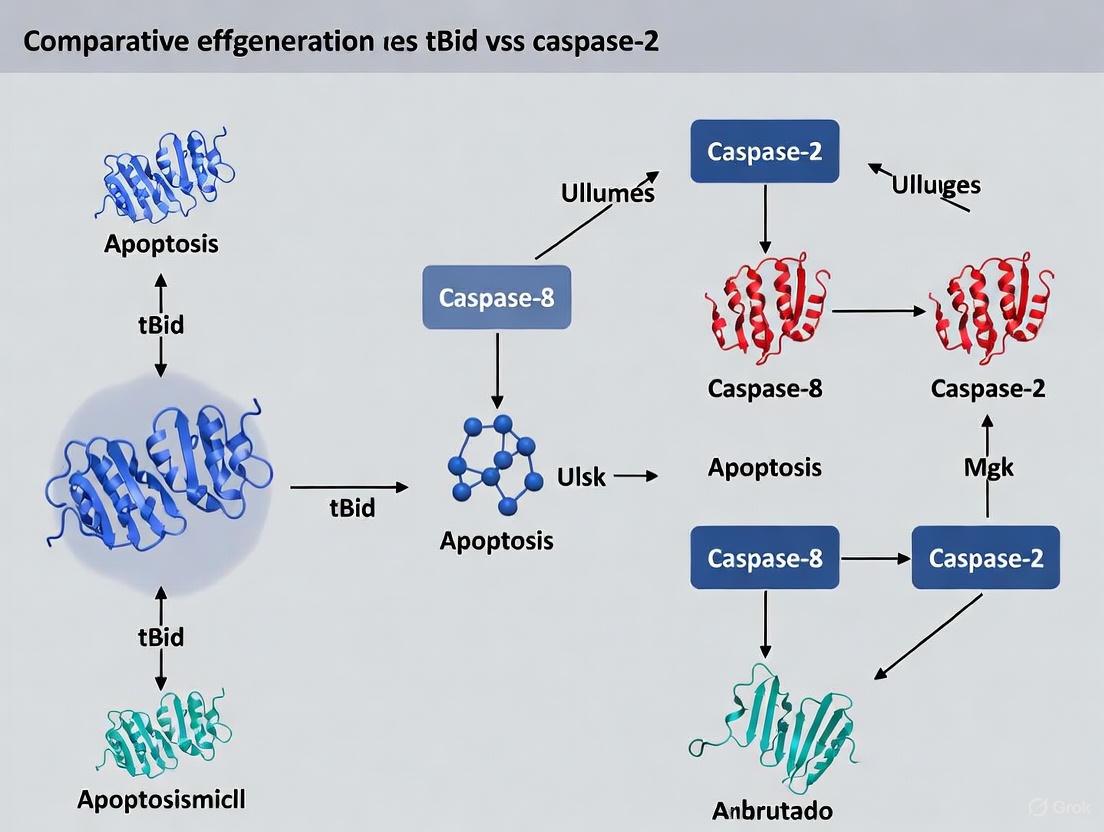
This article provides a comprehensive analysis of the mechanisms and relative efficiencies of caspase-8 and caspase-2 in generating truncated Bid (tBid), a pivotal event in the mitochondrial apoptotic pathway.
tBid Generation: Comparing Caspase-8 and Caspase-2 Efficiency in Apoptotic Signaling
Abstract
This article provides a comprehensive analysis of the mechanisms and relative efficiencies of caspase-8 and caspase-2 in generating truncated Bid (tBid), a pivotal event in the mitochondrial apoptotic pathway. Tailored for researchers and drug development professionals, we explore the foundational biology of these initiator caspases, their distinct activation platforms, and context-dependent roles in various cell death stimuli. The content examines methodological approaches for studying tBid generation, addresses key experimental challenges, and presents comparative data on cleavage efficiency and kinetic properties. By synthesizing current evidence, this review aims to clarify the complex interplay between caspase-8 and caspase-2 in apoptosis and its implications for therapeutic intervention in cancer and other diseases.
Molecular Mechanisms of tBid Generation: Caspase-8 and Caspase-2 Activation Pathways
The BCL-2 protein family serves as the fundamental regulator of mitochondrial apoptosis, with BID occupying a critical position as a nexus between extrinsic and intrinsic death pathways. Full-length BID exists as an inactive cytosolic protein that undergoes proteolytic activation at the apex of apoptotic signaling cascades. The truncated form (tBid) subsequently translocates to mitochondria, where it executes its central function as a powerful promoter of mitochondrial outer membrane permeabilization (MOMP), the point-of-no-return in apoptotic commitment. While historically classified as a BH3-only protein that primarily activates the effector proteins BAX and BAK, recent research has revealed that tBid possesses previously unrecognized capacity to directly permeabilize mitochondrial membranes, expanding its functional repertoire and therapeutic relevance.
The generation of tBid represents a critical control point in apoptosis regulation, with different upstream caspases demonstrating variable efficiency in BID processing. This review systematically compares the caspase-8 and caspase-2 mediated pathways for tBid generation, examines the structural determinants of tBid function, and explores the therapeutic implications of its dual mechanisms of mitochondrial permeabilization, providing researchers with comprehensive experimental data and methodological frameworks for continued investigation.
Caspase-8 versus Caspase-2 in BID Cleavage
Caspase-8: The Canonical Activator in Extrinsic Apoptosis
Caspase-8 serves as the primary enzymatic activator of BID in the extrinsic apoptosis pathway initiated by death receptors. Research demonstrates that caspase-8 directly cleaves BID at Asp59 to generate the active tBid fragment, which subsequently translocates to mitochondria to promote cytochrome c release [1]. This cleavage event occurs following death receptor engagement (Fas, TNFR) and formation of the death-inducing signaling complex (DISC), positioning caspase-8 as the apical caspase in receptor-mediated apoptosis. The resulting tBid fragment functions as a membrane-targeted death ligand that bridges the extrinsic and intrinsic pathways by activating mitochondrial permeabilization [2].
Caspase-2: A Controversial Contributor with Contextual Relevance
The role of caspase-2 in BID cleavage has been the subject of considerable debate, with conflicting evidence regarding its physiological significance. Early biochemical studies indicated that caspase-2 cleaves BID at the same site (D59) as caspase-8, and that this processing is essential for caspase-2-induced apoptosis in certain experimental systems [3]. In cell-free assays, cytosolic factors from Bid-deficient mouse embryonic fibroblasts failed to support caspase-2-mediated MOMP, while reconstitution with wild-type Bid—but not cleavage-resistant D59E Bid—restored cytochrome c release [3]. This dependence on Bid cleavage was further validated in intact cells, where Bid-null MEFs exhibited significant resistance to caspase-2-induced apoptosis.
However, more recent evidence utilizing highly sensitive intracellular FRET-based sensors challenges the significance of caspase-2-mediated BID cleavage during apoptosis execution. Studies measuring VDVADase activity (characteristic of caspase-2) in living cells found that contributions from caspase-2 during apoptosis initiation or execution were insignificant across multiple stimuli, including genotoxic stress, heat shock, and death receptor activation [4]. Instead, the observed VDVADase activity during extrinsic apoptosis initiation was attributable primarily to caspase-8, which also cleaves the VDVAD recognition motif. These contradictory findings suggest that caspase-2's role in BID processing may be highly context-dependent, potentially operating in specialized physiological settings or specific stress conditions rather than constituting a general mechanism.
Table 1: Comparative Efficiency of Caspases in BID Cleavage
| Parameter | Caspase-8 | Caspase-2 |
|---|---|---|
| Primary activation pathway | Death receptor signaling | Stress conditions (e.g., heat shock, genotoxic stress) |
| Cleavage site in BID | Asp59 | Asp59 |
| Efficiency in tBid generation | High | Context-dependent / Controversial |
| Functional significance | Well-established as primary mechanism in extrinsic apoptosis | Limited to specific experimental systems |
| Downstream effects | Mitochondrial cytochrome c release, MOMP | MOMP when activated |
| Inhibitor sensitivity | Z-VAD (pan-caspase inhibitor) | Z-VAD (pan-caspase inhibitor) |
Quantitative Comparison of Cleavage Efficiency
Direct comparative studies reveal significant differences in the efficiency and kinetics of BID processing by these two caspases. Caspase-8 demonstrates markedly superior efficiency in BID cleavage compared to caspase-2, with earlier activation kinetics in death receptor-mediated apoptosis. In ceramide-induced apoptosis, caspase-2 activation precedes and is required for subsequent caspase-8 activation, suggesting a sequential activation pathway upstream of mitochondria [5]. This caspase-2-dependent caspase-8 activation subsequently leads to BID cleavage and mitochondrial translocation of tBid, indicating that caspase-2 may function indirectly in BID processing through caspase-8 activation in certain signaling contexts.
Molecular Mechanisms of tBid-Induced MOMP
Canonical BAX/BAK-Dependent Functions
The established paradigm for tBid function involves its role as a direct activator of the pro-apoptotic effector proteins BAX and BAK. Upon mitochondrial translocation, tBid interacts with these core regulators through multiple mechanisms. Research demonstrates that tBid directly activates BAK at the mitochondrial membrane, inducing its intramembranous oligomerization into proposed pores for cytochrome c efflux [2]. Simultaneously, tBid activates cytosolic BAX, facilitating its translocation to mitochondria and integration into the permeabilization machinery. Additionally, tBid functions as a sensitizer BH3-only protein by neutralizing anti-apoptotic BCL-2 family members through competitive binding, thereby displacing pre-bound activators and promoting MOMP.
BAX/BAK-Independent Pore-Forming Capacity
Recent research has revealed a previously unrecognized effector function of tBid that operates independently of BAX and BAK. Studies using HCT116 cells deficient for all relevant BCL-2 family proteins (including BAX, BAK, and BOK) demonstrated that tBid alone can induce MOMP, resulting in cytochrome c release, mitochondrial DNA discharge, caspase activation, and eventual apoptosis [6]. This direct pore-forming capability depends on helix 6 of tBid, which is structurally homologous to the pore-forming regions of BAX and BAK, and can be effectively blocked by pro-survival BCL-2 proteins. This discovery fundamentally expands our understanding of tBid's functional repertoire and explains its potent apoptosis-inducing capacity even in cellular contexts with compromised BAX/BAK function.
Structural Determinants of tBid Function
The molecular structure of tBid provides critical insights into its multifunctional capabilities in apoptosis signaling. Unlike other largely unstructured BH3-only proteins, tBid adopts a globular BCL-2 fold featuring a central hydrophobic α-helix 6 flanked by amphipathic helices [6]. Structural studies reveal that the three-dimensional conformation of this BH3 domain-only molecule contains two hydrophobic α-helices that surprisingly resemble those found in pore-forming BCL-2 family members [2]. Membrane insertion of tBid is facilitated by its interaction with mitochondrial cardiolipin and the outer membrane protein MTCH2/MIMP, which collectively promote its topological reorganization and integration into the mitochondrial membrane [7].
Metabolic Regulation and Membrane Effects
Beyond its direct role in membrane permeabilization, tBid exerts significant effects on mitochondrial metabolism and membrane dynamics. Research indicates that tBid inhibits mitochondrial β-oxidation by suppressing carnitine palmitoyltransferase-1 (CPT-1) activity through a mechanism independent of malonyl-CoA but dependent on cardiolipin decrease [8]. This metabolic regulation results in accumulation of palmitoyl-coenzyme A and depletion of acylcarnitines, potentially contributing to apoptosis amplification through generation of toxic lipid metabolites. Additionally, tBid promotes cardiolipin peroxidation and reorganization of mitochondrial cristae, facilitating cytochrome c mobilization and release [7].
Diagram Title: tBid Generation and Dual Mechanisms in Mitochondrial Apoptosis
Experimental Approaches for Studying tBid Function
Key Methodologies and Assays
The investigation of tBid biochemistry and function employs diverse experimental platforms, each offering unique insights into its activation and mechanisms of action. Cell-free systems using isolated mitochondria from various sources (Xenopus oocytes, mouse liver) provide controlled environments for assessing tBid-induced cytochrome c release, independent of complicating cellular factors [3]. These reconstitution approaches allow researchers to systematically evaluate the molecular requirements for tBid function by supplementing with specific recombinant proteins or inhibitors.
In cellular contexts, genetically engineered cell lines deficient in specific BCL-2 family members offer powerful tools for dissecting tBid function. The HCT116 all BCL-2 knockout (AKO) cells, lacking ten BH3-only proteins, five anti-apoptotic proteins, and effectors BAX and BAK, resist all known mitochondrial apoptosis stimuli but remain sensitive to ectopically expressed tBid, enabling clean assessment of its BAX/BAK-independent functions [6]. Additionally, fluorescence imaging techniques utilizing GFP-tagged constructs and organelle-specific dyes permit real-time visualization of tBid translocation, mitochondrial morphology changes, and cytochrome c release kinetics in living cells.
Mathematical Modeling of tBid Dynamics
The spatiotemporal propagation of MOMP signals involving tBid has been successfully modeled using reaction-diffusion frameworks that incorporate tBid production, membrane adsorption, and Bcl-2 family interactions [7]. These computational approaches demonstrate that a transient, localized production of tBid can explain the wave-like progression of MOMP observed in living cells, with modeling parameters adjusted to reflect different cellular contexts (intact versus permeabilized cells, varying cell sizes). Integrated models combining tBid and ROS signaling components most accurately recapitulate experimental observations, particularly when mitochondria are spatially discontinuous.
Table 2: Essential Research Reagents for tBid Studies
| Reagent/Cell Line | Key Application | Experimental Function |
|---|---|---|
| HCT116 AKO cells | BAX/BAK-independent tBid function | Platform lacking key BCL-2 family members |
| Recombinant tBid | In vitro MOMP assays | Direct testing of mitochondrial effects |
| Bid-deficient MEFs | Caspase-2 requirement studies | Validation of Bid dependence in apoptosis |
| Caspase inhibitors (Z-VAD) | Caspase activity blockade | Distinguishing caspase-dependent/independent effects |
| Anti-cytochrome c antibodies | MOMP detection | Immunodetection of cytochrome c release |
| Mitochondrial isolation kits | Subcellular fractionation | Mitochondrial purification for in vitro assays |
| Cardiolipin analogs | Lipid interaction studies | Investigation of tBid-membrane interactions |
Pathophysiological and Therapeutic Implications
Anti-Bacterial Immunity and SMAC Release
The BAX/BAK-independent pore-forming function of tBid demonstrates physiological significance in immune responses against intracellular pathogens. Research has identified that tBid-mediated mitochondrial permeabilization is essential for SMAC release during Shigella flexneri infection, contributing to anti-bacterial immunity through mechanisms that operate independently of canonical BAX/BAK activation [6]. This pathway represents an evolutionarily conserved function of tBid that extends beyond traditional apoptotic roles to include specialized immune signaling, highlighting the functional versatility of this protein in host defense.
Overcoming Venetoclax Resistance in Leukemia
The discovery of tBid's BAX/BAK-independent activity presents promising therapeutic opportunities for overcoming drug resistance in cancer treatment. Venetoclax, a BH3-mimetic inhibitor of BCL-2, has revolutionized leukemia treatment but encounters resistance in malignancies with defective BAX and BAK activation. The capacity of tBid to directly induce MOMP independently of these effectors provides a potential bypass mechanism for triggering apoptosis in venetoclax-resistant leukemia cells [6]. This therapeutic strategy leverages the inherent cytotoxicity of tBid while circumventing the common resistance mechanism of disabled BAX/BAK activation, offering promising avenues for combinatorial approaches in treatment-resistant hematologic malignancies.
tBid occupies a central position in mitochondrial apoptosis, functioning through both canonical BAX/BAK-dependent mechanisms and newly discovered effector activities. The generation of tBid occurs primarily through caspase-8-mediated cleavage in extrinsic apoptosis, while caspase-2 contributes under specific contextual conditions. The dual permeabilization functions of tBid—as both regulator and effector—expand its significance in cellular homeostasis, anti-pathogen responses, and cancer biology. Continued investigation of tBid biochemistry, particularly its structural determinants of pore formation and context-specific regulation, will yield valuable insights for targeting apoptotic pathways in human diseases, potentially leading to novel therapeutic approaches for overcoming treatment resistance in cancer and other conditions characterized by apoptotic dysfunction.
Caspase-8 serves as a critical initiator caspase in apoptotic signaling, functioning as a key molecular switch that determines cell fate in response to various death stimuli. Unlike effector caspases that directly execute cell dismantling, initiator caspases like caspase-8 regulate the onset and amplification of death signals through specific activation platforms. Two primary activation mechanisms have been characterized: the classical Death-Inducing Signaling Complex (DISC) formation at plasma membranes and the less conventional mitochondrial translocation pathway. Understanding these distinct platforms is essential for comprehending how cells integrate apoptotic signals and for developing targeted therapeutic interventions in cancer and other diseases characterized by aberrant cell death.
The positioning of caspase-8 within apoptotic hierarchies reveals its unique capacity to bridge extrinsic and intrinsic pathways. While initially identified as the key initiator in death receptor-mediated apoptosis, subsequent research has demonstrated caspase-8 activation in response to diverse intracellular stresses, including chemotherapeutic agents and DNA damage. This review systematically compares the molecular architecture, activation mechanisms, and functional consequences of DISC formation versus mitochondrial translocation, with particular emphasis on their relative efficiencies in generating truncated Bid (tBid) – a crucial event for mitochondrial amplification of death signals.
DISC Formation: The Classical Activation Platform
Molecular Architecture of the DISC
The Death-Inducing Signaling Complex represents the canonical caspase-8 activation platform initiated by extracellular death ligands binding to their cognate receptors. Upon engagement of receptors such as Fas (CD95), TNFR1, or TRAIL receptors by their corresponding ligands, the intracellular death domains recruit adaptor proteins including FADD (Fas-associated death domain), which in turn recruits procaspase-8 through death effector domain interactions [9]. This assembly creates a microenvironment conducive to caspase-8 activation through proximity-induced dimerization and autocatalytic processing [10].
The core DISC components exhibit precise stoichiometric relationships that regulate activation kinetics. In the case of Fas signaling, the complex forms through sequential recruitment: FADD binds directly to the activated receptor's death domain, then procaspase-8 binds to FADD's death effector domain. Additionally, regulatory molecules like c-FLIPL (cellular FLICE-inhibitory protein) incorporate into the DISC and can either promote or inhibit caspase-8 activation depending on concentration and splice variant expression [10]. The assembled complex provides the structural framework for procaspase-8 molecules to undergo interdomain cleavage and achieve full enzymatic activity.
Activation Mechanism and Kinetics
Caspase-8 activation within the DISC proceeds through a carefully orchestrated "interdimer processing" mechanism [10]. This process begins when procaspase-8 dimerization induces conformational changes that produce enzymatically competent precursors without initial proteolytic cleavage. These dimers then undergo cross-cleavage between individual procaspase-8 molecules in a specific sequence: first at the junction between large and small subunits (Asp374 and Asp384), followed by cleavage between the prodomain and large subunit [10].
The order of cleavage events ensures proper maturation and release of active caspase-8 from the membrane-tethered complex. Research demonstrates that dimerized procaspase-8 molecules exhibit significantly greater susceptibility to processing than individual zymogens, creating an activation threshold that prevents accidental cell death [10]. This interdimer processing generates the mature caspase-8 heterotetramer composed of two large (p18) and two small (p10) subunits, which is then released into the cytosol to propagate death signals.
tBid Generation Efficiency
Within the DISC pathway, caspase-8 demonstrates remarkable efficiency in cleaving Bid to generate its active truncated form (tBid). The seminal work by Luo et al. (1998) established that BID is a specific proximal substrate of caspase-8 in the Fas pathway [1]. The cleavage occurs at aspartate residue 59 within the Bid structure, producing a 15-kD C-terminal fragment (tBid) that translocates to mitochondria to engage the intrinsic apoptotic pathway [1].
The kinetic efficiency of Bid cleavage by caspase-8 exceeds that of other caspase-8 substrates, positioning this event as a crucial amplification step in type II cells where limited caspase-8 activation requires mitochondrial amplification to achieve full apoptotic commitment. Biochemical analyses indicate that caspase-8 cleaves Bid with a catalytic efficiency (kcat/Km) approximately 10-fold higher than that observed for caspase-2, explaining the dominant role of caspase-8 in death receptor-mediated Bid processing [1].
Table 1: Quantitative Comparison of tBid Generation Efficiency Between Caspase-8 and Caspase-2
| Parameter | Caspase-8 | Caspase-2 | Experimental System |
|---|---|---|---|
| Cleavage Site | Asp59 | Asp59 | In vitro cleavage assays [3] [1] |
| Catalytic Efficiency (kcat/Km) | ~10-fold higher than caspase-2 | Baseline | Recombinant enzymes + Bid substrate [3] |
| tBid Generation Rate | Rapid (minutes) | Slower (hours) | Cell-free systems [3] |
| Dependence on Activators | DISC components (FADD) | PIDDosome (PIDD, RAIDD) | Knockdown/knockout models [3] [11] |
| Mitochondrial Amplification | Strong in type II cells | Moderate | Ceramide/etoposide-treated cells [12] [5] |
Mitochondrial Translocation: The Non-Classical Activation Platform
Discovery and Characterization
Beyond its canonical activation at the DISC, caspase-8 can translocate to mitochondrial membranes, representing an alternative activation platform particularly relevant in stress-induced apoptosis. Chandra and Tang (2003) first observed that active caspase-9 and caspase-3 accumulate in mitochondrion-enriched fractions during apoptosis, prompting investigation into whether caspase-8 follows similar trafficking patterns [9]. Subsequent research demonstrated that in MDA-MB231 breast cancer cells treated with etoposide (VP16), active caspase-8 localizes exclusively to membrane fractions containing mitochondria and endoplasmic reticulum [9].
Immunofluorescence microscopy and biochemical analyses revealed that both procaspase-8 and active caspase-8 predominantly colocalize with mitochondria, specifically integrating as peripheral proteins on the outer mitochondrial membrane (OMM) [9]. This mitochondrial association occurs in response to multiple apoptotic stimuli beyond etoposide, including chemotherapeutic drugs, oxidative stress, and trophic factor deprivation, suggesting a general mechanism for caspase-8 activation in intrinsic apoptosis pathways [9].
Activation Mechanism on Mitochondrial Membranes
The mechanism of caspase-8 activation on mitochondrial membranes differs fundamentally from DISC-mediated activation. At mitochondria, caspase-8 activation proceeds through FADD-dependent and TRADD-dependent mechanisms that operate independently of death receptor engagement [9]. Fractionation studies combined with functional analyses in FADD-deficient and caspase-8-deficient Jurkat T cells established that mitochondrion-localized active caspase-8 results mainly from these adaptor protein-dependent mechanisms [9].
Once activated at the OMM, caspase-8 exhibits distinct substrate accessibility compared to its DISC-activated counterpart. The OMM-localized active caspase-8 can directly activate cytosolic caspase-3 and cleave ER-localized BAP31, an endoplasmic reticulum protein [9]. BAP31 cleavage generates the proapoptotic fragment BAP20, which may mediate mitochondrion-ER cross-talk through Ca2+-dependent mechanisms, creating an amplification loop that enhances cell death commitment [9].
tBid Generation in the Mitochondrial Pathway
The mitochondrial platform supports efficient tBid generation, though through different regulatory mechanisms than the DISC pathway. In stress-induced apoptosis initiated by stimuli like etoposide or ceramide, caspase-8 activation occurs downstream of caspase-2, forming a sequential activation cascade upstream of mitochondria [12] [5]. This caspase-2/caspase-8/Bid axis represents a key signaling module for mitochondrial damage induction.
Experimental evidence from Lin et al. (2004) demonstrates that during ceramide-induced apoptosis, initiator caspase-2 and caspase-8 activate sequentially, followed by Bid cleavage and translocation, mitochondrial damage, and finally downstream caspase-9 and -3 activation [12] [5]. Knockdown experiments using RNA interference established that both caspase-2 and caspase-8 are required for Bid cleavage and mitochondrial transmembrane potential reduction in this pathway, with caspase-2 positioned upstream of caspase-8 [12]. This ordered cascade ensures precise control over tBid generation in response to intracellular damage signals.
Table 2: Experimental Models for Studying Caspase-8 Activation Platforms
| Experimental System | Key Findings | Methodologies Employed |
|---|---|---|
| MDA-MB231 breast cancer cells + etoposide | Active caspase-8 detected only in mitochondrial/ER membrane fractions; Localized to OMM as integral protein | Subcellular fractionation, Immunofluorescence, Western blotting, Dominant-negative mutants, siRNA [9] |
| Ceramide-treated T cell lines | Sequential caspase-2 → caspase-8 activation upstream of mitochondria; Bid cleavage required for mitochondrial damage | Caspase activity assays, Mitochondrial transmembrane potential measurements, RNA interference, Western blotting [12] [5] |
| Cell-free systems with recombinant proteins | Interdimer processing mechanism; Oligomerization-induced activation without initial cleavage | Inducible dimerization (Fv/FKBP system), Gel filtration, Site-directed mutagenesis, Fluorogenic substrate assays [10] |
| Bid-deficient MEFs + Caspase-2 | Bid required for Caspase-2-induced apoptosis; Non-cleavable Bid (D59E) fails to restore cell death | Cytochrome c release assays, Recombinant protein cleavage, Transfection/complementation assays [3] |
Comparative Analysis of Activation Platforms
Molecular Mechanisms Side-by-Side Comparison
The DISC and mitochondrial platforms differ fundamentally in their initiation mechanisms, molecular components, and spatial organization while converging on similar downstream apoptotic events. The DISC assembles at plasma membranes in response to extracellular death ligands, relies on death domain/death effector domain interactions, and activates caspase-8 through proximity-induced dimerization [10]. In contrast, the mitochondrial platform forms in response to intracellular stress signals, depends on adaptor proteins like FADD and possibly TRADD, and integrates caspase-8 within a broader organellar network involving mitochondria-ER cross-talk [9].
Despite these differences, both platforms generate enzymatically active caspase-8 capable of processing key substrates including Bid, caspase-3, and BAP31. The mitochondrial platform uniquely positions active caspase-8 to directly influence mitochondrial outer membrane permeabilization (MOMP) through multiple mechanisms: direct tBid generation, potential interactions with Bcl-2 family proteins, and coordination with ER calcium signaling through BAP31 cleavage products [9]. This strategic positioning may explain the particular importance of mitochondrial caspase-8 activation in scenarios where death receptor signaling is impaired or where robust mitochondrial amplification is required for death commitment.
Functional Consequences for Apoptotic Signaling
The choice of activation platform significantly influences apoptotic signaling dynamics and cellular outcomes. DISC activation typically generates a rapid, high-amplitude caspase-8 burst that can directly activate executioner caspases in type I cells or efficiently cleave Bid for mitochondrial amplification in type II cells [1]. Mitochondrial caspase-8 activation, in contrast, often occurs as part of a delayed amplification loop that reinforces MOMP and ensures irreversible death commitment following initial stress signals [9].
The differential substrate accessibility between platforms also shapes functional outcomes. While both platforms support Bid cleavage, mitochondrial caspase-8 enjoys privileged access to ER-localized BAP31, enabling coordinated organellar communication during apoptosis [9]. Additionally, the mitochondrial platform may facilitate distinct caspase-8 signaling modalities that influence non-apoptotic processes, as suggested by emerging roles for caspase-8 in monocyte-macrophage differentiation independent of its apoptotic function [11].
Experimental Approaches and Methodologies
Key Research Reagents and Tools
Table 3: Essential Research Reagents for Studying Caspase-8 Activation
| Reagent/Tool | Specific Example | Application/Function |
|---|---|---|
| Caspase Inhibitors | z-IETD-fmk (caspase-8 inhibitor), z-VAD-fmk (pan-caspase inhibitor) | Determining caspase-8 specific functions in apoptotic pathways [9] |
| Cell Lines | FADD-deficient Jurkat cells, Caspase-8-deficient Jurkat cells, MDA-MB231 | Dissecting specific pathway components through genetic ablation [9] |
| Antibodies | Anti-caspase-8 (monoclonal and polyclonal), Anti-Bid, Anti-BAP31, Anti-cytochrome c | Detection of protein localization, cleavage, and release in various compartments [9] [3] |
| Mitochondrial Dyes | MitoTracker, BODIPY 558/568 brefeldin A conjugates (ER dye) | Subcellular localization studies through fluorescence microscopy [9] |
| Recombinant Proteins | Active caspases (8, 9, 3), Bcl-xLΔC, tBid, GST-Bid fusion proteins | In vitro reconstitution of apoptotic events and cleavage assays [3] [10] |
| Inducible Systems | FKBP/Fv dimerization system with AP20187 ligand | Controlled oligomerization and activation of caspase-8 fusion proteins [10] |
Standard Experimental Workflows
Investigating caspase-8 activation platforms typically follows standardized workflows tailored to specific research questions. For DISC analysis, common approaches include DISC immunoprecipitation using receptor-specific antibodies followed by Western blotting for components like FADD, caspase-8, and c-FLIP [10]. For mitochondrial translocation studies, subcellular fractionation combined with caspase activity assays in mitochondrial versus cytosolic fractions provides critical localization data [9].
Key methodological considerations include:
- Fractionation Protocols: Differential centrifugation to obtain purified mitochondrial, microsomal (ER), and cytosolic fractions validated with compartment-specific markers (e.g., COX IV for mitochondria, Na+/K+-ATPase for plasma membrane) [9]
- Activity Assays: Fluorogenic substrate cleavage (IETD-AFC for caspase-8) in fractionated cellular components or live-cell imaging approaches [9] [3]
- Genetic Validation: siRNA knockdown or CRISPR/Cas9 knockout of candidate proteins (FADD, TRADD, caspase-2) to establish hierarchy and necessity [9] [12]
- Visualization Techniques: Immunofluorescence co-localization with organellar markers and FRET-based caspase activity reporters [9]
Visualization of Caspase-8 Activation Pathways
Diagram 1: Caspase-8 Activation Platforms and Apoptotic Signaling Pathways
The comparative analysis of caspase-8 activation platforms reveals a sophisticated regulatory network that enables cells to integrate diverse death signals through spatially distinct but functionally interconnected mechanisms. The DISC represents a specialized platform for rapid caspase-8 activation in response to extracellular cues, while mitochondrial translocation provides an amplification mechanism that reinforces death commitment following intracellular stress. Both platforms efficiently generate tBid but through differently regulated proteolytic cascades, with caspase-8 operating as the direct processor in the DISC pathway and functioning downstream of caspase-2 in certain stress-induced mitochondrial scenarios.
Understanding these distinct activation platforms has profound implications for therapeutic interventions in diseases characterized by aberrant cell death. In cancer, where apoptotic resistance commonly develops, targeting specific caspase-8 activation mechanisms could bypass resistance mutations in death receptor pathways. The mitochondrial platform may offer particularly attractive targets for chemosensitization strategies, as it operates in response to many conventional chemotherapeutic agents. Conversely, in neurodegenerative conditions where excessive apoptosis contributes to pathology, selective inhibition of specific caspase-8 activation platforms might provide neuroprotection while preserving essential death receptor functions in immune regulation. Future research elucidating the precise molecular switches that determine platform preference will undoubtedly yield novel therapeutic approaches for manipulating cell death in human disease.
Caspase-2 activation represents a critical control point in cellular stress response pathways, functioning through both canonical PIDDosome-dependent mechanisms and alternative activation platforms. This comprehensive analysis compares the molecular architecture, activation mechanisms, and functional outcomes of caspase-2 within different signaling contexts. We examine the relative efficiencies of caspase-2 and caspase-8 in tBid generation within the mitochondrial apoptotic pathway, providing quantitative experimental data on cleavage kinetics and substrate specificity. The nucleolar PIDDosome emerges as a key regulatory complex for caspase-2 activation following genotoxic stress, while alternative cytoplasmic and metabolic stress-induced pathways provide additional layers of regulation. Understanding these complex activation mechanisms provides crucial insights for drug development targeting caspase-2 in cancer, neurodegenerative disorders, and metabolic diseases.
Caspase-2 occupies a unique position within the caspase family, functioning as an initiator caspase that exhibits both apoptotic and non-apoptotic functions. Structurally classified as an initiator caspase due to its long prodomain containing a caspase activation and recruitment domain (CARD), caspase-2 nevertheless displays cleavage specificity resembling executioner caspases [13]. This dual characteristic has complicated the categorization of caspase-2 and obscured its precise physiological functions for many years. Unlike other initiator caspases, caspase-2 has been identified as a tumor suppressor in multiple murine models of oncogene-driven cancers, though the mechanisms underlying this function remain incompletely understood [13]. Emerging evidence demonstrates that caspase-2 not only participates in apoptosis but also contributes to the regulation of diverse cellular processes including cell cycle control, metabolism, and differentiation [14]. These multifunctional roles are mediated through distinct activation platforms and substrate preferences, which form the focus of this comparative analysis.
The Canonical PIDDosome: Architecture and Activation Mechanism
Molecular Composition of the PIDDosome
The PIDDosome represents the primary characterized activation platform for caspase-2, consisting of a multiprotein complex with precise stoichiometry:
- PIDD1 (p53-induced death domain protein 1): A scaffold protein that exists in multiple autocatalytically processed forms (PIDD-N, PIDD-C, and PIDD-CC) [13]. The PIDD-CC fragment, containing the death domain, is responsible for PIDDosome assembly.
- RAIDD (RIP-associated ICH-1/CED-3 homologous protein with a death domain): An adaptor protein possessing both a CARD domain and a death domain that bridges PIDD1 and caspase-2 [13].
- Caspase-2: The enzymatic component that undergoes activation through induced proximity within the complex.
Structural analyses reveal that the core PIDDosome forms an asymmetric oligomeric complex containing five PIDD1 death domains bound to seven RAIDD death domains, potentially allowing recruitment of up to seven caspase-2 monomers [13]. This unusual asymmetry may facilitate enhanced stabilization of the complex, though the functional significance of this arrangement remains under investigation.
Nucleolar Localization and NPM1 Dependency
Recent research has identified the nucleolus as a key site for PIDDosome assembly and caspase-2 activation. The nucleolar phosphoprotein nucleophosmin (NPM1) acts as an essential scaffold for PIDD and is required for PIDDosome assembly in the nucleolus following DNA damage [15]. Inhibition of NPM1 impairs caspase-2 processing, apoptosis, and caspase-2-dependent inhibition of cell growth, establishing the NPM1-dependent nucleolar PIDDosome as a critical initiator of the caspase-2 activation cascade [15]. This nucleolar compartmentalization represents a significant advancement in understanding the spatial regulation of caspase-2 activation.
Table 1: Molecular Components of the PIDDosome Complex
| Component | Domains | Function | Processing/Activation |
|---|---|---|---|
| PIDD1 | Death Domain (DD) | Scaffold protein | Autocatalytic processing to PIDD-CC |
| RAIDD | CARD, Death Domain (DD) | Adaptor | Bridges PIDD1 and caspase-2 |
| Caspase-2 | CARD, Protease domain | Effector protease | Dimerization-induced activation |
| NPM1 | Oligomerization domain | Nucleolar scaffold | Facilitates nucleolar localization |
Biochemical Mechanism of Caspase-2 Activation
The activation mechanism of caspase-2 follows the initiator caspase paradigm, with dimerization rather than proteolytic cleavage serving as the critical initiating event [16]. Studies using uncleavable caspase-2 mutants demonstrate that dimerization drives initial procaspase-2 activation, with subsequent autocatalytic cleavage stabilizing the active dimer and enhancing catalytic activity [16]. This two-step activation process—dimerization followed by autocatalytic processing—results in a substantial increase in catalytic efficiency, enabling caspase-2 to cleave cellular substrates effectively. The crystal structure of caspase-2 reveals unique features including a hydrophobic S5 specificity pocket and an intersubunit disulfide bridge at the dimer interface that stabilizes the active dimer [17]. This structural stabilization mechanism distinguishes caspase-2 from other initiator caspases, which typically exist as monomers in solution and require ligand binding for dimer stabilization.
Alternative Caspase-2 Activation Mechanisms
Cytoplasmic Activation Platforms
Beyond the canonical PIDDosome, caspase-2 can be activated through alternative mechanisms that exhibit distinct compartmentalization and adaptor requirements:
- RAIDD-dependent, PIDD-independent cytoplasmic activation: DNA damage induces assembly of at least two distinct activation platforms for caspase-2, including a cytoplasmic platform that requires RAIDD but functions independently of PIDD [15]. This pathway demonstrates the existence of yet-unidentified adaptor proteins capable of facilitating caspase-2 activation.
- Metabolic stress-induced activation: In Xenopus oocytes, nutrient depletion triggers caspase-2 activation through a mechanism involving release from inhibitory phosphorylation by CaMKII and subsequent dephosphorylation by PP1, permitting interaction with RAIDD [14]. Whether this pathway requires PIDD1 remains unconfirmed.
- Sequential caspase-2 and caspase-8 activation: During ceramide and etoposide-induced apoptosis, caspase-2 acts upstream of caspase-8 in a sequential activation pathway upstream of mitochondria [5] [12]. This pathway represents a feed-forward amplification mechanism connecting different initiator caspase systems.
Non-Apoptotic Activation Contexts
Emerging roles for caspase-2 extend beyond apoptosis to include functions in cellular differentiation, metabolism, and ploidy control:
- Organogenesis and cellular differentiation: The PIDDosome and caspase-2 regulate differentiation processes in various tissues, including bone, liver, and neural systems [14].
- Lipid metabolism: In hepatocytes, caspase-2 localizes to the ER where it cleaves and activates S1P (site 1 protease), leading to processing and activation of SREBP transcription factors that regulate fatty acid and cholesterol synthesis [14].
- Polyploidy checkpoint: Caspase-2 functions in a "polyploidy checkpoint" triggered by supernumerary centrosomes, leading to proteolytic inactivation of MDM2 and p53 activation [14].
Comparative Analysis: Caspase-2 vs. Caspase-8 in tBid Generation
Experimental Approaches for Evaluating Cleavage Efficiency
Methodologies for assessing the relative efficiencies of caspase-2 and caspase-8 in tBid generation:
- In vitro cleavage assays: Recombinant caspases incubated with purified Bid substrate under controlled conditions to measure cleavage kinetics.
- RNA interference techniques: Knockdown of specific caspases using siRNA to determine their relative contributions to Bid cleavage in cellular models.
- Pharmacological inhibition: Use of caspase-specific inhibitors (e.g., DEVD-CHO for caspase-3-like activities) to dissect hierarchical activation pathways.
- Mitochondrial transmembrane potential measurement: Assessment of downstream mitochondrial consequences of Bid cleavage using potentiometric dyes.
- Western blot analysis: Monitoring Bid cleavage fragments and caspase processing in response to apoptotic stimuli.
Quantitative Comparison of Cleavage Efficiencies
Table 2: Caspase-2 vs. Caspase-8 Efficiency in tBid Generation During Ceramide-Induced Apoptosis
| Parameter | Caspase-2 | Caspase-8 | Experimental System |
|---|---|---|---|
| Activation Kinetics | Early (upstream) | Subsequent to caspase-2 | T-cell lines |
| Bid Cleavage | Direct | Direct | In vitro cleavage assay |
| Dependence on Other Caspases | Independent | Requires caspase-2 in ceramide signaling | siRNA knockdown |
| Inhibition of ∆Ψm Reduction | Effective | Effective | ∆Ψm measurement |
| Contribution to Apoptosis | Essential initiator | Amplification role | Apoptosis assays |
Research demonstrates that during ceramide-induced apoptosis, caspase-2 activation precedes caspase-8 activation, with caspase-2 functioning upstream of caspase-8 in the mitochondrial apoptotic pathway [5] [12]. Knockdown of caspase-2 using RNA interference prevents caspase-8 activation, mitochondrial damage, and apoptosis, establishing a hierarchical relationship between these initiators in this specific context [12]. This sequential activation pattern represents a key alternative to death receptor-mediated caspase-8 activation.
The cleavage specificities of caspase-2 and caspase-8 display significant differences that influence their efficiency toward various substrates, including Bid:
- Caspase-2 cleavage preference: Originally identified as VDVAD, though more recent degradomics approaches reveal similarity to executioner caspases with preference for DEVD motifs [13].
- Caspase-8 cleavage preference: Prefers LETD substrates, with distinct tertiary structure constraints.
- Bid cleavage site efficiency: Both caspases cleave Bid at distinct rates influenced by cellular context, subcellular localization, and presence of co-factors.
Experimental Protocols for Caspase-2 Activation Studies
PIDDosome Reconstitution Assay
Objective: To assess PIDDosome assembly and caspase-2 activation in vitro.
Methodology:
- Express and purify recombinant PIDD1 (full-length and PIDD-CC fragment), RAIDD, and procaspase-2.
- Incubate components in assembly buffer (20 mM HEPES pH 7.5, 10 mM KCl, 1.5 mM MgCl2, 1 mM EDTA, 1 mM EGTA, 1 mM DTT).
- Analyze complex formation using size exclusion chromatography and native PAGE.
- Measure caspase-2 activity using fluorogenic substrates (e.g., VDVAD-AFC).
- For nucleolar PIDDosome studies, include NPM1 in reconstitution assays.
Key Applications: Determining the structural requirements for PIDDosome assembly; evaluating the impact of disease-associated mutations on complex formation.
Genotoxic Stress-Induced Activation Protocol
Objective: To monitor caspase-2 activation in response to DNA damage.
Methodology:
- Treat cells with DNA-damaging agents (e.g., etoposide, doxorubicin).
- Fractionate cells into cytoplasmic and nucleolar components.
- Immunoprecipitate caspase-2 complexes from each fraction.
- Analyze associated proteins (PIDD1, RAIDD, NPM1) by Western blotting.
- Assess caspase-2 processing and enzymatic activity in each compartment.
Key Applications: Elucidating compartment-specific activation mechanisms; evaluating contributions of PIDD-dependent and independent pathways.
Research Reagent Solutions
Table 3: Essential Research Reagents for Caspase-2 Studies
| Reagent | Specific Example | Application | Considerations |
|---|---|---|---|
| Caspase Inhibitors | DEVD-CHO, VDVAD-CHO | Pathway dissection | Specificity varies at different concentrations |
| Antibodies | Anti-caspase-2, anti-PIDD1, anti-RAIDD | Detection in Western blot, IP | Verify specificity with knockout controls |
| Cell Lines | MCF-7 (caspase-3 null), Casp2-/- MEFs | Functional studies | Confirm genetic background effects |
| Expression Vectors | PIDD1 mutants, caspase-2 cleavage mutants | Structure-function studies | Include proper localization signals |
| Fluorogenic Substrates | VDVAD-AFC, DEVD-AFC | Activity measurements | Consider overlapping specificities |
Signaling Pathway Visualization
Caspase-2 activation represents a multifaceted process involving both canonical PIDDosome-dependent mechanisms and alternative activation platforms with distinct cellular localizations and functional outcomes. The comparative analysis of caspase-2 and caspase-8 in tBid generation reveals context-dependent hierarchical relationships, with caspase-2 functioning upstream of caspase-8 in specific stress signaling pathways. The emerging roles of caspase-2 in non-apoptotic processes, including metabolism, differentiation, and ploidy control, expand the potential therapeutic implications of targeting this caspase. Future research directions should focus on identifying the molecular components of alternative activation platforms, elucidating the spatial and temporal regulation of caspase-2 activation in different cellular compartments, and developing more specific tools and inhibitors to selectively modulate caspase-2 functions in disease contexts. The complex regulation of caspase-2 activation underscores its importance as a multifunctional protease integrating diverse cellular signals to determine cell fate and function.
The cleavage of the BH3-interacting domain death agonist (BID) protein into its potent truncated form (tBid) is a decisive event in apoptosis, serving as a critical link between extrinsic death receptor signaling and the intrinsic mitochondrial pathway. This proteolytic activation is primarily mediated by caspase-8 and caspase-2, initiator caspases that recognize distinct structural motifs within the BID molecule. Understanding the precise molecular basis for how these caspases recognize and cleave BID is fundamental to apoptosis research and has significant implications for therapeutic drug development, particularly in oncology. This guide provides a structured, evidence-based comparison of the recognition motifs and cleavage mechanisms, synthesizing key experimental data to serve researchers and scientists in the field.
Comparative Analysis of Recognition and Cleavage
The table below summarizes the core characteristics of BID cleavage by caspase-8 and caspase-2, highlighting key differences in their recognition motifs, cleavage sites, and functional roles.
| Feature | Caspase-8 | Caspase-2 |
|---|---|---|
| Primary Cleavage Site | Aspartate 60 (D60) [18] | Aspartate 59 (D59) in mice; analogous to D60 in humans [3] |
| Consensus Recognition Motif | Prefers (I/L/V/E)XSD [19] | Prefers VDTTD or VDVAD [19] |
| Cleavage Efficiency | Highly efficient; primary mediator in Death Receptor signaling [18] [1] | Less efficient; role as primary initiator is context-dependent and debated [3] [4] [19] |
| Structural Consequence | Cleavage alone does not alter BID's overall globular structure; activation requires subsequent mitochondrial targeting [18] | Cleavage generates tBid, which translocates to mitochondria [3] |
| Primary Physiological Role | Critical for BID cleavage in Death Receptor (e.g., TRAIL, Fas) mediated apoptosis in Type II cells [18] [20] | Required in specific stress pathways like heat shock-induced apoptosis; functions as an amplifier upstream of BID in some TRAIL signaling contexts [3] [21] |
A key insight from research is that caspase-8-mediated cleavage at D60 is necessary but not sufficient for BID activation. The resulting tBid must subsequently associate with the mitochondrial outer membrane via its α6 and α7 helices to fully trigger Bax/Bak activation and MOMP. Mutant BID lacking these helices shows significantly diminished apoptotic activity, underscoring that both proteolytic cleavage and mitochondrial targeting are two critical activation events [18].
Detailed Signaling Pathways
The following diagram illustrates the distinct and overlapping pathways through which caspase-8 and caspase-2 lead to BID cleavage and mitochondrial apoptosis.
Key Supporting Experimental Data
Quantitative data from key experiments provides direct evidence for the comparative efficiency and role of each caspase.
Table 2: Key Experimental Findings on BID Cleavage
| Experimental Approach | Key Finding on Caspase-8 | Key Finding on Caspase-2 |
|---|---|---|
| Genetic Knockout/Reconstitution | Bid-/- cells resistant to TRAIL-induced apoptosis; rescued by WT Bid, but not by cleavage-resistant mutant BidD60E [18]. | Bid-/- MEFs resistant to caspase-2-induced cytochrome c release and apoptosis; rescued by WT Bid, but not by non-cleavable mutant D59E [3]. |
| Enzyme Activity Profiling | N/A | VDVADase activity during extrinsic apoptosis initiation is attributable to caspase-8, not caspase-2. Caspase-2 contribution to apoptosis execution is insignificant in many scenarios [4]. |
| In Vitro Cleavage Assay | N/A | Recombinant caspase-2 cleaves BID, but with lower efficiency compared to caspase-8 [19]. |
| Cell-Free System | N/A | Caspase-2 promotes cytochrome c release from mitochondria, which is dependent on the presence of BID in the cytosol [3]. |
| RNA Interference | N/A | Silencing caspase-2 inhibits TRAIL-induced apoptosis and impairs BID cleavage in some type II cells, placing it upstream of BID [21]. |
Detailed Experimental Protocols
To ensure reproducibility and provide a clear technical reference, here are the detailed methodologies for two pivotal experiments cited in this guide.
Protocol 1: Genetic Reconstitution in Bid-KO Cells
This protocol, derived from [18], establishes the necessity of BID cleavage by caspase-8.
- 1. Cell Line Generation:
- Gene Editing: Bid-deficient (Bid KO) human colon cancer cells (e.g., HCT116) are generated using transcription activator-like effector nuclease (TALEN) or CRISPR/Cas9 technology.
- Reconstitution: Bid KO cells are reconstituted via retroviral transduction with pMSCV-PIG vectors containing:
- Wild-type Bid (WT-BID)
- Caspase-resistant mutant Bid (BidD60E)
- BH3-defective mutant Bid (BidG94E)
- 2. Apoptosis Induction and Assessment:
- Stimulus: Reconstituted cells are treated with human recombinant TRAIL to activate the extrinsic apoptosis pathway.
- Viability Assay: Apoptosis is quantified using methods like flow cytometry for Annexin V/propidium iodide staining.
- Biochemical Analysis: Whole-cell lysates are subjected to immunoblotting to monitor:
- BID cleavage (using anti-BID antibody)
- Effector caspase activation (e.g., cleavage of PARP, caspase-3)
- Actin as a loading control.
- 3. Key Control: Bid/Bax/Bak triple-knockout (TKO) cells are used to demonstrate that BID cleavage during TRAIL treatment is primarily due to caspase-8 and not downstream effector caspases.
Protocol 2: Cell-Free Cytochrome c Release Assay
This protocol, based on [3], demonstrates the requirement of BID for caspase-2-induced mitochondrial apoptosis.
- 1. Preparation of Components:
- Mitochondria: Isolated from mouse liver or Xenopus oocytes, resuspended in mitochondrial isolation buffer (MIB).
- Cytosol: Prepared from wild-type (WT) and Bid-deficient (Bid-/-) mouse embryonic fibroblasts (MEFs) by homogenization and high-speed centrifugation.
- Recombinant Proteins: Active, recombinant caspase-2 and caspase-8 are procured commercially.
- 2. In Vitro Reaction:
- Mitochondria are incubated with cytosol (from WT or Bid-/- MEFs) in an appropriate reaction buffer (e.g., containing sucrose, KCl, HEPES, DTT).
- Recombinant caspase-2 or caspase-8 is added to the reaction mixture.
- Reactions are incubated at 37°C for a defined period (e.g., 1 hour).
- 3. Analysis:
- Mitochondria are pelleted by centrifugation.
- The supernatant is carefully collected and analyzed for cytochrome c release via immunoblotting using an anti-cytochrome c antibody.
- 4. Key Control: Reactions containing Bcl-xLΔC protein are used to confirm the dependence on mitochondrial outer membrane permeabilization (MOMP).
The Scientist's Toolkit: Essential Research Reagents
The following table catalogs key reagents used in the cited studies to investigate BID cleavage, providing a resource for experimental design.
Table 3: Essential Reagents for Studying BID Cleavage
| Reagent Category | Specific Example | Function/Application in Research |
|---|---|---|
| Recombinant Proteins | Active Recombinant Caspase-8 & Caspase-2 [3] | For in vitro cleavage assays, substrate specificity studies, and direct induction of apoptosis in cell-free systems. |
| Cell Lines | Bid-deficient (Bid KO) MEFs and HCT116 cells [18] [3] | Essential genetic tools to delineate the specific role of BID and validate findings using reconstitution experiments. |
| Bax/Bak/Bid Triple-Knockout (TKO) cells [18] | Used to isolate the role of BID cleavage from the downstream functions of Bax/Bak. | |
| Antibodies | Anti-BID Antibody [18] [3] | Critical for immunoblotting to detect full-length BID and its cleavage product tBid. |
| Anti-Cytochrome c Antibody [3] | To monitor mitochondrial outer membrane permeabilization (MOMP) in release assays. | |
| Anti-PARP, Anti-Caspase-3 [18] | Markers for the execution phase of apoptosis via immunoblotting. | |
| Chemical Inhibitors | z-VAD-fmk (pan-caspase inhibitor) [20] | To confirm the caspase-dependent nature of an apoptotic process. |
| Peptide Substrates | Ac-VDVAD-AFC [19] | A fluorogenic substrate traditionally used to measure caspase-2-like activity, though it lacks perfect specificity. |
| Ac-DEVD-AFC [4] | Fluorogenic substrate for effector caspases (e.g., caspase-3). | |
| Ac-VDTTD-AFC [19] | A recently developed, more selective fluorogenic substrate for caspase-2. | |
| Expression Vectors | pMSCV-PIG-Bid (WT and mutants) [18] | Retroviral vectors for stable expression of wild-type and mutant BID (e.g., D60E, G94E) in knockout cells. |
The structural basis for BID cleavage reveals a sophisticated regulatory network where caspase-8 acts as the primary, efficient processor of BID in death receptor-mediated apoptosis, with its activity often being consolidated on the mitochondrial surface through interaction with cardiolipin. In contrast, caspase-2 serves a more specialized, context-dependent role, functioning as a crucial amplifier in specific stress pathways like heat shock. The distinct recognition motifs and cleavage efficiencies of these caspases, combined with the obligatory two-step activation of BID (cleavage followed by mitochondrial targeting), underscore the complexity of apoptotic regulation. This comparative guide provides a foundational framework for researchers to design experiments, interpret data, and explore therapeutic interventions targeting the BID-mediated apoptotic checkpoint.
The activation of the mitochondrial apoptotic pathway is a convergence point for diverse death signals. A pivotal event in this process is the proteolytic cleavage of the Bcl-2 family protein Bid into its active, truncated form (tBid), which directly amplifies the death signal by promoting mitochondrial outer membrane permeabilization [22]. While multiple caspases can cleave Bid, the efficiency and context of this activation are central to understanding apoptotic regulation. This guide objectively compares the roles of caspase-8 and caspase-2 in tBid generation, evaluating their contributions within the distinct paradigms of death receptor-mediated and stress-induced apoptosis. Synthesizing data from key studies, we provide a structured comparison of experimental findings, protocols, and essential reagents to inform research and drug discovery strategies.
Comparative Analysis of tBid Generation by Caspase-8 and Caspase-2
The contribution of initiator caspases to tBid generation is not universal but is highly dependent on the specific apoptotic stimulus and cellular context. The table below summarizes key experimental findings on the roles of caspase-8 and caspase-2.
Table 1: Comparative Efficiency of Caspase-8 and Caspase-2 in tBid Generation Across Apoptotic Contexts
| Apoptotic Stimulus | Caspase-8 Role | Caspase-2 Role | Key Experimental Evidence | Cellular Context |
|---|---|---|---|---|
| Death Receptors (Fas, TRAIL) [23] | Essential initiator. Directly cleaves Bid to tBid at the DISC [22]. | Not required. No significant activity detected during initiation [4]. | FRET-based sensors in living cells showed VDVADase activity was from caspase-8, not caspase-2 [4]. | Jurkat T-lymphocytes [4]. |
| Endoplasmic Reticulum Stress [24] | Critical conduit. Required for apoptosis and Bid cleavage [24]. | Information Missing | Caspase-8 knockout cells showed nearly complete inhibition of apoptosis induced by thapsigargin [24]. | HCT116 colorectal carcinoma cells [24]. |
| Ceramide / Etoposide [5] [12] | Activated downstream. Required for tBid expression and mitochondrial damage [5] [12]. | Upstream activator. Acts upstream of caspase-8; its knockdown blocks caspase-8 activation [5] [12]. | Sequential caspase-2 and caspase-8 activation was observed upstream of mitochondria [5] [12]. | T-cell lines [5] [12]. |
| Genotoxic Stress / Heat Shock [22] [4] | Dispensable. Not required for apoptosis initiation [22]. | Dispensable. Deficiency did not confer resistance to heat-induced apoptosis [22]. | Cells deficient in caspase-2, caspase-8, or RAIDD remained susceptible to heat-induced apoptosis [22]. | Jurkat T-lymphocytes [22]. |
Detailed Experimental Protocols for Apoptosis Research
Protocol 1: siRNA Knockdown for Assessing Caspase Function in Stress-Induced Apoptosis
This protocol is adapted from methods used to establish the sequential activation of caspase-2 and caspase-8 upstream of mitochondria during ceramide-induced apoptosis [5] [12].
- Step 1: Gene Knockdown. Use RNA interference (RNAi) techniques. Transfect cells with short interfering RNA (siRNA) specifically targeting caspase-2, caspase-8, or a non-targeting control [5] [12].
- Step 2: Apoptosis Induction. After confirming knockdown efficiency (e.g., via Western blot), induce apoptosis using a stressor like C2-ceramide (e.g., 25 μM) or etoposide (e.g., 50 μM) for a defined period (e.g., 4-8 hours) [5] [12].
- Step 3: Analysis of Mitochondrial Events. Assess the mitochondrial commitment to apoptosis by measuring the reduction in mitochondrial transmembrane potential (ΔΨm) using a fluorescent dye like DiIC1(5) and flow cytometry [5] [22].
- Step 4: Analysis of Downstream Apoptosis. Quantify apoptosis using Annexin V/propidium iodide staining and flow cytometry. Monitor caspase activation (e.g., caspase-9, caspase-3) and Bid cleavage by Western blotting [5] [24].
Protocol 2: FRET-Based Caspase Activity Measurement in Living Cells
This protocol outlines a highly sensitive approach to dissect the contribution of specific caspases to apoptotic signaling in real-time, as employed to resolve controversies around caspase-2 [4].
- Step 1: Substrate Design. Utilize a highly sensitive Förster resonance energy transfer (FRET) substrate designed to be cleaved by caspase-2, such as one containing the VDVAD recognition motif [4].
- Step 2: Live-Cell Assay. Introduce the FRET substrate into living cells. Induce apoptosis via death receptor stimulation (e.g., FasL, TNFα, TRAIL), genotoxic stress (e.g., cisplatin), or heat shock [4].
- Step 3: Activity Quantification. Monitor FRET signal loss in real-time using fluorescence microscopy or plate readers, which indicates substrate cleavage and, therefore, caspase activity [4].
- Step 4: Activity Attribution. To attribute the observed VDVADase activity to a specific caspase, combine the assay with genetic or pharmacological inhibition of caspase-2, caspase-8, or effector caspases [4].
Key Signaling Pathways in Apoptosis
The following diagrams illustrate the distinct and overlapping roles of caspase-8 and caspase-2 in different apoptotic contexts, based on the experimental data summarized in this guide.
Death Receptor-Mediated Apoptosis Pathway
Diagram 1: Caspase-8 is the key initiator, directly cleaving Bid and activating executioner caspases.
Stress-Induced Apoptosis Pathways
Diagram 2: In stress-induced pathways, the caspase hierarchy varies. Ceramide stress triggers a caspase-2 → caspase-8 → tBid sequence, while ER stress can directly engage caspase-8 via DR5.
The Scientist's Toolkit: Key Research Reagents
This table catalogs essential reagents for studying tBid generation and caspase function, as derived from the cited experimental protocols.
Table 2: Essential Reagents for Apoptosis and Caspase Activity Research
| Reagent / Assay | Primary Function in Research | Experimental Application Example |
|---|---|---|
| siRNA / shRNA [5] [22] | Targeted knockdown of specific genes (e.g., caspases, adaptor proteins) to determine their functional requirement. | Establishing that caspase-2 knockdown blocks caspase-8 activation and mitochondrial damage in ceramide-induced apoptosis [5]. |
| FRET-Based Caspase Substrates [4] | Highly sensitive, real-time measurement of specific caspase activity within living cells. | Determining that VDVADase activity during extrinsic apoptosis initiation is attributable to caspase-8, not caspase-2 [4]. |
| Annexin V / Propidium Iodide [25] [22] | Flow cytometry-based detection of phosphatidylserine externalization (early apoptosis) and loss of membrane integrity (necrosis/late apoptosis). | Quantifying the rate of apoptosis in ADSCs induced to differentiate into neurons [25] and in Jurkat cells exposed to heat shock [22]. |
| Mitochondrial Dyes (e.g., DiIC1(5)) [22] | Flow cytometric measurement of the loss of mitochondrial transmembrane potential (ΔΨm), a key event in intrinsic apoptosis. | Demonstrating that Bcl-2/Bcl-xL overexpression or Apaf-1 deficiency prevents heat-induced mitochondrial depolarization [22]. |
| Western Blot Antibodies | Detection of protein expression, cleavage, and post-translational modifications. | Monitoring cleavage of Bid to tBid, and activation of caspases (e.g., caspase-3, -8, -9) and PARP in response to ER stress [24]. |
| Caspase Inhibitors (e.g., Q-VD-OPh, b-VAD-fmk) [22] | Pan-caspase or specific caspase inhibitors used to affinity-label active caspases or to confirm caspase-dependent death. | Biotin-VAD-fmk was used to affinity-label activated initiator caspases in Jurkat cells to identify which caspases are active during heat shock [22]. |
Research Methodologies: Assessing tBid Generation Efficiency and Functional Consequences
The BCL-2 homology domain 3 (BH3)-only protein BID represents a critical signaling node that integrates death signals from multiple apoptotic pathways to engage the mitochondrial amplification loop. Proteolytic cleavage of native BID (22-26 kDa) generates a potent pro-apoptotic fragment, truncated BID (tBID, approximately 15 kDa), which translocates to mitochondria and triggers cytochrome c release through mitochondrial outer membrane permeabilization (MOMP) [26] [1]. The significance of BID processing extends beyond fundamental biology to pathological contexts, as excessive apoptosis contributes to degenerative diseases, while insufficient cell death characterizes many cancers [27]. Consequently, quantitative assessment of BID cleavage kinetics provides crucial insights for therapeutic interventions aimed at modulating cell survival.
While multiple proteases can process BID, the comparative efficiency between the two principal initiator caspases—caspase-8 and caspase-2—remains a subject of active investigation. This guide systematically compares the performance of these enzymes in processing BID through the lens of in vitro cleavage assays, providing researchers with objective data to inform experimental design and interpretation. The quantitative framework presented herein establishes a foundation for understanding the kinetic preferences that govern BID activation under different apoptotic stimuli, from death receptor engagement to endoplasmic reticulum (ER) stress and genotoxic insults.
Comparative Quantitative Analysis of Caspase-Mediated BID Cleavage
Kinetic Parameters of Caspase-8 and Caspase-2
The efficiency of BID cleavage by caspase-8 and caspase-2 has been quantified under various experimental conditions, revealing distinct kinetic profiles for each enzyme. Caspase-8 demonstrates superior catalytic efficiency in direct cleavage assays, while caspase-2 operates within specific stress-responsive contexts. The following table summarizes key quantitative findings from published research:
Table 1: Comparative Kinetic Analysis of BID Cleavage by Caspase-8 and Caspase-2
| Parameter | Caspase-8 | Caspase-2 | Experimental Context |
|---|---|---|---|
| Primary Role | Direct activator in extrinsic pathway [1] | ER stress mediator [27] | Death receptor vs. ER stress signaling |
| Cleavage Site | Specific aspartate residue [1] | Specific aspartate residue [27] | In vitro cleavage assays |
| Downstream Effect | tBid mitochondrial translocation, cytochrome c release [1] | tBid mitochondrial translocation, Bax/Bak activation [27] | Mitochondrial apoptosis |
| Inhibition Effect | Blocks Fas-induced apoptosis [1] | Confers resistance to ER stress-induced apoptosis [27] | Genetic and pharmacological inhibition |
| Activation Context | Death receptor ligation (Fas, TNF) [26] [1] | Genotoxic stress, ER stress [5] [27] | Stimulus-dependent activation |
| Temporal Sequence | Early activation (75.4±12.6 min post-TNF-α) [26] | Upstream of caspase-8 in ceramide signaling [5] | Kinetic ordering in apoptotic pathways |
Key Experimental Findings
The quantitative data reveals several critical aspects of BID processing biology. Caspase-8 operates as the principal BID processor in death receptor-mediated apoptosis, with cleavage occurring within approximately 75 minutes of TNF-α exposure in MCF-7 cells [26]. This cleavage event coincides precisely with tBID mitochondrial translocation and loss of mitochondrial membrane potential (ΔΨm), establishing a direct cause-effect relationship [26]. In cellular models of ER stress induced by thapsigargin or brefeldin A, caspase-2 emerges as the essential protease responsible for BID cleavage, with caspase-2 inhibition conferring significant protection against apoptosis [27].
Notably, the activation hierarchy between these caspases appears stimulus-dependent. During ceramide- or etoposide-induced apoptosis, caspase-2 activation precedes caspase-8, with caspase-2 knockdown ablating subsequent caspase-8 activation and mitochondrial damage [5]. This sequential relationship positions caspase-2 upstream in specific intrinsic apoptotic pathways. However, in heat-induced apoptosis, caspase-9 assumes the dominant initiator role, with BID cleavage occurring downstream as an amplification mechanism rather than a triggering event [22].
Experimental Protocols for BID Cleavage Analysis
In Vitro Cleavage Assay Methodology
The core methodology for assessing BID cleavage kinetics employs cell-free systems that isolate the proteolytic event from complex cellular regulation. The following protocol, adapted from multiple sources, provides a standardized approach for comparative analysis:
Table 2: Key Research Reagent Solutions for BID Cleavage Assays
| Reagent Category | Specific Examples | Function in Assay |
|---|---|---|
| Caspase Source | Recombinant enzyme, Activated S100 cell extracts [27] | Provides proteolytic activity |
| BID Substrate | Recombinant BID, In vitro transcribed/translated BID [27] | Cleavage target for kinetic analysis |
| Reaction Buffer | Caspase activity buffer (10 mM DTT, 20 mM Tris-MOPS, 200 mM KCl) [27] | Maintains optimal enzymatic activity |
| Inhibitors | z-VAD-fmk (general caspase), z-VDVAD-fmk (caspase-2 specific) [27] | Enzyme specificity validation |
| Detection Method | Western blot, FRET-based probes [26] | Cleavage quantification |
S100 Cytosolic Extract Preparation: Begin by resuspending cells in mitochondrial experimental buffer (MEB: 125 mM KCl, 10 mM Tris-MOPS [pH 7.4], 5 mM glutamate, 1.25 mM malate, 2 μM EGTA) supplemented with protease inhibitor cocktail. Mechanically disrupt cells using a microfluidizer processor or Dounce homogenizer, then centrifuge lysates at 100,000 × g for 60 minutes at 4°C. Collect the resulting supernatant (S100 fraction) as a source of endogenous caspase activity [27].
Recombinant Protein Cleavage Assay: Combine 100 μg of S100 extract or 10-100 nM recombinant caspase with 1-10 μg recombinant BID substrate in caspase activity buffer (10 mM dithiothreitol, 20 mM Tris-MOPS [pH 7.4], 200 mM KCl). Pre-incubate experimental samples with caspase inhibitors for 10 minutes to verify specificity. Incubate reactions at 37°C for 30-60 minutes, then terminate by adding SDS-PAGE loading buffer and boiling at 100°C for 5 minutes [27].
Analysis and Quantification: Resolve proteins by SDS-PAGE (10-15% gels), transfer to membranes, and immunoblot using BID-specific antibodies that detect both full-length (22-26 kDa) and truncated (15 kDa) forms. Quantify band intensity using densitometry software such as ImageJ, calculating cleavage percentage as tBID/(full-length BID + tBID) × 100 [27].
Advanced Methodological Approaches
Single-Cell Kinetic Analysis: For real-time assessment of BID cleavage kinetics in live cells, implement FRET-based BID probes. Transfert cells with a recombinant BID-FRET construct (e.g., CFP-YFP fusion), then monitor fluorescence emission ratios following apoptotic stimulation. Cleavage separates the fluorophores, reducing FRET efficiency and altering emission profiles. This approach documented BID cleavage within 75.4 ± 12.6 minutes after TNF-α exposure in MCF-7 cells [26].
Cellular Fractionation for Subcellular Localization: Following cleavage reactions or apoptotic stimulation, fractionate cells into cytosolic and mitochondrial components. Confirm tBID translocation by immunoblotting mitochondrial fractions for tBID, concurrently assessing cytochrome c release as a functional consequence [26] [1].
Signaling Pathways in BID Processing
The integration of BID cleavage into apoptotic signaling networks involves complex regulatory relationships between initiation stimuli, protease activation, and mitochondrial engagement. The following pathway diagrams delineate these connections for both caspase-8 and caspase-2 mediated BID processing.
Caspase-8-Mediated BID Cleavage Pathway
Caspase-8 Mediated BID Cleavage: This extrinsic pathway initiates with death receptor engagement (Fas/TNFR), which recruits FADD and procaspase-8 to form the death-inducing signaling complex (DISC). Activated caspase-8 proteolytically processes full-length BID to generate tBID, which translocates to mitochondria and triggers cytochrome c release, committing the cell to apoptosis [1].
Caspase-2-Mediated BID Cleavage Pathway
Caspase-2 Mediated BID Cleavage: This intrinsic pathway responds to ER stress and DNA damage through PIDDosome complex formation, which recruits and activates caspase-2 via dimerization. Activated caspase-2 cleaves BID, generating tBID that translocates to mitochondria and triggers cytochrome c release. Caspase-2 may also activate caspase-8 in a feed-forward amplification loop [5] [27] [28].
Discussion and Research Implications
Contextual Efficiency of Caspase-8 and Caspase-2
The quantitative data clearly demonstrates that neither caspase universally outperforms the other across all apoptotic contexts. Instead, their efficiency in BID processing depends fundamentally on the initiating stimulus and cellular context. Caspase-8 serves as the primary BID processor in death receptor-mediated pathways, while caspase-2 assumes this role specifically during ER stress-induced apoptosis [27] [1]. This division of labor reflects the evolutionary specialization of apoptotic initiator caspases to respond to distinct danger signals while converging on the common amplifier, BID.
The temporal relationship between these caspases further complicates efficiency comparisons. During ceramide signaling, caspase-2 activation precedes and is required for subsequent caspase-8 activation, suggesting a hierarchical relationship in certain pathway configurations [5]. However, in heat-induced apoptosis, neither caspase-2 nor caspase-8 proves strictly necessary, with caspase-9 assuming the dominant initiator role and BID cleavage occurring downstream as an amplification mechanism [22]. These findings emphasize that caspase efficiency rankings must be contextualized within specific pathway architectures.
Technical Considerations for Assay Design
Several technical factors significantly influence the measured kinetic parameters of BID cleavage. The source of enzymatic activity (recombinant versus endogenous caspases from cell extracts) introduces variability due to differences in post-translational modifications, co-factor availability, and subcellular context [27]. Similarly, reaction conditions including ionic strength, pH, temperature, and reducing agent concentration dramatically impact catalytic efficiency, as demonstrated in CRISPR-Cas cleavage assays where optimized conditions increased catalytic efficiency by several orders of magnitude [29].
Substrate presentation also critically affects cleavage kinetics. Full-length BID with native conformation may present cleavage sites differently than truncated recombinant versions or FRET probe fusions [26]. Researchers should therefore standardize these parameters when making direct comparisons between caspase-8 and caspase-2 activity and exercise caution when extrapolating in vitro kinetics to cellular environments.
Therapeutic Implications and Future Directions
The differential involvement of caspase-8 and caspase-2 in BID processing across apoptotic pathways presents distinct therapeutic opportunities. In degenerative diseases featuring excessive ER stress-induced apoptosis, caspase-2 inhibition may offer targeted cytoprotection without globally disrupting death receptor signaling [27]. Conversely, augmenting caspase-8-mediated BID cleavage might overcome apoptosis resistance in certain malignancies.
Future research should address several unanswered questions, including the structural basis for BID cleavage site recognition by each caspase, the impact of BID phosphorylation and other post-translational modifications on cleavage efficiency, and the existence of tissue-specific differences in caspase preference for BID processing. The development of more specific caspase inhibitors and activators will further refine our understanding of the contextual hierarchy in BID cleavage and its therapeutic implications.
Within the intricate signaling networks of programmed cell death, the cleavage of Bid (BH3-interacting domain death agonist) into its active truncated form (tBid) represents a critical amplification step, bridging extrinsic and intrinsic apoptotic pathways. The efficiency of different caspases in generating tBid is a subject of active investigation, with significant implications for understanding cellular fate and developing therapeutic strategies. Functional validation using genetic models—specifically gene knockout and knockdown systems—provides the definitive evidence required to delineate the specific roles of initiator caspases such as caspase-8 and caspase-2 in this process. This guide objectively compares the experimental performance of these genetic models in validating tBid generation, providing researchers with a structured overview of key findings, methodologies, and essential reagents.
Core Experimental Findings: Caspase-8 vs. Caspase-2 in tBid Generation
Genetic models have been instrumental in clarifying the hierarchical relationship between caspases in tBid generation across different apoptotic stimuli. The table below summarizes quantitative and observational data from key studies utilizing knockout and knockdown approaches.
Table 1: Functional Validation of Caspases in tBid Generation Using Genetic Models
| Caspase Targeted | Genetic Model | Apoptotic Stimulus | Key Findings on tBid Generation & Apoptosis | Experimental System |
|---|---|---|---|---|
| Caspase-2 | siRNA Knockdown | Ceramide / Etoposide [12] | Sequential activation with caspase-2 upstream of caspase-8. Blocked mitochondrial damage and apoptosis. Inhibited Bid cleavage and translocation. | T cell lines [12] |
| Caspase-8 | siRNA Knockdown | Ceramide [12] | Activation downstream of caspase-2. Blocked mitochondrial damage and apoptosis. Inhibited Bid cleavage. | T cell lines [12] |
| Caspase-8 | Deficient Cell Line | Hyperthermia [22] | Remained susceptible to apoptosis. Activation was detected but was not critical for cell death. Bid cleavage occurred downstream of caspase-9. | Jurkat T-lymphocytes [22] |
| Caspase-2 | shRNA Knockdown | Hyperthermia [22] | Remained susceptible to apoptosis. Activation was not required for this stimulus. | Jurkat T-lymphocytes [22] |
| RAIDD (Caspase-2 Adaptor) | shRNA Knockdown | Hyperthermia [22] | Remained susceptible to apoptosis. Confirmed caspase-2 activation is dispensable. | Jurkat T-lymphocytes [22] |
The data consolidated in Table 1 demonstrates that the functional requirement for a specific caspase in tBid generation is not absolute but is highly dependent on the specific death stimulus and cellular context. The canonical role of caspase-8 in Bid cleavage is strongly supported by evidence from ceramide-induced apoptosis [12]. However, in alternative scenarios like heat-induced stress, other initiators like caspase-9 can assume a primary role, with tBid potentially serving in a feed-forward amplification loop downstream of mitochondrial engagement [22].
Detailed Experimental Protocols for Key Studies
To ensure the reproducibility of these comparative findings, the following section outlines the detailed methodologies from the pivotal experiments cited above.
Protocol 1: Validating Sequential Caspase-2 and Caspase-8 Activation
This protocol is adapted from the study investigating ceramide and etoposide-induced apoptosis in T-cell lines [12].
- Cell Culture and Transfection: Maintain T cell lines (e.g., Jurkat) in RPMI 1640 medium supplemented with 10% FBS and antibiotics under standard conditions (37°C, 5% CO₂).
- Gene Knockdown: Use an RNA interference (RNAi) technique.
- Transfect cells with short interfering RNA (siRNA) specifically targeting caspase-2, caspase-8, or a non-targeting control siRNA.
- Include a caspase-3 knockdown as a negative control for upstream initiator functions.
- Apoptosis Induction: Post-transfection (typically 24-48 hours), induce apoptosis by treating cells with C2-ceramide (e.g., 25 µM) or etoposide (e.g., 50 µM) for a predetermined time course (e.g., 4-12 hours).
- Sample Collection and Analysis:
- Western Blotting: Lyse cells and analyze proteins by SDS-PAGE. Probe membranes with antibodies against:
- Full-length and cleaved Bid (to monitor tBid generation).
- Caspase-2, caspase-8, caspase-9, and caspase-3 (to assess cleavage/activation).
- Cytochrome c (from mitochondrial fractions).
- Mitochondrial Transmembrane Potential (ΔΨm): Use potentiometric dyes like DiIC₁(5) and analyze via flow cytometry.
- Apoptosis Assessment: Quantify apoptosis using Annexin V-FITC/propidium iodide staining and flow cytometry.
- Western Blotting: Lyse cells and analyze proteins by SDS-PAGE. Probe membranes with antibodies against:
Protocol 2: Assessing Caspase Requirements in Hyperthermia-Induced Apoptosis
This protocol is derived from experiments using a panel of genetically modified Jurkat cells to dissect heat-induced apoptosis [22].
- Cell Lines: Utilize isogenic Jurkat cell lines, including:
- Wild-type (clones E6.1/A3).
- Caspase-8-deficient (clone I 9.2).
- Caspase-2-depleted (via stable expression of shRNA).
- Apaf-1-deficient (via stable expression of shRNA).
- Bcl-2/Bcl-xL overexpressing cells.
- Apoptosis Induction: Subject cells to hyperthermia (44°C) for 1 hour in a precision water bath, followed by a recovery period (e.g., 6 hours) at 37°C.
- Inhibitor Pretreatment: As a control, pre-treat a subset of wild-type cells with a pan-caspase inhibitor such as Q-VD-OPh (20 µM) or the biotinylated inhibitor b-VAD-fmk (for affinity labeling) 1 hour prior to heat shock.
- Downstream Analysis:
- Affinity Labeling of Active Caspases: Use b-VAD-fmk to covalently tag active caspases in cell lysates, followed by pull-down with streptavidin beads and immunoblotting for specific caspases.
- Western Blotting: As in Protocol 1, analyze the processing of caspases (caspase-2, -8, -9) and Bid.
- Mitochondrial Analysis: Assess Bak activation, cytochrome c release, and loss of ΔΨm.
- Cell Death Measurement: Employ Annexin V/PI staining and flow cytometry.
Signaling Pathways and Experimental Workflows
The following diagrams, generated using Graphviz DOT language, illustrate the logical relationships and pathways derived from the experimental findings.
Caspase Hierarchy in Ceramide-Induced Apoptosis
Alternative Pathway in Heat-Induced Apoptosis
The Scientist's Toolkit: Key Research Reagents
Successful execution of these functional validation studies relies on a core set of reagents. The table below details essential materials and their applications.
Table 2: Essential Reagents for Caspase Functional Validation Studies
| Reagent Category | Specific Examples | Function & Application |
|---|---|---|
| Genetic Model Systems | Caspase-8 deficient Jurkat (I 9.2) [22], Caspase-2/RAIDD/Apaf-1 shRNA knockdown cells [22], siRNA for caspase-2/-8 [12] | Provide isogenic backgrounds to definitively test the necessity of a specific gene product in the tBid pathway. |
| Apoptosis Inducers | C2-ceramide [12], Etoposide [12], Agonistic anti-Fas antibody (clone CH-11) [22], Hyperthermia (44°C) setup [22] | Activate specific death pathways (extrinsic, intrinsic, or stress-related) to probe caspase function under different conditions. |
| Caspase Inhibitors | Q-VD-OPh (broad-spectrum) [22], b-VAD-fmk (biotinylated, for affinity labeling) [22] | Confirm caspase-dependent apoptosis and identify active caspases through affinity purification. |
| Key Antibodies | Anti-Bid (full-length/cleaved), Anti-caspase-2, -3, -8, -9 (full-length/cleaved), Anti-cytochrome c, Anti-RAIDD [22] | Detect protein expression, cleavage, and subcellular localization via Western blotting and immunofluorescence. |
| Cell Death Assays | Annexin V-FITC / Propidium Iodide kits [22], MitoProbe DiIC1(5) for ΔΨm [22], DEVD-AMC substrate for caspase-3/7 activity [22] | Quantitatively measure phosphatidylserine exposure, mitochondrial membrane potential, and effector caspase activity. |
The truncation of Bid (BH3-interacting domain death agonist) into tBid represents a critical convergence point for extrinsic and intrinsic apoptotic pathways. As a pro-apoptotic BCL-2 family member, Bid integrates death signals from cell surface receptors to mitochondrial outer membrane permeabilization (MOMP). The cleavage event that generates tBid is primarily mediated by specific initiator caspases, with ongoing research seeking to quantify the relative efficiencies of different caspases in this process. Following cleavage, tBid translocates to mitochondria where it becomes an integral membrane protein and facilitates the release of cytochrome c and other intermembrane space proteins, committing the cell to apoptosis. Detection of tBid generation and subsequent mitochondrial protein release therefore provides crucial insights into apoptotic commitment and progression, with significant implications for understanding cancer biology and developing therapeutic agents.
Caspase Efficiency in tBid Generation
Comparative Caspase-8 and Caspase-2 Efficiency
The cleavage of full-length Bid (p22) to generate truncated tBid (p15/p13) occurs at specific aspartate residues, with the efficiency of this processing varying significantly between caspase enzymes. Research indicates that caspase-8 serves as the primary physiological activator of Bid in death receptor-mediated apoptosis, while caspase-2 demonstrates substantially lower processing efficiency under most experimental conditions.
Table 1: Comparative Efficiency of Caspases in Bid Cleavage
| Caspase | Cleavage Site | Relative Efficiency | Primary Context | Key Supporting Evidence |
|---|---|---|---|---|
| Caspase-8 | Asp59/Asp60 | High | Fas, TRAIL, TNFα death receptor signaling | Required for cytochrome c release in type II cells; forms mitochondrial complex with Bid [30] [1] [31] |
| Caspase-2 | Asp59 | Low/Moderate | Genotoxic stress, heat shock | Requires Bid for apoptosis; less efficient cleavage compared to caspase-8 [3] [19] |
| Caspase-3 | Multiple sites | Feedback amplification | Execution phase | Cleaves Bid after initial caspase-8 activation [32] |
The central role of caspase-8 in tBid generation is well-established in death receptor-mediated apoptosis. Following Fas or TRAIL receptor engagement, caspase-8 activates and cleaves Bid at Asp59, with the resulting tBid fragment translocating to mitochondria to induce cytochrome c release [1]. This process is particularly critical in type II cells, where limited caspase-8 activation at the death-inducing signaling complex (DISC) requires mitochondrial amplification to execute apoptosis [31]. Interestingly, recent findings indicate that caspase-8 itself translocates to mitochondrial membranes, where it forms a native complex with Bid to facilitate efficient cleavage at the mitochondrial surface [31].
In contrast, caspase-2 demonstrates lower efficiency in Bid processing. Although caspase-2 can cleave Bid at the same Asp59 residue, this occurs with significantly reduced efficiency compared to caspase-8 [19]. Studies using Bid-deficient mouse embryonic fibroblasts (MEFs) demonstrated that caspase-2 requires Bid to induce cytochrome c release and apoptosis, particularly in heat shock-induced cell death [3]. The physiological relevance of caspase-2-mediated Bid cleavage appears context-dependent, with more pronounced effects observed in response to specific stressors like genotoxic stress and heat shock rather than in canonical death receptor signaling [3] [5].
Molecular Basis for Differential Efficiency
The differential efficiency between caspase-8 and caspase-2 in Bid cleavage stems from both structural and compartmentalization factors. Caspase-8 exhibits optimal recognition and cleavage at the LQTD↓G site in Bid, with structural studies confirming efficient substrate binding and catalysis [1]. When localized to mitochondrial membranes, caspase-8 forms stable complexes with Bid, creating a microenvironment optimized for precise cleavage at the appropriate site [31].
Caspase-2, while capable of cleaving at the same site, demonstrates different substrate specificity preferences. Detailed analysis of caspase-2 minimal specificity revealed optimal recognition sequences distinct from those preferred by caspase-8 [19]. The traditional VDVAD-based reagents often used to measure caspase-2 activity lack specificity, as caspase-8 and effector caspases can also cleave this sequence, potentially confounding experimental results [4] [19]. Development of more selective substrates like VDTTD has improved the ability to distinguish genuine caspase-2 activity [19].
Table 2: Biochemical Properties of Caspases in Bid Cleavage
| Parameter | Caspase-8 | Caspase-2 |
|---|---|---|
| Primary Activation Complex | DISC (Death-Inducing Signaling Complex) | PIDDosome (with PIDD and RAIDD) |
| Optimal Recognition Motif | LETD/LQTD | VDTTD/VDVAD |
| Bid Cleavage Site | Asp59 | Asp59 |
| Subcellular Localization for Bid Cleavage | Mitochondrial membrane, DISC | Cytosol, nucleus, Golgi |
| Dependence on Bid for Apoptosis | Context-dependent (essential in type II cells) | Required for heat shock-induced apoptosis |
Western Blotting Methodology for tBid Detection
Sample Preparation and Protein Extraction
Proper sample preparation is critical for accurate detection of tBid, which undergoes rapid post-translational modifications and membrane integration. For cell culture models, harvest cells at appropriate time points after apoptotic stimulation using cold PBS washes followed by lysis in RIPA buffer (25 mM Tris-HCl pH 7.6, 150 mM NaCl, 1% NP-40, 1% sodium deoxycholate, 0.1% SDS) supplemented with fresh protease inhibitors (1 mM PMSF, 10 μg/ml aprotinin, 1 mM sodium orthovanadate) [30] [3]. For subcellular fractionation to assess tBid mitochondrial translocation, use differential centrifugation: pellet nuclei and unbroken cells at 1,000 × g for 10 minutes, then collect heavy membrane fraction (enriched mitochondria) at 10,000 × g for 15 minutes [3]. To confirm tBid integration into mitochondrial membranes, treat the heavy membrane fraction with alkaline extraction (0.1 M Na2CO3, pH 11.5) for 30 minutes on ice, followed by ultracentrifugation at 100,000 × g for 30 minutes to separate integral membrane proteins (pellet) from peripheral proteins (supernatant) [30].
Electrophoresis and Immunoblotting Conditions
Separate protein extracts (20-50 μg per lane) on 4-20% gradient SDS-PAGE gels to resolve full-length Bid (∼22 kDa) from tBid (∼15 kDa) and smaller cleavage fragments (p13, p11) [30]. Transfer to PVDF membranes using semi-dry transfer systems at 15 V for 45 minutes, as tBid hydrophobic domains may require optimized transfer conditions. Block membranes with 5% non-fat dry milk in TBST (Tris-buffered saline with 0.1% Tween-20) for 1 hour at room temperature.
Incubate with primary antibodies in blocking solution overnight at 4°C with gentle agitation. Key antibodies include:
- Anti-Bid antibody (recognizing both full-length and truncated forms): Use at 1:1,000 dilution [3]
- Cleavage-specific antibodies (detecting neo-epitopes created by caspase cleavage): Commercial options available
- Mitochondrial protein controls: Cytochrome c (1:1,000; clone 7H8.2C12) [3], COX IV (1:5,000)
After TBST washes (3 × 10 minutes), incubate with appropriate HRP-conjugated secondary antibodies (1:5,000) for 1 hour at room temperature. Develop blots using enhanced chemiluminescence with exposure times optimized to avoid saturation, as tBid signals may be substantially weaker than full-length Bid.
Optimization and Troubleshooting
Several technical challenges require specific attention in tBid detection:
- Signal resolution: The multiple cleavage fragments of Bid (p15, p13, p11) may appear as closely spaced bands; optimize gel running conditions for maximum separation [30]
- Membrane association artifacts: Include appropriate fractionation controls and validate mitochondrial enrichment with compartment-specific markers (e.g., cytochrome c for intermembrane space, COX IV for inner membrane)
- Cleavage specificity: Use caspase inhibitors to confirm caspase-dependent cleavage patterns (z-VAD-fmk for pan-caspase inhibition, z-IETD-fmk for caspase-8 specific inhibition)
Caspase Signaling to tBid Generation
Detection of Mitochondrial Protein Release
Cytochrome c Release Assays
The release of cytochrome c from mitochondria represents a critical commitment step in apoptosis and serves as a key functional readout of tBid activity. For in vitro assays, isolate mitochondria from mouse liver tissues or cultured cells through differential centrifugation [3]. Resuspend mitochondrial pellets (4% w/v) in mitochondrial isolation buffer (MIB: 68 mM sucrose, 220 mM mannitol, 10 mM KCl, 0.5 mM succinate, 10 mM HEPES/KOH pH 7.5, 1 mM EGTA, 1 mM EDTA, 0.1% BSA) [3]. Incubate mitochondria with recombinant tBid or cytosolic fractions containing activated caspases at 37°C for 1 hour, then separate mitochondrial pellets (10,000 × g, 10 minutes) from supernatant fractions. Analyze both fractions by Western blotting using anti-cytochrome c antibodies (clone 7H8.2C12 at 1:1,000 dilution) [3].
For cellular assays, perform digitonin-based fractionation to separate cytosolic from mitochondrial fractions. Gently permeabilize cells with 0.025% digitonin in cytosolic extraction buffer (220 mM mannitol, 68 mM sucrose, 50 mM KCl, 5 mM EGTA, 2 mM MgCl2, 1 mM DTT, 10 mM HEPES-KOH, pH 7.4) for 5-10 minutes on ice [3]. Collect cytosolic fractions after centrifugation at 1,000 × g for 5 minutes, then lyse remaining cellular material for organellar fraction. Compare cytochrome c distribution between fractions by immunoblotting.
Additional Mitochondrial Markers
Beyond cytochrome c, tBid-induced MOMP releases multiple intermembrane space proteins that can provide complementary data:
- SMAC/DIABLO: Use anti-SMAC antibodies (1:1,000) to detect release; appears concurrently with cytochrome c [32]
- AIF: Detect using specific antibodies; release pattern may differ from cytochrome c
- Cytochrome c oxidase subunit IV (COX IV): Monitor as mitochondrial integrity control; should remain in heavy membrane fractions
Mitochondrial Release Assay Workflow
Research Reagent Solutions
Table 3: Essential Research Reagents for tBid and Mitochondrial Apoptosis Studies
| Reagent Category | Specific Examples | Application/Function | Experimental Notes |
|---|---|---|---|
| Antibodies for Detection | Anti-Bid (polyclonal), Anti-cytochrome c (clone 7H8.2C12), Anti-COX IV | Western blot detection of Bid/tBid and mitochondrial proteins | Validate specificity with knockout controls; cleavage-specific antibodies preferred for tBid [3] |
| Recombinant Proteins | Active caspase-8, Active caspase-2, Recombinant tBid, Bcl-xLΔC | In vitro cleavage assays, cytochrome c release assays | Confirm activity with fluorogenic substrates; use purified proteins for consistent results [3] |
| Caspase Substrates/Inhibitors | VDVAD-AFC (caspase-2), IETD-AFC (caspase-8), DEVD-AFC (caspase-3), z-VAD-fmk (pan-caspase inhibitor) | Activity assays, inhibition studies | Note: VDVAD is cleaved by multiple caspases; use VDTTD for improved caspase-2 specificity [4] [19] |
| Cell Lines | Wild-type vs Bid-deficient MEFs, HeLa cells, Jurkat cells | Genetic validation of Bid dependence | Bid-deficient MEFs are resistant to caspase-2-mediated apoptosis [3] |
| Mitochondrial Isolation Components | Digitonin, sucrose, mannitol, HEPES buffer, BSA | Subcellular fractionation | Optimize digitonin concentration for different cell types (typically 0.025%) [3] |
Western blot detection of tBid generation and mitochondrial protein release provides crucial insights into apoptotic signaling pathways, with particular relevance for distinguishing caspase-8 versus caspase-2 mediated apoptosis. The differential efficiency between these caspases in Bid cleavage reflects their distinct biological roles, with caspase-8 serving as the primary physiological activator in death receptor pathways, while caspase-2 contributes under specific stress conditions. Methodologically, successful detection requires careful attention to subcellular fractionation protocols, antibody validation, and appropriate controls for both cleavage specificity and mitochondrial release. The experimental approaches outlined here enable researchers to quantitatively assess these key apoptotic events, supporting ongoing investigations into therapeutic strategies that target regulated cell death pathways in cancer and other diseases.
Caspases, a family of cysteine proteases, are central regulators of programmed cell death (PCD), encompassing apoptosis, pyroptosis, and necroptosis [33]. In the intrinsic apoptotic pathway, a critical event is the proteolytic cleavage of the BH3-interacting domain death agonist (BID) into its truncated active form (tBID), which translocates to mitochondria to promote cytochrome c release and execution of cell death [1] [33]. Research into tBID generation has identified multiple caspases with potential cleavage capabilities, notably caspase-8 and caspase-2, making them prime targets for pharmacological inhibition [34] [1] [5]. The strategic application of caspase inhibitors—ranging from broad-spectrum pan-inhibitors to highly specific compounds—is indispensable for dissecting these complex signaling pathways. This guide provides a comparative analysis of selective versus pan-caspase inhibitors, focusing on their experimental applications in elucidating the specific contributions of caspase-2 and caspase-8 to tBID generation and downstream apoptotic events.
Comparative Analysis of Caspase-2 and Caspase-8 in tBID Generation
Molecular Mechanisms and Pathways
Caspase-8 and caspase-2 operate within distinct upstream signaling contexts but can converge on the mitochondrial apoptosis pathway through BID cleavage.
- Caspase-8: This is the established initiator caspase in the extrinsic apoptotic pathway triggered by death receptors like Fas. Upon activation, caspase-8 directly cleaves BID to generate tBID, which then transduces the apoptotic signal from the cell membrane to mitochondria [1]. This function is well-documented and considered a canonical step in death receptor-mediated apoptosis.
- Caspase-2: The role of caspase-2 is more complex and context-dependent. It is considered an initiator caspase and can be activated by multi-protein complexes such as the PIDDosome (comprising PIDD1, RAIDD, and caspase-2) in response to genotoxic or metabolic stress [34] [35]. Recent research indicates that activated caspase-2 can also directly process BID, and this may occur upstream of caspase-8 activation in certain stress-induced apoptosis scenarios, such as those triggered by ceramide or etoposide [5]. However, some studies contest its general role in apoptosis, suggesting its contributions may be highly stimulus-specific [36].
The diagram below illustrates the parallel pathways through which caspase-8 and caspase-2 can be activated, leading to BID cleavage and the engagement of the mitochondrial apoptotic pathway.
Quantitative Efficiency Data
The following table summarizes key experimental findings regarding the efficiency of caspase-2 and caspase-8 in BID cleavage and pathway initiation, based on data from inhibitor studies.
Table 1: Comparative Efficiency of Caspase-8 and Caspase-2 in tBID Generation
| Caspase | Experimental Context | Efficiency / Key Finding | Evidence from Inhibitor Studies |
|---|---|---|---|
| Caspase-8 | Fas-mediated apoptosis [1] | Direct, specific proximal substrate of Caspase-8; efficient cleavage. | Inhibition blocks Fas-mediated mitochondrial damage entirely. |
| Caspase-2 | Ceramide-induced apoptosis [5] | Acts upstream of Caspase-8; sequential activation (Casp2 -> Casp8 -> tBID). | Caspase-2 knockdown blocks caspase-8 activation, Bid cleavage, and apoptosis. |
| Caspase-2 | PIDDosome-induced apoptosis [34] | Directly and functionally processes BID. | Genetic ablation of BID prevents PIDDosome-induced apoptosis. |
| Caspase-2 | Multiple apoptotic stimuli (FasL, genotoxic, heat shock) [36] | No significant activity detected during initiation or execution. | VDVADase activity attributed to caspase-8 and effector caspases, not caspase-2. |
Experimental Dissection Using Inhibitors
Tool Compounds: Selective and Pan-Caspase Inhibitors
The core strategy for dissecting apoptotic pathways involves using pharmacological inhibitors with varying selectivity profiles. The table below catalogs essential reagents for this research.
Table 2: Research Reagent Solutions for Caspase Pathway Dissection
| Reagent Name | Type | Target Specificity | Primary Function in Research |
|---|---|---|---|
| Q-VD-OPh [37] | Irreversible peptidomimetic | Pan-caspase inhibitor | Broadly suppress all caspase activity to establish caspase-dependency of a process. |
| z-VDVAD-fmk [37] | Irreversible peptide | Primarily Caspase-2 (but also inhibits Casp3) | A traditional, but non-fully selective, tool for probing caspase-2 function. |
| LJ3a [37] | Irreversible peptidomimetic | Highly selective Caspase-2 inhibitor (k3/Ki ~946x lower for Casp3) | Genuinely selective inhibition of caspase-2 to define its specific role without off-target effects. |
| Ac-DEVD-CHO [37] | Reversible peptide | Caspase-3 (and other effector caspases) | Inhibit executioner caspases to dissect initiation phases from execution. |
| Caspase-8 Selective Inhibitors (e.g., Z-IETD-FMK) | Irreversible peptide | Caspase-8 | Specifically block the extrinsic apoptotic pathway initiation at the death receptor level. |
Application in Experimental Workflows
The typical workflow for implicating a specific caspase in tBID generation involves a combination of genetic and pharmacological approaches, followed by the assessment of downstream phenotypic outcomes. The logic and sequence of these experiments are summarized in the workflow below.
Detailed Key Experimental Protocols:
- Establishing Caspase-Dependence: The first critical step is to determine if the cell death process and tBID generation are caspase-dependent. This is achieved by using a broad-spectrum pan-caspase inhibitor like Q-VD-OPh. Cells are pre-treated with the inhibitor before applying the apoptotic stimulus. A significant reduction in tBID levels and subsequent cell death confirms the involvement of caspases in the pathway [38] [37].
- Dissecting Initiator Caspase Roles: Once caspase-dependence is established, selective inhibitors are employed. To test the role of caspase-2, researchers would use a genuinely selective inhibitor like LJ3a. Conversely, a caspase-8 selective inhibitor (e.g., Z-IETD-FMK) is used to probe the extrinsic pathway. The effect on tBID generation is then measured by immunoblotting. A key mechanistic experiment involves assessing the interdependence of these caspases; for instance, if caspase-2 inhibition also abrogates caspase-8 activation (as seen in ceramide-induced apoptosis), it places caspase-2 upstream of caspase-8 in that specific signaling context [5].
- Genetic Validation: Pharmacological data should be corroborated with genetic approaches. This involves knocking down or knocking out the candidate caspase (e.g., using siRNA or CRISPR-Cas9) in the cell line of interest, followed by application of the apoptotic stimulus and measurement of tBID and downstream events. The use of Casp2-/- mice or derived cells is a powerful tool for this validation [34] [35].
- Measuring Downstream Phenotypic Outcomes:
- tBID Translocation: Assessed by subcellular fractionation followed by immunoblotting for tBID in the mitochondrial fraction.
- Mitochondrial Membrane Potential (ΔΨm): Measured using fluorescent dyes like JC-1 or TMRM. A loss of ΔΨm is a indicator of mitochondrial dysfunction.
- Cytochrome c Release: Cytosolic fractions are immunoblotted for cytochrome c to confirm mitochondrial outer membrane permeabilization (MOMP).
- Effector Caspase Activation: Cleavage of executioner caspases (e.g., caspase-3) and substrates like PARP are standard endpoints for confirming apoptosis execution [5] [33].
The dissection of tBID generation pathways exemplifies the critical need for well-characterized chemical tools in biological research. While caspase-8 has a well-defined, direct role in cleaving BID following death receptor engagement, the role of caspase-2 is more nuanced and appears to be highly context-dependent, acting as a key initiator in specific stress-induced pathways [34] [5]. The conflicting data, with some studies failing to observe significant caspase-2 activity [36], underscores the complexity of apoptotic networks and potential cell-type or stimulus-specific differences.
The future of this field lies in the development and application of increasingly selective inhibitors, such as the LJ-series for caspase-2 [37], which minimize off-target effects and allow for clearer interpretation of experimental results. Furthermore, the emerging concept of caspases functioning on an "activity continuum"—where sublethal roles in processes like synaptic plasticity and metabolic reprogramming are recognized—adds another layer of complexity [39]. This paradigm shift suggests that the functional output of caspase-2 and caspase-8 inhibition may extend beyond cell death blockade, opening new avenues for therapeutic intervention in cancer, neurodegenerative diseases, and inflammatory disorders.
Caspases, a family of cysteine-aspartate proteases, function as master regulators of programmed cell death (PCD), maintaining cellular homeostasis and defending against disease [33]. These enzymes cleave their substrates at specific aspartic acid residues, orchestrating precise signaling pathways that determine cellular survival [33]. Among the various forms of PCD, pyroptosis, necroptosis, and apoptosis represent the most well-studied mechanisms, with caspases serving as molecular gatekeepers ensuring accurate execution [33]. Therapeutically targeting specific caspases presents a promising strategy for treating cancer, autoimmune disorders, neurodegenerative diseases, and inflammatory conditions where cell death pathways become dysregulated [23] [33]. This review focuses specifically on comparing the efficiency of two initiator caspases—caspase-8 and caspase-2—in generating truncated BID (tBID), a critical event connecting extrinsic and intrinsic apoptotic pathways, and explores the implications for drug development.
Caspase-8: The Primary Engine of Extrinsic Apoptosis and tBID Generation
Central Role in Death Receptor Signaling
Caspase-8 functions as the crucial initiator caspase in extrinsic apoptosis triggered by death receptors such as FAS, TNFR1, or DR4/5 [23]. Upon receptor activation, caspase-8 is recruited to the Death-Inducing Signaling Complex (DISC) through adapter proteins like FADD (Fas-associated protein with death domain) [23] [33]. Within this complex, caspase-8 molecules aggregate and undergo autocatalytic activation, initiating the apoptotic cascade [23]. Research unequivocally establishes caspase-8 as "the most pivotal initiator caspase in the cell death pathways mediated by death receptors" [23].
Mechanism of BID Cleavage and Mitochondrial Amplification
A seminal function of caspase-8 in Type II cells (which include many cancer cells) is the proteolytic cleavage of the BH3-only protein BID to generate its active truncated form, tBID [18] [1]. This cleavage event occurs primarily at residue Asp-60 within BID's unstructured loop [18]. The resulting tBID protein then translocates to mitochondria, where it triggers mitochondrial outer membrane permeabilization (MOMP) by activating the pro-apoptotic effectors BAX and BAK [18]. This cascade leads to cytochrome c release and activation of the intrinsic apoptotic pathway, effectively amplifying the initial death signal [18] [33]. Importantly, studies using Bid-deficient cells reconstituted with wild-type or mutant BID demonstrate that cells expressing caspase-resistant mutant BidD60E fail to restore TRAIL-induced apoptosis, confirming the essential nature of this cleavage event [18].
Table 1: Key Functional Characteristics of Caspase-8 and Caspase-2 in tBID Generation
| Feature | Caspase-8 | Caspase-2 |
|---|---|---|
| Primary role in apoptosis | Master regulator of extrinsic pathway; molecular switch between apoptosis, necroptosis, and pyroptosis [33] | Context-dependent roles in apoptosis; more prominent in stress-induced responses and non-apoptotic functions [40] [41] |
| Efficiency in BID cleavage | High efficiency; primary physiological BID-cleaving caspase during death receptor signaling [18] | Lower efficiency; secondary role with minimal contribution in canonical apoptosis [4] [19] |
| Specificity for BID cleavage site | Cleaves at Asp-60 with high specificity [18] [1] | Can cleave at Asp-60 but with reduced efficiency compared to caspase-8 [19] |
| Subcellular localization for BID cleavage | Activates on mitochondria within a native complex containing BID [20] | Primarily nuclear and cytosolic; no specific mitochondrial activation platform for BID cleavage identified [41] |
| Therapeutic implications | Prime target for modulating extrinsic apoptosis in cancer and inflammatory diseases [23] | Potential target for cancer therapy based on tumor suppressor functions, but not primarily via BID pathway [40] [19] |
Mitochondrial Localization and Native Complex Formation
Recent research reveals that caspase-8 stably inserts into the mitochondrial outer membrane during extrinsic apoptosis, where it forms a native complex with BID [20]. This mitochondrial localization is essential for efficient BID cleavage, as inhibition of caspase-8 enrichment on mitochondria impairs its activation and prevents apoptosis [20]. The presence of active caspase-8 on mitochondrial membranes enables specific targeting of mitochondria-associated BID, positioning the protease where its action is most needed for efficient cytochrome c release [20]. Cardiolipin, a mitochondrial membrane phospholipid, provides an essential activating platform for caspase-8 on mitochondria, further enhancing the specificity and efficiency of this process [20].
Caspase-2: The Enigmatic Caspase with Context-Dependent Functions
Structural Features and Activation Mechanisms
Caspase-2 represents the most evolutionarily conserved caspase across species, yet its biological functions remain enigmatic and context-dependent [40] [41]. Structurally, caspase-2 contains a long caspase activation and recruitment domain (CARD) prodomain, typical of initiator caspases, but its cleavage specificity more closely resembles effector caspases like caspase-3 and -7 [41] [19]. This unique combination places caspase-2 at odds with traditional caspase classification [41]. Activation of caspase-2 occurs through CARD-mediated dimerization induced by specific activation platforms, particularly the PIDDosome complex comprising PIDD (p53-induced protein with a death domain) and the adaptor protein RAIDD [41]. Alternative activating complexes may also exist, contributing to the diverse functions attributed to this caspase [41] [19].
Limited Role in Direct BID Cleavage and Apoptosis
Despite early suggestions that caspase-2 could cleave BID with efficiency similar to caspase-8 [19], subsequent research has significantly downplayed its role in direct BID cleavage during canonical apoptosis. Multiple lines of evidence now indicate that caspase-2 activity contributes insignificantly to proteolytic activities during apoptosis execution [4]. Sensitive FRET-based measurements in living cells detected no caspase-2-specific activity during apoptosis initiation in response to genotoxic stress, microtubule destabilization, or heat shock [4]. Even during death receptor stimulation by FasL, TNFα, and TRAIL, observed VDVADase activity (traditionally associated with caspase-2) was attributable primarily to caspase-8 rather than caspase-2 [4]. Furthermore, while caspase-2 can cleave BID under certain conditions, the processing by caspase-8 demonstrates markedly superior efficiency [19].
Direct Comparative Analysis: Experimental Evidence of Cleavage Efficiency
Quantitative Assessment of Caspase Activity
Advanced methodological approaches have enabled direct comparison of caspase-8 and caspase-2 efficiency in BID cleavage and related apoptotic activities. Single-cell FRET-based measurements using highly specific substrates have revealed that intracellular VDVADase activity during apoptosis initiation is primarily attributable to caspase-8 rather than caspase-2 across multiple death receptor stimuli [4]. These findings challenge the traditional association of VDVAD-based reagents exclusively with caspase-2 activity [4] [19]. Genetic studies using Bid-deficient colon cancer cells reconstituted with wild-type or mutant BID provide compelling evidence that Bid is primarily cleaved by caspase-8, not by effector caspases or caspase-2, during TRAIL-induced apoptosis [18]. The critical dependence on caspase-8-mediated BID cleavage is further underscored by the observation that caspase-resistant mutant BidD60E fails to restore apoptosis in Bid-deficient cells [18].
Table 2: Experimental Evidence Comparing Caspase-8 and Caspase-2 Efficiency
| Experimental Approach | Key Findings on Caspase-8 | Key Findings on Caspase-2 | Experimental Context |
|---|---|---|---|
| FRET-based activity measurements in living cells [4] | Accounts for majority of VDVADase activity during extrinsic apoptosis initiation; activity detected during FasL, TNFα, and TRAIL stimulation | No significant activity detected during apoptosis initiation; contribution to execution phase proteolysis is insignificant | Single-cell analysis during death receptor stimulation, genotoxic stress, and heat shock |
| Genetic reconstitution in Bid-deficient cells [18] | Primary caspase responsible for BID cleavage at Asp-60 during TRAIL-induced apoptosis; essential for apoptosis in Type II cells | Not identified as significant BID-cleaving caspase in this paradigm | HCT116 colon cancer cells treated with TRAIL |
| Substrate specificity profiling [19] | Efficiently cleaves BID at Asp-60; recognizes VDVAD sequences but with broader substrate range | Cleaves optimal substrate VDTTD; cleaves BID but with lower efficiency than caspase-8 | Yeast-based transcriptional reporter system and in vitro cleavage assays |
| Mitochondrial localization studies [20] | Stably inserts into mitochondrial outer membrane; cleaves BID within native mitochondrial complexes | No specific mitochondrial activation platform identified for BID cleavage | Mitochondrial fractionation and complex analysis during Fas and TRAIL signaling |
Substrate Specificity and Tool Development
The development of specific reagents has been crucial for distinguishing caspase-2 activity from that of other caspases, particularly caspase-3 and caspase-8. Traditional VDVAD-based substrates and inhibitors show poor specificity for caspase-2, as caspase-8 and effector caspases can efficiently cleave this recognition motif as well [4] [19]. Research to define the minimal substrate specificity of caspase-2 has led to the development of more selective reagents, including the fluorogenic peptide Ac-VDTTD-AFC, which demonstrates better selectivity for caspase-2 relative to caspase-3 than traditional VDVAD-based tools [19]. These advances in tool development have facilitated more accurate assessment of the relative contributions of different caspases to apoptotic signaling events, including BID cleavage.
Experimental Methodologies for Assessing Caspase Activity and Inhibition
FRET-Based Single-Cell Analysis
Protocol for Determining VDVADase Activities in Living Cells [4]:
- Cell Preparation and Transfection: Plate appropriate cell lines (e.g., HeLa, MCF-7) and transfect with highly sensitive Förster resonance energy transfer (FRET) substrate specific for VDVADase activity.
- Stimulus Application: Apply apoptotic stimuli including death receptor ligands (FasL, TNFα, TRAIL), genotoxic agents (cisplatin, 5-FU), microtubule destabilizers (vincristine), or heat shock.
- Real-Time Monitoring: Use fluorescence microscopy to monitor FRET signal changes in individual living cells over time, allowing quantification of substrate proteolysis.
- Inhibitor Studies: Employ specific caspase inhibitors (e.g., caspase-2 inhibitors, caspase-8 inhibitors) or genetic approaches (siRNA, CRISPR) to determine relative contributions of different caspases to observed activities.
- Data Analysis: Calculate proteolysis rates and determine statistical significance of caspase contributions under different stimulation conditions.
Genetic Reconstitution in Bid-Deficient Cells
Protocol for Establishing Caspase-Specific BID Cleavage [18]:
- Generation of Knockout Cells: Use CRISPR/Cas9 or TALEN gene editing to create Bid-deficient (Bid KO) cells in relevant cell lines (e.g., HCT116 colon cancer cells).
- Reconstitution with BID Variants: Stably transfect Bid KO cells with wild-type BID or mutant constructs including caspase-resistant BidD60E and BH3-defective BidG94E.
- Apoptosis Induction and Assessment: Treat reconstituted cells with TRAIL or other death receptor agonists and measure apoptosis through Annexin V staining, caspase activation assays, and mitochondrial membrane potential changes.
- Cleavage Detection: Monitor BID cleavage through Western blot analysis using BID-specific antibodies to detect full-length and truncated BID.
- Functional Validation: In Bid/Bax/Bak-deficient (TKO) cells, directly compare the efficiency of different caspases in cleaving BID through overexpression or specific inhibition.
Engineered Caspase Activation Assays
Protocol for TEV-Activatable Caspase Screening [42]:
- Protein Engineering: Replace natural caspase cleavage sites with tobacco etch virus (TEV) protease recognition sequences in caspase expression constructs.
- Protein Purification: Express and purify engineered caspase proteins, ensuring minimal background activation.
- Activation Assay: Incubate engineered caspases with TEV protease to induce activation, monitoring cleavage efficiency through Western blot.
- Activity Measurement: Assess caspase activity using fluorogenic substrates (e.g., Ac-VDVAD-AFC for caspase-2/8 activity).
- Inhibitor Screening: Employ the activation system for high-throughput screening of potential caspase-specific inhibitors, using appropriate counter-screens to eliminate non-specific hits.
Visualization of Apoptotic Signaling Pathways
Caspase-8 Mediated Extrinsic Apoptosis Pathway
Comparative Caspase Activation Platforms
The Scientist's Toolkit: Essential Research Reagents
Table 3: Key Research Reagents for Caspase-Specific Investigations
| Reagent Category | Specific Examples | Research Applications | Considerations and Limitations |
|---|---|---|---|
| Caspase-8 Specific Tools | Recombinant active caspase-8; Ac-IETD-AFC substrate; caspase-8 specific inhibitors (e.g., Z-IETD-FMK) [18] [23] | Assessing extrinsic apoptosis initiation; measuring direct caspase-8 activity; inhibiting death receptor-mediated cell death | IETD-based reagents may also inhibit other caspases including caspase-6 and granzyme B; require validation with genetic approaches |
| Caspase-2 Specific Tools | Ac-VDTTD-AFC substrate (caspase-2 selective); caspase-2 specific inhibitors [19] [42] | Monitoring caspase-2 activation in cell lysates; distinguishing caspase-2 activity from caspase-3; investigating PIDDosome function | Traditional VDVAD-based reagents lack specificity for caspase-2; caspase-2 selective tools have relatively recent development |
| BID Cleavage Assays | BID-specific antibodies detecting full-length and truncated forms; caspase-resistant BID mutant (BidD60E) [18] | Determining BID cleavage efficiency by different caspases; establishing caspase-specific contributions to mitochondrial apoptosis | Requires careful interpretation as multiple proteases can cleave BID under different conditions |
| Genetic Models | Bid-deficient cells; Caspase-2 knockout mice; Caspase-8 knockout models (embryonic lethal) [18] [41] | Establishing non-redundant functions of specific caspases; determining essential roles in physiological apoptosis | Compensatory mechanisms may develop in knockout models; cell-type specific effects are common |
| Activity-Based Probes | FRET-based substrates for live-cell imaging; Rho-DEVD-AOMK for active caspase labeling [4] [42] | Monitoring real-time caspase activity in living cells; profiling active caspases in complex mixtures | Requires optimization for specific cellular contexts; may have overlapping specificity for related caspases |
| Engineered Caspase Systems | TEV-activatable caspase constructs; caspase-10 TEV linker variants [42] | High-throughput screening for caspase-specific inhibitors; studying zymogen activation mechanisms | Engineering may alter natural regulation and activation kinetics of caspases |
Therapeutic Implications and Future Directions
The distinct efficiencies of caspase-8 and caspase-2 in tBID generation have significant implications for therapeutic targeting. Caspase-8 represents a prime target for modulating extrinsic apoptosis in cancer and inflammatory diseases, given its master regulatory position and proven efficiency in BID cleavage [23]. Therapeutic strategies could include caspase-8 agonists to enhance apoptosis in cancer cells or caspase-8 inhibitors to ameliorate excessive cell death in degenerative conditions [23]. Recent research has also revealed caspase-8's role as a molecular switch between apoptosis, necroptosis, and pyroptosis, further expanding its therapeutic relevance [23] [33].
While caspase-2 demonstrates lower efficiency in BID cleavage and appears to play a limited role in canonical extrinsic apoptosis, it may offer therapeutic opportunities in contexts where its tumor suppressor functions are relevant [40] [19]. The development of more selective caspase-2 tools, including the optimized Ac-VDTTD-AFC substrate, will facilitate clearer understanding of its physiological functions and therapeutic potential [19]. Emerging high-throughput screening approaches, such as TEV-activation systems for identifying zymogen-directed inhibitors, promise to advance the development of highly specific caspase-targeting therapeutics [42].
Future research directions should focus on elucidating the structural determinants of caspase specificity toward BID and other substrates, developing increasingly selective small-molecule modulators, and exploring combination therapies that exploit caspase-specific pathways for enhanced therapeutic efficacy with reduced side effects.
Experimental Challenges and Context-Dependent Variables in tBid Research
The classification of cells into Type I and Type II represents a fundamental paradigm for understanding how cells process death receptor signals through divergent intracellular pathways. This classification emerged from observations that the same death receptor stimulus can trigger apoptosis through distinct mechanisms in different cell types [43]. The core distinction lies in the dependence on mitochondrial amplification; Type I cells bypass the need for mitochondrial involvement to directly activate executioner caspases, whereas Type II cells require mitochondrial amplification to fully execute the apoptotic program [43]. This dichotomy has profound implications for cancer therapy, as many carcinomas exhibit the Type II phenotype, making them potentially more resistant to death receptor-targeted treatments. The efficiency of tBid generation, particularly through the activities of caspase-8 and caspase-2, serves as a critical regulatory node determining a cell's classification and susceptibility to apoptotic stimuli [5] [43]. Understanding these pathways at molecular and experimental levels provides crucial insights for developing targeted therapeutic strategies that overcome apoptotic resistance in cancer cells.
Defining Characteristics and Molecular Mechanisms
Core Distinguishing Features
The Type I and Type II cell paradigms are distinguished by several fundamental characteristics centered on their differential use of mitochondrial amplification in death receptor-mediated apoptosis.
Table 1: Core Characteristics of Type I and Type II Cells
| Feature | Type I Cells | Type II Cells |
|---|---|---|
| Mitochondrial Dependence | Independent | Dependent |
| Caspase-8 Activation | Robust at DISC | Requires amplification |
| tBid Generation | Not essential | Essential |
| Mitochondrial Outer Membrane Permeabilization (MOMP) | Bypassed | Required |
| Cytochrome c Release | Minimal | Extensive |
| Caspase-9 Inhibition Effect | No survival benefit | Blocks apoptosis [43] |
| Representative Cell Types | Thymocytes, SW480 colon carcinoma cells | Hepatocytes, HCT116 colon carcinoma cells [43] |
Molecular Signaling Pathways
The molecular divergence between Type I and Type II cells occurs downstream of death receptor activation. In Type I cells, the assembly of the Death-Inducing Signaling Complex (DISC) at the plasma membrane generates sufficient active caspase-8 to directly cleave and activate executioner caspases-3, -6, and -7, effectively bypassing the mitochondrial apoptotic pathway [44] [43]. The high efficiency of DISC formation and caspase-8 activation in these cells enables this direct route to apoptosis execution.
In contrast, Type II cells exhibit less efficient DISC formation and generate insufficient active caspase-8 at the receptor level to directly trigger full apoptosis execution [45]. Instead, the limited caspase-8 activates the mitochondrial pathway through cleavage of the Bcl-2 family protein BID to its truncated form (tBid) [45] [44]. tBid then translocates to mitochondria, where it promotes BAX/BAK oligomerization, resulting in Mitochondrial Outer Membrane Permeabilization (MOMP), cytochrome c release, and formation of the apoptosome, which activates caspase-9 and subsequently the executioner caspases [45] [33] [44]. This mitochondrial amplification loop is essential for adequate caspase activation in Type II cells.
Diagram 1: Comparative signaling pathways in Type I and Type II cells. Type I cells directly activate executioner caspases, while Type II cells require mitochondrial amplification through tBid generation.
tBid Generation: Caspase-8 versus Caspase-2 Efficiency
Caspase-8 in tBid Generation
Caspase-8 serves as the primary enzyme for BID cleavage in death receptor-mediated apoptosis, particularly in Type II cells [45] [44]. The efficiency of this process is regulated by the subcellular localization of caspase-8 activation. Recent research has identified that caspase-8 achieves full activation potential only when bound to cardiolipin on the outer mitochondrial membrane surface, forming a crucial caspase-8/cardiolipin/BID activation platform [45]. This platform enables the localized generation of tBid at mitochondrial contact sites, where BID is cleaved to its highly active truncated form (tBid) [45]. The resulting tBid then initiates BAX/BAK delocalization and oligomerization, leading to MOMP and cytochrome c release [45] [33]. This mitochondrial platform represents a critical amplification mechanism essential for Type II apoptosis, explaining the mitochondrial dependence of this cell type.
Caspase-2 in tBid Generation
Caspase-2 functions upstream of mitochondria in stress-induced apoptosis and can regulate caspase-8 activity in specific contexts [5]. During ceramide- and etoposide-induced apoptosis, sequential activation of caspase-2 and caspase-8 occurs upstream of mitochondrial events [5]. Experimental evidence demonstrates that caspase-2 knockdown effectively blocks ceramide-induced caspase-8 activation, mitochondrial damage, and subsequent apoptosis, positioning caspase-2 as an upstream regulator of caspase-8 in these stress-induced pathways [5]. Caspase-2 also participates in intrinsic apoptosis triggered by reactive oxygen species and ER stress, where it cleaves BID and contributes to DNA damage response [33]. The relative contribution of caspase-2 versus caspase-8 to tBid generation appears context-dependent, influenced by both cell type and the nature of the apoptotic stimulus.
Comparative Efficiency and Regulatory Dynamics
Table 2: Caspase-8 and Caspase-2 in tBid Generation
| Parameter | Caspase-8 | Caspase-2 |
|---|---|---|
| Primary Activation Context | Death receptor signaling | Cellular stress (e.g., DNA damage) |
| Subcellular Localization | DISC at plasma membrane; Mitochondrial platform [45] | Nucleus, cytosol, Golgi apparatus |
| BID Cleavage Efficiency | High in Type II cells via mitochondrial platform [45] | Context-dependent; upstream regulator |
| Regulatory Role | Direct initiator of extrinsic pathway | Upstream regulator of caspase-8 in stress-induced apoptosis [5] |
| Mitochondrial Dependence | Critical for Type II amplification [43] | Functions upstream of mitochondrial events [5] |
| Therapeutic Targeting Potential | High (TRAIL/DR5 agonists) [46] | Emerging target |
Experimental Models and Methodologies
Key Experimental Approaches
The characterization of Type I and Type II apoptotic pathways relies on several well-established experimental methodologies that enable precise dissection of these signaling cascades.
DISC Analysis and Caspase Activation Assays
The Death-Inducing Signaling Complex (DISC) immunoprecipitation followed by Western blotting provides critical information about the efficiency of initial caspase-8 activation [43]. This methodology involves stimulating death receptors (e.g., with TRAIL or Fas ligand), followed by rapid immunoprecipitation of the receptor complex and assessment of caspase-8 recruitment and processing. Type I cells typically show more efficient procaspase-8 and FLIP processing at the DISC compared to Type II cells [43]. Complementary caspase activity assays using fluorogenic substrates specific for caspases-8, -9, and -3 help map the temporal sequence of caspase activation, with Type I cells showing direct caspase-8 to caspase-3 activation, while Type II cells demonstrate sequential caspase-8, -9, and -3 activation.
Mitochondrial Functional Assays
Assessment of mitochondrial parameters provides definitive differentiation between Type I and Type II phenotypes. Cytochrome c release assays using subcellular fractionation or immunofluorescence microscopy quantify mitochondrial outer membrane permeabilization [43]. Mitochondrial transmembrane potential (ΔΨm) measurements using fluorescent dyes (e.g., JC-1, TMRM) detect early permeability transition events. BID cleavage and tBid translocation can be tracked through Western blotting of subcellular fractions and proximity ligation assays to visualize protein interactions at mitochondrial membranes [45] [5].
Genetic and Pharmacological Modulation
RNA interference techniques enable selective knockdown of specific caspases or regulatory proteins to establish hierarchical relationships in apoptotic pathways [5]. For instance, caspase-2 knockdown experiments demonstrated its upstream position relative to caspase-8 in ceramide-induced apoptosis [5]. Pharmacological inhibitors provide complementary approaches; the caspase-9 specific inhibitor Z-LEHD-FMK blocks apoptosis in Type II but not Type I cells, serving as a key diagnostic tool [43]. Similarly, the pan-caspase inhibitor zVAD-fmk can help distinguish between apoptotic and necroptotic pathways.
Diagram 2: Experimental workflow for distinguishing Type I and Type II apoptotic cells. Multiple complementary approaches including DISC analysis, mitochondrial assessment, and caspase profiling enable definitive classification.
The Scientist's Toolkit: Essential Research Reagents
Table 3: Key Research Reagents for Apoptosis Pathway Analysis
| Reagent/Category | Specific Examples | Primary Research Application |
|---|---|---|
| Death Receptor Agonists | Recombinant TRAIL, Fas Ligand, TNF-α | Activation of extrinsic apoptotic pathway [43] |
| Caspase Inhibitors | Z-VAD-FMK (pan-caspase), Z-LEHD-FMK (caspase-9), Z-IETD-FMK (caspase-8) | Pathway dissection and diagnostic classification [43] |
| siRNA/shRNA Tools | Caspase-2, caspase-8, BID, FADD-specific constructs | Genetic validation of pathway hierarchy [5] |
| Mitochondrial Dyes | JC-1, TMRM (ΔΨm), MitoTracker | Assessment of mitochondrial membrane potential and integrity |
| Antibodies for Western Blot | Anti-cytochrome c, anti-caspase-8, anti-BID, anti-tBID, anti-PARP | Detection of protein cleavage and subcellular localization [43] |
| Immunoprecipitation Kits | DISC immunoprecipitation reagents | Analysis of death receptor complex formation [43] |
Therapeutic Implications and Research Applications
The distinction between Type I and II apoptotic pathways has significant implications for cancer therapy development. Many carcinomas, including pancreatic and certain colorectal cancers, exhibit Type II characteristics, making them resistant to death receptor-targeted monotherapies [46] [43]. Therapeutic strategies have consequently evolved to target the mitochondrial amplification step essential for Type II apoptosis. BCL-2 family inhibitors like venetoclax represent a promising approach for Type II cancers by directly targeting the mitochondrial checkpoint [46]. Similarly, TRAIL analogues and DR5 agonist antibodies aim to activate the extrinsic pathway while combination strategies with sensitizing agents help overcome resistance mechanisms [46].
From a research perspective, understanding the molecular determinants of Type I/II classification enables more predictive in vitro modeling of therapeutic response. The assessment of DISC formation efficiency, BID expression levels, and caspase-8 activation kinetics provides biomarkers for apoptotic classification that can inform therapeutic selection [43]. Furthermore, the emerging understanding of caspase-2's upstream regulatory role in stress-induced apoptosis suggests potential for targeting this pathway in conjunction with conventional chemotherapeutics [5]. As our comprehension of the crosstalk between different cell death mechanisms deepens, the strategic modulation of these classified pathways promises more effective and targeted therapeutic interventions for cancer and other diseases characterized by apoptotic dysregulation.
Within the complex signaling networks that control cellular life and death decisions, the generation of the truncated BH3-interacting domain death agonist (tBid) represents a critical commitment point to mitochondrial apoptosis. The efficiency and pathway by which tBid is produced can determine cellular fate in response to diverse stressors. This guide provides a detailed comparison of tBid generation mechanisms across three well-established apoptosis models: ceramide signaling, etoposide-induced DNA damage, and heat shock stress. Framed within the broader context of caspase-2 versus caspase-8 efficiency research, we examine how different stimuli engage distinct initiator caspases to activate the mitochondrial apoptotic pathway through Bid cleavage. The comparative analysis presented herein integrates quantitative experimental data, detailed methodologies, and pathway visualizations to serve researchers and drug development professionals investigating stress-specific apoptosis signaling.
Comparative Analysis of tBid Generation Across Stress Models
The apoptotic response to cellular stress involves precise activation mechanisms that exhibit both shared and stimulus-specific characteristics. The following comparison examines key parameters of tBid generation across three established stress models.
Table 1: Comparative Efficiency of tBid Generation Pathways Across Stress Models
| Parameter | Ceramide Model | Etoposide Model | Heat Shock Model |
|---|---|---|---|
| Primary Initiator Caspase | Caspase-2 | Caspase-2 | Not fully elucidated |
| Secondary Caspase | Caspase-8 | Caspase-8 | Not observed |
| Bid Cleavage | Confirmed | Confirmed | Indirect via ceramide |
| Mitochondrial Involvement | Cytochrome c release, ΔΨm reduction | Cytochrome c release, ΔΨm reduction | Not direct |
| Temporal Sequence | Caspase-2 → Caspase-8 → Bid cleavage → Mitochondrial damage | Caspase-2 → Caspase-8 → Bid cleavage → Mitochondrial damage | Heat shock → de novo ceramide → SR protein dephosphorylation |
| Key Evidence | siRNA against caspase-2 or -8 blocks tBid and ΔΨm reduction [5] [12] | siRNA against caspase-2 or -8 blocks tBid and ΔΨm reduction [5] [12] | Ceramide accumulation via de novo synthesis [47] |
Table 2: Quantitative Measurements in Apoptotic Progression
| Experimental Measurement | Ceramide Model | Etoposide Model | Heat Shock Model |
|---|---|---|---|
| Ceramide Increase | 2-3 fold (varies by cell type) | Not primary mediator | 2-fold within 1-2 minutes [47] |
| Caspase Activation Timeline | Sequential: 2→8→9→3 | Sequential: 2→8→9→3 | Not caspase-dependent |
| Mitochondrial ΔΨm Reduction | 60-80% (cell type dependent) | 60-80% (cell type dependent) | Not primary pathway |
| Apoptotic Cell Death | 40-70% in 24h (concentration-dependent) | 40-70% in 24h (concentration-dependent) | Cell type specific |
Stimulus-Specific Signaling Pathways
The apoptotic signaling cascades engaged by each stressor demonstrate distinctive architectures while converging on mitochondrial regulation. The following pathway diagrams visualize these stimulus-specific mechanisms.
Ceramide and Etoposide-Induced Apoptosis Pathway
Ceramide and Etoposide-Induced Apoptosis Pathway: This diagram illustrates the sequential caspase activation pathway shared by ceramide and etoposide models. Both stimuli initiate signaling through caspase-2 activation, which subsequently activates caspase-8 independently of death receptors [5] [12]. Caspase-8 then cleaves Bid to its truncated form (tBid), which translocates to mitochondria and triggers membrane permeabilization, culminating in the activation of executioner caspases and apoptosis.
Heat Shock-Induced Ceramide Signaling Pathway
Heat Shock-Induced Ceramide Signaling Pathway: This visualization depicts the rapid ceramide generation pathway activated by heat stress. Unlike the caspase-centric models, heat shock triggers a rapid increase in ceramide mass through acute activation of the de novo synthesis pathway [47]. This pathway involves serine palmitoyltransferase (SPT) and ceramide synthase (CerS) activities, resulting in a two-fold increase in ceramide within 1-2 minutes of heat exposure. The accumulated ceramide drives downstream effects including SR protein dephosphorylation and interacts with regulatory proteins such as Hsp27, which modulates CerS1 activity [48].
Experimental Protocols for Key Methodologies
Caspase Activation and Bid Cleavage Analysis
Objective: To sequentially analyze caspase-2, caspase-8 activation, Bid cleavage, and mitochondrial transmembrane potential reduction during ceramide or etoposide-induced apoptosis.
Materials:
- T-cell lines (e.g., Jurkat, Molt-4)
- C2-ceramide (cell-permeable analog) or etoposide
- Caspase-2, caspase-8, and caspase-3 siRNA constructs
- Anti-Bid, anti-tBid antibodies
- JC-1 or TMRE mitochondrial membrane potential dyes
- Flow cytometer with appropriate laser configurations
Procedure:
- Cell Treatment: Culture T-cells in complete medium and treat with 25 μM C2-ceramide or 50 μM etoposide for 0-24 hours.
- Gene Knockdown: Transfect cells with caspase-2, caspase-8, or control siRNA using appropriate transfection reagents 48 hours prior to apoptotic induction.
- Caspase Activity Measurement:
- Harvest cells at 2, 4, 6, 8, and 12-hour post-treatment
- Assess caspase activation using FLICA kits according to manufacturer's protocol
- Analyze by flow cytometry, gating for specific fluorescence signals
- Bid Cleavage Analysis:
- Prepare whole cell lysates using RIPA buffer with protease inhibitors
- Perform Western blotting with anti-Bid antibody (1:1000 dilution)
- Detect both full-length Bid (22 kDa) and truncated Bid (15 kDa)
- Mitochondrial Membrane Potential (ΔΨm):
- Incubate cells with 2 μM JC-1 dye for 20 minutes at 37°C
- Analyze by flow cytometry monitoring fluorescence emission shift
- Calculate percentage of cells with reduced ΔΨm
Expected Outcomes: Caspase-2 activation typically precedes caspase-8 activation by 1-2 hours. Bid cleavage follows caspase-8 activation, with mitochondrial depolarization occurring within 4-6 hours of initial treatment. siRNA against caspase-2 or caspase-8 should significantly reduce both tBid generation and mitochondrial membrane potential reduction [5] [12].
De Novo Ceramide Synthesis During Heat Shock
Objective: To measure acute activation of de novo ceramide biosynthesis and subsequent functional effects upon heat shock.
Materials:
- Molt-4 or HL-60 cells
- [³H]serine or [¹⁴C]palmitoyl-CoA
- Myriocin (SPT inhibitor) and fumonisin B1 (ceramide synthase inhibitor)
- Ceramide standards for TLC
- Silica Gel 60 TLC plates
- Phosphorimager or liquid scintillation counter
Procedure:
- Metabolic Labeling:
- Pre-label cells with 5 μCi/ml [³H]serine for 4 hours
- Alternatively, use [¹⁴C]palmitoyl-CoA for pulse labeling studies
- Heat Shock Treatment:
- Subject cells to 42.5°C for varying durations (0-30 minutes)
- Maintain control cells at 37°C
- Lipid Extraction:
- Harvest cells and perform lipid extraction with chloroform:methanol (1:1)
- Add 0.9 ml of 2M KCl, 0.2M H₃PO₄ for phase separation
- Collect organic phase and dry under nitrogen stream
- Ceramide Separation and Detection:
- Resuspend lipids in chloroform:methanol (2:1)
- Spot on Silica Gel 60 TLC plates
- Develop plates in chloroform/methanol/acetic acid (9:1:1) for half the plate length
- Complete development with petroleum ether/diethyl ether/acetic acid (60:40:1)
- Visualize with iodine vapor and identify ceramide bands using standards
- Quantify radioactivity by scraping bands and liquid scintillation counting
- Inhibition Studies:
- Pre-treat cells with 10 μM myriocin or 25 μM fumonisin B1 for 1 hour
- Assess impact on heat shock-induced ceramide accumulation
Expected Outcomes: Ceramide mass typically increases 2-fold within 1-2 minutes of heat shock exposure. This accumulation is dependent on both SPT and ceramide synthase activities, as demonstrated by inhibitor studies [47].
The Scientist's Toolkit: Essential Research Reagents
Table 3: Key Research Reagents for Apoptosis Signaling Studies
| Reagent/Category | Specific Examples | Research Application | Key Function |
|---|---|---|---|
| Caspase Inhibitors | Z-VDVAD-FMK (caspase-2), Z-IETD-FMK (caspase-8) | Pathway dissection | Selective caspase inhibition to establish hierarchy |
| Ceramide Analogs | C2-ceramide, C2-dihydroceramide (inactive control) | Ceramide model studies | Cell-permeable ceramide tools to directly induce apoptosis |
| siRNA/shRNA | Caspase-2 siRNA, caspase-8 siRNA, scrambled control | Genetic validation | Targeted gene knockdown to establish protein requirement |
| Metabolic Labels | [³H]palmitate, [³H]serine, [¹⁴C]palmitoyl-CoA | Lipid tracking | Radiolabeled precursors for de novo synthesis studies |
| Mitochondrial Dyes | JC-1, TMRE, MitoTracker | Functional assessment | Measure mitochondrial membrane potential (ΔΨm) |
| Activity Assays | FLICA caspase kits, MTS cell viability | Quantitative analysis | Measure caspase activation and cell viability |
| Ceramide Synthase Modulators | Fumonisin B1 (inhibitor), CERS1 overexpression constructs | Ceramide regulation | Manipulate specific ceramide species production |
| Hsp27 Modulators | Hsp27 phosphorylation mutants, Hsp27 siRNA | Chaperone studies | Investigate Hsp27-CerS1 regulatory interaction [48] |
Discussion and Research Implications
The comparative analysis reveals fundamental differences in how distinct cellular stresses engage apoptotic machinery. The ceramide and etoposide models demonstrate a sequential caspase-2 and caspase-8 activation pattern upstream of mitochondria, with both initiator caspases being essential for efficient tBid generation and apoptosis progression [5] [12]. In contrast, the heat shock model operates through rapid ceramide generation via de novo synthesis, engaging different downstream effectors including SR protein dephosphorylation [47].
From a therapeutic perspective, these stimulus-specific pathways offer unique targeting opportunities. The caspase-2 to caspase-8 sequence presents two potential intervention points for modulating apoptosis in pathological conditions. Meanwhile, the heat shock response highlights the potential for targeting ceramide generation enzymes or their regulators, such as the Hsp27-CerS1 interaction [48], in conditions where ceramide-mediated signaling is dysregulated.
The experimental frameworks provided here enable systematic dissection of these pathways across different cellular contexts. Particularly noteworthy is the utility of siRNA approaches in establishing caspase hierarchy and the critical importance of temporal analysis in capturing the sequence of apoptotic events. These methodologies support ongoing research into how stimulus-specific signaling dynamics encode information that determines cellular fate decisions—a principle that extends to other pleiotropic signaling systems such as NF-κB [49].
For researchers investigating therapeutic applications, these models provide platforms for screening compounds that can selectively modulate specific apoptotic pathways without disrupting overall signaling integrity, potentially leading to more precise interventions with reduced side effect profiles.
Programmed cell death is a fundamental process maintained by evolutionarily conserved pathways, with caspases acting as the central regulators. The functional redundancy and crosstalk between initiator caspases, particularly caspase-8 and caspase-2, represent a sophisticated compensatory mechanism that ensures cellular homeostasis is preserved despite varying stress conditions. Both caspases can initiate the mitochondrial apoptotic pathway through cleavage of the BH3-interacting domain death agonist (Bid) to generate its active truncated form (tBid), which subsequently triggers mitochondrial outer membrane permeabilization (MOMP) and apoptosis [50] [3]. This review systematically compares the efficiency, activation contexts, and molecular mechanisms of caspase-8 versus caspase-2 in tBid generation, providing researchers with objective experimental data and methodologies for investigating these critical compensatory pathways in cell fate determination.
Comparative Efficiency of tBid Generation: Caspase-8 vs. Caspase-2
Quantitative Comparison of Catalytic Activity
Table 1: Comparative Efficiency of Caspase-8 and Caspase-2 in tBid Generation
| Parameter | Caspase-8 | Caspase-2 | Experimental Context |
|---|---|---|---|
| Primary Activation Pathway | Extrinsic (death receptor-mediated) [50] | Intrinsic (genotoxic stress, heat shock) [3] [40] | Cell-free systems & MEF models |
| Dependence on Bid | Direct cleaver of Bid [50] | Absolutely requires Bid for apoptosis induction [3] | Bid-deficient MEF studies |
| Cleavage Site on Bid | Aspartate 59 (D59) [3] | Aspartate 59 (D59) [3] | Mutational analysis (D59E mutant) |
| Downstream Pathway Engagement | Direct activation of effector caspases OR mitochondrial amplification via tBid [50] | Exclusive reliance on mitochondrial pathway via tBid [3] [5] | Cytochrome c release assays |
| Amplification Loop | Can activate caspase-2 in certain contexts [5] | Can activate caspase-8 upstream of mitochondria [5] | Sequential activation studies |
The experimental data reveals that while both caspases target the identical D59 site on Bid, their efficiency and reliance on this cleavage event differ substantially. Caspase-2 exhibits an absolute requirement for Bid cleavage to induce apoptosis, as demonstrated by complete resistance of Bid-deficient mouse embryonic fibroblasts (MEFs) to caspase-2-mediated cell death [3]. The critical nature of the D59 site was confirmed through mutation studies where expression of wild-type Bid, but not the cleavage-resistant D59E mutant, restored apoptosis in Bid-null cells [3]. In contrast, caspase-8 possesses dual functionality—it can both directly activate downstream effector caspases and engage the mitochondrial amplification loop via Bid cleavage, providing greater flexibility in apoptosis initiation [50].
Context-Dependent Activation Hierarchy
The functional relationship between these caspases demonstrates notable context-dependent hierarchy. During ceramide and etoposide-induced apoptosis, sequential activation occurs with caspase-2 acting upstream of caspase-8, followed by Bid cleavage, mitochondrial damage, and eventual activation of caspase-9 and -3 [5]. This ordered pathway was validated through RNA interference techniques where caspase-2 knockdown prevented caspase-8 activation, mitochondrial transmembrane potential reduction, and apoptosis, while caspase-3 inhibition did not affect upstream events [5]. This positioning of caspase-2 as an apical caspase in specific stress conditions highlights the compensatory redundancy built into the cell death regulatory network.
Experimental Protocols for Assessing Caspase Activity
Cell-Free Cytochrome c Release Assay
Table 2: Essential Research Reagents for Caspase-tBid Pathway Analysis
| Reagent/Cell Line | Specification | Research Application |
|---|---|---|
| Recombinant Caspases | Active caspase-2 and caspase-8 (commercial sources) | In vitro cleavage assays & enzyme kinetics |
| Bid Constructs | Wild-type Bid and D59E cleavage-resistant mutant | Verification of specific cleavage dependency |
| Mouse Embryonic Fibroblasts (MEFs) | Wild-type vs. Bid-deficient genotypes | Genetic requirement determination |
| Antibodies | Anti-cytochrome c, anti-caspase-2, anti-Bid | Western blotting & immunodetection |
| Peptide Substrates | VDVAD-AFC (caspase-2), IETD-AFC (caspase-8), DEVD-AFC (effector caspases) | Fluorometric caspase activity quantification |
| Mitochondrial Fractions | Isolated from Xenopus oocytes or mouse liver | Cytochrome c release assays |
The cytochrome c release assay provides a quantitative measurement of mitochondrial apoptosis activation downstream of tBid generation. The methodology involves incubating isolated mitochondria (from Xenopus oocytes or mouse liver) with cytosolic fractions from various cell types in the presence of recombinant caspases [3]. Following incubation at 37°C, mitochondria are pelleted by centrifugation, and cytochrome c release into the supernatant is quantified via Western blotting using specific antibodies [3]. This protocol allows researchers to directly assess the functional consequence of caspase-mediated Bid cleavage without confounding cellular compensatory mechanisms.
Key Controls:
- Inclusion of Bcl-xLΔC to confirm mitochondrial dependence
- Comparison of cytosols from wild-type versus Bid-deficient MEFs
- Use of cleavage-resistant Bid mutant (D59E) to verify specificity
Genetic Rescue in Bid-Deficient Systems
The essential role of Bid in caspase-2-mediated apoptosis was definitively established through genetic rescue experiments in Bid-null MEFs [3]. The protocol involves transfecting Bid-deficient cells with expression vectors containing either wild-type Bid or the non-cleavable D59E mutant, followed by induction of caspase-2 activation through specific stimuli like heat shock. Apoptosis is then quantified through multiple parameters including DEVD-AFC cleavage (caspase-3/7 activity), phosphatidylserine exposure (Annexin V staining), and nuclear fragmentation [3]. This methodology provides unequivocal evidence for the absolute requirement of Bid cleavage in caspase-2-mediated apoptosis signaling.
Molecular Visualization of Compensatory Pathways
Caspase-8 and Caspase-2 Signaling Crosstalk
Diagram Title: Caspase Crosstalk in tBid-Mediated Apoptosis
This visualization illustrates the compensatory relationship between caspase-8 and caspase-2, demonstrating how both pathways converge on Bid cleavage to activate the mitochondrial apoptotic pathway. The bidirectional arrow highlights the context-dependent regulatory crosstalk between these initiator caspases, particularly evident in ceramide and etoposide-induced apoptosis where caspase-2 activation precedes caspase-8 [5]. The shared substrate (Bid) and common downstream pathway represent the fundamental redundancy that ensures robust apoptosis induction despite variations in upstream signaling.
Experimental Workflow for Caspase-tBid Pathway Analysis
Diagram Title: Experimental Pathway Analysis Workflow
This workflow outlines the standardized methodology for investigating caspase-mediated tBid generation, incorporating key validation steps including genetic rescue experiments and functional assessment of mitochondrial apoptosis. The protocol emphasizes the critical use of Bid-deficient systems to establish definitive mechanistic relationships, as demonstrated in foundational studies that established the absolute requirement of Bid for caspase-2-mediated apoptosis [3].
Discussion: Therapeutic Implications and Research Applications
The compensatory relationship between caspase-8 and caspase-2 in tBid generation represents a sophisticated biological redundancy mechanism with significant implications for therapeutic development. The experimental evidence demonstrates that while both caspases target the identical site on Bid, their activation contexts, hierarchy, and dependence on this cleavage event differ substantially. This understanding provides researchers with critical insights for designing targeted therapeutic strategies that either exploit or inhibit these compensatory pathways in disease states ranging from cancer to neurodegenerative disorders.
For drug development professionals, the key consideration lies in understanding the context-dependent hierarchy of these caspases—while caspase-2 inhibition may effectively prevent apoptosis in response to genotoxic stress, caspase-8 targeting might be more relevant in death receptor-mediated scenarios. The experimental protocols and reagents outlined in this review provide a foundation for screening approaches that can identify specific contexts where each caspase serves as the dominant tBid generator, enabling more precise therapeutic intervention in pathological cell death processes.
The truncated form of Bid (tBid) is a critical pro-apoptotic protein that acts as a molecular sentinel connecting extrinsic and intrinsic apoptotic pathways. Its generation is primarily mediated through proteolytic cleavage of full-length Bid by initiator caspases, with caspase-8 and caspase-2 being the principal enzymes implicated in this process. Caspase-8 activates tBid in the extrinsic death receptor pathway, while caspase-2 contributes to tBid generation during stress-induced apoptosis upstream of mitochondrial involvement [12] [33]. The efficiency of tBid generation directly influences the commitment to apoptosis, making its accurate detection paramount for understanding cellular fate decisions in both physiological and pathological contexts. However, the reliable detection of tBid presents substantial technical challenges due to its transient nature, low abundance, and rapid integration into mitochondrial membranes. This guide provides a comprehensive comparison of methodological approaches and reagent solutions for optimizing tBid detection, with particular emphasis on antibody validation within the framework of caspase efficiency research.
Caspase-Mediated tBid Generation Pathways
Molecular Mechanisms of tBid Activation
The cleavage of full-length Bid to generate tBid represents a pivotal amplification step in apoptotic signaling. Caspase-8-mediated cleavage occurs primarily in response to death receptor stimulation (e.g., Fas, TRAIL), yielding a p15 fragment (tBid) that translocates to mitochondria to promote Bax activation and mitochondrial outer membrane permeabilization (MOMP) [51] [33]. Structural studies using NMR spectroscopy have revealed that tBid adopts an extended conformation with six α-helices when associated with membranes, with the BH3-containing helix α3 being membrane-associated rather than exposed above the membrane surface [51]. This membrane-associated state facilitates tBid interaction with Bax, leading to Bax activation and oligomerization.
Recent research has identified that caspase-2 also contributes to tBid generation upstream of mitochondria during stress-induced apoptosis initiated by stimuli such as ceramide and etoposide [12]. The sequential activation of caspase-2 followed by caspase-8 represents a coordinated mechanism for mitochondrial amplification of apoptotic signals in specific contexts. The relative efficiency of these caspases in generating tBid depends on cellular context, apoptotic stimulus, and the interplay between different initiation pathways.
Technical Challenges in tBid Detection
The accurate detection of tBid presents multiple technical challenges that impact assay sensitivity and specificity:
- Transient expression: tBid generation is rapid and transient, with kinetics that vary based on apoptotic stimulus and cell type [52]
- Membrane association: tBid quickly translocates to and integrates into mitochondrial membranes, altering epitope accessibility [51] [53]
- Low abundance: tBid is generated in stoichiometrically limited quantities compared to full-length Bid
- Conformational heterogeneity: tBid undergoes multiple conformational changes at the membrane, which can affect antibody recognition [53]
- Rapid degradation: tBid has a short half-life once generated, creating a narrow detection window
These challenges necessitate rigorous validation of detection reagents and optimization of experimental conditions to ensure reliable tBid measurement.
Antibody Specificity Validation Methodologies
Validation Strategies for tBid-Specific Antibodies
The critical importance of antibody specificity in tBid detection requires implementation of comprehensive validation strategies. Multiple orthogonal approaches should be employed to confirm antibody performance across different experimental applications.
Table 1: Antibody Validation Strategies for tBid Detection
| Validation Method | Experimental Approach | Interpretation Criteria | Advantages | Limitations |
|---|---|---|---|---|
| Genetic Knockout (KO) | Western blot using Bid KO cell lines or tissues | Absence of signal in KO samples confirms specificity | Definitive confirmation of target specificity; considered gold standard | Not feasible for essential proteins; may not account for epitope masking in native conformations |
| Binary Validation | Testing in known positive/negative expression systems | Signal present only in positive systems | Confirms recognition in biologically relevant context | Requires well-characterized model systems |
| Orthogonal Strategy | Correlation with non-antibody-based methods (e.g., mass spectrometry) | Consistent results across different detection platforms | Verifies results independent of antibody-based detection | Requires specialized equipment and expertise |
| Multiple Antibody | Parallel detection with antibodies against different epitopes | Consistent staining patterns across antibodies | Confirms target identification through epitope convergence | Limited by availability of well-validated antibodies |
| Recombinant Expression | Detection of recombinantly expressed tBid | Specific recognition of target protein | Controlled system for specificity assessment | May not reflect endogenous protein context |
| Complementary Assays | Peptide blocking, functional assays | Inhibition of signal with specific peptides | Confirms epitope specificity | May not address conformation-dependent recognition |
The combination of these validation strategies provides a robust framework for verifying antibody specificity. For tBid detection specifically, KO validation remains the most definitive approach, though it must be complemented with methods that address the conformational flexibility and membrane association of tBid [54] [55].
Application-Specific Validation Considerations
Antibody performance varies significantly across different applications due to differences in sample processing, epitope presentation, and detection sensitivity. For tBid detection, particular attention must be paid to the conformational state of the protein in different assay formats.
- Western Blot: Sample denaturation reveals linear epitopes but destroys native conformation. Validation should confirm specific recognition of the tBid fragment (p15) without cross-reactivity with full-length Bid or other Bcl-2 family proteins [54]
- Immunocytochemistry/Immunofluorescence: Preserves cellular context and localization but is affected by fixation methods and epitope accessibility. Validation should demonstrate expected mitochondrial localization following apoptotic stimuli [53]
- Flow Cytometry: Enables single-cell analysis but requires careful optimization of permeabilization conditions to maintain antibody access to intracellular epitopes
The membrane-associated conformation of tBid presents particular challenges for immunodetection, as some epitopes may be masked or altered upon membrane integration [51] [53]. Antibodies validated for specific applications should not be assumed to perform equivalently across different platforms without application-specific testing.
Comparative Analysis of tBid Detection Approaches
Quantitative Comparison of Detection Method Performance
The selection of appropriate detection methodologies requires careful consideration of performance characteristics relative to experimental requirements. The table below provides a comparative analysis of major tBid detection platforms.
Table 2: Performance Comparison of tBid Detection Methods
| Method | Sensitivity | Spatial Resolution | Temporal Resolution | Quantitative Capability | Throughput | Special Requirements |
|---|---|---|---|---|---|---|
| Western Blot | Moderate (ng range) | None | Low (endpoint) | Semi-quantitative with standards | Low-medium | Protein extraction, gel electrophoresis |
| Immuno-fluorescence | High (single-cell) | High (subcellular) | Low (fixed timepoints) | Semi-quantitative with image analysis | Low-medium | Specific fixation/ permeabilization |
| Flow Cytometry | High (single-cell) | Low (cellular) | Medium (multiple timepoints) | Quantitative | High | Single-cell suspension, viability markers |
| ELISA | High (pg range) | None | Low (endpoint) | Quantitative | High | Specific matched antibody pairs |
| FRET-Based Biosensors | Variable | High (subcellular) | High (real-time) | Quantitative | Medium | Genetic manipulation, specialized equipment |
Each method offers distinct advantages depending on the research question. Western blot remains the most widely used approach for initial tBid detection, while advanced techniques such as FRET-based biosensors provide unprecedented temporal resolution for monitoring tBid generation kinetics in live cells [53] [52].
Caspase Efficiency in tBid Generation
The relative efficiency of different caspases in generating tBid has significant implications for apoptotic commitment and pathway cross-talk. Experimental evidence suggests contextual specificity in caspase-2 versus caspase-8 mediated tBid generation.
Table 3: Caspase-Specific tBid Generation Efficiency
| Caspase | Primary Activation Context | tBid Generation Efficiency | Downstream Consequences | Key Regulatory Factors |
|---|---|---|---|---|
| Caspase-8 | Extrinsic apoptosis (death receptors) | High efficiency; direct cleavage | Direct Bax activation; MOMP amplification | c-FLIP levels; DISC formation efficiency |
| Caspase-2 | Stress-induced apoptosis (e.g., DNA damage) | Moderate efficiency; sequential with caspase-8 | Mitochondrial priming; enhances caspase-8 activation | PIDDosome formation; cellular stress status |
| Caspase-3 | Execution phase (downstream of initiators) | Low efficiency; minor contribution | Amplification loop in strong apoptosis | Executioner caspase activation level |
Studies have demonstrated that caspase-2 acts upstream of caspase-8 during ceramide and etoposide-induced apoptosis, with caspase-2 knockdown effectively blocking subsequent caspase-8 activation and mitochondrial damage [12]. This sequential activation mechanism represents a key regulatory node in stress-induced apoptosis that may be cell type and stimulus-dependent.
Experimental Protocols for tBid Detection
Optimized Western Blot Protocol for tBid Detection
The following protocol has been optimized specifically for tBid detection by western blot, addressing the particular challenges of low abundance and potential cross-reactivity:
Sample Preparation:
- Induce apoptosis in cells using appropriate stimuli (e.g., TRAIL for caspase-8 activation, etoposide for caspase-2-mediated activation)
- Harvest cells at multiple timepoints (e.g., 0, 2, 4, 6, 8 hours) to capture transient tBid expression
- Lyse cells in RIPA buffer supplemented with fresh protease inhibitors (including broad-spectrum caspase inhibitors to prevent post-lysis tBid generation)
- Perform protein quantification using BCA assay
- Prepare samples in Laemmli buffer without boiling (heat at 65°C for 10 minutes to preserve conformational epitopes)
Electrophoresis and Transfer:
- Load 30-50μg total protein per lane on 12-15% Tris-Glycine gels
- Include positive controls (e.g., recombinant tBid, lysate from strongly apoptotic cells) and molecular weight markers
- Transfer to PVDF membrane using wet transfer system at 100V for 1 hour at 4°C
Immunoblotting:
- Block membrane with 5% non-fat milk in TBST for 1 hour at room temperature
- Incubate with primary antibody diluted in blocking buffer overnight at 4°C with gentle agitation
- Anti-tBid antibody: consult manufacturer's recommendation for optimal dilution (typically 1:500-1:2000)
- Anti-full-length Bid antibody: to monitor cleavage efficiency
- Loading control (e.g., GAPDH, tubulin)
- Wash membrane 3×10 minutes with TBST
- Incubate with appropriate HRP-conjugated secondary antibody (1:5000-1:10000) for 1 hour at room temperature
- Wash membrane 3×10 minutes with TBST
- Develop using enhanced chemiluminescence substrate with appropriate exposure times
Validation Controls:
- Include Bid knockout cell lysates as negative controls
- Test antibody specificity using peptide competition assays
- Confirm mitochondrial fraction enrichment when assessing membrane-associated tBid
Immunofluorescence Protocol for tBid Localization
This protocol enables visualization of tBid translocation to mitochondria, a key event in its pro-apoptotic function:
Cell Preparation and Fixation:
- Culture cells on sterile glass coverslips to 60-70% confluence
- Induce apoptosis with appropriate stimulus
- At designated timepoints, wash cells with PBS and fix with 4% paraformaldehyde for 15 minutes at room temperature
- Permeabilize with 0.1% Triton X-100 in PBS for 10 minutes
- Block with 5% BSA in PBS for 1 hour
Immunostaining:
- Incubate with primary antibodies diluted in blocking buffer overnight at 4°C:
- Anti-tBid antibody (species-specific)
- Mitochondrial marker (e.g., anti-COX IV, anti-Tom20)
- Wash 3×5 minutes with PBS
- Incubate with species-appropriate fluorescent secondary antibodies (e.g., Alexa Fluor 488, 568) for 1 hour at room temperature protected from light
- Wash 3×5 minutes with PBS
- Counterstain nuclei with DAPI (1μg/mL) for 5 minutes
- Mount coverslips using antifade mounting medium
Image Acquisition and Analysis:
- Acquire images using confocal microscopy with appropriate filter sets
- Capture z-stacks to ensure complete cellular representation
- Quantify co-localization using Pearson's correlation coefficient or Mander's overlap coefficient
- Analyze multiple fields (>5) and cells (>100) for statistical significance
Signaling Pathway Visualization
Caspase-Mediated tBid Generation Pathways
This diagram illustrates the sequential and parallel activation pathways involving caspase-8 and caspase-2 in tBid generation. Caspase-8 is primarily activated through death receptor signaling, while caspase-2 responds to cellular stress signals. Both caspases cleave full-length Bid to generate tBid, which translocates to mitochondria to promote Bax activation and MOMP, culminating in apoptosis execution.
tBid Detection Experimental Workflow
This workflow outlines the systematic approach for developing and validating tBid detection assays. The process begins with careful antibody selection and proceeds through sample preparation, detection method selection, and rigorous specificity controls. The dashed lines indicate critical validation steps that should be implemented to ensure antibody specificity throughout the experimental process.
Research Reagent Solutions
Table 4: Essential Research Reagents for tBid Detection Studies
| Reagent Category | Specific Examples | Function/Application | Technical Considerations |
|---|---|---|---|
| tBid-Specific Antibodies | Anti-tBid (cleaved Bid) monoclonal antibodies | Specific detection of tBid fragment in various applications | Require validation against Bid KO cells; confirm specificity for p15 fragment |
| Caspase Inhibitors | Z-VAD-FMK (pan-caspase), Z-IETD-FMK (caspase-8), Z-VDVAD-FMK (caspase-2) | Pathway inhibition to establish caspase-specific tBid generation | Use appropriate controls for inhibitor specificity; potential cross-reactivity |
| Apoptosis Inducers | TRAIL (caspase-8 activation), Etoposide (caspase-2 mediated), Staurosporine | Controlled induction of tBid generation through specific pathways | Titrate for optimal response; cell type-specific sensitivity |
| Mitochondrial Isolation Kits | Commercial mitochondrial fractionation kits | Separation of membrane-associated tBid from cytosolic fractions | Validate fraction purity with compartment-specific markers |
| Recombinant Proteins | Recombinant tBid, full-length Bid | Positive controls for antibody validation and standardization | Consider species specificity; proper refolding for functional studies |
| Cell Lines | Bid knockout cells, caspase-8 deficient cells, control wild-type lines | Essential controls for antibody and assay validation | Verify genetic modifications by sequencing; monitor for compensatory changes |
| Detection Systems | High-sensitivity ECL substrates, fluorescent secondary antibodies | Signal amplification for low-abundance tBid detection | Match detection method to application needs; optimize signal-to-noise ratio |
Discussion and Future Perspectives
The detection of tBid presents unique challenges that necessitate rigorous methodological approaches and reagent validation. The contextual efficiency of caspase-2 versus caspase-8 in tBid generation adds complexity to experimental design, requiring careful consideration of apoptotic stimuli and cellular models. The emerging understanding of non-apoptotic caspase functions further complicates this landscape, as evidenced by recent research showing caspase-8 driving inflammation in SARS-CoV-2 pathology independently of its apoptotic function [56].
Future directions in tBid detection technology should focus on:
- Development of conformation-specific antibodies that distinguish membrane-integrated versus cytosolic tBid
- Implementation of real-time biosensors for monitoring tBid generation kinetics in live cells
- Standardization of validation protocols across laboratories to enhance reproducibility
- Integration of single-cell analysis approaches to address cell-to-cell variability in tBid generation
The continuing evolution of caspase biology, including the recognition of their multifunctionality beyond cell death execution, underscores the importance of precise analytical tools for studying key mediators such as tBid [39]. As research progresses, the interplay between caspase-2 and caspase-8 in tBid generation may reveal new regulatory mechanisms and therapeutic opportunities for modulating apoptotic commitment in disease contexts.
In the investigation of apoptotic signaling, distinguishing the primary initiator caspases from components of amplification loops is fundamental to understanding cell fate decisions. Research into the generation of truncated Bid (tBid), a key event linking apoptotic pathways, highlights the contextual roles of caspase-8 and caspase-2. This guide objectively compares their efficiency based on experimental data, detailing the methodologies required to delineate their functions as primary initiators or participants in feedback amplification.
Key Comparative Findings on Caspase-8 and Caspase-2 in tBid Generation
| Parameter | Caspase-8 | Caspase-2 |
|---|---|---|
| Primary Role in tBid Generation | Direct initiator and cleaver of Bid in the extrinsic pathway [57] [58] | Upstream regulator in intrinsic pathway; can precede caspase-8 activation [5] |
| Initiator Context | Canonical initiator in Death-Inducing Signaling Complex (DISC) of extrinsic apoptosis [57] [59] | Acts upstream of mitochondria in stress-induced apoptosis (e.g., ceramide, etoposide) [5] |
| Evidence of Direct Cleavage | Directly cleaves Bid to tBid in Type II cells [22] [58] | Sequential activation leads to caspase-8-mediated Bid cleavage; direct cleavage role less established [5] |
| Key Experimental Evidence | RNAi against caspase-8 blocks tBid generation and mitochondrial damage [5] | RNAi against caspase-2 blocks subsequent caspase-8 activation, tBid generation, and apoptosis [5] |
| Functional Outcome | tBid translocation to mitochondria, triggering MOMP and caspase-9 activation [5] [22] | tBid generation and MOMP are blocked in caspase-2-deficient cells [5] |
Detailed Experimental Data and Protocols
Ceramide-Induced Apoptosis Model
This model demonstrates a clear sequential activation where caspase-2 acts as a primary initiator upstream of caspase-8.
- Objective: To delineate the hierarchical order of caspase activation and tBid generation in response to ceramide.
- Key Experimental Data:
- Cell Model: T-cell lines [5].
- Induction: Apoptosis induced by ceramide or etoposide [5].
- Key Findings:
- Sequential activation of initiator caspase-2 followed by caspase-8, then Bid cleavage, mitochondrial damage, and downstream caspase-9/-3 activation [5].
- Knockdown of caspase-2 using short interfering RNA (siRNA) blocked ceramide-induced caspase-8 activation, mitochondrial damage (loss of ΔΨm), and apoptosis [5].
- Knockdown of caspase-8 also blocked tBid generation and mitochondrial damage, placing it downstream of caspase-2 in this pathway [5].
- Protocol Summary:
- Cell Culture & Transfection: Culture Jurkat or other relevant T-cell lines. Transfect with caspase-2-specific or caspase-8-specific siRNA using standard transfection reagents to generate knockdown cells [5] [22].
- Apoptosis Induction: Treat cells with a defined concentration of C2-ceramide (e.g., 25-50 µM) or etoposide (e.g., 50-100 µM) for a specified time course (e.g., 4-12 hours) [5].
- Sample Collection: Harvest cells at various time points post-induction for molecular analysis [5].
- Analysis:
- Western Blotting: Probe for pro- and cleaved forms of caspases (-2, -8, -9, -3), full-length and truncated Bid (tBid) [5] [22].
- Mitochondrial Membrane Potential (ΔΨm): Use fluorescent dyes like DiIC1(5) and analyze by flow cytometry [22].
- Apoptosis Assay: Quantify phosphatidylserine exposure via Annexin V-FITC staining and flow cytometry [22].
Heat-Induced Apoptosis Model
This model presents a contrasting scenario where caspase-9 is the critical initiator, and Bid cleavage functions as part of a feed-forward amplification loop.
- Objective: To determine the molecular requirements for initiator caspase activation and the role of Bid during hyperthermia.
- Key Experimental Data:
- Cell Model: Wild-type and genetically modified Jurkat T-lymphocytes (e.g., Apaf-1-deficient, caspase-8-deficient) [22].
- Induction: Hyperthermia (44°C for 1 hour) [22].
- Key Findings:
- Cells deficient in caspase-8 or caspase-2 remained susceptible to heat-induced apoptosis, whereas Apaf-1-deficient cells (blocking caspase-9 activation) were completely resistant [22].
- Cleavage of Bid to tBid occurred downstream of caspase-9 activation [22].
- Bid-deficient cells showed reduced Bak activation, cytochrome c release, and loss of ΔΨm, indicating its role in promoting mitochondrial outer membrane permeabilization (MOMP) as part of an amplification loop [22].
- Protocol Summary:
- Cell Culture: Maintain wild-type and isogenic knockout Jurkat lines (e.g., caspase-8-deficient, Apaf-1-deficient) [22].
- Heat Shock Induction: Submerge cell cultures in a water bath pre-set to 44°C for 60 minutes. Return to 37°C for a recovery period (e.g., 6 hours) to allow apoptosis to proceed [22].
- Pharmacological Inhibition (Optional): Pre-treat cells with a pan-caspase inhibitor like Q-VD-OPh (20 µM) to confirm caspase-dependent death [22].
- Analysis:
- Caspase Activation Labeling: Use a cell-permeable, biotinylated caspase inhibitor (b-VAD-fmk) to affinity-label activated initiator caspases for pull-down and identification [22].
- Western Blotting: Analyze processing of caspases and Bid [22].
- Mitochondrial Assays: Assess cytochrome c release, Bak activation, and ΔΨm [22].
Signaling Pathway Diagrams
The following diagrams illustrate the distinct hierarchical relationships between caspase-2, caspase-8, and tBid generation in different apoptotic contexts.
Diagram 1: Sequential Caspase-2 and Caspase-8 Activation. In ceramide-induced apoptosis, caspase-2 acts as the primary initiator, leading to caspase-8 activation and subsequent tBid generation [5].
Diagram 2: tBid in an Amplification Loop. In heat-induced apoptosis, the primary initiation occurs via Apaf-1/caspase-9. tBid is generated downstream as part of a feed-forward loop that amplifies mitochondrial damage [22].
The Scientist's Toolkit: Research Reagent Solutions
The following table details essential reagents and their applications for studying tBid generation and caspase hierarchies.
| Research Reagent | Primary Function/Application | Key Experimental Use |
|---|---|---|
| siRNA / shRNA | Gene-specific knockdown | Validating the specific role of a protein (e.g., caspase-2, caspase-8) by observing phenotypic consequences of its depletion [5] [22]. |
| Caspase Inhibitors (e.g., Q-VD-OPh, b-VAD-fmk) | Pan-caspase or specific caspase inhibition | Confirming caspase-dependent apoptosis; b-VAD-fmk used for affinity-labeling and identification of activated caspases [22]. |
| Annexin V-FITC/PI | Detection of phosphatidylserine exposure and membrane integrity | Flow cytometry-based quantification of apoptosis in its early (Annexin V+/PI-) and late (Annexin V+/PI+) stages [22] [60]. |
| Mitochondrial Dyes (e.g., DiIC1(5)) | Measurement of mitochondrial membrane potential (ΔΨm) | Flow cytometric assessment of mitochondrial health, a key event in intrinsic apoptosis [22]. |
| Antibodies for Western Blotting | Detection of protein expression and cleavage | Analyzing the processing of caspases and Bid (e.g., pro-form vs. cleaved fragments) to map pathway activation [5] [22]. |
| Genetic Knockout Cell Lines | Elimination of protein function | Providing a robust model to study the absolute requirement of a specific protein (e.g., Apaf-1-/- cells) in a death pathway [22]. |
Comparative Efficiency Analysis: Caspase-8 vs. Caspase-2 in tBid Generation
The cleavage of Bid (BH3-interacting domain death agonist) to its truncated, active form, tBid, is a critical commitment step in multiple apoptotic pathways, serving to amplify the death signal and engage the mitochondrial apoptosis machinery [61]. The initiator caspases-2 and -8 are both reported to process Bid, yet a direct, quantitative comparison of their catalytic efficiency in this specific reaction has been lacking. Understanding the precise kinetic parameters—the catalytic rate (kcat), Michaelis constant (KM), and overall catalytic efficiency (kcat/KM)—is fundamental for researchers and drug development professionals to model apoptotic signaling networks and identify potential regulatory nodes. This guide objectively compares the available experimental data on the cleavage kinetics of caspase-2 and caspase-8 toward Bid, contextualizing their roles within a broader thesis on tBid generation.
Quantitative Comparison of Caspase-2 and Caspase-8 Efficiency
A direct, side-by-side quantitative comparison of catalytic efficiency (kcat/KM) for caspase-2 and caspase-8 cleaving Bid is not available in the searched literature. The data that does exist comes from distinct, separate experimental systems. The table below summarizes the key functional and kinetic information available for each caspase in the context of Bid cleavage and apoptosis induction.
Table 1: Functional and Kinetic Profile of Caspase-2 and Caspase-8 in tBid Generation
| Parameter | Caspase-2 | Caspase-8 |
|---|---|---|
| Role in tBid Generation | Upstream activator in intrinsic stress-induced apoptosis (e.g., ceramide, etoposide) [5]. | Primary activator in extrinsic death receptor-mediated apoptosis; also functions in intrinsic pathways [5] [61]. |
| Experimental System for Bid Cleavage | RNAi knockdown in T-cell lines [5]. | Type II cell death signaling; activation at the mitochondrial membrane [61]. |
| Observed Outcome on Bid/Mitochondria | Knockdown blocks truncated Bid (tBid) formation and loss of mitochondrial transmembrane potential [5]. | Cleaves Bid to tBid at the mitochondrial membrane, leading to BAX/BAK activation and MOMP [61]. |
Catalytic Efficiency (kcat/KM) |
Not quantitatively determined in the available studies. | Not quantitatively determined for Bid substrate in the available studies. |
| Key Functional Kinetics | Acts upstream of caspase-8 activation in a sequential model [5]. | In Type I cells, high levels can directly activate caspase-3 without mitochondrial amplification [61]. |
Detailed Experimental Protocols for Key Studies
Protocol for Investigating Sequential Caspase-2/Caspase-8 Activation
This methodology is derived from studies on ceramide and etoposide-induced apoptosis in T-cell lines [5].
- 1. Cell Culture and Induction: Maintain Jurkat or other relevant T-cell lines in RPMI 1640 medium supplemented with 10% fetal bovine serum (FBS). Induce apoptosis by treating cells with C2-ceramide (e.g., 25 µM) or etoposide (e.g., 50 µM) for varying time courses (e.g., 0-12 hours).
- 2. Gene Knockdown: Use RNA interference (RNAi) to stably deplete specific caspases. Transfert cells with short interfering RNAs (siRNAs) targeting caspase-2, caspase-8, or caspase-3 using a standard electroporation protocol. A non-targeting siRNA should be used as a negative control.
- 3. Monitoring Apoptotic Events:
- Western Blotting: Harvest cells at different time points post-induction. Lyse cells and perform SDS-PAGE and Western blotting to analyze:
- Initiator caspase activation: Procaspase-2 and -8 processing.
- Bid cleavage: Appearance of tBid.
- Downstream events: Caspase-9 and -3 activation, PARP cleavage.
- Mitochondrial Potential Measurement: Use the potentiometric dye DiIC1(5) to assess the mitochondrial transmembrane potential (∆Ψm) via flow cytometry. A decrease in fluorescence indicates mitochondrial damage.
- Western Blotting: Harvest cells at different time points post-induction. Lyse cells and perform SDS-PAGE and Western blotting to analyze:
- 4. Data Interpretation: In this model, caspase-2 knockdown is expected to inhibit subsequent caspase-8 activation, tBid generation, and loss of ∆Ψm, positioning caspase-2 upstream in this specific pathway [5].
Protocol for Analyzing Caspase-8-Mediated Bid Cleavage at Mitochondria
This methodology focuses on the extrinsic pathway in Type II cells, where mitochondrial amplification is essential [61].
- 1. Cell Stimulation and DISC Formation: Treat Type II cells (e.g., certain HeLa or Jurkat subclones) with an agonistic anti-Fas antibody (e.g., clone CH-11 at 100 ng/mL) or TRAIL to activate death receptors. This leads to the formation of the Death-Inducing Signaling Complex (DISC).
- 2. Subcellular Fractionation: At designated times post-stimulation, disrupt cells and isolate mitochondrial and cytosolic fractions via differential centrifugation. Verify purity of fractions using markers like cytochrome c (intermembrane space) or COX IV (mitochondria).
- 3. Analysis of Mitochondrial Events:
- Immunoprecipitation/Western Blot: Immunoprecipitate caspase-8 from the mitochondrial fraction. Probe for its interaction with cardiolipin and its cleavage activity. Analyze whole mitochondrial lysates for the presence of tBid.
- Lipid Binding Assays: Use biophysical techniques with artificial membranes, such as lipid-supported monolayers or giant unilamellar vesicles (GUVs) containing cardiolipin, to demonstrate the recruitment and full activation of caspase-8.
- 4. Functional Assays: Measure the release of cytochrome c and Smac/DIABLO from the isolated mitochondria into the cytosol as a functional readout of MOMP success, typically via Western blot [61].
Signaling Pathways for tBid Generation
The following diagrams illustrate the distinct and interconnected pathways through which caspase-2 and caspase-8 lead to tBid generation, based on the experimental data.
Diagram Title: Caspase-2 and Caspase-8 Pathways to tBid
The Scientist's Toolkit: Key Research Reagents
The following table lists essential materials and reagents used in the featured studies for investigating caspase-mediated Bid cleavage and apoptosis.
Table 2: Essential Research Reagents for Studying Caspase-2/Caspase-8 and tBid
| Reagent / Material | Function / Application | Specific Examples / Context |
|---|---|---|
| Short Interfering RNA (siRNA) | Gene-specific knockdown to determine caspase function in pathways. | Validating the upstream role of caspase-2 by blocking caspase-8 activation and tBid generation [5]. |
| Agonistic Anti-Fas Antibody | Activates the Fas death receptor to initiate the extrinsic apoptotic pathway. | Clone CH-11, used to induce DISC formation and study caspase-8 activation [22] [61]. |
| Caspase Inhibitors (e.g., b-VAD-fmk, Q-VD-OPh) | Broad-spectrum, cell-permeable inhibitors to affinity-label or inhibit active caspases. | b-VAD-fmk used to label activated caspases; Q-VD-OPh used to confirm caspase-dependent apoptosis [22] [62]. |
| Potentiometric Dyes (e.g., DiIC1(5)) | Flow cytometric measurement of mitochondrial transmembrane potential (∆Ψm). | Used to demonstrate mitochondrial damage downstream of tBid formation [5] [22]. |
| Cardiolipin-Containing Artificial Membranes | Biophysical study of protein-lipid interactions critical for caspase-8 activation. | Lipid-supported monolayers or GUVs used to demonstrate caspase-8 recruitment and full activation at mitochondria [61]. |
| Annexin V-FITC / Propidium Iodide | Flow cytometric detection of phosphatidylserine exposure (early apoptosis) and membrane integrity (necrosis). | Standard assay for quantifying apoptosis in cell populations after caspase activation [22]. |
This guide provides a comparative analysis of the functional outputs resulting from two distinct initiator caspase pathways, focusing on their efficiency in triggering the downstream apoptotic events of cytochrome c release and caspase-3 activation. We objectively evaluate the roles of caspase-8 and caspase-2, situating the discussion within the broader context of tBid generation research. The data, derived from established experimental models, are summarized to facilitate direct comparison for researchers and drug development professionals. Supporting methodologies and key research reagents are detailed to enable experimental replication and application.
The intrinsic apoptosis pathway is characterized by mitochondrial outer membrane permeabilization (MOMP), leading to the release of cytochrome c into the cytosol. Cytosolic cytochrome c binds to Apaf-1, forming the apoptosome complex, which activates caspase-9. Caspase-9, in turn, cleaves and activates the effector caspases-3 and -7, executing the cell death program [22] [63]. A critical regulatory intersection exists where initiator caspases from other pathways can amplify the intrinsic pathway through the cleavage of Bid (BH3-interacting domain death agonist), a pro-apoptotic Bcl-2 family protein. Full-length Bid (Bid-FL) is cleaved into its active truncated form (tBid), which potently engages the mitochondrial pathway to promote MOMP and cytochrome c release [64]. The relative efficiency of different initiator caspases, specifically caspase-8 and caspase-2, in generating tBid and driving the core apoptotic outputs of cytochrome c release and caspase-3 activation is a key area of investigation. This guide compares the functional output of these signaling branches.
Comparative Experimental Data: Caspase-8 vs. Caspase-2
The following tables synthesize quantitative and qualitative data from key studies, comparing the roles of caspase-8 and caspase-2 in apoptosis initiation.
Table 1: Comparative Efficiency in tBid Generation and Downstream Signaling
| Feature | Caspase-8 | Caspase-2 |
|---|---|---|
| Primary Role | Key initiator of extrinsic apoptosis; amplifier of intrinsic apoptosis in Type II cells [64]. | Orphan caspase with context-dependent roles; not mandatory for most apoptosis [35] [4]. |
| tBid Generation | Well-established and efficient cleaver of Bid-FL to tBid [64]. | Can cleave Bid in specific stress scenarios, but efficiency and requirement are debated [12] [35]. |
| Upstream Trigger | Death receptor ligation (e.g., Fas, TNFα, TRAIL) [4]. | Genotoxic stress, heat shock; evidence is conflicting [22] [4]. |
| Functional Output on Mitochondria | tBid generation leads to Bak activation, loss of ΔΨm, and cytochrome c release [22] [64]. | In some models, its activation upstream of mitochondria can induce cytochrome c release [12]. |
| Requirement for Apoptosis | Essential for death receptor-induced apoptosis in multiple models [4]. | Not essential for apoptosis induced by FasL, TNFα, TRAIL, genotoxic stress, or heat shock [22] [4]. |
| Contribution to VDVADase Activity | Major contributor during extrinsic apoptosis initiation [4]. | Insignificant contribution during initiation or execution of apoptosis in models tested [4]. |
Table 2: Experimental Evidence from Genetic Models
| Experimental Stimulus | Genetic Model | Observed Phenotype | Interpretation & Functional Output |
|---|---|---|---|
| Hyperthermia (44°C) [22] | Caspase-8-deficient Jurkat cells | Remained susceptible to apoptosis. | Caspase-8 is not required for heat-induced cytochrome c release and caspase-3 activation. |
| Hyperthermia (44°C) [22] | Apaf-1-deficient Jurkat cells | Completely resistant to apoptosis; no initiator caspase activation detected. | Heat-induced apoptosis requires the mitochondrial (Apaf-1/caspase-9) pathway for caspase-3 activation. |
| FasL, TNFα, TRAIL [4] | Caspase-2 activity measurement via FRET in living cells | VDVADase activity was detected but was attributable to caspase-8, not caspase-2. | During extrinsic apoptosis initiation, caspase-8 is a significant VDVADase; caspase-2 activity is absent. |
| Ceramide / Etoposide [12] | Caspase-2 knockdown via RNAi | Blocked caspase-8 activation, Bid cleavage, and mitochondrial damage. | In this specific model, caspase-2 acts upstream of caspase-8 in the mitochondrial pathway. |
| Serum Withdrawal [63] | Bid-deficient MEFs reconstituted with Bid-D59A mutant | No ROS production after serum withdrawal. | Caspase-9-specific cleavage of Bid at Asp59 is required for mitochondrial ROS production during intrinsic apoptosis. |
Detailed Experimental Protocols
To contextualize the data presented above, this section outlines key methodologies used in the cited studies.
Protocol: Assessing Molecular Requirements for Apoptosis using Genetically Modified Jurkat Cells
This protocol is adapted from studies investigating heat-induced apoptosis [22].
1. Cell Culture and Induction:
- Cell Line: Jurkat T-lymphocytes (wild-type and genetically modified).
- Culture Conditions: Maintain in RPMI 1640 medium supplemented with 10% FBS, glutamine, and antibiotics at 37°C in 5% CO₂.
- Apoptosis Induction:
- Hyperthermia: Expose cells to 44°C for 1 hour, then incubate at 37°C for 6 hours.
- Death Receptor Stimulation: Treat with agonistic anti-Fas antibody (e.g., 100 ng/ml clone CH-11) for 6 hours.
- Caspase Inhibition: Pre-treat with pan-caspase inhibitor Q-VD-OPh (20 µM) or cell-permeable biotinylated VAD-fmk (b-VAD-fmk).
2. Flow Cytometric Analysis:
- Phosphatidylserine Exposure: Detect using Annexin V-FITC/PI staining per manufacturer's instructions. Analyze by flow cytometry to quantify early and late apoptotic cells.
- Mitochondrial Membrane Potential (ΔΨm): Stain cells with DiIC1(5) dye. Loss of fluorescence indicates depolarization of ΔΨm.
3. Protein Analysis by Western Blotting:
- Cell Lysis: Lyse pelleted cells (5 × 10⁶) in ice-cold lysis buffer with protease inhibitors.
- Detection of Key Proteins: Subject protein extracts to SDS-PAGE, transfer to nitrocellulose, and probe with antibodies against:
- Caspases: -2, -3, -8, -9 (to detect cleavage/activation).
- Mitochondrial factors: Cytochrome c.
- Bcl-2 family: Bid (to detect cleavage to tBid).
- Loading control: β-Actin.
4. Caspase Activity Measurement:
- Affinity Labeling: Use b-VAD-fmk to covalently label activated caspases in intact cells, followed by streptavidin-based pull-down and Western blot identification.
- Enzymatic Assay: Monitor cleavage of fluorogenic or colorimetric caspase substrates (e.g., DEVD-aminomethylcoumarin for effector caspases) in a microplate reader.
Protocol: Single-Cell FRET Analysis of Caspase Activity in Living Cells
This protocol is based on a study that precisely dissected caspase contributions [4].
1. Sensor Construction:
- Create a FRET-based caspase sensor by linking a donor fluorophore (e.g., ECFP) and an acceptor fluorophore (e.g., EYFP) via a linker containing a caspase-specific cleavage sequence (e.g., VDVAD for caspase-2 preference or DEVD for effector caspases/caspase-8).
2. Cell Transfection and Stimulation:
- Stably or transiently transfect the FRET sensor construct into the cell line of interest (e.g., HeLa, MEFs).
- Induce apoptosis using stimuli of interest (e.g., FasL, TNFα, TRAIL, cisplatin, heat shock).
3. Real-Time Live-Cell Imaging and Data Analysis:
- Use a fluorescence microscope equipped with environmental control (37°C, 5% CO₂) and appropriate filter sets for FRET.
- Acquire time-lapse images of donor and acceptor emission before and after cleavage.
- Calculate the FRET ratio over time. A decrease in the FRET ratio indicates caspase-mediated cleavage of the linker.
- To attribute the activity to a specific caspase, employ genetic knockout models or selective pharmacological inhibitors in parallel experiments.
Signaling Pathways and Experimental Workflow
The following diagrams, generated using Graphviz DOT language, illustrate the logical relationships in the signaling pathways and the flow of experimental analysis.
Comparative tBid Generation Pathways
- Diagram 1: Comparative tBid Generation Pathways. This diagram contrasts the well-established caspase-8 pathway (yellow) with the more context-dependent caspase-2 pathway (blue). Both converge on tBid generation (green) to promote MOMP and the core apoptotic cascade (red). The dashed line for caspase-2 indicates its debated and stimulus-specific role.
Experimental Analysis Workflow
- Diagram 2: Experimental Analysis Workflow. This flowchart outlines the standard methodology for comparing functional outputs in apoptosis research, from system establishment to data integration.
The Scientist's Toolkit: Key Research Reagents
This table details essential materials and reagents used in the experiments cited, providing a resource for protocol design.
Table 3: Essential Reagents for Apoptosis Signaling Research
| Reagent / Assay | Function / Target | Example Use Case |
|---|---|---|
| Annexin V-FITC / PI Apoptosis Kit | Flow cytometry-based detection of phosphatidylserine exposure (early apoptosis) and membrane integrity (necrosis). | Quantifying the percentage of apoptotic cells after treatment with an apoptotic stimulus [22] [65]. |
| MitoProbe DiIC1(5) Assay Kit | Flow cytometry-based measurement of mitochondrial membrane potential (ΔΨm). | Determining the loss of ΔΨm as an indicator of mitochondrial health during apoptosis [22]. |
| Caspase Inhibitors (e.g., Q-VD-OPh, z-VAD-fmk) | Broad-spectrum, cell-permeable inhibitors of caspase activity. | Determining the caspase-dependence of a cell death process [22]. |
| b-VAD-fmk (Biotinylated) | Irreversible, cell-permeable caspase inhibitor that affinity-labels active caspases for pull-down and identification. | Identifying which specific initiator caspases are activated during a specific apoptotic stimulus [22]. |
| FRET-Based Caspase Sensors (e.g., CFP-DEVD-YFP) | Real-time, single-cell measurement of caspase activity in living cells. | Kinetically analyzing the activation of caspases and attributing activity to specific pathways without disrupting the cells [4] [66]. |
| Antibodies for Western Blotting | Detection of protein cleavage/activation (e.g., caspases, Bid) and subcellular localization (e.g., cytochrome c). | Confirming the proteolytic activation of caspases-3, -8, -9 and the cleavage of Bid to tBid [22] [65] [63]. |
| Recombinant Active Caspases | Purified, active enzymes for in vitro cleavage assays. | Determining direct substrate specificity, e.g., testing if caspase-9 can directly cleave Bid [63]. |
The comparative data synthesized in this guide demonstrate a clear functional hierarchy in the initiation of cytochrome c release and caspase-3 activation. Caspase-8 emerges as a potent and non-redundant activator of the mitochondrial amplification loop via tBid in death receptor-mediated apoptosis. In contrast, the role of caspase-2 is highly context-dependent and appears to be dispensable for apoptosis initiation by several canonical stimuli, including death receptor engagement and heat shock. Its contribution to tBid generation is likely overshadowed by other caspases, such as caspase-8 and caspase-9, in many experimental models. For drug development professionals, targeting the caspase-8/Bid axis presents a more consistently validated node for modulating cell death in conditions like cancer or degenerative diseases. Future research should focus on clarifying the specific cellular contexts and stress signals that unequivocally require caspase-2 activity.
In the intricate signaling networks that control cellular fate, the concepts of sequential activation and parallel processing represent two fundamental organizational principles with distinct functional consequences. Sequential activation describes a linear pathway where molecular events occur in an ordered series, with each step dependent on the completion of the previous one [67]. In contrast, parallel processing involves the simultaneous execution of multiple signaling tracks that can converge to influence a common outcome [68] [69]. These organizational paradigms are exemplified in apoptotic signaling, particularly in the initiation of the mitochondrial pathway through cleavage of the BID protein to its active truncated form (tBid). The generation of tBid represents a critical node where extrinsic and intrinsic death signals converge, with caspase-8 and caspase-2 both implicated as activator caspases through potentially distinct mechanisms [51] [16] [70]. Understanding the hierarchical relationship between these proteases and their efficiency in tBid activation has significant implications for targeted therapeutic interventions in cancer and other diseases characterized by dysregulated cell death.
Comparative Analysis of Processing Models
Fundamental Characteristics of Sequential and Parallel Systems
Table 1: Core characteristics of sequential versus parallel processing models
| Feature | Sequential Processing | Parallel Processing |
|---|---|---|
| Task Execution | Linear, ordered series of operations [67] | Simultaneous execution of multiple operations [68] |
| Dependencies | High inter-task dependencies; subsequent tasks require completion of prior tasks [67] | Low inter-task dependencies; tasks can execute independently [68] |
| Efficiency | Limited by single processing track; slower for large-scale operations [67] | Enhanced through simultaneous processing; faster for complex computations [68] |
| Error Handling | Single point of failure can disrupt entire pathway [67] | Redundancy provides robustness; failure in one track may not compromise system [68] |
| Coordination Overhead | Minimal coordination requirements [67] | Significant synchronization needed to integrate results [68] |
| Biological Analogy | Classical apoptotic cascade with ordered caspase activation [71] [72] | PANoptosis with concurrent activation of multiple cell death pathways [73] |
Caspase-8 vs. Caspase-2: Efficiency in tBid Generation
Table 2: Comparative analysis of caspase-8 and caspase-2 mediated tBid generation
| Parameter | Caspase-8 | Caspase-2 |
|---|---|---|
| Activation Context | Extrinsic apoptosis via death receptors [71] [72] | Genotoxic stress, metabolic stress, intrinsic apoptosis [16] |
| Activation Complex | Death-Inducing Signaling Complex (DISC) [71] [72] | PIDDosome [71] [16] |
| tBid Cleavage Efficiency | High efficiency; primary physiological activator in extrinsic pathway [51] [70] | Lower efficiency; context-dependent activation [16] |
| Activation Mechanism | Induced proximity dimerization at DISC [71] | Induced proximity dimerization at PIDDosome [16] |
| Downstream Pathway | Direct tBid cleavage links extrinsic to intrinsic pathway [51] [70] | May require additional caspases for full apoptotic execution [16] |
| Non-Apoptotic Functions | Regulates inflammation, NF-κB signaling, IL-1β processing [73] [74] | Cell cycle regulation, DNA damage response [16] |
Experimental Analysis of tBid Generation
Methodologies for Assessing Caspase Efficiency
Recombinant Protein Cleavage Assays: Purified full-length BID protein is incubated with active recombinant caspase-8 or caspase-2 under controlled buffer conditions (typically 20-50 mM HEPES, pH 7.4, 100 mM NaCl, 0.1% CHAPS, 10% sucrose, 10 mM DTT) [51] [16]. Reactions are terminated at timed intervals (0, 5, 15, 30, 60 minutes) by addition of SDS-PAGE loading buffer. tBid generation is quantified by Western blotting using anti-BID antibodies that distinguish full-length BID from truncated tBid, with densitometric analysis providing cleavage kinetics [51].
Cell-Based Death Receptor Stimulation: Cells are treated with FasL (100 ng/mL) or TRAIL (50 ng/mL) to activate death receptor signaling [71] [72]. Caspase-8 specific inhibitors (IETD-fmk) or caspase-2 specific inhibitors (VDVAD-fmk) are applied 1 hour prior to stimulation. Cells are harvested at 0, 2, 4, 8, and 12 hours post-treatment, and mitochondrial fractions are isolated by differential centrifugation. tBid translocation to mitochondria is assessed by Western blotting of mitochondrial fractions [51].
Structural Analysis of tBid-Membrane Interactions: Solution NMR spectroscopy is employed to characterize the structure and dynamics of human tBid in membrane-mimetic environments using LPPG (1-palmitoyl-2-hydroxy-sn-glycero-3-[phospho-RAC-(1-glycerol)]) micelles [51]. tBid is produced through TEV protease cleavage of modified full-length Bid, where the caspase-8 cleavage site is replaced with a TEV protease recognition site. NMR experiments including paramagnetic relaxation enhancement (PRE) measurements reveal tBid's membrane-associated conformation and the orientation of its BH3 domain [51].
Key Experimental Findings
Kinetic Efficiency: Caspase-8 demonstrates significantly faster tBid generation kinetics compared to caspase-2 in recombinant cleavage assays, with caspase-8 achieving 50% BID cleavage within 5 minutes versus 45 minutes for caspase-2 under equivalent conditions [51] [16].
Mitochondrial Engagement: In death receptor-mediated apoptosis, caspase-8 generated tBid shows more rapid translocation to mitochondrial membranes and more efficient Bax/Bak activation compared to caspase-2 generated tBid [51] [70].
Structural Insights: NMR analysis reveals that membrane-associated tBid adopts an extended structure with six α-helices arranged in a C-shape configuration, with the BH3 domain (helix α3) remaining membrane-associated rather than exposed above the membrane surface [51]. This "on the membrane" binding mode suggests conformational constraints that may influence functional interactions with Bax.
Pathway Architecture and Molecular Relationships
Sequential Apoptotic Signaling Pathway
Diagram 1: Sequential apoptotic signaling pathway
Parallel Processing in Cell Death Pathways
Diagram 2: Parallel processing in cell death pathways
Research Reagent Solutions
Table 3: Essential research reagents for studying tBid generation and caspase activity
| Reagent/Category | Specific Examples | Research Application |
|---|---|---|
| Recombinant Proteins | Active recombinant caspase-8, caspase-2, full-length BID [51] [16] | In vitro cleavage assays, enzyme kinetics studies, structural biology |
| Caspase Inhibitors | IETD-fmk (caspase-8 inhibitor), VDVAD-fmk (caspase-2 inhibitor), Z-VAD-fmk (pan-caspase inhibitor) [16] | Pathway dissection, determining caspase-specific contributions |
| Antibodies | Anti-BID (full-length and tBid specific), anti-caspase-8, anti-caspase-2, anti-cytochrome c [51] [70] | Western blotting, immunofluorescence, immunoprecipitation |
| Cell Death Inducers | FasL, TRAIL, TNF-α, etoposide, staurosporine [71] [72] [16] | Activating specific apoptotic pathways in cellular models |
| Live-Cell Imaging Tools | Fluorescently labeled caspase substrates, mitochondrial membrane potential dyes (JC-1, TMRM) [51] | Real-time monitoring of caspase activation and mitochondrial events |
| Structural Biology Reagents | Isotopically labeled proteins (15N, 13C), membrane mimetics (LPPG micelles) [51] | NMR studies of protein structure and membrane interactions |
Discussion and Research Implications
The hierarchical organization of apoptotic signaling exhibits context-dependent utilization of both sequential and parallel processing models. Caspase-8 operates predominantly within a sequential framework, initiating from death receptor activation and proceeding through an ordered cascade to mitochondrial engagement via tBid [71] [72]. In contrast, caspase-2 functions within parallel processing networks that integrate diverse stress signals, potentially providing redundancy or context-specific amplification of death signals [16]. The superior efficiency of caspase-8 in tBid generation positions it as the primary physiological activator in death receptor-mediated apoptosis, while caspase-2 may serve auxiliary or compensatory roles under specific conditions.
Recent evidence suggests these hierarchical models are not mutually exclusive. The emerging concept of PANoptosis reveals instances where caspase-8 participates in parallel processing assemblies, interacting with components beyond the traditional apoptotic cascade, including the ASC pyrin domain in inflammasome-like complexes [73]. This molecular crosstalk enables parallel integration of inflammatory and cell death signals, expanding the functional repertoire of caspase-8 beyond its sequential role in pure apoptotic signaling.
From a therapeutic perspective, understanding the efficiency differences between caspase-8 and caspase-2 in tBid generation provides opportunities for targeted intervention. In pathological conditions where selective apoptosis induction is desired, such as in cancer, strategies that enhance caspase-8 mediated tBid generation could potentially bypass resistance mechanisms that evolve in sequential apoptotic pathways. Conversely, in degenerative conditions where apoptosis inhibition is therapeutic, targeting the convergent point of tBid action at mitochondria might provide broader protection than inhibiting individual caspase initiators. The structural insights into membrane-associated tBid conformation further illuminate potential intervention sites for modulating its interactions with Bax/Bak [51], offering new avenues for therapeutic regulation of this critical apoptotic switch.
The cleavage of BID to generate its truncated, active form (tBid) represents a critical molecular switch that connects upstream death signals to mitochondrial apoptosis. This process bridges the extrinsic and intrinsic apoptotic pathways, ultimately leading to mitochondrial outer membrane permeabilization (MOMP) and cell death [51] [75]. The central question addressed in this review concerns which caspases—caspase-8 or caspase-2—serve as the primary physiological activators of BID across different biological contexts and experimental systems. Understanding this specificity has profound implications for therapeutic interventions targeting apoptotic pathways in cancer and other diseases.
BID belongs to the BCL-2 protein family and normally resides in the cytosol in an inactive form. Upon apoptotic stimulation, proteolytic cleavage generates tBid, which translocates to mitochondria and induces Bax/Bak activation, resulting in cytochrome c release and caspase activation [51] [1]. While multiple caspases can cleave BID in vitro, genetic evidence from knockout models and mechanistic studies reveals complex patterns of enzyme specificity that depend on cellular context, death stimuli, and methodological approaches.
Quantitative Comparison of Caspase-8 and Caspase-2 in BID Cleavage
Table 1: Direct Comparison of Caspase-8 and Caspase-2 Mediated BID Cleavage
| Parameter | Caspase-8 | Caspase-2 |
|---|---|---|
| Primary Role in BID Activation | Major physiological processor in death receptor pathways [1] | Context-dependent processor; efficiency debated [19] [35] |
| Cleavage Efficiency | Highly efficient (primary cleavage enzyme) [1] | Less efficient compared to caspase-8 [19] |
| Substrate Recognition Motif | Prefers (I/L/V)E(T/S)D [19] | Recognizes VDVAD but also cleaves VDTTD more selectively [19] |
| Specificity Challenges | Minimal cross-reactivity with optimized caspase-2 substrates [19] | Traditional VDVAD-based reagents lack specificity [4] [19] |
| Genetic Evidence | Essential for Fas-mediated BID cleavage and mitochondrial apoptosis [1] | Controversial role; knockout mice show limited phenotypes [40] [35] |
| Cellular Context Dependence | Critical in type II cells (hepatocytes, pancreatic β-cells) [75] | Potential role in genotoxic stress, heat shock, and cell cycle regulation [40] |
Table 2: Experimental Evidence from Key Genetic Studies
| Study System | Caspase-8 Findings | Caspase-2 Findings |
|---|---|---|
| Fas Pathway Apoptosis | BID identified as specific proximal substrate; tBid generation essential for mitochondrial damage [1] | No significant contribution to VDVADase activity during Fas-mediated apoptosis [4] |
| Genotoxic Stress | Not primary activator | Limited activity detected during cisplatin-induced apoptosis [4] |
| Heat Shock | Not involved | No caspase-2-specific activity detected [4] |
| Knockout Mouse Phenotypes | Embryonic lethality in complete knockouts [76] | Mild phenotypes; increased oocytes, temporary neuronal boost [40] [35] |
| Tumor Suppressor Function | Not established | Demonstrated in Eμ-myc and ATM-deficient models [19] [35] |
Molecular Mechanisms and Signaling Pathways
The molecular machinery governing BID activation involves precise proteolytic cleavage that unleashes its pro-apoptotic function. Caspase-8-mediated cleavage occurs primarily after death receptor engagement, particularly in what are known as "type II" cells where mitochondrial amplification is required for effective apoptosis execution [75]. The resulting tBid fragment then translocates to mitochondria through exposure of its BH3 domain and N-myristoylation, where it activates Bax and Bak to induce MOMP [51].
Structural studies have revealed that membrane-associated tBid adopts an extended conformation with six α-helices arranged in a C-shape configuration when bound to membranes [51]. Contrary to earlier models suggesting the BH3 domain would be exposed above the membrane surface, recent NMR evidence demonstrates that the BH3-containing helix α3 also associates with the membrane, suggesting an "on the membrane" binding mode for tBid interaction with Bax [51].
Diagram 1: BID Cleavage Pathways in Apoptosis
Experimental Approaches and Methodologies
Genetic Knockout Models
Gene targeting technology has been instrumental in delineating caspase functions through the generation of knockout mice. This approach relies on homologous recombination in embryonic stem cells to introduce specific genetic mutations into the mouse genome [76]. The process involves constructing targeting vectors with sufficient homology (typically 6-14 kb) to the endogenous locus, introducing these into stem cells via electroporation, and identifying recombinant clones through rigorous screening [76].
Knockout models for both caspase-8 and caspase-2 have revealed striking phenotypic differences. Caspase-8 deficient mice exhibit embryonic lethality, underscoring its critical role in development [76]. In contrast, caspase-2 null mice display surprisingly mild phenotypes, with only slight increases in oocyte numbers and temporary boosts in facial neurons [40] [35]. This discrepancy in phenotypic severity provided the first clues about their relative importance in BID activation and apoptosis.
Biochemical and Cell Biological Assays
FRET-based substrate technology has advanced our understanding of caspase specificity in living cells. One seminal study developed a highly sensitive FRET substrate to quantify VDVADase activity non-invasively during apoptosis initiation [4]. This approach revealed that during death receptor stimulation by FasL, TNFα, and TRAIL, the observed VDVADase activity was attributable to caspase-8 rather than caspase-2 [4]. Similarly, no significant caspase-2-specific activity was detected during genotoxic stress, microtubule destabilization, or heat shock [4].
In vitro cleavage assays using purified components have directly compared caspase efficiency. These studies demonstrated that while caspase-2 can cleave BID, caspase-8 processing is markedly more efficient [19] [1]. Specificity profiling using yeast-based transcriptional reporter systems has further defined the minimal recognition motifs for each caspase, facilitating the development of more selective substrates and inhibitors [19].
Table 3: Essential Research Reagents and Their Applications
| Research Tool | Application | Key Features | References |
|---|---|---|---|
| Ac-VDTTD-AFC | Selective caspase-2 substrate | Improved specificity over traditional VDVAD-based reagents | [19] |
| Ac-DEVD-AFC | Caspase-3/7 substrate | Standard effector caspase activity measurement | [19] |
| Caspase-2 KO Mice | Genetic loss-of-function studies | Mild developmental phenotypes, tumor suppressor functions | [40] [35] |
| Caspase-8 KO Mice | Essential function analysis | Embryonic lethality, critical death receptor signaling | [76] |
| FRET-Based Reporters | Single-cell caspase activity monitoring | Non-invasive, real-time activity measurements in living cells | [4] |
| tBid Structural NMR | Membrane interaction studies | Reveals C-shape conformation and BH3 domain positioning | [51] |
Controversies and Contextual Dependencies
The functional redundancy between caspase-8 and caspase-2 in BID cleavage remains controversial, with conflicting evidence from different experimental systems. While some studies report caspase-2-mediated BID cleavage in response to specific stimuli like heat shock or endoplasmic reticulum stress [40], others using more specific detection methods find minimal contribution from caspase-2 in multiple apoptotic scenarios [4] [19].
This controversy may stem from several factors, including the historical use of non-specific reagents. Traditional VDVAD-based substrates and inhibitors initially characterized as caspase-2-specific were later found to be efficiently cleaved by caspase-3 and other caspases [19]. This lack of tool specificity has considerably complicated the interpretation of earlier studies attempting to assign BID cleavage activities.
Additionally, cell-type specific differences and alternative activation platforms create complexity in assigning functions. Caspase-2 can be activated through the PIDDosome complex (composed of PIDD and RAIDD) in response to genotoxic stress [40] [35], potentially creating context-specific opportunities for BID cleavage that are not engaged in all experimental scenarios.
Diagram 2: Experimental Workflow for Determining Caspase-Specific BID Cleavage
Genetic evidence from knockout and mutant studies demonstrates that caspase-8 serves as the primary physiological activator of BID in most apoptotic contexts, particularly in death receptor-mediated pathways. The embryonic lethality of caspase-8 knockout mice, contrasted with the mild phenotypes of caspase-2 deficient animals, underscores the fundamental importance of caspase-8 in apoptotic initiation and development [76] [35]. Biochemical studies further support this conclusion, showing superior BID cleavage efficiency by caspase-8 compared to caspase-2 [19] [1].
While caspase-2 retains the ability to cleave BID under specific circumstances, its primary biological functions appear to extend beyond direct BID activation to include cell cycle regulation, DNA damage response, and tumor suppression [40] [19] [35]. The development of more specific reagents, particularly optimized substrate sequences like VDTTD, has been instrumental in resolving previous controversies stemming from cross-reactivity in biochemical assays [19].
For researchers and drug development professionals, these findings suggest that therapeutic strategies targeting BID activation should prioritize caspase-8 modulation rather than caspase-2 inhibition. However, the context-dependent functions of caspase-2 in tumor suppression indicate that its inhibition might have unintended consequences in oncogenesis. Future research should focus on delineating the precise cellular conditions under which caspase-2 contributes to BID cleavage, utilizing the improved genetic models and specific reagents now available.
The cleavage of Bid (BH3-interacting domain death agonist) to generate its truncated, active form (tBid) is a critical convergence point in cell death signaling, bridging extrinsic and intrinsic apoptotic pathways. The efficiency of this process dictates cellular fate, making it a compelling target for therapeutic intervention. While multiple caspases can process Bid, the context-specific roles and relative efficiencies of caspase-8 and caspase-2 are of particular significance. Caspase-8 is traditionally recognized as the primary caspase activating Bid during extrinsic apoptosis initiated by death receptors [51] [77]. In contrast, emerging evidence positions caspase-2 as an initiator upstream of mitochondria in specific stress-induced apoptosis scenarios [5]. This guide provides a structured comparison of caspase-8 versus caspase-2 in tBid generation, synthesizing experimental data to illuminate context-specific vulnerabilities that can be leveraged for targeted drug development. Understanding the hierarchy and regulatory mechanisms governing these initiator caspases is essential for designing precise interventions in cancer, neurodegenerative disorders, and inflammatory diseases where programmed cell death is dysregulated.
Comparative Efficiency of tBid Generation: Caspase-8 vs. Caspase-2
The efficiency of tBid generation is not absolute but highly dependent on cellular context, the nature of the apoptotic stimulus, and the specific molecular machinery involved. The table below summarizes key comparative data based on experimental findings.
Table 1: Comparative Analysis of Caspase-8 and Caspase-2 in tBid Generation
| Feature | Caspase-8 | Caspase-2 |
|---|---|---|
| Primary Pathway | Extrinsic (Death Receptor) [77] | Intrinsic (Stress-Induced) [5] |
| Role in tBid Generation | Direct cleavage of Bid to tBid [51] | Upstream regulator; indirect role in some contexts [22] |
| Sequential Activation | Activated downstream of caspase-2 in ceramide/etoposide-induced apoptosis [5] | Acts upstream of caspase-8 in ceramide/etoposide-induced apoptosis [5] |
| Key Experimental Readouts | Cleavage of Bid, activation of caspases-3 and -7, apoptosis execution [77] | Knockdown blocks mitochondrial damage (ΔΨ loss), Bax activation [5] |
| Therapeutic Implications | Target in inflammatory diseases; "molecular switch" between cell death modes [78] [77] | Potential target in p53-mediated apoptosis and genotoxic stress responses [79] |
The relationship between these caspases can be sequential. During ceramide or etoposide-induced apoptosis in T-cell lines, caspase-2 activation precedes and is required for caspase-8 activation. Caspase-2 knockdown abrogates caspase-8 activation, mitochondrial transmembrane potential reduction, and subsequent apoptosis, establishing a clear upstream role for caspase-2 in this specific context [5]. Furthermore, the functional consequences of tBid generation also differ; caspase-8-generated tBid is a key signal for Bax/Bak activation and MOMP [51], whereas caspase-2 can also stabilize anti-ferroptotic proteins like GPX4, revealing crosstalk with other cell death pathways [78].
Experimental Protocols for Key Findings
Protocol 1: Establishing Sequential Caspase-2 and Caspase-8 Activation
This protocol is adapted from the seminal study that demonstrated the hierarchical relationship between caspase-2 and caspase-8 upstream of mitochondria [5].
- Objective: To determine the sequence of initiator caspase activation and its dependence during stress-induced apoptosis.
- Cell Line: T-cell lines (e.g., Jurkat).
- Inducers: C2-ceramide (a cell-permeable ceramide analog) or etoposide (a topoisomerase II inhibitor).
- Methodology:
- Induction and Time-Course Analysis: Treat cells with ceramide or etoposide. Harvest cell lysates at various time points (e.g., 0, 2, 4, 6, 8 hours).
- Gene Knockdown: Use RNA interference (RNAi) technology. Transfert cells with short interfering RNA (siRNA) targeting caspase-2, caspase-8, or a non-targeting control (e.g., scrambled siRNA).
- Western Blot Analysis: Probe lysates with antibodies against:
- Cleaved/active caspase-2
- Cleaved/active caspase-8
- tBid (to monitor Bid cleavage)
- Cytochrome c (release from mitochondria)
- Cleaved caspase-3 (as a marker of late apoptosis)
- Mitochondrial Membrane Potential (ΔΨm) Assessment: Use the fluorescent dye DiIC1(5) and analyze via flow cytometry. A loss of ΔΨm indicates mitochondrial damage.
- Apoptosis Quantification: Measure using Annexin V/propidium iodide staining and flow cytometry.
- Key Outcome: In caspase-2 knockdown cells, ceramide-induced caspase-8 activation, Bid cleavage, mitochondrial damage, and apoptosis are blocked. This confirms caspase-2 acts upstream of caspase-8 in this pathway [5].
Protocol 2: Differentiating Initiator Caspase Requirements in Apoptosis
This protocol uses genetic deletion models to pinpoint the essential initiator caspase for a specific death stimulus [22].
- Objective: To identify the critical initiator caspase activated during heat-induced apoptosis.
- Cell Lines: A panel of genetically modified Jurkat T-lymphocytes:
- Wild-type
- Caspase-8-deficient
- Caspase-2-deficient (or RAIDD-deficient, impairing caspase-2 activation)
- Apaf-1-deficient (blocks caspase-9 activation)
- Inducer: Hyperthermia (44°C for 1 hour).
- Methodology:
- Caspase Activity Profiling: Use the broad-spectrum, cell-permeable caspase inhibitor b-VAD-fmk. This inhibitor is biotinylated, allowing affinity purification and identification of active caspases.
- Affinity Labeling: After heat shock and b-VAD-fmk treatment, lyse cells and pull down biotinylated proteins with streptavidin. Identify which initiator caspases (caspase-2, -8, -9) were active by Western blot.
- Genetic Validation: Subject the panel of knockout cells to heat shock and measure apoptosis (Annexin V staining) and mitochondrial parameters (ΔΨm, cytochrome c release).
- Key Outcome: Although b-VAD-fmk labels active caspase-2, -8, and -9 after heat shock, only Apaf-1-deficient cells (lacking functional caspase-9 activation) are resistant to apoptosis. Caspase-8- and caspase-2-deficient cells remain susceptible, demonstrating that caspase-9 is the critical, non-redundant initiator in this context. Bid cleavage in this model occurs downstream of caspase-9, serving in a feed-forward amplification loop [22].
Signaling Pathway Diagrams
The following diagrams illustrate the molecular relationships and experimental workflows discussed in this guide.
Caspase Hierarchy in Stress-Induced Apoptosis
Experimental Workflow for Caspase Activation Analysis
The Scientist's Toolkit: Essential Research Reagents
The following table details key reagents used in the cited experiments, providing a resource for researchers aiming to replicate or build upon these findings.
Table 2: Key Research Reagents for Studying tBid Generation
| Reagent / Tool | Function / Specificity | Example Application |
|---|---|---|
| siRNA / shRNA | Gene-specific knockdown (caspase-2, caspase-8). | Establishing hierarchical dependency between caspases [5]. |
| b-VAD-fmk | Irreversible, biotinylated pan-caspase inhibitor. | Affinity purification and identification of active initiator caspases [22]. |
| DiIC1(5) | Fluorescent dye for mitochondrial membrane potential (ΔΨm). | Flow cytometric measurement of early mitochondrial damage [5] [22]. |
| Annexin V / PI | Labels phosphatidylserine exposure (Annexin V) and membrane integrity (PI). | Standard flow cytometry assay for quantifying apoptosis [22]. |
| Caspase-8 Deficient Cells | Genetically modified Jurkat cells (e.g., clone I 9.2). | Determining the requirement for caspase-8 in specific death pathways [22]. |
| Antibody vs. tBid | Detects the truncated p15 fragment of Bid. | Confirmation of Bid cleavage by Western blot [5] [51]. |
| C2-ceramide | Cell-permeable analog of the endogenous lipid messenger ceramide. | Inducing stress-mediated apoptosis via the intrinsic pathway [5]. |
Conclusion
The generation of tBid represents a critical convergence point in apoptotic signaling, with caspase-8 and caspase-2 serving distinct but occasionally overlapping roles. Caspase-8 operates as the primary tBid generator in death receptor-mediated apoptosis, particularly in type II cells, leveraging mitochondrial platforms for efficient BID processing. In contrast, caspase-2 functions as a specialized initiator in specific stress conditions, such as genotoxic stress and heat shock, with its efficiency tightly dependent on cellular context. The comparative efficiency between these caspases is not absolute but rather stimulus- and cell type-dependent, with emerging evidence suggesting potential hierarchical relationships in certain contexts. Future research should focus on elucidating the structural determinants of cleavage efficiency, exploring non-apoptotic functions of these cleavage events, and developing context-specific therapeutic strategies that selectively modulate these pathways in cancer, neurodegenerative disorders, and inflammatory diseases.
References
- 1. Cleavage of BID by Caspase 8 Mediates the Mitochondrial ... [https://www.sciencedirect.com/science/article/pii/S0092867400815901]
- 2. tBID, a membrane-targeted death ligand, oligomerizes BAK to ... [https://genesdev.cshlp.org/content/14/16/2060.short]
- 3. Caspase-2–induced Apoptosis Requires Bid Cleavage [https://pmc.ncbi.nlm.nih.gov/articles/PMC1446087/]
- 4. Determining the contributions of caspase-2, ... [https://www.sciencedirect.com/science/article/pii/S0167488913002152]
- 5. Sequential Caspase-2 and Caspase-8 Activation Upstream ... [https://www.sciencedirect.com/science/article/pii/S0021925820771681]
- 6. BCL‐2‐family protein tBID can act as a BAX‐like effector of ... [https://pmc.ncbi.nlm.nih.gov/articles/PMC8762556/]
- 7. An Analysis of the Truncated Bid- and ROS-dependent Spatial ... [https://pmc.ncbi.nlm.nih.gov/articles/PMC4813484/]
- 8. tBid induces alterations of mitochondrial fatty acid oxidation ... [https://www.nature.com/articles/4401636]
- 9. Association of Active Caspase 8 with the Mitochondrial ... [https://pmc.ncbi.nlm.nih.gov/articles/PMC444870/]
- 10. Interdimer processing mechanism of procaspase-8 activation [https://pmc.ncbi.nlm.nih.gov/articles/PMC175803/]
- 11. Caspase activation pathways: some recent progress [https://www.nature.com/articles/cdd200959]
- 12. Sequential caspase-2 and caspase-8 activation upstream ... [https://pubmed.ncbi.nlm.nih.gov/15262979/]
- 13. Caspase-2 Substrates: To Apoptosis, Cell Cycle Control, and ... [https://pmc.ncbi.nlm.nih.gov/articles/PMC7785872/]
- 14. Uncovering the PIDDosome and caspase-2 as regulators ... [https://www.nature.com/articles/s41418-020-0556-6]
- 15. NPM1 directs PIDDosome-dependent caspase-2 activation in ... [https://pubmed.ncbi.nlm.nih.gov/28432080/]
- 16. The biochemical mechanism of caspase-2 activation [https://www.nature.com/articles/4401492]
- 17. Crystal Structure of Caspase-2, Apical Initiator of the ... [https://www.sciencedirect.com/science/article/pii/S0021925820827872]
- 18. Cleavage by Caspase 8 and Mitochondrial Membrane ... [https://pmc.ncbi.nlm.nih.gov/articles/PMC4882451/]
- 19. Analysis of the minimal specificity of caspase-2 and ... - PMC [https://pmc.ncbi.nlm.nih.gov/articles/PMC3966047/]
- 20. BID is cleaved by caspase-8 within a native complex on the ... [https://www.nature.com/articles/cdd2010135]
- 21. Caspase-2 Can Function Upstream of Bid Cleavage in the ... [https://www.sciencedirect.com/science/article/pii/S0021925820773461]
- 22. Activation of Caspase-9, but Not Caspase-2 or Caspase-8, Is ... [https://pmc.ncbi.nlm.nih.gov/articles/PMC3003351/]
- 23. Caspase-8 in inflammatory diseases: a potential therapeutic ... [https://pmc.ncbi.nlm.nih.gov/articles/PMC11463096/]
- 24. Confirming a critical role for death receptor 5 and caspase ... [https://www.nature.com/articles/s41418-018-0155-y]
- 25. Endoplasmic reticulum stress and death receptor-mediated ... [https://pmc.ncbi.nlm.nih.gov/articles/PMC10998070/]
- 26. Real Time Single Cell Analysis of Bid Cleavage and ... [https://www.sciencedirect.com/science/article/pii/S0021925819767131]
- 27. Caspase-2 Cleavage of BID Is a Critical Apoptotic Signal ... [https://pmc.ncbi.nlm.nih.gov/articles/PMC2423129/]
- 28. Caspase-2: the orphan caspase - PMC - PubMed Central [https://pmc.ncbi.nlm.nih.gov/articles/PMC3252831/]
- 29. Unleashing high trans-substrate cleavage kinetics ... [https://pmc.ncbi.nlm.nih.gov/articles/PMC12604663/]
- 30. tBID, a membrane-targeted death ligand, oligomerizes BAK to ... [https://pmc.ncbi.nlm.nih.gov/articles/PMC316859/]
- 31. BID is cleaved by caspase-8 within a native complex on the ... [https://pmc.ncbi.nlm.nih.gov/articles/PMC3132005/]
- 32. ABT-737 promotes tBid mitochondrial accumulation to ... [https://www.nature.com/articles/cddis2012163]
- 33. Caspases as master regulators of programmed cell death [https://www.nature.com/articles/s12276-025-01470-9]
- 34. Dissecting caspase-2-mediated cell death: from intrinsic ... [https://pmc.ncbi.nlm.nih.gov/articles/PMC11637483/]
- 35. Caspase-2: the orphan caspase | Cell Death & Differentiation [https://www.nature.com/articles/cdd2011157]
- 36. Determining the contributions of caspase-2, ... [https://pubmed.ncbi.nlm.nih.gov/23747563/]
- 37. Genuine selective caspase-2 inhibition with new ... [https://www.nature.com/articles/s41419-022-05396-2]
- 38. Caspase Inhibition as a Possible Therapeutic Strategy for ... [https://pmc.ncbi.nlm.nih.gov/articles/PMC8869094/]
- 39. The multifunctionality of the caspase family of proteases [https://www.sciencedirect.com/science/article/abs/pii/S0098299725000755]
- 40. The Role of Caspase-2 in Regulating Cell Fate - PMC [https://pmc.ncbi.nlm.nih.gov/articles/PMC7290664/]
- 41. The enigma of caspase-2: the laymen's view - PMC [https://pmc.ncbi.nlm.nih.gov/articles/PMC3272397/]
- 42. An activation-based high throughput screen identifies caspase ... [https://pubs.rsc.org/en/content/articlehtml/2025/cb/d5cb00017c]
- 43. Defining Characteristics of Types I and II Apoptotic Cells in ... [https://www.sciencedirect.com/science/article/pii/S1476558602800616]
- 44. Insights on the crosstalk among different cell death ... [https://www.nature.com/articles/s41420-025-02328-9]
- 45. Caspase-8 and BID Caught in the Act with Cardiolipin [https://pmc.ncbi.nlm.nih.gov/articles/PMC12609577/]
- 46. Targeting apoptotic pathways for cancer therapy - PMC [https://pmc.ncbi.nlm.nih.gov/articles/PMC11245162/]
- 47. Acute Activation of de Novo Sphingolipid Biosynthesis ... [https://www.sciencedirect.com/science/article/pii/S0021925819718419]
- 48. The heat shock protein Hsp27 controls mitochondrial function ... [https://pmc.ncbi.nlm.nih.gov/articles/PMC10591768/]
- 49. A computational workflow for assessing drug effects on ... [https://pmc.ncbi.nlm.nih.gov/articles/PMC12370059/]
- 50. Caspases: A Molecular Switch Node in the Crosstalk between ... [https://pmc.ncbi.nlm.nih.gov/articles/PMC4183927/]
- 51. Structural Insights of tBid, the Caspase-8-activated Bid, and Its ... [https://pmc.ncbi.nlm.nih.gov/articles/PMC3861634/]
- 52. Exploring the Contextual Sensitivity of Factors that Determine ... [https://journals.plos.org/ploscompbiol/article?id=10.1371/journal.pcbi.1002482]
- 53. tBid Undergoes Multiple Conformational Changes at the ... [https://www.sciencedirect.com/science/article/pii/S002192582045505X]
- 54. How to choose and use antibodies [https://www.abcam.com/en-us/technical-resources/guides/antibody-basics/how-to-choose-and-use-antibodies]
- 55. Tools to Confirm Antibody Specificity | Validation [https://blog.cellsignal.com/tools-to-confirm-antibody-specificity]
- 56. Non-apoptotic caspase-8 is critical for orchestrating ... [https://pmc.ncbi.nlm.nih.gov/articles/PMC12615602/]
- 57. Biochemistry, Extrinsic Pathway of Apoptosis - StatPearls - NCBI [https://www.ncbi.nlm.nih.gov/books/NBK560811/]
- 58. Apoptosis [https://www.promega.com/resources/guides/cell-biology/apoptosis/]
- 59. Apoptosis signaling pathways and lymphocyte homeostasis [https://www.nature.com/articles/cr200752]
- 60. Guidelines for Regulated Cell Death Assays: A Systematic ... [https://www.frontiersin.org/journals/cell-and-developmental-biology/articles/10.3389/fcell.2021.634690/full]
- 61. Multiple entanglements of different cell death pathways, in ... [https://www.frontiersin.org/journals/cell-and-developmental-biology/articles/10.3389/fcell.2025.1667611/full]
- 62. The enigma of caspase-2: the laymen's view | Cell Death & ... [https://www.nature.com/articles/cdd2008170]
- 63. -9, Caspase -3 and caspase -7 have distinct roles during... caspase [https://bmcmolcellbiol.biomedcentral.com/articles/10.1186/1471-2121-14-32]
- 64. Giant unilamellar vesicles (GUVs) as a new tool for analysis of... [https://www.nature.com/articles/cddis201081?error=cookies_not_supported&code=51ae15fb-fc1d-490b-864a-19a4ccfa544f]
- 65. Involvement of cytochrome c release and caspase-3 ... [https://pubmed.ncbi.nlm.nih.gov/12788227/]
- 66. Essential requirement of cytochrome c release for caspase ... [https://www.nature.com/articles/cddis201190]
- 67. Parallel vs sequential processing [https://www.starburst.io/blog/parallel-vs-sequential-processing/]
- 68. Parallel vs Sequential vs Serial Processing [https://www.servermania.com/kb/articles/parallel-vs-sequential-vs-serial-processing]
- 69. Parallel and hierarchical neural mechanisms for adaptive ... [https://www.sciencedirect.com/science/article/pii/S0893608021003592]
- 70. Pro-apoptotic cascade activates BID, which oligomerizes ... [https://www.nature.com/articles/4400783]
- 71. Cellular Mechanisms Controlling Caspase Activation and ... [https://pmc.ncbi.nlm.nih.gov/articles/PMC3660825/]
- 72. Caspase Activation & Apoptosis [https://www.rndsystems.com/resources/posters/caspase-activation-apoptosis]
- 73. Evolutionary and Functional Analysis of Caspase-8 and ASC ... [https://pmc.ncbi.nlm.nih.gov/articles/PMC12066828/]
- 74. Non-apoptotic caspase-8 is critical for orchestrating ... [https://www.nature.com/articles/s41467-025-65098-z]
- 75. BID Gene - Ma'ayan Laboratory, Computational Systems Biology [https://maayanlab.cloud/Harmonizome/gene/BID]
- 76. Overview: Generation of Gene Knockout Mice - PMC [https://pmc.ncbi.nlm.nih.gov/articles/PMC2782548/]
- 77. Caspase-8 in inflammatory diseases: a potential therapeutic ... [https://cmbl.biomedcentral.com/articles/10.1186/s11658-024-00646-x]
- 78. Caspases as master regulators of programmed cell death [https://pmc.ncbi.nlm.nih.gov/articles/PMC12229594/]
- 79. Old, new and emerging functions of caspases | Cell Death ... [https://www.nature.com/articles/cdd2014216]